WINGS
CAREERS IN AVIATION 2016
EDUCATION / TRAINING / JOB PROSPECTS IN CANADA’S AVIATION & AEROSPACE SECTOR
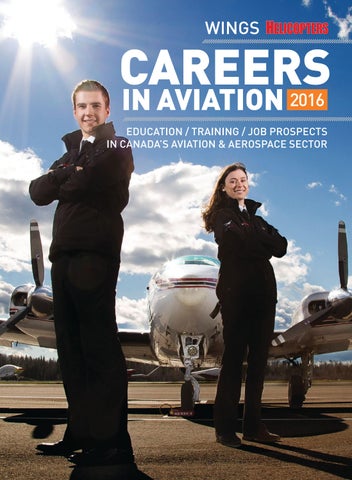
Erin Grant, Bachelor of Aviation Technology Graduate (2013), now First Officer Jazz Aviation LP
Seneca and Jazz are proud partners and industry leaders. Seneca graduates are industry-ready and prepared for direct entry to a First Officer Pilot position through the Jazz Seneca Cadet program.
Find out more about this unique program. senecacollege.ca/aviation
CIA2016
STARTING POINT:
HEAD TO YOUR LOCAL AIRPORT
he 2016 edition of Wings and Helicopters’ Careers in Aviation supplement begins at the local airport – and it doesn’t matter where. Airports tie together parts (or all) of Canada’s aviation activities from flight schools to destination points for major airlines, corporate jets and smaller airplanes and helicopters. Many aviationrelated companies are located either on airport grounds, or surround airports in nearby clusters. Airports are transit zones for the men and women who operate the airplanes, and are the vital link to an even larger community of professionals who support the industry by designing, building, repairing and maintaining aircraft, teaching students how to fly, preparing airplanes for flight, guiding them into the sky and bringing them safely back to earth. They are hubs where trainers cross paths with technicians, ramp agents hand off fully serviced airplanes to pilots, and captains of corporate jets meet captains of business at the local fixed-base operator (FBO). It is where everybody pulls together to keep one of Canada’s most technology-driven and fast-paced industries moving, including in the offices of the airport itself. Airports are where a new generation of pilots, maintenance specialists and aviation support staff will first be bitten by the aviation bug, with many using the terminal buildings, training schools and hangars as a resource to map out a career. Wings and Helicopters Careers in Aviation 2016, is a one-stop resource to help you focus on an exciting career in aviation or aerospace. It contains brief descriptions of several leading aviation and aerospace sectors, as well as valuable information on education and training. The country’s
T
WWW.WINGSMAGAZINE.COM
flight schools, colleges and universities offer excellent programs to help chart a course along one of the hundreds of career paths available, whether in the air, on the ground, in air traffic control or with one of the major original equipment manufacturers (OEMs) or maintenance repair and overhaul (MRO) organizations. The listings are intended as an introductory snapshot of the types of flight schools, colleges and universities that are available. It is by no means a comprehensive list, and not every school or facility is listed. The best advice is to use this guide as a starting point for your research. The 2016 edition of Careers in Aviation is presented in three sections: 1. Flying the Aircraft (including flight schools and flight colleges) 2. Designing, building and maintaining the aircraft (including maintenance colleges and universities that offer aviation programs) 3. Supporting the aircraft, which is an introduction to careers in airport operations, air traffic control and flight dispatch. An emerging and fast-growing segment of aviation that is unlikely to be found at an airport – at least not airside – and was not previously included in Careers in Aviation – is Unmanned Aerial Vehicles (UAVs) or drones. Demand for drones has outstripped all projections, and not just among hobbyists. Governments and businesses have realized that small, remotecontrolled aircraft can take on some of the functions of traditional aircraft at a fraction of the cost. This trend will continue along with the need for greater regulation of how and where drones can be operated. For the first time, Careers in Aviation highlights several schools that offer courses on
THE NAME GAME Key aviation and aerospace associations to help you in your career search • AéroMontréal www.aeromontreal.ca/capacitedinnovation-en/ • Aerospace Industries of Canada www.aiac.ca/ • Air Transport Association of Canada www.atac.ca/web/en/ • Air Line Pilots Association www.alpa.org/ • AME Canada www.amecanada.ca/en/about/ about-ame-canada.html • Aviation Alberta www.aviationalberta.com • B.C. Aviation Council www.bcaviationcouncil.org/about-thebcac/ • Canadian Business Aviation Association www.cbaa-acaa.ca/ • Canadian Council for Aviation and Aerospace www.avaerocouncil.ca/ • Canadian Owners and Pilots Association www.copanational.org/ • National Airlines Council of Canada www.airlinecouncil.ca/ • Helicopter Association of Canada www.h-a-c.ca
operating UAVs in the flight school listings. Again, there are many programs just emerging so treat this guide as a jumping off point for your research. As a research document, Careers in Aviation 2016 is an excellent starting point for all aspects of this incredible industry. January/February 2016 | WINGS C3
CIA2016
[CAREERS IN AVIATION EXPOS]
MDA's Natalie Panek, a rocket scientist (yes, for real) wowed the attendees at the CIA Expo last year. "Career events like these are so important to the development of young people," she said. "It is a great opportunity to learn from industry experts and network with aviation and aerospace leaders.
MEET THE EXPERTS
WINGS AND HELICOPTERS CIA EVENTS HELP YOU LEARN Getting a chance to rub shoulders with some of the nation’s top aviation and aerospace leaders is an invaluable experience for anyone interested in a career in aviation or aerospace. And that’s precisely what happens at Wings and Helicopters Careers in Aviation (CIA) Expos. The CIA program started three years ago with our inaugural event in Toronto and has grown to feature two exciting events in both Toronto and Calgary. This year’s
C4 WINGS | January/February 2016
events will be even more significant with the addition of two major sponsors (Porter Airlines and WestJet) and a pair of outstanding venues: April 9 at Porter’s hangar at Toronto’s Billy Bishop Airport, and May 14 at the WestJet Campus in Calgary. For more information on dates, planning and program updates go to www.careersinaviation.ca Designed as a live version of the Careers in Aviation print guide that polybags with
the January/February issues of Wings and Helicopters, the CIA events present a tremendous opportunity for students interested in aviation and aerospace careers to rub shoulders with industry leaders from a variety of sectors. Special presentations and panel sessions cover a broad spectrum of pertinent topics including flight operations/pilots; varied aviation professions such as air navigation, TSB investigation, business operations, what it’s like to be a flight attendant, the life of an aviation museum curator and more; aircraft maintenance and engineering/aircraft completions; and what information to ask aviation educators/professionals at the many flight schools, colleges and universities that dot the nation. “Events like this are so valuable to young people interested in this line of work,” said Glen Lynch, president and CEO of GAL Aerospace, one of last year’s panellists in Toronto. “The CIA events are invaluable in providing young people with the tools they need in making appropriate career choices – and all of it is in one room on one day.” Lynch was just one of several key speakers that participated last year, an impressive roster that included aerospace and aviation leaders from a broad cross section of industry sectors on both the rotary- and fixed-wing sides of the equation. For more information on the CIA Expos: youtube.com/watch?v=9qbsosGPoJQ
WWW.WINGSMAGAZINE.COM
FASTER ON LESS FUEL. THAT’S HOW WE ROLL. For the 2016 PC-12 NG, outstanding performance becomes even more exceptional. We began by adding a custom Hartzell composite five-blade propeller, and then made smart improvements to the aerodynamics. The result is pure Pilatus. A new top speed of 285 knots. Faster climb to altitude. Shorter take-off distance. But with no extra fuel burn. And an even quieter, more relaxing cabin. That’s how you roll into 2016.
Stan Kuliavas, Vice President of Sales | skuliavas@levaero.com | 1.844.538.2376
CIA2016
PART I. FLYING THE AIRCRAFT ONE IN A MILLION
OPPORTUNITIES ABOUND FOR BOTH ROTARY AND FIXED WING PILOTS
G
lobal aviation is going to need more than one million new pilots and technicians over the next 20 years, according to the Boeing Airplane Company’s 2015 market outlook. It is a huge growth number, intended just to keep pace with expanding airline fleets and flight schedules. North America is expected to add 95,000 pilots and 113,000 technicians by 2034. This is good news for students gearing up for their first “discovery flight” and graduates just beginning the steep climb up the ladder to the cherished left-hand seat, or the authority to clear a multi-million dollar
C6 WINGS | January/February 2016
jetliner for takeoff. According to the Boeing forecast, the Asian Pacific market will need 464,000 new pilots and technicians – more than four in 10 new hires – over the same period, pointing to the global growth of aviation and aerospace, and pointing to the number of international opportunities available to well-trained Canadian graduates whose passion for airplanes and flight includes a healthy dose of wanderlust. Still, these numbers fill in one small part of the employment picture. For every new flight deck seat or maintenance position added, there are many existing positions that need to be filled as pilots and technicians retire, and the aviation support
industry creates even more high-tech career opportunities. And not just with the airlines. Canadian airplane and helicopter pilots land military aircraft deep into the world’s troubles spots, test fly new and cutting edge equipment, keep the country’s resource and exploration sectors moving, navigate the challenging waters off the coast of British Columbia in a floatplane, fight forest fires, evacuate remote communities and take the controls of a corporate jet every inch as complex as the most sophisticated airliner. For new graduates, Canada’s diverse aviation industry means there are more opportunities to tie flight to individual passions than almost anywhere else in the world. Here’s something important to remember: whether the aviation industry is coping with a skills shortage in specific sectors, keeping up with attrition or accommodating growth, it may be a numbers game, but this is no crapshoot. Aviation remains a highly technical and safety-driven industry that places experience and the right skills set for the mission ahead of all else. Then there is the ladder: most pilots work toward the 1,500 hours flying time WWW.WINGSMAGAZINE.COM
The Skills You Need – THE SCHOOL YOU WANT
At Waterloo Wellington Flight Centre we are dedicated to collaborative and meaningful relationships with our students and clients. By working with the University of Waterloo and Conestoga College, we enable our students to earn a degree or diploma in combination with professional training. This commitment to excellence gives our graduates a competitive edge when they enter the workforce. Developing innovative graduates and IXWXUH LQGXVWU\ OHDGHUV Ȃ ȵ\ ZLWK XV today! wwfc.ca – 1-877-359-9932
Waterloo Wellington Flight Centre Professional programs are approved as vacational programs under the Private Career Colleges Act, 2005 (PC#105919)
photo courtesy of Bombardier
Make your dream of becoming an airline pilot a reality!
Exceptional Training, Excellent Facilities, Energized Environment. Braampt Br pton on Fliligh ghtt Coll gh Colllleg Co egge ((B BFC BFC) FC C) iss rreec ecog og zeed ass one of thhe to ognize topp fli pfligh ghht ttrrai raiinniing ng sch chooolss in Can Canad adda. aW Wee ar aree prrou o d too innttrroodu odu ducee the new w IA ATPL ppro AT rogr g am gr m dessiggne ned ssppec ecifi ecifi ificaallly to t prov pr ovid idde st stud uden ennts t witithh th thee skil skki ls req equiireed byy tod toddaayy’ss airi liline nes. ne s..
Inte In t gr te grat ated e A ed Air irliline n Tra ne ans n port Pillot o Licen icen ic e cee - IAT ATPL PLL 16 6--mo on ntth pr p og gra ram m • Fo Focu cuse sedd on adv dvan ance cedd ai ce airlrlin inee op in ope per erat erat atio ionnal knnow io o le ledg dgge • Mu M ltlti-i-cr crrew flflig igght eexp xper erie iieencce in a Q Q40 4 0 si 40 s mu mula laatoor • In Incl clud udes es ttra rain inin ingg by b iind ndus usstr ustr t y ex expe peert rtss fr f om m AeroC eroC er o ou ours rsse • Po Pote tent ntia iall caade dett pl plac acem em men entt opppo port rttuunnitie ittiiees
For More Information: Call 905-838-1400 ext 248 career@bramfly.com bramptonflightcentre.com
Callll ffor Ca orr m mor oree in info form rm mat atio ioon on ouurr dip iplo loma lo ma and ddeg egre eg reee pr re prog oggraams ms.. A B At BFC FC C, we aare ree ded e iccat a ed to pprrod oduc ucee qu uc qual alifi al ified ifi ed pili ot ots, s job s, ob-r -rea eady ea dy andd fam miillia i rw wiithh cur urre reent indu in duust s ryy exp xpec ecta taatition on. on
WWW.WINGSMAGAZINE.COM
January/February 2016 | WINGS C7
CIA2016
[PART I. FLYING THE AIRCRAFT]
necessary for an Airline Transport Pilot Licence, which means there is a lot of time to fill from the less than 200 hours that the average flying school student graduates with. Entry-level jobs at this stage would include flight instructor, air taxi pilot or general aviation pilot as a recent graduate builds up time. For helicopter pilots, there is a similar gap between the 100 flying hours they will graduate with to the 1,000 plus hours many operators are on the hunt for. Career-minded rotor rookies bridging the "900-hour gap” are likely to travel large-distances for short-term jobs, low pay and long stints away from home. Even with these hardships, helicopter pilots are less likely to swap the “hands-on” flying for a fixed wing airplane. Ultimately, flying is also a lifestyle choice, especially here in Canada with so many options. LEARNING TO PICK A FLIGHT SCHOOL COMES FIRST Make no mistake: learning to fly is expensive, so matching a flight school to a potential career as a professional pilot will help reduce the margin for error of staring out on the wrong foot, and may even lower the cost of training overall. This is because Canada’s aviation industry is so diverse, with so many varying job opportunities in both airplanes and helicopters. Canada also has many excellent flying schools and colleges, many of which specialize in specific types of flying. Floatplanes versus a private jet, or turbinepowered rather than piston-driven helicopters, are two extreme examples. At the very least, picking the right school will help students build up the necessary hours while sticking to a budget. For example, airplanes rent by the hour. Learning to fly in uncontrolled airspace will reduce the amount of time spent on the ground taxiing or idling for takeoff. But students who want to fly for an airline
Train in the heart of Canada Apprenticeship Manitoba and Red River College offer the country’s only Transport Canadaapproved Aircraft Maintenance Engineer (AME) Apprenticeship program.
Find out more about the AME program as well as several other highly specialized aviation programs offered through Red River College at:
rrc.ca/stevenson
THE DIFFERENCE IS HERE C8 WINGS | January/February 2016
also need to build up the experience of slotting in and out of a controlled airport. Likewise, pre-paying for lessons in “block-time” can reduce costs, but students should be wary of flight schools that insist on covering the cost of the full course upfront. A good plan is to start compiling a list of potential schools and visit as many as you can. Transport Canada has a helpful webpage, How to Select a Flying School (https://www.tc.gc.ca/eng/civilaviation/standards/general-flttrain-selectftu-menu-3410.htm) to help you get started. If you can, visit as many schools on your list as possible. Meet the flight instructors and students and do not be nervous about engaging them in questions about the school such as its approach to training, how student records are maintained and its success rate. If you have little or no aviation experience, selecting a flying school can be overwhelming and is best not done on impulse, Transport Canada cautions. Canada’s aviation regulator does not rank flight schools or flying colleges, but there are specific steps a student should take to make the right determination. Start by plotting out a career path, which is not to say there can’t be a detour or two along the way: a switch from airplanes to helicopters, for example. Industry professionals tend to agree that when picking the right flight school or graduating up to a flight college (see below), be prepared to ask a lot of questions. Many factors should go into selecting a flight school and program, including location of the school and condition of the facilities, accessibility of the instructors, the number and types of training aircraft available and the quality of maintenance. An unwritten industry rule is one training aircraft for every four- or five full-time students, although that ratio changes with part-timers. These airplanes clock a lot of hours and are often put through tough paces. Maintenance is an important consideration for both safety and scheduling; who is on the hook financially if maintenance problems (or weather) cancel a flying lesson? Flight school is divided between hands-on airplane training and ground school, where students learn such things as the principles of flight, pilot decision-making, navigation, etc. It might not be the sexist part of learning to fly, but it is essential and a school’s approach to ground school should not be overlooked. Nor should other operational issues such as: does the school offer progressive flight checks to monitor a student’s progress; how are flight lessons scheduled; what is the insurance coverage of a student pilot (how does the deductible work in case of an accident); and who is responsible for keeping a student’s flight records? Detailed records are a passport to that first job. Cost will always be a determining factor. Most flight schools in Canada are cost competitive, but the final bill will depend on what you want to get out of your training. Most schools are “pay as you go” and some offer financing or have links to financial institutions that offer loans for flight training. And don’t forget to factor in transport, accommodation and meals when assessing the cost of learning how to fly. Once a flight school has been selected, it is up to the student to secure a written agreement outlining all costs and payment procedures.
CONSIDER THE MILITARY OPTION
Flying for the Royal Canadian Air Force (RCAF) is one of the most demanding careers in aviation, including fighter pilots, search and rescue, military helicopters and flying heavy-lift transports into some of the world’s toughest airports. With the right background, the RCAF will train students with no previous flight school experience and shape them into sought after candidates for a career in civil aviation after military service has ended.
WWW.WINGSMAGAZINE.COM
Train in the heart of Canada, work anywhere in the world! Apprenticeship Manitoba, in cooperation with Red River College’s Stevenson Campus in Southport, offers the only Transport Canadaapproved Aircraft Maintenance Engineer (AME) Apprenticeship program. Designed for those already working in the aircraft maintenance field in Canada, this 36-week (nine weeks per year) government-subsidized program fulfils Transport Canada’s basic training requirement for an AME licence, which is used to certify many aircraft operated around the world.
Learn more at rrc.ca/amj
THE DIFFERENCE IS HERE
CIA2016
[PART I. FLYING THE AIRCRAFT]
FLIGHT SCHOOLS BRITISH COLUMBIA Canadian Flight Centre | Boundary Bay & Kamloops B.C. Canadian Flight Centre (CFC) opened in 1979 at B.C.’s Boundary Bay Airport, near Vancouver, and became one of the first flight schools to specialize in instrument flying and other advanced training. CFC has trained pilots from around the world and established a second training school at Kamloops Airport in 2012. CFC offers flight training for recreational, private and commercial licences. In addition, pilots can obtain a night rating, multi-engine rating, instrument rating or instructor rating. For students looking to sharpen their flying skills, tail wheel and aerobatic training is one of CFC’s specialties. Kamloops proximity to the mountains also allows pilots the opportunity for mountain checkouts. Equipment: Citabria, Cessna 152, Cessna 172, Piper Cherokee, Piper Tomahawk, Piper Warrior, Super Decathlon and, King Air C90, Piper Seneca III and Piper V twin-engines. Learn more: www.cfc.aero
Coastal Pacific Aviation | Abbotsford International Airport, Abbotsford, B.C. Coastal Pacific Aviation (CPA) started operations in 1973 and now has an experienced staff of instructors training approximately 100 students. CPA’s main business is a University Aviation Program in partnership with the University of the Fraser Valley. Offerings include a one- and twoyear Diploma, or a choice of a four-year Business (Aviation) Degree, or a General Studies Degree. CPA also offers non-university training for students who wish to complete their career flight training in a fast paced year-long program or a selfpaced flying program for fun. CPA teaches to an ATPL level and students get added benefits such as Navajo, King Air and Boeing simulator flying experience. To discover if you have what it takes to be an airline pilot, CPA offers an introductory simulated flight on its Boeing 747 simulator or in a Cessna 172. CPA also offers career counselling for potential students. Equipment: 11 Cessna 172s, three Piper PA-30s and six flight simulators. CP Advanced Flight operates a Beech King Air and Boeing 747 Classic flight simulators. Learn more: www.coastalpacific.com
Chinook Helicopters | Abbotsford, B.C. Chinook Helicopters began training operations in 1982 at the Abbotsford Airport. The company provides a full spectrum of basic and specialized advanced flight and ground training. Chinook’s 22,000 square foot, state-of-the-art training facility includes a large classroom for ground school lectures and rooms with PC access for private study. The facility also provides all necessary services to keep the fleet operational. The training program includes simulator time, of which two are available for student use. Sim 1 is free for students to use anytime, but only accumulates training hours with an instructor present. As for hands-on flying, the Abbotsford area is ideal for yearround helicopter training. Chinook utilizes the expansive Fraser Valley for all initial flight exercises, and the Coastal Mountain Range for intermediate and advanced exercises. Due to the extensive commercial helicopter activity in southwestern British Columbia, most approaches and landings are to actual industry helipads. Equipment: Three Bell 206B JetRangers, one Bell 47 and one Robinson R44 Raven II. Learn more: www.chinookhelicopters. com C10 WINGS | January/February 2016
the energy, mining, agriculture and forestry sectors. The helicopter flight training school offers a comprehensive pilot training program. Training in the Okanagan area provides a variety of terrain and weather that exposes a student to new challenges while under the supervision of a skilled instructor. The dynamic and challenging environment includes low-lying open areas used for basic training as well as for emergency and advanced exercises, heavily forested areas throughout a wide variation of elevation changes and mountainous terrain with peaks up to 9,000 feet. The area also includes several uncontrolled airports in close proximity to Kelowna, used for crosscountry navigation, flight training, radio and emergency procedures. The program and environment enable students to acquire the skills to be a well-trained commercial helicopter pilot. The flight school has only six to eight students per class, with not more than three to four students per instructor to maximize individual attention for each student. Okanagan Mountain Helicopters is the only helicopter training school in Western Canada to offer a realistic bush camp experience in the curriculum, including remote, rustic accommodations at the foot of Monashee Mountains, mountain work at 9,000 feet, hover exit training, winter operations and fueling from barrels. Equipment: Robinson R22, Robinson R44, Bell 206 and a FRASCA 131 flight simulator. Learn more: www.okhelicopters.com
Pacific Sky Aviation | Victoria, B.C. Glacier Air | Squamish Municipal Airport, B.C. Glacier Air describes itself as a mountain flying adventure company, with a long history of pioneering the mountain flying experience along the Sea-to-Sky corridor from Vancouver to Whistler. Glacier Air also specializes in mountain flight training for fixed wing and rotary aircraft. The school offers a series of courses including commercial pilot license, night rating and VFR Over-the-top (VFR OTT) rating. Given the terrain, Glacier Air also offers survival ground school, which includes studies in weather, flight techniques, effects of density altitude, emergencies, route planning and aircraft preparation, and survival gear. Fleet: Cessna 172, Cessna 206, Bell 206 JetRanger Learn more: www.glacierair.com/ mountain-flight-training/index.htm
Okanagan Mountain Helicopters | Kelowna, B.C. Okanagan Mountain Helicopters has operated a flight training school since 2003, and its students have gone onto flying careers in
Pacific Sky Aviation’s Training and Simulation division has been in the business of flight training in Victoria for more than 25 years. Pacific Sky offers a full range of flight training options, including Transport Canada licences and ratings. The company has introduced new training technologies that have greatly enhanced the training experience. The use of iPhone and iPad applications help students see how they are progressing in their skills. Flight training programs are tailored to a student’s schedule and budget. Staff members are fulltime employees and have a depth of experience in private, commercial float and Twin Otter training. Facilities are open seven days a week. Pacific Sky will extend training capabilities to include Type Initial and Recurrent courses for the Twin Otter as well as seaplane training. In 2014, Pacific Sky and Viking Air Limited contracted TRU Simulation + Training of Montreal to develop the world’s first full flight simulator to feature a seaplane configuration. The simulator will be ready for training in early 2016, and will be incorporated into a new 13,000 square foot training facility to be WWW.WINGSMAGAZINE.COM
Earn a Master’s Degree in Aviation with an additional 1 ½ years of study. Georgian’s Aviation Management program is the only 3 year program in Canada that allows students to progress directly into Griffith University’s Masters in Aviation Management degree program. With only 1 additional year of study our grads also have a choice to complete one of two Bachelor of Science degrees with Embry-Riddle Aeronautical University.
WWW.WINGSMAGAZINE.COM
January/February 2016 | WINGS C11
CIA2016 constructed adjacent to Viking’s corporate headquarters. Equipment: Pacific boasts a modern fleet of Cessna 172 aircraft and a Twin Otter SIM coming soon. Learn more: www.pacificsky.ca
Victoria Flying Club | Victoria, B.C. The Victoria Flying Club (VFC) has been training professional pilots since 1946. Located at the Victoria International Airport, one of Canada’s busiest airports, VFC has a full range of facilities to ensure that flight training sessions are enjoyable and efficient. Students train in a Second World War era hangar beside the control tower. Over the years, VFC has created a fully professional flight training operation, while still retaining a friendly clubhouse atmosphere. VFC specializes in mountain flying, an extremely important course for any pilot flying in British Columbia. In the Pacific Region, the combined effect of the great mountain system and adjacent Pacific Ocean can lead to some extremely changeable flying conditions. The Mountain Course is designed to provide a licensed pilot with a level of skill and proficiency to fly safely in mountainous terrain. VFC also offers a seaplane rating, teaching students how to evaluate tides and current, winds and waves, how to safely navigate a busy harbour, and the art of docking. VFC has partnered with the University of Victoria to offer a Diploma in Business Administration – Aviation Option program. Equipment: New standardized millennium fleet of Cessna 172S aircraft and a Cessna 172 Seaplane. Redbird FMX simulator. Learn more: www.flyvfc.com
ALBERTA Absolute Aviation | Wetaskiwin, Alta. Absolute Aviation is a flight training and aircraft maintenance facility, largely serving students from Edmonton and Central Alberta. The school offers flexible schedules to accommodate various student lifestyles. Ground school can be taken in regular weekly scheduled classes, through an accelerated pace on weekends and even online. Absolute operates out of Wetaskiwin, Alta., with close proximity and access to major airports such as Edmonton International. The school operates in both uncontrolled and controlled airspace, eliminating costly ferrying time to training areas. Equipment: Five Cessna 172Ms, one Piper Twin Comanche and one Piper Aerostar. Learn more: www.absoluteaviation.ca
Canadian Centre for Unmanned Vehicle Systems | Medicine Hat, Alta. The Canadian Centre for Unmanned Vehicle Systems (CCUVS) is a not-for-profit company whose purpose is to facilitate C12 WINGS | January/February 2016
[PART I. FLYING THE AIRCRAFT] sustained profitable growth in the Canadian civil and commercial unmanned systems sector. CCUVS offers a 1.5 day condensed Unmanned Aerial Systems (UAS) ground school course to both civil and commercial operators, covering a range of topics including, aerodynamics, air law and regulations, weather, basic UAS 101, and aviation chart and flight supplements. Students also receive instruction for an Industry Canada Restricted Radio Operators License (Air). Upon the successful completion of the radio exam, students will be able to operate and monitor aviation frequencies. CCUVS also offers UAS training in Ontario and B.C. Learn more: www.ccuvs.com/
Mountain View Helicopters | Springbank, Alta. Mountain View Helicopters (MVH) has been training pilots for commercial or private helicopter licences for more than 15 years. The school also provides advanced and recurrent training for pilots working in western Canada. The training program includes basic training and a concentration of advanced skills necessary after receiving a commercial license. Courses are designed to provide students with a competitive advantage by training in the skills specifically sought by operators. The training facility is located near Calgary International Airport, providing several advantages such as exceptional flying weather found on the prairies, close proximity to the mountains for use as a valuable training tool and the experience gained through frequent contact with air traffic controllers operating out of one of Canada’s busiest airports. Equipment: Robinson R22 Beta and Beta II, Robinson R44 Raven II and a Bell 206 Jet Ranger turbine helicopter for advanced training. Learn more: www.mvheli.com
SASKATCHEWAN Mitchinson Flight Centre | Saskatoon, Sask. Since 1946, Mitchinson Flight Centre has been one of Saskatchewan’s leading flight training schools, and has a long history of guiding pilots to their desired careers in aviation. The school is located in its own hangar at the Saskatoon John G. Diefenbaker International Airport. Students learning to fly with Mitchinson train in an ATC controlled environment, providing experience for flying in larger centres, but without the traffic delays and congestion of a larger airport. Mitchinson is owned by professional airline pilots who have trained at the school and know what it takes to get ahead in today’s competitive aviation industry. The ground school classroom is comfortable and equipped with the latest
technologies, including SMART board and Apple TV. For students who need greater flexibility, Mitchinson offers ground school DVD’s. Mitchinson’s fleet of 13 aircraft are equipped with modern Garmin avionics. Fleet: Three Cessna 152s, three Cessna 172s, one Cessna 172RG, one Cessna 185 floatplane, two Cessna 182s and two Cessna 310 twin-engines. Redbird FMX flight simulator. Learn more: www.mitchinsonflyingservice.com
MANITOBA Brandon Flight Academy | Brandon, Man. Whether you want to train for a private or commercial license, Brandon Flight Academy has been placing qualified pilots in cockpits since 1936. Located at Brandon Municipal Airport, just outside of Winnipeg, Brandon Flight Academy offers onestop training in a multitude of courses. The Flight Academy offers a continuous regular ground school, recreational, private and commercial course. Night visual flight rules (VFR) and over the top and instrument ratings are also available. Statistics prove that southern Manitoba has excellent weather and terrain for conducting VFR flight training. Transport Canada written recreational, private, ultra-light and helicopter exams can also be completed at the facility. Brandon offers students a varied flight experience with light aircraft, commuter twins, military trainers, commercial jets and helicopters using the airport daily. With the practice facilities close by and no delays on the ground or in the air, students experience an efficient and educational learning environment. Learn more: www.brandonflightcentre. com
KF Defence Programs | Southport, Man. Serving as a pilot in the Royal Canadian Air Force (RCAF) is a very demanding yet rewarding career. Training to become an Air Force pilot takes place in two locations in Canada – the Canada Wings Aviation Training Centre at Southport (Portage la Prairie), Man. and Canadian Forces Base at Moose Jaw, Sask. All pilots-to-be start their training with the Primary Flight Training (PFT) program on the Grob 120A aircraft at Southport. This is roughly 20 hours of flying plus five hours on a sophisticated Flight Training Device (FTD). The program is designed to introduce candidates to military flying and training procedures as well as assessing their ability to succeed. On successful completion of PFT, student pilots proceed to Moose Jaw for the Basic Flying Training (BFT) program on the Raytheon T-6A turbo prop aircraft. WWW.WINGSMAGAZINE.COM
GREAT EDUCATION GREAT TRAINING GREAT AIRPLANES
dan.uwo.ca/undergraduate/cam
WWW.WINGSMAGAZINE.COM
www.dfclondon.com
www.diamondaircraft.ca
January/February 2016 | WINGS C13
CIA2016 BFT is approximately 70 hours of flying and 30 hours of simulation. On successful completion of BFT, the student pilots are streamed into jet, multi-engine or rotary wing programs. Multi-engine and rotary wing candidates return to Canada Wings for advanced flight training on their respective aircraft, either the Beechcraft C90B or the Bell 206 and the Bell 412. The training facility operates in the wide open airspace west of Winnipeg but with access to higher density air traffic as required for training. Wings employ roughly 200 personnel to provide all ground-based and simulator instruction, Grob 120A in-flight instruction, administrative support including housing and feeding, all aircraft maintenance and repair as well as all services associated with the operation and maintenance of the airfield. RCAF pilots perform all in-flight instruction on the multi-engine and rotary wing aircraft. Equipment: A fleet of 39 fixed- and rotary-wing aircraft consisting of Grob G120A and Beech King Air C-90 aircraft, and Bell 206 and 412 helicopters. www.kfaero.ca/ Learn more: aerospace-and-defence-programs/ military-flight-training
ONTARIO Brampton Flight Centre | BramptonCaledon Airport, Ont. The Brampton Flight Centre (BFC) has been conducting flight training since 1946. Located just northwest of Toronto’s Pearson International Airport, BFC teaches students to fly in a variety of airspace classifications, experiencing both controlled and uncontrolled environments. BFC is owned and operated by the Brampton Flying Club and owns its airport. With a staff of more than 30 instructors, BFC offers a broad base of courses from recreational flying up to commercial career starters. The centre has a tie-in with Sheridan College’s Bachelor of Business in Global Business Management, a strong fit for an ambitious professional pilot. Equipment: Cessna 172 and Piper Seminole aircraft. Learn more: www.bramptonflihtcentre. com
Diamond Flight Centre | London, Ont. The Diamond family of aircraft are easy to learn to fly, have an excellent safety record in the industry and utilize the latest technology for students to get the most out of their training. The Diamond Flight Centre (DFC) in London is part of a network of Diamond flight training schools in North America, and provides high-quality flight training using Diamond aircraft and Diamond-specific flight training simulators. DFC London is located at the London C14 WINGS | January/February 2016
[PART I. FLYING THE AIRCRAFT] International Airport. The airport is busy enough that students acquire experience with traffic, yet is generally quiet enough so that students can practice in a relaxed atmosphere, without long waits for clearance. Equipment: Diamond C1, Diamond DA40 and Diamond DA42 aircraft. DA42 FTD Level 5, CR12 FTD Level 2, ATD C1 Glass Cockpit, ATD DA40 KAP140 Autopilot and ATD DA40 GFC700 Autopilot. Learn more: www.dfclondon.com
Great Lakes Helicopter Flight Training School | Waterloo, Ont. Great Lakes Helicopters is an Ontario Private Career College Flight School offering helicopter flight training. Its operation is based at the Region of Waterloo International Airport, close to Toronto and is considered one of the best training airports in Canada. Great Lakes Helicopter offers year-round training for Commercial and Private Helicopter licences. The school also offers specialty training programs and courses, on the ground and in the air. Great Lakes Helicopters offers a two-year Commercial Helicopter Pilot General Arts and Science Diploma in collaboration with Conestoga College. Students in this program will take classes at the college and flight school. Graduates will acquire a commercial helicopter pilot’s licence as well as a diploma in General Arts and Science. Equipment: Robinson R22, R44 and Bell 206B Jet Ranger aircraft. Learn more: www.greatlakeshelicopter.ca
Helicopters Canada | North Bay, Ont. Helicopters Canada trains students from across the country and around the world from its training facility at Jack Garland Airport in North Bay. Just minutes north of the airport are heavily forested areas that contain multitudes of lakes and rivers, providing the ideal location for helicopter training to prepare a student pilot for real life helicopter industry experiences. Helicopters Canada offers a wide range of flight training courses, and its flexible start dates accommodate all students’ requirements. The school’s three-hour intro course is designed for individuals who are seriously interested in choosing the career path of a helicopter pilot. Equipment: Robinson R22 and R44 helicopters, and the Bell Jet Ranger and Long Ranger turbines. Learn more: www.helicopterscanada.com
Ottawa Aviation Services | Ottawa Ottawa Aviation Services (OAS) is a professional flight training and maintenance operation based out of Ottawa International Airport. OAS provides aviation professionals and enthusiasts with aviation services based on the values of the “golden
age” of flight. The school specializes in designing customized, pay-as-you-go flight training programs that accommodate each student’s pace. The OAS Pilot Assessment Centre helps to assess pilot skills and aptitudes, fine tune training and avoid expensive failures. The assessment tool provides peace of mind for parents, candidates, pilots, flight training and commercial operators. With the ability to assess individual aptitude for flying, clients can now count on a program tailored to the results of their individual tests. Equipment: A mixed fleet of Cessna 172, Diamond DA-20, Diamond DA-40, Grub G115C (aerobatic) and Piper Seneca II twin-engine aircraft. Learn more: www.ottawaaviationservices.com
Spectrum Airways | Burlington, Ont. Spectrum Airways has been teaching students how to fly for over 40 years. Training programs include the Private Pilot License, the Commercial Pilot Licence, Night Rating, Multi-Engine Rating, Instrument Rating/Multi Instrument Rating and Instructor Rating. The training facility is at the heart of Burlington Executive Airport, one of the busiest airparks in Ontario. Burlington Executive Airport averages 30 flights on weekdays and many more on weekends, and has become an exciting centre for general aviation enthusiasts. Spectrum also offers advanced training in specifics such as “tail wheel” training to help a pilot dramatically improve stick and rudder skills, and training for pilots wishing to learn about glass cockpit procedures. Glass cockpits are not difficult, but they are complex and require specific knowledge to operate safely and efficiently. Spectrum is registered as a private career college. Equipment: Fleet of 18 aircraft; the Cessna 152, Cessna 172, Cessna 172SP featuring a Garmin G1000 glass cockpit, Piper Warrior, Piper Seneca twin-engine and Piper Super Cub. Redbird FMX 1000 and PFC Cirrus 2 Flight simulators. Learn more: www.spectrumairways.com
St. Thomas Flight Centre | St. Thomas, Ont. Established in 1996, the St. Thomas Flight Centre offers flight training from the Recreational Pilot Permit through to Commercial Pilot Licence and Multi-Engine Instrument Ratings. Whether a student is interested in flying recreationally or chooses aviation as a career, the Flight Centre has a flight training program customized to suite budgets and schedules. The school operates out of St. Thomas Airport in an uncongested flight training environment. School offices are located in the main terminal building and ground school classes are held on site. The Flight Centre WWW.WINGSMAGAZINE.COM
d u o r p A f o r o s n spo n i s r e e Car n! o i t a i v A
38 80//1 80 15.1 12 2..1 18 8.jj
Aircraft Maintenance Engineering Next intake is Sept 2016 at our Dawson Creek Campus
Apply online Afford dabble student residences available! a Affordable
nlc.bc.ca
NLC’s 15-month Aircraft Maintenance Engineering program is designed to train individuals wanting to work in the aerospace industry. Gradua Graduates receive the full training component and 1.5 years of the ffour-year experience component required for an AME licence, category M1 or M2. Apply through the Apply BC link at nlc.bc.ca studentrecruiter@nlc.bc.ca for more information. or email stud
1-866-463-6652
CIA2016 has been granted Private Career College status by the Ontario Ministry of Training, Colleges and Universities, providing complete training of Commercial Pilots and Flight Instructors. Equipment: Two Cessna 152 IIs, three 172 Skyhawk’s and one Piper PA-23. Learn more: www.learntofly.on.ca
Toronto Airways | Toronto Toronto Airways has been training pilots since 1963, and offers both full-time and part-time programs. Students train out of Oshawa and Buttonville Airport, a busy multi-service general aviation airport owned by Toronto Airways. The flight training department has 50 instructors and offers eight distinct aviation-training programs from learning to fly for fun to launching a pilot career with a professional pilot program. Toronto Airways has trained more than 10,000 plots since 1963, and has invested in state-of-the-art, full motion flight training devices (FTDs). Equipment: A fleet of 45 training aircraft and five FTDs. Learn more: www.torontoairways.com
Waterloo Wellington Flight Centre | Waterloo, Ont. The Waterloo Wellington Flight Centre (WWFC) is located at the Region of Waterloo International Airport and is one of the largest and most experienced flight training centres in Canada. WWFC has more than 20 flight instructors on staff. For potential students who would like to first experience piloting an aircraft, WWFC offers a special “test the skies,” 30-minute introductory flight in a Cessna 152 or 172 with one of the centre’s qualified instructors. WWFC is partnered with Conestoga College and the University of Waterloo to offer diploma and degree programs. WWFC also has a well-developed network among entry-level aviation employers across the country. The centre recently launched a UAV course. This course is designed to introduce people to the range of scope of the two categories of UAV’s (under two kg or from two-25 kg). It will provide participants with sufficient knowledge and resources to operate safety and comply with Transport Canada requirements. Equipment: Cessna 152, Cessna 172N, 172S and 172RG Cutlass, Diamond DA40 and Piper PA44 Seminole. Learn more: www.wwfc.ca
QUEBEC CQFA Aviation Industry Training | Montreal The CQFA maintains the skills of professionals in aviation through more than 50 courses, including a light unmanned aerial vehicle (UAV) professional pilot course, C16 WINGS | January/February 2016
[PART I. FLYING THE AIRCRAFT] which has been offered since 2007. The 140-hour, light UAV training is given by professional UAV operators and covers the regulations, aerodynamics, flight discipline and human factors for operating a light UAV aircraft. The course covers all phases of a drone mission within the framework of a commercial or public safety operation. All the theory necessary for the operation of a light drone for the purpose of a commercial or public security flight is presented prior to practical flight. The hours of supervised practise are followed by solo flying hours and culminate with a practical flight test. The student will develop the skill and ability for planning, operational risk management and the preparation and execution of actual missions. Learn more: http://www.cqfa.ca/pro/ index.php?id=29&lng=An
Laurentide Aviation | Greater Montreal Area, Que. Laurentide Aviation is a family business that has been providing professional flight training since 1946. Based at Les Cedres Aerodrome, approximately 25 kilometres west of Montreal, Laurentide offers bilingual inflight and ground school instruction to suit any style of learning. The flight school is located at an uncontrolled airport, allowing students to get in the air and into the practice area quickly, reducing the cost and amount of time spent on the ground taxing and waiting for clearance at busy controlled airports. Laurentide is located close to two major Canadian airports, including Montreal/Trudeau to ensure that students receive experience in controlled air space. The large classroom provides an excellent learning environment, including hands on teaching aids and visuals. Laurentide is a member of the Air Transport Association of Canada. Equipment: Fleet of seven single-engine aircraft; five Cessna 152s, one Cessna 172Ps and a Grumman GA-7 Cougar. Learn more: www.laurentideaviation. com/index.php?lg=en
Quebec City Flight School | Quebec City Quebec City Flight School is a Canadian Helicopters’ flight school offering training to students and company pilots. Canadian Helicopters is Canada’s largest helicopter transport services company. Quebec City Flight School is recognized around the world as a top helicopter flight training centre. The school offers introductory and recurrent training. Instructors are operationally experienced in a broad variety of fields, including air ambulance, offshore, mining, firefighting, aerial construction and spraying. Instruction can be provided in French and English.
Equipment: Robinson R22, R44, Bell 206 JetRanger and Eurocopter AS350 Learn more: www.canadianhelicopters. com/services/flight-training
NOVA SCOTIA Debert Flight Centre | Truro, N.S. Debert Flight Centre, part of the Truro Flying Club (TFC), operates out of one of the best facilities in Atlantic Canada for flight training. Students learn in uncontrolled airspace that is not crowded with commercial jets and other air traffic. Debert is a compact airport offering students less than five minute from flight to the training areas. Ground school is held at Debert Airport and Halifax. Equipment: Fleet of four aircraft: a Cessna 152, Cessna 172M and two Cessna 172Ss. Elite PI-135 and Premium simulators. Learn more: www.flytfc.ca
NEWFOUNDLAND GFT Aerospace | Gander, N.L. GFT Aerospace has been offering elite flight training in Canada since 1992, and prepares pilots for the real work of aviation from its state-of-the-art training facility. Located in Gander, Nfld., GFT proves to be beneficial because students experience real world weather conditions. GFT was the first flight school in Atlantic Canada approved to conduct the electronic Transport Canada written test for the private pilot license. The school offers large classrooms and individual briefing rooms for a comfortable and conducive learning environment. Ground schools utilize interactive computer programs and multimedia presentations, and examinations are conducted both electronically and on paper. GFT’s sister company, EVAS Air, is a local airline for Air Canada. Because of this, GTF has established its Career Progression Program, which is open to all students at no additional cost. The program provides students with the opportunity to advance directly into an airline position without ever leaving GTF. Several pilots with Air Canada and Air Canada Jazz provide advanced instruction and conduct flight tests at GFT Aerospace College. The experience and expertise of these active industry pilots provide students with exposure to the airline industry, while motivating them toward success. Equipment: 17 aircraft: three Cessna 150s, nine Cessna 152s, three Cessna 172s, one Cessna 172S with a G1000 glass cockpit and one Piper Seminole PA44-180 twin engine. Precision Flight Systems Modular Flight Deck Flight simulator. Learn more: http://evasair.com/gft/ WWW.WINGSMAGAZINE.COM
The unique spherical design of the Carleton University Simulator Project (CUSP).
Study Engineering at Carleton University The research-intensive Faculty of Engineering and Design at Carleton is recognized as one of Canada’s leading institutions in the study and research of engineering. Continued investment in state-of-the-art labs and research facilities provides our students with a hands-on education that has real-world application. Carleton’s comprehensive Aerospace Engineering programs emphasize the development of analytical, computational, and practical engineering and design skills. We offer a wide array of programs that are essential to the evolution of aerospace design and operation, including communications, electrical, software, and computer systems engineering.
carleton.ca/engineering-design/
CIA2016
[PART I. FLYING THE AIRCRAFT]
A STEP UP THE LADDER
FLIGHT COLLEGES BRING ADDED BENEFITS TO A PILOT LICENCE
C
anada has many top flight training schools, but in today’s competitive environment, a pilot’s license may not be enough, no matter how impressive the student. Consider flight colleges to be the finishing school for the aviation profession, where pilots build up the knowledge and specific skill sets that can put a candidate a couple of rungs further up the career ladder. Some recruiters estimate that up to 95 per cent of pilots hired by commercial operators have a college degree supporting their license. At the very least, a college diploma may accelerate the hiring process, which is why some of the larger flight schools have ties with colleges: to give students a better-rounded education. Several colleges offer in-house flight training programs. Colleges with aviation programs offer students a deeper understanding of the technical aspects of the industry and teach critical decision-making and communication skills that are essential when working with crews on the flight deck and on the ground. Flight colleges are a valuable career investment in other ways, such as for pilots who might fail a medical but want to hold onto a job in aviation as they transition out of the cockpit. Colleges with aviation programs also offer added services such as career counselling, networking and helping graduates to make the right connections to land that important first job.
BRITISH COLUMBIA British Columbia Institute of Technology | Vancouver The British Columbia Institute of Technology (BCIT) is Canada’s largest English-language aviation training school. The Institute has paired with Pacific Flying Club, one of Western Canada’s premier flight training schools to provide an opportunity for students who wish to become airlines pilots with a strong skill set of aviation industry knowledge. It is a fully integrated program that combines flight training with industry focused academic training. The BCIT School of Aviation’s Airline and Flight Operations Diploma programs is 64 weeks long and operates for four terms. It is one of C18 WINGS | January/February 2016
the fastest ways in Canada to qualify for a commercial pilot’s license while attaining a post-secondary diploma. Flight training is conducted at Pacific Sky Aviation’s flight school at Boundary Bay Airport, outside of Vancouver. Pacific Sky Aviation has a modern fleet of Cessna 172 aircraft. College courses take place at BCIT’s Aerospace and Technology campus. Learn more: www.bcit.ca
College of New Caledonia | Five B.C. locations The College of New Caledonia has played an important role in training and educating residents in northern British Columbia since 1969. The college operates an Aviation Business Diploma program in conjunction with Guardian Aerospace Holdings, a Canadian licensed flight training and air tax operator. Offered out of the college’s Vanderhoof campus, PilotPlus is designed to provide highly trained single engine VFR pilots for entry-level pilot in command positions with Canada’s northern air carriers and with similar air taxi companies operating in difficult conditions around the world. This is a program that allows students to train within the daily operations of single and multi-engine, non-jet carriers to carry out most commercial training operations in simulated air taxi conditions. The plus for employers is detailed knowledge of the business environment of small carriers, as well as capacity to act in a functional management role with those carriers when not contributing as a pilot. The diploma is granted on completion of the Private and Commercial Pilot licenses and a float training rating, as well as 12 university level business courses and one aboriginal studies course. Learn more: www.cnc.bc.ca
ALBERTA Red Deer College | Red Deer, Alta. Red Deer College (RDC) is one of Canada’s premier community colleges. RDC’s partnership with Sky Wings Aviation Academy combines a foundation in business with hands-on flight training. The college provides high-quality academics that are critical to the credibility of the Aviation
Diploma Program. This two-year course enables students to earn a certificate in Business Management while obtaining an Aviation Diploma. Flight training is provided approximately ten minutes from the RDC campus at Red Deer Regional Airport. Sky Wings Aviation Academy has been providing flight training since 1982, and operates a fleet of Cessna 172s, a twinengine Piper Seneca and Navajo. Ground training is conducted in a large, multimedia classroom. Multi-engine preparatory training is provided on an ALSIM 200 Flight Simulator. Highlights of the Aviation Diploma Program include a transcontinental flight crossing the Canadian/ U.S. border, familiarization training for a regional or national airline and crew resource management. Most RDC courses are university transferable. Learn more: www.rdc.ab.ca/programs/ aviation-certificate
SASKATCHEWAN Saskatchewan Polytechnic | Saskatoon The Saskatchewan Polytechnic is a member of Polytechnics Canada, an alliance of 11 research-intensive, industry-responsive postsecondary institutions. The Polytechnic’s Commercial Pilot program is offered in partnership with the Saskatchewan Aviation Council, a membership-based association. The Commercial Pilot diploma program provides a strong foundation in the basic principles of aviation. Students study aviation-related topics such as the theory of flight, advanced aircraft systems and flight operations, aviation business, crew resource management and cultural awareness. Flight training takes place at a student’s home flying school. Ground school classes offer a unique opportunity for students to talk one-on-one with experienced pilots and other aviation professionals, offering an inside view on finding a job, building a career and developing skills. The Polytechnic’s new ALSIM flight simulator puts students in the pilot’s seat for take-off and landing at any airport in North America. Learn more: www.saskpolytech.ca
ONTARIO Algonguin College | Ottawa Algonguin College’s Aviation Management program is a starting point to launch a career in aviation. This two-year course is designed to provide students with the knowledge and skills required to become a commercial pilot. Through a series of classroom-based courses and hands-on practical labs, students are provided the opportunity to develop the required level of proficiency. Algonguin has contracted the Ottawa Flying Club and Ottawa WWW.WINGSMAGAZINE.COM
CIA2016
[PART I. FLYING THE AIRCRAFT] Aviation Services to provide up to 250 hours of flight time experience. During the final term, students can select one of the following areas of specialization: flight instructor, advanced multi-IFR or seaplane rating. Each of these options may offer students numerous opportunities for directentry jobs with aviation employers. Learn more: www.algonguincollege. com/sat/program/aviation-managementgeneral-arts-and-science
Conestoga College | Kitchener, Ont. Conestoga pathways enable students to build on their academic achievements in order to earn a degree or additional credentials. Pathways are formed through agreement between Conestoga and partner institutions. The Aviation – General Arts and Science program is a collaboration between Conestoga and the Waterloo Wellington Flight Centre (WWFC) and Great Lakes Helicopters (GLH). Students in this program will take classes at the college’s Doon campus and flight training with WWFC or GLH, depending on whether they have chosen the fixed-wing or rotary-wing option. Training takes place at the Region of Waterloo International Airport. Graduates will receive a diploma in General Arts and Science, as well as the
pilot training to allow them to undertake the Transport Canada commercial pilot license testing. Learn more: www.wwfc.ca/fly-professional or www.greatlakeshelicopter.ca
Confederation College | Thunder Bay, Ont. The Aviation Flight Management program at Confederation College combines business, management and flight training into one unique program. The program has been running at Confederation since 1973 and is a demanding academic program with rigorous flight standards throughout the program. From “bush” type flying to IFR, the college provides students with the skills they will need to land their first entry-level aviation job. The business and management training provides students with background knowledge to form a detailed and comprehensive understanding of today’s aviation industry. The college owns and operates 19 Cessna aircraft and two advanced flight simulators at its Aviation Centre of Excellence hanger at Thunder Bay International Airport. The program prepares graduates for entry level work with a small air carrier, tourist outfitter or other positions. Learn more: www.confederationc.
on.ca/flight-mgmt
Georgian College | Barrie, Ont. The Georgian College Aviation Management program is designed to give students knowledge and hands-on experience in Aviation and Management as well as to provide co-operative work within the aviation industry. A variety of aviation courses provide students with a solid understanding of the aviation industry in Canada and around the world. Management courses are designed to give students an understanding of management practices and procedures in order to be prepared for future promotional opportunities. Georgian has contracted with Future Air to provide Flight Labs that offer practical training required by its Aviation Program students. Future Air gives students a structured foundation in an aircraft cockpit and operating within an airport environment as part of the learning process. For students who wish to further their studies, Georgian has popular University articulation agreements. Students can earn their Masters degree in Aviation Management in only three additional semesters of study either online or at Griffith University in Australia or in as little as one year, they can earn a Bachelors degree (B.Sc.) in Aeronautics or
Come fly with In only two years you could be ready to start your career in aviation. As a student in Algonquin’s Aviation Management Program you’ll be spending over 250 hours in the air as you train to become a commercial airline pilot. Our Aircraft Maintenance Technician Program will start you on the path to becoming a licensed Aircraft Maintenance Engineer.
First-class graduates AVIATION MANAGEMENT PROGRAM AIRCRAFT MAINTENANCE TECHNICIAN PROGRAM
To learn more, visit our website at algonquincollege.com/aviation Algonquin College 1385 Woodroffe Avenue Ottawa, Ontario K2G 1V8
WWW.WINGSMAGAZINE.COM
As Western Canada’s largest aviation training facility, British Columbia Institute of Technology is unparalleled in replicating industry conditions. Our partnerships and education model ensure our grads are more than ready for the challenges of the dynamic aviation industry.
Explore today.
bcit.ca/aerospace January/February 2016 | WINGS C19
CIA2016
[PART I. FLYING THE AIRCRAFT]
Technical Management with Embry-Riddle Aeronautical University, the world’s largest, fully accredited university specializing in aviation and aerospace. Learn more: www.georgiancollege.ca
Sault College | Sault Ste. Marie, Ont. Sault College has been training and graduating professional pilots since 1974. Sault’s three-year Aviation Technology Flight program includes quality on-campus classroom and simulator room facilities. Students gain hands-on training with a fleet of aircraft including, nine Zlin and two Piper Seminole airplanes complemented by new state-of-the-art flight simulators, providing a realistic experiencing that closely replicates flying in one of the college’s airplanes. Each aircraft includes advanced radio navigation systems and real-time aircraft tracking systems. Individuals with previous flight training start with a modified flight training program, however, all students will be at the same level by the second year. Flight training is conducted at the Sault College hangar at the Sault Ste. Marie International Airport. Learn more: www.saultcollege.ca
Seneca College | Peterborough, Ont. Seneca College offers full-time Aviation and
Flight Technology programs, and a parttime aviation certificate. Seneca’s Bachelor of Aviation Technology program provides a rigorous aviation technology-based curriculum and the application of this theory to aviation. Students gain the skills and knowledge to operate safely in a complex aircraft, to understand the technologies and human factors that affect the successful operation of an aircraft and to assume the professional responsibility associated with being a commercial pilot. Flight training and classroom instruction for years two to four of the program are conducted at Seneca’s state-of-the-art campus in Peterborough, Ont. Campus. Seneca’s fleet consists of eight Cessna 172s, four Cessna 172 G1000 (glass cockpit), four Beechcraft Bonanza’s, two Beechcraft Barons and one Baron G1000. Students begin their flight training in the single-engine Cessna 172 and move on to the Beechcraft Bonanzas Learn more: www.senecac.on.ca/ school/aviation
NEW BRUNSWICK Moncton Flight College | Moncton, N.B. Established in 1929, the Moncton Flight College (MFC) is the oldest and one of the
largest flight schools in Canada, offering a broad range of aviation courses. MFC educates and develops aviation professionals with a state-of-the-art curriculum, highly qualified instructors and modern facilities and equipment. MFC offers a Modular Pilot Training Program that is structured to meet the needs of students wishing to extend their pilot training or complete one or more licenses or ratings at their own pace. The college offers a four-year B.Sc (Aviation) program in partnership with Mount Allison University for students wanting to obtain a university degree while preparing for a career in aviation. MFC also has a two-year Diploma in Aviation Technology for students fresh out of high school who may not want a university degree, as well as a one-year integrated program for those who already have significant post-secondary education or planning a career change. MFC’s fleet of 39 aircraft consists of 28 Diamond DA20-C1 Eclipses, one Cessna 172 M/N, two Cessna 172 Ss, two King Air C90Bs and six Piper Seminole PA44-180 aircraft. The college also has 16 simulators, consisting of nine Situation Awareness Trainers, three ATC810 Level 2s, two King Air 200 Level 5s, one Diamond DA40 Level 5 and one Elite Level 2. Learn more: www.mfc.nb.ca
SCHOOL OF TRANSPORTATION
TAKE YOUR CAREER TO NEW HEIGHTS SAIT Polytechnic has been delivering leading-edge aviation programs for 85 years with hands-on training in one of Canada's most comprehensive training facilities, the Art Smith Aero Centre, located at the Calgary International Airport. And with a 93% employment rate, our graduates are in demand. AIRCRAFT MAINTENANCE ENGINEERS TECHNOLOGY AIRCRAFT STRUCTURES TECHNICIAN AVIONICS TECHNOLOGY
LEARN MORE
C20 WINGS | January/February 2016
sait.ca
WWW.WINGSMAGAZINE.COM
Aviation Career on hold
private pilot
as low as $499
Starter Package
+hst
includes: Private Pilot Ground School, Ground School Kit, Discovery Flight & 1 Hour in the Red Bird Flight Simulator
5296 Bell School Line, Bulrington ON L7M 0P1
(905) 336-4010 www.spectrumairways.com FLIGHT TRAINING & CAREER COLLEGE
Follow Us!
CIA2016
PART II. DESIGNING, BUILDING AND MAINTAINING THE AIRCRAFT CANADA REMAINS A WORLD LEADER IN AEROSPACE MANUFACTURING AND MRO
W
hile Canada has the world’s fifth largest aerospace industry, the numbers supporting the sectors global advantage are perhaps even more impressive. According to the State of the Canadian Aerospace Industry in 2015, Canada ranked number one globally in turboprop and helicopter engine production, and civil flight simulation, second overall in business aircraft and regional aircraft production, third in general aviation production and fifth in helicopter production (for an overall ranking of number three in civil aircraft production in the world). Industry Canada and the Aerospace Industries Association of Canada (AIAC) compiled the report. The Canadian aerospace industry is supported by 76,000 direct, well-trained C22 WINGS | January/February 2016
and highly-skilled workers, and more than 100,000 indirect jobs, including a thriving maintenance, repair and overhaul (MRO) sector, which accounts for 27 per cent of aerospace activity. Central Canada continues to account for 79 per cent of aerospace manufacturing, while western Canada continues to be the country’s MRO hub, with 44 per cent of activity. Atlantic Canada has been the fastest growing region in MRO over the past five years, and accounts for 14 per cent of the sector. Qualified Aircraft Maintenance Technicians have found challenging careers in all avenues of Canada’s airline and aerospace sectors. A new generation of aircraft such as the Bombardier C Series, made of carbon composites and featuring more complex systems, will require sophisticated
skill sets and more education than ever before. Aviation technical personnel will be expected to come to the table with a strong knowledge of aircraft systems, aerodynamics and aircraft structures along with a clear understanding of the integration of components on the aircraft. In addition, the business jet sector is seeing operators invest heavily in retrofits and upgrades for their existing airplanes, especially around connectivity, boosting higher-end MRO opportunities in Canada. Aerospace manufacturing will continue to demand the best in innovation, productivity and skills development. What follows is a sample of colleges – there are more out there, so please continue your research – that offer licence courses in aircraft maintenance and avionics. Some of the colleges listed here offer programs in more than one discipline. WWW.WINGSMAGAZINE.COM
CIA2016
[PART II. DESIGNING, BUILDING AND MAINTAINING THE AIRCRAFT]
MAINTENANCE COLLEGES BRITSH COLUMBIA British Columbia Institute of Technology | Vancouver The British Columbia Institute of Technology (BCIT) Aerospace facility is Canada’s largest aerospace technology school. The institute offers accredited programs that prepare graduates for careers as Aircraft Maintenance Engineers (avionics and maintenance) and Gas Turbine/Jet Engine Technicians. BCIT’s Aviation Maintenance Technician – Avionics program consists of 68 weeks of full-time studies. Approximately 50 per cent of the day is spent on theory in a classroom setting, followed by hands-on practical training in the shops and hangar located at BCIT’s state-of-the-art Aerospace Technology Campus. The 285,000 square foot campus is located at the Vancouver International Airport, and is home to all BCIT aerospace-related programs. The facility includes a dramatic 40,000 square foot hangar for the institute’s fleet of light piston, turboprop, corporate and jet transport aircraft, including light and medium helicopters. Successful completion of the program will result in a work experience credit of 18 months of the 48 months required by Transport Canada toward obtaining an Aircraft Maintenance Engineer Category E licence. Learn more: bcit.ca/study/programs/ aerospace
individuals wanting to work in the aerospace industry. Graduates receive the full training component and 1.5 years of the four-year experience component required for an AME license. NLC’s Type Training program are field maintenance courses for specific types of helicopter airframes and engines that are Transport Canada approved. The programs meet the training required by regulation prior to exercising the privileges of the AME license to certify maintenance completed on Canadian registered, turbine powered helicopters. Learn more: www.nic.bc.ca
ALBERTA SAIT Polytechnic | Calgary SAIT Polytechnic is a member of Polytechnics Canada, a national alliance of leading research-intensive colleges and institutes of technology. The Aircraft Maintenance Technician/Engineer program covers all aspects of aircraft maintenance including general aviation, corporate, charter, transport category aircraft and helicopters. This is a two-year diploma program and all classes are scheduled at the Art Smith Aero Centre for Training and Technology, located at the Calgary International Airport. Some of the courses in this program are web-based and will require students to access information from the Internet. Learn more: www.sait.ca
Northern Lights College | Dawson Creek, B.C.
SASKATCHEWAN
Northern Lights College (NLC) is B.C.’s Energy College, serving northern British Columbia. Programs at NLC are designed to provide students with the opportunity to obtain the necessary classroom education and supplement that with appropriate practicum or hands-on opportunities to make the successful transition from student to employee. NLC offers Aircraft Maintenance Engineering in the Aerospace Centre of Excellence, located on the Dawson Creek Campus. This 26,000 square foot hangar consists of several helicopters, including a Robinson R44, MD500D, AS350D, Hughes 300C, Bell 205 and 206, and six fixed-wing airplanes including, a Cessna 180, Cessna 310, Piper Aztec 250, King Air B90 and British Aerospace JetStream 31. NLC offers two types of AME training. The 15-month Basic Training program is designed to train
Saskatchewan Indian Institute of Technologies | Saskatoon
WWW.WINGSMAGAZINE.COM
The Saskatchewan Indian Institute of Technologies (SIIT) is governed by Saskatchewan’s First Nation, but also operates within the Saskatchewan provincial postsecondary system. Students enrolled in the Aircraft Maintenance Engineer Training Program will benefit from SIIT’s Boeing Aerospace, Rockwell Collins and Lockheed Martin aerospace and defense companies. Students will develop the knowledge and skills required to complete the approved training necessary to be eligible to apply as an apprentice in the aircraft maintenance industry. Graduates will be credited with 18 months toward the current 48 months of industry experience required to obtain a licence. Learn more: www.siit.sk.ca/aircraftmaintenance-engineer
MANITOBA Red River College | Winnipeg Red River College (RRC) offers training in all aspects of the aviation and aerospace sector. RRC’s Aircraft Maintenance Engineer program is designed to develop the knowledge and skills in maintenance of both large and small airplanes and helicopters. Aircraft Engineer Maintenance uses a combination of classroom and practical training on a fleet of fixed and rotary wing aircraft to provide the necessary foundation for entry-level positions in the aircraft maintenance industry. The diploma program is designed to develop the knowledge and skills in maintenance of both large and small airplanes and helicopters. Time is split between the study of aircraft maintenance theory and practical projects. Upon graduation, students will receive an experience credit of one month for every 100 hours of training, and will have completed all the necessary exams with the exception of the Transport Canada administered Canadian Aviation Regulations (CARs) exam. Learn more: www.rrc.ca
ONTARIO Algonquin College | Ottawa The Aviation Techniques – Aircraft Maintenance program at Algonquin College is offered in partnership with Centennial College in Toronto. Classes take place at Algonquin’s School of Advanced Technology in Ottawa. The program teaches students the knowledge and skills required to equip themselves for work in the aircraft maintenance industry. Through a series of classroom-based courses and practical labs, students in this one-year program learn to repair and maintain electrical and mechanical systems within an aircraft – hydraulics, fuels, environmental systems, engines, surface controls and undercarriage systems, and the aircraft’s frame and external skin. The curriculum also covers aviation maintenance servicing practices, and procedures and aviation regulation requirements. Graduates of the certificate program are encouraged to continue their studies in the second year at Centennial College in either the Aviation Technician – Avionics Maintenance program or the Aviation Technician – Aircraft Maintenance program. Learn more: www.algonguincollege.com
Canadore College | North Bay, Ont. Canadore has been a leader in aviation training for more than 40 years. The School of Aviation is a dedicated aviation training facility with approximately 30 employees assigned to the Aircraft Maintenance, Avionics Maintenance and Aircraft January/February 2016 | WINGS C23
CIA2016 Structural Repair programs. Courses are delivered at the college’s Aviation Campus at Jack Garland Airport. The 87,000 square foot campus includes 17,000 square feet of prime training space, and is filled to capacity with fixed and rotary wing aircraft for students to work hands-on. A New Advanced Composites, Fabrication, Repair and Test Centre is a recent addition to the campus and supports innovative technologies, applied research, materials testing opportunities and customized training programs. The college offers three basic training programs: the Aircraft Maintenance (AMT) and the Avionics Maintenance (AVN) program, and a Structural Repair (ASR) Technician program. Learn more: www.canadorecollege.ca/ programs-course/aviation-technicianaircraft-maintenance
Centennial College | Toronto The Aviation Technician Avionics Maintenance (“E” option) program at Centennial College will provide students with the knowledge and skills to launch a career as an aircraft maintenance technician. “E” category graduate technicians perform tasks and activities associated with the maintenance and repair of aircraft communication, navigation and data systems.
C24 WINGS | January/February 2016
[PART II. DESIGNING, BUILDING AND MAINTAINING THE AIRCRAFT] The program is Transport Canada accredited for experience and exam credit towards the issue of an AME licence, and is accredited by the Canadian Council of Aviation & Aerospace as meeting the national occupational standard for avionics maintenance training. Students learn highly sought after skills relating to the maintenance, repair/replacement, inspection and troubleshooting of basic electronics circuits to sophisticated avionic systems used in modern aircraft. A significant portion of time is spent on practical application in labs. Learn more: www.centennialcollege.ca/ transportation
Mohawk College | Hamilton Mohawk’s two-year program offers students an excellent balance of theoretical knowledge and practical application. Students have an opportunity to work on a variety of aircraft including a helicopter, vintage aircraft and heavy jet transports. In addition, Kelowna Flight Craft recently donated a Boeing 727-100 for the Aviation Technician program, bringing the fleet up to 13. The Mohawk program is a living laboratory that focuses on developing key skills students will need to maintain aging aircraft as well as understand rapidly changing technologies.
NOVA SCOTIA
Fanshaw College | London, Ont. Fanshaw College is one of the largest colleges in Ontario. The school’s Aviation Technician – Avionic Maintenance program covers all aspects of aircraft avionics systems used in general aviation, corporate, charter transport category aircraft and helicopters. The course provides students with the knowledge and skills needed for servicing, repair and maintenance of aircraft electrical and electronics systems. Learn more: www.fanshawec.ca
Nova Scotia Community College (NSCC) | Dartmouth, N.S. NCSS’s Aviation Institute, located at the Akerley Campus in Dartmouth, is a modern, 43,045 square foot training facility where students build their skills using the latest technology applied to real aircraft. The institute’s Aircraft Maintenance Engineer (Avionics) program provides the skills needed to service, maintain, repair, overhaul, inspect and test aircraft systems. Systems may include electrical power distribution, communication, navigation, data,
WWW.WINGSMAGAZINE.COM
CIA2016
[PART II. DESIGNING, BUILDING AND MAINTAINING THE AIRCRAFT] autopilot and various instrumentation systems. Students learn the safe use and maintenance of hand tools as well as sophisticated and specialized tools and equipment. Learn more: www.nscc.ca
PRINCE EDWARD ISLAND Holland College | Summerside, P.E.I. The Holland College Aircraft Gas Turbine Engine Repair and Overhaul Technology program works closely with P.E.I.’s growing aerospace industry. In this 10-month program, students will learn the techniques, procedures and documentation requirements necessary to perform the disassembly, inspection, repair, reassembly and testing of the turbine engines used to power today’s aircraft. The program consists of approximately 60 per cent practical work and 40 per cent theory. Hands-on, practical training is carried out on a variety of turbine engines, including the Pratt and Whitney Canada (P&WC) 100 series turbine engine used on the de Havilland Dash 8 legacy aircraft, P&WC PT6 and Rolls Royce 250 engines. Learn more: www.hollandcollege.com
NEWFOUNDLAND College of the North Atlantic | Gander, N.L. The Aviation division of the College of the North Atlantic delivers two aerospace programs at its campus in Gander, Nfld.; Aircraft Maintenance Engineering Technology and Aircraft Structural Repair Technician. The three-year Aircraft Maintenance Engineering Technology program offers training in fixed and rotary wing categories. Topics include the role of the Aircraft Maintenance Engineer as being responsible for aviation safety and airworthiness. Courses cover all aspects of aircraft maintenance for fixed and rotary wing aircraft and include safety practices, ground handling, inspection techniques, power plants, structural repair, aircraft systems and avionics. Upon completion, students are awarded a Diploma in Aircraft Maintenance Engineering Technology, along with an experience credit of 21 months. Students in the Aircraft Structural Repair Technician program are trained in the maintenance, repair and fabrication of aircraft structural components. In addition to training with wood, fabric and sheet metal materials, this program includes extensive training in modern composite materials. Upon completion, students are awarded a Certificate in Aircraft Structural Repair along with an experience credit of 10 months. Learn more: www.cna.nl.ca WWW.WINGSMAGAZINE.COM
LEADERS WANTED:
UNIVERSITIES WITH AVIATION DISCIPLINES
MARRYING PRACTICAL PRECISION WITH THEORETICAL INSIGHT TO INNOVATE AND STIMULATE GROWTH
A
$30 billion a year, exportdriven industry supporting 180,000 direct and indirect jobs – many of them highly skilled and high paying – cannot afford to coast. The world’s airlines have orders for approximately 38,000 airplanes over the next 20 years, worth almost US$6 trillion dollars. In addition, Bombardier Aerospace and Honeywell Aerospace expect between 9,000 and 9,200 business jets to be delivered over the next 10 years, valued at up to $US270 billion. It is certain that the technologies and composites being used in this new generation of airplanes are going to be more advanced than what is flying currently, and Canadian manufacturers must continue to be an important part of the global supply chain, producing engines, aircraft systems and the actual airplane. Increasingly, Canada’s universities are being looked at as partners in helping to develop leading edge technologies, support industry growth and supply aviation and aerospace with its next generation of innovators and visionaries. Universities have already put a distinct stamp on the industry. For example, Tracy Medve, president of KF Aerospace, holds a Bachelor’s degree from the University of Saskatchewan); Phillip Underwood, chief executive of Magellan Aerospace, the world’s 69th largest aerospace company, has a Bachelor of science degree; and Alain Bellemare, chief executive of Bombardier, the world’s 13th ranked aerospace company and third largest builder of civilian aircraft, got his MBA from McGill University and his Bachelor’s degree in mechanical engineering from the University of Sherbrooke. In addition to industry leaders, complex aircraft and aviation systems researched at the university level and integrated into
aircraft designs demand specialized skills to comprehend them. In addition, a university degree is regarded as a valuable asset by the airline industry. For example, Gregg Saretsky, chief executive of WestJet, holds a master’s degree in business administration from the University of British Columbia. Many excellent Canadian universities have Aerospace Engineering and other programs at the undergraduate, graduate and PhD levels to support the aerospace and air transport sectors.
University of the Fraser Valley | Abbotsford, B.C. The University of the Fraser Valley (UFV) offers a four-year Bachelor of Business Administration (Aviation) degree to equip students with the flight skills and academic knowledge needed to succeed in the aviation industry. The program is offered in partnership with Coastal Pacific Aviation, a leading flight training school, located at the Abbotsford International Airport. As part of the Aviation degree, students will complete over 200 hours of flight training in Cessna single engine and Piper multiengine aircraft, as well as up to 175 hours of simulator training. In the classroom, students will cover human factors affecting pilot decision-making and learn how to be a valuable member of an airline crew. In the fourth year, students have the option to specialize in either heavy jet transport operations or professional flight instruction. UFV also offers an Aircraft Structures Technician program that provides students with a thorough introduction to the aircraft repair and aircraft maintenance trade. The program is offered at the UFV Aerospace Centre at the Abbotsford International Airport. Learn more: www.ufv.ca/aerospace or www.ufv.ca/programs/aviation-bba January/February 2016 | WINGS C25
CIA2016 Mount Royal University | Calgary Mount Royal University’s Aviation Diploma program combines flight training with an academic diploma, preparing students to handle the role of a pilot both in the air and on the ground. Students will receive more than 420 hours of aviation education and will have a foundation in aviation-related studies including aviation economics and management, safety management systems, aircraft systems, advanced meteorology, and GPS and crew management. Practical flying experience is accumulated on Mount Royal’s fleet of four, single-engine aircraft and three multi-engine aircraft. The fleet is equipped with the latest GPS avionics and is located at the Mount Royal Hanger at Springbank Airport just west of Calgary. While making flights across Western Canada, students will earn more than 200 hours of total flying experience. In addition to the Commercial Aviation Diploma, Mount Royal also offers Private Pilot License training. Learn more: www.mtroyal.ca
MacEwan University, Aviation Major | Edmonton MacEwan’s Business Management Aviation Major is a unique partnership between MacEwan University and Transport Canada-approved training centres. The Aviation Major provides a mix of skills that prepares students for the business of flight. Five courses from the Business Management diploma are replaced with aviation training, leaving students with instruction in many core business skills, including accounting, marketing and strategic management. Learn more: www.macewan.ca
University of Toronto, Institute for Aerospace Studies (UTIAS) |Toronto UTIAS is a graduate studies and research institute, forming part of the Faculty of Applied Science and Engineering at the University of Toronto. In addition to its responsibilities as the Graduate Department of Aerospace Science and Engineering, institute staff provides undergraduate teaching in aerospace studies through the Aerospace Option of the Engineering Science program. The academic program in aerospace science and engineering at UTIAS includes undergraduate and graduate studies. The program is offered through the Engineering Science Program. At the graduate level UTIAS offers research-intensive programs leading to MASc and PhD degrees, and a professionally oriented program leading to the MEng degree. The scope of research includes aeronautical engineering (aircraft flight systems, propulsion, aerodynamics, computational fluid dynamics and structural mechanics) and space systems engineering (spacecraft dynamics and control, space robotics and mechatronics and micC26 WINGS | January/February 2016
[PART II. DESIGNING, BUILDING AND MAINTAINING THE AIRCRAFT] rosatellite technology). Learn more: www.utias.utoronto.ca
Ryerson University | Toronto The undergraduate Aerospace Engineering program at Ryerson University is accredited by the Canadian Engineering Accreditation Board (CEAB). The curriculum emphasizes practical engineering applications and reflects industry developments. Ryerson’s Aerospace Engineering Department has ties to the industry through the Ryerson Institute for Aerospace Design and Innovation (RIADI), a university/industry collaborative program that is fully funded by many major Canadian aerospace companies. Students also have access to a highly successful Industrial Internship Program that often lays the groundwork for subsequent full-time employment in the Canadian aerospace sector. Control and avionics faculty members at the Department of Aerospace Engineering, including two Canada Research Chair in Space Systems, are actively involved in research activities in three major areas: aerodynamics and propulsion, aerospace structures and aerospace manufacturing, and avionics and aerospace systems. Ryerson’s Bachelor of Aerospace Engineering degree includes directly related studies in aerodynamics, stress analysis and structural design, flight mechanics, stability and control, aircraft performance, propulsion, avionics and systems, together with courses in the fields of Mechanical and Electrical Engineering. Learn more: www.ryerson.ca/aerospace
University of Waterloo | Waterloo, Ont. The University of Waterloo’s Bachelor of Environmental Studies (BES) and Bachelor of Science (BSc) programs have been designed to provide a strong base for careers in a diverse array of aviation and aerospace industries. Through a strong partnership with the Waterloo Wellington Flight Centre (WWFC), students will complete a Professional Pilot Program where courses are offered over a period of six academic terms, beginning in second semester. Overall, the flight training component is offered concurrently with the courses. These programs provide students with a solid and comprehensive grounding in aviation-related subjects such as geomatics, climatology, cartography and remote sensing. The BSc degree additionally provides candidates with a strong science and technology base while the BES provides expertise in areas such as tourism and geomatics. For students interested in combining a passion for flying with a love for the environment, Waterloo’s Geography and Aviation program takes a different approach to aviation studies. Instead of looking at the industry as a business, students explore it from the
perspective of a geographer and pilot. In the Faculty of Environment classes, students will learn to interpret weather patterns, identify land formations, read multilayer maps and use tools such as geographic information systems and remote sensing. Learn more: www.uwaterloo/aviation
University of Western Ontario Commercial Aviation Management (CAM) | London, Ont. Commercial Aviation Management (CAM) at the University of Western Ontario (UWO) was launched in 1999. Within the CAM program, students have the option of combining their four-year bachelor’s degree with professional pilot flight training. CAM students graduating with the flight option would receive a bachelor’s degree in Management and Organizational Studies and a Transport Canada approved Integrated Commercial Pilot’s Licence with Multi-Engine and Instrument Ratings. Students in the commercial aviation stream pursue courses in human factors in aviation, aviation law, airport planning and management, and more. A non-flight option of this degree is also offered. Flight training for the program takes place at the Diamond Flight Centre at the London International Airport. The facility is equipped with classroom space and individual briefing rooms, all with computers and Internet access. These areas allow trainees to participate in both group and individual instruction before and after flight lessons with DFC London instructors. The London Flight Information Centre (FIC) is located upstairs. This facility, operated by NAV CANADA, provides flight planning and weather information services to Ontario and western Quebec. Learn more: www. dan.uwo.ca/ undergraduate/cam/
University of Windsor Aeronautics Leadership Program | Windsor, Ont. The University of Windsor Aeronautics Leadership Program is a four-year Bachelor of Arts Honours and Commercial Flight Training. The program is based on the main campus of the university and at Windsor International Airport. The program is integrated and concurrent. In the Flight Option, students are jointly enrolled in the Bachelor of Arts Honours Degree in Liberal and Professional Studies and in the Journey Air flight training school. Journey Air’s Professional Pilot Training Program, coordinated with Liberal and Professional Studies, is designed to enrol a student with little or no experience and provide them with the knowledge and training required to become a licensed commercial pilot with a multi-engine instrument rating, following three years of study. Learn more: uwindsor.ca/aeronautics WWW.WINGSMAGAZINE.COM
CIA2016
[PART II. DESIGNING, BUILDING AND MAINTAINING THE AIRCRAFT]
Carleton University | Ottawa
Concordia University | Montreal
Carleton University’s Carleton Aerospace is one of the largest and most comprehensive aerospace research programs in Canada, with a wide range of unique, state-of-theart research facilities. Carleton provides research in many fields of aerospace and aeronautics including Intelligent Aircraft Systems, Unmanned Aerial Vehicles (a graduate student won the “Best Student Paper” award at the annual meeting of Unmanned Systems Canada in November 2015), Rotorcraft Research and Advanced Propulsion Systems. It boasts the only undergraduate program in Canada to offer a course in rotorcraft. Carleton rotorcraft research examines the behaviour of the helicopter and wind turbine blades under various conditions. The university’s UAV and Micro Aerial Vehicles faculty is working in collaboration with an Ottawa-based geophysics company on a UAS for high-resolution magnetic surveys. The wind tunnel at the Pratt & Whitney Canada High-Speed Wind Tunnel Laboratory is currently being expanded to include aeroacoustic studies of compressible flows at high subsonic Mach numbers. This aeroacoustic addition will make it the only facility of its kind in Canada. Learn more: www.carleton.ca/aerospace
Concordia University’s Master of Aerospace Engineering (MEng) is a coursebased program that emphasizes a practical, real-world learning experience. Students participate in industry-sponsored case studies and project-based learning. They graduate as well-qualified engineers. The MEng (Aerospace) program provides a multi-disciplinary training environment. Students can choose from four areas of specialization: aeronautics and propulsion, avionics and control, structures and materials, and space engineering. The MEng (Aerospace) program provides a multi-disciplinary training environment. It enables students to broaden knowledge acquired at the undergraduate level, develop analytical and design skills and enhance their ability to comprehend and solve complex technological concepts. Students have access to interactive, state-of-the-art computer facilities and industry hardware. They train with aerospace industry partners through an integral component of industrial stage and training working on customer-focused research projects with quantifiable deliverables under the supervision of an experienced engineer in the facilities of a participating company, or a university faculty
C28 WINGS | January/February 2016
member. These internships give students a balanced, global outlook that enhances value in the job market. The MEng (Aerospace) program is offered in cooperation with other Quebec universities and as many as 20 industry partners. Learn more: www.concordia.ca/encs/ aerospace
McGill University, Air and Space Law LL.M. | Montreal McGill University offers an Air and Space Law LL.M. with Thesis or Non-Thesis. A Master’s Thesis is a 30,000-word project. It should constitute a sustained analytical contribution to an ongoing academic discussion or to developing concepts and practices. The paper constitutes a substantial piece of critical writing, of publishable length and quality that elucidates particular ideas or problems within an area of law. The Thesis program is suited to students who wish to focus on original scholarly research and writing under the supervision of a law professor. In turn, the Non-Thesis program is suited to students who wish to gain a wide exposure to a range of taught courses within, and related to, the domain of Air and Space Law. Learn more: www.mcgill.ca/law
WWW.WINGSMAGAZINE.COM
CIA2016
PART III. SUPPORTING THE AIRCRAFT COORDINATING ALL ASPECTS OF FLIGHT OPERATION TAKES PRECISION, PATIENCE AND SKILL
C
anada’s airports are hubs of aviation activity and an essential support system to keep the airplanes and helicopters flying. Here, thousands of men and women ensure that aircraft are maintained, prepared for flight, dispatched and guided safely to their destinations. Since 1992, Canada’s largest airports have been transferred to local operating authorities, which have opened the door to new skills in management and operations. Canada also has a strong international presence in airport design and development, and management of foreign airports. For those looking for a career in aviation but are not interested in become a pilot or involved in aircraft development or maintenance, connected industries offer many worthwhile careers, such as the airport, the ramp and flight dispatch. AIRCRAFT MAINTENANCE CREW Depending on the size of airplane, a team of up to 35 ramp attendants will offload an arriving flight and ready the airplane to receive a new load of passengers. An aircraft maintenance crew will marshal aircraft to and from the gate, manoeuvre the air bridge, operate a fleet of vehicles including tow trucks and catering trucks, attach nozzles to the aircraft to pump lavatory waste out, unload hundreds of passenger bags and tonnes of air freight, refuel and clean the cabin. The computerized bar codes that are placed on a bag at check-in are scanned WWW.WINGSMAGAZINE.COM
and the bag deployed to its next destination, whether that is the luggage carousel in the terminal building or a connecting flight. There is more to the job than meets the eye. Each aircraft is different, and the weight of an aircraft changes daily. The way freight and baggage is distributed will have a direct effect on aircraft performance and fuel consumption. For this reason, the attendant must keep in close communication with the aircraft dispatcher (see Flight Operations Dispatch), who will have already calculated how much weight can be placed in the hold. Airlines, third-party air service providers or airport authorities employ most ramp attendants. It is demanding physical work and airlines typically have standards on how much a candidate is able to lift on a regular basis. FLIGHT OPERATIONS DISPATCH A flight dispatcher is like a ground captain, except where the captain is operating a single aircraft, an airline dispatcher can be responsible for up to 50 aircraft during a single shift, including charting routes and alternates, calculating fuel loads and aircraft weight, monitoring flights (known as “flight watch”) and making decisions whether to divert or cancel flights if an aircraft cannot continue to operate safely. A dispatcher is also plugged into air traffic control to ensure the most efficient routings and minimize costly air traffic control delays. An airline dispatcher makes joint
decisions with the flight captain to ensure a safe and efficient flight, including giving the crew a situational update prior to departure, monitoring aircraft activity and weather information and feeding data to the flight deck en route. Possessing a commercial pilot licence, flight services specialist experience, air traffic control experience or related experience within a flight operations centre can improve career prospects, especially with the larger air carriers. AIR NAVIGATION The airport control tower is the most visible piece of air navigation infrastructure, but is just the tip of the iceberg. NAV CANADA is the country’s private sector civil air navigation service provider with operations from coast to coast to coast. NAV CANADA manages 18 million square kilometres of domestic and international airspace assigned to Canadian control through a network of air traffic control towers, area control centres, flight information centres, flight service stations and maintenance centres. With 12 million aircraft movements annually, NAV CANADA is the second largest air navigation service worldwide by traffic volume. Air navigation employees provide air traffic control, flight information, weather briefings, aeronautical information services, airport advisory services and electronic aids to navigation. NAV CANADA also has a demand for technologists and engineers. NAVCANatm, a marketing subsidiary, has sold and installed Canadian made air navigation January/February 2016 | WINGS C29
CIA2016
[PART III. SUPPORTING THE AIRCRAFT]
systems technology around the world. Area air traffic controllers coordinate the safe, efficient and orderly flow of air traffic from seven Area Control Centres across Canada. Airport air traffic controllers operate from one of 41 air traffic control towers at airports across the country, keeping an eye over every approach, departure and taxiway. Flight service specialists provide reliable, dependable and up-to-date information to pilots operating everything from a Robinson R22 piston helicopter to large commercial aircraft.
British Columbia Institute of Technology (BCIT) (Vancouver) | Airport Operations The award-winning BCIT diploma program in Airport Operations is designed to meet the demands of today’s unique and dynamic global airport operation environment. The 16-month Airport Operations program is supported and approved by the aviation industry and provides students with a comprehensive, interdisciplinary program of study. This is the only program of its type in Western Canada. BCIT also offers an online Airport Operations parttime studies Associate Certificate.
Georgian College (Barrie, Ont.) | Avi- Council International. AMI initiatives include online programs such as the AVSEC ation Management The Canadian Aviation Institute (CAvI) at Georgian College is a national centre of aviation management training and education. Graduates of CAvI work in a variety of aviation fields including airport management, aviation operations, airport planning and air traffic control. Commercial pilots, flight dispatch, flight services specialists and many other aviation-related occupations have benefited from this additional enhancement to their chosen career field. Located in Barrie, Ont., the three-year Aviation Management diploma program provides students with a solid understanding of the aviation industry.
Concordia University (Montreal) | Aviation Management Institute Concordia’s John Molson School of Business offers non-credit courses in leadership development and aviation management to partners in the aviation industry. Concordia’s Aviation Management Institute (AMI) has partnerships with many universities and international organizations, and has developed blended learning programs for both the International Civil Aviation Organization and Airports
Security Professional Management Course and the Airport Executive Leadership Program, as well as organization-specific executive programs. These programs are offered at Concordia, international training centers or on-site at the client’s home offices.
World Class Training @ NAV CANADA (internal) Before controlling, directing and advising aircraft in Canadian air space, air traffic controllers and flight service specialists go through intensive training programs that last anywhere between one- and two-anda-half years. The curriculum and duration of NAV CANADA’s training programs depend on the stream a student is selected for. All streams require focus, hard work and commitment. Training is delivered on a full-time basis. Class times vary by location, but they are typically eight hours a day. Students can also expect to put in additional study and simulator time to prepare for next day’s classes. Expect to invest a further two to three hours after class hours to succeed. Learn more: www.takecharge.navcanada.ca/
OUR MISSION: To recognize outstanding women in aviation and aerospace to inspire and encourage increased participation in these industries by: heightening their visibility as role models; promoting awareness of the vast opportunities in all sectors; ensuring organizations recognize and benefit from women’s diverse and untapped talents.
Visit our booth at the 2016 WINGS Careers in Aviation Expo events
April 9, 2016
Toronto, Ontario
May 14, 2016
Calgary, Alberta
For more information, visit: www.careersinaviation.ca/expo
If you need an event speaker visit the Speakers’ Bureau section of our website
C30 WINGS | January/February 2016
WWW.WINGSMAGAZINE.COM
Our Aviation programs can help you take flight. Our leading-edge programs in Aircraft Maintenance and Avionics Maintenance are taught at one of the largest aircraft maintenance training facilities in Canada; offering an intense mix of theoretical learning and hands-on training that will get you career ready. Students meeting the Transport Canada (TC) accreditation requirements receive 18 months credit towards the experience requirements for issue of an Aircraft Maintenance Engineer (AME) licence (M or E), and TC AME licensing technical exam credit. The programs are also accredited by the Canadian Council of Aviation & Aerospace (CCAA) as meeting the national occupational standards for aircraft and/or avionics maintenance training. For more information contact: Coordinator, Aviation Programs, Jim Passant 416-289-5000, ext. 7510 jpassant@centennialcollege.ca
Coming in 2017! Centennial College’s Downsview Park Aerospace Campus.
See where experience takes you.
CAREERS IN AVIATION
AREA
CONTROLLER
FLIGHT
SERVICE SPECIALIST
TOWER
CONTROLLER
Take Charge and join a team that keeps aircraft moving safely and efficiently in Canadian airspace. Our careers are among the most exciting the aviation industry has to offer. There are two main professions in the field of air traffic services – air traffic controller and flight service specialist – each with a key role in one of the ZRUOG·V VDIHVW DLU QDYLJDWLRQ VHUYLFHV In return for your commitment to keeping the skies safe. NAV CANADA rewards you with an excellent salary, great benefits and the opportunity to grow and challenge yourself throughout your career.
NO EXPERIENCE IS NECESSARY, WE TRAIN YOU. TAKE CHARGE AND SEE YOUR CAREER TAKE OFF!
Apply now!
takecharge.navcanada.ca