WINGS
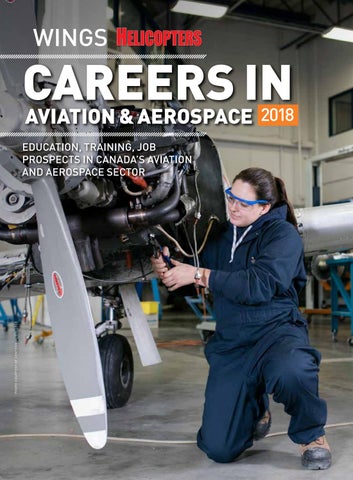
CAREERS IN AVIATION & AEROSPACE
2018
PHOTO CREDIT TK
PM 40065710
$6.00
PHOTO COURTESY OF CENTENNIAL COLLEGE
EDUCATION, TRAINING, JOB PROSPECTS IN CANADA’S AVIATION AND AEROSPACE SECTOR
Apply today for
Fall 2018!
The
SKY’S THE LIMIT with a career in the aviation industry and we can get you there!
Earn your diploma at the brand new Centennial Downsview Aerospace and Aviation Campus (opening in Fall 2018), future home of Centennial’s Aviation Technician and Aerospace Manufacturing programs including: • Aerospace Manufacturing Engineer Technician/Technology • Aviation Technician – Aircraft Maintenance • Aviation Technician – Avionics Maintenance
centennialcollege.ca/transportation 1206_DEC17
See where experience takes you.
CIA2018
CAREERS IN AVIATION:
A SCHOOL FOR EVERY JOB
A
viation and aerospace are complex, high-tech industries rooted in education and the pursuit of excellence. Canada’s flight schools, training colleges and universities are the essential pivot between raw talent and enthusiasm, and tomorrow’s pilots, technicians and air transport and aerospace leaders. It’s a huge responsibility, ensuring there is a school and classroom for every job, and a job for every school to keep the pipeline flowing with exciting new talent. Canada is home to the world’s fifth largest aerospace industry, and is supported by a dynamic air transport sector. How big is that? The Aerospace Industries Association of Canada (AIAC) reports the sector employs about 87,000 Canadians and generates $27 billion in revenues each year in aerospace manufacturing and MRO activities. Recent surveys suggest about 15,000 pilots and flight engineers. There are skill shortages popping up everywhere, meaning there are job opportunities for qualified new graduates in almost all sectors. “Educational outreach and career pipeline programs will be essential to inspiring the next generation of pilots, technicians and cabin crew,” Boeing concludes in its 2017 Pilot & Technician Outlook, a respected industry forecast of personnel demand in the global air transport sector. “As personnel demand increases over the next two decades, the aviation industry will need to find innovative solutions to keep pace with training requirements.” Boeing projects global demand for two million commercial airling pilots, maintenance technicians and cabin crew between now and 2036: 637,000 pilots, 648,000 technicians and 839,000 cabin crew. There's no field with more opportunity. And while a shortage of pilots tends to grab the headlines, the story runs much deeper. Up to 800 engineers are reported to retire every year between now and 2024, according to Canadian Business, while the rate of new hires is expected to outpace retirements as demand for Canadian aerospace products grows. And not just among large companies such as Bombardier, Pratt & Whitney Canada and Boeing – but also medium and small high-tech firms that feed the global supply chain.
According to the Aerospace Industries Association of Canada (AIAC), the share of supply chain exports stamped “made in Canada” increased by 20 per cent over the last 15 years, and now accounts for more than 60 per cent of Canadian aerospace product exports. Canada’s academic infrastructure appears ready to meet the challenge of feeding the Canadian aerospace and air transport sector’s appetite for innovative and new graduates with full-time, parttime and learn-at-your-own-pace courses, and opportunities to upgrade academic skills such as partnerships between flight schools and flight colleges. Major industry players are helping academia develop course curriculum, and mentoring programs are springing up between operators, colleges, universities and flight schools to provide mentorship and career pathways for aspiring pilots. Still, the learning experience should not be limited to the walls and runways of flight schools and academia, especially in the early days when a student is considering career options in aviation. But a learning experience should not be limited to the walls and runways of academia, especially in the early days when a student is setting a career course. There are many industry associations in Canada ready to help you make career choices, and many enthusiastic people in this industry who enjoy sharing their experiences. The 2018 edition of Wings and Helicopters Careers in Aviation (CIA) guide is an introduction to a variety of careers in aviation and aerospace. It provides listings, helpful tips for choosing a flight school, and sets expectations for new graduates breaking into the industry. Whether you are looking to fly fixedwing airplanes or helicopters. Launch a career in the sky with an airline or corporate operator, or keep your feet planted firmly on the ground in manufacturing and maintenance or industry support, this is an invaluable starting point. Good luck on your journey!
TAP THESE RESOURCES
Aviation and aerospace leaders at various associations can aid in your career search • AéroMontréal www.aeromontreal.ca/capacitedinnovation-en • Aerospace Industries of Canada www.aiac.ca • Air Transport Association of Canada www.atac.ca/web/en • Air Line Pilots Association www.alpa.org • AME Canada www.amecanada.ca/en/about/ about-ame-canada.html • Aviation Alberta www.aviationalberta.com • B.C. Aviation Council www.bcaviationcouncil.org/about-thebcac • Canadian Business Aviation Association www.cbaa-acaa.ca • Canadian Council for Aviation and Aerospace www.avaerocouncil.ca • Canadian Owners and Pilots Association www.copanational.org • National Airlines Council of Canada www.airlinecouncil.ca • Helicopter Association of Canada www.h-a-c.ca
ON THEWEB
To find out more about Wings and Helicopters Careers in Aviation Expos, go to www.wingsmagazine and www.helicoptersmagazine.com January/February 2018 | C3
CIA2018
PART 1: FLYING THE AIRCRAFT
COCKPITS ARE CALLING by David Carr
A
n industry-wide demand for new pilots continues unabated, with shortages impacting even flight schools that are on the lookout for instructors. There are an estimated 36,000 registered aircraft in Canada (both fixed-wing and rotary), that are calling for crews. The 2017 Boeing & Technician Outlook, a respected industry forecast of personnel demand, projects that North America will need 117,000 new pilots over the next 20 years, to support industry growth. That is for commercial aviation alone and doesn’t include backfilling positions of retiring pilots heading for the exits. Transport Canada estimates there are over 800 “on-demand” aviation service providers such as charter operators, law enforcement and emergency medical services, and helicopters supporting Canada’s resources industry and a growing demand for rotary business aircraft. Approximately 26 per cent of Canada’s business aviation fleet are helicopters. “Airlines across the globe are expanding their fleets and flight schedules to satisfy demand generated by global economic expansion,” the report notes. “The aviation industry continues to address these challenges by creating balanced, sustainable solutions to fill future pilot pipelines.” The Jazz Aviation Pathways Program, for example, has agreements with 15 aviation colleges, flight schools and universities across Canada, including Seneca College, to create a streamlined career path for pilots. Jazz is Canada’s third largest airline. Thirdyear Seneca Bachelor of Aviation Technology students are eligible for the Jazz cadet program that includes direct entry into the airline’s hiring pool. It is all about giving low-time pilot graduates a ticket to develop their skills and enter the cockpit. Earlier this year, Air Georgian – with bases in Calgary and Toronto – launched SOAR – Sharing Opportunities for Advancement and Reward – mentorship program in partnership with Ottawa Aviation Services (OAS), a flight school. Flight instructors are given the opportunity for employment at Air Georgian. Air Georgian recently added Ornge, Ontario’s air ambulance operator with its fleet of fixed wing and rotary aircraft, to the C4 | January/February 2018
SOAR operator partnerships. The partnership provides a career pathway for pilots at Ornge to become first officers with Air Georgian. Watch programs like Jazz Aviation Pathways and SOAR grow as operators look to fill cockpit seats and flight schools look for incentives to attract qualified instructors. Flight schools sign a small number of graduates as instructors. It is a stepping stone where recruits build up necessary hours. An increased demand for pilots, especially at the regional level, means that the turnover of instructors is higher; a good opportunity for students entering the industry. Other entry-level opportunities to build up hours include air taxi operator or general aviation pilot. Canada’s thriving corporate aviation sector should not be overlooked. Business aviation accounts for five per cent of registered airplanes in Canada, about 50 per cent of the fleet based in Ontario and Alberta. Modern corporate jets are every bit as sophisticated as today’s airlines, and the requirements to fly these airplanes is often equivalent and sometimes greater than what is required in the airline business. Canada also has the second largest fleet of helicopters in the world. The backbone of the sector remains resource-based, although opportunities in the executive sector are available around major urban centres. Boeing notes that regional markets that have relied heavily on recruiting pilots from outside their home locations are increasingly seeking to recruit, train and develop locally sourced pilots. Local aviation and aerospace expos such as the Wings and Helicopters Careers in Aviation Expos – this year in Toronto and Edmonton – certain help in this regard. In Ontario, Ready Set Fly (RSF) is a notfor-profit organization specializing in educating high school students about aviation careers, including highlighting the skills and education needed to achieve a specific career. RSF is building an industry network to connect students and aviation organizations. SELECTING A FLIGHT SCHOOL If you have little or no aviation experience, selecting a flying school can be overwhelming and is best not done on impulse. Many questions go into selecting a flight school, beginning with identifying your flight goals. What province do you want to learn in,
the type of airplane you want to learn on (fixed-wing, dual engine, helicopter, turbine engine) and whether you prefer to train fulltime or part-time. Learning to fly is time consuming and expensive. Students who train part-time typically do so to build flying lessons into a busy schedule that often includes a job, or to spread the cost over a longer period. Depending on the length of break between lessons, part-time will cost more because the student often has to relearn lessons. For those planning a career in aviation, full-time lessons are recommended. There are two parts to learning how to fly; flight training and ground school. Ground school is classroom instruction where students learn the principles of flight, pilot decision-making, navigation and prepare for the written examination. Many flight schools offer ground school courses online. Transport Canada requires 40 hours of ground school instruction for a commercial pilot licence, so a flight schools approach to classroom instruction should not be overlooked. Transport Canada has an online Flight Training Units Search tool to help find schools that offer the precise type of training a student is looking for. The search page includes drop-down menus that allow potential students to specific the type of training and type of aircraft to be used in training. Canada’s aviation regulator does not rank flight schools or flying colleges, so an online search should be considered a starting point. Industry professionals agree that when picking the right flight school or graduating up to a flight college (see separate article), be prepared to ask a lot of questions. Don’t be timid. For example, ask about the number of hours it takes for students to complete a course. This number may vary from instructor to instructor. Don’t be afraid to walk away if a flight school does not answer all your questions. What about the accessibility of the instructors, the number and types of training aircraft available and the quality of maintenance? An unwritten industry rule is one training aircraft for every four or five fulltime students, although that ratio changes with part-timers. Training aircraft clock a lot of hours and are put through tough paces. Maintenance is an important consideration for both safety and scheduling.
—— BRITISH COLUMBIA INSTITUTE OF TECHNOLOGY
— THE SKY IS LITERALLY THE LIMIT. AEROSPACE FOR A COMPLEX WORLD. BCIT offers one of the largest aviation training facilities in Canada. Attend an info session or spend a day on campus to explore the Aircraft Gas Turbine Technician, Aircraft Maintenance, Avionics, Airport Operations or Commercial Pilot (Rotary or Fixed-Wing) programs. Learn how BCIT gives students the best opportunity to launch their careers at bcit.ca/aerospace
—— BCIT Aerospace Technology Campus
CIA2018
[PART I. FLYING THE AIRCRAFT]
FLIGHT SCHOOLS
TOP OPTIONS FOR PILOT DEVELOPMENT AND TRAINING YUKON Alkan Air | Whitehorse Alkan Air flight training is partnered with Yukon College to offer a two-year Aviation Management Diploma program. Whitehorse is an excellent place to learn to fly. It offers unique experiences and challenges that are not found elsewhere in Canada. Students not only experience flying at an international airport with traffic including large airliners, but also fly to gravel strips in more remote areas of the territory. Learn more: ftu@alkanair.com
BRITISH COLUMBIA Canadian Flight Centre | Boundary Bay & Kamloops B.C. Canadian Flight Centre (CFC) opened in 1979 at B.C.’s Boundary Bay Airport, near Vancouver, and became one of the first flight schools to specialize in instrument flying and other advanced training. For students looking to sharpen their flying skills, tail wheel and aerobatic training is one of CFC’s specialties. Kamloops proximity to the mountains also allows pilots the opportunity for mountain checkouts. Learn more: flying@cfc.aero
Chinook Helicopters | Abbotsford, B.C. Chinook Helicopters began training operations in 1982 at the Abbotsford Airport. The Abbotsford area is ideal for yearround helicopter training. Chinook utilizes the expansive Fraser Valley for all initial flight exercises, and the Coastal Mountain Range for intermediate and advanced exercises. Due to the extensive commercial helicopter activity in southwestern British Columbia, most approaches and landings are to actual industry helipads. Learn more: training@chinookhelicopters.com
Coastal Pacific Aviation | Abbotsford International Airport, Abbotsford, B.C. Coastal Pacific Aviation (CPA) started operations in 1973. CPA’s main business is a University Aviation Program in partnership with the University of the Fraser Valley. Offerings include a one and two-year C6 | January/February 2018
by David Carr
Diploma, or a choice of a four-year Business (Aviation) Degree, or a General Studies Degree. CPA also offers non-university training for students who wish to complete their career flight training in fast paced year long program or self-paced flying for fun. Learn more: info@coastalpacific.com
Glacier Air | Squamish Municipal Airport, B.C. Glacier Air has experience along the Sea- to- Sky corridor from Vancouver to Whistler. Glacier Air specializes in mountain flight training for fixed wing and rotary aircraft. Given the terrain, Glacier Air also offers survival ground school, which includes studies in weather, flight techniques, effects of density altitude, emergencies, route planning and aircraft preparation, and survival gear. Learn more: glacier.com
Ocean Air Floatplanes | Victoria, B.C. Seaplanes are a way of life along coastal Canada. Coastal jobs require high levels of experience because of the many challenges that the coast offers. Ocean Air Training specializes in seaplanes. The company’s beautiful Gulf Island’s setting just outside Victoria and close proximity to Vancouver, creates a perfect training environment for learning to be an experienced bush/urban Seaplane pilot. Learn more: info@oceanair.ca
Okanagan Mountain Helicopters | Kelowna, B.C. Okanagan Mountain Helicopters started as a helicopter flight training school in 2003. Training in the Okanagan area provides the variety of terrain and weather that exposes a student to new challenges while under the supervision of skilled instructors. The training facility at Kelowna International Airport – the tenth busiest in Canada – introduces students to fully controlled radio procedures, multiple training locations for confined areas and mountain flying introduction within a control zone, and the best blend of controlled and uncontrolled practice areas. Learn more: okheli.ca/flight-training
Pacific Flying Club | Boundary Bay, B.C. The Pacific Flying Club (PFC) was formed in 1965 as the Canadian Pacific Airlines Employees Flying Club. It remains one of the premier flight training and general aviation centres in Western Canada. Students train at Boundary Bay Airport, one of the busiest general aviation airports in Canada. PFC is also partnered with the British Columbia Institute of Technology, and together offers the diploma course, Airline & Flight Operations. Learn more: info@pacificflying.com
Southern Interior Flight Centre | Kelowna, B.C. Southern Interior Flight Centre (SIFC) is located at Kelowna International Airport in the heart of the Okanagan Valley, where students spend time flying in mountain valleys, visiting the Rocky Mountains, travelling out over the Canadian prairies and exploring the coast of British Columbia running along the Pacific Ocean. The area is also surrounded by many small air strips, which allow for exposure to every level of controlled and uncontrolled environments a pilot might encounter. Learn more: info@flysifc.ca
Victoria Flying Club | Victoria, B.C. The Victoria Flying Club (VFC) has been training professional pilots since 1946. Located at the Victoria International Airport, one of Canada’s busiest airports, VFC specializes in mountain flying. In the Pacific Region, the combined effect of the great mountain system and adjacent Pacific Ocean lead to some extremely changeable flying conditions. VFC has partnered with the University of Victoria to offer a Diploma in Business Administration – Aviation Option program. Learn more: info@flyvfc.com
ALBERTA Absolute Aviation | Wetaskiwin Regional Airport, Alta. Absolute Aviation is a flight training and aircraft maintenance facility, largely serving students from Edmonton and central Alberta. Absolute operates out of
ADVANCED HAS NEVER BEEN SO SIMPLE Only the Pilatus PC-12 NG offers the advanced avionics of a high-end business jet tailored for the single pilot. Featuring an autopilot optimized for stability and smoothness, and SmartView™ synthetic vision with performance-based HUD symbology, it sets the bar for ultimate control and situational awareness. Simple. Powerful. Intuitive. Definitely Pilatus. Visit www.pc-12advantage.com to learn how easy it is to advance to the head of the class. Pilatus Business Aircraft Ltd • +1 303 465 9099
Stan Kuliavas, Vice President of Sales | sales@levaero.com | 1.844.538.2376
www.levaero.com
www.pc-12advantage.com
CIA2018
Calgary Flight Training Centre | Olds-Disdury Airport The Calgary Flight Training Centre (CFTC) provides training for professional pilots and enthusiasts alike. Olds-Disdury Airport is uncontrolled airspace. There is no waiting for air traffic controllers to clear students’ take-offs and landings. Students are also able to start up the aircraft, taxi directly to the runway and takeoff when safe to do so. Learn more: info@calgaryflight.com
Canadian Centre for Unmanned Vehicle Systems | Medicine Hat, Alta. The Canadian Centre for Unmanned Vehicle Systems (CCUVS) offers a 1.5 day condensed Unmanned Vehicle Systems (UAS) ground school course to both civil and commercial operators, covering a range of topics including, aerodynamics, air law and regulations, weather, basic UAS 101, and aviation chart and flight supplements. Students also receive instruction for an Industry Canada Restricted Radio Operators License (Air). CCUVS also offers UAS training in Ontario and B.C. Learn more: info@ccuvs.com
Centennial Flight Centre | Edmonton Centennial Flight Centre has been operating since 1967. Located at Villeneuve Airport, approximately 25-kilometres northwest of Edmonton, Centennial offers a full range of training including a Recreational Pilot Permit, Private Pilot Licence, Commercial Pilot Licence, Multi-Engine and Instrument Rating. Villeneuve Airport has 3500-foot and 5,000-foot runways with approach lighting which are perfect for night flight training. Learn more: info@centennial.ca
Mountain View Helicopters | Springbank, Alta. Mountain View Helicopters (MVH) has been training pilots for commercial or private helicopter licences for over 15 years. The training facility is located near Calgary International Airport, providing several advantages such as exceptional flying weather found on the prairies, close proximity to the mountains for use as a valuable training tool and the experience gained through frequent contact with air traffic controllers operating out of one of C8 | January/February 2018
Canada’s busiest airports. Learn more: info@mvheli.com
Real life bush flying is only minutes away. Learn more: prairiehelicopters.com
SASKATCHEWAN
Winnipeg Aviation | St. Andrews Airport
Mitchinson Flight Centre | Saskatoon, Sask. Since 1946, Mitchinson Flight Centre has been one of Saskatchewan’s leading flight training schools. The school is located in its own hangar at the Saskatoon John G. Diefenbaker International Airport. Students learning to fly with Mitchinson train in an ATC controlled environment, providing experience for flying in larger centres, but without the traffic delays and congestion of a larger airport. Mitchinson is owned by professional airline pilots who have trained at the school and know what it takes to get ahead in today’s competitive aviation industry. Contact: info@flymitchinson.com
MANITOBA Brandon Flight Academy | Brandon, Man. Brandon Flight Academy has been placing qualified pilots in cockpits since 1936. Located at Brandon Municipal Airport, just outside of Winnipeg, Brandon Flight Academy offers one-stop training in a multitude of courses. Southern Manitoba has excellent weather and terrain for conducting visual flight rules (VFR) flight training. Brandon offers students a varied flight experience with the practice facilities close by and no delays on the ground or in the air, students experience an efficient and educational learning environment. Learn more: cfi@brandonflightcentre.com
Harv’s Air | Winnipeg Manitoba’s extreme four seasons allow pilots to experience all types of flying conditions from cold air performance to hot summer day. Harv’s Air is a family owned training operator with locations near Steinbach and St. Andrews, Man., both in the Winnipeg area. In business since 1973, the company offers comprehensive courses for both recreational flying and those seeking a career in aviation. Learn more: www.harvsair.com
Prairie Helicopters | Gimli Airport Prairie Helicopters is a leading custom charter helicopter service and Manitoba’s only turbine helicopter flight school. Low traffic volume at the world-famous Gimli Airport – 45 minutes north of Winnipeg – provides ideal conditions for students to acquire radio communication skills pilots require throughout their careers.
Winnipeg Aviation has been a leading trainer of pilots for over 20 years. The school’s base at St. Andrews Airport, 15 kilometres outside of the Manitoba capital offers three runways to maximize your training with and without cross winds. Instructors take students into Winnipeg International Airport to get first-hand experience to mix it up with the big players, while also flying to small short, uncontrolled grass strips to learn procedures. Learn more: winnipegaviation.com
ONTARIO Brampton Flight Centre | Brampton-Caledon Airport, Ont. The Brampton Flight Centre (BFC) has been conducting flight training for more than 70 years. Located just northwest of Toronto’s Pearson International Airport, BFC teaches students to fly in a variety of airspace classifications, experiencing both controlled and uncontrolled environments. BFC is owned and operated by the Brampton Flying Club, and owns its airport. The centre has a tie-in with Sheridan College’s Bachelor of Business in Global Business Management, a strong fit for an ambitious professional pilot. Learn more: www.bramptonflightcentre.com
Diamond Flight Centre | London, Ont. The Diamond Flight Centre (DFC) in London is part of a network of Diamond flight training schools in North America, and provides high-quality, flight training using Diamond aircraft and Diamondspecific flight training simulators. DFC London is located at the London International Airport. The airport is busy enough that students acquire experience with traffic, yet is generally quiet enough so that students can practice in a relaxed atmosphere, without long waits for clearance. Learn more: info@dfclondon.com
Durham Flight Centre | Oshawa, Ont. Durham Flight Centre (DFC) has been training aspiring pilots for 20 years. Located in the Enterprise Airlines hanger buildings on the grounds of Oshawa Municipal Airport, DFC charges competitive prices for ground training, instructor time and airplane rentals. There are major advantages to the Oshawa airport for flight training, including virtually no congestion, 24-hour operation, an air traffic control tower and modern navigational aids, extensive airport based facilities and more. From the Oshawa airport to nearly
PHOTO CREDIT CENTENNIAL COLLEGE
Wetaskiwin, Alta., with close proximity and access to major airports such as Edmonton International. The school operates in both uncontrolled and controlled airspace, eliminating costly ferrying time to training areas. Learn more: info@absoluteaviation.ca
[PART I. FLYING THE AIRCRAFT]
photo courtesy of Bombardier
Make your dream of becoming an airline pilot a reality!
Exceptional Training, Excellent Facilities, Energized Environment Brampton Flight College (BFC) is recognized as one of the top-flight training schools in Canada. The IATPL program is designed specifically to provide students with the skills required by today’s airlines. It includes over 1000 hours of ground school, flight and simulator instruction, covering basic skills to highly advanced training.
Integrated Airline Transport Pilot Licence (IATPL)18-20 month program • Focused on advanced airline operational knowledge • Experience in a full motion simulator used by airlines • Includes training by industry experts from AeroCourse At BFC, we are dedicated to produce qualified pilots, job-ready and familiar with current industry expectations. Students graduating from the IATPL program are eligible to apply to several career programs like destination:porter, The Porter Pilot Mentoring Program and SOAR Mentoring Program with Air Georgian open to flight instructors.
For More Information: Call 905-838-1400 ext 248
admissions@bramfly.com
bramptonflightcentre.com
CIA2018 practice airspace the flight time is only about 10 minutes, which means less time and money spent travelling and more on training. Learn more: info@durhamflightcentre.com
Essential Helicopters | North Bay, Ont. Essential Helicopters is a leader in helicopter charters and flight training. Essential has developed an efficient model for providing all levels of service and specialization within the helicopter industry. Students participate in strenuous physical activities such as helicopter log pad construction, chain saw operation, underwater egress training, winter survival program and winter helicopter operations. Essential Helicopters is also aligned with the Canadore College Commercial Helicopter Pilot Licence and Pilot Preparedness program. Learn more: info@essentialhelicopters.com
Genesis Flight College | Collingwood, Ont. Genesis Flight College is a registered private career college located at the Collingwood Regional Airport. Through its affiliated holding company, Genesis owns the real estate and all the buildings on the field in which it operates. its students expect knowledgeable, highly trained professionals, premium training facilities, and an array of amenities. The facilities, flight training professionals and equipment at Genesis offer a breadth of services to students in the GTA and Georgian Bay region. A significant advantage of our program is that 100% of the flying is in advanced aircraft (DA40 and DA42). The program is designed to prepare students for direct entry into a commercial flying job with expert-level knowledge of the advanced systems of the DA40 and DA42 platform. Collingwood and Blue Mountain is a resort town and there are many accommodation options in the area. Students who like skiing or enjoy water sports will find lots of extracurricular opportunities. Genesis also has new accommodations being built at the airport, which will be ready in the summer of 2018. Services include commercial flight training, a college diploma program, private pilot training, instrument rating, multi-engine rating, instructor rating, sightseeing flights, and air taxi services. Learn more: flygenesis.ca
Great Lakes Helicopter | Waterloo, Ont. Great Lakes Helicopter offers helicopter flight training and charters. The operation is based at the Region of Waterloo International Airport, one of the best training C10 | January/February 2018
[PART I. FLYING THE AIRCRAFT] airports in Canada. The region offers a unique blend of modern, energetic urban centres and scenic, rural landscapes creating diverse experiences for helicopter flight training. The training school also has a partnership with Conestoga College to provide a two-year Commercial Helicopter Pilot General Art and Science diploma program. Learn more: info@greatlakeshelicopter.ca
Spectrum Airways | Burlington, Ont.
Helicopters Canada | North Bay, Ont.
Waterloo Wellington Flight Centre | Waterloo, Ont.
Helicopters Canada trains students from across the country and around the world from its training facility at Jack Garland Airport in North Bay. Just minutes north of the airport are heavily forested areas that contain multitudes of lakes and rivers, providing the ideal location for helicopter training to prepare a student pilot for real life helicopter industry experiences. Learn more: info@helicopterscanada.com
Ottawa Aviation Services | Ottawa Ottawa Aviation Services (OAS) is a professional flight training and maintenance operation based out of Ottawa International Airport. OAS provides aviation professionals and enthusiasts with aviation services based on the values of the “golden age” of flight. The school specializes in designing customized, pay-as-you-go flight training programs that accommodate each student’s pace. Learn more: info@ottawaaviationservices.com
Ottawa Flight College | Ottawa The Ottawa Flying Club, operating as the Ottawa Flight College (OFC) has been training pilots since 1928, and is Canada’s oldest flight training college. The school provides float and instructor ratings, and supports a large number of recreational pilots who fly for fun. Located at Ottawa International Airport, students learn to interact with a control tower and operate in an airport control zone as part of their training. The school’s practice area is minutes away from the airport. Learn more: dispatch@ofc.ca
St. Thomas Flight Centre | St. Thomas, Ont. Established in 1996, the St. Thomas Flight Centre has a flight training program customized to suite budgets and schedules. The school operates out of St. Thomas Airport in an uncongested flight training environment. School offices are located in the main terminal building and ground school classes are held on site. The Flight Centre has two additional satellite locations at Chatham airport and London airport. Email: learntofly@learntofly.on.ca
Spectrum Airways has been teaching students how to fly for over 40 years. The training facility is at the heart of Burlington Executive Airport, one of the busiest airparks in Ontario. Burlington Executive Airport averages 30 flights on weekdays and many more on weekends, and has become an exciting centre for general aviation enthusiasts. Learn more: info@spectrumairways.com
The Waterloo Wellington Flight Centre (WWFC) is located at the Region of Waterloo International Airport and is one of the largest and most experienced flight training centres in Canada. WWFC is partnered with Conestoga College and the University of Waterloo to offer diploma and degree programs. WWFC also has a well-developed network among entrylevel aviation employers across the country. The centre also offers a UAV course designed to introduce people to the range of scope of the two categories of UAV’s (under 2 kg or from 2-25 kg). Learn more: info@wwfc.ca
QUEBEC Air Richelieu (Montreal Flying Club) | Montreal Air Richelieu is an accredited flight training centre that delivers both Canadian and American licences at the same time, and under the same roof. The school is located at St-Hubert Airport, approximately 20 minutes from Montreal. The airport provides a busy environment for training, but without the inconvenience of dense air traffic. Learn more: info@airrichelieu.com
CQFA Aviation Industry Training | Montreal The CQFA overs more than 50 courses, including a light unmanned aerial vehicle (UAV) professional pilot course, which has been offered since 2007. The 140hour, light UAV training covers the regulations, aerodynamics, flight discipline and human factors for operating a light UAV aircraft. The course covers all phase of a drone mission within the framework of a commercial or public safety operation. All the theory necessary for the operation of a light drone for the purpose of a commercial or public security flight is presented and learned prior to practical flight. Learn more: info@cqfa.ca
Dorval Aviation | Montreal Dorval Aviation is the only flight training centre located at the Montreal Trudeau International Airport, Canada’s third busiest, and at the heart of one of the country’s main
Let Your Dreams Take Flight! At the heart of the Burlington Executive Airpark, Spectrum Airways is a premium flight training facility. We are proud to offer the following professional courses: • Discovery Flights • Private Pilot License • Night Rating • Commercial Pilot License
• Multi-Engine Rating • Instrument Rating • Flight Instructor Rating • Professional Pilot Program
• Aircraft Rental • Sightseeing Tours • Photo Flights
“Over 40 years of professional flight training excellence” info@spectrumairways.com
www.spectrumairways.com
905-336-4010
CIA2018 aviation centres. This strategic location provides all experiences required for successful training within controlled airspace. Dorval offers bilingual services and a complete selection of courses from a simple introduction to aviation to a commercial pilot licence. Learn more: info@dorvalaviation.com
Laurentide Aviation | Greater Montreal Area Laurentide Aviation has been providing professional flight training since 1946. Based at Les Cedres Aerodrome, approximately 25 kilometres west of Montreal, Laurentide offers bilingual inflight and ground school instruction to suit any style of learning. The flight school is located at an uncontrolled airport, allowing students to get in the air and into the practice area quickly, reducing the cost and amount of time spent on the ground taxing and waiting for clearance at busy controlled airports. Learn more: info@laurentideaviation.com
Quebec City Flight School | Quebec City Quebec City Flight School is a Canadian Helicopters’ flight school offering training to students and company pilots. Canadian
C12 | January/February 2018
[PART I. FLYING THE AIRCRAFT] Helicopters is Canada’s largest helicopter transport services company. The school offers introductory and recurrent training. Instructors are operationally experienced in a broad variety of fields, including air ambulance, offshore, mining, firefighting, aerial construction and spraying. Instruction can be provided in French and English. Learn more: www.canadianhelicopters.com/services/flight-training
NOVA SCOTIA Debert Flight Centre | Truro, N.S. Debert Flight Centre, part of the Truro Flying Club (TFC), operates out of one of the best facilities in Atlantic Canada for flight training. Students learn in uncontrolled airspace that is not crowded with commercial jets and other air traffic. Debert is a compact airport offering students less than five minute from flight to the training areas. Ground school is held at Debert Airport and Halifax. Learn more: fly@flytfc.ca
Greenwood Flight Centre | Annapolis Valley, N.S. The Greenwood Flight Centre (GFC) is located in Nova Scotia’s Annapolis Valley,
approximately one hour’s drive west of Halifax. Greenwood Flight Centre has been training pilots since 1958. Students often gain subsequent employment with the GFC. In addition to Kings County Municipal Airport, the school operates two satellite sites at Digby Municipal Airport and Yarmouth Airport in south-west Nova Scotia. Learn more: mail@flyfc.com
NEWFOUNDLAND GFT Aerospace | Gander, N.L. GFT Aerospace has been offering elite flight training in Canada since 1992, and prepares pilots for the real work of aviation from its state-of-the-art training facility. Located in Gander Newfoundland, GFT proves to be beneficial because students experience real world weather conditions. GFT’s sister company, EVAS Air, is a local airline for Air Canada. Because of this, GTF has established its Career Progression Program, which is open to all students at no additional cost. Learn more: admin@gft.com
GIVE YOUR CAREER A
VERTICAL LIFT
AIRCRAFT MAINTENANCE ENGINEERING PROGRAM Transport Canada accredited
Northern Lights College offers
Aircraft Maintenance Engineering in the
Aerospace Centre of Excellence
380-17.12.7-d
The Aircraft Maintenance Engineering Program is applicable to both rotary wing aircraft (helicopters) and fixed wing aircraft. Contact our Trades and Apprenticeship Division or visit our website 1-866-463-6652 | nlc.bc.ca
CIA2018
[PART II. DESIGNING, BUILDING AND MAINTAINING THE AIRCRAFT]
PART II: DESIGNING AND MAINTAINING AIRCRAFT
A LAND OF OPPORTUNITY
CANADA’S VIBRANT AEROSPACE AND MRO INDUSTRIES PROVIDE GREAT OPTIONS
A
erospace jobs in Canada are nationwide, meaning there are excellent job opportunities coast-to-coast for graduates of colleges with aviation technician programs. Students interested in manufacturing will largely be based in Quebec and Ontario, which account for 80 per cent of manufacturing (55 per cent and 25 per cent respectfully). For MRO students, Western and Atlantic Canada remain strong, capturing almost 60 per cent of the sector. According to Boeing, global fleet growth will continue to drive a strong demand for technicians to repair and maintain the airplanes. Boeing predicts that North America will need 118,000 new technicians to support airline growth alone. Airplanes are very mobile. While many basic MRO functions have been exported to lower wage countries, Canada remains a global player in higher end and more sophisticated MRO. There are manufacturing opportunities in Western Canada also. For example, Winnipeg is home to Boeing Canada, which operates the country’s third-largest aerospace manufacturing facility (Canada is Boeing’s second-largest international supplier network, working with more than 560 suppliers across the country). There are good jobs available for graduates interested in both fixed wing and rotary aircraft and propulsion systems. Canada ranks in the top three worldwide in terms of civil airplanes (No. 2 in business aircraft production and #3 in regional aircraft), helicopters (No. 3 in helicopter production) and aircraft engines (No.1 in turboprop and helicopter engine production). Canada also ranks fourth worldwide in turbofan production and large jet production. Like other sectors in Canada’s manufacturing industry, aerospace is scrambling to close a skills gap. According to a 2015 labour market report by the Canadian Council for Aviation and Aerospace (CCAA), 83 per cent of Canadian aviation and aerospace companies expect to continue to grow. Another driver for C14 | January/February 2018
by David Carr
hiring will be retirements. As the Canadian workforce ages, demand for younger workers – and workers with skills to apply to new and emerging technologies in aviation, is expected to also grow. The CCAA study noted an imbalance in skills needed and those that are available, something students should research carefully when selecting an aviation technician program. Boeing notes that as operators continue to take delivery of new airplanes, advances in airplane technology will drive an increased need for technicians skilled in avionics, composites and digital troubleshooting.
AVIATION TECHNICIAN COLLEGES BRITISH COLUMBIA British Columbia Institute of Technology | Vancouver The British Columbia Institute of Technology (BCIT) School of Transportation is a North American leader in transport training and producing high-quality, job-ready graduates in demand by the aerospace sector. The School of Transportation delivers accredited and globally recognized programs tailored to meet the human capital needs of the transport industry. The school’s aerospace facility is the largest provider of skilled graduates to the aviation industry in British Columbia, and offers accredited programs that prepare graduates for careers as Aircraft Maintenance Engineers (avionics and maintenance), and Gas Turbine/Jet Engine Technicians. The Aerospace Technology Campus is conveniently located at the Vancouver International Airport and features a dramatic 40,000 square foot hangar at the centre for BCIT’s fleet of light piston, turboprop, corporate and jet transport aircraft, and light and medium helicopters. Learn more: www.bcit.ca/about/aerospace
Northern Lights College | Dawson Creek Northern Lights College (NLC) opened in 1975. It is known as B.C.’s Energy College, serving northern British Columbia in an area covering more than 324,000 square kilometres. NLC’s Aerospace Centre of Excellence opened in 1981, at the college’s Dawson Creek Campus. Aspiring students and current aircraft maintenance engineers receive hands-on training in a hangar that houses 13 aircraft, including a Robinson R44, Airbus AS350D and Bell 205 and 206 helicopters, a Cessna 180, Beechcraft King Air, Piper Aztec and British Aerospace Jetstream 31, turboprop airliner. Learn more: www.nlc.bc.ca
ALBERTA SAIT Polytechnic | Calgary The Southern Alberta Institute of Technology (SAIT) Polytechnic is a member of Polytechnics Canada, a national alliance of leading research-intensive colleges and institutes of technology. SAIT’s School of Transportation, provides hands-on, practical education for the aviation, heavy equipment and rail sectors. The school offers full-time training in aircraft maintenance engineering, aircraft structures and avionics technology. All programs are taught at the state-of-the-art Art Smith Aero Centre for Training and Technology, located at the Calgary Airport. Learn more: transportationinfo@sait.ca
SASKATCHEWAN The Saskatchewan Indian Institute of Technologies | Saskatoon The Saskatchewan Indian Institute of Technologies (SIIT) was created in response to the need for quality, post-secondary education for First Nations people. The Saskatchewan Aviation Learning Centre at Saskatoon’s Diefenbaker International Airport is a joint effort of SIIT, the government of Canada, province of Saskatchewan and the Saskatoon Airport Authority. The SIIT Aircraft Maintenance Engineer program is open to First Nation and non-First
SEE YOUR CAREER TAKE OFF! START SEPTEMBER. APPLY TODAY! Transport Canada-approved aviation programming in: Diplomas • Aviation Technician – Aircraft Maintenance • Aviation Technician – Avionics Maintenance
CO-OP OPTIONS AVAILABLE!
LEARN MORE
fanshawec.ca/aviation
WG_FanshaweCollege_CIAJan18_CSA.indd 1
2017-12-19 10:33 AM
Delivering skills-oriented aviation programs for over 85 years in Canada’s most comprehensive training facility, the Art Smith Aero Centre.
Aircraft Maintenance Engineers Technology Aircraft Structures Technician Avionics Technology LEARN MORE AT SAIT.ca
School of Transportation
Industry-experienced instructors and a hands-on, practical education. And with an 87% employment rate, our graduates are in demand.
January/February 2018 | C15 WG_SAIT_CIAJan18_CSA.indd 1
2017-12-13 3:01 PM
CIA2018
[PART II. DESIGNING, BUILDING AND MAINTAINING THE AIRCRAFT]
Nation students, and delivers the knowledge and skills required for eligibility to apply as an apprentice in the aircraft maintenance industry. Graduates are credited with 18 months toward the current four-year industry requirement to obtain a licence. Learn more: www.siit.ca
MANITOBA Red River College | Winnipeg Red River College (RRC) offers training in all aspects of the aviation and aerospace sector. RRC’s Aircraft Maintenance Engineer program is designed to develop the knowledge and skills in maintenance of both large and small airplanes and helicopters. This program has been accredited by the Canadian Forces for their Non-Commissioned Member Subsidized Education Plan. RDC also offers programs for careers as an Aircraft Structures Technician, Aircraft Gas Turbine Engine Repair and Overhaul Technician. Learn more: www.rrc.ca
ONTARIO Algonquin College | Ottawa Algonquin College’s School of Advanced Technology of a broad range of programs including Transportation Technology departments. Programs are created with the needs of industry sectors in mind, with skills that are transferable around the world. The Aircraft Maintenance Technician program teaches students the knowledge and skills required to equip themselves for work in the aircraft maintenance industry. Learn more: www.algonquincollege.com
Canadore College | North Bay, Ont. Canadore has been a leader in aviation training for more than 40 years. The School of Aviation is a dedicated aviation training facility and courses are delivered at the college’s Aviation Campus at Jack Garland Airport. The campus includes prime training space, and is filled to capacity with fixed and rotary wing aircraft for students to work hands-on. A New Advanced Composites, Fabrication, Repair and Test Centre is a recent addition to the campus and supports innovative technologies, applied research, materials testing opportunities and customized training programs. The college offers three basic training programs; the Aircraft Maintenance (AMT) and the Avionics Maintenance (AVN) program, and a Structural Repair (ASR) Technician program. In addition there are advanced aviation technology programs. Learn more: www.canadorecollege.ca
Centennial College | Toronto Centennial College’s School of Transportation is Canada’s transport training hub. The faculty are among the most highly skilled in the industry, and training equipment is state-of-the-art, including a fully equipped hangar for aerospace and avionics students. Programs are supported and reviewed by industry representatives to ensure they are of the highest quality. Aircraft Maintenance and Avionics Maintenance are the two Aviation Technician programs offered within the school. The Aviation Technician – Aircraft Maintenance program is for students who are more interested in the airplane than the trip. It provides the opportunity to master mechanical, electrical, electronic and other science skills related to aircraft maintenance. The program emphasizes the repair of electrical and mechanical systems within the aircraft. Students will study hydraulics, fuels, environmental systems, engines, flight controls, landing gear system and airframes and structure. The Aviation Technician – Avionics Maintenance program provides students with the knowledge and skills to launch a career as an aircraft maintenance technician in avionics, which covers a wide-range of the aviation and aerospace sectors that work together to keep aircraft safe and airworthy. A large portion of this program focuses on aviation maintenance practices, procedures and Canadian aviation regulation requirements through hands-on practice in labs. Avionics Maintenance courses are designed to teach students how to perform tasks and activities associated with the maintenance and repair of aircraft communications, navigation and data systems, and inspection and troubleshooting of basic electronics circuits to sophisticated avionics systems found in modern aircraft. In this program, a significant portion of time is spent on practical applications in labs. Training focused on the aircraft’s various electronic systems – electrical power distribution and control, navigation, flight instrumentation, communication and radar. Students are also prepared to be a bench technician for avionic-approved shops and aircraft manufacturing companies. The course material is very technical and comprehensive, and to achieve success, students should be prepared to invest extra time on study, mandatory project completion and exam preparation. Centennial College’s Ashontbee Campus’ airplane hangar provides a learning environment that conforms to industry standards. Students will learn about routine maintenance, servicing, inspection, diagnostics and repair, as well as performing flight-line duties. In the fall of 2018, Centennial College will open its Centre for Aerospace and Aviation, now under construction at Toronto’s Downsview Park. The project includes a hangar, which is large enough to accommodate today’s commercial jets, as well as new classrooms, laboratory space, workshops, offices, a library and, for the first time, access to working runways. Learn more: www.centennialcollege.ca
C16 | January/February 2018 WG_Mag Aerospace_CIA_JanFeb 18_CSA.indd 1
2017-12-18 11:15 AM
your flight plan with STEP 1: LEARN TO FLY Get your commercial pilot licence with one of our flight school partners. Upon graduation continue to build your hours as an instructor or apply to one of our SOAR mentorship pilot opportunities. For a full list of our partners, visit airgeorgian.ca.
STEP 2: FLY WITH AIR GEORGIAN Do you have 800 hours of flying time? You’re ready to start your career with Air Georgian flying as an Air Canada Express First Officer! Gain airline experience and take advantage of quick upgrades, training department opportunities and fleet transfers.
STEP 3: INTERVIEW WITH AIR CANADA Have you dreamed of flying for Air Canada? We can help you achieve your dreams. As a pilot flying for Air Georgian you are guaranteed an interview with Air Canada once you meet their minimum hiring requirements.
INTERESTED IN LEARNING MORE? Visit airgeorgian.ca/soar for program details
CIA2018 Confederation College | Thunder Bay, Ont. Confederation College offers several aerospace and aviation technician courses at its Aviation Centre of Excellence (ACE) at Thunder Bay International Airport, Ontario’s third busiest. For example, Students learn about composites and how these materials make a difference in flight. Programs were developed in partnership with some of Canada’s leading aerospace companies including Bombardier and Magellan, and ACE has a sizeable fleet of non-flying aircraft for students to work on. Learn more: confederationcollege.ca
Fanshawe College | London, Ont. Fanshawe College is one of the largest colleges in Ontario. The school’s Aviation Technician – Avionic Maintenance program covers all aspects of aircraft avionics systems used in general aviation, corporate, charter transport category aircraft and helicopters. The course provides students with the knowledge and skills needed for servicing, repair and maintenance of aircraft electrical and electronics systems. Learn more: www.fanshawec.ca
[PART II. DESIGNING, BUILDING AND MAINTAINING THE AIRCRAFT] St. Clair College | Windsor, Ont. St. Clair College delivers a customized training program to train aircraft maintenance and repair workers in partnership with Quebec-based Premier Aviation at its Windsor maintenance, repair and overhaul (MRO) facility. The course will future classroom and hands-on study. Premier Aviation’s Windsor MRO facility is capable of handling all types of aircraft, including the Boeing 747. Learn more: www.stclaircollege.ca
NOVA SCOTIA Nova Scotia Community College | Dartmouth, N.S. The Nova Scotia Community College’s (NSCC) Aviation Institute provides students with the opportunity to build their skills using the latest technology, and to apply learning to real aircraft. The Aviation Institute is housed in a modern, 43,000 square-foot training facility. Students will learn from faculty who bring a passion for their work, valued experience and strong industry connections. NSCC offers three aircraft maintenance engineer programs at the Aviation Institute; structures, mechanical and avionics. Learn more: www.nscc.ca
PRINCE EDWARD ISLAND Holland College | Summerside, P.E.I. The Holland College Aircraft Gas Turbine Engine Repair and Overhaul Technology program works closely with PEI’s growing aerospace industry. In this 10-month program, students will learn the techniques, procedures and the documentation requirements necessary to perform the disassembly, inspection, repair, reassembly and testing of the turbine engines used to power today’s aircraft. The program consists of approximately 60 per cent practical and 40 per cent theory. Hands-on, practical training is carried out on a variety of turbine engines. Learn more: info@hollandcollege.com
NEWFOUNDLAND College of the North Atlantic | Gander, N.L. The College of the North Atlantic (CNA) is part of the Lufthansa Technical Training network of approved schools. The Aviation division of the College of the North Atlantic delivers several aerospace programs at its Gander, Newfoundland campus, including Aircraft Maintenance Engineering Technology and Aircraft Structural Repair Technician. Learn more: www.cna.nl.ca
Earn a Master’s Degree in Aviation with an additional 1 ½ years of study. Georgian’s Aviation Management program is the only 3 year program in Canada that allows students to progress directly into Griffith University’s Masters in Aviation Management degree program. With only 1 additional year of study our grads also have a choice to complete one of two Bachelor of Science degrees with Embry-Riddle Aeronautical University.
C18 | January/February 2018 CIA_JanFeb16_Georgian bay_MLD.indd 1
2016-01-14 11:42 AM
LOOKING FOR A GREAT CAREER IN AVIATION OR AEROSPACE? The 2018 Careers in Aviation Expos bring together leading experts in a variety of aviation fields for an exciting opportunity to map out your future career!
2018
Come visit the WINGS exhibit booth at the Careers in Aviation Expo for a chance to WIN a Hamilton Khaki Aviation X-Wind Auto Chrono Watch.
REGISTER ONLINE: CAREERSINAVIATION.CA/EXPO
TWO GREAT LOCATIONS! PREMIER SPONSOR PREMIER SPONSOR
April 28, 2018 // Mississauga, ON
May 12, 2018 // Edmonton, AB
WHO SHOULD ATTEND:
WHY SHOULD YOU ATTEND:
• High school students • Air Cadets • Post-Secondary students • Flight school students • Anyone looking for a career
• Network with industry professionals • Meet a mentor or future employer • Learn about educational requirements • Discover new options to get your flight
change!
PREMIER SPONSORS
I
hours • Have fun, take a tour, and win prizes!
PLATINUM SPONSOR
I
SILVER SPONSORS
R
FOR MORE INFORMATION, PLEASE CONTACT // TARA JACOBS // 1.888.599.2228 EXT 213 // tjacobs@annexbusinessmedia.com
CIA2018
[PART II. DESIGNING, BUILDING AND MAINTAINING THE AIRCRAFT]
MOVING TO A HIGHER PLANE:
THE UNIVERSITY EDGE by David Carr
UNIVERSITY STREAMS OFFER VALUE
A
erospace is a research-driven industry, and Canada needs a steady supply of sharp and disciplined minds to maintain its innovative edge and push forward in aircraft design and productions, composites, integration, artificial intelligence and advanced propulsion systems. This is where universities come in. The Canadian aerospace industry invests almost $2 billion annually in R&D, and is the number one investor in research and development compared with all other Canadian manufacturing sectors. Aerospace manufacturers also partner more with academia, government and others more than any other manufacturer. As a student in a university with an aerospace diploma program you will work hands on alongside creative thinkers and designers to research and develop the products that will enter the global supply chain, while building a path to excel and position yourself as a leader in this exciting industry. But it’s not just aerospace. A university degree is also regarded as a valuable asset by the airline industry when hiring pilots with the potential to transition from the flight deck to executive management. Many excellent Canadian universities have aerospace engineering and other programs at the undergraduate, graduate and PhD levels to support great careers in the aerospace and air transport sectors.
BRITISH COLUMBIA Fraser Valley University | Fraser Valley, B.C. Fraser Valley University (UFV), in partnership with Coastal Pacific Aviation, a renowned flight training company located at Abbotsford International offers a Bachelor of Business Administration (Aviation) degree to equip you with the flight and business skills you need to succeed in the aviation industry. Graduates not only have the potential to become flight captains, they can also assume management responsibilities for an airline or airport. Learn more: www.ufv.ca.
ALBERTA MacEwan University | Edmonton MacEwan’s Business Management Aviation Major is a unique partnership between MacEwan University and Transport Canada-approved training centres. The Aviation Major provides a mix of skills that prepares students for the business of flight. Five courses from the Business Management diploma are replaced with aviation training, leaving students with instruction in many core business skills, including accounting, marketing and strategic management. Learn more: www.macewan.ca C22 | January/February 2018
Mount Royal University | Calgary Mount Royal University’s Aviation Diploma program combines flight training with an academic diploma, preparing students to handle the role of a pilot both in the air and on the ground. Students will receive more than 420 hours of aviation education and will have a foundation in aviation-related studies including, aviation economics and management, safety management systems, aircraft systems, advanced meteorology, and GPS and crew management. Practical flying experience is accumulated on Mount Royal’s fleet of four, single-engine aircraft and three multi-engine aircraft. The fleet is equipped with the latest GPS avionics, and is located at the Mount Royal Hanger at Springbank Airport just west of Calgary. While making flights across Western Canada, students will earn more than 200 hours of total flying experience. In addition to the Commercial Aviation Diploma, Mount Royal also offers Private Pilot Licence training.
ONTARIO Carleton University | Ottawa Carleton Aerospace is an organized research group concentrating many researchers at Carleton University to encompass the full breadth and depth of aerospace and aeronautics. It features one of the largest groups of professors conducting aerospace research in the country. Aerospace Engineering students at Carleton actively participate in design projects. Carleton is a long-time leader in aerospace and has chalked up a number of impressive firsts, including introducing the First Bachelor of Aerospace Engineering program in Canada, in 1988, and first undergraduate course on rotorcraft in Canada. The university has one of the largest undergraduate aerospace programs in Canada, and one of the largest graduate aerospace populations. Learn more: aerospace@carleton.ca.
Ryerson University | Toronto The mission of Ryerson University’s Aerospace Engineering graduate program is a combination of several interconnected objectives: to provide an excellent academic experience for graduate students within the realm of aerospace engineering that will better enable them to realize their potential upon graduation; to bring relevance to the program through strong interaction with the aerospace industry as it related to both education and research; and to conduct innovative, internationally recognized research across a spectrum of key areas that are of significant to the Canadian and global aerospace industries. Learn more: www.ryerson.ca
University of Toronto | Toronto The University of Toronto Institute for Aerospace Studies (UTIAS) offer many exciting research activities for prospective undergraduate and graduate students. The undergraduate program is offered through the Engineering Science Program. At the graduate level, UTIAS offers research-intensive programs leading to MASc and PhD degrees, and a professionally-oriented
Flight Operations - Maintenance & Engineering - Pilot Training A World Leader In Innovative Aircraft Modifications
Challenging work Rewarding environment Continuous learning & development Dynamic & growing operations
A EROSPACE
KFAero.ca
[PART II. DESIGNING, BUILDING AND MAINTAINING THE AIRCRAFT]
program leading to the MEng degree. The scope of research includes aeronautical engineering (aircraft flight systems, propulsion, aerodynamics, computational fluid dynamics and structural mechanics) and space systems engineering (spacecraft dynamics and control, space robotics and mechatronics, and microsatellite technology). Learn more: www.utias.utoronto.ca
University of Waterloo | Waterloo The University of Waterloo’s Bachelor of Environmental Studies (BES) and Bachelor of Science (BSc) programs have been designed to provide a strong base for careers in a diverse array of aviation and aerospace industries. Through a strong partnership with the Waterloo-Wellington Flight Centre, students will complete a Professional Pilot Program where courses are offered over a period of six academic terms, beginning in second semester. Overall, the flight-training component is offered concurrently with the courses. Learn more: www.uwaterloo/aviation
University of Windsor | Windsor The University of Windsor’s Aeronautics Leadership program provides students with a unique opportunity to combine a university education with flight training. Students take classes on the University of Windsor campus in areas of Arts, Humanities, Social Sciences, Business, Science and Engineering.
C24 | January/February 2018
The Aeronautics Leadership curriculum is diverse and flexible, giving students the chance to explore various areas of study. This education is coupled with commercial flight training, which is run by Journey Air at the Windsor International Airport. Learn more: www.uwindsor.ca
Western University | London, Ont. The Commercial Aviation Management (CAM) program at the Western University is a stepping stone to a career in aviation. CAM students graduate with a Bachelor’s degree in Management and Organizational Studies (BMOS), with specialized courses in aviation management. Western is the first Canadian university to offer an aviation management program, and the only university to offer a four-year university degree in Aviation Management. The CAM program was developed in response to the changing Canadian aviation industry, which is increasingly requiring a university degree. Learn more: www.welcome.uwo.ca
QUEBEC Concordia University | Montreal For graduates with longer-term executive career ambitions in aviation and aerospace, the Aviation Management Institute (AIM) at Concordia University offers courses in aviation management and leadership development. Part of Concordia’s
PHOTO CREDIT CENTENNIAL COLLEGE
CIA2018
TAKE CHARGE Did you now that NAV CANADA was selected as one of Canada’s Top 100 Employers? Work for NAV CANADA as an Air Traffic Controller or Flight Service Specialist and help contribute to aviation safety.
Apply today at takecharge.navcanada.ca
CIA2018
[PART II. DESIGNING, BUILDING AND MAINTAINING THE AIRCRAFT]
John Molson School of Business, AMI has established partnerships with leading universities and international aviation organizations. It has developed e-learning programs for the International Aviation Organization (ICAO) and Airports Council International (ACI). AMI offers online programs such as the Aviation Security (AVSEC) Professional Management Certificate (PMC). Created in partnership with ICAO, this is the first and only certificate of its kind in the world, designed to provide specialized training focused on the evolving and critical area of aviation security. AMI’s Airport Executive Leadership program helps to develop airport industry leaders and advance the professionalism of airport management practices. Learn more: www.concordia.ca
Ecole Polytechnique de Montreal | Montreal The master’s program in Aerospace Engineering aims to broaden candidates’ technological and scientific knowledge of aerospace engineering and to train highly specialized engineers. The program is offered in conjunction with McGill and Concordia universities, Ecole de Technologie Supérieure, Université Laval, Université de Sherbrooke and a number of aerospace companies in the Montreal region. Students must follow at least two specialization courses (with the exclusion of case studies) given by the other participating institutions. Candidates who successfully complete the professional master’s in Aerospace Engineering program obtain a Master of Engineering (MEng) degree. Learn more: www.polymtl.ca
McGill University | Montreal McGill University offers an Air and Space Law LL.M. with Thesis or Non-Thesis. A Master’s Thesis is a 30,000-word project. It should constitute a sustained analytical contribution to an ongoing academic discussion or to developing concepts and practices. Non-Thesis 15,000-word Supervised Research Project. The paper constitutes a substantial piece of critical writing, of publishable length and quality that elucidates particular ideas or problems within an area of law. The Thesis program is suited to students who wish to focus on original scholarly research and writing under the supervision of a law professor. In turn, the Non-Thesis program is suited to students who wish to gain a wide exposure to a range of taught courses within, and related to, the domain of Air and Space Law. Learn more: www.mcgill.ca/law
NEW BRUNSWICK Mount Allison University | Moncton, N.B. Offered in partnership with the Moncton Flight College, Mount Allison’s aviation program allows students to earn an undergraduate degree incorporating flight and ground school training. The major is an interdisciplinary science program, featuring study in depth of subject that are relevant to aviation. Before graduation, students must complete over 200 hours of flying, hundreds of hours of ground training and hold a Commercial Pilot Licence with multi-engine and instrument ratings. Learn more: www.mgta.ca/aviation Learn more: www.mtroyal.ca
ONE YEAR DIPLOMA PROGRAM
Genesis Flight College is a private career college offering specialized flight training programs which expose students to the most advanced equipment available in the industry. Graduates of the one year program achieve a COMMERCIAL PILOT DIPLOMA and have the credentials required to begin flying as a career immediately. NEW DIAMOND FLEET G1000 FOR ENTIRE PROGRAM
FLYGENESIS.CA C26 | January/February 2018 WG_GeneisisFlight_CIAJan18_CSA.indd 1
2017-12-12 1:23 PM
CIA2018
[PART III. SPECIALIZE AVIATION SUPPORT SERVICES
PART III: SPECIALIZE AVIATION SUPPORT SERVICES
READY AND ABLE
by David Carr
SPECIALIZED PROFESSIONALS IN AIRCRAFT MOVING
A
viation relies on a vast and complex network to dispatch airplanes, turn aircraft around at a local airport, guide flights across the sky and safely back to the ground, finance equipment and maintain the regulatory framework that keeps aviation and aerospace turning over. There are literally thousands of jobs for recruits who want to keep their feet on the ground, and those who want to work in the air in a different capacity – flight attendants. Careers in Aviation provides a sampling of some of these opportunities.
Aircraft maintenance crew
efficient flight, including giving the crew a situational update prior to departure, including aircraft activity and weather information and feeding data to the flight deck en route. A commercial pilot licence, flight services specialist experience, air traffic control experience or related experience within a flight operations centre can improve career prospects, especially with the larger air carriers.
EDUCATIONAL OPPORTUNITIES AIR NAVIGATION, NAV CANADA (internal)
Business offers non-credit courses in leadership development and aviation management to partners in the aviation industry. Concordia’s Aviation Management Institute (AMI) has partnerships with many universities and international organizations, and has developed blended learning programs for both the International Civil Aviation Organization and Airports Council International. AMI initiatives include on-line programs such as the AVSEC Security Professional Management Course and the Airport Executive Leadership Program, as well as organization-specific executive programs. These programs are offered at Concordia, international training centres or on-site at the client’s home offices.
Depending on the size of airplane, a team of up to 35 ramp attendants will offload an arriving flight and ready the airplane to receive a new load of passengers. An aircraft maintenance crew will marshal aircraft to and from the gate, manoeuvre the air bridge, operate a fleet of vehicles including tow trucks and catering trucks, attach nozzles to the aircraft to pump lavatory waste out, unload hundreds of passenger bags and tonnes of air freight, refuel and clean the cabin. There is more to the job than meets the eye. Each aircraft is different, and the weight of an aircraft changes daily. Airlines, third-party air service providers or airport authorities employ most ramp attendants. It is demanding physical work and airlines typically have standards on how much a candidate is able to lift on a regular basis.
Before controlling, directing and advising aircraft in Canadian air space, air traffic controllers and flight service specialists go through intensive training programs that last anywhere between one- and two-anda-half hours. The curriculum and duration of NAV CANADA’s training programs depend on the stream a student is selected for. All streams require focus, hard work and commitment. Training is delivered on a full-time basis. Class times vary by location, but they are typically eight hours a day. Students can also expect to put in additional study and simulator time to prepare for next day’s classes. Expect to invest a further two to three hours after class hours to succeed. Learn more: takecharge.navcanada.ca
AVIATION MANAGEMENT, Georgian College (Barrie, Ont.)
Flight operations dispatch
AIRPORT OPERATIONS, BCIT, (Vancouver)
FLIGHT SERVICES, Seneca College (Toronto)
The award-winning BCIT diploma program in Airport Operations is designed to meet the demands of today’s unique and dynamic global airport operation environment. The 16-month Airport Operations is supported and approved by the aviation industry and provides students with a comprehensive, interdisciplinary program of study. This is the only program of its type in Western Canada. BCIT also offers an online Airport Operations Part-time studies Associate Certificate.
The Flight Services program encourages students to develop career-related skills, knowledge and behaviours to effectively perform a variety of functions required in providing exceptional passenger service. As a Flight Services graduate students may find employment as a passenger service representative, check-in agent or reservation agent. The Operations and Cabin Management diploma program encourages students to develop career-related skills, knowledge and behaviours to effectively perform a variety of functions required in providing passenger safety and customer service in the airline industry.
A flight dispatcher is like a ground captain, except where the captain is operating a single aircraft, an airline dispatcher can be responsible for up to 50 aircraft during a single shift, including charting routes and alternates, calculating fuel loads and aircraft weight, monitoring flights (known as “flight watch”) and making decisions whether to divert or cancel flights if an aircraft cannot continue to operate safely. A dispatcher is also plugged into air traffic control to ensure the most efficient routings and minimize costly air traffic control delays. An airline dispatcher makes joint decisions with the flight captain to ensure a safe and
AVIATION MANAGEMENT, Concordia University (Montreal) Concordia’s
John
Molson
School
of
The Canadian Aviation Institute (CAvI) at Georgian College is a national centre of aviation management training and education. Graduates of CAvI work in a variety of aviation fields including airport management, aviation operations, airport planning and air traffic control. Commercial pilots, flight dispatch, flight services specialists and many other aviation-related occupations have benefited from this additional enhancement to their chosen career field. Located in Barrie, Ont., the three-year Aviation Management diploma program provides students with a solid understanding of the aviation industry.
January/February 2018 | C27
CIA2018
[PART III. SPECIALIZE AVIATION SUPPORT SERVICES
FLIGHT COLLEGES
SURGING FORWARD
E
ven in a tight labour market, unlocking the door for the chosen career is going to be tough. Education will always be the key. Recruiters are more likely to put candidates with a college degree or university closer to the top of the list, especially if the post-secondary program includes studies in fields linked with aviation. Indeed, it is estimated that up to 95 per cent of pilots hired by commercial operators also have a college degree. Canadian colleges with aviation programs teach essential skills not always found at flight schools, something else to consider when selecting a flight school. These skills include a deeper understanding of the technical aspects of the industry, critical decision-making and so-called “soft skills” such as effective communication; an important consideration on the flight deck, or flying for a corporate charter provider where the client base is often top executives of some of Canada’s largest corporations. The one-two punch of a pilot’s licence and college degree is also smart career planning for the student that wants to consider transitioning into an executive position for an airline, airport or aerospace company. Not everything taught in a college setting will be connected with aviation, and students with broader career ambitions outside of a long-term career in aviation may want to consider flying school while taking a degree program not so closely tied in with the aviation and aerospace industry. Although this may limit your potential within the airline sector. Aviation is also an assessment-based and cyclical business. Think of a degree as an insurance policy against an unexpected failed health check or layoff. Finally, the subject matter for many aviation-related college courses is set and taught by industry professionals, and offer students greater opportunities to build a network to land secure that critical first job.
YUKON Yukon College | Whitehorse The Aviation Management Diploma at Yukon College trains in a unique northern climate that offers variable topography and an increased number of acceptable flying day. Part of the School of Business and C28 | January/February 2018
by David Carr
Leadership, the diploma comprises a block transfer of pilot training credentials earned at Alkan Air (or other recognized flight schools) that equals one year or 30 credits and an additional 30 credits earned at Yukon College. Students are expected to earn a commercial pilot licence while concurrently earning academic credits. However, students may enter the program with some pilot training (a private pilot licence for example) or a completed commercial licence. Learn more: sbl@yukoncollege.yk.ca
BRITISH COLUMBIA British Columbia Institute of Technology The British Columbia Institute of Technology (BCIT) is Canada’s largest English-language aviation training school. The Institute has paired with Pacific Flying Club, one of Western Canada’s premier flight-training schools to provide an opportunity for students who wish to become airlines pilots with a strong skill set of aviation industry knowledge. It is a fully integrated program that combines flight training with industry focused academic training. Flight training is conducted at Pacific Sky Aviation’s flight school at Boundary Bay Airport, outside of Vancouver. Learn more: www.bcit.ca
College of New Caledonia The College of New Caledonia operates an Aviation Business Diploma program in conjunction with Guardian Aerospace Holdings, a Canadian licensed flight training and air taxi operator. The program is designed to provide highly trained single engine VFR pilots for entry level pilot in command positions with Canada’s northern air carriers and with similar air taxi companies operating in difficult conditions around the world. Learn more: www.cnc.bc.ca
Douglas College | New Westminster, B.C. Douglas College’s Associate of Arts Degree for Future Professional Pilots is a program for students who wish to continue to a career in the aviation industry. This program is jointly offered with Professional Flight Centre, located at Boundary Bay Airport. Douglas College provides the academic instruction leading to the Associate of Arts
Degree, and Professional Flight Centre provides the ground and flying instruction. These two distinct and separate components together provide students with the foundation needed in the aviation industry. Learn more: www.douglascollege.ca
Okanagan College | Kelowna The Commercial Aviation diploma program at Okanagan College consists of two distinct and separate areas of study: flight training and business studies. The business portion is completed at Okanagan College and normally consists of two business courses per semester for a total of eight courses over two years. The flight-training portion taken with Southern Interior Flight Centre, out of Kelowna Airport, and consists of flight training, theory and exams. Southern Interior Flight School offers graduating students the opportunity to become flight school instructors. Learn more: www.okanagan.bc.ca and info@flysifc.ca
ALBERTA Red Deer College Red Deer College’s (RDC) partnership with Sky Wings Aviation Academy combines a foundation in business with hands-on flight training. The college provides high-quality academics that are critical to the credibility of the Aviation Diploma Program. This two-year course enables students to earn a certificate in Business Management while obtaining an Aviation Diploma. Flight training is provided approximately ten minutes from the RDC campus at Red Deer Regional Airport. Sky Wings Aviation Academy has providing flight training since 1982. Highlights of the Aviation Diploma Program include a trans-continental flight crossing the Canadian/U.S. border, familiarization training for a regional or national airline and crew resource management. Most RDC courses are university transferable. Learn more: www.rdc.ab.ca and info@skywings.com
SASKATCHEWAN Saskatchewan Polytechnic The Saskatchewan Polytechnic is a member of Polytechnics Canada, an alliance of 11
CIA2018
[PART III. SPECIALIZE AVIATION SUPPORT SERVICES research-intensive, industry-responsive post-secondary institutions. The Polytechnic’s Commercial Pilot program is offered in partnership with the Saskatchewan Aviation Council, a membership-based association. The Commercial Pilot diploma program provides a strong foundation in the basic principles of aviation. Students study aviation-related topics such as the theory of flight, advanced aircraft systems and flight. Flight training takes place at a student’s home flying school. Learn more: www.saskpolytech.ca
ONTARIO Algonquin College | Ottawa Algonquin College’s Aviation Management program is a starting point to launch a career in aviation. This two-year course is designed to provide students with the knowledge and skills required to become a commercial pilot. Through a series of classroombased courses and hands-on practical labs, students are provided the opportunity to develop the required level of proficiency. Algonquin has contracted the Ottawa Flying Club and Ottawa Aviation Services to provide up to 250 hours of flight time experience. Learn more: www.algonguincollege.com/sat/program/ aviation-management-general-arts-and-science
Conestoga College | Kitchener, Ont. Conestoga pathways enable students to build on their academic achievements in order to earn a degree or additional credentials. Pathways are formed through agreements between Conestoga and partner institutions. The Aviation – General Arts and Science program is a collaboration between Conestoga and the Waterloo Wellington Flight Centre (WWFC) and Great Lakes Helicopters
(GLH). Students in this program will take classes at the college and flight training with WWFC or GLH, depending on whether they have chosen the fixed-wing or rotary-wing option. Training takes place at the Region of Waterloo International Airport. Learn more: www.wwfc.ca/fly-professional or www.greatlakeshelicopter.ca
Confederation College | Thunder Bay, Ont. The Aviation Flight Management program at Confederation College combines business, management and flight training into one program. The program has been running at Confederation since 1973 and is a demanding academic program with rigorous flight standards. The business and management training provide students with background knowledge to complete a detailed and comprehensive understanding of today’s aviation industry. The college operates its owns aircraft and flight simulators at its Aviation Centre of Excellence hanger at Thunder Bay International Airport. Learn more: www.confederationc.on.ca/flight-mgmt
Georgian College | Barrie, Ont. The Georgian College Aviation Management program gives students knowledge and hands-on experience in Aviation and Management as well as provides co-operative work within the aviation industry. A variety of aviation courses provide students with a solid understanding of the aviation industry in Canada and around the world. Georgian has contracted with Future Air to provide Flight Labs that offer practical training required by its Aviation Program students. Future Air gives students a structured foundation in an aircraft cockpit and operating within an airport environment as part of the learning process. Learn more: www.georgiancollege.ca
January/February 2018 | C29 WG_Waterloo_Wellington_CIAJan18_CSA.indd 1
2017-12-12 3:10 PM
CIA2018 Sault College | Sault Ste. Marie, Ont. Sault College has been training and graduating professional pilots since 1974. Sault’s three-year Aviation Technology Flight program includes on-campus classroom and simulator room facilities. Students gain hands-on training with a fleet of aircraft. Flight training is conducted at the Sault College hangar at the Sault Ste. Marie International Airport, just 15 minutes from the college. The surrounding landscape provides a safe backdrop to learn the art of flying. Students may receive advanced standing from Algoma University, towards a Bachelor of Business Administration program. Learn more: www.saultcollege.ca
Seneca College | Peterborough, Ont. and Toronto Seneca College has been a national leader in aviation education for more than 40 years, and continues to respond to emerging industry demands. The college is now educating students at the degree level. The Honours Bachelor of Aviation Technology program provides a rigorous aviation technology-based curriculum and application of this theory to aviation. Students gain the skills and knowledge to operate safely in a complex aircraft, to understand the technologies and human factors that affect the successful operation of an aircraft, and to assume the professional responsibility associated with being a commercial pilot. Flight training and classroom instruction for students in year’s two to four of the Honours Bachelor of Aviation Technology program takes place at Seneca’s state-of-the-art Peterborough Campus. Seneca’s flight consists of 19 aircraft, including Cessna 172s (including four with Garmin G1000 glass cockpits), Beechcraft Bonanza’s and Baron’s (including one with a Garmin G1000 glass cockpit). Students begin their flight training in the single-engine Cessna 172 before moving on to the Bonanza’s. Training in the Bonanza’s includes long distance flights to places such as Burlington, Vermont, Fredericton, New Brunswick and Detroit, Mich. Students then progress to the twin-engine Beechcraft Baron. Seneca’s Airline Pilot Operations program is the only graduate certificate program of its kind in Canada. The program delivers a comprehensive education in airline operations that includes the study of airline operations and administration as well as extensive practical training to prepare students for direct entry into a First Officer position in airline operations. Halifax-based Jazz Aviation and Seneca College have recently enhanced its career pathway partnership for student pilot. The agreement includes a Cadet program whereby a group of top performing students are selected as Jazz Cadets following completion of the third year of their aviation C30 | January/February 2018
[PART III. SPECIALIZE AVIATION SUPPORT SERVICES degree and evaluated on professionalism, discipline and both flight and academic performance during their fourth year. Upon completion of the degree program, the Jazz Cadets undergo a comprehensive review and simulator evaluation with Jazz, Canada’s third largest airline. The enhancements to the agreement include the addition of a flight simulator pathway and two scholarships for student pilots enrolled in Seneca’s Bachelor of Aviation Technology program. Learn more: www.senecacollege.ca
NEW BRUNSWICK Moncton Flight College | Moncton N.B. The Moncton Flight College (MFC) has been training pilots since 1929, and is the largest private flight school in Canada. Since its inception, MFC has taught over 20,000 pilots from around the world, with graduates holding senior positions throughout the world’s airlines, aviation authorities and companies. The college educates aviation professionals with state-of-the-art curriculum, highly qualified instructors and modern facilities and equipment. MFC’s Moncton campus benefits from efficient airport infrastructure and low commercial flight activity. There are 21 combined training areas in Moncton for local training, all within five minutes flying time from the airport. This proximity makes MFC one of the few major schools with training areas so close to its main base of operations, resulting in maximum training time on every flight. Because of its location, students benefit from four-season training, and are better equipped to safely manage different weather conditions. MFC has partnered with Mount Allison University is offer one of the few aviation programs in Canada that allows students to earn an undergraduate degree incorporating flight and ground school training. Learn more: mfc.nb.ca
UNMANNED AERIAL VEHICLES Drones and unmanned aerial vehicles (UAVs) is a growth industry in Canada. Transport Canada regulates the use of drones and UAVs. It is important that operators understand and comply with all rules governing this sector. For example, all airports, heliports and seaplane basis should be considered “No Drone Zone” unless the operator has permission from Transport Canada (it is recommended that operators fly outside a nine kilometre radius). Canada also limits and controls the use of unmanned aircraft inside national parks. Penalties for non-compliance are steep and can result in up to $25,000 in fines for a single violation and/or jail time. Operators who fly a UAV for work or research – or if the UAV weighs more than 35 kilograms, a Special Flight Operations
Certificate (SFOC) is required. An SFOC outlines where and how a UAV can be operated. Transport Canada recommends that UAV training should be similar to training taken for manned aviation since fundamental knowledge, experience and skills are basic requirements to assure a safe and effective operating environment.
Canadian Unmanned | Medicine Hat, Alta. Canadian Unmanned Incorporated (CUI) is a highly specialized UAV/drone and support company whose objective is to generate a safe and educated culture for both civil and commercial operators throughout Canada. CUI is the only organization of its type in Canada that offers a 2.5 day unmanned air ground school course for civil and commercial operators. This course is compliant with training requirements set out by Transport Canada for operators of small UAV’s under 25 kg. in weight for visual line of sight operations. This course is based on the proven Canadian Centre for Unmanned Vehicle Systems (CCUVS) ground school with over eight years of serving the Canadian UAS industry. The course focuses on aviation themed instruction, including aerodynamics, air law and regulations, communications, weather and Basic UAS 101, with regular industry updates. Students receive instruction for an Industry Canada Restricted Radio Operators Licence, which will allow them to operate and monitor aviation band frequencies. CUI has successfully trained more than 1,400 students in the past seven years, and offers its course both in house and on location as required. Learn more: info@canadianunmanned. com or info@ccuvs.com
CQFA Aviation Industry Training | Montreal The CQFA maintains the skills of professionals in aviation through more than 50 courses, including a light unmanned aerial vehicle (UAV) professional pilot course, which has been offered since 2007. The 140-hour, light UAV training is given by professional UAV operators and covers the regulations, aerodynamics, flight discipline and human factors for operating a light UAV aircraft. The course covers all phase of a drone mission within the framework of a commercial or public safety operation. All the theory necessary for the operation of a light drone for the purpose of a commercial or public security flight is presented and learned prior to practical flight. The hours of supervised practice are followed by solo flying hours and culminate into a practical flight test. The student will develop the skill and ability for planning, operational risk management and the preparation and execution of actual missions. Learn more: info@cqfa.ca
Seneca Aviation: Celebrating 50 Years of Excellence and Innovation in Aviation Education. senecacollege.ca