Step into the future of business aviation at the 2026 NBAA Business Aviation Convention & Exhibition (NBAA-BACE).
NBAA-BACE is where you can get up close with the newest business aircraft, meet legendary heroes of flight and witness epic announcements. It’s where business aviation comes together – not just to do business, but to connect, belong and celebrate the shared passion that unites our industry.
Andrew Moonilal, Jazz Aviation and Fanshawe College
Actually Enjoy Work
UPFRONT BACK
5 Leading Edge Becoming a great middle power
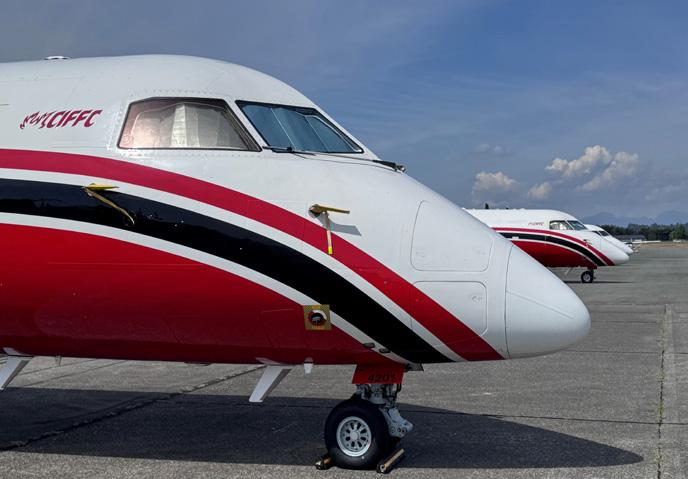
6 On the Fly CIFFC national fleet, Siskin for the Snowbirds, Juno flights in Fort Erie
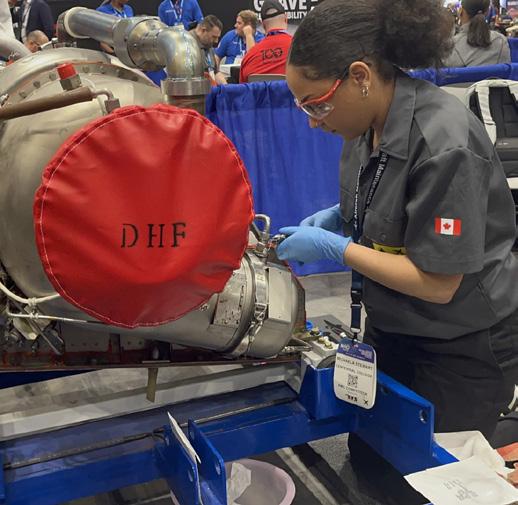
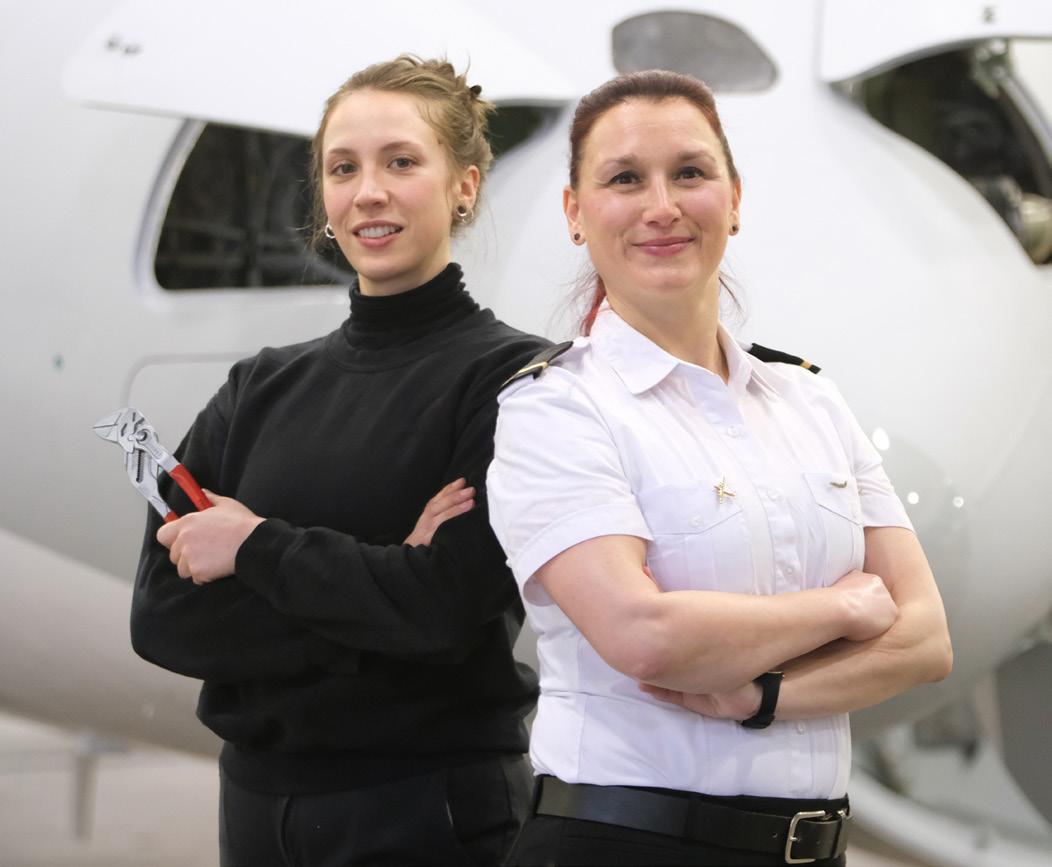
10 Alternate Approach Mentorship elevates Centennial AME team
12 Position Report AME licencing and the challenges of Red Seal
27 ATAC Report Preparing for safe summer travel
28 Marketplace
30 On Final Inside the Pan-Canadian aerial firefighting plan
FEATURES
14 TOP 20 UNDER 40
The annual program produced by Wings and Helicopters highlights leaders powering the future of Canadian aviation and aerospace BY JON ROBINSON
24 AI AND ITS IMPACT ON AVIATION
Leading companies and organizations in Canada share how they are embracing artificial intelligence to enhance their operations BY PHIL LIGHTSTONE
Top 20 Under 40 recipient Jessika Venne, Aircraft Acquisitions and Corporate Pilot with Echo Aviation Leasing of Montreal, prepares to fly the Pilatus PC-24.
From top:
Centennial’s Michaela Stewart. Pg. 14. Aireon and AI innovation. Pg. 24.
Stay in Touch with Aviation News
READER SERVICE
Print and digital subscription inquires or changes, please contact Angelita Potal, Customer Service apotal@annexbusinessmedia.com 416-510-5113
Mail: 111 Gordon Baker Rd., Suite 400, Toronto, ON M2H 3R1
EDITOR Jon Robinson jrobinson@annexbusinessmedia.com 647-448-6188
FLIGHT DECK
TIm Anderson, Jessica Dizon Burns, John Gradek, Kendra Kincade, Phil Lightstone, Carroll McCormick, Andrea Sepinwall, Steven Sitcoff
NATIONAL ACCOUNT MANAGER Mena Miu mmiu@annexbusinessmedia.com 416-510-6749
International – 1 Year $96.00 CAN Occasionally, Wings magazine will mail information on behalf of industry-related groups whose products and services we believe may be of interest to you. If you prefer not to receive this information, please contact our circulation department in any of the four ways listed above.
All advertising is subject to the publisher’s approval. Such approval does not imply any endorsement of the products or services advertised. Publisher reserves the right to refuse advertising that does not meet the standards of the publication.
Business Media brands focused on Canadian aviation and aerospace include Wings, Helicopters and UAV
By Jon Robinson |
Becoming a great middle power
Domestic firms position themselves for generational push from government
CANSEC organizers reported a record 20,000 registered attendees for its May defence and security show held in Ottawa, Ont., with around 11,000 people attending day one, according to the Canadian Press, and more than 300 exhibiting companies. Mark Carney attended at the show, noting he is the first Canadian Prime Minister to do so. Defence is a priority for his government, largely driven by pressure from the U.S. for greater NATO member investments.
There is no guarantee, that when Donald Trump leaves office, scheduled for January 2029, NATO spend levels will draw back from the new requirements for member nations to hit five per cent of GDP. These factors in part pushed the Liberals on February 17, 2026, introduce the Defence Industrial Strategy.
The framework of the policy, which fundamentally reshapes how Canada approaches defence procurement and industrial growth, prioritizes building domestic defence capabilities and only buying from abroad when necessary. This is a move toward becoming a great middle power as Carney outlined on January 20, 2026, during his speech at the World Economic Forum in Davos. He suggested middle powers must band together to hedge against uncertainty – to avoid being subjugated or coerced – during the current geopolitical rupture driven by a “system of intensifying great power rivalry”.
Less than a month after Carney’s speech, his government introduced the Defence Industrial Strategy and then CANSEC, four months later, was setting records. Whatever your political views are, there is new credibility in the early framework of Canada’s government, elected a little over a year ago, and significant opportunities across aviation and aerospace. Industry Minister Mélanie Joly also attended
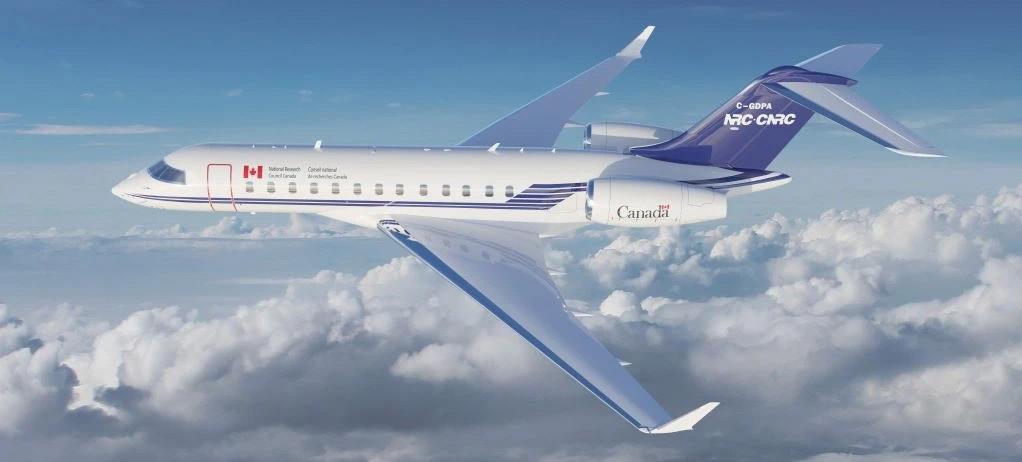
The NRC is acquiring a Bombardier Global 6500 for industry and academics to use for research on defence-related technology like intelligence and reconnaissance systems, radar and electronic warfare systems.
CANSEC and unveiled that the Liberal government will overhaul how it weights bids on defence contracts, again putting a larger premium on domestic content. Joly said companies that expand their production or invest in R&D in Canada will get a larger industrial and technological benefits score multiplier. She said the new policy is “based on what actually builds Canadian industrial capacity, not old regulatory habits.” Through the Defence Industrial Strategy, Canada aims to build up annual revenues for small- and mid-sized domestic firms by more than $5.1 billion. Larger players, of course, are also pushing deeper into defence, as companies with an existing
TOP DATA BURSTS… in this issue
1. The Canadair CT-114 Tutor has been the Snowbirds’ aircraft for 55 years. P.8. 2. One Centennial AME student team placed 25th overall in this year’s AMC. P.10. 3. Earning an AME licence in Canada typically requires a 4,800-hour apprenticeship. P 12. 4. Air Trail holds more than 40 customers managing over 500 aircraft. P. 20. 5. Disconnected operations cost the airline industry more US$60 billion every year. P. 24.
presence in the sector can leverage the federal government’s need to push now. Ottawa in March announced its seventh purchase of a Bombardier Global 6500 jet for industry and academics, through the National Research Council (NRC), to use for research on defence-related technology, such as intelligence and reconnaissance systems, radar and electronic warfare systems. Joly at the time said this is “the first time” the government will have a fully Canadian-built aircraft to conduct such research in the skies. The move was part of $900 million commitment allotted to NRC.
At CANSEC 2026, Carney said the federal government was entering into contract negotiations with Saab to buy a fleet of surveillance aircraft for the RCAF. Saab produces the surveillance planes in a joint partnership with Bombardier, based on the Global 6500. What remains less clear from CANSEC is the state of Canada’s planned $19 billion purchase of 88 F-35 fighter jets, which has been under review form more than a year after Trump pushed his trade war with Canada.
At the end of April, the federal government announced Canada was selected to host a multinational bank to provide “long-term, low-cost financing” for defence projects by NATO members and allies. National Defence Minister David McGuinty called it a “resilient and responsive defence industrial base — for Canada and our allies.” If anything, it lends more credibility to Carney’s vision of Canada becoming a great middle power. | W
ON THE FLY
THE LEAD
CIFFC LEADS NATIONAL AERIAL FIREFIGHTING FLEET
The Government of Canada is investing $316.7 million over the next five years to increase Canada’s aerial wildfire firefighting capacity. The commitment was announced in February, stemming from an outline in the Liberal government’s 2025 Budget to bolster provincial and territorial aerial firefighting capacity. Eleanor Olszewski, Minister of Emergency Management and Community Resilience and Minister responsible for Prairies Economic Development Canada, and Tim Hodgson, Minister of Energy and Natural Resources, made the investment announcement.
The plan will be directed to the Canadian Interagency Forest Fire Centre (CIFFC), which coordinates wildfire resources among federal, provincial, and territorial governments. Over the next five years, CIFFC will use this funding to lease and manage the deployment of federally funded wildfire fighting aircraft to provinces and territories to boost their capacity during periods of intense wildfire activity. CIFFC launched a request for proposals (RFP) for aircraft use in the 2026 wildfire season, with British Columbia-based firms Conair Group, Coldstream Helicopters and VIH Helicopters all contributing aircraft.
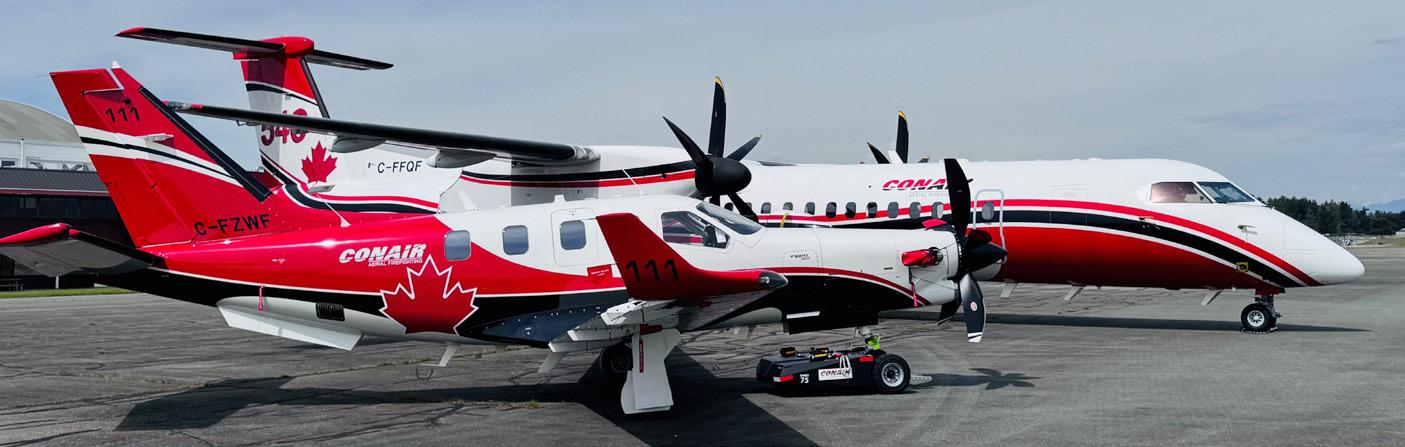
Conair Group is providing four Dash 8-400AT airtankers plus one TBM 960 Air
Attack aircraft to Canada this wildfire season, including experienced aerial firefighting pilots plus trained aircraft maintenance engineers. The operational contract period runs May 1 to September 27, 2026. “For six decades, Canada has been at the forefront of designing, building, and operating specialized aircraft to combat wildfires. Today the nation is building upon that legacy,” said Chris Niemann, CEO, Conair.
The federal government states, that since 2019, in addition to dedicated aerial firefighting capacity, it has committed close to $1 billion to strengthen wildfire resilience and enhance the management of wildfire across the country.
COMMERCIAL
AIR CANADA TAKES DELIVERY OF ITS FIRST AIRBUS A321XLR
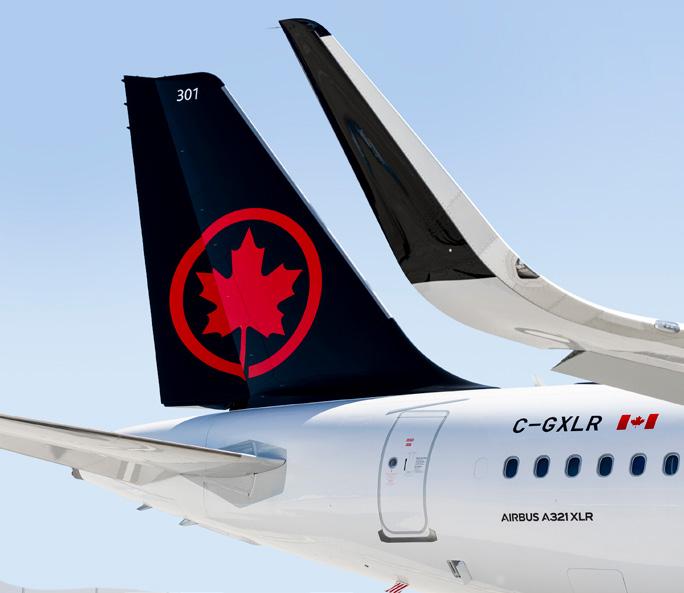
Air Canada on April 24 took delivery in Hamburg of its first Airbus A321XLR, described by the airline as a next-generation, single-aisle aircraft designed to fly longer routes efficiently and with greater passenger comfort. The arrival of this aircraft, leased from SMBC Aviation Capital, marks an important milestone in Air Canada’s fleet renewal and growth strategy, with a total of 30 A321XLR aircraft (15 will be leased, 15 are being acquired directly from Airbus S.A.S.) expected to enter the fleet over the coming years.
Air Canada’s A321XLR aircraft also feature the flag carrier’s new Glowing Hearted cabin standard. The new cabin design features personal device power at every seat, free Wi-Fi for Aeroplan Members, next-generation in-flight entertainment screens that are larger and offer Bluetooth connectivity, and what Air Canada describes
Air Canada is acquiring 30 of the next-generation Airbus A321XLR aircraft, which debut the airline’s new Glowing Hearted cabin design standard.
as cabin finishes inspired by the Canadian landscape and aligned to the airline’s brand and commitment to enduring quality. In a first for Air Canada, the A321XLR also offers Air Canada Signature Class on a single-aisle aircraft, with 14 lie-flat seats.
The A321XLR furthers Air Canada’s ability to serve new transcontinental and transatlantic city pairs. Following Transport Canada certification and entry into service, Air Canada plans to integrate the A321XLR into its schedule progressively to support growth across its network. Air Canada notes the aircraft’s performance and range characteristics are well suited to adjust for seasonal demand patterns and evolving market opportunities.
AIRASIA PLACES LANDMARK 0RDER FOR 150 A220 AIRCRAFT
Malaysia’s AirAsia placed an order for 150 latest generation A220-300 aircraft, which represents the largest single firm order placed for the A220 and propels the program beyond the 1,000 firm order milestone. The contract was announced at a ceremony at the Airbus facility in Mirabel, Quebec, where the aircraft will primarily be built.
The purchase agreement makes AirAsia a new customer for the A220. The airline also becomes the launch customer for the aircraft's new cabin configuration of 160 seats. The increase in capacity, adding 10 seats, is made possible by the addition of an extra overwing exit on each side of the aircraft. Adding to AirAsia’s existing Airbus fleet, the A220 will service destinations across ASEAN and into Central Asia, explains Airbus, freeing up larger aircraft
Conair is providing four Dash 8-400AT airtankers plus one TBM 960 Air Attack aircraft to Canada this wildfire season.
PHOTOS: CONAIR GROUP, AIR CANADA
to fly longer routes. Airbus describes the A220 as the most modern airliner in its size category, carrying between 100 to 160 passengers on flights of up to 3,600 nautical miles (6,700 km). At the end of March 2026, 501 A220s had been delivered to 25 operators worldwide.
“We have built AirAsia by making bold decisions at the right moment, not the easiest moment. This order reflects our long-term discipline and the scale of our ambitions. The A220 unlocks new markets and routes and brings us closer to building the world's first true low-cost network carrier,” said Tony Fernandes, CEO of Capital A and Advisor to Air Asia Group.
PORTER CELEBRATES REVAMPED MET
Porter Airlines in late March announced the opening of its new flight operations at the Montreal Metropolitan Airport (MET), formerly known as the Montreal SaintHubert Airport (YHU). Porter’s service begins on June 15, with 12 routes being
MET’s new terminal will support growth to four million passengers annually with daily flights growing from approximately 175 to 215.
introduced using both its De Havilland Dash 8-400 and Embraer E195-E2 aircraft. Located in Longueuill, Que., on Montreal’s South Shore, MET’s location offers a more convenient air travel option for more than 50 per cent of the region’s population and provides easy access to Montreal’s downtown and central neighbourhoods. MET is one of Canada’s oldest airports, built in 1927.
The new terminal building at MET was designed, built and will be operated by YHU Infrastructure Partners. The
new terminal measures 68,897 square feet (21,000 square metres) with nine boarding bridges, 10 passenger check-in kiosks (two more at the baggage drop area), three passenger security screening lanes, two baggage carousels, 200 employees at the terminal’s opening (growing to 500) and 900 seats in the airside lounge. The terminal’s retail lineup will include a Bâton Rouge restaurant, a Café Dépôt and a convenience and travel goods store. Passenger and employee parking is supported with 2,600 parking spaces located 75 feet (25 metres) from the parking lot to the terminal. MET will support growth to four million passengers annually with daily flights growing from approximately 175 to 215.
Just a couple of weeks earlier, Porter also celebrated a significant enhancement for Toronto travellers with the opening of U.S. Customs and Border Protection Preclearance at Billy Bishop Toronto City Airport (YTZ). As the airport’s largest airline, Porter has been the driving force behind U.S. traffic at Billy Bishop,
PHOTO: PHIL LIGHTSTONE
ON THE FLY
accounting for all cross-border service since it started operating these routes nearly two decades ago. This represents more than 13 million passengers to date. Porter operates up to 16 daily flights to five U.S. destinations from YTZ.
MRO
LUFTHANSA TECHNIK CANADA COMPLETES FIRST ENGINE EVENT
Lufthansa Technik Canada in midApril reached a significant milestone by completing its first live engine event at its interim facility in Calgary. This achievement marks the facility’s full operational readiness as a central partner for LEAP-1B engine services in North America. The interim facility is now fully operational with a total of eight bays, supporting scalable engine maintenance activities while preparations continue for the future permanent site at Calgary International Airport.
Since announcing its Calgary headquarters in February 2025, Lufthansa Technik Canada (LTCA) has grown to more than 80 employees. In December 2025, LTCA passed its Transport Canada Civil Aviation audit. LTCA will develop a 150,000-square-foot engine maintenance facility in cooperation with Calgary Airports. It will include Canada’s first test cell for the latest-generation of aircraft engines. Construction is scheduled to commence in the second quarter of 2026.
VOYAGEUR EXPANDS ATR CAPABILITIES WITH OTTAWA FACILITY
Voyageur Aviation announced the expansion of its aircraft component support capabilities with the opening of a new, dedicated landing gear repair and overhaul facility in Ottawa, Ontario, specializing in ATR regional aircraft. Voyageur explains the new facility enhances its established in-house component programs and further strengthens its comprehensive repair and overhaul (R&O) capabilities.
The new Ottawa facility expands Voyageur’s support for ATR operators by providing increased capacity and a full suite of landing gear services. A Canadian-owned
and operated company, Voyageur delivers all levels of aircraft maintenance and in-service support for commercial and government fleets. Headquartered in North Bay, Ont., Voyageur Aviation, a wholly owned subsidiary of Chorus Aviation, is an integrated provider of specialized aviation services, including contract flying operations both internationally and domestically.
EMBRAER ADDS EXECAIRE TO NETWORK
Embraer added Execaire Aviation to its Authorized Service Center Network to support executive jet customers in Canada. Execaire will provide line maintenance for the Phenom 100 and Phenom 300 series, Praetor 500 Praetor 600 series, and Legacy 450 and 500 aircraft in its base in Toronto. This becomes the third Embraer Authorized Service Center in Canada.
Execaire describes itself as Canada’s longest-standing provider of integrated aviation services to the corporate aircraft and commercial aviation market. The company holds nine operational bases and FBOs across the country, offering a range of services like aircraft management, charter sales, FBO operations, aircraft sales and acquisitions, heavy maintenance, and a variety of technical support.
HELICOPTERS
RCAF JUNO COMPLETES FIRST TEST FLIGHTS
SkyAlyne and Airbus Helicopters Canada achieved a key milestone in the Royal Canadian Air Force (RCAF) Future Aircrew Training (FAcT) program, with the first CT-153 Juno (Airbus H135) completing initial Canadian test flights and showing its RCAF livery in Fort Erie, Ontario. Following initial assembly and acceptance, the aircraft was delivered to Canada for completion activities, including the integration of Canadian-specific modifications and application of the program’s Reflect Forward paint scheme. SkyAlyne is acquiring 19 CT-153 Junos for the RCAF with deliveries beginning in mid-2026.
SkyAlyne states initial flights and installation of the Canadian STCs in Airbus’ Fort Erie facility represent important steps in validating aircraft performance, systems
integration, and overall airworthiness. This phase of testing, continues SkyAlyne, ensures the platform meets the rigorous standards required to support the training of future RCAF pilots.
DEFENCE
SNOWBIRDS TO FLY THE CT-157 SISKIN II
Canada’s Department of Defence will procure the CT-157 Siskin II (Pilatus PC21) for the future Snowbirds air demonstration team of the Royal Canadian Air Force. The Snowbirds’ Siskin fleet will be based at 15 Wing Moose Jaw, Saskatchewan, and is expected to be operational in the early 2030s under 431 Squadron. It will replace the Canadair CT-114 Tutor, which first entered service with the RCAF as a jet trainer in 1963 before helping to support the formation of Canadian Forces Snowbirds in 1971. After 55 years of air demonstration, 2026 will mark the final season for the CT114 Tutor fleet.
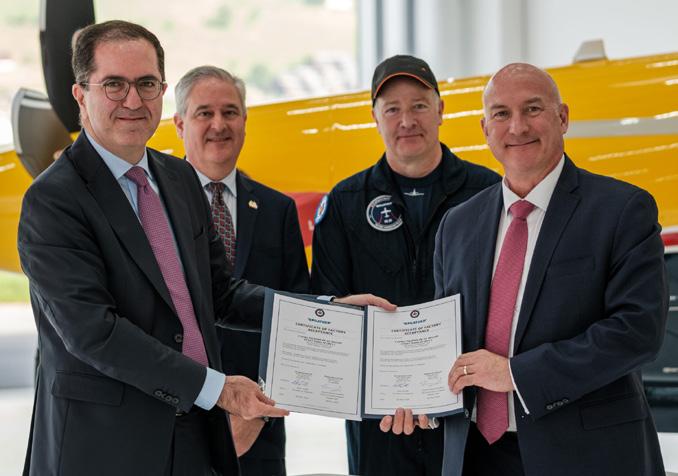
Just days earlier, Team SkyAlyne completed factory acceptance of the first CT157 Siskin II at the Pilatus production facility in Stans, Switzerland, marking a milestone in the RCAF’s Future Aircrew Training (FAcT) program. Beyond the Snowbirds procurement, Canada has ordered a fleet of 19 CT-157s for FAcT. The CT-157 Siskin II will serve as the training aircraft for both the Advanced Flying Training – Fixed Wing (AFT-FW) course, as well as the Advanced Flying Training – Jet (AFT-Jet) course in the FAcT program. The two-seat aircraft, featuring a 1,600 horsepower PT6A Pratt & Whitney Canada turboprop engine, can reach speeds of 685 km/h. The first four CT157s are expected to arrive in Canada in the second half of 2026. | W
Team SkyAlyne in mid-May completed the factory acceptance of the CT-157 Siskin II for FAcT at the Pilatus Aircraft facility in Stans, Switzerland.
By Jessica Dizon Burns
Passing the torch
How mentorship prepared Centennial College students for the Aerospace Maintenance Competition and for their future in the hangar
ASunday in March at Centennial College, not in a classroom or lab, but in our hangar, where the pace is different, expectations higher, and the standard real. The top Centennial College aircraft maintenance and avionics students, selected for the Aerospace Maintenance Council (AMC) Competition team, were not just practicing for an upcoming event; they were being introduced to the realities of our profession.
The AMC, held this year in Orlando, is one of the most demanding events in aircraft maintenance. For the second year in a row, Centennial students were the only Canadian school team to compete. Teams travelled from as far as Turkey, Australia and Brazil, representing professional, military, and student divisions.
With Air Canada entering two professional teams, its coach, Nuno Martins, reached out to schedule regular weekend mentorship sessions in our hangar, preparing both their teams and ours. What unfolded over those weekends became much more than competition prep; it became a model for what aviation training can look like when industry steps in as a true partner.
In the classroom and labs, we teach foundational skills. To prepare for this level of competition, we needed more. That’s when the Air Canada team began coming in on weekends, voluntarily and consistently. They introduced the students to real-world communications and decision-making under pressure, and the pace of operational maintenance.
Some members of the 2025
Centennial team, now working as apprentices, returned for a weekend session to share insight on both the competition and transitioning into the industry.
Erik Burns, a 2024 competitor for the WestJet professional AMC team, also helped mentor for weekend practices. Porter’s team stopped in to work alongside the students after committing to the 2026 competition.
This type of mentorship should not be limited to competition. There is an opportunity for AMOs across the country to invest in summer work programs, job shadowing during reading weeks, and structured hangar visits. “Seeing the level of dedication from these students during their training would make me
confident to have them as apprentices when they graduate,” said Burns.
When a student walks into a hangar after graduation already understanding the pace, culture and expectations, they are not starting from zero; they are stepping into something familiar. This model of mentorship goes beyond well beyond instruction.
“Working with the students in preparation… I saw the passion in them, the hard work and determination,” said Air Canada’s Bruno Consolante, a member of the airline’s professional AMC team. “Spending quality time was the key to it all and what led to both of our groups finding success on the world stage. Mentoring the students was a career
highlight for me and has inspired me to continue contributing my time to ensure future generations in finding success.”
Every AMC practice became an opportunity for industry professionals to observe; not just task performance, but to see how students responded to criticism, handled pressure and worked as a team. These are the qualities that do not appear on transcripts and resumes, but often determine success in a hangar. When experienced engineers work directly with students, they pass on the mindset, habits and standards that define our profession, not just procedures.
There are clear lessons from this experience. Industry involvement needs to start early
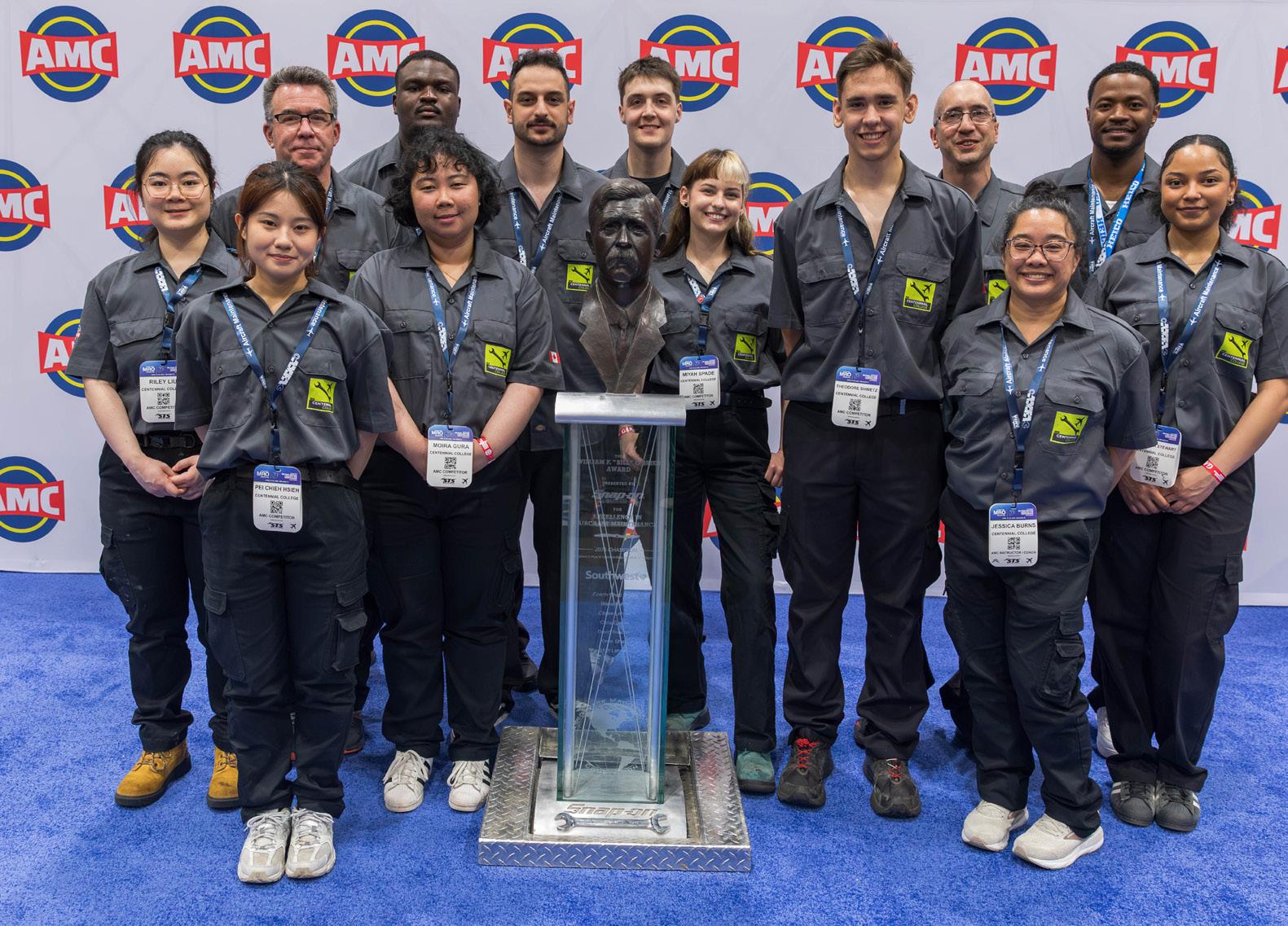
Two teams of Centennial College students helped to represent Canada at the 2026 Aerospace Maintenance Council competition.
and remain consistent. A single guest lecture won’t move the needle, hands-on engagement will. Mentorship must be active; working side by side is fundamentally different from demonstrating or observing.
One of the most important outcomes of this experience is what happens after the competition. Mentorship doesn’t stop when the event is over; it creates pathways, exposure, connections and real job opportunities. Students rise to the level of expectations they are given. When they are treated like professionals early, they begin to act accordingly.
What stood out, just as much as the mentorship itself, was how many parts of the aviation industry stepped forward, often without being asked. As this was not a college-funded event, the team had to raise the funds to get to Florida. Smart Aviation Maintenance Solutions’ Mark Rinaldi was among the first to reach out and ask, “How can I help?” There was no formal request, just a genuine willingness to support the next generation. Shortly after, the Aircraft Mechanics Fraternal Association, at both national and local levels, expressed interest in helping our team attend.
What began as a single team of five students and one substitute quickly evolved into something much bigger. Darren Cook, Senior Line Maintenance Manager at WestJet, reached out to let us know their team would
be unable to attend. Since their registration had already been paid, they offered to gift their spot to us. That opportunity allowed us to send two Centennial teams, doubling both our participation and our costs. It also allowed an additional professor, Sean Fleming, to attend and support the team. He, along with John DeJong, already trains students outside of regular hours for the Skills Ontario competition, making him a natural addition.
Darryl Best of Air Canada and Gavin Pais of Porter Airlines both offering direct flights from Toronto to Orlando, stepped in to cover travel. The Centennial College Student Association support helped with food and transportation costs while in Florida. This wasn’t one company helping our team; it was an entire industry recognizing its future workforce and choosing to invest in it. According to the Government of Canada’s Job Bank, 34 per cent of Aircraft Maintenance Engineers are over the age of 50, with a median retirement age of 63, and the occupation is projected to face a moderate risk of a labour shortage in the coming years. This isn’t a future problem; it’s a current one.
By the time we left Orlando, the results didn’t matter, what mattered was the transformation. Students who began the process unsure of themselves left confident, capable and connected to the industry. “Signing up
for the AMC team started as wanting to prove myself to others, but as practices started, the training gave me confidence, a strong work ethic, and a deep sense of gratitude for the people who supported us throughout,” said Moira Gura, a Centennial Team student Centennial Team student Giuseppe Gatto, said, “The journey to the AMC is one I’ll carry with me for the rest of my life. Along the way, I gained more than just experience, I found mentors who shaped me and friendships that will last a lifetime.”
For the second year in a row, we were awarded the Peer Banner Award, voted on by fellow competitors in recognition of knowledge, skill, integrity and professionalism. We also earned first place in the WIN MS Wire Diagnostic event and first in the Panasonic IFE Troubleshooting event. One of our teams placed 25th overall and 7th among schools.
What stayed with me as a coach was not the scoreboard, it was the moment I watched our students stand taller, speak with confidence, and recognize that they belong in this industry. | W
For mentorship opportunities, summer work programs, job shadowing, hangar visits, AMC team support, or collaboration across Canada, reach out to Jessica Dizon Burns at jburns@centennialcollege.ca.
We are NAV CANADA
For some, the sky's the limit. But for us, it's just the start.
Congratulations to Michelle Griffin, Director, Airport & Flight Information Services for being recognized as a Top 20 Under 40. Her passion and dedication have had a tremendous impact on Canada's air navigation system. Together with a team of professionals from coast to coast to coast, we applaud her contributions to keeping Canada's skies safe.
By Tim Anderson |
AMEs and Red Seal
The challenges presented by a reemerging incentive
program
Anyone who has looked at the aviation industry lately, particularly in the aircraft maintenance world, knows that we are still facing a significant personnel challenge. The expanding market, ongoing retirements, competition from other sectors and industries, and a lower number of younger people entering the trade have combined to make this a very persistent and difficult issue to solve.
To better understand the challenge, it helps to review the Aircraft Maintenance Engineer (AME) licensing process. The traditional pathway involves an individual being hired by a company and completing a four-year (4,800hour minimum) apprenticeship. During that time, they maintain a logbook covering a series of required tasks. They also complete Transport Canada accepted basic training, previously available through ICS correspondence, but now delivered online through the Canadian Council for Aviation & Aerospace (CCAA). Finally, depending on the license category, they must pass three to four Transport Canada exams before earning for their license.
The more common pathway today involves attending a college that offers a Transport Canada accredited program. If students meet the required grades and attendance standards, they receive credit, commonly 1,800 hours, toward their 4,800 hours and complete their technical exams during the program. This reduces both the time
required and the number of exams once they enter the workforce.
Both options are valid and accessible, but each pose their own challenges to newcomers, and some individuals can only participate in one option due to personal or logistics reasons. Because of this, there have been many ideas put forward to improve access to an AME license. Some are well-intentioned, but they tend to focus on short-term incentives instead of longterm, sustainable solutions. A recent example is the push to have AMEs recognized as Red Seal tradespeople. The issue is that we’ve already been down that road, and it was discontinued for good reason.
The Canada Red Seal Program sets national standards for provincially regulated trades, allowing workers to move across provinces without additional testing. Prior to 2011, apprentice AMEs were under this designation. That changed when it was recognized that AMEs, just like pilots, are federally regulated through Transport Canada, not provincially like most trades. Because of that, the Red Seal designation did not add meaningful value to the profession. I remember a Red Seal representative visiting my shop at this time to inform me that some of my apprentices who where registered in the program had been removed due to this change.
Fast forward to today, and the personnel shortage has brought the Red Seal idea back into the conversation. The proposal suggests that AME apprentices would be designated under Red Seal while completing their entire 4,800 hours apprenticing with an employer. Some companies already offer this pathway without Red Seal, including IMP Aerospace, Cascade Aerospace, and International Test Pilot School.
But this isn’t actually a new pathway, it’s the same one that already exists. Anyone hired without prior training can enroll in the CCAA program, complete their 4,800 hours, meet the requirements, and earn their AME license.
The traditional pathway to earn an AME licence in Canada involves an individual being hired by a company and completing a four-year (4,800-hour minimum) apprenticeship.
What has changed is the broader policy environment. In April, the federal government announced the Team Canada Strong initiative. A new $6 billion nationwide effort to recruit, train, and hire 80,000 to 100,000 new Red Seal trades workers in the next five years. This includes the Build Canada Apprenticeship Service to provide up to $10,000 for an apprentice’s first-year salary. This has led to the idea that reconnecting AMEs with the Red Seal program could encourage more hiring.
The problem is that this approach doesn’t address the real constraints. Adding Red Seal requirements introduces more administrative work for companies and apprentices, with limited benefit. More importantly, hiring apprentices isn’t just a matter of funding, it’s a matter of capacity. Apprentices need to be trained and supervised by licensed AMEs. Companies cannot
simply hire large numbers of apprentices without having enough experienced personnel to support them safely. In many cases, the priority for companies remains hiring licensed engineers first, before they can accommodate more apprentices.
There is also the issue of sustainability. Incentive programs are temporary by nature. Whether they end due to funding limits, policy changes, or external disruptions, such as COVID. Once these initiatives are over, the underlying structural issues remains unchanged.
If we are serious about addressing the personnel shortage, the focus needs to shift. We need to look at how to support apprentices as they enter the industry, how we support the licensed AMEs who will be mentoring them, and how we expose younger generations to aviation earlier. At the same time, we need to make existing pathways
more accessible, whether through college programs or direct-entry apprenticeships.
Ideas like reintroducing Red Seal show that the industry is actively looking for solutions, which is a good sign. But if we want long-term, sustainable results, we need to focus on the core issues that have created the shortage in the first place.
Another factor that often gets overlooked is retention. Bringing new people into the industry is only part of the equation; keeping them is just as critical. Early-career AMEs are entering a work environment that can be demanding, shift-based and, in some cases, less competitive than other technical industries competing for the same talent pool. If those individuals do not see a clear path forward, whether through wage progression, specialization, or work-life balance, the industry risks losing them just as quickly as it brings them in.
There is also an opportunity to better align training with real operational needs. Employers, colleges, and regulators are not always moving at the same pace, which can create gaps between what is taught and what is required on the hangar floor. Strengthening that alignment, even in small ways, can reduce onboarding time and ease the burden on licensed engineers who are already stretched thin.
None of these changes are quick fixes, but they are practical ones. The solution is less about adding new labels or programs, and more about making the existing system work better for the people who are already in it, and especially for those who are trying to enter it. | W
Tim Anderson is a professor at Fanshawe College’s Norton Wolf School of Aviation and owner of Anderson Aviation Services.
TOP 20 UNDER 40
POWERING THE FUTURE OF CANADIAN AVIATION AND AEROSPACE
BY JON ROBINSON
In the annual Top 20 Under 40 program, Wings recognizes leaders influencing the direction of Canadian aviation and aerospace. Presented alphabetically, these leaders, who are all under the age of 40, were initially put forward through an online nomination process. Wings then determined this year’s Top 20 honourees based on leadership, innovation, influence, achievement and dedication to their organizations and the Canadian aviation industry.
Shaheer Ali, 39, joined Transat’s revenue management team close to five years ago, after focusing on the same sector with Air Canada for more than four years, and spending close to a year with Bombardier. At Transat, Ali oversaw RM initiatives that drove a 33 per cent year-over-year EBITDA increase in 2025 and contributed to a record $3.4 billion in revenue. He also coordinated the integration of three AI-driven tools into the RM ecosystem, strengthening analytical capabilities and enabling incremental revenue opportunities.
Why is your company unique?
What makes Transat truly unique is that its identity as a world-class leisure airline is reflected in its internal culture. It keeps customer satisfaction at the heart of its operation, and it is achieved by deeply valuing the employees and fostering an entrepreneurial spirit. It is an environment where employees are encouraged to challenge existing processes, think outside the box, and drive continuous improvement.
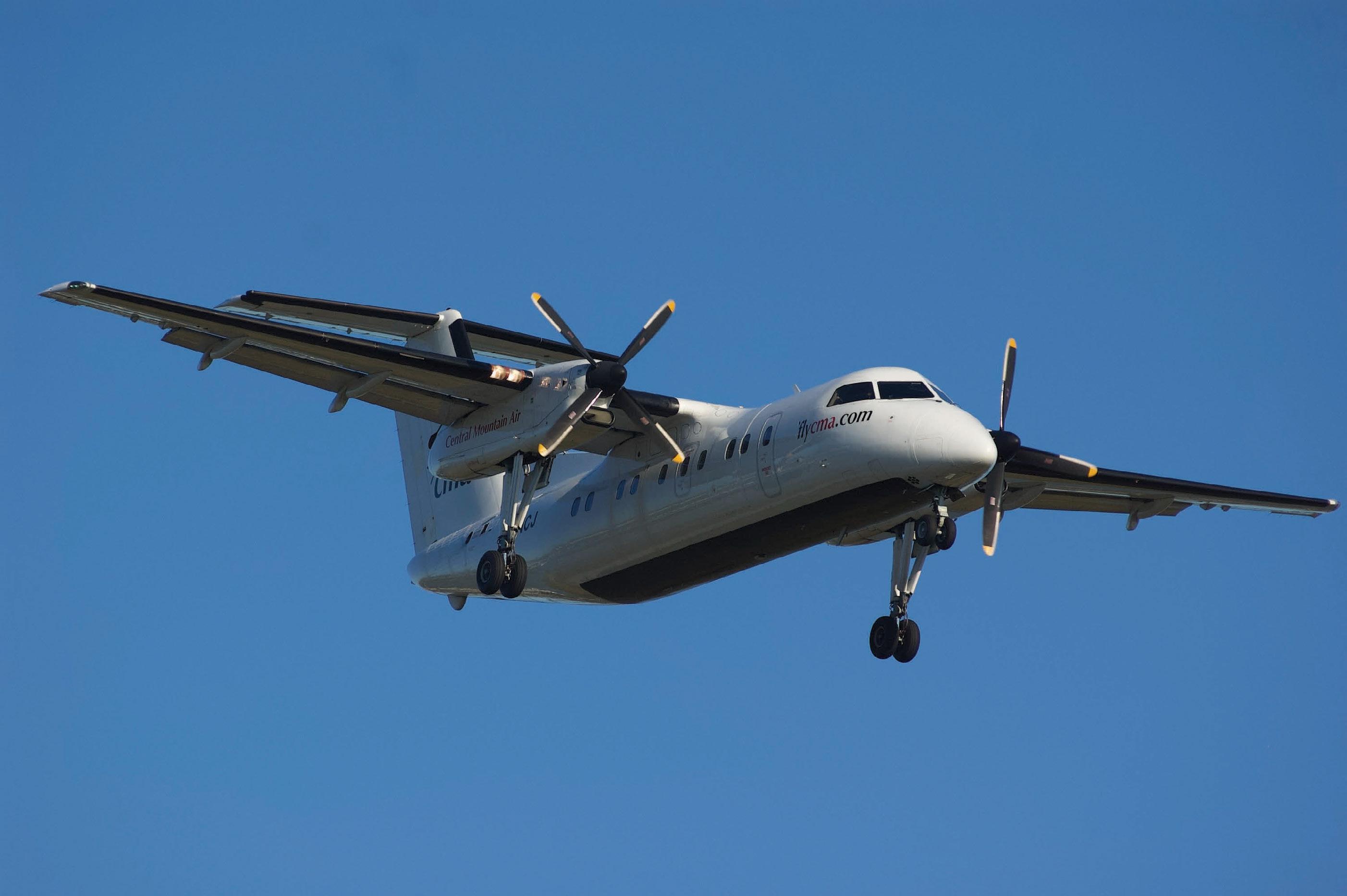
Director, Charter Services, Central Mountain Air, Prince George, B.C.
Carrie Colville, 35, oversees a diverse portfolio of specialized air transportation solutions across Canada, spanning workforce logistics, cargo operations, government support and complex charter programs. With Central Mountain Air (CMA) for the past 18 years, she has been pivotal in supporting industries and communities where aviation is critical for connectivity and economic development. Colville helped lead CMA’s national cargo expansion and strengthened the company’s position in competitive procurement environments across mining, energy, government and tourism. She has been actively involved in advancing Indigenous partnerships and contributes to the industry as a board member of the BC Aviation Council.
Why is your company unique?
We’ve expanded into an airline with more than 340 employees, operating across multiple provinces and supporting industries,
communities and organizations across Canada. What has kept me engaged is that the business is constantly evolving. We support everything from workforce FIFO programs and cargo operations to government contracts, tourism and VIP charters. The challenges of the operation changes throughout the year, and each season brings different customers, challenges and opportunities.
KYLE CYBULSKI
Senior Program Manager, Boeing Defence Canada, Ottawa, Ont.
Kyle Cybulski, 36, leads Canada’s CH147F Boeing Chinook In Service Support Program designed to materially increase Royal Canadian Air Force (RCAF) readiness and strengthen domestic and international mission capability. He joined Boeing in 2018 and today manages a diverse program team of engineers, logisticians, business management specialists, maintenance coordinators and field technicians, operating across multiple Canadian and U.S. sites. Cybulski enhanced the Boeing Chinook program’s framework by leading negotiations through the latest contract renewal and implementing a robust performance management framework that aligns operational goals with contractor incentives, while maintaining the Government of Canada’s focus on value. He also established long-term Contracted Maintenance Support and is currently shaping the planned mid-life fleet upgrade project for the CH147F.
Why is your company unique?
Boeing is truly a special place to work. The scale of the company means endless opportunities, and every day we’re connected to
CARRIE COLVILLE
Kyle Cybulski, Program Manager, Boeing Defence Canada
incredible aerospace projects for both government and commercial customers. What makes it even better is the diverse, talented, and energetic team I’m lucky to be part of here in Canada... While I’ve never served, I am deeply proud knowing our team’s dedication helps keep these helicopters flying and supporting the men and women protecting Canadians.
COURTNEY DAVIS
Director,
Business Development, Sydney Airport Authority, Sydney, N.S.
Courtney Davis, 36, joined the
Sydney Airport Authority in 2018 and is a central figure in its transformation. In the wake of the COVID pandemic, she played a lead role in rebuilding air service to Cape Breton Island. She spearheaded the development of new airline partnerships, including WestJet service, that for the first time in the YQY’s history, connected the region directly to Western Canada. Davis introduced datadriven marketing and strategic initiatives like Sydney’s Fly Local campaign, which influenced traveller behaviour, increased passenger volumes, and strengthened the airport’s case for additional air service. Davis has championed a communitycentred approach to growth, strengthening relationships with local organizations and ensuring the airport’s success is shared across the communities it serves.
Why is your company unique?
The most meaningful milestones for me are collective,
built by pushing ourselves every day, at every opportunity, to go further than we thought possible. Entering 2026, we saw total economic output increase by 276 per cent and GDP contribution rise by 140 per cent. Most importantly, our work helped create 148 per cent more jobs across Cape Breton... Passenger traffic also grew by 13.6 per cent, reflecting stronger connectivity and demand.
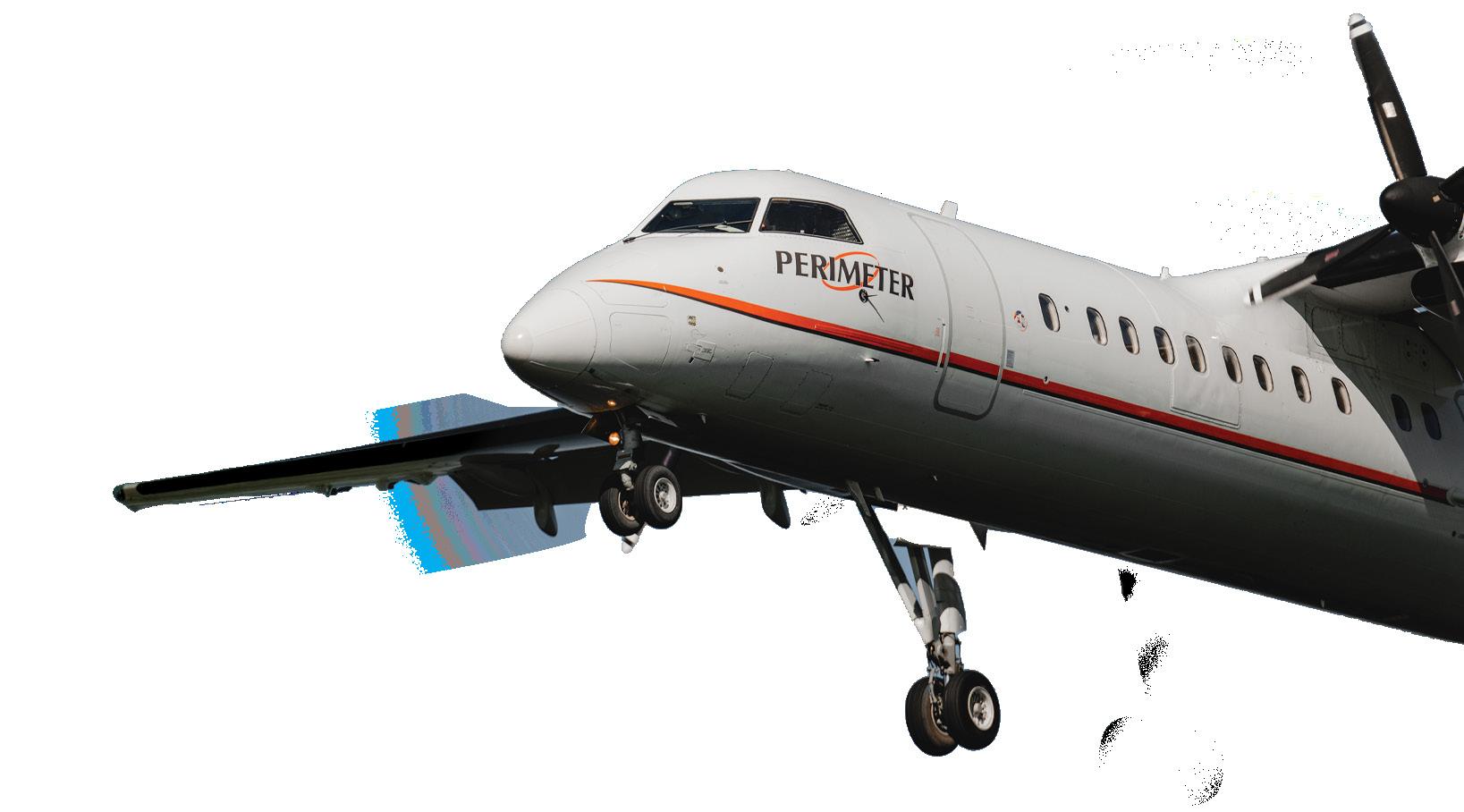
Sara Echakar, 30, leads customer operations across Perimeter’s complex network, including flights within the GDS, interline
connections, and non-GDS environments, spanning regional and NAMO-managed airports, as well as its own terminal. She played a critical role in streamlining check-in, baggage processes, and customer service operations, leading her cross-functional teams through change. She also led digitizing compensation vouchers to facilitate APPR compensation requirements. One of the most visible examples of Echakar’s leadership was during the phased rollout of the expanded Winnipeg terminal in 2025.
Why is your company unique?
Perimeter Aviation is much more than an airline. We’re a lifeline for many northern communities in Manitoba and Northwestern Ontario, connecting people to healthcare and essential services. Every flight has a purpose, which makes impact more than just a word – you truly feel it in the work you do every day. We have a strong culture of teamwork and care, especially during challenging situations.
Congratulations!
Bradley Poulette, CEO
From a proud team, congratulations on being named one of Canadian aviation’s Top 20 Under 40! Your vision and leadership are modernizing what’s possible in aviation operations, and we’re grateful to be part of it.
ECHAKAR
MICHELLE GRIFFIN
Director, Airports and Flight Information Services, NAV CANADA, Ottawa, Ont.
Michelle Griffin, 38, entered the aviation industry with a business and human resources background, allowing her to build a career focused on people leadership, labour relations, and organizational culture before moving into operations as a Regional Director overseeing Airport and Flight Information Services. Griffin today helps to lead a range of critical functions from collective bargaining and HR initiatives across the AFIS team to her contributions with the Digital Aerodrome Air Traffic Services program.
Why is your company unique?
NAV CANADA is unique because of the critical role we play in the safe movement of aircraft across Canada and the North Atlantic. Every day, employees help safely guide aircraft in 18 million square kilometres of airspace, connecting people, communities, and businesses across the country and around the world.
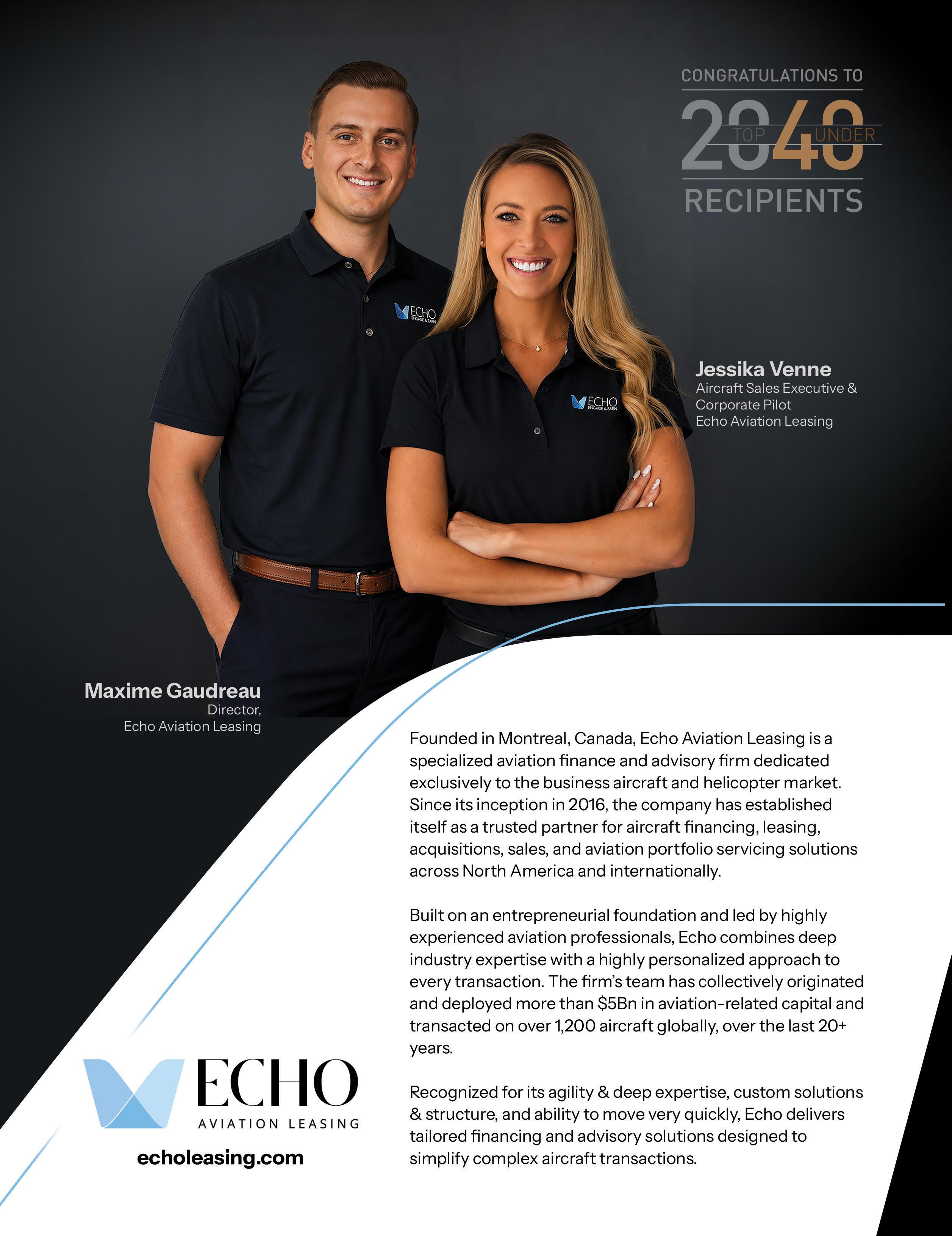
MAXIME GAUDREAU Director, Echo Aviation Leasing, Montreal, Que.
Maxime Gaudreau, 28, as employee no 1 of Echo Aviation Leasing, played a foundational
role in building the company from inception into a respected platform in business aircraft financing, leasing, and brokerage throughout North America. His influence has been both strategic and operational, directly contributing to sustained double-digit growth year over year. Gaudreau has been instrumental in structuring and executing aircraft financing, acquisitions and sales mandates, while continuously improving internal processes and client engagement strategies.
Why is your company unique?
From the beginning of my career, the leadership team entrusted me with meaningful responsibility, giving me the opportunity to lead, learn, and grow while continuously mentoring me along the way. That journey has provided invaluable exposure, the ability to lead complex aircraft transactions, and to build longstanding relationships with some of the most inspiring business leaders and entrepreneurs around the world.
DINA JUGURNAUTH Manager, Audit Operations, IOSA, International Air Transport Association, Montreal, Que.
Dina Jugurnauth, 32, works with the trade association for the world’s airlines, helping to represent more than 370 airlines accounting for some 85 per cent of global air traffic. The IATA Operational Safety Audit (IOSA) Program, which represents 483 airlines, is an internationally accepted evaluation system designed to assess the operational management control systems of an airline. Leveraging her 13year career in aviation, which included serving as Senior Manager of Safety and Quality Assurance with Pivot Airlines (rebranded as Great North Airlines
in January 2026), Jugurnauth excels at overseeing complex audit frameworks, improving operational processes, and ensuring adherence to global standards.
Why is aviation exciting?
The industry is constantly in motion, regulations evolve, operations shift, and risks change... What excites me most is being part of an industry where everything is interconnected on a global scale. A single standard, audit, or procedural update can influence operations across multiple airlines and regions in real time, ultimately shaping how safely and efficiently people travel around the world.
DAMON
JUSS
Pilot and Aircraft
Maintenance Engineer, Capital Helicopters, Whitehorse, Yukon
Damon Juss, 38, joined Capital Helicopters in 2023 and quickly demonstrated himself to be a well-rounded aviator, whether moving a drill in a Bell 407 or performing an inspection on one of the company’s AStars. Capital Helicopters is a locally owned business providing a range of missions for mining exploration, geological surveys, camp support and fire suppression, among others. Juss has been working in Yukon’s helicopter industry for close to 15 years and has developed troubleshooting skills that are second to none. He is an extremely accomplished engineer with a knack for mentorship and training co-workers. He
also holds multiple type ratings on all of Capital’s aircraft types as an accomplished pilot.
What is a favourite memory? I think my favorite memories of aviation are tied to all the repeatable achievements, the clean rebuilt engine with no leaks, odd longline load that goes perfect, track and balance that is near flawless, finding the perfect alpine lake for a swim.
MATTHEW KAMSTRA
Vice President, Flight Operations, Perimeter Aviation, Winnipeg, Man. Matthew Kamstra, 39, began his journey with Perimeter Aviation 20 years ago as a ramp agent in Thompson, before joining the flight deck as a Metro First Officer, later upgrading to Metro Captain. He went on to fly medevac operations, followed by single-pilot Merlin charter and scheduled flying. In 2017, he became Dash 8 Captain before earning designation as Approved Check Pilot. In 2022, Kamstra was appointed Chief Pilot, Training and Standards. His impact became pivotal in 2023 as Flight Operations Manager and, again in 2025, when he assumed his current role, encompassing the Transport Canada–approved Company Operations Manager responsibilities. He helps to lead a complex organization (CARs 703/4/5), with a broad range of scheduled, charter and medevac operations.
Why is your company unique? Perimeter Aviation is a uniquely multifaceted airline... No two days are the same, there are always new missions, challenges, and solutions to be found. What
truly sets the company apart is its deep connection to the communities it serves. As an essential service provider in many remote regions, there is a genuine sense of responsibility, care, and commitment to our passengers.
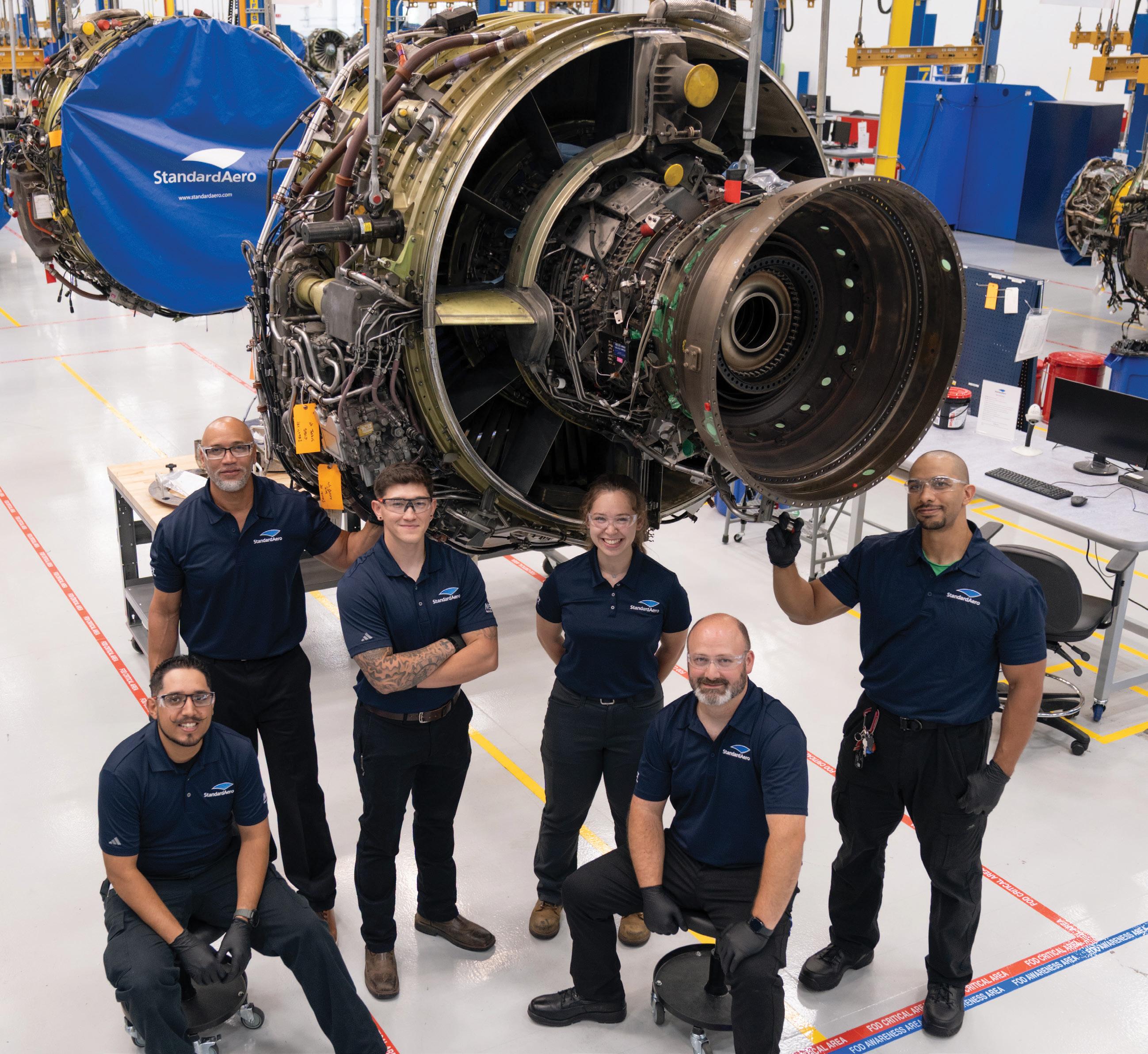
JOSH KIMELMAN Interim Customer Program Director, StandardAero, Winnipeg, Man.
Josh Kimelman, 32, joined StandardAero in April 2014 as an Engineering Summer Student supporting the Helicopter Business Unit. In May 2017, Kimelman was hired full time as an Associate Repair Development Engineer in the CF34/CFM56 Business Unit. He expanded his engineering breadth by moving into a Service Engineering role in 2018. In 2021, he was promoted to Service Engineering Manager in CF34. In 2023, Kimelman moved from engineering to the commercial side when he became a Program Manager supporting airlines that operate large fleets with CF34-powered aircraft. In December 2025, he took on his current role for the Helicopter Business Unit, responsible for the customer relationship with three OEMs and five engine platforms.
Why is your company unique?
First, and foremost, is our people. StandardAero has a strong culture and DNA that has been passed down from generation to generation since its inception in Winnipeg back in 1911. There is a real sense of community amongst our team, and everyone is always willing to lend a hand when help is needed. Second is, what I believe to be, the unique position StandardAero holds within
the MRO industry. StandardAero is OEM-aligned on all the engine platforms we support, while also being one of the largest independent MRO companies in the world.
ANDREW MOONILAL
First Officer, Jazz Aviation, Toronto, Ont.; Professor, Fanshawe College, London Andrew Moonilal, 35, wears a couple of hats in the aviation industry as a part-time Professor at Fanshawe College, teaching in the Commercial Flight and Aviation Leadership program, and as a full-time First Officer on the CRJ-900 with Jazz Aviation. He is also an M1 licensed Aircraft Maintenance Engineer. This allows Moonilal to look at tasks or scenarios with both skillsets, a perspective he most enjoys sharing in the classroom at Fanshawe for students to consider a bigger picture when flying.
What is a favourite memory?
One moment that stands out recently was flying the CRJ-900 into my hometown airport of London, Ontario. My wife was waiting near the threshold of Runway 15 and watched me as I hand flew the landing in. Two years earlier, she had encouraged me to finish my flight training, making the moment especially meaningful and reflective. It reminded me how far I had progressed professionally – from working in London at Diamond Aircraft and Fanshawe College
Careers that take you to new heights.
CARRIE COLVILLE Director of Charter Services, Central Mountain Air
Central Mountain Air is proud to celebrate Carrie Colville for being nominated in Wings Magazine’s Top 20 Under 40.
to eventually flying a jet full of passengers into the very airport where I spent many years.
ALLISON PELLETIER
Assistant Chief Flight Instructor, Executive Compass Flight Institute, Calgary, Alta.
Allison Pelletier, 34, progressing to Class 1 Instructor in under three years, has licenced 30 students and, as an Assistant Chief Flight Instructor, she has mentored nine new instructor ratings and supervised over 50 instructors, elevating regional training standards. Pelletier holds a strong, personal commitment to safety and refuses to let any student settle for the bare minimum, expecting her pilots to leave every lesson more motivated than when they arrived. She is fixture in the community, volunteering for the Alberta Aerobatics Club and Girls in Aviation.
What is a favourite memory?
What’s especially meaningful now is watching that ripple effect in real time, seeing the next generation of pilots I’ve had a hand in developing go on to fly all over the world. It genuinely feels like being a mama bird watching the fledglings take off. I love bragging about the cool jobs my students are doing after they graduate.
BRADLEY POULETTE
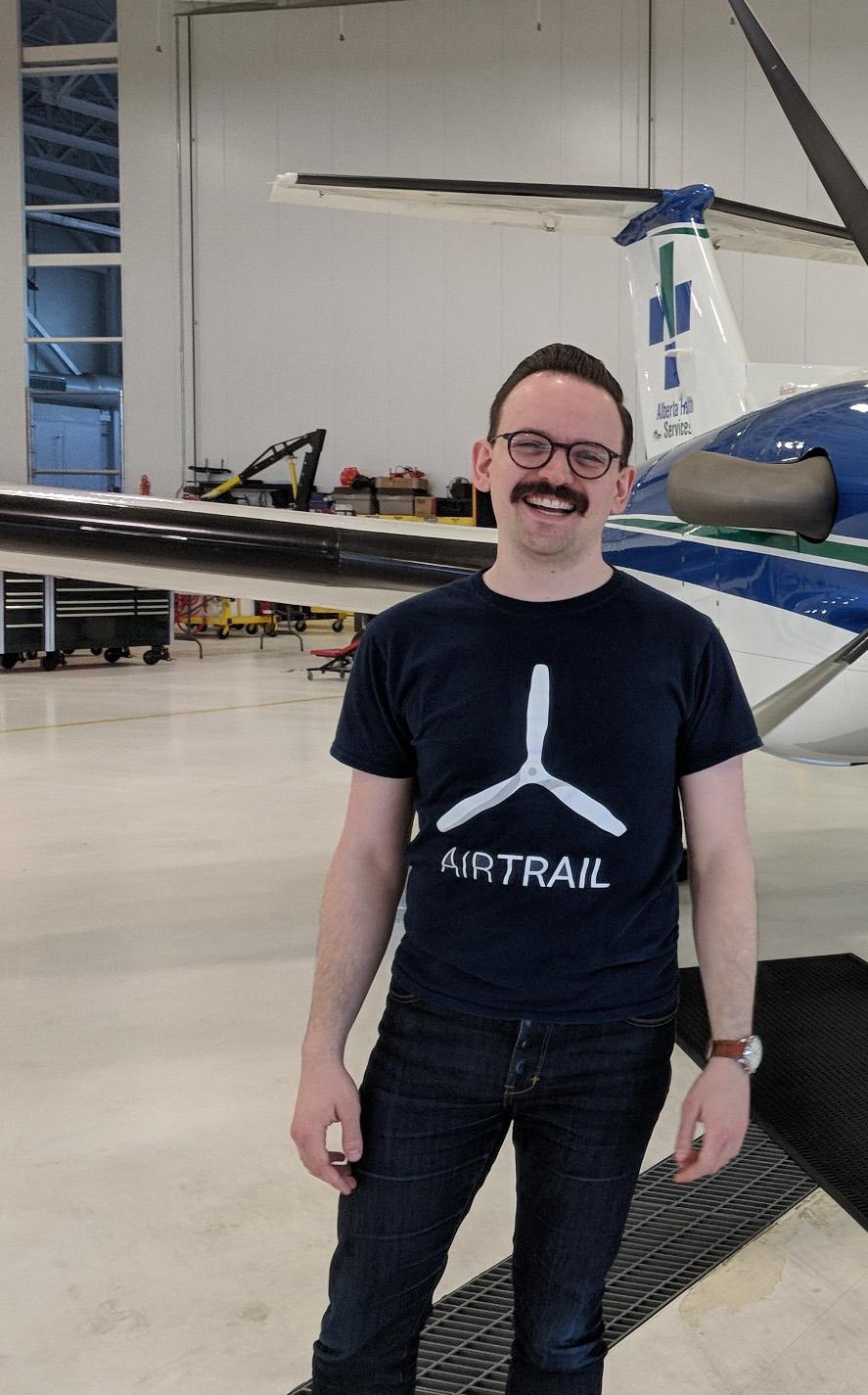
Founder and CEO, Air Trail, Edmonton, Alta.
Bradley Poulette, 33, founded Air Trail with the goal of leveraging automation to help regional
airlines free themselves from the stresses and costs of regulatory compliance. He held that a single, connected source of truth for the entire operation is not just possible, it is the only way to make compliance sustainable and give operators the visibility they need to run a safer, smarter business. Air Trail is purposebuilt for CARs compliance and configurable enough to serve operators of all types across fixedand rotor-wing segments. Under Poulette’s leadership, Air Trail has grown to hold more than 40 customers managing over 500 aircraft across Canada.
Why is aviation exciting?
Aviation, and specifically Canadian aviation, is full of renegades, willing to do things their own way, while also warmly inviting you into their family of people who love turning dinosaurs into noise. Every visit I make to an operator includes an opportunity to share a meal and swap stories. I'm thrilled to see the next generation of aviators continuing to live these values passed down from the previous generation, while using technology to channel that renegade spirit in new and exciting ways.
PATRICK SIHOTA
Airport Manager, Township of Langley, Langley, B.C.
Patrick Sihota, 32, has been instrumental in providing strategic direction for the Langley Regional Airport over the past four years, helping to deliver the airport’s 2045 Strategic Plan. The airport recently completed the Advanced Air Mobility Feasibility Study – a first in Canada. He is actively involved with Canadian Advanced Air Mobility. Sihota holds a wealth of experience in the airport sector, previously serving as an interim Managing Director for North Peace Regional Airport and, in 2017,
as General Manager of Dawson Creek Regional Airport, YDQ, where he was instrumental in bringing WestJet Link to the community. He also spent close to three years in a consultancy role with Vantage Airport Group.
Why is your company unique? What makes Langley Regional Airport unique is that we are not only supporting day-to-day aviation operations, but also helping shape what aviation looks like next. We serve an important role in the Greater Vancouver region, balancing communityfocused general aviation with forward-looking work in areas like Advanced Air Mobility and future vertiport planning. That combination is rare.
KAITLYN TAYLOR Interim Director, EHS & Sustainability, StandardAero, Summerside, P.E.I.
Kaitlyn Taylor, 29, joined StandardAero Summerside’s Environmental Health & Safety (EHS) team in 2019. She was promoted to Senior EHS & Security Specialist in March 2023, and again to EHS&S Manager, Turboprops, in May 2024. In her current role, Taylor provides strategic leadership for environmental, health, safety, and sustainability programs across StandardAero's global Commercial Engine Services division. A member of the Summerside facility’s Senior Management Team, Taylor is also one of only two StandardAero Designated Officials in Summerside certified by Public Services and Procurement Canada to ensure compliance with the Canadian Controlled Goods Program and Defense Production Act.
Why is your company unique? Visiting and working across multiple international locations has
shown me that despite geographical differences, there is a shared commitment to safety, quality, and continuous improvement that guides how we operate every day. That shared commitment, paired with flexibility to support over 40 platform authorizations, is what allows us to deliver for our customers and remain one of the world’s largest independent providers of MRO services.
ANOJH THAYAPARAN
Chief Technology Officer, Airble, Richmond, B.C.
Anojh Thayaparan, 30, leads the development of Airble’s global aviation platform that connects travellers and air operators while modernizing how flights are booked, managed and optimized. Under his leadership, the platform has scaled from 40 to 75 operators across North America, Europe and Asia, including companies like Talon Air, Cirrus Aviation, Maverick Helicopters and Helijet. Thayaparan's leadership enables operators to reduce administrative burden, increase aircraft utilization, and unlock new revenue opportunities by making better use of existing resources. He is also the technical lead behind a provincially funded Innovate BC project, working alongside Helijet to deploy advanced operational optimization tools in a live aviation environment.
Why is your company unique?
Airble is bringing a modern technology mindset into an industry that has historically relied on legacy systems and fragmented workflows. We move quickly, iterate constantly, and focus heavily on user experience while still respecting the operational rigor aviation demands. It’s exciting to work at the intersection of aviation and technology because the
At Perimeter Aviation, we connect Canadians communities, and
careers.perimeter.ca Direct Entry Medevac & Dash 8 Captains NOW HIRING
Congratulations Matthew Kamstra, Vice President of Flight Operations and Sara Echakar, Director of Commercial Services on being recognized as one of Canada’s Top 20 Under 40 in Canadian aviation.
MATTHEW KAMSTRA Vice President, Flight Operations
Your leadership and dedication to Perimeter Aviation, our passengers, and the communities we serve continue to make a meaningful impact.
We’re proud to celebrate this well-deserved recognition.
impact is tangible, whether it’s improving operational efficiency, simplifying booking experiences, or helping operators better connect with customers.
JENNIFER VAN BLITTERSWYK
Chief Engineer, Boeing Defence Canada, Ottawa, Ont.
Jennifer Van Blitterswyk, 33, has been a vital member of the Boeing Canada Medium-toHeavy Lift Helicopter (MHLH) Program for more than nine years, excelling in roles ranging from project management
and IT system sustainment to her current position as Chief Engineer. She holds a pivotal role for the sustainment of the CH147F Chinook fleet, overseeing in-service support for nonstandard repairs, modifications, maintenance program updates and safety assessments. Van Blitterswyk leads coordination among platform design, service, and system integration engineers across Ottawa and Boeing’s Ridley Park facility. She operates within the Boeing Canada Accredited Technical Organization (ATO), accountable to the RCAF and the Department of National Defence’s airworthiness authority. She is a cultural leader at Boeing Canada, as a founding member of the MHLH Program Team’s Culture Committee and chairing Boeing Canada’s Veterans Engagement Team.
Why is aviation exciting? Things are getting quicker, smarter, better, all of the time,
and it’s exciting to be at the forefront of that, helping to ensure the Canadian fleet is working with the best. It’s also incredibly encouraging to see, on a daily basis, the love Canadians in the industry have for the work they do, and the people they support.
JESSIKA VENNE
Aircraft Sales and Acquisitions, Corporate Pilot, Echo Aviation Leasing, Montreal, Que. Jessika Venne, 36, began her aviation career as a flight attendant before transitioning into flight operations and becoming a corporate pilot in 2019. As a Pilatus PC-24 Training Captain and an aircraft acquisitions specialist at Echo Aviation, she combines operational expertise with commercial insight, advising clients on financing strategies and operational decision-making. Venne has developed expertise across flight operations, contract flying and mentoring, training systems, maintenance and engine programs, regulatory compliance, aircraft transactions, and simulator development. She worked closely with Echo, CAE, JSSI and the NRC on aircraft evaluation, test flying, flight-data collection, and advanced training initiatives. Venne currently serves as Subject Matter Expert and Test Pilot for CAE’s Pilatus PC-24 full-flight simulators, playing a critical role in test flying, data validation and regulatory approval.
Why is your company unique?
I’ve been able to build a career that goes beyond traditional flight operations, combining corporate aviation, aircraft consulting, maintenance programs, sales and acquisitions, training, and simulator development. Echo
Aviation Leasing has provided exposure to multiple angles of business aviation, from aircraft financing and acquisitions to operational strategy, while allowing me to remain actively engaged in flight operations and maximize my actual flying.
JENNA GERIS
Manager,
Resource Management Unit, Greater Toronto Airports Authority, Mississauga, Ont.
Jenna Geris, 39, grew up in aviation, particularly as a teenager after her father – a bush pilot – purchased the Canadian Aviation Expo. She then worked at the Oshawa Executive Airport as an Airport Duty Manager before taking on an airfield maintenance position at Billy Bishop Toronto City Airport, where she quickly became an Airport Duty Manager and provided the airport with operational leadership for 10 years before joining the GTAA as the first female manager of the RMU. Geris is a member of the International Association of Airport Executives Canada and she recently earned her Accredited Airport Executive designation.
What is a favourite memory?
One of my most cherished aviation memories is flying with my dad over the far reaches of northern Ontario, watching polar bears and beluga whales along the shores of Hudson Bay... an experience that can only be fully appreciated from the air. Professionally, one of my proudest achievements is bringing Girls Take Flight to life at YTZ. That project came straight from the heart, and seeing it evolve from an idea into a fully realized event was incredibly rewarding. | W
THE WORLD’S LEADING INDEPENDENT MRO PROVIDER
With over a century of proven excellence, StandardAero has built a reputation as the industry leader and best place to work. Supporting some of the industry’s most popular platforms, StandardAero’s global network of 50+ service locations takes pride in offering customized MRO solutions through trusted partnerships with our customers.
Kaitlyn Taylor and Josh Kimelman embody the customer focus which is a hallmark of StandardAero’s 8,000 employees. We are proud to see them recognized in Wings’ Top 20 Under 40. Congratulations to Kaitlyn, Josh, and all of this year’s winners!
There are approximately 16,000 aircraft in the air at any given time transmitting ADS-B data and acting as sensors for Aireon’s space-based ADS-B system,
AI IMPACTS IN AVIATION
ENHANCING ORGANIZATIONAL OPERATIONS THROUGH ARTIFICIAL INTELLIGENCE
BY PHIL LIGHTSTONE
The past century has been, in large part, fuelled by the global growth of aviation and aerospace, which only accelerated out of the 1980s proliferation in computing with the innovation behind microprocessors, RAM, storage and networks. Today, artificial intelligence (AI) presents a new business paradigm in its ability to review and analyze millions of data points and provide context. For the non-technical, AI is the simulation of human intelligence by machines and computer systems, allowing them to learn, reason, solve problems and perceive. AI systems can process and analyze copious amounts of data to recognize patterns, make predictions and decisions. While AI is commonly used as a digital assistant, it can also be used to enhance an organization’s operations. AI can create code, develop procedural steps, serve as an agent, optimize workflows and provide metadata and advanced analysis.
The Canadian federal government’s 2024 budget included: investing $2 billion to build and provide compute and technological infrastructure for AI researchers, startups and scale-ups; enhancing AI startups through $200 million in support from Canada’s regional development agencies; investing $100 million into the National Research Council Canada’s (NRC) AI Assist Program; supporting workers who may be impacted by AI with $50 million over four years through the Sectoral Workforce Solutions Program; creating a new Canadian AI Safety Institute with a
$50 million investment; and providing $3.5 million over two years to advance Canada’s leadership in the Global Partnership on AI.
The FAA has been thinking and planning for AI in aviation since the early 2020s. Dr. Trung Pham, Chief Scientist and Technical Advisor, FAA, reports: “Artificial Intelligence is the discipline of creating computational systems that mimic aspects of human intelligent capability to perceive, decide, and act. In aviation, AI systems are implemented to enhance the effectiveness and efficiency of controlling aircraft systems. Machine Learning (ML), often considered a key subset of AI, applies computational methods to train AI models to learn from data and generalize that knowledge into compact algorithms for implementation in code. While theoretical research in ML advances computational technique, aviation research focuses on measuring the functionality and performance of AI systems in accordance with the certification framework to assure the safety of aircrafts containing AI systems. Discipline leadership supports evaluating the effective use of ML and safely integrating AI technologies in aviation systems, informing FAA policy, guidance, and training. This effort includes international collaboration with industry, other government agencies, standards development organizations, and academic institutions to advance understanding of algorithm development, data characteristics, and model functionality and performance.”
There are a number of AI enabled systems
being developed by the FAA, including (but not limited to): Strategic Management of Airspace Routing Trajectories; AI Enabled ATC Decision Support; Drone Identification Tool; Safety Data Analysis; Maintenance, monitoring and control of the National Airspace System; AI safety assurance methods, which allow for the safe introduction of algorithms into aviation; and other applications.
Bombardier Inc. has been using AI to increase productivity and enable condition based and predictive maintenance, while reducing aircraft downtime. Bombardier’s AI driven tool, Smart Link Plus, transforms an aircraft’s data into actionable, proactive and prescriptive solutions, allowing operators to leverage the power of their aircraft’s data to minimize downtime.
Internally, Bombardier employees use AI tools to quickly find and understand information across a complex aerospace knowledge base (spanning engineering standards, maintenance manuals, quality procedures and evolving operational documentation). This is especially valuable in aviation, where details are technical, highly regulated, version controlled, and distributed across many systems; and where accuracy and context matter as much as speed. Bombardier is applying AI internally through enterprise software tools that help improve productivity and support betterinformed decisions. One example is CLARA, an internal sales tool that helps streamline the creation of range maps and supports more efficient customer discussions. On the
which, with AI, can help enhance GPS spoofing/jamming products and turbulence avoidance technologies.
engineering side, Bombardier recently signed a multi-year agreement with CoLab AI Inc. to deploy artificial intelligence solutions that will support the design and manufacturing processes of its business jets. With this collaboration, Bombardier will harness AI to drive innovation throughout product development cycles, enabling faster timelines and adding advanced AI driven capabilities to current procedures. Bombardier continues to explore the use of AI to improve manufacturing processes by reducing aircraft cycle time, enhancing product quality, and identifying production bottlenecks earlier, while driving greater efficiency across operations.
Savvy Aviation has many products which utilize AI. Its first AI project focused on failing exhaust valve analytics (called FEVA). FEVA was created in 2014 and utilizes AI to report on signs of a burned exhaust valve in the company’s database. On average, Savvy found one cylinder in 40 would have a burned exhaust valve, but that cylinders, reported by FEVA “at elevated risk”, have roughly one chance in four of having a burned valve. Savvy recommends that any cylinders reported to be at elevated risk by FEVA be borescoped at the next opportunity. Its machine learning language was trained using hundreds of thousands of flights. More recently, Savvy’s GADfly technology utilizes an AI agent to review data from Cirrus SR22 aircraft that has been uploaded to Savvy. The difficulty in Savvy’s nine million flights (in its database) is unlabelled data, which can be challenging for AI engines.
Dr. John Sipple joined Savvy’s team to resolve this problem of unlabeled data, creating a technique called MADI (Multivariate Anomaly Detection with Interpretability). GADfly provides blame analysis that identifies which specific data element (of a flight) contributes the most to an anomaly score for a Cirrus aircraft, which Savvy staff can use to escalate (to the aircraft owner) future maintenance issues before they occur. Mike Busch, founder and CEO of Savvy, reports: “We are also working on AI projects in other areas of Savvy. The Savvy platform has a huge database of all sorts of things, like 250,000 borescope images, thousands of maintenance records with many handwritten records and stickers. Our newest project, Ask Anything, utilizes typed commands to search through all the records of our database, delivering an AI super search capability to find the relevant records in the database. I am thrilled to be on the ground floor of AI, which will massively change everything people do. These powerful AI tools are getting demonstrably better every week.”
North America is in the early stages of utilizing AI on the operations side of an airport. Asia Pacific is further ahead, implementing AI-based systems to improve efficiency and
safety. Alan Tay of Ilumia Labs reports: “My company has been working the embedding AI systems in aviation for the past two years,” says Alan Tay of Ilumia Labs. “In the Asia Pacific, we see airports implementing AI into Gate Management systems, realizing a fiveto seven-minute [per hour] efficiency gain, allowing the gates to support more aircraft per hour. Some major airlines in the Asia Pacific have embedded AI and facial recognition into their gate boarding systems, eliminating the need to scan boarding passes. The result is 248 to 336 passengers boarding a Boeing 787 Dreamliner in 30 minutes. This has the long-term effect of allowing the total aircraft accommodated per hour to increase, thereby allowing the airport to avoid or defer airport construction projects. Subsequently, annual movements are now limited by weather events and aircrew shortages.”
AI augmented systems have been implemented across the aviation ecosystem. One example is AXIS Flight Simulation unveiling its AI Debriefing Station in 2025, an advanced automated platform designed to improve pilot training, support instructors and standardize assessments. CAE is focused on AI development, with the release of CAE Rise. In 2022, CAE announced that Air Busan had implemented CAE Rise. Nick Leontidis, CAE Group President, Civil Aviation,
reported: “Air Busan and CAE share a longstanding partnership that spans almost a decade and we are thrilled to expand the CAE Rise training system to their Airbus A320 fleet. With CAE Rise, Air Busan can now harness the power of big data analytics to train the safest pilots, while leveraging insights to continuously adapt and improve Air Busan’s flight training programs.”
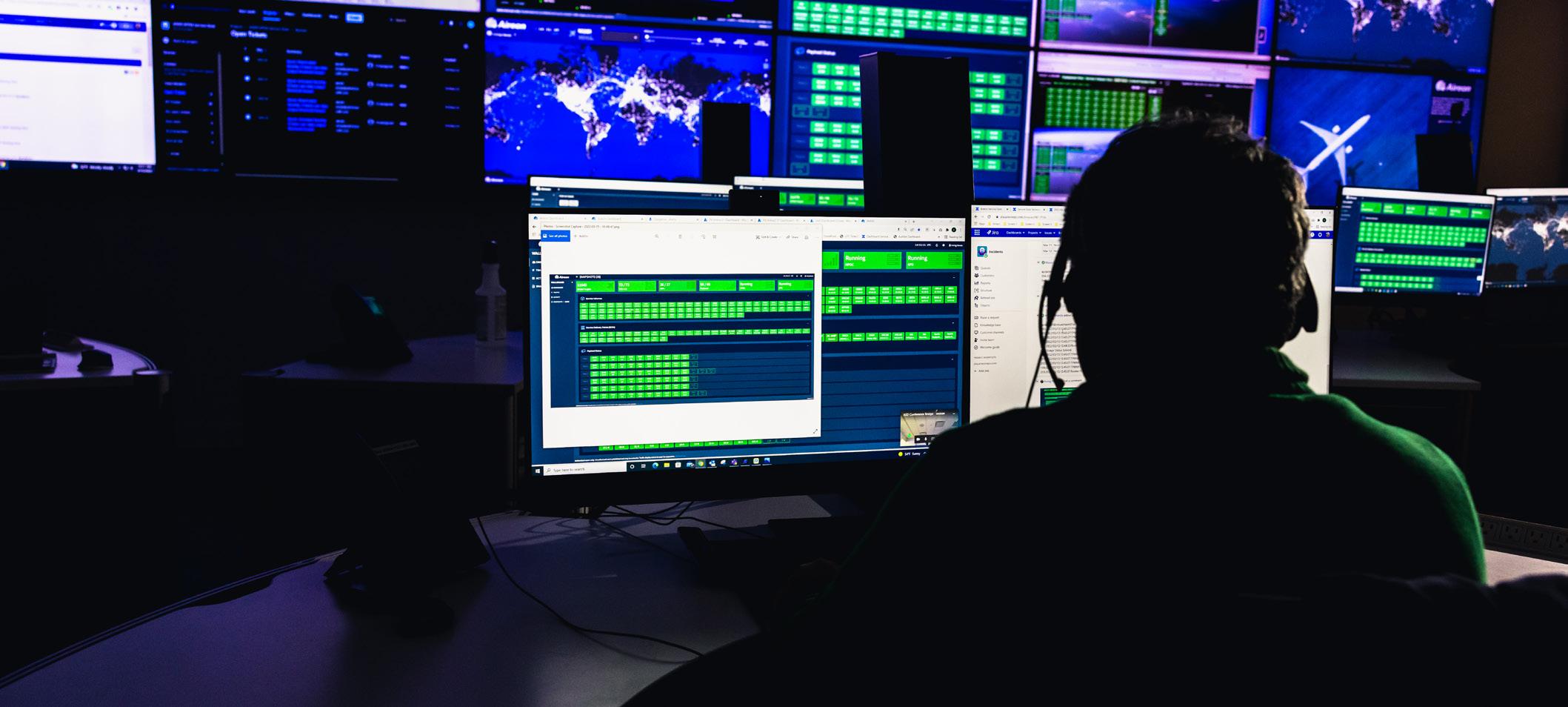
Iridium Communications Inc. and Aireon LLC are both using AI after making a substantial investment into AI implementation. Aireon created a walled garden with its first AI enablement focusing on cyber security monitoring and implementation in its 24/7 customer service environment. With GPS jamming and spoofing on the rise, they see the utilization of AI based analytics into their robust databases, which have been collecting data since 2017. There are approximately 16,000 aircraft in the air at any given time transmitting ADS-B and acting as sensors for their space-based ADS-B system, which, with AI, can enhance GPS spoofing/jamming products and turbulence avoidance technology.
“We have made substantial AI investments in our team and infrastructure and have created a secure enclave for our global ADS-B data and now are exploring AI-based applications, including looking at how to apply it
Reach Your Aviation Goals
Learn from the Experts
For over 35 years, AeroCourse has been a leader in advanced aviation training in Canada.
We provide regular training courses-IFR and ATPL and custom seminars for the aviation industry along with developing and publishing manuals and workbooks to assist pilots gain the knowledge required to write their IFR and ATPL exams.
Our dynamic and enthusiastic instructors are exceptional –they are professional pilots and ight examiners with thousands of hours experience both in ight and in the classroom. They provide a productive learning environment which contributes to student’s success.
We pride ourselves with high quality materials and training resulting in a high success rate.
to turbulence detection and prediction applications,” says Don Thoma, Chief Executive Officer, Aireon. “We are also working with partners who are building AI-based air traffic analysis and airspace management tools, which is a key part of our early strategy to use the power of AI tools and very unique datasets to improve safety and efficiency for aviation stakeholders.”
Matt Desch, Chief Executive Officer of Iridium Communications, explains: “AI is being integrated into Aireon products and we expect them to be able to mine important real-time and historical insights from their very rich and high-quality dataset. Their commercial data services will be turbocharged by AI, creating revenue and increased profitability. We don’t need AI to generate cost reductions, but it’s more about creating new products and services. Success with AI will be about the quality of data and Aireon is the gold standard for global aircraft surveillance and movement information.”
Companies like Jeppesen ForeFlight have been using AI in its applications for years. Henrik Hansen, Chief Technology Officer, Foreflight, reports: “Specific to aviation, I’m confident it will change our industry for the better, it’s just a matter of when. When considering the pace of AI adoption, I think about it in terms of three factors: optimization, regulation and trust.” ForeFlight’s first step in leveraging AI in its app is enhancing large language models (LLM) to save users time in their flight planning. ForeFlight has trained LLMs to analyze user airport comments and summarize them for quick reference. This process is executed in ForeFlight’s cloud ensuring that ForeFlight’s consistency and traceability on the iPhone or iPad is not compromised.
In 2025, Jeppesen ForeFlight added Ryan
Walker as Head of AI and Portfolio Marketing to the team. “I see the biggest opportunity of AI in bridging the gap between ATC, operations and the cockpit through continuously updating both ends of a flight,” says Walker. “Disconnected operations are costing the airline industry over US$60 billion annually. However, there is risk in over confidence in systems not grounded in certified data. With certified systems and data, AI analysis and problem solving should not deliver wrong answers.”
Travis Root, Senior Vice President, Flight Deck, Jeppesen ForeFlight, reports: “Safety is the biggest opportunity for AI to connect teams, which for business aviation and the airlines is a natural occurrence. General aviation pilots tend to be a team of one, however, AI delivers a team of experts for every pilot. As the pilot is the final decision authority, there is risk that in the early days of adoption, AI can be wrong, requiring guard rails to manage expectations and help the pilot make the right decision.”
NAV CANADA is taking a pragmatic and gradual approach to AI, focused on three main areas. The organization is progressively operationalizing the technology, starting with business functions like human resources and finance, and extending into operational decision-support tools that complement, rather than replace, the work of its controllers and technical staff. “We are in the early days of AI, with NAV CANADA operating in a heavily regulated and safety-focused industry. As such, we are taking a controlled deployment strategy designed to ensure that safety is not compromised,” says David Sheppard, VP and Chief Technology and Information Officer. “However, we believe the benefits to NAV CANADA will be profound in the long run, delivering productivity enhancements across
our workforce and workloads. Where AI is a component, our analysis already illustrates productivity gains.”
As RPAS operations and Beyond Visual Line of Sight (BVLOS) commercial flights grow in Canada, AI is one of the enabling technologies that will help scale simultaneous operations without overloading air traffic management systems (ATM). Today’s ATM is built around human-to-human communications, with technology supporting controllers and pilots on either end. The RPAS segment is structurally different, relying on richer data exchanges, evolving standards, and lower-cost hardware, which allows for faster integration of new technology than the longer certification cycles of conventional aviation typically permit.
Both the U.S. and Canada, as well as other countries, are evaluating AI-based unmanned aircraft designed to pair with manned aircraft, whereby the unmanned fighter aircraft will (in phase 1) be autonomously controlled from the ground, but in phase two will be controlled by AI systems. With the ability to currently target up to 100 enemy points, the only limitation is the number of weapons on each autonomous AI-driven attack aircraft. With the issues that NATO-based countries have been experiencing over the past year(s), however, there is an obligation of each country to ensure that the AI systems (delivered by foreign companies) have no hidden code, which allows that country to lose control of the attack vehicle to a foreign country. An obvious question is will AI systems or human IT experts be used to audit the AI attack systems for compliance to country specific requirements.
In 2024, ICAO released a series of seminars on ICAO TV discussing the utilization (both present and future) of AI in aviation. There are numerous episodes with many hours of content, which provides information about AI from a variety of stakeholders. These episodes are a great way to gather information from organizations on the leading edge of AI implementation, providing a real-world assessment of the benefits and drawbacks of the path to AI enablement.
Aviation-based AI systems can change the results of every flight through ensuring that the human aspect of the flight does not compromise passengers and aircrew through bad decisions. One might argue that (over time), mid-air and ground collisions will become a thing of the past, as more AI integration into avionics, air traffic management (and control) and airport automation systems take place, preventing (or reducing) bad decisions. In-cockpit AIdriven technologies may hold the potential to reduce the number of accidents and incidents. Which would be priceless. | W
Bombardier in April 2026 signed a multiyear, multimillion-dollar contract to use artificial-intelligence software from CoLab AI to help with aircraft design and engineering.
READY FOR TAKEOFF: TRAVELLING SMART AND SAFELY THIS SUMMER
As Canada enters the busy summer travel season, the air transport industry prepares for one of the most important periods of the year. Across our country, aviation plays a vital role in connecting communities, supporting tourism, and enabling Canadians to explore, from major urban centres to remote regions that rely on air service year-round.
With this surge in activity comes a shared responsibility. At the Air Transport Association of Canada, our message is clear: come early, come prepared, and travel with respect. These actions contribute directly to a safe, efficient experience for everyone across the aviation system.
PREPARING FOR PEAK TRAVEL
This summer peak will be further intensified by an anticipated influx of international visitors linked to FIFA World Cup activities in Vancouver and Toronto. We expect higher-than-usual passenger volumes and air traffic, placing added importance on planning and preparedness.
Summer travel brings high volumes, full flights, and operations at capacity. While the industry continues to invest in safety, resilience, and service, passenger preparedness remains essential. Arriving early, allowing time for security screening, and having documentation ready can make a meaningful difference.
Steps such as confirming baggage allowances, checking in online, and reviewing airline policies in advance help reduce stress and support a smoother travel experience. Wellprepared travellers contribute to a more efficient flow, benefiting passengers, crew members, and aviation professionals.
LITHIUM BATTERIES: SMALL DEVICES, SERIOUS RESPONSIBILITY
Travellers rely on personal electronic devices powered by lithium batteries, which require careful handling. These batteries are classified as dangerous goods due to fire risk. Devices must be kept in the cabin, on your person or in carry-on baggage, and not in checked luggage. This is a critical safety safeguard. In the unlikely event of malfunction, keeping devices in the cabin allows trained
crew members to respond immediately.
Understanding these requirements is an important part of modern air travel. Safety is shared, and informed passengers help reduce risk.
RESPECT IN THE CABIN: A SHARED COMMITMENT
Aviation safety depends not only on systems but also on behaviour. A respectful, cooperative environment is essential for crews to perform their duties effectively.
Transport Canada’s campaign on respecting crew and fellow passengers highlights that while most travellers contribute positively, even isolated disruptive incidents can have significant consequences.
Unruly behaviour, including refusal to follow instructions, can lead to delays, diversions, and enforcement action. Crew members are trained first to ensure safety, and their instructions must be followed.
At ATAC, we support continued awareness of the importance of respect in the cabin. Professionalism from crew members, combined with cooperation from passengers, is fundamental to maintaining Canada’s high safety standards.
WORKING TOGETHER FOR A STRONG SUMMER SEASON
Every day, thousands of aviation professionals, including pilots, flight attendants, maintenance personnel, flight dispatchers, airport staff, and air traffic controllers, work together to deliver safe air transportation across Canada.
Passengers are an integral part of this system. By travelling prepared, understanding safety requirements, and demonstrating respect, they contribute directly to the system’s success.
As we move through the busy summer months, ATAC encourages travellers to embrace preparedness, awareness, and respect. This summer also offers an opportunity to rediscover Canada through destinations served by ATAC member airlines, connecting travellers to diverse regions and cultures.
The result is a stronger travel experience for all, defined by safety, efficiency, and the spirit of connection that defines Canadian aviation. On behalf of ATAC and its members, I wish everyone a safe and enjoyable summer of travel.
Julie Mailhot President and Chief Executive Officer
By John Gradek
Building a national wildfire fleet
The
pan-Canadian aerial plan is a start, but it is not yet a strategy
The Canadian government in May announced that it will lease a fleet of 10 firefighting aircraft and other support assets to be deployed for the 2026 wildfire season. The plan will see these 10 leased aircraft being managed by the Canadian Interagency Forest Fire Centre deployed strategically across the country and made available to provinces as they face intense wildfires. The new aircraft include four firefighting air tankers, one birddog plane and five heavy lift helicopters, with operating crew and maintenance support to be provided by the leasing companies.
This announcement follows the government’s fall 2025 budget announcement of a $316.7-million investment in Canada’s aerial wildfire-fighting capacity – an announcement that marked an important acknowledgement of a growing national challenge to improving the response to elevated wildfire activity. After record fire seasons in 2023 and 2025, the federal government is stepping into a domain long dominated by the provinces.
This surge model is intended to provide additional capacity when provincial resources are stretched. Increasing the wildfire aerial firefighting asset base is very welcome but remains an incomplete improvement to improving the effectiveness of the aerial wildfire firefighting strategy. Policy architecture behind this action remains incomplete.
Canada’s wildfire aviation system remains fundamentally decentralized. Provinces own or contract their own wildfire firefighting aircraft and rely on the Canadian Interagency Forest Fire Centre to co-ordinate interprovincial sharing when resources allow. That model worked when fire seasons were staggered geographically. Increasingly, they are not, and wildfires are more intense and fast-moving.
In recent years, Canada has experienced multiple Level 5 preparedness alerts, meaning every available aircraft in the country is already responding to fires. When that happens, there are no reserves left to move between provinces and action may be taken to call for international firefighting assistance. Leasing a handful of additional aircraft may ease pressure, but it does not resolve the structural vulnerability. What Canada lacks is a clearly defined national aerial response
Without a clearly defined framework, the new surge capacity risks becoming another asset pool waiting for a crisis rather than a system designed to prevevent one.
framework. That framework should establish how federally-funded aircraft are deployed, how they are prioritized when multiple provinces face simultaneous fires, and how they integrate with the emerging detection technologies, such as satellite monitoring and long-endurance drones, that can identify fires earlier than ever before.
Without that doctrine, the new surge capacity risks becoming another asset pool waiting for a crisis rather than a system designed to prevent one. Current aerial firefighting strategies focus primarily on support of ground forces in proximity to advancing wildfires on human establishment and infrastructure.
It is, however, important to note that aerial suppression remains most effective in the early stages of a wildfire, when rapid intervention can prevent a small ignition from becoming a landscape-scale disaster. But that requires aircraft to be positioned strategically and deployed quickly – not simply dispatched after fires have already significantly grown.
During a recent visit to De Havilland Aircraft of Canada’s new production facility in Calgary, I saw firsthand manufacturing for the next generation of Canadair water bombers. The production rate for this new facility is set for 10 aircraft per year. European customers have already ordered this new generation
of aircraft for delivery through 2030, responding to their own worsening wildfire seasons. Provincial governments wanting to renew or expand their De Havilland water bomber fleets have been told to expect deliveries through 2031 and 2032.
Yet Canada – the country that pioneered the modern water bomber – still lacks a coherent national strategy for aerial wildfire response. The point is not simply that Canada should acquire additional firefighting aircraft. The point is that Canada must decide what role aerial firefighting should play in a national wildfire resilience strategy.
Should federally funded aircraft focus on rapid initial response, similar to the model used in parts of southern Europe? Should they primarily reinforce provincial fleets during peak events? Or should they form the backbone of a national front-line attack capability that can be pre-positioned across the country as fire conditions develop?
These are important strategic questions. At present, they remain elements of a debate, they remain unanswered. Ottawa’s new funding recognizes that wildfire risk is no longer a purely provincial concern. Smoke from fires can affect millions of Canadians far from the flames themselves. Evacuations disrupt regional economies. Insurance losses and infrastructure damage ripple across the country.
Wildfire resilience has now been recognized as a national public-safety issue. Leasing aircraft through the Canadian Interagency Forest Fire Centre is a useful beginning. But if Canada is serious about preparing for fire seasons, the next step is unavoidable: the development of a co-ordinated national aerial firefighting framework. This should be one that complements provincial operations while ensuring Canada has the capacity to respond when multiple regions face fire at the same time. The fires are changing. Canada’s wildfire aviation strategy must change with them. | W
This article was originally published by The Conversation. John Gradek is Faculty Lecturer and Academic Program Coordinator, Supply Network and Aviation Management, at McGill University. He previously held senior roles at Canadian Pacific Railway and at Air Canada.
T R A D I T I O N E M P OW E R S
TO M O R R OW
# U P L I F T YO U R F U T U R E
S h a p e t h e f u t u re o f a v i a t i o n w i t h u s .
J o i n t h e t e a m w h e re i n n ov a t i o n & c o l l a b o ra t i o n g o h a n d i n h a n d . WE ARE HIRING SCAN TO APPLY NOW