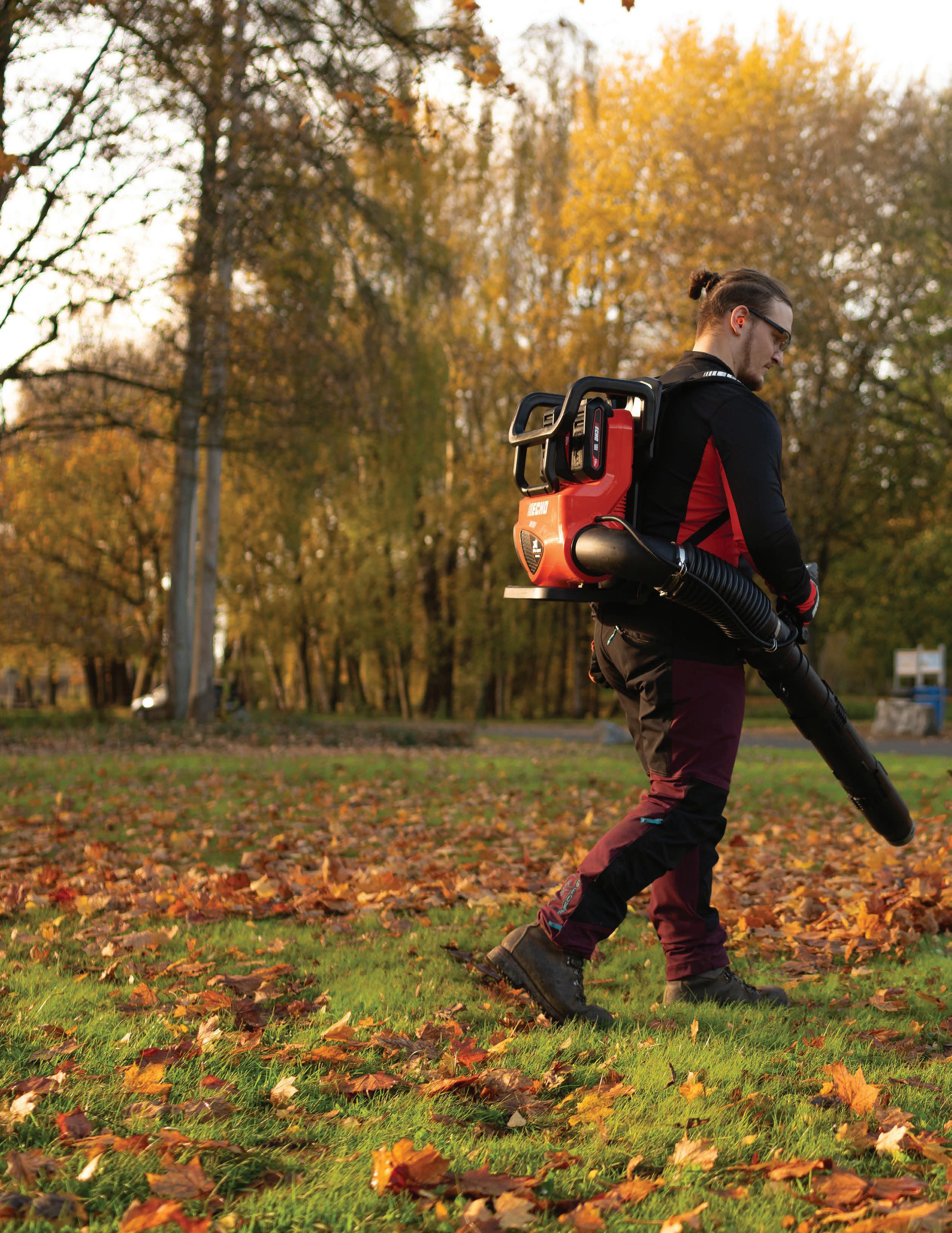

SPORTS FIELD LINE PAINTING
WEATHER RESISTANT
IPX4-rated weather-resistant construction.
FINE MESH AIR FILTER
Ensures optimum cooling.
VARIABLE-SPEED TRIGGER
3 performance levels allow for optimal power and run times.
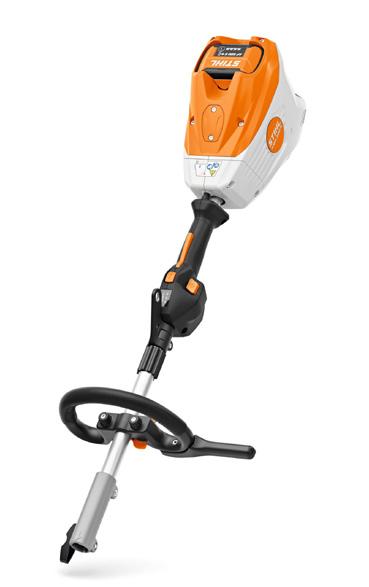
RUBBERIZED ADJUSTABLE LOOP HANDLE
Designed for user comfort and increased manoeuvrability in confined spaces.
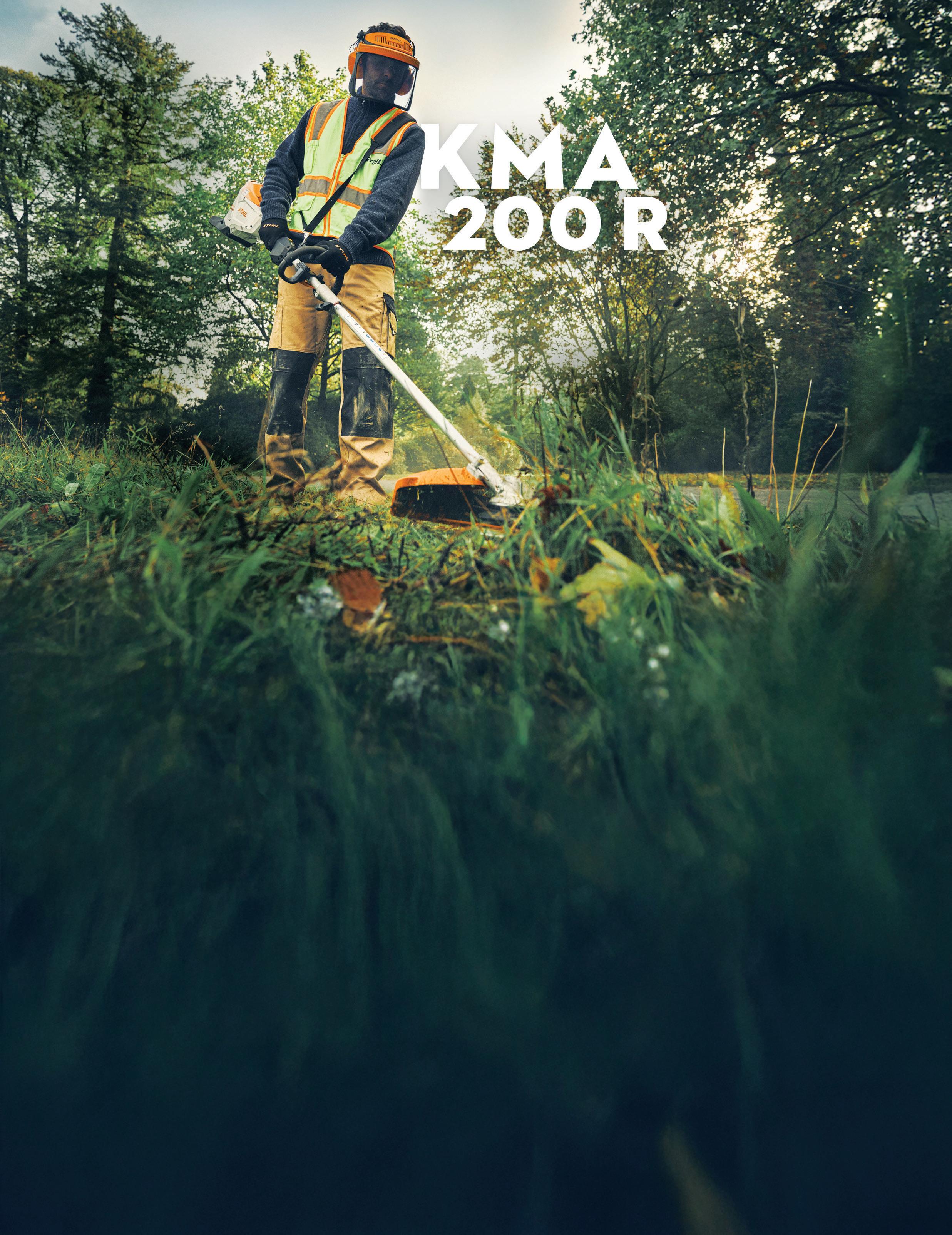
KMA 200 R battery KombiEngine: versatile, quiet and very powerful for professionals in garden maintenance
The STIHL KMA 200 R battery-powered KombiEngine is the most powerful KombiEngine in the STIHL lineup. Compared to the equivalent gas-powered KM 131 R, the KMA 200 R has a greater power output of 1.5 kW while remaining quiet to operate, making it deal for noise-sensitive areas. The KMA 200 R features an ergonomic, user-friendly operating handle with three speed levels on an LED display. The loop handle can be adjusted to various heights without the use of tools, with the quick clamping system. The KMA 200 R is universally compatible with STIHL‘s wide range of 15 different KombiTools.

By Mike Jiggens
A memorable interview with a legendary superintendent
Every now and then, I’ll meet someone in the turf and grounds maintenance industry who will leave a lasting impression on me. A month or so ago, I met Dennis Pellrene for the first time – by telephone. Our paths had never previously crossed, even though I’ve been in the business for more than 30 years.
Pellrene, of course, is a legend in the golf industry. He retired 20 years ago after 46 years in golf – most of it as a superintendent – and is perhaps best known for his years at Oakville’s Glen Abbey which he grew in.
I wanted to write a feature about him after learning he had recently donated stock to the National Turfgrass Research Foundation – a rather unique contribution. I had long known about his years at Glen Abbey and had heard stories about his dealings with Jack Nicklaus who designed the golf course.
I had a selection of questions I wanted to ask him, figuring our phone conservation might last perhaps 20 minutes. In fact, I allotted 30 minutes for the call, having scheduled a subsequent call to another individual immediately after-
ward. Pellrene barely got through my first few questions when it was time for me to make my second phone call. He had lots to say, and I had to call him back soon afterward to pick up where we left off.
The fun began when it came time to talk about Nicklaus and the trials and tribulations of growing and maintaining the infamous C-15 creeping bentgrass variety that ultimately failed and led to Pellrene’s dismissal. HeDennis chose his words carefully, probably knowing he was speaking with a member of the media.
It would have been interesting to be a fly on the wall during that exchange
Nicklaus’ own Muirfield Village Golf Club, with greens that were also grown to C-15 creeping bentgrass, ultimately experienced the same fate with bacteria wilt that led to the greens’ demise. Pellrene caught up with Nicklaus – after moving on to the Scarboro Golf & Country Club – at the PGA Tour’s Honda Classic in Florida, where he asked him about Muirfield’s lost battle against C-15.
The Golden Bear was report-
edly at a loss for words. It would have been interesting to be a fly on the wall during that exchange.
Pellrene had more stories to tell than I had time to listen. That was unfortunate on my part. I could easily have spent the afternoon being entertained, but I was on a deadline. One of his stories from Glen Abbey – about a group of loose horses – did make its way into the feature, which begins in this issue on page 12.
Although he retired two full decades ago, he has never let go of his passion for golf course management. In his retirement, he has visited an astonishing 79 countries and made efforts to link up with local golf course superintendents wherever he went.
I didn’t ask him to rattle off the roll call of those countries, but they represent virtually half the world. He’s essentially the Gary Player of golf course superintendents.
Pellrene has one of those infectious laughs, and it’s hard not to chuckle along with him. Some of his recollections may not have been funny at the time, but they’ve become water under the bridge with the passing years. Still, he manages to find some humour in them.
turfandrec.com
Reader Service
Print and digital subscription inquiries or changes, please contact Angelita Potal, Customer Service Tel: 416-510-5113 apotal@annexbusinessmedia.com
Mail: 111 Gordon Baker Rd., Suite 400 Toronto, ON M2H 3R1
Editor Mike Jiggens mjiggens@annexbusinessmedia.com
Advertising Manager Rebecca Lewis 519-400-0322 rlewis@annexbusinessmedia.com
Account Coordinator Emily Guimarães 416-510-5118 eguimaraes@annexbusinessmedia.com
Audience Development Manager Anita Madden 416-510-5183 amadden@annexbusinessmedia.com
Group Publisher Anne Beswick 416-410-5248 abeswick@annexbusinessmedia.com
CEO Scott Jamieson sjamieson@annexbusinessmedia.com
Printed in Canada ISSN 1186-0170
PUBLICATION MAIL AGREEMENT #40065710
SUBSCRIPTION RATES
Published 7 times a year – Jan/Feb, March, Apr/May, June/July, Aug/Sept, October, Nov/Dec
Canada – 1 year $37.13 CAD; 2 year $47.74 CAD (plus applicable taxes; single-copy$7.00 CAD USA – 1 year $50.92 CAD HST 86717 2652 RT0001
Occasionally, Turf and Recreation will mail information on behalf of industry related groups whose products and services we believe may be of interest to you. If you prefer not to receive this information, please contact our circulation department in any of the four ways listed above.
Annex Privacy Office privacy@annexbusinessmedia.com Tel: 800.668.2374
No part of the editorial content of this publication may be reprinted without the publisher’s written permission © 2026 Annex Business Media. All rights reserved. Opinions expressed in this magazine are not necessarily those of the editor or the publisher. No liability is assumed for errors or omissions.
All advertising is subject to the publisher’s approval. Such approval does not imply any endorsement of the products or services advertised. Publisher reserves the right to refuse advertising that does not meet the standards of the publication.






Your Trusted Source for Top Turf Brands in Canada

- Wetting Agents

Chris Nelson
T&O Sales Manager, East Canada chris.nelson@target-specialty.com 647.382.6868
Paul Powers
Toronto West / Niagara paul.powers@target-specialty.com 289.209.1869
Perry Brazeau
Toronto / East perry.brazeau@target-specialty.com 416.705.8006
Jason MacRae
Quebec North & West

& Controlledrelease Fertilizers

Joey Losito
Quebec South & East joseph.losito@target-specialty.com 819.571.1677
Colin Hindle
Ottawa & Eastern Ontario colin.hindle@target-specialty.com 613.314.9711
Mark Obee
Northern Ontario mark.obee@target-specialty.com 705.444.9010
Kyle Johnston South-West Ontario


Josh Seibel
T&O Sales Manager, Western Canada josh.seibel@target-specialty.com 306.861.8296
Daren Collins
Mainland British Columbia daren.collins@target-specialty.com 403.559.8472
Gregor Kowalski Vancouver Island


Mitch Davidson
Southern Alberta, Kootenays mitch.davidson@target-specialty.com 587.223.2083
Chris Paterson
Southern Alberta & Kootenays chris.paterson@target-specialty.com 403.540.0157
Chad Fauchoux
Saskatchewan & Manitoba gregor.kowalski@target-specialty.com 250.686.3909 306.551.2041
chad.fauchoux@target-specialty.com
Dwayne Simpson Northern Alberta dwayne.simpson@target-specialty.com


Neighbour suing golf course over alleged flooding, stray balls
The Cambridge (Ont.) Golf Club is being sued for more than $1 million by a neighbouring resident who alleges the golf course is intentionally diverting water toward his property and is allowing errant golf balls to fly toward his home.
The North Dumfries man claims his property is being flooded, adding his and others’ safety is at risk from stray hit golf balls.
Philanthropic group makes large donation for ball field upgrades
A half-million-dollar donation from a local philanthropic organization will help a Cambridge, Ont. baseball diamond undergo a series of accessibility upgrades.
The donation from the Lyle S. Hallman Foundation will help with such upgrades as artificial turf, pathways and dugouts which had been approved last year by the city. The upgrades were to be funded through debt at a cost of $3 million.
NTRF funds research projects to U of G and Olds College
Funding from the National Turfgrass Research Foundation has been awarded for four research projects, including two spearheaded by the University of Guelph’s Dr. Katerina Jordan.
She will oversee further investigation into the causal agents of take-all patch and their management in Canada and the Northern United States.
Jason Pick at Olds College will lead an assessment of environmental conditions under impermeable and permeable turf covers, influencing the survivability of poa annua in bentgrass.
Sports field training sessions for Ontario, Western Canada
Venues have been announced by the Canadian Sports Fields Association for its Ontario sports field training days this fall.
The Oakfield Rugby Park in Perth will be the site for an event Sept. 23 while Waterloo’s RIM Park has been selected for Oct. 1.

Additional training days are to be scheduled for Western Canada – in Port Coquitlam, B.C. and Brandon, Man. Dates have yet to be confirmed.
Sports field training days bring together professional turf managers, operators, and industry suppliers for a full day of handson learning, live demonstrations, and networking. This interactive outdoor event showcases the latest products, equipment, and services that support safe, efficient, and high-quality sports field maintenance. Attendees gain practical, real-world insights
directly from experts and suppliers through engaging presentations and on-field demonstrations, while suppliers have an opportunity to share their innovations and connect with the professionals who use them every day.
Suppliers can connect face to face with industry decision-makers and end users in an engaging, real-world setting and can share their expertise, demonstrate their equipment and tools in action, and highlight how their products help improve safety, efficiency, and field performance.
An industry survey has indicated the major areas in need of enhanced education include new technology, managing wear, cricket and infield maintenance.
More information about sports field training days can be obtained at sportsturfcanada.com.
Settlement sought by neighbour of Cambridge Golf Club
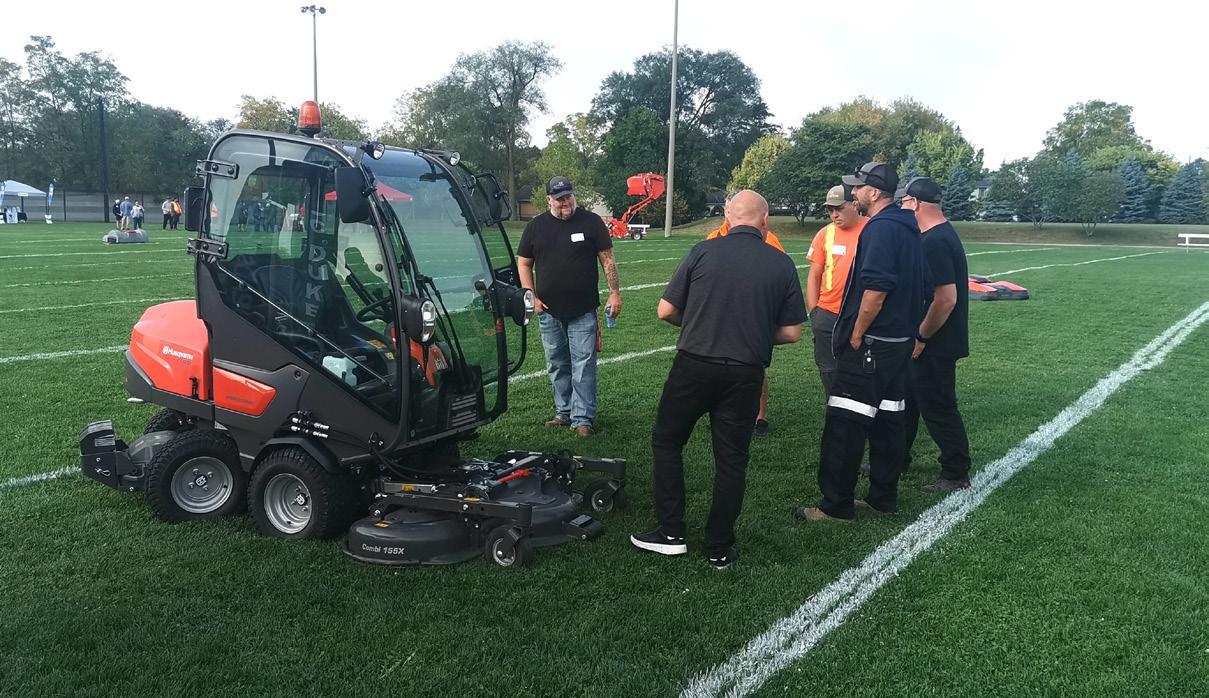
The CSFA held a sports field training day in 2025 in Brantford, Ont.
PHOTO: MIKE JIGGENS
Former golf superintendents launch new business venture
A pair of former Canadian golf course superintendents have joined forces to launch HK Golf Services Inc., a specialist firm dedicated to supporting golf clubs through infrastructure projects of every scale.
Stephen Hicks, formerly of the Brantford Golf & Country Club, and Jordan Kitchen, formerly of the Hamilton Golf & Country Club, have a combined 41 years of experience in the golf industry.
HK Golf Services offers three core service lines: drainage planning and design, hands-on project support during renovation and construction, and topographical surveys and mapping. Hicks



and Kitchen founded their new business to fill a gap they had experienced firsthand – a need for practical, club-side expertise to help superintendents and club leadership navigate complex capital projects with confidence.
“As superintendents, we lived the process – the budget pressures, the on-the-ground realities, the need to get infrastructure right the first time,” Hicks said. “We built this firm to be the partner we wished we’d had.”
Hicks brings 23 years of golf industry experience, including extensive work leading agronomic programs and on-course improvement projects such as drainage,
Efficiency That Pays Off
irrigation, and green and tee renovations.
Kitchen has 18 years of experience in the golf industry with a track record of planning and executing large-scale course renovations from initial site assessment through construction completion.
Services provided by HK Golf “Accurate base data is the foundation of every successful project,” Kitchen said. “Whether a club needs a full drainage master plan or just a clear picture of what they’re working with before committing capital, we’re here to provide that practical, ground-level support.”
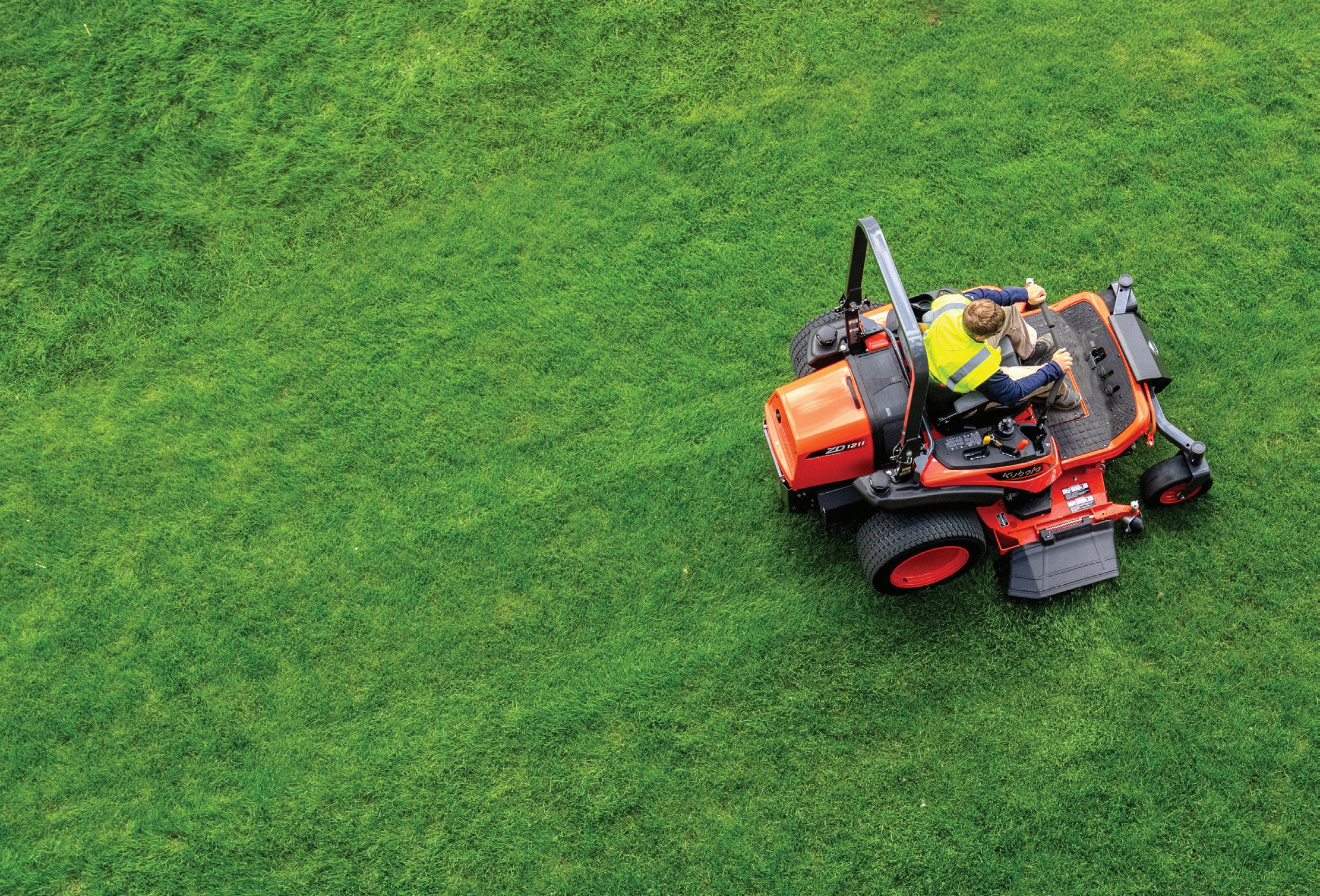
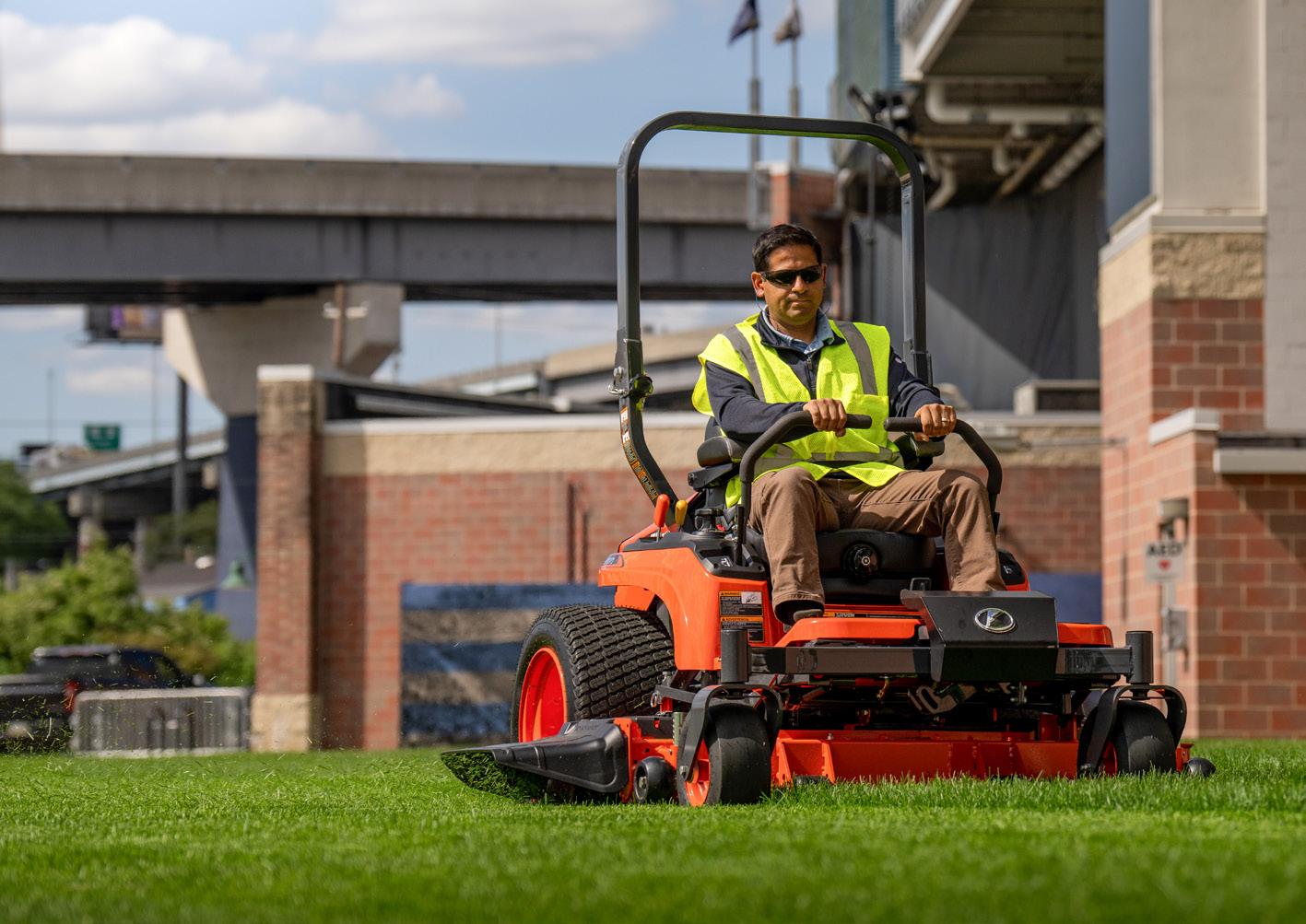
Productivity is more than speed. It’s efficiency you can feel on every job. The Kubota ZD1200 Series pairs Kubota diesel power with a shaft-driven ACS deck designed to move air, cut clean, and discharge efficiently, helping reduce power draw so you can stay productive across the route. The same oscillating front axle technology you know from tractors is incorporated in the ZD giving you built-in stability, along with operator-focused comfort, keeping the machine (and the crew) working like the schedule demands.
Stephen Hicks
Jordan Kitchen
Line painting on sports turf
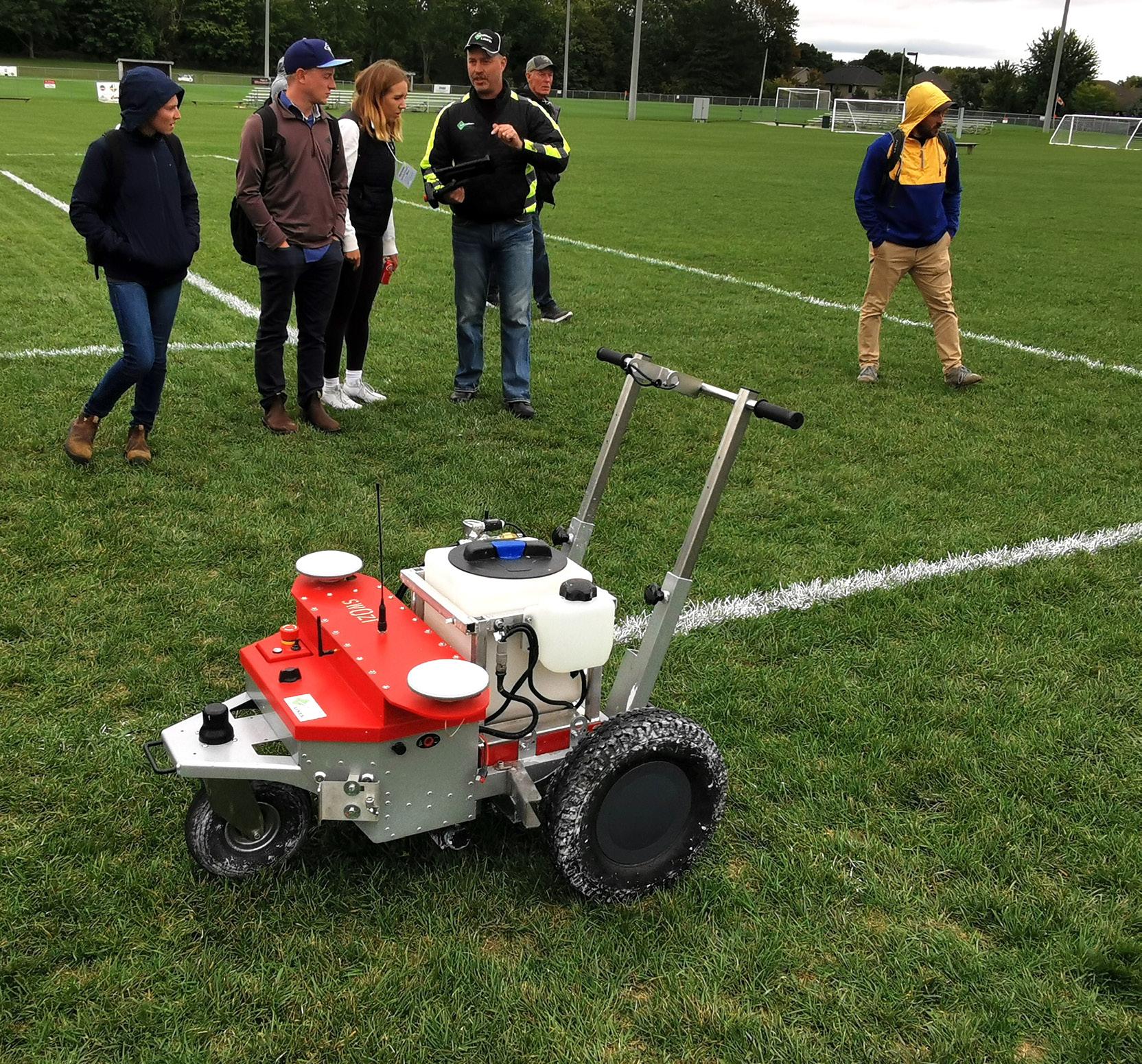
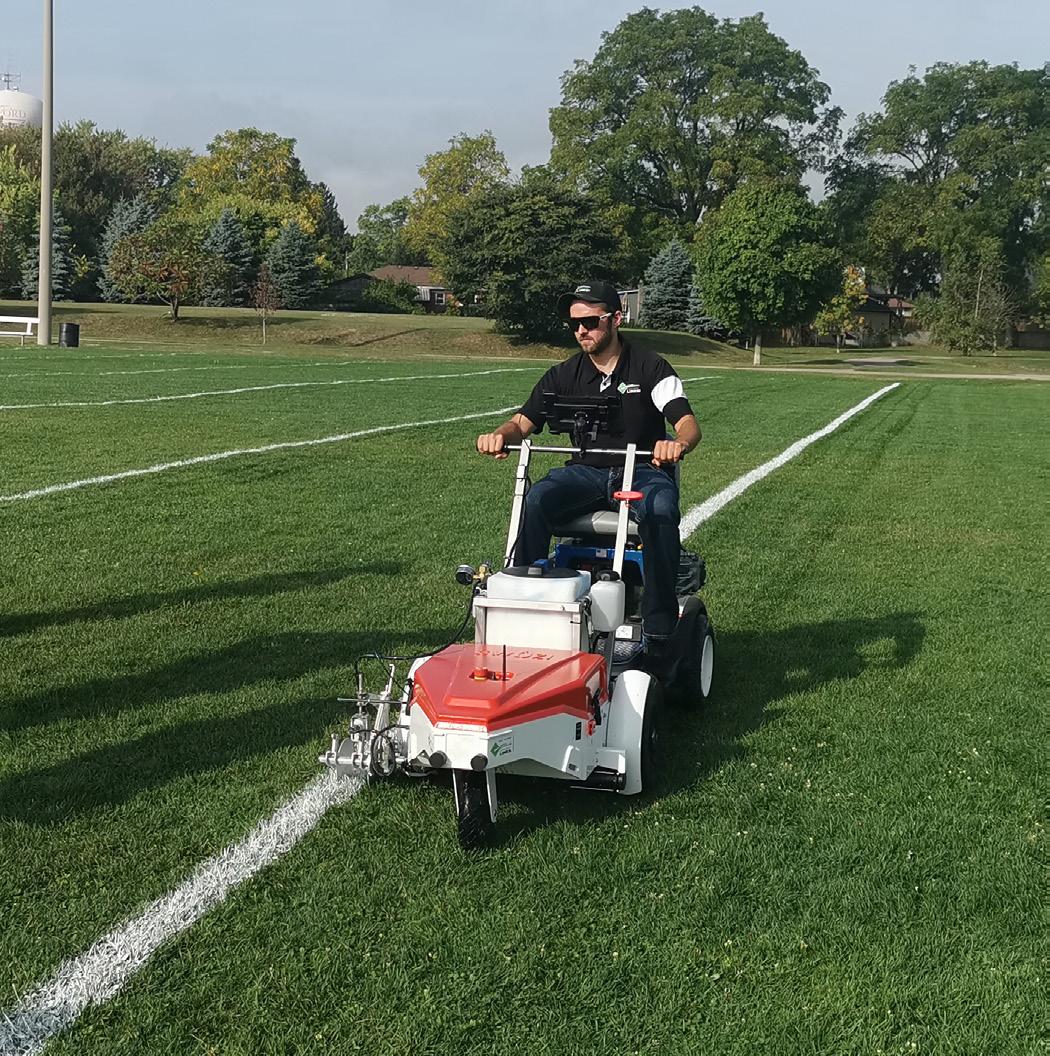
Automated line painting is becoming more prevalent on municipal sports fields.
By Mike Jiggens
Sports field maintenance practices have come a long way since the close of the 20th century. The advent of robotic and autonomous technology – aided by global positioning – has provided consistent mowing heights with precise striping and has addressed labour shortage issues. Technology has aided and abetted pesticide applications, and irrigation systems are smarter than ever.
Not getting lost in the shuffle amid this changing technology are significant advances in sports field line painting. Manual line painting was once the standard practice. It usually involved the placement of strings to serve as guidelines to ensure lines were painted straight and were perfectly parallel to one another. Operators needed a steady hand to ensure they didn’t stray from Point A to Point B.
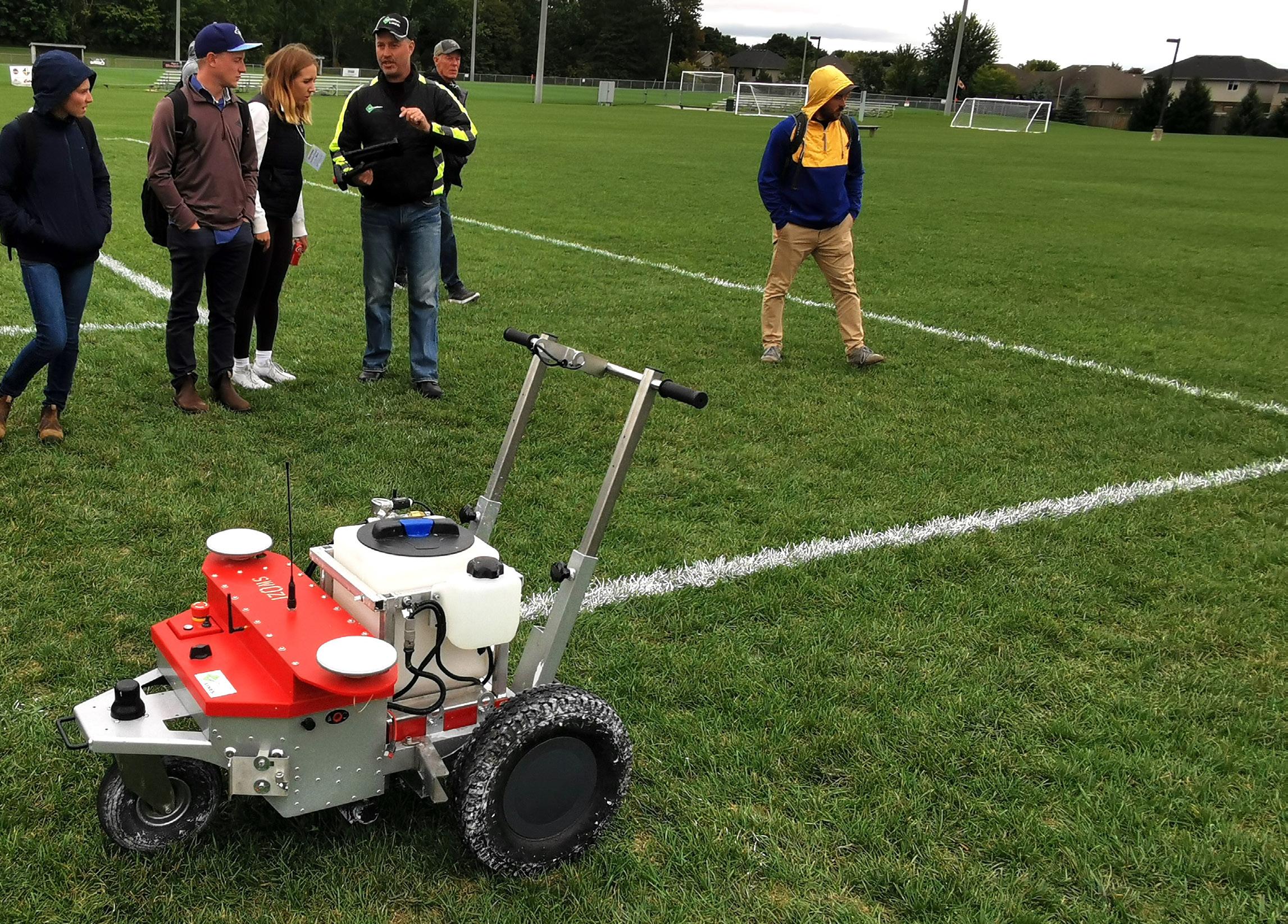
Although several Canadian municipalities continue to paint their fields manually, the trend is shifting toward automation with GPS-guided, robotic painting.
Those attending February’s Ontario Turfgrass Symposium in
Guelph learned more about the evolution of sports field marking, from manual techniques to autonomous GPS technology. Brent Baker, president of Stratford, Ont.-based Simplistic Lines, and Joe Breedon, outdoor recreation facility coordinator for the City of Barrie, spoke of the virtues of automated line painting, outlining different technology types, environmental factors to be considered and GPS solutions.
Autonomous technology has allowed fields to be painted in about a quarter of the time it takes to be done manually.
Breedon said fields continue to be painted manually in Barrie. Members of individual user groups have been doing the work themselves at several fields and have earned accolades from coaches and teams for their skills at marking fields.
“Keeping up that relationship with your local user groups shows that you care and you’re engaged with your community and your clients,” he said.
Dealing with Mother Nature
Whether lines are painted manually or autonomously, Mother Nature is the “boss,” Breedon said, noting that dew, frost, rain and working around irrigation schedules are factors that must be considered before painting. Timing and the right conditions are
critical for paint adhesion and durability.
Dew points and precipitation must be monitored, he said, and the use of backpack blowers can help “dry” damp grass to improve paint bonding.
Field painting may require the work to be done in the evening if a major event is happening the next day and lining can’t be done earlier due to hurdles with weather. Breedon said he’s painted fields in total darkness with the aid of a headlamp or has had to turn on field lights after hours, risking negative feedback from neighbouring residents.
Fields can be painted autonomously in the evening without such worries.
“As technology has evolved for a more efficient kind of line marking, it’s going to be that this is coming down the pipe for everyone, and especially myself and our crew,” Breedon said.
Technology is changing by the day, Baker said, adding he gets frequent updates on autonomous software. Two main systems – low pressure and high pressure – are used in paint sprayers. Low pressure systems use micronized paint and are ideal on fields while high pressure systems are better suited for hard surfaces and for painting logos.
‘What you have to remember is this is a growing surface’
GPS-guided line painting provides greater precision when marking fields for play.
“This micronized paint is a new product that’s been coming into the market,” Baker said.
The mechanism of low-pressure systems are electric diaphragm pumps operating between 40 and 80 pounds per square inch (psi). They are quiet, environmentally friendly, require less maintenance and are safe on field surfaces. However, they are often restricted to thinner and more expensive micronized paints due to suction tube limitations.
The mechanism behind high-pressure systems are gas-powered piston pumps operating at up to 3,300 psi. They provide ideal atomization and handle thicker paint. They can also be painted on clay and granular surfaces. But they are noisy and bulky and can damage turf.
Because field painting is done on a growing surface, there are things to consider before spraying if the
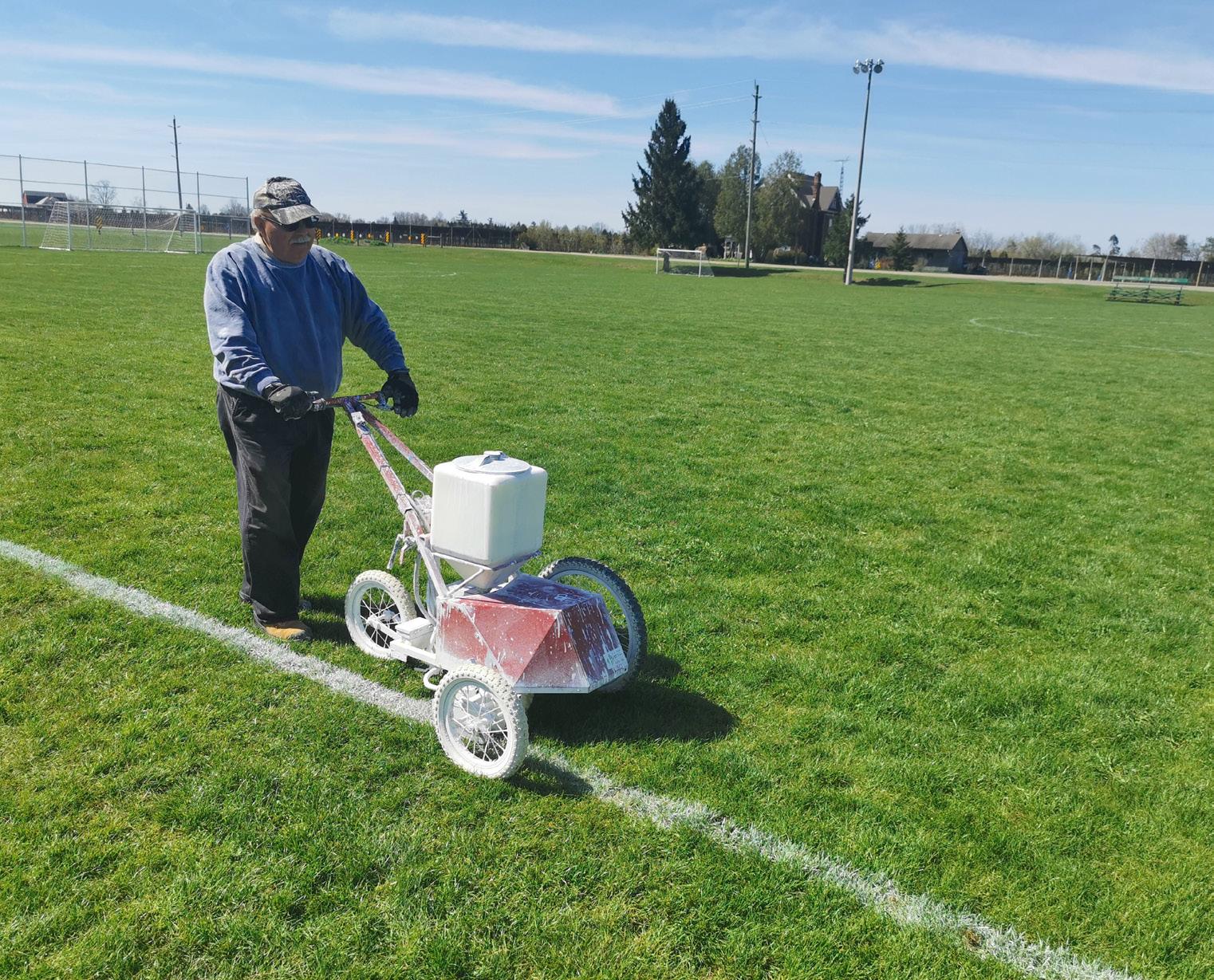
Manual line painting of sports fields continues to be done in many municipalities, and often by volunteers of user groups.
GRANDE PRAIRIE
ALBERTA FOREST & GARDEN
HORIZON FOREST AND GARDEN LTD
EDGE EQUIPMENT LTD
DENNEY’S SAW SHOP INC
KEDDIES TRAILERS
BRITISH COLUMBIA
ABBOTSFORD
BURNABY
CAMPBELL RIVER CHILLIWACK
COURTENAY KAMLOOPS KELOWNA NORTH VANCOUVER
SURREY
VERNON
MANITOBA
FORESHORE EQUIPMENT AND SUPPLY
FORESHORE EQUIPMENT AND SUPPLY
C & L SUPPLY LTD
CHILLIWACK OUTDOOR POWER EQUIPMENT
PILON TOOL RENTALS
B & L SMALL MOTORS LTD
SAVOY EQUIPMENT
FORESHORE EQUIPMENT AND SUPPLY
ARCOM POWER EQUIPMENT INC
SAVOY EQUIPMENT
403-248-0878
780-542-4446
780-455-3343
780-881-2179
780-513-1340
604-744-0547
604-436-9312
250-287-9231
604-792-4410
250-338-5361
250-376-0033
250-868-1010
604-924-9400
604-533-0081
250-545-0627
SPORTS TURF
ONTARIO
ARVA
HURON TRACTOR LTD
AYR TURF & TRAC LTD
BOBCAT OF BRANTFORD INC
B.R. DICKSON EQUIPMENT INC
CAMBRIDGE POWER EQUIPMENT INC
CHATHAM OUTDOOR POWER
BRUCE SERVICE
MARTIN’S SMALL ENGINES LTD
EXETER
MAPLE
MILVERTON
MISSISSAUGA
MISSISSAUGA
MITCHELL
PETERBOROUGH
SIMCOE
STAYNER
STRATHROY
THAMESFORD
VARS
WALKERTON
WINDSOR
HURON TRACTOR LTD
LOU DENNIS EQUIPMENT
ALBRECHTS CHAINSAW SERVICE
CURRENT POWER MACHINERY INC
TONY & SONS POWER EQUIPMENT
MITCHELL CYCLE INC
STORM SOLUTIONS PLUS INC
NORFOLK TRACTOR
HURON TRACTOR LTD
CAMPBELL’S OUTDOOR POWER EQUIPMENT
HURON TRACTOR LTD
M.R. BLAIS SALES & SERVICE INC
HURON TRACTOR LTD
OAKEN EQUIPMENT
519-666-2300
519-632-9901
519-752-7900
905-331-5040
519-621-7805
519-354-3990
519-363-6345
519-669-2884
519-235-1115
289-963-9666
519-595-2579
905-822-4211
905-569-2055
519-348-0490
705-775-7587
519-426-1090
705-466-6232
519-245-2428
519-285-3845
613-443-1230
519-881-2231
416-679-4172
best quality job is expected. If grass is too tall or if ample clippings remain on the ground, the quality of the paint job will be compromised with much of the paint failing to stick to the surface.
Improving paint’s adherence
Mowing the field beforehand and minimizing the number of clippings left behind will improve the chances of the paint adhering to the grass blades.
“It’s important to know what they’re capable of and what you’re expecting,” Baker said.
The low-pressure system’s safe operating range of between 40 and 80 psi gives adequate atomization for turf spraying with paint coverage getting at least midway down on the grass blade.
High-pressure systems are like little power wash units, he said, adding they atomize paint extremely fine. An important consideration to make before using high-pressure systems is that they demand a high degree of safety training.
Micronized pigment is designed for low-pressure robots to reduce weight and clogging. But testing suggests they may not always offer superior brightness compared to standard diluted acrylics. The acrylic in the paint is a key ingredient for drying time. The greater the amount of acrylic, the faster it will dry.
“What you have to remember is this is a growing surface,” Baker said. “It gets cut, repainted and you’ve got to find a balance here. It’s something to consider if you’re dealing with bad weather conditions. You could go to your toolbox or maybe go with a little bit more acrylic paint.”
Technology has allowed sports fields to be painted in about a quarter of the time it takes to do manually.

Reflections on a storied golf career
Dennis Pellrene spent more than 46 years in the golf industry.
By
Mike Jiggens
For almost 50 years, Dennis Pellrene enjoyed an illustrious career as a golf superintendent, working at six different golf courses in three Canadian provinces. Now 84 and retired for the past 20 years, his passion for golf course upkeep has never diminished. In fact, this past spring, he reconnected with the industry by making a unique donation to the National Turfgrass Research Foundation in the form of a stock transfer.
A career in golf was never the plan for Pellrene. Originally from Alberta, he had been working in the lab at a steel mill in Camrose and was looking for something to do in the summer during its shutdown. He figured he could while the time away by playing golf at a local nine-hole course that featured oiled sand “greens,” or putting surfaces that were green in name only, requiring golfers to smooth the circular areas by pulling a special tool behind them in a spiral pattern from the centre flagstick.
The golf course subsequently offered him a job when it set about replacing its
oiled sand greens with bentgrass putting surfaces. The club’s golf professional at the time, who was a native of St. Catharines, Ont., opted to return to his hometown and placed a well-timed call to Pellrene with a new job offer.
“During that winter, he phoned me and said John (O.J.) Piccolo at the St. Catharines Golf & Country was looking for an assistant.”
Pellrene was hired and, in addition to his duties on the golf course, worked at the club’s curling facility during the winter months.
“John took me under his wing and took me to all the meetings, and I became really interested in becoming a superintendent.”
That ambition was eventually fulfilled when Piccolo and an official from the Niagara Parks Association referred Pellrene to Fort Erie’s Erie Downs Golf Course where he worked for the next four years.
“I really enjoyed myself there,” Pellrene said, adding he married his wife Laura in 1969 during his time at Erie Downs.
Starting at Glen Abbey
A new opportunity presented itself in the 1970s during the construction of Oakville’s Glen Abbey Golf Course. The Jack Nicklaus-designed course was intended to become the new home of the PGA Tour’s Canadian Open.
Before joining Glen Abbey as its superintendent, Pellrene left a lasting impression at Erie Downs by significantly improving its drainage system. Courses in surveying that he studied during the winter in California were applied to areas of the golf course that drained poorly, enabling greater use of its golf cart fleet following rain events.
The Erie Downs club owner was sorry to see Pellrene move on but appreciated his contributions toward improving the club. On his final day of work, he was presented with a second paycheque and the message: “Here’s another two weeks’ salary as our appreciation for what you did for us at Erie Downs.”
Most of Pellrene’s knowledge of golf course management came from attending
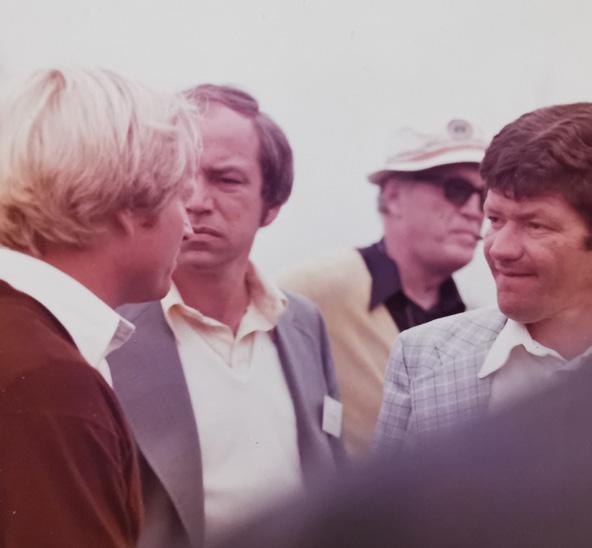
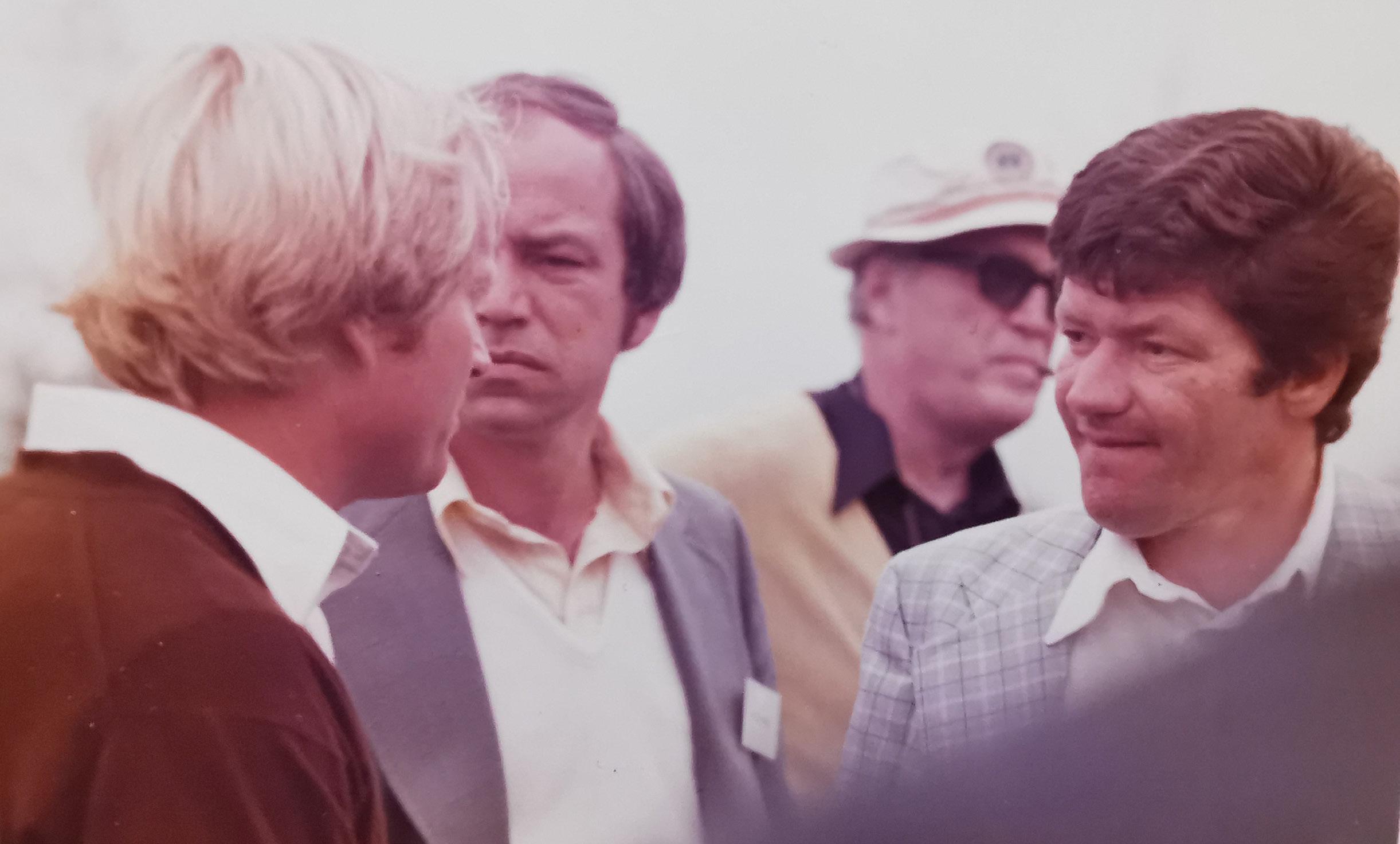
Dennis Pellrene, right, listens to instructions from Jack Nicklaus, left, while Muirfield Village superintendent Ed Etchells, centre, listens in.
conferences and having meaningful discussions with other golf superintendents.
“I’m sure they had the conversation if I was qualified or not to take over (at Glen Abbey),” Pellrene said, noting a key to the course’s successful grow-in was his relationship with Ed Etchells, the superintendent at Nicklaus’ Muirfield Village Golf Club in Ohio. “He was my tutor and walked me through all the processes we have to go on on a daily basis throughout the year during construction and grow-in.”
Rather than seeding Glen Abbey’s greens, they were “stolonized” or sprigged with C-15 creeping bentgrass – a choice that later backfired.
“When we were about to stolonize our greens at Glen Abbey, we bought our stolons from Chicago (at the same nursery where Muirfield obtained its), and we stolonized all the greens.”
Glen Abbey was grown in in 1975 and
opened the following year.
“We had absolutely excellent greens through 1976 and 1977, but a little later on we started to have problems with our greens at Glen Abbey. They were succumbing to something. We didn’t know what it was. We took samples to Guelph and had them analyzed, and nobody could figure it out until Dr. (Joe) Vargas from Michigan State identified the problem as bacteria wilt.”
Pellrene said Etchells was also dumbfounded by the turf’s failure.
A show of solidarity
Negative comments attributed to Nicklaus about Glen Abbey’s greens were reported in the media, leading to a stand of solidarity by Pellrene’s staff who threatened to quit on the Monday of the 1979 Canadian Open. The threat caught the attention of both Nicklaus and the Royal Canadian
Golf Association.
“So, Jack comes over to the shop, and all the staff are there, and they listen to his comments, and he says it wasn’t Dennis’ fault, and he smoothed everything over. But, after that Open, I was fired.”
Pellrene, however, landed on his feet, taking over as superintendent at the Scarboro Golf & Country Club.
The Glen Abbey era was a memorable time in Pellrene’s career, despite its unfortunate conclusion. During its construction, he secured several young trees from a nursery in Ohio and had them shipped to Oakville with plans to plant them during the winter.
“When it was time to plant them, the backhoe would not penetrate the soil. It was so cold and the frost was down three or four feet.”
He recalled the attributes of a Buckeye trencher he had seen in operation while he

was in Alberta and managed to locate one.
“I watched it work in Alberta, and it would go through anything.”
Pellrene paid a recent visit to Glen Abbey and said he marveled at how much the trees had grown over the decades.
At the time of Glen Abbey’s grow-in, Pellrene considered C-15 creeping bentgrass to be “the Cadillac of bentgrass.” It was an upright variety of bentgrass the club mowed using the same type of Toro walk-behinds that were used at Muirfield.
“We had to grind the bottom of the bedknives down because we and Muirfield were cutting our greens down to about an eighth of an inch. It was unheard of then, but the greens were as fast as lightning, and everybody loved it. As a result, I think that species of grass couldn’t take that height of cut and it eventually succumbed to the bacteria. That’s my theory.”
During his tenure at Scarboro, Pellrene caught up again with Nicklaus who was in the field at the PGA Tour’s Honda Classic in Florida. Pellrene had read an article about Muirfield renovating its greens which had also been planted to C-15 creeping bentgrass.
Years earlier, when Glen Abbey experienced issues with its C-15 greens, Nicklaus claimed Muirfield had no issues with the variety, Pellrene recalled him saying. He questioned Nicklaus about shutting down his Ohio course to accommodate the greens’ renovations after the putting surfaces suffered the same fate as those at Glen Abbey.
Pellrene said Nicklaus could only “stutter” a response.
A return to Western Canada
Following his tenure at Scarboro, Pellrene returned to his roots in Western Canada, starting a new career as superintendent at West Vancouver’s Capilano Golf & Country Club. Maintaining a golf course on Canada’s west coast presented a new set of challenges.
In his first year at Capilano, he said the golf course received 120 inches of rain. Only 16 greens were playable upon his arrival in June of his inaugural season.
“That was the wettest spring I had ever seen in my life.”
The unplayable dead greens were overseeded with ryegrass and poa trivialis on the advice of some of his peers in the United States. Grass cover was soon realized, but the ryegrass couldn’t be mowed as low as bentgrass.
“As you lower the height of the ryegrass, the bentgrass starts showing through because it’s more in the mid-summer now. Over time that year, we transformed from rye to bent and had a reasonable surface after that.”
Also lending timely assistance during his time at Capilano was Corrie Almack of Almack Agronomic Services who “helped me a lot.”
Each of the three provinces where Pellrene worked on golf courses had its own unique pros and cons. Conditions in Alberta tended to be bright and sunny with several thunderstorms, he said, resulting in plenty of nitrogen getting into the soil. Consequently, he dealt with few summer diseases.
Ontario, on the other hand, produced humid summer conditions, he said.
“That’s a big deal. You’re always on the alert for pathogens that will affect the
greens at certain temperatures.”
Despite the challenges and setbacks he experienced during his 46-year career, Pellrene said there was never a day he didn’t look forward to going to work. Some days, in fact, could be outright bizarre, including one he recalled in the weeks leading up to a Canadian Open event at Glen Abbey. While eating lunch and overlooking the 18th fairway, he watched about dozen horses galloping down the fairway toward the clubhouse. Fearing their hooves would significantly damage the turf, he hopped in his cart and steered them back to the neighbouring farm from which they came.
“Lo and behold, they stopped, and I was able to turn them around, and they went back the same way they came in. That was a unique experience.”
Since his retirement, Pellrene has done some consulting work and has visited 79 different countries with his wife Laura, stopping at local golf courses and meeting with their superintendents.
“I’m through with traveling now. We did our thing and saw half the world.”
In 1999-2000, Pellrene was named the Canadian Golf Superintendents Association’s superintendent of the year.
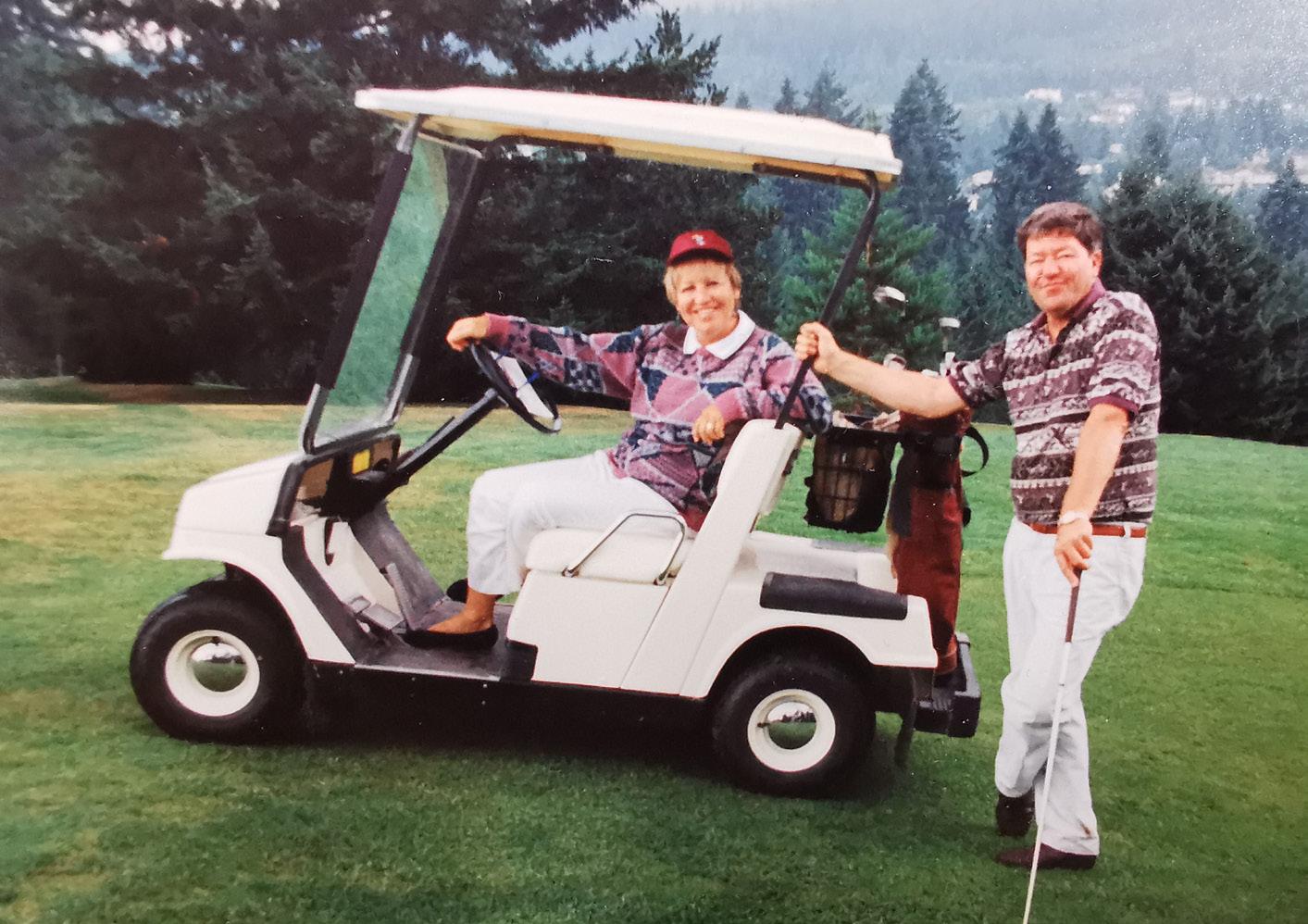
Dennis Pellrene and his wife Laura enjoy a round of golf in their spare time.
Cut your mowing costs by 80 %
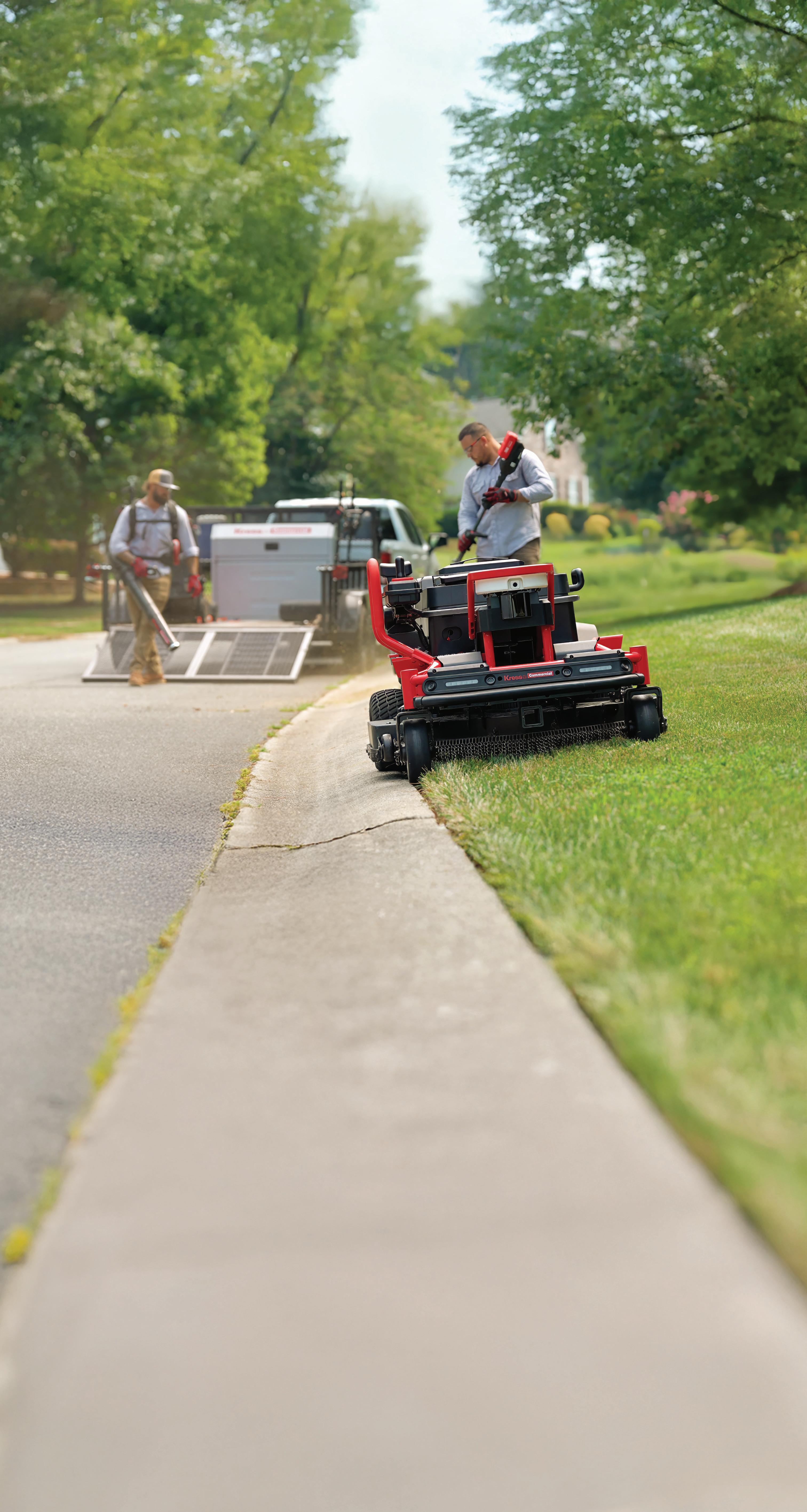
Introducing Kress Voyager – the 40” fully autonomous robotic mower that works alongside your crews. While they focus on edging, blowing, and other detailed tasks, Voyager mows with centimeter-accurate precision and uncompromising power.
Voyager is the new benchmark for efficient, safe, productive landscaping - and your unfair advantage.

Scan this code to find your local Kress dealer
What the data says to golf turf upkeep
How pesticide use on golf courses has changed in the years since ban was enacted. By
Dr. Sara Stricker
In April 2009, Ontario’s cosmetic pesticide ban fundamentally changed how landscapes could be maintained across the province. Golf courses were granted an exemption, but only under strict regulatory requirements. More than 15 years later, I wanted to take a closer look at how pesticide use at Ontario golf courses has changed over time.
To maintain this exemption, golf courses in Ontario must become accredited in integrated pest management (IPM) through the IPM Council of Canada. IPM emphasizes cultural practices, mechanical and biological controls, and targeted pesticide use based on scouting. Specialty turf facilities and sports fields hosting international competitions may apply for similar exemptions.
Golf course superintendents must maintain detailed records of pesticides purchased, stored, and applied throughout the season, along with supporting documentation such as equipment calibration and pest scouting reports. Annual pesticide use reports summarize kilograms of active ingredient (AI) applied, compare totals to the previous year, and state the reason for pesticide applications. These reports are publicly available through the IPM Council of Canada website. The records are verified through annual desk audits and onsite audits every three years.
Although the reporting system is designed to encourage reduced pesticide use, there is no requirement for year-over-year decreases. Pest pressure, weather, and disease outbreaks can all influence annual totals. Even so, the Canadian golf industry has steadily shifted toward more sustainable turf management. Routine applications of broad-spectrum, long-residual products have largely been replaced by more targeted approaches supported by improved turfgrass cultivars, precision application technology, alternative products, and stronger best management practices.
At the same time, communication between superintendents and golfers has evolved. These days turf managers regularly educate players about realistic expectations, sustainability goals, and the trade-offs associated with maintaining perfectly uniform turf. Since pesticide products are also a major operational expense, reducing unnecessary applications is both environmentally responsible and

financially beneficial for golf facilities managing increasingly tight budgets.
For those who need to submit them, the annual pesticide use reports probably feel like a tedious task. But as a self-proclaimed data nerd, I see them as a fascinating source of industry insight. Curious about what trends might be hidden in the numbers, I downloaded historical pesticide use records from 10 high-end golf courses in southern Ontario. The dataset spans 2011–2024, including the COVID-era golf boom when participation and course traffic surged.
Before crunching the numbers, I expected to see spikes in pesticide when hosting large events and throughout 2020–2021 as heightened play placed additional stress on turf. Instead, the data revealed something far more significant: a remarkably consistent decline in overall pesticide use across all 10 golf courses. I was wrong, and I have never been happier to be wrong. The findings suggest that turf managers are genuinely committed to reducing
To maintain their exemption from the Ontario cosmetic pesticide ban, golf courses must become accredited in integrated pest management through the IPM Council of Canada.
pesticide use and applying products only when and where they are truly needed.
What the data says:
Impact of large events
To examine whether hosting large events influenced pesticide use,
I focused on golf courses that hosted the men’s or women’s Canadian Open and excluded properties that hosted the event in consecutive years. For each tournament, I compared pesticide use during the tournament year to the average of the year before and the year after (nine individual data points total).
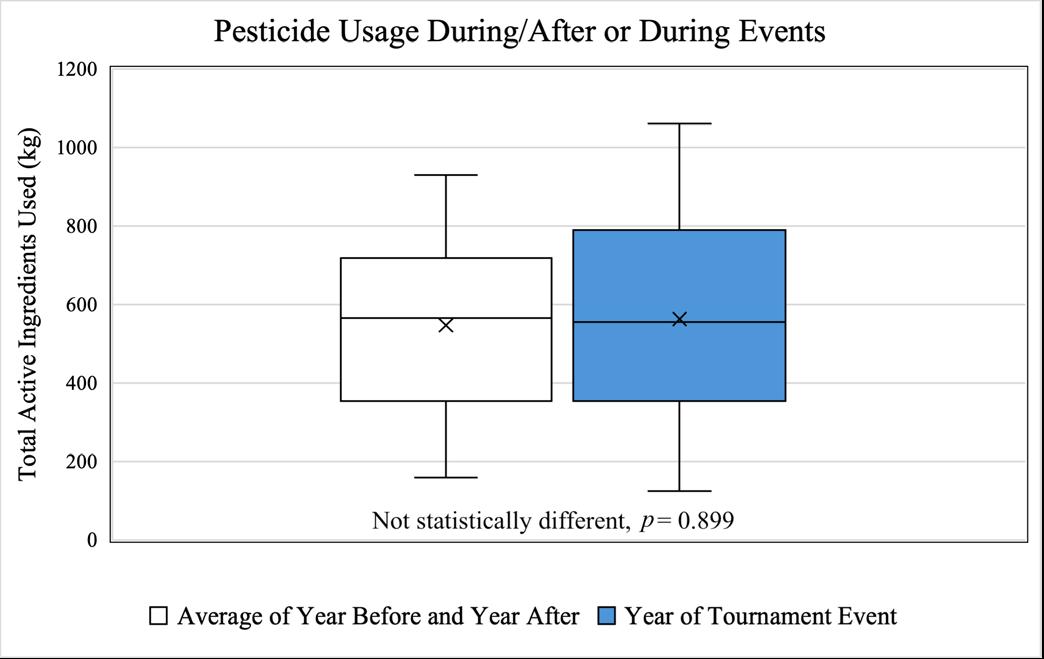
Interestingly, three of the golf courses reported lower pesticide use during the tournament year, potentially due to course closures before and after the event. One course specifically noted a decrease in pesticide use during the year it hosted the Open because large spectator stands occupied significant portions of the property and those areas did not require treatment during the tournament season. Overall, tournament years showed an average pesticide increase of just one per cent, which was not statistically significant (Figure 1).
One course that hosted the Canadian Open in multiple consecutive years did show a noticeable increase in pesticide use, with an overall upward trend during the time as the event host. With only one location to draw from, I can’t make a data-driven conclusion, but I suspect that maintaining elite playing conditions year after year, with increased traffic and disruption, may place added pressure on both the property and the staff responsible for maintaining it. I think this reinforces the value of rotating the location of major
events to reduce long-term pressure on golf courses, their surrounding environments, and the grounds staff.
Pesticide use over time
To allow for fair comparisons between properties, the data were normalized to represent an 18-hole golf course, since several of the facilities in the dataset had more than 18 holes. The 10 golf courses were also anonymized because the purpose of this analysis was not to single out individual properties, but rather to examine broader industry trends. It is also important to note that these courses represent the higher-input end of the golf industry, and many golf courses operate with lower pesticide inputs.
Overall, pesticide use showed a clear downward trend from 2011 to 2024 (Figure 2). I had expected to see a spike during 2020 and 2021, when golf participation surged and courses experienced record levels of play, but those years instead continued along the overall downward trajectory. The highest average pesticide use occurred in 2015 – a season associated with particularly high dollar spot and anthracnose disease pressure in southern Ontario. The pesticide use reports cited GPS-guided sprayers, disease forecasting models, and continuing education as factors driving the reduction of pesticide use.
Active ingredient breakdown
Overall, 61 active ingredients were reported over the 14-year period, including 35 fungicides, 11 herbicides, 11 insecticides, three plant growth regulators (PGRs), and one fumigant. Although fungicides remained the dominant pesticide category throughout the study period, their relative contribution declined over time, decreasing from 83 per cent of total pesticide use in 2011 to 75 per cent of the total AIs applied (by weight) in 2024. Overall trends indicate reductions in fungicide and insecticide use, while herbicide use trended upwards (Figure 3).
Within the herbicide category, the most heavily used AIs were 2,4-D, mecoprop, glyphosate, and dicamba, in descending order. Increased herbicide use was attributed to recent turf renovations, irrigation limitations, drought, and increased foot traffic. Many golf courses in Ontario are approaching (or have celebrated) their 100th anniversary, meaning major renovations are likely on the horizon. At the same time, drought stress and extreme weather events like flooding are becoming more prevalent due to climate change. Heavy foot traffic will also likely remain a challenge as golf continues to enjoy its popularity (fingers crossed). These ongoing pressures suggest that the industry may need to place greater emphasis on alternative weed management strategies and turf resilience.
A major driver of the decline in fungicide and insecticide use is due to regulatory changes affecting key AIs. In 2018, a re-evaluation restricted the use of chlorothalonil to three applications per year (two for summer disease, one for snow mould). Prior to that, chlorothalonil accounted for nearly 70 per cent of the fungicide use across the 10 golf courses in this dataset. In 2024, that proportion had declined to 48 per cent. Similarly, the 2020 cancellation of
iprodione, historically the second most-used fungicide AI, forced a phased reduction that will eventually reach zero.
Even with the regulatory changes affecting chlorothalonil, it was still the most-used fungicide in 2024. This is likely because this AI is labelled for several diseases, including dollar spot, brown patch, anthracnose, leaf spot, and snow mould. Chlorothalonil is also in the M5 mode-of-action group, making it a valuable rotation tool for managing fungicide resistance. Nine of the 10 pesticide-use reports from these courses specifically named dollar spot as the target for control, suggesting that it remains the primary disease challenge for golf courses in Ontario, followed closely by snow mould (no surprise there).
Beyond regulatory changes, advances in chemistry and formulation technology may also be reducing fungicide inputs. For example, propiconazole use has decreased substantially over time. Historical products containing this AI recommended application rates of approximately 31–62 mL/100 m2, whereas a current product on the market recommends rates of 26–51 mL/100 m2. What changed between these two formulations is unclear, but improvements in formulation technology, adjuvants, delivery systems, or the potency of AIs may help explain why comparable disease control can now be achieved at lower application rates.
Frustratingly, AI deregistrations have created challenges for resistance management and mode-of-action rotation. The seven insecticide AIs applied in 2024 represented only four mode-of-action groups, one of which is only effective against lepidopteran pests. This limited selection can make effective pesticide rotation difficult, or in some cases impossible, thereby increasing the risk of resistance development and reducing management flexibility for turfgrass managers.
Next steps
I would like to raise a small red flag, or perhaps issue a professional challenge, for the turf industry. Considerable progress has been made in reducing fungicide and insecticide inputs through cultural practices. However, this dataset shows an upward trend in herbicide AI use. This could be an area for future improvement.
Let’s improve turf density, tweak weed tolerance thresholds, expand the use of alternative control methods, and develop more weed-resistant turfgrass systems. We have the technology! Weather models, soil sensors, and forecasting tools are already helping superintendents anticipate disease outbreaks and make more precise management decisions; now let’s apply that same mindset to weeds.
One of the most important takeaways from this dataset is that reduced pesticide use does not mean reduced performance.
As the GTI communications & outreach Coordinator, and instructor for Environmental Turf Management at the University of Guelph, I plan to continue exploring this dataset to see what other insights can be drawn from it. Kudos to Frank Rossi for inspiring me to take a closer look at these reports. Stay connected with the GTI at GuelphTurfgrass.ca or @ GuelphTurf.

Staying ahead of break-ins at storage yards
Waterloo landscape business owner has thought outside the box to deter theft. By Mike Jiggens
Lawn care companies’ storage yards can be an attractive target for would-be thieves looking for expensive pieces of equipment they can flip for a quick sell. When victimized by theft, businesses will often deal with increased insurance premiums, not to mention the expenses associated with repairs to breached security fencing, broken windows and the costs of replacing equipment.
Richard Burch, owner of Burch Landscape Services in Waterloo, Ont., knows all too well about the impact of break-ins and vandalism.
“We’ve had our fair share of break-ins and vandalism,” he said. “We’ve had the cops here a number of times for different vandalisms or break-ins, and more recently someone decided to break the back window of a truck because they saw a tool bag sitting on the floor. They broke the window and took the bag and one of our work jackets, but there was only $50 worth of stuff in the bag.”
The damage to the truck was the most disturbing, Burch said.
His company’s storage yard is located within the city at a multi-use plaza whose tenants include other industrial businesses and a dance studio. Its location near a shopping mall sees ample back-and-forth traffic in the area.
Burch has taken all the right precautions to deter break-ins and theft. Surveillance cameras have been placed both outside the building and inside, club locks are placed on the steering wheels of the company’s trucks and winter snow removal equipment, trailers are locked on the hitch, and both the side and rear doors of enclosed trailers are locked.
Additionally, the building is outfitted with an alarm system.
Although cameras serve as a deterrent against break-ins, thieves tend to hide their faces with a scarf and cover their heads with a hood, Burch said.
“Unless you have really high-end cam-
eras, you’re not going to get a face,” he said. “You might get a licence plate.”
Thieves, however, can be crafty and will scope the area out in advance and then arrive on a bicycle or scooter.
Catalytic converter theft
Past break-ins at Burch Landscape Services resulted in the theft of catalytic converters from three of its trucks, costing the company about $5,000 per truck. This prompted Burch to think outside the box to prevent further incidents.
While other companies have welded shields across the bottoms of their trucks to safeguard their catalytic converters from theft, Burch chose another strategy to avoid having to painstakingly remove the shield each time to perform routine maintenance.
“We didn’t want to get into that, so we made up what we call protection skids. Basically, it’s one of those blue CHEP skids.”
Cement poured atop the skids at just the right height allows a truck to safely park
How lawn care and landscaping equipment is stored can have a bearing on its security.
SECURITY
above it to protect the catalytic converter area. When crawling under, would-be thieves are unable to move the skid because of its weight and can’t position their cutting saws within the confined space.
“It slows then down or deters them altogether from going after our trucks that way.”
The skids are cheap to make and saves the company money, Burch said.
Following the first catalytic converter theft, he said he called police but opted not to go through insurance. Not wanting to “eat” the cost after the next two incidents, his insurance company was notified.
Burch said equipment is also strategically parked inside the yard to deter would-be thieves from cutting locks and accessing trailer doors. Trailers are backed up against a sea container so that the back door can’t be pulled down, and trucks and other equipment are parked tight to the side doors of
GPS, dashcams offer added security measures
The landscaping industry is arguably in a high-risk environment. Vehicles are frequently moving from jobsite to jobsite and equipment is often stored in open or lightly secured yards, creating exposure to theft, driver safety and liability from accidents and insurance claims.
“What we’re seeing in the fleet management business is that many of these risks come down to visibility,” Michelle Way, vice-president of Element Fleet Essentials, says. “So, if you don’t know where your vehicles are, how they’re being used or how they’re being driven, you’re essentially operating with blind spots.”
GPS tracking helps to eliminate these “blind spots,” she says, providing a security tool in which landscaping and lawn care companies can set up “geofences” around their yards and storage locations so that if a vehicle moves outside those boundaries after hours, an instant alert will be sent to the company’s management. GPS tracking essentially turns each vehicle into a mobile security system.
SEEDS & SCIENCE BY DESIGN

“It also detects unauthorized use, so if a vehicle is actually being used outside of working hours or off those assigned routes that they’re supposed to be on, managers or owners of these businesses can identify that immediately,” Way says.Real-time tracking goes into effect in the case of theft which helps to significantly improve a vehicle’s recovery rate.
“GPS gives operators full visibility into how their fleet is being used day to day.”
The return on investment for GPS tracking systems considers a reduction in vehicle theft, always knowing where vehicles are located, and avoiding abundant insurance claims. The telematics and connectivity work for the landscaping company, Way says.
“When you have telematics, you know smoothly and seamlessly where all your vehicles are. It saves on insurance claims, it saves on theft, it saves on where the vehicles are at all times, and it saves on the inside operational costs of managing your day-to-day fleet.”
GPS-connected fleets can also help curb

fuel misuse, Way adds.
“The bottom line is that being connected gives you control of your fleet.”
Training and onboarding
Element Fleet Essentials, which has offices in Canada, the United States, Mexico, Australia and New Zealand, offers training for companies managing fleets and provides drivers with the information they need. The training and onboarding also includes dashboard camera operation.
Way says dashboard cameras are one of the fastest growing security tools because they address the safety of the driver and the vehicle as well as liability issues.
“From a claims perspective, they’re incredibly valuable. If there’s an accident, the video footage can help prove what actually happened and protects the company from a fraudulent or exaggerated insurance claim which could potentially happen.”
Dashboard cameras have become proactive safety tools by detecting such ill driving behaviours as not wearing a seat belt, using a cell phone while driving, and exhibiting aggressive driving patterns that include harsh braking or acceleration.
“Drivers don’t just need sharper images, they need different information,” George Chen, founder and CEO of Vantrue, says.
His company recently introduced to the market a four-channel dashboard camera that provides front, rear, in-cabin and external thermal imaging for complete safety documentation.
“Thermal imaging reveals what the human eye and conventional cameras miss, and that difference can mean seconds of extra reaction time,” he says.
trailers, making access more difficult.
Because Burch doesn’t own its company building – it’s an easement between two buildings – it is unable to erect security fencing, although there is existing fencing on one side and across the back. Unfortunately, it’s not much of a deterrent, he admitted.
“They’ll climb over the fence. Our cameras have picked them up climbing over the fence at the back. The fence doesn’t seem to do too much, especially if they’re coming in with cutoff saws anyway. It’s not much to get through the fence, but it does slow them down. Anything you can do to slow them down or deter them is good, but we’re not able to fence the compound here.”
GPS tracking
Each of Burch’s trucks as well as its snow-clearing equipment is equipped with GPS tracking with connectivity to a phone
app. Once a piece of equipment is started up, Burch or one of his supervisors will be alerted by email with the time of start-up.
“We know when our staff gets there, but we also know if somebody’s trying to steal it and make off with it. We can follow it wherever.”
Burch warned of a new scam being perpetrated by would-be thieves. He said an employee of another Waterloo lawn care company noticed one of its tractors had left its compound and was later parked at another plaza. The driver was spotted leaving the tractor and fleeing on foot. Police were notified and warned that stolen vehicles will be parked elsewhere. If no one comes for the vehicle within a couple of days, the thief will realize it’s not equipped with GPS tracking and it will be taken again.
GPS tracking not only keeps a vehicle’s whereabouts known but allows companies
to know where their staff are at all times.
“If you have it set up right, it will alert you when a vehicle starts up or leaves.”
Burch’s vehicles are also equipped with dashboard cameras to protect drivers against fraudulent accident claims that might have been the fault of another driver. The devices can potentially keep insurance premiums from escalating.
Burch recommended insurance companies be informed if company vehicles are equipped with GPS tracking and dashboard cameras to demonstrate that proactive measures are being taken.
He added police should always be notified of any break-in incident or theft.
“Chances are they won’t catch the guy, but it’s still worth placing that call.”
Burch said if police are kept abreast of such incidents, they will not only patrol the front of a property but will occasionally circle in behind for added security.

Standing out in sports field management
Belleville’s Ken Hoard explains how it’s done in eastern Ontario.
By Mike Jiggens
The basics of sports field management is standard across Canada, but geography, soil types, budgets and other factors may vary from one region to another, differentiating the maintenance practices between one municipality and another.
Ken Hoard, parks supervisor for the City of Belleville, Ont., shared his maintenance regime with his peers during February’s Ontario Turfgrass Symposium in Guelph.
The 2025 Canadian Sports Fields Association’s (CSFA) sports turf manager of the year has a broad background in the turfgrass industry, including 18 years as a golf course superintendent and 10 years as the owner of his own lawn care business. For the past 34 years, he has also been a golf course consultant.
Hoard showcased some of his fields in September during the CFSA’s fall training day at Belleville’s Mary Anne Sills Park.
Spring openings of natural grass sports fields can often be delayed by extreme wetness, and games during the season may be rained out or even cancelled if wet field conditions persist after a rain event.
To keep water under control at his softball fields, Hoard said sumps were dug beneath the batters’ boxes. Both the full batters’ boxes and the catcher’s box were excavated upwards of four feet down and filled with clear stone. A layer of clay bricks was incorporated downwards of about four feet and filled with clear stone.
The job involved the laying of the bricks before home plate was re-installed to help prevent rainouts. Wet spots are marked with stakes in the fall and are drilled down as far as possible. They will be filled with clear stone and a little bit of topsoil.
The city has a policy to close fields when standing water is present. As a deterrent for keeping people off the fields, nets are pulled off and chained to the surrounding fence. Belleville has

an arrangement with neighbouring Quinte West where if one municipality closes its fields, so does the other.
Beaten up goal mouths
Soccer goal mouths are arguably the most beaten-up areas on a sports field and require added attention. At one time, worn goal mouths were tarped in the fall with greens covers. Mice, however, would spend the winter season under the tarps and feast on the tender grass shoots. Covers now are used as germination blankets in the spring.
Belleville’s marquee sports field complex is Mary Anne Sills Park which is home to five fields, including an artificial surface. Three of the fields are lit.
For its Class A fields, three applications of nitrogen are made at a pound and a half. The fields are cut three times a week at a height of two inches. Class B fields receive two applications of
Ken Hoard is parks supervisor for the City of Belleville, Ont. and a former Canadian Sports Fields Association’s sports turf manager of the year.
PHOTO: KEN HOARD
nitrogen at a pound and a half and are cut twice a week at a height of 2.5 inches.
Soccer and baseball fields are rolled in the spring to help smooth them from lumpiness caused by frost’s impact on their heavy clay content.
“It does create a bit of compaction, but the surface is a lot better for the athletes,” Hoard said.
By mid-September, the park’s grass fields are shut down, and play is moved to the artificial turf field. That allows the city to aerate, overseed and perform the necessary maintenance and repairs on its natural fields. Goal mouths in poor shape are sodded.
Overseeding of fields is done in the spring and summer with perennial ryegrass while a mix of perennial ryegrass, fescue and bluegrass is used for fall overseeding.
Hoard recommended municipalities use the best quality seed they can afford. The fall mixture has a reduced need for water and has greater drought tolerance.
Aeration is done at least once a year following a major sports event.
A new stand-on fertilizer sprayer/spreader has allowed the city to cut its labour costs in half. Hoard estimates the unit will
pay for itself in three years. The sprayer is used for spot applications of Fiesta for weed control.
Fields are groomed following about 80 hours of use.
For its artificial turf field, crumb rubber is added to highusage areas and worked in with a stiff-bristled broom.
The city purchased a GPS line painter from Simplistic Lines this year and is relieving the local soccer club from the lining task it has performed the past several years.
Issues with geese
Belleville has had issues with geese on its fields and had paid about $35,000 annually for an individual and his dog to scare the birds away. Hoard said he felt the city wasn’t getting the proper value for its expense, however.
Devices producing loud noises were used to some effect to scare away geese, and a laser that gave the illusion that the birds’ feet were on fire had them running for the water. Another effective deterrent was a construction flashlight provided by the city’s public works department that produced a yellow flash which disrupted the sleeping patterns of geese.
A recent addition to the city was its “field of abilities,” a project heavily funded by the Jays Care Foundation.
26_003876_Turf_and_Rec_JUN_JUL_CN Mod: May 1, 2026 8:43 AM Print: 05/11/26 page 1 v2.5

The key role of drivetrains
Summer performance starts beneath the surface
By Ben Slute
Peak season is where equipment proves its value or exposes its weaknesses. For grounds professionals and fleet managers, summer brings sustained workloads, tight schedules, and little room for downtime. Whether maintaining sports fields, municipal properties, or commercial landscapes, success depends on machines that perform consistently under pressure. While engine power and cutting performance often receive the most attention, the drivetrain, the system responsible for transferring power to the ground, plays an equally important role in reliability, efficiency, and operator experience.
The role of the drivetrain
The drivetrain connects engine output to real-world productivity. It influences how smoothly a machine operates, how efficiently power is transferred, and how consistent performance remains under changing conditions.
For operators, this translates directly into ease of use. A well-designed drivetrain delivers smooth, responsive control that supports consistent operation across long workdays. Predictable machine response allows operators to work more efficiently and with greater confidence, especially in environments that require precision.
Drivetrain design also affects long-term
reliability. Machines with well-integrated engine and transmission systems experience less strain over time, contributing to longer service life and fewer unexpected issues during peak season.
Operator productivity and fatigue
In high-use environments, operator comfort and efficiency are closely tied to drivetrain performance. Grounds crews often spend eight or more hours operating equipment in demanding conditions. Over time, inefficiencies such as inconsistent response or excessive vibration can lead to fatigue and reduced productivity.
Drivetrain systems that prioritize smooth engagement and consistent power delivery help minimize these challenges. Predictable controls, stable
handling, and reduced vibration allow operators to focus on the task rather than compensating for equipment limitations, resulting in improved productivity and more consistent job quality. When operators are comfortable and confident, they can maintain performance across large properties and long work periods.
Design differences impacting reliability
Drivetrain systems vary significantly in how they transfer power, and those differences influence durability and performance.
Systems that rely heavily on belts are common, but they may be more susceptible to wear and maintenance demands under heavy use. Designs that incorporate more durable components,
Operator comfort and efficiency are closely tied to drivetrain performance in high-use environments.
Slute
such as shaft-driven systems or purpose-built transmissions, can improve power efficiency and reduce the likelihood of failure.
Integration between drivetrain components is equally important. Machines designed with compatibility between engine, transmission, and supporting systems tend to operate more smoothly and experience less mechanical strain. This can lead to more consistent performance over time.
Peak-season maintenance and preventive strategies
Summer conditions accelerate wear and reveal design weaknesses. Several common issues emerge during heavy-use periods, and intentional maintenance practices prevent costly failures.
The best way to catch issues early is through daily operator circle checks
performed at the beginning of each workday. A simple walk-around inspection takes minutes but can identify problems before they escalate. Operators should check oil level, coolant level, tire pressure, and lug nut tightness. While checking, they should look for signs of oil or coolant leaks, loose components, clean steel indicating rubbing or movement, and any visible damage to the machine. Small leaks easily escalate if missed, and loose components can fail suddenly under load. By empowering operators to perform these daily checks, fleet managers catch maintenance needs before they create unexpected downtime.
Regular greasing of bearings and pivot points protects components from moisture, debris, and friction – one of the most effective ways to extend component life and prevent costly repairs. Before every season, if your machine is belt

drive, inspect belts, bearings, and tensioner movement. While most machines feature auto-tensioning systems, checking tensioner movement ensures the system is functioning properly and preventing slippage and unnecessary strain on bearings.
Before equipment storage, ensure that all bearings are greased and pivot points are lubricated, as this will force out moisture and prevent corrosion over the winter months. Store in dry conditions when possible, and at the start of peak season, perform a thorough inspection of all drivetrain components prior to use.
Inconsistent power delivery forces operators to compensate by working harder, reducing efficiency and increasing fatigue.
While drivetrain design may not always be the most visible feature, it plays a critical role.





Marketing lawn care
Proper advertising and marketing of lawn care businesses can significantly impact the bottom line.
By Mike Jiggens
How Canadian lawn care companies advertise and market their businesses can make a world of difference in the revenue they generate. Glenn Martin, a marketing consultant for Stratagem in Mississauga, shared some novel ideas in March with those attending Nutrite’s lawn care seminar day in Guelph.
The goal in marketing and advertising is threefold, he said – driving brand awareness, signing up new customers and retaining existing customers.
“You have to really look at a cohesive sort of conglomeration of a bunch of different things working together,” he said.
Urbanization, suburban housing, construction and home resales are among the factors that can impact the lawn care profession, Martin said, noting consumers tend to spend between $300 and $700 annually on the maintenance of their properties.
The short growing season and the unpredictability of weather can challenge lawn care professionals but can also present opportunities for diversification – “things you can do to even out those ebbs and flows
that come with a seasonal business.”
Homeowners are more tech-savvy today and are looking toward such technological advances as adopting robotic mowers and irrigation systems they can control with their smartphones. These represent opportunities for lawn care companies to help support their installation and maintenance, Martin said.
A survey of Canadian homeowners found that 14 per cent use some form of lawn care service – a number Martin said he expects to grow as homeowners get older and want to remain living in their private residences longer yet are no longer physically able to maintain their lawns themselves.
“That presents a really good growth opportunity.”
The way lawn care professionals promote their businesses through marketing and advertising can better their chances at capturing these opportunities, Martin said.
Culturally relevant advertising
Immigrants from Asia and South Asia represent the largest group of new Canadians, and culturally relevant advertising is an effective way of getting their attention as
potential new customers, he said. About 80 per cent of people surveyed searched out brands they saw in advertisements that were worded in their native languages, such as Hindi or Mandarin.
“That’s a huge number of people taking that first step thanks to native language advertising. It’s as simple as advertising within specific channels. It has a real positive effect.”
Those who see native language advertisements are more likely to reach out to those brands and purchase their services, Martin said.
Lawn care professionals who don’t take advantage of social media with relevant content aren’t likely to get noticed, he said, adding businesses must understand how to attract people to their websites and keep them engaged.
Email and short message service marketing are also effective ways to communicate with customers in the form of newsletters or ongoing dialogue.
Print and direct mail “still have a place,” Martin said, adding, “If you’ve got their attention, there better be a way to close that deal.”
Opportunities abound for lawn care companies that effectively advertise and market their businesses.
That could include a free lawn assessment, a customized plan or a first-time customer special. It should be a way to connect with customers fast and effectively, he said.
Incorporating humour into advertising is a “secret weapon” for driving attention and brand awareness, enhancing recall and message retention.
“Humour helps drive home those two elements. It does so much more than make you laugh.”
One-off services
Consumers take personal pride in their lawns and gardens, Martin said, and have concerns about safety, the desire to save time and effort, and the goal of increasing their property values. They prefer long-term plans for the season, yet one-off treatments aren’t necessarily bad and serve a purpose, he added.
“It’s a way to get new customers to try a lawn care service and, if they’re happy, you can convert them into a long-term program.”
Such one-off services or ways lawn care companies can augment their current services include mulching, rodent control, hornet or wasp nest removal, mosquito control and pruning.
Before the season gets busy, lawn care professionals can map out the entire year with a promotional calendar covering the spring, summer and fall seasons. Early yard cleanup and a new season refresh can be conducted in the spring. Summer is the time for upselling additional one-off services while preparations for the following season can be done in fall.
Customers can be sold on the benefits of a full lawn care program rather than simply the functionality a business provides. Such benefits include a recreational space for
children to play, a venue for outdoor entertaining, curb appeal, a place for relaxation and personal enjoyment, and increased property values.
Most lawn care customers are between the ages of 35 and 65 with income brackets ranging from middle to upper middle. During COVID, when many people either worked from home or found themselves grounded to a degree, “do-it-yourself” lawn care spiked. People have since returned to their busy lifestyles, however, and although they may continue to mow and overseed their lawns themselves, they are seeking professional services for fertilizing and pest control.
“We are seeing a growth in sustainability and eco-friendly practices, shifting toward consumers wanting natural, organic fertilizers, natural pesticides, water-efficient practices and the growth in electric-based maintenance equipment.”

Technological ugrade provides enhanced vision in dark, rain and fog
Commercial drivers, including landscapers and lawn care professionals, looking to enhance their level of safety on the road have been offered a new upgrade in dashboard camera technology.
Vantrue’s new Pilot 2 is a four-camera system enhanced with thermal imaging provided by an exterior-mounted camera that allows drivers to “see” the heat signatures of pedestrians, wild animals, vehicles, and unexpected roadside obstacles, even in total darkness, heavy rain, fog, or rural low-light conditions where traditional optical sensors fail. By identifying heat signatures and providing early alerts, the Pilot 2 helps drivers respond proactively before hazards become emergencies – significantly improving nighttime and all-weather safety.
The Pilot 2 dashcam features a dual front lens system that pairs an optical camera with a dedicated thermal lens for reliable, low-visibility performance, reducing stress and enhancing safety when visibility is at its worst.
Its four-camera system – 1440P front optical, thermal front lens, 1080P interior, and 1440P rear – captures four synchronized perspectives, providing layered visibility across daytime, nighttime, and low-visibility environments. The ultra-bright 6.25-inch touchscreen enhances usability with clear real-time views and built-in CarPlay and Android

Auto support, bringing smart-cockpit features to vehicles of any age. It beefs up the professional appeal for commercial operators, fleet professionals, and owners of older vehicles who are seeking robust safety upgrades.
Other Pilot 2 features include storage support for up to one terabyte, Wi-Fi 6 high-speed transfer for faster downloads, all-lens Sony Starvis 2 sensors for superior low-light optical performance and HUD-stye display options and fatigue reminder features.


Inside this book are proven techniques that enable you to design, build, and manage an efficient and safe turf maintenance facility for golf courses, parks, and sports complexes. Backed by more than fifty years of collective experience, the authors assist you in developing andimplementing cost-effective preventive maintenance programs that rely on the latest technology to optimize the performance of turf equipment. Moreover, with its detailed coverage of safety regulations and regulatory agencies, the book helps ensure the safety of everyone who works in the shop or uses the turf equipment.


Health & Safety
By CCOHS
Hands-on safety: Tips to protect workers
The Canadian Centre for Occupational Health and Safety (CCOHS) promotes the total well being of workers in Canada by providing information, training, education, systems and solutions that support health and safety programs and injury and illness prevention. www.ccohs.ca
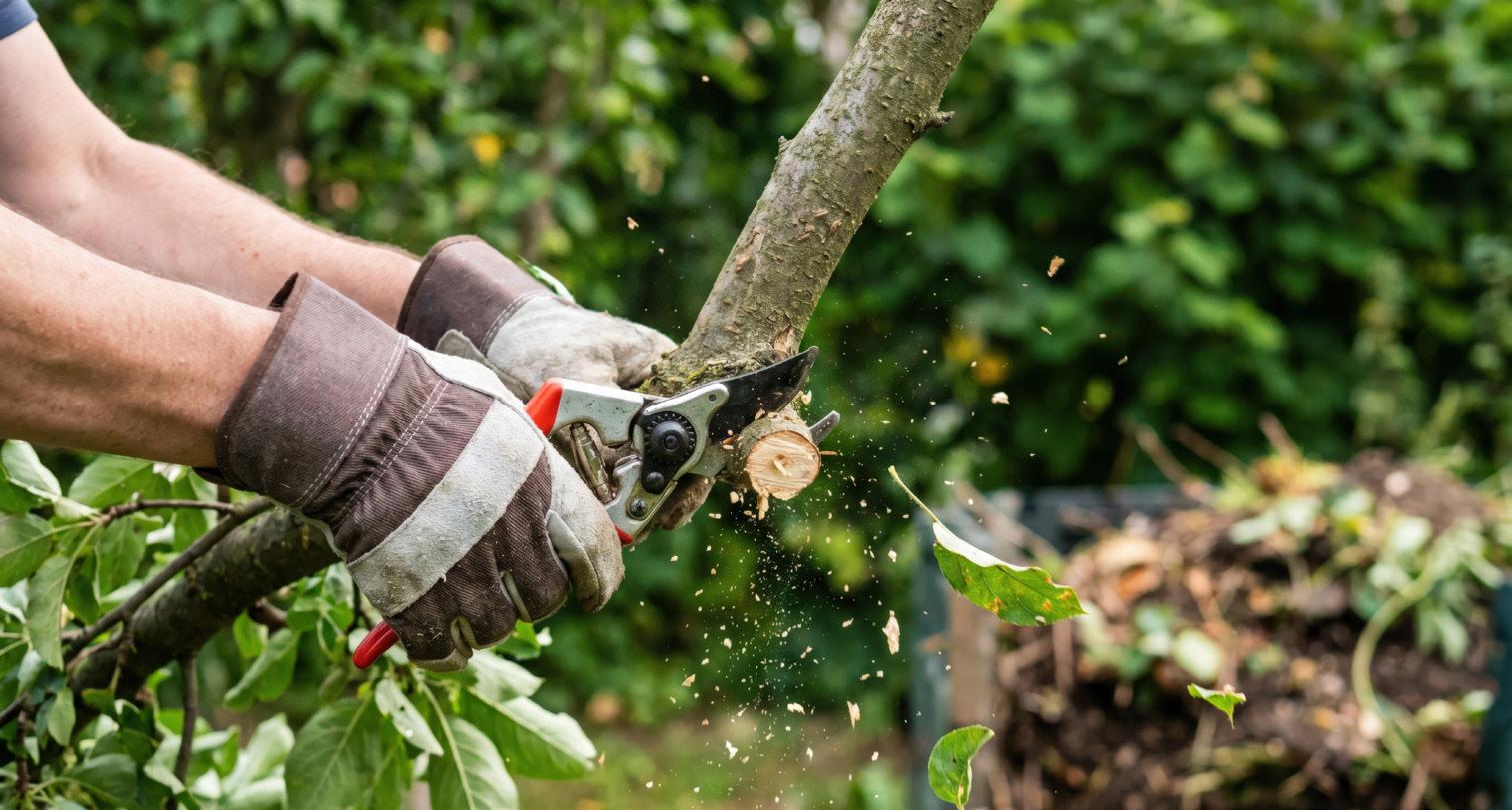
Whether gripping a hammer or typing on a keyboard, your workers’ hands are one of their most valuable tools. They are also vulnerable to injuries, including cuts, burns, fractures, repetitive strain, infections and amputations. These injuries can lead to the loss of hand motion, dexterity and grasp, making it difficult to perform even the simplest of tasks.
The good news is hand injuries are preventable. By taking proactive measures, you can protect your workers from potential harm. Follow these tips to promote hand safety in your workplace.
Assess for hazards and risks. Take a look around your workplace for potential hazards like sharp edges, pinch points, chemicals, and outdated or faulty equipment. Use the hierarchy of controls to eliminate and reduce any risks to your workers’ hands.
Follow safe work practices. Implement procedures to protect workers’ hands during day-to-day activities, like using push blocks and guards when operating machinery and power tools. Make sure everyone follows the health and safety standards and regulations that apply to your workplace.
Develop a lockout and tagout system. Have a process in place that puts machinery in a safe and de-energized state when being serviced or repaired. This can help prevent workers from unintentionally restarting the equipment, which could lead to serious hand injuries.
Prevent chemical exposure. If applicable to your workplace, provide WHMIS training for workers so they understand how to read product labels and safety data sheets to safely handle chemicals safely. Dispose of sharp objects properly. Make sure that wide-mouth, puncture-resistant sharps containers are readily available for workers to safely dispose sharp objects and needles. Ensure they are sealed,
collected, and disposed of according to local regulations.
Use appropriate hand protection. Ensure your team has access to the right protective gloves that fit well, are regularly inspected and are in good condition, and don’t introduce new hazards. Gloves that don’t fit properly can get caught in power tools and machines, while gloves made with metal or with faulty insulation can put workers at risk of electrocution.
Avoid rings and jewelry. Wearing rings and bracelets when operating machinery or power tools can lead to serious hand injuries. Where jewelry poses a risk, make it a policy that requires workers to leave it at home or secure it in a locker.
Use the right tools. Tools that vibrate or are too big, small, or heavy can lead to strains, sprains and other injuries. Consider using anti-vibration mounts or gloves when operating tools like chainsaws or jackhammers.
Make time for hand exercises. Encourage workers to stretch and exercise their hands, wrists, and fingers before work and between tasks. This practice will help build hand strength and provide a rest from repetitive motions.
Support good hand hygiene and care. Working hands can be prone to dryness and cracked skin, making them susceptible to cuts and infection. Gentle soap, hand sanitizer, barrier cream, and moisturizer can help keep them clean and free of irritation.
Hands are essential to nearly every task your workers perform and, when they’re injured, the consequences can be serious and far-reaching. By being proactive in protecting your workers’ hands, you can help reduce the risk of injuries in your workplace.


The Grass the World Cup Is Played On.
When the world’s best players take the pitch in Toronto this year, they’ll be playing on Greenhorizons Ultimate Sports Turf, our proprietary natural grass blend grown on our family farm in Southern Ontario, and installed by our experienced crews.
Whether you’re planning a new sports field, developing a municipal park, upgrading a school athletic facility, or specifying materials for a community recreation project, the decisions you make today will influence performance, playability, and durability for years to come. Choosing the right turf is about more than appearance. It’s about creating safe, resilient, high-performing spaces that athletes and communities can enjoy season after season.