topcropmanager.com
April 2026
WESTERN EDITION
+ FUNGICIDE GUIDE
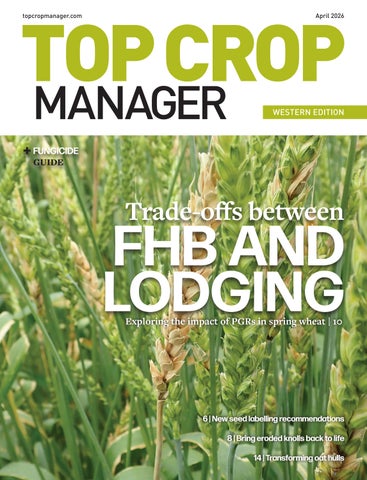
Trade-offs between
FHB AND LODGING Exploring the impact of PGRs in spring wheat | 10
6 | New seed labelling recommendations 8 | Bring eroded knolls back to life 14 | Transforming oat hulls
Reach your canola potential with Proline GOLD Proline ® GOLD’s unique formulation is designed to protect canola yield potential by delivering excellent disease control, especially in high disease pressure situations. Protect against yield-robbing sclerotinia infections to ensure maximum yield potential can be achieved. Proline GOLD lets you unlock the full potential of your canola crop.
See how it performs at ProlineGOLD.ca
ALWAYS READ AND FOLLOW PESTICIDE LABEL DIRECTIONS. Bayer, Bayer Cross and Proline® are registered trademarks of Bayer Group. Used under license. Bayer CropScience Inc. is a member of CropLife Canada. ©2026 Bayer Group. All rights reserved.
2
TOP CROP MANAGER WEST
April 2026
April 2026 Vol. 52, No. 4 topcropmanager.com
KNOW. GROW.
PESTS AND DISEASES
6
6 New seed labelling recommendations Clubroot resistance labels.
10 Trade-offs between FHB and lodging
Exploring the impact of PGRs in spring wheat.
SOIL AND WATER
8 Bring eroded knolls back to life
Multiple strategies provide different results.
CORN
12 Bt-resistant European corn borer 14
18
Scout, rotate and take refuge.
MARKETS AND MARKETING
14 Transforming oat hulls Researchers are finding ways.
PLANT BREEDING
18 Moving pea and soybean varieties forward The Crop Development Centre’s breeding programs boost these efforts.
AGRONOMY UPDATE
22 Factors influencing flea beetle damage ON THE WEB
GAINING A BETTER UNDERSTANDING OF VERTICILLIUM STRIPE
In the 10 years since Verticillium stripe was first identified in Manitoba, researchers have been working to gain a better understanding of the disease and its impact on canola production.
ON THE COVER: Researchers looked at spring wheat cultivars with a range of plant heights and FHB resistance ratings. Photo courtesy of Kelly Turkington.
Readers will find numerous references to pesticide and fertility applications, methods, timing and rates in the pages of Top Crop Manager. We encourage growers to check product registration status and consult with provincial recommendations and product labels for complete instructions.
FROM THE EDITOR by Kaitlin Berger
TOPCROPMANAGER.COM April 2026 | Volume 52 | Number 4
RISK, RECORD KEEPING AND RESEARCH “Control the controllables.” That’s what my husband tells me during weeks of high stress or unforeseen events. For me, that usually means hopping on the stationary bike, going for a run and eating healthy – doing the things I don’t feel like doing, but will make me feel better in the long run. My husband’s advice is also what I think about when it comes to managing disease in the field each year. Of course, there are many uncontrollable factors in agriculture - and disease is just one of them. A research report prepared for the Canadian Agri-Food Policy Institute (CAPI) by Farm Management Canada, entitled Striking the Balance: Proactive Strategy Versus Reactive Response, articulates the importance of comprehensive risk management in agriculture - a way to control the controllables - starting at the farm level. The report cites a study published by Farm Management Canada in 2020 that said 75 per cent of Canadian farmers feel moderate to high stress, mainly caused by feeling a loss of control and the unpredictable nature of the sector. The same study reported that 88 per cent of farmers who followed a written business plan – an example of proactive management – reported greater peace of mind. Writing down a plan can be helpful in other areas too. For example, it’s impossible to control the weather, but the CAPI report suggests that keeping a record of the weather – and having historical weather patterns to assess and monitor the situation each year – is an important proactive risk management strategy. It can be helpful for evaluating disease risk, too. Manitoba Agriculture suggests drawing a disease map shortly before harvest to track troublesome areas in the field – and to use as a reference tool when you grow the same crop again. Having more knowledge on the disease in your field can also help you decide which variety to plant to give your crop a disease-free head start. Thankfully, researchers are continuously looking into methods to manage disease risk, too. In this issue, on page 10, you’ll read about a study exploring how to manage Fusarium head blight and lodging. On page 6, you’ll also read how a new seed labelling system could improve stewardship for clubroot in canola. While none of us can control whether disease shows up in our fields, we can plan strategies to prevent it, catch it early, and choose the best method of control.
75 per cent of Canadian farmers feel moderate to high stress...
@TopCropMag @topcropmanager @TopCropManager KAITLIN BERGER editor kberger@annexbusinessmedia.com
4
TOP CROP MANAGER WEST
Reader Service Print and digital subscription inquiries or changes, please contact Angelita Potal, Customer Service Administrator Tel: (416) 510-5113 | Fax: (416) 510-6875 Email: apotal@annexbusinessmedia.com Mail: 111 Gordon Baker Rd., Suite 400, Toronto, ON M2H 3R1
Editor KAITLIN BERGER (403) 470-4432 kberger@annexbusinessmedia.com Western Field Editor BRUCE BARKER (403) 949-0070 bruce@haywirecreative.ca National Account Manager QUINTON MOOREHEAD (204) 720-1639 qmoorehead@annexbusinessmedia.com National Account Manager REENA UPPAL (437) 922-7359 ruppal@annexbusinessmedia.com Account Coordinator JULIE MONTGOMERY (416) 510-5163 jmontgomery@annexbusinessmedia.com Group Publisher MICHELLE BERTHOLET (204) 596-8710 mbertholet@annexbusinessmedia.com Audience Development Coordinator LAYLA SAMEL (416) 510-5187 lsamel@annexbusinessmedia.com Team Lead/Media Designer BROOKE SHAW CEO SCOTT JAMIESON sjamieson@annexbusinessmedia.com Printed in Canada ISSN 1717-452X PUBLICATION MAIL AGREEMENT #40065710 SUBSCRIPTION RATES (Canadian prices do not include applicable tax) TOP CROP MANAGER WEST – 8 ISSUES Feb, Mar, Mid-Mar, Apr, May/June, Sept, Oct and Nov – Canada 1 Yr $51.45; 2 Yr $82.21 USA 1 Yr $116.69 CDN; Foreign 1 Yr $139.50 CDN TOP CROP MANAGER EAST – 3 ISSUES Mar/Apr, Sep/Oct, Nov/Dec Canada 1 Yr $51.45; 2 Yr $$82.21 USA 1 Yr $116.69 CDN; Foreign 1 Yr $139.50 CDN POTATOES IN CANADA – 1 ISSUE Spring – Canada 1 Yr $18.56; 2 Yr $29.70 USA 1 Yr $41.90 CDN; Foreign 1 Yr $53.57 CDN Occasionally, Top Crop Manager will mail information on behalf of industry related groups whose products and services we believe may be of interest to you. If you prefer not to receive this information, please contact our customer service department listed above. Annex Privacy Office privacy@annexbusinessmedia.com Tel: 800.668.2374 No part of the editorial content of this publication may be reprinted without the publisher’s written permission © 2026 Annex Business Media. All rights reserved. Opinions expressed in this magazine are not necessarily those of the editor or the publisher. No liability is assumed for errors or omissions. All advertising is subject to the publisher’s approval. Such approval does not imply any endorsement of the products or services advertised. Publisher reserves the right to refuse advertising that does not meet the standards of the publication.
Powerful pulse performance to maximize your yield potential— and test just how humble you can be. Delaro® Complete fungicide is your best first pass choice on pulses. Delaro Complete effectively manages both Anthracnose and Ascochyta Group 11-resistant biotypes. Its unique combination of three powerful modes of action are expertly formulated to provide broad-spectrum disease control for your pulse crops, helping to protect your yield potential and maximizing your return on investment. With performance like this, don’t be surprised if you need bigger bins.
See how it performs at DelaroComplete.ca
ALWAYS READ AND FOLLOW PESTICIDE LABEL DIRECTIONS. Bayer, Bayer Cross and Delaro® are registered trademarks of Bayer Group. Used under license. Bayer CropScience Inc. is a member of CropLife Canada. ©2026 Bayer Group. All rights reserved.
topcropmanager.com
TOP CROP MANAGER WEST
5
PESTS AND DISEASES
Canola sector proposes new seed labelling recommendations Voluntary clubroot resistance labels could help manage stewardship. BY KATE AYERS
CURRENT LABELLING SYSTEM
The complexity of pathogen populations makes the current CR labelling system difficult to decipher, 6
TOP CROP MANAGER WEST
ABOVE Clubroot infects canola and can cause galls in susceptible cultivars. These swollen cells disrupt the plant’s ability to uptake water and nutrients, which impact yield and oil content.
classifying canola hybrids as simply resistant or susceptible. Companies also use their own unique terms when marketing their products. For example, labels may identify either the source of resistance (origin where the genes themselves are found) or phenotypic resistance (generally observed resistance). First-generation resistance, a phenotypic resistance, means the varieties are effective against the initial clubroot pathogen in Western Canada, namely 3H. Second-generation resistance is a catch-all term for varieties that differ from the first generation – not necessarily more or less resistant than first generation, just different. “This is proprietary information. So, we don’t necessarily know what different companies have, but basically it can be effective against some of these new pathotypes,” says Stephen Strelkov, plant pathology professor at the University of Alberta (U of A). “It’s helpful for fields where the first-generation resistance is no longer effective.” The sector doesn’t have a single system to identify what a new variety with different resistance genetics brings to the table, making it difficult for producers to compare breeding programs, Gabert explains. To help producers with resistance stewardship, the Clubroot Steering Committee proposes a new voluntary CR labelling program to highlight a cultivar’s phenotypic resistance to common pathotypes 3A, 3D and 3H. April 2026
Photo courtesy of S.E. Strelkov, University of Alberta.
C
lubroot is a soil-borne disease caused by a fungus-like protist called Plasmodiophora brassicae. It’s a perennial challenge that Western Canada’s canola producers face when crop planning each year. To support on-farm management decisions, the Clubroot Steering Committee - a cross-sector group of industry representatives, growers and researchers - is proposing a new labelling program to standardize clubroot resistance (CR) information on canola cultivars. In Canada, clubroot was first discovered near Edmonton, Alta in 2003, and by 2009, companies introduced CR products into the market for Canadian producers. These products were critical for helping the plant prevent or reduce gall development on canola roots, reducing disease severity and inoculum buildup in the soil. By 2013, producers and researchers started to see CR break down, allowing pathotypes to cause disease in a previously resistant host. Clubroot has many pathotypes, also known as strains, that can rapidly adapt to infect a range of hosts in different ways to cause disease – and not all of these strains are equal. While the predominant pathotypes on the Prairies include 3A, 3D and 3H, as defined by the Canadian Clubroot Differential, Canada currently has over 50 reported pathotypes, according to Keith Gabert, provincial agronomist at Alberta Canola. “Not all of those are important,” he says. “A number of the pathotypes are regionally isolated. Some of them aren’t particularly unique, but they’re just different than the others.”
“Different companies were describing the resistance in different ways,” says Strelkov. “That can be confusing to growers sometimes. So, the idea of this resistance labelling initiative was to say, okay let’s start with phenotypic resistance as a standardized way to label resistance by its phenotypic reaction to different key pathotypes.” The objective of the labelling program is to enable canola sector stakeholders to compare apples to apples when selecting seed that will work best for their operations. “A grower can look at a product from company A and from company B and they would use the same terminology. They would show the phenotypic response, everything would be in a consistent manner,” Strelkov says. As seed breeders continue to learn about the underlying mechanisms of clubroot resistance, the sector will start with phenotypic resistance labelling and may add more pathotypes to the system as new ones become dominant across the Prairies. “The first three pathotypes - [3A, 3D, 3H] - simply represent the first step in the process,” Gabert says. “Ideally, I think we would identify the specific gene that provides that resistance, but at this point we’re down to identifying the pathotype and then identifying if resistance material is effective against that.” As more pathotypes emerge and more CR genes are bred into canola cultivars, rotating varieties that contain different CR genes will be necessary for managing clubroot, Canola Council of Canada says.
topcropmanager.com
TCW_CleanFarms_April26_CSA.indd 1
MULTIPLE MANAGEMENT STRATEGIES
Managing clubroot is important for Western Canada, and maintaining CR is a sector-wide effort. Since 2005, researchers have confirmed clubroot in 6,100 crops representing 4,347 individual fields in Alberta, according to a 2025 province-wide survey across all 12 canola regions. In Saskatchewan, data indicates 82 fields with clubroot symptoms and 45 fields with clubroot DNA. Data from Manitoba Agriculture indicates the province has less than 45 fields with clubroot symptoms and 296 fields with clubroot DNA. To prevent major pathogen infestations, producers can reduce spore load through crop rotation, weed control, equipment sanitation and field scouting. “It’s important to identify what’s going on in your field and what works there. Include at least a two-year break between canola years and continue to scout like you really are concerned about clubroot,” Gabert says. Planting CR cultivars is another tool in a producer’s toolbox. “Resistance is such an important tool,” says Strelkov, “that we want to practice good resistance stewardship so that we don’t lose resistance sources.” A roll-out date for the proposed labelling system has not been set as discussions are ongoing.
TOP CROP MANAGER WEST
2026-03-02 9:44 AM
7
SOIL AND WATER
Bring eroded knolls back to life Multiple strategies provide different results.
landscape that’s most susceptible to any type of erosion,” says Cavers.
BY BRUCE BARKER
8
TOP CROP MANAGER WEST
DIFFERENT OPTIONS FOR RESTORING PRODUCTIVITY
ABOVE Moving topsoil from low spots back to eroded knolls is the fastest way to improve productivity.
Increasing cropping inputs with additional fertilizer and increased seeding rates is one approach that has been researched. Cavers did demonstrations in 2022 and 2023 at the AAFC Portage la Prairie research site where the topography is level compared to an eroded knoll site at Altamont, Man. He looked at the effects of doubling the seeding rate, doubling the fertilizer rate or doubling both at the Portage la Prairie site. Wheat yield on the level land was 70 bushels per acre, but when seeding rate was doubled, it dropped to 55 bu/ac. Doubling the fertilizer rate increased the yield minimally to 72 bu, but doubling both seed and fertilizer rates cut yield to 49 bu/ac. On the eroded knoll site at Altamont, Man., the check yield was 11 bu/ac, and doubling the seeding rate increased it to 17 bu/ac. Adding about six inches of topsoil produced 15 bu/ac and doubling the fertilizer rates and adding topsoil increased yield to 20 bu/ac. “Increasing crop inputs helped somewhat, but the expense of additional fertilizer or seed probably doesn’t justify the increase in productivity,” says Cavers. Another approach is to apply crop residues to the eroded hilltops to reduce water runoff and evaporation, and to conserve moisture on the landscape that is April 2026
All photos courtesy of Curtis Cavers.
S
oil erosion by wind, water and tillage have all contributed to the decline in productivity on hilltops ever since the land was broken for field cropping. Research has looked into how to restore productivity on those eroded knolls. “Eroded hilltops are consistently the lowest-yielding areas of a given field, especially in years of low-normal rainfall, but can typically occupy 10 to 30 per cent of the landscape in areas with rolling topography,” says Curtis Cavers, agronomist with Agriculture and Agri-Food Canada (AAFC) at Portage la Prairie, Man. “A good rule of thumb is these parts of the landscape usually yield about 50 per cent of the mid-slope or depression areas, and sometimes as low as 30 per cent in extreme cases.” Cavers says the most dominant erosion pathway has been tillage, which moves topsoil off the hilltops to the mid-slopes or depressions with each tillage pass. With the recent move to reduced- and no-till, this pathway may have decreased, but no-till alone isn’t restoring those eroded knolls to productivity. “There’s two reasons for that. Soil formation is a slow, slow process that takes decades, if not centuries, rather than years. And the second reason is that we’re dealing with the part of the
Table courtesy of Curtis Cavers.
RESEARCH SHOWS HOW TOPSOIL RELOCATION INCREASES SOIL ORGANIC CARBON AND IMPACTS YIELD Research
Increase in SOM Concentration (%) at 0 to 6 in Depth
Increase in Crop Yield (%)
Schneider et al. (2021) – Topsoil relocation in Minnesota
112% From 2.9 to 6.2%
21-53% (corn); 12-59% (soybean)
Smith and Lobb (2008) – Topsoil relocation in Manitoba
108% From 2.2 to 4.6%
10-133% (various sites & crops)
Cavers et al. (2024) – Topsoil relocation in Manitoba (Unpublished)
53% From 3.3 to 5.0%
TBD
(Schoenau and Hangs, 2020) – 21 years of no-till in Saskatchewan
25%
(Larney and Olson, 2018) - Multiple applications of beef manure in Alberta
19% From 2.5 to 3.0%
(Peng et al., 2023) – Cover crops for > 5 years - North America summary
8%
typically short on soil moisture. Cavers ran a 2023 demonstration at Altamont that compared the effects of added straw, added topsoil and the cumulative effect of both on wheat yield. He says that too much straw was added to the knolls, impacting crop productivity. The control yielded 11 bu/ac. Added straw reduced yield to 9 bu/ac. Added topsoil increased yield to 15 bu and the combination yielded 13 bu/ac. “That’s a cautionary tale to say that if you add way too much straw at the wrong time or the wrong way, you’re going to cause more harm than good,” says Cavers. Chaff may be a better option. It could be collected from the low spots where too much residue is causing problems, such as keeping the seedbed cold and wet, and to put it on hilltops where it can help retain some moisture, reduce evaporation and possibly even help with weed management. Another way to add organic carbon to the hilltops to improve productivity is the addition of livestock manure and compost. While it takes livestock integration into cropping systems to have access to the manure, it can be effective. However, it still takes time to improve productivity. Cavers says anecdotally that other researchers have calculated that using beef manure applied at recommended phosphorus rates would take approximately 30 years to increase soil organic matter by only one per cent.
to move the topsoil from the lower slopes back up to the eroded knolls where it came from in the first place. Cavers says this provides an immediate increase in soil organic carbon as opposed to slowly increasing carbon sequestration with manure, cover crops or improved annual cropping productivity. Typically, 10 to 20 cm (4 to 8 in) are moved from lower slopes to knolls. An additional advantage is that it should be a one-time practice if done correctly. Cavers says multiple research projects have shown how topsoil relocation immediately increases soil organic carbon, and how that impacts yield. “The yield response to topsoil addition to knolls depends on the year and crop. The thing that we’re trying to confirm, though, is that by adding topsoil, the yield improvements we get on the hilltop are greater and longer lasting than the yield reductions we get in the depressions. Hopefully, with an abundance of moisture in the depressions, the yield reductions in the depressions are shorter lasting and less severe if there are any at all,” says Cavers. “With soil landscape restoration, in essence, we are attempting to transfer the impacts of soil erosion from the most sensitive areas of the landscape to the most resilient areas, where impacts are minimized and recovery can be accelerated.” Overall, Cavers says that one approach doesn’t fit all farms. There are pros and cons to the various approaches to improving productivity on knolls, whether applying crop residues, adding manure or other organic amendments, using cover crops or landscape restoration. Some are cheaper, more effective or longer lasting. “Look at your situation, look at the options that you have, and pick and choose some of these,” says Cavers. “Maybe you restore the landscape first, move the topsoil around, and then go to no-till, so that you minimize how much soil movement you have. Or do some of the other approaches as well. They shouldn’t have to be exclusive.”
RIGHT Tillage is the greatest contributor to lost productivity on eroded knolls.
TOPSOIL RECLAMATION MAY BE MOST EFFECTIVE
What may be the most effective and quickest strategy is topcropmanager.com
TOP CROP MANAGER WEST
9
PESTS AND DISEASES
Trade-offs between FHB and lodging Exploring the impact of PGRs in spring wheat. BY JOEY SABLJIC
V
ery few of the management challenges wheat growers face in a typical season loom quite as large as Fusarium head blight (FHB). Not only does the disease directly hurt yields, but it renders crops unmarketable due to the buildup of deoxynivalenol (DON) or vomitoxin. At the same time, growers in high-moisture Prairie regions are dealing with another wheat production reality: Varieties with the strongest Fusarium resistance tend to be taller, which increases lodging risk. A University of Manitoba (U of M) study is addressing this issue, suggesting there may be a way to grow taller, Fusarium-resistant wheat – and manage height by using plant growth regulators (PGRs).
TALLER WHEAT COMES WITH TRADE-OFFS
10
TOP CROP MANAGER WEST
ABOVE Researchers looked at spring wheat cultivars with a range of plant heights and FHB resistance ratings.
anther retention after flowering. Those retained anthers provide nutrients and physical entry points for Fusarium infection within the floret. Shorter varieties often develop compact spikes, as well, which can trap moisture and create the ideal micro-environment for fungal infection. Taller wheat varieties, on the other hand, tend to shed anthers more completely, leading to lower initial Fusarium infection rates.
EXAMINING THE IMPACT OF PLANT GROWTH REGULATORS
PGRs are already widely used in cereal systems to help shorten plants, thicken stems and reduce lodging risk. Lee and her fellow researchers wanted to find out if PGRs allow growers to use taller, more Fusarium-resistant varieties while keeping plant height in check and without increasing the risk of FHB infection. Over two seasons of field-scale trials, the researchers looked at five commercial spring wheat cultivars with a range of plant heights and FHB resistance ratings: AAC Brandon, AAC Cameron, AAC Penhold, AAC Tenacious April 2026
Photo courtesy of Kelly Turkington.
According to plant science researcher Younyoung Lee, wheat breeders have made steady progress in their efforts to improve Fusarium resistance, but one issue they haven’t quite been able to solve is lodging. “Most cultivars with better FHB resistance are taller, which makes them more difficult to adopt in high-moisture regions with higher lodging potential,” she explains. Shorter wheat, on the other hand, tends to be the more popular choice for intensive management, as it stands well, harvests easily and can handle higher fertility systems without falling over. As with anything, there are trade-offs. Lee says shorter wheat often shows higher Fusarium levels than taller wheat varieties, even when facing the same disease pressure levels. One reason is that shorter wheat plants are positioned closer to the soil surface, where humidity is higher and air circulation is reduced. Because Fusarium spores are mainly dispersed from infected crop residues on the soil, shorter plants are more likely to be exposed to conditions that favour spore survival and dispersal. Another major factor is genetics. Many modern short-strawed or semi-dwarf wheat varieties carry semi-dwarfing alleles, which reduce cell elongation throughout the plant, including in the anther filaments. Shortened filaments, says Lee, can result in greater
and Prosper. Two commercially available growth reguAAC Brandon, a semi-dwarf cultivar, showed the highest anther retenlators were also tested: Manipulator and Ethrel. tion at 55 per cent, whereas AAC Tenacious, a tall variety, had the lowest Lee and her team then looked at several parameters anther retention at around 20 per cent. This reinforces the fact that wheat including plant height, lodging, Fusarium severity, genetics ultimately drive most of the relationship between plant height and Fusarium-damaged kernels and DON levels. What they Fusarium risk, not PGR applications. eventually found was that neither of the PGRs increased The differences between wheat varieties couldn’t have been clearer. The the level of FHB infection or DON toxins. Even with tallest variety, AAC Tenacious, consistently showed the strongest Fusarium hormonal changes to plant growth, Fusarium outcomes resistance. Meanwhile, semi-dwarf cultivars like Prosper and AAC Penhold were unchanged. tended to show higher Fusarium and DON levels. Where the PGRs did differ was in their ability to reduce plant height. The researchers found that Ethrel THE PATH FORWARD FOR PGRS AND FUSARIUM MANAGEMENT consistently reduced plant height by about five centi- Where does this study leave growers who are grappling with Fusarium and metres across all varieties. Manipulator reduced plant lodging concerns? According to Lee, growers should start with a tall, geheights by roughly two centimetres, but the results netically FHB-resistant variety. Plant growth regulators can be used safely were more varied across varieties. to help manage lodging risk but can’t compensate for poor genetic resistLee notes that both years of their trials were unusu- ance to FHB. “PGRs play more of an indirect role by maintaining standabilally hot and dry, which could have limited the plants’ ity and canopy structure in taller varieties that already have strong genetic response to PGRs, and reduced lodging risk. resistance,” she says. Another big question the researchers wanted to anLee also cautions that PGRs do carry a cost, and their value may depend swer was whether shortening plants with PGRs might on lodging risk and weather. “Our study shows that PGRs should be viewed worsen anther retention — and potentially increase as a supplementary tool rather than a full-on substitute for genetic resistFusarium infection. According to Lee, that didn’t hap- ance to FHB,” says Lee. “And for wheat growers, PGRs can provide a little pen at all. “The most significant variations were due to more flexibility in their variety choice, along with a better chance at prothe cultivars themselves,” she says. tecting yield and grain quality.” 26_000614_Top_Crop_Western_Edition_APR_CN Mod: February 12, 2026 4:30 PM Print: 02/20/26 page 1 v2.5
π WIDE-MOUTH JARS
QUANTITY MEETS QUALITY
UTILITY JUGS
BULK PACKS IN STOCK
PLASTIC PAILS
F-STYLE JUGS MILK JUGS
ORDER BY 6 PM FOR SAME DAY SHIPPING topcropmanager.com
TCW_Uline_April2026_CSA.indd 1
1-800-295-5510
uline.ca TOP CROP MANAGER WEST
11
2026-02-23 10:06 AM
CORN
Holding back Bt-resistant European corn borer Scout, rotate and take refuge.
F
or corn growers, there was a time before Bacillus thuringiensis (Bt) and a time after Bt – Bt being a naturally occurring soil bacterium that has been genetically engineered into corn, with strains that resist European corn borer (ECB), and other strains that resist corn rootworm (CRW). Before Bt, corn growers had to rely on foliar insecticides, and biological and cultural control methods. However, with lab studies suggesting that Bt-resistance ECB may be starting to develop in Manitoba, growers are encouraged to manage the technology so that widespread resistance does not develop. “European corn borer levels overall have not been very high in Manitoba in recent years. Some localized heavier populations can still be found though,” says John Gavloski, entomologist with Manitoba Agriculture at Carman, Man. “The prevalence of corn hybrids with Bt traits may be a factor in the lower populations of European corn borer overall.” Currently, almost 90 per cent of corn grown in Canada has the transgenic Bt trait. Bt corn has a protein that binds to receptors in an insect’s gut that causes the 12
TOP CROP MANAGER WEST
European corn borer larva tunnel in corn stalks to reduce yield.
gut wall to break down and rupture. The larva stops feeding and dies within 24 to 48 hours. Otherwise, ECB larvae damage can cause stalk breakage, cob drop and restricted nutrient flow within the plant to reduce cob size. Humans and other mammals do not have these specific receptors, and are unaffected by the Bt trait. Information from the Canadian Corn Pest Coalition (CCPC) also indicates that many research studies have found that Bt corn does not affect beneficial insects, including honey bees, lady beetles, green lacewing larvae, spiders, pirate bugs, damsel bugs, syrphid flies or parasitic wasps. There are four effective Bt proteins used for ECB control in Canada. These different types may be found singularly or pyramided with two or more of these proteins in hybrids. The proteins are Cry1Ab, Cry1A.105, Cry2Ab2 and Cry1F. In Canada, the first Bt-resistant ECB population was identified to Cry1F in Truro, N.S. in 2018. Since then, resistant populations have been found in additional fields in Nova Scotia, in a sweet corn field at St. April 2026
All photos courtesy of John Gavloski.
BY BRUCE BARKER
Mathieu-de-Beloeil, Que., and near Roseilse, Man. in 2020 on millet. In 2022, a Cry1Ab-resistant ECB population was also found near Truro, and a Cry1Fa-resistant population was collected near St. Armand, Que. In 2023, a sweet corn hybrid with pyramid Cry1Ab, Cry1A.105 + Cry2Ab2 traits showed unexpected injury to ECB at Sussex, N.B. The same year, a Cry1Fa + Cry1Ab grain corn also had unexpected crop injury at Sussex. Most recently in 2024, unexpected injury to a pyramid trait hybrid with Cry1Fa, Cry1Ab, Cry1A.105 + Cry2Ab2 traits was observed in New Brunswick, Nova Scotia, Quebec and Prince Edward Island. “Reduced mortality to the Bt protein Cry1F has been detected in European corn borers from Manitoba in lab testing, although unexpected damage from European corn borer to Bt corn has not been seen in fields in Manitoba,” says Gavloski. Resistance development is a natural process that occurs over many generations of ECB populations. When Bt-resistant corn is grown, a small number of ECB insects in the population may be naturally resistant to the Bt trait. These surviving, resistant insects can mate with other resistant insects, and over time, the resistant populations multiply to the point that they cause economic damage to corn.
TIPS FOR PREVENTING RESISTANCE
Scouting for ECB is the first step in understanding if Bt-resistant ECB is developing. Look for egg masses, young larvae and injury to the plant. Egg masses will be found on the underside of corn leaves, predominately on leaves near the ear. The first two instar larva feed within the whorl and cause shothole and windowpane damage. The third instar bores into the corn stalk (look for frass on leaves near the stalk), and along with the fourth and fifth instar larva stages, feed within the stalk. Slice open the stalks to look for older larvae. “Corn growers should look for signs of European corn borer damage in Bt corn fields in late summer. Contact your provincial entomologist and seed agronomist if you find any signs of unexpected European corn borer damage in Bt corn fields,” says Gavloski. Suspect larva may be collected for lab evaluation. Including a refuge is a mandatory practice for Bt corn growers that is required by the Canadian Food Inspection Agency (CFIA). A refuge does not have the Bt trait, and provides a habitat where the susceptible insect population can feed, mate and reproduce without being exposed to the Bt trait. This ensures the susceptible population is much more abundant than the small, naturally occurring resistant population, so that the resistant population is diluted during mating, which topcropmanager.com
ABOVE Newly laid egg masses (upper) and egg masses read to hatch (lower).
delays the development of resistance. There are two types of refuges. Today, most corn hybrids have an integrated refuge, sometimes called ‘refuge-in-a-bag.’ This typically contains five per cent non-Bt seed pre-mixed with the Bt-resistant seed. When seed is planted without an integrated refuge, a structured refuge must be planted. This is where blocks or strips of ECB-susceptible corn is grown to provide a refuge for susceptible ECB. The refuge must be planted at the same time as the Bt-resistant corn. Sprayable Bt insecticides (such as Dipel or Bioprotec) should not be applied to the refuge corn. Another best management practice is to avoid planting hybrids that contain only one Bt toxin, says Gavloski. Additionally, rotating between Bt toxins in successive years also helps to slow the development of Bt resistance. Information on Bt toxins found in corn hybrids and refuge requirements can be found from seed companies, and at the CCPC website. Shredding stalks with a flail mower is an effective way to kill overwintering ECB if unexpected damage is found. Shred the stalks close to the ground, and then bury the shredded stalks. More information on European corn borer and minimizing the risks of Bt resistance can be found in the Manitoba Agriculture factsheet on European corn borer and on the CCPC website. The Manage Resistant Now website also has information on weed, disease and insect resistance management. TOP CROP MANAGER WEST
13
MARKETS AND MARKETING
Transforming oat hulls into high-value products Researchers are finding ways. BY CAROLYN KING
‘A NEW LEASE ON LIFE’ THROUGH FERMENTATION
One of these three teams is at the Saskatchewan Food Industry Development Centre (Food Centre). Mehmet Tulbek, the Food Centre’s president, explains that an oat kernel is about 70 per cent of a raw oat and the hull is about 30 per cent. So, the hulls represent a sizeable byproduct. Tulbek points out that oat hulls are typically used in animal feed, for combustion for electricity generation, or as an absorbent in animal bedding material, which are all low-value uses. He adds that some people are exploring higher-value possibilities such as using the hulls in the production of anhydrous biobutanol (a 14
TOP CROP MANAGER WEST
TOP Pooba Ganeshan adjusts fermentation equipment used to transform oat hulls into higher-value food ingredients. ABOVE Oat hulls (left) and samples of the oat hull extracts from Bishnu Acharya’s fractionation project.
biofuel), food packaging, or biodegradable plastics. A few, like the Food Centre team, are developing food applications. In a project called ‘A new lease on life for oat hulls,’ Tulbek is working with Pooba Ganeshan, a principal scientist at the Food Centre, to use fermentation to transform oat hulls into higher-value food ingredients. “The process is very simple; it is almost like a sourdough kind of fermentation,” explains Ganeshan. First, they mill the hulls into fine particles. Then in a process called solid-state fermentation, they ferment this ground material using an edible fungus. The fermentation process gradually breaks down the oat hulls. After five to seven days, the team heats up the fermented material to 45 degrees to inactivate the edible fungus. Then they dry the fermented material and mill it again. This system results in a flour-like product that can be used in baking, substituting for about 10 to 20 per cent of the amount of flour required in the food. “The most important challenge that we had to overcome in this project was the silica content in the hulls. Oat hulls are very gritty and abrasive, and that is because there is six per cent silica,” says Ganeshan. “So, to be able to use the hull as a food product, first we had to find a way to reduce or remove that silica content.” He notes that, although silica consumption is April 2026
Photos courtesy of the Saskatchewan Food Industry Development Centre; Bishnu Acharya, University of Saskatchewan.
A
n oat hull, the outer husk of an oat, starts out in life with the vital task of protecting the oat kernel from diseases and other threats. After harvest, the oats are cleaned and dehulled to get the kernels, while the hulls typically become low-value byproducts. Now, three teams of Canadian researchers are developing innovative approaches to give oat hulls high-value second lives. Turning oat hulls into valuable coproducts can help create new value chains and new market opportunities and it can be better for the environment – part of a ‘circular bioeconomy’ approach, which emphasizes the wise use of bio-based resources, including reducing, reusing and recycling wastes. According to the Prairie Oat Growers Association (POGA), Prairie farmers produce about 90 per cent of Canadian oats and Canada is the world’s largest exporter of oats. In other words, the opportunity is there – and the results from these three projects could help enhance the sustainability of the Prairie oat industry, an important part of Canada’s bioeconomy.
Cereal performance you can harvest Prosaro® PRO fungicide is here to maximize your yield potential and quality. Prosaro PRO delivers protection from fusarium head blight, ergot, and control of tough leaf diseases in cereals. It’s an excellent way to maximize your return on investment, and your yield envy.
See the impact at ProsaroPRO.ca
ALWAYS READ AND FOLLOW PESTICIDE LABEL DIRECTIONS. Bayer, Bayer Cross and Prosaro® are registered trademarks of Bayer Group. Used under license. Bayer CropScience Inc. is a member of CropLife Canada. ©2026 Bayer Group. All rights reserved.
topcropmanager.com
TOP CROP MANAGER WEST
15
MARKETS AND MARKETING
HIGHER VALUE THROUGH FRACTIONATION
Bishnu Acharya, director of the Centre for Bioproduct Development and Commercialization (CBDC) at the University of Saskatchewan (USask), is leading another one of the oat hull projects. His research interests centre on a circular bioeconomy approach. “In general, our research goal has always been to explore alternative biomasses and determine how we can generate value from them. That focus led to the development of the CBDC, which examines not only oat hulls but a wide range of agricultural byproducts like straws, canola meal, and various other byproduct streams produced through agricultural activity or agro-processing,” he says. “When we discussed this with our oat industry partners, one of the challenges they identified was managing the oat hulls. In some cases, it was costing them money to handle the hulls rather than generating any positive revenue,” explains Acharya, who is also an associate professor and the Saskatchewan Ministry of Agriculture Chair in Bioprocess Engineering at USask. “When we looked at the properties of those oat hulls, we thought that they could be used to produce more valuable products so that, instead of costing the processors, the hulls could actually generate positive revenue.” Acharya initiated his project in 2022 with support from Richardson Milling, the Natural Sciences and Engineering Research Council of Canada (NSERC) and Mitacs. The promising results from this work led to a larger project launched in 2024, supported by ADF, NSERC and Richardson Milling. This research focuses on fractionation (separating the hulls into several components, or fractions) and on developing industrial applica16
TOP CROP MANAGER WEST
ABOVE Nicole Gammie sets up optimized parameters on the benchtop spray-dryer system in the UBC project. tions for each of these fractions. “In our project, we have developed a greener extraction process that allows us to extract a high-value fibre from the hulls, which could have applications in food and other high-value products. We’re exploring the use of this fibre as a food additive to improve nutritional value while also providing additional health benefits,” he says. “The lignin that we removed from the hulls is being explored for use as an adhesive in composite materials. Meanwhile, the cellulose we extracted is being evaluated for potential applications in packaging and other industrial products.” Acharya and his research group have already completed a pilot test of their extraction process. “Right now, we are working to optimize the process and to better understand these materials, with the goal of ensuring that this knowledge can be adopted and translated into commercial operations.” He notes, “The potential benefits of developing higher-value uses for oat hulls include the creation of new value chains. This could lead to the establishment of commercial facilities dedicated to processing oat hulls. In turn, that would generate new jobs and introduce new renewable products into the market.”
AN ‘ALL OAT’ APPROACH
In a recently completed project, Emily Cranston’s research team at the University of British Columbia (UBC) has developed a system that makes the most of two byproducts from oat processing: oat hulls and oat oil. “Oat oil contains very high unsaturated fatty acid contents and unique oat-derived antioxidants that are April 2026
Photo courtesy of Ariane Fernandes, Cranston Research Group, UBC.
thought to have some health benefits, a food with such an abrasive texture wouldn’t be fun to eat. The U.S. Food and Drug Administration recommend limiting daily food intake of silica to less than two per cent of the food’s weight. Using fermentation plus a method they developed, Ganeshan and Tulbek reduced the silica content to less than one per cent. In fact, in some of their experiments, silica was almost undetectable. “That was one of the main achievements in this project, to make [our product] more like a flour consistency,” says Ganeshan. Their two-year project will be wrapping up this spring. Currently, they are doing some pilot-scale testing to show that their process can be scaled up. They are also developing some prototype food products. “We have tested it in some cookies and brownies, at a 10 per cent rate of substitution of flour. There are some more products we have in the pipeline that we will test between now and March,” says Ganeshan. Tulbek adds, “If a product works in a cookie and a cracker, it works in pretty much everything; those are the standard products you look at first.” Tulbek emphasizes the significance of this project in the bioeconomy of Saskatchewan, a major producer of many crops including oats. “The flour milling companies and oat milling companies deal with a lot of oat hulls and they are not getting sufficient value for them … Our objective was to increase the value of oat hulls, which are getting only about 80 or 90 cents per kilogram in the market [for uses like animal feed]. We are trying to increase it up to maybe $2, $2.5 or $3 per kilogram.” The project is funded by Saskatchewan’s Agriculture Development Fund (ADF).
really valuable in nutraceutical or cosmetic products,” says Megan RobRoberts outlines what was involved in the UBC proerts, who was a post-doctoral researcher in Cranston’s lab and now leads ject: “We used natural cellulose-based material to staher own research group at Western University in Ontario. bilize the oat oil droplets in an emulsion form – an However, being high in fatty acids and antioxidants also makes oat oil emulsion is just oil stabilized in water like a salad prone to oxidation and going bad quickly, so Cranston’s team has created dressing. Then we spray-dried that emulsion into a a bio-based system to stabilize oat oil as an oil powder. powder by misting it into warm air so fast that each Roberts explains that oil powders are liquid oils that are converted into droplet dries before it ever lands, forming a powder.” dry and free-flowing powders that maintain their fluidity without being A key part of this work was the use of a statistical liquid. Oil powders are usually made by encapsulating tiny oil droplets method to optimize the spray-drying process. Accordinside a protective shell. This shell protects the oil from damage from ing to Roberts, this method allowed the team to use a things like oxygen, heat and light, so oil powders have a longer shelf-life. lot fewer lab experiments to determine which particuAs well, oil powders are easier to store, transport, and formulate than lar spray-drying conditions would produce the best oil liquid oils. powder yield and quality. “Oat oil is an underutilized byproduct of some oat processing,” notes The resulting powder was exceptionally high in oil Roberts, who is the lead author on a new scientific paper about this pro- content: “We got powder yields of 82 per cent with oil ject. “We can unlock all sorts of new and cool applications by making oat contents contained within the powder as high as 90 per oil into powders.” cent.” Also, this powder was redispersible, meaning For example, she remembers getting into poison ivy as a child and her that it could be easily mixed back into water simply by mom applying a powdered oatmeal bath product that was extremely using a quick hand shake. soothing to itchy skin. This soothing effect is due to the antioxidants, The cellulose-based stabilizers used in this system which are contained within the oil and not in the solid portion of the were nanocelluloses, which are produced by chemicaloatmeal. “Those oatmeal powders are about five per cent oil by mass. If ly treating cellulose fibres. Roberts explains that nanowe could make a formulation that is 90 per cent 7.125 oil by mass – like TopCrop in an oat celluloses are extremely small, uniform crystals that AL10626 AlbaughCA Fungicides x 4.75 oil powder – we would maximize the availability of those antioxidants.” CONTINUED ON PAGE 19
FIELD-PROVEN LINEUP. NO-NONSENSE APPROACH. FARMER-FOUNDED SPIRIT. You’ll find that spirit in our products and our people, and how we make doing business easy. For more than 45 years, we’ve been providing
options and affordability to help maximize returns. Our fungicides —
Toledo™ 250 EW, StarPro®, Pavise® 480, and new Propistar® — do exactly that. When you can get the results you want, why pay more?
LEARN MORE AT ALBAUGH.COM/CA ©2026 Albaugh, LLC. All rights reserved. Albaugh, the Albaugh logo, StarPro, Pavise and Propistar are registered trademarks and Toledo is a trademark of Albaugh, LLC. ALWAYS READ AND FOLLOW PESTICIDE LABEL DIRECTIONS. It is a violation of federal law to use any pesticide product other than in accordance with its labeling.
AL10626_TopCrop_HalfHoriz_Fungicides1.indd 1
topcropmanager.com
TCW_Albaugh_April26_CSA.indd 1
3/9/26 11:40 AM
TOP CROP MANAGER WEST
17
2026-03-09 3:26 PM
PLANT BREEDING
Moving pea and soybean varieties forward The Crop Development Centre’s breeding programs boost these efforts. BY BRUCE BARKER
B
eat this return on investment. A 2024 Ernst & Young report found an 18:1 benefit to cost for pea breeding at the Crop Development Centre (CDC), Saskatoon, Sask., since 1971. With 62 per cent market share for pea acres in western Canada in 2024, that’s a lot of return for western Canadian farmers. “I think every plant breeder would say that they want to boost the yield of their crop, and so that’s a heavy focus for our pea breeding program. But root rot and protein concentration are also some of the main breeding objectives,” says Tom Warkentin, professor and Ministry of Agriculture Strategic Research Program (SRP) Chair in pulse crop breeding and genetics at the University of Saskatchewan’s CDC. Warkentin first started working on pea breeding in 1992 at Agriculture and Agri-Food Canada (AAFC) at Morden, Man. He moved to the University of Saskatchewan (USask) in 1999 to work in the CDC’s plant breeding program. Since 1999, the CDC has released 40 pea varieties. The pea and soybean breeding program is supported by about 15 technicians and PhDs. The other main pea breeding program on the Prairies is run out of AAFC at Lacombe, Alta. by Dengjin (DJ) Bing. The most widely grown yellow, green and maple pea varieties in western Canada come from these two programs.
Warkentin says CDC has a good track record on yield. One current variety, CDC Meadow, now almost 20 years old, is still the most widely grown yellow pea variety on the Canadian Prairies, covering some 20 per cent of insured acres. That is slowly changing with newer varieties. The current check variety in regional trials in Saskatchewan is CDC Amarillo, which yields about eight per cent more than CDC Meadow. Other yellow varieties like CDC Tollefson, CDC Boundless and AAC Julius are yielding upwards of eight per cent more than CDC Amarillo. The reason these varieties haven’t taken a larger market share yet is that seed multiplication of pea takes three to four years to ramp up enough 18
TOP CROP MANAGER WEST
ABOVE Pea and soybean breeder, Tom Warkentin, is having success with new varieties adapted for the Prairies.
seed for commercial use. The other big breeding objective is root rot, specifically Aphanomyces root rot, along with Fusarium root rot, powdery mildew and the ascochyta blight complex. In addition, other objectives include increasing biological nitrogen fixation to help reduce greenhouse gases, increasing protein content and increasing heat/ drought tolerance. “Aphanomyces is the main culprit and we have some CONTINUED ON PAGE 20
April 2026
Photo courtesy of Chris Hendrikson.
BREEDING OBJECTIVES
MARKETS AND MARKETING
Transforming oat hulls into high-value products | CONTINUED FROM PAGE 17
have really remarkable surface properties. The surface property of most interest in this research is that one face of the crystal loves water and another face loves oil. This makes nanocelluloses excellent stabilizers for making the emulsions used in creating oil powders. Another vital part of the project was to compare the effects of using oat hull-derived nanocelluloses versus wood-derived nanocelluloses in the oat oil emulsions. “Really interestingly, our ‘All Oat’ emulsions performed even better in terms of spray-dry ability and redispersibility compared with the nanocelluloses we made from wood starting materials. This infers a really cool synergy that makes exciting grounds for future research,” says Roberts. “The fact that we could extract these very high-value nanocelluloses from the hulls and create this ‘All Oat’ system was a great example of turning a low-value waste biomass into a high-value functional ingredient.” This project was funded by Mitacs in collaboration with C-Merak and POGA. Cranston’s work is also financially supported through the Canada Research Chairs program, the UBC President’s Excellence Chair initiative, an NSERC grant, the E.W.R. Steacie Memorial Fellowship and the Canada Foundation for Innovation. Roberts notes that the next steps towards real-world translation of this ‘All Oat’ system would include tasks like testing the stability and shelf life of the oat oil powders, scaling up the process, and exploring how these powders perform in real nutraceutical or food formulations, depending
on industry interest. This research also has some broader implications: “It provides a pathway towards [bio-based] sustainable oil encapsulation technologies that are both scalable and industry relevant. It also shows that we can convert sensitive oils into dry powders that can improve stability, potentially reduce transportation costs and enable new product format in nutraceutical, food or cosmetic markets,” she says. From a more oat-focused viewpoint, “Using oat hulls to make nanocelluloses supports the circular bioeconomy, which is of interest to Canada as a whole, allowing us to valorize an agricultural side stream that is often treated as a low-value waste,” says Roberts. “Also, if we think specifically about Canadian farmers and grain processors, this creates an opportunity to extract greater value from the oat supply chain, transforming both oat oil and oat hull residues into higher value-added functional ingredients, affording lots of new applications for potential growth, which is really exciting. And then ultimately our hope would be that this could lead to greener and more sustainable ingredients for food, nutraceuticals and even medicine downstream.”
Realize your potential. Stay ahead of weeds and diseases this season with powerful Prospect™ pre-seed herbicide and the unparalleled disease control of Viatude™ fungicide.
Find more canola solutions at Corteva.ca/Canola
topcropmanager.com
Always read and follow label directions. ™ ® Trademarks of Corteva AgriscienceTOP and CROP its affiliated companies. © 202619Corteva. MANAGER WEST
PLANT BREEDING
ABOVE CDC pea trials are focusing on yield and disease resistance. Fusarium root rots as well. It’s complicated. So, have some patience with us plant breeders on tackling root rot in pea,” says Warkentin. “Our colleagues have found different quantitative trait loci (QTL), chunks of chromosome associated with Aphanomyces resistance. And there’s at least seven such locations in the pea genome. So it’s not simple. It’s not just one spot.” Warkentin says researchers have found two major QTLs that have the bigger effect on Aphanomyces resistance. The CDC has conducted research in collaboration with Sabine Banniza, pulse crop pathologist at USask, to pyramid these two major QTLs for resistance. A few lines had less than 30 per cent root discolouration in indoor assays compared to CDC Meadow at 85 per cent. The most promising lines were tested in 2023-24 pea Co-op registration trials. “In our new breeding lines there is a progression toward lower amounts of root discolouration. The percentage of root discolouration doesn’t hit zero but 30 per cent is certainly better than 85 per cent,” says Warkentin. The CDC has developed a root rot nursery in Saskatoon where they can
ABOVE CDC’s pea breeding program is tackling multiple genetic approaches to variety development. 20
TOP CROP MANAGER WEST
test pea lines for resistance. Colleagues at AAFC Morden and Lethbridge also have root rot nurseries. Some of the more promising lines were tested at the three nurseries and some had better root rot resistance, but the Co-op yield results weren’t promising for the first batch. “This first set was kind of a pilot project, so stay tuned,” says Warkentin. The CDC is also testing all of the pea varieties in the Saskatchewan Varieties of Grain Crops seed guide at the three nurseries in 2024 and 2025. The intent is to provide root rot resistance ratings in the provincial seed guides, so that growers have a better indication of which varieties they might want to grow if they feel that root rot is a big issue on their farm. In another project, Warkentin developed a genome wide association study (GWAS) with 255 accessions that came from gene banks, breeding programs, existing varieties and wild accessions from around the world. The accessions were evaluated for Aphanomyces to identify marker-trait associations. The majority fell within the 60 to 70 per cent disease level, but a few had lower disease levels, and will be taken to the field to confirm the results. Using genomics, Warkentin’s group is associating the DNA profile of these lines with their response to Aphanomyces. This allows the creation of DNA markers, which help when designing crosses and selecting the progeny from those crosses. The lines were also screened for Fusarium avenaceum. Of the 233 lines, quite a few had low disease levels. However, resistance was strongly associated with purple flower types with a pigmented seed coat. But in Canadian pea production, almost all the pea production is white flower types with white seed coats, so Warkentin is hoping to find at least partial resistance in accessions with white flowers. Warkentin has also put a large effort into improving protein concentration in pea. In studying the GWAS panel, they found three markers that stood out quite well in terms of being associated with higher protein concentration in pea. The percentage increases are relatively small, but if the markers can be pyramided, then perhaps protein content could be increased by two to three per cent. Kishore Gali, in the Warkentin group, has taken these results and developed 750 F8 inbred lines called the Pea-NAM (Nested Association Mapping) panel. These are being evaluated in the field for protein content and yield. These lines have also been genotyped to develop useful markers for protein and yield for development of future varieties. Another approach being used is called Multiparent Advanced Generation Intercross (MAGIC) population. April 2026
Photos courtesy of CDC; Connor Burbridge.
Moving pea and soybean varieties forward | CONTINUED FROM PAGE 18
RIGHT 2018 yield trials at Rosthern show the differences in maturity between pea and soybean.
Photo courtesy of CDC.
CONVENTIONAL SOYBEAN BREEDING PROGRAM
Warkentin’s CDC soybean breeding program at Saskatoon that started in the early 2000s is focusing on maturity and yield. Soybean breeder Ketema Daba is working with Warkentin, and they are collaborating with other researchers in Canada and the U.S. “We’re at the frontier for soybean. We want yield. We want to develop varieties in the early maturity groups double zero and triple zero,” says Warkentin. “Amazingly, we can grow soybean in Saskatoon, which is similar latitude as Swan River, Manitoba.”
Warkentin first thought that maturity was the number one issue but feels they have it under control with lines in the MG 00 and MG000. They can even grow soybean at Rosthern, one hour north of Saskatoon. Now the non-GMO program is focusing on yield, along with abiotic stress resistance, high protein and light hilum colour. So far, disease and insect stresses have been minimal in Saskatchewan. Their first variety release in 2024, CDC Cedar, is reasonable for yield and maturity – two days earlier than OAC Prudence, and similar to AAC Halli while yielding similar to OAC Prudence. SeCan is marketing CDC Cedar, and seed production began in 2024. A second potential cultivar from CDC, X6405-8, was entered in the Saskatchewan regional variety trials for the first time in 2024. Maturity was similar to OAC Prudence but yield was five per cent higher. “We’re moving in that kind of a direction. It’s a relatively small program so far, but I think we’re making some good progress,” says Warkentin. Genome Canada and partners are also supporting a collaborative initiative involving seven Canadian breeding programs including CDC. It is using genomic prediction approaches to select the best parents for crossing to achieve high yield in early maturing soybeans.
You don’t have time to wait around for weeds to react. With Insight® Liquid SC, your pre-seed burndown happens fast, giving you a cleaner field and a head start on the season.
Make this spring your fastest start yet with The Fastest Burndown, Insight Liquid SC!
topcropmanager.com
TCW_Gowan_Mar26_CSA.indd 1
SCAN FOR MORE
INSIGHT® is a registered trademark of ISK BIOSCIENCES CORP. REGISTRATION NO: 34234 PEST CONTROL PRODUCTS ACT. ALWAYS READ AND FOLLOW LABEL DIRECTIONS.
Gali used eight founder lines in crosses starting in 2020 – two elite varieties, three high protein lines and three root rot resistant lines. From 2020 through 2023, 96 F1 combinations of the eight-way crosses were advanced to produce 848 F6:7 lines. These lines are being tested at multi-locations in the field for agronomic, protein and root rot traits. “We started this project on our own a couple years ago, and then we incorporated the MAGIC activities into a Genome Canada project focusing on disease resistance and drought tolerance in pea,” says Warkentin. One last project is taking a mutagenesis approach to create some new diversity in the CDC breeding material. Called PeaTill, CDC worked with the University of California Davis to do a fast neutron bombardment of seeds from CDC Tollefson. Approximately 5,000 inbred lines were developed in 2024 and the best 1,000 lines based on agronomy, yield, protein concentration and disease resistance were selected in 2025, and the most promising of these will be incorporated into the CDC breeding pipeline.
TOP CROP MANAGER WEST
21
2026-02-02 9:21 AM
AGRONOMY UPDATE
by Bruce Barker, P.Ag | CanadianAgronomist.ca
Factors influencing flea beetle damage
S
triped and crucifer flea beetles are chronic pests of seedling canola that cause millions of dollars in feeding damage, in addition to the millions of dollars spent on seed and foliar insecticides. However, predatory feeding might help to control or slow flea beetle feeding. Research was conducted at the University of Manitoba, Department of Entomology, to fill knowledge gaps in how generalist predators and temperature affect flea beetle feeding on canola. Striped and crucifer flea beetles were collected with sweep nets one to two weeks before each trial, and striped flea beetles were also collected from colony-reared cages. Colony-reared striped flea beetles used in the research were four to nine days of age. Predators were collected using live pitfall traps set in canola fields. All flea beetles and predators were not fed for 24 hours before the trials. Canola seeds were planted into plastic trays and grown until they reached the cotyledon growth stage. Two seedlings were then grown in covered microcosm pots for Experiments 1, 2 and 4. Experiment 1 looked at the effect of temperature and flea beetle species on canola damage. Four constant temperatures of 13 C, 18 C, 23 C and 28 C were compared at 70 ± 5 per cent relative humidity, and a 16:8 light/dark rotation. Damage from five introduced striped or crucifer flea beetles were assessed and compared to a control with no flea beetles. As temperature increased, the amount of flea beetle damage also increased, with the most damage occurring at 28 C – by far. The least damage occurred at 13 C, and damage at 18 C and 23 C was intermediate and similar. Damage from both species increased similarly as temperatures increased. Feeding damage on the upper and lower cotyledon surfaces were similar at all temperatures. Experiment 2 looked at the effect of temperature and plant density on canola damage. Two temperatures of 18 C and 28 C were compared at the same relative humidity and light/dark rotation as Experiment 1. Two plant densities of five or 10 canola plants were compared. Five colony-reared striped flea beetles were introduced to the microcosm and compared to a no-flea beetle control. Flea beetles were removed after 24 hours. Defoliation damage was greater at the low plant density and a temperature of 28 C. At 18 C, cotyledon damage was similar at both low and high plant densities. There was also more stem damage at 28 C with a low plant density, but damage was similar at low and high plant densities at 18 C. Cotyledon defoliation significantly predicted stem damage. Experiment 3 looked at the effect of predation on flea beetle survival. Generalist predators included carabids and spiders. One predator and three striped plus three crucifer flea beetles were placed in plastic petri dishes with two canola cotyledon plant materials. Flea beetle survival was counted after 24 and 48 hours.
22
TOP CROP MANAGER WEST
Two carabid species, Harpalus amputatus and Pterostichus melanarius, as well as two spider species, Pardosa spp. and Pirata spp., significantly reduced the number of flea beetles in the petri dish trials. Experiment 4 looked at the effect of predation and plant density on canola damage. Twelve rounds of microcosm experiments were conducted, with the first seven rounds having three plants per pot, while the last five rounds also included six plants per plot. One predator and six flea beetles were added to each pot and compared to a predator-free control after 48 hours. In the first seven rounds with low canola plant density, P. melanarius and Pardosa spp. reduced flea beetle abundances. P. melanarius also reduced the mean number of flea beetles at high plant densities. The presence of predators Pardosa spp. and P. melanarius resulted in less overall cotyledon defoliation and damage intensity (per cent defoliation when only considering damaged plants) from flea beetles compared to the predator-free control group. Flea beetles also caused less overall stem damage and stem damage intensity with P. melanarius than in the controls. Overall, the four experiments showed the value of predators in helping to control flea beetle populations and in reducing their feeding damage, especially at low plant populations. Feeding damage for both crucifer and striped species increased with higher temperatures. Both flea beetle species preferred feeding on the undersides of cotyledons; however, the difference in per cent damage was less than one per cent, suggesting that current scouting techniques that assess surface damage is adequate. The researchers concluded by recommending that “field studies are needed to determine the potential of increasing generalist predator field populations through conservation biological control approaches, in combination with increasing seeding rates and other agronomic techniques, to reduce flea beetle damage to canola crops.” Bruce Barker divides his time between CanadianAgronomist.ca and as Western Field Editor for Top Crop Manager. CanadianAgronomist.ca translates research into agronomic knowledge that agronomists and farmers can use to grow better crops. Read the full research insight at CanadianAgronomist.ca.
April 2026
EXPLORE COMPARE OPTIMIZE
Interactive guides that empower and simplify crop protection decisions.
topcropmanager.com topcropmanager.com
The digital crop protection centre is only a guide. Be sure to consult product labels before application for details and precautions. TOP CROP MANAGER WEST
23
WEATHER EVERY STRESS. FORTIFY YOUR PLANTS FOR IMPROVED NUTRIENT UPTAKE AND CROP RESILIENCY WITH WAVE™ BIOSTIMULANT. Even if you can’t stand the heat, you can still protect your canola fields from it. Wave biostimulant from UPL, your source for Interline® herbicide, improves nutrient uptake for enhanced plant vigor, growth and overall health. This easy-to-use, naturally derived abiotic stress mitigator increases profit potential by reducing the costly effects of environmental stressors such as excessive heat, moisture and drought. Field trials have also shown up to six percent in yield increase.* TAKE SOME OF THE STRESS OUT OF YOUR SEASON.
ASK YOUR RETAILER ABOUT WAVE BIOSTIMULANT TODAY.
Always read and follow label directions. UPL, the UPL logo, Interline and Wave are trademarks of a UPL Corporation Limited Group Company. ©2025 UPL Corporation Limited Group Company. UPL NA Inc. is the US affiliate of UPL Corporation Ltd. (UPL Corp) 25-UPL-2945 11/25 *UPL Research Trials, Western Canada, 2019-2024.
24
TOP CROP MANAGER WEST
April 2026