RASTECH Europe: Highlights from inaugural event p. 6
The Fish View: Drafting a RAS plan that works p. 10
rastechmagazine.com
Spheric Research: Growout salmon sees growth p. 18
Winter 2026
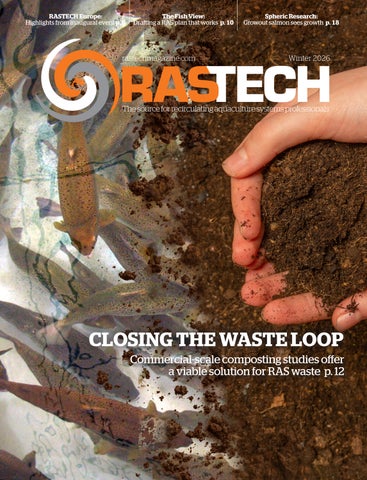
CLOSING THE WASTE LOOP Commercial-scale composting studies offer a viable solution for RAS waste p. 12
Feed smart. Keep it clean.
Your RAS system will thank you! With Skretting’s superior knowledge in faecal binding and over 20 years of continuous reasearch, our feed solutions are built to keep your system clean and your fish thriving.
Contact your sales representative for more information
CONTENTS
Winter 2026 Vol. 9, No. 4 rastechmagazine.com
10
16 COLUMNS
12
10 | The Fish View Drafting a RAS plan that works 22 | Fresh Tips Cultivating talent while culturing fish
DEPARTMENTS
FEATURES
04 | From the editor Making new waves 06 | RASTECH Europe 2026 Highlights from the inagural event 08 | In the news Latest industry updates 20 | Showcase New products and services
12
18
BY CHRISTINE LEPINE AND ABHINAV CHOUDHURY,
BY MATT CRAZE, SPHERIC RESEARCH
COVER STORY Closing the waste loop Commercial-scale composting studies offer a viable solution for RAS sludge management.
Growout salmon ensures double digit growth for the RAS sector Reviewing deal flow from 2026 and looking ahead to next year’s landbased opportunities
FRESHWATER INSTITUTE ON THE COVER Photo composition of Freshwater Institute tanks next to a stock image of fertilized soil (Photo on left: Freshwater Institute; photo on right: Vera Kuttelvaserova/Adobe Stock)
16
Big tanks, small markets Europe’s Seriola sectors face a scaling challenge. BY VLADISLAV VOROTNIKOV
RAStech is a supplement to Hatchery International and Aquaculture North America by Annex Business Media. Return undeliverable Canadian addresses to: Circulation Department, 111 Gordon Baker Rd., Suite 400, Toronto, ON M2H 3R1. No part of the editorial content in this publication may be reprinted without the publisher’s written permission. © 2026 Annex Business Media. All rights reserved. Opinions expressed in this magazine are not necessarily those of the editor or publisher. No liability is assumed for errors or omissions. All advertising is subject to the publisher’s approval. Such approval does not imply any endorsement of the products or services advertised. Publisher reserves the right to refuse advertising that does not meet the standards of this publication. Printed in Canada.
From the editor By Jean Ko Din
rastechmagazine.com
Making new waves
N
ow that our inaugural RASTECH Europe Conference & Trade Fair is done, there are two things that are left to do to close the project. The first is to celebrate what this small team has accomplished. Launching a brand new industry event, in an already busy aquaculture conference calendar, in a country that is far outside of our Canadian headquarters, is no easy feat. Though we have our annual RASTECH conference in the United States has gained us a lot of expertise, we were entering an unfamiliar field and we couldn’t just rely on what we already knew. Outside of a language barrier in some areas, we were essentially setting up a new business in a new country with a new set of parameters to abide by. (In a way, this process gave the team a new appreciation for all the new RAS projects that are looking to establish new operations or expand into new markets.) Then, we quickly had to immerse ourselves into an already tight-knit and well-established European aquaculture network. We leveraged our established partnerships, but we also had to stretch beyond what we thought we knew. This took a lot of cold inquiries through emails, phone calls, virtual meetings, and LinkedIn connections. I, personally, spent hours of painstaking research and hundreds of consulting meetings to help me understand the European land-based aquaculture landscape. I felt that I needed to fully immerse myself in this sector to make sure that I was creating a program that serviced the concerns and challenges before the European industry. My fellow team members at RAStech Magazine were doing the same. Sleep deprivation was a running theme, as we
stretched our schedules to accommodate meetings in European time zones, not to mention the sleepless nights that many on the team experienced as we worried about what we didn’t know. We all held our breathes and spent the last of our energy to make sure that it was a valuable event until the last of the booths were packed up at the end of the last day. For us, the ending celebrations came with a sigh of relief for all the little details that we agonized over. I don’t think many other industry conferences can match this team’s dedication to make every interaction and every opportunity valuable for every participant in that conference. When you attend a RASTECH conference in Europe or in the United States, you immediately see the high-quality standard we set in the speakers, the attendees, the exhibitors, the food and service, the brand exposure, the lead generation, the networking, and all the other things that you come to in-person meetings for. Everything is concentrated and targeted and designed for making productive connections. So, in this editorial, let me humbly take this time to boast about our conference and why our version of an aquaculture industry meeting is set apart. But also, let me thank all of our partners, advisors, and support systems that have helped us accomplish this new precedent. The second thing has to do with how success has emboldened us to expand. We now know what we can accomplish and we are only motivated to get better from here. There is another RASTECH event around the corner in Roanoke, Vir., USA on May 26-27, 2026, so join us and help us better serve you. Email your thoughts at jkodin@ annexbusinessmedia.com.
Reader Service Print and digital subscription inquiries or changes, please contact Angelita Potal, Audience Development Manager Tel: 416-510-5113 Email: apotal@annexbusinessmedia.com Mail: 111 Gordon Baker Rd., Suite 400, Toronto, ON M2H 3R1 Editor Jean Ko Din 437-990-1107 jkodin@annexbusinessmedia.com Associate Editor Seyitan Moritiwon 416-302-2560 smoritiwon@annexbusinessmedia.com Associate Publisher Jeremy Thain 250-474-3982 jthain@annexbusinessmedia.com Sales Manager Patrick Villanueva 416-606-6964 pvillanueva@annexbusinessmedia.com Account Coordinator Barb Vowles 416-844-7106 bvowles@annexbusinessmedia.com Group Publisher Anne Beswick 416-410-5248 abeswick@annexbusinessmedia.com Audience Manager Urszula Grzyb 416- 510-5180 ugrzyb@annexbusinessmedia.com CEO Scott Jamieson sjamieson@annexbusinessmedia.com Printed in Canada Subscription Rates Canada – $38.48 (+tax) United States – $49.92 CAD Foreign – $64.48 CAD All prices are for 1yr subscription and in Cdn funds. ISSN 2817-7266 - Print ISSN 2817-7274 - Online Occasionally, RAStech will mail information on behalf of industry related groups whose products and services we believe may be of interest to you. If you prefer not to receive this information, please contact our circulation department in any of the four ways listed above. Annex Privacy Office privacy@annexbusinessmedia.com Tel: 800.668.2374 No part of the editorial content of this publication may be reprinted without the publisher’s written permission © 2026 Annex Business Media. All rights reserved. Opinions expressed in this magazine are not necessarily those of the editor or the publisher. No liability is assumed for errors or omissions. All advertising is subject to the publisher’s approval. Such approval does not imply any endorsement of the products or services advertised. Publisher reserves the right to refuse advertising that does not meet the standards of the publication.
RASTECH EDITORIAL ADVISORY BOARD: Andrew Cree Preston I I Amy Stone I Bendik Fhyn TerjesenI I Yonathan Zohar
Made possible with the support of
facebook.com/RAStechmag rastechmagazine.com
4
Winter 2026
EUROPE
THANK YOU
TO OUR SPONSORS PLATINUM SPONSORS
GOLD SPONSORS
SILVER SPONSORS
LANYARD SPONSOR
COFFEE SPONSORS
SWAG BAG SPONSOR
WIFI SPONSOR n e x t g e n e r a t i o n a q u a c u l t u r e
Thanks also to all our attendees, speakers, and exhibitors at RAS Europe 2026 for another superb event. We look forward to welcoming you all again in 2027. May 26-27, 2027: Roanoke, Virginia, USA - Sep 21-22, 2027: Porto, Portugal
ras-tec.com • ras-tec.com/europe rastechmagazine.com
5
RASTECH goes to Europe
F
or the first time ever, RAStech Magazine hosts its international conference and trade fair in Europe. More than 150 recirculating aquaculture professionals from 18 countries across Europe and beyond gathered in the vibrant city of Porto, Portugal for the inaugural RASTECH Europe Conference and Trade Fair on Sept. 8-10. Producers, engineers, designers, researchers, policymakers, investors, and industry suppliers of all kinds talked about the burgeoning potential of land-based aquaculture in Europe.
6
First keynote speaker, Jacob Bregnballe from AKVA Group, said instead of relying on a few large salmon ventures, he called for broader diversification in species, markets, and value-added products, with strong branding and storytelling, to build a more consistent and resilient land-based aquaculture sector across Europe. Participants also discussed an open forum that explored the challenges and realities of the European Union’s complex regulatory landscape. Second keynote speaker, Tamas Eisenbeck from Seafood Europe, urged clearer sustainability metrics,
Winter 2026
RASTECH HOSTS ITS INAUGURAL EUROPE CONFERENCE AND TRADE FAIR
better integration of RAS into national strategic plans, and more coordinated industry representation to influence European Union agendas and unlock funding. “We need to promote what we do as a solution to the Commission objectives, and not be shy in doing that,” said David Bassett, secretary general of European Aquaculture Technology & Innovation Platform (EATIP). The conference was structured into two session tracks: Operation and Technology. The Operation sessions showcased the diversity and growing potential of aquaculture in different European regions. The Technology sessions were designed for technical leads and engineers to
rastechmagazine.com
EUROPE
provide hands-on interactive sessions in design, fish health, and water quality. Following the inaugural success, RASTECH Europe will officially return to Porto, Portugal on Sept. 21-22, 2027. RASTECH US Conference & Trade Fair will take place on May 26-27, 2027 in Roanoke, Vir., USA. Stay updated on RASTECH’s events at
7
In the news
Ocean Aquaculture constructs new seriola & meagre hatchery Ocean Aquaculture (OAC) is beginning construction on a new hatchery that will produce up to eight million greater amberjack (seriola dumerili) and meagre (argyrosomus regius) juveniles per year. The hatchery, located in Carboneras in Almerìa, Spain, is a former thermal power plant that will be retrofitted with recirculating aquaculture systems (RAS). Construction is expected to be complete in December 2027 and its first production for January 2028. “OAC Hatchery will supply a continuous stream of premium seriola fingerlings, addressing the current shortage of specialized hatchery capacity in the Mediterranean. By supplying both its own farms and other producers, OAC supports the development and scaling of the emerging Seriola aquaculture industry within the framework of European Blue Growth strategies,” as written on the company website. The first phase of production is designed to supply about eight million juveniles each year weighing 10 grams. Phase 1 production is meant to support the company’s own open net growout farms, as well as external producers across the Mediterranean. A second phase will be designed to produce up to seven million more juveniles weighing about 40 grams, extending the pre-growing stage to reduce biological risk once transferred into the marine growout farms.
8
Land-based and recirculating aquaculture systems (RAS) are increasingly highlighted in policy and investment discussions as sustainable production models aligned with EU food-system and environmental objectives. However, European financial institutions perceive aquaculture, particularly land-based and RAS, as high-risk due to biological uncertainties, long production cycles, and limited insurance options. These findings were published in a recent study, commissioned by DG Mare and the European Investment Bank (EIB). The study identifies key investment needs, financing barriers and existing support mechanisms across the seafood sector. The study focuses primarily on investments in fishing vessels in the European Union (EU) fisheries sector, with a particular emphasis on access to finance for fishing enterprises. However, it also makes mention of forward-thinking solutions like land-based aquaculture in order to provide a wider understanding of the fisheries and aquaculture sectors. Investments in land-based and recirculating aquaculture often drive innovation in production technologies, circular approaches, and higher value-added products. The study said European Union policy encourages targeted
investment in these systems as part of the green transition and to meet sustainability and climate objectives. However, it also mentions that streamlined regulatory procedures, improved spatial planning, and better access to finance are needed to unlock further growth. Dedicated loan products and guarantees (e.g., Estonia’s MES loans, Italy’s ISMEA guarantees) have helped some land-based and RAS operators invest in modernisation, but uptake is often limited by preference for grants, collateral requirements, and sector risk perceptions. The study concludes that technical assistance and advisory support are critical for improving investment readiness and enabling more operators to access repayable finance.
Visit us online Find the latest RAS-related news, features and analysis from across the world.
rastechmagazine.com Winter 2026
PHOTO: EU ROPE A N I N V E ST M E N T BA N K
EIB study unpacks investment barriers for land-based, recirculating aquaculture
PHOTO: F I R ST WAT E R, K H Y B E R AQ UAC U LT U R E
First Water taps Ístak for construction work at Þorlákshöfn site Land-based salmon producer, First Water, has contracted Ístak to carry out construction work as it moves to double its production capacity from 5,000 to 10,000 tonnes of gutted salmon at its Þorlákshöfn site. The Icelandic project will complete the first phase of the First Water taps Ístak for construction of company’s land-based salmon Þorlákshöfn site farming facility. It involves constructing a tank and control building housing eight fish farming tanks, with a capacity of approximately 5,500 cubic metres each, as well as associated technical equipment. “The agreement with Ístak marks a major and important milestone in the development of First Water. This project will complete the first phase of our development and double our current production capacity. We are delighted to partner with a strong Icelandic construction company with extensive experience in delivering complex projects,” said Einar Örn Ólafsson, CEO of First Water. Construction is expected to take 16 to 18 months, with an anticipated completion for the first quarter of 2028. This is the first of six planned phases in the development of First Water’s land-based salmon farming facility in Þorlákshöfn. First Water’s long-term goal is to produce up to 60,000 head-on-gutted tonnes of salmon annually. “First Water’s development is an ambitious and technically demanding project that is well aligned with Ístak experience and expertise,” said Karl Andreassen, CEO of Ístak. “We are proud to be involved in this important phase and look forward to working closely with First Water on the project.”
Khyber Aquaculture partners with Indian government to launch trout training program
Khyber Aquaculture uses a closed-loop system reuses up to 98 per cent of water to produce 1,500 tons of Himalayan trout annually.
Khyber Aquaculture, a large-scale Himalayan trout RAS producer in India, is working with the Jammu & Kashmir Department of Fisheries to launch a trout aquaculture training program for local farmers. Participants are guided through practical modules on biosecurity, water quality management, responsible aquaculture, early disease detection, and recirculating aquaculture systems (RAS) technology. A key focus for the program was to shift trout farmers from reactive treatment of fish diseases to proactive prevention, emphasizing best practices in routine water monitoring, stress reduction, and early warning systems to safeguard fish health. Umar Tramboo, Khyber Aquaculture chairman and managing directo, said Jammu & Kashmir region’s natural mountain conditions make for perfect conditions for coldwater fish production. He hopes that this larger government initative can equip local farmers with modern scientific tools to boost productivity, strengthen value chains, and create new opportunities for rural communities.
Efficient, Sustainable Air Solutions for your Recirculating Aquaculture System (RAS) Clean, reliable air technology designed for modern land-based aquaculture
about efficiency and protecting fish health www.aerzen.com/ca-us-aquaculture
rastechmagazine.com RAS_Aerzen_Summer26_CSA.indd 1
2026-04-16 7:47 AM9
The Fish View By Bendik Fyhn Terjesen
Bendik Fyhn Terjesen, PhD is head of Land-based Innovation in Cermaq Group, where he works with the regions to build new infrastructures and improve operations to give the fish a safe start in life. He has an extensive research background in fish physiology, nutrition, and RAS, and is adjunct professor at Nord University in Norway, where he teaches aquaculture technology. (bendik.fyhn.terjesen@cermaq.com)
Drafting a RAS plan that works
I
n one of my previous The Fish View articles, “The Iron Triangle of landbased,” I argued that land-based salmon projects are managed under a “cost-time-quality” triangle that was never intended with a live animal production unit in mind. Instead, “quality” is not a good proxy for life-support system robustness and must be replaced with the term, fish welfare, since this is what the facility must deliver. This article goes one level deeper, into how we translate what the fish need into something a contractor can actually build, test, and be held to: the functional requirement document. In Cermaq land-based, we call this document the prosaic name A2 (Annex 2) as part of a turnkey contract.
10
The process of developing functional requirements for a RAS facility is substantial work because it involves several disciplines, different teams internally and externally.
systems, to sludge handling, freshwater and seawater intake, fish barriers, energy systems, start-up and testing. The document can also include requirements for civil works and building, and other more traditional infrastructure components, since they ultimately can have substantial impact on fish welfare as well (e.g. air ventilation). The process of developing the functional requirements is substantial work because it involves several disciplines, different teams in the company (e.g. Operations, Fish Health, IT and AI), external advisors, and governmental agencies. From scratch, the work can easily take a year or more, but less, if it is a continuous improvement document in a farming company that has standardized some of the requirements and has previous experience in building several facilities. The work is best carried out by an internal team at the farming company, but supported by external advisers, and the document needs to be finished before contract negotiations begin.
Communicate with precision A large post-smolt facility will typically have several hundred individual functional requirements. Every one of the sentences describing the requirements will potentially be discussed between the owner and contractor at some point. Any sentence that can be misunderstood will be so at a point in time. The language must therefore be unambiguous and closed to interpretation. Consider this requirement: “It is advantageous to be able to change flow from 2-4 m3 min fast up to 12 m3 min in short periods when the fish tanks shall be filled up again after e.g. disinfection.” Compare this to the following: “Flow shall be controlled to maximum within a twominute ramp-up when the fish tanks are to be refilled. The refilling of all fish tanks at the same time shall be completed within 8 hours.” The first version of the requirements is unclear if the contractor really has to follow the requirement at all because it says “advantageous.” What does that mean? The second version has no such adjectives and uses a Winter 2026
PHOTO: C E R M AQ
Why write functional requirements at all? A post-smolt or smolt facility must protect three overlapping needs. In addition to the safety and well-being of the staff fish welfare, a facility must protect the fish health and the fish’s performance. Welfare and health obligations exist regardless of economics. Performance (growth, feed conversion) carries large economic weight but must never be pursued at the expense of the first two. A functional requirement document is the mechanism by which a facility owner turns these obligations into buildable, testable specifications instead of general intentions. Practically, this document normally sits high in the contract hierarchy; below the main agreement itself and below the annex describing execution, but ahead of most other technical annexes. It should describe requirements relevant for the entire chain of the operation, from egg intake, through hatchery and each subsequent department, RAS dimensioning and design, water quality limits, biosecurity, feeding systems and control
measurable functional criterion which is critical for the farmer in this context, that all tanks shall be refilled within a specified time, i.e. eight hours. Precision of language is not a stylistic preference in this document. It is a functional requirement in itself. Two further practices reduce friction later. First, requirements should describe the function to be delivered, not name a specific supplier’s product or brand. The contractor should be free to choose how the function is achieved. Second, if the requirement document is not thoroughly reviewed before signing, the discussions do not disappear, they simply continue for the whole project at an increasingly greater cost to both parties. And ultimately, it can also negatively affect fish welfare. Stating the purpose in numbers Every facility requirement in the document must trace back to a clearly quantified purpose. That means the production plan and goals – number of fish, size classes, feed use, growth rates, feed conversion ratios and similar – must be spelled out in detail, not described vaguely. The standards the facility must comply with should be named explicitly, and the terms “life-support” and “redundancy” need their own precise definitions. For instance, “life-support equipment” is defined in Cermaq as everything in the facility which is required to secure fish welfare and health under the water-quality threshold table within the requirement document itself. This definition leaves little room for later arguments. Production site logistics are critical A requirement document that stops at tanks and water chemistry misses a category of risk that can dominate real operations: logistics. What are the site’s supply limitations? Post-smolt facilities are often built at remote locations, where logistics can be a challenge. How frequently do feed, chemicals and other consumables arrive, and what happens during storms or other access disruptions? If the longest, realistic gap between deliveries is for instance 14 days, that number has a direct effect on the dimensioning of feed and chemical storage, and ultimately the maximum allowed biomass, and the RAS treatment capacity under that load. The same logic applies to post-smolts leaving the site. If well-boat access can be rastechmagazine.com
interrupted, the facility’s ability to maintain e.g. water quality for a delayed transfer needs to be designed in from the start, not discovered afterwards. Defining “built correctly” versus “functioning correctly” The document needs two distinct categories of requirement: how the facility shall be built, and what measurable criteria must be demonstrated during a test operation once it exists. These are not the same thing and confusing them is a common source of dispute. A pipe can be built to a stated minimum water velocity; that is a design requirement. Whether the whole RAS avoids dead zones and hydrogen sulfide formation under real feeding loads can only be confirmed once fish are in the water – a functional requirement, proven through testing. Defining the maximum load situation A precise definition of the maximum load situation is vital. This is the time at which biomass, feeding rate and other loads are at their highest for a given RAS, department, and the facility as a whole. The production plan must determine when this occurs for each unit, because a facility that starts several batches in sequence will hit its various maximal loads at different times. Critically, the contractual guarantee period must not end before the maximum load situation occurs, for individual units and the overall facility. It is also worth negotiating extended equipment guarantees (for example 24 rather than 12 months) running from startup rather than delivery to the construction site, so that a supplier’s warranty has not quietly expired before the unit it covers has seen its heaviest load. Testing for it Testing itself needs its own specification: which analyses or sensors will be used, ideally two independent methods should be chosen. The sampling period and number of sampling dates must cover the maximal load situation but also below that, since certain issues can turn up at low loads. How many times per day water is sampled, and what other performance indices are to be recorded, must be planned in detail. Certain units, such as smolt department, have a de-
fined 12:12 photoperiod which will impact water quality, and sampling must be timed to the point of peak post-feeding metabolic rate rather than at a random hour of the day. Another important topic to consider is which location in the RAS to sample. At minimum, this should be at specific points inside the tank and from the tank outlets, which provide important information on the conditions the fish actually experience. Finally, the statistical rules for deciding if the water quality is complying need to be agreed in the document itself, not discussed afterwards. Requiring every single measurement to meet or be better than the guaranteed value is unrealistic, it would only push the engineering toward costly over-dimensioning which can draw resources away from other important fish welfare measures. A better approach is to state that a specific, large majority of measurements must meet the requirement, for instance that the CO2concentration in tank outlet water must be below or at the requirement of 12 mg/l in 90 per cent of the samples. For the remaining 10 per cent of the measurements, then none shall exceed 15 mg/l CO2. If the testing fails in any of the requirements, then a detailed description of how the issue shall be resolved must of course also be included in the contract. What does this all mean in practice? None of this is bureaucracy for its own sake. At Cermaq Group, our experience is that some requirements that we thought are clear and unambiguous, are in fact not so in real engineering, construction, and the test phase. We, therefore, work to improve the landbased functional requirements continuously. We do so by examining the text for unambiguous language, quantified production goals, named standards, defined logistics limits, and testable maximum load criteria. This process protects the production goals the investment was built around. Most importantly, it is the practical instrument through which fish welfare and health are secured on land, where there is no ocean current to fall back on if the design falls short. You can read the previous article on “The Iron Triangle of land-based” in the Winter 2025 issue or on the RAStech website. 11
COVER STORY
Closing the waste loop Commercial-scale composting studies offer a viable solution for RAS sludge management. By Christine Lepine and Abhinav Choudhury
L
and-based recirculating aquaculture systems (RAS) are becoming increasingly efficient at water conservation while maximizing fish production, a significant advancement for aquaculture. However, one challenge remains common across all production facilities: managing the waste generated by intensification, the steady stream of fish feces and uneaten feed. Generally dewatered into a condensed sludge, treatment or disposal of this “waste” product is considered a costly part of land-based aquaculture operations. For many farmers, finding an economical and environmentally responsible outlet for waste products has become a critical component of farm sustainability. But what if this waste management became an opportunity for farmers to reclaim lost nutrients and generate additional revenue? That is exactly the idea of the circular bioeconomy, where biological waste is viewed as a resource to be recovered and then kept in productive use for as long as possible. COMPOSTING FOR A CIRCULAR BIOECONOMY RAS-generated sludge contains high amounts of organic matter and nutrients such as nitrogen and phosphorus, which can benefit agricultural soils. But the direct land application of RAS sludge can be problematic for several reasons. The high moisture content of sludge, even after dewatering, makes it heavy (i.e., expensive to move) and can complicate land application. Raw sludge is also considered unstable and immature and may not initially be chemically balanced for plants. Nitrogen, for example, can be lost as odourous ammonia gas if not first converted into a stable form such as nitrate. There may also be pathogen concerns if raw materials leach into waterways. Finally, direct land application can occur only seasonally, when 12
Figure 1. A commercial in-vessel rotary drum style composter was used to evaluate co-composting dewatered RAS sludge (fecal matter and uneaten feed).
plants are growing, and nutrients are immediately needed. As an alternative, composting is one of the simplest ways to recycle organic matter, transforming waste materials into a nutrient-rich, stable product that farmers can readily use or store. Under aerobic (containing oxygen) conditions, naturally occurring microorganisms break down organic matter and convert nutrients into forms beneficial for long-term storage and plant assimilation. An advantageous side effect of intensive microbial growth and respiration during the compost process is heat generation. As temperatures rise above 55 C, the process further accelerates decomposition and can destroy pathogens commonly found in biological waste. Additionally, moisture is lost, making sludge lighter and easier to handle. Essentially, composting could transform RAS raw waste into a safe, manageable agricultural soil amendment or fertilizer. While composting has been widely adopted for the treatment of livestock manure and municipal biosolids, its application in the aquaculture industry has received far less attention. But new research has examined the feasibility of composting RAS-generated sludge as a waste valorization strategy and developed practical approaches to converting these wastes into a nutrient-rich, stable, and beneficial soil amendment. Winter 2026
time) using sludge generated from RAS salmonid production, and dewatered via a conventional gravitational thickening settler. From a practical and functional standpoint, these studies chose to utilize an in-vessel compost unit. A model with commercial availability across North America was chosen for its modular design that could be scaled to farms of different sizes, and for its ease of operation. Modern rotary drum systems are generally programmable and remotely controllable, designed to maximize efficiency (i.e., low input, high output). By providing continuous mixing and aeration alongside in-line temperature monitoring, in-vessel composting units can accelerate microbial activity, enabling a quicker transition to stabilized nutrients than traditional windrow composting. Additionally, in-vessel units can operate year-round in most climates (indoors or outdoors, depending on farmer preference) and require only a fraction of the space required.
RECIPE DEVELOPMENT FOR EFFICIENCY Composting requires an appropriate carbon-to-nitrogen (C:N) ratio and suitable moisture content; thus, recipe development is a crucial step for fast, efficient composting. Optimal composting conditions for rapid and efficient decomposition generally require a starting C:N ratio of 20:1 to 35:1 and a moisture content of 40-60 per cent. Dewatered sludge (DS) alone generally contains too much moisture and too little carbon, making it challenging to compost as a single source. As DS is similar in composition to wastewater treatment plant biosolids, adding a dry, carbon-rich bulking material is recommended to absorb excess moisture, improve aeration during composting, and provide the additional carbon needed to support microbial activity. Commonly used materials are often wood-based products, and in the case of these studies, a kiln-dried
NOVEL RESEARCH FOR AQUACULTURE Researchers at The Conservation Fund’s Freshwater Institute in Shepherdstown, W.V., USA, evaluated whether composting could provide a pragmatic sludge management solution for RAS farmers. Two recent case studies examined the performance of a commercial-scale rotary drum composter (Figure 1) (2.95 m long, 1.5 m diameter, and 3.15 m³ usable volume; 14-day theoretical retention
PRECISE DISSOLVED OXYGEN CONTROL DGI® technology uses a proprietary method to infuse gases into liquids, maximizing oxygen efficiency for aquaculture applications. Potential benefits include:
┃
LOWER ANIMAL STRESS INCREASED STOCKING DENSITY
┃IMPROVED FOOD CONVERSION RATIO
┃
┃
FTEK.COM 630-845-4500 INFO@FTEK.COM
rastechmagazine.com RAS_FuelTech_Spring26_CSA.indd 1
2025-12-18 3:38 PM 13
COVER STORY
Figure 2. Schematic and process flow diagram of the in-vessel composter setup.
wood-flake (WF) bedding available nationally at most farm stores was chosen. Preliminary analysis demonstrated that while a DS+WF mixture could reduce the DS’s moisture content to the optimal range, the large amount of carbon required to dry the DS resulted in an unbalanced C:N ratio. One way to balance the C:N ratio is through co-composting, combining DS+WF with other organic waste streams that complement its physical and chemical characteristics to enhance decomposition. Depending on the materials selected, co-substrates may
also improve compost quality by adding micronutrients or enzymes not otherwise present in the DS material. In addition to improving nutrient balance, co-composting offers an opportunity to recycle multiple waste products into a single value-added soil amendment, furthering the circular bioeconomy approach. In two separate case studies, each over six months, researchers evaluated co-composting DS+WF with either spent mushroom compost (SMC; a locally available by-product of mushroom cultivation) or fish
LONG-LASTING AQUACULTURE PUMPS
CASE STUDY 1 Dewatered sludge + wood flakes + spent mushroom compost Spent mushroom compost, also known as mushroom soil, was chosen because it has previously demonstrated beneficial effects as a co-composting substrate for other complex wastes, owing to enzymes that break down recalcitrant materials. The DS+WF+SMC mixture consistently exceeded the minimum EPA threshold temperatures for human pathogen destruction, with the drum’s hottest region averaging nearly 59 C, thereby promoting rapid microbial decomposition. After only 14 days, the material leaving the drum was considered stable, mature compost, ready for use as an agricultural soil amendment. Seed emergence, seedling vigor, respiration testing, and nitrification measurements all indicated that the finished compost was high quality and non-toxic to plants. Additional curing for six months further reduced the C:N ratio (19) to optimal levels and produced a phosphorus-rich compost with an approximate nutrient ratio of 3:6:1 (N-P2O5-K2O) (Figure 3a).
Specialists in corrosionresistant, reliable and stable propeller pumps, with high uptime and low energy consumption.
+45 65 98 13 16
14 RAS_Lykkegaard_Winter25_CSA.indd 1
mortalities (FM; from on-site culls) (Figure 2). The goal of each study was to assess the impact of the co-composting material on compost efficacy and end product quality. The studies also examined the challenges a farmer may face when composting RAS DS at a commercial scale.
·
WWW.LYKKEGAARD-AS.COM
Winter 2026 2025-10-01 11:04 AM
CASE STUDY 2 Dewatered sludge + wood flakes + fish mortalities Fish mortalities occur periodically during normal farm operations, and incorporating them into the composting process would provide producers with an additional opportunity to recover resources. However, as a co-composting substrate, they proved challenging. The DS+WF+FM mixture did not consistently reach optimal thermophilic temperature, attributed to the high amount of carbon needed to compost the N-rich mortalities, with fish pieces decomposing slowly. Elevated ammonium concentrations and noticeable ammonia odors suggested that decomposition remained incomplete after the 14-day retention period in the drum. Following a six-month curing period, compost quality improved substantially as ammonium concentrations declined and nitrate concentrations increased, indicating continued biological stabilization. The finished compost retained a relatively high C:N ratio of 28, suggesting it may be better suited for applications such as compost mulch or used for erosion control rather than as a primary nutrient source for crop production (Figure 3b). PRACTICAL LESSONS FOR FARMERS Beyond comparing feedstocks for compost recipes, researchers also reviewed operational questions producers would face when implementing the technology.
a
b
Figure 3. The mulch-like compost produced after six months post-drum for (a) DS+WF+SMC and (b) DS+WF+FM.
One of the biggest challenges was DS’s high moisture content (>90 per cent), which required large amounts of dry, carbon-rich bulking material to achieve suitable composting conditions. While costly kiln-dried wood flakes performed well in this study, recycled wood products or agricultural residues may reduce operational costs. Alternatively, adding a pre-drying step could reduce the need for excess bulking material but would initially increase capital expenses. Additionally, while compost recipes are a useful guideline for operators to achieve optimal conditions leading to a fast and efficient process, the daily variations in DS consistency, pumping characteristics, and material loading made it challenging to match theoretical recipe formulations. These case studies suggest that operators may need to make real-time recipe adjustments based on DS characteristics, but that the compost process overall may be forgiving over time as multiple in-vessel batches
continually mix in the drum. As more farms seek sustainable approaches to waste management, these studies demonstrated that composting is one way to apply circular economy principles in modern aquaculture. Future studies are still needed to evaluate the cost-effectiveness of composting compared to other waste management methods, and to conduct field application trials to demonstrate RAS-generated compost as a soil amendment. References Lepine, C., Choudhury, A., Ryland, K., Bell, J., Good, C. (2026). Co-composting aquaculture sludge at full-scale: Two case studies evaluating process performance and compost quality. Aquacultural Engineering 115, 102778. Choudhury, A., Lepine, C., Ryland, K. (2023). Waste characterization and recipe development for composting aquaculture sludge. Hatchery International, Nov/Dec 2023.
Hand-held meters
P O L ARIS C OXYGEN
SALINITY
DISSOLVED OXYGEN
REDOX
rastechmagazine.com RAS_Oxyguard_Winter26_CSA.indd 1
TGP
TEMPERATURE
ATMOSPHERE
pH
CO2
EXPLORE THE FEATURES
2026-09-09 9:26 AM 15
FEATURE
Big tanks, small markets Europe’s Seriola sectors face a scaling challenge. By Vladislav Vorotnikov
K
16
The Kingfish Company’s Zeeland site in The Netherlands
a market size of approximately three kilograms within 12 months – significantly faster than species such as trout or salmon, which typically require 20-22 months to reach the same size,” Bech said. In addition, Bech said both species tolerate a relatively wide salinity range of 20-35 ppt. The optimal rearing temperature for S. lalandi is approximately 20-24 C, while S. dumerili performs best at 22-26 C. Several other factors encourage investors to look into these species. For instance, Seriola species display favourable characteristics for intensive aquaculture, with relatively low aggression and manageable schooling behavior, particularly when fish are properly size-graded, according to Bech, who also emphasized that they appeared to be particularly good candidates for RAS farms. “They are well suited to high-density tank culture and can tolerate stocking densities of up to 100 kg/m³, making them highly suitable for land-based RAS operations,” Bech added.
Growth pains However, both segments face certain challenges, according to Vasiliy Krasnoborodko, a Latvian fish farmer and RAS farm engineer with experience growing great amberjack in RAS near Riga. “It is an interesting and valuable fish, but in my view, it is also quite demanding. Great amberjack are very skittish, sensitive to handling and generally require more careful management and a well-developed production technology,” Krasnoborodko said. Krasnoborodko’s assessment is supported by recent research. Amberjack can grow extremely well in RAS, but the species is unusually sensitive to the conditions imposed by intensive production. Handling and tank transfers trigger measurable stress responses, while the early life stages are plagued by cannibalism, low survival, and nutritional challenges. Even water clarity can affect performance: one RAS study found that amberjack kept in very clear water consumed 25 per cent less feed and showed stronger physiological stress responses Winter 2026
PHOTO: T H E K I NG F I S H COM PA N Y
ingfish and pike-perch are emerging as two of Europe’s most promising RAS species. But as production moves from pilot projects to industrial scale, the industry is discovering that growing fish on land is only the first challenge. The harder task is doing it consistently, efficiently and profitably. Kingfish (Seriola lalandi) grown in RAS is emerging as one of European aquaculture’s next big growth stories. The clearest sign is how quickly production is scaling. The Netherlands-based The Kingfish Company, a sector pioneer, increased sales by 37 per cent in 2024 to 1,992 tonnes, while harvested volumes surged 41 per cent to 2,323 tonnes. Great amberjack (Seriola dumerili) is developing from a much smaller base, but the direction is similar. Global farmed production exceeded 3,000 tonnes in 2020, up from just 653 tonnes in 2009, according to the Aquaculture Stewardship Council, which says the species has increasingly shifted from extensive pond farming toward intensive RAS production. Denmark alone reported 389 tonnes of amberjack aquaculture production in 2023 Both Seriola lalandi and S. dumerili have significant potential for further growth in aquaculture, commented Michael Bech, CEO of Nordic Aquaculture Consulting ApS, which has been involved in the design and establishment of several hatcheries for Seriola lalandi. “They are fast-growing species, reaching
“Technically, it is possible to grow amberjack in RAS. But from the perspective of an industrial business, I consider trout or salmon more straightforward and economically attractive species,” Krasnoborodko said. Kingfish faces a different problem: the fish can be grown efficiently in RAS, but producing enough high-quality juveniles remains a challenge. A 2025 review by Alejandro Mechaly and colleagues from the Institute for Research on Biodiversity and Biotechnology in Argentina identified larval and juvenile survival, deformities and reproductive technology as key constraints on further expansion of this segment. The researchers also found significant gaps in understanding the nutritional requirements of kingfish broodstock and larvae, which can affect egg quality, survival and skeletal development. A separate 2025 review of kingfish RAS production found that survival of commercial kingfish larvae in Australian hatcheries was historically only three to 19 per cent between 2004 and 2007 and 0-11 per cent in 2016-2017. Improvements in hatchery technology subsequently raised survival to roughly five to 15 per cent, but the authours still describe larviculture as a significant commercial challenge. In fact, the supply of juveniles is the key constraint for both sectors, agreed Bech, adding that the technical challenges are reflected in price. “At present, hatcheries are selling kingfish juveniles at extremely high cost, like €3 per piece of two-gram fish. Juvenile amberjack can also be bought from some of the German or Swiss hatcheries, but they are expensive,” Bech said. Hatchery production is demanding because of the need for live feed before weaning onto formulated diets, as well as the challenges associated with grading, cannibalism and overall juvenile management, he added. Selling point But biology may not be the biggest constraint facing Europe’s kingfish and amberjack farmers. As production scales up, producers will also have to answer a more fundamental question: who will buy all the fish? From a market perspective, Bech said, seriola species are premium products, valued for their firm texture and high Omega-3 content. They are highly sought after in Europe and Asia, particularly in Japan, where they are widely used in sashimi and sushi. Competition in Europe remains relatively limited, with key producers including Sashimi Royal in Denmark and Kingfish Zeeland in the Netherlands. According to Kingfish Zeeland’s March 2025 financial report, whole fish achieve average prices of approximately €13.4 to €14.4 per kilogram, with larger fish reaching up to €18 per kilogram. “This is significantly higher than the €10 per kilogram or less typically achieved by salmon and trout,” Bech said. Still, the economic model of growing kingfish and amberjack in RAS in Europe, given the relatively weak demand, remains unclear.
“In general, when designing a RAS facility, I believe the key question is not, ‘Can we grow this fish?’ Today, it is technically possible to farm a very wide range of species. The more important question is: who will we sell the fish to, in what volumes and at what price, and can we do so consistently?” Krasnoborodko said. Both species can command high farmgate prices, but their markets are considerably narrower, while the technological and commercial risks are higher, Krasnoborodko said. “If I were tasked with building a large-scale commercial farm in Latvia today, I would be more inclined to consider a facility producing around 10,000 tonnes of large trout or salmon than a comparable great amberjack or yellowtail kingfish project,” he added. Growth, but no mass market In general, analysts say that while RAS has made kingfish and pike perch commercially possible – but scaling them profitably is proving much harder than scaling the tanks. “I expect great amberjack and yellowtail kingfish production in Europe to continue developing, but primarily as premium niche segments. I do not expect them to reach anything close to the scale of trout or salmon in the near future,” Krasnoborodko said. “My base case for the next five to 10 years would therefore be continued growth in both species, accompanied by significant professionalization and consolidation, but with kingfish having a substantially better chance of becoming a major European RAS species,” Bech said. “Amberjack can certainly become a good business, but I would be more cautious about assuming that it will become a very large one,” Bech added. Analysts also emphasize that the challenge will be growing the sector without outrunning the relatively limited demand that has made these fish premium products in the first place.
DESIGN | EQUIPMENT | SOLUTIONS PROTEIN FRACTIONATORS Venturi-driven protein fractionators improve water clarity, oxygen, and waste removal in aquaculture and research systems.
HYDROTECH PRODUCTS Very low operating cost.
CARRYING THE FULL LINE OF GENESYS® PUMPS Maximize the uptime and efficiency of your recirculating aquaculture system.
We add new products daily! We can source anything! Subscribe to our newsletter to receive updates.
rastechmagazine.com
+1 407 995 6490 | AquaticED.com
17 RAS_EquaticEquipment_Design_Winter26_CSA.indd 1
2026-09-10 2:55 PM
Ask the Expert By Matt Craze
Matt Craze worked for many years as a commodities analyst, helping establish Bloomberg’s agri-commodities pricing coverage, and as a strategy consultant working for Big 4 firms. He set up Spheric Research in 2017 as an independent research firm dedicated to the global aquaculture industry. The company’s yearly “Land-based Aquaculture Report” is published each year via Undercurrent News, and has been featured in The Economist. (matt@sphericresearch.com)
Growout salmon ensures double digit growth for the RAS sector
T
18
Accumulated land-based smolt and growout capacity
smolt facilities, while industry leaders Mowi, Leroy Seafood and SalMar have paused further expansion following heavy investment in recent years. Norway’s resource rent tax on marine salmon farming combined with two consecutive years of low prices have likely contributed to the drop in RAS spending. The slowdown represents a significant challenge for the ecosystem of equipment manufacturers, engineering and construction firms that design, equip and build RAS facilities. Norwegian firms like AKVA Group are increasingly looking beyond Norway for projects to elongate its project pipeline. Growout investments to the rescue Fortunately for aquaculture technology and services providers, rising demand for land-based growout systems
– RAS, hybrid flowthrough (HFT) and flowthrough (FT) – is helping offset the downturn in post-smolt investment. Nordic Aqua Partners is expanding its RAS salmon farm in China, while Pure Salmon Japan is building a major facility near Tokyo with annual capacity of 10,000 metric tons. In Norway, Salmon Evolution has commissioned Phase 2 of its hybrid flowthrough facility at Indre Haroy, while Andfjord Salmon and Arctic Seafarm are scheduled to complete their respective FT and HFT facilities this year. Iceland has become a giant building site, with First Water, Laxey and Samherji simultaneously developing major HFT farms. Overall, the land-based growout sector is expected to add approximately 180,000 metric tons of annual capacity Winter 2026
G R A PH S: S PH E R IC R E S E A RC H, 2026
he land-based aquaculture industry rode an investment wave of nearly US$10 billion over the past decade driven by traditional salmon farmers investing in recirculating aquaculture system (RAS) facilities to grow increasingly larger post-smolt. RAS post-smolt capacity has expanded at a compound average growth rate (CAGR) of 19 per cent since the pandemic, led by investments in Norway and the Faroe Islands. Most of this was down to the installation of post-smolt facilities. These investments have partly helped the salmon industry increase supply by double digits last year. Transferring larger post-smolt to net pens allows companies to harvest more fish with the same marine infrastructure. This strategy also reduces fish deaths by shortening the growout period at sea from two summers to one, reducing exposure to parasites and disease that have become increasingly problematic in the warming waters of Scotland and Norway. Year 2026 is shaping up to be another banner year for the sector. Greenfield and brownfield projects, including Nova Sea’s Kilvik facility (now part of Mowi) a n d C e r m a q ’s S o r o y a facility in Finnmark, are expected to add another 26,000 metric tons of annual capacity. However, the flood of new capacity is set to become a trickle next year, with only 3,000 metric tons projected to be commissioned. The outlook for 2028 is even bleaker unless salmon farmers sanction new projects. Nordlaks is currently the only Top 10 Norwegian salmon farmer building new
between 2023 and 2030, representing a CAGR of 21 per cent. Most of that capacity will come from Iceland, Japan and Norway. Despite the rapid expansion of grow-out capacity, RAS smolt remains the largest segment of the land-based aquaculture industry, adding a whopping 214,000 metric tons of annual capacity between 2015 and 2026. We expect total smolt capacity and salmonid grow-out capacity to converge in the early 2030s. Under our most conservative scenario, RAS smolt capacity is projected to expand at a CAGR of five per cent between 2023 and 2030. This assumes that no projects will be developed beyond those already announced, including Nordlaks’ Morsvika facility, which is under construction, a Ventisqueros project in Chile, and Cooke’s Bayside project in New Brunswick, Canada. Chile could surprise to the upside if President Jose Antonio Kast improves the investment climate for a salmon farming industry stifled by red tape. Combining that outlook for RAS smolt capacity with forecast expansion in growout projects produces a CAGR of 10 per cent for total land-based capacity between 2023 and 2030. Growth could accelerate further if RAS operators such as Danish Salmon and Nordic Aqua Partners continue to report strong key performance indicators, including larger harvest weights and high capacity utilization rates. Post-smolt investments should also rebound with a vengeance in the 2030s. Global salmon demand continues to increase, especially across Asian markets such as China. Salmon farmers could potentially increase their harvests by as much as 40 per cent by introducing larger post-smolt into conventional net-pen production systems, according to AKVA Group. We expect overall land-based production capacity to plateau from 2027 through the end of the decade before resuming its upward trajectory. The pace of the next growth cycle will largely depend on the magnitude of renewed post-smolt spending and whether growout systems can profitably harvest salmon at commercial scale. rastechmagazine.com
RAS production projections until 2030
RAS_StructuralArmor_Fall26_CSA.indd 1
2026-06-29 3:15 PM 19
SHOWCASE
Ace Aquatec launches AIpowered technology, A-HARVESTCAM Ace Aquatec has released an artificial intelligence technology, A-HARVESTCAM, that gives processors instant visibility of fish weight, quality and yield. Using AI-powered computer vision, A-HARVESTCAM counts and weighs fish while assessing weight distribution, quality and harvest performance, providing processors insight into differences between stocks. The camera also provides harvest data that can feed back to Ace Aquatec’s A-BIOMASS in-water cameras, allowing the comparison of what was estimated in the pen with what is measured at harvest. Knowing the volume, size and quality of fish available improves planning, reduces unexpected downgrades and minimizes the need for last-minute spot sales. “What A-HARVESTCAM really gives processors is a much clearer picture of the weight, volume and quality of fish moving through their lines, so they can get more from every harvest,” said Tara McGregor-Woodhams, chief sales and
marketing officer at Ace Aquatec. The technology can also connect with Ace Aquatec’s A-HSU in-water stunning system, using post-stun monitoring to provide feedback on stun efficacy and support welfare verification and compliance. It is being used by Scottish Sea Farms and Aquascot, as well as some Salmon companies in Chile
BIO-UV Group upgrades ballast water management system LAKE & POND SUPPLIES
Est. 1989
AQUACULTURE SUPPLIES
Proud to have served the
aquaculture industry for 35 years and looking forward to many more!
116 Bonnie Cres, Elmira, Ontario, Canada Toll Free: (877) 669-1096 www.FishFarmSupply.ca info@FishFarmSupply.ca
BIO-UV Group has upgraded its BIO-SEA ballast water management system (BWMS), with new features to help crews identify and monitor treatment capacity and filter performance in challenging water conditions. The new BIO-SEA control panel has a colour-coded “traffic light” display showing treatment capacity as a percentage of full flow. When a BIO-SEA BWTS is in operation, the new software displays four levels of operation (green, yellow, orange, dark orange) before going to red (critical alarm) when the system stops. “We have focused on giving the crew a much clearer picture of what is happening during ballast water treatment, particularly when water quality becomes more challenging for UV treatment,” said Charlène Ceresola, BIO-UV Group’s project manager. “The operator can see available treatment capacity directly on the process screen and respond to changing conditions without having to interpret a series of individual sensor values.” Filter loading is monitored through the same approach. Red still indicates a clogged filter and generates an alarm, but preventive popups help to better identify when the self-cleaning function is being challenged. Cybersecurity features are still accessible through BIO-SEA HIGH mode in line with IACS UR E26 standards. “Ship-specific and class requirements can differ, which is why the user management system can be configured accordingly at commissioning,” Ceresola said. Winter 2026
20 RAS_FishFarmSupply_Fall26_CSA.indd 1
2026-07-02 12:10 PM
Mutag acquires majority stake in Microbe Biosolutions Danish water treatment company Mutag has acquired a majority stake in Microbe Biosolutions ApS (MBS), a company specialized in biological solutions for water environments, odour control, biogas, and process optimization. Mutag said the acquisition will expand its overall offering with expertise in microbiology, odour control, and gas treatment, enabling it to address a wider range of treatment processes and integrated biological solutions. “We see significant strategic potential in Microbe Biosolutions. The company has built strong competencies, proven solutions, and close customer relationships. Together, we can accelerate the development of new technologies and solutions for the water, environmental, and industrial sectors,” said Michael Bayer Thomsen, Group CEO of Matters Group. Klaus Westergaard Sørensen, founder and technical specialist at MBS, will continue as a minority shareholder and remain actively involved in the company. “I am very pleased with the solution we have found. With Mutag as majority owner, we gain access to a strong organization and new opportunities for growth, while continuing to develop our profession-
From left - Michael Bayer Thomsen, Klaus W. Sørensen and Jesper N. Nielsen
al platform and the close collaboration we have with customers and partners,” said Westergaard Sørensen. MBS will maintain its name and brand, but the company will relocate to Matters Group’s headquarters in Ribe, Denmark.
© Veolia Picture Library - Hydrotech.
Where Water Drives Innovation.
Innovation Beyond Measure
Results Beyond Expectation • 100% Titanium Heat Exchangers • Hot & Cold Water Loop Systems • Available with Tube Sheet, Helical Coil, or Plate • Compact Designs • Easy Installation • Salt & Fresh Water Safe • Chiller & Heat Pump Packages • Electric Heaters & Gas Boilers
Engineered for aquaculture excellence Hydrotech Disc Filter - Hybrid series Veolia’s Hydrotech Hybrid Filter helps aquaculture safely maintain consistent water treatment.
Call Aqua Logic Today! 704-774-1391 AquaLogicInc.com
rastechmagazine.com
RAS_AquaLogic_SUMMER24_ASK.indd 1
�
Smarter: combination of two proven technologies: high hydraulic flow capacity (HDF) and large filtration area (HSF)
�
Lighter: individual panel removal using only two bolts (Alphadisc™ patent)
�
Cleaner: particle filtration sizes down to 10 μm and patented high-pressure cleaner
To learn more, visit www.hydrotech.se
2024-04-29 3:02 PM RAS_Veolia-Hydrotech_Spring26_CSA.indd 1 260009_HYDROTECH_Rastech_Ad.indd 1
21 2026-01-14 10:36 AM 14/01/2026 14:37
Fresh Tips By Kayla Fairfield
Kayla Fairfield is a fish production technician at the Freshwater Institute where she supports industry-driven aquaculture research. She holds a B.Sc. in Marine Biology from Old Dominion University and an M.Sc. in Aquaculture from the Scottish Association for Marine Science. (kfairfield@conservationfund.org)
Cultivating talent while culturing fish
S
uccessful aquaculture facilities must balance complex equipment, budgets, evolving husbandry practices, and continuous labour. Yet, between monitoring oxygen levels, keeping feeders filled, and cleaning drum filters, daily animal husbandry can become a loop of repetitive tasks that can leave technicians feeling uninspired or burnt out. When these team members leave, they take critical institutional knowledge with them, creating immediate operational vulnerabilities. Keeping lower-level staff engaged, motivated, and connected to the field doesn’t require sweeping changes. Small, deliberate shifts in how supervisors communicate with and support individual employees can transform routine labour into a clear path for professional growth. This helps technicians gain new skills, build careers, and feel valued as contributors to the success of the facility. Actionable tips Make time to connect with staff Long-term staff engagement rarely stems from formal annual reviews. It develops through intentional and routine dialogue. Supervisors must create an environment where open communication is normalized, and technicians feel comfortable being honest about their workplace experience. Committing 15-30 minutes bi-weekly or monthly with each technician provides clearer understanding of your team’s unique experiences and goals. Ask direct, open-ended questions like: • What part of your job do you enjoy the most and the least? • Are you looking to be challenged more? • How would you like to be challenged? • What skills would you like to learn in the next six to 12 months? Each employee is different. One technician may be eager for greater responsibility, while another may be content with their current 22
role and duties. Both responses are valid. These check-ins help supervisors understand each technician’s interest and capacity without forcing a one-size-fits-all approach.
Develop a dynamic Professional Development Plan For technicians who are ready for a challenge, develop a professional development plan (PDP) designed to grow their skills and maintain engagement. Begin by asking about the technician’s long-term career goals. Ask technicians where they want to be in one, three, or five years, and be realistic about what the organization can offer. If advancement is limited internally, honest communication is still more respectful and useful than vague promises of future opportunity. Use that discussion, as well as the employee feedback, to collaboratively create a blueprint for skill development. Together, prioritize two or three near-term goals, balancing the technician’s interest with the facility’s operational needs and capacity. This keeps the plan realistic and gives the technician ownership over their own trajectory. Once priorities are set, allocate work hours each month dedicated to skill-building. That could involve cross-training with other departments, reading research papers, taking online courses, or leading a project. Dedicated development time shows the commitment your facility has to their progression and does not view skill-building as an extra task to be squeezed in around production demands. Include technicians in production planning meetings, problem-solving, and appropriate decision-making processes. This exposure helps them understand how their routine responsibilities affect larger outcomes and shifts their perspective from simply completing a checklist to contributing to the facility’s operational success. PDPs should be flexible. Give technicians the room to set their pace, allowing them to indicate when they are ready to take in new
skills and responsibilities or when they need to temporarily pause or scale back. Plans should adapt to production demands and an employee’s evolving capacity. Ultimately, professional development should make work more meaningful, not more hectic.
Honour the labour, celebrate the growth The industry cannot rely solely on employees’ love for animals or interest in the field to retain staff. Skillful mentorship, open communication, and thoughtful professional development may not lead to longterm engagement or retention unless they are paired with appropriate recognition. When technicians take on new responsibilities, develop specialized skills, or begin leading others, their job title and compensation should reflect their added value. Expecting enthusiastic technicians to take on greater responsibility without providing a meaningful path for advancement can quickly turn commitment into frustration. Managers are already investing time, training, and operational knowledge in these employees. Recognizing growth internally protects that investment, preserves institutional knowledge, and reinforces that technicians are long-term assets rather than interchangeable labour. In an industry where experienced, dependable staff are difficult to replace, clear advancement pathways are not just a retention benefit, they are an operational necessity. The takeaway Employee engagement is an operational investment for every aquaculture facility. Preventing boredom and burnout starts with an environment that supports open communication, flexible growth plans, and meaningful recognition for increased capabilities. By pairing essential daily responsibilities with opportunities to learn and take on new challenges, managers can help technicians remain engaged and see a long-term future in aquaculture. Winter 2026
rastechmagazine.com
23
DESIGNED WITH INTENT INSTALLED TO LAST Hidden piping defines stability, fish welfare, and performance from day one.
Discover how we design and deliver complete piping systems 24
Winter 2026