The Fish View: Closing the biosecurity gap p. 8
Feature: Africa’s bet on RAS p. 18
rastechmagazine.com
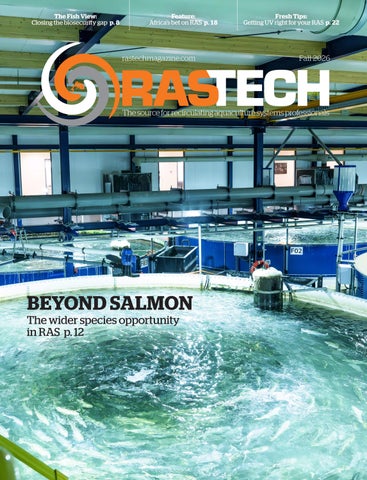
BEYOND SALMON
The wider species opportunity in RAS p. 12
Fresh Tips: Getting UV right for your RAS p. 22
Fall 2026
Connecting RAS innovators in Europe Register Now Save $150 with code SAVE150
ras-tec.com/europe
Sept 8-9, 2026 Hilton Porto Gaia , Porto, Portugal
2
EUROPE
FOR SPONSORSHIP OR EXHIBITOR OPPORTUNITIES, PLEASE CONTACT Jeremy Thain | jthain@annexbusinessmedia.com Patrick Villanueva | pvillanueva@annexbusinessmedia.com Fall 2026
CONTENTS
Fall 2026 Vol. 9, No. 3 rastechmagazine.com
8
18 COLUMNS
12
8 | The Fish View Closing the biosecurity gap BY BENDIK FHYN TERJESEN
22 | Fresh Tips Getting UV right for your RAS BY CURTIS CROUSE, FRESHWATER
DEPARTMENTS
FEATURES
04 | From the Editor Growing potential 06 | In the News Latest industry updates 20 | Showcase New products and services
12
INSTITUTE
COVER STORY Beyond salmon The wider species opporunity in RAS BY RAMON PEREZ
18
Africa’s bet on RAS Despite growing interest, African entrepreneurs face many startup challenges. ON THE COVER Photo: The Kingfish Company
BY BOB ATWIINE
RAStech is a supplement to Hatchery International and Aquaculture North America by Annex Business Media. Return undeliverable Canadian addresses to: Circulation Department, 111 Gordon Baker Rd., Suite 400, Toronto, ON M2H 3R1. No part of the editorial content in this publication may be reprinted without the publisher’s written permission. © 2026 Annex Business Media. All rights reserved. Opinions expressed in this magazine are not necessarily those of the editor or publisher. No liability is assumed for errors or omissions. All advertising is subject to the publisher’s approval. Such approval does not imply any endorsement of the products or services advertised. Publisher reserves the right to refuse advertising that does not meet the standards of this publication. Printed in Canada.
rastechmagazine.com
3
From the editor By Jean Ko Din
rastechmagazine.com
Growing potential
T
his year, I’ve been privileged to connect with some of the leading experts in the European land-based aquaculture sector as part of our preparations for our inaugural RASTECH Europe Conference & Trade Fair (Sept. 8-9 in Porto, Portugal). As a result, I’ve grown really excited about the growing potential this technology has. In this issue, we explore some of those possibilities, especially with warmwater species that are robust in RAS conditions while also being a premium fillet for European consumers. Species like yellowtail kingfish and shrimp are starting to get wider attention in the sector as more of these projects start to gain operational momentum. Then, there are other popular species like tilapia, sea bream, sea bass, turbot and sole that have always found their own corner in the European seafood market, but the industry has been slow to adopt RAS in its operations. Salmon and trout have always led the way for growth and innovation in recirculating aquaculture. The sector’s history and the maturity demonstrates this very clearly in its expanding smolt, post-smolt and growout production facilities. But then, as the European industry started to consider producing other aquaculture species in RAS, the sector suddenly feels new, fresh, and entreprenurial again. As we start to see more new projects with non-salmonid production models, I think the sector is unlocking even more potential for RAS. Suddenly, we are reminded that this technology doesn’t have to look the same in order for it to find a place in the future of fish farming. I think everyone in the seafood industry
understands that despite the current capital and operational barriers to entry, recirculating aquaculture is necessary. It will lead the next phase of seafood production as consumers become more thoughtful about where their food comes from, how ethically it is made, and how it impacts the environment. Perhaps, the actual question that remains unanswered is: what will RAS look like in the future? That is why I hope to dive deeper into the unique applications of RAS technology. It has been too easy to trap our conversations into thinking that all RAS is a 10,00o-ton Atlantic salmon farm at 99.9 per cent water exchange rate from egg to harvest. It can also look like expanding your landbased breeding and nursery facility to raise a more robust fish that needs less time exposed at sea. It can be a land-based hybrid flowthrough that uses gravity to move clean water through raceways in a economical way. It could be a small-scale growout that finishes a harvest size fish next to a Michelin-star sushi restaurant. It could be an aquaponics operation that captures valuable nutrients in a system that embraces a circular economy concept. We don’t talk about this in the magazine, but maybe it also looks like floating containment systems. I like the idea that despite all the challenges that we continue to explore and dissect in these pages, the RAS industry can still feel like venture with limitless opportunity. That’s because it is. Yes, there are problems to be solved about right-sizing investment and navigating regulations that are not build for growth. But, there are still frontiers to be explored. If you’d like to share your unique stories, please reach out at jkodin@annexbusinessmedia.com.
Reader Service Print and digital subscription inquiries or changes, please contact Angelita Potal, Audience Development Manager Tel: 416-510-5113 Email: apotal@annexbusinessmedia.com Mail: 111 Gordon Baker Rd., Suite 400, Toronto, ON M2H 3R1 Editor Jean Ko Din 437-990-1107 jkodin@annexbusinessmedia.com Associate Editor Seyitan Moritiwon 416-302-2560 smoritiwon@annexbusinessmedia.com Associate Publisher Jeremy Thain 250-474-3982 jthain@annexbusinessmedia.com Sales Manager Patrick Villanueva 416-606-6964 pvillanueva@annexbusinessmedia.com Account Coordinator Barb Vowles 416-844-7106 bvowles@annexbusinessmedia.com Group Publisher Anne Beswick 416-410-5248 abeswick@annexbusinessmedia.com Audience Manager Urszula Grzyb 416- 510-5180 ugrzyb@annexbusinessmedia.com CEO Scott Jamieson sjamieson@annexbusinessmedia.com Printed in Canada Subscription Rates Canada – $38.48 (+tax) United States – $49.92 CAD Foreign – $64.48 CAD All prices are for 1yr subscription and in Cdn funds. ISSN 2817-7266 - Print ISSN 2817-7274 - Online Occasionally, RAStech will mail information on behalf of industry related groups whose products and services we believe may be of interest to you. If you prefer not to receive this information, please contact our circulation department in any of the four ways listed above. Annex Privacy Office privacy@annexbusinessmedia.com Tel: 800.668.2374 No part of the editorial content of this publication may be reprinted without the publisher’s written permission © 2026 Annex Business Media. All rights reserved. Opinions expressed in this magazine are not necessarily those of the editor or the publisher. No liability is assumed for errors or omissions. All advertising is subject to the publisher’s approval. Such approval does not imply any endorsement of the products or services advertised. Publisher reserves the right to refuse advertising that does not meet the standards of the publication.
RASTECH EDITORIAL ADVISORY BOARD Andrew Cree Preston I | Amy Stone | Bendik Fhyn Terjesen I| Yonathan Zohar
Made possible with the support of
facebook.com/RAStechmag rastechmagazine.com
4
Fall 2026
rastechmagazine.com
5
In the news
PHOTO: EU COM M I S S ION
New fund launches to scale Atlantic Canada’s blue economy
The European Commission published a “Farmed fish welfare” report earlier this year.
A new investment platform, AtlantiCan Growth Partners (AGP), has launched to scale high-potential businesses in Atlantic Canada, with an initial focus on aquaculture, marine technology, fisheries, and ocean innovation. The firm plans to address the longstanding venture capital gap through three dedicated funds, beginning with a $100M-$150M fund focused on the blue economy. Over the past five years, the region has attracted two to three per cent of national venture capital, with Ontario and Quebec capturing the vast majority of deployment. “Atlantic Canada has always punched above its weight. This region is home to exceptional companies, driven founders, and a strong support system that is often understated,” said Alex McCallum, president and CEO of AtlantiCan Growth Partners. “What we see now is an opportunity to build on that foundation with more dedicated growth-stage capital for companies ready to scale.” AGP was developed on the long-term vision of executive chairman Telfer Hanson, who has three decades of international financial and investment banking expertise. “I know the incredible potential of Atlantic Canada’s businesses and the challenges they face when scaling,” said Hanson. “AGP is the realization of a long-term goal to bridge the region’s funding gap. We are providing the dedicated growth capital, strategic governance, and hands-on support our entrepreneurs need to drive long-term regional value.” While the platform is launching with a focus on the blue economy, AGP is planning to expand to other sectors as it looks to support the growth of Atlantic Canadian companies.
6
FEAP criticizes EU Commission’s new fish welfare report The Federation of European Aquaculture Producers (FEAP) has released a statement in response to the European Commission’s newly published fish welfare report. The Commission’s overview report, “Farmed fish welfare,” was published in April. Authors of the report found that “fish welfare in the European Union (EU) remains uneven and less developed than for other farmed animals.” The report highlights that while good practices, research and technologies are emerging, key challenges like lack of clear welfare indicators, limited expertise, and difficulties in inspecting remote farms, still remain. FEAP published a statement criticizing the major conclusions of the report, explaining that it “overlooks fundamental scientific and operational challenges facing the sector.” “FEAP fully supports science-based welfare improvements, but they must be practical, achiev-
able, and proportionate,” said Javier Ojeda, FEAP secretary general, in a press statement. “The Commission’s report risks setting unrealistic expectations that fail to account for the diversity of our sector, from small family-owned lagoon farms to larger marine operations. Legislation that ignores farm-level realities will not improve fish welfare; it will simply drive production outside the EU, where standards may be lower.” The FEAP statement lists specific criticisms in the overview report, emphasizing that welfare needs are not homogenous across species, production systems, or life stages. FEAP asserts that the report fails to understand the nuances and unique challenges of aquaculture that is different from terrestrial livestock production. FEAP adds that the organization remains committed to working with EU institutions and Member States to develop workable welfare standards that protect both fish and the future of European aquaculture.
Visit us online Find the latest RAS-related news, features and analysis from across the world.
rastechmagazine.com Fall 2026
Laxey is located in Vestmannaeyjar, Iceland.
growth. Future expansion is expected to be supported through operational cash flow and debt financing,” the company said. Alongside the equity raise, Laxey has
signed a committed Term Sheet co-ordinated by DNB Carnegie, and with DNB, Rabobank and Arion Bank as Mandated Lead Arrangers and Lenders and Eksfin as Lender.
© Veolia Picture Library - Hydrotech.
Icelandic land-based salmon producer, Laxey, reported it has completed an oversubscribed €47 million (US$53.5 million) equity raise to support its next phase of development. The offering initially targeted €40 million but the company said it increased the final amount due to investor demand. The financing was said to be supported by a combination of existing shareholders and new investors joining. To date, Laxey has raised almost €200 million (US$227.8 million) in equity since its inception. “Based on the company’s current plans, the equity raise and syndicated financing are expected to provide the funding required for the next stage of
PHOTO: L A X EY
Laxey raises €47M, above initial target
SEPT 3, 2026 • 11AM EST • ONLINE SUMMIT
2026
Innovation, Intelligence & Impact For North America’s Aquaculture Community
Engineered for aquaculture excellence
FEATURING EXPERT PANELS ON EXPANDING SEAWEED AQUACULTURE MARKETS, AI AND AUTOMATION IN FARMS AND MORE.
Hydrotech Disc Filter - Hybrid series Veolia’s Hydrotech Hybrid Filter helps aquaculture safely maintain consistent water treatment. �
Smarter: combination of two proven technologies: high hydraulic flow capacity (HDF) and large filtration area (HSF)
�
Lighter: individual panel removal using only two bolts (Alphadisc™ patent)
�
Cleaner: particle filtration sizes down to 10 μm and patented high-pressure cleaner
Presented by: OWNERS NARROW BOLD
Gold Sponsors:
LAKE & POND SUPPLIES
Est. 1989
AQUACULTURE SUPPLIES
REGISTER TODAY I ANANEXUS.COM
To learn more, visit www.hydrotech.se
rastechmagazine.com RAS_NEXUS_FALL26_BAS.indd 1
7 2026-06-30 RAS_Veolia-Hydrotech_Spring26_CSA.indd 1:57 PM 1 260009_HYDROTECH_Rastech_Ad.indd 1
2026-01-14 10:36 AM 14/01/2026 14:37
The Fish View By Bendik Fyhn Terjesen
Bendik Fyhn Terjesen, PhD is head of Land-based Innovation in Cermaq Group, where he works with the regions to build new infrastructures and improve operations to give the fish a safe start in life. He has an extensive research background in fish physiology, nutrition, and RAS, and is adjunct professor at Nord University in Norway, where he teaches aquaculture technology. (bendik.fyhn.terjesen@cermaq.com)
Veines post-smolt RAS during construction, Winter 2025/2026
B
iosecurity means the measures taken in an aquaculture facility to prevent introduction and spread of infectious agents and disease outbreaks. It includes a wide range of measures to prevent infection through fish, intake water, personnel, air, feed, and additives to the rearing water. Biosecurity in land-based facilities using a recirculating aquaculture system (RAS) is particularly critical because pathogens introduced at one point in the facility can quickly spread to all parts of the facility, tanks and fish. Further, in RAS, a huge surface area exists, available for biofilm formation and pathogens, and fish can escape the culture tanks and end up in pipes and water treatment, posing a biosecurity risk. 8
Research has demonstrated similarities between the microbiota in culture tank water and in the water treatment, and that biofilter communities influence the water microbiota (e.g. Bakke et al., 2017; Khadka et al.,2026). This is expected since there is hydraulic contact between all tanks and water treatment in a RAS. This mixing can be considered a strength of the RAS technology, since the microbiota may counteract disturbances and outcompete pathogens. However, at the same time, it is a weakness since pathogens can be quickly transmitted to all parts of the system. The firewall The first barriers around the facility include screening of genetic material, intake water particle removal, ozonation, and radiation with e.g. ~250 mJ /cm2 in redundant ultravio-
lets. However, if these barriers fail and the RAS is infected, it is essential that the pathogens can be eradicated so the next group of fish is not infected. Otherwise, the pathogen will follow the fish to the next RAS or to sea and spread from location to location. Research has demonstrated that pathogens and disease outbreaks in sea cages can be traced back to specific RAS (Sindre et al., 2024). In addition, pathogen house strains are a threat (Jansen et al., 2021). It has been shown that the HPR0 variant of the ISA virus establishes “house strains” specific to the hatchery, the virus circulates and can infect new fish groups (Sindre et al., 2024). Inside the first barrier Biosecurity strategies inside the first barrier must have the goal to limit pathogen transmission within a RAS, avoid infecting fish Fall 2026
PHOTO: C E R M AQ NORWAY
Closing the biosecurity gap
tanks are cleaned and disinfected and there is no disinfection of the biofilters (Treatment A, Figure 1). This is not true AIAO, since it is only the fish that is “all-in-all-out” and not the microbiota. In Chile, however, practices closer to AIAO are used, since it is required to terminally disinfect RAS regularly including the biofilters (i.e. Treatment B, Figure 1).
populations, and include tools to control and/ or remove infectious agents that may have passed the first barrier. The all-in-all-out (AIAO) concept is a strategy recommended by the World Organisation for Animal Health. In RAS for salmon in Norway, the fish are moved all-out, and the water returned to the RAS by a dewatering unit. However, in most cases only the fish
Achieving true AIAO Why do biofilters constitute a bottleneck for biosecurity? A major reason is the downtime due to its biological nature. In RAS-circles a general saying is that a biofilter becomes more robust against rapid changes in production parameters, the older it is. A long maturation time is needed to develop sufficient nitrification, at least six weeks depending on temperature, during which production is halted. Secondly, it has been pointed out by some authors that biofilters should not be disinfected due to several arguments, including that the re-start of new microbiota can become dominated by fast-growing opportunists (e.g. Dahle et al., 2023; Fernando et al., 2025). Finally, the cleaning and disinfection of RAS not designed with this in mind is very labour-intensive, and several farmers decide against it in a cost-benefit assessment since the procedure can stop production for months, and the pathogens may still escape the disinfection (Larsen et al., 2024). However, the major purpose of RAS, like
any rearing system, is to provide a controlled environment for fish growth, and optimal welfare and health. Avoiding disease transmission between fish groups passing the RAS, hinder development of pathogen house strains, and reducing the risk of later pathogen transmission between sea locations, should take precedence over keeping a particular biofilter as long as sufficient nitrification can be re-established after disinfection. Indeed, Sindre et al. (2024) stated that only cleaning the fish tanks in facilities positive for HPR0 virus, did not prevent further infection of new fish groups. Alternatives might be to use bath vaccination, bacteriophages or disinfectants developed to treat RAS while still running with fish. However, these cannot remove all known and unknown pathogens indiscriminately like a terminal disinfection has the potential to achieve. In my opinion, research and innovation should therefore approach internal biosecurity in RAS along two trajectories: Non-biological ammonia removal Non-biological removal of ammonia, such as electrochemical technology (e.g. Ben-Asher et al., 2024), is a collection of methods that in the future may eliminate the need for biofilters, reduce surface area in RAS, and simplify disinfection and give rapid restart of RAS between fish groups (Treatment C, Figure 1). To my knowledge, however, non-biological ammonia removal has not been tested in large-scale salmon RAS over several fish
PRECISE DISSOLVED OXYGEN CONTROL DGI® technology uses a proprietary method to infuse gases into liquids, maximizing oxygen efficiency for aquaculture applications. Potential benefits include:
┃
LOWER ANIMAL STRESS INCREASED STOCKING DENSITY
┃IMPROVED FOOD CONVERSION RATIO
┃
┃
FTEK.COM 630-845-4500 INFO@FTEK.COM
rastechmagazine.com RAS_FuelTech_Spring26_CSA.indd 1
2025-12-18 3:38 PM9
The Fish View Treatment A: Only cleaning and disinfecting fish tanks in RAS and not biofilters. Occurs in most RAS facilities in Norway today, between fish groups. Run as usual Mechanic al filter
Biofilter
CO2 degas
Clean, disinfect, fallow Fish ta k Fish tank Fish tank
Treatment B: Full disinfection of RAS including biofilters. Little practiced between fish groups in Norway, but each 2nd year in Chile.
Mechanic al filter
Biofilter
Clean, disinfect, fallow, mature, re-start CO2 degas
Fish ta k Fish tank Fish tank
Treatment C: Non-biological TAN removal. Little experience or use in large-scale RAS for Atlantic salmon Mechanic al filter
Nonbiological TAN removal
Clean, disinfect, rapid re-start
CO2 degas
Fish ta k Fish tank Fish tank
Figure 1. Alternative biosecurity strategies internally in RAS for Atlantic salmon post-smolt production.
Complete disinfection with adapted designs Until non-biological TAN removal has been developed and tested for large-scale RAS, then true AIAO with full disinfection of RAS between fish groups including sumps, pipes, and biofilters should be developed. Full disinfection of RAS including biofilters has not, to my knowledge, been studied in repeated controlled trials in large-scale facilities. In small lab-scale, however, it was observed that ozonation removed ISA HPRdel virus in all replicate biofilters, and in two out of three replicates, also Branchiomonas or IPN virus were removed (Patel et al., 2025). This may imply that cleaning 10
and disinfecting the entire RAS has varying success, and further development is needed. Furthermore, the effects on the fish themselves of prior disinfection of RAS in which they are stocked are little known. Health and welfare of the fish must be the primary objective of biosecurity measures, not the microbial community itself, although it obviously has a central role. If the situation after disinfection is an unstable microbiota dominated by opportunists, and the water quality is characterized by increased concentration of ammonia, nitrite and particles, then this will be a harmful environment for the fish. However, it can be hypothesized that inoculating with screened seed cultures of nitrifying and other bacteria, can counteract or eliminate the negative consequences above, including reducing downtime of RAS and improving stability. The negative effects of disinfection
must be weighed against positive effects, such as potentially reduced spread of infectious agents, avoiding house strains, and fewer outbreaks of diseases both during the phase on land and in facilities at sea. RASafe Cermaq and partners, Pharmaq, Nord University, Helgeland Smolt and Mowi, and with funding from the Norwegian Seafood Research Fund (FHF) and the partners, have just started a four-year research project called RASafe, addressing several biosecurity challenges during postsmolt production in RAS. The main goal of the project is to increase the practical and theoretical knowledge of biosecurity strategies in largescale commercial post-smolt facilities with RAS and how these affect microbiota, fish health and welfare, water quality, routines and production plans. Fall 2026
G R A PH IC: B E N DI K F H Y N T E R J E S E N
generations and little is known about the robustness of the technology under these conditions. The time horizon for largescale RAS with non-biological TAN-removal is therefore likely to be years.
The project will focus on how the fish, microbiota and water quality in large-scale RAS respond to two treatments, Treatment A or B (Figure 1). The project will map the use of time and resources and the overall feasibility of the treatments, from one fish group is moved out from a RAS until a new one can be reintroduced. A large number of samples of water, biofilm and the fish will be collected and analyzed to understand effects on fish welfare and health, water quality, bacterial community profiles in water and biofilms, and screening of relevant pathogens. Further, SCADA output, time, personnel and energy use will be monitored. RASafe will use the new Cermaq Norway large-scale 3,200 tons per year postsmolt RAS Veines as the test facility. We are now investigating the facility from the first start-up, which offers a unique possibility to study how the microbiota in RAS develops from the very beginning after construction. The facility is adapted to regular cleaning and disinfections through a number of modifications, such as time in the production plan for the procedure, access to all enclosed unit processes and piping for cleaning, slopes and drains on pipes, acrylic membrane surface treatment throughout the RAS, dosing systems for the disinfection chemicals, bypass of all culture tanks when cleaning-in-place to reduce chemical use, and master cultures for inoculating the biofilters with nitrifiers, used downstream following pathogen screening. RASafe will likely result in several practical lessons learned about what to do, and not do, during disinfection procedures, biofilter maturations and more. To contribute to improved biosecurity in RAS, the results from the project will be actively shared with other fish farmers, fish health providers, research institutions and the public.
lantic post-smolts at different salinities. Aquacultural Engineering, 78, 42-49. https:// doi.org/10.1016/j.aquaeng.2016.10.002 Ben‐Asher R, Gendel Y, Lahav O (2024). Electrochemical applications in RAS: A review. Reviews in Aquaculture, 16(1), 86-105. https://doi.org/10.1111/raq.12822 Dahle SW, Ribicic, D, Netzer R, FinneFridell, F, Attramadal K, Buran Holan A, von Ubisch L, Litlabø A, Dinning AJ, Strauch S (2023). Stable and mature biofilters are important for good fish welfare in RAS (in Norwegian). LandbasedAQ 2-2023, p 52-57. Fernando F, Khadka S, Hofstad K, Fredriksen S, Vadstein O, Bakke I (2025). Mature nitrifying biofilters counteract invasion by rapid-growing heterotrophic bacteria in recirculating aquaculture systems (RAS). Aquaculture, 620, 743950-. https://doi. org/10.1016/j.aquaculture.2026.743950 Jansen, M.D, Christiansen, D.H., Moldal, T., Falk, K. (2021). Final report: Prevalence and significance of ISA virus in the Norwegian
farmed population of salmonids (FHF901181)(In Norwegian). VI report. Norwegian Veterinary Institute 2021. Larsen SV, Tørud B, Hess-Erga OK, Furseth K, Sonal P (2024). Practical biosecurity work in recirculating aquaculture systems (RAS)(In Norwegian). Akvaplan-NIVA report 2024 64276.01 and VI report series 2024_5. ISBN 97-82-449-0074-4. Patel S, Colquhoun D, Fernandes P, Weli S, Guimarães MM, Dale H, Roalkvam I, Øvredal L, Sture GM, Furne M, Mohammad S, Larsen SV, Midtbø EV, Handegård R, Andrews M, Jæger A M-L, Nilsen H, Hess-Erga OK (2025). Spread, Survival and Inactivation of Fish Pathogens in Lab-Scale RAS (In Norwegian). LandbasedAQ issue 3, 68-74. Sindre H, Moldal T, Fosse JH, Weli S, Peñaranda MM, Skaftenesmo KO (2024). Biosecurity measures against ISA in hatcheries (ILA-SAFE) (FHF project 901674, in Norwegian). Report 47-2024, Norwegian Veterinary Institute. 39 pp.
References cited Bakke I, Åm AL, Kolarevic J, Ytrestøyl T, Vadstein O, Attramadal KJK, Terjesen BF (2017). Microbial community dynamics in semi-commercial RAS for production of Atrastechmagazine.com
RAS_StructuralArmor_Fall26_CSA.indd 1
2026-06-29 3:15 PM11
COVER STORY
Beyond salmon The wider species opportunity in RAS By Ramon Perez
R
ecirculating aquaculture systems are often discussed through the lens of salmon. That is completely understandable. Atlantic salmon is high value, globally recognized, familiar to consumers, and attractive to investors. It helped bring RAS into boardrooms, policy discussions, newspapers, public markets and mainstream aquaculture conversations. But RAS is way more than a salmon machine. At its core, RAS is a control tool. Its value lies in the ability to manage water quality, temperature, oxygen, biosecurity, stocking conditions, waste streams, feeding, and production timing with far more precision than open production systems. Sometimes that control justifies full grow-out on land. Sometimes it does not. In many cases, the best use of RAS may be in specific parts of the production chain: broodstock, hatchery, nursery, fingerling production, quarantine, post-larvae, juvenile phases, or pregrow-out before animals move to ponds, cages, raceways, or other systems. That distinction matters. If the industry only measures RAS against the most ambitious full growout projects, it misses a much wider opportunity. Why salmon became the reference point Salmon became the dominant RAS conversation for good reasons. It is a premium product with strong global demand. It has established a full specialized industry including processing routes, retail formats, feed supply, genetics, logistics, and consumer recognition. It is also a species where traditional farming faces burning platforms: licenses, sea lice, escapes, environmental pressure, geography, and social acceptance. Land-based RAS offered a powerful promise: produce closer to market, improve biosecurity, reduce 12
Yellowtail kingfish is one of the cleanest examples of a premium marine species that can carry a serious
escapes, control the environment, and potentially avoid some of the constraints of sea-based expansion. Its success, though, was not only biological or technological. For me, salmon is one of the best commercial examples of market creation in modern seafood. Did you know that raw salmon was not traditionally a major sushi ingredient? Norway’s long-running Project Japan introduced farmed Atlantic salmon into the Japanese sushi and sashimi market, turning it into one of the most recognized raw seafood products in the world. Nobody has nigiris or pokes without salmon nowadays. That angle matters for every new species. Biology opens the door, but markets decide what walks Fall 2026
s RAS story. PHOTO: THE KINGFISH COMPANY
through it. A species does not succeed because it grows in a tank. It succeeds when production, product quality, food safety confidence, branding, logistics, and customer demand line up. Where control creates value The next era of RAS needs a wider species conversation, because salmon is only one application. A smolt facility, an indoor shrimp farm, a yellowtail kingfish grow-out unit, a tilapia nursery, a catfish fingerling system, and a marine hatchery may all use recirculation. But they are not the same business. The species changes everything: temperature, salinity, oxygen demand, feeding behaviour, solids loadrastechmagazine.com
ing, stocking density, welfare indicators, disease risk, harvest size, product format, and price. The right question is not simply, “Can this species be produced in RAS?” The better question is, “Where does control create enough value to justify the cost?” That may mean full growout. It may mean broodstock conditioning. It may mean hatchery reliability, nursery survival, cleaner juveniles, better grading, or stronger animals before transfer to ponds or cages. Once you look at RAS that way, species such as yellowtail kingfish, shrimp, barramundi, meagre, Arctic char, tilapia, pangasius, and catfish become much more interesting. 13
COVER STORY
Yellowtail producers, like The Kingfish Company, have shown meaningful scaleability in RAS.
Four directions worth watching – and a bonus track 1. Yellowtail kingfish: premium marine RAS Yellowtail kingfish is one of the cleanest examples of a premium marine species that can carry a serious RAS story. It is high value, fast-growing, attractive for sushi and sashimi, and already has commercial land-based production behind it. That last part is crucial to its story. Yellowtail is not a species sitting in a trial tank waiting for someone to build a glossy investor deck around it. Several
farms/companies have shown that yellowtail can be produced at meaningful scale in land-based systems, with recent public updates pointing to higher harvest volumes, improved feed conversion, and stronger focus on core markets. But the same example also keeps the conversation honest. Premium does not mean easy. In fact, premium usually means less room for excuses. If the target market is sushi, sashimi, foodservice, or high-end retail, consistency is the main product. That means juvenile quality, oxygen
LONG-LASTING AQUACULTURE PUMPS
Specialists in corrosionresistant, reliable and stable propeller pumps, with high uptime and low energy consumption.
+45 65 98 13 16
14 RAS_Lykkegaard_Winter25_CSA.indd 1
2. Can indoor shrimp compete with tropical commodities? Shrimp deserves a place in the RAS conversation. Globally, it is already a massive consumer product. In North America and Europe, much of the market still depends on long-distance imports, frozen logistics, and production systems that can carry recurring questions around disease, water quality, antibiotics, and biosecurity. Shrimp and RAS are already far from being only a concept. In Europe, companies such as Aquapurna, Oceanloop, HanseGarnelen, and Three-Sixty Aquaculture are already showing different versions of the same idea: produce shrimp closer to the customer, with tighter control and a fresher product story. Aquapurna’s Gamba Zamba brand, for example, is already present in German retail and foodservice channels. The elephant in the room, obviously, is cost. Indoor shrimp farms are not
·
WWW.LYKKEGAARD-AS.COM
2026 2025-10-01 Fall 11:04 AM
PHOTO: T H E K I NG F I S H COM PA N Y
management, feed conversion, health control, harvest logistics, shelf life, and product presentation all have to work together. A bad batch hurts trust. For me, that is what makes yellowtail interesting. It shows that RAS can support a premium marine fish with real market appeal, but it also reminds us that the farm is only half the story. The market, the balance sheet, and the route to the customer matter just as much.
PHOTO: PI N E I S L A N D R E DF I S H
going to beat low-cost tropical commodity production by playing the same game. That would be commercial suicide with better plumbing. They need a different reason to exist: freshness, local supply, foodservice relationships, traceability, never-frozen product and, bottom line, consumer trust. For shrimp, RAS makes sense when control becomes part of the product, not just part of the farm. The customer is not only buying shrimp. They are buying freshness, transparency, and confidence that the product is not just another anonymous frozen import. 3. Regional whitefish and the local market play Warm-water whitefish are another underdog in the RAS conversation. Barramundi is a good example. It has a clear whitefish proposition, works in premium seafood channels, and does not always need a full indoor grow-out story to be interesting. In many cases, the stronger RAS angle may be the nursery: producing robust juveniles under control before transferring them to ponds, cages, or other grow-out systems. That is less flashy than “everything indoors,” but often much more practical and responsible. Redfish, or red drum, brings the same discussion closer to the U.S. market. Pine Island Redfish recorded its first harvest of RAS-raised red drum in Flor-
Warmwater whitefish, like red drum, might be another underdog to consider in RAS.
ida in 2025, which is exactly the kind of regional species story the sector should watch. Not every RAS project needs to chase the same global species. Sometimes the better route is to take a fish people already understand locally and produce it with more consistency, biosecurity, and supply planning. Meagre adds a Mediterranean and eastern Atlantic angle. It has strong aquaculture attributes: large size, good processing yield, firm texture, mild flavour, and a good fit for both whole fish and processed formats. But meagre also shows the commercial side of the prob-
lem. In markets where consumers know it, controlled production can support consistency and supply. In markets where they do not, biology alone will not carry the product. You still need the right harvest size, product form, branding, and route to market. That is why this group is interesting. Warmwater whitefish are not a single species bet. They are the reminder that RAS diversification should start with market fit, not species hype. The question is “which fish has a real customer, a sensible production model, and enough value to justify the control?”
GO FROM MONITORING TO SMART CONTROL Monitoring, systems and software
HOW TO UPGRADE
Scan the QR code
rastechmagazine.com RAS_OxyGuard_Fall26_CSA.indd 1
2026-06-15 9:33 AM 15
COVER STORY
Artic char is a familiar fish to many consumers, technically relevant for producers and well-aligned for land-based production.
16
This applies directly to pangasius, where controlled early development can produce stronger juveniles before transfer to ponds. It applies to tilapia too, where hatchery and nursery control already play a major role in reliable production. Anyone who has farmed these species knows the species is hardy, but “hardy” is not the same as “impossible to mess up.” Poor fry quality, uneven batches, weak grading, and bad early feeding will follow you all the way to harvest – if mortalities do not damage the batch before it even gets there. The same principle could also apply to U.S. catfish farms. Catfish may be a traditional pond industry, but that does not mean every part of the production chain has to stay traditional. Better control over fingerling production, grading, health, and early growth could support more predictable pond growout, especially in an industry facing pressure from disease, birds, weather, and shrinking acreage. Don’t get me wrong here: RAS is not a replacement for ponds. It is a way to improve pond performance. For commodity species, the argument
is reliability, not glamour. Better early-stage control will not fix every problem, but it can reduce the biological lottery farmers face when they stock ponds, cages, or raceways with inconsistent juveniles. 5. Bonus track: Opportunities hiding in plain sight A fifth direction is worth adding, especially for colder markets: Arctic char and trout. These species are not exotic, and that is part of the point. They are familiar enough for consumers, technically relevant for producers, and well aligned with cold-water land-based production. Arctic char in particular deserves more attention than it gets. It has a strong product identity, good flesh quality, and enough premium positioning to stand on its own, especially if you have ever eaten a fillet cooked properly in butter. For RAS, Arctic char fits the logic of controlled freshwater production: temperature control, biosecurity, year-round supply, and proximity to market. It is not trying to be a global mega-species. It can be a regional, high-quality salmonid Fall 2026
PHOTO: A L L E KO/G ET T Y I M AG E S
4. Controlled commodity species: tilapia, pangasius, and catfish Tilapia and pangasius are not usually treated as exciting RAS candidates. They are familiar, high-volume, lower-value species. But I think that is exactly why they deserve attention. I have a soft spot for tilapia. I farmed them, worked with them, and even have one tattooed on my arm, so I am probably not neutral here. But bias aside, tilapia is a good reminder that “commodity” does not mean simple. The same applies to pangasius. I have been personally involved in pangasius work in Vietnam, where part of the discussion has been exactly this: how better control in the early stages can improve fry quality, robustness, and performance later in the production cycle. The opportunity is not necessarily to grow commodity fish to harvest in expensive full RAS facilities. In many cases, that would be economically difficult, to say the least. The stronger opportunity may be using RAS where control has the greatest impact: broodstock, hatchery, first feeding. In fewer words: early-stage survival.
with its own story. Trout is less glamorous, but probably more practical. It is already widely farmed, well understood, and relevant for both grow-out and juvenile production. In some cases, the RAS opportunity is not to reinvent trout farming from scratch, but to upgrade parts of the chain: hatchery reliability, water reuse, biosecurity, welfare, and more consistent local production. That is why I like this category as the bonus track. Diversification does not always need to mean unfamiliar species. Sometimes the practical opportunities are hiding in plain sight. The hybrid future may be bigger than full grow-out The industry often talks as if the big question is whether RAS can replace conventional aquaculture. For me, that is the wrong frame. In many species, the future is hybrid. RAS can support hatcheries, nurseries, broodstock, quarantine, genetic programs, cleaner juveniles, post-larvae, fingerlings, or pre-growout stages. Ponds, cages, flowthrough systems, and raceways can then handle growout where they remain biologically, locally, and economically appropriate. That may not sound as dramatic as building a giant, fully automated, AI-operated, human-free growout facility. But it may be where RAS creates some of its most practical value. Beyond animals There is also a wider opportunity beyond fish and shrimp. As RAS matures, the sector will need to think harder about waste streams, sludge, dissolved nitrogen, phosphorus, and circular production. That will increasingly connect RAS to aquaponics, IMTA, algae, kelp, biofertilizers, insect meals, or other nutrient recovery pathways. Kelp is not a simple “RAS species” in the same way as yellowtail, shrimp, or char. It belongs in the wider conversation about nutrient circularity and integrated production. The point is not to force seaweed into every RAS discussion. The point is to ask what value can be created from the nutrients the system already concentrates. The future of RAS is not only about which animals we grow, but also what we do with the nutrients they leave behind. Other industries have been forced to deal with waste, circularity, and by-product value for decades. Aquaculture will not be different. What future RAS projects should ask first Future projects should stop starting with technology and start with species-system-market fit. What problem does control solve for this species? Survival? Biosecurity? Seasonality? Juvenile quality? Product freshness? Local supply? Welfare? Mortality? Water use? Waste management? Food safety? Market reputation? rastechmagazine.com
Where in the life cycle does RAS create the most value? Broodstock? Hatchery? Nursery? Full growout? Quarantine? Finishing? Depuration? Who pays for the improvement? Retailers? Foodservice? Farmers buying stronger juveniles? Consumers paying for fresh local product? Regulators demanding better traceability? Existing pond or cage farmers improving performance? And finally, what is the right scale? Some species may justify full commercial grow-out in RAS. Others may justify smaller, specialized, high-impact systems connected to conventional grow-out infrastructure. Not every RAS opportunity needs to begin with a giant building, a heroic production target, and assumptions that leave no room for biology to be biology. The future is wider We need to stop treating RAS as a one-size-fits-all machine and start treating it as a precision control platform. Salmon has been good for RAS. It attracted attention, capital, engineering, and ambition. It helped prove that controlled land-based aquaculture is part of the future food system. But the next stage needs to be more nuanced. RAS is not one species, one model, or one business case. It is a control platform. Its best use depends on where control creates the most value: premium growout, biosecure local production, stronger juveniles, better pond performance, cold-water diversification, or even nutrient recovery. That is the real opportunity. Not simply moving more fish indoors, and definitely not forcing every species into the same production model. The opportunity is to understand which parts of aquaculture need more control and then design systems around that need. That is bigger than any single species.
Dissolved Oxygen Simplified Trusted RDO® Technology, intelligent wiping, weighted copper-infused guard, and salinity compensation for continuous DO monitoring
Scan To Learn More
17
FEATURE
Africa s bet on RAS ’
F
or decades, aquaculture production across Africa has depended largely on earthen ponds, lakes, and seasonal water availability. But as urban populations explode and demand for fish continues to grow, interest is increasing in recirculating aquaculture systems (RAS) technology. Experts say the technology could help African countries increase fish production while using less land, less water, reducing dependence on seafood imports, and easing pressure on wild fisheries. Critics, however, point to high startup costs, unreliable electricity supplies, and the specialized expertise required to operate RAS facilities successfully in some areas. “Aquaculture in Africa today has experienced a significant shift from what existed a decade ago,” said Lanre Badmus, a Nigerian aquaculture expert and director at the World Aquaculture Society (WAS) African chapter. According to Badmus, the sector was dominated ten years ago by smallholder farmers operating traditional pond systems characterized by low productivity, limited technical expertise, poor seed quality and weak value chains. Today, the industry is undergoing a transition toward commercialization and intensification, driven by improved genetics, locally formulated feeds, cage culture, digital farm management, and 18
growing private-sector participation. Even so, interest in RAS appears to be growing steadily across parts of Africa, particularly among commercial operators seeking greater efficiency and year-round production, while many farmers continue to face challenges in sustaining the systems. In Nigeria, Badmus said RAS adoption remains relatively limited because of the high initial cost of installation with many components still imported. Nevertheless, he noted that uptake is steadily increasing. Countries such as Nigeria, South Africa, Egypt, Kenya, and Morocco are among those showing growing interest in the technology as governments and investors look for ways to strengthen food security and domestic fish production. For entrepreneurs, such as Badmus, the appeal of the technology lies largely in its efficiency and predictability. “RAS gives farmers more control over production,” Badmus said. “Instead of depending entirely on weather conditions or large volumes of water, producers can manage the environment much more closely.” Industry observers say the shift reflects broader changes taking place within African agriculture and food systems. As populations rise and cities expand, farmers are under increasing pressure to produce more food using fewer resources. The United Nations
A man feeding fish at a trout hatchery in Chogoria Route, Mount Kenya National Park, Kenya
projects Africa’s population will continue growing rapidly in coming decades, placing additional pressure on food systems already struggling to meet demand. Fish remains one of the continent’s most important and affordable sources of animal protein. Despite growing interest in RAS, Badmus said several misconceptions continue to surround the technology. Some farmers underestimate the level of management required, while others wrongly believe fish produced in RAS facilities are less healthy or less natural than those raised in conventional systems. Morena Khashane, a RAS operator in South Africa’s North Western province, attributes the relatively low adoption of the technology in Africa to limited technical expertise and support infrastructure compared with Europe and North America. “For RAS to become a significant part of Africa’s aquaculture sector, the continent needs affordable energy, skilled manpower, improved financing mechanisms, lower equipment costs and growth in premium urban fish markets,” he said. “I expect RAS to grow substantially, but not to replace ponds and cages. Africa’s future is likely to involve a combination of improved technologies and traditional systems serving different markets.” He added that operational and financial Fall 2026
PHOTOS: M A RT I N/A D OB E STO C K
Despite growing interest, African entrepreneurs face many startup challenges. By Bob Atwiine
risks remain among the biggest obstacles to wider adoption. Electricity also poses a particularly serious challenge. Because RAS facilities rely heavily on pumps, aeration systems and filtration equipment, even short power interruptions can place fish stocks at risk. In countries like South Africa, Nigeria where electricity supplies remain unreliable, many operators depend on backup generators, significantly increasing operating costs. Imported equipment and limited local technical expertise can create additional financial pressure, particularly for smaller producers attempting to enter the sector. For Royd Mukonda, a national consultant with the United Nation’s Food and Agriculture Organization (FAO) in Zambia, the long-term success of RAS will depend on adapting the technology to African realities rather than simply replicating systems developed elsewhere. In Zambia, he said, RAS is currently found mainly in pilot projects, hatcheries and a small number of commercial farms targeting high-value species such as tilapia fingerlings and trout. “In places like Lusaka and Southern Province, where borehole water levels drop and surface water availability is seasonal, RAS makes aquaculture possible where ponds are not viable,” Mukonda said. “Urbanization also means farmers often cannot secure large tracts of land or water rights near major markets. For cities, RAS is often the only practical way to undertake intensive fish farming locally.” Compared with conventional pond sys-
tems, RAS facilities require substantially higher upfront investment for tanks, filtration systems, sensors and backup power infrastructure. Access to financing for aquaculture projects remains limited in many African markets, particularly for young entrepreneurs without substantial collateral. Many African lenders still view the technology as technically complex and high-risk. Financial institutions and funding agencies often lack adequate understanding of aquaculture economics, leaving many farmers unable to secure the capital required for investment. “There is still caution among lenders,” Mukonda said. “Aquaculture is already viewed as a specialized sector and RAS can appear even more complex from a financing perspective.” Yet despite these constraints, enthusiasm surrounding the technology continues to grow. Industry observers point to several factors driving that momentum. Urban consumers increasingly demand reliable year-round fish supplies. Governments are placing greater emphasis on domestic food production, while pressure on wild fisheries is encouraging policymakers and investors to explore alternative production systems. In several African countries, universities and aquaculture training institutions are beginning to introduce more specialized instruction focused on intensive production systems and aquaculture innovation. Some experts argue that RAS is likely to remain concentrated among commercial
operators and hatcheries in the near term rather than becoming widespread among small-scale farmers. Others believe falling equipment costs, advances in renewable energy and improved technical training could gradually expand adoption. What appears increasingly clear is that African aquaculture is entering a period of rapid transformation. Inside facilities powered by pumps, filters and carefully monitored water systems, a different vision of African fish farming is emerging one built not around vast ponds and seasonal cycles but around precision, control and resource efficiency. Whether RAS ultimately becomes a niche technology or a major pillar of African aquaculture will depend largely on how effectively operators, governments and investors adapt it to local conditions. With appropriate government support, investment and training, Badmus believes Africa could become one of the world’s most important aquaculture growth frontiers. “Africa is not only an emerging market,” he said. “It is potentially one of the world’s most important aquaculture growth frontiers driven by population growth, favorable climatic conditions, urbanization, rising fish demand, entrepreneurial innovation and opportunities for climate-smart aquaculture development.” Mukonda shares that optimism. “The continent’s greatest opportunity is not merely producing more fish,” he said. “It is building resilient aquatic food systems capable of addressing food security, employment creation and environmental sustainability simultaneously.”
Efficient, Sustainable Air Solutions for your Recirculating Aquaculture System (RAS) Clean, reliable air technology designed for modern land-based aquaculture
about efficiency and protecting fish health www.aerzen.com/ca-us-aquaculture
rastechmagazine.com RAS_Aerzen_Summer26_CSA.indd 1
2026-04-16 7:47 AM 19
SHOWCASE
Aquaservice expands to Chile, hires country manager
Norwegian company Aquaservice has extended its operations to Chile, appointing Andrea Catalan-Hernandez as country manager. Catalan-Hernandez has 20 years of experience in the aquaculture industry, specializing in sales and customer service. She previously served as the head of equipment business, Chile at ScaleAQ. At Aquaservice, Catalan-Hernandez will be responsible for sales and customer relations in Chile. Aquaservice specializes in HDPE (high-density polyethylene)-based fish transport and water treatment equipment to the aquaculture industry.
Aquabench launches digital platform for salmon producers Aquabench has launched Salmobench Digital, a web platform for direct downloads of the salmon industry’s key production indicators. The tool combines all of Aquabench’s information modules on the production cycle, beginning with the saltwater stage, to provide fast, secure, and timely access to the information needed for decision-making. “This platform empowers customers to proactively manage their information needs,” said Rodrigo Esquivel, development manager at Aquabench. Users can log in directly, explore historical data, filter by time periods, regions, and variables, and export the data to Excel for their own analysis. “This change aims to achieve greater speed, traceability, and reliability in the use of information, reducing manual intervention and standardizing internal data validation processes, which will help improve the decision-making process,” Esquivel said. The platform also allows users to track the weekly evolution of mortality and its causes, and the abundance of sea lice. It has filters by region, geographic area, and period, and comparisons with the same weeks in previous years.
Where Water Drives Innovation.
Innovation Beyond Measure
Results Beyond Expectation • 100% Titanium Heat Exchangers • Hot & Cold Water Loop Systems • Available with Tube Sheet, Helical Coil, or Plate • Compact Designs • Easy Installation • Salt & Fresh Water Safe • Chiller & Heat Pump Packages • Electric Heaters & Gas Boilers
LAKE & POND SUPPLIES
Est. 1989
AQUACULTURE SUPPLIES
Proud to have served the
aquaculture industry for 35 years and looking forward to many more!
Call Aqua Logic Today! 704-774-1391 AquaLogicInc.com
116 Bonnie Cres, Elmira, Ontario, Canada Toll Free: (877) 669-1096 www.FishFarmSupply.ca info@FishFarmSupply.ca
Fall 2026
20 RAS_AquaLogic_SUMMER24_ASK.indd 1
2024-04-29 RAS_FishFarmSupply_Fall26_CSA.indd 3:02 PM 1
2026-07-02 12:10 PM
Globaq redesigns RAS outlet pipes to improve tank performance
Seneye brings optical sensing technology to aquaculture Seneye, a water monitoring tech company, is bringing its optical sensing technology to aquaculture, for continuous real-time monitoring of free ammonia (NH3), dissolved oxygen, pH and temperature readings. Seneye, who used to work with aquarium technology and support environmental research, is looking to provide the water intelligence for modern aquaculture. Free ammonia can impact fish feed intake, growth rates, gill health, stress levels and disease susceptibility. Because NH3 often builds gradually, it can erode performance long before obvious signs appear. Seneye says continuous monitoring gives operators the early warning needed to act. “This isn’t about collecting data for its own sake. It’s about giving producers the clarity they need to improve stock performance, reduce risk, cut costs and operate more sustainably,” a press release from the company reads. Optical sensing technology comes in battery-powered standalone sensors for more remote environments.
Aquaculture design company, Globaq Solutions, has redesigned an outlet pipe to improve tank hydraulics and self-cleaning performance in recirculating aquaculture systems (RAS). Outlet pipes are an important hydraulic component in RAS tanks, affecting tank water-level control and the efficiency of solids removal. A feature of the new design is the adjustable final section of the outlet pipe. This allows operators to slightly lower the pipe during production, increasing suction at the tank bottom and improving the removal of settled solids and mortalities. The center outlet pipe was installed in three tanks in the
Påvekst 1 system at Fister Smolt to resolve operational issues in the previous design. According to Globaq, the position can be adjusted depending on fish size and flow velocity. Globaq said the outlet pipe resolved the initial challenges and improved tank performance at Fister Smolt, as it is planning to extend the same solution to the remaining tanks at the facility.
ZEBRAFISH HUSBANDRY
SUMMIT 2026
VIRTUAL EVENT OCT 15, 2026 11 AM EST
DESIGN | EQUIPMENT | SOLUTIONS WATERLINK® SPIN TOUCH® FF PHOTOMETER Test up to 8 most common parameters in 2 minutes! Testing disks available for freshwater, brackish water & salt water applications.
ROTOMOLDED PLASTIC TANKS
FIBERGLASS TANKS
Currently the only free-standing, semi-square, plastic tank for aquaculture.
Ready to ship—no waiting!
AFM® ACTIVATED FILTER MATERIAL A direct replacement for sand, doubling the performance of sand filters without extra infrastructure investments.
PRESENTED BY
SUPPORTING PARTNER
Zebrafish are the future of research in genetics, neuroscience and toxicology. The goal of this Summit is to share the latest zebrafish husbandry practices and technology from around the world bringing together labs, universities and researchers worldwide to share and discuss innovations and breakthrough findings. Sponsors of this event align with a rapidly growing research community.
A FIN-TASTIC WAY TO DEMONSTRATE YOUR SUPPORT TO THE ZEBRAFISH HUSBANDRY COMMUNITY! REGISTER TODAY. ZEBRAFISHHUSBANDRYSUMMIT.COM
We add new products daily! We can source anything! Subscribe to our newsletter to receive updates.
NEW INTERNATIONAL EVENT FOR RESEARCHERS & LABS
+1 407 995 6490 | AquaticED.com
rastechmagazine.com RAS_AquaticEquipmentandDesign_Summer26_CSA.indd 1
ANA_ZEBRAFISH_SEPTOCT26_JLR.indd 1 2026-05-07 3:59 PM
21
2026-06-26 10:25 AM
Fresh Tips
Curtis Crouse is a research support specialist at The Conservation Fund’s Freshwater Institute in Shepherdstown, W. Va. (ccrouse@conservationfund.org)
By Curtis Crouse
Getting UV right for your RAS
T
Range finding and sizing When deciding to adopt UV disinfection at a RAS facility, operators must define their goal, assess feasibility, and weigh practicality. To define goals, one must identify the most common pathogen threats to the facility, so that the risk posed by each pathogen can then be assessed for likelihood and severity, and the required UV dose for inactivation of each pathogen determined. UV dose is calculated by multiplying the bulb intensity by the water detention time and the water transmittance factor. Operators can use design specifications for required flow rates and water clarity data to identify the equipment needed to achieve their target UV dose. The maximum estimated flow rate and the minimum water UV transmittance should be used to ensure that the UV equipment effectively inactivates pathogens under all operating conditions. Operators will then need to determine whether the correctly sized equipment is practical for their facility. Implementation The first place to consider implementing UV is on incoming water supply. 22
used on research RAS. However, UV is always used in the incubation RAS with high water clarity because there is no solids load from feeding.
Whether treating incoming water or the RAS loop, UV equipment will require maintenance.
Disinfecting the supply water reduces the risk of introducing pathogens to the RAS, increasing biosecurity. Incoming water is likely to contain fewer suspended particles and thus have higher UV transmittance than water in the RAS. Though UV transmittance can be higher, the flow rate through the UV disinfection unit may vary if the RAS is supplied by on-demand float valves. The UV dose in this application should be based on the facility’s highest expected water demand. UV disinfection can also be deployed in the RAS. Applying it in the RAS loop can reduce the number of viable pathogens in the culture water. The major challenge with this approach is that particles and dissolved organics, likely seen in a tightly run RAS, reduce light penetration. It is best to install UV at the location with the highest water clarity. This is typically after solids filtration and just prior to entering the culture tank. UV can be especially effective when paired with ozone, which improves water quality and clarity. UV provides an added benefit by breaking down residual ozone, serving as a safety mechanism against its entry into the culture tanks. Freshwater Institute’s use of ozone is not part of standard operating procedure. Accordingly, UV disinfection is not typically
Operation Whether treating incoming water or the RAS loop, UV equipment will require maintenance. UV bulbs will lose intensity over time and reduce the disinfecting dose if left in service beyond their expiration date. The bulbs should be replaced according to the manufacturer’s recommendations. The quartz crystal sleeves enveloping the bulb should also be serviced to ensure they are not fouled or damaged. This is particularly important if the UV equipment lacks automatic cleaning features. Sleeves can be cleaned or replaced to prevent fouling that reduces transmittance. At Freshwater Institute, UV bulbs and quartz sleeves are replaced or serviced at least annually. Some safeguards should be considered to prevent damage to UV equipment. Inline UV systems typically require a minimum flow through the unit to prevent overheating. When using UV on an intermittent flow, such as supply water, the lamp should either shut off when a low-flow condition is detected, or the minimum flow can be ensured by manually directing a small stream of water through the unit. As a biosecurity tool, UV-C inactivates pathogens without altering water chemistry or compromising biofilters. Careful design is required to appropriately size UV equipment to achieve the dose needed to mitigate the pathogen risks identified by the RAS facility. Operators must be familiar with the implications of bulb intensity, water clarity, equipment fouling, and changing flow rate on UV dose. Practicality, operational complexity, and maintenance costs will weigh into the decision to use UV disinfection. Fall 2026
PHOTO: U LT R A AQ UA
he use of recirculating aquaculture systems (RAS) allows for higher stocking densities than other forms of aquaculture, but with higher densities comes greater risk of losses due to pathogens. Inline, closed-vessel ultraviolet (UV) systems, commonly used in RAS, provide a continuous and chemical-free way to prevent the proliferation of pathogens by utilizing UV-C radiation to damage microbial DNA and stop replication. They work by passing water across UV lamps sealed inside a protective quartz sleeve. Implementing UV disinfection is a site-specific decision that weighs the potential benefits against operational challenges.
rastechmagazine.com
23
DESIGNED WITH INTENT INSTALLED TO LAST Hidden piping defines stability, fish welfare, and performance from day one.
Discover how we design and deliver complete piping systems 24
Fall 2026