MARCH/APRIL 2021
CANADIANPIZZAMAG.COM
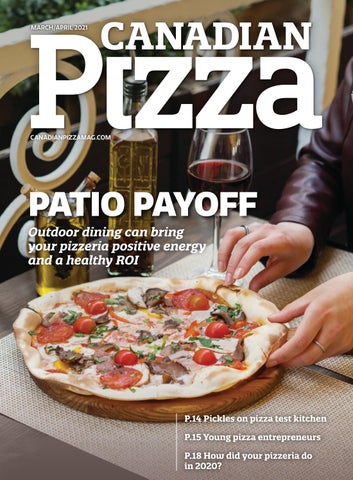
PATIO PAYOFF Outdoor dining can bring your pizzeria positive energy and a healthy ROI
P.14 Pickles on pizza test kitchen P.15 Young pizza entrepreneurs
CANADIAN PIZZA · March/April 2021
P.18 How did your pizzeria do CanadianPizzaMag.com in 2020?
1
Why the Vemag is a better pizza dough divider. Unmatched versatility. Easily adjustable to scale a wide range of pizza dough portions. Unmatched scaling accuracy. Consistently produces precise weight portions at 1% standard deviation. Easily handles stiff dough. The Vemag’s positive displacement double-screw pump gently handles even the stiffest doughs. No divider oil needed. Save thousands of dollars annually.
www.reiser.com Reiser Canada Burlington, ON • (905) 631-6611 Reiser Canton, MA • (781) 821-1290 2021
Visit our website to learn more
MARCH/APRIL 2021 Vol. 27, No. 2
DEPARTMENTS 6
From the Editor Roundtable recruiting tips
8
Industry News
10
Movers, shakers, legislation and news you can use
14 The Pizza Chef The pickle pizza phenomenon
17 Making Dough Prepping for spring
21 Recipe 23 Tools of the Trade
CONTENTS COVER STORY
New products
26 Guest Column
10 Patio payoff
Benefits of in-house delivery
ONLINE Professional Pizza Roundtable: Managing Your Pizza Team Sean Milks of Gabriel Pizza Franchise Corporation, Diana Cline of Diana’s Cucina & Lounge and Karen Horton of Patrice & Associates Recruiting Specialists discuss key staffing challenges for pizzerias. Tune in to the “videos” page at canadianpizzamag.com for ideas to inspire your own team!
14
COVER PHOTO: © MARGARITA KAPRIZE / ADOBE STOCK
CANADIAN PIZZA · March/April 2021
12 RC Show roundup This year’s Restaurants Canada event combined valuable industry information, important perspectives and advice for meeting the challenges ahead By Canadian Pizza
15 Young entrepreneurs Meet two young pizzeria owners who fell in love with the business By Colleen Cross
15
ON THE COVER In the last year, many more restaurants have jumped on board the patio bandwagon. Andrew Hind explores do’s and don’ts with industry expert Doug Radkey. See page 10.
Outdoor dining can bring positive energy, a connection with your community and a return on investment for your pizzeria By Andrew Hind
18 How did your pizzeria do in 2020? Survey says half of pizzerias who filled out our January online survey saw sales up or on par with 2019 By Colleen Cross
21 Meet Great Pizza Box Fold-Off champion Virgil Risi Virgil Risi of Maria’s Original Pizza of Brantford, Ont., emerged the winner of the Great Pizza Box Fold-Off held during our Virtual Canadian Pizza Summit.
23
22 Dough ball efficiency Centralizing your pizza operation can create efficiencies and open up new product options. Q-and-A with Ron Mullins, Reiser USA and Canada CanadianPizzaMag.com
3
FROM THE EDITOR BY COLLEEN CROSS
March/April 2021, Vol. 27, No. 2
Focus on employee skills
W
hen it comes to attracting and keeping employee, nothing beats paying a fair wage. We were reminded of that truth by young Virgil Risi, our box-folding champ featured in these pages. Working in a pizzeria is about earning money, new skills and independence. But there are so many other reasons people come to this industry. As Karen Horton of Patrice & Associates Recruiting Specialists says, even after notching up post-secondary degrees, many have fallen in love with the hospitality industry. (Horton’s comment was made during our online roundtable on Managing Your Pizza Team – check it out on our video page at canadianpizzamag.com). It’s becoming clear that employees must be given a path to succeed – whether they succeed as part of your pizzeria’s team or in other fields of work – or for that matter, other areas of their life – employees value the training you can give them and the chance to become independent. A 2018 CivicAction study points out that “soft skills” such as communications are least susceptible to economic disruption and highly prized by job seekers. As Adam Morrison of the Ontario Tourism Education Corporation said in a recent RC Show seminar on recruiting, “We don’t properly document the different skills employees learn and develop. Customer service, leadership, conflict resolution. We don’t celebrate this the way we should.” That training can come in the form of specific skills, many of which are discussed in our profiles of young pizzeria owners Dylan Taylor and Matt Chung (see page 15). Chung says he prizes the communication skills he’s picked up working in and owning a pizza business. Taylor lists several specific skills: Dealing with the public. Time management. Taking instruction, following through on tasks. Being able to confront someone and ask for help. In his mind, even something as simple as giving an employee the responsibility of switching shifts with another employee teach-
es them interpersonal skills and can give them growing confidence. These skills are highly transferable. Taylor and Chung know what they’re talking about, having taken on the role of owner. They are motivated, ambitious, energetic and creative young men who recognize the value of these skills. It’s important that owner-operators and supervisors recognize and promote the value of each of these skills. That could be done in staff meetings and communications tools or on a whiteboard. Team members could be encouraged to add their own ideas about what skills they are learning – or want to learn. This employee feedback could be combined in a working document that may be updated later on. These skills could be played up in help wanted ads, on social media and anywhere you reach out to the public. You could combine these. Giving shout-outs to team members is a solid, creative way to promote your business especially when face-to-face visits are difficult. How about posting short video of one of your employees talking about a skill they’ve developed as part of your team? Technology is a skill area that deserves more recognition. As Sean Milks of Gabriel Pizza Franchise Corporation points out in our Canadian Pizza roundtable, young workers are highly skilled at video editing, using social media and marketing. We mustn’t underestimate the value of these skills to a small business. And we mustn’t underestimate the power of recognizing and praising them in staff. Millennials and generation Z are a key part of this industry, with many entering the workforce through food service. But they are by no means the only employees to consider. As for the shortfall of workers, Mondor suggests focusing on new Canadians/immigrants as the people who can fill these jobs in the near future. Whoever you target as your next team member, promote the skills your pizzeria teaches and develops and you will be offering job seekers a meaningful work experience. | CP
6
@CdnPizzaMag
EDITOR Colleen Cross ccross@annexbusinessmedia.com 519-428-3471 ext. 261 SALES MANAGER Stephanie Jewell sjewell@annexbusinessmedia.com 705-826-2254 ACCOUNT COORDINATOR Kathryn Nyenhuis knyenhuis@annexbusinessmedia.com 416-510-6753 MEDIA DESIGNER Svetlana Avrutin GROUP PUBLISHER, VP SALES Martin McAnulty mmcanulty@annexbusinessmedia.com
COO Scott Jamieson sjamieson@annexbusinessmedia.com
MAILING ADDRESS P.O. Box 530, 105 Donly Dr. S., Simcoe, ON N3Y 4N5 Publication Mail Agreement #40065710 Printed in Canada ISSN 1203-6838 Published six times per year (Jan/Feb, March/April, May/June, Jul/Aug, Sept/ Oct, Nov/Dec) by Annex Business Media
SUBSCRIPTION RATES Canada – 1 Year $ 26.50 (+ applicable tax) Best pricing (Can/USA/foreign) available online at canadianpizzamag.com Occasionally, Canadian Pizza Magazine will mail information onbehalf of industry-related groups whose products and services webelieve may be of interest to you. If you prefer not to receive thisinformation, please contact our circulation department in any ofthe four ways listed above.
ANNEX PRIVACY OFFICER privacy@annexbusinessmedia.com Tel: 800-668-2374 No part of the editorial content of this publication may be reprinted without the publisher’s written permission. ©2021 Annex Business Media. All rights reserved. Opinions expressed in this magazine are not necessarily those of the editor or the publisher. No liability is assumed for errors or omissions. All advertising is subject to the publisher’s approval. Such approval does not imply any endorsement of the products or services advertised. Publisher reserves the right to refuse advertising that does not meet the standards of the publication.
canadianpizzamag.com
CONNECT /CanadianPizzaMagazine
READER SERVICE Print and digital subscription inquires or changes, please contact Anita Madden, Audience Development Manager Tel: (416) 510-5183 Fax: (416) 510-6875 Email: amadden@annexbusinessmedia.com Mail: 111 Gordon Baker Rd., Suite 400, Toronto, ON M2H 3R1
@CdnPizzaMag
canadian_pizza_magazine March/April 2021 · CANADIAN PIZZA
V i ta P l a n t p pe sed ba ntpla
MAKE IT
Aloha P
lant plant-based pe
VEGAN
pe ron i, s au tée d
WITH OUR
pp e
DAIRY-FREE CHEESE
ron i, p ine
,m ple ap
hot peppers, sundrie d bla eroni, epp ck o p live sed a b s, m t n a oz pl z
Pi c c a n
te P l
lla
an
a ell ar
are o zz
t
spin ach, r ed onions, mozzarella
416-439-0000
PZ_PizzaNova_MarApr21_CSA.indd 1
CANADIAN PIZZA · March/April 2021
OU T SIDE GTA (use local area code)
3 1 0-3 3 00
PIZZANOVA.COM
2021-03-25 3:41 PM
CanadianPizzaMag.com
7
INDUSTRY NEWS
ON THE WEB Fredericton pizzeria named fan favourite in online contest; Montreal takeout initiative pairs top Canadian chefs with local restaurants; COVID-19 relief funding for pizzerias and restaurants across Canada; Private fund launches to help save Ontario restaurants and bars | FOR MORE PIZZA NEWS, check out our website, canadianpizzamag.com
enjoy a game night at home. The promotion is on at Pizza Pizza locations from March 15 through April 18. Customers who purchase the “UNO Combo” will receive a large three-topping pizza, three drinks and an exclusive co-branded UNO deck for $14.99. Sister brand, Pizza 73 will launch a version of the combo that includes two pizzas, drinks and a co-branded UNO deck from April 12 through May 9. EVENTS
New dates announced for Pizza Expo: Aug. 17-19
FOOD COSTS
Dairy prices rise by 2% as of Feb. 1 The Canadian Dairy Commission has increased by two per cent the price for milk used in the manufacture of dairy products for the retail sector and the restaurant industry. A Feb. 1 announcement by the commission reads: “Effective February 1, 2021, the 4(m) milk class is updated to allow dairy processors to obtain the 4(m) permit price for the buttermilk incorporated in the manufacture of skim milk powder sold for animal feed and to include liquid buttermilk for animal feed as an eligible permit product in the 4(m) milk class up to the established limit.” 8
@CdnPizzaMag
The Class 3(d) application process for mozzarella used on fresh pizza, set up in 2013, is still in place. The changes are a result of the CDC’s review of Canadian farm-gate milk prices and other costs used in administering the supply management system. MARKETING IDEAS
Pizza Pizza and Pizza 73 offer ‘UNO Combo’ aimed at games night Mattel Canada is working with Pizza Pizza and Pizza 73 locations across Canada to celebrate the 50th anniversary of its card game UNO with the “UNO Combo.” The idea is to give friends and families everything they need to
The International Pizza Expo looks to be hotter than ever now that it’s been moved to Aug. 17-19, 2021. Registration for the Expo is open and organizers are offering a special rate for Canadian operators looking to attend the annual convention that celebrates the dynamic business of pizza. It’s as easy as pizza pie. Go to PizzaExpo.com, click on the “Register to Attend” button and enter the promo code CPM150 in the box provided to receive a discount registration for $150. In addition, you can also use the discount code DETRO. Pizza Expo takes place alongside the International Artisan Bakery Expo. The annual event is a trade show and convention designed to let the pizzeria industry shop, network and learn. Exhibitors include suppliers of pizza ingredients and pizza flour, pointof-sales systems, ovens, kitchen equipment, marketing and promotional materials and many other companies providing goods and services to the pizza restaurant industry.
Highlights in 2021 include: • A keynote talk by world-renowned pizzaiolo Anthony Falco, who made his name at Pulino’s, Vinegar Hill House and then finally legendary Roberta’s, which became an international brand. It’s earned two Michelin stars and is a favourite of pizza aficionados visiting New York City. Since leaving Roberta’s after nine amazing years, he’s consulted with clients from around the globe doing what he does best: helping restaurateurs perfect their craft and business. • Straight talk from Nicole Bean, president and owner of Pizaro’s Pizza Napoletana, about what it takes to offer more than one style of pizza in your shop. Different styles can mean different dough formulations, different equipment, new techniques, more staff training. But it can be so worth it if you commit to the process, Bean says. • A new competition for 2020, open to qualified attendees for either International Pizza Expo or International Artisan Bakery Expo. The International Italian Sandwich Championship will be limited to the first 30 entrants presenting a sandwich seen on the menu of a pizzeria, Italian restaurant or bakery. COMPANY NEWS
Pizzaiolo names Pat Finelli first chief operating and marketing officer Pizzaiolo has officially brought on Pat Finelli to assume the dual role of chief operating and marketing officer. Finelli joined the artisan pizza maker in mid 2020. March/April 2021 · CANADIAN PIZZA
INDUSTRY NEWS
“It’s a great honour to welcome Pat to the team,” said Luigi Petrella, a third-generation pizza maker who founded the company in 2000 and is now its chief executive officer. “Pat’s passion for pizza comes out each time I see him in our restaurants, when we’re sampling menu items or even just talking food strategies.” Finelli started in the pizza industry upon graduating university, accepting an accounting role at Pizza Pizza Ltd. During his 35-year career in the industry, he helped the chain grow across the country and became the company’s first chief marketing officer. “Luigi and his family, both those who are active as well as those who have paved the way before him, are extremely well respected and admired in the industry,” Finelli said. “I’ve enjoyed seeing them grow over the years and especially the way they’ve remained committed to homemade tomato sauce and hand-crafted pizzas that are made fresh in each location. I’m delighted to join Luigi’s team and help Pizzaiolo, ‘the pizza maker’s pizza’, grow and reach new customers.” Founded in 2000, the chain has more than 40 locations. In the past eight months during the pandemic, Pizzaiolo has opened three new locations in
Toronto and expects to open another 10 sites in 2021. NEAPOLITAN INNOVATION
Naples pizzeria bakes using geothermal oven A pizzeria in Naples, Italy, is making a name for itself by baking pizza in geothermal ovens. Sorelle Bandiera is the brainchild of archaeologist Vincenzo Albertini, president of Naples Underground. The pizzeria is located inside the ancient Roman theatre, not far from Piazza San Gaetano which forms the entrance to Naples Underground (Napoli Sotterranea). The pizza is prepared in the excavated Neapolitan yellow tuff subsoil of the city. The kitchen comes equipped with tuffaceous chambers for the dough to leaven within, after which they are then cooked in ovens made of the same material. “The geothermal pizzeria was born after we carried out particular studies and research into both the characteristics of the city subsoil but also of the history of Naples and of pizza,” said Albertini in a news release. “We began by first studying the Greek-Neapolitan bakers who were very famous for their signature sourdough bread. Then we further expanded upon this research by measuring the microclimatic parameters of the
PHOTO BY VINCENZO ALBERTINI
city as it stands now, which led to the discovery of organoleptic properties as reflected in the leavened dough.” What gives the geothermal pizza its signature qualities is that it is prepared in tuffaceous chambers in which it leavens for 24 to 48 hours and is then baked in a tuffaceous oven. These novelty pizzas are prepared in optimal geothermal conditions underground and served with easy access on the streets of Naples. ASSOCIATION CHANGES
Chefs Canada launched to promote chefs and products Bocuse d’or Canada has established Chefs Canada, an organization devoted to inspiring culinary excellence, promoting Canadian cuisine, terroir, producers, ingredients and products in Canada and abroad.
BY THE NUMBERS NPD Group compared restaurant ordering in Canada between December 2019 and December 2020. Here are some of the results:
25% The increase in carry-out orders
98% 45% The amount delivery jumped
CANADIAN PIZZA · March/April 2021
The increase in drive-thru orders
–NPD Group
37%
Loss in traffic for full-service restaurants
Grown from a network of 500 chefs and industry professionals built under the Bocuse d’Or Canada brand, the new entity will further define and promote Canadian gastronomy through international competitions and partnerships at home and on the world stage. The new brand will feature teams, the Chefs Academy and the Chefs Pantry. The organization will continue to participate in events and will form a World Pastry Cup team as well as support contenders in the World Pâté Croûte Championship. It will promote sharing of expertise through training, seminars and cooking lessons, Canadian cooks, chefs and industry professionals will have a reliable resource to turn to for guidance, mentorship and information. To launch this new service, the team has partnered with Sysco, on the Chefs Academy podcast, which will explore topics affecting the Canadian restaurant industry. Chefs Canada will launch the Chefs Panty, a gourmet line of products to the public. Proceeds generated will directly support the development the national teams the organization represents. More information is available at chefscanada.com. CanadianPizzaMag.com
9
COVER STORY
PATIO
PAYOFF
Outdoor dining can bring positive energy, a connection with your community and a return on investment for your pizzeria BY ANDREW HIND
10
@CdnPizzaMag
The data bears out the importance of patios moving forward, says Roberto Sarjoo of Restaurants Canada. “Our Angus Reid survey conducted Sept. 17-18, 2020, found that 76 per cent of Canadians were comfortable eating on a patio/outdoors for a full-service restaurant, and 66 per cent felt comfortable eating on a fast-food patio. Only 49 per cent said they would feel comfortable eating indoors,” he explains. “From our most recent Chef Survey, 27 per cent of respondents upgraded their patio by adding overhead covering, patio heaters and additional seating,” this last point a clear sign they viewed patios as more than a single-season expediency. In 2020 The City of Toronto launched CafeTO, a program designed to provide help to restaurants, bars and cafés suffering from revenue losses brought on by COVID-19 by allowing restaurant owners to make patio space in curb lanes and along city sidewalks (many municipalities across Canada unveiled similar programs). The city conducted a survey of 2,800 respondents consisting of restaurant owners and members of the public. The results showed that 95 per cent of respondents want to see CafeTO in 2021, 90 per cent said they were “very satisfied” or “satisfied” with their patio experience, and perhaps more critically, 66
Offering outdoor dining is all about delivering a unique and pleasant experience.
27%
The number of respondents who upgraded their patio by adding overhead covering, patio heaters and additional seating in 2020 (Restaurants Canada Chef Survey)
per cent of operators said their restaurant wouldn’t have survived without CafeTO. Unsurprisingly, CafeTO will return in 2021. Whether your patio is temporary or intended to be a permanent fixture, having a successful patio takes planning. Naturally you want to be ready to take full advantage when the good weather hits, so that means a lot of advance planning. It’s not enough to put up a barrier and throw out tables and chairs. You need to be as thoughtful when designing a patio as you would your restaurant’s interior. Success depends upon it. March/April 2021 · CANADIAN PIZZA
PHOTO: © MARGARITA KAPRIZE / ADOBE STOCK
P
atio season is fast approaching, and for pizzerias and Italian restaurants struggling under the continuing COVID-19 pandemic it’s none too soon. Traditionally, many restaurants have eagerly embraced patios. And for good reason. “The essence of an outdoor dining option has always been a driver of foot traffic,” explains Doug Radkey, president and project manager of KRG Hospitality Inc. “While not every venue has the setup or capacity to execute an outdoor dining program, the ones that have an opportunity to do so must look at this as a must-have investment. There is tremendous value in offering an outdoor dining option as they often bring positive energy, conversations and a desired connection with your community. The return on investment will always be there, if executed properly.” In the last year, many more restaurants have jumped on board the patio bandwagon, viewing them as an economic lifeline in an era of limits on indoor dining and social distancing. “This [the implementation of patios] is expected to increase twofold as we continue to navigate the pandemic and the successful recovery of this industry,” Radkey says.
COVER STORY
“Comfort and safety are always crucial elements to a successful outdoor dining program. You want to ensure you have temperature control, pest control and noise control within your patio. If you’re near to a street – ensure you have safety barriers that will protect your patio. These are all things that could have a negative impact on your guests’ experience and the perception of your brand,” Radkey explains. “Look for solutions to keep it warm during colder weather or to shade it when the sun is at its peak. Find solutions to block wind and prevent heavy rain from ruining a potentially profitable day or night on the patio. Take the time to meet with your CANADIAN PIZZA · March/April 2021
pest control vendor and discuss your plans for outside. They can suggest safe bug repellents and means of keeping away other animals and critters like mice, squirrels and even birds.” Noise – in the form of vehicle traffic, construction and other background sound – is often an issue with patios. You want to mitigate it using fencing, vertical screens of wood or glass, or plantings (which have the added benefits of offering protection from wind and providing some privacy). A good sound system is also part of a comprehensive noise reduction strategy. The bar has been raised when it comes to what customers find acceptable in patio furniture. Cheap white plastic chairs will no longer cut it. When selecting outdoor furniture, bear in mind that the elements will inevitably take their toll. Synthetics are better than wood, which tends to be high maintenance. Lighting is another important consideration, as you need to provide enough lighting to ensure safety and comfort. Installing additional lights on exterior walls provides reflected illumination, which is easier on the eyes than direct light. LED string lights or lighting within trees add both illumination and ambience. If you have a patio, you should embrace nature in some form – no one wants to be surrounded entirely by asphalt or concrete. Plants have a way of softening these harsh environments. Is there an opportunity to plant small trees or shrubs? If so, select evergreens that will look good throughout the years and provide much-needed shade, privacy and shelter. Plant climbing vines along trellises. Add large containers to create height and break up sightlines. Select plants that are low maintenance (so you don’t have to incur the additional costs of hired landscapers) and ones that are hardy (so you won’t have to replace those that die). “The number one best practice is to ensure you’re delivering an experience,” Radkey says. “To do that, out-
side of providing a safe, comfortable, and energetic atmosphere, you need to also review your menu options (consider creating unique outdoor food and beverage menus), your labour needs (depending on the size of the patio you may need additional staff to handle the extra covers; customer service and work in the kitchen should not be hindered by the fact additional seating is now offered), and your flow of service from reservations, to ordering processes to payment processes. You need to review the entire guest journey to ensure you’re delivering a seamless, memorable experience. The restaurants and bars that provide the right mix of planning and energy are the ones that will attract a consistent level of guests throughout the patio season.” Plan for the traditional patio season to extend well into the cooler months, Sarjoo recommends. “47 per cent of those who responded to our Angus Reid poll said that ‘patio season’ will likely be permanently extended well into the fall/early winter each year.” “Just thinking that putting out some tables, chairs, and umbrellas or patio heaters will be enough is the downfall of a successful outdoor dining program,” Radkey says. “This past winter, for example, too many venues expected guests to just sit down and enjoy a meal like normal by putting out some patio heaters. That didn’t work. You also cannot expect staff to go in and out of the cold all day long serving food and drink. That is not feasible. You have to create an actual outdoor experience first – that is what will drive awareness, revenue and repeat business.” In the best of times, patios are a driver of business for any restaurant. In the era of COVID-19, they may represent the difference between life and death. You don’t need to go all in, but you should be in the game. | CP
‘Depending on the size of the patio you may need additional staff to handle the extra covers; customer service and work in the kitchen should not be hindered by the fact additional seating is now offered.’ –Doug Radkey
Andrew Hind is a freelance writer from Bradford, Ont., specializing in food, history and travel. He is the author of 25 books and the proud father of one. CanadianPizzaMag.com
11
EVENTS
RC SHOW ROUNDUP This year’s Restaurants Canada event combined valuable industry information, important perspectives and advice for meeting the challenges ahead BY COLLEEN CROSS
I
f you want to have growth in your business during and beyond the pandemic, you have to be ahead of the curve. This was the overriding message of a virtual Restaurants Canada Show panel “Where do we go from here? COVID-19’s impact on foodservice and hospitality.” The experts set out to help operators do just that by sharing insights on the lasting effects of the workfrom-home movement on food service, where Canadians are spending money and the evolution of service coming out of the pandemic.
12
@CdnPizzaMag
Asad Amin, vice-president of Ipsos, shared insights from two studies Ipsos carried out through Foodservice Monitor and Five Syndicated. A whopping 90 per cent of Canadians are eating at home for the vast majority of their meals and the question is, will people become comfortable in this habit? Prior to pandemic, 42 per cent worked outside the home, now it’s 23 per cent working away from home and 31 per cent working from home. “We may not get that traffic back after the pandemic,” Amin said. “There is a strong urge to be at home, people are comfortable and they may not want to change.”
‘Local vacationers have needs – they are just different needs than outside tourists.’ – Vince Sgabellone, NPD Group
He shared findings that, depending on your pizzeria’s situation, may or may not surprise you: • Those working away from home tend to be older blue collar and those working from home tend to be on the younger side. • Lunchtime traffic is down 43 per cent primarily because of the exodus of office workers. • Delivery has grown by 45 per cent. Digging into delivery, Amin revealed that average party size has grown significantly over the pandemic period. People ordering from home are ordering in larger quantities and this is something you’ll want to keep this in mind. On the electronic side, two-thirds of Canadians use streaming services, more than half communicate by video and one-third work using video. Of interest to restaurants, nearly half are engaging with screens when ordering food. Before the pandemic, basic hunger was the main motivation behind eating at home and something he called “craveable rewards” was the motivation behind eating out. Interestingly, now people are interested in craveable rewards both at home and when going out. Restaurants need to learn how to tap into the trend of people working from home, staying at home and wanting to treat themselves. Vince Sgabellone, Foodservice Industry Analyst with The NPD Group, talked about how retail spending has shifted. We are shopping and eating differently and the idea of having experiences – “the experience economy” – has declined drastically. Instead of a vacation, people are barbecuing in their backyard. Instead of going to the gym, they are buying inhome exercise equipment. We’re spending less and saving more – possibly to buy a home away from a city or a car to socially distance while travelling and access drive-thrus, he speculated. March/April 2021 · CANADIAN PIZZA
EVENTS
About this time last year, NPD Group reported digital food service spending had tripled. This past year that has tripled again. “We need to reach people where they are and help them improve their quality of life at home,” he said. This includes birthday parties and corporate events. To reach these customers, consider offering subscriptions, meal kits or hosting online events. Why not help support people who are buying gadgets to cook at home get more use out of their gadgets? Why not help them fight cooking fatigue by reminding them they can escape the routine with a restaurant meal. Support local tourism and stay-cations. Promote meals to-go and cross-promotion with other local businesses. Local vacationers have needs – they are just different needs than outside tourists. Full-service restaurant recovery has plateaued at about -15 per cent for last four months. How do we jump-start sales? This industry needs to, as one example, encourage ordering more food than they thought they needed and eating leftovers. Focus on customers’ needs and the sales will come. Off-premise dining will maintain a larger share of eating occasions, said Melissa Wilson, principal of Technomic Inc. But what will off-premise look like in the coming months? Technomic did a survey of 1,000 consumers. Many said they will eat out more, but almost an equal number said they will eat out less. People say they expect to order less from third-party but the convenience is expected to continue to draw them in. And younger people will continue to drive off-premise dining. We can expect to see more technologies for ordering, more geofencing and more ghost kitchens. There are more of these CANADIAN PIZZA · March/April 2021
types of innovations and that is because customers are using them more. Customers are driving that innovation. They’re seeing fast-casual brands adding drive-thru, new to-go-only formats by full-service brands such as Buffalo Wild Wings and big brands such as KFC scaling back on eat-in to do more curbside delivery with customized parking spots. Our expectations of different types of restaurants – full-service, drive-thru, fast-casual – are changing. On a positive note, the survey results suggest consumers can’t wait to dine in again. 65 per cent of people miss being waited on, having someone else plan their meals and do the dishes. And about 60 per cent of people surveyed said they miss the atmosphere. Consumers still need convenience when kids go back to school and former routines come back and life accelerates. But they will want to eat things they wouldn’t prepare at home, and don’t have the same level of presentation of a restaurant. Visible cleaning and sanitation will be more important than ever post-pandemic: it will be expected and a strong consideration in where people eat out. Self-service concerns will linger. People said they will use these less: food and salad bars, self-serve desserts, self-serve bakery cases all will be slow to return. Use of tabletop condiments are a concern but to a lesser degree. Almost one-third of operators plan to invest in voice-activated technology and many are interested in hands-free door openers or hands-free technology. The pandemic has made us view robotics differently. It’s now seen as less gimmicky, more practical and safer. | CP
IMPORTANT SESSION TACKLES INDUSTRY RACISM High Liner Foods chef Philman George moderated a timely roundtable called “Inclusive Kitchen: Tackling Systemic Racism.” Successful chefs shared their experiences with racism and talked about solutions. Eden Hagos, founder of the Black Foodie media platform, said she’s experienced racism as subconscious bias, racism as a customer and as a chef. Black professionals often are not considered, not hired, not promoted – not seen, Hagos said. Chef and social advocate Suzanne Barr talked of the need for everyone to not just talk about but stand behind their values. Joseph Shawana, chair of Indigenous Culinary of Associated Nations and professor at Centennial College, said he teaches about racism through the classroom before people enter the industry. Roger Mooking, chef and host on Food Network and Cooking Channel, talked of the importance of working hard – then taking action. “You can either ask for the key to the door or you can build your own house,” he said. What can employers do to attract a more diverse workforce? Barr summed up: “Take yourself out of your place of privilege and see what others are experiencing. It’s not about just hiring Black. Having a diverse spectrum of staff is the way of the future. Put tools in place. Ask questions that make people uncomfortable. Understand your sense of privilege and really own it.”
CanadianPizzaMag.com
13
THE PIZZA CHEF BY DIANA CLINE
Diana Cline is an award-winning pizza chef, a partner with Diana’s Cucina & Lounge in Winnipeg. In addition to creating award-winning recipes, Diana is a consultant to other pizzeria owner/operators in menu development, creating operational systems and marketing to help operators grow their business strategically. Contact her at diana@dianascucinaandlounge.com.
M
ove over pineapple. Pickles are here. In recent months there has been a new ingredient erupting onto pizzas everywhere. If you haven’t seen it in your neck of the woods, maybe you should be the first to add it to your menu! What am I talking about? No, not Fruit Loops. I’m talking about pickles! Yes, it seems that while pineapple on pizza has been used to divide us into camps, now we can argue about pickles on pizza. It might not come as a surprise to some that I’ve had designer pizzas and flatbreads with pickles on my menu going back to 2015. I created a flatbread I called “Farmer’s Dawg” featuring our locally sourced gluten-, dairyand nitrate-free farmer’s sausage; olive oil and herbs sauce; garlic-and-chives Havarti; spicy Italian-style pickles and Dijon mustard on top. In this case, the pickles are raw and topped after the flatbread is fully baked. This phenomenal pizza pairs well with our Pinot Grigio and also most of the craft beers that we carry. Last year, I also created a weird specialty pizza that I called “Consent Fries with a pickle” featuring our olive oil and herbs sauce, seasoned french fries, gravy, farmer’s sausage, strip bacon, mozzarella, cheese curds, garlic-and-chives Havarti cheeses, dill pickles, and more gravy on top. It was well received by my regulars, and also by my own family. A quick search reveals a few interesting pickle pizzas made by home chefs. The most popular ones are simple pizzas with a creamy garlic-based pizza sauce, pickles and mozzarella. Some have bacon, and some suggested ranch dressing on the side for dip.
From test kitchen to menu Recently a good friend and I played around with a few different styles of pickles: dill, spicy, bread-and-butter, 14
@CdnPizzaMag
We were inspired to make a dill pickle pizza dough: one with dill weed only, and one with both dill weed and dill pickles.
Meat toppings that pair well with dill pickles: farmer’s sausage bacon capicola ham pepperoni corned beef salami chicken chorizo sausage
extra garlic and a bunch of other ingredients. We dressed some of the dill pickles up with a beer-battered, breaded topping sprinkled with dill, then fried them. Then we used them on a pizza with other toppings. We especially enjoyed those ones: crunchy, salty, with a nice bite to them on the pizza. My friend made a specialty pizza with dill dressing as the sauce base, breaded pickles, mozzarella and dill weed sprinkled on top. A couple of my favourite creations from that day – now on my menu – are “Sweet’n’Spicy Pickle” with olive oil and herbs sauce, dill pickles, farmer’s sausage, jalapenos, mozzarella and Cheddar cheeses with a drizzle of honey on top. The name says it all. Another one that I’m calling “Pickle BLT” featuring my new dill pickle pizza crust as a flatbread, a drizzle of olive oil and sea salt, mozzarella and cheddar cheeses, strip bacon, grape tomatoes and dill pickles. After it’s baked we drizzle it with ranch dressing and top it with fresh romaine lettuce. I sampled this one with my pickle-loving neighbours and it received rave reviews. It is well suited to spring, summer and beautiful patio weather. Other meat toppings that we thought paired very well with dill pick-
les are capicola ham, pepperoni, corned beef, salami, chicken, and chorizo sausage. The cheeses that we thought were especially good were a medium sharp cheddar, garlic-and-chives Havarti and Monterey Jack. If you’re looking to spruce up your menu this spring, I highly recommend you try pickles out, as a topping, and see how well received they are in your market. Lastly, we were inspired to make a dill pickle pizza dough: one with dill weed only, and one with both dill weed and dill pickles. We didn’t know what to expect, so we made only a small batch. I went with a 55 per cent hydration and then we let the dough cold ferment for 24 hours. We baked them up the next day to taste-test. I made the double dill pickle pizza dough into a simple focaccia, drizzled it with olive oil and a sprinkle of sea salt. I wanted to taste the dough just on its own, and it was super awesomesauce! It baked up crispy and light, and you could taste both the dill weed and the pickles in the crust. I baked the second single dill weed dough as a half-and-half pizza: half just Monterey Jack and mozzarella cheeses and half with pepperoni. It paired very well as the base crust, again: light and crispy on the outside and soft bread on the inside. Both crusts were quite nice, but my favourite was the one that had both dill weed and dill pickles. As it is with many of my weird creations, I decided to put it on my menu at Diana’s Cucina. My friend and I, our families and our taste testers really enjoyed it, but you never know if it will sell – until you put it on the menu. We launched it the third week in March. We’ll see what happens. If this column has inspired you to add dill pickles to your pizza menu, drop me an email and let me know. I’d love to hear from you. Until next issue, be well and be kind. | CP March/April 2021 · CANADIAN PIZZA
PHOTO: DIANA’S CUCINA & LOUNGE
The pickle pizza phenomenon
PROFILES
PAST AND FUTURE UNITE!
Meet two young owner-operators with different approaches to taking over classic pizzerias BY COLLEEN CROSS
PHOTO COURTESY CHEF BONDI PIZZA
Chef Bondi: Bringing back the classics Dylan Taylor will remember 2020 for the pandemic but also because that’s when, at age 19, he became owner of Chef Bondi Pizza in St. Thomas, Ont. Under the ownership of Agostino (Gus) Bondi and Phil DiLosa, the pizzeria has seen railway and automotive booms come and go since it opened in 1964. For three-and-a-half years, Taylor worked closely with DiLosa, and later with an interim owner for four months in 2019. Taylor bought the business for $60,000, a steal of a price, after saving up after working two jobs full time and at the pizzeria part time. He remembers the moment he decided to accept the offer to buy the business. “I was at the factory the day after the offer was pitched to me. I was working, putting parts where they needed to be. I just stopped and looked around. I thought, ‘This can’t be me in 50 years.’ It was like a switch turned on in my brain telling me that’s what I am supposed to do.” The young entrepreneur’s strategy has been to return the pizzeria to its roots and he is working hard to highlight its glory days. They sell two main pizzas: Chicago-style and original, both of which are popular. They bridge old and new during this transition by giving customers choices. Cheese on top or cheese on the bottom. Sauce develCANADIAN PIZZA · March/April 2021
Young entrepreneur Dylan Taylor is working hard to highlight the glory days of Chef Bondi Pizza in St. Thomas, Ont.
SKILLS LEARNT AT A PIZZERIA: • Dealing with the public • Time management • Taking instruction, following through on tasks • Being able to confront someone and ask for help (Dylan Taylor, owner, Chef Bondi Pizza)
oped in 2019 by the previous owner or the classic “Phil’s sauce.” “I like to please as many people as I can.” He says the pizza business has taught him key skills such as dealing with the public, time management, taking instruction and being able to confront someone and ask for help. “I am not a social person. That made me want to work in food,” he says. “I had anxiety, I couldn’t function well, and I saw as opportunity to be able to fix something I struggle with. It’s really helped me.” “Working here has been a great way to open that gateway into talking to people face to face and when they’re in a good mood.”
Food service can help you with stress management, he says. “You have to go from slow to fast, figure out priorities and be able to shift into gear. It’s a very important skill. I think every kid should try food service to see the different ways you can manage your time.” He’s also a problem solver. “I love hearing if I did something wrong because I can fix it on the spot. If you can get the feedback when you need it, it gives you the ability to improve things.” He works with four team members, most of whom are young. He finds managing staff he used to work alongside as a co-worker tricky at times. “That’s a little barrier I’m trying to overcome. But I like knowing I have something to work on.” Bookkeeper and small business advisor Kathy Cook Noble has been a great source of help, he says. “As much support as a person can give a pizza business, she gives – she orders pizza for her office and tells everyone about the business. And she invited me to do a podcast with her. It’s a great idea to take opinions from someone else.” One change he has made is to add a full breakfast. His dad, an experienced cook, volunteered to serve a full breakfast from 8 a.m. to noon to residents of new seniors apartments across the street. It provides an affordable meal, makes the pizzeria part of the neighbourhood and uses the otherwise empty space during off hours. There are more changes in store but most relate to returning to a retro vibe. He recently obtained the full set of classic recipes from Phil. “We are getting set to ‘pump up the diningroom.’ ” “We’re trying to keep everything super retro, authentic Italian, making our own pastas and sauces. We want to do CanadianPizzaMag.com
15
build-your-own pasta and handmade ravioli. That’s something missing in the St. Thomas area.” When the pandemic is over, he wants to get back their liquor licence and bring in some nice wines to complement the menu. He brims with excitement as he describes his vision and his plans to talk with great Italian chefs for inspiration. “This is totally new for me to explore and learn about.” “I really just want to add my own thing but keep it what it was. That’s really what I want most for the business. I like the story it had. “I am honoured to carry on.”
Papa Ceo: Three-part menu celebrates past and present In 2017, at age 25, Matt Chung bought Papa Ceo, a Toronto pizzeria with a colourful history going back to 1984. He brought to it a pair of fresh eyes and a talented, hardworking family to help run it. The Papa Ceo (pronounced “Chey-o”) website is bit tongue in cheek, calling itself “a hole-inthe-wall, family/friend-run pizzeria serving one of the best thin crust pizzas in Toronto.” But the story of this pizzeria and its revamp is fascinating. According to Chung, Papa Ceo was opened in 1984 by Tony Bonventre, who came to Toronto from Sicily in the 1950s and opened several pizzerias with various family members. Chung and his family took over Papa Ceo’s, tweaked the original recipes and added their own twist. Chung’s great uncle and father introduced him to the opportunity. “My great uncle, Tai Lam, had worked at the rival pizzeria next door for over 20-plus years and my dad used to own his own sandwich shop,” the young owner says. Tai Lam is key to this story. A Vietnamese refugee, he came 16
@CdnPizzaMag
Toronto’s Papa Ceo owner Matt Chung, left, is working with great uncle Tai Lam to combine old-school Italian pizza, new traditional pizzas and signature pizzas featuring Asian toppings.
to Canada in the late 1970s and started off delivering pizzas and working at a bunch of Toronto pizza places, his nephew says. “He’s a good resource to have.” Tai, the chef, was actually more like a partner when first hired. Other family members work in the pizzeria as well – a total of nine staff. Chung says he couldn’t operate without the help of his family, some of whom quit their previous jobs to come on board. “It’s a lot of work. It’s important to have trusted, dedicated people working with you.” Chung himself has an interesting background writing music for films. He likes the change of pace from such an introverted line of work. “I really like building relationships with customers. I’m so sheltered. And all these people have different stories.” “I think the most special thing is that I get to work with my family and friends. We just hang out, make pizza, hear random stories from customers, witness interesting things and it’s pretty fun. It helps that we’re in such a diverse area right beside University of Toronto where we see so many international people.” Typical customers are community people and especially university students. “We do a lot of slice sales,” he says.
“Our brand is special in the way that we fuse traditional Italian pizza with Asian toppings,” Chung says. A common element to several of the pizzas is a special spicy pork sauce. Pizza crusts are thin. The new owner has kept about half of the original pizzas – the most popular ones – and added new pizzas. The result is a three-part menu that’s one-third “Retro Classics,” onethird “Signature” pizzas featuring Asian ingredients and one-third “Signature Classics” featuring more traditional North American ingredients. Many Retro Classic pizzas are named for movie stars such as Kevin Bacon and Audrey Hepburn. Legend has it that Robert De Niro came into the store in the 1980s and there is a pizza named for the Hollywood giant featuring Italian plum tomato sauce, mozzarella, Italian sausage, ham, prosciutto, mushroom and spinach. The bestseller on the Retro Classic menu is Tony’s Sicilian. The Papa Ceo Signature Classics include the Blue Jays Meat Lover featuring plum tomato sauce, pepperoni, Italian sausage and ground beef. Among Tai’s Asian fusion pizzas, the top seller is Tai’s Margherita, a vegetarian pizza featuring Italian plum tomato sauce, extra
mozzarella, basil, oregano, olive oil and Tai’s secret garlic sauce, is the most popular. Tai handpicks ingredients daily, Chung says. The Margherita was added in 2017. “Tai is a perfectionist,” Chung says. “He keeps trying to make it better all the time.” Every week or so, they shake up the display at the front with a special pizza created by their team. For example, Long’s Clam Chowder was created by his dad. “The biggest challenge as an owner is trying to constantly improve and innovate,” he says. After that, the challenge is sourcing quality ingredients without breaking the bank. Like so many restaurants, COVID-19 threw them for a loop. “We thought would go away in two weeks, but after the shutdown suddenly 80 per cent of business just stopped, though we were still getting orders on Friday and Saturday. They no longer saw their regular customers but, surprisingly, during the pandemic people placed large orders. Looking ahead to the future, they are in the process of figuring out take-and-bake and developing a line of Asian-Italian frozen pizzas. “We want to focus on getting our logistics down, improving our workflow, then after that we want to expand,” Chung says. “I took over not knowing anything about pizza or the food industry. It was a totally new environment for me coming from a music production background. I think what I bring to this longstanding business is a pair of fresh eyes. This business has been around longer than I have been alive, which is intimidating, but I’m not married to any ideas on how it used to operate and I’m not afraid to do things that challenge tradition.” | CP March/April 2021 · CANADIAN PIZZA
PHOTO: COURTESY PAPA CEO PIZZA
PROFILES
MAKING DOUGH WITH DIANE BY DIANE CHIASSON
Diane Chiasson, FCSI, president of Chiasson Consultants Inc., has been helping foodservice, hospitality and retail operators increase sales for over 30 years by providing innovative, revenue-increasing marketing strategies. Contact her at 416-926-1338 or chiasson@chiassonconsultants.com, or visit chiassonconsultants.com.
Three ways to quickly recover for small pizzerias
T
imes of crisis and challenges are always difficult for restaurant owners and operators, but they also provide opportunities for business operators to innovate. Changing marketing tactics and scaling down menus are just a few things that pizzerias are doing to stay in business during this pandemic. Here are three key ways to quickly recover and thrive:
IMAGE: ADOBE STOCK
Concentrate your effort on your local community Pizzerias are the heart of many communities. Small, local businesses are what give a town or city its character. It’s where young couples with children enjoy a Saturday afternoon with pizza and drinks, families get together to celebrate birthdays, and friends gather for delicious and hot pizzas. Focus on connecting with your customers and your community. Stay in touch with your customers, whether you are open or closed. They care about you and your business, especially those who are regulars. Never before have we seen local communities rally together so much to support small businesses. People are really making an effort to buy local. Ensure that your customers think of you when they decide to shop around for their upcoming events such as birthdays, anniversaries and graduation. During these challenging times, people are still looking for pizzeria operations to provide that same level of comfort and feeling they experienced in the past. Start building your customer list. You may have already captured people’s email addresses on your website, but make sure you are also doing it in store. Are you encouraging your social media fans to subscribe to your newsletter? Have you thought of SMS (short message service), which is a text messaging service component of most CANADIAN PIZZA · March/April 2021
Your pizza operation should be based on four customer needs: quality reliability ease
telephone, Internet and mobile device systems? Once you have built these lists, you have an opportunity to have “sales conversations” with customers by sending them timely and relevant messages. Customer communication should be consistent and can take place through various formats, such as email, your website, your customer service line, social media platforms. These are the top subjects you should be communicating about with your customers: your strict safety, cleaning policies, sanitation measures; your takeout, delivery or curbside pickup options; and your future plans for your restaurant. You should also list your current hours of operations and include community support messages.
accuracy
Get restaurant customers to come back again quickly
The easiest way to get started marketing online is to pick the top four to six things you want to be known for. Talk about one of those things each week across your social media platforms.
There are only three ways to increase revenue for your pizza operation. Get new customers. Have your current customers spending more money per visit. And get current customers returning more often. For years, Starbucks used this strategy successfully to increase afternoon and evening sales. If you bought a coffee in the morning, Starbucks gave you a printed receipt with an offer to return the same day, and you got $1 off your next purchase. These offers created goodwill with their best customers. Offer a free gift with purchase. This can be enough to entice passersby in the door. Try to create a free offer with no strings attached. As you know, free offers always get the most activity: “Buy a pizza and get a free drink.” My testing has proven that offering a one “free item” will get around three times more redemptions than offering a price or percentage discount. You could always create expiration dates. This gives customers a sense of urgency to return to your pizzeria for some other treats. I am sure that you could set up in your POS system a receipt
with the printed offer. For more impact, you could create a small advertising card with pictures to place in front of your cash register. Your staff should also point out the offer to the customer. Train your employees to say, “Thank you, and don’t forget to view our special on our website. For example, if you come back within a week, you can get a free________.”
Continue focusing on quality and great customer service Quality pizzeria products and friendly local customer service have not changed since the start of the pandemic. Continue building relationships now and these will turn into future sales. Your pizza operation should be based on four customer needs: quality, reliability, ease and accuracy. Your product mix should always include high-quality products and ingredients, and satisfy as many dietary and lifestyle preferences as possible. Make yourself known not only to your existing customers but also to your future clients. For the time being, the best way to build relationships is online: you should show up consistently with relevant, helpful advice. Getting the word out is certainly your next step to survive, and that’s why it’s important that you develop your social media brand. Tap new online marketplaces to expand your market. The easiest way to get started is to pick the top four to six things you want to be known for. Talk about one of those things each week across your social media platforms. To alleviate people’s safety concerns, heighten your cleanliness standards. Let customers know you limit the number of customers in the store at one time. Proactively communicate changes that affect your operation. Finally, update your location, restaurant hours (including temporary closings or modified hours), and takeout or delivery options. | CP CanadianPizzaMag.com
17
SURVEY
HOW DID YOUR PIZZERIA DO IN 2020? Survey says half of participating pizzerias saw sales up or on par with 2019 BY CANADIAN PIZZA STAFF What was your biggest operational challenge in 2020?
33%
13%
Finding and keeping competent, reliable staff
Other
8% Marketing and reaching new customers
Managing the flow of orders from different sources (delivery/ curbside pickup/ walk-in traffic)
20% Managing staff scheduling was a headache
H 18
@CdnPizzaMag
Who participated? We thank the 61 pizzerias who shared their experiences in the survey. 75 per cent identified themselves as small independents. About 15 per cent were franchises with two or more locations. The remainder described themselves as a large independent or small independent with two locations. To our question “How were sales at your pizzeria in 2020?” answers were mixed:
• Twenty-five per cent reported sales decreasing by more than 10 per cent compared to 2019 sales. • Nearly as many pizzerias (21 per cent) reported sales increasing by more than 10 per cent. • For 17 per cent sales decreased slightly. • Another 13 per cent of businesses reported sales on par with 2019. • For 12 per cent of businesses responding, sales increased slightly.
Unsurprisingly, considering COVID-19 restrictions, for 60 per cent of pizzerias, most of their sales came from take-out. Just over a quarter of pizzerias saw most of their sales from inhouse delivery. A few (seven per cent) saw most of their sales from third-party delivery. Not surprisingly, only about three per cent reported the majority of their sales came from dine-in customers. A couple of pizzerias reported most of their sales came from a combination of dine-in and take-out.
What was your biggest operational challenge in 2020? One-third of pizzerias said that finding and keeping competent, reliable staff was their biggest operational challenge. One-quarter March/April 2021 · CANADIAN PIZZA
IMAGE: © MALLARI / ADOBE STOCK
Where did the majority of sales come from?
26%
ow were sales at your pizza business in 2020? Canadian Pizza magazine conducted a short national online survey to find out how pizzerias in Canada fared in 2020. As a thank-you to participants, we entered them in a draw for a chance to win a set of Apple AirPods. Congratulations to Domenic Ruggiero of Dante’s Mobile Pizza in Grimsby, Ont., who won the AirPods!
The 12 per cent – seven pizzerias – who responded “Other” to this question told an interesting tale. Discouragingly, one business reported sales decreased by 45 per cent compared to 2019 and another reported sales were down by about 65 per cent. However, there was also good news: five pizzerias told us they opened in 2020. One response was encouraging for the future independents: “I opened on April 1 and our sales are increased up to 25% on top of the break-even point.”
SURVEY
said managing the flow of orders from different sources (delivery/ curbside pickup/walk-in traffic) was keeping them up at night. For almost 20 per cent of pizzerias, managing staff scheduling was a headache. Eight per cent found marketing and reaching new customers a major challenge. As expected there were several responses outside of the choices given (13 per cent responded “Other”): • grocery, products and food cost • COVID shutdowns and restrictions • shortages/availabilty of mozzarella, increase prices in supply chain, for example, pepperoni produce • keeping staff safe from COVID and informed about changing protocols • dealing with suppliers: shortages and major price increases • finding staff that wasn’t collecting CERB (Canada Emergency Response Benefit)
How would you describe your delivery capability? Forty-two per cent of pizzerias described their delivery service as inhouse only. Twenty-one per cent don’t deliver and an equal number use third-party service only. Others (14 per cent) offer both in-house delivery and service through a third-party company. One participant reported they launched delivery in January 2021. The result? “So far it’s not as popular, people still prefer to pick up.”
Did your delivery mode change in 2020? This proved a complicated question, as 37 per cent of pizzerias did not change their delivery mode in 2020. Of those, 21 per cent were not satisfied with third-party services but continue to use them and 16 per cent were CANADIAN PIZZA · March/April 2021
satisfied with extra sales from third-party services. Some pizzerias (18 per cent) changed how they delivered in 2020. Nine per cent we ended their contract with a third-party service. Seven per cent added third-party service in 2020. Two per cent signed on with a delivery co-op. However, pizzeria operators had more – much more – to say. A quarter of participants answered “Other” to this question. Clearly, the range of choices we gave did not fully describe the experience many of you had. Here is a representative sampling of the comments: • “Stayed with in house delivery, no third party” (there were 15 responses to this effect) • “No delivery, didn’t change” (there were a half-dozen responses to this effect) • “COVID-19 restrictions, contactless delivery and online payment challenges” • “No, did not change but numbers down 10-15%” • “We do our own delivery using our own staff to maintain their hours and keep costs down” • “We focus on building a large delivery team in house to avoid price gouging from third party companies” • “We do our own delivery with using our own staff to maintain their hours and keep costs down from using a 3rd party solution” • “We are eat-in or pick-up only” • “Did not deliver, pick-up only”
Unsurprisingly, for 60 per cent of pizzerias, most of their sales came from take-out. Just over a quarter of pizzerias saw most of their sales from in-house delivery. grade current location. Others planned to move operations (just under 10 per cent) to another location or downsize (just under 10 per cent). A few wanted to expand outdoor seating (three per cent) or partner with another business such as a brewery or bakery (three per cent). A significant percentage of responding pizzerias (14 per cent) had more to say about making
changes to their business. Some said multiple changes were in store and others said “none of the above” changes were planned. Some had “No major plans for 2021” other than to “stay afloat and carry on.” One forward-thinking operator planned to add virtual concepts to their kitchen. Another reported starting to sell frozen dough and pizza kits at a grocery store. It’s clear from our poll that pizza businesses do not all fit into one mold. For every individual business there is an individual circumstance. It’s our goal to recognize and understand those differences, and to provide information and inspiration for all of our readers. Look for online and print coverage of issues uncovered in this national survey. | CP
NOW AVAILABLE
CERTIFIED HALAL PIZZA TOPPINGS Beef Pepperoni, Julienne Cut Chicken, Beef Crumble, Beef Sausage, Veggie Pepperoni and more...
What changes are you planning for 2021? Looking ahead, more than 20 per cent planned to increase takeout/curbside/delivery capability. About the same percentage planned to add a new pizza style or major product category. A good number (18 per cent) see 2021 as a good time to renovate or up-
Wholesale: 905-547-1321 www.SpringersMeats.com
CanadianPizzaMag.com
19
GUEST COLUMN
Design expert Michael Chusid, FCSI, RA, may be reached at +1 818 219 4937 (UTC/GMT -8) or michael@chusid.com.
BY MICHAEL CHUSID, RA, FCSI
Pizzerias choose elegance above all
I
20
@CdnPizzaMag
Montreal’s Restaurant Di Menna, originally a pizzeria that expanded into full-menu fine dining, creates a dramatic setting with coffered Ceilume panels in a metallic tin finish.
dark metallic tin-finish coffers, framed in a white soffit, dramatically focuses attention on the dining area. Ludica Pizzeria and Game Room in Vancouver mixes two panel styles to create a unique ceiling. The deep-relief floral Florentine style alternates with Fleur-de-lis, a stamped-metal lookalike, Thermoformed arranged in a white-on-white checkboard. It emphasizes Ludica’s brand as panels are a game room with a collection of 300 particularly board games for guests to play. useful when Paradiso Pizza in Kingston, Ont., opening up the uses thermoformed ceilings throughkitchen into out the restaurant. Cofounder Lucia the dining area, La Duca discovered the affordable because the ceiling option while searching online panels are easy for “something different” when they to clean and moved their pizzeria across the street approved for six years ago. “I didn’t know what I was use over food looking for,” La Duca recalls, “but when I saw this one, that had to be it. It’s been preparation six years and we’ve received lots of areas. compliments on how very elegant and rich they look.” In addition to the esthetic, La Duca appreciates how cleanable the panels are. “We just take them down, spray them off and rinse them. With the
kitchen panels, we spray them with degreaser and they look brand new.” Other advantages cited for Ceilume’s panels include greater strength, sag resistance, stain resistance, and durability. Because the lightweight panels are easy to install, many restauranteurs find they can perform their own installation or remodelling work without having to close the business while the work takes place. Canada’s biggest player, the Pizza Pizza/Pizza 73 chain, is in the midst of a campaign to renovate or refresh 80 per cent of its 415 Pizza Pizza traditional locations, about half of which are getting complete renovations with new Ceilume thermoformed ceilings. Pizza Pizza selected black Stratford style for both the service counter and dining areas. “It gives us a different look,” explains chief officer of operations Philip Goudreau. “It makes the lobby and the restaurant look a little richer. What our franchisees and operations team like about the ceilings is that they look great, and they’re terrific from a maintenance perspective. They’re easy to wipe down. They work perfectly in the restaurant setting.” | CP March/April 2021 · CANADIAN PIZZA
PHOTO COURTESY OF RESTAURANT DI MENNA
n pizzerias across Canada, things are looking up. From little neighbourhood shops to elegant restaurants to the country’s largest pizza businesses, pizzerias have been discovering the benefit of a better-looking ceiling. Installing a type of lightweight, decorative three-dimensional ceiling tiles called thermoformed panels, instead of conventional mineral fibre tiles, has enabled restaurants to create attractive dining rooms. These ceilings are particularly useful when opening up the kitchen into the dining area, because the panels are easy to clean and approved for use over food preparation areas: the same ceiling can be extended throughout the entire restaurant. Pizzerias have embraced several different styles of ceiling, and there are a wide variety of looks available, including several types of coffered ceilings, panels that resemble old stamped metal tiles, and a range of contemporary patterns. Ceilume, the leading maker of thermoformed ceilings, has supplied a large number of pizzerias with ceiling choices from their range of 40 patterns. Unlike the old tiles, these ceilings don’t have to be white. Ceilume offers seven colours, as well as three faux-wood grains, three metallic finishes, and three levels of light-transmitting panels for making luminous ceilings. Some colours and finishes have 98 per cent or even 100 per cent recycled material. Como Pizzeria, in Delson, Que., near Montreal, has Ceilume Stratford panels, a shallow coffer style, in Sand, a warm near-white colour that sets off the bright tricolour banners draped across the dining room. Restaurant Di Menna in Montreal, which started as a quick-service pizzeria in the 1970s and has expanded into a full-menu fine dining establishment, recently updated their look to create an elegant setting with Madison style panels. A square of
PROFILE
MEET GREAT PIZZA BOX FOLD-OFF CHAMP VIRGIL RISI BY COLLEEN CROSS
CREDIT: PHOTO BY BOBBIE-SUE RISI
V
irgil Risi folds pizza boxes like he means business. Last October, Risi, then 19, put together 10 large boxes in an impressive 36.33 seconds. A time good enough to topple the previous record of 42.55 seconds, held by James Timothy of Zen’Za Pizzeria in London, Ont. Risi has worked in his family’s business, Maria’s Original Pizza in Brantford, Ont., for the last six years, coming on board when he started high school. His grandparents, Maria and Virgilio, his namesake, started the business in 1968. Like his grandparents, Virgil Risi is a hard worker. While busy with university studies – he’s in his second year of a four-year degree in nuclear engineering at the Ontario Tech University – he currently works at the pizzeria about 12 hours a week. In the summer-
Great Pizza Box Fold-Off champion Virgil Risi.
time, he expects to take on a fulltime shift. His role has changed over the years. When he started he was mostly stocking ingredients and supplies such as, well, pizza boxes. When he got older, he learned to stretch and bake the pizzas – “pretty much everything my dad does,” he says, referring to Gino Risi, who with wife Bobbie-Sue
owns and operates the business. “I was a little nervous switching to the ovens,” Virgil Risi admits. “It really puts your skills put to the test.” We asked him what part of his job he enjoys the most. “The boxes, of course!” he says with a laugh. “You can just listen to music and get in the groove.” He got fast at folding through good old-fashioned practice. “Practice makes perfect,” says Risi, who estimates he’s folded 400,000 boxes in his lifetime. He does offer one clue behind his success: “Use as few arm movements as possible.” The friendly competition at Maria’s no doubt motivated him hone those skills. His chief competition is his father. “He’s slowly been phased out as champ,” the younger Risi says cheekily.
He enjoys his work and recognizes the skills it develops. “Communication is a big one, especially with customers. I’m usually a shy person. Having to deal with people has helped me open up. Also teamwork. There’s no one person – you have to work as a team.” Young people are looking to develop their skills in the jobs they choose, he says, but the majority are looking for money and independence: “Most Grade 9-12’s want experience and spending cash and to become self-sufficient.” As for the future, a career goal is to work for Ontario Power Generation. At the moment, Risi is looking forward to a summer of working full time at Maria’s. “We’re a family at the shop, so you’ve got that close camaraderie.” | CP
dough in your fingers. Remove dough from the bowl and make a ball with it. Work on a smooth surface with some oat flour. Extend the dough and place into a large saucepan a very thin layer of olive oil. Place in the oven (off) covering it with a damp cloth for 30 minutes.
Then cover the dough with tomato sauce and the toppings. Put it back in the oven at 150 C for about 15 to 20 minutes. Then your pizza is ready to be served.
RECIPE BY PRAIRIE OAT GROWERS ASSOCIATION
Hawaiian Pizza (with Oat Dough) INGREDIENTS
DIRECTIONS
PIZZA DOUGH
For the dough, mix the oat flour with all the ingredients until you can easily work the dough with your hands. Place the dough in a bowl that you can put inside the oven. Heat oven to 100 C to give the dough a warm place to rise. Once the oven reaches 100 C, turn it off and keep the door closed to cool. After 5 minutes, the outside of the dough should be smooth and slightly sticky, but when touched you should not get any pieces of
• 250 grams of oat flour • 2 teaspoons extra-virgin olive oil • ½ teaspoon (3 g) salt • 1 cup water TOPPINGS
• Turkey ham • Pineapple chunks • Mozzarella cheese (to taste) • Tomato sauce Yield: 1 Pizza CANADIAN PIZZA · March/April 2021
Prairie Oat Growers Association (POGA) is a voluntary organization of prairie oat growers established to promote the interests of oat growers and oat marketing. POGA was formed in 1998. CanadianPizzaMag.com
21
ASK THE EXPERT
Centralizing your pizza operation can create efficiencies and open up new business opportunities BY RON MULLINS, REISER USA AND CANADA
D
o you produce pizza dough in multiple stores? Do you have dreams of expanding your operation from one to multiple stores in future? Analyzing the equipment, labour and other costs involved to produce your doughs will help clarify your operation’s efficiency and increase your profit margins. To learn more about what to consider when consolidating dough ball production, Canadian Pizza talked with Ron Mullins, Director of National Bakery Accounts for Reiser USA and Canada, which supplies pizza dough ball production processing and packaging equipment.
What are the potential benefits of consolidating your pizza dough ball production at a central commissary facility? Potential benefits include: • Labour savings • Consistent quality/ control over quality • Less equipment at store level • Less space required at store • Less training required at store level • Controlled cost of materials We have seen from our experience how optimization and efficiency results in increased profits. By consolidating produc22
@CdnPizzaMag
Reiser’s Vemag V500 dough ball divider. Dough dividers are key to producing yeast-raised pizza dough and filled pizza pockets.
tion into a single facility, higher outputs can be managed at greater accuracy with fewer people.
always a critical factor once you have your machine in operation.
For those expanding their business into other pizza dough categories, what equipment and labour When consolidating and auto- will be required? What advice do you have for operators moving to a commissary model?
mating, keep in mind that it’s important to purchase versatile processing equipment. Versatile processing equipment will provide flexibility as the business, markets and opportunities are changing over time. When selecting equipment, allow room for growth. Look for equipment that offers a wide range of scaling capability to meet your needs. Consider a machine that allows you to grow in the future. Clean-ability and hygiene factors are of greater importance these days and you should always consider food safety. And, of course, machine service and support are
Yeast-raised pizza dough requires a dough mixer (horizontal, spiral or planetary), a dough transfer/ loading dough divider, a rounder, and sometimes intermediate rest, sometimes double round to create the best possible round dough ball. Filled pizza pockets require the same equipment as above. However, they also may use a co-extrusion process (two dividers connected via piping and crimping). For gluten-free pizza dough, the consistency could range from batter to dough, and each of these requires slightly different processing equipment. The dough mixer is often a planetary-style
More and more operators want to reach customers through different venues. What options for operators selling their doughs? There are many venues, among them pizza restaurants, retail (finished pizza par-baked, frozen dough balls, refrigerated dough balls) and food service (including finished pizza par-baked, frozen dough balls). Food trucks also are becoming more popular throughout parts of North America. They actually did well during the COVID pandemic. | CP Ron Mullins is Director of National Bakery Accounts for Reiser USA and Canada. Ron is a second-generation baker and has been in the baking industry since 1980. He may be reached at 970-556-0270 or rmullins@reiser.com:
For more expert information on improving your process and product from Reiser experts, visit the Techspertise page at https:// reiserexperts.com/. March/April 2021 · CANADIAN PIZZA
PHOTO: COURTESY REISER
DOUGH BALL EFFICIENCY
mixer with a paddle-style mixing attachment, but sometimes a spiral mixer is used. Dough/ batter transfer requires a depositor or dough divider and possibly a rounder. However, often gluten-free products require direct deposit without further processing prior to baking. Keto pizza dough requirements are similar to those for gluten-free. For cauliflower pizza dough, you need a food processor/ mixer, a depositor and a press. Cookie dough pizza requires a planetary-style mixer, a depositor and a press. For those who hesitate to jump into new equipment purchases, any one of the above doughs may be made manually and later automated if the increase in production volume justifies it.
TOOLS OF THE TRADE
When it comes to new ingredients, equipment and services, Canadian Pizza keeps you in the know. For more on new products for the pizza industry, check out our website, canadianpizzamag.com
MADE-IN-ITALY CRUSTS
Pizza Fellas handkneaded, par-baked pizza crusts made in Italy
PLANT-BASED PRODUCTS
Prairie Melt plantbased cheese satisfies special diets Family business Good Stock Foods Ltd. of Edmonton has created Prairie Melt, a plant-based cheese with a unique, crumbly texture that ticks the boxes for many special dietary needs. Red Seal chef Michelle Robinson and her parents and brother opened Good Stock in 2017 as a restaurant and pivoted during the pandemic to also become a retail store. “I realized cheese was what I missed it most as a vegan,” Robinson told Canadian Pizza. This helped her identify a gap in the market for the lactose-intolerant,” said Robinson, who has worked in the food industry for 12 years and as a chef for 10 years. “I knew I wanted as few ingredients as possible and I wanted it to be sustainable.” The plant-based product is made from five ingredients: potato, canola oil, nutritional yeast, lemon juice and salt. It is dairy-free, gluten-free, soyfree, nut-free and vegan. Robinson recommends it for CANADIAN PIZZA · March/April 2021
pizza, pasta, burgers, sandwiches, nachos and quesadillas. She offers a tip on the company’s blog: “To use Prairie Melt as a topping, crumble on your dish and bake at approximately 400 degrees Fahrenheit for about 10 to 20 minutes. If broiling on high heat, cook for 2-5 minutes only or until it just begins to brown. Prairie Melt will also melt in the microwave after about 1-2 minutes on high. “We worked with the Leduc processing centre to develop the products,” she said. “We tweaked it to be even more meltable. It has a unique texture. It’s a little bit softer than feta – crumbly. You can pick up a block and crumble it onto your pizza. We melt it into our mac and cheese. You can keep it in a melted state.” Robinson and husband Jamieson Byrt, who assists with business development, tested the product locally last year and now are ready to ship across Canada and internationally. Prairie Melt is available to food service now in 12-kg size (4 x 3-kg bags) for $144 and soon will be available at grocery and specialty stores as well. Good Stock Foods takes orders directly and the team is actively seeking a distributor. goodstockfoods.com
For pizzerias looking for a convenient, cost-effective way to add styles to their menu, Pizza Fellas has a line of artisanal par-baked pizza crusts hand-kneaded in Italy and ready to be topped. The crusts are made entirely in Italy using Italian ingredients such as GMO-free, stone-ground, non-reconstituted, unbleached, unbromated and whole-wheat flour; type 0 and type 1 flours, and ancient Italian grains. The company’s own natural liquid yeast (sourdough) is used to make all doughs, which are leavened for 24 to 48 hours.
Three types are available. Gold par-baked crusts are intended for those who want a thin pizza with a well-defined crust. Natural proofing and a mix of types of flour combine to make the pizza fragrant on the outside and soft on the inside. Prime par-baked crusts have a 24-hour proofing time with a high percentage of sourdough starter that gives the cooked pizza a well-defined crust and makes it light, crunchy and easy to digest. Flatbread par-baked crusts are fragrant on the outside and soft on the inside, with a subtle crust and a delicate aroma of flour evocative of homemade bread. Pizza Fellas plans to add focaccia and pinsa crusts to its inventory in the coming months. All products are available frozen to be stored in freezer -0.4 F (-18 C) with a shelf life of
18 months from the production date. They are available to Canadian restaurants and wholesalers through The Imported Gourmet near Boston, Mass. pizzafellas.com
RESTAURANT TECH
Square for Restaurants POS system launches in Canada
A new integrated POS system from Square has launched in Canada to help restaurant operators manage staff, connect with customers through online ordering and save time. Square for Restaurants is an all-in-one specialized POS system for restaurants, breweries, cafés and bars. The system helps both front and back of house. Managers can update menus and floor layouts remotely across multiple terminals and locations, which can be helpful during changing occupancy allowances due to COVID-19 restrictions. It also offers built-in employee management capabilities to enable staff time and performance tracking, tip splitting, fraud protection, a kitchen display system for full synchronization. Square for Restaurants enables online ordering, allowing restaurants to process orders directly through their restaurant website for no monthly fees or commissions. Businesses can easily set up delivery and curbside pickup and limit in-person contact with self-serve ordering as well as offer loyalty programs and gift cards as additional ways to engage with customers. square.ca CanadianPizzaMag.com
23
TOOLS OF THE TRADE
LABOUR SAVERS
OperaPrima automatic pizza stretcher imitates hands OperaPrima is an automatic pizza stretcher that creates high-quality Italian pizza simply and quickly by simulating the expert hands of a professional pizza maker. The product is equipped with a patented cold working system that stretches different types of dough without stressing the dough, said the inventor, Ecor International S.p.A. of Vicenza, Italy. This allows chefs to obtain an artisanal result with uniform cooking and a defined edge. The device does not break the gluten shield and the dough maintains its internal alveolation. According to Ecor, it is easy to use even for inexperienced employees. The automatic system can replicate the manual operations of the pizza maker and avoids the typical back and arm pain that professionals are subjected to due to wearing physical movements. While the pizza stretcher shapes the dough, the employee in the pizzeria can fill the ready-made pizza bases and bake them, saving time and thus improving the efficiency of the business. Up to 200 pizzas can be stretched in one hour. 24
@CdnPizzaMag
The user can customize diameter and thickness of the pizza base by setting the desired parameters on the digital touchscreen display. In this way, the classic, Neapolitan or Roman crust can be obtained in both small and large dimensions. OperaPrima can process different types of flours and is suitable for both directly and indirectly kneaded doughs. The automatic pizza stretcher is currently available directly from Ecor. The company intends to enter into commercial relations with Canadian distributors. For more information, contact Dario Cariolato at dario.cariolato@ecor-international.com. opera-prima.eu/en/
ONLINE MARKETING
Smooth Commerce platform takes hit-and-miss out of digital marketing
When it comes to new ingredients, equipment and services, Canadian Pizza keeps you in the know. For more on new products for the pizza industry, check out our website, canadianpizzamag.com
PLANT-BASED PRODUCTS
Smooth Commerce is a platform for the restaurant industry that combines digital ordering and payment, delivery, loyalty programs and marketing campaigns at a fraction of the cost of traditional custom design. Smooth Commerce was designed with the pizza market in mind. Branded web and mobile apps built on the platform make it easy for customers to order and pay whether online or on their phones, with customizable special requests and schedule pickup or delivery with automated order pacing that supports smooth kitchen operations. Loyalty rewards can be automatically added to customer accounts. The platform aims to take the hit-or-miss element of marketing by providing targeted digital campaigns, including offers and push notifications, that highlight exactly what new and returning customers want. Whether a loyalty or win-back campaign, if a customer likes veggie or gluten-free, or perhaps a bottle of wine, analytics of historical purchasing information and other data stored by the platform make it easy to craft compelling promotions at the best intervals to encourage ordering. The platform also allows you to launch regularly scheduled marketing campaigns to win new customers through integrated promotions customized by location, age, or other demographics. In just two to four weeks, a pizza chain or single restaurant can be up and running on the platform, driving more business while eliminating the need to use third-party markets, Smooth Commerce said, adding that it has been adopted by Topper’s Pizza, Maker Pizza and Pizzeria Libretto.
Rich Products has entered the plantbased market with freezer-to-oven crusts to help operators appeal to health-conscious customers. The company, known for making gluten-free freezer-to-oven crusts, now has branched out into plant-based crusts with two featured crusts: the Broccoli Cheddar Pizza Crust and Seasoned Cauliflower Pizza Crust. Creating plant-based, gluten-free crust from scratch is labour intensive, time consuming and difficult to get right, the company said. The ready-made crusts can help attract new customers, increase ticket averages and set your pizzeria apart in a market where free-from menu items can be hard to find. The Broccoli Cheddar crusts contain more than 20 per cent broccoli, and provide a foundation for unique pizzas, chips, sandwich fillings and flatbread apps. The Seasoned Cauliflower crusts cook, cut and crunch like traditional pizza. The plant-based crusts are made with more than 20 per cent cauliflower and are an ideal base for creative toppings, alongside dips and as a panini carrier. Both broccoli cheddar and cauliflower crusts are 10 inches, weigh 5.2 ounces and are available in packs of 24 with a shelf life of 180 days. Rich’s 10-inch gluten-free crusts are available in packs of 24 7.75-ounce crusts with a shelf life of 270 days. The 12-inch gluten-free seasoned crusts come in packs of 20 15.2-ounce crusts with a shelf life of 270 days.
https://smooth.tech/
richproducts.ca
Rich Products launches freezer-tooven plant-based crusts
March/April 2021 · CANADIAN PIZZA
EQUIPMENT
Advertisers Index Company
Page #
Annex Bookstore ............................................25 Faema Company (Canada) Ltd. / Euro-Milan Inc. ...........................................28 Ford Motor Company .....................................27 Goodstock Foods ...........................................25 INGREDIENTS Pizza Misc .......................................................7 BJ_Routhier_BC_Dec20_MLD.indd 1 PM SIMPLY DELICIOUS2020-11-09 3:18 Pizza Nova........................................................7 plant-based cheese that will Reiser / Robert Reiser & Co. ............................2 expand your customer base! Ricco Food Distributor ...................................13 vegan • Canadian made free of: dairy • gluten • soy • nuts Routhier et Fils ...............................................25 Springer’s Meats Inc. .....................................19 FREE SAMPLE Stanislaus Food Products..............................4,5 for qualified restaurants Contact us for more info: 587-499-8793 sales@goodstockfoods.com prairiemelt.com @prairie.melt
PZ_goodstock_buscard_MarApr21_CSA.indd 1
Use these advertiser contact numbers to find out more about a product advertised in this issue or to place an order. This index is provided as a service. Canadian Pizza Magazine is not liable for errors or omissions.
2021-03-25 11:08 AM
NO GLUTEN, NO PROBLEM PIZZA Learn how to make the best gluten-free pizza you’ve ever had. For Kelli and Peter Bronski, pizza is a passion. So when Peter was diagnosed with celiac disease, they set out on a mission—to master the art of gluten-free pizzamaking themselves. With insights from the best pizzaioli from Naples to New York City and beyond—and more than a decade of gluten-free recipe experience—they tested over one thousand pies in pursuit of the perfect gluten-free pizza. Everyone deserves great pizza and with this book, you can finally have it! Item #1615195411
$32.95
877-267-3473 CANADIAN PIZZA · March/April 2021 PZ_BOOKSTORE_MAYJUNE2020_ASK.indd 1
annexbookstore.com CanadianPizzaMag.com
25
2020-05-28 2:02 PM
GUEST COLUMN BY MAURIZIO MASCIOLI
Chef Maurizio Mascioli owns and operates Maurizio’s Pizzeria Inc. in Parry Sound, Ont. He is a volunteer firefighter for the Parry Sound Fire Department, two-time International Pizza Championship gold medal recipient and 2018 Master Chef recipient. He has received awards for outstanding customer service, entrepreneur of the year and business of the year from the Parry Sound Chamber of Commerce, and is an instructor for the School of Italian Pizza in Toronto.
Benefits of in-house delivery PHOTO COURTESY MAURIZIO MASCIOLI
W
Maurizio’s team member Christopher Quinn prepares pizzas for delivery. By cycling staff for delivery shifts once a week, you give everyone the chance to interact with your customers.
When to hire a third-party delivery service Perhaps you cannot afford to have one of your employees deliver. That’s completely understandable. They may be an integral part of the machine. In that case, be vigilant about which delivery service you hire. Do your homework. Some companies have multiple fees, including online transaction fees, a bulk fee plus a percentage of the order. It can get complicated. Consider searching for a delivery co-op program in your area. It’s an idea where restaurants pool their resources together to assist one another. For more information on the topic, check out delivery.coop. Yes, dining in is a unique experience: you sit, you chat, you drink, you enjoy a good meal, you pay and you leave. With delivery you can bring elements of your establishment to the customer. However, if done incorrectly it can backfire. Your delivery driver (in-house or outsourced) is an extension of your brand, as they represent you. Within your restaurant you have absolute con26
@CdnPizzaMag
Outsourcing delivery: Cuts into margins Unknown driver Limited accountability Limited experience control
Using in-house delivery: Increases margins Keeps employees employed 100% accountability 100% experience control
trol over your patrons’ experiences. Now you’re relying on those drivers to not only deliver your product but also deliver a brand experience. The customer doesn’t care if they work for you or you’ve hired a delivery service. They expect courteous, prompt and professional service. The whole point of offering delivery is to increase profits, not to decrease them. By outsourcing delivery, expect a cut into your margins by up to 30 per cent, little or no control over customer and brand experience, and additional temporary or permanent layoffs of your team because of additional expenses.
When and how to run your own delivery service In the event you cannot find a local coop delivery service or you want total control over your deliveries, then may I suggest the following: Offer delivery positions to your immediate staff. In-house delivery can benefit both employee and restaurant. By cycling staff for delivery shifts once a week, you give all team members the opportunity to interact with your customers. Everyone wants to see their favourite server: now they can through delivery service. Staff once again have the opportunity to make tips. After all, it’s not
about serving tables; it’s about customer service. Promoting on your social media who’s delivering this week lets you show off your staff to your patrons and encourage those patrons to order for delivery from a favourite staff member. You can justify charging a small delivery fee to cover expenses and make you a profit. Most customers don’t blink an eye at $5, but ideally, you do not want to go over $7. Your wireless delivery terminal will cost about $49 for a monthly rental: this fee will easily cover that expense and others (for example, protective masks and gloves, cellphones for drivers, in-car GPS and thermal bags for cold and hot items) and make you a profit. Because they work for you, each driver is held accountable to uphold the standards and brand reputation of your business – no different than if they interacted with your patrons face to face in your restaurant. They now carry that responsibility with them on delivery. You can rest assured that your reputation and brand are in good hands with your staff – they have your back. Eventually this pandemic will be over, When that day comes you’ll have created a new revenue stream where you may need to hire more staff to fill those additional delivery positions – an excellent problem to have. | CP March/April 2021 · CANADIAN PIZZA
IMAGE: ADOBE STOCK
ith the onset of COVID-19, many normal operations have changed in our restaurant industry. Let’s face it, normal is not coming back anytime soon. Dine-in is heavily restricted or entirely restricted in some regions. Take-out has always been an option. However, we are in the “service” industry. An establishment cannot stand to be closed for an extended period of time. Take-out is not enough to keep the doors open. Let’s be realistic: our staff is the life blood of a smoothly operating machine. Without our team in place, the machine falls apart. We need to keep them employed, we need to embrace a delivery component and we need to keep our people working. If we fail them, then we’re failing ourselves when this storm lifts.
2021 TRANSIT Count on the dependable and versatile Ford Transit to help make building your business easier. We’ve also loaded our cargo vans with an available suite of smart driver-assist technologies*, so when you’re ready to get to work, you can be condent behind the wheel.
3 HEIGHTS 3 LENGTHS 58 CONFIGURATIONS AVAILABLE ALL-WHEEL DRIVE
Vehicles may be shown with optional features. *Driver-assist features are supplemental and do not replace the driver’s attention, judgment and need to control the vehicle. ©2021 Ford Motor Company of Canada, Limited. All rights reserved.