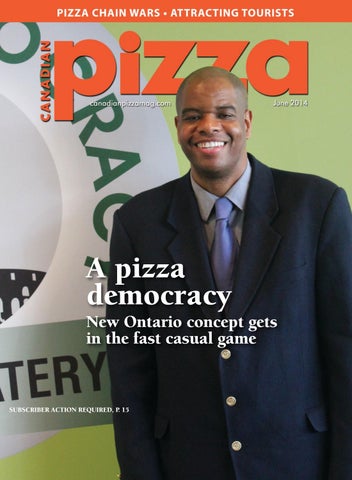
A pizza democracy New Ontario concept gets in the fast casual game
SUBSCRIBER ACTION REQUIRED, P. 15
Volume 20 Issue 3 June 2014
12
10 CARAMELIZED PEAR AND ROASTED WALNUT PIZZA Here’s a dessert pizza recipe to tempt the taste buds.
12 A PIZZA DEMOCRACY 10
There’s a new pizza player in Ontario’s fast casual market.
18 INNOVATE OR STAGNATE How the pizza chain wars are being won
22 BLAZE YOUR OWN TRAIL
Pizza business success Michael Shepherd shares his road map to high profits
18
24 STAYING POWER
How Chef Bondi’s Pizza outlasted over two dozen other local pizzerias to celebrate 50 thriving years
24
www.canadianpizzamag.com
DEPARTMENTS 6
editor’s desk
7
the pizza chef
8
pizza bites
9
pizza pete
14
marketing insights
20
making dough
27
guest column
30
pizza on fire JUNE 2014 pizza 3
“Packed from Fresh Tomatoes, Not from Concentrate”...
President Tom Cortopassi (kneeling) and “Coach” Dino Cortopassi (standing) in one of our
Since 1942, our Restaurateur customers’ success has depended on the superior taste of the food they serve and of our products. As a family-owned business, it feels good knowing that so many of our customers have relied on our “Packed From Fresh Tomato” products from generation to generation.
Whether your restaurant has a long family history, or whether you’re the founder, you can depend on our family making the best “Real Italian” tomato products...always Packed From Fresh Tomatoes, Never From Concentrate...generation after generation!
Tom Cortopassi President/Owner
Dino Cortopassi Coach/Owner
Generation after Generation.
tomato fields in Stanislaus County, California
IT
Y
THE
S
L
StaniSlauS E
AL
O F
Q U
A
The “Real Italian” Tomato Company 1202 “D” Street
Modesto, CA 95354 Toll Free 1-800-327-7201 ©2010 Stanislaus Food Products
from the editor’s desk June 2014, Vol. 20, No. 3
Service, Disney style friend of mine recently got back from a trip to Walt Disney World with her young family, and one of the first things I had to ask was how she found the service. I don’t recall the service on my last trip to Disney as I was too young, but I understand the service is legendary. She responded: “Amazing. They think of everything. I mean every little detail.” I recently got back from a trip to Paris and have been wishing out loud that all restaurants in Canada put bread on the table as they do frequently in Paris, even the very casual. It is so nice when you sit down hungry to have food put in front of your face immediately so you can think clearly and take your time ordering from the menu. It’s a small detail, but one that sets the tone for a pleasurable experience. Guest experience is made of small details, but as in a novel, the individual bits as a whole are what tell the story. Bread on the table alone won’t give you Disney-level service. And service is not defined only by how much it costs per head to eat at your establishment, although expectations go up in tandem with the cheque. Service is really just another word for professionalism: that is a set of behaviours indoctrinated in the employees from the top down, with some taking to it more naturally than others. But the folks at Disney got their positive service results by doing more than just telling their staff what to do. They got results by making it easy for them to follow the rules. For example, in an article on quality service, Bruce Jones of the Disney Institute shared the lesson that one of the keys to their success is ensuring their cast members are “on” and in character in guest areas – never eating, drinking
A
6 pizza JUNE 2014
or messing around on their cellphones. However, Disney recognized the importance of creating a place for them to be themselves and blow off steam – take a real break – so the company created designated areas for staff to do this (with their name tags off). Jones asks of other businesses, “Where are your backstage areas?” For a pizza kitchen, this can be tough to determine. In some layouts, such as the one I worked at as a teenager, customers could see into the kitchen, prep area and back door where us delivery drivers took breaks. It was small and noise carried everywhere. This left little space for the staff to relax in private, and as a result, I’m sure the staff saw less than professional behaviour more often than the boss would have liked. People of all ages can act like yahoos on the job in a restaurant – something about the culture just brings it out. Probably the fact that it’s fun! But it’s more fun for everyone when business is going well – shifts are aplenty, people are making money and the vibe is rocking. Take a cue from the world leaders in service and try to teach your staff what it is to be “on” and “off” on the job. Acknowledge that it can be tiring and impossible to be “on” all the time, and develop ways for them to be “off” that don’t impact your guest experience. •
Editor Laura Aiken laiken@annexweb.com 416-522-1595 Associate Editor Colleen Cross ccross@annexweb.com 519-428-3471 ext. 261 Publisher Christine Livingstone clivingstone@annexweb.com 519-429-5173 888-599-2228 ext. 239 Account Coordinator Shannon Drumm sdrumm@annexweb.com 888-599-2228, ext. 219 Media Designer Kelli Kramer Group Publisher Martin McAnulty mmcanulty@annexweb.com President Mike Fredericks mfredericks@annexweb.com Mailing Address P.O. Box 530, 105 Donly Dr. S., Simcoe, ON N3Y 4N5 PUBLICATION MAIL AGREEMENT #40065710 RETURN UNDELIVERABLE CANADIAN ADDRESS TO CIRCULATION DEPARTMENT, P.O. Box 530, Simcoe, ON N3Y 4N5 e-mail: subscribe@canadianpizzamag.com Published seven times per year (Jan/Feb, Apr/May, Jun, Jul/Aug, Sept/Oct, Nov, Dec), by Annex Publishing & Printing Inc. Printed in Canada ISSN 1203-6838 Circulation e-mail: subscribe@canadianpizzamag.com Tel: 866-790-6070 ext. 207 Fax: 877-624-1940 Mail: P.O. Box 530, Simcoe, ON N3Y 4N5 Subscription Rates Canada – 1 Year $ 19.00 (+ applicable tax) Best pricing (Can/USA/foreign) available online at www.canadianpizzamag.com Occasionally, Canadian Pizza Magazine will mail information on behalf of industry-related groups whose products and services we believe may be of interest to you. If you prefer not to receive this information, please contact our circulation department in any of the four ways listed above.. No part of the editorial content of this publication may be reprinted without the publisher’s written permission. ©2014 Annex Publishing and Printing Inc. All rights reserved. Opinions expressed in this magazine are not necessarily those of the editor or the publisher. No liability is assumed for errors or omissions. All advertising is subject to the publisher’s approval. Such approval does not imply any endorsement of the products or services advertised. Publisher reserves the right to refuse advertising that does not meet the standards of the publication. www.canadianpizzamag.com
@CdnPizzaMag
the pizza chef
Making managers By Diana Cline
he pizza business is not a business of one; even independently owned take-out and delivery operations require additional staff to answer phones and to make and deliver pizzas. And every owner needs a day off to rest and recharge, although I think for many of us these days are spent catching up on dozens of other things. Many independent operators I know feel that they cannot take a day off because the business doesn’t run as it would if they were there and because there are problems that come up whenever they aren’t on site therefore it’s not worth the time off. This is your warning flag that you’ve set yourself up with a job, not with a business that creates an income. This is one of the most fatal flaws that many independent operators commit. A business set up this way is no way to live. Think about it, if you worked for anyone else, you’d at least have a limited number of hours you’d be working with time off and vacation pay accruing. Working for yourself with this design is a certainty to total burn out. You must make the mental shift from employee to business owner and go from working for an hourly wage to increasing the value of your business. Some independent pizzeria owners I’ve known have shut down their store for a week or up to a month so they can take a vacation. I understand why, however consider if your store was set up to operate without you and you could take that vacation and still have the income from your business? Which brings me to the main point of this column: you need additional help to work your business and key individuals to manage your business, yet how do you find the right individuals to promote to those positions?
How do you identify and bring along internal staff to management positions?
T
It’s important to inspect what you expect
Take a step back for a moment and put first things first: you must systemize your operation. I mean that everything must be written down as a step-by-step manual on how to run your operation. This in turn creates a system of checklists that automate your operation. Do you personally open your pizzeria every day? What is the first step? And the next? And the next? Write all these steps down and now you’ve created your “opening checklist.” Print up a dozen and make it a policy that every staff member who opens completes the opening checklist. Now any one of your staff can follow this simple checklist, it’s not a matter of leaving it up to the employee to remember it’s either done or it isn’t. Next, follow the same process for the step-by-step checklist for closing your pizzeria. Identify the essential jobs/tasks that a supervisor or manager need to perform the way you do, and then create a document that could also be used as a checklist for these jobs. Initially, it’s not a matter of the “who” as much as it is the purposeful systemizing your operation in the simplest steps imaginable. An opening checklist usually looks like this: 1. Turn on air make up unit/hood exhaust; 2. Turn on oven – make sure it’s
set to the correct temperature; 3. Pull out dough to warm up; 4. Pull out pizza sauce bucket(s) to warm; 5. At 11 am turn on the open sign and unlock the front door. And so on. It’s important to inspect what you expect. Verify that the checklists are being completed to the standard you have set. The staff members who you have verified to consistently follow your checklists are the best candidates to promote to supervising and/or managing positions. They have demonstrated that they are capable and willing to follow your directions on how to operate your pizzeria. They are the likely natural leaders for your operation to run smoothly whether you are there on site or not. It’s really that simple. •
Diana Cline is a two-time Canadian Pizza Magazine chef of the year champion, internationally recognized gourmet pizzaiolo, former owner of Diana’s Gourmet Pizzeria in Winnipeg, Man., and a director for the CRFA from 2009-2013. In addition to creating award-winning recipes, Diana is also a consultant to other pizzeria owner/operators in menu development, creating systems to run a pizzeria on autopilot, along with marketing and positioning to help operators grow their business effectively and strategically. She is available for consulting on a limited basis. For more information contact her at dianaslcline@gmail.com.
JUNE 2014 pizza 7
pizzabites Pizza Pizza awarded izza Pizza received the Franchisees’ Choice designation on April 7 during a gala awards presentation at the 23rd annual Canadian Franchise Association (CFA) National Convention in Niagara Falls, Ont. The Franchisees’ Choice designees are CFA member franchise systems who voluntarily take part in an independently administered survey. More than 50 CFA member franchise systems participated in the survey, now in its fourth year. Franchisees were asked to assess their franchisor in key areas of the franchise business model, including the franchisee selection process; franchisee information package; leadership; business planning and marketing; training and support; ongoing operations; and the relationship between the franchisor and franchisee. In order to qualify for this designation, a minimum number of Pizza Pizza’s more than 350 franchise operators were required to participate. “Our franchisees are at the front line of our business, so receiving an award of this calibre is truly an honour for our company and a great sign of our collective performance,” said Sebastian Fuschini, vice-president of franchising for Pizza Pizza, in a news release. “The true strength of a franchise system lies in the mutually-rewarding relationship between a franchisor and its franchisees,” said Lorraine McLachlan, CFA president and chief executive officer, in the release. “Being a Franchisees’ Choice designee is an honour and a vote of confidence because the high rankings in franchisee satisfaction come directly from the franchisees themselves.”
P
8 pizza JUNE 2014
Law aims to protect personal information online he Digital Privacy Act, introduced April 8 in Parliament, will provide new protections for Canadians when they surf the web and shop online. These changes to protect Canadians’ personal information are key elements of Digital Canada 150, a plan for Canada’s digital future. The Digital Privacy Act will require pizzerias, among other businesses and organizations, to inform consumers when their personal information has been lost or stolen – also referred to as a “data breach” – ensuring Canadians can act to protect themselves when they shop online. Companies that fail to do so, or that destroy these records, will face fines of up to $100,000. The new measures also establish stronger rules to ensure that vulnerable
T
Canadians, particularly children, fully understand the potential consequences when companies ask to collect and use their personal information. Companies will need to communicate these requests in clear and simple language for the target audience. Changes will also be made to the way personal information is shared from one business to another. This includes vital information for financial institutions to detect financial abuse and attempts to defraud seniors or to communicate with the parents of an injured child. The Privacy Commissioner of Canada will also have improved powers, making the Commissioner more flexible and effective in protecting the rights of Canadians in the changing digital world.
pizzabites
Fast-casual category captures 6% of QSR
Foodservices: expect improved results in 2014
here is a new category in the Canadian foodservice industry predicted to give quick-service and full-service restaurants (QSRs and FSRs) a run for their money, reported a recent study by the NPD Group. While still relatively underdeveloped in comparison to the American market, “fast casuals” – those restaurants considered to be upscale QSRs with offers of more attentive service and higher food quality – are beginning to stir the pot. Making significant inroads since 2011, fast casuals average a larger cheque size than traditional fast-food restaurants and in a relatively short time are stealing market share by capturing six per cent of all QSR visits in Canada. The new category is compelling consumers to choose between food freshness / menu variety and speedy service / value pricing. Though fast casuals and QSRs share convenience as a number one traffic driver in the study (38 and 39 per cent respectively) and general appeal as their number two influencer (34 and 30 per cent respectively), the need to satisfy a specific craving (23 per cent) and the desire for quality menu items (22 per cent) round out the top reasons why consumers frequent fast-casual outlets, while a restaurant being an old favourite (28 per cent) and being known for its good pricing (19 per cent) are the additional drivers for QSRs. As it stands, however, traditional QSR foods are currently dominating the fast-casual marketplace, with French fries (26 per cent), hamburgers (25 per cent), carbonated soft drinks (24 per cent) and hot coffee (13 per cent) representing the most popular menu items. The rising success of fast casuals is, therefore, largely linked to the perception Canadians have of these establishments, as well as the ambiance they provide for patrons who choose to enjoy their meals on premise (58 per cent). Likewise, the NPD Group’s research also reveals that fast casuals have consistently outperformed QSRs in the past two years when comparing customer satisfaction, periodically having surpassed FSRs as well. The emergence into Canada’s foodservice market is not without its challenges. Even with its high-quality positioning, fast casuals are vulnerable to being too expensive for regular visits. In this respect, QSRs have the competitive advantage, as the average cost per meal tends to be lower. Also, to compete more aggressively with this trend, FSRs have begun promoting decreased pricing in the hopes that they will be able to maintain their existing customer base. In the United States, visits to fast-casual restaurants increased by eight per cent from 2012 to 2013, while spending increased by 10 per cent, said the release. In Canada, both traffic and dollars spent are comparable to American consumer habits, as visits increased by seven per cent and spending by nine per cent in the same time frame.
he food manufacturing and foodservice industries in Canada had disappointing financial results in 2013, but expectations are brighter for 2014, reported the Canadian Industrial Outlook: Winter 2014 forecasts for the two industries, which was produced by The Conference Board of Canada. Profit levels in the food manufacturing sector dropped for the third consecutive year and totalled slightly more than $3.5 billion in 2013, down from just over $4 billion in 2010. Foodservice industry profits fell 33 per cent between 2012 and 2013, to less than $1 billion, due in large measure to high food prices in the early part of last year. Foodservice operators will benefit from a more moderate increase in food prices. As a result of lower cost growth, profit levels will grow to almost $1.4 billion in 2014, a gain of 46 per cent over 2013. However, the restaurant industry is marked by low profit margins, and that will not change over the next five years. The Canadian Industrial Outlook publications are produced twice yearly. The Board also just published its Canadian Food Strategy, outlining a new vision for the food sector in Canada.
T
T
JUNE 2014 pizza 9
profile
Caramelized pear and roasted walnut pizza FROM PIZZA ON THE GRILL EXPANDED BY ELIZABETH KARMEL AND BOB BLUMER ow much do we love this dessert pizza?! It is hard to believe that a pizza with three toppings can taste this complex and delicious. But this is a perfect example of our philosophy that time invested in homemade toppings is time well spent. It’s so good, you’ll find plenty of uses for the walnut spread, like on crêpes or waffles or spreading it on bread and adding sliced bananas.
H
THE PIZZA 2 ripe pears, peeled 1/4 cup firmly packed dark brown sugar 2 tablespoons unsalted butter 1 tablespoon granulated sugar 1/2 teaspoon ground cinnamon, divided 1 ball prepared pizza dough, at room temperature 1/4 cup all-purpose flour, for rolling the dough 1 cup Walnut Spread (see below) 6 ounces Cambonzola or Saga blue cheese, cut into 1/4-inch-thick strips Serves 2 to 4 Stand each pear upright and cut vertically into 1⁄4-inch-thick slices. Use a small spoon or paring knife to remove the core from the pear slices. Spread the brown sugar evenly on a small plate and dredge both sides of the pears in it to coat. In a large sauté pan over medium heat, melt the butter. When it bubbles, gently add the pears and cook until nicely browned and soft, about 4 minutes per side. Remove from the heat and reserve for topping. Mix the granulated sugar with 1⁄4 teaspoon of the cinnamon and knead into the dough. Set aside until ready to make pizza. Preheat the grill, roll out and shape the dough, and grill the first side of the crust
10 pizza JUNE 2014
per the master instructions (Brush dough with 2 tablespoons walnut oil in place of olive oil). Use tongs to transfer it to a peel or rimless baking sheet. Flip the crust to reveal the grilled side. Spread the entire surface with the walnut spread. Artfully arrange the pear slices on top and sprinkle with the cheese. Finish grilling the pizza per the master instructions. Remove from the grill and sprinkle with the remaining 1⁄4 teaspoon cinnamon. Slice and serve immediately. Adventure Club: Finish with a crumble of your favorite toffee or a Heath bar. Drink this: A late-harvest dessert wine, such as Tokai from Hungary, Sauterne from France, or ice wine from Canada or Germany, would be a luscious accompaniment for the walnut spread and caramelized pears. WALNUT SPREAD Makes about 1 1/2 cups 1 pound (2 cups) walnut halves or pieces, toasted 3 tablespoons granulated sugar 2 tablespoons pure maple syrup 2 tablespoons walnut oil Pinch of kosher salt; more to taste In a food processor, combine the toasted walnuts, 2 tablespoons of the granulated sugar, the maple syrup, 2 tablespoons walnut oil, and a pinch of salt, then process until the texture resembles peanut butter. Reserve 1 cup of it for topping and refrigerate the rest in an airtight container, where it will keep for 1 week. MASTER INSTRUCTIONS: THE GAS GRILL METHOD Preheat the grill by setting all the burners on high. After lighting, close the lid and leave on high for 10 minutes, then reduce the heat of all the burners to medium.
Meanwhile, sprinkle your work surface with the grits or polenta. Place the dough in the middle of the surface. You can either roll out the dough with a rolling pin, stretch it out with your hands, or press it out from the center against the work surface. Ideally, you want a 12-inch, organically shaped piece of dough – round, square, or rectangular – 1⁄8 to 1⁄4 inch thick (error on the thinner side for thin-crust pizza and on the thicker side for thick-crust pizza). Drizzle or brush both sides generously with oil. Our recipes call for 2 tablespoons, but we tend to use more oil when making our own pizzas, which results in a thinner and crispier crust. Pick up the dough by the two corners closest to you. In one motion, lay it down flat on the cooking grate from back to front (as you would set a tablecloth down on a table). Close the lid and grill for 3 minutes (no peeking!), then check the crust and, if necessary, continue grilling a few more minutes until the bottom is well marked and nicely browned. Continued on page 28
feature
A pizza democracy A new Ontario concept gets in the fast-casual game BY LAURA AIKEN
F
ast-casual Italian fare has a new player in the Ontario market that is aiming high and bringing a 57page business plan to back it up. Meet Jason Harris, a former director of dairy for a grocery chain in the U.S. turned CEO of Garlic Democracy, his fast-casual brainchild with Canadian business partner Veneta Anand. Harris left St. Louis to call Waterloo, Ont., his new home because he had a dream. He is now seeing that dream come to life. His Orillia location of Garlic Democracy opened in early March and the second launched in Stoney Creek shortly thereafter. Harris was inspired by Chipotle, an American fast-casual chain, and he wanted to bring that style of highly customizable fresh-fare-fast at a good price point to Italian food. “If I didn’t follow my dreams, I knew I would regret it,” he says of the decision to sell his home, pack his bags and move to a new country in pursuit of pizza. Here’s how Garlic Democracy works: Customers can choose a pizza, pasta or salad. Each costs $8.99. This is a fixed
12 pizza JUNE 2014
price point, regardless of how many toppings or what menu options a customer chooses. If ordering a pizza, diners simply choose what type of sauce, proteins and vegetable toppings, and then each pie is finished with their secret and signature garlic sauce. The mechanics are the same for pasta and salad. The restaurant also serves cookies, baked fresh in house. The pizzas and cookies are baked in an Italforni Pesaro Bull stone bake triple-decker oven. Pastas, which come with in-house baked garlic bread, are made to order on induction cooktops. Customers can finish their order themselves using a variety of herbs and spices. The heart of the concept is all in the name and logo, explains Harris. “Democracy is part of the name because it is ruled by the people. It’s made to order. You choose and we will change our ingredients to reflect customer feedback.” The garlic part of the name links to the garlic sauce that accompanies every order. A coliseum in the logo is a symbol for the Italian heritage of the food. A fist
in the logo represents big change, which Harris is noticing to be the case. He finds the concept typically needs explaining to customers the first time around, particularly when it comes to the unlimited toppings available for a fixed price point (they all wonder what the catch is). But once they get it, he says, they keep coming back. He is surprised to find seniors the biggest supporting demographic of his Orillia store, where sales are split about 50/50 between pizza and pasta. He sees a different dynamic in Stoney Creek, where sales are 75 per cent pizza and 25 per cent pasta, with a more varied clientele who opt for the fior di latte cheese more often than shredded mozzarella when compared to his Orillia location. Harris can rhyme off lots of data about his new venture. He is an avid sports fan who’s been marvelling at the Canadian hockey craze and loves the Real Sports Bar & Grill in Toronto, but his penchant
LEFT: Jason Harris, CEO of Garlic Democracy, with his pride-and-joy oven. RIGHT: Customers at Garlic Democracy can choose an unlimited number of toppings for one fixed price of $8.99.
for statistics seems to be more rooted in an equally avid tech side to his interests. He offers free WiFi in the restaurants for customers. He chose to live in Waterloo because it is a technology hub and he had his custom-designed, cloud-based computer system created there. He can see everything from the system, from current orders to the security cameras on his trustee iPad in real time, and has found himself in the habit of checking his sales stats for the two stores hourly. His system also helps him closely monitor his labour costs, and his employees clock in and out on an iPad. He knows he is averaging a five- to 10-minute window from the time orders are placed to the moment the customer receives his or her meal. To make his profit margins on $8.99, which is a price point he based on volume sales, he had to make some accommodations. He finds using local produce is saving him a lot of money. He’s busy on social media, putting paid ads
on Facebook and racking up over 2,000 likes (as well as addressing customer complaints). In preparation for launch, he ran radio and print ads, as well as did some old-fashioned hand delivery, sticking flyers on cars and in the mailboxes of nearby homes. Once he got up and running, it was time to meet his new customers. One thing that initially surprised him about the Canadian market was the requests for beer or wine. He says that is uncommon in the U.S. fast-casual segment. As the term democracy implies, he is listening to his customers and has investigated obtaining a liquor licence. He also is impressed with what he sees as a great loyalty in Canada to Canadian brands like Tim Hortons and Boston Pizza. This makes him hopeful as a new Canadian company and proud pizzeria owner. “I’m just a foodie. I love cooking. It’s just who I am,” says Harris, clearly pleased to be standing in his own restaurant. Rather than take that foodie passion in an upmarket direction, he is using his business savvy and corporate
experience to build what he hopes is a moneymaking concept that will grow into a large franchise. Launching a restaurant is enough to keep one’s hands full, even with a great business partner, but Harris is reaching for all his ambitions. He is still working on a doctorate in corporate leadership that he started while living in the U.S., which entails a weekly reading plus papers and homework. It’s worthwhile, he says, as it is helping him better lead his team. He wants to be a boss his staff enjoy working for, and he wants to be able to build a strong team and promote from within. He also is leaning on his experience in procurement and the supply chain in the grocery business and on his previous work managing convenience stores. His whole career has been in retail, so the business of selling a product has been his business all along. The big change for him is that now it speaks to his passion for Italian food too. • For more on what’s hot, visit www.canadianpizzamag.com
JUNE 2014 pizza 13
marketing insights
Apps and appetizers Michelle Brisebois
hile having lunch at a trendy Toronto bistro last summer, I was taken aback. The server approached our table, and as we began to order, pulled out her iPhone, hunched over it and began clicking away with both thumbs. I was momentarily surprised because I thought she was ignoring us in favour of texting her boyfriend but then I realized she was actually taking our order. The restaurant was using handheld POS (point-of-sale) technology presumably to provide us with a better service experience and the restaurant with improved efficiencies, but that goal was somewhat hampered by my initial confusion. It got me to thinking: when it comes to technology in restaurants, are we in danger of losing our human touch? The traditional process for ordering in a restaurant sees the customer tell the server what they want. The server writes it down or memorizes it and then goes to a central terminal where the order is rung in and relayed to the kitchen for preparation. Anyone who has worked in a restaurant knows that if the server is detained before getting to the terminal, it will delay the order being entered. From the customer’s perspective, the order was in play the minute they handed back the menus to the server. From the kitchen’s point of view, the order is live from the time they receive it. The actual difference between these two realities can be significant if the restaurant is busy, the server is pulled in several directions at once and the order isn’t logged for a few minutes. Handheld POS relays the order to the kitchen as soon as the words are out of the customer’s mouth and some systems allow the server to fire off the drink and appetizer order while still taking the or-
W
14 pizza JUNE 2014
der for the mains and desserts. Imagine eye contact with each guest as they are the appetizers and drinks being prepared ordering and to make conversation while even before the table is finished ordering. they’re entering the order onto the device. If the guests have had time to finish their Many of these systems can be linked to drinks before the food arrives, chances your inventory, so if the kitchen runs out are excellent they’ll order a second round. of something your servers are able to know Tables could be turned even faster. With in an instant and avoid the embarrassment opposable thumbs tapping of having to return to a taaway – the server types ble to inform the guest the order, hits send and all that something they’ve set From the is well. That is, all is well their heart on eating isn’t except for dinosaurs like available. Many systems customer’s me who can’t appreciate can call up images and fact perspective, the sheets that you link to the this more efficient process because I’m feeling ignored POS, which in turn allows order was in by the server. Process innothe server to give guests play the minute tasting notes and the inside vation wins; customer service loses. scoop on delicious menu they handed You see, for people of items. It can link to picback the menus tures that allow the server a certain age, the sight of a young person hunched to show the guest what the to the server. over a handheld device dish looks like. Encourevokes feelings of angst. age your team to show the For many baby boomers, screen to the guest and to the smartphone is something their off- describe the item in a conversational manspring use to erect a wall between them- ner using the device to support the human selves and their parents. To truly enhance interaction, not to hijack it. the guest experience, the interaction must Devices armed with chip readers allow remain between the server and the guest, the server to process the payment right at not between the server and the device. In- the table. Handheld POS devices are also tegrate the handheld POS into your steps perfect for line busting in establishments of service. As the server greets the table, such as QSR restaurants that don’t have they should introduce the handheld de- table-side service. Handheld POSs can vice as the means by which they will be make your business able to serve more communicating their order to the kitchen. customers using less labour, committing Your team could even explain how it al- fewer errors and providing more securilows the kitchen to start on the prepara- ty. However, none of that matters if the tion right away. This information should team members forget that the experience promote a very positive first impression is shaped by them – not by the device. • regarding your restaurant’s commitment to service and set the stage for a pleas- Michelle Brisebois is a marketing professional with expeant interaction between server and guest. rience in the food, pharmaceutical and financial services industries. She specializes in brand strategies. Encourage your team members to make
feature
Innovate or stagnate How the pizza chain wars are being won BY STEPHANIE ORTENZI
P
izza chains in Canada are duking it out for market share, growing and innovating to stay competitive. Just how big are four big guys getting? How fast are they growing? How are they growing? (Probably the most interesting question to watch). What are they thinking about? What do they have to say about the pizza segment today? Read on and find out. PIZZA PIZZA / PIZZA 73 Pizza Pizza and its sister Pizza 73 brands form a publicly traded company beholden to its stakeholders, and according to vice president of marketing Pat Finelli, the company delivers, literally and fiscally. The brand has 620 stores across Canada, plus 74 units in Western Canada under the Pizza 73 brand. Nearly 700 units puts Pizza Pizza at the number one spot nationally, and it is growing, with 35 new stores opening in the last year. “Sales are consistently up over three years, with positive same-store sales growth year over year,” says Finelli, adding that the company’s aim is to consistently add between 15 to 25 new stores every year. For longevity and growth at this level, good product innovation is key. “You need to innovate, but you can’t follow trends blindly. You have to stay a step ahead,” he said, pointing to his choice of adding poutine to his product line before Wendy’s made it a staple of theirs. So, once you’re on trend, adds Finelli, “If the market likes it, sell a lot of it.” A big success for Finelli, which began in 2009, is the charitable donations to the national Children’s Miracle Network. Pizza Pizza makes a half-moon Smiley Pizza as a way to contribute $2 from each sale. In terms of competition, Finelli points to the frozen pizza market, and how it’s getting bigger and better. Also a segment of the market that threatens the company’s sales are the new fresh variety of pizzas available in supermarkets. Survival, ultimately, says Finelli, is to have great fanchisees, to innovate, to buy the best ingredients, to make deliveries on time and to provide great value.
18 pizza JUNE 2014
Canada’s national pizza chains are battling it out under intense competition. Who’s emerging victorious and in what areas?
BOSTON PIZZA INTERNATIONAL Milestones, anniversaries, record sales, marketing awards, recognition for exceptional management – it’s been a great year for Boston Pizza International. Boston Pizza opened 12 new stores this year, including its 100th in Edmonton, the brand’s home town, which also marked the company’s 50th anniversary, “where we’re making pizza in exactly the same way we always have: dough made fresh every day, hand formed and gourmet toppings,” says director of communications Perry Schwartz. Sales hit a system-wide 2013 record of $975 million. Boston was recognized as a 20-year member of the Canada’s best-managed companies. Marketing campaigns won the company both a Cassie and a Gold from the Canadian Marketing Association. On the bricks and mortar side, Boston requires franchisees to renovate every seven years. “It’s a proud part of our culture,” says Schwartz. That initiative is going to be just a little different this year. The company has introduced a new store design, top to bottom, from tables and chairs to new AV packages for bars, which will currently apply to the 37 existing restaurants due for their renovation. For growth opportunities, rather than building from scratch to support the brand’s physical model, Boston Pizza is looking at existing vacant real estate for ways to convert and serve as viable lo-
feature
cations. “The locations aren’t traditional in size or layout for us, but they’re doing the trick,” says Schwartz. For challenges, Schwartz says the company is looking at a sliver of the market where casual and fast food are moving together in the fast casual segment. He points to, among other brands, McDonald’s better lighting and improved ambience, with better seating and fireplaces. “We’re all fighting for a place between those two segments, and everyone is bringing up their game.” Ultimately, innovation is where the brand has invested a lot of steam. The otherwise known as “boneless wings” by another brand, are being called “all-meat wings,” a significant spin toward the positive. At the time of writing, Boston Pizza is introducing a steak and potato pizza, Srirachi pizza and a pizza taco. DOMINO’S For Domino’s, the focus is on getting back to basics and homing in on good customer service, says Jeff Kacmarek, vice president of marketing and new product development, but this is the tip of the iceberg for this pizza brand. “We had a strong 2013, with double digit sales growth due to order counts, order frequency, new products and new customers,” he said, pulling from 386 stores nationwide, which could explain how the company has stayed away from discounting ($7.99 continues to have solid pull on one level of the company’s value proposition). Domino’s has opened 18 new stores in the last 16 moths, driving by an expansion plan to see 15 new stores every year over the next three to four years. On April 21, the company rolled out a line new chicken pizzas in four profiles: crispy bacon and tomato made with a garlic parmesan white sauce, spicy jalapeno and pineapple made with a spicy mango habanero sauce, classic hot Buffalo made with a hot buffalo sauce and sweet BBQ bacon made with a sweet and smoky barbecue sauce What might be Domino’s biggest news actually goes back 20 months and is ongoing: a new store concept, with a new image, and a new look and feel. It’s called The Pizza Theatre, which is going to create a “bigger footprint,” says Kacmarek, taking up more room in the market as a concept of note. The plan is essentially a way to create seating and shift perception of the brand. “The focus will still be on delivery and takeout, as always, but now you can come in and sit down and eat in-store (and watch the theatre of pizza making). It’s a third option.” Some will require all new builds from scratch, but some can be transformed with existing square footage and other foodservice features. When asked Kacmarek’s overview of the pizza segment today, he pointed to fierce competition, and the need for innovation in image, products and tech. “Still, it’s an exciting time,” he said. “In the end, innovation will ultimately win the pizza wars.”
PIZZA HUT Pizza Hut is having a good year, with 15 new locations in the first two quarters of 2014 alone, with over 300 units nationwide. Some of the new openings highlight new thinking about the nature of how the company wants to expand. The new designs are moving toward making restaurants smaller, says company spokesperson Debra Quinn. The new designs also include fast-bake ovens, additional savings in terms of operations, important in the eyes of prospective franchisees. “The new design makes it possible for Pizza Hut to widen our appeal and reach,” adds Quinn, “because it’s a lower cost, offers more flexible options for franchisees and opens up our brand to new venues and locations.” A stand-out innovation for the brand is the success of the 60-cent wing promotion, created to encourage customers to try the brand’s range of wings again. Other on-trend innovations proven successful in the past are making their way back into customer’s minds via a promotion for Cheesy Beef Poutine Pizza and Creamy Butter Chicken. The world of flavours continues to be a rich area to plumb in search of innovations to satisfy a more and more worldly customer base. •
JUNE 2014 pizza 19
making dough
Eight ideas to attract tourists Diane Chiasson
ow that summer is here, there are probably hundreds of tourists walking around your pizzeria’s neighbourhood. Does your marketing strategy cater to tourists? If not, it should. Recent statistics show that around 25 per cent of the restaurant industry’s dollars come from the tourism industry, and this number is expected to continue to increase as more and more people travel the world. Eating also tops the list as one of the favourite activities of travellers. Many tourists today will go to a particular destination just to eat at a certain restaurant they have seen on TV or read about on the Internet. Here are a few ideas that might help attract more tourists into your pizza operation:
N
1. BE KNOWN FOR SOMETHING SPECIAL Your pizza operation should have a signature dish or style that is unique to your area, thus making your pizza a must-try for tourists. Send information about your signature dish to food bloggers, travel bloggers, travel writers, travel shows or any other outlet that would promote your pizza as the place to eat for visitors to your town. 2. ADVERTISE IN HOTEL LOBBIES AND MAGAZINES Ask the hotels and motels in your area to place your pizza operation’s menu/ brochures in its lobbies and/or guest rooms. Offer free delivery to guests staying at the hotel. Most hotel rooms also have a magazine or booklet that offers recommendations on where to eat in the
20 pizza JUNE 2014
city. Make sure to get your information into that guide. Consider also car rental agencies, travel agencies, bus charters and event centres.
with other restaurants and businesses on your street. Have carnival rides, clowns, bands and entertainers to ramp up the entertainment value.
3. CREATE A PACKAGED TOUR 7. ADVERTISE ON BILLBOARDS Work with other local businesses to If your pizza operation is nearby a highcreate a full package that way exit or by a major includes hotel stay, a meal airport, it might be a good at your restaurant and an idea to purchase billboard activity such as a spa visspace to attract potential Send it, golf, theatre, concert, tourists to stop in your information wine tour, or anything area for a bite to eat. else that is a must-do acabout your tivity in your area. 8.USE PROPER signature dish to SIGNAGE 4. HAVE A GREAT If your pizza operation food bloggers, WEBSITE is located on a busy strip travel bloggers, or near a tourist attracMost tourists and out-oftowners are more likely to tion, use sidewalk boards travel writers use the Internet to look for to direct tourists to your and travel a good place to eat. Make business. Be sure to make sure that your website is passersby an offer they shows. up to date, fun and invitcan’t refuse. ing, and make a special Tourists have only a welcome for visitors with limited time to sample the a 10 per cent discount for anyone who delights of their destination. Make sure is from out of town. Send a link request your marketing strategy does everything to your local chamber of commerce and possible to entice these willing, and no tourism bureau. doubt hungry, customers through your door. Use these eight ideas will help you 5. JOIN A REWARDS PROGRAM get your marketing strategy started and There are several rewards networks that boost your bottom line by capturing exist like Open Table, SkyMiles Dining some great out-of-town business. • or Rewards Network Restaurant that can help you attract business from custom- Diane Chiasson, FCSI, president of Chiasson Consultants Inc., has been helping restaurant, foodservice, ers who frequently travel for business hospitality and retail operators increase sales for and are trying to collect points. over 25 years. Her company provides innovative and 6. ORGANIZE A CULINARY EVENT Draw tourists to your area by organizing a culinary event in your neighbourhood. Hold a street fair or a culinary festival
revenue-increasing foodservice and retail merchandising programs, interior design, branding, menu engineering, marketing and promotional campaigns, and much more. Contact her at 416-926-1338, toll-free at 1-888-926-6655 or chiasson@chiassonconsultants. com, or visit www.chiassonconsultants.com.
Contact your local repesentative to arrange a demonstration British Columbia Castle Agencies North Vancouver, BC, Canada Tel/Cell: (604) 904-7681 Contact: David Terretta Email: king@castleagencies.ca
Alberta MAC Sales & Marketing Calgary, AB, Canada Phone: 403-281-8540 Contact: Steve MacKell Email: mackell@telusplanet.net
Manitoba/Saskatchewan Dennis Braun Agencies Winnipeg, MB Canada Tel: 204-663-8077 Cell: 204-229-4613 Email: denbraun@mts.net
Ontario Distex M.&M. Inc. Mississauga, Ont Tel: 905 565-5990 Toll Free: 1 888 645-7324 Email:info@distex.ca
www.wowoven.com
Quebec Distex M.&M. Inc. St-Laurent (Quebec) Tel.: (514) 382-3620 Toll free : 1-800-567-3620 Web: www.distex.ca
Atlantic Provinces/Maritimes Flanagan Agencies Inc Moncton, New Brunswick Tel: (506) 387-8757 Contact Mike Flanagan Email: mike@fai.ca
feature
Blaze your own trail Pizza business success Michael Shepherd shared his road map to high profits BY COLLEEN CROSS
T
here is no magic bullet to make a pizza operation profitable, shared pizza veteran Michael Shepherd in a well-attended seminar at Pizza Expo in March. The trick, he said, is to “begin at the end” by setting a profit goal then figuring out how to achieve it. The audience of about 100 had good reason to follow his advice. Shepherd, owner of Six Hundred Downtown in Bellefontaine, Ohio, founder of Michael Angelo’s Pizza and four-time World Pizza Champion, had some great numbers of his own to back up those words. One of his stores, a take out-only operation, made $286,000 in sales last year for a profit of 22 to 26 per cent in a town of 600. Another, which offers full, dine-in service and carryout, made $1.1 million in sales for a profit of 22 per cent in a town of 14,000. He took the audience on a journey back to explore just how he got those results, breaking out the factors that go into making a profit: location, concept, menu, system, portion control, a simplified environment and low-cost marketing. The key to it all, in a word, was spreadsheets, said Shepherd. He recommended
22 pizza JUNE 2014
using spreadsheet templates such as those found at www.restaurantowner.com to help organize your operation and control costs. Plugging in the numbers, he said, is well worth the effort, as it will give you an accurate financial picture. When choosing a location for your pizzeria, he said you need to consider your tax situation, regulations and cost of living. It’s difficult to make big profits in the larger markets, said Shepherd, so you’d do well to consider becoming a big fish in a small pond as he did. What’s more, location is not as important as you may think if, for example, you rely heavily on delivery, does it matter where you are? A great concept can take you far. It’s tough to make a profit with the $5-pizza concept, he said. “It’s not all about price,” citing the example of Mikey’s Late Night Slice, a store in Columbus, Ohio, that draws a steady college crowd by projecting Beavis and Butthead cartoons on its outer brick wall in an alley on Friday nights. He said that with labour costs on the rise, you can’t help but pass the increase on to customers. Therefore, you need to offer an experience that is worth the high price. It’s important to engineer your menu so that you are putting the effort into items
that make sense. For example, he said, try selling ready-made wings. “I hate selling wings,” he said, getting a chuckle from the audience. They incur a cost of 175 per cent, and because he doesn’t have a deep fryer, it just didn’t make sense for him to make them. Offering dessert has similar drawbacks, he added. Try teaming up with a local bakery to sell small, pre-portioned items. This strategy means paying 30 to 40 per cent more for the goods but it keeps labour costs low. “Never add an item that can’t be used for at lease two purposes,” he cautioned. Shepherd was relieved to learn practising portion control was popular in the room, noting it is crucial with the high price of cheese these days. Shepherd said he saved tens of thousands of dollars the first year he implemented this tight portion-control system, which he was pleased to share: Write down recipes. Weigh and control everything – not just pepperoni and cheese. Place inexpensive digital scales that use rechargeable batteries at every point on the make line. Weighing will become such a strong habit for staff that it won’t slow them down. They will soon learn to grab just the right amount
feature instinctively. You don’t have to monitor employees unless you see the inventory is not matching up with costs; at that point you can do a bit of detective work to find out where the inventory is off. Post charts on the make line that will help walk employees through all processes. Checklists are a key aspect of efficient systems, said Shepherd. There should be store manager opening and closing checklists, server opening and closing shift checklists, morning prep checklists and a dough-making checklist. “Everything done in my restaurant is on someone’s checklist.” Shepherd acknowledged it is difficult to find staff who are willing both to learn and to excel. For this reason, he said he has simplified all tasks. Every single storage spot, shelf, cabinet is labelled; he limits the menu, the inventory, the utensils and the silverware staff use; and he expands the menu only in areas that don’t require much labour. However, he urged operators to treat their staff well.
“Don’t make the mistake of not investing into your staff,” he said. “Pay your employees well and above your competitors. Higher wages are cheaper than higher turnover.” He encouraged operators to create an environment where staff will work to their potential. “Strive to push your staff so that they are able to perform their jobs better than you can,” he said, adding that as a balance to intensive training you should involve them in fun events and aspects of the business. As an example, he encouraged first his sister, then another employee, to enter pizza competitions. They both went on to become world champions. Shepherd said it is also important to use low-cost marketing strategies that work for you, for example, word-of-mouth and cross-promotions, mailings targeting non-customers and making the rounds to a community business once a month. “For 17 years people have been telling me that I don’t know what I am doing and
Michael Shepherd said the key profit centres are location, concept, menu, system, portion control, a simplified environment and low-cost marketing.
will soon be out of business,” said Shepherd to appreciative laughs. His closing words of wisdom? “Be willing to throw out what the ‘experts’ tell you, donate only to charities that really matter and don’t hesitate to say no to everyone else. Remember that you don’t ‘have’ to do anything you don’t want to.” •
2013 Winner The Muntains of TJ’s Pizza
Put Your
on our cover
The Muntains of TJ’s Pizza
ARE YOU MAKING A DIFFERENCE IN YOUR COMMUNITY?
PM400657 PM40065710 10
Winners of the Pizza with PurpSaputo Foodservice ose award
Nominate your pizzeria for the Pizza with Purpose Award sponsored by Saputo Foodservice and share the spirit of generosity with your fellow pizzaiolos.
PizzaDEC2013.indd
1
2013-12-04
9:14 AM
We want to hear about your fundraising, sponsorship, participation in community events and creative contributions. Activities can be local or national in scope. The winner won’t be determined just on an amount of money raised, but on all the ways, big and small, that your pizzeria is touching lives.
The Pizza with Purpose award sponsored by
Enter online at www.canadianpizzamag.com or e-mail: laiken@annexweb.com
2014 Entry Deadline Aug 31st! Pizza_Purpose_Saputo may14.indd 1
JUNE 2014 pizza12:56 23 2014-04-10 PM
feature
Staying power How Chef Bondi’s Pizza outlasted over two dozen other local pizzerias to celebrate 50 thriving years BY COLLEEN CROSS
P
hil DiLosa had a good job as a linotype operator at The Globe and Mail in the early 1960s. He had steady hours, good pay, and interesting work. On weekends he helped out his friend Agostino (Gus) Bondi at Chef Bondi’s, his St. Thomas, Ont., pizzeria. However, when the presses switched to a new process in 1966, requiring him to be retrained, DiLosa decided not only to work full time at the growing pizzeria but also to become partners with his friend. He never looked back. Forty-eight years later, at 72, he is thrilled to be at the helm of a business that has outlasted 25 other local pizzerias – he has kept a list – to stand as an important part of the southwestern Ontario city’s history. The pizzeria, which has seen railway and automotive booms come and go, celebrated its 50th anniversary in May. DiLosa,
24 pizza JUNE 2014
who handles day-to-day operations while Bondi prefers a behind-the-scenes role, had special red shirts made to commemorate the milestone. He wore his when Canadian Pizza visited. It reads: “Gooooood pizza [that’s six o’s] and greaaat panzerotti.” “We also had business cards done up,” he adds with excitement. “There is a $2 discount right on the card, which will go into loot bags for our anniversary open house on the May 2-4 weekend.” It’s clear DiLosa’s heart is in St. Thomas, a railway city with a population of about 37,000. The “automotive town” was anchored for years by a Ford plant and spinoff businesses Lear Seating, Therm-ODisc and Timken, but lost much of its industry when Ford closed the plant in 2011. DiLosa says they used to deliver to Timken at lunch and dinner and during Ford’s heyday they delivered for three meals a day.
That thriving delivery route has ended. Yet he sees a lot of potential in the city and in particular in the restaurant’s downtown location on Talbot Street within easy walking distance to the intra-city railway track being built to link the old Canada Southern railway station with a Via Rail station the city is refurbishing. The project is expected to give tourists a direct route between tourist town Port Stanley and London. FROM SCRATCH “Everything in the store is made from scratch,” says DiLosa, who says 80 to 90 per cent of his business is takeout. He has been buying ingredients from just three suppliers since the 1970s because the quality is good “Everything in the store is made from scratch,” says co-owner Phil DiLosa, who says 80 to 90 per cent of his business is takeout.
and consistent. Tuesday is “cooking day,” when he makes the sauces. Everything is made at the restaurant, he says. The veteran pizzaiolo says he believes they have stayed in business by focusing on the traditional items they do best. The pizzeria serves two styles of pizza: original, which DiLosa describes as crisp and chewy, and Chicago style, where the cheese goes on top and the crust is softer and contains whole wheat. Which sells best? “It’s about 50-50 between the two,” he says. He likes to stick with traditional, time-tested ingredients and is not interested in branching out to such items as chicken and broccoli, as some other pizzerias have. DiLosa also is firm in his baking methods: he is adamant about using only a wood-fired oven. “With the conveyors, you get steam,” he points out, which he feels makes for a soggier crust. He prefers the even, golden brown crust a wood-fired oven can achieve. The shop has always sold pasta, he says. Pizza, panzerotti, spaghetti, ravioli, manicotti, lasagna – these staple items sell well, especially panzerotti, which is so popular it’s up there with pizza on the front awning. He sells about 150 pasta orders a week. DiLosa believes in offering deals, but he emphasizes they are special offerings and ways of combining items, not deep discounts. The shop has had a Tuesday special “forever” and a “3-on-3” that offers three pizzas with three toppings is very popular. To give some idea of the changes half a century can bring, he says that a case of cheese that is now $200 cost $29 in 1964. Acknowledging it is tough to make a living in this economy, he says the recent dairy subsidy offered to pizza operators has helped. The restaurant is licensed, but the focus is squarely on the pizza and pasta, says DiLosa. COMMUNITY PIZZA Although DiLosa says he has not formally dabbled in take ’n’ bake, he has sent halfbaked pizza to Scotland at the request of a visitor who had fallen in love with his pizza. He has also taken orders from afar.
The shop is covered in photos of teams he coached and sponsored over the years, including those of his sons and 10 grandchildren.
One man called from his home in Alberta and asked DiLosa to surprise his father in St. Thomas with a favourite pizza on his birthday. That request turned into a monthly standing order. The business reaches out to the St. Thomas and area community by doing catering for such events as buck and does and midnight wedding buffets. Another community initiative, school delivery, the shop finally gave up after 25 years because it proved to be a losing proposition for the restaurant given the time and labour spent preparing the pizzas and the slim margins that resulted. The biggest change over the years, says DiLosa after some thought, has been in the demand for more toppings. Ham and pineapple – Hawaiian pizza – was unheard of in the 1960s. But while that innovation took hold, other items over the years did not, always bringing them back to their old standbys. He recalls introducing charbroiled Bondi Burgers, which were popular but turned out to be too costly, with the open flame elevating their insurance rates. LOW STAFF TURNOVER DiLosa takes pride in his hardworking staff of eight. His crew is made up largely of employees in their mid-20s and 30s. They work on a four-hour shift ba-
sis, with shifts staggered to have more staff on at peak times of 4 to 8 p.m. Three teenagers work as dishwashers. The boss is keen to acknowledge all employees. He offers a list, nervous about forgetting anyone: Charlie, Haillie, Aidan, Riley, Spencer, Katharine and the two Andrews. The longest-serving employee, Charlie, has worked for the business for 44 years. He and Charlie work weekdays and on Saturdays and Sundays DiLosa oversees a separate weekend crew. He hires through the government employment office, which does a good job of matching employee and employer needs. He says his secret to retaining happy employees is to give them some responsibility; for instance, if an employee wants a day off, he tells them to arrange it with the other employees. Trust is key in his business. “It’s always been like that,” says DiLosa. The driver pays before he leaves. Staff write the orders on the pizza box, instead of using paper slips. Flexibility is also important, he says, adding that he tries to be approachable. “I tell everyone, if you have a problem just come to me and we’ll solve it.” A former employee, he likes to point out, went on to become a vice-president at CIBC and later to establish a large, successful business of his own.
JUNE 2014 pizza 25
feature Six months ago, an employee built a website for Chef Bondi’s, and even though they gave up their Yellow Pages listing, business has increased more than DiLosa expected. “I paid $350 for a line and a Yellow Pages listing, but I’ve done more from that website,” he says. COMMUNITY HOCKEY PRIDE After showing us his oven and his homemade tomato sauce, and extolling the virtues of a web presence, DiLosa realizes he has overlooked something. “Did you see our picture wall?” The shop is covered in photos of teams he coached and sponsored over the years, including those of his sons and 10 grandchildren. A prominently displayed plaque honours a local team that made it to the OMHA finals in 1978-79. The centrepiece of the wall is a large black-and-white photo of Bobby Orr showing Orr flying through the air as he is tripped after scoring the winning goal in the Stanley Cup in 1970. The NHL legend gave the photo to DiLosa. Below it is a newspaper photo of the Ken Danby print signed by Orr. “To my friend Phil, Best wishes,” it reads. “You probably can’t see it anymore,” says DiLosa, “but it also says, ‘Love your pizza!’ ” St. Thomas mayor Heather Jackson added her kudos to the landmark business. “I would certainly congratulate Phil on a very successful business career in downtown St. Thomas. This
T
he taste of
Tradition
Manufacturers and Distributors of Italian Specialty Cheeses and Food Products
T. 905.544.6281 F. 905.549.1196 20 Morley Street, Hamilton, Ontario, L8H 3R7
26 pizza JUNE 2014
is a great milestone to be celebrating!” she wrote in an email to Canadian Pizza. When asked for funny stories, he thinks for a moment, then offers this small gem. “For years, every Friday night, this guy would order a pizza. I’d tell him ‘Now, make sure you carry it flat.’ And he would just tuck it under his arm like a newspaper.” When he and Bondi sell the business, he says, it will go to someone who will nurture it and who is a good fit. He is committed to helping with the transition, however long it may take. “I worked so hard,” he says. “I’m not just going to give it to anybody.” DiLosa and his wife, Linda, have four grown children, none of whom is in the pizza business. Two sons, Joe and Paul, are chemical engineers in Sarnia, a third son Patrick works in advertising in Aurora and daughter Anne is a speech therapist in Waterloo. He is pleased with their diverse paths – and quick to point out the pizza business put four kids through university. He is slowing his pace a bit and plans to spend more time at the family’s cottage in Port Stanley, where he enjoys fishing when not attending personally to continual business requests. “It’s been a good life,” he says. • For more profiles, visit www.canadianpizzamag.com
guest column
Ingredients for a pest-free reputation By Alice Sinia
oodborne illness is a constant threat to the foodservice industry and consumers. Roughly four million Canadians, or one in eight, suffer from food poisoning each year. The consequences can be severe for customers as well as companies, which risk damage to their reputation, fines and loss of business licences. Flies, rodents and cockroaches are the primary sources of contamination for food. Whether or not they lead to illness, having just one of these pests spotted in your facility is enough to generate negative word of mouth. Protecting your business, and most importantly your customers, from these pests begins with an integrated pest management (IPM) approach. IPM focuses on proactive facility maintenance and sanitation measures to eliminate the factors pests need to survive. Using IPM to mitigate the risk of foodborne illness requires knowing what pests cause it, what attracts them and how to combat them. Flies are always unsightly in restaurants and kitchens, but these pests also can transmit more than 100 pathogens, from E.coli, to Salmonella and Staphylococcus. Because of their filthy breeding and feeding habits, they carry pathogens on their body and leave them behind every time they land. It’s critical to prevent flies from coming in and around your facility. Hanging insect light traps attract flies using ultraviolet light, capturing them on a non-toxic adhesive board inside the unit. The devices are silent and discreet, so you can place them in many locations without worrying about the buzzing noise or contamination from airborne in-
F
Use IPM to protect your business and your customers
sect parts associated with traditional and hassle when it comes time for an bug-zappers. Discreet sticky-surfaced inspection, since as far as an inspector fly traps also are effective for con- is concerned, if it isn’t documented, it trolling small flies such as fruit flies didn’t happen. and phorid flies. Maintenance and sanCockroaches are laden with bacteria itation measures, such as frequently that can cause food poisoning, diartaking out trash; cleaning drains and rhea and dysentery. They pick up these hard-to-reach areas, like under equip- diseases by walking into contaminated ment and in tile grout; areas and spread them to caulking cracks and crevfood directly or by walkices in window sills and ing on food preparation Flies, rodents doors; power-washing surfaces. These pests trash cans and dump- and cockroaches also reproduce quickly, sters; and keeping food making prevention key are primary preparation areas clean to protecting against an and free of crumbs and infestation. Simple sanisources of spills will also help keep tation and facility maincontamination. tenance steps can help flies away from your pies. Rodents are known to deter cockroaches: not carry more than 40 vileaving food out overruses and bacteria. They spread such night, frequently taking out the trash, diseases as Salmonella, Hantavirus thoroughly cleaning all food preparaand Trichinosis through their drop- tion areas and cleaning up spills and pings and urine. Cracks and openings crumbs immediately. as small as your pinky finger can serve Protecting your products from conas entry points for rodents. These pests tamination requires a continuous, comdon’t like being out in the open, so be pany-wide commitment to pest mansure to eliminate areas such as over- agement. Employees are the first line grown landscaping, piles of cardboard of defence against pests, so be sure to boxes and wooden crates. Mechanical include all staff members in pest mantraps and non-toxic baits can be used agement efforts and establish specific to capture rodents that find their way roles for each person. An informed and inside. Recent technology can help active staff is critical to an effective IPM identify the presence of rodents before program. • they become a major problem. Electronic scanning to capture and record Alice Sinia, PhD, is resident entomologist, regulatory/ lab services for Orkin Canada focusing on government data that measures pest activity trends. regulations pertaining to the pest control industry. They can help facilities identify pest With more than 10 years of experience, she manages hot spots, and allow management and the quality assurance laboratory for Orkin Canada and performs analytical entomology as well as pest management professionals to tack- provides technical support in pest/insect identification le the problem immediately. Having to branch offices and clients. For more information, electronic copies of all pest manage- email Alice Sinia at asinia@orkincanada.com or visit www.orkincanada.com. ment reports also can save you time
JUNE 2014 pizza 27
feature Continued from page 10 Use tongs to transfer the crust from the grill to a peel or rimless baking sheet. Close the lid of the grill. Flip the crust to reveal the grilled side. Follow the specific recipe directions for adding any sauce, toppings, and/or cheese. Switch the grill to indirect heat by turning off the center burner(s) if you have a three- or four-burner grill. For a two-burner grill, turn off one burner. Set the pizza back on the grate over indirect heat (the unlit section) and grill, with the lid down, until the bottom is well browned and the cheese is melted, 7 to 10 minutes. For two-burner grills, rotate the pizza halfway through the cooking time. Remove from the grill, garnish, and season as directed. Slice and serve immediately. MASTER INSTRUCTIONS: THE CHARCOAL GRILL METHOD Build a fire by lighting 50 to 60 charcoal briquettes in either a chimney starter or a pyramid-shaped mound on the bottom grate of your grill. Once the briquettes have become gray-ashed (20 to 30 minutes), move them all to one side of the grill. Meanwhile, sprinkle your work surface with the grits or polenta. Place the dough in the middle of the surface. You can either roll
out the dough with a rolling pin, stretch it out with your hands, or press it out from the center against the work surface. Ideally, you want a 12-inch by 6-inch, organically shaped piece of dough – a rectangle – 1⁄8 to 1⁄4 inch thick (error on the thinner side for thincrust pizza and on the thicker side for thick-crust pizza). Drizzle or brush both sides generously with oil. Our recipes call for 2 tablespoons, but we tend to use more oil when making our own pizzas, which results in a thinner and crispier crust. Pick up the dough by the two corners closest to you. In one motion, lay it down flat – over the side without briquettes – on the cooking grate from back to front (as you would set a tablecloth down on a table). Close the lid and grill for 3 minutes (no peeking!), then rotate the crust 180 degrees and continue grilling until the bottom is well marked and evenly browned, another 2 to 3 minutes. Use tongs to transfer the crust from the grill to a peel or rimless baking sheet. Close the lid of the grill. Flip the crust to reveal the grilled side. Follow the specific recipe directions for adding any sauce, toppings, and/or cheese. Set the pizza back on the grate over the side without briquettes and grill, with the lid down, for 4 to 5 minutes. Rotate the pizza 180 degrees and continue to grill with the lid down until the bottom is well browned and cheese is melted, another 4 to 5 minutes. Remove from the grill, garnish, and season as directed. Slice and serve immediately. •
Passionate about Pizza Canadian Pizza baking champion Diana Coutu shares some of her award winning pizza recipes, tips and techniques for the home pizza chef. Included in this volume is her personal philosophy on health, fitness and incorporating this ancient healthful ‘fast food’ into your daily diet. Diana Coutu is a four-time Canadian Pizza baking champion, internationally recognized gourmet pizziolo with 19 years of experience in the pizza industry, 11 of those co-owning Diana’s Gourmet Pizzeria in Winnipeg, Manitoba. In addition to creating award-winning recipes, Diana is also a consultant to other independent pizzeria owners and helps operators grow their business effectively and strategically.
28 JUNE PIZZApizza book ad june 14.indd2014 1
2014-05-01 1:42 PM
equipment
pizza show
Worlds Finest Dough Presses, Divider/Rounders & Dough Dividers
heated delivery systems DUT/DM-18
BMIH
MANUAL PIZZA DOUGH PRESS
Manually Operated DOUGH DIVIDER
Dough up to 18” diameter Economically priced
1-9 ounce dough capacity per piece, 36 or 18 at a time.
ElEctric HotBag DElivEry SyStEm No temperature drop from oven to customer • Bag heats to & stays at 160°-175°
Dutchess has you covered with dough dividing, rounding and pressing to produce the perfect pizza crust.
• Heats from top & bottom • Lightweight Thermoloft
™
1-800-777-4498 sales@dutchessbakers.com www.dutchessbakers.com
In-store delivery system heats up to 12 HOTBAGS at once.
marketing
Learn tips & tricks from a Master Pizziolo. Order your copy of Canadian Pizza Baking Champion Diana Coutu’s cookbook Passionate About Pizza at www.Amazon.ca
Food serviCe equipment
Your specialist in Food Service Equipment! spsalescanada.com
STEPHEN PHIPPEN 7032 Wellington Road, CR124 Guelph-Eramosa, ON N1H 6J3 T: 519·568·8080 C: 519·242·0995 Toll Free: 1·855·568·8080 E: info@spsalescanada.com
XLT Ovens · Somerset Industries · Crown Verity · Epicurean · EmberGlo · Discovery Products
nylon
• The original, proven & patented
800-927-6787 www.HotBag.com Made in the USA by the Check Corporation
Advertisers Index Company
Page #
Annex Anti Spam ........................................... 15 Annex Bookstore ........................................... 28 Burke .............................................................. 11 Canadian Pizza Show ............................16 & 17 Middleby Marshall.......................................... 21 Pizza with a Purpose ..................................... 23 Ricco Food Distributor................................... 26 Salerno ........................................................... 26 Saputo ............................................................ 32 Springer’s Meats ............................................ 19 Stanislaus ..................................................4 & 5 Viau Food ......................................................... 2 XLT Ovens ..................................................... 31 Use these advertiser contact numbers to find out more about a product advertised in this issue or to place an order. This index is provided as a service. Canadian Pizza Magazine is not liable for errors or omissions.
JUNE 2014 pizza 29
1
pizza on fire
Labour pains Tom Stankiewicz
ow do you make a profit when times are financially tight? If you want to avoid going the route of increasing prices, you’d do well to focus on managing your labour costs. It is becoming increasingly difficult to control labour costs. In order to survive, one has to be a very savvy manager who uses each opportunity to its maximum capacity. At the end of the day, those whose businesses remain successful are very efficient when it comes to the management of time and people. One of the simplest ways to better use labour is to put more emphasis on upselling. This simple tactic could increase your total revenue by quite a bit. This might involve specific training for all employees about various techniques that could be used to offer such add-ons as salads, pop and bread sticks. In general, all it requires is you telling customers that for a minimal increase in price they could enjoy, for example, a fresh salad with their pizza. Some businesses take it a step further and introduce it as a sales contest among employees. You might find that your employees will be more motivated to incorporate this new approach during their conversations if even a small reward is offered, for example, a gift certificate for coffee. A higher percentage of customers add more items to their order if prompted to do so. Train your employees to turn time on the phone with customers into additional sales. Another important task that allows you to effectively manage labour costs involves a regular monthly review of your sales and activities. This review will indicate monthly sales patterns
H
30 pizza JUNE 2014
One of the simplest ways to better use labour is to put more emphasis on upselling.
that could be used to properly schedule hire someone new to replace them. In work hours for all employees. In turn, these situations, it becomes expensive for managers can use this information when managers to train someone new, usually creating weekly work schedules for em- during slower times of day, because their ployees. It will quickly become apparent time could be used more effectively doing that the pizzeria could operate efficient- other things. Before you decide to invest ly with fewer employees on some days, time and money to train new employees, while it may require full staff on others. it is important to understand not only This helps you better plan shifts and why they want to work for you but also make decisions about letting employees for how long. go home early. If all of the above fails, and as a last It is good practice to resort only, you might be minimize the number of forced to offset high laemployees who need to bour costs by deciding if Although it stay until closing hours you need to increase your might not be and assign specific cleancurrent pizza prices. This obvious at ing duties to each person strategy requires careful throughout the evening. review of your books. first retaining This way, some of the Take a closer look at the employees cleaning could be completoperations and managehelps minimize ed earlier during less busy ment of the business to times. Ultimately, this will identify the problem. labour costs. help keep labour costs to Keep in mind that regular a minimum because fewer price increases could popeople will be required to tentially drive your cusstay until closing time to clean. tomers to your competition. It is also a good strategy to end indiWhatever strategy you choose to manvidual shifts half an hour or one hour age the labour costs, never sacrifice the apart instead of letting most of your staff quality of your product and customer sergo home at the same time. Keep in mind vice. Both must be maintained at the top that proper staffing always leads to excep- level to ensure customers stay loyal and tional customer service as well as great continue supporting your business. employee satisfaction. There are many ways to manage labour Another way to help keep labour costs costs without negatively affecting your down is to provide a great working envi- business, but it is best when the process ronment. Retaining employees helps min- appears seamless to customers while the imize labour costs. A happy employee is product and customer service stay excepmore productive and ends up working tional. • for you for a longer period of time than someone who is unhappy. In the long Tom Stankiewicz has been in the pizza business for more than 15 years. He has been the proprietor of Bondi’s Pizza run, it costs more money to fire some- in London, Ont., since 2000 and is president of the Canadione who has already been trained and an Pizza Team.
, y e s g n i K t o ! e n n s i ’ t t u o If i P t ti ’s no
THE AUTHENTIC QUÉBEC CHEESE CURD Poutine is super trendy right now, suddenly it’s everywhere! Operators are loving the increased margins they get by adding poutine to their menu. It’s a terrific side dish or great on its own; make the classic recipe or create your own signature dish! Our Kingsey® cheese curds are famous throughout Québec and are the essential ingredient for authentic poutine. VANCOUVER
(604) 946-5611
EDMONTON SASKATOON WINNIPEG
DARTMOUTH
(902) 468-5700
(613) 741-9718
MONCTON
(506) 859-8888
(514) 328-3466
ST. JOHN’S
(709) 753-3943
TORONTO
(905) 264-7600
(780) 468-5811
OTTAWA
(306) 931-0040
MONTRÉAL
(204) 987-6345
QUÉBEC
(418) 651-5220
www.saputofoodservice.ca