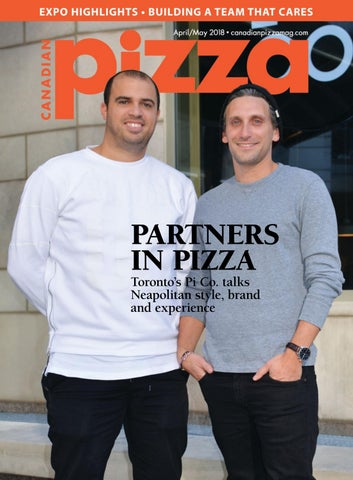
PARTNERS IN PIZZA Toronto’s Pi Co. talks Neapolitan style, brand and experience
Volume 24 Issue 2 April/May 2018
14 12
12 PARTNERS IN PIZZA
Toronto’s Pi Co. talks, neapolitan style, brand and experience
14 POINTERS FROM PIZZA
EXPO New pizza styles and products can add to your bottom line, attendees of the busy annual event learned
14
18
BRAND AMBASSADORS How to build a team that cares about your pizzeria
ABOVE: Chef of the Year Matteo Cesarotto represented Canada well at the International Pizza Expo in Las Vegas in March. See page 14 for highlights of annual event.
DEPARTMENTS 6
editor’s desk
8
pizza bites
10
the pizza chef
20
making dough
21
recipe
22
Giorgio’s corner
21
ONLINE RAISE PRICES DURING PEAK HOURS: RESTAURANT EXPERT Increasing prices during peak hours, holding regular meetings and rewarding staff for quality work are some of the things restaurant operators must do to be successful, said a hospitality leadership coach at the recent Restaurants Canada Show in Toronto. Learn more in this web-exclusive article at canadianpizzamag.com.
CANADIAN PIZZA EXTRAS | Maria’s in Brantford, Ont., to rebuild soon; Quebec bill will modernize alcohol rules; Truro, N.S., pizzeria makes group delivery to Dartmouth… plus, the latest news and new products. canadianpizzamag.com
APRIL/MAY 2018 pizza 3
from the editor’s desk April/May 2018, Vol. 24, No. 2
Honest feedback ome people will give you their opinion whether you ask for it or not. This may take the form of an earful about the state of the country or the trials of running a small business. It may take the form of a fair – or not so fair – online review. Asking for an opinion can open the floodgates. It can also help you tap into the mind of an important asset – your return customer. And if you’ve been following Facebook’s tribulations in the news lately, you’ll know that information is a precious commodity. There are lots of people who by nature keep their opinions to themselves. They need to be asked. This is low-key Canada, after all. But most people appreciate being asked what they think – even if they choose not to answer. Being consulted can make a customer feel heard, valued and motivated to be part of your business’ story. My husband and I were recently made to feel special by a new local bakery we like. On one visit, the owner, no doubt recognizing us from frequent stop-ins, stepped away from the ovens to say hello. When he noticed my husband was buying a new hot-cross bun the baker was trying out, he asked what we look for in this product and how we typically eat it. He encouraged us to come back and let him know if we liked it. This simple conversation went beyond the usual pleasantries. The baker asked our opinion with sincerity – even vulnerability. We gave our two cents’ worth and now feel more connected than ever to the business and rooting for its success. How often do you have a real conversation with a customer that goes beyond small talk to connect to your pizza and your services? Asking for feedback – and truly listening – can put you on the path to improving your image and your sales.
S
6 pizza APRIL/MAY 2018
Editor Colleen Cross ccross@annexweb.com 519-428-3471 ext. 261 Publisher Christine Livingstone clivingstone@annexweb.com 519-429-5173 888-599-2228 ext. 239
On that note, we here at Canadian Pizza want honest feedback from YOU – about our magazine and about your business. We are excited to launch our first national survey of Canadian pizzeria operators. It’s a 10-minute online survey and you can find out how to take part on page 9 of this issue. Your response will be anonymous and your participation will help us fill the magazine with useful, entertaining content. It will also give us a benchmark for the Canadian pizza industry of same-store sales, average cheque, costs and other key information that will help you see how you stack up with other pizzerias. Those who participate will be entered into a draw to win a $100 Visa gift card. The results of this survey and of a special millennial consumer pizza poll Abacus Data is carrying out in partnership with us will be previewed at the Canadian Pizza Summit on Monday, Oct. 15. You heard that right! Consider yourself officially invited to a day of business education, product perusing, networking, watching the exciting Chef of the Year competitions and sampling delicious pizza. It’s our treat and our way of connecting you with the pizza community. See page 23 for details and watch our website and enews for event updates. One last way we are looking for feedback from you is through our new Weekly Operator Poll. The poll covers a wide range of topics and is updated weekly. Have your say with a couple of clicks and view results from past surveys. It’s a fun way for all of us to stay connected! •
Account Coordinator Shannon Drumm sdrumm@annexweb.com 888-599-2228, ext. 219 Media Designer Emily Sun Circulation Manager Anita Madden amadden@annexbusinessmedia.com 416-442-5600 ext 3596 Group Publisher Martin McAnulty mmcanulty@annexbusinessmedia.com COO Ted Markle tmarkle@annexbusinessmedia.com President & CEO Mike Fredericks Mailing Address P.O. Box 530, 105 Donly Dr. S., Simcoe, ON N3Y 4N5 PUBLICATION MAIL AGREEMENT #40065710 Printed in Canada ISSN 1203-6838 Published seven times per year (Jan/Feb, Apr/May, Jun, Jul/Aug, Sept/Oct, Nov, Dec) by Annex Business Media Circulation email: lmalicdem@annexbizmedia.com Tel: 416-510-5187 Fax: 416-510-6875 or 416-442-2191 Mail: 111 Gordon Baker Rd., Suite 400, Toronto ON M2H 3R1 Subscription Rates Canada – 1 Year $ 26.00 (+ applicable tax) Best pricing (Can/USA/foreign) available online at www.canadianpizzamag.com Occasionally, Canadian Pizza Magazine will mail information on behalf of industry-related groups whose products and services we believe may be of interest to you. If you prefer not to receive this information, please contact our circulation department in any of the four ways listed above.
Annex Privacy Officer privacy@annexbusinessmedia.com Tel: 800-668-2374 No part of the editorial content of this publication may be reprinted without the publisher’s written permission. ©2018 Annex Publishing and Printing Inc. All rights reserved. Opinions expressed in this magazine are not necessarily those of the editor or the publisher. No liability is assumed for errors or omissions. All advertising is subject to the publisher’s approval. Such approval does not imply any endorsement of the products or services advertised. Publisher reserves the right to refuse advertising that does not meet the standards of the publication.
facebook.com/CanadianPizzaMagazine @CdnPizzaMag canadian_pizza_magazine
www.canadianpizzamag.com
www.wowoven.com
Contact your local repesentative to arrange a demonstration MARITIME PROVINCES Flanagan Agencies, Inc. Moncton, New Brunswick 506.387.8757 Fax: 506.387.8750 sales@fai.ca
QUEBEC Distex M&M, Inc. St. Laurent (Quebec) 514.382.3620 Fax: 514.382.7837 info@distex.ca
ONTARIO Distex M&M, Inc. 905.565.5992 or 1-800.645-7324 Fax: 905.565.5992 info@distex.ca
MANITOBA and SASKATCHEWAN Simpson Wilson Ltd. Winnipeg, Manitoba 204.632.6941 or 1-800.342.3626 Fax: 204.633.9254 cam@simpsonwilson.com
ALBERTA Bert Johnson Ent., Ltd. (BJE) Calgary, Alberta 403.870.4763 Fax: 403.287.7788 Calgary: dave@bje.cc Alberta: erin@bje.cc
BRITISH COLUMBIA Distex M&M, Inc. Port Moody, BC 778.989.3620 cvandenhoven@distex.ca
pizzabites BRIEFLY | Maria’s in Brantford, Ont., to rebuild soon; Seasonal hiring tips; Truro, N.S., pizzeria makes group delivery to Dartmouth | FOR MORE pizza news, check out our website, canadianpizzamag.com
amembert l’Extra, made by Agropur in Saint-Hyacinthe, Que., was chosen over 17 other cheeses to win first prize in the World Championship Cheese Contest, held in Madison, Wis., from March 6 to 8, Agropur said in a news release. The creamy texture and hazelnutand-mushroom flavour of the Camembert was given top honours by a distinguished panel of 50 experts from different countries. Four cheeses from Agropur’s U.S. facilities were also chosen as winners at the contest. Agropur cheese from Jerome, Idaho, received the best score in the shredded cheese category for the second consecutive year. Lake Norden, S.D., took top honours in the mozzarella category. Feta from Weyauwega, Wis., won for the third consecutive year, and smoked provolone from Luxemburg, Wis., also swept the top award in its category.
Concept drawing courtesy Buco Pizzeria
Quebec Camembert wins global cheese competition C
Edmonton’s Buco Pizzeria expands uco Pizzeria & Vino Bar in Edmonton recently opened two restaurants back to back: one in the city’s Upper Windermere area in February and another downtown near the Rogers Place arena in March. The Upper Windermere restaurant is a 372-square-metre restaurant with 170 seats and an all-day, European-style bar. Doors opened in March on a 200-seat restaurant and bar in the downtown’s Epcor Tower a block from Rogers Place arena. A part of Sorrentino’s Restaurant Group, Buco specializes in fresh, modern Italian entrées, grilled dishes, Napoletana pizza and desserts. The Buco concept is about sharing and creating a quality dining experience, said Chris Hrynyk, the chain’s
B
corporate chef. The Windermere restaurant will have a bar and lounge and extend its opening hours beyond those at the original St. Albert location. “We are trying to draw a younger market,” Hrynyk said. “It’s a modern approach with ambience.” The Epcor Tower restaurant will take advantage of a prime downtown location in the city’s Ice District to provide hot breakfast every day to nearby office workers. The core menu is the same at the Buco locations, and staff will alternate among the three locations, Hrynyk said. Sorrentino’s Restaurant Group, which is owned by Carmelo and Stella Rago, employs between 430 and 450 staff across its 13 locations, which also include steakhouses and cafés.
Alberta restaurateur new Restaurants Canada chair Pizza Hut Canada launches loyalty program P atrick Saurette, owner and operator of The Marc restaurant in Edmonton, is Restaurants Canada’s new chair of the board for 2018-19. Saurette was elected at the association’s annual meeting on Feb. 25. He and his wife and business partner Doris opened The Marc in 2010, a small French bistro that has received many awards and has been on several best restaurant lists. As chair of Restaurants Canada, the new chair will oversee the trade association, which represents 30,000 businesses.
8 pizza APRIL/MAY 2018
izza Hut Canada launched its first loyalty program, Hut Rewards, in March. With five consecutive online orders of $10.99 or more, members will receive a free two-topping medium pizza. “We’re thrilled to be launching this program digitally, forging ahead in our commitment to making the best tasting pizza more accessible to Canadians,” said Jason Cassidy, brand director for Pizza Hut Canada, in a news release. “This is going to make it easier for customers to get the innovative recipes they know and love, like the original pan pizza and stuffed crust, by simply signing up online or through our mobile app.” Pizza Hut has plans to grow the program and offer its members incentives throughout the year.
P
pizzabites
Canadian Pizza National DoorDash and Uber Eats Industry Survey food delivery expand C T
anadian Pizza has launched its first national survey of Canadian pizzeria operators. We are taking the pulse of the industry on issues that matter to you and we want your input! Your participation will help us understand the state of Canada’s unique pizza industry. This key information also will help us deliver valuable content, tailored to meet your needs. Those who complete the survey are eligible to win a $100 Visa gift card. Responses will be completely anonymous. The results of this survey and – and of an exciting millennial consumer pizza poll Abacus Data is carrying out this summer in partnership with Canadian Pizza – will be previewed at the Canadian Pizza Summit on Oct. 15 (see inside back cover of this issue for details). Attendees receive full access to the exclusive report. Please take a few minutes to fill out this important survey at www.research.net/r/9BGM97W and have your say!
More pizza diners seek best crust: report
echnology company DoorDash recently announced it will expand in the Greater Toronto Area, working with a total of more than 1,000 GTA restaurants. Starting March 1, DoorDash will be available across Halton and Peel regions in Ontario, including the cities of Mississauga, Brampton, Oakville and Burlington. DoorDash, headquartered in San Francsico, Calif., operates in four major cities in Canada and in more than 600 cities across North America. In the west, Uber Eats’ delivery service is coming to Lethbridge and Red Deer in Alberta and to 10 communities in Ontario, the company said in a news release. The digital app and delivery service is now available to customers in Lethbridge and Red Deer in Alberta, and 10 cities in Ontario: Aurora, Barrie, Cambridge, Guelph, Kanata, Kingston, Newmarket, Niagara Falls, St. Catharines and Windsor. Since launching in Canada in December 2015, Uber Eats has provided food from restaurants in major cities such as Toronto, Ottawa, Montreal and Vancouver. For more news, visit www.canadianpizzamag.com
he number of diners who choose a pizzeria based on who has the best crust is up sharply from 2016, says a new report from research firm Technomic. The 2018 Pizza Consumer Trend Report also suggests increased competition in the pizza segment in the U.S. as consumers eat pizza more regularly and more options emerge. In fact, sales among the limited-service pizza industry grew by 3.7 per cent in 2017, while units grew by 0.9 per cent. With different variations such as fast casual build-your-own concepts, retail options, and the growth of regional pizzas, operators and suppliers must find unique ways to stand out while remaining authentic to their brand and pizza recipes, Technomic said in a news release. “Increased demand for quality and authenticity is influencing consumers to become increasingly discerning about each component on their pizzas,” said Anne Mills, senior manager of consumer insights at Technomic. “As consumers’ expectations rise and competition increases, pizza operators will be driven into niche, specialized areas such as Roman-style, Detroit-style, and even convenience-focused offerings.” Key takeaways from the report: • 44 per cent of consumers (up from 40 per cent in 2016) say that they choose pizza operators based on who offers the best crust • 28 per cent of consumers (43 per cent of those ages 1834) are more interested in pizza with unique toppings or ingredients now than they were two years ago • 49 per cent of consumers want more restaurants and pizza establishments to offer more authentic pizzas.
T
APRIL/MAY 2018 pizza 9
the pizza chef
Slow-season buster Diana Cline
n every pizzeria there’s always a period when your sales are going to slump. For many of us it’s January and February – right after Christmas – when our customers get their credit card statements that remind them of the spend-happy ghost of Christmas past. Other customers make the common New Year’s resolutions to eat out less and work out more often. Some of us have seasonal businesses that rely heavily on the yearly influx of tourists, and fall is their official slow season. While it’s important to track the trends and the ebbs and flows of your sales, there are several marketing strategies that, if used correctly, can not only bump that slump, but even increase sales over the previous months. One of my favourite marketing strategies that always increases sales in January and February is what we call our “No Peeking” red-envelope promotion. Have you ever had a scratch-off card for a department store that could only be scratched by one of their employees once you were paying for your items? This is a similar kind of promotion that we call “No Peeking” because it’s a sealed red envelope with a winning certificate inside that’s good for one of five prizes. The sealed red envelope has “No Peeking” printed all over it, gives instructions on how the promotion works and also lists the five prizes that might be in the envelope. The reason we use a red envelope is so you can’t read the certificate inside and to tie in with Christmas, which is the time of year we run it. Our five prizes are a free two-litre, a $5, $10 or $25 voucher towards their order, and the grand prize of $100 in gift certificates from my pizzeria. You can choose any prizes you’d like to give away for your pizzeria but keep in mind that the majority
I
10 pizza APRIL/MAY 2018
of the prizes are the $5 voucher with a The exciting part begins in January, smaller percentage of the bigger prizes. when the envelopes are valid, providing We have more than one qualifier for the that they are presented unopened to my grand prize to help ensure that at least one staff. My customers have had one or more person wins it. It would be a shame if the of these envelopes in their homes or vehiwinning envelope never came back. cles since December and by this time they We give the customer a sealed envelope really want to know what prize is inside. with every order in DeEspecially when they’ve cember and instruct them been told that they’re holdto bring it back unopened ing a winning envelope. In It’s up to you beginning in January. This my restaurant, December is to make sure is where it’s important to typically very strong for sales have scripting for your and this promotion is a great that your staff. What I mean by way to encourage all those customers scripting is that you should customers to come back in provide your staff with the January. We’ve been running do not forget words to say as they hand this promotion every year out the envelopes; otherfor five years and it has conyour wise, they’re likely to botch sistently helped to increase pizzeria. the explanation and conour sales every January over fuse the customer. “Every the previous year. Once you envelope is a winner,” my understand the dynamics staff will say. “The catch is of this promotion, it’s easy that it’s not valid before Jan. 2 of next year to adapt it to other similar slow-season and that it must be presented unopened to busters. I’ve had small business owners of one of our delivery drivers or in-store staff. other industries contact me to ask how to Good luck – and no peeking!” adapt this one strategy for their business. Of course, there are always a few people Perhaps the biggest lesson to keep in mind who rip open the envelope immediately af- is that it’s not up to your customers to reter my staff member has explained the pro- member your pizzeria; rather, it’s up to you motion and handed them the sealed enve- to make sure that your customers do not lope. In those cases we tear up the opened forget your pizzeria.• certificate, hand them another envelope and calmly explain the promotion again, Diana Cline is a two-time Canadian Pizza magazine asking them not to open this envelope and Chef of the Year, three-time winner of “Canada’s Best Pizza Chef” at international pizza competitions, a judge for to put it in a safe place until the following international pizza culinary competitions in Las Vegas, year. My regulars enjoy this promotion and Italy and France, and a partner with Diana’s Cucina & new customers like to play along, especial- Lounge in Winnipeg. In addition to creating award-winning recipes, Diana is a consultant to other pizzeria ly when they know their good behaviour owner/operators in menu development, creating systems will be rewarded. It’s like that present that to run a pizzeria on autopilot, along with marketing and you’re not allowed to open until Christmas positioning to help operators grow their business effectively and strategically. She is available for consulting day and you’re very excited to see what it on a limited basis. For more information contact her at diana@dianascucinaandlounge.com is, but you can’t peek.
cover story
Partners in pizza Toronto’s Pi Co. talks Neapolitan style, brand and experience BY COLLEEN CROSS
W
hen Marc Askenasi and Sam Hazan were kicking around a soccer ball together in the 1990s, they did not image teaming up in the pizza business. But the childhood friends and partners in Toronto’s Pi Co. have scored big with their build-your-own Neapolitan pizza concept and are busy expanding outside of the city. I talk with the pair at their Yonge and Eglinton location, where bundled-up customers file in, their eyes on a colourful and inviting ingredients counter. The shop is minimalist and modern with a youthful vibe and a soundtrack of laid-back hip-hop and pop music. “That’s intentional, Askenasi says. “We’re not big suitand-tie guys.” Pi Co. makes two pizzas – the margherita and a build-yourown – on a Neapolitan or a gluten-free crust in a 1,000-degree oven for 90 seconds. The margherita is their top seller. “I think when you’re coming to our place, you want to compare apples to apples,” Askenasi says of the thinking behind this dual concept. It seems their early soccer days bred in them a taste for fun and teamwork that has served them well in the pizza business. The two met at age eight while playing on a rep team in the Toronto area that took them far afield to Europe. Askenasi hails from nearby Richmond Hill and Hazan from Thornhill. “It was fun,” says Hazan, who continued playing soccer in Europe and in Israel for a while. Askenasi returned to Canada, got his degree at McGill University and played soccer there as well. While working in the gaming and technology industry for several years after graduation, he harboured a desire to be in the food business but waited for the right time – and the right concept. “I wouldn’t touch it unless it was scalable,” he says.
12 pizza APRIL/MAY 2018
Sam Hazan (left) and Marc Askenasi, co-founders of Pi Co., favour slow and steady growth. Two locations and 20 locations are very different propositions, Askenasi says. “Test the waters. Don’t go too big or too fast.”
SEARCH FOR PERFECT CONCEPT Askenasi found the perfect concept while travelling in the United States, where he saw Neapolitan quick service popping up. “There’s a time and a place for a nice, greasy New York-style slice, but I’ve always loved Neapolitan pizza,” he says. But in most restaurant visits, he found an element lacking. “The experience I had at those restaurants was that they were kind of cold. I thought, the concept’s great, but I don’t like the food, I don’t like the branding, I don’t like the experience. So if I could change all three of those things and make it better, I think there is an interesting offering for customers.” “If you don’t have great pizza, people won’t come to your restaurant, and if you don’t have great atmosphere people won’t enjoy the food. It works both ways,” he says. Recognizing he needed a strong operator to work with, he thought of longtime friend Hazan, whose family has been involved in food service for 25 years and built up strong relationships with suppliers.
All ages are represented, but young people seem to be drawn here. “It’s a fun place to work,” Hazan says. “A lawyer works here, he was a customer first, and now his wife works here too. Actually, we have four couples working for us,” he says, though usually at different locations.” Hazan is not a trained chef, but has a lot of experience in the kitchen and has worked with a master chef to develop Pi Co.’s recipes. But this concept is not about the chef, Askenasi says. It is firmly in the category of fast food. “Does McDonald’s have a chef? For us it’s about the experience. You can go to a different city or location and get the same experience.” Pizza lovers enjoy a mid-afternoon feed. More than 80 per cent of Pi Co.’s customers are repeat customers and some come back multiple times per week to enjoy the pizzas and signature salads.
Hazan agreed that’s where the opportunity was and the two went on a fact-finding foodie tour of sorts. They spent the year training with experienced chefs, researching Neapolitan pizza and honing their business plan. “We put our heads down. From Day 1 we were always focused on Neapolitan,” Askenasi says. They had the idea for their pizzeria, worked on the branding and lastly obtained the intellectual property. In all the process took about a year. Co-founders and equal partners in the business, Askenasi is president and chief executive officer and Hazan is vice-president of operations. GROWTH OF DUAL PIZZA CONCEPT When I talked with the partners in late February, Pi Co. had three locations in Toronto. Bay and Bloor was their first location, but they consider the slightly bigger shop (just over 2,000 square feet, 1,500 of that customer-facing) at Yonge and Eglinton – where we met – their flagship. Their University and Adelaide location is their first franchise location. They expect to open two or three more stores in April alone, some newly constructed and some existing locations. One of the new spots, at the Shops at Don Mills, is their first shop not located in an urban centre. It’s suburbia, they say, with a
different price point. Their pizzas typically cost $3 to 5 less than others in similar locations. They started with a consistent price point in mind, aiming for growth beyond Toronto – to Kitchener, Hamilton and Barrie – in terms of price and the experience. “Toronto customers can afford one price, but suburbia and small-town customers can afford a different price.” A separate central dough dispensary, or commissary, is also in the works. STREAMLINED STAFF Hazan and Askenasi are big on teamwork: they have surrounded themselves with experts including a community manager, construction manager and dough manager. They hired a regional manager with 10 years’ experience. They recruit people not in big groups but as they need them and they train them months in advance. The store managers have no pizza experience but are hired based on other attributes such as a positive attitude. Training is not a one-size-fits-all. “We spend a ridiculous amount of time training franchisees,” Askenasi says. “We train them on how to train staff. Some people can fly through it in weeks; some take about three months.” There is a mixture of full-time and parttime employees – about 10 at each location.
REPEAT CUSTOMERS More than 80 per cent of customers are repeat customers, they say, and by repeat they mean customers who come back multiple times per week. “We have salads as well as pizza, but I think it’s a result of the brand name, the interior design, the food and the kind of culture and experience we’ve created,” Askenasi says. Although proud of their success, they are far from complacent. The two are laser-focused on maintaining a relationship with customers. “We always have to be careful that we don’t let our guard down or that we’re not on top of market trends or not interacting with the community around us, and thankful for the customers we have, because that’s when others can come in and steal your market share,” Askenasi says. Another key trait is knowing what you’re good at and get help with what you’re not. “Expanding is not for everyone,” Hazan says matter-of-factly. “I think you have to decide, are you a risk taker?” Of course, risk is easier to bear when you have the support of loved ones. His wife, Melanie, and Askenasi’s wife, Amanda, have been very supportive of the venture: “That support is important to help you do what you do,” Askenasi says. What does the future hold for Pi Co.? “We are rolling out 12 more locations,” Askenasi says with a twinkle in his eye. “We have massive plans.” •
APRIL/MAY 2018 pizza 13
pizza event
Pointers from Pizza Expo New pizza styles and products can add to your bottom line, attendees of the busy annual event learned BY COLLEEN CROSS
T
he International Pizza Expo, held March 19-22 in Las Vegas, Nev., proved a great place to learn what pizza makers around the world are doing, which trends can translate to money for your pizzeria and what products are out there to make your work easier. The convention centre was full of the sights, sounds and smells of the pizza industry and people: the event saw record attendance of 7,500. Canadian Pizza was there to collect tips and trends, meet Canadian operators who attended the show, and cheer on our Canadian chefs in the heated competitions. Remo Palladini, organizer of Pizza Fest in Woodbridge, Ont., and friend Robert Billingsley, stopped by the booth to say hello, as did Rob and Karen Shortreed of Roka Woodfired Pizza in Beaumont, Alta., who were looking for ideas and products for their newly opened mobile business. Chef of the Year Matteo Cesarotto and runnerup Giuseppe Cortinovis represented Canada well in their respective Traditional and Non-Traditional categories, Cesarotto bringing his winning
wild boar sausage pizza to an appreciative wider audience. He enjoyed competing, adding that competing abroad brought with it the challenge of making the signature sausage entirely on his own. Cortinovis changed up his original entry to a pecorino-topped pie cooled with ice to slow the cooking process and make the cheese extra creamy. Always one to innovate, he cooked his pizza in a conveyor oven A full slate of helpful seminars and demonstrations helped pizzeria operators streamline their business practices and figure out how current pizza trends can help them make more money. Here are highlights from two of those sessions. HOW TO MAKE ROMAN PIZZA Giulia Colmignoli and Christopher Antinucci, co-owners and operators of Napizza in San Diego, Calif., demonstrated how to make the very specialized but very versatile pizza al taglio, or Roman-style pizza. They have had success with the style and said it can boost sales for any pizzeria willing to give it a try.
Italian chef Vito Iacopelli demonstrates how to make a mozzarella cheese crust for the low-carb crowd at the California Milk Advisory Board booth. There were lots of visitors on hand keen to taste the results.
14 pizza APRIL/MAY 2018
Originally from Rome, Italy, the pair opened Napizza in San Diego, and now have four thriving locations. They focus on pizzas with quality ingredients and gourmet salads. What is Roman pizza? The crust is a distinctive combination of crunchiness and airiness. The ingredients are simple: flour, yeast, salt, water and oil, but the fermentation process is what sets it apart. The dough is very wet and the flour used needs to be very high in protein. Colmignoli and Antinucci recommend 72 hours’ levitation and hydration of 80 per cent. The pair said they prefer a flour made in small batches at a cold stone mil to prevent the heat generated by most milling processes. The dough takes 72 hours to rise but “the sky is the limit” as to how much you can ferment it. It creates a gluten net (also known as a skin or shield) on top that holds the air in, creating bubbles, and the bubbles make it unique. It’s important to handle the dough carefully, not stress it too much. A gentle hand and pinching motion will help prevent cracks in the dough and keep the carbon dioxide inside. They suggest using a mixer with a blade in the middle to cut the dough and let in oxygen at intervals. A good ratio of yeast to flour is two grams of yeast per kilogram of flour. A good ratio of flour to oil is 25K flour to four grams of EVOO. They described the fermentation process. After 24 hours the dough will look different. You fold it to break the bubbles so it can move the sugars around. This allows it to regenerate. Keep your hands open to let air go through the dough, they said. Press dough all around the edge of a rectangular pan, trying not to break the gluten shield. The pizza-making pair demonstrated adding their signature wavy marks in the pizza to ensure the right consistency. “It’s like painting a canvas,” Antinucci said, adding that they use their hands and not a spoon because the dough is “still alive.” Cook the base at 600 F (check) for 15 minutes. Add cheese, then cook for 10 more minutes. One audience member, concerned the heat was escaping, called out to remind Antonucci the oven door was open, but the chef explained that briefly opening the door to let in air and start the cooling process is part of their method. The laid-back pair shared many tips toward success. Aim for consistency, of temperature, they said. Dough should be 18-21 C in summer and 21-24 C in winter. You can achieve this by getting the water to the right temperature. That way, if the temperature outside changes or different employees prepare the pizza, the results will be consistent. Another tip: using dry yeast makes the temperature easier to control. The Napizza owners listed several advantages to Roman dough, which when baked should be a light yellow – the colour of beer. Because this crust is structured and strong, it can hold its weight in toppings. It’s also easy to plan ahead because it is designed to sit out and be reheated for 90 seconds with each customer order. With so much water content, this crust is built to handle reheating. Each time it is reheated, it loses more water and gets crunchier. Mozzarella is added later so the pizza looks the best it can. This pizza is also good served cold, making it ideal for catering situations where you don’t have ovens. The inviting aromas of the pair’s baking brought the audience to the stage in a rush to sample two pizzas. The red, topped
with slow-cooked Bolognese sauce, is one of their bestsellers. I couldn’t resist the layered scent of the white pizza featuring a truffle béchamel base, with champignon and porcini, and topped with mozzarella and parsley. The rich taste did not disappoint. Another popular – and much lighter – combo for them is zucchini, lemon zest and ricotta, Colmignoli said. PROFITING FROM GLUTEN-FREE PIZZA During afternoon seminars just off the show floor, three pizzeria operators shared their experiences with adding gluten-free pizza to their menu. Mike Rutledge of Farrelli’s Wood Fired in Tacoma, Wash.; Jeff Smokevitch of Brown Dog Pizza in Telluride, Colo., and Blue Pan in Denver, Colo.; and Eric Spata who coowns Valeo’s in Kenosha, Wis., all have had success incorporating gluten-free pies into their pizzerias. The three industry veterans had plenty of advice on how to do it profitably. The bottom line: customers are asking for it and it’s well worth bringing in – as long as it doesn’t affect the quality of the pizza you are known for. The “why” is a bit of a no-brainer, according to the panel, which was moderated by Jeremy White, editor of Pizza Today. Customers are asking for gluten-free pizza, and more important, they are willing to pay for it, they agreed. Rutledge’s pizzeria has been serving gluten-free pizza for 10 years. His observations that one per cent of Americans are celiac
NOW AVAILABLE
CERTIFIED HALAL PIZZA TOPPINGS Beef Pepperoni, Julienne Cut Chicken, Beef Crumble, Beef Sausage, Veggie Pepperoni and more...
Wholesale: 905-547-1321 www.SpringersMeats.com
APRIL/MAY 2018 pizza 15
Left: Giulia Colmignoli and Christopher Antinucci, co-owners and operators of Napizza in San Diego, Calif., highlight the distinctive air holes, or alveoli, that make roman pizza crusts so crunchy and structured. Right: Competitor Mario Vollera displays his pizza featuring edible gold during the Non-Traditional preliminary round.
and 25 per cent think they are celiac were met with both chuckles and vigorous nods of agreement. “People ask for it. Why wouldn’t you?” Jeff Smokevitch said. All agreed it’s hard to gauge how much business you’d lose by not offering gluten-free. Spata said he always asks customers if they eat gluten-free because of an allergy or as a diet preference. Rutledge said he sells roughly 50 to 75 pizzas on a typical Tuesday night. He offers gluten-free versions of all menu items because simplifies his operation. Preventing cross-contamination: Smokevitch recommended having a clear disclaimer – for example, identifying products but not the environment as gluten-free – and labelling products with the less strict claim of “gluten-friendly,” depending on your particular situation. Panellists said they cook their regular and GF pizzas in the same ovens, but prevent cross-contamination by brushing them out, using dedicated pans or baking on parchment paper. Spata said his stores’s gluten-free crust touches only one stone. Like Rutledge and Smokevitch, he has a disclaimer on his menu and takes every precaution to prevent cross-contamination. Setting up your pizzeria for gluten-free: The three shared their ideas on how to
16 pizza APRIL/MAY 2018
run a gluten-friendly kitchen. Smokevitch said he switched to rice flour. Rutledge assigns one person per shift to oversee the GF menu, has set up his POS system to highlight GF items and has trained staff to repeat the orders back verbally. The decision to make your own dough from scratch, source dough from a supplier or buy ready-made crusts is one of personal preference, but each has merits and drawbacks. Rutledge does not make his own dough but sources it from outside. Smokevitch does make his own but acknowledged it’s not easy. “It’s like cake batter – hard to push out,” he said. Whatever you decide, it’s important to factor labour into your costs, said Smokevitch, who said staff make their own dough in one location and keep the cost about the same as for ready-made, recognizing the extra time and labour involved. At another location, they source it, meaning they need to charge more to cover their costs. Charging $2-4 more than covers labour costs, he said. On “Gluten-free Thursdays” Farelli’s does not upcharge for GF items and the promotion is worthwhile because they double their sales that night, Rutledge said. Spata agreed that upcharging is not a great source of profit but a way to cover costs. Smokevitch agreed, adding that
sometimes he gets “conversions” – customers who prefer GF to regular pizzas. One curious audience member asked if the operators ever have cross-contamination issues when they deliver? All three panellists knocked on wood while saying they hadn’t had a problem to date, but acknowledged the potential for issues in delivery situations when they lack control. Spata said that stating your disclaimer, which may include stressing yours is a certified gluten-free crust but not a certified GF environment – goes a long way toward avoiding potential issues. Spata said he asks on social media if there is one topping or product you’d like the pizzeria to add; for example, vegan or gluten-free crust. He’s had a good response and the answers serves as trend signposts for his business. At the moment, customers are asking for low-carb crusts such as cauliflower, he said. “Low-carb, gluten-free is huge.” Rutledge said he always tries to identify trends for the next five years and focus on a couple of favourites. Finally, what’s in a name? Word choice can make a difference when marketing your gluten-free pies: when Rutledge changed his “vegan sauce” to “crushed tomato” (sporting the vegan symbol) he saw sales go up.
Operators in the audience also voiced concerns about their legal responsibility. Spata said if you can show your “intentionality” and that you did everything you could, that will go a long way toward relieving you of liability. “You can’t control what people put in their mouths,” he said. The session ended with advice from the three: Mike Rutledge: It’s all about training. Teach staff proper hand-washing techniques, make steps and processes for everything and consider undergoing LEAN certification to streamline your workflow. Jeff Smokevitch: Educate customers and employees. Train staff to deliver the proper warnings to customers. Eric Spata: How you handle problems when they arise makes a difference, Spata said. Don’t allow complaints to escalate. GLUTEN-FREE PRODUCTS ABOUND There was no shortage of gluten-free flours, doughs and crusts on the trade show floor. Among some two dozen gluten-free ingredient suppliers, Oggi showcased its gluten-, GMO- and peanut-free crusts available in Veggitaly, Margherita, Italian Herbs and Cauliflower (the latter two also lactose-free and vegan), sold in packs of 20. Manini’s gluten-free 10-inch parbaked crusts are made with whole ancient grains including millet, organic sorghum, organic amaranth and teff, and free of rice, gluten, soy, dairy and
eggs. Cauli-Flour’s clean-label, all-purpose baking mix is certified gluten-free, dairy-, wheat- and egg-free. Speaking of alternative crusts, we found Italian chef Vito Iacopelli at the California Milk Advisory Board booth demonstrating for a fascinated attendees how to make a mozzarella cheese crust for the low-carb crowd. A sampling of new products found on the show floor: a pizza trailer with storage for 800 dough balls and mobile caterer with optional chimney by Forza Forni; heat-resistant modacrylic sleeves to prevent arm burns by Double ‘D Knitting and Glove Inc.; soybased proteins simulating chicken, beef and pork from Before the Butcher; Simply Dressed clean-label salad dressing flavours, including lemon vinaigrette, honey mustard and balsamic vinaigrette from Marzetti; F’real self-contained blend-in-cup shakes, smoothies and frappés for the company’s B7 Blender; Captain’s driver dispatch software systems for reducing delivery times; Herbco International herbs, spices and custom blends; Pizza Crisp, a natural dough additive made of bleached wheat flour, yeast, sugar and salt that is sprinkled on pan and pizza to prevent sogginess; Lemoncocco non-carbonated lemon and coconut drink made with cane sugar and meant to simulate a popular Italian beverage. After three days at this buzzing industry event, it was easy to see how learning pizza trends and techniques and swapping stories with fellow operators can refresh and profit your pizzeria. •
TASTE THE
TRADITION
Manufacturers and Distributors of Italian Specialty Cheeses and Food Products
gaylea.com • 1-800-268-0508 • salernodairy.com APRIL/MAY 2018 pizza 17 PZ_AprMay16_Salerno_CSA.indd 1
2016-03-22 7:32 AM
feature
Brand ambassadors How to build a team that cares about your pizzeria BY MICHELLE BRISEBOIS
I
f the people who work for you are excited about being there, it has a positive impact on the strength of your brand. Experiences are delivered by people – and your people are your brand, so you should want them to be in a good place. It’s great in theory but how does it look in practice? We spoke with two pizza operators known for their strong employee engagement to try to understand how they nurture a culture of engagement and brand advocacy. WHAT DOES A BRAND AMBASSADOR LOOK LIKE? An employee who is “engaged” in your business goals, culture and products is most likely to be a strong brand ambassador. Engagement comes in three flavours: actively engaged, disengaged and actively disengaged. Actively engaged employees rave about your food and excitedly point out their personal favourites to guide customer decisions. Disengaged employees smile and say, “Everything here is good.” Actively disengaged employees are rude to your customers, provide poor service and drive away business. Actively engaged is easy to see. Actively disengaged is also easy to identify. The danger zone resides with the disengaged team members. They look fine on the outside but they aren’t “in the canoe.” ENGAGEMENT IS A MINDSET – NOT BEHAVIOUR Employers mistakenly think they can see if an employee is engaged by simply observing them. On time? Check. Smiling? Check. Does the job efficiently? Check. They’re engaged. Or not. Not everyone who is miserable in their job shows it by acting out. Engagement is a function of the employee’s behaviour and their perception. That superstar you see may actually be a workhorse who is afraid of losing their job or a martyr who likes the attention obtained by working marathon hours. While visible metrics like attendance, illness and mood can indicate engagement issues. It’s important your team truly feel valued and connected to your business and not just going through the motions. THE BUSINESS CASE FOR EMPLOYEE ENGAGEMENT When Gallop began measuring employee engagement in the 1990s, it quickly became clear that a lack of employee engagement costs businesses big time. According to Jim Harter of Gallop, “Those outcomes range from basics such as absenteeism, employee retention rates, service levels and productivity; and ultimately it all adds up to about a 22 per cent difference in profitability when
18 pizza APRIL/MAY 2018
you compare top quartile business units to the bottom quartile.” With strong evidence to indicate that engaged employees are good for business, why do so few companies do it well? And how do the ones doing it well “keep the love alive?” ENGAGED, EXCITED AND SUCCESSFUL: A TALE OF TWO PIZZERIAS We spoke with two pizza operators known for their strong employee engagement to try to understand how they nurture a culture of engagement and brand advocacy. Turns out it’s about collaboration and caring. We decided to dig in at the beginning: How do you recruit new talent? What do you look for when recruiting? THE SELECTION PROCESS For Brigade Pizzeria in Montreal, it’s about a mindset and fit with the existing team. The type of position they’re hiring for often dictates the personality they want. If they’re hiring for a pizzaiolo, Brigade wants someone who is calm to be able to weather the heat – physical and emotional – of the kitchen. “The one quality we look for in all team members is that we want them to be humble,” says Jean-Daniel Nadeau, president and co-founder. Candidates are often interviewed as a group so that team dynamics can be gauged. “We might have as many as five people in all at the same time and we may ask a shift captain to join in on the interview process,” Nadeau says. Nadeau believes this process works because the existing team is part of the selection process, and therefore, invested in their success from the beginning, and the newly hired employee is pleased they made the cut. Pizzeria Libretto, with four Toronto locations, also takes great care as they hire new team members. Hilary Drago, marketing co-ordinator of the restaurant chain, says they look for an “energy” rather than a specific profile. “We look for someone that cares about themselves and others. If they enter the interview room and thank the person that holds the door open for them, it’s little gestures like this that speak volumes,” she says. Pizzeria Libretto also asks at the interview that candidates reveal what their favourite restaurant is and why. Surprisingly, the “why” answer tends to land in the same zone for many. “It makes me feel like home,” tends to be the answer that fits with the culture Libretto is trying to channel. “If you say that, we know you understand what we’re looking for,” Drago says.
putting out food for the team to grab at their convenience, they make a meal and sit down all at the same time to eat and bond. In addition to being a beautiful way to connect with each other, it’s cool to start dinner service by doing the exact same thing the customers are about to do. That energy and empathy naturally flows throughout the service. Philanthropy is also part of the culture with causes chosen that resonate with the employees too. “We recently decided to contribute one dollar from each pizza sold to the “March for our Lives” campaign to support the March 24 march by teachers and students in Washington, D.C., connected to the school shootings. “We have a number of teachers and students on staff and many of them told us it meant a lot to them that the company supported this cause,” Drago says. Actively engaged employees rave about your food and excitedly point out their personal favourites to guide customer decisions.
THE ONBOARDING As with any great recipe, getting the right ingredients is only part of the equation. The real magic comes from the right combinations of flavours being blended and guided into something that’s greater than the sum of the parts. This is the definition of alchemy and it’s what separates great teams from good ones, or bad ones. Brigade Pizzeria fosters empathy and excitement for the menu by cross-training the team on all roles. They find this helps everyone understand how it feels to be in someone else’s shoes as well as creating a deeper knowledge for the ingredients and the menu. “We often see someone start as a busboy and then eventually move to becoming a topper. In between they’ll be responsible for opening and slapping the dough. Some aspire to go all the way to becoming a pizzaiolo but some are happy to stay bussing . . . and that’s OK,” Nadeau says. Pizzeria Libretto also cross-trains as part of their onboarding process. “We find it creates empathy amongst the team,” Drago says. NURTURING A STRONG CULTURE This tends to be the hard part for many restaurants. It’s almost accepted that there
will be everything from disdain to allout war between front and back of house and that getting pulled into the inevitable drama is a rabbit hole management does not want to go down. Here is where both restaurants we spoke to clearly break away from the pack. They fearlessly wade in. For Brigade Pizzeria, it can be anything from helping a new team member pick up their furniture at Ikea because they have no vehicle to going down to immigration with someone trying to sort out their legal status. “Sometimes if you notice that someone seems preoccupied or off I’ll sit down to talk with them and say, ‘What’s going on at home?’ If you understand what they’re going through sometimes it’s an easy fix to support and get them back on track,” Nadeau says. Pizzeria Libretto also makes a point to connect with their team members personally with shout-out programs where team members nominate each other for going above and beyond the call of duty. What’s unique about this is that both the person nominated and the person nominating are recognized, both to encourage the act of noticing and to reward great interaction. Libretto also does something quite unique and lovely each day as a team. They break bread together. Instead of
THE TIPPING POINT Operational issues can often be the kindling that stokes the flames of discord. When the tips are skewed to one segment of the restaurant team leaving the other members in the cold or with very little, a sense of unfairness can exist and that works against a democratic culture. At Brigade Pizzeria and Pizzeria Libretto, tips are shared, and they believe this contributes to a more egalitarian and healthy culture. Research shows that employee engagement increases when people know what their roles are, what success looks like and how it’s measured, and when they have the tools and latitude to reach those goals. Brigade Pizzeria confirms that tasks and responsibilities for each role are outlined in a standard operating procedure manual. Employees who are emotionally invested in their company’s success are good for business and it’s time we made them a priority. It’s the right and civil thing to do. As Brigade’s Nadeau puts it, “Anything that impacts our employees lives affects the business too. We’re a part of their lives, so we embrace that.” • Michelle Brisebois is a marketing consultant specializing in e-commerce and digital content strategy and retail/ in-store activation. Michelle has worked in the food, pharmaceutical, financial services and wine industries. She can be reached at michelle@textrixconsulting.com
APRIL/MAY 2018 pizza 19
making dough with Diane
How to rebrand your pizzeria Diane Chiasson
here are many new restaurant concepts emerging everywhere and every week, and you may find that your pizzeria is struggling in the midst of this evolving market. Your business may be declining as competition increases or you may find that your customers’ needs have changed. It may be time to consider rebranding your pizzeria. Just remember that rebranding is not just a fresh coat of paint: it’s embracing a new way of doing business. Before you make any drastic changes, you need to determine how your pizzeria is currently performing. Ask your friends, family members, past and current employees, and your customers for their honest opinion on what they think about your pizzeria and what they like about other restaurants they have visited in your neighbourhood. This will give you some ideas on what you should focus on during your rebrand. It takes courage for a pizzeria owner to admit their restaurant isn’t working. In this, part 1, here are three main tips to successfully start rebranding your pizzeria.
T
1. KNOW WHAT YOUR PIZZERIA STANDS FOR IN THE MARKETPLACE You really have to think long and hard as well as understand and identify how your pizzeria is currently performing, what your brand currently stands for, and what the rebrand would really mean for your business. You need to understand everything, from what you are doing well to what you could improve upon immediately. Do you have the same steady stream of loyal repeat customers? Are your regular customers not coming to your restaurant anymore? Do you know why your customers still come? Is your concept still relevant to current restaurant market trends?
20 pizza APRIL/MAY 2018
Is your pizzeria giving customers a unique or your new logo, but it’s not appealing to experience compared to other restaurants your customer base, it’s not going to work. in your neighbourhood? Is your menu If your customers don’t understand your too large or simply boring . . . the same message, it’s not serving a purpose. old? Is your décor drab and stuck in the Remember what made you special: Do you ’80s, with checkered tablecloths and Chi- remember what made you successful a few anti-bottled candles, or did you keep up years back? Did your customers love the with the times? Are you ambiance, the Tuesday speplagued by bad PR? Go cials or the great customer back to the roots of your service? Were you offering Your brand original business and rede2-for-1 or All-You-Can-Eat fine your vision and your isn’t about your on Mondays? Are there any identity, and understand favourites that you took out pizzeria – it’s what made you so special of your menu? When was about your in the past. You must find the last time you revamped out what’s important for your menu? Did you host customers. your customers. some special events and offer catering options? If you 2. MAKE A PLAN TO want to rebrand your pizzeCLARIFY YOUR VISION ria properly, you will need to understand You may remember when you started your how your product and service fit into the pizzeria 30-plus years ago, and you may life of your consumers. wish to continue running your operation Take a good look at the physical space the same way. If you decide to go ahead and visit other places: If you do a complete with rebranding your restaurant, however, rebranding, you will need to consider rewrite a list of what you envision your piz- designing your interior space. Nobody zeria to be in the future. This includes the likes to eat in a tired-looking restaurant. type of food, service, customers, concept, You should spend some time visiting and design and décor, ambiance, employees, paying attention to what your competitors customer service, training programs, re- may be doing better than you. Go and visit branding and design budget, future growth their pizzerias, restaurants or bars. Interand financial objectives, inside and out act with their employees and witness cussigns, print marketing material, business tomer reactions. Have a look beyond their cards and letterhead, voicemail, marketing physical restaurant, reviewing their weband advertising campaigns, website, social site and seeing what kind of presence they media, and special unveiling brand event. have on social media channels, in magazines and in other places. • 3. START BY DESIGNING Diane Chiasson, FCSI, president of Chiasson Consultants THE IN-STORE EXPERIENCE Understand that branding is more than a Inc., has been helping food service, hospitality and retail operators increase sales for over 30 years. Contact her at name or a logo: Your brand isn’t about your 416-926-1338, toll-free at 1-888-926-6655 or chiasson@ pizzeria: it’s about your customers. If you chiassonconsultants.com, or visit www.chiassonconsuland your employees love your new name tants.com
recipe
Piña Pancetta
By Khrystyna Collins Here’s a pizza that just may just lay to rest any debate about pineapple on pizza. Last year Khrystyna Collins of Applestone Pizzeria in Burlington, Ont., brought this fruit-laden pie to the Chef of the Year competition at the Canadian Pizza Show. METHOD This pizza is a thin crust pizza made with 00 flour. There is a tomato sauce base with pancetta, basil, cherry tomatoes, pineapple, bocconcini and caramelized onions. After it is cooked, the pizza has a light layer of Parmesan and is drizzled with honey. INGREDIENTS • 00 flour • Tomato sauce • Bocconcini
• Basil • Cherry tomato • Pineapple
• Parmesan • Honey • Seasonings
• Pancetta
• Caramelized onions • Extra virgin olive oil
Khrystyna Collins is a pizza maker at Applestone Pizzeria in Burlington, Ont. Khrystyna finished in second place in the Canadian Culinary Federation Toronto Championship pizza competition in 2017.
PIZZA DELIVERY BAGS
MARKETING
Learn tips & tricks from a Master Pizziolo. Order your copy of Canadian Pizza Baking Champion Diana Cline’s cookbook Passionate About Pizza at the Annex Bookstore
Advertisers Index
ADVERTISING PZ_dianac_SeptOct17_CSA.indd 1
Untitled-2 1 AM 2017-09-06 9:22
Company
2016-12-12 7:59 AM
Page #
Annex Bookstore ..................................................................................11 Ardent Mills ...........................................................................................2 Canadian Pizza Summit .......................................................................23 Faema/Moretti Forni .............................................................................28 Middleby Marshall..................................................................................7 Pizza Power Page .................................................................................21 Ricco Food Distributor .........................................................................17 Salerno.................................................................................................17 Springer’s Meats ..................................................................................15 Stanislaus .......................................................................................4 & 5 Use these advertiser contact numbers to find out more about a product advertised in this issue or to place an order. This index is provided as a service. Canadian Pizza Magazine is not liable for errors or omissions.
APRIL/MAY 2018 pizza 21
1
Giorgio’s corner
Elements of an effective website Giorgio Taverniti
ebsites, Instagram and Facebook are often the first place people look for a business or service, and this is especially true in the case of restaurants. It’s important to invest the time and money needed to make your website the best it can be. After all, it is the first point of contact and it could be the last if not done properly. Instagram and Facebook accounts can be colourful, creative and also have a touch of your personality without having a systematic plan for layout and appearance: you are using the platform’s template and don’t need to create your own. Websites, however, need to be well thought out. What information do you want to share and how will you present it?
W
MAKE IT MOBILE-FRIENDLY First, let’s talk about mobile compatibility. It’s 2018, folks, and it’s a mobile world. Instagram, UberEats and all our other favourite apps have one thing in common: they are mobile-friendly. Most people use their mobile devices every day. It’s so important to take that next step and make your site mobile-friendly by getting help from an expert. When people search on their phone and come across a site that doesn’t display properly on their smartphone, they generally become frustrated and give up. It leaves them unimpressed and kills their excitement for this new place. Problems with content and structure can stop that potential customer from even bothering to give you a try. We need to make life easy and quick for people. Anything that takes too long is on the chopping block because it means you’re losing a potential customer without even knowing it due to a problem that may have a simple fix. Investing the time and money
22 pizza APRIL/MAY 2018
in making your site mobile-friendly will allow for easier navigation and less frustration for new customers who don’t know how great your spot is.
thing you feel will put you in a positive light. It’s also important to put all social media and delivery app icons (and links) you may use on the site. People do look for these markers and it is yet another way to keep customers engaged.
MAKE IT READABLE Font and layout play a big role in any website. We all like to be POST PHOTOS unique and stand out, but Pictures, pictures, pictures! let’s be honest: people still Everyone wants to see a If possible, try need to be able to read the place before they decide to to match your words on a site. A poorly dine there for the first time. chosen font or colour can The right pictures can enwebsite font make your site look amatice people instantly. When to your current choosing which pictures to teur from the get-go. I suggest using something that post, remember you’re not menu font. is clean, fresh and legible. scrapbooking, so try not to Try not to focus on choosget carried away. Choose ing a fancy or unique font; pictures that are relevant: instead, stick to the basics photos of your bestsellers, and be sensible. If possible, try to match or have-to-try items and a few of your pizyour website font to your current menu zeria exterior and interior will be enough font. This will give your site the same feel to entice potential customers. and be a true reflection of the business. The quality of the images is important. There is nothing worse than a customINCLUDE KEY ELEMENTS er being turned off by a dimly lit picture An effective website should be broken of food that looks unappetizing. Use a down into natural categories. A brief biog- good-quality camera to ensure you are raphy or “About us” page is always nice to getting appealing pictures. If your budget have as it gives a little insight to your busi- allows, spring for a photographer. ness. There should be a prominent menu Sticking with the basics and top sellers tab with separate categories for items and will ensure that the pictures do not need all of their modifications. There must be a to be updated every couple of months. contact section with all elementary busiUltimately, remember that your webness information such as phone number, site should be a reflection of your and business hours and address. your business. No two businesses are alike Sounds simple enough, right? Howev- and nor should their websites be! • er, it is surprising how many websites lack some of the basics. Once you have deter- Giorgio Taverniti owns Frank’s Pizza House in Toronto, mined everything you need, you can add which has been in his family since 1990. A graduate of George Brown College’s culinary management and Italian one or two extra sections: perhaps char- culinary programs, Giorgio helped found a popular itable events the business is involved in pizza-making workshop at the college and ran it for three or what’s coming soon. These can be any- years.