NOVEMBER/DECEMBER 2020 | WWW.PLANT.CA | $12
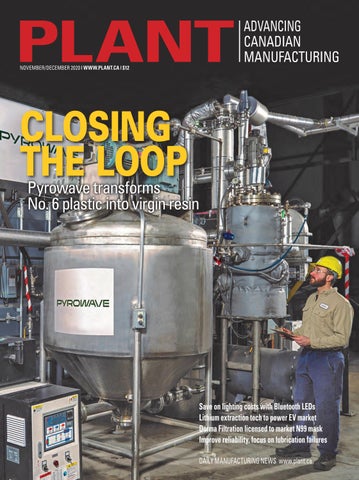
CLOSING THE LOOP Pyrowave transforms
No. 6 plastic into virgin resin
Save on lighting costs with Bluetooth LEDs Lithium extraction tech to power EV market Dorma Filtration licensed to market N99 mask Improve reliability, focus on lubrication failures DAILY MANUFACTURING NEWS www.plant.ca
PLT_NovDec20_AMS.indd 1
2020-11-20 8:28 AM
IT’S TIME TO TAKE A CLOSER LOOK AT ITALIAN MACHINERY We are your link to over 10,000 Italian manufacturing solutions providers from every industry. When you’re looking for the competitive advantage that comes with innovative technologies, take a closer look at Italian-made industrial equipment. We connect you to partners who offer problem-solving, flexible design, expanded functionality, and creative, cost-effective solutions. Our goal is to help you achieve your goals. When you’re ready, look to Machines Italia.
For more information on Machines Italia visit www.machinesitalia.org
machinesitalia
PLT_NovDec20_AMS.indd 2 1 PLT_MarApr20_ITC_AMS.indd
Machines Italia
@ITAmachines
Machines Italia
2020-11-20 2020-04-01 8:28 2:02 AM PM
01 2:02 PM
CONTENTS
November/December 2020 Vol. 79, No. 7
FEATURES 13 PERFORMANCE Looking for productivity gains? Build employees’ abilities through cross training.
15 THINK LEAN 5S offers more than workplace organization. Clean to inspect and drive improvements on the shop floor.
18 CCOHS SAFETY TIPS Put COVID-19 protocols in place to ensure all hazards are identified, risks are assessed and controls are in place.
10 PLASTICS
Pyrowave applies its proprietary technology to turn hard to recycle plastics into virgin-quality resins.
DEPARTMENTS
12 COVID-19 Dorma Filtration receives Health Canada approval to move ahead with its N99 reusable facemask.
14 AUTOMOTIVE E3 Metals advances technology that extracts lithium from brine for use in electric vehicle batteries.
16 MAINTENANCE How to reduce equipment failures from lube problems, waste, improper maintenance and disposal issues.
19 LIGHTING EcoGrid makes energy efficiency lighting projects pay off with LEDs and Bluetooth technology.
4 Editorial 6 News Bulletins 7 Careers 8 Industry Mix 9 Economy PLANT Pulse 20 Leading Edge: Innovative ideas for plants 21 Plantware Events 22 Postscript: A blueprint for manufacturing excellence
COVER IMAGE: PYROWAVE
PLANT—established 1941, is published 7 times per year by Annex Business Media. Publications Mail Agreement #40065710. Circulation email: bolechnowicz@annexbusinessmedia.com Tel: 416-510-5182 Fax: 416-510-6875 or 416-442-2191 Mail: 111 Gordon Baker Road, Suite 400, Toronto, ON M2H 3R1. Occasionally, PLANT will mail information on behalf of industry-related groups whose products and services we believe may be of interest to you. If you prefer not to receive this information, please contact our circulation department in any of the four ways listed above. Annex Privacy Officer: privacy@annexbusinessmedia.com Tel: 800-668-2374. No part of the editorial content of this publication may be reprinted without the publisher’s written permission. ©2020 Annex Publishing & Printing Inc. All rights reserved. Performance claims for products listed in this issue are made by contributing manufacturers and agencies. PLANT receives unsolicited materials including letters to the editor, press releases, promotional items and images from time to time. PLANT, its affiliates and assignees may use, reproduce, publish, re-publish, distribute, store and archive such unsolicited submissions in whole or in part in any form or medium whatsoever, without compensation of any sort. This statement does not apply to materials/pitches submitted by freelance writers, photographers or illustrators in accordance with known industry practices. Printed in Canada. ISSN: 1929-6606 (Print), 1929-6614 (Online).
www.plant.ca
PLT_NovDec20_AMS.indd 3
PLANT 3
2020-11-20 8:28 AM
EDITORIAL
Better days ahead, time to move on
T
his has been quite a year. Manufacturers have been dealing with uncertainty for some time; well, to be frank, at least since the end of 2016, and we all know who, in large part, contributed to our discomfort. Of course, that was preCOVID conditions. The pandemic has added another dimension to the uncertainty. But there is reason to believe better times are ahead, although there may be some hills and valleys as the effects of the pandemic wind down in 2021. COVID-19 showed how quickly manufacturers, recognized as essential to the economy, jumped on the need to produce personal protective gear and instruments to fight the virus. Amazing agility but there was a lot of seat-of-the-pants creativity at work. Looking ahead, manufacturers would be wise to have a more structured plan to manage risks, especially the unpredictable kind. COVID demonstrated the need to have a deeper understanding of supply chains. For example, who supplies your suppliers? What are the alternative sources for critical materials? What about proximity? The pandemic has also prompted SMEs to pick up the pace when it comes to adopting digital technology, which combines the power of data properly used with productivity improvements delivered by IoT-smart machinery and equipment. Longer term, advanced technology will help fill the shortage of appropriately skilled personnel. The expectation is it will attract younger people with more diverse backgrounds to manufacturing who see it as an attractive, challenging and lucrative career path. Great news in the automotive sector, too. Unifor has hammered out close to $5 billion in investments with the Detroit 3 automakers. Pat D’Eramo, CEO of auto parts maker Martinrea observed this is likely the highest level of investment in the Canadian industry in a decade. It has been an ongoing concern that there has been no investment in electric vehicles for Canadian plants. Ford and Fiat Chrysler are now on board with plans to assemble them in Oakville and Windsor, Ont. And there’s good news for Oshawa, Ont., where General Motors will be ramping up the recently wound-down assembly plant to produce pickup trucks. Assuming defeated US president Donald Trump eventually leaves the White House on his golf cart and heads into the sunset or a sand trap, business with the America will be less of a circus as Joe Biden assumes command of the presidency. Not that there won’t be challenges. Democrats have their own protectionist tendencies, and note Biden is making Buy American noises on infrastructure projects, although we won’t have to worry about tariff fun. Flavio Volpe, president of the Automotive Parts Manufacturers’ Association, said it best in a Yahoo Finance Canada article: “I don’t think that a Biden administration is going to be especially positive for the Canadian automotive sector. But it’s the end of the rule-by-clown wherein we wake up randomly to tariff threats that make it difficult to forward-plan where you allocate product and where you source metals.” Amen brother. It’s time to turn the page on the Trump aberration, which brings me to another matter involving moving on. I’ll be retiring, ending my adventures on PLANT after almost 22 years. It has been great covering the many accomplishments of Canada’s innovative manufacturers. I’ve learned a lot about the business and there have been many highlights and interesting people along the way. You are a creative and resilient group, punching way above your weight. And we appreciate your loyalty to the magazine, which has been part of the manufacturing community since 1941. Here’s to better days and the opportunities that lie ahead.
C
Ja Editor Joe Terrett 416-442-5600 ext. 3219 jterrett@plant.ca Senior Publisher Scott Atkinson 416-510-5207 satkinson@annexbusinessmedia.com National Account Manager Ilana Fawcett 416-829-1221 ifawcett@annexbusinessmedia.com
Th to Th sa de mo
Media Sales Manager Jason Bauer 416-510-6797 / 437-218-0941 jbauer@annexbusinessmedia.com Media Designer Andrea M. Smith asmith@annexbusinessmedia.com Circulation Manager Beata Olechnowicz 416-510-5182 bolechnowicz@annexbusinessmedia.com
S
M
Account Coordinator Debbie Smith 416-442-5600 ext 3221 dsmith@annexbusinessmedia.com COO Scott Jamieson sjamieson@annexbusinessmedia.com
Subscription Price Canada $76.00 per year, US $201.00 (CAD) per year, Foreign $227.00 (CAD) per year. Single Copy Canada $12.00. Add applicable taxes to all rates. Combined, expanded or premium issues, which count as two subscription issues.
FA
Mailing Address Annex Business Media 111 Gordon Baker Road, Suite 400 Toronto, ON M2H 3R1
Se
Circulation Beata Olechnowicz 416-510-5182 bolechnowicz@annexbusinessmedia.com Fax: 416-510-6875 or 416-442-2191
Ca glo of pro an int co to tec an pro vie tec the
Joe Terrett, Editor Comments? E-mail jterrett@plant.ca.
4 PLANT
PLT_NovDec20_AMS.indd 4
November/December 2020
2020-11-20 8:28 AM
PLT_No
SPECIAL FEATURES
GROWING YOUR BUSINESS
COVID HONOURS
March / April
January / February
The Canadian Industry stepped up to help stem the spread of Covid 19. Through the production of PPE, hand sanitizer, ventilators, and other devices like thermal gauges, distance monitors and others.
Covid 19 challenged manufacturers in 2020, but many companies proved their agility by finding new markets, new suppliers and making productivity moves that ensured production continued.
PLANT Magazine presented the Covid Honours in Fall 2020 and now is the time to learn more about these amazing companies and what they achieved for the benefit of all Canadians.
SUPPLY CHAIN MANAGEMENT May / June
Business uncertainty resulting from volatile trade issues and global disruptions are forcing manufacturers to examine their supply chains.
PLANT investigates the potential for 2021: planning for growth; innovation of products, processes and customer service to quickly address market needs; investment in tools and equipment to enhance productivity; financing; and expanding markets through exporting.
These are questions PLANT will address in a special report.
July / August
MONKEY BUSINESS - STOCK.ADOBE.COM
FACTORY OF THE FUTURE
CYBER SECURITY
Canadian manufacturers lag their global peers in the implementation of technologies, which improve productivity, production efficiency and provide deeper visibility into business operations. As companies recognize the need to adopt “factory of the future” technologies to deal with skills and labour shortages, improve ZAPP2PHOTO - STOCK.ADOBE.COM production and provide real-time views of their business, PLANT will identify trends, technology solutions, application of business intelligence and the challenges to implementation and how to address them.
A growing concern among manufacturers is the risk of cyber attacks.
September / October
NAVEE - STOCK.ADOBE.COM
HR REPORT, EXECUTIVE SKILLS AND TRAINING PLANT magazine’s annual salary survey
Who supplies their suppliers, and where are they sourcing materials? What happens if there is a disruption and who are the alternate suppliers? Are they geographically close? Should manufacturers be looking at reshoring? ENDOSTOCK - STOCK.ADOBE.COM
2021
of manufacturing executives shows senior management and business owners how their compensation breaks down according to a range of criteria. But it also provides senior management’s take on business confidence; investment issues, challenges; and changes they foresee over a five-year span. PLANT will also look at the skills issue. A shortage of qualified people is an ongoing problem. Where are the gaps? How do leading companies approach training, recruitment and employee retention? What are the most effective ways to find the right people?
November / December
It has become increasingly necessary for manufacturers to implement risk management plans to protect themselves, and to deal with incursions that will come. Our in-depth report will explore what leading companies are doing to stem the risk of cyber attacks, and deal effectively with them when they do occur.
DEAGREEZ - STOCK.ADOBE.COM
FOR MORE INFORMATION CONTACT: ILANA FAWCETT, National Account Manager | ifawcett@annexbusinessmedia.com | 416-829-1221 JASON BAUER, National Account Manager | jbauer@annexbusinessmedia.com | 416 510-6797
PLT_NovDec20_AMS.indd PLT_NovDec20_FP House ad_AMS.indd 5 1
2020-11-20 2020-11-13 8:28 9:15 AM AM
NEWS BULLETINS
Landfill waste to fuel RNG plant
Volunteer energy use program also approved
Ontario, Canadian Manufacturers & Exporters and BlackBerry Ltd. are partnering to accelerate the province’s economic recovery. BlackBerry will participate in CME’s Ontario Made program, aimed at promoting locally made products. The Waterloo-based enterprise software and IoT specialist will also establish a technology working group to expand the program. The Medicom Group has expanded at its US mask manufacturing operations with a second factory in Augusta, Ga. The global manufacturer of preventive and infection control products based in Montreal is tripling the square footage of its existing United Medical Enterprise facility in the city. It’s also adding a plant that will deploy new state-of-the-art surgical and N95-type mask production equipment with updated technology. Cascades, a manufacturer in Kingsey Falls, Que. of eco-friendly recycling, packaging and hygiene paper products, is launching a 100% recycled and recyclable thermoformed cardboard tray for fresh food packers. A patented water-based coating protects the tray from moisture without compromising the recyclability of the cardboard. 5N Plus Inc., a Montreal producer of specialty chemicals and engineered materials, has entered the additive manufacturing market. It will supply a range of high-performance engineered powders for 3D printing. It’s working with Metalpine GmbH in Graz, Austria, a producer of high quality performance powders to jointly serve growing demand. 5N Plus will distribute Metalpine’s metal powders in North America, while continuing to serve the global market with its own products. Stelco Inc. has completed its Lake Erie Works blast furnace upgrade and reline project in Nanticoke, Ont. The Hamilton steelmaker said the upgrades will improve quality and increase hot metal production of up to 300,000 net tons annually with a $30 per net ton cost reduction to produce steel coils. Stelco’s Hamilton and Lake Erie facilities produce more than 2 million tons of steel products annually.
6 PLANT
PLT_NovDec20_AMS.indd 6
(L-R) Walter Graziani, president, Comcor; Jeff Yurek, Ontario environment minister; Mike Watt, executive vice-president, Walker Industries; Bill Walker, associate minister of energy; Cynthia Hansen, Enbridge executive vice-president and president, gas distribution and storage; and Geordie PHOTO: DENIS CAHILL Walker, president and CEO, Walker Industries.
NIAGARA FALLS, Ont. — Four partners are building a renewable natural gas (RNG) plant that will generate enough energy from landfill waste to heat 8,750 homes across the country and reduce greenhouse gas emissions by 48,000 tonnes. The $42 million Niagara Falls Renewable Natural Gas plant brings together the Ontario government, construction materials firm Walker Industries in Niagara Falls, Ont., energy company Enbridge and engineering firm Comcor Environmental on a project that will capture biogas generated by decomposing organic waste and transform it into renewable natural gas. The Ontario Energy Board has also approved an application from Enbridge to implement a pilot Voluntary Renewable Natural Gas Program in Ontario starting in 2021. Customers can choose to support the transition to clean energy by making a small monthly contribution to purchase carbon-neutral renewable natural gas.
Co-op deal on aluminum foam use TORONTO — Cymat Technologies Ltd. has entered into a co-operation agreement with Tesseract Structural Innovations Inc., an automotive design company specializing in lightweight solutions for crash energy absorption. The Fayetteville, Ariz. company’s patented Uniform Deceleration Unit (UDU) applies Cymat’s SmartMetal in combination with a high-strength aluminum skin. Toronto-based Cymat’s stabilized aluminum foam is an ultra-light, cellular metallic material. Production involves the injection of gases through a molten bath of alloyed aluminum infused with ceramic particles. The material’s characteristics include: customizable density and dimensions; mechanical energy absorption; thermal and acoustic insulation; and time, temperature and strain-rate insensitivity. Tesseract’s UDU has been proven in physical crush and FEA simulations to absorb more energy than any other approach by weight. Cymat said the system mitigates small overlap crashes in passenger vehicles and light trucks, but also adapts to protect EV batteries during crashes. The companies will strategically market the UDU system and develop future energy absorption innovations within the automotive industry.
Maxim Power switches from coal to natural gas GE assists Alberta power plant changeover with combustion system upgrade of the gas turbine and proCALGARY — As Alberta duces NOx (nitric oxide and moves away from coal-pownitrogen dioxide) emissions ered electricity generation, at a rate of less than 9 ppm Maxim Power Corp. has to help meet operational been working with GE to and environmental requireconvert its Milner II coal ments. power plant to natural gas. The power plant produces Maxim Power’s M II 204 the equivalent of electricity megawatt (MW) natural consumed by approximategas-fired power plant is ly 208,000 Canadian housedelivering power to the holds. Maxim said it has Alberta grid near Grand Maxim converts its Milner II coal power plant to Cache, Alta. since the secPHOTO: MAXIM the option to increase the natural gas. plant’s capacity to approxond quarter, generating less imately 300 MW and improve the efficiency of than half of the emissions of a coal-fired facility. the plant by investing in heat recovery combined GE provided relocation support with a cycle technology. DLN2.6+ combustion system upgrade and seGE Gas Power, part of global energy technolcured a contractual services agreement for the ogy company GE, provides natural gas power GE 7F.05 gas turbine. technology, services and solutions. The DLN2.6+ upgrade improved the flexibility
November/December 2020
2020-11-20 8:28 AM
Consumers encouraged to buy made in Ontario Directory promotes local manufacturers, supported by the provincial government BARRIE, Ont. — A new guide will make it easier for shoppers to find made-in-Ontario products, while supporting local businesses and manufacturers. The Ontario Made Consumer Directory comes from Canadian Manufacturers & Exporters (CME), with support from the Ontario government. Consumers will find made in Ontario goods in the online, searchable directory at SupportOntarioMade.ca. The announcement was made at the Napoleon plant where high-quality barbecues, HVAC products and fireplaces Premier Doug Ford touring the Napoleon plant in Barrie, Ont. are made. PHOTO: ONTARIO GOVERNMENT “As we lean into 2021, we are increaslines to produce more food, personal protective ing production and have hired over 200 new fullequipment and other essential supplies. time positions since June to meet the need of In September, an increase of 51,700 jobs our customers,” said Chris Schroeter, co-CEO at pushed Ontario’s manufacturing employment by Napoleon. “... Ontario Made is a fantastic way for 17,000 jobs above pre-COVID levels. consumers to become aware of products made Since launching in July 2020, CME’s Support in their own backyards.” Ontario Made website has registered more than Ontario’s manufacturing sector accounts for 4,600 products from over 1,200 local manufacmore than 12% of the province’s economy, with turers. Over 150 retailers are also participating nearly $300 billion in annual shipments and in the program. Products with the Ontario Made $200 billion in exports. logo range from baby wipes to barbecues, and At the start of the COVID-19 pandemic, mancosmetics to cars. ufacturers ramped up or shifted production
GM trucks returning to Oshawa Unifor reaches a deal that will create up to 1,700 jobs
General Motors Silverado trucks. The automaker plans to start pick-up production PHOTO: GM starting in January 2022.
TORONTO — Unifor has closed its final deal among the Detroit 3 automakers after an agreement was hammered out with General Motors Canada in overtime Nov. 5. The automaker plans to bring pickup truck production
www.plant.ca
PLT_NovDec20_AMS.indd 7
back to the Oshawa Assembly Plant in Ontario with a $1 billion to $1.3 billion investment. It will hire between 1,400 and 1,700 hourly workers. Other investments include $109 million in St. Catharines to support added engine and
transmission production; and $500,000 in the Woodstock Parts Distribution Centre. The automaker said construction will begin immediately at Oshawa Assembly and will include a new body shop and flexible assembly module to support demand for its new family of pickup trucks. Production is to begin in January 2022. GM identifies the trucks as its most important market segment in Canada and across the continent, while helping to fund the transition to electric and autonomous vehicles. The union, which also represents workers at Ford and Fiat Chrysler, had set a deadline of 11:59 p.m. on Nov. 4 to reach a new, three-year labour deal and told its members to be prepared to strike if needed. But negotiations were extended to avoid a work stoppage.
CAREERS Corby Spirit and Wine in Toronto has appointed Caroline Begley vice-president of marketing. Most recently she served as vice-president of marketing for wine Caroline Begley and champagne at Pernod Ricard USA in New York. She returns to Toronto where she’ll drive the growth of Corby’s brands such as J.P. Wiser’s whisky, Ungava gin and Polar Ice vodka. Also on her agenda: increasing the Canadian market share of Pernod Ricard brands. General Fusion, the Vancouver developer of commercial fusion energy, has appointed John (Jay) Brister as chief business development officer. He previously led busiJay Brister ness development for AECOM’s Power division out of London, UK. He held various management roles throughout his career with utilities in the US as well as consulting roles. Boralex Inc. has appointed COO Patrick Decostre as the Montreal-based renewable power producer’s next CEO. He replaces the retiring Patrick Lemaire. Decostre Patrick Decostre joined the company in 2001 and spent 18 years building its business in Europe. Boralex develops, builds and operates renewable energy power facilities. Duncan Davies is the new CEO of Pinnacle Renewable Energy in Richmond, BC, replacing Rob McCurdy, who is retiring. From 2000 to 2019, Davies served as the president and CEO of Interfor Corp., a BC forest products company with operations in Canada and the US. He led the transformation of Interfor from a small regional producer into one of the largest lumber companies in the world. Pinnacle is the third largest industrial wood pellet manufacturer.
PLANT 7
2020-11-20 8:28 AM
INDUSTRY MIX
MISCELLANY FROM THE WORLD OF MANUFACTURING
Innovating short haul trucking Here’s an eco-friendly innovation in the short-haul trucking sector. NuPort Robotics in Toronto is betting on shuttle runs between distribution centres, warehouses and ports using self-driving electric trucks. This innovative start-up comes from a young entrepreneur – 26-year-old Raghavender Sahdev – president and CEO of the company, and co-founder Bao Xin Chen, chief tech officer. He has expertise in robotics, computer vision and machine learning. Sahdev came to Canada from India as a Mitacs intern at the University of Toronto and then went on Raghavender Sahdev with to earn his Master’s in Computer Science at York his Mitacs award. University. Mitacs is non-profit national research PHOTO: MITACS organization that partners with Canadian academia, industry and government. FYI, it awarded Sahdev its Environmental Entrepreneur Award at a virtual awards ceremony in September. They started their MaRS portfolio company last year and are poised to change the way retailers, manufacturers and logistics companies move goods by targeting the “middle mile” delivery of a company’s supply chain, typically between five and 20 kilometres. NuPort’s technology applies a navigation system that incorporates high-tech sensors and controls, and will be offered as a robot-as-a-service. Client trucks are converted from manual to autonomous operation, then managed by NuPort as they move along a fixed route. It’s running pilot projects with major retailers and players in the trucking and transportation industries, aiming for commercialization “in the near future.”
Processors face challenges An IDC Canada report says nearly half of Canadian process manufacturers are concerned about regulatory changes, 40% point to data breaches and 35% note labour shortages as top priorities. Almost two thirds (62%) see tech as critical to staying afloat as the speed of market shifts increase. Process manufacturers cite challenges Regulation, talent and traceability are in regulation, talent and traceability. Thirconcerns. ty-two per cent say changes to import/exPHOTO: DEDMITYAY - STOCK.ADOBE.COM port regulations have a “very high impact” on decision-making; 49% note a moderate talent pool impact from evolving immigration legislation; and 54% highlight loss of brand value if products and components are not effectively traced. How to embrace the inevitable uncertainties? IDC found tactical technology investment is the top priority: 35% prioritize reducing operational costs; 25% want increased supply chain visibility; and 26% are looking for the automation of repetitive tasks. Another IDC Canada study for ERP provider SAP shows companies well into their digital transformation performed better through the COVID-19 pandemic, while companies without a robust digital strategy are being left behind. Of the enterprises identified as leaders, most have a digital strategy that’s fully integrated into the business or is complete and already producing significant results. Observers are beginning to build or execute their digital strategies. Key attributes of the resilient players include: a willingness to adjust the workforce mix to support digital initiatives; a belief it’s very important to improve employee experience while improving customer experience; and a change management strategy that’s fully integrated into the digital strategy.
8 PLANT
PLT_NovDec20_AMS.indd 8
CAE is carbon neutral CAE has entered the carbon neutral zone. The Montreal-based manufacturer of civil aviation, defence and healthcare training systems declared itself the first Canadian aerospace company (as of Sept. 28) to do so. CAE achieved its goal by making CAE’s CEO Marc Parent discusses investments in projects that offset its PHOTO: CAE carbon neutrality. remaining annual carbon emissions. Training pilots in simulators prevents hundreds of thousands of tons of CO2 from being emitted each year. Additional measures are carbon offsetting and renewable energy certificates while new technologies and solutions are in development to reduce emissions. Other measures will be put in play by making full-flight simulators more energy efficient. Investments in renewable energy certificates are also made in the countries where CAE operates and by funding greenhouse gas reduction projects, including wind energy in India and forest preservation in Canada. Check out a video at https://youtu.be/26X3uV5pc2Y.
Companies that are early adopters of technology gain a productivity edge and have a greater likelihood of survival. Dalhousie University economics professor Lars Osberg in a Canadian Press article.
CEO transition at Magna Don Walker, Magna International’s CEO between 1994 and 2001, and again since 2005, will retire at the end of the year. Magna’s president Seetarama Kotagiri, with 21 years at the global automotive parts manufacturer in Aurora, Ont., will take over the top leadership spot. During his 33-year career, Walker has various Soon to retire Don leadership roles including CEO of Intier Automotive Inc. Walker. PHOTO: MAGNA between 2001 and 2005. Over 15 years Magna’s sales have grown from $23 billion to $40 billion. The company has 152,000 employees, 346 plants and 93 offices in 27 countries. He graduated from the University of Waterloo with a Bachelor of Arts in Science Mechanical in 1980. Prior to Magna he spent seven years at General Motors in various engineering and manufacturing positions. Walker wasn’t looking for a job at Magna in 1987 when he pitched founder Frank Stronach on making an investment in a company he hoped to start, according to the Financial Post. Stronach offered him a job instead but Walker wasn’t planning to stay too long. Time flies. Now the 64-year-old auto executive is planning to apply his talents in retirement to Canada’s future prosperity by helping to influence a range of policy issues.
November/December 2020
2020-11-20 8:28 AM
ECONOMY
Ready to walk Pandemic fallout cited
www.plant.ca
PLT_NovDec20_AMS.indd 9
ROBOTICS EXPAND WORKFORCES
billions of chained (2012) dollars – all industries 2,050 2,000 1,950 1,900 1,850 1,800 1,750 1,700 1,650 1,600 Aug 2015
2016
2017
Aug 2020
2019
2018
Firms that invested in robots from 1996 to 2017 employ more, not fewer, workers, according to two Statistics Canada studies. Firms expanded their high- and low-skilled workforce, but not the middleskilled. Fewer managers were needed to monitor workers to ensure quality; and workers have greater decision-making authority. In 2008, the stock of robots was $1.2 billion, just under half for automotive assembly lines. By 2017, less than $400 million of the $1.5 billion stock was in the automotive sector.
Source: Statistics Canada, CANSIM
TORBZ - STOCK.ADOBE.COM
55.5 Confidence of manufacturing purchasing managers according to October’s IHS Markit Canada Manufacturing PMI. That’s down slightly from September’s 56.0, but it indicates strong improvement in overall business conditions.
71%
E .C OB AD K. OC ST
Advance in manufacturing GDP in August, up for the fourth consecutive month, with gains in durable manufacturing (3.8%) more than offsetting lower non-durables, down 1.6%.
OM
1.2%
$127,478 ADRAGAN - STOCK.ADOBE.COM
Average salary of male manufacturing executives and senior managers, compared to $96,759 for women, according to the 2020 EMC-PLANT manufacturing Salary Survey. That’s a 27.4% difference.
TORBZ - STOCK.ADOBE.COM
M
ost Canadian employers are confident about the economy and have a positive job outlook despite the global pandemic, but employees don’t necessarily share that perspective, according to Hays Canada, an HR specialist based in Toronto. Its 11th annual salary guide shows they cited as concerns reduced social interaction, increased workloads and a lack of well being and mental health support. The 2021 report, completed in August during the COVID-19 pandemic, also found 49% of employees are “seriously considering” leaving their current role, which represents a ninepoint increase over last year. Manufacturing is higher than the national average at 56%. Heading into Q4, 55% of companies were back to business as usual or in growth mode (19%) after several months of coronavirus slowdown. Early in the year, 81% of employees rated their well-being as “positive” but dropped almost 20 points to 64% as the lockdown unfolded, while 54% of employers admitted to providing no employee wellness or mental health assistance. “Employees expect a company to have their best interests at heart and we’re now seeing evidence that unsupported teams look for better opportunities,” said Travis O’Rourke, president of Hays Canada. One-third of respondents cut staff and 71% froze salaries in response to the pandemic. They expected to recoup headcount lost over the previous six months but only 19% planned to boost pay greater than an annual cost-of-living adjustment. A further 29% confirmed no salary increases are planned for the next year. Here are some highlights: • Employment optimism is highest in Ontario and Quebec (77%) and BC (74%). • Employees in Quebec (54%), Ontario (52%) and Alberta (48%) are most ready to leave. They seek benefits (53%), career development (44%) and work-life balance (40%). Access the Salary Guide report at https://bit.ly/2Gvuyco.
55.4% STO CK. ADOBE. COM
Share of manufacturing businesses closed in March as a result of the pandemic that reopened by July, according to Statistics Canada. This is ahead of the cumulative total of 49.5% businesses that re-opened.
Companies investing in on-demand digital services, says a CEO study by Vanson Bourne and Dell Technologies. But only 40% have fully or almost completed their latest round of investment. Before the pandemic, the pace of digital transformation in Canada lagged other parts of the world. Mid- to enterprise-sized Canadian businesses now recognize the need to pick up the pace of deployment. Just 34% can say having the right technologies in place enabled them to successfully accelerate in 2020. Download the study at https://bit.ly/2JJxHGR.
PLANT 9
2020-11-20 8:28 AM
PLASTICS
CLOSING THE
LOOP
PYROWAVE TURNS PLASTIC INTO A REUSABLE RESIN Technology microwaves feedstock to create virginlike styrene resin. BY KIM LAUDRUM
A
Quebec-based start-up is coming closer to realizing a circular economy for plastics manufacturers and helping to save the planet, one yogurt cup at a time. Pyrowave has developed a technology that nukes hard-to-recycle plastic trash back into identical virgin resins. Named “One to Watch” in the global 2018 50TOWATCH clean techs, it recently caught the attention of Michelin. In the fall of 2020, the French company announced it was investing in Pyrowave’s microwave company. A Michelin executive now sits on Pyrowave’s board. The global tire manufacturer’s goal is to increase to 100% the composition of its tires made of sustainable material. Using recycled styrene produced by Pyrowave’s technology will help it do that. And Michelin’s involvement will help Pyrowave bring its technology to market faster, says Jocelyn Doucet, the company’s CEO and co-founder. The investment in the technolgy’s international rollout is more than $31 million, but Michelin also brings its expertise to the table. “Instead of making products from resources, let’s make
10 PLANT
PLT_NovDec20_AMS.indd 10
resources from products,” says Doucet, explaining the idea behind the technology. Pyrowave’s patented catalytic microwave depolymerisation (CMD) technology electrifies the chemical process using low-carbon footprint microwaves on feedstock from post-consumer plastic. This carefully breaks the plastic’s internal links, returning them to their component molecules, or “monomers,” to recreate a resin identical to the virgin material used to make the original product. Pyrowave is focusing on tough-to-recycle No. 6 plastic or polystyrene and returning it to its original styrene monomers, which Michelin blends in its rubber tires. “Michelin has made a very strong and aggressive commitment to integrate more renewable and recyclable – and even bio – materials in their products. The short story is some of their products require styrene. They hadn’t yet found any renewable alternative for the styrene source,” Doucet says. Pyrowave turning polystyrene waste back into styrene monomer helps Michelin resolve its feedstock issue. Currently, the virgin material is made using fossil fuels. Michelin will test Pyrowave’s technology at its facility outside of Paris. Styrene-butadiene rubber is the most widely used type of synthetic rubber, with an annual North American production of
Top: The catalytic microwave depolymerisation reactor that detaches No. 6 plastic building blocks. PHOTOS: PYROWAVE
Above: A yogurt cup cut down during the first step of the process.
of methanol or ethanol. That was a very visionary idea at the time.” But Doucet says these systems would perform differently when they were scaled up.
PHOTO: ERIC_CARRIERE
Scaling up
approximately 490 kilotons. Its manufacture requires between 15% and 40% styrene. The global market for styrene butadiene is growing at 7% per year and is expected to reach US$9.17 billion by 2027, according to Reports and Data. A graduate of Polytechnique Montreal with a PhD in chemical engineering, Doucet began his entrepreneurial career with his father as a consultant working on waste conversion projects 10 years ago. “At the time, what was popular for treating waste were those big gasification and pyrolysis plants. People thought you put the trash in and there is a massive reactor that converts it to fuel or syngas. And then you use that syngas as a raw material in the production
Doucet and co-founder JeanPhilippe Laviolette, a chemical engineering PhD from Polytechnique Montreal who oversees the development and implementation of Pyrowave technologies, began working together in 2012 in the lab. They were “like a couple of crazy guys experimenting and trying different things to see if they would work,” to meet the challenge of scaling up recycling systems, Doucet says. The microwave technology allowed them to target the polymers to break down into styrene monomers, better than the gasification and paralysis systems could. Also, Doucet says they realized they could scale up in a modular way, adding microwave units that have a footprint of 6 feet by 15 feet. In 2014, they realized they had a viable technolo-
November/December 2020
2020-11-23 9:38 AM
markets for Pyrowave technology are wherever clean electricity is readily available, such as in Ontario and Quebec. Europe is also a target market. Why is clean electricity important? Although microwave technology is an efficient use of electricity for the recycling process, fossil fuel generated power would impact the technology’s carbon footprint. Plastics No. 6 (or polystyrene) has long been on environmentalist’s hit list. It’s found strewn everywhere and is notoriously difficult to recycle. Most places do not accept foam plastic for recycling because it’s 98% air. Polystyrene is found in packing peanuts, disposable plates and cups, meat trays, egg cartons, and take-out food containers. The rigid form is found in yogurt cups, DVD cases and refrigerator shelves.
Plastic waste
Above: Styrene drop of monomer that has been purified and is identical to virgin resin. Top right: Jocelyn Doucet, CEO and co-founder of Pyrowave. Bottom right: Jean-Philippe Laviolette, vice-president, innovation and co-founder of Pyrowave.
gy and Pyrowave was born. Today the company employs 20 people and operates out of a head office in Montreal. Funding sources for ongoing research came from National Science and Engineering Research Council (NSERC), which recently contributed $173,000 with matching funds up to $400,000; and a $3.2 million injection from Sustainable Development Technology Canada. Along the way, Ontario Centres of Excellence, Export
www.plant.ca
PLT_NovDec20_AMS.indd 11
Development Canada, and other provincial and federal departments provided support. Two years ago, Pyrowave began testing its technology, working with the city of Salaberry-de-Valleyfield, Que. to recycle polystyrene plastics from landfill. The firm earned accolades as a start-up clean tech company with the greatest potential for export sales from Jim Carr, the federal minister of international trade diversification. According to Doucet, potential
Every year Canadians throw away 3 million tonnes of plastic waste, less than 10% of which is recycled. This means the vast majority of plastics, which take 400 years to break down, end up in landfill. About 29,000 tonnes of the stuff was discarded in our natural environment in 2016. Globally, 50 million tonnes of plastics are choking the world’s oceans, according to the World Economic Forum. It’s costly, too. About $8 billion worth of single-use plastics are tossed out in Canada. To meet the Canadian government’s objective of zero plastic waste by 2030, a ban was announced, in October effective within a year, on six common items it says can be replaced with better alternatives. These plastic items are checkout bags, straws, six-pack rings, stir sticks, cutlery, and take-out food containers, the latter of which is made of polystyrene. The ban is opposed by the Chemistry Industry Association of Canada (CIAC), which now includes a plastics division. Instead, the association supports an industry-led program to advance a circular economy
for plastics in Canada. The CIAC made a goal to recycle, reuse or recover 100% of plastics packaging by 2040 and 100% of plastics being recyclable or recoverable by 2030. Pyrowave is a CIAC member. “Advanced recycling technologies are a key piece to developing a circular economy for plastics and eliminating plastic waste. Pyrowave is a prime example of how Canadian companies are leading the way in developing innovative and effective technologies that are successfully addressing the issue of plastic waste,” says Elena Mantagaris, vice-president of CIABC’s plastics division. For plastics manufacturers who want to contribute to a circular economy, Mantagaris says new advanced technologies will help expand and build new markets for specific types of recycled plastics. “As industry takes on more responsibility for full recycling systems, increased amounts of plastic will be collected. Advanced recycling technologies will break down hard-to-recycle items to their molecular level use again and again – thus creating new markets for recycled plastics. From an economic and environmental standpoint it’s win-win.” The plastics industry faces mounting pressure to accept some responsibility for cleaning up the environment. It’s cheaper to create styrene monomer from fossil fuels, but if the industry had to bear the costs of contaminating the environment and contributing to greenhouse gas emissions, that cost would rise. Returning the contaminating products – especially single-use plastics – to their original state just makes sense. Kim Laudrum is a Collingwood, Ont.-based business writer and regular contributor to PLANT. E-mail kimlaudrum777@gmail.com. Comments? E-mail jterrett@plant.ca.
PLANT 11
2020-11-23 9:38 AM
COVID-19
Looking for a fabricator for a complex project? Whether it’s a heat exchanger, stack, pressure vessel, filter, or other custom process equipment, Alps Welding can turn your design into reality.
Battling the second
WAVE
MANUFACTURERS CONTINUE TO INNOVATE Production aims to meet the protection of healthcare workers. BY PLANT STAFF
C We have experience working with steel, stainless, and other alloys, including titanium.
With over 150 welding procedures, and 40 years of experience meeting the demanding specifications of the energy, mining, chemical, and cleantech industries, make Alps Welding your first call when looking for a fabricator for critical equipment.
400 New Huntington Road Woodbridge, Ontario 905-850-2780
www.alpswelding.com
anadian companies are continuing to respond to the need for protective gear and testing devices as the second wave of the virus that causes COVID-19 kicks in. Dorma Filtration has received its Medical Device Establishment Licence from Health Canada to market its N99 mask, the first designed and manufactured entirely in Canada. The Montreal company describes itself as a network for the manufacture and distribution of personal protective equipment. It’s now allowed to manufacture up to 500,000 N99 masks per month, increasing to one million units by December. The mask filters more than 99% of airborne particles, making it more efficient and environmentally friendly than the disposable N95 mask. It can be reused more than 30 times and its components are recyclable. The N99 mask is the result of collaboration with the National Research Council of Canada. Its team has expertise in optimizing the injection moulding processes to be employed in the manufacture of the masks. The project also brings together the expertise of NRC researchers; Sefar BDH, a filtration technologies specialist; MI Integration, a specialist in injection moulding; and eLab extrusion, a polymer extruder.
12 PLANT PLT_JanFeb_Alps.indd 1 Alps_Plant_ Jan 2018.indd 1
PLT_NovDec20_AMS.indd 12
The Dorma 99 mask. PHOTO: DORMA FILTRATION
Multinational mining group Rio Tinto contributed financially to the filter design, and acted as a facilitator between the project’s stakeholders.
Virus detection BioCanna CuraLab, collaborating with the University of Ottawa, has achieved a breakthrough in the development of its BioNano Virus Detection System. The Toronto-based subsidiary of BioCanna Health Care Inc. has applied nano technologies to make the device. It can be used at home, in schools, sport and entertainment venues and remote areas. BioCanna is enhancing the system features and tailoring the device to specific viruses, such as the one that causes COVID-19. The COVID-19 POC KIT identifies the virus by reading a saliva sample and delivers a reading within 15 minutes. The company claims more than 95% accuracy at an estimated cost of $5 per test. Comments? E-mail jterrett@plant.ca.
November/December 2020 2019-01-16 11:02 AM 2019-01-08 12:55 PM
2020-11-20 8:28 AM
PERFORMANCE
Train workers so they are capable of stepping into other roles. PHOTO: WINNIEVINZENCE - STOCK.ADOBE.COM
High productivity
GAINS ACHIEVE THEM WITH CROSS TRAINING Build agility by building employees’ abilities. BY HUGH ALLEY
A
manufacturer is working on a project that’s likely to deliver an immediate 10% productivity gain, plus several other benefits. Employees will experience more variety in their work, the risk of injury could be lowered, and there will be greater awareness of how all jobs are interconnected. What could be so powerful? Cross training. It’s amazing how companies chain their people to workstations, missing an opportunity to expand their capabilities for use in other areas of the plant. In a post-COVID-19 world, companies can’t afford to have employees so limited in their abilities. When a manufacturer’s production line unexpectedly ran out of an input, the new plant manager was frustrated he couldn’t use the idled people to fill in for some COVID-related vacancies. Most people weren’t trained for other tasks. There can be significant barriers to cross training. However, it’s possible to overcome each of them. Here are some examples of barriers, causes and a strategy to deal with each issue.
• Owner doesn’t support training. Previous training has been ineffective. Start by training for skills that can be taught in five minutes. • Supervisor won’t share. Wants to avoid blame when production ramps up again and doesn’t want to risk missing a bonus. Develop short-term loans. Add a plant-wide performance component to any bonus structure. • Union contract makes moves onerous. Concern about favouritism applied to who gets trained. Create a clear open process for people to indicate they want training. • Union contract makes moves onerous. Concern about favouritism applied to who gets moved. Establish a clear process for deciding who moves, and use it. • Resistance to time away from production. Fear it will take a long time to train people to do new jobs correctly. A good training approach (TWI Job Instruction) can teach segments of a job in as little as 15 minutes. • Highly specialized skills. Complex jobs often require a lot of background understanding. Look for portions of the job that can be cross-trained (tending a machine is easier than set-up, kitting for a changeover is easier
than doing the changeover.) Employees at a company that developed a cross-training program responded positively to the posting of a chart showing which skills were needed and what people were willing to train for, and which skills people already had. The union got on board when it was shown how the program would be administered. And reps were shown how job rotation would
Hugh Alley is an industrial engineer based in the Vancouver area. Call (604) 866-1502 or e-mail hughralley@gmail.com. Comments? E-mail jterrett@plant.ca.
CONNECTING THE NEXT GENERATION TO ADVANCED MANUFACTURING HIRING POSTSECONDARY STUDENTS ?
GET UP TO
$7,500 PER PLACEMENT!
CONTACT
EMC TODAY!
Wendy Gray
Susan McLachlan
Senior Project Coordinator wgray@emccanada.org
Project Coordinator smclachlan@emccanada.org
Emploi et Développement social Canada
Employment and Social Development Canada
PLANT 13
www.plant.ca PLT_Excellence_NovDec20.indd 1
PLT_NovDec20_AMS.indd 13
address some safety risks related to exertion. The result was a vastly more flexible workforce. Measured productivity went up 10% that year.
2020-11-12 1:07 PM
2020-11-20 8:28 AM
AUTOMOTIVE E3 Metals improves the performance of its technology. BY PLANT STAFF
W
ith the world heading towards replacing internal combustion transportation with electric vehicles, the demand for the atomic No. 3 element, aka lithium (Li) is growing, which is causing some concern among automakers expecting a strain on supply. E3 Metals, a Calgary lithium developer, is advancing an extraction technology that will help bolster supply while providing a more concentrated and pure material. Lithium is used in rechargeable automotive batteries. The experts believe the global lithium supply is adequate for current needs, but that’s going to change. Bloomberg New Energy
Lithium batteries for electric vehicles.
PHOTO: ROMASET - STOCK.ADOBE.COM
Extracting
LITHIUM ENSURING A POWER SOURCE FOR ELECTRIC VEHICLES
MURPHY MEANS
MORE More
QUALITY No One Gives You More! More than 14,000 systems sold over the past 75 years
N.R. MURPHY LTD. DUST COLLECTORS 430 Franklin Blvd., Cambridge, ON N1R 8G6 E-mail: 4nodust@nrmurphy.com
(519) 621-6210
www.nrmurphy.com
Finance finds EVs will account for 10% of global vehicle sales by 2025, 28% by 2030 and 58% in 2040. California wants to ban combustion-powered vehicles by 2030 and the pressure is on in Europe to move more EVs along similar timelines. Lithium-ion batteries are the prevalent energy storage medium for EVs. They’re efficient and they have a long lifespan covering up to 320,000 kilometres, over an average 17 years.
Extraction technology E3 Metals has access to 6.7 million tonnes of lithium carbonate equivalent from the Leduc Reservoir in Alberta. It’s advancing a propriety direct lithium extraction (DLE) technology to a commercial pilot phase with Livent Corp., a producer of lithium chemicals in Philadelphia. Livent has provided $5.5 million to fund development, the pilot plant construction and its operation. E3 Metals is also working with the University of Alberta and GreenCentre Canada in Kingston, Ont., which supports the growth of chemical
14 PLANT PLT_NRMurphy_NovDec20.indd 1
PLT_NovDec20_AMS.indd 14
and materials start-ups. The Leduc resource will be developed through brine production. It sustains very high flow rates within its confined aquifer allowing for large volumes of brine to be brought to the surface. Once lithium is extracted, the brine can be injected back into the reservoir. The sorbent developed by E3 Metals and the University of Alberta is highly selective for lithium compared to other unwanted dissolved ions, such as calcium, magnesium and sodium. Lithium is selectively extracted from brine, concentrating it into a rich solution while removing unwanted impurities and reducing fluid handling volumes for downstream processing. Using existing commercial technology, the concentrate is further purified to produce highgrade lithium products through electrolysis and crystallization. DLE recovers over 90% of the lithium and increases its concentration from ~80 mg/l to over 5,000 mg/l, while reducing impurities by 99%. The process is a low-energy method that requires no solar evaporation, and has a rapid reaction time. “The first phase of the joint development project is an essential step in initiating a robust and economically viable process for commercializing lithium production from Alberta brines,” says Chris Doornbos, president and CEO of E3 Metals. Comments? E-mail jterrett@plant.ca.
November/December 2020 2020-11-16 11:25 AM
2020-11-20 8:28 AM
THINK LEAN
Clean to
INSPECT HOW 5S DRIVES IMPROVEMENTS It offers more than workplace organization.
M
www.plant.ca
PLT_NovDec20_AMS.indd 15
from Kunst Solutions at https:// kunstsolutions.com/shop/ tpm-tpm-boards). Richard Kunst is president and CEO of Cambridge, Ont.based Kunst Solutions Corp. Visit www.kunstsolutions.com. E-mail rkunst@kunstartofsolutions.com. Comments? E-mail jterrett@plant.ca.
Conveying More Than IDEAS
BY RICHARD KUNST any people default to 5S as a method for workplace organization, which is really a primary result but not necessarily the driver of the methodology. Ultimately 5S organizes your workplace for a quick way to “clean to inspect” but the benefits trickle into other methodologies as a catalyst for improvement. At local machine shop in Japan, team members were on top of a machining centre wiping down the top guards, which were not visible from the floor. The manager explained: “The most sensitive and agile instrument still on the planet today is the human hand. If I can create a work pattern where a human hand touches every inch and aspect of a machine at least once per week, the likelihood of early detection of an issue is exponentially increased.” When machines arrived at the facility, team members minimized guarding. Exposed wires and hoses were easier to access for cleaning and wiping down componentry, and detecting potential problems. Concerns would then be dealt with. In Japan where the culture supports no time limits on cleaning to inspect, and cleaning is carried out continuously, you are guaranteed the machine will be touched top to bottom at least on a weekly basis. How can we make this happen
to a TPM checklist, which are printed on a different colour paper and specific to cleaning and equipment checks defined by day. Corollary audits embedded within the TPM methodology allow a quick and easy check that the tasks have been completed. Or act as an instigator to provide a team member with additional training to complete the task in a safe manner. TPM methodology is available
A TPM board template. GRAPHIC: KUNST SOLUTIONS
in our plants? First you need an organized work environment where visually identifying the normal from the abnormal can be done quickly. But cleaning every attribute of a machine weekly can be done another way. Start by standing at the machine and instruct the team member to clean it from top to bottom, including every wire, hose, nook and cranny. Time every significant process step to rebalance later during reflection.
Cleaning activities Review the process steps and time, then develop a balance chart. What cleaning activities are required to be completed every day without exception? How long does that take? Take the additional identified cleaning process steps with their times and balance them across five days to establish a standard time for cleaning on a daily basis. This may require expanding the time allocated daily for cleaning, or you may learn ample cleaning time has already been allocated (but there was no process). To ensure standardization and compliance, add the tasks
From a few simple replacement parts to a complex automation project, our skilled and dedicated staff are here to help you. With over 70 years of experience in material handling equipment, Rolmaster is the
www.rolmasterconveyors.ca 121 Avenue Road, Cambridge, ON (800) 461-6806
PLANT 15
2020-11-20 8:29 AM
MAINTENANCE
Technician checks and logs data from the lubrication system of an electric motor and PHOTO: PICHITSTOCKER - STOCK.ADOBE.COM centrifugal pump.
Reliability
ISSUES FOCUS ON REDUCING LUBRICATION FAILURES
THAT’S THE TRUE MEANING OF PERFORMANCE
Highlights from a STLE Toronto workshop help with lube management.
T EXPLORE THE BROAD RANGE OF
NEW SULLAIR COMPRESSORS AT SULLAIR.COM
© 2020 Sullair, LLC. All rights reserved.
ribological losses that lead to damaged equipment, energy loss, and premature disposal of components, equipment, machinery and lubricants leach away the value of assets, leading to downtime and added costs. What’s needed is a little planning and to follow proper maintenance procedures. The not-for-profit Toronto Section of the Society of Tribologists and Lubrication Engineers (STLE) offered some assistance in this regard with a workshop and panel discussion. Held at the nuclear Ontario Power Generation (OPG) facility in Pickering, Ont., the session covered how to reduce equipment failures due to lubrication problems, waste, improper maintenance and disposal issues. How should maintenance
16 PLANT PLT_Sullair_NovDec20.indd 1 021013_Sullair_Plant Canada and MRO_3.875x11.indd 3
PLT_NovDec20_AMS.indd 16
pros maximize productivity and component life? The following highlights gleaned from the workshop offer some direction. Cleanliness. Don’t assume new oil is clean enough. As a rule of thumb, oil should have a cleanliness level that protects the tightest machine clearance on the equipment. Terry Pitcher, indirect business consultant for Chevron Canada Ltd. who is based on Guelph, Ont., observed oil cleanliness requirements are often based on a component’s sensitivity to contamination. That’s because 82% of wear is induced by particles. It’s often assumed new oil meets the performance and cleanliness requirements set by the equipment manufacturer. But Pritcher warned new oil could contain up to 32 times more contaminant particles than what’s acceptable. The reason? New oil can be transferred multiple times before it reaches the equipment. Oil picks
November/December 2020 2020-10-14 1:15 PM 10/13/20 2:04 PM
2020-11-20 8:29 AM
up more contaminants each time it’s transferred. Filters will remove some of them, but not before they’ve caused damaging wear. Some companies choose to pre-filter new oil onsite to ensure it’s clean enough. Additives. Gavin Duckworth, vice-president of national accounts for Functional Products, an additive supplier in Macedonia, Ohio, said identifying viscosity index (VI) improvers in today’s modern formulations, combining polymer chemistries to reduce costs and improve performance, and detecting sources of haze are possible solutions to lubrication issues. The higher the VI, the lower the change in viscosity with temperature, and the wider the operating temperature window for equipment. He identified advantages of polymer viscosity modifiers over blending oils: cheaper high VI (Gr. I and naphthenic with VI 140+); higher viscosity grades (Gr. III, synthetic ester); better low temperature (polymer + light oil vs. heavy oil + light oil); and low viscosity, high VI formulations are possible (low viscosity base oils tend to be lower VI). Oil analysis. Andrew Sit, a components engineer at OPG’s Pickering nuclear facility, recommended oil analysis to detect early signs of contamination and degradation. At OPG, maintenance and operations conduct routine testing on site, at a maintenance and oil testing facility or at an offsite lab. The crew testing the sample report any abnormalities. Test data is verified and recorded into a database that automatically generates notifications of out-of-spec conditions. Results are received and troubleshooting is conducted by the station lube engineer, systems engineer and chemistry technical section. Filtration. Wendy Walker, general sales manager of Pall Canada Ltd., a provider of filtration, purification and separation products in Mississauga, Ont., said effective filtration is a
critical aspect of any reliability program. Fluid cleanliness can be controlled to allow components and systems to operate at peak efficiencies. Her presentation offered some need-to-know fundamentals. Fibre size and density govern a filter’s pore size and porosity. Benefits of smaller diameter filters include higher dirt capacity, lower pressure drop and longer service life. Inert organic fibres offer wide chemical compatibility; there’s no swelling; and there are no limitations to shelf life. Fixed pore fibres are bonded with specially formulated resin to resist deterioration from pressure, flow fluctuations temperature and age. Non-fixed pore are inconsistently or poorly bonded. This allows movement of the fibres under pressure and flow surges, resulting in channelling, unloading and media migration. She also compared a uniform and tapered pore construction. Tapered has a coarser upstream surface to capture larger particles. This allows finer downstream pores to capture critical clearance-sized particles. More particles captured means longer service life. Uniform pore design limits the use of effective void volume to capture particles. It increases costs by reducing the number of particles captured, and reduces filter life.
utilities used in manufacturing. Air leaks are often ignored and they’re costly. Dent’s presentation noted cost of ownership is split at 15% capital, 15% maintenance and repair and 70% electricity. With no compressed air leak program, 40% of the electricity cost is wasted on leaks and wrong applications such as using compressed air when there is a lower cost energy source available; blow offs without energy efficient nozzles; and filters that aren’t clean. The high frequency component of a leak is directional, making locating its source with ultrasound fast and easy. A compressed air survey once every three months will improve efficiency and reduce costs. Ultrasound surveys of an entire steam system will reveal system leaks, blockages, stuck valves and failed traps. Dent said increasing steam efficiency
This synopsis was provided by Steve Gahbauer, an engineer, a Toronto-based business writer and a regular contributing editor. He passed away in May. This is his final article. Comments? E-mail jterrett@plant.ca.
Condition monitoring Ultrasound technology. Robert Dent, the national sales and service manager of SDT Ultrasound Solutions in Cobourg, Ont., extolled the benefits of ultrasound as an extremely versatile condition monitoring technology that is applied to lubrication, leak detection, and steam system inspection. Applying the right amount of grease, at the right location and at the right time interval is crucial. Ultrasound provides the data to optimize lubrication programs and facilitates a shift from calendar-based to condition-based scheduling. Compressed air is one of the top three most expensive
Need help with the cloud?
Cloud-based drive maintenance is here. Transform your operations from being reactive to pro-active all while doing it remotely in the new reality we are living.
M
E
CIAL
D
I
A
Local site: sewcan.ca | Corporate site: sew-eurodrive.ca
PLANT 17
www.plant.ca PLT_SEW_NovDec20.indd 1
PLT_NovDec20_AMS.indd 17
means huge dollar savings and increased product quality. Monitoring devices. Chris Henn, a territory account manager for Omron Automation Canada in Toronto, spoke about predictive maintenance for motors by applying current analysis, vibration and temperature control, and employing insulation resistance monitoring devices. He said motor monitoring devices bring practical Internet of Things to the component level. Knowing an asset’s current status and when a replacement is needed prevents reactive downtime.
2020-11-17 11:06 AM
2020-11-20 8:29 AM
CCOHS SAFETY TIPS Guidelines and best practices will minimize COVID-19’s impact.
Provide masks when they’re recommended for your workplace. PHOTO: SUPACHAI - STOCK.ADOBE.COM
C
OVID-19 greatly changed how workplaces across the world operate. From implementing emergency management plans, enacting shutdown procedures and re-opening for business, manufacturers have been tasked with providing a COVID-safe work environment. The virus spreads in the droplets expelled when someone coughs or sneezes. Contracting COVID-19 is more likely when people are within two metres (six feet) of each other. Making contact with any surface where droplets have settled can also spread the virus. For example, touching a doorknob or a piece of machinery that has come in contact with the virus, and then touching your face without washing your hands can put you at risk of infection. Developing new COVID-19 protocols in your workplace will ensure all hazards are identified, associated risks are assessed and controls are put in place. Employers and supervisors must put the necessary control measures in place, inform their employees about these measures and ensure everyone complies with the procedures. Here are some practices everyone should follow: • Hand hygiene. Wash hands with soap and water for 20 seconds, or alcohol-based hand sanitizer when arriving at the workplace, at the start of a shift, before eating or drinking, after
Prevent virus
SPREAD
BASICS FOR PROTECTING YOUR WORKPLACE touching shared items, after using the washroom and before leaving work. Remove jewellery while washing and avoid touching eyes, nose or mouth with unwashed hands. • Cleaning and disinfecting. It is not yet known how long the virus that causes COVID-19 lives on surfaces, but early evidence suggests it ranges from a few hours to days. Shared surfaces or equipment frequently touched with hands are most likely to be contaminated. These include doorknobs, handrails, machin-
Build your COVID-19 plan A customizable tool kit from the Canadian Centre for Occupational Health and Safety (CCOHS) will help you build a COVID-19 plan. The online hub (https://bit.ly/38tcM4S) provides one-stop access to more than 40 free resources to protect everyone in the workplace. The guide includes information on the responsibilities of employers and workers, and what workplaces should do to control risks. Topics covered include how the coronavirus spreads, employers’ duties, handling work refusals, hazard and risk assessment identification for COVID-19, and how to control the risk and apply a hierarchy of controls in the workplace.
18 PLANT
PLT_NovDec20_AMS.indd 18
ery and tools elevator buttons, light switches, turnstiles, vending machines, tables, cabinet handles, faucet handles and electronics. • Choose cleaning products that disinfect, and always follow manufacturer’s instructions. Use damp cleaning methods. Dusting or sweeping can distribute virus droplets into the air. Workers cleaning and disinfecting products should wear protective gloves, work in a well-ventilated area and allow enough time for the disinfectant to kill germs. Dispose of contaminated cleaning items safely followed by hand washing. • Respiratory etiquette. Cough or sneeze into a tissue or bend of the arm. Dispose of tissues in a lined wastebasket immediately followed by hand washing. • Access to hygienic products. Make soap and running water, hand sanitizer (minimum 60% alcohol) and tissues available to everyone. Also provide
access to non-medical masks or face coverings when they’re recommended for your workplace. • Good practices for employers. Encourage sick workers to stay home. Use a screening questionnaire from a public health agency and remind employees to stay at home if they have COVID-19 symptoms, even if symptoms are mild. Consider a flexible attendance policy that allows workers to stay home if they are sick or need to stay home to care for a sick family member. Post signs appropriate for age, ability, reading level and language preferences to remind people to follow hygienic practices. Place hand sanitizer dispensers where they’re easy to see, and encourage workers to clean and disinfect their personal work environments more often. Promote physical distancing and create barriers (such as plexiglass windows) when distancing is not possible. Involving the health and safety committee or safety representative in your efforts to promote these safe practices will help keep healthy hygiene top of mind for everyone. Continue to watch for updated recommendations from local public health or other authorities. Following guidelines while providing workers with training and support will ensure all staff are protected on the job. The Canadian Centre for Occupational Health and Safety (CCOHS) in Hamilton contributed this article. CCOHS provides information, training, education, management systems and solutions that support health and safety programs and the prevention of injury and illness in the workplace. Visit www.ccohs.ca. Comments? E-mail jterrett@plant.ca.
November/December 2020
2020-11-20 8:29 AM
TECHCENTRE LIGHTING
SUPPLY LINES
EcoGrid makes LED energy efficiency projects pay off with Bluetooth technology.
EV INFRASTRUCTURE
BY JOE TERRETT, EDITOR
C
anadian manufacturers are facing a couple of challenges when it comes to the consumption of electricity: reducing the cost, especially important to those who operate in Ontario and must contend with the province’s global adjustment charge on top of the electricity price; and reducing their carbon footprint. Traditional lighting choices in plants and warehouses have been high intensity discharge (such as metal halide), fluorescents and induction lamps. They use a lot of juice, generate heat, have a limited lifespan, the quality of light diminishes as the gases deteriorate, and they present disposal/recycling problems. It’s not surprising light emitting diodes (LEDs) are becoming an alternative because they consume less power (as much as 50% according to some sources), they last up to four times longer than conventional lighting and they eliminate much of the maintenance hassle. So those who make the switch and leave the lights on or off as usual will log savings quickly, but there is still low hanging fruit to harvest, and that’s where EcoGrid Technologies Inc. (www.ecogridtech.com) comes in. The Toronto company sees its mandate as future proofing everything it does by establishing a digital ceiling in the industrial, commercial built space and providing customers with LEDs combined with fixture-embedded, open standard Bluetooth controls. “LEDs are dimmable, you don’t need them on at 100%,” says George Filtsos, president of
www.plant.ca
PLT_NovDec20_AMS.indd 19
LHM plant floor, new LED lights.
Let there be
PHOTO: ECOGRID
LIGHT
…BY DEPLOYING LEDS WITH WIRELESS CONTROLS EcoGrid. “You can’t tell the difference at 60%. That extends the life of LEDs (50,000 to 100,000 hours) – 40% more on the top end.” Sensors detect when someone walks into the space and the lights are turned up, typically in the 60% to 70% range. When the space is vacated, after a minute the lights can be dimmed to 10%. “In industrial spaces, you have forklifts driving around and people so there’s no time to wait for latency of sensors to turn lights back up when people are flying through areas, so we leave them on at 10%.” But another advantage is future Internet of Things applications, such as asset tracking, GEO fencing and contact tracing. There’s also lifespan to consider. Using the wireless technol-
ogy, LED life can be extended from 10 years to 15 or even 20, depending on how the lights are used. Cost for each application will vary “by a lot” but Filtsos suggests a ballpark of $500 to $1,000 per square foot.
Looking for savings It’s precisely because electricity “isn’t cheap” in Ontario that Antun Gotovac, business analyst at LHM Technologies Inc., went looking for savings. Aside from the usual consumption charge, LHM, like most manufacturers in Ontario, had to contend with the costly global adjustment. That’s the charge levied by the McGuinty Liberal government in 2005 to cover the cost of building new electricity infrastructure in the province, and to deliver conservation programs.
ABB is partnering with Lion Electric to further develop of zero-emission vehicle infrastructure for the North American market. Lion Electric is a manufacturer of electric vehicles ranging from small buses to 300-kilowatt battery trucks. It’s infrastructure division in Saint-Jerome, Que. will offer ABB’s complete charging equipment product line, making it a service partner of the Swedish industrial technology company. Lion Energy’s end-to-end infrastructure solution streamlines EV charging station installation. ABB’s Canadian headquarters is based in Montreal. Its products include AC wall boxes and DC fast charging stations, fast chargers and heavy vehicle chargers.
THORDON DISTRIBUTOR Venables Machine Works Ltd. has been appointed an authorized distributor and service provider for Thordon Bearings’ industrial bearings. Thordon, based in Burlington, Ont., manufactures oil- and grease-free, self-lubricating journal bearings, seals and wear pads. Venables will focus on Thordon’s SXL and XL polymer bearings and engineered thermoplastics.
GORBEL ACQUIRES ELS A Gorbel Inc. affiliate business has acquired Engineered Lifting Systems (ELS) & Equipment Inc., a manufacturer of material handling products in Elmira, Ont. ELS technology produced in Elmira includes Destuff-IT/ Restuff-IT ergonomic conveyor systems for loading and unloading containers, overhead crane systems, transfer carts, and belowthe-hook lifting attachments. Gorbel, a manufacturer of lifting systems in Victor and Henrietta, NY, said integration of the two companies will last through 2021.
PLANT 19
2020-11-20 8:29 AM
LEADING EDGE Gotovac was looking at an electricity cost of $35,000 to $40,000 a month, so something had to change. It wasn’t like LHM could shut down during the day and run production during the cheaper evenings. It produces precision parts for its customers and as he notes, customers want their parts when they want them. “We tried to reduce costs as much as we could. Years ago the machines used to run all the time; the last couple of years we have been shutting them off when we’re not using them. But lighting has always been an issue,” Gotovac says. The 9,200 square-metre manufacturing facility in Woodbridge, Ont. where 95 people produce high-quality precision components for the aerospace, military, automotive, oil and gas and nuclear energy sectors, was built in 2000, featuring very high ceilings with high-watt lighting. The 1,000-watt bulbs presented challenges. It took five to 10 minutes for them to warm up, getting parts was difficult, and there were safety issues replacing them because they were so heavy, plus, that’s a lot of wattage. “A thousand watts is way too much considering the LED technology that’s available. (LEDs are) pretty much instant on and off – you don’t have to warm up anything,” Gotovac says, noting EcoGrid replaced about 78 lights in the production area with 200-watt LEDs. Installation took four days, with EcoGrid working section by section in COVID-safe conditions, which allowed production to proceed. LHM’s intrinsically safe fixtures couldn’t use controls because they weren’t equipped with the required IP67 rating so microwave technology was used, with the Bluetooth controls doing the thinking. “That allows us to put the sensor behind the lens,” Filtsos explains. Microwave sensors automate industrial spaces requiring higher egress protection and safety standards where protection from inert gases, chemicals and dust is required. With EcoGrid’s solution, no internet connections or gateways are needed and it sets up by phone or tablet. Other bells and whistles would require cloud capability but he says that can be done “over the air.” LHM is looking at other areas to relight such as offices and lightly used, smaller spaces. Gotovac also wants to see what else can be done with control, to monitor the big power draws – such as the big machines – and figure out where changes can be made. There are government incentives available for retrofits. Check out the federal Accelerated Investment Incentive (https://bit.ly/3ki2XsP) and in Ontario, IESO is managing the Save on Energy retrofit program (https://bit.ly/2Uaty0l). Comments? E-mail jterrett@plant.ca.
20 PLANT
PLT_NovDec20_AMS.indd 20
Innovative ideas for plants
FREE CNC TRAINING ONLINE
Covers 101 to advanced Siemens is offering free training for CNC operators, programmers and maintenance pros that’s hands-on and online. The German industrial technology provider is offering the training through its Siemens Technical Application Center. The schedule for the live, online monthly courses covers introductory classes through advanced 5-axis programming. Courses are separated into milling, turning, general operations and maintenance/service. Level one courses are on milling and turning, level two explores advanced G-Code programming and level three focuses on multi-axis programming. Service and maintenance classes cover how to perform PLC and drive diagnostics, check the topology of the system, commission and troubleshoot. Siemens Canada Ltd.’s head office is in Oakville, Ont. http://usa.siemens.com/cnc4you
Online, hands-on CNC training.
FATIGUE-FREE HMI
Durable for rough plant use
Get immediate notification.
PHOTO: ITT
DIAGNOSE MACHINE HEALTH
More monitoring capabilities ITT’s i-ALERT brand has added automated machine health diagnostics to its wireless condition monitoring capabilities. Immediate notification of machine faults now includes information about the severity of the fault and recommendations to resolve it, visible anywhere in the world on a mobile device or computer. Vibration signatures are analyzed as the machine operates. Faults are detected through the application of proprietary algorithms, leading to actionable diagnostics and recommendations. ITT is a manufacturer of critical components and customized technology for industry based in Seneca Falls, NY. www.itt.com
Tending to automated machine functions and robotics applications has been made handier by IDEC Corp. The supplier of automation controls based in Sunnyvale, Calif. has come up with a compact, lightweight handheld HMI with a 4.3-in. touchscreen, function keys and switches that deliver fatigue-free use. The HMI connects to automation platforms via a standard 19-pin connector. The HG1P is a quick starter at less than three seconds and it’s durable enough to withstand a 1.5-metre drop with a flush-mount selector switch that resists breaking. HG1P goes anywhere a traditional HMI is used for robot teaching, machine tending and wherever operators need to move among various locations. http://us.idec.com/HandheldHMI
Quick start at under three seconds. PHOTO: IDEC
November/December 2020
2020-11-20 8:29 AM
PLANTWARE
IMPROVE MACHINE PERFORMANCE
Collect data for network sharing
PHOTO: SIEMENS
The CP2E all-in-one controller from Omron Automation Americas makes it easy to visualize the performance and data of connected compact machines through simple programming. The controller collects performance data and shares the necessary information with enterprise networks, while predefined program data and function blocks allow virtually anyone to set up machines to perform complex control. Easy set-ups for complex control. This reduces the time required for program PHOTO: OMRON ming, testing, debugging and maintenance. There are two ethernet ports with switching (host and HMI connectivity) and up to three serial ports for open connectivity to serial devices. Omron Canada Inc., based in Toronto, provides industrial automation and safety solutions. http://automation.omron.com
AVOID POWER ISSUES
…with point-of-use protection
Maximizes panel space. PHOTO: EMERSON
Machine downtime is the single largest source of lost production, typically accounting for almost 5% of factory losses, so it’s best to avoid issues related to power quality. The STV25K surge protector from Emerson provides point-of-use coverage against damaging transients at the dedicated equipment level. Install it in electronic control cabinets on the factory floor or at a remote location to provide all-mode protection on all electrical paths. A compact and narrow design maximizes panel space, and the device installs quickly thanks to easy-access terminal screws. It provides 25,000 A of surge protection and its thermal fusing prevents MOV overheating caused by excessive current levels. Emerson Canada Ltd., based Richmond Hill, Ont., is part of the US-based global technology and engineering company. www.emerson.com
EVENTS ProMat Manufacturing and Supply Chain Show 2021 MHI April 12-14, 2021, Chicago Features material handling, supply chain, and logistics equipment and technologies. Includes 140 sessions from industry experts. Visit www.promatshow.com. ISA Calgary Show ISA April 13-14, 2021, Calgary The latest industry trends will be covered with technologies on display and opportunities for networking. Visit https://isacalgary.com.
www.plant.ca
PLT_NovDec20_AMS.indd 21
Western Manufacturing and Technology Show SME June 1-3, 2021, Edmonton Presented by the Society of Manufacturing Engineers (SME). Western Canada’s manufacturing marketplace. Look for the latest manufacturing tech, take in the keynotes and network. Visit https://wmts.ca. PTDA 2021 Canadian Conference PTDA June 9-10, 2021, Montreal Brings key decision makers from the Canadian power transmission/motion control industry together for business networking and education. Visit www.ptda.org.
Intel’s 11th Gen Core Processor. PHOTO: INTEL
INTEL ENHANCES IOT Intel (Santa Clara, Calif.) has enhanced Internet of Things (IoT) capabilities for edge users. The chipmaker’s 11th Gen Core Processor used in mission-critical control systems (PLC, robotics), industrial PCs and HMIs powers high-speed processing, computer vision and low-latency deterministic computing. It delivers up to a 23% gain in single-thread performance, a 19% gain in multithread performance and up to a 2.95x performance gain in graphics gen on gen. Intel’s Pentium and Celeron N or J processors and the Atom x6000E have enhanced real-time performance and efficiency, proving up to 2x better 3D graphics; a dedicated real-time offload engine; Intel programmable services engine; enhanced I/O and storage options; and integrated 2.5GbE time-sensitive networking. Intel predicts 70% of all enterprises will process data on the edge by 2023. www.intel.com
ADVANCED ANALYTICS Seeq Corp. has expanded support for users of its software with advanced analytics capabilities. The Seattle tech company is adding connectivity to Amazon Timestream, a fully managed time series database service in the cloud for IoT and operational applications. Seeq users can find and publish insights on data stored in Amazon Web Services from IoT sensors, industrial assets and process variable data. Applications for analyzing and sharing insights include Workbench for advanced analytics, Organizer for publishing reports and dashboards, and Data Lab for accessing Python libraries. www.seeq.com
PLANT 21
2020-11-20 8:29 AM
POSTSCRIPT
A blueprint for manufacturing excellence BY JAYSON MYERS
T
“DIGITAL TECHNOLOGIES HAVE REVOLUTIONIZED HOW MANUFACTURERS CREATE VALUE AS SMART PRODUCTS BECOME PLATFORMS FOR DATA-DRIVEN SERVICES…”
22 PLANT
PLT_NovDec20_AMS.indd 22
he Association for Manufacturing Excellence (AME) is an international network of more than 4,000 manufacturing practitioners, including a large Canadian membership, exchanging knowledge in enterprise excellence. AME’s annual conference took place as a virtual event at the end of October. It attracted more than a thousand participants in a series of presentations, discussions and online tours highlighting some of the best in manufacturing management and operational techniques. A central theme this year was rebuilding manufacturing capabilities in North America. It was a timely focus given the supply chain disruptions caused by COVID-19, increasing trade frictions and growing concern over the resiliency of globalized manufacturing. AME’s Manufacturing Marshall Plan summarizes what needs to be done to sustain a renaissance in manufacturing. It makes clear, COVID-19 has been a wakeup call highlighting North America’s lack of manufacturing capabilities for producing critical medical supplies, drugs and other security-related products. While many manufacturers repurposed their production lines to make essential medical supplies, this has a short-term and relatively expensive approach. A longer-term strategy is needed led by manufacturers to build globally competitive production capabilities backed up by resilient supply chains in North America. Lean thinking is at the heart of AME’s action plan. It means focusing on activities that deliver customer value and eliminate wasteful activities. Neither value nor waste is static. Digital technologies have revolutionized how manufacturers create value as smart products become platforms for data-driven services. And smart processes allow for more customized or personalized solutions to address both customer and social needs. New forms of waste are also emerging such as unforeseen market and supply chain risks, organizational rigidities, and too much or low-quality data that won’t contribute to value creation. There are some important parts of a strategic tool kit that North American manufacturers need to take on board quickly. The first is a re-evaluation of the total cost of ownership that takes into consideration the long-distance travel, increased communication obstacles, unpredictable delivery times, environmental impacts, disconnects between engineering and manufacturing, and the financial, quality and sourcing risks associated with extended international supply chains. AME estimates that sourcing decisions based solely on price can lead to a 20% to 30% miscalculation of actual offshoring costs.
The nature of supply chains is also changing. They are developing into more reconfigurable networks with manufacturing, technology, research and other support capabilities. Collaborative partnerships across networks are becoming more important. In this context, nearshoring doesn’t necessarily mean shrinking supply chains to more local sources of supply. The need to develop new and better products, services and production processes is driving more manufacturers to reinvent the value chains most critical for their business. They’re also seeing collaboration as a joint activity among business partners rather than a cascade of supply contracts based on price alone. AME also emphasizes the importance of advanced digital, materials and production technologies in developing new value-adding solutions that radically enhance productivity, quality, resiliency, agility, and cost competitiveness. That echoes a message dear to my heart. Technology isn’t a silver bullet. It’s how technology is managed that counts. Workforce reskilling is the final theme of AME’s call to action. Strategy, new business partnerships and advanced technologies are great, but unlikely to lead to better business outcomes if people are not equipped with the skills and operating processes needed for successful deployment. Partnerships with educational institutions are critical, but so too are manufacturers providing internships, apprenticeships and work-integrated learning opportunities for young people. Five times the number of people will be retiring from North America’s manufacturing workforce over the next 10 years than are currently entering it. Manufacturers need to convince young people the sector offers them an opportunity to work at the forefront of technology and to solve some of the world’s biggest challenges. These include sustaining the environment, improving health care, providing inclusive employment opportunities, and securing critical supplies of medical products, food, energy, water and natural resources. The main message of AME’s Toronto virtual summit was – as the pandemic shows – manufacturing plays a critical role in North America. We need the capability to make things here that are important for our social and economic wellbeing. Check out the conference proceedings at www. ame.org. Jayson Myers, the CEO of Next Generation Manufacturing Canada, is an award-winning business economist and advisor to private and public sector leaders. E-mail jayson.myers@ngen.ca. Visit www.ngen.ca. Comments? E-mail jterrett@plant.ca.
November/December 2020
2020-11-20 8:29 AM
PLT_Eng
Engineered Solutions to... Reduce your
Workload & Increase your
Efficiency Gorbel® and AnverTM lifting systems ‒ together, the ergonomic choice that will change your workplace and improve your employees’ lives. ELS is an industry-leading Canadian manufacturer who specializes in engineering and design-building materials handling solutions. We represent many different manufacturers from around the world, which is how we can readily provide the right solution to fit your needs. With over 45 years of experience, ELS provides no-charge independent consultations, Certifications by on-staff Professional Engineers, Installations and Warranties. Contact one of our Representatives today to learn how you can modernize your facility. We make difficult jobs seem easy!
e
s
ng
ELS
S ys t e m
ineer
Lifting
d
E
PLT_EngineeredLifting_NovDec20.indd PLT_NovDec20_AMS.indd 23 1
Engineered Lifting Systems & Equipment Inc.
engliftsystems.com (877) 669-5545
2020-11-19 8:29 2020-11-20 1:34 AM PM
NEW! GS20 DRIVES
The GS20X for your messiest environments.
GS20
STARTING AT
$135.00 (GS21-20P2)
GS20X
STARTING AT
$216.00 (GS21X-20P5) GS20 and GS20X General Purpose AC Drives
Starting at $135.00 (GS21-20P2) The GS20 and GS20X drives take the best features of our popular GS2 series drives, add Sensorless Vector and Field Oriented Control, expanded built-in I/O, and include an integrated PLC with optional Ethernet communications. If that isn’t enough, the GS20X models come with a NEMA 4X enclosure so you can install them in a wash-down location. You’ll have a hard time believing that a drive this feature-rich costs as little as it does!
Research, price, buy at:
www.automationdirect.com/GS20
• Broad size offering from 1/4 to 30 hp (GS20) • NEMA 4X models available up to 10hp (GS20X) • Input voltages available: 120VAC, 230VAC, 460VAC and 575VAC • Built-in PLC supports up to 2K steps • Built-in USB port for fast & easy programming • 100kA Short Circuit Current Rating • Built-in Dynamic Braking – optional resistors • PID Controller – including sleep and wake • GS2 mode duplicates exact parameter configuration of existing GS2 drives (GS20 only) • Two year replacement warranty • UL/CE listed
Orders over $49 get FAST FREE SHIPPING Our shipping policies make it easier than ever to order direct from the U.S.!
Fast free standard shipping* is available for most orders over $49 U.S., and that includes the brokerage fees (when using an AutomationDirect nominated broker). Using our choice of carrier, we can reach most Canadian destinations within 2 to 3 days. *Free shipping does not apply to items requiring LTL transport, but those shipments can take advantage of our negotiated super-low flat rates (based on weight) that include brokerage fees. See Web site for details and restrictions at: www.automationdirect.com/canada
To see all products and prices, visit www.automationdirect.com All prices shown are U.S. Dollars
Order Today, Ships Fast! * See our Web site for details and restrictions. © Copyright 2020 AutomationDirect, Cumming, GA USA. All rights reserved.
PLT_AutomationDirect_Dec20.indd PLT_NovDec20_AMS.indd 24 1
1-800-633-0405
the #1 value in automation
2020-11-11 2020-11-20 11:05 8:29 AM