OCTOBER 2016 | WWW.PLANT.CA | $12
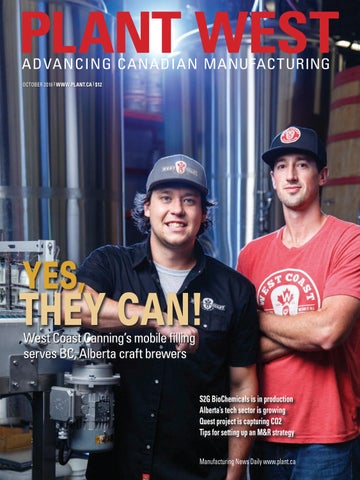
YES,
THEY CAN! West Coast Canning’s mobile filling serves BC, Alberta craft brewers
S2G BioChemicals is in production Alberta’s tech sector is growing Quest project is capturing CO2 Tips for setting up an M&R strategy Manufacturing News Daily www.plant.ca
PLNTwest_OCT16_KAM.indd 1
2016-12-08 10:38 AM
PLT_SME_Sept.indd 1 PLNTwest_OCT16_KAM.indd 2
2016-12-08 2016-08-31 10:38 3:17 PM AM
31 3:17 PM
CONTENTS
October 2016 Vol. 11, No. 3
7
TRENDS Alberta’s energy sector is in a slump but the province’s technology sector is growing in size and revenue.
8
PACKAGING West Coast Canning takes its filling production line on the road to serve craft brewers in BC and Alberta.
10 STRATEGY Tips from Suncor for setting up an effective maintenance and reliability program in a new facility.
11 WESTERN HIGHLIGHTS S2G BioChemicals is making headway bringing bio-glycols to market that will replace petroleum-based chemicals.
7
8
12 CO2 CAPTURE Shell’s Quest CCS project has captured and safely stored one million tonnes of CO2.
10 DEPARTMENTS 4 Editorial 5 News Plant West Pulse 6 Careers 13 CIEN: Product news Events 14 Postscript
11
14
COVER IMAGE: ROGER MAHLER
PLANT West, a supplement to PLANT, is published four times per year by Annex Business Media. Publications Mail Agreement #40065710. Circulation email: stelian@annexnewcom.ca Tel: 416442-5600, ext 3636 Fax: 416-510-5170 Mail: 80 Valleybrook Drive, Toronto, ON M3B 2S9. Occasionally, PLANT will mail information on behalf of industry-related groups whose products and services we believe may be of interest to you. If you prefer not to receive this information, please contact our circulation department. Annex Privacy Officer: privacy@annexbizmedia.com Tel: 800-668-2374.No part of the editorial content of this publication may be reprinted without the publisher’s written permission. ©2016 Annex Publishing & Printing Inc. All rights reserved. Performance claims for products listed in this issue are made by contributing manufacturers and agencies. PLANT receives unsolicited materials including letters to the editor, press releases, promotional items and images from time to time. PLANT, its affiliates and assignees may use, reproduce, publish, re-publish, distribute, store and archive such unsolicited submissions in whole or in part in any form or medium whatsoever, without compensation of any sort. This statement does not apply to materials/ pitches submitted by freelance writers, photographers or illustrators in accordance with known industry practices. Printed in Canada. ISSN: 1929-6606 (Print), 1929-6614 (Online)
www.plant.ca
PLNTwest_OCT16_KAM.indd 3
PLANT WEST 3
2016-12-08 10:39 AM
EDITORIAL
Unlocking the oil sands
D
uring the Second World War, Canadian industry had to switch from oil to other forms of heating fuel. The November 1942 issue of PLANT Administration asked: could the $25 million changeover have been avoided by more active development of the abundant tar sands resource in northern Alberta? John McNicol, a Toronto MP who was in the area to inspect a new highway to Alaska, noted the untold wealth of the Tar Sands and observed that extracting it would be “simple enough”, so he urged their development to make the Empire independent of outside sources of oil. But the oil controller declared it was cheaper to move oil from Texas or Venezuela by tanker than from Alberta by rail. His recommendation was to change heating equipment over to coal, coke or wood. Today Alberta has the third largest oil reserves in the world, after Venezuela and Saudi Arabia, but still can’t get the resource to the east and west coasts by pipeline. As the world refocuses on climate change, Canada (1.6% of greenhouse gas emissions) has ratified the Paris Accord, which has 191 signatories, but requires 55 countries representing 55% of the global emissions to take effect. With ratification from the US (16%), China (26%) and the EU (10%), the accord has passed its carbon test, so for the countries that take this seriously, it’s now all about how to reduce emissions. Prime Minister Justin Trudeau is laying down a $10 a tonne national carbon levy starting in 2018 and the price goes up to $50 by 2022. Provinces can impose their own “tax” that meets or exceeds the national price, or set up a cap and trade system. Or the federal government will impose its system and turn the cash back to the provinces. This has several premiers, including Saskatchewan’s Brad Wall, yelping; yet Alberta’s premier Rachel Notley is supportive of the idea carbon should have a price. Alberta has a $20 a tonne price on emissions and that rises to $30 by 2018. But she won’t support Ottawa’s plan unless there’s progress on building new pipelines to get Alberta’s oil and gas to Canada’s coasts. She certainly has the high ground. Canada has basked in the glow of Alberta’s good fortune while oil prices were much higher and the oil sands were undergoing massive investment and development. Now it’s time to help Alberta turn its fortunes around. And by the way, it’s not in the national interest to have oil sands resources landlocked. As of 2014, proven reserves were 166 billion barrels and total production (mined and in situ) reached about 2.3 million barrels per day. Between 1999 and 2013, approximately $201 billion was invested in the oil sands industry, which employed approximately 133,053 people. Despite oil sands opponents campaigning to keep fossil fuels in the ground, petroleum and natural gas account for 80% of the global energy supply, and that will rise to 82% by 2030 as demand escalates in developing countries. Federal approval of Enbridge’s Northern Gateway pipeline connecting Alberta’s resource to BC’s deep-water port in Kitmat was overturned be the Federal Court of Appeal for not adequately consulting with the Indigenous groups who would be affected by the project. TransCanada Pipeline’s Energy East project is bogged down by opposition from various municipalities on the route through Quebec to Saint John, NB and the resignation of the National Energy Board panellists over questions about their “independence.” The Kinder Morgan Trans Mountain pipeline expansion to Burnaby, BC is similarly under siege from municipalities and environmental opponents. Trudeau wants to ensure communities are consulted and their concerns addressed. Alberta’s resource must have access to tide water. Tough decisions will have to be made. Is the Trudeau government prepared to make them?
Publisher Michael King 416-510-5107 mking@plant.ca, mking@cienmagazine.com Editor Joe Terrett 416-442-5600 ext. 3219 jterrett@plant.ca Associate Editor Matt Powell 416-510-5145 mpowell@plant.ca Art Director Katerina Maevska National Account Manager Ilana Fawcett 416-510-5202 ifawcett@plant.ca Account Coordinator Barb Vowles 416-510-5103 bvowles@annexbizmedia.com Annex Business Media Vice President Tim Dimopoulos (416) 510-5100 tdimopoulos@annexbizmedia.com President & CEO Mike Fredericks Circulation Manager Beata Olechnowicz 416-442-5600 ext. 3543 bolechnowicz@annexbizmedia.com Subscription Price Canada $72.50 per year, US $146.95 (US) per year, Foregin $166 (US) per year. Single Copy Canada $12.00. Add applicable taxes to all rates. Combined, expanded or premium issues, which count as two subscription issues. Mailing Address Annex Business Media 80 Valleybrook Dr., Toronto, ON M3B 2S9 plant.ca Tel: 416-442-5600, Fax: 416-510-5140 Customer Service Silva Telian 416-442-5600 ext. 3636 stelian@annexnewcom.ca
Joe Terrett, Editor Comments? E-mail jterrett@plant.ca. We acknowledge the [financial] support of the Government of Canada.
4 PLANT WEST
PLNTwest_OCT16_KAM.indd 4
October 2016
2016-12-08 10:39 AM
PLANT WEST PULSE
NEWS
ECONOMIC DEVELOPMENTS AND TRENDS
Ballard-powered buses hit the road in China
OUTPUT RISES IN JULY 1,700 1,680
Marks largest fuel-cell bus deployment in Asia
1,500 1,520 1,540 1,560 1,580 1,560 1,540 1,520 1,500
July July 2011 2012 2013 2014 2015 2016
SOURCE: STATISTICS CANADA
Gross domestic product grew 0.5% in July, led by higher output in the mining, quarrying, and oil and gas extraction sector. Manufacturing output rose 0.4% thanks to an increase of 2.5% in non-durable goods that more than offset a 1.4% decline in durable goods. A 5.4% increase in output from chemical manufacturing was driven by petrochemicals, pharmaceuticals and medicines. The petroleum and coal products subsector was up 8%. Food manufacturing rose 2.1%, as most industry groups recorded increases. There were declines in printing and related support activities, and beverage and tobacco manufacturing.
$8.8B
Capital spending in the oil and gas industry for Q2, a 28.8% drop from 2015, reports Statistics Canada.
1.5%
Alberta’s Q2 private sector job vacancy rate, which fell 0.3%. It’s a record low based on two years of data collected by the Canadian Federation of Independent Business. Saskatchewan slid 0.1% to a 1.8% rate. Vacancies in BC were 3.2% of total jobs. Manitoba was 2.1%.
19.5%
Increase in exports of Canadian consumer goods in 2016 over the previous year. Statistics Canada includes food and beverage, clothing, pharmaceutical and medicinals, furniture, clothing, appliance, miscellaneous goods and supplies.
Foshan Feichi’s fuel cell bus manufacturing facility. PHOTO: BALLARD VANCOUVER — Twelve fuel cell-powered buses have been deployed in Foshan, China, the country’s largest fleet, and they’re equipped with Canadian-made, hydrogen-based technology. The buses are manufactured by Foshan Feichi and powered by 85-kilowatt fuel cell engines designed by Ballard Power Systems. The buses will accommodate 80 people and travel more than 300 kilometres. Hydrogen gas consumption is less than 6.5 kilograms per 100 kilometres and there are zero tailpipe emissions. Ballard Power, based in Vancouver, develops clean energy products, including fuel cell modules for transportation applications.
“Canadian” attitude holds back manufacturers TORONTO — Canadians aren’t known for rushing in. Facing a long list of unknowns, businesses often take a slow, more cautious approach to growth. Leaving room for sober second thought has its advantages, but according to a new KPMG report, by embracing the slow and steady approach, manufacturers risk falling behind. Canadian companies have spent between 2% and 3% of their revenue on research and development over the past few years. Their global competitors, meanwhile, have spent 4% to 5%, according to KPMG’s 2016 industry outlook. Though 57% of Canadian manufacturers say they have made exploiting opportunities for growth a top strategic priority, other companies around the world are looking at growth more aggressively and investing more in new technologies, the report says. Three in four global companies say they have prioritized growth over the next two years. To continue expanding, the report says Canadian manufacturers need to do away with their cautious attitude about the global economy – a change that will help spur investment in research and development and provide them with a competitive edge.
Vicwest opens “centre of excellence” Plant equipped with automated stackers, wrapping machines
ACHESON, Alta. — Vicwest Inc. has opened its new manufacturing facility in Acheson, Alta., noting the plant is a “centre of excellence” designed to maximize efficiency and output in a smaller footprint. The 60,000 square-foot facility will employ 18 operators, and optimizes floor space by deploying coil cars to fill uncoiling machines. Vicwest’s new Acheson, Alta. plant. PHOTO: VICWEST The company has also installed VF drives and servo controls to increase mill operations speeds. Automated stackers at the end of mills will eventually be fitted with material wrapping machines. Vicwest is a manufacturer of steel roofing and cladding for residential, commercial and agricultural buildings based in Oakville, Ont. It’s a subsidiary of the Kingspan Group.
ILLUSTRATIONS: THINKSTOCK
www.plant.ca
PLNTwest_OCT16_KAM.indd 5
PLANT WEST 5
2016-12-08 10:39 AM
AltaGas opens $430M BC gas plant
Ceapro opens Edmonton biotech facility
Project completed ahead of schedule
EDMONTON — Ceapro Inc. has opened a 30,000-square-foot bioprocessing extraction and manufacturing facility in Edmonton. The company, a biotechnology developer of active ingredients for healthcare and cosmetic industries, said the facility includes an expanded production area to house a commercial and demonstration-scale PGX skid, an ethanol recycling system, and extraction fractionation process technologies. The company has also in-licensed its proprietary PGX enabling technology for worldwide use in all industries and for all applications. The processing technology handles a range of bio-based feedstocks.
The Townsend natural gas processing facility PHOTO: ALTA GAS
FORT ST. JOHN, BC — AltaGas Ltd. has opened a new natural gas processing facility in BC’s northeast corner. The Townsend project is located about 100 kilometres from Fort St. John, BC and will process up to 198 million cubic feet of natural gas per day. The processing facility also has a truck terminal and other related infrastructure. The Calgary-based energy firm said work on the $430 million project was completed in July, ahead of schedule and under budget. The plant is connected to Alta Gas’ Blair Creek Facility by a 25-kilometre gas gathering line.
CCOHS launches Healthy Workplaces website HAMILTON — The Canadian Centre for Occupational Health and Safety (CCOHS) has launched a new Healthy Workplaces website that brings together information, tools and resources to help
Empire wins $21M theme park contract VANCOUVER — Empire Industries Ltd.’s Dynamic Attractions unit has been awarded a $21 million contract to supply a ride system for a major theme park in Asia. The contract will be completed over the next three years at the company’s Vancouver design and manufacturing facilities. Empire, based in Vancouver, manufactures specialized engineered products, and provides steel production and installation services.
employers, workers and practitioners make their workplaces healthy and safe. It features a mobile-friendly layout and design, and provides a single point of access to credible information on topics related to creating healthy workplaces such as active living, aging workers, occupational diseases, ergonom-
CAREERS Nancy Gougarty has moved up from president and COO of Westport Fuel Systems Inc., a manufacturer of advanced fuel systems in Vancouver, to CEO. She replaces David Demers who is retiring. Gougarty, a 30-year veteran in the transportation-equipment industry, has served as a senior automotive executive with several large automakers and auto-parts companies. She joined Westport in 2013. Total Canada has appointed Frederic Porlier its newest Western Canada territory manager for industrial lubricant sales. He has eight years of technical sales in the Quebec region. In his new position he’ll cover Alberta, BC, Saskatchewan and the Yukon. Total Canada is a petroleum company and manufacturer of lubricants, based in LaSalle, Que. Michael Culbert is retiring as president and CEO of Progress Energy Canada Ltd. (PECL), a natural gas developer based in Calgary. Culbert will continue to serve as a director on the boards of both PECL and Pacific NorthWest LNG. He will also assume a non-executive position of vice-chairman for PECL. Mark Fitzgerald, an energy industry veteran and member of the management team, takes over as president and CEO of PECL.
ics and mental health. The site (www.ccohs.ca/healthyworkplaces/) is organized by topics, roles and resource types to make finding information easy. Tools and resources include programs, case studies, policies, publications, articles, videos, presentations and fact sheets.
There when you need it, growing when you don’t. Business Savings Account
Business Savings Account
1.15%
0.45%
1,2
2
cwbank.com/bsa 1 2
Interest is paid as follows: 1.10% on deposit balance to $250,000; 1.15% on deposit balance between $250,000 and $15,000,000; and 0.25% on deposit balance exceeding $15,000,000. Rate is subject to change without notice. Interest is calculated on the daily closing balance and paid monthly
6 PLANT WEST PLT_CanWestBank_Oct.indd 1
PLNTwest_OCT16_KAM.indd 6
October 2016 2016-09-16 9:14 AM
2016-12-08 10:39 AM
TECHNOLOGY
ALBERTA
DIVERSIFIES
ITS TECH SECTOR IS GROWING: REPORT The 2016 Deal Flow Study shows the market and revenues are expanding.
A
lberta may be suffering through the downturn in its energy industry, but there has been “significant growth” in technology investment, according to an Alberta Enterprise Corp. report. The independent corporation invests in venture capital funds that finance early-stage tech companies on behalf of the Alberta government. Its 2016 Deal Flow Study, which polled 357 companies, shows the tech sector grew 48%, from 927 to 1,373 companies over the past four years. Calgary saw a 55% increase with Edmonton showing a similar surge of 39%. Annual revenues are also up, with 20% of companies reporting more than $1 million, fundraising has matured with 33% raising more than $1 million, and 10% securing a Series A funding round. The knowledge base of tech entrepreneurs is evolving. The study shows seven out of every 10 tech companies include at least one founder with previous start-up experience. The mix includes clean and energy tech, industrial hardware and materials, and software which experienced significant growth from 2012 to 2016. Software gained the most, up from 456 firms in 2012 to 735 today. The Alberta government is providing more support for the expansion of the tech sector by: allocating $1.5 billion to ATB Financial to stimulate small business growth and $500 million to AIMCo for investment in growth companies; increasing its commitment to Alberta Enterprise by $75 million; providing a 30% investor tax credit; and cutting the small business tax rate cut from 3% to 2%. Comments? E-mail mpowell@plant.ca.
Ultrasonic Data Analyzer Ultrasound Vibration Temperatue Condition Indicators All in One Device
sdthearmore.com/sdt270 Training Programs: Level 1 & 2 Ultrasound Certification Category 1 & 2 Vibration Training Onsite Implementation Training
1-800-667-5325 info@sdthearmore.com PLANT WEST 7
www.plant.ca PLT75_SDT_Nov.indd 1
PLNTwest_OCT16_KAM.indd 7
SDT Ultrasound Solutions
2016-10-11 10:51 AM
2016-12-08 10:39 AM
PACKAGING
MOBILE CANNING FILLING A NEED IN THE CRAFT BEER MARKET
West Coast Canning takes its filling line on the road, serving brewers in Alberta and BC. BY JEFF BROWNLEE
K
evin Pederson and Matt Leslie have tapped into an innovative business opportunity that’s helping the craft beer industry in BC and Alberta. The result of a little ingenuity, a lot of sweat equity and some door knocking, Burnaby’s West Coast Canning is carving out a niche in a rapidly growing sector with its mobile canning solution, while solving small brewers’ packaging challenges cost-effectively. “We believe in cans for craft breweries and all of the added benefits including portability, UV protection and freshness. Most of the brewers use us from once a month to every couple of weeks,” says Pederson, 33. “With packaging equipment being so expensive, canning lines especially, it doesn’t make too much sense for most of these breweries to buy their own equipment for the number of times they will run it during the year.” The company’s two mobile canning trucks navigate the Rocky Mountain highways of BC and Alberta to service more than 30 clients. According to Beer Canada, the nation’s trade association, the number of breweries in BC and Alberta has doubled since 2011. In 2015, BC boasted 120 breweries while Alberta had 40. Cans account for approximately 69% of beer sales in BC and 66% in Alberta – both are dramatically
8 PLANT WEST
PLNTwest_OCT16_KAM.indd 8
higher than the national average of 55%. The small company has covered a lot of ground since opening its doors in 2014. So too have its partners, who are both alumni of the business program at the University of Northern British Columbia (UNBC) in Prince George, BC, who met on the golf links. Pederson played NCAA golf in North Carolina while Leslie was ranked in the world’s top 20 long-drive competitions. Pederson, who owns another packaging company that sells photodegradable six- and eightpack rings to the liquor industry, originally came up with the idea because he noticed craft beer was mostly sold in bottles, the result of an industry stigma that bottles better preserve flavour, as well as the cost effectiveness and warehousing challenges of cans. “I kept on getting the same response – ‘we don’t have plans for a canning line at this time,’ so it was pretty hard to sell them six-pack rings,” he adds. “One of the main reasons craft breweries didn’t use cans before West Coast Canning came along was the huge minimum order requirements for printed cans and the cost of equipment. I thought to myself, if we can figure that out, there’s opportunity here.” Pederson and Leslie, who had little to no experience in the beer industry, started seizing that opportunity by developing and
Marketing director and canning line assistant Matt Human with co-founder Matt Leslie. PHOTO: ROGER MAHLER
honing a business plan while looking south of the border, specifically to the craft brewery meccas of Seattle and Colorado, for inspiration as well as intelligence. They came across Wild Goose Canning, a machine manufacturer in Boulder that ended up building their mobile line. “They make a fantastic piece of equipment,” says Pederson. “They built it to be mobile so we can piece it together at the location.”
Process anywhere The canning line is divided into three sections. A de-palletizer pulls the cans off the pallet and moves them down the line via conveyor belt to the twist rinse, which sanitizes each can before it heads to the main canning line where four are filled at a time. Each line is transported in its own 35-foot truck, which Pederson admits is a little daunting, especially for the crew navigating the twisty mountain roads. “We drive around with a really important piece of equipment not only to us, but to our customers as well, so we tend to baby our machinery,” he says. The key to a successful mobile
canning operation on any given day is having properly trained operators who know what they’re doing, and a level of planning leading up to canning day to fully understand the specific needs of each brewery, says Pederson. It takes approximately an hour for the initial set up and once ready, WCC can process anywhere from 1,500 to 8,000 litres in one day, with minimal waste. The process includes a protocol on startup that includes a variety of tests and a rigorous sanitization process Matt Human, WCC director of marketing, says is crucial. “Going from one brewery to another, it’s important to follow a stringent sanitization process to ensure our equipment is ready to go,” he says. “We worked closely with industry partners on our clean-in-place process to see what works best. Cleanliness is a top priority for our customers and it’s important to show the breweries what we do before filling cans.” The initial cans rolled off WCC’s line in 2014 with Pederson and Leslie making up the workforce. Two key employees (Mitch Evanecz and Human) joined the team later that year and the company
October 2016
2016-12-08 10:39 AM
finished its first full year of operations having filled approximately 750,000 cans (355 and 473 ml) and developed a clientele of 13 craft brewers. “We were probably six months too early when we launched as there weren’t that many breweries in BC and we only had a few customers here and there,” Pederson says. “We were patient with the idea as we built our business plan, but eventually had to place a bet that more breweries would open soon and finally decided that we had to either do this or not, because someone would.” They were right. Today, the company is operating six days a week and has grown to eight employees – four were added in April – with plans to hire at least two more by the end of the year. WCC boasts a client list of 57 with a new business line – warehousing and sleeving cans.
Leslie feeds empty cans down WCC’s mobile canning line. PHOTOS: ROGER MAHLER
Opening new doors The company offers its customers the ability to purchase the exact amount of cans it needs for a specific run and will store the remaining labels until needed, overcoming the challenge of small breweries having to purchase and store large quantities of printed cans. “If you are doing a pumpkin ale in October and you want to be in cans, you would have to order up to 150,000 to 200,000 printed cans,” Pederson explains. “Say you are a small brewery, it’s going to take you years to use them let alone the space to store them. The only upfront capital investment (in our service) is in the sleeve itself in much smaller minimum orders.” That opened new doors for WCC and delivered a cost-effective solution to brewers. “That has become a whole other manufacturing business for us now,” says Human. “It allows us to offer an as-you-go basis to the breweries and providing that convenience has been integral to growing our market.” It’s also overcoming another challenge, specific to the highcost of BC real estate. “Our solution for mobile canning and shrink-sleeved cans is a huge savings in terms of square
www.plant.ca
PLNTwest_OCT16_KAM.indd 9
Beer cans roll down the “twist rinse,” where they’re sanitized before being filled.
Cans of Strange Fellows’ Talisman West Coast Ale are filled.
footage and the overall footprint,” says Pederson. “A lot of these breweries don’t have the extra space to store cans and now they can use their space to add more tanks and increase brewing capacity, keeping the focus on what they do best – making great beer.” An emerging trend for WCC is how the company is becoming a crucial element in the launch of a new brewery. “A lot of breweries think they have to package (on their own) from day one,” says Pederson. “But once they look into the process and costs involved, they turn to us and often make us part of their overall business plans, so we see and meet the people in these companies early on.” Fostering the personal relationship makes a difference. “We need to understand our clients and their brands as well as the stories behind each of the brands,” says Human. “The care and attention they put into not only their beer, but their beer labels – it’s really a passion. And because we see their operation first hand, we’ve really come to appreciate the effort our clients put into making their beer. It makes us want to help them even more.” Looking ahead, WCC will likely add a third truck in early 2017 to help with more canning days for BC and Alberta customers. It’s currently taking a serious look at how the single-serve wine market will unfold, which has its own challenges, but has been in their business plan since day one. “We believe it could be the next big thing,” says Pederson. “These days everyone wants the portability and convenience of a single-serve option and it’s likely only a matter of time before they get what they want. The process isn’t quite the same as canning beer or cider, but we’re up to the challenge and why not? BC is said to be the wine capital of Canada.” And that’s potentially “huge.” Jeff Brownlee is an Ottawa-based communications specialist and business writer. E-mail jeffsbrownlee@outlook.com.
Loading cardboard flats with filled cans.
Comments? E-mail mpowell@plant.ca.
PLANT WEST 9
2016-12-08 10:39 AM
STRATEGY
MAINTENANCE AND RELIABILITY TIPS FOR SETTING IT UP IN A NEW FACILITY
Putting the right team in place and keeping it simple will derive significant benefits.
L
orous inspection program for all aying the foundation for a regulatory equipment will ensure successful maintenance and compliance; and maintenance reliability (M&R) program in managers can properly plan their a new facility requires building preventive maintenance budgets. blocks to maximize the value of Two experts from Suncor the assets. Energy Inc. in Alberta addressed Done right, there are signifthis subject in a presentation to icant benefits: assets will be maintenance pros at a Maincommissioned with maintenance Train conference in Vancouver. programs in place; capturing Both Sridhar Ramakrishnan, a history and cost from day one reliability improvement manager will facilitate reliability analysis; at Suncor’s risk-based inspection and a rig- 3:54 PM nrmurphy_mmmore_16 16-06-16 Page 4 Sarnia, Ont. refinery,
Murphy means
MORE.
Experience more
No one gives you more. Ask the Experts: 14,000 systems / over 70 years. Get it done right the first time.
430 Franklin Blvd., Cambridge, ON N1R 8G6
(519) 621-6210
Fax: (519) 621-2841
E-mail: 4nodust@nrmurphyltd.com Web Site: www.nrmurphy.com
A jet tower at Suncor’s Sarnia, Ont. refinery.
and Saigopal Visvanathan, an asset strategy lead based in Calgary, are professional engineers with many years of maintenance practice who feel strongly about the need for a team that includes people from operations, maintenance and reliability. They provide input into design reviews, ensure proper turnover of engineering documents to stakeholders, provide support to commissioning and start-up teams, develop M&R foundational work and turn it over to stakeholders before commissioning and start-up, and assist stakeholders in implementing the programs.
Master data The team identifies the maintenance-significant assets that involve the tracking of cost and history; assigns criticality for all assets; and creates master data for all significant assets, identifies spare parts for them, creates stock codes and a bill of materials, and links stock codes to bill of materials in CMMS. The team must also set up an inventory control strategy for the spare parts, perform RCM analysis for critical systems and develop basic care for all assets, procedures and check sheets. Finally, preventive maintenance programs must be developed for CMMS. There are challenges. Getting the project team on board is critical. It’s also important to pay close attention to lifecycle costs, spare parts inventory, operability and maintenance. Other chal-
10 PLANT WEST PLT_NRMurphy_Sept.indd 1
PLNTwest_OCT16_KAM.indd 10
PHOTO: SUNCOR
lenges include a complex review process for asset strategies, inconsistent use of templates and formats, and resource constraints. To overcome challenges, they suggest concentrating on communications and coaching, while practicing patience and perseverance. It’s also a good idea to develop a feedback process that addresses gaps and keeps track of “lessons learned” from the site to improve deliverables for future projects. Developing a controlled process for managing the changes is vital. There are several critical success factors: getting senior leadership support; including the M&R foundation work in the project charter; helping stakeholders understand the M&R foundation at the project stage is only a basic framework, and provides opportunities for further improvement in the future; having a small core team of people with the right skills, collaborative mindset and experience; and communicating effectively at all times. Their final bit of advice? Keep it simple. This article is excerpted from the presenters’ technical paper, Setting up M&R foundation for new facilities. MainTrain is convened by the Plant Engineering and Maintenance Association of Canada (PEMAC). Comments? E-mail jterrett@plant.ca.
October 2016 2016-08-31 2:17 PM
2016-12-08 10:39 AM
WESTERN HIGHLIGHTS
BIO-GLYCOLS DEBUT
S2G BIOCHEMICALS DEMONSTRATES SUCCESSFUL PRODUCTION They’ll be used as a drop in replacement for common petroleum-based chemicals.
S2G’s two-stage process was integrated with Pennakem’s chemical facility in April and produced glycols over a five-week period. “The successful demonstration of S2G’s bio-glycol process at scale validated the reliability and economic viability of our technology based on solid operational experience,” said Mark Kirby, president and CEO of S2G. S2G reached three important milestones: successful product evaluations by several industrial
customers; the sale of bio-glycols to an industrial resin plant; and the production of sample quantities of pharmaceutical-quality propylene glycol that has been reserved for customers looking at replacements for petrochemical-derived sources. S2G and its partners plan to build a $25 million plant, operational in 2018, to co-produce glycols and a specialty chemical. Comments? E-mail jterrett@plant.ca.
P
etroleum is used for more than heat and transportation fuel. You’ll find petrochemicals (ethylene and propylene glycols) in a host of products such as PET bottles, cosmetics, pharmaceuticals, coolants and antifreeze. S2G BioChemicals Inc., a Vancouver-based developer of chemical conversion technologies, is offering an alternative to petroleum-based glycols. It’s bio-glycol process uses low cost renewable feedstocks such as wood debris and agricultural flotsam. The end product performs the same as petroleum-based materials, but contributes far fewer greenhouse gas emissions. Currently 15% of every barrel of oil goes to create synthetic resins and other chemical products. S2G notes that in 2010, 191 million barrels of petroleum and natural gas were used to make plastic products in the US. More than $30 billion worth of ethylene and propylene are sold globally each year and S2G says demand is projected to increase as plastics are substituted for paper, glass and metal. North America can supply between 50 to 100 million tons of harvest crop residue for feedstocks. Converting just 5% of the 20 million tons per year markets could take the equivalent of 330,000 cars off the road. In June, S2G successfully completed commercial production at a plant operated by Memphis-based Pennakem LLC, a subsidiary of the Minafin Group. It makes chemical intermediates and solvents from renewable resources.
PLANT WEST 11
www.plant.ca PLTW_Rousseau_SeptOct.indd 1
PLNTwest_OCT16_KAM.indd 11
2016-10-11 1:09 PM
2016-12-08 10:39 AM
ENERGY
QUEST FOR A MILLION SHELL’S CCS REACHES A MILESTONE The $1.35 billion CO2 capture and storage project transforms carbon emissions into near-liquid that’s pumped into porous rock formations. BY PLANT STAFF
I
n its first operating year, the Quest carbon capture and storage (CCS) project has captured and safely stored one million tonnes of CO2, the equivalent of taking 250,000 cars off the road. The first-of-its-kind $1.35 billion CCS project in Alberta’s
oil sands, which is part of a collaborative effort between Shell Canada, and joint-venture owners Chevron Canada and Marathon Oil Canada, is ahead of schedule and under budget. Financing for the project includes $745 million from the Alberta government and $120 million from Ottawa. The Quest project captures
DEPENDABLE.
RELIABLE. AIR / WATER SERVICES
QUALITY WHEN IT MATTERS MOST. every time.
WASHDOWN
POWER SOURCE
VACUUM
WELDING GAS
FOR OUR COMPLETE LINE OF
HOSE, CORD, & CABLE REELS:
WWW.COXREELS.COM | 800.269.7335
Shell’s Quest project near Fort Saskatchewan, Alta.
about a third of the CO2 of the emissions produced at Shell’s Scotford Upgrader outside Fort Saskatchewan, Alta. Those emissions are transformed into a near-liquid and pumped two kilometres via pipeline into porous rock formations. “Not only is Quest capturing and storing CO2 emissions from our oil sands operations, but its technology can be applied to other industries around the world to significantly reduce CO2 emissions,” said Zoe Yujnovich, executive vice-president of Shell’s oil sands operations. Globally, there are 15 largescale CCS projects in operation with an additional seven under construction (total CO2 capture capacity for the 22 projects annually is around 40 million tonnes). There are currently four large-scale projects in Canada, including SaskPower’s Boundary Dam venture, which came under heavy scrutiny
12 PLANT WEST PLT_Coxreels_MayJune.indd 1
PLNTwest_OCT16_KAM.indd 12
PHOTO: SHELL
in July after a parliamentary budget office report suggested the facility’s carbon capture technology would double the price of the power it generated. CCS has been criticized as a high-cost, stop-gap measure that has relied heavily on government funding, but Shell says technology development has advanced to a point where the project would cost up to 30% less to construct thanks to a variety of factors, such as capital efficiency improvements and a lower cost environment. The energy producer, based in Calgary, has also made any intellectual property or data generated by Quest available to the public, in collaboration with the Alberta and federal governments. This will further reduce future CCS development costs and encourage wider use of the technology. Comments? E-mail jterrett@plant.ca.
October 2016 2016-05-26 11:41 AM
2016-12-08 10:39 AM
CIEN EQUIPMENT NEWS CANADIAN INDUSTRIAL
MOTORS
Out of the box installation.
VARIABLE SPEED CAPABILITIES EXPAND Nidec Motor Corp.’s 1 to 10 hp US Motors brand hybrid drives require no programming or commissioning, are easy to install and are up and running in 10 minutes. The AC drives are available as IP20, NEMA 1/IP20 & 50, and NEMA 4X/IP65 from basic enclosures to those used for indoor and outdoor watertight applications. They can be customized for a specific application. Nidec Motor is a manufacturer of motors and controls based in St. Louis, Mo. www.nidec-motor.com
like a traditional design B induction motor and pulls into true synchronous speed and operates as a true synchronous machine. Laminated finned frame construction contributes to power density and enhanced thermal performance by providing greater heat dissipation, which results in cooler operation and longer motor life. The operating temperature is lower than typical B and F rise temperatures found in cast iron or steel band induction motors. The power dense motor offers horsepower in a smaller frame best suited when the driven equipment or machine is limited on space. And the standard NEMA offers a drop-in replacement solution for traditional induction motors. Baldor, based in Fort Smith, Ark., manufactures industrial electric motors, drives and mechanical power transmission products. www.baldor.com
LUBRICATION
HYBRID MOTOR EXCEEDS TOP EFFICIENCY LEVEL
Powered by a lithium battery.
GUNNING FOR LUBRICATION ACCURACY Saves enegy.
Baldor Electric Co.’s RPM XE hybrid motors raise the efficiency bar two to four bands above NEMA Premium efficient levels (IE3). The platform combines the starting attributes of an induction cage with permanent magnets to deliver energy savings and performance in most centrifugal load applications. The hybrid design exceeds premium efficiency performance on sine wave power while meeting IE3 as a combined motor and drive package. The motor starts
www.plant.ca
PLNTwest_OCT16_KAM.indd 13
SKF’s TLGB 20 battery-driven grease gun ramps up the efficiency and accuracy of portable, manual lubrication of bearings, machines and off-road equipment. An integrated grease meter dispenses the proper amount of lubricant to prevent over- or under-greasing, and a rechargeable 20-volt lithium battery delivers extended service life. A built-in light illuminates the work area and a display on the tool indicates battery charge level, the amount of dispensed grease, pump/motor speed and blocked lubrication points.
The grease gun dispenses up to 15 grease cartridges per battery charge and delivers two flow rates adjustable for a specific application, at pressures up to 700 bar (10,000 psi). It’s supplied with a sturdy carrying case and a 900 mm (36 in.) high-pressure hose, battery and 90-minute charger. SKF is a leading global supplier of bearings, seals, mechatronics, lubrication systems, and services with offices across Canada. www.skf.com
ENCLOSURES
NEMA 4X-, 6P-rated.
LIGHTWEIGHT ENCLOSURES MOUNT EASILY AutomationDirect’s Impact polycarbonate enclosures are lightweight, making them easier to carry and install. The UL, CE, RoHs, and REACH enclosures resist impacts up to 900 in.-lb., UV light, and have an operating temperature range from -40 to 130 degrees C. The enclosures are NEMA 4X- and NEMA 6P-rated. Integrated mounting flanges are moulded into the enclosure and an integrated latch provides an easy opening. Extra interior mounting bosses on the rear wall provide multiple options for DIN-rail, back panels or other components. Back subpanels, dead front panels and swing-out panels in aluminum, PVC and white powder coated steel finishes are also available. Accessories include DINrail kits, 10-piece screw packs, outdoor labyrinth vent, and pole mounting kits for 2- to 12-in. pole diameters. AutomationDirect is a supplier of industrial automation technologies based in Cumming, Ga. www.automationdirect.com
EVENTS MRO 2016 RATS Nov. 2-3, Fort Saskatchewan, Alta. Organized by the Rotating And Turbomachinery Society (RATS), this semi-annual event focuses on knowledge, education and career development in rotating equipment optimization. Visit http://mro.Rotatingspecialist.org. FABTECH 2016 AWS/SME Nov. 16-18, Las Vegas North America’s largest metal forming, fabricating, welding and finishing event. Presented by FMA, SME, PMA, CCAI and AWS. Visit www.fabtechexpo.com. IFPE 2017 AEM March 7-11, Las Vegas This international exposition and technical conference is dedicated to the integration of fluid power with other technologies for power transmission and motion control applications. Presented by the Association of Equipment Manufacturers and the National Fluid Power Association. Visit www. ifpe.com. WMTS 2017 SME June 6-8, Edmonton Keynotes, panel discussions, interactive technology exchanges on the event floor. Connect with other stakeholders on timely manufacturing topics, including sourcing the future workforce, government programs driving innovation, and updates on energy forecasts. Visit www.wmts.ca. CMTS 2017 SME Sept. 25- 28, Mississauga, Ont. Featuring the latest advancements in machine tool, tooling, metal forming and fabricating, and advanced manufacturing. Visit cmts. ca/general-info.
PLANT WEST 13
2016-12-08 10:39 AM
POSTSCRIPT
Internal trade: making 191 words count BY SYLVAIN CHARLEBOIS
A
THE HARD TRUTH IS THAT CANADA IS NOT A TRADE-FOCUSED NATION, PARTICULARLY IN AGRICULTURE AND FOOD…
meagre 191-word document signed by every premier this summer is being lauded as a major coup for Canada, but our optimism about the future of internal trade should be tempered by reality. The Canadian Free Trade Agreement (CFTA) was signed at the annual premiers summit in Whitehorse. We can certainly celebrate the goodwill of our provincial leaders and we should all remain cautiously optimistic, yet it may take months before we know what products are included in the deal, or if the deal actually turns into concrete change at all. For years, restrictions among provinces have prevented many food products – such as dairy, wine and beer – from flowing freely through the country. What will change? The new deal is meant to revitalize the ineffective Agreement on Internal Trade. That deal was signed in 1994 at the beginning of the Chretien era. After defeating the Conservatives, who were in power for nine years, the Jean Chretien government was beginning a new mandate. There was a sense of rejuvenation within the Confederation and provincial leaders signed the agreement with confidence. A little more than 22 years later, under another new Liberal government, we are witnessing the second coming of serious efforts to deal with our internal trade quarrels.
Prepare for upheaval Several events soon after the 1994 deal was signed changed the political spectrum. The leaders who signed it were replaced and the overwhelming sentiment of co-operation disappeared. Quebec elected a separatist government, transfer payments to the provinces were reduced and Ottawa’s honeymoon with the provinces ended abruptly. As the political landscape changed, so did internal economic priorities. Nothing can prevent a similar upheaval now. Brexit, Trumpism and terrorist attacks in many countries show the world is a much more complicated and volatile place. CFTA could easily
14 PLANT WEST
PLNTwest_OCT16_KAM.indd 14
be forgotten or ignored in such a climate. With our rigid quota-based schemes, tariffs on imports, provincially-based marketing boards and liquor board, the hard truth – particularly in agriculture and food – Canada is not a trade-focused nation. Our internal trade issues speak to a significant constitutional paradox. While confederation is certainly complicated to manage, our constitution is fairly easy to interpret. Signed more than 149 years ago in Charlottetown, it offers clear provisions for enhanced internal trade. Our forefathers likely never anticipated provinces acting in contempt of the Constitution. Now the premiers have basically agreed to agree – and nothing more. That means we may see a more detailed agreement in the future or we may not. Hopefully, exploring options through consultation will bring us to where we need to be. But we should not be surprised if details coming out of working groups become points of contention. Keep in mind that consultations on a trade deal will be added to PHOTO: THINKSTOCK the 150 consultations on various issues already taking place in Ottawa. In recent years, most of our trade-related attention was given to major international deals like the Comprehensive Economic and Trade Agreement (CETA) and the Trans-Pacific Partnership (TPP). Years of work went into both agreements but uncontrollable factors make both agreements seem uncertain. We would be better off concentrating on interprovincial trade, where the economic terrain is less choppy. More internal trade is desirable for all regions and provinces. And a renewed economic focus among provinces is indispensable. So that 191-word document takes on even greater importance. It may be meagre, but it could be the foundation for something substantial. Sylvain Charlebois is dean of the Faculty of Management and professor in the Faculty of Agriculture at Dalhousie University in Halifax. Distributed by Troy Media © 2016. Comments? E-mail jterrett@plant.ca.
October 2016
2016-12-08 10:39 AM
PLT_ATX
Meet ADM The Advanced Design & Manufacturing Expo brings Montréal’s five leading manufacturing shows together under one roof.
Nov. 30-Dec. 1, 2016 Palais des congrès de Montréal Montréal, Québec
33077_AS_MON16
PLT_ATXShow_Sept.indd 1 15 PLNTwest_OCT16_KAM.indd
New Name. New Technology. New Experience.
ADMmontreal.com 2016-12-08 2016-09-01 10:39 9:30 AM
WORK SAFER AND MORE EFFICIENTLY with the new FLIR® CM174 clamp meter with built-in thermal imaging camera. Featuring Infrared Guided Measurement (IGM) technology, the CM174 visually points you to the precise location of potential electrical issues. You’ll find problems faster, get more done, and boost your credibility. TO SEE IGM IN ACTION GO TO WWW.FLIR.CA/CM174
Plant_Feb_Flir.indd 1 PLNTwest_OCT16_KAM.indd 16
2016-12-08 2016-01-27 10:39 8:57 AM