MAY/JUNE 2017 | WWW.PLANT.CA | $12
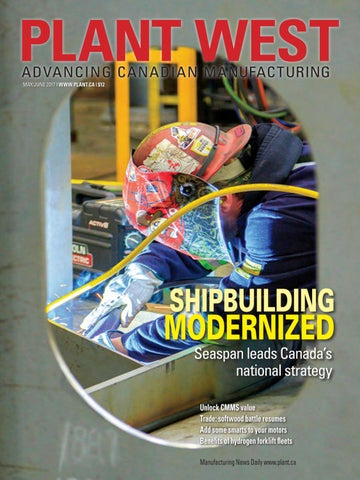
SHIPBUILDING
MODERNIZED Seaspan leads Canada’s national strategy Unlock CMMS value Trade: softwood battle resumes Add some smarts to your motors Benefits of hydrogen forklift fleets Manufacturing News Daily www.plant.ca
PLTWest_MayJune2017_AMS.indd 1
2017-06-13 7:55 AM
R | WELDER | SOUDEUR | INSPECTOR | INSPECTEUR | METAL FABRICATOR | FABRICANT DE MÉTAL | BUSINESS O E MÉTAL | BUSINESS OWNER | ENTREPRENEUR | WELDER | SOUDEUR | INSPECTOR | INSPECTEUR | METAL FABR NER | ENTREPRENEUR | WELDER | SOUDEUR | INSPECTOR | INSPECTEUR | METAL FABRICATOR | FABRICANT DE | INSPECTOR | INSPECTEUR | METAL FABRICATOR | FABRICANT DE MÉTAL | BUSINESS OWNER | ENTREPRENEU
ATOR | FABRICANT DE MÉTAL | BUSINESS OWNER | ENTREPRENEUR | WELDER | SOUDEUR | INSPECTOR | INSPE
EXPO & | CONFERENCE USINESS OWNER | ENTREPRENEUR | WELDER SOUDEUR | INSPECTOR2017 | INSPECTEUR | METAL FABRICATOR | F METAL FABRICATING - WELDING - FINISHING NER | ENTREPRENEUR | WELDER | SOUDEUR | INSPECTOR | INSPECTEUR | METAL FABRICATOR | FABRICANT DE
INSPECTEUR | METAL FABRICATOR | FABRICANT DE MÉTAL | BUSINESS OWNER | ENTREPRENEUR | WELDER | S
B
THE WELDING & FABRICATION
BUSINESS COMES TOGETHER 150 EXHIBITORS SHOWCASING TODAY’S FOREMOST TECHNOLOGIES, PRODUCTS AND SERVICES | HANDS-ON TECH DEMO ZONE | NEW TECHNOLOGY PRE-ARRANGED ONE-TO-ONE MEETINGS | LEARN FROM INDUSTRY EXPERTS 60 PLUS SPEAKERS | CANADA’S BEST PROFESSIONAL WELDER COMPETITION
SEPT. 13-14, 2017 | PLACE BONAVENTURE | MONTRÉAL, QUÉBEC REGISTER TODAY AT: CANWELDEXPO.COM
LIMITED EXHIBIT SPACE AVAILABLE! PRESENTED BY THE CWB GROUP & DMG EVENTS
PLTW_PetroChem_MayJune.indd PLTWest_MayJune2017_AMS.indd 1 2
2017-06-12 2017-06-13 11:04 7:55 AM AM
BUSINESS OWNER | ENTREPRENEUR METAL FABRICATOR | FABRICANT DE MÉTAL | BUSINESS OWNER | ENTREPREBRICANT DE MÉTAL | BUSINESS OWNER | ENTREPRENEUR May/June 2017 REPRENEUR | WELDER | SOUDEUR | INSPECTOR | INSPECTEUR | METAL FABRICATOR | FABRICANT Vol. 75, No.DE 05 MÉTAL | B
CONTENTS
TOR | INSPECTEUR | METAL FABRICATOR | FABRICANT DE MÉTAL | BUSINESS OWNER | ENTREPRE-
ICATOR | FABRICANT DE MÉTAL | BUSINESS OWNER | ENTREPRE-
FEATURES
ICANT DE MÉTAL | BUSINESS OWNER | ENTREPRE-
FORESTRY PRODUCTS How Canada can secure new softwood markets. WELDER | SOUDEUR | INSPECTOR | INSPECTEUR | METAL FABRICATOR | FABRICANT DElumber MÉTAL | BUSINESS OW
2 11:04 AM
7
8
SHIPBUILDING Vancouver’s Seaspan leads a national strategy to renew Canada’s naval and coast guard fleets.
11 MATERIAL HANDLING Uncover a carbon advantage with hydrogen-powered forklifts.
12 INSIDE MAINTENANCE Avoid common pitfalls by unlocking the value of your CMMS.
7
13 ECONOMY Alberta’s per-person debt is accelerating and catching up to Ontario.
14 GOVERNMENT Awash in red ink, Canada’s cleantech sector needs a boost.
15 SENSORS Connecting with IIoT makes your motors smarter.
8
11 PHOTO: AIRLIQUIDE GUILLEMIN/LUCAS
DEPARTMENTS 4 Editorial 5 Plant West PULSE News 6 Careers 16 Products and Equipment 17 Events 18 Postscript
12
13 COVER IMAGE: SEASPAN
PLANT—established 1941, is published 8 times per year by Annex Business Media. Publications Mail Agreement #40065710. Circulation email: stelian@annexnewcom.ca Tel: 416-442-5600 ext 3636 Fax: 416-510-5170 Mail: 80 Valleybrook Drive, Toronto, ON M3B 2S9. Occasionally, PLANT will mail information on behalf of industry-related groups whose products and services we believe may be of interest to you. If you prefer not to receive this information, please contact our circulation department in any of the four ways listed above. Annex Privacy Officer: privacy@annexbizmedia.com Tel: 800-668-2374.No part of the editorial content of this publication may be reprinted without the publisher’s written permission. ©2016 Annex Publishing & Printing Inc. All rights reserved. Performance claims for products listed in this issue are made by contributing manufacturers and agencies. PLANT receives unsolicited materials including letters to the editor, press releases, promotional items and images from time to time. PLANT, its affiliates and assignees may use, reproduce, publish, re-publish, distribute, store and archive such unsolicited submissions in whole or in part in any form or medium whatsoever, without compensation of any sort. This statement does not apply to materials/pitches submitted by freelance writers, photographers or illustrators in accordance with known industry practices. Printed in Canada. ISSN: 1929-6606 (Print), 1929-6614 (Online)
www.plant.ca
PLTWest_MayJune2017_AMS.indd 3
PLANT WEST 3
2017-06-13 7:55 AM
EDITORIAL
Interesting times, be prepared
W
e are living in interesting times. Canada’s manufacturers are facing daunting challenges as global trade, protectionism and technology reconfigure the playing field. Fasten your seatbelts. Topping the list of troubling factors is trade disruption with our biggest customer as NAFTA goes under the knife; and the possibility of a border tax looms as part of the Trump regime’s efforts to make America “great” again. Meanwhile the latest softwood lumber fandango is playing havoc with the forestry sector. The Conference Board of Canada says duties (between 3% and 24%) will cut $700 million from lumber exports over two years with the loss of 2,200 jobs. BC, as Canada’s largest producer (accounting for about half overall), has the most to lose. Adding to the uncertainty is the brewing provincial conflict over the Kinder Morgan Trans Mountain pipeline extension. With BC’s change of government, the NDP-Green partnership is officially opposed to the project, which is nonetheless within federal jurisdiction and approved by Ottawa. If the alliance stalls the project, moving more of Alberta’s fossil fuel resources to the coast will be impeded, and that does not bode well for manufacturers serving the industry. These kinds of issues must be left to the politicians to resolve, but there are factors manufacturers can control that will make them more competitive and ready for whatever lies ahead. Take investment in machinery and equipment. It’s time to crack open the wallet. Compared to the US, business investment is at its lowest level per worker in more than 25 years, having fallen after years of narrowing the gap, according a C.D. Howe Institute report. Investment per worker in 2017 at 55 cents is down from a high of 77 cents in 2013, compared to each dollar invested in US workers. Alberta and Saskatchewan show the steepest declines. Canadian companies also lack enthusiasm for smart technologies. Only 3% of manufacturers responding to a Business Development Bank of Canada study have fully digitized their production, but 17% are preparing to do so. Businesses that switched to digital production are seeing higher growth, greater productivity and lower operating costs. Manitoba and Saskatchewan top the list of provinces initiating the shift, BC is in the middle, while Alberta trails. However, overall investment is low: under $100,000 – $161,000 less than the international average. And how many manufacturers are looking at shortages of people with the right skills as legions of baby boomers retire? In 2016, 243,000 experienced workers punched out for the last time. For every job created, companies had to cover for the loss of 1.8 people, according to a Conference Board of Canada study. Filling technical and skilled trades took 40 days in 2005. Now it’s 60 days, raising the costs from $3,000 to $5,000 per worker. The smart play is to plan farther ahead than the current two years. Here’s an FYI for the NDP regimes in BC and Alberta. As Trump aims for a precipitous drop in the US corporate tax rate, be aware that hiking their rates not only creates competitive obstacles for businesses, it ultimately dings the voter. A report from the University of Calgary’s School of Public Policy shows every $1 in extra tax revenue results in a long-run decrease in aggregate wages for workers that ranges from $1.52 in Alberta to $3.85 in PEI. So the 2% corporate tax increase in Alberta reduces earnings for an average two-earner household by about $830 and results in a $1.12 billion reduction in aggregate labour earnings for the province. Business will continue in North America with or without a renegotiated NAFTA, but manufacturers must be better prepared for the outcome by being smarter about technology, more productive and by looking outward. Trump proves how unwise it is to be too comfortable with the status quo. Joe Terrett, Editor Comments? E-mail jterrett@plant.ca.
4 PLANT WEST
PLTWest_MayJune2017_AMS.indd 4
Publisher Michael King 416-510-5107 mking@plant.ca, mking@cienmagazine.com Editor Joe Terrett 416-442-5600 ext. 3219 jterrett@plant.ca Associate Editor Matt Powell 416-510-5145 mpowell@plant.ca Art Director Andrea M. Smith National Account Manager Ilana Fawcett 416-510-5202 ifawcett@plant.ca Account Coordinator Barb Vowles 416-510-5103 bvowles@annexbizmedia.co Annex Business Media Vice President/Executive Publisher Tim Dimopoulos (416) 510-5100 tdimopoulos@annexbizmedia.com COO Ted Markle tmarkle@annexweb.com President & CEO Mike Fredericks Circulation Manager Beata Olechnowicz 416-442-5600 ext. 3543 bolechnowicz@annexbizmedia.com Subscription Price Canada $72.50 per year, US $146.95 (US) per year, Foregin $166 (US) per year. Single Copy Canada $12.00. Add applicable taxes to all rates. Combined, expanded or premium issues, which count as two subscription issues. Mailing Address Annex Business Media 80 Valleybrook Dr., Toronto, ON M3B 2S9 plant.ca Tel: 416-442-5600, Fax: 416-510-5167 (if busy use 416-510-6875) Customer Service Silva Telian 416-442-5600 ext. 3636 stelian@annexnewcom.ca
We acknowledge the [financial] support of the Government of Canada.
May/June 2017
2017-06-13 7:55 AM
NEWS
PLANT WEST PULSE ECONOMIC DEVELOPMENTS AND TRENDS
BUSINESS BOOST
Waste-to-fuel ethanol products to be sold in the province
Canada Newfoundland & Labrador Prince Edward Island Nova Scotia New Brunswick Quebec Ontario Manitoba Saskatchewan Alberta British Columbia Yukon Northwest Territories Nunavut -6
-4
-2
0
2
4
6
SOURCE: STATISTICS CANADA
Labour productivity in the business sector rose 0.4% nationally in 2016 with eight provinces and the Yukon showing increases, according to Statistics Canada. In Western Canada, Saskatchewan showed no growth, Manitoba was ahead at 3%, followed by BC at 1%. Alberta was down 1.1%, the largest decline among the provinces for the second consecutive year. Lower prices for crude oil, and temporary difficulties from the forest fires affecting Northern Alberta were to blame. Hours worked were also down (4.4%), with 9.7 million lost work hours attributed to the forest fires. Nationally, hours worked rose 0.6%, following an increase of 1.1% in 2015.
3.3%
Alberta’s leading GDP forecast for 2017, according to the Conference Board of Canada. Saskatchewan and BC are second at 2.5%. Manitoba is fourth at 2.1%.
$203.3M Net earnings for forest, paper and packaging companies in Western Canada for Q4 2016. That compares to $30.7 million in Q4 2015, reports PwC. It’s watching how “evolving” trade policies in the US will impact 2017.
IMAGES: FOTOLIA
48,343
www.plant.ca
PLTWest_MayJune2017_AMS.indd 5
BC approves Enerkem biofuels MONTREAL — Enerkem Inc. has received the lowest carbon intensity value ever issued by the British Columbia Ministry of Energy and Mines for its ethanol product under the Renewable and Low Carbon Fuel Requirements Regulation. Waste-based ethanol confirmed carbon intensity is set at -55 gCO2e/MJ. Gasoline has an intensity of +88 gCO2e/MJ. The approval will allow Enerkem to sell its ethanol in the province, in addition to the Alberta market where it has a full-scale production facility. The regulation is designed to reduce reliance on non-renewable fuels and the environmental impact of transportation fuels. Fuel suppliers must progressively decrease the average carbon intensity of their fuels by 10% by 2020 relative to 2010.
PHOTO: ENERKEM
Enerkem, a biofuels and renewable chemicals producer based in Montreal converts non-recyclable, non-compostable household waste into advanced biofuels.
TransAlta accelerates clean power transition CALGARY — TransAlta Corp.’s transition to gas and renewables generation is gathering momentum. Its strategy will include the retirement and shutdown of several coal-fire generation plants for conversion to gas-powered generation by 2023. The Calgary-based power company is converting some of its coal units to extend their use until the mid-2030s. The Sundance Unit 1 will be retired in January, and the Sundance Unit 2 will be mothballed for up to two years. TransAlta said taking Sundance Units 1 and 2 reflects their limited economic viability once the Power Purchase Arrangement expires.
Online portal delivers pipeline data
Exporters in Canada last year, down 1.5% from 2015. Every province saw declines except Quebec, PEI and Nova Scotia. The largest declines were in Alberta (289), Ontario (276) and Manitoba (234).
Enerkem’s biofuel refinery in Edmonton.
CALGARY — The National Energy Board (NEB) has launched an online portal to show Canadians products moving through NEB-regulated pipelines. Data is provided at key points, including every international export/import point. Some companies are exempt from filing pipeline traffic data. The NEB is reviewing all exemptions to filing requirements for greater data transparency. The traffic data includes: type of product (heavy oil, natural gas) moving through the pipeline; the amount at key points; approximate capacity of each pipeline; daily data for natural gas pipelines; and monthly data for oil pipelines.
Converting the units to gas-fired generation will lower carbon intensities, emissions, carbon costs, operating and sustaining capital costs. Federal regulations require coal plants built before 1975 to cease using coal by the end of 2019. Sundance Units 1 and 2 provide 560 megawatts of the 2,141 megawatts at the Sundance plant, a baseload provider for the Alberta electricity system. Capacity of Sundance Units 3 to 6 and Keephills 1 and 2 will not change following conversion, which will reduce carbon emissions up to 40% while maintaining 2,400 megawatts.
Nsolv completes oil sands pilot CALGARY — Nsolv Corp. has completed the optimization phase of a pilot project near Fort McKay, Alta., which produced more than 125,000 barrels of oil without any water and minimal greenhouse gas emissions. Compared to traditional extraction methods such as steam-assisted gravity drainage (SAGD), the commercial-scale program has generated a higher return on investment thanks to lower capital and operating costs. It also produces a partially upgraded, higher-quality oil product at rates comparable with SAGD. The technology accesses otherwise inaccessible shallow resources and because of the lower emissions intensity, it allows production of up to 800,000 barrels per day under Alberta’s 100 mega-ton carbon cap.
PLANT WEST 5
2017-06-13 7:55 AM
NEWS
Protonex fuel-cell powers Boeing UAV test flights
CAREERS
Aircraft has multiple payload capabilities
Ballard Power Systems has a new vice-president and COO. Rob Campbell is joining the Vancouver-based fuel cell manufacturer following several leadership roles in the cleantech and power generation industries. He’ll oversee the company’s business development, sales, marketing, product line management and after-sales service activities. FortisAlberta Inc. has appointed Karl Bomhof president and CEO, succeeding, Phonse Delaney, who has been appointed executive vice-president and CIO. Bomhof joined the company in 2006 and was most recently vice-president of corporate and customer service. TerraVest Capital Inc. has appointed Michael MacBean to its board of directors. He’s senior managing director at TriWest Capital Partners. Prior to joining TriWest, he was founder and CEO of Diamond Energy Services, a Saskatchewan-based energy services firm.
VANCOUVER — Protonex, a Ballard Power Systems subsidiary, has successfully powered test flights of the ScanEagle unmanned aerial vehicle (UAV) with the company’s PEM (proton exchange membrane) fuel cell propulsion system. The ScanEagle is manufactured by Insitu, a Boeing subsidiary. Protonex’s fuel cell modules improve mean time between failures by up to five times, provide silent operation and throttle flexibility, including mid-air start-stop capability, and use existing JP8 fuel in ground refuelling systems. Insitu’s ScanEagle has multiple payload capabilities, including high-definition imaging,
Insitu’s ScanEagle UAV.
PHOTO: INSTITU
logging over 800,000 flight hours in military and civilian applications.
Hyduke to build AltaGas propane tank NISKU, Alta. — Hyduke Energy Services Inc. will provide steel and construction services for a 95,000 cubic metre propane storage tank project at AltaGas’ proposed Ridley Island Propane Export Terminal near Prince Rupert, BC. Hyduke, based in Nisku,
Medium duty. Conforms to ‘industry standard’ impact rating.
Alta., will provide supervision, labour, welding and equipment necessary for completion of the tank project. The company, an oilfield equipment supplier and service provider, says the project supports its expansion of engineering and fabrication
Lighter-duty. Contractor-grade and also protects your budget.
services beyond the drilling and well-servicing equipment. It recently completed the acquisition of Western Manufacturing Ltd. of Hythe, Alta. and Avalanche Metal Industries Ltd., a manufacturer of structural steel based in Kelowna, BC.
Extra tough. The ‘gold standard’ in protective guard rail.
THREE LEVELS OF PROTECTION. THE CHOICE IS YOURS. More guard rail designs than any other U.S. manufacturer. When it comes to protective guard rail for your facility – you now have three powerful choices to protect your equipment, machinery, and most importantly, your people.With the expansion of Wildeck’s industry-leading Wilgard® guard rail brand, the new Wilgard® XT, MT and LT offer a wide range of impact resistance to best fit your application. One tough family. Three levels of protection. The choice is yours. 800-325-6939 | WWW.WILDECK.COM ©Wildeck, Inc. 2016
WGD 1604 AD
6 PLANT WEST PLT_WilDeck_June.indd 1
PLTWest_MayJune2017_AMS.indd 6
May/June 2017
2016-05-26 9:56 AM
2017-06-13 7:55 AM
FORESTRY PRODUCTS Victory in the latest trade battle will only be secured if Canada uses all of the weapons in its arsenal. BY NAOMI CHRISTENSEN
C
anadian softwood lumber exports are once again subject to a US countervailing duty, and an additional anti-dumping duty was to be imposed in June. Trade missions being organized to help build markets in the Asia Pacific region for wood products is encouraging. Yet we’ve been all too willing to run back into the welcoming arms of the US as soon as conditions improve. Let’s not make that mistake again. Attracting new customers for Canadian softwood is possible; recent successes in China provide a roadmap for doing so. Canada went from sending less than 1% of exports to China in 2006 to a high of 21% in 2011. But exports to China have been declining while exports to the
SOFTWOOD FAQS $5 billion Value of exports to the US (2015)
20%
Share of Canada’s forest product exports
69%
Exports that went to the US (2015)
50%
BC’s share of exports to the US
232,700
Number of forestry workers
5
Years it took to settle the last softwood lumber dispute (2006)
$5.4 billion Collected by the US during that dispute
$4.4 billion
Returned when the dispute was resolved, duties reduced to zero
www.plant.ca
PLTWest_MayJune2017_AMS.indd 7
Softwood lumber duties range from 3% to 24%.
Softwood dispute
REDUX TIME TO SECURE NEW LUMBER MARKETS US are increasing. A recent trade mission to China by the federal trade and finance ministers with softwood sector representatives aimed to reinvigorate exports to that country. Growing market share outside the US where Canada is already a player (China and Japan) will help exporters pivot some exports from the US to Asia, avoiding American duties. There are also markets beyond China with a growing demand for softwood lumber. Vietnam, Thailand and Indonesia have booming packaging and furniture sectors that use softwood. Chile and New Zealand are ahead in aggressively targeting these markets, but there’s no reason Canada can’t compete – we already hold a majority market share in the Philippines. Expanding our customer base provides more leverage with the US when we sit down to negotiate a new softwood lumber
agreement – or push for it to be included in NAFTA. The US does not have enough domestic softwood production to meet demand, relying instead on imports to fill the gap (96% coming from Canada). It has always been our top softwood customer, so when duties are imposed, exporters have had little choice but to pay the extra charges – or go out of business.
Extra charges The customer base this time is more diverse than the last time the US slapped duties on lumber in the early 2000s, but even better than two strong customers outside the US would be five or 10. The downside is market diversification takes time, and Canadian softwood exports are facing extra charges now. Canada can pursue a couple of defences in the more immediate term: appeal the latest
PHOTO: FOTOLIA
duties and work with US allies to put a spotlight on the impact softwood duties will have on American consumers. Ottawa will litigate this most recent round of export taxes, and since the 1980s, Canada has won every NAFTA and WTO appeal of the duties. But the appeal process and duties paid will drag on for at least two years. Our best hope for a quick resolution is to get the new US administration onside. Softwood duties have noticeable economic impacts on both sides of the border. Canada should be working with natural allies such as the homebuilders and lumber retailers to reiterate that message. US consumers will be hardest hit – the family that can no longer afford to buy a new home, and workers in construction, real estate, and mattress bed frame manufacturing who will face job losses – will be the hardest hit. These are the very people who voted President Trump into office. Canada has many weapons to take into the fight. Victory will only be achieved by using them all. Naomi Christensen is the senior policy analyst at the Canada West Foundation. Distributed by Troy Media © 2017. Comments? E-mail jterrett@plant.ca.
PLANT WEST 7
2017-06-13 7:55 AM
SHIPBUILDING
West Coast
REVIVAL
SEASPAN LEADS CANADA’S NSS A national strategy to renew Canada’s naval and coast guard fleets is paying dividends coast-to-coast. BY CINDY MACDONALD
V
ancouver’s industrial waterfront is bustling with new activity, and new, highly-skilled workers thanks to a shipbuilding resurgence that’s being helped along by a massive national effort to modernize and revive Canada’s marine industry. And it’s in Vancouver where the benefits of Canada’s National Shipbuilding Strategy (NSS), a $39-billion dollar federal program launched in 2010, are most obvious. A huge crane and four new buildings have sprouted along the city’s waterfront, while hundreds of new, trainedin-BC workers, including marine pipefitters, naval architects and marine engineers, are the result of a strategy touted as the opportunity of a generation. The NSS, launched by the federal government in 2011, is designed to eliminate boom-andbust cycles in the Canadian shipbuilding sector by adopting a “program” approach that renews Canadian Coast Guard and the Royal Canadian Navy fleets. Seaspan’s Vancouver Shipyards Co. Ltd. and Irving Shipbuilding Inc. in Halifax were picked in 2011 for long-term strategic supplier relationships. Both companies have invested heavily in their facilities to improve production and workforce capacity, contracted to supply
8 PLANT WEST
PLTWest_MayJune2017_AMS.indd 8
the larger vessels for the Coast Guard and Navy. Seaspan will manufacture the non-combat variety, which includes science vessels and ice-breakers for the Coast Guard; and support ships for the Navy. Tim Page, Seaspan’s vice-president of government relations, says the NSS announcement “was a huge moment for shipbuilding in Canada,” with the work providing Seaspan the confidence it needed to commit to expansion, invest in modernization and change the scope of of its Vancouver shipyard. “All of the infrastructure, all of the capability, had withered away, or been greatly diminished. We were starting virtually at ground zero,” says Page. “With the promise of work in hand, we invested $170 million of our own money to build a state-of-the-art facility here in Vancouver.” Seaspan builds and repairs ships at three locations in BC: the Victoria Shipyards (mostly military and commercial repair and refit work); the Vancouver Drydock (repairs ferries, cruiseships and other commercial vessels); and Vancouver Shipyards, which is now capable of handling complex new construction thanks to heavy investment in the facility. Lisa Campbell, the federal government’s lead official for the NSS program within Public Services and Procurement Can-
(L-R) Seaspan’s “Big Blue” crane; the drydock production area; a ship ready for launch.
May/June 2017
2017-06-13 7:55 AM
A scientific offshore fisheries vessel under PHOTOS: SEASPAN construction.
ada, says that in six years, the shipbuilding strategy has moved two new classes of large vessels from design to construction stage. And a number of smaller vessel projects are underway. There are also in-service support and maintenance contracts. “To avoid the boom and bust cycle, you have to keep work flowing,” says Campbell, assistant deputy minister of Canada’s Defence and Marine Procurement Acquisitions Program. Since 2012, the government has signed $3.92 billion in NSS contracts.
Gathering a workforce When the NSS was announced, there was both a capability and capacity gap between where the Canadian shipbuilding sector was and where it needed to be to effectively build large military and scientific vessels. Seaspan’s modernization was completed on time and below budget in 2014. The upgrade project added a sub-assembly shop with new equipment, a panel shop, a block assembly shop and a pre-outfitting shop. The paint and blast shop was moved. And a 300-tonne permanent gantry crane was installed at the erection area, alongside mobile shelters and service towers. The crane, called Big Blue, is the largest of its kind in Canada. Other upgrades include improvements to ground water capture and treatment, and increased environmental controls. “We spent equal effort to attract and build the workforce that we need to succeed,” says Page. To nurture the next generation of Canadian shipbuilders, Seaspan has an active mentoring program. The company currently employs 800 highly-skilled workers, quite a jump from 100 tradespeople on the job in 2012. “One of the challenges to building these large, complex vessels
www.plant.ca
PLTWest_MayJune2017_AMS.indd 9
PLANT WEST 9
2017-06-13 7:55 AM
ships (JSS), Seaspan will deliver construction engineering and long lead purchasing services, but there isn’t a build contract for the vessels yet. “We are earning our right to produce one class of vessel at a time,” Page says. Our expectation is that we will be building ships for the federal government into the foreseeable future.”
is that neither the Canadian industry nor the federal government has done this for a long time,” says Page. “A critical mass of knowledge and experience has departed. We’re all learning together: the infrastructure, human capital, processes – these are all being developed real time as we build ships.” Campbell acknowledges the NSS has been a learning process for the government as well. Since the program’s early days, her department has enhanced its marine procurement expertise and now has a better grasp on how to work with planning cycles for large marine projects. Within the framework of the NSS, Seaspan and Irving are working under umbrella agreements. These agreements are not contracts, but are instead “a promise of known work at the time,” Campbell explains. The arrangement lets the companies plan their order books, but permits Campbell’s department to maintain control over the lengthy design and construction process. “This structure also allows us to take advantage of innovation,” she notes. Seaspan has received a series of contracts for each class of vessel in the non-combat package. The company is in the advanced stages of construction of three offshore fisheries science vessels (OFSV). For the offshore oceanographic science vessel (OOSV) and two joint support
Rebuilding an industry The long lead item contracts for the OOSV and JSS were awarded in March 2016. With these contracts in place, specialized parts such as propulsion systems, scientific equipment, generators and steel could be ordered prior to construction, helping to ensure best value and timely delivery. In February, Seaspan was awarded the design and production engineering contract for the Navy’s JSS, valued at $230 million. The contract includes the development and finalization of the ship build plan (including the test, trial, and build strategy), required manufacturing content and a 3D product model. With the shipyard modernization project, Vancouver Shipyards was transformed into a world-class facility with modern infrastructure and leading-edge capabilities. That included the adoption of international standards and shipbuilding best practices, such as high density, pre-outfitted, block-construction. The 63-metre OFSVs will be
constructed from 39 separate blocks, flowing through the manufacturing process until they’re joined as grand blocks, enabling Seaspan to erect them using the massive gantry crane. The manufacturing process is used by most world-class shipyards and has improved labour efficiency and safety. Rather than working overhead, blocks are inverted, allowing tradespeople to work down rather than overhead. Doing so optimizes effectiveness, raises productivity and improves quality. The new facilities have been designed with this in mind to ensure tools are accessible, work orders are clearly laid out for each stage, and material is available when needed. Following the formation of the hull, auxiliary equipment is added and wiring is placed. Final outfitting, testing and trials take place at Seaspan’s Victoria Shipyards. Another goal of the government’s strategy is to create a centre of excellence in shipbuilding and ship repair on each coast. Page says this goal is becoming a reality on the West Coast, where Seaspan is the hub, anchoring shipbuilding capacity and instigating research, innovation and training. Seaspan is supporting two research chairs at the University of British Columbia with a $2 million investment over seven years to encourage innovative teaching and research in the naval architecture and marine engineering
programs. The company is also involved with developing training programs for specialized shipbuilding trades. A Marine Fitter program at the British Columbia Institute of Technology launched in 2014. “As a Canadian, the National Shipbuilding Strategy is an important nation-building tool for a maritime nation,” says Page. Six years in, the NSS has attracted significant investment in the Canadian marine sector and generated economic benefit for the country. The first OFSV is now structurally complete, and Seaspan is preparing a launch by the end of the year. Page says Seaspan is doing what the country expects of the company with respect to the NSS: maintaining an important shipyard, attracting and nurturing new talent, while building a marine industrial base and keeping Coast Guard and Navy fleets to the highest standards. Equipped with a much-needed expansion, new equipment and facilities, and that impressive Big Blue crane, Seaspan will keep Vancouver’s waterfront busy and key to revitalizing Canada’s marine industry. Cindy Macdonald is a business writer who has covered Canada’s manufacturing sector for more than 20 years. E-mail cmacdonald306@gmail.com. Comments? E-mail mpowell@plant.ca.
Seaspan and the NSS
2010
2012
NSS announced
2011 Seaspan wins non-combat vessels package
10 PLANT WEST
PLTWest_MayJune2017_AMS.indd 10
Contracts negotiated for non-combat vessels package, shipyard modernization begins
2014
2013 Construction engineering begins for OFSV
Vancouver shipyard modernization completed
2016
2015 Construction begins on OFSV, and design for production on OOSV and JSS
Contracts for long lead items granted to Seaspan for OOSV and JSS
2018
2017
Contract awarded for design and production engineering for JSS
Construction projected to begin on JSS
May/June 2017
2017-06-13 7:55 AM
MATERIAL HANDLING
Reduce your carbon
FOOTPRINT ADVANTAGES OF HYDROGENPOWERED FORKLIFTS Industry is under growing pressure to deal more aggressively with its carbon emissions.
like electrics, which lose 14% of their speed over the last half of the charge. And fuel cells last about 10 years, twice as long as a lead-acid battery. Air Liquide Canada (based in Montreal and part of the multinational Air Liquide Group based in France) supplied the hydrogen, filling station and infrastructure to power Walmart’s forklift fleet in Balzac, Alta. The
supercentre retailer wanted an alternative to traditional lead-acid batteries powering forklifts at its 400,000 square-foot perishable food distribution centre. The switch reduced operating costs by $1.1 million over seven years and the facility avoids 53,000 tonnes of carbon emissions a year. Comments? E-mail jterrett@plant.ca.
Be a LUBExpert
BY PLANT STAFF
E
very manufacturer is a carbon emitter regardless of intensity and whether it’s for environmental, altruistic, practical or public relations reasons, carbon action will play a bigger role in business strategy. An area that offers carbon savings is hydrogen forklifts, which received some attention at ProMat 2017 in Chicago April 3 to 6. Most forklift manufacturers offer hydrogen-capable units and there are plenty of benefits, chief among them zero carbon emissions. Hydrogen gas combines with oxygen from the air to produce electricity, discharging only water. Air Liquide, which supplies the hydrogen and the delivery systems, showed ProMat attendees what’s involved. Its hydrogen station has two modular components: the automatic refuelling control panel and the dispenser, which includes the tube and nozzle Stations are positioned in several strategic locations, rather than having a centralized hub that would service electric forklifts. This reduces travel time. Switching to hydrogen forklifts also saves space. No need for storing heavy spare batteries operators would have to lug in and out of their vehicles. Vehicles run longer and provide more consistent power because they don’t slow down
www.plant.ca
PLTWest_MayJune2017_AMS.indd 11
Grease Bearings Right Right Lubricant
Right Quantity
Right Location
Right Indicators
Right Interval
1-800-667-5325 905-377-1313 sdtultrasound.com/lubexpert PLT_SDT_April.indd 1
PLANT WEST 11 2017-04-03 10:40 AM
2017-06-13 7:55 AM
INSIDE MAINTENANCE Tap into the system’s benefits by avoiding common application pitfalls.
Technology will enable your plant to meet its goals more productively. PHOTO: FOTOLIA
BY STEVE GAHBAUER
L
ike most plants, you have bought a Computerized Maintenance Management System (CMMS) and implemented it. You now have the tools, but how do you maximize the value and avoid common pitfalls? CMMS is 90% about people, processes and culture, and only 10% about technology. Misunderstand that and you are heading for failure. Here are some thoughts on achieving success. The system provides the framework and information tools needed to integrate a plant’s assets, technical and work management activities to minimize asset failures, consequent losses, operational costs and risk. When data is selected, interpreted and analyzed carefully, then chosen for evidence- and data-based decision-making, the system will yield a series of benefits such as: providing a central repository for the majority of data and information about a plant’s physical assets;
Covering your
ASSETS
IT’S UP TO YOU TO UNLOCK CMMS VALUE managing and controlling the workforce and materials; and providing an effective interface with supporting systems and useful feedback for analysis. Plants that have successfully implemented a CMMS and its supporting processes have claimed a 10% to 30% reduction in maintenance-related expenditures. Accruing these benefits requires the right people who know the CMMS, the business process-
es, the plant and the implementation. But like any tool, the system will not do anything for you if it sits on the shelf.
Managing expectations Many manufacturers purchase CMMS software expecting that maintenance will operate more efficiently instantly. But its effectiveness depends on what you put into it. Abrar Ahmad presented a
TECH TIP
Managing your systems
Many motor management programs only focus on energy efficiency; repair versus replace decisions; Focus on the motor’s maintenance and predictive maintenance; and/or motor full lifecycle storage. However, few treat the motor system otor system maintenance and within the framework of physical asset manmanagement is all about agement – the full lifecycle of the machine. continuous improvement from Include the following in your motor incoming power to the driven management program (combined with equipment/load. It involves all continuous improvement) to extend the components of system speceffective useful life of the system: ification/design, purchasing, • Full lifecycle energy, maintenance and • Energy improvements reliability, from cradle to • Motor system maintenance grave, says Howard Penrose, • Motor system reliability publisher of MotorDoc LLC • Repair versus replace decisions Apply continuous improvement to all the motor newsletter (quoted with • All aspects from incoming power to the PHOTO: FOTOLIA systems. permission). driven equipment and process.
M
12 PLANT WEST
PLTWest_MayJune2017_AMS.indd 12
technical paper at a MainTrain maintenance conference convened by the Plant Engineering and Maintenance Association of Canada (PEMAC) that noted some of the factors that impede the effectiveness of a CMMS. Ahmad, PEMAC’s Alberta chapter president who is an asset management pro and manager of business process integration at Suncor Energy in Calgary, observes that it’s the process that drives the software, not the other way around. There are many reasons why CMMS implementation fails to meet expectations. Some of the most common pitfalls are: an inadequately defined scope; unresponsive technical support; ineffective training; and people who resist the project. An out-of-the-box CMMS is like a blank page. It must be configured to run the company’s business process. The gap between business process expectations and CMMS capabilities must be as small as possible. Consider this when selecting software, because it’s much more difficult (though not impossible) to do afterward. Master data management is a journey. Continuously check data health, periodically review the business process and work with maintenance to enable a team. When building your support team, be sure you have the right people and the right team structure. And the fewer people who have the access and/or ability to add, change or delete data, the better – good advice if you want to maximize the return from your CMMS investment. Steve Gahbauer is an engineer, a Toronto-based business writer and a regular contributing editor. E-mail gahbauer@ rogers.com. Comments? E-mail jterrett@plant.ca.
May/June 2017
2017-06-13 7:55 AM
ECONOMY The gap is narrowing as net per-person debt converges with Ontario’s. BY PLANT STAFF
Energy is pushing export growth but Alberta is taking on escalating net debt.
S
ome good news for Alberta, and a warning. Export Development Canada has announced a turnaround from the double-digit export decline last year. Alberta’s energy sector, combined with modest growth in its agri-food exports, will boost the province’s global growth by 19% – the best in the country. Something else is experiencing significant growth that’s much less positive. Ontario’s deficits post-2009 (measured per person) are a bit daunting, but Alberta is pulling ahead and then some, according to a study by the Fraser Institute. The somewhat right-of-centre policy think-tank compared the two provinces in Race to the Bottom: Comparing the Recent Deficits of Alberta and Ontario. It found over the past three years the energy-rich province managed to rack up a per person deficit of $6,385 compared to Ontario’s $3,864 (built up over the three years following 2009’s fiscal crisis). The NDP government under Rachel Notley (elected in 2015) can take a bow for much of this achievement, although it had to contend with the sharp downturn in the energy sector. Thousands of jobs (about 33,000 and counting in direct energy and mining extraction, plus supporting) were lost and at least 17 major oil sands projects were cancelled. The government identifies capital investment as the largest contributor to Alberta’s economic growth between the mid-nineties and 2014, but low oil and gas prices resulted in declining capital investment in 2015-16. Prices are expected to improve prospects in the conventional oil and gas sector, but capital investment in most other
www.plant.ca
PLTWest_MayJune2017_AMS.indd 13
PHOTO: FOTOLIA
Alberta’s debt
DANGER
ESCALATING DEFICITS AND A RACE TO THE BOTTOM
sectors is expected to remain weak this year. Despite the difficult economic circumstances, the report warns Alberta’s deficits are closing the debt gap with Ontario, after entering 2015-16 with no debt. In 2015-16, the province ran a $6.4 billion deficit. In 2016-17, the deficit grew by $10.8 billion. The 2017-18 deficit is projected to grow $10.3 billion. Ontario is the most indebted subnational jurisdiction in North America, and it increased its debt by $5,500 per person in the five years between 2007/08 and 2012/13. The report says Alberta is on pace to add twice as much debt per person: $11,000-during the five-year period between 2014/15 and 2018/19. To put it another way, Alberta will have burned through about 40% of the debt gap with Ontario in just five years.
This rapid accumulation means Alberta is catching up to Ontario’s per person debt levels. In 2014/15, Ontario’s per person debt was $24,256 higher than Alberta’s. By 2018/19, the gap is expected to shrink to $14,597. The report warns Alberta is
using up the fiscal advantage it has enjoyed, and the government’s plan to slow future debt is based on “optimistic” oil price projects. Should those projections not materialize and debt grows at its current rate, Alberta will find that being among the highest indebted provinces will lead to higher interest rates to service debt, heaping additional costs on its taxpayers. Download the report at www. fraserinstiture.org. Comments? E-mail jterrett@plant.ca.
Manitoba: An export winner EDC forecasts two years of growth
D
iversifying trade is serving Manitoba well. After posting a slight decline last year, the province is on track to grow its exports 5% this year and 2% in 2018, reports Export Development Canada (EDC) in its Global Export Forecast. The federal trade-financing agency cites prospects in the US, Manitoba’s main market, and an upsurge in metals and ores, chemicals, as well as machinery and equipment. Key sectors including agri-food (which accounts for more than one-third of exports), aerospace and large industrial automotive production will also help boost international sales. “With the threat to globalization on the horizon, Manitoba is well positioned to weather the impending storm,” says Peter Hall, EDC’s chief economist and vice-president. “Diversification is the key ingredient for export success – it provides stability the economy can rely on in volatile times like we’re experiencing right now.”
PLANT WEST 13
2017-06-13 7:55 AM
GOVERNMENT
On the Exports declined by 12%.
PHOTO: FOTOLIA
Power Meets Profitability Guaranteed. The Model 1020 is not only incredibly powerful—recovering up to 5 tons of even the heaviest materials per hour—it’s also uniquely portable, so it goes almost anywhere. With a 99% efficiency rating, noise levels below OSHA standards, and a performance guarantee, it’s more than a cleaning system; it’s a business asset.
VAC-U-MAX 1020MFS 10 & 15 HP Continuous Duty Vacuum • 50% more vacuum power than other industrial vacuums • Move mountains of material through hundreds of feet of hose • Vacuum rates up to 10,000 lbs per hour • One-man portable, fits through a 34” doorway • Versatile: Portable Vac or Breakaway Central Vac • XP electrics and HEPA filtration available
Let us solve your industrial vacuum cleaning challenges. Visit vac-u-max.com/vacuum or call 800-VAC-U-MAX.
WET/DRY • AIR OPERATED AND ELECTRIC DRUM-TOP • CONTINUOUS DUTY • COMBUSTIBLE DUST CENTRAL SYSTEMS • CONTINUOUS-BAGGING • LIQUID & SLUDGE • FLAMMABLE LIQUIDS SUBMERGED RECOVERY • METALWORKING • PHARMACEUTICAL • STEEL SHOT INTERCEPT HOPPERS & PRE-SEPARATORS • HSE / INDUSTRIAL HYGIENE SOLUTIONS
ROPES CLEANTECH NEEDS A BOOST Despite a commitment to accelerate growth, Canada’s cleantech sector is awash in red ink. BY PLANT STAFF
A
s the federal government accelerates Canada’s transition to a low-carbon economy, it needs more smart policy to build markets, unlock private investment and secure innovation, according to a report by Analytica Advisors, an Ottawa-based cleantech research firm. In terms of cash flow, the 2017 Canadian Clean Technology Industry Report says cleantech appears reasonably healthy, with revenues up 8% over 2016. But overall it’s not profitable. Shareholder returns are very low, with retained earnings declining every year each of the past five years. All cleantech sectors but one have experienced years of negative returns on sales, rising slightly from -4% in 2011 to negative -2% in 2015. At 3.5%, the return on capital employed for companies with commercialized projects was lower than the average for all nonfinancial Canadian companies (4.4%), providing investors with negative incentives to invest in clean technology firms. Poor returns translated into decreasing competitiveness. Globally, Canada’s market share of cleantech exports declined by 12% from 1.6% in 2008 to 1.4% in 2015. International competitiveness
14 PLANT WEST Plant_March_Vacumax.indd 1
PLTWest_MayJune2017_AMS.indd 14
is affected by declining innovation performance. Canada’s global market share of patent applications plunged by 19% from 1.6% in 2011 to 1.3% in 2015. Poor returns in clean technology made it difficult to access money, with firms paying 38% more for working capital than the OECD average. Between 2014 and 2015 industry revenue grew from $11.63 billion to $13.27 billion. Direct employment sat at 55,200 people, with 23% of employees aged 30 or younger. Wages are 48% more than the Canadian average. Fifty-one per cent of revenues in 2015 came from sales outside of Canada, of which 18% came from non-US markets. The think-tank suggests Ottawa overhaul policies that convert innovation into wealth. Doing so involves securing intellectual property through standards and public procurement that seeks lower-cost innovative solutions. Investors must also identify where climate policy impacts financial returns. The report concludes industry exports could be worth up to $19 billion (while employing up to 95,000 people), contingent on the development of market-based policy that emphasizes innovation and its ability to address climate risks. Download a copy of the report at www.analytica-advisors. com. Comments? E-mail mpowell@plant.ca.
May/June 2017 2016-03-03 10:08 AM
2017-06-13 7:55 AM
CIEN EQUIPMENT NEWS CANADIAN INDUSTRIAL
SENSORS
PLANTWARE
Harnesses Iridium network. PHOTO: CYBERWATCH
Remote monitoring Monitoring motor condition reduces unplanned downtime by up to 70%.
Smarten up your
MOTORS CONNECT WITH THE WORLD OF IIOT Food plant managers can retrofit most motors with smart sensors to bring their plants into the digital age.
T
he first home security system was born in 1969. It consisted of four peepholes and a camera that could be moved to look through any of them, and broadcast images to a monitor. Today we can stream and view a feed from home security cameras on mobile phones or tablets. Food processing plant managers can add a similar level of connectivity by retrofitting most motors with smart sensors to bring their plants into the digital age. Food processing is the largest manufacturing sector in most provinces, according to Agriculture and Agri-Food Canada. BC and Alberta account for 21% of
www.plant.ca
PLTWest_MayJune2017_AMS.indd 15
production, Ontario and Quebec about 65% and the remaining provinces 14%. Many manufacturers are applying technologies enabled through the Industrial Internet of Things (IIoT). Gartner, the global information technology research firm, predicts that 25 billion devices will be IIoT-connected by 2020. Most food manufacturing and processing plants have motors powering essential equipment such as mixers, conveyors and packaging machines. But they’re just motors. They don’t play in the same league as other intelligent devices. With years of service to go, it’s difficult for plant managers to justify replacing motors that work just to make an upgrade with smart features. But motors can connect to the IIoT without a complete overhaul. Instead of investing in new, more intelligent/smart equip-
PHOTO: ABB
ment, consider investing in sensors that provide similar functionality to connected devices. Smart sensors attach to almost any standard low-voltage induction motor. For example, ABB’s Ability Smart Sensor attaches directly to the motor’s frame. Internal sensors collect vital data points (such as vibration, sound and temperature) and transmit the information via Bluetooth to the cloud through a smartphone or ABB gateway to a secure server. The data gives plant managers
FOOD INDUSTRY FAQS $2 billion
Capital expenditures, 80% in machinery and equipment
6,500
Food and beverage processing plants in Canada
$26.3 billion
Meat processing’s sales (2014) accounting for most (25%) shipments
90%
Plants with less than 100 employees; 10% 100 to 500; 1% more than 500
Keytroller’s CYBERWATCH SAT provides equipment monitoring of machinery used in remote locations via satellite. It harnesses the Iridium network and transmits up to six one-hour meter readings and six alarm readings with GPS location. This data is viewed in the company’s web portal or sent to a smartphone. The device is also a hub communicator. A smart phone connects to the mounted device and an e-mail or text message is sent through the SAT device. Or send a text command to the CYBERWATCH SAT’S phone number. Keytroller LLC is a manufacturer and supplier of electronic safety and weighing devices based in Tampa, Fla. www.keytroller.com
Tap profit data Schneider Electric’s EcoStruxure Profit Advisor introduces IIoT capabilities that measure and control the profitability of operations in real time. It uses big data analytics to gauge the financial performance of an industrial operation in real time. On-premise or cloud-enabled, it mines historical and real-time data, processing it through Schneider Electric’s segment-specific accounting algorithms. Schneider Electric is a global specialist in energy management and automation with Canadian offices in Mississauga, Ont. www.schneider-electric.ca
PLANT WEST 15
2017-06-13 11:52 AM
SENSORS
PRODUCTS & EQUIPMENT
a complete picture – even on mobile devices – of how their motors are working, without carrying out dangerous handson monitoring. This facilitates condition-based or predictive maintenance rather than periodic maintenance. Using a smart tool to monitor motor condition reduces unplanned downtime by up to 70%, which is especially important in the food and beverage industry where even a short period of downtime is extremely costly. Infrastructure failures cost up to $75,000 per hour and impact seasonally produced items such as sugar. Greater awareness of any motor’s condition also leads to a better understanding of how an entire system is performing. For example, an overheated or burned out motor may indicate a problem elsewhere, such
NETWORKING
Comments? E-mail jterrett@plant.ca.
and type B USB connections have a USB HUBS HANDLE locking, highHARSH ENVIRONMENTS retention ACCES I/O Products Inc.’s design that USB3-104-HUB handles complies with harsh environments and temclass 1, Div II peratures between -40 to 85 withdrawal degrees C, locking USB and requirements. power connections. Bus or self powered. The hub’s An industrial steel encloType B connection follows the sure protects against shock and USB3 Vision standard and has vibration. a screw lock USB cable to keep The OEM version (board connections secure. only) installs in new or existing Accessories include standard PC/104-based systems and USBUSB cables and mounting provibased I/O to embedded systems sions for quick connectivity. The or connects peripherals such as hubs are DIN rail-mountable and external hard drives, keyboards, external instrument-grade power GPS and wireless. suppliers are available. The four-port hub is bus or ACCES I/O is a manufacturer externally powered, delivering a of industrial networking and full 900 mA source at 5 V on each communication equipment based downstream port. in San Diego, Calif. A wide input power option www.accesio.com accepts 7 to 28 VDC. All type A
DEPENDABLE.
Systematic Energy Savings
as a line moving too fast and producing waste. Eliminating the problem improves energy efficiency by up to 10%. Motors, the heart of the food and beverage plant, don’t have to be left behind in the IIoT age. Just like a home security system connected to your phone, a smart sensor helps regular motors become an integral part of the data-rich factory, with all the benefits. This article is an edited version of a contribution from ABB, a Swiss-Swedish multinational industrial products and services provider with Canadian headquarters in Montreal. For information about ABB Canada, visit http:// new.abb.com/ca.
RELIABLE. AIR / WATER SERVICES
With the SIGMA AIR MANAGER 4.0 Compressed Air Management System
QUALITY WHEN IT MATTERS MOST. every time.
30% energy savings
This advanced compressed air management system optimises the compressed air supply to achieve significant energy savings.
WASHDOWN
POWER VACUUM SOURCE
WELDING GAS
Contact us today to learn more! Kaeser Compressors Canada Inc. Locations all over Canada – Toll free: 1-800-477-1416 info.canada@kaeser.com
#COXREELS
FOLLOW US:
FOR OUR COMPLETE LINE OF HOSE, CORD, & CABLE REELS:
www.coxreels.com | 800.269.7335 | info@coxreels.com
16 PLANT WEST PLT_Coxreels_JanFeb.indd 1
PLTWest_MayJune2017_AMS.indd 16
www.kaeser.ca May/June 2017
2017-01-27 PLTW_Kaesar_MayJune.indd 11:45 AM 1
2017-06-05 3:28 PM
2017-06-13 7:55 AM
PRODUCTS & EQUIPMENT
SAFETY E-STOP ASSEMBLY PREVENTS OPERATOR INJURIES Rockford Systems’ Cable and Push-Button E-Stop assembly has a unique cam operation that delivers faster positive stopping of metal working machines, but is immune to nuisance tripping caused by vibration.
EVENTS EMO Hannover VDM Sept. 18-23, Hannover, Germany This global machine tool trade fair presented by the German Machine Tool Builders’ Association will feature the latest metalworking solutions and services. Visit www. emo-hannover.de. MainTrain 2017 PEMAC Sept. 23-25, Saskatoon Convened by the Plant Engineering & Maintenance Association of Canada (PEMAC). Features multitrack educational workshops, exhibit hall, keynote speakers, tours and panel discussions on real issues and concerns asset management pros are facing. Visit www.pemac.org/conference. CMTS 2017 SME Sept. 25-28, Mississauga, Ont. A national SME manufacturing event that features the latest in machine tools, tooling, metal forming and fabricating, 3D printing/ additive manufacturing, automation, design engineering and plant management. Visit http://cmts.ca/ general-info. FABTECH 2017 FMA, SM, PMA, CCAI, AWS Nov. 6-9, Chicago North America’s largest metal forming, fabricating, welding and finishing event featuring 1,700 suppliers. Presented by FMA, SME, PMA, AWS and CCAI. Visit www. fabtechexpo.com.
www.plant.ca
PLTWest_MayJune2017_AMS.indd 17
Immune to nuisance tripping.
The assembly is also effective as an awareness barrier on the backside of shears and press brakes, and around the perimeter
of other hazardous areas. They’re easy to install on most standard machinery, with a red mushroom-head button, indicator light and bulb, 21 ft. of red PVC-covered steel cable, and a cable tension kit. The cable is interlocked with the switch to actuate an emergency stop if pulled or removed from a hook. Machinery can’t restart until the
switch is reset. If the cable is pulled, the contacts are opened to isolate machine power and engagement of the latch. Turning the blue dial from the off position to the run position resets the switch. Rockford Systems is a manufacturer of machine safeguarding products based in Rockford, Ill. www.rockfordsystems.com
PLANT EXPO
October 11, 2017 Bingemans Centre, Kitchener, Ontario
PLANT
E P
PLANT OPERATIONS PRODUCTION AND AUTOMATION
This one-day tabletop show will bring together buyers and specifiers from the industries your company is trying to reach… Automotive Food Processing Plastics Chemical Processing Mining Oil & Gas Utilities Aerospace Custom Fabricators And more… Put your products in front of hundreds of potential buyers including… Plant Managers Engineers Technologists Plant Operations Production Managers Designers Maintenance Managers Safety Managers Purchasing Managers And more…
Don’t miss out – Reserve your table today! To view more information go to www.PLANTExpo.ca
EXHIBIT SALES HAVE STARTED AND SPACE IS FILLING QUICKLY! To discuss sponsor and exhibitor options, contact Mike King, Publisher
Presented by:
416-510-5107 mking@plant.ca
PLNT_Apr2017_PlntExpo_AMS.indd 1
PLANT WEST 17 2017-04-04 7:56 AM
2017-06-13 7:55 AM
POSTSCRIPT
Sinking the West Coast oil tanker traffic myth BY GWYN MORGAN
T THE 1989 EXXON VALDEZ ACCIDENT IN ALASKA’S PRINCE WILLIAM SOUND IS THE MOST OFTEN CITED REASON TO OPPOSE THE KINDER MORGAN EXPANSION…
18 PLANT WEST
PLTWest_MayJune2017_AMS.indd 18
he expansion of the Kinder Morgan Trans Mountain pipeline system, to ultimately move Alberta crude oil by tanker through the Port of Vancouver, was a high-profile issue in the May 9 BC election. Liberal premier Christy Clark agreed to support the federally-approved project in exchange for Ottawa’s commitment to a substantially upgraded emergency spill response plan and financial compensation from Kinder Morgan that would see the province paid as much as $1 billion over the next two decades. This didn’t appease spill-fearing Vancouverites, who shifted their votes to NDP leader John Horgan after he vowed to use “every tool in the toolbox” to fight the project. Green Party leader Andrew Weaver also voiced strong opposition. With a New Democrat/Green coalition in charge, the federal government’s resolve to enforce its approval of the project will be sorely tested. Prior to the election, Vancouver Mayor Gregor Robertson stated that expanding Kinder Morgan’s tanker traffic from five to 35 per month isn’t worth the “disastrous risks’’ of a spill. But does the project actually pose such risks? Although there has never been a serous oil tanker spill on Canada’s Pacific coast, the disastrous environmental impact of the 1989 Exxon Valdez accident in Alaska’s Prince William Sound is the most often cited reason to oppose the Kinder Morgan expansion. Paradoxically, the Exxon Valdez spill proved to be a powerful catalyst that set off a spill-prevention movement in the global oil shipping industry. Investigators concluded the spill wouldn’t have happened if the Exxon Valdez had been a double-hulled vessel. As a result, 150 countries mandated a 25-year phase-out of single-hull tankers and a requirement for all new vessels to be double-hulled by the end of 2014. Double-hulled ships, combined with advanced navigation systems and other safety measures, have resulted in a precipitous drop in global seaborne oil spills from an annual average of 2,340 barrels per day in the 1980s to just 110 barrels since 2010. That staggering reduction has been achieved despite a doubling of tanker shipments to 60 million barrels per day. Meanwhile, hundreds of times more petroleum from leaking vehicles, trucking spills, illegally disposed used oil and other land-based sources runs down municipal storm drains into the world’s rivers and oceans.
What about in Canada? Transport Canada data shows that more than 1.6 million barrels of petroleum is safely moved from 23 Atlantic Canada ports each day. Another 500,000 barrels move up the St. Lawrence to Montreal and other Quebec ports. Overall, Eastern Canada’s ports berth some 4,000 inbound petroleum tankers each year without any major incidents. Due to the proximity of the Vancouver and Seattle areas, analysis of tanker movements on the West Coast must include Canadian and American traffic. Essentially all tankers must transit the Strait of Juan de Fuca bordered to the north by Vancouver Island and to the south by Washington State. Of the approximately 1.2 million barrels per day that goes though the strait, about 500,000 barrels of mainly Alaskan oil (similar to diluted oil sands crude) move south to the Seattle area. About 700,000 barrels per day moves from the Vancouver region transported by tugboat-towed barges, refined fuel tankers and, five days a month, an outbound tanker carrying crude from Kinder Morgan’s Vancouver pipeline terminus. Despite hundreds of millions of barrels of seaborn petroleum movements over many decades, the only significant spill on the West Coast didn’t come from a tanker. It occurred when the BC Ferries vessel Queen of the North foundered near Prince Rupert with 1,750 barrels of fuel on board. The Kinder Morgan capacity expansion would see its tanker shipments grow to 35 per month. The company’s spill prevention measures go far beyond employing the strongest and safest double-hulled tankers. Certified Marine Navigation Pilots will be on the bridge until the ships reach open ocean. Powerful ocean tugs, one of which will be tethered to the tanker and the other available to assist, will keep the ships safe, even in the highly unlikely event of engine failure. As a West Coaster, I’m not worried about adding one more oil tanker per day. But I do worry about the boat diesel, heavy bunker fuel and chemical pollutants pumped from the bilges of the other 6,000 large ships that travel our waters each year, ships that are not nearly as closely scrutinized as those 35 Kinder Morgan tankers are sure to be. Gwyn Morgan is the retired, founding CEO of EnCana Corp., which produces, transports and markets natural gas, oil and natural gas liquids. Distributed by Troy Media © 2017. Comments? E-mail jterrett@plant.ca.
May/June 2017
2017-06-13 7:55 AM
PLT_CM
SEPTEMBER 25–28, 2017 THE INTERNATIONAL CENTRE, MISSISSAUGA (TORONTO), ONTARIO
THE EVOLUTION OF CANADIAN MANUFACTURING CANADA’S NATIONAL STAGE FOR MANUFACTURING TECHNOLOGIES, BEST PRACTICES AND INDUSTRY CONNECTIONS. For more than 30 years, CMTS’s audience has influenced the buying decisions within Canada’s leading industries, including automotive and aerospace. They come together to source solutions and knowledge from the global leaders in machine tools & tooling, metalworking and advanced manufacturing. u
9,000+ attending manufacturing professionals
u
4,600 attending companies
u
77% influence purchase decisions
u
65% are company managers, corporate executives, owners or engineers
Your partners, peers and competitors will be on-hand to showcase their products and services. Join them and ensure that attendees have the opportunity to compare your solutions side-by-side.
GET INVOLVED. EXHIBIT | SPONSOR | ADVERTISE | PRESENT
cmts.ca Strategic Event Partners
PLT_CMTS_April.indd 1 PLTWest_MayJune2017_AMS.indd 19
Official Media Partners
2017-04-04 7:55 2017-06-13 1:23 AM PM
REIMAGINED WITH PROS IN MIND. SEE PROBLEMS CLEARLY WITH THE RE-IMAGINED, SIMPLE-TO-USE
FLIR E75, E85, and E95 cameras offer the superior resolution and range performance needed to quickly identify hotspots and discover potential points of failure in electrical distribution and mechanical systems. Avoid costly shutdowns and lost production time through regular predictive maintenance routines with these rugged, intuitive cameras. Learn more at www.FLIR.ca.
PLT_Flir_March.indd 1 PLTWest_MayJune2017_AMS.indd 20
2017-03-02 7:55 2017-06-13 9:10 AM