SEPTEMBER 2016 | WWW.PLANT.CA | $12
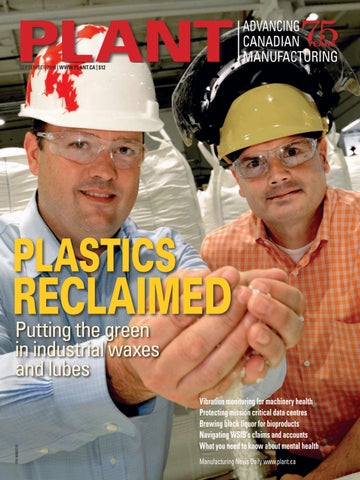
PLASTICS
RECLAIMED Putting the green PM 40065710
in industrial waxes and lubes
Plant_Sept2016_AMS.indd 1
Vibration monitoring for machinery health Protecting mission critical data centres Brewing black liquor for bioproducts Navigating WSIB’s claims and accounts What you need to know about mental health Manufacturing News Daily www.plant.ca
2016-09-02 11:16 AM
WORK SAFER AND MORE EFFICIENTLY with the new FLIR® CM174 clamp meter with built-in thermal imaging camera. Featuring Infrared Guided Measurement (IGM) technology, the CM174 visually points you to the precise location of potential electrical issues. You’ll find problems faster, get more done, and boost your credibility. TO SEE IGM IN ACTION GO TO WWW.FLIR.CA/CM174
Plant_Feb_Flir.indd 1 Plant_Sept2016_AMS.indd 2
2016-09-02 2016-01-27 11:16 8:57 AM
27 8:57 AM
CONTENTS
September 2016 Vol. 75, No. 06
FEATURES 17 RESEARCH Simon Fraser University technology pulls water from air. 18 BIOPRODUCTS West Fraser switches on its Alberta lignin recovery plant. 19 INSURANCE Understand how the WSIB works to deploy best practices to contain its costs. 20 TRAINING Focus on reinforcing the right way of completing a task. 27 LUBRICATION Vibration monitoring is an effective way to ensure machinery health.
14 PLASTICS
GreenMantra uses proprietary catalytic processes to transform everyday plastics into value-added industrial waxes.
29 CCOHS SAFETY TIPS How to maintain mental well-being in the workplace. 31 THINK LEAN Team members taking five minutes each daily to stay organized reduces costs. 34 CONFIDENCE Executives are naïve about business challenges ahead, report says.
CIEN 35 THERMAL IMAGING Camera continuously monitors packing integrity. 22 INFRASTRUCTURE Renewable power offers a solution that would protect vulnerable mission critical data centres.
24 DECISION MAKING Business still relies on human judgment, but big data is quickly catching up.
SUPPLY LINES 36 PRODUCT FOCUS Lifting equipment 39 PRODUCTS AND EQUIPMENT 45 PLANTWARE
DEPARTMENTS
32 ANNIVERSARY PLANT ushers in the 1980s, an era of technology and free trade.
44 Q&A Schneider Electric goes all-in on energy efficiency.
4 Editorial 6 News 8 Careers 11 Markets: 3D printing, technology, bearings 12 PLANT Pulse 45 Events 46 Postscript COVER: Ryan L’Abbe, Domenic DiMondo by Stephen Uhraney
PLANT—established 1941, is published 8 times per year by Annex Business Media. Publications Mail Agreement #40065710. Circulation email: stelian@annexnewcom.ca Tel: 416-442-5600 ext 3636 Fax: 416-510-5170 Mail: 80 Valleybrook Drive, Toronto, ON M3B 2S9. Occasionally, PLANT will mail information on behalf of industry-related groups whose products and services we believe may be of interest to you. If you prefer not to receive this information, please contact our circulation department in any of the four ways listed above. Annex Privacy Officer: privacy@annexbizmedia.com Tel: 800-668-2374.No part of the editorial content of this publication may be reprinted without the publisher’s written permission. ©2016 Annex Publishing & Printing Inc. All rights reserved. Performance claims for products listed in this issue are made by contributing manufacturers and agencies. PLANT receives unsolicited materials including letters to the editor, press releases, promotional items and images from time to time. PLANT, its affiliates and assignees may use, reproduce, publish, re-publish, distribute, store and archive such unsolicited submissions in whole or in part in any form or medium whatsoever, without compensation of any sort. This statement does not apply to materials/pitches submitted by freelance writers, photographers or illustrators in accordance with known industry practices. Printed in Canada. ISSN: 1929-6606 (Print), 1929-6614 (Online)
www.plant.ca
Plant_Sept2016_AMS.indd 3
PLANT 3
2016-09-07 10:31 AM
EDITORIAL
Beware of trade xenophobia
W
hat’s going on out there with global trade? Seems some parts of the developed world are becoming insular and a bit crazy. Britain goes Brexit, thus tossing a spanner into the workings of the CETA deal and setting itself up for some economic hardship, while closer to home there are two US presidential nominees who are donning protectionist armour and slagging NAFTA. This is a troubling development that could have serious ramifications for Canadian manufacturers, many of whom are part of the intricate supply chains that feed North American commerce. On the Republican side, we have the Donald Trump-branded reality show actor, and he’s telling his people NAFTA is a disaster. He’ll rip up the agreement with his tiny hands if he can’t renegotiate it. And he’ll bring back all those manufacturing jobs lost to China and Mexico, evidently by magical means because details related to how he plans to reset the flow of global commerce are at best, sketchy. On the Democratic side, Hillary Clinton is also sour on NAFTA, the trade deal her husband President Bill signed in 1993. She too believes it has been bad for America. Jobs have disappeared and companies moved offshore to cash in on cheap labour so she wants to renegotiate. Street level, Canadians are ambivalent about the benefits of continental free trade. An Angus Reid Institute poll found about 25% of respondents believing NAFTA has benefited Canada; an equal number say it has hurt the country; 34% say it should be renegotiated; and 9% want it ripped up. Yet North American free trade has demonstrated it expands markets and opportunities. Trade circa 1993 was $288 billion. In 2014 it topped $1.12 trillion. Canada has seen investment from the US and Mexico triple since 1993. And the Council on Foreign Relations reports US investment in Canada grew from $70 billion to $368 billion in 2013. The US think tank also tallies the number of US jobs that rely on trade with Canada and Mexico at 14 million, and 250,000 export-related jobs are created annually, which pay 15% to 20% more on average than jobs lost. But that’s cold comfort to the many thousands of workers who have seen plants close, production moved and jobs lost to countries where labour is cheap. It’s their disgruntlement and the pain they’ve experienced from the dynamics of trade flow that fuel this election year hostility. Who knows what will happen to NAFTA when the US picks a president. Some pundits expect the political heat will dissipate, although the Trans-Pacific Partnership (TPP) may be in for a rough ride. Both candidates are against the TPP, which is an odd place for Hillary to be since she was involved in the negotiations during the early innings. Even Prime Minister Justin Trudeau, whose Liberal government has signed on, is being coy about how “done” this deal may be when he suggests the people should have their say before it’s implemented. The North American and Europe markets, though lucrative, are mature. Real growth beckons from beyond. Canadian Manufacturers & Exporters wants to double manufacturing and exporting output by 2030, so it sees this agreement, which opens access to 40% of the world economy, as a good way to accomplish that goal. Escalating trade xenophobia will not make life better for workers or manufacturers. Falling back to tariffs and trade retaliation will impede opportunities, growth, jobs and better wages. History and experience have demonstrated there’s not a lot to see looking inward. Joe Terrett, Editor Comments? E-mail jterrett@plant.ca.
4 PLANT
Plant_Sept2016_AMS.indd 4
Publisher Michael King 416-510-5107 mking@plant.ca, mking@cienmagazine.com Editor Joe Terrett 416-442-5600 ext. 3219 jterrett@plant.ca Associate Editor Matt Powell 416-510-5145 mpowell@plant.ca Art Director Andrea M. Smith National Account Manager Ilana Fawcett 416-510-5202 ifawcett@plant.ca Account Coordinator Barb Vowles 416-510-5103 bvowles@annexbizmedia.co Annex Business Media Vice President Tim Dimopoulos (416) 510-5100 tdimopoulos@annexbizmedia.com President & CEO Mike Fredericks Circulation Manager Beata Olechnowicz 416-442-5600 ext. 3543 bolechnowicz@annexbizmedia.com Subscription Price Canada $72.50 per year, US $146.95 (US) per year, Foregin $166 (US) per year. Single Copy Canada $12.00. Add applicable taxes to all rates. Combined, expanded or premium issues, which count as two subscription issues. Mailing Address Annex Business Media 80 Valleybrook Dr., Toronto, ON M3B 2S9 plant.ca Tel: 416-442-5600, Fax: 416-510-5140 Customer Service Silva Telian 416-442-5600 ext. 3636 stelian@annexnewcom.ca
We acknowledge the [financial] support of the Government of Canada.
September 2016
2016-09-02 11:16 AM
PLT_Exa
NEWS BULLETINS Brotech, a precision metal manufacturer, is embarking on a $2.5 million expansion project with $250,000 in assistance from the Ontario government. The company, which makes components for the nuclear power, aerospace and defence industries, has moved into a larger manufacturing facility in Barrie, Ont. and will add several new pieces of equipment on the plant floor. The project will create 15 new jobs and improve the company’s capabilities with materials such as titanium. Transcontinental Inc., a publishing, printing and packaging firm in Montreal has added Robbie Manufacturing to its packaging operations for an undisclosed amount. Robbie, a Lenexa, Kan. manufacturer, specializes in on-site packaging for grocery stores, shrink-wrap, multipack consumer goods and packaging for food processors. It has 175 employees and generated $50 million in revenue during the 2015 fiscal year. Quebec’s Héroux-Devtek Inc. has delivered its first set of landing gear for the Boeing 777 and 777X aircraft programs to Boeing Co.’s manufacturing plant in Everett, Wash. Sub-assembly work was carried out at the company’s facility in Strongsville, Ohio, while plants in Springfield, Ohio, Cambridge, Ont. and Laval, Que. manufactured a number of the complex components. Ontario utility company PowerStream Inc. has launched a microgrid project in Penetanguishene, Ont. that provides backup power for up to 400 homes and businesses for several hours. Working in partnership with Korea Electric Power Corp., the microgrid operates in “grid mode” or “island mode,” drawing power from transmission lines or 500 kilowatt-hour batteries during a disruption. MacDonald, Dettwiler and Associates Ltd. (MDA), a global communications and information company based in Richmond, BC, signed two contract amendments worth $2.75 million with two long-term RADARSAT-2 satellite customers. They use RADARSAT to watch for oil spills, illegal fishing, agriculture, forestry, disaster management and maritime safety. The customers were not identified.
6 PLANT
Plant_Sept2016_AMS.indd 6
Kwantlen gets $3M in funding for high-priority trades training BC polytech university to fund 1,238 tech seats
Stephanie Cadieux, MLA for Surrey-Cloverdale, checking out skills training at PHOTO: BC GOVERNMENT Kwantlen Polytechnic University.
VICTORIA — The BC government is investing $3 million at Kwantlen Polytechnic University (KPU) for skills training in high-priority trades seats. The investment, through the province’s Industry Training Authority (ITA), will fund 1,238 seats at KPU’s Tech Campus in Cloverdale until March 31, 2017, covering various trades, including welding, electrical, automotive service technician, millwright and carpentry. The funding is part of the ITA’s annual allocation to BC post-secondary institutions and training providers. ITA provides more than 100 apprenticeship training programs, including almost 50 Red Seal trades, with more than 39,000 registered apprentices. BC is forecasting nearly one million job openings by 2025 due to retirements and economic growth. Eight of every 10 of these job openings will require post-secondary education or trades training.
Electrovaya launches LC-44 cell TORONTO — Electrovaya Inc. has unveiled a next-generation lithium ion battery cell that increases the energy density and has a longer cycle life. The LITACELL LC-44, released through the Mississauga, Ont. company’s wholly owned German subsidiary Litarion GmbH, delivers 44Ah in the same geometry as its 40 LC-40 cell. Its cycle and calendar life is up to 9,000 cycles at 1C charge and discharge. The company says the LC-44, which contains optimized NMC/ graphite-based electrode chemistry, is available to OEMs and battery pack integrators worldwide. Electrovaya has production facilities in Canada and Germany.
Eclipse joins new global partnership CAMBRIDGE, Ont. — A Canadian manufacturer of automation equipment is part of a newly formed global group that intends to shake up the custom automation services industry. Eclipse Automation, a manufacturer of automated manufacturing equipment in Cambridge, Ont., is part of Smart Automation Group, which it describes as a “collaborative partnership” that includes Insys Industriesysteme AG, Transmoduls Ltd., SMZ Wickel-und Montagetechnik AG, JULI Technology and ITE Automation. The companies, located in Canada, the US, Hungary, Switzerland and China, will share best practices, industry IP, experience, and know-how to “produce technologies that are the lynchpins of manufacturing processes across every industry,” says a press release. Each partner will review its own client requests, and if a particular project requires additional capabilities, the collaborative project team will be tapped to provide the customer with the best value.
Cascades takes a major position in Texas tissue plant
Expanding in the US.
PHOTO:CASCADES
KINGSEY FALLS, Que. — Cascades Inc., a Canadian manufacturer of green packaging and tissue products, has taken a majority position in Longhorn Paper Converting, a tissue converting plant in Grand Prairie, Tex. The Kingsey Falls, Que. company said the investment expands its
coverage of key US markets. Citing the facility’s strategic location, Cascades will convert parent rolls manufactured in other Cascades plants there. Financial details were not disclosed. Cascades Tissue Group, a division of Cascades Canada ULC, is the fourth largest tissue paper manufacturer in North America.
September 2016
2016-09-02 11:16 AM
Cascade Aerospace names its top suppliers for 2016 Award winners support RCAF’s CC-130H and CC-130J Hercules fleets ABBOTSFORD, BC — Cascade Aerospace has announced six winners of its 2016 Supplier Awards, given to companies that have supported the aerospace manufacturer’s contracts, notably the Royal Canadian Air Force’s CC-130H and CC-130J Hercules fleets. The winners were announced at the Aerospace, Defence and The CC-130J Hercules in flight. PHOTO: RCAF Security Expo in Abbotsford, BC Aug. 12. Cascade, based in Abbotsford, said each of Cascade’s top suppliers were evaluated based on delivery, quality, communications and cost reduction initiatives in manufacturing, support services and distribution. The winners are: • Trulife Engineered Solutions, Bellingham, Wa., a precision CNC machine shop specializing in production CNC milling and turning, and prototyping. • Pyrotek Heat Treating, Abbotsford, BC, a supplier of certified aluminum heat treat services to the Pacific Northwest. • MHD Rockland, Pointe-Claire, Que., a worldwide stocking distributor of aircraft OEM parts. • KLX Aerospace, Miami, with offices in Montreal and Vancouver, a supplier of aerospace fasteners and consumables. • Kellstrom Industries, Roselle Ill., suppliers of OEM and aftermarket components. • DGI Supply, Cambridge, Ont., an industrial supply company. Cascade Aerospace is an operating unit of IMP Aerospace & Defence, a specialty aerospace and defence contractor based in Halifax.
Kruger invests $55M in new paper machine Crabtree plant will produce tissue for away markets The Montreal-based manufacturer of tissue products for household, commercial and industrial use, said the project will increase the plant’s overall annual production by 20,000 tonnes and will help to consolidate 600 jobs. The company received a $39.5-million loan from Investissement Québec, which is acting as an agent of the Québec government. (L-R) Mario Gosselin, CEO, Kruger Products; Joseph Kruger II, The No. 8 paper machine chairman, CEO, Kruger Inc.; Dominique Anglade, Minister of (PM8), which will produce Economy, Science and Innovation; and Digital Strategy; and tissue products primarily PHOTO: KRUGER Denis Laporte, Mayor of Crabtree. for the “away” markets, will be installed in a new building that will CRABTREE, Que. — Kruger Prodsoon be under construction. ucts LP is investing $55 million to add Kruger said the machine will be a paper machine at its Crabtree plant, commissioned by end of summer 2017. in the Lanaudière region of Quebec.
www.plant.ca
Plant_Sept2016_AMS.indd 7
$80M pork partnership Companies go 50-50 on Lucyporc YAMACHICHE, Que. — Olymel management and Groupe Robitaille plan to invest $80 million in a Quebec pork processing plant as part of its 50-50 partnership in Lucyporc, a food processing firm. Lucyporc in Yamachiche, Que. was founded in 1998 by Groupe Robitaille, which is active in poultry and pig production. Olymel is a producer and processor of pork and poultry. The partnership goes into effect at the Lucyporc plant in the fall with a second shift in the expanded and reorganized Olymel (ATRAHAN) hog slaughterhouse and deboning facility. The project is to be completed within three years. It will combine 360 Olymel employees and 430 Lucyporc employees, plus create 350 new jobs. The two partners intend to share knowLucyporc to produce pork products with how and pool Olymel’s Yamachiche operation. expertise. PHOTO: THINKSTOCK
Franklin Empire to assemble Siemens SIMOGEAR motors Line to be put together and serviced at a dedicated facility near Montreal BOUCHERVILLE, Que. — Siemens Canada has expanded its partnership with an electrical distributor in Quebec that will assemble and service SIMOGEAR motors. This first time agreement will see Franklin Empire assemble the new geared motor in a state-of-the-art, dedicated facility in Boucherville, Que. Franklin Empire’s DS Tech division has been selling and servicing the Flender product line, SIMOGEAR’s predecessor, for 13 years. Siemens said local assembly will allow greater flexibility for customization based on specifications from OEM customers. Siemens Canada is based in Oakville, Ont.
SIMOGEAR motors from Siemens.
PHOTO: SIEMENS
PLANT 7
2016-09-02 11:16 AM
NEWS CAREERS Nancy Gougarty has moved up from president and COO to CEO of Westport Fuel Systems Inc., a manufacturer of advanced fuel systems in Vancouver. She replaces David Demers, who is retiring. Gougarty, a 30-year veteran in the transportation-equipment industry, has served as a senior automotive executive with several large automakers and auto parts companies. She joined Westport in 2013. Valeant Pharmaceuticals International Inc. in Laval, Que. has appointed Paul Herendeen executive vice-president, finance. He’s taking over the CFO role from Robert Rosiello, who will remain at Valeant as executive vice-president, corporate development and strategy. Herendeen joins Valeant from Zoetis, where he served as executive vice-president and CFO for the past two years. He’ll oversee Valeant’s finance functions. Margaret Law is taking over the responsibilities of field service advisor for the GTA and York communities for the Excellence in Manufacturing Consortium (EMC). She has more than 25 years of experience in manufacturing, primarily in the print industry. Most recently she was project manager with a SR&ED consulting firm. EMC is a non-profit organization dedicated to helping manufacturers grow and become more competitive domestically and globally. Hydro One Ltd. has appointed Paul Barry executive vice-president, strategy and corporate development, and Greg Kiraly COO. Barry was recently CEO and founding partner of Public Infrastructure Partners LLC, a power and utility strategic advisor to leading private equity, infrastructure, and pension funds in the US, Canada and Europe. Kiraly was senior vice-president, electric transmission and distribution, for PG&E in San Francisco. Dundee Sustainable Technologies Inc., a developer of environmentally-friendly technologies for the mining industry based in Montreal, has appointed Brian Howlett interim president and CEO, replacing John Mercer. Howlett has been a director of the corporation and chair of the audit committee since October 2015.
8 PLANT
Plant_Sept2016_AMS.indd 8
CRIQ, Festo partner on Industry 4.0 MUNICH, Germany — Centre de recherche industrielle du Québec (CRIQ) has signed an agreement with industrial automation manufacturer Festo to accelerate the adoption of Industry 4.0 and smart factories in Quebec. The agreement provides CRIQ with access to specialized resources and automation technologies from Festo, which will collaborate with the Quebec industrial innovation incubator’s research team. CRIQ develops robotization, artificial intelligence, telematics, numerical control, production systems organization and big data management technologies. Smart factories are a core element of Industry 4.0 and are characterized by continuous communication between various production tools and workstations of supply and production lines. CRIQ, which completes more than 2,000 innovation and productivity-focused projects every year, says the partnership will drive the development of factory technology in the province.
Captured CO2 to supply Quebec greenhouse project QUEBEC CITY — CO2 Solutions Inc. has sealed the deal on a $7.4 million carbon capture project with Fibrek General Partnership, a subsidiary of Resolute Forest Products Inc., and Serres Toundra Inc. A CO2 Solutions carbon capture unit will be deployed at a pulp mill in the Saint-Félicien region of Quebec and the carbon dioxide will be put to commercial reuse in Serres Toundra’s adjacent vegetable greenhouse complex. CO2 Solutions, a Quebec City developer and manufacturer of enzyme-enabled carbon capture technology, said the project will collect up to 30 tonnes of carbon dioxide per day. After a six-month demonstration period, Serres Toundra has agreed to purchase the CO2 for 10 years. Serres Toundra is a 34-hectare greenhouse complex arising from a 2014 partnership between Resolute, the city of Saint-Félicien and local investors. When fully operational in 2019, the $100 million project will be the largest greenhouse in Quebec, producing vegetables 12 months a year and contributing 400 jobs to the Lac-Saint-Jean region. CO2 Solutions will collect about $400,000 a year from the sale of the captured CO2 and the associated carbon credits. Sustainable Development Technology Canada is providing a $2.4 million non-refundable grant to the project, while Resolute and Serres Toundra will make in-kind contributions of $300,000 and $100,000. CO2 Solutions is working with potential public and private partners to complete the financing before completing the commissioning of the CO2 capture unit by the end of 2017.
FedDev invests $18.8M in Ontario projects Funding collaborates, commercializes, upgrades technology
FedDev Ontario supports innovation, entrepreneurship and PHOTO: THINKSTOCK collaboration.
SARNIA, Ont. — Bioindustrial Innovation Canada (BIC) is getting $12 million in funding from FedDev Ontario to support the Sarnia, Ont. area’s sustainable chemistry and bio-based industrial sector. The accelerator, based at the Sarnia Lambton Campus of the Western University Research Park, has been set up to bridge the gap between
research and the marketing of chemicals and energy production from biomass. BIC aims to create 478 jobs and develop 250 new industrial collaborations, especially among SMEs. The funding will help businesses speed up the commercialization of new products from final testing to market. Moving on to Eastern Ontario, the Northumberland Community Futures Development Corp. (CFDC) is getting $6.3 million to support collaborative projects with SMEs. And Etratech Enterprises Inc., a manufacturer of advanced electronic controls, received $500,000 from FedDev Southern Ontario to purchase surface-mount equipment and a new component traceability system. The Burlington, Ont. automotive supplier said the repayable investment in the $2 million project will help the company fulfil recently acquired production contracts with Stoneridge Inc., which provides parts to General Motors. The project is projected to create up to 25 fulltime jobs.
September 2016
2016-09-02 11:16 AM
PLT_Tor
Switch to Tork wipers and save*
23% 23% 20% less time
less solvent
less effort
Do you use rags or rental shop towels? You could save time, money and effort with Tork disposable wipers. We make a range of professional wipers for wiping, cleaning and polishing. Tork industrial wipers are designed to do the job right, time after time, without the risk of damaging equipment or your finished product. Try them today!
Visit talktork.com/industrial to start your free trial and see how much you can save.
* Rental shop towels, cotton rags and mixed rags were compared to Tork Heavy-Duty Cleaning Cloths. Panel test conducted by Swerea Research Institute, Sweden, 2014. ** Rental shop towels, cotton and mixed rags were compared to Tork Heavy-Duty and Tork Industrial Heavy-Duty Cleaning Cloths. Panel test conducted by Swerea Research Institute, Sweden, 2014.
PLT_Tork_Sept.indd 1 Plant_Sept2016_AMS.indd 9
© 2016 SCA Tissue North America LLC. All rights reserved. Tork® is a registered trademark of SCA Tissue North America LLC, or its affiliates.
2016-08-29 11:16 2016-09-02 12:13 AM PM
NEWS
Quebec tech wins water treatment contest QUEBEC CITY — H2O Innovation Inc. has secured an order for its Clearlogx proprietary technology following a three-month pilot demonstration with the Brazos Regional Public Utility Agency in Granbury, Tex. The Quebec City manufacturer of water treatment solutions said Clearlogx will handle the coagu-
lant dosing of a water treatment plant to maintain proper pH levels and optimum particle discharge by combining a conventional and membrane filtration system using ultrafiltration and reverse osmosis technologies. The pilot demonstration was conducted following a contest last February at the Membrane
Technology Conference (MTC) in San Antonio, Tex. During the pilot, it was demonstrated that BRPUA would improve its clarifier performance by 50%, increase production by 25% and prevent premature fouling of the ultrafiltration system, thus extending the life of the membranes.
PRECISION
ISO 9001 CERTIFIED COMPANY
Timing belts and pulleys with perfect meshing made to your exact specifications for precise, long-lasting performance
PERFORMANCE Timing belts that outperform and outlast the competition. More OEMʼs specify BRECOflex belts and drive components than any other brand
LONGUEUIL, Que. — D-BOX Technologies Inc., a Quebec manufacturer of immersive motion technology for cinemas, has signed a distribution agreement that expands its reach in China. The Longueuil-based company will be working with Link Digital Cinema China Technology (Beijing ) Co. Ltd. It’s a subsidiary of Zhixinhengcheng, one of the largest distributors of cinema equipment in China. D-BOX designs, manufactures and commercializes motion systems aimed at the entertainment, simulation and training markets. Its patented technology uses motion effects programmed for visual content that are integrated into a platform, seat or other product. The motion is synchronized with on-screen action, to create what the company describes as a “realistic, immersive experience.”
Single source provider of timing belts, pulleys & accessories. Custom pulleys ship in 8 days or less. Get FREE engineering and design support for your application
Timing Belts Pulleys Accessories
For customer service and technical support call (732) 460-9500, Email: info@brecoflex.com or visit us at www.brecoflex.com
Plant_Sept2016_AMS.indd 10
VANCOUVER — Avcorp Industries and the University of British Columbia are looking at establishing a learning partnership for advanced composites. The Learning Factory at UBC’s Okanagan campus would integrate industrial production with learning and research. Technical and skills training opportunities would be provided to students from partner institutions, such as Okanagan College. Avcorp, a supplier of integrated composite and metallic aero-structures based in Delta, BC, would benefit from an enhanced ability to evaluate and improve manufacturing efficiency.
D-BOX signs deal with Link DC China
CONVENIENCE
10 PLT_Brecoflex_Sept.indd PLANT 1
Avcorp partners with UBC on innovation
2016-08-31 11:48 AM
September 2016
2016-09-02 11:16 AM
MARKETS
3D PRINTING
3D SOFTWARE AND SERVICES TO GROW AS PRINTING SHRINKS
T
he largest segment of the global 3D printing market in 2015 was the machines, accounting for about half. BCC Research forecasts this segment will shrink while the software and services markets grow by compound annual growth rate of 23.2% from $3.7 billion 2016 to $10.4 billion 2021. The research firm, based in Wellesley, Ma., cites consumer goods manufacturing as the largest user of 3D printing last year, accounting for an estimated 17.6% of the total market, followed by the automotive sector with 17.5%. Medical and dental products ranked third at about 15%. Medical/dental is projected to increase its market share to nearly 17% by 2021. Aerospace should grow from 12% in 2015 to 14% in 2021. North America is the largest player for printing, materials and services with 38% of the global market last year. Europe follows with 22% and Asia-Pacific with 19%. However, Asia-Pacific is growing faster. It’s share of the world market should grow to 21% by 2021 as North America’s drops to 36% and Europe declines to 19%.
PHOTOS: THINKSTOCK
TECH SECTOR
TECHNOLOGY AN ECONOMIC DRIVER
C
anada’s tech sector is growing and a major driver of innovation, according to a study by the Brookfield Institute for Innovation + Entrepreneurship (BII+E) at Ryerson University. The Toronto-based research firm describes the sector ranging from digital to aerospace and pharmaceuticals as diverse, highly innovative and a significant economic driver. In 2015, it was responsible for $117 billion or 7.1% of Canada’s economic output. Here are some study highlights: • Technology employs 864,000 Canadians, making up 5.6% of total employment. • More than $9.1 billion is spent on research and development. • The sector is comprised of nearly 71,000 firms, representing 6.1% of all businesses. • Employee earnings are about $67,000 a year, compared to the national average of nearly $48,000. • More than 50% of employees had a university education, compared to 29% across Canada’s labour force. Industries not included in ICT contributed significantly to the tech sector’s GDP. Combined, they made up 38.8% ($45.5 billion) of output. Architecture, engineering and design made up 18.4%; chemical and pharmaceutical manufacturing 6.9%; and aerospace manufacturing made up 6.1%. Scientific R&D, machinery and specialized manufacturing (combined) accounted for 7.4%.
BEARINGS
CANADIAN DEMAND SLOWS
G
lobal demand for bearings will increase 6.1% each year through 2020 to $104.5 billion, accelerating from the 2010-2015 period, according to the World Bearings forecast by The Freedonia Group, a Cleveland-based industry research firm. Investment and durable goods manufacturing will fuel demand. North American growth will be almost $17 billion through 2020. Demand in Canada will be $1.4 billion, well below the regional average and slightly slower than the 2010-2015 pace. Sales will be constrained by a decline in automotive production, the largest market for bearings. Gains in the US, which was the world’s second
www.plant.ca
Plant_Sept2016_AMS.indd 11
largest market in 2015, will slow through 2020. Advances were strong between 2010 and 2015 fuelled by recoveries in motor vehicle and machinery production. China accounts for a third of world demand and India will experience the fastest increase in demand as motor vehicle and machinery markets expand substantially. Generally, the strongest sales will be in developing areas, with Thailand, China and Mexico posting robust gains. Sales growth in a number of developed countries, especially in Western Europe, will accelerate.
PLANT 11
2016-09-02 11:16 AM
Business is looking up
12 PLANT
Plant_Sept2016_AMS.indd 12
INTERNATIONAL TRADE UPDATE
3 2 1 0 -1 -2 -3 -4
June 2011
2012
2013
2014
2015
5,600
80%
The percentage of small business owners who say CPP hikes will make it much more difficult for them to cope with other tax increases and increased costs, according to the Canadian Federation of Independent Business.
Job growth in manufacturing from June to July. Statistics Canada marks that up as a 0.3% gain while overall job growth shrank 0.2%. However, manufacturing is currently down 1.1% (18,800 jobs) year-over-year. Natural resources is down 12% (42,800 jobs).
IMAGE: FOTOLIA
1.2
MILLION BARRELS
June 2016
Canada’s merchandise trade deficit with the world widened in June from $3.5 billion in May to $3.6 billion, rising from $6.4 billion to a record $10.7 billion in the second quarter. Q2 imports decreased 1.4% to $134.7 billion while exports dropped 4.7% to $124 billion, the largest decline since Q2 of 2009. June’s exports were driven by energy and energy products, which rose 7.2%. Industrial chemical, plastic and rubber products, plastic resins, dyes and pigments, petrochemicals and basic chemicals all showed gains.
IMAGE: THINKSTOCK
E
conomic growth has been uneven so far this year, but things are looking up, particularly in manufacturing, according to two bank prognosticators. Sales growth tallied 0.8% in June after dropping 1% in May, says Statistics Canada. Fifteen out of 21 industries reported higher sales with machinery ahead 5.8% after declining in the previous five months. Transportation equipment was up 1.4%. Statistics Canada attributed nearly 75% of the increase to these two industries. Durable goods rose 1.6% to $27 billion, while non-durable goods decreased 0.1% to $23.2 billion. Food manufacturing dropped 1.2%, primary metal by 1.1% and paper 1.8%. Ontario led sales, up 1.4% to $24.7 billion. More than half the gain came from a 2.2% surge in transportation equipment. Machinery increased 3.7%, computer and electronics 6.2% and miscellaneous by 6.4%. TD Economics called the June numbers a welcome bright spot that points to a healthy rebound in output. Disruptions to the oil and gas sector have not fully dissipated, but TD economist Brian DePratto said a further boost to output is expected as the sector continues to recover. Manufacturers’ order books also point to a healthier second half, with greater demand from the US. RBC Economics said the June sales numbers supports its view that much of May’s 0.6% drop was transitory. The Bank of Canada estimates in its July Monetary Policy report the Alberta wildfires reduced Q2 GDP by 1%. Non-resource sectors are expected to pick up, with non-commodity exports gaining traction and conditions for investment are favourable. Manufacturing is experiencing capacity pressures and a lower value dollar is delivering higher margins. Yet investment hasn’t been robust because of uncertainty over future demand, prospects and structural changes. The Bank of Canada has revised its 2016 GDP down to 1.3% from 1.7% in the April report, and 2.2% for 2017, down from April’s 2.3%.
billions of dollars
56%
Percentage of manufacturing executives polled by the 2016 EMC-PLANT salary survey who read trade/B2B print publications to stay up-to-date in their fields. Conferences/ trade shows are second (50%) and trade publication web sites are third (47%). IMAGE: FOTOLIA
Anticipated daily global growth of oil demand next year. The International Energy Agency, which lowered its forecast from 1.3 million barrels, says the new number represents a slowdown from this year’s growth of 1.4 million barrels. IMAGE: THINKSTOCK
75% IMAGE: THINKSTOCK
Analysts expect a rebound in Q3
Work sites inspected by the Ontario labour ministry that violated the Employment Standards Act and the Labour Relations Act. The two-person panel found unions represented just 14% of private sector workers (70% in the public sector). Union coverage (public and private) has declined from 29.9% in 1997 to 26.8% in 2015. The panel attributes much of the decline in the private sector to the movement of jobs from blue collar sectors such as manufacturing to service jobs.
September 2016
2016-09-02 11:16 AM
PLT_Imp
T:9” S:8”
Three years. Zero oil changes. The next time your rotary-screw air compressors need an oil change, switch to groundbreaking, synthetic Mobil SHC™ Rarus Series oils. These lubricants have demonstrated the capability to last up to 24,000 hours in a compressor field trial* and are backed by a three-year warranty†. Make the change to Mobil SHC Rarus Series compressor oils—your nextgeneration solution. Learn more at mobilindustrial.com
PLT_Imperial_Sept.indd 1 13 Plant_Sept2016_AMS.indd
2016-09-02 2016-08-08 11:16 3:10 PM AM
T:12”
S:11”
*Result relates solely to fluid performance in one rotary-screw compressor. Performance will vary based on operating conditions and application. † To learn more about the product warranty, contact your Mobil lubricants representative or distributor. Copyright © 2016 Exxon Mobil Corporation. All rights reserved. All trademarks used herein are trademarks or registered trademarks of Exxon Mobil Corporation or one of its subsidiaries unless otherwise noted.
PLASTICS
GreenMantra’s
RECYCLING INNOVATION PUTTING THE GREEN IN INDUSTRIAL WAX PRODUCTION The Brantford company’s proprietary catalytic process turns everyday recyclables into high-value products used in almost everything. BY MATT POWELL, ASSOCIATE EDITOR
L
ook around the room you’re in. About 80% of its contents likely contain some kind of wax. Synthetic fire logs popular at Christmas time have wax in them and so does your shoe polish. Here’s the problem: about 94% of the world’s waxes (a $10 billion global business) are made from crude oil, natural gas or coal. At a time when there’s so much focus on sustainable and greener produced goods, that just won’t fly. But it presents an opportunity for Brantford, Ont.based GreenMantra Technologies Inc. The company founded in 2010 is a recycler that transforms plastics into high-value waxes, greases and lubricants, and pumps out 5,000 tonnes of product a year. In May, GreenMantra finished two years of work on a new manufacturing operation at a former Cascades recycling facility in the city’s downtown.
14 PLANT
Plant_Sept2016_AMS.indd 14
GreenMantra sells its waxes to manufacturers producing goods such as glue, roofing shingles, ink and ashphalt. The new site is equipped with a semi-continuous production that’s both compact and modular that’s designed for future expansions and for upgrades to a continuous, fixed-bed process. What started as a four-person endeavour has morphed into a team of 35, and is soon to grow by more than 25 as it ups its sales and marketing efforts. Its new CEO, Kousay Said, joined the company last October. He’s a nearly 20-year veteran of Dow Chemical, the Michigan-based global chemical giant. Most recently he was chief commercial officer for Sirrus Inc., a manufacturer of high-performance monomers. Ryan L’Abbe, vice-president of operations, and Domenic Di Mondo, director of research and business development, round out GreenMantra’s leadership team. L’Abbe joined the company in 2015, coming from Blue Mountain Plastics in Feversham, Ont., a subsidiary of Ice River Springs Water Co., where he spearhead-
Ryan L’Abbe, GreenMantra’s vice-president of operations, at the company’s Brantford, Ont. manufacturing facility. PHOTO: STEPHEN UHRANEY
September 2016
2016-09-02 11:16 AM
ed development and operations of Canada’s largest recycler of post-consumer PET plastics. Di Mondo, who was GreenMantra’s first employee, developed the company’s transition metal catalysts for converting biomass feedstocks to fine chemicals and has led the scale up from lab to production. In June, GreenMantra received $600,000 through FedDev Ontario’s Investing in Business Innovation Initiative to expand market development activities and develop and implement a resource planning system to automate its production operations. It also received $750,000 from the agency in 2013 to complete final commercialization testing of its technology, a project that created 13 jobs. There’s also funding from a number of Canadian and European private sector partners, including a $1 million injection through the MaRS Clean Tech Fund and $500,000 from the innovation incubator’s Investment Accelerator Fund. There are two product lines. A Series waxes are meant for applications that require specific technical properties such as black masterbatch, dark PVC, recycled plastics and industrial adhesives. The G Series is compatible with plastics products such as paints, inks, rubber, tires, adhesives, paper and packaging. The waxes are derived from hard-to-recycle plastics such as grocery bags, shrink wrap, bottle caps, milk jugs and shampoo bottles. The materials are seperated by resin type and fed into a patented catalytic depolymerization process to create wax. It is then filtered and purified to create higher-value waxes and chemicals. “The key with our system is that we’re not converting polyethylene back into the same material, but into an upgraded material,” says L’Abbe, who came on-board after the company finalized a $12 million round of seed
www.plant.ca
Plant_Sept2016_AMS.indd 15
(Top to bottom): GreenMantra’s process begins with high-temperature extruders that mix, melt and filter the resins that are to be depolymerized; several buffer and blending tanks ensure in-process quality and consistency of the wax being manufactured; process operator Femi Olorunnaiye monitors and controls the highly-autoPHOTOS: STEPHEN UHRANEY mated depolymerization process.
PLANT 15
2016-09-02 11:16 AM
PLASTICS funding in private equity and government investment to scale up the Brantford plant. “Depending on the customer, we have the ability to uniquely formulate and replicate the kind of wax they use.” The two modular production lines are operational 24/5 but are capable of running 24/7. The company is in talks with a number of partners in the US and Canada to expand the next evolution of the production process, and is currently on the lookout for a second production facility. “We want to do more refinining,” he says. “Our dream is to take a recycled feedstock and produce a perfectly white, deoiled wax – and we’re working on the technologies to do that.” At the heart of GreenMantra’s production process is a set of proprietary heterogeneous catalysts that enables selective thermal-catalytic depolymerisation reactions to occur. Di Mondo explains that the catalysts deliver higher yields and controls factors such as molecular weight and structural and thermal properties of its final product. The catalyst’s aluminum oxide regenerates back to its virgin form and re-impregnated with active metals. The catalysts also allow GreenMantra’s process to operate at a much lower temperature than other chemical recycling processes while avoiding the randomness of depolymerizations experienced in processes based on pyrolysis or gasifaction. “This allows us to deliver conversion rates as high as 97%,” says Di Mondo. There are also plans to expand the number of feedstocks, such as agricultural films and polyethylene bagging, which typically don’t make it into the recycling stream. Those kinds of materials will force the company to continue updating its proprietary catalysts, but also allow it to get into the production of higher-valued products where yields per pound are much higher. Their product expansion plans come at a good time. Statistics
16 PLANT
Plant_Sept2016_AMS.indd 16
GreenMantra’s Cerenovus wax “pastilles” are used in a wide variety of commercial applications.
show it’s likely GreenMantra won’t run out of supply any time soon. Recycling programs that now accept and recycle plastic packaging have grown to the largest ever in 10 years, according to the Canadian Plastics Industry Association. The association’s 2014 annual report shows the national rate for access to recycling of plastic non-bottle containers is at least 93% for the most common resin types of PET (polytheylene terephthalate) and HDPE (high-density polyethylene). Nonbottle containers made from other resin types, such as PVC (polyvinyl chloride), LDPE (low-density polyetehylene) and PP (polypropylene), have recycling access rates greater than 80%.
More than wax But L’Abbe emphasizes: “We’re not fully vested in just making wax – we want to use our technology as a lever to enter a variety of other industries.” The idea is to be a technology company that provides customers with a way to transform their businesses and develop new products or product lines. GreenMantra has a number
of local and global partners, including one in France that collects agricultural films and wants to turn them into higher-value products. L’Abbe says the company is currently working on a catalyst that would allow agricultural films to be recycled in the same way as a plastic bag. There’s also a partner in Saudi Arabia that wants to use GreenMantra’s technology to produce an extrusion-aiding wax on-site to get more output from the manufacturing process. And the City of Vancouver has tapped the company to develop a granular, wax-like material that’s added to asphalt, allowing it to flow smoothly at a much lower temperature. The material helps cut fuel costs required to heat the asphalt and limits the amount of vapours released into the atmosphere. “Traditionally, people have thought of this as a waste plastics-to-fuel type business, but we’re not that. You can’t just throw random amounts of different plastics into a black box and expect wax to come out,” he says. “You have to depolymerize those resins in the wax to meet specific customer needs.”
PHOTO: STEPHEN UHRANEY
Growth from start-up to fullscale commercial supplier has had its own set of challenges. But L’Abbe thinks the company has found a sweet spot in Brantford, an area in southwest Ontario that has been hungry for manufacturing capacity since the auto sector’s exit during the economic downturn of 2009. There’s a healthy pool of qualified manufacturing workers and the plant’s proximity to university towns such as Guelph and Waterloo have also supplied a steady stream of qualified candidates for hire. Taking over an old Cascades recycling facility also made things easy because there weren’t any issues related to zoning when construction of the plant began. Yet as GreenMantra considers expansion into a second facility, L’Abbe has major concerns about Ontario’s high energy costs, especially for manufacturers, noting energy prices in the province are almost five times those in Quebec. “[Energy prices] are out of control, and it’s really forcing manufacturers to look outside of Ontario as a place for growth,” he says.
September 2016
2016-09-02 11:16 AM
RESEARCH He’d like to see the province find new ways to fund recycling companies. This could be achieved by examining procurement procedures to ensure the government is sourcing products that contain recycled materials. “They have to an opportunity through procurement systems to actually make decisions about what they’re buying and from whom. They could drive the standards of buying material that contain recycled content. That would really help companies like us find a place for our products. If the government came out and said, ‘Ok, every new road has to contain 10% recycled content per kilometre,’ that would be huge for a company like us.” In the meantime, GreenMantra will focus on expanding its portfolio of specialty chemicals and showing off its modular production system to potential partners. It’s also examining other resins, such as #7s, which are made up of feedstocks including reusable water, juice and condiment bottles, oven-baking bags, barrier layers and custom packaging. The focus on greening industry is a positive development for the $10 billion global industrial wax sector. GreenMantra is in a prime position to play a key role in the industry’s transformation. Comments? E-mail mpowell@plant.ca.
Water from
AIR SFU TAPS THE ATMOSPHERE
Technology integrates sorption, refrigeration and water filtration systems. BY PLANT STAFF
R
esearchers at Simon Fraser University’s (SFU) School of Mechatronics Systems Engineering in Surrey, BC are tackling the world’s water crisis by pulling water out of the air. Professor Majid Bahrami has spent the past three years working with PhD student Farshid Bagheri to uncover a sustainable answer to the world’s water needs. The patent-pending Hybrid Atmospheric Water Generator (HAWgen) generates clean drinking water from the atmosphere through the integration of sorption, refrigeration and water filtration systems. The system provides water generation in hot and dry conditions using waste heat and renewable energy sources. Whatever is extracted from the atmosphere’s nearly 13 trillion cubic metres of renewable fresh water is replenished naturally, thanks to ocean evaporation.
Developed at the laboratory for Alternative Energy Conservation at SFU’s Surrey campus, the atmospheric water generation technology will be marketed through Watergenics Inc. The system generates water in nearly all climates, unlike conventional atmospheric water generators that rely on on hot and humid environments and can fail when humidity drops. It works by pre-conditioning the incoming air stream using an adsorption system, channeling it into a refrigeration unit for condensation. The water is then filtered. Bahrami’s research focuses on improving the efficiency of heating and cooling systems in vehicles, electronics and buildings. The HAWgen will be deployed in various applications for resource industries, such as mining, oil and gas, and disaster relief, as well as consumer use, by the end of 2017. The technology will also play a role in Surrey’s BioPod Initiative, a regional hub for agri-tech innovation, where researchers test high-tech solutions to improve the efficiency of year round food production. The HAWgen will provide water for the plants.
Majid Bahrami enjoying some refreshing water from air. PHOTO: SFU
Electrical enclosures for all your applications. Whether your needs are industrial/ commercial, indoor/outdoor, or small/ large, Hammond has thousands of enclosure options to address your needs. Visit hammondmfg.com - by far, the easiest enclosures website to find your equipment protection solutions. Our brief video at www.hammfg.com/qsearch explains why.
Contact a Hammond enclosure expert today:
Quality Products. Service Excellence.
hammondmfg.com 519.822.2960 plant@hammfg.com www.plant.ca Plant_Hammond_MayJune.indd 1
Plant_Sept2016_AMS.indd 17
PLANT 17
2016-05-13 10:07 AM
2016-09-02 11:16 AM
BIOPRODUCTS An innovative Alberta pulp mill is transforming a wood byproduct for value-added products.
T
he West Fraser Timber Co.’s pulp mill in central Alberta has begun making more than just wood pulp for paper. The forest products company, with operations across Western Canada, has completed work on the country’s first commercial-scale lignin recovery plant in Hinton, which is designed to extract the natural wood byproduct and repurpose it for use in a range of new value-added products. The $30-million plant – made possible through joint funding from industry and government – began production in March. Lignin is the natural compound in trees that gives wood its strength, and it’s one of the most abundant organic polymers. Pulp mills usually burn black
West Fraser’s Hinton pulp mill where it recovers lignin for use in a variety of applications that replace fossil fuel ingredients. PHOTO: WEST FRASER
West Fraser brews its
BLACK LIQUOR FIRST COMMERCIAL LIGNIN RECOVERY PLANT IS UP AND RUNNING
West Fraser will use the lignin as a natural adhesive in its engineered wood products.
liquor, a pulping byproduct consisting of lignin and spent chemicals, as a fuel source. West Fraser will divert a portion of the black liquor and extract high-purity lignin using a proprietary process developed in Canada with FPInnovations and NORAM Engineering. The LignoForce System involves lignin precipitation, coagulation, filtration and washing, followed by drying and product packaging. Key to the process is a patent-pending pretreatment step for the black liquor, which reduces CO2 use and improves filtration.
18 PLANT
Plant_Sept2016_AMS.indd 18
Inside the recovery plant.
Expanding product line West Fraser will use lignin as a renewable substitute for synthetic resin components currently derived from fossil fuels that are used to manufacture plywood and other engineered wood products such as laminated veneer lumber and oriented strand board. Other potential uses include resins, fuels, water and air filtration systems, rubber additives, thermoplastics, pharmaceuticals and insulating foams. “Lignin is an opportunity to expand our product line and recover the maximum value
PHOTOS: ALBERTA INNOVATES
from our fibre and our manufacturing process,” says Ted Seraphim, president and CEO of West Fraser. “This technology has the potential to be a new product offering for all pulp mills in Canada and it’s a sustainable choice. Every tonne of lignin substituted in phenol-formaldehyde resin prevents a tonne of CO2 emissions from entering the atmosphere.” West Fraser’s funding includes a $3-million innovation grant came from Alberta Innovates Bio Solutions (AI Bio). The Alberta agency invests in science and innovation in the agricul-
ture, food and forest sectors. The agreement includes a provision that West Fraser contribute $1.5 million to a lignin research fund. Natural Resources Canada (NRCan) contributed $10 million in 2014 under the Investments in Forest Industry Transformation (IFIT) Program, which provides funding for near-commercial or first-commercial deployment of innovative technologies in the forest sector. And Sustainable Development Technology Canada (SDTC) announced an investment of $6 million in 2015. “Foresters have long been searching for ways to put lignin to better use,” said Steve Price, CEO of AI Bio. “The ability to recover lignin and transform it into green bioproducts will add more value to an abundant Alberta biomass and contribute to the provincial economy in a sustainable way.” Comments? E-mail jterrett@plant.ca.
September 2016
2016-09-02 11:16 AM
INSURANCE
ABCs of the
WSIB NAVIGATING THE WORLD OF CLAIMS AND ACCOUNTS The first step is understanding the WSIB system; the second is implementing best practices to contain costs. BY CAROL CHAN AND ANDREW EBEJER
T
o some employers, a Workplace Safety and Insurance Board (WSIB) document looks like a random jumble of letters – LOE, NEL, WT, PI – and it’s further complicated by confusing medical terminology. Misunderstanding or mishandling a WSIB matter will be costly, but the good news is taking charge need not be intimidating. In Ontario, workers’ compensation is a compulsory, no-fault insurance program administered by the province. The trade-off is that a worker forgoes the right to sue the employer for damages arising from a workplace injury, but receives benefits from a system that does not consider the fault of the employer or its ability to pay. The employer contributes premiums and is insulated from potentially crippling liability. An employer is required to report every workplace accident and illness to the WSIB if health care is required; or if either the accident or illness results in the worker not being able to earn full wages because of lost time due to absence, working partial hours or performing modified work. WSIB policy also requires an employer to report if a worker requires modified duties for more than seven calendar days, but only received first aid instead of health care. Thereafter, a worker has six months to claim WSIB benefits.
www.plant.ca
Plant_Sept2016_AMS.indd 19
Inability to earn full wages occurs when a worker has lost time due to an absence, works partial hours or requires modified PHOTO: THINKSTOCK duties at less than regular pay.
The WSIB evaluates a claim to determine whether to allow initial entitlement, which is generally granted to a worker that suffers a personal injury “arising out of and in the course of employment.” This involves the time of the injury (work hours or off-duty), the place (workplace or elsewhere) and nature of the activities being performed (was the activity necessary or incidental to the worker’s employment?). Granting initial entitlement opens the gateway for the worker to receive a wide range of benefits and services including: • Loss of earning benefits (LOE). Awarded if a worker’s earnings decrease as a result of his/her injury or illness. • Healthcare benefits. Covers healthcare services, prescription drugs, medical devices, orthotics and travel expenses associated with receiving treatment for a workplace injury or illness. • Non-economic loss benefits (NEL). They’re awarded after reaching maximum medical recovery (MMR) to compensate for physical, functional or psychological loss caused by a permanent impairment (PI) arising out of a workplace injury or illness. • Workplace transition (WT) plan. It may include literacy, academic and vocation-
al skills training to help the worker return to work with either the employer or elsewhere in the labour market. (A WT Plan replaces labour market re-entry or LMR).
Best practices Understanding how the WSIB system works is important, but the next step is implementing best practices to contain costs. Here are three: Get out your highlighter. Managing a WSIB claim or account requires careful review of each letter and decision from the WSIB as well as monthly cost statements and experience rating summaries. Ensure the list of workers is accurate and benefits received are consistent with the claim status. For example, is a worker identified as receiving LOE benefits despite being offered or having accepted suitable modified duties? Contact the WSIB immediately to correct any discrepancies and submit additional information if required. Consider whether the information in a letter or decision is accurate and complete, the position or steps taken make sense, and any decision made is supported by appropriate evidence. Respond immediately if you have any concerns. When a decision is unsatisfac-
1.
PLANT 19
2016-09-02 11:16 AM
INSURANCE tory, consider filing an objection. This will trigger the WSIB to reconsider its decision. Even if unsuccessful, filing an objection gives an employer access to the entire WSIB claim file and provides an opportunity to take it to an appeals resolution officer. Ask for help. LOE is often the principle cost in a WSIB claim. Avoid it by offering modified duties suitable to the worker’s restrictions, but have up-to-date information about those restrictions. In an ideal world, the worker should provide this information voluntarily and regularly. In reality, you may have to pursue it, so have a system in place that tracks, seeks and updates relevant medical information. Request information in a manner that does not contravene human rights or privacy laws. An employer should not request medical information directly from a healthcare professional without the worker’s consent. Ask the worker to obtain it. This information determines when the employee is able to return to work and what, if any, accommodation is required. Only inquire into the nature of the worker’s injury or illness, medical restrictions and prognosis for recovery, not the diagnosis. Using a WSIB functional abilities form (FAF) helps identify the required medi-
2.
A claim is granted to a worker that suffers a personal injury arising out of and in the course of employment. PHOTO: THINKSTOCK
cal information. If the worker refuses to provide medical information or accept modified duties, ask the WSIB claims manager for assistance. If the worker fails to cooperate, the claims manager may deny or discontinue benefits and close the file.
TRAINING
3.
Don’t focus on wrong Teach by reinforcing the right way BY HUGH ALLEY
W
hen starting work at new facility, I was required to do some safety training. Good for them! They were taking safety seriously. At the end of the training, there was an online quiz. I had to get a minimum score to be allowed to start work. Also good. I got the first few questions right, and the system told me so. Then I got one wrong, and that’s where the system got it wrong. It told me the answer I’d provided – and it repeated that answer – was incorrect, thus reinforcing the mistake, not the knowledge I needed (the right answer, and why my answer was wrong). What I experienced is pretty common. I once saw an experienced machinist trying to teach an apprentice, and the instructions were, “Make sure you don’t … “ and “Never do …” Well intentioned, but these instructions didn’t tell the learner what he needed to do. It’s like telling a child, “Don’t run across
Although often initiated by the WSIB, an employer can also ask the WSIB to conduct a return to work (RTW) meeting. Typically, this is an excellent opportunity to learn more about why the worker objects to the modified duties and demonstrate to the WSIB that the proposed accommodation meets the worker’s medical restrictions. If the worker returns to work and is paid at his/her regular rate, or refuses suitable modified duties, LOE should end. Ask for cost relief. In some cases, the WSIB may agree to transfer a percentage of an injured worker’s claim costs to the Secondary Enhancement and Injury Fund (SEIF). This relief is available if the injured worker has a pre-existing condition that caused or contributed to the workplace accident, or prolonged or enhanced the recovery time. The key to obtaining this relief is knowing when and how to ask. If you’re not sure, consult with experienced WSIB counsel. Don’t blindly accept WSIB expenses as an uncontrollable cost. Carefully scrutinize documents, communicate with the WSIB and worker, offer modified duties when appropriate and object to unfavourable decisions. Doing so will help control and manage WSIB costs.
Focus on achieving the objective.
PHOTO: THINKSTOCK
the road.” It’s accurate as far as it goes, but it doesn’t help the child achieve the desired outcome, which is to cross the street. We do better to say, “Look both ways to make sure there are no cars coming, before you step into the street,” which teaches the child how to achieve the objective safely. We need to do the same with our workplace training. Note mistakes and state what the correct action should be, and why. The payoff is faster learning and fewer mistakes. Hugh Alley is a senior industrial engineer with Stantec Consulting Ltd. based in Vancouver. Call (604) 866-1502 or e-mail hughralley@gmail.com or hugh.alley@stantec.com.
Carol Chan and Andrew Ebejer are lawyers with Sherrard Kuzz LLP in Toronto, an employment and labour law firm representing management. Contact them at (416) 603-0700 or (416) 420-0738 (24 hour). Visit www.sherrardkuzz.com. Comments? E-mail jterrett@plant.ca.
20 PLANT
Plant_Sept2016_AMS.indd 20
September 2016
2016-09-02 11:16 AM
Plant_IFP
E POWE R
NE
F O
N O
S
TH
I T W SO LU
To meet the competitive demands of the fluid power industry, adapting quickly is critical to your success. IFPE 2017 combines all of the new solutions and essential resources you need to increase efficiency, contain costs and improve the performance of your hydraulic and pneumatic systems and applications.
Gain the power of smart solutions. REGISTER TODAY at IFPE.com Show Owners:
Co-located with:
INTERNATIONAL FLUID POWER EXPO
March 7–11, 2017 Las Vegas, Nevada, USA
Plant_IFPE_JulyAug.indd 1 21 Plant_Sept2016_AMS.indd
2016-09-02 2016-04-25 11:16 3:17 PM AM
CRITICAL INFRASTRUCTURE
Off the
GRID
PROTECTING MISSION CRITICAL DATA CENTRES Renewable power generation offers a potential solution for keeping them online during a prolonged power outage caused by aging infrastructure, terrorists, hackers or extreme weather. BY PETER JEFFREY
I
North America’s power infrastructure is vulnerable to outages because of age, and disruptions caused by nature or human PHOTO: FOTOLIA interference.
22 PLANT
Plant_Sept2016_AMS.indd 22
took my first post 9/11 flight, travelling from Toronto to Los Angeles on business a few weeks after the terror attacks. From my window seat looking down from 33,000 feet through cloudless skies, I realized just how much our lives had changed. I couldn’t help but note bridges in the middle of nowhere, dams that looked untended and mile after mile of unguarded power lines crisscrossing the landscape. The view I found so serenely beautiful in the past had become unsettling. Future attacks could cripple segments of the infrastructure for extended periods, which would be massively disruptive and cause grave economic damage. Included in this havoc would be the impact on the mission critical data centres with limited back-up power that control so many essential processes and services. One way to keep critical infrastructure operating would involve taking these data centres off the grid. How acute is the risk? As low profile, defenceless “soft targets” go, America’s electric grid is among the softest, owing mostly to its age. Outages have increased at a rate of 10% per year since the 1990s and more than 3,600 occurred nationwide last year averaging 47 minutes. Canada’s power infrastructure is also feeling its age and is due for almost $300 billion in investment between 2016 and 2030, according to a 2011 Conference Board of Canada report. Indeed, power infrastructure in both countries is susceptible to modern threats from physical or cyber attacks, as well as changing weather patterns. First the human threats. According to recent analysis in USA Today, the US power grid is affected once every four days by outag-
September 2016
2016-09-02 11:16 AM
es caused by either a cyber attack involving a virus or hacking; or a physical attack like the one involving a man in Scott, Ark. He climbed a tower and using only a wrench, disconnected a power line and placed it on a nearby railway track. This resulted in the destruction of an electrical station, causing $4 million in damage. Meanwhile, outages caused by extreme weather are becoming more frequent and repairing the catastrophic damage can be complex, time consuming and expensive. Who can forget the ice storms that swept through Central Canada and the Northeast US in 1998 and 2013 that caused such extensive damage. Power was restored to some areas within hours, but many others were without electricity for days, and in some cases weeks. Forest fires in the Western US and Canada, partly the result of climate change, also join the list of potential threats. Without actually burying cables underground there is no way to safeguard transmission lines. Data centres that perform mission critical functions are more complex and costly to build, and they’re designed to maintain an uptime standard because of the high cost of being offline, even for a few minutes a year. Banks, credit card companies and government services fall into this category. Other mission critical applications involve keeping critical infrastructure systems and the services they control operating. But data centres without power, whether or not they have hacker-proof software and unbreakable encryption systems, are of no use. Operators have put comprehensive disaster recovery plans in place to minimize disruption. Sites are chosen, preferably, in locations where power from different electrical grids can be accessed for redundancy. “A” and “B” power is distributed within the site using isolated redundant switchgear and separate electrical distribution networks. And large, uninterruptable power supplies (UPS) are installed to deliver instantaneous bridge power during an outage. The UPS is backed up by batteries or by kinetic energy storage devices. At the end of this power chain are large, diesel generators that engage when electricity from the grid is lost for more than a minute or two. Onsite backup generators are usually provisioned with enough fuel onsite for anywhere from 48 to 72 hours of operation at full power. My colleague Paul De Groot and I began researching the use of alternative energy sources last year as part of a project to develop an advanced, ultra-efficient design for a modular Net Zero data centre on behalf of a large Silicon Valley corporation. Net Zero Energy Buildings is a relatively new “green” standard
www.plant.ca
Plant_Sept2016_AMS.indd 23
Bloom energy cells on the job at Wal-Mart.
that incorporates a standalone energy source powered by renewable fuel. Power produced by these facilities is supplied back to the grid in equal measure to power consumed.
Universal design Our objective was to provide a universal base design that could be replicated, with minor tweaks, in a variety of locations. We proposed a fully modular design, with components built in a factory and shipped to site 95% complete, positioned on pre-poured concrete pads and connected to electrical and mechanical systems. Modular data centres use space more efficiently. They can be built in half the time of traditionally constructed infrastructure and cost approximately 30% less.
PHOTOS: BLOOM ENERGY
As modules are added to the base design and installed over time, clients scale the data centre to match current needs. This keeps capital cost down and assures the most productive use of the money spent on infrastructure. Assets are written down over seven years (as are other IT assets) versus the 30-year standard for conventional bricks and mortar buildings. Outmoded cooling systems and poor space utilization are the leading causes of data centre inefficiency. Emerging guidelines from industry groups such as ASHRAE are encouraging the use of warmer air to cool data processing equipment more efficiently by bypassing the chiller. Cooling towers facilitate convection cooling using outside
An AT&T energy cell installation.
PLANT 23
2016-09-02 11:16 AM
CRITICAL INFRASTRUCTURE
air. In this mode, the only energy consumed is by fans moving air inside the modules and pumps cycling cooling water through the system. Compact closed loop water-cooling systems enable much higher equipment density per rack without relying on the oversized aisles required in ambient-cooled data centres. This allows for a substantial increase in efficiency while reducing the footprint of the white space by as much as 40%.
Optimal technology Several renewable power-generating systems were considered but the most common ones were in one way or another impractical. A solar array would require 1.6 acres of land in a sunny state (where land is cheap) to house enough panels to generate 900 kilowatts of power. Intermittent energy from wind power is even less practical in urban areas where data centres are built to be close to users, power grids and fibre cable trunks. And advanced combustion engine systems that use biofuel must contend with inconsistent availability, as well as engines that are too big to achieve the needed scalability. The optimal technology turned out to be solid oxide fuel cells manufactured by Bloom Energy, a Northern California green energy company. Its energy cells convert fuel, typically natural gas, into electricity through a clean electro-chemical process, without combustion. An individual Bloom energy server provides 250 kilowatts of power and requires about one tenth of the space required for a solar array. More energy servers can be added as demands increase, which avoids unnecessary first cost. With lower natural gas prices thanks to new sources of domestic supply, Bloom’s systems are now competitive in regions where utility rates are at about 10 cents per kilowatt hour or higher. Bloom Energy’s cells used in conjunction with closed loop water-cooling as the primary source
24 PLANT
Plant_Sept2016_AMS.indd 24
of power generation eliminates traditional power protection, back-up power and energy storage systems. This reduces the cost of construction and simplifies system maintenance. Other benefits include: power produced without transmission losses, which can net an additional 5% to 6% in efficiency; no diesel generators so no permits, emissions testing and noise abatement; no onsite bulk storage tanks; no UPS and power losses drop by an additional 2% to 8%; no air-conditioned battery rooms; and the cells don’t consume water or produce emissions. The technology’s key advantage is its use of natural gas, delivered via underground distribution systems that are not as vulnerable as power lines to extreme weather or sabotage. If needed, onsite (above ground) storage of compressed natural gas is simpler and more economical than diesel fuel stored in large underground tanks. Major outages caused by weather related catastrophes can take grid power offline for weeks depending on the severity of the damage, and targeted attacks on grid infrastructure could disrupt power for even longer. Yet current mission critical data centres only operate for up to three days using fuel stored onsite. If we are to weather all manner of coming storms, critical IT assets must be sheltered from a vulnerable power grid. Building data centres with independent energy sources is worthy of serious consideration. Peter Jeffery developed and patented the first high efficiency closed loop, water-cooled enclosure for mission critical applications. He’s a co-founder of DataThermic Infrastructure Solutions, a designer of modular infrastructure systems for data centres with offices in Toronto and Silicon Valley, Calif. E-mail peter@datathermic.com. Comments? E-mail jterrett@plant.ca.
DECISION MAKING
MIND VS.
MACHINE HUMAN JUDGEMENT STILL TRUMPS DATA Executives still rely on humans to inform significant business decisions but Canadian companies are quickly becoming more data driven. BY PLANT STAFF
C
anadian businesses are beginning to understand the value of predictive analytics and how smart data empowers leadership to create positive change within an organization, according to PwC’s Big Decisions Global Data and Analytics survey. It sheds light on how enterprises are limiting risk and leveraging data to make the big decisions and the speed at which business moves today is encouraging them to unlock the power of big data. While one in three Canadian organizations are highly data-driven, globally a low number of companies are harnessing the predictive analytics capabilities available to them. Only 29% of respondents say they have the capabilities to make use of it. Meanwhile, 69% of Canadian respondents are being prompted to make big decisions to remain competitive in a fast-paced global business environment while 24% are driven by disruption. The survey, which captured insights from more than 2,100 respondents (207 in Canada), found that focusing on improving speed and sophistication increases return on investment in data and analytics. As innovation cy-
IMAGE: THINKSTOCK
cles narrow, organizations can’t afford to take months or weeks to identify opportunities, forcing them to increase the speed at which they make decisions and apply the right insight to their problems using more sophisticated data analysis. Results reveal a gap between where Canadian companies are and where they’d like to be in relation to data speed (55% away from 2020 needs) and 57% away from sophistication. Many want to make the most of their analysis, but most admit ambition exceeds realistic expectations achieved by 2020. Canadians say reducing the time it takes to get insights is their biggest challenge, and they’re two times more confident than their global peers that data sophistication will improve over speed by 2020. But they don’t anticipate closing the gap as tightly as their global peers. PwC concludes that Canadian companies must establish a data-driven innovation culture to lead their markets. This hasn’t happened yet because their use of analytics isn’t where it needs to be – more than 60% of respondents say decisions aren’t driven by data. Those using data and analytics focus on the past, instead of looking back with descriptive (43%) or diagnostic (18%) methods. Sophisticated organizations are deploying a forward-thinking prescriptive approach to data. Just a tenth of Canadian respondents say they’ve deployed such activities.
September 2016
2016-09-02 11:16 AM
PLT_Dys 23755_A
Airblade™ hand drying technology in a tap. Wash and dry hands at the sink.
THINKSTOCK
With Airblade™ technology in a tap, hands can be dried at the sink in just 14 seconds.1 There’s no need to move to a separate drying area, so no water is dripped on the floor. Businesses worldwide are now benefitting from the Dyson Airblade Tap hand dryer – including BMW, Keflavik Airport and Pathé Cinemas.
To experience the latest Dyson Airblade Tap hand dryer call: 1 877 397 6622 www.dysonairblade.ca
Plant_Sept2016_AMS.indd PLT_Dyson_Sept.indd 1 25 1 23755_AB_Tap_FP4C_Ad.indd
2016-09-02 2016-08-31 11:58 PM 11:16 AM 08/30/16 01:29
PLANT EXPO
September 27 2016 Bingemans Centre, Kitchener, Ontario
PLANT
E P
PLANT OPERATIONS PRODUCTION AND AUTOMATION
This one-day tabletop show will bring together buyers and specifiers from the industries your company is trying to reach… Automotive Food Processing Plastics Chemical Processing Mining Oil & Gas Utilities Aerospace Custom Fabricators And more… Put your products in front of hundreds of potential buyers including… Plant Managers Engineers Technologists Plant Operations Production Managers Designers Maintenance Managers Safety Managers Purchasing Managers And more…
Don’t miss out – Reserve your table today! To view more information go to www.PLANTExpo.ca
EXHIBIT SALES HAVE STARTED AND SPACE IS FILLING QUICKLY! To discuss sponsor and exhibitor options, contact Mike King, Publisher
Presented by:
416-510-5107 mking@plant.ca
PLNT_AUG_PLNTEXPO_LAZ.indd Plant_Sept2016_AMS.indd 26 1
2016-09-02 16-07-27 11:16 9:43 AM AM
7 9:43 AM
LUBRICATION
Poor lubrication is responsible for one third of premature bearing failures. PHOTO: FOTOLIA
Benefits of vibration
MONITORING
ANALYSIS IS AN EFFECTIVE WAY TO ASSESS MACHINERY AND EQUIPMENT HEALTH
Vibration measurements relate to the probability of equipment bearing failure.
N
othing does more for improving availability, reliability and longevity of plant equipment than proper lubrication. Opinions abound as to what, exactly, proper lubrication means. Most would agree that the right amount of the right lube, in the right place, at the right time, for the right application, fits the bill. But how do you determine this? One way is using the results of vibration monitoring. “Vibration analysis appears to be the cheapest and one of the most effective methods for assessing machinery health, es-
www.plant.ca
Plant_Sept2016_AMS.indd 27
pecially for rotating equipment,” said Andrew Jardine, the founder and principal of C-MORE, the Centre of Maintenance Optimization and Reliability Engineering based in Toronto, during a presentation to the Canadian Machinery and Vibration Analysis conference in Halifax. And how it improves machinery lubrication was the subject of a technical presentation to the Society of Tribologists and Lubrication Engineers (STLE) in Hamilton. Iraj Zarieh, a lubrication specialist and vibration analyst with VibeLube Inc. in Woodbridge, Ont., reminded his audience most rotating equipment runs with rolling bearings lubricated with grease, although oil is used for high-speed, high-load, high-temperature applications, requiring a
special housing design. And more than one-third of all premature bearing failures are caused by poor lubrication practices that include: under- or over-greasing; poor quality lubricant, or lubricant unsuited for the application; poor storage and handling; and impurities.
Better monitoring Traditional preventive maintenance can lead to over- or under-greasing, or no greasing at all. He recommended predictive maintenance as a better method to monitor lube condition and to adjust the intervals as well as the amounts of re-greasing. Zarieh cited five useful tips for monitoring and identifying lubrication faults: • infrared thermography • listening with an accelerometer
• ultrasonic detection • conventional vibration analysis • vibration analysis with advanced signal processing using demodulation Demodulation is a useful tool for detecting any type of low-frequency impacts in rotating parts, such as unbalance, looseness, rubbing or cracks in the outer race of a bearing. It also detects some electrical defects in non-variable speed electric motors, so-called bearing and gear “tones,” and lubrication deficiencies. But its main focus is on high-frequency vibration. Using a high-pass filter, low-frequency data is eliminated and a data collector “zooms in” on the low-level, high-frequency vibration. This means some peaks otherwise lost in the noise floor of a normal narrow band spectrum can be detected. But demodulation can’t be used on reciprocating engines or compressors, on motors with commutators, and on regular variable frequency drives. Vibration is measured with a sensor attached to the machine housing. It registers bearing housing or shaft vibration relative to the bearing housing. Sensors must be properly mounted in the correct locations (follow the instruction manual) to get the best results. Vibration data collectors analyze the measurements, then deliver time and spectrum analysis, and wave form. Vibrations can be harmonic, periodic, impulsive, pulsating or random. The key take-away from Zarieh’s session is focused, purposeful and effective maintenance that includes vibration monitoring will lead to better lubrication practices while extending equipment life. — Steve Gahbauer Comments? E-mail jterrett@plant.ca.
PLANT 27
2016-09-02 11:16 AM
PLT_SME_Sept.indd 1 Plant_Sept2016_AMS.indd 28
2016-09-02 2016-08-31 11:16 3:17 PM AM
31 3:17 PM
CCOHS SAFETY TIPS Making sure employees are safe and well includes safeguarding their psychological health.
A
re your employees working in a highly productive environment where they feel safe, respected and valued; the work is challenging; the demands of the job are reasonable; they have work-life balance; and the company supports growth in work and interpersonal development? These are the hallmarks of a mentally healthy workplace. Today’s view of health and safety now includes a comprehensive approach that safeguards psychological health, promotes mental well-being and actively works to prevent harm due to negligent, reckless or intentional acts. The most common psychological health problems in the workplace are anxiety and depression. Poor mental health hurts individuals, affects work, reduces employer profits and costs the Canadian economy billions of dollars each year. There are several issues that impact mental health. The comprehensive workplace guide, Guarding Minds at Work, identified 13 psychosocial risk factors that can impact employ-
PSYCHOSOCIAL RISK FACTORS 1. Psychological support 2. Organizational culture 3. Clear leadership and expectations 4. Civility and respect 5. Psychological job fit 6. Growth and development 7. Recognition and reward 8. Involvement and influence 9. Workload management 10. Engagement 11. Balance 12. Psychological protection 13. Protection of physical safety Other issues to consider include stigma and discrimination, presenteeism, job burnout, violence, harassment and bullying, and substance abuse.
www.plant.ca
Plant_Sept2016_AMS.indd 29
There’s no “right” way to create a mentally healthy workplace.
PHOTO: THINKSTOCK
Total well-being in the
WORKPLACE WHAT YOU NEED TO KNOW ABOUT MENTAL HEALTH ees’ responses to work and work conditions, and potentially cause health problems (see Psychosocial risk factors). Employers are legally required to protect the physical and mental health of their employees. Many provincial occupational health and safety acts have been expanded to include harm to psychological well-being in the definition of harassment, but the general duty clause applies to jurisdictions that don’t have explicit legislation.
Core values What can employers do to support mental health? Start at the top with the commitment and involvement at all levels of leadership including the board of directors, management, finance and human resources. Implement a comprehensive workplace health and safety program that consists of strategies and related activities, initiatives and poli-
1.
2.
cies developed with input from employees. Promote positive mental health by: encouraging active employee participation in decision making; clearly defining duties and responsibilities; promoting work-life balance; encouraging respectful behaviours; managing workloads; enabling continuous learning; having conflict resolution practices in place; and recognizing employee contributions to make them feel valued. Make good mental health central to your company’s core values and include these measures: • Assess psychological safety and develop a plan to address it. • Develop a policy statement that makes workplace mental health a priority. • Specifically include mental health and psychological safety in your OH&S committee mandate. • Develop policies and practices for workplace harassment, violence and bullying. • Review current policies and
3.
procedures; consider how they might contribute to issues of violence and harassment. • Educate and train managers and employees to recognize hazards such as harassment, bullying and psychologically unhealthy work conditions. • Provide practical ways for co-workers to recognize and talk generally about mental health issues. Equip managers with the skills and knowledge needed to identify and respond to issues before they escalate. • Educate health and safety committee members about the importance of mental health in the workplace. • Develop substance abuse policies and inform employees. For more information and resources visit www.ccohs.ca/ healthyminds. This article was provided by the Canadian Centre for Occupational Health and Safety (CCOHS). It provides information, training, education and management systems to promote the health and safety of Canadian workers. Visit www. ccohs.ca.
PLANT 29
2016-09-02 11:17 AM
09 04 2:25 9:31 PM AM
THINK LEAN Everyone can find five minutes a day to improve the work environment. PHOTO: FOTOLIA
Twelve people, five minutes each deliver an hour of lean enhancements per day. BY RICHARD KUNST
L
eaders, employees and investors adore clean, well-organized environments. Why? They’re safe, efficient and professional. That’s why 5S is a common starting point for many lean journeys, but some companies jump into a 5S+ 1 initiative without first doing some preliminary thinking and planning. 5 Minute 5S+1 is built on the theme that many hands make a large task seem small. Do the math: 12 people who devote five minutes daily will deliver an hour of improvements, which amount to more than 250 hours annually. Imagine what your facility would look like if you could divert 250 hours towards enhancements. Nearly every employee can find miscellaneous minutes during a busy workday to enhance and improve the work environment. Start with the creation and communication of a master plan that includes policies related to colour, label standards, and answers the following questions: • What is the purpose or function of the area? • What activities are performed in the area? • How do people know what to do? • How do they know how to do it?
Invest in
5S+1
HOW TO STAY ORGANIZED WHILE REDUCING COSTS • How do they know how they are doing? • How will material be conveyed? • What are the production and replenishment triggers? • What is done if performance expectations are not met? 5S needs to be a justifiable investment of both time and money. Start with a conversation,
5S +1 SORT. What’s needed and what isn’t. STRAIGHTEN OR SET IN ORDER. Straighten needed items so that they’re ready and easy to use. SHINE. Clean the workplace and equipment regularly. STANDARDIZE. Revisit first three and confirm the condition of the Gemba using standard procedures. SUSTAIN. Stick to the rules, maintain the standard and continue to improve every day. SAFETY. Integrate safety into each step.
www.plant.ca
Plant_Sept2016_AMS.indd 31
create visual standard work instruction (VSWI) and complete a spaghetti diagram. This will help with a root analysis of how the area became disorganized. Define how much time will be saved through reduced walk, search, changeover times or a combination of all, which can be calculated into a cost reduction.
Power of 5 Five minutes is not a long time but it’s significant. This is what a typical 5 Minute 5S+1 activity looks like during a typical week: Day 1 – Target a shelf within the work area to be organized and begin the sort process. Day 2 – Take what is left and begin to set in order while considering the frequency certain items will be used, and ensuring the most frequently used items are the most accessible. The team should define the resources required to make a permanent solution, labels, foam for
organizing drawers, fast wall and shadows. Day 3 – Shine time to conduct a deep cleaning of the target area. This may take more than five minutes. A shadow surface has to be very clean before anything will stick to it. Day 4 – Standardize staying compliant to the organization’s 5S+1 policies and principals to make your re-organized area permanent. Day 5 – Review the VSWI to ensure objectives have been met, and that folks appreciate the newly organized shelf. Update the VSWI and TPM sheets and post them near the location to support sustainability. Remember to take a picture of your well-deserved team accomplishment. Studies have shown that people retain information as follows: read (10%); hear (20%); see (40%); hear and see (50%); say ourselves (70%); and do ourselves (90%) so it makes most sense to use more visual than strictly verbal or written techniques. Visibility provides other benefits: improved probability of sustaining standard work practices; a greater sense of belonging, accountability, and pride; and customers, suppliers having increased confidence in the organization. Adopting and guiding a 5 Minute 5S+1 program will ensure a continuous improvement journey with an element of sustainability and commitment. For some enhanced 5S+1 organizational enablers visit https:// kunstsolutions.com/kunststore. Richard Kunst is president and CEO of Cambridge, Ont.-based Kunst Solutions Corp., which helps companies become more agile, develop evolutionary management and implement lean solutions. Visit www.kunstsolutions.com. E-mail rkunst@ kunstartofsolutions.com. Comments? E-mail jterrett@plant.ca.
PLANT 31
2016-09-02 11:17 AM
ANNIVERSARY
ADVANCING
MANUFACTURING
PHOTO: FOTOLIA
HIGHLIGHTS FROM PLANT IN THE 1980s Technology offers the potential for great leaps in productivity improvement as Canada and the US shake hands on free trade. BY JOE TERRETT, EDITOR
T
he “disruptions” of the 1970s continued into 1980 when Canada faced the prospect of a separate Quebec. René Levesque, premier and leader of the separatist Parti Québécois, tried to sell the province on “sovereignty association.” The result – with an 86% turnout – was 40% in favour and 60% against. Aside from potentially rupturing the country and a recession in 1982 (described as the worst since the Great Depression), the rest of the decade was relatively calm, with some big moments that included Terry Fox’s ill-fated cross-country run in 1980; Marc Garneau’s 1984 voyage in the Challenger shuttle, making him the first Canadian in space; Ben Johnson’s gold medal performance in the 100-yard dash at the 1988 Olympics, later revoked because he was a drug cheater; and the Canada-US Free Trade Agreement passed the same year for implementation in 1989. Canada’s leading industrial magazine, called PLANT Management & Engineering for most of the decade, described how manufacturing continued to evolve. It was driven by computers, automation and revolutionary developments in efficiency, such as just-in-time (JIT) as globalization was creating a highly competitive environment for manufacturers.
32 PLANT
Plant_Sept2016_AMS.indd 32
Energy efficiency was also a concern, but more as a way of saving money than reducing industry’s carbon footprint. In the February 1980 issue of PLANT, editor Bill Roebuck described how Bata Ltd. slashed its energy needs by 70% at its Picton, Ont. running shoe factory. An “ambitious environmental experiment” using exhaust heat from an air compressor covered a significant portion of the plant’s space heating requirements. The company’s efforts included a plant expansion that also incorporated solar heating, heat storage and reclamation. Payback for the investment was a long 10 to 15 years, but Bata engineer Wyeth Tracy described the factory as “the prototype of the coming thing in industry.” Bata was certainly ahead of its time, but sadly, by 2000 it had closed down its Canadian manufacturing operations and had sold off the last of its retail shoe stores by 2007.
PC efficiency In the November issue, a story featuring Canadian Gypsum describes how new desktop computers from IBM with their tiny, inches by inches screens, were reducing errors and speeding communications. The machines saved $30,000 a year by reducing manual operations and the cost of data processing. Under the old system, data packets from smaller locations across Canada were transmitted weekly to a computer in Toronto by TWX lines, where the data was punched onto a paper tape, transferred to cards and fed into another computer. Canadian Gypsum settled on the desktops because they provided greater power for less money. Five were installed
The first issue of a rebooted PLANT as a tabloid newspaper (October 26, 1988).
in four locations and the Toronto head office, which received data whenever it was needed. Buying the desktops rather than leasing terminals resulted in a two-year payback. PLANT’s January 1984 issue described how auto parts manufacturers improved productivity by adopting just-in-time inventory control. The technique was described as converting raw materials into finished products in the time it takes to do the processing. Making the production lines more efficient and productive was key. TRW installed robots to reduce production costs. Hayes Dana, making rear axles, drive shafts and torque rods for a truck manufacturer down
September 2016
2016-09-02 11:17 AM
ANNIVERSARY the road in St. Catharines, Ont., organized its plant like a fast food operation. Raw materials were kept close to operators and machinery set-ups were minimized, allowing 13 operators to turn out high-quality parts quickly. The May issue featured a “Computers in Industry” supplement that foretold the inevitability of automation. In the “Automated Factory,” a CAD/CAM expert noted: “In the factory of the future, every manufacturing activity will be computer integrated. These factories will boost increased productivity and decrease product development cycles through the total automation of product design, development and manufacturing.” If the writer could look farther ahead, he would be dazzled by the potential of Industry 4.0, the possibilities of IIoT and puzzled by the cautious response of Canadian manufacturers to these developments. By October 1989, the magazine was embarking on a new journey as a tabloid with more of a news focus, and a new name: PLANT, Canada’s Industrial Newspaper. The January 25 issue checked the pros and cons of the FTA, which was a response to growing US protectionism.
www.plant.ca PLT Oct 3398 ELS_CSA.indd 1
Plant_Sept2016_AMS.indd 33
When Canadian prime minister Brian Mulroney and US president Ronald Reagan got together at the Shamrock Summit in Washington in 1985 to sing “When Irish Eyes are Smiling,” they also shook hands on the historic agreement that was intended to drop all tariffs and duties. It sparked vocal opposition among labour groups, nationalists and the Liberals under John Turner, who feared massive job losses, a gutting of manufacturing as branch plants ran back to the US, and other tariff-protected plants. Yet the agreement passed and was followed by NAFTA with the inclusion of Mexico in 1993.
FTA a winner? PLANT noted it was still early but at the time of writing, the agreement had produced more winners than losers. “There have been a number of major and minor shakeups in Canadian industry, some tied directly to the new deal, and other simply as “streamlining of production operations. And there is usually emphatic denial by company spokespersons that impending layoffs or closings have anything to do with the massive north-south commercial partnership.”
It notes several defections and closings, including Gillette Canada phasing out its Toronto and Montreal operations; PPG ceasing operations in Toronto with paint operations moving to two US locations; and Canada’s own Northern Telecom closing two Caandian plants and a US factory. On the upside, DuPont Canada was increasing its capital spending to $156 million; and Campbell Soup Co. denied it was moving south, noting $15 million spent the previous year on acquisitions and joint ventures. Thermos products was another winner. Doug Blair, president of the Canadian operations, declared free trade was the impetus to become more competitive and analyze markets outside Canada. For R&M Metal, it was a sign to build three new plants. Today, the US Democratic candidate Hillary Clinton and Republican contender Donald Trump each question the value of free trade agreements. Canadian manufacturers have benefited from the FTA and NAFTA. To what degree those benefits continue will depend on which way the trade winds blow when America chooses its next president. Comments? E-mail jterrett@plant.ca.
PLANT 33
2016-08-22 1:02 PM
2016-09-02 11:17 AM
CONFIDENCE
Hey CEOs, COOL YOUR JETS C-SUITES ARE OVERCONFIDENT ABOUT BUSINESS CHALLENGES
C
anadian CEOs may be too confident about their company’s ability to manage the state of their organizations and
industries, and their ability to perform, according to a KPMG survey. The consulting firm’s 2016
Canadian CEO Outlook, part of a broader survey covering more than 1,300 CEOs in 28 countries, polled 53 Canadian companies in 11 industries. While 58% of respondents acknowledge that Canada is in a state of slow growth, 96% are confident about growth over
We see the whole picture.
Not every application can be solved with plastic cable carriers! Whatever the application, we have a solution. Presenting plastic and steel cable and hose carriers populated with continuous bending high flex cables from Kabelschlepp. Cable and hose carriers are the lifeblood and backbone of countless modern machinery. Based on their importance, it only makes sense to trust the industry leader. One supplier, one quick lead time, guaranteed quality. It doesn’t get easier than that!
Just what you’d expect from KabelSchlepp. Plastic • Hybrid • Tube • 3D Line • Steel
To receive your no obligation quote visit
kabelschlepp.ca
the next three years. More than 50% predict top-line growth of between 2% and 5%, and they expect to increase headcounts in the same period. But the study says they might be getting ahead of themselves. While executives acknowledge they’re managing during a time of disruption and change, KPMG says they aren’t backing that belief up with action. Virtually all (98%) say customer loyalty is their number one concern. Ninety-two per cent acknowledge concern over their ability to stay on top of what’s next in services and products, and 91% are worried about how millennials and their differing needs will change their business. Attracting new customers is a key source of growth for 70% over the next three years, but just over half are deploying data and analytics tools to drive strategy and change by better understanding their customers. Only 21% plan to invest in data and analytics for the future, while 66% of those who have deployed data technologies believe they’re using it effectively. Thirty-two per cent consider themselves to be leaders within their industries. Yet their approach is focused on operations instead of driving innovation and developing a deeper understanding of their customers, potential customers and market. Most are using data and analytics to analyze branding via social media; 57% use it to drive strategy and change while 55% are developing new products and services. Forty per cent are leveraging data to identify new customers. Cyber attacks are a cause for concern. Only 13% of the Canadian respondents are fully prepared to manage the fallout of a cyber breach; just 8% say minimizing cyber security risk is a strategic priority. That number could increase once businesses are required by law to reveal a cyber attack to authorities. Comments? E-mail mpowell@plant.ca.
TSU 089 KabelSchlepp PlantMagAd_FNL.indd 1
34 PLT PLANT Sept 3401 Tsubaki_CSA.indd 1
Plant_Sept2016_AMS.indd 34
2016-04-14 4:23 PM 2016-08-24 8:13 AM
September 2016
2016-09-02 11:17 AM
CIEN EQUIPMENT NEWS CANADIAN INDUSTRIAL
THERMAL IMAGING
SUPPLY LINES
FCM recycles electronic waste. PHOTO: FOTOLIA
NEW RECYCLING PLANT
The AX8 sensor is set up to look at predefined areas of the flaps where glue should be applied, and verify spot sizes and their temperatures. PHOTO: FLIR
Sealing the
DEAL
HOW RECOCHEM ENSURES PACKAGING INTEGRITY A compact thermal imaging camera continuously monitors the quality of the chemical product manufacturer’s cardboard boxes.
P
resentation and delivery are critical parts of product quality. Recochem Inc., a privately owned, Montreal-based manufacturer and distributor of chemical products and fluids understands this all too well. That’s why the company is using thermal imaging to continuously monitor the quality of its package sealing. Recochem’s Americas Division is a producer, formulator,
www.plant.ca
Plant_Sept2016_AMS.indd 35
contract packager and wholesale distributor of household chemical products and automotive fluids operating from five locations in Canada. “Packaging is something that is really important in terms of product quality and safety,” says Adam Wolszczan, plant engineering manager at Recochem. “Our windshield fluid products come in jugs, which in turn are put in cardboard boxes. The integrity of these cartons that overwrap and protect our products must be maintained at all times.” One of the most cost-effective ways of sealing cartons is to use hot melt adhesive on the carton flaps; however, in the online process, the glue is sometimes
FCM Recycling Inc., a provider of electronic waste recycling services based in Lavaltrie, Que., has opened a state-of-the-art plastics recycling facility in Cornwall, Ont. The 25,000 square-foot plant has a capacity of 14,000 tonnes annually and can produce both regrind and repro, as well as customized compounding services to meet the growing demand for recycled materials. The facility specializes in processing high impact polystyrene (HIPS) and acrylonitrile-butadiene-styrene (ABS), plus other engineered resins such as polycarbonate and polycarbonate blends. The company says it’s aiming to reintroduce 100% of the materials generated from electronic waste back into the electronic materials stream “and close the loop.”
TANKSCAN RESELLER
The AX8 sees heat through Recochem’s PHOTO: FLIR cardboard cartons.
applied inaccurately or inadequately. Recochem needed a way to check whether or not the glue had been applied, and applied in
ATEK Access Technologies in Eden Prairie, Minn., is partnering with Titan Logix Corp. The Edmonton company, which specializes in research and development, manufacturing and marketing advanced technology fluid management solutions, will be responsible for selling ATEK’s TankScan monitoring products and identifying new applications. The TankScan TSM8000 and TankScan TSU Ultrasonic liquid tank monitors fluid levels in multiple tanks, across numerous sites, from anywhere an internet connection is available. ATEK makes advanced machine-to-machine technologies.
PLANT 35
2016-09-02 11:17 AM
PRODUCT FOCUS
THERMAL IMAGING the right position. “In the past, the carton integrity was determined by periodically taking boxes from the production line and destroying them for further inspecting,” says Wolszczan. “This was very time-consuming and quite expensive.” Recochem first tried a single-spot IR sensor. “Because the glue is heated, we can use temperature information to inspect the glue spots,” says Wolszczan. “However, we did not manage to install IR sensors in a position in which they could look at the bottom carton flaps. Also, the IR sensor only looked at the applied glue on the open flaps.
the flaps where glue should be applied, and verify spot sizes and their temperatures. The compact sensor installs in such a way that it can look at the bottom of the box. And since the AX8 can see the heat through the carton, it’s no longer necessary to destroy boxes for inspection. Video images are viewed by an operator on a dedicated screen. The AX8 thermal images show the hotter spots where the glue has been applied. Whenever a glue gun is delayed, you see a position shift of the hot spots, so it’s instantly evident something is wrong. “The big advantage is that thermal imaging now allows us
LIFTING EQUIPMENT EASY IN-PLANT TRANSPORTING The PLS53-150 LiftStik transporter from Presto Lifts makes it easy to manoeuvre loads to and from stockrooms, assembly areas and other locations inside plants. The mast-style configuration places the platform and load directly over the four wheels for maximum stability. A fingertip control switch positions loads at any height from 4.5 in. up to 53 in. The lift mechanism consists of a steel reinforced cam belt. There are no hydraulics, so there’s no chance of messy fluid leaks. Lifting speed is 4.75 in. per second. Maximizes stability.
There are two platform options: wood laminate measuring 17.75 x 15.5 in. or HDPE plastic at 19.5 x 19.5 in. Lifting capacity is 150 lb. at a 15.75 in. load centre, regardless of the platform specified. Power to the lift mechanism is supplied by a 24 V 7.2 Ah battery (a 115 V external charger is included). Front and rear swivel casters roll easily on any surface and a foot actuated floor lock prevent the unit from moving as items are loaded and unloaded. Presto Lifts Inc. is a manufacturer of lifting devices based in Norton, Ma. www.prestolifts.com
HIGHER SPEED PACKAGE HANDLING A thermal image.
Recochem’s quest for an effective monitoring solution finally reached a breakthrough with thermal imaging. “I already knew thermal imaging as a technology,” says Wolszczan. “The company has a contractor for roof maintenance and inspection of our electrical panels, so I knew the technology can be used effectively to search for moisture, missing insulation and more.” He purchased a FLIR TG165 thermal imaging camera to look at some of the boxes that came off the production line and the camera clearly showed him where the hot glue spots were; and the camera could see through the cardboard to check the pattern and size of the applied hot melt adhesive. That led to the FLIR AX8 thermal imaging sensor. It’s set up to look at predefined areas of
36 PLANT
Plant_Sept2016_AMS.indd 36
PHOTO: FLIR
to spot quality problems much faster and more efficiently,” says Wolszczan. “The thermal image is very convenient for our operator, whereas a single-spot IR sensor just gives you an on/off switch as the box moves along the sensor without any further information.” The outcome is better products for the customers, and time saved. Operators were destroying a box every 10 to 15 minutes for inspection. “Our production line is operational five days a week, for a good portion of the year, says Wolszczan. “The amount of time and money saved is significant.” This is an edited version of an article contributed by FLIR Systems Ltd. – Canada, in Burlington, Ont. Visit www.flir.ca and www.flir.com/automation for more information.
PFlow Industries Inc.’s upgraded DB package handling lift increases the maximum achievable speed from 600 to 1,500 fpm for highest throughput, multi-level vertical applications. The reciprocating conveyor moves cartons, boxes, containers and totes weighing up to 250 lb. to heights up to 100 ft. The upgraded DB lift is a space-saving alternative to spiral and inclined conveyors. Improved acceleration keeps pace with high-speed packaging lines that require materials to be raised or lowered at some point in the process without causing a bottleneck. The quiet counter-weighted lifting mechanism features improved dual Reciprocating conveyor. urethane no-lube belts, an optional high torque servo drive for precise control, and smooth stops and starts. The self-contained unit loads and unloads from three sides and has a standard lift platform of 3 x 3 ft. Larger sizes and custom enclosures in steel, aluminum or clear view panels are available. PFlow Industries in Milwaukee makes lifting equipment. www.PFlow.com
September 2016
2016-09-07 10:32 AM
SYSTEM MONITORS BATTERY HEALTH
MULTI-ENVIRONMENT FORKLIFTING
Industrial forklift batteries are an expensive investment. Although they eventually need replacement even in ideal conditions, deep discharge, overcharging, undercharging and poor maintenance practices contribute to premature failure. The Yale Battery Vision management system, powered by PosiCharge technology, monitors battery health and use to maintain proper maintenance and warranty compliance tracking. This low-profile device installs in as little as 20 minutes, and employs cellular communications to deliver actionable, real-time data on key performance metrics such as state-of-charge, water levels, voltage current and temperature. E-mail notifications quickly alert fleet managers to potential battery issues that may affect equipment performance and uptime. Yale Battery Vision is supported by PosiNET back-office data management software that offers extensive reporting capabilities and data analysis tools. Detailed daily tracking reports, weekly exception reports and lifetime statistical analysis provide easy visibility to battery health across the entire fleet, to identify potential issues before they become larger problems. Yale Materials Handling Corp., a supplier of material handling products, is a division of Hyster-Yale Group, a wholly owned subsidiary of Hyster-Yale Materials Handling Inc., based in Cleveland. www.yale.com Delivers real-time data. nrmurphy_mmmore_16 16-06-16 3:54 PM Page 4
UniCarriers Americas Corp.’s BX battery-powered Nissan forklifts work in a variety of environments. Cushion-tire models in 3,000 to 8,000-lb. capacities and pneumatic-tire models in 3,000- to 5,000-lb. capacities are powered by a 100% AC motor and controller system for high performance throughout a AC motor and controller. shift, on a single battery charge. The units have fewer parts requiring less maintenance. They’re built for standard operator comfort with a high-visibility carriage, adjustable seat and lumbar support, and non-cinching seatbelt. Thermal sensors protect the motor and controller systems by reducing speed and alerting the operator to potential overheating. Information is stored in the vehicle’s service history to assist technicians during troubleshooting. Return-to-neutral, and a standard seat-actuated operator presence system automatically locks lifting and tilting when the operator exits the truck. Three factory-set performance modes simplify customization, and a manual mode creates unique settings specific to applications or users. Security is ensured with PIN code access. Options include a sideshifting fork positioner, rear blue spotlight for pedestrian awareness, strobe light, clamp release switch and freezer packages for operation in temperatures as low as -35 degrees C. UniCarriers, based in Marengo, Ill., manufactures material handling equipment. www.UniCarriersAmericas.com ManufactAuto-May2016.pdf 1 17/05/2016 3:59:34 PM
Murphy means
MORE.
Experience more
No one gives you more. Ask the Experts: 14,000 systems / over 70 years. Get it done right the first time.
C
M
Y
CM
MY
CY
CMY
K
430 Franklin Blvd., Cambridge, ON N1R 8G6
(519) 621-6210
Fax: (519) 621-2841
E-mail: 4nodust@nrmurphyltd.com Web Site: www.nrmurphy.com
PLANT 37
www.plant.ca PLT_NRMurphy_Sept.indd 1
Plant_Sept2016_AMS.indd 37
2016-08-31 PLT_SewEurodrive_June.indd 2:17 PM 1
2016-05-20 9:43 AM
2016-09-02 11:17 AM
DEPENDABLE.
RELIABLE. AIR / WATER SERVICES
QUALITY WHEN IT MATTERS MOST. every time.
WASHDOWN
POWER SOURCE
VACUUM
WELDING GAS
FOR OUR COMPLETE LINE OF
HOSE, CORD, & CABLE REELS:
WWW.COXREELS.COM | 800.269.7335
MINI CLAMP VISES
PLT_Coxreels_MayJune.indd 1
PRODUCT FOCUS MORE PRODUCTIVE MATERIALS HANDLING Raymond Corp.’s 4750 sit-down counterbalanced truck with enhanced ergonomics drives up productivity. It has an open view mast and integral sideshift on the 4,000- and 5,000lb. trucks with a three-stage mast and full free lift. Entry is from the left or right to a full-suspension seat with four-way adjustability and tilt steering wheel. The ergonomics include a lower step height and foot-activated parking brake. Maintenance is Open view mast. compartmentalized and brake fluid levels are checked from the dashboard. The floorboard is removable without tools to gain access to the hydraulic tank for maintenance. Raymond is a manufacturer of forklifts based in Greene, NY. www.raymondcorp.com
HIGH CAPACITY FOR COMPACT CONDITIONS New 30,000- to 33,000-lb. short wheelbase industrial lift trucks from Hyster Co. combine compact with manoeuvrability for applications such as lumber and steel manufacturing. The H300HD2S and H330HD2S models have a tight turning radius for the most operating conditions where space is limited. They come with a right-sized Cummins QSB 4.5 L Tier 4 Interim engine mated to a three-speed power-shift ZF WG 161 transmission for smooth shifting, precise inching and fast acceleration. The powertrain is fuel-efficient while providing full-rated lifting capacity. And 2016-05-26 11:41 AM these models feature an on-demand hydraulic system, wet brake axles, on-demand cooling system and a closed ComforCab II. There’s also a wide range of options and attachments, including masts, forks and carriages. Hyster is a forklift manufacturer based in Greenville, NC. www.hyster.com
IMPROVE YOUR ERGONOMIC TILT
Perfect for Five Axis Machining
• Unique design allows clear tool access to 5 out of 6 workpiece sides. • Manual or hydraulic actuation. • Fixed jaw or concentric clamping. • Small, but with a large holding capacity, and excellect rigidity and durability. View all of our machining vises at:
www.clrh.com
Fenton, MO 63026
(636) 386-8022
Verti-Lift standard and wide-base hydraulic tilt tables improve operator ergonomics and productivity in demanding environments With a tilting range from 0 to 90 degrees and capacities to 6,000 lb., these hydraulically actuated tilt tables handle a wide variety of requirements. For example, in automotive and appliance manufacturing tilters on the line side allow operators to bring totes to a 45-degee angle, which makes products more accessible. Internal power units, heavy-duty cylinders, hand or foot controls, and heavy-duty tubular frames are easily accessible, while lifetime lubricated kingpin bearings ensure a long service life with no need for maintenance. Optional accessories Tilting ranges include accordion skirts, to 90 degrees. oversized platform, portability package, a variety of conveyor tops, PLC control and external power supply. Verti-Lift manufactures materials handling and ergonomic equipment in Louisville, Ky. www.verti-lift.com
38 PLANT PLT_CarrLane1_4_JulyAug.indd 1
Plant_Sept2016_AMS.indd 38
September 2016 2016-07-20 3:20 PM
2016-09-02 11:17 AM
PRODUCTS MOTION CONTROL CONTROLLERS HANDLE UP TO 32 DRIVES
EtherCAT-compatible.
Galil Motion Control’s DMC52xx0 EtherCAT controller manages up to 32 drives and two I/O modules to solve complex motion problems. These include applications that involve jogging, point-to-point positioning, position tracking, contouring, ECAM and PVT. The controller comes in 2-, 4-, 8-, and 16-axis formats. Coordinated moves are performed within banks of up to 8 axes. They operate in cyclic synchronous position (CSP) mode, where the servo control loop is closed on the EtherCAT drive while the controller sends motion profile commands at 1 kHz. Powered by a 90-250 VAC supply, the controllers have an ethernet port for communication with a host PC and a port to communicate with EtherCAT drives. Galil is a manufacturer of motion control technologies based in Rocklin, Calif. www.galilmotioncontrol.com
ENCODERS HANDLE HIGH VOLUMES 40 kHz operation frequency.
Pittman’s E21 21 mm optical incremental encoders operate at 40 kHz to handle the harsh demands of high volume, precision motion control applications. They’re 40% smaller than previous versions, weighing 2.5 g. Multichannel outputs and options deliver up to 32 times the resolution and 24 times the frequency response.
There’s a 5 V, and 2-and 3-channel versions housed in a 21 x 8 mm footprint that operate in temperatures between -20 to 85 degrees C. Locking radial or optional axial connections are available. Resolutions are 120, 125, 128, 200, 250, 256, 300, and 360 CPR. The encoder outputs two-channel quadrature signals that are TTL compatible with optional complimentary channels. Operating frequency is 40 kHz. Pittman is a manufacturer of motion control and automation technologies based in St. Lindale, Tex. www.Pittman-Motors.com
MACHINING
VISE ENSURES MACHINING ACCURACY Schunk’s Kontec KSC 80 centric clamping vise supports ID and OD clamping and adapts easily for conventional or short depths for 5-sided machining, mould parts, plates or saw cuts. A pre-tensioned and backlash-free centre bearing and extra fitted slide deliver repeat accuracy of ±0.01 mm and
enable the processing of the first and second side in a clamping system. Jaw widths are 40, 80 and 125
Online
INSERTS DELIVER HIGH REMOVAL RATES
Resistant to thermal cracking.
Sandvik Coromant’s GC1130 inserts handle challenging machining conditions with a clean and intact edge to deliver high metal removal rates in both wet and dry machining operations. The inserts overcome the unwanted effects of short tool life and unstable production by minimizing machining issues such as flaking, abrupt chipping and thermal cracks in steel applications. Zertivo enhances edge-line security and reduces flaking. A high-Cr content fine-grain substrate is resistant to thermal cracks from temperature fluctuations during shoulder milling, linear and helical ramping, turn-milling, deep shoulder milling, edging and pocketing applications. Sandvik Coromant is a manufacturer of metal cutting tools based in Sandviken, Sweden. www.sandvik.coromant.com
How do you collect data here? Online Ultrasound & Vibration Monitoring
• Premanently mounted sensors • Real-time data collection • Custom alarm levels • Wired/Wireless communication
online4us.com PLANT 39
www.plant.ca PLT Sept 3404 SDT_CSA.indd 1
Plant_Sept2016_AMS.indd 39
Clamping force of 25 kN.
2016-08-29 10:14 AM
2016-09-02 11:17 AM
PRODUCTS mm with a clamping force up to 25 kN. An integrated chip drain and a protected spindle boost process reliability. Schunk is a manufacturer of clamping and toolholding systems based in Lauffen am Neckar, Germany. www.schunk.com
BLENDING DISC DELIVERS CONSISTENT FINISH The Blendex U Turbo blending
disc from Walter num alloys. The disc blends Surface Technologies uses a fillet welds and heat-resistant deburrs sharp non-woven edges in automomatrix to deliver tive, aerospace, Reduces cycle times. a more consisfood and beverage, tent machining finish without manufacturing and fabrication smearing. applications. It conforms to Self-sharpening grains produce tough angles, corners and hard to high material removal rates on reach areas to eliminate finishing different surfaces, including steps and reduce cycle times. Walter is a manufacturer of steel, stainless steel and alumimetalworking tools based in Montreal. www.walter.com
Power Meets Profitability Guaranteed.
The Model 1020 is not only incredibly powerful—recovering up to 5 tons of even the heaviest materials per hour—it’s also uniquely portable, so it goes almost anywhere. With a 99% efficiency rating, noise levels below OSHA standards, and a performance guarantee, it’s more than a cleaning system; it’s a business asset.
VAC-U-MAX 1020MFS 10 & 15 HP Continuous Duty Vacuum • 50% more vacuum power than other industrial vacuums • Move mountains of material through hundreds of feet of hose • Vacuum rates up to 10,000 lbs per hour • One-man portable, fits through a 34” doorway • Versatile: Portable Vac or Breakaway Central Vac • XP electrics and HEPA filtration available
Let us solve your industrial vacuum cleaning challenges. Visit vac-u-max.com/vacuum or call 800-VAC-U-MAX.
NOZZLES NOZZLES DELIVER HIGH-VOLUME SPRAY EXAIR’s 1/2 NPT large external mix nozzles atomize fluids at up to 1,250 L (303 gal.) per hour for high-volume spraying applications. The nozzles handle liquids with viscosities up to 800 cP, and come in a narrow or angle CE-compliant. flat fan pattern. Compressed air and liquid combine to deliver liquid coatings that are easily adjustable to meet specific application requirements. Used with water, atomizing nozzles evenly cool hot items in automated processes. Since they are external mix, air and liquid flow are controlled independently to boost precision. The stainless steel, CE-compliant nozzles come in 1/4 and 1/2 NPT. Internal mix and siphon fed atomizing nozzles are also available, as well as no-drip versions. EXAIR is a manufacturer of compressed air products base in Cincinnati. www.exair.com
TUBES WET/DRY • AIR OPERATED AND ELECTRIC DRUM-TOP • CONTINUOUS DUTY • COMBUSTIBLE DUST CENTRAL SYSTEMS • CONTINUOUS-BAGGING • LIQUID & SLUDGE • FLAMMABLE LIQUIDS SUBMERGED RECOVERY • METALWORKING • PHARMACEUTICAL • STEEL SHOT INTERCEPT HOPPERS & PRE-SEPARATORS • HSE / INDUSTRIAL HYGIENE SOLUTIONS
TUBING RESISTS CORROSIVE CHEMICALS Use Parker Hannifin’s high-tem-
40 PLANT Plant_March_Vacumax.indd 1
Plant_Sept2016_AMS.indd 40
perature FEP tubing in applications where corrosive chemicals, including aqua regina, hydrofluoric acid and hydrogen peroxide, are present.
Diameters from 0.010 to 4 in.
The chemically inert, translucent tubing is weldable, non-wetting and comes in diameters from 0.010 to 4 in. It won’t crack, degrade or discolour and operates in temperatures up to 204 degrees C. A low refractive index allows operators to visually inspect for contaminants, flow interruptions and leak detection. The tubes come in smoothbore, convoluted or corrugated style. Parker Hannifin is a manufacturer of motion and control technologies based in Fort Worth, Tex. www.parker.com
TEST AND MEASUREMENT METER MEASURES HIGH POWER LASERS Ophir Photonics Group’s Helio laser power meter measures high-power lasers in industrial processing applications, including diode, fibre and Nd:YAG versions Communicates from 100 via PROFINET. W to 12 kW, 10 to 10 kJ. The meter integrates easily into industrial automation networks and includes a PC-based software that communicates via PROFINET and RS232 serial communications. The Helios measures the power, energy and exposure time of a short 0.1 to 10 s exposure to the high-power laser. Keeping the pulse energy under 10 kJ,
September 2016 2016-03-03 10:08 AM
2016-09-02 11:17 AM
eliminates water or fan cooling. The high damage threshold is over 6 kW/cm2, with a 2 s response time and 10 s wait between measurements. A dust-resistant enclosure keeps the meter clean, even in harsh factory conditions. The cover opens and closes remotely to protect optics and electronics when it’s not in use. Ophir Photonics is a manufacturer of industrial test and measurement equipment based in North Logan, Utah. www.ophiropt.com
WELDING WELD MONITOR READS OXYGEN LEVELS Huntingdon Fusion Techniques’ HFT weld purge monitor reads atmospheric level of oxygen (20.94%), down to 1 ppm and accurate to 10 ppm for applications in the aerospace, semi-conductor, cryogenics, gas manufacture, and
Carms, UK. www.huntingdonfusion.com
WELDING FLUID PREVENTS CORROSION Accurate to 10 ppm.
food and beverage industries. The PurgEye 600 has a lifetime sensor that won’t need replacing or recalibrating. A large, full-colour touch screen (3.2 in./ 81 mm) and on-screen graph displays oxygen levels during welding. USB data logging capability eases transfer without a computer connection. Results are logged for each weld using the company’s PurgeLog software. Quick fit/disconnect, leak tight fittings are standard and control alarms activate if oxygen levels rise or fall. Levels are pre-set by the users. Huntingdon is a manufacturer of weld purge products based in
Lincoln Electric’s RP6 weldable rust preventative fluid delivers up to six months of indoor corrosion protection by preventing rust on ferrous metals without impacting the welding process. The fluid is used in For ferrous heavy fabmetals. rication, automotive, steel storage and agriculture applications, or other welding applications where there’s a risk of corrosion. After applying the fluid, there’s no need to grind, shot blast or chemically clean the joint prior to welding.
The fluid comes in 55-gal. drums or 5-gal. pails and can be dipped, sprayed or brushed onto ferrous metals. Lincoln Electric is a manufacturer of welding products based in Cleveland. www.lincolnelectric.com
FASTENERS FASTENERS WORK WITH MULTI-PANEL ASSEMBLIES PEM self-clinching standoff fasteners from PennEngineering mount, space or stack panels, boards, or components in assemblies for metal sheets as thin as 0.025 in./0.63 mm.
For metal sheets as thin as 0.025 in.
Relax, tomorrow has already been tested. Say goodbye to hardwiring with HARTING connectors.
One source: your partner for pumps, valves and service KSB is your single source for all pumping needs. Our pump experts help ensure the best possible solution for every job, no matter if it’s selecting a new pump, stocking up on spare parts, or remanufacturing a long-service veteran. Ask us how you can benefit from our exceptional products, advice and services on your next project.
Reduce the number of wiring errors, save time and headache. HARTING, first established in 1945, delivers unrivaled reliability, efficiency, innovation and performance in connectors. With HARTING you have a partner who ensures you dependable connections that stand the test of time. HARTING.ca
KSB Pumps Inc. info@ksbcanada.com n www.ksb.ca You can also visit us at: www.ksb.com/socialmedia
Our technology. Your success. Pumps n Valves n Service
PLANT 41
www.plant.ca TwoFaces_Ad_0001_R01_PLANT_3.875x5.375_SEPT-OCT2016.indd 1 PLT_Harting_Sept.indd 1
Plant_Sept2016_AMS.indd 41
9/1/2016PLT 9:22:09 AM 2016-09-02 Sept 10:19 3394 AM KSB pumps_CSA.indd 1
2016-08-22 7:20 AM
2016-09-02 11:17 AM
PRODUCTS The fasteners work with stainThere are through-hole or blind less steel, steel and aluminum threads, unthreaded and closed sheets and become a permaend versions. nent part of an assembly once Unthreaded SNAP-TOP or installed. KEYHOLE options with gripping Standoffs for sheet metal teeth are meant for broaching mount by pressing the fastener or surface mounting in printed into a round hole and applying circuit boards. sufficient squeezing force with a Some types can be supplied PEMSERTER or standard press. with round and knurled heads A single mating screw completes allowing closer-to-edge clinch the attachment. installation, “gripping teeth” on 1 24/08/2016 9:12:25 AM the end ofPLANT the half_page_Island_Print_Ad.pdf barrel. PennEngineering is a fastener
manufacturer based in Danboro, Pa. www.pemnet.com
CABLES CABLE MANAGEMENT MADE EASY
grounding capability by up to 50%. The system is field-adaptable to simplify cable management projects. A wire basket tray is easily cut and bent to allow cable runs Field-adaptable.
Eaton’s Flextray accessories minimize labour and time on cable management installations, equipped with reduced splicing hardware that’s required to achieve UL-classified electrical
to be quickly adjusted on the job. Accessories include a corner radius support, bottom and side drop outs, and blind ends. The corner radius support reduces the need for field fabrication when creating a radiused fitting by up to 80% compared to traditional field techniques. The built-in tab correctly positions the corner radius support and minimizes hardware requirements. Eaton is a manufacturer of power management products based in Highland, Ill. www.eaton.com
HOSES HOSE HANDLES HYDRAULIC FLUIDS
C
M
Y
CM
Single or welded twin configurations
MY
CY
CMY
CRP Industrial Reinflex VHP hose handles hydraulic applications such as bolting, high-pressure jacking with hydraulic and fuel oils, greases, mineral oils and phosphate esters. The hose is rated at 10,000 psi with a burst of 40,000 psi and comes in single or welded twin line configurations. A polyester elastomer lines the inner hose while the cover is made of an abrasion and chemical resistant polyurethane. The entire hose is reinforced with a braid of steel and polyaramid yarn. CRP is a manufacturer of industrial hose based in Cranbury, NJ. www.crpindustrial.com
K
42 PLT PLANT Sept 3405 Festo_CSA.indd 1
Plant_Sept2016_AMS.indd 42
2016-08-24 4:30 PM
September 2016
2016-09-02 11:17 AM
PLT_ATX
Meet ADM The Advanced Design & Manufacturing Expo brings Montréal’s five leading manufacturing shows together under one roof.
Nov. 30-Dec. 1, 2016 Palais des congrès de Montréal Montréal, Québec
33077_AS_MON16
PLT_ATXShow_Sept.indd 143 Plant_Sept2016_AMS.indd
New Name. New Technology. New Experience.
ADMmontreal.com 2016-09-02 2016-09-01 11:17 9:30 AM
Q&A Juan Macias (red tie) at the opening of Schneider Electric’s upgraded plant in Brossard, Que. PHOTO: SCNEIDER ELECTRIC
lect data. Analytics are incredibly important to understanding how a plant is consuming its energy. If there are multiple sites, there are capabilities to collect data from both and compare them, which leads a company to take action because energy savings are identified. We want to put more value into measuring, aggregating and driving action to optimize processes that monetize energy improvement.
The business of
ENERGY EFFICIENCY A CHAT WITH SCHNEIDER ELECTRIC’S JUAN MACIAS The president of the company’s Canadian arm looks at how industry will manage energy use. BY MATT POWELL, ASSOCIATE EDITOR
M
uch is being made of energy efficiency and how a more sustainable manufacturing future will look. Schneider Electric, the France-based producer of electricity distribution, automation management and energy management technology, is looking into its crystal ball and believes it has a pretty good idea what the future of energy consumption for industry looks like. It’s rooted in sustainability, more efficient energy consumption and using high-technology to make it all happen. Juan Macias, has been tapped to lead Schneider’s Canadian arm into this new world. Joining the company from General Electric in 2015 as president, he oversees the company’s five Canadian manufacturing op-
44 PLANT
erations that produce solar inverters, power meters, room control energy management systems and industrial automation components. Schneider Electric, based in Mississauga, Ont., recently announced a significant expansion at its Brossard, Que. facility, which will focus on delivering end-to-end digitized electrical distribution products. Any new technology coming down the pipeline that could help manufacturers with energy efficiency? There’s a variety of technologies on the go that from the perspective of a manufacturer takes you in a couple directions. We want to help manufacturers see how they’re consuming energy and the variety of inputs within their operations, such as electrical, water and gas. We have technologies dedicated to reporting and monitoring, so we’re able to install those at different points in a facility. The biggest advances revolve around enhancing our lines of metering equipment, integrating power capability, switch gears and electrical distribution products that also col-
What is the key focus on energy management? First and foremost, measurement. You have to understand where and when you’re consuming energy. Begin with some basic building automation that allows you to capture some of the low-hanging fruit related to efficiency. Lots can be done to harvest much of that low hanging fruit. You also need to understand where some of the major consumption processes are and determine whether or not they’re running in the most efficient ways. If not, you need to identify solutions and how they can be optimized. What’s Schneider’s role in helping to reduce a plant’s carbon footprint? As a company, we’re squarely focused on energy efficiency and reliability, and what we bring to the marketplace is geared to help customers update processes in a safe and reliable and efficient way. Any plans for investment in Canadian manufacturing operations? There are no manufacturing investments planned for the immediate future. We have five manufacturing facilities in Canada, and recently invested in our Quebec facility to improve our switch gear capabilities. Ontario is home to many of our service capabilities, but there’s no main line production. We have two types of facilities where we manufacture in Canada. The facility in Montreal supports the Canadian market, while our facility in Victoria (where we make solar inverters) is an export plant. We continue to invest in growing our presence in Canada around commercial support and service capabilities; building automation; and helping customers improve their efficiency, and how they consume power in buildings. This interview has been edited. Comments? E-mail mpowell@plant.ca.
September 2016
PLANTWARE
Real-time feedback.
APP MINIMIZES TOOL WEAR Walter Tools’ new app helps machine tool operators decrease wear rates and machining costs. It works on all current mobile devices and operating systems, and identifies specific wear forms on indexable-insert and round-tool solid carbine applications, such as milling, drilling, threading, turning, grooving and parting. Wear is displayed as high-quality photos. Each template describes the type of wear, where it occurred and how to prevent it. The app, available in 24 languages, then produces practical recommendations to fix the problem. Walter is a manufacturer of machining tools based in Waukesha, Wis. www.walter-tools.com
Industrial Literature Reviews
POWER WORKHOLDING DEVICES
NEW ITEMS FOR FAST FIXTURING
This 192-page catalogue provides specs, photos, charts, drawings and detailed descriptions of hydraulic clamps and cylinders, work supports, precision vises, zero point mounting, power units, valves, and assembly and handling devices. Find out the best uses, maximum clamping forces, dimensions and more. Available in print and online, either interactive or in PDF. Click CNC Machiningat CarrLaneRoemheld.com. Carr Lane Roemheld Mfg. Co.
New for IMTS, Carr Lane Manufacturing’s 700-page catalogue provides more efficient tooling products. It includes complete specifications on the CL5 system for 5-axis workholding, the Carr Lock system for fast fixturing, toggle clamps, pins, knobs, ID clamps, and much more. See what’s new, including low profile Tiny Vise edge clamps and self-retaining ball plungers. www.carrlane.com Carr Lane Mfg. Co.
DYSON AIRBLADE TAP
ACCESSORIES – AIR AND DUST HANDLING SYSTEMS
Helped Crider Foods solve key issues surrounding safety and productivity. Switching to Dyson Airblade Tap allowed a more hygienic, safe, and fast hand drying experience. www.dyson.com/ hand-dryers/
iALERT2 FOR iPAD, ANDROID ITT’s PRO Services has optimized the i-ALERT2 equipment health monitor for iPad and Android devices. The app makes use of the larger iPad screen size for tracking vibration, temperature and runtime hours, providing a real-time view of machine health, historical data, diagnostic information and machine records. ITT, based in Seneca Falls, NY, is a manufacturer of technology solutions for industry. www.itt.com
case-studies.aspx Dyson Canada
This fully illustrated, 8-page catalogue features a wide variety of accessories including: stamped and rolled angle rings, blast gates, galvanized spiral duct, diverters, clean outs, nozzles, duct silencers, rotary air locks, exhaust fans, and more. www.nrmurphy.com N.R. Murphy Limited
EVENTS FPIRC16 NFPA Oct. 12-14, Minneapolis The Fluid Power Innovation and Research Conference (FPIRC) brings together industry and academic research, and connects industry to university resources and talent through technical sessions, networking opportunities, lab tours and panel discussions. Visit www.nfpahub.com. Advanced Manufacturing Canada SME Nov. 2-3, Toronto This conference and exhibition covers automation and robotics, additive manufacturing/3D printing,
www.plant.ca
Plant_Sept2016_AMS.indd 45
materials and software. Companies will learn how to produce products faster and at lower cost while maintaining quality standards. Visit www. advancedmfg.ca. MRO 2016: Technical Conference & Workshops RATS Nov. 2-3, Fort Saskatchewan, Alta. Organized by the Rotating And Turbomachinery Society (RATS), the semi-annual event focuses on knowledge, education and career development in rotating equipment optimization. Visit http://mro. rotatingspecialist.org. Physical Asset Management Certificate Program U of T School of Continuing Studies
Nov. 7-14, Toronto The program, offered in partnership with the Faculty of Applied Science and Engineering, combines fundamental need-to-know material with new, proven, leading-edge approaches to asset management that have shown measurable payoffs. Visit learn.utoronto.ca. FABTECH 2016 AWS/SME Nov. 16-18, Las Vegas North America’s largest metal forming, fabricating, welding and finishing event features products, developments and tools for improving productivity. Presented by FMA, SME, PMA, CCAI and AWS. Visit www.fabtechexpo.com.
PLANT 45
2016-09-07 10:34 AM
POSTSCRIPT
IoT in action… at a music festival BY MATT POWELL, ASSOCIATE EDITOR
I THIS WAS THE INTERNET OF THINGS, IN FULL FORCE, IN THE LEAST LIKELY OF PLACES...
46 PLANT
Plant_Sept2016_AMS.indd 46
t was the last place you’d expect to see the Internet of Things (IoT) in action: sun-baked, dusty and dirty event grounds in rural southwestern Ontario. It was home for three days to 40,000 twenty-somethings rocking a music festival marathon who had made a questionable decision to camp in a shade-less, 40-acre grass field on a sizzling hot July weekend. It’s likely no one realized IoT kept it all together. The second annual Wayhome music festival, which brings together legions of alternative rock fans to the quiet hollow of Oro-Medonte, Ont., went cashless this year. No need for a bulging wallet. Instead, festival-goers were outfitted with a snappy multi-coloured bracelet with an RFID tag stitched inside. For the huge crowds, sun-burned and well lubricated with cheap beer, it was all incredibly convenient. No long lines, no one fumbling with cash, and no waiting on point-ofsale machines to complete transactions. A quick tap of the wrist, a click on an iPad and off we went. An e-mail detailing each transaction hit the inbox instantly, for those who absolutely needed to know come Monday morning how many Molson Canadians had quenched their thirst. Those little bracelets also gave festival organizers access to a treasure trove of data. They had insight into everything from how much beer was consumed to how many bottles of water will be needed next year. Sensors at the gates told organizers who was inside and who wasn’t. And all that information, captured in real-time, will be deployed to organize Wayhome 2017. This was IoT in the least likely of places. If 40,000 people living in a field over three nights can be connected to an incredibly vast network by a tiny sensor on each person’s wrist, think of the potential and competitive benefits for manufacturers who can also leverage IoT’s immense potential. Manufacturing is entering an era where deep data inter-connectivity will become the norm, and IoT more of a necessity than an option.
Between 2013 and 2018, IoT is expected to boost manufacturing output from $42.8 billion to $98.8 billion, according to computing-giant Cisco. Canada’s share would represent about $522 billion. By 2020, the number of IoT-connected devices will increase 285% to 38.5 billion. Like most technology advances, there’s a high level of caution related to entering such a new world. So far, adoption has been slow, according to US consulting firm Accenture. Just 7% of respondents to a recent survey had formalized a plan to deploy IoT technologies across their operations. A PwC survey found 35% of US manufacturers are currently collecting and using data via smart devices to enhance their processes. Thirty-four per cent said adopting an IoT strategy will be critical to their operations and 38% are currently embedding sensors in products so customers can collect sensor-generated data. Some big companies have taken the leap. General Electric has deployed more than 10,000 sensors to collect process data that tells operators the production status of each unit in a New York battery factory. And StanleyBlack&IMAGE: THINKSTOCK Decker deployed IoT at a Mexico plant to monitor production status in real time through mobile devices and Wi-Fi RFID tags. The company says it improved overall equipment effectiveness by 24%, labour utilization by 10% and throughput by 10%. Are you a Harley Davidson fan? Your new hog was made in an IoT-connected factory. Canadian businesses are catching on. A report by Toronto-based research firm IDC reveals that 45% of mid to large Canadian enterprises have adopted at least one IoT solution, and it’s on the radar for the other 55%. That puts us into the mid-range of countries with higher rates of technology adoption. The US leads the way at 51%. The Industry 4.0 era is here. Smart factories will be tracking metrics such as machine utilization as a normal part of business. If IoT works for a music festival, it can work anywhere and for any size operation. Comments? E-mail mpowell@plant.ca.
September 2016
2016-09-02 11:17 AM
PLT Sep
SUPERIOR SPRAY. SERIOUS RESULTS.
US$80,000 ANNUAL SAVINGS
A fiber cement siding manufacturer drastically reduced the use of an expensive resin coating using an AutoJet® Modular Spray System. The system automatically adjusts for line speed changes, eliminating messy overspray and reducing scrap. The system paid for itself in less than three months.
75% REDUCED
95%
CLEANING TIME
LESS SCRAP
A manufacturer automated the cleaning of its ribbon blender with two TankJet® 75 tank cleaners. The units provide quick and effective cleaning despite internal blender obstructions. Production time increased by two hours per shift. The equipment cost was offset in less than one week.
A commercial bakery using an AutoJet Modular Spray System to apply egg wash on hamburger buns cut maintenance time in half. The system’s PulsaJet® nozzles provide clog-free performance. Plus, uniform coating has reduced the bakery’s reject and scrap rates.
TALK WITH YOUR LOCAL SPRAY EXPERT TO FIND OUT HOW WE CAN HELP IMPROVE YOUR PROCESSES
Our local experts and Spray Technology Centers are right where you need them – in your area. We’re standing by and ready to help optimize your coating, cleaning and drying operations, maximize your production time and lower your operating costs. For unmatched service and support, visit spray.com/localexpert or call 1.800.95.SPRAY.
PLT Sept 3399 Spraying Systems_CSA.indd Plant_Sept2016_AMS.indd 47 1
2016-09-02 2016-08-24 11:17 8:06 AM AM
DRIVE In Efficiency, DRIVE Out Cost. AC and DC drives at great prices
Volts/Hertz AC Drives
GS1 & GS2 Series starting at $99.00 • Dynamic braking & PID control • Support for analog and discrete input, plus relay output • Removable/relocatable keypad (GS2) • RS-485 MODBUS communication • Single and three-phase input • 1/4 to 10 HP
Sensorless Vector AC Drives
Durapulse® Series starting at $242.00 All GS series features (above) plus: • Sensorless vector control w/autotune • Supports optional encoder feedback for enhanced speed control • Smart keypad stores all parameters • Three-phase models: 1 to 100 HP • Single-phase input on select models
Soft Starters for AC Motors
Stellar® Series starting at $119.00 • Three-phase models from 5A to 477A • Intelligent Energy Recovery System (iERS) reduces power consumption • Reduced mechanical stress extends the life of the machinery • Fast setup for a wide range of applications
Ironhorse® DC Drives Starting at $60.00
• Input voltages: 12/24/36/48 VDC 12/24 VAC, 24/36 VAC, 115/230 VAC and 120/240 VDC • Output voltages: 12/24/36/48/90/180 VDC • Output current up to 20A • Available in open frame and NEMA rated enclosed versions
Also Available DC Motors and Gearmotors
AC Motors
Fuses, Filters, Line Reactors, Braking Units and more…
Research, price, buy at: www.go2adc.com/drives
Orders over $49 get FAST FREE SHIPPING Our shipping policies make it easier than ever to order direct from the U.S.!
Fast free standard shipping* is available for most orders over $49 U.S., and that includes the brokerage fees (when using an AutomationDirect nominated broker). Using our choice of carrier, we can reach most Canadian destinations within 2 to 3 days. Order by 6pm ET and in-stock orders ship the same day! *2-day free shipping does not apply to drop-ships, or orders requiring LTL transport, but those shipments can take advantage of our negotiated super-low flat rates (based on weight) that include brokerage fees. See Web site for details and restrictions at: www.automationdirect.com/canada
To see all products and prices, visit www.automationdirect.com All prices shown are U.S. Dollars
Order Today, Ships Today! * See our Web site for details and restrictions. © Copyright 2015 AutomationDirect, Cumming, GA USA. All rights reserved.
PLT Sept 3400 Automation Direct_CSA.indd Plant_Sept2016_AMS.indd 48 1
1-800-633-0405
the #1 value in automation
2016-09-02 2016-08-24 11:17 8:10 AM AM