OCTOBER 2020 | WWW.PLANT.CA | $12
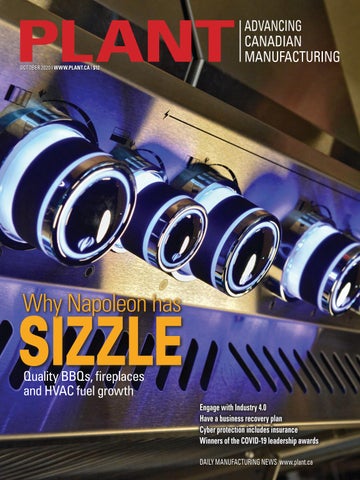
Why Napoleon has
SIZZLE Quality BBQs, fireplaces and HVAC fuel growth
Engage with Industry 4.0 Have a business recovery plan Cyber protection includes insurance Winners of the COVID-19 leadership awards DAILY MANUFACTURING NEWS www.plant.ca
PLT_October2020_AMS.indd 1
2020-10-02 1:38 PM
IT’S TIME TO TAKE A CLOSER LOOK AT ITALIAN MACHINERY We are your link to over 10,000 Italian manufacturing solutions providers from every industry. When you’re looking for the competitive advantage that comes with innovative technologies, take a closer look at Italian-made industrial equipment. We connect you to partners who offer problem-solving, flexible design, expanded functionality, and creative, cost-effective solutions. Our goal is to help you achieve your goals. When you’re ready, look to Machines Italia.
For more information on Machines Italia visit www.machinesitalia.org
machinesitalia
PLT_October2020_AMS.indd PLT_MarApr20_ITC_AMS.indd2 1
Machines Italia
@ITAmachines
Machines Italia
2020-10-02 2020-04-01 1:38 2:02 PM
01 2:02 PM
CONTENTS
October 2020 Vol. 79, No. 06
FEATURES 15 PERFORMANCE Avoid the obstacles that sap the desire to learn how to coach team members.
14 COVID-19 BDO offers five steps that manufacturers can apply as they build a post-pandemic growth strategy.
17 THINK LEAN Acting as an observer aids learning and rebalances processes so step back and let it happen.
10 GROWTH
Napoleon is hot and it’s not just the quality barbecues; the Barrie, Ont. manufacturer is also aiding home comfort with its HVAC product line.
18 CCOHS SAFETY TIPS Lifting is one of the most common causes of back injuries in workplaces but they are avoidable.
DEPARTMENTS
12 INSURANCE Cyber attacks are becoming more frequent and wide ranging. Include cyber insurance as part of a risk mitigation strategy.
13 AWARD The COVID: Industry Leadership Honours virtual event cited manufacturers whose performance during the pandemic stood out.
16 INDUSTRY 4.0 Canadian manufacturers are slowly moving ahead with digital technology implementations but they have concerns.
19 MACHINE TOOLS Three views of digitalization that will help machine tool builders prepare for the factory of the future.
4 Editorial 6 News Bulletins 7 Careers 8 Industry Mix 9 Economy PLANT Pulse 20 Leading Edge: Innovative ideas for plants 21 Plantware Events 22 Postscript: New era of intelligent manufacturing
COVER IMAGE: Stephen Urhaney, a Napoleon barbecue.
PLANT—established 1941, is published 7 times per year by Annex Business Media. Publications Mail Agreement #40065710. Circulation email: bolechnowicz@annexbusinessmedia.com Tel: 416-510-5182 Fax: 416-510-6875 or 416-442-2191 Mail: 111 Gordon Baker Road, Suite 400, Toronto, ON M2H 3R1. Occasionally, PLANT will mail information on behalf of industry-related groups whose products and services we believe may be of interest to you. If you prefer not to receive this information, please contact our circulation department in any of the four ways listed above. Annex Privacy Officer: privacy@annexbusinessmedia.com Tel: 800-668-2374. No part of the editorial content of this publication may be reprinted without the publisher’s written permission. ©2020 Annex Publishing & Printing Inc. All rights reserved. Performance claims for products listed in this issue are made by contributing manufacturers and agencies. PLANT receives unsolicited materials including letters to the editor, press releases, promotional items and images from time to time. PLANT, its affiliates and assignees may use, reproduce, publish, re-publish, distribute, store and archive such unsolicited submissions in whole or in part in any form or medium whatsoever, without compensation of any sort. This statement does not apply to materials/pitches submitted by freelance writers, photographers or illustrators in accordance with known industry practices. Printed in Canada. ISSN: 1929-6606 (Print), 1929-6614 (Online).
www.plant.ca
PLT_October2020_AMS.indd 3
PLANT 3
2020-10-02 1:38 PM
EDITORIAL
Ingredients for recovery in a post-COVID Canada
T
he COVID-19 crisis has brought anguish to thousands of families, swung a wrecking ball at the economy and escalated business uncertainty. Yet there is a potential positive. The pandemic is transforming the way manufacturers conduct business in ways that lead to new opportunities and improve the diversity of the workforce. But chief among the changes will be the application of technology. More companies are waking up to the benefits of digital technology. Annex Business Media publications Canadian Manufacturing and PLANT Magazine are releasing the results of the 2021 Advanced Manufacturing Outlook report this month (polybagged with this issue or available on www.plant.ca). The study shows more manufacturers (30%) are applying Industrial Internet of Things (IIoT) than last year’s study sample (24%) while another 17% have a plan, more than doubling last year’s response. The Outlook report complements KPMG’s Global CEO study that found 84% of Canadian company leaders (all sectors) are prioritizing technology investments to meet growth and transformation objectives; and most (92%) say COVID-19 has accelerated the digitalization of their operations. But US companies (all sectors) spend an average C$22.8 million per technology – 30% more than what Canadians spend, according to a KPMG/HFS Research report. The Outlook report shows 56% of manufacturing executives spnt the most on robotics and automation (average $129,800) but most companies (65%) are investing in the cloud ($61,000). Canadian manufacturers, mostly small, find investment dollars are tight, especially this year, so no wonder Outlook survey comments show caution when it comes to technology adoption with an emphasis on ROI. You will find a few tech planning pointers (page 16) to build confidence, but be mindful of how informed vendors are and how closely they align with your values and culture. Research by ERP provider IFS notes poor advice from vendors tops the list of why digital transformation projects fail for 37% of global respondents. The disruptive effects of the pandemic have further exacerbated shortages of labour and skills, driving the need for technology to improve productivity, yet people with skills necessary to operate digital solutions are in short supply. This points to a need for greater gender diversity within the skills pool. The recent speech from the throne called for an action plan to involve more women in the economy to reverse a drop in their participation in the workplace because of the pandemic. That certainly makes sense, especially with half the population chronically underutilized in business and industry; and some realignment is necessary, according to another study by Ryerson’s Diversity Institute and the Public Policy Forum. It notes occupations in STEM fields often define technology roles and stereotypes of entrepreneurs by unintentionally excluding women, thus impeding innovation by making technology the focus rather than using it to drive change. The Trudeau government would be wise to also consider the contents of a report by the national Task Force for Real Jobs, Real Recovery. It represents 250,000 businesses (see page 8) and declares the key to a recovery plan is the engagement of Canada’s natural resource sectors and manufacturing. It offers 19 recommendations that focus on social, regulatory and climate goals with the potential to create 2.6 million jobs and generate $200 billion in labour earnings. Technology, greater effort to achieve gender parity in industry and harnessing the power of natural resources and manufacturing should be part of a strategy driven by governments and industry to reboot manufacturing as a more agile, innovative contributor to Canada’s economy. The ingredients are there. Let’s move quickly on a national plan.
Editor Joe Terrett 416-442-5600 ext. 3219 jterrett@plant.ca Senior Publisher Scott Atkinson 416-510-5207 satkinson@annexbusinessmedia.com National Account Manager Ilana Fawcett 416-829-1221 ifawcett@annexbusinessmedia.com Media Sales Manager Jason Bauer 416-510-6797 / 437-218-0941 jbauer@annexbusinessmedia.com Media Designer Andrea M. Smith asmith@annexbusinessmedia.com Circulation Manager Beata Olechnowicz 416-510-5182 bolechnowicz@annexbusinessmedia.com Account Coordinator Debbie Smith 416-442-5600 ext 3221 dsmith@annexbusinessmedia.com COO Scott Jamieson sjamieson@annexbusinessmedia.com
Subscription Price Canada $76.00 per year, US $201.00 (CAD) per year, Foreign $227.00 (CAD) per year. Single Copy Canada $12.00. Add applicable taxes to all rates. Combined, expanded or premium issues, which count as two subscription issues. Mailing Address Annex Business Media 111 Gordon Baker Road, Suite 400 Toronto, ON M2H 3R1 Circulation Beata Olechnowicz 416-510-5182 bolechnowicz@annexbusinessmedia.com Fax: 416-510-6875 or 416-442-2191
Joe Terrett, Editor Comments? E-mail jterrett@plant.ca.
4 PLANT
PLT_October2020_AMS.indd 4
October 2020
2020-10-02 1:38 PM
PLT_Lap
OPERATE AT THE NEW SPEED OF INDUSTRY
Making Smart Factories Future-Ready High-speed industrial communication empowers smart factories to achieve the potential of Industry 4.0 and maximize productivity. LAPP provides high performance solutions that deliver reliable, high-speed industrial communication networks including Industrial Ethernet. Our range of robust, factory resilient cables extends to CAT.7 and offers continuous flex, tray rated and torsion options to meet all applications. Explore LAPP’s full range of Industrial Communication products and solutions. lappusa.lappgroup.com/automation.html
PLT_Lapp_Oct20.indd 1 PLT_October2020_AMS.indd 5
2020-09-16 2020-10-02 11:23 1:38 PM AM
NEWS BULLETINS
Peak Processing Solutions granted a HC cannabis licence
Siemens Energy (corporate headquarters, Oakville, Ont.) is providing its gas turbine technology to the planned 900 megawatt Cascade Power Plant in Alberta. It will support the decarbonization of the province’s power supply by switching from coal to natural gas and reducing Alberta’s carbon emissions from energy production by up to 5%. The $515 million order comes from Kineticor, a developer and manager of clean power projects across Canada. The Cascade plant is expected to begin operating in 2023.
Manufacturing service covers multiple products
Fertilizer manufacturers overcame rail disruptions and COVID-19 to ensure Canadian farmers had all the crop nutrients they needed for planting this spring, new Statistics Canada data shows. Shipments of nitrogen and phosphorus fertilizer reached record levels this year. And shipments of potash and sulphur were steady, down only slightly from near record levels. Canada’s fertilizer industry contributes $24 billion to the economy and sustains more than 76,000 jobs.
Beverage canning line.
CSV Midstream Solutions Corp. in Calgary has completed expansion of its Karr 6-18 Sour Natural Gas Processing Plant, acquired from Paramount Resources Ltd. in 2019. Karr, near Grande Prairie, Alta., now has 150 million cubic feet per day of total raw sour gas handling capacity. The expansion includes sour gas sweetening, refrigeration, oil treatment, storage, water handling and utilities including the addition of a digital control system and 15 megawatts of gas turbine-driven power generation. BevCanna Enterprises Inc., a Vancouver manufacturer of cannabinoid-infused beverages and consumer products, has signed a letter of intent with State B Beverage Co. to manufacture white-label CBD and THC-infused drinks. State B is a Brujera Elixirs Inc. brand that currently includes Boozewitch (sober-curious mixers) and three performance drinks in development by the Squamish, BC company. BevCanna will create the new State B beverage concept that will combine functional and cannabis drinks. State B will handle national sales and marketing efforts.
6 PLANT
PLT_October2020_AMS.indd 6
PHOTO: PEAK PROCESSING
TECUMSEH, Ont. — Peak Processing Solutions has received its Health Canada processor’s licence allowing it to move to the next phase of its contract service model. Peak, a subsidiary of Althea Group Holdings and based in Tecumseh, Ont., said it has large-scale cannabis processing and packaging capabilities with an automated canning line and hydrocarbon extraction. Its service model is aimed at cannabis licence holders and non-licensed CPG groups looking to enter the Canadian market. The 40,000 square-foot facility formulates, processes and packages a variety of product types including: canned beverages; concentrates; topicals; powders; vaporizers; and medicinal products. Althea Group Holdings Ltd. is an Australian licensed producer, supplier and exporter of pharmaceutical grade medicinal cannabis.
ATS lands $20M order for syringe line CAMBRIDGE, Ont. — A medical device manufacturer has booked a $20 million order with ATS Automation Tooling Systems Inc. for several automated safety syringe-manufacturing systems. The deal features the Cambridge, Ont. automation company’s patented Symphoni technology. ATS said the order by an unidentified customer will produce syringes to meet demand related to COVID-19 vaccine production. The program is related to the US government’s Operation Warp Speed. It aligns production of safety needles and syringes to meet demand as supplies are consumed in routine healthcare and treating the surge of COVID-19 patients. ATS describes Symphoni as high-performance digital manufacturing technology that multiplies the productivity of automated assembly processes by eliminating non-value-added production time. All movements are precisely mapped out and synchronized through electronic gearing resulting in a “symphony of motion.” Consumables such as syringes are assembled at very high rates in a compact footprint while assuring compliance to rigid quality standards. ATS employs approximately 4,400 people at 22 manufacturing facilities.
GM invests $28M in cogen at engine plant St. Catharines project cuts greenhouse gas emissions, electricity costs to run on the renewable OSHAWA, Ont. — Genlandfill gas delivered to eral Motors Canada has the plant through a short completed a $28 million pipeline. investment in cogeneraThe project involves tion at its St. Catharines, partnerships with Ont. propulsion plant. Alectra Utilities and The automaker forethe Ontario Centres of casts cogeneration will Excellence. It’s the first reduce net greenhouse complete renewable gas emissions by aplandfill gas industrial proximately 70% while cogeneration system buffering the engine and in Ontario delivering transmission plant from Inside GM’s St. Catharines, Ont. engine plant. PHOTO: GM renewable fuel from an rising electricity and offsite source. generate electricity from newly carbon costs. GM has committed to power installed engines at the plant. The 6.4-megawatt project all of its global operations’ GM will also recover otheruses renewable landfill gas electricity needs with 100% wise wasted thermal energy to delivered by pipeline from the renewable energy by 2040. power and heat the plant. nearby Walker landfill working The facility will be running Instead of using natural gas, with partner Integrated Gas at full capacity by Oct. 31. the new engines are adapted Recovery Services (IGRS) to
October 2020
2020-10-02 1:38 PM
Elkem to build biocarbon pilot in Quebec
CAREERS
Plant will produce a renewable alternative to metallurgical coal CHICOUTIMI, Que. — A Norwegian company that produces silicones, silicon and alloys is investing in a new biocarbon pilot plant in Canada. Elkem Metal Canada Inc.’s $26 million project aims to secure industrial verification of its technology for renewable biocarbon with a long-term goal of climate-neutral metal production. The technology also has potential for use in other industrial sectors. The project is getting more than $17 million from the Canadian, Quebec and City of Saguenay governments, reducing Elkem’s net investment to $8.7 million. Construction is planned for this year near Elkem’s production site in Chicoutimi, Que. The industrial process, specifically for silicon and ferrosilicon production, will use climate-neutral, renewable biocarbon instead of fossil coal as a reduction agent. Elkem already uses close to 20% biocarbon in its Norwegian production and the company is targeting 40% by 2030. The project supports the manufacturing of
Pilot plant will use sawmill waste.
biocarbon briquettes, or compressed blocks of coal dust, a renewable alternative to metallurgical coal that reduces the environmental impact of foundries and steelworks. Elkem Metal Canada intends to replace 43,000 tonnes of metallurgical coal per year used at its Chicoutimi plant, with 37,000 tonnes of bio-briquette (biocarbon) for a potential reduction of 100 kilotonnes of CO2 equivalent per year. The pilot plant will source raw materials from local sawmills, including recycled bark, wood chips, sawdust and wood shaves.
Province ramps up.ventilator components production Linamar gets $2.5 million to produce 10,000 units
Ontario Premier Doug Ford and Linamar CEO Linda Hasenfratz tour the PHOTO: ONTARIO GOVERNMENT Guelph, Ont. plant.
GUELPH, Ont. — The Ontario government is investing $2.5 million in Linamar Corp. to support the retooling of its assembly line to manufacture ventilator components. The company, a major player in automotive parts and systems based in Guelph, Ont., will produce 10,000 e700 ventilators. O-Two Medical Technologies has partnered with Linamar and others, including Bombardier, to produce the devices. “By building home-grown capacity to make ventilators, we will never again have to rely on any other country for this critical piece of lifesaving medical equipment,” said Ontario Premier Doug Ford. The funding comes through the province’s Ontario Together Fund.
www.plant.ca
PLT_October2020_AMS.indd 7
PHOTO: ELKEM
Micron to make.. face masks. for COVID-19 fight VANCOUVER — Micron Technologies Inc. is ramping up to produce face masks for the fight against the COVID-19 pandemic. The manufacturer of personal protective equipment, a subsidiary of Micron Waste Technologies Inc. in Vancouver, has installed a three-ply mask-manufacturing machine and associated equipment. The company has received a Medical Device Establishment Licence from Health Canada that permits it to manufacture Class I products at its Delta, BC facility. A N95 mask-manufacturing machine is also onsite and Micron expects production to begin in October. The company plans to send samples to the National Institute for Occupational Safety and Health for certification for medical grade N95 masks. “We believe that the supply of face masks will remain constrained as governments and corporations mandate masks be worn in public spaces, the workplace, and in educational centres,” said Micron CEO Kal Malhi.
Lafert North America, a supplier of motors and drives, has appointed Douglas Backman its North American sales director. Most recently he was Douglas Backman the vice-president of Danfoss (Vacon) Canada Inc. in Mississauga, Ont. Aurora Cannabis Inc. has appointed Miguel Martin CEO, replacing Michael Singer, who has served as Interim CEO since February. He continues his role as executive chairman. Martin came to Aurora from Reliva, a US CBD brand where he served as CEO. He assumed the role of CCO at Edmonton-based Aurora in July. Nexii Building Solutions Inc., a manufacturer of green construction materials, has hired four executives. Brian Carter, executive vice-president of manufacturing, joins the Vancouver company following seven years as president and CEO of Seaspan Shipyards. Rob Simpson, senior vice-president of engineering, previously led structural engineering firm Glotman Simpson. Laurenz Kosichek, vice-president of architecture, was a principal at Stantec Architecture Ltd. David Fisher, vice-president of business optimization, comes to Nexii from Mitsui Home Canada. General Fusion has appointed Klaas de Boer as chair of its board. His appointment coincides with the arrival of new institutional investors backing the Vancouver fusion energy developer’s commercialization program. de Boer has more than 20 years of venture capital experience spanning Europe, North America and the Middle East. Neo Performance Materials Inc. has appointed Greg Share an independent director. Share is managing partner of Ambina Partners LLC, an investment firm focused on financial services and software companies. Neo Performance Materials in Toronto manufactures rare earth- and rare metal-based materials for high technology and sustainable products industries.
PLANT 7
2020-10-02 1:38 PM
INDUSTRY MIX
MISCELLANY FROM THE WORLD OF MANUFACTURING
Kraken unleashed Bet on natural resources A national task force has a plan for getting Canada through a pandemic recovery: natural resources. Canada has plenty of them but the idea is to go beyond sending raw materials out to be made Canadian recovery plan. PHOTO: HUEBI - STOCK.ADOBE.COM into stuff that we end up buying back. The Task Force for Real Jobs, Real Recovery – which represents more than 250,000 businesses and over 3 million workers – released a blueprint that shows under the right conditions, natural resources and manufacturing could create up to 2.6 million new jobs and increase GDP by 17%. This represents a potential $200-billion increase in potential labour earnings, while cutting greenhouse gas emissions. The report outlines 19 recommendations aimed at achieving goals that include: • Leveraging Canada’s world-class industries; advancing regulatory efficiency; attracting capital investment; ensuring access to resource lands; and maximizing Indigenous economic participation. • Ensuring job creation and building resiliency; advancing Indigenous employment; and enhancing skilled workforce mobility. • Aligning climate action and natural resource development; driving challenge-oriented innovation; advancing emissions reduction technologies and plastics innovation; supporting sustainable forestry and mining; and developing hydrogen and small modular nuclear reactor industries. Check out Securing Canada’s Economic Future: Natural resources for real jobs and real recovery at https://realrecovery.ca.
Just like real cigarettes We have Beyond Meat, stay tuned for Beyond Tobacco. Interesting story, Molori Energy Inc., a Vancouver oil and gas company, has taken a hard turn out of the energy business to provide a safer smoking experience. It recently acquired a start-up life sciences company in Las Vegas and has adopted its name, Taat Lifestyle The Beyond Tobacco smoking & Wellness Ltd. PHOTO: TAAT alternative. An unidentified manufacturer already producing cigarettes is handling the first production-scale batch of Beyond Tobacco cigarettes made with hemp. They feature “rich naturally occurring terpenes” as Taat makes a play for some of that still significant global tobacco money (1.3 million smokers, US$975 billion). Taat filed a US patent application for a process that causes the hempbased material to emit the scent and taste of tobacco – original flavour and menthol – with a satisfactory volume of smoke, but no nicotine. And the cannabidiol (CBD) content is a non-psychoactive derivative of hemp, so lighting one up won’t result in a wacky tobaccy buzz. The “sticks” look like regular smokes and they come in a regular-looking package (in the US), all of which emulates the classic smoking experience. A test run in Nevada sold out in less than 72 hours.
8 PLANT
PLT_October2020_AMS.indd 8
In Scandinavian folklore, the kraken is a giant squid-like monster that terrorizes sailors off the coasts of Greenland and Iceland. The Newfoundland Labrador version is not so scary. It’s doing interesting things with marine robotics. Kraken Robotics Inc.’s XL version of the ThunderFish autonomous underwater vehicle (AUV) The ThunderFish XL. PHOTO: KRAKEN is larger than the Alpha model, has an increased depth rating, carries a larger payload and has greater endurance during deep dive survey missions. NRC-IRAP is helping the project along with non-refundable funding of $3 million. Capabilities include: transitioning from high-speed survey mode to “zero” speed hovering mode; through-the sensor acoustic, laser and optical target detection, image recognition and inspection; and onboard sensors that improve navigational accuracy. The AUV will be depth rated to 6,000 metres and carry an array of sensors and custom payload modules that will be integrated with – holy Industry 4.0 – advanced artificial intelligence algorithms. Stay tuned for a concept of a robust and autonomous multi-modal docking solution allowing the AUV to function as a seabed resident that runs missions from its underwater docking station.
…We have raised the issue of Canada’s unpreparedness for pandemic diseases for quite a while. You need to have manufacturing capacity. You need to have the ability to quickly respond. Volker Gerdts, director of VIDO-Intervac, which is leading the Canadian efforts to develop a COVID-19 vaccine, commenting on how greater government investment in a facility would have put a Canadian solution at the forefront of global efforts.
AI R&D comes to Toronto Cerebras Systems, which has developed a computer system that accelerates artificial intelligence (AI) work, is expanding to Canada with an office in Toronto. The tech company based in Los Altos, Calif. introduced its CS-1 technology in November 2019. Its innovative computing system helps companies using artificial intelligence to potentially cut the training time of an artificial neural network from weeks to a few hours. The CS-1 computer. The magic to this deep learning is a giant (46,255-square PHOTO: CEREBRAS millimetre) wafer scale engine that contains 400,000 sparse linear algebra compute cores, each flexible and programmable. The system provides the performance of a room full of servers into a compact unit the size of a mini-fridge maxing the power draw at 20 kilowatts. Cerebras likes Ontario’s innovation vibe, hence the regional office in Toronto that will focus on accelerating R&D and establishing an AI centre of excellence. With more than 15 engineers currently employed, Cerebras plans to triple its Toronto team.
October 2020
2020-10-02 1:38 PM
ECONOMY
Productivity is up …but a record job decline
T
www.plant.ca
PLT_October2020_AMS.indd 9
OWNERSHIP OF NEW FIRMS ACROSS INDUSTRIES Educational services
The success of enterprises owned by women depends on the industry, according to a 20052013 Statistics Canada study. Fewer than onefifth of start-ups were owned by women during the study period. Most had lower survival rates and labour productivity than those owned by men or equally owned. In industries where there’s a higher concentration of women-owned startups, survival and productivity were higher than enterprises owned by men. In manufacturing, women owned 4% of firms, men 70% and 16% reported shared ownerships.
Health care and social assistance Arts, entertainment/recreation Other services (except public admin.) Retail trade Accommodation/food services Admin/support, waste mgmt./remediation services Real estate, rental/leasing Finance/insurance Professional, scientific/technical services Information/cultural services Management of companies & enterprises Wholesale trade Manufacturing Utilities Agriculture, forestry, fishing/hunting
Majority Women Owned
Transportation/warehousing
Majority Men Owned
Construction
Equally Owned
Mining, quarrying & oil and gas extraction 0%
50%
100%
Source: Statistics Canada, CANSIM
$134,747 IMAGES: STOCK.ADOBE.COM
he COVID-19 pandemic and the resulting lockdown helped boost labour productivity but led to a record decrease in employment. Statistics Canada reports the labour productivity of businesses rose 9.8% (compared to 4.5% in Q1). Hours worked falling at a much faster pace than output drove the productivity gain. However, the real gross domestic product of businesses declined 14.5% (mostly occurring in April) following a 2.8% decrease in the first quarter. This is a 16.7% drop from the second quarter of 2019. The decline was widespread across all goods- and service-producing industries. Only the agriculture and forestry sector saw an increase. Hours worked fell 22.1%, more than three times the 7% decrease in the first quarter. Hours worked were down 27.5% from the second quarter of 2019. Employment also suffered a record drop (22.7%), while hours worked per job rose 0.7%. The number of people who had more than one job fell by almost half (44.3%), while the number of people who were absent without pay almost doubled (98.6%). Hours lost vary by industrial sector. Manufacturing was down 30.6 million hours. The greatest decline was in other private services (41.9 million hours). Labour costs per unit of output rose 4.1% after rising 0.7% in the first quarter. The last comparable increase occurred in fourth quarter of 1986 (3.6%). This rapid rise is attributed to “an unprecedented increase” in the average compensation per hour worked (14.3%), which topped a historic productivity gain (9.8%). Average hourly compensation rose 16.5% in service-producing businesses and increased 9.5% in goods-producing businesses. The gain in hourly compensation was widespread across all main industrial sectors, except professional services (3.5%). Labour productivity in the US rose 1.6% in the second quarter, after posting zero growth in the previous quarter.
69%
Average pay for a university graduate employed in manufacturing with an executive or senior management role, according to the 2020 EMC-PLANT Manufacturing Salary Survey.
Percentage of Canadian businesses that require PPE to operate safely according to an August survey by Statistics Canada.
Percentage of Canadian CEOs that remain as confident as they were pre-pandemic, versus 26% of global CEOs; 12% are less optimistic compared to 29% of global CEOs, according to KPMG’s Global CEO Outlook.
40%
58%
US respondents who objected to the now-cancelled Trump administration’s 10% tariff on Canadian raw aluminum, according to an Aug. 7-9 poll by Leger and the Association for Canadian Studies.
12%
Net hiring outlook for Canadian manufacturers of non-durables over the next three months, according to the latest ManpowerGroup Employment Outlook Survey. Net outlook for durables manufacturers is 9%. Overall, Canadian employers have a seasonally adjusted outlook of 6%. Net outlook is based on organizations that plan to hire versus those laying off employees. Seventy-three per cent of employers expect current staffing levels to remain unchanged, 12% expect to increase payrolls, 9% will cut staff and 6% are unsure of their hiring intentions.
PLANT 9
2020-10-02 1:38 PM
GROWTH
NAPOLEON’S
SIZZLE
President Ron McArthur presents a Napoleon barbecue.
10 PLANT
PLT_October2020_AMS.indd 10
INNOVATION AND QUALITY ARE PART OF ITS DNA
PHOTOS: STEPHEN URHANEY
Hats off to a manufacturing dynamo for doubling revenues in five years. BY KIM LAUDRUM
N
ot even COVID-19 can douse the sizzle at Napoleon. The manufacturer of gas and wood stoves and fireplaces, barbecues, and heating and air conditioning (HVAC) systems embarked on an ambitious five-year plan in 2013 to ensure revenues from innovations represented 30% of sales within each of its three divisions. By 2018, overall sales doubled, earning the Barrie, Ont. firm its seventh nod as one of Canada’s Best Managed Companies. On March 23, Napoleon shuttered its plants and operations to comply with COVID-19 lockdown requirements in Ontario. During this time, some of its 900 skilled workers volunteered with neighbouring manufacturers to meet surging demand for medical equipment by making face shields. By mid-April, Napoleon recalled 50 of its workers, established new COVID-19 protocols throughout the plant to protect the health and safety of staff, and returned to manufacturing, eventually bringing back all of its Canadian workforce. Why? Sales are on fire. Families isolating during the pandemic are eating meals at home. That’s boosting an already emerging trend for backyard entertainment products and demand for barbecues beyond normal expectations. In fact, the company is hiring 100 skilled workers, according to Napoleon president Ron McArthur, and it already has 400 applications. McArthur says finding skilled workers is not a challenge in the Simcoe County area. Being near major highways, Georgian College and a manufacturing hub serving OEM auto manufacturers Honda and Toyota means Napoleon can tap a large skilledtrades labour pool. The area’s reputation as a four-season outdoor playground also makes it an attractive place to live and work. Plus, the company offers good paying jobs. “When you are a company with a good reputation, it makes it easier to recruit,” McArthur says. How did Napoleon get there? Wolfgang Schroeter, a Germany-trained tool and die maker, and his wife Ingrid Schroeter co-founded the manufacturing business in the late 1970s, initially making steel railings and patio furniture in Barrie. As the story goes, in 1978 Wolfgang designed and built a wood stove for his father-in-law that so impressed his neighbour, he also wanted one. As demand for the wood stove grew, so too
October 2020
2020-10-02 1:38 PM
did Wolf Steel Ltd.’s reputation for on-time delivery, quality work and innovation. Wolf Steel was the first wood stove manufacturer to introduce a single-cast-iron door with Pyrocerm ceramic glass so customers could see the flame inside. Continuous improvement and innovating products to meet market demand was in the company’s DNA from the start. It drives the successful growth strategy at Wolf Steel, now the legal entity of what is best known as Napoleon. That growth can be traced from the wood stove market to developing residential fireplaces. Venting innovations in fireplace design sparked industry firsts and Napoleon’s name awareness grew. So making hearth products for the larger market in home-building developments made sense. Diversifying the lineup to include products in the multi-billion dollar HVAC market was a logical next step. Wolfgang brought ingenuity for design engineering and a knack for solving manufacturing challenges to the enterprise, successfully matched by Ingrid’s talent for administration and marketing. Their sons Chris and Stephen also work for the family business. After 36 years the Schroeters were proud of their success, but sought to position the company Chris and Stephen could see to its future growth.
Preparing parts for installation on HVAC products.
Components destined for the HVAC line.
Growth strategy
Working on the fireplace line.
In 2018, Chris and Stephen became co-CEOs of Napoleon. Like his father Wolfgang, Chris looks after operations as well as research and development. Stephen takes after his mother Ingrid, running sales and marketing. Wolfgang and Ingrid continue on the company’s board of directors. McArthur joined the company as president in 2012, responsible for management and finance. Previously, he served as president of Hudson Bay Wholesale. He was president of the largest division within the Van Houtte Coffee Co. And he worked for WSI, where he expanded the internet marketing company into 32 countries in Europe, the Middle East and Latin America. By 2013 Napoleon set a growth goal: to double sales within five years. To do it, Napoleon aimed to reach 30% of sales every year from new products in each of its three divisions. That would require an ongoing dedication to research and development of new barbecue, hearth and HVAC products. McArthur won’t reveal the percentage of the annual budget set aside for R&D, but he does allow it’s “significant.” He’s also tightlipped when asked about annual revenues. “As a private enterprise the company is run
tighter than a Swiss watch,” he says. At the outset of creating the strategic plan, McArthur says Napoleon learned it had been doing some things well. “We knew we had to provide world-class customer service to reach our objective,” he says. “How could we ensure the customer has a ‘Wow!’ experience every time they deal with us?” Napoleon provided a superior product, which he says customers perceived to be expensive. Top of the line Prestige gas-grills range in price from $1,299 to $4,549. “But when we ask them, ‘Why did they buy it?’ customers answer: ‘Because of the quality’.” The barbecues are well made with innovative safety features such as LED-lit control knobs that indicate if the gas is left on. The Prestige line also comes with a lifetime “bumper to bumper” warranty. Quality is a key part of Napoleon’s strategy for keeping competition at bay. It’s not the only Canadian manufacturer of barbecues. Broil King, for example, operates out of Waterloo, Ont. and the US Broil King’s grills are also sold across the country through big retail chains. Quality control is achieved by
www.plant.ca
PLT_October2020_AMS.indd 11
ensuring most manufacturing such as machining, fabricating, assembly, welding and painting operations take place onsite. Making Napoleon a recognized quality brand spurred sales in other divisions, too. Focus groups indicated 70% of gas-grill consumers remember the brand name. But only 4% of fireplace or furnace customers remember any manufacturer’s brand. To gain quality brand awareness is one of the reasons why Napoleon expanded its barbecue line and distribution to big-box retailers such such as Canadian Tire, Home Depot and Lowes in the US. It’s hoped building quality brand recognition in one market will cross over to the fireplace and HVAC divisions, boosting sales across the board. Notably, HVAC market potential is greater than the grill and fireplace markets combined. Producing high-volumes of barbecues at a price point of less than $1,000 for the big-box stores and to reach a global market prompted Napoleon to manufacture in China. To ensure quality control and reach markets in Asia, a plant was purchased in Guangzhou, China. Napoleon is registered to ISO9001 – 2015 certification, which helps ensure consistent quality control at all of its manufacturing plants. In all, Napoleon has two plant locations in Ontario (Barrie and Mississauga); one in Crittenden, Ky.; and one in China. Total manufacturing capacity is 1.4 million square feet. Worldwide, Napoleon had about 800 employees in 2013. Now it employs close to 1,600 and sells to more than 35 countries, from Dubai to Australia. International sales represent 20% of total revenues. It’s interesting to note 60% of Napoleon’s mainly high-end gas grills are made in Canada. Some barbecues for the big box stores are manufactured in China. But “100% of Napoleon’s gas and wood fireplaces are made in Canada,” McArthur says. Continuous improvement has always been important to innovating new products, reducing time and costs, and improving manufacturing processes. Says McArthur, “We could put in a new process or system and in a couple of months we’ll look at it again and see if we could improve it.” With growth doubled and exports rising, Napoleon burns bright. Kim Laudrum is a Collingwood, Ont.based business writer and regular contributor to PLANT. E-mail kimlaudrum777@ gmail.com. Comments? E-mail jterrett@plant.ca.
PLANT 11
2020-10-02 1:38 PM
INSURANCE Include cyber insurance as part of a risk mitigation strategy. BY IMRAN AHMAD, KATHERINE BARBACKI, JELENA CVETKOVIC AND JULIE MORAND
C
yber attacks are on the rise. Of the various threats aimed at manufacturers, ransomware continues to be among the most common. The ease with which sophisticated attackers can infect entire networks to quickly paralyze operations has led to a surge in ransom amounts. Faced with continuously evolving threats, it’s difficult, if not impossible, for companies to completely eliminate the risk of becoming victimized. That’s why it’s important to deal with attacks quickly and efficiently. One of the ways to do so is through cyber insurance, which has become an essential part of any risk mitigation strategy. Most policies will offer general coverage for extortion, including the ransom payment and services of specialists such as forensic and communications firms. Typically, specialists recommended by insurance providers have been carefully vetted for their expertise and have pre-negotiated rates. Insurers typically appoint a lawyer specializing in cybersecurity and privacy law. This breach coach will take leadership of the incident response, including coordinating between the various internal and external teams, asserting legal privilege on all communications and documents, and navigating potential reporting and notification obligations. This further protects the insured in the event of an attack that results in a third-party lawsuit. Basic coverage under a typical policy includes first party costs from expenses relating to various components of the incident response and remediation efforts, such as the following: • Cyber extortion. Ransom-
12 PLANT
PLT_October2020_AMS.indd 12
Cyber insurance has evolved in response to evolving threats.
Cyber
ATTACKS ARE YOU COVERED? ware attacks typically involve a ransom demand in exchange for a decryption key that allows the victim to recover data. The amounts demanded vary widely, but can be significant. • Forensic investigation. Systems must be secure before being brought back online. This entails an investigation to determine the cause and scope of the breach. This also helps determine whether a company is subject to any reporting or notification requirements under Canadian privacy law. • Data restoration. Opting not to pay the ransom and restoring networks from backups or from scratch (or paying the ransom, but data is lost) will likely lead to costs associated with restoring systems to the pre-attack state. • Notification costs. Under Canadian privacy legislation, companies may be required to notify affected individuals in the event of attacks involving a risk of harm due to data theft or unauthorized access. Costs include the mailing of notification let-
ters, credit monitoring services and call centre services. • Business interruption. Ransomware attacks often have a paralyzing effect leading to loss of income. Business interruption coverage helps recover income lost during an attack and the period of restoration. • Crisis management costs. Reputational harm is another aspect of cyber attacks. Having access to a team of experts trained to respond to the media and other inquiries helps alleviate some of the potential damage and reduce the likelihood of a third party lawsuit.
Covering costs Basic cyber insurance also covers third party costs (liability coverage). This includes costs incurred for damages caused to the third parties as a result of an attack, such as: Network security liability. In the event of a cyber attack, the policyholder could incur damages and claims resulting from unauthorized access to (or disruption of) its network using
PHOTO: ZEPHYR_P - STOCK.ADOBE.COM
malware, phishing and other techniques leading to a loss. Privacy liability. Privacy issues are increasingly important, especially when they entail the unauthorized access or exfiltration of personal information. Cases of class action litigation have risen steadily in Canada over several years. The continuously evolving sophistication of attacks combined with increasing regulatory scrutiny and data protection legislation means companies must be equipped to respond. A comprehensive cyber insurance policy provides rapid access to vetted cybersecurity experts and some monetary relief from the increasing costs associated with cyber attacks. Imran Ahmad – imran. ahmad@blakes.com, (416) 863-4329) – is a partner and Katherine Barbacki – katherine.barbacki@blakes. com, (514) 982-4138 – is an associate at the law firm Blake, Cassels & Graydon LLP. Both practice in the area of cybersecurity, privacy and technology law. Jelena Cvetkovic – jelena.cvetkovic@ cna.com, (416) 915-6928) – is the specialty claims manager and Julie Morand – julie. morand@cna.com, (416) 5427435) – is a specialty claims analyst at CNA Insurance. Comments? E-mail jterrett@plant.ca.
October 2020
2020-10-02 1:38 PM
AWARDS
Pandemic
HEROES THE WINNING MANUFACTURERS Virtual event honours outstanding contributors to the COVID-19 fight.
Looking for a fabricator for a complex project? Whether it’s a heat exchanger, stack, pressure vessel, filter, or other custom process equipment, Alps Welding can turn your design into reality.
BY PLANT STAFF
W
hen Canada was swept up in the COVID-19 pandemic, many manufacturers acted quickly to fill shortages of personal protective equipment (PPE) for frontline workers and civilians, hospital equipment and monitoring devices. Annex Business Media publications Canadian Manufacturing, PLANT Magazine and EP&T hosted the Responding to COVID: Industry Leadership Honours virtual event Sept. 17 to recognize companies that stand out as quick and innovative responders. Here’s a brief rundown of the winners but go to www.plant.ca/qO6PL for a recap of the event and details about all the finalists. PPE-large manufacturer, and Ultimate COVID Hero (most significant impact). The Canadian Shield was founded in March at the height of the COVID-19 pandemic, when the Kitchener, Ont.-based InkSmith, an educational technology company (about eight employees), decided to produce medical face shields. Within the first few weeks, it donated 20,000 face shields to frontline healthcare workers across Ontario, and has donated 750,000 face shields to teachers. Now the company employs more than 300 team members and has a federal government contract to produce 10 million units. PPE – Medium-sized Manufacturer. Auto parts manufacturer Molded Precision Components (Shanty Bay, Ont.) pivoted to make face shields when COVID-19 hit in March. PPE – Small Manufacturer. I3 Biomedical (Mirabel, Que.) created a mask infused with its TrioMed technology that deactivates the COVID-19 virus. Assisting the Sick. Aerospace manufacturer Space Engine Systems (Edmonton) custom-designed and produced a ventilator and brought it to market in 21 days. Disease Detection. iLobby (Toronto) launched Fever Check technology that uses a thermal camera to scan visitors’ temperatures. Services. Nuclear power provider Bruce Power (Tiverton, Ont.) streamed 1.7-million pieces of PPE to more than 100 organizations. Sanitization – Hygiene. Hunter Amenities (Burlington, Ont.), a multinational cosmetic manufacturer, quickly pivoted to hand sanitizer that isn’t scented or alcohol-based. Sanitization – Innovation. Envision SQ Inc. (Guelph, Ont.), a manufacturer of pollution filters, created a semi-permanent disinfectant that sticks to virtually any surface and kills COVID-19. Machines Italia – COVID Hero. Forty Creek Distillery Ltd. (Campari Canada) in Grimsby, Ont. produced high-alcohol hand sanitizer for several organizations in the region.
We have experience working with steel, stainless, and other alloys, including titanium.
With over 150 welding procedures, and 40 years of experience meeting the demanding specifications of the energy, mining, chemical, and cleantech industries, make Alps Welding your first call when looking for a fabricator for critical equipment.
www.alpswelding.com
Comments? E-mail jterrett@plant.ca.
PLANT 13
www.plant.ca PLT_JanFeb_Alps.indd 1 Alps_Plant_ Jan 2018.indd 1 PLT_October2020_AMS.indd 13
400 New Huntington Road Woodbridge, Ontario 905-850-2780
2019-01-16 11:02 AM 2019-01-08 12:55 PM 2020-10-02 1:38 PM
COVID-19 Hit hard by market disruptions, manufacturers are rethinking strategy. BY DAVID LINTON
S
upply chain disruptions and increasing costs are eroding competitiveness. As manufacturers pass through the recovery stage of the COVID-19 pandemic and think about growth strategies, there are a
Plan for growth.
Focus on
GROWTH
FIVE STEPS TO TAKE DURING THE ECONOMIC RECOVERY few areas to keep top-of-mind. What needs to change? What does success look like? Where should the shifts be made to stay competitive? Here are five areas for building a growth strategy: Supply chain disruptions. Traditional supply chains – both direct material supply and product sales – will be disrupted for some time. Moreover, costs have increased. To remain competitive, find new supply channels while minimizing additional cost increases. To combat disrupted sales channels, either find new sources of revenue or expand existing ones. This might mean new geographies, new products or new channel partnerships. Build and execute a plan to review and adjust supply sources that improves resilience, manages costs and adjusts inventory-carrying policies. Review go-to-market options, think about diversifying your product portfolio and prepare to expand into new sales channels. Margin erosion. Reduced margins will continue for the foreseeable future. Your growth strategy must address the fact direct material costs have increased while some costs have remained fixed. Incorporate reductions in direct material costs and fixed costs, while increasing revenue and productivity. This might include automating production lines, retooling and retraining staff. Pivoting from what’s currently being produced may be a solution. Stay on top of financial forecasting to respond to the
1.
EXTENSIVE UP-TO-DATE CANADIAN LABOUR MARKET INTELLIGENCE ACCESS DATA FOCUSED ON WAGES, TURNOVER, VACANCIES, PROJECTED INCREASES AND MORE! Also, this year, the ManufacturingGPS survey is exploring experiences in training across the manufacturing sector. Through this survey, we will be able to learn about employers’ motivations for investing in skills training, as well as their preferences for funding models that support their investments.
2.
14 PLANT PLT_ExcellenceinMFG_Oct20.indd 1
PLT_October2020_AMS.indd 14
PHOTO: STOCK.ADOBE.COM
current and future landscape. Workforce management. Unprecedented challenges have strained the HR capabilities of many manufacturers that have laid off staff as production lines were halted. Or they were faced with a labour shortage caused by the closing of borders. Consult an HR advisory team about return-to-work programs, policy updates, leadership and management support, and a staff communications strategy. Business continuity planning. A robust plan minimizes risk of disruptions as conditions change. Be ready to change with them. Build, test and deploy a plan to minimize disruptions as conditions change. Include preserving business continuity, managing cash flow, rethinking budgets, maintaining important vendor and stakeholder relationships, and leveraging technology to help keep your various platforms running. Cash flow and working capital management. Dynamically reforecast as conditions change to maximize your use of working capital and avoid cash flow stress. Re-plan as needed, pivoting business at any given point and react quickly to change. There will be losses in line with the economic downturn. That stresses the importance of managing liquidity and cash flow now, taking uncertainties into account for future planning. Addressing these issues will help increase market share without sacrificing margin.
3.
4.
5.
This is an edited version of a longer article (Æ) contributed by BDO Canada LLP (www. bdo.ca), an accounting, tax, consulting and advisory firm. Contact David Linton, partner and BDO Consulting’s national manufacturing and distribution leader at (647) 795-8008. Comments? E-mail jterrett@plant.ca.
October 2020 2020-09-23 2:08 PM
2020-10-02 1:38 PM
PERFORMANCE
Ready to COACH? MAKING USE OF NEW SKILLS
BY HUGH ALLEY
L
ean expert (Modele Consulting) Dorsey Sherman’s presentation at the KataCon6 conference in February questioned the meaning of the word “coach.” During the discussion, Mike Rother, author of Toyota Kata, asked how much managers, supervisors and team leaders really wanted to develop their skills. Did they want to learn to coach, or were they just doing it to respond to pressure? Many answers reflected disinterest. One attendee reported a coaching program where 30 managers/supervisors finished a 90-day program but only 15% of them actually carried on using their new skills. What can we learn from this? Here are five possible conclusions: 1. The employer didn’t measure or reward the behaviour so they ignored it. 2. Only outcomes were rewarded, people development is ignored. 3. Frontline managers face so many ‘priorities’ the initiative got lost. 4. Frontline managers were previously chastised for the new behaviour. 5. Participants felt discouraged by the obstacles to using their new skills. But two factors point to the best answer. The first is something Deming talked about 60 years ago. A lot of people discouraged by obstacles put in their way give up. The other comes courtesy of a 2015 Gallup study. It found while executives typically have 10 priorities, at the front line they become over 40 ‘priorities.’ With that many, there are no priori-
www.plant.ca
PLT_October2020_AMS.indd 15
ties, only urgent requests. If you are frustrated your latest initiative is floundering, ask yourself the following questions: • What unintended obstacles make it hard to do what is asked?
more clarity about what to do next. Hugh Alley is an industrial engineer based in the Vancouver area who helps organizations achieve significant performance gains. Call (604) 8661502 or e-mail hughralley@ gmail.com. Comments? E-mail jterrett@plant.ca.
FIND OUT HOW YOUR INDUSTRY 4.0 ADOPTION COMPARES WITH OTHER CANADIAN MANUFACTURERS A FREE ONLINE PRESENTATION November 2 • 2 pm EST. 2021
ADVANCED MANUFACTURING OUTLOOK R E P O R T
Join us November 2 at 2pm EST as Jason Myers CEO of Next Generation Manufacturing and Will Mazgay, Editor of Canadian Manufacturing, discuss the results of the Advanced Manufacturing Outlook report and the adoption of Industry 4.0 technologies by Canadian companies.
Industry 4.0 is here, are Canadian Manufacturers ready?
STOCK.ADOBE.COM
Obstacles and escalating priorities can sap a team leader’s will to learn.
• Are your frontline leaders clear about priorities? Go to the production floor to ask the frontline leaders directly, “What do you understand to be the priorities of the organization right now?” and “What things are currently preventing you from addressing those priorities?” Don’t argue or correct their answers. Just listen, then thank them. These answers will provide
Published by:
Sponsored by:
Jayson Myers Chief Executive Officer Next Generation Manufacturing Canada
PLT_AdvMfg_Nov2020_AMS.indd 1
Will Mazgay Editor Canadian Manufacturing magazine
REGISTER ONLINE: bit.ly/indstry4report
WEBINAR SPONSORED BY
PLT_2021AMO_report_ISL_SVA.indd 1
REPORT SPONSORS
PLANT 15
2020-09-30 12:50 PM
2020-10-02 1:38 PM
INDUSTRY 4.0 Survey shows more manufacturers are investing in the future. BY JOE TERRETT, EDITOR
C
anadian manufacturers are not technology leaders. Most are small, so they are inclined to follow once a technology is proven and the costs come down. The 2021 Advanced Manufacturing Outlook survey, conducted by Toronto research firm RK Insights for Annex Business Media publications Canadian Manufacturing and PLANT Magazine, shows companies are more engaged with Industry 4.0 and the “smart factory” than last year’s survey respondents, but they have concerns. And there are still those who are reluctant to adopt or are not interested. Thirty per cent of senior executives, managers and owners of manufacturing operations are applying industrial internet of things (IIoT). That compares to 24% of those who participated in the 2020 outlook survey, while another 17% have a plan, more than doubling last year’s response. And 23% are evaluating the technology. Thirty per cent are out of the loop compared to 39% from last year’s sample. There are several reasons identified for not investing in advanced technologies, but leading the list are difficulty integrating it in existing systems, followed by a lack of skills to support investment. The top reason for applying the technology is to improve efficiency and productivity (41%), but improving maintenance functions, and analysis of data are also high on the list. Key benefits reported by 76% of manufacturers are reducing downtime, increased throughput and increased quality of product. “[The survey] really shows how COVID-19 has accelerated adoption of digital technologies, even if it means remote working,” says Jayson Myers, CEO of Next Generation (NGen)
16 PLANT
PLT_October2020_AMS.indd 16
Robotics and automation lead investment choices.
Getting
SMARTER COMPANIES ENGAGE WITH DIGITAL TECHNOLOGY Manufacturing Canada. The notfor-profit is focused on matching companies with advanced technologies. “With the use of digital technology, whether its communication, connecting factories and work flow or supply chains, it has become much more evident why that’s important.” He says it also shows the importance of having guidance and some sort of playbook; it’s about having the processes in place to manage the data and achieve the desired business objectives. “It’s not as intimidating as people think,” he adds. Manufacturers have faced challenges implementing technology, most (60%) identifying funding, plus a lack of skilled talent (47%), resistance to change (41%) and integrating legacy technology (40%). Myers offered some tips to help ease companies into more advanced manufacturing, noting there’s plenty of help available, and they don’t have to be technology experts. But companies do need to be experts on the
solution needed to do the job. And it’s not just about jumping in and investing in digital technologies. He observes a mistake many manufacturers make is to invest in solutions looking for a problem, rather than the other way around.
Solving problems “My advice is to figure out what the business model is, what you want to do, what processes you need to put in place, and what processes need to be improved, then go out and find the right solution,” he says. Business and skills requirements (getting the job done using the technology that’s on hand) must be part of the project document. He cautions against using technology to solve a problem that could be fixed by improving the efficiency of an existing process. And beware of bringing in technology for one problem that causes trouble elsewhere. He cites one company that automated part of its process to increase flow, only to see the increased
PHOTO: BLUE PLANET STUDIO - STOCK.ADOBE.COM
flow overwhelm the next step in the process. And consider the requirements needed to implement a technology solution profitably, such as the skills needed to operate the systems, data flow, communications and internal processes. NGen is helping companies segment technology in more manageable ways. There are also groups that offer help, such as MTech Hub in Burlington, Ont. (www.mtechhub.ca) a non-profit that focuses on digital transformation, hosted at its innovation centre. He says companies should also be looking at how technology adds value for the customer in terms of product, service and collaboration. And there’s a role to play helping the customer add value to its customers. “Part of the change we’re seeing with Industry 4.0 is it’s driving a more collaborative model of the value chain than a purely transactional model of how the supply chain works.” The future looks bright for companies that respond quickly to changes in the marketplace, focus on innovation, bring new products to market, or improve them, as many have done in response to the pandemic. The survey received 183 responses from company leaders. Look for a copy of the report with roundtable comments at www.plant.ca. Comments? E-mail jterrett@plant.ca
October 2020
2020-10-02 1:38 PM
LEAN THINKING
Power of OBSERVATION STEP BACK, LET IT HAPPEN Acting as an observer rebalances processes.
in to provide an additional set of hands to help maintain flow. But it’s more effective to step back, observe and rebalance resources. Here’s a lesson from a boss years ago: “Learn to sit on your hands. You know what needs to be done and you can do it faster than the technician but if you slow down, instruct, educate and coach, the technician will understand and most likely never call you again when faced with the same problem.” Don’t teach by doing. By doing, the desired result will come much faster, but you have failed as a leader by not using the op-
BY RICHARD KUNST
L
iving with COVID-19 has meant traditional processes constantly being modified, then adjusted. In some cases these changes are wonderful new and enduring experiences, which brings us to the 30-inch view and the power of observation. Thirty inches is the average length of a person’s arm. Naturally you’ll focus on what your hands touch and manipulate. If your team experiences a bottleneck, of course you jump
A POWERFUL COMBINATION OF
RELIABILITY, DURABILITY AND PERFORMANCE Sullair LS Series Air Compressors
portunity as a learning moment. Being an observer allows you to see the bigger picture instead of just focusing on that 30-inch view. Here’s an example. Team leads on a very long packaging line helped people in the final pack zone while others at the start of line were standing around. An observer that understands the process would have seen it was much easier to rebalance resources.
Emerging benefits As we live with the potential effects of COVID-19 and organizations of all kinds are reacting with methods to support physical distancing, some great benefits are emerging. Here’s an example from a grocery store. No more jockeying for the shortest or fastest line at a cashier. Cashing out has switched from batching to sequencing by an observer who directs customers to the next available
cashier. This improves throughput but also accomplishes two tasks: it adds capacity by calling for more cashiers or redeploying excess cashiers when there are no customers. Many organizations are complaining about the detrimental impact COVID-19 has on their businesses and indeed many are suffering. But others have figured out how to create a better and more personal experience with no negative impact on sales. If you view the role of observers as adding value, think of its as a great tool for building your brand while improving relationships. Richard Kunst is president and CEO of Cambridge, Ont.based Kunst Solutions Corp. Visit www.kunstsolutions.com. E-mail rkunst@kunstartofsolutions.com. Comments? E-mail jterrett@plant.ca.
EXPERIENCE THE SULLAIR DIFFERENCE IN
ONE HARDWORKING PACKAGE RELIABILITY including the full-color, easy-access Sullair Touch Screen controller
DURABILITY including the patentpending, new generation Sullair air end
PERFORMANCE including highly efficient Electronic Spiral Valve technology
Available in 125, 150 and 200 hp models
Find your local authorized Sullair distributor today at SULLAIR.COM
© 2019 Sullair, LLC. All rights reserved.
018191_Sullair_Plant Canada_8x5.375.indd 1
www.plant.ca PLT_JulyAug_Sullair.indd 1
PLT_October2020_AMS.indd 17
6/19/19 4:40 PM
PLANT 17
2019-06-20 11:33 AM
2020-10-02 1:38 PM
CCOHS SAFETY TIPS Lifting is among the most common causes of back injury in workplaces.
T
housands of Canadian workers are injured or permanently disabled by back injuries each year. It’s fair to say every worker who lifts or engages in other manual material handling tasks is at some risk of musculoskeletal injury. About three of every four workers whose jobs include manual materials handling suffer pain due to back injury at some time, accounting for about 33% of all lost work and more than one-third of all compensation costs. Employers can reduce injuries by ensuring workers prepare and plan for the lift while practising safe lifting and handling techniques. As long as COVID-19 is a concern, workers must continue practising physical distancing
Use hoists, cranes, lift trucks or dollies for heavy or awkward loads. PHOTO: MOODBOARD - STOCK.ADOBE.COM
Lifting
SAFELY
HOW TO AVOID BACK INJURIES
(more than two metres) whenever possible and continue all safe work procedures while following these safe lifting tips: 1. Dress appropriately. Clothing should be flexible, tear eas-
FED UP? Problem: You want to use the latest automation technology. However, the complexity is overwhelming. Solution: MOVIKIT® software modules! They empower you to perform complex automation tasks easily and without experience. No more login hours. No more complex programming. Positioning? Synchronization? Torque sharing? Winders? Yes, and even more. Simple is good... Local Site: sewcan.ca Corporate Site: sew-eurodrive.ca
ily and avoid exposed buttons, zippers or loose flaps that could get caught in the load. Add safety boots with toecaps and slip-resistant soles, and protective gloves. 2. P lan the lift. Clear obstacles and debris – such as grease, oil, water and litter – in the load’s path. 3. W arm up with gentle stretches. This is especially important for occasional lifters that may not be accustomed to handling loads. 4. Test the load. Check stability and overall weight by pulling or sliding. Determine if the load is liftable without a lot of exertion. Workers should get help for heavy or awkward loads. When possible use equipment such as hoists, cranes, lift trucks, dollies or wheelbarrows.
Task-specific training Specific handling and lifting techniques are needed for different kinds of loads or materials. There’s no correct way to lift so provide on-site, task-specific training that includes these general lifting rules: • Stand close to the load facing the direction of movement. • Place feet wide apart to maintain balance. • Grasp opposite corners and balance the load evenly be-
18 PLANT PLT_SEW_Oct20.indd 1
PLT_October2020_AMS.indd 18
tween both arms. • The back should be comfortably straight, tightening abdominal muscles. • Bend legs so they do the lifting. • Lift the load smoothly, without jerking, keeping it as close to the body as possible. • Keep the load in the middle, between shoulder and knee height. • Avoid twisting and side bending while lifting. Step or pivot, turning the whole body. • Plan where to set the load down, ideally on a raised platform that won’t require bending down with the weight of the load. Ensure workers take advantage of rest periods. Switch between heavy loads and lighter ones. They should rest more often when it’s hot and humid or when it’s cold, and take more time to warm up. Eventually safe lifting techniques will become good habits. Regardless of the tasks, have workers wash their hands or use hand sanitizer before and after touching shared items, using equipment or when entering and exiting production areas. Review processes such as material pick-up, delivery and maintenance, then determine methods that avoid congregating or working in the same area. Finally, step up the cleaning regimen. Develop a schedule for each work area, especially between shift changes, that includes cleaning and disinfecting all touched surfaces and equipment. The Canadian Centre for Occupational Health and Safety (CCOHS) in Hamilton contributed this article. It provides information, training, education, management systems and solutions that support health and safety programs and the prevention of injury and illness in the workplace. Visit www.ccohs.ca. Comments? E-mail jterrett@plant.ca.
October 2020 2020-09-22 3:09 PM
2020-10-02 1:38 PM
TECHCENTRE MACHINE TOOLS
SUPPLY LINES
Start at the design phase to build more reliable machines.
STABLE PPE SUPPLY Maitri Health (https://maitrihealth. ca) has launched a supply system for Canadian-manufactured personal protective equipment. “We intend to grow our trusted stable of manufacturers, technology innovators and logistics and distribution partners, and ensure we can scale to support Canadian and global demand,” said Andrew Morton, CEO of Maitri Health, the global platform for healthcare supply security based in Vancouver. The company will deliver certified masks, face shields, anti-viral cleaning solutions and disinfectants, plus best in class test kits.
BY RAMONA SCHINDLER
M
achine tool builders hear and read a lot about digitalization. There are three ways OEM engineering and management teams can view this technology’s impact as it shapes production and sales processes of the future. 1. Advantages during design. Digitalization is a viable means of building a more effective, reliable and predictable machine from the very outset of the design phase. Having a visual model of your CNC machine for commissioning makes the investment in digitalization worthwhile. With the data and design concept in hand, you can use digitalization tools, such as a mechatronics concept designer, which brings the physics of the world to your computer screen. You test the PLC and the NC, run the motion control or load protocols including full machine kinematics and conduct overall system component integration, prior to the first manufacturing step of the build. Digitalization tools provide highly accurate hardware in the loop emulation, transitioning from CAD to CAM to mechatronic concept designer, then finally to the virtual machine controller. Since the model is essentially mirroring the real hardware in operation under power, the simulations of machine motion and feedback are more precise than it would be with a pure simulation. Specific customer challenges are addressed at this stage and the results for the machine tool builder are faster resolution of design issues and quicker path
www.plant.ca
PLT_October2020_AMS.indd 19
GDW ACQUIRED
customer. It also creates a closer touch point between builder and customer.
Investment firm Graycliff Partners LP in New York has acquired Gerard Daniel Worldwide (GDW), a manufacturer of wire mesh and other wire products. Gerard Daniel makes 5,000-plus wire mesh and related products for more than 3,000 customers worldwide. They’re used for filtration, sound suppression, heat dispersion and electro-chemical applications. Markets include automotive, aerospace, energy, pharmaceutical, electronics, food and general manufacturing. The Canadian division is based in Mississauga, Ont.
Tracking data
LOCATOR IS HERE
3. Better business models. Builders fashion new business models for the use of machine tools by demonstrating to customers what can be done with the data and to sell more services, optimize machine uptime and track the performance of equipment in the field, all of which improves the customer experience with your machines. New business models are also created by the machine tool builder’s ability to help customers use digitalization tools to improve their production. The vir-
Wiser Systems (www.wisersystems.com) has made the first deployment of its ultra-wideband (UWB) wireless location and tracking systems in Canada. It’s being used for yard management to track vehicles at a Gatineau, Que. site. Locator has Industry Canada certification for use in Canada and the Raleigh, NC manufacturer of redundant radio localization technology is looking at applications for manufacturing, energy and other sectors.
Digitalization on the shop floor.
PHOTO: SIEMENS
Three views of
DIGITALIZATION HOW IT’S ADVANCING MACHINE TOOL BUILDING to market. 2. Improved customer experience. Digitalization adds definable value that can be presented to customers. On a functional level, the digital twin further integrates virtual and actual machine commissioning and production monitoring. The machine tool builder presents its machines with enhanced, augmented reality monitoring, customizable apps for data prioritization and improved requirements and production data evaluation scenarios. This concept of data exchange represents a richer value proposition for the machine tool, as you present it to your
PLANT 19
2020-10-02 1:38 PM
LEADING EDGE tual twin, based upon the virtual NC kernel, allows various production, material handling and full motion control scenarios to be sampled by the customer in the design stage. Virtual training for programmers, operators and maintenance personnel is also possible. This digital twin is high-value in terms of market appeal, plus the embedded software positions the training as a perceptible value-add for the machine builder to pass along to the end-customer. This saves the customer valuable machine uptime on the shop floor. As machine tool builders become more capable of tracking data on their CNC machines, there’s a dual benefit for the customer. Machine uptime is improved with more streamlined resolution of issues. Current and rapidly emerging edge technology also add more precise analysis of the machine and the customer’s production process. Studying component and overall machine performance in the field improves the design and production process of the machine, even a global installed base, and makes this data available to the end-customer. The machine builder then uses the available data to track line productivity, machine-to-machine or facility-to-facility comparisons, production schedule variance and other KPIs. Digital twins are emerging as viable tools in the design and marketing of many CNC machine tools, a trend that will continue. Bottom line, digitalization, both at the concept and build stages for the OEM and customers, can be implemented at every level of machine tool operation. Romona Schindler is head of machine tool systems, Siemens, based in Switzerland. Siemens Canada Ltd.’s head office is in Oakville, Ont. E-mail ramona.schindler@siemens. com. Comments? E-mail jterrett@plant.ca.
20 PLANT
PLT_October2020_AMS.indd 20
Innovative ideas for plants
GTS IMPROVES EFFICIENCY
Utilization levels above 95% Fastems is aiming for greatly improved tool storage and deployment efficiency with a new release of the Gantry Tool Storage (GTS) system. Working with its management software and flexible manufacturing system, the automation company is declaring machine utilization levels above 95%. Pick-and-place and traveling gantry robots provide access to 4,000 centrally stored cutting tools, and perform just-in-time tool delivery to individual machines. MMS software commands automatic cutting tool changes based on specific NC program scheduling requirements and real-time cutting tool life status. There’s sharing among multiple machines, minimizing redundancy without having to reserve a cutting tool for a single machine. Sharing also reduces the size of machine tool magazines. And the modular design shortens delivery, installation and commissioning times. Fastems LLC based in Chester, Ohio is a US office of the Finnish company that provides automation solutions to fabricating manufacturers. www.fastems.com
Stores up to 4,000 tools.
BIOCLOUD DETECTS COVID-19 IN THE AIR
Wall unit for facilities, transit vehicles
Kontrol BioCloud sensor. PHOTO: KONTROL ENERGY
Kontrol Energy Corp. has launched a technology that detects the presence of COVID-19 in the air and triggers an alert system. The company based in Concord, Ont., a provider of energy efficiency technology through IoT, Cloud and SaaS, describes BioCloud as an unobtrusive wall-mounted technology that would be used in facilities but also in
mass transit vehicles. The detection chamber is fully replaceable after it comes in contact with the SARS-CoV-2 virus. BioCloud will initially be manufactured at Kontrol Energy’s London, Ont. facility. First orders are expected to ship in Canada and then globally. www.kontrolenergy.com
Up to 30 million welds. PHOTO: TOLOMATIC
NEXT-GEN WELDING ACTUATORS
Two models, high and lower force Tolomatic’s latest generation of high-force actuators for seventh-axis robotic spot-welding come in a compact footprint for faster resistant cycles. The servo motor and high-force actuator combo deliver up to 30 million welds in typical applications along with increased force and speed capabilities, easily adapting to increases in production demand. The CSWX for steel and aluminum weld applications provide up to 18 kN of pressing force (4,047 lbf) in a 90-mm frame. Model CSW (15.6 kN or 3,500 lbf) is for lower duty cycle applications (20 million-plus welds). Tolomatic, based in Minneapolis, is a manufacturer of factory automation technology. www.tolomatic.com
October 2020
2020-10-02 1:38 PM
PLANTWARE
CLEANER MINE WASTEWATER
Ethacor removes contaminants
E2Metrix Inc. has received $4.5 million from the federal government to help mining operations recycle wastewater while removing harmful contaminants. The specialist in wastewater treatment based in Sherbrooke, Que. said its Ecothor technology cleans and separates contaminants, such as complex organics, total suspended solids, heavy metals, emulsified oils, phosphates, ammonia and other contaminants. The Ecothor reactor is cylindrical shape and balances electrochemistry, coagulation and hydrodynamics to decontaminate the wastewater. Its automated process includes real-time water quality monitoring, data logging, controls and guarantees compliance with discharge criteria. https://e2metrix.com/
Functionality of the NA5 Sysmac HMI. PHOTO: OMRON
HMI IMPROVES CONTROL
An Ecothore reactor. PHOTO: E2METRIX
PHOTO: FASTEMS
EVENTS Future Aluminum Forum Industry 4.0 Aluminum Association of Canada Dec. 8-9, Quebec City Presented by the Aluminum Association of Canada. The focus is on Industry 4.0. Visit https://futurealuminiumforum.com. ProMat Manufacturing and Supply Chain Show 2021 MHI April 12-14, 2021, Chicago Features the latest material handling and logistics equipment and technologies. Includes over 140 sessions from industry experts. Visit www.promatshow.com. ISA Calgary Show ISA April 13-14, 2021, Calgary The International Society of Automation (ISA) in Calgary presents the Instrumentation, Systems and Automation Show. The latest industry trends will be covered with technologies on display and opportunities for networking. Visit https://isacalgary.com. Western Manufacturing and Technology Show (WMTS) SME June 1-3, 2021, Edmonton Western Canada’s manufacuring marketplace. Look for
www.plant.ca
PLT_October2020_AMS.indd 21
the latest technology from suppliers, take in the keynotes and network. Visit https://wmts.ca. PTDA 2021 Canadian Conference PTDA June 9-10, 2021, Montreal The 2021 conference will be held in Montreal. It brings key decision makers from the Canadian power transmission/ motion control industry together for business networking and education. Visit www.ptda.org. CMTS 2021 SME Oct. 4-7, 2021, Mississauga, Ont. The Canadian Manufacturing & Technology Show (CMTS) features advanced technologies, keynote speakers and panellists from government and business. Visit https://cmts.ca. FABTECH Canada SME June 2022, Toronto Presented by the Society of Manufacturing Engineers (SME). Metal forming, fabricating, welding and finishing event features world class suppliers with the latest industry products and developments, plus tools to improve productivity. Visit https://canada.fabtechexpo.com.
Omron Automation Americas has released new Soft NA software for its industrial PC (IPC) that improves control and visibility for applications not requiring a full SCADA system. It implements the full functionality of the NA5 Sysmac HMI, eliminating an IPC for data (such as ERP, SAP, Sysmac Studio or CXONE) and a separate NA5 HMI for NJ/NX machine control. The greatest benefit goes to users needing an HMI interface to the Sysmac NJ/NX system and the ability to run additional software. Omron Automation Americas is an industrial automation company based in Hoffman Estates, Ill. https://automation.omron.com
NEW DIGITAL DUO 3Diligent has updated its Industry 4.0 procurement service with new software and name (ProdEX) while launching Shopsight, its new manufacturing shop management software. The two services work together. ProdEX is one-stop for express manufacturing procurement across thousands of material and technology options. It includes real-time part assessment and quoting that allow quick comparison of manufacturing options. Customize eligible suppliers using criteria such as country, certifications and conformance documents. Shopsight streamlines and enhances pre-production and production operations. Pre-production, suppliers assess in seconds which technology-material combinations are viable for a job. 3Diligent is a El Segundo, Calif. digital services provide.r www.3diligent.com
PLANT 21
2020-10-02 1:38 PM
POSTSCRIPT
New era of intelligent manufacturing BY JAYSON MYERS
T
ALL TOO OFTEN, IT’S TECHNOLOGY FIRST WITHOUT A CLEAR DEFINITION OF BUSINESS OBJECTIVES, UNDERSTANDING OF CRITICAL PROCESSES, OR APPRECIATION OF BUSINESS REQUIREMENTS…
22 PLANT
PLT_October2020_AMS.indd 22
he World Manufacturing Forum brings together industry, academic and policy leaders from around the world to discuss the future of manufacturing. Its annual report (to be released in November) shines a light on how common the challenges and opportunities are for manufacturers, regardless the country they hail from. This year’s report emphasizes the importance of innovation and focuses specifically on how trends in artificial intelligence (AI) are defining the future of manufacturing. As a member of WMF’s Advisory Board, I can speak to a few of the key themes . The analytical power of AI is growing exponentially. So too are its applications in every sector of the global economy. The WMF believes AI will reshape every aspect of manufacturing – not so much because of the nature of the technology itself, but because of its potential to increase industry growth. For that reason, manufacturing is expected to lead the way in AI applications. It’s important to see AI primarily from a business rather than a technological view. Functions under the AI umbrella – natural language processing, knowledge representation and reasoning, automated planning, intelligent robots, machine perception, and machine learning – are all basically systems of prediction. The question for manufacturers is: Where in the products, processes or general functions would a better system of prediction create greater value for customers in a more efficient, higher quality, more timely and more profitable way? The selection of AI tools and techniques should reflect the most appropriate way of achieving business outcomes. Yet that’s not the way many manufacturers have approached AI or broader automation and digital transformation initiatives. All too often, it’s technology first without clear definition of the business objectives, understanding of critical processes or appreciation of business requirements for successful implementation. Maybe that’s why Deloitte reports 90% of all large-scale digitization projects fail, why more than half of Canadian manufacturers report their technology investments have not delivered expected business results, and why so many companies still struggle to get their ERP systems under control. If AI is viewed as a tool, the issue becomes selecting the most appropriate tool or set of tools for the job, then ensuring they are managed in a productive way. Approaching AI in this way demystifies the technology and focuses on how it and other technologies are deployed to grow a business instead of displacing jobs. In fact, it emphasizes that AI
applications are likely to fail unless manufacturers have the right information systems, cybersecurity safeguards and skill sets in place to manage the technology effectively. It also underlines the importance of finding good technology partners that support AI deployment in a manageable, timely and cost effective way. It’s how the business model, systems and people work together that counts. AI and automation help, but they must have a purpose with a clear understanding of how processes and external business relationships contribute to value creation. Today materials, products and processes are rapidly becoming data platforms. Now the name of the game is to learn from it, rapidly predict outcomes from a more in-depth understanding of current conditions, and create new forms of value that offer unique competitive advantages. Intelligent manufacturing is about the value of products, machines, production systems and supplier-customer interactions increasing rather than depreciating over time. In this fundamental respect, manufacturers are becoming more like technology companies. To the extent their purpose is defined increasingly by customer or social outcomes, they’re also becoming more like personal services companies, and there’s profit in that! However, the game has changed. Risks and rewards aren’t as clear-cut. Decisions need to be taken, results tested and actions recalibrated quickly. Here too AI is providing some powerful tools when it comes to planning, scheduling, monitoring and maintaining operations. One caveat: it all depends on the quality of the data fed into the algorithms. But what’s important? Start with data that contribute to business objectives, and ensure it’s good data. Low quality data leads to low quality outcomes. And gather it from all parts of the enterprise, including customers, suppliers and other business partners. Data silos lead to unintended consequences and ultimately to unmanageable deployments and unsustainable business results. There’s a lot to be said for basic lean thinking here. Focus on value. Eliminate non-value adding activities. AI is radically expanding the boundaries of both these concepts. That doesn’t mean the principles no longer apply. Watch for the WMF’s report (www.worldmanufacturingforum.org). It’s worth the read. Jayson Myers, the CEO of Next Generation Manufacturing Canada, is an award-winning business economist and advisor to private and public sector leaders. E-mail jayson.myers@ngen.ca. Visit www.ngen.ca. Comments? E-mail jterrett@plant.ca.
October 2020
2020-10-02 1:38 PM
CO849_A PLT_May
WHAT IF… YOU COULD SAVE MILLIONS OF LITERS OF WATER BY MAKING A FEW SIMPLE CHANGES? REPLACE NOZZLES AT THE FIRST SIGN OF WEAR Worn nozzles spray over capacity, resulting in water waste. Check nozzle flow rates regularly; visual checks won’t detect wear. Replacing nozzles that are spraying just 15% over capacity can save millions of liters of water. Using less water means you’ll reduce chemical and energy use too.
AUTOMATE TANK CLEANING
Automated washing of tanks, totes, drums, vats and more will ensure thorough, repeatable cleaning using the least amount of water possible in the shortest amount of time. Processors often reduce cleaning time by as much as 75% and water use by 50% or more.
RIGHT-SIZE YOUR NOZZLES In many operations, lower capacity nozzles can be used without compromising product/process quality. We helped one processor save more than one billion liters of water annually on conveyor cleaning. Evaluate and test your nozzles to see if you can experience similar benefits.
Reducing water use is good for the environment and the bottom line. Let us help you make some of the simple changes described above. We help companies around the world reduce water, energy and material use, decrease waste, minimize environmental impact and improve worker safety. Let our spray technology advance your sustainability initiatives.
MAKE EVERY DROP COUNT! To learn more visit spray.com/sustainability
CO849_AD_Whatif-Tank_9x12_PlantMag_052019.indd 1 PLT_MayJune_Spraying.indd 23 PLT_October2020_AMS.indd 1
5/20/19 4:19 PM 2019-05-21 2020-10-02 11:05 1:38 PM AM
Don’t overpay for IP69K Shop AutomationDirect for your Food & Beverage components Schmersal Pushbuttons Pushbuttons
Photoelectric Sensors Pushbutton Enclosures
Inductive Proximity Sensors
Food & Beverage Cables
Controls Components for Food & Beverage If you’re looking for a low-cost source of controls components for your Food & Beverage machinery, look no further than AutomationDirect. We have the components you need, available today in a NEMA 4X or IP69K rating to perform in the harshest of environments. Photoelectric sensors, inductive proximity sensors, pushbuttons, and enclosures are just some of the components we have ready to ship today.
Also Available Capacitive Proximity Marathon PowerWash Magnetic Proximity Sensors Sensors SXT Motors
Research, price, buy at: www.automationdirect.com
Orders over $49 get FAST FREE SHIPPING Our shipping policies make it easier than ever to order direct from the U.S.!
Fast free standard shipping* is available for most orders over $49 U.S., and that includes the brokerage fees (when using an AutomationDirect nominated broker). Using our choice of carrier, we can reach most Canadian destinations within 2 to 3 days. *Free shipping does not apply to items requiring LTL transport, but those shipments can take advantage of our negotiated super-low flat rates (based on weight) that include brokerage fees. See Web site for details and restrictions at: www.automationdirect.com/canada
To see all products and prices, visit www.automationdirect.com All prices shown are U.S. Dollars
Order Today, Ships Fast! * See our Web site for details and restrictions. © Copyright 2020 AutomationDirect, Cumming, GA USA. All rights reserved.
PLT_AutomationDirect_Oct20.indd PLT_October2020_AMS.indd 24 1
1-800-633-0405
the #1 value in automation
2020-09-22 2020-10-02 10:44 1:38 PM AM