OCTOBER 2017 | WWW.PLANT.CA | $12
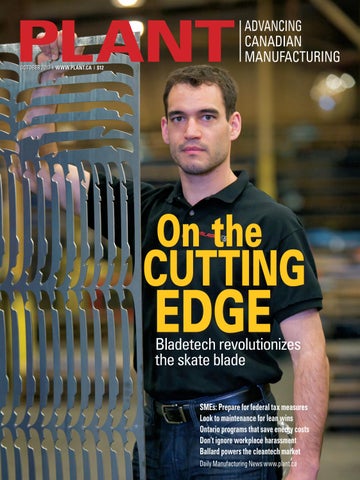
On the
CUTTING
EDGE
Bladetech revolutionizes the skate blade SMEs: Prepare for federal tax measures Look to maintenance for lean wins Ontario programs that save energy costs Don’t ignore workplace harassment Ballard powers the cleantech market Daily Manufacturing News www.plant.ca
PLANT_Oct2017_AMS.indd 1
2017-10-13 2:42 PM
T:9” S:8”
On time. On spec. Repeat. Your 100th product should be as good as your first. That’s why Mobil’s family of lubricants is designed to reduce defect rates and extend machine tool life. So your business can deliver again and again while minimizing downtime. To find out how, go to mobil.ca/industrial
PLT_ImperialOil_Oct.indd 1 2 PLANT_Oct2017_AMS.indd
2017-10-06 2:42 2017-10-13 1:34 PM PM
T:12”
S:11”
2017 ExxonMobil. All trademarks used herein are trademarks or registered trademarks of Exxon Mobil Corporation or one of its subsidiaries. Imperial Oil, licensee.
October 2017 Vol. 76, No. 07
FEATURES 20 EMISSIONS Carbon pricing will have a limited impact on carbon targets. 21 PIP 2017 Five tips that will train your brain to be happier. 22 THINK LEAN Explore the abstract: conduct a maintenance audit. 23 CCOHS SAFETY TIPS Train a safety team to hunt down workplace hazards. 24 DESIGN Focus on people, flow and the future. 25 ENERGY EFFICIENCY Check out Ontario energy programs that will cut your costs.
12 FABRICATING
Bladetech’s innovative Flex-Force skate blades are helping NHL players improve their performance on ice.
26 CLEANTECH Canada improves its global ranking. 27 HYDROGEN Hydrogenics is powering the global hydrogen fuel market.
T:12”
28 FUEL CELLS Ballard Power Systems is gaining traction in the cleantech market.
B:12.25”
S:11”
06 1:34 PM
CONTENTS
30 TRADE NAFTA talks may lead nowhere: prepare for “no deal.” WORKPLACE Culture and career progression trump paycheques. 15 CYBERSECURITY You need a plan to deal with cyber attacks.
18 TRAINING Avoid making mistakes when correcting employee behaviour.
16 TAX Prepare for how potential changes will impact our business.
19 THE LAW Don’t ignore workplace harassment. It can be costly.
DEPARTMENTS 4 Editorial 6 News Bulletins 8 Careers 10 PLANT Online 11 PLANT Pulse 31 CIEN feature: Dealing with pests Supply Lines 32 Product Focus: Smart data 34 Products and Equipment 37 Plantware Events 38 Postscript
Cover photo by Silvana Metallo
PLANT—established 1941, is published 8 times per year by Annex Business Media. Publications Mail Agreement #40065710. Circulation email: stelian@annexnewcom.ca Tel: 416-442-5600 ext 3636 Fax: 416-510-5170 Mail: 80 Valleybrook Drive, Toronto, ON M3B 2S9. Occasionally, PLANT will mail information on behalf of industry-related groups whose products and services we believe may be of interest to you. If you prefer not to receive this information, please contact our circulation department in any of the four ways listed above. Annex Privacy Officer: privacy@annexbizmedia.com Tel: 800-668-2374. No part of the editorial content of this publication may be reprinted without the publisher’s written permission. ©2017 Annex Publishing & Printing Inc. All rights reserved. Performance claims for products listed in this issue are made by contributing manufacturers and agencies. PLANT receives unsolicited materials including letters to the editor, press releases, promotional items and images from time to time. PLANT, its affiliates and assignees may use, reproduce, publish, re-publish, distribute, store and archive such unsolicited submissions in whole or in part in any form or medium whatsoever, without compensation of any sort. This statement does not apply to materials/pitches submitted by freelance writers, photographers or illustrators in accordance with known industry practices. Printed in Canada. ISSN: 1929-6606 (Print), 1929-6614 (Online)
www.plant.ca
PLANT_Oct2017_AMS.indd 3
PLANT 3
2017-10-13 2:42 PM
T
EDITORIAL
America first, fair trade last
W
ho would have thought that with economic fundamentals looking so promising for the manufacturing sector, Canada’s most stable relationship with its biggest customer would be in danger of lapsing into uncertainty? Indeed, Canadian companies should hope for the best but prepare for the worst as NAFTA negotiations limp to the finish line (see KMPG report, page 30). It’s evident the current White House administration has little interest in seeing a new NAFTA agreement unless the free trade benefits flow mostly into US coffers. As of the third round of talks hosted by Canada, we had few details related to American demands. Since the US wants a deal in the bag by February, many analysts and pundits are questioning whether the US is even serious about concluding an agreement. One scenario suggests negotiators will introduce outrageous demands at the eleventh hour that Canada and/or Mexico likely wouldn’t agree to, with Trump declaring it all a failure and moving to withdraw. Is this Art of the Deal negotiating or window dressing aimed at the Trump base to show the administration is working hard to protect American jobs? Sure looks that way. US Commerce Department chief Wilbur Ross was certainly aiming at the base when he bragged about an almost 50% rise in anti-dumping and countervailing cases last year, just as the outrageous 220% gouge against Bombardier was announced. The department is backing a dubious Boeing claim that the Montreal aerospace company has threatened its wellbeing with the sale of cut-rate C Series aircraft to Delta Air Lines. Boeing claims the C Series aircraft were sold below the cost of production, backed by about $3 billion in subsidies from Britain, Canada and Quebec. That’s a laugh. Aside from the fact Boeing doesn’t compete in this aircraft segment having abandoned it years ago, the global aerospace industry is rife with subsidies and Boeing has been outed as the top US recipient of government assistance, drawing $14.1 billion from various spigots since the 1990s. Its professed aim is to “level” the playing field, but Boeing is haunted by Airbus, the France-based aerospace giant that entered the US in a small way in the 1970s and is now gunning for 50% of the market. So the aerospace giant, a beneficiary of tax breaks, government financing support and US defence largesse residing in the land of free enterprise, is tired of competing and seeks the comfort of a Trumpish trade barrier as it attempts to – as the British would say – strangle Bombardier in its pram. Aluminum, steel and other suppliers of raw materials are concerned about how their industries will be affected. And there are thousands of jobs at stake in the US, Canada and Britain. Canada is not entirely without sin. We protect our telecom, banking and dairy industries from outside competitors. These are areas the US would like to see opened. Perhaps they should be. But as the White House shrouds itself in the mantle of fair trade, its real aim – as with the softwood lumber industry – is not just to protect, but to attack competitors, limit their activity or eliminate them. This protectionist aggression invites retaliation, such as Prime Minister Justin Trudeau’s threat to cancel Boeing’s $6 billion Super Hornet deal with Canada, and could lead to potential trouble from a sympathetic Britain as well as other international players. And let’s not forget that it was the folly of US protectionism (Smoot-Hawley tariff act) that worsened the Great Depression (1929-1941) by seriously reducing international trade while encouraging retaliatory tariffs in other countries. Will similar trade fallout be the legacy of America First? Joe Terrett, Editor Comments? E-mail jterrett@plant.ca.
4 PLANT
PLANT_Oct2017_AMS.indd 4
Co
Th me blo pow sys EX
Publisher Michael King 416-510-5107 mking@plant.ca, mking@cienmagazine.com
Th don pro wa ove we
Editor Joe Terrett 416-442-5600 ext. 3219 jterrett@plant.ca Art Director Andrea M. Smith National Account Manager Ilana Fawcett 416-510-5202 ifawcett@plant.ca Account Coordinator Kim Rossiter 416-510-6794 krossiter@annexbizmedia.com Annex Business Media Vice President/Executive Publisher Tim Dimopoulos (416) 510-5100 tdimopoulos@annexbizmedia.com COO Ted Markle tmarkle@annexweb.com President & CEO Mike Fredericks Circulation Manager Beata Olechnowicz 416-442-5600 ext. 3543 bolechnowicz@annexbizmedia.com Subscription Price Canada $72.50 per year, US $146.95 (US) per year, Foregin $166 (US) per year. Single Copy Canada $12.00. Add applicable taxes to all rates. Combined, expanded or premium issues, which count as two subscription issues. Mailing Address Annex Business Media 80 Valleybrook Dr., Toronto, ON M3B 2S9 plant.ca Tel: 416-442-5600, Fax: 416-510-5167 (if busy use 416-510-6875) Customer Service Bona Lao 416-442-5600 ext. 3552 blao@annexbizmedia.com
We acknowledge the [financial] support of the Government of Canada.
October 2017
2017-10-13 2:42 PM EXAIR_taca PLT_Exa
The Truth About Compressed Air! If you think compressed air is too expensive and noisy - read this. The facts will surprise you!
Compare these Blowoffs
Facts about Blowers
There are a variety of ways to blow the water from the bottles shown in the photo below, but which method is best? To decide, we ran a comparison test on the same application using four different blowoff methods: drilled pipe, flat air nozzles, Super Air Knife (each using compressed air as a power source), and a blower supplied air knife (using an electric motor as a power source). Each system consisted of two twelve inch long air knives. The following comparison proves that the EXAIR Super Air Knife is the best choice for your blowoff, cooling or drying application.
Energy conscious plants might think a blower to be a better choice due to its slightly lower electrical consumption compared to a compressor. In reality, a blower is an expensive capital expenditure that requires frequent downtime and costly maintenance of filters, belts and bearings.
The goal for each of the blowoff choices was to use the least amount of air possible to get the job done (lowest energy and noise level). The compressed air pressure required was 60 PSIG which provided adequate velocity to blow the water off. The blower used had a ten horsepower motor and was a centrifugal type blower at 18,000 RPM. The table at the bottom of the page summarizes the overall performance. Since your actual part may have an odd configuration, holes or sharp edges, we took sound level measurements in free air (no impinging surface).
Here are some important facts:
Drilled Pipe
This common blowoff is very inexpensive and easy to make. For this test, we used (2) drilled pipes, each with (25) 1/16" diameter holes on 1/2" centers. As shown in the test results below, the drilled pipe performed poorly. The initial cost of the drilled pipe is overshadowed by its high energy use. The holes are easily blocked and the noise level is excessive - both of which violate OSHA requirements. Velocity across the entire length was very inconsistent with spikes of air and numerous dead spots.
Flat Air Nozzles
As shown below, this inexpensive air nozzle was the worst performer. It is available in plastic, aluminum and stainless steel from several manufacturers. The flat air nozzle provides some entrainment, but suffers from many of the same problems as the drilled pipe. Operating cost and noise level are both high. Some manufacturers offer flat air nozzles where the holes can be blocked - an OSHA violation. Velocity was inconsistent with spikes of air.
Blower Air Knife
The blower proved to be an expensive, noisy option. As noted below, the purchase price is high. Operating cost was considerably lower than the drilled pipe and flat air nozzle, but was comparable to EXAIR’s Super Air Knife. The large blower with its two 3" (8cm) diameter hoses requires significant mounting space compared to the others. Noise level was high at 90 dBA. There was no option for cycling it on and off to conserve energy like the other blowoffs. Costly bearing and filter maintenance along with downtime were also negative factors.
EXAIR Super Air Knife
The Super Air Knife did an exceptional job of removing the moisture on one pass due to the uniformity of the laminar airflow. The sound level was extremely low. For this application, energy use was slightly higher than the blower but can be less than the blower if cycling on and off is possible. Safe operation is not an issue since the Super Air Knife can not be dead-ended. Maintenance costs are low since there are no moving parts to wear out.
• Filters must be replaced every one to three months. • Belts must be replaced every three to six months. • Typical bearing replacement is at least once a year at a cost near $1000. • Blower bearings wear out quickly due to the high speeds (17-20,000 RPM) required to generate effective airflows. • Poorly designed seals that allow dirt and moisture infiltration and environments above 125°F decrease the one year bearing life. • Many bearings can not be replaced in the field, resulting in downtime to send the assembly back to the manufacturer. Blowers take up a lot of space and often produce sound levels that exceed OSHA noise level exposure requirements. Air volume and velocity are often difficult to control since mechanical adjustments are required. To discuss an application, contact: EXAIR Corporation 11510 Goldcoast Drive Cincinnati, Ohio 45249-1621 (800) 903-9247 Fax: (513) 671-3363 email: techelp@exair.com www.exair.com/18/423a.htm
See the Super Air Knife in action.
The Super Air Knife is the low cost way to blowoff, dry, clean and cool.
www.exair.com/18/akvideoa.htm
Blowoff Comparison Comp. Air
Horsepower Type of blowoff PSIG BAR SCFM SLPM Required
Annual Approx. Annual Sound Purchase First Year ElectriLevel Maintenance Price Cost dBA Cost cal Cost*
Drilled Pipes
60
4.1
174
4,924
35
91
$50
$4,508
$920
$5,478
Flat Air Nozzles
60
4.1
257
7,273
51
102
$208
$6,569
$1,450
$8,227
Blower Air Knife
3
0.2
N/A
N/A
10
90
$5,500
$1,288
$1,500
$8,288
Super Air Knife
60
4.1
55
1,557
11
69
$594
$1,417
$300
$2,311
* Based on national average electricity cost of 8.3 cents per kWh. Annual cost reflects 40 hours per week, 52 weeks per year. Prices shown are U.S. Dollars.
EXAIR_taca_sak_plcien2016.indd PLT_Exair_Oct.indd 1 PLANT_Oct2017_AMS.indd 5 1
9/14/17 8:22 2017-09-14 2017-10-13 10:35 2:42 PM AMAM
NEWS BULLETINS Canadian Metals Inc. has been granted a 120-megawatt block from Hydro-Québec at the industrial rate for its silicon alloy plant in Baie-Comeau, Que. The Montreal-based company is positioning itself as a supplier of high purity silica and silicon alloy in North America. Silicon-based materials are used in a broad range of products such as durable building materials, smarter electronic devices, solar panels and more efficient wind turbines. The company says the hydro agreement will make it one of the silicon producers with the lowest greenhouse gas emissions in the market. Saputo Inc., a Montreal-based dairy processor, is extending its reach in the US with the acquisition of Southeast Milk Inc.’s extended shelf-life dairy products. Its plant is in Plant City, Fla. The business, which by the end of June had generated $59 million in annual revenues, employs 66 people. EnWave Corp., an advanced technology developer based in Vancouver, has signed a technology evaluation and licence option agreement with Kelowna, BC’s Sun-Rype Products Ltd., a fruitbased food and beverage manufacturer. The companies will develop innovative fruit-based products using EnWave’s Radiant Energy Vacuum dehydration technology. Sun-Rype will retain the exclusive option to license the technology through the 12-month agreement. Roxul Inc., the North American division of the Rockwool Group, a global manufacturer of stone wool products, is changing its name. As of Jan. 1, it will be Rockwool North America. The rebranding will apply to all segments of Roxul’s insulation business and product lines. The company operates plants in Milton, Ont., Grand Forks, BC and Marshall County, Miss. Photon Control Inc., a developer of optical measurement technologies in Richmond, BC, has achieved customer certification at its new plant to meet the semiconductor industry Copy Exact standards. The more efficient and scalable manufacturing facility will help it take on new growth opportunities in the semiconductor market.
6 PLANT
PLANT_Oct2017_AMS.indd 6
Are you lagging in digitalization?
Fastenal pleads guilty to HCFC ozone violations
Siemens tool will benchmark your progress
Only 3% of SME plants have fully digitized production.
PHOTO: SIEMENS
OAKVILLE, Ont. — Canadian manufacturers have been slow to embrace Industry 4.0. For example, only 6% of respondents are engaged with the Industrial Internet of Things, according to PLANT’s 2017 Outlook survey. And a BDC survey shows only 3% of small and medium manufacturers have fully digitized their production. But the BDC survey notes 40% have implemented 4.0 projects, and 36% are part way through digitizing production while 17% intend to do so. On the other hand, 42% have done nothing, and most investments in 4.0 over the past two years were just $100,000 or less. BDC’s survey shows higher investment increases the benefits. So how is your digitalization effort progressing? On behalf of Siemens Canada, Longitude Research has created a 15-minute benchmarking survey to explore the progress of discrete and process manufacturing companies. Check key areas such as data, networking of production equipment and products, adaptability of capacity and processes, integration, security and people. It will show how your plant fares compared to multi-industry and single-industry averages. Link to: http://survey.euro.confirmit.com/wix/4/p1852377034.aspx.
KITCHENER, Ont. — Industrial supplier Fastenal Canada Ltd. has been fined $265,000 after pleading guilty in the Ontario Court of Justice to selling products containing hydrochlorofluorocarbons (HCFCs) – a regulated ozone-depleting substance. The Kitchener, Ont. company was charged with two counts of contravening the Ozone-Depleting Substances Regulations, 1998. Investigators found that from November 2012 to January 2015, Fastenal had imported and sold aerosol products containing HCFCs.
View of the ozone layer.
PHOTO: FOTOLIA
Regulations prohibit the manufacture, import, use or sale of HCFCs unless they’re intended for export or use as a refrigerant. HCFCs are used for foam blowing, refrigeration and air conditioning, solvent cleaning, aerosols and fire protection. As a result of the conviction, Fastenal will be added to the Environmental Offenders Registry. The fine will go to the Environmental Damages Fund.
NSERC invests $52M in U of T R&D, $515M for researchers TORONTO — The federal government is investing more than $52 million to support research at the University of Toronto. The funding will flow through the Natural Sciences and Engineering Research Council of Canada’s (NSERC’s) 2017 Discovery Grants program to engineers, scientists and graduate students in a variety of disciplines who are conducting the research. The investment is part of the $515 million program funding that will support more than 4,000 researchers at 71 Canadian institutions. An additional $36 million is available for research tools and instruments grants to purchase new equipment. NSERC is providing $15 million for resources to accelerate researchers’ progress, and 54 researchers at small universities will receive Discovery grants of more than $1 million to support their projects.
An investment of close to $86 million in Scholarship and Fellowships will launch a new generation of scientists and engineers who are at the early stages of their research careers, with support at levels of study from graduate to postdoctoral. In Quebec City, TÉLUQ University announced that Professor Daniel Lemire, director of the university’s department of science and technology and a researcher at the cognitive informatics and training environments laboratory, was awarded a $210,000 Discovery grant over five years. An additional $120,000 will provide resources to researchers who have a highly rated, original and innovative project on the go. Lemire’s project, Faster Compressed Indexes On Next-Generation Hardware, leverages software indexes to accelerate business intelligence, machine learning and data science applications.
October 2017
2017-10-13 2:42 PM
Forecast for 60- to 150-seat aircraft strong
Bombardier sees growing, $820 billion market over a 20-year horizon
C Series aircraft are designed for the 100- to 150-seat, singlePHOTO: BOMBARDIER aisle market.
MONTREAL — Its dogfight with Boeing over the C Series aircraft sold to Delta Airlines aside, Bombardier sees a clear horizon for its sweet spot, which falls in the 60- to 150-seat segment, over the next 20 years. The Montreal aerospace giant’s 2016 to 2036 forecast is for a market comprised of 12,550 aircraft worth US$820 billion. Bombardier’s C Series resides in the 100- to 150-seat segment,
which represents 70% of the revenues. That’s 6,800 aircraft valued at $580 billion, followed by the 60- to 100-seat segment with 5,750 deliveries worth $240 billion. The forecast sees a trend in smaller aircraft, right-sized based on demand as airlines aim to increase profitability per passenger. Erosion in the small (20 to 60 seats) regional aircraft segment will have a rippling upgrading effect; large (60 to 100 seats) regional aircraft will continue to dominate short-haul (up to 500 nm/926 km) routes; and small (100 to 150 seats) single-aisle aircraft will increase point-to-point flying on short- to medium-haul sectors, allowing airlines to fly new and thin routes at a profit. The forecast predicts 86% of the current fleet in this segment will retire by 2036. North America and Europe will continue as the largest markets for new aircraft. Together they will take delivery of 5,700 aircraft or 46% of the units. Demand will be strong for large regional aircraft from Asia/Pacific owing to growth, and renewal demand from Europe and North America. Key markets for the small, single-aisle aircraft segment are North America, Europe and Greater China.
Premium acquires Leadbetter specialty meat processor VANCOUVER — Premium Brands Holdings Corp. has acquired 100% of the shares of Leadbetter Foods Inc. in Orillia, Ont. Leadbetter manufactures specialty bacon, fresh and frozen burgers and portion-cut steaks. Annual sales are $55 million. The company operates two production facilities, including
a modern 47,000 square-foot, custom-designed bacon operation built in 2012. “This transaction is the next step towards our objective of building a leading specialty protein platform in Ontario,” said George Paleologou, president and CEO of Premium Brands. He said Leadbetter complements Premium’s Ontar-
io-based Belmont Meats’ burger business and will also help with the launch of Centennial’s new 105,000 square-foot custom cutting and distribution facility in the Toronto region at the end of the year. Premium Brands owns a range of specialty food manufacturing and differentiated food distribution businesses across Canada and in the US.
CAE and Tech3Lab explore training effects Gauging user experience to improve aircraft pilot performance MONTREAL — CAE, a Montreal-based manufacturer of aerospace training simulators, is joining forces with HEC Montreal’s Tech3Lab to conduct research aimed at improving pilot performance. HEC Montreal is a business school and Tech3Lab is its user experience research lab. The companies will apply biometrics, neuroscience and big data analysis to study behaviours during training and identify high performance factors. The partnership was made possible through the Institute for Data Valorisation (IVADO).
www.plant.ca
PLANT_Oct2017_AMS.indd 7
Applying neuroscience to improve aircraft pilot performance. PHOTO:CAE
TerraVest acquires all assets of Fischer Tanks VEGREVILLE, Alta. — TerraVest Capital Inc., through a wholly owned subsidiary, has acquired all of the assets of Fischer Tanks LLC and its affiliated companies. Fischer is a privately owned Kaleva, Mich.-based company focused on refurbishing and manufacturing domestic propane tanks for the US and Canadian markets. It also has a fleet of trucks and trailers. TerraVest, an industrial products manufacturer based in Vegreville, Alta., says the acquisition enhances its position in the North American propane industry, providing customers with full scope services. They include the manufacture of domestic propane tanks, large storage vessels, trailers and bobtails as well as the refurbishment of used propane tanks. No financial details were provided.
SSL awarded next phase NASA funding PALO ALTO, Calif. — SSL, the manufacturing arm of global communications company MacDonald, Dettwiler and Associates Ltd. in Vancouver, has been awarded the next phase of funding for NASA’s Dragonfly on-orbit satellite assembly program. The contract modification moves forward SSL’s detailed design of a semi-autonomous robotic system for in-space satellite assembly. SSL, based in Palo Alto, Calif., and its partners, which include MDA, NASA and Tethers Unlimited, recently completed a successful ground demonstration of current Dragonfly developments. The demonstration involved an ultra-light robotic system and advanced command and control software that makes use of existing spacecraft equipment and capabilities, including a standard geostationary spacecraft platform and processor. The company said its demonstration proved SSL’s concept of highly dexterous on-orbit operations that are expected to drive next generation satellite architectures. SSL makes state-of-the-art small satellites, robotics and autonomous systems for remote operations.
PLANT 7
2017-10-13 2:42 PM
NEWS CAREERS Kenneth Patrick, founder of CAE, an aerospace company based in Montreal, has a street named in his honour: KenKenneth Patrick neth-Patrick Street in the borough of Saint-Laurent. Patrick, an aviator and ex-Royal Canadian Air Force Officer, founded CAE on St. Patrick’s Day, 70 years ago. His goal was to: “...create something Canadian and take advantage of a war-trained team that was extremely innovative and very technology-intensive.” The company that makes aircraft simulators now employs 8,500 people. Christophe de Maistre will lead Schneider Electric’s partner projects division as executive vice-president. Christophe has held various senior management Christophe de positions in China, Germany and France. Maistre His last assignment was president and CEO of Siemens France since 2011. Mazak Optonics Corp. has appointed Adam Smelewski national sales manager. He will oversee development and management of Mazak’s sales team and distribution network. Smelewski Adam Smelewski has five years of sales management experience with laser manufacturers. David Boyle, outside sales for W. R. Meadows of Canada, a manufacturer of concrete construction products in Milton, Ont., has been appointed president David Boyle of the non-profit Construction Specification Canada, which serves the design and construction community. Boyle has been a member of CSC since 2000.
8 PLANT
PLANT_Oct2017_AMS.indd 8
Quebec university students enter global solar decathalon
Expanded Cascades packaging plant now making corrugated products
Roxul backs TeamMTL with insulating products and building science expertise
TeamMTL energy green home under construction.
PHOTO: ROXUL
MILTON, Ont. — Roxul Inc. is backing a university team that will be competing in the 2018 Solar Decathlon in Dezhou, China. The manufacturer of stone wool insulation (with plants in Milton, Ont., Grand Forks, BC, and Marshall County, Miss.) will provide TeamMTL students from the architecture, engineering and design faculties of both McGill and Concordia in Montreal with product and expertise. Their task is to build a one or two-storey net-zero energy, sustainable, green energy home. The 1,290 to 2,150 squarefoot structure must be fully functional, comfortable and generate but also conserve energy. Each home must accommodate household appliances and include an electric vehicle with a charging station. Roxul stone wool insulation and roofing products will be used in prefabricated wall and roof panels. The company’s specifications and building science team provide on-theground expertise on thermal bridging and hygrothermal modelling of the wall and roof assemblies to ensure an energy efficient building envelope and suitable durability for China’s northern climate. TeamMTL is the only Canadian competitor in the 2018 Decathlon. They’ll dismantle the home currently housed at Concordia’s Loyola campus and ship it to China where they will have 18 days to reassemble it. Entries will be judged on architecture, market appeal, engineering, communications, innovation, comfort zone, appliances, home life, commuting and energy performance. Visit www.teammtl.ca.
Construction of AP&C’s new plant underway BOISBRIAND, Que. — Advanced Powders & Coatings (AP&C), a producer of titanium powder for additive applications, says its new facility in Saint-Eustache, Que., will welcome 106 new employees by the end of the year. AP&C, a subsidiary of
Swiss firm Arcam AB, a GE Additive Co., invested $31 million in its highly automated, second plant that will help met a growing demand for the material used in 3D printing. Total production capacity is 750 tons, but the plant will produce up to 1,250 tons.
DRUMMONDVILLE, Que. — Cascades Inc. has inaugurated its expanded corrugated packaging plant in Drummondville, Que. following a $26.4-million investment. The 45,000 square-foot expansion included the installation of a new corrugator that the paper products manufacturer said is among the fastest in the market. The new equipment has been operating since early 2016. The plant makes cardboard boxes used mostly to package food products made in Quebec and the US. Cascades produces, converts and markets packaging and tissue products that are composed mainly of recycled fibres.
Cannabis shortage in Germany.
PHOTO: FOTOLIA
Aurora now shipping cannabis to Germany World’s largest medical market VANCOUVER — Aurora Cannabis Inc. is now in a position to supply its home-grown dried cannabis to the German medical market. The licensed producer of medial cannabis products based in Vancouver has a Health Canada export permit that allows Aurora to supply the German market through Pedanios GmbH, its wholly-owned subsidiary. Exporting began Sept. 18 when Aurora shipped 50 kilograms of dried cannabis from its facility in Mountain View County, Alta. to Berlin-based Pedanios. It will distribute the product to 1,500 pharmacies. Germany is the largest single, federally legal medical cannabis market in the world. Aurora notes it’s experiencing “a significant shortage of supply.”
October 2017
2017-10-13 2:42 PM
Federal CED funding aids Quebec manufacturers HÉBERTVILLE-STATION, Que. — Adex Systems has received a $352,500 repayable loan from Canada Economic Development for Quebec Regions (CED) to increase its production capacity. The company, located in Lac-Saint-Jean, manufactures coatings that seal and insulate buildings. Adex Systems will acquire new production equipment, expand and modernize its plant, and obtain accreditation for new products in accordance with Canadian Construction Materials Centre (CCMC) standards. Five St-Laurent businesses also received CED repayable funding of more than $1.65 million for projects that will
create 14 jobs. Identification Multi Solutions Inc., a manufacturer of printed identification products, will add the $500,000 in funding to a $1.85 million project that will increase production capacity through the acquisition of specialized digital equipment for printing shrink sleeve labels. ERA Group Inc., a manufacturer of kitchenware, housewares, winter toys and snow shovels, will apply its $400,000 to a $2.54 million project. It involves the purchase of feeder, injection, inspection, counting and filler systems, plus related installation costs and the purchase of moulds. Diacarb Machining, a specialist in the machining and mass production of small,
precise, elaborate parts will use its $400,000 to purchase a lathe and CNC machining centre as part of a $1.45 million project. Ananda Devices, which makes silicone micro-devices for laboratories, will use its $241,000 contribution as part of a $512,844 project to drive domestic and international sales growth. Colorbeam North America Inc., a manufacturer of LED lighting, is implementing a commercialization strategy for the US. The $371,000 project includes CED funding of $111,600 that will be used to hire an export specialist, participate in trade shows, make prospecting visits and tweak its website and promotional tools.
Palliser opens a fourth Mexican plant, second in Matamoros WINNIPEG — Palliser Furniture has opened a fourth plant in Mexico to handle two growing segments: theatre seating and its entry-level, price point brand. The Winnipeg manufacturer said the new 65,000 square-foot plant is located in Matamoros, Coahuila, Mexico, adjacent to its existing cut and sew operation. It will employ up to 180 people filling jobs ranging from operators and technicians to engineers and management.
The plant is applying modern manufacturing methods such as conveyor one-piece continuous flow production to achieve higher efficiencies and more strenuous quality control. Energy efficiency was a key priority. The plant uses low-demand kilowatt equipment and LED illumination. Palliser operates five manufacturing operations: one in Winnipeg, two in Saltillo and two in Matamoros, Coahuila, Mexico.
CFL expands recycling operations Acquires seven Ontario recovery facilities from HGC Management
A CFL recycling facility.
www.plant.ca
PLANT_Oct2017_AMS.indd 9
PHOTO: CFL
TORONTO — Canada Fibers Ltd. (CFL), a provider of material recovery and recycling services, is acquiring the outstanding common shares of HGC Management Inc., which recovers recycled materials from Ontario municipalities. HGC, based in Brantford, Ont., also operates material recovery facilities in Brantford, Belleville, Cornwall, Peterborough, Simcoe and Trenton. The company also has 75 trucks on the road picking up curbside recyclable materials and mixed waste. No financial details were provided but Canada Fibers said the acquisition will significantly increase its footprint within Ontario, adding coverage in the east and west.
Magna invests in solid-state LiDAR developer Innoviz AURORA, Ont. — Magna has made an investment to expand its existing collaboration with Innoviz Technologies Ltd., a pioneer in solid-state LiDAR technology. The auto parts manufacturer based in Aurora, Ont. started collaborating with Innoviz in December 2016. Innoviz’s solid-state LiDAR can provide high-definition, 3D, real-time images of the vehicle’s surroundings regardless of changing light and weather conditions. It integrates with any vehicle at a lower cost compared to commercially available LiDAR technologies with comparable performance. Magna has been steadily expanding its suite of sensor technologies and features that enable Level 3/4/5 autonomous driving capabilities.
New Flyer invests $25M in its Alabama campus ST. CLOUD, Minn. — New Flyer Industries Inc.’s US subsidiary is investing US$25 million for the renovation and expansion of its Anniston, Ala. operations. New Flyer of America’s investment will add fabrication equipment that enhances component manufacturing, streamlines the weld process, expands the operational footprint, and adds capacity and an innovation centre for zero-emission bus production. The New Flyer Anniston campus (formerly North American Bus Industries) was acquired by Winnipeg-based New Flyer in 2013. Five buildings manufacture transit buses from part fabrication, to high-strength frame welding, to final assembly. In 2015, New Flyer invested US$20 million to transform the campus into a world-class lean manufacturing site capable of producing the Xcelsior heavy-duty bus platform. The US subsidiary also won a contract for 14 Xcelsior clean diesel, 35- and 40-foot heavy-duty transit buses from the County of Fairfax in Virginia. And there’s an option for additional buses purchased over the five-year contract period.
PLANT 9
2017-10-13 2:42 PM
NEWS
Labatt investing $460M in its operations
Ontario WSIB lowers its rates 3%
Modernizing and improvements to brewing production will get $62 million
TORONTO — For the second consecutive year, the Workplace Safety and Insurance Board (WSIB) in Ontario is lowering its premium (3% for 2018). Combined with last year’s cut, that’s a 9% reduction, noted Elizabeth Witmer, WSIB chair. “That means $760 million will remain in Ontario’s economy.” More than 300,000 businesses and organizations pay WSIB premiums for workplace injury and illness coverage. WSIB’s 2017 economic statement shows continued progress reducing the unfunded liability stands at $2.6 billion, down from $14.2 billion in 2011.
TORONTO — Labatt Breweries of Canada is celebrating its 170th anniversary in Canada with a major investment in its operations. The Belgian-owned beer company is investing $460 million between now and 2020, which includes $62 million on brewing operations. The funding will cover modernizing and optimizing brewery equipment and processes; increasing production Freshly brewed bottles of Blue. PHOTO: LABATT of new products; enhancing and dicapital improvements between 2011 and 2016. versifying packaging and labelling capabilities; The company, founded in London, Ont. by preserving water, energy and other resources; John Kinder Labatt in 1847, is Canada’s largest and improving employee safety, emergency brewer. Belgian brewer Interbrew purchased response capabilities and logistics. Labatt in 1995. Labatt made more than $546 million worth of
PLANT ONLINE SOUNDING OFF
What readers have to say about breaking news Have you checked out PLANT’s daily news online? Here are some headlines that have inspired members of the Canadian manufacturing community to chime in. They’re edited, but use the links to see the raw – and for some – longer versions of their remarks plus the stories that inspired their reactions. Stay up-to-date on the developments – domestic and global – that affect Canada’s industrial sectors by watching the news feed at www.plant.ca or reading PLANT’s twice-weekly newsletter (hit Subscribe on the website). Former air force brass recommend buying used rather than new Super Hornets http://www.plant.ca/t5HxW Used fighter jets? Really? Did we learn nothing from the fiasco of buying used submarines? As for using the purchase to pressure Boeing to drop the case against Bombardier, well, that’s just wrong. If their case has merit, they should be allowed and ex-
10 PLANT
PLANT_Oct2017_AMS.indd 10
pected to pursue it. Perhaps we should stop funnelling taxpayer money into a non-viable company and solve the problem at the source……Or we could pour a couple billion more into Bombardier and develop a fighter jet program. (The plans for the Arrow are probably still sitting around in a dusty filing cabinet somewhere?) Trudeau defiant on small business tax changes http://www.plant.ca/qmtrc [We have] a non-business friendly finance minister like Morneau supported by an inexperienced, Hollywood styled PM like Trudeau, and neither one can define middle-class Canadians let alone make progressive tax decisions. These new tax rules are a recipe for disaster. I hope Canadians will stop them before we lose many of our quality health care professionals and small business owners. Without small, professional businesses, Canada risks becoming a banana republic.
Trial for two Liberals on Election Act bribery charges to start in Sudbury http://www.plant.ca/4kNnF We all know how this will turn out. Nothing will change. Wynne will still be Wynne, Liberals will still be liberal with our money, and working class Ontarians will still be screwed. Looking forward to casting my vote with a steel-toed boot…. Round 2 of NAFTA talks ends with Mexican resistance over wages www.plant.ca/60mmX Increasing Mexican wages will not only level the free trade playing field – it will bring about a better quality of life for Mexican workers who will be happy to live and work in their own country, buy local and imported products and educate their children in their own country. When will we understand that nobody wants to leave their homeland unless their people are impoverished, persecuted and fear for their lives …?
Our $38-million-a-day gift to Americans www.plant.ca/c4srx The Indigenous people resist certain developments because they need to protect their limited access to resources that have significant impact on food security, economic income and medicines. As we move forward together, Indigenous governments will enact laws that are in the best interests of Indigenous people to [ensure] safe and meaningful lives, regardless of someone’s viewpoint that suppressing their inherent rights is somehow okay. That type of action is a slippery slope to a very dark and sinister place. Tesla to unveil electric semitruck in September www.plant.ca/uePG9 Has anybody given much thought as to where the power will come from to charge all of the electric vehicles? Will California brown out at the end of the day when people come home from work and plug in??
October 2017
2017-10-13 2:42 PM
OECD projects growth Canada is looking at 3.2% for the year, 2.3% in 2018
T
here may be a lot of politically cranky rhetoric and a few apocalyptic threats throwing shade on the world today, but economically, it’s all good, according to the latest forecast from the Organisation for Economic Co-operation and Development. The Paris-based economic think tank expects the Canadian economy to grow 3.2% this year, an upgrade from a June forecast of 2.8% and the best performance in the G7. Next year growth will be 2.3% Globally, expect 3.5% growth this year and 3.8% in 2018, which is an improvement over a previous forecast of 3.6%. July wasn’t great for Canadian manufacturing sales, though. They were down 2.6% from June. Durable and non-durable goods output fell, prices were down and volume fell 1.4%. Transportation equipment plunged 13.8%, which Statistics Canada attributes the decline to factory shutdowns at vehicle plants. Brian DePratto, senior economist at TD Economics, said in a note there may be a rebound in the next month’s figures as assembly lines come back to life, but with forward-looking indicators down again in July, rebound expectations should be tempered. Conference Board of Canada chief economist Craig Alexander finds some comfort from the August employment numbers in his jobs report note. There were 22,000 new positions adding to a total of 374,000 over the last year. More than 60% of these jobs are full time. However, August saw a drop in full-time jobs of 88,000 against an 110,000 gain in part-time employment. Job growth was concentrated in services. Employment in goods-producing industries fell by 13,700 jobs, led by an 11,100 decline in manufacturing positions. Natural resources saw a loss of 7,700 jobs. There is good news about wages. Alexander noted year-over-year growth accelerated to 1.8% while year-overyear wage increases for full-time employees reached 2%. “This is well above inflation estimates over the last year, meaning employees are finally seeing increases in real wages.” The unemployment rate fell to 6.2%, the lowest rate since October 2008.
www.plant.ca
PLANT_Oct2017_AMS.indd 11
MORE INDUSTRIAL CAPACITY UTILIZED % 87
Canadian industries operated at 85% of their capacity in Q2, up from 83.2% in Q1, reflecting very strong growth in economy-wide production. Statistics Canada says the increase was driven mostly by mining, quarrying and oil and gas extraction. Manufacturing operated at 84.2%, up 0.7 of a point from Q1, thanks mostly to durable goods. The utilization rate rose in 15 of 21 major manufacturing industries – about 85% of manufacturing GDP.
86 85 84 83 82 81 81 79 78 2011
2012
2013
2014
2015
2016
2017
Source: Statistics Canada
3.2%
$3.8 BILLION
Economic growth this year, an increase from June’s 2.8% forecast by the OECD and the best in the G7. The outlook for 2018 is a firm 2.3%.
Canada’s merchandise trade deficit in July, narrowing from a $3.8 billion deficit in June. Statistics Canada reports imports fell 6% and exports decreased 4.9%, both due mainly to widespread price decreases and a higher-value loonie.
59.8
53%
Saskatchewan’s labour market score, placing 15th out of 60 jurisdictions and Canada’s top performer, according to the Fraser Institute’s Canada-US assessment. The Atlantic provinces occupy four of the five lowest rankings.
56%
Canadian firms that say now is a good time to spend on their plants and machinery, according to the Conference Board of Canada’s summer business confidence index. Those who identified weak market demand as a cause for concern fell more than 11 points to 28%.
The percentage of small businesses not familiar with the Canada-European Union Comprehensive Economic and Trade Agreement (CETA). A Canadian Federation of Independent Business (CFIB) survey found 18% of SMEs are very or somewhat likely to trade with the EU as a result of the agreement. Among those who already trade with Europe, more than half said they plan to increase the dollar value they import from and/or export to the region over the next three years.
PLANT 11
2017-10-13 2:42 PM
FABRICATING
Innovation
ON ICE
Bladetech Hockey CEO Anthony Morra (left) and Jeff Azzolin, president, check out freshly cut Flex-Force skate blades.
High-tech skate blades are popular among hockey’s elite. BY JEFF BROWNLEE
T
hroughout history, Canadians have been responsible for some of the world’s best inventions. They include the snowmobile, lightbulb, insulin and the telephone. Now Toronto-based innovators Jeff Azzolin
12 PLANT
PLANT_Oct2017_AMS.indd 12
and Anthony Morra are striving to add their Flex-Force skate blade to that list. If the past year is any indication, achieving that dream could be within reach for Bladetech Hockey in the not-too-distant future. Since the beginning of 2016-17 National Hockey League (NHL) season, more than 30 players – including 15 wearing a Washington Capitals’ jersey – had tested out the duo’s leading-edge innovation in an effort to gain a
BLADETECH SCORES IN THE HOCKEY WORLD
PHOTOS: SILVANA METALLO
competitive edge on the ice. Dave Poulin, a retired Philadelphia Flyers’ player and current NHL hockey analyst, explains. “When I talk to teams and equipment managers, they tell me they’re getting more efficient skating from their players using Bladetech blades,” he says. “They’re able to keep sharp edges without having too deep a hollow. It simply allows for a better glide.”
October 2017
2017-10-13 2:42 PM
Cutting out the blades from sheets of high-quality steel.
The company’s journey to get to this stage has been more like dig-and-grind hockey than a glide. Azzolin, an avid hockey player, founder and now president of the company, became a student of the game at an early age. But instead of focusing on hockey strategy, he took a keen interest in equipment advances. “When you’re a kid and start to buy equipment, you pay close attention to price,” says the 27-year-old Azzolin. “Equipment has changed dramatically over the years and become more expensive, but skate innovation has focused on making the boot lighter. I couldn’t understand why a skate that was 50-grams lighter was worth $500 more.” That was the catalyst for a fourth-year engineering project at the University of Waterloo in 2012. “My goal was to improve the hockey skate,” Azzolin adds. “So I focused on the holder and blade relationship, which has remained virtually untouched for more than 25 years.” He discovered a relatively simple design – plastic holder and blade likely made of low-quality steel. Inspired by clap speed skating blades, he designed and engineered his first prototype featuring a spring-loaded blade, with a coiled spring under the balls of the feet, and a pivot mechanism in the heel. “I couldn’t just tweak the design of the speed skate blade because there are so many other forces in hockey from stops, starts and turns,” Azzolin explains. “I had to look at different possibilities and develop a number of prototypes. It was a lot of trial and error.” Azzolin relied on the feedback from both the men’s and women’s university hockey teams in the initial testing stages, as well as friends and family. “I looked at the test results and realized that I was onto something – it was actually working,” he adds.
www.plant.ca
PLANT_Oct2017_AMS.indd 13
That early success prompted him to start Bladetech in 2013 and since then, the company has mainly focused on research and development. Currently on its sixth model, the springs have given way to the company’s proprietary Flex-Force technology that features a flexible blade.
A better glide “It works like a diving board: when one end has force, the other is free floating,” Azzolin explains. “When you press down, it flexes and then springs back like a slingshot and returns the energy to you.” The result: increased speed and efficiency for a mere $140. “The more strides a player takes, the greater the benefit,” says Bladetech CEO Anthony Morra, who joined the company in 2015. “Ten seconds into a shift, a player has already gained a full stride and this allows him/her to cover more ice over an entire shift using
the same amount of energy.” There are also health benefits. Flex Force eases wear and tear on a player’s’ joints including knees and hips. Depending on age and skill level, these innovative blades appeal to any hockey player for a variety of reasons. “We have customers who are kids just starting hockey to beer league players and of course the elite pros,” Azzolin says. “Our blades appeal to any age and any level for a number of different reasons, but everyone sees increased speed, efficiency and the added health benefits as well as an overall, more durable product.” With just two employees, the company is currently partnering with a metal fabricator in Cambridge, Ont. for the entire manufacturing process. But with growth, the company may bring the entire process in-house to increase its own speed and efficiency. Creating that durable product begins with punching blades out of a sheet of steel that’s of a higher quality than traditional blade manufacturers use. They’re formed into the specific size and shape for each skate manufacturer’s specific plastic blade holder, then polished and finally treated. While the manufacturing process is streamlined, the duo learned that in the world of business, specifically sales and marketing, the shortest distance between two points is not necessarily a straight line. “The business end of Bladetech has been the biggest learning experience,” Azzolin admits. “You make assumptions and then they get thrown out the window. It really demonstrates the things you don’t know and how you need to adapt to things along the way.”
Bladetech is partnering with a metal fabricator to manufacture the blades.
PLANT 13
2017-10-13 2:42 PM
The company has successfully adapted to current market realities. While it expected retailers to be interested in the science and engineering behind the technology, the focus was more on testimonials and who was using the product. That prompted Bladetech to eye the NHL market last fall. “Instead of trying to slug it out solely through the retail route, we focused on the Holy Grail,” says Morra, 32. “We figured that validation from pro hockey players would unlock doors of opportunity.” It did just that while providing another valuable lesson in the process. “The hockey community worldwide is very close knit,” Morra adds. “Like any business, success hinges on the ability to establish and strengthen relationships. Those are the two biggest lessons we’ve learned.”
Sharp solution Bladetech’s solution was to target NHL team equipment managers, send them product samples and educate them on the competitive advantages of Bladetech’s skate blades over traditional blades. “We were instantly solving a problem (for them) by demonstrating our blades need to be sharpened only half as much as traditional blades,” Morra says. “That definitely got their attention.” It certainly made Washington Capitals equipment manager Brock Myles’ job easier. “The amount of blades I have to change during games has drastically declined. Play-
A Flex-Force blade holds its edge longer than a traditional blade.
ers tell me they notice the blades hold their edge longer and more thoroughly on turns, “ he says. Bladetech has finally unlocked the retail market door and has struck a deal with a major distributor in Ontario, but the plan is to expand that reach across Canada and into the US. The company has sold blades to customers in Europe and Japan through its online store and expanding its global footprint is in the immediate business plan. “It’s like we put the cart before the horse,” says Morra. “We are focusing on the NHL and as a result, the US. But we plan to tackle any market where a steel blade hits the ice. We will be focusing on Europe in the next 18 months.”
After that, China. “Hockey is becoming huge over there,” Morra adds. “They are putting a lot of money into the game and hiring a lot of Canadian coaches. China is a place that’s definitely on our radar.” In the competitive global economic arena, succeeding in the world’s largest market for hockey gear doesn’t ensure a monopoly. “We may not be global, but that certainly doesn’t mean we don’t face global competition,” Morra says. “Some of our biggest emerging competitors are in Korea and Finland right now, and we expect more. That’s why targeting the NHL was the main part of our business plan.” “We’re always focused on continuous improvement. Working with NHL players this year has provided a lot of great feedback that will help us make improvements,” Azzolin explains. “There will undoubtedly come a time for a another light bulb moment, but for now, we are confident we have the best product with the best technology on the market.” And the duo hopes that its Canadian innovation changes the game of hockey the world over. “We are selling a unique product that appeals to anyone who plays hockey, regardless of where they call home,” says Morra. Their game plan also includes ongoing R&D in the short term with added tweaks that ensure Flex-Force remains on the cutting edge of innovation. Jeff Brownlee is an Ottawa-based communications specialist and business writer. E-mail jeff@rainmakermedias.ca.
Fewer blade changes during Washington Capitals games.
14 PLANT
PLANT_Oct2017_AMS.indd 14
Comments? E-mail jterrett@plant.ca.
October 2017
2017-10-13 2:42 PM
CYBERSECURITY Without adequate remedial action in place, cyber attacks can impact organizations in many ways.
Ensure all employees have an in-depth understanding of how a cyber attack could impact your company. PHOTO: FOTOLIA
BY IMRAN AHMAD AND ASHLEY-ROSE GILLESPIE
A
s hackers become more sophisticated, it’s not a matter of “if” but “when” companies will be targeted by cyber criminals. Is your company ready to respond to attacks? Being poorly prepared could lead to the same fate as Yahoo! Inc. In July 2016, Verizon Communications Inc. acquired Yahoo! for approximately $4.8 billion. In September, Yahoo! disclosed it had suffered a data breach involving the theft in late 2014 of customer data from approximately 500 million user accounts. Then in December, the company revealed another data breach: information from more than one billion accounts stolen in August 2013. This breach has been deemed the largest in history. But that wasn’t the end. The internet giant, based in Sunnyvale, Calif., reported two more breaches in November and December when hackers used forged cookies to access about 32 million user accounts. Verizon saw the breaches as material adverse events and insisted that the purchase agreement be amended to reduce the purchase to $4.48 billion. According to the amended agreement, Yahoo! and Verizon are each responsible for 50% of the cash liabilities relating to government investigations and third-party litigation of the data breaches, but Yahoo! will be solely responsible for the liabilities relating to shareholder litigation and SEC investigations. According to Yahoo!’s annual report, an investigation by an independent committee of the board of directors found senior executives and legal staff were aware of the breach, but didn’t
www.plant.ca
PLANT_Oct2017_AMS.indd 15
Prepare for an
ATTACK LESSONS LEARNED FROM VERIZON-YAHOO ORDEAL properly comprehend or investigate it further due to failures in communication, management, inquiry and internal reporting. Nor was the company adequately advised of the legal and business risks associated with the breach. As a result of the independent committee’s findings, CEO Marissa Mayer missed out on her 2016 annual bonus and the company accepted her offer to forgo any equity award for 2017. Yahoo!’s general counsel also resigned.
Prevent fallout Yahoo!’s data breaches illustrate how the lack of proper governance structures and inadequate planning for remedial actions impact a company in many ways. Prevent similar fallout by following these tips: 1. Conduct regular cyber risk assessments. Identify system vulnerabilities, threats, and risks and implement an incident
response plan. When there is an attack, launch the incident response plan, which may require bringing onboard cybersecurity experts to assist with the detection, containment and remediation process. Consider investing in cybersecurity liability insurance, which Yahoo! did not do. 2. Have a clear governance structure to deal with cyber incidents. All employees, including senior management and legal staff, need to have an in-depth understanding of cyber attacks. They must collaborate and communicate effectively with each other so that appropriate decisions are made. 3. Conduct cybersecurity due diligence in transactions. Contemplating an acquisition? Inquire about any cyber attacks that could have legal and financial consequences. To Verizon, Yahoo! is now worth $350 million
less because of the company’s issues related to data breaches. Additionally, there could be litigation and exposure to regulatory investigation for Verizon post-closing. Yahoo! is currently facing 43 consumer class action lawsuits, a stockholder class action, four stockholder derivative actions as well as investigations by federal, state, and foreign governmental officials and agencies. Verizon will also need to set aside additional funds to cover the costs associated with investigations, recovering data, repairing computer systems, changing security measures, hiring additional personnel, defending litigation and defending regulatory actions. Yahoo! had $16 million dollars in expenses arising from the data breaches by the end of December 2016. 4. Know how to handle the public fallout resulting from a major breach. Have a clear communication plan in place involving early disclosure of any breaches where appropriate and a strategy on how to engage with law enforcement and regulators. This will prevent a loss of customer and business relationships, and damage to the brand, all of which could result in a loss of revenue. As the Greek philosopher Epictetus said, “It’s not what happens to you, but how you react to it that matters.” Learn from Yahoo!’s experience to better protect your company and customers. Imran Ahmad is a partner specializing in cybersecurity law at Miller Thomson LLP in Toronto. E-mail iahmad@millerthomson.com. Ashley-Rose Gillespie is a lawyer at David J. Gillespie Professional Corp. in Whitby, Ont. Comments? E-mail jterrett@plant.ca.
PLANT 15
2017-10-13 2:42 PM
TAX Be prepared for how potential changes will impact your business. BY MICHAEL OSEEN
C
anada has revised and modified its taxation laws over the years to reflect government policy and national need. However, the finance department’s current discussions on “how tax planning strategies involving corporations are being used to gain unfair tax advantages” could lead to the biggest potential changes to the Income Tax Act in more than 40 years. Privately held manufacturers may see higher taxes, heightened administrative challenges and significant impacts to their tax and ownership structures. Changes are being proposed in several areas, but the following are the most significant: 1. Taxation on split income. The aim is to put income in the hands of family members who hold an equity interest in the company and are in a lower marginal tax bracket than the primary owner/manager. Currently, non-salary payments are not subject to a “reasonability” test because they’re considered equity-based. This will likely change. Under the new proposals, certain adults (adult children, spouse/partner) who receive such payments and are somehow related or connected to the company will be assessed to determine the degree their efforts contribute to the business’s success, the extent of their capital contribution to the company and other factors that may have impacted
New tax rules could impact smaller manufacturers’ ownership structures.
Rejig your
TAX STRATEGY TOUGHER NEW FEDERAL MEASURES ARE ON THE WAY
earnings. If these factors are not “reasonable” with respect to the dividend paid, the individuals may be taxed at the highest marginal rate rather than a lower one. Similar tests will apply to capital gains exemptions. This new rule could have a materially adverse effect on after-tax cash in the family unit. While “reasonability” has yet to be clearly defined, these tests would presumably be applied broadly, which may force owners of manufacturing companies to alter their tax structures and corporate distribution practices.
2. Limitations on surplus strippings. Currently, owners can remove surplus cash from the company as dividends that are taxed at relatively high rates (depending on the province). However, certain tax planning strategies allow owners to create capital gains through a series of transactions for example, stepping up the cost base of shares so surplus cash taken out of the business is taxed at the lower capital gains rate. These strategies would not be viable under the proposed new rules, resulting in potential increases
TAX Q&A
Q: A:
Can we still pay dividends to family members? Yes. Until the end of this year, there will be no impact to dividends. The income splitting rules would come into effect in 2018, so consider sprinkling dividends this year.
16 PLANT
PLANT_Oct2017_AMS.indd 16
PHOTO: FOTOLIA
Q: A:
Does a family trust or estate freeze still make sense? Yes. In some circumstances, they may still be effective tools for succession planning and managing family wealth.
Q: A:
Should we pay big dividends now and strip funds out of our investment accounts? Maybe. A wait and see strategy may be prudent given rules have not been finalized.
in tax or even “double” taxation. Aspects of the rule changes may also negatively affect succession planning strategies, limiting the options to transfer wealth and potentially creating a greater tax burden. 3. Holding passive investment portfolios within private corporations. Currently owners invest some of their earned income to fund future business expenditures, the family or retirement needs (after paying appropriate personal taxes). The original principal amounts invested are typically taxed at the lower corporate rate rather than the higher personal rate. Under the new rules, the tax rate applied to income earned on those investments could rise significantly, leading to less optimal business decisions. For instance, to avoid onerous tax rates, a manufacturer may decide to use the investment to buy assets sooner than needed, or are not really needed. This
GOL
NOM
MED
October 2017
2017-10-13 2:42 PM
PLT_Ont
EXPOR
JOIN US ON TUESDAY, NOVEMBER 21, 2017
FOR THE ONTARIO EXPORT AWARDS Network with Manufacturing Executives and Business Leaders in the Export Sector The Ontario Export Awards are the province’s most prestigious awards paying tribute to the success and innovative approaches of Ontario export companies. Extending across industries and including both rural and urban representation, the awards are a celebration of the contributions exporters have made to both the provincial and national economy. Attend this Gala Luncheon and connect with leading and emerging industry decision-makers within the Ontario export sector. For more information, visit us at: ontarioexportawards.com
PREMIER SPONSORS
Follow us @ONExportAwards GOLD SPONSOR
NOMINATING PARTNERS
CATEGORY SPONSORS
SUPPORTING SPONSOR
ASSOCIATION PARTNERS
MEDIA PARTNERS
PLT_OntarioExport_Oct.indd 17 PLANT_Oct2017_AMS.indd 1
EXPORT_AWARDS_ SYSPRO_FULL_MAR 5.indd 1
2017-10-13 2017-10-13 11:04 2:42 PM AM 2017-10-12 3:41 PM
TRAINING
change could also impact the way business owners save for the future, including retirement. The effect on the sector could be considerable given the high percentage of owners approaching retirement.
What to do… How to prepare? If the changes are implemented as is, many manufacturers will have significantly less after-tax cash for savings, re-investing in their business and retirement; nonetheless, there are a few steps you could take now: • Review continuity and estate plans to identify any potential gaps in light of these proposed changes. • Review current corporate investments and reinvestment strategies, as well as owner/ manager remuneration strategies, to identify any potential exposure. • Determine if you qualify for the elective step-up that would allow them to use the capital gains exemption by the end of 2018. You may be able to access the full capital gains exemption before the new rules go into effect. • There’s no one-size-fits all response to these proposals, so talk to your business advisors to determine the best next steps for your unique situation. Proposed tax changes are an evolving challenge. Details will be refined over time, so monitor the dialogue and understand the core proposals and high-level consequences. Once the full implications are clear, be ready to respond quickly and strategically to mitigate the negatives. Michael Oseen is a partner, Grant Thornton LLP, a Canadian accounting and advisory firm providing audit, tax and advisory services. E-mail Michael.Oseen@ca.gt.com. Visit www.grantthornton.ca. Comments? E-mail jterrett@plant.ca.
18 PLANT
PLANT_Oct2017_AMS.indd 18
Consider how your behaviour affects employees.
PHOTO: FOTOLIA
Check your
CORRECTION DOES IT CONVEY THE RIGHT MESSAGE? How you interact with workers can result in unintended training. BY HUGH ALLEY
I
recently watched a person give superb service to a couple of customers, so I complimented her. She then told me about an incident the day before. At the end of her shift, she observed a long line of customers, so she stayed an extra 20 minutes to help out. But she was reprimanded by her supervisor for doing unauthorized overtime and was told she wouldn’t be paid for it. Her manager was likely thinking, “She needs to learn to ask permission to do overtime.” But what else was she being trained to do? Three things: don’t pay attention to the customer’s expe-
rience; don’t take initiative; and follow the rules, regardless of whether they make sense. “I know I really shouldn’t be saying this about my employer…” she said. And she was correct. But she told the story because she had been crushed, and will be less inclined to put herself out in the future. Her company’s loss. As you interact with employees, think about what your behaviour is training them to do. How does it encourage or discourage them? What core message will they take away? Consider how your actions strengthen or weaken the relationship. What should the manager have done? How about saying, “I really appreciate the way you’re attentive to our customers’ needs by noticing the line-ups. I need to be able to manage how much
effort we throw at that task. Another time, will you please speak with me (or your supervisor) before stepping in? Sometimes I know about other considerations that will affect how we handle line-ups. Thanks.” There are lots of different ways to handle this kind of situation. The next time you need to correct someone, stop to consider the unintended effect. Are you really training for what you want? Hugh Alley is an industrial engineer based in the Vancouver area who helps organizations achieve significant performance gains in delivery, quality and cost over a short timeframe. Call (604) 866-1502 or e-mail hughralley@gmail.com. Comments? E-mail jterrett@plant.ca.
October 2017
2017-10-13 2:42 PM
THE LAW
Take harassment
SERIOUSLY BEST TO PREVENT IT, COSTLY TO IGNORE Court awards $650,000 for hiring decision that revictimized an employee. BY ANDREW EBEJER
G
one are the days when an employer doesn’t take seriously a complaint of workplace harassment, particularly of the psychological kind. Beyond the potential for reputational injury and negative employee morale, the financial implications of disregarding all forms of workplace harassment can be substantial. A recent Ontario Superior Court decision underscores this point. On Jan. 29, 2007, Tbaytel (Thunder Bay’s municipal telecommunications services board) announced the rehiring of a former male employee to a senior executive role. He previously worked for the predecessor of Tbaytel, but his employment was terminated in 1996 on a without cause basis, for reasons of sexual harassment, misappropriation of funds and managerial incompetence. Upon learning of his rehiring, a long-time administrative assistant who worked for him in 1996, was “shocked and very upset”. She was one of the subjects of his sexual harassment and advised Tbaytel she did not feel comfortable working with him. She asked Tbaytel not to rehire him. Tbaytel conducted its due diligence and confirmed what she had alleged. Nevertheless,
www.plant.ca
PLANT_Oct2017_AMS.indd 19
it moved forward with the hiring, offering to reassign the administrative assistant to a different building to minimize her interactions with the executive, although it could not guarantee she would have no contact with him. She did not accept the reassignment offer and did not return to work. Instead, she commenced a lawsuit alleging constructive dismissal, and sought damages of more than $3 million for the loss of her job, “intentional infliction of mental suffering”, and prospective losses from the resulting post-traumatic stress disorder and major depressive disorder.
Constructive dismissal The court agreed the executive’s hiring resulted in a constructive dismissal of the administrative assistance, but not that Tbaytel had “intentionally” inflicted her mental suffering. As for the constructive dismissal, the court found the plaintiff was unable to tolerate even incidental contact with the executive, and Tbaytel’s decision to proceed with the hiring “re-victimized [the plaintiff] and minimized the past conduct of [the rehired executive] in the eyes of [the plaintiff] and other Tbaytel employees.” However, the evidence did not establish this conduct, although “flagrant and outrageous”, was intended, or “substantially certain”, to cause her harm. Hence, the tort of “intentional infliction of mental suffering” was not
Being indifferent to an allegation of sexual harassment can lead to extraordinary damage awards. PHOTO: FOTOLIA
made out. The court awarded damages of $650,000 breaks down as: • $100,000 as general damages for pain and suffering and impairment to quality of life; • $193,719 for past income loss; • $279,064 for future income loss, premised on the assumption she would have retired at age 60; • $14,082 as pay in lieu of notice, setting off the disability benefits and wages already provided to her; and • $100,000 for breach of the duty of good faith in the manner of her dismissal, on the basis of Tbaytel’s indifference to the allegations of prior sexual harassment as “flagrant and outrageous” and the treatment of the plaintiff “grossly unfair, unduly insensitive and in blatant disregard of her interests.” While this decision may seem extraordinary – particularly the 12-year gap between the allegations of sexual harassment and her constructive dismissal – anxiety, depression and other forms of mental illness have regularly been held by courts and arbitrators to be a consequence
of workplace harassment. An employer that is indifferent to an allegation of sexual harassment, past or present, can be exposed to the potential of extraordinary damages awards. While the best defense is to avoid incidents of harassment altogether, if and when an incident does occur, it’s critical to address it directly and thoroughly. An employer should consider the following: Workplace violence and harassment policy. Have one. Train employees and management on its content and how it works. Enforce it consistently and transparently. Risk assessment. Conduct one at a regular interval (at least once per year). Critically examine your workplace to determine what, if any, factors may put an employee at risk. If appropriate, engage the services of an objective third party to conduct the assessment. Be proactive. Don’t let the results of a risk assessment (or internal investigation) sit on the shelf. Where appropriate, take active steps to reduce risks and enhance workplace safety. Collective agreement. If you
PLANT 19
2017-10-13 2:42 PM
EMISSIONS
have one in the workplace, be familiar with the procedures, if any, for handling a complaint, as they may require an employer to go beyond legislative requirements. If an incident occurs: Investigate. An important step and, in some cases, mandated by law. If appropriate, engage the services of an objective third party to conduct the investigation. Mediate and de-escalate. Where appropriate, make efforts to mediate and de-escalate animosity among the parties, particularly if they must re-integrate into the workplace. Some situations are more complex and sensitive than others. When in doubt (or simply to confirm your preferred plan of action), consult with experienced employment counsel who will help navigate these challenging issues. Andrew Ebejer is a lawyer with Sherrard Kuzz LLP in Toronto, an employment and labour law firm representing management. E-mail aebejer@ sherrardkuzz.com. Call (416) 603-0700 (main) or (416) 4200738 (24 hour). Visit www. sherrardkuzz.com. Comments? E-mail jterrett@plant.ca.
Carbon
PRICING IT AND A FOSSIL FUEL SHIFT DON’T MAKE THE GHG CUT Conference Board of Canada report says investments worth trillions of dollars are needed.
R
educing climate change-inducing carbons will take more than a pricing regime and a shift away from fossil fuels to reach Canada’s goal of a 30% reduction from 2005 levels by 2030. A joint report by The Conference Board of Canada and The Canadian Academy of Engineering warns between $1.5 trillion and $3.4 trillion would need to be invested in clean energy infrastructure and significant changes made to the way Canadians consume energy. Even carbon taxes reaching $200 per tonne by 2025 would only result in a 1.5% reduction in greenhouse gas
emissions (outside of the power generation sector). “While technology and innovation will play a role in the long term, it can’t get us to the 2030 target given the relatively short window available to develop and adopt these solutions,” said Louis Thériault, the Conference Board’s vice-president, industry strategy and public policy. The report concludes only a small reduction in greenhouse gas emissions will come from carbon pricing alone; and the annual cost to average households based on an $80 per tonne carbon tax would be close to $2,000 by 2025. However, the negative impact on the economy would be small given the revenues would be returned through tax cuts, higher public spending and investment. The largest price increases will be in natural gas, gasoline
and electricity. The report sees natural gas increasing by as much as 60% based on a $200 per tonne carbon tax. Investment requirements are based on the Ottawa-based Canadian Academy of Engineering’s Trottier Energy Futures Project analysis, which outlines several technical options to achieve reductions of 30% to 60% by 2050. Bringing emissions 30% below 1990 levels by 2050 is far off Canada’s Paris Agreement target. Sixty per cent is closer, but at considerable cost: $3.4 trillion in new investments would be needed between now and 2050. That’s about $100 billion annually, which represents about half of current non-residential business investment in Canada. More than half of that investment would be directed to power generation for electrification of Canada’s economy. The Conference Board, an Ottawa-based research firm, notes the Canadian economy is fast approaching its capacity and would be challenged to absorb these new investments, which are expected to crowd out spending in other areas. Thériault said policy makers must communicate to Canadians how this transformation will impact their lives. Power Tug – Move up to 5,000 lbs Ideal for moving carts, bins, conveyors and vessels with up to four swivelling casters Available in stainless steel for food-grade applications
Super Pusher – Move up to 150,000 lbs
Keep Workers Safe – Increase Productivity – Reduce Costs
PLANT_Oct2017_AMS.indd 20 Plant_PowerPusher ad_MAR.pdf.indd 1 PLT_PowerPusher_Oct.indd 1
Ideal for moving larger vehicles & equipment, railcars, pre-fab homes Available with dual motor to move up to 250,000 lbs
2017-10-13 2:42 PM
PIP 2017
Power of the
POSITIVE GOOD FOR YOU AND THE BUSINESS
Neil Pasricha in happy mode.
Five tips that will train your brain to be happier.
T
here are plenty of things for manufacturers to get stressed about these days: uncertain business conditions, escalating costs and is anyone hiding the nuclear codes from Trump? You’ll find relief and power in being positive. If you’re a grump, there are simple ways
PHOTO: PIP 2017
to recalibrate your negative default to happy. And it’s good for business. That was a key deliverable from Neil Pasricha, Toronto-based happiness guru and keynote speaker who opened the Partners in Prevention 2017 workplace health and safety conference and trade show May 1. He referenced an analysis of 225 international academic studies that found happy people are 31% more productive, they have Power Pusher – Move up to 50,000 lbs Ideal for moving vehicles, paper rolls, bins, equipment Available with Class 1, Division 1, Group D Certification for hazardous locations
37% higher sales and they’re three times more creative than folks who are not happy. What influences your level of happiness? University of California research found half of it is genetics, and 10% external factors but 40% is personal thought and actions. Pasricha, director of the Institute for Global Happiness, a TED talker and author of several books, including the Happiness Equation, offers five tips derived from the hundreds of studies he perused that will train your brain to be happy. • Three brisk 20-minute walks per week (the woods is better than the mall). Also good for improving recovery from clinical depression. • 20-minute replay. Use the time to write about something positive. You relive the happy
and again each time you re-read the entry. • Random acts of kindness. You’ll feel good about yourself. • Meditation. It can permanently rewire your brain, shrinking the stress areas and growing the parts responsible for compassion and self-awareness. • Five gratitudes. Write down things you’re grateful for from the past week. For the record, Canada is among the top 10 happiest of 155 countries. It ranks seventh (down a spot from last year) in the United Nation’s World Happiness Report, behind Norway, Denmark, Iceland, Switzerland, Finland and the Netherlands. The US is fourteenth and the Central African Republic is last. Comments? E-mail jterrett@plant.ca.
Moving heavy loads indoors or outdoors, over long distances or in tight spaces, on rails or on uneven floors… WE HAVE THE RIGHT SOLUTION
E-750 Electric Wheelbarrow – Haul & dump up to 1,000 lbs
bs
12 cu. ft. tub, ideal for construction, demolition & landscape applications
Available with quick change system to switch between funnel, flat bed, hitch and dolly attachments
PLANT_Oct2017_AMS.indd 21
2017-10-13 2:42 PM 2017-10-12 4:22 3:44 PM 2017-10-12
THINK LEAN
A tidy toolbox means less downtime during maintenance and repair PHOTO: FOTOLIA operations.
Applying basic principals such as 5S+1 leads to productivity improvements. BY RICHARD KUNST
W
hat kind of metrics best measure how lean methodologies are performing? Although most analyze process output, it sometimes pays to take a peek at abstract areas to define culture, employee engagement or professionalism. When my father did store audits, he would start his tour in the employee parking lot. A lot of newer vehicles conveyed to him employees had faith in the management team and the future. Similarly others check the cleanliness of washrooms. I like to sneak a peek into the boss’s car. If it’s clean, I know a 5S deployment will be successful. Several years ago a supplier audit with a prominent OEM team took only 10 minutes to complete, but it provided some valuable insights into the maintenance operation. We were warmly greeted at the supplier site and escorted to a very ornate boardroom where we were offered food and drink. The leadership team bombarded us with information about how great the company was, emphasizing its technology, the robustness of
22 PLANT
PLANT_Oct2017_AMS.indd 22
Explore the
ABSTRACT LOOK BEYOND THE CIRCLE WITH YOUR AUDITS their processes and the greatness of the people. After a two-hour session, we were escorted to the factory. It did look clean and organized, but then it happened. Two maintenance technicians walked past our group with their super-large rolling toolboxes. One of our senior leaders wanted to speak with the technicians, who were then introduced to the group. Our Sensei asked to look inside their toolboxes and empty the contents. After a very brief review, our Sensei announced the tour was over and he was ready to debrief the supplier’s lead team. What did he see? The drawers were disorganized; several standard tools had been modified for a specific purpose as an easy remedy for certain pieces of equipment that were constantly breaking down; the toolbox had a huge chain
and lock; and there were spare components. Even without walking the process, the Sensei was quick to conclude a lack of organization resulted in unnecessary extended downtime while mechanics searched for tools.
Sensei’s observations Processes weren’t robust since the mechanics carried modified tools and the plant lacked a strong preventive maintenance program. The mechanics felt they needed to lock their toolboxes to prevent theft, indicating a problem culture, despite the supplier team’s pontificating about how great the people were. And spare components were needed to support production targets during machine repairs or adjustments. How would your maintenance area fare? Follow these tips: • Do a kaizen event. Get orga-
nized, but think before you act. Sort by commodity and then machine type. • Use an outside resource for the initial event with red (unnecessary items that need to be either tossed, recycled, sold or relocated) and yellow (may need it, keep it until…) tags. Maintenance will be reluctant to cull some things. • Date stamp everything. If it has not been used within a year, return it for a credit. • Measure reactive maintenance versus preventive maintenance. • Train your technicians in formal problem solving for quicker identification of root cause. • Leverage your quality department to monitor machine repair logs. Their standard array of tools show trends of re-occurring defects and breakdowns. Providing maintenance with some focus on basic lean principals such as 5S+1 leads to immediate productivity improvements and a happier, healthier workplace. That was the outcome at the supplier plant. Although the company’s president was visibly upset by the Sensei’s observations on tour day, a year later there was a dramatic difference at the facility. The second tour took much longer and yes, we did a deep inspection of the maintenance department and its much leaner toolboxes. Richard Kunst is president and CEO of Cambridge, Ont.-based Kunst Solutions Corp., which helps companies become more agile, develop evolutionary management and implement lean solutions. Visit www.kunstsolutions.com. E-mail rkunst@ kunstartofsolutions.com. Comments? E-mail jterrett@plant.ca.
October 2017
2017-10-13 2:42 PM
CCOHS SAFETY TIPS Regular, thorough inspections by a trained team will keep workers safe.
H
azards exist under desks, on the plant floor, in the air and pretty much any other place where people work. A regular inspection of the workplace prevents injuries and illnesses by identifying and eliminating actual and potential hazards. But there’s more to a workplace inspection than just looking around. It involves listening to people’s concerns, fully understanding jobs and tasks, determining the underlying causes of hazards, monitoring controls, and recommending corrective action. What must an inspection examine? Who, what, where, when and how, plus a careful look at the environment, equipment and processes. Pay particular attention to equipment and items most likely to develop unsafe or unhealthy conditions because of stress, wear, impact, vibration, heat, corrosion, chemical reaction or misuse. Look for biological (viruses and mould), chemical (cleaners, adhesives, paints), ergonomic (repetitive and forceful movements, computer workstations), safety (inadequate machine guards, slippery surfaces), and physical hazards (noise, heat, cold).
All in the details A detailed inspection report includes a diagram of the work area, a complete inventory of equipment and chemicals used, plus checklists to help clarify inspection responsibilities and provide a record of activities. Have a schedule that specifies when inspections will take place and in which areas, who conducts them and how detailed they’ll be. Frequency may be set in your legislation and high hazard or risk areas require extra attention. Inspectors must wear required
www.plant.ca
PLANT_Oct2017_AMS.indd 23
Inspect to
Check for safety hazards, such a slippery PHOTO: FOTOLIA surfaces.
CORRECT HOW TO HUNT FOR WORKPLACE HAZARDS personal protective equipment, and should follow these basic principles: • Draw attention to any immediate danger. Other items can await the final report. • Shut down and “lock out” any hazardous items that can’t be brought to a safe operating standard until repaired. • Look up, down, around and inside. Be methodical and thorough. • Describe each hazard with its exact location in your rough notes. Allow on-the-spot recording of all findings before they’re forgotten. • Ask questions, but do not unnecessarily disrupt work activities. • Consider the static (stop position) and dynamic (in motion) conditions of the item you are inspecting. If a machine is
shut down, consider postponing the inspection until it’s functioning again. • Discuss as a group any problem, hazard or accident that could be generated from a situation involving the equipment, process or environment. Determine appropriate correction or controls. • Photograph a situation if you’re unable to clearly describe or sketch it. • Don’t operate equipment. Ask the operator for a demonstration. Be concerned if the operator doesn’t know what dangers may be present. Never ignore any item because you do not have knowledge to make an accurate safety judgement. • Don’t try to detect all hazards simply by relying on your senses or by looking at them. You
may have to monitor equipment to measure the levels of exposure to chemicals, noise, radiation or biological agents. In the final inspection report, include all unfinished items from the previous one for follow up. Specify the exact location of each hazard, a detailed description of the problem, the recommended corrective action, and a definite date for correction. Assign a priority level (major, serious, minor) to each hazard to indicate the urgency of the required corrective action. When an inspection is completed, it’s not over. The health and safety committee should review the reports to recommend corrective action where needed, then review progress. This will help to identify trends. This article was contributed by the Canadian Centre for Occupational Health and Safety (CCOHS). The Hamilton-based organization provides information, training, education, management systems and solutions that support health and safety programs in the workplace. Visit www.ccohs.ca. Comments? E-mail jterrett@plant.ca.
PLANT 23
2017-10-13 2:42 PM
DESIGN Workplaces should attract and sustain top talent while being adaptable to change. BY JAY LEVINE
F
rom standing desks to fully loaded games rooms, anyone who has stepped into a sleek new office space will see innovative design. A growing millennial workforce craves more creativity, flexibility and inspiration from their work environments. But you won’t find a lot of innovative, people-first design in a plant. Yet good design enhances productivity, especially as more millennials enter the manufacturing sector. Simple design easily creates a more future-equipped environment, one that puts people first and encourages the free flow of ideas and adaptability to new processes and equipment. Collaboration among colleagues is key. One important design element being implemented into more facilities is collision spaces. From specific placement of work zones to washrooms and coffee stations, they intentionally create meeting places where personnel bump into each other, share ideas, advance efficiencies in their tasks and inspire out-of-the box ideas. There’s also value in bringing natural light into a plant. Introducing more transparent walls and even removing existing walls (if possible) creates spaces more open to life outside the plant, while making shop floors more inviting. The world offers a few lessons in good manufacturing design. Take Japanese manufacturers: they have long integrated production around human workflows to support the kaizen philosophy. Their plants tend to be well organized and clean, and they’re also among the most productive. European manufacturers tend to place greater emphasis on
24 PLANT
PLANT_Oct2017_AMS.indd 24
Advancing plant
DESIGN
FOCUS ON PEOPLE, FLOW AND THE FUTURE promoting human interactions than their North American counterparts. It’s partly cultural. A beautiful example of European sensibility toward industrial workspace design is the BMW Group’s automotive R&D and manufacturing operations in Leipzig, Germany. Its award-winning design creates an interactive relationship between employees, the cars, and the public thanks in part to its approach to process-focused flow and a transparent glass façade that brings the outside world in.
Better configurations Of course, smart design must accommodate proper equipment placement, streamline and support existing processes and account for future production needs. Yet many plants have not planned well for future needs. As a result, interiors consist of a complex puzzle of spaces added to the existing structure whenever a new piece of equipment
or new process is introduced. These separate, ‘island-like’ spaces eat into valuable warehouse or materials handling space. Many practical considerations come into play around the use, flow and handling of raw and finished materials, chemicals or waste, and they all have to be managed safely and effectively. There is a practical need to create flow diagrams and virtual reality mock ups that trace the routing of all input and output processes through the facility with a view of all the people involved in the workflow at each stage. This aids the design of an efficient and compact footprint to keep materials, machinery and manpower flowing as it should. Properly designed and implemented long-term growth strategies are based on easily adaptable utility distribution schemes that make room for future unknowns.
Smart design accommodates proper PHOTO: FOTOLIA equipment placement.
There’s a need for manufacturing facility design to be flexible, but also adaptable to change. It’s about valuing manufacturing process. Flexible means providing for every utility and structural capacity everywhere it might be needed in the future. That comes with a very high capital cost. Adaptable design creates a well-planned infrastructure backbone co-located with a circulation spine that’s easily extended or tapped into as equipment and processes evolve. Think of a road system in a city, with sewer, power and water services below it. Every site is configured with headers that have sufficient capacity and geometry to facilitate new connections. This lowers initial and future capital costs. Plant design that accommodates people and looks ahead saves space, decreases renovation costs and ensures operations are in good shape for whatever the future brings. Jay Levine is a principal at NXL Architects, a Toronto-based architecture firm that designs complex buildings for the science, technology and manufacturing sectors. Visit www.nxl.ca. Comments? E-mail jterrett@plant.ca.
October 2017
2017-10-13 2:42 PM
ENERGY EFFICIENCY Programs tailored to the needs of your operations will help to mitigate high energy costs. BY JEFF SHEPHERD
M
any Ontario manufacturers are missing out on a significant opportunity to reduce their electricity bills. They’re not taking advantage of a range of government incentives. Ontario’s Save on Energy programs provided through the province’s Independent Electricity System Operator (IESO) fund energy audits, retrofits, and control electricity demand at peak usage times. Organizations that have used Save on Energy reduced the cost of energy efficiency investments and their energy costs over time. Yet confusion about the programs has become a barrier to use. Some incentives are regionally based so be proactive about seeking out and understanding what’s available. Save On Energy’s website (https://saveonenergy.ca) allows business owners to uncover a customized list of program incentives. The process can be completed by postal code or utility. Identify the local utility and choose the ‘My Programs’ toolbar to see open programs. Here’s what the most popular programs offer: Audit funding. Up to half the cost of a certified energy audit may be covered. An audit assesses current energy use and identifies potential savings through a variety of projects. Demand response. Manage electricity consumption during peak times in several ways, such as shifting production to off-peak times or switching to on-site power generation. A subset of the program involves electricity generated and sold back to the IESO during peak demand. Existing building commissioning. Improve the efficiency of chilled water systems that
www.plant.ca
PLANT_Oct2017_AMS.indd 25
Save your
ENERGY CASH IN ON ONTARIO’S REBATE PROGRAMS
are more than three years old. Offset a portion of costs related to hiring an expert to scope ($2,500), investigate ($30,000), implement ($5,000) and complete ($2,500) the project. High performance new construction program. Funding is provided to construct or renovate high-efficiency buildings. Major building renovations (including the replacement of commercial lighting or unitary air conditioners) or new buildings engineered to surpass the 2012 Ontario Building Code (OBC) qualify. Process and systems upgrades program. It assists organizations with complex systems or processes to identify, implement and validate energy efficiency projects. Three streams of funding offer variable incentives based on the size of business and how much electricity is saved over
the course of the project. This includes the support of capital investments, engineering studies and consultation with a technical advisor. Retrofit. Projects provide sustained reductions in peak electricity demand or consumption, and are verfiable over time. This includes upgrades to lighting, motors, air compressors and control systems. Funding is awarded based on total energy savings; however, certain measures and contribution levels may vary.
Reduce costs Manufacturers have used Save on Energy to successfully reduce costs and improve the efficiency of their operations. Here are some examples: Industrial lighting I. A management company owning warehouse, commercial and industrial space renovated a
Online tools provide an easy way to PHOTO: FOTOLIA identify opportunities.
145,300 square-foot Mississauga, Ont. property. Using the retrofit program, 319 new high-efficiency lighting fixtures and 272 motion sensors were installed. Save on Energy provided $42,000 and energy savings were more than $60,000 per year, reducing the project payback to 13 months. Industrial lighting II. Another retrofit project resulted in annual savings of more than $270,000 annually for an auto parts manufacturer. The company received $156,000 to replace inefficient lighting fixtures with newer fluorescent lamps with motion sensors. The project also reduced temperatures inside the plant, improving the efficiency of other equipment. Air compressors. Variable speed options lower energy use when full capacity isn’t required. An auto manufacturer used Save On Energy to purchase high-efficiency compressors that reduced peak energy demand by 206 kilowatts to realize cost savings of $168,000 per year. Manufacturing retrofits. An Ajax, Ont. manufacturer used
PLANT 25
2017-10-13 2:42 PM
CLEANTECH the retrofit program to install variable-capacity air compressors and lighting. Together, compressors and lighting accounted for up to 40% of operating costs. Most Save on Energy programs accept applications throughout the year. Be aware of the programs that best suit your needs. You’ll combat the province’s high electricity costs and leverage technology that
makes your plant operations more efficient. Jeff Shepherd is a marketing coordinator at Mentor Works in Cambridge, Ont. It provides assistance and support services related to small business funding grants. Visit www. mentorworks.ca.
The Sullair 10-Year Diamond Warranty
Start your Diamond Decade today, and protect your compressor’s most critical components. One of the market’s most comprehensive programs, our exclusive Diamond Warranty offers:
CANADA IMPROVES ITS GLOBAL RANKING
Comments? E-mail jterrett@plant.ca.
CRITICAL PROTECTION
WE’RE #4!
10 years air end protection 5 years coverage on the main motor, aftercooler, oil cooler, separator vessel and variable speed drive (if equipped).
Find your distributor at Sullair.com Warranty available on S-energy line and other select models.
© 2017 Sullair, LLC. All rights reserved.
Top three countries are Denmark, Finland and Sweden.
C
anada has jumped up three spots (since 2014) to fourth place globally in the 2017 Global Cleantech Innovation Index, scoring first for funding available and second for early entrepreneurship. We score high for the number of cleantech funds, but we’re low on organizations and clusters. Canada also gets a top score with three other countries for the amount of venture capital investment. Late-stage investment is well established, with a high ranking for public cleantech companies as well as merger and acquisition activity, leading to a strong score for evidence of commercialized cleantech.
26 PLANT PLT_Sullair_Oct.indd 1
PLANT_Oct2017_AMS.indd 26
PHOTO: FOTOLIA
Globally, the Nordic region has the strongest cleantech profile. The top three positions on the index are held by Denmark, Finland and Sweden. The lowest scoring Nordic country is Norway. The study covers 20 countries, including the G20. The index report by the Cleantech Group and global conservation organization WWF (World Wildlife Foundtaion) was released with support from the United Nations Industrial Development Organization, Asian Development Bank, the Swedish Agency for Economic and Regional Growth and the Swedish Energy Agency. Download the report at http://bit.ly/2s2bGGe.
October 2017 2017-10-04 3:59 PM
2017-10-13 2:42 PM
HYDROGEN The Mississauga manufacturer is busy powering the global hydrogen fuel market. BY PLANT STAFF
H
ydrogenics Corp. has had a busy first half of the year helping to build a foundation for hydrogen as an alternate fuel in an increasingly carbon-conscious world. In June, the Mississauga, Ont.-based manufacturer of hydrogen technologies that include generation, energy storage and power modules, won a contract to deliver four of its HyPM-HD90 fuel cell systems for use in Scania hydrogen trucks owned and operated by ASKO, Norway’s largest grocery wholesaler. The fuel cell systems will help the company reduce its energy consumption 20% by 2020. Hydrogenics also signed a purchase and license agreement for technology and fuel cells with Blue-G New Energy Science and Technology Corp., a Chinese manufacturer of electric buses and powertrains for the country’s zero-emission urban bus markets. The $50 million deal involves the delivery of 1,000 fuel cell units over the next two to three years with engineering support. Hydrogenics expects licence royalties to generate revenues over 10 years. In April, the cleantech manufacturer was awarded $1.6 million by Natural Resources Canada (NRCan) to build two hydrogen-fuelling stations for fuel cell vehicles. The GTA Hydrogen Beachhead project, which includes two hydrogen-fuelling stations, will be built in the Greater Toronto Area (GTA) to help establish a Canadian market for fuel cell vehicles. “Driven by automotive OEMs introducing fuel cell electric vehicles, we’re seeing an increase in demand for hydrogen-based models. Using our renewable
www.plant.ca
PLANT_Oct2017_AMS.indd 27
A Hydrogenics fuelling station.
PHOTO: HYDROGENICS
Hydrogenics
TOPS UP
HYDROGEN STATIONS FOR FUEL CELL FILL UP IN THE GTA hydrogen fuel, the GTA will be one step closer to enabling carbon-free fuelling for zero-emission vehicles,” said Daryl Wilson, Hydrogenics president and CEO.
Hydrogen power The federal government has committed nearly $1.4 billion in new financing to boost Canada’s clean technology sector. Budget 2016 set aside $16.4 million for electric vehicle recharging and refuelling infrastructure.
April was a busy month for the manufacturer, which unveiled a new three-megawatt PEM electrolyzer stack and secured a $21 million private placement from a Chinese equity investment partnership. The new electrolyzer system produces up to 1,350 kilograms of hydrogen power per day, capable of powering 280 fuel cell vehicles every 24 hours. Hydrogenics was selected by SunLine Transit Agency in Thousand Palms, Calif. to sup-
ply heavy-duty fuel cell power modules for installation in New Flyer fuel cell buses. SunLine’s fuelling station gets an upgrade as part of the deal with a 1.5 megawatt PEM and PEM HyLyzer electrolysis equipment to produce up to 400 kilograms of hydrogen per day, enough to fuel 15 buses. The company, operating for 60 years, has manufacturing sites in Germany, Belgium and Canada, plus service centres in Russia, Europe, the US and Canada. Areas of expertise include PEM and alkaline hydrogen generators for industrial processes, hydrogen fuelling stations, hydrogen fuel cells for electric vehicles, fuel cell installations for freestanding electrical power plants, critical power and UPS systems, and Power-to-Gas for storing and transporting energy. Comments? E-mail jterrett@plant.ca.
PLANT 27
2017-10-13 2:42 PM
FUEL CELLS Is the clean tech innovator about to achieve its breakout moment? BY PLANT STAFF
B
allard Power Systems is enjoying a bit of a power surge as its hydrogen fuel cell technology takes hold in a world now showing an appetite for alternatives to internal combustion engines. The publicly traded Burnaby, BC company founded in 1979 has endured years of financial losses as it developed commercially viable products for a slow to materialize hydrogen power market. But now Ballard is finding success in its markets and getting enthusiastic support from the popular multi-media financial advisory firm, The Motley Fool. Founder and CEO Tom Garner was rhapsodizing about what he sees as Ballard’s potential, soonto-be-realized success, noting in April a 21% (year-to-date) increase in share price. Partnerships and joint ventures are moving its FCveloCity engines into municipal transportation systems, powering buses in Vancouver and China (which represents a huge market and the jumping off point for global markets). Other markets include the automotive industry and portable power through its wholly owned Protonex subsidiary in the US. But what really excited him was a strong balance sheet, rising revenue (51% in 2016 to $85 million), the benefits of scale and volume kicking in, a growing gross margin (18% last year, 28% now) and an $87 million backlog, all suggesting the company is about to make some serious money. So what has Ballard been up to this year? The company, which employs almost 370 people in Canada, or 500 counting operations in the US, Europe and China, has made several recent announcements, with one on the tech side a po-
28 PLANT
PLANT_Oct2017_AMS.indd 28
ExquiCity tram-buses being built by Van Hool NV.
Gaining
TRACTION BALLARD’S FAITH IN HYDROGEN IS PAYING OFF tential game changer. Ballard is collaborating with a Japanese environmental and energy company to develop a non precious metal catalyst (NPMC) for use in the world’s first commercialized NPMC-based proton exchange membrane (PEM) fuel cell product. When this announcement broke, Ballard’s stock shot up 21%.
Platinum-lite Ballard plans to launch a new 30-watt FCgen-1040 fuel cell stack incorporating NPMC for commercial use later this year. It will be a variant of the FCgen-micro stack, derived from air-cooled technology designed for integration with ultra-lightweight applications. The significance of this
development is the reduction of precious metal used. A catalyst-coated membrane between two gas diffusion layers forms the electrode assembly in a PEM fuel cell. The catalyst has been platinum. When hydrogen gas flows across one side of the membrane electrode assembly and oxygen flows across the other side, an electrochemical reaction occurs, splitting hydrogen into protons and electrons, with the electrons captured as electricity. Combining fuel cells together to form multi-layer stacks increases the amount of electricity that can be produced. The amount of platinum catalyst-coated material used in fuel cells accounts for 10% to 15% of the cost. Nisshinbo’s technology
PHOTOS: BALLARD
is based on a carbon alloy material. Ballard says NPMC reduces the amount of precious metal used in the air-cooled stack by more than 80%. The companies, collaborators since 2013, will work together to assess the potential development of NPMC fuel cell stacks for use in commercial material handling applications. Ballard is continuing to make progress with the hydrogen fuel cell bus market. It recently accepted a letter of intent to provide its FCveloCity-HD 100-kilowatt fuel cell engines to power 8 ExquiCity tram-buses being built by Van Hool NV, a Belgian bus, coach and industrial vehicle manufacturer. The engines are destined for the Syndicat Mixte de Transports urbains – Pau Portes des Pyrénées and the Société de Transport de l’Agglomération Paloise transportation systems in Pau, France during the second half of 2019. These bus routes will be the first for hydrogen buses in France and the world’s first hydrogen tram-buses for a full bus rapid transit system. The 18-metre, 125-person
October 2017
2017-10-13 2:42 PM
vehicles will be hybrids, using fuel cells for primary power and lithium batteries for additional power when needed. The only emission will be water vapour and the buses will travel more than 300 kilometres between 10-minute hydrogen refuelling stops.
Market expansion “We are excited to see continued market expansion of fuel cell powered mass transit vehicles in Europe, as typified by this tram-bus project,” Rob Campbell, Ballard’s chief commercial officer said in a statement. “This is a further sign of the growing importance of zero-emission fuel cell solutions globally.” Ballard expects to firm up details before the end of the year. In April, Ballard announced $11 million deal to supply 200 of its FCveloCity hydrogen fuel cell engines to a Chinese motor
Last year BroadOcean became Ballard’s largest shareholder following an investment of $28.3 million in common shares, representing approximately 9.9% of the outstanding shares. Ballard has been working with OEM partners on fuel cell power for automotive applications, but hydrogen NPMC-based proton exchange membrane (PEM) fuel cell. has been slower to take on the automotive side. Battery electric manufacturer. vehicles (BEVs) like the Tesla The engines, manufactured models currently command the in Vancouver and supplied to spotlight, but that may change Zhongshan Broad-Ocean Motor to Ballard’s advantage. Co. Ltd. in Zhongshan, China, Almost 80% of automotive will be used in demonstrations executives who responded to of clean energy buses and comKPMG’s 2017 Global Automotive mercial vehicles aimed at key Executive Survey said fuel cell Chinese cities.
vehicles will overtake BEVs. The key issue is user-friendly charging that can be done quickly at a traditional gas station, making recharging times of 25 to 45 minutes for BEVs seem unreasonable. However, KPMG cautions fuel cell technology is far from market maturity “and will bring new unsolved challenges like the cooling of hydrogen or the safe storage in a car.” As the year begins its final quarter, Ballard is laying claim to first fuel cell company powering buses for more than 10 million cumulative kilometres of revenue service. There may not be a trophy to go with that accolade but it is an indication the cleantech innovator has come a long way since 1979 and appears to be on track for a market breakthrough. Comments? E-mail jterrett@plant.ca.
Engineered Systems, Products & Services Keep your operation on the move with ergonomic solutions for lifting, manipulating and transferring loads.
Ingersoll Rand Bundle Handler
Parker Moduflex IO-Link
Schmalz JumboFlex
Parker L90LS Mobile Valve
A variety of solutions from Wainbee and its partners - Ingersoll Rand, Schmalz & Parker.
Your Motion & Control Solutions Partner • 1-888-WAINBEE • www.wainbee.com www.plant.ca PLT_Wainbee_Sept.indd 1
PLANT_Oct2017_AMS.indd 29
PLANT 29
2017-08-22 1:28 PM
2017-10-13 2:42 PM
TRADE
Strong divisions across the three countries on key issues.
PHOTO: FOTOLIA
NAFTA progress is
SLOW PREPARE FOR THE RISK OF “NO DEAL” Failure won’t end trade, but it will increase the focus on other markets. BY PLANT STAFF
P
rogress on the key issues in the NAFTA negotiations has been slow, so it’s wise for businesses to work on backup plans, says a KPMG report. The global tax, accounting and advisory firm thinks a withdrawal from the trade agreement is unlikely, but notes strong divisions across the three countries on key issues increase the risk a deal can’t be reached in the near term. “You may think that NAFTA renegotiations are not likely to pose a material threat to your business, but in these uncertain times, these risks may be unpredictable,” says Russ Crawford, partner at KPMG in Canada. Crawford observes the NAFTA Implementation Act (NIA) offers no explicit authorization for the president to unilaterally invoke the termination clause without Congressional approval.
30 PLANT
PLANT_Oct2017_AMS.indd 30
Unless a US law has a ‘sunset’ date of self-termination, only Congress has the authority to repeal an existing law. Should Trump move unilaterally to withdraw without Congressional
approval, Crawford predicts the issue may be litigated before the federal courts. If the US does withdraw, expect an increase in tariffs and challenges with US customs. “Withdrawal from NAFTA does not mean loss of access. Geography and size of the respective markets – and inertia – will ensure trade flows within North America remain an attractive proposition,” says Crawford. But the removal of NAFTA’s preferential treatment may see focus directed to on other markets such as the EU, BRICs and the ASPAC region (TPP minus the US). KPMG recommends the following actions in the report prepared with the Eurasia Group, a risk consultancy: • Decide upfront if you want to have a voice. Any business with trading links through Mexico, US and Canada must understand the implications of possible outcomes. • Become a scenario player. A withdrawal from NAFTA increases uncertainty around the long-term prospects, costs and compliance obligations of doing business across North
THE ISSUES 1. Canada, backed by Mexico, continues to reject the elimination of the dispute resolution mechanisms stipulated in Chapter 19. 2. T he US will try to increase the rules of origin and potentially promote US content in manufactured products, especially in the automobile sector. 3. L abour has taken a central spot, with both Canada and the US demanding Mexico raise wages and implement stricter enforcement of labour laws and union rights.
America and globally. Consider the impact it might have on customers, suppliers and employees, and develop contingency plans to deal with any potential changes to business and supply chains. • Embrace the idea of planning with flexibility. Separate the knowns from the unknowns to have a manageable set of business responses. Comments? E-mail jterrett@plant.ca.
WORKPLACE
Culture, career trump paycheque Employees will take a pay cut for their ideal job
E
mployment and career priorities are changing for Canadians, according to a study by Hays Canada. The Toronto-based recruitment specialist reports culture has made a big move up the list and 74% of the 4,000 employees who offered insights into their salary, benefits, culture and career growth preferences are willing to take a pay cut to land their ideal job. Since Hays Canada’s first career preferences survey in 2013, work satisfaction has declined 19% and almost 90% would consider leaving their current job for something else. That’s up from the 77.6%. Compensation dominates career decisions, but there’s an 11% drop in how salary is weighted and greater emphasis on culture (up 26%). In fact, career progression combined with workplace culture trump a paycheque. Here are some highlights: • Preferences for informal work environments and a focus on career growth are more pronounced as Generation Y employees reach their mid-30s and become
Work satisfaction has declined 19%.
PHOTO: FOTOLIA
managers. Two-thirds of all job seekers would take a step down in seniority and 75% would take a pay cut for their ideal job. Generation Y employees are most likely to take a cut of more than 10%. • Company culture is the main reason 41% of employees seek new positions. Open communication, strong leadership and work-life balance top wish lists. • Career training and progression are crucial considerations for job seekers. Three out of the four most sought after benefits involve training and development, with 76% of Generation Y respondents wanting a personal development allowance. Visit www.hays.ca for survey results.
October 2017
2017-10-13 2:42 PM
CIEN EQUIPMENT NEWS CANADIAN INDUSTRIAL
FOOD
SUPPLY LINES New Bosch distributor TRC Hydraulics is Bosch Rexroth Canada’s newest distributor for industrial and mobile hydraulics in Atlantic Canada. The company, with hydraulics facilities in Newfoundland Labrador, Nova Scotia and New Brunswick, will support MRO, end users and resellers in the region. Bosch Rexroth, an industrial products company, will be primarily responsible for OEM with a limited focused end user business. The distributor agreement does not include Hägglunds and Compu-Spread technology.
A safety buy
Storage is a high pest pressure point.
PHOTO: ORKIN
Pest
MANAGEMENT FIVE STEPS TO A SAFER FOOD CULTURE An integrated management plan will address pest problems in food processing plants. BY ALICE SINIA
Y
ou take out the trash. You clean the floor. You set up traps. And yet – you just saw a cockroach scurrying across the plant floor. When it comes to pests, food manufacturers must be vigilant. The good news is that implementing an integrated pest management (IPM) plan will address any problems. An IPM takes a proactive approach
www.plant.ca
PLANT_Oct2017_AMS.indd 31
to preventing and controlling pests through a combination of non-chemical solutions, and using chemical treatments only as a last resort. Proper sanitation practices, ongoing facility maintenance, and regular monitoring are all essential elements of an IPM strategy. Follow these steps below to create a food safety culture that keeps your products safe – and the pests away! Identification. Knowing which pests threaten your facility helps to prevent future infestations. Pests most likely to enter food processing plants include rodents, ants and flies. Other common pests are wasps,
1.
beetles and moths (referred to as stored product or pantry pests). Training. Include identification and prevention of potential pest threats, as well as pest pressure points both inside and outside the facility. Create a schedule for regular inspections and designate employee roles when and where applicable. Pressure points such as dumpsters, trash cans, storage areas, mop rooms, break rooms and water sources in and around the plant should be inspected at least weekly. Employees add extra eyes and ears so make communication tools, such pest sighting memos,
2.
The Mircom Group has expanded its reach in the intelligent buildings services segment with the acquisition of JNH Developments Ltd. in Edmonton. JNH is a supplier of fire alarm systems. Mircom, based in Vaughan, Ont., manufactures systems that cover fire detection and alarm, communications and security, mass notification, nurse call, and building automation and smart technologies. JNH will be integrated with Mircom’s Edmonton office.
A test for 400G EXFO Inc. in Quebec City has released its 400G testing solution for telecom network equipment manufacturers, carrier labs and data centres. Its FTBx-88400NGE Power Blazer provides advanced testing for the full suite of new 400G technologies, including support for FlexE (Flex Ethernet), 400G Ethernet and high-speed transceiver validation. The rackmount or portable platforms maximize lab space and accelerate testing time. EXFO develops smarter network test, monitoring and analytics solutions.
PLANT 31
2017-10-13 2:42 PM
PRODUCT FOCUS
SMART DATA
Rodents are among the pests most likely to enter food processing plants. PHOTO: ORKIN
readily available. Assign designated roles that coincide with daily tasks. For example, have an exterior maintenance team member regularly check for doorway holes or gaps that may provide an entryway for curious pests. Prevention. Your facility is already attractive to pests, so here are a few things you can do to discourage them: • Use older food products before newer ones to prevent deterioration. • Keep all food products off the floor and more than 46 centimetres from the wall. Paint this perimeter white to further enhance pest detection. This will make housekeeping easier while helping with monitoring and service. • Inspect incoming shipments and packages for signs of pest activity. • Clean up all food debris or product spills immediately – and clean the hard-to-reach areas, including dead-end spaces in equipment, cracks and crevices! • Use temperature to control pest populations by maintaining a cool 15 degrees C in storage rooms. • Monitor pest activity with tools placed throughout your facility and transportation vehicles, such as insect light traps, pheromone traps and insect monitor glue boards. Documentation. No matter how careful you are, you may still see a pest or two.
3.
4.
32 PLANT
PLANT_Oct2017_AMS.indd 32
If this happens, review the program and re-strategize. Follow a pre-established protocol for reporting sightings and include these three areas in your report: • Whenever possible, either catch the pest or take a picture of it. • Note when, where and the number of pests spotted. • How did the pest enter the facility and how will the issue be resolved? Keep records of pest management services and trends established from monitoring traps around the plant. Detailed documentation of service and pest trends is critical to the decision making process, to the safety of your facility and for future audits. Indeed, auditors will likely ask for this documentation to ensure you have a comprehensive pest management program and you are consciously working to improve your efforts. Continue education. Pests will continue to adapt based on many factors, including the availability of food and shelter, vegetation, season and rainfall. Ongoing staff training is essential to maintain pest control best practices and to prevent future infestations. Tip sheets and checklists are effective tools to ensure all staff members are on the same page. Following an IPM plan that focuses on assessment, implementation and monitoring is an effective way to protect your plant, products and bottom line.
5.
Alice Sinia is the quality assurance manager – regulatory/lab services, for pest management firm Orkin Canada. She performs analytical entomology and provides technical support in pest/insect identification to branch offices and clients. E-mail Alice Sinia at asinia@orkincanada.com. Visit www.orkincanada.com. Comments? E-mail jterrett@plant.ca.
MAKE MANUFACTURING SMARTER
VersaView 5000 computers.
Allen-Bradley VersaView 5000 industrial computers, thin clients and monitors from Rockwell Automation modernize standalone or distributed HMI applications to support smart manufacturing. An open architecture gives manufacturers greater freedom to install the software that fits their needs. The portfolio also includes a large, full-HD screen, which displays more information and replicates control room displays on the plant floor for more efficient data sharing. The VersaView 5000 line includes: VersaView 5400 display and nondisplay computers; VersaView 5200 display and nondisplay thin clients; and VersaView 5100 monitors. Display options include an
edge-to-edge glass, a new 22-in. widescreen option, full HD and 10-point multi-touch capabilities. View Site Edition software stores, processes and transmits electronic records and signatures to show which employees have made changes. ThinManager centrally manages content and visualization for every aspect of modern industrial operations. And location-based Relevance technology delivers the right content to the right worker at the right time and place. Thin clients start receiving information as soon as they’re plugged in. Because information is stored on a server instead of locally, sensitive information is less likely to be lost if a device goes missing. The ThinManager software also provides multifactor user authentication, including biometric fingerprint scanning. Rockwell Automation, based in Milwaukee, is a supplier of automation technology. www.rockwellautomation. com
MODEM UPGRADE CONNECTS Digi International’s Digi XBee modem has been upgraded with programmed local intelligence. Rules engines and application logic transform data, control local I/O, connect to Bluetooth sensors, actively manage use of the cellular link and optimize cellular data plans. Hardened USB support covers basic to security. more complex LINUX-based applications/systems, and communication for apps with native control requirements. Bluetooth Low Energy (BTL) and Bluetooth Mesh connectivity allow simple and quick local setup, provisioning and troubleshooting using mobile phones and tablets. Advanced manageability features support robust OTA firmware upgrades and security is hardened with built-in Digi TrustFence. Digi International, based in Minnetonka, Minn., is a provider of business and mission-critical machine-to-machine and Internet of Things connectivity products and services. www.digi.com
October 2017
2017-10-13 2:42 PM
DRIVING PRODUCTIVITY FROM THE SHOP FLOOR
ENHANCE ACCESS TO IIOT GATEWAYS
MEMEX has added something to its smart manufacturing tool-kit. MERLIN Tempus measures and analyzes manufacturing time, identifying exactly how much of it is being used on shop floors by any type of asset. This next-generation software foundation equips industrial machines with interfaces that enable data-driven manufacturing by funnelling data from both machine states and processes. It then provides actionable information as user-configurable, web-enabled dashboard reports for machine operators, factory managers, engineers, production managers, continuous improvement managers and senior management. As a launchpad into the IIoT/Industry 4.0 universe, MERLIN Tempus connects to and embraces a wide range of factory-floor devices. It supports MTConnect, Fanuc Funnels data Focas, Fanuc I/O link to MTConnect, OPC and other software protocols. Tempus EE adds OEE, a dynamic job scheduler and connectivity to your ERP system. MEMEX is a Burlington, Ont. developer of manufacturing analytics and IIoT technologies. www.memexoee.com
Moxa has partnered with Microsoft and the OPC Foundation to develop the MC-1121, an industrial-grade IoT gateway with an integrated OPC UA Publisher module. OPC UA is critical for the Industrial Internet of Things, where many devices and systems that use different protocols need Secure data. to communicate with one another. Windows 10 IoT and OPC UA Publisher securely and reliably accesses data from field side devices to the cloud for analytics and monitoring through a dashboard. IIoT gateways include a variety of interfaces to connect to ethernet, serial and I/O devices. They can be used with Microsoft Connected Device Studio. This is an all-in-one solution for small to medium-scale deployments, or for connecting a large-scale deployment to the cloud. Moxa is a provider of edge connectivity, industrial computing, and network infrastructure solutions based in Brea, Calif. www.moxa.com
SMART IO-LINK ADDED TO VALVES Parker Hannifin has added smart connectivity to machine controllers by introducing new IO-Link modules that quickly integrate with its valves. The module is ethernet-based protocol independent and vendor neutral making it plugand-play for customers using industrial ethernet. Devices are easily integratEasily ed without training for a new integrated. protocol. The network configuration is stored or written into the code without programming. Connected valve technology provides the option to add intelligence and decentralize control, which enables advanced machine-to-machine control, especially when used on small to medium machines. And IO-Link gets more performance data to maintenance teams quickly with time critical extended diagnostics (not available through traditional discrete solutions). Parker Hannifin, based in Cleveland, is a manufacturer of motion and control technologies. www.parker.com
www.plant.ca
PLANT_Oct2017_AMS.indd 33
PLCS READY FOR INDUSTRY 4.0 Schneider Electric has upgraded its Modicon M241 and M251 programmable logic controllers. Both PLCs come with an EtherNet/IP scanner on board for optimized industrial network communication via Modbus TCP and EtherNet/IP. With a SoMachine 4.3 firmware upgrade, the PLCs boast an impressive number of new functions, making them ready for Industry 4.0 and the Industrial Internet of New functions. Things (IIoT). They feature an ethernet-embedded RJ45 port across a dual-port network control switch and a single-port fieldbus master connection. The PLCs offer a number of communication protocols and standards, including: SQL for remote access with SSL/TLS encryption; SNTP client for synchronizing the controller’s RTC clock with a SNTP/NTP server on the same ethernet network; DNS for handling URLs instead of IP addresses; FTP client and server; e-mail library for sending and receiving e-mails with attachments PackML; read and write XML; and CSV files. The upgraded PLCs come with an installed OPC Unified Architecture (OPC UA) server. Schneider Electric, based in Mississauga, Ont., specializes in energy management and automation. www.schneider-electric.ca
PLANT 33
2017-10-13 2:42 PM
PRODUCTS AND EQUIPMENT WORKHOLDING CHUCK HANDLES DELICATE WORKPIECES Eases clamping.
by tightening a bolt under the centre cover plate. The chuck has an internal greasing system, hardened body, and hardened and ground internals. It comes in 165, 200, 250, 315, 400, 500, 630, 800, 1,000 and 1,200 mm sizes with serrated or metric tongue and groove jaw interfaces. Schunk is a manufacturer of workholding and clamping systems based in Lauffen am Neckar, Germany, with Canadian offices in Mississauga, Ont. www.us.schunk.com
Schunk’s 6-jaw ROTA NCR compensation chuck handles large workpieces from 165 to 1,200 mm by distributing clamp force around the circumference with MOTORS six points of contact. Compared to a conventional ENCLOSED MOTORS 3-point clamping profile, the DELIVER UP TO 600 HP 6-jaw version suits thin-walled TITAN enclosed fan-cooled or deformation sensitive parts, motors from Nidec Motor Corp. including rough casting or rings deliver up to 600 hp for harsh that are centred with minimal environment applications distortion. involving pumps, compressors, The unit switches from comfans, blowers and conveyors in pensating to centric clamping the Page pulp 3and paper, wastewanrmurphy_mmmore_16 16-06-16 3:54 PM
Murphy means
Operates in temperatures up to 40 degrees C.
ter, steel, forestry and cement industries. TEFC CORRO-DUTY TITAN enclosures have cast iron frames, conduit box, bearing caps and end shields. The motors operate in temperatures up to 40 degrees C and at a maximum altitude of 3,300 ft. above sea level. They’re rated Class B rise at 1.0 service factor and Class F at 1.15 service factor with full Class F or better insulating materials. Nidec is a manufacturer of small precision pumps based in St. Louis. www.usmotors.com
ACSI AUTOMATES AXIS OF MOTION Optimized setup.
MORE.
Value more
No one gives you more. Feature for feature: Murphy packs more in
Get it done right the first time.
430 Franklin Blvd., Cambridge, ON N1R 8G6
(519) 621-6210
Fax: (519) 621-2841
E-mail: 4nodust@nrmurphyltd.com Web Site: www.nrmurphy.com
Tolomatic’s ACSI integrated servo/motor/controller allows engineers to design easy-to-use electric actuator solutions for single-axis applications. The integrated package replaces pneumatic cylinders and automates axis of motion with Siemens or other PROFINET-enabled PLCs. An integrated controller automatically configures the motor, actuator, safety limits and other key settings. The PROFINET protocol adds to Tolomatic’s existing EtherNet/IP and Modbus-TCP options. The integrated servo motor and drive doesn’t require space in a control cabinet, making it suitable for machine retrofits and displacing pneumatic cylin-
34 PLANT PLT_NRMurphy_Sept.indd 1
PLANT_Oct2017_AMS.indd 34
der applications. The units come in NEMA 23 and 34 with peak torques up to 1.35 N-m (12 in.-lb.), M12 connectors, an IP65 rating, dual ethernet ports with LED indicators for easy troubleshooting, and a USB microprogramming port. All models come with 24 VDC digital I/O (4 in / 2 out) and 0-10 VDC / 4-20 ma analogue I/O (1 in / 1 out) for distributed sensors and logic to expand the network. Dual ethernet ports with an integrated managed switch allow daisy-chaining without affecting network performance. Tolomatic is a supplier of electric linear and pneumatic actuators, and power transmission products based in Hamel, Minn. www.tolomatic.com
DATA TRANSMISSION ACCURATE WIRELESS DATA TRANSMISSION
Simplifies recording and documenting.
Mahr Federal’s MarCal 16 EWR gauges provide wireless data transmissions of depth probe measurements, especially in a networked plant. There are gauges for a variety of tasks, including measuring groove widths and distance between grooves. The units are IP67-rated for dust, coolant and lubricant resistance, and are easy to use with a high contrast digital display, locking screw, zero reset function, and immediate measurement readout. Depth measurement is provided via an integrated depth rod with measuring ranges of 0-6 or 8 in. and resolution to 0.0005 in. Specialty calipers include jaws for measuring distance between bores and grooves, and stepped workpieces. Acquired data is sent from the gauge to an i-stick radio receiver plugged into the USB port of the computer. MarCom Pro 5.2 software eases measuring station setup with wireless data transfer to
October 2017 2017-09-11 10:55 AM
2017-10-13 2:42 PM
the PC. Measured values from connected devices are automatically transferred into separate Excel columns, tables, or files ensuring the reliability of measurement data documentation. At the same time, readings are passed through an integrated virtual interface box to an SPC/ CAQ software, such as Q-DAS or Babtec. Mahr Federal is a manufacturer of measurement technologies based in Providence, RI. www.mahrexactly.com
GANTRIES LIFT UP TO 337 TONS
quadratic sensorless flow control algorithm that responds to system demand to consistently provide only the necessary flow for energy savings of up to 70%. The circulators operate over a range of up to 20 ft. of head and up to 20 gpm flow. A design envelope technology provides sensorless demand-based control. They accept 0 to 10 VDC external control and communicate with most modern boilers to improve efficiency. Armstrong is a manufacturer of fluid flow equipment and pumps based in Toronto. www.armstrongfluidtechnology.com
PUMPS HANDLE HIGH PRESSURES
PROFESSIONAL DEVELOPMENT SERIES
New Online Course
ULTRASOUND MECHANICAL INSPECTION & LUBRICATION Designed for all levels of experience - beginner to advanced. Earn continuing education credits.
Complies with ASME B30.1-2015.
Enerpac’s SL300 hydraulic gantry has two stage lifting cylinders that lift up to 22 ft. at the top of the second stage and handles up to 337 tons in the first stage. The gantry complies with the safety standards set by ASME B30.1-2015. To ensure quality performance, each gantry is tested to 125% of capacity at full extension and witness-tested by a qualified, third-party organization. It’s also CE-compliant. An Intellilift wireless control system provides an unobstructed operator view. Users operate the lift locally at each leg or use a remote control. Automatic lifting synchronization accuracy is 1 in. and automatic synchronization of travel with accuracy is 0.60 in. Enerpac is a manufacturer of lifting and position products based in Milwaukee, Wis. www.enerpac.com
PUMPS CIRCULATORS CUT ENERGY USE UP TO 70% Armstrong Fluid Technology’s COMPASS H high-efficiency wet-rotor circulators have a
LEARN AT YOUR OWN PACE
Capacities of up to 1,450 m 3/h.
KSB has added a large-size version to its CHTR series high-pressure pumps for petroleum industry applications, including refineries, petrochemical facilities, boiler feedwater and SAGD applications. The pumps, which are compliant with the American Petroleum Institute’s API 610 standard for barrel pumps (Type BB5), provide capacities of up to 1,450 m3/h and heads as high as 2,500 m. They come in a variety of corrosion-resistant materials and a “cartridge” design allows internal components to be withdrawn from the casing as a unit. Doing so leaves support structures and pipe connections to the suction and discharge nozzles undisturbed, simplifying maintenance and reducing downtime. Up to 30 hydraulic configurations are available. KSB is a pump manufacturer based in Mississauga, Ont. www.ksb.com
www.uesystems.com/MIL7
info@UESystems.com Tel: 1-800-223-1325 PLANT 35
www.plant.ca PLT_UESystems_JulyAug.indd 1
PLANT_Oct2017_AMS.indd 35
2017-08-03 2:30 PM
2017-10-13 2:42 PM
PRODUCTS AND EQUIPMENT DRILLS TWO-SPEED MOTOR UPS DRILLING TORQUE Metal fabricators have more options to drill deep holes in steel, whether it’s a solid piece or multiple stacked plates, with Hougen Mfg Inc.’s portable HMD918 magnetic drill. It has a high torque motor Cuts depths up and extended to 6 in. 6-in. depth. A 2-gal. pressurized bottle easily attaches to the drill arbour and provides pressurized coolant to the cutter, whatever the drill’s position. A pilot light allows operators to line up the
hole quickly and accurately in all lighting levels. A two-stage magnet increases holding power by 30% when the drill motor is turned on to save energy. Features include a larger housing and with an ergonomic carrying handle, a spot to hold the hex wrench, reversible feed handles and a d-ring on the back of the magnet for quickly attaching the safety chain. Drilling diameter capacities are from 13/16 to 2 in., with the 6-in. depth of cut. A two stage power-on switch prevents drill rotation unless the magnet has first been engaged. If there’s a power interruption, safety circuitry keeps the motor off after power is restored until the start button is manually pressed. Hougen is a manufacturer of hydraulic cutters and drills based in Swartz Creek, Mich. www.hougen.com
DEPENDABLE.
CONNECTORS SHORTEN WIRE INSTALLATION TIMES
MATERIAL HANDLING MOVE ALL SIZES OF LOADS VERTICALLY
Pitch varies from 2.54 to 6.35 mm.
Dinkle International’s pluggable, push-in terminal blocks ease wire connections in PLC, I/O module and signal panel applications, shortening wire installation times by up to 75%. An LED at each connection point shows when current is flowing through the wire. Dinkle is a manufacturer of terminal blocks headquartered in Taipei, China, with offices in more than 40 countries. www.dinkle.com
PNEUMATIC MODULES WITHSTAND HIGH PRESSURES
RELIABLE. AIR / WATER SERVICES
QUALITY WHEN IT MATTERS MOST. every time.
WASHDOWN
POWER SOURCE
VACUUM
WELDING GAS
#COXREELS
FOLLOW US:
FOR OUR COMPLETE LINE OF HOSE, CORD, & CABLE REELS:
www.coxreels.com | 800.269.7335 | info@coxreels.com
No separate drive or control connections.
Harting’s Han pneumatic modules streamline production processes with high mating cycles. The modules are equipped with metal contacts and withstand pressures up to 10 bars. Route compressed air in pneumatic models feeds through the same connector along with power and signal lines without setting up separate connections for drive and control units. A spring-loaded valve closes over an O-ring when the connector is opened to prevent compressed air from escaping. They come in variants with two or three plug slots. Harting is a global connector
36 PLANT PLT_Coxreels_JanFeb.indd 1
PLANT_Oct2017_AMS.indd 36
manufacturer based in Germany, with Canadian headquarters in Montreal. www.harting.ca
PFlow Industries Inc.’s vertical reciprocating conveyor lifts move loads of all shapes, sizes, and weights in factories, warehouses and industrial plants where products or supplies need Loads to 90,720 kg. to move between levels inside or outside. Use them for applications involving weights to 90,720 kg. PFlow in Milwaukee manufactures vertical lifts. www.pflow.com
MOVE PALLETS AND HEAVY COMPONENTS Verti-Lift’s heavy-duty transfer cart quickly and ergonomically moves pallets and other heavy components (up to 4,000-lb. capacity). It includes a gravity roller conveyor, a pallet-retaining bar to secure the load during transport, and a manual foot-actuated locking/docking arm for handsfree operation.
Moves in all directions.
The cart is fitted with heavy-duty swivel casters and a hitch/pin arrangement for towing multiple units. Verti-Lift, based in Louisville, Ky., manufactures materials handling equipment. www.verti-lift.com
October 2017 2017-01-27 11:45 AM
2017-10-13 2:42 PM
Industrial Literature Reviews PLANTWARE BRIDGE YOUR WIRELESS NETWORK Looking to extend your wireless capability beyond the main building? Cambium Networks, a global provider of wireless networking technology, has a highspeed, plug-and-play solution that provides up to 200 Mbps of throughput at a lower Operates in 5 GHz cost than leased frequency band. services. Its wireless ethernet ePMP Bridge-ina-Box includes two pre-configured ePMP Force 180 Subscriber Modules that work for most scenarios involving distances ranging from short up to 16-kilometres. Data rates also support diverse services such as security camera feeds and Wi-Fi access points, with high interference resiliency to ensure superior link quality. The system operates in the unlicensed 5 GHz band, and installs in hours using a minimal tool kit, with no trenching or permitting. A Quick Start guide makes set-up easy for people with little or no wireless networking experience. Cambium Networks Distributors, based in Rolling Meadows, Ill., has research and development facilities in the US, UK and India. www.cambiumnetworks.com
ACCESSORIES – AIR AND DUST HANDLING SYSTEMS This fully illustrated, 8-page catalogue features a wide variety of accessories including: stamped and rolled angle rings, blast gates, galvanized spiral duct, diverters, clean outs, nozzles, duct silencers, rotary air locks and exhaust fans. www.nrmurphy.com N.R. Murphy
DYSON AIRBLADE V The most hygienic hand dryer is now 30% quieter. Loudness testing shows the Dyson Airblade V hand dryer is 30% quieter than its predecessor without compromising performance. Ideal for sound-sensitive spaces such as offices, schools and restaurants. Hear it live. www.dysonairblade Dyson
EVENTS Lubrication fundamentals STLE Hamilton Nov. 2, Hamilton The Hamilton Section of the Society of Tribologists and Lubrication Engineers (STLE) presents a seminar on lubrication fundamentals that will cover: what tribology is; oils; greases; filtration; lubricant application; lubricant audits and an open panel discussion. Visit www.stle.org FABTECH 2017 FMA, SME, PMA, CCAI, AWS Nov. 6-9, Chicago North America’s largest metal forming, fabricating, welding and finishing event featuring 1,700 suppliers. Featuring the latest products and develop-
www.plant.ca
PLANT_Oct2017_AMS.indd 37
DUST COLLECTORS FULL LINE LITERATURE GUIDE This impressive guide outlines dozens of N.R. Murphy dust collectors, installations, capacities, styles and models. A must for any reference library. N.R. Murphy Limited has been in business for over 75 years with thousands of satisfied customers. “Dust Collectors are all we do, so get it done right the first time. Just Ask the Experts.” www.nrmurphy.com N.R. Murphy
THERMAL IMAGING: INDUSTRIAL PROBLEM SOLVING Take a thermal look at your problem. Download the FLIR Automation Guidebook to learn how automated thermal imaging can help you solve safety and process control problems. www.flir.ca Flir
ments, and tools to improve productivity. Presented by Fabricators & Manufacturers Association (FMA), SME (Society of Manufacturing Engineers), Precision Metalforming Association (PMA), American Welding Society (AWS) and Chemical Coaters Association International (CCAI). Visit www. fabtechexpo.com.
IMC-2017 Reliabilityweb.com Dec. 11-15, Bonita Springs, Fla. The 32nd International Maintenance Conference presents a multi-track learning event that showcases the best maintenance reliability programs from a variety of industries. Call (239) 444-1234.
Physical Asset Management Certificate Program University of Toronto Nov. 6- 10, 13-15, Toronto The program, offered in partnership with the Faculty of Science and Engineering at the University of Toronto, is taught by three world-class instructors. They combine fundamental need-to-know material with new, proven, leading-edge approaches that have shown measurable payoffs. (SCS Course Number 2338-010). Call (416) 978-2400. Visit https:// learn.utoronto.ca.
FABTECH Canada 2018 FMA, SME, PMA, CCAI, AWS March 20-22, 2018, Toronto World-class suppliers, the latest products and developments, and tools to improve productivity. Presented by Fabricators & Manufacturers Association (FMA), SME (Society of Manufacturing Engineers), Precision Metalforming Association (PMA), American Welding Society (AWS) and Chemical Coaters Association International (CCAI). Visit http://fabtechcanada.com.
PLANT 37
2017-10-13 2:42 PM
POSTSCRIPT
A tiger awakens BY JEFF BROWNLEE
T “IF YOU WANT TO SEE A KITTEN TURN INTO A CRAZY TIGER, MESS WITH MY WALLET…”
here’s been so much hyperbole on the both sides of the federal “tax gate.” Economists, doctors, farmers, Liberals and the opposition parties have found squawk boxes on both sides of this issue and are vying for official spokesperson status. So, to help make sense of all of this, I’ve employed some simple math: (decent policy idea + bad politics) X dismal communication = tax gate fiasco. In theory, what the Liberals have proposed isn’t that bad a policy idea. Close three so-called tax loopholes – income sprinkling, changing the methods of converting income into dividends and capital gains in addition to limiting passive business income. It fits the Prime Minister’s Robin Hood-esque mission to promote the middle class – it targets the rich and collects $250 million that was otherwise unrealized tax revenue.
The loopholes being closed will impact SMEs.
PHOTO: FOTOLIA
But not all good policy decisions are great political ideas. As a political staffer, I travelled across the country for “pre-budget consultations.” For the most part, what the business community wanted to see was pretty straightforward – don’t increase taxes. I remember one fishermen in Petty Harbour, NL who wanted to give my boss, the finance minister at the time, some sound advice. “If you want to see a kitten turn into a crazy tiger, mess with my wallet.” The Finance Department briefing document didn’t spell out that the $250 million would come from people who run businesses. The loopholes this new tax policy proposes to close not only impact the wealthiest companies, but also the lifeblood of the Canadian economy, small and
38 PLANT
PLANT_Oct2017_AMS.indd 38
medium-size enterprises. Many of them don’t know where their next pay cheque is coming from, but they work day and night, making sacrifices to pursue success. Messing with their wallets has created a lot of angry tigers. The Liberals managed to turn up the temperature even more by creating a major communication issue right out of the gate. In a presser, Morneau used phrases such as “fancy accounting schemes” and hinted that many businesses used the existing structure to somehow “gain a tax advantage.” Sure, it fit the Robin Hood story line, but it also accused many in Canada of cheating the system by tapping loopholes. Lisa Raitt, deputy leader and the best Conservative Party MP, has been stellar rallying the troops and creating a massive anti-tax change movement from coast to coast, almost single-handedly. That has been problematic for the Liberals, who chose to stay the course even with some dissenters on the issue within the party’s own ranks. I believe the Liberals miscalculated just how divisive and explosive an issue this would become. Now they’re trying to catch up after letting other interests define the discourse by rallying the troops, engaging the business community and pushing anyone that “agrees” with tax changes into a media foray; this in addition to sending some star staffers in the Prime Minister’s Office to the Finance Department to try and clean up the mess. But they haven’t had much help from their boss, who has used terms such as “family fortune” when referring to his own business interests. Who is right and who is wrong? I know the Trudeau government is looking for a quick policy win. However, I also know most Canadian businesses aren’t tax cheats. I know that governments don’t create jobs, businesses do; the majority of businesses in Canada are SMEs that power the economy; and that $250 million is a drop in the bucket when looking at that economy overall. Most importantly, once the tiger is awake, you better listen. It’s really simple math. Jeff Brownlee is a former journalist, political staffer serving in several federal government departments, and was vice-president of public affairs, partnerships and membership for Canadian Manufacturers & Exporters. He’s now president of boutique public relations and marketing firm RainMaker Media. E-mail jeff@ rainmakermedias.ca. Comments? E-mail jterrett@plant.ca.
October 2017
2017-10-13 2:42 PM
PLT_Flir_
REIMAGINED WITH PROS IN MIND. SEE PROBLEMS CLEARLY WITH THE RE-IMAGINED, SIMPLE-TO-USE
FLIR E75, E85, and E95 cameras offer the superior resolution and range performance needed to quickly identify hotspots and discover potential points of failure in electrical distribution and mechanical systems. Avoid costly shutdowns and lost production time through regular predictive maintenance routines with these rugged, intuitive cameras. Learn more at www.FLIR.ca.
PLT_Flir_March.indd 1 PLANT_Oct2017_AMS.indd 39
2017-03-02 2:42 2017-10-13 9:10 PM AM
Stack up the savings
with quality stack lights from AutomationDirect. Patlite® 25mm ME/MES series stack lights
These high-quality stack lights are designed with rust-free aluminum bodies and ready for direct mount. • Super slim design for easy fit in tight spaces • PNP models IP65 rated and NPN models IP42 rated • 1 to 4 LED tiers
25MM SERIES STARTING AT
$79.00 (ME-102A-R)
Patlite® 30mm MP/MPS series stack lights Double-insulated ABS main body design for superior impact and heat resistance. Ready for direct mount. • IP65 rated (IEC 60529) • 1 to 4 LED tiers • Optional alarm buzzer available
30MM SERIES STARTING AT
$79.00 (MP-102-R)
Patlite® 40mm LCE series stack lights Impact and heat resistant ABS main body. Low maintenance and energy efficient LED technology. • 2 to 4 LED tiers • Two built-in alarms (FB model); selectable sound patterns • IP54 rated for pole mounted; IP65 rated and UL type 4, 4x and 13 for direct mounted
40MM SERIES STARTING AT
$79.00 (LCE-202W-RG)
Patlite® 70mm LS7 series stack lights An attractive design with a smooth body and no exposed screws or metal parts. Use for high pressure/temperature washdown and other harsh environments. • Available in 3 or 5 LED tiers • Models with buzzer available • IP65 rated; models with buzzer are IP54 rated; WC9 models are IP69k rated
70MM SERIES STARTING AT
$139.00 (LS7-302DWC-RYGNN)
Research, price, buy at: www.go2adc.com/stacklights
Orders over $49 get FAST FREE SHIPPING Our shipping policies make it easier than ever to order direct from the U.S.!
Fast free standard shipping* is available for most orders over $49 U.S., and that includes the brokerage fees (when using an AutomationDirect nominated broker). Using our choice of carrier, we can reach most Canadian destinations within 2 to 3 days. Order by 6pm ET and in-stock orders ship the same day! *2-day free shipping does not apply to drop-ships, or orders requiring LTL transport, but those shipments can take advantage of our negotiated super-low flat rates (based on weight) that include brokerage fees. See Web site for details and restrictions at: www.automationdirect.com/canada
To see all products and prices, visit www.automationdirect.com All prices shown are U.S. Dollars
Order Today, Ships Today! * See our Web site for details and restrictions. © Copyright 2017 AutomationDirect, Cumming, GA USA. All rights reserved.
PLT_AutomationDirect_Oct.indd PLANT_Oct2017_AMS.indd 40 1
1-800-633-0405
the #1 value in automation
2017-09-19 2:42 2017-10-13 1:25 PM PM