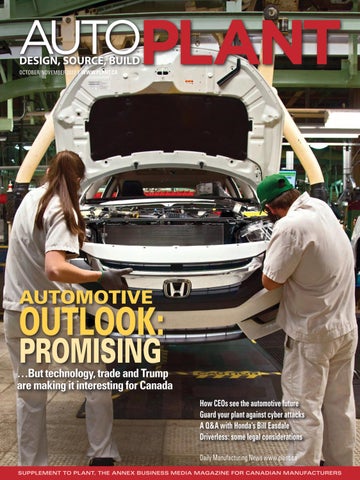
OCTOBER/NOVEMBER 2017 | WWW.PLANT.CA
AUTOMOTIVE
OUTLOOK: PROMISING
…But technology, trade and Trump are making it interesting for Canada How CEOs see the automotive future Guard your plant against cyber attacks A Q&A with Honda’s Bill Easdale Driverless: some legal considerations Daily Manufacturing News www.plant.ca SUPPLEMENT TO PLANT, THE ANNEX BUSINESS MEDIA MAGAZINE FOR CANADIAN MANUFACTURERS
AutoPLANT_OctNov2017_AMS.indd 1
2017-10-18 2:35 PM
Increase uptime
by protecting the backbone of assembly lines
Eliminate downtime with e-chains
®
igus energy chain systems offer maintenance free modular cable protection and guidance for nearly all applications and industries, including complete energy supply and retraction systems for multi-axis robots. ®
®
Individual components to fully populated and connectorized dress packs in as little as 24 hours.
®
Plastics for longer life
Samples, technical information, and more: www.igus.com/automotive | 1.800.521.2747 | sales@igus.com
AutoPlant_Igus_Oct.indd 1 AutoPLANT_OctNov2017_AMS.indd 2
2017-09-25 2:35 9:28 PM AM 2017-10-18
CONTENTS
October/November 2017 Vol. 76, No. 08
e
es
ife
om
25 9:28 AM
FEATURES 20 INTERVIEW A Q&A with Honda of Canada Mfg.’s Bill Easdale. 22 INVESTMENTThere’s government funding available for an electric future.
12 OUTLOOK
How trump, trade and technology are impacting the automotive industry.
23 INNOVATION Magna and Ford develop a lighter carbon fibre subframe. 24 SMART TECH Goodyear unveils next-gen concepts for autonomous vehicles. 25 MANUFACTURING Ford is testing largescale car part printing and lightweighting.
DEPARTMENTS 14 MOBILITY GM’s new tech centre in Markham, Ont. will develop automotive software.
15 TRENDS Global automotive CEOs identify what’s hot and what’s not.
16 LEGAL Autonomous vehicles and driverless cars raise some legal issues.
18 SECURITY Understand the cyber risks of a connected plant.
4 Editorial 6 News Events 9 Auto Pulse 11 Parts World 26 Backseat Driver
COVER IMAGE: HONDA OF CANADA MFG.
PLANT—established 1941, is published 8 times per year by Annex Business Media. Publications Mail Agreement #40065710. Circulation email: stelian@annexnewcom.ca Tel: 416-442-5600 ext 3636 Fax: 416-510-5170 Mail: 80 Valleybrook Drive, Toronto, ON M3B 2S9. Occasionally, PLANT will mail information on behalf of industry-related groups whose products and services we believe may be of interest to you. If you prefer not to receive this information, please contact our circulation department in any of the four ways listed above. Annex Privacy Officer: privacy@annexbizmedia.com Tel: 800-668-2374.No part of the editorial content of this publication may be reprinted without the publisher’s written permission. ©2017 Annex Publishing & Printing Inc. All rights reserved. Performance claims for products listed in this issue are made by contributing manufacturers and agencies. PLANT receives unsolicited materials including letters to the editor, press releases, promotional items and images from time to time. PLANT, its affiliates and assignees may use, reproduce, publish, re-publish, distribute, store and archive such unsolicited submissions in whole or in part in any form or medium whatsoever, without compensation of any sort. This statement does not apply to materials/pitches submitted by freelance writers, photographers or illustrators in accordance with known industry practices. Printed in Canada. ISSN: 1929-6606 (Print), 1929-6614 (Online)
www.plant.ca
AutoPLANT_OctNov2017_AMS.indd 3
AutoPLANT 3
2017-10-18 2:35 PM
EDITORIAL
America First, America Only
I
f there was any question about where US trade priorities lie, they have been answered: the North American Free Trade Agreement (NAFTA) negotiations are about benefits for America Only. The Trumpish ire may be directed more at Mexico and its trade deficit with the US, but there are troubling indications the maple tree is in for some aggressive branch trimming. As of this writing, prospects of a renewed deal that’s a win-win-win for all parties have not been promising with little if any progress made in the first three rounds of talks. And running parallel to NAFTA are aggressive trade actions aimed against Canada involving softwood lumber and aerospace (Boeing versus Bombardier), with aluminum, steel and other trade items in America’s line of fire. Pundits are questioning whether the Americans are serious about concluding an agreement. Some demands are so heavily weighted to US interests or so outrageous that it’s unlikely Mexico and Canada could or would agree to a deal. Whatever the Trump regime’s true intent may be, as this drama unfolds the automotive sector is in for a particularly tough time over content rules. The US wants 85% North American content per vehicle (from 62.5%) and at least 50% of that specifically American to qualify for duty-free status. US Department of Commerce chief Wilbur Ross kicked off the content face-off in a Washington Post article that disputed the view that Canadian and Mexican car parts crossing borders numerous times have high US content. His so-called evidence is a department study using out-of-date numbers (2011) to show US content dropped significantly (from Canada 21% to 15%; and Mexico, 26% to 16%). Flavio Volpe, president of the Automotive Parts Manufacturers’ Association, counters with other studies that put US content in Canadian-produced vehicles at about 63%. Scotiabank Economics also has some numbers to throw into the mix. It observed North American content in vehicles is at 75%, much higher than the current requirement, so there’s no need to further tighten content rules. What concerns automakers is the US demand for 50% of that content. Such a restriction will prevent auto assemblers and parts makers from sourcing materials through suppliers that offer the best quality and price, whatever the country. This does not enhance North American competitiveness. The result? Sourcing outside NAFTA and paying the tariff, then passing the cost along to consumers. The current NAFTA arrangement has been good for the three nations. Scotiabank notes exports have been rising 3.5% annually over the past decade, increasing North America’s share of the world market to 22% from 19%. Exports from the US rose 3.1% annually. And thanks to NAFTA, the US auto industry has outperformed other industrial sectors, with output gains of 2.5% annually since the trade agreement’s introduction. The sector now accounts for 12.4% of total manufacturing activity, up from 10% prior to NAFTA. But so much for numbers. They’re of little consequence to an administration that is more interested in bolstering a storyline that has the American worker victimized by rapacious companies shipping jobs offshore and parasitic trade partners taking advantage of an agreement that’s ruinous to US interests. This puts Canada and Mexico at the centre of a paradox, summed up by Volpe. “You can’t have protectionism within a free trade agreement. It’s an oxymoron.’’ Yet that’s Canada’s reality. It’s not negotiating a free trade agreement so much as defining what degree of politically motivated American protectionism will be tolerable. The answer should be none. But it’s early.
Publisher Michael King 416-510-5107 mking@plant.ca, mking@cienmagazine.com Editor Joe Terrett 416-442-5600 ext. 3219 jterrett@plant.ca Art Director Andrea M. Smith National Account Manager Ilana Fawcett 416-510-5202 ifawcett@plant.ca Account Coordinator Kim Rossiter 416-510-6794 krossiter@annexbizmedia.com Annex Business Media Vice President/Executive Publisher Tim Dimopoulos (416) 510-5100 tdimopoulos@annexbizmedia.com COO Ted Markle tmarkle@annexweb.com President & CEO Mike Fredericks Circulation Manager Beata Olechnowicz 416-442-5600 ext. 3543 bolechnowicz@annexbizmedia.com Subscription Price Canada $72.50 per year, US $146.95 (US) per year, Foregin $166 (US) per year. Single Copy Canada $12.00. Add applicable taxes to all rates. Combined, expanded or premium issues, which count as two subscription issues. Mailing Address Annex Business Media 80 Valleybrook Dr., Toronto, ON M3B 2S9 plant.ca Tel: 416-442-5600, Fax: 416-510-5167 (if busy use 416-510-6875) Customer Service Bona Lao 416-442-5600 ext. 3552 blao@annexbizmedia.com
Joe Terrett, Editor Comments? E-mail jterrett@plant.ca. We acknowledge the [financial] support of the Government of Canada.
4 AutoPLANT
AutoPLANT_OctNov2017_AMS.indd 4
October/November 2017
2017-10-18 2:35 PM
PLT_EM
1997 2017 www.emccanada.org
PLT_EMC_JulyAug.indd 1 AutoPLANT_OctNov2017_AMS.indd 5
2017-08-09 2017-10-18 12:04 2:35 PM PM
NEWS EVENTS Lubrication fundamentals STLE Hamilton Nov. 2, Hamilton The Hamilton Section of the Society of Tribologists and Lubrication Engineers (STLE) presents a seminar on lubrication fundamentals that will cover: what tribology is; oils; greases; filtration; lubricant application; lubricant audits and an open panel discussion. Visit www.stle.org FABTECH 2017 FMA, SME, PMA, CCAI, AWS Nov. 6-9, Chicago North America’s largest metal forming, fabricating, welding and finishing event featuring 1,700 suppliers and their fabricating solutions. Presented by Fabricators & Manufacturers Association (FMA), SME (Society of Manufacturing Engineers), Precision Metalforming Association (PMA), American Welding Society (AWS) and Chemical Coaters Association International (CCAI). Visit www.fabtechexpo.com. Physical Asset Management Certificate Program University of Toronto Nov. 6- 10, 13-15, Toronto The program, offered in partnership with the Faculty of Science and Engineering at the University of Toronto, is taught by three world-class instructors. They combine fundamental need-to-know material with new, proven, leading-edge approaches that have shown measurable payoffs. (SCS Course Number 2338-010). Call (416) 978-2400. Visit https://learn.utoronto.ca.
Magna and RocketSpace accelerate automotive innovations Focusing on electric vehicles, automated driver systems, secure connectivity
Tech start-ups have a new route to bring their inventions to life. PHOTO: MAGNA
AURORA, Ont. — Tech start-ups in the automotive sector have a new path to bring their innovations to life thanks to a collaboration between Magna International and a San Francisco-based technology accelerator. The Aurora, Ont. automotive supplier and RocketSpace will focus the Mobility Tech Accelerator Program on areas that include electric vehicle systems, automated driver assisted systems and secure vehicle connectivity. This is RocketSpace’s third industry-focused program. “We see great opportunity to form mutually beneficial relationships when inventors, investors and corporations bring their ideas and resources together,” said Ian Simmons, Magna’s vice-president of business development, corporate engineering and R&D. RocketSpace has a global network of technology campuses that helps start-ups scale their innovations.
Supporting innovation.
AutoPLANT_OctNov2017_AMS.indd 6
DETROIT — General Motors Co. is making a bigger play with its electric vehicle line-up. Over the next 18 months, the Detroit automaker will introduce two new all-electric vehicles based on what it has learned from the Chevrolet Bolt EV. These vehicles will be the first of at least 20 new all-electric vehicles launching by 2023. “General Motors believes in an all-electric future,” said Mark Reuss, General Motors executive vice-president of product development, purchasing and supply chain. “Although that future won’t happen overnight, GM is committed to driving increased usage and acceptance of electric vehicles through no-compromise solutions that meet our customers’ needs.” GM is taking a two-pronged approach to electrification – battery electric and hydrogen fuel cell electric. The automaker also introduced the SURUS (Silent Utility Rover Universal Superstructure) concept vehicle. It’s fuel cell powered with four-wheel steering on a heavy-duty truck frame, and driven by two electric motors. GM is thinking emissions-free delivery vehicle, truck or ambulance.
$18.2M funding for auto innovations
Canadian Pavilion at Auto Expo India – Component Show, APMA, CTCS, EDC Feb. 8-11, New Delhi, India Canadian automotive parts manufacturers are invited to participate in the Auto Expo Inda – Component Show, organized by the Automotive Parts Manufacturers’ Association (APMA), the Canadian Trade Commissioner Service (CTCS), and Export Development Canada (EDC). The Canadian booth, occupying about 100 square metres, will showcase Canadian parts and components, tooling and machining suppliers, and other related organizations. Visit https://apma.ca.
6 AutoPLANT
GM is all in on all electric
PHOTO: FOTOLIA
TORONTO — Two Canadian companies have received repayable federal funding of $18.2 million to further develop innovations that would make cars lighter, more fuel efficient and improve the battery life of electric vehicles. Auto parts manufacturer Asterex Inc. in Lakeshore, Ont. (near Windsor) received $17 million from FedDev Ontario to set up a plant to produce lightweight, aluminum components. The company intends to create 62 jobs this year and 24 more in the next two years. Astrex, established in 2015, is a new joint venture between Ontario-based CanArt Aluminum Extrusion Inc. and the Netherlands-based Constellium NV. CanArt GBatteries Energy Canada Inc. in Ottawa received $1.2 million from Sustainable Development Technology Canada’s SD Tech Fund to develop longer lasting, faster charging batteries for electric cars. The company is working with two consortium partners, eCAMION and S&C Electric Canada Ltd., to demonstrate its Active Battery Management System (ActiveBMS), which it says will boost battery charging rates by at least six times compared to conventional methods.
October/November 2017
2017-10-18 2:35 PM
Honda Clarity debuts in Ottawa Government officials see fuel cell tech in action MARKHAM, Ont. — Honda Canada showcased the potential of its fuel cell technology at a RideN-Drive in Ottawa in June. This collaboration with the Canadian Hydrogen Fuel-Cell Electric Vehicle Coalition of Automakers offered federal and municipal government officials an opportunity to get behind the wheel of the Honda Clarity to experience what
Clarity on display at Parliament Hill Ride-N-Drive.
fuel cell technology has to offer. Navdeep Bains, minister of innovation, science and economic development, the Bardish Chagger, minister of small business and tourism, and Ottawa Mayor Jim Watson had a chance to take the vehicle for a test drive. The hydrogen fuel stack is all under the hood, allowing for a roomier five-person cabin. Fuel is stored in a 141-litre tank behind the rear seats and in a 27 litre tank under the rear seats, with an aircooled 1.7 kWh battery pack under the front seats. The vehicle refuels in about five minutes and has a 590-kilometre range. On the electric plug-in side Honda Canada has announced 152 dealerships – nearly two thirds of its dealer network – have committed to installing two level 2 electric chargers on-site by the end of the year. The project will be completed before the arrival of the Clarity plug-in electric PHOTO: HONDA hybrid during the winter.
GF Linamar wins $300M components order GUELPH, Ont. — GF Linamar, a joint venture between GF Automotive and Canadian automotive parts manufacturer Linamar Corp., has won a US$300 million contract from an unidentified US manufacturer to produce lightweight magnesium components. The contract, which will run over a five-year period, includes cross car beams for a new pickup truck model. The magnesium components will be produced at a new plant in Mills River, NC, which was to open in October. Swiss-based GF Automotive, is a manufacturer of components for passenger cars, trucks and industrial applications. The division provides casting solutions based on iron, aluminum and magnesium at 11 production plants in Germany, Austria, China and the US. Linamar, based in Guelph, Ont., makes automotive parts and other industrial products.
Engineered Systems, Products & Services Keep your operation on the move with ergonomic solutions for lifting, manipulating and transferring loads.
Ingersoll Rand Bundle Handler
Parker Moduflex IO-Link
Schmalz JumboFlex
Parker L90LS Mobile Valve
A variety of solutions from Wainbee and its partners - Ingersoll Rand, Schmalz & Parker.
Your Motion & Control Solutions Partner • 1-888-WAINBEE • www.wainbee.com www.plant.ca
PLT_Wainbee_Sept.indd 1
AutoPLANT_OctNov2017_AMS.indd 7
AutoPLANT 7
2017-08-22 1:28 PM
2017-10-18 2:35 PM
NEWS
Pacifica Hybrid wins green accolades Only hybrid minivan recognized for fuel efficiency WINDSOR — FCA Canada’s Chrysler Pacifica Hybrid just missed winning the 2017 Canadian Green Car Award judged by Canadian auto journalists, who gave the nod to the US-built Chevy Bolt. But the Pacifica Hybrid was awarded Green Car of the Year by the Northwest Automotive Press Association
(NWAPA) in the US. The Chrysler Canada minivan entry was named the best ‘Efficient Three-row Family Vehicle’ in the Canadian Green Car awards, which covered several categories. Built in Windsor, Ont., it’s the industry’s only hybrid-electric minivan, with an estimated
Cutaway of the Chrysler Pacifica Hybrid.
LEAKChecker
LUBEChecker FOCUSED. SIMPLE. AFFORDABLE. Ultrasound detectors for every application and budget
TRAPChecker sdtultrasound.com/checkers
TIGHTChecker 8 AutoPLANT AutoPlant_SDT_Oct.indd 1
AutoPLANT_OctNov2017_AMS.indd 8
2017-10-17 2:28 PM
PHOTO: FCA
electric range of up to 53 kilometres, up to 911 kilometres total driving range and a fuel efficiency rating that achieves 2.6 litres per 100 kilometres in the city (109 imperial miles per gallon). The NWAPA award followed a test drive challenge involving 19 electrics, hybrids and fuel cell powered vehicles in Portland, Ore. The journalists picked the Pacifica Hybrid for its family functionality and fuel economy. The Chevy Bolt EV was the winner of the 2017 Canadian Green Car Zero Emission category before taking the overall prize. It was the second consecutive Car of the Year win for Chevrolet, after the Volt took home the award in 2016.
AUTO FACTS Canada’s automotive industry is key to economic growth. Here are some stats from A Profile of the Automotive Manufacturing Industry in Canada, 2012-2016, by McMaster University’s Automotive Policy Research Centre. • 2.4 million vehicles were built annually in Canada over the past five years. • $84.7 billion in revenues (2013, Industry Canada) • 140,404 Canadians directly employed in 2016 with 15,000 added since 2012. • Five OEMs employed 37,127 people in their plants. • Canadian-owned automotive parts manufacturers employ 51,923 people, more than half of all employment in this sector globally.
October/November 2017
2017-10-18 2:35 PM
ECONOMY
2017 growth: So far, so good
E C ONOMIC T R E NDS IN T HE A U T OMO T I V E S E C T OR EMPLOYMENT 2012-2016
On track for 3.7% as the momentum builds
The automotive industry employed 125,395 people in 2016, an increase of 16,913 jobs compared to 2012. Approximately 30% of the workforce is employed in vehicle assembly and 70% in parts manufacturing, according to A Profile of the Automotive Manufacturing Industry in Canada, 2012-2016. The APRC report says Canadian firms accounted for 50% of parts employees, Japanese companies 18% and US firms 13%. Advisory firm KPMG gives Canada an 11.2% labour cost advantage over US parts suppliers.
www.plant.ca
AutoPLANT_OctNov2017_AMS.indd 9
186,800
T
Sources: Statistics Canada, as noted in A Profile of the Automotive Manufacturing Industry in Canada, 2012-2016.
$110.42 BILLION
Value of the automotive lightweight material market by 2021, driven by stringent emission and fuel economy regulations, plus the growth in sales of electric vehicles.
Vehicles sold in September, a 7.7% increase from the same month a year ago and on track for 2 million units in Canada for year.
Research and Markets
DesRosiers Automotive Reports
45%
$15B
The percentage of Ontario auto industry workers who have a post-secondary education. Ontario Government
What the automotive industry contributes annually to Ontario’s GDP. Ontario Government
ILLUSTRATIONS: FOTOLIA
he Canadian economy continues to exceed expectations. Scotiabank Economics notes Q1 expansion roared ahead at an annualized 3.7%, only to pass that mark in Q2 at 4.5%. And the momentum continues. Real GDP growth will be 3.1% for the year, which is way ahead of the 2% most analysts and Scotiabank anticipated at the beginning of the year. But growth will slow to 2% in 2018 and 1.5% in 2019. The latest forecast from the Organisation for Economic Co-operation and Development is in the same neighbourhood. The Paris-based economic think tank expects the Canadian economy to grow 3.2% this year, the best performance in the G7, which is an upgrade from a June forecast of 2.8%. Next year growth will be 2.3% Globally, the OECD expects 3.5% growth this year and 3.8% in 2018, which is an improvement over a previous forecast of 3.6%. RBC Economics sees business investment picking up as firm demand pushes capacity limits, despite uncertainty radiating from the NAFTA negotiations. Investment posted the fastest increase in almost five years and RBC expects more solid spending in the second quarter. The Bank of Canada’s July outlook survey showed a near-record level of companies intending to invest in the year ahead, while higher imports of machinery and equipment, rising machinery sales by Canadian companies and a pickup in the hiring of engineering construction workers add to the optimistic outlook. Scotiabank observes industrial operating rates rising and a growing backlog stoking manufacturers’ confidence. Industrial machinery demand is up 25% year-over-year, reviving in BC and rebounding to 45% in Alberta.
th 9
Canada’s position among the top 10 vehicle producing companies. China is first, the US second and Mexico is seventh. Canada was ahead of its North American amigo as of 2005 by about 1 million units. Mexico pulled ahead in 2010. International Organization of Motor Vehicle Manufacturers
AutoPLANT 9
2017-10-18 2:35 PM
REAR-VIEW
Canada’s first automobile
Trimmed for Canadian truckers
A GMC heavier-duty Maple Leaf truck. PHOTO: NZ CAR FREAK
Oh Canada! The Canadian Maple Leaf truck was built at the General Motors of Canada Oshawa, Ont. plant from 1946 to 1957, sporting minor trim differences to its US counterpart. There are a few around. One version, a ladder truck, was recently listed on Kijiji for $5,000, but they can sell for as much as $30,000.
Wheel of EV progress Hats off to engineer and physicist Pierre Couture who developed an electric wheel motor concept in 1994. The Quebecer worked at the Institut de recherche d’Hydro-Québec (IREQ), which was developing a prototype electric vehicle based on the Dodge Intrepid as part of a $100 million proThe MOTIVE motor. PHOTO: PRESS 00 vincial government project. Fuel consumption was rated at between 80% and 85%. However, the project was dropped in 1995 with Couture and his staff resigning. The project was picked up by Hydro Quebec subsidiary TM4, which joined the Dassault Group in France to develop the Cleanova. Prototypes were built in 2006, and in 2009 TM4 partnered with India’s Tata Motors and a Danish firm to test a demonstrator in Norway. In 2011, Tata Motors expect to sell up to 5,000 of its Indica Vista EVs in Europe. To meet demand, TM4 upgraded its production facilities in Boucherville to produce up to 10,000 units of the MOTIVE powertrain. TM4 now designs and manufactures electric motors, generators, power electronics and control systems. In 2012 it entered into a 50/50 joint venture and licensing agreement with China’s Presolite Electric Beijing Ltd. to build electric buses.
Bricklin lands like a brick
A Bricklin SV-1 gull-winged sportster. PHOTO: THOMAS DOERFER
10 AutoPLANT
AutoPLANT_OctNov2017_AMS.indd 10
Henry Seth Taylor wasn’t aiming to be a disrupter of the transportation industry when he built Canada’s first automobile and unveiled it at the Stanstead, Que. Fall Fair in 1867. Taylor, a watchmakHenry Seth Taylor’s steam-powered buggy. er and jeweller, modelled his steam-powered buggy after a US-built steam car he saw at a fair three years earlier. It was a personal project to show he could build a buggy of his own design, which made use of the most available fossil fuel at the time: coal (or wood), stored in a nook under the seat. A two-cylinder boiler was mounted behind the driver with rubber hoses connected to a six-gallon water tank between the front wheels. Traction was sketchy with metal strips wrapped around the wheels instead of rubber. Fully pressurized steam moved the piston attached to the rear axle for forward motion of up to 20 km/hr, but there was no reverse gear or brakes. This one-off now resides at the Canada Science and Technology Museum in Ottawa.
What’s in a name? Chrysler has gone through some changes since it set up shop in Windsor, Ont. In 1925 it gained control of the Maxwell-Chalmers plant and with 181 employees, produced 7,857 vehicles in the first year. In Employees gather around a 1967 Plymouth 1998 Chrysler merged with the Fury coming off the production line at ChrysGerman automaker Daimler to ler’s Windsor, Ont. assembly plant. PHOTO: FCA form Daimler-Chrysler Canada. That union wrapped up in 2007 when the automaker was sold to Cerberus Capital Management and renamed Chrysler Canada Inc. The recession pushed Chrysler into bankruptcy protection, emerging in 2009 under joint ownership of the UAW, the Canadian and US governments and Fiat S.p.A. In 2014 Fiat bought the rest of the common shares and on this side of the border the automaker is now FCA Canada (but still Chrysler Canada to the locals). Year-to-date it’s tracking third for Canadian market share.
Believe it or not, Canada briefly had a car of its own and it projected a sporty, early Batmobilepotential chic about it. The Bricklin SV-1 was the creation of Malcolm Bricklin, an American millionaire who founded Subaru of America in 1968. He sold his interest in the company to make his own cars in Saint John and Minto, NB. The Bricklin, with its cool if somewhat impractical factory-powered gull-wing doors and dent-resistant plastic body, was supposed to be a safe and economical sports car, but the added weight of the safety features made it inefficient. Features included an integrated roll cage with 8 km/h bumpers and side beams. Front suspension was A-arms and coil springs with leaf springs on a live axle in the rear. The 1974 models were powered by a 360 cubic-inch AMC 360 V8 while the 1975-76 models rocked a 351 cubic-inch Ford Windsor V8. Unfortunately, Bricklin couldn’t produce the cars fast enough, selling only 2,854 before the company went into receivership, owing the New Brunswick government $21 million (about $87.6 million in 2017 dollars). One estimate has 420 vehicles still in play, and Colossal Canadian Failures says you can pick one up today on eBay for about $22,000.
October/November 2017
2017-10-18 2:35 PM
PARTS WORLD
Automotive parts suppliers are ready for the future BY FLAVIO VOLPE
far more advanced final product. But machinery is only half the story. Modern robots aren’t operated so much as they’re prohe Automotive Parts Manufacturers’ Assogrammed and operated by highly trained people ciation (APMA) has watched the Canadian who are much more skilled than their predecessors automotive industry grow up over the past 65 from past decades. Investing in upgraded mayears and a lot has happened in that time. It has chines and people has paid off. Skilled operators become one of the most integrated market sectors extract additional efficiencies that go beyond what in North America touting cutting edge technology these machines were designed for. Nothing breeds and processes. It employs almost 100,000 people innovation like smart people using smart equipand generates $32 billion in revenue annually. ment, and these jobs are in very high demand – so As Canada, the US and Mexico work diligently to high that some companies are having trouble filling renegotiate the North American Free Trade Agreethem with qualified people. At some point in the ment (NAFTA), the industry will likely change even near future, our post-secondary education system more. Some in the industry are worried about the will need to better fit their programs to deal Canada will ultimately get from this actual job requirements (but that’s negotiation. Their fear a subject for another time). is understandable. So where does this leave The value propCanada in a NAFTA 2.0 ositions for both world? Mexico and the US Despite what the are self-evident (cheap alarmists say, Canlabour and large market, ada’s automotive respectively). How parts manufacturers can Canada hope to are in a position of compete? strength and poised To answer that to get stronger moving question, we must first forward. Canada and the US understand how Canada’s can’t compete with Mexico’s auto parts sector has evolved Cut-away of a transmission. PHOTO: FOTOLIA much lower labour costs, nor over the years. One of our should they try. Canada’s economy, while healthy member companies has a retired mid-20th century, and vibrant, is nowhere near the size of the US hand-operated, mould-cutting machine on display economy. Most of our products are exported. Canin its main foyer. By today’s exacting standards, ada’s value proposition in NAFTA has always been this machine was slow and the product it produced high-quality, high-tech products made by a skilled grossly inaccurate. The person using this machine and highly trained workforce. And with this workhad to be as much an artist as an operator. While force, automotive parts manufacturers are ready this old machine may stir up nostalgic feelings for to produce the high-tech, state of the art parts and some, it’s as far behind the modern equivalent as a components needed for the electric/connected and typewriter is to an iPad. autonomous vehicles of tomorrow. As the 20th century moved forward, the sector From start to finish, parts and components cross faced downward pressure on costs and upward the borders several times before a vehicle is ready pressures on productivity and quality. The solution for the dealer’s lot. Nobody wants an outcome that was innovation and smart investment – better makes it harder for the North American supply chain tools, better machines, better training – and it to get access to Canadian automotive parts (and worked. expertise). As a close observer of the NAFTA negoThanks to these innovations, Canada’s auto tiations, I can assure you the people involved in the parts sector has become a world leader in quality, discussions know that, and are acting accordingly. design, testing, and preparedness for the future. Today’s modern machine tools make products that Flavio Volpe is president of the Automotive Parts are accurate to a few microns; and they’re producManufacturers’ Association (APMA) in Toronto. ing them at a pace never seen before. Technology Visit https://apma.ca. advances have made modern machinery more efficient, accurate, versatile, data-driven, digital and Comments? E-mail jterrett@plant.ca. connected. And these machines are feeding into a
T
“TODAY’S MODERN MACHINE TOOLS MAKE PRODUCTS THAT ARE ACCURATE TO A FEW MICRONS; AND THEY’RE PRODUCING THEM AT A PACE NEVER SEEN BEFORE…”
www.plant.ca
AutoPLANT_OctNov2017_AMS.indd 11
AutoPLANT 11
2017-10-18 2:35 PM
OUTLOOK
What’s ahead for
AUTOMOTIVE TRUMP, TRADE AND TECHNOLOGY’S IMPACT ON THE AUTO SECTOR
Canada is well positioned to meet the technology needs of the 21st century vehicle. BY JEFF BROWNLEE
W
Ford Edge rolling off the production line at the Oakville Assembly plant.
12 AutoPLANT
AutoPLANT_OctNov2017_AMS.indd 12
PHOTO: FORD
hatever the uncertainty and impact “tweaking” NAFTA and presidential tweeting may have on North America’s most integrated industry, Canada’s auto sector is negotiating some sharp curves as it adapts to digital disruption and environmental imperatives that will set the stage for the future. Yet the outlook is promising. “Canadian companies are showcasing their leadership in the development of advanced technologies shaping the future of the auto industry,” said Navdeep Bains, Canada’s Minister of Innovation, Science and Economic Development at January’s North American International Auto Show in Toronto. “Canada is uniquely well-positioned to lead on the design, development and production of the cars of the future,” he said. Those cars will be lighter, more fuel efficient, and in many cases are powered by electricity or hydrogen, digitally connected and operating autonomously. “We are seeing a merging of ICT (information communication technologies) and the automotive space,” says Christian Bertrand, automotive sector specialist at Export Development Canada (EDC). “The trend the past few years has been that a lot of these companies start to look at automotive.” Why? Stringent pollution emission targets for autos established by former US President Barack Obama and changing customer demand related to vehicle connectivity. While companies are gearing up for a digital future, the Trump administration is covering the traditional industry in a bit of a fog. Calls to tweak NAFTA, a more protectionist sentiment and a commitment to repeal Obama’s EPA standards are keeping the industry on its toes. “You have 51 years of absolute, total integration of the second-most complex manufactured product in the world,” says Dennis DesRosiers, a Canadian automotive expert, analyst and principal of DesRosiers Automotive Consultants Inc., in Richmond Hill, Ont. “You can’t undo that – you can’t take a genie out of the bottle here.” DesRosiers is referring to the Trump adminis-
October/November 2017
2017-10-18 2:35 PM
tration’s promise to renegotiate nizing regulations makes sense. NAFTA, rules of origin (raise the Things could get tricky, however, requirement from 62.5% to 85%) as Trump and Prime Justin Minisand content rules (half from the ter Trudeau are on opposite ends 2018 Chevrolet Equinox, made at the CAMI plant in Ingersoll, Ont. PHOTO:GM US). Starting with the AutoPact in of the environmental spectrum. It’s 1965, free trade between Canada unlikely Trudeau would concede to and the US has been defined by Trump’s demands to eliminate fuel the automotive industry. Since emissions standards completely. NAFTA came into force in 1994, That’s not just from an environcomplex supply chains between mental standpoint, but also from the three countries are deeply an innovation angle, where much integrated within the North Ameriof Canada’s R&D and technology can economy. development focus, in the auto sec“If you were to do something at tor at least, has been on products the border that would disrupt the that mitigate the environmental (degree of) integration like get rid of impact of cars and other modes of NAFTA or change content requiretransport. ments, it would destroy the inteCanada is, at least, well posigration and everything integration tioned to mitigate the shockwaves has brought to the marketplace,” of a potential Trump disruption, DesRosiers says. “The number one Toyota’s first hydrogen fuel facility to be built at its Québec zone office. PHOTO:TOYOTA particularly as it relates to technolothing integration has brought to the gy. The demand from consumers for wait,” he says. “It’s not in their best interest marketplace is stable pricing.” a more connected vehicle will drive future to make decisions right now, at least until By singling out Mexico in terms of “getting opportunities, and it comes at a time when we know more precisely what the Americans a better deal” in NAFTA renegotiations, the Canadian technology companies are forming have in mind.” US administration is toying with disrupting a new, super information highway between automotive supply chains in all three partner the tech hot-bed of Waterloo, Ont. all the way countries. That’s left many auto-based comthrough Windsor’s rich auto manufacturing Fuel emissions reduction panies north of the 49th parallel wondering history and into the Big 3-dominated metroThe Trump administration is also set on what the overall impact will be on their politan area of Detroit. eliminating stringent fuel emissions stanoperations. “A decade ago, the big advances in auto dards put into law by the Obama adminis“This new wave of ‘America-first’ thinking innovation and technology were found inside tration. But doing so risks slowing the pace is not just troubling Mexico. Canadian prothe car and under the hood. Now innovation of innovation and technology development ducers are worried that the ill feelings might extends well beyond the car through mobile related to advances in alternative fuel also shift our way, forcing, or subtly coercing connectivity and business model transformasources and parts lightweighting. Naturally, increased production stateside,” explains tion,” Steve Carlisle, president and managing Trump says the standards threaten auto Peter Hall, EDC’s vice-president and chief director of General Motors Canada wrote in jobs, a popular tone among his nationalist economist, adding that Canadian companies a 2016 Montreal Gazette opinion piece. “The supporters and a portion of American auto are worried about their existing operations future of the automobile is increasingly elecworkers who fear a rise of the robots that in Mexico, where tier one suppliers are settric, connected, autonomous (or self-driving) will once and for all eliminate traditional ting up shop to co-locate with customers. and an integral part of the sharing economy.” manufacturing jobs. “Industry is on the defensive, and seriously EDC believes Canadian companies are “If the standards threatened auto jobs, wondering what their next investment moves well positioned to play a leadership role in then common-sense changes could have and might be.” these developments. should have been made,” Trump said. “We To date, the Big 3 haven’t wavered on “I’m encouraged by the number of innoare going to restore the originally scheduled investment plans. Ford is still planning to vative companies I meet that are marketing midterm review, and we are going to ensure invest $700 million into its Ontario operadirectly to OEM automotive companies,” that any regulations we have protect and tions, while General Motors Canada’s $554 says Bertrand. ” defend your jobs, your factories.” million-boost for Ontario operations is still In the meantime, automakers, parts Trump’s comments were spurred on by on the table. And Fiat Chrysler still plans to suppliers and other players would be wise CEOs of the Big 3 OEMs who have suggested inject $325 million into a new paint shop at to continue business as usual while Trump, the standards – without tweaking – could put its Brampton plant. trade and technology play out. 1 million jobs at risk. Playing the waiting game is a good strateThis is creating more uncertainty in Canagy, according to international trade lawyer Jeff Brownlee is a business writer based in da because of the country’s commitment to Lawrence Herman. Ottawa. E-mail jeff@rainmakermedias.ca. reduction targets outlined by Obama in 2012. “My advice to auto companies would be to And because of the industry’s integrated think about the worst-case scenario, but to Comments? E-mail jterrett@plant.ca. nature across the US/Canada border, harmo-
www.plant.ca
AutoPLANT_OctNov2017_AMS.indd 13
AutoPLANT 13
2017-10-18 2:35 PM
MOBILITY
Disruptive
GM adds advanced mobility innovation to Markham’s fast growing technology cluster.
AUTO R&D T GM’S NEW CENTRE FOR SOFTWARE DEVELOPMENT
here’s nothing like a bit of disruption to freshen up the automotive industry and General Motors of Canada is doing its bit on the R&D side. GM employs 250 engineers at its Oshawa Tech Centre and
Transfer carts are plaƞorms used for the horizontal movement of materials, assemblies & other items. Compact in design, they can handle upwards of 60 ton, work well in areas with limited oor space and are 100% custom-made to your specicaƟons. Transfer carts can opƟmize manufacturing processes, are easy to operate and available as on-rail, towed or steerable units.
gineer n E
Lifting
ELS
stem s Sy
ed
ENGINEERED TO
MOVE
Steve Carlisle, GM Canada’s president and general manager, announcing the creation of Canadian Technical Centre. PHOTO: GM
intends to expand its Canadian engineering base by 1,000 positions over the next few years. The automaker’s efforts are focused on the vehicles of the future, including autonomous vehicle software and controls, active safety and vehicle dynamics technology, infotainment and connected vehicle technology, which has exceeded the Oshawa centre’s capacity. This led to GM’s new Canadian Technical Centre where GM develops software for connected, autonomous and shared vehicles and mobility systems. The 150,000 square-foot Markham Campus has 180 employees but will accommodate up to 750 when it’s complete. “We see an opportunity for Canada to be part of something even bigger – a new global auto innovation supply chain. Our Canadian software and technology work has the potential to make its way into some 10 million vehicles GM designs and produces around the world each year,” said Steve Carlisle, GM Canada’s president and managing director. The Markham Campus hosted 70 CEOs from the Business Council of Canada a tour of the facility in January, where they had a look at the state-of-the art labs that will develop the futuristic software. The Canadian Technical Centre joins Markham’s fast growing technology cluster of 4,400 firms, the largest ICT concentration in Canada. GM will also invest $10 million in its Kapuskasing Cold Weather facility where it will conduct testing for a wide range of new products and technologies. Comments? E-mail jterrett@plant.ca.
14 AutoPlant_ELS.indd AutoPLANT 1
AutoPLANT_OctNov2017_AMS.indd 14
2017-08-09 1:40 PM
October/November 2017
2017-10-18 2:35 PM
TRENDS Smart technology, driverless vehicles and mobility as a service will revolutionize PHOTO: FOTOLIA driving.
Our automotive
FUTURE GLOBAL CEOS IDENTIFY THE LEADING TRENDS A KPMG study looks at where automotive executives think the industry is going.
N
ew power trains, digital technology, mobility, autonomous vehicles and climate change are shaking up the global automotive industry. Traditional is being usurped by the evolutionary and revolutionary. So where is the industry heading? KPMG LLP, the global audit, tax and advisory firm, surveyed 1,000 auto executives from around the world, including Canada, from all aspects of the industry, including OEMs, parts suppliers, ICT companies, services providers and dealers. Here are some highlights.
Powertrains Fifty per cent of executives say
www.plant.ca
AutoPLANT_OctNov2017_AMS.indd 15
battery electric vehicles (BEVs) have overtaken connectivity and digitization as the top trend, but 62% believe they’ll eventally fail because of the difficulty setting up a user-friendly charging infrastructure. Most (78%) feel fuel cell vehicles will be the real breakthrough. Refuelling is faster at traditional gas stations versus 25 to 45 minutes for BEVs. But 76% believe the internal combustion engine (ICE) will continue to be important, while 53% say the diesel is pretty much dead, except for long transport hauls, because there aren’t a lot of alternatives for medium and heavy trucks.
going to decrease significantly. Based on demand-oriented development, alternative powertrains will increase from 4% in 2016 to only 7% in 2023. However, regulation aiming for set CO2 reduction goals will likely drive up the e-mobility share to 30% of global automotive production.
major business model disruption over the next five years around mobility and digital applications. Speaking of disruption, the industry is based on number of cars sold, but 59% believe consumers won’t want to own a car by 2025. Not owning isn’t strong now but look out as folks become fed up with parking and congestion, relying instead on Mobility as a Service. Autonomous driving will revolutionize the way we use cars and 68% of executives feel purchasing criteria of the past such as performance and speed, safety innovation, environmental friendliness or comfort will be irrelevant. And 89% say vehicle-independent features will be key.
Digital revolution
Big changes ahead
The digital ecosystem will generate more revenues than the car’s hardware, say 83% of executives, while 82% agree a Silicon Valley company will launch the next car in four years. Looking ahead to 2025, 35% see OEMs offering vehicle dependent and independent services over the whole customer lifecycle as the favoured business model. And 15% say OEMs will become contract manufacturers for ICT companies.
Measuring market share based on unit sales is outdated, say 71% of respondents and 83% expect a
Comments? E-mail jterrett@plant.ca.
Investing Over the next five years, 53% of executives plan to invest in plug-in hybrids, and 52% in ICE vehicles and full hybrids. KPMG surveyed 240 consumers on their purchasing preferences and found full hybrids are their first next car choice (36%), but 21% would still buy an ICE vehicle.
Status of ICE Internal combustion still has some mileage left in it as electric alternatives are further developed and integrated into existing platforms, but KPMG says its share of the future market is
Powertrain technologies top the CEO agenda.
PHOTO: FOTOLIA
AutoPLANT 15
2017-10-18 2:35 PM
LEGAL Introducing driverless vehicles into our lives comes with unique legal risks. BY IMRAN AHMAD AND SARAH NASRULLAH
W
hen the first Michael Bay Transformer movie was released in 2007 depicting alien robots that could transform into driverless vehicles of various sizes, the idea of such autonomous contraptions seemed far-fetched. Today, autonomous and connected vehicles are much closer to reality than fiction. Studies predict approximately 21 million autonomous vehicles will be on the road by 2035, depending on how quickly the technology can be developed, tested and brought to market. Vehicles that drive with minimal human supervision are classified on a scale from 0 to 5 (fully automated), as published by the Society of Automotive Engineers. And they rely on sensors (such as radar and cameras) and computer analytics to sense their environments and navigate without human input. Vehicles using wireless tech-
Gathering data from the environment.
Going DRIVERLESS LEGAL CONSIDERATIONS FOR THE AUTO INDUSTRY nology connect to the internet and transportation infrastructure to interact and exchange information with other vehicles to create a safer and more efficient transport network. Autonomous vehicles offer many potential advantages. They eliminate human error and emotion to reduce fatalities (up to 90% by some estimates), and
How driverless works
A
utonomous vehicles gather data from the environment using a combination of sensors such as Lidar (light detection and ranging), radars, cameras, and sensors, both ultrasonic and infrared. An onboard computer combines these data feeds with GPS coordinates and detailed maps to build a three-dimensional model of the immediate environment (typically up to 61 metres). Artificial intelligence identifies important features such as other vehicles, pedestrians, lane markings and speed signs; then the computer extracts relevant information for each one, such as the speed limit, location, speed and acceleration of other vehicles and pedestrians. These features update the initial plan to ensure the vehicle reaches its destination safely and legally. For example, even if the initial intent was to accelerate to 60 kph but traffic is heavy and moving slowly, the vehicle must limit its speed to that of the next car. Once an action is taken, the vehicle will repeat the cycle of sensing, planning and acting (if needed) several times a minute to react quickly to new Using the road more efficiently. PHOTO: FOTOLIA situations.
16 AutoPLANT
AutoPLANT_OctNov2017_AMS.indd 16
PHOTO: FOTOLIA
reduce costs for transportation and trucking companies, as well as reduce daily congestion in large metropolitan centres by 50 minutes. But there are legal risks to consider: 1. Cybersecurity. Autonomous vehicles have more than 100 electrical components. Any of these could be hacked and controlled from a remote location. There’s additional risk related to information gathered by vehicles that’s usually stored with a third-party cloud provider. And many devices in these vehicles come from different manufacturers, adding another source of vulnerability. 2. Data privacy. Vehicle-collected data includes: location; the environment; driver biometrics; climate control; and the passenger communication system. This raises significant privacy concerns. Protection of personal information is governed by the Personal Information Protection and Electronic Documents Act, which applies to all provinces except those with substantially similar legislation. 3. Accident liability. Who shoulders the liability: the OEM, or the supplier of sensors and equipment that malfunctioned
and caused the accident? This is yet to be clarified. Adding to the complications is whether the accident was due to a malfunction occurring during the interaction of different sensors, or relaying the information from the cloud took too much time. And how will insurance companies calculate risk as liability shifts from the driver to the autonomous vehicle and its manufacturer?
Regulations and policy Currently, there are no federal safety standards in Canada for autonomous vehicles, but the 2016 federal budget allocated $7.3 million over two years to support their development. Ontario is the first province to allow automated vehicle testing on its roads. The framework covers how testing will be done and the development of a more comprehensive framework. Canada and the US generally harmonize safety regulations. The American Association of Motor Vehicles (AAMVA) convened US and Canadian experts to develop guidelines. Their NHTSA Federal Automated Vehicles Policy (released in September 2016) coincided with the NHTSA Cybersecurity Best
October/November 2017
2017-10-20 10:54 AM
Practices for Modern Vehicles, which offered these recommendations: • Use the guidance and best practices provided by NIST, NHTSA and Auto ISAC. Identify risks, analyze potential threats and establish rapid detection and remediation capabilities. Document companies’ actions, changes, design choices and analysis. • Appoint a high-level, senior executive responsible for the cybersecurity of the product. A top-down approach encourages the rest of the organization to make this a priority. Allocate resources focused on researching, investigating, implementing, testing and validating product cybersecurity measures and vulnerabilities. • Share information. Join the Auto ISAC and share as much information as possible to stay on top of cybersecurity. • Create a reporting and
disclosure policy to provide guidance to external cybersecurity researchers on how to disclose vulnerabilities. • Develop a documented process for responding to incidents, vulnerabilities and exploits. Outline roles and responsibilities for each group to ensure a rapid response; define metrics to assess the effectiveness of the process; report all incidents, exploits and vulnerabilities to the Auto ISAC; and periodically run response capability exercises to test the effectiveness of the disclosure policy operations and internal response processes. • Document the details related to the cybersecurity process for both auditing and accountability. Include risk assessments, penetration test results and organizational decisions. • Implement fundamental vehicle cybersecurity protections. Develop cyber awareness,
Sensors feed data to an onboard computer to create a 3D model of the vehicle’s PHOTO: FOTOLIA environment.
such as controlling developer access to an ECU for deployed units by eliminating or limiting access to authorized privileged users; limit diagnostic features to a specific mode of vehicle operation; consider encryption to prevent unauthorized recovery and analysis of firmware; limit the use of network servers on vehicle ECUs to essential functionality; and avoid sending safety signals as messages on common data buses.
As technology and capabilities evolve, long-term security is critical. Have a thorough understanding of policy, regulatory framework and accepted best practices. Imran Ahmad is a partner specializing in cybersecurity and technology law at Miller Thomson LLP. Sarah Nasrullah practices cybersecurity law. Comments? E-mail jterrett@plant.ca.
5-fold soldering efficiency improvement
Defects cut from double digits to below 1%
Cloud-based data for accurate forecasting
UR_Ad_Creating_Revolutions_PRINT.indd 3
www.plant.ca MA_Universal_Oct.indd 1
AutoPLANT_OctNov2017_AMS.indd 17
12/09/2017 18.47
AutoPLANT 17 2017-09-20 8:34 AM
2017-10-18 2:35 PM
SECURITY No business is too small to be a cyber PHOTO: FOTOLIA target.
New technologies offer many benefits but increase the risk of data breaches. BY SUNIL CHAND
C
anadian manufacturers in the highly competitive automotive sector have a lot to gain by embracing Industry 4.0. Interconnected technologies that automate, the Industrial Internet of Things (IIoT) and cloud computing have the potential to dramatically change just-in-time manufacturing by enhancing interoperability, information transparency, technical assistance and decision-making. But new technologies come with a darker side. As more information is stored online, equipment becomes increasingly interconnected and robots become more autonomous, malicious internal and external actors will have more opportunities to exploit them. To ensure your company and its technological investments are adequately protected, it’s critical to acknowledge and understand the risks, and take appropriate steps to mitigate them. While Industry 4.0 is still in its infancy, there are signs automotive manufacturers around
18 AutoPLANT
AutoPLANT_OctNov2017_AMS.indd 18
Play it
SMART CYBER SECURE YOUR PLANT
the world are taking steps to adopt smarter manufacturing processes. Global procurement of robots is at an all-time high, with the International Federation of Robotics reporting auto manufacturers in NAFTA nations making up 55% of global purchases. New smart factories are also being built.
But this rise in technology adoption also raises cyber threats. Today, manufacturers are the most common target for e-mail-based malware, a cyber threat that a Verizon report says is responsible for 51% of data breaches across industries. Ransomware, a form of malware designed to extort hefty sums of
Cyber attacks increasing
S
calar Decisions Inc., a Toronto-based IT company surveyed of 650 Canadian IT and security workers earlier this year and found declining confidence among organizations for the third consecutive year. The average number of reported cyber attacks rose to 44 per year, up nearly 30% since the initial survey in 2014. Most respondents also report that both the severity (81%) and sophistication (72%) of attacks are increasing. Here are the highlights: • 41% of organizations had systems in place to deal with advanced persistent threats, up from 38% last year.
money from its victims, has also increased in prevalence by 50% since 2016. Additionally, IBM estimated 60% of all cyber attacks are inside jobs, with 75% resulting from the work of malicious perpetrators, and 25% caused by unintentional actions. This means a growing number of organizations of all sizes and across all industries are experiencing the horrors of cyber breaches first-hand. In 2016, the global WannaCry virus forced French auto manufacturer Renault to temporarily halt production in its Douai facility for a day. Similarly, 2,200-employee AW North Carolina, a transmission manufacturer supplying Toyota, was hit by ransomware twice over the last 12 months. Such risks shouldn’t prevent Canadian manufacturers from making the investments necessary to launch their organizations into the future, but they should do so with their eyes open. As cyber hackers become more sophisticated and breaches more damaging, companies would be well-served to ramp up their defenses if they hope to protect their technological investments. AW North Carolina, which supplies auto parts to nine Toyota car and truck plants across North America, estimated it lost $270,000 per hour during its first attack. Its production lines were shut down for close to four hours.
• The most frequent compromise comes from web-borne malware (76%) and rootkits (67%). • Threats on the rise include spear phishing, which exploits the vulnerability of existing software greater than three months old, and botnet attacks. • Mobile devices (75%) and third party applications (70%) were identified as the greatest potential risks threatening their company’s IT environment. • Negligent third party risk has increased significantly since last year along with negligent insider risk. • Only 21% of respondents faced with ransomware threats report incidents to law enforcements. The most common reaction is to simply pay the ransom.
October/November 2017
2017-10-18 2:35 PM
The ransomware infiltrated the plant’s computer network after an employee clicked on a link in a legitimate-looking e-mail, a common method used by hackers called phishing. While ransomware is swiftly becoming a significant threat for auto manufacturers, there are other ways malicious actors could put your business at risk. A competitor could hire someone to inject malware into your network, or your smaller suppliers, and change the specs of certain software elements. This corporate espionage could lead to errors in manufacturing, serious safety issues, massive recalls or other dire consequences.
doesn’t need access to an area of your network, don’t grant it. 4. Update your security measures. Apply all software patches when they become available and ensure your systems are regularly backed up to prevent loss. 5. Establish a response plan. It will be easier to get your systems up and running quickly in the inevitable event of a breach.
6. Train your employees. They must understand their role in cybersecurity. Show them what to look for when identifying phishing e-mails, how to handle sensitive online information and the elements of strong passwords. No business is too small to be a cyber target. To successfully compete in an evolving, smarter world of manufacturing, technology and cybersecurity invest-
ments must evolve in tandem. Sunil Chand is director, cybersecurity for Grant Thornton LLP, a Canadian accounting and advisory firm providing audit, tax and advisory services. E-mail Sunil.Chand@ ca.gt.com. Visit http://www. grantthornton.ca/. Comments? E-mail jterrett@plant.ca.
Taking action Internal threats are also growing, making your people one of the greatest potential cyber risks your company faces. As jobs become more automated, interconnected and mobile, employees have more opportunities to unwittingly put your network at risk by sharing sensitive information over e-mail, using personal phones to conduct work activity or failing to appropriately safeguard work computers with strong passwords. Disgruntled employees or those working on behalf of outsiders can also bypass firewalls and cause significant network damage. While there is no way to completely defend your organization from these risks, there are ways to mitigate them or minimize the damage when breaches occur. Here are some strategies to consider: 1. Identify your security priorities. This includes people, processes and technologies that support critical business functions. Allocate the necessary cybersecurity resources. 2. Frequently test for vulnerabilities. Cyber threats are always evolving. Watch any new vulnerabilities that could be exploited. 3. Harden your systems. Reduce the points of entry into your organization by enabling only what you need. If a person
www.plant.ca
AutoPLANT_OctNov2017_AMS.indd 19
BAD MOVE. GOOD MOVE. Up to 75% more tensile strength and 30% higher transmittable force.
move-series
The New Generation of Timing Belts
PLANT Brecoflex Sept 17.indd 1
www.brecoflex.com AutoPLANT 19
2017-08-15 10:24 AM
2017-10-20 8:22 AM
INTERVIEW
Q&A with
BILL EASDALE HIS TAKE ON LIFE AT HONDA AND AUTOMOTIVE MANUFACTURING
Bill Easdale, senior vice-president, Honda PHOTOS: HONDA of Canada Mfg.
He’s glad to be back and looking forward to the challenges that lie ahead.
W
hen you see Honda Civics or a CR-Vs on the road, think of Honda of Canada Mfg. (HCM) with its three plants in Alliston, Ont., about 4,000 associates and a production capacity of 390,000 vehicles a year that are sold in North America and other export markets. The Japanese automaker has quite a footprint in the Canadian automotive sector. Its manufacturing operations sit on 450 acres of real estate in Alliston – a community also known for its potatoes. HCM began operations in 1986 producing the Accord. Today it assembles the CR-V crossover SUV and is the lead for the Civic, a popular compact that (as of 2016) has been Canada’s best selling car since 1998. Plant 1 produces the Civic Sedan, Si and Coupe, Plant 2 the Civic Sedan and CR-V and Plant 3 about 260,000 four-cylinder engines annually. Bill Easdale, senior vice-president of HCM, shares his thoughts on life at Honda and how the Canadian automotive industry is faring. He rejoined HCM April 2016 after a previous two-year stint (1997-99) when he supported the Plant 2 start up with the
20 AutoPLANT
AutoPLANT_OctNov2017_AMS.indd 20
purchasing team, and he spent many years at Honda of America Mfg., where he was most recently vice-president. The following Q&A has been edited. Tell us about yourself, your life at Honda and the various roles you’ve had at the company. I was born in Sarnia, Ont. I’ve worked for Honda Manufacturing for 29 years with assignments in Ohio, Japan and Ontario; and worked in many areas of our business including, purchasing, new model development and corporate planning. Why did you get into the automotive business? My dad was the senior vice-president of Toyota Motor Manufacturing of Canada and he introduced me to the business. I liked the pace and the bandwidth, but I also really like my Dad, and I wanted to keep it that way, which is why I did not
go to work for him. What are the most exciting parts of your job and what brings you the most joy at work? The best part of my work is interfacing with the great people at HCM. My joy comes from setting the framework for the successful future of HCM, to provide stability and growth for our current associates, and for our future associates. What are HCM’s plans for the future? In the first two weeks of 2017, we made an announcement about Honda’s significant investment in HCM. At that time, we shared the plan to invest $100 million in brand new state-of-the-art paint department for Plant 1. It’s under construction now and will be in operation by 2020. We also put a lot of focus on our full model changes, which won’t be taking place soon, but both models we
build at HCM (Civic in Plant 1 and the CR-V in Plant 2) require a great deal of advance planning and work. Why is it important for HCM to be a global hub for specific vehicle platforms? As the global lead plant for the 2016 Honda Civic, HCM was presented with the opportunity to impress Honda Motor and our North American customers with the quality that we are capable of here in Alliston. Our associates stepped up to meet the challenge and thanks to their hard work we created a winner. The same can be said for the 2017 CR-V, which Plant 2 launched in December. I believe Honda is proving to the Canadian automotive sector that a global product like the Civic can be developed right here. We have the skills, the capability to lead the way and we have been successful at it.
The 2017 CR-V coming off the production line in Alliston, Ont.
October/November 2017
2017-10-18 2:35 PM
A 2016 Civic, Canada’s best selling car since 1998.
Describe some of HCM’s efforts to improve its environmental footprint. We are proud of our many environmental efforts at HCM such as being a ‘zero waste to landfill’ facility since 2007. Our latest environmentally friendly investment is the new paint department for Plant 1 where we are utilizing new technology, which
will result in a 44% reduction in greenhouse gas emissions. What’s your outlook for the automotive industry in Canada? Any concerns related to trade and the Trump factor? Honda feels positive about the future of automotive manufacturing in Canada. No doubt there
Medium duty. Conforms to ‘industry standard’ impact rating.
are challenges, such as uncertainty related to trade, foreign exchange rates, competition from other jurisdictions for assembly plants, and sub-national policy initiatives (such as high energy costs and cap and trade regulations). Nevertheless, Honda feels the Canadian business climate offers Honda a robust and stable marketplace to sell our quality, durable and reliable products; a highly skilled and dedicated workforce; and a prosperous and supportive economic and political environment. We believe these factors will help Honda remain competitive and that by continuing investment in Canada and working closely with our stakeholders and all levels of government, we are doing our part to ensure the future of Canadian auto manufacturing remains a strong, dynamic and an innovative component of the economy.
laboration with all levels of government, including Ontario, we believe that Honda can remain competitive and that by continuing investment in the province, we are doing our part to sustain the automotive manufacturing sector in the province.
What’s your outlook in Ontario? By continuing our ongoing col-
Comments? E-mail jterrett@plant.ca.
Lighter-duty. Contractor-grade and also protects your budget.
What are the automotive sector’s greatest opportunities in the short/ long term?
The priority will be to maintain and secure the existing manufacturing footprint in Canada and Ontario. There are challenges that all of us in the industry face. We need to work with all industry stakeholders, along with the government, to ensure that costs of manufacturing vis-a-vis other jurisdictions remains competitive, so we can showcase the quality of Canada’s advanced automobile manufacturing.
Extra tough. The ‘gold standard’ in protective guard rail.
THREE LEVELS OF PROTECTION. THE CHOICE IS YOURS. More guard rail designs than any other U.S. manufacturer. When it comes to protective guard rail for your facility – you now have three powerful choices to protect your equipment, machinery, and most importantly, your people.With the expansion of Wildeck’s industry-leading Wilgard® guard rail brand, the new Wilgard® XT, MT and LT offer a wide range of impact resistance to best fit your application. One tough family. Three levels of protection. The choice is yours. 800-325-6939 | WWW.WILDECK.COM ©Wildeck, Inc. 2016
WGD 1604 AD
www.plant.ca PLT_WilDeck_June.indd 1
AutoPLANT_OctNov2017_AMS.indd 21
AutoPLANT 21 2016-05-26 9:56 AM
2017-10-18 2:35 PM
INVESTMENT There are government programs available for technology developers. BY MATTHEW RODGERS
T
he future appears to be bright for electric vehicles (EVs). The world’s leading automotive brands are expanding into this segment, but a transition period is underway as gasoline and diesel users hesitate to make the switch. Many drivers are opting for plugin hybrid electric vehicles (PHEVs) that combined combustion and electric power. As drivers become more comfortable with electric power, government funding programs will help technlogy developers get them there. But first some background. European markets have the highest share of EVs, although other international markets are heating up, according to the Global EV Outlook 2016. And the North American plugin electric vehicle (PEV) market is poised to become a major ingredient in the vehicle mix. Release of the Tesla 3 in North America this year will help to accelerate the market by almost 60%, and nearly double it in 2018, according to Navigant Research. Accelerated growth is also expected worldwide. Clean Energy Canada, a program run by the Centre for Dialogue at
EVs
Tesla’s Model 3 prototype. Tesla CEO Elon Musk expects monthly production to reach 20,000 vehicles by December.
FUNDING WILL HELP YOU GET AHEAD OF THE CURVE
Vancouver’s Simon Fraser University, notes China cruised past a million vehicles last year (from a couple of thousand 10 years ago) and kept going. This year it plans to add as many electric vehicles as there are in the rest of the world. A report on the economic impact of EV adoption forecasts the following benefits, based on 10% of Ontario’s market share by 2025: • total economic income of $3.6 billion; • 34,000 person-years of new employment; • significant energy savings
An electric vehicle topping up at a charging station.
22 AutoPLANT
AutoPLANT_OctNov2017_AMS.indd 22
PHOTO: FOTOLIA
with declining use of fossil fuels; • reduction in CO2 emissions; • employment opportunities for skilled employees; and • construction of an extensive charging-station infrastructure.
Offset costs Technology companies investing in EV development can apply for the following government grants and loans to offset project costs: • Automotive Supplier Investment Fund (ASIP). It offers Canadian government grants for automotive manufacturers researching/developing innovative products or processes, including prototyping, product engineering, pre-commercial testing and validation. Only automotive suppliers with fewer than 500 employees or less than $1 billion in global revenues may apply. Grants are valued up to 50% of eligible project expenses to a maximum of $10 million. • Automotive Innovation Fund (AIF). Funding supports technology investments for larger automotive suppliers and manufacturers. Largescale projects include the
PHOTO: TESLA
development of automotive products, new production methods, or new/expanded facilities for fuel-efficient auto production. Applicants must provide a minimum project investment of $75 million over five years to be considered. Grants or repayable funding (10% to 15% of eligible costs) are available to a maximum $80 million. Only projects with a focus on environmental sustainability will be eligible for grant funding. • Sustainable Development Technology Fund (SD Tech). It allows Canadian tech developers to lead their projects to commercialization. Projects typically last two to three years and focus on developing disruptive technologies that will reduce greenhouse gas emissions, environmental contamination or water consumption. The fund provides up to up to 33% of eligible project expenses to a maximum $15 million. As the shift away from fossil fuels builds momentum, consumer interest and confidence in alternatives will follow. Now is the time to take advantage of the funding opportunities. Matthew Rogers is a business funding analyst with Mentor Works, based in Cambridge, Ont. It provides assistance and support services related to small business funding grants. Visit www.mentorworks.ca. Comments? E-mail jterrett@plant.ca.
October/November 2017
2017-10-20 10:55 AM
INNOVATION A collaborative lightweighting project with Ford yields 34% mass reduction and 87% fewer parts.
Where the carbon fibre composite subframe fits into the vehicle architecture. PHOTOS: MAGNA
M
agna International Inc. has been busy on the innovation front. The Aurora, Ont.-based global auto parts manufacturer, working with Ford Motor Co., has developed a prototype carbon fibre composite subframe that reduces mass by 34% compared to making a stamped steel equivalent. The subframe is a key part of a vehicle’s structure, providing a place to attach the engine and wheels while contributing to rigidity and crash management. Replacing 45 steel parts with two moulded and four metallic parts accounts for an 87% reduction. Mouldings are joined by adhesive bonding and structural rivets. The subframe is the result of joint R&D by Magna and Ford that’s investigating potential mass-reduction benefits and the technical challenges posed using carbon fibre-reinforced composites in chassis applications. Magna’s engineering team involved the body and chassis, and exteriors product groups. Their design has passed all performance requirements based on computer-aided engineering (CAE) analyses. Prototype subframes are now being produced by Magna for component and vehicle-level testing at Ford where factors not measured by CAE such as corrosion, stone chipping and bolt load retention will be evaluated. The project team will also develop a design, manufacturing and assembly process based on what they learned from the prototype. On the tech side, Magna has developed a camera-based, advanced driver assistance system (ADAS) called ClearView to improve visibility during lane changes, backing up and driving with a full cargo in the back.
www.plant.ca
AutoPLANT_OctNov2017_AMS.indd 23
Magna takes a
LOAD OFF JOINT R&D WITH FORD CREATES LIGHTER CARBON
It combines a self-cleaning camera with a regulatory compliant side-view mirror to display a live feed inside the vehicle. The camera is mounted on the mirror beyond the widest point of the vehicle to achieve a maximum field of view and can include features such as turn signals, ground illumination and surround-view cameras.
Advanced AWD Magna is also a supplier of 4WD/ AWD systems, and it’s working with Audi on the new quattro ultra all-wheel drive system. Audi featured a next-generation AWD system on its A4 all-road in 2016 that’s reducing fuel consumption and emissions. Magna’s Flex4 all-wheel drive is the technical foundation of this system that fits into vehicles with longitudinally mounted engines and dual-clutch or manual transmissions. Its true all-wheel-drive disconnect system automatically acti-
vates all four wheels, but only when necessary – approximately 20% of driving conditions. When there is no need for allwheel drive, the rear axle drive is decoupled from the drivetrain, and the vehicle operates with front wheels only. The quattro ultra system adds some cool driving dynamics. When road conditions call for additional traction (slick road or dynamic curves) the rear-wheel drive is engaged to maximize driving stability. The system doesn’t react,
it engages proactively with a lead-time of about half a second as it recognizes the need for increased traction before it arises. The electronic all-wheel drive management is networked with several additional control devices that in 10-millisecond intervals collect and evaluate data, such as the steering angle, friction coefficient, lateral and longitudinal acceleration and the motor torque. The control system also takes into account driving style, the status of the electronic stability control, the selected driving program and trailer identification. A multi-disc clutch integrated into the rear axle drive handles the switch between front- and all-wheel drive modes. In front-wheel mode, the clutch is opened. This disconnects the shaft and parts of the rear axle drive, which reduces transmission and friction losses. To make the switch to all-wheel, the multidisc clutch closes and accelerates the resting elements of the transmission to the rotational speed of the coupling before it also closes. Control accuracy is high for precisely coordinated processes that are unnoticed by the driver. Magna has 317 manufacturing operations and 102 product development, engineering and sales centres in 29 countries. Comments? E-mail jterrett@plant.ca.
Rear-view from the ClearView mirror.
AutoPLANT 23
2017-10-18 2:35 PM
SMART TECH The spherical Eagle 360 Urban and IntelliGrip Urban advance real-time tire intelligence.
A
s the automotive industry looks to a future of smarter, more environmentally responsible vehicles, Goodyear is developing tires that combine sensors, the Internet of Things (IoT), artificial intelligence and advanced materials to ensure the trip is intuitively safer. The global tire company based in Akron, Ohio unveiled smart tire concepts at the 2017 The IntelliGrip Urban senses road and weather conditions. Geneva International Motor Show in March that connect what’s happening on the road to the autonomous vehicles that are envisioned for a near-future world of driverless and shared mobility. Two of its “future” tires are of particular interest. First up is the Eagle 360 Urban. This 3D-printed sphere is powered by artificial intelligence that allows it to sense, decide, transform and interact, while moving in all directions to match the demands of autonomous and neath the tire’s surface change to decide the most appropriate service mobility as a service. shape with an electrical input, action. “To safely navigate their working like human muscles. The tire’s super-elastic surroundings, autonomous They reshape the individual polymer expands and contracts vehicles will need to learn to sections of the tread, adding like human skin. It covers a cope with the millions of possi‘dimples’ for wet or smoothing foam-like material that remains ble unknowns we face in daily for dry conditions. flexible despite the vehicle’s driving scenarios. To do so they weight. Actuator elements bewill need access to data and the ability to learn and adapt,” said IoT elements Jean-Claude Kihn, president of Information, the related action Goodyear Europe, Middle East and its success is shared with and Africa. other vehicles, and all of the This tire with a brain elements making up the IoT. features a bionic skin and When the skin is dammorphing tread that uses aged, the sensors locate acquired knowledge to the puncture, and the tire adapt to changing road rotates to create a differconditions. ent contact patch. This A sensor network reduces pressure on the checks on the tire’s stapuncture while a self-healtus in real time, gathering ing process begins. Mainformation about the terials designed to flow to road surface, other vehicles, the puncture react physically infrastructure, traffic and moand chemically with each other bility management systems. All to form new molecular bonds, this information is processed closing the perforation. using neural networks trained Goodyear has also unveiled its The Eagle 360 Urban takes smart tire with deep learning algorithms, IntelliGrip Urban concept tire technology to the next level. PHOTO: GOODYEAR
PHOTO: GOODYEAR
Developing smarter
TIRES
GOODYEAR UNVEILS NEXT-GENERATION CONCEPTS FOR AUTONOMOUS VEHICLES
24 AutoPLANT
AutoPLANT_OctNov2017_AMS.indd 24
for future urban fleets. It senses road and weather conditions with a specially designed tread that provides all-season grip. Tire sensors gather critical road and weather data, sending it directly to the vehicle’s computer system to optimize speed, braking, handling and stability. Operators also precisely identify and resolve tire-related issues before they occur. The tire’s tall and narrow shape reduces rolling resistance to increase the energy efficiency and range of electric vehicle fleets. Decreasing the grooves on the tire improves mileage and reduces noise, while the shape improves aquaplaning performance. The upside for mobility providers will be more operating time, proactive maintenance and a safer ride. Comments? E-mail jterrett@plant.ca.
October/November 2017
2017-10-18 2:35 PM
MANUFACTURING Stratasys’s Infinite Build 3D printer is testing largescale car part printing and lightweighting.
S
ince the Ford Motor Co. was founded June 16, 1903, it has racked up a number of firsts, among them on the manufacturing side are the moveable assembly line (1913) and automated stamping of body parts (1950). Now it can add piloting largescale 3D printing to the list. The automaker is running a project with Stratasys, a manufacturer of additive manufacturing systems based in Eden Prairie, Minn., that’s testing the production of big, single-piece units as prototypes, auto parts and components. The new Stratasys Infinite Build system, housed at Ford’s Research and Innovation Center in Dearborn, Mich., grows large, lightweight thermoplastic parts with repeatable mechanical properties horizontally out of a chamber. Ford recognizes the Stratasys system as a potentially more efficient and affordable way
Stratasys Infinite Build 3D printer at work.
3D PRINTING FORD PILOT PROJECT GOES LARGE
It analyzes CAD specifications then prints one layer of material at a time, gradually stacking them into a finished 3D object.
as it creates design iterations, says Ellen Lee, Ford technical leader, additive manufacturing research. “We’re excited to have early access to Stratasys’s new technology to help steer development of large-scale printing for automotive applications and requirements.”
Automotive opportunities
Prototypes of interior console components.
to create tooling, prototype parts, make components for low-volume vehicles (such as performance cars) and produce personalized car parts. The Infinite Build works in much the same way as a conventional industrial 3D printer.
www.plant.ca
AutoPLANT_OctNov2017_AMS.indd 25
PHOTO: FORD
PHOTO: FORD
But when the system senses the material canister is empty, a robotic arm automatically replaces it with a full one, allowing the printer to operate unattended for hours, even days. This capability would make the automaker more nimble
The time is right to test the printer’s potential. Declining prices, new materials and expanding applications are driving the global market for 3D printers, according to Global Industry Analysts Inc., a market intelligence firm in San Jose, Calif. It’s projecting sales of $16.8 billion by 2022. “There’s a lot of opportunity, especially looking at automotive-related materials that meet all the requirements (of automotive applications),” Lee said. Materials that interest automotive users include aluminum and carbon, glass fibre and plastics composites. A SmarTech study forecasts growing demand from the au-
tomotive sector with the rise of capable composites generating $530 million in sales by 2021. There are plenty of benefits as the technology advances, especially in automotive production where the ability to produce lighter-weight parts translates into improved fuel efficiency. For example, Ford notes a 3D-printed spoiler could weigh less than half its cast metal counterpart. On the prototyping side, developing a new intake manifold would normally involve an engineer creating a computer model of the part, then waiting months for the prototype tooling. Ford can 3D-print the manifold in a couple of days. The technology isn’t fast enough for high-volume work, but at low volume and minus the constraints of mass-production, it creates a host of lower-cost possibilities for more timely production of specialized parts that function more efficiently. Comments? E-mail jterrett@plant.ca.
AutoPLANT 25
2017-10-18 2:35 PM
Dyson’s EV diversification Call for a robotaxi Mobility as a service (MaaS) has the potential to radically change the urban transportation dynamic. BCG, a Boston consulting firm, sees robotaxis replacing conventional pick-ups over short distances (costing 35% less than traditional taxis with one passenSummoning a driverless taxi. PHOTO: FOTOLIA ger) and eating into subway ridership. But developers will have to come up with an app to deal with the debris and vomit left behind by late-night, partied-out passengers.
UK innovator Dyson Ltd. has revolutionized technologies that suck and blow (vacuum cleaners, hand and hair dryers, bladeless fans and heaters), but now it’s getting into the auto business. A team of 400 engineers are working on an electric car that will launch in 2020. James Dyson, the company’s chief engineer, said on Twitter he’s committing more than C$3.3 billion to the project. No details are available but we’re guessing the car will be self-cleaning. A Dyson vacuum ready to roll.
PHOTO: DYSON
Take that Tuk Tuk! A 35-year-old entrepreneur is working on the first Egyptianmade minicar. The Associated Press reported Ahmed Saeed el-Fek wants to create a local product that’s an alternative to the Chinese-built three-wheeled Tuk Tuk, commonly used as a taxi. His car offers more power (300 cc versus Tuk Tuk’s 175 cc); a thicker body (4 mm versus 0.75 mm) a fourth wheel; and it sells for less ($1,907 versus $2,130). He was producing up to 40 a month on his own but is taking production up a notch at a different factory space.
Ford Mustang clay model.
Despite all the software and ultra-sophisticated virtual design tools at their disposal, automakers use clay to make scale and real-size models of each vehicle. Every detail is covered, including tiny creases in the body that define the shape. Ford recycled about 5,000 pounds of its modelling clay in 2015
AutoPLANT_OctNov2017_AMS.indd 26
PHOTO: HONDA
A Civic love affair Canadians love their Hondas, especially Civics. The popular compact, best seller for the past 19 years has topped 2 million units since it was introduced to Canadian drivers in 1973 when 747 were sold. It now accounts for nearly 40% of Honda Canada’s annual sales. The Japanese automaker says the Civic is also the longest running nameplate and biggest seller model globally. Production at Honda of Canada Mfg. in Alliston, Ont. began in 1988 with the three-door model. So far, more than 4.8 million have been built there and in 2015, HCM became the global lead plant for the tenth generation Civic. That’s the first time for a global lead outside Japan.
PHOTO: FORD
Did you know?
26 AutoPLANT
A 1973 Honda Civic and today’s model.
We’re waiting with baited breath…as to what the US is going to propose... Mark Nantais, president, Canadian Vehicle Manufacturers’ Association, on the NAFTA negotiations.
October/November 2017
2017-10-18 2:35 PM
AutoPlan
AutoPlant_Impacto_Oct.indd 1 AutoPLANT_OctNov2017_AMS.indd 27
2017-10-17 2:35 2017-10-18 7:49 PM AM
Expertise you can count no matter what path your business takes
WELLS FARGO EQUIPMENT FINANCE STRUCTURED LOANS CAPITAL AND OPERATING LEASES FAIR MARKET VALUE LEASES PREAPPROVED CREDIT LINES FOR CAPITAL EXPENDITURE TRANSACTIONS FUNDED IN US OR CAD CROSS-BORDER EQUIPMENT FINANCING LEASE SYNDICATION/SECURITIZATION OF ASSETS
Balancing capital expenditure and the costs of doing business can be challenging for many auto parts manufacturing companies. At Wells Fargo Equipment Finance, we understand these challenges. By getting to know you and your business, our experienced specialists can help you find the solutions that best meet your needs — now and in the future. To learn more, contact Abid Kabani or visit wellsfargo.ca/equipmentloans. Abid Kabani Territory Manager 905-283-4484 abid.kabani@wellsfargo.com © Wells Fargo Bank, N.A. All rights reserved. All transactions are subject to credit approval. Some restrictions may apply. Wells Fargo Equipment Finance is the trade name for certain equipment leasing and finance businesses of Wells Fargo & Company and its subsidiaries. Equipment financing transactions are provided in Canada by Wells Fargo Equipment Finance Company. Wells Fargo Equipment Finance Company is an affiliate of Wells Fargo & Company, a company that is not regulated in Canada as a financial institution, a bank holding company or an insurance holding company. IHA-
4783001-WFEF-AutoManufactAd-PROOF1.indd 1 AutoPlant_WellsFargo_Oct.indd 1 AutoPLANT_OctNov2017_AMS.indd 28
8/28/17 2:35 12:37 2017-10-18 2017-09-25 9:58 AMPM PM