NOVEMBER/DECEMBER 2018 | WWW.PLANT.CA | $12
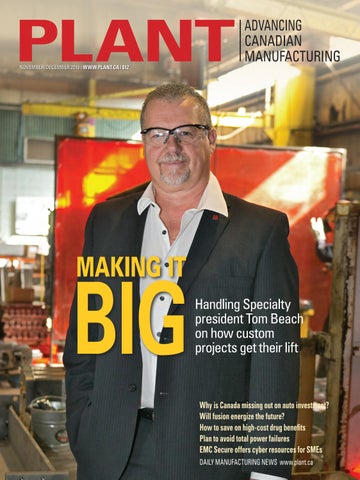
MAKING IT
BIG
Handling Specialty president Tom Beach on how custom projects get their lift
Why is Canada missing out on auto investment? Will fusion energize the future? How to save on high-cost drug benefits Plan to avoid total power failures EMC Secure offers cyber resources for SMEs DAILY MANUFACTURING NEWS www.plant.ca
PLT_NovDec_2018_issue_AMS.indd 1
2018-11-29 9:52 AM
SPECIAL
LIMITED TIME
OFFER
WHAT DO YOU NEED TO MEASURE? FLIR delivers world-class thermal cameras and test & measurement tools with the accuracy, reliability, and versatility you need to tackle your most challenging jobs.
BONUS BUYS
Visit flir.ca/promos
PLT_JulyAug_Flir.indd PLT_NovDec_2018_issue_AMS.indd 1 2 Annex Print 9(W) x 12(H) (Bleed .25 W&H).indd 1
2018-07-25 2018-11-29 11:14 9:52 AM AM 7/24/2018 1:47:05 PM
5 11:14 AM 1:47:05 PM
CONTENTS
November/December 2018 Vol. 77, No. 08
FEATURES 15 MAINTENANCE Put a solid structure in place that aligns with corporate goals. TECH TIP Watch for damage to electrical components from high vibration. 17 THINK LEAN Build your brand with tools that improve processes. 19 IMPAIRMENT Resources for dealing with recreational pot issues. 21 PERFORMANCE Asking and answering as effective training. 24 SECURITY EMC offers cybersecurity resources to SMEs.
10 MATERIAL HANDLING
When it comes to custom lift technology, Handling Specialty thinks big and does “big.”
25 EXPORTS Key characteristics of successful exporters. 26 SUCCESS Zombie companies are dragging down productivity. 27 AUTOMATION Machines will be handling more tasks than humans by 2025.
DEPARTMENTS 18 CCOHS SAFETY TIPS Legalized cannabis: address the safety issues.
20 BENEFITS Tighter controls on drug benefits will trim your plan costs.
22 AUTOMOTIVE Canada is missing out on investment. Why?
28 CLEAN TECH General Fusion is paving the way for fusion energy.
4 Editorial 6 News Bulletins 7 Careers 8 PLANT Online 9 Economy PLANT Pulse 29 Tech Centre Feature: How to avoid total power failures. Supply Lines 30 Leading Edge: Innovative ideas for plants 32 Products and Equipment 33 Plantware Events 34 Postscript
Cover: Alexei Quintero
PLANT—established 1941, is published 8 times per year by Annex Business Media. Publications Mail Agreement #40065710. Circulation email: blao@annexbusinessmedia.com Tel: 416442-5600, ext 3552 Fax: 416-510-6875 or 416-442-2191 Mail: 111 Gordon Baker Road, Suite 400, Toronto, ON M2H 3R1. Occasionally, PLANT will mail information on behalf of industry-related groups whose products and services we believe may be of interest to you. If you prefer not to receive this information, please contact our circulation department in any of the four ways listed above. Annex Privacy Officer: privacy@annexbusinessmedia.com Tel: 800-668-2374. No part of the editorial content of this publication may be reprinted without the publisher’s written permission. ©2018 Annex Publishing & Printing Inc. All rights reserved. Performance claims for products listed in this issue are made by contributing manufacturers and agencies. PLANT receives unsolicited materials including letters to the editor, press releases, promotional items and images from time to time. PLANT, its affiliates and assignees may use, reproduce, publish, re-publish, distribute, store and archive such unsolicited submissions in whole or in part in any form or medium whatsoever, without compensation of any sort. This statement does not apply to materials/pitches submitted by freelance writers, photographers or illustrators in accordance with known industry practices. Printed in Canada. ISSN: 1929-6606 (Print), 1929-6614 (Online).
www.plant.ca
PLT_NovDec_2018_issue_AMS.indd 3
PLANT 3
2018-11-29 9:52 AM
EDITORIAL
Buckle up for 2019
A
nother year is drawing to a close and it has been a bit of a wild ride. US president Donald Trump continued alienating US allies while exercising his protectionist proclivities with trade wars and tariffs, all of it punctuated by an endless stream of inflammatory, witless tweets. NAFTA negotiations were a roller coaster affair pitting rude America First intransigence against polite Canadian resolve not to give in to a terrible trade deal while enduring the insult of steel and aluminum tariffs based on the dubious proposition that Canada represents a security threat. With all of these factors in play, it’s little wonder Canadian manufacturers are less confident than last year about their business prospects, according to details from the PLANT Manufacturers’ Outlook 2019 survey. The full survey and executive roundtable report won’t be officially released until the New Year, but we can offer a glimpse at some of the details. They show how 501 manufacturing executives from small, medium and large operations see the upcoming year in terms of confidence, growth, investment, advanced technology, risk, innovation and issues such as cybersecurity. Although 2018 was a pretty good year for Canada economically, executives show a marked decrease in their confidence moving forward. Those truly confident about 2019 account for 30% of respondents, down from 44% in 2018 with much of the gap filled by those who are concerned (18%). Looking ahead three years, confidence continues to tumble. There’s much about next year and beyond that gives pause, but Canadian manufacturers have proved to be resilient through challenging times. Looking at the Outlook results, three areas stand out. With all the risks so evident in today’s business environment, you’d think more companies would get ahead of them by having a management strategy in place, yet 35% rarely – or do not – conduct an assessment, while 37% do so only occasionally. What they should do is integrate a risk management strategy across their enterprises that regularly looks at current risks, future risks, and how to mitigate them, then test their strategies to ensure they’re still relevant. Engaging technology to improve productivity is key to competitive advantage. Yet technology integration wasn’t a concern for 37% of respondents, and no wonder: 43% collect data manually for analysis and review, while 8% don’t collect any data. Only 7% are taking advantage of the Industrial Internet of Things, 32% are unfamiliar with its capabilities and an astonishing 31% say it’s not applicable. Since your adversaries are adopting smart and advanced technologies, there’s nothing smart about not doing so. Canada didn’t gain much, if anything, from the USMCA but it has altered our relationship with the US. America is no longer a trusted trade partner. Trump has signalled he will try to use the national security ploy to secure trade quotas in other areas, so don’t be surprised if softwood planks become a danger to US national security. Message received. Diversify your markets beyond North America. Granted, venturing “out there” represents a significant challenge for smaller companies. There are plenty of resources available to get you on the export track, but be sure to check out the Trade Accelerator Program (https://wtctoronto. com), the Export Excellence winner at this year’s Ontario Export Awards. This six-week program provides SMEs from across Canada with a comprehensive education program that connects them with the right contacts and resources. We’re coming off a year of decent economic growth but prospects for the next couple of years are less stellar. Ditto for the US, which will see the benefits of tax reform wind down as the downside of tariffs and bellicosity ramp up. Stay tuned for interesting times to come.
Publisher Jeff Brownlee 416-277-8428 jbrownlee@annexbusinessmedia.com Editor Joe Terrett 416-442-5600 ext. 3219 jterrett@plant.ca Art Director Andrea M. Smith National Account Manager Ilana Fawcett 416-510-5202 ifawcett@plant.ca Account Coordinator Debbie Smith 416-442-5600 ext 3221 dsmith@annexbusinessmedia.com Annex Business Media Vice President/Executive Publisher Tim Dimopoulos (416) 510-5100 tdimopoulos@annexbusinessmedia.com President & CEO Mike Fredericks Circulation Manager Beata Olechnowicz 416-442-5600 ext. 3543 bolechnowicz@annexbusinessmedia.com Subscription Price Canada $74.50 per year, US $151.50 (US) per year, Foregin $171.00 (US) per year. Single Copy Canada $12.00. Add applicable taxes to all rates. Combined, expanded or premium issues, which count as two subscription issues. Mailing Address Annex Business Media 111 Gordon Baker Road, Suite 400 Toronto, ON M2H 3R1 Circulation Bona Lao 416-442-5600 ext. 3552 blao@annexbusinessmedia.com Fax: 416-510-6875 or 416-442-2191
Joe Terrett, Editor Comments? E-mail jterrett@plant.ca.
4 PLANT
PLT_NovDec_2018_issue_AMS.indd 4
November/December 2018
2018-11-29 9:52 AM
PLT_Nov
© 2018 Penske. All Rights Reserved.
With remote diagnostics, we not only know if there’s a problem with your engine, we know from 900 kilometers away. By monitoring vehicle data, we can help you make reliable, informed decisions, getting you back on the road quickly — and keeping you there. It’s how we deliver confidence. Learn more at gopenske.ca.
PLT_NovDec_Penske.indd 1 PLT_NovDec_2018_issue_AMS.indd 5
2018-11-19 2018-11-29 12:08 9:52 AM PM
NEWS BULLETINS Nestlé’s Purina subsidiary is closing its Mississauga, Ont. plant and costing 87 workers their jobs. The pet food manufacturer is moving its operations to the US in 2019. The announcement came three days before a new round of contract negotiations were to begin with members of Unifor Local 41-O. The union intends to fight the closure with political and consumer pressure. Viterra, an agricultural processor based in Regina, has acquired full ownership of Pacific Coast Canola, an oilseed processing facility located in Warden, Wa. Viterra intends to fully integrate the facility into its network and will be implementing the Viterra brand across the business. The Pacific Coast facility is the largest expeller-press processor in North America, producing canola oils to meet demand from food manufacturers and distributors. Wajax Corp., an industrial products and services company in Mississauga, Ont., has acquired Montreal-based Groupe Delom Inc., a specialist in the maintenance and repair of critical electromechanical and rotating equipment for continuous process industries. Purchase price was $51.8 million. Delom has six branches across Eastern Canada and employs more than 350 people. Precision BioLogic Inc., a developer of hemostasis diagnostic products in Dartmouth, NS, has acquired Affinity Biologicals Inc., a manufacturer in Ancaster, Ont. of reagents and kits used in hemostasis and thrombosis research and diagnostics. Both companies will focus on their regular operations while developing longer-term strategic plans under the Precision BioLogic umbrella. Calian Group Ltd. has acquired IntraGrain Technologies Inc., a growing Canadian AgTech firm delivering advanced technology to the agriculture market. Based in Regina, IntraGrain makes the BIN-SENSE grain storage system. It combines IoT connectivity with bin sensors to protect grain quality and eliminate the risk of stored grain spoilage. IntraGrain will report into Calian’s Saskatoon-based Systems Engineering Division, a manufacturing partner.
6 PLANT
PLT_NovDec_2018_issue_AMS.indd 6
Magna has the Edge on seating Second J.D. Power win for SUV category AURORA, Ont. — Magna International has shown it has an edge when to comes to automotive seating. The J.D. Power 2018 Seat Quality and Satisfaction Study has recognized the global auto Award-winning seating system. PHOTO: MAGNA parts supplier based in Aurora, Ont. with an award in the midsize/large SUV category for having the highest ranking for seats that go into the Ford Edge. It’s the second consecutive year Edge seats have ranked highest in the category. Consumers reported an average of only 3.6 problems per 100 cars sold in 2018, an improvement from last year’s top ranking at 5.8. Magna manufactures the complete Ford Edge seat system at its Mississauga Seating Systems plant in Ontario. Approximately 400 employees work at the plant, which also produces seats for the Ford Flex, Lincoln MKX and Lincoln MKT. The Mississauga team credits the award to a rigorous, cross-functional approach to developing and making seats. J.D. Power is a marketing research company based in Costa Mesa, Calif.
$1.9M funding for 4D LABS BURNABY, BC — Simon Fraser University’s 4D LABS has received more than $1.9 million from the federal government for its new Centre for Advanced Manufacturing and Integration (CAMI). Its state-of-the-art machinery will help prototype and manufacture advanced micro and nanotechnologies. Sectors benefitting from this technology include information and communication technology, energy, healthcare, transportation and security. 4D LABS’ state-of-the-art fabrication and characterization facilities are available to academic, industrial and government researchers. Technical staff provide users with training and fee-for-hire services in nanofabrication, nano-imaging and laboratory for advanced spectroscopy and imaging research (LASIR).
INOAC guilty plea concludes auto parts bid-rigging case OTTAWA , Ont.— Japanese car parts manufacturer INOAC Corp. was ordered to pay $1.3 million for its role in an international bid-rigging conspiracy, after pleading guilty before the Ontario Superior Court of Justice. A Competition Bureau investigation determined INOAC entered into illegal agreements with a competing Japanese parts manufacturer. In 2004, the companies conspired to determine who would win certain calls for bids issued by Toyota for plastic interior car parts. The parts were used in Toyota Corollas manufactured and sold in Canada between 2008 and 2014. INOAC’s guilty plea concluded the Bureau’s investigation into a series of international bid-rigging conspiracies among car parts suppliers. The investigations led to 13 guilty pleas and fines totalling more than $86 million, including three of the largest bid-rigging fines ever imposed by the courts in Canada: $30 million (Yazaki Corp.), $13.4 million (Mitsubishi Electric) and $13 million (Showa Corp.).
350 bus deal for Nova Five-year deal with Maryland Transit
Forty-foot clean diesel bus.
PLATTSBURGH, NY — Nova Bus has won the Maryland Transit Administration’s bid to supply city buses to the Baltimore region’s public transport system. The bus manufacturer, based in Saint-Eustache, Que., said the five-year contract provides for the delivery of 70 buses per year for a total of 350 clean
PHOTO: NOVA BUS
diesel buses. The order includes 310 forty-foot Nova LFS and 40 sixty-foot LFS Artic articulated buses. These buses will be built at the Nova Bus factory in Plattsburgh, NY. Delivery is to start in the fall of 2019 and will continue through the end of 2024. No financial details were provided.
November/December 2018
2018-11-29 9:52 AM
VMAC hosts future manufacturers Compressed air plant opens to 24 local high schoolers
Dover Bay students on tour at VMAC. PHOTO: VMAC
NANAIMO, BC — October was Manufacturing Month presented by Canadian Manufacturers & Exporters (CME) and VMAC got into the spirit by hosting 24 students from Dover Bay High School. The manufacturer of mobile compressed air technology in Nanaimo, BC took the students through the production areas, including the assembly area, foundry, engineering and the custom shop. Canadian manufacturing employs 1.73 million people and contributes 10.4% to Canada’s GDP. On a provincial level, WorkBC predicts 54,946 manufacturing job openings in BC between 2017 and 2027.
Additive scholarships for Humber students TORONTO — Cimetrix Solutions is investing in Humber College students with a scholarship available over five years for students demonstrating a proven understanding of advanced manufacturing and automation applications related to Industry 4.0 practices. The additive manufacturing company based in Oshawa, Ont. is donating $10,000 per year for the scholarships. Cimetrix will be the lead partner for additive manufacturing in Humber’s Advanced Manufacturing Skills Consortium. Industry partners working with the college will train students and employees of Canadian companies at the new Barrett Centre for Technology Innovation (Barrett CTI). The company has also donated equipment worth $300,000 and will host industry specific forums to enhance awareness of Industry 4.0 additive manufacturing applications.
www.plant.ca
PLT_NovDec_2018_issue_AMS.indd 7
Cannabis firm expands into Oregon VANCOUVER — C21 Investments Inc. is acquiring Swell Companies Ltd., an extractor, manufacturer and distributor of THC and CBD products. Swell has more than 50 of its branded raw oil, encapsulate and vaporizer products available in more than 275 licensed retail locations across Oregon. C21 Investments, a vertically integrated cannabis company based in Vancouver, said Swell’s Portland processing facility will handle as much as 5,000 pounds of raw material a month. This translates into 220,000 to 270,000 grams of processed high-quality oil-based extracts per month, making Swell one of the largest processing groups in Oregon. A new state of the art facility located in Bend, Ore. will be operational in December adding further capacity to process 1,200 pounds of raw material per month that will deliver an additional 65,000 grams of extracts. The deal not only expands C21 Investments presence in the US, it wll also expand markets for Swell’s vapes and edibles. In other cannabis news, High Tide Inc.’s wholly-owned subsidiary, RGR Canada Inc., has received its largest ever wholesale purchase order for smoking accessories from Aurora Cannabis Inc. Aurora, based in Edmonton, is purchasing bubblers, grinders, hand pipes, hemp wicks, sherlocks, vaporizers and water pipes. High Tide, based in Calgary, has begun manufacturing the accessories. Established in late 2010, RGR Canada makes more than 3,000 different smoking accessories and lifestyle products as well as distributing more than 1,000 other SKUs from around the world.
OPG Stem partner on energy Storage system manage electricity costs
Stem energy storage system.
TORONTO — Stem Inc. and Ontario Power Generation (OPG) are partnering on advanced energy storage systems they claim will assist the province’s manufacturers manage electricity costs. Stem, based in Millbrae, Calif., brings Athena, its AI-driven energy storage system, to the table. In-
PHOTO: STEM
stalled onsite, it optimizes the timing of energy use to reduce onsite peak demand and enables manufacturers to access additional market opportunities via Stem’s network. Stem has installed (or has under contract) 900 energy storage systems across six US states, Ontario and Japan.
CAREERS DIRTT Environmental Solutions Ltd., an interior construction company that uses technology for client-driven design and manufacturing, has appointed Kevin O’Meara Kevin O’Meara CEO. O’Meara was a co-founder of Builders FirstSource, a manufacturer of structural building products. DIRTT’s manufacturing facilities are located in Phoenix, Ariz., Savannah, Ga., Kelowna, BC and Calgary. JP Bouchard, vice-president of General Bearing Service Inc., has joined the Power Transmission Distributors Association (PTDA) board as second vice-president. General Bearing Service is an Ottawa-based supplier of bearings and power transmission products. PTDA is the Chicago-based global association for the industrial power transmission/ motion control distribution channel. EHC Global (EHC) has appointed Bill King customer service and inside sales manager for North America. He joined EHC in 1994 as a production technician. Most recently he was service supervisor for the Western Region. EHC, based in Oshawa, Ont., manufactures parts and lift components for escalators, elevators and moving walks. Colin Osborne has been promoted to president and COO of Samuel, Son & Co. Ltd., a metals distributor and industrial products manufacturer based in Burlington, Ont. He’s responsible for Samuel’s operations, manufacturing, purchasing and commercial activities, along with oversight for the company’s corporate functions. Prior to joining Samuel in 2015, he was president and CEO of Vicwest. CellCube Energy Storage Systems Inc., a manufacturer of energy storage for the power industry in Toronto, has added Bruno Arnold to its board. Arnold is an international financier and real estate developer. E-mail appointments, promotions, retirements and other career changes to jterrett@plant.ca.
PLANT 7
2018-11-29 9:52 AM
NEWS
Solo gets a partner
Swedish sawmills added to Canfor assets
Will promote single-person vehicle VANCOUVER — Electra Meccanica Vehicles Corp. is expanding its reach with the help of professional services firm The Meriwether Group LLC in Portland, Ore. The Vancouver-based manufacturer of the single-passenger SOLO EV recently launched the vehicle in Southern California and is opening a dealership/showroom in the Studio City suburb of Los Angeles with plans for expansion up the West Coast. “Our SOLO single-passenger electric vehicle is a revolutionary advancement in commuting and we’re partnering with the Meriwether Group to focus on developing innovative opportunities for expansion and growth from Los Angeles northward,” said Jerry Kroll, Electra Meccanica’s CEO. Priced at US$15,500, the SOLO features many of the comforts found in a regular sedan such as
One of two SOLO EVs that 7-Eleven will use to make deliveries PHOTO: ELECTRA MECCANICA in Vancouver.
air conditioning, heated seats, backup camera and Bluetooth radio. The automaker is also developing the Tofino, a two-seater electric roadster. Electra Meccanica sources parts and components from India and China, and then assembles the vehicles in Vancouver.
PLANT ONLINE SOUNDING OFF
What readers have to say about breaking news Have you checked out PLANT’s daily news online? Here are some headlines that have inspired members of the Canadian manufacturing community to chime in. They’re edited, but use the links to see the raw — and for some — longer versions of their remarks plus the stories that inspired their reactions. Stay up-to-date on the developments — domestic and global — that affect Canada’s industrial sectors by watching the news feed at www. plant.ca or reading PLANT’s twice-weekly newsletter (hit Subscribe on the website).
member state is part of the EU under a single economy.
Trudeau’s wrong-headed approach to climate change http://www.plant.ca/Xcpuz Domestic natural gas supply is already under stress due to the oil sands and its energy intensive bitumen upgraders. Converting the nation to natural gas will be an expensive, half-assed solution driving up natural gas prices. I also profoundly disagree with your argument that Trudeau is pitting “Canadians against Canadians” ... What he is doing is accepting our obligations to our planet, and doing so in a way that doesn’t disadvantage the poorest of Canadians. And
Cancelling cap and trade will result in $3B in lost revenue: FAO [UPDATED] http://www.plant.ca/55ebk “…result in $3B in lost revenue.” Revenue? When did this become revenue? It’s clear most Liberals are liars when they talk about the carbon tax (in whatever progressive form) being revenue neutral.
8 PLANT
PLT_NovDec_2018_issue_AMS.indd 8
yes, people will face the costs of this tax. It isn’t going to be easy, but I can’t imagine what it would be like 50 years from now if we didn’t do our part today. There is no easy solution to climate change. Canada open to growing trade with China now USMCA is a done deal: PM http://www.plant.ca/qIlmb You guys keep forgetting the EU is the second largest economy in the world. Not China. We don’t rank individual states in the US, but rather group them as the US. Europe is no different as each
Worker caught in extruder, Uponor fined $80,000 http://www.plant.ca/ELskx Ugh! That is not enough of a fine. This is a disgrace to justice. God bless this worker and his family.
http://www.plant.ca/55ebk Weed sales will recover this loss, although we will likely need three times as much when the potheads turn into the Walking Dead!
VANCOUVER — Canfor Corp. is purchasing 70% of the VIDA Group, Sweden’s largest privately owned sawmill company, for $580 million. Canfor, an integrated forest products company based in Vancouver, said the current ownership holds the remaining 30% and will continue to manage the day-to-day business. VIDA operates nine sawmills in southern Sweden with an annual capacity of 1.1 billion board feet. All of the sawmills produce spruce and pine products. The company also has nine value-added facilities that include premium packaging, modular housing, industrial products and energy.
Raucous crowd hears Ford, Kenney rail against carbon tax at Calgary rally http://www.plant.ca/8aNDl No annual wage increases to cover annual inflation costs for employees = NO disposable income or savings = no more money left for an additional tax. Cut the cost of government first – find the “efficiencies ” in all departments, plus cut back on social welfare grants to corporations. It’s not the 1980s when there was wage growth, today wages are stagnant for the private sector! The only sector that has annual wage increases is the public sector. They can pay any new taxes! AP FACT CHECK: Trump fudges history on black vote, drug cost http://www.plant.ca/fGymR The only time Trump will surprise me is if he says something that’s actually, factually, undeniably true. The man believes the words that come out of his mouth are the only truth. Problem is he spent so much time fabricating his own dream world, he’s no longer able to distinguish [between] his made up reality and the rest of the world’s reality.
November/December 2018
2018-11-29 9:52 AM
ECONOMY
Trade confidence is high: HSBC Firms favour North America
FACTORY ENERGY USE RISES IN 2017
D
www.plant.ca
PLT_NovDec_2018_issue_AMS.indd 9
Canadian manufacturers consumed 2,172 petajoules of energy as part of the production process in 2017, up 1.8% from 2016, according to a Statistics Canada report. Top sources of power included natural gas (31.6%), electricity (28.6%), spent pulping liquor (11%), wood (8.2%) and other (20.6%). Top energy consumers were paper (26.1%), primary metal (23%), petroleum and coal products (14%) and chemical manufacturers (12.3%). Combined they accounted for 75.5% of consumed energy. Prior to 2011, electricity was the largest source of energy consumed by manufacturers, but natural gas has since grown at a faster pace. From 2009 to 2017, it rose by 21.8% while electricity consumption grew by 1.8%.
Natural gas
Electricity
Spent pulping liquor
Wood
All other combined
0
200
Source: Statistics Canada, CANSIM
400 petajoules
600
800
72%
85.5% Percentage of innovative manufacturers in Canada during 2015-2017, according to Statistics Canada. That’s an increase from almost 75% in 2010-2012.
Percentage of manufacturing tasks still performed by humans, according to new data from A.T. Kearney and Drishti.
$2.541B In-house R&D expenditures by foreign majority-owned affiliates in 2016, compared to $2.433 billion in 2015.
$29B
Revenue growth for robots used in manufacturing (2027) from $218 million in 2018, according to ABI Research. The newest trend is mobile robots working with robotic arms.
IMAGE CREDITS: ADOBE
espite all the protectionist bravado from the Trump administration with its tariffs, trade wars and America First rhetoric, North American businesses are nonetheless pumped about international trade opportunities, according to HSBC’s latest Navigator Survey. This despite the survey being fielded before the framework for the United States-Mexico-Canada Trade Agreement (USMCA) was settled. However, the survey shows firms in the US, Canada and Mexico are more interested in doing business within the region. The Canadian subsidiary of the international bank attributes this preference for the North American to ongoing uncertainty arising from trade negotiations happening around the world. Canadian firms see growth opportunities in the US (46%, a 10% increase) and Mexico (15%). US firms identified Canada (28%) and Mexico (13%) as their top markets for growth with an eight percentage point increase in interest for Canada. And Mexican firms are looking to the US (45%) and Canada (34%) for growth with strong increases in interest for both markets. Nearly half (46%) of US and Canadian businesses felt NAFTA will help their business in the next three years. Businesses in Mexico were most optimistic at 58%. Here are other key findings for companies in Canada: • More expect US-China trade uncertainty to have a positive near-term impact on their businesses. • 68% believe key trading partner countries are becoming more protective of domestic businesses – around five percentage points higher than the global average. • 72% are using data to optimize performance. Operational and transactional data (each used by 47%) were the most common. Many firms also intend to invest in developing key skills within their workforces and in productivity growth. Download the report at www.business.hsbc.com/trade-navigator.
5X
The difference in labour productivity of the most productive manufacturing plants in real value-added per worker as of 2015, compared to others. A Statistics Canada long-run productivity dispersion report shows the difference as 3.2% in 1973 and 3.6% in 1990. Top performing plants are more likely to belong to a foreign multi-national, export, and perform R&D inhouse or purchase it.
PLANT 9
2018-11-29 9:52 AM
MATERIAL HANDLING
MAKING IT
BIG
HANDLING SPECIALTY’S VALUE PROPOSITION Custom engineering and manufacturing puts the lift into demanding applications. BY KIM LAUDRUM
B
ig things are happening at Handling Specialty Manufacturing Ltd., for more than 50 years a solutions provider and manufacturer of custom engineered lift equipment in Ontario’s Niagara region. Ever wonder how Lockheed Martin welders gain access to all sides and elevations of the F-35 Joint Strike Fighter wings in the manufacturing bay? Handling Specialty built them a vertical assembly station with smooth, synchronized motion to move workers, tools and equipment on platforms up and down and around a static wing. That lift has a capacity to hold 15,000 pounds. Handling Specialty custom engineered, manufactured and installed one of the world’s largest underwater stage systems for Cirque du Soleil’s groundbreaking Las Vegas show O, another example of the kind of lifting, titling, rotating and traversing equipment the company builds. The stage surface area is 3,650 square feet. Lift capacity? One million pounds. “Our motto is: ‘We build big
10 PLANT
PLT_NovDec_2018_issue_AMS.indd 10
things to help our customers build big things,’” Tom Beach, Handling Specialty’s president told PLANT during a tour of the company’s two facilities in Hamilton and Grimsby. Since 1963 Handling Specialty has earned a reputation for providing unique, custom-engineered material handling and industrial automation systems for demanding applications. It has attracted big-name manufacturers in aerospace and defence, automotive, energy, entertainment, rail/transportation, process industries, and advanced manufacturing. Clients include Royal Caribbean Cruise Lines, Cirque du Soleil, Disney, Boeing, Bombardier Transportation, Rolls Royce, Pratt & Whitney, Lockheed Martin, Raytheon, GE Aviation and NASA. When Beach joined the outfit 34 years ago there were eight employees and annual revenues were $1.5 million. In July 2011 Handling Specialty was sold to overhead crane manufacturer Whiting Corp., parent company of Whiting Equipment Canada
Left: Welding specialist focuses on critical weldments. Centre: A large weldment begins for a Cruise ship’s underwater stage system. Right: Final assembly begins with the lift of the main structure to the test cell.
November/December 2018
2018-11-29 9:52 AM
Tom Beach (centre) joins members of the assembly team in front of a large weldment overhead lift event at the Hamilton PHOTOS: SILVANA METALLO plant.
Inc. Beach remained as president after the sale. Today, annual revenues are $27.5 million and there are 125 employees at the two locations. The Grimsby plant, where the head office is located, is 28,000 square feet, but they’ve outgrown it. Now the manufacturer leases an 80,000 square-foot former Stelco facility from the Hamilton Port Authority. This is where the large-scale projects and those requiring large open test areas are managed.
AGVs drive growth Beach attributes part of the company’s strong growth in the past four or five years to funding they received from the federal Industrial Research Assistance Program (IRAP) to develop technology that “steers machines and makes them intelligent and even automatic.” Although automatic guided vehicles (AGV) have been around since the 1980s, their sales sagged for some time. But he says AGV and robot sales numbers “are off the charts,” because many manufacturers are returning to North America and investing in technology to make them more competitive on a global scale.
www.plant.ca
PLT_NovDec_2018_issue_AMS.indd 11
PLANT 11
2018-11-29 9:52 AM
“At one point we would just lift up the cars, heavy vehicles, combines or heavy engines. But now (with AGVs) we lift them, transport them, tell the computer where they are, when they need lubrication, and how long it will be before equipment failure,” Beach says. “It’s really about how creative the mind can be taking these technologies to another level.” For example, you’ll see lots of little AGVs zinging and zooming around Amazon or other big warehouses. “But we play in big things, like one airplane or one tractor,” he says. “With these large-scale AGVs you deliver heavy materials to an assembly line. It has become affordable and quite honestly, an excellent return on investment for our customers. So we will lift the equipment and be part of the work cell, but we also deliver parts or equipment automatically. [As a result], we’ve seen significant growth.” The manufacturer is about to make it even bigger thanks to General Electric Co.’s distributed power unit moving its engine factory from Wisconsin to nearby Welland, Ont. In August 2016 GE broke ground on its “brilliant factory,” which will use machines embedded with sensors and connected to the Industrial Internet of Things (IIoT) that will collect data and stream it to the cloud for analysis. That data would be used for continuous improvement and faster prototyping and commercialization of parts. The project is expected to employ 220 people at the new 450,000 square-foot facility. The initial phase of the factory investment is worth $165 million. In June 2018, the project changed hands. Advent International purchased GE’s distributed power unit for US$3.2 billion. Handling Specialty has already delivered several pieces of equipment to the Welland factory, part of a $13 million deal the manufacturer landed with the energy behemoth. Massive four-post engine lifts, rotators, personnel lifts and manually
12 PLANT
PLT_NovDec_2018_issue_AMS.indd 12
Welding and assembly specialist takes the time to check drawings during fit up.
Millwrights put the final touches on a lifting apparatus for aircraft engine test cells.
Connecting the equipment to a shipping jig.
guided vehicles will help GE’s distributed power division make and assemble large-scale reciprocating gas engines. The equipment ergonomically accommodates the people working on the engines: a rotator lifts and spins the engine around eliminating the need for an overhead crane. “We also have an order in for two Boeing projects. Our customers tend to be high profile. This stuff isn’t cheap. We’re getting orders in the millions more often now, which means we have an appreciation for large cap ex (capital expenditure) budgets,” Beach notes.
Big budgets With larger clients and higher budgets come more global locations. He returned recently from Bangkok where the company is providing equipment to Bombardier Transportation and Bangkok Transportation. And thanks to the GE Welland deal they found themselves in Jenback, Austria where there is another GE engine plant. Opportunities for exports are growing. High capital expenditure projects in foreign countries do not come without risk. Fortunately for Handling Specialty, Export Development
Canada (EDC) provides export credit insurance, among other things, to help mitigate that risk. “Without a doubt, we wouldn’t be able to do what we do without EDC backing,” Beach says. Canada having an export credit agency turned out to be a significant factor in GE’s decision to locate its brilliant factory in Welland. Dithering in Congress over funding a similar agency to help manufacturers in the US has been cited as a frustration that led GE to move to Canada. Beach says EDC funding is also helping others in the supply chain, including those who are subcontracted to do various types of machining for projects, which is all part of the brilliant factory’s multiplier effect. He highlights the company’s supply chain as integral to the process. “We have a whole separate heartbeat going on. We have report cards that are sent to suppliers every month. They’re visited on a regular basis. We have been doing work with them for so long that there are great partnerships.” Finished parts come to Handling Specialty for final assembly. “We put it together, we make it work, we put the controls on it and we test that whole thing out.” Assembly and welding are the main operations at the Hamilton plant, while painting steel parts is the primary function at the Grimsby plant. Beach says there isn’t much need for lean manufacturing when doing customized, one-off projects. But he stresses the need to be aware of how lean affects clients, particularly when helping them design manufacturing cells. “When you make prototype equipment, an inherent part of that business is that you make errors. You correct them and that becomes wisdom,” Beach says. “So when someone comes to us, I like to tell them, ‘Listen, we’ve already made that mistake, and that one, and that one. So, you’re going to be the beneficiary of the wisdom we gained from that mistake made years ago.’” Handling Specialty has a team
November/December 2018
2018-11-29 9:52 AM
PLT_Nov
T:9”
“A CHILEAN COMPANY CALLED FOR 30,000 BRAKE PADS, WITH NO DEPOSIT.
T:12”
I SAID, WHY PUT THE BRAKES ON NOW?”
RISK DOESN’T STOP YOU WHEN YOU’RE WITH EDC. At Export Development Canada, we’re the international risk experts. Whether you manufacture car parts or design software, we’ll help you take your business to new markets, with confidence. Together, let’s take on the world. edc.ca/risk-experts
PLT_Nov_ExportDevCan.indd 1 PLT_NovDec_2018_issue_AMS.indd 13
2018-11-08 9:52 2018-11-29 9:20 AM AM
of professional sales people who meet with potential clients to discuss their needs. Their engineers look at solutions, and the team analyzes the project to assess the risk factors (a template for estimating includes a cell for risk assessment). “We even have an index we can use, so if it’s a very difficult welding or automation project (for example), we’ll score it a different way,” Beach explains.
“There is a process where all the managers in the company who report to me will do an assessment and give a mark or score, then it comes to my desk before we quote it. Our sales team is good at measuring. If something is outside the box or on the edge, I’ll get the call. Then I’ll lean on my top level engineering people to find out how the mathematics look. We’re very team-driven with our risk assessment.”
Every job quoted has to go through those steps before it gets signed and sent to a customer. “There is no way anything would go out without those risk assessments because we are dealing with such heavy and dangerous elements,” Beach says. “Not only for our customers, but for our manufacturing staff, too. And, of course, contractual-
Data Collector
Detect, Measure, Analyze
Ultrasound and Vibration
hůƚƌĂƐŽƵŶĚ ^ŽůƵƟŽŶƐ
sdtultrasound.com/sdt340 14 PLT_NovDec_SDTCanada.indd PLANT 1
PLT_NovDec_2018_issue_AMS.indd 14
Scalable Multi-technology Multi-platform
UAS4.0
Analysis Software
2018-10-02 1:50 PM
ly – reliability and uptime – we don’t want failures, we don’t want phone calls, we don’t want litigation. In this business, you have to be very, very good at saying no.” He shares a story about being contacted to build stage structures for an entertainment event.
Going Gaga “It was a concert for Lady Gaga. And you want to do it. The entertainment business is exciting because there is a buzz about it. But it was too dangerous. And the timeline was really short. So the wrong thing to do would be to get excited, and say, ‘Don’t worry. We’ll work tons of overtime. We’ll get it done. This is awesome. We’re going to work with Lady Gaga.’ But then you would have made a mess of projects for other high-end customers.” Beach says steel tariffs have affected the company but not as much as one would think. “I don’t immediately pay 30% to 40% more for the steel. But there is a consequential effect, so if we are buying motors or drives or components from the US that have steel as part of the raw material, then yeah, we’ll see a smidgeon with that.” He prefers to focus on what he can change. The same day steel and aluminum tariffs were announced, Handling Specialty received a purchase order. “What am I going to focus on? We’ll keep an eye on what’s generally going on around us for the purpose of looking out for a rock sticking out of the water. But, honestly, I’d rather us focus on ‘what can we do today to make us work better and land another order.’” It will probably be something big. Kim Laudrum is a Toronto-based business writer and regular contributor to PLANT. E-mail klaudrum@rogers.com. Comments? E-mail jterrett@plant.ca.
November/December 2018
2018-11-29 9:52 AM
MAINTENANCE City of Mississauga experience provides guidance for manufacturers. BY STEVE GAHBAUER
W
hether you are starting from square one or looking to upgrade a current strategy, creating or improving a maintenance system can be a huge undertaking with which many asset managers struggle. Keeping costs down and increasing profitability are challenges that can be costly without a solid maintenance structure. But it’s never too late to improve. Susan Lubell, president of the Plant Engineering and Maintenance Association of Canada (PEMAC), says a reliability and maintenance strategic plan guides continuous improvement that’s aligned with bottom line expectations for plant assets. You can also add re-engineered reliability-centred maintenance (RCM-R) to the mix. It provides standard-based guidance for determining failure modes, and RCM-R employs quantitative reliability methods, tailoring evidence-based decision-making whenever historical failure data is available. During a technical presentation at PEMAC’s 2017 MainTrain maintenance conference in Saskatoon, Nigel D’Souza, manager
Performing maintenance on bottling equipment.
Upgrade your
PHOTO: ADOBE
PLAN
ALIGN STRUCTURE WITH BOTTOM LINE GOALS
of asset and maintenance management for City of Mississauga in Ontario, noted most plants have implemented processes and tools for the collection of data to facilitate informed decision-making.
Tactical deployment Often they will seek best practices and measures to assist in deci-
sion-making or rely on technology to guide them. However, a gap in tactical deployment affects the connection to pre-emptive or follow-up actions needed to derive true efficiency from equipment. In his presentation, An Asset Decision Framework for Optimal Value, D’Souza, also PEMAC’s Ontario chair, reviewed processes for establish-
TECH TIP
Bad vibrations Watch for electrical component damage
H
igh vibration affects more than mechanical components of an electric motor or generator. It also has an impact on electrical components, such as windings and cables. The impact becomes more serious as the insulation system ages or is exposed to temperature extremes from overheating or extreme cold. Connections to the inside of the box or passing through
www.plant.ca
PLT_NovDec_2018_issue_AMS.indd 15
High vibration can affect windings and PHOTO: ADOBE insulation. a conduit abrade against stationary components, causing them to wear. Embrittled windings experience
fractures in the insulation system, and the conductors move against contaminants and other conductors, leading to winding shorts. In effect, resistance to failure decreases with high vibration from unbalance, misalignment, the surrounding structure and other equipment. To guard against the effects of high vibration, ensure alignments are performed properly and equipment is balanced. Promptly investigate the cause of abnormal vibration. Files from MotorDoc LLC newsletters. Visit www.motordoc.org.
ing a system of alignment and the setting of priorities setting, drawing from the techniques employed for resiliency and risk management. City services are delivered through facilities such as recreation centres, libraries, works and maintenance yards, civic and heritage buildings, and transit terminals. Like any manufacturing operation, a municipality is expected to balance all revenue sources with expenses, which include overhead, maintenance and capital projects for renewals and expansion. Some decisions include whether to repair equipment rather than seek capital replacement. But business units with varying goals are rewarded differently. The planning group must have accurate project scoping and budget; the construction team is accountable for executing and completing a project within scope, time and budget; maintenance is responsible for routine checks, tune-ups and repairs, with the only unifying goal being accountability to the ratepayers and city council. Although there is a systematic process to identify and execute work, much falls to the wayside as political desires rather than needs are satisfied. Driving proper alignment is achieved by engaging all stakeholders – starting with the leadership – in identifying sensitivities that influence decisions. Criteria include building occupancy, service impacts, failures and regulatory requirements. Applying a risk matrix to this decision framework provides justification of recommendations. When the organization is aligned, how tactics are applied and decisions made becomes clearer. Decision-making in a business is typically rooted in financial performance, which is what stakeholders and investors value the most. However, there is much value in cost avoidance through efficiencies and other measures, brand strength, cus-
PLANT 15
2018-11-29 9:52 AM
tomer loyalty or perception, and employee retention. So define what your organization is sensitive to or what would cause a business reaction. In municipal government, positive perception from the citizens and elected officials is a fundamental criteria. Next up is determining how to measure or account for these sensitivities. The decision framework starts with organizing the asset portfolio in a manner that
permits obtaining needed information. The City of Mississauga established each service area, followed by the significance of the area, the specific facility and the assets. This allowed the review of information summarized at the top level. Some organizations are extremely data-focussed, collecting as much information as possible on everything imaginable, while others adopt a more
humble approach. There is an immense difference between data and information: data is recorded, stored and monitored; information is interpreted and used to make decisions. When identifying what information to collect, determine how it will be used, and does this help to achieve goals and align with objectives?’ Data confidence has a significant impact on decision-mak-
STAINLESS STEEL WITH CARBON STRENGTH
www.tsubaki.ca 16 PLANT
PLT_NovDec_2018_issue_AMS.indd 16
1-800-263-7088
ing. Mississauga found capital prioritization relied on a static software-driven model established almost 15 years ago. Most of the considerations were either not relevant or no longer existed.
Best options To evaluate the best option for asset investment, the city chose Net Present Value (NPV) to compare anticipated outcomes and evaluate some concise scenarios for considering options. They include repair, replacement-in-kind and replacement with new technology that considers the total life cycle cost of each option in today’s dollars. Life cycle costs are purchase/design, installation/ commissioning and operational/ maintenance costs. Identifying lifetime operating and maintenance requirements are extrapolated through existing information. This includes reviewing and identifying the preventive maintenance schedule and all associated costs, including internal labour rates and materials. Renewal costs are obtained through historical records or through verification of current budgetary pricing with service providers. Decommissioning and disposal costs are estimated with assistance from the service provider. Establishing this framework was key to forming governance and in aligning the organization; it also provided a common baseline for interpreting information being communicated to all teams. Now the City of Mississauga has a better way of transparently identifying and prioritizing projects. Empirical data allows for better decision-making and a better understanding of the impacts of those decisions. Steve Gahbauer is an engineer, a Toronto-based business writer and a regular contributing editor. E-mail gahbauer55@ gmail.com. Comments? E-mail jterrett@plant.ca.
November/December 2018
2018-11-29 9:52 AM
THINK LEAN Build velocity and increase your value to the customer. BY RICHARD KUNST
Y
our company has identified a product or service that the world needs. Initially you put in countless hours and lots of energy, and you created a process. As demand increases, you add people, move to a larger location, but with the initial process still in place. Along comes a consultant who encourages you to adopt lean methodologies. What should you do? Well, start by understanding lean is not a cost reduction exercise. It’s about increasing velocity within your process while enhancing your brand image. Most manufacturers start and often stop with 5S, believing they’ve implemented lean, but what they’ve actually done is complete a huge house cleaning exercise. 5S is a lot about building your brand. Consider what kind of professional image you want your organization to project. Articulate this into quantifiable requirements such as colour, font size and the “no tape” rule where reminders written on plain paper and taped to walls, doors or workstations are forbidden. Building your brand image reflects the respect your people and process deserve. The environment surrounding your process should be inviting and professional. This will engage your employees to act professionally and make them proud to be part of the team. A disorganized work area says professional standards are not required. As you implement 5S, look at how your workplace reduces walking distance and repetitive reach (two steps is five feet and reaching 30 inches is 0.6 seconds each time). Adoption of lean methodology is about opening capacity, particularly if you approach 5S implementation with “eyes for flow” and “eyes for waste.” Most
www.plant.ca
PLT_NovDec_2018_issue_AMS.indd 17
Kanban provides visual authorization.
PHOTO: ADOBE
Build your
BRAND
…WITH TOOLS THAT IMPROVE YOUR PLANT’S PROCESSES
manufacturers are focused on cost reductions, equating them with less head count. In most cases adding people or re-allocating resources significantly improves process velocity, enhances customer delight and could become a significant competitive differentiator. At a large RV dealership, employees blamed the OEM for poor quality and the response to any customer was two weeks, because that was perceived as the industry standard. Minor process modifications could dramatically improve throughput velocity and increase business exponentially. Yet, when they’re making so much money, there’s no burning platform to spur change. If you do not have a burning platform (urgent need to change) to stimulate action, create one. Sometimes the vision may not be immediately evident, but it will become clearer with progress.
Focusing on velocity and lean methodologies makes sense, but it’s very important to respect your people and provide feedback constantly.
Opening capacity Run boards stimulate the competitiveness within each employee as they strive to meet hourly targets or exceed them. And daily management report-outs allow employees to share disturbances to flow experienced over the previous 24 hours, as well as express concerns about potential issues in the coming 24 hours. Kanban provides a visual authorization to produce, replenish or retrieve. A kanban at the finished goods level fuels the production kanban. Typically there’s a 30% reduction in finished goods inventory while improving machine uptime. Why? Because employees know the process and can optimize it.
Of course reflections are mandatory for success, whether in real time (supervisors), daily (management report-outs) or monthly (four month, check, do, act, plan). It’s from here the richness of enhancing your lean deployment comes. Many focus on the implementation and forget to take time to get “on” the business because it seems like too much fun being “in” the business. Finally, an effective lean program comes with lots of checklists and many white boards. Checklists act as an alarm to wake up employees if something is not correct, and prompts them to rectify the situation – very much like error proofing a process. Employees use whiteboards to give real-time feedback, which they trust and believe in more than any computer generated metric. Ultimately, lean is a reflection of your business. How is it looking? Richard Kunst is president and CEO of Cambridge, Ont.-based Kunst Solutions Corp., which helps companies become more agile, develop evolutionary management and implement lean solutions. Visit www. kunstsolutions.com. E-mail rkunst@kunstartofsolutions. com. Comments? E-mail jterrett@plant.ca.
PLANT 17
2018-11-29 9:52 AM
CCOHS SAFETY TIPS Work with the health and safety committee to update policies that address the risk PHOTO: ADOBE of impairment.
Put policies and procedures in place to keep everyone safe.
W
hat does the legalization of recreational cannabis in Canada (as of Oct. 17) mean for manufacturers? The key issue is impairment. Review policies and procedures because, regardless of the source, impairment affects focus, judgment and the ability to do jobs safely. Legalization of cannabis use may not change existing policies and procedures, but it provides an opportunity to ensure they address both therapeutic and recreational use of the drug. Cannabis laws vary by jurisdiction. Each province and territory has the ability to set its own rules, including the legal minimum age, where pot is purchased and where its use is allowed. Confirm which rules apply in your area. There are many potential causes of impairment including: the use of legal and illegal substances such as alcohol, cannabis, drugs (over the counter, prescription, illicit) and certain medications; as well as factors such as fatigue, life stresses and certain medical conditions. Like other sources of impairment, cannabis affects concentrating, thinking and decision-making. Coordination also suffers and reaction time slows
18 PLANT
PLT_NovDec_2018_issue_AMS.indd 18
Legalized
CANNABIS ADDRESS THE SAFETY AND ACCOMMODATION ISSUES down. This affects motor skills, including the ability to drive. It can also increase anxiety and trigger panic attacks. In some cases, it causes paranoia and hallucinations. When inhaling cannabis, the chemicals pass from the lungs into the blood, which carries them throughout the body and to the brain. Ingesting cannabis delays the effects because the chemicals must first pass through the digestive system.
Shared responsibility Health and safety is a responsibility shared by everyone. Employees must understand how impairment affects their safety and the safety of others. Employers are responsible for developing, implementing and monitoring hazard prevention programs, while managers and supervisors watch for signs of cannabis impairment and respond appropriately. Work with the health and
safety committee to create and implement a plan that identifies possible workplace hazards, including the impacts of possible impairment. The plan also covers appropriate corrective action to prevent incident or injuries. Workers are required under the Occupational Health and Safety Act to report hazards as they see them. Keep the focus general to ensure the policy is relevant to all sources of impairment and take a fitness-to-work approach. Also called fit-to-work, this assessment is done to ensure an employee can safely do a specific job or task. Elements of an effective policy include: • Defining impairment. • Addressing impairment from all causes. • Stating if the item is allowed on premise, and if so, under what circumstances. • Educating workers on policies, programs and support,
such as employee assistance programs (EAPs). • Training workers, supervisors and managers on how to identify signs of suspected impairment and respond appropriately. • Describing when accommodation will be considered (for example, workers with medical needs or disabilities). • Explaining how disciplinary actions will be conducted, when necessary. Assess each situation and determine its effect on the workplace, and whether there’s a need to fulfil your company’s duty to accommodate in terms of therapeutic use and disability due to substance dependence. Base accommodation on assistance from a medical assessment and collaboration with the employee. Testing typically reveals the presence of a substance, but not the level of impairment. Generally, human rights legislation does not support testing. Seek legal advice before doing so. Addressing potential impairment from cannabis is part of the workplace’s hazard assessment process. Reduce the potential impact by having the appropriate mechanisms in place, provide clear guidance to all stakeholders, and apply policies and programs fairly and consistently. The Canadian Centre for Occupational Health and Safety (CCOHS) in Hamilton contributed this article. CCOHS provides information, training, education, management systems and solutions that support health and safety programs and the prevention of injury and illness in the workplace. Visit www.ccohs.ca. Comments? E-mail jterrett@plant.ca.
November/December 2018
2018-11-29 9:52 AM
IMPAIRMENT
Establish policies that cover medical and recreational cannabis use.
PHOTO: ADOBE
Dealing with
POT
YOUR QUESTIONS ANSWERED Resources for manufacturers that prepare for this new reality. BY PLANT STAFF
R
ecreational use of cannabis is legal, which is heightening the focus on impairment in the workplace. This raises questions for smaller manufacturers who may be short on legal and human resources to deal with this issue. Business owners are asking: • Can cannabis be consumed on their premises? • What responsibility do they bear if an impaired employee or customer has an accident onsite? • Can they ask employees to submit to a drug test if they have safety concerns? The Canadian Federation of
Independent Business has developed a series of educational and workplace tools to help employers manage the change. CFIB has created a suite of tools, including a free webinar, a workplace drug and alcohol policy template and an online course for employers and employees on workplace impairment (www.cfib-fcei.ca/ en/cannabis-resources, online course excluded). On the safety side, the Canadian Centre for Occupational Health and Safety (CCOHS) offers easily deployable aids that will help navigate the workplace issues. CCOHS, the independent federal agency for the advancement of safe and healthy workplaces, has produced a helpful infographic (www.ccohs.ca/products/posters/impairment) for distribution via social networks or e-mail that can also be print-
ed as an 11- x 17-in. handout, or you can download a poster (www.ccohs.ca/products/ posters). It covers causes and the impact of impairment in the workplace, tips for employers, workers’ responsibilities and legal considerations. CCOHS has also produced a white paper titled, Workplace Strategies: Risk of Impairment from Cannabis (www.ccohs. ca/products/publications/ cannabis) that discusses the implications associated with the use of cannabis for both therapeutic and recreational purposes. It includes information and guidance for employers, workers and others interested in workplace health and safety. On the left coast, WorkSafeBC has launched an awareness campaign to educate employers and workers about impairment in the workplace. The Richmond, BC-based health and safety
Comments? E-mail jterrett@plant.ca.
Did you purchase polyether polyols, MDI, TDI or polyether polyol systems in Canada between 1999 and 2004? If so, you could be entitled to a payment from class action settlements totalling approximately $13.3 million. You can apply to receive a payment online at www.polyethersettlement.com no later than February 11, 2019. You are represented by Siskinds LLP. For more information, visit www.polyethersettlement.com, email polyether@ricepoint.com, or call 1-866-674-1760.
PLANT 19
www.plant.ca PLT_NovDec_ComputerShare.indd 1
PLT_NovDec_2018_issue_AMS.indd 19
organization notes employers’ responsibilities include: • Not allowing a worker who is impaired by alcohol, drugs, or any other substance to perform activities that endanger anyone. • Not allowing an impaired worker to remain at the workplace while his/her ability to work safely is impaired. Employers also need to make workers aware they’re responsible for showing up to work fit, (as in unimpaired) but to know enough to stop working if they are impaired for any reason, including reasons that are not related to drugs or alcohol, and to notify a supervisor. WorkSafeBC’s guide for managing workplace impairment and developing a policy is available at www.worksafebc. com (Forms & Resources).
2018-11-08 9:37 AM
2018-11-29 9:52 AM
BENEFITS Drug prices are putting a strain on company plans.
Data is key to creating mechanisms that will reduce drug benefit costs. PHOTO: ADOBE
BY STÉPHANIE MYNER-NHAM
K
eeping a tight grip on costs is more important than ever. One cost centre that can be better managed is the employee health benefit plan. According to a 2015 Glassdoor survey, three in five employees value their company-sponsored health plans more than any other benefit and Harvard Business Review reported 88% of employees ranked health insurance at the top. Manufacturing offers some of the best benefit packages. It’s partly due to higher rates of collective bargaining, but also the level of education and experience necessary for many of the jobs, as well as hazardous work conditions in some facilities that command stronger benefits packages to attract workers. The challenge is that Canada has the third highest drug prices among all OECD (Organisation for Economic Co-operation and Development) countries and drug costs are growing faster than any other component of healthcare, second only to hospitals. According to the 2017 Drug Trend Report from Express Scripts Canada, high-cost specialty medications, which make up 2% of total claims but account for more than 31% of total drug spending, increased by 6.5% in 2017. More widely prescribed non-specialty drugs have also risen in price, raising drug costs across the board. Balancing patient care and benefit affordability is top-ofmind for plan sponsors. So, what can employers do to sustain and improve their health benefit plans, in the face of rising drug costs? First, understand plan members’ health challenges. The 2018 Sanofi Canada Healthcare Survey found 59% of drug-plan members report they have a chronic disease or condition,
20 PLANT
PLT_NovDec_2018_issue_AMS.indd 20
The high cost of
DRUGS
SAVE WITH TIGHTER HEALTH BENEFIT CONTROLS yet plan sponsors estimated that number to be only 29%. That huge gap in awareness means companies aren’t targeting the heaviest users of the plan. That’s where the biggest cost savings can be found. In fact, according to the 2017 Drug Trend Report, just 20% of employees claim almost 80% of prescription drug costs from their employer plans. Their average annual drug spending is 15 times that of other claimants and they average 7.8 chronic conditions, 3.3 physicians and 8.9 medications. Understandably they struggle with the complexity of their treatments. Targeting these patients can ensure better health outcomes and have a dramatic effect on the bottom line, but it’s a complex task that involves analyzing data for trends, looking at a person’s prescription history, supporting patients
with information and digital tools to ensure adherence, and ultimately, suggesting lower cost alternatives.
Lower costs A comprehensively managed plan lowers costs and creates healthier outcomes using four main levers: • Formulary management. It opens access to superior medications while targeting high-cost therapies that offer no added clinical benefit. • Utilization management. Tools such as prior authorization and step therapy programs are examples of intelligent plan design that guide patients to safer, more effective drug choices using clinically based criteria. Plus, patients are increasingly willing to receive personalized health information. In the Sanofi survey, 66% of plan members said they would consent to
receive information on personal health issues based on their use of benefits. • Channel management. Leveraging a specific network of preferred pharmacies saves money by simplifying payment and adherence. Research shows patients who fill medications through a preferred provider are 15% to 25% more adherent compared to those who fill their prescriptions through other providers. Non-adherence is another way health costs rise, as patients experience increased disability, additional drug therapy and out-of-pocket and plan spending. The increase in absenteeism and loss of productivity all take a toll on the bottom line. • Health management. Patients with complex conditions such as cancer and cardiovascular disease need specialized care with better monitoring and supervision. According to the Sanofi survey, 84% of those with chronic diseases would like to know more about their condition and how to treat it, and 75% are interested in coaching from a pharmacist as a plan benefit. Pairing specialized pharmacies with enhanced digital health tools and better communication with patients offers a more holistic approach that better manages treatment complexity. Manufacturers are always facing rising costs. Managing them is a challenge. Applying tighter controls to employee benefits saves your company 10% to 15% just from drug expenditure costs. Stéphanie Myner-Nham is the director of human resources and corporate services with Express Scripts Canada, a provider of health benefits management services. Visit www. express-script.ca. Comments? E-mail jterrett@plant.ca.
November/December 2018
2018-11-29 9:52 AM
PERFORMANCE
Ask and
ANSWER
AN EFFECTIVE TECHNIQUE FOR LEARNING HOW TO IMPROVE Coaching cycles provide structure for addressing changing circumstances. BY HUGH ALLEY
I
n a recent interview, an industry leader nearing the end of his career said he wanted to share his knowledge with “new folks in the industry.” Many trainers have similar objectives, but is it the best way to go? Here’s the challenge. You and other experienced staff have accumulated a lot of knowledge, but there are two major limitations to sharing. First, it’s unlikely you have a systematic process to ensure the full breadth of your knowledge is transferred. Second, your knowledge doesn’t help learners figure out how to deal with new circumstances. It’s the same for trainers. If all they do is teach specific skills, how does the organization learn or improve? By teaching people how to ask and answer questions. Not that teaching skills isn’t
5 kata questions 1. What’s the target condition? 2. W hat’s the actual condition? 3. W hat obstacles are preventing reaching the target condition? 4. W hat’s the next step? What do you expect? 5. How quickly can we see what we have learned from taking that step? Source: Toyota Kata website
important. Someone starting out has a lot to learn and needs foundational skills. But once they’ve been trained and are executing correctly, new employees need to learn how to ask good questions and how to develop the answers. People who come after you will face issues and challenges you’ve never encountered or imagined.
Applying kata If you need a model, consider the work of Mike Rother and his colleagues (www-personal. umich.edu/~mrother/Homepage.html) who are exploring the concept of improvement and coaching cycles. They use the word “kata” – a Japanese term that means practice, routine or form. Anyone who practises martial arts knows the term. These cycles provide a proven structure for asking and answering questions (see 5 kata questions), even in very complex situations. It’s also a great way to develop your crew’s management skills and steadily improve performance. In a project last year using this model, a small team of front line staff learned how to ask and answer questions. After 12 weeks, there was a 46% reduction in customer wait times, and staff understood how to get hard data about their operations. Skill was demonstrated when one of the participants declined to draw a conclusion because there wasn’t enough data. Those skills will endure long after the project ends, which is a much better outcome than simply “sharing knowledge.”
A teaching moment.
Hugh Alley is an industrial engineer based in the Vancouver area who helps organizations achieve significant performance gains. Call (604) 866-
1502 or e-mail hughralley@ gmail.com. Comments? E-mail jterrett@plant.ca.
MURPHY MEANS
MORE More
QUALITY No One Gives You More! More than 14,000 systems sold over the past 75 years
N.R. MURPHY LTD. DUST COLLECTORS 430 Franklin Blvd., Cambridge, ON N1R 8G6 E-mail: 4nodust@nrmurphy.com
(519) 621-6210
www.nrmurphy.com
PLANT 21
www.plant.ca PLT_NovDec_NRMurphy.indd 1
PLT_NovDec_2018_issue_AMS.indd 21
PHOTO: FOTOLIA
2018-11-05 9:30 AM
2018-11-29 9:52 AM
AUTOMOTIVE Since 2006, 10 out of 16 bids for new auto plants went to Mexico and the rest to the Southern US. BY KIM LAUDRUM
C
anada, one of the top 10 car manufacturers in the world, is an attractive place for automotive vehicle and parts manufacturers to do business. Five big automakers – General Motors, Ford, Fiat Chrysler Automobiles (FCA), Honda and Toyota build more than 2 million vehicles here annually. It’s home to one of only five machine tool die and mould clusters in the world with a highly-skilled, highly-educated workforce, and there’s R&D expertise in advanced technology, innovation artificial intelligence (AI) and autonomous vehicles. Yet since 2006, 10 out of the 16 bids to build new automotive manufacturing plants in North America were won by Mexico, with the remaining six going to the Southern US, according to automotive sector guru Ray Tanguay’s report Drive to Win, prepared for the Canadian Automotive Partnership Council. Automotive industry pundits anticipate the trend will continue with investment numbers to be in the “record lows” when reports are released at the end of the year. This represents a lost opportunity for Canada. “There was a day when you could build an automotive manufacturing plant for $100 million. Now it costs $2 billion to $3 billion,” says Dennis DesRosiers, who has been a consultant to the industry for more than 48 years. Canada’s share of North American production has decreased from 17% in 2010 to 13% in 2016. Although parts and vehicle production has risen steadily since 2009 to nearly pre-recession levels, employment has not recovered the same way. Canada is no longer the lowest cost jurisdiction to build cars. This despite the fact Cana-
22 PLANT
PLT_NovDec_2018_issue_AMS.indd 22
Toyota announced in May a $1.4 billion investment in its Cambridge (north plant pictured) and Woodstock, Ont. facilities, plus $200 million in R&D over 10 years. Toyota’s Canadian operations will be home to the largest RAV4 hybrid production in North America. PHOTO: TOYOTA
Automotive
INVESTMENT
CANADA IS MISSING OUT. WHAT HAPPENED? da punches above its weight, producing 2.4 million vehicles annually. It’s the second largest export sector, contributing $86.4 billion to the economy, with more than 95% of the vehicles going to the US. Eleven assembly lines and 700 parts suppliers produce a vehicle every 13 seconds. Canada boasts some of the best quality plants in the world, receiving three out of 10 J.D. Power awards recognizing excellence in manufacturing.
Blame NAFTA The industry employs 126,900 people – 43,200 in assembly plants and 83,700 in automotive parts production, and Ontario is the second largest IT region in North America, leading innovation in electrical and autonomous vehicles. So, why is Canada losing out on billions of dollars of investment?
To some extent, blame NAFTA renegotiations and the threat of 25% tariffs on Canadian automotive exports to the US, says DesRosiers, principal of DesRosiers Automotive Consultants in Richmond Hill, Ont. “Everybody sits on their hands in this type of environment. Companies and senior executives hate uncertainty. They know what they want to do and they choose multiple locations that they study to death,” DesRosiers says. “But in the face of a threat of a tariff situation, they’ll just wait it out. They don’t invest for the short term. They invest for the long term.” The last two years have seen only $3.2 billion in new investments, arguably just enough to maintain the automotive footprint, not to expand it. These investments have been mainly for plant re-tooling or for R&D. American incentive programs
have played a large role in attracting dollars to southern US states, particularly when the Canadian dollar was strong (2012 to 2015). DesRosiers says subsidized energy costs gave Ontario a big advantage for many years. Today’s higher costs aren’t a huge factor because they represent only 2% to 3% of the cost per vehicle. Yet energy is a consideration that matters a lot when manufacturers’ scouts analyze locations for plants. Canada’s healthcare system was once thought to be equal to the big cheques Alabama and other states flashed. While American auto sector employers were paying for retirees’ health benefits, Canada enjoyed an advantage equal to $1,500 to $2,500 per vehicle. “That goes a long way to cover differences in our dollar, and taxes and so on,” DesRosiers says.
November/December 2018
2018-11-29 9:52 AM
But that all changed under Obamacare, when the onus for retiree health benefits switched from employers to a new federal system, unburdening American manufacturers. The arrival of the assembly plants led to an expansion of the supply chains in the Southern US and Mexico along with the infrastructure to support further large-scale investments. “If you look at the Linamars and the Magnas of the world they have significant assets in Mexico and the south US because they’re incredibly innovative companies, first-class in terms of their technologies and their competitiveness. They’ve got to be close to the
tax treatment that’s changed and made it very competitive is the immediate write off of capital investment.” For Canada, he calls for tax write offs for investments in new technology or equipment to offset that tax advantage in the US (which the Trudeau government addresses in its fall economic update).
Attract investment Governments could do more to lower regulatory compliance costs, too. Myers notes Ontario Premier Rob Ford has said he wants to eliminate the province’s carbon tax. “Carbon tax is a very important part of doing business. I wouldn’t necessarily focus on
is applicable to more than the carbon tax – how we can incent investment and how we can achieve these objectives.” Myers touts the advantages offered by the advanced manufacturing supercluster, which fosters innovation, along with federal and provincial funding support for initiatives, as very important for attracting business investment.” Examples include the Automated Vehicle Network Partnership with the Automotive Parts Manufacturers’ Association, AI initiatives with federal government funding, and similar initiatives made possible with Quebec and Ontario resources as “important for companies to leverage” to attract further investment. He recommends a shift in perspective. “The auto sector is changing in terms of the product, the process and the materials it’s using. I don’t think Canada should be aiming to
attract the kind of auto investments taking place in the 1990s or the 2000s. We need to attract investments for the auto sector of the future.” He has a point, which is brought into sharp focus by the announced closure of GM’s Oshawa, Ont. plant. It was among five plants (four in the US) caught in a restructuring as the automaker shifts its attention to autonomous and electric vehicles. More than 14,000 jobs will be lost although others with the required technology skills will be hired. If this is the future, Canada’s auto industry needs to figure out how it fits in. Kim Laudrum is a Toronto-based business writer and regular contributor to PLANT. E-mail klaudrum@rogers.com. Comments? E-mail jterrett@plant.ca.
A TRAY SOLUTION FOR ANY OCCASION The 2018 RAV4 on the Woodstock production line.
market. The market is where the assembly plants have gone and the assembly plants in the South continue to grow.” That said, these firms could go anywhere for the best in technology and research. When it comes to AI or materials research, much of that leading worldwide expertise is here, says Jayson Myers, CEO of Next Generation Manufacturing Canada, an auto sector supercluster working with such firms as Linamar, Martinrea and Magna International. “But we have to be competitive with the rest of the world.” To attract more automotive money, Myers suggests revamping the tax treatment of investments. “One aspect of US
PHOTO: TOYOTA
LAPP’s tray-rated cables play a critical role in a variety of industries and operating environments. No matter your application, we have a tray solution for you.
the carbon tax itself, I would focus on the regulatory structure that we have in Canada around environmental regulations and product regulations where you have a very top heavy regulatory structure,” he says. “The cost of regulatory compliance is a major concern when we’re talking about attracting investment.” Investment is driven by the cost of operations, Myers says. “Increasing the cost of operating in Canada, you are actually detracting from the ability of companies to invest in some of the technologies they need to compete, but to do things like reduce emissions and improve environmental management. We have to rethink – and this
POWER & CONTROL SERVO & VFD
UNITRONIC® DATA COMMUNICATION
ETHERLINE® INDUSTRIAL ETHERNET lappusa.lappgroup.com/tray-cables.html
PLANT 23
www.plant.ca PLT_NovDec_LAPP.indd 1
PLT_NovDec_2018_issue_AMS.indd 23
ÖLFLEX®
2018-11-22 2:51 PM
2018-11-29 9:52 AM
SECURITY
Are you
SECURE? Nobody is under the radar.
PHOTO: ADOBE
EMC OFFERS SMEs CYBERSECURITY RESOURCES
Consortium members now have access to a leading technology platform.
You're ready. We're set. Let's move.
M
Single Source Motion Control Solutions
Your move? Factory of the Future Complete motion control solutions - from Mechatronics, Conveyance, Assembly Handling, and Tightening Systems, to Linear and Electrical Drives and Controls Technology Rely on Bosch Rexroth, the world leader in drive and motion control technologies that power today’s most advanced manufacturing systems. Our automation solutions drive your manufacturing performance with fast throughput, precision, repeatable efficient motion control with maximum uptime. We’re set to help you achieve this with the industry’s most advanced conveyor technologies, electric drives and controls, linear motion components and systems, as well as production tools and tightening systems. All equipped for fast changeovers, and ready for Industry 4.0. Smarter, more productive automation starts with the right technology. Make your move to Rexroth’s motion control solutions today. We Move. You Win!
Order your free Factory Automation Resource Kit: www.boschrexroth.ca/factoryautokit For expert advice call 1-855-REXROTH (739-7684) or email us at info@boschrexroth.ca
180903 BR Industry 4.0 Half-Page Ad for Plant Magazine_5.875x7.875.indd 1
24 PLT_NovDec_Bosch.indd PLANT 1
PLT_NovDec_2018_issue_AMS.indd 24
2018-09-20 10:18 AM 2018-10-22 9:16 AM
anufacturers concerned about their cybersecurity but need help addressing the issue can tap into a program specifically designed for small and medium-sized companies. “Too often we see manufacturers believing they have taken the right precautions, but are actually quite exposed,” says Scott McNeil-Smith, national director of programs and partnerships, and cybersecurity program lead for the Excellence in Manufacturing Consortium (EMC). “Small and medium-sized firms who think they’re ‘under the radar’ and even larger industries with onsite IT management are finding holes in the boat.” In 2017, 28% of medium and 19% of small businesses in Canada experienced cyber incidents resulting in an average of 24 and 22 hours of downtime respectively. The average cost of a cyber breach in Canada was $6.11 million in 2017. EMC, partnering with N-Dimension Solutions, have put together the EMC Secure program that will provide more than 13,000 consortium members with access to the cybersecurity provider’s technology platform. “The resources and solutions N-Dimension is providing fills a critical need our members have been seeking by providing cybersecurity visibility, intelligence and remediation guidance. Their proven experience within industry and
November/December 2018
2018-11-29 9:52 AM
energy sectors, as well as a deep cybersecurity expertise, fulfils the growing need to protect and strengthen both IT and industrial networks,” says Al Diggins, chairman of the non-profit EMC, which provides manufacturers with resources that will help them excel.
Protect yourself EMC, based in Owen Sound, Ont., cites the increasing use of automation, advanced manufacturing processes and IoT connecting industry with both customer and supply chains for the need for manufacturers to be protected. “Manufacturers across Canada (and globally) are more connected today than ever before,” says Shawn Casemore, president of EMC. “With data from ERP systems and equipment being held in the cloud, and the continued growth of online commerce and advanced technologies, our members are highly vulnerable. The EMC Secure program provides our members the protection and support they deserve to avoid disruption and risks to
their businesses.” Launched in 2015, the N-Sentinel platform has been installed in a number of critical infrastructure sectors including electric utilities, water utilities and manufacturing. EMC said it will expand N-Sentinel’s availability throughout Canada and enable manufacturers to effectively address their cybersecurity risks and challenges. As part of the program launch, EMC and N-Dimension have arranged for consortium members to test-drive the platform for 60 days, at no cost. The program is available in all provinces and territories, coastto-coast. For more information or to access the EMC Secure program for manufacturers and the N-Sentinel cybersecurity technology platform, visit www. emccanada.org/emcsecure. N-Dimension is based in Richmond Hill, Ont. with US headquarters in Delray Beach, Fla.
A POWERFUL COMBINATION OF
RELIABILITY, DURABILITY AND PERFORMANCE Sullair LS Series Air Compressors
EXPERIENCE THE SULLAIR DIFFERENCE IN
ONE HARDWORKING PACKAGE
Comments? E-mail jterrett@plant.ca.
RELIABILITY including
EXPORTS
the full-color, easy-access Sullair Touch Screen controller
Thinking of exporting? Here are some key success factors
N
ow that Canada, the US and Mexico have settled on the USMCA to replace NAFTA after a lot of hubbub, manufacturers are reminded of the need to look beyond North America for business opportunities. International agreements with Europe (CETA) and Pacific economies (CPTPP) offer new markets for adventurous entrepreneurs. Thinking of venturing into international markets? The not-for-profit Forum for International Trade Training (FITT) in Ottawa offers some good advice for manufacturers looking at exporting in its Trade Ready blog. Here are key success factors: • Products and/or services are successful domestically. • A solid domestic business plan
with proven effectiveness. • Specific advantages over the competition. • Products and/or services are unique in one or more ways. • Products and/or services are competitively priced. • Willing to invest time, people and capital for a period of time without return. Entry into new markets may require two or three years of effort before showing a profit. • Sensitive to and aware of the cultural differences of doing business in other countries. Check out the article, 7 characteristics of successful exporters, by Nicole Chevrier for some great advice on preparation as well as human, financial and production resources at www.tradeready.ca (published Nov. 11).
DURABILITY including the patent-pending, new generation Sullair air end PERFORMANCE including highly efficient Electronic Spiral Valve technology Find your local authorized Sullair distributor today at
© 2018 Sullair, LLC. All rights reserved.
PLANT 25
www.plant.ca 016085_Sullair_MRO Ad_3.875x11.indd 1 PLT_Sept_Sullair.indd 1
PLT_NovDec_2018_issue_AMS.indd 25
SULLAIR.COM
8/15/18 10:01 2018-08-27 1:50 AM PM
2018-11-29 9:52 AM
SUCCESS Practise five essential behaviours for long-term success.
C
anadian businesses aren’t acting fast enough to adapt to change, says a Deloitte Canada report. The infinite organization: Realizing lasting success studied more than 700 Canadian businesses, analyzing their future-focused attitudes and practices and found complacency is holding them back. “Business is changing – and what it takes for Canadian companies to succeed is also changing. This report points to a new reality, which is attitudes and behaviours that made companies successful in the past will not be the best or most reliable predictors for success in the future,” says Duncan Sinclair, chair, Deloitte Canada and Chile. “More concerning – while 55% of Canadian companies believe that they’re positioned for lasting success, our analysis found that few in fact are.” The study shows 16% of public companies (including manufacturers) on the TSX and TSXV are considered to be “zombie” companies. That’s 60% higher than the global average of 10%. Walking dead companies are defined by the OECD as 10 years and older with earnings that aren’t high enough to cover the interest payments on their debts, yet they manage to survive. Deloitte says that puts many Canadian businesses in a vulnerable position when it comes to economic shocks and technological disruption. But they’re also a drag on productivity because they divert capital and talent away from more productive firms, while hindering the ability of younger, more dynamic businesses to grow. The advisory firm identified five essential behaviours cited by successful companies: • Be clear about the company’s purpose and ensure everyone knows it. Use purpose to drive innovation, foster a strong
26 PLANT
PLT_NovDec_2018_issue_AMS.indd 26
Zombie companies are diverting capital and talent from more productive firms.
PHOTO: ADOBE
Beware the walking
DEAD
ZOMBIE COMPANIES ARE A DRAG ON NATIONAL PRODUCTIVITY
work culture, and shape decisions. • Use change as an opportunity to experiment, win fast, fail quickly, learn and grow. • Play the long game but make small bets on new opportunities as they arise; both require overcoming uncertainty to make the tough calls. • Invest in your people as a competitive advantage, and use analytics to truly understand your customers and anticipate their needs. • Embrace opportunities to col-
laborate globally with customers, vendors and governments.
Short on investing Deloitte says Canadian companies perform well in some of these areas and poorly in others. More than half (57%) of the respondents reported they had a clear purpose beyond simply making money, but they fall short in investing with a view to the long term with only 20% putting money into products and services that won’t come to market for at least a year. Only
3.6% export and just 19% have processes in place to test and scale innovations. Just 37% are heavily investing resources in developing talent and less than half (45%) are investing heavily in the technology they believe will help them get ahead. Deloitte LLP is the Canadian member of Deloitte Touche Tohmatsu Ltd. Visit www.canada175.ca for a pdf of the report. Comments? E-mail jterrett@plant.ca.
November/December 2018
2018-11-29 9:52 AM
AUTOMATION
March of the
MACHINES THEY’LL HANDLE MORE TASKS THAN HUMANS BY 2025 But robots will create 58 million new jobs in the next five years.
A
utomation and algorithms are going to move more tasks from humans to machines, creating a seismic shift in the way the two work together, according to new research from the World Economic Forum (WEF). The report says machines will perform more than half of current workplace tasks by 2025,
compared to 29% today. More than 75 million jobs will be displaced but 133 million new ones will be created. However, countries and companies must prepare for the upheaval. Roles that will experience increasing demand across all industries are data analysts and scientists, software and applications developers, and ecommerce and social media specialists. Roles that leverage human
Many companies expect automation to shrink their full-time workforces by 2022. PHOTO: ADOBE
skills such as sales and marketing, innovation and customer service will experience increasing demand. Redundant jobs include routine-based white-collar roles, such as data entry clerks, accounting and payroll clerks. While nearly 50% of all companies expect automation to shrink their full-time workforces by 2022, almost 40% expect to extend their workforces and more than a quarter expect automation to create new roles. The Future of Jobs 2018
report by the international think tank based in Cologny-Geneva, Switzerland covers more than 300 global companies from a wide range of industry sectors, including manufacturers and industrial processors. Responses represent more than 15 million employees from 20 developed and emerging economies. Download the report at http:// reports.weforum.org/futureof-jobs-2018. Comments? E-mail jterrett@plant.ca.
RETHINK MFG. WITH CREFORM FLOW RACKS
Creform flow racks. A simple, yet effective way to ensure that manufacturing runs at peak performance. Built for ergonomics, efficiency and FIFO inventory management, each incorporates flow lanes and levels to present containers and parts at assembly stations, machine loading points and for other material handling applications. When used in combination with workstations, carts and AGVs, Creform flow racks are an integral part of the systems approach to industrial material handling. Create other economical, flexible, reliable structures and AGVs. ®
WORKSTATIONS
FLOW RACKS WITH PLACON ® ROLLER CONVEYORS CRE-451MDX 8x5.375.indd 1
www.plant.ca PLT_NovDec_Creform.indd Plant_March_Creform.indd 11
PLT_NovDec_2018_issue_AMS.indd 27
CARTS
AGVs
w w w. c r e f o r m . c o m • 8 0 0 - 8 3 9 - 8 8 2 3 1/28/16 2:55 PM
PLANT 27
2018-11-14 10:43 9:17 AM 2016-01-29
2018-11-29 9:52 AM
CLEAN TECH BC innovator powers emissions-free electricity. BY PLANT STAFF
T
he global temperature is rising as a result of greenhouse gases generated by human activity. Thirty-seven percent of those emissions are coming from the generation of electricity, most directly from coal, natural gas and oil, says the World Nuclear Association. Earth’s human population is to reach almost 9 billion by 2040, and demand for electricity is expected to increase by 43% over the next 20 years, according to a United Nations intergovernmental panel. So the world needs more emissions-free electricity and a Canadian clean tech company is developing a technology that, if successful, would dramatically alter its production. General Fusion has picked up a $43 million investment from the federal government to develop a first-of-its-kind, largescale prototype plant to produce electricity from fusion energy. Founded in 2002, the company currently employs more than 70 people in Burnaby, BC and is the only Canadian company working on commercializing the technology. How does it work? Fusion technology applies the same process that powers the sun: two lighter atomic nuclei combining to form a heavier nucleus while releasing energy. Fusion reactors generally use hydrogen isotopes (deuterium and tritium) to create confined
General Fusion’s PI3 plasma injector.
PHOTO: GENERAL FUSION
Fusion
ENERGY PAVING THE WAY FOR COMMERCIALIZATION
plasma of millions of degrees using, in General Fusion’s case, magnetic methods to produce energy. The company’s PI3 plasma injector, preceded by 18 increasingly sophisticated machines over the past decade, went into action in December 2017, generating its first plasma. “This is an important milestone for the company, successfully translating the knowledge gained and technology devel-
oped from over 150,000 plasma experiments into a machine that is of a comparable scale to what is needed for commercial fusion power plant,” said CEO Chris Mowry at the time.
Fusion reaction Plasma fuel is delivered into a compression chamber where it’s rapidly heated to ignition conditions, releasing energy. It’s much like a diesel engine, but
HOW IT WORKS
Molten lead-lithium.
28 PLANT
PLT_NovDec_2018_issue_AMS.indd 28
PHOTO: GENERAL FUSION
General Fusion’s magnetized target fusion system uses a sphere filled with molten lead-lithium that’s pumped to form a vortex. A pulse of magnetically confined plasma fuel is then injected into the vortex. An array of pistons drive a pressure wave into the centre of the sphere, compressing the plasma to fusion conditions. This process is repeated as the heat from the reaction is captured in the liquid metal and used to generate electricity via a steam turbine. Source: General Fusion
the hydrogen fuel coming out of the injector is 5 million degrees C and will be heated by compression to 150 million degrees C, the temperature required for plasma to burn in a fusion reaction. The company says fusion energy has been proven in laboratories, where closely contained reactions release energy from superheated hydrogen gas. There are no carbon dioxide emissions and the process does not produce high-level nuclear waste. According to the International Atomic Energy Agency, if there’s a failure, fusion reactors automatically come to a halt within a few seconds, and produce no harmful effects. General Fusion will invest at least $150 million in research and development with the potential for more than $250 million in additional investment for the construction of a demonstration plant. The project would be power plant size to confirm commercial viability, minus the complexity. Successfully commercialized, fusion energy has the potential to safely provide carbon-free and competitively priced electricity, on demand, anywhere in the world. Comments? E-mail jterrett@plant.ca.
November/December 2018
2018-11-29 9:52 AM
TECHCENTRE MAINTENANCE
SUPPLY LINES
Create a living program that’s monitored regularly.
NEW CHANNEL PARTNER
BY STEVE GAHBAUER
T
here’s a gap in most maintenance and reliability plans: the electrical power system. Yes, maintenance is done and technicians recognize that electrical systems are critical, but important questions need to be asked: • What powers the most critical plant assets? • Where is budgeting directed for electrical maintenance? • Do you fully understand the electrical system? • Are you overloading the system? • Is the electrical equipment properly rated? • What changes have been done since commissioning? The answers are vital because power failures can cripple a plant at enormous cost. Proper and effective power system maintenance was addressed at the MainTrain maintenance conference, convened by the Plant Engineering and Maintenance Association of Canada (PEMAC). Paul Baker, president, and Kerry Heid, manager of technical services, both with Shermco Industries Canada Inc. in Regina, delivered a paper on the basics of electrical systems and their maintenance. Shermco provides engineering and technical services for electric power systems, maintenance and commissioning for utilities, industrial plants, mining and pipelines. “Remember a fully functioning electrical maintenance plan is not as simple as setting up some testing tasks and intervals, and then walking away. Things change, electric fault current changes as the utility becomes more robust. A maintenance plan needs to be a living program that’s regularly moni-
www.plant.ca
PLT_NovDec_2018_issue_AMS.indd 29
Carrying out an effective electrical system maintenance plan.
Total power
PHOTO: ADOBE
FAILURES AVOID THEM WITH A ‘LIVING’ LIABILITY PLAN tored,” says Baker, who is also president of PEMAC’s Saskatoon Chapter and co-chair of the MainTrain committee.
Cascading damage Major components of electrical power systems include: transformers, circuit breakers, switches, cables, motor control centres, capacitors, reactors, battery systems and emergency generators. A catastrophic failure in any of these major components usually results in cascading damage. An arc flash blast, for example, will severely damage a single piece of equipment that has failed, but also many of the components around it. This means major downtime and worker safety is compromised, so begin with an arc flash and protection coordination study. Baker emphasizes the importance of understanding the P-F
curve. It illustrates how equipment fails and how early detection saves time and money. The P identifies a potential failure. For instance, vibration or heat indicates a functional failure is imminent. F is the point where the asset fails to perform one or more of its key functions. If you can find a P and determine the time between the P and the F, the P-F curve will help asset owners understand the right inspection method to detect a potential failure early. This allows for planning and scheduling of the proper corrective action. Some of the common tests that are recommended for major components include: • Transformers: test insulation resistance. • Circuit breakers, relays and trip units: test relays, insulation and contact resistance to
Endress+Hauser welcomes an independent electrical distributor in Quebec as its authorized channel partner. Lumen will provide its process automation customers Endress+Hauser’s measurement technology with the Rockwell Automation platform. The partnership with Rockwell focuses around tools for integration, plant-wide advanced diagnostics and helping customers manage process system lifecycles. Endress+Hauser supplies process measurement and instrumentation based in Burlington, Ont.
ONSITE ADD-ON Librestream Technologies Inc. has expanded its Onsight augmented reality service platform with Onsight Flow, an enterprise-grade digital work instruction solution. This digital alternative to traditional workflows replaces paper processes in the field. It captures machine, time and geometric data to provide critical information on asset and operational performance. Deploy Flow on wearables for hands-free operation or on the smartphones and tablets used by workers. Librestream, based in Winnipeg, develops digital transformation technology.
REAL-TIME SAFETY DATA DuPont Sustainable Solutions, a consulting services firm, is partnering with Guardhat, an industrial safety technology company based in Detroit that develops wearables, infrastructure and software platforms. The companies will supply advanced, scaleable solutions that provide actionable, real-time data to better safeguard employees. DuPont Sustainable Solutions is based in Wilmington, Del.
PLANT 29
2018-11-29 9:52 AM
LEADING EDGE determine levels of degradation. • Switches: test insulation and contact resistance to determine levels of degradation. • Cables: Try to make a cable fail. The newest and most accurate test is partial discharge. Baker also draws attention to hidden failures. They’ve already occurred and under normal operating circumstances go unnoticed until another failure occurs. For example, company XYZ had the protective relays on its 13.8 kV power system calibrated each year, but didn’t maintain or test the circuit breakers because they were new and never operated. But an underground feeder cable failed several months after a maintenance shutdown and the fault cascaded through six circuit breakers before it was cleared. But it was thought the fault lay in the protective relays not being properly calibrated, but upon inspection their indicators showed they had operated. It was determinedthat because the operating mechanisms were so dry from lack of lubricant, the opening coils burned up and destroyed their enclosures. The intense heat burned the ceramic in the arc extinguishers; all cable terminations and insulations were destroyed; metal inside the circuit breaker was vaporized or melted; and the switchgear had to be replaced. Costs in addition to equipment replacement included those related to production downtime and lost revenue. There are industry standards and guidelines available to help with a maintenance plan. CSA Z463 deals with electrical systems, and ANSI/ NETA MTS are specifications for maintenance and testing. In addition, there are some new technologies available that will help identify potential problems. What’s the takeaway for maintenance pros? Treat electrical systems with the same care as mechanical systems.
Innovative ideas for plants
3D PRODUCTION BOOST
Large parts, quick turnaround
Burloak Technologies is taking delivery of an EBAM 110 system from Sciaky Inc. in July 2019 that will allow the additive manufacturing specialist in Dundas, Ont. to produce large-scale titanium structural parts in days. “Using traditional subtractive processes, such as forging and machining, the production of titanium parts of this size could take one year while generating a significant amount of waste,” said Peter Adams, co-founder and president of Burloak Technologies, a division of Samuel, Son and Co. Ltd. Sciaky’s metal 3D printing system produces parts ranging from 8 in. (203 mm) to 19 ft. (5.79 m) in length. Electron beam additive manufacturing is also the fastest deposition process in the metal additive manufacturing market, with gross rates ranging from 7 to 25 lb. (3.18 to 11.34 kg) of metal per hour. Burloak Technologies produces parts for a range of industries including space, aerospace, defense, energy, medical, automotive and transportation. Sciaky Inc., a Chicago-based subsidiary of Phillips Service Industries Inc., makes metal additive manufacturing systems. https://burloaktech.com
Scans 30 sheets per minute.
Steve Gahbauer is an engineer, a Toronto-based business writer and a regular contributing editor. E-mail gahbauer55@gmail.com.
Sciaky’s EBAM 110 system, on the way to Burloak Technologies.
EASILY DIGITIZE DOCS WITH SCANSNAP
Connects to your favourite cloud service
PHOTO: FUJITSU
Manufacturers with a lot of paper documents piling up in the office or on the shop floor can easily digitize them with Fujitsu Canada Inc.’s new colour ScanSnap iX1500 scanner. It converts most office documents into PDFs, searchable PDFs, Word and Excel documents that are sent to desktops, network folders or a cloud service. This compact unit automatically detects page size, colour, blank pages and page orientation, scanning 30 sheets per minute in colour-duplex mode. ScanSnap Cloud also connects to your favourite service – without a computer or mobile device – to manage documents, receipts, business cards and photos. Fujitsu Canada has eight offices across Canada. www.fujitsu.com
Comments? E-mail jterrett@plant.ca.
30 PLANT
PLT_NovDec_2018_issue_AMS.indd 30
November/December 2018
2018-11-29 9:52 AM
INDUSTRIAL IOT ON THE RISE
Making data more central to business An IFS study shows industrial outfits are making significant year-over-year gains in Internet of Things (IoT) use. The enterprise software company (Canadian offices in Waterloo, Ont. and Toronto) polled 200 North American executives representing manufacturing, trade contractors and energy companies. It found they’re collecting more data from connected devices, integrating it with other systems in new ways, and making IoT data more central to their businesses. Here are some highlights: • Companies collecting IoT data on entire work cells or production lines rather than individual machine components or individual machines has increased by 17%. • Monitoring customer equipment saw a 10% increase, potentially signalling transformational approaches to field service management. • Those who have integrated IoT data streams with their ERP software hovers at just 16%. Download the results at www.ifsworld.com.
Wider range of data collected.
PHOTO: ADOBE
SAFETY EYEWEAR , INDUSTRIAL STYLE
Mavericks look cool and they’re recyclable
PHOTO: SCIATY
Safety chic.
IOT NETWORKS FOR THE AUTO INDUSTRY
Partnership will provide services, support Behr Technologies Inc. in Toronto, worldwide licensee of the MIOTY LPWAN solutions for the Industrial Internet of Things (IIoT) market, is partnering with Counsel Group
Improving production efficiency.
www.plant.ca
PLT_NovDec_2018_issue_AMS.indd 31
Frankfurt (CGF), an international provider of on-site IT counselling services and support. They’ll be helping automakers around the world improve production efficiency with robust, scalable and cost-efficient private IoT networks. CGF’S IT counsellors will be the single point-of-contact for
PHOTO: ADOBE
PHOTO: KIMBERLY-CLARK PROFESSIONAL
ordering, configuring and installing MIOTY, and providing all on-site operational service and support. The new commercial standard in LPWAN technology includes: • Factory-wide sensors that monitor and control conditions for processes such as painting and fluid filling. • Wearables and external sensors that transmit workers’ health status and working conditions. • Embedded sensors that continuously track assets and equipment for condition-based monitoring and predictive maintenance. • Sub-meters capturing energy consumption data at different factory areas to identify sources of wasted power. www.behrtechnologies.com
Safety eyewear for the plant tends to look industrial. Maverick Eye Protection made by Kimberly-Clark Professional for its KleenGuard brand is industrial chic, and the eyeglasses are recyclable. Practical points include an anti-glare coating to reduce eye strain and fatigue; premium anti-fog and scratch protection; and comfort touch points to prevent slippage and reduce pressure. When workers are done with them, the eyeglasses enter the RightCycle Program to be converted into consumer goods. Kimberly-Clark Professional is a safety products company based in Roswell, Ga. www.kcprofessional.com/kleenguardpower
PLANT 31
2018-11-29 9:52 AM
PRODUCTS AND EQUIPMENT HOSES, TUBING HOSE FOR HIGH PRESSURE
Handles tight bends.
The Kurt Tuff 6,500-psi capacity hose from Kurt Hydraulics handles rugged, high-pressure applications. It uses less installation space because it bends twice as tight as standard SAE hose with half the bend radius. The hose, rated to 1 million impulse cycles, is reinforced internally with two braided layers of high tensile steel wire. It has an abrasion resistant outer cover and withstands temperatures from -40 up to 121 degrees C. Applications include large machinery and most heavy-duty hydraulic uses. Kurt Hydraulics, based in Lyman, Neb., is a manufacturer of hydraulic parts and assemblies. www.kurthydraulics.com
TUBING TACKLES TOUGH PROCESSING JOBS
For harsh environments.
Festo’s PTFEN pneumatic tubing resists high pressure, heat, corrosion and hydrolysis in many process applications. The polytetrafluorethylene tubing is TSE-free, resistant to cleaning agents and not affected by challenging ambient atmospheric conditions. Microbes and other active agents and contaminants don’t stick to polytetrafluorethylene, making the tubing easier to clean for use in food production, chemical, semiconductor, pharmaceutical and cosmetics industries. It’s rated for up to 6 bar at 130
32 PLANT
PLT_NovDec_2018_issue_AMS.indd 32
degrees C for pressure resistance, or 150 degrees C for heat resistance, with seven outside diameters, ranging from 4 to 16 mm. More than 200 nickel-plated brass and stainless steel fittings are available. Festo, based in Mississauga, Ont., makes automation technology. www.festo.com
COMPRESSED AIR NO DRIP NOZZLE CONSERVES LIQUIDS
Three liquid patterns.
EXAIR’s 1/8 NPT no drip atomizing nozzles mix liquid and air on the outside, allowing both to be adjusted independently. Post spray drips waste expensive coatings, chemicals or water. When the compressed air supply is shut off, the nozzle seals off the flow to eliminate drips. The nozzles come in three liquid patterns: round, narrow angle flat fan and wide angle flat fan, with 1/8, 1/4 and 1/2 NPT inlets and a variety of liquid flow values. Use them for pressure fed applications where precise liquid flow is needed. Applications include painting, coating, rinsing, cooling, quenching, wetting (moistening), dust control and humidification. EXAIR Corp. is a manufacturer of compressed air products based in Cincinnati. www.exair.com
CONTROL CONTROLLER COVERS GLOBAL SAFETY PROTOCOLS A new version of the NX-series safety controller from Omron Automation Americas supports CIP Safety and Safety over EtherCAT
safety networks. By supporting both protocols, it addresses 40% of the safety network needs of the global market. CIP Safety is popular among industrial robot manufacturers for its IIoT Includes CIP Safety and capabilities and EtherSafety over EtherCAT. CAT is favoured for high-speed response. The controller supports applications in industries such as automotive manufacturing and food where a variety of products are produced and production lines are frequently modified. Features include an integrated development environment – Sysmac Studio – for accelerated safety programming; easy maintenance; quick troubleshooting; and it’s scalable from large to small production lines. Sysmac Studio offers functions such as automatic programming, safety data logging, online functional test and third-party CIP Safety device connectivity that includes industrial robots. Omron Automation is a supplier of industrial automation with Canadian offices in Toronto. omron247.com
VISION HD IMAGES SENSING Teledyne e2v has added the Emerald 2M to its CMOS image sensor lineup providing Small footprint. full HD resolution images of objects in motion without distortion. The small footprint sensor, which includes 5-degree Chief Ray Angle compensation, comes in a high performance CLGA package or miniaturized organic fan-out package just 1.19 mm thick. It’s compatible with low-cost 1/3-in. optics. The sensor, with a
shutter and MIPI CSI-2 interface, uses the latest image signal processors for mobile applications. Digital functionalities (multi region of interest, subsampling, auto exposure at first frame, single frame HDR and on-chip statistics) are also embedded to reduce processor load and hasten time-to-market. Sensors come in resolutions of 8, 12, 16, and 67 mp. Teledyne e2v, part of Teledyne Imaging, is based in Chestnut Ridge, NY. www.e2v.com
CAPTURE IMAGES AT 525 FPS
Short exposure times.
Four new ace U USB 3.0 cameras from Basler with IMX287 and IMX273 Sony Pregius sensors shoots up to 525 frames per second with VGA and 1.6 megapixels resolution. The IMX273 is high speed and low noise while the IMX287 has twice the pixel size with an edge length of 6.9 µm for increased saturation capacity and a higher dynamic range. Both sensors feature an ultra short exposure time mode, which enables extremely short exposure times of up to one microsecond (1 µs). This makes the cameras particularly attractive for applications with fast movement. The cameras include PGI, a unique combination of 5x5 debayering, colour-anti-aliasing, denoising and improved sharpness. Basler is a leading manufacturer of industrial cameras and accessories based in Ahrensburg, Germany, with a North American subsidiary in Exton, Pa. www.baslerweb.com
MULTI-CAMERA VISION CONTROL Matrox Imaging’s 4Sight EV6 vision controller in a rugged casing integrates a seventh-generation Intel Core processor to
November/December 2018
2018-11-29 9:52 AM
PLANTWARE
Mobile-class processor.
power increasingly demanding multi-camera applications. Powered by an embedded mobile-class processor, the controller features four Gigabit Ethernet and four SuperSpeed USB ports for multiple connections to the full range of GigE Vision and USB3 Vision cameras. RS-232/RS-485 ports support connections to legacy automation devices while two additional GigE ports offer independent connections to work cell and enterprise networks. A hardware-assisted mechanism for PROFINET communication is included. Matrox Imaging, based in Montreal, supplies imaging solutions to OEMs and integrators involved in the machine vision, image analysis and medical imaging industries. www.matrox.com/imaging
MACHINING MILL STREAMLINES MANUFACTURING PROCESS The Mastercam 2019 Mill from CNC Software expands machining flexibility with speed and automation.
2D high-speed toolpaths, 3D enhancements and multiaxis features combine with dozens of additional new enhancements in a software package to improve shop floor productivity. Functionality includes the Model Chamfer tool path for 2D machining for safe horizontal chamfers on solid models. After selecting the geometry, several unique parameters further control the tool path. The Equal Scallop 3D tool path creates a consistent scallop motion relative to stepover distance. Linking process time for area roughing toolpaths has been improved, specifically for parts with many pockets and small stepdowns. Projected boundary smoothing tolerance has been added for hybrid and equal scallop tool
paths and the deburr function breaks edges for 3- to 5-axis. Morph and Parallel toolpaths support a gradual front shift, which keeps the tool in better contact with the part without placing excess wear on the leading and trailing edges. Curve, Swarf, Flow, Multisurface, Port and Rotary toolpaths are now multithreaded. CNC Software Inc., based in Tolland, Conn., develops Mastercam, a suite of CAD/CAM software. whatsnew.mastercam.com
Improves productivity.
Industrial Literature Review BASICS OF STATIC ELECTRICITY EXAIR’s Basics of Static Electricity and Electrostatic Discharge white paper details what causes static electricity. Discover how to eliminate static and which products help control it within your facility. Static Eliminators include Super Ion Air Knife, Ion Air Cannon, Ion Air Gun, Ion Air Jet, Ionizing Bars and Ionizing Point. Applications include web cleaning, pre-paint blowoff, bag opening and neutralizing plastic parts. Visit www. exair.com/18/sebasics18_1F.htm. EXAIR CORP.
EVENTS A3 Business Forum Association for Advancing Automation Jan. 14-16, Orlando An annual networking event for robotics, vision and imaging, motion control, and motor professionals. Visit www. a3automate.org. CanWEA Operations and Maintenance Summit 2018 CanWEA Jan. 30-31, Mississauga, Ont. Canadian Wind Energy Association’s (CanWEA’s) annual summit covers technical innovations, operational strategies and turbine technologies. Visit canwea.ca. Hannover Messe Deutsche Messe AG
www.plant.ca
PLT_NovDec_2018_issue_AMS.indd 33
April 1-5, Hannover An international trade fair focusing on industrial technology from R&D, IT, supply, production and services to energy and mobility. Visit www.hannovermesse.de. Metalworking Manufacturing & Production Expo FMA Inc. April 3, 2019, Winnipeg Features automation equipment, industrial, meteorology equipment, machine tools and services. Visit www. mmpshow.com. Automate 2019 Association for Advancing Automation April 8-11, 2019, Chicago Automation solutions from traditional industrial applications to cutting edge. Visit www.automateshow.com.
INTELLIGENCE FOR SMALL DRIVES Bosch Rexroth’s ADVANCED performance level for IndraDrive Cs provides integrated motion logic for the compact drive series that controls up to nine additional axes via a sercos master interface. The multi-enSercos coder interface master and supports a wide range of standard multi-ethernet interfaces. encoder systems such as EnDat, Hiperface, SSI encoder, simple TTL incremental encoder, sinus cosinus encoder, resolver, and the serial encoder system for Rexroth’s compact MSM motors. Different linear motor versions are also supported via the electronic communication and/or analogue and digial hall sensors. The new version with its connected slave drives integrates into nearly any control environment as an intelligent subsystem. The certified Safe Torque Off and Safe Break Control are available for all power stages and performance levels. By saving the firmware and parameters in the intelligent control panel, all drive-specific data can be transmitted by simply exchanging the control panel. And the IndraMotion Service Tool, an integrated web server, accesses to all drive diagnoses and parameters via standard web browser. IndraDrive Cs compact drives come in two versions. The converters for 100 to 230 VAC connect motors with 50 to 750 W of mechanical continuous power and can be operated as single phase drives without significant power loss. Drives for supply voltages of 200 to 500 VAC cover the power range from 400 W to 9 kW continuous power. Bosch Rexroth provides drive and control technologies. The Canadian headquarters is in Welland, Ont. www.boschrexroth.ca
PLANT 33
2018-11-29 9:52 AM
POSTSCRIPT
Manufacturing not as hot in 2019 BY JAYSON MYERS
C TARIFFS HAVE INCREASED MANUFACTURING COSTS THROUGHOUT NORTH AMERICAN SUPPLY CHAINS, WHICH WEIGH HEAVILY ON BUSINESS CONFIDENCE...
34 PLANT
PLT_NovDec_2018_issue_AMS.indd 34
anadian manufacturing has been on a roll. Over the past year-and-a half, the sector has experienced its strongest growth rate in 20 years. From the end of 2016 to July of this year, the value of goods produced and shipped by Canadian manufacturers grew by almost 10%. Indeed, shipments increased by 5.1% during the first half of 2018 alone. They have soared in part because manufacturers’ selling prices have risen, accounting for about 60% of shipments growth since the end of 2016. But the impact of higher prices was felt mostly last year. Two-thirds of the growth in shipments value during the first half of this year is the result of real increases in production volumes responding to stronger customer demand. Customers have been mainly overseas. Manufactured exports to the US rose by about 9% since the end of 2016. However, exports to other markets such the European Union, China, Hong Kong, Saudi Arabia and Indonesia in particular, have grown more rapidly, which shows manufacturers are diversifying their international customer base. Shipments for the Canadian market have grown at a much slower pace. Exports accounted for about half of all goods shipped at the end of 2016. Today they account for almost 60% of total shipments value. Here’s another surprising detail. Automotive vehicle and parts production has actually declined since the end of 2016. Growth has been driven largely by stronger performance in petroleum and wood products, machinery, electronics and fabricated metal products industries. It’s unlikely the good news will last. The expansion recorded in currently available statistics occurred before manufacturers felt the full brunt of US steel and aluminum tariffs, then the retaliatory tariffs on American exports. Tariffs have increased manufacturing costs throughout North American supply chains, which weigh heavily on business confidence and investment decisions. The USMCA will help to calm some fears Canadian manufacturers had of more punitive trade measures in the US. But the erratic nature of US trade policy stills holds significant risks for manufacturers in Canada and around the world. The future of the institutions that underpin the world’s trading system is itself highly uncertain. Political dynamics will have a negative impact on international trade and manufacturing performance over the year ahead. The future of the
European Union and the UK economy after Brexit is already weighing heavily on international markets. Meanwhile, new political risks are emerging in Mexico, Brazil and Saudi Arabia – all important export markets for Canadian companies. China will also be facing political difficulties as growth slows and the impact of US tariffs is felt. Politics won’t be the only drag on economic growth next year. Growth rates are slowing in the world’s largest economies, as well as in emerging markets. The US is kicking the trend because of the impact of its tax reforms and the fiscal stimulus injected by the Trump administration. America’s momentum is good news for Canada! But interest rates in all major economies are on the rise. Stronger growth over the past two years and increasing inflationary pressures (much of it policy induced) are convincing the world’s central banks, most notably the Fed, that they should tighten monetary conditions. The prospect of higher interest rates has already sent asset markets into a tailspin. They also mean borrowing costs will rise for business, governments and especially for consumers and households that are more indebted than ever. That’s certainly a threat in Canada, but we are not alone. One way or another, higher interest rates will mean consumers, companies and governments must borrow less and spend more income on servicing their debt. Higher interest rates, tariff fallout and political instability are the three biggest risks facing manufacturers in 2019. On top of that, they will continue to experience skills shortages, higher taxes and increasing regulatory, labour and materials costs. No wonder PLANT’s Manufacturers’ Outlook 2019 survey shows manufacturers are less confident about 2019 than they were about 2018. A leading manufacturer once told me it’s always difficult to climb into the crow’s nest in the midst of a storm, but doing so is more important than ever. Next year every company will have to reassess and double down on its strategy to compete and grow. Jayson Myers is the CEO of Next Generation Manufacturing Canada. The award-winning business economist and advisor to private and public sector leaders was president and CEO of Canadian Manufacturers & Exporters between 2007 and 2016. E-mail jayson.myers@ngmcanada.com. Visit www.ngmcanada.com. Comments? E-mail jterrett@plant.ca.
November/December 2018
2018-11-30 8:12 AM
PLT Exp
PROGRESS BEGINS HERE
PLANT MANUFACTURING TABLETOP EXHIBIT
2 019
A series of one-day tabletop shows highlighting leading-edge manufacturing technologies for the Canadian market PlantExpo is an effective forum for face-to-face interaction between buyers and sellers
April 3, 2019
Victoria Inn Hotel & Convention Centre Winnipeg, MB
April 23, 2019
Mississauga Convention Centre Mississauga, ON
May 15,2019 TRADEX Abbotsford, BC
June 19, 2019
Sherbrooke Exhibition Centre Sherbrooke, QC
The list of attendees includes manufacturing decision makers in these areas:
• C-suite executives • Maintenance and engineering • Purchasing • Plant operations • Plant and design engineering • Logistics/Transportation/Distribution • Research and Development • Transportation
MARK YOUR CALENDAR! www.plantexpo.com
THE POWER OF ONE: DEX, PLANT Expo and MMP co-locate to bring together more technology AND more attendees at one convenient venue.
PLANT
*
MANUFACTURING TABLETOP EXHIBIT
*The Mississauga event only co-locates with DEX.
FREE ADMISSION FOR ATTENDEES! To discuss exhibit options please contact: Jeff Brownlee Publisher Plant & Canadianmanufacturing.com 416 277 8428 jbrownlee@annexbusinessmedia.com
PLT Expo Nov2018_FP house ad_AMS.indd 1 PLT_NovDec_2018_issue_AMS.indd 35
Ilana Fawcett
National Account Manger 416 829 1221 ifawcett@annexbusinessmedia.com
2018-11-14 2018-11-29 11:48 9:52 AM
Affordable HMIs for any budget Starting at only $98.00 $98.00,, you’re guaranteed the savings you need C-more HMIs starting at:
$477.00 (EA9-T7CL-R)
C-more micro HMIs starting at only:
$98.00 (EA3-S3ML-RN)
2019 FINALISTS
®
The C-more and C-more Micro HMI families provide a variety of affordable options and features to meet your operator interface needs, no matter the project size or complexity. Whether your application requires advanced interfacing or just the basics, we have a low-cost HMI solution for you. • C-more advanced touchscreen HMIs are available in a variety of sizes including 6, 7, 8, 10, 12 and 15 inch, with widescreen options. Advanced functionality includes animations, logic, math, alarming, remote accessibility (web server and mobile app) , data logging and a myriad of supported communication protocols. • C-more Micro non-touch and touchscreen HMIs are available in a variety of sizes starting at 3 inches. With free programming software and a starting price of $98.00, these micro HMIs provide the basic functionality needed for small systems and cost-conscious applications.
Research, price, buy at:
www.automationdirect.com/cmore www.automationdirect.com/cmore-micro
Orders over $49 get FAST FREE SHIPPING Our shipping policies make it easier than ever to order direct from the U.S.!
Fast free standard shipping* is available for most orders over $49 U.S., and that includes the brokerage fees (when using an AutomationDirect nominated broker). Using our choice of carrier, we can reach most Canadian destinations within 2 to 3 days. Order by 6pm ET and in-stock orders ship the same day! *2-day free shipping does not apply to drop-ships, or orders requiring LTL transport, but those shipments can take advantage of our negotiated super-low flat rates (based on weight) that include brokerage fees. See Web site for details and restrictions at: www.automationdirect.com/canada
To see all products and prices, visit www.automationdirect.com All prices shown are U.S. Dollars
Order Today, Ships Today! * See our Web site for details and restrictions. © Copyright 2018 AutomationDirect, Cumming, GA USA. All rights reserved.
PLT_Dec_AutomationDirect.indd PLT_NovDec_2018_issue_AMS.indd 1 36
1-800-633-0405
the #1 value in automation
2018-11-15 2018-11-29 9:56 9:52 AM AM