NOVEMBER/DECEMBER 2016 | WWW.PLANT.CA | $12
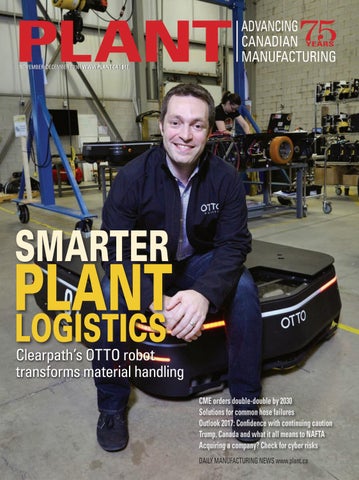
SMARTER
PLANT LOGISTICS
Clearpath’s OTTO robot transforms material handling CME orders double-double by 2030 Solutions for common hose failures Outlook 2017: Confidence with continuing caution Trump, Canada and what it all means to NAFTA Acquiring a company? Check for cyber risks DAILY MANUFACTURING NEWS www.plant.ca
PLNT Dec2016_AMS.indd 1
2016-11-24 2:25 PM
WORK SAFER AND MORE EFFICIENTLY with the new FLIR® CM174 clamp meter with built-in thermal imaging camera. Featuring Infrared Guided Measurement (IGM) technology, the CM174 visually points you to the precise location of potential electrical issues. You’ll find problems faster, get more done, and boost your credibility. TO SEE IGM IN ACTION GO TO WWW.FLIR.CA/CM174
Plant_Feb_Flir.indd PLNT Dec2016_AMS.indd 1 2
2016-01-27 2:25 2016-11-24 8:57 PM AM
27 8:57 AM
CONTENTS
November/December 2016 Vol. 75, No. 8
FEATURES 15 MEDICAL DEVICE Fanshawe College and MDDT collaborate on an innovative device for sufferers of Parkinson’s disease. 16 SECURITY XRCC research is helping manufacturers meet challenges related to counterfeit products. 20 THINK LEAN Leverage enterprise excellence tools to make it easier for customers to do business with you. 22 CCOHS SAFETY TIPS What you need to know about the consequences of workplace violence.
12 AUTONOMOUS VEHICLES
Clearpath’s OTTO self-driving vehicles are transforming material handling.
23 TROUBLESHOOTING Common hose problems and practical solutions to fix them. 29 TRAINING Use the TWI module to train your trainers. 30 EMPLOYEES Employers are out of touch with what their workers value. 31 CYBERSECURITY Make assessing cyber risks a part of your due diligence process. 33 CLOUD Omnichain reimagines your network of supply partners.
17 OUTLOOK 2017 Manufacturers are primed for growth, but they’re proceeding with caution.
19 TRADE Trump presidency makes NAFTA’s future questionable, but don’t hit the panic button yet.
DEPARTMENTS
26 FUTURE CME lays out its Industrie 2030 plan to double manufacturing output in 15 years.
32 ENERGY Battery and wood-to-gas alternatives to traditional energy sources.
4 Editorial 6 News 8 Careers 10 Markets 11 PLANT Pulse 34 Product focus: Motors, drives 36 Products and equipment 41 Plantware Events 42 Postscript
COVER IMAGE: RODNEY DAW
PLANT—established 1941, is published 8 times per year by Annex Business Media. Publications Mail Agreement #40065710. Circulation email: stelian@annexnewcom.ca Tel: 416-442-5600 ext 3636 Fax: 416-510-5170 Mail: 80 Valleybrook Drive, Toronto, ON M3B 2S9. Occasionally, PLANT will mail information on behalf of industry-related groups whose products and services we believe may be of interest to you. If you prefer not to receive this information, please contact our circulation department in any of the four ways listed above. Annex Privacy Officer: privacy@annexbizmedia.com Tel: 800-668-2374.No part of the editorial content of this publication may be reprinted without the publisher’s written permission. ©2016 Annex Publishing & Printing Inc. All rights reserved. Performance claims for products listed in this issue are made by contributing manufacturers and agencies. PLANT receives unsolicited materials including letters to the editor, press releases, promotional items and images from time to time. PLANT, its affiliates and assignees may use, reproduce, publish, re-publish, distribute, store and archive such unsolicited submissions in whole or in part in any form or medium whatsoever, without compensation of any sort. This statement does not apply to materials/pitches submitted by freelance writers, photographers or illustrators in accordance with known industry practices. Printed in Canada. ISSN: 1929-6606 (Print), 1929-6614 (Online)
www.plant.ca
PLNT Dec2016_AMS.indd 3
PLANT 3
2016-11-24 2:25 PM
EDITORIAL
Welcome to Trump world
C
anadian manufacturers tend to live on the cautious side of life, playing it pretty safe, and sticking close to home. Their careful view of prospects and opportunities is a common thread running through successive PLANT Manufacturers’ Outlook surveys, and such is the case with the latest study. Our companies are often described as more risk averse than their more productive (by 18% per worker) US counterparts, and that may be so. Most are small (less than 100 employees), family or owner run, they’re operating in a smaller pond with less access to giant pools of investment capital, and their costs are high. Almost two-thirds of their revenue comes from domestic sources, and about 25% from the US, with a smattering coming from other parts of the world. Most (32%) find the chief impediment to more adventurous exporting is intense competition. Despite all that talk about the need for companies to diversify their markets, there’s the backlash against global trade to consider. Britain pulled a Brexit, CETA was almost scuttled by the burghers of an obscure region in Belgium and the Trans-Pacific Partnership ran into trouble during the US election. Then Trump happened. The president-elect’s unlikely victorious bid for the White House points to a likely disruption of global trade and international relationships. That includes Canada. Donald has made his position clear. America first. Make America great again. He’s bringing manufacturing jobs back to America. NAFTA is the worst trade deal in history. And “no” to the Trans-Pacific Partnership. Suddenly the world is looking a lot more protectionist, especially in our neighbourhood. There is nothing to indicate Trump’s version of fair dealing will be to Canada’s benefit. But if he tears up the NAFTA agreement, we still have the Free Trade Agreement (FTA) to ensure tariff-free commerce, right? Don’t bet on it. Trump promised jobs for America. So what does that mean to the automotive sector? Unifor just wrapped up four-year contracts with the Detroit Three worth roughly $1.6 billion in Canadian investments. How will auto investments fit into Trump’s “America first” world? Ford has already walked back plans to shift Lincoln production from Kentucky to Mexico. And Trump is a climate change denier. He intends to sweep aside Barack Obama’s environmental initiatives as the Trudeau government and the provinces prepare to levy carbon reduction costs on consumers and businesses – another potential competitive disadvantage for our home team. Trump also plans to lower corporate taxes and repatriate cash from foreign profits. Mathew Wilson, vice-president of national policy at Canadian Manufacturers & Exporters, says that could have a direct impact on Canadian manufacturing’s competitiveness and ability to attract investment. CME has released an ambitious plan for manufacturers that would double output and exports. Are companies ready to meet the challenge, especially in a Trump world? The Outlook 2017 survey (and other studies) suggest we have some work to do. Manufacturers hesitate on matters of investment in machinery, equipment, technology and innovation; and they lag in the adoption of technologies that would make their businesses more productive. “We are not investing enough,” Wilson warns, noting that since 2002, investment in new machinery has dropped 65% compared to the US – the worst in the G7. That has to change. Manufacturers must become more competitive, which requires investments in hard and soft technologies that will drive up productivity. Diversifying markets outside the US is no longer a should do, but a must do. The potential for growth and expansion is out there – and it’s no longer safe to play it safe.
Publisher Michael King 416-510-5107 mking@plant.ca, mking@cienmagazine.com Editor Joe Terrett 416-442-5600 ext. 3219 jterrett@plant.ca Associate Editor Matt Powell 416-510-5145 mpowell@plant.ca Art Director Andrea M. Smith National Account Manager Ilana Fawcett 416-510-5202 ifawcett@plant.ca
In
Account Coordinator Barb Vowles 416-510-5103 bvowles@annexbizmedia.com
F n a
Annex Business Media Vice President Tim Dimopoulos (416) 510-5100 tdimopoulos@annexbizmedia.com President & CEO Mike Fredericks Circulation Manager Beata Olechnowicz 416-442-5600 ext. 3543 bolechnowicz@annexbizmedia.com Subscription Price Canada $72.50 per year, US $146.95 (US) per year, Foregin $166 (US) per year. Single Copy Canada $12.00. Add applicable taxes to all rates. Combined, expanded or premium issues, which count as two subscription issues. Mailing Address Annex Business Media 80 Valleybrook Dr., Toronto, ON M3B 2S9 plant.ca Tel: 416-442-5600, Fax: 416-510-5140
In w fin ar us
A
Customer Service Silva Telian 416-442-5600 ext. 3636 stelian@annexnewcom.ca
W
Ri
Co
Co
Q
W
H
D
Joe Terrett, Editor Comments? E-mail jterrett@plant.ca.
4 PLANT
We acknowledge the [financial] support of the Government of Canada.
November/December 2016
CIENPL_ PLNT Dec2016_AMS.indd 4
2016-11-24 2:25 PM
PLT_Exa
LIQUID Internal Mix For pressure fed applications not requiring independent air and liquid control.
2011
Internal mix nozzles mix the liquid and water inside the air cap and produce the finest atomization. Both air and liquid sides are pressure fed. Internal mix nozzles can be used on liquids with a viscosity up to 300 cp.
Applications
Advantages
Washing
Fully adjustable Maximizes liquid dispersion Minimizes liquid consumption All stainless steel construction Compact Minimize air consumption Interchangeable liquid and air caps
Rinsing Coating Cooling Quenching Wetting (moistening) Humidification Dust Control
NOZZLES
Siphon Fed
External Mix
Siphon or gravity fed for non-pressurized applications. New no drip option shown below
For pressure fed applications with independent air and liquid control.
Siphon fed nozzles require no liquid pressure and can be used with gravity fed liquids or lift liquids from a siphon height as much as 36 inches (91 cm). Siphon fed nozzles can be used on liquids with a viscosity up to 200 cp.
External mix nozzles have the highest flow rates and allow the air and liquid flows to be adjusted independently and precisely. External mix nozzles are also the best choice for liquids with a viscosity over 200 cp.
Winner 2013
What Are Atomizing Nozzles? EXAIR’s atomizing spray nozzles atomize fluids (most commonly water) in a range of spray patterns for a variety of uses. They combine liquid and compressed air to create a mist of atomized liquid that can be easily adjusted to meet the needs of your application. All models use stainless steel construction for durability and corrosion resistance. All Liquid Atomizing Nozzles are now available in No Drip configurations. No Drip models have the added benefit of positively stopping liquid flow when compressed air is shut off, eliminating the problem of unwanted drips.
www.exair.com/18/4180.htm WINNER
@ExaIR.com
Manufacturing Intelligent Compressed Air Products Since 1983 11510 Goldcoast Drive • Cincinnati, Ohio • 45249-1621 • (800) 903-9247 fax: (513) 671-3363 • E-mail: techelp@exair.com • www.exair.com
CIENPL_exairLANad.indd 1
11/4/16 1:28 PM
PLT_Exair_Dec.indd PLNT Dec2016_AMS.indd 1 5
2016-11-08 2:25 2016-11-24 2:11 PM
NEWS BULLETINS Global engineering firm SNC-Lavalin, based in Montreal, has been awarded a contract by Norilsk Nickel to implement a sulphur recovery project at its Nadezhda Smelter, in Krasnoyarsk Region, Russia. It’s one of the largest sulphur dioxide mitigation projects in the world. SNC-Lavalin will handle the project through its Toronto and Moscow offices. SO2 contributes to the formation of acid rain. Unifor has wrapped up four-year contracts with the Detroit Three, starting with General Motors ($554 million in investment promised) and Fiat Chrysler Automobiles of Canada ($325 million). FCA has 9,750 members. Ford Motor Co. of Canada’s 6,700 members have also signed on. The automaker is investing $700 million. Approximately 7,500 positions will be affected as Montreal-based Bombardier Inc. cuts its global workforce and streamlines its facilities through 2018. About 2,000 jobs will come out of Canada. Globally, two-thirds will come from the rail division and the rest from aerospace. However, there will be strategic hiring to support the CSeries aircraft and Global 7000 business jet. The Group of Experts in Automation and Robotics (GEAR), an initiative of Canadian Manufacturers & Exporters (CME), will host technology demonstration workshops and related events throughout Ontario to help raise awareness of the advantages in adopting automation and best practices. Partners include Festo and ABB, Québec’s Réseau des Équipementiers en Automatisation Industrielle (REAI) and Sheridan College. Visit www.gearcanada.ca. CO2 Solutions has received a notice of a patent allowance for a process that captures CO2 from gas using carbonic anhydrase and potassium carbonate. The Quebec City-based developer of carbon capture technologies said potassium carbonate is a highly stable and benign solvent, with no toxic degradation or waste issues. CO2 Solutions said the patent will have significant value relative to the use of carbonic anhydrase to improve CO2 absorption and desoprtion.
6 PLANT
PLNT Dec2016_AMS.indd 6
AMTB gets $12.7 FedDev funding For advanced robotic laser welding technology
WOODSTOCK, Ont. — Auto parts manufacturer ArcelorMittal Tailored Blanks Americas Ltd. (AMTB) is getting an investment from FedDev Ontario of up to $12.73 million to adopt advanced technologies. The company, Jason Tong, production supervisor at AMTB and based in WoodPeter Fragiskatos, MP for London North Centre. stock, Ont., makes PHOTO: GOVERNMENT OF CANADA auto parts using lightweight steel. The investment contributes to AMTB’s robotic laser-welding project. The company describes its tailored blanks as sheets of steel that may combine several grades, at various thicknesses with different coatings. The different parts are laser welded together for vehicle bodies and closures. Stamped steel parts are lighter than those made of conventional steel, making them more fuel efficient and stronger. The advanced manufacturing project has also increased the company’s footprint with the retrofitting of its 93,000-square foot facility in Woodstock. Completed products will be used in vehicles assembled at the FCA Canada assembly plant in Windsor, Ont. AMTB is owned by ArcelorMittal Canada Inc. in Hamilton, which is owned by Luxembourg-based ArcelorMittal, a global steel and mining company with operations in over 60 countries.
Heroux-Devtek wins $11M BAE deal LONGUEUIL, Que. — HérouxDevtek Inc. has landed a $11 million deal with BAE Systems to supply landing gear shipsets for the Hawk, an advanced jet trainer aircraft. The aerospace company based in Longueuil, Que. will manufacture and assemble the replacement shipsets and hydraulic actuators. BAE, a defence, aerospace and security company based in the UK, will install them on an unnamed export customer’s fleet as part of a planned aircraft maintenance program. Deliveries are set for early 2018 and extend through the following year.
Biomass, composites industries get $2.9M WINNIPEG — Composites Innovation Centre Manitoba (CIC) has received $2.9 million in funding to develop biomass quality standards measurement techniques, and for overcoming technology barriers to the adoption of natural fibres in the composites industry. The federal Growing Forward 2 (GF2) AgriMarketing Program will provide up to $982,075 to identify quality gaps and develop quality standards and measurement techniques for commercializing biomass in four sectors: biomaterials, biochemical, biofuels and bioenergy. The GF2 AgriInnovation Program will provide up to $1.9 million for research into how the strength and quality of composites can be affected by farming practices, varieties and weather. The Winnipeg-based CIC will also develop more robust composites that combine fibres with plastic resins to produce parts for buses, cars and farm equipment. The CIC is a not-for-profit corporation that supports research, development and the application of composite materials and technologies for manufacturing industries.
A new home for Northern Transformer
Facility in Maple, Ont. built with room to grow MAPLE, Ont. — Northern Transformer Corp., a North American manufacturer of electrical power transformers, has a The Northern Transformer team in the Maple new 105,000 square- facility. PHOTO: NORTHERN TRANSFORMER foot facility. cent to the factory. No financial details are The company has also available but the Maple, invested in hiring additional Ont. state-of-the-art facility production, engineering and includes 90,000 square-feet support teams. of factory space with anNorthern Transformer other 15,000 square-feet of designs and manufacoffice space for engineering tures liquid-filled power and customer support. transformers, grounding An additional 55,000 transformers and specialty square-feet of production transformers. expansion space is adja-
November/December 2016
2016-11-24 2:25 PM
Magna wins a top SPE award For innovative laser cutting and welding TROY, Mich. — Global auto supplier Magna International Inc. has won an innovation award for its unique laser cutting and welding of front and rear fascias for the 2017 Chevrolet Camaro ZL1. The Aurora, Ont.-based manufacturer received the Magna wins the top SPE award in the Process/Assembly/ top award in the Process/ PHOTO: MAGNA Enabling Technologies category. Assembly/Enabling Technologies category at SPE’s Automotive Division 2016 Innovation Awards Competition in Livonia, Mich. The process, which can be applied to other plastic exterior components, is used instead of punch and ultrasonic welding to provide greater flexibility for lower-volume programs. This win follows a near sweep at the SPE Central Europe Automotive Awards in October. The company won five trophies, including the Grand Award for a unique, lightweight skid plate made for a European automaker. The laser cutting and welding process also won the SPE Detroit Chapter’s Innovation Award in the exteriors category. Magna has 312 manufacturing operations and 98 product development, engineering and sales centres in 29 countries, and employs more than 155,000 people.
Giant turbine to harness Fundy tides Cape Sharp Tidal completes subsea cable connection PARRSBORO, NS — Cape Sharp Tidal has successfully deployed its first two-megawatt tidal turbine in the Bay of Fundy at a Nova Scotia test site near Parrsboro, lowering it to the sea floor in a four-hour operation during an ebb tide. The marine operations team connected the turbine cable tail with the 300-metre interconnection cable installed in the Minas Passage last winter. The cable connects the 1,000-tonne turbine’s power and data system to a 16-megawatt subsea export cable at the Fundy Ocean Research Centre for Energy (FORCE), which is connected
to the onshore substation. FORCE is a research centre for instream tidal energy development. It hosts the technology developers who will attempt to find ways to harness an estimated 2,500 megawatts of extractable power. The commissioning program involves testing the connection, communications and electrical systems to confirm energy is produced by the world’s highest tides. When the subsea cable is connected to the grid, it will be the first such device at FORCE, and the largest in North America. Cape Sharp Tidal is a partnership involving OpenHydro, an Irish company that manufactures and installs marine turbines; and Emera, a Halifax-based energy services company. Spokeswoman Sarah Dawson told Canadian Press Cape Sharp Tidal partnership plans to install a pair of two megawatt, inCape Sharp Tidal lowers its tidal turbine into the water at its Bay stream tidal turbines at the PHOTO: CAPE SHARP TIDAL of Fundy test site near Parrsboro, NS. testing site.
www.plant.ca
PLNT Dec2016_AMS.indd 7
Austrian freighter buys three TRAXX AC3s
Deal with Wiener Lokalbahnen Cargo includes eight-year maintenance contract BERLIN, GERMANY — Bombardier Transportation has signed a deal with the Austrian rail freight operator Wiener Lokalbahnen Cargo to deliver three TRAXX AC3 last mile locomotives. No financial details were provided but the contract includes full maintenance and servicing for eight years, and an option for three additional locomotives with the possibility of extending the maintenance contract for another 24 years. Last Mile functionality allows the operator to shunt the locomotives on feeder tracks by using an additional diesel engine and battery. Bombardier’s TRAXX AC3 locomotive. PHOTO: BOMBARDIER This eliminates the need to use an extra diesel locomotive. TRAXX AC3 locomotives are powered by energy efficient MITRAC traction converters. Montreal-based Bombardier, its rail businesses based in Berlin, said the new locomotives will go into operation in Austria and Germany next year.
FEEDBACK
Trade with China Re: Why Canada should avoid free trade with China, Postscript, Gwyn Morgan, October 2016. Well written and I totally agree! While I am all for the removal of trade barriers, there must be an understanding that any agreement benefits all parties. We must continue to trade with China but ensure that Canadian interests are best served. Not protectionism, but rather conservative, structured change. Skip MacLean Tru Tech Doors Vaughan, Ont. We’d like to hear from you. Send comments to jterrett@plant.ca with your name, address and phone number. Comments will be edited.
PLANT 7
2016-11-24 2:25 PM
NEWS CAREERS Canadian Manufacturers & Exporters (CME) has a new board chair. Rhonda Barnet, a director on CME’s board since 2013, is the vice-president of finance at Steelworks Design Rhonda Barnet Inc., a designer and fabricator of custom automation for manufacturers in Peterborough, Ont. David MacLean has been appointed divisional vice-president of CME’s Alberta division. Previously, he was vice-president, communications and policy, at the Alberta Enterprise Group in Edmonton. Cos Phi, a manufacturer of Power Factor & Power Quality correction technology based in Hensall, Ont., has appointed Ann Barteaux general manager. Her background covers management in government, industrial ISO and health and safety. D-BOX Technologies Inc., a manufacturer of immersive motion technology based in Longueil, Que., has engaged Larry O’Reilly Entertainment Consulting as a special sales advisor for major accounts. O’Reilly has more than 22 years of experience at Imax Corp., including president of world sales. Claude Goulet has joined KSB Pumps, a pump manufacturer in Mississauga, Ont., as sales manager. Goulet is a 30-year veteran of pump and seals sales specializing in oil, gas, chemical/petrochemical and other industries. Previously he was a regional sales manager with Sulzer. Walter, a cutting tool manufacturer in Waukesha, Wis., has appointed Kurt Ludeking director of marketing for its world west region, which includes all the Americas and Great Britain. He moves up from product manager for turning and indexable drilling products. CCL Industries Inc., a Toronto based manufacturer of specialty labels and packaging, has appointed a new president for its Checkpoint business. John Dargan joins CCL from Jabil Circuit Inc., a St. Petersburg, Fla. electronics manufacturer.
8 PLANT
PLNT Dec2016_AMS.indd 8
$485,000 to develop A-LARS
Kraken’s systems supports UMV recovery ST. JOHN’S, NL — Kraken Sonar Inc.’s subsidiary Kraken Sonar Systems Inc. will receive federal R&D funding of up to $485,000 for the development of an autonomous underwater vehicle. The non-refundable financial contribution from the National Research Council of Canada’s Industrial Research Assistance Program (www. nrc-cnrc.gc.ca/eng/irap/index.html) will be applied to the development of autonomous launch and recovery systems (A-LARS) for unmanned maritime vehicles. Kraken Sonar Systems, a marine technology company based in Conception Bay, NL, makes software-centric sensors and underwater robotic systems. The initial A-LARS will support Kraken’s KATFISH Synthetic Aperture Sonar underwater towbody. Kraken said next-generation surface vessels will carry a variety of unmanned vehicles and modular mission packages that will require specialized launch and recovery equipment. The A-LARS will help bring an unmanned vehicle and its payloads aboard a host ship safely, efficiently
Boralex takes 25% interest in Niagara wind farm MONTREAL — Renewable energy company Boralex Inc. is acquiring a 25% interest in a 230-megawatt Niagara Region wind farm in which Enercon Canada Inc. has a majority interest. Enercon Canada, with offices in Montreal, Toronto and Dartmouth, NS, and production facilities in Quebec and Ontario, is a manufacturer of wind turbines. Enercon’s $825.5 million project located in the Lincoln, West Lincoln, Wainfleet and Haldimand counties will include 77 Enercon E-101 3 megawatt wind turbines. The project, which has a 20-year feed-in tariff deal with the province’s Independent Electricity System Operator, was commissioned on Oct. 30. The construction phase created 700 jobs and will create another 25 direct long-term jobs during operations. Six Nations of the Grand River Development Corp. also has a stake in the project. Boralex, based in Kingsey Falls, Que., develops, builds and operates renewable energy power facilities in Canada, France and the US.
Kraken’s autonomous launch and recovery system. PHOTO: KRAKEN
and without damage. In both military and commercial markets, unmanned surface and underwater vehicles are the way of the future and present a wide range of revenue opportunities, said Karl Kenny, Kraken’s president and CEO. “Having in-house capability to design and manufacture autonomous launch and recovery systems will add significant benefits as we continue to evolve our sensors-to-systems strategy.” The NRC funding will be used to expand Kraken’s Handling Systems Division based in Dartmouth, NS. It helps with potential handling systems work related to the Canadian Surface Combatant program, the procurement project that will replace the Iroquois and Halifax-class warships with up to 15 new ships.
IPL extends reach with $35M acquisition of US packaging firm
Encore Industries adds three plastics moulding plants to expand North American reach MONTREAL — IPL Inc. is acquiring a US plastics manufacturer Encore Industries Inc. for US$35 million, making it the third largest player in America’s plastic injection moulded products market. IPL, a Montreal-based manufacturer of injected moulded plastic products, is also investing $36 million to expand production capacity in Canada and the US. Encore, based in Sandusky, Ohio, makes rigid plastic packaging products for the North American industrial packaging market operating from facilities in Ohio, Georgia and Minnesota. The acquisition represents a collaboration involving IPL’s parent company One51, and partners Caisse de dépôt et placement du Québec and the IPL’s St. Damien, Que. manufacturing site. PHOTO: IPL Fonds de solidarité FTQ. It will expand opportunities for IPL in the North American market, add an extensive customer base, add to its capacity, and enhance its new product development capabilities. IPL has plants in Saint Damien, Que., Edmunston, NB and Lee’s Summit, Mo. One51, based in Dublin, focuses on plastics and environmental services.
November/December 2016
2016-11-24 2:25 PM
Plant_IFP
S
L
U F A R P OW E I D E If you’re seeking new methods and solutions to increase efficiency, contain costs, and improve the overall performance of your hydraulic and pneumatic systems, then the forward-looking educational program at IFPE 2017 will bring you up to speed. Gain the latest technical knowledge and insights into engineering advances at a powerful array of half-day college-level courses and the co-located Energy Efficient Hydraulics & Pneumatics Conference. Explore new ideas and solutions to enhance the quality of your design so that they become leaner, cleaner, greener and more cost-effective.
Gain from the power of new ideas. REGISTER TODAY at IFPE.com Show Owners:
Plant_IFPE_NovDec.indd PLNT Dec2016_AMS.indd 19
Co-located with:
2016-04-25 2016-11-24 3:22 2:25 PM
MARKETS
ENCLOSURES CYBERSECURITY
More spending to ward off network attacks
S
ophisticated internet attacks are evolving, but companies are better equipped to handle potential threats. Organizational spending on IT security is expected to increase 9% by 2018, providing a big boost in global markets. The global cybersecurity market should reach $85.3 billion by 2016 and $187.1 billion by 2021, reflecting a five-year compound annual growth rate of 17%. Factors driving growth include the complexity and frequency of threats, increasing severity of cybersecuIoT, big data and cloud computing provide opportunities rity, stringent PHOTO: THINKSTOCK government for cyber developers. regulations and compliance requirements, ubiquity of online communication, digital data and social media. Rising adoption of technologies such as the Internet of Things, evolution of big data and cloud computing, increasing smartphone penetration and the developing market for mobile and web platforms, will provide opportunities for vendors. Network security, which had the highest market revenue in 2015 based on solution type, is expected to remain dominant, while substantial growth (27.2% over five years) is anticipated in the cloud security market.
Non-metallic market soars
T
he global market for non-metallic enclosures is looking at more than 20% growth, but products of the metallic enclosures will see a decline. The electrical enclosure Environmental factors are shifting the focus on new market is growing at a PHOTO: THINKSTOCK materials. significant rate, reaching $5 billion this year and $7.3 billion by 2021. Five-year growth will be 7.9%. The non-metallic market should reach $3.9 billion by 2021, up from $1.5 billion this year, for a 21.1% growth rate over five years. Used indoors and outdoors, they’re durable, corrosion-resistant, lightweight and last longer than metallic enclosures. The metallic market should total $3.3 billion by 2021, down from $3.5 billion in 2016, for a decline of 0.6% over five years. Being used mainly in explosion-proof environments and because they’re made from electrically conductive materials, they have a tendency to fail in high humidity and rainy environments, which is a factor in their decline. “Increasing raw material prices and stricter environmental regulations on electrical enclosures used in hazardous locations have forced companies to focus on developing enclosures with advanced technologies,” says BCC Research analyst Aneesh Kumar. There’s pressure to develop environmentally friendly recyclable electrical enclosures, even in the Asia-Pacific region and other developing regions, which poses a challenge to small domestic players.” Rapidly growing economies such as China and India have boosted demand in the past five years. Europe has also become the hub for western and eastern markets to outsource enclosure manufacturing. North America has seen increased, pent-up demand as OEMs replace existing mild steel or wooden products.
AUTOMOTIVE COATINGS
Increased vehicle sales drive demand
A
utomotive coatings are showing steady growth, driven primarily by the North American and Asia-Pacific markets. Mature markets will also provide major opportunities for suppliers in developing countries by outsourcing manufacturing and setting up new plants. The market is expected to reach $21 billion this year, and $26 billion by 2021, for a five-year compound annual growth rate of 4.4%. OEM coatings will see five-year growth of 4.2%, and 4.6% for refinish coatings. The global economic recovery is driving vehicle sales, particularly in North America, thanks to increased, pent-up demand. “Asia-Pacific has become the hub for Western markets that are outsourcing the manufacture of coatings. Also, in this region, automotive coating refinishing should see rapid growth over the next seven years, owing to rising consumer spending power in emerging economies of countries such as China, India and Thailand,” says Aneesh Kumar, a research analyst at BCC. Increasing OEM demand for greener coatings comes from increasing
Demand for environmentally-friendly coatings will increase.
PHOTO: THINKSTOCK
production needs to meet growing demand for new vehicles. This will also drive R&D investments along with ongoing product development to improve coating performance. Fluctuations in the prices of raw materials including pigments, resins, titanium oxides and other additives, will keep market growth in check. Another challenge will be harmful environmental effects from conventional solvent-borne coatings, and the industry’s inability to meet OEM expectations on environmental durability and coating sustainability.
Reports by BCC Research, a market research firm based in Wellesley, Mass.
10 PLANT
PLNT Dec2016_AMS.indd 10
November/December 2016
2016-11-24 2:25 PM
Business improves
PMI gains with new work, higher employment numbers
C
anada’s manufacturers report a slight improvement in business conditions during October, registering a 51.1 on the Canada Manufacturing Purchasing Managers’ Index (PMI). Their renewed confidence is driven by a rise in new work and greater employment numbers. That’s a gain from September’s seven-month low of 50.3, but still short of the 52.4 survey average. The PMI, which polls purchasing executives from 400 Canadian manufacturers, shows production volumes stagnating for the month with subdued demand and continuing efforts to reduce finished goods inventories. Operating margins were also eroded as factory gate charges fell against intense competition for new work, and input costs increased. There was some recovery in volumes, which some firms linked to new product launches and discounting. But PMI research firm IHS Markit said there were also reports that subdued energy sector demand had weighed on volumes. And export sales showed little change, which nonetheless compared favourably to marginal declines in the third quarter. Employment growth rose across the sector, although it was marginal as some manufacturers reported hiring freezes at their plants. IHS Market said the month’s data pointed to a lack of pressure on capacity, with work backlogs broadly unchanged despite worsening pressures. Vendor performance deteriorated at one of the fastest rates since 2014, which the researcher linked to capacity cutbacks among suppliers, alongside low stocks and supplying delays. Some companies boosted their stocks of purchases, which contributed to a rise in input buying for the first time since June. Input cost inflation hit a threemonth high for the month, partly attributed to higher prices of imported raw materials. International research firm IHS Markit produces the PMI with Canada’s Supply Chain Management Association.
www.plant.ca
PLNT Dec2016_AMS.indd 11
MANUFACTURING OUTPUT RISES
billions of chained (2007) dollars – all industries 1,700 1,680 1,660 1,640 1,620 1,600 1,580 1,560 1,540 1,520
Aug. 2011
2012
2013
2014
2015
Aug. 2016
Real gross domestic product rose 0.2% in August, following a 0.4% increase in July, reports Statistics Canada. Manufacturing’s share rose 0.3% with increases in output for durable (0.3%) and non-durable goods (0.3%). Gains in durable goods from primary metal and machinery manufacturing were partially offset by declines in fabricated metal products, miscellaneous manufacturing and electrical equipment, appliances and components. Beverage and tobacco, as well as food manufacturing drove gains in non-durable goods.
Source: Statistics Canada
1.3%
60.3 Manufacturing’s reading on the CFIB Business Barometer index for October, with anything over 50 indicating an upbeat mood among smaller companies. Their top cost constraints are taxes and regulations; fuel and energy; and insurance.
The pace of growth for average global trade flows between 2009 and 2015, according to the World Trade Organization. Between 1949 and 2008, average global trade flows increased 10% annually.
$11.2B 10.6% Exports to countries other than the US, which were up 2.3% in September. Statistics Canada reports higher exports to the UK ($175 million) and India ($147 million) were partially offset by lower exports to China (down $206 million).
Percentage of GDP Canada spends on healthcare. A Fraser Institute report says Canada is among the most expensive universalaccess healthcare systems in the OECD, but its performance is modest to poor.
The percentage of Canadian manufacturers that rate their concern about cybersecurity risks as medium to high, according to PLANT’s Manufacturers’ Outlook 2017 study. The Government of Canada notes in a recent one-year period, 86% of large organizations experienced a cyber attack. Loss of intellectual property as a result of such attacks doubled between 2006 and 2008. Visit www.publicsafety.gc.ca and search “cyber” for information on Canada’s Cyber Security Strategy.
70%
PLANT 11
2016-11-24 2:25 PM
AUTONOMOUS VEHICLES
OTTO-mating
MATERIAL HANDLING
CLEARPATH TRANSFORMS IN-PLANT LOGISTICS
The Waterloo, Ont. innovator’s self-driving vehicles help manufacturers embrace Industry 4.0. BY MATT POWELL, ASSOCIATE EDITOR
C
Simon Drexler, director of industrial solutions at OTTO Motors, using the OTTO 1500 self-driving vehicle as a work surface. PHOTOS: RODNEY DAW
12 PLANT
PLNT Dec2016_AMS.indd 12
learpath Robotics was founded in 2009 on the premise that robots could be used to handle the world’s most “dangerous, dull and dirty” jobs. The company had a humble beginning, its goals developed by a small group of University of Waterloo mechatronic engineering students. Its first batch of autonomous robots were deployed mostly for research that involved entering unwelcoming environments to perform tasks that may not have been safe for humans. But the company, headquartered in the Canadian tech hotbed of Waterloo, Ont., has come along way since if was first profiled by PLANT last year as an up-and-comer. It’s now a quickly ascending developer of super high-tech robotics technologies deployed by 500 companies in 40 countries. That includes partnerships with some of the world’s biggest brands, such as Caterpillar and General Electric, which Clearpath has tapped for private equity funding to build the next generation of its self-driving vehicle technologies. In 2015, it introduced a new line of robots slated to become the company’s future, and it’s going after an entirely new market segment, aspiring to become a global leader in the manufacturing material handling sector. Clearpath aims to leverage increased dependence on automation and robotics, and ride an on-shoring trend that’s bringing manufacturing production back from low-cost jurisdictions to North America. After two years of development, the robotics innovator has introduced OTTO to the world, it’s first self-driving vehicle for intral-
November/December 2016
2016-11-24 2:25 PM
ogistics and material handling. The vehicles, which now come in two models (OTTO 1500 and OTTO 100), efficiently transport heavyload materials in industrial and warehouse centres. The purely interconnected setup combines hardware, electrical and software engineering – the new norm in manufactured technologies delivered as a “system” instead of a “product.” “We’re only scratching the surface with the potential of this technology,” says Simon Drexler, Clearpath’s director of industrial systems. “The future of this technology is to broaden the spectrum of the material handling pie, and the exciting thing about OTTO is that it provides manufacturers with a way to harness real time data that businesses can use to make important operational decisions and make themselves more efficient.” But OTTO is part of a bigger manufacturing story as companies deal with a wave of operational changes that will require them to increase the adoption of automation technologies. This high-tech robot addresses a number of challenges related to productivity, efficiency and even labour shortages. Drexler believes material handling is an important place to start when it comes to understanding how a manufacturer operates, how it could improve its efficiency and how productivity could be improved. “When you automate your material handling activities with a technology such as OTTO and get your hands on real-time data that’s sent to a centralized hub, you have the ability to know everything you need to know about your operation.” The indoor robots are tough, built with industrial grade components that withstand harsh rigours of industrial environments. A one-piece welded steel frame delivers the strength the vehicles need to move payloads up to 1,500 kilograms at speeds up to two metres per second, with a zero turning radius. Eight wheels power a passive suspension: four caster type (one at each corner), a support wheel mid-body on each side and twodrive wheels near the centre of the unit. Two coordinated servomotors drive the wheels and allow it to spin at a zero turn radius. Both the 1500 and 100 models (for payloads up to 100 kilograms) are completely configurable and allow the vehicle, powered by a proprietary software package, to drive underneath an object to pick it up, or travel under a cart and move it somewhere else. And unlike automated guided vehicles (AGVs), OTTO is meant to work with existing factory personnel (not replace people) while staying out of their way. Safety-rated
www.plant.ca
PLNT Dec2016_AMS.indd 13
The OTTO 1500 self-driving vehicle performs tests with a lift and lower appliance.
front- and rear-mounted LIDAR sensors and a built-in collision avoidance system detects plant floor obstacles, while a 360-degree LED lighting system and audio communicate the vehicle’s intentions.
High-tech tour guide Most impressive is the unit’s ability to investigate and navigate new spaces in the same way as a human. LIDAR laser scanners “map” the plant during the robot’s first tour. Points of interest are highlighted including walls and stationary shelves. Clearpath’s software acts as a tour guide, marking specific areas of importance such as intersections, material drop off points and mandatory stop points.
Then the navigation system goes to work, allowing the robot to roam freely. OTTO is built on SLAM technology (Simultaneous Localization and Mapping), making it smart enough to identify optimal paths from A to B and recalculate a new path if the original route becomes blocked. There is no end to the number of vehicles that can be introduced to a facility – fleets working together and communicating via a WiFi network. While OTTO’s technology is impressive, the complete package is meant to satisfy changing factory floor dynamics, which are trending to requiring more flexibility, responsiveness and efficiency to meet growing customer demands for product customization and
OTTO’s electrical and mechanical designers work in an open-concept office space to foster collaboration.
PLANT 13
2016-11-24 2:25 PM
complexity. They’re also in line to replace traditional AGVs that require costly and rigid changes to infrastructure. OTTO doesn’t require any fixed-infrastructure such as bar codes, magnetic tape or beacons to safely navigate a plant. Its proprietary internal mapping technology brings the vehicles, and the companies using them, into the realm of Industry 4.0, powered by Internet of Things (IoT) technologies that communicate with entire manufacturing supply chains through a central network. Clearpath has placed a premium on delivering a tool that addresses the types of technology adoption manufacturers are using to improve productivity, while eliminating low-value, manual labour and shifting employees into higher-valued positions. Although the idea of moving boxes and components around a plant may seem simple enough, it is a critically important part of the automated supply chain that will benefit significantly from technologies like OTTO. Manufacturing is moving at a velocity never seen before, mainly by customer driven demands based in the variety of the goods they purchase. More product customization is becoming the norm, and with that an explosion of SKUs within a manufacturer’s stores and warehouses. “Automation in the material handling space hasn’t changed in decades, and it’s resulted in a situation where automation is generally
The OTTO family of robots: the OTTO 1500 (top) and OTTO 100 (bottom).
fixed and limits the potential of an operation, placing a glass ceiling on productivity,” says Drexler. Clearpath sees manufacturers responding to assembly-floor challenges by adopting methods such as mixed-model assembly lines and just-in-time, kit-based delivery to produce smaller batch runs with a great variation of products.
Improving efficiency
An OTTO Motors team member maps the facility using the vehicle’s LIDAR sensors.
14 PLANT
PLNT Dec2016_AMS.indd 14
Component proliferation is growing, as customers demand more complex products at a much higher velocity. Thing is, this is creating efficiency issues for manufacturers slow to adapt their processes to meet these needs. Traditional automation and material handling systems are typically built into existing infrastructure and can’t be cost-effectively adapted to handle ongoing changes. As a result, manufacturers are struggling to contend with the logistics of product complexity, which starts in the warehouse and the way materials are transported to assembly lines. Companies need to find new ways to reduce operating costs, particularly to compete against offshore rivals. This requires resetting the bar for production density and re-shores their operations. Automation helps make this happen. “OTTO helps you evolve your operations into an Industry 4.0 facility, right now,” says Drexler. “Something like that doesn’t typically happen overnight. What’s compelling about self-driving vehicles is you can drop one or two of them into your operation tomorrow and have the power and flexibility you need to evolve your processes over time into a completely Industry 4.0-powered factory.”
In June, OTTO helped Clearpath attract $30 million in equity funding from a group of investors led by iNovia Capital, including Caterpillar, GE Ventures and Silicon Valley Bank. Drexler says the Series B funding will be used to scale and grow OTTO’s business, and eventually deliver the robots globally. For now, Clearpath is focused on the North American market. “We want to make sure we’re responsibly scaling our operations and integrating capability. We don’t want to grow too fast,” he adds with a chuckle. “The Series A funding we received was about further validating the product and enhancing our development team to get to the point we’re at today. We’re comfortable with the idea of scaling up, but doing so responsibly.” This year has been a good one for Clearpath, which included a Stevie Award win for Best New Industrial Product at the 13th Annual International Business Awards. And General Electric has deployed a fleet of OTTOs at a healthcare equipment repair facility that’s being expanded in Milwaukee where the robots are automating just-in-time parts delivery. The Material Handling Institute’s 2016 annual report estimates robotics adoption in material handling applications will grow by 71% over the next 10 years, further validating the notion that robots will be important to new industrial areas outside traditional ones such as assembly. OTTO is making this shift possible, while helping manufacturers navigate the mostly unfamiliar waters of Industry 4.0. Comments? E-mail mpowell@plant.ca.
November/December 2016
2016-11-24 2:25 PM
MEDICAL DEVICE Fanshawe graduate Louise Marchand checking out the tremor suit. PHOTO: FANSHAWE COLLEGE
Parkinson’s
INNOVATION
FANSHAWE AND MDDT COLLABORATE ON A TREMOR SUIT Recent college graduate Louise Marchand has designed a device that improves the accuracy of reporting and assessing tremors.
I
n the spirit of collaborative innovation, Fanshawe College and researchers at Movement Disorder Diagnostic Technologies Inc. (MDDT) are developing a tool that will aid people living with Parkinson’s disease. This progressive disease of
the nervous system named after English surgeon James Parkinson (1755 to 1824) mostly affects middle-aged and elderly people who experience tremors, muscular rigidity, slowness of movements and loss of balance. More than 100,000 Canadians are
dealing with the disease. Fanshawe and medical device company MDDT, both in London, Ont., have come up with a prototype for a motion capture suit and tremor sleeve that will help with the diagnosis and monitoring of Parkinson’s patients. The suit, designed by recent Fanshawe fashion design graduate Louise Marchand, guided by the college’s design professors, improves the accuracy of reporting and assessing tremors. Accuracy is key to determining the correct dose of Levodopa – an initial pharmacological therapy for patients with Parkinson’s. MDDT collaborated with Fanshawe’s School of Design to create a washable and durable suit for home assessments and that can be mass-produced. The suit incorporates software MDDT uses to capture data from sensors placed at fixed points across the body and ensures ease of use for patients with varying body types and a ranges of tremor activities. The two-piece (top and bottom) suit’s large, easy to use zippers and belting are helpful for patients with hand tremors
Electrical enclosures for all your applications. Whether your needs are industrial/ commercial, indoor/outdoor, or small/ large, Hammond has thousands of enclosure options to address your needs. Visit hammondmfg.com - by far, the easiest enclosures website to find your equipment protection solutions. Our brief video at www.hammfg.com/qsearch explains why.
Contact a Hammond enclosure expert today:
Quality Products. Service Excellence.
hammondmfg.com 519.822.2960 plant@hammfg.com www.plant.ca Plant_Hammond_MayJune.indd 1
PLNT Dec2016_AMS.indd 15
PLANT 15
2016-05-13 10:07 AM
2016-11-24 2:25 PM
Parkinson’s innovation and the mesh underlay provides breathability. Anti-skid fabric further enhances accuracy reading tremors by tightening the sensor pockets against the body. A prototype of the TremorTek sleeve is based on an earlier design by MDDT, which commercializes technologies developed by researchers at The University of Western Ontario’s Movement Disorders Centre in London.
Tremor disorders The non-invasive, experimental device would be used for Parkinson’s and other tremor disorders. Its multiple sensors analyze complex movements with accute accuracy. Using the data from the sleeve, doctors will isolate specific areas of the arm muscle to guide drug treatments, reducing tremors over the course of seven to 10 days. Practitioners and caregivers would use the sleeve to treat patients at the hospital or in their homes. Dan Douglas, dean of Fanshawe’s Centre for Research and Innovation, noted the importance of the College’s collaboration with an industry partner. “This project demonstrates the trend towards cross-sector research and innovation activities and, in this case, by the merging of fashion with technology to develop a product for the health sector,” he said. “Projects such as this have an immediate and substantial impact for industry partners and those they serve while providing valuable experiences for our student researchers.” The project received funding from the Natural Sciences and Engineering Research Council of Canada. Comments? E-mail jterrett@plant.ca.
16 PLANT
PLNT Dec2016_AMS.indd 16
Navdeep Singh Bains, minister of innovation, science and economic development (left), visits the Xerox Research Centre of Canada facility in Mississauga, Ont. He’s joined by Al Varney, president and CEO of Xerox Canada (centre) and Dr. Paul Smith, vice-president of PHOTO: XRCC XRCC (right).
Counterfeiter
ISSUES? XRCC EXPERTS ARE ON THE JOB The Xerox Research Centre of Canada has developed advanced materials to meet manufacturers’ security challenges.
M
anufacturers that find themselves battling counterfeit products and intellectual property pirates have an ally. The Xerox Research Centre of Canada (XRCC) is developing security innovations at its stateof-the-art lab in Mississauga, Ont. that will help companies tackle a global problem with an annual price tag of $1.7 trillion (according to the Organisation for Economic Co-operation and Development). For more than 40 years, XRCC has developed new materials such as inks, toners and photoreceptors for Xerox’s own purposes, says Paul Smith, vice-president and centre manager of the XRCC. “As the primary materials research and development centre for Xerox’s operations around
the globe, virtually every Xerox product in market today has been influenced in some way by the research team in Mississauga.” As of five years ago, the centre has been applying its expertise and the efforts of more than 60 chemical engineers, physicists and scientists to the security challenges other companies are experiencing.
Security features “Our researchers have also demonstrated particular expertise for developing materials that enable security features, including fluorescence, colour shifts, metallic finishes and electronic properties,” Smith says. “These materials can be incorporated directly or indirectly into life-critical products like medicines, food, toys, cosmetics, fertilizers, aircraft and car parts.” A company that delivers fuel worldwide approached the Xerox research centre to develop and test a series of chemical markers that would guarantee its product hadn’t been diluted or tampered
with. Added to the fuel, the tested marker had to show a specific response when exposed to a stimulus. One of the many challenges that came up during the R&D and testing phase was developing an additive that could survive the complex chemical environment of liquid fuel for its lifetime. “Once our team formulated a marker that met all of the client’s goals, we were able to begin manufacturing large batches of the additive in our Scale-Up Engineering Pilot Plant, which is outfitted with chemical reactors capable of producing anywhere from two to 2,000 litres of material at a time,” Smith says. XRCC’s work (see xrcc. external.xerox.com) involves electronic materials, sustainable materials, chemical processes, coatings, security and authentication, and technologies for printing, electronics and manufacturing. — Source: XRCC Comments? E-mail jterrett@plant.ca
November/December 2016
2016-11-24 2:25 PM
OUTLOOK 2017 Manufacturers are primed to grow their businesses but are cautious about investments next year. BY JOE TERRETT, EDITOR
A
lthough economic growth was disappointing this year (1.2% forecast by the OECD), Canadian manufacturers have a positive view of their prospects next year. Canadian and US GDP is supposed to rise a bit above 2%. However, companies are exercising their customary caution when looking ahead. PLANT’s Manufacturers’ Outlook 2017 survey (June to September) shows 36% of senior company executives are optimistic although most (55%) qualify that optimism. The survey, conducted by Northstar for PLANT Magazine in partnership with sponsors Grant Thornton LLP, SYSPRO Canada and Machines Italia (with the Italian Trade Commission), is based on 526 replies from senior manufacturing executives (margin of error of +/- 4.27%, 19 times out of 20). Most of their companies (65%) fall into the small business category (under 100 employees); 23% are under 500; and 13% are large firms (500 or more). Complete results will be available in a downloadable report (visit www.plant.ca) that includes a roundtable discussion of manufacturing issues involving senior executives and industry experts, but here are some highlights. As in past surveys, we picked key areas for some additional detail, and this year focus was sharper on how companies view and are adapting to Industry 4.0 (a.k.a. the fourth industrial revolution), which entails automation and data exchange, cyber-physical systems, the Industrial Internet of Things (IIoT), cloud computing and how it all relates to the “smart factory.” The results confirmed what has been evident in past Out-
www.plant.ca
PLNT Dec2016_AMS.indd 17
Manufacturers see growth, higher profits and higher costs in 2017.
PHOTO: THINKSTOCK
Confidence with
CAUTION GROWTH PREDICTED, INDUSTRY 4.0 ADOPTION LAGS
look surveys: manufacturers are primed to grow their businesses, but they’re not as engaged as they could be – or should be – with the technologies that would deepen their business intelligence and drive productivity. These key competitive factors will aid the success of companies operating in advanced economies like Canada’s where higher-cost labour is a disadvantage. Only 30% make use of automatic data access, analysis and review to measure and monitor productivity; 42% do it manually; 28% don’t measure; and 61% won’t be connecting the shop
floor to the top floor over the next 12 months. The top three adopted technologies are CAD/CAE/CAM (46%), data acquisition, information and control technologies (34%) and computerized processing, fabricating and assembly technologies (27%). Thirty-two per cent don’t use any of the listed technologies.
IIoT engagement Respondents also demonstrated limited engagement with IIoT, which connects and optimizes machines via the internet. Only 6% are applying IIoT capabilities and not knowing where to start is
a major obstacle for 31%. Innovation is key to improving processes and developing higher value products. Caution is evident by this year’s responses. Most (80%) either don’t know or aren’t sure what their companies will spend on innovation in 2017, but they’re almost evenly split on investment increasing (48%) or remaining at the same level (49%) over the next five years. Whatever their spending plans, most (62%) have not – nor do they plan to – take advantage of the SR&ED federal tax credit for investment in research. Only 27% plan to do so in 2017.
PLANT 17
2016-11-24 2:25 PM
Only 30% of manufacturers use automated tools to monitor and measure productivity. PHOTO: FOTOLIA
And what of their businesses? More than half of the companies are expecting orders and sales to increase (by an average 15% and 16%); but costs will also increase (by 9%). Pricing will stay the same for 55% but 33% expect increases (of 8%). Forty-two per cent see profits rising an average by 13%. Pricing and costs top the list of challenges for 50%, followed by
increasing sales (48%), economic conditions (45%) and the value of the loonie (42%). Their caution is again evident by their intentions to invest. Sixty-six per cent don’t know how much they’ll invest in machinery, equipment or technology in 2017, and 72% are unsure about investments in their facilities. But 60% expect to invest in training and 55% in machinery, equipment and
technology over the next three years. Only 33% are concerned about entering new markets and 37% don’t export at all. Most (86%) are doing most of their business in North America, 62% of it in Canada. What’s holding them back from increasing their revenues outside North America? Most (32%) say intense competition. Forty per cent will drive growth by focusing on North America, 45% will expand sales and distribution channels and 44% will introduce new products. Despite the growing risk to government and business networks from cyber attacks, most executives (48%) gauge their level of concern as mid-range and half are prepared for cyber attacks. The threats manufacturers are most unprepared for are targeted external attacks (26%) and breaches through a third party vendor (24%).
With increasing emphasis on regulations targeting the reduction of carbon emissions, 77% indicated they were very or at least somewhat engaged. But recent government moves to put a price on carbon have not raised the priority level of responses to climate change for 51% of companies and 46% do not include carbon reduction as a part of a formal business strategy. Aside from tepid economic factors, manufacturers must also contend with troubling developments in the world at large. Belgium’s resistance to CETA is a sympton of growing objections to global trade agreements. The surprising election of president-elect Donald Trump in the US also suggests a disruption of trade relationships. Perhaps the caution expressed by Outlook respondents is prescient. Comments? E-mail jterrett@plant.ca.
The revolution is here. Take on the most demanding applications with CONTI® SYNCHROCHAIN CARBON heavy-duty timing belts. Our technology combines light but durable polyurethane teeth with high tensile carbon reinforcement to deliver up to 15% more horsepower. Contact Continental for a complimentary drive analysis. We offer complete drive solutions, including belts, metal, and a team ready to help you get the most from your drives.
The trademarks displayed in this banner are the property of Continental AG and/or its affiliates. Copyright © 2016 ContiTech AG. All rights reserved. For complete information go to: www.contitech.de/discl_en
www.contitech.ca
VEY.VEYGEN.16003_MRO-REM_Conti-Sychrochain_8x5.375.indd 1
2016-11-17 9:58 AM
18 PLT_Continental_NovDec.indd PLANT 1
November/December 2016 2016-11-21 10:00 AM
ART November 16, 2016 CMYK PLNT Dec2016_AMS.indd 18
REVISION
2016-11-24 2:25 PM
TRADE Would a Trump campaign promise to renegotiate NAFTA actually benefit Canadian businesses?
President-elect Donald Trump blames NAFTA for eliminating US manufacturing jobs. PHOTO: OFFICE OF THE PRESIDENT-ELECT
BY MATT POWELL, ASSOCIATE EDITOR
I
t didn’t take much time for the federal government to move on possible NAFTA renegotiations following the election of Donald Trump as US president. The deal signed in 1994, which Trump calls the “worst trade agreement in history” and promises to scrap or renegotiate, was among the many political salvos the president-elect used to ignite his supporters. He blames the deal for gutting US manufacturing jobs, and would instead seek an agreement better for blue-collar American workers, while slapping tariffs of up to 35% on products such as Mexico-made vehicles sold in the US. The Trudeau government has offered “a gesture of goodwill” to renegotiate NAFTA. Trudeau and Trump are political opposites, unlikely to agree on climate change, immigration or pipelines, but there’s a possibility Canada could benefit from going to the NAFTA bargaining table to renegotiate the deal that drives 75% of Canada’s exports. “We want to deepen integration with the US and modernize that relationship to reflect what’s happened over the past 20 or so years since it was ratified. If [the US] wants to re-open [NAFTA], there’s a number of things we’d love to put on the table,” says Mathew Wilson, vice-president of national policy at Canadian Manufacturers & Exporters (CME). He has been advising nervous Canadian manufacturers to take a deep breath. Canada and the US exchange $2.4 billion in goods and services everyday – the agreement is an important one for both countries, but economic independence and anti-globalism became a cornerstone of the Trump campaign, which also took a hard stance
www.plant.ca
PLNT Dec2016_AMS.indd 19
NAFTA:
NOW WHAT? LET’S NOT HIT THE PANIC BUTTON JUST YET on undocumented immigration, particularly from Mexico. And Trump moving on NAFTA is more likely than his promise to “build a wall.” The impact Canada could feel from a scrapped NAFTA could also be harsh, as outlined by Export Development Canada chief Peter Hall, who wrote in a Nov. 9 note that Canada would be reduced to “most favoured nation” status by the World Trade Organization. He estimates that would be the equivalent of tacking on a 3.5% across-the-board tariff on goods and services from Canada to the US. That’s similar to tariffs paid prior to NAFTA, which were in the 4% range. But Hall advises against hitting the panic button just yet, and notes that Canada’s tariff-free movement of goods to the US would be protected by the original free-trade agreement signed by both countries prior to NAFTA. He also suggests that
discouraging trade with Canada would be an incredibly disruptive process, pointing to the auto sector where US-made components make up 63% of Canadian-made vehicles.
Update provisions If the agreement does make it’s way to the bargaining table, Wilson says there are provisions CME would like to see that would benefit Canadian businesses that trade with the US. They include updating labour mobility and reciprocal government procurement policies. Currently, Canadian manufacturers are locked out of US municipal procurement contracts, a symptom of contentious Buy American legislation, while US businesses are free to supply government projects in Canada. “[I think] there’s as much upside and there is downside to renegotiating NAFTA if it comes to that,” he says. Wilson is, however, concerned
about another Trump election promise – lowering corporate taxes and cash repatriation on foreign profits. He suggests those could have a direct impact on Canadian manufacturing’s competitiveness and ability to attract investment. “Canadian governments better be paying attention to that because it could fundamentally change the business environment here,” he says. Opening NAFTA negotiations could also give Ottawa an opportunity to address the persistent trade war on US softwood lumber tariffs, which remains at an impasse. Perrin Beatty, president and CEO of the Canadian Chamber of Commerce, admits to being a little surprised by the government so swiftly expressing its willingness to renegotiate the trade deal. He would have rather seen the Trudeau government wait to see what the Trump administration would consider during bargaining. “We need some clarity on what [Trump’s] deal is before we commit ourselves to reopening NAFTA,” he says. Beatty also believes trade deals such as CETA will become even more critical to Canadian business if NAFTA is scrapped. And there will be opportunities to ratify trade deals with countries such as China and other Asia Pacific nations involved in the yet-to-be-signed Trans-Pacific Partnership, which may be dead in the water with Trump in the Oval Office. “There are a lot more questions than there are answers at this point,” says Beatty. “I’d be concerned about doing potential damage to an agreement that’s worked for Canada than I am about modernizing it, given the protectionist mood right now.” Comments? E-mail mpowell@plant.ca.
PLANT 19
2016-11-24 2:25 PM
THINK LEAN
Make it easier and less stressful for your customer to do business with you.
The five steps to lean implementation. PHOTO: FOTOLIA
BY RICHARD KUNST
A
re successful implementations of enterprise excellence tools helping you manage customer demand or simply react to it more effectively? Chances are it’s the latter. You’ve used the tools to identify and eliminate waste and reduce variability to open up capacity, thus reacting to customer demand with greater agility. Even using the heijunkia (level loading) tool may be an inadvertent method of reacting to customer demand once it reaches your operation and levels (somewhat) internal operations. But there’s a great opportunity to proactively use your enterprise excellence tools as an added sales lever that makes it easier and less stressful for your customer to do business with you. Place your customers on kanban. This will stabilize a significant portion of your production schedule and get it closer to actual demand at the customer’s site. The bulk of those pesky rush order requests seem to come from the same customer, sales
Managing consumer
DEMAND
LEVERAGE YOUR ENTERPRISE EXCELLENCE TOOLS person and/or customer service rep, but don’t blame them. Manage the orders so they stabilize. In most cases the disturbances are a result of a performance or service level that isn’t supportable on a regular basis. It’s also conceivable the customer’s
priority is not high on the agenda until there’s a stock-out. To start the journey, do a Pareto chart of your rush order requests during the past 90 to 120 days, who generated them and for what products. Dig into
Installing new enterprise software? Review processes and adjust staff behaviours
M
anufacturers implement new enterprise software to improve data integrity, embrace newer technology, make decisions faster, improve scheduling and reduce inventory. Most approach the implementation in traditional ways, using charts to map the current flow of information and then building a huge project management Gantt chart to insure the project will be completed on time and within budget. But is this truly effective? Installing new software is an
20 PLANT
PLNT Dec2016_AMS.indd 20
opportunity to review process and adjust staff behaviours using enterprise value stream mapping. After you complete a current state map and develop the future state using the skills and experience of your software support people, build a cadence within your communication infrastructure. There will be tasks that need to be completed on a regular basis. What’s the benefit of order-entry updating orders hourly if credit only releases them daily? You can build the desired cadence using existing technology.
A Gantt chart provides a graphic PHOTO: FOTOLIA display of a schedule. Regularly enter tasks that need to be performed into MS Outlook or build it into your standard work template. You may dislike those pesky reminders, but if they work for meetings, they’ll work for tasks.
your bill of lading files and plot actual shipments on a calendar by date and quantity shipped. Any trends? Now you can begin some modelling exercises. • Calculate demonstrated daily consumption by customer. • Using your internal capacity and staffing modeller, what’s the most desirable quantity to produce? Think cellular and onepiece flow, taking into consideration your takt time. • Consider how to optimize your logistics route by batch size or the most cost effective routing to customers and suppliers. Next, visit the customer with your data and review it to establish quantities and triggers. Triggers are an art. They range from the use of returnable containers to webcams focused on storage locations or customer kanban boards. Provide standard visual work instructions on how to process triggers to your facility, and build in some time phasing of the demand based on your modelling. We often hear about listening to the voice of the customer, but there’s also great value in speaking to the customer with a proactive solution beyond traditional products and services. Remember, sales sells and operations services customer needs. Employing customer kanban will allow you to provide service in a more predictable and repeatable manner. Richard Kunst is president and CEO of Cambridge, Ont.-based Kunst Solutions Corp., which helps companies become more agile, develop evolutionary management and implement lean solutions. Visit www.kunstsolutions.com. E-mail rkunst@kunstartofsolutions.com. Comments? E-mail jterrett@plant.ca.
November/December 2016
2016-11-24 2:25 PM
PLT_Mar
CANADA’S MOST COMPREHENSIVE WORKWEAR & PPE SUPPLIER Improve your supply-chain efficiency and positively influence your bottom line with an uninterrupted supply of head-to-toe workwear and PPE from Mark’s Commercial.
We are your source for bulk wholesale order fulfillment and managed supply solutions for the manufacturing industry. Benefit from our product sourcing, safety compliance awareness and streamlined purchasing to ensure you always have the right products delivered to the right place at the right time. We know that manufacturing work never stops, so always be ready with durable, comfortable footwear, workwear and safety PPE for your workers from Mark’s Commercial. We are your one-stop, bulk wholesale supplier. As the direct sales arm for Mark’s we are Canada’s largest supplier of bulk wholesale industrial and corporate workwear and footwear, as well as PPE and uniforms. Count on us to meet all your manufacturing workwear needs. Your workers’ safety comes first. Mark’s Commercial supplies top safety workwear brands through apparel programs to thousands of Canadian businesses. Corporate wholesale integrated apparel programs, online ordering, direct delivery and a dedicated Client Services Team make Mark’s Commercial the only wholesale workwear supplier you’ll need when safety matters most.
Get Us Working For You markscommercial.ca
PLT_Marks_NovDec.indd PLNT Dec2016_AMS.indd 121
CYAN
MAGENTA
MARK’S COMMERCIAL
001
2016-11-21 2:25 2016-11-24 8:54 PM AM
CCOHS SAFETY TIPS A violent act can be physical, verbal, psychological or sexual. PHOTO: THINKSTOCK
sign to consider layout, use of signs, locks or physical barriers, lighting, building security and electronic surveillance. Modify administrative work practices to reduce risks. While workers should never enter any situation or location where they feel threatened or unsafe, take preventive measures such as having back-up and effective monitoring and communication systems.
RISK FACTORS
It’s a problem that disrupts the workplace and devastates the victims, its consequences immediately and potentially long term.
W
hile the term workplace violence may conjure up images of physical assault, it’s a much broader problem. It includes any incidents in which a person is abused, threatened, intimidated or assaulted. Examples are rumours, swearing, verbal abuse, pranks, arguments, property damage, vandalism, sabotage, pushing, theft, physical assaults, psychological trauma, anger-related incidents, rape, arson and murder. The violence can come from co-workers, clients, or people with no direct relationship to the workplace whose motivation
Workplace
VIOLENCE WHAT YOU NEED TO KNOW ranges from personal or work-related stress, feelings of personal inadequacy, or discriminatory attitudes toward others. While it may not be possible to predict another person’s behaviour, there are ways to minimize the risk of workplace violence. Most Canadian jurisdictions have a “general duty provision” in their occupational health and safety legislation that requires
App accesses H&S advice Covers almost 600 topics and safety tips
N
eed useful workplace health and safety advice and information while you’re on the move in the plant or on a work site? There’s an app for that from the Canadian Centre for Occupational Health and Safety (CCOHS). It provides instant access, on mobile devices, to the centre’s online fact sheets. You’ll find thousands of questions and answers on almost 600 topics related to the health and
22 PLANT
PLNT Dec2016_AMS.indd 22
well-being from stress and chemical safety, to ergonomics and seasonal safety tips. The app also provides access to OSH Answers offline in remote areas and job sites, or where wireless connectivity is absent or unreliable. It’s free and available from www. ccohs.ca. A web-based version is available at www.ccohs.ca/oshanswers.
employers to take all reasonable precautions to protect employees. A first step for management is to state its commitment to violence prevention in a written policy. Include a definition of “violence” and examples of unacceptable behaviours (even if incidents have not occurred in the workplace) and working conditions. Also specify the consequences of making threats or committing violent acts, outline the company’s preventive measures, encourage reporting of any incidents and offer full management support. Ensure all employees are educated on the issue of violence and know the company’s policies and procedures. Identify risk factors and review any history of violence in the workplace as well as in similar places of employment. Ask employees about their experiences and whether they are concerned for themselves or others. Review the workplace de-
• Working with unstable or volatile people • Carrying out inspection or enforcement duties • Working alone, in small numbers, or in isolated or low traffic areas • Working during periods of intense organizational change • Working with the public • Handling money, valuables or prescription drugs • Providing service, care, advice or education • Working in premises where alcohol is served • Working in community-based settings or a mobile workplace
A safer workplace starts with employees being aware of the factors that increase the risk of violence, and with employers taking the appropriate preventative steps to keep workplaces safer. This article was contributed by the Canadian Centre for Occupational Health and Safety (CCOHS), Canada’s national resource for the advancement of workplace health and safety. It promotes the physical, psychosocial and mental health of working Canadians by providing information, training, education and management systems to promote the health and safety. Visit www.ccohs.ca. Comments? E-mail jterrett@plant.ca.
November/December 2016
2016-11-24 2:25 PM
TROUBLESHOOTING A fluid power expert identifies potential failures and how to deal with them.
T
here are plenty of ways for industrial hoses and their systems to fail. So how do you avoid trouble? By understanding why they fail. “The purpose of troubleshooting is to identify the causes of failure and take action to correct the problems,” says Shane Monaghan, fluid power product manager with the industrial division of Gates Canada Inc., a manufacturer of power transmission belts and fluid power products in Brantford, Ont. In a presentation to maintenance pros in Hamilton, he offered some practical solutions. Monaghan identified the most common causes of premature hose failure as abrasion, burst, leaks, weep at the hose/coupling interface, coupling blow-off, coupling corrosion, cracks and twists, blisters and tube swell, and mushroom flare. Eighty per cent of hydraulic hose failures are caused by abrasion, many of them the result of improper routing. Continuous rubbing results in deteriorated cover stock exposing wire reinforcement, which becomes weakened from environmental exposure and that leads to catastrophic failure. There are three basic solutions: • Bundle hoses that flex in the same direction. Clamps, bent tube couplings, nylon ties, spring guards and sleeves keep hoses away from abrasion sources and exposure to non-compatible fluids. • Protect hoses with nylon and urethane sleeves and spring guards. • Change to a hose with a more abrasion-resistant cover. Pinhole leak and/or hose burst occurs when pressure surges exceed the maximum operating pressure capacity, when the minimum bend radius is exceeded, or when reinforcement fatigue results from excessive flexing. The remedy is to check the
www.plant.ca
PLNT Dec2016_AMS.indd 23
Why hoses
FAIL
COMMON PROBLEMS AND PRACTICAL SOLUTIONS system’s pressure output and select a hose with the proper rating to handle the maximum pressure (including surges) of the application. If pressure surges are frequent, consider using a spiral, wire- rather than braid-reinforced hose. Bursting at the coupling ferrule occurs when the hose isn’t long enough, or when there’s excessive bending and flexing. Other reasons are an over-crimped coupling or a wrong ferrule. Fix this by increasing the hose length to accommodate contraction under pressure or reduce stress at the coupling end. Leaks are caused by damaged or worn out O-rings, damaged thread or seat, incompatible
terminations or incorrect torque load. Look for O-rings damage caused by pinching during installation or possible material breakdown from heat or from fluid incompatibility. Check the threads and/or seat angle for damage. Any ding or burr can be a link. Threads could have been damaged if the coupling was misaligned during installation. Carefully replace and install.
Solving problems Weep at the hose/coupling interface happens when there’s a bad crimp, excessive vibration, flexing or bending. If the hose assembly has been under-crimped or the stem improperly inserted, replace it.
Stainless steel hoses with flanges. PHOTO: FOTOLIA
Possible causes for coupling blow-off are under- or over-crimping, incorrect crimping dies, improper skive, incorrect fitting/hose combination, or insufficient hose slack in routing. Solve these problems by modifying hose length and/or routing to allow for potential reduction under pressure. Most hydraulic fittings are made from carbon steel and have zinc chromate plating that provides minimal corrosion resistance. ISO 9227 requires manufacturers to pass a 96hour continuous salt spray test. Provide adequate protection for the coupling or ensure minimal exposure to corrosive elements. Other coupling materials such as stainless steel, brass or aluminum provide better resistance. Hose cover cracks are caused by heat, ozone, undersized hose or reservoir, or flexing at very low temperature. An increase of 7.7 degrees C above the maximum temperature may decrease hose life by half. Seat cracks are due to over-torqueing, vibration or shock loading. Tube cracks show up as brittle or cracked material.
PLANT 23
2016-11-24 2:25 PM
Hydraulic tubes, fittings and levers on a PHOTO: FOTOLIA control panel.
Compare pump output to the hose size by using a flow rate chart. Select a hose type with a higher temperature rating. If that’s not possible, add cooling devices and increase the reservoir size. Another frequent problem is hose twist, which occurs from improper installation or multi-
Festo proudly presents:
The pneumatic stars. Pneumatic Connections
Powerful rotation, precise guidance.
A moving combination.
You need best in class products. You want affordable prices. You require quick and reliable delivery.
WE ARE THE ENGINEERS OF PRODUCTIVITY.
These are our brightest stars! If a product in our catalogue or online shop is marked with a star, then you know it has been selected by our experts for its outstanding features and performance – the standard product range. Our standard product range promises: • a global product range • quick deliveries – outstanding availability • optimal price/performance www.festo.ca/stars PLANT_halfpage_island_Festo_Ad_stars in pneumatic.indd 1
24 PLT_Festo_NovDec.indd PLANT 1
PLNT Dec2016_AMS.indd 24
17/02/2016 4:27:41 PM 2016-11-21 9:49 AM
plane bend. Twisting seven degrees may reduce service life by up to 90%. Replace and reroute the hose to ensure that bending occurs only in one place. The use of bent tube or block-style couplings and adaptors may improve routing. When installing the assembly, hold the back-up hex nut to prevent it from turning and apply a twist. If male and female couplings are used on the same hose assembly, install the male first. Cover blisters are caused by fluid incompatibility, gases under pressure, excessive vibration or condensation. The solution is to replace the hose with one that’s compatible with the fluid, and bleed the system to get rid of trapped air. The problem with flange head crack or separation is that flanges with a brazed or welded joint often soften the metal, which becomes a weak point. Replace the flange with a solid one-piece coupling that provides high-pressure reliability and increases the safety factor as well as burst ratios. Monaghan notes a 3,000 psi coupling on a 3,000 psi hose does not always equal a 3,000 psi assembly. An often overlooked factor is the hose/coupling interface. Instead of designing just a hose or just a coupling, it’s necessary to design a system. The next time you choose any hose and coupling, ask yourself whether the components have been designed for each other and validated together; whether you’re willing to accept an assembly with a guarantee for reduced impulse life and performance; and whether you’re prepared to risk catastrophic failure. — Steve Gahbauer This article is condensed from a technical paper presented by Shane Monaghan at a meeting convened by the Hamilton section of the Society of Tribologists and Lubrication Engineers (STLE). Comments? E-mail jterrett@plant.ca.
November/December 2016
2016-11-24 2:25 PM
PLT_Car
The LOWEST clamping device
just got lower.
Tiny Vise Low-Profile ®
NEW Low-profile Tiny Vise® clamps from Carr Lane Manufacturing securely grip the side of a workpiece to keep the top clear for machining. Available in a wide range of sizes, from a miniature #8-32 thread size, up to a powerful 1”-8 thread size with 11000N clamping force. Patented design. Made in USA.
www.carrlane.com
PLT_CarrLane_NovDec.indd PLNT Dec2016_AMS.indd 251
2016-11-10 2:25 2016-11-24 3:31 PM
FUTURE
INDUSTRIE
2030
CME’S PLAN TO DOUBLE OUTPUT AND EXPORTS Manufacturers would generate $1.2 trillion in manufacturing output over 15 years. BY KIM LAUDRUM
M
anufacturing is the single most important and largest economic sector in Canada, creating close to three of every $10 of national wealth. Yet, it’s stagnating at an alarming rate compared to global competitors. Over the past year, Canadian Manufacturers & Exporters (CME) partnered with the Canadian Manufacturing Coalition and key stakeholders to investigate the challenges companies will face over the next 15 years by consulting with more than 1,250 executives. Based on that feedback, they developed an ambitious plan to invigorate growth and compete better globally. They plan to do it by doubling Canada’s manufacturing output and value-added exports by 2030. If the plan is successful, it would bring the Canadian economy $1.2 trillion in total manufacturing output and $696 billion in
26 PLANT
PLNT Dec2016_AMS.indd 26
exports of manufactured goods by 2030. Is this pie in the sky thinking or is it actually achievable? “It’s ambitious, without a doubt. It’s aggressive, but doable,” says Mathew Wilson, CME’s senior vice-president. The CME introduced the findings in a report, Industrie 2030: Manufacturing Growth, Innovation and Prosperity for Canada, at an October summit in Ottawa, where it was “very well received.” How can Canadian manufacturers improve growth? “Canada’s manufacturing sector has been growing since 2008 at 4.5%,” Wilson says. “So we looked at that and realized if we had a growth rate of 4.7% we could double manufacturing output by 2030.” The 2030 report shows manufacturing in Canada (as of 2015) employs 1.7 million – a constant figure since 2008. It pays a total of $118 billion in wages – the highest of any sector in the economy. It encompasses 90,000 companies of all sizes in all regions of the country. Annual sales of $610 billion represent 10.5% of Canada’s GDP. Exports
of manufactured goods contributed $348 billion to Canada’s trade balance. Including indirect and spin-off impacts manufacturing accounts for nearly one-third of the economy, including 4.25 million employees and more than $530 billion in GDP, the report adds. This is all good stuff. Canadian manufacturers are also increasing domestic product sales; experiencing stronger growth in exports to the US, thanks to a more favourable Canadian dollar; and improving customer service by adapting to more demanding clients and offering differentiated products. Even so, much has changed since 2004 when CME last looked at the state of Canada’s manufacturing sector. There are new developments in digital manufacturing that “quite frankly, weren’t
Manufacturing employs 1.7 million people. PHOTO: THINKSTOCK
even available 10 or 12 years ago,” Wilson says. New markets are opening all the time with trade deals that offer both new opportunities, but also increased competition, he adds. When CME looked at long-term trends compared to other countries, there were “a couple of really important facts that stood out,” Wilson says. “Number one: productivity levels are low – one third of that of the US. It costs us more to produce a unit of goods.” Manufacturers are concerned about the creeping rise in the costs of doing business and are looking to the federal government to help them through transparent and predictable tax legislation and regulatory policy, the 2030 report recommends. It’s not too surprising that one of the primary challenges facing Canadian manufacturers continues to be labour and skills shortages. Two out of five companies face immediate labour shortages. Sixty per cent of companies sur-
KEY RECOMMENDATIONS 1. Improve access to labour and a skilled workforce. 2. Integrate new technologies in business operations. 3. Create a competitive tax and regulatory environment. 4. Attract new product mandates and commercialize new products. 5. Expand access to domestic and foreign markets.
November/December 2016
2016-11-24 2:25 PM
PLTExpo PLT_PltE
PLANT
E P
PLANT OPERATIONS PRODUCTION AND AUTOMATION
October 11, 2017 Bingemans Centre, Kitchener, Ontario This one-day tabletop show will bring together buyers and specifiers from the industries your company is trying to reach… Automotive • Food Processing • Plastics • Chemical Processing • Mining • Oil& Gas • Utilities Aerospace • Custom Fabricators • And more…
Put your products in front of hundreds of potential buyers including…
Plant Managers • Engineers • Technologists Plant Operations • Production Managers • Designers Maintenance Managers • Safety Managers Purchasing Managers • And more…
Don’t miss out – Reserve your table today! Standard Tabletop
$1,195
- Includes draped table and listing in all show participation correspondence
Branded Sponsor packages
$5,000
- Two 8’ x 2’skirted tables - Preferred table top location - Logo on all outbound marketing communications (print/online & Website) - Logo on all event signage - Literature distribution at event - Inclusion in the PLANT EXPO show e-blast
Presenting Sponsor packages
$10,000
- Two 8’ x 2’skirted tables - Preferred table top location - 30-minute presentation opportunity - Logo on all outbound marketing communications (print/online & Website) - Logo on all event signage - Literature distribution at event - Inclusion in the PLANT EXPO show e-blast - Dedicated post-event eBlast to all registrants and 10,000 additional manufacturing contacts
Optional Add-On
$500
- OnSite Video: A high-quality three minute video shot and edited by our professional videographer. You own the video.
EXHIBIT SALES HAVE STARTED AND SPACE IS FILLING QUICKLY!
www.plantexpo.ca PLTExpo_Promov4.indd PLT_PltExpo_NovDec.indd PLNT Dec2016_AMS.indd1 27 1
To discuss sponsor and exhibitor options, contact Mike King, Publisher 416-510-5107 • mking@plant.ca
Presented by:
2016-11-23 2:17 2016-11-24 2016-11-24 10:11 2:25 PM AM
Global trade agreements will be critical to manufacturers’ success.
veyed said they anticipate labour pool scarcity in the next five years, spanning general labourers to skilled tradespeople to senior management. Skills shortages are constraining business growth and innovation. They are causing investment opportunities to pass Canada by and, in some cases, forcing manufacturers to shut down local operations and move production overseas, the report notes. CME is calling for improved engagement among youth to grow the domestic skilled labour pool. It also wants expedited visas for foreign trained skilled workers, among other things. “We are not investing enough,” Wilson adds. “Since 2002 our
investment in new machinery has dropped 65% compared to the US. It’s the worst in the G7 now.” He says Canadian manufacturers must make broader investments in new machinery, new processes and new products to spur innovation and commercialization. CME is calling on government to modernize the SR&ED program; reward commercialization and production of products through a patent box system; expand funding for postsecondary partnership with industry in R&D and commercialization; and leverage government procurement to foster R&D and new product development. Close to half of the respondents feel the federal government is
$25M SMART Green Program aims to reduce GHGs
C
anadian Manufacturers & Exporters (CME) has launched its SMART Green Program for Ontario manufacturers. They’ll have access to repayable grants for investments in technology and process improvements that reduce greenhouse gas emissions. The program, a partnership with the Ontario government, is open to smalland medium-sized companies and will cover 50% of eligible costs up to $200,000. “The $25 million SMART Green Program provides an opportunity to continue to invest in measures that will improve the environment, mitigate costs associated with carbon and improve competitiveness. It’s a great example of a partnership with government that we can build on,” said Ian Howcroft, vice-president of CME Ontario. Eligible improvements reduce GHG emissions intensity through upgrades to process and production equipment, deliver energy efficiency and lead to productivity improvements.
28 PLANT
PLNT Dec2016_AMS.indd 28
PHOTO: FOTOLIA
not supporting efforts to invest and grow. The report calls for tax credits, enhanced depreciation and other incentives that offset investment risks. Manufacturers also want more opportunities to examine and test advanced manufacturing technologies – in a manufacturing hub, for example – to ensure investments will pay off.
Access to markets Free trade agreements, like the Canadian European Trade Agreement (CETA) and Trans-Pacific Partnership (TPP) are “critical” to manufacturers and exporters in Canada, Wilson says. “We rely on exports to make profits. We need access to those markets. Canada’s overall market of 35 million people certainly isn’t big. CETA is critical to our members and we support it,” Wilson says. “Tariffs are not our only concern. Regulatory measures often are a way to keep finished products out of markets.” CME is calling on the government to negotiate free and fair trade agreements with reciprocal access for manufactured goods and strong trade enforcement mechanisms. The report reveals Canadian manufacturers need better access to information about the trade assistance programs available to them. Improvements to existing trade-related transportation infrastructure and funding to support travel for overseas business devel-
opment also would be beneficial. “We are shrinking in terms of our global output. In all of these areas we are declining compared to our global competitors,” says Wilson. “When we started to analyze manufacturing as an economic sector, we seemed to be doing well. The sector is critically important to the national economy. But,” he pauses, “on almost every level we are falling behind. We are not on the right track in terms of where we need to be in a global environment.” Wilson anticipates a number of initiatives will be announced in the fall federal economic update based on the recommendations in Industrie 2030 and meetings with Navdeep Bains, the minister of Innovation, Science and Economic Development. The “something” could be expedited visas for skilled workers or infrastructure spending to help exporters. “Because the recommendations put forward in Industrie 2030 come from consultation with industry, we believe this is a good plan for the federal government to look at seriously to develop initiatives that will propel growth,” Wilson says. Over the next two or three months, CME will continue to meet with legislators to work out an action plan. “We didn’t just write this report to sit on the shelf,” Wilson says. “We have to hold the government’s feet to the fire.” There’s two alternatives, he adds: an action plan to implement change by doubling manufacturing output and potentially contributing $1.2 trillion to the economy, or falling further behind global competitors. “That would eliminate onethird of the economy,” Wilson says. “And no one wants that.” Kim Laudrum is a Torontobased business writer. E-mail klaudrum@rogers.com. Comments? E-mail jterrett@plant.ca.
November/December 2016
2016-11-24 2:25 PM
TRAINING
An engineer teaching an apprentice how to use a milling machine.
Train the
PHOTO: THINKSTOCK
TRAINER
GET THE JOB DONE WITH TWI BY HUGH ALLEY
A
sking a supervisor or manager who has no background in training can lead to expensive mistakes. Many institutions will take your money to “train the trainer,” or provide other credentials, but the Training Within Industry (TWI) module called Job Instruction is my “go-to.” Best of all, TWI programs are in the public domain, so they can be used freely, without charge. The TWI approach works. In a study of more than 600 firms that used Job Instruction, every one of them found instruction dropped by at least 25%, and for some it was much more. Toyota uses its own version of this method to achieve its legendary repeatability and I’ve used it successfully for tasks as varied as teaching an intricate aluminum weld, introducing a new computer program to staff, cleaning a floor and inspection methods. There are many reasons why it works: it’s geared to the supervisor for whom instruction is just one of many tasks; it doesn’t require weeks or months of train-
ing; and there’s no jargon. Despite being around for more than 70 years, it reflects the best of what we know about learning: it works better in the context of real work when there’s repetition and immediate feedback. The basic course takes only 10 hours – enough time for most supervisors to use effectively. But here’s the catch: there isn’t, to my knowledge, one definitive resource you can turn to. The original manuals from 1941 and 1942 are available on the internet, but can’t be used as is. The TWI Institute in Liverpool NY (twi-institute.com) offers courses and some resources and the Lean Enterprise Institute (www.lean.org) offers TWI training. There is a loose community of users across North America. But your best bet is to find someone near you who is using it. If you’re interested I’ll do my best (coordinates below) to put you in touch with someone in your area. Hugh Alley is a senior industrial engineer with Stantec Consulting Ltd., in Vancouver. E-mail hughralley@gmail.com.
CRITICAL PROTECTION The Sullair 10-Year Diamond Warranty Start your Diamond Decade today, and protect your compressor’s most critical components. One of the market’s most comprehensive programs, our exclusive Diamond Warranty offers:
10 years air end protection 5 years coverage on the main motor, aftercooler, oil cooler, separator vessel and variable speed drive (if equipped).
Find your distributor at Sullair.com Warranty available on S-energy line and other select models.
Sullair.com © 2016 Sullair, LLC. All rights reserved.
PLANT 29
www.plant.ca PLT_Sullair_NovDec.indd 1
PLNT Dec2016_AMS.indd 29
2016-11-23 2:04 PM
2016-11-24 2:25 PM
EMPLOYEES Communication and effective supervision are top of mind to keep employees engaged. BY PLANT STAFF
M
ore than half of Canadian employers are having trouble attracting employees in key workforce segments, and many are out of sync with what potential hires want, according to recent global employer and employee studies. Willis Towers Watson, a global advisory company, surveyed employers and employees around the world, including Canadian samples. It shows that despite a reshaping of the workplace, employees remain focused on fundamentals when deciding to leave or join an organization. These include a fair and competitive base pay, opportunities for advancement and job security. However, the surveys show a disconnect between how employers and employees see the value of job security. It’s among the top three reasons why employees join or leave a company, while employers ranked it ninth and eighth. Communication and effective supervision are very important to foster attachment to a company, but only 39% of Canadian companies reported their employees are highly engaged. The Global Workforce Study shows senior leaders need to work on communication.
Studies show job security ranked high for hires, but much lower for companies.
Employers’ hiring
DISCONNECT THEY’RE OUT OF SYNC WITH WHAT CANDIDATES VALUE
Less than half (43%) of employees say senior leadership has a sincere interest in their wellbeing, nor do 46% have trust and confidence in the job their leaders are doing. The Global Talent Management and Rewards Survey was conducted from April to June with responses from 2,004 companies worldwide, including 88 companies from Canada.
Modest salary gains in 2017
High tech workers will get the highest increases Compensation will get the biggest bump in Manitoba and lowest in Alberta.
C
ompanies are responding to widespread uncertainty about Canada’s economy and business conditions by playing it safe with salary increases next year, according to the Conference Board of Canada. Its Compensation Planning Outlook for 2017 projects average base increases for non-unionized employees will be 2.2% next year, with the lowest increases going to workers in Alberta at 1.4%. “The economic growth we saw in the first quarter of 2016 quickly tapered off and the energy sector
30 PLANT
PLNT Dec2016_AMS.indd 30
PHOTO: THINKSTOCK
has been hit particularly hard. While conditions are expected to improve, Canadian organizations are being cautious and opting for another year of modest wage increases,” said Allison Cowan, director of the Conference Board’s compensation research centre. Workers in the high technology sector can look forward to the highest increases at 2.8%, followed closely by food, beverage, and tobacco; and finance, insurance, and real estate – both at 2.7%. On the other hand, workers in the oil and gas sector will come in on the low end. Energy companies are grappling with low oil prices as well as the recent wildfires in the oil patch and a tempo-
The Global Workforce Study covers more than 31,000 employees in large and midsize organizations across a range of industries in 29 markets around the world. It was fielded online during April and May. The Canadian sample includes 1,003 employees and has a margin of error of ±1%. Comments? E-mail jterrett@plant.ca.
rary shutdown of oil production. These influences, compounded by low business investment contributed to an anticipated salary increase of just 1.1%. And they’re the lucky ones. Nearly half (48%) of the companies are planning to freeze salaries next year. Job creation in 2016 is projected to be weak at just 107,000 jobs nationally, the worst performance since the 2008-09 recession. The percentage of organizations experiencing difficulty recruiting and retaining employees with specific skills is 58%, in line with the 59% who reported these challenges last year. Energy companies are grappling with low oil prices as well as the recent wildfires in the oil patch and the subsequent temporary shutdown of oil production. These influences, compounded by low business investment in
the sector, are contributing to projected salary increases in the oil and gas industry to be the lowest among all industries for 2017 at just 1.1%. Further demonstrating the economic hardship felt by many organizations in the industry, nearly half (48%) are planning to freeze salaries in 2017. Workers in Manitoba are expected to have the highest pay raises at 2.7%. In Quebec and BC, workers can expect an increase of 2.5%, while those in Ontario and Saskatchewan will get 2.4%. Workers in the Atlantic provinces are low at just 1.9%. The top professions in highest demand include specialist IT, skilled trades, engineering, management, and sales and marketing. Comments? E-mail jterrett@plant.ca.
November/December 2016
2016-11-24 2:25 PM
CYBERSECURITY
Failure to assess cyber risks can lead to litigation and a depreciated value of the acquisition.
The longer a company takes to detect and contain a data breach, the higher it costs. PHOTO: THINKSTOCK
BY IMRAN AHMAD AND GARY VOLMAN
Y
ou have acquired a competitor to help your business grow by accessing new customers and technology. However, you learn shortly afterwards the target company had a major data breach that it didn’t disclose to bidders. This scenario is not hypothetical. It describes what occurred with the Yahoo! – Verizon deal. As a result of the breach, Yahoo! is now facing multi-year litigation, damage to its reputation and the real possibility that Verizon will walk away from the transaction. Little wonder businesses now require detailed cybersecurity due diligence before the completion of a deal. There are inherent risks when acquiring a business and it’s the buyer’s responsibility to ensure the level of risk is known and acceptable. Failure to do so will expose issues and liabilities later that diminish the value of the acquired business and require significant resources to fix. Identifying cybersecurity risks during a strategic acquisition is essential. The longer a company takes to detect and contain a data breach, the higher its costs. In fact, recent results from a Ponemon Institute and IBM study in June confirmed breaches identified in less than 100 days cost companies an average of $3.23 million, while breaches discovered after 100 days cost companies an additional $1.15 million. Common issues resulting from a breach include: • Business continuity • Legal liability, including litigation • Regulator investigation and enforcement action
www.plant.ca
PLNT Dec2016_AMS.indd 31
Check under
THE HOOD MAKE IT PART OF YOUR DUE DILIGENCE PROCESS • Failure to meet contractual obligations • Loss of critical data (such as intellectual property, trade secrets) • Reputational harm • Inconvenience to customers • Expenses related to recovering the data • Loss of revenue
Covering the bases When considering a strategic acquisition, include the following baseline elements in your cybersecurity due diligence: • Initial identification at the engagement stage. Identify the target’s key processes and systems. Aim to authenticate key assets, major threats and potential vulnerabilities. Ensure the target is aware of its operational risks rather than relying on the target’s assurances made in good faith. • Assess target’s security measures. Have the target complete due diligence questionnaires based on recognized standards (NIST, ISO 27001) to determine what security controls are in place to protect critical business data. The findings will help determine if
the target has a crisis management plan, approved by senior management in place, and whether employees have been effectively trained to respond to potential cyber attacks. • Tailoring diligence. After reviewing the information obtained from the initial risk assessments, tailor and focus due diligence efforts accordingly. You’ll have a better idea about what has been going on, the industry it will be operating in, and how important information security is to the target. • Engage cybersecurity experts. Many parties involved in transactions likely don’t possess the technical skills necessary to thoroughly assess risks. Experts conduct on-site testing and assess the suitability of the programs in place to manage underlying data risks. They’ll also ascertain costs and consequences of any potential vulnerabilities identified during the engagement stage. The findings will help shape the transaction accordingly. • Setup a risk oversight team. Consider establishing a cybersecurity risk oversight team. Regularly brief the team on
cyber-risks uncovered during the diligence process and inform key stakeholders. The team liaises with the target to ensure security measures are comprehensive and oversees the integration process to ensure the buyer’s network is not put at risk. • Check the past. When purchasing a company, you’re directly acquiring its past, present, and future data security problems. Ask the target about past cybersecurity incidents and any pending litigation or investigations by regulators. If the target has suffered numerous cyber incidents leading up to the transaction, security hasn’t been a priority. This also signals that the target’s business secrets may have been compromised. • Assessing cyber insurance. To what extent are cyber risks mitigated by insurance coverage, including whether enhancements to the cyber program may be available post-closing? Most policies cover data breaches and the expenses involved in complying with notification laws. Given the accelerated pace businesses are digitizing operations and assets, the importance of cybersecurity must not be underestimated. Including it in the due diligence process ensures acceptable risks are mitigated and all parties are satisfied with the outcome of the transaction. Imran Ahmad is a partner specializing in cybersecurity law at Miller Thomson LLP in Toronto. E-mail iahmad@millerthomson.com. Gary Volman is a business law associate at Miller Thomson LLP. E-mail gvolman@ millerthomson.com. Comments? E-mail jterrett@plant.ca.
PLANT 31
2016-11-24 2:25 PM
ENERGY
University of Waterloo and Gaz Metro provide alternatives to traditional energy sources. BY PLANT STAFF
T
here have been a couple of interesting developments in the quest for cleaner forms of energy. Chemists at the University of Waterloo have developed a long-lasting zinc-ion battery that costs half the price of lithium-ion batteries and aid in the shift away from traditional power plants to solar and wind energy production. In Quebec, Gaz Metro, working with G4 Insights, is piloting a wood-to-gas conversion process that provides a natural alternative to the fossil variety of fuel. First the battery and the science behind it. The University of Waterloo reports the zincion version uses non-flammable, non-toxic materials and a pH-neutral, water-based salt. A water-based electrolyte, pillared vanadium oxide positive electrode and ametallic zinc negative electrode combine to generate electricity through a reversible process called intercalation. The process involves positively charged zinc ions that are oxidized from the zinc metal negative electrode. They travel through the electrolyte and insert between the layers of vanadium oxide nanosheets in the positive electrode. This drives electrons in the external circuit to create an electrical current. The reverse process occurs on charge. The cell is the first demonstration of zinc ion intercalation in a solidstate material that satisfies high reversibility, rate and capacity with no zinc dendrite formation. It delivers more than 1,000 cycles with 80% capacity retention and energy density of 450 watt-hours per litre. Lithium-ion batteries also operate by intercalation, but they typically use expensive, flammable, organic electrolytes.
32 PLANT
PLNT Dec2016_AMS.indd 32
Gaz Metro’s pilot project uses a thermochemical process to turn forest biomass into natural gas.
Green
POWER A BATTERY BREAKTHROUGH AND WOOD-TO-GAS
The global energy storage market is expected to grow to $25 billion in the next 10 years. Manufacturers can produce the Waterloo zinc battery at low cost because fabrication doesn’t require special conditions, such as ultra-low humidity or the handling of flammable materials needed for lithium ion batteries. Water in the electrolyte facilitates the movement of zinc ions and swells the space between the sheets, like tiers of a wedding cake. This gives the zinc enough room to enter and leave the positive structure as the battery cycles. The electrode material’s nano-scale dimensions and the battery’s high-conductivity aqueous electrolyte also improve cycling life and response times. The Waterloo team is working with researchers at the Joint Center for Energy Storage Research in Washington, DC to investigate multivalent ion intercalation batteries based on Mg2+ in non-aqueous electrolytes. They were the first to report highly
reversible Mg cycling in the TiS2 thiospinel and layered sulfides, which represent the first new highly functional Mg insertion materials announced in more than 15 years.
Pilot project complete And now the more natural “natural gas.” Energy distributor Gaz Metro has successfully completed a pilot project that converts wood chips into natural gas using a thermochemical process. The project has been running for several months in collaboration with Burnaby, BC-based cleantech company G4 Insights, and deploys a thermochemical or heat-induced process known as PyroCatalytic Hydrogenation (PCH) to convert forest industry biomass to natural gas. While much of Quebec’s energy, particularly electricity, already comes from clean sources, higher-emissions industries – including transportation – would benefit from the development of cleaner sources of natural
PHOTO: GAZ METRO
gas. Fossil-based natural gas is typically produced alongside oil or from shale and used in a variety of applications, including compressed or liquefied natural gas vehicles, power generation and heating. Governments worldwide are committing to reducing CO2 emissions, making natural gas a “bridge fuel” as economies transition from traditional energy to renewable and cleaner sources. Gaz Metro’s first-of-its-kind demonstration project was run at the company’s Natural Gas Technologies Centre in Boucherville, Que. Saint-Hyacinthe was the first city in Quebec to produce energy through biomethanation and move closer to energy independence. Partnering with Gaz Metro, the city will heat municipal buildings and fuel city vehicles. This project will eventually lead to an annual reduction of 25,000 tonnes of greenhouse gas. G4 develops renewable energy technologies, including a pyrocatalytique hydrogenation technology for renewable natural gas production. Its system uses a pyrolysis process and proprietary thermochemical catalyst that converts forest biomass into renewable natural gas. Gaz Metro is moving forward. The technology is ready to be tested as part of a larger pilot that will produce higher volumes of renewable fuel. Comments? E-mail mpowell@plant.ca.
November/December 2016
2016-11-24 2:25 PM
CIEN EQUIPMENT NEWS CANADIAN INDUSTRIAL
CLOUD
SUPPLY LINES
Mobile advanced robotic welding PHOTO: LINCOLN ELECTRIC trainer.
Welding trainer
Omnichain information from along a manufacturer’s supply chain is available anywhere, any time.
PHOTO: THINKSTOCK
Link up with
OMNICHAIN REIMAGINING YOUR NETWORK OF SUPPLY PARTNERS Stakeholders have access to all relevant data needed for their roles within supply operations, in real time. BY GAVIN DAVIDSON
M
anufacturers operate in a progressively complex business world hinging on customers’ lofty expectations when it comes to product quality, availability and rapid delivery.
www.plant.ca
PLNT Dec2016_AMS.indd 33
Canadian companies must respond by building intricate supply chains involving multiple layers of partners. Manufacturers are demanding real-time visibility into and control over every aspect of the supply chain, whether the facilities are internal or external, domestic or international. However, the systems many companies run their supply chains on prevent them from realizing the promise of real time transparency and control. Disparate and niche supply
chain products are amassed over time that are inflexible and operate with minimal integration, making it difficult if not impossible to obtain accurate, full and clear pictures of the entire supply chain. There is another way to see the supply chain. Instead of separate links in a chain, which sets the stage for a linear mix of distinct systems, consider an ‘omnichain’: one single cloud-based environment built around a unified data set that fully integrates all supply
Lincoln Electric has developed a training tool that will prepare employees who will be working with robotic welding and programming. The ClassMate Robotic Trainer with its compact FANUC robotic arm is classroom-ready. It includes instructor training, curriculum, a fully functional welding power source, integrated fume control and safety equipment, plus a large expandable surface that easily sets up in seconds. Instructors teach robotic programming in the classroom using 120-V input power and move to the lab for hands-on practice. The outfit comes with more than a dozen projects to encourage active inquiry, higher-level thinking and easy integration into advanced manufacturing education programs. Each lesson provides learning activities, step-by-step instructions and discussion questions. And an optional robotic 3-in-1 welding fixture allows students to practice a number of industry-standard weld joint configurations. Lincoln also has a program for the trainers, with curriculum and safety materials, as well as a basic robotic training course for up to three instructors. Lincoln Electric Canada in Toronto is your best contact for more information (www.lincolnelectric. com/en-ca/Pages/default.aspx).
PLANT 33
2016-11-24 2:25 PM
PRODUCT FOCUS
TECHNOLOGY
Build your supply chain quickly without the IT costs of onsite systems chain business processes, no matter where they occur. Stakeholders have access to all relevant data needed for their roles within supply operations, in real-time. Cloud-based applications are built upon a foundation of agility, flexibility and scalability so they’re well suited to supporting an omnichain and they’re easily customizable, based on individual user needs. Software-as-a-service (SaaS) supply chain management applications are achieving functional parity with onsite SCM software. IT advisory and analyst firm Gartner says the cloud application services SCM market is growing at a compound annual growth rate of 18.1% (2013 through 2018) and is set to become a $4.2 billion opportunity.
Better visibility Taking a cloud approach also allows manufacturers to build their supply chains quickly without the IT costs, time and maintenance required by some onsite systems. Klenzoid Canada Inc., an industrial water management company, based in Mississauga, Ont., is data driven and strives for water systems to achieve and maintain the lowest possible operating costs. With efficiency as a corner stone of its business, the company needed a supply chain management system that would best serve its customers. An existing custom-built, DOS-based ERP and Lotus notes for CRM couldn’t provide the automation and integration needed for process efficiencies and visibility across Klenzoid’s systems. Implementing integrated systems increased operational efficiencies by 40% and provided better visibility into inventory while ensuring nearly perfect ontime delivery for chemicals and equipment. Customer satisfaction skyrocketed, and business-to-business clients doubled
34 PLANT
PLNT Dec2016_AMS.indd 34
to 1,500 in eight years. Here are some omnichain advantages: • Information is used to make decisions, plan and to assess supplier performance. Manufacturers and partners operate with clearer communication, fluid collaboration and interact directly with customers. • Omnichain supply processes are streamlined to meet the company’s needs. This increases a manufacturer’s flexibility when, for example, it has to change long-established businesses processes on the fly to fulfil and then refresh smaller runs of products more frequently, all within a more compressed time to market. • Manufacturers manage their entire supply chain operations, no matter who the operator is or where it’s located. With increasingly integrated operations and information sharing, third-party logistics providers and other partners become a virtual part of the manufacturer’s organization. • With a flexible, customizable supply chain, manufacturers are optimally placed to adapt their business models and focus on as-needed responses to new technologies, competitors and changing consumer purchasing trends. Rethinking supply chain operations allows manufacturers to develop a proactive response to changes, large and small and important information will be available – anywhere, anytime. Gavin Davidson is an ERP product-marketing manager for NetSuite, a provider of cloudbased business management software based in San Mateo, Calif., with Canadian offices in Mississauga, Ont. Visit www. netsuite.com. Comments? E-mail jterrett@plant.ca.
MOTORS, DRIVES DRIVES OPTIMIZE SYSTEM PRODUCTIVITY Rockwell Automation’s Allen-Bradley suite of PowerFlex 755T drives reduces energy costs and increases machine uptime for assets running in high-demand applications. TotalFORCE delivers precise, adaptive control of motor velocity, torque and position. The expanded portfolio For high demand applications. includes three drives, all compliant to the IEEE 519 specification. The 755TL (250 to 1,800 hp, 160 to 1,250 kW) uses active, front-end technology and an internal harmonic filter to reduce distortion. The 755TR (250 to 3,000 hp, 130 to 2,300 kW), includes regenerative and harmonic mitigation solutions. It delivers energy back to the incoming supply. Or build an optimal system with the 755TM for regeneration and coordination of multiple motors in common bus configurations. Predesigned modules range from 250 to 3,000 hp (130 to 2,300 kW). Advanced, predictive diagnostics estimate and provide notification of the remaining lifespan of components such as fans, relay contacts, power semiconductors and capacitors. They actively monitor motor or drive parameters, such as temperature and runtime, to allow for preventive action if necessary. Rockwell Automation, based in Atlanta, is a provider of automation technology. www.rockwellautomation.com
MEASURE THREE-PHASE MOTOR PERFORMANCE Measuring mechanical loads typically requires load sensors to determine system performance and detect overloaded conditions. The Fluke 438-II power quality and motor analyzer uses algorithms to analyze three-phase power quality plus torque, efficiency, and speed. It provides analysis data for both the electrical and Analyzes characteristics. mechanical characteristics while the motor is in operation. Current and voltage waveforms are compared against rated specifications to calculate mechanical performance. The analysis is presented in simple readouts, making it easy to gauge operating performance and determine if adjustments are needed before failures cause an operational shutdown. The analyzer also provides measurements to determine efficiency (conversion of electrical energy to mechanical torque) and mechanical power under operating load conditions. Maintenance engineers use this information to gauge in-service operating power compared to rated power, and then determine if the motor is operating in overloaded condition or if it’s oversized and application energy is being wasted. Fluke Corp., based in Everett, Wash., makes electronic test tools. www.fluke.com
November/December 2016
2016-11-24 2:25 PM
FACE ELIMINATES KEYWAY, SHAFT DAMAGE
For frequent start/stop cycles.
Posidyne long coupled C-Face clutch brakes from Force Control Industries are an option for high cycle (50 to 300 cpm) applications because they eliminate the damage to keyways and motor shafts that commonly occur. A coupling that is shrink-fitted or clamped to both shafts for a 360-degree connection transfers the torque through the shaft and not just the key. Posidyne provides C-Face mounting and tight fitting coupling. Oil shear technology allows rapid and precise stopping, starting, reversing, speed change and positioning – all without adjustment and virtually no maintenance. Several sizes are available from ½ to 350 hp (99 lb.-in. to 79,000 lb.-in.) with cooling options, control logic and mounting arrangements to simplify and speed installation. Force Control Industries, based in Fairfield, Ohio, makes clutches, brakes and clutch brakes for OEMs in diverse applications. www.forcecontrol.com
MOTORS FOR EVERY PROJECT
Aluminum body.
Pittman Motors’ EC044A slotted brushless DC motors covering three lengths and 24 winding variations handle just about every project. Use them for scanning and winding applications, pump and
www.plant.ca
PLNT Dec2016_AMS.indd 35
compressor products, medical equipment and industrial automation products. The aluminum motor body with stainless steel shaft is 1.7-in. (44 mm) in diameter and capable of no-load speeds of up to 15,000 rpm. The small motor is rated for a continuous output torque rating of up to 15 oz-in. (0.11 Nm). The 4-pole rotor is built with high-energy neodymium magnets. An internal circuit board supports hall sensor feedback spaced at 120 electrical degrees. Other standard features include preloaded, shielded ball bearings, low detent (cogging) torque, low vibration and quiet operation. Versions equipped with a drive, higher IP class, and other mechanical and magnetic variations also are available. Pittman, based in Harleysville, Pa., makes motion control products. www.Pittman-Motors.com
SOFT STARTERS REDUCE DRIVE STRAIN
Mount on the motor.
Eliminate uncontrolled starting and mechanical strain on your drive components with the SK135E/SK175E soft start drives from NORD Gear Corp. The starters are used in a distributed control system and mount directly or near the motor. AC Motors connected directly to their power source exhibit heightened energy consumption during starting and stopping and demand up to seven times the rated motor current irrespective of load. This creates irregular starting and shutdowns as well as unnecessary strain on all the components. SK135E/SK175 regulate the three major functions of a motor starter and control them to pro-
tect equipment and what’s being moved. NORD Gear Corp. is a manufacturer of drives based in Waunakee, Wis. www.nord.com
SMART SENSORS, SMARTER MOTORS
Supply operation and condition parameters.
ABB’s smart sensors reduce downtimes of low-voltage motors and extend their lifetime by transforming them into intelligent machines that tell you when they need servicing. The sensors attach directly to the motor and supply operating and condition parameters via wireless transmission, making it easy to access the Internet of Things and the Internet of Things, Services and People (IoTSP). Information on operating and condition parameters includes vibration, temperature or overload and the sensor calculates power consumption. A specially developed software program analyzes data and delivers it as graphics for maintenance planning, reducing downtime up to 70%, while extending the lifetime of the motors by up to 30% and reducing energy consumption by as much as 10%. The sensors will also install at the factory or retrofit on already operating low-voltage motors within minutes. Cybersecurity is guaranteed. The sensor is not electrically connected to the motor, so unauthorized parties are shut out. Data is transmitted wirelessly via encryption protocols to a secure server for analysis using special algorithms. Data are stored in the cloud in encrypted form and the
internet-based customer portal uses a secure role-based access protocol. ABB is global manufacturer of power and automation products based in Zurich, Switzerland, and has locations across Canada. http://new.abb.com/ca
DETECT MOTION IN ALL TYPES OF MACHINERY Wieland Electric Inc.’s line of machine safety devices with a sensorless standstill monitor are compatible with all types of motors. The DIN rail mounted SVM4001K uses electromagnetic feedback technology to provide a sensorless method of detecting motion in virtually all types of machinery applications, Sensorless monitoring. including high-speed rollers, slitters and winding equipment. Its rated for 690 V with frequencies up to 5 kHz and is compatible with single-phase and three-phase AC and DC motors, variable frequency drives and servo-driven motors. The monitor module features selectable voltage thresholds and programmable time delays for customizing. The module configures to monitor the motor’s rotation and control solenoid-actuated interlocks on mechanical safety systems. The monitors are cULus-rated for use in both the US and Canada, and are used in safety-oriented applications up to PLe/ Category 4 according to EN ISO 13849-1 and SIL 3 according to EN 62061. Wieland Electric Inc. is a manufacturer of electrical interconnect technology products with an office in Oakville, Ont. www.wieland-safety.com/ SVM4001
PLANT 35
2016-11-24 2:25 PM
PRODUCTS & EQUIPMENT MOTION CONTROL ETHERCAT ENCODERS BOOST COMMUNICATION PERFORMANCE Dynapar has added the EtherCAT interface to its Hengstler AI25 encoders to boost communication performance, resolution, accuracy and production cycle times. Cycle times of 62.5 μs and 22 bit single turn resolution have absolute accuracy of ±35 in.,
400 G shock, 30 G vibration ratings.
making the encoder suitable for applications such as robotics, packaging and high-end motion
control. It also handles harsh environments thanks to class 400 G shock and 30 G vibration ratings. Optional shaft seals and a stainless steel housing increase protection. Several configurable options include hub bore or shafted mounting and resolution options up to a combined 32-bit. Dynapar is a manufacturer of motion feedback products based in Gurnee, Ill. www.dynapar.com
PRECISION
ISO 9001 CERTIFIED COMPANY
Timing belts and pulleys with perfect meshing made to your exact specifications for precise, long-lasting performance
PERFORMANCE Timing belts that outperform and outlast the competition. More OEMʼs specify BRECOflex belts and drive components than any other brand
CONVENIENCE Single source provider of timing belts, pulleys & accessories. Custom pulleys ship in 8 days or less. Get FREE engineering and design support for your application
ROTARY STAGES HANDLE MEDIUM-DUTY JOBS
Speeds up to 1,000 rpm.
Bell Everman’s compact and high-torque ServoBelt rotary stages deliver through-hole size and speed comparable to direct-drive rotary tables. The stages come in 16- or 25mm through-hole configurations with 50-, 100- or 200-mm centre openings and accommodate large bundles of power, signal and pneumatic conductors. The stages for NEMA 23 and 34 motors deliver speeds up to 1,000 rpm, continuous torque to 6.6 N-m and resolution down to 0.16 arc-sec with Renishaw ring encoders or tape scales for partial rotation. The stages handle a range of medium-duty rotary motion jobs such as driving carousel tables on packaging and assembly machines and providing fourth-axis rotary motion for laser cutting and mini CNC machines. Bell Eerman is a manufacturer of motion control technologies based in Goleta, Calif. www.bell-everman.com
TEST AND MEASUREMENT CALIBRATOR VERIFIES THERMOMETER ACCURACY
Timing Belts Pulleys
Improved temperature stability.
Accessories
Tel-Tru Manufacturing Co.’s Check-Set thermometer calibrators deliver accurate and cost-effective calibration and verification for thermometers. They’re used for plant quality assurance; preventative controls; food safety; instrument calibration and service applications; and for reducing downtime by speeding up the certification of temperature instruments.
For customer service and technical support call (732) 460-9500, Email: info@brecoflex.com or visit us at www.brecoflex.com
36 PLT_Brecoflex_Sept.indd PLANT 1
PLNT Dec2016_AMS.indd 36
2016-08-31 11:48 AM
November/December 2016
2016-11-24 2:25 PM
PRODUCTS & EQUIPMENT The calibrators are equipped with improved temperature stability, an interchangeable test well, multiple standard well inserts, built-in wrench options, a compact housing and simplified controls. A dedicated error light is integrated to indicate any possible malfunctions. Airflow has also been optimized to broaden ambient temperature tolerance. Temperature set points are between 4 and 100 degrees C. Tel-Tru is a manufacturer of test and measurement technologies based in Rochester, NY. www.teltru.com
Resolution in micrometers.
system failures. 4D Technology’s handheld 4D InSpec surface gauge measures precision-machined surface defects with micrometer-level resolution. The surface gauge manufacturer’s patented technology enables rapid measurements that are unaffected by vibration. HI-RES SURFACE GAUGE The rugged and lightweight FOR PRECISION gauge has a single cable tethered MACHINED PARTS to its computer. The system meaPrecision-machined surfaces on sures surface defects between turbine blades, drive train com0.1 and 100 mils (2.5 to 2,500 ponents and other critical parts micrometers) deep on a wide may be damaged during producvariety of part geometries. It tion, and wear or corrode from easily accesses tight corners or use or environmental exposure. reaches large surfaces. A These surface defects can cause nrmurphy_mmmore_16 16-06-16 3:54 PM Page across 4
Murphy means
MORE.
Experience more
No one gives you more. Ask the Experts: 14,000 systems / over 70 years. Get it done right the first time.
“fold mirror” attachment enables borescope-like access to features without direct line of sight. Software automatically finds critical features and calculates height, volume, area, slopes and location. Operators quickly select 2D traces or 3D plots to view feature details. The system also supports network or USB data transfer to QC systems for rapid pass-fail analysis and historical data tracking. 4D Technology is based in Tucson, Ariz. www.4dtechnology.com
INDUSTRIAL X-RAY ON THE MOVE
For non-destructive testing.
Teledyne DALSA and Teledyne
ICM have jointly launched a portable digital radiography system for non-destructive testing (NDT) applications. Go-Scan systems feature a high-definition tablet display with user-friendly touch-software for real-time imaging. Lightweight and ruggedized, the detector units and x-ray generators are built into a shock-absorbing mechanical housing. They’re well-suited for industrial x-ray inspection and non-destructive testing applications in the oil and gas, petrochemical, shipbuilding, aerospace, defense and other related industries. The Go-Scan 1510 HR and 1510 XR portable x-ray detectors provide an active area of 102 x 153 mm (roughly 4 x 6 in.), 99 or 49.5.5 micron pixel size respectively, and real-time frame rates of up to 30 fps with a choice of wired gigabit ethernet or wireless Wi-Fi connection. A built-in rechargeable lithi-
SPECIAL PRICING ON OUR ROBUST SWING CLAMPS
With this swing clamp, you get the same high quality you’ve come to expect from Carr Lane Roemheld, but at reduced pricing. • High Clamping Force @ 5000 PSI Operating Pressure • Position Monitoring Available • Double Acting • Robust Swing Mechanism For Faster Clamping Cycles
View power workholding at: 430 Franklin Blvd., Cambridge, ON N1R 8G6
(519) 621-6210
Fax: (519) 621-2841
E-mail: 4nodust@nrmurphyltd.com Web Site: www.nrmurphy.com
carrlaneroemheld.com
PLNT Dec2016_AMS.indd 37
Metal Wiper Optional Optimum swarf protection by metallic wiper FKM Wiper Standard Standard element equipped with FKM wiper Enhanced Robust Swing Mechanism Sturdy swing mechanism for short clamping times
Call us and ask about CLR-1843-XXX-SCD to CLR-1846-XXX-SCD.
Fenton, MO 63026 (636) 386-8022
Carr Lane Roemheld Mfg. Co.
PLANT 37
www.plant.ca PLT_NRMurphy_Sept.indd 1
Indexable Clamping Arm Indexing of the clamping arm in a pre-determined position is possible
2016-08-31 PLT_CarrLaneQuarter_Nov.indd 2:17 PM 1
2016-11-11 12:01 PM
2016-11-24 2:25 PM
PRODUCTS & EQUIPMENT um-ion battery delivers up to seven hours of continuous operation. Teledyne DALSA (in Waterloo, Ont.) and Teledyne ICM, both Teledyne Technologies (based in Long Beach, Calif.), provide state-of-the-art digital x-ray image sensing, portable x-ray generators and software solutions to industrial and scientific equipment manufacturers. www.teledynedalsa.com/NDT
POWER SUPPLY TRANSFORMERS HANDLE DUSTY ENVIRONMENTS
480 and 600 VAC versions.
AutomationDirect’s dry-type encapsulated 3-phase transformers are NEMA 3R-rated for dust or lint-laden atmospheres and for use in indoor and outdoor environments. The high-efficiency transformers are completely enclosed and have a fully encapsulated core and coil, copper lead wire terminations, electrostatic shield and are fitted with grounding studs for use with non-metallic conduit. They come in 480 and 600 VAC versions and in 3 to 15 kVA sizes. The transformers are ULand CSA-approved and RoHS compliant. AutomationDirect is a distributor of industrial automation products based in Stoughton, Mass. www.automationdirect.com
POWER SUPPLIES DELIVER CONSTANT VOLTAGE, CURRENT SELECTION
Power range up to 1,520 W.
Saelig Co. Inc.’s PSU single output programmable switching
38 PLANT
PLNT Dec2016_AMS.indd 38
DC power supplies deliver up to 200 A current and covers a power range up to 1,520 W. They come in five models from 6 to 60 V, and connect in series for increased power capacity: up to two units in series or up to four in parallel. The PSU-series of 19 in. rackmount (1U) single channel power supplies provide constant voltage and current selection, a useful safety feature for protecting a device under test. The power supplies operate in constant voltage (CV) mode when turned on, but connecting to a capacitive load could cause a high inrush current or current-intensive load at the power output stage. Running in constant current mode limits current spikes, protecting the DUT from inrush current damage. The over-voltage (OVP) and over-current (OCP) protection levels are selected from 10% to 110%, with the default level set at 110% of the power supply’s rated voltage/ current. The adjustable slew rate sets either output voltage or output current with a specific rise time for low to high level transition, and a specific fall time for high to low level transition. The PSU-Series provides USB host, device, LAN, RS-232 with RS-485, and isolated analogue control interfaces as standard. A LabView driver is also available for rear-panel external control of power on/off and external monitoring of the power output voltage and current. Saelig is a distributor of test and measurement technologies based in Fairport, NY. www.saelig.com
NOZZLES NOZZLES PLACE SPRAY PRECISELY EXAIR’s 1/4 NPT no-drip internal mix deflected flat fan spray nozzle atomizes fluid and sprays at a right angle to the nozzle orientation, placing spray precisely in pressure-fed applications that don’t require independent air and
Nozzles are adjustable.
liquid control, such as painting and coating. The nozzles work the same way as standard atomizing versions, but stop liquid flow when compressed air is shut off. They come in five patterns: narrow angle round pattern, wide angle round pattern, flat fan pattern, deflected flat fan pattern and 360 degree hollow circular pattern. The CE-compliant nozzles are adjustable to minimize air and liquid consumption and have interchangeable liquid and air caps. Exair is a manufacturer of compressed air products based in Cincinnatti. www.exair.com
ENCLOSURES HN4WMS HOUSE CONTROLS IN WET, DUSTY ENVIRONMENTS
12 standard sizes.
Hammond Manufacturing’s HN4WM gasketed wall mount enclosures are sealed to UL 508 Type 4, CSA Type 4 and IEC 60529, IP66 to deliver protection in environments where the housing might be hosed down, wet or dusty conditions or in outdoor applications. The strong and rigid enclosures house a variety of electrical, electronic, hydraulic or pneumatic controls and instruments. They come in 12 continuously welded standard sizes, from 24 x 42 x 8 in. to 48 x 48 x 12 in. Man-
ufactured from formed 12-gauge steel, phosphatised and finished in recoatable ANSI 61 gray powder coating. The doors have a seamless poured-in place gasket for longlife sealing. They’re attached with heavy gauge continuous hinges and have a three-point locking system with a padlockable handle. A removable inner panel is included and a removable centre post between the doors adds structural rigidity. Grounding and bonding studs are provided on the door. Ground wire kits are optional. Hammond is a manufacturer of industrial enclosures based in Guelph, Ont. www.hammondmfg.com
NETWORKING RELIABLE WI-FI IN OUTDOOR ENVIRONMENTS Moxa’s AWK-4131A-US-T outdoor industrial AP/bridge/client has an IP68-rated weatherproof housing and supports ultra-fast 802.11n and 2X2 MIMO to deliver reliable wireless internet service in outdoor environments. The unit’s weatherproof housing and high tolerance for vibration, moisture and wind makes it suitable for critical industrial applications, such as high-resolution IP video surveillance. It improves throughput up 300 Mbps, even under conditions of interference and multi path propagation, operating in temperatures from -40 to 75 degrees C. Dual isolation on power and RF signals enhances resistance to
Improves throughput up 300 Mbps.
November/December 2016
2016-11-24 2:25 PM
PRODUCTS & EQUIPMENT electromagnetic disturbances. The unit also supports dynamic frequency selection operating in the 5 GHz band, which makes more wireless spectrum available to minimize interference and maximize bandwidth. Moxa is a manufacturer of industrial networking technologies based in Brea, Calif. www.moxa.com
MATERIAL HANDLING
duffle-top bulk bags. A powered height adjustment on the cantilevered fill head accommodates all common bag heights, pneumatically adjustable bag hooks, a roller Automated controls.
conveyor, automated vibrator densification/deaeration deck and load cells with automated controls. Material passes through a hopper equipped with a slide gate valve positioned above the filler and through the inlet chute that tapers from 26 to 20 in. before discharging into an open-top bulk bag. A vibratory deaeration deck activates at timed intervals during
the filling cycle and densifies the bulk material to stabilize the bag. When load cells indicate the bag is approaching target weight, a controller shuts the slide gate valve, releases the bag straps and activates a powered roller conveyor to remove the filled bulk bag from the filling area. Made of carbon steel, the system suits sludge-like materials, disparate-sized scrap, mulch, stone, coal and wood pellets.
EASY RETROFITTING VACUUM GENERATOR
Fits generic suction cups.
Piab’s piSTAMP decentralized generic vacuum generator provides easy retrofitting in automotive press shop tooling. A decentralized design with compressed air ports at the side and vacuum port underneath allows the unit to fit perfectly in generic suction cup holders. Ports for compressed air and vacuum are supported by quickfit push-in connectors of varying diameters. Piab’s COAX technology keeps air consumption low, boosts suction capacity and improve evacuation. The generator is supplied with two MICRO COAX cartridges to support large suction cups in high speed applications. A one cartridge option is available for additional air consumption savings when used with smaller cups or at slower cycle speeds. The integrated release function is based on a durable polyurethane membrane that’s dust resistant. Piab is a manufacturer of industrial vacuum technologies based in Taby, Sweden. www.piab.com
BAG FILLER HANDLES CHUNKS, SEMI-SOLIDS Flexicon’s wide-inlet bulk bag filler works fast and passes large, moist or dense chunks and semi-solid materials into open or
www.plant.ca
PLNT Dec2016_AMS.indd 39
Ultrasonic Data Analyzer Ultrasound Vibration Temperatue Condition Indicators All in One Device
sdthearmore.com/sdt270 Training Programs: Level 1 & 2 Ultrasound Certification Category 1 & 2 Vibration Training Onsite Implementation Training
PLT75_SDT_Nov.indd 1
SDT Ultrasound Solutions 1-800-667-5325 info@sdthearmore.com
PLANT 39
2016-10-11 10:51 AM
2016-11-24 2:25 PM
PRODUCTS & EQUIPMENT Flexicon is a manufacturer of material handling equipment based in Bethlehem, Pa. www.flexicon.com
SET-UP CART ADAPTS TO SPECIFIC APPLICATIONS. Creform Corp.’s applications-specific tool cart supports production operation, machine setup and changeovers by optimizing Optimizes tool configurations configurations. and placement of tools and other setup supplies. The cart comes as parts only for the user to design and build, as a kit or fully assembled by Creform. The open design promotes easy visual management and there are no enclosed cabinets or drawers. The framework (shown) is
built with 28-mm blue pipe and black joints but a wide variety of colour options are available. The cart has an integrated metal pegboard on two sides for flexible tool storage and positioning, as well as a bottom horizontal shelf for bulk storage and has four angled height adjustable shelves with solid surfaces. Creform, based in Greer, SC, manufactures materials handling equipment. www.creform.com
MACHINING MILLING CUTTER LENGTHENS TOOL LIFE Walter’s MC341 supreme carbide shoulder/slot milling cutter extends tool life when machining steel and stainless steels. Performance improvements are up to 100% thanks to the WK40TZ Sizes from 6 to 20 mm.
coating process. The cutter has the capability for full slotting at 1.5 x Dc, low spindle load thanks to a differential pitch, soft cutting action as a result of optimized micro-geometry and optimal chip evacuation. The MC341’s ‘cutting-at-back radius’ reduces transitions when performing shoulder milling operations. A stable core and optimized microgeometry delivers high process stability. The DIN 6535 HA tool shank has a special surface treatment for better gripping. The cutters are available in sizes from 6 to 20 mm. Walter is a manufacturer of metalworking products based in Waukesha, Wis. www.walter-tools.com
CABINETS R LINE COMPENSATES FOR UNEVEN SURFACES Rousseau’s “R” line heavy-duty
cabinets and shelving are equipped with swing doors that adjust vertically and horizontally to compensate for uneven floors. The ergonomic Two locking handles turn options. to the left or right for easy opening. Two locking options are available for added security: a key lock and a safety hasp. They come in both solid and polycarbonate versions, combining rigidity and durability. Stacked doors for shelving are also available. Rousseau is a manufacturer of storage cabinets, shelving and tool boxes based in Saint-JeanPort-Joli, Que. www.rousseaumetal.com
DEPENDABLE.
HOLD
MORE
RELIABLE. AIR / WATER SERVICES
QUALITY WHEN IT MATTERS MOST.
WITH CREFORM 42mm PIPE.
every time.
Simplify and strengthen structures. Creform unique 42mm pipe is 2-1/2 times stronger than standard 28mm pipe so structures can be built in less time using less material. Build wide-span, heavy-duty, high-capacity structures as simple, open designs using less bracing and joints. And structure possibilities are virtually limitless because 42mm/28mm transition joints give you access to all of Creform’s 700-plus 28mm components and accessories. Let Creform show you how to hold more using our 42mm pipe and joint system.
WASHDOWN
POWER SOURCE
VACUUM
WELDING GAS
FOR OUR COMPLETE LINE OF
HOSE, CORD, & CABLE REELS: w w w. c r e f o r m . c o m • 8 0 0 - 8 3 9 - 8 8 2 3
40 PLANT
CRE-393 3.875x5.375.indd 1 Creform_CdnPlant_Jan.indd 1
PLNT Dec2016_AMS.indd 40
WWW.COXREELS.COM | 800.269.7335
12/3/15 4:08 PM 2015-12-08 PLT_Coxreels_MayJune.indd 2:46 PM 1
November/December 2016 2016-05-26 11:41 AM
2016-11-24 2:25 PM
PLANTWARE
Industrial Literature Reviews POWERFUL STATIC ELIMINATORS
A range of safety functions.
SOFTWARE MAKES ROBOT COLLABORATION SAFER The SafeMove2 robot monitoring software from ABB Robotics enables closer collaboration between robots and factory workers by restricting motion to precisely what is needed for a specific application. Safety functions include speed limits, standstill monitoring, axis ranges and position and orientation supervision. Next-generation functionality encourages the development of innovative robot applications by integrating safety features directly into the robot controller. When an operator needs to interact with the robot system, safety sensors incorporated into the robot cell detect the person’s presence. Then the controller will either monitor the robot while it’s standing still or supervise its speed. Once the person clears the zone, the robot resumes operation. ABB is a Swiss manufacturer of power and automation technologies with 50 locations across Canada. www.abb.com/robotics
PALLETIZING SOFTWARE IMPROVES FLEXIBILITY Intelligrated Canada has a better way to adjust pallet load configuration minus a lot of programming and cumbersome integration. The Mississauga, Ont.-based materials handling specialist’s IntelliGen palletizing software adjusts load patterns and stacking characteristics with flexibility, speed and load integrity according to changing product dimensions. It integrates with the robotic cell’s standard control system and operators select the load configurations. The software adjusts load configurations, patterns and product sizes without service calls or leveraging complex external software programs. And staff make changes with minimal training, extending the palletizing cell’s capability beyond the initial product mix. Advanced functionality includes row forming and case turning, allowing multiple-piece picks and drops on multiple rows, yielding high rates. www.intelligrated.com
www.plant.ca
PLNT Dec2016_AMS.indd 41
EXAIR’s Super Ion Air Knife removes static electricity from webs, sheet stock and plastic surfaces where dust, tearing, jamming or hazardous shocks are a problem. Its balanced laminar airflow eliminates static at distances of up to 20 feet, improving production speeds, product quality and surface cleanliness. Other styles include Ion Air Cannon, Ion Air Gun, Ion Air Jet, Ionizing Bars and Ionizing Point. Applications include web cleaning, pre-paint blowoff, bag opening and neutralizing plastic parts. www.exair.com/18/176.htm EXAIR Corp.
DUST COLLECTORS FULL LINE LITERATURE GUIDE This impressive guide outlines dozens of N.R. Murphy dust collectors, installations, capacities, styles and models. A must for any reference library. N.R. Murphy Ltd. has been in business for 65 years and has thousands of satisfied customers. “Dust Collectors are all we do, so get it done right the first time. Just Ask the Experts.” For more information contact: Craig Moffatt, sales manager, Cambridge, Ont. www.nrmurphy.com Murphy Ltd.
POWER WORKHOLDING DEVICES This 192-page catalogue provides specs, photos, charts, drawings and detailed descriptions of hydraulic clamps and cylinders, work supports, precision vises, zero point mounting, power units, valves, and assembly and handling devices. Find out the best uses, maximum clamping forces, dimensions and more. Available in print and online, either interactive or in PDF. Click CNC Machining at http://CarrLaneRoemheld.com. Carr Lane Roemheld Mfg. Co.
EVENTS Maintenance planning and scheduling workshop Richard Palmer and Associates Jan. 17-18, St. Catharines, Ont. This workshop covers theory and vision, plus the nuts and bolts of how planning and scheduling work. Visit www.palmerplanning.com/ workshop. IFPE 2017 AEM March 7-11, Las Vegas An international exposition and technical conference that’s dedicated to the integration of fluid
AUTOMATED SYSTEMS FOR CONVEYING This brochure offers a detailed overview of the VAC-U-MAX range of pneumatic conveying components and automated systems. These include conveying, weighing and batching of powders and bulk materials in food, pharmaceutical, chemical and petrochemical processes. www.vac-u-max.com/landingPneumatic.cfm
VAC-U-MAX
power with other technologies for power transmission and motion control applications. Visit www. ifpe.com. Design & Manufacturing Canada UBM Canon May 16-18, 2017, Toronto Exhibitors provide the software, raw materials, manufacturing equipment, components, sub-assemblies and contract services for OEM products and parts. Visit www.dm-canadashow.com. WMTS 2017 SME June 6-8, Edmonton Keynotes, panel discussions and
interactive technology exchanges at this Western Canada event will connect stakeholders and covers topics such as the future workforce, government innovation programs, plus updates on energy forecasts and factors impacting the region. Visit www.wmts.ca. CMTS 2017 SME Sept. 25-28, Mississauga, Ont. A national event presented by SME featuring the latest advances in machine tools, tooling, metal forming and fabricating, additive manufacturing, automation, and plant management. Visit http:// cmts.ca/general-info.
PLANT 41
2016-11-24 2:25 PM
POSTSCRIPT
CETA: An intrepid Canadian opportunity BY CONSTANTINE PASSARIS
T CETA WILL GIVE CANADA UNRESTRICTED AND PREFERENTIAL ACCESS TO THE EU MARKETS…
he Comprehensive Economic and Trade Agreement (CETA) is the right deal for Canada’s economy now – and it’s essential for the nation’s future prosperity. The near-death experience of CETA, the trade deal between Canada and the European Union (EU), exposed the economic frailties of negotiating multi-boundary free trade deals. The more countries around the table, the more opportunity for a long, cumbersome process. In fact, CETA was almost scuttled when the regional parliament of Wallonia in Belgium initially rejected the pact, which has been seven years in the making. As Halloween approached, nothing was as scary as the potential collapse of this unique opportunity to open up new export markets for Canada in Europe. CETA will promote the free movement of goods, services, investment and labour for Canada. The EU consists of 28 countries, including such economic luminaries as Germany, France, Austria and Sweden. Despite its current financial malaise, the union will remain an economic powerhouse. With a population exceeding 500 million people, it’s one of the world’s most lucrative consumer markets. It has a combined gross domestic product of $17 trillion. But it’s worth noting CETA is simply an economic opportunity, not a guarantee of success. It opens the door for enhanced trade with one of the world’s most coveted export destinations. Transforming this opportunity into a success will require the vision
A STEP FORWARD: CME
T
he Belgian government reaching a deal to back the Comprehensive Economic and Trade Agreement (CETA) is an important step forward for CETA and Canadian manufacturers and exporters, said the national association representing manufacturers. Canadian Manufacturers & Exporters (CME) said CETA is critical to reaching its goal of doubling output and value-added exports within 15 years as outlined in the CME Industrie 2030 Action Plan. Mathew Wilson, CME’s senior vice-president, said the deal, following seven years of negotiations, is critical for two reasons: “First, it provides access to one of the largest and wealthiest markets in the world for Canadian manufactured products. Second, it creates a template for all future trade agreements that support meaningful market access through the elimination of both tariff and non-tariff barriers, including procurement, labour mobility and regulatory cooperation.” Wilson called for all governments to quickly ratify and sign the agreement.
and smarts of our entrepreneurs, and the competitiveness of our products and services in terms of price and quality. Indeed, CETA is a role model for countries around the world that embrace the benefits of international trade for their citizens and have strategically used free-trade agreements as empowering tools to grow their economies. CETA offers Canada distinct economic opportunities. Our over-dependence on the US export market creates a serious economic vulnerability. The new deal gives Canada an opportunity to diversify and extend our trade, opening up new European markets for our products and services. Small and medium-sized businesses are the backbone of the Canadian economy and the leaders in job creation. They should be major beneficiaries of CETA. Building economic bridges and establishing links with foreign markets is financially prohibitive for small enterprises on their own, but they can make those connections as a group. Canada has several strong sectors that will thrive in the EU marketplace. These include the seafood and forestry industries, agricultural frozen and processed foods, IT, pharmaceuticals and the auto industry. Canada’s outreach to the EU should concentrate on elevating exports of value-added merchandise and our knowledge sector. CETA will give Canada unrestricted and preferential access to the EU markets. Removing tariffs will enhance our ability to be truly competitive in Europe. All of this will accelerate economic growth and job creation in Canada. The bad news is that the CETA roller-coaster ride isn’t over. The ratification process may still hold some surprises. Canada’s Parliament is expected to ratify CETA quickly. Both the governing Liberals and the Conservatives have enthusiastically embraced the deal and played a role in its creation. The problem rests in Europe. CETA’s passage through the European Parliament and all 28 member countries will likely not be smooth sailing. We are in for some more uncertainty before Canada will enjoy the economic benefits that CETA promises. Constantine Passaris is a professor of economics at the University of New Brunswick and a national research affiliate of the Prentice Institute for Global Economy and Population at the University of Lethbridge. © 2016 Distributed by Troy Media. Comments? E-mail jterrett@plant.ca.
42 PLANT
PLNT Dec2016_AMS.indd 42
November/December 2016
2016-11-24 2:25 PM
PLT Sep
SUPERIOR SPRAY. SERIOUS RESULTS.
US$80,000 ANNUAL SAVINGS
A fiber cement siding manufacturer drastically reduced the use of an expensive resin coating using an AutoJet® Modular Spray System. The system automatically adjusts for line speed changes, eliminating messy overspray and reducing scrap. The system paid for itself in less than three months.
75% REDUCED
95%
CLEANING TIME
LESS SCRAP
A manufacturer automated the cleaning of its ribbon blender with two TankJet® 75 tank cleaners. The units provide quick and effective cleaning despite internal blender obstructions. Production time increased by two hours per shift. The equipment cost was offset in less than one week.
A commercial bakery using an AutoJet Modular Spray System to apply egg wash on hamburger buns cut maintenance time in half. The system’s PulsaJet® nozzles provide clog-free performance. Plus, uniform coating has reduced the bakery’s reject and scrap rates.
TALK WITH YOUR LOCAL SPRAY EXPERT TO FIND OUT HOW WE CAN HELP IMPROVE YOUR PROCESSES
Our local experts and Spray Technology Centers are right where you need them – in your area. We’re standing by and ready to help optimize your coating, cleaning and drying operations, maximize your production time and lower your operating costs. For unmatched service and support, visit spray.com/localexpert or call 1.800.95.SPRAY.
PLT Sept PLNT Dec2016_AMS.indd 3399 Spraying Systems_CSA.indd 43 1
2016-08-24 2:25 2016-11-24 8:06 PM AM
Low-cost Linear Motion Actuator assemblies, sliding components and accessories NEW! SureMotion® Linear Slides and Actuators Get reliable linear motion at low prices with the award-winning customer service and support you expect from AutomationDirect! Our line of linear motion products is designed to provide smooth, precise and durable linear actuation. With supreme versatility and low maintenance, these affordable, motor-ready actuators can meet both your linear motion and budget requirements.
Starting at:
Starting at:
$789.00 LAVL-60T06LP2
Low-cost, versatile linear slide actuator with hard-coated aluminum guide shafts. Unit can be mounted horizontally, vertically, or inverted without loss of load capacity.
Compact Linear Actuator
Twin Round Shaft Actuator
• • • • • •
• • • • • •
Compact design Stainless steel lead screw Max load capacity: 125 lb Max speed: 20 in/sec Travel: 6, 12, 24, 36 inches Ready for NEMA 17 motor
Linear Slide Components Passive sliding elements can be combined with actuators to build a huge variety of machine mechanisms.
Starting at:
LARSD2-08T12BP2C
Self-contained linear slide actuator designed for light loads in harsh or wet conditions in a very small package.
Max load capacity: 110 lb Max speed: 15 in/sec Travel: 6, 12, 18, 24 inches Ready for NEMA 17 motor
$269.00
$2,399.00
LACP-16T06LP5
Value Line Linear Actuator
• • • •
Starting at:
$1,129.00
Continuously-supported round rail slide with ball screw actuation provides a very robust precision linear motion. High-accuracy ball screw Continuously-supported guide rails Max load capacity: 920 lb Max speed: 6 in/sec Travel: 12, 24 inches Ready for NEMA 23 motor
Research, price, buy at: www.automationdirect.com/motion-control
Extensive Video Series on Linear Motion:
• Linear ball bearings • High-quality clear anodized aluminum blocks • Carbon-steel shafts
http://go2adc.com/lm
LARSA1-08L12C
Orders over $49 get FAST FREE SHIPPING Our shipping policies make it easier than ever to order direct from the U.S.!
Fast free standard shipping* is available for most orders over $49 U.S., and that includes the brokerage fees (when using an AutomationDirect nominated broker). Using our choice of carrier, we can reach most Canadian destinations within 2 to 3 days. Order by 6pm ET and in-stock orders ship the same day! *2-day free shipping does not apply to drop-ships, or orders requiring LTL transport, but those shipments can take advantage of our negotiated super-low flat rates (based on weight) that include brokerage fees. See Web site for details and restrictions at: www.automationdirect.com/canada
To see all products and prices, visit www.automationdirect.com All prices shown are U.S. Dollars
Order Today, Ships Today! * See our Web site for details and restrictions. © Copyright 2016 AutomationDirect, Cumming, GA USA. All rights reserved.
PLNT Dec2016_AMS.indd 44
1-800-633-0405
the #1 value in automation
2016-11-24 2:25 PM