MAY/JUNE 2020 | WWW.PLANT.CA | $12
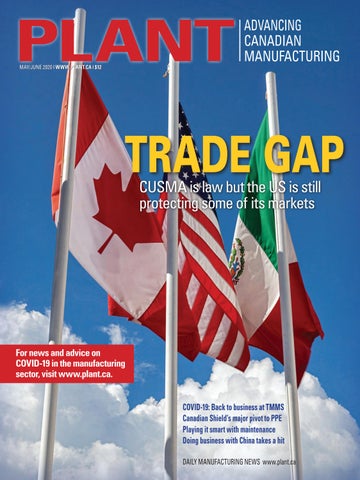
TRADE GAP CUSMA is law but the US is still protecting some of its markets
For news and advice on COVID-19 in the manufacturing sector, visit www.plant.ca. COVID-19: Back to business at TMMS Canadian Shield’s major pivot to PPE Playing it smart with maintenance Doing business with China takes a hit DAILY MANUFACTURING NEWS www.plant.ca
PLT_MayJune2020_AMS.indd 1
2020-06-03 8:12 AM
IT’S TIME TO TAKE A CLOSER LOOK AT ITALIAN MACHINERY We are your link to over 10,000 Italian manufacturing solutions providers from every industry. When you’re looking for the competitive advantage that comes with innovative technologies, take a closer look at Italian-made industrial equipment. We connect you to partners who offer problem-solving, flexible design, expanded functionality, and creative, cost-effective solutions. Our goal is to help you achieve your goals. When you’re ready, look to Machines Italia.
For more information on Machines Italia visit www.machinesitalia.org
machinesitalia
PLT_MarApr20_ITC_AMS.indd 21 PLT_MayJune2020_AMS.indd
Machines Italia
@ITAmachines
Machines Italia
2020-04-01 8:12 2:02 AM PM 2020-06-03
01 2:02 PM
CONTENTS
May/June 2020 Vol. 79, No. 03
FEATURES 15 COVID-19 GHD helped TMMS set up its screening procedures and offers some pointers to others ramping up production. TMMS engineers and Fanshaw College professors are global innovators. 16 HCM engineers harness their talents to produce face shields. 18 Social distancing is a challenge in plants, but a new company has come up with a wearable alarm. 20 PERFORMANCE Help team members take a more scientific approach to their thinking.
12 PROTECTIONISM
CUSMA may be law but buy USA policies are preventing full access to the US market.
22 CCOHS SAFETY TIPS Safeguarding machinery is the first line of defence. 23 THINK LEAN When consistency of purpose isn’t quite enough.
DEPARTMENTS 14 TRADE Global tensions, relationships and the pandemic have cut into doing business with Canada’s number two trading partner.
17 COVID-19 Some management factors to consider when ramping up for postpandemic commerce.
19 COVID-19 Canadian Shield has quickly pivoted from small manufacturing to a 10-million unit contract for reusable PPE.
25 INDUSTRY 4.0 Digitization and networked systems power maintenance and warehousing.
4 Editorial 6 News Bulletins 7 Careers 8 PLANT Online 10 Industry Mix 11 Economy PLANT Pulse 26 Leading Edge: Innovative ideas for plants 28 Products and Equipment 29 Plantware Events 30 Postscript: NGen: A supercluster update
COVER IMAGE: RONNIECHUA - STOCK.ADOBE.COM
PLANT—established 1941, is published 7 times per year by Annex Business Media. Publications Mail Agreement #40065710. Circulation email: bolechnowicz@annexbusinessmedia.com Tel: 416-510-5182 Fax: 416-510-6875 or 416-442-2191 Mail: 111 Gordon Baker Road, Suite 400, Toronto, ON M2H 3R1. Occasionally, PLANT will mail information on behalf of industry-related groups whose products and services we believe may be of interest to you. If you prefer not to receive this information, please contact our circulation department in any of the four ways listed above. Annex Privacy Officer: privacy@annexbusinessmedia.com Tel: 800-668-2374. No part of the editorial content of this publication may be reprinted without the publisher’s written permission. ©2020 Annex Publishing & Printing Inc. All rights reserved. Performance claims for products listed in this issue are made by contributing manufacturers and agencies. PLANT receives unsolicited materials including letters to the editor, press releases, promotional items and images from time to time. PLANT, its affiliates and assignees may use, reproduce, publish, re-publish, distribute, store and archive such unsolicited submissions in whole or in part in any form or medium whatsoever, without compensation of any sort. This statement does not apply to materials/pitches submitted by freelance writers, photographers or illustrators in accordance with known industry practices. Printed in Canada. ISSN: 1929-6606 (Print), 1929-6614 (Online).
www.plant.ca
PLT_MayJune2020_AMS.indd 3
PLANT 3
2020-06-09 10:24 AM
EDITORIAL
New normal comes with a cost
A
s the COVID-19 pandemic winds down (so far, anyway) and Canada eases back into a state of being that resembles revival, the crisis has run up an astronomical cost that will have to be reckoned with. When the New Year beckoned, no one could have anticipated the chaos that quickly followed as SARS-CoV-2 swept across continents, hitting some countries harder than others, and rapidly tallying deaths while plunging the world into economic turmoil. Severe acute respiratory syndrome coronavirus 2 – as of May 28 – afflicted more than 5.93 million people in 188 countries and territories, leading to over 357,000 deaths. More than 2.38 million people have recovered. On the same date, Canada reported almost 88,500 cases, 6,900 deaths and 48,000 recovered. Despite some stumbles along the way, Canada’s governments at all levels responded relatively quickly and effectively to lock down and isolate citizens in an attempt to slow and hopefully halt the exponential spread of the virus. Most governments recognized it was essential manufacturers continue to operate. Companies that were able to keep their plants running, even at a reduced capacity, demonstrated their importance to communities and the economy. It was evident early in the pandemic response that Canada was short of healthcare and safety supplies ranging from ventilators to commodity items such as masks, face shields, gowns, gloves and sanitizing products. The Trudeau government called on manufacturers to respond and many have done so, some recognizing opportunities for new lines of products. But the world has become a different place to do business. It will no longer do to take a passive view of managing risk. Too many companies, especially small ones, have avoided formal strategies. Many have struggled with a sudden loss of sales, liquidity issues, problems stemming from weaknesses in their supply chains and workforce concerns. Moving ahead comes at a cost. Prepare for other unanticipated crisis events. It’s the new normal. Here are some factors arising from the COVID-19 experience to consider: • Safety tops the list – screening, more sanitizing done more frequently, barriers, mapping out reduced contact and flow of people. • Identify critical functions and personnel, put a backup plan in place. Who can work from home? What can be done remotely? • How smart is your production floor? It may be time to get into the efficiencies of digital technologies and automation. • Dig deeper into the supply chain. Who provides what from where? Think about offloading some global sourcing in favour of relationships closer to home. • Keep a closer eye on assets, money in, money out. It will reassure your lender of choice, especially during a major economic distortion. And now a few words about the Trudeau government’s pre-COVID policy of endless budget deficits. Before the virus, Liberals rationalized it was okay to pile them up because the debt-to-GDP was so low (around 34%). That’s grand, unless there is an unexpected event – like a pandemic. This year the deficit will balloon by $250 billion or more because of lost economic activity and cash outlays from Ottawa to keep the economy afloat. The net debt is heading to $1 trillion-plus ($612 billion when Stephen Harper left office) and the debt-to-GDP ratio could exceed 48%. A healthy ratio is 27%. When interest rates go up…well, let’s not think about. Its legacy of credit card budgets and COVID-19’s first wave leaves the Trudeau government less room to manoeuvre, especially if there’s a second wave. Chickens-roost. Structural deficits need a rethink.
Editor Joe Terrett 416-442-5600 ext. 3219 jterrett@plant.ca Senior Publisher Scott Atkinson 416-510-5207 satkinson@annexbusinessmedia.com National Account Manager Ilana Fawcett 416-829-1221 ifawcett@annexbusinessmedia.com Media Sales Manager Jason Bauer 416-510-6797 / 437-218-0941 jbauer@annexbusinessmedia.com Media Designer Andrea M. Smith asmith@annexbusinessmedia.com Circulation Manager Beata Olechnowicz 416-510-5182 bolechnowicz@annexbusinessmedia.com Account Coordinator Debbie Smith 416-442-5600 ext 3221 dsmith@annexbusinessmedia.com Vice President/Executive Publisher Tim Dimopoulos 416-510-5100 tdimopoulos@annexbusinessmedia.com COO Scott Jamieson sjamieson@annexbusinessmedia.com
Subscription Price Canada $76.00 per year, US $201.00 (CAD) per year, Foreign $227.00 (CAD) per year. Single Copy Canada $12.00. Add applicable taxes to all rates. Combined, expanded or premium issues, which count as two subscription issues. Mailing Address Annex Business Media 111 Gordon Baker Road, Suite 400 Toronto, ON M2H 3R1 Circulation Beata Olechnowicz 416-510-5182 bolechnowicz@annexbusinessmedia.com Fax: 416-510-6875 or 416-442-2191
Joe Terrett, Editor Comments? E-mail jterrett@plant.ca.
4 PLANT
PLT_MayJune2020_AMS.indd 4
May/June 2020
2020-06-03 8:12 AM
PLT_Irwi
CASE STUDY
DC Emergency Lighting at Lennox Generating Station
ZĞƉůĂĐŝŶŐ ŝŶĐĂŶĚĞƐĐĞŶƚ ďƵůďƐ ǁŝƚŚ > ƚĞĐŚŶŽůŽŐLJ ƉƌŽǀŝĚĞƐ Ă ƌĂŶŐĞ ŽĨ ďĞŶĞĮƚƐ ŝŶ ƚŚŝƐ ĐƌŝƟĐĂů ĂƉƉůŝĐĂƟŽŶ
KǀĞƌǀŝĞǁ
ŵĞƌŐĞŶĐLJ ďĂĐŬƵƉ ƉŽǁĞƌ Ăƚ >ĞŶŶŽdž '^ ŝƐ ƉƌŽǀŝĚĞĚ ďLJ ďĂƩĞƌŝĞƐ ǁŚŝĐŚ ƐƵƉƉůLJ ĞŶĞƌŐLJ ƚŽ ĐƌŝƟĐĂů ĨƵŶĐƟŽŶƐ Ăƚ ƚŚĞ ĨĂĐŝůŝƚLJ Ͳ ŝŶĐůƵĚŝŶŐ ƚŽ ƚŚĞ ĞŵĞƌŐĞŶĐLJ ůŝŐŚƟŶŐ ƐLJƐƚĞŵ ĐŽŵƉƌŝƐŝŶŐ ĂƌŽƵŶĚ ϭ͕ϮϬϬ ĮdžƚƵƌĞƐ͘ ĸĐŝĞŶĐLJ ŝƐ ĂůǁĂLJƐ Ă ĐŽŶĐĞƌŶ ǁŝƚŚ ůŝŐŚƟŶŐ ƐLJƐƚĞŵƐ͕ ƐŽ > ůŝŐŚƚƐ ǁŽƵůĚ ƐĞĞŵ ƚŽ Įƚ ƚŚĞ ďŝůů͕ ďƵƚ ŵŽƐƚ ĐĂŶ͛ƚ ŽƉĞƌĂƚĞ Ăƚ ƚŚĞ ŚŝŐŚĞƌ ǀŽůƚĂŐĞƐ ƵƐĞĚ ŝŶ ĞŵĞƌŐĞŶĐLJ ƐLJƐƚĞŵƐ ŝŶ KŶƚĂƌŝŽ WŽǁĞƌ 'ĞŶĞƌĂƟŽŶ ;KW'Ϳ ƐƚĂƟŽŶƐ͘
ĞƐĐƌŝƉƟŽŶ
dŚĞƌĞ ĂƌĞ ĨŽƵƌ ŝŶĚŝǀŝĚƵĂů ďĂƩĞƌLJ ƌŽŽŵƐ Ăƚ ƚŚĞ ĨĂĐŝůŝƚLJ ;ŽŶĞ ƉĞƌ ƵŶŝƚͿ͕ ƉůƵƐ Ă ĮŌŚ ĨŽƌ ƚŚĞ ĐŽŵŵŽŶ ƉůĂŶƚ ĂƌĞĂ͕ ĞĂĐŚ ǁŝƚŚ ϭϭϲ ůĞĂĚͲĂĐŝĚ ĐĞůůƐ ǁŚŝĐŚ ƉƌŽǀŝĚĞ ϮϱϬ s Ăƚ ϭϭϳϯ , ;ϴ ŚŽƵƌ ƌĂƚĞͿ͘ ĂĐŚ ďĂƩĞƌLJ ƌŽŽŵ ƉŽǁĞƌƐ ĞŵĞƌŐĞŶĐLJ ďĂĐŬƵƉ ŵŽƚŽƌƐ ĨŽƌ ŝƚĞŵƐ ƐƵĐŚ ĂƐ ƉƵŵƉƐ ƚŽ ůƵďƌŝĐĂƚĞ ƚŚĞ ƐƚĞĂŵ ƚƵƌďŝŶĞƐ ŝŶ ƚŚĞ ĞǀĞŶƚ ŽĨ ƉŽǁĞƌ ĨĂŝůƵƌĞ͘
^ŽůƵƟŽŶƐ
s ;sŝƐƵĂů ŽŵŵƵŶŝĐĂƟŽŶƐ ŽŵƉĂŶLJ͕ >> Ϳ ĐƵƐƚŽŵͲĚĞƐŝŐŶĞĚ ƚŚĞ > ůĂŵƉ ĨŽƌ KW' ĐŽŶƐŝĚĞƌŝŶŐ Ăůů ŽĨ ƚŚĞ ĐŚĂůůĞŶŐĞƐ ĂŶĚ ĚƌĂǁŝŶŐ ŽŶ ƚŚĞŝƌ LJĞĂƌƐ ŽĨ ĞdžƉĞƌŝĞŶĐĞ ŝŶ ƐŽůŝĚ ƐƚĂƚĞ ŝŶĚŝĐĂƟŽŶ ĂŶĚ ůŝŐŚƟŶŐ ĨŽƌ ĚĞŵĂŶĚŝŶŐ ĂƉƉůŝĐĂƟŽŶƐ͘ dŚĞ > ĚƌŝǀĞƌ ŚĂĚ ƚŽ ĂĐĐŽŵŵŽĚĂƚĞ ƚŚĞ ǁŝĚĞ ƌĂŶŐĞ ŽĨ ĂŶĚ ǀŽůƚĂŐĞƐ ĚĞŵĂŶĚĞĚ ĂŶĚ ĚĞƐŝƌĞĚ ŽĨ ƚŚŝƐ ůĂŵƉ͘ dŚĞƐĞ ĞůĞĐƚƌŽŶŝĐƐ ĂůƐŽ ŝŶĐŽƌƉŽƌĂƚĞ ƚŚĞ ƚĞŵƉĞƌĂƚƵƌĞ ƐĞŶƐŝŶŐ ĂŶĚ ĨŽůĚͲďĂĐŬ ĐŝƌĐƵŝƚƌLJ ƚŽ ƉƌŽƚĞĐƚ ƚŚĞ > ĨƌŽŵ ŽǀĞƌͲ ƚĞŵƉĞƌĂƚƵƌĞ ĐŽŶĚŝƟŽŶƐ ƚŚĂƚ ĂƌĞ ĞdžĂĐĞƌďĂƚĞĚ ďLJ ƚŚĞ ĞŶĐůŽƐĞĚ ĮdžƚƵƌĞ͘ s ŚĂĚ ĞdžƚĞŶƐŝǀĞ ƚĞƐƟŶŐ ƉĞƌĨŽƌŵĞĚ ďLJ Ă ƚŚŝƌĚͲƉĂƌƚLJ ĂƵƚŚŽƌŝƚLJ ĂŶĚ ƚŚĞ ĚĞƐŝŐŶ ǁĂƐ ƌĞǀŝƐĞĚ ĂŶĚ ƉĂƐƐĞĚ Ăůů ƌĞƋƵŝƌĞŵĞŶƚƐ ŽĨ h> ϭϵϵϯ ;^ĞůĨͲ ĂůůĂƐƚĞĚ >ĂŵƉƐͿ ĨŽƌ ĨƵůůLJͲĞŶĐůŽƐĞĚ ĮdžƚƵƌĞƐ͘
ŚĂůůĞŶŐĞƐ /ŶƉƵƚ WŽǁĞƌ
dŚĞ ĂƉƉůŝĐĂƟŽŶ Ăƚ >ĞŶŶŽdž ƌĞƋƵŝƌĞƐ ϮϱϬ s ŝŶƉƵƚ͕ ǁŚŝůĞ ƐŽŵĞ ŽƚŚĞƌ KW' ĨĂĐŝůŝƟĞƐ ƵƐĞ ϭϮϱ s ͕ ĂŶĚ ĨŽƌ ǀĞƌƐĂƟůŝƚLJ͕ ƐƚĂŶĚĂƌĚ ϭϮϬ s ŽƉĞƌĂƟŽŶ ǁŽƵůĚ ďĞ Ă ďŽŶƵƐ͘
dŚĞƌŵĂů WĞƌĨŽƌŵĂŶĐĞ
&ƵůůLJͲĞŶĐůŽƐĞĚ ĮdžƚƵƌĞƐ ĂƌĞ ƵƐĞĚ ƚŚƌŽƵŐŚŽƵƚ ƚŚĞ ĞŵĞƌŐĞŶĐLJ ůŝŐŚƟŶŐ ƐLJƐƚĞŵ Ăƚ >ĞŶŶŽdž '^͕ ĂƐ ŝƐ ƚLJƉŝĐĂů Ăƚ KW' ŐĞŶĞƌĂƟŶŐ ƐƚĂƟŽŶƐ͘ dŚĞƐĞ ĞŶĐůŽƐƵƌĞƐ ƌĂŝƐĞ ƚŚĞ ƚĞŵƉĞƌĂƚƵƌĞ ǁŝƚŚŝŶ ǁŚĞŶ ďƵůďƐ ĂƌĞ ŽƉĞƌĂƟŶŐ͕ ƚŚƌŽƵŐŚ ƐĞůĨͲŚĞĂƟŶŐ͘ dŚŝƐ ŚĞĂƟŶŐ ĐĂŶ ƐŝŐŶŝĮĐĂŶƚůLJ ĚĞŐƌĂĚĞ ƚŚĞ ŽƉĞƌĂƟŶŐ ůŝĨĞ ŽĨ ĂŶLJ ďƵůď ĂĐƟǀĞ ǁŝƚŚŝŶ ƚŚĞƐĞ ĞŶĐůŽƐƵƌĞƐ͘
PLT_Irwin_MayJune20.indd 1 5 PLT_MayJune2020_AMS.indd
KŶĞ ŽĨ &ŽƵƌ ĂƩĞƌLJ ZŽŽŵƐ Ăƚ >ĞŶŶŽdž '^
ĞŶĞĮƚƐ
ĂƐLJ ZĞƚƌŽĮƚ
dŚĞ s ƌĞƉůĂĐĞŵĞŶƚ ďƵůď ŚĂƐ Ă ƐƚĂŶĚĂƌĚ Ϯϲ ďĂƐĞ͕ ĂŶĚ Ă ƐƚĂŶĚĂƌĚ Ϯϭ ƐŚĂƉĞ͕ ĂƐ ǁĞůů ĂƐ ďĞŝŶŐ ĂďůĞ ƚŽ ŽƉĞƌĂƚĞ ŝŶ ƚŚĞ ƐƚĂŶĚĂƌĚ ĞŶĐůŽƐĞĚ ĮdžƚƵƌĞƐ ĂŶĚ ǁŝƚŚ ƚŚĞ ƌĂŶŐĞ ŽĨ ŝŶƉƵƚ ǀŽůƚĂŐĞƐ ƚŚĂƚ KW' ƵƐĞƐ͘ ^Ž͕ ƚŚĞLJ ĂƌĞ ĨŽƌŵ͕ Įƚ͕ ĂŶĚ ĨƵŶĐƟŽŶ ĐŽŵƉĂƟďůĞ ǁŝƚŚ ƚŚĞ ĞdžŝƐƟŶŐ ŝŶĐĂŶĚĞƐĐĞŶƚ ďƵůďƐ͕ ĂŶĚ ĐĂŶ ďĞ ƌĞƉůĂĐĞĚ ŽŶ Ă ĮdžƚƵƌĞͲďLJͲĮdžƚƵƌĞ ďĂƐŝƐ͘
ŶĞƌŐLJ ^ĂǀŝŶŐƐ
>ĞŶŶŽdž ŝƐ ƵƐŝŶŐ ƚŚĞ s > ůĂŵƉ ƚŽ ƌĞƉůĂĐĞ Ă ŵŝdž ŽĨ ϭϬϬ t ĂŶĚ ϮϬϬ t ŝŶĐĂŶĚĞƐĐĞŶƚ ůŝŐŚƚ ďƵůďƐ͘ dŚĞ ϮϬϬt ďƵůďƐ ŚĂĚ ďĞĞŶ ƵƐĞĚ ŝŶ ƚŚĞ ƚƵƌďŝŶĞ ŚĂůů ǁŚĞƌĞ ĐĞŝůŝŶŐƐ ĂƌĞ ŚŝŐŚ͕ ĂŶĚ ƚŚĞ ĮdžƚƵƌĞƐ ĂƌĞ Ϯϱ ĨĞĞƚ ĂďŽǀĞ ƚŚĞ ŇŽŽƌ͘ KŶĞͲŚƵŶĚƌĞĚ ǁĂƩ ďƵůďƐ ǁĞƌĞ ƵƐĞĚ ŝŶ ĐŽƌƌŝĚŽƌƐ ĂŶĚ ŽƚŚĞƌ ĂƌĞĂƐ ǁŚĞƌĞ ĮdžƚƵƌĞƐ ĂƌĞ ůĞƐƐ ƚŚĂŶ ŚĂůĨ ƚŚĂƚ ĚŝƐƚĂŶĐĞ ĨƌŽŵ ƚŚĞ ŇŽŽƌ͘ dŚĞ s ůŝŐŚƚ ďƵůď ǁĂƐ ŶŽƟĐĞĂďůLJ ďƌŝŐŚƚĞƌ ƚŚĂŶ ƚŚĞ ϭϬϬ t ŽŶ ƌĞƉůĂĐĞŵĞŶƚ͕ ĂŶĚ ĂĐĐĞƉƚĂďůLJͲƐŽ ŝŶ ƚŚĞ ŚŝŐŚĞƌ ŝŶƐƚĂůůĂƟŽŶƐ͕ ŝŶ ƌĞƚƌŽĮƫŶŐ ƚŚĞ ϮϬϬ t ŽŶĞƐ͘ WĂƌƚ ŽĨ ƚŚŝƐ ŝƐ ĚƵĞ ƚŽ ƚŚĞ ŽƌŝĞŶƚĂƟŽŶ ĂŶĚ ďĞĂŵͲĂŶŐůĞ͘ ůů ĮdžƚƵƌĞƐ Ăƚ >ĞŶŶŽdž ŚĂǀĞ ƚŚĞ ďƵůďƐ ďĂƐĞͲƵƉ͕ ƐŽ ƚŚĞ ƐůŝŐŚƚůLJ ŶĂƌƌŽǁĞƌ ďĞĂŵ ĂŶŐůĞ ŽĨ ƚŚĞ > ůĂŵƉ ƐƵŝƚƐ ƚŚŝƐ ďLJ ƐŚŝŶŝŶŐ ŵŽƐƚ ŽĨ ŝƚƐ ůŝŐŚƚ ĚŽǁŶǁĂƌĚ͕ ǁŚĞƌĞ ŝƚ ŝƐ ƌĞƋƵŝƌĞĚ͘ dŚĞ s > ůĂŵƉ ŝƐ ϵt͕ ƐŽ ŝƚ ĚƌĂǁƐ ůĞƐƐ ƚŚĂŶ ϭͬϭϬƚŚ ƚŚĞ ĞŶĞƌŐLJ ŽĨ ƚŚĞ ϭϬϬ t ŝŶĐĂŶĚĞƐĐĞŶƚ ďƵůď ĂŶĚ ůĞƐƐ ƚŚĂŶ ϭͬϮϬƚŚ ŽĨ ƚŚĞ ƉŽǁĞƌ ĚĞŵĂŶĚĞĚ ŽĨ ƚŚĞ ϮϬϬ t ďƵůď͘ &ŝŐƵƌŝŶŐ ƚŚĂƚ ƚŚĞ ϮϬϬ t ďƵůďƐ ĂƌĞ ϭϬй ŽĨ ƚŚĞ ŝŶƐƚĂůůĂƟŽŶ͕ ƚŚĞ ƚŽƚĂů ĐƵƌƌĞŶƚ ĚƌĂǁ ĨŽƌ ƚŚĞ ĞŵĞƌŐĞŶĐLJ ůŝŐŚƟŶŐ Ăƚ >ĞŶŶŽdž ǁĂƐ ϱϮϴ ͕ ĂŶĚ ŝƐ ŶŽǁ ϰϯ͘Ϯ ǁŝƚŚ ƚŚĞ ĨƵůů ŝŵƉůĞŵĞŶƚĂƟŽŶ ŽĨ s > ůĂŵƉƐ͕ ƉƌŽǀŝĚŝŶŐ ŝŶĐƌĞĂƐĞĚ ŚŽůĚͲƵƉ ƟŵĞ ĚƵƌŝŶŐ Ă ƉŽǁĞƌͲĚŽǁŶ ƐŝƚƵĂƟŽŶ͕ ĂŶĚ ŵŽƌĞ ĂǀĂŝůĂďůĞ ĞŶĞƌŐLJ ĨŽƌ ƚŚĞ ŽƚŚĞƌ ĐƌŝƟĐĂů ĞŵĞƌŐĞŶĐLJ ƐLJƐƚĞŵƐ͘
&ƵůůLJͲ ŶĐůŽƐĞĚ &ŝdžƚƵƌĞ ;ǁŝƚŚ s > >ĂŵƉͿ
^ĞƌǀŝĐĞ >ŝĨĞ
dŚĞ ŝŶĐĂŶĚĞƐĐĞŶƚ ďƵůďƐ ƵƐĞĚ Ăƚ >ĞŶŶŽdž ŚĂǀĞ Ă ƌĂƚĞĚ ůŝĨĞ ŽĨ ϭ͕ϬϬϬ ŚŽƵƌƐ͘ ^ƚĂŶĚĂƌĚ ŝŶĐĂŶĚĞƐĐĞŶƚ ďƵůďƐ ĞŶĚ ƚŚĞŝƌ ůŝĨĞ ǁŝƚŚ Ă ŇĂƐŚ Ͳ Ă ǁŽƌŶͲ ŽƵƚ ĮůĂŵĞŶƚ ďƌĞĂŬƐ ĂŶĚ ĂƌĐƐ͕ ƵƐƵĂůůLJ ŽŶ ƚƵƌŶͲŽŶ ǁŝƚŚ ƚŚĞ ƐƵƌŐĞ ŽĨ ƉŽǁĞƌ ŝŶƚŽ ƚŚĞŝƌ ƌĞƐŝƐƟǀĞ ĂŶĚ ŝŶĚƵĐƟǀĞ ůŽĂĚ͘
ŵĞƌŐĞŶĐLJͲWŽǁĞƌĞĚ > >ŝŐŚƟŶŐ /ŶͲ ĐƟŽŶ
> Ɛ ŚĂǀĞ ŶŽ ĮůĂŵĞŶƚ͕ ďƵƚ ĂƌĞ Ă ƐŽůŝĚͲƐƚĂƚĞ ĚĞǀŝĐĞ ǁŝƚŚ Ă ũƵŶĐƟŽŶ ĂĐƌŽƐƐ ǁŚŝĐŚ ƚŚĞ ůŝŐŚƚ ŝƐ ŐĞŶĞƌĂƚĞĚ͘ > ůŝŐŚƚ ŽƵƚƉƵƚ ǁŝůů ĚĞŐĞŶĞƌĂƚĞ ŽǀĞƌ ƟŵĞ͕ ďƵƚ ĚŽĞƐ ŶŽƚ ďƵƌŶͲŽƵƚ͘ > ůŝĨĞ ŝƐ ƌĂƚĞĚ͕ ƚLJƉŝĐĂůůLJ͕ ƚŽ ƚŚĞ ŶƵŵďĞƌ ŽĨ ŚŽƵƌƐ ĨƌŽŵ ϭϬϬй ƚŽ ϳϬй ;>ϳϬͿ͕ Žƌ ϴϬй ;>ϴϬͿ ŽƵƚƉƵƚ͘ dŚĞ s > ůĂŵƉ ŝƐ ƌĂƚĞĚ Ăƚ ϱϬ͕ϬϬϬ ŚŽƵƌƐ ƚŽ >ϴϬ͘ dŚŝƐ ŵĞĂŶƐ ƚŚĂƚ ǁŚĞƌĞ ϱϬ ďƵůďƐ ŵĂLJ ŚĂǀĞ ďĞĞŶ ƌĞƉůĂĐĞĚ ŝŶ Ă ŐŝǀĞŶ LJĞĂƌ͕ ǁĞ ŵĂLJ ĞdžƉĞĐƚ ŽŶĞ ŝŶ ƚŚĞ ĨƵƚƵƌĞ͘ ZĞĂĚ ƚŚĞ ĨƵůů ĐĂƐĞ ƐƚƵĚLJ͕ ƉůƵƐ ĂŶŽƚŚĞƌ ĚŽĐƵŵĞŶƟŶŐ ƚŚĞ ŝŶƐƚĂůůĂƟŽŶ Ăƚ Z, ^ĂƵŶĚĞƌƐ '^͕ ĂŶĚ ƐĞĞ ƚŚĞ ĨƵůů ƐƉĞĐŝĮĐĂƟŽŶ Ăƚ ǁǁǁ͘ŝƌǁŝŶͲŝŶĚ͘ĐŽŵ͘
2020-05-21 2020-06-03 11:43 8:12 AM
NEWS BULLETINS The Competition Bureau has announced the 2020 pre-merger notification threshold relating to transaction size will remain unchanged from the current threshold set in 2019. The federal law enforcement agency must be given advance notice of proposed transactions when the target’s assets in Canada or revenues from sales in or from Canada exceed $96 million; and when the combined Canadian assets or revenues of the parties and their respective affiliates exceed $400 million.
FortisBC first to purchase RNG from wood waste
REN Energy to produce one million gigajoules annually over a 20-year deal
A biomass crane handling wood waste. Baylin Technologies Inc., a global wireless tech company in Toronto, has received more than $1.2 million in purchase orders for its Satcom frequency converters from an unidentified major US carrier, and NATO. Its subsidiary, Advantech Wireless Technologies Inc. has received an initial $650,000 order for its high power S-band solid-state power amplifiers destined for use in the US Space Force system. Spectra Premium Industries Inc. has signed an agreement with Trico Group LLC to purchase Spectra Premium Industries Inc.’s fuel pumps and related products inventory for the US market. Trico is a supplier of aftermarket automotive parts based in Rochester, Mich. The transaction, allows Spectra, a Boucherville, Que. manufacturer of components and systems for autos, light and heavy trucks, to lighten its debt load. Cematrix Corp., through its operating subsidiaries Cematrix (Canada) Inc., MixOnSite USA Inc. and Pacific International Grout Co., has been awarded several new infrastructure projects with a total contract value of $2.1 million. The Calgary-based manufacturer makes advanced cellular concrete products. Current projects total $78.5 million. Cannabis processor Nextleaf Labs Ltd. has an extraction agreement with an unnamed cannabis producer in Atlantic Canada to supply refined and distilled THC and CBD oils over one-year or a total 10 tonnes of processed biomass. Nextleaf Labs operates an industrial-scale extraction plant in Vancouver that can process 600 kilograms of biomass daily.
6 PLANT
PLT_MayJune2020_AMS.indd 6
Bloom cannabis products are coming
PHOTO: FORTISBC
SURREY, BC — BC utility FortisBC is teaming up with biomass energy firm REN Energy International Corp. in a 20-year partnership that will produce renewable natural gas (RNG) produced from wood waste. The production facility near Fruitvale, BC will be owned and operated by REN Energy. Renewable natural gas is a carbon-neutral energy typically made from capturing the methane released from decomposing organic waste. This project will make use of waste from forestry operations, sawmills and other wood product manufacturers. Rather than collecting the methane from decomposition, it will create synthesis gas through gasification. The gas is further converted to methane and then purified to meet natural gas line specifications. FortisBC said the project would assist the forestry industry with cleaning up bush residuals, which also helps with forest fire mitigation.
$60M EV order for ATS Automation CAMBRIDGE, Ont. — ATS Automation Tooling Systems Inc. has secured a $60 million order from an automaker for two automated battery assembly systems. They’re destined for North American assembly operations. ATS, an automation systems manufacturer based in Cambridge, Ont., will design, build and install the two conveyor lines for the unidentified automaker’s electric vehicle production. “The program will be built on our best-in class SuperTrak linear motion technology,” said CEO Andrew Hider. Its third generation conveyor platform supports payloads of up to 10 kilograms with spacing as low as 155 mm. ATS employs 4,500 people at 23 manufacturing facilities and more than 50 global offices.
VANCOUVER — BevCanna Enterprises Inc. has signed a definitive agreement with Capna Intellectual Inc. to bring Bloom, its multi-state cannabis vape brand, to Canada. BevCanna, a manufacturer of cannabinoid-infused beverages and consumer products, will produce and sell “Cali-Bloom” products, including cannabis concentrates and extracts. The Vancouver company will also acquire exclusive licensing and manufacturing rights to select Bloom product formats, technology and branding. BevCanna has a 292-acre outdoor cultivation site in BC’s Okanagan Valley and a 40,000-square-foot manufacturing facility, with a capacity of up to 210 million bottles annually. The company has also launched Jase, a ready-to-mix single-serve powder. It’s infused with 10 mg of THC and comes in a 10-pouch box available for sale in licensed California dispensaries. A1 Cannabis Co.’s first two beverages – Summit THC Citrus Water and Basecamp CBD Iced Tea – have launched in Ontario. Summit THC Citrus Water blends lemonade and grapefruit flavours with 2.5 mg of THC. Basecamp CBD Iced Tea with lemon contains 15 mg of CBD.
McCain fights food insecurity Donating potato products to food banks
Potato products for national distribution. PHOTO: MCCAIN FOODS
FLORENCEVILLE-BRISTOL, NB — McCain Foods Ltd. is donating up to 20 million pounds of potato products to support Food Banks Canada, Second Harvest and other local food security organizations across
the country. The Canadian multinational manufacturer of frozen food products in Florenceville, NB is acting on an increased demand created by COVID-19 at facilities battling food
insecurity. According to Food Banks Canada’s HungerCount report, more than one million visits were made to food banks across Canada each month prior to the pandemic.
May/June 2020
2020-06-03 8:12 AM
Starfish contracts Celestica to make its ventilators
C27-J landing gear.
PHOTO: HEROUX-DEVTEK
Heroux-Devtek cuts 10% of its workforce Closing its recently acquired Alta Precision plant LONGUEUIL, Que. — HerouxDevtek Inc., an aerospace manufacturer of landing gear, is reducing its workforce by 10% as it deals with a production slowdown resulting from the pandemic. The move affects approximately 225 employees, of which 125 are located in Quebec. The Longueuil, Que.-based company will be closing its Alta Precision plant in Anjou, acquired last year. Although defence activities have been generally insulated from the global pandemic, the company said it was seeing lower demand for its commercial products. Heroux-Devtek has facilities in Canada, the US, the UK and Spain.
Cryopeak breaks ground for a new LNG plant RICHMOND, BC — Cryopeak LNG Solutions Corp. has begun construction of a new liquefied natural gas (LNG) plant in Fort Nelson, BC capable of producing up to 90,000 gallons of LNG daily. The plant will be the closest LNG production point to northern Canada and portions of Alaska. Its new truck loading system optimizes loading of LNG Super-B tankers. Cryopeak is partnering with Fort Nelson First Nations to develop business opportunities associated with the project.
www.plant.ca
PLT_MayJune2020_AMS.indd 7
TORONTO – Celestica Inc. is building 7,500 ventilators in Newmarket, Ont. for Starfish Medical Inc. Celestica, based in Toronto, makes electronic equipment for a variety of industries including health care, aerospace and information technology. Starfish, based in Victoria, designs medical devices and provides contract manufacturing. It’s one of several companies that are part of the federal government’s plan to produce up to 30,000 medical ventilators to treat patients with severe symptoms of COVID-19. Celestica began manufacturing the ventilators in May and intends to deliver them on behalf of StarFish to Health Canada for distribution early in the fourth quarter. “We’re working on a very short timetable, and Celestica’s expertise and capabilities across the entire product development cycle will ensure we can meet the deadline and deliver products of the highest quality,” said John Walmsley, executive vice-president of strategic relationships at StarFish Medical. Canadian hospitals had an estimated 5,000 ventilators at the outset of the COVID outbreak in mid-March, when public health measures were put in place to limit the disease’s impact. Financial terms of the contract weren’t released.
Pyrowave wraps second for plastic waste technology Decomposes chemical structure to a simpler form MONTREAL — A cleantech innovator in Montreal with a technology that makes plastic infinitely recyclable has wrapped up a second round of investment. Pyrowave said the investment marks the Pyrowave’s patented high-power microwave first step to bringing catalytic depolymerization technology its modular technol- platform. PHOTO: PYROWAVE ogy to market and provide a scalable, viable and sustainable way to recycle plastic waste. France-based tire maker Michelin and Sofinnova Partners, a leading European life sciences venture capital firm based in Paris, London and Milan, led the round. It includes Ecofuel, a Quebec-based early stage cleantech venture capital fund. After more than a year of technological review, Pyrowave demonstrated its technology’s ability to produce recycled styrene monomer from plastic waste for integration in the production of synthetic rubber used in tires. The patented catalytic depolymerization platform uses a modular microwave-based technology that decomposes the complex chemical structure of plastics back into a simpler form to make virgin plastics and other products in multiple applications.
CAREERS A new president and CEO will be leading Toronto-based Corby Spirit and Wine Ltd. Nicolas Krantz comes to the distiller from Paris-based Pernod Ricard, a producer of wines and spirits, most recently as CEO of Pernod Ricard Winemakers, Spain. He replaces the retiring Patrick O’Driscoll. Pond Technologies Holdings Inc. has a new CEO. Grant Smith succeeds Steven Martin, who is retiring from the Markham, Ont. clean tech manufacturer. Its on-ste system allows industrial emitters to generate new revenue streams by transforming CO2 into algae-based products. Smith, a 25-year veteran of the North American nutraceutical industry, was president of the Pond Naturals subsidiary. Kevin Lynch will step down as chair of global engineering firm SNC Lavalin in Montreal when a successor is appointed no later than September. Lynch said the next stage of the firm’s renewal is a total focus on its new strategic direction, which requires a new chair. Daryl Musselman joins Loop Energy in Vancouver as vice-president of engineering. Loop is a mobile-power company providing hydrogen fuel cell solutions for medium-to-heavy duty vehicles. Musselman was previously vice-president of operations and engineering for Svante, a carbon capture technology company based in Burnaby, BC. BioNeutra Global Corp. has appointed Branko Jankovic CFO. His experience includes roles with three publicly traded life sciences companies and three years with the Agriculture & Food Council of Alberta. BioNeutra manufactures the sugar alternative sweeter VitaFiber in Edmonton. Canntab Therapeutics Ltd. in Toronto, a manufacturer of cannabinoid and terpene pills, has appointed Joshi Laxminarayan CSO. He’ll be responsible for strategic research and partnerships, as well as manufacturing and distribution. Laxminarayan, a pharmaceutical scientist, was previously in a consulting role as director of quality assurance and quality control.
PLANT 7
2020-06-03 8:12 AM
NEWS
BioNeutra joins fastest growing 500
Financial Times places the hyper-speed Edmonton company at 364 pandemic has just thrown LONDON, UK — Bioeconomies across the Neutra Global Corp., the globe into unprecedented Edmonton-based manufacturer of sugar alternaturmoil…” tive VitaFiber, has been BioNeutra, 364th on declared by the Financial the list, is one of only 36 Times to be one of the 500 companies among the 500 fastest growing compalisted on stock exchanges. nies. VitaFiber is made using The London, UK-based a patented process that international business naturally transforms and economics newsstarch molecules from paper bases the growth agricultural cereal crops ranking on annual revesuch as wheat, barley, pea nue growth over a threeor tapioca into healthy, year period from 2015 to functional molecules. 2018 in 20 countries of The company says the the Americas. A bottle of VitaFiber sweetener. PHOTO: ROBERT BRAY manufacturing process is The 20 companies based on a natural enzyare described by the Times as “…growing at matic conversion of the molecules without any hyper speed – especially when the coronavirus chemical modification.
SNC-Lavalin helps Medicom with N95 masks MONTREAL — Personal protection equipment (PPE) manufacturer AMD Medicom Inc. has selected SNC-Lavalin to support its first Canadian N95 and surgical masks plant. The Canadian and Quebec governments chose Medicom to deliver large-scale production of masks, starting in July. Its new 60,000-square-foot facility in Montreal will produce masks to supply the Canadian market. An existing building is being retrofitted for new machines with the capacity to produce millions of masks per month. New conveyors, a ventilation system, a compressor, a packaging system and a central palletizer will also be installed. The SNC-Lavalin’s Industrial Solutions team will help with equipment installation.
PLANT ONLINE SOUNDING OFF
What readers have to say about breaking news Have you checked out PLANT’s daily news online? Here are some headlines that have inspired members of the Canadian manufacturing community to chime in. They’re edited, but use the links to see the raw – and for some – longer versions of their remarks plus the stories that inspired their reactions. Stay up-to-date on the developments – domestic and global – that affect Canada’s industrial sectors by watching the news feed at www. plant.ca or reading PLANT’s twice-weekly newsletter (hit Subscribe on the website). Canadians divided over making COVID-19 vaccine mandatory: poll http://www.plant.ca/klGrq If and when a vaccine is developed, getting it should be mandatory. Deaths and economic devastation should be averted if such a simple action can do it. Freedom of choice has to take a backseat to the larger health and economic issues at stake. Most Canadians would sacrifice privacy to help stop COVID-19: KPMG http://www.plant.ca/25TYr First of all, the number of
8 PLANT
PLT_MayJune2020_AMS.indd 8
people surveyed is small so how can the survey be accurate to allow rules to be applied to the whole population? And everyone assumes that everybody has a cell phone. There are many of us who don’t. In fact many people don’t have a computer. Statistics are wonderful but the results can be manipulated to sway the outcome. Nonvisible disabilities: How to accommodate workers’ limitations http://www.plant.ca/wS7z2 It’s unfortunate the article makes no mention of environ-
mental sensitivities and the need to provide accessible-built environments for this group. 20% of small businesses too small to qualify for CEBA loan: CFIB http://www.plant.ca/YKTJ1 Due to the shortage of drivers in the transportation industry, many companies have moved from an owner-operator model to hiring employee drivers, therefore the payroll has increased substantially. The CEBA program eliminates them. The bar should be raised to $2 million to keep essential workers going. Also, banks need to waive lease interest on essential equipment for at least three months. This will lessen the stress. Anticipating N95 mask shortage, hospital turns to full-face snorkel masks http://www.plant.ca/Jgcqw When things return to normal
with the cost of labour, will all manufacturing stop in Canada and move back to Asia – or will we learn from this situation and keep some in-house manufacturing just in case? (I highly doubt it, as free trade and economics dooms us to higher margin products). Ontario’s essential businesses include manufacturing http://www.plant.ca/ke71Z I work at a manufacturing plant that produces duvets and pillows, definitely not essential when compared to other goods… Not to mention there are about eight to 10 of us in the building at any given time. Gloves, sanitizer and masks are provided but no one seems to care to use them. http://www.plant.ca/ke71Z My husband works at a manufacturing facility that makes fitness equipment. How can that be deemed essential? There are workers on the assembly line, two feet apart, and parts are passed from one person to the next. The provincial government needs to be more specific with their definition of “essential manufacturers.”
May/June 2020
2020-06-03 8:12 AM
NEWS
AI deployment will take time: survey BOSTON — Deployment of artificial intelligence is widespread but will take time to scale, according to a research program by MIT Technology Review Insights. The magazine, wholly owned but independent of the Massachusetts Institute of Technology, explores trends in global AI adoption and includes a survey of more than 1,000 AI leaders as well as interviews with experts worldwide. Most survey respondents expect AI to be used in 11% to 30% of their business processes within three years. Other findings from The global
Tafisa Line 1 press gets $23M upgrade
interfacing with open-data platforms. • 60% of manufacturers and pharma companies are using AI to improve product quality. Nearly half of retail and consumer firms are using it in customer care. • 66% of companies are willing to share data externally to help develop new AI-enabled efficiencies, products, or even
AI agenda: Promise, reality, and the future of data sharing, include: • More than half of surveyed companies struggle most with the change management involved in modifying business processes to leverage AI. Nearly as difficult are integrating unstructured data and
value chains. Manufacturers envision benefits to supply chain speed and visibility, plus reduced time to market of new products. • Although businesses are in principle willing to share data, they’re still cautious. More clarity is needed in privacy regulation (say 64%) and industry standards (58%) before data sharing takes hold.
FOR MACHINERY THAT DEMANDS
PRECISION, QUALITY AND HIGH PERFORMANCE
Produces particleboard used in TFLs
Tafisa’s Line 1 particleboard press. PHOTO: TAFISA LAC-MEGANTIC, Que. — A particleboard and thermally fused laminate (TFL) panel manufacturer has completed a $23 million modernization of its Line 1 particleboard press. Tafisa Canada, a subsidiary of Sanae, a Portugese wood panel business, operates a 17,000 square-metre plant in Lac-Megantic with a workforce of 325. The project involved the complete refurbishment of the original press used for the TFL panels. Every component of the press was removed, leaving only the original frame. Heating platens, hydraulic, electronic and mechanical components were replaced. This investment follows installation of new rotary screens and a gas extraction system on Line 1.
www.plant.ca
PLT_MayJune2020_AMS.indd 9
Polyurethane Timing Belts
English and Metric Pitch. Backings, profiles and machining available for diverse applications
Pulleys
Stock pulleys available for fast delivery Custom pulleys made to your specifications
Drive Components & Accessories
Clamps, tensioning clamps and tensioners Tension Meter, Field Welder and Connecting Kits
(732) 460-9500
PLT_March_Brecoflex.indd 1
www.brecoflex.com
info@brecoflex.com PLANT 9
2019-02-07 1:44 PM
2020-06-03 8:12 AM
INDUSTRY MIX
MISCELLANY FROM THE WORLD OF MANUFACTURING
Emissions target harder to see
Beer sales down, brewers up
The battle to lower greenhouse gas emissions continues. How is Canada doing to meet its commitment of a 70% cut from the 2005 level by 2030? Not so good based on our 2018 performance. And we have about 200 million tonnes ahead of us to meet the 2030 goal of 529 million tonnes. Canada’s latest national inventory report delivered to the United Nations shows an increase from 714 million tonnes in 2017 Emitted almost 730 million tonnes in 2018. to 729 million tonnes. Emissions PHOTO: FRENTA - STOCK.ADOBE.COM from road traffic, manufacturing and fossil-fuel production – responsible for two-thirds of the increase – have almost erased progress made since 2005. Their impact was mitigated somewhat from a significant cut in electricity produced by coal power. Manufacturing contributed 44 million tonnes in 2018, up from the previous two years of 42 million tonnes, but still ahead of 48 million tonnes in 2005. The number of vehicles on the road is up 40% since 2005 and emissions from energy extraction grew by 43 million tonnes. Still to be considered are the impact of carbon pricing, how declining prices for fossil fuels has affected the industry, how the Russia-OPEC price war affected Canadian production and – of course – COVID-19. Canada is last among the top 10 global emitters (2017) at 1.63% of total emissions. China is first (27.51%) followed by the US (14.75%) although President Donald Trump’s climate change scepticism and his administration’s attack on environwmental regulations may make “America First.”
Beer business in Canada was challenging before the COVID-19 pandemic. Domestic sales fell (3.9% in 2018-2019) and imports were down 1.5% while the number of breweries increased. But good news for imbibers, lots of brand selection. Beer Canada’s Industry Trends update reports the number of breweries hit an all-time high of 1,123 in 2019, nearly tripling the number operating five years ago. Ontario leads with 350 breweries followed by Quebec with 240. More brewers and a smaller market trans- Lots of brand selection. PHOTO: TIKO_PHOTOGRAPHER - STOCK.ADOBE.COM lates into intense competition. Changing demographics and consumer tastes, the high overall tax and price of the product, and COVID-19 essentially shutting social and entertainment activities, are adding to the challenges. Yet Canada’s beer industry is pushing ahead. It accounts for 90% of the domestic beer brewed, it directly employs 15,000 people, supports 149,000 jobs overall, tallies $13.6 billion in GDP and generates $5.7 billion in tax revenues for three levels of government. That’s worth raising a mug of suds.
Alberta takes aim at hydrogen Factions at home and abroad are determined to grind down Alberta’s greenhouse gassy energy sector on multiple fronts by hanging up proposed pipelines, stymying investment (Norway’s sovereign wealth fund cut out four oil sands producers over emissions) and depicting the province as an environmental pariah. How ironic Alberta has launched a task force to detail a plan aimed at advancing a zero-emission economy in its industrial heartland by producing hydrogen from upgrading natural gas. That is correct, folks: sustainability from a fossil fuel. Hydrogen is generally associated with the H in H2O, dirigibles and fuel cells used in transportation. We’re currently lacking distribution and refuelling infrastructure so hydrogen-powered vehicles are a promise yet to be kept. But there are many industrial and manufacturing uses for the Big H, including decarbonizing natural gas distribution systems, industrial processes, thermal power generation, and heavy and long-distance transportation. Hydrogen demand in the global energy system is projected to increase tenfold in the decades ahead, and Alberta is among the world’s lowest-cost producers. Stick that in your fiords, Norway. Transition Accelerator, a national group that works with stakeholders providing research for sustainability initiatives, is driving the task force (heartland cities, government, business, academia Many uses for atomic number 1. and green people). Visit https://transiPHOTO: ALEXLMX - STOCK.ADOBE.COM tionaccelerator.ca.
10 PLANT
PLT_MayJune2020_AMS.indd 10
We took an elevator ride down for the economy. It’s going to be a staircase back up. It will take time, and possibly a long time, to get all the way back to where we were before the virus hit. BMO chief economist Douglas Porter on job losses arising from the pandemic.
Burger take-out innovation There’s no end to the creativity applied by Canadian manufacturers dealing with COVID-19 challenges. Bauer Hockey, with manufacturing facilities in Blainville, Que., and Harvey’s Canada, our hometown burger chain, have come up with a uniquely Canadian way to maintain two metre-plus social distancing at the take-out window. When you roll up to collect your meal, you’ll be presented with a payment machine on the end of a Bauer hockey stick. And a portion of the drive-through sales will be donated to Food Banks Canada. Bauer has also re-tooled its production facilities in Liverpool, NY, and Blainville to make medical face shields to protect nurses and other frontline health Great stick handling. PHOTO: BAUER/HARVEY’S care workers. They shoot, they score!
May/June 2020
2020-06-03 8:12 AM
ECONOMY
Post COVID-19 An economic prognosis
www.plant.ca
PLT_MayJune2020_AMS.indd 11
MARCH MANUFACTURING SALES PLUMMET
$ billions 60
Not a surprise: manufacturing sales took a deep dive in March – 9.2% to $50.8 billion. That’s the lowest level since June 2016 and the largest percentage decline since December 2008 during the previous recession. Many plants shut down as a result of the COVID-19 pandemic, or they experienced sharply lower demand during the last two weeks of the month. Statistics Canada expects the decline in sales to continue into April.
CURRENT DOLLARS 2012 CONSTANT DOLLARS TREND-CYCLE (CURRENT DOLLARS) TREND-CYCLE (2012 CONSTANT DOLLARS)
58 56 54 52 50 48 46 44
May
2015
2016
2017
2018
2019
May 2020
Source: Statistics Canada, CANSIM
1.7%
18%
Increase from 134.1 on the Statistics Canada Machinery and Equipment Price Index for manufacturing from Q4-2019 to Q1-2020, and from 2019 to 2020.
Percentage of small manufacturers in May who said business was looking up, according to Canadian Federation of Independent Business. But 39% describe their business health as bad.
$324,036,678
Lost time injuries in manufacturing (2018) according to the Association of Workers’ Compensation Boards of Canada (AWCBC). That’s up from 33,893 in 2017. There were 182 fatalities in 2018. IMAGES: STOCK.ADOBE.COM
A
s the COVID-19 pandemic cools and the Canadian economy eases into a revival, what’s the prognosis for manufacturing? Declared essential by many provinces (particularly in Ontario’s industrial heartland), many companies have maintained operations amid disruptions to supply chains, sales and various workforce issues. Statistics Canada reports the economy lost nearly 2 million jobs in April. The good news is 97% of them were on temporary layoff. That’s different from previous recessions when most job losses were permanent. Employment in manufacturing declined by 302,000 (or 17.3%) compared to February, with almost all of the erosion occurring in April. Transportation equipment, machinery and fabricated metal products were most affected, which Statistics Canada said hinted at bottlenecks in the supply chain and lower demand. Yet employment in food manufacturing was relatively stable. This aligns with an outlook report by TD Economics that slots 30 industries into three recovery categories: L (slow), U (moderate) and V (quick). Manufacturing is mostly U-shaped, according to Brian DePratto, TD Economics director and senior economist, who writes: “...Physical spacing requirements and damaged order books appear to be the order of the day, keeping the rebound modest until later this year.” He notes all industries in this category will be adapting new ways to operate that re-assure workers and customers business can be conducted without fear. Some manufacturers fall into the V category, such as those who make cleaning products and other needed chemicals, and medical equipment. Food manufacturers also fall into this category, “although the risk of supply chain disruptions, particularly in protein production, risk sending this industry grouping to the Us.” This analysis assumes reopening plans succeed. Delays would delay the recovery, stretching out the Us. What happens if there is a second wave of the virus? Let’s not go there…
35,910
Value of manufacturing exports in 2019 generated by 18,233 manufacturers, according to the Statistics Canada Trade by exporter characteristics: Goods 2019 report.
40%
Q1 decline in revenues compared to Q1-2019 for almost 33% of the 12,600 Canadian businesses that responded to a Statistics Canada COVID-9 impact study (April 3-24). Another 21.2% of businesses reported revenues had decreased by 20% to 40%. In response to requests from government, 2.8% of businesses started making new products to help cope with the pandemic crisis. Manufacturers were most likely to shift production. Almost 43% of businesses shifting production had started manufacturing hand sanitizer or masks and eye protection. Nearly two-thirds (62.3%) reported they could re-open or return to normal operations less than one month after social distancing measures are removed.
PLANT 11
2020-06-03 8:12 AM
PROTECTIONISM
CUSMA: A DONE DEAL
BUT IT DOESN’T ADDRESS ALL US PROCUREMENT IRRITANTS
The trade agreement that replaces NAFTA is law, but some manufacturers are concerned about protectionist gaps.
Protectionist Buy American/America policies make life difficult for Canadian manufacturers. BY KIM LAUDRUM
J
ust as the proverbial virus stuff hit the fan in early March, the renegotiated trilateral North American Free Trade Agreement, or NAFTA and now called CUSMA (Canada-US-Mexico Agreement), became law. After a hastened line-by-line review, the treaty that will govern the US$1.1
12 PLANT
PLT_MayJune2020_AMS.indd 12
trillion worth of trade between Canada the US and Mexico was hailed by all – although some politicians only agreed to it because they said it was better than no deal at all. Ironically in retrospect, the impetus for swift passage of Bill C-4: An Act to Implement the Agreement between Canada, the United States of America, and the United Mexican States was to secure economic certainty in an uncertain economic time under an unpredictable presidential administration in the United States. Who would have predicted that as of CUSMA’s royal assent, the world economy would unravel under
PHOTO: MYCREATIVE - STOCK.ADOBE.COM
a zombie apocalypse called the COVID-19 pandemic? Businesses, provinces, labour unions and political conservatives supported the quick passage of Bill C-4 that brought CUSMA into law. So did Goldy Hyder, the president of the Business Council of Canada, who called for swift passage – to quell economic uncertainty – but he also said the deal wasn’t perfect. For example, CUSMA fails to eliminate the application of US Section 232 national security tariffs on imports, such as steel and aluminum, from its North American partners. This signals future risk concerning
May/June 2020
2020-06-03 8:12 AM
assured access to the US market, according to C.D. Howe Institute’s recently released report, Quantifying CUSMA: The Economic Consequences of the New North American Trade Regime. The authors warn CUSMA will lower real GDP for all three countries, with Canada’s expected to be reduced US$10 billion. Yet, they allow the three trading partners are “marginally better off than under a scenario in which NAFTA lapses altogether.” The Canadian government’s analysis of the deal shows a modest expectation of $6.8 billion growth in GDP by 2025, compared to no trade deal at all. Hopefully, CUSMA will outlast the pandemic, as is expected. When the air clears, manufacturers will get back to business. In the meantime, amid the scrutiny of CUSMA’s ramifications for Canadian companies, one issue stood out: American protectionist policies, like Buy American, continue to deny Canadian firms fair access to the US market. Case in point: Jim Tully is executive vice-president of Decast Ltd. in Utopia, Ont., a manufacturer of engineered precast products, such as concrete pipes and steel fittings for storm and sanitary projects, bridges and transit systems. Decast has provided infrastructure solutions since 1957 and employs 500 people with a supply chain that affects another 3,000 workers. After 10 expansions in 30 years, the company’s indoor manufacturing facility now encompasses 510,000 square feet.
Open markets Tully says that “while NAFTA and now CUSMA should provide open markets to both sides of the border, history has shown us that this isn’t the case. There are several existing US policies that have affected small to midsized companies like Decast: Buy America; Buy American; the American Recovery and Reinvestment Act (ARRA); and US President Donald Trump’s executive orders on US content.” There are nuances to the terms of Buy
BUYING AMERICAN Although Buy American and Buy America policies have been on the books since 1933 and 1982 respectively, it wasn’t until 2009 when the American Recovery and Reinvestment Act (ARRA) was introduced that Canadian manufacturers began to feel the pinch. The ARRA was intended to stimulate the US economy by injecting $787 billion in spending and tax cuts. The ARRA includes Section 1605, a Buy American provision that stipulates funded projects involving the construction, alteration, maintenance or repair of a public building or public work, requires 100% of the iron, steel and manufactured goods used to be produced in the US, with certain waiver restrictions. In effect, the ARRA expanded the Buy American provision to include all manufactured goods, not just iron and steel. In 2014, legislation was introduced affecting the Buy America provisions for US Department of Transportation procurement. This meant all sub-federal level transit, roads and highway projects would be restricted to 100% domestic sourcing. Although the Canada-US Agreement on Government Procurement was meant to clarify these policies, it hasn’t done so.
nies like Decast,” he says. “From our perspective, the real effect on us has been that we have no ability to bid on US jobs.” No ability, he says, because of the uncertainty these policies have caused. “By the time the local proponent, who has asked us to give them a price, figures out whether they can use us as a supplier, the bids are closed. It’s too late. So, we’re blocked from bidding on pretty well any project. Our US competition – and I’m all for open and fair competition when it’s equal – has the ability to Jim Tulley, executive vice-president of Decast Ltd. come into Canada to bid on jobs, and PHOTO: DECAST they use predatory pricing when they come up here.” American that require construction materiFor example, in 2018 Decast lost the als to be made 100% in the US, with greater equivalent of 41 full-time jobs on lower-bid than 50% of materials coming from America. Canadian projects lost to imports of US steel Although Canada is exempt for contracts pipe. greater than $10 million, Tully points out Tulley says as recently as February in most of the projects Decast bids on fall Winnipeg a pipe manufacturer from Texas under this amount. Many states and municundercut local pipe producers to win a conipalities use similar geographic production tract. “Given the distance they had to ship, requirements, he says. they are selling at or below their cost. It’s Trump incorporated and expanded Buy unacceptable. America and Buy American concepts into “They do this freely, knowing that we three executive orders. “These executive have no ability to retaliate. That’s our real orders create more uncertainty for compaproblem,” Tully says. “From my perspective, reciprocity is the answer: ‘If you put this kind of policy on us, we do the same back.’ That’s the only clear answer.” Buy American Dennis Darby, president and CEO of CaApplies to all US federal government agency nadian Manufacturers & Exporters (CME), purchases of goods valued over the micro-pursays the association recognizes it’s difficult chase threshold. All goods for public use (articles, for Canadians to bid on American governmaterials, or supplies) must be produced in the US, ment-funded infrastructure projects. “I and manufactured items must be made in the US understand the frustration.” from American materials. Many states and muCME advocated for reciprocity in light of nicipalities include similar geographic production an executive order by the US president in requirements in their procurement legislation. February last year that called for expanding
AMERICA PROVISIONS: HOW THEY DIFFER Buy America Provisions are applied to transit-related procurements valued over US$100,000 with grants administered by the Federal Transit Authority (FTA) or Federal Highway Administration (FHWA). They’re a condition of US federal government grants to state, municipal or other organizations including transit authorities and include requirements for 100% US content for iron/steel and manufactured products.
www.plant.ca
PLT_MayJune2020_AMS.indd 13
PLANT 13
2020-06-03 8:12 AM
the scope of Buy American policies. The association asserted in a statement at the time the Canadian government must respond in kind with its own reciprocal policy. CME was adamant to ask for those provisions, Darby says. At the federal level, for example, Canada has an exemption to Buy
NAFTA PROS Since 1994, NAFTA has generated economic growth and rising standards of living for the people of all three member countries. In 2017, total trilateral merchandise trade (of each country’s imports from one another) reached nearly US$1.1 trillion. Total merchandise trade between Canada and the United States has more than doubled since 1993, and has grown more than nine-fold between Canada and Mexico. Source: Government of Canada
American policies for military projects. But to be fair, he offers, “it’s not entirely one way. We have local content requirements as well.” He cites Buy Canadian projects in Quebec and Ontario, which offset some of the loss. Reciprocity is not the best action to take, he says. “We would prefer no difference between a A view of the Decast yard from the air. PHOTO: DECAST Canadian supplier or an American one.” agreement, it’s not a shining agreement. But Despite global free trade, such protecwe need a modern manufacturing agreement tionist policies also exist in Europe. “We’ll because 79% of all we produce in Canada we continue to work against them,” Darby says. sell to the United States. We need rules that “Once things are back to normal we will are fair.” work with the US and Mexico to clarify things.” He added dumping is often a factor Kim Laudrum is a Collingwood, Ont.-based of export subsidies or currency manipulabusiness writer and regular contributor to tion. “It’s hard to tell why it’s going on and PLANT. E-mail klaudrum@rogers.com. enforcement is very difficult. We’re pleased CUSMA has been ratified. Versus the old Comments? E-mail jterrett@plant.ca.
TRADE Business is down since December 2018. IMAGE: ALLEXXANDARX - STOCK.ADOBE.COM
Tension with
CHINA
CANADIAN BUSINESSES ARE FEELING IT CCBC survey reveals a decline in trade based on three key factors.
C
hina is Canada’s second largest two-way trading partner but business took a hit in 2019 and will likely be down this year, according to a Canada China Business Council (CCBC) survey. The 2019-2020 Business Impact Survey, conducted in partnership with the Rotman Institute for International Business and fielded Feb. 20 to March 14, examines the impact of bilateral tensions between March 2019 and March 2020.
14 PLANT
PLT_MayJune2020_AMS.indd 14
The results are based on 282 responses from mostly Canadian businesses operating in China (87%) and Chinese businesses operating in Canada (13%). Manufacturers represent 7.6% of the respondents. The survey reveals business was good at $103 billion for the year until December 2018, when the RCMP arrested Huawei CFO Meng Wanzhou over alleged bank and wire fraud in violation of American sanctions on Iran. What followed were various trade actions against Canadian interests, and the apparent retaliatory arrests of two Canadians in China: Michael Spavor and Michael Kovrig.
More disruption followed when the US initiated a trade war with China and the year closed at about $98 billion in two-way business. The COVID-19 pandemic was in its early phase when the survey was taken, so its full impact is yet to be determined. Not surprisingly, 43% of respondents reported business was down following a record year in 2018, while 22% reported an increase and 34% said business was stable. The outlook remained positive for most: 43% were optimistic about the future of Canada-China business, although growing uncertainty has prompted 33% to make China a lower priority in their global plans, with 5% exploring opportunities in other countries. Most manufacturers (52%) expected business to be stable, 19% looked to increased business and 29% expected a decline. More than two thirds of companies (69%) didn’t see any change in priority doing trade with China, 25% said it was a lower priority and 6% cited trade as a higher priority. Tension has led 63% of respondents to postpone business development trips or negotiations, twice 2018’s level. And 51% said contracts or deals postponed, 40% reported cancellations and 46% said demand had decreased, about twice the 2018 rate. Download results at https://ccbc.com. Comments? E-mail jterrett@plant.ca.
May/June 2020
2020-06-03 8:12 AM
COVID-19 GHD helps the automaker ramp up and discusses effective measures. BY JOE TERRETT, EDITOR
C
anadian manufacturers are in the process of easing their operations into revival mode as the nation emerges from the COVID-19 pandemic. Among these are the large-scale, automotive manufacturers. They took steps in May to begin carefully ramping up production after shutting down in March to protect employees and align with plummeting demand for vehicles during the crisis. Toyota Motor Manufacturing Canada Inc. (TMMC) opened its doors at the Cambridge and Woodstock, Ont. plants to its 8,500 employees after prepping the sites with procedures and safety equipment that will protect against an outbreak of the virus. Helping TMMC with this task is GHD, a global engineering firm based in Waterloo, Ont. TMMC has a COVID task force and plenty of resources to apply against a COVID incursion, but the automaker’s efforts provide some basic guidance for other manufacturers with much less to work with. For GHD, it’s about responding, recovery and especially
Employee screening at TMMC plant entrances.
PHOTO: TMMC
Back to
WORK
IT’S SAFETY FIRST AT TMMC’S ASSEMBLY PLANTS
long-term resiliency, the last point a theme GHD vice-president Jason Haelzle emphasizes as manufacturers such as Toyota move forward. “Those who survive this challenge are
going to come out much stronger, more resilient and more agile than they were coming into it.” The automaker is clear its primary concern is the safety of employees and the community.
COVID-19
Toyota engineers top 10 in ventilator design Team beats more than 1,000 entries from 94 countries
A
team including four engineers from Toyota Motor Manufacturing Canada (TMMC) and two professors from Fanshawe College finished ninth in an international competition to design a lowcost, easy-to-use medical ventilator to help COVID-19 patients. Their Code Life Ventilator Challenge design incorporated common parts such as sensors and moulded bearings that normally go under the hoods of Toyota and Lexus vehicles. They were combined with components made with in-house 3D printers. The six-person team beat out more than
www.plant.ca
PLT_MayJune2020_AMS.indd 15
(L-R) TMMS team members: Chris Loates, Daniel Adam, PHOTO: TMMS Moe Bdeir and Leon Drasovean.
As such, Haelzle has been working with TMMC management from the president and executives to senior managers on the employee-screening piece of the recovery phase. TMMC has set up controlled and spaced entryways into its facilities where it assembles RAV4 and Lexus models. Everyone is provided with face masks for use at all times while on site. Employees fill out a daily questionnaire to determine if anything has changed day-today, and each person’s temperature is checked using thermal cameras. A temperature reading above a set limit requires a second test. This interlocks
1,000 entries from 94 countries. The innovators include Leon Drasovean, an engineering manager, Chris Loates, a project engineering analyst, engineering analyst Moe Bdeir and mechanical designer Daniel Adam from TMMS; and Drasovean’s wife Yvonne, who learned of the challenge through her role as a professor of respiratory therapy at Fanshawe, and David Wall, also a professor at the college. The team initially collaborated virtually from their homes to research the problem and brainstorm solutions. Once they had a plan, they built their prototype at TMMS. The Code Life Challenge worked with the shortlisted teams to ensure compliance, testing, materials and engineering all met the required standards.
PLANT 15
2020-06-03 8:12 AM
with other safeguards such as sanitizing, personal protective equipment (face shields, gloves and hand-sanitizer), barriers, signage and the alignment of employee movement to ensure social distancing is maintained. The plants were assessed and changes made to accommodate physical distancing, physical separation and use of enhanced PPE while working, during all breaks, and while entering or leaving during shift changes. Cleaning processes were also enhanced, with high traffic areas such as break rooms and restrooms getting more frequent attention. These protocols continue indefinitely, with ongoing monitoring and Toyota says it will make changes based on federal, provincial and municipal public health recommendations.
Manufacturers conducting temperature screening have done so manually from the ear, but Haelzle says thermal imaging cameras allow rapid throughput and are capable of taking images. If a high temperature is detected, there’s also a capability to tie in with swipe cards to prevent access. To ensure efficacy of the data, parallel testing of ear readings and thermal imaging are compared. Whatever the size of the plant, getting back to business and building in long-term resiliency requires a layered approach that includes measures similar to those employed by TMMC. Haelzle likens it to stacking slices of Swiss cheese. They’re connected but the holes don’t line up. “Any one of those [measures] adds value, but on their own, they’re not anywhere near as
effective as integrating the whole solution,” he says. “The connected worker and social distancing is the end-piece that leads to resiliency planning for the long term.”
Moving people About the connected worker: that’s the essence of GHD’s Movement Strategies offering, which the engineering firm has been pitching to automotive companies. It’s a technology that comes from a UK company (same name) specializing in crowd dynamics and people movement in busy places. GHD acquired the firm in January. The connected workforce is real-time social distancing that could be, for example, an audible signal letting employees know they are getting too close. Part of that is contact tracing by
COVID-19
Honda PPE for front liners
Engineers innovate face shield design BY PLANT STAFF
The automaker is deploying its 3D printers and collaborating with Georgian College in Barrie.
Face shield holder on a 3D printer.
onda of Canada Mfg. (HCM) is partnering with Georgian College to source materials and 3D print face shields for front line healthcare workers. The auto manufacturer’s Alliston, Ont. site, one of five Honda facilities in North America making equipment for doctors and nurses, is deploying four multiple-duty 3D printers at Plants 1 and 2 to make the protective gear. “The printers are normally used to make jigs and new model prototype parts, but we realized there was a new way to use them to help front line healthcare workers,” says Ahmed Amir, an HCM associate in the product-engineering department. The visor piece and the attachment feature are made in-house, while the clear face shield comes from the college in Barrie, Ont. “We designed the holder piece and for the visor portion, we get roll from a supplier and Georgian College helps us cut it,” says Jim Kerr, a production associate. “We can produce 27 of the hospital style a day, and 95 of the production style (for Honda associates).”
The HCM engineers collaborated with the Stevenson Memorial Hospital in Alliston on the face shield’s requirements, says Terry Grasby, also a production associate. “We make a couple of versions, the other for associates (who wear Honda caps) with a clip arrangement and holder (designed by Kerr).” The face shields are destined for the hospital, two long-term care facilities (Riverwood Senior Living and Good Samaritan Seniors’ Complex), Matthews House Hospice and My Sister’s Place shelter for women in Alliston. The engineering team also came up with a device to relieve the chaffing caused by securing a surgical mask with loops around the ear. “The ear savers hook onto a plastic piece behind the healthcare worker’s head, taking the load off the back of the ear,” Amir explains. Printed in-house, the automaker can produce about 400 of the ear devices daily for hospitals. HCM is working with St. Michael’s Hospital in Toronto and the Trillium Health Partners in Mississauga, Ont. to get feedback.
H
16 PLANT
PLT_MayJune2020_AMS.indd 16
PHOTO: HCM
gathering movement data. This reveals high contact areas within a facility. Depending on plant requirements, employees wear a fob connected to a swipe card or RFID tag and sensors do the rest. The technology is capable of analyzing large data sets from mobile phone networks, wireless networks, smart cameras and other sources. “We’re constantly seeing close interactions in hallways leading to the cafeteria or in the line during initial screening. These are all areas you can modify,” Haelzle says. “The data is anonymous except, if someone is sick from COVID or has a fever, you do contact tracing to see who he/ she had close contact with. [They] then go for testing and that limits the shutdown to exposed areas rather than the entire facility.” Small and medium-size enterprises don’t have the deep pockets of a large company but there are steps they can take to establish what the new normal will look like post pandemic. Haelzle says it will require some modelling and in-house expertise in hygiene and engineering or plant operations, to understand where there is close contact and how to eliminate it. Some GHD clients are using digital twinning to see how modifications will work before the capital is invested. Haelzle expects to see more automation in plants, and hits to supply chains during the crisis have exposed weakness that will lead to onshoring some of that business. Yes, there will be a cost, but he offers a pragmatic view. “What does the solution look like compared to shutting your facility down for a day, a week or a month?” Haelzle sees companies that adapt and put team safety first ending up stronger and finding their way back to growth quicker than those who neglect their long-term resiliency. Comments? E-mail jterrett@plant.ca.
May/June 2020
2020-06-03 8:12 AM
COVID-19 Points to consider as manufacturing gets back to business. BY JOE TERRETT, EDITOR
M
anufacturers are getting back to business as COVID-19 restrictions are eased, but they are facing a changed environment. Although most provincial governments allowed manufacturers to continue operating during the pandemic, it has been a challenge: sales are down, liquidity has been disturbed, sources of supply were disrupted and there are workforce safety issues that differ from past practise and must be addressed. The virus could and likely will come again, or some other peril will appear. If there’s anything positive about the coronavirus crisis, it has laser-focused the need for companies to have a strategy in place to deal with such risks. Rosanna Lamanna, a partner with Toronto and Hamilton-based advisory firm Fuller Landau’s audit and accounting team, notes some general points all manufacturers should consider as they prepare for what comes next. Production. “Consumer behaviour has changed, possibly permanently,” she says, noting shortages (such as toilet paper) have meant brand preferences were replaced in a heartbeat. “That could happen to other SKUs.” Look at what you produce. Consider the business case for focusing on higher demand and higher volume items, or managing a variety of SKUs. “Ensure the plant can handle an increase in volume and the supply chain is robust enough to support it,” she adds. Safety measures. Companies operating through the pandemic will have made necessary investments in safety measures, such as personal protective equipment (PPE) and aligning the movement of people in the
www.plant.ca
PLT_MayJune2020_AMS.indd 17
Navigating the return to business.
IMAGE: TANG90246 - STOCK.ADOBE.COM
What’s
NEXT? BRINGING OPERATIONS BACK UP TO SPEED plant. Those reopening after a shutdown can expect a cost and putting new safety measures in place will delay production. A top consideration must be employee safety, and how that fits in with production. How many workers are required on the production line, and should they work in pods rather than as floaters? Not everyone will be needed onsite, all the time. Think about various online tools and digital platforms to manage the offsite scenario. Plexiglass and social distancing will be a thing, as will stepped up sanitizing, cleaning regimes, and more frequent testing. Supply chains. The pandemic has exposed the weaknesses in supply chains too reliant on global sources. Lamanna says it’s important to revisit whether and/ or how much global sourcing still makes sense. The pandemic and shortages have also shaken just-in-time strategies, pointing to the need
for backups. Have a replacement plan for lost suppliers. Look at how you manage supplier relationships and whether to go with multiples for essential inputs. Also consider digital solutions for logistics to ensure deliveries are timely and can be managed remotely.
Weaknesses exposed Working from home. As noted, not all team members in a manu facturing operation need to be onsite. She observes there is a now a stronger working from home culture that will change hiring somewhat because it will require people with different skill sets. Online training will grow because it’s more efficient than gathering people in a room for a day or three. Financing. It’s back to basics: she calls for more diligent forecasting. In the past, companies may have erred on the side of optimism. “There needs to be more realism in forecasting and projections. Consider
new customers and how they’re operating. There will be casual, production and revenue forecasting, ideally daily, but at least weekly and worst-case scenario, monthly,” Lamanna says. “If you don’t manage through this properly, it will hurt the bottom line. That hurts your opportunity to tell a good story about the business. There are only so many dollars to go around. Financial institutions are going to lend to viable companies.” Despite the disruption, the pandemic has opened the door to opportunities that include producing new products (such as PPE), applying more flexible work arrangements, using online tools to deliver training and investing in digital platforms to meet business needs. And she warns companies should step up cybersecurity measures to head off an increase in fraud attempts. That means revisiting internal process and controls. This is also a good time to engage in R&D, innovation and how to quickly bring new products to market. Revisit the type of people you hire and what they bring to the table. And Lamanna suggests partnering with other companies to drive the agenda and bring forward efficiencies to the plant floor. “It’s an opportunity to re-evaluate how things are done and how to do them better.” Comments? E-mail jterrett@plant.ca.
PLANT 17
2020-06-03 8:12 AM
COVID-19 Two Quebec companies create a company to make the Social Distancer. BY PLANT STAFF
M
any manufacturers operating through the COVID-19 state of emergency and continuing when restrictions are eased will be challenged by social distancing requirements. In some plant environments, maintaining that two-metre space can be difficult. The spirit of innovation has brought together two Quebec companies and three senior executives to combine their expertise and co-found a company to produce a device that addresses the safe space issue. Jarred Knecht, president of Promark Electronics Inc., John Soares, vice-president and Steve Zimmermann, president and
The Social Distancer proximity alert. PHOTO: SOCIAL DISTANCER TECHNOLOGIES
Keep your
DISTANCE NEW WEARABLE DEVICE SENDS PROXIMITY ALERT
CEO of CMP Advanced Mechanical Solutions, have formed Social Distancer Technologies Inc. (https://gosocialdistancer.com). Zimmermann is the president and CEO of the new company. Promark and CMP Advanced Mechanical (combined) operate 500,000 square-feet of manufacturing in both Canada and the US with more than 800 employees. Watching their team members navigate the distancing challenge led to the development of a wearable alert called the Social Distancer.
Too close
8407 Monroe Ave., Cincinnati OH 45236
www.vi-cas.com | 513.791.7741
The credit card-sized, patent-pending device instantly calculates the distance between employees and generates a visual, vibration and tone alert when employees are too close. “Most workers have to interact collaboratively with one another at some point in their day, and it can be difficult to maintain physical distancing practices. The Social Distancer was developed as an easy solution for workers to continue their
18 PLANT PLT_March_ViCasMfg.indd 1
PLT_MayJune2020_AMS.indd 18
projects while maintaining proper safety standards during COVID-19,” says Knecht, COO of the new company. The development of the Social Distancer came together from concept to pre-production in four-weeks thanks to a cross-functional design team of 14 people that included hardware, software and mechanical engineers. “The COVID-19 landscape is something new to all of us. We brought together our experts, with advisory support and research and development funding from NRC IRAP, to help our employees not only stay safe, but also be able to work freely and comfortably,” says Soares, vice-president of Social Distancer Technologies. “Employees can go on with their workday without awkward conversations, unexpected proximity issues, or discrepancy about what is exactly [two metres].” The executives say the device will be manufactured by various Canadian partner companies and initially sold in Canada, the US and Mexico, but eventually it will roll out through global channel partners. The $199 unit lasts 10 to 12 hours on a single charge. Production is underway and first order fulfillment was set for the last week in May. Comments? E-mail jterrett@plant.ca.
May/June 2020 2019-02-28 11:28 AM
2020-06-03 8:12 AM
COVID-19 Small Kitchener manufacturer pivots to large production volumes of a patent-pending PPE. BY PLANT STAFF
T
he Canadian Shield has won a contract from the federal government to manufacture 10 million reusable face shields for healthcare providers and essential workers across Canada, and it has surpassed production of one million units. There are many examples of manufacturers switching up their operations to produce personal protective equipment (PPE), or other safety products aimed at battling the spread of COVID-19. But what’s notable about Canadian Shield is the speed of its pivot, and its transformation from such a small operation to a much larger manufacturing concern. This Kitchener, Ont. PPE manufacturer, in existence for just a few weeks at the time of its federal contract announcement April 24, will double its workforce from 150 to 300 employees to fill the order by August. “The federal government’s contract will put us in a position to expand our operating capabilities to address the critical shortage of medical equipment,” says Jeremy Hedges, founder and CEO of The Canadian Shield. “We understand the significant toll that COVID-19 has taken on our local economy and the Canadian workforce as a whole. This investment will allow us to put at least 150 more people back to work, reinvigorating our local manufacturing sector in Waterloo Region.” As of May 11, the one-millionth face shield had rolled off the assembly line for distribution. The milestone shield is part of a 500,000-unit order for Ontario Health that will be allocated to hospitals and healthcare facilities across the province. This remarkable start-up sprang from InkSmith, Hedges’
www.plant.ca
PLT_MayJune2020_AMS.indd 19
Gearing up for face shield production.
PHOTOS: CANADIAN SHIELD
Making it
BIG
CANADIAN SHIELD JUMPS INTO FACE SHIELDS
original company. The manufacturer of educational tools with 10 employees responded to the COVID-19 state of emergency’s need for medical gear by producing face shields using 3D printing and laser cutting technology at its 10,000 square-foot plant. The first version of the face protector was called “Community Shield”, designed by Czech Republic firm Prusa3D. It consisted of a 3D-printed headband and reinforcement piece, clear protective face shield and an adjustable head strap.
Versatile shields But 3D printing would not handle the expected volume so the company switched to its own patent-pending design – the Canadian Shield – laser-cut to eliminate the 3D-printed parts. The new shield can be washed, chemically sanitized and reused. It’s also compatible with N95 masks, surgical masks and safety
goggles. Canadian Shield hired 80 workers laid off because of the financial impacts of COVID-19 to produce the protective gear. And demand has pushed the company to expand to a 50,000 square-foot space where the face shields are produced on several automation lines. Plastic is fed into machines that cut out thousands of shields hourly, in conjunction with dozens of manual punch-press machines that are also producing parts. The shields, approved by Health Canada in March, are going to hospitals across Ontario, including Joseph Brant in Burlington, Grand River in Kitchener, Cambridge Memorial and Queensway Carleton in Ottawa. “The story of The Canadian Shield demonstrates the strengths of Waterloo region, combining modern-day innovation of a company like InkSmith,
The Canadian Shield.
our traditional roots in manufacturing and our collaborative spirit of cities like Kitchener and Waterloo with the private sector to move mountains [and] get things done,” said Kitchener mayor Berry Vrbanovic in a statement. “InkSmith’s Canadian Shield is a perfect example of tech for good and an inspiration to other innovators looking to help Canada respond to COVID-19,” said Iain Klugman, president and CEO of Communitech, a public-private innovation hub. It supports more than 1,400 companies from start-ups to scaleups and large global players in the Waterloo Region. The Canadian Shield has partnered and collaborated with Communitech, City of Kitchener, Bereskin & Parr, Whitney, Waterloo EDC and BDO Kitchener-Waterloo. Once the contract with Public Services and Procurement Canada is fulfilled, the manufacturer plans to extend its reach internationally. Comment? E-mail jterrett@plant.ca.
PLANT 19
2020-06-03 8:12 AM
PERFORMANCE A basis for your team members to think on their own.
Practising a learnable skill. PHOTO: ORLANDO FLORIN ROSU - STOCK.ADOBE.COM
SCIENTIFIC METHOD
BY HUGH ALLEY
A
common question from managers is, “What’s it going to take for my people to learn to think on their own?” Three glib answers come to mind: • We need people to take Grade 9 science seriously and learn to apply the scientific method. • Their bosses will have to stop chewing them out for mistakes when they try to solve a problem. • The reward system can’t be focused on achieving perfection. All three are true, but not sufficient to get people to thinking “on their own.” What’s really needed is scientific thinking in more detail. Three things separate a scien-
Scientific
THINKING GET THE RESULTS YOU WANT tific mindset from just mucking about: a clear problem to solve; having enough knowledge about
For the automakers that are shifting into high gear and making much needed ventilators.
UNSTOPPABLE 24/7/365
WE LOVE THIS SHIFT
Local site: sewcan.ca Corporate site: sew-eurodrive.ca
M
E
• Question • Background research • Hypothesis • Experiment • Procedure working?* • Analyze data/conclusions • Results align? Partially? No?** • Communicate results
CIAL
D
I
A
what’s going on that you’re willing to predict the outcome when you change something; and the ability to learn from data you get from experiments. These are learnable skills, as long as your employees aren’t afraid to make mistakes. If managers aren’t modelling scientific thinking, it’s unlikely team members will see an upside to it.
Making changes In practice, much of what managers do qualifies more as mucking about. They don’t actually know what the outcome will be but make changes anyway. Often, many things are changed at once (a cardinal sin in basic science), but steps aren’t taken to measure what was changed or the outcomes. And they don’t reflect on learning from what was observed. If we want our people thinking for themselves, the scientific method’s structure and discipline prevent stupid or dangerous experiments. Select one of the many different structures available, and use it consistently to show how things should be done. When your team sees it as management’s way, they’ll take note. It’s likely you’ll need to adjust
20 PLANT PLT_SEW_MayJune20.indd 1
PLT_MayJune2020_AMS.indd 20
* If a procedure doesn’t work, troubleshoot, check all steps and set up. ** If results partially align or don’t, they provide background for future experiments.
your own behaviour to more explicitly “show your work.” You may need to pick a system and work with it over time. There are several that come to mind: A3, PDCA, DMAIC, Lean and Six Sigma. Another is the Toyota Kata structure described first by Mike Rother in his book of the same name. If your organization already has a commitment to one of these approaches, work with it. Bring out the scientific thinking. Show your people how an ongoing cycle of understanding what’s happening now, predicting outcomes from specific changes, experimenting, learning, stabilizing and starting again gets the results you want and need. Show them it’s how you get results. Do this, and you will provide a structure to build up your people and the performance of your organization. Hugh Alley is an industrial engineer based in the Vancouver area who helps organizations achieve performance gains in delivery, quality and cost in a short timeframe. Call (604) 866-1502 or e-mail hughralley@gmail.com. Comments? E-mail jterrett@plant.ca.
May/June 2020 2020-05-25 1:50 PM
2020-06-03 8:12 AM
Untitled-1
Untitled-1 1 PLT_MayJune2020_AMS.indd 21
2020-06-02 PM 2020-06-03 12:12 8:12 AM
CCOHS SAFETY TIPS
Guarding a robot cell. PHOTO: GEN_A - STOCK.ADOBE.COM
Understand how safeguards protect workers and reduce the risk of injury.
S
afeguarding machinery is the essential first line of defence against potentially serious injuries. Many machines used in plants have moving parts that rotate, reciprocate, punch, slide, grind, use toxic or corrosive chemicals, or generate extreme heat, noise and vibration. Guards are fitted on the machinery and equipment to protect against direct contact with moving parts, mechanical failure, electrical failure and human error. When guards are missing or improperly used, potential for injury ranges from severe cuts to crushed hands and arms, amputation and even death. Safeguards include barrier guards, safety devices, shields, awareness barriers, and warning signage. Some examples include wire cages around fans, blade guards on table and band saws, and covers on drive belts and electrical switch boxes. These methods are used on their own or in combination to
22 PLANT
PLT_MayJune2020_AMS.indd 22
First line of
DEFENCE SAFEGUARDING MACHINERY protect the machine operator and other employees in the area. Some machines have a built-in interlock switch that prevents activation unless the machine guard is in place. Never disable the interlock switch!
Hierarchy of controls When selecting a safeguard or combination of safeguards, always start at the top of the hierarchy to control the hazards. Use a lower control method only when a more effective solution isn’t possible. Here are controls and examples from most to least effective: Elimination. Remove the hazard from the workplace. Examples include process design, redesign or modification, including changing the layout to eliminating hazards; eliminate or reducing human interaction
in the process; and automating tasks, material handling (lift tables, conveyors, balancers) and ventilation. Substitution. Replace hazardous materials or machines with less hazardous ones; for example, machines that have energy containment or machines with lower energy (lower speed, force, pressure, temperature, amperage, noise, or volume). Engineering controls. Remove the hazard at the source by installing safeguards or complementary measures such as emergency stop devices, platforms and guardrails for fall protection. Systems that increase awareness of potential hazards. Examples include lights, beacons, strobes, backup alarms, notification systems, as well as hazard warning signs,
placards and labels. Administrative controls. They alter the way work is done and include training, housekeeping processes, and safe job processes (rotation of workers, changing work schedules). Personal protective equipment to reduce exposure. This includes protective eyewear and face shields, hard hats, hearing protection, hand protection and protective footwear. Team members must never operate equipment without a machine guard in place. Ensure they understand that if a guard is missing, don’t operate the tool and report the situation to a supervisor. The Canadian Centre for Occupational Health and Safety (CCOHS) in Hamilton contributed this article. CCOHS provides information, training, education, management systems and solutions that support health and safety programs and the prevention of injury and illness in the workplace. Visit www.ccohs.ca. Comments? E-mail jterrett@plant.ca.
May/June 2020
2020-06-03 8:12 AM
THINK LEAN What customers willingly pay for will change, so think process. BY RICHARD KUNST
C
onsistency of purpose is about long-term thinking of the organization as a system. Let us observe the actions pertaining to COVID-19 – the voice is the same and very consistent. Do whatever you can to prevent the spread of the virus and protect yourself by washing your hands frequently, minimum duration of 20 seconds, and keep a safe distance (two metres) from others. But consistency of purpose is not always enough. A couple of examples from the retail sector illustrate the same purpose, but as a result of execution, a different effect. At a bakery, the entire store layout is changed. Self-serve capabilities are replaced with controlled distribution. The bakery racks are covered with plastic and the staff gowned and wearing hairnets. Serving tables are more than three metres away from the bakery racks. Approaching the serving table – distance spaced with tape on the floor to support social distancing – a friendly staff member wearing gloves takes the order and accepts only debit of credit card payments. Order complete, the gloves are discarded and new ones put on for the next customer. At a local grocery store, the consistency of purpose is the same but the strategy is different. A staff member sprays
A VWI FOR YOU Here’s best practice Kunst Solutions will happily share: a VWI Macro that embeds within Excel and simplifies the use of many features. Nearly anyone can create an instruction within a standard template. Contact rkunst@ kunstartofsolutions.com.
www.plant.ca
PLT_MayJune2020_AMS.indd 23
Post COVID-19, the perception of value will change.
Consistency of
PURPOSE FINDING BALANCE WHEN IT’S NOT QUITE ENOUGH hands front and back, and sanitizes the cart handle. At the cash, taped off to maintain a safe distance between patrons, a cashier wearing latex gloves sanitizes the belt and runs the items over the bar code reader. Unsanitized cash and change in the till is passed back and forth, with no change of gloves, so the entire effort is at least
flawed, therefore somewhat ineffective. Lesson learned: a flawed process interferes with the consistency of purpose.
Changed workplace Post COVID-19, expect a changed definition of value (what the customer will pay for). Manufacturers will have to find balance. And the workplace will change. People will continue to maintain a social distance as part of our new muscle memory. Lean practitioners can help with this transition to a new normal. Capture voice of the customer by creating “critical to” trees for delivery, quality, safety and cost. Currently cost has not been a significant driver due to the primary purpose, but it’s going to creep back into the picture with a vengeance, so start thinking
PHOTO: OLIVIER LE MOAL - STOCK.ADOBE.COM
about it seriously. Develop a cause and effect matrix (priority process inputs) and assign a risk prevention number (risks from highest to lowest). Then observe your current process and plan your future state with value stream mapping. Finally, document your new process to insure there is both standardization and consistency in play. People are going to change and strangers will be introduced, so don’t rely on tribal knowledge or a communication chain (whisper circle). Visual work instruction is a powerful tool that creates alignment and tests process against the cause and effect matrix. Remember, once a visual work instruction has been created, it’s not gospel, but rather the current best practice. Richard Kunst is president and CEO of Cambridge, Ont.-based Kunst Solutions Corp., which helps companies become more agile, develop evolutionary management and implement lean solutions. Visit www. kunstsolutions.com. E-mail rkunst@kunstartofsolutions. com. Comments? E-mail jterrett@plant.ca.
PLANT 23
2020-06-03 8:12 AM
Polycarbonate Enclosures
Glass-Reinforced Polyester Enclosures
Die-Cast Aluminum Enclosures
EPT_Jan18_Hammond.indd 1 24 PLT_MayJune2020_AMS.indd
Industrial Wall-Mount Enclosures
Stainless Steel Enclosures
2017-11-13 2020-06-03 11:23 8:12 AM
3 11:23 AM
TECHCENTRE INDUSTRY 4.0
SUPPLY LINES
How digitization and networked systems power maintenance and warehousing.
FORKLIFT DEAL
BY SCOTT HALE
S
ensors, cloud-based networks, and seamless information sharing are changing the way manufacturers work. These technologies and connecting ecosystems are hallmarks of Industry 4.0. Leading manufacturers are turning their attention from traditional, linear business operations to interconnected, open systems that unleash the power of data. Smart maintenance shows Industry 4.0 in action. It falls into two categories: predictive and remote. The proliferation of sensors and the Internet of Things (IoT) has really opened the door for both of these approaches. Predictive maintenance has the potential to truly disrupt traditional, reactive maintenance. Imagine your company has several plants. All of the manufacturing equipment has been outfitted with sensors that gather data about the health of the machines. The sensor data is then sent to a cloud-based system and is accessed by employees in any location. Maintenance teams proactively analyze the information to identify failure-related patterns. For instance, it may be that every time a factory completes a run of 4,000 parts, the machinery bearings and bushings need to be replaced. Based on this information, the maintenance team may decide to proactively replace parts before starting an order that requires a high-volume run of parts. This minimizes the likelihood the machine will break down in the middle of an order, saving money and ensuring deadlines are met.
www.plant.ca
PLT_MayJune2020_AMS.indd 25
An engineer using smart glasses with virtual reality technology to monitor machinery in PHOTO: MONOPOLY919 - STOCK.ADOBE.COM real time.
A smarter
FACTORY
PUTTING DIGITAL TECHNOLOGY TO WORK IN YOUR PLANT A Fortune 500 manufacturer that implemented a predictive maintenance program has equipped several machines with sensors. An interface sends data to Autodesk’s Inventor design system whenever the machine registers an error. The maintenance team monitors position and orientation data from the equipment, uses it for issue tracking, and initiates design modifications to the machine, where needed. Remote maintenance is another way manufacturers use technology to respond more rapidly to plant problems and minimize downtime. In addition to the collection of error code data, the information is used to automatically submit maintenance requests to a cloud server that’s accessed by teams remotely. Repair teams are immediately dispatched. Because sensors are
working 24/7, equipment failures are identified immediately. In addition, cloud-based management systems mean the head of maintenance no longer has to be physically located in the factory with the equipment. Customers with tight deadlines appreciate working with manufacturing partners who proactively monitor their factory equipment health and are confident that they’ll deliver products on time. In addition, lower factory downtime translates into higher levels of productivity and higher profit margins.
Working with customers Smart warehousing and inventory management also help manufacturers work more closely with customers. Take for example, a communications company that tracks and aggregates combined bill of materials (BOM) require-
Wajax Corp. is now the exclusive distributor of Bulmor sideloader forklifts. Sideloading space It’s the PHOTO: BULMOR saver. Austrian forklift manufacturer’s first foray into this market through a Canadian distributor. The machines include lower-carbon internal combustion and electric models. Wajax, based in Mississauga, Ont., has locations across Canada.
BULGARIA BOUND RoboDK in Montreal has teamed up with automation specialist RobCo S.W.A.T. from Bulgaria to provide automotive manufacturers with Industry 4.0 solutions. RoboDK’s offline programming and simulation software allows automation cell designers to try bespoke hardware devices alongside leading robot brands in a range of industrial applications. These include milling, welding, pick and place, packaging and labelling, palletizing, painting and robot calibration.
30 YEARS OF E+H Endress+Hauser Canada is celebrating its 30th anniversary. The Swiss-based manufacturer of measurement instruments set up offices in Burlington, Ont. and Montreal in 1990, then added offices in Calgary and an experience centre in Edmonton. Starting with 13 employees, it now has 140. A 47,000 square-foot customer experience centre aiming for LEED certification is destined for Burlington. Like the Edmonton centre, it will feature a process training unit, plus a calibration laboratory, an expanded workshop and a large training centre.
PLANT 25
2020-06-03 8:12 AM
ments data for multiple projects to ensure proper warehousing and availability for all locations. A custom application was built to allow project managers for each location to push the electronic BOM information for their project to the cloud. That data automatically populates and updates the manufacturer’s inventory and asset management systems. As a result, adequate components in inventory for that location’s order are immediately reserved. This means shorter lead times for the project. It also translates into better visibility for inventory planners. Carrying less inventory reduces expenses, so it’s a win for all. Sensors embedded in warehouse lighting fixtures, as well as heating and cooling systems, gather valuable information about energy use. There’s also a potential benefit. That data combined with information from warehouse motion sensors could be used to deploy more efficient lighting, heating, and cooling strategies. For instance, if one area of a warehouse is not used during specific times of the day or week, lighting and temperature levels are adjusted accordingly. Augmented reality is another 4.0 technology applied to the warehouse. It combines virtual model data of machinery, products or renovation plan with data captured from the existing environment. The facility is captured through photogrammetry or 3D scanning. The augmented view is then created digitally and combined with the virtual model to convey how a new factory layout would work in the available space. Many building renovation projects begin with this approach because it provides a cost effective way to mitigate risk and highlight construction and warehouse reconfiguration issues earlier in the process. Digital annotations also help locate manufactured products within the warehouse environment. Workers outfitted with augmented reality glasses identify pick points in the warehouse to quickly find products. Industry 4.0 is changing the game for manufacturers. The combination of sensors, cloud data storage and cloud-based software solutions has opened the door for new opportunities to reduce costs, increase productivity and boost customer satisfaction. Scott Hale is vice-president of consulting services, IMAGINiT Technologies, a specialist in technology and software development with offices across Canada. Visit www.imaginit.com. Comments? E-mail jterrett@plant.ca.
26 PLANT
PLT_MayJune2020_AMS.indd 26
LEADING EDGE Innovative ideas for plants
SHORTEN MEASUREMENT, TESTING SETUP
Software functions automate calibration Setup and preparation times for large-scale measurement and testing procedures are often lengthy and can delay project deadlines. Delphin Technology has extended its ProfiSignal software with new functions that fully automate calibration and sensor compensation to shorten setup and prep times. ProfiSignal Software provides direct control over sensor calibration and adjustment via data acquisition trends. It performs basic data archiving, visualization procedures and enables fully automated systems with report functions. Complete applications for calibration can also be generated. Links to sensor databases are possible via SQL, ASCII or DLL interfaces. Using It’s also easy to implement the management of calibration chambers via an interface. An integrated report generator produces calibration protocols in PDF format. Delphin Technology is a German provider of measurement products. CAS DataLoggers in Chesterland, Ohio is its master distributor in North America. www.DataLoggerInc.com Links to sensor databases.
Maximum 87 positions.
PHOTO: GROB
PALLET SYSTEM CONNECTS
Up to five machine tools GROB Systems’ PSS-L linear pallet storage links machining systems to improve production. This highly automated modular system for individual machines or for interlinking the same machining systems connects up to five machine tools – including the G550a, G552 and G552T – to pallet storage racking with a maximum of 87 positions. It also operates locked out of a system as an independent machine. A linear travelling pallet changer with a pallet gripper transports materials between setting stations, work-piece deposits and machines. No cable track is used and the pallets are staged close to the machine to prevent long exchange times. Production control software delivers autonomous part and pallet control while considering resources, and monitoring and verifying tool resources for all scheduled orders. GROB Systems, based in Bluffton, Ohio, is a manufacturer of machinery and machining systems. www.grobgroup.com
May/June 2020
2020-06-03 8:12 AM
ANALYZER MONITORS ENERGY COSTS
Measures variables, consumption, distortion Carlo Gavazzi’s WM15 three-phase power analyzer helps manufacturers monitor and manage escalating energy costs. It’s used with single, two- and three-phase systems, and wild-leg systems, measuring the most relevant instantaneous electrical variables, energy consumption and harmonic distortion. The WM15 replaces traditional analogue meters and provides immediate visual indication of current values via three bar graphs on the matrix LCD display. Features include: The three-phase WM15. • self-power, 208 to 415 VLL AC PHOTO: CARLO GAVAZZI • auxiliary power supply, 208 to 600 VLL AC • current inputs, 5 A by CT connection • 3-phase/4-wires, 3-phase/3-wires, 2-phase, 1-phase systems • optical port for configuration via OptoProg (Bluetooth or USB) • digital output for pulse or alarm outputs Carlo Gavazzi makes products used in automation. Its Canadian office is based in Mississauga, Ont. www.gavazzionline.com
PHOTO: DELPHIN
AR AIDS MACHINERY MAINTENANCE
Connects technicians with offsite specialists SYSTEM SOLVES VISION CHALLENGES
Defects, OCR and assembly verification Deep learning software imbedded in Cognex Corp.’s In-Sight D900 vision system solves a broad range of complex in-line inspection applications including optical character recognition, assembly verification and defect detection. The system, using a small number of image samples, leverages Cognex’s spreadsheet platform and does not require a PC or deep learning expertise to deploy. It deciphers badly deformed, skewed and poorly etched codes using optical character recognition. A detection tool learns from images of good parts to identify defective ones. For assembly verification, the system detects complex features and objects. It verifies parts and kits are assembled correctly based on their location within a user-defined layout. Cognex Corp., based in Natick, Mass., manufactures a range of image-based instruments. www.cognex.com
www.plant.ca
PLT_MayJune2020_AMS.indd 27
Small number of image samples.
PHOTO: COGNEX
It’s hard to say to what extent social distancing will continue in plants post COVID-19, but augmented reality (AR) is one way to bring technicians and specialists together without having them both on site. With this technology, real objects are enhanced by computer-generated information. REFLEKT Remote from RE’FLEKT, a provider of AR tech based in Sunnyvale, Calif., connects technicians engaged in machine maintenance on site with support specialists offsite via video or chat, channelled in real time through a smart phone, tablet or data glasses. It draws steps or provides visual instructions, and there’s a global database available of issues already solved. Animations and digital overlays are also possible. Integrated analysis tools show the user all previous incident data, and administration data can be collected for export. www.re-flekt.com
Real objects enhanced.
PHOTO: RE’FLEKT
PLANT 27
2020-06-03 8:12 AM
PRODUCTS AND EQUIPMENT LIGHTING LET THERE BE LIGHT The F3SG-SR safety light curtain from Omron Automation helps manufacturers comply with global safety standards without sacrificing efficiency or throughput. It minimizes wiring connections and provides easy-to-see colour indicators for quick verification of beam status and alignment. Harsh environWorks in low temperatures. ments are not a problem. The light curtain has an oil-proof IP67G rating and works in temperatures as low as -30 degrees C. Simple beam adjustment and multiple accessory options reduce installation time. The light
curtain also makes it easier to identify the cause of equipment stoppages. Omron Automation, based in Hoffman Estates, Ill., is a provider of industrial automation technology. automation.omron.com
COOLING CLOSED-LOOP COOLING FOR ENCLOSURES
No compressor.
axial fans so there is virtually no maintenance. Mount them in nearly every position (except roof) because they don’t have a compressor or any moving parts aside from the fans. The units are resistant to extreme ambient conditions and operate effectively in dusty and oily environments, indoors and outdoors. Cooling capacities range from 170 to 680 Btu/h (50 to 200 W); the operating temperature range is 20 to 65 degrees C. AutomationDirect is a distributor offering thousands of industrial automation products for electrical control systems based in Cumming, Ga. www.automationdirect.com
AUTOMATION
Seifert SoliTherm thermoelectric coolers from AutomationDirect use the Peltier Effect for closedloop enclosure cooling. The only moving parts are
ACTUATOR APPLIES EXTREME FORCE
MURPHY MEANS
MORE More
QUALITY No One Gives You More! More than 14,000 systems sold over the past 75 years
N.R. MURPHY LTD. DUST COLLECTORS 430 Franklin Blvd., Cambridge, ON N1R 8G6 E-mail: 4nodust@nrmurphy.com
(519) 621-6210
www.nrmurphy.com
For challenging conditions.
Tolomatic’s has added the RSX128 actuator to its extreme-force electric actuator family. Rated up to 50,000 lb. of force (222.4 kN), it replaces hydraulic cylinders. The actuator handles 100% duty cycle with precision-ground planetary roller screws for long, consistent operating life in challenging conditions. Applications include assembly, metal fabrication (pressing, punching, clamping), automotive manufacturing, timber processing and motion simulators. The RSX128 increases the bi-directional maximum force of the RSX family by 60%. Additional frame sizes include the RSX080 (18,000 lbf/80kN) and the RSX096P press-model optimized to provide extended force up to 40,000 lbf/178 kN.
28 PLANT PLT_NRMurphy_MayJune20.indd 1
PLT_MayJune2020_AMS.indd 28
Tolomatic, based in Minneapolis, is a supplier of electric linear actuators, pneumatic actuators and power transmission products for factory automation. www.tolomatic.com
ELECTRICAL ENERGY-SAVING POWER SUPPLY WAGO’s six Pro2 power supply units (120 to 960 W) increase energy efficiency by up to 96%. An interface allows them to be tailored to Tailor to any any application application. requirement and monitoring functions provide continuous power supply data information and signal errors. Fieldbus connection is easy with snap on communication modules that include high-performance TopBoost and PowerBoost capabilities. TopBoost delivers 600% extra output current compared to conventional circuit breakers, for protection up to 15 ms. PowerBoost provides an extra 150% reserve power output current for five seconds. WAGO, based in Germantown, Wis., manufactures components for electrical connections and electronic components for decentralized automation. www.wago.us
COMPRESSED AIR SPRAY WITH NO DRIPPING
Independent air and liquid control.
When spraying any type of liquid,
May/June 2020 2020-05-21 11:35 AM
2020-06-03 8:12 AM
post-spray drips can ruin product function on sealing or mating surfaces and ruin painted or coated finishes. EXAIR’s 1/2 NPT External Mix Air Atomizing Spray Nozzles stop liquid flow when compressed air is shut off. The no-drip nozzles are highflow and independently adjustable for use on liquids above 300 centipoise. Use them for sanitization, decontamination, cooling, cleaning, dust mitigation, coating or humidification. They’re available in a narrow angle flat fan pattern for pressure fed applications with independent air and liquid control. Flow ranges from 141 to 303 gph (534 to 1,147 lph). They’re also available in 1/8 and ¼ NPT. EXAIR Corp. is a manufacturer of compressed air products for industry in Cincinnati. https://exair.co/1-2ndext
MORE EFFICIENT CARTON FORMING Ergonomic design, sustainability and increased efficiency are key to Syntegon Technology’s new Kliklok ACE advanced carton erector. Use it for food applications
ELECTRONICS SMALL, BUT POWERFUL PLC
Advanced carton forming.
and non-food products. The integrated “Flex Feeder” controls the carton throughout the forming process to the machine exit, running at up to 80 cpm with single, double or triple head. This reduces the risk of jams within the machine. Lock-style and glue-style cartons are formed on the same machine. Glue-free lock and ultrasonic versions handle different format sizes, ranging from a blank of 190 x 122 mm wide and 800 x 600 mm wide. The hopper is waist high to make manual feeding more operator friendly. Syntegon Technology, formerly Bosch Packaging Technology, is a German process and packaging technology provider. www.syntegon.com
EVENTS Many planned events have been cancelled or postponed because of the COVID-19 pandemic. Consult the event websites for more information. MainTrain 2020 PEMAC Sept. 15-18, Saint John, NB Presented by the Plant Engineering and Maintenance Association of Canada (PEMAC). Professional development for asset management, maintenance and reliability professionals. Gathers leading experts, practitioners and professionals from across Canada and around the world to share their insights and strategies. Visit www. pemac.org. Future Aluminum Forum Industry 4.0 Aluminum Association of Canada Dec. 8-9, Quebec City Presented by the Aluminum Association of Canada. The focus is on Industry 4.0 and what’s happening in the world of digitalization. Visit https://futurealuminiumforum.com.
www.plant.ca
PLT_MayJune2020_AMS.indd 29
Divelbiss Corp.’s second generation P10 PLC on a Chip has a smaller footprint but the same capabilities as the P13 but in a LQFP144 package. Add it to any embedded application, with no low-level programming required. The program is entered and monitored using the Divelbiss EZ Ladder Toolkit, which supports Ladder diagram, FuncSame capabilities as the P13. tion Block and Structured Text. It covers more than 110 standard function blocks with the ability to add custom functions and function blocks using Structured Text. Embed the PLC in electro-hydraulic and mobile equipment, motor drives, HMIs, packaging equipment, telematics, remote field and other applications. Divelbiss Corp., a manufacturer of industrial electronics, is based in Fredericktown, Ohio. www.divelbiss.com
PTDA 2021 Canadian Conference PTDA June 9-10, 2021, Montreal The 2020 Power Transmission Distributors Association (PTDA) Canadian conference has been cancelled. Refunds for registrants. The 2021 conference will be held in Montreal. Visit www.ptda.org. FABTECH Canada SME POSTPONED until 2022, Toronto Presented by the Society of Manufacturing Engineers (SME). Metal forming, fabricating, welding and finishing event. Visit https://10times.com/fabtech-canada-expo. MMTS 2020 SME POSTPONED, Montreal The Montreal Manufacturing Technology Show (MMTS) features machine tools, tooling, metalworking, automation, additive manufacturing, design and physical asset management. Keynotes, panel discussions and interactive technology exchanges on the event floor. Visit https://mmts.ca/attend.
PLANTWARE
Updated supervisor view. PHOTO: JITBASE
EFFICIENT MACHINISTS Short of machinists on the shop floor, or looking for productivity gains by having one person handling several CNC machines? JITbase’s smart manufacturing software (same name), powered by artificial intelligence, calculates the optimal sequence of machinist activities on the shop floor. Three or four machines can be managed at the same time, limiting the number of employees per cell. Its optimal path system is based on algorithms that calculate in real-time what should happen to maximize machine availability. OPS tells the machinist which machine should be tended to next, whether manual intervention (setup, tool change, inspection) is required or an unplanned stop occurs. JITBase is based in Montreal. www.jitbase.com
FREE SALES RESOURCES With all the competitive pressures in manufacturing marketplaces, you need a well-armed sales force. Kiite, a sales enablement platform provider in Waterloo, Ont., has launched a free online resource hub for sales professionals to help them stay ahead of the curve. Kiite Academy is a combination of online video resources, complementary assets, and self-assessments covering key areas such as prospecting, conversational fluency and sales process. It starts with eight courses and more content to follow throughout the year. Each course includes several modules and a self-assessment before completion. https://academy.kiite.ai
PLANT 29
2020-06-03 8:12 AM
POSTSCRIPT
NGen: A supercluster update BY JAYSON MYERS
I
“NGEN’S GOAL IS TO ENABLE CAPABILITIES NO INDIVIDUAL COMPANY OR ORGANIZATION CAN ACHIEVE ON ITS OWN...”
30 PLANT
t has been two years since Innovation Minister Navdeep Bains announced Canada’s Advanced Manufacturing Supercluster. It’s time for an update. As CEO of Next Generation Manufacturing Canada – NGen for short – I have a vested interest in the industry-led, not-for-profit that leads the supercluster. I’m the guy who’s responsible for realizing our board’s vision of positioning Canada as a world leader in advanced manufacturing, and for how the $230 million dollars in federal government funding is spent. I’m also incredibly proud of what the NGen team has achieved as we have scaled up our operations, navigated the rules around government funding, and launched initiatives that are already building unique advanced manufacturing capabilities. Early on, NGen’s board, led by Linda Hasenfratz, set the strategic objectives. They told us NGen needs to be transformative – to focus on building advanced capabilities that confer a competitive advantage on Canadian industry, recognizing digital technologies are revolutionizing manufacturing. To be transformative, NGen needs to support collaborative initiatives by leveraging Canada’s technology and manufacturing strengths, our skilled workforce, and the business, networks and funding supports. The goal is to enable capabilities no individual company can achieve on its own. Our initiatives have to be applied, focusing on later-stage technology development and testing, and have significant commercial potential. They need to strengthen connectivity and contribute know-how, tools or test beds that build advanced manufacturing capabilities across Canada. NGen launched its membership drive early last year inviting all companies, organizations and individuals making a contribution to advanced manufacturing. Data describing members’ capabilities are used to identify partners for innovation projects and new commercial ventures. And membership has expanded from the founding 100 to more than 2,000 as we continue to grow. An open call for project proposals was launched a year ago. NGen reimburses 44% of the eligible costs in collaborative projects that build world leading manufacturing capabilities and that offer significant benefits to Canadians. Any NGen member can propose a project or apply to be a partner funded by the supercluster. All projects go through a short but rigorous review process and are assessed by panels of independent industry experts. Granted, it’s a tall order to meet NGen’s project approval criteria, but that hasn’t stopped companies with really exciting projects from moving ahead. To date, we have six projects on the go
and more than 40 in the pipeline. Current projects involve more than 40 partners from across Canada, mostly small and medium-sized manufacturing and technology companies, and all but one led by SMEs. I’m impressed by the level of ambition. Our projects will develop a faster, less expensive process to manufacture life-saving stem-cell therapeutic treatments. Whole new electronics, digital and knowledge supply chains will be developed around the digitization of primary metal manufacturing. New manufacturing processes will be developed for high tech devices, metal forming and largescale additive applications. Complex tooling will be developed to remedy environmental problems in oil sands extraction. And, personalized implants will be manufactured for children’s orthopedic surgery. That’s a good start, but we’re always looking for new proposals. One of the lessons we’ve learned is that amazing things happen when companies come together to do something they could not achieve on their own, but is ground breaking. Most manufacturers that invest in advanced technologies fail to achieve their business objectives. Small technology companies find it difficult to scale up their operations for lack of customers and supporting infrastructure, while everyone is challenged to source the people with needed skills. These challenges will not be met unless new ways for manufacturers, technology companies, schools, research centres, supporting business and financial services, and business networks find new ways to collaborate. NGen will support new industry-led initiatives to enhance workforce education and training, and de-risk technology investment decisions. This includes helping to equip companies with the tools they need to reconsider business strategies, increasing throughput and improve processes, understanding what’s needed for the successful deployment of advanced technologies, and identifying partners with capabilities that help them compete and grow. Start by visiting www.ngen.ca. Become a member – let everyone know your capabilities and interests in finding partners that might help grow your company. Propose a project or apply to become a partner in a project funded by NGen. Above all, stay connected to a community that’s dedicated to building advanced manufacturing capabilities. Our economy and Canadians depend on it. Jayson Myers, the CEO of Next Generation Manufacturing Canada, is an award-winning business economist and advisor to private and public sector leaders. E-mail jayson.myers@ngmcanada.com. Visit www.ngmcanada.com. Comments? E-mail jterrett@plant.ca.
May/June 2020
EXAIR_R PLT_MayJune2020_AMS.indd 30
2020-06-03 8:12 AM
PLT_Exa
NON-MARRING PEEK SUPER AIR NOZZLES
EFFICIENT AIR GUNS, COMFORTABLE GRIP
PEEK (plastic) Super Air Nozzles feature nonmarring and excellent chemical compatibility properties. These award winning nozzles come in a variety of sizes with force from 2.0 ounces to 1.9 pounds. PEEK nozzles can be used with temperatures up to 320°F (160°C).
https://exair.co/18_peek_ad
UNIQUE FLAT NOZZLES USE PATENTED TECHNOLOGY The 2" Flat Super Air Nozzle™ is a highly efficient, unique flat air nozzle. Using EXAIR’s patented technology, a precise amount of air is released through the thin slot, across a flat surface. The result is a wide, forceful stream of high velocity, laminar airflow. 1" Flat Super Air Nozzle™ available as well!
https://exair.co/18_2san_ad
NOZZLE CLUSTER, HIGHEST BLOWING FORCE
Safety Air Guns use engineered Air Nozzles to provide superior performance. Safe operation is assured along with low air consumption and noise level. VariBlast Compact, Soft Grip, Heavy Duty and Super Blast Safety Air Guns are available. Extensions and Stay Set Hoses are available.
https://exair.co/18_sag_ad
Many blowoff, cleaning, cooling and drying applications require high force and extensive reach. EXAIR’s Super Air Nozzle Clusters deliver up to 9.8 lbs of force. Three sizes for handheld and stationary mounting are available. Available on Super Blast Safety Air Guns for ease of use.
https://exair.co/18_blast_ad
1400% Return
on Investment!
MICRO AIR NOZZLE FOR PRECISION BLOWOFF The Micro Air Nozzle is one of the smallest available. EXAIR’s “precision blowoff” provides optimum air entrainment for a directed high volume, high velocity airflow. The compact size permits mounting where space is limited.
https://exair.co/18_micro_ad
SUPER AIR NOZZLES™ EXAIR’s Super Air Nozzles provide a high thrust, concentrated stream of high velocity airflow and are engineered to reduce noise levels and air costs. The sound level is as low as 58 dBA with hard-hitting force up to 23 pounds. All meet OSHA noise and pressure requirements.
https://exair.co/18_super_ad
BACK BLOW NOZZLES CLEAN INSIDE DIAMETERS EXAIR’s Back Blow Nozzles are engineered to clean inside of pipe, tube, hose or channels. An array of holes provide a forceful 360˚ airflow to clear out coolant, chips or debris created from machining processes. This nozzle prevents blowing chips further into a pipe or out the opposite end of the pipe.
https://exair.co/18_back_ad
BUILD YOUR OWN SYSTEM EXAIR’s Swivel Fittings, available for all our nozzles up to 1 NPT, make it easy to adjust the aim of the Air Nozzles and Jets. Correct placement of the blowing angle can help optimize performance, reduce noise levels and improve efficiency.
https://exair.co/18_swivel_ad
This small Super Air Nozzle costs only $41. Installing it in place of one 1/4" copper tube can save you $592.80 per year.
Here’s how: A 1/4" copper tube is a common homemade blowoff that consumes 33 SCFM when at a normal supply pressure of 80 PSIG. EXAIR’s award winning Model 1100 Super Air Nozzle is 1/4 NPT and consumes only 14 SCFM at 80 PSIG. 33 SCFM (copper tube) - 14 SCFM (Super Air Nozzle) = 19 SCFM compressed air saved. For this example, the blowoff is continuous. Most large plants know their cost per 1,000 standard cubic feet of compressed air. If you don’t know your actual cost per 1,000 SCF, 25¢ is a reasonable average to use. SCFM saved x 60 minutes x cost/1,000 SCF = Dollars saved per hour. In this case, 19 SCFM x 60 minutes x .25/1,000 = 28.5 cents per hour. 28.5 cents per hour x 40 hour work week = $11.40 per week. $11.40 per week x 52 weeks = $592.80 per year. The Super Air Nozzle pays for itself in three weeks. For more information, visit https://exair.co/18_410 If you would like to discuss an application, contact an Application Engineer at:
Manufacturing Intelligent Compressed Air Products Since 1983 11510 Goldcoast Drive, Cincinnati, Oh 45249-1621 1 (800) 903-9247 fax: (513) 671-3363
EXAIR_ROI_AirNozzleJet.indd 1
5/14/20 4:26 PM
PLT_Exair_MayJune20.indd 1 31 PLT_MayJune2020_AMS.indd
2020-05-21 2020-06-03 10:54 8:12 AM
Protect your equipment and budget... with circuit protection devices at everyday low prices from AutomationDirect Would you rather stock over 200 thermal overload relays
OR
just five Eaton XT electronic overload relays? Bryant Manual Motor Controllers Starting at $26.00
• Lockout / Tagout capability • 30, 40 and 60A up to 600VAC • 2-pole and 3-pole switches
UL 508 Non-Fusible Disconnects -
Starting at $68.00
NEW! Eaton XT Series Electronic Overloads - Starting at $67.00 Five models of Eaton XT series electronic overload relays are all you need to replace over 200 thermal overload relays that cover applications ranging from 0.33 to 175A with selectable 10A, 10, 20, or 30 trip class with automatic and manual reset. Eaton electronic overload relays allow you to configure these settings right on the face of every relay. Imagine the applications you can cover with just a handful of inventory. • Compact, flexible and high featured design • Enhanced motor protection • Covers the entire power control spectrum including NEMA, IEC and DP contactors • Communication capabilities • Predictive indication
• Self-powered, no control power needed • Integral current sensing electronics save money and panel space • Selectable trip classes for variable or high inertia loads • Separate mounting allows use with any contactor
UL 489 MCCBs
Starting at $198.00
• Rated current up to 800A, max 600V • Standard and high-interrupting capacity types
• 3-pole • Allows adding 1 power pole and 1 auxilliary contact • 30A and 60A ratings
UL 98, UL 489 and UL 508 Compact Fusible Disconnect Switches Starting at $19.50
• Up to 30A, utilizing Class CC, Class J or Midget fuses • 1-, 2-, or 3-pole available • Open fuse indication on select models • Lockout/Tagout capability
Eaton UL 1077 Supplementary Protectors - Starting at $10.50 • DIN rail mountable • Optional busbar system and a full line of auxiliary switches, alarm switches and padlock lockout accessories • B trip curve 1 to 63A, C trip curve 0.5 to 63A, and D trip curve 0.5 to 40A
Edison General Purpose Fuses Starting at $13.00 (10-pack)
Current Limiting Fuses
• General purpose Class M (Midget) and small dimension glass and ceramic fuses • Ideal supplementary protection up to 30A for branch circuits and 50A for end of line equipment
Starting at $10.00
• Class T, RK5, RK1 and Class J current limiting short-circuit protection up to 600A • Sold in packs of 1, 5, or 10 fuses
Mersen Surge Protectors
Eaton UL 489 Miniature Circuit Breakers, up to 40A - Starting at $14.50
Starting at $106.00
• Surge capacity: 50kA • Up to 7 protection modes (L-N, L-L, L-G optional, N-G optional) • NEMA 4X enclosure for indoor/outdoor use • LED status indicator (ON = Good, OFF = Replace) • Five year warranty
• DIN-rail mounted • 1-, 2-, or 3-pole available • 10kAIC @ 277/480VAC
UL 98 and UL 508 Disconnect Switches - Starting at $19.50
Research, price, buy at:
• Non-fusible and fusible rotary disconnect switches • Make/break loads up to 600A
www.automationdirect.com/circuit-protection
Orders over $49 get FAST FREE SHIPPING Our shipping policies make it easier than ever to order direct from the U.S.!
Fast free standard shipping* is available for most orders over $49 U.S., and that includes the brokerage fees (when using an AutomationDirect nominated broker). Using our choice of carrier, we can reach most Canadian destinations within 2 to 3 days. *Free shipping does not apply to items requiring LTL transport, but those shipments can take advantage of our negotiated super-low flat rates (based on weight) that include brokerage fees. See Web site for details and restrictions at: www.automationdirect.com/canada
To see all products and prices, visit www.automationdirect.com All prices shown are U.S. Dollars
Order Today, Ships Fast! * See our Web site for details and restrictions. © Copyright 2020 AutomationDirect, Cumming, GA USA. All rights reserved.
PLT_AutomatinDirect_June20.indd PLT_MayJune2020_AMS.indd 32 1
1-800-633-0405
the #1 value in automation
2020-05-20 2020-06-03 11:17 8:12 AM