MAY/JUNE 2018 | WWW.PLANT.CA | $12
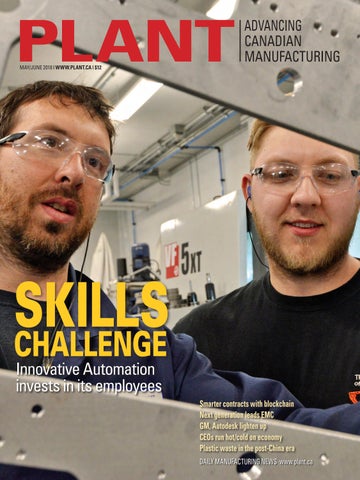
SKILLS CHALLENGE Innovative Automation invests in its employees
Smarter contracts with blockchain Next generation leads EMC GM, Autodesk lighten up CEOs run hot/cold on economy Plastic waste in the post-China era DAILY MANUFACTURING NEWS www.plant.ca
PLT_MayJune2018_AMS.indd 1
2018-06-08 8:01 AM
C
M
Y
CM
MY
CY
CMY
K
PLT_March_FlirSystems.indd PLT_MayJune2018_AMS.indd 12
2018-03-06 2018-06-08 11:25 8:01 AM AM
6 11:25 AM
CONTENTS
May/June 2018 Vol. 77, No. 04
FEATURES 22 THINK LEAN Ensure the maximum labour expended goes directly to adding value. 23 TECH TIP How to spot errors after a motor rewind. 24 INSIDE MAINTENANCE Optimize performance and increase profits. 25 FACILITY Solving Pearson International Airport’s grease problem. 27 CCOHS SAFETY TIPS 10 tips for effective health and safety committee meetings. 28 ENERGY Prepare for a decentralized, decarbonized, digitized future.
12 HUMAN RESOURCES
Filling skills needs: Innovative Automation is investing in its employees.
29 TRANSPORT Disrupters are needed to meet greener freight targets. 30 RECYCLING Managing plastic waste in the post-China era.
DEPARTMENTS 16 LEADERSHIP EMC: the next-generation takes over.
18 TRAINING Seven critical elements that will improve your teaching skills.
19 CONTRACTS Blockchains are making contracts smarter.
21 C-SUITE Executives sour on economy shorter term, bolder over three years.
4 Editorial 6 News Bulletins Feedback 8 Careers 10 PLANT Online 11 Economy PLANT Pulse 31 Tech Centre Feature: GM harnesses advanced design. Supply Lines 32 Leading Edge: Innovative ideas for plants 34 Products and Equipment 37 Plantware Events 38 Postscript COVER IMAGE: RODNEY DAW
PLANT—established 1941, is published 8 times per year by Annex Business Media. Publications Mail Agreement #40065710. Circulation email: blao@annexbusinessmedia.com Tel: 416442-5600, ext 3552 Fax: 416-510-6875 or 416-442-2191 Mail: 111 Gordon Baker Road, Suite 400, Toronto, ON M2H 3R1. Occasionally, PLANT will mail information on behalf of industry-related groups whose products and services we believe may be of interest to you. If you prefer not to receive this information, please contact our circulation department in any of the four ways listed above. Annex Privacy Officer: privacy@annexbusinessmedia.com Tel: 800-668-2374. No part of the editorial content of this publication may be reprinted without the publisher’s written permission. ©2018 Annex Publishing & Printing Inc. All rights reserved. Performance claims for products listed in this issue are made by contributing manufacturers and agencies. PLANT receives unsolicited materials including letters to the editor, press releases, promotional items and images from time to time. PLANT, its affiliates and assignees may use, reproduce, publish, re-publish, distribute, store and archive such unsolicited submissions in whole or in part in any form or medium whatsoever, without compensation of any sort. This statement does not apply to materials/pitches submitted by freelance writers, photographers or illustrators in accordance with known industry practices. Printed in Canada. ISSN: 1929-6606 (Print), 1929-6614 (Online).
www.plant.ca
PLT_MayJune2018_AMS.indd 3
PLANT 3
2018-06-08 8:01 AM
EDITORIAL
C for innovation: a competitive drag
C
anada has received its latest grade for innovation performance from the Conference Board of Canada and it appears summer school is in order. The Ottawa research firm’s How Canada Performs: Innovation report card awards Canada another C, with some slippage from ninth to 12th place among 16 peer nations. This puts us well behind the fourth-place US of “A.” Provinces are included in the ratings and although Ontario is sporting a B and Quebec a C, the rest of the provinces are in D and D- territory. Canada gets an A for entrepreneurial ambition but shows continued weakness in ICT investment, patents (D), business R&D (last place) and productivity. So how do we nudge Canada out of its lagging, middle of the pack performance? The Trudeau government’s Supercluster program has allotted $950 million for selected, broad-based industry groups that will invest in high-potential areas of the economy. This should help to drive innovation but more needs to be done, which brings us to the Scientific Research and Experimental Development (SR&ED) tax credit. Manufacturers, most small and medium-sized, appear to view it as having limited value, especially since the Harper government dialled back the amount of money available and made access to the program more difficult. PLANT’s Manufacturing Outlook survey reveals 43% have not made use of the program and 59% of those who have stated it had no impact on their innovation efforts. The Harper regime’s response to complaints of abuses from the Canada Revenue Agency (CRA) may have weeded out much of the scamming, but it also squeezed funding. A report last year from the Canadian Advanced Technology Alliance (CATAAlliance) in Ottawa estimates the aggregate tax credits delivered by the CRA declined by $5.3 billion between 2006 and 2016. Innovation is further impeded by limited access to investment money. Successive Outlook surveys show manufacturers rely most on internally generated cash. And the investments they do make are modest. Most (33%) are committing 1% to 3% of revenue to R&D, and the average investment is just $500,000 or less. Canadian Manufacturers & Exporters has called on the federal and provincial governments to take decisive action on tax reform; and to modernize the SR&ED program. The CATAAlliance wants the Trudeau government to follow through with a promised review of the SR&ED program, ensuring that it’s transparent and looks at: who is responsible for what; key elements that require input; goals and measurable targets for tax instruments; a third-party evaluation of program options for improvements; and SR&ED’s impact on competitiveness. It also offers these ideas on how to improve the program: eliminate retrospective claims for SR&ED tax incentives; permit non-refundable (technology) claims to be made at the program and project levels; require Initial Submission of Technology Benchmarking and Plans before the start of a project/program or within three months of starting; and implement third-party redress of problems as they arise in the reviews of claims. The World Economic Forum’s 2017-18 competitiveness report ranks Canada 14th, a slight improvement over the previous period. Among the challenges preventing entry to the top 10 is its lower ranking in technological readiness, business sophistication and innovation. There are too many uncertainties (courtesy of our increasing unreliable US trade partner) plaguing manufacturers’ business prospects. Canada can’t afford to prolong its lagging innovation performance. Maintaining a C is just two grades either way from competitive success or failure.
Associate Publisher Jeff Brownlee 416-277-8428 jbrownlee@annexbusinessmedia.com Editor Joe Terrett 416-442-5600 ext. 3219 jterrett@plant.ca Art Director Andrea M. Smith National Account Manager Ilana Fawcett 416-510-5202 ifawcett@plant.ca Account Coordinator Debbie Smith 416-442-5600 ext 3221 dsmith@annexbusinessmedia.com Annex Business Media Vice President/Executive Publisher Tim Dimopoulos (416) 510-5100 tdimopoulos@annexbusinessmedia.com President & CEO Mike Fredericks Circulation Manager Beata Olechnowicz 416-442-5600 ext. 3543 bolechnowicz@annexbusinessmedia.com Subscription Price Canada $74.50 per year, US $151.50 (US) per year, Foregin $171.00 (US) per year. Single Copy Canada $12.00. Add applicable taxes to all rates. Combined, expanded or premium issues, which count as two subscription issues. Mailing Address Annex Business Media 111 Gordon Baker Road, Suite 400 Toronto, ON M2H 3R1 Circulation Bona Lao 416-442-5600 ext. 3552 blao@annexbusinessmedia.com Fax: 416-510-6875 or 416-442-2191
Joe Terrett, Editor Comments? E-mail jterrett@plant.ca.
4 PLANT
PLT_MayJune2018_AMS.indd 4
May/June 2018
2018-06-08 8:01 AM
PLT_Apr
Switch to Tork wipers and save*
up to
up to
up to
less time
less solvent
less effort
23% 23% 20% Do you use rags or rental shop towels? You could save time, money and effort with Tork disposable wipers. We make a range of professional wipers for wiping, cleaning and polishing. Tork industrial wipers are designed to do the job right, time after time, without the risk of damaging equipment or your finished product. Try them today! Visit talktork.com/industrial to start your free trial and see how much you can save.
© 2018 Essity Professional Hygiene North America LLC.. All rights reserved. ®Tork is a registered trademark of Essity Professional Hygiene North America LLC or its affiliates. * Rental shop towels, cotton rags and mixed rags were compared to Tork Heavy-Duty Cleaning Cloths. Panel test conducted by Swerea Research Institute, Sweden, 2014. ** Rental shop towels, cotton and mixed rags were compared to Tork Heavy-Duty and Tork Industrial Heavy-Duty Cleaning Cloths. Panel test conducted by Swerea Research Institute, Sweden, 2014.
PLT_MayJune2018_AMS.indd PLT_April_Tork.indd 1 5
2018-06-08 2018-03-26 8:01 9:40 AM AM
NEWS BULLETINS
Steam Whistle is water-wise
Receives water conservation award from CIPH
Magna International invested $125,000 in Skills Ontario initiatives. The money from the Aurora, Ont. automotive parts manufacturer supports the 2018 Skills Ontario Competition, Skills Ontario Young Women’s Initiatives, and Skills Ontario Summer Camps. Aluminum maker Rio Tinto Alcan has been fined $100,000 for releasing 1.7 cubic-metres of hydrochloric acid into the Saguenay River in 2016. Rio Tinto Alcan pleaded guilty to violating subsection 36(3) of the Fisheries Act and will be added to the Environmental Offenders Registry. Hydrochloric acid is used in the production of alumina. Xebec Adsorption Inc., a clean energy company in Montreal, is partnering with JNK Heaters Co. Ltd. of Korea to advance biogas upgrading and on-site hydrogen generation. JNK gets exclusive market rights to Xebec’s biogas technology in Korea and India, plus use of Xebec’s pressure swing adsorption technology in its on-site steam methane reformer (SMR) hydrogen generation products. Xebec will have exclusive rights to manufacture and market JNK’s SMR generators in North America and Europe. The Canada Border Services Agency (CBSA) is launching an investigation into whether or not sucker rods from China are being sold at unfair prices in Canada. It will also investigate whether or not subsidies are being applied. A complaint was filed by Dover Canada ULC (Alberta Oil Tool Division) in Edmonton alleging the Canadian industry faces price suppression, lost sales, reduced profitability and under-utilization of capacity. A sucker rod, typically between 7-to 9-metres long, joins the surface and downhole components of a reciprocating piston pump installed in an oil well. CCL Industries Inc., a manufacturer of label products based in Toronto, is acquiring a specialty manufacturer of high performance labels in Tel Aviv, Israel for $9 million. Nortec International Ltd., which serves domestic and global customer bases, will change its name to CCL Design Israel.
6 PLANT
PLT_MayJune2018_AMS.indd 6
Steam Whistle director of marketing Tim McLaughlin (middle); CIPH program manager Matt Wiesenfeld; and Stephanie Steiner, director of sales at PHOTO: CIPH Dahl Valves.
TORONTO — The Canadian Institute of Plumbing and Heating (CIPH) has presented Steam Whistle with its National Water Wise Award. The Toronto craft brewery has been recognized for its commitment to water conservation and purification in its core operations. Steam Whistle recently installed water-saving equipment such as a new bottle washer, keg-filling line and shower heads on the packaging line using municipal tap water. Spring water is used to brew the beer. Other initiatives include green packaging, using Bullfrog power and biodiesel fuels in delivery trucks, tapping into Enwave’s deep water cooling for temperature control, energy efficient equipment and lighting and waste diversion. The CIPH is a not-for-profit trade association that includes manufacturers and distributors.
Hawksbury to get a tire recycling plant MONTREAL — Cleantech company Ecolomondo Corp. is acquiring land in Hawksbury, Ont. for a plant that will recycle tires into resaleable commodity products. Its 52,000 square-foot thermal decomposition process (TDP) facility will be built on approximately 13.4 acres. Two reactors will process approximately 13,000 tons of tire waste annually. Four processing departments will handle shredding, thermal decomposition, carbon black processing and oil distillation, recovering 5,000 tons of carbon black, more than 6.5 million litres of oil, 1,200 tons of process gas and more than 1,600 tons of steel per year. Ultragen, an engineering company experienced in waste processing and petrochemicals, will handle the project, which is to be completed by 2019. Ecolomondo’s main revenues will come from the sale of TDP turnkey facilities and royalties from their operations. TDP facilities will generate revenues from the sale of end-products, tipping fees and carbon credits. The company is based in Montreal.
CO2 into concrete collaboration DARTMOUTH, NS — CarbonCure Technologies Inc. and Airgas, an Air Liquide company, are collaborating to spread the use of carbon dioxide utilization technologies in concrete production across the US Gulf Coast region. CarbonCure’s technology injects CO2 into concrete that becomes mineralized, to improve
the material’s strength. Airgas, with Canadian locations in Victoria and Surrey, BC, supplies industrial gases and provides services. CarbonCure, based in Dartmouth, NS, has installed its technology in nearly 100 locations across North America.
FEEDBACK
Safety contradiction I enjoyed the article (Job safety analysis, PLANT, April 2018), but had to smile at the contradiction depicted in the stock photo used to illustrate it. The lady is by a high-speed roller conveyor with her long hair hanging loose. Typical safety protocol would require a hair net or pony tail, tucked-in shirt, glasses and hearing protection. In a real-life scenario with the conveyor running, her hair could be pulled into the rollers causing severe injury or death. Walter Kreimes Vice-president of sales Bojack Manufacturing, Kingston, Ont.
Safety protocols: what’s wrong with this picture? PHOTO: FOTOLIA We’d like to hear from you. Send letters to jterrett@ plant.ca with your name, address and phone number. Letters will be edited.
May/June 2018
2018-06-08 8:01 AM
Aurora, Mitacs partner on cannabis R&D Researchers to undertake studies on outcomes and therapeutic benefits
Benefits and patient impact studies are lacking. PHOTO: US FISH & WILDLIFE
EDMONTON — Aurora Cannabis Inc. is partnering with a Mitacs, a national, not-for-profit research and training organization, to study how cannabis use impacts health. The Edmonton-based licensed medical cannabis producer said research supporting therapeutic benefits of cannabis and comprehensive patient studies into health outcomes are lacking. The research project will study data collected from 29,000 Canadian patients that combines
their reported outcomes and physician-based medical assessments. Multiple studies will be performed to characterize the population, acute and chronic conditions, exposure of medical cannabis, participant ratings of symptom improvement and satisfaction with treatment, as well as side effects, adverse events and long-term beneficial or detrimental effects. The project will also look at how medical cannabis influences the use of other medications, health insurance claims, hospitalizations, doctor appointments and accident claims. Additional objectives include establishing a research infrastructure to track the health outcomes of eventual non-medical consumers, and to identify potential long-term health impacts that should be monitored. Aurora’s wholly owned subsidiary, Aurora Cannabis Enterprises Inc., is a licensed producer of medical cannabis. The company operates a 55,200 square-foot production facility in Mountain View County, Alta., and a 40,000 square-foot facility in Pointe-Claire, Que.
Beleave extracting cannabinoid in Hamilton Process uses only ethanol, other food-grade components, no organic solvents TORONTO — Beleave Inc. has completed construction and commissioning of a stateof-the-art industrial cannabinoid extraction laboratory at its production facility located in Hamilton. The biotech company said the laboratory design is based on collaborations with principal investigators at Ryerson University’s Department of Chemistry and Biology. The work led to the development of a proprietary and large-scale industrial method for the extraction and purification of cannabinoid com-
of cannabinoid active ingredients (including THC and cannabidiol) using only ethanol and other food-grade components, but no organic solvents. The scalable process has been approved by Health Canada for cannabis oil production Cannabinoid active ingredients include THC and by Beleave’s subsidiary, PHOTO: FOTOLIA cannabidiol. Beleave Kannabis Corp. Initial production capacity pounds from plant tissue. will be 200,000 millilitres of The company has filed a cannabis oil per week and the patent application in the US company anticipates being and Canada for this process. able to scale up to 1 million It involves the activation, millilitres by Q3 this year. purification and extraction
Innergex acquires remaining 33.3% of Ledcor LONGUEUIL, Que. — Innergex Renewable Energy Inc. has acquired Ledcor Power Group Ltd.’s 33.3% interest in Creek Power Inc., a company that indirectly owns three BC hydro facilities. Innergex now has sole interests in Fitzsimmons Creek (7.5 megawatts), Boulder Creek (25.3 megawatts) and Upper Lillooet River (81.4 megawatts)
www.plant.ca
PLT_MayJune2018_AMS.indd 7
hydro facilities as well as a portfolio of projects. The Quebec-based owner and operator of several renewable electricity facilities that include hydro, solar, wind and geothermal, owned the other 67.7% interest in Creek Power Inc. “This transaction gives Innergex a 100% stake in three hydro facilities that it already operates and for
Manufacturers tap Ontario Jobs and Prosperity funds New 3D printing centre for Oakville
3D printed applications.
PHOTO: FOTOLIA
TORONTO — The Ontario government has been busy handing out funds from its Jobs and Prosperity Fund. Burloak Technologies, a division of Samuel, Son & Co., a metal manufacturing, processing and distribution company, will build a 3D printing centre in Oakville, Ont. Ontario is investing up to $7 million in the $104 million project over four years that is to be operational by September-October and scaled up by 2019. The federal government is kicking in $14 million as a repayable loan from its Strategic Innovation Fund. The project is to create 100 jobs by the end of the year. The Burloak Technologies division, which supports 20 jobs, delivers 3D-printed applications to customers across various sectors. Dishon Ltd. is getting $1.3 million for state-of-the-art multi-axis computer numerical control milling machines, training and facility upgrades. The $13.8 million project (completion by 2022) will add 54 jobs to its 60-person payroll in Vaughn, Ont.
which long-term electricity purchase agreement are in place with BC Hydro for remaining periods of 32 to 39 years,” said Michel Letellier, Innergex’s president and CEO. Innergex has interests in 64 operating facilities with an installed capacity of 1,642 megawatts, including 34 hydroelectric facilities, 25 wind farms, three solar farms and two geothermal facilities.
PLANT 7
2018-06-08 8:01 AM
P
NEWS CAREERS General Motors of Canada has a new president and managing director. Travis Hestor moves over from global product programs where he was a vice-president since 2016. He held a Travis Hestor variety of positions in Australia from 1995 before moving to the US in 2005. Since then he held engineering positions in both the US and China. He replaces Steve Carlisle, who is now senior vice-president and president of GM’s Cadillac group. He began his career in 1982 as an industrial engineering co-op student at Steve Carlisle the Oshawa Truck Assembly Plant and has held several senior leadership positions that have taken him around the world. Avcorp Industries Inc. has appointed Amandeep Kaler, general manager of Avcorp’s Delta operations, as the new CEO of Avcorp Group. He replaces Peter George, who resigned. Avcorp Group in Delta, BC designs and builds major airframe structures for global aircraft companies. Barbara Feit has resigned from her post as CFO of Big Rock Brewery Inc. in Calgary. She joined the craft brewer in 2011 and wrapped up in mid-June. Big Rock brews in Calgary, Vancouver and Toronto. Craig Alexander joins Deloitte Canada as the advisory firm’s first chief economist. He’ll oversee and develop Deloitte’s macroeconomic research and forecasting capability. Alexander was most recently chief economist at the Conference Board of Canada, was a chief economist at TD Bank and was vice-president for economic analysis at the C.D. Howe Institute.
E-mail appointments, promotions, retirements and other career changes to jterrett@plant.ca.
8 PLANT
PLT_MayJune2018_AMS.indd 8
Javelin, Cimetrix to form additive manufacturing powerhouse Management coming from both companies
The Stratasys Fortus 450mc.
PHOTO: JAVELIN TECHNOLOGIES
OAKVILLE, Ont. — Javelin Technologies and Cimetrix Solutions have merged to provide a new 3D design engineering and additive manufacturing service. Javelin, in Oakville, Ont., provides 3D design engineering, product data management, automation, and additive manufacturing in plastic and metal. Cimetrix in Oshawa, Ont. is an authority on additive manufacturing and laser scanning solutions for industry and educational institutions. The senior management team for the integrated company will consist of John Carlan and Ted Lee from Javelin and James Janeteas of Cimetrix. The combined entity will operate as Javelin Technologies with Cimetrix Solutions as a division of Javelin. The integrated company will be national with offices in Vancouver, Calgary, Edmonton, Winnipeg, Kitchener, Ont., Oakville, Ont., Oshawa, Ont., Montreal and Dartmouth, NS.
M Nestlé targets 100% recyclable, reusable packaging VEVEY, Switzerland — Nestlé is aiming to make 100% of its packaging recyclable or re-usable by 2025 to prevent it from ending up as waste in seas, oceans and waterways. The food and beverage manufacturer based in Vevey, Switzerland says it will focus on eliminating non-recyclable plastics; encourage the use of plastics that allow better recycling rates; and eliminate or change complex combinations of packaging materials. The Nestlé plan includes: • Development of collection, sorting and recycling schemes. • Working with value chain partners and industry associations to reduce plastic use, facilitate recycling and develop new ways to eliminate plastic waste. • Labelling packaging with recycling information to help consumers dispose of it properly. • Promoting a market for recycled plastics by using more of it in packaging. • Globally, the company is aiming for. zero waste for disposal by 2020. Canada’s five factories have achieved this goal. Nestlé in Canada locally manufactures and/or distributes Lean Cuisine, Nesquik, Nestlé Good Start, Häagen-Dazs, Kit Kat, Nescafé, Nestlé Pure Life and Nestlé Drumstick.
B
P f m
“
Bell Helicopter gets $49.5M from feds $125 million project will develop next-generation pilotless aircraft maintain more than MONTREAL — An 300 jobs in Canada, aerospace consorcontribute almost tium in the Montreal $178 million to Canarea led by Bell ada’s GDP over the Helicopter Textron next five years and Canada Ltd. is getting strengthen Cana$49.5 million in federda’s position as a al funding to develop world-leading centre next-generation for innovation. helicopters. The partners inBell and 18 indusclude Pratt & Whittry and academic ney Canada, CMC partners will inteNew technology will enable next-generation helicopters to fly with Electronics, Esterline grate new technology or without crews. PHOTO: BELL HELICOPTER TEXTRON Technologies Corpothat will enable heliration, several small and medium-sized busicopters to fly with or without a crew on board. nesses, and nine Canadian universities. The aircraft will also be more energy-efficient Bell and its partners are investing more than and reduce noise. $125 million in the project. The collaboration is projected to create or
P o
P
D
T
May/June 2018
2018-06-08 8:01 AM
PLNT_Ma
PLANT EXPO Mark October 10, 2018 on your calendar Bingemans Centre, Kitchener, Ontario
PLANT
E P
PLANT OPERATIONS PRODUCTION AND AUTOMATION
CONNECT
to products and services
SAVE
time and money
GROW
your bottom line PlantExpo is Southern Ontario’s premier event for anyone in manufacturing, processing, machinery, and maintenance and repair markets.
“
“
This was by far the best trade show for TDT Crews/WorkForce Capital in 2017. We were visited by potential clients who were specifically there to do business, not just to chit-chat. The Plant show was cost effective, had good quality leads which is proof of the excellent marketing that you and your team put out for this show. We are looking forward to the 2018 Dex/Plant Expo. Donna Parisien Manager, Business Development TDT Crews/WorkForce Capital
Put your products in front of hundreds of potential buyers including… Plant Managers Engineers Technologists Plant Operations Production Managers Designers Maintenance Managers Safety Managers Purchasing Managers and more…
PlantExpo will help your company connect, save, grow.
Don’t miss out – Reserve your table today! To view more information go to www.PLANTExpo.ca
EXHIBIT SALES HAVE STARTED AND SPACE IS FILLING QUICKLY! To discuss sponsor and exhibitor options, contact: Jeff Brownlee, Associate Publisher 416-277-8428 jbrownlee@annexbusinessmedia.com
PLNT_May2018_PlntExpo_9x12_AMS.indd 1 PLT_MayJune2018_AMS.indd 9
Ilana Fawcett, National Account Manager 416-829-1221 ifawcett@canadianmanufacturing.com
Presented by:
2018-05-28 2018-06-08 10:58 8:01 AM
NEWS
Elysis to eliminate greenhouse gas emissions from smelting Alcoa, Rio Tinto joint venture gets $120 million funding to advance larger-scale development MONTREAL — US aluminum producer Alcoa Corp. and British-Australian miner Rio Tinto are advancing an innovative process that produces oxygen and eliminates all direct greenhouse gas emissions from the traditional smelting process. And they’ll be doing it with $120 million in funding from the Quebec and Canadian governments. The two companies are forming a joint venture called Elysis based in Montreal to advance larger-scale development and commercialization of the new process. A technology package is planned for sale beginning in 2024. The technology will be licensed for retrofitting existing smelters or to build new facilities. Elysis will also have a research facility in Quebec’s Saguenay–Lac-Saint-Jean region. The joint venture will also sell proprietary anode and cathode materials, which the companies say will last more than 30 times longer than traditional components. Canada and Quebec are each investing $60
Rio Tinto’s facility in Quebec’s Saguenay region. PHOTO: RIO TINTO
million and the Quebec government will have a 3.5% equity stake, with the remaining ownership split evenly between Alcoa and Rio Tinto. Apple, which helped facilitate the collaboration between Alcoa and Rio Tinto on the carbon-free smelting process, is investing $13 million and will provide technical support to the partners. Alcoa and Rio Tinto will invest $55 million over the next three years and contribute specific intellectual property and patents. The patent-protected technology developed by Alcoa is currently producing metal at the Alcoa Technical Center, near Pittsburgh, where the process has been operating at different scales since 2009. The joint venture intends to invest up to $40 million in the US, which would include funding to support the supply chain for the proprietary anode and cathode materials.
PLANT ONLINE SOUNDING OFF
What readers have to say about breaking news Have you checked out PLANT’s daily news online? Here are some headlines that have inspired members of the Canadian manufacturing community to chime in. They’re edited, but use the links to see the raw – and for some – longer versions of their remarks plus the stories that inspired their reactions. Stay up-to-date on the developments – domestic and global – that affect Canada’s industrial sectors by watching the news feed at www. plant.ca or reading PLANT’s twice-weekly newsletter (hit Subscribe on the website). Canada’s wireless prices justified even if high by world standards: MEI http://www.plant.ca/j03rD Apparently I was driving a Rolls Royce data plan and did not even know it as nothing else is available! The IEDM has been drinking the “Telecom Koolaid” if it thinks there’s a real gradient of services offered by the wireless carriers (and their “flanker” brands). Have some US wireless companies come in and offer their services, and let’s see if the incumbents can maintain their “fishing from a barrel” attitude.
10 PLANT
PLT_MayJune2018_AMS.indd 10
Business leaders’ confidence sours on Canadian economy: survey http://www.plant.ca/CSQBv Fifteen dollars per hour for pot smoking workers with full benefits and pensions is not exactly conducive to high foreign investment. Mr. Trudeau has nice hair though! Trudeau insists pot plan proceeding apace, despite calls for delay http://www.plant.ca/JOLGZ I’m pushing 70 years of age, and all I have to say is it’s about time this country crawls out of the
dark ages. Thank God we finally have a Prime Minister with some gonads. Saskatchewan seeks Court of Appeal ruling on federal carbon tax http://www.plant.ca/JEpoM The only way polluting industries will ever reduce their emissions is by giving them a financial reason to do so. One year since new softwood duties, Canadian industry doing fine http://www.plant.ca/UVNs4 Why don’t we just charge companies 30% more for stumpage and keep the money ourselves? It’s idiotic giving it to the Americans in tariffs. If they want to pay more for houses and renovations, we should help them. Ontario government understates deficit by billions: AG http://www.plant.ca/H9ROP
One of the bad mortgages in the US leading up to the collapse was one where you paid ‘some’ of the interest (and none of the principal). The unpaid interest was tacked onto the principal, so you actually owed at renewal, not less. Wynne is doing the equivalent with hydro. This is not merely amortizing the debt over a longer period (as she suggests). That is a lie. Paramount pipeline leaks 290,000 litres of oil, saltwater in Alberta http://www.plant.ca/AKaRn Pipeline companies should receive no approvals for new lines without a one billion dollar insurance policy (for each line). I would not trust them with a lawn hose and they are mostly American owned, not Canadian. Magna partnering with Lyft on self-driving vehicle systems http://www.plant.ca/hLJfO Will they brake for dogs and cats? My uncle Eddie braked for a dog in Circleville, Ohio years ago and got tail-ended by someone following too close. I don’t think self-driving cars will avoid every situation...
May/June 2018
2018-06-08 8:01 AM
ECONOMY
Profits are up Manufacturing gains in Q1 Canadian corporations had a good first quarter. They earned $99.3 billion in operating profits, up 2.7% or $2.6 billion compared to the fourth quarter of 2017, reports Statistics Canada. That’s a 7% improvement over last year’s Q1 performance. The financial sector gets credit for much of the increase, but manufacturers also had a good quarter. Their operating profits were up 6.2% to $16 billion with eight of 13 industries reporting increases. Most of the gain is attributable to petroleum and coal products – up 28.3% – and primary metal manufacturing (37.9%), it’s increase because of strong commodities prices. Copper hit a four-year high and zinc reached a 10-year peak during the quarter. On the downside were air, rail and ship products and other transportation equipment manufacturing. They declined 35% to $460 million. Take out petroleum and coal products, manufacturing profits rose 2.6% to $13.3 billion.
2017 INCREASE IN FDI
34 32 30 38 36 24 22 20 18 16 14 12 2008
2009
2010
2011
2012
2013
2014
2015
2016
Manufacturing
Mining and oil and gas extraction
Management of companies and enterprises.
Finance and insurance.
Source: Statistics Canada
2.08M
Annualized Canadian automotive sales as of March, according to the Scotiabank Global Auto Report. More than 71% of sales were CUVs, SUVs, pickups and vans.
2017
Foreign direct investment in Canada increased 1.9% to $824 billion in 2017. Manufacturing was the top industry with a 21.4% share, although it was down 0.3%, mainly on a 15.8% reduction in petroleum and coal products. Statistics Canada notes manufacturing hasn’t kept pace with other industries over the past 10 years. Its share of foreign investment is down significantly from 32.7% in 2008. Canadian direct investment abroad rose 3.4% to $1,121.1 billion, mostly in Europe (7.7%), thanks in part to a lowervalue loonie against the euro and the pound. Investment in North America was up 1.9%, but growth was offset by a higher-value loonie.
0.4%
Fewer EI beneficiaries The number of people collecting employment insurance dropped 1.5% in March to 471,000 beneficiaries, according to Statistics Canada. Manufacturing showed a 2.6% drop month-to-month. Nine out of 10 occupation groups declined year-overyear with manufacturing among the highest, down 18.1%. Manufacturing occupational groups tracked by Statistics Canada all showed decreases month-to-month and year-over-year as follows: • Supervisors and central control operators (2.6% and 18.8%) • Machine operators and related production workers (3.3% and 24.1%) • Assemblers (7.3% and 6%) • Labourers (0.5% and 17.6%) Year-over-year, the number of EI recipients in Canada fell by 76,700 (14%). The Labour Force Survey showed the unemployment rate declining by 0.8 percentage points to 5.8% over the same period, matching a record low since comparable data became available in 1976. All major demographic groups, led by young men (down 22.3%) and men aged 25 to 54 (18.2%).
www.plant.ca
PLT_MayJune2018_AMS.indd 11
Q1’s anticipated decline in exports (annualized quarterly rate), reports TD Economics. Import growth (5.1%) outpaced exports (3%), with net trade likely placing a drag on growth during the quarter.
1.5M
$16,000 Number of Canadians employed in manufacturing last year, representing 9.3% of total employment nation-wide, according to Statistics Canada. Food processors led, providing 227,027 jobs (15%). Transportation equipment employed 195,661.
The gap in average income, women ($35,300) versus men ($51,400) as of 2015, according to Statistics Canada. That’s an improvement from $32,300 ($16,100 versus $48,400) in 1976, but the gap has been relatively stable since 1995.
1.4%
Manufacturing sales gain in March led by durable goods, which TD Economics says is a positive sign for the rest of the year. Much of the increase was through price growth, but volumes were also up (0.6%). Solid US demand is expected, so the outlook for manufacturers remains healthy. And with factories running near full-tilt, TD says there’s a clear incentive to continue building out capacity to meet demand. The bank is forecasting an above-trend pace of growth through the remainder of the year, supported by continued business investment.
PLANT 11
2018-06-08 8:01 AM
HUMAN RESOURCES
FILLING THE
SKILLS GAP
INNOVATIVE AUTOMATION INVESTS IN ITS EMPLOYEES Want to find and keep skilled workers? Here’s a thought: develop them. BY KIM LAUDRUM
C
Steve Loftus (president) with mechanical engineering student Tyler Burnham and controls programmer Ainsley Hobart. PHOTOS: RODNEY DAW
12 PLANT
PLT_MayJune2018_AMS.indd 12
anadian manufacturers are grappling with a perplexing challenge: finding people with the right skills for the demands of rapidly changing technologies and market pressures. Retirement beckons aging babyboomers, yet it’s difficult to attract young people to industrial careers. Smaller companies complain their investments in training are often wasted when employees acquire the needed skills only to be lured away by fatter paycheques and other incentives. “There’s an old adage,” says Ian Howcroft, CEO of Skills Ontario, the Toronto-based provincial non-profit that helps young people develop skills for trades and technologies. “I don’t recall who said it first but it goes like this: ‘The only thing worse than investing time and money into training a person and having them leave, is not training a person and having them stay.’” It’s a profound point – one that resonates with many manufacturers struggling to attract and retain skilled workers in today’s economy. And Howcroft is certainly familiar with the issues after 30 years with the Ontario division of Canadian Manufacturers & Exporters (CME), much of it as a vice-president. So how do manufacturers encourage good employees to knock on the front door without leaving a short time later out the back door? Manufacturing represents a significant driver of economic growth in Canada. It employs 1.7 million people and that’s been pretty steady for the last decade or so, says Dennis Darby, CEO of CME, based in Ottawa. Total annual compensation paid to workers in manufacturing is $114 billion – more than any other sector.
May/June 2018
2018-06-08 8:01 AM
“However, 40% of our members tell us they’re facing skilled labour shortages. That’s been an issue for a while. But what’s startling is 60% of our members anticipate that shortage will be worse in five years time.” It’s a growing trend in manufacturing the past three years. Darby says, “In 2015 there were 14,000 unfilled positions in manufacturing. By 2016 that number swelled to 19,000. At the end of 2017 there were 30,000 vacant positions in manufacturing.” Innovative Automation Inc. has found a way to meet its skills challenges. The manufacturer of industrial automation systems based in Barrie, Ont. invests in its employees’ professional development, something the new hires appreciate. In fact, in April the company received an Employee Recommended Workplace Award from human resources consulting firm Morneau Shepell and The Globe and Mail. The award recognizes excellence in achieving a healthy, engaged and productive workforce. Innovative Automation provides automation solutions to global manufacturers in areas such as automotive, consumer goods and medical devices from its 62,000 square-foot (5,787 square-metre) facility. For example, the firm provides customized robotic Mig welding cells that offer repeatable positioning for quality welding automotive seat recliner subassemblies. They also offer quality testing of equipment. The company employs 116 people. “We try to make sure everyone who comes through the door has a training plan laid out with clearly defined objectives and expectations,” says Stephen Loftus, Innovative Automation’s CEO. “I believe that anyone who is motivated working for you wants to exceed expectations.” Loftus stresses training objectives must be achievable and rewarding to entice people to want to grow. He says young people are too often given the tasks and responsibilities of more senior people too soon, so they have less chance of success. Achieving objectives consistently builds confidence, an important part of the culture at the company. Mentoring is key to the company’s success. New employees are teamed one-on-one with experienced workers who provide application-specific training, such as robotics. Workers progress as they accomplish simple tasks. They see the list of tasks more senior people have and, if they’re motivated, they’ll want to progress to take on more challenges and responsibility. “They can go from zero
www.plant.ca
PLT_MayJune2018_AMS.indd 13
A sample of Innovative Automation’s young workforce. Back (L-R): Matthew Robertson, Blake Hyde, Tyler Burnham, Owen Langford, Jonathan Ferrier, Alex Nowell, Johnny Borg. Front (L-R): Arjun Srnivas, Ainsley Hobart, Steve Loftus (president) Julia Taylor, Kim Marshall (finance and resources manager).
to senior level in about five years. The better they perform, the compensation will follow.” Employees, dubbed “Innovators” at the firm, are encouraged to learn everything they can about the company, their clients and the different manufacturing processes. They work as teams and are empowered to make decisions. Teams change often to bring fresh insights to problem solving, and this helps workers determine where they want to take their careers. It keeps them engaged.
Open door policy The company’s credo is treat everyone with dignity, fairness and respect; and an open door policy encourages communication and employee engagement without fear of reprisals. Training investment in manufacturing is notoriously lower than the norm for other industries, says Jean-Pierre Giroux, national director, skills and talent development for the Excellence in Manufacturing Con-
sortium. The national not-for-profit based in Owen Sound, Ont. focuses on strategic issues such as training. Giroux notes the average annual investment in all industries is $800 per employee. In manufacturing it’s just $400, although the amount is increasing. At Innovative Automation the amount is “considerably higher,” according to Kim Marshall, the finance and administration officer. It’s Marshall’s job to recruit new talent. This summer Innovative Automation will take on 17 students from Ontario universities and community colleges. She plans to hire 10 of them. Most are co-op students. Some are first-timers who will return to their programs in the fall. And a few are local summer interns. The hope is to expose them at an early age to the possibilities of a career in manufacturing while attracting them to the company with its positive corporate culture. “Forty per cent of our staff are hired after competing post-secondary education,” Marshall points out.
PLANT 13
2018-06-08 8:01 AM
Barry Lightheart and Matthew Robertson in the Innovative Automation machine shop. Both are licensed general machinists.
Innovative Automation looks for basic skills sets including technical and logical thinking. It wants people who have an ability to learn quickly. “Typically, we are looking for electrical, mechanical and robotics engineering backgrounds. People who want to exploit these types of interests will excel with us,” Loftus says. “We are committed to hiring grads with an appetite to learn.” The company participates in co-op programs and other forms of work integrated learning initiatives that help identify potential employees. Funds are available from Skills Ontario and Innovative Automation tapped the federal digital grant program through the Information and Communications Technology Council (ICTC) to fund training for some of their programmers. Manufacturers should consider being more proactive. Canada’s shortage of trades people is expected to hit at least one million by 2020, according to recent research by Workopolis. By the same date, Canada will create an estimated 218,000 new technology jobs, says a 2016 ICTC report. Contributing to the problem is the rapidly aging manufacturing labour force. In 2005, 11.5% of the manufacturing sector’s workforce was 55 years and older. Within a decade that percentage almost doubled to 21.7%. Compare that to other industries where the over 55 crowd represented 13.2% in 2005 and 19.6% in 2015. This makes succession planning a huge issue for manufacturers. Keeping soon-to-be retirees on board parttime to mentor new hires is one suggested solution. “It sounds attractive,” says Rowan O’Grady, president of human resources firm Hays Canada. “But I think it’s kind of too
14 PLANT
PLT_MayJune2018_AMS.indd 14
Johnny Borg, a licensed general machinist working as a machine builder.
little, too late at that point.” Far better to put a plan in place and position the company to reach a bigger objective within five years, notes O’Grady, although he admits, 60% of SMEs do not have a succession plan. “If there are only a few people in the company they feel there is no point. But there is.”
Trade careers Attracting youth to manufacturing careers is proving to be more difficult. Technical education in high schools has all but disappeared. Parents’ negative perception of the skilled trades is obstructing youth from pursuing it, according to Howcroft. “Parents are not aware of what a skilled trades career is all about,” he says, noting the average age of an apprentice in Ontario now is 27. He suggests 18 to 20 would give youth a better start to their careers. “There is some validity that the schools are not producing skills employers need,” he notes. That’s partially why many young people drift for a few years and come to the skilled trades later. But that puts them at a disadvantage because by then there are often family commitments, mortgages and other debts. Howcroft gives credit to many colleges that are trying to be more receptive to the business community. Five colleges in Ontario offer certificate programs in manufacturing, and that’s helpful. The apprenticeship grant, rather than a tax credit, is making it easier to access funds to train recruits now as well. And there are student co-op programs and earn-while-you-learn funding, such as the federal Student Work Integrated
Learning Program (WIL) that help. These programs not only provide funding for companies who train youth, there are incentives for hiring women and indigenous workers – under-represented demographics in manufacturing. “Even when a company in manufacturing is not growing there are still jobs that they need skilled people to fill,” O’Grady says. Generally, these are at a higher skill level: jobs such as process improvement, which help make business or processes more efficient; or effective procurement, which helps a company find good prices and delivery from suppliers. “Annually we ask our clients about the shortage of skilled workers. Most people say it’s caused by two things: lack of young people joining industry and a lack of professional development in the industry. Even people in manufacturing would agree there isn’t proper investment in professional development to ensure people can move into those roles.” Why aren’t companies investing in the professional development of their staff? “I think a lot of companies see it as something that would be nice to do but they feel they don’t have the available financial resources to invest in it enough to make a difference,” he explains. “They’re asking themselves, ‘Is this going to give me an ROI this year? Or in three to five years?’ I think a lot of SMEs have trouble thinking three to five years down the road. They think, ‘We’re just trying to survive this year, never mind five years from now.’” But they can do a lot more than they might think, O’Grady says. He cites three things
May/June 2018
2018-06-08 8:01 AM
Jonathan Byvelds, general machinist working as a machine builder.
that affect a company’s ability to attract and retain talent: compensation and benefits; career progression; and company culture. “SMEs that tend to focus on the compensation and benefits are missing a tremendous opportunity. The number one reason why people leave their job is because of a lack of career progression. People want to progress. 1 25/01/2018 11:08:02 AM If theySEW-ECDRIVES-CANPACK11x4-2018.pdf don’t they’ll look around.”
Alex Nowell, apprentice general machinist.
Taking career development seriously is working for Innovative Automation. “I just don’t get it when manufacturers say they can’t find or keep senior people,” Loftus says. “How do you find skilled senior staff? Develop them. As an organization, I believe our mandate should be that we’ve trained the same number of people as we have staff. He sees training as a cost of doing busi-
ness. “That’s how we grow. Until people start thinking that way, we’re going to continue to have a shortage of skilled workers.” Kim Laudrum is a Toronto-based business writer and regular contributor to PLANT. E-mail klaudrum@rogers.com. Comments? E-mail jterrett@plant.ca.
C
M
Y
CM
MY
CY
CMY
K
www.plant.ca PLT_June_SEWEurodrive.indd 1
PLT_MayJune2018_AMS.indd 15
PLANT 15
2018-05-24 1:22 PM
2018-06-08 8:01 AM
LEADERSHIP Al Diggins has retired, passing the Post-it notes to Shawn Casemore. BY JOE TERRETT, EDITOR
T
here has been a changing of the guard at the Excellence in Manufacturing Consortium, a hand-off to the next-generation leadership of the not-for-profit group that, in its official capacity, has been helping manufacturers for the past 21 years help themselves by tackling common issues and challenges together. Al Diggins, the president, general manager and one of the founders of the Owen Sound, Ont.-based organization, has retired (sort of) at 71, to golf and generally kick-back, although he’s keeping his hand in as EMC’s chair. Jim McCoubrey, also a founder and president of Troy Life & Fire Safety in Owen Sound, is moving from the chair to a director’s seat at the board. Diggins has passed the Post-it notes (more on this later) to Shawn Casemore, 44, who began transitioning into the lead role at the organization in February. Casemore comes to EMC with a strong background in manufacturing, plus several years as a member. The Owen Sound native scored a part-time job at a Magna plant during his second year of college and after his third year was hired full-time. Other opportunities followed at Arvin Meritor, Pilkington, NCR, Bellwyck Packaging and Bruce Power where he handled senior leadership roles spanning supply chain management, project management, operations and distribution. For the past eight years he has consulted, helping manufacturers with training and team building, and he wrote a couple of books (Operational Empowerment, published by McGraw Hill, October 2015 and The Unstoppable Organization, published by Career Press, December 2017). His first exposure to EMC was at a strategic interest group
16 PLANT
PLT_MayJune2018_AMS.indd 16
Al Diggins, one of the founders and chair of EMC’s board.
PHOTOS: EMC
EMC’s next
GENERATION A NEW PRESIDENT LOOKS TO THE FUTURE
(SIG) event about 15 years ago. These collaborations focus on specific areas of interest, such as continuous improvement, safety and human resources, and provide a forum for manufacturers to tackle common issues by either sharing best practices or coming up with new ideas. “I found these SIG events to be very powerful because they allowed me personally to be more productive, but more importantly, to bring proven best practices back to my plant. That’s what drew me to EMC. SIGs are at the core of EMC and will continue.” The organization is now coast-to-coast with 60 regions serving 13,000 consortium and online member manufacturers and will stick with its grassroots approach, which stretches back
to the mid-1980s, coalescing in the early 1990s and formalizing in 1997. It all began for Diggins as a banker in Mississauga, Ont. (1968 to 1976) serving manufacturers, before striking out on his own for a few of years (1978 to 1983) to run a manufacturing business in Burlington that made aluminum windows and doors.
Skills program When a storm forced a layover in Collingwood, he decided he liked the Georgian Bay area and settled in Owen Sound. By 1986 he was working for Georgian College delivering a provincial skills program that involved training for businesses. “I decided early on to focus on manufacturers, because
they had a better opportunity to create wealth than other sectors such as farming,” Diggins says of his debut. Within six months he was friendly with about 18 companies, and during his first year noticed many of them were hiring expensive consultants to handle training, much of it similar. Ever the forward thinker, Diggins came up with what was at the time, a novel idea: centralize that similar training in one manufacturer’s building, source the best trainers, and do so with funding from the Ontario government. “The key was manufacturers allowing their trainees to be in a room together, which was unheard of.” By 1987, he was pulling things together with his manufacturing partners, beginning with the collaborative
May/June 2018
2018-06-08 8:01 AM
training, adding plant tours and helping them realize their common issues would be best dealt with as a group. Diggins was running the informal network out of his basement, where he came up with the SIG idea. Get each of the 12 members to send their health and safety, quality and production, plant and human resources managers to participate in 90-minute plus sessions that would involve collaboration and prioritizing of issues. This is where the Post-it notes come in. Participants in each of the groups would answer three questions: what’s going on in your plant that needs to change to make your business more successful; how can we help each other as a group; and what can you do in your plant beyond your job to help the business? That was good for four walls of Post-it notes, roughly arranged in topic areas called
“clouds,” then refined by the participants, with each group prioritizing what to work on first. “We had an agenda for the groups to get together once a month to do their own problem solving. They were the experts, we facilitated. Then they went back to their plants to share the ideas and apply them.” Diggins says this eventually worked its way up to senior management who recognized the process as a very powerful tool that today is still powered by collaboration, ideas and sticky notes. By the end of year 10, Diggins, plus five of the Owen Sound multi-nationals, were looking at ways to enhance the program. Meanwhile, the provincial government was planning to wind it down. Jim McCoubrey, who at the time was with Edwards of Canada, a fire alarm manufacturer, got the five companies together and suggested they
formalize what they were doing into some kind of organization. The result was the Owen Sound Area Manufacturing Sectoral Group in 1997, the first official consortium. In 1998, Bradford added a consortium, the first outside Owen Sound. Others followed in Ontario and by 2003 EMC was expanding into other provinces, starting with a consortium in New Brunswick. As the membership grew and programs were added, EMC hired staff and moved out of Diggins’ basement to a house in 2007. Today there are 27 team members supporting the organization. Scott McNeil-Smith joined in 1999, initially to manage a large, six-month job creation project for the Owen Sound-Grey Bruce area. He also developed communications materials and he notes that as EMC entered new communities and worked with new companies – at their invitation – the need for new initiatives became apparent.
Developing strategy
Shawn Casemore, EMC’s new president.
www.plant.ca
PLT_MayJune2018_AMS.indd 17
“It’s been my role to put arms and legs on a lot of those initiatives – what’s the strategy, or business plan – to get industry to engage and people in the community to buy in, and that goes right up to the provincial and federal governments.” Indeed, Diggins says McNeil-Smith has had his hand in most EMC initiatives, while helping to grow the membership, he’s always astute when helping to develop ideas, providing critical strategic thinking, writing up the projects and finding funding for the programs, which is all channelled to benefit members, none of it to EMC. Companies pay a core membership fee that hasn’t changed for 20 years. The national director of projects and partnerships, and the energy programs lead, has attached many arms and legs to an expanding repertoire of programs, that include (among others): managing the EMC end of an energy purchasing and
Jim McCoubrey, a founder and director of EMC’s board.
management initiative with ECNG Energy LP, a management and procurement solutions provider in Burlington, Ont.; creating Manufacturing GPS with Jean-Pierre Giroux, a labour market intelligence tool; and the Manufacturing Essentials Certification program, also developed with Giroux, EMC’s national director of skills and talent development. And he keeps the wheels turning when EMC collaborates with governments, departments and agencies. Looking head, Casemore is focusing on making a good thing better, and maintaining the supply of Post-its. Short term, the priority is to focus on growth, “to become more known and to be of help anywhere in Canada, even in remote areas where there are no SIGs. Short and long term, the plan is to ensure SIGs are as valuable 10 years from now as they are today.” And he wants EMC to be nimble enough to respond quickly when something new comes up. These are interesting times for manufacturers, what with technology disruption, the Trump factor, developments in global trade flows and the competitive pressures that are sure to arise. Nimble will be a useful attribute as EMC, under its new leadership, helps manufacturers meet these and other challenges. Comments? E-mail jterrett@plant.ca.
PLANT 17
2018-06-08 8:01 AM
TRAINING Seven critical elements that will make a difference. BY HUGH ALLEY
A
t the 2017 fall convocation at University of Manitoba, the College of Rehabilitation Sciences (CoRS) graduated 47 out of the 50 candidates who started in occupational therapy and 14 of 14 in respiratory therapy. Other institutions don’t do as well. The trades training programs in BC have a completion rate well under 50%. Canadian high-school graduation rates are marginally better, ranging from 35% in Nunavut to 87% in Nova Scotia and PEI. This kind of “success rate” is an enormous waste of instructional effort. The success rate in industry is pretty much the same as it is in the schools. Managers don’t purchase training with new machinery or software; or they ask if it can be done for less. “Too expensive,” the senior manager says. “They’ll figure it out.” But they don’t figure it out. So a $500,000 milling machine gets used as if it were a $30,000 router, or staff make do with inadequate reports from their ERP system because they don’t know how to use it properly. Training accounted for fewer than 2% of staff budgets according to the 2018 PLANT Manufacturers’ Outlook survey. By their actions, managers proclaim their conviction that training is ineffective. What is it that the people at the College of Rehab Sciences do to make the difference? Seven critical elements emerged from discussions with professors and graduates:
1 2
Faculty are practitioners. Are your instructors the people doing the work?
The college trains its faculty to teach. Do you put a new hire with one of the old hands and say, “Show them the ropes?” Or do you train those
18 PLANT
PLT_MayJune2018_AMS.indd 18
Engineer shows an apprentice how to use a CNC machine.
Teaching
SKILLS HOW TO IMPROVE YOUR SUCCESS RATE
old hands how to instruct using a proven methodology?
and the manager got a “good gut feel?”
3
5
4
6
Students are expected to graduate. Do your managers expect new hires to succeed, or is the attitude, “We’ll try ’em out for a few weeks and we’ll let ’em go before probation expires if they’re not doing well enough.”
Students show the proven characteristics of the profession. Do you hire new staff because they match a carefully considered profile, or because they understand English
Staff focus on fashioning new professional therapists, not on processing numbers. Do you set up administrative and onboarding processes to remove obstacles for employees, or do you set them up to be convenient for the staff running the systems? Staff and faculty know the students by name and engage with them. Do managers and senior people know the names of your employ-
PHOTO: FOTOLIA
ees, and regularly engage with them at their place of work? Or does the company treat staff members as interchangeable cogs?
7
Instruction is focused on helping people succeed. Testing is to measure what more is needed, not to weed out people. Is your instruction designed to help people learn, or is it just thrown together by whoever had some spare time? Lessons from the College of Rehabilitation show it’s possible to be efficient and successful at training very complex skills to a wide range of people with very different backgrounds. Your organization can do that, too. Hugh Alley is an industrial engineer based in the Vancouver area who helps organizations achieve significant performance gains in delivery, quality and cost over a short timeframe. Call (604) 866-1502 or e-mail hughralley@gmail. com. Comments? E-mail jterrett@plant.ca.
May/June 2018
2018-06-08 8:01 AM
CONTRACTS Legal considerations include security, law and financial crime.
Smart contracts are powered by blockPHOTO: FOTOLIA chain technology.
BY IMRAN AHMAD
I
n a 2016 World Economic Forum report, it was suggested smart contracts based on blockchain technology could potentially codify financial agreements in a shared platform and guarantee execution based on mutually agreed conditions. This would significantly reduce manual efforts required to support the execution of financial agreements and – in theory – accelerate business processes. But there are also important technical and legal issues. Broadly speaking, smart contracts are self-executing electronic instructions drafted in computer code. This allows a computer to read the contract, which in many instances, will
Links in the
BLOCKCHAIN CREATING SMARTER CONTRACTS
self-execute the stipulations of an agreement when predetermined conditions are triggered.
The parties to the contract typically sign the agreement using a cryptographic security code and
deploy it to a distributed ledger, or blockchain. When conditions in the code are met, the program automatically triggers the required action. Blockchain is a register (or ledger) of all the contract’s transactions. Each one (or block) is authenticated by a network of computers before it’s added to the chain of all prior transactions. The blockchain is open and transparent for all to see, but is intended to be secure, permanent and immutable. The system applies mathematical techniques to match a public address with a private security access key for each participant in a transaction. If there’s a match, the transaction broadcasts to the other participants in the blockchain for verification and entry into the ledger.
Engineered Lifting Systems & Equipment Inc.
Your material handling solutions provider Overhead Crane Systems l Transfer Carts Below the Hook Products l Hoisting Products Lift Assists l Forklift Attachments engliftsystems.com www.plant.ca PLT_June_EngineeredLift.indd 1
PLT_MayJune2018_AMS.indd 19
800.263.9823 PLANT 19
2018-05-24 3:36 PM
2018-06-08 8:01 AM
A key concern is whether smart contracts can be hacked and manipulated. In July 2016, code vulnerabilities in the Decentralized Autonomous Organization investment fund were exploited to redirect $50 million into an account controlled by a hacker, a participant in the fund. Based on Canadian case law in the area of electronic commerce, it’s unlikely smart contracts will require any special
set of new law or regulations. Rather, existing legal principles will be adapted and perhaps modified, either by statute or by the courts, to deal with the requirements of smart contracts or other emerging technologies.
Legal requirements But it’s unclear at this stage how smart contracts will take each legal requirement for formation and demonstrate they’re met
with the proposed solution. Smart contracts also raise concerns about anti-money laundering. Under Canadian law, participants in financial transactions are required to know and verify the identity of counterparties. They must also report any suspicious activity to law enforcement or block the transfer of funds to specific individuals or organizations. Since smart contracts are designed
One integrated platform for all your automation needs One platform for electric automation means seamless connectivity. From electromechanical actuators when joined with servo motors and servo drives to complete positioning systems, motion control solutions as well as entire handling systems and decentralized control solutions - always with the right software and interface. festo.ca/ea
to self-execute without human intervention, users will need to build technical contracts that allow them to comply with such legal requirements. The identity of parties are often kept anonymous, which further complicates the work by financial institutions who are required to report such transactions, and law enforcement tasked with investigating them. Another issue is how legal disputes between contracting parties will be settled and how evidence will be provided to the courts. For example, given the courts’ limited expertise in deciphering code, a neutral third party would securely maintain and produce it in natural language for a court to review. Similarly, if the parties to a smart contract are using a third party platform, they may be required to agree to an established set of overarching basic legal provisions, such as dispute resolution, governing law and venue. These would need to be clearly disclosed and agreed upon to be enforceable. That’s simple enough in theory, but demonstrating the parties clearly understood what agreeing to such provisions meant is not likely to be straightforward. Blockchain technology and smart contracts have the potential to positively transform financial markets and banking. Given the significant costs associated with building such contracts and the underlying infrastructure to support them, businesses should invest resources in developing a legal architecture built on existing statutory and judicial guidance. This will avoid unnecessary issues down the road. Imran Ahmad is a partner at the law firm Miller Thomson and practices in the areas of cybersecurity, privacy and technology law. E-mail iahmad@millerthomson.com or call (416) 597-6031. Comments? E-mail jterrett@plant.ca.
20 PLT_MayJune_Festo.indd PLANT 1
PLT_MayJune2018_AMS.indd 20
2018-05-31 11:17 AM
May/June 2018
2018-06-08 8:01 AM
C-SUITE Protectionism, economic uncertainty and competitiveness are taxing the C-Suite. BY PLANT STAFF
C
onfidence in the Canadian economy has soured among business leaders as of the first quarter of the year, according to two surveys, both expressing concern about business competitiveness. But another survey shows executives bullish on technology and growing their businesses over the next three years. KPMG’s 2018 Global CEO Outlook (a survey of 1,300 global executives, access it at kpmg. ca/CEOoutlook) shows Canadian CEOs confident the economy will continue to grow over the next three years (94% compared to global counterparts at 74%) and they expect their businesses to grow with it (96%). The Canadians are also embracing technology: 98% are building artificial intelligence (AI) into their operations, 22% have fully implemented it and 56% are using it for limited applications. Nearly 66% believe investments in AI and robotics will create more jobs than they eliminate, slightly higher than the global view. Two other executive surveys provide a contrast to the KPMG report. The Conference Board of Canada’s Index of Business Confidence fell 6.9 points to 93.1, its lowest level in the last six quarters and an indicator of growing pessimism in the state of the economy. The March 9 to April 13 survey shows executives don’t expect the rapid sales growth of 2017 to continue, and half are concerned about the impact of government policy on business competitiveness. Other issues are the availability and cost of labour; competitiveness of the Canadian economy in the face of US tax cuts; a weak loonie; and an uncertain future for NAFTA. “The first-quarter results
www.plant.ca
PLT_MayJune2018_AMS.indd 21
Executives aren’t expecting rapid sales growth of 2017 this year.
Confidence blows
HOT & COLD ...BUT OPTIMISM SOARS OVER THREE-YEAR FORECAST for 2018 are closer to the 2016 average, a sign that businesses see the economy moving into a new, slower-growth phase,” says Matthew Stewart, the Conference Board’s director of national forecasting. Weaker financial expectations and investment intentions are also apparent. Firms that believe now is a good time to invest in machinery and equipment declined from 52% to 34%, while the percentage of those who see this as a bad time to invest rose from 17% to 21%. The Ottawa-based research firm says those planning to increase capital investment by at least 10% fell from 28% in the previous quarter to 22%. Firms that anticipate capital expenditures will increase fell two points but are still at 60%. Expectations for the economy
overall have also worsened. The balance of opinion (respondents believing conditions will be better in six months minus those who project that conditions will be worse) was at 19 percentage points in the previous survey. It’s now – 6 percentage points.
Waning optimism The Toronto-based Chartered Professional Accountants of Canada found similar waning optimism among members of the C-Suite. Its Q1 Canada Business Monitor showed a decline among executives and other business leaders to 34% from 48% in Q4 of 2017, the lowest level since 2016. More than two-thirds (67%) described Canada as a less competitive place to invest and do business than the US compared to a year ago, citing US trade protectionism (30%)
PHOTO: FOTOLIA
as the top challenge. “Canadian business leaders are looking for assurance from the federal government that the situation is being properly monitored to allow a course of action to be developed that will keep Canada competitive,” says Joy Thomas, CPA Canada’s president and CEO. Most of the executives (84%) say a detailed analysis of US tax reforms to assess the potential impact on Canada is urgently needed. And 82% were disappointed the government did not set a date for a return to a balanced budget. Factors impacting business planning over the next year include uncertainty surrounding the Canadian economy (32%), employee retention, acquisition and development (30%) and lack of skilled workers (24%). More in line with the optimism of the KPMG survey, 69% of executives are projecting revenue growth over the next 12 months and 63% anticipate an increase in profits. Forty-four per cent predict employee growth while 38% anticipate no change and 18% expect a drop. Comments? E-mail jterrett@plant.ca.
PLANT 21
2018-06-08 8:01 AM
THINK LEAN
Genuine efficiency requires an improvement in productivity.
True kaizen generates no waste and reduces costs. BY RICHARD KUNST
E
liminating waste increases efficiency and reduces costs. But is it wise to increase efficiency in every instance? Many people define production efficiency as the process of searching out and eliminating waste, then deploying newly available resources to a more productive task. This process is called kaizen. Effort or motion that doesn’t contribute to the progression of the production process should, with wisdom, be converted into useful work. The key to true efficiency lies in ensuring the maximum labour expended goes directly to adding value. But increasing the level of efficiency is very different from strengthening labour, which is increasing the workload without improving the job. Eliminating wasted effort and making better use of the existing work force increases output from the same labour. Labour efficiency is work divided by motion (or effort), and the objective is 100%. Don’t be deceived by apparent efficiency from improved work methods. Take a manufacturing line producing 100 parts per day with
22 PLANT
PLT_MayJune2018_AMS.indd 22
PHOTO: FOTOLIA
Truth about
EFFICIENCY DISTINGUISH BETWEEN GENUINE AND APPARENT 10 team members. By eliminating waste, team members now produce 120 parts per day. But the extra 20 parts per day is more than what’s required and that’s waste. Any kaizen must lead to reduced costs. Let’s say improved efficiency enables just eight team members to produce the required 100 parts per day. That’s genuine efficiency. Machinery and equipment can also deceive with apparent efficiency. It’s easy to assume costly equipment should work 24 hours a day, producing large numbers of items while reducing unit cost. However, production that exceeds planned volume only increases costs. To illustrate this, imagine someone who buys a new automobile, and drives it all day, every day, with no particular place to go. Quite apart from the gas
and oil used, the vehicle runs a greater risk of accident or wear. The same is true of production equipment.
Operational availability The Japanese call the rate of operation “ka do ritsu,” which can also mean “operational availability.” This is the percentage of operating time machinery and equipment is used without breaking down, or more precisely, the equipment must be capable of operating when and for as long as you want it to. Imagine a rowboat with oarsmen rowing in unison and at a constant rate, except onefellow. This guy has extra energy and insists on rowing faster than everyone else. All he actually achieves is a disruption to the established rhythm, which slows the boat. The same applies to work. Increasing your own efficiency
without an equal improvement in the shop will not result in a cost reduction from your extra output. In fact, your actions may increase costs. A good way to focus on efficiency is to be critical about inventory. When there’s excess inventory, more containers are required that need extra space. And more inventory means more control and maintenance. Decide exactly how much stock is essential for the job. Make sure this amount is provided, and no more. Excessive inventory is a waste, but it also generates other forms of waste. Distinguishing between apparent and genuine efficiency is key to your continuous improvement efforts. Genuine efficiency directs attention to what advances the production process and ensures the expended labour adds value. Richard Kunst is president and CEO of Cambridge, Ont.-based Kunst Solutions Corp., which helps companies become more agile, develop evolutionary management and implement lean solutions. Visit www. kunstsolutions.com. E-mail rkunst@kunstartofsolutions.com. Comments? E-mail jterrett@plant.ca.
May/June 2018
2018-06-08 8:01 AM
TECH TIP
Post-rewind
ISSUES?
of a critical or expensive motor repair will verify specifications are followed, corrections are made prior to delivery, or a decision is made to accept a lower quality machine.
HERE ARE SOME REASONS WHY
Watch for errors that result from the PHOTO: FOTOLIA rewind process.
Source: Howard Penrose, president, MotorDoc LLC, publisher of the MotorDoc newsletter.
Following proper specifications reduces repair problems.
reliability. Quality assurance inspection
Comments? E-mail jterrett@plant.ca.
which leads to higher operating temperature and reduced
W
hen you experience a higher than expected current after a motor rewind, look at the uncoupled noload and normal load currents. There are a variety of reasons for post-repair issues: • Improper winding conversions. Some repair facilities convert machine-wound motor windings to lap, which will result in a more balanced phase-to-phase current draw. • Core damage. Even if the core loss tests show little or no change before and after the repair, changes to the materials or other breakdowns may cause the power factor to decrease. The result is an increase in operating current and reduced efficiency. • Bearing changes. Modifications such as the use of contact seal bearings will cause an increase in friction and winding losses, resulting in higher current draw. • Changes to the fan type or design in TEFC machines. If a fan is replaced with an improper unit, it increases friction and winding losses with a corresponding increase in operating current. • Wire size changes. Metric and half-wire sizes are becoming more common in low-voltage electric motors. These are often overlooked and lead to the repair shop rounding down to the next full AWG size. Even a half-wire size change can cause a significant change in the motor’s I2R losses. Increases in current come from decreased motor efficiency,
www.plant.ca
PLT_MayJune2018_AMS.indd 23
BAD MOVE. GOOD MOVE. Up to 75% more tensile strength and 30% higher transmittable force.
move-series
The New Generation of Timing Belts
PLT_June_BrecoFlex.indd 1
www.brecoflex.com PLANT 23
2018-05-02 11:33 AM
2018-06-08 8:01 AM
INSIDE MAINTENANCE Make the connection with the overall cost of production. BY STEVE GAHBAUER
G
ood maintenance management is all about preventing costs from escalating. There are ways to keep costs low, make the process more efficient and contribute to the bottom line. Start by acknowledging the difference between expenditure and investment, as well as cost and value. It’s also important to establish the link between maintenance and the overall cost of production. In the book Maintenance Excellence by Andrew Jardine and John Campbell, maintenance excellence is defined as getting exemplary performance at a reasonable cost. The meaning of reasonable cost needs to be clarified. Maintenance costs vary for a variety of reasons, including: working environment, equipment age, operating standards and technology. Look at maintenance from a proactive rather than reactive perspective, and explore the potential for profitability through strategies that maximize the productivity of a plant’s physical assets. Breakdown strategy is more expensive than linking maintenance actions to likely causes of failure. It costs three times as much as preventive, predictive or planned maintenance. The reasons are production interruption, unprepared site, shortage of adequate skills, delays in equipment rental and/ or special tools procurement, and overtime. Preventive and predictive routines help keep costs low. But a planned maintenance strategy is even better. That requires a work order; a work request or notification; an inspection; failure call-in; a failure report; auto-generated PM (whether time-based, or condition-based); a breakdown report; or a note of a run-to-failure requiring
24 PLANT
PLT_MayJune2018_AMS.indd 24
Maintenance technician working on an electric pump.
Lower cost, increase
PROFITS
…WHILE OPTIMIZING PRODUCTION PERFORMANCE
a corrective action. Planning ensures the technician, inspector or contractor has all of the requirements identified to do the job promptly and effectively. Ben Stevens, the principal of DataTrak Systems Inc., a provider of assessment management solutions based in Godfrey, Ont., observes many work orders in a CMMS are too brief and contain little or no detail to be of any value (for example, “repair motor Nr. 1245” or “investigate problem and report”). And inspections are often unplanned. Technology is changing rapidly. Stevens says with the advanced capability of online monitoring systems, it’s now easy to collect data faster than it can be analyzed – thus missing critical changes in the asset. He also reminds us that the upsurge in reliability centred maintenance in past years has resulted in greatly expanded use of condition- and time-based maintenance. The former tactic must restore the asset’s condition and
performance, and the cost of maintenance must be less than the cost of failure. The objective for time-based maintenance is to balance the cost of failures before replacement against the loss of asset life of items replaced earlier than needed.
More accurate data A sensitivity analysis is useful in determining optimal replacement decisions. It looks at the relative costs of a planned replacement versus those of a sudden and/or unexpected failure. Sensitivity analysis allays unwarranted fears and indicates when to obtain more accurate cost data to reduce overall expenses. There is one other aspect to consider – the future of maintenance. An editorial in a recent MotorDoc LLC newsletter posited that it’s realistic to assume in a very short time artificial intelligence (AI) and self-repairing systems will soon become a reality. Howard Penrose, MotorDoc’s
PHOTO: FOTOLIA
president, notes we are currently dealing with ‘expert systems’ that require interaction, or in-operation changes that follow specific rules to make those changes, a process that’s programmed by a human being. Repairs on most systems still require skilled workers and/ or technicians who may follow procedures that were initially programmed, but are kicked out as instructions. Variations and issues that aren’t contemplated during programming will require human experts to bring knowledge and thought processes to the table. At the same time some variations to the rule-based ordering through CMMS or enterprise systems follow human-developed rules, although they’re programmed to be more automated. Technicians will be required, although their skill set will have to expand to understand new technology, complex controls and monitoring tools. As AI and self-repairing systems become the new normal, they’ll help to significantly lower the cost of maintenance even more. Steve Gahbauer is an engineer, a Toronto-based business writer and a regular contributing editor. E-mail gahbauer55@ gmail.com Comments? E-mail jterrett@plant.ca.
May/June 2018
2018-06-08 8:01 AM
FACILITY Infrastructure reliability focused on better serving passengers and tenants.
R
apid growth of Toronto’s Pearson International Airport (YYZ) put strain on mechanical systems, but the maintenance teams found ways to meet the challenge. How they did so offers some useful facilities maintenance take-aways for manufacturers. The number of travellers passing through Toronto’s Lester B. Pearson International Airport has risen steadily from 41 million in 2015 to 47 million last year. As a result of this kind of growth, new retail food establishments were added. In turn, this and other growth developments created challenges for maintenance teams of the Greater Toronto Airports Authority (GTAA). In a detailed presentation at a MainTrain maintenance conference convened by the Plant Engineering and Maintenance Association of Canada, Clarence Walters, the GTAA’s manager of mechanical systems, shared his experience with the airport’s projects. Walters is responsible for the maintenance and repairs of the Life Safety and the plumbing systems. The rapid growth of traveller traffic has put a heavy strain on the airport’s plumbing infrastructure, with the number of failures climbing steadily. This had an impact on passengers, customer operations and retail tenants. The maintenance team’s main focus had to be reducing the number of failures and improving the reliability of the infrastructure. One of the issues was cast iron pipes designed to last between 25 to 30 years failing in less than 15 years. The teams used a simple “five why” template and carried out a root cause analysis, which revealed the major problem was grease. Build-up in the lines not only blocked the drainage pipes
www.plant.ca
PLT_MayJune2018_AMS.indd 25
Aerial shot of Lester B. Pearson International Airport.
YYZ’s grease
PROBLEM HOW GTAA MAINTENANCE TEAMS SOLVED IT
but added excess weight to the entire system. Solidifying grease is corrosive and quickly deteriorates cast iron pipes and decaying grease attracts vermin. Although not an immediate threat due to the airport’s stringent cleaning standards, it was an issue that needed better control. When blockages occurred, the normal response was to snake the lines, but the problem would recur. On one occasion, while snaking the drains, the joint let go and a six-foot section of pipe fell through the ceiling into an unoccupied area. This prompted the maintenance teams to take a serious look at the infrastructure, the causes of failures and to develop a comprehensive plan to deal with the problems. The first priority was the corroding pipe. Proper maintenance was difficult because cleanouts (installed as per building code)
were suspended in the ceiling spaces above restaurants, retail locations, passenger screening areas, and often baggage belts. Maintenance stipulated cleanouts must terminate in the tenant floor space so lines are easily accessible for cleaning.
Piping priorities The teams also looked at the cast iron pipes, which were not standing up to daily use. Breakdown maintenance was the only type being done because of the few hours available when restaurants were closed, and the inaccessibility of the cleanouts. Other types of piping were researched, which led to a piping product called XFR, made by IPEX and used by other airports. XFR meets fire code requirements, has a low coefficient of friction and is 75% lighter than cast iron, making it a lot easier to work with. And training was
PHOTO: BUFFYJOSSDOLLHOUSE
provided by an IPEX representative. All new restaurants were required to adhere to new standards for drainage piping, the first being the location of the cleanouts and the second the type of material used for the drains. However, the root cause of the problem was grease draining into the pipelines. So the maintenance teams looked at the restaurants and their practices. All restaurants were equipped with passive grease interceptors relying on the principle that oil floats to the surface and hardens when it cools, which can then be pumped out. However, only the water from the preparation sinks was being plumbed into the grease interceptors. The frequency of cleaning was not adequate because, as the units filled, much of the fats and oils would flow down the drain. With the type and volume of food preparation, kitchens required frequent pump-outs, although they were not being done frequently enough. Another major issue was water from commercial dishwashers bypassing the grease interceptors and emptying directly into the drains. Checking the plumbing code revealed it wasn’t mandatory to plumb the dishwasher water into the grease interceptors. A dishwasher with a water booster heater
PLANT 25
2018-06-08 8:01 AM
puts out water between 1,400 and 1,800 degrees C, which is counterproductive to separating the oil from the water, causing it to flow down the drain. GTAA business partners approached the restaurant owners and operators to get records and information on how often they were cleaning their grease interceptors. There was limited success tracking the establishments, and holding restaurants accountable was difficult. Several of the restaurant drains tied into the main lines and at that time the GTAA did not have any standards covering what was allowed to go down the drains. Subsequent research of oil separation technology revealed limited improvements with the use of passive oil separators. It also found a new type of grease recovery device manufactured by Clearflow Environmental Technologies in the UK. It was
Terminal 3 at Lester B. Pearson International Airport.
marketed and sold in the US and Canada under the name Goslyn. The unit instantly separates fat and oil at the source, collects food particles in a removable strainer, and doesn’t store fats or oils. This eliminates decay and improves hygiene.
More evidence To ensure this product was the right solution to the problem, further evidence was required. The GTAA is a member of Partners in Project Green. With its help, valuable information was acquired
PHOTO: HELLO MIKE
from municipalities. The maintenance teams wanted to see scientific data and standards for oils and fats, biochemical oxygen demands, total suspended solids and PH levels. Goslyn provided all the required information and also supplied a list of several of their installations. After several site visits, the teams were confident enough to install the units. Superheated water was diverted from the dishwasher into the Goslyn units, which allowed better control of grease going
down the drain lines. The units, and a new dishwasher discharge water-piping configuration going into the unit were added to the Tenant Design Standards for all new GTAA tenants. The airport has also implemented a recycling program. Oil is collected and moved offsite and repurposed for bio diesel and other uses at a net zero cost to GTAA restaurants. What started out as a modest initiative to improve the reliability of the airport’s plumbing infrastructure turned into a large-scale project, which addressed all the failures that were encountered. Its initiatives met the three criteria of sustainability: social, environmental and economical, which put Lester B. Pearson International Airport’s water sustainability a step ahead. Comments? E-mail jterrett@plant.ca.
DO MORE
WITH CREFORM WORKSTATIONS
Productivity along with the ability to do more in manufacturing begins with ergonomic workstations for convenient parts presentation, correct work surfaces and proper height requirements. Workstations can be configured in a wide range of width, depth and height dimensions with the Creform® system of 28 or 42mm pipe and joints. When used in combination with flow racks, carts and AGVs, Creform workstations answer the call for an integrated and systems approach to material handling. Create other economical, flexible, reliable structures and AGVs.
FLOW RACKS
WORKSTATION SYSTEMS CRE-454 8x5.375.indd 1
26 PLT_Creform_MayJune.indd PLANT 1
PLT_MayJune2018_AMS.indd 26
CARTS
AGVs
w w w. c r e f o r m . c o m • 8 0 0 - 8 3 9 - 8 8 2 3
3/23/17 4:45 PM
May/June 2018 2017-04-04 2:11 PM
2018-06-08 8:01 AM
CCOHS SAFETY TIPS Maximize the value of your management, plant floor committee.
Y
our plant’s joint health and safety committee has an integral role to play in creating and maintaining a safe workplace. It combines plant floor and management representatives who meet regularly and deal with health and safety issues. The success of any committee depends on how well the meetings are organized and conducted. Here are 10 tips to make your meetings effective: Set the schedule. Cover the next year to make the meeting dates predictable. This gives people time to plan, prepare for the meetings and manage their schedules. Post and remind. Use notice boards and electronic scheduling tools to make members and others aware of meeting arrangements. Remind all committee members of the meeting a week in advance. Set the stage. Create an agenda that includes items submitted by other members and circulate it to the committee at least one week before the meeting. Keep it on track. The cochairs (management and non-management) should start on time and follow the agenda, keeping the discussion focused on health and safety matters, all
1
2
3 4
Identifying workplace safety issues.
Get your committee
ORGANIZED
10 TIPS FOR EFFECTIVE JOINT H&S MEETINGS
within the allotted time. Table unaddressed items at a future meeting. Educate. Set aside time at every meeting for talks from inspectors, suppliers and experts on equipment and procedures; or watch a training webinar or video. Recommend action. State the issue clearly in the
5
6
How is your plant’s mental health?
A
free online toolkit from the Canadian Centre for Occupational Health and Safety (CCOHS), partnering with the Great-West Life Centre for Mental Health in the Workplace, will help manufacturers of all sizes address mental health issues. The newly redesigned Guarding Minds at Work (www.guardingmindsatwork.ca) provides an eight-step process to conduct a thorough audit using worksheets, surveys and reports that evaluate psychosocial risk factors baselined to a 2016 nationally representative sample of industries. This will help employers undertake appropriate interventions and measure their effectiveness actions. It will also assist with implementation of the National Standard of Canada for Psychological Health and Safety in the Workplace. This set of voluntary guidelines, tools and resources promote mental health and help prevent psychological harm at work.
www.plant.ca
PLT_MayJune2018_AMS.indd 27
PHOTO: FOTOLIA
inspection reports and meeting minutes, based on known facts. Next, investigate the issue to discover the root cause, and recommend corrective actions. Wrap it up. End all discussion items with a decision and definite outcomes, indicating what action will be taken and by whom. Prioritize. Include items that have appeared more than once on the agenda and make sure they are addressed. Document. Keep accurate and clear minutes plus actions from inspection reports as permanent records of the meeting. Include the time, date and location of the meeting, who attended, items discussed, recommendations and rationale. Also note the date, time, and location of the next meeting. Communicate. Keep all employees informed by making meeting decisions and
7 8
9
10
reports easily accessible. Post and distribute the committee’s activities in print and electronically. Joint health and safety committees bring together first-hand knowledge of specific tasks performed on the plant floor with a manufacturer’s policies and procedures. Conducting organized and effective meetings brings issues to light and develops solutions that will make your workplace safer. The Canadian Centre for Occupational Health and Safety (CCOHS) in Hamilton contributed this article. CCOHS provides information, training, education, management systems and solutions that support health and safety programs and the prevention of injury and illness in the workplace. Visit www.ccohs.ca. Comments? E-mail jterrett@plant.ca.
PLANT 27
2018-06-08 8:01 AM
ENERGY
Only 30% of survey respondents have implemented or plan to use energy storage.
Big corporations are not prepared for a decentralized, decarbonized and digitized future. BY PLANT STAFF
W
hen it comes to energy and carbon management, businesses may believe they’re ready for a decentralized, decarbonized and digitized future, but a survey of large corporations (US$100 million or more) suggests otherwise. Schneider Electric’s global study of 240 organizations in 11 segments, including consumer goods and industrial, found many are not taking the necessary steps to integrate and advance energy and sustainability efforts. The global company, which focuses on energy and carbon management, and automation, attributed their false sense of security to fairly conventional approaches to these issues. Projects in development or initiated tend to involve energy, water and waste conservation; and aside from renewables (completed or planned by 50%), few are implementing more advanced strategies and technologies. Eighty-one per cent of companies have made energy efficiency
28 PLANT
PLT_MayJune2018_AMS.indd 28
PHOTO: FOTOLIA
Advancing green
POWER CURRENT APPROACH IS TOO CONVENTIONAL upgrades or plan to within the next two years, while 75% are working on reducing water consumption and waste but just 30% have implemented or plan to use energy storage, microgrids, combined heat and power or a mix of the technologies. And only 23% have demand response strategies in place or plan to do in the near term. How are Canadian companies doing? Kaliyur Sridharan, Schneider Electric’s Toronto-based director of utility sales and North American strategy, says there’s a general awareness of energy conservation among industrial and goods producing companies. “They’re making an effort in select areas…and that has been happening in industry for a long time.” But he says integrated energy requires more effort, while sustainability, planning
and execution are evident in select pockets. “I think we can enhance that and take it to the next level.”
Advanced concepts Data management is another issue. “How do we use energy, how do we buy energy are two key questions. If we have the answer to the first, then we can plan on bringing advanced concepts to North America, and Canada,” Sridharan says. When power is created in one place and transmitted and distributed in another, there’s an enormous loss of energy, so decentralization is good, and he says there are examples of that in Ontario. Microgrid projects are progressing. He cites a company in the GTA that recently embraced electric vehicles charging stations and implemented a
microgrid advisory program “which tells us Ontario is taking steps to decentralize through microgrids. In terms of size they aren’t massive, but we are quite happy they are unfolding here. And that may be a future answer to the cost of electricity being consumed in Ontario.” He says Canadian concerns centre on funding, resources, financial backing and leadership commitment, which is similar to other global companies. Internal alignment is a primary barrier to progress. Sixty-one per cent of respondents noted energy and sustainability decisions are poorly co-ordinated across teams and departments, particularly among consumer goods and industrial businesses. Globally, data management is an obstacle to integrated energy and carbon management. Forty-five per cent of the respondents describe organizational data as highly decentralized, and of those who identified insufficient tools or metrics for data sharing or project evaluation, 65% were managing data at local or regional levels, not globally. Visit www.schneider-electric.ca/en/search/GreenBiz for a copy of the report. Comments? E-mail jterrett@plant.ca.
May/June 2018
2018-06-08 8:01 AM
TRANSPORT
Greener
TRUCKING DISRUPTORS ARE NEEDED TO MEET TARGETS …But timelines for getting electric and driverless trucks on the road are uncertain.
C
anada has some work to do reducing greenhouse gas emissions generated by transportation, including truck freight. Freight transport contributes 10.5% of Canada’s emissions and trucks account for 83% of the total. Road transportation generates more than one-quarter of
www.plant.ca PLT_April_Gorbel.indd 1
PLT_MayJune2018_AMS.indd 29
Canada’s total GHG emissions, and the level and share are both rising, says the Conference Board of Canada. Emissions from heavy-duty vehicles have risen from 21 megatonnes (Mt) in 1990 to 63 Mt in 2015. The Ottawa-based research firm’s report (Taking Us Further Down the Road: Disruptive Technologies in Heavy-duty Road Freight) says aggressive adoption of emerging, disruptive technologies could help lower emissions to 42 Mt in 2030 (20% below 2005)
Truck freight is a major contributor to greenhouse gas emissions.
and 27 Mt in 2050 (49% below 2005). They include double trailers behind a single tractor; platooning (devices that allow drivers to maintain a limited gap to the vehicle ahead); traffic optimization; natural gas engines; and electric trucks. Previous Conference Board research estimates electric trucks could reduce emissions up to 17% from 2020 to 2050, and by close to 6% from driverless trucks, although timelines for getting vehicles on the road are uncertain.
PHOTO: FOTOLIA
Another report, Greening Freight: Pathways to GHG Reductions in the Trucking Sector offers these emission-reduction suggestions: reduce truck travel; adopt established fuel-saving technologies; price carbon and recycle revenues to support investment; and harmonize direct regulations and standards. For information about both reports visit www.conferenceboard.ca. Comments? E-mail jterrett@plant.ca.
PLANT 29
2018-04-04 8:50 AM
2018-06-08 8:01 AM
RECYCLING Overcome the challenges presented by restricted export markets. BY COLIN BELL
T
he market for recyclable materials such as waste paper and plastics is undergoing a radical shift following China’s ban of contaminated or “dirty recycling” such as mixed plastics and paper as of Jan. 1. Dubbed the “National Sword,” this import ban aims to prevent highly contaminated or hard to recycle material from being shipped to China from overseas markets. This change presents a big problem for Canada, which exports 21% of its plastic waste to China. Any kind of dirty or mixed plastics (from food processors or manufacturing) will be affected immediately. And there will be no more mixing different
Conveyor in a waste sorting facility.
Waste dilemma:
MIXED PLASTICS MANAGING THEM IN THE POST-CHINA ERA plastics types. Recyclers are being forced to hire more staff to separate materials and large-vol-
ume generators can expect pressure to pre-sort. A second set of regulations are coming into affect in 2019 that will re-categorize post-industrial PE, PET, PS, PVC and other scrap plastic as materials banned from import. Processors have huge backlogs of material in cities across Canada. Eventually there will be no more space and recycling companies will refuse more material or start landfilling it. How can manufacturers keep up? Trade data from the US shows a huge shift in the end destinations for materials. In January 2017, China and Hong Kong accepted 77% of recovered plastic exports. By December, they accepted only 18%. Emerging markets in India, Malaysia, Thailand and Vietnam have taken some of the volume but a substantial amount of plastic waste is standing by. If your recycler has stopped accepting your materials, look at these options: Source separation. Re-evaluate how materials are separated using on-site collection systems and containers. More aggressive sorting will produce higher quality materials, but labour costs will be higher and you might
30 PLANT PLT_March_StoneTucker.indd 1
PLT_MayJune2018_AMS.indd 30
PHOTO: FOTOLIA
need to invest in more advanced sorting equipment. In the long run it will enable the continuous operation of your recycling program. Innovate. Review waste by-products and what you can do with them. Consider reuse in-house or find complementary uses for cut-offs/by-products. Subaru grinds bumpers with imperfections on the spot to make new ones. Find a local source for your material. The internet will help. Companies are posting and finding homes for all kinds of materials on sites. A good Canadian example is MaterialExchange.ca, which focuses on businesses in Ontario’s Greater Toronto Area. While the recycling market may be more challenging, there are cost-effective opportunities to recycle your materials. Colin Bell is a managing partner with RecycleSmart Solutions, a Vancouver-based waste and recycling consulting firm. E-mail colin@recycle-smart. com. Visit www.recycle-smart. com. Comments? E-mail jterrett@plant.ca.
May/June 2018 2018-03-06 2:24 PM
2018-06-08 8:01 AM
TECHCENTRE DESIGN
SUPPLY LINES
Sandra Abuwalla, marketing, and Kyle Sheppard, director of sales, Central Ontario accept the award. PHOTO: RITTAL
A BEST WORKPLACE
A proof-of-concept seat bracket design.
PHOTO: GM
GM and Autodesk are
LIGHTENING UP TECHNOLOGY REDUCES PARTS WEIGHT Collaboration eliminates mass and consolidates parts.
G
eneral Motors is harnessing the power of advanced design and 3D printing technologies to develop the next generation of lighter-weight vehicle parts. The Detroit-based automaker is collaborating with Autodesk, the San Rafael, Calif.-based design software developer, to come up with future product designs. Autodesk’s generative design software uses cloud computing and artificial intelligence-based algorithms to rapidly explore
www.plant.ca
PLT_MayJune2018_AMS.indd 31
multiple versions of a part design and generate hundreds of options based on parameters set by the user, such as (among others) weight, strength, material choice and fabrication method. The user then determines the best options. “This disruptive technology provides tremendous advancements in how we can design and develop components for our future vehicles to make them lighter and more efficient,” says GM vice-president Ken Kelzer, global vehicle components and subsystems. “When we pair the design technology with manufacturing advancements such as
3D printing, our approach to vehicle development is completely transformed and is fundamentally different to co-create with the computer in ways we simply couldn’t have imagined before.” The technology provides significantly more opportunities to reduce vehicle mass and consolidate parts that can’t be achieved through more traditional methods. GM and Autodesk engineers have produced a proof-of-concept part – a seat bracket – that is 40% lighter and 20% stronger than the original part. It also consolidates eight different components into one 3D-printed part.
Rittal Systems Ltd., Mississauga, Ont.-based Canadian subsidiary of the German enclosure manufacturer, has made the Best Workplaces in Canada list. Great Place to Work Institute Canada compiles the list based on a confidential employee survey; and an in-depth culture review, including an evaluation of HR policies and procedures. Rittal provides a range of online and onsite training, plus Rittal Academy certification for its product lines, and it sends employees on industry and networking events to keep up to date with the latest industry trends and highlights.
OMRON DONATES TECH Georgian College engineering technology students in Toronto now have real-world equipment to work with. Omron Canada in Toronto has donated hardware, software and training for faculty. Students will put their knowledge into practice using a new set of programmable logic controllers to simulate assembly line production in one of the college’s electrical labs. Omron has also partnered with Georgian College’s Centre for Applied Research and Innovation to help a food and beverage client improve its manufacturing process with new electrical and mechanical capabilities.
PLANT 31
2018-06-08 8:01 AM
LEADING EDGE Innovative ideas for plants
Check out a video on the Autodesk site – www.autodesk.eu, search Fusion 360 generative design technology. It demonstrates how an (unrelated) brake pedal assembly with 87 components, including 13 machined or sheet metal-made parts, is redesigned to be 15% lighter, stiffer and stronger with 86 fewer parts. It shows how the important geometry is pulled off and automatically sent to the generative design setup to further define the problem. All the work takes place in the cloud, out of sight and saves the designer productive time. There are numerous ways to sort, view and compare the options. In the video example, the part is checked to verify the new shape doesn’t impede pedal movement. A team member is then brought in to add locating features, address work-holding requirements and create tool paths that meet tolerances. The technology offers benefits for the vehicle owner. GM points out that by eliminating mass and consolidating parts there’s more interior space, increased range and performance is enhanced. It also paves the way for new features and the exploration of designs and shapes not seen today. GM and Autodesk have formed a multi-year innovation alliance that will see them collaborate on projects involving generative design, additive manufacturing and materials science. Executives and engineers from both companies will participate in a series of onsite sessions to exchange ideas, lessons and expertise. GM also has on-demand access to Autodesk’s full portfolio of software and specialists. GM is not a stranger to additive manufacturing. For more than 30 years, it has used 3D printing to create three-dimensional parts directly from digital data through successive addition of layers of material. The automaker has more than 50 rapid prototype machines that produced over 250,000 prototype parts over the last decade.
OPTIMIZE PLANT PRODUCTIVITY
Look to the cloud for industry apps
Reduces design waste.
PHOTO: CINCINNATI
Voith Digital Solutions takes proven industry applications into the cloud via an Industrial Internet of Things (IIoT) platform with its new OnCumulus product. Leverage data across your entire enterprise from all equipment in all facilities to optimize reliability, performance and productivity. There’s one platform for data from plants, production lines, machines and devices based on open-source and highly standardized technologies. It’s scalable, flexible and extendible at any time. Security and best practices comply with CSA, NIST and OWASP. The Voith group is a German company with offices in Mississauga and Hawksbury, Ont., and Brossard, Que. http://voith.com
3D-PRINT FROM CAD
Produce full-scale parts Cincinnati Inc. is making life easier for manufacturers making small parts and prototypes. The Harrison, Ohio manufacturer of metal forming technology introduced its SAAM (Small Area Additive Manufacturing) system, which reduces waste in the design process and accelerates advancement to production. SAMM, powered by NVBOTS, uses fused filament fabrication technology to 3D-print plastic parts directly from a CAD design. Once the design is validated for form and functionality, the files are used to produce full-scale parts on BAAM or metal fabrication equipment. SAAM also simulates parts produced by non-additive machines, and the same CAD file used for the prototype can be sent to a laser or press brake for metal fabrication. www.e-ci.com
This is an edited version of a submission from General Motors of Canada with files from PLANT. Comments? E-mail jterrett@plant.ca.
32 PLANT
PLT_MayJune2018_AMS.indd 32
RealWear HMT-1Z1 wearable computer combines with cloud-based workflow.
May/June 2018
2018-06-08 8:01 AM
s into rm with Renting or leasing is the new frontier.
quipnd
PHOTO: FOTOLIA
ROBOTICS AS A SERVICE
Shift the expense to operations
nes, andardany time. nd
MissisModular IIoT platform.
PHOTO: VOITH
CONNECT INDUSTRIAL WORKERS
Intelligent wearables improve safety
PHOTO: HONEYWELL
www.plant.ca
PLT_MayJune2018_AMS.indd 33
With all the Industry 4.0 plant connectivity going on, it was just a matter of time before industrial workers were added to the network. Honeywell Connected Plant in Houston has introduced Skills Insight Intelligent Wearables that feature a head-mounted visual display that responds to voice and brings live data, documents, work procedures, plus health and safety information into view. It includes the latest in handsfree mobile computing, augmented reality, IIoT and mobility software. Here are the key features: • Guided work instruction and procedures plus visualization of documents. • Real-time IIoT data. • Video capture and playback. • Instant access to remote experts via video chat. • Geo-localization, navigation and asset visualization. • Emergency evacuation that guides workers to assembly points. • Man-down assistance. Bottom line, workers are safer and more efficient. www.honeywell.com
Does the cost of investing in robotics give you pause? Consider robotics as a service (RaaS). ABI Research (offices in the US, Europe and Asia-Pacific) sees renting or leasing systems with services as the new frontier for robotics companies looking to expand their markets. What’s the upside for manufacturers? Shifting capital expenditure to the operational side of the ledger, and deploying technology without large upfront costs. ABI Research estimates the installed base for RaaS will grow from 4,442 units in 2016 to 1.3 million in 2026, with annual revenue increasing from US$217 million to nearly $34 billion. “This will make the yearly revenue of RaaS providers (including all payments for services) greater than the shipment revenues for industrial robots, which currently accounts for the lion’s share of the robotics industry in terms of revenue,” says Rian Whitton, an ABI Research analyst.
VGVS CIRCLE THE GLOBE 40 TIMES
Seegrid passes 1 million safety miles
A Seegrid VGV on the move.
PHOTO: SEEGRID
Seegrid’s connected self-driving materials handling vehicles hit 1 million production miles (1,609,300 kilometres) at customer sites without a single personnel safety incident. That’s the equivalent of 40 times around the globe, says the Pittsburgh-based manufacturer of vision-guided vehicles (VGVs). Seegrid’s VGVs see the world like humans do by combining stereo cameras and perception technology. Their eyes capture and build a detailed, 360-degree map of the world around them. VGVs continue working even when something in this world changes. www.seegrid.com
PLANT 33
2018-06-08 8:01 AM
INNOVATING
SAFETY
PRODUCTS AND EQUIPMENT AUTOMATION ROBOT PAINTERS DELIVER SMOOTH FINISHES
Yaskawa Motoman’s highspeed, six-axis MPX1150 and MPX2600 robots create smooth, consistent finishes for a variety of painting and dispensing Efficient footprints. applications. The compact MPX1150 robot paints smaller components with its straight wrist with 5-kg payload capacity. An optional location (right, left or bottom) for SAFEST REELS PATENTED REWIND SYSTEM IN THE INDUSTRY. manipulator cable connection Eliminate dangerous whipping hazards. reduces interference with walls. DURABLE. RELIABLE. It has a 727-mm horizontal Requires no external power source. HOSE, CORD, & CABLE reach, 1,290-mm vertical reach Wide array of reel models & options to PRO GRADE REELS increase worksite efficiency & safety. and ±0.02 mm repeatability. SOLUTIONS FOR: The MPX2600 robot, used WATER | AIR | POWER | HYDRAULIC | PNEUMATIC | VACUUM | WELDING AND MORE in automotive components productions and other industrial www.coxreels.com applications, features a streamnrmurphy_mmmore_16 16-06-16 3:54 PM Page 1 lined, upper arm equipped with mounting points to optimize hose routing. Its 15-kg wrist PLT_April_Coxreels.indd 1 2018-03-27 1:15 PM payload mounts a variety of spray guns and large bells, while the 70-mm hollow wrist diameter prevents paint and air tube interference. It has a 2,000-mm horizontal reach, 3,643-mm vertical reach and ±0.2 mm repeatability. Yaskawa Motoman, based in Dayton, Ohio, is the Motoman Robotics division of Yaskawa America Inc. www.motoman.com
Murphy means
MORE.
Quality more
No one gives you more. We sold more than 14,000 systems in the past 70+ years. Get it done right the first time.
LUBRICATION LUBRICATE HSK CLAMPING SYSTEMS IN SECONDS
Includes Lubriflux grease cartridge. 430 Franklin Blvd., Cambridge, ON N1R 8G6
(519) 621-6210
Fax: (519) 621-2841
E-mail: 4nodust@nrmurphyltd.com Web Site: www.nrmurphy.com
RÖHM Products of America’s Lubritool minimizes costly and time-consuming manual lubrication maintenance work. This intelligent and fully automatic lubrication device for HSK
34 PLANT PLT_June_NRMurphy.indd 1
PLT_MayJune2018_AMS.indd 34
spindle tool clamping systems comes in HSK-A63 and HSK-A100 interfaces and includes a Lubriflux grease cartridge that provides 100 cycle applications. The device is stored in the machine’s tool magazine and swaps into the spindle to provide the ideal amount of lubrication directly to the tool clamping system in just a few seconds. Then it returns to the tool magazine where it remains until the next lubrication cycle. RÖHM Products of America based in Suwanee, Ga., supplies clamping and gripping technologies. www.rohm-products.com
SWITCHES SWITCHES HANDLE HIGH SHOCK, INTERFERENCE
Data safely transmitted.
Moxa is calling this a world first. The manufacturer of industrial networking, computing, and automation products says its rack-mounted PT-G7828/G7728 Layer 2/Layer 3 managed switches comply with IEC 61850-3 Edition 2 Class 2 and IEEE 1613 Class 2. Their 28 ports support full gigabit hardware time stamping as defined in IEEE 1588v2. The unit also provides selectable RJ45/SFP/PoE+ interfaces and dual LV/HV power modules to cover a variety of applications. Compliance with Class 2 of the Edition 2 standard also ensures the device, subjected to high levels of EMI, shock or vibrations, will successfully transmit data. Complex network integration and scalability is supported by a modular architecture that includes four fixed gigabit ports, six quad-port gigabit module slots, and two power module slots to ensure sufficient flexibility for a variety of applications. The hot swappable function allows power and media modules to be replaced without shutting down the system or affecting other communications that pass
May/June 2018 2018-06-07 4:40 PM
2018-06-08 8:01 AM
through the switch. To speed up troubleshooting the PT-G7828/G7728 acts as an event recorder to perform GOOSE monitoring for early detection of problems, and inspect all GOOSE messages between IEDs. The switches also keep the power SCADA or NMS systems informed of the communication status of GOOSE messages. The switches are available from distributor Manufacturers Automation Inc. in St. Jacobs, Ont. www.manuauto.com
MOTION CONTROL ENCODER FOR LONG LENGTHS
20 µm accuracy.
The AMO LMF 9310 multi-section linear encoder from Heidenhain handles long length applications of 25 cm (or 10 in.) on manually operated machines. Measuring lengths are from 3.15 cm (124 in.) up to 1,826 cm (719 in.), in 18 cm (7 in.) increments. It comes standard with a 20 µm accuracy grade, 1,000 µm grating pitch and a 5 µm
measuring step. The high precision, high-resolution encoder has IP67 contamination resistance; it’s insensitive to interfering magnetic fields; it operates at speed up to 3 m/s; and handles operating temperature from -10 to 80 degrees C. Heidenhain, based in Schaumburg, Ill. and San Jose, Calif., develops motion control feedback solutions for a range of global markets. www.heidenhain.us
ELECTRICAL COMPONENTS MORE TERMINALS, SAME CONNECTOR HOUSING The new ILME CDS line of 10 A spring-contact inserts for multi-pole connectors provide up to 80% more ter- Screw inserts. minals than the popular 16 A screw inserts, using the same housings. The CDS series features: 14 AWG (solid Cu wire) or 16 AWG (stranded wire with ferrule); greater resistance to vibration; rated current of 10 A (UL); and 600 V (UL). ITC Electrical Components is an importer and master distributor of electrical components
based in Concord, Ont. www.itcproducts.com
LIGHTING FLEXIBLE MODE EXPANDS LIGHT OPTIONS Balluff’s flexible mode SmartLight provides two new applications: user defined segments and point-of-use indication. Flexible mode allows every LED segment to be controlled individually, which provides plenty of programFor point of use. ming options for a tower light. The light also defines segments by intended user: a larger element for visual data from a distance and smaller elements for those in the work envelope. Smaller elements mean the lights are no longer regulated to only the top of the machines. Now they can be brought into the point of use. Flexible mode is available in software version 3.0 or later. Balluff Canada Inc. is a supplier of networked IO-Link control system architectures based in Mississauga, Ont. www.balluff.com
PNEUMATICS RODLESS CYLINDER SUPPORTS COMPACT MACHINES
Lube-free slide bearing.
RTC-SB rodless cylinders from Aventics cover applications where basic variants just won’t do, but high-performance cylinders are too powerful. The heart of this slide bearing is its oval piston shape, with a very high load capacity in relation to its size. As a result, engineers can draft even more compact machine designs. Equipped with a lubrication-free slide bearing, the cylinder is maintenance-free and resistant to water, chemicals and dirt. Slide play is optimally adjusted at the factory. The cylinder has a maximum speed of 6.5 m/s (21.3 ft./s) with a maximum stroke of around 6,000 mm (21.6 ft.) and is protected from dust and dirt by a wear-free magnetically attached exterior strip, scraper and sealing strip. Bore sizes range from 25 to 40 mm. RTC cylinders are easily configured online with a part number, CAD drawings and other
“Industrial Transformation Begins Here...” - Han-Modular® The biggest transformation the industry has never seen before
HARTING-usa.com
Combine Different Media into One Customizable, Plug & Play Connector Solution Space-savings. Flexible. Low-Maintenance. IIoT-Capable. ■ See how you can save cost and time by downloading the Han-Modular® app. HARTING-usa.com/hartingapplications
www.plant.ca PLT_MayJune_HartingCanada.indd 1
PLT_MayJune2018_AMS.indd 35
■ Free up your time by taking advantage of HARTING’s assembly business. HARTING-usa.com/customized-solutions
PLANT 35
2018-05-07 11:25 AM
2018-06-08 8:01 AM
PRODUCTS AND EQUIPMENT documentation that’s available in minutes. Aventics, based in Lexington, Ky., manufactures pneumatic components and systems. www.aventics.com/us/RTC
MATERIAL HANDLING REACHING FOR HIGH PERFORMANCE Yale’s MR1425 moving mast reach truck ramps up performance, manoeuvrability and stability for faster put away and re41-ft. lift height. trieval times. Lifting height is 41 ft. at speeds up to 143 fpm. Operators have constant visibility into operational status with the “premium” touchscreen display. They choose between 180- and 360-degree steering at the touch of a button as they navigate increasingly tight aisles. A “Get Home” action activated even after all other functions have come to rest, drives the truck to an appropriate service location. Yale Materials Handling Corp. in Greenville, NC is a supplier of materials handling lift truck products and services. www.yale.com
REACH FOR MORE STORAGE SPACE Raymond Corp. is extending its reach with a new high-capacity
ReachFork truck, that lifts 2,041 kg with a 13.8m reach. The lift truck stores heavy pallets in Increased visibility. almost any location, allowing pallet storage from eight to 10 levels for potentially 25% more storage in warehouses. And extended battery shift-life keeps operators running longer. There are integrated telematics onboard and the open-view mast provides better visibility and ergonomics, which are enhanced with a Vantage Point camera that provides an eye at greater lift heights. Raymond is a manufacturer of electric lift trucks based in Greene, NY. www.raymondcorp.com
DUST COLLECTOR MAXIMIZES FLOOR SPACE Camfil APC’s Farr Gold industrial dust collectors remove hazardous and nuisance dusts from plants while occupying the smallest possible floor space.
100,000 cfm airflow.
1/4 TON OF REFRIGERATION EXAIR Vortex Tubes produce up to 10,200 Btu/hr. with no moving parts. Stainless Steel Vortex Tubes convert an ordinary supply of compressed air into two streams; one hot and one cold. Temperatures are adjustable from -50° to +250°F. Applications include cooling hot melts, cutting tools, welding horns, electronic controls, soldered parts and gas samples. https://exair.co/18_130 EXAIR Corporation
PLT_MayJune2018_AMS.indd 36
SAFETY PROTECT WORKERS WITH RACK SAFETY STRAP
AIR FILTERING
Industrial Literature Review
36 PLANT
They’re built from 3½ squarefoot modules that combine in dozens of configurations to fit the specific work environment. Each module accommodates airflows up to 5,000 cfm using four pleated filter cartridges mounted in a symmetrical frame. And they can be built to meet airflow requirements of 100,000 cfm or more. They’re made from heavy-duty, powder-coated carbon steel. The filter cartridges are oriented vertically, which provides more efficient pulse-cleaning of high dust loads. Camfil APC is a manufacturer of dust, mist and fume collection equipment based in Jonesboro, Ark. www.camfilapc.com
No retrofitting.
Adrian’s Safety Solutions’ rack safety straps provide a barrier to keep large, palletized or shrinkwrapped items from pushing through into the flue space or falling into a work area. It doesn’t require tools or retrofitting and installs in seconds. The straps are made of 2-in. premium cargo webbing with hardware that attaches to the existing pallet rack upright within seconds. Standard sizes for bays range from 8 to 13 ft., but are also available in custom sizes. Adrian’s Safety Solutions, based in Knoxville, Tenn., makes industrial safety products. www.adrianssafetysolutions. com
COATINGS PRETREATMENT COATER REDUCES SLUDGE Madison Chemical’s Enviro-Bond NCP-60, a zero phosphate con-
For use with hard or soft water.
version coater for the pretreatment of ferrous, aluminum, zinc and stainless alloys, is for use with hard or soft water to reduce sludge. Using inorganic nano zirconium technology with biodegradable surfactants, it chemically changes the surface to develop a nano-size inorganic structure when painting steel or aluminum without the use of harsh alkaline or caustic pre-cleaners. Maximum operating temperature of 49 degrees C (120 degrees F) and concentration of 3% or less reduces energy needs. It also increases corrosion resistance, significantly extending salt spray hours. Madison Chemical is a chemical formulator in Madison, Ind. www.madchem.com
HYDRAULICS LOCK NUT EXTENDS LOAD HOLDING Enerpac’s Double-Acting Lock Nut Cylinders with fast hydraulic retraction and high side-load capacity provide mechanical load holding for extended periods of time. They withstand up to 10% sideload of maximum capacity and include an integrated tilt saddle allowing up to five degrees of misalignment. They’re weather protected on the inside and out and the hardened surface resists side-loading and cyclic wear. Certified lifting eyes, base mounting holes and collar thread are standard; a stop-ring prevents plunger blowout; and the low-friction locknut saves time and effort. They’re available in low height, lightweight or high tonnage models, with capacities from 20 to 1,000 tons and stroke
May/June 2018
2018-06-08 8:01 AM
lengths from 1.77 to 11.81 in. HCRL series lock nuts are available up to 2,000-tons. Enerpac, based in Menomonee Falls, Wis., is a supplier of high-pressure hydraulics with distributors across Canada. www.enerpac.com
Surface resists side-loading.
TEST & MEASUREMENT TEST OR CALIBRATE FOR VIBRATION The CAL25HF air bearing vibration exciter (operating bandwidth of 3 Hz to 20 kHz) from MB Dynamics Inc. improves transverse performance over traditional flexural-based calibration 20 mV/g sensitivity. exciters. Used for testing or calibration, this high-frequency device is available as either a standalone unit or as part of a larger automated test
system. A lightweight beryllium (Be) armature and removable Be test instrument mounting fixture provides the necessary high stiffness, low mass and high resonant frequency required for accurate, repeatable performance. Pneumatic-based automatic payload re-centring mitigates the risks of unwanted noise on the armature. The device also has an IEPE internal reference accelerometer with 20 mV/g sensitivity (optional 100 mV/g), not built into the armature. The internal reference accelerometer has a <1 Hz to 55 kHz usable frequency range, 70 kHz mounted resonance and extremely low sensitivity to thermal drift. Back-to-back calibrations of the Model CAL25HF are performed by comparing device-under-test (DUT) output to known reference accelerometer output values. Typical applications include high-volume accelerometer calibrations, sensor manufacturing quality assurance testing, and in-laboratory R&D instrumentation verifications. MB Dynamics, based in Cleveland, is a provider for vibration test solutions. www.mbdynamics.com
EVENTS IMTS 2018 AMT Sept. 10-15, Chicago The International Manufacturing Technology Show (IMTS) 2018 presented by the Association For Manufacturing Technology (AMT) with more than 2,400 exhibitors. Pavilions will cover metal cutting; tooling and workholding systems; fabricating and laser; abrasive machining/sawing/finishing; controls and CAD-CAM; EDM; gear generation; machine components/cleaning/environmental; and additive and quality assurance. Visit www.imts.com. Hannover Messe USA 2018 Hannover Messe Sept. 10-15, Chicago The HANNOVER MESSE USA premier will feature the latest trends and developments in Industry 4.0 and industrial digitalization. Visit https://hannovermesseusa.com. 2018 MainTrain Conference PEMAC Sept. 24-27, Ottawa Annual professional development conference for asset management, maintenance and reliability professionals. Presentations by experts from across Canada and around the world. Hosted by the Plant Engineering and Maintenance Association of Canada (PEMAC). Visit www.pemac.org/conference.
www.plant.ca
PLT_MayJune2018_AMS.indd 37
Pack Expo International 2018 PMMI Oct. 14-17, Chicago Advanced packaging equipment, materials, containers, automation technologies and other supply chain solutions. The PACKage Printing Pavilion brings together suppliers of the latest digital packaging solutions. Visit www.packexpointernational.com. Physical Asset Management Program U of T Nov. 5-9, Toronto Offered in partnership with the Faculty of Science and Engineering at the University of Toronto, St. George campus. Taught by two world-class instructors. Features fundamental need-to-know material combined with proven, leading-edge approaches that have shown measurable payoffs. Visit http:// learn. utoronto.ca. FABTECH 2018 FMA, SME, PMA, AWS, CCAI Nov. 6-8, Atlanta North America’s largest metal forming, fabricating, welding and finishing event. Sponsored by Fabricators & Manufacturers Association International (FMA), SME (Society of Manufacturing Engineers), Precision Metalforming Association (PMA), American Welding Society (AWS) and Chemical Coaters Association International (CCAI). Visit www. fabtechexpo.com.
Plantware
Greater operations visibility.
PHOTO: FOTOLIA
ANALYTICS SIMPLIFIED FOR IMPROVED PRODUCTIVITY Gaining insight into operations and production capabilities to make informed decisions can be involved and time-intensive. Rockwell Automation is simplifying the process with its expanded FactoryTalk Analytics portfolio. The automation company based in Milwaukee has developed the analytics for scale, discovering and connecting data sources from the edge of the network up through the enterprise, then fusing the information to resolve issues close to the source. Powered with machine learning capabilities, Analytics looks for trends in the data and proactively presents users with insights before an issue arises. Internet-like search capabilities of production data and self-serve drill-downs speed up decision-making. And Microsoft’s Azure cloud is the chosen platform to help develop and power advanced IoT solutions from the edge to the cloud. Several customer pilots preceded the Analytics release. In one, a global automotive manufacturer implemented Analytics to help improve operational productivity. Purpose-driven applications brought data together from disparate systems that had previously proven difficult to integrate and had limited workers’ ability to investigate production issues. The solution is providing new visibility into key areas of operations and helps to forecast production targets more accurately. In another pilot, a solar panel manufacturer used Analytics to connect data sources of legacy systems across several facilities. Now data is managed on-premise and in the cloud, which minimizes downtime and saves millions of dollars in IT spending. FactoryTalk Analytics is available globally. www.rockwellautomation.com
PLANT 37
2018-06-08 8:01 AM
Comeau ruling defies economic and common sense
Supreme Court of Canada rules there’s no constitutional guarantee of free trade.
PHOTOS: THE MIGHTY QUILL/FOTOLIA
BY SYLVAIN CHARLEBOIS
T “…CREATIVE COMPANIES IN SMALLER PROVINCES WON’T HAVE A FIGHTING CHANCE TO EXPAND AND COMPETE IN LARGER MARKETS.”
38 PLANT
PLT_MayJune2018_AMS.indd 38
he Supreme Court of Canada has ruled that provinces have the right to erect interprovincial tariff barriers. That’s bad news for Canadian consumers and the health of the national economy, but a relief for provinces that for years have allowed fiscal priorities to supersede consumer choice and common economic sense. In 2012, Gerard Comeau bought 344 bottles of beer, two bottles of whisky and one bottle of other spirits in Quebec, then brought it all back to his home province of New Brunswick. He had done this several times, even though a 90-year-old law made it illegal. This time, however, Comeau was arrested and fined $292.50. The Comeau case was never just about beer. It was more about enabling the domestic economy to thrive under freer trade across Canada. But the Supreme Court unanimously ruled (on April 19) that there is no “constitutional guarantee of free trade” within Canada. The decision has tremendous significance for the agri-food sector. For almost nine decades, interprovincial barriers have multiplied and handicapped many food companies. This has created a problem for businesses buying ingredients or specialty products from other provinces. Barriers were erected to suppress competition, and sell more taxed and overpriced food products
and beverages produced at home. Canada has a myriad of trade barriers (along with the agrifood sector’s addiction to marketing boards). We needed the Supreme Court to help us get our interprovincial act together. But it didn’t happen. Because of this ruling, creative companies in smaller provinces won’t have a fighting chance to expand and compete in larger markets, such as Quebec and Ontario. Wineries, craft cheese producers, craft breweries, specialty meat producers and many other small-scale operations will face mounting obstacles domestically. And the obsolete, provincially based quota system to support dairy, poultry and egg production facilities will remain in place. A different decision could have allowed for a redistribution of some of the agri-food wealth across the country. For example, dairy processing has been concentrated in Quebec. A different ruling could have shifted a weak and obsolete equalization system that has some provinces supporting others. And consumers would benefit from more competition and lower prices. There is a public will for more economic integration and that makes internal barriers undesirable, not that they ever made sense. We have just 36 million inhabitants spread out across a vast country. Protecting micro-markets in 10 regions is illogical. Those who support the status quo argue a different ruling could have triggered a race to the bottom in both health standards and food safety. That’s nonsense. Risk management practices in the Canadian agri-food sector are exemplary. As we continue to seek opportunities abroad, the federal government and the provinces need to clean up trade at home. It has taken more than 90 years – and a timid fine of $292.50 – but perhaps Ottawa has finally received a strong message that Canadians deserve better, even if the Supreme Court has opted to stay on the sidelines. Sylvain Charlebois is dean of the Faculty of Management and a professor in the Faculty of Agriculture at Dalhousie University, Senior Fellow with the Atlantic Institute for Market Studies. © Troy Media 2018 Comments? E-mail jterrett@plant.ca.
ANCES | CHEMICALS/PETROLEUM | COMMUNICATIONS/MARKETING | CONSTRUCTION | CONSULTING/ENGINEERING | DEFENSE | ELECTRICAL/COMPUTERS | ENERGY |GOV. AND MILITARY | INDUSTRIAL AND COMMERCIAL | MACHINERY | MEDICAL/SURGICAL | MINING | OIL & GAS | PLASTIC PRODUCTS RESEARCH & DEVELOPMENT | TRANSPORTATION | UTILITIES | AGRICULTURE | AIRCRAFT/AEROSPACE | APPLIANCES | CHEMICALS/PETROLEUM | COMMU-
POSTSCRIPT
May/June 2018
2018-06-08 8:01 AM
PLT_May
CAN WELD 2018
CANWELDEXPO.COM
AGRICULTURE | AIRCRAFT/AEROSPACE | APPLIANCES | CHEMICALS/PETROLEUM | COMMUNICATIONS/MARKETING | CONSTRUCTION | CONSULTING/ENGINEERING | DEFENSE | ELECTRICAL/COMPUTERS | ENERGY |GOV. AND MILITARY | INDUSTRIAL AND COMMERCIAL | MACHINERY | MEDICAL/SURGICAL | MINING | OIL & GAS | PLASTIC PRODUCTS | RESEARCH & DEVELOPMENT | TRANSPORTATION | UTILITIES AGRICULTURE | AIRCRAFT/AEROSPACE | APPLIANCES | CHEMICALS/PETROLEUM | COMMUNICATIONS/MARKETING | CONSTRUCTION | CONSULTING/ENGINEERING | DEFENSE | ELECTRICAL/COMPUTERS | ENERGY |GOV. AND MILITARY | INDUSTRIAL AND COMMERCIAL | MACHINERY | MEDICAL/SURGICAL | MINING | OIL & GAS | PLASTIC PRODUCTS RESEARCH & DEVELOPMENT | TRANSPORTATION | UTILITIES | AGRICULTURE | AIRCRAFT/AEROSPACE | APPLIANCES | CHEMICALS/PETROLEUM | COMMU-
CANADA’S PREMIER WELDING SHOW
RBC CONVENTION CENTRE
EXPO & CONFERENCE SEP 12-13 | WINNIPEG ,MB.
• •
EXHIBITOR TECHNOLOGY DEMONSTRATIONS SHOW FLOOR & CONFERENCE SPEAKING OPPORTUNITIES •Of ATTENDEES INDUSTRY ROUNDTABLE DISCUSSIONS Of Of ATTENDEES SAID • THEONE-TO-ONE MEETING PROGRAM RESPONDENTS CONSIDER BUSINESS CANWELD ONE Of • CONNECTIONS NEW PRODUCT PROGRAM PLAN ATTEND THE MOST AT CW17 • MADE OPEN HOUSE HOSPITALITY TO PROGRAM CW18 IMPORTANT MET AND/OR • EXCEEDED AWARDS & GALA INDUSTRy EvENTS EXPECTATIONS
PLT_MayJune_DMGEvents.indd391 PLT_MayJune2018_AMS.indd
IN CANADA
50,000 2,500+ 2,000+ 100+ 50+
CWB MEMBERS REPRESENTED EXPECTED ATTENDEES COMPANIES DOING BUSINESS
EXHIBITORS
BUSINESS & TECHNICAL PRESENTATIONS
THE WELDING & FABRICATION BUSINESS COMES TOGETHER
BOOK YOUR SPACE TODAY!
Stephen Furze • Sales Manager P: (403) 444–6529 E: StephenFurze@dmgevents.com
2018-05-15 8:01 2018-06-08 3:02 AM PM
Your Success is Our Success
AutomationDirect is your trusted source for cost-effective control solutions
www.dehumidifiers.com
Jeff Baxter General Manager Innovative Air Technologies, Inc.
Innovative Air Technologies has been solving some of the world’s most complex moisture and temperature control challenges with their low humidity desiccant dehumidifiers for over 20 years.
“We rely on AutomationDirect for our PLCs, VFDs, and many other control components. Their low prices, product availability and free support can’t be matched by anyone else in the industry. We have used the Productivity2000 controller extensively for many years and have never been disappointed with its capabilities.” - Jeff Baxter At AutomationDirect, customer satisfaction is priority one and we are continually expanding our offering of practical, cost-effective industrial control products to meet a wide range of applications. Our Productivity2000 controller has many advanced features for a surprisingly low price. The $255 CPU boasts 5 built-in communications ports, OLED status display, 50 MB of user memory and many other features that will provide you with the easy network integration, faster troubleshooting and minimal development time you’ve been looking for.
www.Productivity2000.com
Orders over $49 get FAST FREE SHIPPING Our shipping policies make it easier than ever to order direct from the U.S.!
Fast free standard shipping* is available for most orders over $49 U.S., and that includes the brokerage fees (when using an AutomationDirect nominated broker). Using our choice of carrier, we can reach most Canadian destinations within 2 to 3 days. Order by 6pm ET and in-stock orders ship the same day! *2-day free shipping does not apply to drop-ships, or orders requiring LTL transport, but those shipments can take advantage of our negotiated super-low flat rates (based on weight) that include brokerage fees. See Web site for details and restrictions at: www.automationdirect.com/canada
To see all products and prices, visit www.automationdirect.com All prices shown are U.S. Dollars
Order Today, Ships Today! * See our Web site for details and restrictions. © Copyright 2017 AutomationDirect, Cumming, GA USA. All rights reserved.
PLT_MayJune2018_AMS.indd 40 1 PLT_June_AuotmationDirect.indd
1-800-633-0405
the #1 value in automation
2018-06-08 2018-05-16 8:01 2:55 AM PM