JULY/AUGUST 2020 | WWW.PLANT.CA | $12
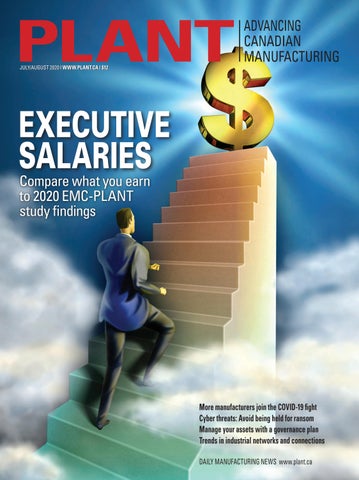
EXECUTIVE SALARIES Compare what you earn to 2020 EMC-PLANT study findings
More manufacturers join the COVID-19 fight Cyber threats: Avoid being held for ransom Manage your assets with a governance plan Trends in industrial networks and connections DAILY MANUFACTURING NEWS www.plant.ca
PLT_JulyAug2020_AMS.indd 1
2020-07-24 8:30 AM
PLT_JulyAug2020_AMS.indd PLT_Salesforce_JulyAug20.indd 2 1
2020-07-24 2020-07-14 8:30 9:51 AM
14 9:51 AM
CONTENTS
July/August 2020 Vol. 79, No. 04
FEATURES 20 PERFORMANCE Get rid of the wasteful processes in your plant. Tolerating them sets a bad example. INDUSTRY 4.0 Future proof while implementing your digital transformation projects. 21 CYBERSECURITY Cyber threats are escalating. The most common of them are identified with tips for defending against an attack. 22 MAINTENANCE Manage your assets with a governance plan to create value.
12 COMPENSATION
Executive and senior management salaries hold steady as COVID-19 fuels business uncertainty for manufacturers.
19 COVID-19 More manufacturers join the virus challenge with PPE, medical devices and sanitizing technology.
25 AUTOMATION Trends in industrial networks and connections: they’re smaller, smarter and customized.
23 CCOHS SAFETY TIPS As plants build towards more normal production, COVIDera safety measures will have to be hardwired into routines. 24 THINK LEAN Pandemic issues have distracted from process and product delivery. Pay attention to the voice of the customer.
DEPARTMENTS 4 Editorial 6 News Bulletins 7 Careers 8 PLANT Online 10 Industry Mix 11 Economy PLANT Pulse 26 Leading Edge: Innovative ideas for plants 28 Products and Equipment 29 Plantware Events 30 Postscript: Canada’s post-pandemic supply chain challenge
COVER IMAGE: ANDREA DANTI - STOCK.ADOBE.COM
PLANT—established 1941, is published 7 times per year by Annex Business Media. Publications Mail Agreement #40065710. Circulation email: bolechnowicz@annexbusinessmedia.com Tel: 416-510-5182 Fax: 416-510-6875 or 416-442-2191 Mail: 111 Gordon Baker Road, Suite 400, Toronto, ON M2H 3R1. Occasionally, PLANT will mail information on behalf of industry-related groups whose products and services we believe may be of interest to you. If you prefer not to receive this information, please contact our circulation department in any of the four ways listed above. Annex Privacy Officer: privacy@annexbusinessmedia.com Tel: 800-668-2374. No part of the editorial content of this publication may be reprinted without the publisher’s written permission. ©2020 Annex Publishing & Printing Inc. All rights reserved. Performance claims for products listed in this issue are made by contributing manufacturers and agencies. PLANT receives unsolicited materials including letters to the editor, press releases, promotional items and images from time to time. PLANT, its affiliates and assignees may use, reproduce, publish, re-publish, distribute, store and archive such unsolicited submissions in whole or in part in any form or medium whatsoever, without compensation of any sort. This statement does not apply to materials/pitches submitted by freelance writers, photographers or illustrators in accordance with known industry practices. Printed in Canada. ISSN: 1929-6606 (Print), 1929-6614 (Online).
www.plant.ca
PLT_JulyAug2020_AMS.indd 3
PLANT 3
2020-07-24 8:30 AM
EDITORIAL
How we can climb out of the pandemic hole
C
anada’s manufacturers demonstrated why they’re essential to our economy. They were agile and adapted quickly to COVID-19 safety measures under rapidly shifting business and regulatory conditions, but also seized opportunities to provide needed medical supplies and protective gear to their communities. Some developed creative new product lines that will continue beyond the pandemic’s run. But there have been losses. Companies closed, others have struggled to stay in play and many jobs were lost. The pandemic has changed the way business will be conducted and how trade flows. Recovery won’t be a short affair. Manufacturers would like the current federal regime to show some agility and help them “kick start” the economy, currently experiencing shrinkage of about 6.8%. Two industry groups – Canadian Manufacturers & Exporters (CME) and the Coalition of Concerned Manufacturers and Businesses of Canada (CCMBC) – are on the job, each with a report (download at https://bit.ly/3dzd7lA and www. ccmbc.ca) offering recommendations for action. There is much common ground between the two associations when it comes to cutting red tape, lowering the cost of doing business and the importance of leveraging natural resources (not just harvesting, digging, pumping and shipping, but adding value in Canada). The CCMBC places particular emphasis on energy – getting out of its way by declaring orderly development to be in the national interest. And CME is keen on a Made in Canada strategy, but not in a Trumpy way. The idea is to boost sales at home and abroad, increase infrastructure spending and leverage government procurement by basing purchasing decisions on total economic value to Canada (not just price). Procurement should also be used to encourage development and production of new health care technologies to avoid another supply panic. Of particular note is CME’s forward thinking: develop policies that support SME exporting and scaling up; conduct a full mapping of Canada’s domestic manufacturing capabilities; and leverage CUSMA to drive North American activity. RBC also has some advice for small businesses, which account for most of Canada’s manufacturers. The bank surveyed companies and got 22,000 responses that led to a report offering a five-point plan. Three points adapt nicely to CME’s and CCMBC’s recommendations (download at https://bit.ly/2ZxpCdP). • Create new networks for a massive digital push. The pandemic has led to a significant increase in cross-border data flows. A greater concentration of power among global platforms is helping customers search, share and shop from a distance. Act on this growing reality. • Implement new economic strategies to scale small business. Form alliances to compete in a more fragmented, localized global marketplace. Governments and large enterprises creating Canadian alliances for procurement and supply chains would strengthen the economy and communities. • Adopt a more strategic approach to globalization. The pandemic disrupted supply chains and exposed some of the unintended consequences of globalization. Small manufacturers that retooled to produce critical products such as masks and ventilators demonstrated the sector’s ability to quickly adapt and innovate. More of that is needed and not just for the domestic market. Manufacturing’s share of GDP has been shrinking over the years but accounts for 10% and 1.7 million jobs (pre-COVID), making our plants significant contributors to the economy. Quickly reversing shrinkage with a national plan is just what the doctor ordered. Reimagining supply chains to be less dependent on global sources and making more things here for world markets will hasten long-term growth as we climb out of the deep hole created by the pandemic.
Editor Joe Terrett 416-442-5600 ext. 3219 jterrett@plant.ca Senior Publisher Scott Atkinson 416-510-5207 satkinson@annexbusinessmedia.com National Account Manager Ilana Fawcett 416-829-1221 ifawcett@annexbusinessmedia.com Media Sales Manager Jason Bauer 416-510-6797 / 437-218-0941 jbauer@annexbusinessmedia.com Media Designer Andrea M. Smith asmith@annexbusinessmedia.com Circulation Manager Beata Olechnowicz 416-510-5182 bolechnowicz@annexbusinessmedia.com Account Coordinator Debbie Smith 416-442-5600 ext 3221 dsmith@annexbusinessmedia.com Vice President/Executive Publisher Tim Dimopoulos 416-510-5100 tdimopoulos@annexbusinessmedia.com COO Scott Jamieson sjamieson@annexbusinessmedia.com
Subscription Price Canada $76.00 per year, US $201.00 (CAD) per year, Foreign $227.00 (CAD) per year. Single Copy Canada $12.00. Add applicable taxes to all rates. Combined, expanded or premium issues, which count as two subscription issues. Mailing Address Annex Business Media 111 Gordon Baker Road, Suite 400 Toronto, ON M2H 3R1 Circulation Beata Olechnowicz 416-510-5182 bolechnowicz@annexbusinessmedia.com Fax: 416-510-6875 or 416-442-2191
Joe Terrett, Editor Comments? E-mail jterrett@plant.ca.
4 PLANT
PLT_JulyAug2020_AMS.indd 4
July/August 2020
2020-07-24 8:30 AM
Untitled-2
Untitled-2 1 PLT_JulyAug2020_AMS.indd 5
2020-07-23 8:30 2020-07-24 8:19 AM
NEWS BULLETINS Waterloo Brewing Ltd. is investing $13.4 million in its Kitchener, Ont. brewery to meet growing demand for its craft beer and other beverages, plus its copack business. The project will include expansion of its brewing and blending as well as the installation of a new can line, doubling production capacity to 900,000 hectolitres. Packaging capacity will increase to just over 1.4 million hectolitres. Baylin Technologies Inc.’s subsidiary Alga Microwave Inc. has received purchase orders of more than $1.3 million for its C-Band and Ku-Band BUC transmitters used in the broadcast of satellite signals. The Toronto-based manufacturer of radio frequency products said Galtronics USA Inc., its US subsidiary, received purchase orders of more than $700,000 for its small diameter multiband MIMO antennas used in 4G and 5G wireless systems. Cascades Inc., a manufacturer of green packaging and tissue products based in Kingsey Falls, Que., is closing its brown containerboard packaging facility in Burlington, Ont. Production will be deployed to other units in the province. The move aligns its production capacities and reduces costs. Xebec Adsorption Inc., a global provider of clean energy solutions, and development fund Fonds de solidarite FTQ have created the GNR Québec Capital LP investment fund with $10 million each. Their aim is to increase renewable natural gas production in Quebec. Successful applicants will have access to the capital and expertise needed to develop and operate facilities to treat organic waste. The fund partners are looking at adding investors and gathering $100 million in equity capital. Xebec transforms raw gases from organic waste into renewable energy. BevCanna Enterprises Inc. is acquiring Exceler Holdings Ltd. to access the BC corporation’s distribution network across Europe and Asia. BevCanna, a Vancouver manufacturer of cannabinoid-infused consumer products, said the acquisition will accelerate expansion of its CBD beverages in Europe.
6 PLANT
PLT_JulyAug2020_AMS.indd 6
Vegpro, Cascades partner on 100% recycled packaging News containers extend salad shelf life
Fresh Attitude salads in recycled plastic container.
PHOTO: CASCADES INC.
SHERRINGTON, Que. — Vegpro International, a baby lettuce producer, and Cascades, a manufacturer of packaging made from recycled materials, have partnered to replace all Fresh Attitude salad containers made from virgin plastic with 100% recycled and recyclable containers. Vegpro is a vegetable producer based in Sherrington, Que. The plastic containers are manufactured at the Cascades Inopak plant in Drummondville, Que. The companies said the container extends the shelf life of salads thanks to improved airflow that eliminates the build up of excess humidity. A lifecycle analysis of similar Cascades packaging demonstrated using 100% recycled PET reduces greenhouse gas emissions and the consumption of non-renewable resources required to manufacture packaging. Production of the packaging has begun and the transition will take place gradually until early 2021.
CBSA probing plywood imports from China OTTAWA — The Canada Border Services Agency (CBSA) has launched investigations to determine whether decorative and other non-structural plywood from China is being subsidized and sold at unfair prices in Canada. The complaint was filed by Columbia Forest Products, Husky Plywood, Rockshield Engineered Wood Products ULC, and the Canadian Hardwood Plywood and Veneer Association with support from Precision Veneer Products Ltd. and ProPly Custom Plywood Inc. They allege the Canadian industry is facing an increase in the volume of the dumped and subsidized imports, loss of market share and sales, price undercutting, price depression, underutilization of capacity, threat to continuous investments, impacted financial results and reduced employment. Decorative plywood is used in kitchen cabinets, furniture, wall panelling and architectural woodwork and several kinds of furniture. The Canadian International Trade Tribunal will begin a preliminary inquiry to determine whether the imports are harming Canadian producers. The CBSA will investigate whether the imports are being sold in Canada at unfair and/or subsidized prices, and will make preliminary decisions by Sept. 9.
5N Plus signs $12.5M space deal MONTREAL — 5N Plus Inc.’s 5N Plus Semiconductors subsidiary has signed a $12.45 million contract with the US government to advance technologies for specialty semiconductors required by US satellite suppliers. The Montreal-based supplier of specialty metals, alloys and related chemicals said over the next 39 months its subsidiary in St. George, Utah will address future technology requirements and enhance the sustainability of products required in the US supply chain for space. 5N Plus operates R&D, manufacturing and commercial centres in several locations in Europe, the Americas and Asia.
CN train travelling through Thunder Bay, Ont.
PHOTO: CN
CN investing $310M in Ontario Strengthens its rail network, infrastructure TORONTO — CN plans to invest $310 million across Ontario this year to meet demand for rail transport. Investments will be directed to intermodal facilities, replacing 100 kilometres of rail and 195,000 of ties, as well as the maintenance of bridges, level crossings, culverts, signal systems and other track infrastructure. CN said the investments increase rail capacity while reducing supply chain greenhouse gas emissions by up to 75%, replacing more than 300 trucks. CN also proposes to build a $250-million Milton Logistics Hub that will create over 1,000 direct and indirect jobs.
July/August 2020
2020-07-24 8:30 AM
Seaspan’s Vancouver shipyard.
PHOTO: G. HENDERSON, H. MOFFATT, J. JUNCK
$2.4B contract for RCN support ships Seaspan to deliver first of two vessels in 2023 GATINEAU, Que. — Seaspan’s Vancouver Shipyards has been awarded a $2.4 billion contract through the National Shipbuilding Strategy to build two joint support ships for the Royal Canadian Navy. The ships will deliver fuel and other vital supplies to vessels at sea, offer medical and dental services, and provide facilities for helicopter maintenance repair. The first ship is to be delivered in 2023, and the second in 2025. The total budget includes $3.1 billion for the purchase of the two ships and initial spares, plus $1 billion for design and production engineering work, project management and associated contingency costs.
GM declares Linamar an Overdrive winner
CAREERS
GUELPH, Ont. — General Motors has named Linamar Corp. a GM Overdrive Award winner during a virtual ceremony June 24. The award, introduced in 2012, recognizes suppliers for extraordinary leadership in cultural change and commitment initiatives that drove exceptional business results for GM. Linamar, the global auto parts supplier based in Guelph, Ont., was one of four Overdrive winners, and was also named a GM Supplier of the Year. This is the second Overdrive win for Linamar and its fourth consecutive Supplier of the Year award.
Handling Specialty’s Marek Cybula is moving from the professional services group to sales as a senior technical rep. Rob Hicks, a Marek Cybula 12-year staffer, takes Marek’s place as supervisor of the professional services group. The custom engineered material handling systems provider is based in Rob Hicks Grimsby, Ont.
Work underway on Calabogie hydro project Facility replaces tornadodamaged generating station
Genius Conseil fined for bid rigging GATINEAU, Que. — Engineering firm Genius Conseil Inc. has been ordered to pay $300,000 for bid rigging on municipal infrastructure contracts in Montreal and North Shore municipalities between 2002 and 2012. The payment is part of a settlement reached by the Public Prosecution Service of Canada (PPSC) and filed June 19 with the Superior Court of Quebec. Genius collaborated with the Competition Bureau and the PPSC early in the bid rigging investigation. The settlement takes into account that Genius previously reimbursed overpayments through Quebec’s Voluntary Reimbursement Program. It also takes into account that the company ceased all commercial operations in November 2014. This is the fifth settlement with an engineering firm resulting from the Competition Bureau’s ongoing investigation into the rigging of bids for municipal infrastructure contracts in Quebec. Five engineering firms have been ordered to pay a total of $8.85 million for their roles in the bid rigging scheme: Genivar (now WSP Canada); Dessau Roche ltee; Groupe-conseil (now Norda Stelo Inc.); and SNC-Lavalin. The Competition Bureau’s investigation has also resulted in guilty pleas from four executives of engineering firms Cima+, Genivar and Dessau for bid rigging on Gatineau infrastructure contracts. They received conditional prison sentences totalling five years and 11 months, and court-ordered community service totalling 260 hours.
www.plant.ca
PLT_JulyAug2020_AMS.indd 7
Calabogie Generating Station on the Madawaska PHOTO: OPG River.
RENFREW, Ont. — Work is underway on Ontario Power Generation’s (OPG) new Calabogie Generating Station in eastern Ontario (near Ottawa). The new facility, located along the Madawaska River, is to be completed by 2022 and will power 10,000 homes. “Many options were considered over the years, including retrofitting the existing century-old powerhouse, but a complete redevelopment was determined to be the best option and we’re proud to bring more clean energy to Ontario’s grid,” said Mike Martelli, OPG’s president of renewable generation. The five-megawatt station constructed in 1917 was extensively damaged by a tornado in 2018. The new facility will have a new powerhouse that doubles the station’s capacity. OPG is investing more than $100 million to redevelop the site.
Building technology industries veteran Mike Fischer has joined Armstrong Fluid Technology as commercial director and country leader, Mike Fischer USA. He was most recently global HBS service sales leader with Honeywell Building Solutions. Armstrong is a manufacturer of intelligent fluid flow equipment based in Toronto. Premium winter garment manufacturer Canada Goose in Toronto has appointed Carrie Baker president, North America and Kara MacKillop Kara MacKillop chief of staff and executive vice-president, people and culture. Baker will oversee all marketing and commercial operations in North America. MacKillop continues to be responsible for people and culture, and as chief of staff, will assume strategic projects for the office of the CEO, corporate citizenship and serve as the liaison to the board. Maria Perrella has resigned as chief financial officer of ATS Automation Tooling Systems Inc. in Cambridge, Ont. Ryan McLeod, vice-president, corporate controller since 2014, will assume the role of interim CFO. McLeod, who joined ATS in 2007 as manager of reporting and compliance, became director of finance in 2010.
PLANT 7
2020-07-24 8:30 AM
NEWS
Transdev adds 27 electric school buses
Brandt to acquire GeoShack, Inteq
for a total of 31. They’ll be added to its school transport networks in Quebec’s Estrie and Montérégie region in September. Transdev’s Canadian operation, based in Brossard, Que., plans to electrify 100% of its Quebec school buses by 2025. The deal is supported by an electric bus program, part of the Quebec government’s 2015-2020 Transportation Electrification Action Plan. Transdev intends to have a fleet of 1,200 electric buses powered by batterQuebec fleet to be all electric by 2025. PHOTO: TRANSDEV ies, and batteries with hydrogen fuel cells by the end of the year. BROSSARD, Que. — Transdev Canada is invest“We wanted to demonstrate a strong coming almost $4.5 million in its electric school bus mitment regarding energy transition, and in fleet with the Lion Electric – Canada, a manuparticular to serve the younger generations facturer of electric buses based in Saint Jerome, who are the public transportation passengers Que. of tomorrow,” said Arthur Nicolet, Transdev The France-based global transportation Canada’s CEO. company is adding 27 electric buses to its fleet
REGINA, Sask. — The Brandt Group of Companies has reached an agreement with US-based Ultara Holdings Inc. to acquire the assets of GeoShack Canada Co. and the Canadian assets of Inteq Distributors. Brandt, a Regina, Sask.-based company, manufactures and sells agricultural, construction, railroad and other industrial equipment. GeoShack is an exclusive supplier for Topcon Positioning Systems equipment in Ontario for the construction, survey, engineering, and agricultural industries. A separate agreement with Topcon Positioning Systems Inc. assigns Brandt distribution rights for the Quebec market and with GeoShack makes them the exclusive dealer in Canada for Topcon construction and geopositioning products.
Transportation company plans to electrify 100% of its Quebec fleet by 2025
PLANT ONLINE SOUNDING OFF
What readers have to say about breaking news Have you checked out PLANT’s daily news online? Here are some headlines that have inspired members of the Canadian manufacturing community to chime in. They’re edited, but use the links to see the raw – and for some – longer versions of their remarks plus the stories that inspired their reactions. Stay up-to-date on the developments – domestic and global – that affect Canada’s industrial sectors by watching the news feed at www. plant.ca or reading PLANT’s twice-weekly newsletter (hit Subscribe on the website). Most Canadians would sacrifice privacy to help stop COVID-19: KPMG http://www.plant.ca/25TYr First of all, the number of people surveyed is small so how can the survey be accurate to allow rules to be applied to the whole population? And everyone assumes that everybody has a cell phone. There are many of us who don’t. In fact there are many people who do not have a computer. Statistics are a wonderful thing, but the results can be manipulated to fit a desired situation to sway the outcome.
8 PLANT
PLT_JulyAug2020_AMS.indd 8
20% of small businesses too small to qualify for CEBA loan: CFIB http://www.plant.ca/YKTJ1 Due to the shortage of drivers in the transportation industry, many companies have moved from an owner-operator model to hiring employee drivers, therefore the payroll has increased substantially. The CEBA program eliminates them. The bar should be raised to $2 million to keep essential workers going. Also, banks need to waive lease interest on essential equipment for at least three months.
Canadians divided over making COVID-19 vaccine mandatory: Poll http://www.plant.ca/klGrq If and when a vaccine is developed, clearly getting it should be mandatory. Deaths and economic devastation should be averted if such a simple action can do it. Individual freedom of choice has to take a backseat in favour of the larger health and economic issues at stake. Anticipating N95 mask shortage, hospital turns to full-face snorkel masks http://www.plant.ca/Jgcqw When things return to normal with the cost of labour, will all manufacturing move back to Asia – or will we learn from this situation and keep some in house manufacturing just in case? (I highly doubt it, as free trade and economics dooms us to higher margin products). As terrible as
it is to say, if we have a yearly pandemic, it will stay local. Nonvisible disabilities: How to accommodate workers’ limitations http://www.plant.ca/wS7z2 It’s unfortunate the article makes no mention of environmental sensitivities and the need to provide accessible-built environments for this group. Ontario’s essential businesses include manufacturing http://www.plant.ca/ke71Z I work at a manufacturing plant that produces duvets and pillows, definitely not essential when compared to other goods… Not to mention there are about eight to 10 of us in the building at any given time. Gloves, sanitizer and masks are provided but no one seems to care to use them. http://www.plant.ca/ke71Z My husband works at a manufacturing facility that makes fitness equipment. How can that be deemed to be essential? The provincial government needs to be more specific with their definition of “essential manufacturers.”
July/August 2020
2020-07-24 8:30 AM
NEWS
TMMC tallies 9M vehicles Highest producing North American Toyota, Lexus plant
Toyota executives and team members with the nine millionth vehicle.
CAMBRIDGE, Ont. — Toyota Motor Manufacturing Canada (TMMC) hit a significant milestone on May 27 when it’s 9 millionth vehicle rolled off the assembly line at its plant in Cambridge, Ont. The vehicle – a Lexus RX 450h hybrid luxury SUV – is of a valued pedigree. TMMC was the first plant outside of Japan to build a higher-end Lexus. It currently manufactures the Toyota RAV4 and RAV4 Hybrid, Lexus RX 350 and RX 450 hybrid models at its three Ontario plants. “In 1988 – the year we opened our first plant in Cambridge – our team members built 153 Toyota Corollas – and it took 10 years to produce our first million vehicles,” said Frank Voss, president of TMMC. “We built the most recent million in just two years and we’re building almost 500,000 Toyota and Lexus vehicles every year, making us the highest pro-
PHOTO: TMMC
ducing Toyota and Lexus plant in North America, and the second largest in the world.” Since 1988, TMMC has grown to become a major employer in Southwestern Ontario, with two production lines in Cambridge and a third line in Woodstock, Ont. that employ more than 8,500 people. In May 2000, when TMMC was chosen to build the first Lexus outside Japan – the RX 330 luxury SUV – the original Toyota plant in Cambridge had to be completely overhauled. Today, Toyota’s Cambridge South plant builds the Lexus RX 350 and Lexus RX450h. In 2005, TMMC expanded by heading to Woodstock, where it broke ground on a 1.8-million square foot facility to manufacture the RAV4 compact SUV. TMMC West now produces the Toyota RAV4 and RAV4 Hybrid for the North American market.
Valens, FOPS launch ufeelu CBD brand KELOWNA, BC — Valens GroWorks Corp., a manufacturer of cannabinoid-based products, has signed a deal with FPS Brands Inc. in Vancouver to launch ufeelu, a line of craft, hemp-derived CBD products. Valens, based in Kelowna, BC, will produce a minimum of 250,000 units across a variety of branded products over the two-year agreement. It will initially focus on the development of cannabis oils, vapes and topicals, with specialty drinks added later. FPS ufeelu products are made using Canadian-grown hemp and plant-based terpenes. Valens will provide premium extracts, filling, packaging and manufacturing services, and handle national distribution of the product line.
PLANT 9
www.plant.ca PLT_Wainbee_JulyAug20.indd 1
PLT_JulyAug2020_AMS.indd 9
2020-07-08 11:39 AM
2020-07-24 8:30 AM
INDUSTRY MIX Magna: a top GM supplier, innovator
Magna International has burnished its automotive parts, components and systems credentials with six fresh wins at General Motors’ 28 th annual supplier awards in Troy, Mich. on June 24. The automaker declares that’s the most hardware GM’s innovation award for 2019. in a single year, so congratulations PHOTO: MAGNA to the winning global and Canadian company based in Aurora, Ont. Five of the trophies cover mirrors, truck frames, driveline systems, fascias and seat systems but the sixth is an innovation award for Magna’s Freeform seat trim technology. It’s all about styling flexibility with various shapes and “crisp” styling lines for “striking visual effects,” such as a sharp 3- to 4-mm radius, which Magna compares to 20 to 25 mm for traditional cut and sew. Let’s not forget comfort. Magna says highly concave surfaces and contours hug the human shape, which reduces micro-motions of the spine. Back panels have a “soft touch,” and provide up to four inches of additional rear seat knee clearance. And seats are designed for future mobility scenarios such as ride sharing where covers unzip and swap out during routine maintenance. Magna says its FreeForm process can be used in low- and high-volume vehicle programs with more surface control and repeatable precision for less finesse time on the manufacturing floor. GM is launching FreeForm later this year.
MISCELLANY FROM THE WORLD OF MANUFACTURING
Battling plastic fishing gear waste Plastic is used to make countless consumer and industrial products, but as useful as this ubiquitous material in all its forms may be – it takes a long time Washed up plastic fishing netting. to degrade. PHOTO: BETTYSPHOTOS - STOCK.ADOBE.COM Canada recycles just 9% (380 million tonnes produced annually), 4% is incinerated and 1% winds up as litter, according to a Environment and Climate Change Canada report. And too much of the 1% gets into waterways and oceans, tangling up wildlife or leaching into their systems. Every year, 640,000 tons of abandoned, lost or discarded fishing gear enters our oceans and this stuff can linger in the environment for up to 600 years. It’s a big problem the Canadian government is tackling with a bit of grant money ($2 million) from an innovation program directed to four small businesses: • $702,000 goes to Ashored Innovations Inc. (Derbert, NS) to build an acoustically activated ropeless fishing system for use in lobster and crab fisheries. • Goodwood Plastic Product Ltd. (Fort Ellis, NS) gets $475,000 to turn end-of-life plastic fishing nets and ropes into plastic lumber products. • Plantee Bioplastics Inc. (Kingston, Ont.) will develop a “smart” biodegradable plastic polymer fishing line with its $475,000. • Ocean Legacy Technologies (Surrey, BC) will use $360,000 to build a small processing/recycling facility that will collect and repurpose fishing and aquaculture plastics.
We’re cybersecurity laggards
Cyber attacks are on the increase, yet Canadian companies – including manufacturers – appear to be somewhat complacent. This is worrying since many companies are doing more business online or remotely because of the pandemic and will likely do so when things return to “normal.” When Canadian manufacturers were surveyed last year for the 2020 Advanced Manufacturing report by BDO Canada and PLANT Magazine, only 17% of the 251 respondents had measures in place while 6% were planning. Looking more broadly, there’s a Expect attacks to increase. problem at the board level. PHOTO: PESHKOV - STOCK.ADOBE.COM The 2020 EY Global Information Security Survey by advisory firm EY finds Canadian companies are lagging globally. Thirty-four per cent have yet to fully articulate cybersecurity risk, compared to 16% of their peers. Just 21% of Canadian boards understand how to fully evaluate risks compared to 48% globally. And 43% are unable to quantify cybersecurity effectiveness in financial terms, compared to 24% of respondents in other countries. EY emphasizes the importance of cybersecurity teams speaking the board’s language to increase awareness throughout the organization and secure buy-in for resources. Better alliances across all business functions is another must. The survey shows only 10% of respondents say there’s a high level of trust and consultation between the cyber teams and the broader business. And cybersecurity needs to be involved in any product, service or initiative as businesses make digital investments to support an online transition. The threat of hacks and incursions isn’t going away. According to the 2019 Canada Threat Report by cybersecurity firm Carbon Black, 76% of companies reported an increase in attacks, and 25% of those said the volume rose by half.
10 PLANT
PLT_JulyAug2020_AMS.indd 10
You can see it everywhere from the South China Sea to our two citizens who were bundled off to jail for no reason at all except to protest an extradition decision in Vancouver. There has to be an immediate and urgent rethink of our entire relationship.” Former Prime Minister Brian Mulroney on the need to re-evaluate Canada’s relationship with China (Globe and Mail).
OTTO raises $29M to go global It takes a certain amount of cheek for a young Canadian robotics company to invade Japan, one of the world’s top exporters of robots (50% in 2017), but that’s what Otto Motors has done. An OTTO 1500 in motion. PHOTO: OTTO The division of Clearpath Robotics in Kitchener, Ont. (created in 2015) entered the Japanese market in 2018 with its automated mobile robot (AMR) platform, then announced in February it’s first expansion outside North America. OTTO is partnering with Altech, an importer of advanced machinery and equipment from Europe and the US for the Japanese industrial market. Now the manufacturer of intelligent material handling robots is expanding its global network of delivery partners with US$29 million in Series C funding. It sees demand for AMRs growing worldwide. OTTO Motors has now raised US$83 million in funding.
July/August 2020
2020-07-24 8:30 AM
ECONOMY
Signs of life Is a turnaround in play?
www.plant.ca
PLT_JulyAug2020_AMS.indd 11
ECONOMY PLUNGES IN APRIL
billions of chained (2012) dollars – all industries
2,050 2,000 1,950 1,900 1,850 1,800 1,750 1,700 1,650 1,600
April 2015
2016
2017
2018
Source: Statistics Canada, CANSIM
16,513
Exporting enterprises in April, a 24.8% decline year-over-year, reports Statistics Canada.
2019
April 2020
GDP plunged in April by 11.6% following a 7.5% decline in March, reflecting the first full month of measures put in place to slow the spread of COVID-19. Statistics Canada reports all 20 industrial sectors of the Canadian economy were down with manufacturing showing a 22.5% drop. In durables, automotive plants showed the biggest drop (97%) followed by auto parts (86.4%). In non-durables, food (-12.8%) was the biggest contributor to the decline, largely as a result of COVID-19 outbreaks at meat processing plants.
37%
Percentage of employees with a registered pension plan in 2017 (most recent data), down from 45% in 1981. Statistics Canada said wages grew moderately as pension plan coverage fell.
-10%
IMAGES: STOCK.ADOBE.COM
W
hile the COVID-19 pandemic surges in the US and confounds President Donald Trump’s re-election-inspired focus on reanimating the US economy, Canada is showing signs of a turnaround although a long way from recovery. The June IHS Markit Canada Manufacturing PMI registered a 47.8, up from 40.6 in May and well above April’s 33, but still below the positive territory of 50 plus. The purchasing managers’ index gathers survey responses from a panel representing 400 manufacturers who indicted slower declines in output, new orders and employment, rising business expectations but a sharp lengthening of supplier lead times. About 30% of the panel reported a fall in output for the month, while 27% cited an expansion. Looking ahead, around 42% of the survey panel anticipate a rise in production volumes over the following 12 months, while 16% forecast a reduction, the highest measure of expectations since February. July results (available in August at https://bit.ly/2YVwgKo) will show whether or not progress continues. Forecasting GDP for the year appears to be a bit of a moving target. TD Economics predicts in its quarterly outlook GDP will have declined 6.1% for the year but sees 5.2% growth in 2021. Scotiabank Global Economics forecasts a drop of 7.3% and predicts growth of 6.6% in 2021. Federal deficit spending and the hit to the economy will result in a deficit of $343.2 billion, or 16% of GDP. According to the 2020 fiscal snapshot from the federal government. The debt-to-GDP level was around 31% pre-pandemic, and will hit just under 50%. TD Economics says around 50 is okay because it’s under peer economies’ pre-pandemic levels. But there’s a cautionary note: the sharp escalation of the deficit and the triple A credit rating, now downgraded to AA+, makes getting the deficit under control more challenging. TD economists stress, “A convincing path to fiscal sustainability will need to be identified.”
Overall hiring outlook for Q3, a 19% decrease compared to Q2, according to the ManpowerGroup Employment Outlook Survey. Hiring prospects for non-durable manufacturers is more positive at 8%. Durables, less so at -9%.
1.3 MILLION
Number of vehicles produced in Canada for 2020 (forecast) compared to 1.9 million in 2019, according to Scotiabank Global Economics. The drop is attributed to COVID-19, plus lost production at GM-Oshawa due to its closure.
-27.7
Executive confidence level in the global economy over the next three months (-50 to +50 range), reports the second Global Business Barometer from The Economist. The biggest swing comes from China, where executives’ outlook for the domestic economy declined by 21.9 points. The global view is less pessimistic than April’s (-39.4), but as of May executives believe they’re still in the survival stage, (adaptation and recovery to follow). More executives (37.2%) are confident recovery will take three to five years compared to April’s 30.8%.
PLANT 11
2020-07-24 8:30 AM
Sponsored by:
COMPENSATION
YEAR OF THE VIRUS EXECUTIVE SALARIES ARE HOLDING STEADY The impact of COVID-19 fuels business uncertainty as manufacturers forge ahead. BY JOE TERRETT, EDITOR
I
f it’s not one thing, it’s another. Into the fourth year of the Trump Follies and the US administration’s various upsets to Canadian business and trade, with all the uncertainties they entailed, it was looking like conditions were settling down, at least a little, as 2020 began. Tariffs on steel and aluminum were out of the way. As of January the US and China were attempting to cool a tariff war that was disrupting global trade flows. And with the NAFTA redo complete, Canada ratified what it’s calling CUSMA (Canada US Mexico Agreement) on March 18 – but a week after the World Health Organization declared COVID-19 a pandemic. Boom! It soon became evident as the number Canadian (and global) COVID-19 cases mounted, the country would be in lockdown, slowing economic activity to a crawl. Federal and provincial governments declared states of emergency and placed restrictions on civilian and business activities, and have continued with a gradual loosening starting in June. For manufacturers, plagued by uncertainties since US President Donald Trump’s antics began
12 PLANT
PLT_JulyAug2020_AMS.indd 12
right after the 2016 US election, COVID-19 is shaping up to be a bigger calamity than the financial crisis/recession of 2008-09. Economic growth was soft in 2019 (1.9%) but disappears down a virus hole at a projected -6.8% this year, according to the federal government’s latest fiscal snapshot. This was the backdrop as the 2020 EMC-PLANT Manufacturing Salary Survey went into the field between March and May. This annual national benchmark study was conducted by PLANT Magazine, an Annex Business Media publication, and the Excellence in Manufacturing Consortium (EMC), a not-forprofit organization based in Owen Sound, Ont. EMC helps manufacturers achieve operational excellence. A total of 766 executives and senior managers contributed to the study, 508 sharing personal information about what they’re paid, bonuses and how their businesses are faring. Most of the respondents (77%) come from small and medium-sized enterprises. When asked about pay, most representatives from executive and manager ranks reported increases that track slightly above inflation (1.95% in 2019, according to Statistics Canada and projected by the International Monetary Fund to be 0.6% this year) – some significantly more – while some saw decreases. Each year’s sample is different
IMAGE: CROCOTHERY - STOCK.ADOBE.COM
for a variety of reasons (employment churn, variances in bonuses, number of responses), so results don’t always align with the previous year’s unique group, but the responses do provide a general measure that will give you an idea how your compensation compares.
Business forecast Are manufacturers feeling confident? As resilient as companies may be, COVID-19 has punched a hole in the business forecasts they were working toward when the year began and that pressure certainly had an impact on this year’s final survey tally. “COVID-19 has really been a bit of a moving target. What happened in March and April was a shock, a shutdown. We’re in a different world now,” says Jean-Pierre Giroux, EMC’s president. “Moving into summer, we’ll see how small and medium companies get through the hit. There’s a lot of talk about a three- to four-month window for cash flow. That will be the real test in August, whether they still have a market.”
Along with that is the US, which has been an unpredictable trading partner at the best of times under the Trump regime (at this writing, potential aluminum tariffs…again), but as most developed countries are seeing coronavirus numbers declining, America’s are raging. The Canada-US border remained closed (so far, until Aug. 21) to non-essential travel and uncertainty prevails as companies speculate on how the situation will impact business. “So much production relies on access to the US and the supply chains, ensuring those connections aren’t disrupted becomes an issue,” notes Scott McNeil-Smith, EMC’s vice-president, manufacturing sector performance. Little wonder respondents are less optimistic about earning higher revenues this year – 39% see improvement over 2019 revenues compared to 54% last year – and 35% are looking at a decrease from 2019 compared to 24% the year before who anticipated fewer sales. Brighter side, McNeil-Smith
July/August 2020
2020-07-24 8:30 AM
cites Statistics Canada’s April manufacturing sales: $98.4 billion in unfilled orders. “That’s almost three months of (April) sales, so manufacturers that have orders on the books can work through those and hopefully the impact (from the economic shutdown) will be short term.” Manufacturers caught a bit of a break when federal and provincial governments declared manufacturing essential and allowed companies to operate as restrictive measures were put in place
years, most (39%) in the 1% to 3% inflation range; 15% in the 3% to 5% range; and 10% in the 5% to 10% range. Six per cent expect increases of more than 10% and 4% expect a decrease. The survey also provides a profile of typical manufacturing leaders. They’re overwhelmingly male (78% based on 506 replies), 64% are between 46 and 65 years of age; and 65% have management roles rather than ownership or partnership positions. The typical manufacturer has
products geared to the new realities of the plant workspace. Busy as they must have been, manufacturers who responded to the survey offered some valuable insights. This year’s sample shows average remuneration across manufacturing (all categories) hasn’t moved much. It rose 1.9% to $123,422 (compared to 3.5% from 2018 to 2019). Most respondents (48%) are making more than $110,000 a year and 70% project their compensation will increase over the next three
for businesses and services declared nonessential. Nonetheless, there were closures, layoffs, cash flow problems, supply chain disruptions and workforce issues to deal with. Some companies shut down and there have been significant job losses. The federal government is helping with wage subsidies (CEWS) and interest free business loans (CEBA), while many companies have jumped on opportunities to produce protective gear, sanitizers, ventilators as well as other
Demographics EDUCATION 508 replies
Working full-time in manufacturing
68%
508 replies
Workforces not unionized
77%
Employed by SMEs, 14% large
GEP 3% CE
4% % 11
ity degree 3 9 ivers % Un diploma 2 e g e 3 ll % Co ical diplom n h a1 tec e/ o l r o l e o ss ch hs
Tra d
94%
Location, average salaries, percentage of replies
Hig
PROVINCE
Newfoundland & Labrador
$150,000 <1%
REVENUES
508 replies / Average revenues $145M
Saskatchewan
4%
$103,682
12%
$95,500
$128,645
<1%
50%
3%
$123,422
Ontario
New Brunswick
National average
AGE
ROLE IN THE COMPANY
508 replies / Average age = 53
504 replies
25%
50 ➔ 249
250+ 250 ➔ 500 ➔ 1,000 ➔ 5,000 No 499 999 4,999 or more answer
9%
28%
< 50
3%
38%
65% 13% 6%
1%
2%
EMPLOYEES
5%
$148,400
$86,000
508 replies/ Average = 353
11%
Nova Scotia
Management role only
Controlling ownership stake and management role
8%
6%
Minority ownership and management role
Equal partnership and management role
<1% < 25
26 ➔ 35
Two per cent or less represents a small sample and should be considered with caution.
> 65 36 ➔ 45
46 ➔ 55
www.plant.ca
PLT_JulyAug2020_AMS.indd 13
6%
7%
22% 13% 19% 6% 10% 7% 4% 4% 4% 11%
33%
10%
$116,431
31%
$104,515
$131,603
$1M ➔ <$5M $5M ➔ <$10M $10M ➔ <$30M $30M ➔ <$50M $50M ➔ <$100M $100M ➔ <$250M $250M ➔ <$500M $500M ➔ <$1B $1B plus Did not answer
Prince Edward Island
14%
Alberta
$117,178
Quebec
Manitoba
6%
British Columbia
56 ➔ 65
PLANT 13
2020-07-24 8:30 AM
Sponsored by:
Salary Comparisons Hours/ JOB TITLE 2020 2019 2018 % Week
2020 BONUSES & INCENTIVES
506 replies
Vice-president CEO/President Director Owner/Partner Plant manager Maintenance manager Purchasing/Supply manager Plant engineering Design engineering Quality assurance manager Logistics manager Production/Operations manager Technician/Technologist Materials manager Safety manager Administrative management Average
$167,116 $163,609 $142,347 $132,807 $130,908 $128,895 $118,424 $117,707 $111,092 $104,546 $103,143 $101,532 $98,256 $89,000 $87,718 $85,033 $123,422
$168,997 $152,615 $139,886 $140,328 $126,504 $119,485 $115,276 $112,867 $108,271 $98,511 $93,186 $99,714 $96,106 $93,583 $81,582 $84,209 $121,126
$162,600 6% 52.3 $150,633 9% 52.5 $133,270 8% 48.7 $127,639 14% 50 $121,755 9% 49.4 $133,014 6% 47.1 $109,124 4% 46.2 $110,904 6% 47.4 $106,465 3% 44 $91,616 4% 47.9 $88,914 1% 48 $97,559 12% 50 $94,139 4% 40.3 $94,500 1% 47.6 $78,364 2% 44.4 $79,078 9% 46.1 $116,889 48.5
No response from 1%. Two percent or less represents a small sample and should be considered with caution.
11%
GENDER 506 replies
78% Male
2020
$127,478
Female
$96,759
506 respondents / No response from 4%
1% ➔ 3%
0
$101,526 43%
$97,909 7%
11% ➔ 15%
$135,476 5%
4% ➔ 5%
16% ➔ 20%
$139,654 5%
REVENUE
6% ➔ 10%
$119,442 10%
$140,368 13% 20+%
$186,447 14%
506 replies
2020
2019
2018
%
$1M ➔ <$5M $5M ➔ <$10M $10M ➔ <$30M $30M ➔ <$50M $50M ➔ <$100M $100M ➔ <$250M $250M ➔ <$500M $500M ➔ <$1B $1B plus
$90,606 $117,212 $129,036 $137,212 $126,419 $171,009 $135,095 $138,411 $139,287
$87,595 $120,723 $122,157 $133,021 $125,626 $166,770 $139,464 $132,819 $143,041
$84,656 $108,122 $117,119 $126,948 $122,249 $162,353 $138,541 $131,438 $132,621
22% 13% 19% 7% 10% 7% 4% 4% 4%
No response from 11%. Two percent or less represents a small sample and should be considered with caution.
INDUSTRY 506 replies
Aerospace product and parts Beverage and tobacco product Chemical Clothing manufacturing Computer and electronic product Durable goods industries Electrical equipment, appliance & component Environmental Fabricated metal product Food manufacturing Furniture and related product Leather and allied product Life Sciences (such as Biopharma/ Pharmaceutical, medical devices) Machinery Miscellaneous manufacturing Motor vehicle Motor vehicle body and trailer Motor vehicle parts Non-durable goods industries Non-metallic mineral product Paper manufacturing Petroleum and coal product Plastics and rubber products Primary metal Printing and related support activities Railroad rolling stock Ship and boat building Textile mills Textile product mills Transportation equipment Wood product
% 2020 2019 2018 replies $113,643 $78,000 $149,578 NA $118,000 $102,667 $132,373 $149,333 $126,450 $111,641 $122,236 NA $94,300
$113,929 $100,000 $151,478 [$71,380] $111,124 $101,433 $116,364 $140,000 $131,417 $106,674 $132,427 [$89,846] $89,200
$111,600 $100,000 $156,922 [$82,640] $109,538 $96,733 $113,150 $130,333 $120,038 $103,778 $113,655 [$87096] $82,400
3% <1% 2% 1% 3% 1% 7% 1% 14% 6% 2% 1% 1%
$109,733 $108,732 $145,444 $112,700 $141,805 NA $213,817 $163,336 $138,375 $119,526 $132,800 $91,067 $135,000 $205,000 NA $292,500 $96,400 $116,380
$109,956 $104,271 $138,667 $123,700 $142,250 [$100,500] $219,425 $150,100 $148,000 $118,169 $132,133 $88,567 $128,000 $149,000 [$224,033] $256,500 $102,200 $113,240
$102,754 $101,478 $132,000 $113,500 $142,760 [$99,500] $196,600 $162,096 $142,813 $109,878 $123,717 $86,100 $124,000 $149,000 [$209,183] $269,000 $91,400 $115,357
5% 9% 2% 1% 3% <1% 1% 6% 2% 8% 1% 6% <1% <1% 1% <1% 1% 6%
No response from 10%. Two percent or less represents a small sample and should be considered with caution. Square brackets, last year’s survey sample.
14 PLANT
PLT_JulyAug2020_AMS.indd 14
EDUCATION 506 replies
2020
2019
2018
%
University degree CEGEP College diploma Trade/technical diploma High school or less
$134,757 $129,429 $115,475 $128,608 $93,886
$131,827 $133,143 $112,863 $123,107 $93,877
$123,697 $119,714 $108,919 $126,685 $95,634
39% 3% 23% 14% 11%
No response from 9%.
YEARS OF EXPERIENCE 506 replies
2020
2019
2018
%
1 ➔ 4 years 5 ➔ 9 years 10 ➔ 14 years 15 ➔ 19 years 20 ➔ 24 years 25 ➔ 35 years 36+ years
$134,545 $107,451 $103,386 $119,878 $115,687 $126,391 $144,958
$126,320 $98,936 $101,060 $116,422 $119,325 $125,660 $137,172
$117,568 $91,129 $94,851 $115,376 $114,030 $119,199 $141,459
2% 7% 9% 7% 17% 39% 16%
No response from 2%. Two percent or less represents a small sample and should be considered with caution.
AGE
506 replies
2020
2019
2018
%
Under 25 26 ➔ 35 36 ➔ 45 46 ➔ 55 56 ➔ 65 Over 65
$65,500 $85,179 $115,544 $115,898 $140,448 $132,560
$60,000 $79,499 $114,367 $112,704 $140,369 $120,197
$55,000 $74,241 $109,240 $109,420 $135,833 $117,794
<1% 6% 14% 32% 33% 6%
No response from 10%. Two per cent or less represents a small sample and should be considered with caution.
July/August 2020
2020-07-24 8:30 AM
been in the business almost 26 years, 17 of those at his/her current company and 13 in the same job. Breaking down age in more detail, 31% of respondents are 46 to 55, 33% are 56 to 65 and 6% are older. Fourteen per cent are in the 36 to 45 group and just 6% are 26 to 35. Under 25s account for less than 1% of the total. Most respondents (60%) report no change to their employment situation, but 19% say more responsibilities have been added to their workload because of reduced staff, which is consistent with previous surveys. Most (36%) have a university degree that’s likely a bachelor of arts (52%) and their average workweek is 47.3-hours. Aside from those who have a management role only in their companies (65%), 13% have a controlling ownership stake, 6% are equal partners and 8% are minority owners.
Predictably, top executives and senior managers put in the most time. Vice-presidents average almost 51 hours per week; owners, partners, CEOs and presidents more than 50; plant production/operations managers 50; maintenance managers almost 50; plant managers and directors 49.
Decrease for owners Owners and partners are taking less money out of their businesses for compensation. They show a decrease of 5.3% compared to a 9.9% increase last year. Vice-presidents are down 1.1% compared to a 3.9% increase last year. CEOs and presidents are ahead 7.2%, compared to 1.3% the previous year. Plant managers will get a 3.5% increase compared to the 3.9% they received in 2019. Directors are expecting 1.8% following a 5% increase last year. Other management titles show maintenance managers
with a 7.9% increase followed by quality assurance managers (6.1%), plant engineers (4.3%), purchasing/supply managers (2.7%), design engineers (2.6%), technicians/technologists (2.2%), production operations managers (1.8%) and administrative management (1.1%). Results for logistics managers (10.7%), safety managers (7.1%) and material managers (-4.9%) are based on too small a sample and should be viewed with caution. Seventy per cent of manufacturing executives are more optimistic about their prospects over the next three years. They foresee an average increase of 2.9%. Thirty-nine per cent of respondents have a university degree, 23% have a college diploma, 14% a trade or technical diploma, 11% a high school education or less and 3% a CEGEP. Of those with degrees (385 respondents)
most earned a Bachelor degree (42%), MBA (8%), other Masters (7%), PhD (1%) and professional designation (6%). Higher education is good for income. University grads score the highest wage rate at $134,757, almost 4.1% ahead of the next best-paid group – college grads – at $129,429. Owners, senior executives and senior managers top the $120,000 annual pay level. Vice-presidents are the highest earners averaging $167,116, followed by CEOs and presidents ($163,609), directors ($142,347), owners/partners ($132,807) and plant managers ($130,908). Fifty-three per cent of executives report bonuses and incentives as part of their pay, averaging 15%. Those showing the highest percentage (20% or more) are at a $186,447 pay level. Most are in the 6% to 10% range, with their pay averaging $140,368. There was no overtime pay for 90% but
Management Issues PAY PERKS
MOST IMPORTANT SKILLS
501 replies
501 replies
34%
Management / supervisory
Communication
Interpersonal / problem solving
Industry specific technical skills
Productivity/ continuous improvement (lean etc.)
Project management
Analysis
Financial (budgeting, accounting)
Planning (forecasting, demand)
Negotiation skills
Sales skills
Technical skills (software, programming)
53% 40% 37% 36% 34% 31%
➔ RSP contributions
Travel expenses ➔ 33% 32% ➔ Performance or other bonus Car / gas allowance ➔ 31% 26% ➔ Pension Flex hours ➔ 23% 21% ➔ Company vehicle Profit sharing ➔ 20% 18% ➔ Training, executive development Access to private healthcare ➔ 15% 13% ➔ Wellness program Club memberships ➔ 6% 4% ➔ Stock options Other ➔ 4% 17% ➔ No additional benefits to salary
30% 27% 25% 24% 23% 20% CHANGES NEXT FIVE YEARS Investing in new production equipment / processes
51%
47% Hiring new employees
www.plant.ca
PLT_JulyAug2020_AMS.indd 15
Added / entering new lines of business
32%
504 replies
24% Expanding plant size
Enter new lines of business
23%
20% Acquiring other companies or lines of business
Enter new geographic markets
20%
12% Merging with another company
Downsizing employees
11%
8% Downsizing lines of business
Downsizing plant size
5%
3% Closing of company
PLANT 15
2020-07-24 8:30 AM
Sponsored by:
those who did collect it averaged an extra 1.4%. Of course, salary, benefits and perks help to keep key people engaged. McNeil-Smith doesn’t anticipate too much change in compensation for executives and managers. Companies will continue to look at benefits packages with an eye on costs. Salaries will be guided by supply and demand, but generally continue to trend close to the cost of living. Seventeen per cent get no perks or extras, but those who do cite RSP contributions (34%), travel expenses (33%), a car/gas allowance (31%), performance or other bonuses (32%), a car/ gas allowance (31%), pension plans (26%), flex hours (23%), a company vehicle (21%) and profit sharing benefits (20%). Moving forward, some manufacturers will add working from home. Almost two-thirds (60%) of the companies pay for educational courses, 49% cover memberships in professional associations and 43% pay for professional certification programs (but 26% don’t pay for any of these). Asked about what skills they need most to do their jobs, 53% of senior executives and managers cited management/supervisory, 40% identified communication followed by interpersonal problem solving (37%), industry-specific technical skills (36%) and project management (31%). Skills in need of improvement are financial (32%), technical – software and programing (30%), followed by people skills, and productivity/continuous improvement (both 24%). By the way, the skills shortage is still a top concern among executives and senior managers although it dropped to third place (43%) in this year’s survey, behind COVID-19 (68%) and cost control (46%). No surprise the coronavirus has nosed its way into the first position. It may be settling down for now but until there’s a vaccine business uncertainty will remain. Traditional issues continue to be an ongoing concern, and they
16 PLANT
PLT_JulyAug2020_AMS.indd 16
will reassert themselves when the virus runs its course, says McNeil-Smith. Indeed, people shortages, whether its general labour or skilled trades are topping EMC’s ManufacturingGPS (www. emccanada.org/manufacturinggps) tracking. The survey shows 51% will put money into new production equipment and processes, but 47% (high under the circumstances) intend to hire, while 32% are adding or entering new lines of business, and 24% are expanding their plants.
Lay-offs and hiring National job losses through February to mid-April topped 3 million. Manufacturing showed some recovery (5.5%) from April to May that continued into June,
plant during the crisis are opting for the government cheque. The challenge for companies is to keep employees engaged. McNeil-Smith cites successful engagement initiatives that revolve around projects such as maintenance and continuous improvement. EMC opened up its Members Need Help (www.emccanada. org/member-needs-help) e-mail service to all manufacturers. Participants share insights and experiences, but a special COVID-19 section also offered current information, policies and procedures, assessments and communication tools. “We got hundreds of companies that took advantage of the practical policies and tools that didn’t come from consultants or
WHAT COMPANIES PAY FOR
MOST SIGNIFICANT ISSUES 507 replies
Coronavirus
68%
47% Cost control Skills shortage
43%
29% Capacity utilization Supply chain disruption
24%
23% Technology upgrade Risk management
22%
20% Reorganization
476 replies
Resource / asset management Educational courses
Membership in professional associations
Professional certification programs
None of these
60%
49%
43%
26%
20%
17% Forecasting Financing for working capital
13% Environment/
but more than 236,500 jobs disappeared from May 2019 to May 2020, a decline of 13.5%. EMC’s monitoring of manufacturers shows about 30% indicating their intention to hire, while a lot of companies are anticipating lay-offs. The task, as Giroux sees it, is to match displaced workers with the manufacturers that are hiring by leveraging the group’s local and regional connections. “That’s very much part of EMC figuring out how to make the connection, ensure the proper onboarding and training, to quickly transition those people into a new job.” The pandemic has forced companies to adapt in ways that may carry on into the future. Temporary wage subsides are contributing to the people shortage as some workers feeling uncomfortable about being in a
government agencies, but direct from manufacturers,” says Giroux. EMC is also looking at opening up Opportunity Alerts (www.emccanada.org/opportunity-alerts) to non-members for bidding and posting B2B opportunities. Employee safety is the priority and companies have launched protocols that eliminate or limit visitors, conduct temperature checks of those who do enter the plant and activate technologies such as digital tags that alert team members when they’re too close to others. How employees are hired, onboarded and trained has also changed, and who would have thought shift supervisors managing teams from home? Measures will certainly be necessary until vaccines are found and readily available. Will
social 12% corporate responsibility Supplier relationship management
12%
11% IT issues Global market expansion
9%
8% Outsourcing Transportation
8%
7% Cybersecurity Overseas sourcing
7%
for capital N/A Financing acquisitions
July/August 2020
2020-07-24 8:30 AM
these changes be transformational? In some ways. EMC has offered online training/interaction for years, as well as in person sessions for initiatives such as continuous improvement, Six Sigma, lean and safety. In-person sessions were put on hold during the pandemic and some content is being adapted for online delivery. Manufacturers are also turning to online channels for meetings, hiring, onboarding and training. COVID-19 has demonstrated there are opportunities for those in manufacturing to work from home. “There has been a shift,” says
Preeti Dayal, senior business manager, manufacturing and supply chain, Hays Specialist Recruitment, Canada. “Most positions not working from home are doing so, except frontline people actually needed on the shop floor.” Others, such as supply chain and planning people, are also working from home, she says. “Conventional thinking that if you’re not here, you’re not working, is gone.” But she notes some managers find it difficult to manage a team remotely, especially when the people haven’t met in person and have not established a personal relationship.
SALARY FEEDBACK
Another shift is hiring. “More hiring managers are open to remote interviews, which was unheard of before.” And remote onboarding is “huge,” she says.
Skills still short Companies deemed not essential have held up hiring to curtail costs, but certain industries have actually picked up, such as food, where there is a serious shortage of candidates, she says. “That part is hot.” But she’s not seeing a lot of displaced workers from other industries accepted for food jobs. She identifies ongoing shortages of skilled people such as
Executives and senior managers responding to the 2020 EMC-PLANT Manufacturing Salary Survey were invited to add comments about compensation issues and like last year’s survey, their remarks covered a range of topics. Almost 91% of those commenting specifically on compensation level noted salaries were rising or static. Only 9% complained of decreases. COVID-19 was cited as a culprit. But there were also interesting observations about trends, incentives, skills and comments about current business conditions. Here are some of the almost 250 insights provided by respondents:
to know more. Skills needed: able to see the big picture from multiple perspectives; open mind; willing to learn. • The gap between executives and mid management is getting bigger. Now managing a plant is more about the financial aspect than productivity itself.
Trends
Skills
• Becoming more IT driven. More people in the industry with less knowledge about machinery and more about the computers that drive them. • Manufacturing in Canada, Ontario especially, is getting tougher. It’s becoming a do-more-for-less environment, slash costs, improve productivity, but no capital. • There is a greater need for staff that understands how to link issues, analysis and the need for communication and a willingness to try new ideas when presented with a problem. • Need to keep up to date with evolving technologies involving new software and automation, and migrate your organization towards world-class processes, such as continuous rolling forecasting.
Salaries • Outsourcing has had a huge impact. If jobs start to flow back into the market, salaries will increase by at least 10%. • Salaries continue to rise at an
www.plant.ca
PLT_JulyAug2020_AMS.indd 17
average of 3%; the cost of skilled labour is rising at up to 5% a year. • Salaries are mainly based on company performance as a whole and personal performance goals are interrelated to the company goals. • This company is conservative. Salary raises are kept low, but employees are kept as happy as possible, although our responsibilities have more than doubled. Employee turnaround is low. The production support department has only three employees and has remained that way for the last 15 years. Skills stay with one person. There is almost no cross training.
Attitudes • Compensation expectations are inflated and suffer from an entitlement mentality rather than accomplishment and team dynamics. Interpersonal skills are diminishing quickly. Communication is becoming the weakest link in many organizations. • Salaries need to be tied to the value that one brings to the organization. The only way to make more is
• Hard to find reliable workers. Skills can be taught, however the workers must be willing to show up to work. • I feel there is a higher demand for a wider range of all skills rather than being focused on a specialty. Salaries seem to be keeping pace in our industry. • The field is evolving. We get a lot of engineering applicants but not many with skills needed to hit the ground running.
Incentives • Salaries have plateaued, extra compensation/perks are being cut back as things slow down and I don’t think they will come back. • Not getting much for yearly increases. Profit sharing is always the same no matter what happens during the quarter. • We used to have an evenly distributed profit sharing program. Salaries evolved to be based more on merit and hard work. This is much better for encouraging a better work ethic.
millwrights and electricians, and there’s a shortage of supply chain people that has put companies behind their deadlines for hiring. There’s also demand for hourly workers. Some have not felt safe and have opted for federal assistance. Supervisors are also in high demand. “There’s a huge backlog in warehouse, distribution logistics and transportation.” Senior planning jobs are still “very hot” for cost curtailment, demand planning, forecasting and supply planning. She says companies want to tighten up on how much stock to hold and inventory to keep. “A lot of things need to be planned differently now.” How do respondents feel about their employment? Job security ranks high for 59% followed by compensation (53%), a comprehensive benefits package (50%) and vacation time (49%). Forty-four percent are very satisfied with their job security, 35% with the job overall and 34% with their vacation time. Most respondents (70%) put work-life balance ahead of all other desired employment conditions, but only 30% are very satisfied with the level they have achieved. With all the uncertainty and disruption to business plans, manufacturers are likely finding there aren’t enough hours in the day, and that will be part of the “new normal” as the world contends with COVID-19. Uncertainty will continue until there are viable vaccines that can be produced in sufficient quantity. And who knows what the business-economic future holds? Currently, America’s COVID-19 exposure is accelerating upwards, which doesn’t bode well for an open US economy, or for reinvigorated trade across the border. Executives and managers should brace themselves, satisfaction with work-life balance might be taking another hit. Comments? E-mail jterrett@plant.ca.
PLANT 17
2020-07-24 8:30 AM
w w w.e m c c a n a d a .o r g
DON’T WASTE YOUR TIME
RESEARCHING COMPENSATION DATA
We’ve done the Heavy Lifting 2018 EMPLOYER SURVEY AVAILABLE NOW
ONTARIO MANUFACTURERS : WSIB FINANCIAL RELIEF Enroll - Succeed - Enjoy Reward
EMC CAN HELP EMC Health & Safety Excellence program helps you earn financial rebates! Invest in a strong Health & Safety program that will have a positive impact on your workers, your bottom line, and public perception.
Information sessions this August! EMC is an approved provider of Ontario’s new Health and Safety Excellence Program
WEBINAR: AUGUST 18 & 20 @10:30AM
PLT_Excellence_JulyAug20.indd PLT_JulyAug2020_AMS.indd 18 1
2020-07-21 2020-07-24 10:03 8:30 AM
1 10:03 AM
COVID-19 PPE, medical devices and sanitizing tech added to coronavirus countermeasures. BY PLANT STAFF
S
ince the COVID-19 pandemic hit Canada, manufacturers have been responding to the need for protective gear and medical equipment. Here are a few of the companies that have recently joined the fight to protect Canadians from the virus. Printex Transparent Packaging, a Burlington, Ont. manufacturer of clear folding boxes for consumer goods, has re-tooled its facilities to produce face shield splash guards for frontline workers. The shield is lightweight and made entirely of recyclable materials. It and the strap are disposable. Line extensions include shields for bump caps and hard hats as well as printing brand logos on the shield or head strap. The company also produces clear shield sections for other manufacturers that provide their own head strap and assembly. Two Calgary-based manufacturers – Orpyx Medical Technologies Inc. and Fidelity Machine & Mould Solutions – are producing medical face masks. Orpyx is a medical device manufacturer that produces sensory insoles to help prevent diabetic foot ulcers and Fidelity
Virus
CHALLENGE MORE MANUFACTURERS JOIN THE FIGHT
Manufacturers respond to the call for locally made medical devices and PPE.
specializes in tooling and manufacturing across several sectors. BioCanna Healthcare Inc., a Toronto-based R&D company developing cannabis chemicals for medical use, is partnering with researchers at the University of Ottawa to co-develop a rapid and highly-sensitive pointof-care COVID-19 test kit. A paper strip test detects SARS CoV2, the virus that causes COVID-19, from swabbed samples. It’s for use at home, in remote locations or in source-limited settings. Test results are delivered within 10 minutes. Dorma Filtration has partnered with the National Research Council of Canada to develop a one-size-fits-most version of a N95 mask that’s easily sanitized and reused. The manufacturer of personal protective equipment in Montre-
al provides a 3D-printed customized version of the mask using an exclusive mobile application based on facial scanning technology and generative design. The user’s facial dimensions are measured by the app and the data is immediately transmitted to 3D printers, which then employ laser power to sinter powdered polymers into a form-fitting comfortable mask. Dorma also worked with the NRC to adapt its N95 mask to an injection-moulded version for mass production.
Extracting RNA Galenvs Sciences Inc., a biotech company in Montreal, has signed an agreement with the Government of Canada to supply reagents for the extraction of coronavirus RNA. Galenvs’s magnetic-based reagents will aid in the testing for COVID-19.
PHOTO: PRODUCTION PERIG - STOCK.ADOBE.COM
Trium Group, a manufacturer of corporate clothing and uniforms in Montreal, and L.L. Lessard, a manufacturer of apparel such as work clothing and school uniforms in Beauce, Que., are collaborating to purchase a fully automated mask-making machine. The unit is capable of producing disposable and reusable masks with a patented fabric combination that eliminates almost 100% of the most common bacteria and viruses. A simple wash with bleach reactivates the chlorine contained in its fibres to ensure optimal protection. The machine is capable of producing up to 1.5 million masks per month, including more technical three-ply versions. Comments? E-mail jterrett@plant.ca.
NGen funding $5M for disinfection robot technology Next Generation Manufacturing Canada (NGen) is co-investing $5 million in projects leading to the production of automated COVID-19 disinfection technologies. The industry-led non-profit that leads Canada’s Advanced Manufacturing Supercluster has selected five projects. With matching contributions from industry, these projects will exceed $10 million. They fall under NGen’s Disinfection Robot Challenge. To qualify for funding, projects were expected to have a fast turnaround and demonstrate an impact on COVID-19 within six months. The following projects were selected for funding:
www.plant.ca
PLT_JulyAug2020_AMS.indd 19
• A&K Robotics (Vancouver), partnering with Sanctuary AI, will develop a self-driving robot capable of autonomously disinfecting large floor spaces and high-touch surfaces. • Advanced Intelligence Systems (Burnaby, BC) will produce a robot that will map large-scale environments, navigate to points of interest and perform hands-free UV disinfection. • CrossWing (Aurora, Ont.) will manufacture two next-generation robots. Cleanbot UV will target UV light and Cleanbot MIST will deliver a precisely measured spray dose to pathogen hotspots. • GlobalDWS (Toronto) will develop a fully au-
tonomous, voice-enabled service robotic platform with advanced cognitive capabilities. It’s equipped with an intelligent COVID-19 assistant, disinfectant sprayer and UV-C light functionality. Prescientx (Cambridge, Ont.) will develop and deploy a fleet of self-driving mobile robotic vehicles integrated with an UV light disinfection system to quickly and continuously sanitize essential workplaces. Prescientx’s CoolDose UVC technology will combine with the Clearpath Robotics OTTO AMR platform. Visit www.plant.ca/wpmQ8 for more NGen COVID-19 funding news.
PLANT 19
2020-07-24 8:30 AM
PERFORMANCE Tolerating them sets a bad example for staff. BY HUGH ALLEY
“D
o you want our other fax number?” she asked helpfully. The number was accepted and duly noted in the CRM. But why was another fax number needed? How will I know which one to use and when? In the health care sector, where this happened, they still use fax machines to ensure confidentiality. Although fax machines have mostly disappeared from the supply chain, you can often find them in plant sales offices. But even if you don’t have a fax machine, there is still a lesson here. The situation tells us a lot. This company’s internal processes can’t guarantee the fax number would work reliably to convey important diagnostic information from the users of the product. To address that problem, some enterprising person, who knew how important it was to gather the information, added a separate fax number with a different area code. Now the customer has to deal with the company’s inability to fix the fax line issue. “How big a deal can that be?” you ask. Let’s track this through the process.
1.
The sender must make a decision – in the absence of information – about where to direct the data. Add 30 seconds to the process.
Inefficient processes create costly waste.
Wasteful
PROCESSES ADD VALUE BY WEEDING OUT THE POOR PERFORMERS
2.
The person needs to check the fax log at some point to ensure it went through. Add two minutes to walk to the machine, check the log, and return to his/ her desk. If it didn’t go through, add one to two minutes to resend the fax and another two minutes to check later.
3.
At the recipient’s end, someone has to gather information from two fax machines. Who knows what the travel time between them is, but suppose
INDUSTRY 4.0
Go digital Tips for future-proofing your business
I
ntel Corp., the global semiconductor giant, and the Association for Advancing Automation (A3), a North American trade group, are conducting an ongoing study of manufacturing’s digital transformation. Here are some action items: • Identify key suppliers and build relationships that go beyond individual transactions.
20 PLANT
PLT_JulyAug2020_AMS.indd 20
they’re on two adjacent floors. Adding six minutes to walk down the stairs to the fax machine, sift through the faxes, pick up what’s in the mailbox, and return to his/her desk.
Bad processes In total, each customer bears the cost of an extra five minutes for each report sent. And the manufacturer faces how many unnecessary minutes per day to get the data? That’s just one process. If the company is tolerating
• Develop governance policies and standards for sharing data between internal silos and key suppliers. • Develop a vision of what digital transformation and artificial intelligence brings to operations before initiating pilot projects. Ecosystem technology partners need to manage updates and new introductions that correspond to your plant’s needs – don’t outpace the market. • Develop cross-vendor relationships needed to build end-to-end solutions. Download Future-proofing Your Business at https://intel.ly/3bgJswT.
PHOTO: BILLIONPHOTOS.COM - STOCK.ADOBE.COM
that kind of issue on one process, there are probably more that add to the drip-drip-drip of waste. As important, tolerating a bad process like the fax line communicates an ominous message. Poor performance is tolerated. Eliminating waste isn’t seen as important. A lack of response to a process that doesn’t perform states “it doesn’t matter.” Improving performance requires everyone’s involvement and the rooting out of these impediments, even the small ones. It lacks the glamour of a fancy new machine on the plant floor, but the effect is longer lasting and more profound. All those small improvements add up. Yes, you will need a mechanism for setting priorities. Create two lists – one for the ugly improvements that will take a lot of effort and maybe money, and one for things you can knock off in a couple of hours. The net effect will be significant performance gains. Hugh Alley is an industrial engineer based in the Vancouver area who helps organizations achieve significant performance gains in delivery, quality and cost in a short timeframe. Call (604) 866-1502 or e-mail hughralley@gmail. com. Comments? E-mail jterrett@plant.ca.
July/August 2020
2020-07-24 8:30 AM
CYBERSECURITY Attacks are escalating across the country and manufacturers are not immune. BY IMRAN AHMAD & JOE ABDUL-MASSIH
T
he COVID-19 outbreak triggered unimaginable disruption to workplaces. This has led to a significant increase of ransomware attacks across Canada and in all industries as hackers take advantage of vulnerabilities stemming from the rushed implementation of ‘workfrom-home’ arrangements. Not all ransomware variants are equal. In fact, some of the sophisticated ones will demand higher ransoms while the more commoditized will not. A look at the top five shows how they typically infiltrate an organization, who they target, the average ransom amounts (in US dollars) and whether they involve data theft. Sodinokibi. It exploits known security vulnerabilities in software extensions or VPN networks using phishing campaigns. Originally IT-managed service providers were targeted since the COVID-19 outbreak. Several VPN vulnerabilities are more common among large enterprises. Ransoms range from $5,000 to $1 million. Data theft and threatened public release is part of the attack. Ryuk. It relies on sophisticated spear phishing and banking trojan integrations, such as Trickbot and Emotet. Small to large enterprises are targeted. In Q1-2020, focus shifted slightly down market as the average size of victims fell by nearly a third. Ransoms are $100,000 to $500,000. Data theft is not common. Phobos and the Mamba Phobos variant. Remote desktop protocols are used to access poorly secured RDP ports by easily applying either brute force, or by purchasing credentials on dark market sites. Phobos strikes smaller companies and individuals with
www.plant.ca
PLT_JulyAug2020_AMS.indd 21
Vulnerabilities are exploited as more people work from home.
Top cyber
THREATS PREPARE FOR ATTACKS TO AVOID RANSOM DEMANDS less capacity to pay than larger businesses. In Q1, Phobos went slightly up market and successfully attacked a few larger enterprises. Ransoms range between $10,000 and $15,000. Data theft is not common. Dharma. It accesses poorly secured RDP ports, either by applying brute force or purchasing credentials on dark market sites. At risk are companies that allow employees or contractors to access their networks remotely without implementing adequate protection. Ransom is $15,000 to $25,000. Data theft is not common. Maze. Different techniques are used to gain entry, mainly using exploits kits, remote desktop connections with weak passwords or e-mail impersonation. Nearly every industry
sector – including manufacturing – has been attacked. Ransom is $15,000 to $3 million. Maze is stealing data in almost all cases, but as threat actors broadened their attack profile to include smaller companies, the frequency of data theft decreased.
Data theft on the rise Until last year, most of the ransomware attacks were not associated with data theft but between January and April, variants (notably Maze, Sodinokibi, DopplePaymer and Mespinoza) were increasingly stealing data and threatening public release. After gaining access to the target’s network, hackers will conduct reconnaissance and steal small amounts of data over time, then deploy the ransomware. They’ll typically provide sample
IMAGE: ARROW - STOCK.ADOBE.COM
data to demonstrate “proof of life.” This technique increases the likelihood of a pay off. It’s a way to force targets with viable recovery backups who are less likely to pay do so. Most threat actors focus on small and medium-sized business, although the size of ransom demands made to large enterprises increased dramatically during Q1-2020. Several reports show the average payment has increased by 33% during this period, reaching approximately $110,000. In comparison, the average payment at the end of Q1-2019 ranged between $5,000 and $10,000. Expect ransom amounts to continue increasing, especially if data theft is involved. Foiling attacks depends on speed of the response team acting decisively and methodically. Here are some suggestions for protecting data and preparing for an attack: • Have a cyber incident response plan (CIRP). This guide details what to do, who to call and when. • Develop or update your data mapping. This provides visibility to what, where and information is held, and allows cyber experts to quickly
PLANT 21
2020-07-24 8:30 AM
MAINTENANCE assess whether key data was accessed or stolen. • Check your systems regularly. Verify security tools in the network and the software applications in place. Excellent security technology is often in place, but it’s not properly configured or not capturing the right information. • Remind staff about cyber hygiene. Most attacks trace back to a phishing e-mail clicked on by an employee. They’re sophisticated and difficult to distinguish from legitimate e-mails.
Expect ransom demands to continue increasing, especially if they involve stolen PHOTO: NORMALFX - STOCK.ADOBE.COM data.
Despite best efforts, a ransomware attack will occur. Acting quickly is key but so is access to the right legal, digital forensics and crisis communications experts. Build them into your CIRP. This avoids having to search for the right vendor in the midst of a crisis. Imran Ahmad is a partner at law firm Blake, Cassels & Graydon LLP in Toronto. E-mail imran.ahmad@blakes. com or call (416) 863-4329. Joe Abdul-Massih is an associate at the firm’s Montreal office. E-mail joe.abdul-massih@ blakes.com or call (514) 9824297. Comments? E-mail jterrett@plant.ca.
22 PLANT
PLT_JulyAug2020_AMS.indd 22
Create value with an asset management program. BY STEVE GAHBAUUER
G
etting the most out of plant assets requires an organized approach, hence the importance of a governance model. Roopchan Lutchman, an engineer and author of three books on the subject shared his expertise during a presentation of at a MainTrain conference hosted by the Plant Maintenance and Engineering Association of Canada. He’s practice group lead for business consulting at GHD Pty. Ltd.’s advisory division, which provides engineering, consulting and management advice across five continents. He said that the structural configuration of an organizational design is the way work is divided, and how it achieves coordination among its various work activities around the life cycle of plant assets. Asset management’s (AM’s) goal is to ensure team members are always working on the right activities, at the right time, for the right reason, and for the right cost. The governance models he described ensure there’s effective collaboration and coordination to make this happen around all business processes. The most successful and effective models share many of the same design principles, which include: • strategic vision; • mission and values; • reallocation and balance of human resources and workload; • leveraging the existing skill and expertise areas of management and staff; • adherence to collective agreements; • attracting and retaining the right people/skills; and • providing for performance measurement of AM program delivery. He noted the ISO Asset Management Standard (55000, 55001
Delivering required service levels.
PHOTO: ZAPP2PHOTO - STOCK.ADOBE.COM
Manage your
ASSETS ORGANIZE THEM WITH A GOVERNANCE MODEL and 55002) provides guidance. There are four models: 1. Corporate asset management steering team, centralized AM group, departmental delivery through networks. 2. Corporate AM steering team, decentralized departmental delivery. 3. Corporate AM group, internal decentralized departmental delivery. 4. Corporate AM steering team, delivery through task teams.
Making it work He said many plants have adopted Model 1, but some have adopted other models, finding unique ways to manage potential disadvantages. Here is his suggested implementation methodology: • Charter the governance model steering team. • Develop the governance design.
• Get executive approval. • Implement the communications, leading change and the knowledge management plans. • Continue asset management development. • Track and report on program benefits. Lutchman warned asset management programs have the potential to cause significant disruption as new strategies, practices, technologies and roles/responsibilities are introduced. But they also lead to the desired program benefits, integration of the new ways of working, and they set the stage for continuous improvement. Steve Gahbauer, an engineer and a retired Toronto-based business writer, wrote this synopsis. Comments? E-mail jterrett@plant.ca.
July/August 2020
2020-07-24 8:30 AM
CCOHS SAFETY TIPS Hardwire comprehensive measures into workplace routines as production ramps up.
W
hile many manufacturers closed due to the COVID-19 outbreak, had employees working remotely or reduced their staff, businesses are returning to more normal production. However, new norms will replace established routines. Employers need to be prudent and careful while adhering to public health measures and legislation to ensure the health and safety of team members, customers and the public. New COVID-19 infections are possible, but infection rates have slowed enough for the health care system to handle probable cases. If rates increase, another period of more restrictive measures could be reintroduced, and workplaces will need to adjust accordingly. Following a deep cleaning of the facility before workers return, put heightened sanitation practices in place. Make sure washrooms are cleaned frequently and are stocked with soap, paper towels and a plastic-lined waste container. Provide workers with wipes or ways to clean their workspace, and provide hand sanitizer in common spaces, entrances and exits. Additionally, lunchrooms, workspaces and other shared spaces should be cleaned at least once daily, and more often for high-traffic areas and high contact surfaces. Focus on frequently touched and shared surfaces such as keys, doors, handles, phones, tables, chairs and equipment. Protect the health and safety of workers by providing adequate information, training, sanitation and personal protective equipment. Set a clear policy for what is expected of workers if they get sick, have symptoms, or if exposure is reported. Communicating policies, measures and ensuring employees know how to minimize the spread of
www.plant.ca
PLT_JulyAug2020_AMS.indd 23
Personal protective equipment. PHOTO: STANISLAU_V - STOCK.ADOBE.COM
Change of
ROUTINE MANAGING PLANT SAFETY IN THE COVID-19 ERA
COVID-19 is key. Post signs to remind people to practice physical distancing, good respiratory etiquette and hand hygiene. Provide enough items such as phones, tablets, walkie-talkies and tools for each worker to avoid unnecessary sharing. If items must be shared, clean them with alcohol wipes or disinfectant when they change hands. Some changes to operations may be required to accommodate physical distancing. Evaluate what changes can be made, such as installing plexiglass or other barriers. Stagger shifts to minimize the number of workers in one place. And consider how people will use shared spaces such as the cafeteria, lunchroom, hallways, changing rooms and washrooms. Keep close contact to a minimum and less than 15 minutes. Allow only one person at a time if spacing can’t be maintained and post signs to indicate the space is being used. Des-
ignate travel paths so workers don’t have to pass each other closely in hallways, corridors or stairwells. Indicate pedestrian traffic flow with markings, posters or barriers. Adjust production outputs and schedules may need to be adjusted to reflect the necessary changes.
Wearing masks Non-medical masks worn correctly can be used when physical distancing is not possible or difficult to maintain. They help slow the spread of the virus by reducing respiratory droplets dispersed when people talk, sneeze or cough. Each person will have a different reaction to the pandemic, physical distancing and isolation measures. Some will be ready to reintegrate into everyday activities, while others may wish to exercise caution and continue to practice physical distancing. Provide information and reassurance about the measures taken and address any anxiety
or fear that may be expressed. And workplaces will need to be compassionate when a team member is grieving over the loss of a friend or family member. While many people recover from COVID-19 without hospitalization, estimates are one in six become severely ill. Those who required intensive care may continue to be challenged by muscle weakness, and problems with memory and concentration. In some cases, it may take a long time for a person to return to work. Collaboration with the worker will be necessary to develop and support an appropriate accommodation plan. Every business is unique and there is no one-size-fits-all approach for workplace safety. Follow the necessary physical distancing or safety measures, monitor announcements for your area, and follow the latest instructions from the government, public health or other appropriate authority. The Canadian Centre for Occupational Health and Safety (CCOHS) in Hamilton contributed this article. CCOHS provides information, training, education, management systems and solutions that support health and safety programs and the prevention of injury and illness in the workplace. Visit www.ccohs.ca. Comments? E-mail jterrett@plant.ca.
PLANT 23
2020-07-24 8:30 AM
THINK LEAN Pandemic issues have distracted from process and product delivery.
Reflect before designing structural changes. PHOTO: SEVENTYFOUR - STOCK.ADOBE.COM
BY RICHARD KUNST
C
apturing and tracking the voice of the customer (VOC) has never been so important. The landscape is changing almost hourly and businesses are reacting intuitively rather than basing actions on a properly engineered and assessed methodology. Typically VOC is used to capture the critical attributes the customer is willing to pay for, which ultimately defines value. In all instances this goes beyond the clinical definition of your product or service. The power of a “critical to” tree diagram on your wall will be important as business moves ahead. The team must constantly review and update them. Complying with rules and regulations related to protecting customers and staff from the spread of COVID-19 has become a distraction from the primary purpose – process and product delivery. Businesses that have been operating demonstrate a “consistency of purpose” with e-commerce capability supported by curbside pick-up of orders or home delivery with plenty of sanitation between. Two examples from the retail sector
Voice of the
CUSTOMER WHERE LEAN THOUGHTS BECOME REALITY illustrate the point. How is the service level? At a home improvement retailer, the “old normal” involved identifying a need, hopping in the car, visiting the store, purchasing and returning home, typically in an hour. The COVID-19 normal was place an order online, wait for three days to receive confirmation of a pickup date, wait
Stick to basics …although you might have to adjust them As companies ease back into a more normal business environment, some will be tempted to stop following lean basics. Passing a KPI board during a quick facility tour, it was disclosed the daily stand-up meetings had ceased because of concerns about physical distancing, although the company was experiencing severe backlogs, customer frustration waiting for deliveries and erratic absences. Done correctly, the daily report-out is the most powerful methodology to deploy. Follow physical distancing protocols by placing location dots on the floor around the board as markers. If noise is a problem, consider a portable microphone for the board owner who will repeat questions and concerns to the team. And don’t abandon cellular operations. They can be easily adjusted to support physical distancing. As the new normal comes into vogue, the next challenge will be how to maintain productivity and control cost.
24 PLANT
PLT_JulyAug2020_AMS.indd 24
for up to 90 minutes, and take the item home after an elapsed time of four days. The VOC was regulatory compliant, but the consumer voice is extremely subdued.
Jumping to solution A major supermarket chain acknowledged its revenue increased beyond 11% as a result of pandemic emergency purchases, but it could not report on profitability. It hadn’t yet assessed increased costs associated with supporting regulatory requests to enhance sanitation and protect employees. Hence corrective actions were the result of a knee-jerk reaction based on intuition and perhaps job skill and experience. But ultimately they just “jumped to solution.” Jumping to solution can be horrific since in many cases the solutions identified are both expensive and complicated. Many knee-jerk solutions involve adding additional people to the
process. Doing so creates inconsistency. In addition, these changes raise customer expectations or they question past practices, especially regarding cleanliness. Reflect before defining sustained changes. Get on rather than getting into your business. A giant “critical to” tree diagram quickly grows as your team provides inputs. Ultimately you will be creating a FMEA (failure mode evaluation analysis). First categorize values: • Value add, what the customer is willing to pay for. • Non-value add. • Non-value add, but necessary, typically regulatory requirements customers expect but don’t want to pay for. During the pandemic, processes have changed without considering costs and in many cases current pricing has been maintained. Ultimately costs will increase and customer expectations have now increased so some processes need to be maintained and cost controlled. Build your “critical to” trees from two perspectives: the eyes of the consumer and regulatory compliance to protect your customer. Use two different colours on your chart so you can see the differences. The document needs to be dynamic as regulations are subject to constant change, but ultimately some attributes will remain in your process – not as a result of regulatory requirements but because of a change in customer expectations. Richard Kunst is president and CEO of Cambridge, Ont.-based Kunst Solutions Corp., which helps companies become more agile, develop evolutionary management and implement lean solutions. Visit www.kunstsolutions.com. E-mail rkunst@ kunstartofsolutions.com. Comments? E-mail jterrett@plant.ca.
July/August 2020
2020-07-24 8:30 AM
M
TECHCENTRE AUTOMATION
SUPPLY LINES
Connectors are smaller, smarter and can be customized. BY RALF KLEIN
T
he COVID-19 pandemic has thrown a wrench into normal activity for industrial automation manufacturers – no in-person trade shows, no going to technical conferences, making sales calls or giving live demonstrations. Yet innovation hasn’t stalled. Engineers are working from home, sharing work on new products and concepts. If anything, interaction with customers has intensified. There’s no delay in product development. In some ways, it’s moving even faster thanks to this acceleration of digital communications. Network and industrial connectivity innovations making it to market are being driven by these ongoing trends: Miniaturization – less is better. Device manufacturers are continually looking to shrink their products, so connector manufacturers must always miniaturize theirs. That cuts across all market segments. Space-saving connectors support multiple small drives and displays with the same reliability and flexibility expected from larger connectors. Connectorization – why connectors are prevailing. With the prevalence of modular machine design, connectors are increasingly preferred to hardwiring/lugging for wiring such systems. They’re plug and play. Hardwiring is time-consuming. Many OEMs have found the true cost of hardwiring is greater, not less, than connectorized wiring once they account for the labour associated with breaking down the machine into sections for shipping and reassembling it at
1.
2.
www.plant.ca
PLT_JulyAug2020_AMS.indd 25
Machine simulation.
PHOTO: FANUC
5-AXIS CNC TRAINING
Han-Modular rectangular connectors combine power, signal, data and/or compressed air PHOTO: HARTING feeds.
Networks and
CONNECTIONS FIVE TRENDS IN INDUSTRIAL
COMMUNICATION TECHNOLOGY the customer’s location. Connectors speed troubleshooting and shorten downtime. Additionally, connectors are perfect for applications where wiring is detached, such as frequent tool changes or for rapid machine changeovers in IIoT for custom and small-batch production. Customization – having it your way. The great strength of rectangular industrial connectors has always been modularity. Users configure them for the precise needs of applications using standard components. There is a big push to expand digital services online and downloadable that makes the user’s configuration experi-
3.
ence that much easier and faster. Smart Connectivity – the smart idea. Modular industrial connectors evolved to performing active functions, such as surge voltage protection, to protect digital or analogue I/O sensor circuits, or provide energy measurement and status monitoring. Putting surge protection, energy measurement, machinery ID and an ethernet switch in the connector eliminates the need for separate devices and cabling for these functions. For example, putting surge protection in the connector dispenses with the need for multiple surge arresters inside a control cabinet.
4.
Automation technology provider FANUC America is expanding its CNC training to include 5-axis simulation. Machining Simulation for Workforce Development provides training for controls operation and part programming in a virtual environment. A complex milling extension option combines CNC Guide and simulation software that operates as one of the three main 5-axis mill kinematics. There’s also training on a 3-axis mill and a 2-axis lathe. By applying a digital twin, the 5-axis machining simulation allows users to learn how to setup and operate three common advanced 5-axis milling machines: mixed type, tool type and table type. FANUC Canada is based in Mississauga, Ont.
EXPANDED DISTRIBUTION Rittal Systems Ltd., a supplier of enclosures, power distribution and climate control products in Mississauga, Ont., has expanded its distribution relationship with Franklin Empire Inc. in Ontario to include Quebec. Franklin Empire is the largest independently owned electrical distributor in Canada, with over 500 employees. It has 23 branch locations and five assembly and repair shops in the two provinces. Rittal also added RidgeTech Automation Inc. in Cambridge, Ont. to its Certified Systems Integrators. CSIs specify and configure enclosures and climate control systems.
PLANT 25
2020-07-24 8:30 AM
LEADING EDGE Innovative ideas for plants
MACHINE BUILDING MADE EASIER
Platform reduces engineering time
When the two sections are mated and the unit locked, the connector provides secure throughput PHOTO: HARTING for all supplied media.
5.
Last but not least – the (near) future of IIoT. What’s in the future? There are several promising areas, such as solutions for DC power transmission and e-Mobility, but single pair ethernet (SPE) is quickly coming into focus. The Industry 4.0/IIoT environment relies on data. Employing SPE in the lower levels of the automation pyramid promises to be the simplest, fastest and cheapest way to integrate hundreds and even thousands of sensors and other devices requiring only low power and limited bandwidth into a TCP/IP network from shop floor to the cloud. SPE delivers data and power simultaneously over a single pair of twisted copper wires. The cabling is thinner, lighter and less expensive than other ethernet or bus cabling. And most connected devices won’t need a battery or separate power cable. SPE is fully standardized, and generic which promises to sustain a robust, competitive marketplace. There will be a large array of connectors with protection ratings up to IP65/67, in familiar styles including M8 and M12 and proven locking mechanisms like latch, screw and push-pull. Development of new physical-layer (PHY) chips, cables, and test solutions is proceeding, with SPE-compatible devices likely to begin arriving in earnest in 2021. It’s something to watch. Ralf Klein is managing director of Harting Electronics in Espelkamp, Germany. Harting’s Canadian headquarters is in Saint-Laurent, Que. Visit www.harting.ca. Comments? E-mail jterrett@plant.ca.
26 PLANT
PLT_JulyAug2020_AMS.indd 26
The scalable ctrlX AUTOMATION platform based on a new generation of multicore processors from Bosch Rexroth will make life easier for machine builders. The global industry technology manufacturer says a Linux real-time OS, open standards, app programming tech, web-based engineering and a comprehensive IoT connection reduce engineering time and effort by 30% to 50%. No more waiting on the availability of PLC specialists and proprietary systems. Program in IEC 61131, PLCopen or G-Code or other conventional high-level or internet languages. There’s no software installation. Configuration and commissioning of automation components is web-based. Within minutes of switching on the system, the software is programmed. And a completely virtual ctrlX AUTOMATION system environment enables programming without hardware. More than 30 direct connection options and communication standards offer maximum networking flexibility for end-to-end connectivity, from field level up to the cloud; and the platform is equipped for future communication standards, such as TSN and 5G. High-performance CPUs integrate into embedded PCs and industrial PCs, or directly into drives. The all-new hardware and software module will cover all automation tasks – from simple control applications and IoT solutions to high-performance motion control. Bosch Rexroth Canada headquarters are in Welland, Ont. www.boschrexroth.com/en/ca
No software installation.
LOGIN FOR MAINTENANCE SUPPORT
Remote service for field devices
Experts via audio-visual connection.
PHOTO: ENDRESS+HAUSER
The COVID-19 pandemic made it difficult if not impossible to bring in outside help to solve maintenance issues. Endress+Hauser has responded with the early global rollout of Visual Support as part of its support services portfolio. Remote audio-visual support for diagnosis and troubleshooting, commissioning and regular maintenance of field devices allows the technical support team to work almost as if they were on site. Endress+Hauser Canada is a supplier of measurement ad automation technology based in Burlington, Ont. www.ca.endress.com
July/August 2020
2020-07-24 8:30 AM
MONITOR MACHINE HEALTH VIA IIOT
Harvested energy eliminates batteries Here’s a new development in the world of Industrial Internet of Things (IIoT) machine monitoring. You can check the health of your rotating equipment and save energy at the same time with Everactive Machine Health Monitoring technology. The developer of wireless, batteryless IIoT systems in Santa Clara, Calif. says its MHM taps power from low levels of harvested energy, such as a warm machine surface or dim indoor light. Vibration, temperature and magnetic field data is continuously transmitted to the cloud to detect machine faults. Sensors transmit machine health data every minute via an IoT gateway to the company’s cloud-based analytics platform. Evercloud provides detailed analysis and trend data across a wide variety of parameters and sends real-time alarms via e-mail and/or SMS as issues based on profiles of monitored machines and/or user-configurable thresholds are identified. www.everactive.com
Energy-saving monitoring.
PHOTO: DOIN OAKENHELM - STOCK.
ADOBE.COM
PHOTO: BOSCH REXROTH
INDUSTRIAL STRENGTH PAPR
Protection from particulates COVID-19 has focused manufacturers’ attention on personal protective gear and Allegro’s EZ powered air purifying respirator (PAPR) provides industrial-strength protection. The motorized, lithium-ion battery operated system provides a constant supply of fresh, filtered air over the user’s face. It creates an optimal protective pressure at an APF level of 25 inside the respirator hood keeping out harmful particulates. It’s lightweight (1.8 kg) and includes a disposable poly-coated or saran-coated Tyvek hood with attached flexible downtube, rugged yet lightweight ABS Blower, HEPA filter, waist belt, flow tester, battery and charger. Allegro is a supplier of safety equipment based in Piedmont, SC. www.allegrosafety.com
www.plant.ca
PLT_JulyAug2020_AMS.indd 27
Machine builder on Vention’s platform.
PHOTO: VENTION
SIMPLIFY AUTOMATION DESIGN
Build your custom machine online
Fresh, filtered air.
PHOTO: ALLEGRO
Looking to automate a process but boggled by the complexities? Vention, a manufacturing automation technology company in Montreal, has an online solution to design and order custom machines. Its cloud platform expands the range of manufacturing processes that can be automated profitably. A simple user interface provides access to a library of modular parts that are put together in the online MachineBuilder CAD. Parts snap together showing price and weight in real time. The automated process is simulated in the code-free MachineLogic programming software, and you order then receive the kit next day for assembly using auto-generated drawings. FYI, Vention has raised $38 million to further develop its cloud-based platform, grow its library of plug-and-play automation components and continue its international expansion. www.vention.io
PLANT 27
2020-07-24 8:30 AM
PRODUCTS AND EQUIPMENT MACHINING CUTTER HANDLES DIFFICULT JOBS Walter’s M4130’s shoulder milling cutter with 90-degree approach angle roughs operations involving steel, cast iron, stainless steels and materials with difficult cutting properties. It handles plunge, ramping, pocket and circular interpolation milling. Diameters range from Soft cutting action. 16 to 100 mm with 8-, 13- or 16-mm depths, depending on the size of the insert. Inserts, with rhombic basic shape and a 15-degree clearance angle, are also used either in the routing cutters or helical milling cutters of the M4000 family. Double-edged inserts with a sintered circumference come in three sizes, each with four CVD-coated and three
PVD-coated grades for any material application. Walter, based in Waukesha, Wis., makes machining tools. www.walter-tools.com/us
PSS-L PALLET STORAGE IS AUTOMATED
Handles five tools.
GROB Systems’ PSS-L automated linear pallet storage system complements a wide variety of part types. Use it as a modular system for individual machines or for interlinking the same machining systems. Up to five machine tools – including the G550a, G552 and G552T – connect to pallet storage racking with a maximum of 87 pallet positions.
The PSS-L also operates locked out of a system as an independent machine. A linear travelling pallet changer system with a gripper transports the materials between setting stations, workpiece deposits and machines. No cable track is used and the pallets are staged close to the machine to prevent long exchange times. GROB Systems, based in Bluffton, Ohio, makes manufacturing systems and machine tools. www.grobgroup.com
INDEXABLE DRILL DELIVERS 7XD DEPTH Sandvik’s Coromant CoroDrill DS20 indexable drill produces hole depths up to 7xD. The indexable drill replaces the 880 and 881 tools, and Improves tool life.
provides tool life improvements of up to 25% with productivity gains up to 10%, depending on the workpiece material. Sandvik is releasing a new Modular Drilling Interface that acts as a coupling between the drill and adapter. The drills come in diameters of 0.591 to 1.575 in. (15 to 40 mm) with a selection of shank types, insert sizes, grades and geometries. Sandvik Coromant, with Canadian headquarters in Mississauga, Ont., makes cutting tool products. www.sandvik.coromant.com
HEALTH AND SAFETY WIPES KEEP RESPIRATORS CLEAN Allegro Industries has wipes for plant team members using respirators and other PPE equipment that need to be sanitized. Respirator Cleaning Wipes Pocket Paks include 5 x 8-in.
Coming in the October edition of PLANT Magazine.
PLANT Magazine and Canadian Manufacturing Magazine will release a special report gauging how manufacturers are - or aren't - engaging with Industry 4.0 technologies. This annual report will cover adoption and investment in automation, IIoT/IoT, analytics, other technologies and the challenges companies face.
28 PLANT
PLT_JulyAug2020_AMS.indd 28
GOLD SPONSORS
BRONZE SPONSOR
July/August 2020
2020-07-24 8:30 AM
PLANTWARE
Various quantity packs.
wipes that contain 70% isopropyl alcohol for use on rubber respirator masks and other personal safety equipment. Alcohol-free wipes contain benzalkonium chloride that will not harm even the most sensitive rubber masks. Both wipes come in packs of 20 that store in pockets or lockers. There’s also a 200-wipe pack with a pop-up plastic clasp for easy grabbing while keeping the wipes moist longer. Also available are 8 x 11-in. towelettes called Big Ones, 50 per box. Allegro, based in Piedmont, SC, manufactures safety products. www.allegrosafety.com
ADD SOME FRICTION TO PLANT SAFETY Working safe in a plant sometimes requires a little friction. That’s what Wooster Products’ Die-Cut FLEX-TRED does.
The anti-slip tape provides a higher coefficient of friction on a surface, wet or dry. Whether it’s a standard die cut or custom size, this heavy-duty safety surface is easy to install. It bends over sharp 90-degree angles without breaking and bends repeatedly without cracking or breaking the bond. It’s also resistant to motor oil, detergent, hydraulic oil and ultraviolet light. It tolerates steam and detergent cleaning, and is unaffected by climactic exposure Easy to install. and mild acid or alkali exposure under normal conditions. Wooster Products is a manufacturer of anti-slip stair treads and walkway products based in Wooster, Ohio. www.WoosterProducts.com
BEARINGS MORE PROTECTION FOR BEARINGS ABB’s stand-off housing for its Dodge Food Safe mounted ball bearings withstands caustic,
Prevents ingress.
high-pressure cleaning and sanitation processes. The housing solves two issues: grease washout and corrosion from caustic cleansers. A Hydro Armor sealing system, with a stainless-steel flinger and four contact lip seals, prevents water and contamination from entering the bearing. The Maxlife cage ball container retains a large volume of grease in compartments around the rolling elements to prevent washout during high-pressure cleaning. And a 100% stainless steel insert combined with a KleenTec coating protects against corrosion. With no grease fitting, the smooth housing minimizes contamination harbour points and is easy to clean. The bearing is sealed and lubricated for life to minimize maintenance costs. ABB is a global industrial technology company with Canadian headquarters in Montreal. https://new.abb.com/ca
EVENTS MainTrain 2020 PEMAC Sept. 15-16, Online Event Presented by the Plant Engineering and Maintenance Association of Canada (PEMAC). Professional development for asset management, maintenance and reliability professionals. Brings together leading experts, practitioners and professionals from across Canada and around the world to share their insights and strategies. Visit www.pemac.org. Responding to COVID: Industry Leadership Honours Annex Business Media Sept. 17, Virtual event PLANT Magazine, Canadian Manufacturing Daily and EP&T Magazine are presenting a virtual gala awards event to recognize manufacturers that have battled the spread of COVID-19. Their achievements include developing: PPE to protect frontline workers: products to assist the sick and to accelerate testing; and innovations
www.plant.ca
PLT_JulyAug2020_AMS.indd 29
that will have lasting impact post-pandemic. Apply or nominate a company that deserves recognition! Deadline Aug. 7. Register up to the event to attend. No cost. https://bit.ly/2YNnNaP Future Aluminum Forum Industry 4.0 Aluminum Association of Canada Dec. 8-9, Quebec City Presented by the Aluminum Association of Canada. The focus is on Industry 4.0 and what’s happening in the world of digitalization. Visit https://futurealuminiumforum.com. PTDA 2021 Canadian Conference PTDA June 9-10, 2021, Montreal The 2021 conference will be held in Montreal. It brings key decision makers of the Canadian power transmission/ motion control industry together for business networking and education. Visit www.ptda.org.
Three plan levels.
PHOTO: FREEDOM IOT
PLATFORM CONNECTOR Freedom IOT’s cloud-based Smart Manufacturing Platform seamlessly connects all industrial assets and business systems, collecting and monitoring real-time data from any industrial asset. That’s regardless of brand, age or process. And reports are accessed anytime, anywhere via browser devices – including desktops, laptops, tablets or smart phones. Dashboards are customizable while alerts identify bottlenecks and inefficiencies to streamline manufacturing processes. Three plan levels (Light, Pro and Premium) right-size the program to shop and process needs. Freedom IOT based in Cincinnati develops software for manufacturing systems. www.freedomiot.com
ETHERNET ENHANCEMENTS ODVA has enhanced its EtherNet/ IP to aid network troubleshooting by improving understanding of the number of connections, resource use, ethernet errors, missed packets and overall CPU utilization. New provisions for aggregation of multiple I/O connections provide a mechanism to multiplex many individual connections into one. This significantly reduces network bandwidth. The international standards development and trade organization in Ann Arbor, Mich. said runtime reconfiguration will be seamless and efficiency improved across the board, especially in instances where IO-Link or HART translation or modular I/O is used. Ethernet will be possible all the way to edge devices, including use of single pair ethernet (10BASE-T1S), enabling end-toend IIoT communication. www.odva.org
PLANT 29
2020-07-24 8:30 AM
POSTSCRIPT
Canada’s post-pandemic supply chain challenge BY JAYSON MYERS
M “THE WAY GOVERNMENTS AROUND THE WORLD RESPOND TO COVID-19 WILL HAVE A LASTING IMPACT ON THE SOURCING ACTIVITIES OF CANADIAN MANUFACTURERS…”
30 PLANT
anufacturers know they don’t compete, supply chains do. COVID-19 is disrupting them and fundamentally altering the competitive landscape in global markets. But it’s also creating opportunities for companies most capable of responding to changing customer requirements and emerging gaps in supplier capabilities. In some ways, COVID-19 has only accelerated a trend already underway to more localized sourcing of materials, components and finished products. It has been propelled by factors that will influence the reshaping of supply chain relationships, including: • Exposure of lean and extended supply chains to natural and man-made disasters, and to risks associated with climate-related events; • Market and technological changes that are outpacing the ability of extended supply chains to respond; • Falling costs of production resulting from the deployment of advanced technologies; • The importance of concentrating research, development, engineering and production activities for high value, more complex products; • Innovation strategies that favour partnerships across local value chains and ecosystems; and, • Increasing political risk and trade tensions. Manufacturers have been forced to reconsider the security and resiliency of their supply chains – even the existence of individual suppliers. Cost considerations must also balance against higher levels of risk and ensure tighter control over the quality and origin of supplies. Market uncertainty and supply chain constraints are affecting production and distribution capabilities. Demand has fallen off sharply with no clear sign of recovery. And production closures in regions affected by COVID-19 have created supply shortages around the world. There is a further risk of lost capacity as companies experiencing financial difficulties shut down permanently. Purchasing models have been disrupted as oversupply has led to price crashes for some materials and spikes for others. Supply shortages and market uncertainty have also been aggravated by export restrictions and domestic production orders imposed by governments. After decades of dependence on international suppliers, manufacturers now face supply shortages from Canada’s three largest trading partners – China, Europe and most importantly, the US. While manufacturers have expanded capacity
and in many cases re-purposed production lines to supply health care products, supply bottlenecks, the need to meet product standards and regulatory requirements, and the time required to develop new solutions have slowed their response. The way governments around the world respond to COVID-19 will have a lasting impact on sourcing activities. Further protective measures will stoke political and trade tensions. Governments – including Canada’s – are also likely to take a more active role in strengthening domestic manufacturing capacity and reducing dependencies on foreign suppliers, particularly for critical health care products. All of these factors will influence manufacturers considering the location of future production and sourcing activities. A number of business considerations need to be taken into account. The focus will be on reducing costs and conserving cash, including closing down lower margin product lines. Companies will also need to make provision for an uncertain and perhaps extended period of supply and demand shortages. Their approach will have to be just-in-time and just-in-case with increased buffers in inventory levels and in-house production of required parts and components, and finding alternatives and reliable sources of supply from domestic or more secure sources. But few are likely to end sourcing from established international suppliers because they might lose those sources to competitors. Let’s not forget the opportunities! More near shoring will increase domestic demand for Canadian companies, especially for more critical, more highly engineered, or higher value products. Meanwhile, advanced technologies offer better ways to understand and respond to changing market conditions; map out and assess supply chain risks; track and trace critical materials and components through supply chains; simplify product designs; and increase their agility and flexibility. Companies that secure their supply chains, bring production on quickly and diversify product lines while minimizing the costs of sourcing, production and distribution will be best positioned in the future recovery. Jayson Myers, the CEO of Next Generation Manufacturing Canada, is an award-winning business economist and advisor to private and public sector leaders. E-mail jayson.myers@ngen.ca. Visit www.ngen.ca. Comments? E-mail jterrett@plant.ca.
July/August 2020
exairSKE PLT_JulyAug2020_AMS.indd 30
2020-07-24 8:30 AM
PLT_Exa
THE SECRET TO KEEPING ELECTRONICS COOL! A bad choice could cost you thousands! DON’T DO THIS!
It is an OSHA violation that presents a shock hazard to personnel. The fan blows hot, humid, dirty air at the electronics.
BE AWARE OF CONDENSATION!
Refrigerant panel air conditioners cause condensation and moisture. When condensation is present, electrical components can begin to erode, resulting in severe damage.
Look Familiar?
When hot weather causes the electronics inside a control cabinet to fail, there is a panic to get the machinery up and running again. The operator might choose to simply open the panel door and aim a fan at the circuit boards. In reality, the fan ends up blowing a lot of hot, humid, dirty air at the electronics and the cooling effect is minimal. If the machinery starts functioning again, the likelihood of repeated failure is great since the environment is still hot (and threatens permanent damage to the circuit boards). Worse yet, that open panel door is an OSHA violation that presents a shock hazard to personnel.
The Real Solution!
Stop electronic downtime with an EXAIR Cabinet Cooler® System! The complete line of low cost Cabinet Cooler Systems are in stock and can ship now. They mount in minutes through an ordinary electrical knockout and have no moving parts to wear out. Thermostat control to minimize compressed air use is available for all models. All Cabinet Coolers are UL Listed to US and Canadian safety standards.
Watch The Video! https://exair.co/18_ccv_ad The only compressed air powered cooler that is CE compliant! “It took us three days to get a replacement computer cabinet and we didn’t want to risk another heat failure. Fans weren’t an option on some of our other machines were a constant maintenance project of their own.
We purchased EXAIR’s Model 4330 NEMA 12 Cabinet Cooler System since it was easy to install and requires no maintenance.” Jeff Hauck, Lasercraft Inc. Cincinnati OH
Type 316 Stainless Steel Cabinet Coolers For NEMA 4X applications with heat loads up to 5,600 Btu/hr.
For harsh environments where Type 303/304 not suitable Ideal for food and chemical processing, pharmaceutical, foundries and corrosive environments
NEMA 12 Cabinet Coolers Mounts top, side or bottom; for heat loads up to 5,600 Btu/hr Enclosure remains dust and oil-tight Ideal for PLCs, line control cabinets, CCTV cameras and more
NEMA 4 & 4X Cabinet Coolers
Ideal for PLCs and modular controls with heat loads up to 5,600 Btu/hr Enclosure remains dust and oil-tight Suitable for wet locations, splash resistant
Hazardous Location Cabinet Coolers
For use with classified enclosure purge and pressurization systems for many Class I, II and III environments up to 5,600 Btu/hr Maintain NEMA 4/4X integrity UL Classified and CE compliant
Specialty Cabinet Coolers Available High Temperature Cabinet Coolers
For mounting near ovens, furnaces, etc.
Non-Hazardous Purge Cabinet Coolers
For very dusty and dirty conditions; slight internal pressure constantly protects from outside environment.
https://exair.co/18_440 If you would like to discuss an application, contact: 11510 Goldcoast Drive Cincinnati, Ohio 45249-1621 (800) 903-9247/fax: (513) 671-3363
exairSKECad_PL18-2020.indd 1
7/15/20 6:04 PM
PLT_JulyAug2020_AMS.indd PLT_Exair_JulyAug20.indd 1 31
2020-07-16 2020-07-24 11:43 8:30 AM
You’ll be Captivated...
with our great prices on capacitive switches and indicators
Captron Switches and Indicators STARTING AT
$44.00
(CDL1-159-30-GR)
NEW! Captron IP69K Sensor Switches and Indicators
Features include:
Low-cost Captron IP69K-rated capacitive pushbutton/switches use touch sensor technology and are activated using a light touch (without pressure). Ideal for food and beverage, pharmaceutical, and medical applications, these buttons have a determinate sensing distance which may be altered by varying the approach speed and/or damping factor. Also Available IP69K Joystcks
Standard Pilot Devices
Flush and Extended Pushbuttons
Twist-to-Release Operators
Mushroom Head Operators
Indicator Lights
• IP69K-rated, shock resistant, vandal proof, 100% oil and water proof • Static, dynamic, or toggle switch types • 22mm, 50mm and 60mm mounting diameters • No mechanical parts = Long trouble-free service • Easy installations via M8 connectors • Units with indicators are all LED lighting • Construction materials include plastic, stainless steel, aluminum or polycarbonate • White, green, red, yellow, orange or magenta signal colors • 1-year warranty
See how Captron switches handle the most extreme abuse:
http://go2adc.com/captron-test Research, price, buy at:
www.automationdirect.com/pushbuttons
Orders over $49 get FAST FREE SHIPPING Our shipping policies make it easier than ever to order direct from the U.S.!
Fast free standard shipping* is available for most orders over $49 U.S., and that includes the brokerage fees (when using an AutomationDirect nominated broker). Using our choice of carrier, we can reach most Canadian destinations within 2 to 3 days. *Free shipping does not apply to items requiring LTL transport, but those shipments can take advantage of our negotiated super-low flat rates (based on weight) that include brokerage fees. See Web site for details and restrictions at: www.automationdirect.com/canada
To see all products and prices, visit www.automationdirect.com All prices shown are U.S. Dollars
Order Today, Ships Fast! * See our Web site for details and restrictions. © Copyright 2020 AutomationDirect, Cumming, GA USA. All rights reserved.
PLT_AutomationDirect_AugSept20.indd PLT_JulyAug2020_AMS.indd 32 1
1-800-633-0405
the #1 value in automation
2020-07-06 2020-07-24 11:21 8:30 AM