JULY/AUGUST 2017 | WWW.PLANT.CA | $12
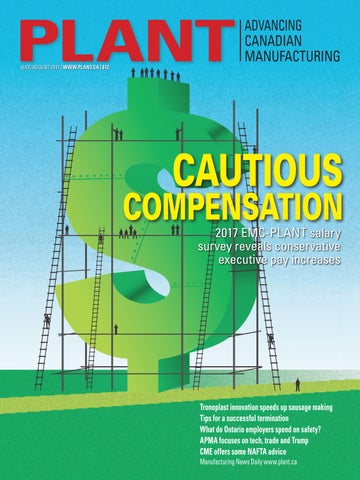
CAUTIOUS
COMPENSATION 2017 EMC-PLANT salary survey reveals conservative executive pay increases
Tronoplast innovation speeds up sausage making Tips for a successful termination What do Ontario employers spend on safety? APMA focuses on tech, trade and Trump CME offers some NAFTA advice Manufacturing News Daily www.plant.ca
PLANT_JulyAug2017_AMS.indd 1
2017-08-09 12:20 PM
Noisy Other hand dryers can be loud, unhygienic1 and bulky.
Quiet Quiet, hygienic, fast and compact.
The most hygienic hand dryer is 30% quieter2 Noise from the washroom can be a concern for businesses. But now, there’s a solution. The Dyson Airblade V hand dryer has reprogrammed digital motor technology and precision air apertures – so it’s 30% quieter2 than its predecessor in loudness testing.
Hear it live 1-877-397-6622 www.dysonairblade.ca Dyson Airblade™ hand dryers are the only hand dryers which have HEPA filtration as standard. 2 Loudness reduction compared to the original Dyson Airblade V hand dryer.
1
PLANT_JulyAug2017_AMS.indd Plant_Dyson_JulyAug.indd 1 2
2017-08-09 2017-07-20 12:20 2:53 PM PM
20 2:53 PM
CONTENTS
July/August 2017 Vol. 76, No. 05
FEATURES 21 TRAINING Focus on fine points to reduce rework and deliver what customers want. 22 THINK LEAN Shadow boards improve plant productivity. 24 LUBRICATION Use smart data modelling to better predict potential failures. TECH TIP Check motor conditions using voltage current readings. 25 PIP 2017 How much are employers spending to prevent injury and illness? 26 CCOHS SAFETY TIPS Ensure forklift operators are properly trained. 27 FOOD PROCESSING Tronoplast brings high-tech flavour to sausage production.
12 COMPENSATION The 2017 EMC-PLANT Manufacturing Salary Survey shows incomes are advancing, but at a conservative pace.
28 CLEAN ENERGY Funding for tidal energy helps to fill knowledge gaps. ENERGY Acceleware’s award winning, radio wave oil recovery method. 29 TRANSPORTATION Are electric vehicle subsidies ineffective? 30 CETA Trade deal will boost US exports to Canada. 31 AEROSPACE NAFTA negotiations point to diversified markets.
18 WORKFORCE When it comes to compensation, millennials prefer perks over pay.
30 TRADE CME outlines its NAFTA wishlist, which seeks a common North American approach to free trade.
20 HUMAN RESOURCES A successful termination should be strategically structured.
32 AUTOMOTIVE APMA’s annual gathering of automotive leaders shows industry has an appetite for disruption.
33 DRIVERLESS VEHICLES Self-driving shuttle project tackles Canadian winters.
DEPARTMENTS 4 Editorial 6 News 8 Careers 10 PLANT Online 11 PLANT Pulse 35 CIEN Feature: Stronger pipe joints Supply Lines 36 Product Focus 38 Products & Equipment 41 Plantware Events 42 Postscript COVER IMAGE: GETTY IMAGES
PLANT—established 1941, is published 8 times per year by Annex Business Media. Publications Mail Agreement #40065710. Circulation email: stelian@annexnewcom.ca Tel: 416-442-5600 ext 3636 Fax: 416-510-5170 Mail: 80 Valleybrook Drive, Toronto, ON M3B 2S9. Occasionally, PLANT will mail information on behalf of industry-related groups whose products and services we believe may be of interest to you. If you prefer not to receive this information, please contact our circulation department in any of the four ways listed above. Annex Privacy Officer: privacy@annexbizmedia.com Tel: 800-668-2374. No part of the editorial content of this publication may be reprinted without the publisher’s written permission. ©2017 Annex Publishing & Printing Inc. All rights reserved. Performance claims for products listed in this issue are made by contributing manufacturers and agencies. PLANT receives unsolicited materials including letters to the editor, press releases, promotional items and images from time to time. PLANT, its affiliates and assignees may use, reproduce, publish, re-publish, distribute, store and archive such unsolicited submissions in whole or in part in any form or medium whatsoever, without compensation of any sort. This statement does not apply to materials/pitches submitted by freelance writers, photographers or illustrators in accordance with known industry practices. Printed in Canada. ISSN: 1929-6606 (Print), 1929-6614 (Online)
www.plant.ca
PLANT_JulyAug2017_AMS.indd 3
PLANT 3
2017-08-09 12:20 PM
EDITORIAL
NAFTA negotiation: Get ready to rumble
I
t’s game on as the US, Mexico and Canada sit down to hash out a new and improved North American Free Trade Agreement (NAFTA). Much is at stake for Canadian manufacturers, who have been major beneficiaries of freer trade with the US and Mexico. With NAFTA, Canadian exports to the US have grown from $70 billion in 1993 to $355 billion last year, while regional trade has grown from $290 billion to $1.1 trillion. The US has also benefited although economists cite a modest impact on GDP of less than 0.5% and several billion dollars of added growth per year. But Canada and Mexico are also America’s top destinations for exports and some 14 million jobs rely on trade with the two countries. Many of those jobs are in states that supported Donald Trump’s ascendancy to the White House. Wrapping himself in protectionist rhetoric, he has convinced his “base” that lost manufacturing jobs are the result of bad free trade deals, NAFTA being the worst. So now he has to deliver a trade win in an otherwise win-deprived presidency. If this were a wrestling spectacle, Prime Minister Justin Trudeau and Mexican president Enrique Pena Nieto would be the symbolically handsome, but lightweight tag team locked in a cage and improbably matched against the orange-masked gigantic villain, Donald Trump. Of course, the heads of state won’t be the ones launching awesome wrestling moves such as the flying squirrel to force concessions and compromises. Experienced and sane trade negotiators will handle all the trash talk and grappling. But Canada is going into this renegotiation with limited moves. More than 82% of the goods we sell abroad go mostly to the US, and to a much lesser extent, Mexico. The US has delivered its NAFTA wish list, which is more than tweaking but something the three countries can work with; however, there are a couple of clangers that could force Canada to exit the ring. The US wants to maintain and expand its Buy-America-type protections that restrict government procurement to domestic firms using homemade materials. It also wants open access to Canadian federal, provincial and municipal procurement. Both Canada and the US intend to spend bazillions of dollars on infrastructure over the next few years so there is much at stake. Of greater concern is the Chapter 19 dispute settlement mechanism. The US didn’t want it during the Free Trade Ageement negotiations and the Trumpites are anxious to do away with it now. The American side would rather see disputes disappear into the fog of the US court system. However, Chapter 19 has helped to keep the trade partners honest. For example, when the US imposes trade-remedy tariffs on softwood lumber as it is wont to do, and the binational panel rules against the gouging, Canadian companies get some of that money back. Canadian Manufacturers & Exporters, which has released a 58-page document detailing priorities and recommendations for the negotiations, has declared doing away with Chapter 19 a deal-breaker for manufacturers. This will surely be a major challenge for Canadian negotiators, especially with a US administration that has a very lopsided view of trade. NAFTA has demonstrated two things: fair free trade agreements, despite their faults, lead to growth for all. That should be the cornerstone of the negotiations. But it also demonstrates the risk attached to Canada focusing so much on one, conveniently placed market. Manufacturers need to diversify their customer and supplier bases. Trade agreements such as CETA and a potentially renewed Trans-Pacific Partnership will help them do that. It’s just a matter of embracing the opportunities. Joe Terrett, Editor Comments? E-mail jterrett@plant.ca.
4 PLANT
Publisher Michael King 416-510-5107 mking@plant.ca, mking@cienmagazine.com Editor Joe Terrett 416-442-5600 ext. 3219 jterrett@plant.ca Associate Editor Matt Powell 416-510-5145 mpowell@plant.ca Art Director Andrea M. Smith National Account Manager Ilana Fawcett 416-510-5202 ifawcett@plant.ca Account Coordinator Barb Vowles 416-510-5103 bvowles@annexbizmedia.co Annex Business Media Vice President/Executive Publisher Tim Dimopoulos (416) 510-5100 tdimopoulos@annexbizmedia.com COO Ted Markle tmarkle@annexweb.com President & CEO Mike Fredericks Circulation Manager Beata Olechnowicz 416-442-5600 ext. 3543 bolechnowicz@annexbizmedia.com Subscription Price Canada $72.50 per year, US $146.95 (US) per year, Foregin $166 (US) per year. Single Copy Canada $12.00. Add applicable taxes to all rates. Combined, expanded or premium issues, which count as two subscription issues. Mailing Address Annex Business Media 80 Valleybrook Dr., Toronto, ON M3B 2S9 plant.ca Tel: 416-442-5600, Fax: 416-510-5167 (if busy use 416-510-6875) Customer Service Bona Lao 416-442-5600 ext. 3552 blao@annexbizmedia.com
We acknowledge the [financial] support of the Government of Canada.
July/August 2017
exairSKE PLANT_JulyAug2017_AMS.indd 4
2017-08-09 12:20 PM
PLT_Exa
The Secret To Keeping Electronics Cool! NEMA 12 Cabinet Coolers The NEMA 12 Cabinet Coolers for large heat loads up to 5,600 Btu/hr. are ideal for PLCs, line control cabinets, CCTV cameras, modular control centers, etc.
A bad choice could cost you thousands! Look Familiar? When hot weather causes the electronics inside a control cabinet to fail, there is a panic to get the machinery up and running again. The operator might choose to simply open the panel door and aim a fan at the circuit boards. In reality, the fan ends up blowing a lot of hot, humid, dirty air at the electronics and the cooling effect is minimal. If the machinery starts functioning again, the likelihood of repeated failure is great since the environment is still hot (and threatens permanent damage to the circuit boards). Worse yet, that open panel door is an OSHA violation that presents a shock hazard to personnel.
• Measures 8" (203mm) high • Mounts top, side or bottom • Enclosure remains dust-tight and oil-tight
NEMA 4 and 4X Cabinet Coolers Coolers Cabinet NEMA 4 and 4X Cabinet Coolers for large heat loads up to 5,600 Btu/hr. They are ideal for PLCs and modular controls. • Enclosure remains dust-tight, oil-tight and splash resistant • Suitable for wet locations where coolant spray or hose down can occur
Type 316 Stainless Steel Cabinet Cabinet Coolers Coolers Type 316 Stainless Steel Cabinet Coolers for NEMA 4X applications are available for heat loads up to 5,600 Btu/hr. • Resists harsh environments not suitable for Type 303/304 • Ideal for food and chemical processing, pharmaceutical, foundries, heat treating and other corrosive environments
The Real Solution!
Watch The Video!
Stop electronic downtime with an EXAIR Cabinet Cooler® System! The complete line of low cost Cabinet Cooler Systems are in stock and can ship now. They mount in minutes through an ordinary electrical knockout and have no moving parts to wear out. Thermostat control to minimize compressed air use is available for all models. All Cabinet Coolers are UL Listed to US and Canadian safety standards.
www.exair.com/18/44018.htm
The only compressed air powered cooler that is CE compliant!
Mini NEMA 12, 4, and 4X Cabinet Coolers
High Temperature Cabinet Coolers
Non-Hazardous Purge Cabinet Coolers
The mini NEMA 12, 4 and 4X Cabinet Coolers for small heat loads up to 550 Btu/hr. are ideal for control panels, relay boxes, laser housings, and electronic scales.
High Temperature Cabinet Coolers for NEMA 12, 4 and 4X applications are available for heat loads in many capacities up to 5,600 Btu/hr.
NHP Cabinet Coolers keep a slight positive pressure on the enclosure to keep dirt from entering through small holes or conduits. For use in nonhazardous locations.
• Measures 5" (127mm) high
• Suitable for ambients up to 200°F (93°C)
• Uses only 1 SCFM in purge mode
• Ideal for mounting near ovens, furnaces, and other hot locations
• For heat loads up to 5,600 Btu/hr.
• Mounts top, side or bottom • Enclosure remains dust-tight and oil-tight
“It took us three days to get a replacement computer cabinet and
Jeff Hauck, Lasercraft Inc. Cincinnati OH
we didn’t want to risk another heat failure. Fans weren’t an option since they would just blow around a lot of hot air. Freon-type air conditioners like those on some of our other machines were a constant maintenance project of their own. We purchased EXAIR’s Model 4330 NEMA 12 Cabinet Cooler System since it was easy to install and requires no maintenance.”
• NEMA 12, 4 and 4X
If you would like to discuss an application, contact: 11510 Goldcoast Drive, Cincinnati, Ohio 45249-1621
(800) 903-9247
fax: (513) 671-3363
www.exair.com/18/440.htm @exair
exairSKECad_red_PLcorrect.indd 1
7/13/17 1:51 PM
PLT_Exair_July.indd 1 PLANT_JulyAug2017_AMS.indd 5
2017-08-09 2017-07-13 12:20 3:11 PM PM
NEWS BULLETINS
SFU, Siemens partner on mechatronics Program open to qualified students and professionals to advance skills
Supremex Inc., a Montreal-based envelope and packaging products manufacturer, has acquired Stuart Packaging Inc., another Montreal firm that manufactures folding carton market. The company says the $17.5 million deal strengthens its position in the folding carton market and diversifies revenue streams. Quebec-based meat processor Olymel is investing $8.1 million to expand its La Fernandière plant in Trois-Rivières, Que. The investment will double the plant’s surface area to more than 45,000 square-feet. The project is to be completed in December. The plant produces La Fernandière sausages; breakfast sausages for Olymel, Lafleur and other private brands; and will restart its discontinued meatloaf operation. Bombardier’s Global 7000 aircraft is on track to go into service in the second half of 2018. Four of the jets are in final assembly at the Toronto plant. The company has installed a state-of-theart assembly line that includes a laser measuring system using spherical mirror reflectors to guide the plane through the entire production process. Hydrogenics Corp., based in Toronto, has signed a $ 50 million technology exchange agreement with China’s Blue-G New Energy Science & Technology Corp. Its hydrogen-based vehicle technology will be integrated into 1,000 zero-emission fuel cell motors on Chinese city buses. The deal includes professional support services. In April, Hydrogenics received $1.63 million from Natural Resources Canada to construct two public hydrogen stations in the GTA. A southwestern Ontario automotive manufacturer is scaling up with a $6.7 million expansion. KSR International Co., which specializes in sensors, pedals and control modules, plans to build several new products at its Ridgetown, Ont. plant, including brake pedal assemblies and a pair of suspension sensors. The project is to create 40 jobs, adding to the plant’s 600-person workforce. The Ontario government is contributing $676,600.
6 PLANT
PLANT_JulyAug2017_AMS.indd 6
Instructor Amr Marzouk shows new state-of-the-art industrial training assembly line equipment to SFU mechatronics students Anahita Mahmoodi PHOTO: SIEMENS CANADA and Mouataz Kaddoura.
SURREY, BC — Simon Fraser University and Siemens Canada are partnering to advance the mechatronics skills of engineering students. The collaboration between Simon Fraser and global industrial technologies company involves the introduction of the Siemens Mechatronics Systems Certification Program at the university’s Surrey campus, and an in-kind grant of Siemens PLM software. Mechatronics combines mechanical, electrical and computer engineering to build complex systems ranging from home appliances to automated manufacturing systems that improve efficiency, productivity and quality while
Toronto juice-maker gets $6.3M funding for new technology MISSISSAUGA, Ont. — A Canadian organic juice processor is getting $6.3 million from the federal government to purchase made-in-Canada cold pasteurization technologies that will help it to increase the shelf life of its products. Greenhouse Juice Co. in Mississauga, Ont. will use the funding to expand its new facility, create new positions and increase its purchases of Canadian-grown fruits and vegetables. The three-year old company extracts juice from organic fruits and vegetables using only hydraulic pressure as “cold pressing.” It sources most of its ingredients from Ontario organic farms and operates several stores. It also operates a subscription-only delivery service.
decreasing time to market. You’ll find mechatronics engineers plying their trade in the aerospace, materials processing, machine building, automotive, transportation, building technologies and mining sectors. The university will offer the program in early August to qualified students and to professionals interested in advancing their skills in automation and manufacturing. Participants who complete the program receive a mechatronics systems certification directly from Siemens. The in-kind Siemens PLM software grant provides Applied Sciences students access to the same software used in industry. NX software, an integrated solution for computer-aided design, manufacturing and engineering, is included. Simon Fraser is one of only seven Canadian schools to offer the mechatronics courses taught by instructors who are engineers and have trained at the Siemens Technik Academy in Berlin, Germany. The mechatronics program is offered through the Siemens Canada Engineering & Technology Academy based in Oakville, Ont.
Canada 17th in readiness for disruption, but slips 3 points NEW YORK — Canada is among the most ready to handle disruption resulting from short-term disaster or longer-term demographic, economic, social and technological changes. But it has slipped three points since 2015, according to KPMG’s 2017 Change Readiness Index (CRI). The CRI ranks 136 countries for their capacity to respond and adapt to significant change, breaking it down across enterprise, government and people/civil society. Canada is 17th on the list headed by Switzerland. The global advisory firm observes European countries captured seven of the top 10 places. Switzerland replaced Singapore, which had claimed the top ranking in the 2013 and 2015 CRIs. The UK entered the top 10 for the first time, strengthening its change readiness as the country prepares for Brexit. The US also improved its ranking, rising to 12 from 20 in 2015. KPMG tags migration as a significant driver of change for many countries. Countries with high CRI scores – including Sweden, Germany, the Netherlands and the UK – have greater shares of migrant populations.
July/August 2017
2017-08-09 12:20 PM
NEWS
EV infrastructure spending to hit US$80B by 2025 Declining battery costs are paving the way for longer-range plug-in vehicles BOULDER, Colo. — More than US$80 billion will be spent on global EV infrastructure by the end of 2025, leading to the development of nearly 230 gigawatts of charging capacity, according to a report by Navigant Research. The Chicago-based research division of Navigant Consulting Inc. analyzed the global market for plug-in electric vehicle (PEV) charging equipment sales and found it’s entering a new phase thanks to the declining cost of batteries, making way for longer-range PEVs and a wider range of vehicle body types. This is creating opportunities for specific charging technologies such as DC fast and smart, grid-integrated chargers. Stakeholders with the ability to fund largescale projects, such as governments, utilities and automakers, will continue to play a role in the growth of EV charging installations during the next three to five years, the report says. After that period, Navigant expects the market to be more demand-driven as increasing numbers of PEVs boost interest in a broader
Shift is driving charging infrastructure investment and creating PHOTO: FOTOLIA opportunities for new technologies.
range of charging options. The global market for EV supply equipment for light, medium and heavy duty PEVs is projected to grow from 875,000 sales in 2017 to more than 6 million in 2026. – Files from CanadianManufacturing.com
Businesses lag in risk management: PwC report Upper management lacks a clear view of the company’s vulnerabilities
A shortage of skilled people keeps risk from companies’ front lines.
TORONTO — Despite all the disruption to business, Canadian companies lag their global counterparts in the management of risks. A report issued by advisory firm PwC Canada says 66% of Canadian respondents (versus 75% globally) have mandatory ethics and compliance training for all employees. When new risks emerge, less than 33% (50% globally) report periodic
www.plant.ca
PLANT_JulyAug2017_AMS.indd 7
PHOTO: FOTOLIA
staff education. Future areas of risk and disruption for Canadian businesses will be in technology advancements (70% compared to 55% globally), human capital (49% versus 40%) and operations (37% versus 26%). Addressing risk can be accomplished by moving its management to the front line, but the report notes many businesses hold it at the
second line (risk management/ compliance) or third line (internal audit). This denies upper management a clear view of vulnerabilities, which impairs the company’s ability to manage risks effectively and adapt over time. The primary reason for not moving risk to the front line? A lack of skilled people. The report offers three recommendations: 1. Shift duties and assign responsibilities. Give each line of service a defined role regarding risk decisions, monitoring, oversight and assessment of vulnerabilities. 2. Define risk appetite. Leverage the available technical tools, including aggregation tracking and reporting. 3. Establish a risk reporting system. Reporting structures should enable the first line of service, but also require the second and third line to monitor the first line’s effectiveness.
CSA launches cybersecurity testing services TORONTO — CSA Group will now provide cybersecurity testing services to help manufacturers identify potential issues early in the product design phase and implement security measures to mitigate potential risks. CSA Group, the global organization that provides testing, says its services will include gap analysis, security development lifecycle assurance, embedded device security assurance, and bench testing. The tests and evaluations are based on international standards, ISO 27000 Security Management Standards, IEC 62433 Cybersecurity Standards and NIST Guide 800 series. “These tests will provide greater assurance that the products being delivered to the market have the highest confidence against vulnerabilities,” says Stephen Brown, director of innovation for CSA Group. CSA recently published a whitepaper that discusses the need to have cybersecurity protocols and design considerations in place to support safety-related solutions in commercial or residential buildings and industrial control processes. Download it at www.csagroup.org.
Biobinder gets $188,000 to go commercial NEWMARKET, Ont. — An Ontario clean technology developer is getting $188,000 in funding from Natural Resources Canada’s Investment in Forest Industry Transformation (IFIT) program to commercialize woodbased bonding agents. Natures Affinity, based in Newmarket, Ont., has developed Biobinder, which adds strength and water-resistance to pulp materials for packaging. It uses a renewable, wood-based product that replaces petroleum-based bonding agents, such as polypropylene and polystyrene. The company says the products will help packaging producers reduce greenhouse gas emissions while meeting Health Canada’s food packaging regulations. The agents are also USDA biopreferred.
PLANT 7
2017-08-09 12:20 PM
NEWS CAREERS John Celli is retiring as president of Space Systems Loral (SSL), the wholly-owned subsidiary of MacDonald, Dettwiler and Associates Ltd. MDA is a developer of communications and information technologies based in Richmond, BC, and SSL builds its satellites and space systems. Celli was with SSL for 36 years, joining the company in 1981 as an antenna engineer at its Palo Alto, Calif. facility. To replace Celli, the company has appointed Dario Zamarian group president and Paul Estey executive vice-president and COO. Photon Control Inc, a manufacturer of optical measurement technologies based in Richmond, BC, has promoted Daniel Lee to CFO following a threemonth stint as the company’s vice-president of finance. Lee was the director of finance at BSM Technologies, and has held various finance roles with Webtech Wireless and The Internet Market Center after qualifying as a CPA, CA with D&H Group LLP in Vancouver. Thalmic Labs, a manufacturer of human-computer interaction devices has named Jari Niemela vice-president of engineering. Niemela previously worked for Nokia, Microsoft and most recently NUVIZ Inc., where he led the senior team as CEO. He’ll oversee all aspects of engineering at Thalmic Labs (based in Kitchener, Ont.) with a specific focus on hardware leadership. BDC has appointed Claude Miron vice-president of growth equity to oversee a $250 million investment rollout over the next five years. The aim is to fill a gap between small-scale financing options generally available to smaller firms, and the range of sources available to larger companies. Miron replaces Elmer Kim, who spent the last year launching BDC’s growth equity practice and team. Thom Skinner is retiring as CFO of CO2 Solutions, a Quebec City-based developer of enzyme-based carbon capture technology. He’ll remain with the company until the end of 2017 as a consultant and ease Jérémie Lavoie’s transition into the role. Lavoie was formerly the CFO of Aval Engineering in Calgary.
8 PLANT
PLANT_JulyAug2017_AMS.indd 8
Davie delivers Asterix naval ship Converted from a modern container vessel
The Asterix will cover a range of functions from at-sea replenishment to PHOTO: DAVIE disaster relief.
LEVIS, Que. — Davie Shipyard has completed work on the first naval ship built in Canada in more than 20 years. The Asterix is the result of two years worth of work between Davie, its 1,369 staff members and over 900 Canadian suppliers. The ship goes into service with the Royal Canadian Navy by the end of the year. The Resolve-Class vessel, built from a conversion of a modern containership, will be the largest naval platform in service with the Royal Canadian Navy and will provide a range of functions from at-sea replenishment of fuels and cargo to aviation support, fleet medical support and humanitarian and disaster relief. The Asterix is 182.5 metres long (two football
fields), 25.2 metres wide and travels at speeds of up to 25 knots. It will carry up to 7,000 tonnes of fuel and produce 450 tonnes of drinkable water per day. Two cranes allow it to load and unload containers while at sea. It’s also equipped with a helicopter deck, two hangars for helicopters, garages to park vehicles, a hospital with 60 beds and kitchens capable of feeding up to 1,000 people. It’s privately financed by Davie and will be leased to the federal government. Federal Fleet Services, Davie’s sister company, will operate the ship with a mixed crew of merchant seafarers and Royal Canadian Navy personnel. Davie, headquartered in Levis, Que., is Canada’s highest capacity shipyard and industrial fabricator.
Gilla to make vaporizer for Canadian cannabis market TORONTO — Gilla Enterprises Inc., a manufacturer of E-liquid used in vaporizers, is collaborating with an unnamed licensed producer (LP) to develop a device for cannabis. Their deal calls for a device that will be distributed to the LP’s Canadian client. The device and packaging will be submitted to Health Canada for approvals before a definitive agreement is signed. The partners intend to provide both private-label and branded cannabis vapour devices. They’ll work together to develop full-scale production-level standard operating procedures for manufacturing licensed products to comply with Health Canada’s requirements. Gilla Enterprises is the Toronto subsidiary of Gilla Inc., a manufacturer of vaping products for cannabis and nicotine.
Ont. company fined for worker injury BRAMPTON, Ont. — A recycling company based in Brampton, Ont. has been fined $65,000 for a 2015 injury that left a worker permanently injured. The company’s recycling facility is part of Ontario’s blue-box collection and the Beer Store’s bottle deposit program. The Ministry of Labour says the worker was trying to clear a jam in a cardboard baler, which compresses and bundles the material for storage or transport without locking out the machine. The worker’s wrist was caught behind the ram of the machine, causing a permanent injury. The Occupational Health and Safety Act stipulates any machine with an exposed moving part must be guarded. NexCycle pleaded guilty to the violation July 11.
Jaguar SUV added to Magna line-up E-PACE production in Austria to begin in Q4
The E-Pace is the second Jaguar vehicle awardPHOTO: JAGUAR ed to Magna.
GRAZ, Austria — Jaguar Land Rover has selected Magna to manufacture its Jaguar E-Pace SUV at the Canadian auto parts giant’s contract manufacturing facility in Graz, Austria. E-PACE production is to begin in the fourth quarter. It’s the second model Magna will produce for Jaguar. Production of the I-PACE, announced in December, is to start in the first quarter of 2018. Magna now has five models on the go. The others are the BMW 5 Series, BMW 530e plug-in hybrid, and Mercedes-Benz G-Class. Magna, based in Aurora, Ont., has 321 manufacturing plants and 102 product development, engineering and sales centres in 29 countries.
July/August 2017
2017-08-09 12:20 PM
PLT_EM
1997 2017 www.emccanada.org
PLT_EMC_JulyAug.indd 1 PLANT_JulyAug2017_AMS.indd 9
2017-08-09 2017-08-09 12:04 12:20 PM PM
NEWS
Hydro One acquires US utility Combined assets worth more than $32.2 billion TORONTO — Hydro One Ltd. will acquire Spokane, Wash.-based Avista Corp. in a merger deal worth $6.7 billion, bringing together two energy utility powerhouses with assets worth more than $32.2 billion. The combined entity holding assets throughout Ontario, Washington, Oregon, Idaho, Montana and Alaska will serve more than 2 million retail and industrial customers. Avista will maintain its existing corporate headquarters in Spokane and will continue to operate as a standalone utility in the US when the transaction is complete. More than 2 million retail and industrial customers. PHOTO: FOTOLIA The combined company’s headquarters information technology systems and increased will be based in Toronto. purchasing power. Hydro One said the acquisition will allow it to Both companies expect to maintain their existreduce operational costs and improve efficiening workforces. cies through enhanced scale, innovation, shared
PLANT ONLINE SOUNDING OFF
What readers have to say about breaking news Have you checked out PLANT’s daily news online? Here are some headlines that have inspired members of the Canadian manufacturing community to chime in. They’re edited, but use the links to see the raw – and for some – longer versions of their remarks plus the stories that inspired their reactions. Stay up-to-date on the developments – domestic and global – that affect Canada’s industrial sectors by watching the news feed at www.plant.ca or reading PLANT’s twice-weekly newsletter (hit Subscribe on the website). Rewards and recognition programs don’t match millennial workforce realities www.plant.ca/lzvU1 Most recognition programs are a reward for good work and to encourage employees to remain with the company. During the first six months, an employee
10 PLANT
PLANT_JulyAug2017_AMS.indd 10
learns the job and only then starts to contribute to the success of the company. Why go through the time, effort and cost of recruiting and training if a new employee leaves shortly after becoming productive? Am I missing something? Bottle maker fined $100K after worker sustains permanent injury www.plant.ca/i85Y8 It’s hazardous to own a business these days. Bridging the gap: how industry adapts to a shortage of mid-level maintenance pros www.plant.ca/qH1Wq Make the pay slightly less embarassing and people will gladly show up. No shortage of workers, just a shortage of pay. Low interest rates have done their job: Poloz www.plant.ca/Ob034 Increased interest rates – what
for? Aren’t all Canadian banks making record profits? Are they so greedy they risk collapsing the economy for the sake of even more profit? Most Canadians are at record levels of debt, we still have a soft job market, and with major government spending on infrastructure, raising interest rates now could be the kiss of death for the Canadian economy. Wynne hydro plan to cost $45B to save ratepayers $24B: watchdog www.plant.ca/vQY9u NOT being considered is the ongoing deflection of costs as separated by the global adjustment. “A” pool participants have the ability under the existing rules to avoid over 65% of their current hydro bills, which is deflected mostly to the “B” pool participants. This program gets very little press and is the dirty secret that no one wants to talk about.
Aurora signs cannabis agreement with Australian firm VANCOUVER — Aurora Cannabis Inc. and Melbourne-based Cann Group Ltd. have entered into a technical services agreement. The cannabis producers will exchange information and support on the cultivation and processing of medical cannabis, extraction and manufacturing technology, and analysis of cannabis extracts. Aurora is Canada’s second largest, publicly listed medical cannabis producer and the first Canadian company to establish purpose built cultivation facilities. It’s a 19.9% shareholder of Cann. Aurora will provide technical support as Cann proceeds with the expansion of its research and development and cultivation facilities in Melbourne. Aurora operates a 55,200 squarefoot production facility in Mountain View County, Alta. The company is building a second 800,000 square-foot production facility near the Edmonton International Airport, and a 40,000 square-foot production facility is being built in Pointe-Claire, Que., on Montreal’s West Island.
Lake Erie connector project approved OTTAWA — The federal government has approved the National Energy Board’s decision to issue a certificate for the Lake Erie Connector Project, which is subject to 42 binding conditions. ITC Lake Erie Connector LLC’s project will increase electricity trade between Canada and the US. The $544-million Canadian portion of the project is to create 331 jobs during construction. The project is a 1,000-megawatt, two-way underwater transmission line, measuring about 117 kilometres, which will travel under Lake Erie and provide the first direct electricity link between Ontario and Pennsylvania. The project is expected to be in service by 2020.
July/August 2017
2017-08-09 12:20 PM
ECONOMY
Growth leads G7: IMF ...but the longer-term outlook is less upbeat
Adapted from a report by Kotaro Ishi, David Gentry, and Cheng Hoon Lim, IMF Western Hemisphere Department.
www.plant.ca
PLANT_JulyAug2017_AMS.indd 11
OUTPUT GROWTH LAGGING SINCE 2000 (1961 = 100) 700 600 Business sector
500
Manufacturing
400 300
GETTY IMAGES
200 100 0 1961
1966
1971
1976
1981
1986
1991
1996
2001
2006
2011
Manufacturing is important to Canada’s economy, but it has struggled since the 2008-09 recession and is no longer keeping pace with the business sector. A Statistics Canada study shows output growth levelled off after 2000, then dropped sharply. Real output declined at an average rate of 9% during the recession compared to 2% in the broader business sector, and is significantly lower than peak levels in 2006.
2016
Source: Stats Canada, CANSIM
43B
1.74
The amount business investment fell during 2015-16, according to a Conference Board of Canada outlook report. Energy investment was responsible for almost 80% of the decline.
65%
ILLUSTRATIONS: FOTOLIA
H
ere’s some good news: Canada’s economic growth is the fastest among G7 nations, having galloped ahead at a 4% annual pace in the first quarter, with a projected 2.5% for the year. That’s much better than 1.5% in 2016. But the International Monetary Fund (IMF), a Washington-based international organization focused on global economic stability, says the outlook is less upbeat. However, higher infrastructure spending can spur short-term and long-term growth. Its annual assessment of the Canadian economy notes the recovery is driven by stronger consumer demand and housing activity, while business investment and non-energy exports remain weak. And there are significant risks from rising housing market imbalances as well as uncertainty about US trade and tax policies. Low productivity growth and an aging population aren’t helping, either. Working age people (15 to 64) as a share of the population has fallen about 2% since 2010 from 69% and their share is projected to fall another seven points over the next 20 years. The report acknowledges federal government efforts to reduce internal trade barriers, improve the innovation framework, invest in education and training, and promote highskilled immigration. Longer term, the IMF also supports the government’s planned infrastructure spending ($187 billion, equivalent to 7.5% of GDP) over the next decade. The new Canada Infrastructure Bank is authorized to invest $35 billion in big, complex and revenue-generating projects. Adding private capital to the mix lowers public borrowing and liberates money from the tax base for higher priority projects. But the IMF advises the federal government to do more to get the public on board by publishing selection criteria for projects and investors, and implementing a competitive process to choose investors.
Proportion of current elementary school students who will end up in careers that don’t yet exist, says a study by the Ontario Skilled Trades Alliance.
The ratio of Canada’s gross domestic expenditures on R&D to GDP in 2014, up from 1.73 in 2013. Statistics Canada says we lagged OECD nations (2.4) and ranked fifth among G7 nations.
36%
Share of Canada’s working age population (2016) aged 55plus. StatsCan says this proportion is projected to hit 40% by 2026.
80%
US manufacturing and supply chain executives that say the digital supply chain will be the predominant model within five years, according to the 2017 MHI Annual Industry Report. Top technologies combining to create next-generation supply chains that are digital, on-demand and always-on include: Internet of Things; inventory and network optimization; sensors and automatic identification; cloud computing and storage; robotics and automation; predictive analytics; wearable and mobile technology; autonomous vehicles and drones; and 3D printing.
PLANT 11
2017-08-09 12:20 PM
COMPENSATION
IT PAYS TO BE CAUTIOUS The 2017 EMC-PLANT Manufacturing Salary Survey shows an average 2.6% increase over 2016. BY JOE TERRETT, EDITOR
D
isruption is the buzzword du jour now commonly overused to describe technological change and/or disorder and turmoil; nonetheless, there has been plenty of it since the year began, which is leaving manufacturers a bit bewildered. One the one hand, economic prospects appear to be positive. Business is picking up in the US where 60% of Canada’s manufacturing output goes, GDP for the year is projected to be 2.7% followed by 1.9% next year, and the Canada-European Union Comprehensive Economic and Trade Agreement (CETA) is tracking nicely. Assuming CETA goes into effect, Canada will have more open access to the world’s second-largest market. Contrast these positives with the antics of the Donald Trump administration south of the border, the world’s largest market. The real estate tycoon, reality show actor, cum Republican president has – in six months – created diplomatic
12 PLANT
PLANT_JulyAug2017_AMS.indd 12
turmoil on the international stage, espoused protectionism to “Make America Great Again,” threatened to rip up the North American Free Trade Agreement (NAFTA) and has expoused tax reforms that could negatively impact Canadian manufacturing. This dichotomy creates a lot of uncertainty for manufacturers of all sizes, but especially the smaller enterprises that comprise the majority of the Canadian industrial segment. Yet Canadian companies have proved themselves to be a cautious bunch, not prone to panic or for taking huge risks. So it’s not surprising that when asked by the 2017 EMC-PLANT Manufacturing Salary Survey about compensation and their expectations, representatives from executive management ranks were, for the most part, looking at conservative increases for the year. This national benchmark study conducted through April and May by the Excellence in Manufacturing Consortium (EMC), a not-for-profit organization based in Owen Sound, Ont., and PLANT magazine, an Annex Business Media publication, gathered a total of 1,435 responses from executives and
FOTOLIA
EXECUTIVE SALARIES ADVANCE AT A CONSERVATIVE PACE
July/August 2017
2017-08-09 12:20 PM
Demographics EMPLOYEES
REVENUE
934 replies
11%
6.5%
250 ➔ 499
500 ➔ 1,000 ➔ 5,000+ 999 4,999
$1M ➔ <$5M $5M ➔ <$10M $10M ➔ <$30M $30M ➔ <$50M $50M ➔ <$100M $100M ➔ <$250M $250M ➔ <$500M $500M ➔ <$1B $1B plus
4.6%
36.2% 50 ➔ 249
8%
33.6%
895 replies
< 50
AGE
26 ➔ 35
ity degree 39 ivers .4% Un diploma 27 e g e ll .6% Co ical diplom n h a1 tec e/ r o l e l s s1 hoo sc GEP 4.5 CE
5.8%
30.1%
950 replies
36.4%
20.1%
6.7%
< 25
Tra d
> 65
Hig h
36 ➔ 45
%
56 ➔ 65
PROVINCE
19.6% 14.5% 22.8% 10.7% 9.6% 7.3% 3.9% 4% 7.6%
EDUCATION
947 replies
1%
ufacturing leaders look like? Mostly male (85%), almost 66% between 46 and 65 years of age; and 72% of them have management roles rather than ownership or partnership positions. The typical manufacturer has been in the business 24 years, 15 of those at his/her current company and 11 in the same job. Breaking down age in more detail, most respondents (72%) are 46 to 65 or older. Of the total, 36% are 46 to 55, 30% are 56 to 65 and 6% are older. Twenty per cent are in the 36 to 45 group and just 7% are 26 to 35. Under 25s account for 1% of the total. Almost two-thirds of respondents (62%) report no change to their employ-
% 7.4 2% 1.
senior managers. Of those, 966 answered all of the questions, sharing personal information about salaries and bonuses, and how their businesses are faring. Most of the respondents (81%) come from small and medium-sized enterprises. Each year’s sample is different for a variety of reasons (employment churn, variances in bonuses), so results don’t always align with the previous year’s group, but the responses do provide a general measure that will give you an idea how your pay compares. This year’s sample shows average remuneration across manufacturing (all categories) rising 2.6% to $105,808, compared to 0.9% in 2016. What do our average man-
46 ➔ 55
Location, average salary, percentage of replies 914 replies
89%
MAP: iSTOCK
Working full-time in manufacturing
81%
Respondents employed by SMEs
72%
Companies that are not unionized
Newfoundland
$114,000 0.5%
British Columbia
$103,364 8.1%
Alberta
Manitoba
$123,078
$81,424
8.1%
4.3%
Saskatchewan
$105,389 2.5%
Ontario
$108,780 53%
Quebec
Prince Edward Island
14.7%
0.3%
$85,000
$99,412
FOTOLIA
Nova Scotia
$ 105,808 www.plant.ca
PLANT_JulyAug2017_AMS.indd 13
National average
New Brunswick
$81,939 3%
$76,912 2.1%
PLANT 13
2017-08-09 12:20 PM
Salary Comparisons JOB TITLE 2017 2016 2015 966 replies
CEO/President Vice-president Director Plant Manager Owner/Partner Design Engineering Plant Engineering Maintenance Manager Production/Operations Manager Purchasing/Supply Manager Administrative Management Safety Manager Quality Assurance Manager Materials Manager Technician/Technologist Logistics Manager
$171,916 $152,894 $134,550 $125,218 $119,310 $99,405 $98,170 $95,948 $93,332 $88,504 $86,715 $80,944 $81,764 $81,442 $80,324 $66,875
$165,497 $147,332 $129,182 $120,104 $115,251 $96,071 $97,535 $93,647 $92,750 $85,832 $83,835 $81,894 $81,789 $79,150 $82,485 $62,438
$159,536 $138,076 $122,195 $116,583 $128,182 $107,069 $95,053 $92,570 $92,250 $84,735 $80,367 $78,207 $76,562 $80,229 $83,601 $60,063
Hours/ Week
%
49 49 49 49 47 43 44 45 46 45 44 44 43 44 43 46
6% 5% 6% 9% 7% 6% 4% 8% 15% 6% 10% 3% 5% 1% 6% 2%
GENDER 946 replies
Confident but cautious
15.1%
2017 $80,282
INDUSTRY
ment situation, but 18% say more responsibilities have been added to the workload because of reduced staff, which is consistent with previous surveys. Most (39%) have a university degree that is likely a bachelor of arts (63%) and they put in a 46-hour workweek. Aside from those that have a management role only in their companies, 8% have a controlling ownership stake, 5% are equal partners and 5% are minority owners. Predictably, top executives and senior plant floor leaders put in the most time. CEOs and presidents, vice-presidents and plant managers are averaging 49 hours per week. Owners and partners register 47 hours.
84.9%
$109,960
908 replies
% 2017 2016 2015 replies
Aerospace product and parts Beverage and tobacco product Chemical Clothing manufacturing Computer and electronic product Durable goods industries Electrical equipment, appliances, components Environmental Fabricated metal product Food manufacturing Furniture and related product Leather and allied product Life Sciences Machinery Miscellaneous manufacturing Motor vehicle Motor vehicle body and trailer Motor vehicle parts Non-durable goods industries Non-metallic mineral product Paper manufacturing Petroleum and coal product Plastics and rubber products Primary metal Printing and related support activities Railroad rolling stock Ship and boat building Textile mills Textile product mills Transportation equipment Wood product
$101,552 $116,355 $123,275 $78,163 $102,618 $96,279 $111,268 $142,667 $106,241 $100,316 $93,755 $71,667 $109,986 $117,300 $91,323 $120,000 $90,208 $106,558 $88,438 $124,560 $118,162 $135,627 $108,660 $116,200 $85,067 $80,000 $98,000 $90,333 $129,050 $110,480 $101,377
$99,556 $110,618 $120,859 $73,600 $100,464 $92,636 $108,612 $127,333 $104,278 $97,400 $88,605 $69,167 $107,819 $113,951 $88,212 $121,222 $87,100 $104,717 $82,375 $119,870 $115,622 $ 147,661 $106,408 $117,858 $81,989 $62,000 $93,000 $81,333 $137,600 $106,080 $95,185
$97,125 $112,127 $117,438 $70,925 $99,131 $88,329 $131,374 $117,667 $100,530 $91,289 $84,235 $67,833 $102,620 $115,037 $83,332 $116,889 $237,267 $104,396 $80,875 $113,660 $109,558 $149,286 $102,331 $118,192 $80,381 $62,000 $92,500 $75,000 $127,800 $99,640 $90,313
5% 1% 3% 1% 4% 2% 6% 1% 13% 8% 2% <1% 2% 7% 9% 1% 1% 5% 1% 1% 3% 2% 9% 3% 5% <1% <1% <1% 1% 2% 4%
Respondents are a little more optimistic about earning higher revenues this year (56% see improvement over 2016 revenues compared to 55% over 2015), and just 16% are looking at a decrease from 2016 levels, but 58% intend to invest in new production equipment and processes over the next five years, 52% say they will hire new employees and 36% say they will add new lines of business. Taking in the view at ground level, Al Diggins, EMC’s presi-
REVENUE
dent and general manager, says manufacturers are pretty optimistic, noting Statistics Canada numbers show manufacturing sales in many industry sectors on the rise. “With Trump thinking, manufacturing is going down the tubes. In fact, it’s going the other way. There’s a lot of chatter from Trump that’s so convoluted, you don’t know what’s what, so people are just carrying on…,” Diggins says. All the same, it’s not a surprise that executives are for the most part looking at modest salary increases (mostly on either side of 4%) this year. “Conservative is what we were expecting,” says Scott McNeil-Smith, EMC’s director of strategic planning and communications, and president of the Canadian Manufacturing Network. He heads up EMC’s ManufacturingGPS project, which is developing a comprehensive database that provides real-time labour market information (www.emccanada.org). The GPS shows manufacturing respondents are tracking inflation at just over 2%. “Management insights were reflecting that. Where there was more competition for certain skill sets you’re seeing the higher wages on
966 replies
2017
2016
2015
%
$1M ➔ <$5M $5M ➔ <$10M $10M ➔ <$30M $30M ➔ <$50M $50M ➔ <$100M $100M ➔ <$250M $250M ➔ <$500M $500M ➔ <$1B $1B plus
$84,146 $99,220 $111,835 $107,381 $111,176 $122,160 $131,041 $111,432 $122,108
$81,575 $96,079 $108,678 $105,547 $110,047 $119,591 $129,084 $109,018 $121,914
$83,346 $102,221 $106,813 $102,198 $108,243 $114,914 $123,600 $104,465 $118,085
17% 13% 21% 10% 9% 7% 4% 4% 7%
966 replies
2017
2016
2015
%
University degree College diploma Trade/technical diploma High school or less CEGEP
$120,322 $98,616 $96,339 $92,824 $82,618
$116,709 $97,019 $95,299 $89,125 $80,193
$116,293 $98,675 $91,589 $85,567 $77,697
39% 28% 17% 11% 5%
No response from 9%
EDUCATION
Less than 2% represents a small sample of respondents and should be considered with caution.
14 PLANT
PLANT_JulyAug2017_AMS.indd 14
July/August 2017
2017-08-09 12:20 PM
tors are expecting 4.2% following a 5.7% increase in 2016. Logistics managers are looking at a 7.1% increase, while design engineers anticipate 3.5% followed by administrative management (3.4%), purchasing/ supply managers (3.1%) and materials managers (2.9%). On the low end (less than 1%) or in the negatives are plant engineers, production operations managers, quality assurance managers, safety managers (-1.2%) and technicians/technologists (-2.6%). In addition to the 39% of respondents with a university degree, 28% have a college diploma, 17% a trade or technical diploma, 11% a high school education or less and 5% a CEGEP. Higher education is good
the management side,” he says. Indeed, Toronto-based recruitment specialist Hays Canada has its own salary guide and it’s seeing fewer increases over 3% in all sectors, says Andy Robling, vice-president of business development. “It’s more up to 3%, and some no increases at all.” CEOs and presidents continue to score at the higher end of the EMC-PLANT survey with 3.9% after a 3.7% advance last year, while owners and partners finished several spots lower with a 3.5% increase, behind vice-presidents and directors. This follows a 10% decrease last year. Vice-presidents are up 3.8% compared to a 6.7% increase last year, while plant managers will get a 4.3% raise compared to the 3% they received in 2016. Direc-
2017 BONUSES AND INCENTIVES 960 respondents
42%
4%
3%
31%
0
1% ➔ 3%
4% ➔ 5%
6% ➔ 10%
$89,840
$90,453
$90,788
$107,539
7%
4%
9%
11% ➔ 15%
16% ➔ 20%
20+%
$121,649
YEARS OF EXPERIENCE
$152,866
$171,178
926 replies
2017
2016
2015
%
1 ➔ 4 years 5 ➔ 9 years 10 ➔ 14 years 15 ➔ 19 years 20 ➔ 24 years 25 ➔ 35 years 36+ years
$71,019 $89,199 $93,486 $105,206 $102,743 $113,739 $121,441
$68,386 $86,673 $89,682 $99,768 $100,177 $111,235 $120,965
$62,818 $86,060 $86,710 $106,342 $104,766 $106,707 $118,992
5% 7% 9% 12% 16% 34% 15%
966 replies
2017
2016
2015
%
Under 25 26 ➔ 35 36 ➔ 45 46 ➔ 55 56 ➔ 65 Over 65
$55,263 $68,122 $98,361 $109,503 $112,521 $121,163
$50,200 $64,975 $94,580 $106,583 $110,899 $121,341
$39,555 $61,534 $102,510 $103,308 $108,115 $119,606
1% 7% 19% 35% 29% 5%
AGE
No response from 4%
www.plant.ca
PLANT_JulyAug2017_AMS.indd 15
for income. University grads score the highest wage rate at $120,322, 22% ahead of the next best-paid group, college grads who average $98,616. Looking at salaries based on industry, many show modest increases, but textile product mills, primary metals, petroleum and coal products, and motor vehicles registered decreases (although the samples for each were very low) and several sectors were virtually unchanged. Owners, senior executives, plant managers and materials managers top the $100,000 a year mark. CEOs and presidents are the highest earners averaging $171,916, followed by vice-presidents ($152,894), directors ($134,550) and plant managers ($125,218). Owners/ partners aren’t taking a lot out of their businesses this year, averaging $119,310. Design engineers were just under $100,000 ($99,405), followed by plant engineering ($98,170). Logistics managers are at the bottom (almost $67,000). Most (68%) put work-life ahead of all other desired work conditions, just ahead of compensation (59%) and job security (58%). A comprehensive benefits package and vacation time also rate highly for 51% of executives and managers. Sixty-nine per cent of the companies pay for educational courses, 51% cover memberships in professional associations and 43% pay for professional certification programs. Twenty-two per cent of companies don’t pay for any education upgrades or association memberships.
Attraction, retention With talent in short supply, manufacturers are challenged to find and retain the right people. But salary, benefits and perks help. Fifty-eight per cent of those responding to the EMC-PLANT survey reported a portion of their pay made up of bonuses and incentives with those showing the highest percentage (20% or more) going to those earning $171,178. Most respondents are
WAGE UPDATE Manufacturing’s average wage is tracked by Statistics Canada and its report for April puts the weekly take at $1,080.95, a 0.9% increase over March and a 2.8% increase over 12 months. Trading Economics (https:// tradingeconomics.com), a global economics research firm based in New York, tracks Statistics Canada and other manufacturing data. It reports pay has averaged $19.85 per hour from 1991 to 2017, and it pegs April’s hourly rate at $26.55. Looking ahead 12 months, the hourly rate will average $26.68. Longer term (2020), its models predict $26.23.
in the 6% to 10% range, with salaries averaging $107,539. Forty-eight per cent report perks or extras such as profit sharing (38%), a vehicle of some kind (28%), other enticements (36%), access to private health care (10%), stock options (10%) and club memberships (8%). Robling says larger companies are able to increase salaries to retain the better people, while smaller companies struggle to compete. “They [those employed by large companies] may be at a lower level than [their peers] at a smaller company, but the pay is better. That makes it harder for them to move.” Smaller companies have to think more about how they can keep employees happy by offering enticements to offset salary, such as three weeks vacation. “And more companies are fully funding benefits, which can have less impact on cost than putting the money into salary,” he says. Having benefits kick in on the first day of work also helps to attract people. More flexible hours, including RSPs and offering bonuses in the compensation package, while providing an environment that promises challenges, learning, and skills development, all help to augment pay. But be aware of the generational shift. He says millennials
PLANT 15
2017-08-09 12:20 PM
ment style. “The expectation is to be more collaborative, engaging and attentive,” says Robling. “We’ll find [people] with the technical skills who have been in the job a long time, able to run big teams and certain functions within the operation. But if they don’t have that level of adaptability and awareness to manage a team, we’re finding they’re less fit for purpose. That’s making it harder
think salary is important but they’re also looking for engagement and career growth. “Sometimes they move on more quickly. [Employers] need to accept and adapt to that.” When recruiting for management positions in manufacturing, Hays Canada is finding a more common demand for people who lean to inclusion and teamwork, which is a shift away from a more directive manage-
Management Issues WHAT COMPANIES PAY FOR 943 replies
69%
43%
51%
22%
Educational courses
Professional certification programs
Membership in professional associations
None of these
SKILLS TRAINING 953/891 replies
46%
Management/Supervisory Communication Interpersonal/Problem Solving
20%
36%
17%
33%
17%
58%
Hiring new employees
53%
Added/entering new lines of business
36%
Expanding plant size
26%
Enter new geographic markets
25%
Acquiring other companies or lines of business
22%
Downsizing employees
10%
Merging with another company
10%
Downsizing lines of business
6%
13%
Downsizing plant size
4%
■ More training needed
Closing of company
2%
25%
31%
23%
24%
20%
21%
14%
18%
17%
Planning (forecasting, demand)
17%
Negotiation skills
19% 25%
15%
Financial (budgeting, accounting)
14%
22%
Technical skills (software, programming) Sales skills
10%
■ Most important skills 16 PLANT
PLANT_JulyAug2017_AMS.indd 16
CHANGES NEXT FIVE YEARS Investing in new production equipment/processes
Industry specific technical skills
Analysis
people the interest.” A sense of community is also important. Is it a social place? Does it give you flexibility when it’s needed? Can you work from home? Are there social events? “It’s the culture you build that will help keep people longer.” Robling says an engaging workplace is key to retaining talent. “It’s a combination of things, it’s never just one thing.” For some it’s as simple as having a softball day, or a summer family party. “Something like that as part of a package of things will keep people engaged, which helps attraction and retention. A good selling point if you’re not necessarily offering top salary. ” Culturally, manufacturers are not necessarily doing a good job of engaging the production workforce (shop floor is the biggest problem), says JeanPierre Giroux, EMC’s director of human capital development (based in Ottawa). One indicator cited by the GPS survey is the involuntary turnover rate, which is very high at 6.1% for manufacturing versus 3.7% nationally.
930 replies
33%
Productivity/Continuous improvement (lean etc.)
Project management
for companies to recruit.” That means longer lead times. But he says employers are demonstrating they’d rather keep a job open than compromise their requirements. “That tells us clients are really serious about how they manage their workforce in a more engaging way.” With an aging workforce, companies will have to bring younger people in. “Some will have the skill set you need, some will have to be trained and we advise our clients to look at the right fit for their organization as well as the skill set,” he says. Forward thinking companies look for the right fit with the culture and values as well as skills. If candidates are light on the skills, companies are training them. Robling emphasizes career progression doesn’t have to be vertical: it can be horizontal. It’s about variety. Can you crosstrain for something? Can you learn skills during a project while doing the same job? “We find with more automated manufacturing, updating and using the latest technology gives
July/August 2017
2017-08-09 12:20 PM
SALARY FEEDBACK Manufacturing executives responding to the 2017 EMC-PLANT Manufacturing Salary Survey were invited to add comments about compensation issues and their remarks ranged from salaries progressing (very few) to stagnanting (a lot), depending on the fortunes of their industry segments. There were 471 observations. Here are a few of the respondents’ insights:
Talent • Difficult to recruit skilled employees. • Demand for more skills is increasing while salaries stay about the same. • Companies are looking for engineering skills with most management positions. • In my 40 + years in industry I have learned that you never stop learning. Grab all the skills offered and put them in an imaginary toolbox for the next job. • Frozen wage environment; front line supervisors don’t want to train unskilled workers to acquire
“Progressive companies (early adopters) are getting all kinds of teamwork happening and continuous improvement at the shop floor level,” he says.
Challenges and priorities The survey highlights the usual list of executive concerns, which is topped by cost control for 48% of respondents, while 43% identified skills. Technology upgrades (32%) and capacity utilization (as well as reorganization) follow for 24%. Investing in the business is the highest priority for executives over the next five years. Fifty-eight per cent will put money into new production equipment
• Cost of living is increasing and salary aren’t always. • We now do more work and have more responsibilities and liabilities
for less pay. • Salaries are not keeping pace with industry trends. Skilled trades are hard to find and bidding wars occur. • [Salaries] are increasing, field is being more automated, skills are more technical based. • Compensation has to evolve to an innovative formula … to reward high achievers-performers. • Constant pressure to downgrade salaries through reposting jobs at lower grade levels and having employees repost for their previous role. • Salaries are dropping as many women join the purchasing field. • Starting salaries in technical fields have been too low to attract personnel to live locally where real estate and rents are high. Long
and processes, 53% will hire new employees, 36% are adding lines of business, 26% are expanding their plants and 25% intend to enter new geographic markets. Keeping costs in check is an ongoing issue for manufacturers of all sizes, and there are many points of contact that are of concern. They include payroll costs, inescapable taxes or regulatory demands from various levels of government (such as changes to labour laws, climate change measures) and in Ontario few subjects raise as much ire among manufacturers as the cost of electricity. Diggins notes manufacturers
are running out of places to save money. Meanwhile, US states offer enormous incentives to locate there: low energy costs, huge future tax breaks and hard money. “Going to the US may be a good idea for some of them. A few companies are opening branch plants. Others are looking over the fence…that lure is always out there.” In fact, the Canadian Federation of Independent Business (CFIB) says 34% of SMEs are considering fleeing the US or closing up shop over the Ontario government’s plan to raise the minimum wage from $11.40 to $15 an hour by Jan. 1, 2019.
specialized skills. • Our company requires advanced software skills. Universities and colleges and even high schools need to train students for PLM careers to meet demand… • Supply chain management in all aspects, purchasing, logistics in high demand.
Compensation
commutes mean less job satisfaction and employee turnover.
Trends • Economic downturn has curtailed salary advancement. Variable pay is more prevalent. The field is changing as the customer gets more options and technology solutions. • Continuing emphasis on work/life balance. • Many systems moving more towards pay for performance as a total awards system. • More focus on cultural fit than on technical skills and experience. • We must produce and perform much more in production and maintenance with as few people as possible and increase productivity.
“You take a 50-person facility, that can be $300,000 (or 30%) increase. You have to take that all through your building,” Diggins explains. “All the salary ranges (longer-term employees, the more skilled) are going to have to move. I don’t think anybody has thought that through.” Robling says it’s important for smaller businesses to take the time to plan and phase in the increases. While raising everyone’s else’s compensation to maintain the pay levels is one response, he suggests another is to take out levels. “For example, you take out some team lead roles and
MOST SIGNIFICANT ISSUES 1,156 replies
Skills shortage
48%
Capacity utilization
32% 43%
Cost control
Resource/asset management (HR, capacity, financing)
24% 24%
Technology upgrade
www.plant.ca
PLANT_JulyAug2017_AMS.indd 17
Reorganization
Supplier relationship management
20% 22%
18% 19%
Forecasting
Financing for working capital
IT issues
11% 15%
Risk management
Environment/ Corporate Social Responsibility
11% 11%
Global market expansion
9% 10%
Financing for capital acquisitions
Outsourcing
Other
7% 9%
Overseas sourcing
5% Transportation
PLANT 17
2017-08-09 12:20 PM
OR | INSPECTEUR | METAL FABRICATOR | FABRICANT DE MÉTAL | BUSINESS OWNER | ENTREPRENEUR | WELDE WELDER | SOUDEUR | INSPECTOR | INSPECTEUR | METAL FABRICATOR | FABRICANT DE MÉTAL | SOUDEUR | INSPECTOR | INSPECTEUR | METAL FABRICATOR | FABRICANT DE MÉTAL | BUSINESS OWNER | ENTR WELDER | SOUDEUR | INSPECTO
WELDER | SOUDEUR | INSPECTOR | INSPECTEUR | METAL FABRICATOR | FAB
WELDER | SOUDEUR | INSPECTOR | INSPECTEUR | METAL FABRICATOR | FABRICANT DE MÉTAL | BUSINESS O WORKFORCE| INSPECTEUR | METAL FABRICATOR | FABRICANT DE MÉTAL | BUSINESS OWNER | ENTRE OUDEUR | INSPECTOR
What millennials want
They’re looking for perks over pay
M
illennials want more from employers than a way to pad their wallets. This may be the result of stagnated wage growth across the country, which in April reached a low last seen in 1998 – 1.1% compared to 2016, according to Statistics Canada. It’s not an easy time for this age group (born in the early 1980s to early 2000s). Job prospects tend to be contract or temporary, and housing costs across the country are at a record high, as are costs for food and transportation. Millennials, who as of 2014 took became Canada’s largest workforce cohort at 36.8%, are unfairly seen as disloyal for changing jobs more than previous generations. But research shows this isn’t necessarily the case. Advisory firm PwC says millennials are looking for more than “just a job.” They seek “worthwhile” opportunities and consider a company’s values important when considering a position. That’s not to say pay isn’t important – 44% of respondents to a PwC survey say want competitive wages. But the results show career progression is the most important factor driving employment decisions.
stretch from a junior level to a senior level. Restructuring management roles, fewer team roles and expanding responsibilities could potentially absorb any increase in cost.”
Demand for skills Skills continue to be an issue for management. Asked about what skills they need most to do their jobs, 46% of senior executives and managers cited management/ supervisory, followed by communication (36%), interpersonal problem solving (33%), productivity (33%) and industry-specific technical (31%). Additional training requirements include financial (for 25%) productivity/continuous improvement (25%) and industry-specific technical skills (23%). Demand for certain skills is also reflected in EMC’s GPS data. “We are seeing it in prominent functional skills needed for production and supervisors, that deals directly with productivity,”
18 PLANT
PLANT_JulyAug2017_AMS.indd 18
Also note millennials are very similar to past generations in key areas: they want job security, to save some money for retirement, purchase a home and start a family. Glassdoor, an employer review and jobs website, says almost 80% of employees seek out new or additional benefits more than a pay increase, in-
• 37% – vacation/paid time off: WELDER | SOUDEUR | INSPECTOR | INSPECTE
Young workers prefer jobs that allow them to work PHOTO: FOTOLIA remotely. cluding younger employees aged 18 to 34 (89%) and 35 to 44 (84%), compared to older workers aged 45 to 54 (70%) and 55 to 64 (66%). Here’s a list of benefits and perks millennials find most to least attractive: • 40% – healthcare insurance (medical, dental)
McNeil-Smith says. With 20% of the workforce expected to retire over the next decade (based on data compiled from 2,500 manufacturers and 100 post-secondary institutions), the job vacancy rate in manufacturing is higher at 3.9% than the Canadian average of 2.5%. “Seventeen per cent of the workforce needs to be recruited next year to fill basic requirements and that’s a big chunk if you look at manufacturing,” says Giroux. Maintenance trades and machine operators face the highest replacement rates, while the most difficult positions to hire for are production manager, engineer and development, engineer quality control staff, sales and business development. “One thing we ask [on the GPS survey] is: Do you offer structured training? Seventy-four per cent said yes, so 26% are not doing so. Digging deeper, they’re asked how much they spend per
• 35% – performance bonus • 32% – paid sick days • 31% – retirement and/or pension • 30% – flexible schedule (work from home) • 19% – office perks (free lunch, casual dress) • 19% – employee development programs (on-thejob training) • 18% – tuition reimbursement • 17% – employee discounts • 16% – gym membership or wellness program • 16% – stock, stock options and/or equity • 13% – paid parental leave (maternity leave, adoption assistance) • 13% – childcare assistance (on-site childcare, financial assistance) • 9% – commuter assistance (company shuttle, commuter checks) • 3% – diversity program Millennials are the most educated generation. Attracting and retaining them must be a priority for manufacturers. Thinking outside the box on complete compensation packages will help the process and ensure your company is staffed to succeed, especially as manufacturing shifts into a more digital-focused business environment.
employee. It’s about $530 per per year. The national average is about $800. A lot needs to be done there,” Giroux says. In addition to examining labour market requirements, the GPS also looks at what colleges and universities are doing. It’s not surprising, there are skills shortages in just about every community that provides data, but the shortages aren’t the same in every community. The skills available in a region don’t necessarily correlate with the demand side so the GPS also looked at the programs offered and the skills students have when they graduate. “One of the things revealed was colleges and universities are cutting back on some courses that actually relate to producing in-demand workers,” McNeil-Smith says. The top growing programs are mechanical engineering, computer engineers, mathematics, chemistry, and biochemis-
try plus related technologies. Programs that are in high demand but being pulled back by colleges and universities are pipefitting, power engineering, electrical and electronics engineering and millwrighting. So there is work to be done to align demand and skills, along with the many other issues manufacturers must deal with. Confident but cautious is prudent but companies would also be wise to add progressive to the manufacturing lexicon as a counter to the “disruption” (especially the chaotic kind). As manufacturing executives tackle the noise emanating from the Trump universe and the global tremors or issues that are closer to home, compensation will be driven by how creatively they exploit opportunities to grow their businesses, whatever the challenges. Comments? E-mail jterrett@plant.ca.
July/August 2017
2017-08-09 12:20 PM
PLTW_P
R | WELDER | SOUDEUR | INSPECTOR | INSPECTEUR | METAL FABRICATOR | FABRICANT DE MÉTAL | BUSINESS O E MÉTAL | BUSINESS OWNER | ENTREPRENEUR | WELDER | SOUDEUR | INSPECTOR | INSPECTEUR | METAL FAB NER | ENTREPRENEUR | WELDER | SOUDEUR | INSPECTOR | INSPECTEUR | METAL FABRICATOR | FABRICANT DE | INSPECTOR | INSPECTEUR | METAL FABRICATOR | FABRICANT DE MÉTAL | BUSINESS OWNER | ENTREPRENEU
ATOR | FABRICANT DE MÉTAL | BUSINESS OWNER | ENTREPRENEUR | WELDER | SOUDEUR | INSPECTOR | INSPE
EXPO & | CONFERENCE USINESS OWNER | ENTREPRENEUR | WELDER SOUDEUR | INSPECTOR2017 | INSPECTEUR | METAL FABRICATOR | F METAL FABRICATING - WELDING - FINISHING NER | ENTREPRENEUR | WELDER | SOUDEUR | INSPECTOR | INSPECTEUR | METAL FABRICATOR | FABRICANT DE
INSPECTEUR | METAL FABRICATOR | FABRICANT DE MÉTAL | BUSINESS OWNER | ENTREPRENEUR | WELDER | S
B
THE WELDING & FABRICATION
BUSINESS COMES TOGETHER 150 EXHIBITORS SHOWCASING TODAY’S FOREMOST TECHNOLOGIES, PRODUCTS AND SERVICES | HANDS-ON TECH DEMO ZONE | NEW TECHNOLOGY PRE-ARRANGED ONE-TO-ONE MEETINGS | LEARN FROM INDUSTRY EXPERTS 60 PLUS SPEAKERS | CANADA’S BEST PROFESSIONAL WELDER COMPETITION
SEPT. 13-14, 2017 | PLACE BONAVENTURE | MONTRÉAL, QUÉBEC REGISTER TODAY AT: CANWELDEXPO.COM
LIMITED EXHIBIT SPACE AVAILABLE! PRESENTED BY THE CWB GROUP & DMG EVENTS
PLTW_PetroChem_MayJune.indd 191 PLANT_JulyAug2017_AMS.indd
2017-06-12 12:20 2017-08-09 11:04 PM AM
HUMAN RESOURCES A termination package should be strategically structured and include a comprehensive release. BY ERIN KUZZ
A
comprehensive settlement document, including a release and indemnity, provides an employer the comfort of knowing issues relating to the departure of an employee are fully and finally resolved. However, even a well-drafted settlement document won’t be worth the paper it’s written on if the employer does not comply with basic legal principles concerning releases. Consider this recent case. When an Ontario pipe manufacturer terminated employee AB (not her initials), it offered a termination package equivalent to 12 months’ salary and pay in lieu of benefits, pension and bonus. In exchange, it requested she sign a full and final release of all claims or potential claims against the company, including those under the Human Rights Code of Ontario. Among other things, the release expressly stated the employee understood its contents and had the opportunity to seek legal advice. AB was provided a week to review the termination offer and release, and to return the release signed. Not only did she not request an extension of this time, AB returned the signed release prior to the one-week deadline. Almost a year later, AB filed an application to the Human Rights Tribunal of Ontario (HRTO) alleging the termination of her employment was motivated, at least in part, by her age and history of medical issues. She asserted the release was signed as a result of ‘economic duress’; her children’s tuition payments were due and she did not have the resources to consult a lawyer. She said she was a ‘mess’ as a result of
20 PLANT
PLANT_JulyAug2017_AMS.indd 20
A release found to be signed under duress could result in it being unenforceable.
When an employee is
PHOTO: FOTOLIA
TERMINATED TIPS FOR ACHIEVING A SUCCESSFUL FULL AND FINAL RELEASE
the termination and believed if she did not sign the release, any payment she may ultimately receive would be delayed. She also argued she was not provided sufficient time to review the release before signing.
Request for dismissal The company asked the HRTO to dismiss the application without a hearing on the merits, relying on the signed release, and that AB had signed and returned it prior to the requested date. The HRTO acknowledged
there are circumstances in which a release signed under duress – including economic duress – could result in it not being enforceable. Economic duress is defined as “…an unlawful coercion to perform by threatening financial injury at a time when one cannot exercise free will”. The test to establish economic duress is difficult to pass, and financial pressure alone will not be enough to set aside a release otherwise signed freely and voluntarily.
The HRTO concluded AB was not able to pass the test. A release will not provide the security an employer is seeking if a departing employee can attack it later. To ensure your organization receives the full and intended value, follow these guidelines: Exceed minimum statutory requirements. When terminating without cause, ensure the payment exceeds the minimum requirement under applicable employment legislation. If an existing employment agreement
July/August 2017
2017-08-09 12:20 PM
TRAINING
specifies the amount of termination pay to which an employee is entitled, but does not already require a release in exchange for payment, ensure the payment exceeds the amount set out in the agreement. This extra amount is “consideration” for the release. Time to review. Provide the departing employee at least three to five business days to review the settlement documentation and seek legal advice. Advise an employee who wants to sign the release during the termination meeting that you can’t accept it and to take the release away to review. If a reasonable extension is requested, provide it; an employer would be hard-pressed to justify not doing so. Do not provide legal advice. Be careful not to comment on the employee’s legal rights under the release. If there are questions, encourage the employee to seek legal advice. You may even consider offering a reasonable amount to offset the cost of consulting a lawyer. Do not withhold minimum entitlements. When terminating without cause, do not threaten to withhold minimum statutory entitlements (such as termination and/or severance pay) unless and until the employee signs the release. It’s unlawful to do so and may cause a court or tribunal to conclude the release was signed under economic duress. A release can be an employer’s best friend, but only if it’s drafted and enforced properly, and in accordance with the law. Erin Kuzz is a lawyer with Sherrard Kuzz LLP, a Toronto-based employment and labour law firm representing management. Call (416) 6030700, (416) 420-0738 (24 hour) or e-mail erkuzz@sherrardkuzz.com. Visit www.sherrardkuzz.com. Comments? E-mail jterrett@plant.ca.
www.plant.ca
PLANT_JulyAug2017_AMS.indd 21
Take training beyond what is commonly understood.
Details
COUNT FOCUS ON FINE POINTS TO REDUCE REWORK Getting them right ensures you deliver what the customer wants. BY HUGH ALLEY
G
etting the details right matters, but trainers often make assumptions about what is commonly understood. As a result, trainees don’t understand the details well enough to get them right consistently. When that happens, your plant pays for it in rework, lost production and customer claims. Here are three examples: • In a lab, the procedure was to invert the test tube to ensure the contents came in contact
with a reagent that aided the analysis. The trainers assumed that staff would know to fully invert the test tubes, but the operators only twisted them to about 135 degrees. It took some time to re-train them. • Aluminum is tricky to weld because the temperature range is so narrow. To avoid failures the operators were cautious about applying too much heat, but the fitting ended up too weak. The trainers assumed the operators would be aware of all the challenges involved in welding aluminum. A lot of substandard parts were tossed out before the team was producing units that could be counted on. • In a sorting operation, up to
PHOTO: FOTOLIA
100 pieces a day were lost because they would fail at the next process step. When the pieces were sorted correctly with each one going to the correct process, there were almost no losses. The trainers assumed trainees would spot the differences between the two groups of products. Combining training with posted examples of the difficult middle ground saved the company more than $1,000 per day and improved the quality enough that the customer noticed. In each case, training the operators on the fine points reduced rework and waste. The next time you run into a persistent production failure, consider your team may be missing some details. Small changes in training makes a huge difference in outcomes. Hugh Alley is an industrial engineer based in the Vancouver area who helps organizations achieve significant performance gains in delivery, quality and cost in a short timeframe. Call (604) 866-1502 or e-mail hughralley@gmail. com. Comments? E-mail jterrett@plant.ca.
PLANT 21
2017-08-09 12:20 PM
THINK LEAN
Set up tools as runners, repeaters and strangers to save time and effort. BY RICHARD KUNST
W
hen organizations are introduced to lean they start by embracing workplace organization (5S+1) as the first lean initiative. This is understandable since it provides a dramatic, positive visual impact. Many companies stop after 5S, believing they’ve completed the lean deployment … but it’s just the beginning. Shadow boards are common during an initial workplace organization. They’re used to mark where tools, supplies or equipment are stored, close to the work area or workstations. But beware: like a workplace organization exercise that – without forethought – becomes a giant housekeeping event with no direct savings, similar results can occur with improperly designed shadow boards. Benefits of properly designed boards include: • Improved quality. Gauges and callipers are easily located and setup, calibrated on time, which lowers errors. • Reduces time. Time is saved by not searching for tools and tackle. • Reduces safety hazards. Tools are not lying here and there, or on the floor. • Reduces costs. Fewer tools go missing, which reduces costs. • Increases productivity. The plant benefits as operators/ workers become more efficient.
Runner Frequently used to make products or parts.
Repeater Used over a longer time interval.
Strangers Used at longer, irregular and unpredictable intervals.
22 PLANT
PLANT_JulyAug2017_AMS.indd 22
Get
Workplace organization through 5S. The PHOTO: FOTOLIA plus one is safety.
ORGANIZED SHADOW BOARDS IMPROVE PLANT PRODUCTIVITY But there’s a deeper level to shadow board science. Let’s start with tools. Sort them to produce runners (less than 30 seconds), repeaters (less than two minutes) and strangers (less than 15 minutes). Take into account that every 30 inches of reach takes 0.6 of a second (that adds up with repetition). Once tools are categorized, question the need for each one. If a complete set of wrenches is needed on your board, set-ups are too complex. Look at how to do set-ups and adjustments using one wrench size. Contamination is understood in the food industry, but it’s also
applicable to other industries so consider different colour codes for process versus non-process cleaning. In the food industry they typically will use 1) food contact, 2) non-food contact, and 3) floor cleaning. Your process needs to deliver a quality output so do not risk potential contamination.
Reduce motion Location is the key to success. You’re aiming to reduce the repetitive motion. Be creative. In many cases mobile solutions are most suitable since the team member can place the shadow board exactly where it’s most effective for their use, and you can
have multiple mobile solutions (such as one for order processing and another for set-ups). Shy away from using paint to create your shadows. Try vinyl, which is easily removed. Use a good substrate, such as an engineered plastic, instead of the common melamine pegboard, which is easily damaged and prone to humidity. Since many tools and gauges look similar, use pictures instead of coloured shadows. This simple methodology delivers great savings if you take the extra time to properly engineer the board. Richard Kunst is president and CEO of Cambridge, Ont.-based Kunst Solutions Corp., which helps companies become more agile, develop evolutionary management and implement lean solutions. Visit www.kunstsolutions.com. E-mail rkunst@ kunstartofsolutions.com. Comments? E-mail jterrett@plant.ca.
July/August 2017
2017-08-09 12:20 PM
PLT_Tor
Switch to Tork wipers and save*
23% 23% 20% less time
less solvent
less effort
Do you use rags or rental shop towels? You could save time, money and effort with Tork disposable wipers. We make a range of professional wipers for wiping, cleaning and polishing. Tork industrial wipers are designed to do the job right, time after time, without the risk of damaging equipment or your finished product. Try them today!
Visit Talktork.com/industrial to start your free trial and see how much you can save. * Rental shop towels, cotton rags and mixed rags were compared to Tork Heavy-Duty Cleaning Cloths. Panel test conducted by Swerea Research Institute, Sweden, 2014. ** Rental shop towels, cotton and mixed rags were compared to Tork Heavy-Duty and Tork Industrial Heavy-Duty Cleaning Cloths. Panel test conducted by Swerea Research Institute, Sweden, 2014.
PLT_Tork_JulyAug.indd 1 PLANT_JulyAug2017_AMS.indd 23
© 2017 SCA Tissue North America LLC. All rights reserved. Tork® is a registered trademark of SCA Tissue North America LLC, or its affiliates.
2017-08-09 2017-07-24 12:20 1:40 PM PM
LUBRICATION
Smart data
MODELLING USE IT TO BETTER PREDICT BEARING FAILURE
Predict and monitor tribological interactions with bearings.
B
earings are an essential mechanical part of many machines yet despite improved designs, better materials and superior lubricants, catastrophic failures still occur. Why does this problem persist? The answer appears to be buried in big data. A technical session presented by Jeff Guerin, director of 4LinesFusion Inc., a web-based data analysis company in London, Ont. (for the Toronto Section of the Society of Tribologists and Lubrication Engineers)
PHOTO: FOTOLIA
shed some light on the new “smart data” way of modelling. Guerin is responsible for a number of analytic and risk-adjusting tools that have served as the foundational development of the web-based SeerWorks Tribology Engine. He noted tribological interactions between articulating surfaces are multifactorial and large amounts of data are necessary to obtain useful, predictive mathematical models. Data processing has become a frequently used method to gain insight into such complex processes.
Developed with a team of tribologists, the SeerWorks engine gathers data, quantifies variables and runs complex system models to report on how various lubricants interact with mechanical devices by predicting performance, temperature, stress points, wear and longevity. This information sets up recommendations for reducing future asset failures. The online application coupled with a matured architecture and state-of-the-art security and privacy protocols, test-models a mechanical system using various lubricants based on a growing archive of molecular-level data. He offered WEC, or white-etching crack, as an example.
The engine’s proprietary algorithms accurately calculate this failure, which is distinctly different from classic rolling bearing contact fatigue. WEC is governed by interactions between dynamic conditions, tribo-electrical effects, and the type of lubricant used in the application. The engine considers these interactions and provides the end user/engineer and maintenance technician with a risk factor that relates WEC failure potential to the proposed lifetime of the bearing in real time. For more information on this smart data tool visit http://4linesfusion.com. Comments? E-mail jterrett@plant.ca.
TECH TIP can be estimated. An RMS current reading, by itself, only provides Use voltage, current readings to check conditions an indicator for potential easure voltage readings phase to phase: A to B, then A to C, and B to conditions. It should not C. Why? Because different types of transformers provide different be counted as a pass/fail phase-to-ground values that aren’t very effective in determining supply indicator by itself, due to condition. The values will provide over/under voltage and unbalance conthe number of conditions dition. Over/under must not be more than 10% of the nameplate voltage, that contribute to current with the recommendation – for energy and reliability purposes – not to unbalance. For instance, a exceed 5%. small motor drawing 10.1, 7.1 Unbalance is the percent from the average to largest difference from and 9.9 amps would have an Check current readings. PHOTO: FOTOLIA unbalance of 22%, whereas average voltage. This value should be less than 5% with a recommended limit of 2% and a derating factor for unbalances greater than 2%. For a motor with a current draw instance, a voltage unbalance of 5% requires a derating of the motor of 25% (a of 100, 87, 97 amps would have an 8% unbalance. 10 hp motor would be rated as 7.5%) to compensate for additional heating. Understanding the abilities and limitations of available tools will assist you in Current readings provide an indication of percentage of load when measured making the right call to correct an existing or impending problem. When using above 50% of nameplate current. Current unbalance is a normal course of opervoltage and current tests only, you have limited capabilities. Using other tools, ation in motor circuits (exception: power factor correction will cause balanced such as power, electrical signature or motor circuit analysis, verify the actual current) that results from phase circuit impedance; power factor; loading; voltcondition of the system. age unbalance; and, possibly, motor faults. Loading using current and voltage Source: MotorDoc LLC Newsletter
How’s your motor running?
M
24 PLANT
PLANT_JulyAug2017_AMS.indd 24
July/August 2017
2017-08-09 12:20 PM
PIP 2017 The Institute for Work and Health is conducting a comprehensive study that aims to find benchmarks across sectors. BY PLANT STAFF
W
hat workplace injuries and illnesses cost in Ontario is evident, but what do Ontario employers spend on prevention? That’s a question the Institute for Work and Health (IWH) is attempting to answer with a pilot study that’s underway. Cameron Mustard, the IWH’s president and senior scientist, shared some of the early results during a session at the Partners in Prevention 2017 conference and trade show. “Our interest is, can we provide workplaces, economic sectors, trade associations and perhaps the regulator with information that will be useful as we address work-related injury and illness in Ontario?” Mustard said. The independent research organization based in Toronto has so far gathered data from 300-plus firms with 20 or more employees across several sectors. Respondents spent between 30 minutes and an hour answering questions in a 10page workbook. Inspiration for the IWH study came from work done by the International Social Security Association and the German Work Disability Funds, which looked into what 330 employers in 19 countries spent on prevention, and their return on investment. Measured costs included organizational (managers and supervisors), preventative training, protective equipment, guidance and safety technology, what share of investments can be attributed to safety, preventative medical check-ups and start-up costs. ROI was €2 for every euro spent, while the cost averaged the equivalent of $1,800 per worker per year.
www.plant.ca
PLANT_JulyAug2017_AMS.indd 25
Spending on injury and illness prevention in Ontario ranges from $500 to $4,000 per worker in high hazard sectors.
Injury and
ILLNESS WHAT ARE EMPLOYERS SPENDING ON PREVENTION? “It struck me that it was a really high number and maybe not a plausible number,” Mustard told his audience. He provided a snapshot of the IWH study results as of 186 completes, which focused on management and supervisory costs; staff training in health and safety; personal protective equipment; OHS professional services; and the H&S share of capital equipment investment.
Average annual spending Based on what employers pay in premiums to the Workplace Safety and Insurance Board (WSIB), Mustard noted the average cost per worker per year is $500, but
can be $4,000 in a high-hazard sector. Spending over all sectors breaks down to $1,916 per worker per year (mean), $1,193 (median) and $15,361 (high). Mustard showed results for 31 manufacturers who are among the higher spending sectors (such as construction, mining, utilities, agriculture/forest and wholesale trade) with a mean of $2,264, median of $1,742 and a high of $6,379. Transportation and warehousing (average $1,553) was offered as an example of how costs played out in each of the categories. Management and supervisory costs accounted for
PHOTO: FOTOLIA
$1,000, training $228, personal equipment $179, OHS professional services $129 and capital investment $116. Another IWH study involving 5,000 workers asked them about exposure to work hazards such as noise. Having to raise your voice to speak to someone a metre away is high noise. Workers in construction, manufacturing and mining were high exposure at 300 to 400 hours a year – findings that he said are relative to what employers are spending on health and safety in these sectors. Some session participants were concerned identifying a number would attract the attention of the finance department, which would see it as cost-cutting opportunity. Mustard acknowledged the risk but said investment in health and safety is also a promotable value, and it’s useful information for companies that aren’t investing enough. The study continues and IWH seeks about 50 more participants. Comments? E-mail jterrett@plant.ca.
PLANT 25
2017-08-09 12:20 PM
CCOHS SAFETY TIPS
What can happen when forks aren’t in the lowest possible position. PHOTO: FOTOLIA
Ensure drivers are properly trained and capable of operating lift vehicles safely.
F
orklifts play an important role in the day-to-day operation of warehouses and plants, but lift trucks, reach trucks and tow motors have the potential to cause serious injury or even death to their operators, other workers and pedestrians. Every year there are reports of workers being crushed by tipping vehicles, hit or run over, struck by falling materials or falling from a platform on the forks. There are many reasons forklift accidents occur, including: inadequate training of operators; driving at high speeds; lack of proper tools, attachments and accessories; poor maintenance; age of the forklift; and not using seatbelts. Employers are responsible for providing training and ensuring drivers are fully aware of the operating procedures. Forklifts have a limited lifespan and they require regular servicing. It’s also important to keep the working environment clear. Pass these tips on to operators: • Keep an itemized checklist on the safe operation of machines. Review it before each
Safe forklift
OPERATION EMPLOYERS, DRIVERS SHARE THE RESPONSIBILITY
use or shift. • Check the fuel, water, oil, brakes, steering, hydraulics, warning devices and lifting components before a shift. • Before starting the forklift, carry out a visual circle check. • Follow safe operation procedures at all times, including speed, turning, braking, and accelerating. • Know the forklift’s load limit and never exceed it.
• Always inspect and wear any seat belts or restraint devices. • Drive with the forks at the lowest possible position. • Keep the load low at all times when not stacking pallets. • Move only when you are sure the load is stable. Re-stack the load if necessary. • Operate the forklift in reverse if the load blocks the forward view. • Operate at a speed that will
permit a safe stop. • Obey posted traffic signs. • Decrease speed at all corners, sound the horn and watch the swing of both the forklift rear of and the load. • Watch for and yield to pedestrians. • Avoid sudden stops. • Check for adequate overhead clearance when entering an area or when raising the forks. • Maintain a safe working limit from all overhead power lines. • Do not turn on ramps. • Do not elevate the load when the forklift is on an incline. Forklifts have the potential to cause serious injury. By sharing the responsibility employers and operators will ensure lift vehicles are used safely.
This article was contributed by the Canadian Centre for Occupational Health and Safety (CCOHS). The Hamilton-based organization provides information, training, education, management systems and solutions that support health and safety programs in the workplace. Visit www.ccohs.ca. Comments? E-mail jterrett@plant.ca.
Whether you need to move loads over long distances or in tight spaces . . . Power Tug – Move up to 5,000 lbs
Supe
Ideal for moving carts, bins, conveyors and vessels with up to four swivelling casters Available in stainless steel for food-grade applications Power Pusher – Move up to 50,000 lbs
E-750
Ideal for moving vehicles, paper rolls, bins, equipment Available with Class 1, Division 1, Group D Certification for hazardous locations
Plant_PowerPusher ad_Jun2017_AMS.indd 1 PLANT_JulyAug2017_AMS.indd 26
2017-08-09 12:20 PM
ces
FOOD PROCESSING Artificial casing extrusion technology uses real smoke in smoked sausage production. BY PLANT STAFF
A
n Ontario manufacturer of advanced extrusion lines has developed a proprietary artificial sausage casing technology that will help food producers boost quality and streamline production. Tronoplast Technologies Inc., founded in 2014 and based in Brampton, Ont., has developed an ultra high-speed, three-layer line that makes porous, naturally smokeable polymeric sausage. Food producers can use real smoke in the sausage making process rather than using flavouring additives, something that couldn’t be done unless casings were made from natural animal tissue. The Tronoplast HS-TRON is equipped with a sophisticated control system that allows operators to ramp-up line speed at a ratio of up to 10:1 while maintaining critical process parameters, which is necessary to maintain the quality of casing production. Tronoplast also developed a supplementary technology that eases the process of preparing raw material for
High-tech
SAUSAGE
NEW LINE GIVES PROCESSORS 25% SPEED ADVANTAGE
processing sausage meat into a breathable casing. Depending on the skin casing formulation, the system produces about 300 metres per minute, but is scalable to 400 metres under optimal conditions. The company claims that’s 25% faster than competing lines. The HS-TRON provides customers with tight control over formulation, stretching, thickness variation and calibre
deviation. Two systems are complete, including one sold and shipped to a European customer. The company was founded as a “greenfield” initiative led by industry veteran Felix Guberman, who was formerly head of technology at Macro Engineering & Technology Inc. of Mississauga, Ont. In 2015, Tronoplast secured US$5 million from Equity Partners, a Silicon Valley,
Tronoplast’s HS-TRON multilayer casing line produces both gas barrier or breathable sausage casings. PHOTO: TRONOPLAST
Calif.-based private investment firm, with a mandate to be innovative and set itself apart from the collective of plastic film manufacturers in the Greater Toronto Area. Guberman has since built a team of 20 people made up of employees with decades-long experience in plastic film. Tronoplast reported sales of $4.5 million in 2016, with export partners in the US, Russia, Italy and other European countries. Comments? E-mail mpowell@plant.ca.
. . . indoors or outdoors, on rails or uneven floors
WE HAVE THE RIGHT SOLUTION Super Pusher – Move up to 150,000 lbs Ideal for moving larger vehicles & equipment, railcars, pre-fab homes
, bins, s with asters
Available with dual motor to move up to 250,000 lbs
steel tions
E-750 Electric Wheelbarrow – Haul & dump up to 1,000 lbs
les, pment
12 cu. ft. tub, ideal for construction, demolition & landscape applications
,
Available with quick change system to switch between funnel, flat bed, hitch and dolly attachments
dous
PLANT_JulyAug2017_AMS.indd 27
2017-05-30 2:06 PM 2017-08-09 12:20 PM
CLEAN ENERGY An OERA project will fill knowledge gaps and look at issues related to conversion technologies.
T
he federal government has invested $1 million for a project that aims to address knowledge gaps associated with tidal energy. Offshore Energy Research Association (OERA) received funding from NRCan’s Energy Innovation Program that includes $125,000 each from Nova Scotia and OERA. It’s putting out a call for research that deals with several issues related to tidal energy in Canada, focusing on the different conversion technologies, thus reducing uncertainty and investment risk while lowering the cost of tidal electricity. Among the key concerns are monitoring environmental impacts (turbine effects on fish, marine mammals, seabirds, lobster, ambient noise); cost reduction and innovation (common challenges to foundations, moorings, materials and methods); and specialized marine operational capacity (innovations in vessel deployment, research, equipment recovery). OERA, an independent, notfor-profit organization that funds and facilitates collaborative off-
Cape Sharp Tidal lowers a tidal turbine into the water at its Bay of Fundy test site near Parrsboro, NS.
What’s up with
TIDAL ENERGY? $1.25 MILLION IN FUNDING TO ADDRES ISSUES shore energy and environmental R&D, wants to grow 50 megawatts of tidal capacity before expanding beyond 300 megawatts, while building national supply and service sectors. It intends to develop up to 200 additional sites that include northern and remote locations, suitable for instream tidal turbine technology. In April, OREA announced a plan to bring industry and academic research together to develop new tidal energy technologies. Projects were select-
ENERGY
Radio waves versus SAGD Acceleware recognized for emerging technology
A
cceleware Ltd. has won the 2017 Global Petroleum Show Award for Emerging Clean Technology. The company says its patent-pending RF XL heating technology, which has the potential to reduce oil sands production costs by billions of dollars. The Calgary cleantech innovator (funded in 2004) develops seismic imaging and modeling software products and provides technology for radio frequency (RF) heating, an emerging thermal enhanced oil
28 PLANT
PLANT_JulyAug2017_AMS.indd 28
PHOTO: CAPE SHARP TIDAL
recovery method. Its all-electric technology uses radio waves rather than steam to mobilize heavy oil. No solvents or external water are used, it has a much smaller physical footprint and immediately reduces greenhouse gas (GHG) emissions compared to steam-assisted gravity drainage (SAGD) options. The company says the technology acts like an inside-out microwave oven. Radio waves seek out and heat existing water in oil-bearing forma-
ed for funding through a joint research competition sponsored with Nova Scotia Department of Energy and INNOVACORP, a crown corporation than manages venture capital. The combined research value is close to $500,000.
Monitoring marine life Open Seas Instrumentation Inc. (OSI) of Musquodoboit Harbour was awarded $135,000 and JASCO Applied Sciences of Dartmouth got $65,000 to develop ways to monitor marine life near
tions. The in-situ water turns into steam, which then heats the oil. As the water turns to steam, it no longer absorbs energy from RF XL, allowing that energy to reach further into the formation to heat more water, doing so more efficiently than SAGD. Acceleware started work on its RF XL technology in 2010, and has since completed a number of tests, filing patents for two different platforms. It partnered with GE Global Research in 2016 to further test and commercialize RF heating technology, and plans for a commercial scale pilot deployment this year. Full-scale commercialization is slated for 2020.
tidal turbines. Their findings will help researchers better understand the complex relationships between tidal energy development and the biological and physical ocean environment. The project focuses on the redesign of a subsea platform for monitoring movement and behaviour of marine life close to the turbine. An adjustable structure integrates with the FORCE FAST-2 (Fundy Advanced Sensor Technology) platform to collect data from a range of viewing perspectives, including the face of the turbine. The JASCO project, a partnership involving Dalhousie University and Luna Ocean Consulting Ltd., is developing a long-term monitoring program to measure how sound transmits in turbulent waters. How these conditions impact the ability to acoustically detect marine life will be examined. Researchers will also estimate how different marine organisms audibly detect turbines in turbulent waters. The proposed work in the Bay of Fundy will involve the integration of different hydrophones and sensor technologies. Comments? E-mail mpowell@plant.ca.
July/August 2017
2017-08-09 12:20 PM
TRANSPORTATION
Tesla’s Model S luxury sedan qualifies for a rebate of up to $14,000 in Ontario.
Electric vehicle
SUBSIDIES MEI SAYS THEY’RE EXPENSIVE AND INEFFECTIVE Subsidizing EVs costs up to 29 times the carbon market price per tonne of GHGs eliminated. BY PLANT STAFF
W
hile Quebec and Ontario are trying to pump the sale of electric vehicles any way they can, an economic note published by the Montreal Economic Institute (MEI) concludes that subsidizing the purchase of such vehicles is the least efficient and most expensive way of reducing greenhouse gas (GHG) emissions. “It’s just a waste,” says Germain Belzile, a senior associate researcher at the MEI, an independent researcher in Montreal.
www.plant.ca
PLANT_JulyAug2017_AMS.indd 29
“Not only do these programs cost taxpayers a fortune, they also have little effect on GHG emissions.” If the Quebec government were to achieve its ambitious goal of having one million electric vehicles on the province’s roads by 2030 (there are currently fewer than 6,000), doing so would only avoid 3.6% of current emissions levels. Same thing in Ontario, where aiming for the same proportional target would eliminate just 2.4% of emissions. Quebec provides a subsidy of $8,000 for the purchase of a new electric or rechargeable hybrid vehicle, and Ontario provides up to $14,000. These subsidies cost taxpayers $523 per tonne of GHGs not
PHOTO: TESLA
emitted in Ontario, and $288 per tonne in Quebec. In Ontario, adding to the subsidy to purchase a new electric or rechargeable hybrid vehicle is a 50% rebate on the purchase and installation of a charging station for the home (valued at about $750). The plan also includes investments of $80 million to deploy public charging stations across the province. Quebec has put similar measures in place. Added to its purchasing subsidy is a rebate of up to $600 for a home charging station. Subsidies for the installation of public and corporate charging stations are also planned.
Cheaper options The province has announced a quota system for 2018 that imposes targets on manufacturers for sales of zero-emission vehicles, but those who are over can buy credits from others who have surpluses. Those who do not meet the government’s targets will have to pay a fine. In comparison, the same goal of reducing GHGs will cost around $18 through the existing carbon market, which groups together California, Quebec, and
soon Ontario. And it will cost between $10 and $50 per tonne of emissions avoided with the federal government’s impending carbon tax. “Between the different incentive measures that produce the same results, the most expensive option should never be favoured,” says Germain Belzile. “Subsidizing the purchase of electric vehicles represents without a doubt the worst option among current solutions.” By subsidizing the purchase of electric vehicles, the Ontario government will end up spending 29 times the carbon market price for each tonne of GHGs eliminated, and 52 times the rate of the upcoming federal tax when it comes into effect next year. For Quebec, the figures are 16 and 29 times. “The real costs are probably even higher, since half of the buyers vehicles would make their purchases even without the subsidy,” says Mark Milke, independent policy analyst and co-author of the report. “Those subsidies are a pure loss, with no resulting reduction in GHGs.” Comments? E-mail mpowell@plant.ca.
PLANT 29
2017-08-09 12:20 PM
TRADE Renegotiting the trade deal is an opportunity for the three partners to make gains.
Manufacturers seek a common North PHOTO: FOTOLIA American approach.
N
ow that the renegotiation of the North American Free Trade Agreement (NAFTA) is about to begin, a new report from Canadian Manufacturers & Exporters (CME) offers some advice to negotiators. CME describes NAFTA as “a model against which all trade agreements should be judged,” noting, of the $355 billion worth of goods shipped abroad last year, more than 82% went to the US and Mexico. “It has helped increase the standard of living in all three countries,” says CME’s report. The manufacturing association sees the renegotiation as an opportunity to improve the 25-year old agreement. It sought feedback from its members and partners across the Canadian Manufacturing Coalition who identified four priorities: Do no harm to the current business environment. North America’s deeply integrated manufacturing sector leverages the individual strengths of each NAFTA partner to inno-
1.
4.
CME outlines NAFTA
PRIORITIES
RECOMMENDATIONS BASED ON MANUFACTURER FEEDBACK
vate, collaborate and compete globally. Eliminate barriers to trade within NAFTA. This will improve operational efficiencies; decrease the business
2.
CETA
costs and enhance competitiveness. Strengthen internal trade rules, including customs processes and regulatory alignment. Modernize and expand the agreement. It should
3.
focuses on threats to certain industries. Attention hasn’t yet shifted south concerning our trade with the US. Indeed, one of the least discussed It will increase US exports to Canada aspects of CETA is the impact it will have BY JEAN-MARC CLEMENT on US manufacturing moving to Canada; perhaps not a company’s entire US plant, but certainly some part of ree trade is complicated business, as US presithe production process. dent Donald Trump is discovering. There will be serious planning in meeting rooms NAFTA may be up for a major grooming, but across the US to figure out how to manufacture CETA will the Comprehensive Economic Trade Agreement enough NAFTA-qualifying inputs/components for lead to (CETA) will increase US exports to Canada, duty-free shipping across the Canadian border; then more US advancing the balance of trade in favour of the sufficiently transform or add value to make a good for investment Americans. And a healthy balance is a principle the EU that qualifies for preferential CETA treatment. in Canada. very dear to Trump. Becoming familiar with free trade agreements, PHOTO: FOTOLIA even those of other countries, and working those On the flip side, are more imports bad for the Canadian economy? rules to their advantage, will provide manufacturers No! Imports will create jobs and provide opportunities on both sides of the border with an undeniable competfor Canadian exports to the EU. Canada is well positioned itive edge. to attract US manufacturers and investors looking to get their goods into the EU market. Jean-Marc Clement is an international trade lawyer based Most of the CETA analysis reported in Canadian media in Montreal. E-mail jean-marc@clement-tradelaw.com.
Free trade with the EU
F
30 PLANT
PLANT_JulyAug2017_AMS.indd 30
cover more sectors and products, eliminate remaining barriers to trade and investment, leverage the opportunities created by technological advances, and protect against the creation of future barriers to stimulate growth and prosperity. Leverage NAFTA for common approaches to trade with outside countries. The deep level of integration in North American manufacturing requires a coordinated approach to dealing with mutual threats from unfair trading practices outside the NAFTA region.
Cut red tape The report offers specific recommendations that include maintaining the same level of access to markets and speeding up border crossing times by cutting red tape. Although the US objectives include eliminating the Chapter 19 dispute resolution processes, manufacturers would like to see them enhanced with a common North American approach that defines what constitutes an actionable trade offence. They also call for the complete elimination of all national and sub-national government procurement restrictions, except in cases that fall under existing national security exemptions. This partially coincides with the US side’s stated goals, except the US intends to maintain its Buy America protections. Manufacturers recommend a common North American approach to address unfair trade practices from outside the region, specifically addressing industry concerns about currency manipulation, illegal substitution and dumping. Download a copy of The North American Free Trade Agreement report at www.cme-mec.ca. Comments? E-mail jterrett@plant.ca.
July/August 2017
2017-08-09 12:20 PM
AEROSPACE
PROFESSIONAL DEVELOPMENT SERIES
Aircraft industry is flying
HIGH
New Online Course
Bombardier’s CSeries CS300.
PHOTO: ERIC SALARD
…BUT NAFTA RENEGOTIATION POINTS TO DIVERSIFIED MARKETS There’s a $50 billion order backlog and 30 months of work ahead at normal production rates.
C
anada’s aerospace order book may be healthy, but upcoming NAFTA renegotiations could have a major impact on the industry’s supply chain, according to a Conference Board of Canada report. Aerospace is deeply integrated into global supply chains, says the report. Imports are equivalent to 77% of the industry’s output and exports are 84%. The US is the main export destination, but the Asia-Pacific region is the fastest-growing market at twice the average rate for all aerospace exports. Single-aisle commercial aircraft will be in the greatest demand, which the Ottawa-based research firm cites as an opportunity for Canadian companies involved in the production of Bombardier’s C Series. The report projects pre-tax profits will drop to $1.7 billion this year after reaching a record high of nearly $2 billion last year. The US is the Canadian industry’s top trading partner. About 40% of domestic demand for aerospace products is fulfilled
by US imports, and about half of Canadian-made aerospace products are exported south of the border. The report warns rising protectionist tendencies in the US highlights the need for Canadian aerospace companies to diversity their suppliers and customers. Canada’s trade with the Asia-Pacific and European regions has been growing. But exports to Malta, China, Singapore, Switzerland and Spain have accounted for less than 15% of total exports in 2016. Global drivers are expected to be solid over the next couple of years. The Canadian industry has an order backlog worth nearly $50 billion, equivalent to close to 30 months of work at current production rates. Meanwhile, the global economy is improving and global airline profits remain at historically high levels, which should support investment in new aircraft. Industry pre-tax profits totalled nearly $2 billion in 2016 – their highest level on record. Pre-tax profits are expected to drop by more than 12% this year as cost increases outpace revenue growth. Comments? E-mail jterrett@plant.ca.
ULTRASOUND MECHANICAL INSPECTION & LUBRICATION Designed for all levels of experience - beginner to advanced. Earn continuing education credits. LEARN AT YOUR OWN PACE
www.uesystems.com/MIL7
info@UESystems.com Tel: 1-800-223-1325 PLANT 31
www.plant.ca PLT_UESystems_JulyAug.indd 1
PLANT_JulyAug2017_AMS.indd 31
2017-08-03 2:30 PM
2017-08-09 12:20 PM
AUTOMOTIVE The annual conference for auto parts suppliers set a positive note despite uncertainties globally and closer to home. BY MATT POWELL, ASSOCIATE EDITOR
D
isruption isn’t just about the rise of transformative technology, it’s a mindset, and it’s one automotive manufacturers in Canada would be wise to embrace as the industry enters a period of uncertainty, but also opportunity. That was the message at the 2017 edition of the Automotive Parts Manufacturers’ Association’s (APMA) annual get-together in Windsor, Ont. in mid-June. The conference was transformed this year into a fast-paced one-day event highlighted by a number of concurrent sessions focused on topics including lightweighting, advanced manufacturing and (the contentious) Industry 4.0. While much of the talk on the main stage focused on advancements related to autonomous vehicles and the state of the world economy, there was also a healthy sprinkling of commentary related to technology, trade and Trump. The US president’s tough talk on NAFTA and import tariffs has caused a stir among Canadian assemblers and auto parts producers that depend on the US for a significant portion of their businesses. Yet, the 450 or so attendees who represent the collective automotive brain trust across Canada were urged to relax during an opening keynote by Peter Hall, chief economist at Export Development Canada (EDC). Hall, a mainstay at the annual event, touted the benefits of globalization, particularly in an industry such as automotive, which is crucial; and suggested the US could do more damage to itself by making drastic changes to trade deals, or imposing import tariffs and border
32 PLANT
PLANT_JulyAug2017_AMS.indd 32
Cars will continue to look like...cars, but advancements under the hood will be a different story.
Auto
DISRUPTION APMA FOCUSES ON TECH, TRADE AND TRUMP taxes. That, however, shouldn’t stop Canada from pulling out all the stops to ensure the new US administration doesn’t settle on a plan to disrupt established integrations of the US and Canadian automotive supply chains. “[The US] doesn’t care if Canada whines,” said Hall. “The real effort by Canada has to focus on showing them how millions of American jobs are tied to open trade across our borders.” He also noted Trump’s habit of pulling U-turns on campaign promises that, now in office, he realizes are harder to achieve and may be detrimental to US jobs. “Logic is a word that seems to have been deleted,” said Hall. “But logic always comes through.” General Motors’ chief economist Mustafa Mohatarem also acknowledged the great change barreling toward the auto indus-
try at what seems like breakneck speed. While scary, he said, these new challenges are rooted in opportunity.
Record sales Mohatarem said auto production and sales are at record levels, and there’s little cause for that trend not to continue as the growing number of millennial car
PHOTO: FOTOLIA
buyers buoy the sector now that the job market is growing. These young people are becoming the fastest-growing consumer segment despite being viewed by the industry as most likely to turn away from vehicle ownership. This is not a soley North America trend. It’s happening in developing countries, especially China and India. Hall echoed that sentiment, suggesting there’s a growing global effort to lift millions of people out of poverty, thus creating new markets for vehicle ownership. Indeed, three new Chinese auto manufacturers joined the million-unit club last year, said Joe McCabe, president and CEO of AutoForecase Solutions LLC in Philadelphia. While he acknowledged China’s production was equivalent
Red-tape reduction Ontario’s eight-point plan 1. Cut regulatory costs by $1.25 of new regulatory costs. 2. S treamline compliance for small businesses. 3. Bring national and international standards in line. Businesses will be able to air concerns for review. 4. R educe compliance checks on companies with clean records. Enforcement will focus on “bad actors.” 5. Electronically transmit documents to reduce postal fees and guarantee they reach government. 6. Reduce fees charged to small businesses. 7. C reate a one-stop window for small businesses dealing with government. 8. Open up more government procurement to smaller companies.
July/August 2017
2017-08-09 12:20 PM
last year to North America’s in 2010, he forecasts the number of Chinese-made vehicles to double the North American figure by 2024. And it’s in those places where Canada can shine. Flavio Volpe, APMA’s president, touted Canada’s research know-how and its global potential as technology reigns supreme in the next generation of automotive manufacturing. Mohatarem cited four “game changers” among auto’s biggest disruptors: connectivity (more digital platforms); sharing (Uber, Lyft are redefining mobility); alternative propulsion (EVs, hydrogen); and autonomous vehicles. Closer to home, many auto producers are unhappy with Ontario’s plan to raise the province’s minimum wage to $15 per hour. The province is home to about 96,000 of Canada’s auto workers, and their companies argue the higher minimum wage will make them even less competitive. They are already stick-handling high-elec-
tricity rates, an unpopular cap and trade emissions reduction program and higher labour-employment costs. Brad Duguid, Ontario’s minister of economic development, defended the move in a keynote speech. He outlined a scheme to offset the additional costs by reducing red-tape, with a focus on streamlining Canadian and international standards to deliver cost savings to manufacturers. He said the eight-point plan could reduce costs by billions (see Red tape reduction).
Advanced technologies Duguid also noted Ontario’s strengths in innovation and research, which he predicts will be important as advanced technologies continue to blend with automotive developments. McCabe told conference delegates only 0.02% of car sales in 2010 were electric vehicles, and sales aren’t expected to push beyond 1.5% by 2024, but Duguid is confident new platforms will prove popular with customers as
awareness grows. Advances in propulsion technologies will be complemented by developments within a vehicle’s “brain,” said Deepak Anand, who leads Google Canada’s automotive division, during a 30-minute talk to close the conference. “Change is inevitable, it’s a constant,” he said. “The industries that have embraced technology move quicker and grow faster.” He touched on how machine learning, which he works closely with on a daily basis, has changed everything, and it’s only a matter of time until advances are felt in the auto sector. Google’s Android Auto, introduced to the world in 2015, allows Android-powered smartphones running the Auto app to be operated in cars through its dashboard head unit. The app provides control over GPS navigation, music playback, speech-to-text messaging and web search. It’s supported by hands-free operation via
voice command, which Google describes as a significant safety feature. The Hyundai Sonata was the first vehicle to feature this technology. And Anand promises the app is just the beginning of the internet giant’s foray into the auto sector. “Computers aren’t programmed for A to B. As the machine learns the smarter it gets,” he said, adding although driverless vehicle can’t be programmed to learn every possible scenario it may encounter, but continues to learn along the way. Like speakers before him, Anand acknowledged the need for Canadian auto manufacturers to embrace technology. Doing so requires a change in mindset that includes worrying less about Trump, NAFTA, tariffs and taxes while focusing more on leveraging global opportunities for growth. Comments? E-mail mpowell@plant.ca.
DRIVERLESS VEHICLES
Autonomous
SHUTTLING
TECH PROJECT TACKLES WINTER CHALLENGES The project’s goal is to contribute to the development of an electric vehicle sector. PHOTO: FOTOLIA
F
PInnovations has rallied a gaggle of technology heavyweights in Quebec to develop an electric autonomous shuttle it hopes to adapt to Canada’s harsh winter conditions. FPInnovations, a not-for-profit group that develops technologies for Canada’s forestry sector, says the project will
www.plant.ca
PLANT_JulyAug2017_AMS.indd 33
involve developers of vision, object recognition, artificial intelligence and navigation systems technologies. The vehicle is also expected to include vehicle-to-vehicle, vehicle-to-user and vehicle-to-infrastructure telecommunication systems, in addition to battery management and automatic recharging.
The first series of shuttles will be implemented at Technoparc Montréal before being integrated into the public transit network. Technoparc Montréal will be the first demonstration site. The name and identity of the product will be chosen through a contest between high school, college, and university students, which will be launched when they return to classes in the fall.
Nadine Bernard will chair the contest selection committee. She is president and CEO of the Grappe industrielle des véhicules électriques et intelligents, which was established in March as Quebec’s industrial cluster dedicated to the development of electric and smart transportation technologies. Comments? E-mail mpowell@plant.ca.
PLANT 33
2017-08-09 12:20 PM
SEPTEMBER 25–28, 2017 THE INTERNATIONAL CENTRE, MISSISSAUGA (TORONTO), ONTARIO
THE EVOLUTION OF CANADIAN MANUFACTURING CANADA’S NATIONAL STAGE FOR MANUFACTURING TECHNOLOGIES, BEST PRACTICES AND INDUSTRY CONNECTIONS. For more than 30 years, CMTS’s audience has influenced the buying decisions within Canada’s leading industries, including automotive and aerospace. They come together to source solutions and knowledge from the global leaders in machine tools & tooling, metalworking and advanced manufacturing. u
9,000+ attending manufacturing professionals
u
4,600 attending companies
u
77% influence purchase decisions
u
65% are company managers, corporate executives, owners or engineers
Your partners, peers and competitors will be on-hand to showcase their products and services. Join them and ensure that attendees have the opportunity to compare your solutions side-by-side.
GET INVOLVED. EXHIBIT | SPONSOR | ADVERTISE | PRESENT
cmts.ca Strategic Event Partners
PLT_CMTS_April.indd 1 PLANT_JulyAug2017_AMS.indd 34
Official Media Partners
2017-08-09 2017-04-04 12:20 1:23 PM PM
04 1:23 PM
CIEN EQUIPMENT NEWS CANADIAN INDUSTRIAL
WELDING
SUPPLY LINES
Wes Otten, area sales manager for Carlo Gavazzi (left) and Brent Raynor, president of Manufacturers Automation. PHOTO: MANUFACTURERS AUTOMATION
Outstanding distributor
Purge systems covering pipe diameters between 150 and 2,400 mm.
PHOTO: HUNTINGTON FUSION TECHNOLOGIES
Achieve stronger
PIPE JOINTS
SEVEN TIPS FOR EFFECTIVE WELD PURGING Protecting the underbead from oxidation ensures high-quality welds. BY MICHAEL FLETCHER
W
eld purging of pipes involves removing gases, water and other vapours from the joint area and is only effective if oxygen is displaced from the purge zone prior to and during welding. Any residual oxygen significantly reduces corrosion resistance and joint strength, so it’s essential the pipe
www.plant.ca
PLANT_JulyAug2017_AMS.indd 35
is sealed on either side of the joint and the seal is maintained throughout the process. The residual level of oxygen in the purge zone needs to be consistent with the welding procedure so continuously monitor it to ensure compliance. Pass these seven welding purge tips along to welders to ensure joint welds are high quality: Choose a dependable sealing material. Cheapest is seldom best so examine the options available. Don’t be tempted to use sealing discs made from polystyrene foam, wood
1.
and cardboard. At best, they leak or emit contaminants and at worst they catch fire during the hot weld cycle. Use a complete purging system. Don’t try to economize by using whatever happens to be around at the time. Separate seals for the pipe and rubber tubing for the inert gas, held together with bits of tape, seldom succeeds. It’s time consuming and can only be used once. Find systems using inflatable dams. Commercial equipment is now available in which gas flow and pressure and purge gas quality are all pre-set. Incorporating
2.
Electronics manufacturer Carlo Gavazzi has declared Manufacturers Automation Inc. the winner of its Outstanding Distributor Achievement Award for 2017. Manufacturers Automation, based in St. Jacobs, Ont., distributes electronic and electrical equipment across North America. Carlo Gavazzi, based in Mississauga, Ont., is part of an international group that designs, manufactures and markets electronic equipment for industry.
Green release liners Labelcraft Products Ltd. has overcome a recycling problem with release liners. The silicone coating meant they would end up in landfill. But the Pickering, Ont. manufacturer of industrial labels and printed promotional products has come up with the Recyclable EnviroLiner. It’s made of 100% recycled material for gloss, thermal transfer, EDP and direct thermal face stocks.
OCR speed doubled Matrox Imagining has increased the reading speed of is SureDotOCR tool, which is used on packaging lines. The Montreal-based machine vision developer has doubled the speed of the dot matrix optical character recognition tool to 2,000 ppm. And in some circumstances, read speeds have increased up to four times.
PLANT 35
2017-08-09 12:20 PM
PRODUCT FOCUS
WELDING
AUTOMATION complete monitoring instrumentation ensures a high level of quality control. These systems have been designed for multiple use and are rugged enough to cope with site conditions while significantly reducing overall purging and welding time. Establish an acceptable level of oxygen in the purge gas. There’s plenty of published information available that establishes what the maximum oxygen content needs to be to prevent loss of mechanical and physical properties in the weld. This depends on the material being welded but generally, some stainless steel welding requires a low level whereas most carbon steels are much less sensitive. Take care with gas flow. Whatever system is selected ensure the inert gas enters slowly. Argon is heavier than air so introduce it slowly at the bottom of the weld purge space and discharge from the highest point. Helium is lighter than air and needs to be inserted at the top of a cavity and removed at the base. Don’t rush into the welding sequence. Wait until all the air has been displaced before welding. For many metals this means ensuring a residual oxygen level below 100 ppm. Traditionally, and a practice still
3.
4.
5.
followed even by major fabricators, this is based on guesswork. If the oxygen content is too high or varies during welding, oxidation occurs and this often means rejection with the expense of re-machining, and production delays. It can also lead to loss of corrosion resistance in stainless steels. Use a purge gas oxygen monitor. Don’t assume that allowing ‘plenty of time’ for purging removes all the oxygen. If there are leaks in the system, turbulence or poor quality purge gas, oxygen levels could be way above those necessary to prevent contamination. The best solution is to use a device capable of accurate and reliable measurement of the oxygen level. Read published information about purging. Learn from the experience of others rather than using trial and error methods that could cost time and necessitate re-welding. (See Reading List.)
6.
7.
Michael Fletcher of Delta Consultants is a senior consultant with Huntington Fusion Technologies HFT, a manufacturer of weld purging products. He’s based near Phoenix, Ariz. Comments? E-mail jterrett@plant.ca.
READING LIST Argweld products www.huntingdonfusion.com Developments in weld purge gas oxygen monitoring technology Stainless Steel World, March 2015. Guide to weld discoloration levels in stainless steel American Welding Society, AWS D18.2:1999 Choosing an effective weld purging technique Stainless Steel World, May 2013 Danger of Corrosion when Welding Stainless Steel Food Safety Magazine Digest, Nov. 2014 www.foodsafetymagazine.com 5 Major Advances in Weld Purge Technology World Pipelines 2014 6 Latest developments in weld purging www.energyglobal.com
36 PLANT
PLANT_JulyAug2017_AMS.indd 36
ROBOTIC CONTROL MADE EASIER Processing performance for FANUC’s R-30iB Plus robot both hardware and software has controller simplifies the operabeen improved tion of robots and the signal and automation processing systems. cycle has been The screen shortened. Enresolution and hanced signal processing output timing capability is enexpands possihanced by a new ble applications iPendant, and to systems that the iHMI user require a high interface prolevel of positionvides intuitive Signal output timing expanded. ing precision, guides for easier such as laser applications. setup and programming. A new camera interface quaTutorials on the main home druples the speed for transmitpage have a design common ting images. to FANUC CNCs simplifies FANUC Corp., based in operation. With help from Rochester Hills, Mich., makes the programming guide, even automation products for manufirst-timers can set up a program facturers. for a simple handling task and www.fanucamerica.com execute it in just 30 minutes.
ROBOT APPLIES CONSISTENT FINISH cle time, reach and part access. The six-axis MPX3500 robot The L-axis has no offset so the from Yaskawa Motoman applies manipulator installs close to the a smooth, consistent finish in work piece, saving valuable floor painting and coating applications space. Floor-, wallinvolving parts of or ceiling-mounting nearly any size and provides layout shape, includflexibility. ing those with Its DX200-FM recessed, curved controller includes or contoured application-spesurfaces. It has a cific software for 2,700 mm horipaint applications zontal reach and and coordinates ±0.15 mm repeatoperation of the ability. robot and painting Spray equipment devices, including mounts directly spray gun, coon the robot arm Delivers optimal reach. lour changer and thanks to a 15-kg gear pump. Standard networks wrist and 25-kg upper arm payinclude EtherNet, EtherNet IP, load capacity. CC-Link, DeviceNet, EtherCAT A hollow wrist with a 70-mm and PROFINET. inside diameter accommodates The Motoman Robotics Divithe mounting of spray equipsion of Yaskawa America Inc. ment applicators with large hose is a manufacturer of robotics bundles. Interference between based in Dayton, Ohio. the hoses and parts/fixtures is www.motoman.com avoided, ensuring optimum cy-
July/August 2017
2017-08-09 12:20 PM
PRECISION DRIVE FOR PRECISION MACHINES
PUT A SPOTLIGHT ON INDUSTRIAL DATA
Real-time analysis.
With the advance of the digital age, manufacturers are now capable of knowing what their machines and systems are doing as they’re doing it to ensure everything is working at optimum efficiency. With this in mind, HTM Sensors Inc., a sensor company with Canadian offices in Burlington, Ont., and Route1 Inc., a supplier of secure data technologies with Canadian offices in Toronto, are partnering to provide a technology that delivers real-time industrial analytics on data collected from PLCs and other automation devices (including IIoT). Spotlight, Powered by MobiNET, helps to identify automation issues, opportunities for improvement and re-engineering requirements, while improving productivity and reducing costs. An industrial hardened data collection device (DCD) installed in the plant is programmed to communicate (using industry standard OPC/ UA) with PLCs and other con-
trolling devices, but it’s internally firewalled from the plant’s network. All data is encrypted and transmitted using Route1’s CryptoPath high assurance communication service through MobiNET. It confirms the identities of individual users and their entitlement to access specific applications, data or resources. DCDs are issued unique X.509 (PKI) credentials to ensure reliable mutual authentication of all end-points. Spotlight, the centralized infrastructure, is configured to securely transport process data from the industrial hardened DCD, then transform and aggregate it into an enterprise-grade database. It has automated analytic capabilities and a customer dashboard that identifies in real-time the top productivity issues with recommendations. It includes a content management system, alert and notification capabilities, and leverages MobiNET’s full credential life cycle management, supported by Route1’s 24/7/365 help desk. Users access standardized reports from the plant floor display and secure web-based interface through any browser-based hardware platform. www.htmsensors.com www.route1.com
ABB’s ACS380 machinery drive provides accurate speed and torque control without additional components. Commissioning is easy with its intuitive control panel and icon-based menu, while EMC and connectivity variants ease integration and connectivity. And there’s a fixed space in the machine for automation and motor control. Power ranges from 0.5 to 10 hp, 200 to 480 V. ABB is a Swiss-based manufacturer of industrial technologies with locations across Canada. Universal dimensions. www.abb.com
CRITICAL PROTECTION
The Sullair 10-Year Diamond Warranty
STANDALONE CONTROLLERS ARE EXPANDABLE AutomationDirect has added the BRX PLC platform to the Do-more line of programmable logic controllers. These expandable standalone PLCs come in four form factors: M series (no onboard I/O), 10-point series, 18-point series and 36-point series. Features include built-in data logging, motion control, serial and ethernet communication, an interchangeable (hot-swappable) communications port and integrated high-speed I/O. It supports EtherNet/IP, Modbus RTU and TCP, ASCII and custom protocols. The BRX platform requires no base or backplane and PLC units expand with up to eight additional I/O modules.
Start your Diamond Decade today, and protect your compressor’s most critical components. One of the market’s most comprehensive programs, our exclusive Diamond Warranty offers:
Software simplifies programming.
The updated Do-more software simplifies programming with its dashboard, integrated video help and improved e-mail capabilities; and it provides field-friendly tools such as a PLC simulator, Trend View and PID View. AutomationDirect is a distributor of industrial automation products based in Cumming, Ga. www.automationdirect.com
10 years air end protection 5 years coverage on the main motor, aftercooler, oil cooler, separator vessel and variable speed drive (if equipped).
Find your distributor at Sullair.com Warranty available on S-energy line and other select models.
Sullair.com © 2016 Sullair, LLC. All rights reserved.
PLANT 37
www.plant.ca 009942_Sullair_Canada Plant PLT_Sullair_JulyAug.indd 1 Ad_3.875x7.875.indd 1
PLANT_JulyAug2017_AMS.indd 37
4/18/17 11:32 2017-07-31 2:59 AM PM
2017-08-09 12:20 PM
PRODUCTS & EQUIPMENT TEST AND MEASUREMENT VALVES CONTROL LIQUID LEVELS SOR Inc.’s 1450 close-coupled control valve and 1600 series liquid level controller operate in tandem inside a tank or vessel for oil and gas applications. PneumaticallyThe 1450 control controlled. valve handles either liquid or gas service requiring a throttle or on/off control. It has one port with both quick opening (snap) and modified percent (throttling) plugs, and a hammer nut closure. Spring diaphragm pneumatic actuators are either reverse- or direct-acting. Spring loaded packing with PTFE V-rings and a spring below the packing maintain a tight stem seal. The pneumatically controlled
valves fail in the open or closed position when the input signal is lost. The 1600 controllers use a displacer type sensor to detect liquid level and measure changing interface applications. Left and right-handed configurations include optional reverse and direct action, sealed housing and high vibration. No special tools are required for field repairs or replacement pilots. SOR is a manufacturer of test and measurement equipment based in Lenexa, Kan. www.sorinc.com
HIGH VISIBILITY IN LOW LIGHT Winters’ WinBRIGHT dials provide enhanced visibility in installations with poor exposure to light. The dials come in reflective, fluorescent or glow-in-the-dark with larger bolder numbers
and are an option on single scale PFP, PFPZR, PPC and PPC-ZR series gauges. Winters Instruments Larger, bolder numbers. is a manufacturer of pressure and temperature instrumentation with Canadian offices in Toronto. www.winters.com
THERMOMETER LOGS UP TO 99 DATA POINTS Fluke’s 64 MAX IR thermometer logs up to 99 data points while unattended, freeing maintenance teams to focus on other issues. Precise laser technology provides more accurate (up to ± 1° Cor ± 1% of reading, whichever is greater) and repeatable measurements, with up to 30 hours of battery life. They’re IP54-rated for protection against
airborne contaminants in harsh or dirty environments. A flashlight and easy-to-read backlit LCD display eases viewing in dark settings. It survives drops of up to 3 m for industrial and field Laser accuracy. environments. Fluke is a manufacturer of of vision systems based in Everett, Wash. www.fluke.com
SWITCHES RAISE MAINTENANCE ALARMS Hawk Measurement’s Gladiator microwave switch delivers a high-power circular polarized microwave pulse for blocked chute and collision detection. Approximately 100 pulses per second are emitted from the sending to receiving unit.
HOLD MORE WITH CREFORM CARTS
From a single cart to an entire fleet, Creform® carts provide the flexibility to handle virtually any parts. Creform carts can be an integral part of optimizing your plant and warehouse operations. Our carts can provide the high levels of product protection, presentation efficiency and ergonomic ease required in today’s industrial facilities. When used in combination with workstations, flow racks and AGVs, Creform carts answer the call for an integrated and systems approach to material handling. Create other economical, flexible, reliable structures and AGVs.
WORKSTATIONS
CARTS CRE-455A 8x5.375.indd 1
38 PLT_Creform_JulAug.indd PLANT 1
PLANT_JulyAug2017_AMS.indd 38
FLOW RACKS
AGVs
w w w. c r e f o r m . c o m • 8 0 0 - 8 3 9 - 8 8 2 3 5/23/17 1:07 PM
July/August 2017 2017-06-07 1:36 PM
2017-08-09 12:20 PM
PRODUCTS & EQUIPMENT Transmits 100 pulses per second.
Hawk is a manufacturer of position and flow measurement equipment with North American headquarters in Lawrence, Mass. www.hawkmeasure.com
COMPRESSED AIR Digital processing raises maintenance alarms before failure; provides digital diagnosis over modbus for factor help and is remotely connectable for support and performance monitoring; monitors ambient RF noise; and it compensates to avoid false trips. Software has advanced filters and receives signal identification allowing the unit to detect a signal even with build-up in an acoustic and electronically noisy environment. It mounts using circular beam polarization to avoid possible signal elimination and keeping the circular polarized antenna from cancellation issues.
SPRAY NOZZLE COVERS 360 DEGREES
Prevents post spray drip.
EXAIR’s 1/4 NPT No Drip spray nozzle atomizes fluid and covers 360 degrees for a smooth, even coating on the inside diameter of a pipe or similar ductwork. The stainless steel nozzle is also effective in operations where mist is needed over a
DEPENDABLE.
RELIABLE. AIR / WATER SERVICES
QUALITY WHEN IT MATTERS MOST. every time.
broad area, such as dust suppression, humidification and cooling. It’s used for water, light oils, chemicals, rust inhibitors, paints and dyes. Flows are from 1.6 to 14.7 gph with liquids up to 300 centipoise. A patented No Drip valve assembly stops flow when air pressure is shut off, preventing post spray drip, which can ruin finishes on painted or coated surfaces. The nozzles are available with 1/8 NPT, 1/4 NPT and 1/2 NPT connections and come in a variety of sizes and shapes. EXAIR Corp. is a manufacturer of compressed air products based in Cincinnati, Ohio. www.exair.com
its United VMS 8.0, which combines with three cameras to provide comprehensive security Open platform design. monitoring in industrial environments. The PT-Series HD thermal and visible camera system, Quasar 4K fixed box camera and Ariel 3MP corner camera integrate with video management to oversee large and multi-location operations. Latitude software works with the Horizon and Meridian network video recorders to deliver a more secure system with stronger online credential requirements. Its open platform integrates with third party technologies and is customizSECURITY able and scalable for any size deployment. VIDEO MANAGEMENT The PT-Series HD dual-senMAINTAINS SECURITY sor system FLIR Systems Inc. has updated nrmurphy_mmmore_16 16-06-16 3:54 PM Page 4 provides long-range
Murphy means
MORE.
Experience more
No one gives you more. Ask the Experts: 14,000 systems / over 70 years. Get it done right the first time.
WASHDOWN
POWER VACUUM SOURCE
WELDING GAS
430 Franklin Blvd., Cambridge, ON N1R 8G6
(519) 621-6210
#COXREELS
FOLLOW US:
Fax: (519) 621-2841
E-mail: 4nodust@nrmurphyltd.com Web Site: www.nrmurphy.com
FOR OUR COMPLETE LINE OF HOSE, CORD, & CABLE REELS:
www.coxreels.com | 800.269.7335 | info@coxreels.com
PLANT 39
www.plant.ca PLT_Coxreels_JanFeb.indd 1
PLANT_JulyAug2017_AMS.indd 39
2017-01-27 PLT_NRMurphy_Sept.indd 11:45 AM 1
2016-08-31 2:17 PM
2017-08-09 12:20 PM
PRODUCTS & EQUIPMENT perimeter intrusion detection regardless of lighting and environmental conditions. Threat verification is quick and accurate thanks to the camera’s high-speed, pan-tilt capability. The compact Quasar 4K, which accommodates super-wide to telephoto lenses, provides continuous coverage of high traffic areas as it switches from 4K daytime to 1080p low light-night-time mode.
The Ariel 3MP 3-megapixel compact camera with impact-resistant housing covers views from ceiling-to-floor and wallto-wall. A built-in microphone monitors audio and discreet night vision monitors low light to totally dark locations. FLIR is a manufacturer of sensor systems based in Wilsonville, Ore. with Canadian offices in Burlington, Ont. www.flir.com
METAL PUNCH ADD SOME PUNCH TO STEEL The handheld Akku-Compact Flex hydraulic punch by Alfra with separate punch head is connected through a high-pressure hose to the pump unit. Maximum punch hole size Separate head.
is 82 mm in 3 mm mild steel and 152 mm in 2 mm mild steel (2 mm and 1.5 mm in stainless steel). A pressure-limiting device prevents damage to the tool when punching is complete. ITC Electrical Components is a distributor of electrical components based in Concord, Ont. www.itcproducts.com
ACTUATORS IMA IS READY FOR WASHDOWN
PLANT EXPO
October 11, 2017 Bingemans Centre, Kitchener, Ontario Expanded operations.
PLANT
E P
PLANT OPERATIONS PRODUCTION AND AUTOMATION
This one-day tabletop show will bring together buyers and specifiers from the industries your company is trying to reach… Automotive Food Processing Plastics Chemical Processing Mining Oil & Gas Utilities Aerospace Custom Fabricators And more… Put your products in front of hundreds of potential buyers including… Plant Managers Engineers Technologists Plant Operations Production Managers Designers Maintenance Managers Safety Managers Purchasing Managers And more…
Don’t miss out – Reserve your table today! To view more information go to www.PLANTExpo.ca
EXHIBIT SALES HAVE STARTED AND SPACE IS FILLING QUICKLY! To discuss sponsor and exhibitor options, contact Mike King, Publisher
Presented by:
416-510-5107 mking@plant.ca
40 PLNT_Apr2017_PlntExpo_AMS.indd PLANT 1
PLANT_JulyAug2017_AMS.indd 40
2017-04-04 7:56 AM
Tolomatic has added foodgrade white epoxy coating and stainless steel components to its IMA electric linear actuator for washdown applications in food and beverage manufacturing. The unit integrates a servomotor and a ball or roller screw for slicing control, pressing, valve control and volumetric filling. Four sizes feature stroke lengths from 76.2 to 457.2 mm and peak thrusts from 890 to 30,594 N at speeds up to 610 mm/sec. Re-lubrication of the screw is performed without disassembly. Modifications to the IMA that expand the range of operating environments include: foodgrade greases to provide the lubrication actuators that require and comply with international food/health and safety regulations; stainless steel for all external assembly and mounting; and stainless steel external components for greater corrosion resistance. A hollow-core rotor allows the screw nut to pass inside the rotor, creating a very compact package. Tolomatic, based in Hamel, Minn., supplies electric linear actuators, pneumatic actuators and power transmission products. www.tolomatic.com
July/August 2017
2017-08-09 12:20 PM
PLANTWARE EXPLORER MANAGES BACNET NETWORKS Sierra Monitor Corp. is proclaiming its BACnet Explorer NG to be the industry’s first cloud-connected network discovery and management solution for BACnet networks, an industry-standard protocol widely used in building and Accommodates facility automation. multiple users. Combining the “plugand-play” appliance and FieldPoP device cloud enables installers and system integrators to: remotely discover and manage BACnet MS/TP and BACnet/ IP devices on an automation network; test newly installed devices; debug the network; upload device and network information to the cloud; integrate device and network data with sophisticated cloud-based software applications; and provide a control path back to the network and devices. Multiple authorized users can access BACnet Explorer NG simultaneously, locally or remotely using tablets and smartphones to discover, view and securely write to devices. Applications that run locally on the appliance include Monitor View, which allows users to monitor an entire connected network in real-time while visually tracking devices and data points of interest; and the Historian for logging, storing and graphically displaying selected device data points over customized time intervals. Sierra Monitor is a Milpitas, Calif. provider of Industrial Internet of Things (IIoT) technology that targets facility automation and facility safety requirements. www.sierramonitor.com
Industrial Literature Reviews AIR OPERATED CONVEYORS Line Vac air operated conveyors are the low cost way to transport complex shapes, bulk solids and waste – with no moving parts or electricity. Units eject a small amount of compressed air to produce a vacuum on one end and high output flows on the other with instantaneous response. Large throat diameters maximize throughput capacity. They fit standard hose, tube and pipe. Construction is aluminum, Type 303 or Type 316 stainless steel. www.exair.com/18/164.htm EXAIR Corp.
DYSON AIRBLADE V The most hygienic hand dryer is now 30% quieter. Loudness testing shows that Dyson Airblade V hand dryer is 30% quieter than its predecessor without compromising performance. Ideal for sound-sensitive spaces like offices, schools and restaurants. Hear it live. www.dysonairblade. Dyson
EVENTS EMO Hannover VDM Sept. 18-23, Hannover, Germany This global trade fair focusing on machine tools presented by the German Machine Tool Builders’ Association presents the latest metalworking solutions and services. Visit www.emo-hannover.de. MainTrain 2017 PEMAC Sept. 23-25, Saskatoon Convened by the Plant Engineering & Maintenance Association of Canada (PEMAC). It features educational workshops, exhibit hall, keynote speakers, tours and panel discussions on issues and
www.plant.ca
PLANT_JulyAug2017_AMS.indd 41
concerns that asset management pros face. The event will be capped off with the PEMAC awards banquet. Visit www.pemac.org/conference. CMTS 2017 SME Sept. 25-28, Mississauga, Ont. A national manufacturing event featuring the latest advances in machine tools, tooling, metal forming and fabricating, 3D printing/additive manufacturing, automation, design engineering and plant management. Visit http://cmts.ca/general-info. 2nd Infrastructure Asset Management East Canadian Institute Oct. 25-26, Toronto Learn how to develop a comprehensive asset
DUST COLLECTORS FULL LINE LITERATURE GUIDE This guide outlines dozens of N.R. Murphy dust collectors, installations, capacities, styles and models. A must for any reference library. N.R. Murphy Limited has been in business for 65 years and has thousands of satisfied customers. “Dust Collectors are all we do, so get it done right the first time. Just Ask the Experts.” www.nrmurphy.com N.R. Murphy
THERMAL IMAGING: INDUSTRIAL PROBLEM SOLVING Take a thermal look at your problem. Download the FLIR Automation Guidebook to learn how automated thermal imaging can help you solve safety and process control problems. www.flir.ca Flir
management policy. This conference brings together maintenance pros who will share how to: craft asset management plans that secure corporate buy-in and funding; attack multifaceted issues; and collaborate on common challenges. Visit www.canadianinstitute.com. Lubrication fundamentals STLE Hamilton Nov. 2, Hamilton The Hamilton Section of the Society of Tribologists and Lubrication Engineers (STLE) presents a seminar on lubrication fundamentals that will cover: what tribology is; oils; greases; filtration; lubricant application; and lubricant audits. An open panel discussion is included. Visit www.stle.org.
PLANT 41
2017-08-09 12:20 PM
POSTSCRIPT
Our $38-million-a-day gift to Americans BY GWYN MORGAN
P WHEN ENCANA WISHED TO BUILD A PIPELINE OR A PROCESSING PLANT, IT WORKED WITH COMMUNITIES TO MINIMIZE NEGATIVE IMPACTS…
42 PLANT
PLANT_JulyAug2017_AMS.indd 42
resident Donald Trump has said Canada’s energy exports are unfair to the US, but he’s clearly unaware that we’ve given Americans the biggest trade gift ever because of our self-inflicted inability to access offshore markets. After almost a decade and more than $1 billion spent on planning and regulatory filings, five major oil-export pipelines remain unbuilt, leaving us with no choice but to sell our oil to US buyers at below world prices. The captive-market discount has been as much as US$10 per barrel on the 3.8-million barrels per day exported to the US. That’s a $38-million daily gift to Americans, who then export their oil at the full international market price. Meanwhile, interminable regulatory delays have stymied more than $100 billion of proposed liquefied natural gas export projects aimed at Asian markets as discounted Canadian natural gas finds it way to newly-constructed US LNG export facilities to be exported at the full international price. It gets worse. While the Trump administration streamlines regulatory approvals for the construction of American oil pipelines and LNG export facilities, Canada has done the opposite. This has led Canadian oil and gas producers, including my former company Encana, to move tens of billions of investment dollars and many jobs to the US. And Enbridge’s recent $37-billion acquisition of Houston-based Spectra Energy demonstrates that Canadian pipeline companies are also looking to the US for regulatory-friendly growth. During 30 years of building Encana into the largest Canadian-based energy company, tens of billions of dollars were invested, creating thousands of high-quality jobs across the country; and billions of dollars in government royalties and income tax were paid. Scores of other companies also made the oil and gas industry an economic cornerstone, thanks to our country’s laws and regulations, and the governments responsible for enforcing them. When Encana wished to build a pipeline or a processing plant, it worked with communities to minimize negative impacts and paid fair compensation where appropriate. Regulatory authorities examined projects carefully, the hearing process was conducted with an awareness of the economic cost of unnecessary delay and it included consideration of the views of those directly impacted. As I prepared to retire in 2006, the term “social licence” began to enter the regulatory lexicon, eventually coming to mean that almost any person
or group could claim a voice about a project with a legitimacy equal to that of the people directly impacted by the project. These voices now include anti-fossil-fuel zealots, multinational environmental groups, aboriginal bands claiming control over huge tracts of “traditional lands,” among others. Regulatory proceedings that would have previously taken weeks are now multiyear events with skyrocketing costs that either delay or kill projects. Enbridge’s Northern Gateway oil-export pipeline is a lamentable example. The original application was filed in 2010. After four years and $500 million of expenditures, the project gained conditional federal approval from the Harper government in 2014. A year later Justin Trudeau’s government implemented a moratorium on oil tankers along BC’s northern coast which, if fully implemented, would stymie the project. Then in November 2016, Trudeau announced a reversal of the federal government’s approval, stating that “the Great Bear Rainforest is no place for an oil pipeline.” Besides this political betrayal of Canada’s regulatory laws, TransCanada’s Keystone XL project was rejected by then-US President Barack Obama, also for purely political reasons. And the proposed Energy East Pipeline faces opposition from municipal and provincial governments, plus aboriginal groups in Ontario and Quebec, as both provinces continue to hold their hands out for equalization grants funded by the oil revenues they oppose. That leaves Kinder Morgan’s Trans Mountain project, which miraculously made it through the whole social-licence gauntlet to gain full approval in late 2016. Yet the recent BC election has delivered an NDP/Green Party coalition vowing to use “every tool in the toolbox” to stop Trans Mountain. The Canadian Constitution gives the federal government the unequivocal right to approve the project, but it will require unwavering determination from of Trudeau and his cabinet to enforce that right. This is the final chance to end the ruinous giveaway of billions of dollars to the Americans while giving the beleaguered oil industry and its millions of employees their first glimmer of hope. If this project fails, why would anyone invest in our oil and gas industry again? Gwyn Morgan is the retired, founding CEO of EnCana Corp. Distributed by Troy Media © 2017. Comments? E-mail jterrett@plant.ca.
July/August 2017
2017-08-09 12:20 PM
PLT_Flir_
REIMAGINED WITH PROS IN MIND. SEE PROBLEMS CLEARLY WITH THE RE-IMAGINED, SIMPLE-TO-USE
FLIR E75, E85, and E95 cameras offer the superior resolution and range performance needed to quickly identify hotspots and discover potential points of failure in electrical distribution and mechanical systems. Avoid costly shutdowns and lost production time through regular predictive maintenance routines with these rugged, intuitive cameras. Learn more at www.FLIR.ca.
PLT_Flir_March.indd 1 PLANT_JulyAug2017_AMS.indd 43
2017-08-09 2017-03-02 12:20 9:10 AM PM
Ethernet-ready Micro HMIs s! for les
C-MORE MICRO HMI PROGRAMMING SOFTWARE
FREE
(EA-MG-PGMSW)
3 INCH ETHERNET-READY TOUCH PANEL HMI
4 INCH WIDESCREEN ETHERNET-READY TOUCH PANEL HMI
PRICED AT
PRICED AT
(EA3-S3ML)
(EA3-T4CL)
$198.00
NEW EA3 3” Micro HMI features:
C-more Micro HMI Panels With their low price, free software (with simulator), small form factor and now built-in Ethernet capability, C-more Micro panels are undoubtedly the best value in industrial micro HMIs.
• 3.1” STN LCD monochrome touchscreen display • Twelve selectable LED-driven backlight colors • Five user-defined function keys • Serial, USB and Ethernet Ports • 2-year warranty
NEW EA3 4” Widescreen Micro HMI features: • Widescreen 4.3” touchscreen display • 32K colors • Serial, USB and Ethernet Ports • 14MB memory • 2-year warranty
Research, price, buy at: go2adc.com/CmoreMicro
Orders over $49 get FAST FREE SHIPPING Our shipping policies make it easier than ever to order direct from the U.S.!
Fast free standard shipping* is available for most orders over $49 U.S., and that includes the brokerage fees (when using an AutomationDirect nominated broker). Using our choice of carrier, we can reach most Canadian destinations within 2 to 3 days. Order by 6pm ET and in-stock orders ship the same day! *2-day free shipping does not apply to drop-ships, or orders requiring LTL transport, but those shipments can take advantage of our negotiated super-low flat rates (based on weight) that include brokerage fees. See Web site for details and restrictions at: www.automationdirect.com/canada
To see all products and prices, visit www.automationdirect.com All prices shown are U.S. Dollars
Order Today, Ships Today! * See our Web site for details and restrictions. © Copyright 2017 AutomationDirect, Cumming, GA USA. All rights reserved.
Plant_Automation Direct_JulyAug.indd PLANT_JulyAug2017_AMS.indd 44 1
1-800-633-0405
the #1 value in automation
2017-08-09 2017-07-20 12:20 2:50 PM PM