JANUARY/FEBRUARY 2020 | WWW.PLANT.CA | $12
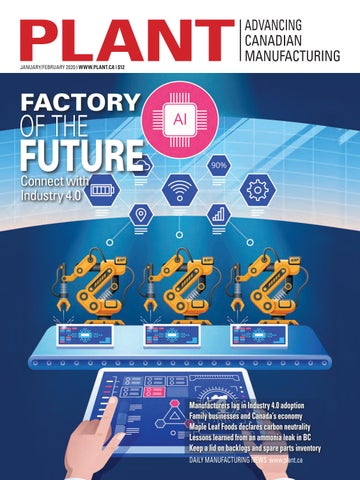
FACTORY
OF THE
FUTURE Connect with Industry 4.0
Manufacturers lag in Industry 4.0 adoption Family businesses and Canada’s economy Maple Leaf Foods declares carbon neutrality Lessons learned from an ammonia leak in BC Keep a lid on backlogs and spare parts inventory DAILY MANUFACTURING NEWS www.plant.ca
PLT_JanFeb2020_issue_AMS.indd 1
2020-01-31 1:06 PM
Less energy. More profit. Looking to reduce operating costs? We pay you for making process improvements and equipment upgrades.
Typical upgrades that earn incentives: • Heating, ventilation and more highefficiency equipment. • Equipment scheduling, system maintenance and other processes.
Success story
Project highlights
$212,706*
Stackpole International, Ancaster
Annual fuel cost savings
850,823 m3
Annual energy savings
64%
Return on investment * Assumes natural gas cost at $0.25/m3.
When global automotive supplier Stackpole International wanted to build a new machine shop at its Ancaster facility, a highefficiency ventilation system was at the top of its must-have list. Like many Ontario manufacturing facilities, Stackpole International has to contend with hot, humid
summers and extremely cold winters, which can affect energy costs, indoor air quality, thermal comfort and staff productivity. With help from a $85,082 incentive from Enbridge Gas, they invested in four Tempeff Dual Core heat recovery units, rated at 35,000 CFM each.
The new equipment reduces the amount of natural gas required to heat the ventilation air, lowers overall operating costs and ensures staff stay comfortable all year round.
Ready to start saving? © Enbridge Gas Inc. All rights reserved.
PLT_Enbridge_JanFeb20.indd 1 PLT_JanFeb2020_issue_AMS.indd 2
Visit enbridgesmartsavings.com/experts to see incentives and learn more.
2020-01-28 1:06 2020-01-31 1:25 PM PM
28 1:25 PM
CONTENTS
January/February 2020 Vol. 79, No. 01
FEATURES 14 INDUSTRY 4.0 Canadian SME manufacturers see value in Industry 4.0 technology, according to the 2020 Advanced Manufacturing survey. 19 PERFORMANCE Dealing with change means a departure from what your team is comfortable with. 20 THINK LEAN Apply 5S properly and you’ll find there’s more to gain than reduced searching. 22 CCOHS SAFETY TIPS What you need to know about disclosing hazards, decisions affecting health and safety and refusing work.
12 PRESSURE POINT
Clear away the obstacles to the adoption of digital technology and become a factory of the future.
23 MAINTENANCE Best practices for the management of backlog and spare parts inventory. 25 TECHNOLOGY A look at the top tech trends ranging from artificial intelligence to IIoT.
DEPARTMENTS 15 IMPORTS SIMA amendments empower manufacturers to take on unfair foreign competitors more effectively.
18 BUSINESS Family-owned businesses are major players in the Canadian economy and account for 60% of manufacturers in the SME segment.
21 SAFETY An ammonia leak at a BC pet food manufacturer provides lessons learned as Technical Safety BC maps out how and why it occurred.
24 SUSTAINABILITY Maple Leaf Foods is declaring carbon neutrality as the first major food company in the world to hit the target.
4 Editorial 6 News Bulletins 7 Careers 8 PLANT Online 10 Industry Mix 11 Economy PLANT Pulse 26 Leading Edge: Innovative ideas for plants 28 Products and Equipment 29 Plantware Events 30 Postscript: A case for collaboration
COVER IMAGE: ADOBE STOCK
PLANT—established 1941, is published 7 times per year by Annex Business Media. Publications Mail Agreement #40065710. Circulation email: bolechnowicz@annexbusinessmedia.com Tel: 416-510-5182 Fax: 416-510-6875 or 416-442-2191 Mail: 111 Gordon Baker Road, Suite 400, Toronto, ON M2H 3R1. Occasionally, PLANT will mail information on behalf of industry-related groups whose products and services we believe may be of interest to you. If you prefer not to receive this information, please contact our circulation department in any of the four ways listed above. Annex Privacy Officer: privacy@annexbusinessmedia.com Tel: 800-668-2374. No part of the editorial content of this publication may be reprinted without the publisher’s written permission. ©2020 Annex Publishing & Printing Inc. All rights reserved. Performance claims for products listed in this issue are made by contributing manufacturers and agencies. PLANT receives unsolicited materials including letters to the editor, press releases, promotional items and images from time to time. PLANT, its affiliates and assignees may use, reproduce, publish, re-publish, distribute, store and archive such unsolicited submissions in whole or in part in any form or medium whatsoever, without compensation of any sort. This statement does not apply to materials/pitches submitted by freelance writers, photographers or illustrators in accordance with known industry practices. Printed in Canada. ISSN: 1929-6606 (Print), 1929-6614 (Online).
www.plant.ca
PLT_JanFeb2020_issue_AMS.indd 3
PLANT 3
2020-01-31 1:06 PM
EDITORIAL
Industry 4.0 and the future of manufacturing
M
anufacturers around the world are engaging with Industry 4.0 to improve performance and accelerate growth, yet Canadian companies have been less adventurous when it comes to advanced manufacturing. A survey of company owners and senior executives by PLANT Magazine and sponsor BDO Canada LLP looked at their involvement with technologies such as digital, automation, the cloud and artificial intelligence (www.plant. ca/2020-advanced-manufacturing-report). The survey results and the subsequent roundtable discussion featuring companies, suppliers and other experts were illuminating. Canadian companies have a bit of a rep for coming up short on investment in their businesses and being late to the party – as in more risk averse than their US counterparts – when new technologies are introduced, preferring to follow rather than lead in adoption. Turns out there are some good reasons for their laggardly behaviour. It’s not that they are skeptical of the value. Almost 90% of the 251 owners and executives recognize emerging technologies allow companies to compete globally. Most of these companies are small, more than half with fewer than 50 employees and and more than half taking in less than $10 million a year. Almost two thirds acknowledge smaller operations have the most to gain from Industry 4.0. But they’re not big users. For example, just 24% are plugged into the Industrial Internet of Things (IIoT), so everyone else is missing out on the value that – among other things – would come from gathering and analyzing machine data and other digital information. What’s the hold up? They’re wary of the costs, where the financing needed to replace machinery and other equipment will come from, and the ROI. How will legacy technology be integrated? They cite the shortage of people with necessary skills. What data should they collect, how do they use it and how about increased cybersecurity risks? These are significant concerns for small manufacturers. But there are some barriers the federal government can help clear, according to Canadian Manufacturers & Exporters (CME), which has done its own analysis of the issue. It recommends the federal government improve the accessibility of information about new technologies and testing opportunities by funding case studies, technology demonstration hubs and site visits. CME also wants to see high purchase costs and investment risks of new technologies offset by a federal-provincial 20% tax credit on the purchase of new machinery, equipment and technologies. And it recommends following the successful example of the SMART program in Ontario to implement strategies that offset the cost of technology assessment and diagnostic services. To address the skills issue, the government is called upon to encourage more Canadians to choose a career in manufacturing; fund the development of workforce planning consortia across the country; expand the Atlantic Immigration Pilot nationally; and make Canada Job Grant funding permanent, while allowing for multi-year training. Manufacturers also have some work to do. As the BDO Canada-PLANT report notes: SMEs may have good reasons for holding off on significant technology implementations, but they will be facing competitors that have made or are making those investments. Advanced manufacturing technologies will drive factories of the future. Companies that aren’t preparing for the future will soon discover they’re travelling on a short road.
Editor Joe Terrett 416-442-5600 ext. 3219 jterrett@plant.ca Senior Publisher Scott Atkinson 416-510-5207 satkinson@annexbusinessmedia.com National Account Manager Ilana Fawcett 416-829-1221 ifawcett@annexbusinessmedia.com
S R
Media Sales Manager Jason Bauer 416-510-6797 / 437-218-0941 jbauer@annexbusinessmedia.com Media Designer Andrea M. Smith asmith@annexbusinessmedia.com
I
Circulation Manager Beata Olechnowicz 416-510-5182 bolechnowicz@annexbusinessmedia.com Account Coordinator Debbie Smith 416-442-5600 ext 3221 dsmith@annexbusinessmedia.com Vice President/Executive Publisher Tim Dimopoulos 416-510-5100 tdimopoulos@annexbusinessmedia.com
P
A
• M • W • E
COO Scott Jamieson sjamieson@annexbusinessmedia.com
Subscription Price Canada $76.00 per year, US $201.00 (CAD) per year, Foreign $227.00 (CAD) per year. Single Copy Canada $12.00. Add applicable taxes to all rates. Combined, expanded or premium issues, which count as two subscription issues.
Pro an a
Mailing Address Annex Business Media 111 Gordon Baker Road, Suite 400 Toronto, ON M2H 3R1 Circulation Beata Olechnowicz 416-510-5182 bolechnowicz@annexbusinessmedia.com Fax: 416-510-6875 or 416-442-2191
Idea that
EX sta pro pro del sta
Joe Terrett, Editor Comments? E-mail jterrett@plant.ca.
4 PLANT
PLT_JanFeb2020_issue_AMS.indd 4
January/February 2020
2020-01-31 1:06 PM EXAIR_ESE PLT_Exa
Static Eliminators Remove Static Electricity and Dust! Improved Performance and Greater Durability!
Prevent Shocks, Jamming, Tearing and Static Cling! As humidity decreases, static electricity problems will increase. • Materials tear, jam or curl • Webs and films cling to themselves • Electronic sensors fail, making false readings
Super Ion Air Wipe™
Super Ion Air Knife™ Produces a laminar sheet of airflow that floods an area or surface with static eliminating ions.
The uniform 360° ionized airstream neutralizes and cleans continuously moving surfaces.
Ion Air Cannon™
Ion Air Gun™ Eliminates static and dust from parts prior to assembly, packaging, painting or finishing.
Ion Air Jet™
Ideal for hard to reach spaces or confined areas that require a concentrated ionized flow.
Delivers a concentrated blast of ionized air prior to shrink wrapping, packaging and printing.
EXAIR manufactures a complete line of static eliminators to remedy common static problems. Many use our engineered airflow products to minimize air use and noise while delivering maximum results by moving more static eliminating ions to the product surface.
Manufacturing Intelligent Compressed Air® Products Since 1983
EXAIR_ESED18_StaticE.indd PLT_Exair_JanFeb20.indd 11 PLT_JanFeb2020_issue_AMS.indd 5
• Hazardous sparks or shocks occur • Product clings to itself, rollers and machine beds • Dust attraction ruins surface finishes
Ionizing Bars Eliminates static cling, dust attraction and jamming on paper, plastics and film.
LEARN MORE ABOUT NEW STATIC ELIMINATORS NOW!
https://exair.co/18_470
11510 Goldcoast Drive • Cincinnati, OH 45249-1621 • Phone (513) 671-3322 FAX (513) 671-3363 • E-mail: techelp@exair.com • www.exair.com
Download our
Basics of Static Electricity White Paper! https://exair.co/bose18ad
@EXAIR
1/15/20 10:20 9:11 2020-01-15 2020-01-31 1:06AM PM AM
NEWS BULLETINS Micron Waste Technologies Inc. has suspended development of its Cannavore waste digester system, citing changing market conditions. The system is designed to process cannabis waste and clean dischargeable water. The Vancouver company said the cannabis industry is not currently funding new technologies, leading to a lower outlook on the commercial viability of the Cannavore system. Focus continues on the Organivore organic food waste digester and effluent treatment system. Micron is also looking at strategic acquisitions. BIOREM Inc. has established Zhongjia Clean Technology (Wuhu) Co. Ltd. in Anhui Province, China as a joint venture with Tus Qingyuan (Beijing) Si-Tech Co., Ltd. BIOREM manufactures high-efficiency air emissions control systems. The joint venture is another phase in the clean tech company’s growth and development strategy in China. The Centre for Probe Development and Commercialization has received clearance from the US Food and Drug Administration to ship products to the United States. CPDC makes diagnostic and therapeutic radiopharmaceuticals used for the detection and treatment of diseases such as cancer. CPDC, founded in 2008, is a not-for profit company located at McMaster University in Hamilton. Packaged food manufacturer Hostess Brands Inc. is acquiring Voortman, a Burlington, Ont. manufacturer of wafers and cookies, for $425 million from private equity firm Swander Pace Capital. The deal represents Hostess Brands’ entry into attractive, adjacent wafer and sugar-free cookie categories. Kraken Robotic Systems Inc. has been awarded a $524,720 contract with the Government of Canada for the SeaVision 3D laser scanner. It was initially pre-qualified under the Build in Canada Innovation Program, now the Innovative Solutions Canada – Testing Stream. The system will be evaluated at a variety of archaeologically significant sites including the HMS Erebus and HMS Terror at the National Historic Site of Canada, Nunavut.
6 PLANT
PLT_JanFeb2020_issue_AMS.indd 6
HMCS Protecteur’s keel laid Seaspan to complete the build in 2023
Vice-Admiral Art McDonald, Commander of the Royal Canadian Navy (left) and Command Chief Petty Officer First Class David Steeves laying the cerePHOTO: SEASPAN monial coin on the future HMCS Protecteur’s keel.
NORTH VANCOUVER — Seaspan Shipyards and its more than 2,800 employees celebrated the ceremonial laying of the keel Jan. 17 for the HMCS Protecteur. The vessel is the first of two supply ships to be built by Seaspan in North Vancouver, as part of the National Shipbuilding Strategy. When completed sometime in 2023, it will be capable of conducting military operations in highthreat environments. The budget for the two ships is $3.4 billion. During the event, a newly minted coin was placed near the keel where it will remain for the duration of the ship’s life. The coin is said to bring good luck for the builders and all those who sail in the vessel. HMCS Protecteur will be the largest naval ship by length ever built in Canada at 173.7 metres by 24 metres.
$3.M orders for H2O Innovation QUEBEC CITY — H2O Innovation Inc.’s subsidiary Piedmont has secured a $3.5 million deal for filter cartridges and couplings to be used at a desalination plant in the Middle East. Piedmont (US headquarters in Vista, Calif., Canadian office in Quebec) makes corrosion resistant equipment for desalination plants in industrial and municipal markets. Orders for fibre reinforced polyester (FRP) cartridge filter housings and couplings will be used in what the company describes as the largest sea water reverse osmosis (SWRO) desalination plant in the world. The plant will treat up to 900,000 cubic metres of water daily. H2O Innovation will provide FRP filter housings for two medium-sized (50,000 cubic metres daily) SWRO desalination plants in Tunisia. Another order destined for Saudi Arabia will include four FRP units, treating a total of 24,480 cubic metres daily. H2O Innovation, based in Quebec City, makes state-of-the-art, custom-built and integrated water treatment solutions based on its membrane filtration technology.
Nexii setting up in Squamish
foundations, roofs, cladding and curtain walls. “The development of our first full-scale comMakes sustainable building products mercial facility in Canada will allow Nexii to further develop and deploy our green construcVANCOUVER — A new player in the construction technology. It will help mitigate the impacts tion industry is setting up a plant in Squamish, of climate change, while simulBC to produce whole building taneously being an economic products for rapid construction driver in what’s shaping up to be of durable, sustainable and disasCanada’s clean growth century,” ter-resilient buildings. said CEO Stephen Sidwell. Nexii Building Solutions Inc. Production at the 90,000 said its first full-scale commersquare-foot plant is expected to cial production plant will create begin later this year. approximately 150 full-time Gregor Robertson, former skilled jobs. Mayor of Vancouver, has joined The manufacturer makes the Nexii team executive as a proprietary material called vice-president of strategy and Nexiite that when combined partnerships. with the company’s design and Nexii’s assembly process. The 2017 United Nations Enassembly process, allows the PHOTO: NEXI vironment Global Status Report rapid construction of commeridentifies buildings as being responsible for 39% cial, institutional, industrial, mixed-use and of total climate emissions. Nexii positions its residential buildings. buildings as requiring less energy to heat and The material is also suitable for retrofitting cool, and notes its products are 99% free from existing buildings. ILFI Red List materials. Nexii’s products include exterior envelopes,
January/February 2020
2020-01-31 1:06 PM
EMC launches RAMP for NS manufacturers OWEN SOUND, Ont. — Manufacturers in Nova Scotia face skills shortages and capacity utilization issues that have an impact on productivity and the implementation of advanced technology. Now they have access to resources that will make them more productive and globally competitive. The Excellence in Manufacturing Consortium (EMC), a non-profit business organization that helps manufacturers become more productive and competitive, is launching its two-year RAMP (Regional Advanced Manufacturing and Productivity) initiative for the province’s manufacturers and related industries. The aim is to provide enhanced productivity improvement knowledge, networking/benchmarking resources, and advanced manufacturing technology best practices and roadmaps. Funding support is provided by the Atlantic Canada Opportunities Agency and the Nova Scotia Department of Labour and Advanced Education. The program will feature: RAMP networking clusters in the Halifax and Truro areas; lean leader and management systems certificate training; and return on investment performance projects that deliver real-time results.
J.D. Irving forecasts 6,800 hires across operations over three years Reflects anticipated retirements, business growth, normal turnover
Irving’s Halifax Shipyards.
SAINT JOHN, NB — J.D. Irving Ltd., the New Brunswick-based conglomerate, is forecasting more than 6,800 full time hires and 2,700 student hires across its operations in Canada and the US over the next three years. Most of these jobs will be in Atlantic Canada. The forecast reflects anticipated retirements, business growth and normal workforce turnover. The company employs 16,000 in agriculture, construction and equipment, consumer products, food, forestry and forest-
www.plant.ca
PLT_JanFeb2020_issue_AMS.indd 7
PHOTO: CITOBUN
ry products, retail and distribution, shipbuilding and industrial fabrication, transportation and logistics. The company said its businesses will need to fill 400 positions through immigration. Most job opportunities are in operations, shipping, supply and logistics, retail sales and engineering. More than 400 skilled trades jobs will be filled across all divisions, 81% of these in Atlantic Canada. The remaining 19% will be in Ontario, Maine, New York and Georgia.
LA Metro orders 70 more buses ST. CLOUD, Minn. — The Los Angeles County Metro Transit Authority (LA Metro) is adding 70 Xcelsior 60-foot compressed natural gas (CNG) transit buses to its fleet from New Flyer of America Inc., a subsidiary of Winnipeg-based NFI Group Inc. The options are part of a contract with LA Metro for up to 400 CNG buses originally announced in October 2017 and include an initial order of 65 buses with options to purchase an additional 335 buses. The buses are built in St. Cloud, Minn. and are completed in Ontario, Calif.
Ryerson launches cyber accelerator BRAMPTON, Ont. — Rogers Cybersecure Catalyst, a cybersecurity research centre at Toronto’s Ryerson University, is partnering with Ryerson’s The DMZ business incubator to launch the Catalyst Cyber Accelerator. The initiative is billed as Canada’s first commercial accelerator specifically designed for scale-up companies in cybersecurity and related fields. The Catalyst Cyber Accelerator, based in Brampton, Ont., will provide scale-up companies tools that will aid their growth. The initiative is supported by the federal government, through the Federal Economic Development Agency for Southern Ontario (FedDev Ontario), and Rogers Communications Inc., in partnership with the City of Brampton. Ryerson also notes that Rogers, Royal Bank of Canada, Herjavec Group, Torys LLP, Amazon Web Services and Siemens Canada will join a “Corporates-in-Residence” program. They’ll provide guidance and mentorship to companies involved in the program. Clients will receive mentoring on product strategy, marketing, talent acquisition, investment attraction and growing sales. They’ll also have access to over $500,000 worth of exclusive business services and perks provided by more than 60 businesses. Visit dmz.to/catalyst.
CAREERS CAE, a provider of training simulators and programs for aerospace based in Montreal, has appointed Todd Probert group president, defence and security. Todd Probert He’ll be based in Washington, DC. He’s succeeding Gene Colabatistto, who retired from CAE in December. Probert comes to CAE from defence firm Raytheon’s command, control, space and intelligence business unit as part of Intelligence, Information and Services. Kruger Products LLP, a manufacturer of tissue products based in Mississauga, Ont., has appointed Susan Irving CMO for North America. Most recently she was the senior marketing director for the Quaker Nutrition portfolio at PepsiCo Foods Canada. She replaces the retiring Nancy Marcus, who joined the Kruger team in 2001. She was appointed to CMO of North America in May 2018. Baudouin Nizet joins McInnis Cement as president and CEO. He comes to the manufacturer from Stuart Olson Building Group, a construction company based in Calgary where he was senior vice-president. He has roots in the cement industry, working for CRH Canada/ Holcim Canada. McInnis’s plant is based in Port-Daniel-Gascons, Que. ElectroKinetic Solutions Inc. has appointed Shaun Kavalinas CEO, replacing the retiring James Micak who will serve as executive chair of the Toronto-based clean tech company’s board. Prior to joining EKS, Kavalinas was senior project engineer-IOL Portfolio at Worley, an energy company in Calgary. EKS has developed a dewatering technology for industrial use where slurries, sludges and unstable clay soil conditions are present. Luke Caplette is joining Nanalysis Scientific Corp. as CFO. The Calgary-based company manufactures portable nuclear magnetic resonance spectrometers or analyzers for laboratory and industrial markets. Caplette was previously CFO at Cordy Oilfield Services Inc.
PLANT 7
2020-01-31 1:06 PM
NEWS
Canada Goose debuts Project Atigi parkas Features a new collection of 90 bespoke pieces from Inuit designers This year’s expanded collection features 90-bespoke pieces, created by 18 Inuit designers from 12 communities, across Inuit Nunangat. In partnership with Inuit Tapiriit Kanatami (ITK), Canada Goose commissioned the designers to each create a collection of five hand-made jackets that reflect their heritage, communities and artisanship. The parkas will be showcased in stores in North America and Europe. Proceeds from sales will benefit Inuit communities across Canada through ITK, which works with the four Inuit regions of Inuit Nunangat. The Atigi collection. PHOTO: CANADA GOOSE Proceeds from last year’s collection supported self-directed Inuit education, employTORONTO — Canada Goose, a manufacturer of ment and cultural preservation programs. premium cold weather garments, has launched Canada Goose, based in Toronto, sells its its latest collection for Project Atigi, a social Made in Canada products globally. entrepreneurship program.
PLANT ONLINE SOUNDING OFF
What readers have to say about breaking news Have you checked out PLANT’s daily news online? Here are some headlines that have inspired members of the Canadian manufacturing community to chime in. They’re edited, but use the links to see the raw – and for some – longer versions of their remarks plus the stories that inspired their reactions. Stay up-to-date on the developments – domestic and global – that affect Canada’s industrial sectors by watching the news feed at www. plant.ca or reading PLANT’s twice-weekly newsletter (hit Subscribe on the website). New York City pulls 298 Bombardier subway cars, cites safety concerns http://www.plant.ca/k5kM8 Leetwo Metal in Montreal should’ve made the subway doors for Bombardier, as they did in the past (with no issues). But they go to China now, this is what you get… Maple Leaf CEO’s Iran plane crash comments unprecedented: experts http://www.plant.ca/bs2N9 Bravo to Mr. McCain! If more CEOs stood up to such causes we might have more evolution
8 PLANT
PLT_JanFeb2020_issue_AMS.indd 8
and less revolution in our societies. We need to stand up to our leaders and ensure they do the right things for humanity and the environment. LNG pipeline will proceed despite protests: Horgan http://www.plant.ca/JzlC9 Funny how the BC government picks and chooses which pipelines are good and bad regardless of the legality of the issue. Money is the motivating factor in this case. Horgan gets to tax the gas line but not the Alberta Trans Mountain line, so the gas line is a great project in Horgan’s eyes.
Ontario can phase out nuclear and avoid increased carbon emissions http://www.plant.ca/5oPAw Phasing out nuclear would be idiotic. More new and safer nuclear technology is coming fast, even though the current technology has been safe and reliable. Solar is not practical in Ontario and the noise from wind power generators is very annoying to many people who live nearby. We also have our own source of uranium, making us energy independent. Corporate tax hikes reduce worker wages: study http://www.plant.ca/LIczD I am a manufacturer with four employees, sales are under $1 million. The more the government taxes, fines and penalizes, the less I can give my employees. As a director, I come last on the payroll. All taxes have to come down and they will only go up
ATS acquires food systems supplier CAMBRIDGE, Ont. — ATS Automation Tooling Systems Inc. has acquired a UK-based provider of yield control and recipe formulation systems for the food, nutraceuticals and cosmetics sectors. MARCO Ltd.’s systems are based on its proprietary weighing hardware and process control software. The automation manufacturer based in Cambridge, Ont. said MARCO provides an in to a product-based, niche segment of the food industry that’s growing at a mid-single digit rate. “The food industry itself is attractive to ATS because it’s subject to industry and government regulations, driving a need for high precision technologies,” said ATS CEO Andrew Hider. “MARCO will serve as a first step in our expansion into an attractive new vertical market.”
because of government debts. We need wiser people running the country. Sluggish investment threatens Canada’s prosperity http://www.plant.ca/dU4DX The Liberals have chased away all oil and gas investments in Canada so good luck with the pipeline they own. The only jobs keeping our economy going are construction and transportation infrastructure projects. There is a huge, empty state-of-the-art automotive plant in Oshawa that’s sitting idle! Where are all the electric vehicles? Oh well, it will likely make a great shelter for the only growth we can guarantee – the homeless. Skills shortage hampers manufacturers’ competitiveness: CME http://www.plant.ca/NRwOn Just for fun, over the next few articles, why not set up search and replace for “we can’t find skilled workers” to “we can’t hire skilled workers at minimum wage or less and we are certainly not going to reduce shareholder profits by training them.” Or would that be fake news?
January/February 2020
2020-01-31 1:06 PM
NEWS
General Fusion partners on demo plant Hatch will provide power plant engineering services VANCOUVER — General Fusion has entered into an industrial partnership with Hatch Ltd. to provide power plant engineering and other expertise to its Fusion Demonstration Plant project. The Vancouver company, which is developing commercial fusion energy technology, said the partnership includes an investment by Hatch into General Fusion’s US$65 million Series E financing. Hatch, a global engineering and construction
Plant will produce cellulose filaments MONTREAL — Resolute Forest Products Inc. intends to build a $38 million plant in Quebec that will produce cellulose filaments, a sustainable biomaterial derived from wood fibre. Its Kénogami paper mill also be optimized. “Our investment in cellulose filaments represents an opportunity to enter into non-traditional growth markets,” said Yves Laflamme, president and CEO. “The cellulose filament and Kénogami mill optimization projects will create synergies within our network of operations in SaguenayLac-Saint-Jean.” The plant will apply FPInnovations’ technology, which involves cellulose filaments derived from wood fibre that is mechanically processed without chemicals or enzymes. Filaments can be integrated into commercial and consumer products from many industries, including transportation, construction and energy. The project will create eight jobs in the startup phase slated for 2021, and a total of 23 jobs once the plant reaches its full production capacity of 21 tonnes per day. These new jobs will be in addition to the 200 positions at the paper mill. The mill, with an annual production capacity of 133,000 tonnes, will produce high-grade SCA+ supercalendered paper. FPInnovations is a not-for-profit R&D organization that is focused on accelerating the growth of the Canadian forest sector.
www.plant.ca
PLT_JanFeb2020_issue_AMS.indd 9
firm with offices across Canada, will support the plant, which will be tested over the next five years. The prototype will demonstrate magnetized target fusion technology, which generates carbon-free electricity by using heat from nuclear fusion reactions. Technology taps energy from nuclear reaction. PHOTO: GENERAL FUSION
FOR MACHINERY THAT DEMANDS
PRECISION, QUALITY AND HIGH PERFORMANCE
Polyurethane Timing Belts
English and Metric Pitch. Backings, profiles and machining available for diverse applications
Pulleys
Stock pulleys available for fast delivery Custom pulleys made to your specifications
Drive Components & Accessories
Clamps, tensioning clamps and tensioners Tension Meter, Field Welder and Connecting Kits
(732) 460-9500
PLT_March_Brecoflex.indd 1
www.brecoflex.com
info@brecoflex.com PLANT 9
2019-02-07 1:44 PM
2020-01-31 1:06 PM
INDUSTRY MIX
MISCELLANY FROM THE WORLD OF MANUFACTURING
Bitumen to carbon fibre challenge U of T researcher an outstanding innovator Using ceramic forms of rare earth oxides as water repellent coatings in industry may not be top of mind for most people, but a researcher at the University of Toronto has shed light on this question. And for doing so, Jason Tam was presented the award for Outstanding Innovation – International by Mitacs, a not-for-profit organization that fosters growth and innovation in Canada. Tam’s research found coatings become more water repellent when they are exposed to ambient air, and they lose their ability to repel water when exposed to high temperatures. His discovery refutes earlier studies that suggested such ceramic coatings had the potential Emmanuel Kamarianakis, director gener- for widespread use in applicaal, Investment and Innovation at Global tions such as steam turbines, Affairs Canada, presents the Mitacs power generation heat exchangPHOTO: MITACS ers and aircraft engines. Ceramic Award to Jason Tam. coatings held promise because they are stronger and more durable than the thin polymer coatings used today that eventually wear. “We now know that there are many more factors to consider before we can reliably apply ceramics as water-repellent coatings on a large industrial scale,” he said.
Oh Canada! MacDonald, Dettwiler and Associates Ltd. (MDA) is back in Canadian hands. The icon of Canada’s space program and creator of the Canadarm has been acquired by Northern Private Capital, a Toronto-based investment firm. It’s leading a consortium that’s picking up MDA from Canadarm in action. PHOTO: NASA Maxar Technologies for $1 billion. Now control is returning to home base in Vancouver. MDA merged with DigiGlobe, a US space imagery company in 2017 to form Maxar, based in Westminster, Colo. Founded in 1969, MDA is Canada’s largest space technology developer and manufacturer, with more than 1,900 employees across the country. Its collaboration and partnership with the Government of Canada over several decades led to the Canadarm family of space robotics for the US Space Shuttle program and the International Space Station; and three generations of Canada’s RADARSAT Earth observation satellites. The Canadians leading the buyout are of note. Billionaire John Risley, based in Atlantic Canada, is the founder of Clearwater Fine Foods. The other leader is investment expert/advisor Andrew Lapham. Social note, Lapham is the husband of Caroline Mulroney, Ontario cabinet minister and daughter of former Prime Minister Brian Mulroney.
10 PLANT
PLT_JanFeb2020_issue_AMS.indd 10
Alberta is looking beyond using bitumen from its oil sands reserves for energy. Alberta Innovates is launching a $15 million clean tech initiative to accelerate development of carbon fibre from the sticky hydrocarbon product. The Carbon Fibre Grand Challenge competition is part of a broader initiative called Bitumen Beyond Combustion. The challenge is targeting technologies and Bitumen, a thick, sticky form of crude oil. PHOTO: SUNCOR ENERGY projects that convert bitumen or asphaltenes into carbon fibre, which makes composites functionally superior to many conventional materials used in transportation, infrastructure, construction and consumer product sectors. Alberta’s agency for research and innovation is expecting applications for the three-phase challenge (wrapping up in 2024) from Canada, the US, Europe and Asia. Three grand prizes of $3 million will be awarded to winners who must produce more than 10 kilograms of carbon fibre per day, then scale to more than 250 tonnes per day. Deadline for Phase 1 is April 7. Visit at albertainnovates.ca for more information.
“I’m concerned about the enforceability, and I want to make sure we do an exhaustive debate, a study in committee, to make sure this is a good deal for Canadians.” NDP Leader Jagmeet Singh on ratifying the USMCA trade deal.
Serious about climate change The recently launched Canadian Institute for Climate Choices wants us to get serious about climate change. It’s deploying a team of academics and policy experts to save us from roasting and drowning by offering clarity and advice to all levels of government. The plan is to help decision-makers and Canadians travel a path to net-zero greenhouse gas emissions by 2050. The arm’s length but federally funded ($20 million) institute has released a report (Charting Our Course, https://climatechoices.ca) that sets up the challenges and opportunities. There are physical impacts, such as floods, heat waves, wildfires and rising sea level (of interest to coastal communities), but there are also economic threats as the world moves to carbon freedom. For example, Canada’s energy sector, a significant contributor to GDP, will see even more depressed prices and declining investment. Swing over to the automotive industry and we could see decreasing demand for gasoline-powered vehicles shift automotive production elsewhere. On the upside, there is promise in the development of clean technologies. The Institute notes the World Bank estimates investments Height change of the sea surface over 23 worth $23 trillion between 2016 and 2030 as years, West Pacific. climate commitments kick in. Bottom line, we PHOTO: NASA/JPL-CALTECH need to get a move on.
January/February 2020
2020-01-31 1:06 PM
ECONOMY
Jobs are in decline How it affects rates and wages in manufacturing
M
www.plant.ca
PLT_JanFeb2020_issue_AMS.indd 11
BUSINESS INNOVATION AND GROWTH SUPPORT BY REVENUE SIZE IN 2017 $0 - $249,999 $250,000 - $999,999 $1,000,000 - $1,999,999 $2,000,000 - $4,999,999 $5,000,000 - $9,999,999 $10,000,000 - $49,999,999
Enterprises
$50,000,000 - $99,999,999
Value of support
$100,000,000 - $499,999,999 $500,000,000 or greater 0
Source: Statistics Canada, CANSIM
20
10
30
Small and medium enterprises received 95.1% of the federal support for innovation in 2017 and 54.2% of the value, according to a Statistics Canada report. Value of support increased with the size of the organization. For example, support for enterprises with annual revenues below $250,000 averaged $20,235. Annual revenues of $500 million averaged $1,017, 373. Manufacturing represented 24% of the enterprises and almost a third of the total value of support.
24%
Percentage of mostly small manufacturers applying Industrial Internet of Things technology, according to the 2020 Advanced Manufacturing survey by PLANT Magazine and BDO Canada LLP. Twenty-four per cent aren’t familiar with the technology and 15% say it’s not applicable.
85%
$1.5
TRILLION
The combined federal and provincial debt in 2019-20, says a new study by the Fraser Institute. That’s 64.3% of the Canadian economy and works out to $39,483 for every Canadian.
67%
Percentage of manufacturers responding to Canadian Manufacturers & Exporters workforce survey that report a skills and labour gap. That represents a 15-point jump in just one year.
IMAGES: ADOBE STOCK
anufacturing jobs in Canada have been in decline since the early 2000s, but how is that affecting employment rates and wages? A Statistics Canada study of the period from 2000 to 2015 offers some insight for men, but women will require more study. The results provide little evidence a decline in employment or wages led to reduced rates for women in the study areas. During the study period, the percentage of men aged 21 to 55 employed full time for at least 48 weeks fell from 63.6% to 58.6%. The reduction was more pronounced in CMAs (census metropolitan areas, one or more municipalities around a core) and CAs (census agglomerations, high population density with infrastructure) that experienced greater-than-average declines in manufacturing. For example, men’s full-year, full-time employment rates fell by 10 percentage points or more in the Ontario areas of Windsor, Oshawa, St. Catharines–Niagara and Kitchener– Cambridge–Waterloo. The decline for employees aged 21 to 55 was between eight and 10 percentage points. This is roughly twice the decline observed across all CMAs and CAs. Using census data, the study found this led to an average 4.5-percentage-point loss among men living in the study areas. The study also noted the five-percentage-point decline in manufacturing employees led to an average 6.9% loss in real weekly wages, especially among less educated men. Estimates suggest wages of those with a high school diploma or less were reduced by at least 7.3%, compared with a 4.8% loss for those with a bachelor’s degree or higher. Less educated young men saw an 8.7% drop in real weekly wages. Reduced real wages for men were not affected by internal migration. Download Study: The impact of the manufacturing decline on local labour markets in Canada at www150.statcan.gc.ca, the Daily, Jan. 15, 2020.
Canadian companies that are upping the ante with perks and benefits when hiring IT staff. Research from staffing firm Robert Half Technology shows 29% of IT managers said it boosts staff retention.
-37
Confidence of Canadian small and medium enterprises in the global economy, indicating they think conditions will worsen in 2020, according to a fall survey by BDC. That’s down 11 points from the last quarter. Confidence in the US is at -26, down 15 points. Canada’s prospects fare a bit better. Confidence is at -8, down one point. Access Investment Intentions of Canadian Entrepreneurs: An Outlook for 2020 at bdc.ca.
PLANT 11
2020-01-31 1:06 PM
PRESSURE POINT
CONNECT TO
INDUSTRY
4.0
BECOME A FACTORY OF THE FUTURE BY KIM LAUDRUM
How to clear obstacles to digital technology implementation.
C
anadian manufacturers are growing increasingly concerned about trailing their global competitors – and with good reason. They acknowledge the “factory of the future” where digital and operational technologies converge. Yet they have been slow to adopt the technologies that would give them an edge and set them up for the future.
The 2020 Advanced Manufacturing Report (www.plant. ca/2020-advanced-manufacturing-report) shows most small and medium manufacturers (87%) see the best way to stay competitive is to adopt internet-connected digital technologies and embrace best practices to implement Industry 4.0 capabilities. Yet just one in four are currently connecting equipment to the Industrial Internet of Things (IIoT). It’s a surprising statistic considering most manufacturers (65%) recognize that the biggest threat of not implementing advanced technologies is falling behind
FEDERAL FUNDING Regional development initiatives and programs are available for manufacturers at: • Atlantic Canada Opportunities Agency (New Brunswick, Newfoundland and Labrador, Nova Scotia, PEI), www.canada.ca/en/atlantic-canadaopportunities.html. • Canada Economic Development for Quebec Regions, www.dec-ced. gc.ca/eng/index.html. • Canadian Northern Economic Development Agency (Northwest Territories, Nunavut, Yukon), www.cannor.gc.ca. • Federal Economic Development Agency for Southern Ontario, a.k.a FedDev Ontario (Southern Onatio), www.feddevontario.gc.ca/eic/ site/723.nsf/eng/home. • FedNor (Northern Ontario), fednor.gc.ca/eic/site/fednor.nsf/eng/home. • Western Economic Diversification Canada (Alberta, BC, Manitoba, Saskatchewan), www.wd-deo.gc/eng/19640.asp.
12 PLANT
PLT_JanFeb2020_issue_AMS.indd 12
their competitors. So, why are Canadian SMEs reluctant to adopt technology they know will make them more competitive? “The biggest challenge in Canada is that we have, on both the manufacturing and technology side, an awful lot of small companies,” explains Jayson Myers, CEO of Next Generation Manufacturing Canada, a not-for-profit based in Hamilton. It matches manufacturers with new technologies to drive advanced manufacturing in Canada. Although the average annual revenue reported for all was $65.7 million, more than half of the manufacturing companies have less than 50 employees, and annual revenues of less than $10 million, according to respondents to the PLANT Magazine survey, sponsored by BDO Canada LLP, an accounting, tax and advisory firm. Myers says there are advan-
tages to being a small company. “They’re far more agile. They’re able to customize. They’re more engaged with their customers. And they can move faster than larger companies.” But there are challenges, such as not having the resources to successfully implement technology. “They don’t necessarily have the people with the skills needed,” Myers says. “Success depends on the process, which is sometimes dictated by their customers or their suppliers.” Technology comes at a cost, not just purchasing the equipment, but understanding how to operate it successfully, Myers says. “For small manufacturers it’s finding the working capital to implement advantage technology that becomes an issue.” What’s the solution for SME manufacturers? In a word: collaboration. “Strengthening collaboration is really important,” Myers says. “That’s how you grow scale.”
January/February 2020
2020-01-31 1:06 PM
Connecting with Industry 4.0 technology. PHOTO: ZAPP2PHOTO - STOCK.ADOBE.COM
He advises manufacturers to talk to other companies that might have found a solution. “How do you identify good data, improve processes, incorporate lean principles and connect the factory floor to the supply chain? Those aren’t trade secrets but they’re challenges everyone faces.”
Transformation project Many companies say they don’t know where to start. “They think it will be disruptive, or they don’t have the skills, or it’s a big expense. That’s why a lot of companies are reticent.” But you can get to the endgame by making incremental changes. As an example, he cites a device with a sensor. Add it to one piece of equipment, perhaps where the process is experiencing bottlenecks. “Ask, ‘where would it help to have more data to improve efficiency?’” It’s important to understand what you want to accomplish
www.plant.ca
PLT_JanFeb2020_issue_AMS.indd 13
when undertaking a digital transformation project, Myers advises. A Boston Consulting Group survey of the Top 100 manufacturing companies in the US asked if they had adopted advanced digital technologies. Most indicated they had done so in the past year. When asked whether they were successful, some 90% said “no”. “Small companies in Canada
don’t invest as much in new technology as those in the US do,” Myers says. “There are lots of large companies there. China now leads in its ability to collect lots of data, too.” That said, Myers expresses confidence in Canadian manufacturers’ ability to manage implementing technology, to come up with solutions for customers and their ability to be flexible and catch up.
Before embarking on an Industry 4.0 journey it’s important to develop a roadmap – a solid vision of where you want to go. “Industry 4.0 is so broad that manufacturers considering implementing digital technologies find it a daunting task,” says Paul Boucher, partner, government incentives, with BDO’s advisory services manufacturing and technology industry team in Mississauga, Ont. “They know they need to do something. They want to do something, but they don’t know how to do it. “ If that’s the case they can turn to third parties for expertise. “The whole concept of accessing government support is a daunting process. It’s overwhelming in terms of the administration and the reporting required. But it’s very important to access funding for each step of the process,” Boucher says. There is funding available for developing a roadmap to successful implementation of advanced technology. FedDev makes it available through regional economic development programs. Industry suppliers are a good source of help to manufacturers, too. Shalabh Bakshi, director, digital enterprises with Siemens Canada Ltd. (Canadian headquarters in Oakville, Ont.), is responsible for integrating digital transformations. “We look into how to assess
COLLABORATION Examples of opportunities for manufacturers with educational institutions. • McMaster University’s Innovation Park in Hamilton. The CANMET materials research centre is a Natural Resources Canada R&D facility. McMaster Automotive Resource Centre offers support for manufacturers that want to test concepts. • Centre for Smart Manufacturing and Digital Innovation at Conestoga College in Kitchener, Ont. • ACE Climatic Wind Tunnel at Ontario Tech University in Oshawa, Ont. It tests concepts for automotive and other applications.
• Humber, Barrett Centre for Technology Information in Toronto. Provides expertise in automation, robotics, systems integration; testing; applied research and work-integrated learning. • CTA, the technological transfer centre linked to the École nationale d’aérotechnique (ÉNA) in Longueuil, Que. It provides training and technology transfer programs adapted to the market requirements of SMEs. • CDCQ, a collegiate technology transfer centre (CCTT), part of Cégep de Saint-Jérôme. Its R&D and technology transfer activities are aimed at companies in Quebec’s composites sector.
PLANT 13
2020-01-31 1:06 PM
INDUSTRY 4.0 the risk and lessen the risk of technology adoption for manufacturers,” Bakshi says. “We do a lot of proof of concepts and pilot projects. We create technology showcases so that they can see how they could benefit from implementing it in their businesses.” With four hubs in Quebec to demonstrate the complete value chain for implementing Industry 4.0 – from the design side, to the Cloud – Siemens offers training and testing. Says Bakshi, “Companies can come in and test technologies to see how they will behave. From there we provide solutions and show how they can implement them.” The Siemens approach is to look into a manufacturer’s complete operations. “We prioritize what systems are near go so they can get a quick return on their investment,” he notes. “But we emphasize that it’s just part of an overall system based on their business model. We look at it step-by-step so they can see where to invest.” There’s a lot of buzz that goes with advanced technologies. Bakshi says ignore it. “Focus on the business case and what they want to get out of their investment.” Investing in integrated digital solutions to boost productivity may seem a daunting task for small manufacturers but collaborations with other manufacturers, business consultants, applied learning institutions, research and development departments, and industry suppliers will improve competitiveness. Getting started on a factory of the future will set your company up for business success in the years ahead. Kim Laudrum is a Collingwood, Ont.-based business writer and regular contributor to PLANT. E-mail klaudrum@ rogers.com. Comments? E-mail jterrett@plant.ca.
14 PLANT
PLT_JanFeb2020_issue_AMS.indd 14
Using a tablet to perform maintenance check on a motor.
Slow to
PHOTO: ZAPP2PHOTO - STOCK.ADOBE.COM
ADOPT WE ARE LAGGING IN DIGITAL TRANSFORMATION SMEs see value in advanced manufacturing technology but have concerns. BY PLANT STAFF
M
anufacturers around the world are adopting Industry 4.0 technologies and integrating digital solutions that optimize their processes. But Canadian companies have not been quick to go digital, according to the 2020 Advanced Manufacturing survey of mostly small and medium-sized manufacturers. Industry 4.0 focuses on automation, interconnectivity, machine learning and the analysis of real time data that involves the Industrial Internet of Things (IIoT), the cloud, advanced computing and artificial intelligence. The survey, conducted by PLANT Magazine for sponsor BDO Canada LLP, looked at how
251 owners and senior executives view these technologies and probed companies’ level of adoption. Many see the value of advanced technologies but are wary of costs and return on investment as they continue to apply more traditional manufacturing methods. They’re also concerned that people with the skills necessary to make the most of digital technologies and networks are in too short supply. Challenges include data being complicated and requiring special knowledge, increased cybersecurity risks, and the massive investment needed to replace machinery. “Most executives (87%) realize that Canadian manufacturers are competing with companies around the world. And almost 80% see the Industrial Internet of Things as a business growth opportunity,” said Mike Gillespie, partner, and manufacturing leader at BDO Canada LLP, an accounting, tax and advisory
firm. “Sixty-four per cent of respondents say manufacturers with smaller operations have more to gain from Industry 4.0. This is welcome news. The first step to change is acknowledging the need to change.” But just 24% of executives are currently applying IIoT, 36% are planning or evaluating, 24% aren’t familiar with the technology’s capabilities and 15% stated IIoT is not applicable to their operations. They see the top IIoT applications as: improving efficiency and productivity (33%); providing more visibility into production processes (23%); improving maintenance functions (22%); tracking materials and shop floor assets (20%); and pulling together business data from shop floor to top floor (20%). Challenges encountered while implementing technology strategies include resistance to change (51%), lack of skilled talent (48%), funding (46%) and integrating with legacy technology (36%). Most companies are using traditional means to compile information. Seventy per cent are using spreadsheets such as Excel for production and material planning, and 46% use accounting packages while 43% generate manual paperwork. Integrating ERP for the supply chain was cited by 35% of respondents and MRP by 26%. Only 14% are employing sensors to capture big data. Research firm RK Insights in Toronto conducted the survey through July and August. The margin of error is +/- 5%, 18 times out of 20. Most of the companies are small: 52% have fewer than 50 employees and 47% of respondents hold controlling or minority ownership, or have partners. Average annual revenue of all respondents is $65.7 million, but 52% take in less than $10 million. Download the survey results and executive roundtable report at www.plant.ca/2020-advanced-manufacturing-report/.
January/February 2020
2020-01-31 1:06 PM
IMPORTS Manufacturers are empowered to deal with unfair foreign competitors more effectively. BY MICHAEL MILNE
C
anadian trade prospects had never been more uncertain than they were in 2018 and 2019. Relations with the US were in doubt as our neighbour to the south engaged in an all-out trade war with China and battled global steel imports. This led to the federal government directing the Canadian International Trade Tribunal (CITT) to examine steel imports. It was tasked to determine whether tariffs should be put in place to protect the domestic industry from diversion of US imports. Although the CITT decided tariffs were unnecessary in five out of the seven product groups, the federal government engaged in a 30-day intensive consultation with the Canadian steel industry to identify other ways to strengthen trade laws. As a result, the Liberal government decided to enact new tools to give Canadian producers in all industries greater firepower to fight unfair imports. With little fanfare, the Special Import Measures Act (SIMA) was amended in September. Its amendments bring Canadian trade laws into conformance with the US and Australia. These amendments give Canadian authorities the ability to unmask unfair trade practices that might otherwise go unpunished. Under SIMA, a manufacturer can seek to have import duties imposed on a foreign competitor’s product if imports are “dumped” and if the dumped imports have caused injury. Both are complex determinations. Dumped imports are goods that enter Canada at prices below what the same goods sell for in the competitor’s home country, or if sold below the cost of production. Injury is caused if sales are stolen from the domes-
www.plant.ca
PLT_JanFeb2020_issue_AMS.indd 15
SIMA amendments bring Canadian trade laws in line with the US and Australia.
Dumping
PHOTO: NESPIX - STOCK.ADOBE.COM
PROTECTION
SIMA AMENDMENTS TAKE ON TRADE CHEATS tic supplier; or the supplier is forced to lower prices to retain sales; and if these losses have a material impact on revenue, financial and operational results.
Filing a complaint When a complaint is filed, the Canada Border Services Agency (CBSA) investigates whether the imports are dumped. During its investigation, the CBSA requires the foreign competitor to report its home market selling prices and its costs of production. The CBSA then spends several months probing these reported prices and costs, asking for supporting documents and explanations for any data anomalies. For the foreign competitor, the investigation is invasive and requires significant time and cost to complete. Prior to September, the CBSA would rarely look behind the foreign competitor’s reported costs. If these costs reasonably reflected actual incurred costs and the costs were verifiable by reference to supporting documents produced in the ordinary course of business, they would
be accepted at face value. This has allowed foreign manufacturers to benefit from unfairly low-priced costs because there was no mechanism to challenge them as reported. Now one SIMA amendment gives the CBSA the ability to find costs incurred in countries subject to significant government control or other market distorting circumstances are not reliable. In these cases, the CBSA can use surrogate costs to determine whether the foreign competitor is dumping. Does your foreign competitor benefit from subsidized inputs produced by a state-owned giant (such as steel throughout Asia)? Or wild currency fluctuations (currently occurring in Turkey)? In both circumstances, the CBSA can find there exists a “particular market situation” and use this finding to ignore reported costs. This makes it much more likely for the CBSA to find that dumping has occurred. Another import measures amendment allows the CBSA to disregard reported acquisition
costs for key inputs obtained from affiliated suppliers. Do you compete against a vertically integrated foreign competitor that sources raw materials or key inputs from sister companies at unfairly low costs? The CBSA can disregard a competitor’s paid costs and build its costs of production using a benchmark price. Bottom line, Canadian manufacturers now have access to important tools that were available to their US and Australian counterparts for years. Trade laws are meant to level the playing field for producers selling at home. These new tools will allow them to do just that. Michael Milne is international trade counsel with Cassidy Levy Kent LLP in Ottawa, which specializes in international trade disputes, export control compliance and customs issues. Call (613) 3684149. Visit www.cassidylevy. com. Comments? E-mail jterrett@plant.ca.
PLANT 15
2020-01-31 1:06 PM
Sponsored Content provided by PLANT partners:
© ZHU DIFENG – STOCK.ADOBE.COM
Creativity & Connectivity through Cool Urban Spaces!
Along with Rittal, a developer of distinctive urban workspace and data centre space in Canada’s major cities, provides knowledge-based organizations with unique environments for creativity and connectivity. Design Dilemma
The Company was known initially for its leading role in the emergence of Class I workspaces, a format created through the adaptive re-use of light industrial structures to satisfy the needs of the most demanding office and retail users. Subsequently, their business expanded to urban missed-use properties and focused on urban intensification, as Canadians flocked to downtown locations to live, work, learn and play in greater numbers. This resulted in a two-fold problem: • Lack of space in concentrated downtown office areas • Rising costs of grade A1 office space being converted into IT Rooms, resulting in a loss of revenue The organization was looking to reclaim unused space in basements, parking or “grey areas” of buildings to be converted into smaller Datacenter Solutions that did
PLT Jan2020_Rittal advert_AMS.indd PLT_RittalDPS_JanFeb20.indd PLT_JanFeb2020_issue_AMS.indd 1 161
not require “white room” conditions (Lab level clean rooms). They wanted to offer the solutions as a ‘Co-location of Rack space’ to their tenants in order to recoup the office floor space and add a new revenue stream.
Creating Cool Solutions
When Rittal reviewed the project, they realized that there was definitely a solution to the challenges being faced. Climate control concepts from Rittal cover the full spectrum of applications, from cooling a single rack to entire data centres. Security plus optimum energy and cost efficiency are paramount. A diverse range of technical solutions creates individual climate control concepts for racks, suites and rooms. • Scaled-down Cooling & Installation: It was noted that a key requirement was lower cooling per rack, as well as quick and simple installation (where a Chilled water or larger commercial room cooling solution was not able to fit within the space). • Hybrid Design: Rittal saw a unique opportunity to offer an Edge LCP DX Solution in a Hybrid design. The front of the rack with LCP DX coolers would be a rack-based cooling solution that would blow cool air across equipment behind the glass doors to capture 100% of the cooling, while the back of the racks were designed with room heat exchange to capture not only the heat rejection from racks but from an uninterruptible power source (UPS) also located in the room.
• Exterior Locations: The condenser units were positioned outside the building above a pedestrian walkway to avoid damage or obstruction. Due to the size, the units could be mounted on most exterior locations in urban areas which is useful when there is no availability of chilled water or sufficient space to place a larger roof cooler. • Space- saving: Minimal space was required for the redundant version by consolidation of cooling circuits in one unit. • Speed of delivery: The project took very little time from order to delivery to installation, minimizing downtime and not disrupting daily business. • Flexible design: With the flexibility in design provided by Rittal, the racks and coolers could be moved to other locations (within the building or a new location across town). • Minimal investment: The solution offered the opportunity to fulfill the current project objectives, and then grow on demand (pay as you grow). Tim Rourke, President, Rittal Systems Ltd. said, “Rittal is delighted to support the creation of memorable urban workspaces in Canada. We specialize in developing customized IT cooling solutions for nontraditional IT environments, utilizing our diverse portfolio of data centre solutions to meet our client’s goals For more information, of achieving the highest visit www.rittal.ca/datasolutions levels of creativity and or contact marketing@rittal.ca. connectivity!”
2020-01-28 1:06 2020-01-31 3:57 PM PM
© ZHU DIFENG – STOCK.ADOBE.COM
28 3:57 PM
Discover the Edge. Smart Solutions for Real Business. Rittal Edge Data Centre Solutions: Quickly and easily build IT infrastructure on demand to meet the challenges of Industry 4.0 and the Internet of Things (IoT) Rittal Climate Control: Covers the full spectrum of applications, from cooling a single rack to entire Edge Data PODs Rittal's Edge solution offers optimum energy and cost efficiency, as well as intelligent control and maintenance for a worry-free system!
rittal.ca/datasolutions, IT@rittal.ca PLT_JanFeb2020_issue_AMS.indd 17
2020-01-28 1:06 2020-01-31 4:00 PM PM
BUSINESS They account for 60% of manufacturers in the SME segment.
Developing that next generation of leaders. PHOTO: ©PRESSMASTER - STOCK.ADOBE.COM
BY JOE TERRETT, EDITOR
that next generation of leaders, getting them excited about the future and then developing their skills to become leaders is on the minds of a lot of business owners. “But also important is having a very supportive public policy environment. We know that with better information, we can have better public policy decisions that support the transitions and the development of leadership.” What’s the prognosis for Canadian firms? “I believe the future of family-owned enterprises is quite good, probably better than it has been for decades,” Brushett says. He acknowledges there isn’t enough solid economic research available that drills down into the details of family-owned businesses. The Family Enterprises Xchange and the Conference Board stress the need for more research to better understand the interactions between industrial, taxation, regulatory structures and family-owned enterprises. This would aid in the creation of public policy and strengthen a valuable contributor to the economy. That said, the research available today still provides a better understanding of these companies and the contribution they make to the economy. “That body of knowledge is helping us make these transitions more successful,” Brushett says. “It’s important to focus on the long-term success of this segment of the economy. It’s an important driver for our future.” See the Family Enterprise Xchange white paper, Family Enterprise Matters: Harnessing the Most Powerful Driver of Economic Growth in Canada at https://bit.ly/2qx1x8f.
M
ost Canadian manufacturers are small and medium-sized enterprises (SMEs). Dig a little deeper, and you’ll find most are family-owned, and they play a huge role in Canada’s economy. New research by the Family Enterprise Xchange Foundation (FEX-F) partnering with the Conference Board of Canada, an Ottawa-based research firm, studied (based on a range of statistical sources) the economic weight, regional impact, industry presence and business performance of these firms. The study found family enterprises: account for 63.1% of all private sector firms in Canada; generate 46.9% of private sector employment; and account for approximately 65% of the output and 90% of the jobs generated by SMEs. That’s 6.9 million jobs, almost 47% of private sector employment and 37.4% of Canada’s entire workforce. Also of note: family businesses have staying power. The research shows 70.1% of the companies in operation in 2007 were still in operation in 2013, compared with just 65.2% of other firms. According to the Conference Board’s study (download The Economic Impact of Family-Owned Enterprises in Canada at https://bit.ly/33hdV9F), more than 60% of the manufacturers in the SME segment are family owned and account for more than 60% of the jobs. Describing the study as the first of its kind, Michael Bassett, the Conference Board’s director of research impact and content strategy said the research shows family-owned businesses exhibit characteristics that are different from non-family-owned. “Given demographic trends and the looming succession of many family enterprises, the data gaps
18 PLANT
PLT_JanFeb2020_issue_AMS.indd 18
Family-owned
COMPANIES THEY’RE MAJOR PLAYERS IN CANADA’S ECONOMY in our understanding of this important part of the economy are worrying because policy makers are largely in the dark regarding an important driver of the Canadian economy.” What makes these firms unique? Bill Brushett, president and CEO of the Family Enterprises Xchange, a national organization based in Oakville, Ont. that represents family-owned companies and their professional advisors, cites three key characteristics. “They tend to be very values driven, extending values important to the family into the business, which resonates with both customers and the supply chain. They want to work with people who have like values,” he says. These firms are also focused more on the long term while public companies are driven by managing shareholder expectations and quarterly reporting. “Private tends to be much
more patient. They invest for the longer term and think intergenerationally rather than quarter to quarter, which establishes their long-term commitment to customers and building out their supply chains and industry sectors,” Brushett explained.
Spanning generations They’re also “very community minded,” he added, noting the importance of being part of their communities. “It’s not just about the business. This is where the family value of giving back comes into play.” Family firms can span several generations, but recent global research suggests the average lifespan across a sector is three generations. Transitioning to new leadership, or even new ownership is a major challenge for family firms, especially as baby boomers shift into retirement mode, or as leaders step back from a direct role. Brushett says developing
Comments? E-mail jterrett@plant.ca.
January/February 2020
2020-01-31 1:06 PM
PERFORMANCE
New
It means a departure from normal for your team.
INITIATIVES
BY HUGH ALLEY
Y
ou have a new initiative. It addresses complaints from your customers. You’ve done some experiments to show that the concept will work. But you’re not getting much of a response from your team. Or worse, you’re getting resistance. What’s going on? This initiative represents a departure from what’s “normal.” They’ve become accustomed to the current way of doing things; they may even tell you the current method is better. With any ending comes some degree of uncertainty. We all squirm when we have to do something new, even if we know it’s good for us, or required. This problem is worse when people feel they don’t have any say. Daniel Pink, in his book Drive,
DEALING WITH CHANGE AND ITS UNCERTAINTY argues a sense of autonomy is key to strong motivation. When there is change there’s a perceived loss of autonomy.
Managing change So how can we, as leaders, help our teams through this? These three actions will help: 1) Treat the development of a new process as a series of small experiments. If a trial doesn’t go well, roll things back to the previous process and work out the next experiment.
A POWERFUL COMBINATION OF
RELIABILITY, DURABILITY AND PERFORMANCE Sullair LS Series Air Compressors
This gives the team confidence their observations matter, and they won’t get stuck with an unworkable process. 2) Involve the team in how the new process is implemented. There may not be room for modification, but you may be able to influence how the process is rolled out. Perhaps you could introduce some parts of the new process before others. Or roll it out for just some customers to start. The team will see how it works in practice and
where tweaks are needed before the initiative starts in earnest. 3) Fix the bugs. There will be things in any initiative that don’t work. You can restore some sense of control – and therefore improve motivation – if you take the comments from your team seriously and fix the bugs. Every bit you do communicates that your crew’s input matters. That will help minimize their sense of loss of control. If you want to engage your people, you must acknowledge the impact of the endings, as much as new beginnings. Hugh Alley is an industrial engineer based in the Vancouver area who helps organizations achieve significant performance gains. Call (604) 8661502 or e-mail hughralley@ gmail.com. Comments? E-mail jterrett@plant.ca.
EXPERIENCE THE SULLAIR DIFFERENCE IN
ONE HARDWORKING PACKAGE RELIABILITY including the full-color, easy-access Sullair Touch Screen controller
DURABILITY including the patentpending, new generation Sullair air end
PERFORMANCE including highly efficient Electronic Spiral Valve technology
Available in 125, 150 and 200 hp models
Find your local authorized Sullair distributor today at SULLAIR.COM
© 2019 Sullair, LLC. All rights reserved.
018191_Sullair_Plant Canada_8x5.375.indd 1
www.plant.ca PLT_JulyAug_Sullair.indd 1
PLT_JanFeb2020_issue_AMS.indd 19
6/19/19 4:40 PM
PLANT 19
2019-06-20 11:33 AM
2020-01-31 1:06 PM
THINK LEAN Do it right and there’s more to gain than reduced searching. BY RICHARD KUNST
M
any manufacturers like to start their lean journeys by embracing 5S because it creates such an impressive visual impact. They head into the methodology with great zeal but little forethought. There’s much to organize, clean, sort, paint and in general they complete a much overdue housekeeping initiative with shadow boards everywhere to make things look that much more organized. But before you start a 5S initiative, do give it a lot of thought. Consider these factors: • What is your process? Stop, look and observe. Define what the process does well and what could be improved. Look at how much “walk” is involved for team members to operate within the process. How accessible are the needed tools, parts and components? • Do we need it all? Determine what items the operator uses the most. Are they easily accessible with minimal movement? Get rid of the just in case stuff. Perfect the process, don’t invest in insurance coverage. • Where is it placed? Before starting 5S, seek simplicity before organization. Define the proper location for your tools. Use shadow boards, but only as
How to organize a workspace for efficiency and effectiveness. PHOTO: ADOBE STOCK
20 PLANT
PLT_JanFeb2020_issue_AMS.indd 20
Eliminate waste with 5S.
PHOTO: OLIVIER LE MOAL - STOCK.ADOBE.COM
Apply 5S
FORETHOUGHT ONCE STARTED IT’S HARD TO CHANGE COURSE a final touch. Toyota Motor Manufacturing Canada was fixated on making as many machine adjustments as possible using a 13-mm wrench. If you only need one size wrench, you don’t need a complete set mounted on a shadow board. Throw the excess wrenches away. Place the active wrench in a location close to where it will be used and don’t be afraid to purchase many of them. Remember, a 30-inch reach requires 0.6 seconds so limit the wandering. Eventually, organize items used sporadically on a shadow board, close by but not in the way. • Part presentation. Once the operator is focused on performing the assigned task within a process, don’t interrupt his/her concentration. Ideally, the components should automatically load and be presented to within a natural arch of the operator’s hand movements without taking a step. A multi-bin approach using flow racks allows replenishment of inventory from the aisle without operator interruption. Wherever possible, use gravity for small components. To access
components, consider using a proper length of hollow PVC drainage pipe capped at one end with a cutout.
Corrective action For larger parts, consider orientation. A bit of a complement to chaku-chaku (load-load) will allow the operator to pick and align the component without having to think. Add a splash of poke-yoke (mistake proofing) and if the component is out of spec, the operator will wake up and conduct corrective action. Don’t forget to 5S your data. A Fortune 50 company decided to embrace an ambitious project to consolidate its fastener library. Initial investigation showed the database contained more than 22,000 types of fasteners. The problem started innocently enough within engineering as they developed item masters and bills of material. Some engineers would name a fastener 13 mm by 10 cm hex head bolt; or 10 cm by 13 mm hex head bolt; or hex head bolt 13 mm by 10 cm, creating multiples of the same item. As cost reduction initiatives
were added while operating within a standard cost system, it was simpler to change a part definition while assigning it a new cost. If you do not conduct at least a cursory assessment of your database, there’s a good chance of double stocking the same part with a different definition within your workstation, wasting valuable real estate. There’s much to pre-think, research and define before you start your 5S initiative. If you think it would be a great lean starter, think again. Once you start, it will be difficult to change course. Richard Kunst is president and CEO of Cambridge, Ont.-based Kunst Solutions Corp., which helps companies become more agile, develop evolutionary management and implement lean solutions. Visit www. kunstsolutions.com. E-mail rkunst@kunstartofsolutions. com. Comments? E-mail jterrett@plant.ca.
January/February 2020
2020-01-31 1:06 PM
SAFETY Technical Safety BC maps out how and why it occurred. BY JAMES CARELESS
A
n ammonia gas leak at a BC pet food manufacturer in 2018 highlights the importance of oversight, communication and staff training to prevent incidents that are potentially dangerous to the plant or the community. On Oct. 24, 2018, anywhere from 485 to 1,500 pounds of toxic liquid ammonia was accidentally leaked from a ruptured evaporator into a freeze-drying production chamber at Carnature Processing in Langley, BC. As the chamber was never designed to contain an ammonia leak, some of it vented as gas into the atmosphere, requiring a two-day evacuation of the surrounding area for safety reasons. Carnature Processing manufactures freeze-dried pet foods and treats. The freeze-drying process uses liquid ammonia pumped through sealed plate evaporators inside large, enclosed chambers. The Technical Safety BC Incident Summary (#II-7620992018, available online at www. technicalsafetybc.ca), reports that after unscheduled maintenance to drain oil from the pumps, the refrigeration system was noted to be slow to return to performance. Oil contamination of some system evaporators was suspected. The responding refrigeration mechanic closed valves to generate pressure within an evaporator to move or dislodge potentially trapped oil. The pressure rose rapidly once the evaporator was isolated between closed valves, breaking a pressure gauge needle and causing a rupture. This released ammonia into the freeze-drying production chamber, which only had a vacuum pump (and lower internal pressure) to maintain a seal. Because the ammonia infusion
www.plant.ca
PLT_JanFeb2020_issue_AMS.indd 21
When factors combine they result in the need for emergency services.
Ammonia
LEAK
LESSONS LEARNED FROM CARNATURE INCIDENT over-pressurized the chamber, some of it escaped and vented into the atmosphere around the facility. The rest of the ammonia stayed in the freeze-drying chamber. “There was no provision for ammonia extraction from the chamber,” said the Technical Safety BC Report. As a result, a four-block area around the facility had to be evacuated “while the leaked ammonia was dispersed into the atmosphere and contained within a water solution.” After 36 hours, “we removed the residual water and ammonia into a vacuum pump truck and had that removed to a hazardous material disposal site,” says Russ Jenkins, Langley Township’s deputy fire chief. The incident required the evacuation of 150 people in the area, while 400 more sheltered
in place. None of the approximately 40 people inside Carnature Processing were injured.
Why it happened The Carnature Processing ammonia leak is a classic case of “a number of contributing factors all coming together at the same time,” says Jeff Coleman, Technical Safety BC’s director of risk and safety knowledge. He identified the three top factors as: a developing oil management issue within the processing system; a late night troubleshooting session by the plant’s employees whose mindset was one of thinking very fast and responding and trying to get quick solutions in place; and operating the refrigeration system with the hand expansion valve fully open, resulting in much greater flow of ammonia into the cooling portion of the
PHOTO: DEAR2627 - STOCK.ADOBE.COM
system than what was originally designed or intended. “They did not understand or didn’t know that the condition it was operating under created a risk of hydrostatic expansion and that the entire evaporator was flooded with liquid ammonia,” Coleman says. It only took a bit of ambient heat energy for the liquid ammonia to start expanding into gas and rupture the evaporator, which was never designed to handle this level of pressure. Once the incident occurred, the initial response to the ammonia leak was confused. “When our apparatus arrived on scene, there was a contract company there, and they told our crews the leak had been contained,” Jenkins says. “It turns out on further investigation, the leak wasn’t actually contained, but it was confined to a vacuum chamber in their mechanical room.” The root problem that led to the rupture was operators of the manual valve system not understanding how it was set up and that the valves were never meant to be fully opened. Adding to their lack of training was an absence of warning signs or posted Standard Operating Procedures; and there was no one in charge who understood, managed and oversaw maintenance of the freeze-drying system.
PLANT 21
2020-01-31 1:06 PM
CCOHS SAFETY TIPS “They didn’t have a chief engineer designated at the time, and the managers of the facilities were the ones who were dealing directly with the mechanics that would come in to work on the system,” Coleman says. “Those employees who were regularly maintaining the equipment were not talking to those mechanics who were coming in to perform maintenance tasks on the equipment. So the owners and the managers did not have an understanding of the developing oil issue.” The incident offers the following lessons learned: • All manufacturing systems within a plant need to be overseen by a chief engineer and his/ her proxies who are available 24/7 to direct employees whenever problems occur. • The people who maintain these systems need to talk to the people who run them – and vice versa – on an ongoing basis. Ideally, all operators should be cross-trained on both functions. • Systems that use toxic materials like ammonia should have containment and safe removal built into their designs. Had the freeze-drying chamber been built to contain ammonia gas, the leak would not have occurred. • Troubleshooting should never be done on an improvised, ad hoc basis. • Troubleshooting should never been done by employees who are not trained on how the entire system works, including its design limits. • Companies should work with local first responders to plan for emergencies before they occur. Applying these measures ensures there’s a plan in place and staff are trained to head off potentially dangerous plant failures like the incident at Carnature Processing. James Careless is an Ottawa-based freelance business writer. E-mail james.careless@ gmail.com. Comments? E-mail jterrett@plant.ca.
22 PLANT
PLT_JanFeb2020_issue_AMS.indd 22
Keeping the workplace safe for everyone. PHOTO: ©DAVIT85 - STOCK.ADOBE.COM
Working
SAFE
UNDERSTANDING EMPLOYEES’ HEALTH AND SAFETY RIGHTS What you need to know about disclosing hazards, decisions that affect health and safety and refusing work.
E
very person employed by a manufacturer in Canada has the right to a safe work environment. The Occupational Health and Safety Act (OHSA), or its jurisdictional equivalent, entitles all workers to three rights. The first is knowing about health and safety hazards, and dangers in the workplace. Workers are to be provided with information, instructions, education, training, and the supervision necessary to protect their health and safety. This information should be provided before the work begins or when it becomes known. Areas of information include: • Workplace hazards identified during day-to-day operations; results of inspections; steps for daily pre-use inspections
of tools; safe use of equipment and machinery; reporting mechanisms for sub-standard working conditions; procedures for various types of work; and the process for reporting hazardous conditions. • Safe work policies, procedures and codes or practice, as required by both the legislation and the workplace. • Emergency, evacuation, first aid, incident reporting and investigation procedures. The right to participate includes: • Participating as a member of the health and safety committee. • Being a health and safety representative for the workplace. • Reporting concerns that could cause harm to anyone’s health and safety. • Making suggestions to the committee or employer on how to make the workplace safer. The right to refuse is used when the first two rights fail to ensure health and safety. The
process involves several steps. It starts with telling a supervisor about what is unsafe about the work. The supervisor must respond, and if in agreement, take corrective action or explain why he/she disagrees. If a worker is not satisfied with a supervisor’s actions, the health and safety committee or representative is advised of the concerns, conducts an investigation, provides a decision on the findings and makes recommendations to the employer. Not satisfied with the results of this process, or there is no committee/representative? The worker can contact a health and safety officer in his/her jurisdiction to investigate the concern. If the officer disagrees with the worker, he/she will be advised to go back to work while also having the right to appeal. The employer has the right to temporarily reassign the worker to other duties during an investigation. An employer may also assign another employee to perform the work, but only after advising that worker of the refusal and the reasons. During a work refusal process, workers can document concerns regarding the dangerous situation or condition, persons spoken to, and the outcome of any conversations. Understanding workers’ rights and employers’ obligations ensures the manufacturing workplace is safe for everyone. The Canadian Centre for Occupational Health and Safety (CCOHS) in Hamilton contributed this article. CCOHS provides information, training, education, management systems and solutions that support health and safety programs and the prevention of injury and illness in the workplace. Visit www.ccohs.ca. Comments? E-mail jterrett@plant.ca.
January/February 2020
2020-01-31 1:06 PM
MAINTENANCE Best practices for sustainable and costcontrolled material management. BY STEVE GAHBAUER
K
eeping a lid on maintenance costs is paramount to efficient management of the things a plant can control: backlog of work orders, keeping a sharp eye on the number and storage of spare parts, and gate-keeping of the storeroom to control access. Sustainable storerooms and spare parts programs require the right management and governance to be successful, said James Kovacevic, principal instructor at Eruditio LLC, a corporate training firm based in Mount Pleasant, SC. “Without this, the storeroom inventory continues to grow and leads to an abundance of obsolete or unneeded spares.” Kovacevic presented a session on storeroom gatekeeping at MainTrain, convened by the Plant Engineering and Maintenance Association of Canada. He suggested the main way to govern spares is a policy that ensures all requests for new spare parts are evaluated, prioritized and ultimately accepted or rejected for stocking in the storeroom. The key to good storeroom maintenance is understanding the financial impact of poor materials management and to develop a process for evaluating spare parts based on stocking levels and criticality. He believes this yields significant improvements for the maintenance department and the business. CMMS/EAM expert Ben Stevens, the principal of DataTrak Systems Inc. in Godfrey, Ont., weighs in on another issue that offers an opportunity to curb maintenance costs: backlog management. He sees it as a very effective way of ensuring work done keeps up with work required. He defines backlog
www.plant.ca
PLT_JanFeb2020_issue_AMS.indd 23
Evaluate requests for new spare parts, prioritize to accept or reject for stocking.
Keep a lid on
COSTS MANAGING BACKLOG, SPARE PARTS INVENTORY as consisting of: work started and on schedule, but not yet completed; work started, but not yet completed, and behind schedule; work planned and scheduled to be started, but not yet started; and work waiting to be started, but not yet planned and scheduled. He suggests five best practices for effective backlog management: review work weekly; review based on priority; examine reasons for delay; include changes in priority for those that require more time to respond; and initiate action for the top priority work orders that are delayed. Stevens also writes about spare parts control, which play a key role in the best practices to be applied to the maintenance function. The lack of spare
parts availability interrupts the smooth provision of planned maintenance and is one of the major reasons for time and cost overruns, unanticipated failures and lower than expected operational performance.
Spare parts control Apply best practices to two categories of spare parts: common-use low-cost spares, and the slow-moving high-cost parts. The first are best managed using the spare parts module of the plant’s CMMS or EAM systems. In this case, best practices are as follows: • Each spare part stocked should have key data recorded in the CMMS or EAM: part number, standard description, preferred vendor, cost, delivery terms and where used.
PHOTO: DAVID PIMBOROUGH - STOCK.ADOBE.COM
• Establish minimum and maximum inventory levels by using CMMS/EAM, along with the economic order quantity. • Record receipts, issues and returns in the CMMS/EAM to maintain current inventory levels. • When issues reduce the levels below the indicated minimum, initiate automatic purchase requisitions. • For high-priority work orders, reserve and quarantine the relevant spare parts in the CMMS/EAM to ensure they’re not inadvertently used for other jobs. • On release of the work order to the supervisor for execution, issue a pick list to stores so parts can be assembled and delivered to the job site. Stevens says a different approach is required for slow-moving, high-cost critical parts. In this case the lead times are extensive and the high cost of spares militates against stocking them. Here are the best practices: • Establish the level of reliability needed from the equipment and spare part. • Factor in the frequency of failure. • Factor in the lead times, replacement cost and cost of failure.
PLANT 23
2020-01-31 1:06 PM
SUSTAINABILITY • Calculate the spare level needed to meet the required level of reliability. Stevens also has some suggestions for maintenance cost control best practices. The CMMS/EAM work order process is capable of accumulating costs against each work order and roll up the total cost to the equipment, system, and plant or site level. With small adjustments, CMMS/EAM also tracks the cost of failure at the same levels. These capabilities are important because they track exactly where maintenance costs were incurred. They also identify “bad actor” equipment. To achieve this, he proposes the following best practices: • Include manpower and contractor rates in the CMMS set-up. • Add materials, consumables and spares. • Put in the work order hours spent, and include materials, consumables and spares consumed. • Change special tools to the work orders requiring them. When preparing monthly cost reports, show the type of expenditure (labour, materials) for each type of maintenance activity (corrective, preventive maintenance, emergency, special projects) for each major piece of equipment and system, plant or site. Monthly reports show variances from the budget and are used to set the next year’s budget. The costs of failure must include: repairs, lost operability, penalties and lost public image. These best practices are key to sustainable material management and will go a long way toward curbing a plant’s maintenance costs. Steve Gahbauer is an engineer, a Toronto-based business writer and a regular contributing editor. E-mail gahbauer55@ gmail.com. Comments? E-mail jterrett@plant.ca.
24 PLANT
PLT_JanFeb2020_issue_AMS.indd 24
Maple Leaf headquarters in Mississauga, Ont.
PHOTO: MAPLE LEAF FOODS
Carbon
NEUTRAL MAPLE LEAF FOODS ALIGNS WITH PARIS GOALS The first major food company in the world to hit the target.
W
hen it comes to sustainability, Maple Leaf Foods Inc. has taken a giant leap forward, declaring itself in early November the first major food company in the world to be carbon neutral. The producer of meat and plant proteins based in Mississauga, Ont. has aligned its carbon reduction goals with the Paris Agreement on Climate Change. This makes Maple Leaf Foods one of three animal protein companies in the world to set science based targets, approved by the international Science Based Target Initiative. “The global food system must change dramatically if we are to sustainably feed the world’s growing population,” said Michael McCain, president and CEO of Maple Leaf Foods.
“We recognize that producing nutrient-dense foods takes vital planetary resources, and we are staking our future on being carbon neutral today, and every day going forward.” The company’s goal is to reduce its environmental footprint 50% by 2025. Since 2015, it has reduced more than 86 million kilowatt hours of electricity – equal to 12,912 passenger vehicles driven for one year – and more than 4.3 million cubic metres of natural gas, which equals annual energy use for 1,000 homes. Its water conservation efforts have reduced use by more than 1.2 billion litres. Maple Leaf is also investing in independently verified projects throughout Canada and the US to address its remaining carbon footprint, bringing it to zero. The projects support wind energy; recovering methane gas from landfills; composting and biomass programs to reduce methane emissions; and forest
protection/re-forestry. All of the company’s facilities are required to develop and implement comprehensive environmental action plans that support the company-wide goal. Since 2014, nearly $12 million has been invested in projects that include: • Environmental training and engagement to raise awareness and support environmental action plans. • LED lighting retrofits and replacing old equipment such as pumps, air compressors, chillers, dryers, motors, vacuum systems and generators, plus installing new ammonia compressors. • Natural gas heat recovery/preheat systems, heat exchangers, heating and ventilation controls, boiler replacements and steam system improvements. • High-efficiency water fixtures, valves and sprayers; piping replacements; tank repairs; closed loop water systems; and wastewater treatment enhancements. • Organics diversion of solid wastes using bio-digester technology, food loss and waste assessments, and enhanced waste audits at facilities; and increasing recycling across operations. Efforts continue to reduce greenhouse gas emissions across its operations and within the supply chain.
January/February 2020
2020-01-31 1:06 PM
TECHCENTRE TECHNOLOGY
SUPPLY LINES multidimensional conversations spanning a variety of complementary channels. In manufacturing, this could take the form of AI chatbots. These ‘digital citizens’ aren’t replacing the human element in customer service, they’re adding value by offering a 24/7 touch point while allowing manufacturers to make decisions faster. Industry 5.0 and the digital opportunity. International Data Corp. (IDC) predicts the global economy will finally reach “digital supremacy” by 2023 with more than half of all GDP worldwide driven by products and services from digitally transformed enterprises. The fifth industrial revolution will require manufacturers to incorporate a level of AI, managed infrastructure, advanced analytics and robotics to remain relevant. Global advisory firm Deloitte calls this digital “muscle building”, in which technology allows manufacturers to connect and monitor every facet of the business. The circular economy and the evolution of sustainability. A recent global sustainability report by Nielsen, an information, data and measurement firm, says 81% of respondents feel strongly companies should help improve the environment by implementing programs. There is also an appeal for manufacturers to opt into the circular economy, which refers to each product at its end-oflife becoming a new resource rather than waste. For example, a plastics manufacturer could incorporate more recycled content in each packaging unit sold. And the environmental benefits of less air pollution will follow from reducing energy use. Technology makes this process a lot easier. Increased intelligence helps decision-making on a range of topics, from
2. Transforming business with technologies from AI to IIoT.
What’s
PHOTO: ADOBE STOCK
AHEAD 3. TOP TECH TRENDS IN 2020 AND BEYOND New technologies ranging from AI to IoT are transforming manufacturing. BY KEVIN DHERMAN
I
t’s no secret manufacturing is important for both developed and emerging economies. From producing necessities to creating jobs, it’s a source of innovation and productivity that also fuels global trade. In Canada, manufacturing represents more than 10% of total GDP and represents 68% (more than $354 billion) of all of Canada’s merchandise exports annually. Innovations in technology have transformed manufac-
www.plant.ca
PLT_JanFeb2020_issue_AMS.indd 25
turing many-fold over the last decade. Combined with globalization and evolving consumer demands, the pace of change affecting business models and processes will continue to quicken, creating rich new market opportunities. Here are the technology trends that will transform manufacturing in the next few years. The augmentation of human ability. Artificial intelligence (AI) is no longer just an industry catch phrase. According to professional services firm Accenture, 84% of C-suite executives believe they must leverage AI to achieve their growth objectives. Interactions with customers will move from straightforward transactions to
1.
Employees outside Rittal headquarters in Mississauga, Ont. PHOTO: RITTAL
GREAT PLACE TO WORK It’s official. Rittal Systems Ltd. is a great place to work. The supplier of enclosure and case technology that employs 60 people at its Mississauga, Ont. location has earned certification from the Great Place to Work Institute Canada for the seventh consecutive year. Great Place to Work in Toronto produces an annual Best Places list based on an analysis of anonymous feedback from employees. Some areas where the company excels include: balanced work life; receiving proper resources, training and equipment; community service opportunities; recycling initiatives; employee awards; team building; and a company matched RRSP.
WAJAX ACQUIRES NORTHPOINT Wajax Corp., a provider of industrial products and services in Mississauga, Ont., has acquired a Calgary electro-mechanical services provider for $18 million. NorthPoint Technical Services ULC serves the Canadian market from nine branches, repairing rotating industrial equipment. The company employs 177 people. Branches are in Grand Prairie and Calgary, Alta., Regina; Winnipeg; Kirkland Lake, Sudbury and Sarnia, Ont.; Moncton, NB; and St. John’s, NL. Wajax said the acquisition is complementary to its ERS business, which includes Groupe Delom Inc. in Montreal.
PLANT 25
2020-01-31 1:07 PM
planning the factory floor more efficiently and buying more energy efficient machines, to implementing a full green initiative. Advanced food tracking and packaging. The World Health Organization reports 600 million people suffer food poisoning every year and 420,000 are fatalities. When an outbreak occurs, investigators can spend days or weeks tracking its source. Technology is playing a more pivotal role in risk detection. Technologies and software such as ERP allow manufacturers to meet consumer demand for food transparency while enhancing the ability to identify, respond to and prevent food safety issues. The wise pivot. With the competitive landscape changing, businesses are investigating a shift away from traditional business models. This “wise pivot” also speaks to the generation of new revenue streams made possible by the introduction of the digital opportunity. Examples include Netflix, which started out as a DVD rental service, or Starbucks that started off selling espresso makers and coffee beans. Product-focused manufacturers are looking at current business models and how they respond to market trends. Manufacturing leaders are also investing in new connected services that facilitate integration both within and beyond their enterprises. For example, instead of keeping obsolete or excess inventory in stock for months, those items are placed on a third-party platform such as Amazon. Every enterprise is a platform. This refers to making money from services delivered via apps and APIs on a scalable technical foundation. According to the 2020 IDC FutureScape Report, 60% of G2000 manufacturers will have a digital ecosystem with thousands of developers by 2023. Half of those enterprises will drive more than 20% of digital revenue through their digital ecosystem/platforms. Greater customer engagement. Despite continuous technological shifts, one element remains the same: customer experience needs to be phenomenal. ChannelFutures. com, which is focused on digital services, brand perception and buying behaviour, sees this tying in directly to customers’ end-to-end experience with a company. This includes its products and services, employees, website, apps and marketing/promotional materials. Customers are calling for greater sustainability efforts, quicker response times and improved service levels. Technology offers a digital opportunity for manufacturers to flourish in 2020 and beyond.
LEADING EDGE Innovative ideas for plants
4. 5.
6. 7.
Kevin Dherman is chief innovation officer at SYSPRO Canada, an ERP provider based in Mississauga, Ont. Visit www.ca.syspro.com.
SYSTEM SPEEDS UP INSPECTION
A solution created for auto parts Bitflow, a developer of frame grabber technology for imaging applications in Woburn, Ma., has collaborated with Irish engineering firm One Box Vision to develop an automated sheet inspection system for an automotive parts manufacturer. The parts maker was looking for an automated cell that would accelerate inspection of parts and improve productivity while reducing returns. BitFlow Axion-CL 2xE frame grabbers were deployed in the One Box Vision ASIX. Its ink marking system identifies and marks rejected printed graphics used in dashboards or on automotive electronics. ASIX has a collaborative robotic arm for sheet handling and marking, multiple high-resolution colour cameras from Chromasens capable of 50 um scans, a dual LED lighting system, and the BitFlow frame grabbers. With a 20 second per part cycle time, sheets are scanned in both directions to highlight different features of the product. The frame grabber helps ASIX deliver one gigabit of acquired colour images per second to a PC in real-time for analysis. If a defect is detected, the robotic arm marks the sheet. AXIS also handles other substrates with thicknesses from 15 microns to 1.55 mm, such as plastic film, paper, foil and non-wovens. www.bitflow.com Identifying rejects. PHOTO: BITFLOW www.oneboxvision.com
IMPROVE MBSE WORKFLOW
A better way to create, document model You don’t have to be an expert in modelbased systems engineering (MBSE) tools with MapleMBSE 2020 from Maplesoft. The Waterloo, Ont. software company has streamlined an Excel-based interface to the systems model with task-specific views for direct editing. This ensures information and knowledge sharing is consistent across the design group. View and edit previous revisions of the model easily to support experimentation and “what if” scenarios; to revert changes and return to a previous state; and to create, view, and modify documentation for model elements. Designers connect with Teamwork Cloud from No Magic to seamlessly access models created in a number of different tools. www.maplesoft.com
Enhanced flexibility.
Comments? E-mail jterrett@plant.ca.
26 PLANT
PLT_JanFeb2020_issue_AMS.indd 26
January/February 2020
2020-01-31 1:07 PM
GAS ANALYZER IMPROVES SAFETY
ROBOT FOR HARSH ENVIRONMENTS
Device’s range is extended
Sealed against dust, water, debris Need a robot that can handle tough manufacturing environments? ABB’s compact IRB 1100 robot and OmniCore controller are protected against water, dust and Two variants. PHOTO: ABB debris generated by applications such as 3C polishing, wet grinding, buffing and deburring. Its fast-moving IP67 body seals all electrical components against contaminants. There are two variants – one with a 4 kg payload and 475 mm reach, and the other with a 580 mm reach. The compact OmniCore C90XT controller is also tough. It’s IP54-rated for installation close to dirty, wet and dusty processes. Extra internal space supports process-related equipment for communication, conveyor tracking and external axis. And thanks to its lean format, the controller fits into tight spaces. ABB Robotics in Auburn Hills, Mich. makes industrial and collaborative robots. www.abb.com/robotics
Visual and audible alarms. PHOTO: BACHARACH
The extended range Monoxor XR hand-held exhaust gas analyzer from Bacharach measures carbon monoxide, especially around forklifts, floor burnishers or other equipment that burns propane, gasoline, diesel and compressed natural gas. It’s also suitable for engine tuning and diagnostics. Visual and audible alarms alert personnel to dangerous CO levels and the expanded measuring range (80,000 ppm) tests even the most poorly maintained equipment without risking damage to the gas sensor. A combustion mobile app creates and sends customizable emissions reports from smartphones or tablets. Pittsburgh-based Bacharach is a supplier of cleantech instruments for gas detection and analysis. www.mybacharach.com
CONTROLLER FOR DEMANDING IMAGING
Handles many camera interface standards Matrox Imaging expands vision capabilities in plants and warehouses with its 4Sight XV6 controller that handles intense imaging applications. Powered by an eighth-generation Intel Core processor, it supports up to three displays, whether VGA, DVI-D, HDMI, and/or DisplayPort. And it addresses many camera interface standards. Its four full-height, half-length expansion slots accept frame grabber PCIe cards operating at full performance. The XV6 pairs with Matrox Imaging frame grabbers to deliver customized video capturing for Camera Link, CoaXPress, GigE Vision with Power-over-Ethernet support, Display Port, HDMI and SDI interfaces. You can also add real-time general-purpose discrete I/O capabilities with the Matrox Indio add-in card. Matrox Imaging Systems Ltd. in Dorval, Que. is a supplier of vision instruments. www.matrox.com/imaging
PHOTO: MAPLESOFT
www.plant.ca
PLT_JanFeb2020_issue_AMS.indd 27
Supports three displays.
PHOTO: MATROX
PLANT 27
2020-01-31 1:07 PM
PRODUCTS AND EQUIPMENT SENSORS MAKE EASY DIGITAL CONNECTIONS The DIN Gateway V2 from SignalFire Wireless Telemetry easily connects wireless and wired sensors, integrated ethernet and builtin automation. The 900 mHz wireless gateway Two digital with an integrated inputs. I/O capability has two digital inputs and outputs, three analogue inputs and an optional gateway output module with eight analogue and two digital outputs. This edge computing capability enables discrete automation functionality. Wireless configuration is supported by up to 240 remote nodes at a three-plus mile typical range and interfaces via RS-232 Modbus RTU or Modbus-TCP. Power consumption is low, and it features integrated highgain 5 dB omnidirectional antenna and 500 mW radio operating at an 902-928 MHz license-free ISM band. An optional expansion output module provides an additional eight analogue outputs and two digital outputs. SignalFire Wireless Telemetry in Marlborough, Ma. manufactures industrial wireless sensors and radios. www.signal-fire.com
MEASURE IN CONDENSING
ENVIRONMENTS Reflective technology.
Condensation is the most commonly encountered variable in liquid level applications and attenuates the acoustic signal of non-reflective ultrasonic sensors.
28 PLANT PLT_Wainbee_JanFeb20.indd 1
PLT_JanFeb2020_issue_AMS.indd 28
This weakens signal strength and reduces measurement reliability. Flowline non-contact EchoPod and EchoTouch reflective ultrasonic liquid level sensors from AutomationDirect deliver reliable level measurement in these environments. Featuring reflective technology, the Echo products replace ultrasonic sensors in condensation applications, and other float, conductance and pressure sensors that fail due to contact with dirty, sticky and scaling media in small, medium and large capacity tanks. The standard 4-20 mA output is monitored by a PLC or other controller. Models with four relays configure for level alarms and/or stand-alone level control such as automatic fill or empty functions. AutomationDirect is a distributor of industrial automation products based in Cumming, Ga. www.automationdirect.com
COMPUTING WIDE SCREEN INDUSTRIAL COMPUTING Marposs Corp. has a new compact, maintenance free industrial computer that fits nicely in shop floor environments. Sealed shop floor The E9066E enclosure. with 15.6-in. PHOTO: MARPOSS wide-screen industrial computer handles data collection, measurement, industrial control and production/factory automation. The fanless, diskless computer runs on a 64-bit industry-grade quad-core processor and has a true-flat full-HD LCD with integrated touch screen that provides operator information, rich colour and crisp, detailed screen images. It covers any connectivity requirement with several LAN, USB and legacy communication ports, as well as industrial fieldbus communication ports.
January/February 2020 2020-01-20 1:28 PM
2020-01-31 1:07 PM
PLANTWARE And adding an integrated uninterruptible power supply guards against outages and brownouts. The computer comes in a sealed shop floor proof enclosure and adapts to bench-mount or swing-arm requirements using VESA-compliant supports. Marposs Corp., based in Auburn Hills, Mich., makes precision equipment, inspection, measurement and process control technology. Marposs Canada Corp. is in Markham, Ont. www.marposs.com
COMPRESSED AIR CREATE POWERFUL INLINE CONVEYORS
diameters maximize throughput. The conveyors eject a small amount of compressed air to produce a vacuum on one end, resulting in high output flows on the other. Response is instantaneous. Regulating the compressed air pressure provides infinite control of the conveying rate. Construction is durable Type 303 or Type 316 stainless steel that resists high temperature, corrosion and contamination. Applications include sampling hot flue gases, exhausting fumes, conveying soot, ashes, salts and other hot debris. EXAIR Corp. is manufacturer of compressed air products based in Cinncinnati. www.exair.com
IMAGING Large throat diameters.
CAMERAS TRANSFER DATA AT HIGH SPEED
The 2.5- and 3-in. LineVac conveyors from Exair Corp. convert hose, tube or pipe into a powerful in-line conveying system for high temperature materials, handling up to 482 degrees C. These air-operated conveyors have smooth ends that fit into hose or tube and are secured with a simple hose clamp or NPT threaded ends that mount to threaded pipe. Large throat
The CL M4160 and C4160 cameras from Teledyne Imaging handle applications that require highspeed data transfer. They join the Genie product line with Teledyne e2v’s 16M Emerald image sensor in compact body size, featuring higher resolutions, greater image quality and faster frame rates. The cameras with 4128 pixels x 4128 lines and 1:1 resolution have built-in lens shading
correction to accommodate a vignette effect. Teledyne, based in Waterloo, Ont., provides imaging and related technology. www.teledynedalsa.com
MOTORS STEP MOTOR SAVES SPACE, WIRING Combining a high-torque step motor with an on-board drive, encoder, controller and closedloop servo software into a single unit saves space Operates cooler. and wiring. That’s what StepSERVO closed loop integrated motors from Applied Motion Products deliver in food and beverage applications. Encoder feedback automatically reduces current to the motor when torque is no longer demanded by the load to consume less power than a traditional step motor system. Executing stored programs created with Q Programming language allows the application of complicated logic and motion sequences. Applied Motion Products, based in Watsonville, Calif., makes motion control products. www.applied-motion.com
EVENTS ICROSMA 2020 Researchfora March 30-31, Vancouver The International Conference on Robotics and Smart Manufacturing provides a platform for researchers and practitioners from academia and industry to share developments in the field. Visit http://researchfora.com/ Conference2020/Canada/2/ICROSMA. MMTS 2020 SME May 11-13, Montreal The Montreal Manufacturing Technology Show (MMTS) specializes in machine tools, tooling, metalworking, automation, additive manufacturing, design and physical asset management. Visit https://mmts.ca/attend.
www.plant.ca
PLT_JanFeb2020_issue_AMS.indd 29
VMPT 2020 NSERC May 19-22, Waterloo, Ont. The 9th International Conference on Virtual Machining Process Technology (VMPT 2020), sponsored by the NSERC Canadian Network for Research and Innovation in Machining Technology – Phase 2 (CANRIMT2). Located at the University of Waterloo and integrated with its annual general assembly. Visit https://uwaterloo.ca/virtual-machining-process-technology. Future Aluminum Forum Industry 4.0 Aluminum Association of Canada May 25-27, Quebec City The focus is on Industry 4.0 and what’s happening in the world of digitalization. Visit https://futurealuminiumforum. com.
Unlocks efficiencies across processes.
DESIGN ENGINEERING IN THE CLOUD Work out IoT-based automation strategies on Beckhoff Automation’s TwinCAT 3 platform – in the cloud. The developer of automation technologies in Savage, Minn. has added cloud-engineering software that creates an instance of an object in an object-oriented programming language, and works from previously unsupported devices. Users run separate TwinCAT Cloud Engineering instances with different software versions, all accessible remotely. And project files are stored in a source code control repository. Team collaboration is efficient with source control. Multiple users work together on a number of instances at the same time either by integrating a Git server or using a Git-based cloud service. www.beckhoffautomation.com
INDUSTRY 4.0 DATA LOGGING Expand data logging and data acquisition systems with the Novus DigiRail Connect, an intelligent, distributed I/O module from CAS Datalogger. It’s designed for Industry 4.0 distributed data collection in industrial environments, machine and process monitoring, SCADA, and upgrading legacy Modbus RTU systems. A Modbus TCP server sends data via a built-in ethernet port over the network. Mixed analogue and digital inputs/outputs accept a variety of standard sensor and signal types including thermocouples, RTDs, voltage and 0-20 mA current. CAS DataLogger is a North American distributor of data loggers and acquisition hardware based in Chesterland, Ohio. www.DataLoggerInc.com
PLANT 29
2020-01-31 1:07 PM
POSTSCRIPT
A case for collaboration BY JAYSON MYERS
C
“THE RAPID PACE OF TECHNOLOGICAL CHANGE PROVIDES AN INCENTIVE FOR COMPANIES TO WORK TOGETHER.”
30 PLANT
PLT_JanFeb2020_issue_AMS.indd 30
ollaboration is a mighty hard thing for manufacturers to do, but in a world of uncertain market conditions and fast-paced technological change, finding a way to work with others that goes beyond straight buyer-seller transactions is critical for business success. Sure, everybody’s busy. Heads down. Working flat out. What’s the point of collaboration? Why should we give away our trade secrets? We don’t trust anyone else. Sound familiar? A recent survey by Statistics Canada indicates that only 17% of manufacturers work collaboratively with other companies on a regular basis – that includes building relationships with their customers and suppliers! Fewer than 8% have a working relationship with colleges or universities, in spite of recognizing the importance of research, education and training. And, only 5% report they work with government research centres or funding agencies. Too hard, they say. Internal collaboration also appears to be a problem. While 80% of manufacturers have invested in some form of advanced technology over the past three years, 45% have not achieved their business objectives by doing so. One of the main reasons is difficulty breaking down operating silos and bringing in people with the right expertise to deploy and manage advanced technologies in a profitable way. World-class manufacturing capabilities are built on well functioning, collaborative networks. Successful companies are built on people working together in efficient, effective and flexible ways. It’s also true of value chains and must also be the case for Canada’s manufacturing sector as a whole. It’s remarkable how many manufacturers think they’re alone in experiencing technical or business challenges, and they somehow need to solve those problems on their own. As a result, a lot of companies are re-inventing the wheel, or turning to government to solve their business problems. That’s never a good idea. It’s true every company needs a unique value proposition to distinguish itself from competitors. In a world where innovation is paramount, intellectual property, trade secrets and organizational wisdom are important differentiating factors. But something can be learned from or shared with others, and then find solutions to common challenges. These include rapidly changing expectations or volatile demand; elevated costs and market risks; more stringent standards and regulations; new barriers to market entry; intense international competition; the need to generate a return on investments; or securing a skilled workforce. I’ve learned manufacturers are unique, but often
in extremely similar ways. Successful companies are turning to others, as well as to education and research institutions, as sources of best practices, technology, knowledge, skills and expertise. They’re looking for help improving processes and delivering new, higher value-adding products and services. Collaboration with innovation partners and among technology providers is crucial in developing integrated solutions, then deploying them in a manageable and cost-effective way. The rapid pace of technological change provides an incentive for companies to work together. At the same time, digital technologies are enabling a greater degree of connectivity, information sharing, knowledge generation and collaboration internally and across value chains. Digitization is enhancing: process visibility; predictive capacity; real-time collaborative design; development, engineering and testing capabilities; supply chain traceability and tracking; and direct interaction between customers, manufacturers and solution providers. In doing so, it’s also transforming the nature of value chains. More companies are partnering in flexible networks to generate solutions, co-create value, manage talent, mitigate risks and shape rather than forecast and respond to changes in demand. All this is creating new challenges for value-chain partners in managing, applying and protecting data, sharing information and intellectual property, and getting the best out of working together. These challenges can only be solved by strengthening collaborative relationships. Solutions must be built on trust and they depend on greater transparency and visibility throughout value streams. They also depend on building mutually agreed processes for sharing knowledge, risks and rewards. As in any company, they’re founded on a common vision of business purpose, a shared view of delivering value to customers, and a commitment to minimize errors and improve business processes, including the integrity of data and the efficiency of information flows. Collaboration doesn’t come easily, but it’s an important means of managing fast-paced change in technologies and market conditions. Much like the deployment of advanced technologies, collaboration needs to be managed well. Lean and six sigma principles are a good place to start. Jayson Myers, the CEO of Next Generation Manufacturing Canada, is an award-winning business economist and advisor to private and public sector leaders. E-mail jayson.myers@ngmcanada.com. Visit www.ngmcanada.com. Comments? E-mail jterrett@plant.ca.
January/February 2020
2020-01-31 1:07 PM
CO849_A PLT_May
WHAT IF… YOU COULD SAVE MILLIONS OF LITERS OF WATER BY MAKING A FEW SIMPLE CHANGES? REPLACE NOZZLES AT THE FIRST SIGN OF WEAR Worn nozzles spray over capacity, resulting in water waste. Check nozzle flow rates regularly; visual checks won’t detect wear. Replacing nozzles that are spraying just 15% over capacity can save millions of liters of water. Using less water means you’ll reduce chemical and energy use too.
AUTOMATE TANK CLEANING
Automated washing of tanks, totes, drums, vats and more will ensure thorough, repeatable cleaning using the least amount of water possible in the shortest amount of time. Processors often reduce cleaning time by as much as 75% and water use by 50% or more.
RIGHT-SIZE YOUR NOZZLES In many operations, lower capacity nozzles can be used without compromising product/process quality. We helped one processor save more than one billion liters of water annually on conveyor cleaning. Evaluate and test your nozzles to see if you can experience similar benefits.
Reducing water use is good for the environment and the bottom line. Let us help you make some of the simple changes described above. We help companies around the world reduce water, energy and material use, decrease waste, minimize environmental impact and improve worker safety. Let our spray technology advance your sustainability initiatives.
MAKE EVERY DROP COUNT! To learn more visit spray.com/sustainability
CO849_AD_Whatif-Tank_9x12_PlantMag_052019.indd 1 PLT_JanFeb2020_issue_AMS.indd PLT_MayJune_Spraying.indd 1 31
5/20/19 4:19 PM 2019-05-21 2020-01-31 11:05 1:07 PM AM
Got Modbus? Need MQTT?
A low-cost MQTT Gateway can provide the solution.
Modbus® Features:
STRIDE MQTT Gateway
• Wired or Wi-Fi models available • Ideal for IIoT/cloud-based data collection systems • Compatible with various MQTT brokers including AWS, Mosquitto and more • Provides bidirectional communication between Modbus-capable field equipment and Cloud software platforms • Converts Modbus RTU on RS485 or Modbus TCP over Ethernet to MQTT with SSL / TLS client certificate authentication
The MQTT protocol is highly efficient with minimal overhead and performs well in unreliable networks, making it a primary protocol for the Industrial IoT. The STRIDE MQTT gateway converts Modbus RTU/TCP signals to MQTT so installations using Modbus can easily communicate with today’s MQTT/IIoT capable networks.
MQTT GATEWAY STARTING AT
$215.00 (SGW-MQ1611)
Research, price, buy at: www.automationdirect.com/stride
Orders over $49 get FAST FREE SHIPPING Our shipping policies make it easier than ever to order direct from the U.S.!
Fast free standard shipping* is available for most orders over $49 U.S., and that includes the brokerage fees (when using an AutomationDirect nominated broker). Using our choice of carrier, we can reach most Canadian destinations within 2 to 3 days. Order by 6pm ET and in-stock orders ship the same day! *2-day free shipping does not apply to drop-ships, or orders requiring LTL transport, but those shipments can take advantage of our negotiated super-low flat rates (based on weight) that include brokerage fees. See Web site for details and restrictions at: www.automationdirect.com/canada
To see all products and prices, visit www.automationdirect.com All prices shown are U.S. Dollars
Order Today, Ships Today! * See our Web site for details and restrictions. © Copyright 2019 AutomationDirect, Cumming, GA USA. All rights reserved.
PLT_AutomationDirect_Feb20.indd 132 PLT_JanFeb2020_issue_AMS.indd
1-800-633-0405
the #1 value in automation
2020-01-17 1:07 2020-01-31 1:42 PM PM