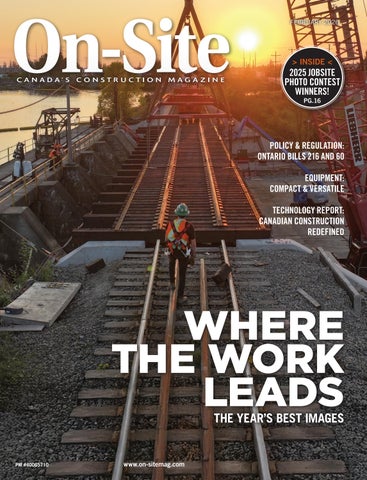
> INSIDE < 2025 JOBSITE PHOTO CONTEST WINNERS! PG.16

POLICY & REGULATION: ONTARIO BILLS 216 AND 60 EQUIPMENT: COMPACT & VERSATILE TECHNOLOGY REPORT: CANADIAN CONSTRUCTION REDEFINED
![]()
> INSIDE < 2025 JOBSITE PHOTO CONTEST WINNERS! PG.16

POLICY & REGULATION: ONTARIO BILLS 216 AND 60 EQUIPMENT: COMPACT & VERSATILE TECHNOLOGY REPORT: CANADIAN CONSTRUCTION REDEFINED


The all-new Komatsu excavator line optimizes operator comfort and performance with 30% more legroom and 50% more visibility. And it’s engineered with industry-leading technology that enhances jobsite safety and increases productivity. The result? An excavator built to stretch the limits of performance. THE ALL-NEW KOMATSU EXCAVATOR LINE


Construction has always been a human endeavour. Long before digital tools, data platforms or automated equipment entered the jobsite, it was people – the planners, trades, supervisors and builders - who turned ideas into infrastructure. That truth remains unchanged, even as technology reshapes how our industry approaches and executes projects.
Today, Canadian contractors are operating in one of the most demanding environments the industry has ever seen. Projects are larger and more complex. Schedules are tighter. Labour markets are constrained. And owners expect higher levels of certainty, safety and transparency. In response to these demands, construction technology has advanced significantly, offering new ways to coordinate work, manage risk and improve productivity. But technology alone does not build projects. People do. In light of this, the most successful contractors are not choosing between technology and labour. Rather, they are learning how to integrate the two. Digital tools can streamline processes, surface information faster and reduce administrative burden, but they rely on the experience, judgment and accountability of the people leveraging them. A concrete pour still depends on crews who understand sequencing and site conditions. Safety still depends on leaders who recognize risk in real time. Quality still comes from hands-on expertise.
Within our 2026 Technology Report, it’s made clear that today’s digital tools are at their best when they support the workforce rather than replace it, giving supervisors more time to lead in the field and helping project teams focus on planning and execution instead of paperwork. If leveraged in this way, technology poses the potential to protect and amplify human expertise while improving project outcomes.
Canada’s construction sector has always been defined by resilience, problem-solving and workmanship. And it’s these qualities that will continue to define it in the years ahead. Tools will evolve. But the heart of Canadian construction remains the same: people working together to build structures that last.
Here’s to a healthy, safe and successful 2026, and the strength of Canada’s construction professionals.
on-sitemag.com
READER SERVICE
Print and digital subscription inquiries or changes, please contact Angelita Potal
Email: apotal@annexbusinessmedia.com
Tel: (416) 510-5113
Fax: (416) 510-6875
Mail: 111 Gordon Baker Road, Suite 400, Toronto, ON M2H 3R1
PUBLISHER | Peter Leonard (416) 510-6847 pleonard@on-sitemag.com
EDITOR | Sean Tarry (416) 410-0600 starry@on-sitemag.com
MEDIA DESIGNER | Lisa Zambri lzambri@annexbusinessmedia.com
GROUP PUBLISHER | Danielle Labrie (226) 931-0375 dlabrie@annexbusinessmedia.com
ASSOCIATE PUBLISHER | David Skene (416) 510-6884 dskene@on-sitemag.com
ACCOUNT COORDINATOR | Kim Rossiter (416) 510-6794 krossiter@on-sitemag.com
AUDIENCE DEVELOPMENT MANAGER | Urszula Grzyb (416) 510-5180 ugrzyb@annexbusinessmedia.com
CEO | Scott Jamieson sjamieson@annexbusinessmedia.com
Established in 1957, On-Site is published by Annex Business Media 111 Gordon Baker Road, Suite 400, Toronto, ON M2H 3R1 Publications Mail Agreement No. 40065710
ISSN: 1910-118X (Print) ISSN 2371-8544 (Online)
SUBSCRIPTION RATES Canada $52.51 CAD (+tax) per year, United States $119.87 CAD per year, Other foreign $144.80 CAD, Single Copy Canada $13.50 CAD. On-Site is published 5 times per year except for occasional combined, expanded or premium issues, which count as two subscription issues. Occasionally, On-Site will mail information on behalf of industry-related groups whose products and services we believe may be of interest to you. If you prefer not to receive this information, please contact our circulation department in any of the four ways listed above.
Annex Business Media Privacy Officer privacy@annexbusinessmedia.com Tel: 800-668-2374
Content copyright ©2026 by Annex Business Media may not be reprinted without permission.
On-Site receives unsolicited materials (including letters to the editor, press releases, promotional items and images) from time to time. On-Site, its affiliates and assignees may use, reproduce, publish, re-publish, distribute, store and archive such unsolicited submissions in whole or in part in any form or medium whatsoever, without compensation of any sort.
DISCLAIMER This publication is for informational purposes only The content and “expert” advice presented are not intended as a substitute for informed professional engineering advice. You should not act on information contained in this publication without seeking specific advice from qualified engineering professionals.
Sean Tarry / Editor starry@on-sitemag.com


JLG Industries recently expanded its North American product portfolio with the addition of AUSA all-terrain compact equipment, bringing a new lineup of wheeled dumpers and rough-terrain forklifts to contractors working in space-constrained, material-intensive environments. The move strengthens JLG’s offering for crews supporting concrete, civil, municipal and infrastructure projects where maneuverability and reliability are critical.
The AUSA lineup includes 12 wheeled dumpers and five rough-terrain forklifts designed to handle material movement on uneven ground, narrow access routes
and active pours. JLG says the machines are engineered to support durability and productivity while complementing its existing access and telehandler portfolio.
For urban and enclosed environments, the JLG AUSA ED33 electric dumper delivers a 3,300-lb payload with low noise and zero emissions, making it well suited to indoor work and nighttime operations. Articulated and reversible dumpers extend payloads up to 22,000 lb, supporting concrete distribution, earthworks and largescale civil construction. And the AUSA rough-terrain forklifts span payloads from 3,000 to 11,000 lb, offering contractors
Cooper Equipment Rentals has announced Brian Spilak will become Chief Executive Officer effective March 1, 2026, succeeding Doug Dougherty, who will transition to Executive Chair of the Board. For Canadian contractors delivering large commercial and infrastructure projects, the move signals leadership continuity at one of the country’s most influential rental providers.

Cooper supplies heavy construction, aerial, compact, pump and power and trench safety equipment nationwide, making stability at the executive level an important consideration for multi-year project planning.
Spilak joined Cooper in 2016 and was named Chief Operating Officer in 2023, bringing to his role more than 30 years of experience working in the rental industry in operations, fleet management, customer engagement and technology adoption. Under Dougherty’s leadership since 2010, Cooper expanded to 89 branches across six provinces, surpassing $500 million in annual revenue.

additional flexibility for handling formwork, materials and supplies across challenging terrain.
JLG’s integration of AUSA equipment highlights its commitment to delivering versatile solutions, empowering contractors to tackle tight, material-heavy projects with enhanced productivity and reliability.
Ontario and the Canadian federal government recently announced the signing of a new cooperation agreement meant to significantly streamline environmental approvals for major infrastructure and resource projects under a “one project, one process, one decision” model. For contractors, the change helps to eliminate duplicative federal and provincial assessments, replacing them with a single Ontario-led environmental review.
The goal of the agreement is to ensure shorter timelines, reduced regulatory risk and faster project starts on large developments, and is expected to accelerate enabling infrastructure for Ontario’s Ring of Fire, including all-season roads and supporting civil works. A side letter commits the federal Impact Assessment Agency to complete its review of Ring of Fire road assessments by June 2026, providing clearer timelines for project proponents and builders.
By reducing overlap and improving alignment between governments, the agreement should serve to provide contractors with more predictability when planning labour, equipment and materials. For firms delivering large infrastructure projects, the move signals a more efficient approvals environment that’s designed to attract investment and get construction projects started sooner.
Canadian contractors are set to gain expanded access to machine control technology following Elationtech’s appointment as Makin’s authorized dealer in Canada.
Announced January 13, 2026, the partnership strengthens Makin’s Canadian presence while providing localized sales, service, training and technical support.
For contractors delivering foundations, slabs and structural concrete on infrastructure, industrial and institutional projects, the move reflects rising demand for precision-driven tools that reduce rework, improve productivity and support schedule certainty.
While machine control is often associated with earthworks, its influence extends to concrete as well. Accurate excavation, grading and layout are critical to achieving correct elevations, slab thicknesses and formwork alignment - factors that directly affect quality, cost control and overall

performance.
Makin’s 2D and 3D machine control solutions visualize project data in real time, enabling operators to work more accurately and efficiently. On projects that involve tight tolerances and compressed schedules, improved accuracy earlier can serve to significantly reduce delays and the corrective work that’s required later in the build.
Under the agreement, Elationtech will represent and support Makin’s solutions nationwide, offering faster response times and localized expertise - an important advantage for projects that face challenging weather, remote locations and narrow construction windows.
As labour shortages sustain and performance expectations continue to rise, machine control systems are becoming essential tools on concrete-heavy jobs. And the Elationtech–Makin partnership provides contractors with another pathway to adopt data-driven construction practices supported by local service and expertise.


The new Kubota SVL110-3 transforms the landscape in every way. With increased horsepower and high-performance attachment capability, it’s ready to tackle dense bush, challenging terrain, and whatever else dares to stand in your way. It’s also loaded with innovative new features like Auxiliary Performance System (APS) and creep mode, so you can work comfortably while you remake the world around you.

Recent Statistics Canada data reveals that Canada’s construction workforce increased modestly in September 2025, offering cautious stability for contractors working on large projects. Labour force growth outpaced employment, lifting the unemployment rate slightly to 4.6%. Gains were driven by male workers, particularly younger tradespeople, easing long-term demographic pressures. Western Canada led growth, with British Columbia posting the strongest gains on hospital and public projects, followed by Alberta and Manitoba. However, Quebec and parts of Atlantic Canada saw declines as permit activity softened, and major projects wound down.
Construction labour force up 16,500 workers (+0.9%) year over year
Employment up 11,400 workers (+0.7%)
Youth male employment (15–24) up 9,600 workers (+5.2%)
B.C. construction employment up 6.8%
institutional permits up 98%
Provincial unemployment ranged from 2.0% (Manitoba) to 10.2% (Newfoundland and Labrador)
8%
6%
firms
111,600
92% of Canadian construction costs are tied directly to U.S. imports new construction workers needed over the next decade by 2030
Global data centre investment expected to reach of construction leaders expect rising costs to impact profitability
US$7 trillion
Canada’s construction sector continued to outperform the broader economy in late 2025, even as contractors grappled with rising costs and supply chain pressures.
According to the Canadian Construction Association’s winter Construction Quarterly Economic Insights report, construction GDP grew 1.3 per cent in Q3 2025, outpacing the all-industry average, reinforcing the sector’s relative strength. Momentum is being supported by federal policy, with the 2025 federal budget committing $32 billion in new construction-related spending over the next five years, part of a larger $89.7-billion fiscal package.
Canadian construction GDP grew in Q3 2025 (+1.3%)
$32B in federal budget commitments
Canadian construction contractors face a mix of pressure and opportunity heading into 2026. HUB’s 2026 Construction Outlook recognizes that tariffs, counter-tariffs and a weak Canadian dollar are driving material cost volatility, complicating bids and financing, while labour shortages persist. At the same time, stabilizing interest rates are expected to restart stalled projects, and data centre construction is emerging as a major growth driver. Authors of the report suggest that contractors with strong risk management, flexible procurement and workforce strategies will be best positioned to protect margins and sustain growth amid ongoing uncertainty.
At the same time, cost pressures remain a key constraint. The Building Construction Price Index rose 4.2 per cent year over year in Q3, driven largely by metal fabrications, structural steel and plumbing. Factory construction costs climbed fastest, increasing 5.7 per cent, while office building costs were up 3.2 per cent. London, Ontario, and Quebec City saw some of the sharpest regional increases. reinforcing equipment rental as a strategic tool to manage risk, control capital and maintain operational agility. Despite these gains, however, CCA warns that workforce availability and escalating input costs will continue to test contractors’ capacity to deliver major projects in 2026.
Building Construction Price Index rose year over year (+4.2%)
Factory construction costs (+5.7%) rose in Q3 2025


Accelerated payments, earlier holdback release and expanded adjudication under Bills 216 and 60 are reshaping cash flow, risk and dispute management, forcing contractors and owners to rethink how projects are governed in Ontario and beyond.
BY SEAN TARRY
Ontario’s construction industry is entering one of its most consequential transitions in decades. With the enactment of Bill 216 and Bill 60, amendments to the Construction Act are changing how money flows through projects, how disputes are resolved and where risk ultimately sits.
At the centre of these reforms are mandatory annual holdback release, tightened timelines for disputing invoices and
expanded adjudication rights. While the stated goal is fairness, particularly for trades and subcontractors, the practical impact is a rebalancing of power that affects every participant in the project chain.
According to Leor Margulies, Partner at Robins Appleby and a long-time construction and development lawyer, the shift is deliberate and significant.
“The pendulum has clearly been tilted in favour of trades,” Margulies says. “And

it’s not subtle.”
For contractors delivering large projects - often multi-year, capital-heavy and tightly sequenced - the implications extend beyond compliance.
Under the amended Act, statutory holdbacks must now be calculated and released annually, rather than being retained until substantial performance or project completion. This change fundamentally alters the cash flow profile of long-duration projects.
For trades that complete their scopes early - forming contractors on high-rise or infrastructure projects being the most obvious example - the change is welcome. Funds that were once tied up for years are now released earlier.
For owners and contractors, however, this means capital leaves the project earlier, often before risks have fully played out.
“Holdback is 10 per cent of the project value,” Margulies notes. “On a large construction project, that’s a meaningful number. Releasing it earlier increases financing costs and puts pressure on cash flow planning.”

The impact is magnified on construction management projects, where owners track dozens of contracts, each with their own anniversary date and holdback calculation.
Perhaps the most disruptive change is not when holdbacks are released, but how they can no longer be used.
Traditionally, owners and contractors relied on holdback as a practical security fund - leverage to resolve deficiencies, disputed extras or incomplete work near the end of a project. That leverage is now largely gone.
“If the holdback has been properly established and certified, it must be released,” Margulies explains. “You can’t withhold it because you have unresolved issues. Those issues must be dealt with separately. Owners can no longer avoid paying a statutory holdback by publishing a notice of an intention to withhold all or part of the holdback”
This effectively decouples payment from dispute resolution, accelerating both. While this creates fairness for trades, it removes a safety valve owners and contractors used
to manage risk without escalating disputes mid-project.
Under the new rules, disputes that might once have been deferred until project closeout must now be addressed in real time. Invoice objections must be made within strict timelines. Extras must be challenged early. Deficiencies must be documented and escalated promptly. And failure to act quickly can lock in payment obligations.
“The whole dispute process has been pulled forward,” Margulies says. “You no longer have the option of waiting until the end.”
For large projects, where sequencing, interfaces and tolerances are complex, this raises practical challenges. Disputes often arise while work is ongoing. And pushing them into adjudication risks disrupting progress. However, not pushing them forward risks losing leverage entirely.
The new regime places a premium on early governance. Owners and contractors must
now invest more heavily in inspection, documentation and review during the course of the work, not after it. As a result, quality assurance must become proactive rather than retrospective.
“If you miss an issue early, and don’t object to the applicable invoice, you may still have to pay,” Margulies notes. “That forces a higher level of diligence.”
For well-resourced organizations, this may simply mean tightening processes. For smaller or less experienced contractors, it may serve to be a steep adjustment.
While well-capitalized developers with established trade relationships may absorb these changes with relative ease, the burden is likely to fall more heavily on smaller or less experienced builders.
Large developers often rely on repeat relationships and portfolio leverage. If a dispute arises, both parties may be willing to accommodate short-term compromises in anticipation of future work. That informal balance of power still exists, just not through holdback. Smaller builders, by contrast, lack that flexibility.
With the amendments already in force, contractors operating in Ontario, or bidding projects that may follow similar rules, should be reviewing the following:
Cash Flow Forecasting -Annual holdback release changes the timing of cash outflows. Update project cash flow models to reflect earlier payments and increased interest costs, especially on multi-year project scopes.
Contract Administration Capacity - More frequent holdback calculations, invoice reviews and objections mean more administration. Ensure project teams are staffed and trained to manage the added workload.
Invoice Review Discipline - Missed objection deadlines can lock in payment obligations. Tighten internal review processes to ensure invoices and extras are assessed within statutory timelines.
Quality Control and Documentation - Deficiencies must be identified early. Strengthen inspection regimes, site documentation and reporting to support timely objections and dispute resolution.
Dispute Escalation Strategy - Expect disputes to arise earlier. Decide in advance when to escalate issues to adjudication and when to resolve commercially to avoid liens or work stoppages.
Trade Relationships - Established relationships matter more than ever. Trust, communication and transparency can prevent disputes from escalating under compressed timelines.
Contract Language - Review subcontract and supplier agreements to ensure offset rights, dispute processes and adjudication mechanisms are clearly defined and enforceable.
Lender and Surety Engagement - Engage lenders early to align on revised cash flow assumptions, equity requirements and holdback funding strategies.
Bid Pricing and Risk Allocation -Reassess how financing costs, administrative burden and earlier dispute risk are reflected in project pricing, particularly on long-duration work. National Strategy - For contractors operating across provinces, monitor Ontario closely. Similar reforms elsewhere could require standardized changes to governance and risk management.

For newer or less well-heeled builders, the holdback was often the only real leverage they had. That tool is now gone.”
“For newer or less well-heeled builders, the holdback was often the only real leverage they had,” Margulies notes. “That tool is now gone.”
In these situations, failure to pay promptly, regardless of unresolved issues, can lead to immediate work stoppages. And replacing a trade mid-project, particularly in specialized scopes, is rarely feasible without cost and delay.
The result may be a widening gap between established developers and emerging players, as lenders, trades and others become more cautious about counterparties with limited balance sheet strength.
As holdback is released earlier, lenders and cost consultants become more deeply involved in day-to-day project governance.
Construction management projects, common in the residential sector, often involve dozens of separate contracts, each with its own holdback calculation and
anniversary date. Tracking, certifying and funding those releases introduces new administrative complexity and cost.
In addition, independent certifiers must now perform more frequent and granular reviews. And lenders must fund holdback releases earlier in the construction lifecycle.
“The loan amount may not change,” Margulies explains, “but the timing of when money leaves the project absolutely does.”
For lenders, this shifts the risk forward. For owners, it tightens the margin for error. As a result, cash flow forecasting must be more precise. And contingency planning becomes critical, not only for construction risk, but for financing continuity.
Over time, these changes are likely to influence how contractors price work. Accelerated cash outflows, higher interest costs, increased administrative burden and earlier dispute risk will need to be accounted for, particularly on long-duration jobs.
Extras, already the most common source

of disputes, will receive heightened scrutiny. As a result, contractors may push harder for clarity at tender stage or price risk more conservatively.
While the changes may not alter asset values, they could incrementally increase the cost of delivery, especially for projects involving less familiar counterparties.
Ontario’s approach is among the most aggressive in Canada. And other provinces are watching closely. Saskatchewan and Newfoundland/Labrador have a permissive but not obligatory system of early holdback release. Alberta has a mandatory one for contracts in excess of $25,000,000 with terms longer than one year. In fact, Margulies describes the reforms as “groundbreaking,” particularly the mandatory annual holdback release. And he suggests that other provinces facing pressure from trade associations may look to Ontario as a model.
“If Ontario can do it, others will be asked why they can’t,” he says.

That said, adoption elsewhere is not guaranteed. Provinces balancing labour fairness with infrastructure delivery pressures may hesitate to introduce similar reforms. But for national contractors, Ontario’s experience may foreshadow what’s coming.
Bills 216 and 60 mark a decisive shift in how construction risk, cash flow and accountability are managed in Ontario. For contractors working on large projects, the path forward is clear: tighter governance, earlier decision-making and stronger documentation are no longer optional. And payment, quality and dispute management must be addressed in real time, not deferred to project closeout. While the transition will challenge established practices, it will also reward discipline, transparency and well-managed relationships. As other provinces watch Ontario closely, contractors who adapt early may find themselves better positioned for a future where predictability, not leverage, defines successful project delivery.


A photographic tribute to the people, precision and perseverance behind Canada’s most demanding construction projects.
BY SEAN TARRY
Construction defines the backbone of Canada’s built environment. From urban high-rises and transit corridors to industrial facilities, bridges and critical infrastructure, construction projects demand a level of precision, planning and resilience unlike most other sectors or industries. This photo spread captures those demands in their rawest form - through moments of scale, focus and human effort that often pass unnoticed beyond the jobsite fence.
Each image tells a story of coordination under pressure. Rebar cages tied by hand in unforgiving weather. Formwork set with millimetre accuracy. Crews moving in rhythm as pours begin, knowing that timing, temperature and teamwork leave little margin for error. These are not isolated tasks, but interconnected operations where one misstep can ripple through an entire schedule. For contractors working at this scale, success is measured not only in finished structures, but in the countless decisions made correctly along the way.
The photos also reflect the realities of modern construction. Tight timelines. Complex logistics. Heightened safety expectations. And projects that grow larger and more technically demanding with each passing year. Yet within those challenges is a constant: the skill and commitment of the people onsite. Supervisors, forepersons, engineers and trades bring experience earned over decades, translating drawings into durable structures that will serve communities for generations.
This 2025 Canadian Construction Photo Contest celebrates more than impressive pours and towering forms. It honours the discipline behind the work, the pride taken in doing it right, and the teamwork required to deliver projects safely and successfully. These images are a reminder that while equipment and methods evolve, the foundation of the industry remains unchanged - people building with purpose, under pressure and with lasting impact.

In the image: As the sun sets in Kapuskasing, crews watch as the new 120-ton steel span is lowered into place, marking the first of two spans to be replaced on the Kapuskasing bridge replacement project.
Company: Construction Demathieu & Bard (CDB) Inc.
Photographer: Andreas Pandikiu
Location: Kapuskasing, Ontario
We would like to extend our sincere thanks to everyone who participated in this year’s Canadian Construction Photo Contest. From supervisors and project managers to trades and site teams, your submissions are very much appreciated. Thank you to all who took the time to share a moment from their jobsites and help tell the story of an industry that continues to shape our communities, strengthen our economy and build lasting foundations across the country.

In the image: Looking east across the geothermal footprint at Beaver First Nation, crews prepare for drilling as the administration building nears completion - work shaped by five years of planning and Northern Alberta’s extreme seasonal conditions.
Company: Krawford Construction
Photographer: Bryant Caines
Location: Child Lake, Alberta, home of Beaver First Nation
In the image: The Ventana Construction team overlooking a massive concrete pour, with pump trucks, concrete deliveries and a crane in motion - capturing a moment of scale, coordination and wellearned team pride.
Company: Ventana Construction Corporation
Photographer: Matthew Marsolais
Location: Burnaby, British Columbia


In the image: Sunlight breaks through the clouds over the Autoroute 30 project as crews pour concrete onto a newly installed joint section, highlighting active construction and steady progress on the busy jobsite.
Company: Construction Demathieu & Bard (CDB) Inc.
Photographer: Andreas Pandikiu
Location: Brossard, Quebec
In the image: BOT crews work on the Hwy 17 Rainbow Falls curve realignment and Hewitson Creek culvert replacement near Schreiber, Ontario - a $38 million remote project involving major earth and rock excavation.
Company: BOT Construction Group
Photographer: BOT Construction Group
Location: Schreiber, Ontario


In the image: EllisDon crew dismantles a crane at Vancouver’s PNE after lifting a 105-metre free-span timber roof, marking completion of major structural work on the new 10,000-seat Freedom Mobile Arch.
Company: EllisDon
Photographer: Take Off Photography
Location: Vancouver, British Columbia

In the image: The formwork of the West, Central and East cores is prepared for the next concrete pour, while the CLT supports are carefully positioned and ready for the upcoming floor assembly and construction sequence.
Company: Kinetic Construction Ltd.
Photographer: Mike Ounsted
Location: Vancouver Island, British Columbia
In the image: This concrete pour, in a world of its own, took place at Syncrude, based north of Fort McMurray, showcasing scale, precision, coordination, challenging conditions and the effort behind industrial construction.
Company: Graham Construction
Photographer: Zak Thomson
Location: Syncrude, north of Fort McMurray, Alberta


In the image: Captured during a sunny visit to Cade Barr BusinessPark, Mission, B.C., this image shows the steel structure of a new light industrial facility, representing significant growth that’s helping to shape local employment opportunities.
Company: Orion Construction
Photographer: Luiza Lima
Location: Mission, British Columbia

In the image: The first truck of a 997 m³ concrete pour delivers material for the Level 1 north suspended slab, including a 5’-deep transfer slab, while crew members manage pumping and vibration on Park Residence 2.
Company: Urban One Builders
Photographer: Mark Mirsaidi
Location: Richmond, British Columbia
In the image: A large urban demolition site shows excavators breaking down reinforced concrete, with hydraulic attachments reducing slabs and columns, dust suppressed by water and debris loaded for removal - preparing the site for major redevelopment.
Company: Delsan-AIM
Photographer: Anthony Caccese
Location: Montréal, Quebec


In the image: Taken late on a beautiful September morning, this photo captures a massive concrete pour below, with the Canadian flag flying high against the BC mountains - a moment proudly framed by the general contractor.
Company: Ventana Construction Corporation
Photographer: Matthew Marsolais
Location: Burnaby, British Columbia
In the image: BOT crews construct the William Halton Parkway bridges over Sixteen Mile Creek in Oakville, Ontario using balanced cantilever, cast-in-place segmental concrete. Dual form travelers advance from 38-metre piers, maintaining structural balance.
Company: BOT Construction Group
Photographer: Paul McCullough Location: Oakville, Ontario


In the image: Sunset frames stacked rebar cages on a construction site, revealing symmetry, precision and scale behind concrete foundations, where preparation, craftsmanship and quiet moments precede the pour at dusk.
Company: Graham Construction
Photographer: Chennoa Tracey Location: Maple Creek, Saskatchewan
In the image: As the seasons change, so too does the new Iles-Aux-Tourte Bridge, as construction roles on. In this picture, we see the steel installed for the bridge, and formwork being installed so that concrete can be poured to construct the new structure.
Company: Construction Demathieu & Bard (CDB) Inc.
Photographer: Andreas Pandikiu Location: Senneville, Quebec


In the image: An operator uses a Hitachi ZX350 excavator to load a Caterpillar 730 rock truck in Wood Buffalo, Alberta, removing spoil for a coarse tailings road crossing at an oil sands mine, reflected in rainwater.
Company: Primoris Services Corporation
Photographer: Robb Williamson
Location: Wood Buffalo, Alberta
In the image: The takedown crew pausing on the crane shaft during dismantling, taking the opportunity to enjoy the Vancouver shoreline view - a fleeting platform, momentarily theirs, earned by the very hands taking it apart.
Company: Ventana Construction Corporation
Photographer: Matthew Marsolais
Location: Vancouver, British Columbia


In the image: One of the final trains crosses Etobicoke Creek Bridge before a major track closure, as crew members leave the site to prepare for a 50-hour window replacing two bridge spans.
Company: Construction Demathieu & Bard (CDB) Inc.
Photographer: Andreas Pandikiu
Location: Etobicoke, Ontario


From AI-enabled
skid
steers to next-generation compact excavators, manufacturers are packing versatility, maneuverability and semi-autonomous technology into machines designed for tight urban jobsites, proving that size isn’t everything when it comes to productivity.
BY NATE HENDLEY
Manufacturers of compact construction equipment have recently introduced new machines, features, upgrades and a first-of-its-kind solution built around artificial intelligence (AI). The prevailing attitude is that small machines can still make a big difference.
Compact machines offer “the ability to work in tight spaces with strong maneuverability, impressive versatility through attachment options and easy transport between jobsites,” says Ryan Anderson, Product Manager, Subcompact Equipment, CASE Construction Equipment.
“These machines excel in tight or restricted-access environments, such as residential backyards, urban infill lots, utility corridors or interior demolition sites,” adds Kyle Emanuel, Product Information Specialist at Bobcat. “They’re lightweight, easy to transport and quick to reposition, allowing operators to complete tasks more efficiently and with less disruption.”
When it comes to specific compact
machine types, “skid steers are often the first machines people think of for work in tight spaces. Compact excavators and wheel loaders also offer some key advantages,” notes Darren Ashton, Product Manager –Compact Equipment, Volvo Construction Equipment.
Also called compact utility loaders, small-size skid steers are prized for their narrow width, low weight, versatility and maneuverability. Their ability to “skid” across terrain and turn in tight quarters make them ideal for working in cramped or hard-to-access jobsites.
Adaptability is another major factor behind the popularity of compact machines.
“Versatility will continue to drive the category forward,” says Brant Kukuk, Compact Equipment Product Manager at Ditch Witch. “A single machine that can trench, lift, grade and move debris allows smaller crews to take on more jobs in a day.”
In terms of trends, there was “a huge push two, three years ago” for electrification in the compact equipment segment, but
interest has “quieted a little bit,” says Jonathan Gardner, Product Manager, Construction Equipment, at Kubota.
Electric machines require recharging every few hours, which isn’t conducive to doing long shifts. Considering that, electric machines work well in some niches and remain an eco-friendly alternative to diesel.
“We still see a lot of potential and value in electrification and the journey to low or zero emission jobsites which compact equipment lends itself to nicely,” says Ashton.
In a similar fashion, the ballyhoo about fully autonomous equipment has receded somewhat in recognition of workplace realities. “Autonomous is still a tough sell in construction, because there’s a lot of moving pieces out there. The thing that we do see coming is semi-autonomous machines,” states Gardner.
On this latter point, there is widespread agreement.
Ashton says he “expects to see onboard systems and intuitive technology handle more of the heavy lifting for the operator.

With the industry-wide shortage of experienced operators, machines need to be easier to learn. I think we’ll see more of the semi-autonomous functions from larger machines - like automated grading or returnto-dig functions - make their way to smaller models as the costs of those technologies come down.”
Bobcat, meanwhile, unveiled a revolutionary AI-enabled solution for compact equipment called Bobcat Jobsite Companion at the CES 2026 global technology show in Las Vegas this January. Jobsite Companion can respond to verbal questions and commands, provide recommendations and automate over 50 functions without the operator taking their hands off the controls.
This system “delivers the most significant interface evolution in nearly two-decades,” states Emanuel.
With all of this in mind, here’s a look at what’s new and/or noteworthy in compact construction equipment:
Case is set to display its latest compact wheel loader, the 321G, at CONEXPO 2026.
“The new 321G features the spacious cab of the larger 421G, with upgraded controls, an ergonomic seat-mounted joystick and improved cab access. It’s the ideal step up for crews needing more load-carrying capability than a skid steer,” says Anderson.
The 321G has a 74 hp engine, 1.3-yard bucket and road speed of 25 mph (other specs haven’t been released yet). For its part, the newly launched 421G weighs 19,775 pounds, with a 112 hp (82 kW) engine and lifting capacity of 15,806 pounds.
CASE will soon be introducing a 221G compact wheel loader with the same cab and control upgrades as the 321G and a TL100EV electric mini track loader. Offering quiet, emissions-free operation and the same performance as a diesel, the TL100EV is well-suited for indoor demolitions or projects near hospitals and schools.
CASE has upgraded its B Series skid steers and compact track loaders, adding a rear-object detection system that alerts operators when they approach an obstacle. Another upgrade involves a new bi-direc-
tional self-leveling solution that automatically keeps the attachment level when the boom is raised or lowered.
Other CASE innovations include EZ Trac - a “maintenance free smart suspension system for select compact track loaders,” says Anderson.
EZ Trac boasts a rigid-mounted undercarriage with rollers on pivoting bogeys to maintain track contact with the ground, enhancing traction, stability and ride comfort, particularly on slippery or rough terrain, which is available on some CASE compact track loaders.
Volvo Construction Equipment recently launched three new-generation compact excavators as part of its CONEXPO 2026 preview.
The ECR90 short-swing, EC65 crawler and EW65 wheeled excavator offer more engine power, digging and lifting force and higher auxiliary flow than their predecessors.
“They’re also well-suited for tiltrotators, so an operator can perform complex tasks without repositioning the excavator, saving

time and fuel,” says Ashton.
Tiltrotators enable 360-degree rotation and 45-degree attachment tilting, which means operators can perform complicated tasks without the need to reposition their excavator. In addition, the three new compact excavators feature bigger fuel tanks and extended service intervals (1,500 hours for hydraulic return filter changes and 8,000 hours for Diesel Particulate Filter cleaning). Interior updates include an eight-inch touchscreen, Bluetooth pairing and optional air suspension seats.
The ECR90 has an operating weight of 19,340 – 23,170 pounds and 73 hp (54 kW) of gross power while the EC65 weighs 12,680 – 15,020 pounds with 62 hp (46 kW) of gross power. The EW65 comes in at 13,490 – 16,320 pounds with a gross power of 67 hp (50 kW).
Volvo also offers an EC27D compact excavator, which weighs 6,019 pounds, features over 9,400 lbf (42 kN) of combined digging force and was “engineered for contractors who need big machine capability in a compact footprint. It represents a great choice for use on utilities, residential
construction and precision grading,” says Ashton.
Special features on the EC27D include auto-idle and auto-engine shutdown (engine speed is automatically reduced or shut down when the controls are inactive for a time) and CareTrack, Volvo’s telematics solution.
Weighing only 2,892 pounds and coming in at just 71.4 inches tall and a mere 36 inches wide with bucket, the S70 is by far the smallest skid-steer loader in Bobcat’s lineup.
“Its size is what makes it indispensable. Measuring just under three feet wide, it can pass through gates, alleys, narrow pathways and interior building openings where larger machines simply cannot go,” says Emanuel.
With a tipping load of 1,520 pounds and a low-range travel speed of 10.1 km/h, the S70 skid-steer loader can be used for residential construction (including basement cleanouts and backyard work), utility installation (including site cleanup and trench backfilling), interior demolition (including debris removal and transporting material through doorways) and a range of general construction chores such as loading and unloading materials and prep work in tight spaces.
Bobcat also offers the S450, S510 and S590 small-frame skid-steer loaders which can perform material handling, digging, site preparation, debris cleanup and grading.
“Their compact size, tight turning radius and simple controls make them ideal for residential, utility and urban jobsites where space is limited. With a wide selection of attachments, operators can move quickly between tasks and get more done with one machine,” says Emanuel.


The S450 weighs 5,370 pounds and measures 77.8 inches tall and 62 inches wide with bucket, while the S510 comes in at 6,208 pounds, 77.8 inches tall and 68 inches wide with bucket. The S590 weighs 6,765 pounds, is also 77.8 inches tall and 68 inches wide with bucket.
The S450, S510 and S590 feature two-speed travel, Power Bob-Tach which allows operators to quickly change attachments from the cab, rearview camera options and automatic ride control.
This January, Kubota Canada Ltd., unveiled the new SVL65-2 and SVL110-3 compact track loaders.
With an operating weight of 8,631 pounds, a width of 65.2 to 67.6 inches and height of 79.9 inches, the SVL65-2 features a seven-inch LCD monitor and LED work lights with a delayed auto turn-off function (to ensure the operator can safely exit). The CTL is also fitted with Work Smart telematics and a heated air ride seat, as well as vertical arms that reach a maximum bucket hinge pin height of 118.5 inches.
The SVL110-3 weighs 12,322 pounds, has a width of 81 inches with bucket and is 83.1 inches high. In addition to an LCD monitor and Work Smart telematics, this machine features seamless Bluetooth radio integration and creep mode (a first for Kubota CTLs, creep mode enables precise speed adjustments).
In addition, standard rear-view cameras on the SVL65-2 and SVL110-3 enhance operator comfort and safety. Both machines can also be fitted with Kubota Shockless Ride to cushion travel for the operator over rough terrain.
Ditch Witch’s stand-on skid steers feature a rear platform for operators, giving them an unobstructed 360-degree view and easy access and egress.
Stand-on skid steers are “a strategic tool for contractors who need to get more work done with limited crews,” explains Kukuk.
Ditch Witch’s new SK1000 stand-on
skid steer is 56 inches tall and 105 inches long, with a wheelbase of 43 inches and a weight of 3,140 pounds. Diminutive but mighty, this machine has a weighted tipping capacity of 3,222 pounds and a weighted operating capacity of 1,356 pounds.
The versatile SK1000 can be fitted with a range of attachments and is “well-suited for construction applications where contractors need higher lift capacity and hydraulic performance without sacrificing access, visibility and efficiency,” continues Kukuk.
Larger Ditch Witch stand-on skid steers include the SK3000, with an operating weight of 7,600 pounds, a tipping load of 8,863 pounds and 59 hp (44 kW) of power.
These larger stand-on skid steers “afford contractors with the horsepower and weight to lift and move heavier loads across the jobsite,” says Kukuk.
Compact equipment continues to evolve beyond size, combining maneuverability with smarter technology and growing capability. As urban density increases and labour remains constrained, these machines are proving that productivity gains don’t always require bigger iron, just better design and smarter tools.
For contractors, that evolution translates into faster setup, greater versatility and the ability to complete more work with smaller crews. In a market defined by tight schedules and thin margins, compact iron is becoming a strategic advantage rather than a compromise.


Sized right for tight spaces. Steel-built for heavy-duty work. With groundbreaking power in a nimble package, Takeuchi Compact Excavators are proof positive that it’s not the size of the machine in the work, it’s the size of the work in the machine.
THE MARK OF TOUGHNESS


As labour tightens and project complexity grows, AI agents are being deployed as digital crew members to protect schedules, margins and safety.
BY SEAN TARRY


The Canadian construction industry is no stranger to pressure. Labour shortages persist. Project values continue to climb into the billions. Construction projects are more complex, more regulated and more schedule-driven than ever before. At the same time, owners, insurers and financiers are demanding unprecedented levels of transparency, reporting and predictability.
Against that backdrop, artificial intelligence - long discussed in abstract or experimental terms - is beginning to move out of the lab and onto the jobsite.
That shift was the focus of a recent industry webinar hosted by On-Site Maga-
zine, bringing together technology leaders and practitioners to explore a fast-emerging concept: AI agents, also known as agentic AI.
Moderated by David Bowcott, Executive Vice President at PLATFORM Insurance, the panel featured Nolan Frazier, Head of Sales for Procore Canada; Jeff Weiss, Chief Revenue Officer at CMiC; and Nick Thompson, Chief Estimator (Calgary Area) at EllisDon.
While much of the industry conversation to date has centred on generative AI - tools that summarize, draft or answer questions - the panel argued that AI agents represent something fundamentally different: a new layer of digital labour that actively executes work inside real construction workflows.
For contractors delivering complex projects, that distinction matters.
Bowcott opened the discussion by grounding the conversation in a reality most contractors recognize immediately: modern jobsites generate enormous volumes of data.
Project management platforms, BIM models, schedules, IoT sensors, reality capture, supply chain systems, safety reports, quality documentation, emails, drawings and risk data now form a sprawling digital footprint around every project. Over the past two decades, construction has
steadily digitized but has struggled to fully capitalize on that data.
“We don’t have a knowledge problem,” Bowcott observed. “We have a capacity and consistency problem.”
Despite having access to more information than ever, project teams remain overwhelmed by administrative work: chasing RFIs, updating logs, reconciling cost and schedule data, producing reports and managing compliance. The result is not a lack of insight, but a lack of time to act on it.
This is where AI agents enter the picture.
Frazier drew a clear line between today’s most common AI tools and what comes next.
“Most of the AI we see in construction today is generative,” he said. “It summarizes information, drafts content or answers questions. That’s useful - but it’s passive.”
Generative AI still relies on people to prompt it, interpret outputs and follow up. AI agents, by contrast, are continuous, task-oriented and proactive.
“Agentic AI monitors workflows, enforces follow-through, escalates risk and takes routine execution work off people’s plates,” Frazier explained. “Generative AI helps people think. Agentic AI helps people work.”
For contractors managing concrete pours, lift sequencing, inspections and coordination
embedded inside construction operations.
“The opportunity isn’t AI as a chatbot,” Weiss said. “It’s AI as a role-based digital staff member - project controls assistants, cost analysts, safety monitors - working alongside people.”
Unlike traditional analytics tools, these agents don’t just surface insights; they take action. They reconcile data, flag deviations, update forecasts and escalate issues when thresholds are crossed.
For construction projects, where sequencing, material availability, curing windows and inspection timing are tightly interdependent, this capability directly impacts productivity and risk.
“What contractors are asking for isn’t smarter dashboards,” Weiss noted. “They want fewer surprises, better predictability and protected margins.”
In that sense, AI agents function less like software and more like a dependable junior team member - one that never forgets to follow up.
The timing of agentic AI is not accidental. As the panel emphasized, Canadian construction faces structural constraints that cannot be solved by hiring alone. “More projects. More regulation. Fewer
“We’ve deployed automated HSE trend analysis, carbon reporting tools, emissions classification engines and we’re working on predictive cost forecasting, too.”
- Nick Thompson, EllisDon
across dozens of subcontractors, this distinction is critical. Delays and cost overruns rarely stem from one catastrophic event; they accumulate through dozens of small, missed follow-ups.
AI agents are designed to prevent that bleed.
Jeff Weiss framed AI agents not as features or dashboards, but as digital employees
experienced people,” Frazier said. “You can’t scale execution by scaling headcount anymore.”
And as projects become more complex, this challenge is magified. They’re labour-intensive, schedule-sensitive and unforgiving of coordination failures. Agentic AI offers a means by which to scale execution capacity without scaling workforce size, by absorbing administrative and coordination tasks that consume experienced supervisors’ time.
Nick Thompson underscored that this shift is already underway at EllisDon.
“AI in construction is finally operational rather than experimental,” he said. “These aren’t pilots. These are functioning agentic tools we’re using across the business.”
EllisDon’s approach highlights a core theme repeated throughout the discussion - AI agents are only as powerful as the data foundation beneath them.
Over several years, EllisDon has invested heavily in modernizing its data environment, building what Thompson describes as a unified ontology - a structured way of connecting safety, schedule, estimating, cost, logistics and field data into a single operational view.
That foundation, built using Palantir Foundry, enables AI agents to operate across traditionally siloed systems.
“We’ve deployed automated HSE trend analysis, carbon reporting tools, emissions classification engines and we’re working on predictive cost forecasting, too,” Thompson said. “The productivity gains have been significant.”
For the purposes of estimating, Thompson outlined a powerful emerging use case involving AI agents that are trained to analyze historical project benchmarks and generate conceptual estimates and preliminary schedules using high-level project parameters.
“The agent can find the most comparable projects, apply real ratios and statistics and produce an early-stage estimate,” he explained. “From there, it can generate scopes of work and risk registers.”
The implication is not replacing estimators but dramatically accelerating early decision-making.
Across the panel, there was strong consensus on where contractors see the fastest, most tangible returns from AI agents today.
The answer: repetitive, time-sensitive and high-risk processes.
RFIs and submittals were cited repeatedly. Projects rarely fail because of one major unresolved RFI; they suffer through dozens of late or forgotten ones. AI agents can monitor aging, identify critical-path impacts, and escalate issues automatically.
Other high-value areas include:
• Daily field logs and reporting
• QA/QC inspections
• Materials and logistics coordination
• Schedule and cost reconciliation
• Compliance documentation
On concrete projects, Weiss noted, agents can be especially effective at monitoring pour readiness, sequencing risks and dependency conflicts - areas where delays cascade quickly.
“The productivity loss isn’t in the pour itself,” he said. “It’s managing everything around it.”
Safety was another recurring theme during the discussion, particularly given the risks inherent in construction operations involving lifting, traffic management and changing site conditions.
The panel was unanimous in suggesting that AI should never replace human accountability for safety. However, AI agents can play a powerful advisory role.
“Most incidents aren’t sudden,” Frazier said. “They’re the result of pressure and inconsistency over time.”
AI agents excel at monitoring adherence to safety processes, detecting early warning signals and escalating concerns sooner. They can analyze patterns across incidents, nearmisses and site conditions - something no individual supervisor can do continuously.
Thompson emphasized that EllisDon views AI as a safety partner, not a decision-maker.
“Site leaders must retain full responsibility,” he said. “But predictive models are incredibly valuable.”
Technology adoption has long been a challenge in construction, particularly in the field. The panel stressed that AI agents will
“People don’t resist technology, They resist friction.” - Nolan Frazier, Procore
fail if they feel like “one more tool to manage.”
“People don’t resist technology,” Frazier said. “They resist friction.”
Successful adoption starts with a clear strategy, focused use cases and early wins that visibly reduce workload. Crucially, AI agents must give value back to the field - not just to head office.
Weiss noted a key shift. For years, site teams were asked to enter data primarily so management could extract insights. AI agents reverse that equation by turning good data entry into immediate, tangible benefits for the people doing the work.
“That’s the ROI finally coming home to roost,” he said.
One of the most pointed questions about the use of AI in construction addressed the fact that many organizations lack the data foundations required for AI success. The panel did not hesitate with their answer.
“Data, data, data,” Thompson said. “Structure and consistency matter.”
However, the panelists, including Thompson, pushed back on the idea that data must be perfect. Contractors don’t need to standardize every workflow; they need enough guardrails to create usable, comparable information across core processes.
Summary-level data, such as work hours per million dollars, general conditions percentages or productivity ratios, can deliver significant value even when granular data remains messy.
Standing still, the panel agreed, is the bigger risk.
Unlike large ERP implementations, AI agents are expected to demonstrate ROI quickly, often within weeks or months.
“If AI doesn’t show up in margin fast, it won’t survive,” Weiss said.
Labour hours saved, reduced rework, improved forecast accuracy and fewer latestage surprises are the metrics contractors are watching. Importantly, agents can be tested, refined or abandoned with relatively low cost to the business, supporting a “fail fast” approach.
However, the panelists all caution that even while considering the immense potential that AI poses in becoming a significant decision-maker for the business, leaders must maintain focus and control. On the issue of accountability, the answer was unanimous - humans remain very much responsible for outcomes.
AI agents support decisions; they do not make them. Contractors must audit outputs, maintain human oversight and treat AI as a tool, not an authority.
As the discussion concluded, one theme stood out - the fact that agentic AI is not a future concept, it’s an operational reality for leading contractors today.
For Canada’s construction builders, the opportunity presnted by AI is not about replacing skilled trades or automating physical work. It’s about protecting time, preserving experience and scaling execution in an industry that cannot hire its way out of constraint.
To help achieve these gains, AI agents are emerging as a new kind of crew member - digital, tireless and increasingly indispensable. And the contractors who invest now in ensuring clean data, stable workflows and thoughtful adoption may find themselves with a decisive advantage in fewer surprises, safer sites and projects delivered with greater confidence in an increasingly unforgiving environment.
As Bowcott summarized, productivity is no longer optional. It is the only lever left. And AI agents may be the strongest hand the industry has yet been dealt.
As
BY SEAN TARRY
On any major Canadian project, whether it’s a downtown high-rise, a transit expansion, or a remote industrial facility, concrete work sets the tone. Once it’s poured, embedded, or enclosed, mistakes become expensive lessons. For decades, contractors relied on drawings, site walks and fragmented photo records to track progress and verify conditions. Today, that reality is changing fast.
Reality capture and visual intelligence technologies are transforming how jobsites are documented, understood and managed. What began as a way to take better photos has evolved into something much more powerful - a data-rich, spatially aware view of construction that supports real decision-making in real time.
“Nothing is more valuable than real reality information about what’s actually happening on your jobsite,” says Michael

Fleischman, Co-Founder and CTO of OpenSpace. “But the future isn’t just capturing data - it’s helping teams act on it.”
For Canadian contractors facing tight schedules, labour constraints and weather-driven disruptions, that evolution is arriving at a critical moment.
The origin of OpenSpace – one of the leaders in the development of reality capture and visual intelligence platforms - starts far from construction. Fleischman’s background is in cognitive science and artificial intelligence, with earlier work spanning machine learning, computer vision and social media analytics. The spark for OpenSpace came from a simple frustration - trying to understand a physical space remotely.
That challenge turned into a realization
once OpenSpace’s founders began testing their technology on construction sites.
“It became very apparent eaerly on that this technology fit a real need in construction, arguably more than anywhere else,” Fleischman says.
The company’s early focus was straightforward reality capture - using 360-degree cameras to create walkable, time-stamped visual records of a jobsite. But as adoption grew, so did expectations.
“We’ve transitioned from a point solution into what we call a field-focused visual intelligence platform,” Fleischman says.
And it’s a shift, he goes on to explain, that rests on three pillars:
Richer data capture – expanding beyond 360-degree cameras to include drone imagery and, increasingly, mobile phone photos that would otherwise live briefly in text messages before disappearing.

Deep integrations – connecting visual data into systems contractors already rely on, such as Procore and Autodesk, to support a single source of truth.
AI-driven analysis – turning images into insights, such as automated progress tracking and early detection of issues.
OpenSpace’s acquisition of progress-tracking firm Disperse accelerated that last pillar, enabling the company to quantify work in place - how much drywall is installed, how zones are advancing - and connect that intelligence to scheduling, quality and payment workflows.
Canada’s construction environment amplifies the true value of visual intelligence. Projects across the country are often remote, weather-exposed and spread across vast geogra-
phies. Travel to sites can be costly, slow, or unsafe, especially during winter shutdowns or seasonal transitions.
“In many ways, remote access is core to what we do,” Fleischman says. “OpenSpace really came of age during the pandemic, when suddenly every jobsite needed to be remotely accessible. That same value applies to inclement weather or isolated regions.”
By creating a continuously updated visual record, contractors can review conditions, verify installations and resolve questions without putting boots on the ground. That capability is particularly valuable for concrete-intensive work that often involves inspections, embeds and sequencing decisions requiring multiple stakeholders to weigh in.
OpenSpace’s global footprint, now spanning more than 80,000 projects across
125 countries, has proven the technology’s resilience.
“We’re used everywhere from high deserts to Antarctica,” Fleischman asserts. “That range of weather forces the platform to work and perform under extreme conditions.”
At PCL Construction, one of Canada’s largest contractors, reality capture isn’t treated as a single technology but as a spectrum of tools. Marcelo Borges, ICT Manager for Construction Engineering at the company, is clear that value depends on alignment.
“Reality capture is a broad term - it can mean everything from a simple mobile photo to drone flights or full 360-degree video,” Borges says. “Each approach has a different purpose, and each delivers value in different ways depending on the problem we’re trying to solve.”
For PCL, tangible ROI shows up in several key areas:
Earthworks validation/logistics planning - Drone imagery provides near-real-time snapshots of excavation progress, helping teams plan staging, layouts and sequences with confidence.
High-fidelity building scans - Creating detailed digital records of completed buildings delivers long-term value for owners, supporting maintenance and future renovations.
Cultural and specialty project - Even niche applications such as scanning sculptural elements demonstrate how these tools preserve detail and document conditions accurately.
Borges, however, is equally clear about where reality capture doesn’t necessarily deliver value.
“Problems arise when the wrong tool is applied to the wrong task,” he says.
Under-delivery, he explains, leads to missing information; over-delivery creates data waste that teams can’t realistically use.
The lesson, he notes, is right-sizing. Visual intelligence works best when workflows are designed intentionally, not when technology is layered on without purpose.
The real shift happens when contractors move from basic documentation to AI-driven visual intelligence. For PCL’s concrete- and steel-intensive projects, that shift has significantly changed daily decision-making.
“What used to be hundreds of unstructured photos is now a consistent, walkable capture of the entire site,” Borges says, explaining that teams no longer waste time searching for images or re-walking areas to confirm conditions.
The impact shows up in three practical ways:
Faster coordination - Stakeholders can review the same verified visuals remotely, reducing site visits and accelerating RFIs.
Earlier issue detection - Comparing reality capture against 3D models flags problems before they turn into rework.
New habits - Superintendents, coordinators and inspectors increasingly check conditions virtually first, using visual data as a shared source of truth.
“Those behaviours weren’t part of the original plan,” Borges admits, “but they’ve become some of the most valuable outcomes.”
Both Fleischman and Borges emphasize that visual intelligence only delivers full value when it integrates seamlessly with existing systems. Contractors don’t want another silo - they want clarity.
“No one wants double entry,” Fleischman says. “If something


happens in OpenSpace, it needs to be reflected in Procore, Autodesk or whatever system is managing the project.”
Progress tracking data tied directly to schedules, ERP systems or payment workflows opens the door to faster updates and fewer disputes. Borges echoes that sentiment from the contractor’s side.
“Data delivers the most value when everyone is using the same information,” he says. “If only the GC uses it, it becomes a silo. When trades, inspectors and owners rely on it, too, coordination improves dramatically.”
Despite the sophistication of today’s platforms, however, both Fleischman and Borges point to the same conclusion – the fact that technology is the easy part and that a company’s culture is what ultimately determines success.
For PCL, adoption improves when reality capture is treated as part of the workflow, not an added task. Transparency must be framed as a strength, not a threat, and teams need to trust that visibility will be used for improvement rather than blame.
“You don’t need everyone on day one,” Borges says. “A few champions drive adoption faster than any mandate.”
Fleischman agrees, adding that AI should be seen as an amplifier, not a replacement, framing it with a pop-culture analogy.
“AI in construction is much more Iron Man than Terminator,” he says. “It’s about giving people superpowers - helping them do more than they could do before - not taking them out of the equation.”
Looking ahead, both see visual intelligence becoming more proactive and more embedded in daily work. Progress tracking will become faster and more granular. AI agents will operate in the background, automatically locating issues, creating records and surfacing justin-time insights. And wearable technologies, such as smart glasses, could further reduce friction, capturing images hands-free and feeding spatial data directly into project systems.
For Canadian contractors managing complex scopes under intense pressure, the promise is compelling - fewer surprises, faster decisions and a clearer picture of reality, no matter where the jobsite sits on the map. And as visual intelligence continues to mature, it’s becoming clear that the most competitive builders won’t just operate efficiently - they’ll see, understand and act on their jobsites with unprecedented clarity.

Protect the Fee: Median 4% increase in profit margins.
Defend Cash Flow: Automate “Proper Invoice” compliance.
Beat the Weather: 83% reduction in project delays.

Looking back at KPMG Canada’s digital maturity report, the industry’s early bets on technology now read as a necessary response to pressures and rising complexity, signalling where construction is headed.
BY SEAN TARRY
When KPMG Canada in collaboration with the Canadian Construction Association released its digital maturity report in Summer 2025, it landed at a moment of reckoning for the construction sector. Labour shortages were acute, supply chains were unstable, and productivity gains were elusive, all while the demand for housing and infrastructure was accelerating.
Looking back now, the report reads less like a snapshot of disruption and more like an early signal of a structural shift still unfolding. The findings captured an industry beginning to accept a hard truth - without technology, Canadian construction will struggle to keep up with the work ahead.
Nowhere is that sentiment more evident than on large projects, where sequencing errors, labour constraints and rework risk compound quickly. As a result, the industry is moving rapidly toward technology as a means to address these pressures. As the report documents, Canadian construction is no longer dabbling in digital tools but preparing to depend on them.
At the time of the report, construction leaders were already feeling squeezed by labour availability, rising material costs, tighter schedules and heightened expectations from

owners and regulators. What stood out was how decisively attitudes toward technology had shifted.
Fully 90 per cent of construction leaders agreed that digital tools, ranging from BIM and analytics to AI and digital twins, were essential to boosting productivity and labour effectiveness, up from 86 per cent just two years earlier. The increase signalled a move away from debate and toward execution.
For contractors delivering complex jobs involving embeds, logistics, curing cycles and inspection readiness that leave little room for error, this consensus marked an inflection point. The industry was no longer asking if technology mattered, but how quickly it could be scaled.
Labour has been the clearest recent accelerant of digital adoption. The report found that 78 per cent of construction companies were experiencing skilled labour shortages, down from 90 per cent in 2024, but still critically high.
Nearly 73 per cent of leaders anticipate that meeting demand will become even more difficult over the next five to ten years as retirements begin to outpace recruitment. Further, an overwhelming 70 per cent stated that shortages were already affecting their ability to bid on work or meet deadlines.
What the report made clear, however, is that technology adoption has never been about replacing workers. It is about extending their reach, enabling fewer people to manage more scope with greater confidence and less rework.
One of the report’s most consequential findings - the fact that technology investment has already been delivering returns - has aged quite well. Eighty-one per cent of construction companies reported that recent digital investments had improved labour productivity and efficiency.
For construction projects, these gains tend to surface in practical ways:
• More accurate quantity tracking and progress verification
• Fewer site revisits and manual measurements
• Earlier identification of issues before they are buried in concrete
• Improved coordination between field teams, consultants and owners
The message from the report was clear then, and it remains so today - that when technology is implemented by organizations with intent and integrated into workflows, it pays off.

The report also captured an industry grappling with supply chain instability. Concrete, steel and critical materials have been subject to recent delays, pricing swings and unpredictable availability constraints that traditional planning methods struggle to absorb.
In response, 56 per cent of respondents identified demanddriven supply chain innovation as their top technology priority for 2026, reinforcing the need for tools that align procurement with real-time project needs.
Recent subsequent shocks, from geopolitical instability to trade friction, have only reinforced the logic behind that investment. On larger projects, where pour schedules and staging constraints often amplify risk, predictability has become as valuable as efficiency.
Rather than chasing a single solution, contractors are spreading investments across multiple technologies. Fifty-three per cent ranked prefabrication and modularization as a top priority, while the same percentage prioritized AI-driven software. Forty per cent are exploring robotics and drones.
For most construction projects, prefabrication stands out as a practical lever to reduce site labour, improve quality and compress schedules.
The report also acknowledged the fact that technology adoption depends heavily on procurement. Encouragingly, 78 per cent of respondents stated that procurement processes were beginning to change in ways that support greater innovation, while 43 per cent identified clients as being highly influential with respect to their technology decisions.
Even as technology advances, the report highlighted a structural issue that digital tools alone cannot solve. A striking 84 per cent of construction leaders across the country called for the elimination of interprovincial trade barriers as quickly as possible as a means to ensure their competitiveness.
Operating under multiple provincial regimes adds friction, cost and delay, particularly for national contractors delivering large, complex infrastructure and institutional projects. While technology can be leveraged to mitigate some of the inefficiencies, the report made clear that policy reform is a necessary companion to digital progress.
With the luxury of hindsight, it’s clear to see that the KPMG report captured a sector crossing an important threshold, with 87 per cent of leaders agreeing that advanced technologies are essential tools to be used in order to meet rising demand. But it also offered a caution of sorts - that investment in technology is only the beginning.
Real returns depend on integration, change management and upskilling. As Canada enters a new era of nation-building, one conclusion stands out - the fact that the future of construction will be shaped not only by concrete and steel, but by data, digital tools and smarter ways of working.

At the same time, the persistence of lowest-price procurement was flagged by the majority of respondents as a limiting factor and one that continues to challenge contractors’ ability to invest confidently in digital capabilities.

By Jacob Stoller

Accurately representing the dynamic complexity of a construction site has been perhaps the greatest challenge for construction technology. New developments in AI show potential to make that easier.
n his keynote in January at the 2026 Consumer Electronics Show (CES) in Las Vegas, NVIDIA CEO Jensen Huang heralded a new era in AI comparable to the release of ChatGPT.
“The ChatGPT moment for robotics is here,” he said. “Breakthroughs in physical AI - models that understand the real world, reason and plan actions - are unlocking entirely new applications.”
While the emphasis at CES was on humanoid robots, the trend toward an AI that understands the physical world will almost certainly have an impact on construction technology.
Physical AI, often referred to as spatial AI or world models, adds intelligence to AI models based on the laws that govern the physical world. A program powered by spatial AI will be able to “see” a point cloud in the context of how physical reality behaves in 3D.
The trend is being accelerated by the defection of AI pioneers such as Yann LeCun, who argue that the lack of world models in mainstream LLM technology is holding back the evolution of AI.
Progress has been rapid and the introduction in January of World Model APIs makes the technology readily available to software developers to incorporate the power of spatial AI into their products.
“World Model APIs have just come out which bring the technology into commercial use,” says Rishi Midha, Manager, Program, AI Insights & Analytics at EllisDon. “That will accelerate the development of construction apps as the user base and funding grow.”
This promises to significantly enrich VDC models, and any other software that relies on an accurate depiction of the evolution of a construction site in real time.
“I’m very excited, because now I have software that understands the concepts of projections, real world geometry, physics and how objects move in space, not just in a theoretical model, but in a live construction scenario such as the building of a bridge,” says Midha.
The likely outcome of this, however, is not the emergence of a killer app, but the improvement of a very diverse portfolio of software products that support construction.
“Every construction company manages a set of business processes, whether it’s scheduling, budgeting, estimating, QA/QC management, coordination of trades, safety or as-built construction,” says Thomas Strong, Senior Vice President who leads Technology and Innovation for the Construction and Infrastructure Group of MFP - a risk capital and human capital advisory firm which supports complex capital projects, “and those fundamentals are points of responsibility in the construction process. A lot of technology fits
into those buckets. The role of AI has been to enhance that technology in order to better support the existing business processes.”
While the new technology is developing at lightning speed, integrating new functionality into existing products faces many barriers.
“Software companies are built around the demand for a product or a problem that they’re going to solve,” says Strong. “So, there’s got to be a business case for those software companies to use AI.”
While it’s still early days, spatial AI clearly strikes at the heart of construction technology – the VDC model. Use cases are likely to emerge in areas where faster and more accurate models can have immediate impact on existing processes.
One emerging area is augmented reality (AR). Because location systems rely on satellite-powered GPS systems, they don’t work indoors. A worker using AR within a building, therefore, has got to scan a preplaced survey marker or manually register their location.
“The lack of GPS and the lack of tight control over where you are within a building disrupts the ability to use augmented reality, or at least complicates it” says Sean Zook, VDC Manager at PCL Construction. “So, some of the software vendors that we use are working to leverage spatial AI to bring, essentially, GPS indoors.”
Safety is another area where improvements can be made.
“Looking at a photograph and making an objective decision whether or not the fencing signage meets the safety requirements is a hard thing for a human to do at scale,” says Strong. “Whereas you could drop in a photo database and spatial AI can immediately identify unprotected openings or workers that aren’t tied off.”
AI adoption, however, requires companies to understand where AI can bring value, and be willing to experiment.
“The direction from our CEO, which I strongly agree with, is that to use AI, you really have to know what its boundaries and capabilities are,” says Zook. “So, I would encourage people to not just read or listen to what others have said, but to explore it themselves and find out what the capabilities are.”
As spatial AI matures, its greatest impact on construction may be quiet but profound - making digital models more faithful to physical reality and everyday workflows more intelligent. Rather than replacing existing tools, AI that understands space and physics will steadily enhance how projects are planned, built and managed.
Jacob Stoller is Principal of StollerStrategies. Send comments to editor@on-sitemag.com


North America’s largest construction tradeshow returns to Las Vegas, offering unparalleled access to equipment, education, innovation and industry networking.
BY SEAN TARRY
When ConExpo makes its long-anticipated return to the Las Vegas Convention Center March 3–7, 2026, it will bring the global construction community together in one of the most consequential industry gatherings of the decade. In fact, for contractors involved in large projects, the event is far more than an exhibition - it’s a strategic opportunity to evaluate equipment, learn from peers and bring back tangible solutions that can improve productivity, safety and profitability on heavy civil, infrastructure and industrial projects.
Held only once every three years, ConExpo is the largest construction tradeshow in North America, spanning nearly 2.9 million square feet of exhibit space with 2,000-plus exhibitors covering major sectors from concrete and aggregates to earthmoving and lifting equipment.
That scale means contractors can see the latest machines, components and innovations from global manufacturers under one roof, compare solutions side by side, speak directly with product specialists and assess
what will move the needle on productivity for large pours, heavy lifts or high-volume material handling.
ConExpo also delivers more than 150 expert-led education sessions that have been designed for real-world application, not just theory, on topics spanning safety, workforce development, project management, sustainability, technology integration and more.
New features for 2026 include the Ground Breakers Keynote Stage, bringing thought leadership on issues that matter to contractors, including workforce trends, equipment connectivity and sustainability strategies.
Workshops like EmpowerHER, Small Business Workshops and the practical Shop Talks & Walks sessions focus on fleet maintenance and jobsite efficiencies that can save time and reduce operating costs.
Beyond static displays, ConExpo emphasizes a one-of-a-kind hands-on experiences where attendees can test equipment, participate in demonstrations and engage with emerging
technologies that are shaping the future jobsite.
The show also expands its community zones and interactive spaces to foster networking. These areas make it easier to connect with peers, exchange insights and build relationships that last beyond the event itself.
For those managing large projects involving complex sequencing and heavy civil structures, ConExpo 2026 is more than a tradeshow - it’s an investment in knowledge and capability. The concentrated access to equipment, education and industry trends can inform fleet decisions, refine workflows and expose firms to innovations that would otherwise take months to discover.
For contractors, the show serves as an opportunity to observe, learn and consider how evolving tools, techniques and approaches might shape projects and operations in the years ahead.
For more information about ConExpo 2026, including ways to register, visit www.conexpoconagg.com.


By David

Moving from backoffice tools to frontline digital employees, AI agents raise critical liability questions for contractors, owners and insurers.
On January 22, 2026, I moderated the On-Site webinar titled AI Agents – The Dawn of the Digital Employee Workforce, which included Nolan Frazier (Procore), Jeff Weiss (CMiC) and Nick Thompson (EllisDon). The discussion was refreshingly practical. No one questioned whether AI agents are coming into construction operations – they’ve already entered. What generated the most interest was something more fundamental: as AI agents begin to behave like digital employees, how do we assign responsibility when their decisions contribute to cost overruns, delays, safety incidents or claims?
For decades, construction risk followed a familiar and defensible structure. Humans made decisions. Companies established procedures and supervision. Contracts and insurance policies allocated responsibility accordingly. Software supported judgment but rarely replaced it. AI agents disrupt this model because they don’t just inform - they increasingly act.
Today’s agents can prioritize work, flag safety risks, approve workflows, optimize schedules and trigger actions across connected systems. In many cases, they operate continuously and at a scale no human team could match. The result is a subtle but important shift: decision-making authority is no longer exclusively human, even if accountability remains so.
At first glance, liability appears straightforward. The company deploying the AI agent owns the risk. The agent is a tool, much like a project management platform or the Internet itself. Management remains responsible for outcomes. This assumption is likely where courts and insurers will land - but it understates the complexity contractors are beginning to face.
Unlike traditional software, AI agents are designed to reason, adapt and optimize toward objectives. Their behaviour reflects not only the intentions of the contractor using them, but also the design choices of software vendors, the assumptions that have been embedded in training data and the governance controls, or lack thereof, surrounding deployment. When something goes wrong, responsibility may be legally clear but operationally diffused.
Consider a simple scenario. An AI agent reprioritizes subcontractor access to improve schedule efficiency. A trade is delayed, temporary conditions change and a safety incident follows. The contractor may ultimately bear liability, but the decision emerged from a system involving algorithms, historical data, configuration settings and automation rules. This is a new kind of risk environment - one where accountability is centralized but causality is distributed.
For construction firms, the takeaway is not at all to avoid the
use of AI agents, but to ensure that they are governed deliberately.
First, define decision boundaries. Contractors should clearly articulate which decisions AI agents are permitted to execute autonomously, and which require human approval. High impact, irreversible decisions, particularly those affecting safety, structural integrity and regulatory compliance, should remain human-gated, even if AI accelerates analysis.
Second, assign operational ownership. Every AI agent should have a clearly designated owner responsible for its behaviour, performance and escalation. “Human-in-the-loop” oversightinvolving the continuous monitoring by a human with the authority to intervene - is more realistic than expecting humans to review every recommendation.
Third, treat data governance as risk governance. AI agents trained on biased, outdated or incomplete data will reliably produce flawed decisions. Training datasets, prompts and feedback loops should be versioned, auditable and periodically stress-tested. In many future claims, the root cause will not be faulty code, but poor data hygiene.
Fourth, expand incident response planning. When an AI agent contributes to a loss event, firms should be able to reconstruct why the agent acted, what information it relied on and how its authority was defined. Explainability is not theoretical - it is essential for claims management and defence.
Finally, your risk finance partners (insurers) will increasingly look beyond whether AI is used and focus instead on how it is governed by your organization. Professional liability and technology E&O policies were not built with autonomous digital workers in mind. Firms that can demonstrate disciplined controls, clear accountability and mature oversight frameworks will be better positioned as improved covers come to market and underwriting standards evolve.
In the end, AI agents do not remove responsibility from construction companies - they concentrate it. And the firms that succeed in this new reality will be those that approach the use of AI agents not as shortcuts for delegation, but as powerful digital employees that require clear rules, supervision and thoughtful risk design.
The future of AI in construction is not just about contractor capability. It’s about stewardship and owning the risk that comes with it.
David Bowcott is the Executive Vice-President Construction Industry Group at PLATFORM Insurance Management. Please send comments to editor@on-sitemag.com.


By David Major


The most recent amendments to Ontario’s Construction Act are now effective (as of January 1, 2026).
The most significant implication of these amendments are to the administration of the statutory holdback and the requirement for the annual release of holdback going forward for construction projects in Ontario.
The amendments were introduced through the Building Ontario for You Act (Budget Measures) (Bill 216). An overview of key amendments under Bill 216 is set out in BLG’s article: Are you prepared for the new changes to Ontario’s Construction Act?
More recently, the Ontario government announced the following:
• The Ontario government proclaimed that the amendments would come into force on January 1, 2026; but changed the original proposed process for the annual release of holdback (section 26). Most importantly, the requirement for annual lien expiry has been removed. Owners will still be required to release holdback on an annual basis; however, lien rights will not expire on an annual basis, rather the majority of the original provisions for the expiry of liens (section 31) will remain the same. In light of this change, we will need to review and consider the potential impact as projects proceed and annual holdback is released.
• The notice of annual release of holdback will be Construction Act Form 6, replacing the existing Form 6, Notice of Non-Payment of Holdback, to align with the amended Construction Act.
• Amendments to O. Reg. 302/18 will allow lien and trust claims to be combined in a single proceeding when they arise from the same or related facts.
• Daily Commercial News, Link2Build and Ontario Construction News have been designated as “construction trade news websites”, official platforms for publishing statutory notices, including notices of non-payment of holdback (O. Reg. 304/18).
Importantly, the amended Construction Act in Ontario includes “transition” provisions. The amendments shall apply to all construction “improvements” in Ontario as of January 1, 2026, except as otherwise provided in the transition provisions (Section 87.4).
The most important transition provision is the application of the annual release of holdback. Essentially, if the contract for the improvement is entered into after January 1, 2026, the annual release of holdback will apply right away. Otherwise, the transition provisions indicate when the annual release of holdback will be effective. An overview of the transition provisions for annual release of holdback requirements under the amended Construction Act is provided in BLG’s article: Annual release of holdback under Ontario’s Construction Act: When does it apply?
Participants in Ontario’s construction industry should consider obtaining advice from a construction law advisor for any questions regarding how the amendments to the Construction Act may affect their contracts, including the annual release of holdback process, any impact on lien or other rights, and steps to implement the new amendments to the Construction Act.
BLG’s Construction Group is continuing to monitor the progress of the Construction Act amendments and the implications of the most recent modifications. We are available to answer questions about the amendments and the proactive steps that should be taken with them coming into force.
This article provides an overview and is not intended to be exhaustive of the subject matter contained therein. Although care has been taken to ensure accuracy, this article should not be relied upon as legal advice.
BLG Law is one of Canada’s largest and most well-established national law firms, providing legal services across a wide range of practice areas, including construction and infrastructure clients. Send comments to editor@on-sitemag.com.
Experience the industry‘s most comprehensive curriculum, all in one world-class facility. AT THE WIRTGEN AMERICA CENTER FOR TRAINING AND TECHNOLOGY, we provide an extensive curriculum tailored to the learning needs of technicians, operators, work crews, site managers, service engineers, and service department personnel. From guardrail to guardrail and 20 inches down, our courses cover everything from aggregate production, to paving, compaction, and recycling of road materials. Experience high-quality teaching from industry experts that keeps attendees in step with Wirtgen Group’s cutting edge technology.


