Subs paid. Stat Decs in place. Let’s rock. Subs paid. Stat Decs in place. Let’s rock.
GCPay keeps work flowing, so you can finish on schedule and on budget.
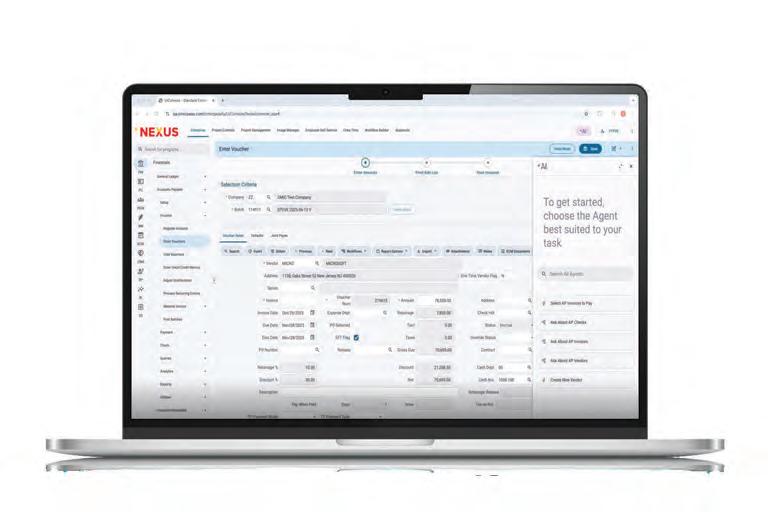
Move away from tedious manual sub-trade payments, and put an end to headaches. Easily manage contracts and meet deadlines. Guarantee stat decs are present and error free. Stop back and forth emails with automatic and custom stat dec generation. All with ERP integrations with platforms like Viewpoint, CMiC, Acumatica and Sage.
Help your entire team complete more projects—smoothly.
www.GCPay.ca
Building a bigger, stronger Canada
These are certainly interesting times for everyone involved in the Canadian construction industry. A combination of continued geopolitical pressures, ongoing trade tension with the United States and sustained price volatility has created a cloud of uncertainty and unpredictability that’s challenging the wherewithal of general contractors across the country. Despite these negative forces, however, the industry continues forward, forging the next chapter of Canadian infrastructure development.
It’s a resilience that should be celebrated and represents one of the many qualities of the industry, along with its perseverance and innovative spirt, that makes Link-Belt proud to sponsor On-Site magazine’s 2026 Infrastructure Report.
With more than a century-and-a-half of history, the Link-Belt brand remains committed to helping support the industry through the delivery of solutions that enhance efficiency across construction operations.
However, Link-Belt is about more than the machines we manufacture or the cutting-edge technologies we integrate. We believe wholeheartedly in the development and strengthening of communities and the fostering of partnerships and collaboration.
And so, with this philosophy in mind, we’re looking forward to continuing our tradition of working alongside the industry to continue driving efficiencies, overcome the challenges ahead and support the development of critical infrastructure that will define Canada going forward.
Sincerely,
Chris Wise Director of Marketing & Distribution Development Link-Belt Excavators
CANADA’S MULTI-BILLION-DOLLAR BUILD-OUT
Where the real work is happening in 2026.
BY ON-SITE STAFF
There’s currently no shortage of infrastructure announcements on the Canadian construction landscape. In fact, federal investment is already well into the hundreds of billions. Provincial allocations promise new transit networks, highways and energy systems. And municipalities across the country are putting forward their growing lists of projects, most of which tied to population growth and aging assets.
In November 2025, the Canadian federal government made the announcement of a significant $115-billion investment in infrastructure, including $51 billion for local infrastructure, aimed at strenghtneing communities across the country.
It’s an announcement that satisfied the majority of stakeholders within the industry. In fact, Rodrigue Gilbert, President of the
Canadian Construction Association (CCA), believed the funding commitment to be the right first step on Canada’s infrastructure road ahead.
“Canada has underinvested in critical infrastructure for decades,” he said. “These investments reflect the essential role of housing-enabling infrastructure in addressing the national housing shortage and committing substantial resources to these projects.”
CURRENT CONSTRUCTION LANDSCAPE
Following the big funding commitments, the Canadian construction landscape in 2026 is one that can be defined less by future announcements and instead more accurately by a host of major projects that are already either in procurement, pre-construction or active build.
Many of the larger projects currently dominating heavy civil construction activity in Canada today involve work related to urban transit, energy infrastructure, transportation corridors, port expansions and regional utility systems. However, there’s also a wide range of smaller regional work underway or planned.
So, considering the scope of projects in front of construction firms across the country, what follows is a snapshot of the work actually happening right now, some of the factors impacting progress and where general conractors fit into the mix.
ONTARIO: CANADA’S INFRASTRUCTURE EPICENTRE
It might not surprise anyone that Ontario remains, by a wide margin, the largest infrastructure construction market in the country. Boasting a 10-year capital infrastructure plan that exceeds $190 billion, the province is paying significant focus toward the development of energy systems and a number of large transit projects.
The Ontario Line, which will run approximately 15 kilometres through Toronto, linking the Ontario Science Centre area to Exhibition Place, is a poject that involves extensive tunnelling, station construction
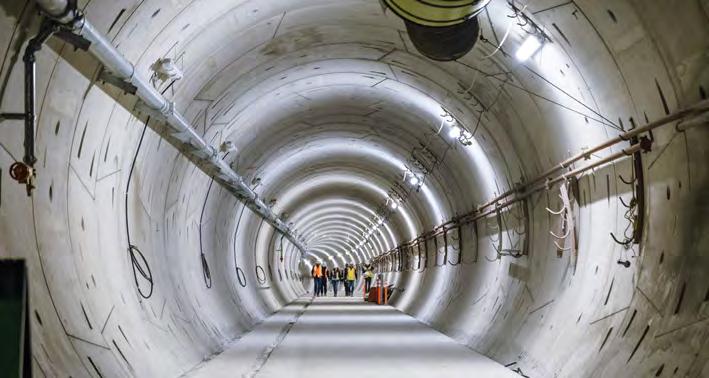
Broadway Subway Project expands rapid transit capacity beneath Vancouver corridor.
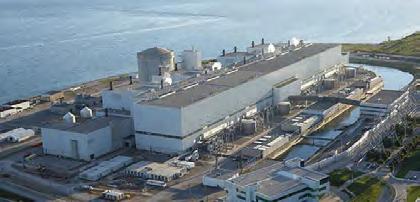
Darlington nuclear project advances clean power with next-generation reactor construction.
and systems integration.
In addition, the Eglinton Crosstown West Extension will extend light rail service westward toward Mississauga, while the Scarborough Subway Extension is set to replace the aging rapid transit infrastructure in the east end of Toronto.
Regionally, Metrolinx’s GO Expansion project promises to transform commuter rail across southern Ontario, which includes the electrification of rail corridors, new stations and grade separations.
Ontario’s energy sector is also generating a significant number of new infrastructure builds, including the Darlington Small Modular Reactor project, which is expected to deliver approximately 300 megawatts of electricity, helping to position Canada as an early adopter of grid-scale SMR technology.
Perhaps most notably, however, Is the early infrastructure work that’s happening in northern Ontario tied to the Ring of Fire. Road access and power transmission corridors are currently moving through environmental review and procurement stages with mulitple phases of work to be rolled out over decades to come.
BRITISH COLUMBIA: TRANSIT, LNG AND PORT CAPACITY
Infrastructure activity on Canada’s west coast, on the other hand, is being driven primarily by urban growth, energy exports and international trade.
Metro Vancouver’s transit expansion remains one of the largest civil construction projects in the province.
And there’s also the Broadway Subway Project, currently under construction, which will extend the city’s Millennium Line westward through Vancouver’s busiest transit corridor, as well as the Surrey–Langley SkyTrain Extension that’s set to extend rapid transit deeper into the Fraser Valley.
Beyond transit and transportation, British Columbia’s energy infrastructure represents another major driver of growth and activity. The LNG Canada project in Kitimat is one of the largest private-sector construction projects ever undertaken in Canada with an estimated investment exceeding $40 billion and work that includes marine infrastructure, liquefaction units, pipeline connections and supporting utilities.
In addition, other LNG projects, like the Ksi Lisims LNG, proposed for northern B.C., could trigger further significant infrastructure investment to support the development of transmission lines, pipelines and port facilities.
Meanwhile, as a result of increasing trade with Asia, Canada’s Pacific ports continue to expand. And, given the Port of Vancouver’s estimates that more than 150 million tonnes of cargo is handled at the port on an annual basis, its expansion becomes a strategic national priority.
THE PRAIRIES: ENERGY CORRIDORS AND TRADE ROUTES
Somewhat contrasting development is occurring in Alberta, Saskatchewan and Manitoba where infrastructure investment continues to be tied closely to energy systems, export corridors and industrial development.
Driven largely by growing investment in energy transition infrastructure, including hydrogen production facilities, carbon capture systems and high-capacity transmission lines, western Canadian construction is helping to lead in more ways than one.
New critical minerals and industrial corridors, particularly across northern Saskatchewan and Manitoba, are also being prioritized and facilitated by federal and provincial policy, opening up significant opportunities for heavy civil contractors specializing in pipelines, transmission systems and industrial site development.
Beyond construction linked to energy and critial minerals, the Calgary Green Line LRT is the largest transit infrastructure project currently underway in Alberta. While the project has undergone multiple scope revisions and funding negotiations to this point, early works and staging activities continue.
QUEBEC: PORTS, TRANSIT AND MUNICIPAL INFRASTRUCTURE
In Quebec, the province’s infrastructure pipeline is made up of a number of large transportation projects alongside a range of municipal renewal work.
The most prominent project currently
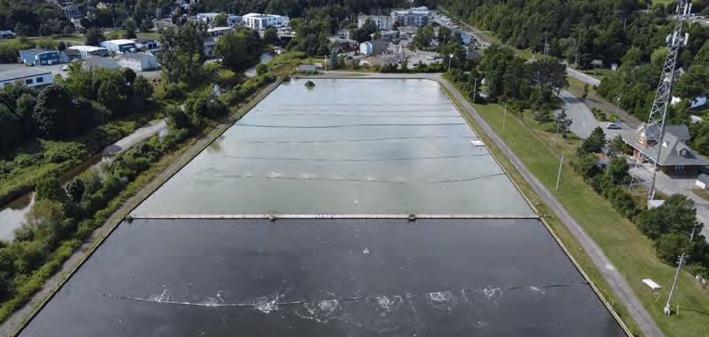
Maritimes wastewater upgrades support growth, resilience and environmental protection.
IMAGE COURTESY OF THE TOWN OF ANTIGONISH.
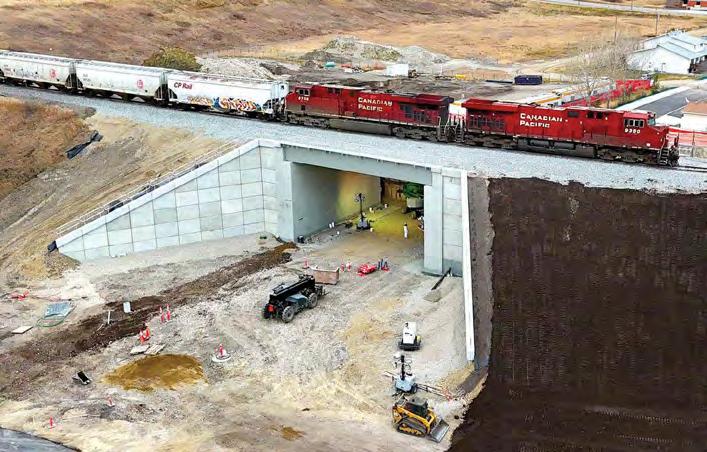
Contrecoeur terminal expansion set to boost port capacity, trade and logistics efficiency.
IMAGE COURTESY OF THE PORT OF MONTREAL.
2026 INFRASTRUCTURE REPORT
underway is the Contrecoeur Container Terminal expansion at the Port of Montreal. Once complete, the new terminal is expected to add more than 1 million TEUs of annual container capacity.
Expansion of the Réseau express métropolitain (REM) automated rail network, another one of the largest public transit projects in Canadian history, also continues.
And municipally, the province faces an abundance of infrastructure renewal needs, particularly with respect to the upgrading and refurbishment of existing water and wastewater systems.
ATLANTIC CANADA: BRIDGE REPLACEMENT AND CLIMATE RESILIENCE
In Atlantic Canada, the infrastructure focus is somewhat different when compared to the rest of the country. Rather than the development of large transit systems or energy megaprojects, the region’s pipeline is dominated by bridge replacements and highway upgrades.
The majority of bridges and highways across Nova Scotia, New Brunswick and Newfoundland and Labrador were built decades ago and are now in need of rehabilitation or replacement. And at the same time, coastal infrastructure, including ports and storm protection systems, is receiving investment as governments respond to increasing climate risks.
While individual projects across these provinces may be smaller than those in central and western Canada, the upgrades represent a significant amount of regional construction activity.
INDIGENOUS-LED INFRASTRUCTURE GAINING MOMENTUM
Beyond the work itself, there are a number of factors and influences that are serving to shape Canada’s infrastructure pipeline, impacting the speed and progress of projects across the country.
One of those factors - one that’s bearing increasing influence on the Canadian infrastructure landscape - is the growing role of Indigenous-led projects and partnerships.
Spanning energy, transmission and resource infrastructure, the impact of Indigenous communities continues to grow with their increasing participation as equity partners and project developers.
In fact, according to Indigenous Services Canada, approximately $18.13 billion has been invested in more than 14,000 projects to support Indigenous community infrastructure since 2016, with a signicant amount more to come as a means to help close the northern infrastructure gap.
DELIVERY MODELS CONTINUE TO SHIFT
The way in which infrastructure projects are delivered in Canada is also evolving, undergoing a shift toward greater flexibility.
Although public-private partnerships (P3s) remain widely used for large transportation projects, particularly in Ontario and British Columbia, some governments are experimenting with alternative delivery approaches, including progressive design-build and construction management models, particularly on complex urban projects.
It’s a shift in model philosophy taking place among many and is driven primarily by lessons learned from past megaprojects that became bogged down by rigid contract structures. As a result, contracotrs and firms are instead navigating a wider range of procurement frameworks to ensure greater flexibility.
LABOUR PRESSURES AND CONTRACTOR CAPACITY
Although estimates from the Canadian Construction Association reveal that Canada’s construction industry now represents roughly 7 to 8 per cent of national GDP, employing more than 1.5 million workers, the industry is also facing a workforce challenge, threatening the success and viability of future infrastructure projects.
In fact, forecasts from BuildForce Canada indicate that the sector could require somewhere in the region of 380,000 additional workers by 2034. It’s a predicament that’s being driven by both
demand growth and the projected retirement of more than 260,000 experienced workers, resulting in labour pressure that’s already shaping where, and how, major projects progress across the country.
FINANCING AND PROJECT SEQUENCING
Even with strong political support and infrastructure investment, financing and sequencing also remain major constraints with respect to the actual development of projects.
Going forward, governments will be forced to balance capital spending with fiscal pressures, staggering projects across multiple budget cycles. In addition, construction inflation has also complicated project planning, with rising material and labour costs requiring governments to revisit budgets and project scopes.
In other words, the infrastructure pipeline in Canada is substantial. But predicting its rollout will not be easy, with a clear understanding of project starts likely reliant on the finalization of individual project financing structures.
THE DECADE AHEAD
Despite the challenges, the opportunities in front of the country’s general contractors as a result of the government’s infrastructure plans are immense. From subway tunnels in Toronto to LNG terminals on the Pacific coast and transmission lines in the country’s northern resource regions, the infrastructure boom that’s currently taking shape across multiple provinces and sectors simultaneously is generational.
However, in order to realize the opportunites, says CCA’s Gilbert, organization and focus at every phase of development will be critical.
“...we need a workforce strategy that reflects real labour-market needs, fair, open, and transparent procurement policies, supply chains that remain resilient under new domestic sourcing rules, and internal trade policies that break down barriers between provinces. Without these elements, even the strongest infrastructure plan risks stalling on implementation.”
Subs paid. Stat Decs in place. Let’s rock. Subs paid. Stat Decs in place. Let’s rock.
GCPay keeps work flowing, so you can finish on schedule and on budget.
Move away from tedious manual sub-trade payments, and put an end to headaches. Easily manage contracts and meet deadlines. Guarantee stat decs are present and error free. Stop back and forth emails with automatic and custom stat dec generation. All with ERP integrations with platforms like Viewpoint, CMiC, Acumatica and Sage.
Help your entire team complete more projects—smoothly. www.GCPay.ca
BUILDING SMARTER AND FASTER
Procurement strategies for Canada’s next wave of mega infrastructure projects.
BY SEAN TARRY
As Canada enters what many are calling a once-in-a-lifetime infrastructure build-out, which includes an array of projects from transit expansions and water systems to energy corridors and climate-resilient structures, the conversation among industry professionals around procurement is shifting. And it’s a shift that’s being driven by the fact that project success is no longer being defined solely by delivering on time and on budget. Instead, it’s increasingly becoming about the way projects are structured from the outset, including how risk is allocated, how teams collaborate and how information flows between stakeholders.
At the centre of the conversation is a growing recognition that traditional procurement models, while familiar, are often not the right fit to tackle the complexity, volatility and scale of modern infrastructure delivery. In their place, a mix of progressive, collaborative and data-driven strategies is emerging, going a long way toward reshaping how contractors engage with owners, consultants and trades.
SETTING THE TONE
For public owners, procurement is more than a process. It defines expectations, allocates risk and establishes the working culture that will carry through the life of a project. According to Tom Sparrow, Chief Construction Officer for the City of Winnipeg, the
responsibility to ensure that foundation is significant.
“We set the tone for the entire project,” Sparrow explains. “We’re the ones developing the RFQs, the RFPs and the statement of requirements. If we don’t align internally, whether that’s with council, ministers or leadership, we risk going down a rabbit hole before the project even begins.”
That “rabbit hole” is a familiar one for contractors where they’ll find incomplete scopes, unclear expectations and misaligned risk allocation that ultimately lead to disputes, delays and cost overruns. in light of this, Sparrow emphasizes that procurement must evolve from a reactive exercise
into a predictive one, leveraging past lessons and forward-looking tools to anticipate challenges before they surface.
“We need to move from reactive to predictive,” he says. “That means using the right tools and working as a true teamowners, contractors, designers - because this can’t be a win-lose environment anymore.”
ALIGNING THE SUPPLY CHAIN EARLY
For general contractors, procurement strategy doesn’t stop at winning the job. It extends deep into the supply chain, particularly as projects become more complex and delivery models more collaborative.
Jeremy Bing, Project Sponsor with
Kiewit Construction Services ULC, points out that one of the biggest related challenges is bringing subcontractors into alignment early, especially under alternative delivery models.
“It’s a real teaching and learning process,” Bing says. “When you’re working in progressive or collaborative models, subcontractors need to understand what they’re getting into before they come on board, including what the expectations are, how involved they’ll be during development and what success looks like.”
This early alignment is critical, because in traditional models, subcontractors often engage well after key decisions have been made. Within progressive models, they may be expected to contribute during design development, risk planning or scheduling.
“If the general contractor and owner spend months aligning during development, but the trades aren’t brought up to speed, you create a disconnect,” Bing adds. “That’s where problems start.”
RISK, LANGUAGE, AND UNINTENDED CONSEQUENCES
While procurement models are evolving, contracts remain the backbone of project delivery. However, they also pose a potential challenge if not handled carefully.
John Paul Ventrella, Partner at Glaholt Bowles LLP, highlights how standard contracts, particularly those based on Canadian Construction Documents Committee (CCDC) templates, are often heavily modified.
“These contracts are meant to be neutral,” Ventrella explains. “But supplementary conditions can significantly shift the
risk profile, sometimes in ways that aren’t fully understood by all parties.”
Key areas of concern include notice provisions, change order structures and dispute resolution processes. Seemingly minor adjustments, he explains, can have major impacts further down the line, particularly when it comes to claims and entitlements.
“One of the biggest issues is how changes are documented,” he says. “If your change order language requires all impacts to be captured upfront, including delay and costs, you may be limiting your ability to recover later if those impacts aren’t fully understood at the time.”
He also goes on to warn against what some in the industry call the “weaponization of contracts” where overly aggressive risk transfer leads to the facilitation of adversarial relationships and early disputes.
“If you put risk on parties who aren’t best equipped to manage it, you’re going to end up in conflict,” he says. “And that shifts the focus away from building the project to fighting over it.”
THE RISE OF PROGRESSIVE PROCUREMENT MODELS
In light of the challenges inherent in some traditional procurement models, progressive alternatives like Progressive Design-Build and Alliance contracting are gaining momentum throughout the industry.
For Sparrow, the appeal is clear and represented by better alignment, clearer scope definition and more realistic pricing.
“In traditional models, you might be pricing a project at 30 per cent design,” he
says. “That creates enormous uncertainty, especially in today’s environment where costs can change rapidly. Contractors price that risk in. It’s only natural.”
Progressive models, on the other hand, aim to reduce that uncertainty by allowing design to advance, often to 70, 80, or even 90 per cent, before final pricing is locked in.
“That gives everyone a clearer understanding of the scope,” Sparrow explains. “It allows contractors and their trades to sharpen their pencils because they know what they’re pricing.”
Bing agrees, noting that these models improve not just pricing accuracy but also team dynamics as well.
“When you spend time in the development phase aligning on risks, schedule and scope, there are fewer surprises later,” he says. “And when challenges do come up, it’s easier to solve them together.”
AVOIDING THE “FRANKENSTEIN” MODEL TRAP
Despite the promise presented by progressive procurement models, not all implementations are successful. One common pitfall is the creation of hybrid or “Frankenstein” models, which are contracts that attempt to blend multiple delivery approaches without fully committing to any.
“I see that as a red flag,” Bing asserts. “It usually means the client hasn’t fully aligned internally on what they want to achieve.”
Instead, he advocates for a more deliberate approach involving the selection of a procurement model that best fits the project’s goals, constraints and risk profile.
2026 INFRASTRUCTURE REPORT
“There’s no one-size-fits-all solution,” he says. “The right model is the one that aligns with your objectives and the one that your team is capable of delivering.”
THE NEW PROCUREMENT ENABLERS
As is the case with most modern advancements, today’s procurement strategies are increasingly connected to and supported by digital tools, from building information modeling (BIM) to AI-driven analytics, offering ways to enhance decision-making and reduce risk. But they also come with new challenges concerning data ownership, integration and usage.
“We’re generating more data than ever through the use of models, drone surveys and telemetry,” Ventrella says. “The questions are: How do we manage that data contractually? Who owns it? How is it shared? And how is it used in disputes?”
Beyond management and ownership of the data, Bing sees significant potential in leveraging these tools to improve construction efficiency.
“Our industry has lagged behind others in productivity gains,” he points out. “This is our chance to catch up, by using AI and digital tools to improve how we build.”
Sparrow adds that predictive analytics may also be used to inform deicisons around procurement and project delivery.
“If we can identify risks six or eight months in advance, whether it’s schedule, cost escalation or quality issues, we can act on them early,” he says. “That’s where the real value is.”
FROM ADVERSARIAL TO PROACTIVE
Despite the strength of the prcourement strategy used, however, disputes will inevitably happen on construction projects. And when they do, it’s important to manage them properly.
Traditional models often rely on resolution processes involving negotiation, mediation, arbitration and litigation that can take years to complete. Progressive models, by contrast, promote early intervention and
continuous resolution.
“We’re trying to avoid disputes altogether,” Ventrella says. “But when they do arise, the goal is to resolve them quickly and keep the project moving.”
As a result, tools such as dispute resolution boards, project mediators and adjudication are starting to receive attention as viable alternatives.
“One of the most underused tools is the project mediator,” Ventrella notes. “If you appoint someone at the start - someone both parties trust - you can resolve issues before they escalate.”
Sparrow agrees, but stresses that prevention is still the priority.
“The last thing we want is to go down that legal route,” he says. “We need to use the tools we have to identify issues early and work through them as a team.”
COLLABORATION AS A COMPETITIVE ADVANTAGE
Beyond contracts and models, perhaps the most significant current shift in procurement is cultural.
“There’s a real move toward a one-team approach,” Bing says. “People want to work in environments where they’re collaborating, not fighting.”
This shift is particularly important in an industry facing labour shortages, increasing complexity and rising expectations around sustainability and performance.
“When teams feel aligned and supported, you get better outcomes,” he adds. “It’s also better for retention because people want to be part of successful, collaborative projects.”
Sparrow sees collaboration as an industry-wide opportunity, but one that requires leadership from both public and private sectors.
“We need more owners in the room, more dialogue, more education,” he says. “This isn’t just a senior management issue. It needs to reach the front lines.”
PROCUREMENT AS STRATEGY, NOT PROCESS
As investment in Canadian infrastructure continues unabated, procurement is increasingly being viewed as a strategic tool that can be leveraged by organizations as a means to increase productivity on projects and protect them against potential risk.
Achieving this, however, requires the willingness to adapt to new models, to embrace collaboration and to invest in the technology that will provide them with the predictivness they need to succeed.
It’s a shift that reflects an eagerness and readiness by leaders within the industry to respond to the infrastructure demand in front of them, and may serve as a reminder, too, that the way in which projects are procured ultimately influence how they’re delivered.
“We’ve been dealing with the same issues for decades,” Sparrow reflects. “Now we have an opportunity to do things differently - to learn, collaborate and build better.”
And in an era that’s increasingly being defined by complexity, it’s a shift in procurement philosophy that may prove to be one of the most important responses to challenges facing general contractors today.
Collaboration across teams, including contractors, subcontractors, owners and designers is becoming the new competitive advantage within the industry.
Agentic AI Reality Capture Visual Intelligence
AS TOOLS AND INTEGRATORS
Join our all-star lineup as they demystify how data synthesis drives smarter decisions and cost savings
JUNE 9TH at the Sandman Signature Mississauga Hotel
Limited Seating Register Today
$60 includes breakfast and refreshments
By Jacob Stoller
AI gains a foothold in construction
Millions of people now use AI to increase their productivity in their day-to-day work. It will take time, however, to leverage that to improve construction’s complex business processes.
Last fall, a multi-year MIT study titled The GenAI Divide reported a 95 per cent failure rate for generative AI projects. A major culprit, the study concluded, was the absence of clear business objectives for the technology.
“If you walk into a room full of CEOs, they’re all eager to embrace AI, but many are still struggling to define exactly where it will deliver the most value,” says Kris Lengieza, Global Technology Evangelist at Procore Technologies.
Expressed goals are often so vague that they are meaningless.
“The biggest misconception I see is people saying that AI is going to ‘make us more efficient,’” says Holynde Smiechowski, Corporate AI Lead at PCL Construction. “That’s the broadest standard statement you can make - it can mean 13 different things to 13 different people.”
With a civil engineering background and 13-plus years of fieldbased project management experience, Smiechowski sees AI as a tool for minimizing administrative effort and maximizing time spent solving realworld problems.
AI’s ability to summarize meetings and draft succinct memos is an obvious starting point.
“Microsoft Copilot can help you reframe a memo so that it doesn’t sound like you’re complaining, or simplify a legal document for you,” says Smiechowski, “I’m a math person, not an English major, so this is great for me.”
SIMPLIFYING INTERACTIONS
Longer term, Smiechowski plans to enlist AI’s information crunching capabilities to simplify interactions with what has become an increasingly complex array of diverse IT systems.
“Years ago, when you had a problem in the field, you’d do a walkaround with your architect or engineer,” says Smiechowski. “They’d do a sketch, and your client would be close by or a phone call away. So, the client could say, ‘go ahead, and send me the quotation,’ and you’d process the change order. That might take a few days. But when everybody’s behind a computer, you don’t have those conversations as much. Today, with all the systems you have to switch between, that could take a month or two.”
The plan is to target the points where decision-makers interact with their IT systems.
“My goal with AI is to not add more steps,” says Smiechowski, “but to pull back the complication or friction points that we’ve got with technology so our people can spend more time in the field where we want them to be, and less time having to deal with the technology side.”
Equally important, AI can help improve pre-construction
processes so that fewer problems arise.
“If we can remove the barriers and roadblocks on the front end, we’ll have fewer schedule disruptions and actually provide better value to the client,” says Smiechowski.
A STEP-BY-STEP APPROACH
While AI’s advantages are obvious, there is no magic bullet for improving construction’s complex business processes.
“It’ll take small iterative steps to get there, because it won’t happen overnight,” says Smiechowski. “How can we deal with pain points people deal with in our processes? Start simple, get more people used to using it, and then you learn and iterate as you discover what actually makes the most sense as you build up to this.”
Lengieza equates initial efforts with AI to working with an intern.
“People need to think of AI as something that you invest in and train and get ready for,” he says. “AI also needs context. That’s one of the reasons why we’ve deeply integrated AI into our platform –we’ve learned from previous examples which data sets are important and which aren’t.”
ENSURING DATA SECURITY
One of the perils of user-based process improvements is that a large number of homegrown solutions can easily become unmanageable.
“People now have the opportunity to create workflows very quickly to solve pain points in their day-to-day work, and that’s awesome,” says Lengieza. “The challenge there is, how do we make sure that our data is secure, that they’re using trusted tools and that as an organization, you have some semblance of control of what’s being rolled out there?”
Ensuring that people use enterprise accounts, Lengieza notes, prevents the potential of leaks and other security risks, helping to create the cohesion that’s necessary for enterprise-wide prediction and analytics.
“Construction is an industry that’s built on continuous feedback,” says Lengieza. “And so, modern platforms need to be able to centralize business processes so firms can continue to iterate on them and turn those historical learnings into predictable, repeatable actions for their employees.”
Jacob Stoller is principal of StollerStrategies. Send comments to editor@on-sitemag.com.