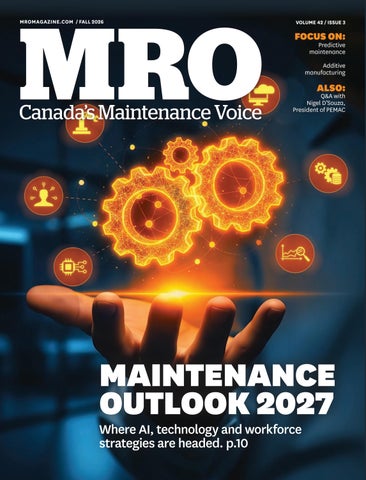
MROMAGAZINE.COM / FALL 2026
VOLUME 42 / ISSUE 3
FOCUS ON:
Predictive maintenance
Additive manufacturing
ALSO:
Q&A with Nigel D’Souza, President of PEMAC
MAINTENANCE OUTLOOK 2027 Where AI, technology and workforce strategies are headed. p.10
8
10
16 INSIDE
19
FALL 2026
Columns
In every issue
4 EDITORIAL People are still part of the equation.
5 NEWSWATCH
6 RELIABILITY MATTERS Preventing equipment defects at the design stage. 18 THE LAST WORD Why 3D printing belongs in your strategic plan nowy.
8 SAFETY 21 PRODUCTS
FEATURES
10 16 19
THE NEXT ERA OF MAINTENANCE Artificial intelligence has reached the plant floor. Three industry experts weigh in on what maintenance leaders need to know for 2027. YOUR PREDICTIVE MAINTENANCE GAP ISN’T TECHNOLOGY The sensors are installed. The software is licensed. So why isn’t anything getting better? THIRTEEN YEARS AND COUNTING A Q&A with president of PEMAC, Nigel D’Souza, about how asset management has evolved and where it’s going.
Fall 2026 / MRO 3
FROM THE EDITOR
People are still part of the equation I’ll be honest, I’m getting a little remain the biggest factor in whether tired of AI. new technologies succeed or fail. To be clear, I’m not tired of the Whether the topic is AI, pretechnology itself (heck, I use it every dictive maintenance or additive day), but the topic seems to have tak- manufacturing, technology alone en over every headline, podcast, pan- isn’t enough. Success still depends el discussion and webinar for the last on good data, sound processes and, few months, and frankly, it’s wearing most importantly, people with the on me. Of course, it’s understandable skills and confidence to put these (we went through something similar tools to work. with the birth of the Internet), but if You’ll see that theme throughout you’re feeling that fatigue too, know these pages. Our cover story on page you’re not alone. 10 examines the connection between Perhaps it’s because, just like the data quality, workforce readiness technology itself, the headlines are and technology performance. Kurt changing at a breakneck pace. For Wentzell echoes the point on page years, the promise has been over- 16, arguing that the barriers to whelmingly positive in favour of AI: predictive maintenance have always AI will close the labour gap, boost been as much about process and productivity, cut downtime, give us culture as they are about technolinsights we couldn’t get any other way. ogy. In his column on page 22, Jeff And those promises aren’t hyperbole Smith cautions against viewing — you’ll see many of them explored additive manufacturing as a quick throughout our content in this issue fix, emphasizing the importance of patience, training and long-term and beyond. But lately, the headlines have adoption. And in my interview with taken a darker turn. As I write this, Nigel D’Souza, PEMAC president, in mid-September, researchers and page 19, he said that while AI is cersenior employees at the world’s larg- tainly going to reshape the future of est AI companies have been resign- asset management, it doesn’t remove ing and speaking out, warning that people from the equation. In fact, it’s development is moving faster than quite the opposite. anyone’s ability to keep it safe, with That’s on my mind as I gear up for some even suggesting catastrophic the PEMAC MainTrain asset management conference, which I’ll be outcomes within the decade. Whether you find those warnings attending for the third year running. credible or overblown, they’re loud It’s a wonderful opportunity to make enough now that it’s hard to ignore new connections and build a stronthem (and if you’re like me, you’re ger network, the kind you can only somewhere between needing AI create face to face. And while AI will surely be a hot topic of conversation and being scared to death of it). All that said, yes, this is another all week long, at least we’re having it issue that discusses AI — a lot. After with other humans. all, it’s impossible to talk about the “future of maintenance” without it. But while the technology comes up KIRSTYN BROWN repeatedly, the conversation always Editor comes back to the same point: people kbrown@annexbusinessmedia.com
Connect with MRO @MROMagazine 4 MRO /Fall 2026
ESTABLISHED 1985 FALL 2026 Volume 42, Issue 3 READER SERVICE Print and digital subscription inquiries or changes, please contact Customer Service Angelita Potal, Customer Service Administrator Tel: 416-510-5113 email: apotal@annexbusinessmedia.com Mail: 111 Gordon Baker Rd., Suite 400 Toronto, ON M2H 3R1 EDITOR Kirstyn Brown 226-931-4194 kbrown@annexbusinessmedia.com BRAND SALES MANAGER Pat Lorusso 416-518-5509 PLorusso@annexbusinessmedia.com AUDIENCE DEVELOPMENT MANAGER Beata Olechnowicz bolechnowicz@annexbusinessmedia.com 416-510-5182 MEDIA DESIGNER Curtis Martin ACCOUNT CO-ORDINATOR Debbie Smith 416-510-5107 dsmith@annexbusinessmedia.com GROUP PUBLISHER Paul Grossinger 416-510-5240
pgrossinger@annexbusinessmedia.com CEO Scott Jamieson sjamieson@annexbusinessmedia.com
Machinery and Equipment MRO is published by Annex Business Media, 111 Gordon Baker Rd., Suite 400, Toronto ON M2H 3R1; Tel. 416-442-5600, Fax 416-510-5140. Toll-free: 1-800-268-7742 in Canada, 1-800-387-0273 in the USA. Printed in Canada ISSN 0831-8603 (print); ISSN 1923-3698 (digital) PUBLICATION MAIL AGREEMENT #40065710 Subscription rates. Canada: 1 year $68.95, 2 years $109.26. United States: 1 year $151.69. Elsewhere: 1 year $173.97. Add applicable taxes to all rates. On occasion, our subscription list is made available to organizations whose products or services may be of interest to our readers. If you would prefer not to receive such information, please contact our circulation department in any of the four ways listed above. Annex Privacy Officer Privacy@annexbusinessmedia.com 1-800-668-2374 No part of the editorial content of this publication may be reprinted without the publisher’s written permission © 2026 Annex Business Media. All rights reserved. Opinions expressed in this magazine are not necessarily those of the editor or the publisher. No liability is assumed for errors or omissions.
PEMAC
/company/mro-magazine
mromagazine.com MROMAGAZINE.COM
NEWSWATCH ENGINEERING
documenting institutional knowledge than smaller ones. The survey also asked maintenance leaders what change would have the greatest impact on their operations. They ranked hiring and retaining technicians above AI adoption. The survey was conducted July 29 to Aug. 6, 2026, among 686 full-time U.S. employees in maintenance or operations roles, with a margin of error of plus or minus 3.7 percentage points.
ONTARIO FUNDING SUPPORTS ENGINEERING WORK FOR PROPOSED ESPANOLA MILL RESTART
Bioveld North Inc., a subsidiary of BMI Group, has received $5.1 million from the Ontario government to advance engineering work related to a proposed restart of the Espanola pulp mill, which has been idle since 2023. The funding will support front-end loading engineering (FEL) and design work needed to finalize the design and cost of restarting the facility, according to a press release issued by BMI Group. Bioveld North is contributing an additional $5.4 million toward the $10.5 million engineering program. The funding is being provided through Ontario’s Forest Biomass Program. The company said engineering work will focus on determining the technical and financial requirements needed to bring the facility back into operation. No timeline for a potential restart has been announced. The Espanola mill operated for more than 120 years before being idled in 2023. According to Bioveld North, the facility historically supported roughly 400 direct jobs and an estimated 2,000 additional jobs across Ontario’s forestry supply chain.
ASSET MANAGEMENT
ALSTOM TO SUPPLY 313 RAIL CARS UNDER VIA RAIL FLEET RENEWAL AGREEMENT
Alstom has signed a $4.7-billion agreement with VIA Rail Canada to design, engineer, manufacture and support a new long-distance, regional and remote passenger rail fleet. The contract includes the delivery of 313 Adessia rail cars valued at approximately $4 billion, as well as a 15-year technical support and spare parts supply agreement valued at nearly $700 million, according to Alstom’s press release. The new fleet will replace VIA Rail Canada’s existing long-distance rail cars and serve eight routes connecting nearly 400 communities across the country. Design and engineering work will be carried out at Alstom’s facility in St-Bruno-de-Montarville, Que., while carbody manufacturing will
Pictured from left: Jason Collins, Corporate Development Officer, BMI Group, Paul Veldman, CEO, BMI Group, Hon. Kevin Holland, Associate Minister of Forestry and Forest Products, Bill Rosenburg, MPP, Algoma— Manitoulin, Joseph Burke, CAO, Espanola.
take place in La Pocatière, Que., and final assembly will be completed in Thunder Bay, Ont. According to the company, the new fleet is designed to operate in Canada’s climate conditions and will incorporate updated accessibility, digital connectivity and cybersecurity features. VIA Rail said the rail cars are intended to improve reliability while replacing equipment that is up to 77 years old. The project includes long-term technical support and spare parts services intended to support the fleet throughout its operating life, according to Alstom. The company said the agreement is expected to support up to 670 direct jobs in Canada, with additional work flowing through its supplier network.
WORKFORCE
NEARLY 75 PER CENT OF U.S. MAINTENANCE TEAMS DEPEND ON ONE PERSON’S KNOWLEDGE
Most maintenance organizations have critical assets that would be at risk if a single employee left, according to new survey data from maintenance software provider Limble. The company’s inaugural State of Maintenance Report, based on responses from nearly 700 U.S. maintenance technicians and leaders, found that 74 per cent of organizations have critical assets dependent on one person’s knowledge.Two-thirds of maintenance professionals said they personally hold critical knowledge that exists nowhere in their organization’s systems. Nearly half of respondents, 47 per cent, said they had lost knowledge they could not recover after an employee left. That figure was 50 per cent higher among organizations with 51 to 100 staff, suggesting larger teams aren’t necessarily better at
SKILLED TRADES
ONTARIO TO INVEST $9.8M IN NEW MILLWRIGHT TRAINING CENTRE
The Ontario government is investing $9.8 million to support the construction of a new millwright training centre in Port Hope that is expected to train 2,550 apprentices, journeypersons and new entrants over the next five years. According to the Ministry of Labour, Immigration, Training and Skills Development, the funding is being provided through the province’s Skills Development Fund (SDF) Capital Stream. The 44,986-square-foot facility will be operated by UBC Millwright Local 2309 and will provide classroom and hands-on training in areas including welding, rigging, alignment and industrial maintenance. Trainees will also have access to certification programs covering topics such as working at heights, confined spaces and equipment operation. The province said the centre will feature industry-standard equipment and technologies, including turbines, conveyor systems, welding equipment and robotic technologies. Ontario Labour Minister David Piccini said the facility will help prepare workers for projects in the province’s energy, manufacturing and industrial sectors. “This new training centre will prepare more workers with the skills employers need to build, maintain and modernize the projects that will power our province and fuel economic growth for decades,” Piccini said in a statement. The province said it has committed $139.6 million through the Skills Development Fund Capital Stream to expand and modernize training facilities across Ontario. Fall 2026 / MRO 5
RELIABILITY MATTERS
COLUMN
Turning off the tap of equipment defects
BY GEORGES OUELLETTE
6 MRO /Fall 2026
Walk through almost any manufacturing plant and you will find teams working hard to improve equipment reliability. The maintenance team is chasing recurring breakdowns, production engineers are investigating chronic issues and planners are refining maintenance strategies to keep production running. This work is essential. Improving the reliability of existing equipment directly supports safety, quality, delivery and cost performance. But there is a question every manufacturing leader should ask: Are we fixing today’s reliability problems while continuing to introduce new ones tomorrow? Many organizations are effective at repairing equipment and responding to failures, but fewer are equally focused on preventing new reliability problems from entering the plant in the first place. Imagine a bathtub overflowing with water. Most people immediately grab a bucket and start removing water. In manufacturing, that bucket represents reliability activities such as root cause analysis, preventive maintenance optimization, condition monitoring and defect elimination.These activities are necessary to reduce the water level, but if the tap remains open, the bathtub will continue to fill. In manufacturing, the tap is often new equipment being introduced into the business. Every year, plants invest in new automation, equipment replacements, process upgrades and expansion projects. However, many of the reliability issues maintenance teams struggle with years later were introduced long before startup. Poor access for maintenance, difficult-to-replace components, weak diagnostics, missing spare parts strategies, inadequate lubrication provisions, limited condition monitoring capability and incomplete maintenance documentation are not maintenance failures; they are design and implementation defects that become maintenance problems for years to come. The result is a familiar trap. Reliability teams spend their days removing
defects from existing equipment, even as new ones walk in the front door through the next capital project or equipment purchase. You can’t fix your way out of that cycle — not unless you’re working both ends of it: improving what’s already running and keeping new problems from being built in to begin with. Make no mistake, the existing asset base still comes first. It’s what keeps the plant running today, and effort should go where it matters most — safety, throughput, quality, environmental performance, the operating cost line. The good news is the toolbox for existing equipment isn’t a mystery. Root cause analysis takes aim at recurring failures, while preventive maintenance gets realigned to actual failure modes instead of the calendar. Condition monitoring catches trouble before it becomes downtime — and when something does need fixing, a solid spare parts review is what keeps that repair from stalling out for a week. The harder call comes at end-of-life: fix it again or finally replace it. These activities improve plant performance and reduce operational risk. In other words, they help drain the bathtub. However, long-term success depends on turning off the tap as well. Reliability should not begin after equipment is installed and handed over to production, it must be considered much earlier in the project lifecycle. Maintenance, Operations, Engineering and Reliability should all have a seat at the table from equipment specification through startup, not just at handover. Their role is to ensure reliability and maintainability receive the same level of attention as production output and project schedule. The discussion should not end with the question: “Will this equipment run?” It should also include the following: • Can it be safely maintained? • Are critical components standardized? • Are spare parts readily available? • Is the equipment easy to inspect and repair? • Have lessons learned from similar equipment been applied?
One of the most valuable resources available to any organization is the knowledge gained from operating existing equipment. Every recurring failure, difficult repair and maintenance challenge provides an opportunity to improve future designs. Unfortunately, many lessons learned remain trapped in reports, databases or individual experience. High-performing organizations convert those lessons into standards. Preferred component lists, controls standards, lubrication requirements, maintainability guidelines, spare parts expectations and condition monitoring requirements ensure that knowledge gained from yesterday’s problems is incorporated into tomorrow’s solutions. The goal is not to choose between improving old equipment and supporting new projects because both are necessary. Most reliability efforts should remain focused on improving current business performance through existing assets, while at the same time, a portion of resources should be dedicated to influencing new equipment before it enters operation.The balance will vary by organizational maturity, but the principle remains the same: improve today’s equipment while reducing the flow of future problems. The plants that achieve this balance gain a significant advantage. They experience fewer recurring failures, lower lifecycle costs, improved maintainability and higher equipment availability. More importantly, they stop repeating the same reliability mistakes generation after generation of equipment. Ultimately, reliability is not just about fixing what breaks, but learning from what breaks, applying those lessons to the future. The best reliability programs do more than drain the bathtub — they turn off the tap. Georges Ouellette, CMRP, CRL, CET is the Reliability Strategy Lead for Honda of Canada Mfg. in Canada. He brings a systems based, practitioner perspective to reliability, focusing on embedding asset reliability and cultural change into day to day manufacturing operations. MROMAGAZINE.COM
YOUR SOURCE FOR ULTRA HIGH-QUALITY ULTRA HIGH-PERFORMANCE 100% SYNTHETIC LUBRICANTS Lubriplate’s ultra-high-performance, 100% synthetic lubricants have been engineered to provide unsurpassed performance in the most demanding plant environments. They provide a wide range of benefits designed to make your plant run better. Benefits include: extended lubrication intervals, lubrication consolidation through multiple application capability, reduced friction, extended machinery life and reduced downtime. Products include...
HIGH-PERFORMANCE SYNTHETIC GEAR OILS SYNTHETIC AIR COMPRESSOR FLUIDS SYNTHETIC HYDRAULIC FLUIDS HIGH-PERFORMANCE SYNTHETIC GREASES NSF H1 REGISTERED FOOD GRADE LUBRICANTS ECO-FRIENDLY SYNTHETIC LUBRICANTS SPRAY & SPECIALTY LUBRICANTS Scan the QR Code for More Information About Lubriplate’s Products and Services.
Newark, NJ 07105 USA / Toledo, OH 43605 USA Tel: + 973-465-5700 www.lubriplate.com / LubeXpert@lubriplate.com
- REPRESENTATIVES IN CANADA Alberta, Saskatchewan & Manitoba: Summit Agencies Ltd. / Edmonton, AB Office / 780-406-7462 / www.summitagencies.ca British Columbia: Summit Agencies Ltd. / Langley, BC Office / 604-209-0987 / www. summitagencies.ca Ontario & Quebec: Mechanical Sales Co. / 800-263-7226 / www.mesaco.com Maritimes: Chris Kniestedt / 603-484-5262 / ckniestedt@lubriplate.com
SAFETY
FEATURE
Beyond the surface: Understanding nonvisible disabilities
Chronic pain, anxiety, PTSD, learning disabilities — some of your most reliable workers may be managing more than you realize. BY CANADIAN CENTRE FOR OCCUPATIONAL HEALTH AND SAFETY (CCOHS)
that mental health conditions alone, including depression, anxiety, bipolar disorder, PTSD, obsessive-compulsive disorder (OCD), attention-deficit/hyperactivity disorder (ADHD) and complex trauma, are among the most common nonvisible disabilities in Canada, and that mental health-related conditions are now one of the leading reasons workers seek accommodation or time away from their jobs. On a shop floor, that could be the tech who seems distracted during a toolbox talk, or who asks to swap off a rotating night shift because they are dealing with something no one else can see.
Why few people speak up
One of the biggest challenges about speaking up isn’t physical, it’s social. Comments like “you look fine to me” or “everyone gets tired” can make a person feel dismissed and less likely to ask for help again. In industries that often prize toughness and self-reliance, that pressure can run even deeper. Workers may be hesitant to disclose a nonvisible disability, worried they’ll be seen as less capable or treated differently. That hesitation can be a heavy burden to carry. A worker who’s quietly pushing through fatigue, pain or a concentration issue rather than flagging it isn’t just risking their own well-being. Working around rotating equipment, following lockout-tagout procedures or operating within confined spaces can quickly become a safety issue for the whole crew.
8 MRO /Fall 2026
More common than you would think
According to Employment and Social Development Canada (ESDC) in 2022, 8 million Canadians aged 15 and older reported having one or more disabilities, many of which are invisible. ESDC’s guide on disability-inclusive language defines a nonvisible disability as a physical, mental or neurological condition that limits a person’s movement, senses or activities without being immediately obvious. These would include conditions such as deafness, epilepsy, and mental health or learning disabilities. The Canadian Mental Health Association (CMHA) Ontario notes
The Rick Hansen Foundation groups the barriers people with nonvisible disabilities face into three types: attitudinal (disbelief or dismissive comments), physical and digital (noisy environments, long stretches without breaks, hard-to-navigate systems) and systemic (policies and workplaces built around the assumption that everyone functions the same way). All three show up in familiar forms on a plant floor. Constant equipment noise can wear down a worker managing a sensory or attention-related condition. Long rotating shifts can be especially hard on someone with a chronic illness or a mental health condition that depends on routine and sleep. And standard procedures, MROMAGAZINE.COM
Photo: aquaArts studio / Getty Images
Maintenance professionals are trained to catch what’s not obvious: the bearing that sounds fine but is weeks away from failure, or the vibration signature that doesn’t match the baseline. What if you applied that same attention to people, not just equipment? Some of the most dependable technicians on a crew may be managing chronic pain, a learning disability, anxiety, diabetes, or post-traumatic stress disorder (PTSD) and none of it may be obvious during everyday work. Collectively, these are known as nonvisible, or invisible disabilities, and understanding them will help you run a safe and productive workplace.
Barriers built into industrial work
such as training manuals, safety briefings and work-order systems are usually built for one kind of learner, which can leave out someone with a learning disability or cognitive difference.
What accommodation looks like
Employers have a legal duty to accommodate workers with disabilities up to the point of undue hardship, taking health, safety and cost into account. That duty only kicks in once an employer is aware of the disability, and generally, employers only need to know the worker’s functional limitation, not the diagnosis. A worker doesn’t have to disclose their PTSD diagnosis – they may just need advance notice before a schedule change, or a quiet space to decompress during a break. Planning around a nonvisible disability follows many of the same steps as planning around a physical injury. Focus on what the person can functionally do, not the label attached to their condition. That could mean easing a worker back to full duties gradually after a leave, building flexibility
around medical appointments, adjusting training for someone with dyslexia, giving extra notice about shift or crew changes for someone managing anxiety, or providing short rest breaks for someone with chronic fatigue during a full shift. Most accommodations aren’t complicated or expensive. A supported, engaged worker is a far better long-term investment than one quietly burning out or struggling through safety-critical work.
Small actions that build trust
CMHA Ontario suggests a few additional tips to help support workers with nonvisible disabilities: First, believe people when they describe what they’re dealing with, even without visible symptoms. Second, use language that avoids judgment, and offer flexibility without requiring someone to “prove” their condition. Finally, check in without pressure or putting someone on the spot in front of the rest of the team. Language matters too, especially from supervisors and leads. Try to avoid using phrases like “suffers from” or “confined to,” and steer clear of framing a disability
as a burden. Small shifts, like saying “a tech with a disability” instead of “the disabled one,” or simply asking what someone needs rather than assuming, signal respect. They also make people more likely to speak up before an issue escalates.
The bottom line
You can’t see them, but nonvisible disabilities are present. Reliability isn’t just about the machines, it’s also about a safety culture where your workers can flag a limitation without fear of judgment, and where accommodation requests get met with trust instead of suspicion. Building that kind of culture doesn’t take a new program. It starts with paying attention to what isn’t visible, in the workplace and among the people running it. The Canadian Centre for Occupational Health and Safety (CCOHS) promotes the total well-being — physical, psychosocial, and mental health — of workers in Canada by providing information, advice, education, and management systems and solutions that support the prevention of injury and illness. Visit www.ccohs.ca for more safety tips.
26_009264_MRO_Fall_CN Mod: August 3, 2026 8:35 AM Print: 08/25/26 page 2 v2.5
π SERIOUS ABOUT SAFETY IN STOCK – SHIPS TODAY
ORDER BY 6 PM FOR SAME DAY SHIPPING
1-800-295-5510
uline.ca Fall 2026 / MRO 9
MRO_Uline_Fall26_CSA.indd 1
2026-09-04 10:27 AM
MAINTENANCE
COVER STORY
The next era of maintenance
AI has arrived on the plant floor. Here’s what maintenance and reliability leaders need to know heading into 2027. BY JACK KAZMIERSKI
10 MRO /Fall 2026
AI would ask the technician to describe the problem and, if it needed more information to develop a repair plan, the AI would ask targeted follow-up questions. She explains that one of the biggest benefits her company is seeing from AI right now is its ability to help people adopt and make better use of the technology that manufacturing facilities have already invested in over the years. “We have all this technology in place: mobile apps, ERPs and other systems that provide great places to store data,” says Olmschenk, “but many of our customers still find it challenging to capture that information. And some of the people responsible for entering the data may not be particularly tech-savvy; they may have been working on the plant floor for many years and aren’t necessarily comfortable with new technology.” AI is bridging this gap, she adds. Despite its potential, Olmschenk cautions that expectations around AI are sometimes running ahead of what the technology can actually deliver. “I’ve heard people say that you can take a photo and AI will identify the issue, and get all your data into the ERP system,” she says. “That makes AI sound like a magic black box, but in reality, at present, you can’t take a photo and get AI to diagnose a problem. That’s just not possible.” Kari Goebel, Business Development Specialist at Marcem Rentals with 20 years in maintenance reliability and operations, agrees that AI has made a significant impact on the industry over the past year. However, he believes the technology is also prompting maintenance organizations to reconsider a more fundamental question: “AI has allowed organizations to start honing
in on why they do what they do, rather than simply looking at what they do,” he says. Goebel explains a key principle: “Maintenance and reliability sound like they’re interchangeable, but maintenance is your input, while reliability is your output. So maintenance is what you do, and reliability is why you do it. AI is allowing these conversations to be more prolific than they were, even 12 months ago.”
The power of data
If AI is going to become a more important part of maintenance and reliability, the quality of the data feeding those systems becomes equally important. Over the past 10 years, Olmschenk explains, master data was something that the IT department used to worry about. “But as we start to incorporate new software, and especially AI-related software, the AI can only give you quality information if it has quality
Photo: Grispb / Adobe Stock
As 2026 draws to a close, maintenance and operations leaders are navigating rapid technological change while continuing to contend with longstanding challenges around uptime, productivity and workforce availability. To get a sense of where the industry is heading, MRO spoke with three industry experts about the technologies, strategies and workforce considerations that will shape maintenance and reliability in 2027. One theme emerged repeatedly: artificial intelligence. “AI has entered the plant floor,” says Bailey Olmschenk, Global Director of Solutions Engineering at Prometheus Group, which makes enterprise asset management software for maintenance and reliability teams in heavy industries. “Two years ago, we didn’t talk about AI at all, a little over 12 months ago we saw AI making its way into the back office, but during the past 12 months, we’ve actually seen AI being used in the plant.” Her observations are supported by a recent report, The State of Industrial Maintenance, published by MaintainX. According to the report, 58 per cent of maintenance teams are now using AI in their operations (only 17 per cent say they have no plans to implement AI), up from 44 per cent a year earlier. Even more impressive: 75 per cent report seeing measurable ROI within six months. Olmschenk explains that her company, like many other software providers, is increasingly integrating AI capabilities into its existing tools. She points to a successful pilot project in which technicians working on-site to diagnose equipment problems could interact directly with an AI tool. The
MROMAGAZINE.COM
58 Percentage of maintenance teams that report now using AI, according to MaintainX’s State of Industrial Maintenance report.
data on the back end,” she says. Goebel says that data quality is paramount. “If data was important before, it’s even more important now,” he says. “We’re relying on some of these analytical engines to give us next steps, and if we’re going to do that, then it’s absolutely essential that they have inputs that we are confident in, that we trust, and that we know and understand.” Master data becomes really important, Olmschenk adds, the more we rely on technology, including IoT devices. “A lot of organizations, when they start looking at revamping their master data program, see it as a one-time cleanse,” she says. “But I think people need to see it as a holistic project, cleaning up things like equipment numbers, functional locations and equipment data. It’s important to do so, especially if you’re going to add an AI orchestration layer on top.”
“If data was important before, it’s even more important now. We’re relying on some of these analytical engines to give us next steps… it’s absolutely essential that they have inputs that we are confident in, that we trust, and that we know and understand.” - Kari Goebel Overhyped and underrated
While AI seems to be stealing the headlines this year, other technologies and trends are noteworthy, either because they’re overhyped or underrated. On the overhyped side of the ledger we find digital twins, according to Olmschenk. “I think they get too much
attention,” she says. “They can be extremely helpful, but when not implemented correctly, they can be a huge waste of money.” For a digital twin to deliver value, Olmschenk argues, it needs to be connected to data from all relevant sources. “And if one of those integrations fails, you might not be able to trust any of the data in the digital twin,” she says. “So I see it as another data silo, if you don’t do it right.” As far as underrated maintenance trends, Olmschenk believes that barrier management deserves more visibility, particularly using technology to properly assess all barriers that could prevent a major event. In plant maintenance, the concept of ‘visualizing barrier management’ refers to the practice of using live digital dashboards, dynamic risk models and visual safety controls to monitor the real-time health and status of a plant’s protective safeguards. Fall 2026 / MRO 11
COVER STORY
“No one gets praised when the plant doesn’t blow up,” says Olmschenk, “and that’s the reason I think it doesn’t get the attention it deserves.”
The human factor
For all the potential AI offers, Jim Vantyghem, Certified Maintenance and Reliability Professional (CMRP) and Implementation Manager at Welders Millwrights Inc., sees a possible downside: the risk that technology could gradually replace the problem-solving skills that maintenance professionals have traditionally been expected to develop. His concern isn’t with AI itself, but with what happens if workers become overly reliant on it, or any other technology. “Are we still going to teach people how to think, how to do better and how to improve?” Vantyghem asks, stressing that we want people who are able to look at a problem, think it through and find a solution. “What 12 MRO /Fall 2026
“It’s easy to rely on technology, but we still need people who understand how to do the work.” - Bailey Olmschenk good is AI if I don’t have people with the proper training?”
Looking ahead to 2027
So, where should maintenance leaders focus their attention as they prepare for 2027? The experts interviewed for this story point to three priorities: get the data right, invest in people and use technology to augment, not replace, human expertise. Vantyghem argues that if we want to optimize the benefits of technology, including AI, we need to go back to the basics. “We need to understand what data we want to collect, why we want to collect it, and what it’s going to do for us,” he says. While technology is important,
Vantyghem argues that we can’t forget the men and women doing the actual work. “Before we start taking AI to another level, not only do we need to make sure our data is correct, but that our people are inspired to do what we want them to do, and that we’re looking out for our fellow brothers and sisters in the industry.” Goebel stresses the importance of skills development and education, as we look ahead to 2027, especially if technologies like AI can help maintenance workers on the plant floor get the job done more quickly. “As people find more and more time, because more and more menial tasks are offloaded to the robots, reinvesting that time in learning, education and understanding will only enhance the outcomes,” he says. Olmschenk agrees that investing in people needs to remain a priority as the industry moves forward. “It’s easy to rely on technology,” she says, “but we still need people who understand how to do the work.” MROMAGAZINE.COM
Photo:Gorodenkoff / Adobe Stock
MAINTENANCE
A DV E RTO RIA L
EXTENDING COMPONENT LIFE IN HIGH-SPEED MOTION APPLICATIONS How Advanced Rod End Technology Helps Manufacturers Reduce Downtime and Improve Reliability
A
s manufacturers continue to increase production speeds, automate processes, and optimize assembly line, the demands placed on motion components have never been greater. Packaging equipment, printing systems, textile machinery, conveying systems, and automated production lines all rely on components capable of operating continuously under high rotational loads while maintaining accuracy, reliability, and consistent performance. Yet one challenge remains common across these industries: premature component wear. When rod ends and bearing assemblies are subjected to continuous rotational movement, maintenance teams often encounter issues such as increased wear, vibration, lubrication breakdown, and unplanned downtime. While these problems may originate from a relatively small component, the resulting impact on productivity, maintenance schedules, product quality, and operating costs can be significant. In many cases, the cost of replacing a worn component is far less than the cost associated with production interruptions, emergency maintenance, or missed delivery schedules. As a result, engineers, OEMs, and maintenance professionals are increasingly evaluating components based not only on initial purchase price, but also on service life, maintenance requirements, reliability, and total cost of ownership. The focus has shifted toward solutions that can
reduce maintenance interventions, improve equipment availability, and deliver more predictable performance over the life of a machine. This shift is particularly evident in industries where equipment operates continuously over multiple shifts. In these environments, even minor improvements in component longevity can help reduce maintenance demands, improve scheduling efficiency, and increase overall productivity. Reliability has become a key performance metric, with many organizations seeking components that contribute to long-term operational stability rather than simply meeting minimum performance requirements. One approach gaining attention is the use of ball-bearing rod ends specifically engineered for high-speed rotational applications. Unlike conventional rod ends, these designs provide smoother operation under demanding conditions while helping to reduce wear over extended operating cycles. The ability to accommodate higher rotational speeds and dynamic loads can contribute to longer maintenance intervals, reduced friction, and more consistent equipment performance. A recent example is the new ROTATION MASTER series from FLURO Germany, a manufacturer celebrating more than 50 years of expertise in rod ends and spherical bearing solutions. Designed for high rotational speeds and dynamic loads, the series incorporates integrated self-aligning ball bearings that help maintain smooth operation while delivering higher dynamic load ratings and longer service life. According to FLURO testing, the ROTATION MASTER series demonstrated significantly longer service life than comparable competitive products while also offering increased permissible speed capability. For maintenance teams, improvements such as these can translate into reduced material wear, longer maintenance intervals, improved machine uptime, and lower long-term operating costs. In applications where equipment operates
ROTATION
MASTER
Reliability, Precision & Tailor-Made
Why Rotation Master?
Higher Dynamic Load Ratings
Rotation Master
The new ROTATION MASTER series from FLURO is engineered for high rotational speeds and dynamic loads delivering significantly longer service life and exceptional performance in the most demanding applications.
Competitor A
+20% Higher Rated Speeds
Competitor B
HIGH-SPEED ROD ENDS THAT KEEP YOU MOVING.
*Internal FLURO endurance test results.
Significantly Longer Service Life Male & Female Thread Options DIN ISO 12240-4 Compatible
Engineered to Deliver Longer Service Life
Regreasable High-Performance Design
Designed for High-Speed Applications in: Printing · Packaging · Textile Conveying · Automation · and More.
Available in North America Through Technical Support
Your North American Source for FLURO Motion Solutions
OEM & MRO Solutions
North America Wide Supply
Inventory Availability
Supplying precision bearings and power transmission products with the expertise to keep you moving.
MONTREAL
TORONTO
VANCOUVER
TF 1 866 631 1110
TF 1 877 820 4865
TF 1 888 567 1399
T: 514 631 1110 F: 514 636 7737
T: 905 624 0612 F: 905 624 1086
T: 604 256 3553 F: 604 371 0056
A DV E RTO RIA L
continuously, reducing the frequency of component replacement can help maintenance teams focus on planned maintenance activities rather than reactive repairs.
Applications such as packaging machinery, newspaper and printing equipment, textile processing systems, food processing machinery, automated material handling equipment, and conveying systems can particularly benefit from components engineered to withstand continuous rotational movement and demanding operating conditions. In many of these applications, smooth and reliable motion is critical to maintaining product quality, production consistency, and overall equipment effectiveness. Selecting the right component, however, is only part of the equation. Access to technical expertise, inventory availability, and application support can play an equally important role in ensuring long-term success. Understanding operating conditions, load requirements, environmental factors, and maintenance objectives help ensure that the selected solution delivers the expected performance throughout its service life. For North American manufacturers, Global Bear Inc. provides access to FLURO’s complete range of rod ends, spherical bearings, and the new ROTATION MASTER series. As a stocking distributor specializing in precision bearings and power transmission products, Global Bear works closely with industrial distributors, OEMs, and maintenance professionals across North America. Through a combination of product knowledge, sourcing capabilities, inventory support, and application expertise, Global Bear helps customers identify solutions that align with their performance, reliability, and maintenance objectives. In addition to providing access to industry-leading products, the company supports customers in evaluating application requirements and selecting components suited to demanding operating environments. As production environments continue to evolve, reducing downtime and extending component life will remain key priorities for manufacturers. By focusing on component reliability, service life, and application-specific performance, organizations can improve equipment availability while controlling maintenance costs and maximizing return on investment. For engineers and maintenance teams evaluating motion solutions, selecting components designed specifically for high-speed rotational applications may offer one of the most effective paths toward improving long-term equipment reliability and operational efficiency. As technologies continue to advance and expectations for equipment performance increase, solutions that combine durability, reliability, and technical support will play an increasingly important role in helping manufacturers remain competitive.
FLURO ROTATION MASTER SERIES Integrated self-aligning ball bearing for high rotational speeds and dynamic loads.
PREDICTIVE MAINTENANCE
FEATURE
Your predictive maintenance gap isn’t technology
Wireless sensors, smart instrumentation and AI software are purchased, installed and eventually forgotten. Closing that gap has less to do with buying more technology than with building the process to use what’s already there. BY KURT WENTZELL
cardio dreams. Somehow the weight does not come off, so you buy an elliptical, because the reviews are better and it proves equally good at gathering dust. The not-so-secret answer is that the equipment has to be used and only converts effort into results; it cannot supply the effort. A wireless sensor or an AI model is no different.
Program first, technology second
Predictive maintenance, built on a high-quality condition monitoring program, is the best-in-class strategy for high reliability at the lowest maintenance cost.The reasoning is simple. Roughly 85 per cent of equipment failures follow a random pattern rather than a wear-out clock (Nowlan & Heap), so time-based maintenance either intervenes on assets that were running fine or arrives after the damage is done. Yet roughly 80 per cent of those failures give warning; a detectable defect appears before functional failure. That is exactly what condition monitoring technologies such as vibration analysis, lubrication analysis and thermography are built to find, which is why they deliver far more reliability per dollar than a calendar-based PM schedule. 16 MRO /Fall 2026
The ROI is strong and well established, and maintenance-intensive organizations are quick to buy the best tools and license the best software. However, for some reason the savings never quite materialize and then the technology starts to gather dust. Sound familiar? Vendors get blamed for overselling, but that is rarely the problem. These tools only return value when they are deployed with a clear purpose, with skilled people empowered to act on what the data tells them and with processes that create reliable workflows and clear accountability. That gap is where the breakdown occurs. Consider an analogy we all understand: buying exercise equipment to get in shape and maybe shed a few pounds. The treadmill in the basement is capable and well-engineered, everything you need to achieve your
85 Percentage of equipment failures that happen randomly rather than because the equipment has reached the end of its expected life.
Closing the gap between best-in-class hardware and best-in-class results has little to do with buying more technology and has more to do with implementing solid processes and depends on four things the technology cannot supply on its own. The first is building the process and the accountability. Every alert needs a defined path: who reviews it, how it is triaged, when it becomes a work order and who owns the outcome. Diagnostics feeding a dashboard that no one owns will always lose to the daily pressure of running the plant. Naming that ownership is what separates a live program from a dormant one. The second is training and resourcing the people. Diagnostics deliver value only in the hands of people who understand them well enough to make quality decisions, which means investing in your analysts and technicians, providing training and protecting their time. Outsourcing is fine, but contractors do not decide for you; you still need the competency and process to act on their recommendations. The third is adjusting the maintenance strategy. Condition monitoring only lowers cost when it changes what maintenance actually does: suitable assets move off calendar-based PMs onto condition-based tasks, intrusive inspections the diagnostics now cover MROMAGAZINE.COM
are retired and the data dictates when work happens. If monitoring is layered on top of an unchanged PM schedule, it just adds cost without value. The fourth is winning over operations. Operations see the value of condition monitoring when it prevents a shutdown or a safety event. Communicating the wins can turn operations from skeptics into allies. Predictive findings need to be prioritized against a backlog of known failures, and therefore, without that buy-in, even a wellrun program can struggle to survive the next budget cycle.
Assess what you already have
Start with an assessment: a documented inventory of the condition monitoring technology you own and the competency your people have to use it. The purpose is to find out what you are already paying for and not using. It does not need to be a six-month study; a few days with the right people in the room gets you most of the way there, and it almost always turns up high-value capability sitting idle. Rank what you find by value and implementation effort, then start where any of these three are already true:
1. The technology is installed and paid for. 2. Someone already knows how to use it. 3. There is a recurring failure or PM task it can immediately prevent or replace. The assessment will flag capability you own but have never properly implemented, along with gaps where new technology is justified. Do not ignore the latter; the return can still be excellent. Just buy after you know how the technology will be used, not in the hope that the process will follow. Then align your maintenance strategy with the capability you now have. This is where organizations leave the most value on the table: a strong condition monitoring program running alongside the time-based tasks it was meant to replace. Vibration analysis on a pump plus an annual alignment PM means paying twice to mitigate one risk, and the condition monitoring is by far the more effective of the two. Run that assessment across a plant and one capability lands at the top of the list far more often than any other. It is rarely the vibration program, and it is never the new AI platform. It is the technology already wired into the process, quietly reporting on
its own health, with nobody watching.
The most overlooked condition monitoring technology
It is smart instrumentation diagnostics, fed by the instrument management system that came with your control system, AMS Device Manager or its equivalent. Companies routinely specify high-end instrumentation with every option, including the device management software, and then never switch the diagnostics on. Instrumentation follows a random failure distribution, which makes it a poor fit for calendar-based maintenance and an ideal fit for condition monitoring. As technology has grown more capable, the diagnostics have become genuinely predictive: travel deviation alerts that reveal stiction in a control valve, low air supply alarms, plugged process connections on pressure transmitters, fouling of instrument internals on magnetic and Coriolis flow meters, and many more. Meanwhile the PM system still carries the old tasks. Calibrate every transmitter annually, visually inspect the valve, replace the device during an outage because of time on the calendar rather than condition.Those
Finally, a manufacturing podcast worth your commute! Find Us Wherever You Podcast.
manufacturingeh.ca
Fall 2026 / MRO 17 CPE_PODCAST_HALF_AUG26_BAS.indd 1
2026-09-01 9:50 AM
FEATURE
tasks consume enormous craft hours and return very little value. Smart instrumentation you have already paid a premium for can retire most of them, cutting calibration volume and confirming device health without ever touching the equipment. So why is the capability so often left idle? The same three reasons as stated before: no owner, no understanding, no process. In several years of helping companies build value through condition-based maintenance, smart instrumentation diagnostics has almost always ranked as the single highest-value opportunity on the list. It applies to the largest asset population you maintain, it retires the largest number of low-value PM tasks and it delivers the biggest gain in plant reliability and safety. Once the light goes on, it feels like a no-brainer. It doesn’t help that condition monitoring programs are usually owned by the mechanical discipline, so instrumentation and 18 MRO /Fall 2026
I have watched several assetintensive companies embrace smart instrumentation technology, build a solid process around it and retire more than a million dollars in annual maintenance tasks, all while plant performance improved. None of it required a capital project. controls rarely show up on the radar. Run the assessment as a multi-discipline exercise, with instrumentation, electrical and mechanical at the table, or you will walk right past the largest opportunity in your plant. I have watched several asset-intensive companies embrace smart instrumentation technology, build a solid process around it and retire more than a million dollars in annual maintenance tasks, all while plant performance improved. None of it required a capital project. The capability was already installed and already paid for, the kind of ROI plant
managers dream about, and it was sitting there in their control system the whole time. Technology is an incredibly powerful enabler of reliability, but it is still only an enabler. The best predictive maintenance programs are not built by organizations with the most technology. They are built by organizations that know exactly why they have it, who owns it, how it will be used and what they will stop doing because of it. The treadmill in the basement was never the problem. You just have to use it. Kurt Wentzell is Director and Senior Consultant at Janus Reliability Solutions. An experienced reliability professional with a 20+ year career in heavy industry, he focuses on leading reliability programs that drive value through condition monitoring, advanced analytics and defect elimination, specializing in lean maintenance strategies and optimized asset performance. MROMAGAZINE.COM
Photo: Thimira / Adobe Stock
PREDICTIVE MAINTENANCE
Q&A
FEATURE
Thirteen years and counting Nigel D’Souza, president of PEMAC Asset Management Association of Canada, sat down with MRO a few weeks before the MainTrain conference to discuss how asset management has evolved and where it’s headed. BY KIRSTYN BROWN Q | Is asset management
Nigel D’Souza was a maintenance and reliability professional when he was first introduced to the PEMAC Asset Management Association. He joined the organization in 2014 as president of the GTA chapter, and today, he’s president of its board of directors. Over that stretch of time, the asset management profession has shifted, in D’Souza’s words, “from maintenance to business strategy.” In the weeks leading up to this year’s MainTrain conference in Montreal, I sat down with D’Souza to talk about that evolution: how far asset management has come, where it’s still catching up and what he sees on the horizon.
Q | What has changed the most since you started at PEMAC? NIGEL D’SOUZA: Back when I first got introduced to PEMAC, I was working in the maintenance and reliability world. There was an uptick happening with asset management, but it wasn’t as mature or as talked about as it is today. Comparing that time to the appetite for knowledge, learning and innovation we’re seeing today, it’s a shift from a what was a more maintenance-and-reliability-focused world to something more holistic — still rooted in maintenance and reliability, but now integrated with financial processes, technology, long-term planning, capital, construction and design. It’s looking at everything as a whole system, and it’s really that shift in thinking towards
gaining real traction as a formal discipline in manufacturing, or is it still something many plants treat as a project?
the asset management system versus thinking about achieving successes in only maintenance and reliability. If I had to sum it up: we’ve moved from maintenance to business strategy. We’re no longer asking what it takes to maintain a piece of equipment — it’s how do we create better value for the organization, or the economy.
Q | In your opinion, what separates organizations that do asset management well from those that do not? ND: If I had to identify the differentiator between organizations that do asset management well and those that don’t, it’s that the successful ones don’t treat it as a project or a box-ticking exercise. They don’t see it as a cost or an expense. They see
it as something that helps optimize how they spend and invest money to generate value. The difference is between saying you have asset management in place and making it part of an integrated system within the organization. You’ve brought people along, changed the culture, integrated it through change management, and built the processes that support a continuous asset management cycle. It reminds me of an article I read years ago about why CMMS implementations fail. The conclusion was that it’s not about the software or the tools. Those are important, but they’re only as good as what you put into them. If you don’t integrate them into the organization’s culture and people, you’re still going to be using your old practices, just in a shiny new system.
ND: Among the more mature organizations, it is a real thing — people want it, they’re talking about it. It’s not required in Canada for manufacturing, unlike some other sectors, so the organizations adopting it are doing it for the right reasons: to be more efficient, make the right investment decisions, and realize value from their assets. What still exists is a misconception of what asset management actually is. I’ve encountered people within the same organization who give different answers. Even within manufacturing you’ll get different perspectives depending on whether you ask IT, finance, engineering or operations. The organizations really building strength are the ones building alignment, so everyone has a common understanding. It’s not just lip service, there is real interest and understanding of the value. But there’s still growth needed to build that common understanding.
Q | Do you think some organizations view AI as a ‘magic bullet’? ND: I’ve heard it at business tables: “We’ve got this problem, why don’t we just get AI to do it?” It doesn’t quite work that way yet. And I say yet, because maybe it could. Fall 2026 / MRO 19
QUESTION & ANSWER
FEATURE
There are fantastic tools out there — things I wouldn’t have imagined 10 years ago — and they do make you more efficient. But what we need to be careful with is what we’re putting into those systems. Without a good foundation, they’re just going to be very efficient at doing the same thing we were doing before. Organizations are very data-rich but distilling that data into these systems and dealing with the mismatches, semantic differences and inconsistent standards between departments is one of the real challenges. There’s a wealth of information that could be leveraged to build amazing decision models; the challenge is bringing it all together.
Q | With the cost pressures business are facing, does asset management get pushed down the priority list? ND: Mature organizations aren’t going to treat asset management
as a cost centre; they treat it as their system of coordinated processes, which helps them decide where to reduce expenses while staying sustainable through budget cuts. Organizations that lack that maturity look at asset management as an easy place to cut, because they don’t understand it’s the thing helping them make trusted, methodical decisions in the first place. Cutting it first means you’re making cuts for convenience rather than the right reasons. Budget cuts aren’t just about money; it’s resources, because you have to pay people too.When you let asset management function properly, you’re using those resources more efficiently: getting the right things done while keeping stakeholders satisfied and still driving value. Make ad hoc decisions instead — cut asset management, reduce maintenance costs — and reliability goes down, repairs and downtime go up, output drops and customers
may not be happy because you’re missing deliveries.
Q | AI and data-driven maintenance appear across several MainTrain sessions this year. Does that reflect where members and the industry are today, or where they are heading? ND: I think it’s a bit of both.The interest, and the desire to share learnings, is reflected in the program because it comes from the members. PEMAC ran a *survey last year on the state of asset management in Canada, which we’re getting out to members and the wider practitioner community, and it found that most organizations are using AI, but the degree differs a lot between them. Right now, it’s mostly being leveraged for simplifying or consolidating information to expedite processes — far from an integrated AI solution. I think there are more mature solutions. More sophisticated organisations are leveraging some amazing tools that are learning and providing advice as to when intervention may be required, or repairs or routine maintenance may be required. So, it’s being able to detect issues or challenges before they were humanly apparent, and that improves reliability. So, is it where we’re heading? Absolutely. It can make processes more efficient. But I don’t think it removes people from the equation, and that’s been a recurring theme at past MainTrains too.
Q | With trade uncertainty,
economic pressures and oil-price volatility, how does PEMAC support members?
ND: I think it’s more about providing the knowledge, capacity, tools and community to navigate uncertainty. We can’t control what happens in the broader world but what PEMAC has always provided, including through global partnerships, is high-quality education, world-renowned certification programs and community through our conference and chapters. MainTrain is a good example
20 MRO /Fall 2026 MRO_Davley Darmex_Fall26_CSA.indd 1
— a unique organization in Canada that lets people leverage learnings from sectors with similar challenges in different contexts and apply them within their own organization. That fosters innovation; it’s a shared-learning environment. At a high level, PEMAC’s work is to develop competencies and capacity within people and organizations so they can enhance the work they’re already doing. These are asset-intensive organizations doing asset-intensive work, and that community fundamentally supports the economy of Canada.
Q | What do you think the next five years hold for asset management and maintenance? ND: I think the narrative is going to shift away from debating the differences between maintenance and asset management. We want to focus on more predictive and less reactive work, and be more strategic: how do we get from strategy to execution? For the maintenance professional especially, conversations are going to be more about risk and strategy, with as much comfort talking about those as about equipment. That’s a fundamental shift, alongside more integration across organizations as asset management becomes more embedded and mature. That shift is also going to happen elsewhere — capital projects, construction, finance, HR — more comfort talking about asset and equipment needs, and how everything works together to realize value for each organization, and ultimately for Canada and the economy. Quotes have been edited for length and clarity. *PEMAC’s advocacy committee will lead the effort to turn their recent State of Maintenance survey results into a full report. The report is intended to raise awareness and understanding of what asset management is, offer some direction, and flag where more education is needed. No publish date has been set. MROMAGAZINE.COM
2026-09-10 8:09 AM
WHAT’S NEW IN PRODUCTS
MELTIO ROBOT CELL EMERSON: ROSEMOUNT 350A PH/ORP SENSOR
Emerson’s Rosemount 350A is a digital pH/ORP sensor built for high-temperature, high-pressure and retractable installations where analog sensors often struggle with signal noise and wiring issues. It uses a digital Modbus interface with M12 quick-connect cabling for plug-and-play commissioning, and stores calibration data, sensor health indicators and event history onboard to support bench calibration and faster troubleshooting. The digital design is interoperable across Rosemount’s liquid analysis sensor line, simplifying spares and standardization across sites. Titanium body options and selectable reference electrolytes are available for harsh process chemistries. emerson.com
FIELD EAGLE AI PREVENTATIVE MAINTENANCE
Field Eagle has added an AI feature to its inspection and asset management platform that looks for deterioration patterns using historical inspection records, condition ratings, defect data and corrective action history. It flags at-risk assets, ranks corrective actions by risk level and cost of inaction, and adjusts inspection frequency based on asset health rather than fixed calendar intervals. The feature runs inside the existing platform, with results shown through configurable dashboards. Aimed at oil and gas, mining, manufacturing, utilities, construction and renewable energy operations. fieldeagle.com
Meltio now assembles its robotic metal 3D printing cell in the U.S., cutting shipping and customs delays for North American industrial customers. The turnkey system pairs a robotic arm with Meltio’s laser deposition head to repair and rebuild worn components rather than replace them. Heavy industry users have reported 30 to 50 per cent reductions in lead time recovering large parts. It requires a single power and gas connection to run, with training and support handled by Meltio’s North American integration partner. meltio3d.com
NEDERMAN FUME ELIMINATOR GOMAX
Nederman’s GoMax welding fume extractor captures fumes at the source for on-torch, robotic and cobot welding, addressing a Class 1 carcinogen exposure risk. It uses nanofiber filter media, with an optional HEPA stage, and automatically regulates airflow and cleans filters as needed. New robots or users can be added in a few clicks, and the unit can exhaust outdoors instead of recirculating. The mobile design also mounts to a wall, serves up to two workstations at once, and claims up to 25 per cent energy savings over comparable systems. nederman.com
kilns, preheaters, silos and other process vessels in cement and bulk material handling plants. Wireless sensors on each cannon track firing performance and feed a web dashboard, catching partial blockages and degradation that manual inspection often misses. A single cellular gateway can support over 1,000 sensors per site, and installation doesn’t require a plant shutdown. Customer trials also reported fewer manual inspections in hazardous or high-temperature areas. Martin-eng.com
HEXAGON LEICA ABSOLUTE TRACKER ATS800 Hexagon has introduced new updates to its Leica Absolute Tracker ATS800, adding an AI-based feature detection capability designed to improve inspection efficiency in large-scale
manufacturing environments. The FeatureDetect function uses computer vision to automatically identify circular features such as bolt holes and mating points, reducing manual setup time prior to scanning. The system combines this with high-resolution direct scanning from distances of up to 40 metres, supporting inspection tasks where access is limited or hazardous. The ATS800 integrates direct scanning and reflector tracking in a single portable unit, allowing for measurement of complex surfaces and geometries without repositioning. Additional features include automated alignment to reflectors and support for remote operation. The system is intended for facilities looking to automate inspection workflows and reduce inspection time in large or complex assemblies. hexagon.com Visit mromagazine.com/products for more industry news and events.
If you’re down, we’re up. Servicing all makes and models.
MARTIN ENGINEERING N2 AIR CANNON INTELLIGENCE SYSTEM Martin Engineering’s ACI system brings continuous monitoring to industrial air cannons, used to keep material flowing through
TORONTO | MONTREAL | VANCOUVER s e w - e u r o d r i v e . c a
Fall 2026 / MRO 21 MRO_SEW Eurodrive_Fall26_CSA.indd 1
2026-09-10 1:05 PM
THE LAST WORD
COLUMN
Expanding the role of additive manufacturing
22 MRO /Fall 2026
warehouse and the strategic plan. We have a strategy statement like: We will be optimizing our MRO costs using 3D printing where it is cost and availability justified. This statement within a SAMP (Strategic Asset Management Plan) enables the application of tactics to attain the strategy. The tactics utilized will change as the utilization evolves but the strategy will not, so let’s consider a few tactics to apply. An initial tactic would be to conduct a study of the potential application of 3D printing and conduct the following. 1. List the parts that could be printed considering the complete inventory. 2. Rank the list based on a risk matrix considering cost of printing over system average price including shipping and all holding costs. 3. Categorize the list by a logical grouping of component types and printer / material requirements. 4. Select the optimal component grouping for an initial trial, produce a business case for 3d printing trial. 5. Upon approval conduct a pilot application. This initial pilot is not only proof of concept but an opportunity to begin the skills development to deliver in-house 3D printing. For example, if the category for the pilot was printing flange gaskets, then it would be successful if the multitude of gasket types became print files. As additive manufacturing becomes a normal part of the store’s inventory
management, the complexity and types of parts printed will be limited only by the quality and capability of the printer. Start small, but evolve as technology and skills grow. Another tactic could be to initiate negotiations with vendors to print parts without risking patent infringement. Rather than jump to ‘They will never allow that,’ let’s consider their margins on parts. To provide you with a part, they must obtain material, machine that material, package it, stock it, ship it, invoice it and track it. If they sell you a part for $500, their margin on that part may be 20 per cent ($100). If they were willing to provide a single-use 3D manufacturing format to enable your print for $100, they would make the same profit, and you would have the part for around the shipping costs you would have paid. This should be a win-win scenario. The point is: have 3D printing in your strategic plan but take your time. Allow the skills to develop and the technology to stabilize. Mark my words, in 20 years, this vision of MRO stock simply being printed will be normal and us old timers will be telling stories of walking through endless rows of shelving to find a part, uphill both ways. Jeff Smith is a reliability professional and change leader with more than 35 years of experience developing maintenance and reliability programs across a wide range of industries. He is the author of several reliability books and white papers, a frequent conference speaker, and former technical editor of Uptime Magazine. MROMAGAZINE.COM
Photo: R_boe / Adobe Stock
BY JEFF SMITH
Anyone who ever watched StarTrek has marvelled at the replicator, a machine that simply produced what ever was needed. One simply asked the machine to produce the required object, and it materialized before them. Though technologically we are not quite there yet, we have made substantial progress in the world of additive manufacturing. 3D printers are becoming a common household item, though the cheaper units are slow and smelly they can still produce very complex items, and industrial printers have been predominantly utilized in prototyping and producing tooling. Now any organization with significant parts inventory should at least have additive manufacturing in its long-term strategic plan. To produce a strategy, one must have an objective, a picture of utopia. So let’s envision an industrial warehouse that simply has a range of printers. When any part is required, it is printed within disassembly time and ready to utilize. As MRO spares can account for up to 50 per cent of an organization’s maintenance budget, this would be a significant reduction in holding costs. Staffing, taxation and shipping costs would fall; shrinkage, lead times and stock counts would be eliminated; risk exposure would be reduced; and supply chain resilience would improve. Industrial technology adoption is often described in terms of leading-edge and bleeding-edge levels. 3D printing has been bleeding edge, based on the number of failed or stalled implementations, which is evident in a 24 per cent drop in printer shipments in Q3 of 2024. Also, according to a Materialise Survey, 98 per cent of companies reported issues adopting 3D printing. This data is coupled with the lack of workforce expertise in printer operation and the reluctance of equipment producers to enable production of parts outside their manufacturing control. Right now, the application of 3D printing is surging in aerospace, medical and the automotive industry but let’s get back to the industrial
North American Manufacturer of Custom O-Rings
Custom Vulcanized O-Rings
Non-standard size? Large O-ring? Need it fast? COR Manufacturing produces custom vulcanized O-rings from a wide range of elastomers and cord profiles. Ideal for static sealing applications where standard molded O-rings aren’t the right fit.
Custom Profiles
Large and NonStandard Sizes
20+ Compounds
Fast Turnaround
Precision O-Rings that drive the Reliability and Efficiency of your equipment.
cormanufacturing.com
519.624.9788