Nebraska nice
Reflecting on the 2026 North American Manure Expo | 8
The heat is on
Manure and spontaneous combustion | 12
The ideal combo
Manure, crop, tillage and drainage practices come together for water quality | 20
September/October 2026
The hidden tolls of hauling
manuremanager.com
Thanks for visiting us at Manure Expo. In case you missed it, the Dietrich Hybrid II performed with minimal crop damage and good coverage at the demo.
3 YEAR
WARRANTY on all models
DIETRICH Hybrid II Injector
DIETRICH A/R Pivot Injector
US Patents 6973884, 8544395 Other patents pending
• 30° left & right pivot angle to accommodate contours & end row turning on dragline • Same time-proven Series 70 ability/reliability • Special design for dragline or tank toolbars • Optional Wing Drop for plug-free operation, high or low GPA, and longer life
Maintenance FREE Non-Grease Hubs on all models
• 30° left & right pivot angle to accommodate contours & end row turning on dragline • Patented Cupped covering blades have a flat center to deter soil build up and are adjustable using an impact only for maximum aggressive coverage or minimum disturbance • Patented Conical blade creates a wider furrow for higher GPA than conventional coulter/vertical till injectors • Carriage bolts for easy impact adjust covering blades • 24” – 30” spacing and weight forward design
For all your sweep and rotary injecting requirements Ask your dealer for more information on these DSI Injectors or contact us for a dealer near you (309) 965-5110 | DSIAG.com
CONTENTS
September/October 2026 Vol.24, Issue 4
8
Safety first and always
Our annual safety issue this year touches on combustion safety, mental health, confined space statistics and more. Editorial
4
Industry News
6
Safety Matters
10
Manure Mastery
22
On Track
24
Manure Minute
26
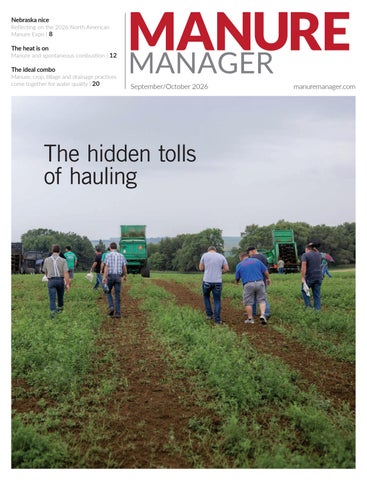
12 16 ON THE COVER Examining spreading patterns at the 2026 Manure Expo. Image by Hannah Dorn.
20
The heat is on
The hidden haul
The ideal combo
BY JIM TIMLICK
BY JACK KAZMIERSKI
BY BREE RODY
The science behind manure combustion – and everyday steps to reduce the chances of disaster.
Farmers and haulers experience unique stressors on their mental health. Why do so many suffer in silence?
Inside a Vermont multi-site project that will determine the best manure methods – and other practices – for water quality.
September/October 2026 - MANURE MANAGER 3
FROM THE EDITOR
MANURE MANAGER September/October 2026 Volume 24 No. 4
BREE RODY | @ManureManager
Reader Service Print and digital subscription inquiries or changes, please contact Angelita Potal, Customer Service Administrator Tel: (416) 510-5113 Fax: (416) 510-6875 Email: apotal@annexbusinessmedia.com Mail: 111 Gordon Baker Rd., Suite 400, Toronto, ON M2H 3R1
For ourselves, for our families Today in my inbox I read a Google news alert about a farm worker death in a confined space. A father and son – aged 72 and 42 – died in Cheshire, U.K. after falling into a slurry (manure) tanker. While the circumstances of the deaths, still being investigated at press time, have not been released, it nevertheless prompts memories of last year’s multi-fatality incident in Colorado which saw six workers die, including one teenager. Among the six workers were at least three workers from the same immediate family. Farming is a dangerous business. It is also, often, a family business. Safety training always instructs – not suggests, implies or cautions, but strictly and consistently instructs – workers to not enter a confined space after someone to rescue them if they have fallen unconscious. However, in many asphyxiation and drowning incidents that involve multiple deaths, this is often exactly what has happened. Even if training is the most
Published by: Annex Business Media, P.O. Box 530 Simcoe, ON N3Y 4N5
At as low as 400 ppm, it can cause loss of consciousness and possible death. Purdue’s analysis found of the 48 confined space agricultural safety incidents in 2025, 10 were due to asphyxiation, but unlike grain entrapments and falls into storage structures, all 10 incidents were fatal. Manure incidents are much more likely to be fatal, due to the indisputable risk of asphyxiation. Counted in that 10 are the Colorado workers. Despite the tragic heroism of an attempted rescue, they almost always end the same way. And while even one family member not coming home is a tragedy, the idea of losing a partner and a child, or two siblings or any other members of your family all at the same time is simply unthinkable. Our annual safety issue often strikes a somber tone, which doesn’t mean we cannot also mark and celebrate the progress of innovations like our North
“Farming is a dangerous business – and often, a family business.” sufficient, it’s always possible that emotion and adrenaline will win out above all else – especially when it’s family. But the facts, the training and the science tell us that hydrogen sulphide always wins – and no, you can’t trust your nose. At just 100 ppm, hydrogen sulphide paralyzes the olfactory senses, meaning the only reliable way to know its concentration is through a monitor.
American Manure Expo – see Page 8 and 9 for the gallery – or research like the water quality research in Vermont detailed on Page 22. But as we enter a busy harvest and arduous application season, I urge all workers to keep but one goal in the back of their minds: get home. Get home safely. There’s a place for you at the dinner table. •
Editor BREE RODY (437) 688-6107 brody@annexbusinessmedia.com Advertising Manager SHARON KAUK (519) 410-4854 skauk@annexbusinessmedia.com Account Coordinator JULIE MONTGOMERY (416) 510-5163 jmontgomery@annexbusinessmedia Media Designer CURTIS MARTIN Group Publisher & VP, Content Strategy MICHELLE BERTHOLET mbertholet@annexbusinessmedia.com Audience Development Manager SHAWN ARUL (416) 510-5181 sarul@annexbusinessmedia.com CEO SCOTT JAMIESON sjamieson@annexbusinessmedia.com Printed in Canada Publication Mail Agreement #40065710 SUBSCRIPTION RATES Canada – 1 Year $40.31 2 Years $68.95 (plus applicable taxes) USA – 1 Year $91.23 CAD Foreign – 1 Year $103.96 CAD GST – #867172652RT0001 Occasionally, Manure Manager will mail information on behalf of industry-related groups whose products and services we believe may be of interest to you. If you prefer not to receive this information, please contact our circulation department in any of the four ways listed above. Annex Privacy Officer privacy@annexbusinessmedia.com Tel: 800-668-2374 No part of the editorial content of this publication may be reprinted without the publisher’s written permission. ©2026 Annex Business Media. All rights reserved. Opinions expressed in this magazine are not necessarily those of the editor or the publisher. No liability is assumed for errors or omissions. All advertising is subject to the publisher’s approval. Such approval does not imply any endorsement of the products or services advertisted. Publisher reserves the right to refuse advertising that does not meet the standards of the publication.
manuremanager.com
@ManureManager 4 MANURE MANAGER - September/October 2026
@ManureMag
Manure Manager
THERE’S MORE
VALUE
IN YOUR MANURE EVERY 1,000 GALLONS COULD YIELD UP TO AN
ADDITIONAL 5–6 LBS. OF NITROGEN AND 7 LBS. OF POTASSIUM. Your manure already contains valuable nutrients and organic matter. The challenge is making that value available. PhycoTerra® feeds the native biology already living in your manure, so microbes break down organic material and cycle nutrients into more plant-available forms. The result? Up to 32% greater nutrient availability, turning the manure you already have into a more valuable fertility resource for the field. Make the most out of your manure this year.
Join the 2026 Manure Value Initiative and help measure the value of your manure while earning up to 70% of your PhycoTerra product cost back.
Join Now
www.phycoterra.com | Gilbert, AZ
INDUSTRY NEWS manuremanager.com
Manure, phosphorus management to be studied Two new Manitoba farms have volunteered to be part of a new initiative from the Potato Sustainability Alliance (PSA). The initiative promotes healthy water stewardship through practices such as 4R nutrient stewardship, manure management, cover crops, riparian buffers, soil management and more. The farms include Blumengart
Hutterite Colony, which focuses on manure management, as well as other practices. The ongoing program has expanded to showcase practices to producers – as well as consumers and the public – across various types of operations. Participating farms fall within the Red River and Assiniboine watersheds. The
project focuses on measuring and evaluating the practices and their worth to both the farms and the expanded environment. It measures factors such as nutrient retention and runoff into waterways, expanding the traditional thinking of ROI. The project continues to look for opportunities to add more producers into the initiative.
NEW WORLD SCREWWORM ARRIVES IN U.S. Experts at the University of Georgia Cooperative Extension are urging producers and citizens to “stay alert, not alarmed” amidst a summertime rise in the U.S. of New World Screwworn cases in livestock. Although headlines raised concerns among producers and the public on the threat of the parasitic pest, experts at the Extension service, including professor Nancy C. Hinkle, assistant professor and program coordinator William Secor, ANR agent and entomology PhD student Raymond Fitzpatrick and pesticide safety program educator Allison Johnson, appeared in a July webinar to share facts beyond potentially sensational or misinterpreted headlines. Secor sated the threat was “really limited at this time” and that markets weren’t showing many signs of impact. Fitzpatrick highlighted an effective control strategy that has been used in the past to eradicate the pest, while the experts urged viewers to avoid using pesticides off-label, minimize unnecessary livestock movement and maintain strong relationships with their veterinarians. Meanwhile on the trade front, the USDA began
a coordinated, phased reopening of southern cattle ports at the end of August, beginning with the Douglas, AZ port of entry to cattle trade, and working toward subsequent openings in Santa Teresa and Columbus, NM. Contingent on Mexico’s adherence to the Joint Action Plan, the plan will see all animals entering the U.S. through these ports undergo a full USDA inspection to ensure it is free of signs of new world screwworm. Ports were closed last year when NWS was detected in Mexico; since then, NWS has entered the U.S. regardless. However, U.S. agriculture secretary Brooke Rollins said in a statement, “The closure of the Southern ports of entry for the last year has been a tough but necessary action.” Sonora and Chihuahua have long maintained a strong animal health infrastructure program, says the USDA, and are identified as the lowest-risk Mexican states for NWS. Sonora borders the Douglas, AZ port, while Chihuahua borders Santa Teresa and Columbus. The reopening timeline will remain flexible.
RNG innovators mark Minnesota milestone RNG specialists Swinergy celebrated its official entry into the Upper Midwest this past July. The energy tech company celebrated the completion and opening of operations at HollandAg near Ellendale, MN on July 29. It’s the first commercial application of Swinergy’s energy technology to the Upper Midwest. While creating renewable natural gas (RNG) out of livestock manure is an established practice, Swinergy’s specialty is enabling RNG production from manure collected from swine pit-barn operations. It employs a modular approach, which it says
is to help producers overcome technical and operational barriers that may limit them in the implementation of on-farm RNG projects. The system is designed to improve the conversion of livestock manure and other organic materials into biogas, which can be processed and used as RNG, while supporting improved manure management and environmental performance. Although the company is initially focused on livestock manure, it foresees potential applications involving food processing byproducts, ethanolindustry residuals and other waste streams.
6 MANURE MANAGER - September/October 2026
Following the ceremony, which included community leaders, investors and industry, attendees toured the installation to get a closer look at the separation and various stages of anaerobic digestion. CEO Eugene Alvey said at the ceremony that the facility is “more than the completion of one project; It is an important step toward building a scalable renewable natural gas platform that can help farmers generate clean energy, improve manure management, reduce methane emissions and participate in markets that reward lower carbon intensity.”
Fertilizer prices to stay high: Report
CALGARY TEAM HONES LIQUID NUTRIENT SENSOR
New research from CoBank’s Knowledge Exchange shows that despite fertilizer prices retreating from the historic highs seen at the start of the Iran war, prices are expected to stay high – still above pre-war levels – through 2027 and likely 2028, and a “major headwind for the U.S. agricultural sector.” The geopolitical instability has led to constrained feedstock supplies and tightened phosphate availability, with an overall ripple effect keeping availability and affordability a top concern. With 50 percent of globally traded sulfur and more than 30 percent of global urea exports originated from the Middle East and shipped through the Strait of Hormuz, an estimated 31 ammonia plants in the region being impacted or even shut down and at least 20 plants in Russia damaged by Ukrainian drone attacks, global supply challenges are expected to continue, with phosphate markets expected to remain especially tight. According to CoBank, U.S. farmers have already adjusted their nutrient management strategies in response to the prices; rather than sharply cutting fertilizer use, many have relied more heavily on soil testing, variable-rate application technology and precision nutrient management to maintain yields, with many subscribing to the idea that under-fertilization can be more costly than higher prices.
University of Calgary researchers are on their way to developing a sensor that provides accurate measurements of nutrients in agricultural liquids, including manure, without ever touching them. Zahra Abbasi of the Schulich School of Engineering leads a research team at the Calgary Sensor Lab, which is developing a microwave-based nutrient sensor designed to provide realtime data on nitrogen, phosphorus and potassium. So far, the team has successfully validated all two-nutrient combinations – nitrogen and phosphorus, nitrogen and potassium, and phosphorus and potassium – with a simultaneous detections of all three nutrients in progress. The technology was developed in partnership with Livestock Water Recycling (LWR), a Calgary-based industry partner, to test the technology in manure management systems. The team is working toward a fully integrated prototype that can operate in real-world agriculture environments. Trials are expected to extend to 2027.
THE INNOVATIVE BIOSELECT FOR EFFICIENT MANURE SEPARATION. + Low Life-Cycle Costs + Turnkey from a Single Source: Separator Pump(s) Control Unit Stationary or Mobile Skids + Patented Profile Auger with Counter Bearing for No Auger Screen Contact + Continuously Variable Dry Matter Content + Large Capacities
SCAN TO WATCH THE BIOSELECT IN ACTION!
844-647-7867 www.boerger.com
MM_Boerger_MarApr23_CSA.indd 1
September/October 2026 - MANURE MANAGER 7 2023-02-24 12:02 PM
The Expo’s return to Nebraska highlights livestock innovation and Midwest hospitality BY MANURE MANAGER STAFF
The North American Manure Expo brought enthusiastic visitors from in and around Wayne, NE – including visitors from out-of-state and even other countries – to check out new technology and learn more about the science of manure management and application. Nearly 800 individuals arrived onsite at the Wayne County Fairgrounds to review, buy and sell equipment, attend education sessions and more on July 29 and 30 for the 2026 event. The show also included a separate day for tours on July 28. Also known as “Wayne America,” Wayne County is known for a plentiful number of beef cattle
feedlots, large poultry operations and plenty of field crops. Leslie Johnson, chair of the 2026 Expo and an educator with University of Nebraska’s Extension, says most of the Expo’s tours featured a beef feedlot, which was important to her and the local committee as it helped showcase the area’s offerings. “We wanted to feature some of the things that are unique to Nebraska, and the feedlots – and the size of the feedlots – are a big piece of it,” says Johnson, who caught up with Manure Manager following the Expo to reflect on the event. Large feedlots are officially classified as 1,000 heads, but Johnson
ABOVE Equipment demonstrations, trade show interactions, safety education and interactive sessions all made an impression in Wayne. 8 MANURE MANAGER - September/October 2026
PHOTO: ALL IMAGES COURTESY OF HANNAH DORN
NEBRASKA NICE
says that’s not the most reflective of the industry – as some large feedlots are known have around 10,000 heads. And livestock drives much of the spirit of the Expo, she says. “Our livestock producers are required to take [manure] training,” she says. “Not our custom applicators.” As the custom application industry is grown, Johnson says, those producers don’t have as many opportunities for education. The few opportunities there are, she said, aren’t always the most geographically accessible. Another unique facet of Northeast Nebraska is that a large amount of manure is put out through center pivot irrigation. “Particularly the runoff from feedlots, there’s not a lot of nutrients in it.” Instead, she says, rain is captured through holding ponds and applied through irrigation systems. “We can put it out through irrigation systems without a lot of problems, and it allows us to put that manure on during the growing season – we can apply water with a few nutrients in it when the corn actually needs that extra moisture and a little bit of nitrogen.” Johnson says as a farmer herself, the demos often appeal to her like a candy store to a small child. “My own small farm, the
size of equipment and the technology does not compare to what’s being used by our custom applicators and larger applicators,” she says. “I never thought in 15 years that we’d be precisionapplying manure, but that’s something that’s becoming more and more popular. There [are] scales on the equipment, they have that variable rate, and the ability to put it where the crop needs it,” she says. “It took a long time for me to see that that was the future, partially because I do come from that small farm, where that is not feasible. But in the larger scale, you can justify spending the money on that equipment.” On the second day of the Expo, a small drizzle during solid application demonstrations turned into an all-out downpour. As a farmer, Johnson says, the rain was much-welcome change – it’s been a rare drought year for the area – but the rain did sadly result in some Expo segments being shortened or altered, such as the hose break demo, which was replaced on the fly with an educational session about manure hose safety. But for Johnson, the important aspects of the Expo were all touched on. “We were really thinking, ‘What do people need to know? What’s different and unique about that region?’… This was a great opportunity for that.” • September/October 2026 - MANURE MANAGER 9
SAFETY MATTERS BREE RODY
By the numbers: Confined space incidents and deaths Purdue University’s ag department has been documenting, investigating and publishing statistics on agricultural safety, specifically in the field of grain storage and handling facilities at both commercial and on-farm locations. This year, no fewer than 48 cases involving agricultural confined spaces were documented, although the report stresses that many cases are undocumented – with the biggest indication being that fatal cases outnumber non-fatal cases in the documented study. This suggests many non-fatal cases go unreported. However, the report can only publish what is known – including the fact that 22 of those cases were fatal, and 26 were non-fatal (editor’s note: in the context of the report, a “case” refers to an individual, and not an incident, as some incidents involve multiple victims or cases). In terms of trends, this seems to be heading in the right direction – with 48 total cases, that marks a 5.9 percent decrease from 2024’s 51 documented cases. The figure is also 20 percent lower than the 10-year average of 60 cases. Fatalities are also
slightly lower than 2024 (24 fatalities), However, despite grainrelated entrapments trending down – with 21 entrapments, a 38 percent decrease from 2024 – livestock waste handling-related cases have stagnated. And, the report states, despite lower-thanaverage cases and some decreases, the “frequency and severity” of such cases is cause for ongoing concern. Of the 48 cases in 2025, this included: • 21 grain entrapments; • Seven falls into or from grain storage structures; • 10 asphyxiations due to oxygen-deficient or toxic environments; • Eight equipment entanglements; and • Two incidents involving miscellaneous circumstances. Four incidents involved livestock waste storage pits or lagoons – but this resulted in 10 fatalities, including six in one incident – a high-profile incident in Colorado which involved numerous workers who were from the same family, including a teenager. The six victims of the Colorado incident made up six of the state’s seven
COMMITTED TO QUALITY YOU CAN DEPEND ON For more info visit huskyfarm.ca or call 1-800-349-1122 Trailing shoe booms from 6m to 30m in width. BlackBird trailing shoe booms in stock Summer 2024. Various incorporation options available. Contact us for more info on tank sizing options.
10 MANURE MANAGER - September/October 2026 MM_Husky_SEPTOCT26_BAS.indd 1
2026-09-08 9:13 AM
cases, making it the second-highest state for cases. Minnesota had the most cases, at eight. Indiana had six cases. Historically, Iowa has had the most cases documented at 298, followed by Indiana (251), Minnesota (240) and Illinois (238). Indiana may rank higher, the report writes, due to more thorough surveillance. Whie this year’s slight decrease in fatal cases could be attributed to improved rescue outcomes, one concern is that manure confined space incidents are highly likely to be fatal – and all 10 asphyxiation incidents were fatal. MANURE-RELATED REPORTS The last published summary of agricultural waste-related incidents was published in 2021, with the database now containing approximately 450 incidents. Historically, the majority have been fatal, with a significant common characteristic of these incidents being a high risk toward secondary victims – such as the victims of the Colorado incident, in which five of the victims were secondary victims attempting to rescue the initial victim. Since many manure-related deaths involve asphyxiation, it’s worth noting that this is the one category of incident in the report in which 100 percent of the cases were fatal. Most victims who died (60 percent) died before first responders could arrive on scene, which highlights the instantaneous nature of some deaths, including asphyxiation. THE NEED FOR TRAINING The report calls into question the efficacy or appropriateness of training. Ongoing surveillance of media for incidents involving confined spaces has identified a high frequency of reports related
to training by and to local emergency first responders; however, the report notes that training occurs “even in areas where the probability of a grain-related entrapment is extremely low, or historically nonexistent.” The report also noted that the primary focus of training is often to address rescue strategies using on-site fabricated or commercially available PPE. With so much spent on these trainings and equipment, the report’s recommendation is that policymakers ask themselves if the current level of training activities is justified. It added that considering the increase in the number of incidents involving manure-related facilities, increased documentation of multiple or secondary victims, and the growing number of confined spaces found on ag operations, it maybe appropriate to offer training on the hazards of extracting victims from such spaces. UNSAFE CONDITIONS COST Besides individual injury and death, the report also offers a glimpse into the growing size of financial settlements resulting from civil litigation associated with such occurrences and more. While economic consequences for these types of injuries or fatalities used to be relatively minor, enhancements from OSHA regulations have resulted in a significant number of employers being subject to civil litigation and penalties. For example, in recent fatal incidents involving grain bins and livestock waste facilities, OSHA fines have been described as “relatively insignificant” (between $50-100,000), whereas legal settlements have been documented at between $10-17 million. Additionally, in at least two documented cases, criminal charges were considered by local and federal prosecutors. •
SEPCOM® V2-200 The vertical separator is designed to dewater liquid-solid mixtures in which the ratio of liquid to solids fluctuates dramatically. This machine design includes two vertical screws manufactured from SINT® engineered polymer. The unique design ensures there is no clogging or loss of the plug during operation. Separation is performed by a combination of gravity and mechanical compression. This flexibility allows the machine to separate the liquid phase from the solid phase of a wide range of materials where the percentage of the liquid inside the solids may be constantly changing. APPLICATIONS • Animal Manure (Cows, Hogs, Chickens,…) • Low Fiber Waste • Digestate from Biogas Plants DESIGN DATA • Flow Capacity: Up to 130 gpm • Motor HP: 7.5 • Dry Matter: Up to 28% • Hopper for stable feeding
MM_SAVECO_FEB26_BAS.indd 1
SEPCOM MICRO-FILTER MFT-500 The SEPCOM Micro-filter MFT is a machine for the micro-filtration of raw or digestate animal slurry (Pigs, Cows, Chickens). In some cases, it can be used as an alternative to the centrifuge for a fraction of the installation cost and operating cost. The micro-filtered liquid can be used for fertigation, or in systems that reuse the liquid, or stored in manure lagoons for easy removal. BENEFITS • High filtration efficiency • Quick installation
• Easy maintenance • Low operating costs
• Food Compost • Rubber Recycling • Industrial Waste
• Dual Vertical Screws • Self-Adjusting counterpressure system • Never loses the solids plug.
SAVECO North America 7809 100th Street Pleasant Prairie, WI 53158 Jeff.moeggenberg@savecowaterna.com 224-441-4204
September/October 2026 - MANURE MANAGER 11 2026-02-17 12:20 PM
The heat is on BY JIM TIMLICK
To those outside of the agriculture industry, spontaneous manure combustion may sound like something out of a comedy sketch. But the fact is, the act is not only a very real biological phenomenon, but also one that can have potentially devastating consequences for a farm operation. That was the case earlier this year when a fire at a poultry farm in Ridgely, Maryland caused an estimated $100,000 in damages. Investigators determined the cause of the fire was spontaneous combustion of stored manure and ruled the incident an accident. The May 30 blaze destroyed a 100-by-50-foot manure storage building and damaged several nearby pieces of farming equipment. Fortunately, no injuries were reported. M. Charles Gould, an extension bioenergy educator at Michigan State University, says the
12 MANURE MANAGER - September/October 2026
incident should serve as a cautionary tale for producers that proper manure management is not only an environmental and biosecurity concern, but also a farm safety issue. “It is, very much so, because if the conditions are right, you’re going to have a hundred thousand dollar or two hundred thousand dollar expense on your hands,” he says. “To prevent it, it’s really, really simple. It’s actually part of a manure management strategy or should be part of one. If you’re a livestock (operation) storing manure, dry manure, it should be a matter of something you should do every day as part of your maintenance or monitoring program.” Gregory Martin and J. Craig Williams, extension educators with Penn State University, agree. They both say that farmers should be checking their collected manure at least once a week to
PHOTO: © ANDRIUS VAIŠNORAS / ADOBE STOCK
Combustion management is part of manure management.
October 5-9, 2026
with Sponsored by
FIVE DAYS of in-depth education to make the most of your manure application Featuring articles, resources, exclusive educational and product webinars and more. MONDAY OCTOBER 5: u FREE WEBINAR: APPLICATION OUTCOMES FROM AGITATION Plus, live product webinar and Q&A Register Here u TUESDAY OCTOBER 6: Special themed enewsletter u WEDNESDAY OCTOBER 7: Video eblast u THURSDAY OCTOBER 8: Special themed enewsletter u FRIDAY OCTOBER 9: Recap eblast with additional resources
APPLY KNOWLEDGE. www.ManureManager.com
make sure its relatively dry and that its temperature is within a safe range. “Check it, know how old that pile is, know if you’ve forgotten about it. Have you looked at the manure shed in the last seven days?” poses Williams, a dairy specialist. “Granted, farmers have got a lot going on. You’re making hay, you’re planting corn and all these other things, but if you’ve got a water leak and you haven’t looked at that manure pile in seven days, that kind of sets the clock and something
could happen. If you’ve forgotten about that pile, check it out.” EVERYDAY COMBUSTION RESPONSIBILITY That inspection should including checking to see if there are any water leaks in any storage facilities, especially any open-sided buildings where rainwater may be able to enter and work its way into manure that was previously dry. So, what actually causes manure to spontaneously combust?
When the going gets tough, turn to the toughest pumps, mixers, and recirculators in the field. Vaughan has unique pump configurations specially designed for agricultural applications, including: • • •
Barn Finish Pits Separator Feeds Lagoons
• • •
Digester Mixing Scraped Manure And More!
888-249-CHOP | CHOPPERPUMPS.COM
14 MANURE MANAGER - September/October 2026 MM_Vaughan _SeptOct26_CSA.indd 1
2026-08-27 1:44 PM
In simple terms, it happens when oxygen and excessive moisture are both present in the manure at the same time. This combination helps to generate microbial activity in the manure which leads to an internal build up of heat and can cause the organic material to reach ignition temperatures. Gould says spontaneous manure combustion can happen on any kind of livestock operation, but it generally happens more frequently on poultry farms. The primary reason for that is that poultry manure tends to be stacked quite high in order to dry it out and and such excessive pile sizes tend to trap heat within the material. That’s why Gould says poultry farmers should ensure their manure piles are shallow and narrow to avoid any heat buildup. Jeremy Daubert, a dairy extension agent at Virginia Tech, encourages farmers to take regular temperature checks of any stored manure on their operation using a long-stem thermometer. Ideally, the reading should be between 110 and 130 degrees Fahrenheit. If it’s between 180 and 190, there’s a high risk it could spontaneously combust. “If (the temperature) keeps going up and if you get above 180, you should have the fire department on hand. You can stir it, but stirring is going to add oxygen, which might ignite it,” he adds. Daubert also suggests farmers have some kind of flame-resistant covering on hand in the event a manure pile begins to smoulder so they can cover it and not allow any additional oxygen into the pile. While a long-stem thermometer is a useful tool to have on hand, Martin and Williams caution they are foolproof. Williams says the problem is most thermometers are only good to a depth of three feet and a lot of times the “hot spot” in a manure pile is located four feet or more from the surface. MODERN PREVENTION PRACTICES Martin, a poultry specialist, says what many farms are now doing is installing high temperature heat sensors in their manure storage facilities. The circular device looks like a home smoke detector and retails for between USD $100 and $150. It is usually placed in the rafters or near the roof of a storage facility where it
can detect dangerous heat spikes and can trigger automated ventilation or issue an alert when safe limits are exceeded. STAYING PROACTIVE AND PRODUCTIVE Williams stresses that it’s important that farmers are proactive and work with their local fire department ahead of time to make a plan in the event manure catches fire or is at risk of doing so. “There’s always good value in doing some work with your local fire company … and saying if there’s a manure fire, this is kind of what we want to do … so that they have some experience before any barn in their area gets into a situation,” he says. As for those regular inspections, Williams says its important for producers to take a close look at any manure piles they suspect could be at risk of catching fire. That includes paying attention to whether its white, wispy smoke emanating from the pile, which likely indicates fire, or is it simply steam escaping from the mound.
“If it looks like cigarette smoke coming out of the pile, then you may have a fire on your hands and I would not disturb the pile until you had a fire crew there or volumes of water there and a good excavator to open the pile and put that fire out,” Martin adds. Gould advises farmers who are working with manure-based compost to avoid adding any new material to the pile. The problem is that adding new material can introduce new oxygen into the mix which can serve which can potentially serve as fuel. “If that pile’s hot, then you set yourself up for potential spontaneous combustion,” he explains. Daubert says one of the simplest steps farmers can take to reduce the chance of spontaneous combustion is to make sure they keep wet manure stored separately from dry manure. That way, you avoid any “sandwiching” in which moisture seeps from wet material to dry material and which can cause additional heating. He also advises producers to avoid excessive pile sizes that can trap heat within.
In addition, if you are storing manure in a facility with six foot concrete walls, Daubert recommends it shouldn’t be piled any higher than six feet so that if it does combust the fire is much less likely to spread and cause any serious damage to an adjacent or nearby barn. Its always preferable to store manure in a separate facility rather than within a barn or attached building since it can limit the amount of damage created when spontaneous combustion does occur. If that’s not possible, Martin recommends installing a concrete firewall to separate the manure storage area from the rest of the barn which can help prevent damage to the facility and protect the animals within in the event of fire. Gould says while spontaneous manure combustion is relatively rare, it is something farmers need to be concerned about because it can have lasting repercussions. That includes the loss of nutrients in the manure because they burn up or they get so hot they become tied up in the manure and aren’t plant-available. •
Smart Performance
YOU CAN COUNT ON! Smart Technology Built for Drag Hose The new 1020 HD pumps are built to pump manure, built to run smoother to save fuel, run at a lower rpm with larger and wider impellors to reduce engine wear and plugging issues.
Nutrient Application Systems
MM_SMARTTURNER_MARCHAPRIL26_BAS.indd 1
647.962.0379 smartturnerag.com
September/October 2026 - MANURE MANAGER 15 2026-02-26 2:40 PM
The hidden haul Fatigue, mental health and the toll on haulers.
Eighteen-hour workdays, extended time away from family, isolation, financial pressures, too little sleep, and limited human interaction can all be part of life for manure haulers during the busy fall application season. The physical demands of the job are easy to recognize. The mental strain, however, can be less visible, and easier to overlook. “The seasonal nature of farming, including manure hauling and application, makes it very stressful,” says Emily Krekelberg, extension educator, farm safety and health at the University of Minnesota Extension. What can make the situation even more challenging, she explains, is that people outside the farming community don’t really understand the nature of the work and how stressful it can be. “Some of the stressors are not socially understood or accepted,” she says, “so we don’t have a lot of social support from people outside of agriculture.” Daniel Andersen, professor and extension
specialist in manure management and water quality at Iowa State University, says the cumulative effect of multiple stressors can be significant. Weather conditions can change quickly, long hours are often unavoidable, and the work demands constant physical and mental attention. Schedules are frequently dictated by the weather, leaving workers with little control over how their days unfold. “When things are consistent,” says Andersen, “you can focus on routine and build in the selfcare that makes it doable every day. When work is seasonal, we often start to say, ‘I can do this. It’s only a few extra hours today. We can finish this job, and move on to the next one.’ Or we say, ‘It’s only a few more weeks until we are done. I can just push through.’” He explains that during busy periods, workers may postpone sleep, proper meals and other forms of self-care until the job is finished, telling
RIGHT A hydrogen sulfide meter reading 23 PPM. Exposure to hydrogen sulfide has been linked to tiredness and confusion. 16 MANURE MANAGER - September/October 2026
ALL IMAGES COURTESY OF DANIEL ANDERSEN
BY JACK KAZMIERSKI
themselves they only need to push through for a little longer. Krekelberg explains that this level of fatigue is a definite safety issue, and so is constant stress. “When we’re stressed, we have higher cortisol levels, and that can impact our judgement and our reaction times,” she says. “When we’re tired, when we haven’t eaten well for a week, we are impaired.” FAULTY COPING MECHANISMS Working extremely long hours leaves very little time for rest or sleep, which eventually impacts a person’s ability to think clearly and make sound decisions. The effects of sleep deprivation are often compounded as workers try to fight fatigue by consuming more caffeine, more sugary snacks and eating whatever foods may be available on the go. The result can be a cycle that reinforces itself: Workers rely on caffeine and quick sources of energy to keep going, but those choices can make it harder to get the rest their bodies and minds need. “We are often trying to bring our energy up, to keep pushing, and that can make it harder to sleep when we do lay down,” says Andersen. “In turn, less sleep slows decision speed and reaction time.” Krekelberg stresses the importance of taking care of our physical bodies during these long hours at work. “Nutrition is often overlooked,” she says. “But when we eat well, we feel well. So instead of a soft drink and a candy bar, have some milk, some cereal, a protein bar or something else that’s good for you.” She explains that the effects of long hours extend beyond physical fatigue and can also take a significant mental and emotional toll. Besides the mental exhaustion workers have to deal with, she is most concerned about isolation. “I would have to say that this is the number-one issue,” she says. “Isolation is a huge risk factor for mental health, regardless of the occupation, but especially in agriculture, since many of the tasks are performed by people working alone for long hours at a time.” Extended periods of isolation, she explains, can contribute to greater stress and a higher risk of depression. The problem can continue even after the workday ends. After 18 or 20 hours on the job, workers may be too exhausted to spend time with family or friends. Instead, all they want to do is sleep. Even manure haulers who work with a team and aren’t necessarily on their own all day can feel the effects of isolation. “They’re away from family,” says Andersen, “And even if they bond with their crew, that crew is not a substitute for family.” EARLY WARNING SIGNS The effects of prolonged stress and exhaustion can be serious. Recognizing the warning signs, either in yourself or someone else, can be an important first step toward getting help. How can you tell if your mental health is being pushed to its limits? And how can you tell if someone you know may need help? At first, the signs may be subtle. Someone who normally enjoys spending time with friends and family may begin withdrawing from others, avoiding social activities and choosing to remain alone, even when they are away from work. “They don’t want to spend time with their family or go to events or do things they’ve normally done,” says Krekelberg. “That can be an early sign.” Another sign, she adds, is when the person no longer wants to take care of themselves. “Their hygiene might be slipping,” she says. “If they’re a person who normally takes pride in their appearance,
A LONG WAY
TOGETHER
THE ONLY FACTOR THAT MATTERS Whatever your job in the fields, BKT’s brand-new AGRIMAXFACTOR 70 series for tractors is perfect for both haulage and soil tillage operations. An innovative tread design and a strong polyester casing provide extraordinary lateral stability and a faster steering response, even for high-speed operations or heavy-duty service. The by-5%-increased contact area on the land significantly reduces the noise perception in the cabin – which stands for more comfort. Besides, the exclusive “E-READY” logo on the sidewall highlights BKT’s commitment to electric mobility and makes this product suitable for electric vehicles. Excellent handling and stability along with increased durability are key features that make AGRIMAXFACTOR the right tire for your safety and comfort – even under heavy-duty conditions."
Discover the BKT Range
Joe Dias Eastern Zone Manager Directeur Régional, Est du Canada BKT Tires (Canada) Inc. Cell: 514-792-9220 Web: www.bkt-tires.com
September/October 2026 - MANURE MANAGER 17 MM_BKT-Tires_SeptOct26_CSA.indd 1
2026-09-01 11:07 AM
but suddenly that doesn’t seem to matter at all to them, that could be a sign.” Changes in how someone cares for their home, farm or personal surroundings may also be worth noticing, particularly when they represent a significant departure from that person’s usual habits. “I’ve been to farms where I know the farmer is struggling, and things look like they were just left in place, without even an attempt to put things in some kind of order,” says Krekelberg. PRACTICAL COPING STRATEGIES While the demands of manure hauling can’t always be reduced during the busiest weeks of the season, there are steps workers can take to protect their mental and physical wellbeing. Andersen recommends looking for ways to spend more time with those you love. If you’re too tired to spend meaningful time with family at the end of the day, he suggests finding opportunities to connect during the workday instead. “Share a picnic in the field,” he says. “Bring the family out and have a picnic with them.” Krekelberg agrees that family time
ABOVE Muddy field conditions can make every job more challenging, increasing fatigue and potential danger.
is essential, and adds that making an effort to connect socially with those you care about during the day can make a big difference in a person’s mental and emotional wellbeing. “If you’re having a long day and you’re on the road, call a friend, a spouse or somebody you know, and just talk for a few minutes,” she says. “Hearing another voice can make a big difference, even if
you’re not talking about anything that’s really important. A call can strengthen social connections and reduce that feeling of isolation.” She stresses the body-mind connection and emphasizes the need for nutritious food. “Reach out for better snacks and lunch options,” she says. “You don’t have to change your whole diet, but you can make better choices.” She also recommends simple deepbreathing exercises as a way to reduce stress and regain a sense of calm. “This is especially good for manure haulers, because it’s easy, and because they are all alone in their trucks, so they don’t have to feel embarrassed, and no one needs to know they’re doing it,” she says. Krekelberg’s final message is that workers experiencing stress should not feel that they have to simply endure it alone: “If you’re experiencing a lot of stress right now, you are not the only one. And if you’re feeling stressed, you’re not helpless. There is a lot you can do to help yourself. You don’t need to change your entire life overnight. You can do something as simple as deep breathing for 30 seconds, and that can help.” •
Specially designed for manure transfer & travelling irrigators Extremely low friction loss For extreme UV and ozone conditions Superior bend radius and kink resistance Ø 4” Ø 6”
Available in 4”- 6” diameter in 660’ lengths
sales@kuritec.com
www.kuritec.com
Oroflex Drag Hose AD OROFLEX DRAG CANADA.indd 2
10/7/26 18:22
MM_KuriTec_SeptOct26_CSA.indd 1
2026-08-31 3:29 PM
18 MANURE MANAGER - September/October 2026
THERE’S MORE VALUE IN YOUR MANURE LIVE WEBINAR OCT. 13 - 11AM EST
THREE KEY TAKEAWAYS
1
Understand the biology:
UNLOCK THE HIDDEN VALUE OF MANURE WEBINAR
CCA-CEU’s are pending approval for this webinar
Learn how microbes break down carbon-bound nutrients and make them more available to plants.
2
Look beyond N-P-K:
Discover manure’s role in building carbon, supporting biology and improving the soil ecosystem.
N=NITROGEN | P=PHOSPHORUS | K=POTASSIUM Manure is more than a source of N-P-K—it’s a valuable resource that provides nutrients, organic carbon and biological benefits to the soil. In this webinar, we’ll explore the biology behind manure and how microbes influence decomposition, nutrient cycling and nutrient availability from storage through field application. You’ll learn how understanding these biological processes can help unlock more of manure’s agronomic value and turn every application into a more effective fertility investment. Speaker: Dustin Blunier, Director of Agronomy
+
3
Get more from every application:
Explore practical opportunities to improve decomposition, nutrient availability, and biological activity.
REGISTER TODAY
THE IDEAL COMBO Manure or fertilizer? Drain tile or none? Till or no-till? Experts say “practice-stacking” preferred to “silver bullet” strategy.
S
oil and water quality are no longer optional for a farmer to worry about. While most farmers agree that sustainability is a positive goal, and that all producers should want to do the right thing and make all efforts possible to do so, they are often met with numerous barriers. Some of those barriers are material or logistical – initiatives that protect and promote soil and water health are expensive to implement and red tape can often make otherwise simple transactions complex. But other times, the barrier is more intangible. Various interest groups can push solutions that are biased in one way or another, and other studies or reports can be so nuanced that the ultimate solution becomes a confusing grey area. But the point, says a pair of Virginia researchers, is not to find the one perfect solution. Instead, they say, it’s about making the changes you can – however small – while implementing what makes sense, and tackling things from a holistic, multi-faceted approach. Some small changes might work best when done together, they say. Think of it like “habit-stacking” – a term made popular by wellness and motivational influencers to describe two or more positive choices performed in coordination with each other to create a doubly productive day. Think listening to an audiobook at the gym, wearing tooth-whitening strips while prepping food or… installing drain tile and land-applying manure? Exactly which practices “stack” well together are being tested at Discovery Acres, a multi-state program where farmers host water quality monitoring sites for researchers to produce credible information about effective environmental management that’s compatible with the thing producers ultimately cannot let out of their sight: profitable agriculture. Discovery Acres is executed through a partnership with University of Vermont (UVM), area farmers and the broader Discovery Farms network. BRIDGING THE GAP WITH PRACTICES Heather Darby, extension associate professor at University of Vermont, says in her area of St. Albans Bay, the farming community
knows the pressure is on from regulators and the public to take responsibility for major environmental concerns. She says farmers are of two minds – they want to do the right thing, but feel the tone directed at farmers can come across as accusatory. “They’re constantly being told how to fix [soil and water problems] and what to do, and at the same time, the scientific data to support what we’re telling them isn’t always there.” She says the farmers don’t doubt the importance, but would like to see more proof when it comes to the implementation of potentially disruptive, expensive activities. “We tell the farmers to cover crop, we tell them to transition to no-till, we tell them to use nutrient management… the farmers’ point is, ‘What is it actually doing? Is it making a difference?” That was the reasoning behind how Discovery Acres began – she and colleague Joshua Faulkner, a fellow extension associate professor, are driven by that push from farmers to deliver the results. “Farmers want science, but they also want local science,” Faulkner adds. “They don’t want decisions being made from five states away, from the Midwest… they want that science to come from Vermont systems, Vermont soils, Vermont climate.” He says while there’ great work done in the Western Lake Erie Basin, there’s not as much similar work done supporting beneficial practice in the Lake Champlain Basin. According to UVM Extension’s data, roughly 41 percent of total phosphorus load into Lake Champlain comes from agricultural production, and with the basin having heavy clay soils, which don’t drain well, more water and phosphorus run off those soils’ surface. Tile drainage installed beneath the surface can mitigate surface runoff, but subsurface runoff contains phosphorus as well. That’s where the Discovery Acres site – part of the Discovery Farms project, a national, farmer-led project spanning five states – comes in. There are four water monitoring stations spread throughout the field with four distinct watersheds. Each watershed is testing out different management practices, including injecting versus broadcasting dairy manure. Other practices studied include tile drainage versus no tile
ABOVE Joshua Faulkner, left, working on phosphorus research in Addison County. 20 MANURE MANAGER - September/October 2026
PHOTO BY JOSHUA BROWN.
BY BREE RODY
drainage and tillage versus no-till. Effects on water quality, soil health, crop yield and more will be studied. HOW THE EXPERIMENTS WORK From a water quality perspective, it’s too early to share results, but Faulkner walks Manure Manager through the line of thinking, applied through the Discovery Acres philosophy. “At one site, we’re. using the exact same setup – injection versus surface application – and we’re using cover crops with the injection, a no-till with the injection, no cover crops and conventional tillage on the other side.” This mix-and-match experiment is around four years in, and Faulkner says the team is seeing “promising results” roughly half of the total P concentration at the end of the field. How much of those results can be attributed to manure management? Faulkner says that’s not the point. “I don’t think we can solely attribute it to the manure management, because there are those other practices that go along with it. We’re stacking practices, which is where I think we need to go instead
of just saying one particular thing [is the solution] because that’s not what farmers are actually doing.” Besides the yield and quality of the crop – Darby says forages are being studied – the group is also looking at the biomass of the cover crop. With the tile drainage project, they’re also looking at economics and ROI. Darby adds that on the treatment with manure injection, no tillage and “essentially letting the cover crop grow and produce quite a bit of biomass,” it provides some insights into how farmers could become open to no-till approaches. “One of the things we have observed is that farmers who are traditionally very apprehensive to using no-till practices are those farms that are on heavy clay soils,” she explains. “We have seen that farmers are able to transition to no-till on clay and get not just adequate yields but [also] better yields than their conventional practices.” She says the cover crop’s biomass production could also be a detriment. “Last year, it produced too much biomass and supressed the yields on the plots that had tile.”
That kind of discovery isn’t a failure, says Darby. “It’s the combination of the practices together on both sides – the combination of the practices helps to enhance crop productivity while at the same time protecting the environment.” PROMOTING POSITIVE PRACTICES Darby says farmers are, understandably, frustrated with “trying to justify how we’re producing food to minimize both risk of failure and risk to the environment.” At the end of the day, she says, that’s what farmers are trying to do, and public discourse on divisive or misunderstood practices like manure application and tile drainage can feel alienating to producers. “It feels like a moving target, as the weather doesn’t give us any consistency and more, even I research.” Faulkner adds that it’s important for everyone – including detractors – to understand that “this is not brand-new, scary technology.” Tile drainage, he says, has been around since the 1800s, and manure application is as old as manure itself. “The climate is changing, we’re having more of these events that farmers are scrambling to respond to,” he says. •
WHAT’S YOUR MANURE WORTH? PhycoTerra® feeds the native biology already living in your manure, so microbes break down organic material and cycle nutrients into more plant-available forms. The result? Up to 32% greater nutrient availability, turning the manure you already have into a more valuable fertility resource for the field.
Join our Manure Value Initiative and let's find out together - with up to a 70% product rebate.
MM_PhycoTerra_SeptOct26_CSA.indd 2
Join Now
www.phycoterra.com | Gilbert, AZ
September/October 2026 - MANURE MANAGER 21 2026-09-01 3:38 PM
MANURE MASTERY Christine Brown | OMAFA
ABOVE Wheel tracks left after manure application to a forage field.
In a perfect world, manure would never be applied on wet or unfit soils. However, increasingly large equipment, heavier loads, tight application windows, and unpredictable weather mean that some compaction is often unavoidable. Healthy soils are porous, much like a sponge. These pores allow rainfall to infiltrate and be stored for crop use. Compaction crushes some of these pores, reducing water infiltration and storage capacity. During years with adequate rainfall, the effects may be difficult to notice. In dry seasons, however, the yield impacts can be significant. Manure application equipment weight varies from about 6 tonnes empty to about 29 tonnes loaded for a 5,000 Imp gal (6,000 US gal) tanker. Manure application does not affect the entire field uniformly, but affects the portion of the trafficked area where the load exceeds the capacity or resilience of the soil to withstand it. Depending on soil moisture, equipment, spread width, and traffic patterns, the proportion of a field impacted by wheel traffic can vary considerably. Figure 1 shows wheel-track patterns from a manure tanker applying manure in a 30 ft width to a forage field . Using the Soil Residue Calculator to estimate the trafficked area, figure 2 shows approximately onethird of the field was affected by wheel traffic. Research conducted by Dr. Scott Shearer at The
22 MANURE MANAGER - September/October 2026
Ohio State University compared crop yields from compacted and uncompacted areas under both fit and wet soil conditions. When loaded manure equipment was operated on soils in good condition, corn yields were reduced by approximately 6 bu/ ac in trafficked areas. When the same equipment operated on wet soils, the yield reduction increased to 18 bu/ac. Overall, corn grown in uncompacted areas produced 27 bu/ac more grain than corn grown on compacted wet-soil tracks. If one-third of a field experiences wheel traffic on wet soils and those trafficked areas suffer a 27 bu/ac yield reduction, the field-wide yield loss would be approximately 9 bu/ac. At a corn price of $6.25/bu (~4.50 US), that translates to more than CAD $55/ac (USD $40) in lost revenue. Wheel traffic, even without causing deep compaction, can also affect yields. Forage fields often experience traffic during mowing, raking, harvesting, bale collection, and manure application. While soil conditions are often drier during these operations, yield losses can still occur, particularly when traffic damages alfalfa regrowth after harvest. Alfalfa regrows from both crown buds and apical buds located on the stem. Wheel traffic can damage this new growth, forcing the plant to restart growth from the crown. The resulting delay reduces yield potential and can become even more
ALL IMAGES COURTESY OF CHRISTINE BROWN
Manure advantage without compaction cost
FIGURE 1 Aerial image of wheel tracks left after manure application to a forage field.
pronounced under moisture stress or other environmental pressures. A field study evaluating forage regrowth following manure application found a 25% yield reduction in trafficked areas where delayed manure application damaged new growth. If one-third of a field experiences tire damage after each cut in a three- or four-cut system, and forage is valued at $200/tonne, the resulting yield loss could approach CAD $30/ac per cut (~USD $20). When observing traffic patterns during manure application, it appears that operators often take the shortest route to and from storage to field. Beyond advances in technology, several
Quick Plug Gen
40% Dry Matter
• Easy access for quick service • Reliable plug formation • Ideal separation results
FIGURE 2 Using a soil cover ap, wheel tracks left from manure application to a forage field affected about 33 percent of the field.
management strategies can help reduce wheel traffic, minimize soil damage, and protect yields. STRATEGIES TO REDUCE COMPACTION DURING APPLICATION For manure tankers: • The first pass causes the greatest damage, and accounts for 75-80 percent of total compaction from multiple passes. Establish consistent travel lanes so equipment repeatedly follows the same tracks. Consider establishing a separate field entry and exit.
• Match load size to field length. Plan application rates and loads so the tanker empties near the end of the field, minimizing unnecessary travel. Splitting fields into application zones can help match field length to load volume. • Increase application width. Wider spread patterns reduce the percentage of the field impacted by manure equipment tire traffic. • Invest in tire technology. Larger tires, tracks, and central tire inflation systems can help reduce ground pressure and compaction depth. Where possible wait for suitable soil conditions. • Apply manure as soon as possible after alfalfa forage harvest. Applying manure before regrowth begins minimizes damage to emerging shoots. The nutrient, organic matter, and soil health benefits of manure are well documented. However, those benefits can be fully or partially offset when heavy equipment creates avoidable compaction. Careful management of traffic patterns, application timing, and equipment can help producers capture the advantages of manure while avoiding the hidden cost of compaction. •
SEPARATE BETTER WITH THE N® EW XSPLIT . Vogelsang’s advanced screw press separator, XSplit Distribution from:
vogelsangusa.com 800-984-9400 | sales@vogelsangusa.com
MM_Vogelsang_SeptOct25_CSA.indd 1
skinneragsolutions.com
September/October 2026 - MANURE MANAGER 23 2025-09-15 9:35 AM
ON TRACK
manuremanager.com
New Holland adds three new compact tractors
GenAp debuts new storage solution
New Holland has debuted its latest three tractors: the Workmaster 45C, 50C and 55C – marking New Holland’s further push into the compact utility segment. The new compact utility tractors range from 47 to 57 engine HP, all three being connectivity-ready and supporting New Holland’s FieldOps connected system and enhanced dealer support opportunities. The tractors come with turbocharged three-cylinder, 1.9-liter engines, a rear hitch lift capacity of 2,320 pounds at 24 inches. Customers have a choice between a 12 by 12 synchronized gear transmission or a three-speed, servo-assisted hydrostatic transmission. An electric cruise control kit can be added to the HST models, too. Upgraded attachment packages include a new loader with simultaneous lift-and-curl functions, and 380BC backhoe. Cory Hunt, compact tractor product specialist for New Holland North America, said in a statement that compact customers are “asking for more from a single machine than ever before,” which is why the three models were designed for more power, more lift capacity and more versatility without the need to upgrade to a traditional utility tractor.
Membrane specialist GenAp has created a new solution for liquid manure storage pits. The company specializes in membrane structures and applications in horticulture, agriculture and civil engineering projects. It recently made the leap into manure with its first manure solution. The new solution consists of a conical tensioned membrane cover for round liquid manure storages. The membrane is engineered and supplied by Genap, with Canadian sales, engineering support and installation coordinated out of Chatham, ON. The centre mass and cable tensioning hold the membrane in a cone so rain and snow shed off the cover, rather than pooling on it, which is what lets it hold up under harsh winter standards. It also retrofits to existing concrete and steel tanks, meaning producers can cover storage they already own, instead of rebuilding it. Cover solutiosn can reduce minimum setbacks, allowing for better neighborly relations.
Simplify your pumping operations.
Now controllable through your phone From your mobile device, use the SunovaWorX Web Portal to: • Start/Stop engine • Set engine speeds • Monitor pump vitals
• Control valves • View real-time pump activity • Track GPS location
1.855.386.9679 sales@sunovaworx.com sunovaworx.com
24 MANURE MANAGER - September/October 2026 MM_Sunova_JulyAug23.indd 1
2023-06-20 MM_VTI_DBLCARD_JulyAug23_MLD.indd 10:32 AM 1
2023-06-30 9:37 AM
BUSINESS DIRECTORY manuremanager.com
MM_AL-INS_dbcard_MarApr26_CSA.indd 1
42822 Blyth Rd. Walton, ON, Canada, N0K 1Z0 Email: wer@tcc.on.ca
TIDAL-WAVE
2026-02-23 MM_Cornell_BusCard_MayJune23_CSA.indd 7:18 AM 1
Dribble Boom by WER
2023-05-02 9:40 AM
Phone: 519 887 9319 Toll Free: 877-557-7527 www.wergroup.ca
MM_WER_BC_MarApr24_CSA.indd 1
2024-02-13 MM_Metal360-BC_MarApr26_CSA.indd 8:47 AM 1
2026-02-05 3:26 PM
Targeting over 11,500 highly intensive livestock producers and custom applicators across North America Check out our website at www.manuremanager.com For advertising information, contact Sharon Kauk | Cell: 519-410-4854 | e-mail: skauk@annexbusinessmedia.com
MM_BUSINESSDIRECTORY_SHARONFILLER_MARAPR26_LAZ.indd 1
September/October 2026 - MANURE MANAGER 25 2026-02-13 1:11 PM
MANURE MINUTE
CHRYSEID MODDERMAN | University of Minnesota Extension
Why you need a manure management plan When applying manure, the goal is to apply at an accurate rate and to avoid nutrient pollution. But manure is complicated. Following a manure management plan will help combat these challenges. Read on for the five challenging factors. OVERALL NUTRIENT CONTENT IS LOW Total nutrient content of manure is low – rarely above 10 percent – whereas commercial fertilizers have a much higher nutrient concentration by weight, meaning you more manure than commercial fertilizer by volume to achieve the same nutrient application rates. This increases time and transportation cost, making it more economical to apply to the field nearest the barn. Over time, repeated over-application to a field can lead to nutrient build up and subsequent pollution. It is common to see fields nearest a livestock operation with very high soil test phosphorus levels. NUTRIENT RATIO IS FIXED Unlike commercial fertilizers that can be mixed and adjusted to reach desired nutrient balance, manure nutrients are fixed – it is what it is. Let’s do some quick math to illustrate this. Let’s say you have turkey manure with 30 pounds of plant-available nitrogen and 40 pounds of plant-available phosphorus per ton, and your agronomist says to apply 180 pounds of nitrogen per acre for your corn crop. You’d need to apply manure at six tons per acre (180 / 30 = 6).
“We all know how fickle the environment can be.” Does this rate pose a risk for nutrient pollution? Yes. At six tons/acre, you will apply 240 lbs P/ acre (40*6=240). Corn only uses 0.29 lbs P per yield unit. So, even a really high yield of 250 bu/ ac corn would only require 72.5 lbs P/acre; and that’s including what is already in the soil. Adding 240 lbs of P is way too much! Over-application of phosphorus can lead to buildup, which can lead to pollution. NUTRIENT AVAILABILITY IS DIFFICULT TO ESTIMATE Nutrient availability, especially the availability of nitrogen, can be challenging to accurately estimate. 26 MANURE MANAGER - September/October 2026
Manure supplies two forms of nitrogen: inorganic and organic nitrogen. The inorganic nitrogen is immediately available to the plant; while the organic nitrogen is not. Organic nitrogen can become inorganic nitrogen over time through a process called mineralization. The challenge here is estimating how much organic nitrogen will become inorganic nitrogen, and how fast. This can be tricky because mineralization is a microbial process, meaning that how fast or slow it processes organic nitrogen depends heavily on the environment. And we know how fickle the environment can be! NUTRIENT CONTENT IS NOT UNIFORM Unlike commercial fertilizers that are fairly uniform throughout in nutrient content, manure uniformity varies spatially and over time. This can make accurate rate calculations tricky. This is why it is important to take a good representative manure sample for testing. Even then, it is likely slight overor under-application can occur. NUTRIENT TIMING MAY NOT BE IDEAL In a perfect world, manure would only be applied when the nutrients are necessary and when it poses the least risk to the environment. Unfortunately, we don’t live in a perfect world. Often, manure application timing is driven by storage limitations and working around wet weather, harvest, or planting rather than when it is best for the crop and environment. Nutrient loss from manure is higher when application occurs in late winter, around the time of snowmelt. HOW TO MEET THESE CHALLENGES Now that you’ve learned about the challenging aspects of manure, I don’t want to leave you on a doom-and-gloom note. While we may never be 100 percent perfect with manure management, there are ways to make these challenges as small as possible. The most significant one is to have a manure management plan which encompasses many best management practices such as accurate rate calculations, soil and manure sampling, setbacks and buffers, spreader calibration, and more! •
GEA XPressTM - Fiber Separation System
Turn Manure into Value with GEA XPressTM.
A simple, low-energy solution that converts manure into consistent bedding, helping improve cow comfort, maintain herd health, and optimize operating costs.
‘‘Now that we run the manure fiber press system, we’re maybe spending 25–30 dollars a week on hydro to make our own bedding. Our cows are healthier, cleaner — and we haven’t treated any for mastitis this summer.’’ Dan and Ryan Bross Bross Dairy Ltd. - Mildmay, ON
Scan the QR code to watch Dan & Ryan Bross’s full story and see the GEA XPressTM in action.