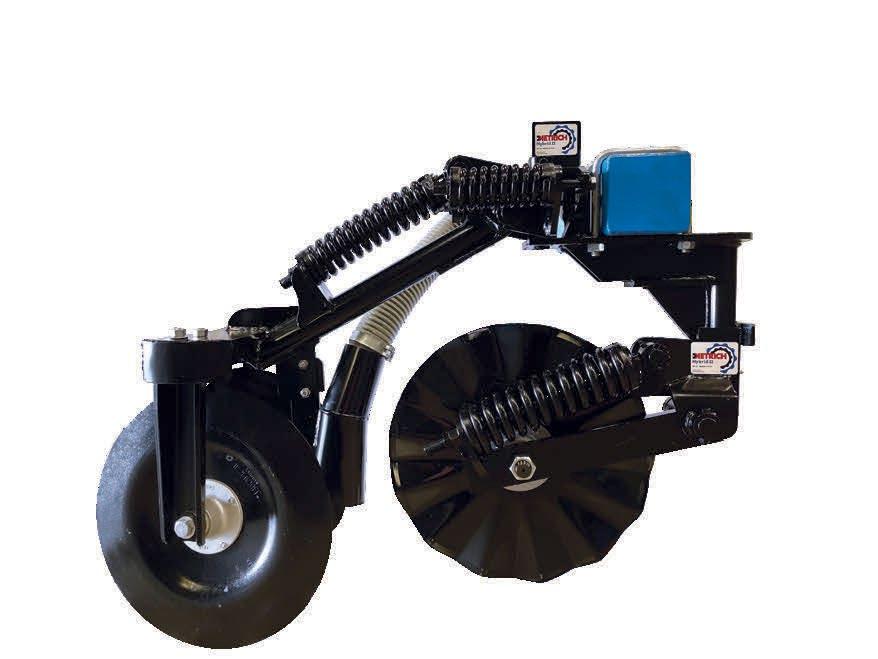
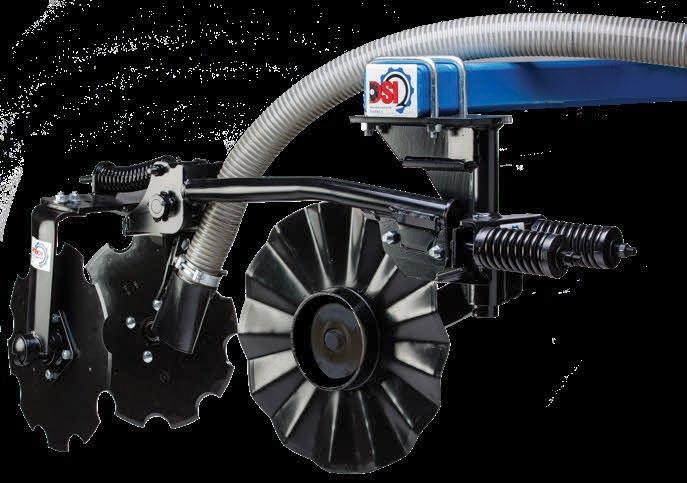
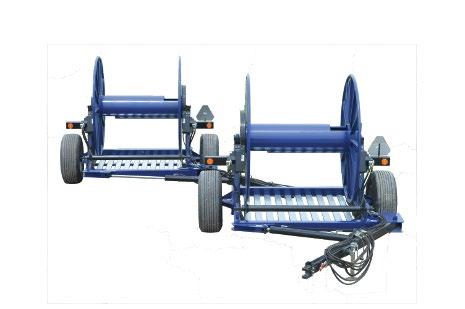
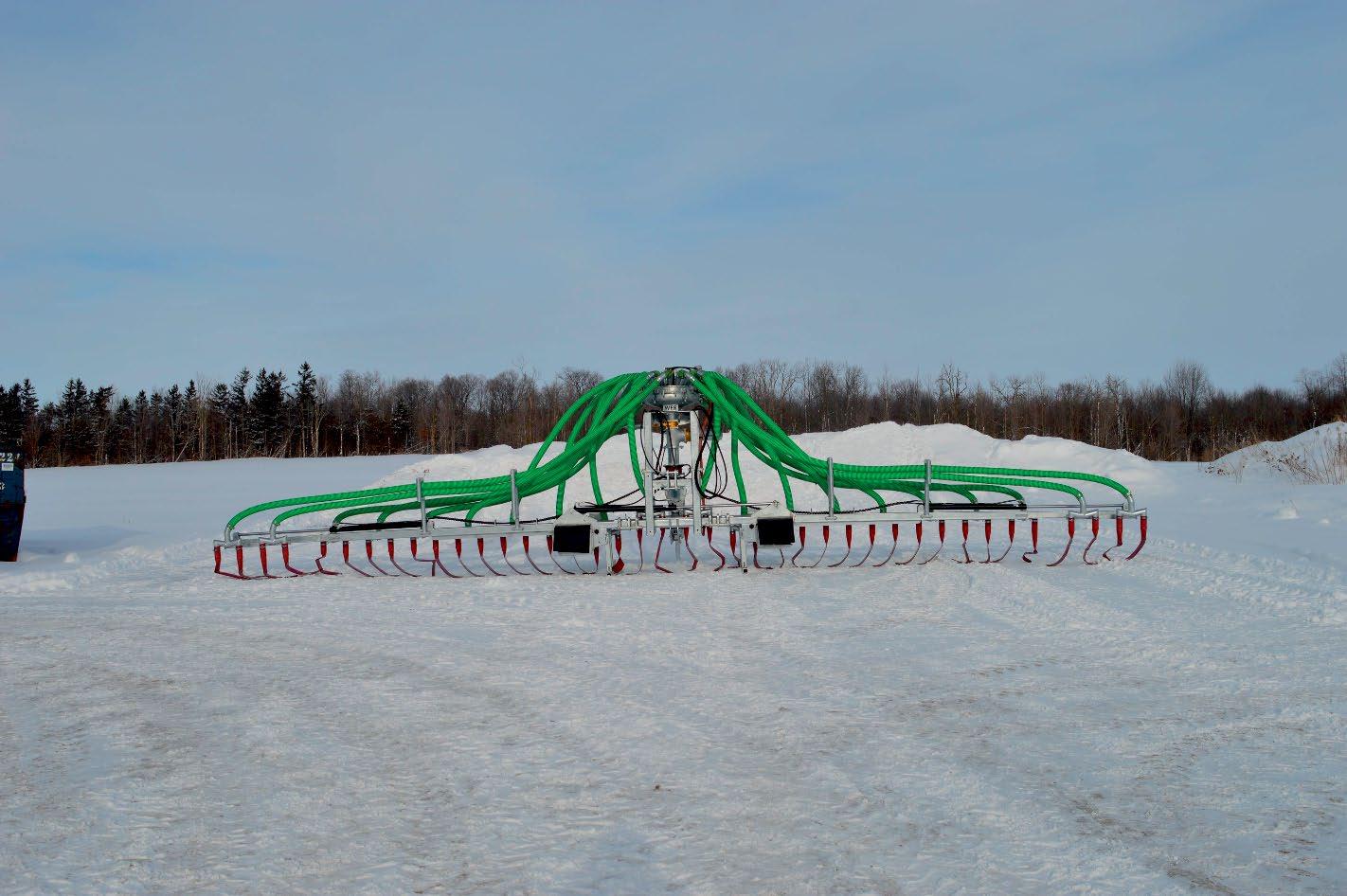
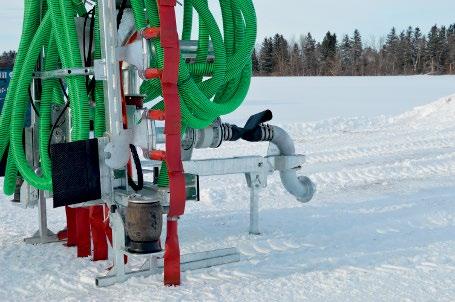
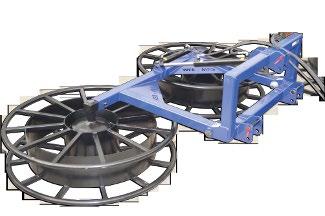
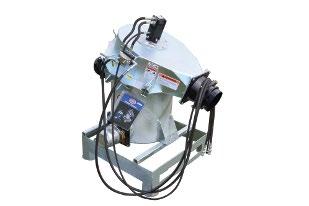
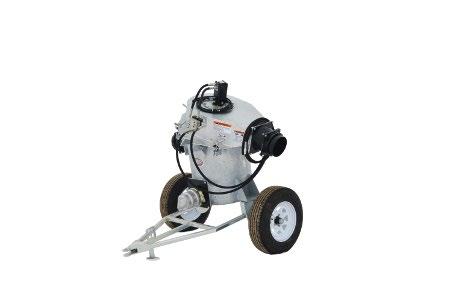
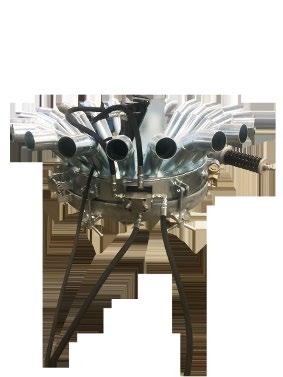
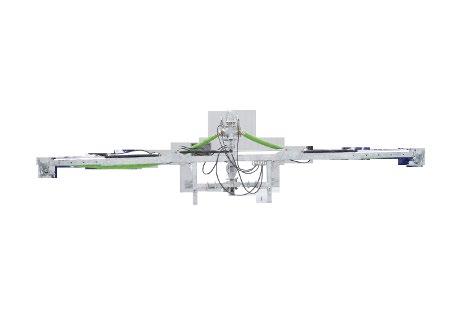
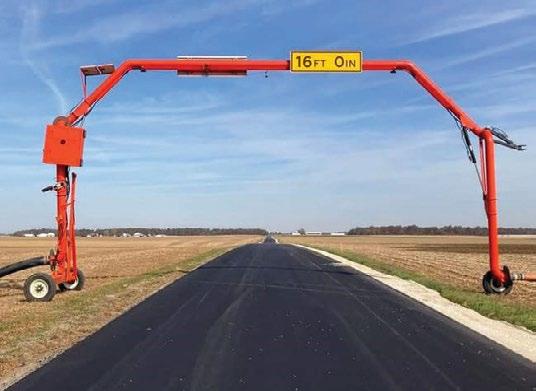
• Covering Blades adjustable for maximum coverage or minimum
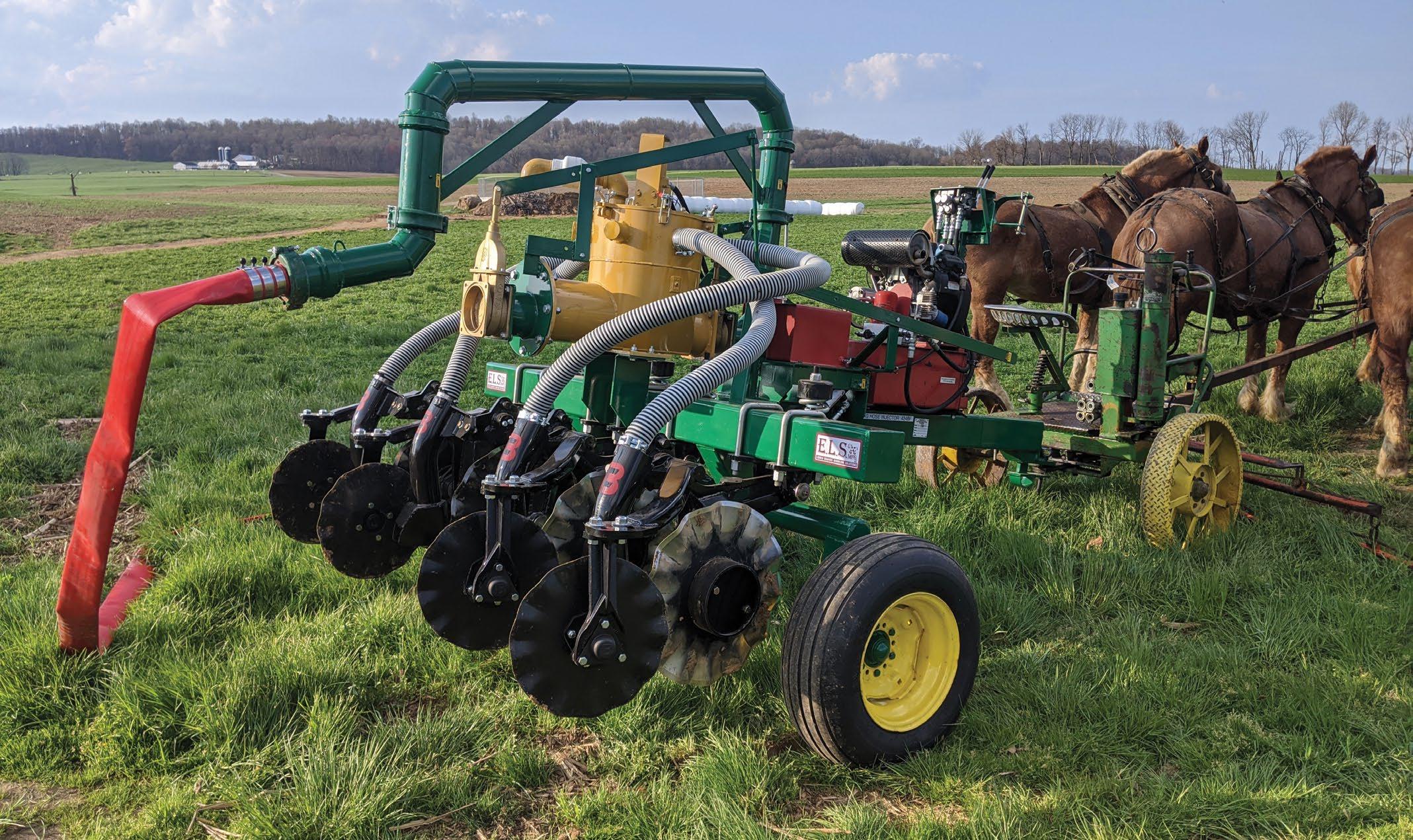
• 24” – 30” spacing
• Best Warranty
• Best actual injection/coverage of wide gallonage ranges
• Best Durability
• Best options for various requirements
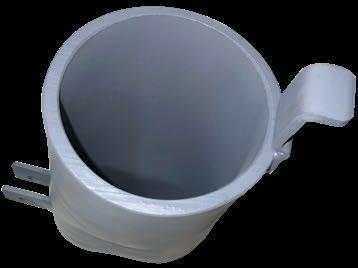
• 4.2” DOM Slurry Tube for heavy wall injection hose
• Highest GPA actually injected/covered in the industry
• Non-grease hubs on all models for maintenance free operation
• Swivel coulters reduce side loads
DIETRICH Rotary Injector
• 18” – 30” spacing
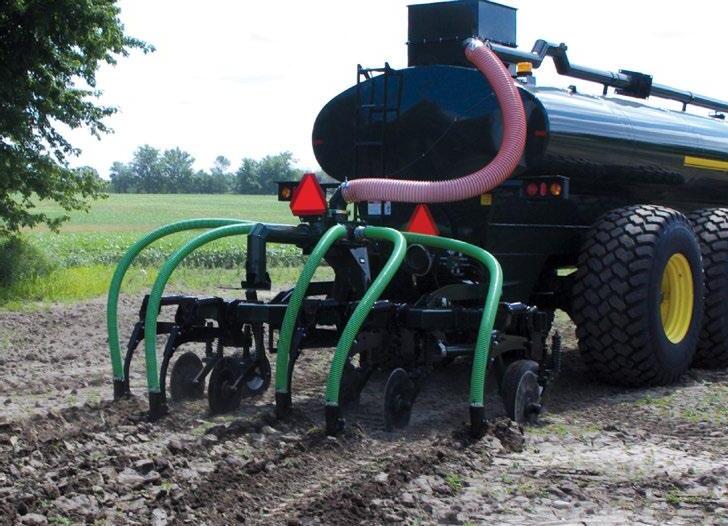
• Patented Conical blade creates a wider furrow for higher GPA than conventional coulter/vertical till injectors
• 18” spacing, 8 wave Conical blade, & 2 Clozr blades on dragline result in higher GPA injected/ covered than a single closer blade design
DIETRICH
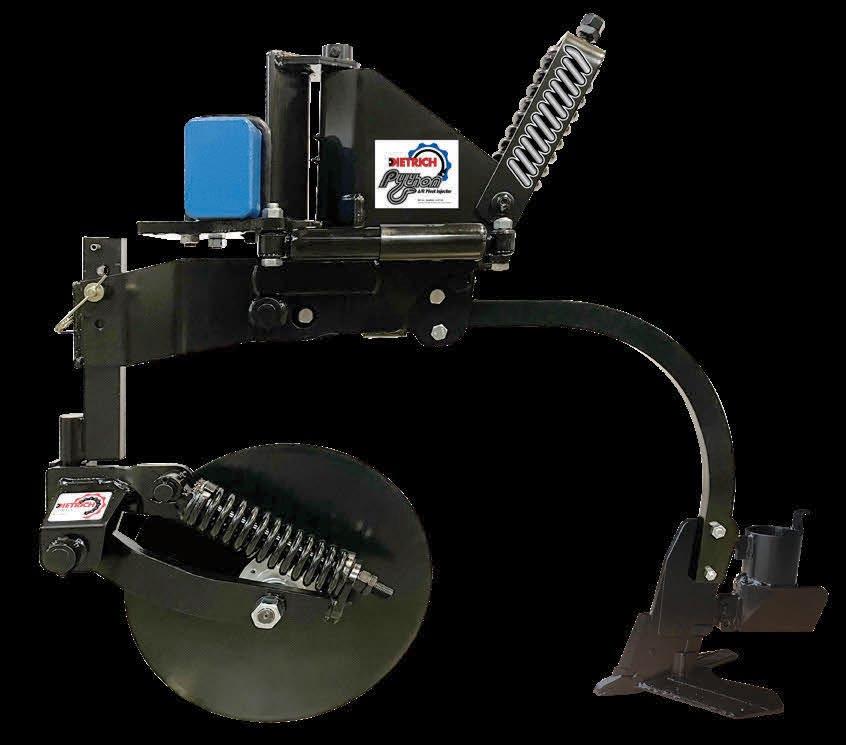
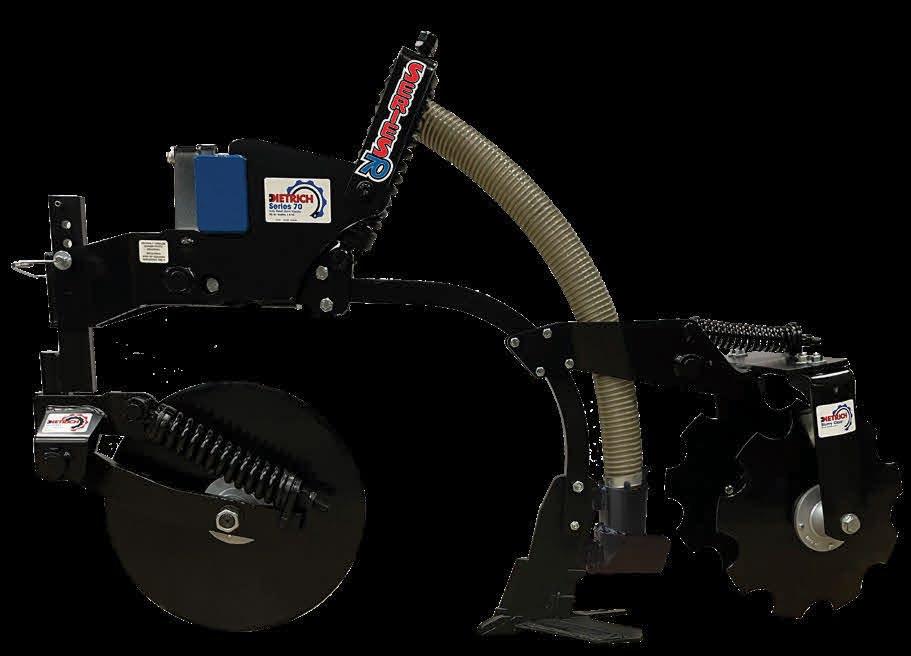
Series 70 A/R Sweep Injector
• DSI’s signature injector
• High performance Coulter down pressure design
• 4 Sweep options for lower rates to 20,000+ GPA
• 5 Tube options, including plug-free wing drop
• Liquid stays where injected, properly placed for full utilization by crop
• Clozr option for different operation requirements
MARCH/APRIL 2026 Vol.24, Issue 1
Trust the process
The promise of manure processing and new revenue. Story on Page 25. By Jim Timlick
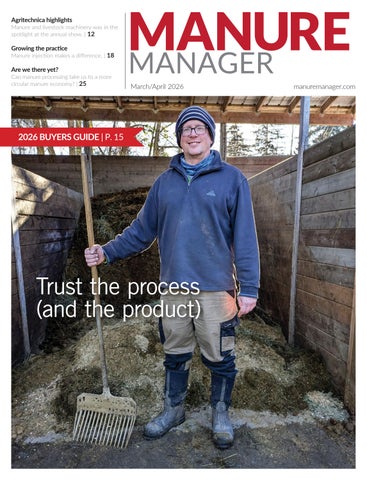
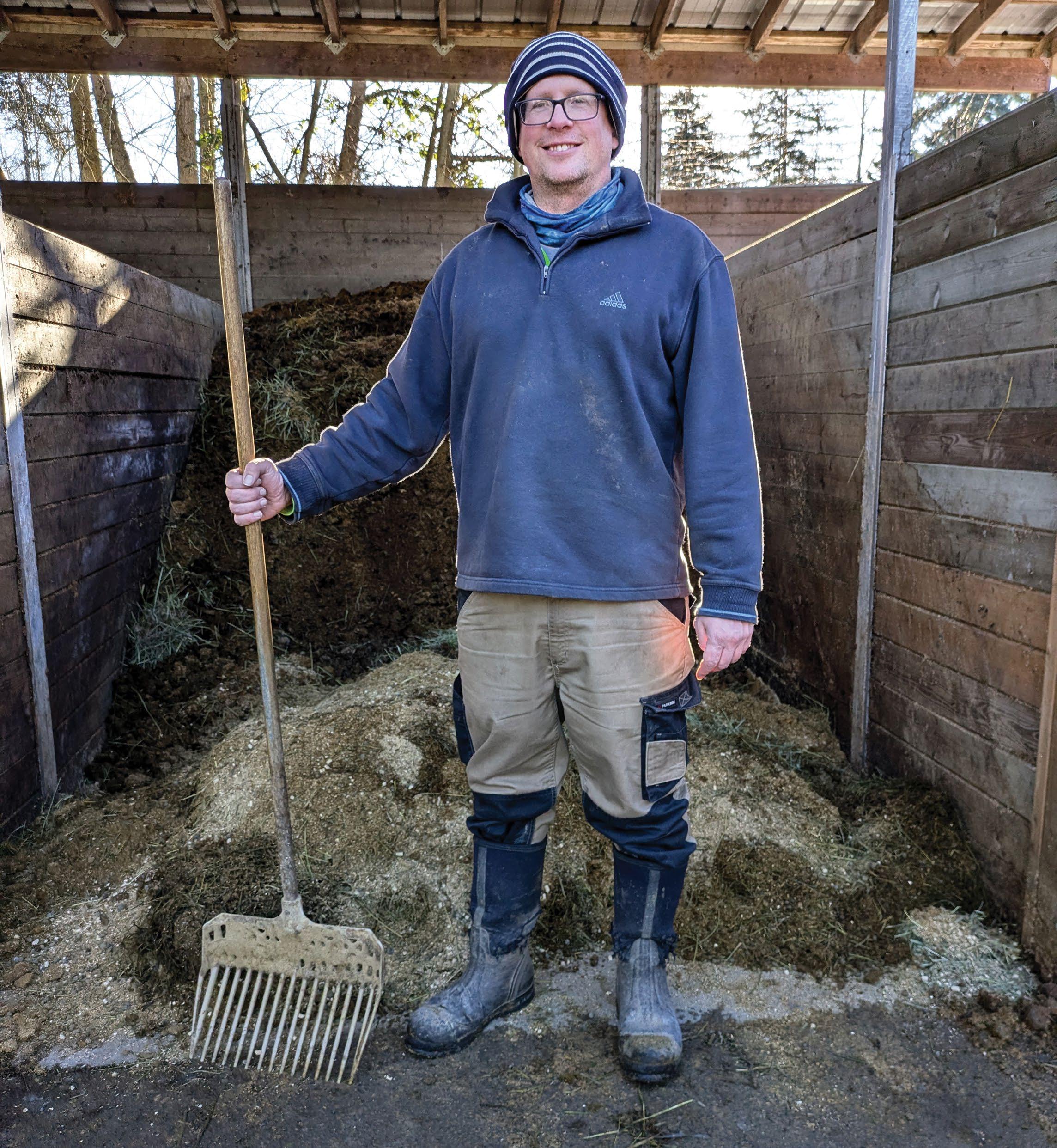
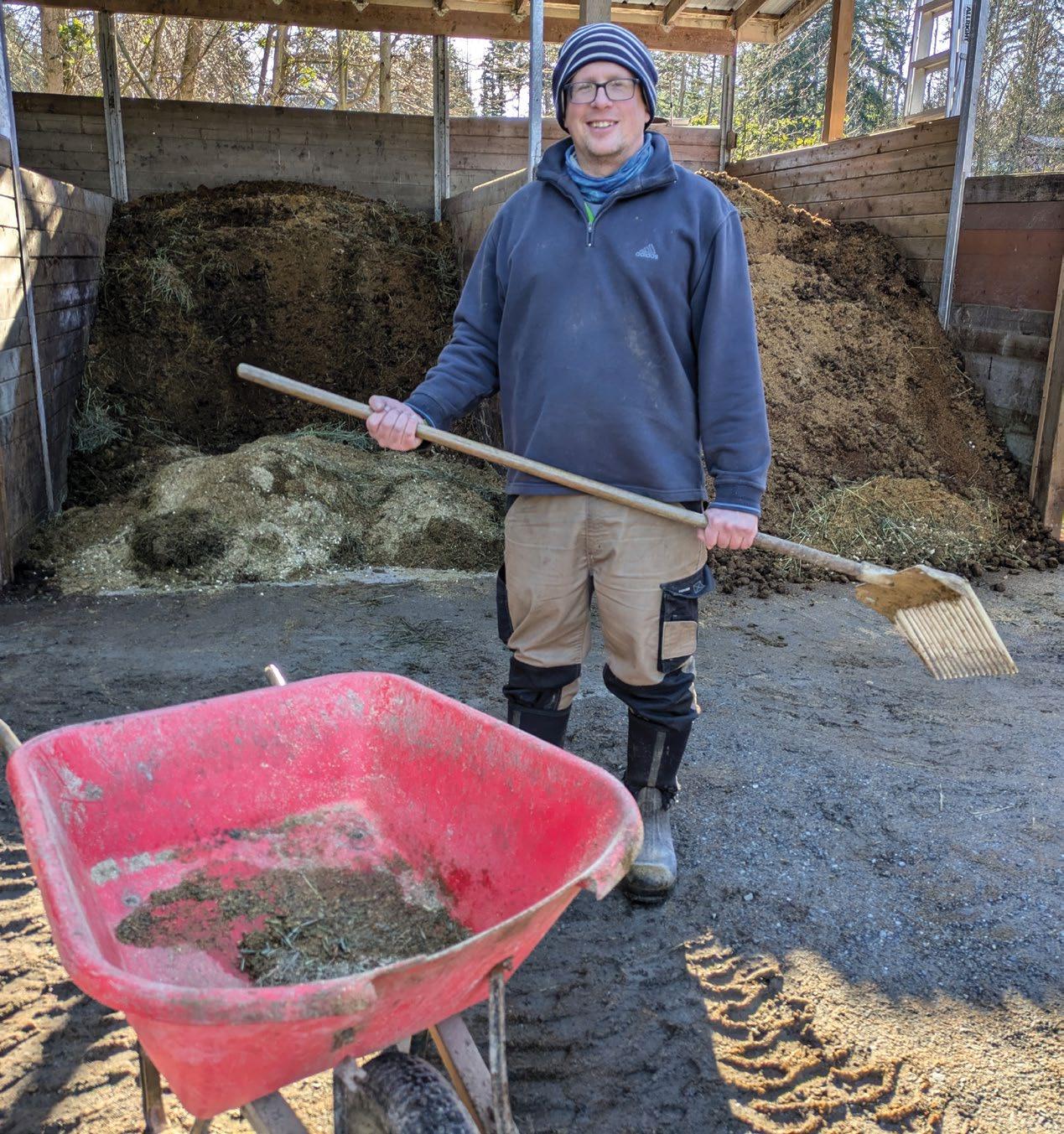
Marcel Sasche regularly educates producers on the nuances of different manure types. See Page 22. Photo courtesy of Marcel Sasche.
12 18 22
U.K. Update
The latest releases from the Agritechnica show floor.
BY CHRIS MCCULLOUGH
Growing the practice Could manure injection be the solution for the Chesapeake Bay?
BY TREENA HEIN
Spreading the diversity
How different manure types interact with plants and each other.
BY RONDA PAYNE
Keep the change
I liken change to a treadmill – it’s a good thing, but it’s constant. And if you stumble just the slightest bit, well… we all remember the classic Jetsons bit, right? It’s hard to get back on track when you’re off.
It’s fitting that our first issue of the calendar year is also the one whose annual theme we’ve changed most recently. Our March/April issue used to focus on whole farm management, until we changed its focus in 2025 to that of manure processing. Whole farm management is still an important topic, but we also found it increasingly difficult to ignore the progress we witness in manure processing – be that through separation, energy processing or any number of on- and off-farm innovations.
to it that you find yourself unable to move when something unexpected happens.
And trust me, something unexpected will happen.
That’s where agility comes in (remember the treadmill metaphor)? The key to agility is education, which can come in the form of continuing education, webinars, online courses, events… or a certain magazine. It’s why platforming exports and showcasing real producer stories is so important. Fortunately, in manure and other agricultural disciplines, it’s an industry where those with the expertise aren’t hard to find. We’re fortunate to report on a community where the influence not only possess a wealth of knowledge, but also are always willing to share it.
“The key to agility is education.”
That progress isn’t always linear –the USDA has recently implemented a temporary pause on the processing of loans for anaerobic digesters, although the department has stated that the pause is prompted more by a need for a comprehensive review of current projects and delinquency rates and not by any lack of merit to digesters themselves.
Adopting new innovations, technology and methods is like a game of chess: with every move you make, whether it’s a tactical, aggressive move or a defending move, there are still implications and things you must give up, such as losing a defender for one of your pieces, or weakening your position somewhere else on the board. Basically, while it’s essential to have a plan, you also can’t be so committed
As for that treadmill metaphor, that’s also how it feels with this season of spreading, compared to the different kind of long-haul stress in the fall.
As I write this, we are heading into our first weekend in Southern
Ontario where we will see above freezing temperatures (or so they tell us) in what feels like months. While that prompts a sense of relief for those of us who love outdoor time, if you’re in the spreading business, that means the sprint is about to begin, and one stumble may result in the old, “Jane, stop this crazy thing!”
The window is short – you can never take a good spreading day for granted. Stay alert, stay energized and stay rested. Please, dear readers: safety first. You’ve got this – and we’ve got you. •
advertising is subject to the publisher’s approval. Such approval does not imply any endorsement of the products or services advertisted. Publisher reserves the right to refuse advertising that does not meet the standards of the publication.
Ontario makes soil info available online
The Ontario Ministry of Agriculture, Food and Agribusiness (OMAFA) has launched the Ontario Soils GeoHub, a new free, online platform to help farmers make better use of provincial and federal soil data. The site allows producers to discover, visualize and download relevant soil information products such
as the Ontario Topsoil Report and its dashboard, a localized Soils Spatial Search and more. It also features new pilot digital soil maps for the Ottawa area, and allows farmers to view soil properties such as pH levels, total organic carbon content, cation exchange capacity and soil texture at different depths.
CANADA CUTS 665 FEDERAL AG POSITIONS
Around 665 positions will be eliminated from AAFC in the face of impending budget cuts. Additionally, three research and development centres and four satellite research farms will close: research stations Guelph, Quebec City and Lacombe, and satellite research farms Nappan (NS), Scott (SK), Indian Head (SK) and Portage La Prairie (MB).
AAFC clarified
that there are “no imminent site closures, and any wind-down of scientific operations would follow a careful decision process that could take up to 12 months. As such, it is too early to determine and share details on final workforce impacts.”
In late 2025, Canadian PM Mark Carney issued his first federal budget that gave indications of budget cuts for AAFC. However,
at the time, the budget report presented made no explicit references to headcount or reductions. However, it would “improve operational efficiency by optimising internal services to align resources with departmental priorities, rationalising administrative support and reducing management layers, advancing technology and automation to cut down on time-
consuming manual work, and reducing reliance on external contractors.”
AAFC was also required, at the time, to meet savings targets up to 15 percent over three years, and it was confirmed that programs including the Agricultural Climate Solution Living Labs would be wound down and “certain science activities” would be reduced.
IWCA returns with new content, dedicated eNewsletter
The popular Influential Women in Canadian Agriculture (IWCA) recognition program has returned to Manure Manager and its fellow agricultural brands, Drainage Contractor, Fruit and Vegetable, Top Crop Manager, Canadian Poultry and Potatoes in Canada magazines. Established in 2020, IWCA recognizes six to seven women every year, nominated by their peers, and provides them with a platform to share their experiences, expertise and advice for women in various fields of agriculture, including nutrient management, livestock production, soil and
water research and more.
Past honourees include previous North American Manure Expo chair Christine Brown (pictured right), OPACA and LICO executive director Mel Luymes and livestock producer and feedlot operator Kendra Donnelly. Honourees’ job roles range from primary producers and farm support to researchers and business development executives.
Those interested can nominate an individual at www. agwomen.ca/nominate before March 30.
New content this year
includes the first-ever IWCA virtual roundtable, which will bring honourees together to share raw, unrehearsed thoughts on careers in agriculture including opportunities, barriers and more. The roundtable will not be held live, but its contents will be released in the form of long-form stories online across Manure Manager and its sister brands. Additionally, IWCA will also publish regular, monthly eNewsletters that include news and feature stories focusing on everyday success, advances, opportunities and challenges for women in agriculture.
Digesters face criticism, federal funding pause
On Jan. 16, a coalition of 34 environmental organizations filed a rule making petition, using the USDA’s Rural Business-Cooperative Service to deem anaerobic digesters that are located at industrial livestock operations or use livestock manure ineligible for grants and loans under the Rural Energy America Program (REAP).
The groups believe these digesters should be disqualified from funding because, according to Patience Burke, national campaign manager at Waterkeeper Alliance for the Pure Farms, Pure Waters campaign, says their use “exacerbates the already heavy burden imposed by factory farming communities and the environment.”
It also claims “factory farm biogas is not a clean source of energy.” The Waterkeeper Alliance’s release states that “hundreds of millions of tax dollars have been funnelled into expensive, polluting manure digesters.”
It alleges that in
five years, new manure digesters have received an average loan guarantee of $18.7M, almost three times more than the average loan guarantee for solar projects. Other parties on the petition include watershed groups such as Buffalo River Watershed Alliance, animal rights organizations such as Animal Legal Defence Fund and producer groups such as the Northeast Organic Dairy Producers Alliance. Days later, a directive from the USDA, addressed from Rural Business Cooperative Service administrator J.R. Claeys and addressed to all national office and field office staff, provided a notice of a 90-day administrative pause “on the acceptance, processing and awarding of loan note guarantees across Rural Business Cooperative Service (RBCS) programs for projects involving biodigesters” as well as controlled environment agricultural projects such as vertical farming and hydroponics, “to allow
the Agency to conduct a comprehensive review of the existing portfolio of such projects, including an assessment of delinquency rates, project performance, operational sustainability and underwriting guidelines to ensure prudent stewardship of federal resources.”
However, the letter clarifies that there are no new eligibility requirements for these projects, nor does it “constitute a determination regarding the merits or viability of any individual applicant or technology.” It also does not mention the petition filed by the environmental groups.
Manure Manager reached out to the
USDA for clarification.
A USDA spokesperson clarified the legitimacy of the unnumbered letter and the figures cited in it. However, the spokesperson stated that the letter had nothing to do with the petition.
“The unnumbered letter… was drafted before Rural Development received or became aware of [the petition]. The decision was based on a review of projects across the RBCS portfolio that indicated losses to taxpayers.”
While the department spokesperson offered no commentary on the petition, they stated that it is under review, and being evaluated in accordance with regulations and administrative procedures.
FALL NITROGEN MORE COMMONLY CONTRIBUTES TO RUNOFF: STUDY
New Illinois research shows fall-applied nitrogen is more likely to contribute to nutrient runoff than spring-applied nitrogen.
A five-year study from the Illinois Fertilizer and Chemical Association, which runs annual N-rate trials, found fall-applied nitrogen lost roughly 12 pounds more per acre through drain tile, or seven percent of the fertilizer.
Lowell Gentry, research agronomist and retired University of Illinois principal research specialist, says this represents almost 40 percent of tile nitrate load.
However, despite the potential environmental impacts of greater nutrient loss, Gentry observed that there was no correlating yield loss.
The primary reason cited for the pause, for both categories of projects, is delinquency. For anaerobic biodigesters, the letter alleges that 21 loans, which make up $386.4 million, are seeing a delinquency rate of 27 percent, or $102.6 million. Controlled environment agriculture loans also have a high delinquency rate, with $311.9 million in loans posting a 43 percent ($135 million) delinquency rate. As such, “The [RBCS] has determined that closer examination is warranted at this time, to ensure that current program administration appropriately accounts for financial, operational and market risks associated with such projects.”
According to a 2025 Michigan State University study, anaerobic digestion adoption is highest in California, which houses 31 percent of the nation’s operating digesters. Wisconsin came in second, with 11 percent. Nearly all in both states are located on dairy farms.
Measure the treasure: Part III
ABOVE
Anaerobic digestate application (pH 8) injected and surface applied.
Manure and organic amendments provide nutrients, organic matter (OM) and contribute to increased biological activity. Manure pH influences what happens to the nutrients once they are applied to soil. Crop available nutrients are influenced by both manure and soil pH.
A manure analysis provides value information for nutrient management planning. Typically, dry matter (DM), total nitrogen (N) and ammonium nitrogen (NH4-N), total phosphorus (P) and potassium (K) are tested. Results, when combined with soil test information, can help to set application rates and determine additional fertilizer needs. Including pH and C:N ratio in the analysis gives insight to manure nutrient availability/loss and nutrient interaction with the soil.
In the last issue of Manure Manager, we covered Part II of our “Measure the Treasure” series, focused on how C:N ratio affects N availability from the organic N portion of manure. The balance between carbon and nitrogen in the manure helps to predict whether organic nitrogen will be mineralized (released) or immobilized (tied up) during the growing season how much plant available N could be anticipated for the current crop.
Manure pH is an indicator of how quickly ammonium N (NH4N) may be lost through volatilization. Knowing the pH supports better
decisions around manure rate, timing, and impact of incorporation for maximizing available N. Manure pH can also influence phosphorus and micronutrient availability, especially in soils with very high or low pH levels.
PH AFFECTS NITROGEN AVAILABILITY AND MICROBIAL
ACTIVITY
pH drives the balance between ammonium (NH4+ and ammonia (NH3). As manure pH moves above 7.5 there is a shift to a higher proportion as NH3 gas, which accelerates volatilization losses. These losses are boosted in warm, windy conditions with surface applied manure.
Liquid manure with high NH4-N and high pH applied on a warm windy day can lose a significant portion of nitrogen within a few hours of application while losses for manure with more neutral pH (<7) applied in the same conditions occur more slowly. In Ontario field trials studying spring/late summer applied manure, the NH4-N loss in the first few hours was higher with manure pH 7.9 than accumulated NH4-N loss in a week with manure at pH 7 or lower. Solid manure tends to have higher pH levels (often >8), however the NH4-N levels were also low.
Manure mineralization occurs through microbial processes. Microbial populations, both in manure and in the soil are pH sensitive which impacts how
quickly nutrients become plant available. This can affect the timing of nutrient supply relative to crop demand. Manure that is neutral to slightly alkaline (high pH) typically mineralizes N and P more quickly, while manure pH 6 or less can slow microbial activity and delay nutrient release.
MANAGING HIGH MANURE pH
Although it is difficult to change manure pH, knowing the pH allows management considerations that can reduce rapid volatilization losses and prevent crop N deficiency. They include:
• Application timing of liquid manure to when conditions are cooler or application can occur into standing crops;
• Placement of manure by injecting, rapid incorporation or application into standing crops;
• Adjusting supplemental nitrogen for crops relying on manure N when conditions during application were favourable for high N loss;
• And, potentially, the use of nitrogen (nitrification) inhibitors (currently being researched).
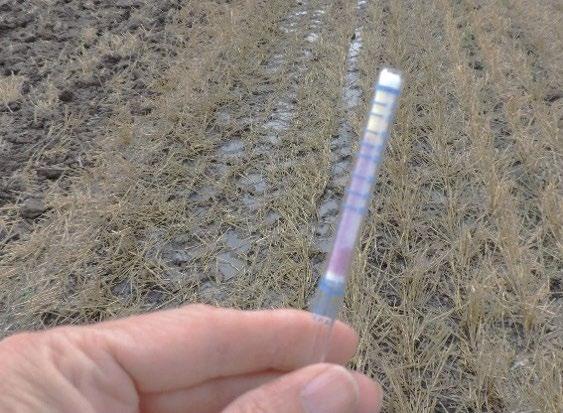
ABOVE
Dosimeter tube showed significant N loss within one hour of application.
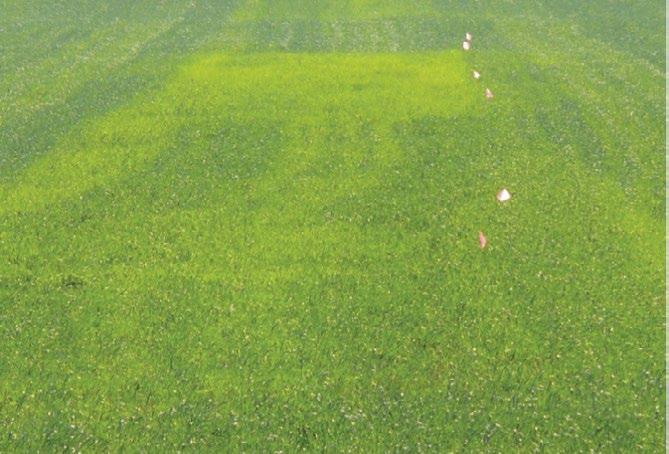
ABOVE
Cover crop oat growth shows N deficiency in surface applied areas compared to injected areas.
pH AFFECT ON PHOSPHORUS AND MICRONUTRIENT AVAILABILITY
Manure phosphorus, mainly in organic form, must be mineralized by microorganisms to become available. Soil pH has the bigger influence, however manure pH can impact areas with manure/soil contact by slowing phosphorus availability.
In calcium-rich, high-pH soils, calcium binds with P, reducing P availability to crops. For example, the use of alkaline-stabilized biosolids (e.g., N-Viro or ashed biosolids) precision applied improves low pH soils but applied to field areas with high pH (eroded knolls) can reduce phosphorus solubility. Availability of micronutrients such as zinc, manganese, copper and iron can also be reduced in high pH conditions.
Manure pH affects how much N is lost to volatilization, how phosphorus behaves in the soil, micronutrient availability and microbial mineralization rates. Including pH in an manure analysis can help fine tune nutrient availability and identify when additional fertilizer may be required. •
+ Low Life-Cycle Costs
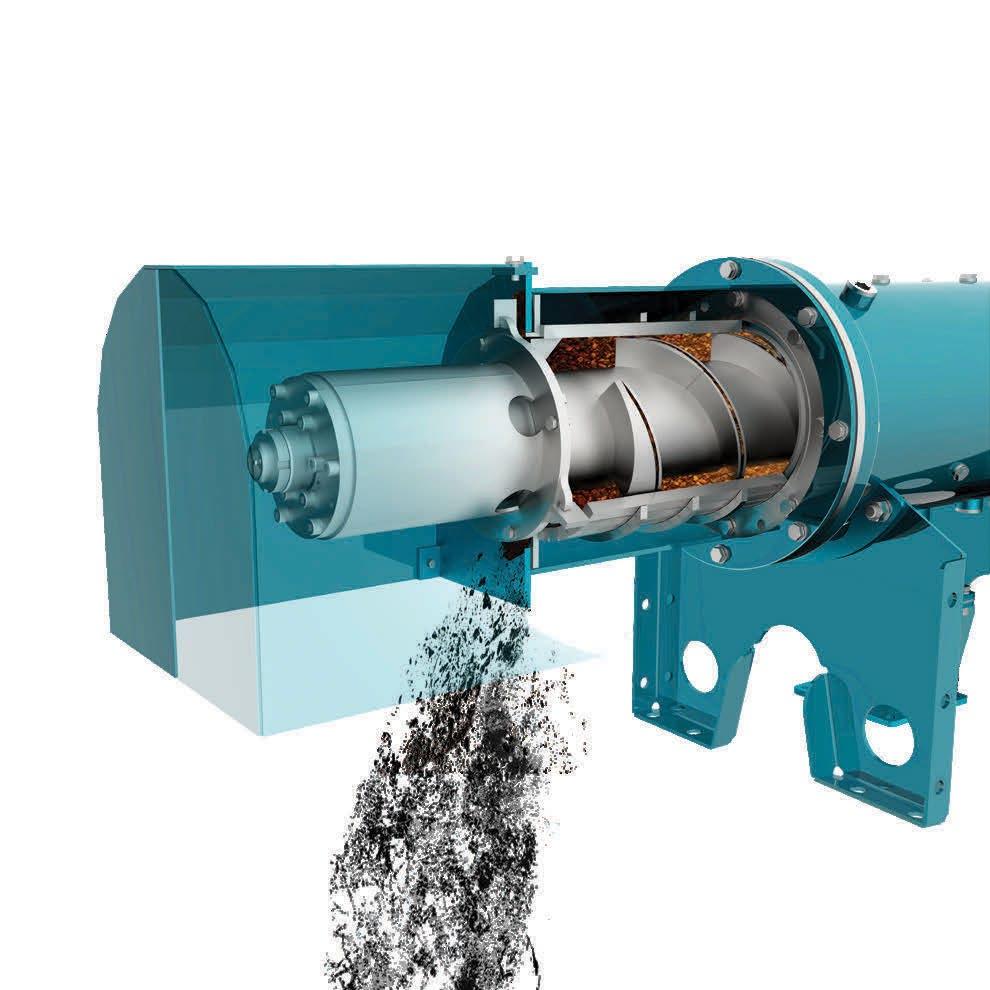
+ Turnkey from a Single Source: Separator Pump(s)
Control Unit
Stationary or Mobile Skids
+ Patented Profile Auger with Counter Bearing for No Auger Screen Contact
+ Continuously Variable Dry Matter Content
+ Large Capacities
844-647-7867
www.boerger.com
SCAN TO WATCH THE BIOSELECT IN ACTION!
Manure processing safety
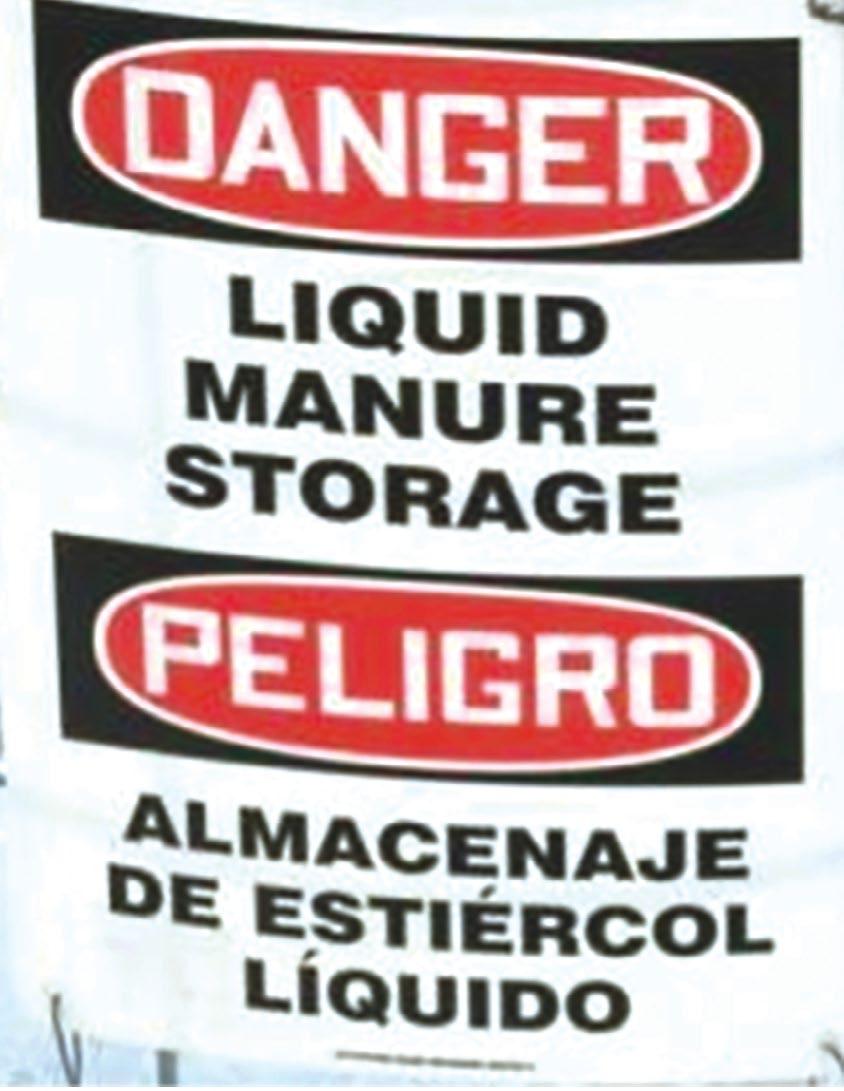
Danger signs for liquid manure storage can often be more effective when presented in both English and Spanish languages.
If you are like me, you get excited about manure processing.
When touring a manure processing facility, I eagerly wait to ask questions about how each system works, how it performs, what problems the operator has run into, and of course whether they would install it again.
What many of us are far less excited to talk about is safety. Regardless, safety is important to ask about, and even more important to actually do.
Putting off a safety assessment or delaying updates to a safety plan is an easy way to end up in a bad situation, telling yourself “I meant to do that.” The best time to start is immediately. After you finish reading this, take a walk through your manure processing system. Bring a notebook and a few other people who see things differently than you do, and start identifying hazards. Look for confined spaces, risks from manure gases, slip and fall hazards, and exposure to moving or rotating parts. Once hazards are identified, the next step is figuring out how to reduce risk. Can a hazard be eliminated entirely by making a design or operational change? Can the risk be reduced through better guarding, ventilation, signage, or communication? Where are chains, barriers, or warning signs needed, and do those signs cover all the languages spoken by people who work
on or visit your farm?
Pinch points are a major but sometimes overlooked hazard in manure processing systems, particularly in manure conveyance systems that move material from one processing step to another. Chains, belts, pulleys, cables, and rotating shafts can create severe pinch points. Getting a finger, hand, foot, or piece of clothing caught in these areas can result in serious injury or amputation. Many separation systems include rotating components that operate continuously and may not appear dangerous at a glance. Shields and guards are critical for preventing injuries and must always be kept in place during operation. Older systems deserve special attention, as guards may be missing, damaged, or removed over time and should be replaced if they are not present or no longer adequate.
In addition to moving parts, be aware of components that may become warm or hot during operation. Bearings, motors, gearboxes, and other mechanical components can heat up and pose burn risks, particularly during cleaning or maintenance. These hazards are often located near rotating equipment, increasing the risk of injury if someone gets too close. Heat should be treated as a hazard just like motion, and workers should know which parts of the system become hot during normal operation.
Falls are another serious risk, especially when ladders or elevated access points are needed to reach manure processing equipment for inspection or maintenance. Ladders and stairs must be properly secured, in good condition, have tread for grip, and be appropriate for the task. Workers should never climb while carrying tools or working near operating equipment. Whenever possible, consider whether ladders can be eliminated altogether by adding platforms, stairs, or guardrails that provide safer access. Many falls occur during routine maintenance, not unusual events, so these access points deserve careful attention.
Transfer channels, receiving pits, tanks, and other manure structures present a serious hazard. These areas should be clearly identified and physically protected using grates, covers, chains, or guardrails to prevent anyone from falling in. Signage should be visible and understandable to anyone who may be on the site, including visitors and contractors. Do not assume familiarity with the system means awareness of the risk. Any opening large enough for a person to fall into should be protected at all
RIGHT
times, not just during operation. These protections are especially important in lowlight conditions, during maintenance, or when surfaces are wet or icy.
Some of the highest-risk activities occur during cleaning and maintenance. These tasks can involve exposure to manure gases, sharp components, hot surfaces, fall hazards, and moving equipment that can cause catastrophic injuries if someone reaches into an operating system. Lockout–tagout procedures are essential before performing any maintenance. Equipment must be fully powered down and secured so no one can accidentally start it while work is being done. This means never reaching into a processing system while it is operating, not even for a quick adjustment or “just one thing.” The system must be completely off before any work begins.
Maintenance often involves chemicals as well. Workers need to be trained in chemical safety, have access to safety data sheets, and know where those sheets are located before using any product. Training should happen before chemicals are used, not after an incident.
Many manure processing systems are housed inside buildings, and those
buildings must be designed with manure gas safety in mind. Adequate ventilation and air exchange are critical to protect human health, just as barns are designed to protect animal health. Buildings should be designed to prevent gas accumulation, eliminate dead air zones, and provide ventilation where manure is present. Electrical and mechanical components in these spaces should be appropriately rated, including explosion-proof equipment where required.
Confined spaces require special attention and specific training. Never assume it is safe to enter a confined space, even briefly, or even if you have done so in the past without consequence. Entry into confined spaces should follow established safety procedures every time. Think carefully about who might enter these areas unintentionally, including small children, and ensure that all necessary protections are in place.
Mobile equipment introduces another set of risks. Areas where manure or separated solids are moved with skid steers, tractors, or other equipment can become extremely slippery, and in winter conditions can quickly turn icy. Equipment
can slide unexpectedly, and the risk of crushing injuries is very real. Operate equipment only when other people are not present in the area, use audible backup alarms, and keep work areas as clean as possible to reduce slip hazards.
Design choices can further reduce risk. For example, transfer systems can be equipped with pressure-drop alerts so pumps automatically shut off if a pipe ruptures or leaks, helping prevent spills and exposure. Proper design can eliminate many risks!
Most importantly, once hazards have been identified and risks reduced or eliminated, all employees must be trained in terms and languages they can understand. If you do the work to improve safety but fail to communicate those risks and procedures, you have not actually made the system safer. Regularly scheduled and documented training, updated as systems or practices change, protects not only the people who work on or visit your farm, but also you as the operator. •
Rebecca Larson is a professor and extension specialist with the University of WisconsinMadison.
Livestock machinery highlighted at Agritechnica
Machinery related to all aspects of feeding livestock and processing manure featured heavily among the exhibits at Agritechnica 25 held in Hanover, Germany.
In total there were 2,849 exhibitors from 52 countries showcasing their latest developments to the 476,000 visitors that attended the event this past November.
From massive cattle feeder wagons, precision manure spreading technology, to full scale robotic tractor units, Agritechnica had it all.
Some of the highlights of the show included;
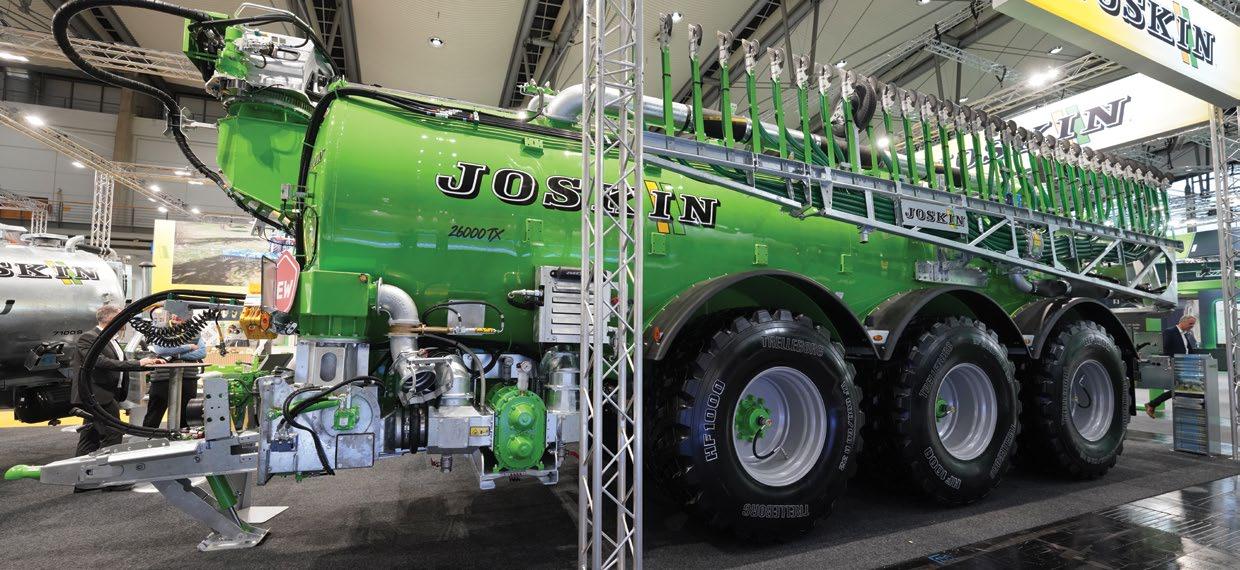
1 JOSKIN XTREM TRIPLE AXEL TANKER
Joskin exhibited its Xtrem triple axel tanker with redesigned dorsal boom. Equipped with bigger 10” (250mm) hoses this machine fills faster and is more efficient in the field. A turbo-filler further boosts the filling flow, significantly reducing pumping times.
Entirely galvanised, the new boom arm features four joints, and is longer than previous models.
Adding an extra joint allows the arm to be folded up shorter if necessary, making it ideal for aboveground pits with high walls, while increasing its suction depth.
When pumping into an underground pit, this longer length also enables going lower in the pit. Mounted on a 270° rotating pivot (135° left/135° right), positioned at the front of the tanker, the dorsal boom provides optimal visibility.
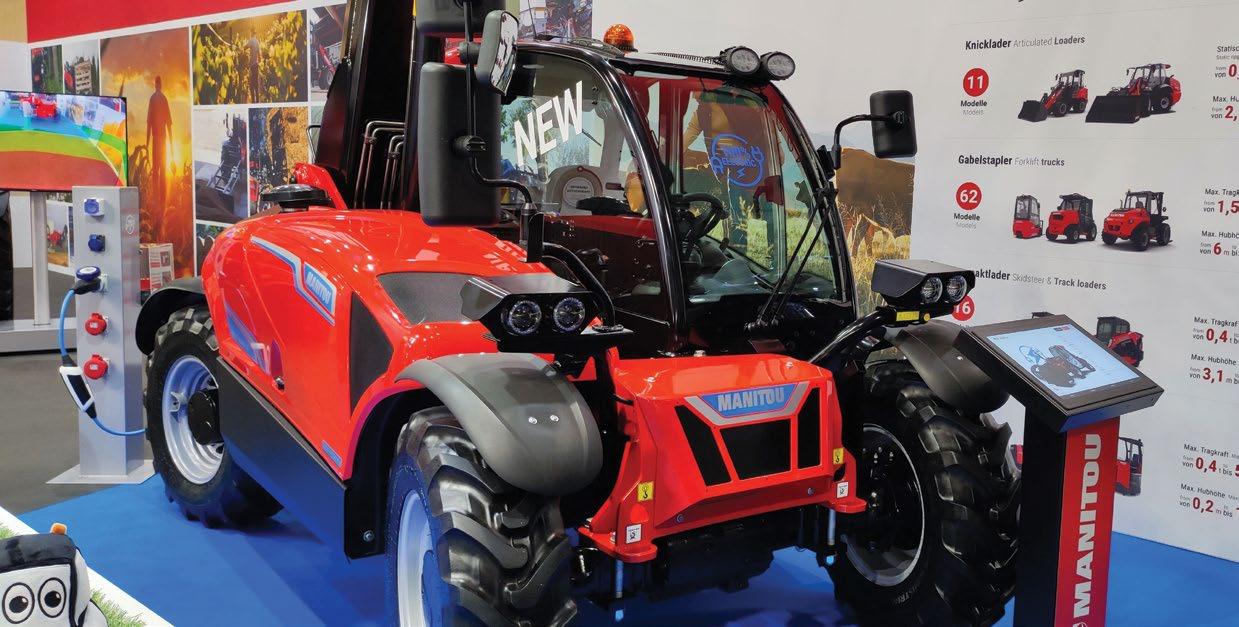
2 MANITOU 625E ELECTRIC TELEHANDLER
Manitou unveiled its first electric telehandler for agriculture at Agritechnica. It is powered by a 35 kWh lithium ion battery, which can work for five hours in a typical farmyard, says the manufacturer. One major benefit of the new electric machine is the 30 percent reduction in the amount of hydraulic oil used, made possible by two innovations.
The first is a 100 percent electric transmission that eliminates the need to use hydraulics for
transmission, unlike the hydrostatic internal combustion version.
Secondly, the integration of an antiemulsion filter in the hydraulic oil tank optimises the volume required. This design helps to simplify maintenance, which is already reduced as a result of the small number of components to be serviced.
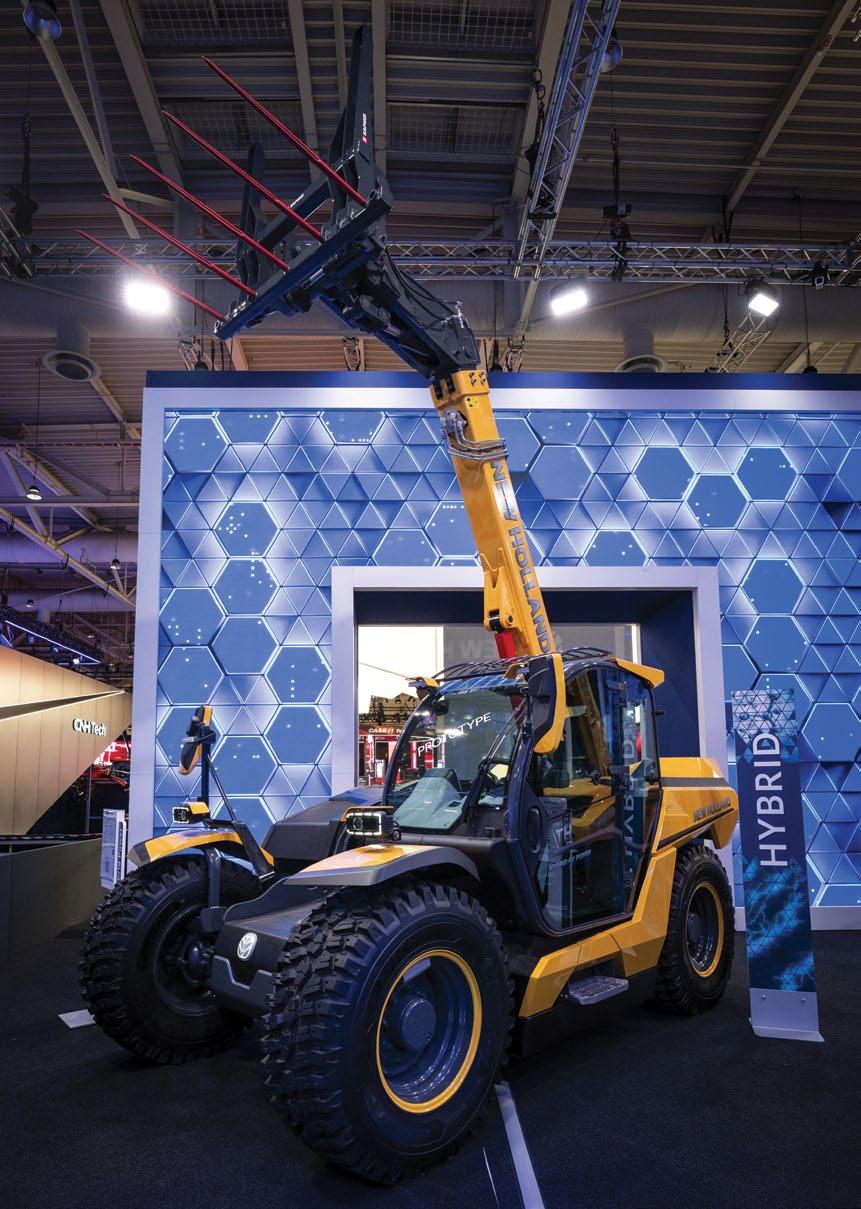
3 NEW HOLLAND TH HYBRID POWER TELEHANDLER
New Holland exhibited its new TH Hybrid Power telehandler, fuelled on natural gas and electric. Hailing it as an industry first, New Holland says the machine can lift a maximum 4.2 tonnes and has a maximum lift height of 7-9m.
The machine is currently going through tests and features an electric drivetrain connected to a supplementary battery/ electric power system.
It operates fully electrically for up to four hours on medium-heavy tasks and up to six hours on light-duty cycles. During heavy-duty work, a four-cylinder F28 methane gas engine from FPT provides supplementary power and simultaneously recharges the battery.
The 2.8-litre engine generates
75kW/100hp and there is 84kW/112hp rated output available at the hydraulic pump and 115kW/154hp rated available for traction. Field tests show up to 70 percent saving in energy usage compared to diesel alternatives, and 30 percent better performance.
4
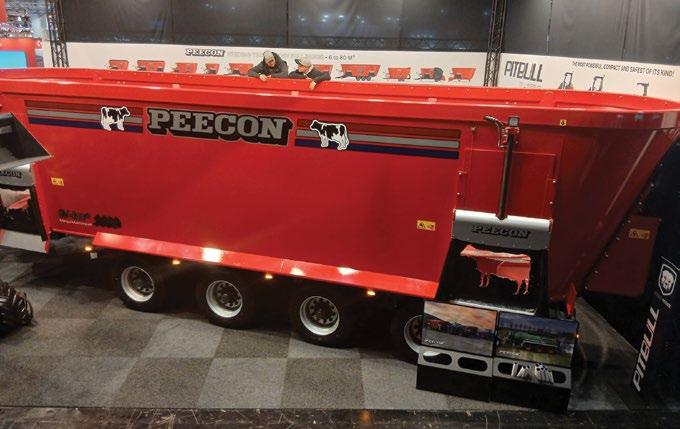
PEECON BIGA 64M3 FEED WAGON
With a price tag of around 215,000 euros the huge Peecon Biga 64 Mega Mammoet feed wagon certainly created a lot of interest on the Dutch company’s stand.
With four vertical augers and a load capacity of 25,600kgs, this machine is designed for the biggest dairy farmers in the world and needs a tractor with over 350hp to drive it.
This particular feeder was going to a dairy farm in Belgium that is increasing its herd up to 1,000 cows.
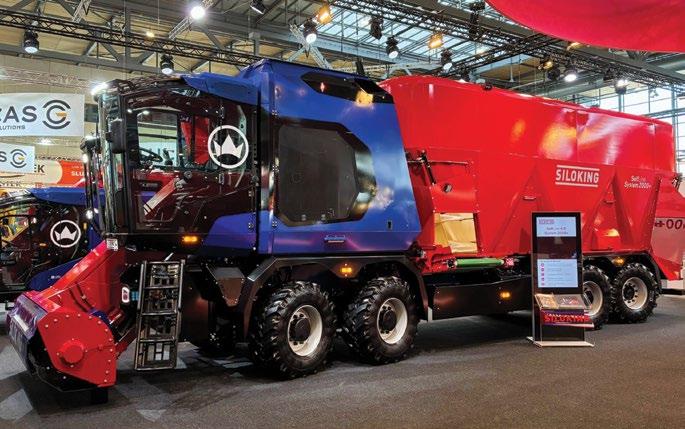
5 SILOKING SELFLINE 4.0 SYSTEM 2000+
Referred to as the world’s most powerful self-propelled feed mixer, Siloking’s new SelfLine 4.0 System 2000+ has an impressive three augers, a mixing volume of 45m3 and driven by a powerful 510hp (375kW) Volvo engine.
Ultimately designed for the big dairy herds around the world with 2,000 cows or more, or big feedlots, this machine can feed up to 320 cows with just one mix.
Four heavy-duty steerable axles support the chassis of this mammoth machine, three of which are driven, to increase
stability, manoeuvrability and traction, even under the toughest conditions. The machine is designed for a service life of 20,000 operating hours, indicating manufacturer confidence in reliability and performance.
6
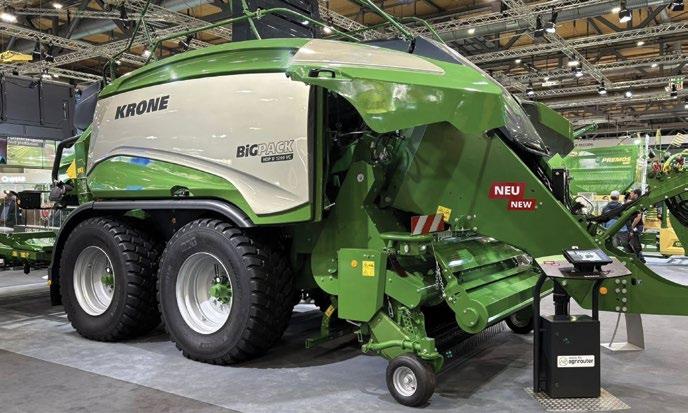
KRONE BIG PACK HDP II 1290 VC BALER
Krone’s latest BiG Pack HDP II 1290 VC baler has a 51-blade cutting unit, achieving an extremely high density, especially when working with dry straw.
Crops are collected by the proven camless EasyFlow Active pick-up that has been tried-and-tested thousands of times. It now includes a crop press roller unit that can be infinitely adjusted in height from the comfort of the tractor cabin.
In the VC variant, the crops are then fed into the large cutting rotor with a diameter of 720mm. The rotor pulls the material through the blades with little effort and conveys the crushed material into the bale channel. Two variants of the VariCut cutting unit are available, the first with 26 blades for cutting lengths from 44mm, or the second with 51 blades for particularly short cuts from 22mm. The blades, which
are individually protected against foreign objects, can be manually pre-selected on the machine in one of five possible groups depending on the desired cutting length.
7
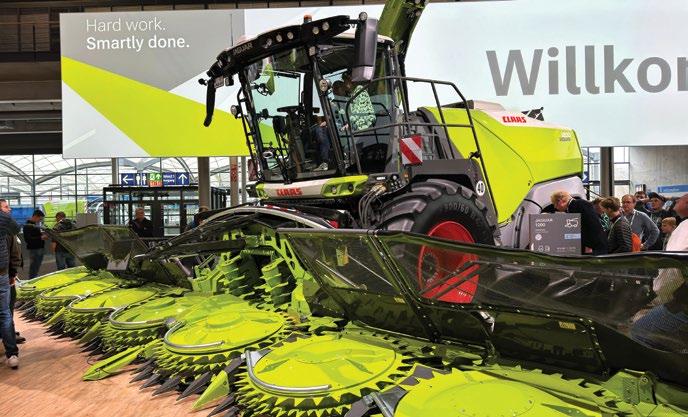
CLAAS 1000 SERIES FORAGE HARVESTERS
Claas exhibited its powerful new Jaguar 1000 series self-propelled foragers ranging from 850hp to over 1,100hp at Agritechnica.
Four models complete the new series, namely the Jaguar 1080 (850hp), 1090 (925hp), 1100 (1,020hp) and 1200 (1,110hp), and all are powered by an efficient, transverse-mounted MAN V12 24-liter engine. These new machines can achieve harvest capacities of up to 500 tonnes per hour with the widest crop flow on the market.
Thanks to its 910mm width, the Jaguar 1000 now offers even more space and inertia for maximum throughputs and continuous crop flow even at the highest swath thicknesses. The crop is cut even more efficiently thanks to the steep knife angle of 10 degrees. This is not only noticeable in the excellent chop quality, but also in the reduced noise level.
The V-Flex chopping cylinder can be fitted with full and half knife sets as well as half-section knives. The knives, fastened from above with three screws, are fixed in the drum stars and automatically aligned.
Claas has also developed new front attachments for the Jaguar 1000, including the Pick Up 3000, 3800 and the new 4500 with independent variable drive and intake auger speed. •
SEPARATE BETTER
MANURE MANAGER
2026 BUYERS GUIDE
AGRICULTURAL AERATION SYSTEMS
4270 County Rd 45, Cobourg, Cobourg ON K9A 0X2, Canada
Tel: 905-373-5103
e-mail: ag.aeration@gmail.com
Website: agro-aeration.com
Description: Agricultural Aeration Systems provides aeration solutions specifically designed for agricultural applications. Our focus lies in boosting both aquatic and organic environments with equipment that improves health and vitality, resulting in better outcomes for your ecological settings. We provide specialized solutions for effective aeration for ponds, lagoons, dugouts, manure & composting.
AGRIMENT SERVICES INC.
1289 NC 241 Hwy, Pink Hill NC 28572, USA
Tel: 252-568-2648
e-mail: agrimentservices@yahoo.com
Website: agrimentservices.com/products
Follow us on
Description: Agriment Services, Inc. was founded in 1994 to administer technical assistance to livestock producers as they cope with the ever changing regulatory process. Agriment Services is a waste management consulting firm prepared to confront the needs of the livestock producer with over 30 years’ experience in the field of animal waste management. Our Team Can Help with Following Concerns: Farm Sales
AZURA ASSOCIATES INTERNATIONAL INC.
490 Dutton Drive Unit C4, Waterloo ON N2L 6H7, Canada
Tel: 226-646-4449
Toll free: 877-298-7288
e-mail: dave.ellis@azuraassociates.com
Website: azuraassociates.com
Follow us on
BAZOOKA FARMSTAR
800 E. 7th St., Washington IA 52353, USA
Tel: 319-653-5080
Toll free: 800-775-7448
e-mail: marketing@bazookafarmstar.com
Website: bazookafarmstar.com
Follow us on
BOERGER, LLC
2860 Water Tower Place, Chanhassen MN 55317, USA
Tel: 651-226-6539
e-mail: america@boerger.com
Website: boerger.com
Follow us on
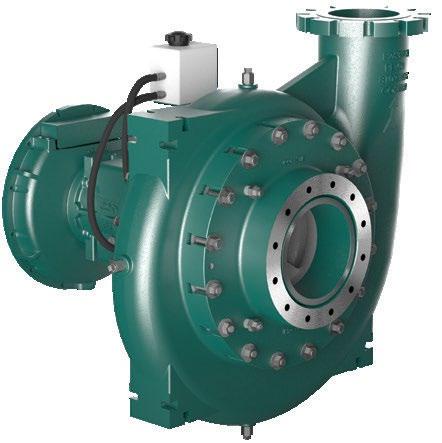
Description: Boerger specializes in efficient manure management solutions with the Bioselect screw press separator. Designed for high-performance solid-liquid separation, the Bioselect offers up to 660 GPM capacity and up to 38% dry solids content. Built for durability and efficiency, it seamlessly integrates with Boerger rotary lobe pumps for optimized manure handling.
BROADCASTER CONTROL SYSTEMS
196679 19th Line, Lakeside ON N0M 2G0, Canada
Tel: 519-349-2770
Toll free: 855-386-9679
e-mail: sales@sunovaworx.com
Website: web.sunovaworx.com
Follow us on
Description: Broadcaster Remote Engine
Controllers offer a wide range of features, configurable to suit your needs. Multiple communication methods allow for the best communication possible, regardless of terrain. No matter your operations size, staying in control of your pumps, improving efficiency, reducing operating costs, and ensuring safe operation are essential. Never lose control.
Description: Canimex is a worldclass mechanical components and powertransmission solutions provider serving agricultural OEMs since 1969. With deep expertise in engineering, product development, manufacturing, sourcing, and logistics, Canimex delivers reliable, highquality components and customized solutions that enhance equipment performance in demanding agricultural applications.
CENTRISYS/CNP
9586 58th Place, Kenosha WI 53144, USA
Tel: 262-654-6006
e-mail: info@centrisys-cnp.com
Website: centrisys-cnp.com
Follow us on
Description: Centrisys/CNP, based in America’s dairyland, specializes in dewatering manure. Our innovative DT Series decanter centrifuge is customized specifically for the manure industry, optimizing profitability and environmental goals. Our centrifuges address water quality and phosphorus emission for specific manure operations, maximizing performance.
CENTRITEK – MANURE CENTRIFUGE SPECIALISTS
508 Stone Road, Benicia CA 94510, United States
Tel: 866-769-3900
Toll free: 866-769-3900
e-mail: sales@centritek.com
Website: centritek.com
Follow us on
Description: CentriTEK provides servicedriven support for decanter centrifuges used in manure solids separation, nutrient recovery, lagoon management, and water reuse. Supporting all major brands, including Centrisys® and Vision®, CentriTEK offers performance evaluations, rebuilds, service, rental, lease, and rent-to-own centrifuge systems are available to support seasonal operations, and pilot projects.
DSI, INC
401 State Route 117, Goodfield IL 61742, United States
Tel: 309-965-5110
e-mail: carol@dsiag.com
Website: dsiag.com
Follow us on
Description: Manufacturer of Dietrich Slurry Injectors
FORT EQUIPMENT
3216 Wabash Road, Fort Recovery OH
45846, United States of America
Tel: 567-644-5927
e-mail: office@fortequip.com
Website: fortequip.com
Follow us on
Description: Draglining Simplified. We strive to come up with new equipment to make pumpers lives easier.
GEA FARM TECHNOLOGIES
4591 boul. St-Joseph, Drummondville QC
J2A 0C6, Canada
Tel: 819-477-7444
e-mail: geahoule@gea.com
Website: gea.com
Follow us on
Description: GEA provides a full range of manure management solutions for modern dairy and hog farms. Our lineup includes industryleading manure spreaders and tool-bars, efficient separation systems, and reliable pumps, agitators, and alley cleaning systems. With expert support and proven technology, we deliver customized, high performance solutions for farms of any size.
METAL 360 INC.
41008 Rd 29 E., Blumenort MB R0A 0C0, Canada
Tel: 204-355-7634
e-mail: info@metal360.ca
Website: metal360.ca
Follow us on
Description: Metal 360 Inc. is the premier supplier of couplers in the Layflat hose industry. We manufacture and sell high quality hose couplers, adapters, parts, and solutions for the umbilical hose nutrient application industry. Backed by unmatched product support, Metal 360 delivers parts and service to keep you going in those busy seasons.
NEW LEADER MANUFACTURING
1330 76th Ave. SW, Cedar Rapids IA 52404, USA
Tel: 319-363-8281
e-mail: marketing@newleader.com
Website: newleader.com
Follow us on
Description: Because precision agriculture can only be as precise as your spreader. Wherever accuracy and productivity are important, you’ll find New Leader spreaders. Our precision application equipment is designed for situations where the precise placement of nutrients is essential. Because we’ve made your precision our mission, you’ll see the results in every application. Our success rides on yours.
R BRAUN INC.
209 N 4th Ave, St. Nazianz WI 54232, United States
Tel: 920-773-2143
Toll free: 800-876-2234
e-mail: info@rbrauninc.com
Website: rbrauninc.com
Follow us on
Description: Take charge of your farm with R Braun Inc! With over 60 years of experience, R Braun Inc. prides itself on quality, full service and superior products. We specialize in manufacturing manure equipment including transfer systems, hose carts, application toolbars, injection toolbars, pump units, manure semi-tankers, hose movers, load stands, and crawler hauler trailers.
RAP MANUFACTURING
12025 County Road 34, Dalhart TX 79022, United States
Tel: 806-244-0075
e-mail: marketing@rapmanufacturing.com
Website: rapmanufacturing.com
Follow us on
Description: The LoadAll represents the latest innovation in material handling technology, featuring a robust Patent Pending Design system of augers, designed to efficiently scrape up the manure and hold it securely in its bed until the unload site. This solution not only enhances the speed of collection but also minimizes spillage ensuring a cleaner and more streamlined process for our customers.
SAVECO NORTH AMERICA
1570 St. Paul Avenue, Gurnee IL 97224, United States
Tel: 224-441-4204
e-mail: jeff.moeggenberg@savecowaterna.com
Website: savecowaterna.com
Description: SAVECO AGRICULTURE
Equipment in 1 small division of WAMGROUP.
WAMGROUP strives to be the world’s leading provider of equipment solutions in the areas of Bulk Solids Handling and Processing, Wastewater Treatment and Renewable Energy Generation.
As the global market leader in Screw Conveyors, WAMGROUP holds top positions across all its product lines.
VERDESIAN LIFE SCIENCE
1001 Winstead Dr, Suite 480, Cary NC
27513, United States
Tel: 559-203-0976
e-mail: jw.lemons@vlsci.com
Website: vlsci.com
Follow us on
ZIMMERMAN MANUFACTURING LLC
14622 IA-2, Cantril IA 52542, USA
Tel: 319-388-3130
e-mail: gunther@zimmermanmfg.com
Website: zimmermanmfg.com
Follow us on
Description: At ZML we build custom high-quality, dependable Manure Injection, Strip-Till, Side Dress, Anhydrous, Fertilizer band, and Hay Ground Injection units with related accessories designed to meet client-specific needs and requirements. If you are in the market for farm equipment that’s a step above the cookie-cutter variety, look no further than Zimmerman Manufacturing LLC.
EQUIPMENT, SUPPLIES & SERVICES
ACCESSORY EQUIPMENT
Canimex Inc.
DSI, Inc
Metal 360 Inc.
Zimmerman Manufacturing LLC
APPLICATION METHODS
Agriment Services Inc.
Bazooka Farmstar
Broadcaster Control Systems
DSI, Inc
GEA Farm Technologies
Metal 360 Inc.
New Leader Manufacturing
R Braun Inc.
Zimmerman Manufacturing LLC
BARN MANAGEMENT
Broadcaster Control Systems
GEA Farm Technologies
R Braun Inc.
SAVECO North America
ENERGY
SAVECO North America
EQUIPMENT & TECHNOLOGY
Agricultural Aeration Systems
Agriment Services Inc.
Bazooka Farmstar
Boerger, LLC
Broadcaster Control Systems
Canimex Inc.
DSI, Inc
GEA Farm Technologies
Metal 360 Inc.
New Leader Manufacturing
R Braun Inc.
SAVECO North America
Zimmerman Manufacturing LLC
NUTRIENT MANAGEMENT
Agriment Services Inc.
Centrisys/CNP
GEA Farm Technologies
REGULATIONS, COMPLIANCE AND SOLUTIONS
Agricultural Aeration Systems
Agriment Services Inc.
Azura Associates International Inc.
Broadcaster Control Systems
Centrisys/CNP
Zimmerman Manufacturing LLC
SAFETY
Broadcaster Control Systems
Metal 360 Inc.
SERVICES
Azura Associates International Inc.
Centrisys/CNP
CentriTEK - Manure Centrifuge Specialists
R Braun Inc.
SAVECO North America
STORAGE, PROCESSING AND HANDLING
Agricultural Aeration Systems
Agriment Services Inc.
Boerger, LLC
Canimex Inc.
Centrisys/CNP
CentriTEK - Manure Centrifuge Specialists
Fort Equipment
GEA Farm Technologies
R Braun Inc.
RAP Manufacturing
SAVECO North America
Verdesian Life Science
Growing the practice
Could manure injection permanently address Chesapeake Bay’s nutrient issues?
BY TREENA HEIN
Everyone in manure management knows about the Chesapeake Bay, where for decades, nutrient run-off from farming has been a contentious issue. Large algae blooms and oxygen-starved ‘dead zones’ in the Bay have caused alarm among the public and government officials alike.
All stakeholders have therefore searched hard for solutions. For their part, farmers have adopted practices like streamside buffers, cover crops and no-till farming. But even with these changes in place, there is still progress to be made for improving water quality in the Bay.
About 20 years ago, manure injection was confirmed as a very promising way to keep excess nutrients out of the Bay’s waterways. Lowdisturbance injection of manure into fields reduces nitrogen losses from ammonia volatilization, which in turn reduces the amount of N fertilizer a farmer needs to apply to ensure good crop yield. The mostrecent numbers provided by experts from regional universities and the USDA Agricultural Research Service (ARS) estimate that manure injection,
ABOVE
coupled with advanced nitrogen management on fields receiving liquid manure, reduces N losses by 27 percent to 37 percent. Phosphorus losses decrease similarly, by 22 percent to 36 percent.
But has manure injection been adopted widely at this point? First, let’s go back in time.
ORIGINS OF A STRATEGY
It was over 20 years ago in the early 2000s when regional research was done on how much manure injection could displace the use of fertilizer. Dr. Curtis Dell, Dr. Pete Kleiman and colleagues at USDA-ARS obtained very exciting results – but it wasn’t as simple as that.
“The injection equipment back then, even up to around 2015 or so, was clunky, slow and also very expensive,” explains Kristen Hughes Evans, executive director of Sustainable Chesapeake.
Her organization leads The Manure Injection Partnership, which has been working collaboratively for over ten years to expand the adoption of manure injection and more-
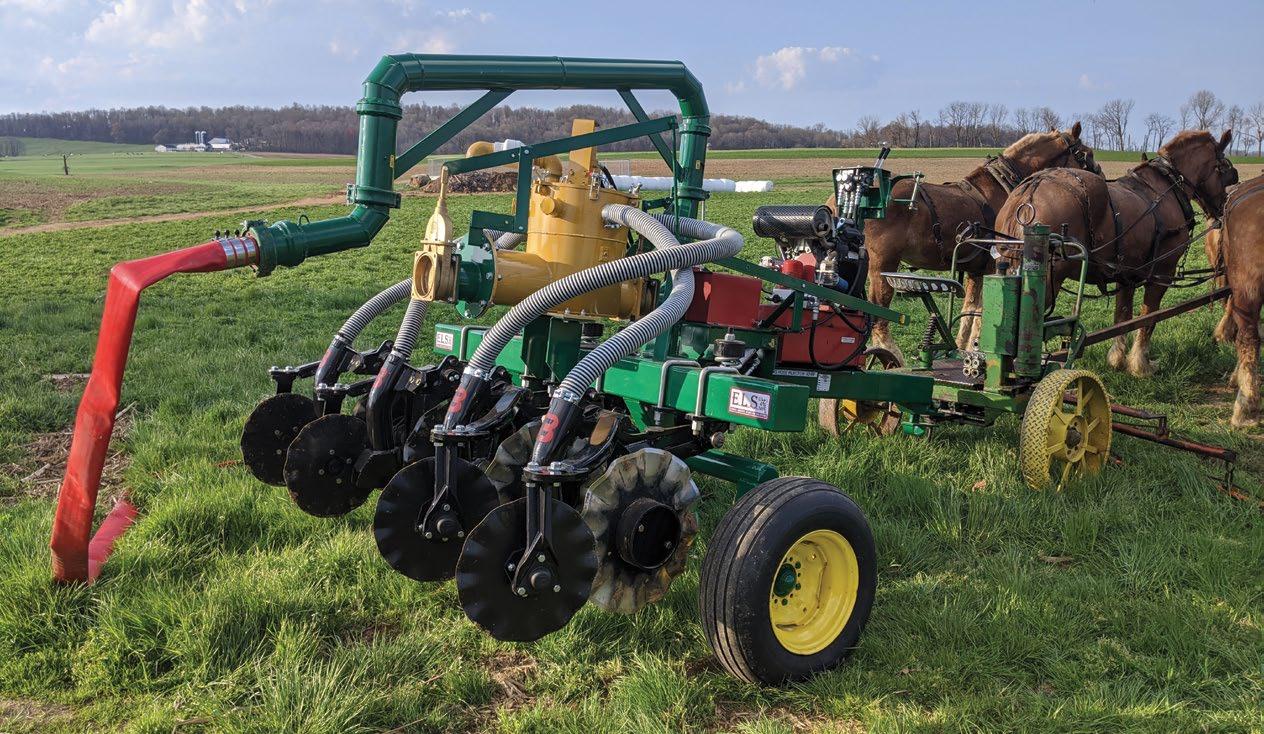
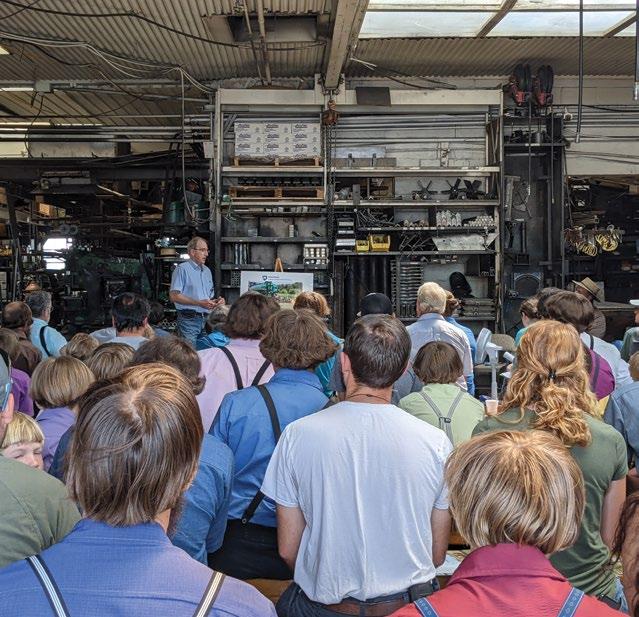
Area Amish farmers like the concept of a dragline with pressure generated by a diesel motor, but the weight would require a team of eight horses to carry.
focused nutrient management planning in the region’s farming communities. Members include other non-governmental organizations, land-grant universities like Cornell and Penn State, agribusinesses, government agencies and farmers.
As Hughes Evans explains, farmers were not going to buy manure injection equipment. Besides the expense and slow speed, farmers just weren’t familiar yet with the concept, nor its merits. This situation spilled over into the perspective of custom applicators. As Sustainable Chesapeake Project Manager Natasha Rathlev explains, why would you buy expensive and clunky equipment for something that your clients may not want? Related to this, it was pretty much impossible back then to make a case for grant money to spur adoption.
But about 12 years ago, Dr. Rory McGuire at Virginia Tech had an idea: the government could incentivize investment in injection equipment through paying custom applicators on a per-acre basis. He approached an applicator in the Shenandoah Valley, who then invested in injection equipment…but the whole scheme flopped. “It looked like a failure, but we said ‘Rory, no, this is gold,’” says Hughes Evans. “It will work.” The trouble was, McGuire had approached a brandnew custom applicator, while what was needed were applicators who had been in business for quite a while. In partnership with the Catoctin Frederick Soil Conservation District and Sassafras River Association in Maryland, Sustainable Chesapeake found
two such businesses – and as they had predicted, everything changed. “They went to their clients and said ‘Do you want to try manure injection?’”
Hughes Evans explains: “I can offer it to you for free during the life of this project, so you can see how it does. Why don’t I do this one field with manure injection, and I’ll do the rest of your fields like we normally manage them.’ And it worked beautifully. That model is what we have replicated across the watershed. It puts all the right incentives where they need to be.” She adds, “The success in Maryland helped us launch this effort in south central Pennsylvania. Injection is now a normal practice there, but it’s also moving up the watershed.”
MORE RESEARCH
Before we look at further adoption progress, let’s dip into research. That is, while the per-acre-payments-from-grants was working well to spur some adoption, members of the Partnership continued doing studies to generate the evidence farmers need about the benefits of injection. One study on commercial dairy farms conducted by Penn State involved anaerobically digested dairy manure applied ahead of corn by
ABOVE
For area research and extension specialists, education for local producers has become key in spreading the practice.
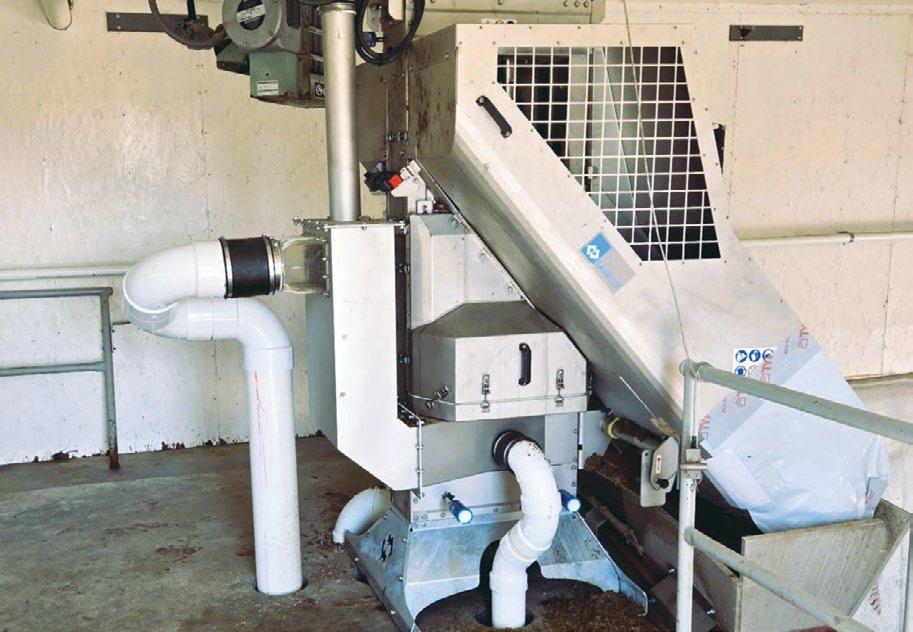
The vertical separator is designed to dewater liquid-solid mixtures in which the ratio of liquid to solids fluctuates dramatically. This machine design includes two vertical screws manufactured from SINT® engineered polymer. The unique design ensures there is no clogging or loss of the plug during operation.
Separation is performed by a combination of gravity and mechanical compression. This flexibility allows the machine to separate the liquid phase from the solid phase of a wide range of materials where the percentage of the liquid inside the solids may be constantly changing.
APPLICATIONS
• Animal Manure (Cows, Hogs, Chickens,…)
• Low Fiber Waste
• Digestate from Biogas Plants
DESIGN DATA
• Flow Capacity: Up to 130 gpm
• Motor HP: 7.5
• Dry Matter: Up to 28%
• Hopper for stable feeding
• Food Compost
• Rubber Recycling
• Industrial Waste
• Dual Vertical Screws
• Self-Adjusting counterpressure system
• Never loses the solids plug.
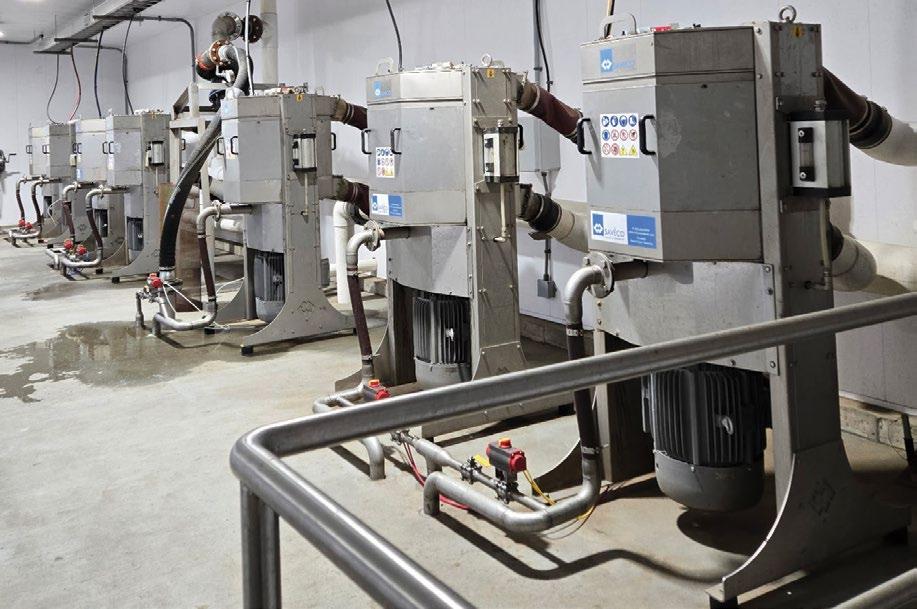
The SEPCOM Micro-filter MFT is a machine for the micro-filtration of raw or digestate animal slurry (Pigs, Cows, Chickens). In some cases, it can be used as an alternative to the centrifuge for a fraction of the installation cost and operating cost. The micro-filtered liquid can be used for fertigation, or in systems that reuse the liquid, or stored in manure lagoons for easy removal.
BENEFITS
• High filtration efficiency
• Quick installation
SAVECO North America 7809 100th Street Pleasant Prairie, WI 53158 Jeff.moeggenberg@savecowaterna.com 224-441-4204
• Easy maintenance
• Low operating costs
SEPCOM® V2-200
SEPCOM MICRO-FILTER MFT-500
injection and surface application. “As was the case with raw manure, we documented a reduction in the amount of side-dressed N with injection,” explains Ron Hoover, Penn State Department of Plant Science on-farm research coordinator.
Another four-year Penn State and ARS-USDA study from 2013 to 2017, measured overland and subsurface water flows during and after precipitation events for phosphorus and sediment losses on plots planted with corn in the summer and cereal rye as a winter cover crop. Dr. Jack Watson and his colleagues analyzed the data and found that compared to broadcast manure, shallow-disk injection was more effective in promoting dilution of dissolved P and to a lesser extent, total P. Water quality improvements were not consistent throughout the entire study. No-till farmers (about half of the dairy farmers in Pennsylvania) were interested to learn that shallow-disk injection did not cause sedimentation and muddying streams.
ADOPTION PROGRESS
Also in Pennsylvania, for the last six years, Partnership member Lancaster County Conservation District has been working with Campbell Foundation funding to increase adoption through the same scheme mentioned previously – funding custom application. In terms of how much adoption has grown, there are only records of the acres covered by incentive payments. However, there are farmers using injection who aren’t taking incentive payments, says the District’s Agricultural Ombudsman Shelly Dehoff. “I hear the custom operators saying they are getting more requests all the time,” she reports. “I think some farmers are sold on it, some are not yet convinced but will do it if there’s funding available.” She
and her colleagues are hopeful that farmers will continue with injection once the incentive payments come to an end.
However, among Amish farmers, there’s a stumbling block. Part of the Campbell Foundation funding has also gone towards the manufacture of a horse-drawn manure injection unit for the Amish of Lancaster County. The Amish farmers did like the concept (a drag line with pressure generated by a diesel motor), but it’s so heavy that it requires a team of eight horses. That and the cost of the fuel has therefore stymied Amish adoption.
There’s also a little stumbling block for some conventional farmers in Pennsylvania. Dr. Heather Karsten, associate professor at Penn State, first explains that farmers are trusting her team’s research results, that if they inject liquid dairy manure digestate, there’s often no need to apply side-dress N or they can significantly reduce side-dress N, depending on farming practices and soil N conditions. “Farmers have recognized the economic benefits of saving N, especially as input costs have gone up,” she explains. “They also recognize the environmental stewardship benefits to the practice. In addition, new technologies such as GPS-guided tractors and drag-hose systems have reduced the time required for manure injection and the risk of soil compaction, often reducing the cost of injection and enabling more timely field operations such as crop planting.”
However, the use of injection can often reduce the amount of manure that is applied. Under current Pennsylvania nutrient management regulations, one can apply the same amount of manure with the dribble bar or broadcasting, making the dribble barn more attractive than injection for some. “Depending on the farm type, some farmers prefer to keep applying the same amount of manure because otherwise they have to change their nutrient management plan and find new places for manure,” Karsten explains. “That can be a problem in Pennsylvania.” She also notes that studies are needed on how much N is lost through ammonia in dribble bar use in the Northeast climate – studies that could be important in further promoting injection.
MORE PROGRESS
Last year in New York, the Delaware County Soil and Water Conservation District and Cornell Cooperative Extension partnered with the New York City Watershed Agricultural Council, Cornell and Virginia Tech to implement a manure injection custom operator service and evaluate its impact on manure management in the New York City Watershed. “With funding from the Conservation Innovation Grants program at USDA’s Natural Resource Conservation Service, the team works with smaller
ABOVE
farms to access manure injection services of the custom operator that won the competitive bid for the project,” explains Dr. Quirine Ketterings, professor of Nutrient Management at Cornell. “Manure injection started last spring and feedback so far has been very positive.”
She notes that within this project, farmers access to the latest in sustainable manure application tech (including shallow disc-coulter manure injection and precision ag tech) to manage application rates and record data. This helps alleviate nutrient deficiencies in fields farther away from the lagoon or digester that typically receive less manure, and also helps reduce applications on fields with a history of heavier manure rates.
LOOKING FORWARD
All this growth in adoption is sure to continue. The Partnership is using funding that was awarded in 2024 from the National Fish and Wildlife Foundation to continue building adoption of manure injection and nutrient management in the Chesapeake Bay watersheds, with a specific focus on the Susquehanna River Basin, which spans New York, Maryland and Pennsylvania.
Rathlev also reports that “we had a booth at the Pennsylvania Dairy Industry Summit last year, and we spoke with four or five farmers that have been injecting for years with their own equipment. And we talked to an equipment dealer who sold 10 injection units last year.” She notes that because injection costs a little more, it’s crucial to make the economic benefits clear to farmers. Still, “they are understanding that injection will enable them to reduce the amount of N they have to apply,” she says. “They also appreciate the odor reduction, because they’re always dealing with complaints from neighbors. In addition, for the applicators, the newer equipment designs are really moving the ball forward.”
Most of all, Rathlev credits the collective success to the dedicated teamwork of Partnership members. “We don’t just have a partnership, we have a collaboration,” she explains. “We’re all united in trying to help farmers realize the value of their manure, because every molecule of nitrogen that’s lost from a farm, whether it goes to the water or the air, that’s money out of the farmer’s pocket. We know what we are doing is working. We want injection to be a normal part of farming. We want to put ourselves out of the manure injection business as an organization, so to speak, and we are on our way.” •
A LONG WAY TOGETHER
WHEREVER YOU ARE, BKT IS WITH YOU
No matter how challenging your needs, BKT is always with you, offering a wide range of tires tailored to every need in agriculture: from work in the open field to the orchards and vineyards, from high power tractors to trailers for transport. Reliable and safe, sturdy and durable, capable of combining traction and reduced soil compaction, comfort and high performance.
BKT: always with You, to maximize productivity.
Joe Dias
Eastern Zone Manager
Directeur Régional, Est du Canada
BKT Tires (Canada) Inc.
Cell: 514-792-9220
Web: www.bkt-tires.com
Manure injection from a liquid tanker on a Lancaster County field.
SPREADING the diversity
Evaluating the benefits and consideration of various manure types
BY RONDA PAYNE
If you’re reading this magazine, you surely already believe that manure is nature’s fertilizer.
But just as chemical fertilizers come in various strengths, ratios and formats, so too do the different types of manure. And, whether you’re managing and applying your own manure, or are an applicator working with producer clients –especially those newer to manure – it’s important to know considerations, benefits and properties of each type of manure and communicate them properly, especially when the choice isn’t obvious. Not all manure is created equal, and each type of manure might mesh differently with the intended soil and crop.
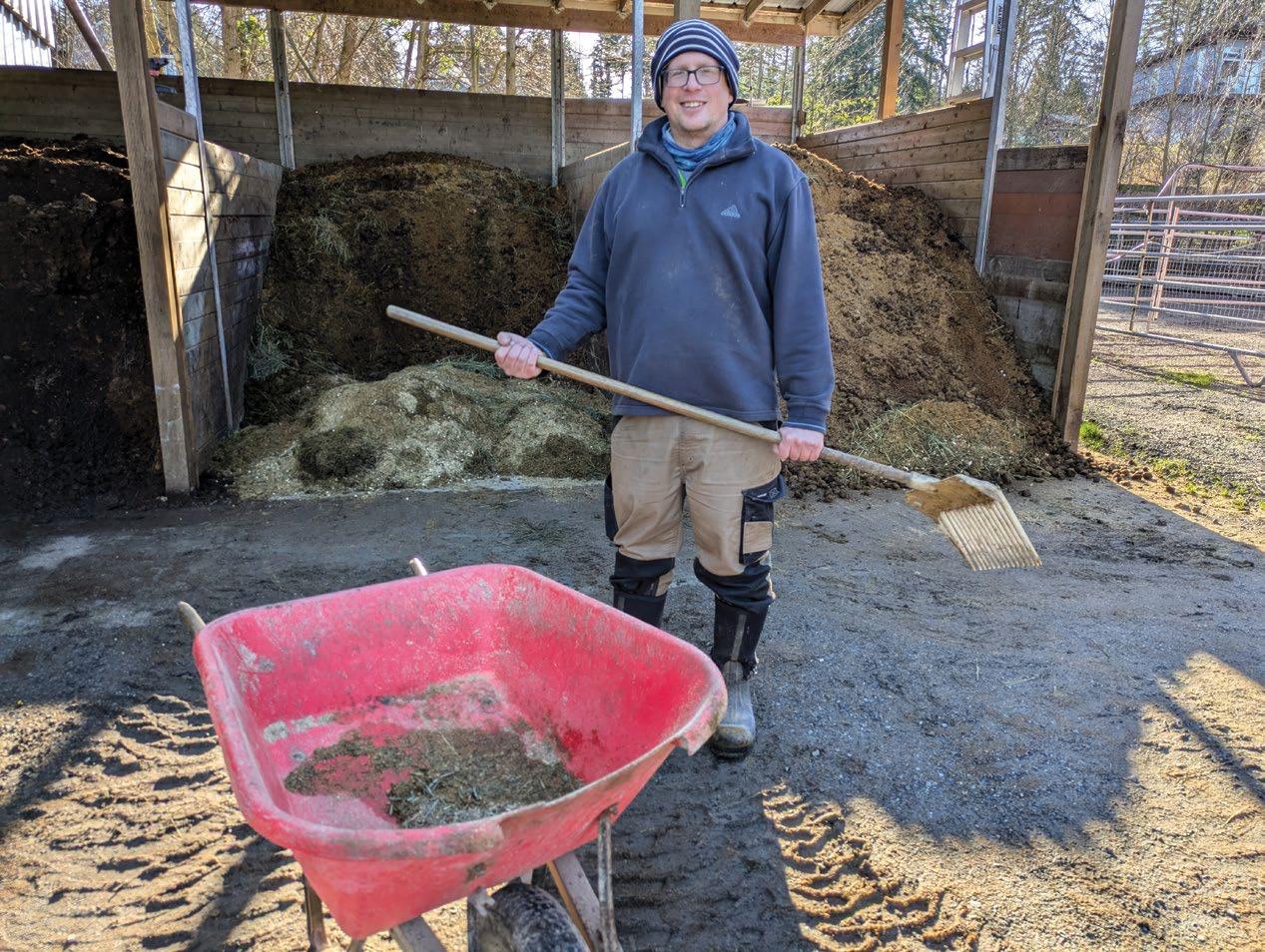
Marcel Sachse, co-owner of Pinsch of Soil Farm in Langley, BC hosts workshops about manure use and planning through LEPS (Langley Environmental Partners Society) in BC.
“It’s a waste product, but in nature it gets recycled to feed new growth,” he says of manure. “You have to be aware of what your crop and soil need in terms of nutrients. You shouldn’t just apply any manure. Chicken manure has a lot more value in nutrients than say horse manure.”
KNOW THE GOAL, CONSIDER THE OPTIONS
Rebecca Larson, professor and extension specialist with the University of Wisconsin’s Nelson Institute for Environmental Studies, would like to see farmers ask more questions before they apply manure.
“I don’t think a lot of people ask why. They don’t really look at their numbers and details and ask why they might want to do something,” she says. “It’s better to understand where you’re trying to improve or what you’re trying to do.”
The objectives for the manure’s application need to be determined prior to choosing and spreading it. Is the goal to reduce input costs, like that of fertilizers? To improve soil health, including adding organic matter? To increase certain nutrients in the soil? Is potassium high, but nitrogen low? Can changes to the manure result in cost savings? Increase yield?
With specific goals in mind, farmers may learn that the manure at hand may not be the right fit. But there may be
an option to manipulate it to improve its suitability. Or, manipulation may make it possible to transfer manure to other farms and trade for, or purchase another, type of manure that’s a better fit.
Separating dairy manure, for example, may result in more organic matter in the solids and higher available nutrient concentrations in the liquid which become two separate products. Swine and other manures can also be separated, and Larson says this allows for more opportunities in usage.
“Each system is really variable,” she says. “If I look at all these systems, I need to know if it’s worth the cost to process. The circumstances of how it’s going to be used is a big part of determining the equipment. And any processing may alter the manure, changing what you want to do with it.”
For many farmers this presents a challenge. Dairy farmers are used to spreading their fields with dairy manure, but what if that’s not what forage fields need? The soil may have indicated compatibility in the past, but perhaps that’s no longer the case.
ABOVE
Marcel Sasche, co-owner of Pinsch of Soil Farm, hosts workshops to teach producers about the most effective use of different types of manure.
MANAGEMENT BASED ON PROPERTIES
How any type of manure is managed depends upon the form and nutrient values of the manure. For example, poultry manure or litter, with its typically dry consistency and high NPK concentrations, needs to be managed in a way that reduces nitrogen losses when it is applied to the soil. It can’t be easily injected like a liquid manure.
“You need to pay attention to some very different things once it’s applied, than if you’re applying something like dairy manure,” say Larson, of poultry manure. “Dairy manure is more liquid, compared to poultry, changing the entire manure management system from collection to land application because your manure is different.”
Liquids usually make sense to move only up to within a few miles due to the high costs of transportation, says Nancy Bohl Bormann, a manure and nutrient management researcher with the University of Minnesota.
“Some of the manure, on the other hand, is more concentrated. Especially some of the solid poultry manure. It can get trucked further because of that,” she says. “If you could use all the nutrients on a field, you can justify hauling it further. There’s the cost benefit.”
As a rule, poultry manure is the queen bee of nutrients and most often is a dry manure. At the other end of the nutrient scale is solid dairy manure, which has the lowest average range of nutrients among other livestock manure ranges provided by ManureDB data from the University of Minnesota.
Beef is interestingly higher in nutrients than dairy in its solid form, but lower in liquid/slurry form. Liquid swine manure has
the largest range of nutrients, likely due to differences in manure storage from open lagoons to deep pits and is similar to liquid/ slurry dairy manure and falls at a higher level than horse or dairy solids, but still significantly lower than poultry.
Smaller scale farmers with chickens and/or sheep may find that their farms produce substantial nutrient benefits that could be used on farm or sold. But standard practices apply says Sachse.
“Manure should be composted usually at least three months,” he says. “When it’s been composting for at least three months, you can call it a soil amendment, your nutrients are more stable and less volatile.”
He adds that fresh manure should never be applied to food that will be harvested within four months.
TEST AND FIND THE RIGHT FIT
Manure calculators, such as the one through Manure DB, are helpful to create an idea of general nutrient values. There are some crops that are a natural fit for the nutrients in certain types of manure.
“Liquid swine finisher manure is a great match for corn production,” says Bohl Bormann. “The nutrients are well balanced for corn. The nitrogen is more readily available compared to other manures.”
And while generally, this is a match made in manure heaven, there are still factors to be considered according to Teng Lim, an extension professor of the Plant Science and Technology Division with the University of Missouri. He recommends testing the manure being considered – every batch if possible. Testing itself
Smart Performance YOU CAN COUNT ON!
requires care and attention, especially with manures in deep pits or lagoons like swine or dairy manure.
“That manure could have been sitting there for months,” he explains.
Using a sludge sampler that takes a core sample from the crust through the pit to the bottom is recommended before the pit has been agitated. Testing is best done after good agitation during pumping out. Larson’s research recommends composting many manure samples during the emptying process, taking some from every few tanker loads, then mixing the samples together and sending a sample in for analysis.
“Even with that, you can still see some differences,” Lim says. “Though commercial scale farms, they tend to be a little more consistent in how they manage the farms and what they feed the animals.”
manure nutrients may line up, there is a time factor as to when that nitrogen becomes available, says Bohl Bormann. Liquid manures are generally incorporated into the soil, so nitrogen stays where it’s needed, un-managed solids have more of a risk of losing their precious nitrogen through volatization (off-gassing) because they are exposed.
“That’s another tricky thing about manure. In solid manures [nitrogen is] not necessarily going to be released right away either,” she says. “Planting a cover crop after a manure application can help reduce nitrogen loss.”
“Planting a cover crop after manure application can help reduce nitrogen loss.”
Data from the manure will inform the applicator of flow rate and speed and hiring a custom applicator team will bring the necessary expertise to balance field needs with nutrient availability. Plus, a manurespreading team will have the tools to do the job more efficiently.
“It’s quite exciting to be thinking about what we have now versus 20 years ago,” he says. “We are constantly improving and the more professional these teams are, the better.”
SHAPE AND FORM MATTER
More solid manures, like poultry or beef are going to have a slower release of nitrogen, so while the numbers for soil need and
THE FOUR Rs
The USDA and other agricultural organizations promote the longstanding “four R” tradition for applied nutrients: right source, right rate, right time and right place. While the principle is often used to refer to commercial fertilizers, it has value in the application of manure, and Lim advises following the guidance for manure as well – regardless of manure type.
“Those are the basic principles whether it’s pig manure or poultry manure,” he says. “Manure can be very different from farm to farm or region to region or even with timing. That’s why the four R principles are always important.”
KEEP IT IN BALANCE
Crop fields usually benefit from manure application, but in many cases the source of those benefits exists outside the land’s normal ecosystem. The desire for additional nutrients needs to be balanced with environmental impacts.
“Wildlife is in a closed ecosystem,” Sachse says. “Their nutrition is usually from the same habitat which they fertilize with their own scat. Our dogs and livestock on the other hand are fed something that comes from outside of that ecosystem. You basically import nutrients and now we do have to think about where we apply that manure. If you don’t know what your soil needs, you quickly over-apply, excess nutrients leach into watercourses and bring things out of balance.”
Grass-fed cows may be considered to be eating from within the ecosystem where their manure is applied, but swine that have food trucked in would not. Therefore, application decisions begin with soil needs, says Bohl Bormann.
“A basic tenant of nutrient management is soil testing,” she says. “Do regular soil testing to know what you even need to begin with.”
Soil testing is the first step to understanding the nutrient support required for the future crop. This should be followed by testing the potential manure to gauge for application rates and overall compatibility. While general assumptions can be made about which manure type is best, even within the same species, manure can be dramatically different; such as manure from a dairy farm with a primarily grass diet compared to one with a blended diet. Manure storage type and climate can also greatly impact manure.
“Fertilizer prices are very expensive, so it makes manure worth more than it had been,” says Bohl Bormann. “You need to know your soil and your manure by the numbers. The carbon and microorganism additions can be added soil health benefits as well.”
Are we there yet?
Can manure processing truly unlock a circular manure economy?
BY JIM TIMLICK
Chad Veldman isn’t afraid of adopting new technologies on his farm.
Veldman owns and operates a dairy farm near the village of Embro in southwestern Ontario, where he manages a herd of about 90 milkers. An early adopter of solar power with a goal of making his farm more self-sufficient, he was eventually intrigued when he started learning about manure processing technologies such as separators and digesters. Not only can they help decrease a farm’s fertilizer costs, but they can also help to dramatically shrink an operation’s environmental footprint.
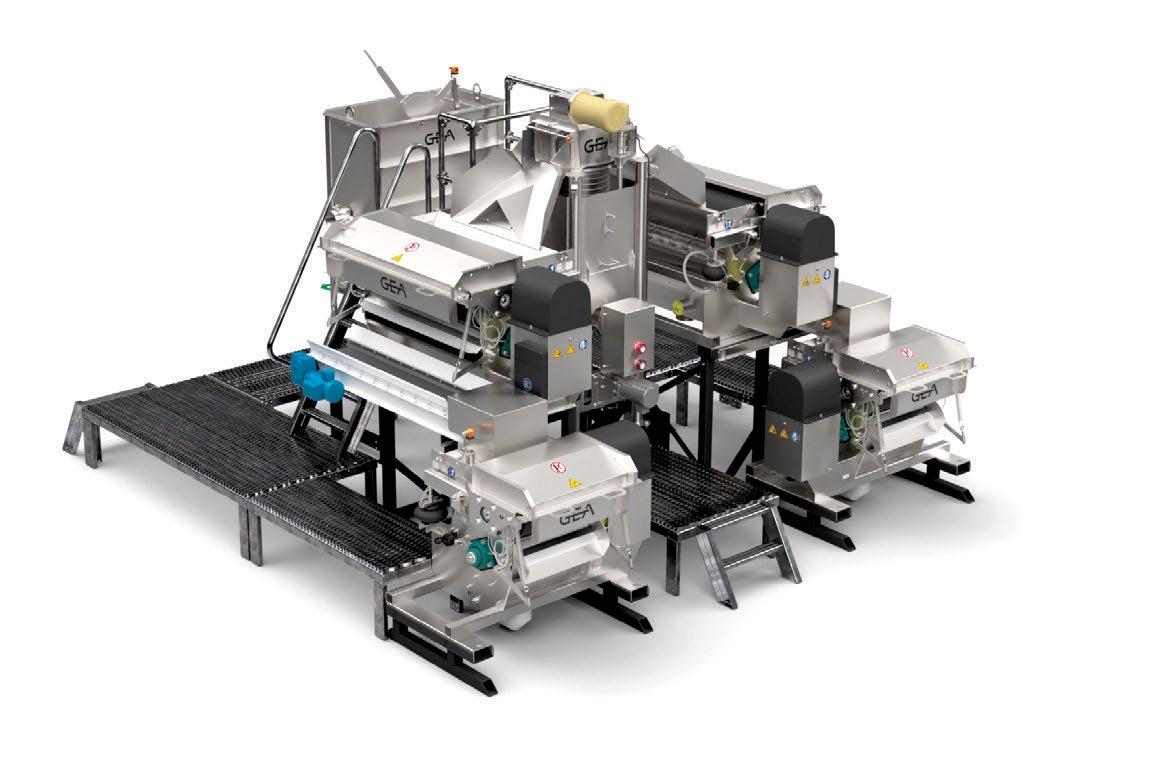
Seven years ago he invested in a GEA XPress manure separator and vertical extract. The stainless steel fiber separation system is designed to separate manure into its solid and liquid components.
Veldman uses the system primarily to create high quality and comfortable “green” bedding for his cows. Think of it as an example of a circular economy in which a product that is often considered to be waste is transformed into a valuable resource.
The way the system works is that manure is fed into the separator where a series rollers squeezes it
and separates it into its liquid and dry components. The dry material, or non-digestible fiber, is then placed on a conveyor belt which transports it to a robotic system that installs it as bedding for his cows.
Veldman says the average person wouldn’t notice a difference between his bedding and most other bedding products. “It almost looks like straw. There’s a lot of full-length pieces of straw in it,” he describes. “The way the rollers are, is they’re very gentle on the fibers. They don’t churn them at all. Anything that goes through it, comes out whole.”
Not only does the separation system mean Veldman now spends less time and money sourcing and hauling bedding for his cows, but it can also reduce manure hauling expenses and it requires less storage space than other types of bedding.
Separators aren’t the only type of processing equipment that can help producers save money – or even generate new revenue. Others, including various types of on-farm digesters, have been the talk of ag headlines for years. Some data even suggests that manure-based processing projects have increased by as much as 50 percent in the last decades.
But many experts say it is still underutilized in much of North America.
Considering the benefits such technology
provides, the question then becomes: why aren’t more farmers adopting this technology?
BEYOND THE HEADLINES
Rebecca Larson, a professor and extension specialist at the University of WisconsinMadison who specializes in manure management, says there are several reasons for adoption not being as widespread and rapid as one would have homed.
Cost is one of the primary reasons, she says. In addition, while it’s easy to
determine what the cost of purchasing and installing this technology might be, it remains much more difficult for producers to find information on what the cost benefits or ROI of using it is – since that data is not always readily accessible.
Amir Sadeghpour, associate professor of soil fertility at the University of Illinois, says another challenge is that some manure processors such as digesters are highly sophisticated and require a high degree of expertise to install and maintain. “You have to be really technical or have folks working
with you that are more technical and that means they’re probably more expensive to manage,” he says. Plus, manure can vary in terms of quality, which makes it difficult to predict the quality of the outputs produced.
Some farmers also aren’t comfortable with the technology just yet, he says. “I think the issue with my style of system is a lot of people are scared of mastitis [an inflammation in a cow’s udder that can result in decreased milk production]. Just wrapping their heads around the idea of bedding with manure doesn’t sound right. But I think once you get your head around that idea and you see the products, I feel like a lot of people kind of change their attitude towards it.”
Still, Larson is encouraged by the fact that several studies seem to indicate the interest in adopting manure processing technologies is trending upwards.
WHY PRODUCERS ARE SAYING ‘YES’
One such study conducted by noted professor Meredith Niles indicated more than 50 percent of surveyed dairy farm operators are interested in installing manure processing, with nine per cent particularly interested in installing separators. This same study indicated 15 percent of those surveyed used manure separation, while another study published in Wisconsin in 2017 showed more than 50 percent of larger farm operators are using some kind of manure processing in their facilities.
Sadeghpour believes there are several reasons why a growing number of farmers are starting to take a closer look at manure separation technologies. Numerous grants and inventives from federal and state levels have incentivized adoption in the U.S. And not only do farmers want to be profitable, but they also want to be good neighbors, he adds.
“Farmers want to use that manure source to reduce their costs or inputs,” he says.
“At the same time, the farmers want to be sustainable. Through these technologies, we should be able to utilize manure more efficiently in a way that we reduce environmental footprints, but at the same time utilize it the best that we can to create a circular economy for the farms.”
NEXT ON THE HORIZON
Larson points out that a number of recent advances in manure processing technologies have also helped attract the attention of a growing number of farmers.
There have been numerous advances
manure dryers that reduce moisture and pathogens in solid manure or separated solids and reduce risks for reuse (primarily as bedding) and storage. On the liquid side, more advanced separation systems such as ultra-filtration (UF) and reverse osmosis (RO) are now being used to treat manure by separating it into clean, reusable water and nutrient-rich concentrate fertilizer. There are also several emerging technologies that use electro-chemical processes now being used to convert manure into concentrated nutrients, fertilizers and energy while reducing environmental impacts such as emissions, odor and water pollution.
Sadeghpour and researchers from the University of Illinois are currently investigating the use of dissolved air flotation (DAF) to see how effective the water treatment process is in drawing out elements like phosphorous from manure. The goal is to determine if this process could effectively replace the phosphorus that is needed by a crop such as corn instead of using triple superphosphate or monoammonium phosphate.
Sadeghpour and researchers from the University of Illinois through funding from Dairy Manure Inc. (DMI) are currently
investigating the use of dissolved air flotation (DAF) to see how effective the water treatment process is in drawing out elements like phosphorous from manure. The goal is to determine if the manure produced could effectively replace the phosphorus used in common phosphorus fertilizers for crops such as corn.
“So far, we’ve seen that it does a really good job. I think the next step would be, [making it] so that it could be used commercially,” he says.
One piece of advice from Larson is to be patient. It can often take some time before a user will be able to quantify the benefits from it. “Usually, only people with advanced knowledge get their separation system to operate exactly as they want when they first install it,” she cautions. “Even if you put [manure] through the same process, the process is going to be different because the manure is different.” She also suggests producers determine what they want to use the technology to accomplish before choosing a specific model. “It’s exciting to pick the technology. But it leaves a lot of farmers feeling confused. The data isn’t always clear as to what I should be picking and for what reason,” she says. “What I
For more info visit huskyfarm.ca or call 1-800-349-1122
Trailing shoe booms from 6m to 30m in width. BlackBird trailing shoe booms in stock Summer 2024. Various incorporation options available. Contact us for more info on tank sizing options.
recommend to producers is try to outline what you’re trying to change, what is the problem that you’re trying to fix. That can really help you identify the technology that can address your needs.”
Sadeghpour recommends producers check out what kind of incentives may be available to them from their federal or state government. They should also do their homework to determine all the benefits the technology could provide on their farm, including building soil health, to determine if it’s a good fit on their farm. “You need to look at it holistically.”
Veldman acknowledges the up-front cost can be a concern. But, he says the ongoing costs for a system like his are minimal since it doesn’t require much electricity to operate and annual maintenance costs are nominal. In fact, he says the system has already paid for itself and then some.
He’s hopeful more farmers will come to see the benefits of the technology for their own farms. “A lot of people just don’t want to be the first [to try something]. But I’ve found in the last there’s a lot more interest in it around here. In the last year I’ve had more people come out and look at my system than what I had in the first six years.” •
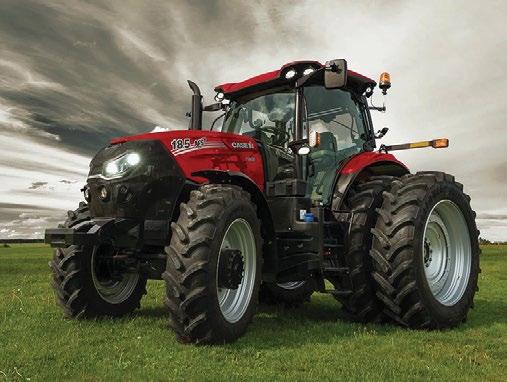
Case unveils Puma series tractor
Case IH launched its all-new Puma series tractor, available in 155, 165 and 185 horsepower models, with a full vehicle redesign. Unveiled at CattleCon, the Puma series boasts superior maneuverability and a smoother ride, and equips operators with access to the latest precision technology and Case IH FieldOp.
Operators can choose between the advanced CVXDrive continuously variable transmission for power, improved traction and long service intervals, or the innovative ActiveDrive 8 dual-clutch transmission for uninterrupted torque, fast shuttle shifts and smart automations. Both options boost productivity, reducing operator fatigue as a result.
The Puma is designed to be compact and powerful, with a 20 percent tighter turn. It features a new front axle suspension for greater high-speed transport safety and roll control. Enhanced braking responsiveness, updated linkage/hitch and a new transmission improve the tractor’s drivability and implement control. The tractor features advanced precision technology, offering optional ISOBUS and Tractor Implement Management (TIM) for compatibility with modern implements, along with expandable electronic architecture. Operators can manage tractor machine and agronomic data and unlock the power of Connected Services with FieldOps.
The updated cab design enhances productivity and ease of use, featuring improved styling, Pro 1200 display, a new cab suspension, a semi-active seat option and an upgraded MultiController Armrest to maximize operator comfort during extended use.
Nokian debuts Country King G2
Nokian’s new Country King G2 is a new model featuring a dual-purpose tread pattern design to reduce loss of power both on-road and in-field. The tread design is wide, with large dimensions, increasing tread contact in lateral and longitudinal directions, more efficient weight distribution, minimized compaction and reduced rolling resistance in field conditions. The non-directional tread design is also designed to make rotation easier, helping to extend service life.
The tire was set to have become available by the end of Q1 2026, in seven sizes:
• VF600/55R26.5;
• VF620/60R26.5;
• VF650/55R26.5;
• 560/60R22.5;
• 600/50R22.5;
• 650/50R22.5; and
• 710/45R22.5.
In the R26.5 sizes, the Country King G2 will feature Nokian’s patented Flexforce VF technology, which provides advanced flotation capacity for minimized soil compaction and lower crop damage.
Drag-Line Systems & Accessories
20 X 6” Hose Capacity. Lead & trailed units can be operated in unison or independently. TPH COILER
• Available in 30’ and 40’
• Full galvanized frame
• WER Distributer
• Rear hitch (max towing 5000 lbs)
• Available in 30’/40’/60’
• Full galvanized frame
• WER Distributer
• C/W ball blow-out
• Rear hitch (max towing 5000 lbs)
Use as a stand alone unit, or as an addition to a developing drag line system. (3 models available).
The telescopic hyd width adjustment provides a large surface radius when moving hose. Dealer Opportunities in
INLINE CHOPPER
Improve productivity by reducing blockages in the drag line system and reduce pump repairs.
DISTRIBUTOR
The high grade chopping system, and auto-reverse function, ensure an obstruction free distribution.
Maximize Efficiency with better spread. Heavy duty construction & galvanized frame.
MANURE MINUTE
CHRYSEID MODDERMAN
Manure challenge: Fixed nutrient ratio
I’m sure all of us at some point in childhood were told, “You get what you get, and you don’t make a fit.” Oddly enough, these words also ring true for manure!
Unlike commercial fertilizers that can be mixed and manipulated to give you the desired nutrient content, manure nutrient ratios are fixed. It is what it is, you get what you get. The fixed nutrient ratios of manure don’t always line up with the ratios that crops need, which means you’ll almost inevitably over- or under-apply some nutrient. Overapplication of a nutrient can lead to pollution, while underapplication can lead to nutrient deficiencies or the need to pay for additional commercial fertilizer. What can you do to meet this tricky challenge of manure?
NITROGEN-BASED VS. PHOSPHORUSBASED APPLICATION RATES
I often hear, “The agronomist told me to spread my turkey litter and then put on more nitrogen with commercial fertilizer. Why can’t I just put all my nitrogen on with manure?” In general, manure tends to over-apply phosphorus, especially poultry litter. For example, turkey manure applied to corn, based on the nitrogen requirements of the crop (i.e. nitrogen-based rate), applies five times as much phosphorus as is needed by the crop. If turkey litter is added each year to this same field at that nitrogen-based rate, soil phosphorus will
phosphorus needs? Well, that depends on your soil and manure tests. Compare the crop nutrient needs to the nutrients you already have available in the soil and what you plan to add with manure. If you have high-phosphorus soils and adding manure will add excess phosphorus, you might consider applying at a phosphorus-based rate to avoid further phosphorus buildup. If your soil test phosphorus is low, you might consider using a nitrogen-based rate so long as it won’t build up soil phosphorus levels to a high level.
AVOIDING SOIL PHOSPHORUS BUILDUP
In conjunction with the previous section, I often hear “What’s wrong with overapplying phosphorus? It sticks in the soil. Can’t I just bank it for future years?” While it is true that phosphorus is far less mobile in the soil than nitrate, it can still be lost via runoff and erosion. Phosphorus leaching can also be a concern in soils with very very high phosphorus levels.
While phosphorus is less mobile, it can still be lost via runoff
build up to very high levels quickly.
By contrast, when application is based on the crop’s phosphorus needs (i.e. phosphorusbased rate), the application rate will generally be lower than a nitrogen-based rate and not cause phosphorus buildup. And in most cases, this will underapply nitrogen, so more needs to be added through commercial fertilizer. In the situation above, the agronomist recommended applying at a phosphorus-based rate to avoid soil phosphorus buildup. Since that underapplied nitrogen, he recommended adding commercial fertilizer nitrogen to avoid nutrient deficiency.
Should you apply based on nitrogen needs or
There are two main methods to avoid phosphorus buildup. The first is to apply at a phosphorus-based rate (as described above). The other method is to apply manure at the nitrogenbased rate, and then not apply any manure to that field until the excess phosphorus has been used up. For example, my family applies turkey manure at a nitrogen-based rate once every three years. The first year’s application supplies all the necessary nutrients for the crop (including nitrogen), but it overapplies phosphorus. It takes two subsequent years for that excess phosphorus to be drawn down by the following crops. In those two years no manure is applied, and nitrogen or other nutrient needs are supplied by commercial fertilizer. Of course, this method only works well for those that have enough land to support it. Keeping a field manure-free for years may not be feasible for those with large amounts of manure, or few acres.
Overall, manure’s fixed nutrient content is challenging. But with a little forethought and planning, you can balance those tricky nutrients to make an accurate application without being nutrient deficient. •
GEA
XPress
and Vertical Extract
Vertical Extract’s single or double outlet configurations allows seamless integration with XPress units on either side.
When the work is tough, your equipment should be tougher.
Built to last and designed for nonstop operation, the GEA XPress Manure Separator and Vertical Extract deliver unmatched efficiency and ease of maintenance.
Stainless Steel 304 Construction — The XPress, Vertical Extract and regulator tank are corrosionresistant for long service life in harsh environments.
Improved Dewatering process with the new vertical Extract.
Top-Mounted Auger Drive — Powered by a 3 HP electric motor for improved reliability and accessibility.
Single Pulsator System — Driven by a ¾ HP motor, eliminating pulleys and belts for fewer components, easier maintenance, and lower energy consumption.
Grease-Free Design — Auto-lubers and grease-free bushings eliminate messy lubrication points, making maintenance quick and clean.