How evolutions in control cabinets are redefining the future of automation. p. 12
WOMEN IN AUTOMATION Q&A
NGen’s Christy Michalak shares insights on the importance of authentic female leadership. p. 11
ADVANCING
Making Industry 4.0 a widespread reality depends on the new 5G networks. p.18
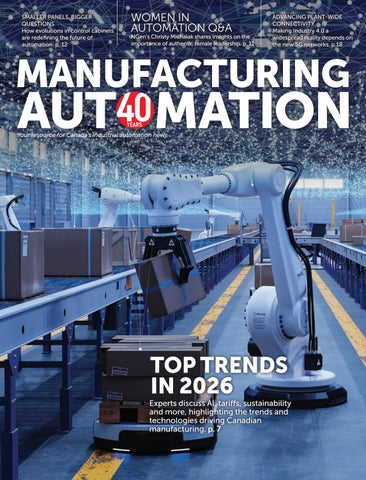
TOP TRENDS IN 2026
Experts discuss AI, tariffs, sustainability and more, highlighting the trends and technologies driving Canadian manufacturing. p. 7
Affordable Industrial Enclosures


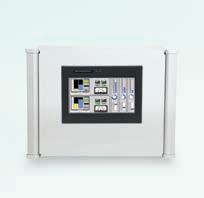
NEW! Hammond ACE Series HMI

Enclosures

& Suspension Arm Systems
Enclosures starting at 949.00 (ACE12126LG)




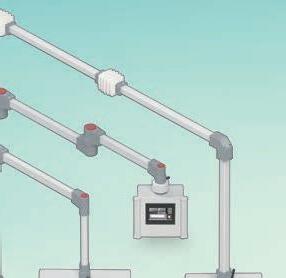
The Hammond Aluminum Command Enclosure (ACE) series provides a versatile, flexible solution for housing today’s most advanced operator interfaces, including the popular C-more CM5 HMIs. With removable front panels, quarter-turn latches, and oil-resistant gaskets, ACE enclosures offer easy machining and reliable protection. Hammond’s taraPLUS suspension arm system combines sleek, modular arms and integrated wire management to improve operator comfort. Hammond Heavy Duty suspension arms deliver greater load capacity with robust 50mm and 80mm profiles ideal for supporting bigger enclosures.


Components start at $46.00 (CPR602)








NEW! Quadritalia OK Series 2200mm Modular Enclosure Components
The Quadritalia OK series 2200mm modular enclosure system combines seamlessly fitting components such as frame rails, doors, panels,and subpanels with a full range of accessories like side doors, partition panels, plinths, swing panels, switches, and interlocks to deliver a highly adaptable, flexible enclosure solution for industrial, electrical, and data applications.


















NEW! Fibox Miniature Cases, Subpanels, & Accessories
Starting at $24.50 (ULTPCM090706)





Fibox MNX and TEMPO series polycarbonate miniature cases are engineered to deliver durable, adaptable protection for every installation need.
• MNX series miniature cases with knockouts are UL listed and rated NEMA 4X & 6, providing protection against harsh and hostile environments
• TEMPO series miniature cases with knockouts are built for quick and efficient installation



Orders over $49 get FAST FREE SHIPPING



Fast free standard shipping* is available for most orders over $49 U.S., and that includes the brokerage fees (when using an AutomationDirect nominated broker). Using our choice of carrier, we can reach most Canadian destinations within 2 to 3 days.
*Free shipping does not apply to items requiring LTL transport, but those shipments can take advantage of our negotiated super-low at rates (based on weight) that include brokerage fees.



See Web site for details and restrictions at: www.automationdirect.com/canada









taraPLUS Suspension Arm Pro les Heavy Duty 50mm or 80mm Suspension Arm Pro le



Experts share what trends and technology they feel will impact the Canadian manufacturing sector in 2026.
By Jared Dodds
NGen’s Christy Michalak shares insights on the importance of authentic female leadership.
By Jared Dodds
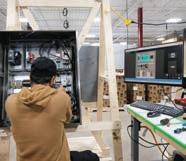
Control cabinets have evolved incrementally for decades. Now, innovations like miniaturization and fully digitized panel builds are redefining the future.
By Jack Kazmierski
Making Industry 4.0 a widespread reality depends on the new 5G networks.
By Treena Hein



FROM THE EDITOR
BY JARED DODDS
Lessons from Hannover MESSE
When I took over as editor of Manufacturing AUTOMATION, one of my first interviews was with Andreas Sobotta, of PILZ and German Technology Day fame. I was interviewing him about Hannover MESSE 2025, and the lasting message was simple: you have to be there. I took this conversation to heart and made it my mission to get MA on the ground for manufacturing’s largest trade show in some way, shape or form. Thanks to Phoenix Contact, I was able to make that happen this year by attending the Press Preview event from Feb. 24-26.
I find it important to begin this story recounting my travel to the event, which was, without a doubt, the worst travel experience of my life. I had originally scheduled myself to leave the Thursday prior, so I could land, finish the very magazine you are currently reading and have time to adjust to the time change and explore Frankfurt. An airplane issue scuttled that plan. No harm, no foul; I rebooked my flight for Sunday. Cue another delay, a slow boarding process and a missed connection by mere minutes.
I was rebooked on a flight departing Frankfurt at 10:00 p.m. To avoid the delay, I instead booked a train, which would have been wise IF I had boarded the train to Hannover and not, as I did, to Berlin. With all said and done I arrived at my hotel three days later and with more hours of lost sleep than I had planned.
I share all this not for sympathy, but to set the stage for my poor mood heading into the tour of Phoenix Contact’s headquarters on Tuesday and the main event on Wednesday. Which is what makes my experience even more extraordinary: I found myself intensely fascinated and extremely engaged throughout every presentation, conversation and networking opportunity.
CONNECT
Take Phoenix Contact; I spent an afternoon learning about some of the developments they are putting in practice to move towards their goal of an All Electric Society. Things like Ice Storage for heating and cooling buildings, utilizing direct currents rather than the more standard alternating and their attempt to reimagine the control cabinet, a topic we touch on in this very issue. There was even some Canadian content in the form of a Mecademic robot running on DC power!
Then Hannover itself. If you haven’t been, the scale of the site is truly indescribable. People tried their best to explain it to me ahead of time and I still wasn’t prepared, you have to see it to believe it. The day’s content reflected the very conversations I had with the experts who participated in our 2026 Trends Roundtable, seen on page seven of this issue. AI has hit the turning point from theory to application, and business owners need to see ROI from the projects they are introducing. Humanoid robots represented a major talking point, as did alternative energy usage, dual-use technologies and more. There will be more insights and product releases to highlight once the show begins in earnest on April 20, but the preview in-and-of itself was an impressive spectacle.
I walked away from my time in Germany excited for the future of the Canadian manufacturing and automation sectors. Every expert I have spoken with highlighted the importance of innovation in the face of geopolitical pressures and a shrinking workforce. Canada is built on innovators, constantly asking what is next and how they can contribute to it. The only thing left is for Canadian manufacturers to take the leap with them, and if what I heard at this conference is any indication, the edge of the cliff is fast approaching. Time to take the plunge. | MA
@AutomationMag jdodds@annexbusinessmedia.com /company/automation-mag
EDITORIAL ADVISORY BOARD
JIM BERETTA, President, Customer Attraction and host of The Robot Industry Podcast
JONATHAN GROSS, Managing Director, Pemeco Consulting
MIHAELA VLASEA, Associate Professor, Department of Mechanical and Mechatronics Engineering and Research Co-Director, Multi-Scale Additive Manufacturing Laboratory at the University of Waterloo
SHELLEY FELLOWS, Past-Chair, Automate Canada
STEPHANIE HOLKO Director, Project Development at Next Generation Manufacturing Canada
WALTER GARRISON, Former Advanced Manufacturing Business Consultant for City of Mississauga
Your resource for Canada’s industrial automation news
Reader Service
Print and digital subscription inquiries or changes, please contact customer service
Angelita Potal
Tel: 416-510-5113
Fax: (416) 510-6875
email: apotal@annexbusinessmedia.com
Mail: 111 Gordon Baker Rd., Suite 400 Toronto, ON M2H 3R1
EDITOR
Jared Dodds jdodds@annexbusinessmedia.com Tel: 416-510-5225
PUBLISHER
Kathryn Swan kswan@annexbusinessmedia.com Tel: 647-339-4880
GROUP PUBLISHER
Paul Grossinger pgrossinger@annexbusinessmedia.com
MEDIA DESIGNER
Graham Jeffrey gjeffrey@annexbusinessmedia.com
ACCOUNT COORDINATOR
Debbie Smith dsmith@annexbusinessmedia.com Tel: 416-510-5107
AUDIENCE DEVELOPMENT MANAGER
Urszula Grzyb ugrzyb@annexbusinessmedia.com Tel: 416-510-5180
CEO Scott Jamieson sjamieson@annexbusinessmedia.com
CONTRIBUTING WRITERS
Jack Kazmierski, Jonathan Gross, Paul Hogendoorn and Treena Hein
Published by Annex Business Media 111 Gordon Baker Rd., Suite 400, Toronto, ON, M2H 3R1 Tel: 416-442-5600 • Fax: 416-442-2191
Printed in Canada ISSN 1480-2996 Publication Mail Agreement #40065710
SUBSCRIPTION RATES
Canada — $45.61 (+tax) per year
Canada — $12.00(+tax) single copy
United States — $103.96 CAD per year
Foreign — $118.81 CAD per year
ANNEX PRIVACY OFFICER email: privacy@annexbusinessmedia.com Tel: 800-668-2374
Occasionally, Manufacturing AUTOMATION will mail information on behalf of industry related groups whose products and services we believe may be of interest to you. If you prefer not to receive this information, please contact our circulation department in any of the four ways listed above. The contents of Manufacturing AUTOMATION are ©2026 by Annex Business Media and may not be reproduced in whole or part without written consent. Annex Business Media disclaims any warranty as to the accuracy, completeness or currency of the contents of this publication and disclaims all liability in respect of the results of any action taken or not taken in reliance upon information in this publication.

Association Partner

AUTOMATION UPFRONT
ROBOTICS
Schaeffler and Humanoid form strategic partnership, rolling out hundreds of humanoid robots
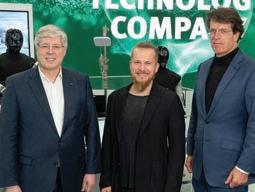
German manufacturer Schaeffler has committed to introducing several hundred humanoid robots into its global production network over the next five years.
The commitment comes in tandem with an announced strategic partnership with Humanoid to develop components for humanoid robots, advancing Schaeffler’s stated goal of becoming the preferred technology partner for the humanoid robotics segment.
The collaboration will focus on the development and supply of actuators used in both wheeled-base and bipedal humanoids.
“As a Motion Technology Company, we want to play a key role in the growing humanoid robotics market. To do so, we are relying on our decades-long manufacturing excellence and industrialization expertise,” said Klaus Rosenfeld, chief executive officer of Schaeffler AG, in a media release. “With Humanoid, we are gaining an attractive partner in Europe that will enable us to drive forward joint innovations in the field of humanoid robotics.”
The specific deliverable is the development and supply of strain wave gear actuators, produced using a number of manufacturing processes including winding, surface mounting and machining technology as well as assembly and testing technologies.
Strain wave gear actuators are used primarily in the upper body, shoulders and arms
of humanoid robots, and enable complete internal cabling of actuators and extremities through their weight to torque ratio and large hollow shaft.
“For years, humanoid robotics has been taking place in labs, product demonstrations and ‘proof-of-concepts’, but real-life application in large volumes is the moment when the
technology will truly be put to the test,” said Artem Sokolov, chief executive officer and founder of Humanoid, in a media release. “At Humanoid, we firmly believe that the future of humanoid robotics will not be defined by the most impressive demonstrations but by its large-scale scalability and capacity for use in real-world environments.”
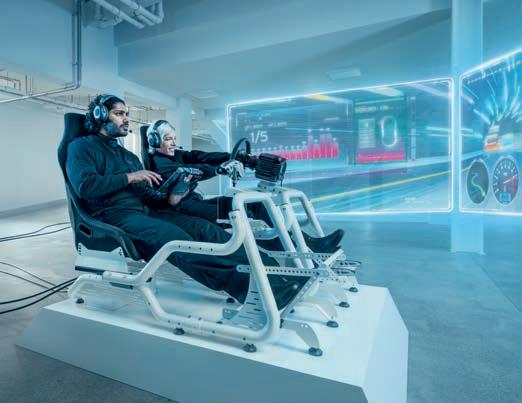
Mastering digitalization is like a rally. With a proactive partner, you take every turn at full throttle.
Digital transformation in the process industry isn’t just a challenge, it’s a chance to grow. It calls on even the smallest teams to rethink what’s possible, to turn complexity into clarity, and to lead with purpose. With Endress+Hauser as your partner, digitalization becomes a shared journey. Together, we turn data into direction, infrastructure into insight, and daily work into real progress. You’re not alone on this path. With the right partner, transformation is achievable – and momentum becomes your advantage. #TeamUpToImprove!
Do you want to learn more? www.ca.endress.com
Image Caption: (from left) Georg F. W. Schaeffler, Chairman of the Supervisory Board of Schaeffler AG, Artem Sokolov, CEO and founder of Humanoid, and Klaus Rosenfeld, CEO of Schaeffler AG. IMAGE: SCHAEFFLER
Robot orders grow 6.6 per cent in 2025, new A3 data shows
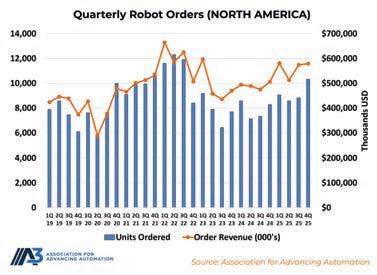
New data from the Association for Advancing Automation (A3) shows North American robot orders rose in 2025, with companies from across the region ordering 36,766 robots valued at $2.25 billion across the year.
Compared to 2024, this represents a 6.6 per cent increase in units ordered and a 10.1 per cent increase in revenue.
Robot demand from non-automotive customers outpaced demand from their automotive industry counterparts in 2025, with general industries capturing the majority share of units ordered throughout the year.
Industries such as food and consumer goods, semiconductors and electronics and life sciences all contributed to this broad-based momentum.
While automotive component orders remained below 2024 levels, activity from automotive OEMs showed meaningful improvement.
A3 notes this uptick from major vehicle manufacturers may signal stabilization in core automotive markets heading into 2026.
In the fourth quarter of 2025, companies ordered 10,325 robots valued at $579 million. These figures represent a 6.6 per cent increase in units and an 8.7 per cent rise in revenue compared to Q4 2024, using adjusted comparisons from matched reporting companies.
This marks the sixth consecutive quarter of year-over-year growth and lifted annual totals to their highest level since 2022.
Collaborative applications, previously called cobots, continued their upward trajectory, accounting for 28.6 per cent of all robots ordered in Q4 2025 and 14.7 per cent of quarterly revenue.
This represents 2,953 units
valued at $85 million, the highest quarterly volume recorded since A3 began reporting collaborative robot as a distinct category in Q1 2025.
Across the full year, collaborative application orders totaled 7,212 units valued at $241 million. This represents 19.6 per cent of total robots ordered in 2025 and 10.7 per cent of total revenue.
“The rebound in robot orders over the course of 2025 reflects renewed confidence in automation as a long-term solution to competitive pressures,” said Alex Shikany, executive vice president at A3, in a media release.
AEROSPACE
Bombardier expanding manufacturing footprint in Dorval, project valued at $100 million
Bombardier has announced a new 126,000-square-foot advanced manufacturing centre in Dorval, Que.
The project represents an investment of approximately $100 million and is part of the company’s long-term strategy to boost productivity as it responds to growing demand for its business aircraft.
finance part of our expansion through a repayable loan, supports Bombardier’s global growth objectives while creating quality jobs in the province of Quebec.”
To support this strategic initiative, Quebec’s minister of economy, innovation and energy and minister responsible for the Montérégie region, Christine Fréchette, will announce a $35 million repayable, non-forgivable loan under Investissement Québec’s ESSOR program, which is managed by the government.
The new centre will be located near the Challenger manufacturing centre and the Laurent Beaudoin Completion Centre.
“This major investment demonstrates our commitment to support Bombardier’s growth and build the infrastructure we need to maximize our productivity. As we expand our manufacturing capacity, we’re positioning ourselves to keep up with global demand and solidify our position at the top of the business aviation industry,” said David Murray, executive vice president, manufacturing, IT and Bombardier Operational Excellence System, in a media release.
“We also want to acknowledge the effectiveness of Investissement Québec’s programs for supporting business growth. The ESSOR program, which will
“By supporting the expansion of Bombardier, a world class prime contractor, our government is generating significant economic benefits for the entire Quebec supply chain and for the aerospace cluster,” said Fréchette in a press statement. “This investment will also lead to the creation of hundreds of highly skilled, well paid jobs, while strengthening Quebec’s expertise.”
The latest PwC study commissioned by Bombardier found that Bombardier contributed a total of $7.4 billion (direct, indirect and induced) to Canada’s GDP in 2024 and sustained nearly 50,000 jobs across the country.
In Quebec, Bombardier reportedly creates nearly 10,000 direct jobs and is a direct source for over 31 per cent of aerospace employment, ranking it as one of the province’s largest manufacturing employers.
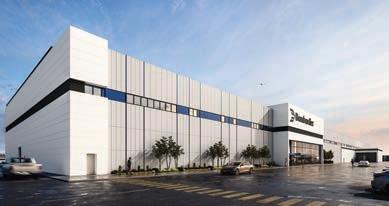
PHOTO: ASSOCIATION FOR ADVANCING AUTOMATION
Bombardier says the expansion of their Dorval facility is part of the company’s long-term plan to boost productivity. PHOTO: BOMBARDIER

TOP TRENDS IN 2026
Experts share what trends and technology they believe will impact the Canadian manufacturing sector in 2026.
BY JARED DODDS
The Experts

JORIS MYNY is senior vice president of Siemens’ digital industries business in Canada. He is responsible for the sales and marketing, implementation and service of Siemens’ automation technology in the manufacturing and process industries.

MAGGIE SLOWIK is the global industry director, manufacturing for IFS. She bridges the execution gap for industrial AI and cloud solutions and advises on global trends for heavy asset industries.

HUGO LAFONTAINE is vice president of industrial automation for Schneider Electric Canada. His oversight includes a wide range of hardware and software solutions, with a mandate to help Canadian manufacturers on their Industry 4.0 integration journey.

RAMTIN ATTAR is the chief executive officer of Promise Robotics, a company that aims to enable the building industry to harness automation through the use of their robotic and AI solutions. He founded the company in 2020 after 13 years at Autodesk.
It is undeniable 2025 was a year of tumult for the manufacturing sector. S&P
Global’s Canada Manufacturing Purchasing Managers’ Index, which monitors the health of global economies, showed a modest expansion of the sector in January 2025. Production levels were rising and, even in the face of tariffs and the upcoming inauguration of President Donald Trump, the index had remained above the critical 50.0 mark for five consecutive months.
W hat followed was 11 months of contraction, with the index remaining below that neutral indicator for the rest of 2025, only rising above 50.0 in January 2026. Companies grappled with lower exports to the U.S., an air of uncertainty and rising business costs.
B ut, as it always does, the sector persevered, adapted and moved forward, and now we stand on the precipice of a critical year. To prepare, Manufacturing AUTOMATIO N brought together a panel of experts to provide their insights on the largest trends facing the Canadian manufacturing sector this year.
Scaling AI integration
When asked what the most significant trend of the year would be for manufacturers, the experts were unanimous: AI. Specifically, they identified the need for Canadian manufacturers to move beyond proof-of-concept projects into scaling, cross-functional implementations.
“If you’ve never learned how to actually scale [deployment], you’re not going to be successful.”
— Ramtin Attar, Promise Robotics
“It’s no longer just about siloed projects anymore,” Slowik said. “It’s about getting that scale buy-in and really scaling fast with AI. It’s about bridging this execution gap that we’re seeing right now.”
This urgency for implementation was a common refrain from the experts, with Lafontaine saying the wait-and-see approach employed by some manufacturers leads to them proof-of-concepting themselves to death. “I still see a lot of companies are saying they’ve done it but still don’t know how to scale [past the proof of concept],” he said. “I think our challenge is moving past early adoption and scaling what we’ve proven works.”
The conversation did not simply focus on implementation, but ensuring companies have the ability to scale these new projects or those already in place. It is only through this scaling that companies will secure the ROI necessary to advance their business and inspire the rest of the manufacturing ecosystem to further adapt AI.
Attar emphasized the importance of tailored, vertical AI projects that are domain specific, focusing on both the individuality of the company and effective deployment
across operational sector you are experiencing friction in.
“Deployment is very important,” he said. “You could have the best software, but if you’ve never learned how to actually scale that part of this, you’re not going to be successful.”
So if the experts all agree scaling AI is a must, what is holding these companies back?
The panel members rejected the generic, oft-repeated concept of slow willingness to adopt by Canadian business owners, with Myny offering a specific roadblock: cybersecurity.
“One thing I notice is for solutions that require machines to be constantly connected to the cloud, there is a reluctance to adopt,” he said. “This is for good reasons, including reliability and cybersecurity. For this reason, we see that manufacturers want their operations to run even disconnected from the cloud.”
To facilitate this requirement, Myny pointed to solutions such as edge computing and digital twins promoting AI native design — manufacturing solutions aiming not to tack AI on as an afterthought, but are instead conceived and developed with AI in mind.

Slowik called this concept “the invisible revolution” and said it would be integral to the continued integration of AI as we move forward in 2026. “For IFS as a company, we are very much behind driving embedded AI capabilities, focusing on a use case by use case approach,” she said. “AI should, in an ideal case scenario, be embedded in your technology and silently work away, augmenting the work of users without them necessarily knowing that it is happening.”
Slowik additionally highlighted the importance of agentic AI as an accessible entry point for manufacturers, allowing them to easily configure and program AI agents for the business processes where it is most required, using simplified human language rather than complex code.
Tariff talk
Despite AI remaining a topic of conversation throughout the panel discussion, the experts agreed it was not the only area of concern for manufacturers.
The conversation surrounding trade, the continued threat of tariffs and the upcoming CUSMA negotiations was a significant point of concern. The panel agreed Canada was in a better position than this time last year in regards to trade exposure to the U.S., but emphasized that the next 12 months would still be critical as the public and private sector seek other investment opportunities and global business partners.
“Canada is one of the most trade exposed manufacturing economies in the G7, no questions asked,” Lafontaine said. “The impact of this is very clear when we speak with our customers, especially in steel, aluminium and automotive. It is limiting their ability to expand and invest right now.”
The response, Lafontaine continued, was split as we entered 2026. Some were continuing to focus on keeping their powder dry, awaiting further clarity from the market, while others were recognizing the importance of introducing additional digital resilience and end-to-end supply chain management to have more flexibility to adapt, finding a way to move their business forward while still maintaining a defensive posture.
Myny expanded on the question of tariffs to examine the Canadian economy from a more historic point of view, arguing the levies placed on Canadian products accelerated the decline of the manufacturing industry rather than starting it.
“Over 20 years ago in 2000, it [the
manufacturing sector] represented 16.5 per cent of our GDP. Now it’s just 8.5 per cent,” he said. This trend was mirrored with a continual drop in investment for advanced technologies by Canadian manufacturers.
Myny noted that since the 1980’s, investment in industrial machinery and equipment has decreased by 30 per cent in Canada. In the
same period U.S. businesses have doubled their investment. As Canadian businesses and the government aim to bring business north of the border, this will need to be corrected for Canada to keep up with American productivity.
Attar reiterated that this lack of investment is going to, “lead to our own peril,”
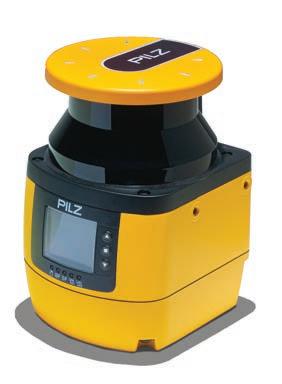
Pilz PSENscan






and emphasized that in the face of tariffs, businesses can rely on the productivity cushion robotics and other automation solutions provide to protect growth and create a competitive advantage over other businesses unwilling to invest.
Energy efficiency and sustainability
A continued focus on sustainability and energy efficiency was a huge talking point for the panel. This may seem unsurprising given that Siemens, Schneider Electric and IFS all have significant ties to the energy sector, but what resonated was the focus their clients were putting on remaining green.
“Sustainability is not just a regulatory hurdle but a cost reduction strategy,” Slowik said, who highlighted that North American businesses who want to do work in Europe need to align their best practices with a more stringent level of regulation.
Lafontaine shared Slowik’s outlook, calling energy, “the next KPI,”, with Canadian clients incredibly focused on reducing their energy usage to stabilize costs.
Even outside of the manufacturing industry, Attar, who works within the construction industry, found that clients are taking a pragmatic approach to sustainability goals, noting that, “the ROI remains in eliminating waste and sourcing better materials.”
This trend will be one to track as the current federal administration moves away from previous government climate commitments, with a new study published in February by the Canadian Climate Institute saying Canada is not on track to meet any of its climate targets because of, “a slackening of policy efforts over the past year, marked by the removal or weakening of climate policies across the country.”
The defence discussion
A point of discussion between the Canadian contributors was the commitment to increased defence spending by the federal government and the impact it may have on the manufacturing sector. The tone of

the discussion was optimistic, provided the funding is supported by sound strategy and manufacturers are willing to invest to capitalize on the dual-use opportunity.
“I think a lot of people are looking at this as a stimulus, but the stimulus is very focused,” Lafontaine said. “It’s going to touch every single piece of the ecosystem as it scales up.
“ When we want to build a boat or a plane, there is a whole industry behind it to feed it. Steel, specialized high-grade material, high precision… a lot of technologies required to get that high level of perfection,” he said.
Myny said he saw this investment as a great opportunity to revitalize and stimulate the R&D and supply chain sectors for aerospace and defence, particularly as it relates to reshoring the portion of the supply chain currently served by other countries.
Through these efforts, he said, we can support growth in the manufacturing sector while simultaneously increasing Canadian sovereignty, a concept that resonated throughout the panel, not only as it related to defence spending but also data sovereignty in the face of a continued push towards AI.
“To me, defence investment is about
pulling from our industrial capacity,” Attar said. “How do we build trusted systems, with the ability to deploy cybersecurity… and how does dual-use manufacturing strengthen our industrial base. That is at the heart of what we’re talking about.”
Looking forward
The final question asked to each panelist was for each of them to look ahead 365 days and imagine we were convening for the conversation again. What would the Canadian manufacturing sector look like?
The group sentiment was that AI and automation would no longer represent trends to discuss, but instead would rapidly be moving towards representing the backbone of the manufacturing industry.
“ I see a strong adoption of AI whether it is in the engineering stage, in the runtime stage, to change the customer experience and with more investment on the cybersecurity side to protect the manufacturing assets,” Myny said.
This backbone will be built of embedded AI solutions driving the rapid rise of more complex automation opportunities and an acceptance from business leaders that AI is not an opportunity, it is a necessity.
“ The day AI will be successful is when we stop talking about it so much,” Slowik said. “I think we’re going to see some of that happening in a year’s time. Manufacturers are going to have to rethink how these digital workers will fit into the current workplace.”
Moreover, it is clear this year and the years to come represent a major turning point, not only for the industry but the Canadian economy. “We are going to wake up in 12 months and know the world has changed,” Lafontaine said. “It’s no longer just about efficiency gains, but its going to be about resilience.”
“ The next decade is going to belong to manufacturers who are going to deploy automation quickly and measure the outcomes,” Atta r said. “Automation is no longer about replacing people, it’s about protecting growth. | MA
Women in Automation Q&A: Christy Michalak, NGen Canada
Manufacturing AUTOMATION
editor Jared Dodds recently sat down with Christy Michalak, the director of manufacturing development programs for NGen Canada, to learn more about her career in the manufacturing industry, how the industry has evolved throughout her tenure and what next steps need to be taken to further advance women in Canada’s manufacturing and automation sectors.
Jared Dodds (JD): Walk me through your career and your experience with the advanced manufacturing sector.
Christy Michalak (CM): I started at Magna International in the automotive sector, an amazing way to start your career, often feels like you can get two years of experience in a year given the expectations.
When the auto recession happened in 2007, I decided to get closer to my roots of aerospace, which led me to move to Honeywell, where I began my career in program management, translating between engineers with deep technical expertise and the broader business and customer teams.
After building a career in aerospace and defence I moved to consulting, which gave me a broader view of Canadian SMEs and their maturity potential. This experience led to an opportunity with NGen, where we’re working to scale these ideas nationally.
JD: What has been the largest industry evolution you’ve seen in your career?
CM: It’s absolutely in leadership. Manufacturing used to focus almost exclusively on machines and processes. Today, competitive advantage comes from leadership operating systems: how companies collaborate, integrate technology and build networks both inside the organization and across the ecosystem. Deep collaboration outside the company’s four walls, especially for Canada, is a real paradigm shift.
JD: How has the representation of women evolved throughout your career?
CM: When I started there were almost no women in my peer group. There were very few women in my engineering class, and we survived by learning the traits that traditionally were rewarded in men. I felt

that I had to take on what, for me, felt like a very aggressive, Type-A persona.
Gradually, things have started to change. More women are entering the sector, and younger women are demanding the ability to show up as themselves. They’re recognizing the cost of masking or only bringing part of yourself to work. At the same time, leaders across the industry are beginning to show up more authentically as well, bringing more holistic perspectives to the table. That’s been a major shift. We’re not there yet, we still have a long way to go, but we’re moving in the right direction.
JD: How important is collaboration and networking with other women in the manufacturing sector?
CM: Coming into NGen, where I was suddenly working with a team that had gender parity, really emphasized the importance of this. All of a sudden, while working on a project, I found myself able to say, “What do you think? This is the direction I want to take. Oh, and my kid is sick today,” and no one would even blink. That kind of permission had never occurred in my career before.
The reality is that many women are carrying a tremendous amount outside of work - family logistics, caregiving and the mental load of keeping everything running. When that reality can be acknowledged instead of hidden, it frees up energy.
I dream of a day when everyone can do that at work. And I don’t just mean women, I mean anyone who feels they have to keep
part of their life off the table.
JD: How can we inspire the next generation of young female leaders to enter the manufacturing sector?
CM: Manufacturing needs integrators. The capabilities that matter most are what we used to dismiss as “soft skills” like problem solving, communication and collaboration, areas where women have historically excelled. Because of that shift, manufacturing is becoming an incredible place to build a career. It offers unlimited opportunities to learn from diverse perspectives, to contribute and to help shape the future.
JD: How important is it to have female representation in keynote and speaking opportunities?
CM: That question takes me back to early in my career. I was invited to a private defence conference in Las Vegas. When I walked into the room, not only was everyone a man, they all looked almost identical. I went and sat beside the only other woman in the room, and when they announced the keynote speaker, she stood up. She was an Assistant Secretary of Defence in the United States.
That moment stayed with me because I had spent much of my career feeling like those rooms were not meant for someone like me. Even later, as a director in an aerospace company, I had a colleague from another city turn to me at an event and ask what was for lunch. These kinds of microaggressions happen even among well-meaning people because we’re all exposed to the same stereotypes. Seeing a woman on stage helps break those assumptions, even if only a little.
Now, whenever I deliver a keynote, I’m reminded of that moment. I’ve had women, especially young women, come up afterward and say, “Thank you for doing that. It makes me feel like I can do it too.”
JD: What message would you have for a women looking to enter manufacturing?
CM: Manufacturing is the sector that will protect Canada’s prosperity and sovereignty in the decades ahead. If you want to shape the future of this country, this is where the work is. Step forward and help build it. | MA
SMALLER PANELS BIGGER QUESTION
Control cabinets have evolved incrementally for decades. Now, innovations like miniaturization and fully digitized panel builds are redefining the future. BY JACK KAZMIERSKI
Walk through almost any manufacturing plant today and one thing becomes obvious very quickly: space is no longer abundant. Production lines are denser, automation is more tightly packed and what once felt like generous buffer zones between machines have been squeezed into carefully optimized pathways. For IT and manufacturing professionals planning for 2026 and beyond, the factory floor is no longer just a place to put machines, it is a strategic asset measured in square inches.
As automation evolves, so must the infrastructure that powers it. Control cabinets, long treated as a fixed and unquestioned part of machine design, are suddenly under scrutiny. Do they still make sense in their traditional form? Or are they following the same incremental path as internal combustion engines: slightly smaller, slightly smarter but fundamentally unchanged?
A century of refinement
The modern control cabinet is the result of decades of refinement. From relay logic panels to PLC-based systems, the industry has consistently optimized around a familiar formula: a metal enclosure, power distribution, protection devices, control hardware and extensive wiring. Each generation
brought benefits—higher reliability, better diagnostics, safer operation—but rarely questioned the enclosure itself.
Chris Timmermans, RSE, MX-System Product Specialist at Beckhoff Automation draws a parallel to the automotive industry. For more than a century, internal combustion engines improved incrementally, he argues, but it wasn’t until the advent of electric vehicles that the entire conversation changed overnight.
Control cabinets, Timmermans
“With conventional builds, the smaller you make a panel, the longer it takes—and the more it costs.”
— Philip Osolinski-Simmonds, Powerhouse Controls
points out, are at a similar inflection point. “We accept the footprint because that’s what we’ve always done,” he said. “But the cabinet itself isn’t the value. The value is the process it enables.”
Space:
No longer a nice-to-have
The pressure driving this rethink isn’t philosophical, but rather economics. Manufacturing facilities are increasingly located near urban centres, where land costs rival residential real estate. Expanding a plant by “opening the back door” and buying the neighbouring lot is no longer realistic, Timmermans said.
Every square foot reclaimed can translate directly into more production capacity. In some cases, it can be the difference between keeping manufacturing local or offshoring entirely.

“Dense automation isn’t about replacing people,” Timmermans said. “It’s about keeping operations viable where skilled labour already exists.”
From this perspective, control cabinets become prime real estate consumers. Large enclosures, service clearances and cable routing all add up. Reducing or redistributing that footprint can unlock game-changing value.
Beckhoff’s MXSystem: A clean-sheet approach
Beckhoff’s MX-System is one of the most striking approaches to rethinking the control cabinet from the ground up. Instead of a wired enclosure, the MX-System uses a standardized baseplate that distributes power and communication internally. Pre-certified functional modules (power supplies, drives, I/O, control) bolt directly onto the plate.
The result is a cabinet-free system that can be assembled in hours rather than weeks. High-voltage wiring is reduced to a single main connection. Diagnostics are built in. Replacement is modular: four bolts, swap the module and move on.
Timmermans describes it less as a turnkey product and more as a “control engineer’s Lego kit.” The idea isn’t to eliminate engineering creativity, but to remove the non-value-added work that precedes it: panel layout, wiring, documentation overhead and more.
Is smaller always better?
Critically, the MX-System is not positioned as a universal replacement. Its fundamental flexibility over rigidity is key, Timmermans explains, adding that large motor control centres, very high-current applications or highly specialized third-party devices may still demand traditional enclosures. In many plants, hybrid architectures may make the most sense:
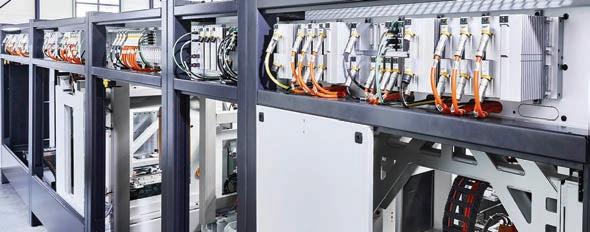
the MX-System can handle the control functions, while classic cabinets are retained where scale or environment demands it.
Traditional enclosure suppliers are well aware of these realities. Many continue to innovate around better thermal management, smarter power distribution and faster wiring methods. For some customers, the familiarity, flexibility and perceived lower upfront cost of conventional panels remain compelling, especially when floor space is not yet the limiting factor.
One of the less discussed, but increasingly important drivers is workforce capability and availability. Skilled electricians, millwrights and controls engineers are in short supply, Timmermans said.
Modular platforms change the work paradigm, making it possible for less-skilled individuals to take on much of the work. This doesn’t eliminate skilled jobs, but refocuses them on higher-value tasks where their skills fundamentally improve value.
When smaller isn’t strategy
P hilip Osolinski-Simmonds, business development manager at Powerhouse Controls is cautious about framing the trend as pure miniaturization. “For certain customers, yes, we’re seeing panels getting smaller,” he said. “But sometimes that’s just
because they’ve run out of room.”
In industries like automotive, legacy equipment often remains in place long after its initial lifecycle. Old panels aren’t decommissioned, and new systems must fit into increasingly constrained footprints. The result? A push to make cabinets “smaller and smaller and smaller.”
Traditional panel shops have long dealt with these pressures through clever layout, tighter component spacing and incremental efficiency gains, but there are limits. As cabinets shrink, thermal management becomes more complex. Wiring density increases. Serviceability can suffer.
The digital twin disruption
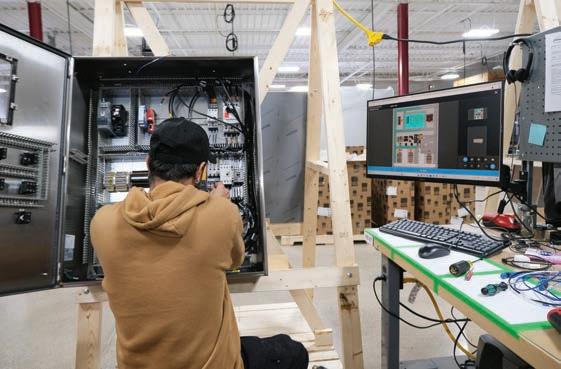
Powerhouse Controls has taken a different approach—one rooted in full digital twinning of control panels before a single hole is drilled.
Rather than relying solely on 2D schematics, the company converts customer designs into a complete digital twin that captures every component, wire, termination, cutout and label. The model doesn’t just represent geometry, it embeds engineering intelligence, including thermal calculations, torque data and tooling requirements.
“Before you’ve even ordered a panel,” Osolinski-Simmonds explained, “you already know
exactly what it’s going to look like and whether it works.”
I n a conventional build, problems are often discovered near the end of the process. In a digital twin environment, spatial conflicts, thermal constraints and layout inefficiencies are identified in advance.
The result, according to Osolinski-Simmonds, is dramatic: up to 75 per cent less build time in some cases. Panels that once required hours can be assembled in minutes because the complexity has already been resolved in the software.
Critically, this changes the cost curve of miniaturization. “With conventional builds, the smaller you make a panel, the longer it takes—and the more it costs,” Osolinski-Simmonds said. “With a digital twin, it makes no difference. It’s just assembly.”
Labour pressures and the skills gap
Osolinski-Simmonds agrees that the conversation about cabinet size is inseparable from another pressure facing manufacturers: labour.
Experienced panel builders are becoming harder to find. The deep knowledge required—thermal management, environmental ratings, code compliance and long-term reliability—takes years to develop. As veteran tradespeople retire, the pipeline
Beckhoff aims to reimagine the traditional control cabinet with their MX-System, significantly reducing the overall footprint. PHOTO: BECKHOFF AUTOMATION
of equally experienced replacements remains thin.
Digital twin workflows aim to decouple production output from scarce expertise. In the Powerhouse model, expert knowledge is concentrated at the digital design stage. Once captured, it can be replicated across hundreds or thousands of identical builds.
Even technicians with no prior panel-building experience can assemble complex systems using guided digital instructions. The artistry of panel building doesn’t disappear, it simply moves upstream.
For high-volume OEMs producing thousands of panels annually, this shift can also reshape sourcing strategies. Companies that once offshored production for labour savings are reassessing in light of supply chain disruptions and geopolitical uncertainty. If
advanced digital manufacturing can close the labour cost gap, local production becomes more viable.
Where traditional shops still fit
Does that mean traditional panels are obsolete? Not necessarily. Digital twin adoption requires investment—not just in software, but in training, integration and cultural change. Many integrators rely on 2D CAD platforms and contract manufacturing partners who expect conventional documentation. Without a fully integrated digital workflow from engineering to shop floor, the benefits of 3D and smart production tools can be diluted.
Perhaps the more important question isn’t whether cabinets are shrinking, but whether the control panel itself is being
reimagined entirely.
D igital twins open doors beyond manufacturing efficiency. Existing panels can be digitized in place, creating virtual replicas that enhance safety, support remote diagnostics and simplify retrofits. In the event of catastrophic failure, a replacement panel can be reproduced quickly from stored digital data.
For new facilities, this reframes the planning conversation. Control systems may represent a small percentage of total project cost, but they carry disproportionate operational risk. Ignoring their strategic design can introduce long-term inefficiencies and vulnerabilities.
Shrinking footprint, expanding opportunity
So, are control cabinets truly getting smaller? In many cases,
yes, but the more significant shift may not be physical shrinkage, but rather the compression of the entire concept-to-build cycle. What once required iterative fabrication and on-floor problem-solving can now be resolved in a virtual environment before materials arrive.
For IT and manufacturing leaders, the takeaway is clear: shrinking floor space is not just a constraint—it’s a catalyst. Whether through digital twin innovation or evolved traditional practices, control cabinet providers are being forced to rethink how enclosures are designed, built, and deployed.
Miniaturization may be part of the story. But the real transformation lies in how intelligence— engineering, manufacturing and operational—is embedded long before the cabinet door ever closes. | MA
like



THE ENTERPRISE
BY JONATHAN GROSS
is managing director
and planning, technology vendor selection, technology
implementation and ongoing optimization.
Automation alone is not the advantage
Why Canadian manufacturers must turn installed automation into coordinated, enterprise-level performance.
Automation investment is accelerating. Robot deployments continue to rise globally, and Canadian manufacturers are modernizing production environments at pace. Capital is committed. Equipment is installed. Pilot cells are producing measurable gains.
Yet competitive outcomes are diverging.
Some organizations are translating automation into margin expansion, stronger service performance and repeatable results across sites. Others are installing capable assets without materially shifting enterprise performance.
The difference is not installation volume. It is coordination.
C oordination means that the plant and the enterprise operate as one execution system. Production status, downtime, quality events and material consumption flow directly into planning and financial platforms. Changes in demand, order priority or inventory commitments flow back to the floor without manual translation. Supervisors manage performance, not spreadsheets.
Automation improves local execution. Coordination determines whether that improvement scales.
The global context: From automation to orchestration
In Asia, the automation deployment scale is substantial. South Korea maintains one of the highest robot densities in the world—well above 1,000 robots per 10,000 manufacturing workers. In the European Union, average robot density exceeds 200 per 10,000 workers.
But density is not the differentiator.
L eading manufacturers in these regions have integrated robots, MES platforms, warehouse systems and
ERP into coordinated execution environments. Enterprise systems release orders. Robots pick, manufacture, assemble and transfer work automatically. Quality and production data update inventory and financial commitments in real time.
In some facilities, this integration enables extended lights-out operation. Not because humans disappear, but because enterprise systems can direct, monitor and rebalance production with minimal intervention. Orders trigger production. Production updates supply and financial positions. Exceptions escalate automatically. The competitive advantage comes from closing the loop between demand, execution and fulfillment.
The benchmark is no longer robotic throughput. It is synchronized, enterprise-directed performance under volatility.
High investment, uneven conversion
Canadian manufacturers are investing. More than 90 per cent of SMBs report prioritizing digital initiatives, and roughly three-quarters are increasing budgets. Modernization is funded and underway.
Yet Canada continues to trail the United States in output per hour worked, and business investment intensity remains below several OECD peers.
The issue is not effort. It is enterprise conversion.
Modernization in Canada is typically disciplined and phased:
• Clear ROI thresholds
• Pilot-first implementation
• Careful capital pacing
• Low tolerance for disruption
This protects stability. But when automation expands one use case at a time without a defined integration trajectory, gains remain contained within cells or individual plants.
L ocal KPIs improve. Enterprise responsiveness does not scale at the same rate.
That gap, not installation volume, is the competitiveness risk.
The real constraint: Coordination capacity
Automation increases interdependence across processes.
When schedules change, materials are delayed or product mix shifts, robots, MES, inventory, planning and finance must respond in sync. If those systems are not tightly integrated, people become the integration layer... and the bottleneck.
S upervisors translate schedule changes across platforms. Planners validate data before committing supply. Finance reconciles production and financial results after the fact. As
Jonathan Gross
at Pemeco Consulting, a vendor-neutral consulting firm. He leads clients through the entire digital transformation lifecycle, including: technology architecture
procurement,
automation density increases, this coordination effort grows.
Automation creates advantage only when coordination effort declines as complexity rises.
Designing for execution
Coordination requires disciplined enterprise design across systems, transactions and governance:
• ERP as the backbone: ERP must serve as the authoritative source of master data and cross-functional transactions. Production reporting, material movements, inventory updates and financial postings must reconcile cleanly in ERP. If plant activity does not translate consistently into enterprise transactions, inventory accuracy, costing and customer commitments degrade.
• Enterprise –OT interoperability: Operational technologies and enterprise systems must interoperate through defined standards, not manual uploads or one-off integrations. MES must issue production and scrap transactions directly to ERP. Automated material movement must update inventory in real time. Quality or maintenance events must immediately affect planning and available-to-promise logic. If information requires reconciliation before decisions can be made, integration discipline is insufficient.
• Transaction standardization: Automation increases transaction volume and complexity. Production reporting logic, rework handling, lot tracking and variance posting must follow enterprise standards across plants. Without standardization, exceptions multiply and adjustments become routine.
• D ata governance: As systems interconnect, tolerance for data inconsistency disappears. Master data ownership, validation controls and change management must be explicit. Without governance, automation amplifies error and reintroduces manual checks.
W hen ERP integrity, interoperability, transaction standards and governance align, coordination effort declines as automation scales. When they do not, complexity outpaces control.
Redesigning work for an automated environment
Automation does not eliminate management work. It shifts it.
A s repetitive execution declines, coordination, monitoring and exception management increase. Operators oversee automated cells rather than perform each task. Supervisors manage system stability, balancing throughput, quality, maintenance, labour and schedule adherence in real time.
Work shifts upward, from direct execution to supervisory control, and laterally into technical roles responsible for integration stability, data reliability and system performance. Governance roles expand as transactional accuracy now drives both operations and financial reporting.
This requires departmental structural redesign. Supervisory spans must reflect automation density and escalation paths must be system-triggered, not personality-driven. IT/OT ownership boundaries must be defined and data stewardship roles must be formalized.
Without intentional redesign, supervisors become the bridge between disconnected
CUSTOM CABLE & HARNESS SOLUTIONS YOU CAN RELY ON
systems. Technical teams spend their time stabilizing interfaces. Finance resolves discrepancies after performance has already moved on.
Automation concentrates complexity at the control layer. If that layer is not deliberately structured, management overhead grows in proportion to capital deployed.
The competitive driver
Competitiveness will be defined by how effectively organizations translate installed automation into coordinated, predictable enterprise performance. That demands ERP as a disciplined transactional backbone, reliable enterprise-OT interoperability, standardized cross-functional transaction design and supervisory roles aligned with real-time system visibility.
This requires modernization to be structured as an enterprise program, sequenced, governed and architected toward a defined integration objective.
P ublic funding programs increasingly prioritize productivity, resilience and digital modernization. Organizations that frame automation as coordinated enterprise transformation, rather than disconnected equipment upgrades, are better positioned to secure support and demonstrate measurable economic impact.
Canada does not need the highest robot density to compete. It needs integration discipline applied consistently across systems, processes and roles.
The divide is no longer between those who automate and those who do not. It is between those who install automation and those who orchestrate it. Moving forward, coordination, not installation, will define advantage. | MA


ADVANCING PLANTWIDE CONNECTIVITY
Making Industry 4.0 a widespread reality depends on the new 5G networks
BY TREENA HEIN
As the use of advanced robotics and AI technology deepens with Canada’s manufacturing sector, a new level of connectivity across the factory floor is critical. New research has shown that even current 5G Wi-Fi networks are not equipped to keep up with the level of technological oversight desired by manufacturers. Evolution in connectivity tech is a must.
“ To keep up with automation, future industrial networks need to be more localized, more intelligent and more secure by design,” explained Dr. Athirah Mohd Ramly, a connectivity researcher at the University of East London in the UK. “Connectivity has advanced significantly, but traditional 5G architectures are starting to show strain in highly-automated factory environments. 5G has been a major step forward, particularly for mobile broadband and early industrial automation. However, as factories move towards ultra-dense robotics, real-time digital twins and AI-driven control loops, limitations are becoming more visible.”
Conventional private 5G deployments rely heavily on centralized core architectures, which can introduce higher energy consumption, single points of failure and latency variability. In manufacturing and industrial environments where machines must react within milliseconds, even small delays in connectivity or instability can have serious operational consequences.
However, Mohd Ramly’s research suggest that new localized and intelligent wireless infrastructures can significantly reduce latency, lower

energy consumption and improve resilience. While early adopters are already taking the plunge, Parm Sandhu, vice president of enterprise 5G products and services at connectivity tech firm NTT DATA, said many manufacturers are still waiting. They haven’t yet installed new 5G platforms, he said, because they don’t yet have solid reasons to justify the investment. “Manufacturers aren’t hesitating because they can’t get 5G hardware, they’re hesitating because they don’t yet see clear, proven use cases with strong ROI.”
However, with adoption among peers growing in the U.S. and elsewhere, alongside automation tech and AI also evolving quickly, hesitation in Canada is expected to diminish.
Why Wi-Fi is a no-go “ The question a lot of people ask us is ‘Am I not good enough just using Wi-Fi networks moving forward?’
But we are at the point where we need a new system,” explained Jason Falovo, vice president of enterprise wireless solutions for Canada at Ericsson. Globally, Ericsson provides technology for about 60 per cent of the world’s 5G networks. “Factories are getting larger and larger,” he said. “We now have gigafactories with much-greater levels of connectivity required. Any manufacturing facility that’s being built in the next two years, the leaders should at least be seriously considering this technology. You aren’t going to be able to properly run AI on the plant floor with a Wi-Fi network.”
Wi-Fi is limited, Falovo explained, in that it can only operate at certain bandwidths and its functionality to steer traffic within the network is capped. Private 5G networks also need specific bandwidths but have much greater reach across the factory floor. These networks conserve and control
New research shows us that current 5G Wi-Fi networks are not equipped to keep up with the needs of manufacturers.
data quality to a much greater degree. In today’s factories, with more and more devices and sensors all being connected and with AI increasingly involved in data analysis and making decision recommendations, a new system is needed.
“And it’s actually less expensive than Wi-Fi as well,” Falovo said. “It’s similar to installing Wi-Fi in some ways, and the complexity and costs are coming down. A recent study that we did here at Ericsson was in a 200,000 square-foot plant, and it was about 22 per cent cheaper per foot to use a private 5G network versus a WiFi network.” Private 5G networks also better address cybersecurity threats, a critical factor in this age of increasing use of autonomous vehicles, processes and robotics in manufacturing.
Falovo reported that adoption of private 5G networks has begun in more advanced manufacturing facilities in North America and some airports are also installing it. “We’ve done some proof of concepts with many of the large manufacturers, and they’re including this in their upcoming planning cycle,” he said.
Inside the new 5G network
The new 5G platforms being examined the most are generally called private cellular networks. There are other new ways to implement 5G in manufacturing, but as Sandhu explained, each comes with trade offs. “One option is a hybrid model where you still deploy dedicated on premise radio and infrastructure, but you run the 5G core in the cloud, splitting between public and private domains,” he said. “Another approach is carrier-led solutions using tools like network slicing and local breakout on an operator’s public network. However, these carrier-based models often struggle to meet stringent enterprise needs around Service Level Agreements, response times, change management and deep integration with existing operational processes.”
N TT DATA’s approach is “pure private” 5G, where data and control stay behind the enterprise firewall and the customer has full visibility
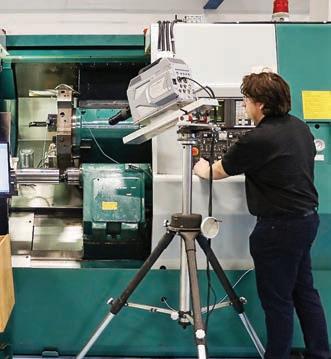
and configurability of the network. “ We’re also able to combine this with cloud-core or carrier partnership options where appropriate,” Sandu said, “so that manufacturers get both the control and trust of a private network and the flexibility of broader ecosystem solutions.”
New resources
Recently, Innovation, Science and Economic Development Canada (ISED) has designed a non-competitive local licensing (NCLL) process to provide a simple licensing approach to allow small operators and businesses easy access to 5G wireless services and beyond.
I n addition, by mid-March, a 5G private network demonstration platform will be ready for manufacturers to learn from, based out of McMaster University in Hamilton, Ont. For over two years, Dr. Stephen Veldhuis, director of the McMaster Manufacturing Research Institute, and others have worked to develop this valuable tool. Project support is being provided by the Ontario Centre of Innovation, Ericsson as the technology provider and TERAGO providing the integration and bandwidth. TERAGO is Canada’s largest spectrum holder and owns its own national network, including the midband and mmWave spectrums that
enable enterprise-wide connectivity. Veldhuis is optimistic about how this platform is going to help Canada’s manufacturers. “Adoption of Industry 4.0 has been slower than expected. It’s hard for many companies to invest. There has been quite a bit of investment in limited connectivity in manufacturing, wired systems and wireless sensors on machines, but with private 5G wireless networks, you can put sensors in different places and get data more easily and gather more data. You can also run AI. Wireless 5G, in particular the private wireless 5G networks, are anticipated to be a real accelerator for Industry 4.0,” he said.
For sensors and other advanced manufacturing tools be effective, manufacturers need to expand their 5G capabilities, perhaps with a private cellular network.
PHOTO: ERICSSON
Sensor technology is also evolving and is rapidly decreasing in price, but the biggest piece of the puzzle has been Ericsson’s development of a tech package that simplifies the implementation of 5G networks for companies. “There is no massive infrastructure needed,” said Veldhuis. “Companies that want to examine and learn about the platform can take a tour of the demonstration site or arrange to work with the McMaster Manufacturing Research Institute to test their own projects and technologies on the equipment available at the site.”
Tips for manufacturers
Beyond choosing a reputable partner to explore private 5G networks, Sandhu said manufacturers should clearly understand their environment, use cases and architecture. “That means understanding coverage needs, how the shop floor or facility is likely to change and where cabling and infrastructure costs can be minimized,” he explained. In his view, it’s essential to ensure the network makes financial sense, with options including using as a service models to spread upfront costs over time, so that ROI is clear from the outset.
“ It’s critical to design for IT/OT integration and security from day one, so the 5G network becomes a trusted part of the enterprise environment, not a standalone island. If you get that foundation right, you can continually add new use cases and scale value over time.” | MA
NEW PRODUCTS
MACHINE AND OPERATOR SAFETY
Wireless E-Stop Pro

FORT Robotics has announced the Wireless E-Stop Pro as the latest addition to their product portfolio. The device puts fail-safe control directly in the operator’s hand by allowing users to send a certified stop command to a machine from up to 200m away, ensuring that safety moves at the speed of the modern jobsite. The solution is built for dense radio environments, featuring longrange Bluetooth communications, and features regulatory certifications for use in Canada, the U.S., Europe, Japan and Australia. The Wireless E-Stop Pro communicates with FORT’s Endpoint Controller receiver and can be used in combination with the Safe Remote Control Pro, as well as the FORT Manager cloud application for device management and configuration. fortrobotics.com
MOTORS AND DRIVES
CMMT-AS-S3 Servo Drive Series
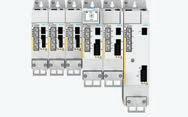
Festo Canada is introducing their new CMMT-AS-S3 servo drive series, aiming to enable machine builders to achieve higher levels of functional safety
while simplifying design, wiring and certification. The CMMT-AS servo drives give OEMs a choice between two distinct safety levels – Basic (S1) and the new Advanced (S3) – offering a flexible, cost-effective way to meet safety and performance requirements without added complexity. All CMMT-AS servo drives are multiprotocol and configurable to EtherNet/ IP, PROFINET, EtherCAT and Modbus TCP communication protocols. The drives integrate key safety functions directly, minimizing external components and setup time. The basic version’s functions include Safe Torque Off, Safe Break Control, Safe Stop 1 and diagnostic outputs for Safety Trip Alarm and Standby Alarm. More advanced models include Safe Stop 2, Safe Operating Stop and more. festo.com
AUTONOMOUS MOBILE ROBOTS
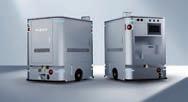
FMR 300
Flexiv has launched the Flexiv Mobile Robot (FMR) 300, the company’s first self-developed autonomous mobile robot platform. Featuring a compact footprint of 31 by 24 inches and a height of 34 inches, along with a payload capacity of 600 pounds, the FMR 300 allows customers to deploy advanced adaptive robotic solutions in space constrained environments. Powered by a 72 Ah lithium-ion battery, the FMR 300 can operate for up to eight hours under typical workloads. If the platform detects that its battery needs recharging, it can autonomously navigate
to its charging dock, enabling true “lights-out” operational capability. When used in conjunction with a Rizon-series adaptive robot, positional errors caused by platform movement or workpiece misalignment can be compensated for as a Rizon robot can use its force sensitivity to “feel out” the exact location of the workpiece. The FMR 300 features high precision laser SLAM navigation, two-wheel differential motion control and built in collision detection to ensure safe human robot interaction.
flexiv.com
ENERGY EFFICIENCY
IE6 SynRM Motor
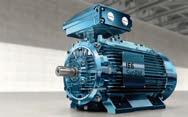
ABB is aiming to accelerate industrial energy efficiency with its expanded range of IE6 Hyper-Efficiency synchronous reluctance (SynRM) motors. This magnet-free technology, now available from 110 to 450 kW in frame sizes 280 and 315, and speeds up to 3600 rpm, looks to bring efficiency and sustainability to more industrial applications, building on a 2024 milestone when ABB was the world’s first manufacturer to launch a magnet free IE6 SynRM motor for specialist applications. Switching to IE5 Ultra-Premium efficiency SynRM motors reportedly delivers savings compared to an equivalent IE4 induction motor package. Over a typical 20-year service life, the savings are increased to €51,200 and 92,200 kg CO— equivalent to 21.5 gasoline-powered passenger vehicles driving for one year. That represents a reported additional 76 per cent improvement than
when upgrading from IE5 to IE6, with an ROI of eight months. The IE6 SynRM contains no permanent magnets or rare earth metals, is 98 per cent recyclable and forms part of the ABB EcoSolutions portfolio with fully verified Environmental Product Declarations (ISO 14025 Type III). abb.com
SOFTWARE

Schneider Electric has announced EcoStruxure Foxboro Software Defined Automation (SDA), which it is calling the industry’s first open, software-defined Distributed Control System (DCS). It combines the reliability of Foxboro with the agility of open SDA, helping hybrid and process industry customers modernize faster, reduce risk and ensure their operations are future-ready. Key features include an open, software-defined architecture decoupling software from hardware to deliver vendor independence and interoperability, IEC 624433-3 compliance to deliver a future-ready platform that enables IT/OT convergence as well as AI/ML integration and simplified operation, leading directly to cost reduction. se.com
SENSORS AND VISION
Micropilot FMR43
Endress+Hauser has announced the Micropilot FMR43 free space radar, part of the company’s new Compact Line, which addresses the need of these industries for smaller

hygienic measurement devices for small vessels and pipes.
The Micropilot FMR43’s 80GHz radar technology provides16 readings per minute, delivering reliability even under rapidly changing or turbulent process conditions. There also is a 180 GHz sensor variant with an especially small process connection, used frequently in particularly small process tanks and containers. The instrument’s combination of small size, scalability and performance makes the Micropilot FMR43 suitable for a wide range of applications up to 15 m: mixing applications of viscous and low conductive media, filling applications of viscous media, storage of low conductive fluids and level measurement in tanks with changing media density. The Micropilot FMR43’s 360-degree hygienic design and IP69 ingress protection class enable efficient cleaning and sterilization (CIP, SIP). With Endress+Hauser’s proprietary Heartbeat Technology on board, the radar’s accuracy
can be verified, on demand, without disassembly or process interruption. endress.com
POWER CABLES
M12 Connectors
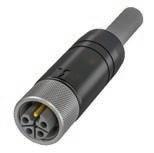
Balluff is expanding its power cable portfolio to include M12 S-coded and L-coded power cables, purpose-built for delivering reliable power to field I/O systems—including the newest generation of Balluff I/O-Link master blocks. These compact cables complement Balluff’s field I/O architecture by providing space-saving power delivery for distributed control panels, I/O hubs and smart automation components. Balluff’s M12 connectors support multiple widely used coding standards, including S-coded (3- and 4-pin) and L-coded (4-pin and 5-pin) options. L-coded M12 connectors are engineered for high-current DC power
applications and support up to 16 A. S-coded M12 connectors are designed for higher-voltage AC power applications up to 630 V and 12A per contact. balluff.com
ARTIFICIAL INTELLIGENCE
GRIIP
Vention has launched the Generalized Robotic Industrial Intelligence Pipeline (GRIIP), an end-to-end physical AI pipeline that enables deployment of autonomous robot cells in highly unstructured manufacturing environments. GRIIP delivers a unified pipeline from perception to motion by integrating Vention’s proprietary models with NVIDIA Isaac open models, specifically NVIDIA FoundationStereo for stereo matching
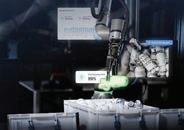
and NVIDIA FoundationPose for pose estimation. The pipeline automatically handles scene digitalization and calibration, object detection and segmentation, 6DOF pose estimation, grasp point evaluation and collision-free path planning, adapting to actual conditions without manual configuration. Running on Vention’s MachineMotion AI controller, powered by NVIDIA Jetson, GRIIP can convert existing traditionally programmed robotic applications to autonomous operations. vention.io



INDUSTRY
WATCH
BY PAUL HOGENDOORN
a
has built multiple manufacturing and manufacturing technology companies. He has been a regular contributing columnist for 15 years. For more insight or information from Paul on related topics, please contact paul@tpi-3.ca or visit TPI-3.ca
Why I love manufacturing people
Ihave written many blogs over the last few years about why I love manufacturing. There’s a lot of reasons to be sure, but principal among them is people. Manufacturing people are great people.
I was speaking with a consultant earlier this month. She reached out to me because she wants to shift her practice towards manufacturing companies and looking to leverage my connections. I had to ask her why she was looking to make this shift in her business.
She said it was because of the people. They were straightforward, to-the-point and honest. In her experience, they were hardworking people who never tried to convince you of anything that wasn’t true. My paraphrase of her explanation was manufacturing people are “salt-of-the-earth”. She agreed.
I’ve always known this to be true, but I’ve never written about it. Hearing the praise of a recent convert was affirming, so here we go with a column I should have written years ago; here are my reasons for believing manufacturing people are the best.
They are genuine. They are real. Their actions speak louder than their words and they know that outcomes speak for themselves. They are a complete contrast from politicians that offer nothing but new promises and old excuses to distract or explain away things they didn’t deliver.
We will be coming up to elections very soon again, in Canada and in the U.S., and the politicians will be spinning their yarn even longer. None of them, save for a rare few (and none of those are in Canada), will be willing to let the outcomes of their parties’ policies stand up to any scrutiny. No, they will spin, bob and weave, come up with new feel-good slogans and distract people by playing to their emotions instead.
Manufacturing people don’t do that. They say what they will deliver and then they deliver what they said. It doesn’t matter if you’re in the office, the engineering department or the plant floor. It’s about getting things done, on time and right.
The social media and entertainment industries have given a disproportionally powerful voice to influencers, be they social media “stars”, movie “stars”, rock “stars”, late night talk show hosts or even some athletes. What do any of these people actually know about the things they speak of? They fly private jets,

live in mansions, have multiple homes and are surrounded by a service staff who manage every aspect of their lives. Why do they think they relate to the rest of us, and why do they believe their opinion is more important than anyone else?
Manufacturing people have opinions, but manufacturing people also know it takes a lot of them, collectively, to get things done. And, its not just when the stage is set and the bright lights are on them – its every day, day in and day out, shift in and shift out. There’s nothing fake about them.
Manufacturing people don’t automatically assume everyone wants to know their opinion. If they’re confronted with something that needs a solution, they usually start thinking about what they can do and not wondering what is politically correct to say.
I’ll admit that I’ve been becoming fatigued with the supposed “realities” of today. It’s hard to know truth from spin, and even fact from fiction. Politicians, the media, and all the outspoken “star” influencers, all have a polarized agenda that doesn’t just slant or skew information, they filter it and tilt it to an extreme and then keep repeating it often enough, and loud enough, to change how people feel.
Manufacturing people don’t try to change the way people feel. They don’t work to manipulate our emotions and beliefs.
A manufacturer may have political allegiances and religious beliefs as any individuals have a right to have, but as a manufacturer, they have a very simple agenda:
1. To deliver to their customer what their customer is willing to pay a fair price for.
2. To earn a living to put food on the table, a roof over their families’ heads, and put their kids through college.
3. To protect a dream of prosperity that was earned by generations before them, and hopefully, generations following them.
I trust a manufacturer’s agenda far more than I trust a politician’s, a “star’s”, or any media representative, be that social media or broadcast media. Results should speak for themselves, and people that make promises and commitments need to be held accountable to them. Just like manufacturing people are, every day, every week, every year.
As much as I am discouraged by what I see on my media feed, I have also found many stories that encourage me. I have connected with thousands of people that work in, founded or lead small and medium sized manufacturing companies in the U.S., Canada and around the world. What I see them post encourages me. Stories about hiring and training young people; of helping out at homeless shelters; of tactile, tangible “hands-on” community service. Of restoring hope for some, giving dreams and opportunities to others, and responsibly passing the responsibility of stewardship from one generation to the next. As they come up on my feed, I share and repost them on my company’s LinkedIn page, TPI-3. Look for it and follow it if you want to start seeing more of the inspiring actions and deeds of some of our great manufacturing people come up in your feed.
I do love manufacturing – I believe it created and sustains our middle class and that it’s people that have made it what it is. | MA
Paul Hogendoorn is
serial entrepreneur that
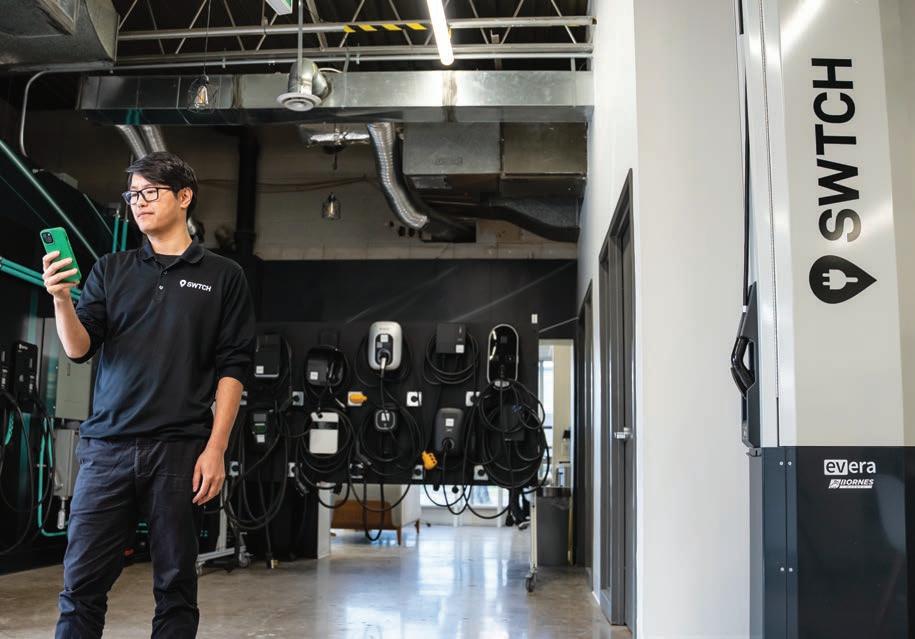
“The reason why we picked QuickBooks was because I knew that that if we wanted to be the company we wanted to be, there would need to be some scalability with it.”

Hear more about SWTCH Energy’s growth story and download the Scaling Up e-book today! This guide gives practical solutions for managing growth, improving cash flow, and scaling your team.
Founder & CEO
SWTCH Energy – Toronto, ON
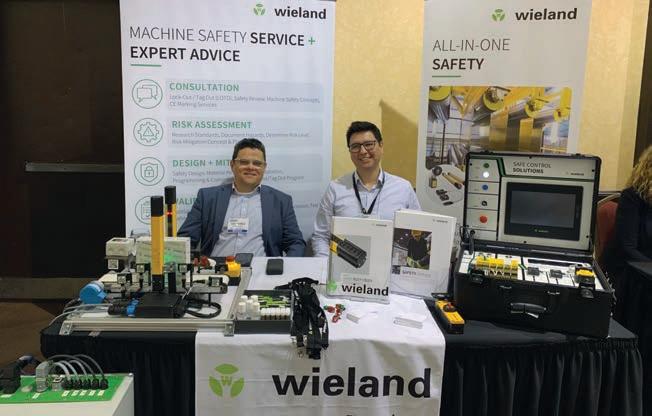

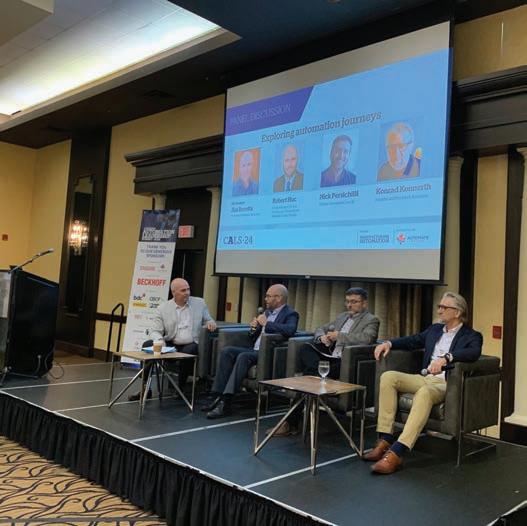




Step into the future of manufacturing at the third annual Canadian Automation Leadership Summit, where leadership and technology converge to shape the next era of Canadian manufacturing. This premier in-person event gathers top executives, innovators and automation experts to explore how manufacturing leaders can harness advanced technologies to drive growth, efficiency and innovation.
WHY ATTEND CALS26?
• Network with like-minded manufacturing and automation leaders
• Learn from an automation-focused agenda curated specifically for manufacturing leaders
• Explore tabletop displays showcasing the latest automation products and services
• Forge partnerships for future collaborations