Rise of robots, AL to cost 5 million jobs by 2020. p.4
A glimpse into the many facets of the esteemed Dick Morley. p.10
B.C. to lead 2016 provincial economic growth: Conference Board. p.8
AutomationMag.com
Your resource for Canada’s industrial automation news
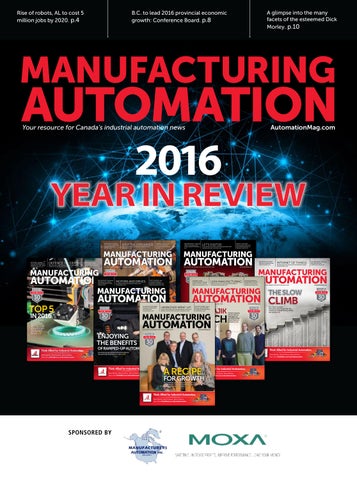
2016
YEAR IN REVIEW DICK MORLEY: A glimpse into the many facets of the esteemed “Father of the PLC.” p.18
SPOTLIGHT: Highlights from our fireside chat with Nathalie Pilon, ABB Canada managing director. p.15
DEFENCE-IN-DEPTH Best practices to help industrial operators deploy the Internet of Things securely and reliably. p.22
Your resource for Canada’s industrial automation news
TOP 5
MACHINE SAFETY: How you can prepare for the upcoming Ontario machine safety blitz. p.21
TRAINING: How you can attract millennials and simultaneously boost your business. p.17
MACHINE SAFETY: Integrated safety technology boosts motion system functionality. p.15
LET’S DIGITIZE:
A look at how connected manufacturing benefits both manufacturers and customers. p.24
SECRET TO SUCCESS: Industry players share how they achieve longevity in a turbulent market. p.21
INDUSTRIAL NETWORKS: Selecting components that make the grade. p.24
AutomationMag.com
Your resource for Canada’s industrial automation news
HMI CHECKLIST: Top factors and features to consider when shopping for an HMI solution. p.22 AutomationMag.com
MOTORS AND DRIVES: An overview of the most popular rotary motion technologies. p.24
Your resource for Canada’s industrial automation news
COST CONTROL: How a stronger employeecustomer connection will improve productivity. p.26
ETHERNET GAINS: Acadian Seaplants capacity grows by 40 per cent with new processing facility. p.20
AutomationMag.com
PC-BASED CONTROL
AutomationMag.com
IN THE DRIVER’S SEAT
AUTOMATION SOFTWARE: Four big-picture benefits of PLM for small manufacturers. p.24
Sodecia uses PC control, EtherCAT and programmable safety to accelerate robot cell performance for automotive assembly. p.22
MACHINE SAFETY: Ensuring safe operations with collaborative robots. p.14
LIGHTING RETROFITS: LEAN MANUFACTURING: Industy bakery welcomes Defining culture as an environment favourable to continuous improvement. p.10
retrofit for non-energy operational savings. p.22 Your resource for Canada’s industrial automation news
Your resource for Canada’s industrial automation news
HANNOVER WRAP-UP:
Couldn’t attend this year‘s Hannover Messe? Catch up on standout moments from the action-packed fair. p.26
AutomationMag.com
LESSONS LEARNED: Tips for how you can avoid pitfalls and make the best decisions in automation. p.28
AutomationMag.com
30 ISSUE TOUCH AutomationMag.com
Your resource for Canada’s industrial automation news
Think Allied for Industrial Automation.
Think Allied for Industrial Automation.
More Brands. More Products. More Solutions. See it all at thinkallied.com/industrialautomation
More Brands. More Products. More Solutions. See it all at thinkallied.com/industrialautomation
AlliedCover_MA_Jan.indd 1
2015-12-23 1:58 PM
CLIMB The 2016 Canadian Manufacturing Study finds the industry is strengthening, slowly but surely p.19
THE MAJIK TH ANNIVERSARY Ontario startup allows factory managers to act before they know there’s a problem p.18 The evolution and future of industrial automation p.18
ENJOYING THE BENEFITS
AlliedCover_MA_Jan.indd 1
2015-12-23 1:58 PM
OF RAMPED-UP AUTOMATION
Think Allied for Industrial Automation.
Automating specialized armored vehicles has paid big dividends for Inkas. p.18
More Brands. More Products. More Solutions. See it all at thinkallied.com/industrialautomation
AlliedCover_MA_Jan.indd 1
Think Allied for Industrial Automation. More Brands. More Products. More Solutions. See it all at thinkallied.com/industrialautomation
AlliedCover_MA_Jan.indd 1
A RECIPE
Think Allied for Industrial Automation. More Brands. More Products. More Solutions. See it all at thinkallied.com/industrialautomation
FOR GROWTH
2015-12-23 1:58 PM
AlliedCover_MA_Jan.indd 1
2015-12-23 1:58 PM
Our editorial advisory board discusses the challenges in Canada’s manufacturing future, and how to overcome them p.18
Think Allied for Industrial Automation. More Brands. More Products. More Solutions. See it all at thinkallied.com/industrialautomation
AlliedCover_MA_Jan.indd 1
SPONSORED BY
INTERNET OF THINGS: Manufacturers who embrace IoT are leading the digital transformation. p.23
THE SLOW
Your resource for Canada’s industrial automation news
IN 2016 From 3D printers to industrial sensors and the Internet of Things (IoT) — key trends and technologies that will impact your plant floor this year. p.16
SPOT THE DIFFERENCE: How to choose the right lighting for machine vision applications. p.26
2015-12-23 1:58 PM
2015-12-23 1:58 PM
2
@AutomationMag
Year In Review 2016 · MANUFACTURING AUTOMATION
MANUFACTURING AUTOMATION · Year In Review 2016
AutomationMag.com
3
AUTOMATION UPFRONT
President Obama visits Phoenix Contact at Hannover 2016 U.S. president Barack Obama visited the Phoenix Contact booth at the Hannover Messe in Germany. The president and Angela Merkel, German Chancellor, met with Frank Stuehrenberg, Phoenix Contact CEO, and Jack Nehlig, president of Phoenix Contact USA as part of the morning opening of the Hannover Messe Exhibition. Stuehrenberg and Nehlig demonstrated to Obama and guests Phoenix Contact’s CCSplus electric vehicle plug for the American and European markets. The CCSplus is a new cable that can charge at up to 350 A, compared to typical charging stations, which are 30 A, says the company, adding that it can charge a vehicle in about three to five minutes. This year is the first time the United States is a partner country of Hannover Messe, the world’s largest industrial trade show that attracts more than 220,000 people from around the world each year. President Obama is the first sitting U.S. president ever to attend the show. “We are honoured that President Obama and Chancellor Merkel took the time to visit our company during their Hannover Messe tour,” said Nehlig. “Phoenix Contact USA is an outstanding example of the SelectUSA initiative
Rise of robots, AI to cost 5 million jobs by 2020 The Fourth Industrial Revolution — which includes developments in artificial intelligence (AI), machine-learning, robotics, nanotechnology, 3D printing, genetics and biotechnology — will result in a net loss of 5 million jobs and cause widespread disruption to business models over the next five years, according to a report published today by the World Economic Forum (WEF). In terms of overall impact, the Future of Jobs report indicates that as many as 7.1 million jobs could be lost through automation, redundancy or disintermediation, with the greatest losses in white-collar office and administrative roles. This loss is predicted to be partially offset by the creation of 2.1 million new jobs, mainly in more specialized “job families,” such as computer, mathematical, architecture and engineering, it adds. The report is based on a survey of chief human resources officers and strategy executives from companies across nine industry categories, covering 15 economies that account for approximately 65 per cent of the global workforce, says the WEF. Respondents expect strong employment growth across the architecture, engineering, computer and mathematical
A partnership first: This year is the first time the United States was a partner country of Hannover Messe. 4
@AutomationMag
job families, a moderate decline in manufacturing and production roles and a significant decline in office and administrative roles. On the plus side, across all job families, chief human resource officers expect major challenges in recruiting. When it comes to respondents’ outlook on how best to deal with these sweeping changes, the news is more encouraging. The most popular workforce strategy across every industry is investing in reskilling current employees. Other practices, such as supporting mobility and job rotation, attracting female and foreign talent and offering apprenticeships, also scored high. Indeed, the survey suggests that those companies that are treating future workforce planning as a priority are almost 50 per cent more likely to invest in reskilling than those that do not. “Without urgent and targeted action today to manage the near-term transition and build a workforce with futureproof skills, governments will have to cope with ever-growing unemployment and inequality, and businesses with a shrinking consumer base,” said Klaus Schwab, WEF founder and executive chair. Drivers and barriers of change
The analysis finds the most significant driver of change, across all industries, is the changing nature of work itself. As new technologies make “anytime, anywhere” work possible, companies are breaking up tasks in new ways, leading to a fragmentation of jobs across many industries, it notes. These effects are further compounded by the rise of mobile internet and Cloud technology, enabling the rapid spread of Internetbased service models. However, while the new “gig economy” may be one of the most visible and current manifestations of disruptions to the labour market, there is more change — both positive and negative — expected in specific industries, leading to new management and regulatory challenges, it says. There is also a gender implication to the future of jobs. Based on the absolute job gains and losses mentioned above, the burden of job losses seems to fall
Year In Review 2016 · MANUFACTURING AUTOMATION
PHOTO: PHOENIX CONTACT
NEWS
and how German investment in the U.S. market can benefit both countries.”
equally on women (48 per cent) and men (52 per cent), according to the analysis. However, given that men represent a larger share of the overall job market than women, this even spread translates into a widening of the employment gender gap, with women losing five jobs for every job gained compared with men losing three jobs for every job gained, it found. This is also partly explained by low participation by women in the “job families” that are expected to grow, such as computers and mathematics, thus adding to the urgency with which leaders must address the chronic problem of getting more women into STEM (science, technology, engineering, mathematics) professions.
PHOTO: SIEMENS
One of the major barriers to change identified by chief human resource officers is the lack of specificity on the types of disruptive change under way. “While forecasts vary by industry and region, momentous change is under way and, ultimately, it is our actions today that will determine whether that change mainly results in massive displacement of workers or the emergence of new opportunities,” concludes the report. “Our analysis reveals that upcoming disruptions to the employment landscape will be about much more than simply automation. It is essential that we act collectively now to prepare ourselves for the changes that we know the Fourth Industrial Revolution will bring,” continues Saadia Zahidi, head of the Global Challenge on Employment, Skills and Human Capital at the WEF.
A win-win deal: The two companies intend to work closely together on automation concepts for the electronics industry.
control over the way thousands of digital bots are created, deployed, and managed to instantly scale up or down to meet business process demand.” “Automation underpins the As-aService model, providing the agility and efficiency needed to transform business operations,” said Manish Sharma, senior managing director, Global Delivery and Solution Development for Accenture Operations. “Accenture has a history of using automation to help our clients capture new business value and our relationship with Automation Anywhere compliments our efforts to apply the technology quickly and at scale.” Since 2014, the parties have worked together to help “drive business value for organizations” by automating business processes.
Accenture, Automation Anywhere partner for robotic process automation
Panasonic, Siemens sign Memorandum of Understanding at Hannover 2016
Accenture and Automation Anywhere say they have teamed up to deliver enterprise-grade robotic process automation (RPA) solutions to organizations that automate business processes. As part of the collaboration, Automation Anywhere named Accenture a key implementation provider for BotFarm, its newly released Cloud-based RPA solution which promises “unprecedented
Against the backdrop of Hannover Messe 2016, Hiroyuki Aota, director in charge of Factory Solutions Business and executive officer of Panasonic Corporation, and Anton S. Huber, CEO of the Digital Factory Division at Siemens AG, signed a Memorandum of Understanding cementing the intention of the two companies to work more closely together in the future in
MANUFACTURING AUTOMATION · Year In Review 2016
the fields of automation concepts for the electronics industry. The focus lies on standardized line integration concepts, which the partners say they plan to develop not only for individual production lines but also as overarching integration concepts for all process steps at the factory level, and as company-wide automation standards for globally distributed production networks. Over recent years, Panasonic and Siemens have both worked independently on concepts linking digitalization and automation. In essence, the smart factory offering from Panasonic encompasses automatic assembly systems and the Manufacturing Execution System (MES) application PanaCIM. With the Digital Enterprise, Siemens says it is bringing to the table a portfolio encompassing the core elements of industrial software and automation, industrial communication, security and services. “The contribution Siemens aims to make to the jointly developed concepts will be first and foremost its expertise in control and automation technology,” says the company. At the signing, Aota said, “To significantly improve the productivity and quality of electronic equipment assembly, it is vital to connect all the equipment of any vendor in order to control the entire factory floor in real time. So concluding the memorandum AutomationMag.com
5
AUTOMATION UPFRONT for collaboration with Siemens, a company which has excellent technologies based on control devices and optimization software, will enable us to enhance our smart factory at the global level.” “Electronic production offers enormous potential for digitalization,” Huber added. “The use of integrated automation solutions paves the way for substantial increases in both productivity and quality. Cooperation with Panasonic offers an exciting opportunity to selectively advance our Digital Enterprise portfolio for companies in the electronics industry.”
China’s Haier buying GE appliance unit for $5.4 billion Haier Group, a global home appliance maker, is buying General Electric Co.’s appliance business for $5.4 billion to expand its U.S. and global presence. The two companies has agreed to form a strategic partnership to co-operate in areas such as the Internet, healthcare, and advanced manufacturing. The announcement comes as Haier tries to transform itself into a premium brand. GE is shifting emphasis from traditional businesses such as appliances, in which it has been a prominent presence for more than a century, to higher-technology areas such as medical equipment and clean energy. Haier, headquartered in the eastern Chinese city of Qingdao, makes a range of refrigerators, washing machines and other home appliances. It operates a string of 21 industrial parks worldwide. Its purchase of GE Appliances is the biggest global corporate acquisition so far this year and the third-biggest in the United States by a Chinese buyer to date, according to Dealogic. “This strategic alliance provides a new starting point for both Haier and GE and I am confident that this partnership will deliver enhanced value to the stakeholders of both companies,” Haier Group chairman Zhang Ruimin said in a statement. Haier’s takeover of GE Appliances is the second-biggest purchase in the 6
@AutomationMag
household appliance sector on record, behind Panasonic Corp.’s 2008 purchase of 50 per cent of Sanyo Electric Co. for $7.1 billion, according to Dealogic. It said Haier’s six foreign acquisitions to date total $6.3 billion. “Haier has a stated focus to grow in the U.S., build their manufacturing presence here and to invest further in the business,” GE chief executive Jeff Immelt said in the joint statement. “In addition, we see the opportunity to work together to build the GE brand in China.” — With files from Joe McDonald, The Associated Press
Collaborative robots market worth US$3.3 billion by 2022: MarketsandMarkets The global collaborative robots market will reach US$3.3 billion by 2022, and will grow at a CAGR of 60.04 per cent between 2016 and 2022, according to a new report by MarketsandMarkets. Titled Collaborative Robots Market by Payload (Up to 5 Kg, Up to 10 Kg, & Above 10 Kg), Application, Industry and Geography - Global Forecast to 2022, the report believes the market will be driven by high ROI, the low price of collaborative robots, and increased investments in automation. “The global collaborative robots market is driven by application in industries such as automotive, metal and machining, furniture and equipment, food and beverages, plastic and polymers, and others. Collaborative robots used in the automotive sector accounted for the largest share of the global collaborative robots market in 2015; this market is expected to grow at a significant rate between 2016 and 2022, driven by the growing focus of consumers on safety features provided by collaborative robots in the field of manufacturing and automation. In developed regions, such as North America and Europe, growth in the collaborative robots market in the automotive sector is expected to be driven by rise in safety rated manufacturing and the growing trend of precision which were not possible due
to the common human errors, while, in developing regions, such as Asia-Pacific and RoW, it is likely to be driven by the rise in industrial automation during the forecast period,” noted the report. Marketsandmarkets found Europe to be the largest market for collaborative robots in 2015, but it expects Asia-Pacific to surpass Europe by 2018 and hold a “large market share” through 2022.
Morley receives CSIA Lifetime Achievement Award Rick Caldwell, founder and president of SCADAware, presented the first Control Systems Integrator Association (CSIA) Lifetime Achievement Award for Contributions to the Automation Industry to Dick Morley at the CSIA Executive Conference 2016 Awards Reception and Dinner, following CSIA CEO Jose M. Rivera’s announcement of the newly created award. Famously dubbed the father of the programmable logic controller (PLC), it is Morley who, in 1968, led the team to develop what is considered one of the most important inventions in manufacturing. Along with the PLC, Morley’s patents include the anti-lock braking system (ABS brakes), the computer floppy disk, the parallel inference machine, the handheld terminal, personal rapid transit, and magnetic thin film, among many others. The Lifetime Achievement Award was created to allow the CSIA to recognize individuals outside its membership for contributions to the automation and control system integration industry. “Every so often, a person comes along who changes the way we live our daily lives and things are never the same again. They represent a paradigm shift: they cause a permanent change in our idea of what is possible,” said Caldwell during his presentation. “For our industry, that person is Dick Morley, the father of the PLC. In fact, as control system integrators, our business may not exist as we know it today if it had not been for Morley. So it is truly fitting that he is the first recipient of this lifetime
Year In Review 2016 · MANUFACTURING AUTOMATION
PHOTO: SCADAWARE, DEUTSCHE MESSE
The father of the PLC: Dick Morley led the team to develop what is considered one of the most important inventions in manufacturing.
achievement award.” Morley has more than twenty U.S. and foreign patents, and has been recognized with many awards, such as the Franklin Institute’s Howard N. Potts Award and the Society of Manufacturing Engineers’ Albert M. Sargent Progress Award. He was also inducted into the Automation Hall of Fame. The association said Morley could not attend the awards banquet due to health concerns. Caldwell, Rivera and a small group of other CSIA members presented Morley with the award on March 11 at his residence in Milford, N.H. Morley has mentored many engineers through the years. “Some of us have the good fortune to know Dick personally. I myself am one of those lucky individuals,” said Caldwell. “Through the years, Dick has intrigued, inspired and mentored me. I am proud to have had the opportunity to share a little about the pioneer responsible for driving innovation in our business.”
presence to the Canadian market,” says company representatives. Any inquiries can be directed to sales@ rosscanada.com or 416-251-ROSS (7677). Established and headquartered in Michigan since 1921, Ross Controls is an international designer and ISOcertified manufacturer of pneumatic valves and controls systems.
Harting wins Hermes Award at Hannover 2016 Based in the town of Espelkamp, Germany, the Harting IT Software company has been announced as the recipient of this year’s Hermes Award, a prestigious
industrial innovation prize, presented today at the Hannover Messe opening ceremony by German federal minister for Education and Research, Dr. Johanna Wanka. Harting received the award for its MICA product, an open and modular platform consisting of embedded hardware and software which serves as a central component in the Industry 4.0 environment. Through its combination of established Linux technologies, the product allows users to virtualize field devices and add their own customizable hardware components that communicate via USB, says the company. MICA can be operated using Power over Ethernet (PoE). Each MICA unit contains a TPM chip and supports both SSL and VPN, promising secure authentication and communication between the various MICA modules. “Since 1947, Harting has been an exhibitor at Hannover Messe and over the intervening decades has evolved from being a pure hardware manufacturer to becoming a software-driven technology provider,” said Dr. Jochen Köckler, member of Deutsche Messe’s managing board, the company organizing the annual event. “The award-winning MICA product represents a key contribution to the keynote theme for this year’s Hannover Messe, and will make it easier for small and medium-sized enterprises to enter the world of Industry 4.0.” Chaired by Dr. Wolfgang Wahlster, director of the German Research Center
Ross Controls opens in Canada Ross Controls says it is pleased to announce the opening of Ross Canada. Located in Barrie, Ont., Ross Canada will support the “growing customer base from coast to coast and will bring a stronger
Award-winning solution: MICA is an open and modular platform that consists of embedded hardware and software for the Industry 4.0 environment.
MANUFACTURING AUTOMATION · Year In Review 2016
AutomationMag.com
7
AUTOMATION UPFRONT for Artificial Intelligence (DFKI), the jury said they was impressed by the “concept of lightweight virtualization using Linux-based containers which MICA implements on compact field devices.” “By installing numerous integrated MICA modules, which essentially represent the nervous system of a digitized factory, an existing plant can be gradually migrated over to Industry 4.0, shortening the time needed for product changeovers along the way,” said Wahlster.
Wesco names Nelson Squires Canadian head Wesco International, a provider of electrical, industrial, and communications MRO and OEM products, construction materials, and advanced supply chain management and logistics services, has appointed Nelson Squires to serve as group vice president and general manager of its Canadian operations. Squires joins Wesco from Air Products and Chemicals in Allentown, Pa., where he served as vice president and general manager, North American Gases, and president of Air Products Canada. He began his career with Air Products as a sales engineer in 1989. He had numerous assignments of increasing responsibility, including region and general management positions, mergers and acquisitions and investor relations. Squires also served as a captain in the United States Army. “Nelson brings a successful track record of building strong management teams in a diverse range of functions and in delivering sales and profitable growth,” said John Engel, chairman, president and CEO, Wesco International. “We are very excited to have him join Wesco to help us make the most of the substantial opportunities we believe are emerging in the Canadian market.”
B.C. to lead 2016 provincial economic growth: Conference Board A report by the Conference Board of Canada says strong economic growth in 8
@AutomationMag
British Columbia is expected to lead to a wave of migration from provinces hit by low oil prices. Following up on its solid performance of the last two years, the B.C. economy is expected to grow by 2.7 per cent thanks to its strength in housing, tourism and manufacturing, outpacing all other provinces in 2016, according to the Provincial Outlook: Winter 2016. “British Columbia posted the strongest economic growth last year and, thanks to widespread gains, is expected to lead the provincial growth rankings over the next two years,” said MarieChristine Bernard, associate director, Provincial Forecast. Aside from B.C., only Ontario, Manitoba, and Nova Scotia can expect to see their economy grow by more than 2 per cent this year. Ontario’s economy is well positioned to advance by an estimated 2.4 per cent this year, just behind B.C., notes the Conference Board. The lower Canadian dollar and stronger growth in U.S. consumer demand will help boost Ontario’s exports, it predicts. The report forecasts net migration of roughly 20,000 people to B.C. this year as low oil and gas prices persist. According to the report, the province’s manufacturing sector is expected to benefit from the low loonie. Alberta is expected to be hardest hit by the energy slump, with the economy forecast to contract by 1.1 per cent this year after a 2.9 per cent pullback last year. “With oil prices continuing to feel the pressure of bloated global inventories and rising supply, the outlook is grim for the energy sector and Alberta’s economy as a whole,” said Marie-Christine Bernard, associate director of provincial forecasts at the Ottawa-based think tank. — With files from The Canadian Press
Axalta celebrates 60 years of Ajax production In January, Axalta Coating Systems, a global manufacturer of liquid and powder coatings, celebrated 60 years of production at its Ajax, Ont., facility. Employees gathered at the local Hilton
Garden Inn to celebrate both Axalta’s 60th year of operations in Ajax and its 150th business anniversary.
Axalta in Ajax: Company officials celebrate a milestone achievement.
Axalta’s history in Canada dates back to 1956 when the Ajax manufacturing plant opened its doors. It has produced a variety of products over the years including acrylic lacquer paints, basecoat and clearcoat technologies. In 2000, it was identified as a corporate development and manufacturing flagship for the “paint on plastics” that is used with many automotive components. More recently, due to increased production volumes, Ajax added a new distribution centre to the campus. Today, products are shipped from Ajax to customers in Canada and the U.S. for collision repair, the production of vehicles and vehicle components, trains, buses and diversified industrial products. “This is a special milestone in Axalta Canada’s history. We are proud to be celebrating our 60th year in Ajax and our 150th year in business,” said Brent Jamieson, Axalta Canada country manager. “We are extremely proud to call Ajax and the Region of Durham home. We look forward to the next 60 years of being a part of this vibrant community.” “The town is extremely pleased of the accomplishments of the Axalta team and proud to have them in Ajax for over 60 years,” added Joanne Dies, Councillor, Ward 3 – Town of Ajax. “We look forward to ongoing partnerships in recognition of Axalta’s strong contribution to the community.”
Year In Review 2016 · MANUFACTURING AUTOMATION
CENTRE STAGE Last August, NATHALIE PILON was appointed ABB Canada managing director, bringing with her two decades of electrical and manufacturing experience. We spoke with Pilon for her take on how Canada can stay competitive in this turbulent market.
PHOTO: ABB
MA: What is it about this industry that has kept you in it all these years? NP: Well for one, I like manufacturing. I think there’s a passion for me to make sure we stay relevant in manufacturing in Canada and there’s a way for us to compete. It’s an industry where there’s a lot of respect, I would say, between the whole supply chain and the value that each of us bring in the supply chain, and one where [we are] able to innovate not only in product but in servicing. Competitors basically know each other because we have an industry in which both distributors and manufacturers get together to try and solve industry problems. There’s collegiality of parties with manufacturing reps and agents that operate in that business, just trying to look at a sustainable business going forward. One thing I talk about often with employees, I started back when I was at Thomas & Betts, is sustainability. It not only looks at what you do to the environment and how you operate, but also at keeping manufacturing relevant and [maintaining] jobs for people, making it sustainable for employees so that they can have a job in Canada. That’s what sustainability means to me. It’s basically about business continuity — the continuation of business and for generations to come. MA: Do you think elements of your career have been more difficult because you are a woman? NP: I cannot say that. Personally I’ve been very fortunate from that standpoint but I also realize that because it hasn’t been difficult for me, I can’t assume it’s not difficult for others. I was sharing that with employees this week when somebody asked me what I will do for women. Really it’s about making sure I express myself and let myself be more accessible or seen and not
the future definitely has challenges, but challenges also bring opportunities.
as self-promotion but [in a way] that helps others. I was sort of refraining from doing so but then I realized that we still have big steps to take in terms of having women in higher positions or as members of boards. When I realized that, I decided I had to share my story more so people understand that it is feasible, it is possible. MA: What advice or words of wisdom would you give to a young person considering a future in manufacturing? NP: You need to believe in it. You need to want to make a difference and be open about the challenges around us. Competition isn’t necessarily in our backyard; it’s the one that we don’t see that is competition. So how do we work on this? How do we stay relevant? Relevance can be product or servicerelated. For me, it’s all about [whether] we are staying in tune with what the customer needs and making sure we develop products with ease of installation that have automation, cost savings or [reduced] emissions. There is so much good you can do with manufacturing if you’re a problem solver. I think
MANUFACTURING AUTOMATION · Year In Review 2016
MA: You bring up a good point in talking about overseas competition. Who do you think our biggest competitors are? Who should we keep our eye on? NP: That’s interesting. To [determine] our top competitor, I think it really depends on what [sector] you look at. Obviously we benchmark with and talk a lot about Germany, not that we can compete with Germany but we should look at its recipe for success and how the country can stay competitive in this environment. [We should] try to benchmark against countries, like Singapore, that have economies that have made conscious decisions to invest and [define] their manufacturing strategy. MA: What is Canada’s biggest obstacle in the manufacturing world? NP: The challenge is the investment needed to automate, and [I wonder if] we’ll have the will and the means to keep up on the automation and change the way we look at investment. In the last 15 years [...] when you look at the investment firms are doing in other parts of the world, you see that we are much slower in getting with the technology. When the Canadian dollar was strong, people were under pressure in terms of margins and cash flow was tight, and they didn’t invest but now... investment is very expensive because the dollar is so weak. Our timing is off. We cannot delay these investments too long otherwise we’re going to put ourselves out. We need to have the latest technology to compete. | MA To read our news item announcing Nathalie Pilon’s move to ABB Canada, visit bit. ly/1OX87X3.
AutomationMag.com
9
PROFILE
THE MAN BEHIND THE PLC A glimpse into the many facets of the esteemed Dick Morley BY ALYSSA DALTON
L
egend. Visionary. Innovator. These are the words several of our regular Manufacturing AUTOMATION contributors used to describe Richard E. (“Dick”) Morley — quite fitting descriptors when you think of a gentleman who has more than 20 United States and foreign patents to his name. Famously known as the father of the programmable logic controller (PLC), it is Morley who, in 1968, led the team to develop what is considered one of the most important inventions in manufacturing. The PLC, which allows us to control processes through digital and analog input-output arrangements in real time, has greatly changed the way we automate our factories. Since its inception nearly five decades ago, the PLC is still used in countless manufacturing facilities worldwide. While you may be hard-pressed to find someone in the business who doesn’t know what the PLC is today, how many of us know about the iconic man behind it? “The first impression I had of Dick Morley was that he was as close to God as you could get,” says Jeremy Pollard, who has known Morley for about 25 years. “And when I first met him, ‘God,’
Time for a photo flashback! We pulled this classic Dick Morley shot from the Manufacturing AUTOMATION vault. This photo was originally published in our June 2008 issue for the article, The father of invention.
he all of a sudden became normal, if that makes any sense. He transformed into a very normal, sensitive and caring individual. He will tell you how smart he is without telling you how smart he is. Yes, he’s got all these patents and he’ll tell you about them, but he’s not throwing it in your face.”
Entrepreneurial spirit Along with the PLC, Morley’s patents include the anti-lock braking system
“The first impression I had of Dick Morley was that he was as close to God as you could get.” 10
@AutomationMag
(ABS brakes), the computer floppy disk, the parallel inference machine, the handheld terminal, personal rapid transit, and magnetic thin film, among many others. Winner of the Business Week Entrepreneur of the Year Award and namesake of the Richard E. Morley Society of Manufacturing Engineers Outstanding Young Manufacturing Engineer Award, Morley is an engineer, accredited machinist and Massachusetts Institute of Technology (MIT) dropout who has helped launch and counsel more than 100 companies throughout his career. “Dick is the kind of guy that thinks of things long before they become
Year In Review 2016 · MANUFACTURING AUTOMATION
mainstream,” says David McPhail, president and CEO of Memex, who asked Morley to join the Burlington, Ont.-based company’s board of directors in November 2013. “When you’ve got [that many] patents to your name, you’re definitely a visionary,” he continues. “What the PLC has done for the industry is foster the third industrial revolution in my opinion. I don’t believe the level of industrial integration and automation that we see today would be possible without it. If you look at all modern manufacturing done today, anywhere in the world, you will see a whole line of equipment that, for the most part, runs unattended because it’s run by a PLC. It has essentially replaced panels and panels and panels of relays.” He recalls the first time he went to meet Morley at the Barn, the office location that Morley worked out of for years. “I went there to meet him for an hour and six hours later, we were still talking. I looked down at my watch and I couldn’t believe the time. I thought that my watch had malfunctioned,” McPhail says chuckling. He says Morley was able to ask him questions that made him think different about his company’s technology and place in the market. “He basically challenged everything I said in a way that was very humble, very simple. It just made me think differently.” Sometimes, Morley would have insomnia and continued to work late into the night, reminisces Jim Pinto. “Dick Morley and I have been friends for a hundred years. At least, that’s the way he would describe it. During a visit, I stayed in the fairly well-furnished, cozy room upstairs. I remember seeing the light on in the middle of the night and coming down to find Dick fiddling with his FatMac — a well-endowed Apple Mac computer. We talked ’til early morning and the ideas flowed.”
Father of more than the PLC Morley is more than just a father to the PLC though, he is also a father to dozens of children. Over the course of their marriage, Morley and his late wife Shirley took in about 40 foster
The team that invented the PLC gather around their invention. L to R: Dick Morley, Tom Boissevain, George Schwenk and Jonas Landau.
children, in addition to having their own biological children. “You look at all the work [he has] done, he has a list of accomplishments a mile long and he still has time to raise 40 foster children,” says McPhail, adding that he believes the true measure of a person’s character is how one lives their personal life.
“He basically challenged everything I said in a way that was very humble, very simple.” “I mean, 40 lives have changed on the humanitarian side as a result of [their] efforts. If I had to pick of all of Dick’s accomplishments which one I would be the proudest of, and this is a tough one, it would be the 40 foster children that he raised,” he says. “So many people get caught up in their career but for Dick to have the time and to give back this way, I don’t know what to say about it. I’m speechless.” “How many people do you know that will take in youth and young adults at risk from the judicial system and foster
MANUFACTURING AUTOMATION · Year In Review 2016
them for weeks, months and years at a time?” asks Pollard.
Almost 50 years later The invention of the PLC, in Pollard’s mind, is “without a doubt” at the top of the list of manufacturing milestones. “The PLC was very disruptive, probably the most disruptive thing that has ever hit the floor running relative to industry,” he says. “There are so many spinoffs from it, not only in terms of the software mindset, but everybody started to think and wonder about [the future of technology]. Adapting to this new disruptive technology forced so many people to get their thinking caps on and start learning again. It’s made the industry more robust and I would dare say it’s made people in the industry more relevant.” Pinto fondly thinks of Morley as “the peripatetic inventor, the dreamer.” “[There is a] famous Morley line, ‘80 per cent of the inventions I predict never happen; I don’t know which.’ There were many instances that Dick and I were co-speakers at ISA and other events. Mostly, he brainstormed out loud, to the delight and sometimes mystification, of his audience. I followed, as the ‘straight man,’ the marketer and businessman, providing interpretations.” But what separates Morley from the AutomationMag.com
11
PROFILE
“A lot of people come up with great ideas but then they don’t execute them.” majority of inventors out there, says McPhail, is his ability to follow through. “I think Dick is the kind of guy that can inspire people to come together and get the most out of that idea — foster it, nurture it and ultimately deliver it
— which I think can be a struggle for some entrepreneurs,” he says. “A lot of people come up with great ideas but then they don’t execute them and they never see the light of day.” For many years, Morley was a
loyal contributor of Manufacturing AUTOMATION through his Distorted Realities column until he decided to take a very well-deserved break from regular submissions last fall. On behalf of the entire team, I would like to extend a very heartfelt and sincere thank-you to Mr. Dick Morley for his wise words, insightful anecdotes, and as you read earlier, the countless ways he has greatly developed and advanced our industry. | MA
THE MAN, THE LEGEND, THE REALIST BY HEATHER ANGUS-LEE “What business are you in?... No, no what are you really selling?” Dick Morley’s tenacious prodding of people at every trade show and conference he attended — at which he was usually honoured with some tribute — personified his trademark curiosity and delight in turning topics on their head. If they said, “I sell networking gateways,” he’d say, “Wrong, you sell relief from bosses hanging over you demanding why the downtime!” Circa 1997, I was the new editor of Manufacturing AUTOMATION, and I had big ambitions for the publication. My first work trip state-side, it didn’t take long to learn of the Mighty Morley, and I immediately set my sights on snagging him as a writer. Of course, he’d never heard of our Canadian magazine... Dick (running into me for the 10th time that month): “Do you know who I am?!?!” Me: “Yup. That’s why I want you to write for us!” Never one to refute logic, Dick began an almost 20-year relationship with Manufacturing AUTOMATION. Over the years we worked together on his delightfully disruptive columns, my favourite comment from him was: “Pig’s ear, Angus…” referring to the adage of “turning a sow’s ear into a silk 12
@AutomationMag
purse” — a high compliment on editing, indeed, from the author of several esteemed books. I visited The Barn, his work/life hangout, on a few occasions, deep in the woods of New Hampshire (so deep I regretted not leaving breadcrumbs on my exit, truly a twisted, forested labyrinth of which he was proud). His lovely wife, Shirley (who passed away in 2012), and their artist daughter, Pat, took me whale-watching. We barbecued and swapped stories, with Dick entertaining a host of entrepreneurs (he was a renown angel investor) alongside his brilliant buddies, beers in hand, at his annual Geek Day. I let our friendship expire, and I regret it. I talked with Dick in Feb. 2016, the first time in many years. Turning 84 this year, he lives in a N.H. retirement
community. On being considered a “legend” in the industry, Dick told me in this conversation that “being called a legend, that doesn’t matter much to us folks,” referring to his low-key state mates. He added, “inventors don’t make any money, you know.” Dick always struck me as a compelling combination of ego and down-home humility. He knew he was a giant of the industry, and he liked the recognition a lot. He also wanted you to know he was a country hick, a devoted husband, and just a guy out for a good time. He is all those things, and so much more. | MA Heather Angus-Lee is a former editor of Manufacturing AUTOMATION, who still writes about automation for clients of her business (coacheditor.com). Today she ghost-writes and edits books about technology, science, and whatever else catches her fancy.
Year In Review 2016 · MANUFACTURING AUTOMATION
DON’T MISS OUT on your next issue of
IT’S FAST, IT’S EASY AND IT’S FREE! DICK MORLEY: A glimpse into the many facets of the esteemed “Father of the PLC.” p.18
TRAINING: How you can SPOT THE DIFFERENCE: attract millennials and How to choose the right lighting for machine vision simultaneously boost your applications. p.26
business. p.17
AUTOMATION SOFTWARE: Four big-picture benefits of PLM for small manufacturers. p.24
Defence-in-Depth Best practices to help industrial operators deploy the internet of things securely and reliably. p.22
Couldn’t attend this year‘s Hannover Messe? Catch up on standout moments from the action-packed fair. p.26
LESSONS LEARNED: Tips for how you can avoid pitfalls and make the best decisions in automation. p.28
AutomationMag.com
Your resource for Canada’s industrial automation news
Your resource for Canada’s industrial automation news
Machine safety: how you can prepare for the upcoming Ontario machine safety blitz. p.21
PC-BASED CONTROL
AutomationMag.com
AutomationMag.com
Your resource for Canada’s industrial automation news
PM 40065710
spOtlight: highlights from our fireside chat with nathalie pilon, aBB canada managing director. p.15
HANNOVER WRAP-UP:
IN THE DRIVER’S SEAT
Top 5 in 2016 from 3D printers to industrial sensors and the internet of things (iot) — key trends and technologies that will impact your plant floor this year. p.16
MARCH / APRIL 2016
A RECIPE
PM 40065710
FOR GROWTH
JUNE 2016
Sodecia uses PC control, EtherCAT and programmable safety to accelerate robot cell performance for automotive assembly. p.22
Think Allied for Industrial Automation. More Brands. More Products. More Solutions. See it all at thinkallied.com/industrialautomation
AlliedCover_MA_Jan.indd 1 1 2016_MA_MAR_APR16.indd
JAnUARY / FEBRUARY 2016
Our editorial advisory board discusses the challenges in Canada’s manufacturing future, and how to overcome them p.18
Think Allied for Industrial Automation. More Brands. More Products. More Solutions. See it all at thinkallied.com/industrialautomation
2015-12-23 12:20 1:58 PM 2016-03-02 PM
pM 40065710
AlliedCover_MA_Jan.indd 1
2015-12-23 1:58 PM
Think Allied for Industrial Automation. More Brands. More Products. More Solutions. See it all at thinkallied.com/industrialautomation
2016_MA_ISSUE.indd 1 1 AlliedCover_MA_Jan.indd
2016-01-07 2015-12-23 2:29 1:58 PM PM
HERE’S HOW: FOR FASTEST SERVICE VISIT
AutomationMag.com AND CLICK THE SUBSCRIPTION BUTTON
AutomationMag.com