Digital supplement to
Technology Handbook
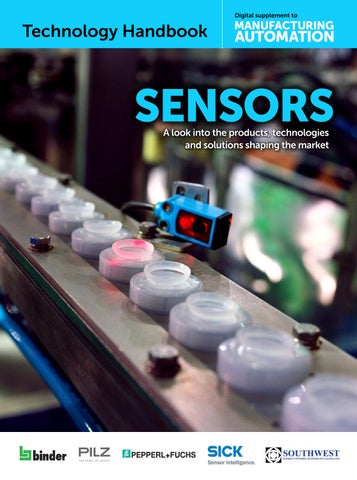
SENSORS A look into the products, technologies and solutions shaping the market
SEN Pressure Switches
Temperat
Level Sensors
on. Best prospect.
Capacitive Buttons
ngineers know the score: the monitoring of
mation as protection is on the mountain. Risks reliably. Based on many years of experience in
ow taking the next step. With a new product
•
Rapid switching capacity
•
Easy to install
•
ner for productive area monitoring. Play it safe: Sensor Test Device
echnology and visualisation. A one-stop shop.
Operate in harsh conditions
•
Short circuit & overload protectio
•
Reverse polarity protection
Full product range available from Southwest Energy Control Systems of Can For information or to purchase, call 905-420-8400 or email phughes@southwes
,
711 3409-0
www.southw info@pilz.com
www.pilz.com
22.03.18 14:10
Technology Handbook | SENSORS
About binder USA Binder USA, LP, is a subsidiary of binder Group, a family owned leading global manufacturer of circular connectors, custom cordsets, and LED lights. binder USA products are used around the world in industrial environments for factory automation, process control, and medical technology applications. Defined by technical innovation and traditional values, the binder name is synonymous with the highest standards of quality and reliability. For over 55 years binder has been a technical leader and innovator serving the automation and medical industries. A combined total of 1,700 employees work at our headquarters in Neckarsulm and subsidiaries in the United States, Singapore, China, Sweden, France, England and the Netherlands.
Expert binder is a specialist in the production of a variety of industrial connectors as well as mounting and cable connectors for
automation technology. Our strengths lie in the development, design and automated manufacturing of customized connectors with LED lighting rounding off our product portfolio. binder products are used in agricultural and construction machinery, signal equipment, machine tool construction, medical technology and measuring technology, as well as sensor and automation technology.
Reliability, quality, responsibility The company’s quality management system is ISO 9001 and 14001 certificated, but it is a solution-focused approach to customer applications and commitment to superior service that truly differentiates binder from the competition. binder is a traditional company characterized by values that stand for absolute reliability towards customers, employees and service providers. Our daily operations are thereby governed by quality and backed by UL listed products and various ISO certifications, including ISO 13485 for medical applications.
For more information about binder connectors, contact us at 805-437-9925 or visit www.binder-connector.us 2 MANUFACTURING AUTOMATION · Technology Handbook Sensors
Cham pions M12 Power S & T Code
M12 Ethernet D & X Code
M12 Stainless Steel
B & D Code Crimp
www.binder-connector.us
Technology Handbook | SENSORS
Detecting Small and Clear Objects with Pepperl+Fuchs’ R20x Photoelectric Sensor
D
etecting small and clear objects is a challenge if you don’t have the right sensor. Standard polarized retroreflective sensors are not sensitive enough to detect small changes in light created by small or transparent items.
Choosing the Right Sensor for Clear Objects To ensure reliable detection, choose retroreflective sensors that are designed specifically for clear object detection. These sensors work just like standard retroreflective photoelectric sensors, but they can detect small changes in light that standard sensors would miss. Sensor manufacturers offer separate models with this capability—for instance, Pepperl+Fuchs retroreflective photoelectric sensors for clear object detection all have “OBG” at the beginning of their model numbers. The same technology that allows certain photoelectric sensors to detect clear objects also makes them suitable for detecting small and thin objects. Photoelectric sensors offer distinct advantages over other sensing technologies in many applications that involve clear objects. High-speed bottling machines are a good example. In addition to being sensitive enough to detect clear bottles, photoelectric sensors can also easily handle the high speeds common in bottling applications. Ultrasonic sensors do not provide a precise enough sound cone to detect the spaces between the bottles, and ultrasonic technology does not offer fast enough response times.
Detecting Small and Thin Objects The same technology that enables these advanced retroreflective sensors
The same technology that allows certain photoelectric sensors to detect clear objects also makes them suitable for detecting small and thin objects.
to detect clear objects also makes them suitable for small object detection. They are ideal for shipping and logistics applications, where thin bubble mailers and poly bags are becoming more and more widespread. Retroreflective sensors with the right set of features are sensitive enough to detect even the thinnest envelopes and packages in conveyor and belt sorter systems.
One Sensor Fits All Clear object detection sensors can also be used like standard retroreflective sensors for polarized applications. This gives users the flexibility to use one sensor for different kinds of target objects in the same application. For added versatility, some sensor manufacturers also provide platform-based portfolios that offer a complete family of sensing modes in a range of standard housing styles. Whether the sensors are retroreflective, diffuse-mode, or measuring models, they have the same user interface and can be configured the same way.
4 MANUFACTURING AUTOMATION · Technology Handbook Sensors
The Difference Is in the Details The right sensors can mean the difference between error-free and faulty production. Familiarize yourself the available sensing modes, features, and technologies—and don’t assume that faults and false trips are par for the course when clear materials and small objects are involved.
Tom Corbett Product Manager, Photoelectric Sensors tcorbett@us.pepperl-fuchs.com
www.pepperl-fuchs.com
Mastering challenges. Opening communication channels. Redefining flexibility. R10x and R20x Series All photoelectric sensing modes in standard
housing styles for maximum flexibility and more integration possibilities Simple installation and setup with one user interface for all housing styles and sensing modes IO-Link and Smart Sensor Profile in every sensor: standardized communication down to the sensor level as the basis for Sensorik4.0® www.pepperl-fuchs.com/pr-rx
Technology Handbook | SENSORS
Safety laser scanner PSENscan from Pilz expands the automation portfolio. In series more productive in 2D
Mississauga, February 1st, 2019– The new safety laser scanner PSENscan from Pilz safely monitors up to three separate zones simultaneously, significantly increasing plant productivity. Up to four safety laser scanners can be connected in series in accordance with the master-slave principle, which reduces the cabling and set-up work considerThe new safety laser scanner PSENscan from Pilz ably. Thanks to the free configuration of safely monitors up to three separate zones. That increases the productivity of laser-based applicawarning zones and protection zones plus tions significantly. the ability to adapt to existing structural conditions, PSENscan can easily be integrated into the most varied applications. Scanner for higher Pilz is expanding its automation portperformance folio with this new product group of flexUp to three separate zones can be ible, configurable safety laser scanners: monitored simultaneously and up to 70 switchable configurations can be set up. The application range extends from staAs a result the application is more protionary area monitoring to automated guided vehicles (AGV) and humanductive. Series connection in accordance robot collaboration (HRC). When comwith the master-slave principle – up to bined with the configurable small confour scanners are possible – reduces the cabling and set-up work considerably. trollers PNOZmulti or the controllers in the automation system PSS 4000 from Also, with a max. protected field range Pilz, you have a complete, economical, of 5.5 metres for the safety zone, even large areas can be covered with just one one-stop solution. Minimum effort for maximum safety device. The warning zone covers up to The safety laser scanner offers two20 metres and enables a person to be dimensional area monitoring with a warned in good time, by an audible large opening angle of 275°: So applicasignal for example, or enables a machine tions in which several adjoining sides of reaction such as deceleration to be triga machine or AGV are to be monitored gered. This protects the application from can beplanners implemented withengineers fewer devices, standstill at the of same time increases perienced system and design know the score: the and monitoring productivity. when with an 180° scanner. nger zones is just ascompared indispensable for automation as protection safety is on theand mountain. Risks That reduces capital expenditure and st be detected immediately and processed reliably. Based on many years of experience in increases the cost-effectiveness of the Flexible design for safe field of optoelectronic sensors, Pilz is now taking the next step. With a new product application. laser automation up: flexible, configurable safety laser scanner for productive area monitoring. Play it safe: PSENscan is flexible and can be used The software tool PSENscan Configusor technology, control technology, drive technology and visualisation. A one-stop shop. in a variety of situations because differrator is used to configure PSENscan. e complete solution from Pilz. ent zone configurations can be stored. The Ethernet port is used to connect PSENscan to the configuration comFor example, safety zones and warning zones of various sizes can be defined for puter. Safety and warning zones plus all For further information on other settings can then be made flexibly set-up and production mode or zones safety laser scanner from Pilz, using the software tool. The safety laser can be adapted to suit the workpiece that visit: www.pilz.com/scanner scanner uses a teach-in mode to record is currently being processed. The ability to adapt simply and flexibly to the most fixed obstacles in its environment, GmbH & Co. KG 73760 Ostfildern 0711 3409-0 info@pilz.com www.pilz.com which can then be excluded from the varied structural conditions saves time and effort during set-up mode. monitoring zones from the outset. That
afe area. Strong solution. Best prospect.
_Mountain_Tent_210x297_UE_2018_04.indd 1 6 MANUFACTURING AUTOMATION · Technology Handbook Sensors
simplifies set-up and reduces commissioning times. As the complete configuration can be stored on an exchangeable memory module, if you need to swap a device, the new scanner can simply be fitted with the existing memory module; there is no need to repeat the configuration. Sensitive, but robust to dust The safety laser scanner PSENscan is designed to protection type IP65, but that’s not all; the whole structure of the device has been optimized so that errors triggered by dust particles are detected and thereby avoided. The device shows status information or error messages, such as a cleaning prompt, on the integrated display. If any persons or objects are within the warning zone or safety zone, this will be signaled on the display with a colour highlight. As a result, PSENscan ensures high availability. The Pilz Group is a global supplier of products, systems and services for automation technology. Based in Ostfildern, near Stuttgart, the family-run company employs around 2,400 people. With 42 subsidiaries and branches around the world, Pilz supplies safe solutions for people, machinery and the environment. The technology leader offers complete automation solutions comprising sensors as well as control and drive technology – including systems for industrial communication, diagnostics and visualisation. Consulting, engineering and training round off its international range of services. In addition to mechanical and plant engineering, solutions from Pilz are used in many sectors such as wind energy, railway technology and robotics.
www.pilz.com 22.03.18 14:10
Technology Handbook | SENSORS
Automated Guided Vehicle Systems for Efficient Automated Production
A
utomated and flexible production processes are the answer to increasing quantities, smaller batch sizes, and high production speeds. Automated guided vehicle (AGVs) systems and their smaller relatives, automated guided carts (AGCs) are poised to conquer the world of intralogistics processes in the field of factory automation. These little masters of logistics on wheels offer considerable potential in all industries for tackling large production volumes, lots of small production stages, variable processes, and production environments with a high degree of protection.
systems. AGVs are often too large for many markets, where there tend to be smaller production stages that are geared toward economic and spatial efficiency. AGCs are a smaller and more cost-efficient form of transport but are still customizable. As a result, they are the main contender when it comes to finding a flexible method of automating production.
guided carts and the production control system. AGCs usually rely on a ready-made route network to travel between the production islands, which typically involves using magnetic or optical lane guidance. The ability to create travel routes with absolute flexibility using SLAM methods (Simultaneous Localization and Mapping) is becoming a reality. This means specific requirements or a particular system can be accommodated flexibly by making the necessary changes to them. It is not just the customizable functions of the AGCs that are worth noting, but also the energy efficiency of these little racers that only consume as much energy as is actually required.
Sensor solutions for precise navigation
About SICK Sensor Intelligence
SICK has spent years helping its customers develop production and logistics processes that are more flexible and more highly automated. The result? – Comprehensive solutions based on intelligent sensor technology and consulting capabilities that bring together mechanical engineering knowhow with expertise. The company has successfully implemented a number of automated guided vehicle systems. These are already showing how an extensive range of sensor functions can be combined for the purpose of transporting products safely in all kinds of processes. SICK offers solutions for all navigation, safety, and detection tasks with its perfectly coordinated sensor products, which are all available from a single source. Code readers and RFID technology automatically detect what an AGC is carrying, laser scanners guide the vehicle, and encoders monitor the speed and direction of travel. However, the sensors are not limited to the vehicle itself. Rather, they also represent the link between the automated
SICK is one of the world’s leading manufacturers of sensors, safety systems, machine vision, encoders and automatic identification products, systems and services for industry automation and Industry 4.0 ready applications. SICK continues to lead the industry in new product innovations. The diversity of its product line allows SICK to offer solutions at every phase of process, factory and logistics automation within many industries. SICK AG was founded in 1946, headquartered in Waldkirch, Germany has operations or representation in 65 countries worldwide. In 2009, SICK founded the Canadian subsidiary SICK Ltd. (Canada) and in 2019 will commemorate 10 years of doing business in Canada. Visit sickcanada.com
Flexible production without a conveyor belt Regardless of the industry in which it operates, any company that wishes to remain competitive must increase its degree of production automation. The technologies, on which sensors and systems are based, are key technologies for many future markets with a strong focus on automation. In the production halls of many industries, the hardware being created for the networked processes that make flexible production possible in the first place. As digitization continues, the manufacturing industry will also have to contend with growing demand from the industrial production environment as well. In small production stages with lots of variety (e.g., smartphone production), automated guided vehicle systems release companies from their dependence on conveyor belt throughput capacity and station processing rates. Automated production systems constantly record where the products are and what state they are in when they leave the individual production islands. Seamless quality control can be ensured between the production islands thanks to the operational profile of the automated guided vehicle
8 MANUFACTURING AUTOMATION · Technology Handbook Sensors
Need more information:
www.sickcanada.com
InsIders know more.
smart motor sensors turn their users into insiders. You could not get any closer to the action! with its smart motor sensors, sICk provides information directly from the center of production. This is information about the status of machines and servomotors that helps to detect malfunctions earlier, solve them more quickly or to avoid them entirely. we think that’s intelligent. www.sick.com/smart-motor-sensors
Technology Handbook Sensors · MANUFACTURING AUTOMATION 9
product range available from Southwest Energy Control Systems of Canada Ltd Technology HandbookFull | SENSORS
For information or to purchase, call 905-420-8400 or email phughes@southwestenergy
www.southwesten
S
outhwest Energy Control Systems of Canada has been successfully operating since 1982. Our traditional business model is based on supplying quality products and delivering exceptional customer service. Southwest Energy Control Systems is continually evolving, and as such, we have recently diversified our product portfolio. We have expanded our operation to include a wide selection of new products to serve a greater number of industries. Our years of distribution experience in petroleum and industrial sectors have provided us the opportunity to address many other market segments. With a 15,000-square-foot facility, our operation allows for the design, assembly, and distribution of products specific to the needs of our customers throughout Canada. Southwest Energy Control Systems provides innovative solutions for building automation and fuel management systems for a wide variety of industry sectors. We distribute DIN rail components, terminal blocks, circuit breakers, servo and VFD cables, DIN rail power supplies, overload circuit protection, surge suppression, heavy duty connectors and relays, sensors, AC drives, LED commercial, industrial, and retail lighting, environmental equipment, building automation controls, process controls, and SCADA (supervisory control and data acquisition).
Maximize ROI for Small and Medium Buildings For over 35 years, Southwest Energy Control Systems has been providing sensible building automation technology for small- and medium-sized buildings. We have developed a small to medium sized building solution that provides everything you need and nothing you don’t to maximize ROI.
We Provide the Schematics Our team provides comprehensive system schematics and drawings for every project. We are perfectionists when it comes to building automation systems, and we want to ensure every system we sell works perfectly. Southwest Energy Control Systems’ experience and extensive technical background allow us to provide comprehensive energy systems by offering reliable and cost-effective solutions.
Canadian-Based for Faster Delivery OEMs depend on a reliable and timely supply of automation and DIN rail electro-mechanical components. For Canadian-based companies, Southwest Energy Control Systems is the logical choice for timely, hassle-free delivery. We are based in Canada and keep a robust inventory in our Canadian warehouse.
Cut Out the Middle Men for Better Prices When you rely on Southwest Energy Control Systems, you are not just saving
10 MANUFACTURING AUTOMATION · Technology Handbook Sensors
time – you are saving money through the elimination of one, sometimes two, middle men. Most importantly, you will enjoy in-depth support for all of your Canadian-approved automation and DIN rail components needs.
We Want to Help You Have questions about DIN rail components or DIN rail issues? We want to help. OEM DIN rail electro-mechanical components supply is a core business at Southwest Energy Control Systems, so customer service is a must. Our sales and technical team are accessible and ready to serve. We ensure the highest standards in service in our category and maintain a broad inventory of DIN rail components in order to serve the needs of OEMs quickly and efficiently. Proudly located in Pickering, ON, we can be reached by calling 905-4208400 Monday to Friday from 8:30am to 4:30pm, or via email at info2@southwestenergy.ca. For more information, please visit our website: www.southwestenergy.ca.
SENSORS Pressure Switches Switches Pressure
Temperature Sensors Sensors Temperature
Level Sensors Sensors Level
Capacitive Buttons Buttons Capacitive
•• •• •• Sensor Test Test Device Device Sensor
•• ••
Rapid switching switching capacity capacity Rapid Easy to to install install Easy
Operate in in harsh harsh conditions conditions Operate
Short circuit circuit & & overload overload protection protection Short Reverse polarity polarity protection protection Reverse
Full product product range range available available from from Southwest Southwest Energy Energy Control Control Systems Systems of of Canada Canada Ltd. Ltd. Full For information information or or to to purchase, purchase, call call 905-420-8400 905-420-8400 or or email email phughes@southwestenergy.ca phughes@southwestenergy.ca For
www.southwestenergy.ca Technology Handbook Sensors · MANUFACTURING AUTOMATION 11
TOP 5 IN 2019 Industrial automation experts offer their predictions on what trends and technologies may impact your plant this year COMPILED BY KRISTINA URQUHART
I
f you’ve been reading Manufacturing AUTOMATION over the past few years, you’ve come across concepts such as digital twins, augmented reality, the Industrial Internet of Things (IIoT) and digitalization. In 2019, these are no longer buzzwords – they’re important technologies that, if implemented correctly, will allow your plant to position itself as a leader for the next decade. Here, in our annual trends roundup, we’ve consulted numerous automation experts to let us know what manufacturers should be honing in on in 2019. The start of a new year is always a good time to take stock about what is and isn’t working for your operation. And it’s a good time to reflect on the past, too – to look back on prior predictions and see how we did, check out our digital archive at automationmag. com/digital.
Muthuraman “Ram” Ramasamy is an industry expert at Frost & Sullivan with over 14 years of manufacturing operations management and strategy consulting experience. He is passionate about creating growth opportunities for clients and tracks horizontal markets such as digital industrial platforms, industrial IoT, analytics (artificial intelligence, machine learning), drones, services 2.0 and ecosystem partnerships. Ramasamy graduated with a degree in mechanical engineering from PSG College of Technology in India.
1. The intelligent edge will augment the cloud, but not displace it Edge is the next big thing across industrial markets. As customers adopt digital to drive capital, resource and asset efficiencies, computing becomes more distributed and converged at source to build in resiliency and responsiveness. Frost & Sullivan predicts that 30 per cent of all industrial applications will shift to the edge technology and will have better computing horsepower. While this is one aspect of the edge, we also expect the emergence of intelligent field devices, which will have two primary characteristics: a) Edge devices will be intrinsically intelligent, as asset/function specific algorithms will be ported/swapped based on requirements. We will also see the convergence of field devices with
12 MANUFACTURING AUTOMATION · Technology Handbook Sensors
artificial intelligence, which will help customers unlock previously untapped levels of efficiencies; and b) They’ll have native integration capabilities with the cloud and use communication protocols such as MQTT, AMQP, LoRaWAN, etc.
2. Digitalization and the emergence of affordable hardware Industrial markets (process, discrete and hybrid) have historically digitized/ sensorized their processes. However, the industry over the next decade will become more focused on closing the loop between data extraction and value creation. In order to achieve this, digitalization – taking action on data captured in an automated manner – will become paramount. At the same time, digitization will be enabled by very affordable hardware, driven by low-cost/self-serve software. A case in point – IIoT-enabled sensors for basic asset monitoring are available for as low as $250/sensor and self-serve algorithms at $1/day rates. Disruption by digital is inevitable, but customers appreciate the cost of digital being low. Clearly, the money is not in selling widgets, but in selling packaged solutions and service offerings – and it’s all about scale. Google speeds, at Amazon prices!
3. Connected products will drive customers to have negative latency operations As connected products emerge (the industry is already seeing this in likes of steam traps, valves, compressors, turbines, etc.), the often-underemphasized aspect is the tie back to lifecycle services. Customers will be able to accurately predict asset failures before they happen and take actions to prevent the failure from occurring in the first place. This is what we call negative latency in operations. In essence, in closing the loop between connected products and lifecycle services, customers will have better predictability over operations and management (O&M) spend, uptime, production, and process flow.
4. End-of-asset ownership and emergence of partial asset subscribership Industrial customers are becoming asset light, as they shed heavy asset ownership and transfer them over to OEMs. This trend started in jet engines and is progressively filtering to industrial class assets. As customers are often in the business of producing oil, chemicals, life science drugs, they are not in the business of maintaining/managing assets. This is prompting them to outsource non-core activities. While asset subscribership may not happen fully, we have begun to observe customers own the assets but transfer the maintenance aspects of those assets to OEMs.
5. The emergence of new business models Technology convergences will lead to a creative destruction and expansion of traditional business models. Frost & Sullivan has identified nine unique
business models that are practiced within industrial markets. There is a spectrum on these business models – at one end are models as common as SaaS agreements and at the other end the models are as unique as zero-cost and gain-share–based contractual agreements. Like in trend number four, customers are constantly pushing the envelope to minimize the cost of O&M on assets in order to improve bottomline benefits. Today, digital pioneers are leveraging digital and new business models to continuously push down O&M costs to less than one per cent of their capital expenditures. Digital is not about technology adoption, but the ability to achieve interesting outcomes. Digital is all about sustained, new value creation across the enterprise. Craig Resnick, vicepresident at ARC Advisory Group, supports both automation supplier and financial clients. He has more than 30 years of hands-on experience in marketing, business development and strategic planning. Resnick graduated from Northeastern University with an MBA and BS in Electrical Engineering.
1. Augmented reality (AR) as a tool for assembly and maintenance As baby boomers retire and are replaced by millennials, knowledge transfer is a major challenge. One solution is to deploy augmented reality (AR) technology, where the user sees the real world with information digitally overlaid. AR devices “sense” what the
“The industry over the next decade will become more focused on closing the loop between data extraction and value creation. In order to achieve this, digitalization – taking action on data captured in an automated manner – will become paramount.”
worker is looking at and display only the data needed for the operation at hand. This is accomplished with videosee-through technology using tablets or smartphones, or with optical-seethrough technology, using smart glasses or wearable computers. For example, in product assembly operations, the AR device prompts an operator with work instructions as augmented reality overlays physical and digital twin models, monitors progress, provides feedback and incorporates automated inspection for quality control. In another example, for maintenance and service operations, AR devices provide maintenance and service technicians with detailed workflows and procedures, such as asset diagnostics, work order information, recording capabilities, and a platform to contact remote experts for assistance. AR users can share their video feed with a mentor and the remote expert can overlay annotations or feed the user with manufacturing/maintenance details for better contextualization. Companies that employ AR achieve faster throughput, reduce rework and lower downtime.
2. Virtual reality (VR) as a tool for training and simulation Workforce changes also create a major challenge for training that goes beyond YouTube videos, on-line or classrooms. One solution is to deploy virtual reality (VR) technology, where the user is fully immersed in a virtual world presented through a head-mounted device. Eyeand head-tracking sensors synchronize the virtual display with the user’s motion. VR is a powerful tool for creating immersive experiences and lends itself to applications, such as product and process design or training simulations. VR can provide a highly realistic virtual training environment with contextualized, real-time data overlaid. This enables operators, maintenance technicians, and plant engineers to explore a variety of plant and field scenarios in a safe, offline environment and prepare for the real-world environment with reduced unknowns. VR enables near-limitless creation of training scenarios with zero risk of disrupted operations. The VR training method is gaining traction in
Technology Handbook Sensors · MANUFACTURING AUTOMATION 13
“By bringing together big data, statistical sciences, rules-based logic, AI and machine learning, manufacturers can use digital twins to help discover origins of complex problems and determine options for resolving.” the process industries, where competency requires familiarity with equipment and operational and maintenance procedures. It is often challenging for millennials to acquire this familiarity, particularly for sophisticated and/or rarely executed tasks. VR provides these workers with a repeatable, low-stress learning environment in which to master these skills.
3. Simultaneous deployment of Cloud and Edge solutions Given the increasing convergence of information technology (IT) and operational technology (OT) and today’s emphasis on digital transformation, manufacturers must focus on deploying computing resources where it makes the most sense to do so on an applicationto-application basis. A simultaneous approach that uses both Cloud and Edge solutions has emerged to enable industrial organizations to distribute computing resources more broadly. In industrial environments, edge technology is used to get the right device data in near real-time to drive better decisions and even control industrial processes. Then that analyzed and processed data is sent to the cloud, enabling this critical business information to be leveraged by IT. Taking a simultaneous approach entails deploying edge devices with embedded analytics, edge servers, gateways and cloud infrastructure, which all must deliver industrial-grade availability and performance. Synchronicity will enable manufacturers to provide actionable information to support real-time business decisions, leveraging asset monitoring, analytics, machine learning and artificial intelligence (AI) to make sense of and act on complex data patterns. This will help manufacturers to better identify
production inefficiencies, compare product quality against manufacturing conditions, and pinpoint potential safety, production or environmental issues.
4. IT/OT cybersecurity converging to address manufacturers’ greatest challenge Many industrial organizations often consider cybersecurity their greatest threat. Reports on industrial cyber incidents show that attackers cross IT/ OT boundaries and exploit gaps in security responsibilities. Organizational silos also complicate efforts to pool resources to help alleviate cybersecurity talent shortages plaguing both IT and OT groups. Industrial IoT devices and network edge equipment expand an already challenging attack surface. Integrating information from sensors within and outside control systems creates more confusion in IT/OT responsibilities. Adding more suppliers further complicates enforcement of security requirements for new assets. To help combat this, companies will converge their IT and OT cybersecurity efforts, which will help to clarify responsibilities and remove security gaps. It will also help ensure more consistent security levels across entire organizations. Combined, this will help to reduce the organization’s overall cyber risk.
5. More assets will deploy Digital Twin technology More and more plant assets will come with digital twins that provide a virtual representation of the asset. These digital twins contain an archive of asset-related information, such as drawings, models, bills of material, engineering analysis, dimensional
14 MANUFACTURING AUTOMATION · Technology Handbook Sensors
analysis, manufacturing data and operational history. This historical information can be used as a baseline when benchmarking asset performance. The digital twin will also have an archive of real-time data acquired via integrated sensors or external sources that can be used for condition monitoring, failure diagnostics, and both predictive and prescriptive analytics. Any knowledge gained will add value to the service life of the asset, such as improving efficiency, reducing downtime, anticipating failures and providing insight for continuous improvement. The digital twin can also be deployed to provide plant personnel with operational intelligence. By bringing together big data, statistical sciences, rules-based logic, AI and machine learning, manufacturers and other industrial organizations can use these digital twins to help discover origins of complex problems and determine options for resolving. As assets increase in complexity, demand for assets with digital twins will continue to grow rapidly. Ruban Phukan is the co-founder and chief product & analytics officer at DataRPM (acquired by Progress), where he leads product and the data science for the flagship Cognitive Predictive Maintenance product, which solves the complex business problems of minimizing asset failures, unplanned downtimes and maximizing yield/efficiency/ quality in IIoT. Phukan is a serial entrepreneur and technologist with rich and diverse experience in machine learning, natural language question answering, data science, product, technology and business. He holds multiple patents.
1. Artificial intelligence becomes king Applications of AI and machine learning will start playing a leading role in the digital transformation of
manufacturing. Data science will move from research labs to the production line and begin to have a tangible impact on how the day-to-day business is run. We will start to see technologies like AI/ ML, AR/VR and blockchain converging to drive new use cases. As an example, the field service management industry will use these technologies to predict machine health (AI/ML), remotely inspect and perform maintenance (AR/ VR) and identify the root cause of faulty parts by looking at the full lifecycle of raw materials (blockchain).
2. IIoT extends its reach More manufacturers will move from condition-based maintenance to predictive maintenance by embracing the Industrial Internet of Things (IIoT). This shift will significantly minimize unplanned downtime, quality issues, maintenance costs and risks. IIoT will not just transform maintenance and field services, but also play an important role in the evolution of other aspects of the manufacturing lifecycle, such as inventory management, supply chain optimization and managing bottlenecks.
3. OEMs redefining the “as-a-service” model More original equipment manufacturers (OEMs), especially the businesscritical and expensive equipment manufacturers, will offer uptime-based services to their customers. This will require OEMs to provide new sales/service models such as “asset management as a service” or “machine as a service” for their products.
4. Now is the time for apps As digital initiatives continue to shape the manufacturing industry, there will be a growing need for more industrial applications. As an example, hpaPaaS (high-productivity application platform as a service) will play a crucial role in helping manufacturers rapidly build apps with improved UI/UX for both internal use as well as for their customers.
5. Digital transformation becomes prevalent The concept of using cutting-edge
technology to drive profound operational and organizational change across the enterprise is not new. It’s called “digital transformation” and it has quickly become the business world’s loudest buzzword. Despite many industry experts criticizing the ambiguity of digital transformation, the strategy and technologies behind it still ring true. To be successful in today’s climate, modern manufacturers must embrace the ongoing shifts in technology and adapt in real-time to fight back the growing number of more agile and digitally empowered competitors. In the year ahead, this trend will only continue to play out more rapidly, which is why now is the time for manufacturers to start acting on their digital future instead of simply planning for it. Olivier Cousseau is the industry vicepresident at Schneider Electric Canada. With over 20 years of experience in international aftermarket sales, offer management and business development, Cousseau takes pride in being a corporate ambassador accomplished in global marketing. Some of Cousseau’s key roles as a leader include anticipating change, uncovering opportunities, driving growth and maintaining the standard of excellence Schneider Electric strives to achieve.
1. Artificial intelligence gaining more functionality Artificial intelligence is becoming a ubiquitous tool in the world of automation, including in quality assurance, predictive analytics for maintenance, operations and design, resulting in improved profitability, optimized assets and a better-informed workforce. Over the last few years, we have seen AI take on many different forms and functions across many different industries, from monitoring to manufacturing. In the coming year, AI will strengthen industries relying on automation with an expanding network of functionality.
Production-line machinery and equipment represent massive investments for companies the world over, and unplanned downtime costs manufacturers approximately $50 billion yearly. Using AI in predictive maintenance, manufacturers can prevent this downtime by knowing ahead of time which part or system in the supply chain is close to failure, allowing for faster response and better-equipped technicians to tackle the problem. Further, AI allows for a process known as generative design, which supports creation based on goals. Designers and engineers input desired outcomes for a system or mechanism, and from there software runs through all the possible solutions, generating alternative designs, learning to test and gather information on what worked and didn’t work in each iteration. This eliminates expensive real-world testing and provides higher performance products and tools from initial implementation.
2. Digital twins for maintenance and modelling Digital twins augment AI, machine learning and software analytics to create functional digital simulation models that reproduce physical assets and systems in a virtual space within which designers can model the behaviour and various processes the item will undergo. In the world of automation, the use of a digital twin system will provide and perfect two high-value solutions in the coming year. First, it allows technicians a clearer line of sight towards predictive maintenance, augmenting one of the functions of the aforementioned AI systems. By modelling the lifespan of a piece of equipment or system with a digital twin, stress points can be identified and addressed before they are encountered in the physical process. Second, manufacturers have the ability to mirror and model entire supply chains with a digital twin. This will provide an opportunity to increase efficiency and output from production lines and other automated systems by identifying and addressing potential bottlenecks and stress points in the system before they impact the real-world supply chain.
Technology Handbook Sensors · MANUFACTURING AUTOMATION 15
information shared via the chain, and provides an efficient solution to track the use of systems and machinery.
With 5G and satellite connectivity speeds, AI will learn faster and augmented reality tools will provide better and more accurate views of real-world systems. Meanwhile, laying a highly responsive and lightning-quick groundwork for numerous powerful systems will allow for companies to embrace an ongoing digital transformation and jump in to the fourth industrial revolution confidently.
4. Connectivity everywhere with 5G and mobile satellite systems
5. The further advancement of the IIoT
5G network technology is spreading and advancing every day, bringing the next generation of mobile internet connectivity to the world and delivering faster, more reliable connection with download speeds averaging 1Gbps or more. In the coming year, we can expect to see 5G networks on factory floors and in homes across Canada providing hyper-fast, low-latency connectivity for improved communication and performance from any system using the network. IoT connectivity is also reaching remote areas not covered through cellphone networks thanks to satellite infrastructure – constellations of mini satellites orbiting the earth picking up signals from tiny ground-based transmitters, which then relay data to antennas on the ground. From there, the data are uploaded to a cloud-based analytics platform, allowing users to gain better insights and make better decisions based on the data.
The above systems feed into Industrial Internet of Things (IIoT) systems, an overarching technology that will become more prevalent through 2019. IoT is already implemented in many homes – for example, a smart thermostat. In manufacturing, IIoT can come into play among complex systems monitoring and maintaining large-scale production lines through machine-to-machine communication to improve safety, production time and efficiency. With IoT connectivity almost everywhere, improving the connection between integrated IIoT components will allow for faster communication and response to change. Meanwhile, advancements in AI and machine learning will allow IIoT systems to more effectively monitor, predict and react to events on production lines and in factory environments, which will improve safety on the floor and plant ROI. | MA
“With 5G and satellite connectivity speeds, AI will learn faster and augmented reality tools will provide better and more accurate views of real-world systems.” 3. Blockchain for safeguarding product traceability Since blockchain technology made its first widespread appearance with the cryptocurrency boom in 2008, its usefulness as a highly secure record-keeping system has become more apparent. Now, blockchain’s uses are expanding beyond tracking currency in high-value transactions, moving in to multiple industrial sectors as a means of enhanced security and automation for supply chains. Blockchain is resistant to data modification, allowing for a transparent, consistent record of transactions or uses of an item. In the industrial world, this feature provides an opportunity. With the use of blockchain, manufacturers will have the ability to easily and securely track and trace an item or system from the moment it enters production, to sale, to its on-site use and eventual end-of-life processes. The digital blockchain system further maintains the integrity of the constantly growing number of transactions by self-auditing and notifying all involved parties of data changes. This acts as an added layer of security for any
16 MANUFACTURING AUTOMATION · Technology Handbook Sensors
DESIGNING A
DIGITAL THREAD Draw on the power of the Internet of Things to ensure traceability throughout a product’s lifecycle BY JASON KASPER
L
ow margins, intense competition, and risk aversion in the digital era have become a formula for disruption in industrial manufacturing. So, how are you ensuring that your organization is on the right path not only to survive, but also to gain the digital edge over competitors? A priority for any organization’s digital transformation should be implementation of the digital thread. Why? Because in order to meet your customers’ demand for the latest technology and stay ahead of your competitors, you must continuously be innovating. And you can’t do it with legacy business processes, outdated engineering and manufacturing systems, or siloed information. You need to unlock that knowledge, harness existing systems and connect people across the enterprise.
What is the digital thread? The digital thread makes connections to critical information, enabling you to follow a product’s digital history and all related digital assets – from concept and planning, through design, manufacturing, quality assurance, field maintenance, and disposal. The implementation of the digital thread increases productivity, improves responses to customers, provides market-expansion opportunities, and creates sustainable feedback loops for innovation. The digital thread connects product information generated by a multitude of functions and phases, including product requirements, simulation models, electronics and embedded software, manufacturing process plans, service records and the Industrial Internet of Things (IIoT). Removing information silos
– connecting critical information and then understanding when it changes, how it changed and what it means – enables a collaborative environment throughout the design-to-manufacturing process. Everyone has a view into information and therefore users can see the changes in real-time, enabling conversations to occur that otherwise would happen after the fact or maybe not at all. Legacy IT systems are incapable of managing today’s – and tomorrow’s – product complexity. These proprietary closed systems were designed for specific engineering and manufacturing disciplines. The inability to integrate across disciplines disrupts ontime delivery of new products, because these complex products now contain not just the mechanical and electrical disciplines, but software as well. The impact of change, coupled with increasing product complexity across the lifecycle, is a fundamental reason for pursuing the digital thread. It increases visibility into what is happening between disciplines, enabling collaboration and reducing quality defects that could impact your bottom line and affect customer perceptions.
Technology Handbook Sensors · MANUFACTURING AUTOMATION 17
Adapt to new business needs Increased product complexity has exposed the shortcomings of legacy engineering, manufacturing systems and business processes with information locked in silos, making collaboration between teams and disciplines difficult if not impossible. Simultaneously, IT architectures and systems lack the power and sophistication to effectively coordinate engineering product development and manufacture across disciplines – mechanical, electrical, and software – across the entire product lifecycle. The best way to resolve this problem is by connecting those disparate systems to gain access to all of the information locked away in legacy systems. With complete traceability across the product lifecycle, various teams can work concurrently with the latest product information. The foundation for growth in an era of complex connected products requires a modern, platform-based approach that enables organizations to quickly change course as business needs change. It is this connection of processes and systems that is at the heart of the digital thread. Close the loop for quality As competition increases for the best new products with the latest technological improvements and materials, there is added pressure to shorten development cycles. Yet, many businesses still use standalone systems and spreadsheets to manage quality, which leads to disconnected information and process gaps. This can then lead to higher rates of product recalls, which can result in fines, compliance issues, and, ultimately, a damaged brand. By contrast, the digital thread allows cross-disciplinary teams and the extended supply chain to create closedloop capabilities that identify and manage risk, improve quality, meet customer requirements, and attain environmental, safety, medical, and other forms of compliance. As an example, a large jet-engine manufacturer built a digital thread to synchronize its bill of materials across multiple legacy manufacturing systems and locations. This resulted in the creation of a traceable digital thread between engineering and manufacturing,
improving visibility to changes between disciplines as well as a 62 per cent reduction in changes to analyze, an 82 per cent reduction in data entry by eliminating spreadsheets and siloed data, and an 80 per cent reduction in tools used, simplifying user training and IT maintenance. Enable product innovation In previous years, determining and matching a product’s functions and capabilities with what a customer required was an art form. Today however, we need new connections to information to build a little science into the process and increase our effectiveness and responsiveness to customer demands. One primary means of achieving that is by connecting operations and maintenance information from assets in the field back into the four walls of manufacturing. This starts by connecting to information in the field, where the product operates. Next, couple that information with the evolution of the product configuration as it operates in different environments. Finally, apply powerful analytics to understand failure rates of components, maintenance histories and environmental operating conditions. Armed with this level of information, you’re in a better position to foster more collaborative discussions with customers about their needs that can shape the next generation of design, manufacturing and quality improvements. Harness new revenue opportunities The ability to create and deliver new services and models presents great opportunity. This is particularly true as product complexity increases. Customers seeking the latest technology in order to gain a competitive advantage more quickly may soon realize they lack the proper resources to maintain your new solution. Instead, they might look to progressive manufacturers that can package the right product with enhanced field-service capabilities, such as real-time monitoring, predictive maintenance techniques, and rapid responses. In many cases, this product-as-a-service approach is easier and more reliable than traditional ownership and do-it-yourself maintenance.
Build your digital thread A platform approach should use a model-based technology and a serviceoriented architecture that allows companies to develop and modify applications, processes and workflows far more easily than traditional PLM systems that take a hard-coded approach and struggle to adapt. Look for an open architecture, including open standards, APIs and connectors to ensure that the platform integrates with other enterprise applications and legacy PDM/PLM systems. Industrial manufacturers must rethink their business processes and connect siloed systems with the digital thread. The result will be sustainable connections of critical data that will enable new business models and handle increasing product complexity. Follow these seven steps to begin: 1. Understand commitments made by the business for new product direction; outline the gaps in achieving direction. 2. Align the organization to your strategy based on resource competencies – people, process and technology. 3. Face facts about legacy IT situations; be realistic about the approach and timeline to get tangible results. 4. Embrace the opportunity for business process change – this will power the digital thread. 5. Power the product lifecycle by using a platform that is open, flexible, scalable and upgradeable. 6. Ensure that employees buy in to supporting all of the new business goals and objectives. Management needs to communicate openly by clearly defining and reinforcing the purpose of the new direction. This helps employees to accept where the organization wants to head in the future. 7. Finally, be realistic about the time needed to implement change. Not following through, or measuring and reinforcing organizational alignment will lead employees to stray and go back to what they think are tried-and-true approaches to align to business goals. | MA
Jason Kasper is the product marketing manager for Aras, a developer and publisher of product lifecycle management software. aras.com
18 MANUFACTURING AUTOMATION · Technology Handbook Sensors
AUTOMATING THE
SUPPLY CHAIN Robotic piece-picking supports logistics and end-to-end manufacturing operations BY VINCE MARTINELLI
T
raditional material handling processes focused on moving products by the case or pallet from distribution centres to brick-and-mortar retail stores, where customers would do their shopping. Today, with the convenience of e-commerce, people are shopping over the internet more frequently and
buying fewer items at a time. E-commerce has turned the traditional material handling and logistics landscape on its head, compelling us to rethink the overall approach to intralogistics operations within the four walls of the fulfillment centre. The problem boils down to pieces and people. The “pieces” part of the problem comes from this shift towards
shipping individual items, driven by surging online order volume, with double-digit growth spanning millions of SKUs. How can automation cope with this flood of individual items? The “people” part of the problem comes from tight labour markets in many regions, shrinking labour pools in others and a tendency for people to avoid sticking with mundane pickand-place task-based roles. Even with automated storage and retrieval (ASRS) systems, intelligent conveyors and sorting systems, people play a key role in handling items as they move through the facility. How will retailers grow and sustain outbound volume with the human resource challenges they face? The solution? Automation of simple,
Technology Handbook Sensors · MANUFACTURING AUTOMATION 19
In a continuous cycle where a robot transfers items one at a time between two adjacent totes, rates of 1,000 units per hour or more can be sustained. menial warehouse tasks by way of robotic piece-picking, designed for the new realities of e-commerce and for integration with a wide range of warehouse systems. The adoption of robotic piecepicking for supply chain is still in an early stage, but many retailers and fulfillment centres are already testing and integrating this new technology into their warehouses in order to stay ahead of the competition. The challenge for someone trying to pick the best option is deciphering the techno-babble and identifying a solution that meets the needs of their business in terms of three key requirements: range, rate and reliability, or simply, the 3Rs.
Range of items Range of items is a measure of the SKU variety and order diversity in your operation. SKU count alone is not a perfect measure of variety in regard to size and shape of items. There are many identically packaged tubes of toothpaste, bottles of shampoo and cereal boxes, for example. Even so, it’s likely that the more SKUs your company stocks, the greater the variety of these classes of items and the greater the size options offered. People deal with this variety easily, but traditionally robotics have only been used when the range of items is very low, such as in a manufacturing production line. But the sheer variety of items is not the only challenge. With demand shifting to direct-to-consumer purchases, your customer order profile may only have between one and two units on average, compared to traditional storerestocking orders that may have 20 or even 100 order lines. Even with some small sets of faster-moving (more popular) products, order diversity is high, especially when trying to process orders quickly to meet same- or next-day
deliveries limits batch size. Combining these factors means that an associate doing ASRS tending or sorter induction may not see the same item twice in a row very often through the day. Does a robotic solution need to support 100 per cent of your products to have a reasonable payback? Probably not. Bicycle tires and toothpaste, for example, do not often flow through the same storage and processing steps in a warehouse. They are unlikely to be packaged together and will normally ship in separate boxes. A toaster oven may ship in its own box and always be processed as a single item. That said, the wider the range of items that your robot workcell can pick, the better. It simplifies material flow, and gives you flexibility to consider using such a system at one or more pain points in the operation. Rate of picking Robotic piece-picking has gotten very fast. In a continuous cycle where a robot transfers items one at a time between two adjacent totes, rates of 1,000 units per hour or more can be sustained. Commercial off-the-shelf (COTS) robot arms provide options for rapid picking, and task-specific path-planning algorithms improve efficiency. Intelligent solutions that integrate vision and smart grasping hardware with software intelligence are quick to identify items, select a motion path and execute the pick. Ask prospective robotic piece-picking partners about benchmark performance measures for items similar to what you intend to run through the workcell. These results should be supported by both lab and field data, accounting for variations in solution design. The supplier should be willing to discuss tradeoffs in order to optimize the system for your operation, whether an existing facility or a greenfield design. They may recommend changes to inbound procedures, including how items are
20 MANUFACTURING AUTOMATION · Technology Handbook Sensors
presented in totes and how they are packaged, to make it simpler for an automated system to perceive and grasp items. Robotic piece-picking can meet the throughput requirements for many typical DC and FC processes – and it is improving rapidly. Another consideration regarding rates and throughput is how quickly robotic piece-picking can be deployed and integrated into your systems. The best systems can be deployed in roughly a day by a single technician and feature simple interfaces. As the installed experience base continues to evolve and standardize, these systems will become even more plug-and-play. There is no need to wait for the operational savings afforded by robotic piece-picking. Reliability of the system Robotic piece-picking is reliable if it provides order integrity – always picking the right quantity, and successfully transferring it to the place location. Robots can also provide and contribute to order integrity by validating an item, such as via barcode scan or image matching, verifying that the proper inventory was presented to the piece-picking system. Similarly, robots can capture data regarding picking tasks, including images, that can be used to confirm task completion, improving overall operational reliability and contributing to continuous improvement for your key quality metrics. Robotic piece-picking also must achieve a high degree of robot independence, operating with minimal human intervention, in order to satisfy use requirements and maximize benefits for warehouse processes. Robot independence can be achieved by having high operational reliability, incorporating error and exception handling into the software control systems, and providing a simple, robust mission control protocol for interfacing to host systems in the facility. Robotic systems must be mechanically reliable. They should leverage highly reliable COTS technology and subsystems that are supported by data from production use at scale. For newer elements, such as gripper hardware, quick-swap designs and on-site spares programs help sustain continuous operation.
Reliability improved throughout the trial with attention being paid to how some items were arranged in the bins. In addition, a successful robotic piece-picking solution must be reliable even in the case of exceptions or errors. It’s easy to plan for happy-path scenarios, where everything is perfect. But this ignores the fact that even in the best-run facility or with the best robotic piece-picking workcell design, there can be errors. A well-conceived solution will have a simple message interface that can easily integrate with the warehouse control system (WCS) to coordinate and resolve issues – and the issue should resolve automatically, which requires robust error handling in the integration message protocol. Canadian pilot program An early example pilot project involved a Canadian e-commerce company evaluating robotic piece-picking for the ASRS pick-tending use case. The system was deployed and integrated with the existing WCS software and physically at the ASRS system port. The task included picking from different bins in sub-divided totes and placing to the proper outbound carton or tote, for several orders that were in queue. The robotic system would receive pick missions from the WCS and would confirm mission success after placing the item in the appropriate container. In the event of an error, including empty source tote, misaligned tote dividers, or a missed pick, for example, the system would log and annotate the error, message the WCS with an error code and then the workflow would proceed based on a predefined set of error handling rules. The robotic system was initially able to pick over 70 per cent of the SKU population with no modification to how the items were slotted in the storage totes and with no modifications to
A piece-picking solution like this one from RightHand Robotics can improve customer workflows, such as sorting batch-picked items, picking items from an ASRS and order quality assurance.
packaging. Keeping in mind that not all SKUs represent an equal proportion of volume, this was encouraging. Depending on the product details, robotic systems may be able to pick 90 per cent or more of the overall SKU set and an even higher per cent of volume, for products that are managed in ASRS. An interesting example of a product that can be hard for robots to pick is men’s belts. If they arrive at the facility ready to hang on racks in a store, it’s not a great form factor for robotic perception and grasping systems. Rolling the belts and securing them in a snug plastic bag secured with an elastic makes them easier to pick and also prepares them for pack-out. Raw rates for the robotic system were in the 400-500 uph range, including delay times in messaging between the systems – which can be reduced in future work – and time to reach to the farthest outbound container. This range is fast enough to where the throughput is now limited by the upstream and downstream systems. It could be further optimized in stations designed with robot ergonomics in mind. Reliability improved throughout the trial with attention being paid to how some items were arranged in the bins. If
bagged t-shirts were packed tightly and arranged vertically in the totes, it would make it a two-hand pick for a person, as one hand separated the items and the other grabbed an item. For the robotic system, laying the items on their side enabled successful single gripper picks. These and other “lessons learned” are driving new feature development based on capabilities of the robotic vision system and machine learning, as well as adaptive hardware systems. In this example project and others, suppliers and customers are quickly learning how to effectively leverage the capabilities of robotic piece-picking to tackle the challenges in the dynamic world of e-commerce. Robotic piece-picking at work Robotic piece-picking is automation in action. The basic value framework is driven by the 3Rs of range, rate and reliability as they apply to your business, and best-in-class solutions have a clear set of common characteristics that offer high levels of 3R performance. When these new and complex technologies are combined intelligently, the results are simple: items are picked and placed predictably, and customers receive their orders on time. | MA
Vince Martinelli is the head of product at RightHand Robotics, a leader in providing robotic piece-picking solutions that improve performance and efficiency in e-commerce order fulfillment and intralogistics. righthandrobotics.com Technology Handbook Sensors · MANUFACTURING AUTOMATION 21
DON’T MISS OUT on your next issue of
IT’S FAST, IT’S EASY AND IT’S FREE!
HERE’S HOW: FOR FASTEST SERVICE VISIT
AutomationMag.com AND CLICK THE SUBSCRIPTION BUTTON
AutomationMag.com 22 MANUFACTURING AUTOMATION · Technology Handbook Sensors