VOLUME 3, ISSUE 3 • SEPTEMBER 2020
RI
ROBOTICS INSIDER 3
SHORT-TERM JOB LOSS EXPECTED AS AUTOMATION INCREASES
9
PLANNING FOR NEW ROBOTICS DURING A CRISIS
SAFETY BENEFITS 13 FOUR OF ROBOTS
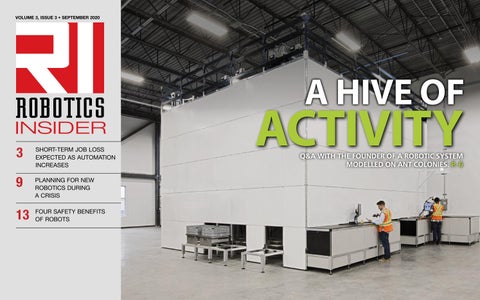
A HIVE OF
ACTIVITY Q&A WITH THE FOUNDER OF A ROBOTIC SYSTEM MODELLED ON ANT COLONIES. P. 6
CONTENTS Columns 3 Market watch
Short-term job loss expected as automation increases post–COVID-19
6 Spotlight
Scott Gravelle, Attabotics
Presented by Manufacturing AUTOMATION, Robotics Insider reports on the world of industrial robots and its developing opportunities, challenges and technologies. By sharing unique perspectives and information, we strive to help improve your manufacturing efficiency.
FEATURES 9 Innovating with
industrial robots
How to plan for and fund new technology during a crisis
Editor – Kristina Urquhart kurquhart@annexbusinessmedia.com
Group Publisher – Paul Grossinger pgrossinger@annexbusinessmedia.com Media Designer – Andrea M. Smith asmith@annexbusinessmedia.com Account Coordinator – Debbie Smith dsmith@annexbusinessmedia.com Circulation Manager – Urszula Grzyb ugrzyb@annexbusinessmedia.com Tel: 416-442-5600 ext. 3537 COO – Scott Jamieson sjamieson@annexbusinessmedia.com President & CEO – Mike Fredericks
2 September 2020 • Robotics Insider
Photos: (back) Festo, (foreground left) Omron, (foreground right) TM Robotics
Publisher – Klaus Pirker kpirker@annexbusinessmedia.com
13 Keeping workers safe
Four major safety-related benefits of robots
15 Industrial robot or cobot?
Your process and application will determine which robot is right for you
9
13
15
111 Gordon Baker Rd, Suite 400, Toronto, ON M2H 3R1 T: 416-442-5600 F: 416-442-2230
MARKET WATCH
By Kristina Urquhart
SHORT-TERM JOB LOSS EXPECTED AS AUTOMATION INCREASES POST–COVID-19
C
oming out of the COVID-19 crisis, Canada is poised to implement more automation, according to a recent study conducted at the University of Waterloo. Joel Blit, a professor in the economics department, highlights manufacturing and retail as the two sectors that will undergo transformational change in the post-COVID-19 economy in his report Automation and Reallocation: Will COVID-19 Usher in the Future of Work? Blit says this change will be brought on by the 2020 economic recession, which was declared in May by the C.D. Howe Institute. Using data from the Labour Force Survey, Blit correlates recessions over the last 30 years with an increase in automation and the permanent loss of what
he terms “routine” jobs. These are roles typically found in warehouses, production assembly and office support – contrary to “non-routine” positions in areas such as management or programming. Analyzing employment trends for routine and non-routine occupations, Blit finds that since 1987, non-routine jobs have increased in Canada, while routine jobs decreased – and the drop has not been a steady one. The routine jobs have all been lost during three recessions. “Those jobs never recover,” says Blit in an interview with Robotics Insider. “That’s consistent with the story that during recessions, firms are taking the opportunity to reorganize and re-examine their processes. Maybe they get rid of workers and then say if we automate, we
Manufacturing and retail will be more primed than ever for robotization and automation after the 2020 recession, because there’s extra incentive to automate this time around. 3 September 2020 • Robotics Insider
Photo: rozdemir01/Getty Images/iStockphoto
MARKET WATCH don’t have to call them back.” Also contributing to the job losses is a trend Blit calls “reallocation” of market share resources. “During recessions, there’s a lot of pressure on firms. The ones that are already more productive – which tend to be the ones that employ automation more strongly – tend to have lower costs, and so they survive,” he says. “The ones that are higher cost – that use more labour, less automation – very often will either see their revenues decrease or they’ll go bankrupt altogether. Then that market share is taken up by the bigger, more productive, more upgraded firms.”
The COVID-19 effect Manufacturing and retail will be more primed than ever for robotization and automation after the 2020 recession, because there’s extra incentive to automate this time around, Blit says. The health and safety precautions required to combat COVID-19 have made automation more attractive. With more robots on the floor, companies can reduce the number of human-to-human interactions, and increase physical distancing measures. “What all recessions have in common is that there’s less spending and firms have a harder time selling their products, so their revenues tend to decrease or stay flat. So they often need to cut costs or reinvent themselves,” Blit explains. With the COVID-induced recession, “It was 4 September 2020 • Robotics Insider
literally the government saying, ‘you need to shut down and you need to do it now.’ In that sense, it is different [than previous recessions]. But the outcome is not going to be different in the sense that now that we have reopened, we’re not going to recover all of those routine jobs.”
How many jobs? So far, Canada has only recouped about half of the 280,000 manufacturing jobs lost between March and April, according to the Labour Market Information Council – but production has been trending upwards, with Statistics Canada reporting a record 20.7 per cent jump in manufacturing sales in June, and a preliminary 8.7 per cent increase in growth in July. (The June levels are still 13.2 per cent below what they were in February, pre-pandemic.) “AI and robotics [are] going to change the nature of work, and a lot of people are going to be hurt by this,” he says. “It’s not just that people are going to lose their jobs, but that it’s going to generate inequality in the long run. The people who have skills that are complementary to the technologies are going to benefit tremendously – that’s already happened in the ICT [information and communications technology] revolution.” The income disparity between routine and non-routine positions intensified during the ICT revolution, which began in the 1970s. Computers replaced some workers who later landed in often
lesser-paid, service-oriented roles. On the other hand, computers made white-collar workers – who were already earning more than routine workers – more productive and able to demand more compensation. Going forward, “It won’t be as clear cut that high-skilled workers are going to have complementary skills or that most skilled workers are going to be replaced,” Blit says. “It’ll be a lot more nuanced, because we know that AI is going to replace a lot of work. But the key question is, what kinds of skills are complimentary to what an AI algorithm does or what a robot does, and what types of skills are going to be replaced by them? That’s how you know who’s going to benefit.” He estimates that ultimately, Canada could permanently lose 586,000 routine jobs across multiple sectors. To mitigate this, Blit suggests retraining and upskilling routine workers to reflect the changing nature of jobs. “Maybe they need a little bit of programming, maybe they need a little bit of operations management. A lot of these workers are going to become obsolete, so let’s help them retrain.” Despite the immediate and mid-term effects on the workforce, Blit advocates for more automation in the long run to spur the creation of more challenging roles, and to ultimately increase competitiveness both at home and on the global scale.
SPOTLIGHT
Scott Gravelle, CEO of Attabotics
Scott Gravelle
C
algary-based Attabotics is not just new to the logistics automation sector, but a pioneer in the space. The company’s “3D storage” solution flips the layout of a horizontal warehouse onto its side – akin in shape and style to an ant colony. Bins are stored in columns, and robotic shuttles on x, y and z axes move alongside to pick and transport the bins down to a workstation on the floor (see video on next page). We talked to the company’s CEO, Scott Gravelle, about his innovative, insectinspired solution.
What problem were you looking to solve? My background originally was in helping companies implement
6 September 2020 • Robotics Insider
digital manufacturing. I was working on a buffer system for the end of the manufacturing line and I needed to have robots move around some shelves. Most automated solutions, with a few exceptions, were a derivative of what I’ll [call] a human-centric environment. We walk on the ground, we drive on the ground. That’s why we need roads and aisles to access everything. I asked myself what would be ideal for a robot, not for a person. And I didn’t have any ideas, but I figured nature probably already had this problem figured out. I [found] a researcher that had poured molten aluminum down a leafcutter ant colony in the jungle, and then excavated it to see what the internal structure of that colony was. That was the a-ha moment. Ants, being one of the most successful natural systems on the planet, arrange all their storage around a vertical axis instead of horizontal – from the floor. That led to unique storage geometry and then the world’s first truly 3D
robotics shuttle. Knowing from manufacturing that automation is historically rigid and flexible, we decided to improve on every one of these things we could. So we ended up with an automation system that, if ants had a copyright lawyer I might be in trouble for. We also tried to create flexibility by having all of the routing and workflow defined by software and not any rigid linear infrastructure.
This technology is turning what a warehouse looks like on its head – literally. What’s been the response? Customers have been looking for a solution to the problem for a long time. They know the change in consumer behaviour, they know the adoption of e-commerce [is] coming, they know internally their own challenges trying to convert their supply chain infrastructure from distributing to stores to distributing direct to individuals. As they start planning and rethinking the future, we’ve been lucky enough to be included in a lot of
SPOTLIGHT providing direct access to any one of the storage bins. We don’t have to move anything to get to anything else. When you look at the solution, there is a horizontal grid across the very top, across the ceiling, and there’s a horizontal grid, at the very bottom, right by the floor. That grid is what allows us to See Attabotics’ system in motion in the video not only direct a robotic shuttle to the vertical column – to the above. tote that it needs next – but, when it gets to the bottom, those conversations. Talking to also allows us to direct that shuttle some of the leading thinkers in the anywhere on the perimeter to supply chain industry working for present that tote. some of the largest organizations, We are working with a number understanding how they’re of different partners to present approaching the problem, and then items for automated picking. We seeing how we can best apply that also have interfaces around the thinking to our technology has perimeter for a bunch of different been a massive benefit in trying kind of workflows – consolidation, to create a solution that actually bin-to-bin picks, induction. We solves problems. present those bins with the goods in How does the 3D storage system them in an optimized sequence for whatever work needs to be done. technology work? And that flexibility is what allows Because of its unique geometry, we us to create spatial efficiency and have the highest storage density of labour efficiency. any automation system while still 7 September 2020 • Robotics Insider
Each bin is not just a single item. It can be a unique combination of items that lead to throughput efficiencies in the solution. With our sorting algorithm and the flexibility in our route finding, we can optimize picking stations by form factor or product to create a higher level of efficiency and lower error rates.
now in just our very final stages of the dotting the i’s and crossing the t’s on the final commercialization stage – a huge accomplishment given that four years ago this was a CAD model and a PowerPoint presentation in a laptop. I couldn’t be any more proud of the supertalented people on our team and what they’ve accomplished.
Attabotics recently received $50 million in funding from the Ontario Teachers’ Pension Plan. How do you plan to use the money?
What do you want manufacturers to know about automated storage and retrieval?
Many companies are figuring out how to survive after COVID. Now, we are not at all concerned with those measures other than how quickly can we get the technology out there. We have not just the financial support, we also have such a depth of experience and connections with the Ontario Teachers’ Pension Plan, because of their history [investing in this space] and that is an invaluable asset to have. The support is so encouraging. We are excited to have worked through that initial process and
What the markets are experiencing today wasn’t something anyone could foresee. Changing customer behaviour has been more rapid than the evolution in a lot of cases. Any automation system that can deliver you a great deal of flexibility so your capital investment can stay relevant and contributing as long possible I think is really important. And that’s why we incorporated that into our technology. This interview has been condensed and edited.
FHA-C Mini Actuator with Integrated Servo Drive Harmonic Drive LLC 42 Dunham Ridge Beverly, MA 01915 800.921.3332 www.HarmonicDrive.net
The Servo Drive is inside!
This evolutionary product eliminates the need for an external servo drive! • Actuator + Integrated Servo Drive utilizing CANopen communication • 24VDC Nominal +7-28VDC Supply Voltage Range • Single Cable, only 4 conductors needed: CANH, CANL, +24VDC, 0VDC • Zero Backlash • Dual Absolute Encoders
• Panel Mount Connectors with 4 exit options • Output Sensing Encoder 14bit (16384 cpr) resolution • Input Sensing Encoder 15bit (32768 cpr) resolution • Control Modes Including Torque, Velocity, and Position Control, CSP, CSV, CST • Harmonic Drive HDL Software
Electromate 6221 Highway 7, Unit #15 Vaughan, Ontario, Canada L4H 0K8 (877) SERVO98 (737-8698) www.electromate.com Harmonic Drive®, Harmonic Planetary® and Quick Connect® are registered trademarks of Harmonic Drive LLC. Electromate is the exclusive Canadian distributor of Harmonic Drive® products (except the Province of Alberta).
Partners in Precision
SHOW REPORT
INNOVATING WITH
INDUSTRIAL ROBOTS How to plan for and fund new technology during a crisis By Kristina Urquhart
T
hroughout the COVID-19 crisis, Robotics Insider and Manufacturing AUTOMATION have heard from industry experts, association representatives and senior executives who say that the implementation of robotics and automation is going to ramp up much more rapidly than previously expected. Labour shortages, increased safety measures and supply and demand fluctuations
9 September 2020 • Robotics Insider
will force businesses to adopt new technologies as they try to stay competitive. But how can a small or mediumsized business invest in robotics and automation during the coronavirus era? To answer that, Manufacturing AUTOMATION and Canadian Plastics recently hosted the Automate to Innovate Virtual Summit. “Senior management has gone from simply reacting to this crisis [to] thinking
Photo: Festo
SHOW REPORT
longer-term,” said Shelley Fellows, chair of the Automate Canada association, in a panel discussion on the cost of automation. “They’re thinking recovery; they’re thinking investment into their operations where automation has a role.” The virtual event was all about the “how” of automation, with the first set of sessions exploring how to plan for and install it, and the second set focusing on how to pay for it. In total, there were four presentations and two panel discussions in the live event, plus an on-demand session. If you’re thinking about installing robotics at your facility, read on for some key takeaways from the event.
Assess your problem As you evaluate your application and consider which robot will be best suited for the job, the Automate to Innovate Virtual Summit panelists had some best practices. “My advice would always be – pre-COVID but maybe now even more in COVID times – just know the problem you’re trying to fix and 10 September 2020 • Robotics Insider
the objectives of your project,” said Blair de Verteuil, vice-president, operations, life sciences at ATS Automation. “Whether it’s costcentric – unit cost reduction, a reduction in changeover time – your competition is edging you out.” Rather than coming at the problem by trying to find automation that fits your current cost needs, figure out the appropriate solution first. Automation integrators and OEM suppliers are there to help manufacturers develop solutions, and often won’t charge for consultations, de Verteuil said. “They may even help you build a TCO model. And then you can start to seek your financing options. It’s really difficult to convince anyone – internal to the organization, lenders, grant decision
makers – to pony up cash unless you know what you’re solving and you have a really solid business case.”
maintainability, safety components, budget and lead time.
Six-axis robots Select your technology The event’s on-demand presentation, which you can view here, covered industrial robots. Kevin Tardif, business development specialist, electric automation at Festo Canada, walked through the features and applications for each type of industrial robot. “There’s no such thing as what is the best technology for robots,” he said. “There’s only the one that’s most suited [for the application].” When selecting a complete solution for your application, consider the cycle time, precision requirements, space constraints, flexibility, payload,
“It’s really difficult to convince anyone – internal to the organization, lenders, grant decision makers – to pony up cash unless you know what you’re solving and you have a really solid business case.”
Six-axis robots are the name for the long, extendable robotic arms that come to mind when you think “industrial robot.” Tardif said the main benefit to these workhorses is flexibility, as they allow for variations in movement, space and orientation, which makes them suitable for a wide variety of applications. Each of the six axes can rotate, so the arm can manoeuvre in many configurations. This makes these robots useful for pick and place, but also any application where a part needs to be moved. End effectors allow for greater flexibility, as the robot can be set to weld, deburr, grind, etc. But the bigger the payload, the bigger the six-axis robot, which means they can have a large footprint. They also require PLCs or robot controllers to program and operate.
Cartesian robots Cartesian robots, also called linear
SHOW REPORT
robots, typically move in x, y, z formation, sometimes with a fourth rotary axis. Tardif said Cartesian robots are optimized for the application they’re being used for – but because they are so specific to the application, it’s harder to repurpose Cartesian robots for another use. These robots can carry heavy payloads over short distances, and don’t require a specific controller to operate because the position of the x, y and z axes are the x, y and z values of the tooling’s coordinates.
motion controller for programming, Tardif said.
SCARA robots SCARA robots feature an articulated arm that moves in the x and y direction, but not in the z direction. They are extremely fast and an
economical option, Tardif explained. SCARA robots can handle larger payloads than a parallel robot – but, similar to a parallel robot, the position of their motors is not dictated by the axis, so they need specific motion controllers. With a relatively small footprint compared
Parallel robots Parallel robots feature manipulator arms mounted to a platform. They have four degrees of freedom and are used for small payloads up to two or three kilograms. Parallel robots have speed on their side, as they are the fastest available type of industrial robot, so they are frequently used in packaging and sorting applications to pick, reorient and place. Because calculating their position involves complicated mathematics, these robots usually need a specific 11 September 2019 • Robotics Insider
to a Cartesian or industrial robot, SCARA robots are often used in electronics manufacturing assembly.
Cobots Collaborative robots can be six-axis, Cartesian or SCARA – they’re not bound to mechanical technology, but they need to have safety mechanisms in place that allow for direct human interaction, Tardif said. This makes them slower both in speed and cycle time than other industrial robots. The cobot may also require additional safety components depending on the type of end-of-arm tooling used (see more on p. 15).
Develop a funding plan
For more insights from the Automate to Innovate Virtual Summit, visit automationmag.com/virtual-events/manufacturing-efficiency-emergingfrom-covid-19/ to register and watch the recordings for free.
Once you know your problem and technology, the funding route becomes clearer, said Bernadeen McLeod, president of Mentor Works, who gave a 20-minute presentation during the virtual summit on how to select and leverage federal government funding. She emphasized that knowing your business challenges will help you divvy up
SHOW REPORT
the funding opportunities into manageable pools. “Identify your project. Is it assessment and analysis money that you need, is it training money that you need? Is it consulting and implementation and execution money?” she asked. “Once you identify where you want to work with a vendor, then the program from the government is so much easier to identify.”
Set up a phased approach Shelley Fellows of Automate Canada recommended a digital simulation as a cost-effective way to test and determine whether a robotics or automation application will work before making a major investment. She said automation companies with good controls teams can conduct virtual representations to show how concepts work, “so the customer has a really strong sense of what capabilities the equipment is going to attain before one single piece of wire is purchased or one single robot is placed on the floor.” 12 September 2019 • Robotics Insider
Expand with data Once you have a plan, think about how you can use data alongside your robotics to gain insight into your operation, which will help you achieve the perennial goals of reducing cost and waste, said Asghar Rizvi, director of automation and motion for Siemens Canada. Artificial intelligence and machine learning are big terms that can feel intangible, but ultimately, they are tools that, when used correctly, help drive a profit. “As more data is available, as computing capabilities increase, it’s really going to open up the way that we work with automation, and not just use automation to replace the work that we do,” said Michelle Chrétien, director of the Centre for Advanced Manufacturing and Design Technologies at Sheridan College. The challenging part for SMEs, however, may be bringing legacy systems into the Industry 4.0 era. Some machines may only require an IoT-enabled sensor, but for others, connectivity may be more
complicated. “There isn’t one solution to rule them all, and right now what predominates is bit of a piecemeal approach in terms of patching together things,” Chrétien said. “That’s an incredibly timeconsuming operation, which basically puts it out of the realm of possibility for many SME manufacturers who just don’t have the time or the staff or perhaps even the expertise to approach that.”
Consider your customer Embracing change is crucial to satisfying the customer – and amid all of the planning for automation, the panelists stressed to never lose sight of that. “Manufacturers are [now] working in an environment where production runs are high mix and low volume,” said Michael Phillips, pre-sales engineer at Universal Robots, citing the move to online shopping as a major factor for the shift. “Manufacturing lines themselves have to become a little bit more agile and able to respond to information
that they pull down from higherlevel systems,” he said. “This in turn means they’re much more flexible. They can execute any of the product lines that the customer may want.” David Jeffrey of Salesforce said the effect of the COVID-19 crisis on the supply chain has highlighted the increasing expectations of businessto-business customers when it comes to price, value, service and other measures of competitiveness. “Now’s not the time to create a worse customer experience,” he said. “So, if your supply chain and technologies don’t support the customer expectations, especially now when those are so critical, you’re really exposing yourself.” Ultimately, be mindful of how all your current and future robotic processes will eventually integrate. “We need to understand how to make our customers’ lives easier,” said Rizvi. “This pandemic will pass, but it will change how our executives will review their readiness for realtime events. Real-time data will play a very important role.”
SAFETY
KEEPING
WORKERS SAFE Four major safety-related benefits of robots
Photo: Omron
By Todd Mason-Darnell
M
anufacturing facilities employ a variety of hazardous machines, and safeguarding is paramount. While traditional safety strategies are designed to mitigate risk in hazardous situations, it’s possible to eliminate this risk altogether by letting robots cover the dangerous tasks. Let’s take a
13 September 2020 • Robotics Insider
look at a few ways that robots make manufacturing safer overall.
1. They minimize workers’ exposure to hazardous motion. The most obvious and commonly cited safety benefit of robots in the workplace is the opportunity to reduce workers’ exposure to mechanical hazards that pose a
significant risk of injury or death. For example, instead of having workers expose their limbs to the hazards of moving sheet metal in and out of a 300-ton stamping press, a robot can assume that risk. The usual method of dealing with these risks is to install functional safety components, such as light curtains, safety controllers and the
like. By changing the operation to a “no touch” environment, you can dramatically improve your workers’ safety by reducing their exposure to dangerous equipment.
2. They keep workers safe from general environmental hazards. Beyond these more obvious and dramatic situations where there’s
SAFETY
Loud and excessive noise, high levels of dust, extreme temperatures and chemical exposure all represent insidious and persistent risks to workers.
Photo: Omron
a point-specific risk, robots can improve safety when dealing with the more general environmental risk factors in a facility. For example, loud and excessive noise, high levels of dust, extreme temperatures and chemical exposure all represent insidious and persistent risks to workers. Most of these risks can be moderated by the proper use of PPE and administrative controls. 14 September 2020 • Robotics Insider
However, as any safety manager can tell you, these methods aren’t very effective, and they also require constant monitoring. Replacing operators in these environments allows companies to reduce or maybe even eliminate workers’ long-term exposure. There’s also the added benefit of allowing safety managers to focus on other value-added activities rather than spending their days checking to see if workers have their earplugs and safety glasses on.
3. They reduce the risk of repetitive motion injuries. Related to the general environmental
risks, there’s an increased awareness of the risks posed to workers from ergonomic issues, especially those involving repetitive motion. Simple, repetitive tasks common to pick-andplace operations or minor assembly applications, such as installing screws, are the breeding ground for carpal tunnel or other repetitive motion injuries. Companies often try to manage these risks via production quota limitations, task rotation or required worker exercises (such as stretching). Fortunately, robots are ideally suited for these types of tasks, and typically a basic SCARA robot can take over the pick-and-place or assembly operations with the greatest ergonomic risks.
4. They contribute to a greater awareness of safety in a facility. Finally, there’s a renewed focus of creating a higher level of safety culture in the facility. A key element in having an effective safety culture in any plant is the general situational awareness of its employees.
Unfortunately, many workers are engaged in repetitive tasks that breed compliancy and inattentiveness. Workers’ minds can wander if their task is installing the same four bolts on an assembly line for an entire shift. If they become disengaged with their surroundings and then the unexpected happens, they’ll be less likely to notice impending hazards and slower to react to them. That general inattention may be the difference between a near miss and an injury. Having a robot install those same four bolts for eight hours lets workers perform less monotonous and more engaging activities, which in turn increases their situational awareness and the general safety culture of the plant. This article was reprinted with permission. Dr. Todd Mason-Darnell is market manager of the Americas, safety products and services for Omron Automation.
TECHNOLOGY
INDUSTRIAL ROBOT OR COBOT? Your process and application will determine which robot is right for you By Nigel Smith
O
Photo: TM Robotics
15 September 2020 • Robotics Insider
n robotic automation in general, Jay Baron, CEO of the Centre for Automotive Research says, “Without this automation, our factories would have been obsolete a long time ago. Automation is necessary for safety, quality and productivity.” This reflects the strong pressure that companies face to implement technology in order to keep up with, or exceed, the competition. As more companies are turning to robotic automation to get ahead, now is the time to take stock, assess the application and make informed business decisions. Automating manufacturing processes is a complex issue without a one-sizefits-all solution. Some processes call for cobots, a breed of robots designed to share a workspace with human workers, but some really are more suited to traditional industrial robots. The global collaborative robot (cobot) market is projected to grow from $175,500 million in
TECHNOLOGY 2016, to $3,811.483 million by 2021. Here’s why manufacturers really need to understand the facts before they jump on the cobot bandwagon, as this investment may not be as low-risk as it first appears.
Cobots The term cobot has been coined to represent an unguarded, easy-to-integrate collection of robots that typically carry out repetitive or unsafe tasks while the human workforce performs higher-value manual tasks up or downstream. They are flexible, able to carry out a variety of different tasks and work alongside humans rather than replacing them. Cobots present a viable automation solution for small and medium-sized businesses as they often have fewer up-front costs, at least at first glance. The robotics industry does not acknowledge cobots as a separate entity, but instead defines industrial safety standards for when humans work collaboratively with robots on the same production floor. This is an important distinction, as new robotics implementers may assume that any cobot is automatically safe for use next to humans, when, in fact, this can only be determined by thorough risk assessment. Some plant managers may be also surprised to discover that they need expensive fencing if risk wasn’t appropriately forecasted initially. As a result of risk assessment findings, 16 September 2020 • Robotics Insider
New robotics implementers may assume that any cobot is automatically safe for use next to humans, when, in fact, this can only be determined by thorough risk assessment. added safety features can result in very low operating speeds or multiple stops for a cobot.
Industrial robots Industrial robots are automatically controlled, are programmable in three or more axes and can automate a broad range of processes unattended. Multiple industrial robots can be integrated for a fully automated production line, meaning they can handle applications that are not conducive to humans at speed, removing operators from unsafe or unclean environments. Improvements in safety technology are now allowing industrial robots to be used in collaborative operations, providing many of the same benefits that a cobot brings, along with increased speed and accuracy. Of course, this collaboration can only be implemented after the appropriate risk assessment – but that is no different than when choosing a cobot. Almost any
robot is capable of collaborative operation with the appropriate safety mechanisms in place.
Defining collaboration It’s really the application that defines the ability for human and machine to collaborate. In February 2016, the technical standard ISO/TS 15066 was published to provide safety guidelines for the use of robots in collaborative applications, including force guidelines, maximum allowable robot power and speed, without discriminating against a certain type of robot. The huge growth in the cobot market represents the view that cobots can be an ideal first step towards automated processes. If the application doesn’t require safety guarding, then the initial investment is low. However, as applications evolve, multiple cobots may soon be required for scalability, the cost of the additional equipment and additional human workforce will soon exceed the cost of an industrial robot, and you will still lack speed and the benefit of unattended production. Business owners must assess the application and the needs of their business’ future carefully before making their decision and consider one important question – is a cobot actually right for you? Nigel Smith is CEO of TM Robotics, a robotics company in partnership with Toshiba Machine.
DON’T MISS OUT ON YOUR NEXT ISSUE OF IT’S FAST, IT’S EASY AND IT’S FREE!
HERE’S HOW: For fastest service visit AutomationMag.com AND CLICK THE SUBSCRIPTION BUTTON
AutomationMag.com