VOLUME 3, ISSUE 2 • JUNE 2020
RI
ROBOTICS INSIDER 6
Q&A WITH IRCO AUTOMATION
RESOURCE GUIDE ON 14 NEW AUTOMATION EDUCATION
VISION? 15 ADDING CONSIDER THESE CAMERA CAPABILITIES
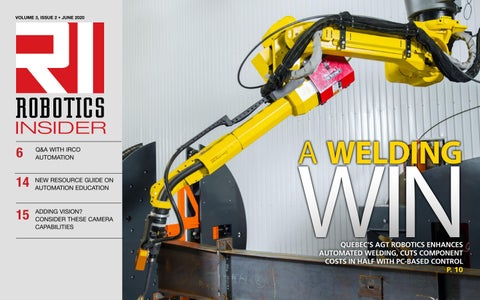
A WELDING
WIN QUEBEC’S AGT ROBOTICS ENHANCES AUTOMATED WELDING, CUTS COMPONENT COSTS IN HALF WITH PC-BASED CONTROL P. 10
CONTENTS Columns 3 Market watch
Robots play important role during COVID-19
6 Spotlight
Presented by Manufacturing AUTOMATION, Robotics Insider reports on the world of industrial robots and its developing opportunities, challenges and technologies. By sharing unique perspectives and information, we strive to help improve your manufacturing efficiency.
Hubert Bethlehem, IRCO Automation
FEATURES 10 Complete control
Quebec’s AGT Robotics enhances automated welding, cuts component costs in half with PC-based control
Editor - Kristina Urquhart kurquhart@annexbusinessmedia.com
14 Ready for robotics?
Publisher - Klaus Pirker kpirker@annexbusinessmedia.com
New resource guide shares career and education pathways in automation
Vice-President & Executive Publisher Tim Dimopoulos tdimopoulos@annexbusinessmedia.com
15 Eyeing up robot cameras
Media Designer - Mark Ryan mryan@annexbusinessmedia.com
10
Account Coordinator - Debbie Smith dsmith@annexbusinessmedia.com
When it’s time to add robot vision, consider the camera’s capabilities
Audience Development Manager Urszula Grzyb ugrzyb@annexbusinessmedia.com Tel: 416-442-5600 ext. 3537 COO - Scott Jamieson sjamieson@annexbusinessmedia.com President & CEO – Mike Fredericks 2 June 2020 • Robotics Insider
3
14
111 Gordon Baker Rd, Suite 400, Toronto, ON M2H 3R1 T: 416-442-5600 F: 416-442-2230
MARKET WATCH
By Kristina Urquhart
ROBOTS PLAY IMPORTANT ROLE DURING COVID-19
A
s Canada slowly lifts restrictions put in place to stop the spread of COVID-19 and more people head back to work, things are looking quite different than they were a few months ago. First off, there are fewer workers on factory floors, as companies have introduced staggered shifts and physical distancing measures. Then there are the new safety barriers, such as Plexiglass dividers and increased personal protective equipment – all rigorous, even for an industry that already placed worker safety at the forefront before the pandemic. It will be a considerable amount of time before manufacturers are able to ramp up to normal volumes again, but automation can fill in some of the gaps when it comes to staffing and production efficiency challenges. And, as we’ve seen throughout the pandemic, robots can also help to solve problems created by the crisis.
Slowing the spread of COVID-19 has highlighted the importance of robotic systems, according to a recent report called “How Robots and Automation are Fighting COVID-19” by the Association for Advancing Automation (A3).
It will be a considerable amount of time before manufacturers are able to ramp up to normal volumes again, but automation can fill in some of the gaps when it comes to staffing and production efficiency challenges. 3 June 2020 • Robotics Insider
“These critical automation technologies are keeping people safe, helping develop new medicines and treatments, producing key products people need today, and filling other essential roles,” says Jeff Burnstein, president of A3, in a release. “We are proud to see our members in action helping people all over the world cope with this global pandemic.” Let’s take a look at what’s been happening around the world, courtesy of A3. Photo: Ca-ssis, E+, iStock / Getty Images Plus
MARKET WATCH Robots manufacturing supplies As the need for more essential equipment arises, manufacturing lines are being re-tooled across the globe. Many suppliers and integrators have responded by ensuring faster turnaround times, like Quebec-based Robotiq, who is offering to deploy collaborative robot cells and software in under two weeks. The goal is to increase capacity to businesses that have been identified as essential by the government. PIA Automation, an international group of companies offering automation solutions, purchased two abandoned production lines from a Chinese medical device manufacturer in order to develop them into fully automated lines for the production of surgical face masks. A team of 24 specialists are now working around the clock to complete the modification within the next two to three weeks. With a production volume of up to 200,000 masks per day, the two modernized facilities will help to massively improve the urgently needed medical care, especially locally in China’s Zhejiang province. At the end of March, JR Automation partnered with General Motors to deploy a medical mask assembly line in just six days. GM needed the equipment running in less than a week, and JR Automation solved the complex task to build an entire assembly line capable of producing 50,000 masks a day. 4 June 2020 • Robotics Insider
3M, which produces N95 respirators, is activating more production lines to support public health across its global manufacturing facilities, and has donated personal protective equipment and medical supplies. Just as the need is high for personal protective equipment (PPE) for medical facilities, so is the need for protective equipment for civilians as the virus continues to spread. In Spain, Somtech Technologies has switched production from automotive, rail and packing to producing visors. These visors are available to shield the general public when they must venture out of their homes. To keep up with requirements, production technology was shifted from 3D printing to injection moulding to meet the ever-increasing demand of the newly developed visors. This change to an injection moulding process was only possible by installing an automated removal system with a suitable gripper to be attached to the robot. PIAB USA, Inc. was able to match the request with an immediate delivery and part switch, allowing the production of 56,000 visors a week. Robots detecting symptoms CloudMinds, a provider of cloud-based systems for robots, donated 12 sets of robots to a smart hospital in Wuhan, China. The robots performed a variety of essential tasks, including flagging patients at the entrance to the field hospital who displayed
fever symptoms, monitoring heart rates and blood oxygen levels and delivering medication. These robots also cleaned and disinfected hospital areas and led exercise routines for sick patients. Medical workers remotely directed and controlled the robot systems over a 5G network. Thermal cameras are being used in tandem with robots as part of this human body temperature scanning process. Not only are they being deployed at hospitals, but these systems are also being used at airports and other public places. Airports in particular are actively employing FLIR thermal cameras as part of their screening measures for passengers and flight crews, according to a story posted on their website. They work as a tool to identify elevated body temperature, which can indicate further screening is necessary. In the United States, Roche Molecular Solutions is using ABB robots to rapidly produce COVID-19 tests newly approved by the U.S. Food and Drug Administration. Now, instead of days, doctors and patients will receive results in three hours. The emergency authorization is allowing these tests to be manufactured at a rate of 400,000 a day, equivalent to about 1.5 million tests a month. “As the coronavirus cases continue to spike, healthcare workers will need access to more and more tests, and we can all be thankful automation is helping to solve the shortage problem,” says A3’s president Jeff Burnstein.
FHA-C Mini Actuator with Integrated Servo Drive Harmonic Drive LLC 42 Dunham Ridge Beverly, MA 01915 800.921.3332 www.HarmonicDrive.net
The Servo Drive is in the Actuator!
This evolutionary product eliminates the need for an external servo drive! • Actuator + Integrated Servo Drive utilizing CANopen communication • 24VDC Nominal +7-28VDC Supply Voltage Range • Single Cable, only 4 wires needed: CANH, CANL, +24VDC, 0VDC • Zero Backlash • Dual Absolute Encoders
• Panel Mount Connectors with 4 exit options • Output Sensing Encoder 14bit (16384 cpr) resolution • Input Sensing Encoder 15bit (32768 cpr) resolution • Control Modes Including Torque, Velocity, and Position Control, CSP, CSV, CST • Harmonic Drive HDL Software
Electromate 6221 Highway 7, Unit #15 Vaughan, Ontario, Canada L4H 0K8 (877) SERVO98 (737-8698) www.electromate.com Harmonic Drive®, Harmonic Planetary® and Quick Connect® are registered trademarks of Harmonic Drive LLC. Electromate is the exclusive Canadian distributor of Harmonic Drive® products (except the Province of Alberta).
Partners in Precision
SPOTLIGHT
Hubert Bethlehem, president of IRCO Automation
B
urlington, Ontario’s IRCO Automation designs, engineers and builds automated welding systems for heavy industry. Over the nearly 60 years the company has been in business, it’s moved from integrating traditional hand welding to major robotic welding equipment. We talked to IRCO’s president about these big builds, how humans work with welding automation and the importance of bringing major projects back to Canada.
Working in heavy industry, where is your client base?
Hubert Bethlehem
6 June 2020 • Robotics Insider
We have a very diverse range of customers that we work with. Some are medium to small, but they’re mostly Fortune 1000 companies. We will move our focus depending on where the wave is. There’s billions of dollars worth of shipbuilding going on in Canada right now. Very few people really know about that. [Or] offshore oil rigs – we’ll go to the Gulf of Mexico and spend time in Corpus Christi, or around there, depending on the nature of those projects. We migrate to where welding is difficult, it’s heavy, it’s complicated.
We don’t have a lot of little cookiecutter things here. Most of the systems that we provide – and that’s why we’re very specialized here in North America – you wouldn’t want to import due to the size and the scope that we build.
You’re going on site to build those systems? It’s all modular built. We have a 33,000-square-foot facility, so we completely manufacture and assemble the systems, or if it’s a line or multiple cells, we build complete parts of it. Some of our systems can use up that entire space. So we’re shipping an entire system, typically they are like Lego blocks – one piece will tie into another piece and then together they create a full line. We do all of the off-site assembling, installation and orientation and training for the customers. The work onsite is just as important as the work done here in our facility.
How does your work for SMEs differ from those bigger jobs? We work with them on their automated needs. It could be a custom fabricating shop, but their
desire and their ability to fund automation might be different than a Fortune 1000. Today, there’s nothing that can’t be automated. Welding automation is only a subset of automation. I would dare say that an SME that is in the welding industry that hasn’t got some type of automation probably won’t be in business much longer. If you think about somebody that has a big piece of metal and they need to assemble it and weld it – they need an overhead crane, they need a forklift, they need to put it into the proper position so they can deploy the right welding process. They have similar constraints as a large company – you still want to optimize the welding process, you still want to put the part where it’s ergonomic, you still have safety [to consider]. Most companies have already moved to some type of automation to assist them in that area.
With these large-scale installations, what do manufacturers need to be aware of in terms of safety? What could potentially cause harm? At the beginning of a project, together we identify the risks and
SPOTLIGHT then build safeguards into the design. Automation can be scary, if you look at the health and safety associated with the robotic arm. It requires guarding. And it requires guarding because a servo motor is always hunting for its next signal. A servo motor can move on its own – meaning, I didn’t tell it to move there, a program did. So if there is a programming glitch, now you’ve got this robotic arm that has a swing radius of 13 feet and it could be very harmful. We want to help our customers make their processes as safe as possible. It really starts with our customer. What are they trying to achieve? What is their core product that they’re manufacturing? And then it’s about training. Training is an investment; it’s not an expense. We all have to come to the table and realize that if you actually plan out the safest way, it’s the most cost-effective way as well.
Does IRCO work with specific vendors for the robots? We aim to do what our customer’s brand preferences are and what’s right for the application. If we showed up in a location that was using all Lincoln, as an example, and the customer said they really want to stay within this welding platform, we would. It’s similar for robotic arms – we would make a recommendation to our customer based on what we know about the technology they want to look at. There are three aspects to any project – there’s 7 June 2020 • Robotics Insider
one, the technology that we integrate, two, the equipment we make, and three, the people. For it to be a successful project, all three have to be in a line. If we built the best equipment possible for the budget for the application, but we didn’t integrate the right technology, it wouldn’t be a successful project. Conversely, if the end user did not supply us with staff that either wanted to adapt or is capable of adapting to the automation, it wouldn’t be a successful project either.
When you’re out at these big sites, what are some of the barriers to implementation of the automation? How does your team work to overcome them? Whether a small or big [company], it’s going to come back to the customer’s view on ROI. First of all, do they have enough qualified welders? Or do they just need to increase their throughput? Our goal is to address their different concerns. If somebody just wanted to increase throughput […] it’s not just welding automation – it’s automation of moving the part into a cell, into position, and then out of a cell. The solution may be building multiple automated systems. Those are things that can reduce cycle time and increase throughput. But if they need to automate the process due to lack of qualified welders in North America, we could take [any worker and make them] operators of these systems. You don’t actually need a welder anymore. You press a button and
walk away. That is the heart of automation. When most people think “robot,” that’s what they think, but it doesn’t have to have a robotic arm on it to be an automated system.
Those two issues are always in tandem – there are not enough people to fill those welder jobs. And then there’s the fact that people are upset that automation is taking away jobs. Nobody should be afraid of automation. Robots and AI [are] not taking their job, they’re making their job easier. It’s reducing the risk. Some solutions increase productivity, or they provide greater repeatability – which ties into that comment about making the person’s job easier – or they take some of the mundane tasks or the ones that maybe are not safe. Every time you’re flipping a piece of metal with a crane, you’re putting somebody at risk. Every time you’re doing a coordinated lift with a crane or forklift, you technically are putting somebody at risk. It’s [about] reducing those safety hazards and improving the quality of the weld. And then ultimately reducing the cycle time. Those are the things that we’re trying to solve with welding automation.
Where does where does the human welder fit in then in your view? We call it crawl, walk, run. “Crawl” would typically be a welder [with] some of the
SPOTLIGHT
mechanical motion happening. But [they’re] telling the machine what to do. Then we’ve got “walk,” where we have some of that repeatable motion built in. So that’s typically what we’re doing with a human interface, like a touchscreen, where the operator wants to move the part into a certain position. The operator would literally select that command and walk away to a safe distance, and the part would move into that pre-determined position. So now an automated welding process could be deployed, or the welder could gain entrance into that work zone and actually complete the manual welding. “Run” is press a button and walk away. So it’s fully automated, it just requires the human – that could be a welder, or it could be an operator, to actually select the command, and then literally go and multitask or go do something else. We have systems that can weld for 12 to 14 hours unmanned. It’s pretty amazing what can be done.
What new technologies in welding automation have you seen over the past couple of years? What do you see becoming big trends going forward? I don’t think we should take for granted how far AI has come, and how that can change our daily path. The technology is more accessible than it’s ever been before. The single biggest change to draw our attention to is Industry 4.0. So is the 8 June 2020 • Robotics Insider
did [the operator] who was running it perform on yesterday’s shift? IRCOpulse provides all the analytics that you want to have.
What is your focus for long-term sales growth in Canada?
ability for all components of a system or process being able to communicate. A machine can report data back to you and tell you the performance of the shift or its efficiency. It could also tell you when it needs new repairs or scheduled maintenance. We developed a system called IRCOpulse, which is our answer to Industry 4.0. If you wanted to know the performance of a particular machine, you literally can get that information – what is its run rate today? How is it performing, how
I’m passionate about seeing heavy industry coming back to Canada. We’re at an exciting time right now with reshoring initiatives. There’s no reason why [production] can’t be happening here in Canada. There’s no doubt that building a refinery in northern Alberta may be challenged going forward until [the oil industry gets] figured out. We don’t have any offshore wind farms targeted yet – but when that starts to happen, there’s going to be great opportunities for Canadian manufacturers to engage in those projects. Our focus right now is infrastructure and infrastructure renewal – there’s a huge opportunity for Canada to start weighing in on that. Particularly for us, it’s how can we help people automate that? We have a lot of technology and innovation right here in our country. And we’ve got to take some of that back. There’s nothing stopping us from shipping a turnkey system across the Atlantic. We just haven’t necessarily gone that way. Canada has a great opportunity to look outside the industries people normally associate Canada with today – there’s more going on.
Need reliable and high speed I/O data over long distances?
Interconnectivity for pneumatics and electric automation The new I/O system in IP65/IP67 enables powerful I/O modules and existing valve manifolds to be directly integrated to a fieldbus. • • • •
Up to 500 I/O modules including IO-Link masters 50 m cables between modules Simplified integration using L5X export/import on Rockwell systems Ability to create power zones
Learn more about the CPX-AP-I
festo.ca
COVER STORY
COMPLETE CONTROL Quebec’s AGT Robotics enhances automated welding, cuts component costs in half with PC-based control By James Figy
A
mong all industries, construction uses the majority of steel produced globally. Beams for buildings
10 June 2020 • Robotics Insider
require reliable, high-precision welding to ensure structural integrity and public safety. McCombs Steel Company, Inc.
in Statesville, North Carolina, fabricates and erects structural steel and miscellaneous metals. As such, the company faces the challenges
of maintaining high quality, implementing lean manufacturing and meeting project timelines every day. One technology, the BeamMaster robotic welding system from AGT Robotics, has helped McCombs meet these challenges. “The lack of experienced personnel in the steel industry previously led to overworking our existing staff, which is unacceptable,” says Mac McCombs, president of McCombs Steel. “The BeamMaster, which is nicknamed Bruce, has increased safety, quality and throughput in production.” Based in Trois-Rivières, Quebec, AGT Robotics was founded in 1992 as a general automation integrator, but now specializes almost exclusively in robotic welding. The BeamMaster system, first released in 2015, uses AGT’s Cortex software with built-in artificial intelligence (AI) and a proprietary simulation engine to optimize weld schedules. Relying on PC-based control technology, the system is modular and scalable to allow many
COVER STORY mechanical configurations for end users. However, the standard version comprises two or more servo-driven beam rotators, a FANUC Arc Mate 120iC articulated robot that moves parallel to the beam along a track and an operator station with a multitouch control panel. The circular rotators can handle beams from four to 48 inches wide and up to 90 feet long with a maximum weight of 10,000 pounds. The rotators can turn 360 degrees to expose all surfaces on W beams and HSS closed rectangular columns to increase welding efficiency. While similar robotic welding systems have become widely adopted for automotive applications, very few are designed for structural steel. AGT Robotics recognized this untapped market as a significant opportunity, but one with unique challenges, according to Louis Dicaire, general manager and co-owner at AGT. “The automotive business produces a few parts maybe 100,000 times, so just a few robots repeat the same tasks for years,” he says. “In structural steel, even though parts are similar, the 11 June 2020 • Robotics Insider
beams have different widths, lengths, sections and accessories in an infinite number of combinations. That has slowed implementation of robotics in this industry.”
Through its inherent flexibility, the BeamMaster – distributed as the Ocean Challenger by Ocean Machinery in the U.S. – offers a solution.
Flexibility for automated welding Design of the BeamMaster presented unique challenges. Robotics can offset a shortage of qualified welders, but constant programming of custom
COVER STORY parts often requires additional controls engineers, which are also difficult to find in today’s market. To avoid this, AGT wanted to produce a system that would automate not only the welding, but also the programming for McCombs and other fabrication shops. “McCombs uses our machine 24/7, automatically welding most of their beams,” explains François Béland, automation and robotics specialist at AGT. “The structural steel industry relies on the Tekla CAD software, so we built a plug-in that exports 3D beam models from Tekla into Cortex.” Without requiring a single robotic technician to fine-tune or add to the program, Cortex automatically generates movements. The system offers a complete weld schedule for structural steel. “All joint types are covered, whether multi-pass or single-pass, a quarter-inch weld or a half-inch weld. The sequencing and flipping of the beam are automatic as well,” Dicaire says. “So not only is the operation automated, but the automation 12 June 2020 • Robotics Insider
programming is also automated: You could say that it’s automation squared.” Transferring these software capabilities to a real-time machine control environment, however, required a similarly flexible automation platform. Hardware and software modularity was important to ensure that BeamMaster systems could be scaled up or down easily as required in the future; end users might want to add rotators or even a second robot to increase throughput. In addition, the platform needed to provide robust remote support capabilities for troubleshooting and updates, since the system is designed for end users around the world with limited engineering resources.
EtherCAT communications While searching for an EtherCAT industrial Ethernet system master controller in 2015, the AGT engineering team chose PC-based control technologies from Beckhoff Automation. They began working closely with Ted Sarazin, regional sales manager for Beckhoff, to
COVER STORY standardize the BeamMaster design. “The openness of the Beckhoff platform, from the company that invented EtherCAT and TwinCAT automation software, was key for AGT,” Sarazin says. While BeamMaster systems can be quite large, AGT sought compact controller and I/O options to ensure small control cabinet footprints while remaining cost-competitive. “[EtherCAT] is deterministic and does not require IP addresses for each device. As such, it speeds up commissioning through automatic configuration of devices on the network and offers reliable, realtime communication,” says Béland. The BeamMaster uses space-saving eight- and 16-channel EtherCAT I/O terminals, EtherNet/IP bus couplers to interface with FANUC robot controllers and TwinSAFE terminals for integrated functional safety. The robotic welding system includes several safety zones with light curtains, ensuring that operators approach the beam to perform quality inspection only when the robot is not active in that specific 13 June 2020 • Robotics Insider
zone. The light curtains connect to TwinSAFE terminals using the TÜVcertified Safety over EtherCAT (FSoE) protocol to communicate safety data via a “black channel” method over the same EtherCAT network used for standard communication.
A platform for robotic welding TwinCAT 3 provides deterministic control from a software-based master for BeamMaster. Programming of all functions, from PLC and motion control to safety and HMI, is directly integrated into Microsoft Visual Studio. Engineers can select the language they know best or that makes the most sense for the project, whether it is IEC 611313 with object-oriented extensions, function blocks or computer science standards. “We can develop our own applications – using .NET, for instance – that will communicate directly with the PLC,” Béland says. All PLC code and auxiliary software runs on a CX5130 embedded PC from Beckhoff, connected to a multitouch control panel as the operator interface.
Hardware and software modularity was important to ensure that BeamMaster systems could be scaled up or down easily as required in the future. Beyond the robot equipped with a Lincoln Electric AutoDrive welding source, all other motion control takes place with Beckhoff’s servo drives and servo motors. These provide closed-loop control for accurate positioning of the beam.
Automatic results Programming of the first system took two months, but with easy code reuse, that is sped up to just half a day now. “Standardizing on Beckhoff also cut our component costs in half compared to previous solutions while providing more capabilities and options for customization,” Dicaire says. Before implementing the BeamMaster, McCombs Steel met with AGT and several customers, and carefully considered where it would fit in the shop’s three production
bays before it went live in September 2019. “We have experienced a safer work environment, higher-quality construction materials and increased throughput through round-the-clock welding,” says McCombs. The connectivity of PC-based control allows AGT to provide support and updates quickly. In addition, AGT includes an Android tablet with each BeamMaster so that customers can send images or video to the engineers in Canada assist in troubleshooting at facilities across the globe. McCombs has appreciated these capabilities and the partnership both companies have developed, and has since commissioned a second BeamMaster system. James Figy is the senior content specialist for Beckhoff Automation LLC.
EDUCATION
READY FOR ROBOTICS? New resource guide shares career and education pathways in automation By Kristina Urquhart
T
here’s a common public misperception that manufacturing jobs are dirty, repetitive and slow to change. Outdated images of factories and workers performing laborious jobs haven’t helped to dissuade public opinion. Those of you working in the industrial automation market know that’s just not the case – and, that with the increasing use of robotics, the public’s misperception is actually getting to be further and further from the truth. Robots are not “killing” jobs. They’re actually creating new categories of jobs – humans are needed to operate, maintain and secure these 14 June 2020 • Robotics Insider
machines. Humans are also needed to interpret and act upon data produced by machine learning and artificial intelligence. Overcoming those misperceptions must be a collective effort, and we need to start the messaging early, with students. So the staff at Robotics Insider and Manufacturing AUTOMATION recently produced a new digital magazine called Careers in Automation. This resource guide proves that manufacturing in the 21st century is a forwardfacing, technologically enabled industry that nimbly adapts to change. We’ve corralled common job descriptions, salary
estimates, school programs, market information, and profiles of young people currently working in the industry, including a robotics engineer at Avidbots. The inaugural edition of Careers in Automation contains information specifically about Ontario colleges and universities, as many of Canada’s automation programs are concentrated in the province. We plan to expand this information in future editions. Access the free Careers in Automation e-book here – and pass it on to anyone with an interest in robotics!
TECHNOLOGY
EYEING UP ROBOT CAMERAS When it’s time to add robot vision, consider the camera’s capabilities By Kristian Hulgard “I think we need robot vision” is a statement that can strike fear into the heart of even the most seasoned robotics specialists. This is because of a widespread perception that robot vision systems – comprising cameras, robots and supporting software – are complex, expensive, difficult to integrate and not entirely reliable. Thankfully, it doesn’t have to be that way. In fact, with the emergence of new technologies and falling costs, incorporating vision into your existing automation is now far more accessible; especially for collaborative robot (cobot) users. 15 June 2020 • Robotics Insider
Let’s look at the benefits of vision by comparing vision-enabled automation against “blind” systems. We’ll explore some of the different camera options available and the upsides and downsides of each category.
Benefits of vision Consider the complex set up that’s required for a traditional “blind” automation application to perform a simple pick-and-place task. The main challenge here is that objects have to be presented
TECHNOLOGY to your robots in exactly the same orientation and location every single time. This means installing costly fixtures and fittings and hardware such as bowl feeders, so that randomness is eliminated and your robots know precisely where the item to be picked is located. Robots can perform superbly without vision, but what if you need to pick and place different objects? What if you want your automation to be capable of handling several types of objects arriving in different orientations? And what if you require rapid changeover times when switching between products? In these scenarios, with flexibility and cost in mind, you should consider the benefits of adding robot vision – i.e., a camera and associated software – to your production lines. Vision eliminates the labour and capital costs associated with the addition of new hardware and fittings. Vision brings flexibility to your operations, enabling you to switch between different products easily. And vision dramatically reduces the time required to move between one product and another – a massive boon for busy manufacturers, especially in today’s demanding, customized-production environment. There are clear benefits to giving your cobot “eyes,” but not all vision solutions are the same. Variations in expense, flexibility, ease of use and software capabilities make a huge difference. So 16 June 2020 • Robotics Insider
let’s take a look at different camera types typically employed in automation scenarios.
Which D is for me? Robot cameras come in three main flavours: 2D, 3D and 2.5D. 2D cameras are the cheapest of the bunch, but are the least versatile. Typically, 2D cameras determine length and width (X and Y axis), but are unable to determine height, which limits the number of
that make many manufacturers reluctant to embrace the technology, despite the powerhouse capabilities. 2.5D cameras occupy a sweet spot between 2D and 3D cameras, both in terms of cost and capabilities. Capable of determining the height of objects, 2.5D cameras are ideal for scenarios in which objects differ in height and when items need to be stacked. Considerably less expensive than their 3D counterparts and considerably more
Not all vision solutions are the same. Variations in expense, flexibility, ease of use and software capabilities make a huge difference. applications they can support. On the plus side, they are reliable within these constraints. With some clever mathematics, the performance of 2D cameras can be improved – but that tends to be an inconvenient, time-consuming and somewhat unnecessary process, especially when more capable camera options are readily available. 3D cameras provide your robot with all the visual information it could possibly need, across all three axes and incorporating object rotation. This functionality comes at a price, however, since 3D cameras are the most expensive cameras and also tend to be difficult to integrate and operate. Furthermore, 3D cameras have reliability issues
capable than 2D cameras, 2.5D cameras (like OnRobot’s, pictured on previous page) are often an ideal fit for a wide range of applications – especially applications where 3D cameras would be expensive overkill. That said, not all 2.5D vision systems are the same. Some 2.5D systems are easier to set up and calibrate than others, some must be attached directly to your cobot, which restricts their capabilities, and some come with software that is, at best, clunky – so be sure to research. Kristian Hulgard is general manager, Americas at OnRobot. This article was reprinted with permission.
DON’T MISS OUT ON YOUR NEXT ISSUE OF IT’S FAST, IT’S EASY AND IT’S FREE!
HERE’S HOW: For fastest service visit AutomationMag.com AND CLICK THE SUBSCRIPTION BUTTON
AutomationMag.com