VOLUME 2, ISSUE 2 • SUMMER 2019
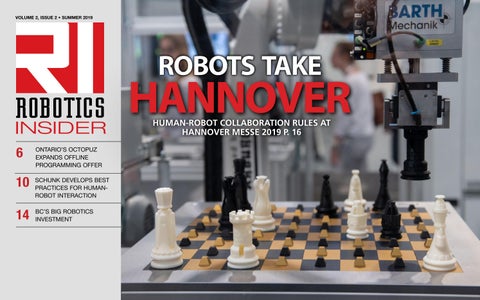
R I HANNOVER ROBOTS TAKE
ROBOTICS INSIDER 6
ONTARIO’S OCTOPUZ EXPANDS OFFLINE PROGRAMMING OFFER
DEVELOPS BEST 10 SCHUNK PRACTICES FOR HUMANROBOT INTERACTION BIG ROBOTICS 14 BC’S INVESTMENT
HUMAN-ROBOT COLLABORATION RULES AT HANNOVER MESSE 2019 P. 16
CONTENTS Columns 3 Market watch
North America increases automation on the road to the future factory
6 Spotlight
Rob House, OCTOPUZ
Presented by Manufacturing AUTOMATION, Robotics Insider reports on the world of industrial robots and its developing opportunities, challenges and technologies. By sharing unique perspectives and information, we strive to help improve your manufacturing efficiency.
FEATURES 10 Robots: The new team players
SCHUNK’s case study in human-robot collaboration aims for harmony on the production line
Editor - Kristina Urquhart kurquhart@annexbusinessmedia.com
14 Putting robots FIRST
B.C invests in FIRST Robotics BC and STEM skills training
Publisher - Klaus Pirker kpirker@annexbusinessmedia.com
16 Robots take Hannover
Vice-President & Executive Publisher Tim Dimopoulos tdimopoulos@annexbusinessmedia.com
Human-robot collaboration reigns at Hannover Messe 2019
Media Designer - Graham Jeffrey gjeffrey@annexbusinessmedia.com
Cover image © Deutsche Messe This page: IBG at Hannover Messe photo by Robotics Insider
Account Coordinator - Debbie Smith dsmith@annexbusinessmedia.com Circulation Manager - Urszula Grzyb ugrzyb@annexbusinessmedia.com Tel: 416-442-5600 ext. 3537 COO - Scott Jamieson sjamieson@annexbusinessmedia.com
2 June 2019 • Robotics Insider
10
14
111 Gordon Baker Rd, Suite 400, Toronto, ON M2H 3R1 T: 416-442-5600 F: 416-442-2230
MARKET WATCH
By Kristina Urquhart
NORTH AMERICA INCREASES AUTOMATION ON THE ROAD TO THE FUTURE FACTORY
O
ver in Europe, the future factory is quickly moving past a concept and into reality. Manufacturers are embracing large-scale automation, human-robot collaboration and connectivity to push Industry 4.0 forward. For example, at Hannover Messe 2019, sensor manufacturer SICK shared footage of the flexible manufacturing cells at its new Industry 4.0 factory in Germany, and Nokia showed its Factory in a Box service, which brings Industry 4.0 solutions (including robotics, additive manufacturing and virtual reality) directly to manufacturers to be brought online in a number of hours. What does the future factory look like on this side of the pond? Right now, North American manufacturers across all industries are establishing the foundation by steadily increasing their level of automation. In the U.S., robot density has hit 200 robots per 10,000 employees in 2017, outpacing China’s 97, according to a 2018 report by the International Federation of Robotics.
3 June 2019 • Robotics Insider
And a new report by the Robotic Industries Association (RIA), a U.S.-based trade group, reveals that robots were shipped in record numbers to North American companies in 2018. A total of 35,880 units were shipped, a seven per cent increase over 2017. Proof of the ripple effect: more nonautomotive manufacturers are installing robots than ever before, with numbers up 41 per cent. Orders from food and beverage and consumer goods manufacturers were up 48 per cent in 2018, with increases also recorded in plastics and rubber (37 per cent), life sciences (31 per cent) and electronics (22 per cent). In fact, automotive companies may have moved past the initial ramp-up phase – robot shipments to automotive manufacturers and tier supplier customers were down 12 per cent in 2018, to 19,178 units. The automotive orders represented only 53 per cent of total robot shipments in North America in 2018 – it’s lowest showing since 2010. “While the automotive industry has always
MARKET WATCH led the way in implementing robotics here in North America, we are quite pleased to see other industries continuing to realize the benefits of automation,” says Jeff Burnstein, president of the Association for Advancing Automation (A3), of which RIA is a member, in a release. “And as we’ve heard from our members and at shows such as Automate, these sales and shipments aren’t just to large, multinational companies anymore. Small and medium-sized companies are using robots to solve real-world challenges, which is helping them be more competitive on a global scale.” So North America has the automation, or is at least implementing more of it. What’s next on the road to the future factory? It all comes back to connectivity – for example, through sensors and other Internet of Things–enabled devices, network architectures and data transmission. In a recent report called “The Future of Automation: Key Enabler for the Vision of Future Factories,” research firm Frost & Sullivan has identified three trends facilitated by connectivity that are impacting automation. 1. Artificial intelligence (AI): AI is assisting traditional engineering models in becoming automated systems. It allows for continuous operational learning and potential productivity gains that go beyond what humans can do. 4 June 2019 • Robotics Insider
2. Edge computing: Computation at the local device can expand PLC functionalities with more computing power and personalized operational needs without impacting overall production architecture. Select data can be delivered to the cloud for further analysis, storage and access. 3. Augmented reality (AR): Frost & Sullivan sees AR as the HMI of the future, enabling operators with high transparency and insights into controllers, machines and production processes. It allows for remote collaboration between machine experts, plant manufacturers, service
technicians and maintenance personnel. “Innovation has played out, but fundamental designs have not witnessed a major overhaul,” says Karthik Sundaram, industrial IoT programme manager at Frost & Sullivan. “However, the automation of yesteryear is slowly becoming untenable for realizing future needs. This requires reimagining automation across all facets, starting from design, engineering, deployment and operation. “Envisioning the future of factories must first begin with a vision for the future of automation, an approach that has been relatively less explored in the industry today.”
GET MORE WITH FANUC’S COBOTS FANUC cobots are easy to use and offer more choices for speed, reach and payload than any other brand.
Discover
our line of collaborative robots and see how much more FANUC offers.
888-FANUC-87 www.fanuccanada.com © 2019 FANUC America Corporation. All Rights Reserved
For additional information or to request an automation audit visit
fanucamerica.com/cobots
SPOTLIGHT
Rob House, co-chief executive officer of OCTOPUZ
W
he chat to Rob House, co-chief executive officer of OCTOPUZ (along with Jon House), a Waterloo, Ontario–based developer of offline programming and simulation software for robots.
OCTOPUZ launched in 2013. What gaps in the market led to the decision? OCTOPUZ actually started inside of a company called In-House Solutions, which provides in-house services and software for the CNC machining industry here in Canada. In-House decided to get into the robotics market as well, and that’s when OCTOPUZ started – as a 6 June 2019 • Robotics Insider
division of In-House Solutions, and then we quickly expanded and moved out into our own company. Now we focus solely on offline programming and simulation software for the robotics industry. At In-House Solutions – even going back 30 years ago or so to when it was founded – we’d noticed a trend where there were a lot of CNC machines in the market being programmed manually. Fastforward 30 years, and now it’s very difficult to find CNC machines in the industry that aren’t programmed by some sort of software. We see the same kind of trend happening in robotics – it’s a growing industry, but the majority of those robots are still being programmed manually on a teach pendant. Our vision is that every robot in the industry will be programmed by software to make that [process] as easy as possible moving forward. We work with a large variety of industries in North America doing a lot of welding applications for fabrication, as well as heavy machinery, trimming, dispensing and
painting applications. One of the best things about robotics is you see new things every day.
What are the main benefits of offline programming? Obviously the ease of use. We focus on trying to make the programming process as easy and user-friendly as possible. So you don’t necessarily need to be a robot expert in order to program your robot. And another main benefit is you don’t have to shut down production in order to program. If your robot is not moving, it’s not making any money. So you can be running production while you’re programming your next four or five parts offline on a computer.
How does the teach pendant method differ from offline programming? The teach pendant would be considered a manual way of programming – [it] has a wire attached to the robot controller. In order to program the robot, first of all you have to shut down
SPOTLIGHT
“You don’t have to shut down production in order to program. If your robot is not moving, it’s not making any money. So you can be running production while you’re programming your next four or five parts.” production because you are moving the physical robot. You jog the robot using the teach pendant, and then you record the program point to point. Configuring a quick pick-andplace application with four, five or six points is not that difficult. If you’re doing a complex trimming or welding application, or even something like full-on machining, or milling of statues and sculptures, you can get into programs that have hundreds, thousands, or even millions of points in the program. This becomes very difficult to program manually, and very timeconsuming. Offline programming is where we essentially take the entire programming process to an offline environment, so onto a computer. We have the virtual model of the physical cell in our software, and we 7 June 2019 • Robotics Insider
have tools to create a program from scratch inside of our software. It’ll simulate through the entire process – with the robot and any external axes that it might be working with. It’ll check for all of your collisions, singularities, joint limits and reach limits to eliminate any potential robot error, and it will also automatically solve those errors for you. And then you can post the code to the robot. Each robot brand has its own specific robot language that it needs in order to run. We program every robot in the exact same way in the software. Then it’ll go through what we call a post processor, which turns our generic language and simulation into the robot’s specific language so that you can just load it onto the controller. One of the things that we
continuously develop is not only the ability to export code to robots, but also the ability to import existing programs or native programs from robots back into our software. This has been a really big differentiator for us.
You just released version 2.1 of the software. What’s new? OCTOPUZ 2.1 was a very big release for us. The flagship feature is called PathFinder. It’s a suite of tools to make the programming and error identification solving much more automated. We first have a
PathAnalyzer tool, which will quickly and automatically check your entire program without simulating. And it’ll give you a report saying you have 50,000 points in this program, this many are in singularity, this many are joints and this many are collisions. And then there’s a solve option, PathSolver, which will automatically solve all of those errors for you without any intervention. It’s like a safety check, so you actually feel safe to be putting code onto the robot and running that job. Everybody wants that easy button, where you essentially click and solve
247 Lynnfield Street Peabody, MA 01960 800.921.3332 www.HarmonicDrive.net
Electromate 6221 Highway 7, Unit #15 Vaughan, Ontario, Canada L4H 0K8 www.electromate.com
Harmonic Drive is a registered trademark of Harmonic Drive LLC. * Electromate is the exclusive Canadian distributor of Harmonic Drive® products (except the Province of Alberta).
SPOTLIGHT your queries. That’s essentially what this is for many of the paths that we work with.
Why is being located in Canada’s Silicon Valley important to you? The majority of our user base is all over North America, but we have resellers that sell support and distribute our product worldwide. Our heaviest user base is actually in the U.S. It’s a very big market for us. The reason we’re located in Waterloo is because it’s a very high-tech area. We have some fantastic engineering schools and business schools all within a 20-minute drive of where we’re located. And there are a lot of high-tech companies in this area, and even technical incubators that have helped the high-tech industry grow here. We’re a part of that network, which really helps when we’re onboarding new employees or looking to hire, or recruiting.
Where do you see your opportunities for growth in North America? Offline programming is definitely a growing industry. Even though robotics has been around for likely 20 years or 9 June 2019 • Robotics Insider
even longer than that, it’s still on the up curve. As the industry grows, so does the technology. So it’s very important for us to keep up with the technology. One of the difficulties for people using robots right now is talent acquisition. They’re having difficulty finding those robot engineers and welders to run programs. That’s where we come in. You don’t necessarily have to be a robot engineer in order to program a robot using software. That’s been a huge market for us. And then, of course, looking at different applications that are up-and-coming, like additive manufacturing. And we have virtual reality (VR) support in our software, so we’re always making sure that we keep up with the new VR technologies that are being released.
Is there an interest among your client base for things like VR? Or is that something that industry talks more about? VR has been a big feature for our integrator partners and customer base. Part of the process for integrators is simulating – we call it prototyping and de-risking a system while they
are building it – and it’s much less expensive to do that virtually, which we do. And when you want to show the finished system to a client to get that final sign-off, one of the more popular ways to do it now is using VR. So they can actually go into the VR environment, see it full size, and see the simulation that they are going to be purchasing running their parts.
What’s the biggest thing that manufacturers need to overcome to implement offline programming? I would say change management. A
lot of companies – especially those who have been using robots for quite a while – have also been programming manually for quite a while. And it works, but it’s not the most efficient. Adopting something like offline programming, you see a return on investment very quickly. But you need to be willing to change. It’s very important for the robot programmer who has been doing that job for 10 years to buy in and see the benefits of actually using a software to program. This interview has been condensed and edited.
APPLICATION
ROBOTS:
THE NEW TEAM PLAYERS A case study in human-robot collaboration (HRC) at SCHUNK reveals the steps required to have manufacturers and machines work in harmony
By Henrik Schunk
I
n the production of modern gripping systems, a large number of product variants are manufactured and provided in different batch sizes. So far, the grippers have been assembled manually on conventional assembly workstations. One-sided physical strain, the danger of injuries – for example, during deburring – and comparatively high costs for purely manual activity are associated with 10 June 2019 • Robotics Insider
manual assembly. The goal of one human-robot collaboration (HRC) project at the SCHUNK Smart Factory in Lauffen, Germany was to use HRC systems to increase employee flexibility, reduce workplace monotony, improve ergonomics and reduce manual cost per item. Instead of completely automating processes, partial automation is currently gaining in importance, in
APPLICATION which the strengths of humans and the strengths of robotics are brought together synergistically. The driving forces behind HRC are relieving the workforce of stressful or monotonous work steps, improving ergonomics in the workplace, especially against the background of demographic change, making work processes more flexible, increasing efficiency, and optimizing logistics, handling and loading processes. This need for change also affects the production of SCHUNK, which manufactures gripping systems and clamping technology.
Careful workplace analysis Before the project started, the SCHUNK team analyzed which change processes are associated with the introduction of an HRC application. On the one hand, it is important to create the technical prerequisites for standard-compliant workplace operation and thus legal certainty for the operators and, on the other hand, to gain the acceptance of the employees for the robot as a colleague. 11 June 2019 • Robotics Insider
Division of labour
In the course of a work process evaluation, SCHUNK identified workplaces and work steps that are suitable for the conversion to an HRC application. Assessment criteria were the required programming effort, the integration effort within the entire process chain and the controllability of the hazard analysis. At the same time, jobs with moderate-duty cycle requirements and process chains of manageable complexity were preferred. Stations were selected where a particularly effective ergonomic
and mental relief was achieved and collaboration times and interventions are initially rather low. Another key factor in the selection of jobs was the fact that the special strengths of the robots and the workers could be clearly distinguished from each other – because if employees can continue to bring their strengths into the overall process in a secure manner, this promotes acceptance. For the pilot projects, employees who have a high degree of technical affinity and curiosity were selected and included at an early stage.
One of the use cases is the preassembly of gripping tools: In the application, a seven-axis lightweight KUKA LBR iiwa 7 R800 robot – on whose DIN ISO 9409-1-A-50 flange, a modified SCHUNK Co-act EGP gripper with integrated blackand-white industrial camera was integrated – removes various base housings from a universally usable transport container and takes them to the worker. The exact position of the basic housing is optically detected by the integrated camera and transferred to the robot in the form of correction signals. The workpiece handle is formfitting from the inside. The gripping force of the gripper with a safe design is limited to a maximum of 140 N. The different sizes of the supplied workpieces are recognized, the corresponding product is classified and the processing parameters adjusted. Other monotonous and, so far, purely manually executed subtasks are the screwing in of set screws, the closing of the air connections on the
VISIT
ATX US AT EAS T BOO TH 2029
urrobots.com/demo1 LEARN MORE AT UNIVERSAL-ROBOTS.COM
APPLICATION gripper and the stripping of screw glue. In a second implementation phase, these steps were also automated. This eliminated the workers’ least favoured steps and the risk of injury was reduced. Between the delivery of the blanks and the finishing of the workpiece, additional assembly tasks have to be carried out that are completed more effectively by the worker: the insertion of spring elements and sealing rings, an initial haptic functional test and the attachment of further individual components. They all require situational adaptation, which is one of the essential strengths of humans.
Regular checks and analyses Risk assessments and space-related safety assessments were carried out for the standard-compliant equipping of the workplace. In addition, at the time of acceptance by the DGUV [German Social Accident Insurance, a national association of professional organizations and insurance companies] and during occupational safety monitoring measures, workers checked whether the biometric 13 June 2019 • Robotics Insider
Recommendations for action
the processes and rely on the function of the safety systems. Anyone who begins with robot movements that are too fast or that irritate employees with constant error messages will suffer an uprising within a very short time. The decisive factor is that the human always sets the pace. He/ she must not be driven or limited by the robot. And most importantly: The area of occupational safety and the works council must be included in the project considerations right from the start. In the economic evaluation of HRC projects, SCHUNK considered other factors besides the immediate expenses and costs:
The experience gained from this use case shows that with HRC solutions, workers must be able to experience right from the start that they can master the work processes, determine
• Flexibility of production in the form of multi-machine operation • Minimizing the overhead of workpiece feed and steering, which
limit values were complied with in the event of a collision. In addition, employees deployed at the HRC position receive regular training in handling the robot and in the effectiveness of the safety measures. In addition, satisfaction is determined in regular survey rounds. It has been shown that, above all, the first contact with the robot has a considerable influence on the acceptance of the employees. The appearance of the robot, as well as the subjective feeling of safety, are decisive in this respect.
would generate high costs in full automation of mass production • Increased system availability through the possibility of rapid response and courageous safe intervention, as well as by avoiding mini-stops due to terminals or small faults • Reduction of quality costs through process optimization • Robotic use for process steps that are monotonous, mentally demanding, but essential for the overall quality, such as gluing and automated testing • Increased employee satisfaction and positive health effects for the workers Partial automation provides an additional benefit, as it extends the sphere of activity of a worker or avoids the conversion of entire existing systems. Likewise, if humans take over set-up, commissioning or control tasks, it achieves increased process efficiency and process quality. Henrik Schunk is CEO of SCHUNK.
EDUCATION
PUTTING ROBOTS
British Columbia’s quarter-million-dollar investment in FIRST Robotics BC to help high school students access robotics programs and STEM training By Robotics Insider Staff
T
he government of British Columbia has awarded a one-time, $250,000 grant to FIRST Robotics BC, to help students with a passion for robotics to develop their science, technology, engineering and math (STEM) skills and explore career opportunities. Benefits to students include increased access to post-secondary training as a result of government’s investment in 2,900 tech-related spaces. These spaces are expected to 14 June 2019 • Robotics Insider
result in 1,000 additional graduates per year by 2023. “This funding is part of our government’s work to invest in services that help give kids around the province the skills they need to succeed,” says Premier John Horgan. “The STEM fields are growing exponentially in B.C., and I’m proud that students like the Reynolds Reybots [robotics team] will be prepared to meet these exciting new opportunities and help build a sustainable, low-carbon economy.” Hundreds more students will now
have the opportunity to participate in robotics programs throughout the province. Students who have participated in these programs have gone on to establish careers in engineering, have started their own tech companies and are working at some of the largest tech companies in the world, such as Microsoft, Google, HP, Intel and Honeywell. Five B.C. secondary school robotics teams already benefited from this funding at the 2019 FIRST Championship in Houston, Texas on April 17-20. Teams that travelled to Texas included Reynolds Secondary in Victoria, North Surrey Secondary,
L.A. Matheson Secondary in Surrey, West Vancouver Secondary and J.N. Burnett Secondary in Richmond. Each team received $5,000 toward its competition fees. FIRST Robotics BC will use this funding to expand teacher development, enhance curriculum resources, explore state-of-the-art robotics materials and hire more FIRST Robotics staff to mentor students throughout the province. These funds will also help grow FIRST Robotics programming by more than 600 students this year, from 1,170 participants in 2018 to 1,795 participants in 2019.
Photo courtesy Province of BC
FIRST
WORKING TOGETHER AS EQUALS.
Humans and robots are working more closely together. Sensors help robots make more intelligent decisions and give them the ability to sense objects, the environment, or their own position. Thanks to sensors from SICK, robots perceive more precisely – the prerequisite for close collaboration. For all challenges in the field of robotics: Robot Vision, Safe Robotics, End-of-Arm Tooling, and Position Feedback. We think that’s intelligent. www.sick.com/robotics
PHOTO GALLERY
ROBOTS TAKE
HANNOVER Human-robot collaboration was biggest trend at Hannover Messe 2019 By Robotics Insider Staff
T
he annual Hannover Messe industrial technology conference and trade show, held in Hannover, Germany from April 1-5, drew more than 215,000 visitors from 75 countries. With over 6,500 exhibitors (up from 5,800 last year) and more than 1,400 events and 80 conferences and forums to choose from, Robotics Insider zeroes in on some of the most exciting machine moments here.
Pilz showcased its service robotics modules, which range from manipulators to control and operating modules to ROS modules, on a dualarm cobot (not commercially available). 16 June 2019 • Robotics Insider
Photo: Robotics Insider
PHOTO GALLERY
Festo’s BionicSoftHand and BionicSoftArm, profiled in the last issue of Robotics Insider, was a highlight for visitors at the fair.
The Baxter cobot, part of The Hahn Group’s acquisition of Rethink Robotics technologies, was spotted sorting parts in the Rittal booth.
A spider robot at Ericsson was built to show proof-of-concept of 5G wireless technology. Computation was done in the edge-cloud, then transmitted back to the robot to make it move – all within 2.5 milliseconds.
OnRobot won the Hannover Messe 2019 Robotics Award for its Gecko Gripper (pictured), a modular gripper that mimics the grasp of a lizard.
FANUC demonstrated its industrial robot R-1000iA, which is now available with spot welding capabilities.
Photos: Robotics Insider
German chancellor Angela Merkel visited the Franka Emika booth to see the company’s lightweight Panda robot.
17 June 2019 • Robotics Insider
DON’T MISS OUT ON YOUR NEXT ISSUE OF IT’S FAST, IT’S EASY AND IT’S FREE! SOFTWARE: Why small business environments cannot follow the enterprise approach. p.24
CYBERSECURITY: Keeping ADVANCED WARNINGS: your plant floor secure in the Industrial Internet of How the connected industry can help you predict and prevent failures. p.20
TECHNOLOGY: Cloud and Fog computing will advance SCADA systems. p.22
INDUSTRY WATCH: Making sense of Big Data, IIoT and Industry 4.0. p.10
BACKSTORY: Boost your business by expanding into international markets. p.30
Things era. p.12
Your resource for Canada’s industrial automation news
AutomationMag.com
50 years of
Glad
PM 40065710
PM 40065710
Ontario plant celebrates milestone anniversary p.18
NOVEMBER/DECEMBER 2017
MARCH/APRIL 2017
DOMESTIC INVESTMENT Ontario manufacturer purchases a new vertical machining centre, slashing lead time and internal costs. p.16
MAY17 AC Branding Front Cover Banner (MA).qxp_Layout 1 4/20/17 3:32 PM Page 1
Automation, electromechanical, cabling, and interconnect products from 300+ manufacturers.
thinkallied.com thinkallied.com MA_AlliedBanner_May.indd 1
MA_mar_Apr_ 2017.indd 1 MA_AlliedCover_JanFeb .indd 1
2017-04-21 11:48 AM
2017-03-01 9:51 AM 2016-12-21 9:16 AM
HERE’S HOW: For fastest service visit AutomationMag.com AND CLICK THE SUBSCRIPTION BUTTON
AutomationMag.com