VOLUME 2, ISSUE 1 • SPRING 2019
R I BIONICS BRAND-NEW
ROBOTICS INSIDER 6
UNIVERSAL ROBOTS AMPS UP DISTRIBUTION IN CANADA
9
BOSCH’S AUTOMATED ASSISTANT HELPS WORKERS WITH DISABILITIES
AUTOMOTIVE 11 AN SUPPLIER INTEGRATES INTERNATIONAL MACHINES
1 Spring 2019 • Robotics Insider
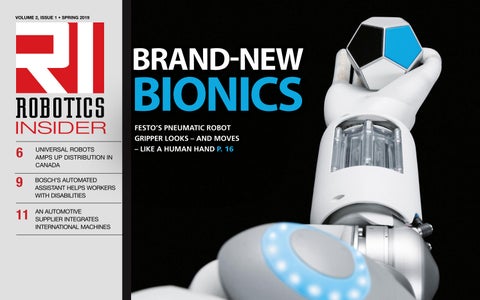
FESTO’S PNEUMATIC ROBOT GRIPPER LOOKS – AND MOVES – LIKE A HUMAN HAND P. 16
CONTENTS Columns 3 Market watch
Reskilling in the age of automation
6 Spotlight
Chris Claringbold & Joe Campbell, Universal Robots
Presented by Manufacturing AUTOMATION, Robotics Insider reports on the world of industrial robots and its developing opportunities, challenges and technologies. By sharing unique perspectives and information, we strive to help improve your manufacturing efficiency.
Features 9 Robots supporting workers An automated assistant helps people with disabilities focus on higher-quality tasks
11 A new language through
Editor - Kristina Urquhart kurquhart@annexbusinessmedia.com
automation
An automotive supplier turned to a Fanuc system to integrate international machines
Publisher - Klaus Pirker kpirker@annexbusinessmedia.com Vice-President & Executive Publisher Tim Dimopoulos tdimopoulos@annexbusinessmedia.com
16
Media Designer - Graham Jeffrey gjeffrey@annexbusinessmedia.com Account Coordinator - Debbie Smith dsmith@annexbusinessmedia.com
2 Spring 2019 • Robotics Insider
curriculum
KUKA Canada partners with Seneca College to bring a robotics lab to students
16 A helping hand
A pneumatic gripper that manoeuvres like a human hand
Circulation Manager - Urszula Grzyb ugrzyb@annexbusinessmedia.com Tel: 416-442-5600 ext. 3537 President & CEO - Mike Fredericks
14 Engineering a new
9
11
14
111 Gordon Baker Rd, Suite 400, Toronto, ON M2H 3R1 T: 416-442-5600 F: 416-442-2230
MARKET WATCH
By Kristina Urquhart
RESKILLING IN THE AGE OF AUTOMATION
T
he skills gap is one of the biggest issues facing Canadian manufacturers today, whether from loss of knowledge due to retiring employees or automation shifting the types of roles that are available to human workers. The skills gap does not only affect the C-suite. It should also be of major concern to workers on the factory floor – and not because their jobs are going to be threatened. Thought leaders are in agreement that increasing automation will not lead to job losses – but it will lead to new and revised job descriptions. Those descriptions will include the types of human skills that a robot can’t imitate – from critical thinking to empathy. So what should workers and manufacturers be aware of as they ready themselves for reskilling in the age of automation?
3 Spring Spring2019 2019••Robotics RoboticsInsider Insider
The gender factor According to a new report by the Royal Bank of Canada (RBC), the jobs at high risk of being eliminated or affected by automation are more likely to be held by women – but women also possess more of the skills required for the “jobs of tomorrow” than men do. The report, titled “Advantage women: how an automated future could play to women’s strengths,” indicates that of the 35 per cent of Canadian jobs that are at high risk of being threatened by automation, women hold 54 per cent, or 3.4 million, of them. Many of these are administration, bookkeeping and data entry roles, which are all more likely to be filled by women. However, the report shows that women are more likely to already have the “human” skills – such as generalist and social skills – needed for the new jobs that will be created
from automation. These roles include jobs that involve contact with the public. (In a separate study, Accenture recently identified complex reasoning, creativity, socio-emotional intelligence and sensory perception as the skills becoming most important in almost every work role.) Dawn Desjardins, vice-president and deputy chief economist, and Andrew Agopsowicz, senior economist at RBC, authored the report. They say that the need for generalist skills will increase as machines replace task-oriented jobs – and since men are twice as likely as women to work in those at-risk, taskoriented manufacturing roles that don’t have close post-automation substitutes or equivalents, they are behind in developing those generalist skills. The authors also report that occupations requiring more general and social skills have grown 33 per cent faster than the national average.
MARKET WATCH “Much of the reskilling conversation in Canada has focused on the retraining of manufacturing workers who fall victim to well-publicized plant closures,” the authors say. “But many of the jobs that are under threat – and disproportionately held by women – disappear in silence.”
Changes in culture and policy Desjardins and Agopsowicz also indicate that while women may be better positioned than men to deal with the transition, women are underrepresented when it comes to management roles. Men become managers more often and at an earlier age than women, which makes it difficult for women to catch up. For example, about 6.8 per cent of men aged 25 to 29 are employed in management positions, compared to 3.9 per cent of women. Manufacturers must foster an environment where women have access to promotions. But Desjardins and Agopsowicz also suggest further policy changes at the government level – such as better access to labour market data and programs to assess “soft” or “human” skills – that would benefit workers no matter their gender.
Opportunities for training In another study titled “Humans wanted: How Canadian youth can thrive in the age of disruption,” the Royal Bank of Canada stated that more than half of Canadian jobs will require a skills overhaul 5 Spring 2019 • Robotics Insider
in the next 10 years. There may be some reskilling help coming in the near future. In its 2019 budget, the federal government includes a potential benefit to help workers train and upgrade their skills The Canada Training Benefit offered by the current Liberal government would include an investment of more than $1.7 billion over five years – starting in 2019-20, after the federal election this fall – and $586.5 million per year ongoing. The broadest part of the benefit is a training credit applying to eligible workers between the ages of 25 and 64 who are earning at least $10,000 per year to a maximum of $150,000.
Each year, the worker would accumulate a credit balance at a rate of $250 per year, up to a lifetime limit of $5,000. The credit could then be used to cover half the costs of a course or training program. For example, a worker could accumulate their training credit balance for four years to have $1,000 to claim against training or tuition fees of $2,000 or more from colleges, universities and eligible institutions. Whether the Canada Training Benefit comes to fruition or not remains to be seen, but, with the government’s announcement, manufacturers are now even more aware that the skills gap is an issue of great importance.
247 Lynnfield Street Peabody, MA 01960 800.921.3332 www.HarmonicDrive.net
Electromate 6221 Highway 7, Unit #15 Vaughan, Ontario, Canada L4H 0K8 www.electromate.com
Harmonic Drive is a registered trademark of Harmonic Drive LLC. Valkyrie image courtesy of NASA/JPL-Caltech. * Electromate is the exclusive Canadian distributor of Harmonic Drive® products (except the Province of Alberta).
SPOTLIGHT What does the market look like in Canada for Universal Robots right now? CC: Prior to my joining Universal, I wasn’t quite sure how many people [in
Chris Claringbold, area sales manager for Canada and Joe Campbell, senior manager of strategic marketing at Universal Robots
Canada] were using the cobots. But once I’d joined and met several of our distribution partners, I found there are actually people who are in their fifth or sixth year of using Universal Robots in Canada. It’s growing rapidly. The technology is becoming more mainstream and understood. People now recognize that it is not a typical industrial robot and that it is easier to use in different applications.
JC: Both Chris and I come from the traditional robot background, and we’re actively selling robots to customers that likely would not have even received a sales call in the past because they were smaller firms or mid-size firms that don’t have the engineering infrastructure to support the traditional automation. But they have very real needs. That’s a big part of our growth over the last few years. CC: Many of our customers in Canada are small companies. The first question
Chris Claringbold
C
Joe Campbell
hris Claringbold, former CEO of KUKA Canada, joined Universal Robots (UR) in December 2018 as the company’s first area sales manager for Canada to bring more collaborative robots (cobots) to the market north of the border. We speak to Claringbold and Joe Campbell, senior manager of strategic marketing and applications development, about cobot adoption in Canada and how these humanfacing robots can help to close the skills gap. Spring2019 2019••Robotics RoboticsInsider Insider 6 Spring
they have is, “Do I have to go hire an engineer?” We show them the robot, the demo, and how easy it is to set it up, and they recognize that with their own skill sets internally, they can take some of these on. The factor in the past that scared [people] about integrating robots was that they’d always thought they needed a controls person, an engineer, a robot programmer. And when they realize they don’t need all of that to maintain this, they’re jumping on it and integrating it quickly themselves.
What is the general sentiment regarding the investment in automation among Canadian manufacturers? CC: As true Canadians, we’re all a little bit pessimistic – we don’t want to be the first. But I find that it’s not like the traditional robot market. Once we get past the education part, there’s a very high level of interest in the cobots. And
SPOTLIGHT it’s really stemming from two main things that I see. One is that manufacturers cannot find or retain the people that they need. In Canada, we have a lot of work that becomes cyclic, so [manufacturers] hire, run through the season and then lay off, and the people don’t come back. The other is there’s a lot of business outside Southern Ontario that doesn’t get well looked after by companies because they are deemed to be too small or too remote. In Western Canada, these guys are self-sufficient. They don’t rely on integrators. Bringing the Universal product to the market for them – they’re very quick to adapt to it and use it to streamline their own processes.
How do collaborative robots differ from traditional automation? JC: You used to have to solve the whole problem. It was all or nothing to do traditional automation, because you couldn’t mix manual operations with automation. Everything was safety caged and safety guarded. The collaborative products – particularly ours with 17 different levels of safety constraints –work quite happily side by side with human operators. And quite often the solution is to have the cobot do 80 per cent of the process and let the highly skilled operators do the other 20 per cent. From a manufacturing standpoint, they’re getting a very, very good return on investment and they don’t have to go solve the entire problem. 7 Spring 2019 • Robotics Insider
Etalex, a Montreal-based manufacturer of racking systems, installed a UR10 cobot that can work beside a human safely without guarding. Etalex says installing the robot has freed up seven worker hours a day.
SPOTLIGHT
“We really do have a labour shortage in manufacturing. So if you can take the dull, dirty and dangerous jobs or processes and let the robot handle them, you get much higher job satisfaction from the operators working on the rest of the line.” CC: I spent many years in automation, and as Joe said, it’s trying to solve the process issues. You start looking at things where it’s like, “Well, if we leave that up to the person, it’s going to be very difficult.” So you end up over-automating things. Now, you don’t have to automate as much and you can rely on a mixture of the cobot and the person. Cobots are actually changing the mindset of the people who are automating. I was just talking to a customer the other day, and he wasn’t even looking at the cost of automation or the people. One of his big things was downtime. If he has one of his current industrial robots shut down, it’s heavily guarded and there’s a proper lockout/tagout procedure that has to be followed. To fix it, you have to find the right maintenance guy. Then he comes out to the line, gets down, says he’s got to go into the cage, so he goes and gets his key, does the lockout/tagout, opens the gate, goes in, tries to figure out what’s wrong, tries to restart the robot. And this guy could lose an hour on the production line for something that’s simple. If he can simplify his process, and doesn’t need the extent of guarding around there, and gets a 8 Spring 2019 • Robotics Insider
more people. It’s the message and how it’s being delivered. To anyone who says, “Robots are taking my job and I’m not looking at improving my processes or getting more efficient or building my business” – they’re going to end up going out of business. Anybody who’s serious about it is growing their business, anyway. And is going to be hiring. They’re just going to be hiring and training people differently.
safe product so a person can actually go in, correct whatever’s wrong, and leave the cell very quickly, his efficiency of production will go way up. There’s a lot of interest in cobots from that side of the business as well.
JC: The whole jobs debate ignores the part that
JC: And we really do have a labour shortage in
there’s going to be a decades-long transition. This is not a tomorrow transition.
manufacturing. So if you can take the dull, dirty and dangerous jobs or processes and let the robot handle them, you get much higher job satisfaction from the operators working on the rest of the line.
On the other side of that skills gap coin is the fear of automation. Is that a real concern that manufacturers have when you’re out in the marketplace? CC: I was at a plant yesterday and the operator himself said, “You gotta get one of your robots in here.” He said, “This job is brutal. I can’t do it.” It was an ergonomic nightmare. And the company wasn’t looking to replace him. The company was looking to add the robot to make his job easier. They knew if they could do that, they could improve productivity. They were going to get more product out the door and they were going to hire
CC: Anyone who knows the Canadian market knows that geographically, there are different challenges in different areas. The one thing I find is it doesn’t matter where I go coast to coast, everybody has the same concern: they can’t find enough people. That the people who are doing the jobs now are getting ready to retire, and the young people don’t want to come in. Many of them are thinking of a strategy to bring in things that make manufacturing interesting and fun for younger people. It’s not the dull, dirty job that it used to be. There are progressive companies that are looking to get people into manufacturing by bringing cobots into their plants. This interview has been condensed and edited.
TECHNOLOGY
ROBOTS SUPPORTING
WORKERS
An automated assistant helps people with disabilities focus on higher-quality tasks By Robotics Insider Staff
R
obots are well on the way to becoming ubiquitous in manufacturing, where they are having an impact on the work environment and on jobs themselves. But what does this new world of work look like? How does it divide up work between humans and machines? And how might robots help to create attractive jobs for people with disabilities so they can participate in the workforce? AQUIAS, a project conducted by Robert Bosch GmbH, the Fraunhofer Institutes for Industrial Engineering IAO and for Manufacturing Engineering and Automation IPA, and ISAK GmbH, offers some 9 Spring 2019 • Robotics Insider
answers. The project’s name is derived from its full title in German: “Work quality through tailored work-sharing between service robots and manufacturing workers with or without severe disabilities.” It is funded by the German Federal Ministry of Education and Research. The initiators of AQUIAS have deployed APAS, Bosch’s automated production assistant, at ISAK GmbH – a company that employs people with a variety of severe disabilities, some of whom have an extremely limited capacity for work. APAS is used in the assembly process for sanitary fixtures. Previously, a worker had to operate a hand-lever press up Ludmilla Parsyak © Fraunhofer IAO
TECHNOLOGY to 8,000 times a day to press intricate parts together, but now the robot has taken on this monotonous and physically demanding task. This eases the burden on workers and lets them focus on the final quality control. One outcome of this project has been to improve the quality of work: with strenuous tasks falling away, there is more space for higher-quality tasks and for direct person-to-person communication. “What we’ve done is to have robots take on only those tasks that are physically demanding for people. All other work tasks, such as work-step preparation or quality control, are still performed by people, which ensures that their jobs are full of variety,” says David Kremer, coordinator of the project at the Fraunhofer Institute for Industrial Engineering IAO. To enable ISAK GmbH to implement this robotics technology, Bosch adjusted the workplace to suit the manufacturing environment and the various needs of the workforce. This called for a reconfiguration of the interfaces between humans and machines. Now the robot can flexibly 10 Spring 2019 • Robotics Insider
Ludmilla Parsyak © Fraunhofer IAO
adjust to different table heights and the sensor skin means there is no need for a safety barrier: if a worker comes too close, APAS automatically stops without any contact at all. This makes it possible to safely hand over workpieces and avoid collisions. “In the AQUIAS project, we want to learn from severely disabled workers how to improve humanmachine interactions,” says Wolfgang
Pomrehn, product manager for APAS assistance systems at Bosch. “A production assistant needs to meet a wide variety of requirements that are often different than the norm. That’s why we develop tailored solutions and are constantly expanding the spectrum of situations and tasks that APAS can support.” Bosch takes the project results and derives measures from them for
further improving the deployment of robots in production and logistics. The company plans to set up workplaces in its Blaichach (Allgäu), Germany plant for workers with and without disabilities. There the focus will be on how to handle heavy aluminum blocks for automotive manufacturing that need to be moved around under the microscope for quality inspections.
APPLICATION
A NEW LANGUAGE
THROUGH AUTOMATION
An automotive supplier turned to a Fanuc system to integrate multiple international machines By Rick Graham
I
n early 2016, JTEKT Automotive, a Tennessee-based automotive supplier, had a simple goal: Upgrade certain machining capabilities for a new project with a global automotive company. In the end, JTEKT discovered how a simple project request could blossom into the next level of productivity through new advances in automation. JTEKT Automotive is part
of the JTEKT North America division of JTEKT Corporation, a global supplier of automotive steering systems and driveline components, bearings and machine tools. Headquartered in Greenville, South Carolina, JTEKT North America employs more than 6,000 associates in 24 facilities, including 15 manufacturing sites, across the continent.
“Communicating the required signal streams for each machine to communicate with the automation was a challenge with so many overseas machine builders.” 11 Spring 2019 • Robotics Insider
APPLICATION JTEKT equips one in nearly four cars in the U.S. with a steering system and also supplies the automotive, industrial and aerospace markets under the brands of JTEKT Automotive, Koyo Bearings, Torsen high-performance differentials and Toyoda precision machine tools. For the upgrade, JTEKT’s engineering team provided a concept and process plan to FANUC America. When the FANUC automation team initially asked JTEKT to allow them to provide automation solution concepts, JTEKT’s management team was hesitant. The fear was that investing in additional automation equipment might be too expensive to implement. In addition, JTEKT had an aggressive timeline to quote the new business along with several other challenges that they needed to solve in order to be competitive. But the JTEKT team became open to the change when they realized that the recommended solution provided them with more flexibility than their previous systems – and with less maintenance and upkeep. 12 Spring 2019 • Robotics Insider
Integrating existing equipment
Communicating the challenges From the onset, the team needed to address several issues. To begin with, JTEKT’s parent company had worked with local integrators in Japan to develop the existing manufacturing process. They would build, test and then ship machining cells to the U.S. facilities. This provided the company with first-rate production lines, but at times limited the Tennessee-based facility in its ability to customize its manufacturing needs.
Locally, JTEKT had purchased additional equipment from a number of machine builders, which meant that the manufacturer’s equipment was varied and therefore did not communicate seamlessly with each other. “Communicating the required signal streams for each machine to communicate with the automation was a challenge with so many overseas machine builders,” says Dennis Schang, JTEKT’s engineering supervisor of diversified products.
Working together, the team began with a comprehensive review of the part process flow, production requirements and a full audit of the required equipment – not limited to just machining. FANUC developed a totally integrated system concept that included 3D automation simulation of the process flow, robotic machine loading and unloading capabilities and, most importantly, a betterthan-expected production cycle time. All of the equipment within the system would be monitored by FANUC’s custom HMI, allowing for one central location for an operator to access and monitor the system. Each system has over 30 pieces of equipment from many different builders, makes and models. This very specialized system consisted of two identical machine lines where each line contained five cells serviced with an overhead rail– mounted M-710iC/T robot and an accumulation conveyor, which fed a third line. Ten applications experts from
APPLICATION FANUC came to the JTEKT facility to implement the new automation system, which integrated all of the existing local and international machine tools. “Machines produced from across the street to around the world [now] all speak the same language,” says Schang. The single-centred machines were each interlocked and monitored from the start of the line to the end, with the process data stored in one location. Therefore, if something is missed, it will be flagged as an error.
Training the staff To make certain that the new system worked smoothly and to ensure JTEKT’s employees were comfortable using it, FANUC provided training support with an automation class for trainers at the plant, as well as online training so that employees could understand how to properly operate the new equipment. FANUC’s iHMI provided users with a method to set up standard operations, and to validate the performance of their programs and cycles to make sure they are performing as expected. Since iHMI 13 Spring 2019 • Robotics Insider
supports both animated and tool track renderings, it can identify the cause of alarms and then recommend a solution. Recovery notes allow JTEKT’s operators to understand the problem and take the necessary steps for recovery. “The classes and training really helped our employees to understand how this new equipment and technology could enhance traceability,” says Wayne Young, JTEKT’s
production manager. “You don’t miss operations. From a control standpoint, this was a significant improvement to our processes, efficiency and delivery of our commitment to quality.”
Finding new business Since launching the new system, JTEKT Automotive is now 45 per cent more efficient on labour compared to its counterparts throughout the world. Where previously an operator could
only handle four to six machines, that same operator can now run close to 15 machines simultaneously. Building on the success of its automation solution, the JTEKT team now sees new opportunities for its business. The previous system took up a significant amount of factory floor space, but since many of the robots used are now on the top loader rail, the new system has opened up valuable floor space. The quality standards and ongoing checkpoints within the new system, as well as a reduction of scrap and waste, helped JTEKT to earn a Superior Launch Award from Toyota, which recognizes the company’s most valuable suppliers. JTEKT was only one of two companies in the U.S. to receive the award. Since the integrated FANUC implementation, JTEKT Automotive has further diversified its business, recently winning two significant contracts. Rick Graham works in the Powertrain and ROBODRILL Group at FANUC America. fanucamerica.com
EDUCATION
ENGINEERING A NEW CURRICULUM KUKA Canada partners with Seneca College to bring a modern robotics lab to students By Robotics Insider Staff
T
oronto’s Seneca College and KUKA Canada, an advanced manufacturing and automation supplier, have partnered to provide Seneca students with state-of-the-art robotic equipment and the opportunity to enhance their manufacturing skills as future graduates. As part of the agreement, KUKA and Seneca will jointly develop 14 Spring 2019 • Robotics Insider
strategic initiatives focused on technology innovation and work on skills development through curriculum on Industry 4.0 automation. This partnership includes a modern KUKA robotics lab within Seneca’s new Centre for Innovation, Technology and Entrepreneurship at its Newnham Campus, which opened in January 2019. Industry 4.0, also known as the fourth industrial revolution, is
David Agnew, president of Seneca College (left) with Steve Green, general manager, robotics and solutions for KUKA (USA).
the current trend of automation, incorporating data in advanced manufacturing technologies. It includes cyber-physical systems, the Internet of Things, along with cloud and cognitive computing. “We recognize the value of collaborating with industry leaders such as KUKA,” says David Agnew,
president of Seneca College. “We are delighted to work with KUKA to further enrich our unmatched cluster of engineering programs. This [agreement] is an important step for us to continue to meet the needs of employers across a variety of sectors that will require robotics, automation and mechatronics technology in the
EDUCATION
“The implementation of a new state-of-the-art KUKA robotics lab will act as an automation learning platform for students.” future. We look forward to working with KUKA on curriculum that will ensure our graduates are in-demand once they enter the workplace.” KUKA will participate in the further development of Seneca’s robotics and automation curriculum. This may include providing guest lecturers, technical workshops and offering opportunities for Seneca students to train, gain practical knowledge and experience with KUKA’s portfolio of products, solutions and technologies. “We are excited to work closely with students and faculty to prepare
15 Spring 2019 • Robotics Insider
for the future of automation and Industry 4.0,” says Ed Manera, vicepresident of sales for KUKA Canada. “The implementation of a new stateof-the-art KUKA robotics lab will act as an automation learning platform for students and provide updated curriculum focused on advanced automation and industry 4.0 concepts. “KUKA is celebrating its 120-year anniversary and we’re continually finding ways to focus on the future of intelligent automation. Partnering with Seneca is an example of our ongoing commitment to develop and enhance advanced manufacturing skills in future graduates.” The partnership also has the potential to evolve into establishing internships and/or co-op opportunities for students. In addition, Seneca faculty members will have the opportunity to undergo training to become KUKA-qualified instructors.
INNOVATION
A HELPING HAND A new robotic gripper uses pneumatics to manoeuvre like a human hand By Robotics Insider Staff
B
etween collaborative robots (cobots) and artificial intelligence, humans and machines are working together more closely than ever before. Now, there’s a new machine that emulates humans in a physical way – Festo has developed a cobot gripper modelled on the human hand. The BionicSoftHand, which uses pneumatics so that it can safely interact with humans, was exhibited for the first time at the Hannover Messe technology fair in April 2019. The BionicSoftHand has no bones, but its fingers consist of flexible bellows structures with air chambers. The bellows are enclosed in the fingers by a special 3D textile coat knitted from both elastic and high-strength threads. The textile indicates exactly where the structure expands and generates power, and where it is prevented from expanding. This is what
16 Spring 2019 • Robotics Insider
INNOVATION
Instead of mimicking specific actions, the hand is given a goal. It uses trial and error to achieve that goal. Based on received feedback, it gradually optimizes its actions until the task is finally solved successfully. makes the hand lightweight, flexible and dexterous, yet capable of exerting strong forces. “Grasping has been an important topic over the last year,” Dr. Elias Knubben, head of corporate research and innovation for Festo, said in a press conference ahead of Hannover Messe. “We have equipped the hand with sensorics – [there are] inertial sensorics that we use to measure the position, and we also have force sensors inside the hand. The ‘glue’ is that we use artificial intelligence to train the hand.” To train the hand to do tasks, the developers used a method of machine learning called reinforcement learning, meaning that instead of mimicking specific actions, the hand is given a goal. It uses trial and error to achieve that goal. Based on received feedback, it gradually optimizes its actions until the task is finally solved successfully. For example, the BionicSoftHand may be told to rotate a 12-sided cube so that a previously defined side points upwards at the end. Using a digital twin, the operator can teach the movement to the hand using data from a depth-sensing camera via computer vision and the algorithms of artificial intelligence. In order to keep the effort of tubing the BionicSoftHand as low as possible, the developers have specially designed a small, digitally controlled valve terminal, which is mounted directly on the hand. The tubes for controlling the gripper fingers do not have to be pulled through the entire robot arm, meaning the gripper can be quickly and easily connected and operated with 17 Spring 2019 • Robotics Insider
only one tube each for supply air and exhaust air. With the proportional piezo valves used, the movements of the fingers can be precisely controlled. The BionicSoftHand gripper can be used on Festo’s existing robot arms or the brand-new BionicSoftArm, a pneumatic lightweight cobot that builds on Festo’s BionicMotionRobot concept (see photo on p. 2). The modular BionicSoftArm can be combined with up to seven pneumatic bellows segments (allowing for seven degrees of freedom) and rotary drives for flexibility in terms of reach and mobility. Direct human-robot collaboration is possible with the arm due to its flexible kinematics. It can also be used in classic SCARA applications, such as pick-and-place tasks, depending on the design and mounted gripper. The BionicSoftHand and BionicSoftArm are the two latest additions to join the Festo bionic family, alongside the previously announced BionicFinWave, an underwater robot shaped like a fish that we first profiled in the Fall 2018 issue of Robotics Insider.
DON’T MISS OUT ON YOUR NEXT ISSUE OF IT’S FAST, IT’S EASY AND IT’S FREE! SOFTWARE: Why small business environments cannot follow the enterprise approach. p.24
CYBERSECURITY: Keeping ADVANCED WARNINGS: your plant floor secure in the Industrial Internet of How the connected industry can help you predict and prevent failures. p.20
TECHNOLOGY: Cloud and Fog computing will advance SCADA systems. p.22
INDUSTRY WATCH: Making sense of Big Data, IIoT and Industry 4.0. p.10
BACKSTORY: Boost your business by expanding into international markets. p.30
Things era. p.12
Your resource for Canada’s industrial automation news
AutomationMag.com
50 years of
Glad
PM 40065710
PM 40065710
Ontario plant celebrates milestone anniversary p.18
NOVEMBER/DECEMBER 2017
MARCH/APRIL 2017
DOMESTIC INVESTMENT Ontario manufacturer purchases a new vertical machining centre, slashing lead time and internal costs. p.16
MAY17 AC Branding Front Cover Banner (MA).qxp_Layout 1 4/20/17 3:32 PM Page 1
Automation, electromechanical, cabling, and interconnect products from 300+ manufacturers.
thinkallied.com thinkallied.com MA_AlliedBanner_May.indd 1
MA_mar_Apr_ 2017.indd 1 MA_AlliedCover_JanFeb .indd 1
2017-04-21 11:48 AM
2017-03-01 9:51 AM 2016-12-21 9:16 AM
HERE’S HOW: For fastest service visit AutomationMag.com AND CLICK THE SUBSCRIPTION BUTTON
AutomationMag.com