VOLUME 2, ISSUE 3 • FALL 2019
RI
ROBOTICS INSIDER 6
KEEPING CLEAN WITH AVIDBOTS
BUILDING 14 MACHINE WITH ROBOTICS AND AUTOMATION AUTONOMOUS MOBILE 17 AN ROBOT COMPETITION HEATS UP
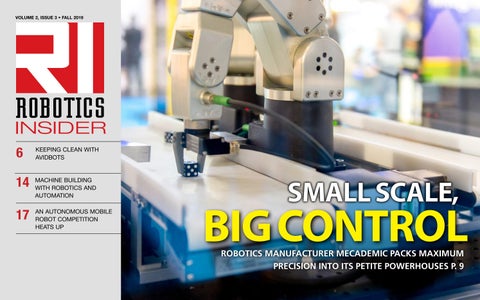
SMALL SCALE,
BIG CONTROL ROBOTICS MANUFACTURER MECADEMIC PACKS MAXIMUM PRECISION INTO ITS PETITE POWERHOUSES P. 9
CONTENTS Columns 3 Market watch
20M factory jobs to be displaced by robots. Now what?
6 Spotlight
Faizan Shiekh, Avidbots
Presented by Manufacturing AUTOMATION, Robotics Insider reports on the world of industrial robots and its developing opportunities, challenges and technologies. By sharing unique perspectives and information, we strive to help improve your manufacturing efficiency.
FEATURES 9 Small scale, big control
Mecademic packs maximum precision into its petite robotic powerhouses
14 Machines in motion
Robotics and automation create a compact case-loading application
Editor - Kristina Urquhart kurquhart@annexbusinessmedia.com Publisher - Klaus Pirker kpirker@annexbusinessmedia.com
17 Ready, set, assemble
Students tackle a manufacturing simulation using autonomous mobile robots
Vice-President & Executive Publisher Tim Dimopoulos tdimopoulos@annexbusinessmedia.com
9
Media Designer - Graham Jeffrey gjeffrey@annexbusinessmedia.com Account Coordinator - Debbie Smith dsmith@annexbusinessmedia.com
Cover image: Mecademic
Circulation Manager - Urszula Grzyb ugrzyb@annexbusinessmedia.com Tel: 416-442-5600 ext. 3537 COO - Scott Jamieson sjamieson@annexbusinessmedia.com
14 2 September 2019 • Robotics Insider
17
111 Gordon Baker Rd, Suite 400, Toronto, ON M2H 3R1 T: 416-442-5600 F: 416-442-2230
MARKET WATCH
By Kristina Urquhart
20M FACTORY JOBS TO BE DISPLACED BY ROBOTS. NOW WHAT?
O
n a busier-than-usual day in robotics news this past June, the media headlines were coming in fast and furious: “Robots to replace 20 million factory jobs by 2030,” they all read. Oxford Economics, a forecasting and research firm, had published “How Robots Change the World,” a 64-page report about the impact of automation on jobs and productivity. The factoid about 20 million jobs disappearing over the next decade was certainly good for clicks for any media outlet covering the study, but those headlines weren’t telling the whole story. The report says industrial robots and automation are expected to displace 20 million manufacturing jobs. Not replace. In fact, new jobs for humans will open up at nearly the same rate that the old jobs are lost. It’s part of the same conversation about training and reskilling/upskilling we’ve been having in the last few issues of Robotics Insider. Automation gives way to major productivity gains – for the 3 September 2019 • Robotics Insider
company bottom line, yes, but also for the human workers who are moving on to more fulfilling, challenging work in manufacturing. The authors of the report say those 20 million jobs that will be affected amount to 8.5 per cent of the global manufacturing workforce. The loss of jobs will be felt more strongly in lower-income regions of the world, where workers tend to have lower skill levels that are more susceptible to being displaced by automation. We know jobs are going to change. The next step is to prepare the global workforce, especially in the more affected regions, to change with them.
The robotics dividend While the regional impact of robot adoption varies, the authors state that robots boost productivity and economic growth. That increase in productivity – which they call a “robotics dividend” – translates to a 0.1 per cent boost in output per worker after a one per cent increase in the stock of robots per
MARKET WATCH worker in the manufacturing sector alone. Oxford Economics currently predicts an annual increase in robot stock growth of five per cent for China and three per cent for the U.S. If robotic adoption exceeds current projections by 2030, global GDP is set to grow, too. For example, if robotic adoption exceeds 30 per cent of current projections, it would result in a 5.3 per cent increase in the global GDP, which amounts to an extra $4.9 trillion added to the global economy – just for that year. With as many industrial robots having been installed over the past four years as in the eight years previous, use in manufacturing has increased because 1) robots are cheaper to employ than humans; 2) robots are becoming more capable in sophisticated contexts; and 3) robots allow manufacturers to not only keep up with demand, but with foreign competitors, too.
manufacturing tend to be the most vulnerable to automation. Canada wasn’t one of the countries profiled, but in the United States, the index rates Oregon, Louisiana, Texas, Indiana and North Carolina as most susceptible for their associations with traditional manufacturing industries such as steel, automotive, etc. Workers that develop most of the robot innovation and knowledge – skills that are trickier to automate – tend to be located in urban centres, the report says, which is why major developed cities will fare better with job displacement over lowerincome regions of the world. The researchers indicate that as robotics adoption increases, governments will need to help workers develop new tools and skills so that they can adapt to new roles.
infrastructure, training and welfare programmes. Business leaders: Look for technological solutions to keep up with innovation and global competition; communicate intentions with robots directly to workers; invest in robot training and education for your workforce. Educators: Focus on fostering technology skills, but also “soft” skills; develop flexible, lifelong learning opportunities that can translate to workers on the job; create new partnerships with local industry to see which skills are more or less important, and to develop specific training programs for displaced workers. Technology companies: Participate in industrywide initiatives to invest in human capital, such as profit sharing; partner with government and educators on retraining and coaching; solve technological problems created by robots.
Preparing the workforce
The study says China now represents around one-fifth of the world’s total stock of robots, with about every third robot worldwide now being installed in China.
The study offers a framework to protect vulnerable jobs from automation, targeting stakeholders across the manufacturing sector: Government: Adapt policy to fit the needs of the workplace and economy during robotization; develop collaborative ecosystems for skills development; use labour market data and business trends to plan strategies to incentivize companies to engage in retraining programs; identify the areas most vulnerable to automation-related job displacement and make investments in
Workers: Evaluate your own job to understand the difference between “soft” (human) skills and automatable skills; understand that retraining is normal and you will need to participate in lifelong learning; support programs that develop job flexibility, even in unionized environments. Managing the skills gap is not just a management problem, but a government problem and a worker problem, too. A readiness to adapt to the changing marketplace and a willingness to invest in training will be paramount for all as we navigate the next = decade of robotization.
Protecting vulnerable jobs The report includes a Robot Vulnerability Index, which ranks the regions of seven developed economies based on how susceptible their workforces are to the installation of industrial robots. Regions with higher instances of traditional 4 September 2019 • Robotics Insider
GET MORE WITH FANUC’S COBOTS FANUC cobots are easy to use and offer more choices for speed, reach and payload than any other brand.
Discover
our line of collaborative robots and see how much more FANUC offers.
888-FANUC-87 www.fanuccanada.com © 2019 FANUC America Corporation. All Rights Reserved
For additional information or to request an automation audit visit
fanucamerica.com/cobots
SPOTLIGHT
Faizan Sheikh, CEO and co-founder of Avidbots
A
Faizan Sheikh (left) and Pablo Molina (right), co-founders of Avidbots
fter a brief foray into developing a snowshovelling robot, University of Waterloo robotics grads Faizan Sheikh and Pablo Molina co-founded Avidbots, a company that manufactures autonomous robots, in 2014. Their first product, Neo, is an autonomous floor-scrubbing robot for use in commercial and industrial spaces, and is installed in facilities in 13 countries. What went into the making of Neo? We asked Sheikh to find out.
How did Avidbots get started? When we graduated in 2011, [it was] into a world where there were 6 September 2019 • Robotics Insider
no robots outside of research labs or cages in factories. We wanted to bring them into everyday life. We decided we were going to look into the snow removal problem – but that problem only arises in the winter. After a few months of research, we pivoted to the indoor commercial cleaning problem. We wanted to solve a global problem, and a problem that currently has a high cost where automation would make sense. The first few years were just experimenting with different form factors and understanding which technologies would work and which would not. In 2017, we started selling Avidbots Neo.
You’ve concentrated largely on the commercial space with Neo but you also supply to manufacturers. What challenges does Neo help manufacturers to solve? In both production and warehouse spaces, [manufacturers] are short on manpower and labour, and what they want their labour to be doing is focusing on the most critical tasks
that are associated with getting more throughput out of their facilities. Every time they get into a situation where somebody on their staff has to stop doing their primary job function and has to get behind a cleaning machine and push it around to clean, it’s a giant drop in productivity.
Can you elaborate on what allows Neo to be autonomous? On day zero, we come in and do mapping, which is when we walk the robot around your facility to teach it what the plant looks like. We send this data up into the cloud and it’s processed into a human-readable map. The customer then gets to give us a lot of feedback about how they would like their cleaning to be done. This is what we call a cleaning plan. Customers are able to come up with almost an infinite number of permutations for cleaning plans based on real operational needs. For example, the way they clean on Fridays may be different than the way they clean on Mondays. They might want to start in different positions, they might want to skip
SPOTLIGHT certain areas, they might want to add other areas, they might want to use different cleaning settings. This feedback is then incorporated into a final cleaning plan. The cool thing about Avidbots is that our solution adapts to the massive changes these environments experience. People and product are moving all the time in these facilities, so what we offer is an artificial intelligence solution that is able to adapt to all the changes that are happening and still get all the floors cleaned. So that means if something has been added to the facility, the robot is going to safely avoid it. If something has been removed from the facility, the robot is going to clean the newly opened-up floor space. And it’s going to do that without any human prodding or cleaning or intervention.
What technology does the robot use to learn the space? The robots have a front-facing lidar as well as a rear-facing lidar – these two lasers give us a 2D view of what the robot sees in the front 7 September 2019 • Robotics Insider
and the back. Then we have a few 3D cameras in the front, primarily facing the ground. They help us see where the walls are and what the 3D obstacles are that the robot will encounter, such as chairs, tables and workbenches. Right now, we are using Hokuyo on our robots. But we have the ability to use any 2D lidar. For our cameras, we are using Intel. All of this data is then uploaded into the cloud for processing. Things such as walls are marked. The walls aren’t going to change for the most part. However, a workbench might move. A pallet will absolutely move. And then once we incorporate the client feedback, we give them a solution where all they have to worry about is taking the robot to the start position where you want it to start cleaning, and press clean on the graphical user interface of the robot.
How is the information then transmitted to the user? The information that is uploaded to the cloud is very raw. First, it’s processed through fairly advanced
robotics algorithms that take all the raw data and make a graphical map – like a blueprint, except this one is from the perspective of the robot. This map of the facility is then displayed on the Avidbots command centre, which is the cloud component of our Avidbots Neo solution. All customers get access to it, and this is where they provide feedback. They would log in using their account information and they will see a new map is available to give feedback on. Using just their mouse, they will be able to pick the start and end locations, and what kind of cleaning settings they want in different areas.
looking at ways where they can improve their productivity and competitiveness. If there’s something where they can get their staff to focus on the most primary function, which is getting more product out the door, rather than pushing a cleaning machine around to clean the floors, they will totally do that. There’s not a lot of education required – they just want to know how it will really clean, is it going to clean well, is it going to be safe, is it going to be able to handle the massive changes they experience on a daily basis with product coming in and out? That’s where they want to see the biggest proof points.
How would you characterize the level of interest about this kind of automated technology among Canadian manufacturers?
Where do you see the biggest opportunities for growth for Avidbots going forward?
Manufacturers in Canada are already looking at robotics technologies for a host of applications. Cleaning just happens to be one of them. Ultimately, the manufacturers in Canada are competing with certain countries where it costs less to produce goods. So they are also
This interview has been condensed and edited.
I think manufacturing warehouses and industrial applications are going to be key drivers to our growth. We are working on a lot of really cool stuff – but I can’t share just yet!
FHA-C Mini Servo Actuator with Dual Encoders NEW!
Introducing FHA-C Mini (24VDC) Actuator with Dual Absolute Encoders and Panel Mount Connectors. Small actuators deliver high torque with exceptional accuracy and repeatability. Peak torque 1.8~28 Nm, max. speed 60~200 rpm. • A pair of Single-Turn Absolute Encoders for Input and Output Sensing • Output Encoder 14 bit (16384 cpr) resolution • Input Encoder 14 bit (16384 cpr) resolution • BiSS-C bi-directional communication for both encoders
• Wide encoder voltage range (4.75-30) • Harmonic Drive® CSF zero-backlash gear • Compact dimensions • High-torque/weight and torque/volume ratio • Panel Mount Connectors with 4 exit options
247 Lynnfield Street Peabody, MA 01960 800.921.3332 www.HarmonicDrive.net
6221 Highway 7, Unit #15 Vaughan, Ontario, Canada L4H 0K8 www.electromate.com
Harmonic Drive is a registered trademark of Harmonic Drive LLC. * Electromate Sales is the exclusive Canadian distributor of Harmonic Drive® products (except the Province of Alberta).
COVER STORY
SMALL SCALE,
BIG CONTROL Robotics manufacturer Mecademic packs maximum precision into its petite powerhouses By Kristina Urquhart
S
ix years ago, when Jonathan Coulombe, an electrical engineering grad at Montreal’s École de technologie supérieure (ÉTS), and Ilian Bonev, Coulombe’s thenresearch supervisor and professor in the school’s department of automated manufacturing, founded their robotics company Mecademic, the idea of going up against industrial giants such as ABB and FANUC wasn’t on the table. In 2014, Mecademic debuted a now-discontinued small dual-arm SCARA robot named DexTAR,
9 September 2019 • Robotics Insider
designed for educational purposes. But it turned out that DexTAR appealed more to manufacturers, who would ask if the diminutive robot could be adapted for pickand-place applications in industry. “We had to address industry – this is something that Jonathan was willing to do since the very beginning, but I wasn’t sure we could compete with all those big guys,” says Bonev, who is also head of the ÉTS control and robotics laboratory and the Canada Research Chair in precision robotics. “Eventually I realized we have the
COVER STORY
Once plugged in with an Ethernet cable, the robot can be programmed directly from a web-based interface accessible on any computer. expertise required to make these small robots.” So the pair developed a six-axis industrial robot called the Meca500, which has a payload of 500 grams and a reach of 260 millimetres at its wrist centre. Its entire arm when fully extended is about 330 millimetres. The controller is embedded in the robot’s base, and the complete robot weighs only 4.5 kilograms. It’s a tidy setup that allows the Meca500 to be mounted in tight spaces for testing, quality inspection, precision assembly, dispensing and machine tending across manufacturing industries including electronics, medical devices, automotive, aerospace and watchmaking. When Mecademic uploaded a demo video to YouTube in May 2015, the positive feedback was swift. And loud – that particular clip has since been viewed nearly half a 10 September 2019 • Robotics Insider
million times. “Everyone who types ‘small robot’ sees our robot,” says Bonev. “This is something that helped us be known worldwide – otherwise it would have been impossible for a small company to get access to a market like this.”
A study in precision Mecademic’s 20 staff members pride themselves on the fact that they manufacture nearly everything for the Meca500 robots out of a single 10,000-square-foot production and assembly facility near downtown Montreal. The team purchases some of the main components, such as the processors. But they manufacture several items themselves, including the aluminum housing, as well as the drives for the Maxon motors (Maxon’s drives are too big for such a small application). Mecademic also
COVER STORY
“In the States, [manufacturers] are really ready to take the risk even if it is a small company and even if it’s something new. Many clients just bought the robot without ever seeing it. In Canada, people need to be more convinced.” executes all the coding for the robot controllers in house, without the help of a library. Zero-backlash gearboxes from Harmonic Drive give the Meca500 its laser-like precision, with repeatability of five micrometres (μm). “If you open another robot, you will see a lot of empty space and big electronic components. In our case, everything is extremely compact,” says Bonev. “The bigger [robot] you get, the more small errors you get in the joints. This is why we are much more precise.” To achieve the Meca500’s extremely high accuracy rate, Mecademic uses a coordinate-measuring machine (CMM) to inspect the robots and identify errors, instead of the metrology equipment commonly used by industrial robot manufacturers, such as laser trackers. This satisfies the 11 September 2019 • Robotics Insider
needs of the company’s clients who use the Meca500 for inspection. “If you want to inspect something like a cell phone, for example, or a camera, you want to move it with relatively high accuracy,” says Bonev.
Big control on a small scale With everything contained in the base of the Meca500, there are no desktop controller boxes or thick cables to contend with. Once plugged in with an Ethernet cable, the robot can be programmed directly from a web-based interface accessible on any computer. “Our philosophy is really that robotics is a component. It is a complement [to your existing operations],” Bonev says. “We thought, why not replicate a PLC like other robot manufacturers, but in the
robot itself? Why don’t we just strip it from everything unnecessary and just focus on the robotics part?” Operators can use the programming language of their choice to transmit commands to the robot via the TCP/ IP protocol or EtherCAT. Those who need to adjust inputs and outputs such as sensors and actuators can use their own programmable logic controller (PLC) instead of the web software. The Meca500 robot arm features unlimited rotation on the end joint, which can be fitted with any end effector using an adapter plate. Mecademic collaborated with SCHUNK on a proprietary miniature electric parallel gripper, the MEGP25, which can be controlled directly within the commands used to move the Meca500 robot arm.
Building a case in Canada Since acquiring a CNC machining centre and releasing the Meca500 to the public in July 2016, Mecademic has sold over 500 of the robot arms, mostly to clients in the US and Europe. LNA Laser Technology, a Rhode Island–based producer
of fibre-laser welding and cutting systems, uses a Meca500 robot fitted with custom end effectors for machine tending. The Canadian market has been a bit tougher for the company to crack. “In the States, [manufacturers] are really ready to take the risk even if it is a small company and even if it’s something new,” says Bonev. “Many clients just bought the robot without ever seeing it. In Canada, people need to be more convinced and have case studies and demos.” As a result, Mecademic plans to hire a salesperson responsible for Quebec and possibly Ontario to work on bringing the product to decision makers, who Bonev says may be the sticklers when it comes to implementing automation – not engineers. “Engineers are not afraid of robotics. It’s probably the management,” he says. “They see it as more risky, even though it’s been 50 years or more that robotics have existed. But there are so many case studies now.” Case in point: one Mecademic client received a large order and
BOOK A DEMO
Filling the labor gap. Studies show 89% of manufacturers are struggling to find qualified workers; unemployment is at historic lows, and 10,000 Baby Boomers retire every day. Smart manufacturers employ collaborative robots – or cobots – to fill their labor gaps. Quick and easy to program, cobots are typically less than half the cost of traditional robots. They can take over the dull, dirty and dangerous tasks in your workplace, including: • • • •
Machine tending Screw and nut driving Assembly Inspection
• • • •
Dispensing Gluing Welding Polishing
Request an onsite demo today to discuss the possibilities – and see how easy and affordable cobots are. Call 844-462-6268 or email ur.na@universal-robots.com. www.universal-robots.com
One cobot at a time.
COVER STORY
The Meca500 is a six-axis industrial robot that has a payload of 500 grams and a reach of 260 millimetres at its wrist centre. Its entire arm when fully extended is about 330 millimetres. The controller is embedded in the robot’s base.
13 September 2019 • Robotics Insider
needed to manufacture more parts. Using the Meca500 robot arm in the manufacturing process allowed the client to replace the work of four operators who would perform a specific task very slowly and with a lot of errors. The operators themselves have not been replaced – they’ve just been reassigned to other tasks in production and quality control that are not easily automated. The client tells the company its return on investment was six months. “A human, even without any training, is extremely dexterous and has vision. We can do stuff that is extremely difficult to automate,” says Bonev. “But a human operator can never do inspection. A human operator can never place a cell phone exactly one millimetre apart. So the question is not, do we continue to do this with humans or do we invest in robotics. The question is, do we do this with fixed automation, or do we just buy a six-axis robot?” Mecademic is building on its small-robot success by going back to its beginnings – the company is introducing a miniature industrial SCARA robot later this year that can be mounted either horizontally
or on the ceiling. Like the Meca500, the SCARA robot will also feature a streamlined design with an embedded controller, but, with its ultra-fast speed, will be better optimized for small-scale pick-and-place applications, such as in electronics assembly and medical device manufacturing. Bonev says that as a professor, it’s important for him to educate manufacturers on how to optimize their robotic applications. “Even if robots one day are much more intelligent, you still have to know how to use this intelligence. You will still need to optimize a robot cell – and this is probably one of the reasons why in Canada we still have difficulty implementing robots. It’s that there is a need for education on how to implement robots the right way,” he says. “Implementing robots is not so easy. You don’t just screw it in there and then teach it. You have to design the robotics cell. It has to be safe; it has to be optimized. And there is no textbook about this. There’s no course. You don’t learn this in university; you learn this by yourself. This is something that we want to educate people on.”
APPLICATION
MACHINES IN MOTION A machine builder uses robotics and automation to create a compact case-loading application for a dairy manufacturer By David Gersovitz
C
anadian machine builder Nuspark used a smart substitution strategy to replace its top-mounted, Delta-style tray loader on two caseloader/palletizers built for Shepherd Gourmet Dairy in St. Marys, Ont. Before its recent acquisition by Saputo Inc., Shepherd began an expansion to add volume and formats to meet increasing demand for products such as its Greek- and Icelandic-style yogurts. Shepherd had installed a third filler in the food zone and needed more tray loading 14 September 2019 • Robotics Insider
and palletizing capacity in the packaging room. Its existing setup was a single tray loader with manual palletizing. Nuspark’s was the winning bid, and while not the lowest, price was certainly a major consideration, says Boris Motskin, general manager at the Toronto-based machine builder. The order called for two new machines with integrated tray forming, loading and palletizing rated at 10 trays per minute, as well as a standalone palletizer for the existing tray loader. New machine #1
Nuspark installed a bottom-mounted Festo EXCT-100 high-speed linear gantry with vacuum gripper for case loading at the Shepherd Gourmet Dairy facility, supported by a Fanuc six-axis robot for palletizing.
APPLICATION would load 500-gram and 900-gram round tubs, and potentially other sizes (the standard tub, no matter the capacity, has a universal 4-5/8inch diameter lid). New machine #2 would load four-packs (two by two) of peel-back, single-serve cups. Building custom case packers and palletizers for food and beverage is Nuspark’s bread and butter. “We emphasize a respect for our customer’s real estate – every machine is one of a kind, depending on the restrictions and constraints that our customers have,” says Motskin. “With Shepherd, they gave us the space and said, ‘We have to fit three lines in here.’” Every Nuspark case/tray packer, whether rated for 10, 25, 100 or 600 products per minute, is based on some common principles, including exclusively single-frame, stainless-steel construction (all welded in-house), top running of all cabling and IP67rated sensor connectors as standard. It employs brand-name componentry throughout: Festo pneumatics, Nordson glue dispensing, Fanuc sixaxis robot for palletizing, and Bosch 15 September 2019 • Robotics Insider
Rexroth and Allen-Bradley electrical systems. Previously, the company would have used top-mounted Delta-style tray loading comprised of a twoaxis robot and servo motors from two different manufacturers for tray-loading in a project of this type. Instead, Nuspark engineers substituted a compact, bottommounted Festo EXCT-100 high-speed linear gantry with vacuum gripper, combined with a motion control package from Festo. On Shepherd’s new machine #2, the gantry loads a full 24-cup tray with a single pick, which is less than its maximum payload weight of 10 kilograms. The EXCT’s two fixed servo motors drive a toothed belt arranged in a T-shape. The motion control package, configured for Ethernet IP, synchronizes the interaction of the servos to control the movement of the interface along the horizontal (Y) axis with a consistent pick accuracy of +/- 0.1 millimetres. Substituting the EXCT for the Delta-style top mount lowered the
“The benefits as a whole are functionality, ease of integration – and the cost is probably the most important thing because at the end of the day we still have to be competitive in the market.” overall machine cost. “The benefits as a whole are functionality, ease of integration – and the cost is probably the most important thing because at the end of the day we still have to be competitive in the market,” says Motskin. The EXCT-100 is rated for up to 90 picks per minute, but high-speed motion wasn’t needed here. “We had been investigating this gantry for some time and it was just a matter of getting the right application for it,” says Motskin. “We preferred for a first experience not to try it on a higher speed application,” he says, so his team could get comfortable with the new technology and bring the end user on board more easily. The motion control package can be set up to control any standard Festo Cartesian robot as well
as the specific applications they are to perform, with no special programming knowledge required. The robot and motion control package come pre-assembled and pre-tested and can be coupled together. For applications with height restrictions, the top mount rises well above the top of the machine frame. As part of the pre-planning phase, says Ray Reginato, industry segment account manager, electronics and assembly at Festo Canada, his team also performed detailed cycle-time analysis, which showed that the EXCT/motion control combination would perform just as well with the end user’s single-phase, 230V power supply as it does with three-phase 480V, which is the available power supply for all previous installations in Canada.
WORKING TOGETHER AS EQUALS.
Humans and robots are working more closely together. Sensors help robots make more intelligent decisions and give them the ability to sense objects, the environment, or their own position. Thanks to sensors from SICK, robots perceive more precisely – the prerequisite for close collaboration. For all challenges in the field of robotics: Robot Vision, Safe Robotics, End-of-Arm Tooling, and Position Feedback. We think that’s intelligent. www.sick.com/robotics
EDUCATION
READY, SET,
ASSEMBLE
Students in Montreal tackle a manufacturing simulation using autonomous mobile robots from Fetch Robotics By Robotics Insider Staff
T
he best way to familiarize yourself with a manufacturing environment is to dive right in – and that’s what students attending the International Conference on Robotics and Automation in Montreal did earlier this year when they participated in a robotics simulation contest. Fetch Robotics, developer of cloudbased autonomous mobile robot (AMR) solutions, held the inaugural 17 September 2019 • Robotics Insider
FetchIt! Mobile Manipulation Challenge during the conference, which saw students using mobile manipulators – or AMRs fitted with robotic arms – to replicate a real-life manufacturing scenario. The FetchIt! Challenge attracted teams from several universities, who were tasked with using a Fetch Mobile Manipulator robot equipped with Ubuntu 18.04 and ROS Melodic to navigate to stations in a work cell where they picked up items with the arm, inserted them into a machining tool, placed the machined items into
The team from Georgia Institute of Technology (Georgia Tech) took home the top prize in a recent Fetch Robotics competition held in Montreal, which saw students using mobile robots to machine parts and then transporting them to various locations.
kits, transported the finished kits to an inspection station, and then finally delivered them to a drop-off location – all with the goal of assembling the most kits in 45 minutes. Georgia Tech was awarded first prize for successfully assembling three kits in 39 minutes, earning a prize package that included a Fetch
Mobile Manipulation Research Robot – a $100,000 value – along with additional prizes from co-sponsors EandM, SCHUNK and SICK AG. AMRs are seeing rapid adoption in multiple applications, particularly for material movement tasks in warehouses and factories. This has fuelled growing interest in using
The FetchIt! Challenge attracted teams from several universities, who were tasked with using a Fetch Mobile Manipulator robot equipped with Ubuntu 18.04 and ROS Melodic to navigate to stations in a work cell. 18 September 2019 • Robotics Insider
AMRs equipped with robotic arms for applications that combine autonomous transport with robotic arms that can grasp and manipulate objects. While conceptually simple, combining autonomous mobility with robotic arm activity is extremely challenging, requiring complex interaction between the robot navigation, machine vision, arm operation and safety systems. “I’d like to congratulate all the teams for their accomplishments during the course of this challenge,” says Russell Toris, director of robotics at Fetch Robotics. “When setting out to create this challenge, we knew we wanted to keep it grounded to a real-world scenario. Interacting with machinery that is designed to be used by humans is no easy task. Piecepicking, kitting and countless other tasks are going to require state-ofthe-art perception, motion planning, navigation, and safety all seamlessly working together.” Sonia Chernova, part of the winning team from Georgia Tech, says, “We’re very excited to have won the FetchIt! Challenge. It has allowed us to validate our research code in a complex domain.”
AMRs vs. AGVs: what’s the difference? Mobile vehicles are increasingly being used for manufacturing or logistics operations. An autonomous guided vehicle (AGV) follows fixed routes throughout a space, either through wires, RFID or magnets embedded in the ground. They use sensors to stop if objects cross their paths, but are unable to move from their route. An autonomous mobile robot (AMR) is not restricted to fixed routes. It uses sensors and computing power to develop a map of a space. Using artificial intelligence, an AMR will plan its own routes and safely avoid people or objects that cross those paths.
DON’T MISS OUT ON YOUR NEXT ISSUE OF IT’S FAST, IT’S EASY AND IT’S FREE! SOFTWARE: Why small business environments cannot follow the enterprise approach. p.24
CYBERSECURITY: Keeping ADVANCED WARNINGS: your plant floor secure in the Industrial Internet of How the connected industry can help you predict and prevent failures. p.20
TECHNOLOGY: Cloud and Fog computing will advance SCADA systems. p.22
INDUSTRY WATCH: Making sense of Big Data, IIoT and Industry 4.0. p.10
BACKSTORY: Boost your business by expanding into international markets. p.30
Things era. p.12
Your resource for Canada’s industrial automation news
AutomationMag.com
50 years of
Glad
PM 40065710
PM 40065710
Ontario plant celebrates milestone anniversary p.18
NOVEMBER/DECEMBER 2017
MARCH/APRIL 2017
DOMESTIC INVESTMENT Ontario manufacturer purchases a new vertical machining centre, slashing lead time and internal costs. p.16
MAY17 AC Branding Front Cover Banner (MA).qxp_Layout 1 4/20/17 3:32 PM Page 1
Automation, electromechanical, cabling, and interconnect products from 300+ manufacturers.
thinkallied.com thinkallied.com MA_AlliedBanner_May.indd 1
MA_mar_Apr_ 2017.indd 1 MA_AlliedCover_JanFeb .indd 1
2017-04-21 11:48 AM
2017-03-01 9:51 AM 2016-12-21 9:16 AM
HERE’S HOW: For fastest service visit AutomationMag.com AND CLICK THE SUBSCRIPTION BUTTON
AutomationMag.com