VOLUME 1, ISSUE 4 • WINTER 2018-19
RI
ROBOTICS INSIDER 6
HUMATICS DEBUTS NEW MICROLOCATION POSITIONING TECHNOLOGY
9
END-OF-ARM TOOLING CONSIDERATIONS FOR YOUR COBOT
COLLEGE’S NEW 15 HUMBER CENTRE FOR ADVANCED MANUFACTURING
1 November 2018 • Robotics Insider
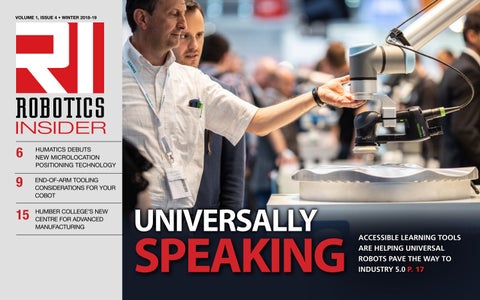
UNIVERSALLY
SPEAKING
ACCESSIBLE LEARNING TOOLS ARE HELPING UNIVERSAL ROBOTS PAVE THE WAY TO INDUSTRY 5.0 P. 17
CONTENTS Columns 3 Market watch
Best practices for automation deployment
6 Spotlight
David Mindell, CEO, Humatics
Presented by Manufacturing AUTOMATION, Robotics Insider reports on the world of industrial robots and its developing opportunities, challenges and technologies. By sharing unique perspectives and information, we strive to help improve your manufacturing efficiency.
Features 9 Get a grip
End-of-arm tooling considerations for collaborative robots
11 Picking up the pieces
Robots automate the supply chain with range, rate and reliability
Editor - Kristina Urquhart kurquhart@annexbusinessmedia.com
15 Advancing manufacturing
Publisher - Klaus Pirker kpirker@annexbusinessmedia.com
Humber College gets support from Canadian automation leaders
Vice-President & Executive Publisher Tim Dimopoulos tdimopoulos@annexbusinessmedia.com
17
Art Director - Graham Jeffrey gjeffrey@annexbusinessmedia.com Account Coordinator - Debbie Smith dsmith@annexbusinessmedia.com
17 Universally speaking
Accessibility is helping Universal Robots pave the way to Industry 5.0
Circulation Manager - Urszula Grzyb ugrzyb@annexbusinessmedia.com Tel: 416-442-5600 ext. 3537 President & CEO - Mike Fredericks
2 November 2018 • Robotics Insider
6
11
15
111 Gordon Baker Rd, Suite 400, Toronto, ON M2H 3R1 T: 416-442-5600 F: 416-442-2230
MARKET WATCH
By Kristina Urquhart
BEST PRACTICES FOR AUTOMATION DEPLOYMENT
I
ntroducing automation to your operation, whether a simple robot arm or a more complex architecture, can be a costly business – and one that you want to get right, preferably on the first try. So what can you do to mitigate risk and harness the most value out of your commitment? A new study by consulting firm McKinsey & Company, called “The Automation Imperative,” surveyed 1,303 people representing various job functions across a number of industries, and aggregated the results to determine some best practices for businesses planning to incorporate automation into their processes. In particular, researchers examined responses from larger companies with annual revenues of $1 billion or more – where automation is more prevalent – and determined six key areas that businesses should focus on as they 3 November 2018 • Robotics Insider
move toward fully – or even partially – automated environments.
1. Make automation a strategic priority. Companies should clearly define their automation needs as part of their strategic planning process, whether they are adopting new technology to keep up with the competition, improve their cost base over the long or short term, or address existing problems with business processes. Beyond defining strategic objectives, the report suggests procuring an executive sponsor for your company’s automation program, and making automation an enterprise-wide mandate – rather than a reactive or functional one.
2. Deploy automation technologies systematically. You need to create a rollout plan and stick to it. Of the respondents
at large “successful” organizations (those who report their company has been very successful in meeting automation targets), 50 per cent used an agile approach with rapid
testing on technologies before implementation, and 41 per cent employed a top-down approach to deployment. Either method is fine, but pick one and be consistent. Robotic
MARKET WATCH process automation was widespread across all respondents in the survey no matter the success rate of their automation efforts, but the successful organizations are twice as likely to engage more complex automation technologies such as machine learning.
3. Decentralize governance. Having a central team issuing directives is not necessarily the way to go. Respondents at successful organizations are more likely than others to say that their functions or business units are responsible for implementing automation, whereas those at less successful organizations are more than twice as likely to say a central team is responsible for all of their automation efforts. The automation may be more “ownable” if it falls under the purview of individual business units.
4. Ensure the IT function’s involvement. The information technology (IT) department should be consulted early and often. According to the study, the most successful organizations are those whose own IT teams have 5 November 2018 • Robotics Insider
already automated their processes. More than 75 per cent of respondents from successful organizations say IT was involved at the beginning of automation projects.
5. Internalize both costs and benefits. Management must understand the full scope of the automation efforts to get the total cost of ownership. Reduced cost is the most common benefit of automation, regardless of an organization’s success. The report suggests that keeping automation efforts technology neutral will
make your company more agile as technology advances.
6. Prioritize workforce management. Seventy-three per cent of respondents at successful organizations say that the automation-related skills gap is a top priority for their company – and they are more than three times likelier to say it’s a top five priority over respondents at all other organizations. Forty per cent of respondents at successful organizations say that obtaining workers with the right combination of skills will be their
company’s most challenging task over the next three years. The report suggests developing an assessment of current skills and what skills will be needed as each new automated process rolls out. The report also finds that while smaller companies are less likely to automate processes than larger companies, these best practices still hold true when they do. For instance, more than 80 per cent of respondents at successful small companies report that their IT department was involved in their automation plan from the beginning. Considering the increasing reliance of operational technology (OT) on information technology, this is just good sense. Implementing robotics, machine learning and other automated systems in your manufacturing operation can be daunting. But with the right plan in place, you will be positioned to realize all of the benefits these technologies provide, including higher production and productivity rates, consistent product quality, reduced lead times, and redistribution of skilled workers to more complex tasks.
ZER DOWN TIME
Protect your investment with FANUC’s proven IoT solution.
Health Status
Maintenance Status
Network Status
With over 19,000 robots connected in 17 countries, ZDT is a proven predictive maintenance solution that improves productivity, optimizes maintenance and increases the life of your FANUC robots. 888-FANUC-87 www.fanuccanada.com/ZDT
© 2018 FANUC America Corporation. All Rights Reserved
SPOTLIGHT in the deep ocean, building robots in the ’80s and throughout the ’90s. One of the things we found was that having precise positioning opened a whole new world for what a robot was capable of doing. I built high-precision positioning systems using sound ranging (sonar) for 15 years and licensed them David Mindell, co-founder and CEO of Humatics off to industry and the navy for different applications. I always wanted to do that same job with radar and radio-based methods in e speak to David Mindell, CEO of Humatics, about the value air, because the ocean is a pretty niche market for of microlocation for manufacturers. Mindell launched his some of this stuff. I always felt if you could company three years ago and brought Humatics’ suite of do centimetre- and millimetre-accurate robot positioning technologies to market in September 2018. positioning using radio waves, then you could work in cities, work in Why should manufacturers care about microlocation? factories, work in warehouses and Markets change, demand changes, parts change, orders change, distribution centres – all the places technology changes, and every manufacturer we talk to is under that human beings actually live enormous pressure to adapt more quickly. [Positioning on] the assembly and work. line of today is really still based on 19th-century railroad technology, About five years ago, the and some kind of 1970s magnetic 8-track tape technology has been technology itself became added. We see Industry 4.0 as being a pressure toward flexible, ready, because the cost programmable manufacturing in a whole number of industries. If of some of the radio you want to have things moving around and changing their positions, frequency stuff was that’s a lot easier if you have a way of measuring what their positions coming down. I was are. There’s a few technologies people use for that today but they’re able to find the right fairly brittle, often don’t work that well in a tough environment like partners to partner manufacturing, and none of them work indoors. with, and also the world has a lot more robots What made you realize there was a need for this technology in factories? moving around than we ever did I started my career in undersea robotics, and I worked on shipwrecks
W
6 November 2018 • Robotics Insider
SPOTLIGHT before. So there is a real need to keep track of them and let them know where they are. There are real cost pressures on those robots. They can’t all be million-dollar research robots with expensive lasers on them anymore. They have to be inexpensive, reliable and robust.
What makes microlocation different from traditional GPS technology? GPS is a radio-based rechnology too, but it’s based on the satellites that are orbiting the earth. They send out signals that your phone listens to and multilaterates, or triangulates, into an XYZ position. The problem that GPS has is its only accurate to tens of metres, it doesn’t work well in cities, it doesn’t work indoors at all and it doesn’t work underground. Our system is based on some very similar principles. We put things up over your head and measure the time for a radio signal to travel through them. Instead of satellites, we have very small, inexpensive beacons that go in the ceiling almost like lighting (pictured, above). They enable you to have signals indoors, or underground, or in cities. Whereas GPS is accurate to the size of a city block, our system is accurate to the size of a golf ball or smaller. There are all of these “smart” things rolling out with the IoT and whatnot, but no one knows where anything is. Think of what we’ll be capable of doing when we know where things are. We’re starting in industrial automation because we feel like that’s the most immediate need. The customers are telling us that they want it yesterday. And it unlocks an incredible amount of value as far as knowing where the AGVs (autonomous guided vehicles) are and telling them where other infrastructure is.
How can microlocation enhance a robot’s performance on the plant floor? Many of the mobile robot providers use certain types of systems like LiDAR 7 November 2018 • Robotics Insider
to navigate today, [but] there are limitations to those systems. We don’t expect to replace their existing systems, but we augment them and expand their capability quite a bit. It’s been an easy sell for most of those providers because they see the value of having absolute reference positions. All of our customers who are manufacturers don’t just have factories – they have campuses. Right now, no mobile robot you can buy could go from inside the factory out into the outdoor environment and back into another factory with any kind of precision. We enable that “full-campus” robotics. One of the key things we are enabling is for the inexpensive robots like the AGVs to start to behave like the higher-end, more expensive robots in terms of flexibility and indoor and outdoor application. And even in their ability to move in unstructured environments. I’ve always said that good position sensing makes an inexpensive robot behave like an expensive robot.
What’s on the horizon for microlocation in industrial automation? We see it going into ever more broad distribution; we see it going toward higher precision. We’re actually actively working on piloting systems that are accurate to the millimetre, which is the key to enabling mobile robots to merge with robot arms. We see microlocation as being the key element of true mobile robot manipulation, which is really not done today because of the lack of positioning technology. We expect that we’ll begin understanding where people are. A lot of the robots in warehousing and distribution – even if they can find their own ways around limited environments – they don’t really know where the people are around them. [The goal] is to enable truly flexible manufacturing where the people and robots are performing in a beautiful concert or ballet together.
Kollmorgen Motion Solutions play a vital role in a variety of innovative robots, including collaborative, industrial articulated, and surgical by providing: • High power density to reduce size, weight and system complexity • Smooth, precise motion for control and safety • Broad range of size and power • Standard and optimized options to meet specialized requirements
Our expertise makes us a unique motion partner who understands the business and technical needs in robotics. Kollmorgen offers highly configurable products such as the AKM® & AKD® servo motors and drives, KBM & TBM frameless motors, and stepper motors & drives. We also offer machine design and manufacturing expertise to help you optimize your robot.
Find out more at www.electromate.com/kollmorgen ©2018 Kollmorgen Corporation. All rights reserved. KM_AD_000320_RevA_EN Specifications are subject to change without notice.
TECHNOLOGY
GET A GRIP End-of-arm tooling considerations for your cobot By Sayre Jeannet
A
s manufacturers consider transitioning to a distributed manufacturing system (DMS) for greater production flexibility, the concept of collaborative robotic implementation becomes paramount. A power- and force-limiting (PFL) collaborative robot (cobot) with sensitive force monitoring capability is a machine that is designed to work safely with, or in close proximity to, human workers without additional safeguarding. These robots lack sharp corners, exposed motors and pinch points; and, properly configured, they have the ability to work free from vision systems, laser scanners and fencing. Although cobots that are power- and forcelimited are the only cobots that can truly work alongside humans without additional safety
hardware and process equipment, there are three other equally effective methods, as defined by ISO 10218, for collaboration and protecting workers from potentially harmful contact situations. For a robot using any of these four collaborative modes (Monitored Stop, Speed and Separation Monitoring, Power- and Force-Limiting, and Hand Guiding), end users should take care when selecting a compatible and safe gripper for their application. From ease of programming to quick ROI, end users have many motives for choosing collaborative automation. Regardless of the reasons, cobots must be equipped with the appropriate end-of-arm tooling to fulfill a specific task.
The importance of end-of-arm tooling Without the proper end-of-arm tooling (EOAT), a robot can do very little to add value to an end user’s production process. Moreover, for an application to maintain collaborative status, special
Manufacturers should always participate in a risk assessment to ensure the use of a collaborative robot does not compromise worker safety and application integrity. 9 November 2018 • Robotics Insider
attention must be given to the EOAT. While a cobot itself may be safe, the entire robotic system must be considered when designing and commissioning a system that will pass a risk assessment. For example, if a collaborative robotic arm with PFL is equipped with an end effector that features a knife or a sharp-edged tool (or even picks up a part that could cause harm), this is intrinsically “unsafe,” and the robotic cell is still dangerous to human workers. For this reason, manufacturers should always participate in a risk assessment to ensure the use of a collaborative robot does not compromise worker safety and application integrity. Cobots present unique challenges (i.e., eliminating pinch points) for EOAT that may be unfamiliar to end users familiar with conventional robotic
complexity and power consumption should all be considered when selecting an end-of-arm tool. Process needs and part size usually determine the type of end-of-arm tool required to meet production demands, and in most cases depending on the application, an electric or pneumatic gripper can be used. A cost/benefit analysis can help determine if a pneumatic or electric device is more advantageous over the robot system’s lifecycle.
Gripper technology EOAT. A thorough risk assessment should be able to provide detailed insight for guiding companies through the following concepts to consider when choosing an end effector for a cobot:
ISO safety standards While worker safety is a primary concern with any robotic application, there are more stringent requirements for collaborative systems designed to work with, or near, human workers. Every application requires a tool compliant with all ISO safety standards (ISO 10218-1, ISO/TS 15066, ISO 13849-1 PLd Cat 3).
Process needs Selecting the proper end effector for a collaborative application is primarily based on an end user’s process needs, and depending on the application, EOAT can be electric, pneumatic, and, in some cases, hydraulic. Factors such as weight, speed, accuracy, 10 November 2018 • Robotics Insider
From simple gripper configurations such as a twojaw parallel design or a suction cup, to complex gripper variations such as a force feedback electric gripper, there are a host of gripping solutions available to end users. A good rule of thumb for decision makers to follow is to keep the technology as simple as possible. Electric grippers offer flexibility and precision, potentially giving end users the ability to program the gripper for various jaw travel lengths. Likewise, electric grippers can provide control over velocity or force. These are ideal for applications where part size and shape may change on a regular basis. Keep in mind that electromagnetic grippers may be the best solution for parts containing ferrous materials. Typically more expensive to start with than their pneumatic counterparts, electric grippers can save on cost and complexity, especially if it allows the system to eliminate an air compressor. Pneumatic grippers typically offer a simple open and close jaw position, compared to the
programmability of electric grippers. Depending on the input air pressure provided, pneumatic grippers can adjust their grip force to varying degrees. Often designed for one product, these grippers are well suited for applications where part size and shape remain consistent. Don’t forget that pneumatically operated suction cups or magnetic grippers may also be a viable option depending on the weight and composition of your part. While less expensive upfront, pneumatic grippers can add additional cost if you don’t have easy access to compressed air. When choosing a gripper supplier for collaborative system, decision makers should ensure that the gripper meets or exceeds all ISO collaborative requirements.
Keep it safe and simple Not all processes are applicable to cobots, and not all end-of-arm tooling is safe to work in a collaborative manner. For this reason, a risk assessment of the overall application solution should be performed to determine the potential hazards, and to ensure the proper devices are used and the appropriate risk-mitigating procedures are followed. Once this assessment has been accomplished, end users can confidently move forward with selecting end effector technology for collaborative operation. Sayre Jeannet is a process engineer on the technology advancement team at Yaskawa America, Inc. - Motoman Robotics Division. motoman.com
APPLICATION
PICKING UP THE PIECES Robots automate the supply chain using the three Rs: range, rate and reliability By Vince Martinelli
T
raditional material handling processes focused on moving products by the case or pallet from distribution centres to brick-and-mortar retail stores, where customers would do their shopping. Today, with the convenience of e-commerce, people
Robotic piece-picking must achieve a high degree of robot independence, operating with minimal human intervention. 11 November 2018 • Robotics Insider
are shopping over the internet more frequently and buying fewer items at a time. E-commerce has turned the traditional material handling and logistics landscape on its head, compelling us to rethink the overall approach to intralogistics operations within the four walls of the fulfillment centre. The problem boils down to pieces and people. The “pieces” part of the problem comes from this shift towards shipping individual items, driven by surging online order volume, with doubledigit growth spanning millions of
APPLICATION SKUs. How can automation cope with this flood of individual items? The “people” part of the problem comes from tight labour markets in many regions, shrinking labour pools in others and a tendency for people to avoid sticking with mundane pick-and-place taskbased roles. Even with automated storage and retrieval (ASRS) systems, intelligent conveyors and sorting systems, people play a key role in handling items as they move through the facility. How will retailers grow and sustain outbound volume with the human resource challenges they face? The solution? Automation of simple warehouse tasks by way of robotic piece-picking, designed for the new realities of e-commerce and for integration with a wide range of warehouse systems. The adoption of robotic piecepicking for supply chain is still in an early stage, but many fulfillment centres are already testing and integrating this new technology into their warehouses in order to stay ahead of the competition. 12 November 2018 • Robotics Insider
The challenge for someone trying to pick the best option is deciphering the techno-babble and identifying a solution that meets the needs of their business in terms of three key requirements: range, rate and reliability, or simply, the 3Rs.
Range of items Range of items is a measure of the SKU variety and order diversity in your operation. SKU count alone is not a perfect measure of variety in regard to size and shape of items. There are many identically packaged tubes of toothpaste, bottles of shampoo and
cereal boxes, for example. Even so, it’s likely that the more SKUs your company stocks, the greater the variety of these classes of items and the greater the size options offered. People deal with this variety easily, but traditionally robotics have only been used when the range of items is very low, such as in a manufacturing production line. But the sheer variety of items is not the only challenge. With demand shifting to direct-toconsumer purchases, your customer order profile may only have between one and two units on average, compared to traditional
store restocking orders that may have 20 or even 100 order lines. Even with some small sets of fastermoving products, order diversity is high, especially when trying to process orders quickly to meet same- or next-day deliveries limits batch size. So an associate doing ASRS tending or sorter induction may not see the same item twice in a row through the day. Does a robotic solution need to support 100 per cent of your products to have a reasonable payback? Probably not. Bicycle tires and toothpaste, for example, do not often flow through the same storage and processing steps in a warehouse. They are unlikely to be packaged together and will normally ship in separate boxes. A toaster oven may ship in its own box and always be processed as a single item. That said, the wider the range of items that your robot workcell can pick, the better. It simplifies material flow, and gives you flexibility to consider using such a system at one or more pain points in the operation.
APPLICATION Rate of picking Robotic piece-picking has gotten very fast. In a continuous cycle where a robot transfers items one at a time between two adjacent totes, rates of 1,000 units per hour or more can be sustained. Commercial off-the-shelf robot arms (COTS) provide options for rapid picking, and task-specific path-planning algorithms improve efficiency. Intelligent solutions that integrate vision and smart grasping hardware with software intelligence are quick to identify items, select a motion path and execute the pick. Ask prospective robotic piecepicking partners about benchmark performance measures for items similar to what you intend to run through the workcell. These results should be supported by both lab and field data, accounting for variations in solution design. The supplier should be willing to discuss trade-offs in order to optimize the system for your operation, whether an existing facility or a greenfield design. They may recommend changes to 13 November 2018 • Robotics Insider
inbound procedures, including how items are presented in totes and how they are packaged, to make it simpler for an automated system to perceive and grasp items. Another consideration regarding rates and throughput is how quickly robotic piece-picking can be deployed and integrated into your systems. The best systems can be deployed in a day by a technician and feature simple interfaces.
Reliability of the system Robotic piece-picking is reliable if it provides order integrity – always picking the right quantity, and successfully transferring it to the place location. Robots can also provide and contribute to order integrity by validating an item, such as via barcode scan or image matching, verifying that the proper inventory was presented to the piece-picking system. Similarly, robots can capture data regarding picking tasks, including images, that can be used to confirm task completion, improving overall operational reliability and
contributing to improvement for your key quality metrics. Robotic piece-picking also must achieve a high degree of robot independence, operating with minimal human intervention, in order to satisfy use requirements and maximize benefits for warehouse processes. Robot independence can be achieved by having high operational reliability, incorporating error and exception handling into the software control systems, and providing a robust control protocol for interfacing to host systems in the facility. Robotic systems must be mechanically reliable. They should leverage reliable COTS technology and subsystems that are supported by data from production use at scale. For newer elements, such as gripper hardware, quick-swap designs and on-site spares programs help sustain continuous operation. In addition, a successful robotic piece-picking solution must be reliable even in the case of exceptions or errors. It’s easy to plan for happy path scenarios,
where everything is perfect. But this ignores the fact that even in the best-run facility or with the best robotic piece-picking workcell design, there can be errors. A well-conceived solution will have a simple message interface that can easily integrate with the warehouse control system to coordinate and resolve issues – and the issue should resolve automatically, which requires robust error handling in the integration message protocol.
Robotic piece-picking at work The basic value framework of robotic piece-picking is driven by the 3Rs of range, rate and reliability. When these new and complex technologies are combined intelligently, the results are simple: items are picked and placed predictably, and customers receive their orders on time. Vince Martinelli is the head of product at RightHand Robotics, a provider of robotic piece-picking solutions for e-commerce order fulfillment and intralogistics. righthandrobotics.com
Transforming vision. Reducing complexity. Reinventing technology.
Light Section Sensors with SmartRunner Technology for Profile Comparison and Area Monitoring
n Transformation of complex image data into a simple digital signal for fast and easy integration n Simplified profile comparison and area monitoring with a unique combination of 2D vision and light section technologies n Easy installation and configuration via Data Matrix control codes or teach-in
www.pepperl-fuchs.com/smartrunner
EDUCATION
ADVANCING MANUFACTURING Humber College’s Barrett Centre for Technology Innovation gets support from Canadian automation leaders By Kristina Urquhart
T
oronto’s Humber College is set to open the new Barrett Centre for Technology Innovation (Barrett CTI) in January 2019, backed by a number of major partnerships that will see advanced manufacturing companies working with students and faculty to further knowledge of Industry 4.0–enabled equipment and develop solutions for real-world problems. “We wanted to work a lot more closely with industry,” says Dr. Darren Lawless, dean of applied research and innovation at Humber
College. “One of our passions at Humber is to help our partner companies, especially in the advanced manufacturing sector, grow. These companies then become a pathway for our students to get jobs.” The school received a $5-million donation from the Barrett Family Foundation in 2016 to fund the 93,000-square-foot centre, which is also allowing Humber to expand its applied research space. “We’d realized that space was a constraint to flexibility,” says Lawless. “Once a lab is set up, it’s very difficult to change how that lab is configured in a semester or even in a year.”
“We will have a fully functional lab that will demonstrate to students, employers and faculty that automation does not equal job loss. It just means job refocusing.” 15 November 2018 • Robotics Insider
The solution was to make Barrett CTI a state-of-the-art, modular environment comprised of a series of studios and flexible lab spaces measuring nine by 12 metres. Companies will be able to use a lab for a month or longer to work on business or technical problems with students and faculty, or to demonstrate equipment. Once a project is finished, it can be disassembled and transferred to the building’s fifth-floor storage space for later or modified use. “Barrett CTI is trying to create
the conditions where industry, faculty and students can all collide and where ideas can flow,” says Lawless. “Maybe one of our partners can say, ‘How might we do this?’ And all of a sudden you have a challenge that students and faculty can embrace across multiple disciplines.” So far, Barrett CTI has signed fiveyear partnerships with seven major companies; all have also agreed to assist the school with STEM outreach to high school and elementary school students. “We were interested in looking at the leaders in their field,”
EDUCATION says Lawless of the selection criteria. “And who had the same vision that we had. In other words, it’s not just about selling equipment.” For example, Barrett CTI will receive two collaborative robots as part of its agreement with KUKA Canada, which also includes robotics systems integration demonstrations, and virtual reality and simulation technology to assist small and medium enterprises in using vision and conveyor tracking. Cisco Canada will provide more than $4 million in equipment, including network infrastructure for a Digital Transformation Zone, which not only will assist small businesses in understanding how they can integrate data analysis and automation, but also will expand applied research into how networks communicate with Industry 4.0– enabled technologies. As the exclusive post-secondary provider for Festo Didactic’s training courses in the Greater Toronto Area, Barrett CTI will offer skills development modules on topics such as hydraulics, pneumatics 16 November 2018 • Robotics Insider
and industrial wiring. Festo is establishing a Cyber Physical Factory at the school, which will act as an expandable simulation model to show how automation works across production, logistics and quality assurance channels. SEW-EURODRIVE will install an Industry 4.0 “living laboratory” focused on automated guided vehicles (AGVs), to demonstrate how mobile technology interacts with people and with automated equipment. DMG MORI Canada will lend machine tooling equipment highlighting the five-axis CNC technology that’s crucial to automotive and aerospace manufacturing; Cimetrix Solutions will deliver additive manufacturing equipment and scholarship support; and Rockwell Automation will create living labs in mechatronics and connectivity. “We will have a fully functional lab that will demonstrate to students, employers and faculty that automation does not equal job loss. It just means job refocusing,” says Lawless. “We can train people to do higher-end tasks and let automation
do the less high-creativity tasks.” Barrett CTI will include a product innovation area for researchers to create prototypes for partners, and a skills training hub to allow the school’s multidisciplinary skills teams to practice before international competitions. Manufacturers will be able to use Barrett CTI for corporate training. “We know there are a lot of great companies who have employees who need to be reskilled to take advantage of advanced automation,” says Lawless. He notes that beyond training current and future workers, the partnerships will serve another purpose to the manufacturing world at large. Participating companies
will inevitably put their heads together to see how their respective solutions can come together to solve a bigger problem. “We know that one plus one sometimes equals three,” says Lawless. “Often new solutions will emerge, which will help our smalland medium-sized companies to grow and hopefully become large companies as well. We really believe that we can work with our partners to make a difference in the Canadian economy and help support the advanced manufacturing sector.”
INNOVATION
UNIVERSALLY
SPEAKING
Esben Østergaard, founder of Universal Robots, describes how accessibility is helping his company pave the way to Industry 5.0 By Kristina Urquhart
Kay Manufacturing in Chicago, with a special gold-painted edition. And niversal Robots has had at the International Manufacturing a big year. After Technology Show (IMTS), creating the also in September, Universal world’s first Robots debuted the e-Series, commercially viable its new line of cobots. collaborative robot “The e-Series is the (cobot) arm a decade evolution – hence the e – ago, the Denmark-based of what a collaborative manufacturer remains robot is,” says Esben the biggest player in the Esben Østergaard Østergaard, founder and industry with 60 per cent chief technology officer of of the market share. In Universal Robots (UR). September, the company sold its Among the chief features of the 25,000th cobot – and, to mark the new UR3e, UR5e and UR10e models occasion, awarded the purchaser, is a built-in tool-centric force/torque
U
17 November 2018 • Robotics Insider
A Universal Robots e-Series cobot arm featuring a vacuum gripper by Purple Robotics, which was acquired by end-of-arm-tooling specialist OnRobot earlier this year.
sensor for applications that need force feedback for consistent results, such as polishing and deburring. The force/torque sensor can measure mass, perform inspection processes or detect contact, with increased repeatability of 30 to 50 microns (0.03 to 0.05 mm), depending on the model, for precise production tasks such as finishing and assembly. Each model includes a responsive, widescreen teach pendant, with
drag-and-drop features that make programming the cobot straightforward for all plant workers regardless of skill level. Advanced users can use a 500Hz system bus to add more complex motion control algorithms to their programs. There’s also the new application builder, which takes customers through the entire process of building a robot application, from configuration through to cost. The
INNOVATION
“We take the operator seriously. We believe the people working on the factory floor are craftsmen that know their processes and know their materials.” application builder “is another approach to make automation accessible and democratized,” says Østergaard. “That’s kind of where our collaborative robots have hit something completely new – we take the operator seriously. We believe the people working on the factory floor are craftsmen that know their processes and know their materials.” Giving workers a greater sense of autonomy is ultimately beneficial to manufacturers, says Østergaard. “What we’re doing is to try to move people away from working like robots to working on robots.” To do that, UR runs the Academy, a free, 87-minute online learning module available in eight languages to train anyone to become a robot programmer. More than 40,000 people have taken the course to date. The company offers Universal Robots+, an online portal that brings 18 November 2018 • Robotics Insider
together in one place all of the URapproved end-of-arm tooling and technology options available from third parties. Recognizing humans and robots as complementary rather than competitors is a relatively new concept, says Østergaard. “The old paradigm in manufacturing was this lights-out type of thinking, where people think, ‘If we have fully automated factories, then we don’t need people anymore. We can just spit out parts and it will be great.’” But that led to manufacturing lines comprised of manual and automated systems that put the cost per part produced at the forefront. “The people in these lines work like machines,” he points out. “They are basically instructed what to do – they get how many units per hour or per day that they have to produce.” Bringing cobots onto the line
brings together the best of both worlds, Østergaard says – they free up people to do complex jobs, and they allow for more consistency while maintaining the flexibility of manual production. “We call that Industry 5.0 – this other way of thinking where it’s all about the humans on the factory floor,” he says. “We want the factory floor to be a positive place to work, because that’s what’s really created all the value that we have in the world today. Since the first industrial revolution, the factories have been the main driver of value creation.
Our role must enable that value creation to happen.” Amid recent shakeups in the cobot industry, including the closure of competitor Rethink Robotics, Østergaard says the key is to keep innovating. He notes the early days of UR were about education, and the e-Series launch comes at a time when the market is ready for more. “We don’t believe we can be the only player in this space,” he says. “We should encourage competition and have more players to make it a legitimate category for robots. For us, it’s about pressing down the pedal.”
DON’T MISS OUT ON YOUR NEXT ISSUE OF IT’S FAST, IT’S EASY AND IT’S FREE! SOFTWARE: Why small business environments cannot follow the enterprise approach. p.24
CYBERSECURITY: Keeping ADVANCED WARNINGS: your plant floor secure in the Industrial Internet of How the connected industry can help you predict and prevent failures. p.20
TECHNOLOGY: Cloud and Fog computing will advance SCADA systems. p.22
INDUSTRY WATCH: Making sense of Big Data, IIoT and Industry 4.0. p.10
BACKSTORY: Boost your business by expanding into international markets. p.30
Things era. p.12
Your resource for Canada’s industrial automation news
AutomationMag.com
50 years of
Glad
PM 40065710
PM 40065710
Ontario plant celebrates milestone anniversary p.18
NOVEMBER/DECEMBER 2017
MARCH/APRIL 2017
DOMESTIC INVESTMENT Ontario manufacturer purchases a new vertical machining centre, slashing lead time and internal costs. p.16
MAY17 AC Branding Front Cover Banner (MA).qxp_Layout 1 4/20/17 3:32 PM Page 1
Automation, electromechanical, cabling, and interconnect products from 300+ manufacturers.
thinkallied.com thinkallied.com MA_AlliedBanner_May.indd 1
MA_mar_Apr_ 2017.indd 1 MA_AlliedCover_JanFeb .indd 1
2017-04-21 11:48 AM
2017-03-01 9:51 AM 2016-12-21 9:16 AM
HERE’S HOW: For fastest service visit AutomationMag.com AND CLICK THE SUBSCRIPTION BUTTON
AutomationMag.com