VOLUME 1, ISSUE 1 • SPRING 2018
RI
PR E IS MI SU ER E
ROBOTICS INSIDER ROBOT 3 INCREASING DEPLOYMENT WORLDWIDE ILLUSTRATES AUTOMATION GROWTH POTENTIAL THE CONNECTED 10 INENVIRONMENT, ROBOTICS IS JUST ONE LINK IN THE MANUFACTURING CHAIN
14
HOW TO KNOW WHEN A SCARA ROBOT IS THE RIGHT CHOICE FOR YOUR APPLICATION
1 Spring 2018 • Robotics Insider
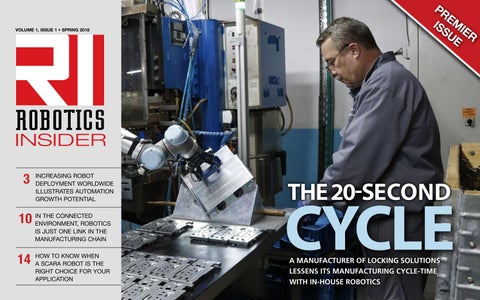
THE 20-SECOND
CYCLE A MANUFACTURER OF LOCKING SOLUTIONS LESSENS ITS MANUFACTURING CYCLE-TIME WITH IN-HOUSE ROBOTICS
CONTENTS Columns 3 Market watch
Increasing robot deployment illustrates automation growth potential
10 Spotlight
Presented by Manufacturing AUTOMATION, Robotics Insider reports on the world of industrial robots and its developing opportunities, challenges and technologies. By sharing unique perspectives and information, we strive to help improve your manufacturing efficiency.
Eric Logan, U.S. Advisory Managing Director, KPMG LLP
Features 6 The 20-second cycle
A manufacturer of locking solutions lessens its manufacturing cycle-time with in-house robotics
Editor - Alyssa Dalton adalton@annexbusinessmedia.com Publisher - Klaus Pirker kpirker@annexbusinessmedia.com
12 Collaborative robots
Ready to help manufacturers embrace Industry 4.0
Vice president & executive publisher Tim Dimopoulos tdimopoulos@annexbusinessmedia.com
6
Art director - Graham Jeffrey gjeffrey@annexbusinessmedia.com Account co-ordinator - Debbie Smith dsmith@annexbusinessmedia.com
14 Understand your requirements
How to know when a SCARA robot is the right choice for your application
Circulation manager - Urszula Grzyb ugrzyb@annexbusinessmedia.com Tel: 416-442-5600 ext. 3537 COO - Ted Markle tmarkle@annexbusinessmedia.com President & CEO - Mike Fredericks
2 Spring 2018 • Robotics Insider
3
12
14
111 Gordon Baker Rd, Suite 400, Toronto, ON M2H 3R1 T: 416-442-5600 F: 416-442-2230
MARKET WATCH
By Alyssa Dalton
INCREASING ROBOT DEPLOYMENT ILLUSTRATES AUTOMATION GROWTH POTENTIAL
T
here’s no doubt about it — industrial automation is on the rise around the world. The North American robotics, machine vision and motion control markets continue to set new records, according to the latest annual report from The Association for Advancing Automation (A3), a vocal advocate for the benefits of automation.
“New industries continue to embrace robotics, vision and motion, reaping the benefits of automation.” Describing 2017 as a “milestone year,” A3 finds the North American robotics market surpassed the figures of previous years in all four statistical categories: order units, order revenue, shipment units and shipment revenue. Specifically, North American 3 Spring 3 Spring 2018 2018 • Robotics • Robotics Insider Insider
customers purchased 34,904 total units representing US$1.896 billion in total sales, equaling a 0.9 per cent growth in units sold and 0.1 per cent in dollars from 2016, according to the report. This boost, A3 believes, is attributed to the rise of nonautomotive orders in 2017, which saw a 20.5 per cent growth in units and 7.3 per cent in dollars. The report finds that in terms of robotic units shipped, the plastics and rubber, metals, and food and consumer goods industries accounted for the largest growth rates. “What I find most telling about these results is not simply that the automation market continues to grow, but that it is growing in such a wide variety of industries,” Jeff Burnstein, president of A3, said. “New industries continue to embrace robotics, vision and motion, reaping the benefits of automation.” Stock image
MARKET WATCH On the global scale, 74 robot units per 10,000 employees is the 2016 average of global robot density in manufacturing industries, up from 66 units in 2015, according to the International Federation of Robotics (IFR). The Republic of Korea has by far the highest robot density in the global manufacturing industry, a position it’s held since 2010. At 631 units, its robot density exceeds the global average by more than eight times. The high growth rate, the IFR explains, is the result of continued installations of a high volume of robots in the electrical, electronics and automotive industries. Singapore takes second place with a density of 488 robots per 10,000 employees in 2016. About 90 per cent of robots are installed in the electronics industry in Singapore, finds the IFR. Meanwhile, Germany and Japan rank third and fourth in the world with 309 and 303 robot units, respectively. The IFR predicts that between 2018 and 2020, the annual supply in Germany will grow by at least 5 per cent a year due to increasing demand for industrial and automotive robots. Rounding out the top five countries with the highest robot density in 2016 is Sweden at 223 units. “Robot density is an excellent standard for comparison in order to take into account the differences in the automation degree of the 4 Spring 2018 • Robotics Insider
700
Number of installed industrial robots per 10,000 employees
600
Republic of Korea Singapore 500
Germany Japan Sweden
400
Canada 300
200
100
0
631
145
223
303
309
488
Statistics courtesy the International Federation of Robotics
manufacturing industry in various countries,” said Junji Tsuda, IFR president. While robot density in Canada has grown steadily over the years, we land in 13th place at 145 units in 2016, largely driven by installations in the automotive industry. Comparatively, robot density south of the border rose to 189 robots, placing the United States in seventh position. One country to keep an eye on is China in
its pursuit to become one of the world’s 10 most automated countries by 2020. Currently in 23rd place in terms of robot density, China has displayed the most dynamic development of robot density worldwide, says the IFR. Due to its significant growth of robot installations, its density rate rose from 25 units in 2013 to 68 units in 2016. “We are on the cusp of a new automation age in which technologies not only do things that we thought only humans could do, but also can increasingly do them at a superhuman level of performance,” states a 2017 McKinsey Global Institute report. But how exactly – and to what degree – will automation transform the workplace, a widening range of industries, and the global economy? Only time will tell. “The speed with which automation technologies are emerging, and the extent to which they could disrupt the world of work, may appear daunting but is not unprecedented,” say the authors of the McKinsey report. “Technological change has reshaped the workplace continually over the past two centuries since the Industrial Revolution, and even earlier. Nonetheless, the latest technological developments will touch every job in every sector and in every country.”
LET’S WORK TOGETHER!
Robotic automation will increase labour productivity by 30% over the next 10 years
30%
FANUC COLLABORATIVE SERIES
no need for safety fences
888-FANUC-87 www.fanuccanada.com
© 2018 FANUC America Corporation. All Rights Reserved
FANUC proven technology
payload 4kg/7kg/35kg
safe touch to stop
COVER STORY
THE
20-SECOND CYCLE Shortening cycle-time with in-house robotics By David Maltais
I
6 Spring 2018 • Robotics Insider
Photo: Robotiq
n the fall of 2015, Assa Abloy plants across Europe, Middle East and Africa were asked by the company’s global management to develop robotics projects that would improve productivity in their factory. In Assa Abloy Romania, based in the city of Bucharest, the skills gap continues to widen every year, and the factory’s management decided to invest in robotics to automate simple tasks and place their human workers in value-added positions. “We wanted to automate the welded assembly between a front plate and a case. There used to be an operator who put both parts together manually,” explains Adrian Iosif, mechanical design engineer at Assa Abloy Romania. “We had in mind to build a flexible cell that could handle lots of parts at lots of stations.”
COVER STORY
“Factories don’t buy a robot to replace people, they buy it because they cannot find people.”
After some research, the team decided to go with Robotiq Plug & Play components. “We found the Robotiq Gripper, which is really adaptive to different parts. It was exactly what we needed. We also bought the Wrist Camera, which is very flexible and able to locate parts in a wide field of view. Anytime there is a new lock to assemble, you can teach a new part. You can teach as many parts as you want and choose which one you will use and that’s it, you change the production.” Iosif reached out to local distributor RobotsNET Consulting to give it a try. “We were in discussion with Assa Abloy for some small application project in the beginning,” says Razvan Isac, sales manager at RobotsNET Consulting, a local distributor. “We 7 Spring 2018 • Robotics Insider
decided to lend them a Universal Robots UR5 for one month to test because they had some very interesting applications that could work with it. Since then we had very positive feedback from their side.” “This solution is an alternative,” Isac says. “Factories don’t buy a robot to replace people, they buy it because they cannot find people.” “As soon as we had the robot here, we started to play with it a little bit,” recalls Iosif. “We saw how easy it is to program. That made us want to buy it and see furthermore how we could benefit from it.” With all the cell design completed, the integration phase started as Iosif and his team were aiming for a cycle time that would improve productivity. Iosif wanted to automate the setup of a welding assembly that used to be done by a human
operator. This included locating the front plate, placing it in the welding machine, picking the case and placing it correctly over the plate on the fixture. Finally, the operator would press the button for welding. “When the first robot arrived, the reaction of the people was not very good. They said that the robot would not be able to produce at the same rate. And they were right at first,” he says. By trial and error, Iosif and his team were able to reach a 20-second cycle time. This would represent a 20 per cent productivity gain while freeing human hands from a highly
repetitive task. Iosif describes a particular pick-and-place robotic application: “We have a table where the operator puts the cases. Using the Wrist Camera, the UR5 robot detects the case, grabs it with Robotiq Adaptive Gripper, and puts it in the fixture of the machine. After that, the Universal Robot goes for the front plate, puts it on the fixture, and then the command is made for the machine to weld.”
The automation revolution This new process still requires a human presence for now, but makes life easier for operators like Moise
Photo: Robotiq
A new solution
COVER STORY
“I didn’t have programming skills but I found it very easy, with logic knowledge, to program the robot, the gripper and the camera.”
8 Spring 2018 • Robotics Insider
automation department has since grown to a team of 10 people, only one year after its creation. “The main role of the automation revolution happening here at the Romanian plant is also to set an example for our colleagues in other plants in Europe, to show what we can do with new technologies like collaborative robots,” Iosif says. “We have lots of opportunities in this factory because it’s a big plant and most of the work is done manually. The robots help us move our colleagues to the empty places that we have here in the factory.” David Maltais is public relations specialist at Robotiq. He travels the world looking for stories of manufacturers who overcame production challenges with robotics. Visit AutomationMag.com to read more Robotiq application stories.
Photos: Robotiq
Nicolae. “At the beginning, I had some technical challenges with the robot. But after a bit of time it became really easy and it’s very simple to work with the robot. It’s a big difference for me working with a robot because my task is much more easy.” While an operator is still required at Assa Abloy Romania’s first collaborative cell, the worker’s duty is now a lot less futile. Plus, each operator will eventually be in charge of two collaborative cells. This step into automation is the first of many for Iosif, a mechanical engineer who learned a bit about robots in his previous job and started working with Robotiq and Universal Robots on this project. “I didn’t have programming skills but I found it very easy, with logic knowledge, to program the robot, the gripper and the camera,” he says. Assa Abloy Romania’s
Kollmorgen Motion Solutions play a vital role in a variety of innovative robots, including collaborative, industrial articulated, and surgical by providing: • High power density to reduce size, weight and system complexity • Smooth, precise motion for control and safety • Broad range of size and power • Standard and optimized options to meet specialized requirements
Our expertise makes us a unique motion partner who understands the business and technical needs in robotics. Kollmorgen offers highly configurable products such as the AKM® & AKD® servo motors and drives, KBM & TBM frameless motors, and stepper motors & drives. We also offer machine design and manufacturing expertise to help you optimize your robot.
Find out more at www.electromate.com/kollmorgen ©2018 Kollmorgen Corporation. All rights reserved. KM_AD_000320_RevA_EN Specifications are subject to change without notice.
SPOTLIGHT
Eric Logan, U.S. Advisory Managing Director, KPMG LLP
W
e spoke to Eric Logan of KPMG LLP for his thoughts on industrial robotics and the evolving manufacturing environment. With nearly 20 years of experience in the industrial manufacturing sector, Logan focuses on operational efficiency and manufacturing strategy with primarily aerospace and industrial clients. • The current industrial robotics landscape
The industry has been preparing for the increased use of automation for quite a while. In fact, KPMG’s own research indicates that robotics 10 Spring 2018 • Robotics Insider
is expected to grow by 23 per cent over the next three years, meaning the ability to deploy in an efficient and effective way is going to be critical. If you look at the robotics industry, historically, the bulk of the impact has been in areas that weren’t specifically manufacturing related or designed for new robotic systems. However, as the demand for automation increases, the industry is shifting. In the past, we saw manufacturers invest in robotics simply for discrete tasks — using a robotic arm to move an item from one line to another. Today, for Industry
4.0, robotics is one link in the chain. Now, we’re seeing a lot more cobots and automation that is real-time data driven. In Industry 4.0, different components are interconnected within the manufacturing environment where one doesn’t really exist without the other. Yet the true potential exists when these components are also connected to key activities outside the manufacturing environment. In fact, we tell clients that confining any of these discrete elements to ‘the four walls of the manufacturing floor’ means losing a good deal of the potential benefits of Industry 4.0.
SPOTLIGHT
The fact is today’s robots don’t exist in a vacuum. They are consistently fed with an immense amount of information that enables them to complete multiple tasks. For example, in a storage facility, a robot can determine what item to pick based off of the schedule in the facility. The robot can make ‘decisions’ based on the data it’s fed versus performing the same discrete task over and over. • Some barriers that hold manufacturers back from adopting the smart factory
We have a number of clients who ask us how they can implement Industry 4.0. We tell them all the same thing: first, take a step back and evaluate your strategy. The type of technology an organization implements must be integrated with the business model, the organization and the output, and there must ultimately be buy-in from the individuals there. Having this kind of ecosystem view also takes into account an organization’s 11 Spring 2018 • Robotics Insider
mechanisms for communication and network infrastructure, like a methodology that pulls big data into a Cloud application that feeds AI information to the machines. Because of all the necessary infrastructure that is part of the connected factory, implementing Industry 4.0 means that manufacturers must take a topdown holistic approach as opposed to a project-specific approach. In my view, this is where a lot of organizations fail. They don’t look at integrating technology holistically, but rather as one-off opportunities. Industry 4.0 should be seen as a system of opportunities that work together to deliver a specific return, and that return is not always just an economic return. It should be a specific return – or set of returns – that is driven by the organization’s strategy.
storage methodology, the right data analysis tools, and that you’re using the data appropriately. The collection piece isn’t as hard today; the real challenge is determining what data is important and how you analyze it to make it useful and help increase manufacturing output. There is so much data today that manufacturers are overwhelmed with the amount they’re able to collect. There are organizations that have opened separate centres just to hold the data they’ve collected without having an understanding of how to appropriately use it. And of course, when using Cloud technology that crosses the boundaries of the manufacturing floor, cybersecurity becomes a significant concern. • The rise of industrial robotics
Two challenges manufacturers need to overcome to have a betterconnected environment are data analysis and data security. The key is ensuring you have the correct data
Robots are definitely driving manufacturing efficiency; in some cases, they are working with humans and in other cases, they are working
beside humans. In many cases, people implement automation to define greater repeatability and reliability — as opposed to having humans perform the same task. A bunch of new jobs have opened up thanks to robotics. People doing data and analytics and process automation will have new opportunities because this is a growth industry. There has to be intent behind how you roadmap for Industry 4.0 and how you integrate it into your business. Robots today are much more driven at the interface by some type of artificial intelligence. The reality is that today’s technologies extend beyond the four walls – it’s about connectivity in an interactive hub. We’re seeing a huge revolution of automation and it’s reaching all areas of the manufacturing operation – including the front office, back office and supply chain. It’s not just about putting a robot on the floor. It’s important to think through the whole organizational structure and how it could be impacted.
THE NEXT GENERATION
COLLABORATIVE
ROBOTS
Ready to help manufacturers embrace Industry 4.0
By Jim Lawton
Addressing one of today’s biggest challenges: Manufacturing
hen introduced five years ago, collaborative robots (cobots) kicked off a revolution in automation. Safe enough to work alongside humans, capable of performing tasks in the variable and sometimes chaotic world of real-world manufacturing and easy to train, these robots drew a lot of attention from media, pundits and educators. Today, robots are hard at work in factories large and small, as manufacturers embrace robots to meet labour needs. The next chapter for these machines is unfolding now, as manufacturers take concrete steps to embrace Industry 4.0. The disruptive technology of collaborative robots will do much more than drive more than efficiency and productivity improvements – it will become a vital contributor to operations that are agile, innovative and highly competitive.
While manufacturing – and the potential the industry offers for job creation – is often fodder for news and politicians, the reality is that manufacturers consistently report that labour shortages wreak havoc with their ability to operate. And it’s getting worse. In 2015, Deloitte and The Manufacturing Institute predicted that by 2025, there will be approximately 2 million unfilled manufacturing jobs in the United States. Last year, a study by Canadian Skills Training & Employment Coalition (CSTEC) and Canadian Manufacturers & Exporters found that over the next decade, Canadian manufacturers will have to replace more than 22 per cent of their workforce due to retirement. Behind those number is one reality – the manufacturing workforce in place today is aging out – and one perception – the next generation of workers
W
12 Spring 2018 • Robotics Insider
Stock image
THE NEXT GENERATION
doesn’t want those jobs. Automation is essential to meeting that challenge. Historically, automation was a massive undertaking, requiring sophisticated programming expertise and months of integration for a single task to be automated. Collaborative robots have changed all that. These robots can: • Do more than one type of task. Users tell the robot what to do (i.e. pull up a task by filename), put a tool in its hand, and off it goes to work. • Be on the job on day one. Manufacturers do not have to design the environment around them. • See and feel like humans, with onboard vision and the ability to feel multi-axis forces throughout its entire arm, allowing them to perform tasks that would otherwise be out of reach.
Software changes the game Manufacturing is becoming increasingly sophisticated, requiring 13 Spring 2018 • Robotics Insider
that automation innovation advances at the same time. The physical robot is, of course, always going to be there – the arms are essential to completing tasks – but the mass adoption of robots over the next five years is not going be driven by the hardware. It will be driven by software that goes well beyond the code that programs the robot to perform a specific task and deliver solutions that define everything from how robots interact, perform and deliver value. With software-driven robots, manufacturers gain a powerful solution for improving operations with a compelling return on investment. Just as we’ve seen with phones and cars, improvements
come without additional cost. The same rules apply to robots — manufacturers won’t have to buy a brand-new robot every time they need it to do a new task.
Moving toward Industry 4.0 Robots today can apply logic and make simple inferences. Soon, digital and information technologies will come together with advanced manufacturing to allow robots to cognitively understand, reason and learn. As the Fourth Industrial Revolution takes hold and factories of the future increasingly run on autonomous machines, robots will be an integral part of the fabric. Not only can these robots perform tasks,
but they will collect data on the performance of the task and analyze it for interpretation and action by human colleagues. The now-nascent field of Cloud robotics will allow the knowledge they gain to be shared with other robots, creating a way for robots to train robots. In this model, robots bring smarts to the process, and with intelligent analysis on error-reporting, qualityreporting and status updates, the robots feed faster and better decision-making. With these and other advances, robots will be able to make themselves, their processes and the products they produce better. And by freeing human colleagues up to focus on problem-solving, manufacturing operations will become more agile and able to respond quickly to shifts in everything from performance to supply and demand. Jim Lawton is COO at Rethink Robotics. The Boston-based company recently expanded its Canadian reach with new distribution deals with Aztec Electrical Supply in Ontario, and Rotalec of Quebec.
TECHNOLOGY
UNDERSTAND YOUR
REQUIREMENTS How to know when a SCARA robot is the right choice for your application By Kwan Shim
S
“Speed is an important factor when choosing a robot, and SCARAs are typically one of the fastest on the market. When cycle time is critical, consider a SCARA solution.” 14 Spring 2018 • Robotics Insider
Image: Fanuc America
CARA robots are a popular option for small robotic assembly applications. SCARA is an acronym for Selective Compliance Articulated Robot Arm, meaning it is compliant in the X-Y axis, and rigid in the Z-axis. The SCARA configuration is unique and designed to handle a variety of material handling operations. The SCARA’s structure consists of two arms joined at the base and the intersection of arms one and two. Two independent motors use inverse kinematics and interpolation at joints J1 and J2 to control the SCARA’s X-Y motion. The final X-Y location at the end of arm two is a factor of the J1 angle, J2 angle, length of arm one and length of arm two.
SR series SCARA robot work envelope
Image: Fanuc America
Here are six factors to consider when selecting the right robot for your application. Using this guideline will make the choice easier. Articulation Articulation is the type of motion and degrees of freedom required by the application. For a robot, the number of joints, joint location and the axis each joint controls determines its degree of freedom. SCARAs are four-axis robots, with motion in X-Y-Z and a rotational motion about the Z-axis. 15 Spring 2018 • Robotics Insider
4
SCARAs are four-axis robots, with motion in X-Y-Z and a rotational motion about the Z-axis.
A SCARA robot lacks the pitch and yaw motion of six-axis robots, so in applications where pitch and yaw is required, there are mechanisms that can be added to achieve the additional axis motion as long as the SCARA can accommodate payload requirements. Most pick-and-place and small assembly applications that involve moving a part from point A to point B are perfect for SCARA robots because this typically involves relocating the part in X-Y-Z with some rotation in the Z-axis. Screw-driving applications are also great for SCARA robots, where the rotation axis can easily drive screws. In addition, for dispensing applications, a SCARA can pick parts and present them to a dispenser, or the dispensing tool can be attached to the robot’s shaft. Work Envelope The work envelope or the area of space that a robot can physically reach is a critical consideration. Whether SCARA, Delta or six-axis robots, the lengths of various links, and the limitations of the joint motion are important
factors to review. Typically, SCARA robots have a cylindrical shaped work envelope with variations in the diameter and depth of the cylinder. The total lengths of arms one and two define the diameter of the circle, while the Z stroke defines the depth of the cylinder. In most applications, a SCARA’s work envelope is contained to the front and side. The back area may not be useable if cables and pneumatic hoses exit from the rear – some SCARAs offer optional bottom exits – making it possible to work behind the robot. Payload In most applications, robots perform assembly or pick-and-place operations, which require an end-effector. It could be a simple gripper or a multi-purpose end-of-arm-tool with dispensers or screwdrivers. The weight and inertia of the end-effector plus the part determines the maximum payload and inertia requirements, which must fall within the robot’s operating specifications. Most robot manufacturers have
at least two variants of SCARAs to accommodate different payloads and inertias. Understanding payload requirements is important - if a small robot can do the job, there’s no need to take up valuable floor space with a larger model. Speed Speed is an important factor when choosing a robot, and SCARAs are typically one of the fastest on the market. With four axes, they have less moving joints and are configured so that J1 and J2 control the X-Y motion, and J3 and J4 control the Z and rotation motion. This simplifies inverse kinematic calculations, requiring less computational time. When cycle time is critical, consider a SCARA solution. Footprint The footprint is the space where the SCARA robot mounts. Typically, SCARAs have a smaller footprint than Cartesian or Delta robots with the same reach. SCARA robots with larger work envelopes have larger footprints 16 Spring 2018 • Robotics Insider
because of the increased motor and base sizes needed for stability. Repeatability SCARA robots typically have the best repeatability performance of all robot types. Errors that occur in the X-Y position are due to having two motors at J1 and J2. Other robot types have three or more motors contributing to the X-Y position. The more motors, the more likely errors could occur. Excellent repeatability is crucial in small assembly applications where tolerances are required to be within several microns. Examples include inserting connectors into circuit boards or moving a needle into a small groove for dispensing. SCARA robots have proven valuable for a variety of industries that manufacture parts requiring the highest possible accuracy and speed. Taking the time to work with a trusted robot supplier is the key to a successful SCARA application. Kwan Shim is senior engineer/product manager, Fanuc America Corporation.
Image: Fanuc America
DON’T MISS OUT ON YOUR NEXT ISSUE OF IT’S FAST, IT’S EASY AND IT’S FREE! SOFTWARE: Why small business environments cannot follow the enterprise approach. p.24
CYBERSECURITY: Keeping ADVANCED WARNINGS: your plant floor secure in the Industrial Internet of How the connected industry can help you predict and prevent failures. p.20
TECHNOLOGY: Cloud and Fog computing will advance SCADA systems. p.22
INDUSTRY WATCH: Making sense of Big Data, IIoT and Industry 4.0. p.10
BACKSTORY: Boost your business by expanding into international markets. p.30
Things era. p.12
Your resource for Canada’s industrial automation news
AutomationMag.com
50 years of
Glad
PM 40065710
PM 40065710
Ontario plant celebrates milestone anniversary p.18
NOVEMBER/DECEMBER 2017
MARCH/APRIL 2017
DOMESTIC INVESTMENT Ontario manufacturer purchases a new vertical machining centre, slashing lead time and internal costs. p.16
MAY17 AC Branding Front Cover Banner (MA).qxp_Layout 1 4/20/17 3:32 PM Page 1
Automation, electromechanical, cabling, and interconnect products from 300+ manufacturers.
thinkallied.com thinkallied.com MA_AlliedBanner_May.indd 1
MA_mar_Apr_ 2017.indd 1 MA_AlliedCover_JanFeb .indd 1
2017-04-21 11:48 AM
2017-03-01 9:51 AM 2016-12-21 9:16 AM
HERE’S HOW: For fastest service visit AutomationMag.com AND CLICK THE SUBSCRIPTION BUTTON
AutomationMag.com