VOLUME 1, ISSUE 2 • SUMMER 2018
RI
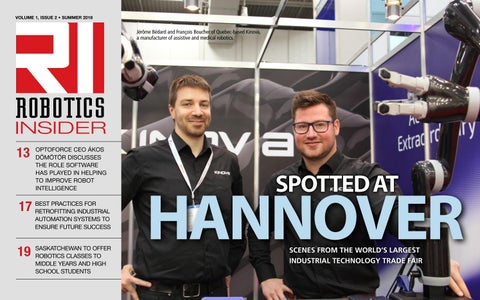
Jérôme Bédard and François Boucher of Quebec-based Kinova, a manufacturer of assistive and medical robotics.
ROBOTICS INSIDER CEO ÁKOS 13 OPTOFORCE DÖMÖTÖR DISCUSSES THE ROLE SOFTWARE HAS PLAYED IN HELPING TO IMPROVE ROBOT INTELLIGENCE PRACTICES FOR 17 BEST RETROFITTING INDUSTRIAL AUTOMATION SYSTEMS TO ENSURE FUTURE SUCCESS TO OFFER 19 SASKATCHEWAN ROBOTICS CLASSES TO MIDDLE YEARS AND HIGH SCHOOL STUDENTS 1 Summer 2018 • Robotics Insider
SPOTTED AT
HANNOVER SCENES FROM THE WORLD’S LARGEST INDUSTRIAL TECHNOLOGY TRADE FAIR
CONTENTS Columns 3 Market watch
New research finds robots create jobs
13 Spotlight
Ákos Dömötör, CEO of OptoForce, discusses the role software has played in helping to improve robot intelligence
Presented by Manufacturing AUTOMATION, Robotics Insider reports on the world of industrial robots and its developing opportunities, challenges and technologies. By sharing unique perspectives and information, we strive to help improve your manufacturing efficiency.
Features 6 Scenes from Hannover Messe
A collection of standout robotic displays from the German trade fair
Editor - Alyssa Dalton adalton@annexbusinessmedia.com
10 Real-world applications
A look at the 2018 igus’ gold and silver vector award winners
Publisher - Klaus Pirker kpirker@annexbusinessmedia.com
17 The right fit
Vice president & executive publisher Tim Dimopoulos tdimopoulos@annexbusinessmedia.com
6
Art director - Jaime Ratcliffe jratcliffe@annexbusinessmedia.com Account co-ordinator - Debbie Smith dsmith@annexbusinessmedia.com
Retrofitting automation systems for future success
19 A province-wide approach
New elective robotics courses will soon be available to all Grade 7 to 12 students in Saskatchewan
Circulation manager - Urszula Grzyb ugrzyb@annexbusinessmedia.com Tel: 416-442-5600 ext. 3537 COO - Ted Markle tmarkle@annexbusinessmedia.com President & CEO - Mike Fredericks
2 Summer 2018 • Robotics Insider
10
13
17
111 Gordon Baker Rd, Suite 400, Toronto, ON M2H 3R1 T: 416-442-5600 F: 416-442-2230
MARKET WATCH
By Alyssa Dalton
NEW RESEARCH FINDS ROBOTS CREATE JOBS he rapid spread of industrial robots hasn’t made a dent in employment figures thanks to the creation of new human tasks due to increased automation, according to the results of a new study by the Centre for European Economic Research (ZEW) on behalf of the German Federal Ministry for Education and Research (BMBF). ZEW explains that in Germany, the rise in the use of machines has allowed employment to grow by 1 per cent. This development looks to continue in the future — based on details from companies surveyed, the ZEW estimates that further automation and digitalization in the industry will generate a 1.8 per cent rise in employment by 2021. This development tallies with experience from the 1990s onwards with the computer boom, it reports, as the large-scale use of IT in
T
3 Summer 2018 • Robotics Insider
companies did render traditional processing jobs superfluous. But according to calculations by the ZEW, from 1995 to 2011, employment rose by just under 0.2 per cent per year. “The results of the ZEW study on the labour market confirm what we’re observing in leading industrial nations across the world,” said Junji Tsuda, president of the International Federation of Robotics (IFR). “The modernization of production shifts hazardous, unhealthy and monotonous work to the machines. In the vast majority of cases, only certain activities of a job are automated and not the entire spectrum of an employee’s work.” The London School of Economics (LSE) recently published a study on the use of industrial robots in 17 developed economies between 1993 and 2007. Stock image
MARKET WATCH At a Messe Muenchen press conference ahead of automatica 2018, LSE Prof. Guy Michaels summarized the results of the report saying, “Productivity has improved by around 15 per cent due to industrial robots. At the same time, the proportion of low-skilled labour dropped and pay increased slightly. Industrial robots don’t have any significant impact on the number of employees overall.” It’s interesting to note while the robotics revolution is creating new job roles and tasks, the digital transformation has also prompted an upskilling movement. A fall 2017 McKinsey Global Institute report describes how training can be improved: “To achieve good outcomes, policy makers and business leaders will need to embrace automation’s benefits and, at the same time, address the worker transitions brought about by these technologies. “Mid-career job training will be essential, as will enhancing labour market dynamism and enabling 4 Summer 2018 • Robotics Insider
Stock image
worker redeployment. These changes will challenge current educational and workforce training models, as well as business approaches to skill-building. Another priority is rethinking and strengthening transition and income support for workers caught in the crosscurrents of automation.” Autodesk announced a partnership with LinkedIn Learning
last November to provide free access to 42 unlocked courses for the manufacturing and design industries, among others. Meanwhile earlier this year, Rockwell Automation and workforce solutions company ManpowerGroup committed to upskilling 1,000 American veterans every year to help strengthen the talent pool for in-demand advanced manufacturing roles.
Across the pond, Emerson is providing automation software and systems valued at US$1 million to Ireland’s National Institute of Bioprocessing Research and Training (NIBRT) to help train next-generation workers on the latest technologies designed to optimize pharmaceutical production. Commenting on the announcement, Martin Shanahan, CEO of the IDA Ireland said, “...It is essential that we continue to provide the appropriately skilled workforce capable of operating these state-ofthe-art processing plants for many years to come.” We must ensure today’s workers have the training and skills needed to transition to the jobs of tomorrow. As Jonas Prising, chairman and CEO of ManpowerGroup, puts it: “We are seeing the emergence of a Skills Revolution today — where helping people upskill and adapt to this fast-changing world of work will be the defining challenge of our time.”
EXPERIENCE A FANUC SCARA Fast | Precise| Compact| Affordable
Robotic automation will increase labour productivity by 30% over the next 10 years
Automotive
Electronics
30%
Plastics
Pharmaceutical
Is a SCARA robot right for your application?
888-FANUC-87 www.fanuccanada.com
© 2018 FANUC America Corporation. All Rights Reserved
PHOTO GALLERY
SPOTTED
AT HANNOVER MESSE A collection of robotic displays from the technology trade fair
T
aking place April 23-27, Hannover Messe 2018 brought together more than 220,000 visitors and 5,000 exhibitors for five action-packed days of industrial technology. The tradeshow floor was buzzing with discussions and demostrations of the digital twin, humanoid and collaborative robots, and augmented reality — a signal that these disruptive trends are much more than buzzwords, they are the future of manufacturing.
6 Summer 2018 • Robotics Insider
The fourth generation of Forpheus made an appearance at Hannover Messe, challenging attendees to a friendly ping pong match.
Photos: Robotics Insider
By Robotics Insider staff
PHOTO GALLERY
Schunk illustrates virtual commissioning with digital gripper twins for assembly automation.
Attendees check out the 2016 picking and stowing winner of the Amazon Picking Challenge, which uses deep learning and AI to stock shelves.
A robotic arm controls 3D printing material placement in this Institut für Kunststoffverarbeitung (IKV) production cell.
Human-machine collaboration, smart gripping and machine-to-machine connectivity are key concepts on display at the IBG Automation booth.
Hiwin RA605 series six-robots demonstrate their agility in a choreographed performance, complete with a dramatic music and lighting show.
KUKA showcases the Smart Factory concept – a combination of mechatronic components and digital solutions – and IIoT digitalization.
7 Summer 2018 • Robotics Insider
PHOTO GALLERY
First introduced to the market at Hannover Messe 2015, ABB describes YuMi as the world’s first collaborative dual-arm robot.
Vacuum components and complex gripping systems on display at the Schmalz booth.
8 Summer 2018 • Robotics Insider
Siemens presents a digital demo of ProsihP2, showing mobile machining in aerospace.
A robotic piano player delights crowds at the Morsettitalia stand.
Meet Roboy, a humanoid robot developed by 100 research labs and countless students and scientists from the Technical University of Munich.
Kollmorgen Motion Solutions play a vital role in a variety of innovative robots, including collaborative, industrial articulated, and surgical by providing: • High power density to reduce size, weight and system complexity • Smooth, precise motion for control and safety • Broad range of size and power • Standard and optimized options to meet specialized requirements
Our expertise makes us a unique motion partner who understands the business and technical needs in robotics. Kollmorgen offers highly configurable products such as the AKM® & AKD® servo motors and drives, KBM & TBM frameless motors, and stepper motors & drives. We also offer machine design and manufacturing expertise to help you optimize your robot.
Find out more at www.electromate.com/kollmorgen ©2018 Kollmorgen Corporation. All rights reserved. KM_AD_000320_RevA_EN Specifications are subject to change without notice.
APPLICATION
REAL-WORLD A look at the 2018 igus’ gold and silver vector award winners By Thomas Renner
M
any manufacturers and designers are striving to build low-cost robots that also offer a high degree of dependability. It’s a trend that has gathered momentum in recent years, but it is hard to determine exactly where a low-cost robot will still be dependable, and what the market will be for such products.
The company won a vector award from igus for its use of two energy chains that move 3-dimensionally in the fuselage assembly.
“It’s possible to automate many repetitive tasks with simple components and control modules that are still done by humans,’’ said Frank Blase, CEO of igus, “and that for a fraction of the cost that would be required with classic industrial robots. How fast this market is growing and what size it achieves is difficult to say from today’s
The cost for building robots has declined dramatically in recent years, and now even more companies are relying on them and cannot afford unplanned downtime due to equipment failure. 10 Summer 2018 • Robotics Insider
Photos: igus
EMPLOYMENT perspective.” An area in which robots have become increasingly used is in the costly business of aircraft assembly. It is an area that demands precision, but manufacturers are also keeping an eye on costs. In April 2018, Loxin, a company from Spain, received igus’ gold vector award for its industrial robot that is used in the final assembly of aircraft fuselages. igus, a German-based manufacturer of motion plastics, explains Loxin won the award for its use of two energy chains that move 3-dimensionally, so that the robots
do not collide with the fuselage and cause damage to the aircraft. The e-chains, manufactured by igus, are attached parallel to each side of the robot arms, which facilitates movement of the arms and makes the fuselages more accessible despite the difficult geometries involved. Different cables and hoses for connecting elements can be guided to the end areas of the robots, and additional energy chain systems with different geometries and directions of movement power the robots. A fuselage needs thousands of holes drilled, and robots are a huge time-
APPLICATION
Loxin uses industrial robots in the final assembly stage of aircraft fuselages.
saver in their assembly. Increasingly automated production is accelerating across the globe and manufacturers are seeking ways to keep costs for such production down. According to a 2018 report from the International Federation of Robotics, 74 robot units per 10,000 employees is the new average of global robot density in the manufacturing industry. Europe has the highest density, with 99 robots for every 10,000 workers. Robots have been used extensively 11 Summer 2018 • Robotics Insider
in other applications, such as automobile manufacturing and packaging. More areas, however, are starting to emerge as areas in which robots can work. The cost for building robots has declined dramatically in recent years, and now even more companies are relying on them and cannot afford unplanned downtime due to equipment failure. Many robots include igus’ plastic components because of their lightweight nature and do not require lubrication and resist dirt and debris,
explains the company. “We want to support our mechanical engineering customers with robotic elements where it is not about extremely high loads and forces,’’ Blase said. Some industries are even using robots in areas that are exposed to dirt. For instance, a painting robot equipped with a multi-axis cable carrier manufactured by igus produces 2,000 pieces per shift and about 600,000 pieces every year. Even with heavy dirt accumulation from the paint mist, the robot operates without any problems. “It’s very important to build up our own know-how with regard to the necessary interfaces with control systems or vision systems,’’ Blase said. “I have to make sure that we do not promise too much here. But we are convinced of the use of plastic and its potential for industrial production. The user has to discover the variety of possibilities while we concentrate on the product ourselves.” Robots are even changing the agriculture and farming industry. The silver vector award went to Cordoba
Technologies. It created a device, the Hummingbird, that includes a robotic toolbar designed to reduce chemical use while increasing farm productivity. The product can be equipped with sensors and software that collects data relating to crop health and nutrient levels, and can detect disease. The Hummingbird aims to advance precision agriculture and also features an igus energy chain. “There is definitely a need for low-cost solutions in robotics,’’ Blase said. “For igus, it’s crucial to make a commitment to robotics. Of course, the application is also about design, control and software. But the right material is ultimately the basis for successful use. The goal for us is to draw strategically and produce technically in order to participate in the success of the move toward lowcost robotics.” Thomas Renner, who is based in Connecticut, writes frequently on robotics, manufacturing and construction for various trade publications.
SPOTLIGHT
Ákos Dömötör, CEO of OptoForce
W
e speak to Ákos Dömötör, CEO of OptoForce, regarding the state of the industrial robot. Since 2014, he has helped transform the company from an engineering-focused organization to a true global corporation. In this interview, he talks about how software has played a key role in helping to improve the intelligence of robots, leading to greater performance in manufacturing.
• How has software changed the capabilities and performance of industrial robots over the years? There have been some significant changes in industrial robotics over the last decade. One is the advancement of software. Robots are now more collaborative. This means they are easier to work with and more precise. We 13 Summer 2018 • Robotics Insider
can literally place them right on a production floor without having to manipulate an existing layout. They are not as big and rigid as they were in the past and can easily fit onto a production floor. Software is also easier to program and easier to integrate with other devices, such as sensors. Part of this is the development of simpler interfaces for users to program the robot. Software is about making robots more intelligent. What that means is that they can react to their environment and change their intended actions if needed. If a product moves, they can feel that movement and react simultaneously in real time. If by chance a robot hits someone or something, they can adjust and correct given built-in controls.
SPOTLIGHT
• Before the emergence of technology advancements from software, what was the state of industrial robots? Robots were designed to do repetitive tasks very precisely. They were designed to be rigid and heavy so that even without sensing, they always arrived at the same position. This works with metal parts with known dimensions in precise fixtures, but you couldn’t use robots if you needed variation in parts or positions. This is now changing. Companies are now getting accustomed to expect robots to sense how their environment is different from the ideal CAD model and predesigned plans and react accordingly. This might occur because parts move or change or the environment changes, but robots are more cerebral today and can react to change dynamically and in real time.
• Can you elaborate how software and programming a robot helps strengthen the overall management of industrial automation? 14 Summer 2018 • Robotics Insider
Industrial automation is done as projects, and every project is different. Robot software should be written for all tasks, and sometimes there are difficulties that the programmer cannot easily solve. This can lead to delays in the project and higher costs than expected. A delayed project could also mean having to find an expensive alternative solution during this time. However, new improvements in software now reduce the time it takes to program an application and the risks associated with programming. When programmers rely on a tested software module, there is a better chance that they won’t run into unforeseen problems.
• What type of skills are required to program a robot with software? It really depends on the robot type. Newer robots tend to have an easier-to-use graphical interface, and there is a clear trend in making programming even simpler. This has already dramatically decreased
automation costs and has made it possible and much easier to redeploy robots for new tasks. This trend will continue. In addition to writing software and creating interfaces that are easy-to-use, companies usually provide partner training, technical training, support, documentation, user guides, and videos.
• Specifically, what parts of a robot does the software manage or control? Firmware and software is everywhere now and couples closely with the hardware. The most important parts from the users’ point of view is safety and the user interface. Through the user interface, we can program robots to have them move into different positions, give commands to external accessories and process the inputs from sensors. The toughest part is how to write a program that reacts to the environment in real time – the algorithms you need to use is really high-tech and is being researched at a lot of universities around the world.
• Besides manufacturing and production tasks – like deburring, and sanding – what other business functions are impacted? Clearly, a robot is there to do a job, and to make manufacturing tasks more productive. A lot of companies now use robots for quality control as well, as the robots will always carry out required tests to measure, record, and analyze the data. Another affected function that benefits from robots is human resources. Many companies struggle to find workforce for afternoon and night shifts, especially for tasks that require attention or are in an environment that some would choose to not work in. For example, polishing requires operators to pay attention to ensure they are exerting the right amount of force on the parts and don’t over or under polish the parts. But it is also very dusty and therefore a hard job to perform. Also, jobs with repetitive motion or weight bearing tasks can be extremely hard on a body, which can increase sick time and injuries.
SPOTLIGHT
If robots are used, a lot of these problems go away, thereby making HR’s job much easier. In short, robots work 24 hours a day, seven days a week, 365 days a year and do not take sick time, vacation time or personal time.
Automation allows you to expand in different areas and employ more people as the company grows and becomes more competitive.
• It seems that a reduction in errors is one benefit of a software-programmed robot, and having a robot that can work nonstop would be another. What are some of the other benefits derived?
Most of the robots that are used in a factory are for enabling the arm. Robotic arms can be programmed offline (at a PC) or by using teach pendants. If the robot arm has accessories, it would be programmed through the robot.
One of the biggest benefits of automation is that it becomes easier to run a company. You want to ensure that you have the best people you can get and employ them in jobs that require creativity and good problem solving skills. Deploying industrial robots frees up workers to perform bigger, more strategic tasks that cannot be performed by a robot. Automation keeps a company competitive in a global environment. It helps to save jobs and keep a company viable that may otherwise have trouble competing and lasting. 15 Summer 2018 • Robotics Insider
• Is the robot programmed in one spot or various parts of the robot?
• What type of oversight by humans is required for a programmed robot? Robots are usually adaptive and can do most tasks, but it does depend on the intelligence level of the robot and the tasks required. If the manufacturing process is the same and consistent then the robot doesn’t need a lot of oversight. But if the tasks vary or if the parts aren’t all the same size or make, then it could require more oversight. If the robot needs to adapt it could very
well have the necessary intelligence to do so. The goal is to setup a robot to operate continuously so that the robot is standardized and performing high quality, regimented work. In the past, the person who oversaw the robot would be an engineer who understood the programming and software, but today, robots are easier-to-use and program and can be supervised by a technician. The key is to continue to make robots more intelligent. In fact, they are much more intelligent today than they were just a few years back. Robots can do more tasks than ever before because the software is more intuitive, easierto-install, and with new functions and applications from sensors — all making the robot smarter than ever. We’ve talked about the shop floor, but what about the top floor? When executive management sees their production environment being run with industrial robots that are programmed by software, what is the overall net payoff that they can
realize from this investment? If you can automate your manufacturing environment with industrial robotics you can potentially achieve payback in one year’s time. The cost of automation continues to go down steadily and rapidly. This is because it’s easier and faster to program a robot. This translates to a cost decrease in integration, production, and training, but also enables more tasks that can be automated. The net gain is labour cost savings, higher quality and greater corporate profitability.
• Where do you think the future is headed with software and industrial robots? The biggest trend is it’s easier to program, understand, use and change robots. The second one is how robots are becoming more intelligent. We will see a lot of analytics and collaborative robotics, and there will be a lot of software to more tightly integrate the robot into production lines. We will also see more robots that can rely on vision and touch sensing.
Transforming vision. Reducing complexity. Reinventing technology.
Light Section Sensors with SmartRunner Technology for Profile Comparison and Area Monitoring
n Transformation of complex image data into a simple digital signal for fast and easy integration n Simplified profile comparison and area monitoring with a unique combination of 2D vision and light section technologies n Easy installation and configuration via Data Matrix control codes or teach-in
www.pepperl-fuchs.com/smartrunner
TECHNOLOGY
THE
RIGHT FIT Retrofitting automation systems for future success By Steve Klopfenstein
I
mplementing a cutting-edge automation system can deliver exceptional speed and precision, leading to reduced cycle times, increased production volume, and less waste or rework. While the right combination of innovative solutions – tailored to exact application requirements – can deliver transformative results, there comes a time when parts become obsolete, machines break down or process needs change. The best practice is to effectively manage the lifecycle of a robot or automation system to ensure maximum performance and return on investment (ROI) over the life of the asset. This is often done through retrofitting, where an existing configuration is changed or upgraded on
“Conforming to a new way of doing things entails considerable planning, and the decision between upgrading a robotic system and buying a new solution should always be weighed to make every investment dollar count.” 17 Summer 2018 • Robotics Insider
original equipment. But in today’s manufacturing climate, is retrofitting still a cost-effective solution? Customer needs are changing and becoming more diverse, putting pressure on manufacturers to alter processes to meet demand. Conforming to a new way of doing things entails considerable planning, and the decision between upgrading a robotic system and buying a new solution should always be weighed to make every investment dollar count. While adding an extra five to 10 years onto the life of an existing robotic cell may not seem like the best choice for manufacturers, retrofitting is a more viable solution than many manufacturers think. The uncertainty to retrofit a robotic system is common. From downtime to cost, there is much to consider. Concerns about low quality parts and confusion over what to retrofit have been valid worries in the past. Manufacturers can gain confidence, however, in the fact that technological advancements and safety standards have greatly improved part quality in recent years. When smaller components, such 18 Summer 2018 • Robotics Insider
as a power source or welding torch, become old and fail to deliver the desired quality, the decision to retrofit may be easier to make. In most cases, a solution can be agreed upon over the phone with the automation system’s OEM or robotic integrator. Based on customer need, delivery and installation of components can vary — with 50 per cent of manufacturers installing newer equipment on their own. Robotic companies are savvy to client needs, creating options to
enhance products on a regular basis. Moreover, customer satisfaction groups are delivering diverse support services to help maximize uptime and optimize ROI to guarantee long-term success, making it easier on manufacturers to move forward on tough decisions. If needed, OEM representatives have the ability to do site visits to determine the best retooling and equipment options to meet application demands. If a retrofit is being considered because of a safety issue or a
process change, a risk assessment may be required. Safety standards must be followed and should be paramount when making any retrofitting decision. Another idea for manufacturers to consider is the concept of utilizing certified preowned robots during a retrofit. This is a growing trend and often a more affordable option for small job shops and medium-size companies. Budgeting financially and planning for retrofitting is crucial to operational success. Some suppliers with lights-out manufacturing have proven this, changing key automation components every two to three years as part of a preventative maintenance initiative. Other manufacturers know that keeping up with the latest technology can help maintain a competitive advantage and reduce energy usage. No matter the reason, adding system options through retrofitting is a worthwhile solution to maintaining operational success. Steve Klopfenstein is senior manager, Retrofit Systems and Refurb Center at Yaskawa America, Inc. - Motoman Robotics. Division.
EDUCATION
A PROVINCE-WIDE
STRATEGY
Coding and robotics classes are coming to Saskatchewan
By Alyssa Dalton
T
he Government of Saskatchewan has announced new coding and robotics opportunities for middle years and high school students in the province. These elective courses will be available to all Saskatchewan high schools, while Grades 7 to 9 teachers can also introduce students to coding and robotics. “Our government is following through on our commitment to develop Saskatchewan students’ computer coding skills that will help prepare them for emerging careers in science, mathematics, engineering and technology,” said 19 Summer 2018 • Robotics Insider
Deputy Premier and Education Minister Gordon Wyant. “The uniqueness we feel is that these courses are offered all the way down into Grade 7,” Susan Nedelcov-Anderson, Assistant Deputy Minister at the Ministry of Education, noted. “We’re always looking for opportunities to ensure students are engaged in their learning. We know that student engagement ultimately leads to higher retention rates and increased graduation rates and we feel [this] is something many students will find of interest.” A writing team, made up of teacher experts and ministry consultants, began developing
the new curricula last fall, with the goal of piloting them in the 2018-19 school year. The ministry expects to implement the courses the following school year. “Saskatchewan’s rapidly growing tech sector relies on a diverse and highly educated workforce that can be achieved only through continued and innovative support at every level of education,” SaskTech spokesperson Dr. Aaron Genest said. “We are thrilled to see the Government of Saskatchewan demonstrate a commitment to position Saskatchewan’s children as leaders in an increasingly technical world.”
Saskatoon University MLA Eric Olauson.
DON’T MISS OUT ON YOUR NEXT ISSUE OF IT’S FAST, IT’S EASY AND IT’S FREE! SOFTWARE: Why small business environments cannot follow the enterprise approach. p.24
CYBERSECURITY: Keeping ADVANCED WARNINGS: your plant floor secure in the Industrial Internet of How the connected industry can help you predict and prevent failures. p.20
TECHNOLOGY: Cloud and Fog computing will advance SCADA systems. p.22
INDUSTRY WATCH: Making sense of Big Data, IIoT and Industry 4.0. p.10
BACKSTORY: Boost your business by expanding into international markets. p.30
Things era. p.12
Your resource for Canada’s industrial automation news
AutomationMag.com
50 years of
Glad
PM 40065710
PM 40065710
Ontario plant celebrates milestone anniversary p.18
NOVEMBER/DECEMBER 2017
MARCH/APRIL 2017
DOMESTIC INVESTMENT Ontario manufacturer purchases a new vertical machining centre, slashing lead time and internal costs. p.16
MAY17 AC Branding Front Cover Banner (MA).qxp_Layout 1 4/20/17 3:32 PM Page 1
Automation, electromechanical, cabling, and interconnect products from 300+ manufacturers.
thinkallied.com thinkallied.com MA_AlliedBanner_May.indd 1
MA_mar_Apr_ 2017.indd 1 MA_AlliedCover_JanFeb .indd 1
2017-04-21 11:48 AM
2017-03-01 9:51 AM 2016-12-21 9:16 AM
HERE’S HOW: For fastest service visit AutomationMag.com AND CLICK THE SUBSCRIPTION BUTTON
AutomationMag.com