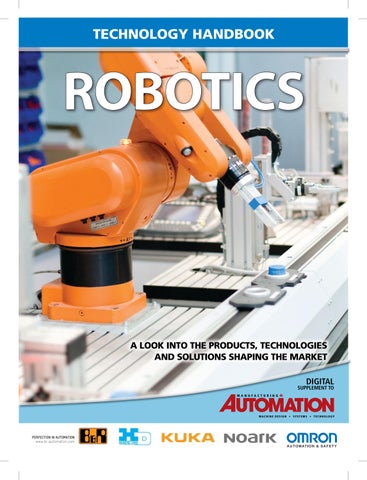
technology hAndbook
Robotics
A look into the products, technologies And solutions shAping the mArket Digital
Supplement to
MACHINE DESIGN • SYSTEMS • TECHNOLOGY
Technology handbook
Robotics
Commission robots quickly and easily B&R expands mapp technology portfolio to include functions for robot kinematics
B
&R is expanding its already extensive mapp technology portfolio to include components for all the most commonly used robot kinematic systems. Not only does this allow users to commission robots much more quickly, it also makes maintenance and diagnostics substantially easier. The new robotic functions in mapp include both serial and parallel robot kinematics, such as SCARA and delta robots. The user interface is based on familiar IEC 61131 programming methods. The robotic functions integrate seamlessly into the overall system, so there is no need for a dedicated robotics controller. Configuring, not programming The robot kinematics themselves are configured graphically in a convenient web interface. Programming in the conventional sense is not necessary. The mapp components can even handle manual operations such as jogging and pointto-point movement of the tool center point. Technicians can run diagnostics on the robot via the easy-to-use web interface. mapp technology consists of individually encapsulated blocks that streamline development of new software. The components provide basic functionality and are configured
graphically. Each mapp component retrieves the data it needs from other components using a client-server model. With mapp technology, development of application software is accelerated by an average of two-thirds. View press release online Learn more about mapp technology Video clip featuring mapp Robotics
B&R Industrial Automation Inc. 2501 Rutherford Road, Unit 42-43 Concord, ON, L4K 2N6 CANADA Tel: 1-905-417 9500 Email: office.ca@br-automation.com
www.br-automation.com 2 MA • Technology Handbook Robotics
STREAMLINE YOUR CABINET. UNLEASH THE SERVO. www.br-automation.com/ACOPOSmotor
< 1 cable for a modular machine design < Integrated safety technology CAT 4 / PL e / SIL 3 < STO, STO1, SBC, SOS, SS1, SS2, SLS, SDI, SLI, SMS, SLP, SMP, Safe Homing, Safe Robotics < Local I/O < 500 W up to 4 kW < CNC, robotics, motion control < reACTION Technology with 1 µs response time
Technology handbook
Robotics
Harmonic Drive LLC
H
armonic Drive LLC designs and manufactures precision servo actuators, gearheads and gear component sets. We work with industry-leading customers and companies of all sizes to provide custom-engineered solutions and standard catalog products. We provide high precision, high performance solutions to meet customer’s application requirements. Gear components and gearheads are available in many configurations including hollow shaft and differential gears as well as gearheads designed to quickly connect to any servomotor. We are happy to customize our products to meet your specific application needs. The easiest way to realize the benefits of these high performance gears is to use one of our performance matched servo actuators Key product performance features: • True Zero Backlash • Accuracy Better than 1 arc-min • Repeatability ±5 arc-sec • High Torque-to-Weight and Torque-to-Volume ratio • High Reliability
Harmonic Drive® Servo Actuators Harmonic Drive designs and manufactures all key components of our actuators including the motor, encoder, gearing and crossroller output bearing. Because these components are designed to be an optimum performance match, our actuators have extremely high torque-to weight ratio and torque-to-volume ratios. It also allows us to incorporate unique features such as a thru-hole in the output flange. EXPERT, EXPERIENCED ENGINEERING. Our full service engineering department truly partners with our customers. We solve problems, and work to provide realistic, timely solutions. Application engineers with expertise in motion control are available to assist you with your concept and detailed designs, free of charge. We love what we do and are eager to share our knowledge and passion with our customers.
4 MA • Technology Handbook Robotics
TYPICAL APPLICATIONS for Harmonic Drive® products include: • Robotics: Humanoid, Exoskeleton, Collaborative, Industrial, Semiconductor & Flat Panel, • Medical: Surgical Robots, Medical Imaging including CT Scan, Therapeutic, Prosthetics, Laboratory Automation • Defense: Unmanned Vehicles, Weapon Stations, Antenna Pointing • Aerospace: Solar Array Drives, Antenna Pointing, Valve Actuators, Lunar and Interplanetary Rovers • Machine Tool: Milling Head, Tool Changer, Rotary Table, Grinding, B & C Axis on a Variety of Machine Tools • Energy: oil exploration, drilling and positioning, wind power, solar VOTE ONLINE Harmonic Drive and Harmonic Planetary are registered trademarks of Harmonic Drive LLC.
HARMonIC DRIve LLC 247 Lynnfield Street, Peabody, MA 01960 Toll Free: 800-921-3332 Phone: 978-532-1800 www.HarmonicDrive.net
eLeCTRoMATe InDUSTRIAL SALeS LTD. 6221 Highway 7, Unit #15 Vaughan, Ontario, Canada L4H 0K8 Phone: 877-SERVO98 Email: sales@electromate.com www.electromate.com
247 Lynnfield Street Peabody, MA 01960 800.921.3332 www.HarmonicDrive.net
Electromate Industrial* 6221 Highway 7, Unit #15 Vaughan, Ontario, Canada L4H 0K8 www.electromate.com
Harmonic Drive is a registered trademark of Harmonic Drive LLC. Robonaut image courtesy of NASA/JPL-Caltech. * Electromate Industrial Sales is the exclusive Canadian distributor of Harmonic Drive® products (except the Province of Alberta).
Technology handbook
Robotics
KUKA Robotics Canada Supporting STeM education
S
TEM fields are considered the core technological underriculum includes lectures, labs and exams. Students also receive pinnings of an advanced society. Today, we are seeing a a Manufacturer Certified Training Certificate on completion. surge of job openings in STEM fields and a lack of trained professionals to fill these positions. 5. Five controller sizes operate over 300 robot models using the Skills Canada estimates that in the next five years, there will be same software and interface. When students learn on the smallest over 1 million jobs in STEM fields and industries. In order to fill KUKA AGILUS robot, they are able to program every KUKA these jobs, and prepare for the future, we need to get more students Robot including the largest KR titan 1000 kg. This is a great adinterested and involved in STEM education. Students need to be vantage for students once graduated. KUKA’s PC based controller mentally stimulated as well as engaged. Educators are turning tointerfaces easily to many different sensory devices through the wards innovative and interactive methods of teaching. latest field bus communication protocols and is ready to help our customer capitalize on the emerging technologies of Industry 4.0. KUKA Robotics KORE Program (KUKA Official Robotics Education) 6. Six Axes. All 6 axes can be automatically mastered to factory KUKA has engineered a hands-on solution that offers high schools, specs in less than 10 minutes using KUKA’s unique Electronic colleges, universities and technical centres the opportunity to inMastering Device (EMD). In addition, KUKA’s USB allows dicorporate Certificate based robot education on KUKA products rect saving and loading on the KUKA smartPAD. Both devices into their STEM, Advanced Manufacturing and Mechatronics proreduce down time and classroom interruptions. grams. With the KUKA KORE package, students will learn basic robot programing and operation skills on equipment utilizing the 7. Seven Firsts. KUKA Robotics has gained a reputation for insame robots and control technology that is utilized in a variety of novation by developing many firsts in robotics, including: the industries. This gives students a competitive advantage in education first 6-axis electro-mechanical robot (1973), PC based controller, and future opportunities in the STEM job market. To learn more safe-robot technology, Robocoaster, collaborative robot, 1000 visit www.kukaconnect.com. kg payload robot, and omnidirectional platforms. Here are 10 reasons to choose KUKA as your partner.
8. Eight jog keys on the KUKA smartPAD allow students direct control of up to 8 axes at once. Even better, the robot can be 1. Number One. Not only is KUKA Robotics the number one controlled intuitively using the unique haptic 6D mouse in 6 robot manufacturer in Europe, they are the robot of choice degrees of freedom. This gives students the ability to choose for many North American industry leaders, such as globally their preferred jogging method to optimize comfort level. renowned automobile manufacturers, aerospace vehicle manufacturers, entertainment-theme park, surgical, and medical- 9. 95% reduced energy consumption in standby mode with the diagnostics companies. new energy management system. The improved cooling concept, combined with a temperature-controlled fan, further reduces 2. Two Times the freedom. KUKA’s open architecture gives users the power dissipation of the controller, while making operation as much freedom as they want. Delve into the Windows 7 OS considerably quieter. to access and modify software or dive deeper into the real-time controller using KUKA’s unique Robot Sensor Interface (RSI). 10. Ten-seat lifetime server license of KUKA.SimPro & KUKA. OfficeLite are included with the Education Bundle. This offline pro3. Three Machine Languages. In addition to its own robot language gramming software allows users to create virtual 3D simulations KRL, and 25 spoken languages, the KR C4 also understands the and generate programs that can be sent directly to the robot. language of the CNC machining world (G-code) and the language of PLCs, enabling you to control it with your SIEMENS® or Rockwell® controller without additional hardware. KUKA Robotics Canada Ltd. 4. 40 hours of KORE curriculum. KUKA is the only industri- 6710 Maritz Dr. – Unit 4, Mississauga, ON L5W 0A1 al robot manufacturer to offer a complete curriculum. The Phone: (905) 670-8600 12-module KORE (KUKA Official Robot Education) cur- www.kukarobotics.ca
6 MA • Technology Handbook Robotics
Technology handbook
Robotics
A Perfect Blend of Quality, Performance and exceptional value
N
OARK Electric is a global manufacturer of electrical distribution and control products that address a variety of customer needs, ranging from components to intelligent system solutions. Our global product lines include: circuit breakers, contactors, relays and intelligent control. NOARK Electric was established in 2007 and covers the globe with regional headquarters in North America, Latin America, Europe and Middle East/Africa. NOARK Electric is backed by a two billion dollar organization and serves the manufacturing, industrial, commercial, residential, utility and renewable energy markets. In North America, NOARK Electric focuses primarily on industrial OEMs, users and associated channel partners. Our motto is “Excellent product. Exceptional value.” NOARK Electric delivers this to our customer with a perfect blend of quality products backed by a five-year limited warranty; exceptional values that reduce the cost of products, improve profitability and increase margins; and local support and local inventory with superb customer service, a knowledgeable technical support, dedicated sales force, wellstocked inventory and a North American headquarters.
NOARK Electric’s top-selling products are: • Ex9 Series M: Molded Case Circuit Breakers and Switches that offer a complete range of UL 489 2 and 3 poles in four frame sizes: 100 A, 225 A, 400 A and 600 A. Each frame offers a choice of interrupting ratings at voltages ranging from 240~690 Vac and 250~600 Vdc. • Ex9 Series – B1: Miniature Circuit Breakers that offer a complete range of UL 489 and UL 489A listed 35 mm DIN rail miniature circuit breakers up to a 63 A current rating with a red/green contact position indicator. • Ex9 Series – B1: Supplementary Protectors that offer a complete range of UL 1077 listed 35 mm DIN rail miniature circuit breakers up to a 125 A current rating with a red/green contact position indicator.
8 MA • Technology Handbook Robotics
• Ex9C & Ex9R Series: IEC Contactors and Thermal Overload Relays with four frame sizes that bring optimization of electrical parameters and mechanical dimensions. All frame sizes share accessory auxiliary contacts. Overload relays differ with frame sizes and fit the respective contactor of a given rated current. • Ex9CD & Ex9RD Series: IEC Contactors and Thermal Overload Relays with four frame sizes that these contactors have a refined appearance, a compact structure and ease of installation. All frame sizes share accessory auxiliary contacts. Overload relays differ with frame sizes and fit the respective contactor of a given rated current. • Ex9CK Series: Definite Purpose Contactors, these UL 508 rated definite purpose contactors have a rated current from 20 to 90 A with 1, 2, 3 and 4 pole configurations. • Ex9SN Series: Manual Motor Starters are electromechanical protection devices for the main circuit and used mainly to switch motors manually ON/OFF and protect them fuse less against short circuit and loss-phase. None-fuss protection with a manual motor starter saves costs, space and ensures a quick reaction under short-circuit condition, by switching off the motor within milliseconds. Manual motor starter combinations are setup together with contactors and overload relays. Contact NOARK Electric today to see how we can help you!
noARK electric north America 2188 Ponoma Blvd. • Ponoma, CA 91768 (626) 330-7007 nasales@noark-electric.com
na.noark-electric.com
Quality Performance Small Panel Solutions Ex9 Minature Circuit Breakers DIN mounted devices for branch circuit & supplemental protection
Broad product range • Amperage ratings: 0.5 A - 63 A Global acceptance • Certified to UL 489/489A and 1077, CSA C22.2 and IEC 60947-2 Flexible terminals • Less physical demand • Detachable shield makes it faster and easier for installer Three terminal options • Lug terminal • Box terminal • Quick connect Multiple accessories • Extended rotary handle* • Electrical auxiliaries • Locking device* * only available for 489/489A
Ex9C/CS Series AC Contactors & Ex9R Overload Relays
Ex9CD/CM Series AC Contactors & Ex9RD Overload Relays
Ex9CK Definite Purpose Contactors
Ex9SN Manual Motor Starters
NT
IT
Ex9 Series - B1 Miniature Circuit Breakers UL 1077 & 489
A
LIM
Ex9 Series - M Molded Case Circuit Breakers & Switches
Y
5
YEAR ED
WAR
R
Ex9 Series Push Buttons & Indicator Lights
Contact NOARK Sales for more information at: (626) 330-7007 • nasales@noark-electric.com • na.noark-electric.com
Technology handbook
Robotics
Five Qualities of the Ideal Pick-and-Place System
T
he hot topic in the automation community is human-machine collaborative robots and there are certainly exciting technology advances being made there. However, many applications are not suitable candidates for this slower technology. Automation integrators agree that making collaboration more efficient between multiple robots and machine controllers is more significant to their near term business. Recent advances in networking and machine controller capabilities have brought the idea of a simple-to-integrate robot solution closer to an affordable reality. High-speed real time communication protocols such as EtherCAT allow tight synchronization of motion with PLCs/PACs machine controllers that have robot kinematics built in and vision for positioning and in-line inspection. Controllers now offer more flexible capabilities for configuring completely integrated control. In traditional robot control the PAC/PLC hands over primary control of the motion to the machine controllers and the robot controller only manages the robot kinematics/motion paths. Newer machine automation controllers take complete control
A traditional robot system requires a dedicated controller for each robot. of the robot as well as handling other motion and I/O processing tasks, with servos directly tied to the machine controller.
1. One controller: Vision, Safety, Motion, I/O, and Multiple Robots are all controlled from a single controller 2. Cost effective replacement parts: Traditional robot manufacturers have very expensive spare parts. This cost of ownership topic tops the list of complaints from end users with older systems. 3. IEC61131 PLCopen programming: No Robotic specialist required to program the robot. 4. Easy to troubleshoot: One programming language and one program. 5. Single manufacturer: Vision, Safety, Motion, I/O, Robotics, SQL, Sensing, Components from a single source simplifies delivery coordination, technical support issues and pricing. One supplier offers a fully integrated approach for robotic projects today. The Sysmac Platform by Omron Automation and Safety uses one controller, one software and one network connection to tightly integrate the necessary control domains of motion, robotic kinematics, machine vision, safety, I/O and SQL. The Omron NJ series machine automation controllers support 2 to 256 motion axes, tightly synchronized with built-in EtherCAT and EtherNet/ IP networks, fast I/O and vision processing. Sysmac Studio software provides an integrated development environment for all the controls used for I/O, robotics, HMI, motion, vision, safety and SQL. Machine builders familiar with the software report a significant reduction in programming steps; more accurate and comprehensive simulation of control with motion that covers entire processes instead of a group of partial views; and a single program for an entire project that does not require multiple reference tables. Sysmac Studio conforms to IEC 61131 and incorporates PLCopen approved function blocks. Watch the video to learn more.
Omron’s Machine Automation Controller with built-in robotics simplifies the system by eliminating the need for individual robot controllers. omron Automation & Safety Five Qualities of the Ideal Robot Control System As collaboration between machine controls continue to improve, these key qualities will ensure an easy to integrate robotic solution:
10 MA • Technology Handbook Robotics
885 Milner Avenue Toronto ON M1B 5V8 Toll Free: 1-866-986-6766 Email: askomron@omron.com
www.industrial.omron.ca
One platform controls your entire machine
From logic, motion to robotics, vision and safety At Omron, we deliver a comprehensive range of products and services designed to increase the speed, versatility, and safety of your machines.
Our growing line of delta robots can boost your machine’s throughput. A single software and integrated development environment saves whole machine control data in one file.
Learn how we simplify your integration of delta robots OMRON AUTOMATION AND SAFETY • Canada toll free: 866.986.6766 • www.omron247.com
Technology handbook
Robotics
COLLAbOrATIvE
robots A look at the emerging trend of operator and robot working together, safely, in manufacturing By Mary Del CianCio
12 MA • Technology Handbook Robotics
Robotics
Technology handbook
F
ifteen years from now, there will be a collaborative robot in every single manufacturing environment in the world. For sure. That prediction comes from Jim Lawton, chief marketing officer of Rethink Robotics, a Boston, Mass.-based robotics company. Rethink is one of several companies with collaborative robot offerings on the market, helping to bring attention to this new category of robots. The term collaborative robots refers to humans and robots working together on common tasks, safely. It’s become an industry buzzword, and is even addressed in the latest version of the ISO 10218 — robots and robotic devices — standard, where collaborative operation is defined as “a state in which purposely designed robots work in direct co-operation with a human within a defined workspace.” But there are certain applications better suited for the emerging technology, and certain considerations need to be made when deciding whether collaborative robots are right for your manufacturing environment. What are the opportunities? Collaborative robots emerged on the manufacturing scene because the industry was demanding flexible automation to replace dangerous, boring and error-prone tasks at an affordable price, and many manufacturers were looking for alternatives to chasing low-cost labour across the globe. At the same time, robot manufacturers were looking for ways to give customers the benefit of more human collaboration with robots. Today, the market is growing, as robotic companies work to build safe, collaborative robots to help customers take advantage of the opportunities the technology offers. But in order to understand the opportunities, you must first consider what collaboration looks like. And that depends on who you ask. Erik Nieves, CTO at Yaskawa Motoman, says that collaboration technically means four flavours — stopped state monitoring, speed and separation monitoring, hand guiding, and power and force limiting. (See the glossary on page 19 for definitions of these terms.) The first three, he says, are supported by just about every robot controller out there. However, it’s the latter that’s typically referred to when collaborative robots are discussed. But Nieves says that’s too narrow. “When we first started thinking about the notion of collaborative robots, it was simply about having robots and their human operators work more closely and naturally together. So it really was just that. How do I make this system more efficient by leveraging the strength of the robot and the strength of the person in better balance?” explains Nieves. “So the robot is good for strength and memory. They can repeat tasks and they can do inhuman tasks in terms of payload and repeatability. But the human operators are much better at decision-making and quality control. So we view collaboration as being very broad, as having direct applicability to lots of robot applications.”
Rethink Robotics’ Baxter robot was designed to work safely next to people without cages or external control safeguards.
Rethink’s Lawton says collaborative robots are ideal for applications that require flexibility and versatility. For example, a manufacturing environment with a high-mix, low-volume operation would be a good candidate, as well as applications “where the task needs to get done in very human-like ways.” Packaging environments are a good fit, as well as applications that require line loading and unloading, machine tending, material handling, light, general assembly, testing and sorting. Applications where collaborative robots may not be the best fit are those that require extraordinary precision. Nieves believes collaboration has a role to play in process robots — those adding value, whether it’s painting, welding or another process. Material handling applications, where robots are supporting moving parts in and out of production, are another area where he feels collaboration is useful — even in applications requiring material handling over 10 pounds. Another application is material handling less than 10 pounds, where precision is not required. Tom Moolayil, technical support manager, North America, for Universal Robots (UR), says the biggest application in North America for the company’s UR5 and UR10 flexible, lightweight, six-axis robot arms is CNC machine tool tending. With these new, portable five- and 10-kg robots, you don’t need to worry about floor space, which is a huge bonus, says Moolayil, “because you don’t have to worry about guarding [and] you don’t have to worry about concreting the floor and bolting it down because it’s a lightweight robot. So you can make it do one thing here, you can move it around, program it to do something else. And that makes it a lot more flexible to install this robot in [a] plant.” But does collaboration automatically mean the robot is not fenced? Not necessarily, says Nieves, giving welding as an example. You can gain the benefit of collaboration in loading the part directly without having this interim fixture in between, but it’s still fenced, he says. Robotics Technology Handbook • MA 13
Technology handbook
Robotics Esben Ostergaard, founder and CTO of Universal Robots, says 80 per cent of the company’s UR5 and UR10 flexible, lightweight, six-axis robot arms are used in collaborative environments without guarding.
“Why? Because the robot needed to shield the operator from the arc flash. So there is a zone where the robot comes out and presents itself to the operator in the wide open. But when it’s going over to do the work, it’s hiding itself in the cubby where the arc welding takes place. Not all fences are about keeping people away from robots. There are reasons for barriers that go outside of human-robot collision,” he says. For example, process paramaters, hygiene and throughput. But there are a growing number of applications where you can legitimately eliminate fences. It all depends on the application and what the robot is holding, says Jim VanKessel, owner of JVK Industrial Automation Inc., in Kitchener, Ont. “The big trick with collaborative is, what are you putting in the hands of that robot — the type of grippers, the type of product you’re handling? Some will require guarding of some sort, like light curtains, where other applications don’t. So the real trick is assessing the risk of the specific application,” says VanKessel. “The robot by itself has all the safety built into it. The part that’s important is assessing the risk of the end-of-arm tooling, the gripper mechanisms — whatever they’re using to handle their materials. It’s assessing that risk of the specific application…The robot by itself is fine, but you put a sword in it, it’s every bit as dangerous as a person with a sword.” What makes them safe? Rethink’s Baxter robot has a four-kg payload and features series elastic actuators. This technology uses springs to advance the robot’s motion control solution from one of rigid positioning to one of force control. This, according to the company, gives Baxter its smoothness of handling, so it won’t damage parts, fixtures and materials, or harm humans during operation. In addition, its smooth, pinch-proof exterior, combined with back-drivable motors and force-detecting sensors, are designed to minimize the impact of inadvertent contact. Embedded sensors allow Baxter to “feel” and compensate for common task variables in order to place parts into a fixture or alignment. The robot recognizes and adjusts to subtle changes similar to its human co-workers, because Rethink designed it to operate in “human-like” ways. “There are four sensors in each of [Baxter’s] joints,” says 14 MA • Technology Handbook Robotics
Lawton. “Any aspect of that arm can come in contact with you, and will immediately be able to respond and understand that it’s experiencing a force and the force can be controlled in a way to prevent somebody from being harmed by that. Because the springs are in series, there’s also a certain amount of give to the arm that absorbs some of the energy, so that when you do come in contact with it, the springs are absorbing some of the impact of that rather than you.” Lawton says Baxter is so safe, none of its customers have it caged. “We don’t have a single instance anywhere of a robot being in a cage or being guarded in any way. There’s not one that’s being guarded,” he says. “There is an envelope that collaborative robots are going to have to operate in to be able to maintain safety,” explains Lawton. “There are some tasks that require heavier payloads, but when you start to combine a really long reach with a heavy payload, with a lot of speed at the tip, that’s when you get all the kinetic energy that can actually hurt people...And in those circumstances, that’s what’s going to require the thing to be caged.” Universal Robots’ UR5 and UR10 robot arms feature “smart joints,” says Moolayil. “They have force sensing built into these joints. It’s continuously monitoring the force on each joint. And if there’s a force spike sensed in any of these (i.e., if it runs into something, there’s a force spike)…it will just stop. That’s what makes these guys safe to work with,” says Moolayil. UR’s third-generation robot arms can operate in reduced mode when someone enters the robot’s work cell, and then resume full speed when the operator leaves. Or the robot can run full speed inside a CNC machine, for example, and reduced speed when outside. The company’s patented safety system monitors eight safety functions: joint position and speed, TCP position, orientation, speed and force, as well as the momentum and power of the robot. For Yaskawa’s offerings, it’s the Functional Safety Unit that makes most of its robots (equipped with its latest controllers) safe to use in collaborative environments. “It’s the functional safety. Collaborative means, from a controls perspective, it means you can be in the safeguarded space of that robot. You’re within reach of that robot, and you can be there safely,” Nieves says. With these and other collaborative offerings on the market, VanKessel says a risk assessment is necessary to make sure the application is really safe. “I’ve had a couple of people now try and say, ‘We don’t need guarding because it’s a collaborative robot.’ But at the same time, they’ve got a pin on the end-of-arm tooling that’s an inch and a half long and three eighths of an inch in diameter. Well if a three-eighths-of-an-inch pin hit me in the head, it’s going to do some serious damage, even if it’s only five
Technology handbook
Robotics pounds or a five-kilo application. Yaskawa Motoman’s Functional It’s going to crack my skull. And it’s Safety Unit makes the assessing those risks that drives the company’s robots safe for whole project,” VanKessel says. collaborative environments It’s going to be a learning prowhere people interact with the cess for manufacturers, says Esben robot during production. Ostergaard, founder and CTO of Universal Robots. “You can’t just put a robot up without fences and say it’s a safe robot, because you really have to consider the risk in the installation,” he says. Though the Danish company says that, after initial risk assessment, 80 per cent of its robots are used in collaborative environments without safety guarding. Are collaborative robots right for you? Customers are embracing this new class of robots, says Nieves, because it allows them to be both safe and productive. “Their productivity goes up, for one, and they haven’t traded productivity for safety — they’ve just gained productivity.” But there are several factors to consider before bringing collaborative robots into your environment. Lawton says it really comes down to whether the robot can perform the task, and whether it can do the task cost effectively. “Think broadly about what one means when talking about collaborative robots. It’s not just about getting them out of the cage. What you really need them to do is perform tasks and have very human-like characteristics in the way they approach solving problems. When you think about them through that lens, it helps you identify the best places to deploy them [and] how to make them successful,” says Lawton. But for VanKessel, it all comes down to that risk level. “If the application is applying a lubricant to a product, it’s very easy to get a lubrication dispenser on the end of the robot that’s very safe. What’s the impact on the people around it? If we take a robot and ask it to do material handling, what does the part look like? Does it have sharp edges? The minute it has a sharp edge, it could hit me in the head, so now we need guarding.” Nieves says to look at your application, your use case. “Your use case will point you in the direction of collaboration or not. And if collaboration, which flavour of collaboration makes the most sense for this particular application and installation?”
And when you’re at that point, says Nieves, the first thing is to look at the mechanical performance. “What do you need to pick up? What do you need to handle? What do you need to do? So you still have to think in terms of payload and reach.” Next, he says, consider what the operation looks like. Is the robot by itself? What is the level of interaction? What does collaboration look like? How portable do you need the system to be? And what other hazards does the application present? What does the future hold? The industry is still at the front end of this emerging market, but Lawton predicts a lot of innovation ahead. “There’s a lot more excitement ahead in terms of how all this comes together over time. There are just so many really interesting things you can do with collaborative robots,” says Lawton. “Over time, we’re also going to see that these robots are going to be able to be leveraged in ways that harness the power of big data and analytics, and the ability to learn from their experiences.” He suggests that, in the future, robots will be able to learn from their experiences and change their own behaviours, and communicate these changed behaviours to other robots they’re working with. This is just the beginning. “There’s no question that collaborative robots are here to stay,” says Lawton. “Every manufacturer is going to have a collaborative robot. In fact, many of them are going to have thousands of collaborative robots. And people won’t be competitive if they don’t.” •
glossaRy There are four “flavours” of collaboration that Yaskawa’s Erik Nieves describes. • stopped state monitoring - The robot stops when a human enters a scanned area, but continues to monitor the area until the operator leaves, at which time it resumes working. • Speed and separation monitoring – The robot slows down when a human comes near, and may stop if the person gets too close. • Hand guiding - The user is in direct contact with the robot while guiding and training it. • Power and force limiting - Safety is achieved through restricting the amount of force available in the system. These robots are limited in payload, acceleration and torque.
Robotics Technology Handbook • MA 15
Technology handbook
Robotics
Where
no one has gone
before By Vanessa Chris
An innovative robotic application automates commercial cake decorating
T
he commercial baking industry is no stranger to automation. For years, it has used machines to mass produce baked goods. Until now, however, the decorating of these items was reserved for manual labour — actual people waiting, with frosting bags in hand, to complete that final “Happy Birthday” on a cake, or an intricate swirl on a cupcake. The reason for this somewhat archaic mode of decorating was simple — and something of which many industries suffer. Automation technology — more specifically, robotics — just didn’t have the capability to meet the demands required of such a delicate and varying application. For a robot to be effective in this capacity, for example, it would have to be able to adapt to a wide range of applications — from writing on cakes to putting swirled icing on cupcakes. It would have to be able to carry a small, light nozzle weighing less than a kilogram for a line of cake writing, and then switch to a heavier decorating head weighing almost 15 kilograms to ice a 12-pack of cupcakes. Delta robots, a popular off-the-shelf brand for the food industry, while easy-to-clean and fast, can only carry a payload of up to five kilograms. In addition, because they’re typically used for pick-and-place, they have a work envelope that’s just too large for this type of application. Despite these obstacles, Unifiller, a company that provides automation equipment to the baking industry, had a dream of automating the time-consuming task of cake decorating — something that, if accomplished, would not only distinguish the company from its competitors, but also revolutionize the commercial baked goods industry. From dream to reality Unifiller contacted Rob Antonides from Apex Motion Control, a Surrey, B.C.-based design and service consulting 16 MA • Technology Handbook Robotics
company specializing in factory automation. Recognizing the desired application wouldn’t be easy to design, Martin Riis, product manager at Unifiller, decided to start small — asking Antonides to design a robot that would allow the company to simply make swirl decorations on cupcakes. “The challenge I had was locating a standard off-the-shelf robot that was sanitary, had a high payload and a small footprint,” Antonides says. He realized rather quickly that this would have to be a custom project. So he set to work, using the sanitary Delta robot as the base of his new “Decobot.” He replaced the Delta robot’s long arms for shorter ones, thus increasing the maximum payload to 25 kilograms while reducing the work area from a two-metre diameter to 400 millimetres. The shorter arms shrunk the overall footprint of the robot, allowing it to be mounted onto the conveyor — rather than beside it — including all the required guarding. Straying from the traditional XYZ Cartesian system in favour of the Delta, Antonides was also able to offer a robot that was not only easy to disassemble and clean, but whose bearings or motors could be replaced in a matter of minutes rather than hours. The majority of these new components fell under the Allen-Bradley line, making them much more accessible and easier to replace than proprietary Delta parts. He also chose the Wittenstein TPM, an integrated servomotor with a gearbox that features low inertia, to allow the robot to move more dynamically while simultaneously tightening its footprint. Exceeding expectations As the Decobot began to take shape, it became obvious that it would be able to do much more than simply add swirls onto cupcakes. So, with Riis’ help, Antonides started to take the application further.
Robotics “We merged our know-how of the baking industry with Rob’s knowledge of robotics, and ended up with something that’s very useful to the industry,” Riis says. “The biggest challenge was designing a robot that understood how the different materials flow and behave. We spent a lot of time working on that.” For example, when batter bakes, the surface isn’t flat but rather dome-shaped — and different types of batter, along with different types of baked goods, rise to different height profiles. If a robot was going to perform intricate designs on these surfaces, it would have to somehow take these variables into consideration. Antonides addressed this by outfitting the robot with full X, Y and Z travel, so different cake heights can be handled automatically within an operator parameter. In critical applications, the robot can be connected to 3D vision systems that can scan the height of each cake and send the information to the robot, which in turn automatically compensates. “The robot uses a laser-generated line and industrial cameras to measure and compensate for the varying heights in cakes, and also for the overall domed profile,” he says. Not just for baked goods Before the Decobot, baked goods would have to travel along a conveyor and stop at a specific station to be decorated. Thanks to the application’s 3D vision guidance, there is no longer a need to stop the line — the robot can decorate the cupcakes as they move, shaving significant time off the production process. Antonides believes this thought process can easily be adapted to meet the needs of other industries. Any scenario where you have parts moving along a conveyor that need to be indexed or stopped at a specific station would be ideal for this type of application. “One example might be a part that needs fasteners. You could attach an automatic screw feeder and screw insertion tool on the robot head. The robot would insert the screws and follow the part as it travels along the conveyor,” Antonides says. “Another example might be if a laser marker was required to mark different areas of a part. The parts could be marked without being stopped.” Antonides says the robot could also be tweaked to meet the needs of any industry — including putting the robot on wheels so it could move freely up and down a continuously moving conveyor. It could also be used to aid in quality control, by identifying damaged parts. The simplicity of the Decobot’s user interface is also something that can be of value to other industries. “Most of the people using equipment in a bakery aren’t familiar with robots — they don’t have a programming background or anything,” Antonides says. “We needed this to be very intuitive. Almost 50 per cent of the work was getting the interface right.” He wanted the process to be as simple as using an iPad, so he created a tablet where the user can draw a design or write a message for a cake using a stylus pen. “When we were first designing the machine, we’d draw the cake designs in AutoCad and the robot would use that as its
Technology handbook
The Decobot automates commercial decorating, and has applications in industrial environments, too.
template,” Antonides says. “The problem was, it looked too perfect. With the tablet, the designs on the cakes look handmade, even though they’re mass produced.” Riis says the user interface Antonides created well exceeded Unifiller’s expectations. “When employees don’t have an automation background, they can get nervous when you introduce automation into their facility. They’re scared of it,” he says. “But Rob made it so simple to maintain and interact with. You can take anyone off the street and train them on this in two to three hours.” Looking ahead Although Unifiller has seen a lot of interest in its new Decobot, with large crowds gathering at a recent tradeshow to watch it in action, George Takei sharing its video on Facebook and even TLC’s Cake Boss inquiring about it, the company only just sold its first machine to a Canadian bakery in September. That’s not a surprise, though. “We’ve seen a huge amount of interest in the technology. People are always interested in new technology,” Riis says. “In our line of work, however, it can take from six months to two years to turn that interest into a sale.” The company that recently purchased a Decobot will likely be making twice as many cakes once it’s installed, Riis says. With that ROI, he expects robotics will start to take over the commercial baking industry before too long, and Unifiller, with the help of Apex Motion Control, plans to be ready when that peak in demand occurs. “Robotics is definitely in our future. To achieve these types of results without robotics, the footprint would be three to four times larger. This solution is ideal for factories that are looking to maximize space,” he says. “For now, we’re focusing on finding new applications for this robot and potentially extending it beyond a standalone work cell. We’d like to design a smaller table-top model for retail bakeries as well.” • Vanessa Chris is a freelance writer based in Guelph, Ont. Robotics Technology Handbook • MA 17
Technology handbook
CAnAdiAn
can-do Robotic systems integration presses forward with Parliament Building restoration
Photos courtesy Kuka Robotics Canada
Robotics
KUKA’s KR 120 R2700 high accuracy robot mills a series of test pieces in foam.
By TReenA HeIn
R
obots are being used for so many applications across the country these days — vacuuming floors, decorating cakes, making any number of things in factories. It is all very futuristic, more so by the day, but robots are also playing an important role in connecting Canadians with their past. First, the history. In 1857, when Ottawa, Ont., was chosen as the capital of the then-Province of Canada, a location for the buildings to house Parliament was called for. The powers-that-were selected the highest point in the centre of the city, a craggy hilltop overlooking the mighty Ottawa River. Soon the shiny copper roofs and Gothic Revival style of the three buildings made them a landmark that can still be 18 MA • Technology Handbook Robotics
seen for quite the distance. Centre Block houses the House of Commons and the Senate, with the West Block and East Block containing offices. However now at more than 149 years old, Canada’s Parliament buildings are degrading, and robots are playing an important role — particularly with ornamentation — in the full ongoing rehabilitation of all three blocks over the next decade. “It is a fairly new approach to stone carving,” notes Pierre-Alain Bujold, a spokesperson for Public Works and Government Services Canada (PWGSC). It is the first time robotic reconstruction has been used at the Canadian Parliament, he says, although it is used extensively in Europe and beyond.
Robotics
Technology handbook
The final relief sculpture was milled from sandstone using the Kuka/New Age Robotics milling system.
Starting point The first stone piece that PWGSC decided to replace is in the East Block, weighing 2.3 tons and located over the entrance to the central courtyard. It features an owl among thistles, and was badly in need of replacement, with some areas of detail worn away by many decades of erosion and freeze-thaw cycles and other areas gone altogether. To get started, PWGSC’s Heritage Conservation Directorate collaborated with Carleton University’s Azrieli School of Architecture and Urbanism to explore how new technologies might be applied. Carleton also brought in a subcontractor, New Age Robotics, with robots built by Kuka Robotics Canada, a subsidiary of Kuka Roboter GmbH in Germany.
It was an “exciting new challenge” for New Age Robotics of Ayr, Ont., as its 30 employees had mostly been building jigs for auto parts suppliers since the firm’s birth in 1989. “But that market fluctuates every few years,” explains Cornel Cosma, president. “So we decided to look around, and it occurred to me that investigating architectural work and art work might be a growing market, one that would shelter us from the ups and downs.” In 2010, Cosma and his son visited Italy to see the architectural robotic sculpting being used there. They managed to create a system similar to that being used in Europe and using Montreal, Que.-based software RobotMaster, went to work — and the rest, as they say, is history. Robotics Technology Handbook • MA 19
Technology handbook
“The variations in surface textures that are created with traditional hand-carving tools create a contrast of shadow and light on the sculpture.” How it works The reconstruction process on Parliament sculptures begins with creating a digital copy of the existing statue or carving using photogrammetry, which would have been done in the old days through plaster casting. From that digital model, a copy of the sculpture is milled from high-density polyurethane foam using a 3-axis CNC router at Carleton. The next step is for a sculptor — in this case, the Dominion Sculptor of Canada (a sculptor hired specifically to look after the Parliament Buildings and similar federal sites) — to rebuild the damaged areas with modelling clay. Then, the carving is digitized again. Once suitable milling parameters are determined, the final relief sculpture is milled from stone using the Kuka/New Age Robotics milling system to within 1 mm of the final image. Then the ‘Dominion Sculptor’ finishes it. “The variations in surface textures that are created with traditional hand-carving tools create a contrast of shadow and light on the sculpture,” notes Bujold, “adding depth when viewed from a distance.” But if all that sounds easy breezy, it wasn’t — at first. ‘Hard’ challenges “It was a big project with tougher challenges than we realized,” notes Cosma. “The stone was extremely hard, and at the speed we started with, our system was slower than a manual sculptor. We didn’t know the stone would be so hard — they [PWGSC] chose a very hard Berea sandstone so that the carvings going forward will last a long time — and we were wearing out tooling in minutes. The tooling was being imported from Italy, taking two to three weeks to get here, so it took too long and the labour and equipment costs were 20 MA • Technology Handbook Robotics
Robotics
very high. We lost money during the experimentation phase.” But New Age Robotics was determined to make things work. They built up their milling capability through constructing a sculpting system with seven axes — six on the robot with the robot on a turntable — so that the robot could successfully mill four-ton pieces. They switched to diamond carbide tips, and used an imported VEM spindle which is cooled from its centre. With all this in place, they eventually achieved robotic sculpting four times faster than manual sculpting. New Age Robotics knew its system was very good, but in order to really demonstrate to new potential customers what the system is capable of, the company realized it needed to have a person on staff with artistic skills — its own Dominion Sculptor. “In order to create a robotic sculpting system, you have to know robots, know your software, for example, scanning software, ZBrush, SolidWorks, Milling Software and you have to know how to cut stone,” Cosma explains. “But you also need to have an artist on staff. So I trained an employee with 3D software called RobotMaster and hired an artist. When we scan and mill, it looks very, very dull, but the artist brings it to life and reveals the potential of what our system can accomplish.”
“It feels good to be a part of the Parliament building restoration, it’s something that will last at least 500 years.” Parliament Hill and beyond Chris Claringbold, president of Kuka Robotics Canada, considers it an honour “to see our robot helping with the restoration of such an important building.” Beyond Parliament Hill, Kuka robots are being used in Canada in construction, architecture and other industries. For example, they mill molds for vehicle cabins of vehicles, and mill aluminum and carbon composite aerospace parts. About 15 Parliament Hill sculptures are completed so far, but the work isn’t finished yet. There are about 4,500 interior and exterior sculptures, and many of them still need work. Cosma says, “We can finish a marble capitol in days now using Kuka’s 7-axis system. We learned, we tried different things, and we achieved success, just like we do with all our projects.” “It feels good to be a part of the Parliament Building restoration,” he adds. “It’s something that will last at least 500 years.” • Treena Hein (treenahein.wordpress.com) is an award-winning Ontario freelance science and tech writer.
Don’t miss out on your next issue of
it’s fast, it’s easy and it’s free! FoR FASTeST SeRvICe vISIT
www.automationmag.com
Here’s
How:
Motion control Learn how thermoplastic racks open up new motion control applications
edUcation A British Columbia college debuts online robotics lab to boost hands-on learning
and click the subscription button
Machine Safety AIT uses Siemens’ integrated platform to improve performance of Boeing’s Dreamliner fuselage assembly process
AuTOmATION SOfTwArE CRM, ERP and PLM solutions deliver positive results for local manufacturers
CONNECTIVITY Bridging the OT/IT gap to leverage the Internet of Things
mAChINE SAfETY Five metrics you can use to measure operational safety
j U n e 2 015 S E p T E m b E r 2 015
www.automationMag.com
M AC H I N E D E S I G N • S YS T E M S • T E C H N O L O G Y
cybersecurity Annual report names cyber risks as the top challenge for Canadian businesses this year
RETURNING hOME How Canada can “compete wisely” and get a piece of the manufacturers’ reshoring pie
machine safety upfrOnt Inspectors issue 130 stop work orders during recent material handling safety blitz
Omni-channel fulfillment ERP and other software help to maintain long-term customer relationships
AUTOMATION SOFTWARE Discover ways your business www.Automationmag.com can benefit from implementing an ERP system
LEAN MANUFACTURING Tips for implementing lean techniques that improve quality and cut wasted space
M AC H I N E D E S I G N • S YS T E M S • T E C H N O L O G Y
M Ay 2 015
m a r c h / a p r i l 2 015
www.AutomationMag.com
www.automationmag.com
M AC H I N E D E S I G N • S YS T E M S • T E C H N O L O G Y
M AC H I N E D E S I G N • S YS T E M S • T E C H N O L O G Y
handS-on education a look at Siemens’ new high school mentoring program
Machine Safety a problem solving guide that shows what power supplies have to do with light curtains
tHe
the
control SySteMS 10 reasons why you should choose Pc-based control
snowball
Canadian
j a n u a r y / f e b r u a r y 2 015
www.automationMag.com
cloud scAdA
our editorial advisory board discusses the top themes changing the face of manufacturing
Issue
M AC H I N E D E S I G N • S YS T E M S • T E C H N O L O G Y
Build your innovation with today’s collaboration tools
securIty
effect
can-do robotic systems integration plays key role in restoring parliament history
condItIon-BAsed Autonomous
More Brands. More Products. More Solutions. See it all at thinkallied.com/industrialautomation 15-10-05 10:07 AM 2015-05-13 10:32 AM
the
year plan
Tissue manufacturer Kruger Products saves big with heat recovery and biomass gasification
Think Allied for Industrial Automation.
ethernet
2015 3d PrIntIng
nArroW
AnAlytIcs
15-10-05 9:57 AM
Internet of thIngs
MA_May2015.indd 1 Alliedbanner_MA_May.indd 1
systems
BIg dAtA
MA_MarApr2015.indd 1
IndustrIAl
moBIle devIces
More Brands. More Products. More Solutions. See it all at thinkallied.com/industrialautomation
smAller, cheAPer Think Allied for Automation & Control sensors
sAfety
MA_June2015.indd 1 AlliedCover_MA_June.indd 1
WIreless
netWorkIng
JUNE15 A&C Front Cover Banner (MA)_Manufacturing Automation Cover Banner 5/12/15 11:42 AM Page 1
PervAsIve
sensIng
edge comPutIng
Think Allied for Industrial Automation.
vIrtuAlIzAtIon
mAIntenAnce AutomAtIon
JUNE15 A&C Front Cover Banner (MA)_Manufacturing Automation Cover Banner 5/12/15 11:42 AM Page 1
MA_Sept2015.indd 1 AlliedCover_MA_June.indd 1
Search. Find. Buy @ thinkallied.com
15-10-05 10:05 2015-04-10 11:10 AM
IndustrIAl APPs
socIAl collABorAtIon
MA_JanFeb2015.indd 1
15-04-23 2:25 PM
www.automationmag.com
15-10-05 10:13 2015-05-13 10:32AM AM