Digital supplement to
Technology Handbook
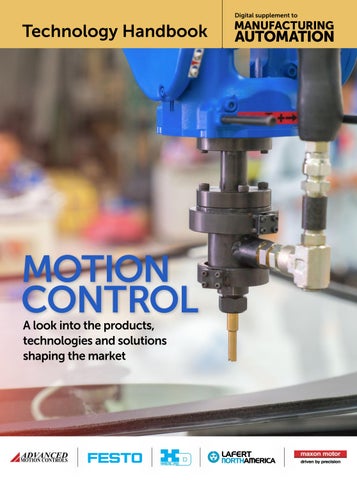
MOTION CONTROL A look into the products, technologies and solutions shaping the market
Technology Handbook | MOTION CONTROL
The Need for Smaller Components
M
oore’s Law, popularized in 1975, states that the number of transistors in a dense integrated PCB circuit doubles every two years, resulting in smaller electronics. While the rate of shrinking has begun to level off in recent years, the demand remains for smaller and more compact technology. The motion control industry is not exempt from this trend. Many applications need to be small and portable, such as devices used in the military or medical industries. Aerospace industries are always seeking lighter solutions to reduce weight wherever they can. Robotics are becoming more complex with more moving parts in tighter spaces, and every articulated joint needs to be controlled somehow. As veteran members of the industry, ADVANCED Motion Controls® recognizes the pressing need for compact, lightweight servo drives, which is why we developed FlexPro®. FlexPro
FlexPro® is AMC’s newest family of digital servo drives. With cutting edge engineering, FlexPro® is meant to deliver the capabilities of AMC’s already powerful and diverse product selection into smaller applications. The IMPACT™ (Integrated Motion Platform And Control Technology) architecture allows FlexPro® servo drives to maintain the intelligence and power of larger-sized servo drives while fitting into much more compact packages. FlexPro began with the FE060-25-EM, a PCB mount servo drive with the highest power density of any AMC drive to date. At just 1.5 x 1 x 0.6 inches (38 x 25 x 16 mm) in size, the footprint of the drive is approximately the same as two standard postage stamps. In other words, four of these drives can fit on a standard business card. Even with its small size, the FE060-25-EM can supply brushed, brushless, stepper, and linear servo motors with up to 25 amps continuous current and 50 amps peak current. Lower-power 5 amp and 10 amp versions are also available. For those seeking to install drives beyond the central PCB, the machine embedded FlexPro drives feature all the capabilities of the PCB mount servo drives but with a special interface board. This board features convenient connectors that make 2 MANUFACTURING AUTOMATION · Technology Handbook Motion Control
them easy to hook up to any system using standard cabling. These drives can also be configured easily via a USB-C connector. Extended Environment.
Extended Environment versions of both the PCB mount and machine embedded FlexPro drives are also available. They offer all the convenience and power of the standard FlexPro drives, but they’re built to handle more extreme environmental conditions, such as temperatures as low as -40°C to as high as +95°C and altitudes as high as 25,000 m above sea level. Customs
More power, network, and feedback options for FlexPro are on the way, but in the meantime, we’ll make sure our customers have exactly what they need. We’re more than happy to develop custom micro-sized servo drives that use the same IMPACT™ architecture as FlexPro®. Final Thoughts
Micro-sized FlexPro® drives are perfect for cobots (collaborative robots), AGVs, fixed robotics, mobile robotics, animatronics, portable devices, lab automation, military equipment, aerospace, medical equipment, and truly any embedded application that requires a compact and/or lightweight solution. The need for smaller servo drives is only going to increase in the coming years, and anyone who knows ADVANCED Motion Controls knows that we are always up for task. Bring it on. Written by Jackson McKay, Marketing Engineer
ADVANCED Motion Controls® 3805 Calle Tecate Camarillo, CA 93012 USA Tel: 805.389.1935 www.a-m-c.com
ELECTROMATE 6221 Highway 7, Unit #15 Vaughan, Ontario, Canada L4H 0K8 Phone: 877-SERVO98 Email: sales@electromate.com www.electromate.com
2020 2O19
ROBOTICS BUSINESS REVIEW
RBR
50
Servo Drives and Motion Control Solutions for Your Industry
A u t o m a te d S t o ra g e
ADVANCED Motion Controls® servo drives are distributed & installed worldwide; from production facilities to extreme environments; from the ocean depths to the vacuum of space; and from start-ups to multi-national companies.
COMPANY
Fa c t o r y F l o o r
N o w ava i l a b l e - F l ex P r o ® , o u r smallest, most adaptive servo d r i v e t o d a te ! Order Fulfillment
Medical
M a te r i a l H a n d l i n g
Wa r e h o u s e
H a r s h E nv i r o n m e n t s
Ask us about standard, modified, and custom solutions to meet your exact demands.
D e fe n s e
Fa b r i c a t i o n
Te l e p r e s e n c e
C a m e ra C o n t r o l
Camarillo, CA 93012 805.389.1935 a-m-c.com
Tra n s fe r L i n e s
Technology Handbook | MOTION CONTROL
Motion control projects can be this simple
H
ow would you define a great experience in a motion control project, like incorporating a new handling system or drive package into a machine or production line? At a minimum, it should be exceedingly simple to do from design through commissioning with an optimized, error-free outcome in a condensed timeline. Once you know what you need, the design phase should take minutes, not hours or days. Delivery of the product should take a few weeks, not months. And commissioning should be remarkably quick and simple. Festo’s approach to making this the rule rather than the exception is to offer simplified products and free, user-friendly digital design and commissioning tools that accelerate each step. Here are three examples that (re) define simple.
chanical end points or for simplified press-fitting and clamping functions. Internally generated end position feedback means no external sensors are required. Commissioning is done manually, on the device, without software or need for special expertise. Connection to the controller is via digital I/O or IO-Link, built in as standard. For the tasks SMS actuators perform, anything more elaborate would be over-engineered. Currently, there are seven SMS actuators – the spindle axis ELGS-BS, tooth-belt axes ELGS-TB and ELGE, mini-slide EGSS, electrical cylinder EPCS, compact electric cylinder EPCE and rotary drive ERMS.
1. Simplest of all – Simplified Motion Series
With the Handling Guide Online (HGO) plus the companion Festo Motion Control Package, there is no easier, faster way to design, order and set up an application-optimized handling system. The no-obligation design process in HGO takes about 20 minutes to enter all parameters, select the best option, and import the CAD document. Once an order is placed, the unit will be delivered quickly, already assembled and tested. With the motion control package, setup, PLC integra-
The simplest is our Simplified Motion Series (SMS) – seven basic electric axes that mimic pneumatic actuators. These are plug and work solutions, mounted directly in the machine without any need for external servo drives or a control cabinet; all necessary electronic components and modules are built into the device. Each is optimized for simple movements like endto-end positioning between two me-
To learn more, click here. 2. Engineering Simplicity – Designing handling systems with a few clicks…
4 MANUFACTURING AUTOMATION · Technology Handbook Motion Control
tion and commissioning is greatly simplified.
Learn more. 3. Simple commissioning for drive packages – Festo Automation Suite
With the PC-based Festo Automation Suite commissioning software, only five easy steps are needed to parameterize and configure a new drive package, from the mechanical system to the controller. Festo’s new compact CMMT-AS and ultra-compact low voltage CMMT-ST servos can be commissioned in just minutes. For expert users, the CMMT-AS plug-in provides access to all device parameters for making advanced optimizations. And the CMMT-AS can be integrated into the program of Festo’s CPX-E controller with just two clicks rather than the 100 or so it would take otherwise. The software also offers fast, easy commissioning for CPXAP-I remote I/O control module and ELGC electric axes.
Learn more about the Automation Suite
5300 Explorer Drive Mississauga, ON. L4W 5G4 Phone: 1 877 GO FESTO festo.canada@ca.festo.com • www.festo.ca
Decentralized remote I/O system CPX-AP-I
Interconnectivity for pneumatics and electric automation The new I/O system in IP65/IP67 enables powerful I/O modules and existing valve manifolds to be directly integrated to a fieldbus. • • • •
Up to 500 I/O modules including IO-Link masters 50 m cables between modules Simplified integration using L5X export/import on Rockwell systems Ability to create power zones www.festo.ca
Technology Handbook | MOTION CONTROL
MINI ACTUATOR - INTEGRATED SERVO DRIVE
H
armonic Drive LLC, the leader in high precision motion control announces new FHA mini actuators with an integrated servo drive. This evolutionary product eliminates the need for an external drive and greatly improves wiring while retaining high-positional accuracy and torsional stiffness in a compact housing. The FHA-C Mini Series is a family of extremely compact actuators that deliver high torque with exceptional accuracy and repeatability. As part of the FHA-C Mini family, an integrated servo drive version utilizing CANopen® communication is now available. Since it communicates via CANopen, only 4 wires are needed: CANH, CANL, +24VDC, 0VDC. A single-turn 14bit (16384 cpr) gear output sensing encoder has been integrated along with a single-turn 15bit (32768 cpr) motor input sensing encoder providing a true absolute encoder that does not require a battery within 360° of rotation of the output. Our engineering team incorporated more features and capabilities without greatly impacting the size and mass of the actuator.
Key Features: • Actuator + Integrated Servo Drive utilizing CANopen communication • 24VDC Nominal +7-28VDC Supply Voltage Range • Single Cable with only 4 wires needed: CANH, CANL, +24VDC, 0VDC • Zero Backlash • Dual Absolute Encoders • Panel Mount Connectors with 4 exit options • Output Sensing Encoder 14bit (16384 cpr) resolution • Input Sensing Encoder 15bit (32768 cpr) resolution • Control Modes Including Torque, Velocity, and Position Control, CSP, CSV, CST • Harmonic Drive HDL Software The FHA-C Mini series actuators with an integrated servo drive are among the latest products developed at HDLLC in Peabody, MA.
With over 50 years of experience, our expert engineering and production teams develop enabling technologies and products to meet the needs of an evolving motion control market. We are very proud of our outstanding company history. Our high-precision, zero-backlash Harmonic Drive® gears and Harmonic Planetary® gears have, and continue to play critical roles in robotics, spaceflight applications, semiconductor manufacturing equipment, factory automation equipment, medical diagnostics and surgical robotics.
About Electromate Electromate’s Core Purpose is to help Manufacturers compete globally by building better machines using differentiated automation technology. We specialize in Robotic and Mechatronic Solutions for the Industrial Automation marketplace. Respected by customers as a premier source for High Performance Automation and Motion Control Components & Systems, Electromate® specializes in AC & DC Servo/Stepper Motors & Drives, Motion & Automation Controllers, Positioning Systems & Actuators, Feedback Devices, Gearing Products and HMI’s & Operator Displays, all supported via extensive product selection, just-in-time delivery, dedicated customer service and technical engineering support. With over 3000+ satisfied customers, Electromate® is a market leader in providing successful solutions for the Industrial Automation industry. We pride ourselves on providing our customers with Precision Technology & Quality, backed by over 100 years combined experience in technical engineering support from our responsive customer service team. Electromate is the exclusive distributor for Harmonic Drive® products in Canada, except for the province of Alberta.
Harmonic Drive and Harmonic Planetary are registered trademarks of Harmonic Drive LLC.
About Harmonic Drive LLC Harmonic Drive, LLC engineers and manufactures precision servo actuators, gearheads and gear component sets. We work closely with both Fortune 500 and companies of all sizes to understand their application requirements and provide a standard or, in most cases, a custom-engineered solution to enable the success of their design project. 6 MANUFACTURING AUTOMATION · Technology Handbook Motion Control
HARMONIC DRIVE LLC 42 Dunham Ridge Beverly, MA 01915 Phone: 978-532-1800 Email: sales@harmonicdrive.net www.HarmonicDrive.net
ELECTROMATE 6221 Highway 7, Unit #15 Vaughan, Ontario, Canada L4H 0K8 Phone: 877-SERVO98 Email: sales@electromate.com www.electromate.com
FHA-C Mini Actuator with Integrated Servo Drive
The Servo Drive is Inside!
The FHA-C Mini Series is a family of extremely compact actuators that deliver high torque with exceptional accuracy and repeatability. As part of the FHA-C Mini family, an integrated servo drive version utilizing CANopen® communication is now available. This evolutionary product eliminates the need for an external drive and greatly improves wiring while retaining high-positional accuracy and torsional stiffness in a compact housing. • Actuator + Integrated Servo Drive utilizing CANopen communication • 24VDC Nominal +7-28VDC Supply Voltage Range • Single Cable with only 4 conductors needed: CANH, CANL, +24VDC, 0VDC • Zero Backlash • Dual Absolute Encoders
• Panel Mount Connectors with 4 exit options • Output Sensing Encoder 14bit (16384 cpr) resolution • Input Sensing Encoder 15bit (32768 cpr) resolution • Control Modes Including Torque, Velocity, and Position Control, CSP, CSV, CST • Harmonic Drive HDL Software
Harmonic Drive LLC 42 Dunham Ridge Beverly, MA 01915 800.921.3332 www.HarmonicDrive.net
Electromate 6221 Highway 7, Unit #15 Vaughan, Ontario, Canada L4H 0K8 (877) SERVO98 (737-8698) www.electromate.com
Harmonic Drive®, Harmonic Planetary® and Quick Connect® are registered trademarks of Harmonic Drive LLC. Electromate is the exclusive Canadian distributor of Harmonic Drive® products (except the Province of Alberta).
Partners in Precision
Technology Handbook Motion Control · MANUFACTURING AUTOMATION 7
Technology Handbook | MOTION CONTROL
Hybrid Design for Hybrid Applications Lafert presents the HPS Series of permanent magnet motors for automated equipment applications where induction motor performance falls short of the mark, or servo motor cost and complexity is impractical. It’s no accident that HPS Series motors are well suited to filling this motor capability gap; the motor construction integrates the cost-effective induction motor stator housing and stator winding with high-performance permanent magnet servo motor rotor technology. The hybrid design is a highly efficient synchronous motor which outperforms induction motors and offers tremendous value for speed control applications. Lafert is an industry leader in permanent magnet motor technology and has proudly manufactured HPS Series motors for over fifteen years. HPS motors are available from stock with standard power ratings to 50 HP for 230, 460, 575 V input. Mounting options include modular base mounts with or without standardized IEC and NEMA flanges.
Reduced Losses, Increased Reliability Energy efficiency has not been a traditional performance consideration for motion control applications, but efficiency has direct reliability and performance implications for motors and systems. All HPS Series motors significantly exceed the current requirements for induction motor efficiency (NEMA Premium®) with motor efficiency performance at or above the “Super Premium” (IE4) level. The increased motor efficiency is due to the HPS Series permanent magnet rotor construction, which reduces the electrical rotor losses to zero. Induction motor rotor losses are defined as the electrical power converted to heat by current flow (I2R) in the rotor, which typically accounts for 10 – 15% of total losses. Eliminating the rotor losses delivers a dual benefit of increased energy efficiency and reduced heat generation;
HPS Series motors create less heat per unit of mechanical power delivered to the load. This explains the reduced thermal rise and thermal time constant, and the increased maximum ambient temperature and overload capability of HPS Series motors. The industry rule of thumb, which states that each 10°C rise in motor winding temperature reduces insulation life by half, establishes the case for correlation of reduced motor losses with longer field service life. With less waste heat to be eliminated from the enclosure, HPS motors require less material volume and surface area to remain cool. Space and weight savings will vary, but a reduction of approximately 50% can be expected compared to induction motors.
High Performance, Without Feedback The HPS Series construction implements a synchronous motor design, which means the shaft speed is synchronized with the rotating magnetic field developed by current in the stator windings. This contrasts against the asynchronous operation of induction motors, Rating
3 HP, 3600 rpm
7.5 HP 3600 rpm
where the shaft speed lags the rotating stator field speed by a value proportional to the motor load (the “slip”). HPS Series motors address the speed control uncertainty inherent to asynchronous motors, and can eliminate the need for costly and complex slip mitigation measures, like encoders. HPS Series motors are engineered and optimized for sensorless control by variable frequency drives, with near-universal support from drive manufacturers.
Leveraging Lineage, Learning More In addition to the benefits of synchronous operation, HPS Series motors inherit two characteristics from the servo motor with performance implications for motion applications. First, the reduced weight and dimensions of HPS Series permanent magnet rotors yield higher torque-to-inertia ratios than induction motors. Higher torqueto-inertia ratios are desirable because they support higher system dynamic response and repeatability. Second, the synchronous motor torque-producing mechanism enables the flat torque curve across a wide speed range and a shorttime 300% peak torque capability. Contact Lafert to learn how and why the unique construction and capabilities of HPS Series motors can drive top performance from your next motion control application.
CLICK HERE to download Lafert’s HPS Series Technical Catalogue.
Motor Type
Frame Size
Weight (lbs)
Inertia (10-3 lb-ft2)
Volume (ft3)
HPS
71
14.5
22
0.19
NEMA Premium® (Aluminum Body)
90
40.3
43
0.38
HPS
90
35.2
31
0.38
NEMA Premium® (Aluminum Body)
112
78.1
204
0.71
8 MANUFACTURING AUTOMATION · Technology Handbook Motion Control
Technology Handbook | MOTION CONTROL
T
maxon drives set the world in motion
he maxon motor combines electric motors, gears and DC motor controls into high-precision, intelligent drive systems that can be custom-made to fit the specific needs of customer applications. maxon motor helps provide innovative solutions at competitive prices for numerous applications in various markets, such as industrial automation, medical technology, security technology, instrumentation, communications, and consumer applications, among others.
Offering solutions that fit your customized needs maxon motors manufactures small, high-quality brush and brushless DC motors ranging in size from 4 mm to 90 mm. maxon’s rhombic wound ironless rotor motors provide exceptionally high efficiency, low EMI emissions, fast acceleration, no preferred rotor position, torque constants and long service life. The drive components are assembled and designed within our modular system according to your individual needs. You can combine, according to your requirements, motors with planetary, standard or special gearheads, feedback devices, brakes and control electronics.
Brushed and brushless configurable DC motors more versions, more power
achieving speeds of up to 120,000 rpm. They run very smoothly and are highly efficient in standard or sterilizable versions (up to 2,000 autoclave cycles). Ideal for use in handheld surgical tools and industrial spindles. maxon motor’s X drives are extremely powerful and are now available in maxon’s online shop, where customizing the drives is easy. Customers can fit the drives with specific mechanical and electrical components specific to their application needs. It is possible to customize the shaft lengths, winding types, ball bearings and much more. When combined together with maxon encoders and planetary gearheads, you form a high-precision, robust drive system ideal for any application from aerospace to medical to robotics. In fact anywhere that requires a compact, powerful, quiet and strong drive system. The X program is a lean and automated process which ensures that all configurable drives are ready for shipment within 11 working days. In addition, detailed product data may be viewed immediately online and 3D CAD data for the configuration is available for downloading. Visit dcx.maxonmotor.com for more information.
Now even stronger, more efficient and with yet more combination options: There are new additions to the maxon family of X drive products. Several long versions of brushed DC motors, with higher torques and more power, have been added to the product range along with matching planetary gearheads. Each of the 3-stage versions can now be combined with the next smaller motor. This saves space, weight and costs. In addition, maxon launched a brushless DC motor (ECX) line to its configurable online program. These motors are available with diameters of 4, 6, 8, 13, 16, 19 & 22 mm 10 MANUFACTURING AUTOMATION · Technology Handbook Motion Control
ELECTROMATE 6221 Highway 7, Unit #15 Vaughan, Ontario, Canada L4H 0K8 Phone: 877-SERVO98 Email: sales@electromate.com www.electromate.com
TRA CONFIGURABLE
Gearhead, motor and encoder tailored to your needs.
11DAYS
READY IN
Assemble your individual maxon DC drive: You can configure the gear stages, the motor bearings, the shafts, the encoder and much more. Design your custom drive online today and your finished drive will ship from Switzerland in 11 working days.
dcx.maxonmotor.com
AUTOMATION, SQUARED Quebec’s AGT Robotics enhances automated welding, cuts component costs in half with PC control BY JAMES FIGY
A
mong all industries, construction uses the majority of steel produced globally. Beams for buildings require reliable, high-precision welding to ensure structural integrity and public safety. McCombs Steel Company, Inc. in Statesville, North Carolina, fabricates and erects structural steel and miscellaneous metals. As such, the company faces the challenges of maintaining high quality, implementing lean manufacturing and meeting project timelines every day. One technology, the BeamMaster robotic welding system from AGT Robotics, has helped McCombs meet these challenges. “The lack of experienced personnel in the steel industry previously led to overworking our existing staff, which is unacceptable,” says Mac McCombs, president of McCombs Steel. “The BeamMaster, which is nicknamed Bruce, has increased safety, quality and throughput in production.” Based in Trois-Rivières, Quebec, AGT Robotics was founded in 1992 as a general automation integrator, but now specializes almost exclusively in robotic welding. The BeamMaster system, first released in 2015, uses AGT’s Cortex software with built-in artificial intelligence (AI) and a proprietary simulation engine to optimize weld schedules. Relying on PC-based control technology, the system is modular and scalable to allow many mechanical configurations for end users. However, the standard version
The standard BeamMaster comprises multiple servo-driven rotators and an articulated robot.
comprises two or more servo-driven beam rotators, a FANUC Arc Mate 120iC articulated robot that moves parallel to the beam along a track and an operator station with a multi-touch control panel. The circular rotators can handle beams from four to 48 inches wide and up to 90 feet long with a maximum weight of 10,000 pounds. The rotators can turn 360 degrees to expose all surfaces on W beams and HSS closed rectangular columns to increase welding efficiency. While similar robotic welding systems have become widely adopted for automotive applications, very few are designed for structural steel. AGT Robotics recognized this untapped market as a significant opportunity, but one with unique challenges, according to Louis Dicaire, general manager and co-owner at AGT. “The automotive business produces a few parts maybe 100,000 times, so just a few robots repeat the same tasks for years,” he says. “In structural steel, even though parts are similar, the beams have different widths, lengths, sections and accessories in an infinite number of combinations. That has slowed implementation of robotics in this industry.” Through its inherent flexibility, the
12 MANUFACTURING AUTOMATION · Technology Handbook Motion Control
BeamMaster – distributed as the Ocean Challenger by Ocean Machinery in the U.S. – offers a solution.
Flexibility for automated welding Design of the BeamMaster presented unique challenges. Robotics can offset a shortage of qualified welders, but constant programming of custom parts often requires additional controls engineers, which are also difficult to find in today’s market. To avoid this, AGT wanted to produce a system that would automate not only the welding, but also the programming for McCombs and other fabrication shops. “McCombs uses our machine 24/7, automatically welding most of their beams,” explains François Béland, automation and robotics specialist at AGT. “The structural steel industry relies on the Tekla CAD software, so we built a plug-in that exports 3D beam models from Tekla into Cortex.” Without requiring a single robotic technician to fine-tune or add to the program, Cortex automatically generates movements. The system offers a complete weld schedule for structural steel. “All joint types are covered, whether multi-pass or single-pass, a quarter-inch
Hardware and software modularity was important to ensure that BeamMaster systems could be scaled up or down easily as required in the future. weld or a half-inch weld. The sequencing and flipping of the beam are automatic as well,” Dicaire says. “So not only is the operation automated, but the automation programming is also automated: You could say that it’s automation squared.” Transferring these software capabilities to a real-time machine control environment, however, required a similarly flexible automation platform. Hardware and software modularity was important to ensure that BeamMaster systems could be scaled up or down easily as required in the future; end users might want to add rotators or even a second robot to increase throughput. In addition, the platform needed to provide robust remote support capabilities for troubleshooting and updates, since the system is designed for end users around the world with limited engineering resources. EtherCAT communications While searching for an EtherCAT industrial Ethernet system master controller in 2015, the AGT engineering team chose PC-based control technologies from Beckhoff Automation. They began working closely with Ted Sarazin, regional sales manager for Beckhoff, to standardize the BeamMaster design. “The openness of the Beckhoff platform, from the company that invented EtherCAT and TwinCAT automation software, was key for AGT,” Sarazin says.
While BeamMaster systems can be quite large, AGT sought compact controller and I/O options to ensure small control cabinet footprints while remaining cost-competitive. “[EtherCAT] is deterministic and does not require IP addresses for each device. As such, it speeds up commissioning through automatic configuration of devices on the network and offers reliable, real-time communication,” says Béland. The BeamMaster system uses space-saving eight- and 16-channel EtherCAT I/O terminals and EtherNet/IP bus couplers to interface with FANUC robot controllers, as well as TwinSAFE terminals for integrated functional safety. The robotic welding system includes several safety zones with light curtains, ensuring that operators approach the beam to perform quality inspection only when the robot is not active in that specific zone. The light curtains connect to TwinSAFE terminals using the TÜVcertified Safety over EtherCAT (FSoE) protocol to communicate safety data via a “black channel” method over the same EtherCAT network used for standard communication. A platform for robotic welding TwinCAT 3 provides deterministic control from a software-based master for BeamMaster. Programming of all functions, from PLC and motion control
Beckhoff’s Ted Sarazin (third from left) visits the AGT Robotics team.
to safety and HMI, is directly integrated into Microsoft Visual Studio. Engineers can select the language they know best or that makes the most sense for the project, whether it is IEC 61131-3 with object-oriented extensions, function blocks or computer science standards. “We can develop our own applications – using .NET, for instance – that will communicate directly with the PLC,” Béland says. All PLC code and auxiliary software runs on a CX5130 embedded PC from Beckhoff, connected to a multi-touch control panel as the operator interface. Beyond the robot equipped with a Lincoln Electric AutoDrive welding source, all other motion control takes place with Beckhoff’s servo drives and servo motors. These provide closed-loop control for accurate positioning of the beam. Automatic results Programming of the first system took two months, but with easy code reuse, that is sped up to just half a day now. “Standardizing on Beckhoff also cut our component costs in half compared to previous solutions while providing more capabilities and options for customization,” Dicaire says. Before implementing the BeamMaster, McCombs Steel met with AGT and several customers, and carefully considered where it would fit in the shop’s three production bays before it went live in September 2019. “We have experienced a safer work environment, higher-quality construction materials and increased throughput through round-theclock welding,” says McCombs. The connectivity of PC-based control allows AGT to provide support and updates quickly. In addition, AGT includes an Android tablet with each BeamMaster so that customers can send images or video to the engineers in Canada assist in troubleshooting at facilities across the globe. McCombs has appreciated these capabilities and the partnership both companies have developed, and has since commissioned a second BeamMaster system. | MA
Technology Handbook Motion Control · MANUFACTURING AUTOMATION 13
INTEGRATED MOTOR 101 These all-in-one motors offer design flexibility in industrial applications with servo control systems BY ERIC RICE
S
ervo control systems are used in numerous industrial applications requiring position, velocity and torque control. At the heart of every system is a servo motor and drive along with cables that connect the two. Traditionally, machine builders and robot designers have invested considerable time into the placement of servo drives and controllers, as well as the routing of cables to connect all of the system components. Integrated servo motors offer a space-saving solution by combining a servo motor with an onboard drive and controller, which eliminates the need to connect motor
power and feedback cables to an external motor controller (see Figure 1). This “integrated package” offers greater design flexibility and frees space to accommodate other critical components such as material handling mechanisms, sensors, additional axes of motion and operator-interface components. Integrated motors also reduce the complications of fitting the external drive
Figure 1: Unlike a conventional servo system that requires a separate motor and drive components along with the cables to connect the two, integrated motors consolidate the components within one package. 14 MANUFACTURING AUTOMATION · Technology Handbook Motion Control
and cables into control panels or within the limited space of a robot housing. Integrated motors consolidate the following components within one package: • Brushless servo motor • Encoder • Drive/controller • Connectors to provide access to digital and analog inputs and outputs • Connector for DC power, usually 24 or 48 VDC • Communications connectors for programming, configuration and industrial networking Without the need for cables or wire harnesses (see Figure 2), integrated motors also simplify the bill of materials and enable faster design cycles over traditional motion control systems with separate motor and drive components. Machine designers can focus less on controller placement and wiring and more on non-motor system components for faster iterations.
Benefits of integrated motors Integrated motors – including integrated servo motors and integrated step motors – offer several benefits over conventional, non-integrated motors: • Reduced number of components: Integrated motors eliminate the need for external drive electronics. • Reduced number of cables: Eliminating motor power and feedback cables reduce the total number of cables in the machine. Smaller diameter cables used for connecting DC power, communications and I/O to the integrated motor are easier to route and require less space. • Smaller control panels: Eliminating external drives reduces the size of control panels and even the need for them in some cases. • Space savings: Reducing the amount of space needed for motion control axes frees space to accommodate other critical components such as material handling mechanisms, sensors or operator-interface components. • Product selection and application: An integrated motor eliminates confusion about the drive and cable requirements and simplifies the system configuration. • Performance: When using an integrated motor, users get the same torque and speed performance from the same size motor.
Applications of integrated motors Integrated servo and step motors are suited for high-speed automation applications including automated test and measurement, automated assembly, packaging and labeling machinery, mobile robots and more. Here are a few real-world applications that benefited from switching to integrated motors.
1. Moving cartons on smart conveyors Application: A smart conveyor system is used for de-palletizing, sorting, singulating, aligning and transferring cartons in multiple directions to downstream processes. Specialized actuators that handle the lateral movement of cartons are driven by step motors. With one motor per mechanism, long conveyors
Figure 2: While the conventional servo motor (left) requires an external servo drive and discrete cables for power and feedback connections, the integrated servo motor (right) eliminates these components, offering a space-saving solution for machine builders.
can have up to 100 motors in a single installation. Solution: An integrated step motor with built-in encoder enhanced the positioning capabilities of the actuators while reducing space. The use of integrated motors greatly reduced the size and number of control panels. Cost savings resulted from a reduction in motion control components, especially when multiplied by the number of axes per installation.
2. Laboratory sample testing equipment Application: Automated sample testing equipment allows for batches of laboratory samples to be tested according to pre-programmed parameters. After samples are loaded into a rack system, an XYZ pick-and-place mechanism inserts each sample into a test chamber, and then retrieves each sample after testing is complete. Lab techs can load and program the machine, then leave it to run autonomously. Solution: Integrated closed-loop step motors offer quiet and smooth operation with great torque. By eliminating the need for separate drives, integrated motors saved space and reduced the overall size of the machine to better fit into the limited space of a test lab. The space saved by using integrated motors made the installation of data acquisition and test components into the machine easier.
3. Traction drive and steering for mobile robots Application: Automated guided vehicles (AGV) and mobile robots are increasingly used for material handling and warehouse management. Mobile robots transport finished work from one area to another, eliminating the need for manual labour. Electric motors drive the forward motion (traction drives) and steering, and provide the actuation of the material handling axes (lift, convey, divert, sample, rotate). Solution: Integrated servo motors provided peak torque and high speed for traction drive and steering axes while eliminating components and freeing valuable space within the mobile robot housing. Combining a servo motor and controller into a single, integrated package eliminates the need for mounting an external motor controller inside the body of the mobile robot. Integrating the motor controller into the motor housing also eliminates the need for motor power and feedback cables normally needed to connect the separate servo motor to its external controller. Integrated motors are not suitable for every application, such as those using motors larger than a NEMA 34 frame or providing more than 600 watts of continuous power. For motor requirements within that range, you may find that integrated motors offer design flexibility and simplified bills of materials. | MA
Technology Handbook Motion Control · MANUFACTURING AUTOMATION 15
DON’T MISS OUT on your next issue of
IT’S FAST, IT’S EASY AND IT’S FREE!
CENTRE STAGE: University of Waterloo prof predicts automation boom. p. 14
SHOW REPORT:
Top takeaways from our first-ever virtual summit on implementing automation in a pandemic. p. 22
Your resource for Canada’s industrial automation news
INDUSTRY WATCH: Technology adoption has to come from the top. p. 10
AutomationMag.com
DECONSTRUCTING
DATA
How Sight Machine transforms data into universal manufacturing concepts. p. 16
SEPTEMBER 2020
MA_SEPT_2020_ASK.indd 1
PM 40065710
2020-08-25 8:28 AM
HERE’S HOW: FOR FASTEST SERVICE VISIT
AutomationMag.com AND CLICK THE SUBSCRIPTION BUTTON
AutomationMag.com