Digital supplement to
Technology Handbook
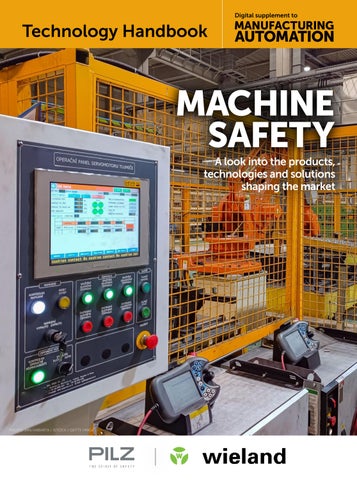
MACHINE SAFETY A look into the products, technologies and solutions shaping the market
PHOTO: JAN HABARTA / ISTOCK / GETTY IMAGES
Technology Handbook | MACHINE SAFETY
Enhance Your Safety Performance and Ease of Use with PSSuniversal 2 from Pilz
A
s industrial automation demands grow, so does the complexity of I/O systems. The need for increased safety and efficiency has led to a surge in the number of I/O points required to communicate with PLCs. To address this challenge, distributed I/O systems offer a cost-effective and flexible solution. Pilz’s PSSuniversal 2 (PSSu2) is a powerful distributed I/O system designed to simplify and optimize industrial automation. It supports both Profinet - Profisafe and Ethernet/IP - CIP Safety, providing a unified platform for both safety and standard I/O. Advantages of IP20 Distributed I/O over Traditional Direct-to-PLC Integration: • Reduced Wiring Complexity: By decentralizing I/O modules, you can significantly reduce the length of wiring required to send data back to the control system simplifying installation and maintenance. • Improved Flexibility: Distributed I/O systems are modular, allowing you to easily expand or modify your system as your needs change. • Enhanced Diagnostics: de-centralized I/O modules provide easy access to diagnostic information and isolate the issues helping you to quickly identify and resolve issues. • Reduced Electrical Noise: Shorter cable lengths between sensors and actuators significantly reduce the probability of induced electrical signal noise, ensuring reliable data transmission. • Reduced Installation Time: de-centralized I/O modules can be pre-wired and pre-configured, significantly reducing installation time.
The PSSu2 system can be your one IO solution for both safe and standard distributed IO supporting Analog and digital I/O as well as IO-Link support for advanced communication with intelligent sensors The 3-part modular design of the system consists of a base, I/O module and terminal block. This modular design enables hot-swapping, allowing for quick
and easy module replacement without disrupting system operation. The PSSu2 distributed IO systems also has easy to read diagnostics LEDs which are cleanly laid out for quick troubleshooting. The terminal design on the cards provides a well organised alignment weather you use 8 position or 16 position terminals. Pilz’s PASconfig software simplifies the configuration and commissioning of the PSSu2 system with its intuitive interface and powerful features. PASconfig also allows the user to create a BOM of the parts used in the system and create a project report for the system. When integrating an IO station into a Rockwell PLC an.L5X file can be exported from PASconfig and imported in Studio 5000 including all the IO and IO descriptions. Pilz’s PSSuniversal 2, combined with the powerful PASconfig software, offers a comprehensive solution for modern industrial automation. By embracing distributed I/O, you can significantly reduce costs, improve efficiency, and enhance safety.
Download the free PASconfig software today and see how the system could simplify your IO selection on your future safe automation projects. www.pilz.ca 2 MANUFACTURING AUTOMATION · Technology Handbook Machine Safety
Enhance your safety, performance, and ease of use with PSSuniversal 2 from Pilz One I/O platform, many control systems Simple integration using free PASconfig software Clear diagnostics
Pilz Automation Safety Canada L.P. Mississauga, ON | (905) 821-7459 | info@pilz.ca | www.pilz.ca
Technology Handbook | MACHINE SAFETY
Steps to obtaining your machine’s CE marking To comply with workplace safety regulations, all equipment and machinery in industrial settings must be maintained in a safe condition. Whether you require full project safety support or individual safety services, Wieland Electric can ensure safe machine operation tailored to your requirements. With us, you can achieve compliance and optimize safety in your operations.
Safety consultation/ research
Experienced Wieland Electric machine safety consultants provide expert guidance on safety reviews, lockout/ tag-out planning and training, the machine safety concept, and the necessary reports for the CE mark certification process. Over a dedicated meeting and assessment, the safety expert will walk you through the requirements and the next steps. Depending on the project, some consultations can be completed virtually while others require a more detailed in-person assessment.
RISK ASSESSMENT
The Risk Assessment is the first phase of any safety system upgrade. The information determined in the Risk Assessment will be used during the diff¬erent phases of the safety system upgrade. Wieland will create a guideline compliant risk assessment, complete with documentation that complies with the current local & global laws and standards. The risk assessment includes research on the applicable standards, documentation of all hazards and likelihood of occurrence, determination of risk level (such as PLr), and the development of the risk mitigation concepts & techniques.
Concept design, engineering + mitigation
The machine safety expert will provide safety system architecture, recommendations, and design, including turnkey integration services.
will do an impact analysis to determine if the machine continues to comply with the appropriate safety guidelines. Finally, we create the required CE documentation for you to prove compliance with legal requirements.
Verification
Inspection
Our verification of your safety concept according to EN ISO 13849-1 ensures that your safety measures meet applicable requirements and your production is safe. Software-supported verification and documentation verification is completed using the SISTEMA software to provide you mathematical proof of the performance levels PL for each safety function.
Validation
To confirm that the safety system achieves the safety performance level determined by the risk assessment, we will run the appropriate tests, check against the standards, and provide documentation.
Evaluation, reporting, maintenance & modification
Machine relocation, refurbishments, the addition of a new energy source, and other substantial modifications require that the safety concept be re-analyzed. Wieland
4 MANUFACTURING AUTOMATION · Technology Handbook Machine Safety
Periodic testing should be performed annually. We conduct safety inspections, tests, and measurements (eg. stop time measurement), perform a safety-related inspection (black box test specifications), and provide a detailed test report to ensure functional safety.
Training & education
Wieland Electric offers courses on the basics of functional safety for machinery, advanced certificate courses, and any custom training in-between that is specific to your situation.
Why work with us?
Safety is our everyday business — and has been for over 30 years. At Wieland Electric, our team possesses in-depth knowledge of safety standards and the capabilities of both current and emerging technologies in standard and safety control systems. From the very beginning, we’re here to support you every step of the way. Whether you need training, one-on-one consultations, or full project implementation, you decide the level of support that works best for you. As your trusted partner in achieving CE marking compliance, we bring extensive experience to your project. We deliver a tailored, all-encompassing solution to ensure the standards-compliant implementation of your machines.
SAFETY SERVICES FOR INDUSTRIAL MACHINERY
ALIGN YOUR MACHINERY LIFECYCLE WITH THE SAFETY LIFECYCLE
Book a Free Consultation www.wieland-electric.com
CRACKING THE SAFETY CODE Exploring the complexities of safety standards and compliance obligations for manufacturers in Canada. BY SUKANYA RAY GHOSH
F
actory floors today are equipped with automated assembly lines, traditional and collaborative robots, automated mobile robots, highvoltage equipment, and more. For manufacturers, protecting against the risks and staying compliant with the most current safety standards will help keep workers safe and ensure fewer liabilities. While the basic framework and intention behind machine safety standards are very similar everywhere, the specific standards vary according to region and even country. Canada has its own set of safety standards and regulations that manufacturers need to be aware of and compliant with, in order to minimize risks to workers and liabilities to their businesses. Douglas Nix, co-owner of Compliance InSight Consulting, and a machine safety expert, shares that each province or territory has occupational health and safety (OHS) legislation governing the employer’s employee safety obligations. Federally, safety is governed by the Canada Labour Code, which covers workers employed in the federal sector. Nix shares that every province and territory has its own legislation that governs electrical products that are connected to power supplied by a public utility. Equipment powered by the public utility is required to bear a recognized Canadian electrical safety mark. This can be a certification mark or
a field evaluation label. Industrial equipment is also required to meet Industry Canada regulations for electromagnetic interference. “Machinery safety is handled differently depending on which province, territory or federal sector the employer is in. Canada, unlike the EU, for example, does not have legislation that requires manufacturers to build and sell safe products. They meet their legal obligations as long as the product has an electrical safety mark on it,” explains Nix. However, he adds, Ontario enacted the Pre-Start Health and Safety Review (PSR or PSHSR). The employer is obligated through O Reg. 851 to conduct a PSR on the equipment. The PSR must be conducted by an Ontario-licenced Professional Engineer (P.Eng.). The result of the PSR is a report that either says the product complies with the requirements or it doesn’t. If it doesn’t, the report must include recommendations for modifications to bring the equipment into compliance.
Recent updates Discussing the most recent updates to the standards, Nix shares that the general safety of machinery standard CSA Z432 was updated in 2023 and the lockout standard CSA Z460 was updated in 2020. CSA Z462, the workplace electrical safety standard, was updated in 2021. “Staying current with the
6 MANUFACTURING AUTOMATION · Technology Handbook Machine Safety
relevant standards in your industry is important. These standards, despite being voluntary, govern how machinery is built and used, including, in the case of Z460 and Z462, how maintenance work is done on these machines. If you don’t know the rules of the road, you can’t meet your legal obligations regarding protecting workers,” says Nix. Nix notes that manufacturers must stay current with changes in the OHS legislation in the province or territory where they operate. If businesses have operations in more than one, they must stay current in all regions. The same principle applies to the standards. “A manufacturer needs to know what standards are applicable in their industry and what they require. Machine builders and integrators need a standards library in their engineering office that holds current copies of the relevant standards so the designers can reference them as they develop product design. They also need to know
PHOTO: ZOONAR RF / ZOONAR / GETTY IMAGES PLUS
STANDARDS
what kinds of inspections and markings are required where the product will be sold. This can be a big job for companies selling products outside of Canada,” he says.
it might not be what people may commonly understand. “Many standards are written using performance-based language, which can be deliberately vague,” says Nix.
Common misconceptions and challenges
Understanding the nuances
Machine safety standards are not discussed in any real depth in colleges and universities, shares Nix. Consequently, he says, new engineers usually learn about standards and applications while working with seniors. “Learning to read standards is a challenge once you know that standards exist. Standards use certain keywords to indicate whether they are talking about a mandatory requirement by using the word “shall,” a strong recommendation when using the word “should,” or when they are permitting certain things when they are using the word “may.” The word “can” is also sometimes used when suggesting options,” explains Nix. Nix shares that where the nuances of the specific language used are considered, the sense of a sentence or even a word as the standards committee sees
Nix explains that international machinery standards fall into three types, defined in ISO 12100: Type A, B, and C. Type C standards apply to a specific type of machine, e.g., CNC turning centres, and are the most common. However, not every type of machine has an available type C standard. In such cases, manufacturers can fall back on the type A and B standards. There is only one type A standard: ISO 12100. It defines the general process for the design of safe machinery. The type B standards are divided into type B1 and B2 standards. Type B1 standards cover particular safety aspects (for example, safety distances, surface temperature, or audible noise emissions). Type B2 standards cover safeguards (for example, two-hand controls, interlocking devices, pressure-sensitive devices, and guards). “When designing a machine, the
first step is to decide where the product will be sold. If you intend only to sell it in Canada, you likely only need to pay attention to CSA standards. If you’re also planning to sell in the U.S.A., then the ANSI standards should also be included in your research, and so on for other jurisdictions. Once you have that information, research to determine if a type C standard exists for the kind of machine you want to design. If there is one, buy it and follow it,” says Nix. He adds, “If there isn’t a type C standard available, follow CSA Z432, or for the USA, ANSI B11.0, or ISO 12100 for international markets outside the EU. As you decide on various safety aspects, guided by the risk assessment, select the relevant type B1 and B2 standards. Follow those standards, ensuring the design meets every “shall” statement and documenting conformity at each step.” Following these steps prepares manufacturers for conformity assessment.
The imperative to use standards Purchasing and placing a standard on the shelf doesn’t add value. The document must be in the hands of the people making the design decisions. There need to be checks in the design process to ensure that the standard(s) are being used and that all requirements are being met. Once the enforcement is in place internally, use of the standard(s) will become second nature. Failing to use the standards can come with significant downsides, says Nix. “In cases where injuries or fatalities have occurred, engineers doing forensic analyses will reference any relevant standards, not just the national standards. Every point of non-conformance will be identified and brought out in the forensic reports. In Ontario, a workplace fatality can result in a $250,000 company fine and a $25,000 personal fine for the supervisor(s) involved in managing the work. Other jurisdictions will have different limits.” Nix adds that the Westray Act can be applied to cases where corporate negligence is found. This places such cases under the Criminal Code of Canada, section 217.1 [10]. Section 217.1 does not limit the size of the fines and prison sentences are possible for managers and supervisors, cautions Nix.| MA
Technology Handbook Machine Safety · MANUFACTURING AUTOMATION 7
MATERIAL HANDLING
SAFETY IN THE AUTOMATION ERA: MINIMIZING RISKS IN MATERIAL HANDLING Exploring strategies for creating safer material handling and warehouse operations in manufacturing.
A
s automation is increasingly added to material handling, warehousing and internal logistics operations within manufacturing facilities, the safety of workers and equipment has become more complex. Automated systems – ranging from robotic arms to advanced warehouse management systems – introduce new risks, from interactions between human operators and machines to the
proper maintenance and functioning of automated systems. Conveyor systems have been a staple for material handling for a long time now. Automated mobile robots are increasingly becoming standard additions to manufacturing warehouses today. Risk assessments are crucial for ensuring the safety of workers operating around machines and in dangerous environments. A risk assessment takes a thorough
8 MANUFACTURING AUTOMATION · Technology Handbook Machine Safety
look at the workplace to identify the things, situations and processes that may cause harm, particularly to people, and evaluate the severity likelihood with the intention of mitigating those risks. Shazard Bansraj, occupational health and safety specialist at the Canadian Centre for Occupational Health and Safety (CCOHS), explains that in general, an effective approach for risk assessments involves a comprehensive look at the tasks being completed by the
PHOTO: VANIT JANTHRA / ISTOCK / GETTY IMAGES PLUS
BY SUKANYA RAY GHOSH
workers. A workplace risk assessment identifies the hazards for every job in the workplace, assesses the risk level and recommends appropriate control measures, he says.
Integrating AMRs AMRs have been introduced into manufacturing material handling operations to minimize risks for workers, especially when handling hazardous materials, heavy loads or repetitive movement of loads. They are designed to work alongside humans. They are expected to make warehouse and material handling operations more efficient. Bansraj notes that the implementation of AMRs, however, should not interfere with existing material handling or make conditions worse. They should not introduce additional risks in the workplace. Therefore, when integrating AMRs or AMR fleets, manufacturers need to plan their work roles in advance and program them accordingly. Bansraj adds that it is equally important to educate warehouse and material handling personnel regarding AMRs, how to work with them safely and other essential considerations. “Prepare for failures and emergencies. Determine when workers and robots come into contact and how that contact may occur. This is important to understand before robot design,” he explains. Certain AMRs have rounded edges, making them comparatively safer, suggests Bansraj. Other considerations include the addition of padding, removing outward projections, regular inspections and maintenance and testing them in work environments. Bansraj adds that another good practice is to mark the pathways where these robots operate, whether they have exclusive workspaces or they work alongside humans. He further suggests that when workers must regularly interact with robots, manual modes of operating them can act as a fail-safe when needed. In addition, signage indicating the presence of robots and mentioning the potential risks can also help minimize risks.
Risk assessments are necessary when adding AMRs to the workspace. Bansraj explains that these should be conducted by the leadership, workers with knowledge of the processes and operations, personnel with knowledge of the specific robotic systems and risk assessment techniques and third-party consultants with relevant, specialized expertise. The involvement of workers in the hazard and risk assessment process is especially important, emphasizes Bansraj. Potential risks around AMRs include impact, collision, being caught between hazards, crushing, trapping, hydraulic and pneumatic hazards, electrical hazards, slipping, tripping and falling. These, says Bansraj, should be part of the risk assessment. He adds that training workers helps ensure that they are informed about all the health and safety procedures in the workplace, specific job practices and proper separation between the robots and worker responsibilities to understand how that interaction works.
Operating forklifts and other material-handling machinery Forklifts and lift trucks, whether automated or manual, are a staple in material handling operations. When evaluating safety considerations, simply ensuring that the load is low on the lift truck, especially when driving forward, so that it’s not obstructing the operator’s vision, can go a long way, says Norm Kramer from Workplace Safety & Prevention Services (WSPS). When operating in reverse, it is important to really look, he adds. Many operators just see 30 percent of what’s behind them. So, they should take the time to really look and slow down near people, emphasizes Kramer. Maintaining proper speed is also an important consideration. Kramer shares that the Material Handling Equipment Distributors Association recommends three miles per hour or five kilometres per hour, that is, walking speed near people. Kramer adds that many equipment
options have built-in systems and speed limits causing them to slow down automatically at intersections. Forklifts can also be equipped with speed alarms that are audible and visible to the operators. Camera technology can allow operators to look at their surroundings when reversing. Wearing seat belts and other restraining equipment can help in case the forklift tips over, reducing the risk of the worker getting crushed. These precautions, along with proper training, are some best practices when dealing with material handling equipment, suggests Kramer.
Communication is key Clear communication and signage in warehouse workspaces act as an important control measure for safety. “We think of signage as a way to direct behaviour or to reinforce safe behaviour – signage like ‘no pedestrians,’ especially around loading docks. Some workplaces have actually painted their floor area in front of loading docks a red colour to indicate that. Another sign which is really good is ‘stop, look and listen for pedestrians’ at intersections so that they don’t just walk out into a danger zone, but they take the time to really look. That also could apply to lift truck operators that at intersections they should stop,” explains Kramer. He adds that effective signage contributes to safe behaviours. He suggests that signage against cell phone use when workers go onto the floor ensures that they avoid distractions. Kramer notes that manufacturing businesses often forget about the outdoor areas. For example, yards that are wide open can be conducive to collision, he says. In these areas, adding lines, right-of-way markings, stop signs and pedestrian walkways are some safety measures that can be implemented. Creating such separations allows people to be more aware of the areas designated for the movement of trucks and vehicles and those that are just for people. Reinforcing safe behaviours with some basic awareness signage can really augment safety programs, he concludes. | MA
Technology Handbook Machine Safety · MANUFACTURING AUTOMATION 9
Canada’s #1 Resource for Industrial Automation Leaders & Decision Makers
SUBSCRIBE NOW
automationmag.com