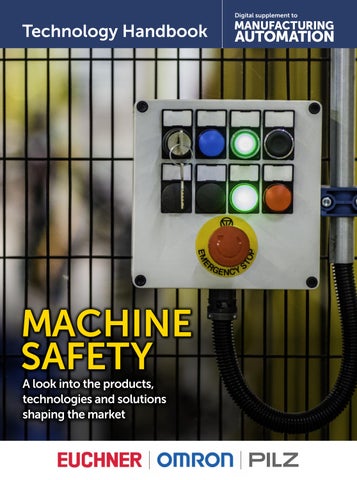
Digital supplement to
Technology Handbook
Modular safety gate system: Your gate. Our system. Your safety.
MACHINE SAFETY
With our modular safety gate system you can build an individual safety gate solution optimally tailored to your application! • Configurable safety controller PNOZmulti 2: Modular and compact solution as flexible as your application
• Safety gate system PSENslock: Safe position monitoring A look into the products, with process guarding in one system • Pushbutton unit and PITgatebox with PITreader: Control unit technologies solutions with access permission system shaping the market • Safety gate system PSENmlock: Safe interlock and guard-locking in one product with optional escape release • Firewall Security Bridge: Protection of controllers from network-based attacks and unauthorised access More information online: http://bit.ly/pilzgatesystem Pilz Automation Safety Canada L.P. - Mississauga, ON - +1 905 821-7459 - www.pilz.ca - info@pilz.ca
Technology Handbook | MACHINE SAFETY
MGB2: One Safety Switch with Thousands of Possibilities
A
s the complexity of applications increases, machine components must become more flexible. This is especially true when it comes to safety automation and engineering. With that in mind, EUCHNER has developed the MGB2 series based on the highly successful Multifunctional Gate Box MGB. The key feature of this new series for safety doors is the redesigned layout, consisting of locking modules with modular sub-modules for machine control and display functions. The MGB2 Classic is connected directly to the control system, while the MGB2 Modular has as an option with bus module for connection to PROFINET/ PROFISAFE. The MGB2 is designed to be adaptable to your unique needs.
tolin. “For another, machine conversions will be much simpler, which, given the steadily increasing pace of product innovation, many manufacturers will surely see as a great advantage. When I want to integrate another pushbutton into the installation, for instance, all I have to do is add the right sub-module instead of a complete locking module. And if something breaks, it’s naturally much easier and cheaper to replace individual components – this can usually be done even while the installation is still running.” Besides allowing hot-plugging replacement and supplying a steady stream of diagnostic information to the control system, the MGB2 components are generally easy to repair, which helps to avoid, or at least greatly shorten, downtimes. For example, all screws are captive and can be tightened or loosened with just one tool.
Doing More with Less From the very beginning, “doing more with less” was the simple principle behind the development of the MGB2. This second generation of the globally successful Multifunctional Gate Box from EUCHNER was designed to offer more flexibility to machine manufacturers, and above all to users, with fewer components. Other goals were to increase the networking options, implement more functions, and achieve greater efficiency while providing more leeway for future safety door innovations, including the Industry 4.0 mega trend. It almost goes without saying that achieving all these objectives would require more than just small evolutionary steps. It would require a smart design instead, which is why the MGB2 was designed to be modular. “All things considered,” says Xabier Antolin, project manager for MGB safety systems at EUCHNER, “our new modular design allows us to implement thousands of variants for door locking mechanisms and their associated systems alone using just a few sub-modules.” What does this diversity of variants with few components mean for users? “For one thing, they will need to keep far fewer spare parts in stock and won’t have to deal with as many different item numbers anymore,” says product manager Xabier An2 MANUFACTURING AUTOMATION · Technology Handbook Motion Control
Designing for the Future The modular design is also ideally suited for the development of additional, innovative features and functions. After all, it is easier to design and implement a single sub-module than a complete, safe system for the safety door. EUCHNER specialists can therefore give free rein to their imagination. “Many signs are pointing to our high pace of innovation in this area increasing even more in future,” product manager Xabier Antolin is pleased to say. What happens next on this platform is entirely up to technological creativity. EUCHNER GmbH + Co. KG in Leinfelden is an international familyowned company with more than 750 employees worldwide. For more information, contact: Euchner Canada, Inc. 2105 Fasan Dr., Oldcastle, ON N0R 1L0 Ph. 519-800-8397 Ph. 1-866-506-9998 sales@euchner.ca www.euchner.ca
MGB2 Classic – Easy installation, maximum flexibility Locking module
Handle module
Comprising a robust, industrial housing with integrated mounting plate.
Intuitive operation thanks to the integrated door handle, which can be adjusted in 90° increments to suit the mounting situation.
Submodules A submodule with up to three controls can be integrated into the locking module.
E bli i h c i n p g
A ili F
g h g
B l wi h N g hb p b d k d hes a e a a ab e.
l bl d h
I a f T a d t app b
p l ll l k d f
bl
p pl h .
d
p
L k
d d .
T c g t p c y p p
t l h
l )
d
T p t th k
l
E ( Th a d
u .
S
V i
e d
f
g .
S
l
l
d li y g
y g
h im g g p -
g y y
www.euchner.com
Technology Handbook | MACHINE SAFETY
CIP Safety: Increase productivity, flexibility and safety
I
n today’s market, fast and frequent changeovers are often essential for adapting to fluctuations in consumer demand. Manufacturers are seeking more ways to improve low-volume, high-mix production, and the right safety technology can help. With conventional hardwired safety solutions, changeovers are time-consuming because it’s necessary to check the safety system for the entire line even when you’re just changing a part of the line. Furthermore, since robots are increasingly adopted on production lines, manufacturing sites are located worldwide, and there’s a shortage of experienced functional safety administrators, demand is growing for advanced safety systems that are easy to install and maintain. One way to enhance the flexibility of a safety system is to implement what’s known as CIP Safety, with “CIP” being short for “Common Industrial Protocol.” CIP Safety provides fail-safe communication between different nodes such as robots, safety programmable logic controllers (S-PLCs) and safety devices like interlock switches and safety light curtains. It enables manufacturers to incorporate both safety-rated devices and standard devices into the same network using just one cable, therefore enhancing flexibility and providing several advantages.
to retrieve diagnostics, and not all relevant information might be available. CIP Safety also supports flexible manufacturing by making it easier to modify the system. With a single cable going back to the PLC, it’s incredibly simple to add or remove a device, and the reduction in wiring back to the safety PLC means that many more layout options are available. What’s more, CIP Safety works seamlessly with the Omron Sysmac platform to save time on design, programming and troubleshooting.
CIP Safety reduces time and effort needed for wiring
Getting the best of both worlds with CIP Safety and FSoE
CIP Safety provides more diagnostic information and promotes flexibility
When using Sysmac, it doesn’t matter whether you’re working with CIP Safety or Functional Safety over EtherCAT (FSoE) – you can use any tools that are part of the platform. (This includes Automatic Programming, which can reduce development time by 25%.) Customers seeking a highly flexible and scalable option for safety control can take advantage of the versatile NXSL5 safety controller, which supports both safety communication protocols simultaneously. Besides its CIP Safety capabilities that reduce wiring, enhance flexibility and simplify diagnostics, the NX-SL5 helps engineers develop scalable safety solutions that can grow with the application or budget to meet production requirements today or in the future. With the NX-SL5, it’s much easier to build modular safety systems for large production lines with industrial robots as well as manufacturing equipment requiring highspeed control.
Because CIP Safety supports integrated architecture, operators can view the status of each module through messaging as well as via the modules’ error codes. All necessary data can be gathered from the HMI for easier access and monitoring. Without CIP Safety, it can get tricky when third-party devices are involved because users must then go to each device’s specific control box
Omron Automation Americas 100 Consilium Place Toronto, Ontario M1H 3E3 1-866-986-6766 www.automation.omron.com/en/ca/
The most common safety solutions involve safety devices with redundant contacts, and each contact is wired back to the safety PLC. This can make installation an extremely time-consuming activity, especially if a production line includes more advanced devices or integration with a robotic application. CIP Safety, on the other hand, runs over common network cabling with no special hardware required. The safety PLC can be located anywhere, with both centralized and decentralized safety systems being solid options. It’s not necessary to wire devices point-to-point, so CIP Safety dramatically reduces wiring effort, and it’s easy to acquire data for managing complex human-machine interactions when all communications go through a single Ethernet cable.
4 MANUFACTURING AUTOMATION · Technology Handbook Machine Safety
We make safety easier than ever Easy to use. shorten the design cycle and start-up with an intuitive programming environment and friendly troubleshooting tools Scalable. streamline machine safety design and develop architecture using CIP Safety, Safety over EtherCAT, or a combination of both
Flexible. easily adapt your production lines to changes, reducing costs, and increasing efficiency
INTEGRATED | INTELLIGENT | INTERACTIVE
: Safe interlock and
optional escape release Technology Handbook | MACHINE SAFETY ion of controllers from
horised access
905 821-7459 - www.pilz.ca - info@pilz.ca
W
Safety gate system and safe interlocking for a core cutter
hen drives cause movement in machines and heavy rollers and blades rotate, there are multiple hazards that must be guarded against. As Brodbeck, a Swabian machine manufacturer, knows, it is not products alone that make machines safe, productive and easy to operate; integrated automation and safety solutions are required. That is why this special purpose machinery manufacturer has relied on automation solutions from Pilz for many years: in conjunction with the configurable safety controller PNOZmulti 2, the safety gate system PSENmlock and the coded safety switch PSENcode are used as a universal solution for almost all machine models.
Redesign requires a modern safety concept As part of a redesign of a cardboard tube cutting machine, Brodbeck needed to modernize the control system and electronics, and implement a new safety solution. The cardboard tube, which weighs approximately 50 kilograms and has an outside diameter of 750 mm and a length of around two meters, rotates on a driven mandrel. Two external guide rollers support the drive movement, ensuring vibration-free rotation and stability. From a horizontally movable lower bed carriage, a rotating circular blade descends onto the cardboard tube. The cutting tool splits the sleeve into handy sections with predefined widths at one-second intervals. An ejector pushes the individual rings from the mandrel into the provided container.
easy to operate. For reasons of efficiency and costs, the selected control, safety gate solutions and switch types must be suitable for use in several machine types. That’s why today you will find the versatile configurable control system PNOZmulti 2 in conjunction with the safety gate system PSENmlock and the coded safety switch PSENcode from Pilz not only in retrofit plants, but also in other machines.
Benefits and advantages of the solution: • Integral, reproducible control, safety and component solution: Transferable to several plants • Control system PNOZmulti 2: Versatile, individually adaptable: Integrated automation and safety solutions in the field of special purpose machinery • PSENmlock: Interlock and safe guard locking in one device with high holding force: For retrofit and new machines Siegfried Maier, Design Engineering Manager at Brodbeck, takes the view that this continues to be the best recipe for a long-standing and stable customer relationship: “Our customers do not want machines, they want convincing solutions including competent advice and reliable service.” This is an approach that Pilz and Brodbeck follow together. Maier added: “For risk assessment, determining of performance levels and final CE certification, we were happy to rely on the competence and expertise of Pilz.”
PSENmlock: Interlock and safe guard locking in one device With many drives, rotating cardboard tubes, guide rollers and a circular knife it is necessary to cover a whole set of hazard risks. Brodbeck attaches great importance to integrated automation and safety solutions that make machines safe, productive and
The safety gate system PSENmlock from Pilz is easy to apply and uses convenient diagnostic LEDs that are always visible to ensure a safe view of processes in any mounting position
Brodbeck, the machine builder, counts on reproducible automation solutions from Pilz. Together with Pilz, Brodbeck focuses on solutions for customers, not machines. 6 MANUFACTURING AUTOMATION · Technology Handbook Machine Safety
Canadian Headquarters Pilz Automation Safety Canada L.P. 6695 Millcreek Drive, Unit 8, Mississauga, ON L5N 5R8 Tel: +1 905 821-7459 • info@pilz.ca • www.pilz.ca
Modular safety gate system: Your gate. Our system. Your safety. With our modular safety gate system you can build an individual safety gate solution optimally tailored to your application! • Configurable safety controller PNOZmulti 2: Modular and compact solution as flexible as your application • Safety gate system PSENslock: Safe position monitoring with process guarding in one system • Pushbutton unit PITgatebox with PITreader: Control unit with access permission system • Safety gate system PSENmlock: Safe interlock and guard-locking in one product with optional escape release • Firewall Security Bridge: Protection of controllers from network-based attacks and unauthorised access More information online: http://bit.ly/pilzgatesystem Pilz Automation Safety Canada L.P. - Mississauga, ON - +1 905 821-7459 - www.pilz.ca - info@pilz.ca
MACHINE SAFETY
This article was prepared by Workplace Safety & Prevention Services (WSPS), which has helped Ontario businesses improve health and safety for over 100 years. For more information, contact WSPS at customercare@wsps.ca.
BY WSPS
Can your respirator program accommodate physical changes?
Y
3. Compare the reality to your existing program. For example, are your training records up to date? Has everyone – workers and supervisors – received the training they need to fulfil their responsibilities? Are you using the right respirators for the hazard? Do the respirators fit properly and have workers been fit tested? Do people know how to look after their respirators? Do you need a policy for clean-shaven faces if respirators are required? 4. Identify solutions. Are there more effective prevention alternatives to respirators, such as mechanical ventilation, enclosure or isolation of the process or work equipment, proper control and use of process equipment, and/or process modifications, including substitution of less hazardous materials? This is one of the first questions a Ministry of Labour inspector would ask. If not, are there respirators better suited to the hazard or that allow people to keep their beards? (For example, for persons that have beards for religious reasons, a powered airpurifying respirator [PAPR] hood would be used.) 5. Create an action plan with achievable goals and timelines. Draw on in-house and external expertise to
8 MANUFACTURING AUTOMATION · Technology Handbook Machine Safety
develop and implement the plan. To manage workload and ensure buyin, involve key stakeholders, such as managers, supervisors, the joint health and safety committee, and safety associations such as WSPS. Include clear objectives and next steps so that everyone understands what to do and how to do it. 6. Conduct a follow-up review. Identify what’s working well and what can be improved. Celebrate successes and set new goals and timelines for implementing improvements. SUGGESTED COMPONENTS OF
A RESPIRATOR PROGRAM This is what the Canadian Centre for Occupational Health and Safety suggests: • Hazard identification and control • Exposure assessment • Respirator selection • Respirator fit testing • Training program • Inspection and record keeping • Cleaning and sanitizing respirators • Repairing and maintaining respirators • Proper storage of respirators • Health surveillance • Standard operating procedures (in writing) • Program evaluation | MA
PHOTO: SMEDEREVAC/GETTY IMAGES
ou may have employees who are not getting an airtight seal on their respirators. For example, employees with full beards that are worn for personal or religions reasons may start interfering with respirator face seals. Wagish Yajaman, occupational hygienist and supervisor of WSPS’ Technical Services, sees this firsthand in workplaces he visits. To work effectively, most respirators require an airtight seal between the respirator and the user’s face and/or neck. Facial hair could interfere with the seal, drawing contaminated air into the workers’ lungs. But that’s not the only threat. Age, changes in body weight, earrings, headscarves, wigs, facial piercings, dental work, facial injury – any of these could compromise respirator seals. “Workers may have a false sense of security in the ability of the equipment they’re wearing to protect them,” says Yajaman. “This could cause irreversible damage to their health.” While most workplaces already have written respirator programs, he’s concerned that otherwise conscientious employers may not recognize the circumstances putting their workers at risk. These steps can help ensure the effectiveness of your program: 1. Identify and assess the hazards. Process changes may have eliminated or introduced hazards. Figure out what substances you need to protect people from and how much of it workers may be exposed to (review MSDSs or SDSs). 2. Look at what’s really going on in your workplace. Are people following prescribed practices? If not, why? Do they know what these practices are? Are ventilation controls working correctly? Are any controls missing?
WHAT’S YOUR SAFETY SYSTEM STRATEGY?
BY MICHAEL JOAQUIN, PAM HORBACOVSKY KLANCEWICZ & TODD MASON-DARNELL
A
safety system is essential for protecting machine operators and other workers on the manufacturing floor from hazardous machine motion. Another less obvious benefit of machine safety technology is that it can help achieve improvements in overall
equipment effectiveness (OEE). Manufacturers are starting to take advantage of their safety systems’ ability to help keep machines running and lower the frequency of unplanned stoppages. Technologies that form part of the Industrial Internet of Things (IIoT) are the driving force behind this trend towards using the safety system to enhance
10 MANUFACTURING AUTOMATION · Technology Handbook Machine Safety
OEE
Another less obvious benefit of machine safety technology is that it can help achieve improvements in overall equipment effectiveness (OEE).
OEE, since they reduce wiring, simplify troubleshooting and help gather machine data. As it turns out, manufacturers are employing these technologies in two seemingly opposing ways: either to create modular safety systems that enhance flexibility or to bring an entire plant’s machinery under a single, allencompassing safety solution. Some companies seek to achieve the best of both worlds.
Using IIoT-enhanced machine safety for equipment availability Traditional machine safety technology requires that all safety devices on a machine be
PHOTO: OMRON
How IIoT advances are fueling two diametrically opposed trends in safety system design
individually wired back to the safety controller, creating a variety of potential failure points. In this situation, a faulty connection could create an error on the system that would result in timeconsuming troubleshooting activities. By using an IIoT safety network instead, manufacturers can reduce wiring requirements and also acquire important diagnostic information. The reduction in the overall number of wires also simplifies installation and cuts costs. The reduction in wiring and resulting improvements in flexibility and data collection have prompted manufacturers to adopt strategies that garner the most value from IIoT safety applications. Depending on its particular business model, a company may opt for centralized control to simplify hardware and optimize the use of data coming from smart sensors and other networked devices or may instead put flexibility first and foremost with a modular system.
The case for centralized safety systems Some manufacturers are currently building comprehensive safety solutions that use just one programmable logic controller (PLC) and one safety controller for an entire production line. This gives them centralized control over safety-related data, simplifies troubleshooting and lowers hardware and training requirements. In the automotive industry, for example, some manufacturers are now bringing the entire panoply of robots on a weld line under one PLC and one safety controller, whereas they used to have a PLC and safety controller for every sub-line. These large-scale safety systems shorten troubleshooting time by making it easier to arrive at the “single source of truth” – that is, the root cause of failure resulting in unplanned downtime. When there are multiple safety controllers, there are more opportunities for variation and errors within safety programs. Each controller might be programmed a little differently from the next, which delays troubleshooting.
The case for modular safety systems Traditional safety guarding defined
around a specific machine doesn’t allow for much in the way of flexibility. In the past, when manufacturers would build a process line and expect to run it for the next 20 years or so, this strategy worked just fine. Nowadays, companies are producing smaller lots in order to meet the demand for a wide variety of customized products. Moving to an IIoT solution opens up more options for machine configurability and allows for automated changes to things such as muting zones and robot working envelopes depending on the particular product coming down the line. This need is leading to a trend in which manufacturers seek to incorporate smaller safety systems dedicated to one specific cell or piece of equipment that can still network with the larger plant-wide system. Essentially, they want to plug modular safety pieces together as needed in order to meet the demands of flexible manufacturing. This trend is largely facilitated by safety networks and smart safety devices. Using safety networks and IIoT devices, manufacturers no longer need to laboriously rewire each safety device and then manually reprogram their safety programs when they want to reconfigure a production line. Instead, they can simply connect devices and subsystems to the local safety network. Some automation suppliers enable automatic detection of networked safety devices and offer the ability to automatically create safety programs on safety PLCs. Production line reconfiguration can then be completed with a few mouse clicks.
Aiming for the best of both worlds Choosing between a modular approach and a centralized approach generally has to do with the degree of flexibility that a manufacturer aspires to. For contract manufacturers and packagers that need a highly variable line with retooling or reconfiguration taking place regularly, a modular approach works best. Large automotive OEMs, on the other hand, tend to benefit from a centralized approach when they plan to produce a particular body style for several years. Some large OEMs are trying to
achieve a combination of modular and centralized safety that maximize both flexibility and data omniscience. Going back to the weld line example, this would involve having a single PLC for the entire line containing multiple robots – let’s say 100 or so – while retaining the ability to work with just part of the system whenever necessary. The centralized computing system would allow them to visualize all the goings-on in that 100-robot system, and when something goes down, they’d be able to delineate the hazard zones of the system and allow specific portions of the line to continue running while troubleshooting the affected area. Several of the current IIoT developments support both strategies and even help move towards the “best of both worlds” ideal. Whether a manufacturer is using a centralized or modular safety system, having a single integrated development environment for the whole system is a powerful strategy, thanks to the “single source of truth” concept discussed above. A single integrated development environment (IDE) can gather and monitor safety data, define the necessary safety measures, and provide visibility to the entire system, no matter the degree of flexibility. Additionally, advances in safety programming software have given rise to automated program verification, which is essentially a sort of “truth table” function that confirms whether the design intent of the safety program has been met. This program verification provides a critical step in demonstrating due diligence and taking “every precaution reasonable in the circumstances” to protect workers – a legislated duty of employers in Canada. Ultimately, IIoT technologies in a safety system serve to simplify installation and maintenance, minimize potential failure points, and reduce the amount of effort required for troubleshooting. Whether a manufacturer is leaning towards a flexible, modular system or a more centralized one, these benefits are within reach. Sophisticated data collection and easy reconfiguration come in handy in any application, whether it’s a high-mix, low-volume production line or a high-throughput, single-product one. | MA
Technology Handbook Machine Safety · MANUFACTURING AUTOMATION 11
THE NEW WAREHOUSE WORKER BY KRISTINA URQUHART
O
ver the past five years, Sunview Patio Doors has transitioned its factory from a manual, paper-driven operation to one that’s fully automated. The Toronto-based manufacturing company, which produces about 80,000 windows and doors every year, is bringing its operations into the Industry 4.0 era in response to increasing customization options and higher customer demand for faster delivery times.
New automation So far, Sunview has implemented automation such as robotic work cells, an automated storage and retrieval system in the warehouse, and enterprisewide software that integrates plant operations. Two years ago, Sunview was looking to replace its traditional tow motors in order to reduce traffic on the shop floor, and purchased its first autonomous mobile robot (AMR) from the Clearpath Robotics–owned OTTO Motors. Sunview worked with a robot integrator to implement OTTO
12 MANUFACTURING AUTOMATION · Technology Handbook Machine Safety
AMR
Autonomous mobile robots (AMRs) can be used on factory floors and in logistics operations to transport goods.
at the end of its first production line. Once a patio door comes off the line, an operator sends a signal and OTTO will bring over the next empty pallet. The operator will then load the pallet, and OTTO will deliver the finished goods to the warehouse storage system, where the vehicle will wait to be called again back to the production line.
A safe solution
The OTTO vehicle (pictured above) uses AI and sensors to adapt to its environment.
Kurt Oberparleiter, vice-president of operations at Sunview Patio Doors, says his company called on OTTO Motors to test its AMR ahead of a full-scale plan to eventually replace all of Sunview’s tow motors with autonomous vehicles. He says Sunview’s existing tow motors are frequently damaged when operators inadvertently bump into objects on the spatially challenged factory floor, and they’re also a safety concern for people moving throughout the facility.
PHOTO: OTTO MOTORS
A patio door manufacturer realizes cost savings and safety improvements with automated material movement
When the Sunview team initially researched solutions for material movement, they considered traditional automated guided vehicles (AGV) that use magnetic tape or lasers. “We were worried because those AGVs are easy to defeat,” he says. “If someone moves a garbage can, or there’s some debris on the floor, or if someone walks in front of it, some of those AGVs will require a reset.” However, OTTO’s fleet of selfdriving vehicles – currently available in three weight specifications for small, medium and heavy payloads – uses laser-based perception and artificial intelligence to move through facilities without additional infrastructure. Onboard sensors and software learn and understand the working environment and adapt to changes in real time, detecting people, obstacles and equipment along the way. “OTTO is our best driver in the factory right now. It doesn’t run into anything, it shows up for work on time, it doesn’t complain. It does what’s required,” says Oberparleiter, who says he’s been most impressed with the safety performance of the vehicle. “That really surprised me.”
Cost considerations The main driver behind the initial implementation, however, was cost. Oberparleiter says that AMRs are less expensive to maintain in the long run because they don’t require the regular propane top-ups and servicing that traditional tow motors do. AMRs also eliminate the need for human drivers, who can be freed up for more challenging and complex tasks. “We face the common problems that the Toronto market has today in that it’s difficult to get skilled workers,” says Oberparleiter. “It’s hard to get people to come to work – and that’s great. It’s great for the economy; it’s great for people.
“I’m glad that we’re doing this legwork to get our factory to where it needs to be in terms of what the future will bring.” from the data collected by OTTO’s AI and fleet management systems is an area of continuous improvement for the company. “Putting data in context really is where the power lies for the customer,” says Baker. “Our goal is ultimately to give them data about their facility that helps them proactively plan.”
“It’s a little bit tough when you’re trying to run a factory and you need everybody to show up every day.” Rick Baker, chief revenue officer at OTTO Motors, says that the company has spent considerable effort over the past few years learning its customers’ needs. “For some of our customers, it’s about reducing labour. For some, it’s really about safety, and preventing any potential for impact against another human,” he says. “Understanding that unique case about what’s driving them to adopt technology was really important, and then optimizing our system to be able to meet those demands.”
Expanding the ecosystem OTTO Motors is continually updating its software to ensure maximum reliability, and, since first debuting its self-driving vehicles on the market in 2016, has focused on growth in North America, Europe, Japan and New Zealand, as well as on developing partnerships to offer tools and assemblies that fit atop the OTTO. One of those most recent partnerships is with U.S.-based Boston Dynamics’ logistics robot, Handle, which uses a vision system to pick boxes and pallets and place them on top of the OTTO vehicle. There will be more comprehensive applications to come, says Baker, “where we’re a part of their overall portfolio. What you’ll see from the go-to-market strategy moving forward is doubling down our efforts to bring scale and leveraging [those partnerships] in market, because we have proven technology that we have spent a lot of time developing for reliability, safety and impact.” He says that gaining insights
Big returns
16
Sunview Patio Doors was able to reach a ROI of about 16 months with its first OTTO robot.
“Everyone knows that we can move stuff,” Baker says. “The question is, when we move it, how do we move it to optimize for efficiency, ROI, labour, safety – it’s the combination of this that is actually most meaningful. And so the conversations are turning from is this technically feasible to what’s the potential business outcome.” Sunview Patio Doors was able to reach its ROI in about 16 months with its first OTTO robot. Oberparleiter says the company is finishing some other projects over the next couple of years but after that, Sunview plans to replace its entire tow motor fleet with mobile robots.
A flexible future Baker says manufacturers looking to implement an AMR may need to be prepared to modify the layout of their factory to optimize the robot’s paths, and to allow it to learn its environment. “It feels to me like this is the future,” Oberparleiter says. “The age of tow motors and people driving cars and machines inside factories – any kind of vehicle inside a factory – those days are starting to disappear. And I’m glad that we’re doing this legwork to get our factory to where it needs to be in terms of what the future will bring. We need to stay competitive.” | MA
Technology Handbook Machine Safety · MANUFACTURING AUTOMATION 13
DON’T MISS OUT on your next issue of
IT’S FAST, IT’S EASY AND IT’S FREE!
CENTRE STAGE: University of Waterloo prof predicts automation boom. p. 14
SHOW REPORT:
Top takeaways from our first-ever virtual summit on implementing automation in a pandemic. p. 22
Your resource for Canada’s industrial automation news
INDUSTRY WATCH: Technology adoption has to come from the top. p. 10
AutomationMag.com
DECONSTRUCTING
DATA
How Sight Machine transforms data into universal manufacturing concepts. p. 16
SEPTEMBER 2020
MA_SEPT_2020_ASK.indd 1
PM 40065710
2020-08-25 8:28 AM
HERE’S HOW: FOR FASTEST SERVICE VISIT
AutomationMag.com AND CLICK THE SUBSCRIPTION BUTTON
AutomationMag.com