Digital supplement to
Technology Handbook
st Fit for Your ntrol Cabinets
pe of switch that is smarter ype nd simpler to set up
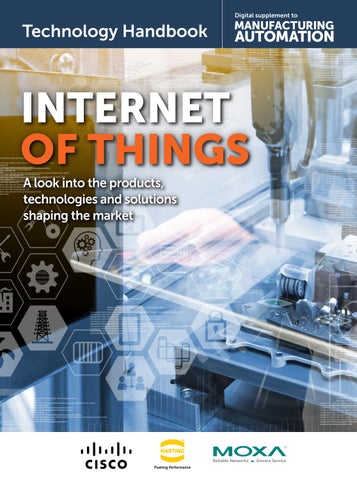
INTERNET OF THINGS
Common Challenges Ethernet Switch Deployment A look into theforproducts,
technologies and solutions shaping the market
e tions that require only basic monitoring ol functions, it’s not economical for s to choose expensive managed which often support too many unneeded
Space Limitations Engineers work with different types of control cabinets, and each one has space or installation limitations.
Connectivity of trial IoT
orks, Sincere Service e Moxa’s promise to drive ty of the Industrial IoT. With of industry experience, s a complete solution o help you tap into of the Industrial
Complex Configuration IT-oriented user interfaces, which are often very complicated and come with a steep learning curve for IA engineers, make it harder to update configurations and handle basic troubleshooting tasks.
Applications
Connectivity Edge Connectivity
Industrial Computing
Serial I/O Video Connectivity Connectivity Connectivity
Embedded Computers
Moxa’s Solution Architecture Networking Infrastructure
vity
puting
tructure
How May We Help You?
acturers Automation Inc.
rth, St. Jacobs, ON N0B 2N0 - 1-800-387-6268 - www.manuauto.com
Devices
Device & Industrial Network Routers Management
Industrial Industrial Ethernet Wireless LAN
Technology Handbook | INTERNET OF THINGS
Rogers Centre’s Iconic Roof Gets an IoT Makeover “Will the roof be open?”
T
he Rogers Centre opened in 1989 as the first stadium in the world with a fully-retractable, motorized roof. Composed of three moveable sections, the roof covers 8 acres, weighs 11,000 tons and reaches a height of 282 feet at its center. Although the roof had opened and closed consistently for more than 25 years, Rogers Centre engineers began to realize the legacy technology was becoming out of date and not as reliable as it once was. “A lot of the components and parts that control and drive the roof were no longer being manufactured,” said Dave McCormick, Manager of Engineering at Rogers Centre. “What this project was about was getting this structure and the operating system back to a state where it could sustain for the next 15 to 20 years.” To do just that, the Rogers Centre engineering team wanted a contemporary network and industrial control system that could efficiently and reliably open and close the roof while providing high availability, fault tolerance, self-diagnostics, and mobility. In 2015, a massive retrofit of the roof infrastructure was commissioned, including a new Operational Technology (OT) network and industrial control system. Rogers Centre selected JMP Engineering and partners for the project. JMP Engineering worked in partnership with Gerrie Electric, Cisco and
Rockwell Automation to design a new, Ethernet-based solution and control system that would meet the strict safety requirements of the stadium and improve the fan experience. “Not only did the new solution need to ensure the safe operation of the roof in winds up to 40 MPH, but it also needed to do so reliably and quickly,” said Steve Szamocki, Executive Vice President of Sales and Marketing for JMP Engineering. “To meet these requirements, we installed a secure Internet of Things (IoT) network and industrial control system built on Rockwell Automation Stratix Switches, supported by Cisco network technology, and FactoryTalk® SE system.” The solution also included a new mechanical and electrical system, Rockwell Automation PowerFlex® 750 VFDs, a rooftop weather station and Cisco ASA Firewall. The two year, $10-million roof retrofit project was completed in the summer of 2016 and has returned the renowned roof to its former glory. Operation of the roof can now be monitored by one person and can be completed with a 46 per cent
2 MANUFACTURING AUTOMATION · Technology Handbook Internet of Things
improvement in speed. The enhanced functionality of the contemporary control system and OT network now provides fault tolerance, self-diagnostics, and reporting previously not available, allowing the operator an easy and quick way to troubleshoot and rectify any issues, should they arise. Cisco Industrial Ethernet switches also ensure the network remains secure and operational year-round. To ensure the reliability of the new Ethernet-based system, the roof completed over 60 opening and closing cycles as part of commissioning and site acceptance testing, and functioned without issue throughout the 2016 Major League Baseball Playoff Season. So what is the answer to the question on the lips of every Blue Jays fan? While the answer still lies with Mother Nature, the Rogers Centre team can now make their decision knowing the roof will perform, regardless of the weather. Play ball! CISCO CANADA 88 Queens Quay West, Toronto
Cisco.com/ca/factoryofthefuture
to manufacture without borders
Discover how technology is creating the factory of the future at cisco.com/ca/manufacturing
Technology Handbook Internet of Things · MANUFACTURING AUTOMATION 3
Technology Handbook | INTERNET OF THINGS
HARTING making Han-Modular® the best connector choice for the Smart Factory HARTING invented the modular connector over two decades ago when it launched the Han-Modular® concept. Han-Modular® has popularized the customer-configurable, modular connector which allows users to create an application-optimized, custom connector entirely from standard, catalogue parts. The plug&play efficiency of modular connectors makes a compelling case that connector-based wiring is more cost-effective than hard-wiring electrical connections in the installation and servicing of machines and production systems. The labor savings alone more than offset the one-time cost of the connectors. Han-Modular® filled a need in the plug&play environment for all-in-one interfaces that streamline the transfer of power, signal and data to distributed switch cabinets, controllers and sensors. Today, the Han-Modular® lineup boasts over 100 different modules that can be combined in Han® housings sizes 6B to 48B, including several of HARTING’s newest modular series like Han-Yellock® and Han-Eco®. The range includes contacts and inserts for current up to 200 A, high voltage up to 5000 V and signal modules with a packing density of up to 25 contacts. The range runs from Cat. 6 Ethernet interfaces, coax and USB inserts to “smart” Han® modules for various Bus technologies and mini-switches (with 4 ports.) There are even pneumatic modules for delivering properly prepared compressed air to functions like drives. Now, HARTING is adding
innovations to make Han-Modular® the smart choice for the data-intensive Smart Factory environment. For 2017, there is a new, improved removable inner frame in which to load the modules – the spring loaded “hinged frame plus.” The spring holds the frame open for loading, then closes it tightly with a clearly audible click. This permits faster, even automated assembly of the connector. And there is a new robust metal docking frame for blind mating applications like switch cabinet drawers. Other new products for use with modular include: • a PE Module for the pluggable connection of large PE Cross-sections in a 10-35mm range. (The hinged frame has two integrated connections for the 0.5-10mm2 cross-section range). Telephone 1 (855) 659-6653
HARTING.ca 4 MANUFACTURING AUTOMATION · Technology Handbook Internet of Things
• Han® HP Direct, which eliminates the need to have to use the classical bulkhead mounted housing and replaces it with two mounting flanges. Installation only requires the mounting flanges to be screwed to the cabinet wall. • Han® Gigabit & Megabit high mating cycle (HMC) modules – two shielded data modules offering customers data rates of up to Gigabit Ethernet Cat. 6A. • Smart Modules, which provide the capability for identification of machine-level components, protect your equipment against surges, and add Ethernet switch functionality. HARTING’s vision is that modular connectors, the preferred choice in conventional manufacturing, will be absolutely indispensible in the IIoT future. New modules are being developed that incorporate sensors and wireless capability to provide monitoring and diagnostic features for managing complex modularized production setups. As these and other innovations reach the market, you will be able to add or swap them into your existing connector housing, so your current HARTING investment is future proof.
Read the Modular Connector FAQ Watch the video - how modular connectors outperform hardwiring of electrical connections
Build a Connector and Calculate Cost Savings
With HARTING’s Industrial Connector Configurator and Savings Calculator App
The Connector Configurator lets users create a custom modular connector and send it to a HARTING expert for feedback.
The Savings Calculator shows how using a connector can save money over time as compared to hardwiring the system.
Stop Hardwiring and Start Connecting Say goodbye to hardwiring and simplify with HARTING connectors. Reduce the number of wiring errors, save time and headache. Download the app and white paper to learn how connectors outperform hardwiring. HARTING, first established in 1945, delivers unrivaled reliability, efficiency, innovation and performance in connectors. With HARTING you have a partner who ensures you dependable connections that stand the test of time. Get a complete plug-and-play solution - Inquire to HARTING about its Customized Solutions business to build your assemblies. Learn more at: HARTING-usa.com/customized-solutions/
DOWNLOAD THE APP: www.harting-usa.com/hartingapplications/ DOWNLOAD THE WHITE PAPER: www.harting-u.com/category/ industrial-connectivity/
Smart Switches with the Most Compact Size and Intuitive Configuration The SDS-3008 smart switch is a new product line within Moxa’s industrial Ethernet switch family. The smart switches offer an intuitive one-page dashboard, which allows users to activate pre-configured IA protocols in one click, simplifying HMI/SCADA integration. Moreover, this is the world’s thinnest switch. With the compact size and flexible mounting design, the smart switch allows the highest installation flexibility. According to the “2016 Global Industry 4.0 Survey” conducted by PWC, the digitization of existing product portfolios, and introducing a new digital product portfolio, are two key measures that companies are planning to take in the coming years to improve production efficiency. "When a network upgrade is required, the most common concern for engineers deploying managed switches is their complexity during the whole system life cycle," noted Jack Lin, Product Manager of Moxa’s Industrial Ethernet Infrastructure Division. "That’s why we developed the smart switch. It supports the most required management functions, and has a 3-2-1 design for ease of use: 3 pre-configured protocols, 2 installation methods, and a one page switch dashboard. We believe the smart switch is an ideal solution for the manufacturing industry, especially machine builders who are on their way towards the IIoT and industry 4.0.” • Three protocols in one device Smart switches support EtherNet/IP, PROFINET, and Modbus/TCP industrial protocols, and the configuration can be done in one click via the smart UI.
• Two centimetres wide with DIN-rail and rack-mounting options Smart switches are designed for flexible installation. The compact size allows them to fit in almost any control cabinet, and they support both DIN-rail and rackmount installation. The three-way DIN-rail kit allows users to install the switches horizontally or vertically. With the optional 1U rack accessory, users can combine four smart switch units on a 19” cabinet. • One-page dashboard Smart switches come with a newly designed smart UI, which features a graphical function menu and one-page dashboard, making it easier for users to clearly visualize the status and operate the switch. For machine builders and automation engineers, being able to monitor their Ethernet switches from a SCADA/HMI gives them a great overall view of their control systems, and the ability to react in time to minimize system downtime. In addition, the most common concern related to deploying managed switches is operational complexity, including both setup and subsequent management. Moxa’s super-slim SDS3008 smart switch is designed to meet these challenges. With its simplified protocol configuration, flexible mounting design, easy-to-use interface, and slim form factor, the SDS-3008 smart switch is the perfect fit for control cabinets in any smart manufacturing application.
Manufacturers Automation Inc. 1-800-387-6268 • www.manuauto.com 6 MANUFACTURING AUTOMATION · Technology Handbook Internet of Things
Best Fit for Your Control Cabinets . A new type of switch that is smarter and simpler to set up
Common Challenges for Ethernet Switch Deployment
Cost Issue For applications that require only basic monitoring and control functions, it’s not economical for engineers to choose expensive managed switches, which often support too many unneeded functions.
Space Limitations Engineers work with different types of control cabinets, and each one has space or installation limitations.
Enabling Connectivity of the Industrial IoT Reliable Networks, Sincere Service continues to be Moxa’s promise to drive the connectivity of the Industrial IoT. With over 25 years of industry experience, Moxa provides a complete solution architecture to help you tap into the potential of the Industrial
Complex Configuration IT-oriented user interfaces, which are often very complicated and come with a steep learning curve for IA engineers, make it harder to update configurations and handle basic troubleshooting tasks.
Applications
Connectivity Edge Connectivity
Industrial Computing
Serial I/O Video Connectivity Connectivity Connectivity
Embedded Computers
Moxa’s Solution Architecture Networking Infrastructure
Edge Connectivity • Industrial Computing • Network Infrastructure
How May We Help You?
Manufacturers Automation Inc. 1600 King Street North, St. Jacobs, ON N0B 2N0 - 1-800-387-6268 - www.manuauto.com
Devices
Device & Industrial Network Routers Management
Industrial Industrial Ethernet Wireless LAN
ENTERING THE IIOT Critical first steps to achieving results in the Industrial Internet of Things BY MARY DEL CIANCIO
T
he Industrial Internet of Things is on track to revolutionize the manufacturing industry. Using sensors, software and other advanced technologies to accurately capture and communicate data from the plant floor promises to decrease costs and downtime for manufacturers, increase quality and savings, and make them much more efficient. The advantages are clear. Yet many manufacturers have been slow to adopt the technology that will give them these results. Why? The Industrial Internet of Things, also called the IIoT, is still in its
infancy. Jumping on board requires an investment and, because it’s an emerging space, it’s difficult to determine the ROI. With so much excitement surrounding the IIoT, many simply don’t know where to start. However, experts suggest that by taking some small first steps, manufacturers will begin to see results.
Getting started The IIoT is no different than the journey manufacturers have been on for years, explains Paul Farrell, senior vice-president of product marketing with NetSuite, likening the IIoT to Lean manufacturing and a company’s efforts
8 MANUFACTURING AUTOMATION · Technology Handbook Internet of Things
to add value and remove dead costs. Like Lean, it’s about driving quality and driving cost effectiveness, he says. With that in mind, the first step is to look at where the value is going to be added, and what you want to accomplish. Do you want to reduce costs, reduce waste, increase productivity, increase efficiency? Where are the areas within your facility that you can gain the most benefit from the IIoT? Perhaps it’s driving real-time scheduling, optimizing maintenance schedules or parts ordering. Maybe it’s managing capacity, catching quality issues or reducing waste. “There is a massive amount of opportunity out there for companies to become a lot more efficient and a lot more effective,” Farrell says. “Look at where you need to add the value, or where you think it’s going to take out the cost, and concentrate on doing that.”
Agree on the goal Success in the IIoT space requires
gyrations in the definition of what the customer is seeking to achieve, wasting precious time.
co-operation between the interested parties within a company. What they are trying to achieve and how they are going to achieve it must be agreed upon at the beginning, explains Aiden Mitchell, the vice-president of IoT global sales for Arrow Electronics. Mitchell participated in a recent panel discussion at the Harting Business Conference (HBC) that discussed how to make the IIoT a reality today. “The guys who run the operations, who run the factory floor, have typically had a pretty closed-loop, tight working environment for years. The last thing they would ever want is to let an IT guy into the middle of it,” explains Mitchell. “But now that you’re talking about data coming off their shop floor and going into some ubiquitous data environment in the Cloud, you’ve really got to get them aligned in terms of how that is going to work.” An IT lead must be involved in the discussion from the start, he says. Otherwise, you go through a lot of
Key considerations In these early discussions, there are several key factors to consider, and important decisions that need to be made. First, explains Farrell, think about how you are going to connect your machine to the IIoT. What sensors and software are you going to use? What is the protocol? What is the network? If you have legacy equipment, how are you going to bridge that serial to digital divide? Second, consider how you are going to gather the huge amount of data coming from your equipment. Is the data streamed, sent on an event or sent at a certain time? Where are you storing it? Is it a Cloud solution or are you building the infrastructure to deal with the data locally? And third, think about how you are going to analyze the data and make sense of it. Is your system of record, ERP software or MES open enough to action the data that comes in from the IIoT? The concern for many manufacturers is that the IIoT is still evolving. Standards are emerging and technology is rapidly advancing. “There are many companies working on producing solutions that will simplify the ability to connect, integrate, analyze, understand and optimize,” explains Farrell. “There is a massive amount of investment here, so we will see standards and simplification emerge over the next couple of years.” Find the right partner It’s a team effort, and partners — whether vendors or system integrators — play a large role in the IIoT. A good partner can make recommendations on the best products to meet the application’s requirements. Afterall, having the right solution that makes sense for the application is critical, explains Nick Hassan, the director of the advanced development group at Texas Instruments, who also participated in Harting’s HBC panel discussion. Indeed, there are companies in the IIoT space who provide frameworks and technologies to help businesses
get started, says Farrell. Manufacturers should do their research and carefully consider partnerships and solution providers that can help them along their journey.
It’s not for everyone While the IIoT holds a lot of promise for many manufacturers, it may not be right for all, Farrell says. For example, the food and beverage industry is one market that can gain a lot of value from the IIoT because there is a great deal of information regarding quality, temperature and other variants that are gathered throughout the manufacturing process. But for a company that is assembling two components together quickly and easily, there may be less advantage, he says. “Don’t think, ‘I have to go and get IIoT implemented or I’m going to fall behind,’” explains Farrell. Instead, think, “Is it going to add value to your processes? There are some industries that are very machine intensive that absolutely it can. But if you’re not in an industry that is, then is it going to add that value?”
Walk, don’t run For companies that can gain value from the IIoT, they will be at a competitive disadvantage over time if they fail to adopt technology. It will become more difficult for businesses that are in the IIoT space to work with them, and they will also be less efficient than their competitors. But that doesn’t mean companies should do everything at once. “There’s lots of noise out there about [IIoT] and...the fantastic things it’s going to be able to do for you. But this should be no different than any other project that a manufacturer does when it’s looking at where the value is,” says Farrell. “Take key projects, implement them, retrieve the value...and let’s get a real robust ROI behind it.” Take it one, small step at a time, he suggests. “Walk the pace rather than run.” | MA Mary Del Ciancio is a business writer who has been covering industrial topics for more than 15 years. She is the former editor of Manufacturing AUTOMATION magazine.
Technology Handbook Internet of Things · MANUFACTURING AUTOMATION 9
IOT AND BIG DATA: THE PREDICTIVE MAINTENANCE SILVER BULLET? BY PATRICK ZIRNHELT
A
According to IDC research, the installed base of worldwide Internet of Things (IoT) endpoints will grow from just less than 13 billion units in 2015 to 30 billion by 2020. This article looks at the potential of leveraging data produced by IoT-enabled devices to unlock dollars on the bottom line, as well as the immediate benefits IoT and big data will provide for three key industries: manufacturing, transport and utilities. Today the ‘big’ deal about IoT is scale. Technology today doesn’t just count
the number of punches or laser cuts a machine does — IoT takes those and much more to a far larger scale. Sophisticated, IoT-enabled equipment today might have dozens, or even hundreds, of sensors continually monitoring the performance of equipment components, such as lasers, cutters, grinders, accelerometers. Multiple sensors will also monitor operating conditions such as temperatures, humidity, weights, densities, flow and vibrations. The volume of information gathered in real-time about equipment performance is higher than ever before. Much of this data can be dissimilar. IoT enables
10 MANUFACTURING AUTOMATION · Technology Handbook Internet of Things
stream analytics — capturing a stream of data simultaneously from multiple data points and aggregating for analysis in real-time.
Machine learning: a step further Big data analytics also enables machine learning, allowing organizations to diagnose the potential for a machine malfunction based on analysis of the data it generates. For example, a sensor might detect that a punch in a numerically controlled machine is likely to breach tolerance levels. Stream analytics would then look for data points from other
sensors that could suggest the cause of the out-of-tolerance condition. Such detailed, real-time analytics can enable true pre-emptive/predictive maintenance, empowering equipment operators and service organizations to take action long before a problem occurs. These smart, connected assets can allow enterprises to move beyond realtime control to predictive control, and ultimately even autonomous operation. Here are three examples from the utilities, manufacturing and transport industries of how IoT is empowering service providers to boost performance and results through predictive maintenance.
Utilities — avoiding catastrophes Utility companies can leverage IoT and predictive maintenance to boost asset reliability and minimize reactive service costs. Electric utilities routinely gather information about their electricity generation and distribution network via Supervisory Control and Data Acquisition (SCADA) systems. Analysis of data gathered by these systems can proactively alert utility maintenance crews of a pending problem in a power substation, an individual transformer, or other parts of the distribution network. Natural gas utilities can leverage smart sensors to detect potential problems in compressors, corrosion and leaks in gas pipelines, or other pipeline components. Data gathered by these remote sensors can be shared in real-time with pipeline operators. Oil pipelines share many of the same issues as gas pipelines — information about failures or potential failures in the pipeline infrastructure must be immediately conveyed and remedied. IoT and predictive maintenance practices are crucial in helping utility companies avoid electricity outages, dangerous gas leaks, oil pipeline breaches, environmental catastrophes, and more.
Manufacturing — good vibrations Manufacturing equipment often contains multiple mechanical components which must be aligned and calibrated properly. Such equipment have tolerances it must operate within to produce a high-quality end product.
Sensors embedded in the manufacturing equipment can monitor the level of vibrations within the equipment and detect if vibration levels have, or are about to, extend beyond specified constraints. Some manufacturing equipment must operate within certain temperature parameters as well. Sensors can monitor and track those temperature levels and immediately determine if operating temperatures are close to or outside of allowable parameters. These intelligent devices can automatically and immediately alert operators about a new or impending service requirement and potential failure. Armed with that information in advance, the organization charged with maintaining the equipment can provide predictive service, based on the condition of the equipment and, rather than a static time schedule. Such predictive service circumvents future equipment downtime and the associated costs.
Transport — opening doors IoT data enables fleet, long-haul trucking, railroad, and other transportation operators to anticipate vehicle service requirements. The data allows operators to proactively maintain those vehicles based on the equipment’s specific needs, rather than a number of miles or time interval since the last maintenance. A sensor-equipped vehicle exhibiting consistently high engine temperatures can be brought in for inspection and remedial maintenance, avoiding a costly breakdown. A tire pressure sensor on a delivery vehicle can automatically alert fleet maintenance staff that a tire may need to be repaired or replaced, thus sidestepping a potential delay in deliveries — or worse, an accident.
A problem shared is a problem solved In addition to monitoring the performance of individual pieces of equipment, smart devices and IoT can also be used to collect data from multiple pieces of equipment of the same type, creating large amounts of information that can be aggregated, analyzed and modelled. This accumulation of performance and reliability data enables comparisons of individual pieces of equipment with
others of the same type or model. Comparative data can help service providers identify individual units that are operating outside the norm so corrective action can be taken proactively. The accumulation of this data allows engineering, manufacturing, and service providers to identify product quality issues so they can be corrected in future versions of the product, or corrected for existing equipment through the creation of field upgrades and engineering changes. Underpinning this predictive maintenance strategy needs to be software that facilitates the analytics and modelling of all the data gathered from smart devices and IoT. The new generation of ERP software solutions are designed with agility and future technology in mind, making it possible for organizations to experience predictive maintenance and its efficiency – ultimately helping to harvest the benefit at the bottom line.
Smart devices, smart solution, smart profit The enterprise software supporting these smart devices and IoT make it possible for organizations to visualize and analyze equipment performance data in ways not previously possible. Customers enjoy improved equipment performance, reliability, fewer outages, and longer equipment life. Service providers can implement predictive strategies for more efficient and cost-effective operations. They can plan optimized maintenance schedules in advance and significantly reduce reactive break/fix service events. Service technicians are more productive and can become the customer’s trusted advisor. Engineering and manufacturing can improve future product quality. At the top level, management will see greater operational productivity, reduced service costs, and stronger financial performance. It’s a win-win approach for service and asset-heavy organizations, with the benefits of this evolving maintenance strategy extending right across the enterprise. | MA Patrick Zirnhelt is the vice-president of Enterprise Service and Asset Management at IFS North America.
Technology Handbook Internet of Things · MANUFACTURING AUTOMATION 11
DON’T MISS OUT on your next issue of
IT’S FAST, IT’S EASY AND IT’S FREE! DICK MORLEY: A glimpse into the many facets of the esteemed “Father of the PLC.” p.18
spOtlight: highlights from our fireside chat with nathalie pilon, aBB canada managing director. p.15
Defence-in-Depth Best practices to help industrial operators deploy the internet of things securely and reliably. p.22
TRAINING: How you can millennials and SPOT THE DIFFERENCE: attract simultaneously boost your How to choose the right lighting for machine vision business. p.17
applications. p.26
ETHERNET GAINS: Acadian Seaplants capacity grows by 40 per cent with new processing facility. p.20
LIGHTING RETROFITS: LEAN MANUFACTURING: Industy bakery welcomes Defining culture as an environment favourable to continuous improvement. p.10
INDUSTRIAL NETWORKS: Selecting components that make the grade. p.24
Machine safety: how you can prepare for the upcoming Ontario machine safety blitz. p.21
AutomationMag.com
Your resource for Canada’s industrial automation news
MOTORS AND DRIVES: An overview of the most popular rotary motion technologies. p.24
PC-BASED CONTROL
IN THE DRIVER’S SEAT
from 3D printers to industrial sensors and the internet of things (iot) — key trends and technologies that will impact your plant floor this year. p.16
HANNOVER WRAP-UP: Couldn’t attend this year‘s Hannover Messe? Catch up on standout moments from the action-packed fair. p.26 OCTOBER 2016
MARCH / APRIL 2016
PM 40065710 AlliedCover_MA_Jan.indd MA october 2016.indd 1 1
2016-11-01 2015-12-23 10:04 1:58 PM AM
Think Allied for Industrial Automation. More Brands. More Products. More Solutions. See it all at thinkallied.com/industrialautomation
NOVEMBER/DECEMBER 2016
30 ISSUE
TH ANNIVERSARY
PM 40065710
SEPTEMBER 2016
2016-01-07 2015-12-23 2:29 1:58 PM PM
The 2016 Canadian Manufacturing Study finds the industry is strengthening, slowly but surely p.19
AutomationMag.com
PM 40065710
2016_MA_ISSUE.indd 1 1 AlliedCover_MA_Jan.indd
2015-12-23 12:20 1:58 PM 2016-03-02 PM
MAY 2016
CLIMB
More Brands. More Products. More Solutions. See it all at thinkallied.com/industrialautomation
OF RAMPED-UP AUTOMATION Automating specialized armored vehicles has paid big dividends for Inkas. p.18
AutomationMag.com
Think Allied for Industrial Automation.
More Brands. More Products. More Solutions. See it all at thinkallied.com/industrialautomation
AlliedCover_MA_Jan.indd 1 1 2016_MA_MAR_APR16.indd
More Brands. More Products. More Solutions. See it all at thinkallied.com/industrialautomation
AutomationMag.com
Your resource for Canada’s industrial automation news
PM 40065710
Your resource for Canada’s industrial automation news
Think Allied for Industrial Automation.
SECRET TO SUCCESS: Industry players share how they achieve longevity in a turbulent market. p.21
PM 40065710
ENJOYING THE BENEFITS
pM 40065710
problem p.18
LESSONS LEARNED: Tips for how you can avoid pitfalls and make the best decisions in automation. p.28
Think Allied for Industrial Automation. JAnUARY / FEBRUARY 2016
A look at how connected manufacturing benefits both know there’s a manufacturers and customers. p.24
Your resource for Canada’s industrial automation news
AutomationMag.com
AUTOMATION SOFTWARE: Four big-picture benefits of PLM for small manufacturers. p.24
Sodecia uses PC control, EtherCAT and programmable safety to accelerate robot cell performance for automotive assembly. p.22
in 2016
Ontario startup allows factory managers to
LET’S DIGITIZE: act before they
MACHINE SAFETY: Integrated safety technology boosts motion system functionality. p.15
MACHINE SAFETY: Ensuring safe operations with collaborative robots. p.14
THE SLOW
Your resource for Canada’s industrial automation news
Top 5
TOUCH
COST CONTROL: How a stronger employeecustomer connection will improve productivity. p.26
INTERNET OF THINGS: Manufacturers who embrace IoT are leading the digital transformation. p.23
AutomationMag.com
Your resource for Canada’s industrial automation news
THE MAJIK
HMI CHECKLIST: Top factors and features to consider when shopping for an HMI solution. p.22 AutomationMag.com
Your resource for Canada’s industrial automation news
retrofit for non-energy operational savings. p.22
More Brands. More Products. More Solutions. See it all at thinkallied.com/industrialautomation
The evolution and future of industrial automation p.18 AlliedCover_MA_Jan.indd 1
A RECIPE
PM 40065710
Think Allied for Industrial Automation.
2015-12-23 1:58 PM
Think Allied for Industrial Automation. More Brands. More Products. More Solutions. See it all at thinkallied.com/industrialautomation
FOR GROWTH AlliedCover_MA_Jan.indd 1 Our editorial advisory board discusses the challenges in Canada’s manufacturing future, and how to overcome them p.18
2015-12-23 1:58 PM
2015-12-23 1:58 PM
JUNE 2016
AlliedCover_MA_Jan.indd 1
Think Allied for Industrial Automation. More Brands. More Products. More Solutions. See it all at thinkallied.com/industrialautomation
AlliedCover_MA_Jan.indd 1 1 2016_MA_june16_GWJ.indd
2015-12-23 2:54 2016-06-02 1:58 PM PM
HERE’S HOW: FOR FASTEST SERVICE VISIT
AutomationMag.com AND CLICK THE SUBSCRIPTION BUTTON
AutomationMag.com 12 MANUFACTURING AUTOMATION · Technology Handbook Internet of Things