Digital supplement to
Technology Handbook
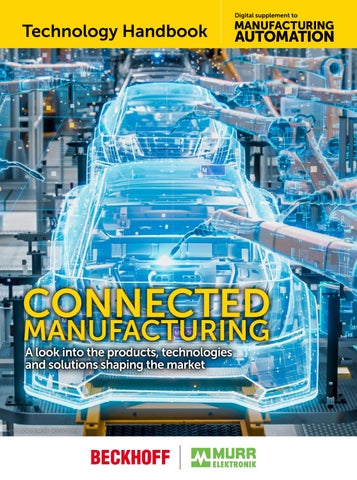
CONNECTED MANUFACTURING A look into the products, technologies and solutions shaping the market
PHOTO: GORODENKOFF / ADOBE STOCK
Technology Handbook | CONNECTED MANUFACTURING
TwinCAT 3 Directly Integrates OPC UA Pub/Sub Beckhoff provides real-time-capable data communication via OPC UA with the new TF6105 function in its universal automation software
Beckhoff supports the extension of OPC UA with a new TwinCAT 3 software function that includes real-time publisher/subscriber communication.
W
ith the new TF6105 function, Beckhoff now offers direct integration of OPC UA Pub/Sub communication into the TwinCAT 3 runtime. This new capability establishes straightforward and secure machine-tomachine (M2M) and device-to-cloud (D2C) scenarios based on the OPC UA Pub/Sub specification.
path back in 2016. Now, the implementation of MQTT adds a second transport path. With the new TwinCAT 3 function OPC UA Pub/Sub (TF6105), Beckhoff provides a complete package to configure and connect via OPC UA Pub/ Sub UDP and MQTT Publisher and Subscriber directly in TwinCAT 3 software.
With a new extension of the OPC UA specification, which Beckhoff played a prominent role in helping develop, the publisher/ subscriber principle is being introduced into the established and standardized OPC UA communication protocol. Two different transport paths are defined in the specification for data transmission: UDP and MQTT. UDP enables efficient and real-timecapable data exchange in a local network between machines or machine components. Transport via an MQTT message broker primarily, but not exclusively, supports cloud scenarios.
Beckhoff Automation is a provider of advanced and open automation solutions based upon proven technologies for customers to implement high performance control systems faster and at a lower overall cost than traditional PLC and motion control systems. Beckhoff’s “New Automation Technology” product range includes PC-based control, Industrial PCs, automation controllers, operator interfaces, I/O, servo drives and motors. With representation in more than 75 countries, Beckhoff is well positioned to provide global sales and service to its customers. Beckhoff sales and service are handled directly, with no intermediaries involved for exceptional customer service and consultation.
As an early adopter of the technology, Beckhoff implemented an initial prototype implementation of the UDP transport
Beckhoff Automation Ltd. 4 Schiedel Court, Unit 1-3, Cambridge ON N3C 0H1 Local: 226-765-7700 Email: sales@beckhoff.ca • www.beckhoff.com 2 MANUFACTURING AUTOMATION · Technology Handbook Connected Manufacturing
| EC11-12E |
Premium performance, without premium prices The CX52x0 Embedded PC series for PLC, motion control and IoT
With the CX52x0 Embedded PC series, Beckhoff offers a cost-effective hardware platform for universal use in automation and IoT applications. The two fanless, DIN rail-mountable versions offer users the high computing and graphics performance of the new Intel Atom® multi-core generation while greatly reducing heat dissipation. The basic configuration includes a direct I/O interface for Bus Terminals or EtherCAT Terminals, built-in IoT and cloud capabilities, two 1,000 Mbit/s Ethernet interfaces, a DVI-D interface, four USB 3.0 ports and a multi-option interface that can be equipped to accommodate a wide range of fieldbuses.
Scan to discover the many benefits of the CX52x0 series
Technology Handbook Connected Manufacturing · MANUFACTURING AUTOMATION 3
Technology Handbook | CONNECTED MANUFACTURING
Murrelektronik Offers Pro IO-Link Solutions for End-To-End Connectivity!
T
he global adoption of IO-Link has enabled industrial I/O systems to evolve quite a bit over the past few years. With IO-Link providing bidirectional communication at the device level, you are no longer limited to sending or receiving binary or noisy analog signals to and from your sensors and actuators. Murrelektronik offers a full range of professional IO-Link solutions that provide reliable end-to-end power, signal and data connectivity for all types of PLC, IIoT and Industry 4.0 applications. Murrelektronik’s new MVK Pro and Impact67 Pro IOLink masters are available in EIP, ProfiNet and EtherCat versions with M12 L-coded power connectors rated at 16A that can provide up to 4A per IO-Link port. All 8 IO-Link ports can accommodate Class A or Class B IO-Link devices or be configured as standard DIO ports. An extended range of IO-Link functionality also includes power and temperature monitoring capabilities in addition to a built-in OPC UA server, MQTT and JSON REST API that makes data
visualization possible straight-out-of-the-box. Joining the new MVK Pro and Impact67 Pro IO-Link masters are Murrelektronik’s latest series of MVP IO-Link Hubs. Available with M12 or M8 ports, our new IO-Link hubs support fast COM3 communication and offer up to 16 multifunctional DIO channels that provide up to 2A per output and require zero configuration. Both the M12 and M8 versions are available with extended diagnostics that provide real-time power monitoring and comprehensive channel diagnostics. Two new analog to IO-Link converters have also been added to Murrelektronik’s existing series of IO-Link analog converters. The existing voltage (-10V+10V & 0-10V) and current (0-20mA & 4-20mA) analog input and output converters are now joined by two new temperature converters that enable thermocouples and RTD/PTs to be converted to a precise 16bit high-resolution value using IO-Link. To learn more about Murrelektronik’s Pro IO-Link Solutions, visit https://www.murr.ca/ca-en/highlights/io-link/
4 MANUFACTURING AUTOMATION · Technology Handbook Connected Manufacturing
Long Term Relationship
THE RIGHT PARTNER FOR YOUR IO-LINK PROJECTS The Easy Way to Integrate Analog/Digital/IO-Link Signals The Master: • 8 Multi-functional ports, up to 4 A/port • Ethernet IP/Profinet/Ethercat protocols supported • Automatic Firmware updates available via AutoUpdateX tool • IIoT Ready supports OPC UA, MQTT, JSON REST API • Easy to use integrated webserver The Hubs: • 16 DIO Signals, up to 2A/port • M12/M8 available • Plug & Play or Configurable with extended diagnostics • Module ID for Tool change applications The Converters: • Analog/RTD/Thermocouple versions • 0.1% accuracy • 16-bit resolution
MURRELEKTRONIK CANADA Tel: (905) 362-2211 Fax: (905) 362-2101 Email: info@murr.ca Web: www.murr.ca Technology Handbook Connected Manufacturing · MANUFACTURING AUTOMATION 5
Cloud computing has given companies access to unlimited computing resources. Operational technology (OT) edge computing is helping them leverage that power on the shop floor. BY JACOB STOLLER
A
ssembly line cameras that can sense minute paint quality defects are, by today’s standards, ordinary devices. What’s difficult is reducing the massive amounts of data they collect to timely information for updating ERP systems, adjusting machines on the fly, alerting operators or even shutting down production lines. Industrial edge computing, sometimes called operational technology (OT) edge computing, provides the computing brainpower that makes this possible. According to IDC research data, annual growth for the segment in Canada is 12.3 percent, with the annual total reaching $7.5 billion by 2024. “If you’re looking at a very simple high-definition webcam setup to track paint quality on cars, there’s a huge amount of data it’s processing,” says Dave Pearson, research vice-president of infrastructure at IDC Canada, “but only a tiny portion of that ever needs to be acted on.” Edge computing is tough to define because it’s a topology rather than a class of technology. “Edge computing is really a networking philosophy, so it’s a very broad umbrella,” says Mike Daly, vice-president of sales at St-Laurentbased automation provider Rotalec. “It brings computing together to simplify
it and it works across many different platforms. So, it’s defined by what you are using it for.” What the approach does is fill in gaps where cloud computing and storage are not viable options. The most commonly discussed issue here is latency – the delay in sending and receiving data to and from the cloud. By bringing the necessary computing power to the shop floor, edge computing lowers the latency significantly, enabling the instantaneous response required in high-speed automation applications. “I often illustrate this by pointing out that you don’t want to have a system that’s sending an email off to find out whether or not it needs to shut off a machine when an employee’s hand is caught inside it,” says Pearson. A related data transmission problem is one that manufacturing shares with mining and agriculture – limitation in bandwidth between the work facility and the cloud. In many situations, the bandwidth is simply not available. In others, the cost of transporting high volumes of data between the plant and cloud servers is prohibitive. This is amplified by what IDC calls source density – the staggering number of IoT devices that are collecting data in the typical plant. “You never want to send all the data back,” says Pearson. “You want to process it there, discard the non-essential
6 MANUFACTURING AUTOMATION · Technology Handbook Connected Manufacturing
information and deal with the outliers that you’re finding on the floor.” Edge computing not only makes local decisions for automated processes but provides real-time information for enterprise apps hosted in the cloud. As such, it acts as an intelligent grid that understands the apps that it is communicating with – for example, a supply chain control tower – and decides whether information gets transmitted, stored or deleted. “When I have a control tower, I want summarization data,” says Vijay Pandiarajan, director of product management at IBM Sterling. “Later on, I might need some other portion from the millions and millions of data bits that I’ve got, but I don’t know what portion I need. So you want to keep and process that data on the edge.” Edge computing also keeps sensitive data within the factory walls, reducing its exposure to potential hackers. “I think security is one element that’s driving the adoption of cloud and connected edge computing, allowing customers to view and manage security holistically across their IT infrastructure,” says Henrik Gutle, general manager, Microsoft Azure, Microsoft Canada. A common issue, Gutle says, is compliance with security standards such as ISA 95. “This has specific requirements around network isolation that can be really tricky to deal with,” he says. Another is data residency – keeping sensitive data from crossing international boundaries. Implementation As Daly points out, edge computing adoption is being driven by particular use cases. Rotalec is seeing strong demand for predictive maintenance,
PHOTO:NANOSTOCKK / ISTOCK/GETTY IMAGES PLUS
COMPUTING ON THE EDGE
which uses artificial intelligence (AI) to scan large amounts of IoT data for potential failure patterns. Bringing technologies like AI and video processing to the shop floor has become increasingly viable with the release of ultra-fast server technology from the likes of Xeon and NVidia. “Hardware has changed a lot in the last couple of years,” says John Younnes, cofounder and COO of edge platform provider Litmus. “With the high-powered servers and chip processors that are coming out, a lot more can be done on the edge with AI and video processing.” Graphics processing units (GPUs) and vision processing units (VPUs), for example, are enabling use cases for image processing and recognition. Implementing automation projects that leverage edge computing, however, involves some serious hurdles from an IT perspective. The primary one is integration with legacy equipment that might be thirty years old.
“I think probably the hardest thing for manufacturers to do right now is to integrate this technology into existing legacy systems,” says Pearson. “A lot of those systems are proprietary and don’t communicate well with each other. So, if we say we’re suddenly going to make our processes machine-learning centric, that becomes a very difficult task.” As Younnes explains, the Litmus edge computing platform functions as a smart data broker that processes and transmits data from diverse legacy devices. “Our core competency is really solving that first piece, which is dealing with data collection from control systems and legacy devices,” says Younnes. “We’ve developed hundreds of different drivers, so we can connect to all the data sources, collect that data and then we normalize it into a common structure and format. And then we have different tools where you can do things like KPI calculations, or run different AI models on top of the data
By bringing the necessary computing power to the shop floor, edge computing lowers latency significantly, enabling the instantaneous response required in high-speed automation applications.
with closed loop control back to the control systems.” The challenge, however, is not just technical – there is often a significant culture gap between the engineers that plan automation projects and the IT people who support edge computing. “Generally, it’s the IT people who control the budgets,” says Younnes, “but people who fully understand how they should be grasping the benefits of these technologies are not always easy to find.” Moving forward The future of edge computing is tied to the use cases it enables. Predictive maintenance, quality control, augmented reality, safety and robotics are frequently-discussed examples, but the possibilities span the entire field of manufacturing automation. Once manufacturers have mastered the learning curve of installing and maintaining an edge computing environment, automation is likely to accelerate. “As manufacturing gets more and more connected and generates more and more data, this will drive accelerated edge computing adoption,” says Gutle. | MA Jacob Stoller is a journalist and author who writes about Lean, information technology and finance.
Technology Handbook Connected Manufacturing · MANUFACTURING AUTOMATION 7
Thanks to wide deployment of IoT sensors, many manufacturers are sitting on mountains of collected data. Capitalizing on their investments will come not from mega-projects, but from incremental initiatives. BY JACOB STOLLER
I
f data is the new oil for online marketers, it might be better described as the new bitumen for manufacturers. The key difference is that manufacturing data, like bitumen, only delivers value after many steps of separation and processing. “A lot of people start to collect data and think that they’re building up this wealth of information that’s going to lead to actionable insight without too much effort,” says Jean-Christophe Petkovich, co-founder and CTO at Kitchener-based Acerta Analytics Solutions. “But what we’re finding is that most of the work that needs to be done comes after the information capture actually happens.”
The challenge in manufacturing is that processes are unique, and there is no universal roadmap for successful technology deployment. Instead, process owners must match the data to real-life situations through a series of trial-and-error experiments. Strategic initiatives that take years to implement, therefore, are likely to miss the mark or be out of date by the time they are completed. “You want to identify the low-hanging fruit as your first target for the implementation of your data strategy,” says Petkovich. “What you don’t want to do is plan out a grand sweeping strategy that takes a couple of years to implement.” A key consideration is that even widely touted initiatives such virtual simulations don’t necessarily add value. “Being able to see a process in 3D is great,” says Rajiv Anand, co-founder and CEO of Oakville-based AI solution provider Quartic.ai., “but does it give you value? I’m not saying that it doesn’t – in some cases it does – but if you can create a 3D digital twin, you’ve got to ask what value it’s going to bring.” Another pitfall is that having large amounts of data is no guarantee of having the right data. “People realize that even though they’ve collected all sorts of data, they don’t have the data for the particular problem that they want to solve,” says Anand.
Extracting value from the data
According to Çağlayan Arkan, Microsoft’s vice-president, manufacturing industry,
8 MANUFACTURING AUTOMATION · Technology Handbook Connected Manufacturing
the journey to connected manufacturing is proving to be an incremental one, particularly in small and medium-sized companies. “What we’re seeing is what I call the flywheel of innovation,” says Arkan, “where you do one project that saves money very quickly, and then invest that saving into the next use case, and so on. That way, you very quickly get into a much different place.” For many, the journey is beginning with familiar problems on the shop floor. Maybe a company is coping with a high defect rate, excessive lead times or frequent equipment breakdowns. Perhaps, as many have found during the pandemic, there’s poor visibility of the inbound supply chain. Projects that make measurable inroads on recognized priorities like these are most likely to generate momentum. While the journey takes time, the powerful combination of collected IoT data and artificial intelligence has the potential to bring unprecedented transparency and insight to a wide range of manufacturing problems. “Rather than limiting ourselves to tooling that was designed to handle low sample sizes, we have complete measurement these days,” says Petkovich,
PHOTO:NADINE_C / ISTOCK/GETTY IMAGES PLUS / GETTY IMAGES
REALIZING YOUR ROI ON DATA
“People realize that even though they’ve collected all sorts of data, they don’t have the data for the particular problem that they want to solve,” says Anand.
“so we can track all the measurements generated from each individual unit that’s being manufactured. That means we can use more advanced methods.” This allows manufacturers to achieve traceability – the ability to track each produced unit by serial number – which is something manufacturers have struggled with in the past. This makes it much easier, for example, to conduct a root-cause analysis of a problem identified after the fact. Perhaps even more important, the technology allows manufacturers to identify problems proactively. Using IoT data, programmers can build models that establish a baseline for normal, defect-free operation of a production line. When real-time readings indicate deviation from the baseline – a condition called signal drift – software tools detect this and either alert operators of an impending problem or take automatic action. This same basic idea can be applied to many problems. Quality problems can be detected as they occur, as opposed to later. Safety risks can be quickly spotted before an accident occurs. Conditions indicative of imminent equipment failure can be flagged early in the
maintenance cycle. “A process has got to be repeatable – that’s the whole idea,” says Petkovich, “so as soon as you see any drift or deviation from what you see as the norm, that’s an indicator that there might be a threat to your repeatable process.” Much of the determination of problems is the result of multifactor measurements – for example, a combination of temperature and pressure conditions might be a warning sign. Recently, thanks to advances in AI, it’s become practical to include discrete or externally gathered information in multifactor calculations. “To me, the biggest opportunity is to be able to combine discrete data in the same system along with time-series data that’s being brought in in other ways,” says Anand, “and that technology is evolving very rapidly.” A key example is the inclusion of a COA (certificate of assessment) of materials, which is incorporated into the AI model using a virtual or soft sensor, allowing the program to treat certain variables in the COA alongside sensor readings for the purpose of calculation. “If you have a lot of previous discrete measurements, you can train algorithms with that data to turn them into online measurements,” says Anand.
Moving forward Technology is enabling manufacturers to achieve unprecedented visibility into their processes. The connected manufacturing journey, however, is not one that can be delegated to technology teams and vendors. “I think you need to start with domain knowledge and the production line itself,” says Petkovich. “This means planning to use some of the time of the process engineers that are involved with architecting or managing
that process within the actual group of people that plan out the data strategy.” One of the subtleties is that much of the data collected will only be useful in specific circumstances that can only be understood by domain experts. “IoT devices collect data all the time, 24/7, but a lot of that data just confirms what you expected to see,” says Shari Diaz, innovation, strategy, and operations director, IBM Sterling, based in Columbus, Ohio. “So it’s about establishing what’s expected versus what is not, and getting alerted when things are, or are predicted to go, awry.” Most manufacturers will be developing their projects in unproven territory, necessitating a trial-and-error approach. “You have to scope it small,” says Diaz. “And if you hit it out of the park the first time, good for you, but not many people do on the first try. What we say is fail fast, learn and do it again. You need to go into it with that mentality.” The need to tie the efforts to immediate problems is a particular incentive for smaller players. “We are starting to see smaller-scale manufacturers adopting faster than larger ones,” says Anand. “They come with a very acute problem in mind, and they don’t have the time or the resources for these large, long-term experiments.” Being smaller may make a company more agile, but it doesn’t necessarily make the journey any simpler. “Whether it’s for a large manufacturer with 500 plants or a smaller one with maybe five, the need for connectivity, visibility, predictability, resiliency – all of that – is actually pretty much the same,” says Arkan. | MA Jacob Stoller is a journalist and author who writes about Lean, information technology and finance.
Technology Handbook Connected Manufacturing · MANUFACTURING AUTOMATION 9
FUTURE FORWARD WITH 5G
BY JACOB STOLLER
A
major barrier to nextgeneration manufacturing automation has been the limited capacity of networks to support dataintensive technologies such as automated vision systems, AI-powered apps, mobile robots, and massive numbers of IoT devices. A new generation of 5Gpowered network-as-a-service (NaaS) offerings from Canadian telcos will help manufacturers fill this gap. 5G or fifth generation cellular is far more than an upgrade to 4G. While its twenty-times-faster transmission speed will allow a consumer to download a full-length high resolution movie in a few seconds, experts believe that other features of 5G, and their utility in business environments, will prove to be far more important. The most prominent of these is its low latency, that is, the ultra-fast turnaround time for a device to receive and send a 5G signal. This same capability that
10 MANUFACTURING AUTOMATION · Technology Handbook Connected Manufacturing
Canada. The result will be, according to Surtees, “the most profound development to occur in telecom in our lifetime.” Accordingly, 5G will essentially become a lynchpin for the deployment of Industry 4.0-related technologies. “5G will enable our customers to move more data at faster speeds to meet the demands of new supply chain applications such as drones for high-speed warehouse inventory and commercial deliveries,” says Paul Howarth, senior director of advanced services at Rogers Communications, in a company statement.
A bigger role for telcos According to François Legare, senior application architect at 5G Services Lab, Bell Canada, one of the key advantages of 5G is that it can be fast enough to replace traditional network infrastructure in certain applications. Private 5G networks that deliver wireless connectivity to the plant floor that will help reduce the expense of fibre optic cabling, IP routers, wi-fi transmitters, and other devices. “A telco operator like Bell can provide a strong signal on the floor so that manufacturers don’t have to invest in network
PHOTO:NANOSTOCKK / ISTOCK/GETTY IMAGES PLUS
Publicity around 5G focusses on faster networks for consumers. Lesser known is its projected pivotal role in advanced manufacturing.
will allow driverless vehicles to interact instantaneously with 5G sensors along the road will enable advanced manufacturing systems to respond in real time to process deviations, quality glitches or safety hazards. 5G also supports high source density, making it suitable for applications that depend on signals from large numbers of IoT sensors. “5G supports incredible amounts of density compared to all the other technologies,” says Charles Cooper, former telecom consultant and owner-operator of Muskoka Hydrovac, “so you can have a lot more sensors, which is where the future is going.” Manufacturers will also be able to deploy 5G to replace aging supervisory control and data acquisition (SCADA) technology, Cooper explains, which is relatively slow and expensive, and has limited capability for communicating with data systems. “5G will give you the opportunity to put in more edge computing devices,” he says. Another key aspect of 5G is that its architecture is based on two other leading-edge networking standards, namely Software Defined Networks (SDN) and Network Functions Virtualization (NFV), creating unprecedented compatibility with other networked technologies. “Now you have things deployed for both wired and wireless networks running on the same architecture and ultimately, the same software,” says Lawrence Surtees, vice-president of communications research at Torontobased technology research firm IDC
“Manufacturers will be able to deploy 5G to replace aging supervisory control and data acquisition (SCADA) technology, which is relatively slow and expensive, and has limited capability for communicating with data systems,” says Charles Cooper, former telecom consultant and owner-operator of Muskoka Hydrovac.
infrastructure,” says Legare. An even greater advantage comes from 5G’s ability to support high bandwidth mobile use cases such as mobile robotics, and augmented and virtual reality. The key is a practice referred to as multi-access edge computing (MEC) where the “brains” of an app reside on an edge computing server installed in close proximity to a 5G base station. This minimizes latency, and makes it practical to integrate mobile technologies with traditional IT infrastructure and the cloud. “When you combine MEC and 5G, this is where the real magic happens,” says Legare, “because you can lower the cost of infrastructure while leveraging the power of the cloud at near real time.” 5G networks can also be segmented for more efficient use of the available spectrum through a technique called network slicing, where segments can be optimized for latency, speed or number of connections. Since a disruption in one segment doesn’t disturb the others, the technique can also be used to isolate segments for security and redundancy purposes – an important requirement in manufacturing environments where large numbers of connected devices are a potential security liability.
Much of 5G’s advanced functionality will be provided through partnerships. Bell, Rogers and Telus are partnering with Stockholm-based network infrastructure provider Ericsson, which provides the 5G-powered Radio Access Networks (RANs) that connect mobile devices to server infrastructure. Ericsson in turn is partnering with Google to bring cloud technology to the edge. “Google’s vision is to empower telcos with a modern edge computing platform that delivers some of the best Google Cloud Platform capabilities to the businesses,” said Google Cloud CEO Tomas Kurian in an interview with Ericsson. “This partnership with Google will help telecom companies monetize their 5G network services.” Microsoft, Cisco, IBM and Amazon are all getting into the game, partnering with a variety of telcos and network infrastructure providers. An Ericsson study predicts that revenues from 5G related services for telco operators will reach 129 billion USD in 2024, up from 14 billion in 2020.
A phased-in approach Unlike previous cellular versions, 5G resides on a number of frequency bands, and is being implemented in phases over an extended period. The technology will not be completely operational in Canada until at least 2024 when the final auction for spectrum licenses is completed. The phased release has created some confusion over the definition of 5G. Much of the currently available 5G network capacity is of the non-standalone (NSA) variety, meaning that the networks are operating in part on existing 4G infrastructure, and don’t have the full functionality and performance of 5G. The predominance of NSA 5G in Canada means that many of the projected benefits to manufacturing will
be delayed for several years – long after 5G services become the standard in consumer markets. Standalone (SA) 5G, which will eventually replace NSA 5G, requires significant investments in telecom infrastructure, as cell towers have to be much closer together to support transmission at higher frequencies. IDC Canada estimates that spending on 5G infrastructure will exceed C$30 billion from 2018 to 2025, not including the record amounts paid to the Canadian Government for spectrum licenses. “Strong vertical industry-specific enterprise use cases for 5G services are dependent upon still emerging technologies tied to SA 5G including mobile edge computing and network slicing,” says Surtees in IDC Market Perspective report 5G Wireless Networks Status in Canada, 2021. Many of these expected advances are at the pilot stage. Telus and Ericsson announced the results of a network slicing pilot in May, and in August, Bell announced a collaboration with start-up Tiny Mile in which it will provide 5G connectivity for food delivery robots in downtown Toronto. Overall, Canadian telcos are betting that just as businesses turned to software-as-a-service (SaaS) cloud vendors for enterprise computing in the 2000s, they will turn to NaaS providers to enable the connected enterprise. “The manufacturing sector is a great example of the synergy between the new technologies of digital transformation, including 5G and IoT networks, robotics, and artificial intelligence,” says Surtees. “All of these technologies are already coming into play in this sector in Canada.” | MA Jacob Stoller is a journalist and author who writes about Lean, information technology and finance.
Technology Handbook Connected Manufacturing · MANUFACTURING AUTOMATION 11
DON’T MISS OUT on your next issue of
IT’S FAST, IT’S EASY AND IT’S FREE!
CENTRE STAGE: University of Waterloo prof predicts automation boom. p. 14
SHOW REPORT:
Top takeaways from our first-ever virtual summit on implementing automation in a pandemic. p. 22
Your resource for Canada’s industrial automation news
INDUSTRY WATCH: Technology adoption has to come from the top. p. 10
AutomationMag.com
DECONSTRUCTING
DATA
How Sight Machine transforms data into universal manufacturing concepts. p. 16
SEPTEMBER 2020
MA_SEPT_2020_ASK.indd 1
PM 40065710
2020-08-25 8:28 AM
HERE’S HOW: FOR FASTEST SERVICE VISIT
AutomationMag.com AND CLICK THE SUBSCRIPTION BUTTON
AutomationMag.com