Digital supplement to
Technology Handbook
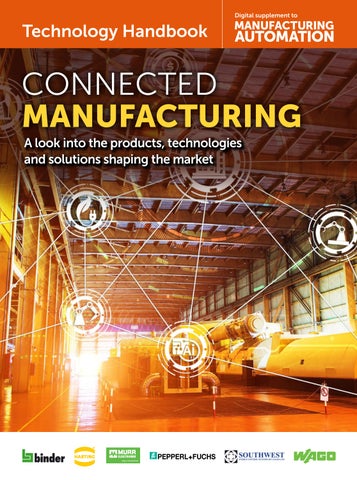
CONNECTED MANUFACTURING A look into the products, technologies and solutions shaping the market
MORE PORTS. MORE FEATURES. MORE ETHERNET SWITCHES. ED,
NAG
A UNM
+ PoE ED, G A AN
M
ProSurge PS series panel SPD MCOV (Vac): 150V~690V Surge capacity (8/20µs): 150~900kA per phase ProSurge patented short circuit current rating: 200kArms Lightning capacity (10/350µs): 12.5~80kA per phase
XPANEL PoE+
STANDARD
Eliminate the need for separate power cables with Power over ETHERNET+ • 30 W per port • Wide temperature range
High quality LED display Durable reinforced aluminum die casting (12”, 15”) Real-time data logging Convenient & powerful designing tool Screen sizes: 4.3”, 7”, 10.4”, 12.1”, & 15”
MANAGED
ECO
Robust and versatile to Performance and security Compact and economical extend application needs built-in with Firewall, PoE+, for everyday requirements High flexing ETHERNET cable • Alarm contact Ring redundancy, VLAN, • Fast and GIGABIT speed For the cabling of industrial field bus web-based systems with theconfiguration globally accepted TCP/IP•protocol • DIPswitch configuration Wide temperature range design for harsh industrial environments and operating • UptoCable 16 GIGABIT ports and monitoring viaconditions alarm with high noise levels For continuous flexing applications in C-tracks or freeor Movement contact RS-232 Applicable in automation technology, transport and conveyor technology, machine tool manufacturing
Download our ETHERNET switch application guide: Full product range available from Southwest Energy Control Systems of Canada Ltd. www.wago.us/switches For information or to purchase, call 905-420-8400 or email phughes@southwestenergy.ca
www.southwestenergy.ca Switches - Manufacturing Automation Handbook.indd 1
Coming Soon www.linkdistribution.ca 8/26/19 3:15 PM
Technology Handbook | CONNECTED MANUFACTURING
binder Quality, Reliability, and Expertise in North America
b
inder specializes in industrial connectors, as well as mounting and cable connectors for automation technology. Our products are used around the world in applications for agricultural and construction machinery, signal equipment, machine tool construction, medical technology and measuring technology, as well as sensor and automation technology for the IIoT.
Expansive product portfolio binder provides OEMs with connectors for applications in industries as diverse as robotics, medical, packaging, communication, energy, transportation, and agriculture. • Subminiature and miniature circular connectors • Connectors for medical applications
• Automation technology – data transmission and power supply connectors • Solenoid valve connectors • Custom cordsets • PUR/PVC cable • LED lights
Customer-focused approach + worldclass quality standards What really differentiates binder from the competition is our solutionfocused approach to customer applications and commitment to superior service. binder USA is located in Camarillo, California at a 65,000 sq. ft. state-of-the-art facility with ISO 9001-2015 certification. The new California location allows for faster service and shorter lead times for customers in Canada, Mexico, and the U.S., while embodying binder’s traditional values of absolute reliability towards
customers, employees, and service providers.
About Binder USA, LP Binder USA, LP, is a subsidiary of binder Group, a leading global manufacturer of circular connectors, custom cordsets, and LED lights. binder USA products are used around the world in industrial environments for factory automation, process control, and medical technology applications. Defined by technical innovation and traditional values, the binder name is synonymous with the highest standards of quality and reliability. The company’s quality management system is DIN ISO 9001 and ISO 9001 & 14001 certificated, but it is a solution-focused approach to customer applications and commitment to superior service that truly differentiates binder from the competition.
For more information, visit www.binder-usa.com, or email sales@binder-usa.com. 2 MANUFACTURING AUTOMATION · Technology Handbook Connected Manufacturing
Cham|pions g M12 Power S & T Code g M12 Ethernet D & X Code g M12 Stainless Steel g B & D Code Crimp
www.binder-usa.com
Technology Handbook | CONNECTED MANUFACTURING
See How Hollywood Sees Modular Connectivity
HARTING announced a newly developed short film to reintroduce their Han-Modular® product line to the industry. The protagonist of this new 90-second movie is an engineer who is struggling with a design. The solution is HARTING’s Han-Modular® series which is illustrated as a robot that transforms as the engineer’s design changes. The film was developed with a Hollywood agency based in Chicago, IL. “We wanted to do something different, something that the industry hasn’t seen before,“ said Christina Chatfield, Vice President of Marketing Communications and Digital Transformation of HARTING Americas, „At the same time, we wanted to do something that would excite and inspire engineers. We knew we had to do something big.“ This film marks the beginning of a new marketing campaign for the product
that focuses on the benefits of the product line, which includes space-savings, design flexibility, IIoT compatibility, and low-maintenance for the end user. “Han-Modular® is a very important product for the industry,“ said Cory Jenkins, Director of Product Management of HARTING Americas, „It was developed in 1996 with 6 modules. Now there are over 100 modules, and HanModular® remains our fastest growing product line.“ To view the film and learn more, visit Han-Modular.com
About HARTING The HARTING Technology Group, family owned and based in Germany, employs more than 4,300 people globally with subsidiaries and branch offices in 40 countries. With production facilities in Europe, Asia, Mexico and the Telephone 1 (855) 659-6653
HARTING.ca 4 MANUFACTURING AUTOMATION · Technology Handbook Connected Manufacturing
United States, the HARTING portfolio of connectivity solutions focuses on multiple levels, from the machine to the device and into the communication infrastructure. The U.S. facility in Elgin, Illinois is one of three HARTING locations that manufactures the HIS product line (HARTING Integrated Solutions - backplanes) and custom cable assemblies. HARTING also has custom cable assembly capabilities in Mexico and Brazil. The company’s core business is intelligent and high-performance connection technology. HARTING works in almost all industrial markets with a focus on requirements for robust, reliable connectivity solutions.
To view the film and learn more, visit Han-Modular.com
“Industrial Transformation Begins Here...” - Han-Modular® The biggest transformation the industry has never seen before
HARTING.com
Combine Different Media into One Customizable, Plug & Play Connector Solution Space-savings. Flexible. Low-Maintenance. IIoT-Capable. ■ See how you can save cost and time by downloading the Han-Modular® app at HARTING.com
■ Free up your time by taking advantage of HARTING’s assembly business. Learn more at HARTING.com.
Murrelektronik IO-Link Solutions
Proceco Integrated Cleaning Systems Gains Powerful Results with Cube67 and IO-Link Location: Montréal, Québec, Canada Industry: Machine builder specializing in aqueous cleaning systems
We chose to work with Murrelektronik because they were able to supply the best I/O system for the type of machine we were building. Their Cube67 system with IO-Link made it much easier for us to integrate different types of I/O devices while reducing the amount of wiring we needed to do.
CHALLENGE
SOLUTION
Proceco was commissioned to build an automated 13 station washing system for the aerospace industry running an Allen Bradley PLC with EtherNet/IP. •
Combination of digital and analog I/O signals with some stations required to go offline while the machine process continued.
Proceco’s original I/O system concept was to use junction boxes. This would have required running power and communication cables to every station. We proposed a Cube67 fieldbus system because the one-cable technology packs data and signal into one main cable. Then we suggested one IO-Link extension module per station for the 12 DIO and 4 IO-Link connections.
•
IP address limitations due to PLC CPU
•
Analog and RTD sensor were replaced with IO-Link versions
•
IO-Link to Analog Converter used to convert an IO-Link signal to a 4-20mA output for the valve
•
Extra digital signals were handled with an IO-Link Hub
30%
LESS INSTALLATION TIME
25%
MATERIAL COST REDUCTION
6 MANUFACTURING AUTOMATION · Technology Handbook Connected Manufacturing
1 Ethernet/IP IP Address 4 Current (A) per branch 16 Error messages in buffer 32 I/O Modules per bus node 60 Total length (m) 100 Over 100 different IO modules 128 IO-Link ports per bus node 504 Bytes of data (Input & Output) 1024 Total I/O Points 2048 Additional I/O with IO-Link 200,000 Cube bus nodes sold 2,500,000 Cube I/O modules sold
Cube67+ System Solutions For innovative IO-Link solutions contact:
2840 Argentia Rd., Unit 9 | Mississauga ON L5N 8G4 905-362-2211 | www.murr.ca
Technology Handbook | CONNECTED MANUFACTURING
An Easy Way into IIoT with Pepperl+Fuchs Comtrol IO-Link Masters
Y
ou’ve probably seen countless articles that tout the benefits of IIoT / Industry 4.0.They present a vision of smart, efficient manufacturing processes based on data from networked IO-Link sensors. But how do you make this a reality in your plant? One option is to remove entire legacy control systems (PLCs, I/O networks, etc.) and replace them with the latest IO-Link communication products. This approach allows you to harvest the additional data and configuration parameters available in today’s sophisticated sensors, but it could prove expensive and time-consuming. Pepperl+Fuchs Comtrol offers an alternative approach: an easy, low-risk migration path to the benefits of IIoT that does not require replacement of legacy controllers and existing control programming. It all begins with Pepperl+Fuchs Comtrol IO-Link masters—the only IO-Link masters on the market that enable simultaneous data access from PLCs and OPC UA clients. In short, they let you upgrade to IO-Link without upgrading your PLC.
A Little Data Goes a Long Way Migrating to IIoT technology may sound appealing, but you may also be wondering what kind of data—and how much of it—you have to collect to make your plant smart. The good news is that you don’t need truckloads of data, and you don’t need to hire data scientists to analyze it. For example, collecting simple data from sensors mounted on a stamping press, like stroke count, stroke time, and clamp performance, can allow you to predict faults and maintain machines before they have to be shut down unexpectedly for repairs. And since Pepperl+Fuchs Comtrol IO-Link masters make it possible to incrementally introduce IO-Link data into your process, it does not require a large investment.
Multilingual Masters IO-Link masters that speak multiple languages are the key to integrating IO-Link sensors into your existing system. MultiLink™ technology allows Pepperl+Fuchs Comtrol IOLink masters to speak to legacy PLCs and cloud/SCADA systems at the same time: The master maintains the EtherNet/ IP Class 3 connection to the PLC while simultaneously providing EtherNet/IP Class 1 communication channels to cloud/ SCADA systems via OPC UA. This allows you to control time-critical processes with a PLC while IIoT systems access sensor data. The masters can also provide sensor data to noncloud based solutions like Wonderware and Ignition without interfering with the PLC.
New and Old Can Coexist Just as you don’t have to throw away your PLC, you also don’t have to throw away your existing sensors to start taking advantage of IIoT. IO-Link adds tremendous value for critical applications within your machine or process, but it might not be necessary for every I/O point. Pepperl+Fuchs Comtrol IO-Link masters allow simple plug-and-play connection to existing 3-wire DC PNP sensors while offering the opportunity to introduce newer IO-Link sensors whenever and wherever you want. The ability to let standard sensors coexist with IOLink sensors enables you to migrate your control systems in a planned and incremental manner.
IIoT at Your Own Pace With Pepperl+Fuchs Comtrol IO-Link masters as the foundation of your migration architecture, you’re free to implement IIoT technology at your own pace, when and where you envision benefits and added value. Whatever pace you choose, Pepperl+Fuchs also offers a complete industrial networking infrastructure—from the sensor to the PLC, SCADA system, or cloud—to help you along the way.
8 MANUFACTURING AUTOMATION · Technology Handbook Connected Manufacturing
HEY PLC, DON’T MIND ME.
Monitor, collect, exchange, and analyze data for reliable predictive maintenance with Pepperl+Fuchs Comtrol IO-Link masters. Unique MultiLink™ technology allows simultaneous data access from PLCs and OPC UA clients, so you can collect and deliver sensor data where you need it—to on-site systems, mobile apps, or the cloud. This helps you unlock the benefits of IO-Link and IIoT / Industry 4.0 without having to replace or interfere with your PLC. www.pepperl-fuchs.com/comtrol
product rangeMANUFACTURING available from Southwest Energy Control Systems of Canada Ltd. Technology Handbook Full | CONNECTED
For information or to purchase, call 905-420-8400 or email phughes@southwestenergy.c
www.southwestene Satisfying Customers with Quality Products & Value Solutions Since 1982
S
outhwest Energy Control Systems of Canada has been successfully supplying quality products and delivering exceptional customer service since 1982. Southwest Energy is continually evolving, and as such, we have diversified our product portfolio. Our years of distribution experience in petroleum and industrial sectors have provided us the opportunity to address many other market segments. With a 15,000-square-foot facility, our operation allows for the design, assembly, and distribution of products specific to the needs of our customers throughout Canada. We have expanded our operation to include a new online division to serve a greater number of industries. Southwest Energy Control Solutions is proud to announce the upcoming launch of our new ecommerce division.
LINKing You to a World of Solutions LINK Distribution is the new all-encompassing online solution for your electrical control needs. Southwest Energy Control Systems continues to offer a diverse product portfolio, including panel surge suppression devices, HMI (HumanMachine Interface) devices, and connectivity cables, to serve a greater number of industries. These products will be available for purchase online at www. linkdistribution.ca. Southwest Energy Control Systems provides innovative solutions for building automation and fuel management systems for a wide variety of industry sectors. We distribute DIN rail components, terminal blocks, circuit breakers, servo and VFD cables, DIN rail power supplies, overload circuit protection, surge suppression, heavy duty connectors and relays, sensors, AC drives, LED
commercial, industrial, and retail lighting, LED sign lighting, environmental equipment, building automation controls, process controls, and SCADA (supervisory control and data acquisition).
Maximize ROI for Small and Medium Buildings For over 35 years, Southwest Energy Control Systems has been providing sensible building automation technology for small- and medium-sized buildings. We have developed a small- to medium-sized building solution that provides everything you need and nothing you don’t.
We Provide the Schematics Our team provides comprehensive system schematics and drawings for every project. We are perfectionists when it comes to building automation systems, and we want to ensure every system we sell works perfectly. Southwest Energy Control Systems’ experience and extensive technical background allow us to provide comprehensive energy systems by offering reliable and cost-effective solutions.
Canadian-Based for Faster Delivery OEMs depend on a reliable and timely supply of automation systems, DIN rail electro-mechanical components, and LED lighting. For Canadian-based companies, Southwest Energy Control Systems is the logical choice for timely, hassle-free delivery. We are based in
10 MANUFACTURING AUTOMATION · Technology Handbook Connected Manufacturing
Canada and keep inventory in our Canadian warehouse.
Cut Out the Middle Men for Better Prices When you rely on Southwest Energy Control Systems, you are not just saving time – you are saving money through the elimination of one, sometimes two, middle men. Most importantly, you will enjoy in-depth support for all your Canadian-approved automation, DIN rail components, and lighting needs.
We Want to Help You Have questions about automation systems, DIN rail components, or LED lighting? We want to help. Components and LED lighting supply is a core business at Southwest Energy Control Systems, so customer service is a must. Our sales and technical team are accessible and ready to serve. We ensure the highest standards in service in our category and maintain a broad inventory of components and LED lighting in order to serve the needs of OEMs quickly and efficiently. Proudly located in Pickering, ON, we can be reached by calling 905-4208400 Monday to Friday from 8:30am to 4:30pm, or via email at info2@southwestenergy.ca. For more information, please visit our website: www.southwestenergy.ca.
ProSurge PS series panel SPD MCOV (Vac): 150V~690V Surge capacity (8/20µs): 150~900kA per phase ProSurge patented short circuit current rating: 200kArms Lightning capacity (10/350µs): 12.5~80kA per phase
XPANEL High quality LED display
Durable reinforced aluminum die casting (12”, 15”) Real-time data logging Convenient & powerful designing tool Screen sizes: 4.3”, 7”, 10.4”, 12.1”, & 15”
High flexing ETHERNET cable For the cabling of industrial field bus systems with the globally accepted TCP/IP protocol Cable design for harsh industrial environments and operating conditions with high noise levels For continuous flexing applications in C-tracks or free Movement Applicable in automation technology, transport and conveyor technology, machine tool manufacturing
Full product range available from Southwest Energy Control Systems of Canada Ltd. For information or to purchase, call 905-420-8400 or email phughes@southwestenergy.ca
www.southwestenergy.ca
Coming Soon www.linkdistribution.ca
IP switch configuration p to 16 GIGABIT ports
web-based configuration and monitoring via alarm contact or RS-232
• Wide temperature range
Technology Handbook | CONNECTED MANUFACTURING
nload our ETHERNET switch application guide: www.wago.us/switches
HIGH PROCESS RELIABILITY FOR COMPRESSED AIR SUPPLY 8/26/19 3:15 PM
Industrial ETHERNET Switches from WAGO guarantee process safety through redundant ring topology in system networks. The contact technology specialist implemented this type of solution in the central compressed air supply for the BMW plant in Regensburg. The scalability of the network infrastructure, interoperability with third-party controllers, and V-LAN capabilities ensure that the system will have a long future. Compressed air is an essential medium in automotive manufacturing. The BMW plant in Regensburg requires around 15,500 standard cubic meters of compressed air per hour – to handle chassis parts using vacuum grippers, for assembly tasks using compressed air impact screwdrivers, or to atomize paints in the Paint Shop. The dry, de-oiled compressed air for the entire plant is generated in the central compressed air supply. It is located along the central line of the plant, along which all central function areas are grouped. The neighboring building houses the central energy supply, and the control room scrupulously monitors the process for generating compressed air.
System with Vital Functions “The central compressed air supply is an important system. If there is an interruption in the compressed air supply, everything on the production lines would have to be reworked: chassis parts would drop to the ground, the torques would be incorrect, or the paint wouldn’t be optimally applied,” stresses Jörg Tratzl. Two years ago, the combined
heat and power plant in the central energy supply was updated. Within the context of this project, a new, redundant network infrastructure with high failure safety was created for the adjacent central compressed air supply. In order to ensure redundancy for the infrastructure components, BMW decided on an ETHERNET ring topology. Instead of a hub distribution technology, the more flexible and safe switching technology was given a chance. The two buildings are now linked via fiber optic cables. In the central compressed air supply, the controllers and compressors are connected to the switches using copper wire. The Regensburg plant had already had good experiences with WAGO’s automation products in previous years. This is why management decided to use industrial switches for their ring. The scalability of the network infrastructure
12 MANUFACTURING AUTOMATION · Technology Handbook Connected Manufacturing
also played a role in this decision. This offered investment security by allowing the network technology to grow as new demands are placed on it. Due to the interoperability of WAGO products, the various third-party controllers in the network can be reliably coupled using the switches.
Managed Switches Ensure Safety An important requirement for the system is that, during disruptions and failures, such as short interruptions, the system must autonomously restart and switch into safe operating mode. A configurable Industrial Managed Switch functions as “Manager” for the ring’s necessary safety. Additional unmanaged ETHERNET Switches are connected for distribution within the ring. If the managed switch detects a cable break or a fault in the network, it divides the ring into two lines so that all components are still available, except the faulty one.
MORE PORTS. MORE FEATURES. MORE ETHERNET SWITCHES.
+ PoE , D GE ANA
D, M E G ANA
UNM
Wago
PoE+
STANDARD
MANAGED
ECO
Eliminate the need for separate power cables with Power over ETHERNET+ • 30 W per port • Wide temperature range
Robust and versatile to extend application needs • Alarm contact • DIP switch configuration • Up to 16 GIGABIT ports
Performance and security built-in with Firewall, PoE+, Ring redundancy, VLAN, web-based configuration and monitoring via alarm contact or RS-232
Compact and economical for everyday requirements • Fast and GIGABIT speed • Wide temperature range
Download our ETHERNET switch application guide: www.wago.us/switches
ACROSS THE ENTERPRISE BY JONATHAN GROSS
Jonathan Gross is the managing director at Pemeco Consulting. He helps his clients architect and implement technology environments that integrate ERP with the edge. pemeco.com
The urgency for Canadian manufacturers to embrace Industry 4.0
I
ndustry 4.0 – or the fourth industrial revolution – refers to a cyber-physical environment that self-optimizes. The system collects data, creates its own analytical models, makes decisions and optimizes the factory. This is why Industry 4.0 is also called the “Smart Factory.” Let’s see how this could work. Our sample company – which is based on a real-world scenario – produces a grain-based fuel in bulk. It also produces various co-products, some of which are higher margin than the primary products. Interestingly, profits
can be maximized when primary product yield is slightly suboptimal. Humans can’t effectively optiGlobal mize production for profit. The trading mathematical models and degree partners of process control micromanagewho used to ment make it impractical, if not compete on impossible. Optimization would cost alone demand almost continuous are now adjustments based on weather competing conditions, equipment processon cost, ing parameters, water quality, value and forecasted demand, raw material service quality, finished good and codimensions. product quality requirements and supply costs, among other things.
14 MANUFACTURING AUTOMATION · Technology Handbook Connected Manufacturing
It’s this type of scenario where Industry 4.0 systems would excel. A self-guiding system could quickly analyze the inputs and vary production parameters to optimize profits. The history of Industry 4.0 Industry 4.0 was conceived as part of a German government strategic initiative to computerize manufacturing with the goal of protecting the country’s position as a manufacturing powerhouse. In April of 2011, a working group presented a draft white
paper with the thesis that Germany can continue to thrive as a manufacturing hub, notwithstanding its highwage economy. The authors proposed a framework based on smart, cyberphysical systems that connect equipment, software and people. The final report was presented at Hannover Messe in April of 2013. Our process-manufacturing scenario is what the framers of Industry 4.0 had in mind – intelligent product customization in mass production environments, where the customizations are delivered by self-optimizing systems. THE URGENCY FOR
CANADIAN MANUFACTURERS For many Canadian manufacturers, the question isn’t whether they should transform. It’s whether they can survive without implementing Industry 4.0 systems. Canada is a relatively high-wage economy. Apart from some recent (and hopefully temporary) trade frictions with our neighbours to the south, global trade barriers are being knocked down, providing foreign competitors with easier access to our markets. And, to further press the issue, global trading partners who used to compete on cost alone are now competing on cost, value and service dimensions. China, for example, recognized that its window to continue building an economy on the back of cheap, low-quality goods was closing. In 2015, China released a strategic plan – Made in China 2025 – aimed at upgrading strategically important industries. It also targets Industry 4.0 sectors, including: robotics, AI, IoT, smart appliances and machine learning. According to Oxford Economics and BCG research, China accounted for 27 per cent of the world’s value-added manufacturing output at the end of 2017, which was 1.7 times more than the U.S. and 4.4 times more than Germany. According to that same research, China’s exports have increased dramatically, even while its labour cost base has increased. To remain competitive, Canadian manufacturing companies need to invest in next-generation industrial and business models to protect and expand their market share.
THE FOUR PILLARS OF INDUSTRY 4.0 Industry 4.0 is that next-generation framework. If we reflect on the evolution of business technologies, the central theme has always been to automate and integrate processes with a view to eliminating transactional and decisionmaking frictions. MRP (materials requirements planning) sought to remove frictions between sales and operations by timephasing purchase and manufacturing material requirements with demand for those resources. ERP (enterprise resource planning) came next. This innovation removed finance and accounting frictions by integrating the operational transactions to general ledger, accounts payable and accounts receivable modules. Today, we’re seeing previously siloed manufacturing control and execution systems being integrated with enterprise software systems – systems that drive production, equipment maintenance, quality and inventory processes. What makes these integrated systems “Industry 4.0” is the layering of artificial intelligence that has autonomous capability to learn from data, make decisions and optimize transactional and execution system processing. When designing your organization’s Industry 4.0 environment, you need to consider four overlapping principles, according to the authors of Design Principles for Industrie 4.0 Scenarios: 1. Interconnection. The systems need to connect people, machines, sensors, devices and software through the Internet of Things (IoT) and allow them to communicate with one another. 2. Information transparency. The data collected through interconnection needs to be made available to operators for decision-making. 3. Technical assistance. The intent is twofold: 1) to shift low-value tasks from people to cyber-physical systems, and 2) for systems to provide people with information to make timely and effective decisions. 4. Decentralized decisions. The systems need to be able to make their own decisions and take autonomous action.
Returning to our above process-manufacturing example, the company would need to make sure that its distributed control systems, enterprise software systems, scales, tank sensors, and other equipment are all connected. The data from all of those systems would need to be collected in a data lake (a warehouse that stores big data sets), and have cognitive analytics to bring timely insights to the operators. And, perhaps most importantly, the system needs the capability to decide and act autonomously. For example, when the system’s artificial intelligence “brain” discovers a higher profit mix of primary and co-product, it needs to be able to automatically adjust production. GETTING YOUR ORGANIZATION READY FOR INDUSTRY 4.0 It’s against this backdrop of urgency for Canadian manufacturers that my firm Pemeco Consulting has partnered with Manufacturing AUTOMATION. We’re collaborating on a multimedia content hub that will be filled with best practices and templates that you can use to plan and execute your Industry 4.0 transformation plan. We’ll cover: 1. The basics. You’ll learn about the building blocks, and how they piece together, including: IIoT, AI, enterprise software and control systems. 2. Planning. You’ll gain access to templates that you can use to map and budget for changes to your organizational structure, information architecture and business processes. 3. Implementation. This scale of transformation is disruptive and risky. You’ll see guides that cover change and project management, data governance, testing and training. 4. Risk management. Privacy, cybersecurity and automation-related job losses are but a few of the big-time challenges and risks. We’ll help you to address the issues and mitigate the risks. If you’re embarking down the Industry 4.0 path, you don’t need to do it in the dark. We hope to enlighten your journey with experiences of those who have preceded you. | MA
Technology Handbook Connected Manufacturing · MANUFACTURING AUTOMATION 15
CONNECTED MANUFACTURING
MODEL 4.0 Sensor manufacturer SICK takes us inside its new Industry 4.0 factory in Germany. What does it mean for Canada? BY KRISTINA URQUHART
16 MANUFACTURING AUTOMATION · Technology Handbook Connected Manufacturing
W
The 4.0 NOW Factory will not only allow SICK to build products on demand and reduce its inventory level, but also achieve increased OEE and just-in-time orders.
A factory for the future With the 4.0 NOW Factory, SICK is doing exactly that – breaking down traditional line-oriented production into non-linear “technology cells,” and using sensors to collect actionable data. “The key component of Industry 4.0 is autonomous flexibility on the production line,” says Bernhard Müller, senior vice-president Industry 4.0 at SICK. With 12 manufacturing cells that can be reconfigured to produce a multitude of SKUs, that flexibility translates to 1,050
square metres (11,302 square feet) of total space – a relatively small footprint compared to the average manufacturing plant. The factory is still in a ramp-up phase after beginning operation in Q2 2018, with one shift of 13 workers and a target of three shifts. The AGCs use SICK sensors to move freely from cell to cell along six aisles, employing pick-by-light technology to fill and transport trays of components. The production control system is also able to interact with manual workstations, which are connected to the machines. In one corner, several of the factory’s workers attend to a small, more traditional-in-style production line – an unofficial proof-ofconcept that automation is changing the roles of humans in manufacturing. Once at full capacity, 4.0 NOW could theoretically manufacture 500,000 product variants, allowing for more customer orders and better resource efficiency. “We are facing the fact that our market is really dynamic,” says Joachim Schultis, head of operations for photoelectric sensors and fibres at SICK. He projects that 4.0 NOW will not only allow the company to build products on demand and reduce its inventory level, but also achieve increased OEE and justin-time orders. The factory uses a SICK-developed software integrated with enterprise resource planning (ERP) software to continuously upload data from all of the AGCs, components and production cells to a cloud. This enables the use of tools such as BOSCH Production Performance Management, a protocol that captures data from sensors and machines to analyze process efficiency and execute predictive maintenance. From there, SICK can further optimize the logistics in the factory, from travel paths of the AGCs to control of the material flow. Depending on the application and accuracy needed, SICK employs a range
hen I first stepped into SICK AG’s sparkling new 4.0 NOW Factory in Freiburg, Germany earlier this year, the first thing that struck me was how quiet it was. To be clear, there was much production going on – the space will manufacture 1.2 million pieces of the company’s sensor-related solutions per year once fully commissioned, joining other SICK manufacturing facilities in the United States and Asia as one of the company’s most productive hubs for sensor making. But this new factory is markedly different from its counterparts. The 4.0 NOW Factory is automation at its peak – a new home for Industry 4.0 technologies and processes, all located under one roof. Only 13 people are currently employed here, with the rest of the work completed by industrial robots in flexible manufacturing cells, or by autonomous guided carts (AGCs) on the shop floor. The purpose of 4.0 NOW is not to replace human workers, but to show how they can thrive alongside automation to achieve maximum efficiency – consider it a test bed that demonstrates the capabilities of Industry 4.0 practices, in addition to being a fully functioning manufacturing plant. “In our business, industrial automation and Industry 4.0 are two sides of the same [coin]. They’re directly linked together,” Dr. Robert Bauer, chairman of SICK AG’s executive board, told me and the other members of a press tour at the company’s Waldkirch, Germany headquarters in January 2019. “The datadriven idea of Industry 4.0 is to better organize the factory.”
of positioning technologies for its mobile applications, including ultra-wide band tags, LiDAR contour mapping, line guidance sensors and infrastructure sensors. True to the company tagline “Sensor Intelligence,” SICK has also developed a software ecosystem, dubbed AppSpace, to solve applications via apps on programmable SICK devices. AppSpace supports sensor applications, data-to-information applications, or the integration of both. Users can either download pre-built SensorApps or develop their own SensorApps by defining the application logic and customizing a dashboard based on their individual needs. Going all-in on an Industry 4.0-enabled factory is bold in the marketplace, says Müller. He estimates that while 30 to 40 per cent of German companies have “islands” of Industry 4.0 concepts, like a predictive maintenance program or autonomous guided vehicles, only one to five per cent of them employ automated material flow, which is integral to total process optimization. The hallmarks of Industry 4.0 design principles are connectivity, transparency, flexibility, and fast, decentralized decisions, Müller says. The common goal is to reach “Lot Size One” – the concept of a single item quantity for an order – at the cost and speed of mass production, with resource efficiency. “You get a lot of noise about automotive factories being in Industry 4.0,” he says. “They have perfected their production lines but always in the same manner they have done it before. Not in a disruptive way [based on] data.”
Bringing Industry 4.0 to Canada Craig S. Smith, president of SICK Ltd., the Canadian branch of SICK AG, says there are some remaining barriers to implementation of Industry 4.0 concepts in Canada. “I think there’s fear. It’s normal to
Technology Handbook Connected Manufacturing · MANUFACTURING AUTOMATION 17
By implementing adaptive safeguarding solutions in Industry 4.0–style manufacturing cells, such as a camera that records an event only if it’s been triggered by a safety breach, maintenance or shutdown can be limited to just one cell rather than the whole line. think, ‘Oh, technology is going to take my job,’” he says. “Yes, some doors in oldschool manufacturing may be closing, but that opens up new opportunities in other areas around technology.” Despite technology shifting the types of roles that are available, Smith notes that competency will still be one of his biggest challenges in promoting the Industry 4.0 mindset with Canadian manufacturers. Unemployment rates nationwide are low, at 4.8 per cent, and he’s had unfilled positions at the company for over a year. The other challenge to establishing Industry 4.0 practices in Canada is the rate of upgrade. “A manufacturing facility isn’t going to do a complete rebuild again; they have to do a stage build. They need to keep their manufacturing running and build in the new flexible manufacturing concepts out there over time,” says Smith. “We do site visits; we do training; we try to understand our customers’ biggest problems. And to
understand how we can help them to reduce costs, improve production yields and reduce cycle times.” Smith has been leading SICK Canada since 2009, shortly after SICK AG acquired AMKO Systems, a Toronto-based distributor of SICK process automation instruments. In April 2012, Smith was tasked with bringing the company’s factory automation and logistics automation businesses into Canada, and he’s since grown the company from $7 million to over $30 million per year in sales. In June 2019, SICK Canada celebrates its 10th anniversary with a move from its 1,031 square-metre (14,000-square-foot) office space in north Toronto to a 2,230 square-metre (24,000-square-foot) building next door, with plans to build a customer-facing showroom of sensor products. Twenty-five per cent of SICK Canada’s revenue comes from the process automation market in Western Canada, and about 80 per cent of the company’s
SICK’s Outdoor Technology Centre (OTC) 18 MANUFACTURING AUTOMATION · Technology Handbook Connected Manufacturing
factory automation business is located in the Ontario-Quebec manufacturing corridor. Smith sees opportunities in logistics automation, where SICK Canada has seen 24 per cent growth in the last five years in airports, health care, transportation and consumer goods manufacturing. The factory automation side is also poised to grow as Industry 4.0 concepts begin to take hold in Canada. Smith plans to add two new subject matter experts in 2019 to handle mobile applications, and the company is working closely with customers to develop new solutions with products from the German headquarters that are tailored to individual manufacturing needs.
Roots in safety Founded in 1946 by Dr. Erwin Sick, SICK AG now has more than 50 subsidiaries, equity investments, and agencies, and manufactures 40,000 different products in presence detection, industrial safety, gas analysis and flow measurement, motion control, identification, and measurement systems. In 1952, SICK began serial production of its flagship product – a safety light curtain that stops a machine should a foreign object make its way past the sensor. Over the past 67 years, the company has added more safety-centric products to its portfolio, including photoelectric sensors, opto-electronic protective devices and vision systems. Industry 4.0 is redefining what a safe product means in 2019. Now that machines and humans are working collaboratively, the leading thought is that instead of the machine stopping altogether if it detects a presence, it should
Long-range sensors at the OTC
slow down and enter a “safe mode” to prevent accident. “Safety in the past was a secure safety, so nothing happens ever,” explains Müller. “And now we try to make it more efficient while not injuring anybody.” The company has developed laser scanners with fields of vision that can respond to positioning of objects – for example, an autonomous vehicle equipped with one of these scanners won’t stop if
it’s turning right but detects a human on the left. And by implementing adaptive safeguarding solutions in Industry 4.0–style manufacturing cells, such as a camera that records an event only if it’s been triggered by a safety breach, maintenance or shutdown can be limited to just one cell rather than the whole line (pictured, bottom left). Investing in the future SICK AG invests 10 per cent of its gross revenues every year back into developing integrative solutions. In 2017, that amounted to EUR 169.4 million for research and development. Over 1,110 of the company’s 8,909 employees work on R&D teams in cooperation with industrial partners, universities and institutes. The company holds around 3,000 patents. SICK is testing outdoor automation technologies for harsh environments at its Outdoor Technology Centre near Freiburg in Buchholz, Germany, which opened in summer 2018. There are another 15 proprietary projects underway that the company calls “start-ups” – research teams devoted to development of new products and processes. “Some of them probably won’t work in the longer picture, but other ideas will come from them,” notes Smith. “In Canada, we’re taking a home-grown approach and bringing
back that technology and knowledge to the education system.” SICK Canada recently partnered with Toronto’s Humber College to build awareness of Industry 4.0–ready sensor technologies as part of an advanced manufacturing consortium comprised of eight companies at the college’s Barrett Centre for Technology Innovation. Over the next three years, SICK Canada will provide sensors and services worth $765,000, new training opportunities for students and staff in sensor intelligence and industrial automation, and two new scholarships. “What I find in Canada is we’re not investing in youth. People are in internship programs working for free, and frankly, that drives me crazy,” Smith says, adding that despite the industry taking some big hits – such as layoffs at GM and Fiat Chrysler – there will be different types of jobs opening up as Canadian manufacturers employ new technologies. “The part that I’m energized about is that we have organizations out there that are looking at things through a different lens,” he says. “There’s an opportunity to build the next phase of manufacturing in Canada. We have the drive to be better as a country in the innovative part of manufacturing. Industry 4.0 is a part of that.” | MA
Technology Handbook Connected Manufacturing · MANUFACTURING AUTOMATION 19
GOING DIGITAL BY JENNIFER RIDEOUT
Jennifer Rideout is the manufacturing marketing manager for Cisco Canada. She is responsible for developing go-to-market strategies for the manufacturing sector in Canada, including channel alignment and content development.
How the connected factory delivers real business benefits
F
• Digital work instructions improve training and quality processes • Physical security is enhanced with monitoring for theft, loss and shrinkage
or years, manufacturers have used wireless technology on the factory floor to power equipment such as machine sensors and computers. But mobile manufacturing “networks” are key to driving business benefits that come with the connected factory – in particular, higher margins, reduced cycle times and improved equipment productivity. Building a mobile network is not without challenges. The wireless capabilities must be built on a solid foundation with robust security and a common network infrastructure. Here’s how to configure your environment:
REAL-TIME LOCATION
DATA-DRIVEN APPLICATIONS
Operational data is at the core of any manufacturing network, and sensors enable access to that data. For example, some of the most common wireless IoT sensors measure vibration, current, particle, temperature and humidity. The sensors then communicate with secure wireless networks with embedded edge computers that move the valuable data, and discard the perishable data. There are countless applications for manufacturing data. These are some of the most common: • Wireless tools such as screwdrivers, torque wrenches and scanners • Operational metrics such as OEE, MTTR and cycle time • Predictive maintenance instead of reactive maintenance (fix it when it breaks) and preventive maintenance (fix after a measured period) • Real-time alerts • Proactive event management/ workflow • Optimized material consumption MOBILITY AND PRODUCTIVITY
Communication is the most tangible and relatable mobility use case. Many
manufacturers provide workers with mobile devices such as tablets and smartphones. The productivity benefits are clear – mobile communications enable workers to do their jobs with greater flexibility and manoeuvrability. Wi-Fi–enabled voice makes it possible to replace licensed use of handheld paid spectrum and cellular fees. With Wi-Fi mobile communicators, everyone on the factory floor gains immediate access to one another, and the ability to receive real-time notifications, pages and safety alert messages. VIDEO COMMUNICATION
On the shop floor or in a warehouse, video capabilities – whether on a smartphone or tablet – takes communication to the next level by removing the ambiguity of what may be happening. Video provides manufacturers with some clear benefits: • Dashboards and digital signs operate in real-time, eliminating the need to print and post the latest production metrics • Faster response time avoids the need to fly in experts
20 MANUFACTURING AUTOMATION · Technology Handbook Connected Manufacturing
The ability to automatically identify and track the location of objects or people in real time is considered by many to be the ultimate wireless capability. The availability of real-time location data about assets, tools and workers provides manufacturers with business benefits: • Improved asset use due to reduced need for “back-ups,” resulting in lower capital costs • Optimized physical workflow by visualizing real-time bottleneck locations • Eliminating hunting events thanks to knowledge of the location of every asset • Enhanced worker safety with the ability to quickly send help to distressed workers Some location use cases are very simple to implement on a data-capable network. For example, in a worker safety scenario such as “man down,” the push of a button on a worker’s RFID tag or mobile phone triggers a “panic alert” that pinpoints the worker’s position so help can be dispatched immediately. All these benefits of connected mobility are focused on one place – the bottom line. Factory mobility solutions enable essential business benefits like reduced downtime, fewer line stoppages, improved worker efficiency, increased cycle time and higher OEE, all of which contribute to productivity, availability and quality. Since every dollar spent in manufacturing is tied to return on investment, it’s crucial to map mobility capabilities to those important business needs. | MA
DON’T MISS OUT on your next issue of
IT’S FAST, IT’S EASY AND IT’S FREE! SOFTWARE: Why small business environments cannot follow the enterprise approach. p.24
CYBERSECURITY: Keeping plant floor secure in ADVANCED WARNINGS: your the Industrial Internet of How the connected industry can help you predict and prevent failures. p.20
TECHNOLOGY: Cloud and Fog computing will advance SCADA systems. p.22
INDUSTRY WATCH: Making sense of Big Data, IIoT and Industry 4.0. p.10
BACKSTORY: Boost your business by expanding into international markets. p.30
Things era. p.12
Your resource for Canada’s industrial automation news
AutomationMag.com
50 years of
Glad
PM 40065710
PM 40065710
Ontario plant celebrates milestone anniversary p.18
NOVEMBER/DECEMBER 2017
MARCH/APRIL 2017
DOMESTIC INVESTMENT Ontario manufacturer purchases a new vertical machining centre, slashing lead time and internal costs. p.16
MAY17 AC Branding Front Cover Banner (MA).qxp_Layout 1 4/20/17 3:32 PM Page 1
Automation, electromechanical, cabling, and interconnect products from 300+ manufacturers.
thinkallied.com thinkallied.com MA_AlliedBanner_May.indd 1
MA_mar_Apr_ 2017.indd 1 MA_AlliedCover_JanFeb .indd 1
2017-04-21 11:48 AM
2017-03-01 9:51 AM 2016-12-21 9:16 AM
HERE’S HOW: FOR FASTEST SERVICE VISIT
AutomationMag.com AND CLICK THE SUBSCRIPTION BUTTON
AutomationMag.com Technology Handbook Connected Manufacturing · MANUFACTURING AUTOMATION 21