Digital supplement to Volume 1, 2020
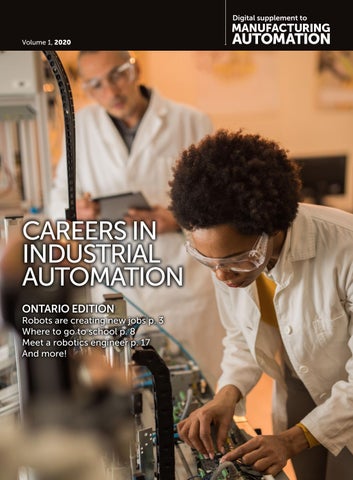
CAREERS IN INDUSTRIAL AUTOMATION ONTARIO EDITION Robots are creating new jobs p. 3 Where to go to school p. 8 Meet a robotics engineer p. 17 And more!
EDITOR’S NOTE
Your career starts here
T
here’s a common misperception that industrial jobs, especially in manufacturing, are dirty, repetitive and slow to change. Outdated images of factories and workers performing laborious jobs haven’t helped dissuade public opinion. This resource guide, presented by Manufacturing AUTOMATION magazine, will prove that those perceptions are wrong. Manufacturing in the 21st century is a forward-facing industry that nimbly adapts to change.
Just think of how quickly many Canadian manufacturers were able to completely change their production and start making medical supplies during the COVID-19 pandemic. Advanced technologies, such as automation, are what allowed them to do so. In broad terms, industrial automation as it pertains to manufacturing means using computers, robots and information technologies to execute processes with minimal to no human intervention. To be clear, automation is not “killing” jobs. It’s actually creating new categories of jobs – humans are needed to operate, maintain and secure these machines. They’re also needed to interpret and act upon data produced by machine learning and artificial intelligence. The skills shortage in Canada is the biggest challenge facing manufacturers today. Our objective with this guide is to take some of the stigma away about careers in manufacturing and to show all of the amazing opportunities available in the growing industrial automation sector for both students and workers looking to transition to
new careers. If you are tech-savvy or good with your hands, you’ll find that roles are being created faster than they are being filled (read more on p. 3). We’ve corralled common job descriptions, salary estimates, school programs and profiles of young people currently working in the industry. This inaugural edition contains information specifically about Ontario, as many of Canada’s automation programs are concentrated in the province. We plan to include more provinces in future editions. Many of Ontario’s schools are home to state-of-theart manufacturing research hubs such as Sheridan College’s Centre for Advanced Manufacturing and Design Technologies, and Humber College’s Barrett Centre for Technology Innovation. To learn more about schools outside of Ontario, visit automationmag. com/automation-education-andtraining-guide. If you are a student, I encourage you to share this guide with your parents or guardians as you consider your post-secondary plans. If you have questions about the industry, please contact me at the email address below.
EDITOR Kristina Urquhart kurquhart@annexbusinessmedia.com Tel: 416-510-5143
MEDIA DESIGNER Lisa Zambri lzambri@annexbusinessmedia.com
COO Scott Jamieson sjamieson@annexbusinessmedia.com
ACCOUNT COORDINATOR Debbie Smith dsmith@annexbusinessmedia.com Tel: 416-442-5600 ext 3221
CONTRIBUTING WRITER Jessica Wynne Lockhart
PUBLISHER Klaus B. Pirker kpirker@annexbusinessmedia.com Tel: 416-510-6757 VICE-PRESIDENT & EXECUTIVE PUBLISHER Tim Dimopoulos tdimopoulos@annexbusinessmedia.com
AUDIENCE DEVELOPMENT MANAGER Urszula Grzyb ugrzyb@annexbusinessmedia.com Tel: 416-510-5180
2 MANUFACTURING AUTOMATION · CAREERS IN AUTOMATION
Annex Business Media 111 Gordon Baker Rd., Suite 400, Toronto, ON, M2H 3R1 Tel: 416-442-5600 Fax: 416-442-2191
Cover photo and this page: skynesher/Getty Images
By Kristina Urquhart
MARKET WATCH
Robots aren’t stealing jobs.
THEY’RE INVENTING NEW ONES By Kristina Urquhart
R
leave an estimated 2.4 million positions empty over the next decade. It’s a similar story here in Canada, according to the manufacturers I speak to on a regular basis. Finding workers is one of their biggest challenges – and retaining them with jobs that are interesting and fulfilling can be even harder. That’s one of the reasons why automating less challenging tasks has become so appealing – because it frees up human workers for other, more complex tasks.
Photo: fotografixx/Getty Images
obots aren’t taking jobs – they’re creating them. That’s the message behind “Robots Aren’t Taking Jobs: Uncovering the Real Crisis in Manufacturing,” a recent white paper by the Association for Advancing Automation (A3). The study indicates that in 2018 in the United States, there were actually more jobs available than people seeking work. That same year, Deloitte reported that the manufacturing skills gap – a term for the phenomenon of a retiring workforce coupled with a lack of qualified replacements – in the U.S. might
MANUFACTURING AUTOMATION · CAREERS IN AUTOMATION 3
MARKET WATCH “By taking the repetitive and dangerous jobs, robots have allowed workers to advance into more skilled roles,” the A3 report states. “Humans will always be needed for robot programming, technical care and updates, and human interaction positions, such as human resources, marketing, negotiations, sales, to name a few.” With those dangerous jobs taken by robots, worker safety increases on the manufacturing floor. After robot implementation, many companies see
intelligence business development managers. “Robots complement and augment labour – the future will be robots and humans working together,” says Bob Doyle, vice-president of marketing, communications and advocacy for A3. “Less than 10 per cent of jobs are fully automatable.”
EARLY EDUCATION IS KEY The study points out that the real crisis in manufacturing is not robots themselves. It’s a lack of training for existing labourers to gain new skills, a lack of education for the general public on the benefits of Some of the roles that have been automation, and a lack of education for the future workforce on the created due to increased use of available opportunities in this fastrobots include robot technicians, paced industry. “The education on automation robotics engineers, data analysts doesn’t start on the production floor, and artificial intelligence business or anywhere within a company, but development managers. rather with the incoming generations while still in high school or earlier,” the report states. Parents and teachers have a pivotal role to play in motivating and encouraging students reductions in lost time claims for musculoskeletal as they consider their career paths. The study cites disorders, which traditionally have been some of the a recent Deloitte paper indicating that 83 per cent most common injuries in the industry due to the of the U.S. population say manufacturing jobs are repetitive nature of production. integral to the economy – but less than 33 per cent would encourage their children to strive for jobs in UPSKILLING THE WORKFORCE the industry. Young people who are considering the industry The report urges that students be exposed to and those workers looking to advance into different many opportunities within the manufacturing industry roles must focus on acquiring more technological from a young age in order to get them excited and “soft” skills. The existing workforce has critical about robotics and automation, and to understand operational knowledge that an employer doesn’t the greater role they play in the manufacturing want to lose. “While these labourers may require landscape. Early education would also help to dispel additional training, companies often provide myths that robots are out to “steal” jobs. it because they value and want to keep their “Working with robots does not require extensive employees,” the study notes. education, but rather, the proper training and Jeff Burnstein, president of A3, says, “Robots are exposure,” the study says. “Once one understands optimizing production more than ever, increasing the capabilities of an industrial robot, programming global competitiveness, and performing dull, dirty it to complete any necessary tasks, not just a and dangerous tasks that enable companies to create singular one, would increase production and sales higher-skilled, better-paying, and safer jobs where for the company and the wage and skillset for the people use their brains not their brawn.” employee.” Some of the roles that have been created due to And hopefully, with earlier education, those public increased use of robots include robot technicians, perceptions will start to turn around. robotics engineers, data analysts and artificial 4 MANUFACTURING AUTOMATION · CAREERS IN AUTOMATION
Re-engineered engineering degrees. Our 4-year programs, with options for mechanical and electrical studies, are built for you – tomorrow’s engineering entrepreneurs and innovators. Our curriculum is unlike any other in Canada — designed to meet current industry needs while also anticipating the demands of an evolving field.
engineering.sheridancollege.ca
CAREERS
Machinist Machinists use computer numerical control (CNC) technology to operate equipment that produces metal parts. A machinist is responsible for ensuring that the parts are accurate and made exactly to specification to ensure quality. As part of their jobs, machinists are required to read blueprints, make calculations, and program machine tools to produce parts that have been designed by engineers.
Salary $32,000-$74,000 via Skills Canada
Millwright/Industrial Mechanic Millwrights install, maintain and repair industrial machines and equipment in factories. As a millwright or industrial mechanic, you may need to read instructions and service manuals to understand how to safely operate and troubleshoot machines, fit bearings, work on motors and gears, and perform maintenance and testing on a range of equipment.
Salary $42,000-$89,500 via Glassdoor
6 MANUFACTURING AUTOMATION · CAREERS IN AUTOMATION
CAREERS
MEET A
MACHINIST Name: Elizabeth Moses Lives in: Windsor, ON Years in industry: 3 as a machinist apprentice School: St. Clair College Program: General machinist
Photos, this page and opposite: Delmore Photography/Build a Dream
What she does now: Machinist at Windsor Mold, a company that makes tooling and components for automotive plastics applications, and ambassador for Build a Dream, which promotes careers in the skilled trades to young women (read more about Elizabeth and the organization’s work on p. 22).
HOW DID YOU GET INTERESTED IN THE TRADES? I was in high school. I did a woodworking class and my teacher saw my interest in building projects and invited me to join FIRST Robotics. So I did the team for three years when I was in high school. I was able to build a few different robots for the FIRST Robotics competitions. After the competitions, I saw an apprenticeship opportunity at St. Clair College. I did the apprenticeship program for three years, and I just graduated [in 2019]. WHAT DO YOU DO AS A MACHINIST? I write instructions for machines. The machines then cut the metal components, and then I’m able to see them. I’m able to hold the pieces that I make. We’re bringing designs to life! WHAT DO YOU LOVE ABOUT YOUR JOB? I’ve been able to really learn what the trade is and work on my craft. It’s been a very fun journey. [I’m] able to apply the skills I’ve learned in school and have a career already – I don’t have to wait four years to find out what my industry holds. I love my job because it’s incredible to make everything. MANUFACTURING AUTOMATION · CAREERS IN AUTOMATION 7
SCHOOLS & PROGRAMS
COLLEGES & UNIVERSITIES ADVANCED DESIGN & MANUFACTURING INSTITUTE VARIOUS LOCATIONS ADMI offers a Masters of Engineering in Design and Manufacturing program codeveloped by Queen’s University and Western University. Grads of the program hone their advanced design and manufacturing skills while establishing deep business knowledge. The program offers 15 courses through the two universities, including intelligent manufacturing, mechatronic systems and operations management. Students are required to take nine courses to complete their degree. ALGONQUIN COLLEGE OTTAWA, ON The college’s School of Advanced Technology includes 23 laboratories, including precision
THE CURRICULUM COVERS THE THEORY machining, automotive, electronics, AND THE SKILLS millwright. REQUIREDEligible FOR: trades programs optical fibre, high-powered may have an optional, paid co-op laser labs, mechanical modeling program where students can apply and element analysis, industrial learning in the real world. controls, aviation maintenance and robotics labs. Diplomas CANADORE COLLEGE include computer engineering, NORTH BAY, ON mechanical engineering and Among the school’s engineering manufacturing engineering. The diploma programs is product four-year Bachelor of Automation engineering for advanced and Robotics (Honours) degree manufacturing and robotics. program prepares students for a Students learn to design and career in the field of automation prototype products with 3D and robotics. design software and printers, and explore how artificial intelligence, CAMBRIAN COLLEGE robot cells, collaborative robotics, SUDBURY, ON process control, big data and Cambrian offers a number of process optimization play key roles engineering diplomas, including in modern manufacturing. power engineering, mechanical engineering and electrical CENTENNIAL COLLEGE engineering. The school also boasts TORONTO, ON more than a dozen programs A range of advanced diploma across the trades including and diploma options make up electrical, heavy equipment, the advanced manufacturing and welding, industrial mechanic and systems automation programs
8 MANUFACTURING AUTOMATION · CAREERS IN AUTOMATION
Photo: FatCamera/Getty Images
Ontario schools with automation, engineering and skilled trades programs
SCHOOLS & PROGRAMS at Centennial College, including electro-mechanical engineering technology – automation and robotics. Students study automation theory and practice, from basic circuitry to applications in automated systems. The program also covers mechanics, electricity, electronics, hydraulics, pneumatics, robotics, programmable logic controllers (PLCs), motion control and HMIs. CONESTOGA COLLEGE KITCHENER, ON Conestoga’s School of Engineering & Technology offers engineering and technology programs with a range of credentials, from one-year certificates, two-year and three-year advanced diplomas, to graduate certificates and degrees. Welding engineering, CNC machining, robotics and industrial automation, manufacturing engineering and applied manufacturing management are just some of the programs available. CONFEDERATION COLLEGE THUNDER BAY, ON The college offers a range of skilled trades and engineering diplomas, including Instrumentation Engineering and Industrial Manufacturing Processes. The aerospace manufacturing engineering program was developed in consultation with aerospace companies to teach students about machining, CNC and other building fundamentals. In the third-year option, students learn machine design, advanced tool design, operations research and management and advanced manufacturing. DURHAM COLLEGE OSHAWA, ON Durham has a number of electrical, mechanical and power engineering programs on its roster, as well as a trades fundamentals course. The college offers apprenticeship training options for industrial mechanic millwrights and welders,
among other skilled trades. Students in the electromechanical engineering technology program will now receive the internationally recognized FANUC Robotics Handling Tool Operations and Programming Level 1 certification in addition to their advanced diploma upon completion of the program. FANSHAWE COLLEGE LONDON, ON Fanshawe’s manufacturing offerings include the manufacturing engineering technician co-op program with two paid work terms. The CNC machine operator courses cover programming, tool design, production planning, statistical process control, advanced machining and maintenance engineering throughout the manufacturing industry. FLEMING COLLEGE PETERBOROUGH, ON Among other programs, the school offers a two-year Instrumentation and Control Technician diploma that teaches in-demand skills in electronics, sensing, programming, device networking, instrument calibration and science used in today’s processing and manufacturing facilities worldwide. In the engineering commons, students have access to a lowerlevel factory floor area and an upper level control/electronic station area, which simulates a real environment. GEORGE BROWN COLLEGE TORONTO, ON The college’s tech training certificate programs include automation technician, PLC technician, robotics technician and electromechanical technician. The robotics technician program, for example, is designed for people who are interested in building their technical knowledge and skills in industrial robotics. Tradespeople such as electricians, millwrights, PLC technicians and maintenance mechanics will benefit from the
program content and experience with a fully functioning industrial robot simulation. The program provides a basic theoretical foundation for industrial robotics. GEORGIAN COLLEGE BARRIE, ON Among the engineering and environmental technologies programs is mechanical technology, where students learn how to solve mechanical engineering–related problems. They also undertake the design and fabrication of mechanical apparatus and systems, including automation and control systems, manufacturing processes and material handling. HUMBER COLLEGE TORONTO, ON The Faculty of Applied Sciences & Technology offers over 37 comprehensive programs in design, engineering technologies and skilled trades. The school’s Barrett Centre for Technology Innovation is designed to inspire innovation and support skills development with industry and community partners. The centre is equipped with state-of-the-art labs featuring Industry 4.0 solutions, automation systems, instrumentation and control, process control, industrial robots and collaborative robots, and more. The Centre for Trades and Technology provides hands-on practice in trades such as millwright or welding, at a simulated worksite. appliedtechnology.humber.ca LAKEHEAD UNIVERSITY THUNDER BAY, ON Students can enter the first year of the Bachelor of Engineering degree programs directly from high school, or if additional academic preparation is required, by successfully completing the Common Year in Applied Science. The structure of the program allows students to complete the requirements of the Engineering Technology diploma in their respective field by the end of the
SCHOOLS & PROGRAMS second year of the Bachelor of Engineering program. A co-op education/internship option is also available. LAMBTON COLLEGE SARNIA, ON A number of programs fall under the Technology & Trades umbrella at Lambton, including instrumentation and control engineering technology for industrial automation. Topics of study include signal conditioning, transmitters, analyzers, control systems, and final control elements such as control valves, dampers, and electric motors. These are components of automated control loops. Typical process industries that use this technology include petrochemical, pharmaceutical, food processing, pulp and paper, automotive and mining. MCMASTER UNIVERSITY HAMILTON, ON The School of Engineering and Applied Sciences is comprised of McMaster Engineering’s seven core engineering academic departments, including materials science engineering, which allows students to specialize in manufacturing and infrastructure. Materials engineers design processes and materials for the automotive, aerospace, energy and infrastructure industries. MOHAWK COLLEGE HAMILTON, ON Mohawk is one of Ontario’s largest skilled trades and apprenticeship colleges to pursue a career in the advanced manufacturing sector. In the mechanical techniques for advanced manufacturing operations program, the handson learning environment includes courses in safety best practices, quality concepts, and how to read and interpret both schematic and mechanical technical drawings, along with trades math and communications.
NIAGARA COLLEGE WELLAND, ON Among the School of Technology offerings is an industrial automation program, which focuses on programmable logic control, robotics, industrial networks and project management. Students can access hands-on learning opportunities via Niagara College’s high-tech manufacturing and design labs.
Ontario is home to more than 350 automation and roboticsrelated companies supporting the province’s $270B manufacturing industry.
Blub
NORTHERN COLLEGE VARIOUS LOCATIONS Trades and technology programs include industrial millwright, where students gain experience in the installation, repair and maintenance of the complex industrial mechanical machinery in existing and new construction. Courses offered at the Timmins campus are delivered at the state-of-the-art Centre of Excellence for Trades and Technology. ONTARIO TECH UNIVERSITY OSHAWA, ON The Faculty of Engineering and Applied Science at Ontario Tech University, formally known as the University of Ontario Institute of Technology, offers a range of
10 MANUFACTURING AUTOMATION · CAREERS IN AUTOMATION
programs such as automotive engineering, electrical engineering and mechatronics engineering. The manufacturing engineering program is about the design and improvement of high-tech systems for the production and manufacturing of products. This includes the development and application of advanced technologies such as robotics, automation, new materials and intelligent controls. RYERSON UNIVERSITY TORONTO, ON The school’s Department of Mechanical and Industrial Engineering gives access to robotics, mechanics, facilities design and systems operation. The department offers more than 20 state-of-the-art laboratories and facilities, including the Advanced Manufacturing Lab, which conducts research in advanced manufacturing, metrology and automation, and the Robotics, Mechatronics and Automation Laboratory, which includes desktop robots, optical tracking systems, micromanipulators and more. SAULT COLLEGE SAULT STE. MARIE, ON Engineering technology programs include robotics and advanced automation, which helps students gain knowledge, expertise and professional skills related to robotic applications and automation used in various sectors of industry. These industries include manufacturing, food packaging, medical, aerospace and many more. This program features a laboratory equipped with the latest robotics equipment installed in a simulated manufacturing environment. SENECA COLLEGE TORONTO, ON Seneca’s engineering technology programs fall under a number of areas including advanced manufacturing and systems
SCHOOLS & PROGRAMS automation, and robotics and automation. The Mechanical Technician – CNC Programming diploma, for example, introduces students to modern manufacturing techniques including programming and computer-assisted manufacturing (CAM). Upon completion of this program, students may begin an apprenticeship with an employer as a general machinist, tool and die maker or mould maker. SHERIDAN COLLEGE OAKVILLE, ON Sheridan’s Faculty of Applied Science and Technology includes several fields of study including but not limited to engineering, skilled trades and technology fundamentals. Sheridan’s programs embrace project-based learning opportunities, working with real-world challenges and local industry partners. The school offers the Siemens Mechatronics Systems Certification Program, a comprehensive industry skill certification. Students in Advanced Manufacturing Management can use the Centre for Advanced Manufacturing and Design Technologies (CAMDT), which features a suite of laboratories in which Sheridan instructors create realistic simulations that reflect actual shop-floor conditions and manufacturing management situations. sheridancollege.ca ST. CLAIR COLLEGE WINDSOR, ON The college stages a variety of programs geared toward engineering and skilled trades, including precision metal cutting, CAD/CAM, welding, electromechanical engineering for industrial automation, and more. With the electromechanical engineering technician for robotics program, graduates will be able to program, troubleshoot and maintain robots and automated production systems along with
mechanical, hydraulic and pneumatic equipment. Students have access to a robot and machine vision lab with eight new robots with integrated vision cameras, and a PLC lab. ST. LAWRENCE COLLEGE KINGSTON, ON Students can learn to control and maintain robots in the practical and hands-on instrumentation and control engineering technician and technology programs. Core subject areas have approximately a 2:1 ratio of lab hours to theory hours. Students work with the equipment found in the industry. The program provides students with a sound knowledge of process measurement and control theory. UNIVERSITY OF OTTAWA OTTAWA, ON Among the Faculty of Engineering’s offerings is the computer engineering program, which covers many different aspects of computer software and hardware, and allows for more specialized studies in microprocessor-based systems, computer architecture, programming concepts, realtime operating systems, software engineering and robotics. This program provides multiple paths to diverse careers. UNIVERSITY OF TORONTO TORONTO, ON The Faculty of Applied Science & Engineering’s departments include both Mechanical and Industrial Engineering. Mechanical Engineering students can customize their upper years of study by focusing on two of five areas: bioengineering, energy and environment, manufacturing, mechatronics, or solid mechanics
and design. Industrial Engineering students can customize their upper years of study by selecting technical electives from four areas of academic focus: artificial intelligence and machine learning, human factors, operations research, or information engineering. UNIVERSITY OF WATERLOO WATERLOO, ON Part of Canada’s largest engineering school, the Mechanical and Mechatronics Engineering department at the University of Waterloo is home to 2,400 undergraduates, 400 graduate students, faculty and staff. Mechatronics Engineering is the first full undergraduate degree of its kind in Canada to combine mechanical, electrical, computer and systems design engineering to design electro-mechanical systems and devices. Mechatronics engineering graduates can work in a variety of industries such as: automotive, aerospace, robotics and precision machining. UNIVERSITY OF WINDSOR WINDSOR, ON The University of Windsor is one of the few institutions in Ontario to offer industrial engineering. Industrial engineers may use intelligent processes to streamline production systems or design flexible manufacturing approaches using a wide range of knowledge, including operations research, manufacturing sciences and enterprise resources planning and integration. Sample courses include manufacturing process design, computer-aided manufacturing and supply chain engineering.
This list is not exhaustive of relevant programs or schools in Ontario.
For more information on schools that offer industrial automation programs across Canada, visit automationmag.com/automation-education-and-training-guide MANUFACTURING AUTOMATION · CAREERS IN AUTOMATION 11
CAREERS
CAREER PATHWAYS
Job descriptions and salary information for common roles in manufacturing See more job descriptions on p. 6 and 16.
Hourly wage $10-$30/hour via Glassdoor and PayScale Canada
Photo: ndoeljindoel/Getty Images
ASSEMBLERS/FABRICATORS Assemblers and fabricators work in manufacturing environments to put together components and build finished products using their hands or machines. These positions often require high school diplomas and on-the-job or apprenticeship training. Examples of titles include boiler operator, general labourer, material handler, processing worker, production worker, warehouse worker and tool and die maker.
12 MANUFACTURING AUTOMATION · CAREERS IN AUTOMATION
CAREERS INSTRUMENTATION & CONTROLS TECHNICIAN An instrumentation and controls (I&C) technician works at a manufacturing plant and is responsible for repairing and maintaining the instrumentation, robotic controllers and sensory readouts. Much of the I&C technician’s job is spent performing diagnostics and assessing equipment for any malfunctions or sluggishness. These technicians are also frequently in charge of scheduling regular maintenance and system downtimes. A degree from a technical college or vocational school in instrumentation or robotics is often required for this position.
PRODUCTION MANAGER Production managers supervise daily operations at manufacturing plants. They hire and manage staff, make sure that production is completed on time and troubleshoot issues. Production managers will often have a bachelor’s degree in engineering or business. Sample titles include plant manager, controls engineer, engineer, general manager, maintenance/production supervisor, manufacturing engineer, operations manager and materials manager.
SAFETY COORDINATOR A safety coordinator supervises the safety of a company’s workers. Their role is a combination of understanding legal safety requirements and setting standards for the company’s workforce. The coordinator’s knowledge is used to help train workers to understand safety procedures and requirements. It is also their duty to monitor working conditions and ensure rules are being followed, using methods such as doing floor checks or quizzing employees about their knowledge of the rules. In the event of problems, it is the coordinator’s job to file reports so that the issues may be fixed. The training required for a safety coordinator varies depending on the coordinator’s field or area of specialty; for example, there are differences in the machines, which the coordinator must know how to maximize safety.
QUALITY ASSURANCE/QUALITY CONTROL INSPECTOR Quality assurance (QA) or quality control (QC) inspectors work for a company to inspect, test and sample materials, parts or products for defects and deviations from specifications. The inspector will discard anything that does not meet with company standards, including products, materials and equipment used by the company in processing. A high school diploma is required to land a job as a quality assurance or quality control inspector, and a college diploma or degree may also be needed. Hours will vary, but an inspector can plan on working a set schedule that could be on the first, second or third shift in a production factory or plant.
Salary $45,000$94,000
via PayScale Canada
Salary $49,000$101,000
via PayScale Canada
Salary $39,000$79,000
via PayScale Canada
Salary $36,000$88,000
via PayScale Canada
MANUFACTURING AUTOMATION · CAREERS IN AUTOMATION 13
SKILLS DEVELOPMENT
RESOURCE DIRECTORY Industrial automation skills training and industry information
BUILD A DREAM Through career information expos designed for female students and their parents, as well as hands-on camps and workshops, Build a Dream spotlights career opportunities in skilled trades, STEM (science, technology, engineering and mathematics), emergency response and entrepreneurship. Read more about the organization on p. 22. webuildadream.com DIGITAL MEDIA ACADEMY TECH CAMPS Digital Media Academy offers
robotics summer camps at the St. George Campus of University of Toronto with STEM courses for teens. Using a combination of mechanical, electrical and software engineering, high school students can learn how to design, assemble and program a robot using an Arduino microcontroller. digitalmediaacademy.org FIRST ROBOTICS FIRST Robotics engages high school students in mentor-based research and robotics programs that help them become science and technology leaders. Under strict rules, limited time and resources, teams of students are challenged to raise funds, design a team "brand," hone teamwork skills, and build and program industrial-size robots to play a difficult field game against like-minded competitors. Students work in teams assisted by expert adult mentors in onfield competitions, judged awards and other forms of recognition, potentially including university and college scholarships. firstroboticscanada.org
14 MANUFACTURING AUTOMATION · CAREERS IN AUTOMATION
ROBOTICS INDUSTRIES ASSOCIATION The Robotics Industries Association, a branch of the Association for Advancing Automation, serves the robotics industry. The RIA’s online hub includes information on safety and standards, robotics markets and robotics integrator certification. robotics.org SKILLS ONTARIO The Ontario branch of Skills Canada partners with school boards, colleges, companies, labour groups and governments to provide opportunities for youth to explore and develop skills for successful careers in skilled trades and technologies. The organization delivers in-school presentations across Ontario, hosts Canada’s largest skills competition, runs summer camps for skills development and connects students to employers. skillsontario.com SPECIALIST HIGH SKILLS MAJORS (SHSM) SHSM are offered at some high schools for grades 11 and 12 students who are heading for apprenticeship training, college, university or the workplace. The programs let students focus on a career path that matches their interests while meeting the requirements of their high school diploma. Students receive the SHSM seal on their diploma when they complete a specific bundle of eight to 10 courses in their selected field, earn industry certifications and gain skills through cooperative education placements. edu.gov.on.ca/ morestudentsuccess/shsm.html
Photo: SolStock/Getty Images
ASSOCIATION FOR ADVANCING AUTOMATION The Association for Advancing Automation (A3) represents over 1,250 automation manufacturers, system integrators, end users, research groups and consulting firms globally. The association also runs A3 NextGen, a program to connect industry leaders with young professionals in the automation industry through events, workshops and online networking. a3automate.org
Mobilizing innovation through automation.
As a leader in polytechnic education, Humber offers theoretical learning with applied, hands-on experience. At Humber, we believe this unique combination gives our students the very best chance to succeed in their personal and professional lives. Strong industry partnerships, multiple opportunities for work-integrated learning through co-op placements and project-based learning, and opportunities for students to partner with faculty and industry to solve real-world problems through applied research, round out why Humber is leading the way in advanced manufacturing and innovation. Humber Faculty of Applied Sciences and Technology appliedtechnology.humber.ca Barrett Centre for Technology Innovation humber.ca/barrett-centre-for-technology-innovation
CAREERS
Robotics Engineer
Salary $60,000-$120,000 via Skills Canada
Mechatronics Engineer Mechatronics engineers design and build smart machines, developing everything from their mechanical systems to their sensing, actuation and control systems. They work across industries, but in manufacturing a mechatronics engineer or automation engineer will solve industrial problems using mechanical and electronic processes and computer technology.
Salary $57,000-$79,000 via Glassdoor
16 MANUFACTURING AUTOMATION · CAREERS IN AUTOMATION
Photo, this page: ipopba/Getty Images. Opposite: Avidbots
Robots may be automating some tasks in factories, but companies require people to design and program robots. As a robotics engineer, you may build and test robots, design and program robot software, teach robots how to move, develop tools for robots to use, and work with industry on new applications for robotics in manufacturing.
CAREERS
MEET A
ROBOT
ENGINEER Name: Faizan Sheikh
Lives in: Kitchener, ON Years in industry: 9 School: University of Waterloo Program: Mechatronics Engineering What he does now: Co-founder of Avidbots, a company that designs and builds autonomous mobile robots that are used to clean industrial facilities. HOW DID YOU START AVIDBOTS? Studying robotics at University of Waterloo was a great experience. We graduated in 2011 into a world where there were no robots outside of research labs or cages in factories. We wanted to bring them into everyday life. Avidbots got founded very quickly. We [were interested in] the indoor commercial cleaning problem. We wanted to solve a global problem that has a high current cost and [where] automation would make sense. WHAT ABOUT YOUR EDUCATION READIED YOU FOR YOUR CAREER? Every engineering student in Waterloo gets the option to do six internships within their field by the time they graduate. So that gets you a lot of real world experience. Once you graduate from university, it’s not the first time you’re going to learn what it takes to get a job or what a workplace looks like or how it works. That is definitely a big leg up. ANY ADVICE FOR ANYONE CONSIDERING MECHATRONICS? University of Waterloo Engineering is a very tough school. So you kind of learn in those formative years to take a lot of hits and keep going. Be very resourceful. Pick your battles. MANUFACTURING AUTOMATION · CAREERS IN AUTOMATION 17
EDUCATION
BUILDING A BOT Three Ontario students create an award-winning pick-and-place robot By Kristina Urquhart
L
ogan Woodrow, a first-year engineering student at Barrie, Ontario’s outpost of Lakehead University, had his robot ready to go and was set to compete in the 2020 VEX Robotics World Championship in Kentucky this spring before the event was cancelled due to the COVID-19 pandemic. “I was looking forward to competing and representing Canada,” he says. Woodrow (pictured, middle) and fellow students Carson Brown (Ontario Tech University, far right) and Daneep Lahl (Humber College, left) make up the PIVX Panthers, a private team competing at the VEX U college and university level. After beginning their robot design in May 2019, the trio won the VEX U national competition on Feb. 8 and were one of two teams from Canada to earn a spot in this year’s world championship. While they’ll have to wait one more year to compete again, Woodrow says he’s learned a lot from building a robot for competition. It’s his second year in a row earning a spot at the VEX Robotics championship – in 2019, during his senior year at Patrick Fogarty Catholic Secondary School in Orillia, Ontario, Woodrow competed on a team that earned one of only 14 spots in the province to advance to Kentucky at the high school level. Last year, his biggest takeaway was “how strategy can change the game and the outcome,” he says. “I was most impressed by the variation of interpretation 18 MANUFACTURING AUTOMATION · CAREERS IN AUTOMATION
– teams from all around the world were given the same game outline and [had] to use the same VEX components, but there was a difference between the robot designs.” Seeing those differences influenced his robot build this year with the PIVX Panthers. “Offensive capabilities were most important to me,” he says. For this year’s Vex U Worlds, called “Tower Takeover,” robots were to compete on a 12-foot-by12-foot playing field. Two “alliances” of two teams
EDUCATION
each were to face off in matches consisting of a 15-second autonomous period, followed by a oneminute-15-second driver-controlled period. In order to win, competing alliances would have to stack cubes in towers or deposit cubes in goals. This required each team to fabricate two robots, one with a 15-inch base and one with a 24-inch base. Each robot had to intake one five-inch cube at a time, with an expandable tray allowing each robot to hold 15 cubes when stacked. Each robot was required to house 14 motors, one brain and one battery. The PIVX Panthers used a 3D printer and the required VEX components to build their bot. The team installed tracking wheels, which are unpowered wheels equipped with a rotary encoder on them, on the robot. “Since they are unpowered, we can track the absolute movement of the robot on the field,” says Brown, who is also a co-founder of the Toronto Robotics Society, an educational robotics
group for high school and middle school students. Brown says that the rotary encoders provide the x and y coordinates as well as the rotational translations of the robot. “We also use potentiometers to sense the movements of our lift and tilting mechanism to score cubes in the scoring zones and tower,” he says. In addition to winning the national competition, the PIVX Panthers robot also snagged the Vex U “Amaze Award,” which is given to a team with a well-rounded and top-performing robot. Woodrow says the power of teamwork was what led to their win. He credits the strength of Brown’s programming, Lahl and Brown’s combined strategy and his own design and build skills in developing a successful solution. “I am interested in robotics and automation because of how quickly these fields are evolving,” Woodrow says.
MANUFACTURING AUTOMATION · CAREERS IN AUTOMATION 19
WORKFORCE
BRIDGING THE SKILLS GAP With automation changing the types of manufacturing jobs available in Canada, leaders look for ways to attract new workers and re-engage existing ones By Jessica Wynne Lockhart
I
future” opened. Located on Humber’s north campus, Barrett CTI isn’t just designed for students – it’s also a customizable training facility for companies gearing up for Industry 4.0, with a focus on robotics, automation and systems integration. In the KUKA Advanced Automation Lab, students can test out the latest software and robotics technology. The SEW-EURODRIVE Innovation Lab showcases advanced manufacturing that uses the latest augmented reality devices to assemble products with step-by-step instructions. In the SICK Sensor Intelligence Room, the focus is on the Internet of Things and automated sensor solutions. “There’s a feeling that this could be part of the solution, rather than just a ‘same-old, same-old’ type building,” says Lawless.
Photo: monkeybusinessimages/Getty Images
n the months following the grand opening of the Barrett Centre for Technology Innovation (Barrett CTI), a 93,000-square-foot facility, the excitement is still palpable in Darren Lawless’ voice. “It’s been absolutely phenomenal. People leave gobsmacked. It’s an amazing facility,” he says. As the dean of applied research and innovation at Toronto’s Humber College, Lawless spent years working on the building – from securing funding (including $15.5 million from the Canadian government, and $10 million from the Barrett Family Foundation), to lining up industry partners (Cisco Systems Canada, KUKA Robotics Canada and Rockwell Automation are just a few.) Then, in April 2019, his dreams were realized when the doors to the $45-million “factory of the
20 MANUFACTURING AUTOMATION · CAREERS IN AUTOMATION
WORKFORCE Brookfield Institute, “may have undermined Ontario The “solution” he’s referring to is for a problem firms’ competitiveness and put more workers at risk.” that’s been brewing in Canada’s manufacturing sector Adopting new technology, though, means training for the last 20 years. Perhaps counter-intuitively, a workforce to use it. The problem, says Doyle, is job loss has been compounded by extreme labour that it’s still not entirely clear how to best train new shortages, with vacancies for skilled positions and existing employees, particularly when we’re still numbering in the tens of thousands. The culprit, say not entirely sure what “jobs of the future” will look some, is automation changing the nature of jobs. like – and when it can feel like change is coming at However, an aging workforce is also to blame, with a breakneck speed. One thing is clear though: The one in five manufacturing employees in Canada traditional post-secondary model isn’t working. currently eyeing retirement. “If you talk to universities or colleges, they’ll tell Whatever the cause, Barrett CTI’s purpose isn’t you that employers aren’t able to give them the just about raising Humber’s profile with shiny new information they need. If you talk to employers, they’ll technology – at its root, it’s about improving Canada’s say the colleges aren’t giving them the skills they competitive edge and attracting investment. The need,” says Doyle. alternative, says Lawless, is the collapse of an industry Doyle, like many others, believes the answer may that employs 1.7 million Canadians. be in developing upskilling programs for existing “Despite the thoughts of protectionism, we’re in a workers, through the use of training global marketplace. If we’re not filling the modules that don’t require multi-year skills gap, it’s really simple – companies will degrees. Some of these are already in go where the talent is.” says Lawless. “It’s The manufacturing existence, with organizations such as not doomsday; it’s not a prophecy. It’s just industry employs TOOLING U-SME offering online training reality.” about 1.7 million modules that can be adapted to each Canadians, repreworker’s needs. THE PUSH FOR UPSKILLING senting about 10 per Others believe that apprenticeship In 2016, when the Brookfield Institute cent of the country’s programs and on-the-job training are the released the report “The Talented Mr. Robot,” workforce. One in solution. When I ask Jayson Myers, the alarm bells sounded. Forty-two per cent of five of those workers CEO of Next Generation Manufacturing jobs in Canada, it reported, were susceptible are considering Canada, for examples of strong retirement. to automation, particularly in manufacturing. apprenticeship programs in Canada, he In Ontario alone, this equated to more than doesn’t even take a breath before rattling off a long 370,000 jobs. The future was finally here, and we list: Linamar has work-integrated learning programs, were all about to be replaced by robots. Siemens has its own training academy, Rockwell “It got misinterpreted. It’s more nuanced than that,’” works directly with students. However, he notes that says Sarah Doyle, Brookfield’s director of policy and these companies all have one thing in common: research. “Automation doesn’t mean a job is going to ample resources. disappear. However, it may require some new skills.” “If you’re a small manufacturing company, you There’s already evidence of the consequences probably don’t have the expertise to do a training of failing to modernize. Between 2009 and 2014, program in-house, and you don’t have time to take industrialized countries around the world expanded your employees off the production line to send them investments in robotics, automated systems and to school,” says Myers. advanced technologies, resulting in productivity
1.7M
increases ranging from 30 to 98 per cent. In contrast, Canadian manufacturers reduced their investments in technology by nearly five per cent, triggering a drop in productivity growth. There was also job loss; between 2001 and 2011, Ontario had a 5.5 per cent drop in employment. Yet, Germany – where automation was adopted at higher rates – only saw a drop of four per cent. Low technology adoption, reported the
REBRANDING AN INDUSTRY That’s why reskilling is just one part of the puzzle. Sree Ramaswamy, a partner at the McKinsey Global Institute (MGI) who studies the economics of multinational corporations, believes that while it’s possible to retrain workers for specialized skills (such
continued on page 25 MANUFACTURING AUTOMATION · CAREERS IN AUTOMATION 21
CAREERS
BUILDERS AND
DREAMERS
Elizabeth Moses, ambassador for Build a Dream, in her day job at Windsor Mold.
Build a Dream guides young women to careers in manufacturing, automation and STEM, while advocating for workplace diversity By Kristina Urquhart
22 MANUFACTURING AUTOMATION · CAREERS IN AUTOMATION
fields such as skilled trades, STEM, emergency response and entrepreneurship. “When I saw young women, I wanted to make sure they heard the message: yes, I believe in you. Yes, you should believe in yourself. And yes, you are more than capable of doing this job,” Moses says. “The support that I didn’t have – I wanted to give it to them. Through Build a Dream, I was able to do that.” ADDRESSING THE SKILLS GAP Moses, who graduated with her certificate of apprenticeship in 2019, steps away from Windsor Mold’s factory floor several times a year to travel across Ontario on behalf of Build a Dream and promote the skilled trades at career information events. She met Nour Hachem-Fawaz, Build a Dream’s founder, when she was recruited into St. Clair College’s general machinist apprenticeship program, which Hachem-Fawaz was heading up at the time. “[Elizabeth] is continuously trying to encourage more youth to go on this pathway,” says HachemFawaz. “If we really want to get more women into the skilled trades, and if we really want to encourage youth to consider this pathway, we need to have a youth leader [like her] to represent the trade.”
Photo: Delmore Photography/Build a Dream
W
hen Elizabeth Moses, a machinist at Windsor Mold (p. 7), arrived at St. Clair College in 2016 to the general machinist apprenticeship program, she was looking for a mentor who would help her to navigate the industry – one she had been disheartened about entering as a young female. In high school, Moses discovered she liked to work with her hands after signing up for a woodworking course. A teacher recognized her aptitude for building and encouraged her to join the school’s FIRST Robotics team. Over the next three years, Moses learned about opportunities in manufacturing automation and determined that she would pursue a career in the trades. “A lot of people didn’t believe I would be successful as a young woman,” she says. “The only person who was really encouraging was my teacher. And because of that reason – because he believed in me – I wanted to do it.” Moses now speaks to high schoolers as an ambassador for Build a Dream, a Windsor, Ontario– based non-profit that brings industry and educators together to inform female students and their parents about career pathways in traditionally male-dominated
CAREERS parents, what they really wanted was that security – Build a Dream’s mission is two-fold: attracting that if their daughter went into a field a) there would more women to industry will bridge the skills shortage be opportunity, b) she’d be accepted, and c) that it by tapping into a talent pipeline that is historically would lead to financial success for their child.” underused, and it will boost diversity and inclusion. Hachem-Fawaz registered Build a Dream as a In addition to the career expos, Build a Dream runs non-profit in 2017, and began holding events across camps and workshops for both the classroom and Southern Ontario. The organization now hosts workplace that aim to increase self-esteem and career information sessions in 10 Ontario cities, with encourage teamwork while introducing young over 10,000 attendees annually and more than 200 women to new technologies. exhibiting companies. After receiving a $728,000 “Build a Dream starts the journey early,” says injection from the federal government, the brand Hachem-Fawaz. “If young women are making careerexpanded into Alberta earlier this year. informed decisions, then they can lead their lives “We’re just one of the many touch points young into high-paying jobs that are in demand and have women need,” says Hachem-Fawaz. “[We] take the security.” intimidating factors out and build their confidence, Hachem-Fawaz began her career helping women so that once they get to that significant decision – on the path to job security while working at Women’s whether it’s going to post-secondary, going into an Enterprise Skills Training of Windsor (WEST), a nonapprenticeship or going straight into industry – they profit committed to equipping women – particularly feel confident enough that they have the knowledge marginalized women and youth, who face more and the skill to pursue this opportunity.” barriers in the workplace – with the training and employment tools they need to enter the workforce. OPPORTUNITIES IN MANUFACTURING In 2012, recognizing an underrepresentation of AUTOMATION women in the trades sector, WEST conducted more With the Windsor-Essex region located in Southern than 500 interviews and surveys to uncover what Ontario’s manufacturing corridor, Build a Dream is factors influence the career decisions of female well connected to industry and sees partners such as students. “What we found was that young women Linamar, Windsor Mold, CenterLine, Reko, and Laval still felt that certain jobs were very male-dominated, Tool and Mold at its area events. and they based their career decisions on The organization has pledged its where they saw themselves as females,” commitment to increasing female says Hachem-Fawaz. “Gender was a huge representation in the workplace as factor.” With the “We Can part of the Canadian Manufacturers Parents ranked highly on the list of Do It” campaign, & Exporters “We Can Do It” campaign influences, as did teachers and support Canadian Manufacturers & Exporters promoting the Women in Manufacturing staff. If a student’s parent worked in the is campaigning for program, which advocates for industry trades or emergency response, she had companies to hire to hire 100,000 more women by 2023. a higher likelihood of entering those 100,000 more wom(Women currently comprise 28 per industries herself. en into manufacturcent of the manufacturing workforce in ing by 2023. Canada.) BUILD A DREAM IS BORN At every Build a Dream event, a FIRST That early research into the role of parents Robotics team showcases an automated in their daughters’ career choices was the application to demonstrate how STEM education foundation of Build a Dream, which started as a oneis used in practice, and to help young women off information event on STEM and trades roles at St. visualize themselves in tech-centric roles. Clair College, presented by WEST, the University of Hachem-Fawaz has been working with FIRST Windsor, Workforce WindsorEssex and several local Robotics since 2015, when she judged one of the school boards. organization’s Windsor-area competitions. She The ability for parents to hear directly from industry noticed that while female students were indeed and female leaders made the event a success, says represented on the participating teams, they were Hachem-Fawaz. “Ultimately, when we talked to
100K
MANUFACTURING AUTOMATION · CAREERS IN AUTOMATION 23
CAREERS only filling the marketing or business roles instead of the STEM-related ones. So in 2017, along with long-time FIRST Robotics volunteer SheriLynn Koscielski, Hachem-Fawaz launched Windsor’s first all-girls robotics team with a roster of female mentors. “I [thought] that’s what it’s really going to take to get more women to see themselves in the actual building and designing of the robot,” she says. The team, called the Build-a-Dream Amazon Warriors, has since enjoyed considerable success – they advanced to the FIRST Robotics World Championships the following year and continue to compete. Other initiatives in the Windsor-Essex region are popping up to draw more women into manufacturing. In late 2019, Automate Canada, the industrial automation arm of The Canadian Association of Mold Makers (CAMM), announced a partnership with WETech Alliance, the region’s entrepreneurship accelerator, to launch the Innovation Catalyst Cohort. For the next four years, the program will bring women working in industrial automation together for sixmonth stints to solve real-life business challenges. The innovation program is supported by the Windsor-Essex Economic Development Corporation, which in August 2019 received $692,000 from the federal government to assist female entrepreneurs in scaling their businesses in “emerging technology sectors” (such as 28% automation and automotive), in an effort to boost the number of women-owned SMEs in Canada Women up from 16 per cent. comprise 28 Hachem-Fawaz’s mother per cent of the was one such entrepreneur, manufacturing who re-entered the workforce workforce in to sell automotive parts to the Canada. aftermarket after 18 years of caring for her children. “When my mom first went into the workforce, she had never finished high school,” says Hachem-Fawaz. “I saw how she persevered through all her challenges, and then entered an industry that was very male-dominated.” Seeing her mother’s story reflected in the women she has encountered throughout her career is what Hachem-Fawaz says continues to drive her work with Build a Dream. “I made it my commitment and purpose to really 24 MANUFACTURING AUTOMATION · CAREERS IN AUTOMATION
break down those barriers for women, because I feel that financial independence not only builds economies and builds families, but allows women to have the power of choice,” she says. “To have power in your own choices for your future is so key to living a successful, prosperous, healthy life.” DIVERSITY AND INCLUSION: THE BIGGER PICTURE In 2014, while working at Women’s Enterprise Skills Training of Windsor, Hachem-Fawaz helped to secure a government grant for a program at St. Clair College that would train women as industrial mechanics and millwrights for work placements that could lead to permanent roles. She started working at the college full time to manage the training program and, while soliciting companies to participate, found manufacturers were interested in the program because it would provide them fully trained apprentices at no cost. Several told her they would hire more women, as long as they had the correct skills and training for the job. In practice, Hachem-Fawaz found that wasn’t always the case. After coordinating training for 25 women, who spent 18 weeks on the shop floor with college instructors to prepare for a 12-week paid placement, Hachem-Fawaz approached the same employers. “And then some of the excuses started coming up,” she says. Some said they didn’t have female washroom facilities, expressing trepidation about how a female on the shop floor might affect existing policies and procedures. “They started asking some really tough questions, but they were questions that I think are very important for us to address because they’re not the only ones thinking about it,” she says. “[Questions like] ‘What if she goes on maternity leave?’ Or, you know, ‘Childcare doesn’t start till 8:30; my shift starts at seven.’ [I asked myself], how do I overcome these barriers in getting more women into industry?” OVERHAULING POLICY The challenge, Hachem-Fawaz found, was that smalland medium-sized companies often don’t have a human resources department to handle such policy changes. “For them to say, ‘Okay, I’m going to drop everything I’m doing and now focus on diversity and inclusion while trying to meet my bottom line’ is going to be very difficult,” she says.
CAREERS Elizabeth Moses (third from right), general machinist at Windsor Mold, is joined by other women in emergency response, STEM and entrepreneurship at a Build a Dream event in Windsor, Ontario.
As a result, she became a de facto diversity officer, working with the companies participating in the placement program to appropriately onboard their new female employees and to develop diversity and inclusion plans for future hires. Now, through Build a Dream, Hachem-Fawaz is continuing the diversity work. In October 2019, the organization launched the Workforce Innovators Network, a platform offering speakers, workshops and business consultations to assist companies in developing inclusive practices for talent management. “We really wanted to – through a grassroots initiative – address the underlying barriers facing women in work, and how we define women in the workplace,” says Hachem-Fawaz of Build a Dream’s expansion. “If you’re saying you want to tap into
the other 50 per cent [of the talent pipeline], your approach must change of how you traditionally do recruitment or advancement in your own industry.” Some of that legwork should be the responsibility of government agencies, she says, through the funding of awareness campaigns on both of the issues that drive Build a Dream: attracting more women to industry, and helping companies to diversify their workforce. “We’re beginning to see a shift,” she says. “[Diversity and inclusion] needs to be embedded into companies’ organizational culture, from recruitment, to HR, to retention. “Advancing women in the industry is going to really be key to growing.”
Photo: Delmore Photography/Build a Dream
continued from page 21 the ability to work with a particular model of CNC machine), the real challenge is finding employees with strong foundational skills in basic programming, digital literacy and critical thinking skills. Or, as he puts it, employees who have the ability to understand “mountains of data.” “Firms are relying on public systems to develop those foundational skills. But if a worker or engineer has those sorts of skills, there’s a strong diversion rate into non-manufacturing occupations or industries,” says Ramaswamy. “Only 40 or 50 per cent of STEM degree holders actually work in STEM-related occupations.” Ultimately, the skills gap can’t be solely blamed on a lack of sufficient training or upskilling programs. More than anything, it’s a PR problem. For years, high school graduates have been pushed into STEM programs, all so that they can avoid ending up in
factory jobs. Yet automation has the power to change this stigma. Today, a career in manufacturing means that those with skills in engineering, programming and technology are sought-after – and compensated accordingly. Lawless understands this all too well. How do we get recent graduates interested in careers in manufacturing? How can we rebrand an entire industry? “It’s great that we can retrain people, but if we can’t get people excited in the automation processes, then the pipeline will dry out and we won’t have the people with the necessary skills,” says Lawless. “We want the talent to be developed here and that means changing the way we do things.”
Jessica Wynne Lockhart is an award-winning freelance journalist. MANUFACTURING AUTOMATION · CAREERS IN AUTOMATION 25
For a complete listing of school programs across Canada, visit AutomationMag.com/Automation-Education-and-Training-Guide
For news and updates on the Canadian industrial automation industry, subscribe to
Visit AutomationMag.com and click the SUBSCRIBE button