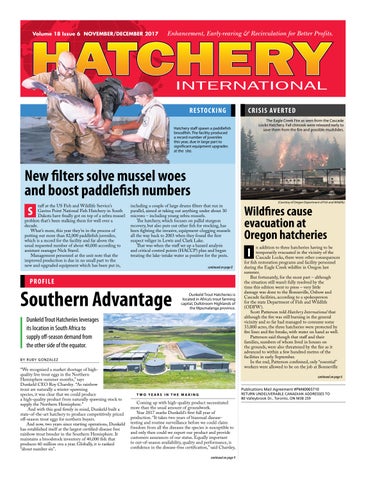
Volume 18 Issue 6 NOVEMBER/DECEMBER 2017
RESTOCKING
CRISIS AVERTED The Eagle Creek Fire as seen from the Cascade Locks Hatchery. Fall chinook were released early to save them from the fire and possible mudslides.
Hatchery staff spawn a paddlefish broodfish. The facility produced a record number of juveniles this year, due in large part to significant equipment upgrades at the site.
New filters solve mussel woes and boost paddlefish numbers taff at the US Fish and Wildlife Service’s Gavins Point National Fish Hatchery in South Dakota have finally got on top of a zebra mussel problem that’s been stalking them for well over a decade. What’s more, this year they’re in the process of putting out more than 82,000 paddlefish juveniles, which is a record for the facility and far above the usual requested number of about 40,000 according to assistant manager Nick Starzl. Management personnel at the unit note that the improved production is due in no small part to the new and upgraded equipment which has been put in,
S
including a couple of large drums filters that run in parallel, aimed at taking out anything under about 30 microns – including young zebra mussels. The hatchery, which focuses on pallid sturgeon recovery, but also puts out other fish for stocking, has been fighting the invasive, equipment-clogging mussels all the way back to 2003 when they found the first suspect veliger in Lewis and Clark Lake. That was when the staff set up a hazard analysis and critical control points (HACCP) plan and began treating the lake-intake water as positive for the pests. continued on page 8
PROFILE
Southern Advantage
Dunkeld Trout Hatcheries is located in Africa’s trout farming capital, Dullstroom Highlands of the Mpumalanga province.
Dunkeld Trout Hatcheries leverages its location in South Africa to supply off-season demand from the other side of the equator. BY RUBY GONZALEZ
“We recognised a market shortage of highquality live trout eggs in the Northern Hemisphere summer months,” says Dunkeld CEO Roy Charsley. “As rainbow trout are naturally a winter-spawning species, it was clear that we could produce a high-quality product from naturally spawning stock to supply the Northern Hemisphere.” And with this goal firmly in mind, Dunkeld built a state-of-the-art hatchery to produce competitively priced off-season trout eggs for northern buyers. And now, two years since starting operations, Dunkeld has established itself at the largest certified-disease free rainbow trout breeder in the Southern Hemisphere. It maintains a broodstock inventory of 40,000 fish that produces 60 million ova a year. Globally, it is ranked “about number six”.
(Courtesy of Oregon Department of Fish and Wildlife)
Wildfires cause evacuation at Oregon hatcheries
n addition to three hatcheries having to be temporarily evacuated in the vicinity of the Cascade Locks, there were other consequences for fish restoration programs and facility personnel during the Eagle Creek wildfire in Oregon last summer. But fortunately, for the most part – although the situation still wasn’t fully resolved by the time this edition went to press – very little damage was done to the Bonneville, Oxbow and Cascade facilities, according to a spokesperson for the state Department of Fish and Wildlife (ODFW). Scott Patterson told Hatchery International that although the fire was still burning in the general vicinity and so far had managed to consume some 33,000 acres, the three hatcheries were protected by fire lines and fire breaks, with water on hand as well. Patterson said though that staff and their families, numbers of whom lived in houses on the grounds, were also threatened by the fire as it advanced to within a few hundred metres of the facilities in early September. In the end, Patterson confirmed, only “essential” workers were allowed to be on the job at Bonneville
I
continued on page 6 Publications Mail Agreement #PM40065710 TWO YEARS IN THE MAKING
Coming up with high-quality product necessitated more than the usual amount of groundwork. Year 2017 marks Dunkeld’s first full year of production. “It takes two years of biannual diseasetesting and routine surveillance before we could claim freedom from all the diseases the species is susceptible to and only then could we export our product and provide customers assurances of our status. Equally important to out-of-season availability, quality and performance, is confidence in the disease-free certification,” said Charsley, continued on page 9
RETURN UNDELIVERABLE CANADIAN ADDRESSES TO 80 Valleybrook Dr., Toronto, ON M3B 2S9