Salt’s intrusion into groundwater
Salinity of Lake Simcoe watershed is on the rise


Salinity of Lake Simcoe watershed is on the rise
Core components stocked for Canadian wholesalers Trusted by installing contractors
CB Supplies is your single source for everything needed to install, operate, and service pump and well systems. From pressure switches and control components to fittings, valves, and accessories, we provide solutions that keep water moving, backed by trusted products and industry expertise.
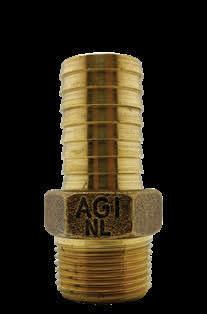
Bronze & Stainless Steel Insert Fittings
Cat. A04
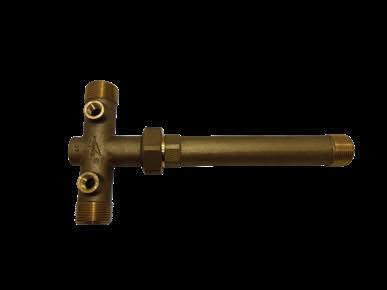
Brass & Stainless Steel Tank Crosses
Cat. A08
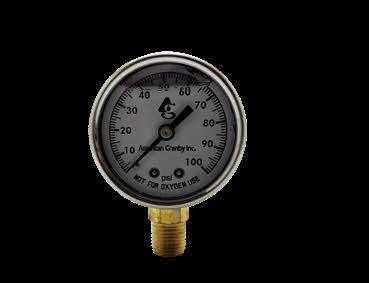
Pressure Gauges & Relays
Cat. A06

Pressure Relief Valves & Tank Installation Accessories
Cat. A07
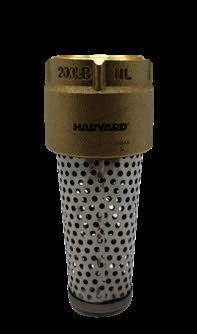
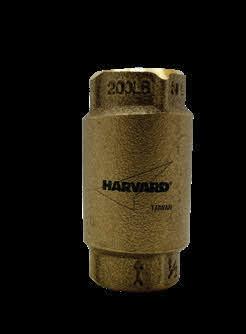
Check Valves & Foot Valves
Cat. A10

Telemecanique Sensors – Pressure Switches, Floats, Transducers & Accessories
Cat. A066

Submersible Pump Wire
Cat. A01
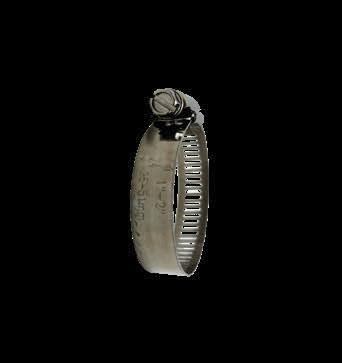
Stainless Steel Clamps
Cat. A20
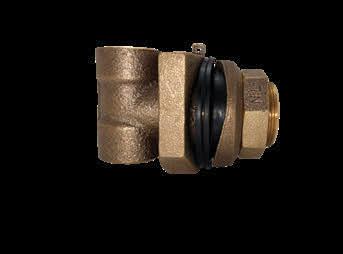
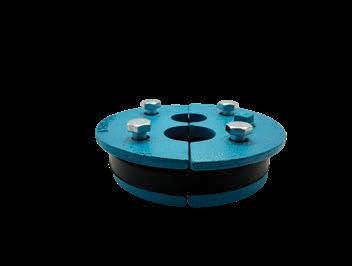
Pitless Adapters & Well Caps & Seals
Cat. A11
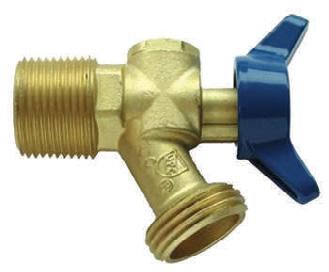
Drain Valves
Cat. A02

Annex Business Media
P.O. Box 530, Simcoe, Ontario N3Y 4N5 (800) 265-2827 or (519) 429-3966 Fax: (519) 429-3094
Reader Service
Print and digital subscription inquiries or changes, please contact Customer Service Administrator | Angelita Potal
Tel: (416) 510-5113 | Fax: (416) 510-6875 apotal@annexbusinessmedia.com
Mail: 111 Gordon Baker Rd., Suite 400, Toronto, ON M2H 3R1
Editor | Mike Jiggens mjiggens@annexbusinessmedia.com (519) 429-5184
Advertising Manager | Sharon Kauk skauk@annexbusinessmedia.com (519) 429-5189
Account Coordinator | Kathryn Nyenhuis knyenhuis@annexbusinessmedia.com (416) 510-6753
Audience Development Manager | Shawn Arul sarul@annexbusinessmedia.com (416) 510-5181
Media Designer | Alison Keba akeba@annexbusinessmedia.com
Group Publisher | Michelle Bertholet mbertholet@annexbusinessmedia.com
CEO | Scott Jamieson sjamieson@annexbusinessmedia.com
Publication Mail Agreement #40065710.
Printed in Canada, All rights reserved. ISSN 0383-7920
Subscription Rates
Canada - 1 Year $22.28
U.S.A. - 1 Year $63.65 CAD
Annex Privacy Officer: Privacy@annexbusinessmedia.com Tel: 800-668-2374
Occasionally, Ground Water Canada will mail information on behalf of industry-related groups whose products and services we believe may be of interest to you. If you prefer not to receive this information, please contact our circulation department in any of the four ways listed above.
No part of the editorial content of this publication may be reprinted without the publisher’s written permission © 2026 Annex Business Media. All rights reserved. Opinions expressed in this magazine are not necessarily those of the editor or the publisher. No liability is assumed for errors or omissions.
All advertising is subject to the publisher’s approval. Such approval does not imply any endorsement of the products or services advertised. Publisher reserves the right to refuse advertising that does not meet the standards of the publication.
Serving the Canadian Ground Water industry for more than 50 years.

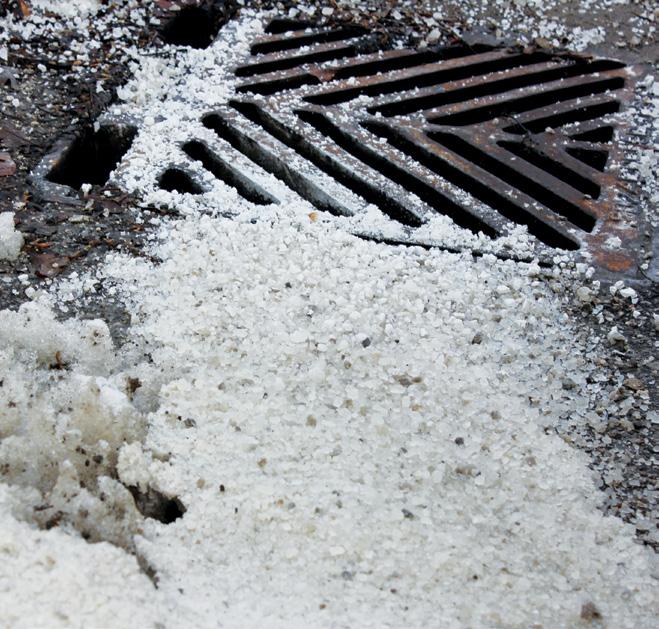
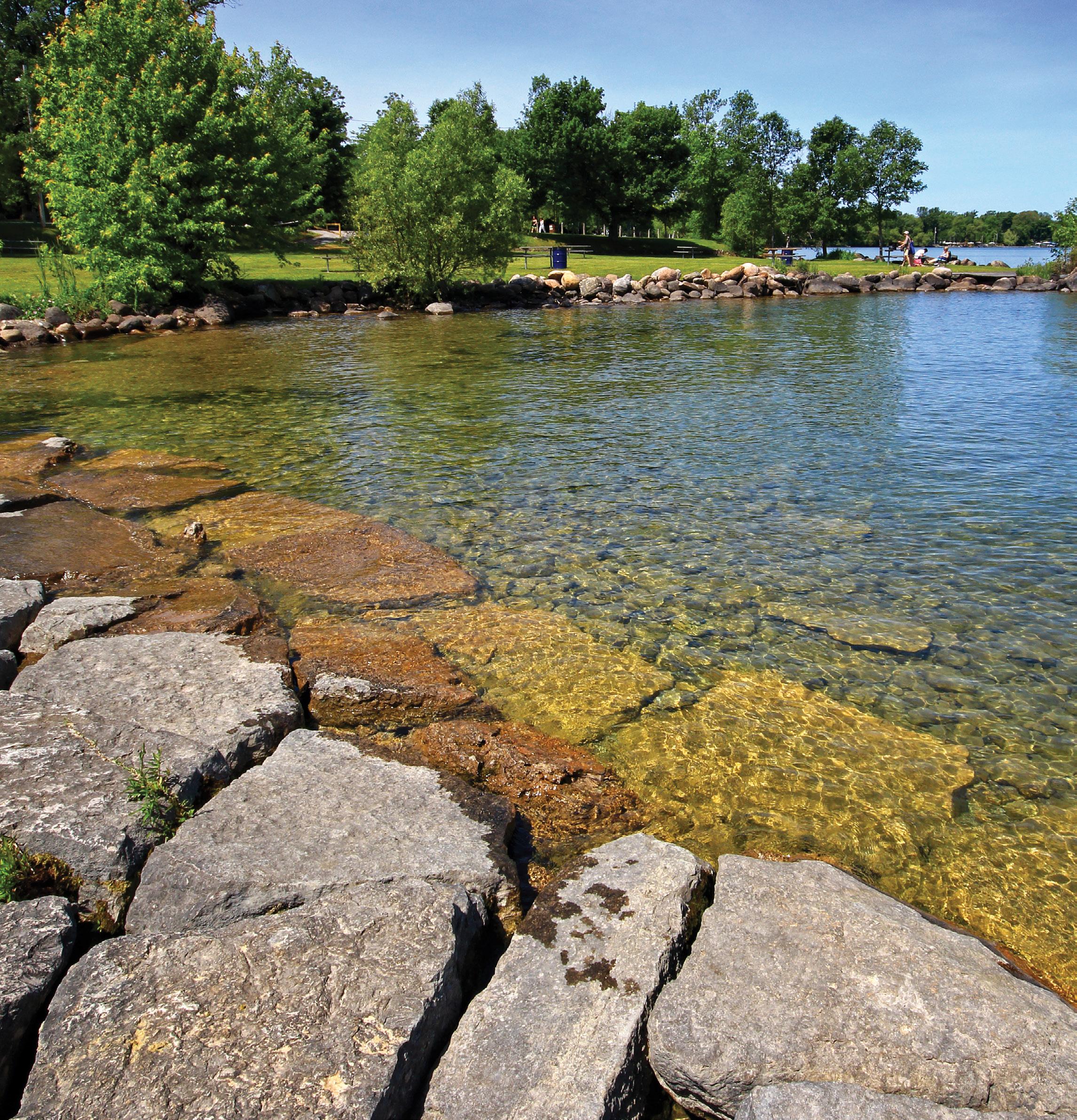
Excessive winter road salt usage is taking its toll on the waters of the Lake Simcoe watershed
News
views from the OGWA
Properly treated water will assist with maintaining equipment ef ficiency and save on energy costs
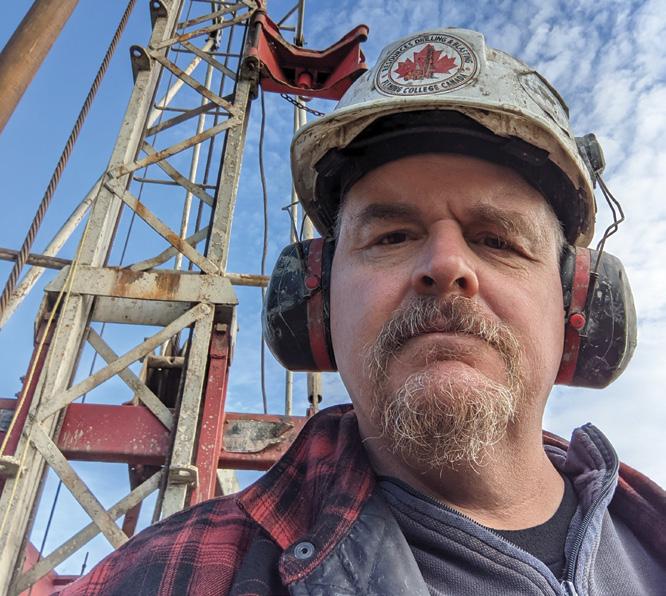
One-of-a-kind Fleming program touches all bases for drilling students
Dry wells possible again this summer if Nova Scotia deals with another summer of drought
With summer on the horizon, some of the province’s municipalities are preparing for the possibility of dry wells as the threat of another year of drought remains. CBC News report
Health officials fear diesel fuel spill in B.C. Interior could reach aquifer Private well owners in the Scotch Creek area are being warned to watch for an oily sheen and the smell of fuel following the spill of about 20,000 litres of diesel at a local gas station. CBC News report
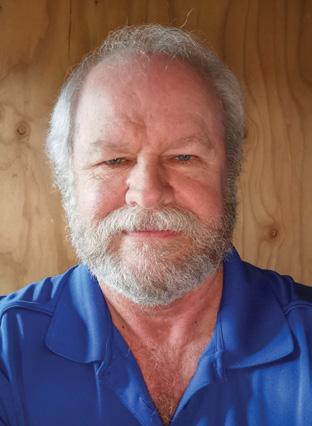
by Mike Jiggens
The time is now to nominate someone worthy of the honour
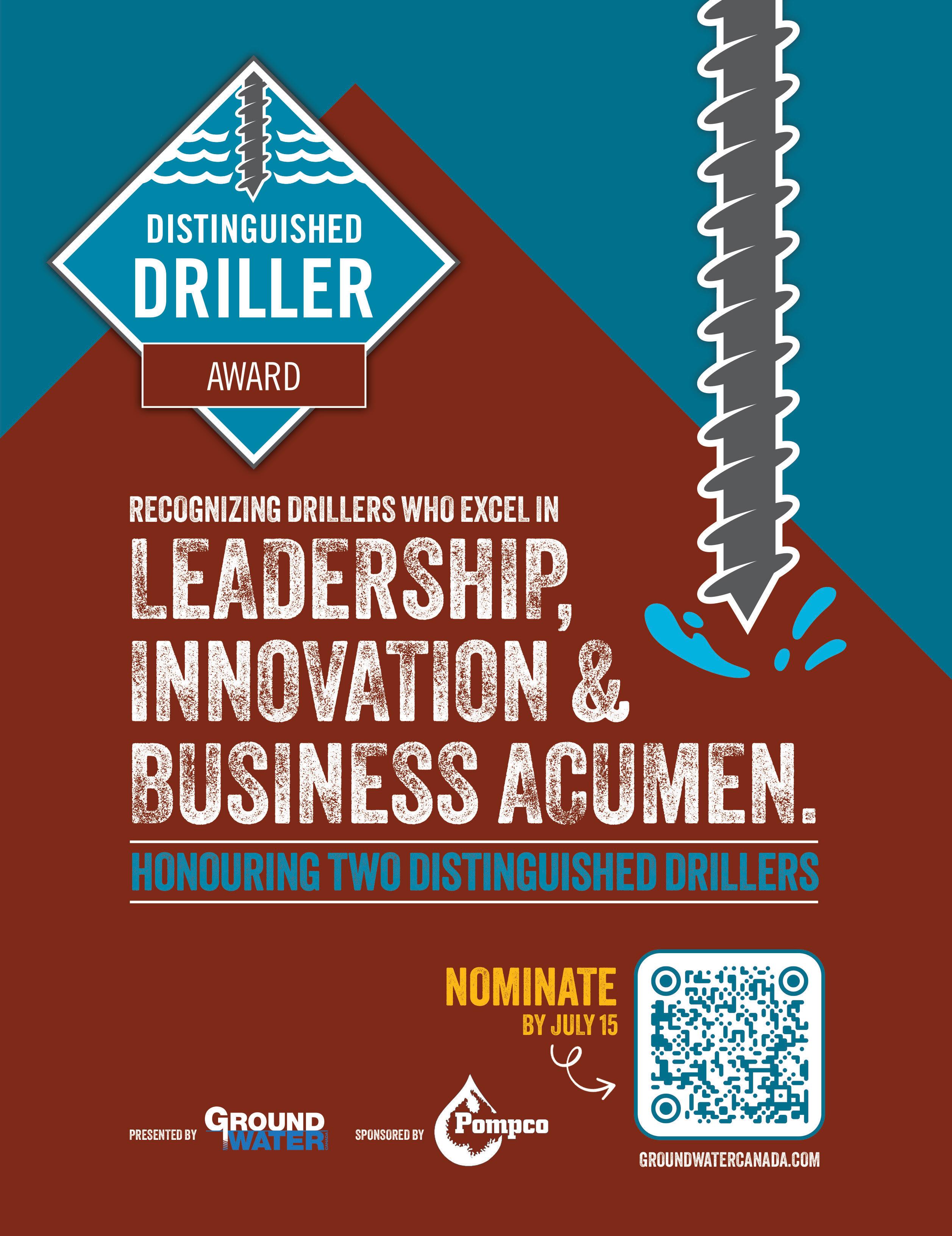
Nominations are now open for Ground Water Canada ’s fourth annual “Distinguished Driller” recognition program. Begun in 2022, the program was launched to acknowledge the efforts of those in the groundwater industry whose profession is often underappreciated.
So far, we have honoured five different individuals over the past three years – all of whom were fully deserving of the recognition.
We’re looking for candidates who are tops in their field in industry experience, business acumen, leadership and innovativeness. There are plenty of deserving candidates throughout Canada who meet these criteria. The goal now is for you – our readers – to take a moment and bring these individuals to our attention. A handy online nomination form can be found at our website at www.groundwatercanada.com.
The program was launched to acknowledge the efforts of those in the groundwater industry whose profession is often underappreciated.
The deadline for nominations is July 15.
Our 2026 “Distinguished Driller” will be featured in our fall edition. This program helps to boost the profile of drillers and pump installers whose work tends to be lost in the shuffle among skilled tradespersons. These individuals play an important role in bringing a vital resource into our homes and businesses, yet their work often fails to get the credit it deserves. This program was designed to change that.
Having attended the Ontario Ground Water Association’s annual convention in March, it was clear that a passion continues to exist
for the industry with the acknowledgment by the association of several businesses honoured for milestone years of service. The backbone of these companies are the drillers who have made long careers out of their trade. These long-serving professionals have been mentoring newer generations of drillers who have come to understand the passion their superiors have for their work.
The OGWA convention also included an address by Jim Smith, instructor for Fleming College’s resources technician drilling program, who spoke about a bright future for the industry, despite water well drilling’s placement toward the bottom of Canada’s most recognized skilled trades.
Fleming’s program is one of a kind, and graduates have gone on to professions in various fields of drilling. Smith said he’s most passionate about water drilling and makes a point of promoting that particular field to his students.
Those graduates will one day become the next wave of “Distinguished Driller” candidates. In the meantime, it’s important we recognize those firmly established in the industry who continue to serve with distinction and professionalism to fulfill an important need for countless Canadians.
Be sure to take a moment and fill out the “Distinguished Driller” nomination form.
NEXT ISSUE: The next issue of Ground Water Canada will profile our newly crowned “Distinguished Driller.” groundwatercanada company/groundwatercanada
Spindle torque rating up to 10,410 ft/lbs and 28,275 pounds of retract force for those deep auger borings.
Detent feed with adjustable pulldown pressure and rate controls for efficient core drilling operation.
Available optional equipment includes angle drilling, automatic SPT hammer, up to 6-5/8” capacity hydraulic rod holder and break-out wrench, cathead, water tank, a variety of hydraulic hoists, water pumps and much more.
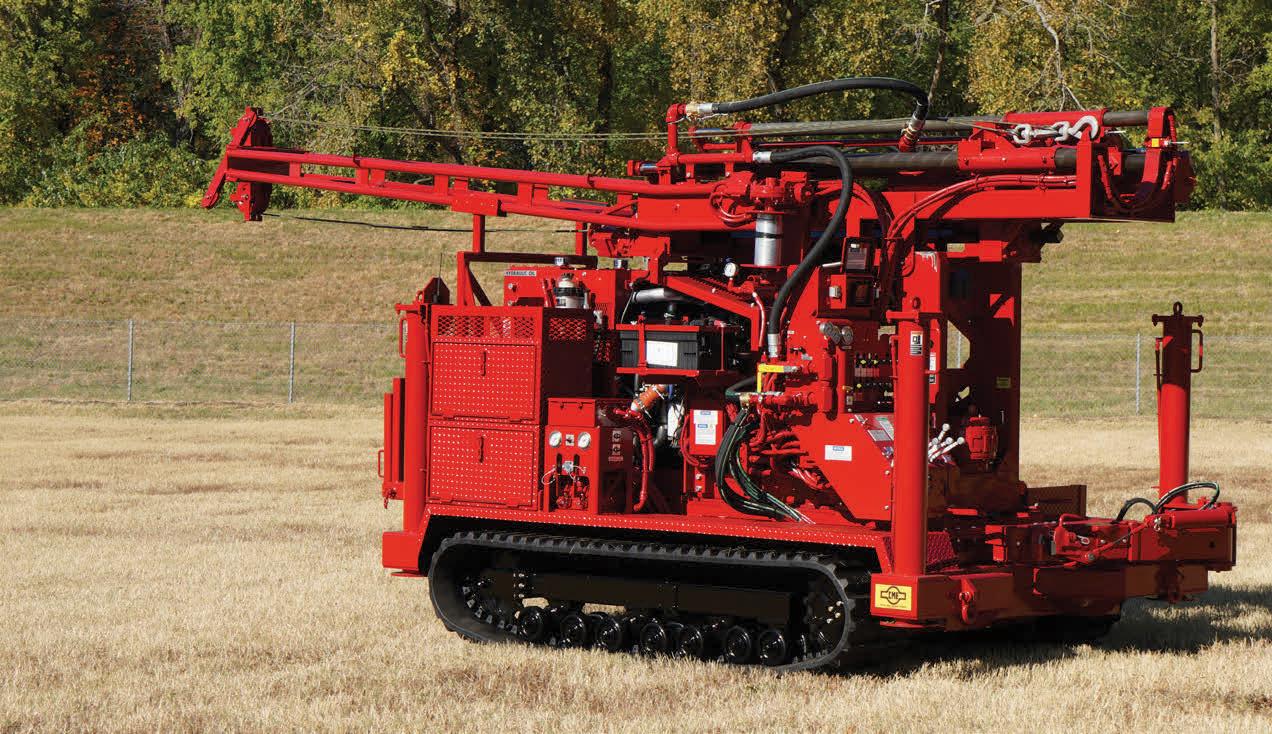
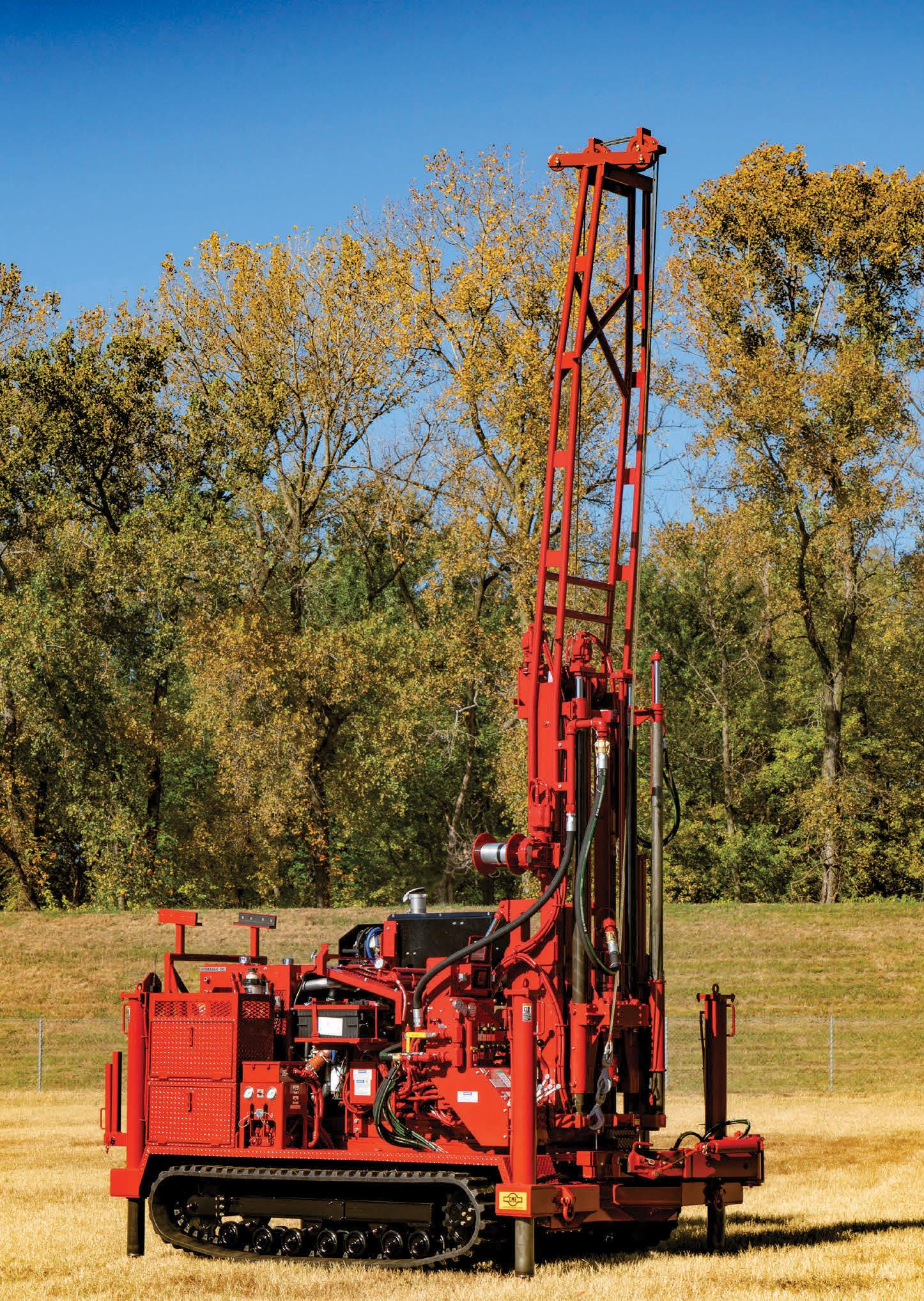
The walking beam suspension provides excellent stability when negotiating uneven terrain, whether it’s curbs in the
or logs in the forest. Couple that with a compact, low ground bearing pressure, zero turn carrier and now you’re getting to sites where your trucks can’t go.
Give us a call or visit our website to learn more about the advantages of the one-source CME-55/300 multipurpose rubber track drill.

World Water Day was observed on March 22, prompting a statement from Mandy Gull-Masty, minister of Indigenous Services.
“As we recognize World Water Day, we acknowledge that there are First Nations in Canada that continue to face challenges accessing clean drinking water. This reminds us why it is so important to work together to support access to safe drinking water for communities today and for future generations.”
She said the strengths, knowledge and teachings that guide this work must be honoured.
“For thousands of years, Indigenous women have played important roles connected to water and community well-being,” Gull-Masty said. “While colonial policies disrupted many of these roles, we remain committed to supporting communities in reclaiming and strengthening this knowledge. In line with this year’s United Nations World Water Day theme, ‘Water and Gender,’ we celebrate the leadership of Indigenous women in advancing water stewardship and building strong, resilient communities.”
She said she sees women leading the work across Canada, by planning and running water systems, training new operators, guiding community projects and shaping longterm decisions about land and water.
“Women also contribute through mentorship, knowledge-sharing and cultural teachings that reinforce the relationship between water and community life. Their work brings care, expertise and continuity to complex water initiatives.
“On World Water Day, I honour the elders, knowledge keepers, water operators, technicians, leaders and youth who protect water every day. Together, we will continue advancing efforts to support safe, clean drinking water in First Nations communities.”
Gull-Masty added she planned to introduce legislation this spring on clean drinking water for First Nations.
The efforts of Canadian First Nations, with the support from Indigenous Services Canada, have lifted 151 long-term drinking water advisories on public systems and have prevented more than 320 short-term advisories from becoming long term.
The 2025 budget included $2.3 billion over three years to renew the First Nations Water and Wastewater Enhanced Program, starting in 2026-2027. Gull-Masty said the funding will support First Nations to address critical health and safety risks related to drinking water by maintaining progress on about 800 projects underway, including those focused on ending remaining water advisories and preventing new ones.

A chemical spill in the Raith, Ont. area in April prompted the Ontario Ministry of the Environment, Conservation and Parks to mandate testing of nearby wells.
The collision of two transport trucks in mid-April resulted in the spill of pesticides. Ministry officials have been investigating the impact of the spill and have requested all wells within a one-kilometre radius of the spill be surveyed.
It was reported the site gave off a smell described as an “overload of chlorine.”
An environmental lawyer is hoping New Brunswick will become the first province in Canada to canonize into law the right to clean water.
The lawyer is pressing New Brunswick lawmakers to enact a tougher law to ensure everyone has equal access to clean water. A forestry official, however, has said stronger regulations could adversely impact the economy.
The federal government had previously talked about a First Nations Clean Water Act, but it has never come to fruition, having last been discussed in late 2024.
A Grade 9 Bradford (Ont.) District High School student has invented a device that removes microplastics from water through AI-powered UV detection.
The autonomous device – called Aquabotix – was among about 250 entries at the recent Simcoe County Regional Science and Technology Fair. The floating robot uses ultra-fluorescent light to detect microplastics and then filters them from water through an onboard filtration system.

In the early 1970s, before an explosive growth in housing and winter road maintenance, the natural background chloride level of Lake Simcoe was just seven milligrams per litre (mg/L). According to monitoring data from the Lake Simcoe Region Conservation Authority (LSRCA), the chloride level has now risen to 63.7 mg/L.
by JAMES CARELESS
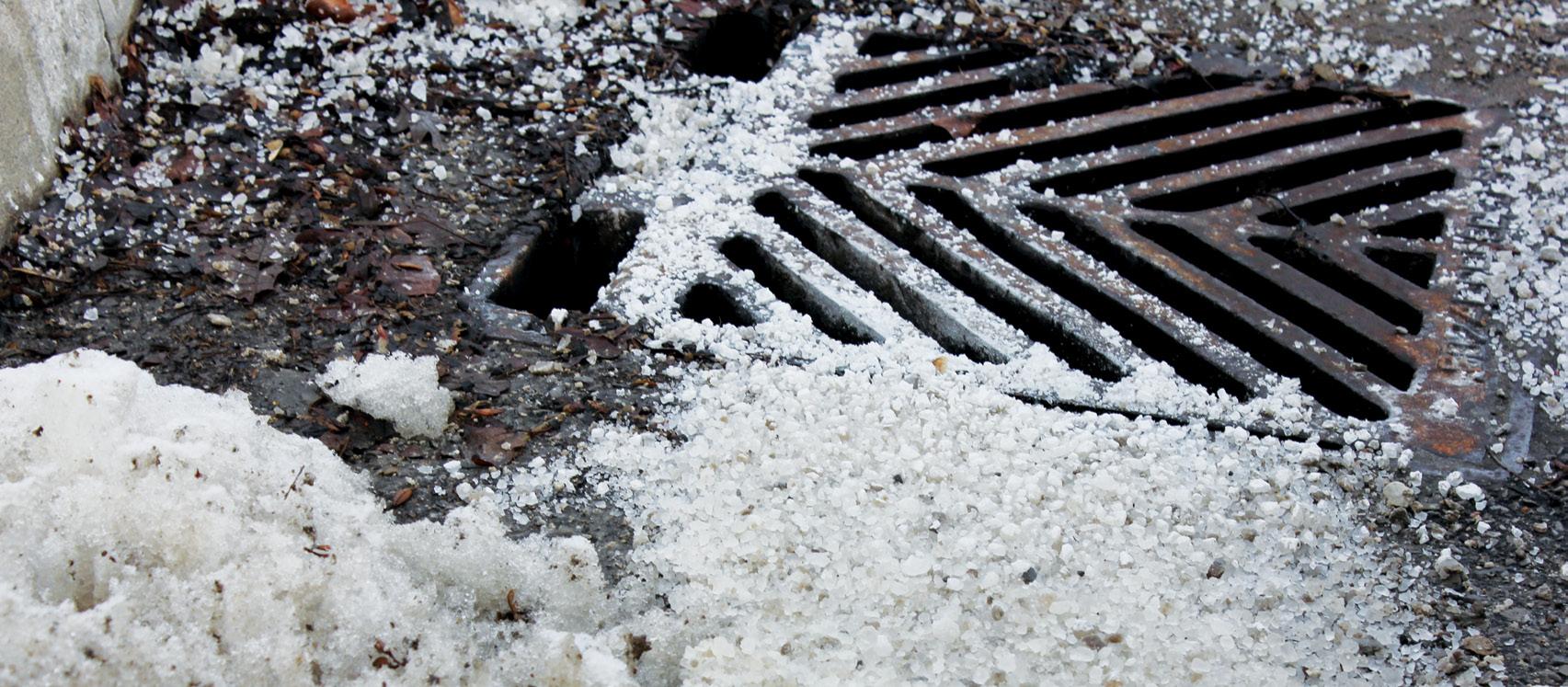
Over-application of winter salt, such as seen here beside a catch basin, will find its way into storm sewers and eventually into receiving water bodies or groundwater.
Lake Simcoe’s rising salinity level is the direct result of winter road salt washing off highways and commercial parking lots into the broader watershed.
“Salt, which is primarily sodium chloride, does not disappear after we put it on pavement,” Christopher Wellen, an associate professor in geography and environmental studies at Toronto Metropolitan University, says. “Instead, it gets washed into rivers and lakes and groundwater and eventually it winds up in Lake Simcoe.”
When compared to the Atlantic Ocean, whose salt level ranges between 19,000 and 19,400 mg/L, 63.7 mg/L isn’t much. However, while the lake’s current salinity remains below the federal
long-term danger threshold for aquatic life – 120 mg/L – several of Simcoe’s smaller feeder streams are experiencing highly concentrated, toxic spikes that far exceed those limits.
Furthermore, the LSRCA has found that streams with lower water volume, such as Hotchkiss Creek and West Holland River, regularly exceed both federal guidelines long after winter ends. Additionally, an LSRCA report found 64 per cent of the watershed was already biologically impacted by chloride more than a decade ago. Smaller organisms like mayflies, caddisflies, zooplankton, and phytoplankton are hit first, damaging the food supply for larger species. Fish cannot manage the osmotic gradient

of high-salinity water, leading to severe shock, failure to reproduce, and death.
One of the streams most severely affected by road salt runoff is Western Creek in Newmarket. Its salinity level exceeded 26,000 mg/L in February 2025. Since Western Creek flows into the East Holland River, these toxic waters go directly into Lake Simcoe.
The ecological impact of road salt on these streams can be drastic.
“In our urban areas, we do see a real lack of diversity in aquatic organisms,” Bill Thompson, the LSRCA’s manager of watershed plans and strategies, says. “In one of our most urbanized water courses, the only thing we find there are goldfish that have been dumped by aquarium owners. Nothing native to the stream has survived.”
According to the LSRCA, communities within the Lake Simcoe watershed apply 120,000 tonnes of road salt annually. This breaks down to roughly 227 kilograms of salt per person living in the region every year.
This number has been rising since the LSRCA started monitoring lake salt levels in the 1970s.
“There’s been a really striking year-over-year increase since then of about one milligram per litre per year,” Thompson told Ground Water Canada. “This increase is being driven by population growth in our region, and their increasing expectations regarding safe, salted winter roads. And so, there’s more and more winter maintenance being done to support all the folks living in the watershed.”
It’s not just aquatic ecosystems that are affected by rising salt levels. Humans are, too, especially when it comes to drinking water. The Ontario target for chloride levels in drinking water is 250 mg/L. The good news here is that this metric is based on taste, not health.
The threat of road salt extends far below the surface.
“When the salt washes off, some of that salt washes into the lake and some of it percolates down to the groundwater,” Wellen says. “We have noticed that we can’t account for all of the salt that gets applied to a watershed when we look at the stream that drains it. The missing salt has to be going somewhere, so it’s probably going into the groundwater and, to some extent, into the soil water, too.”
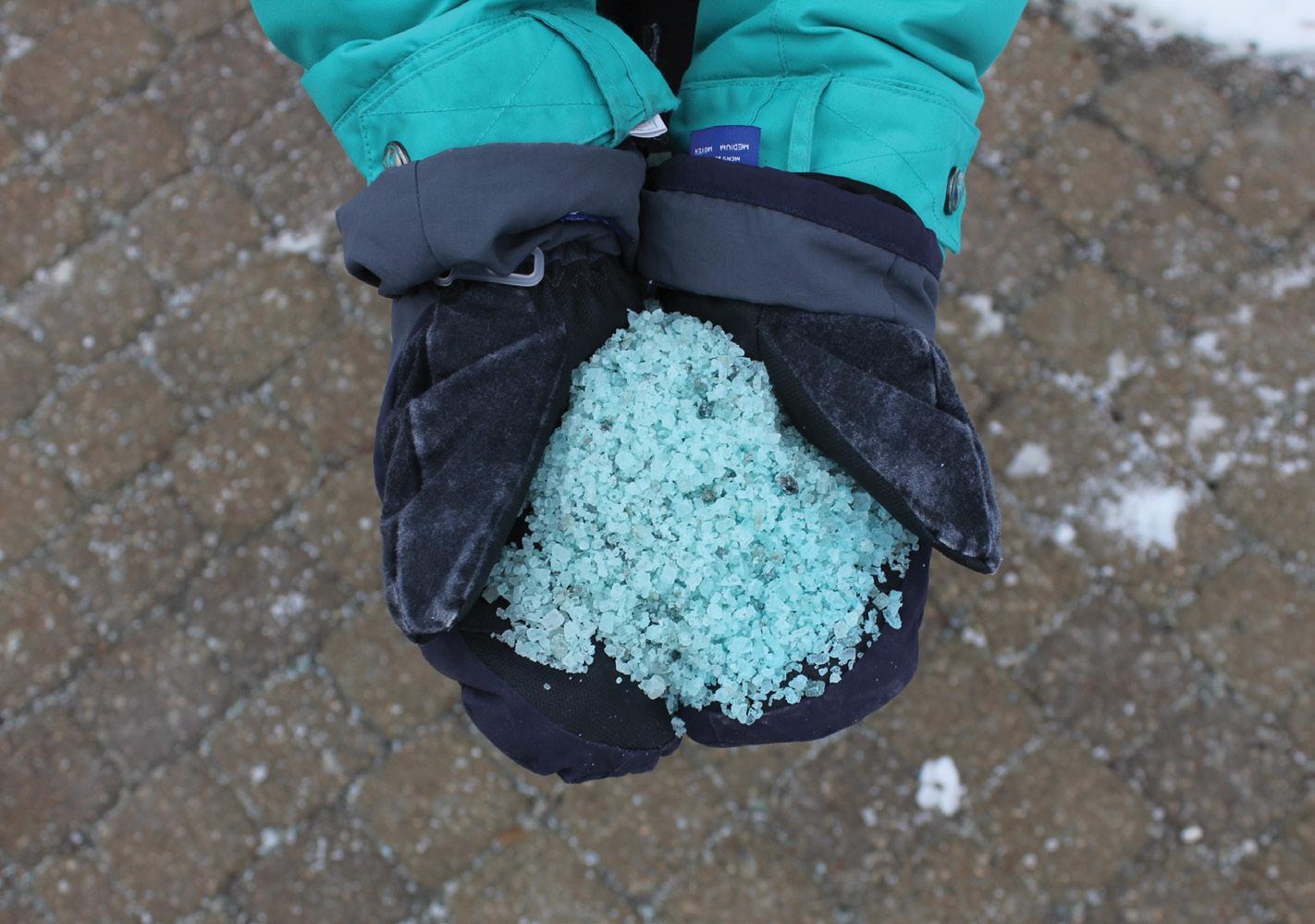
If the cause of Lake Simcoe’s rising salinity is road salt, then the solution lies in reducing its usage or – at the very least – its impact on the watershed. One way to do this is by switching from conventional rock salt to treated salt. It is often blue or green in appearance, due to being coated with a thin film of magnesium chloride.
“Having magnesium chloride on the salt’s exterior means it’s more likely to stick to the surface of the pavement rather than bounce off,” Thompson says. “Treated salt also works at a lower temperature than conventional rock salt, which delivers better results. Best yet, anywhere from 30 to 50 per cent less treated salt is all you need to provide the same level of melting provided by conventional salt.” (Similar coatings can also be done using beet juice, to make salt stickier during application.)
Another solution is liquid brine, aka rock salt that has been pre-melted in water. When applied to a paved surface prior to snow or ice, the liquid brine lowers the surface’s freezing temperature. This proactive approach prevents ice buildup rather than dealing with it after the fact. The good news is that – pound per pound – liquid brine requires up to 75 per cent less salt than the crystallized version to do the job. The downside is that it requires specialized spraying equipment to apply it.
A third solution is to replace salt with sodium acetate. Unlike traditional rock salt, sodium
Treated salt can lower salt application rates by 30-50 per cent.




As we reflect on this year’s 74th AGM & Convention, held at Deerhurst, one theme came through clearly: our members are engaged, invested, and ready for progress.
The AGM & Convention was a strong reminder of the depth of experience within our community and the shared desire to see our industry move forward in a meaningful way. Alongside important organizational updates and the confirmation of leadership continuity, many of you raised thoughtful questions – particularly around regulatory clarity, consistency, and the need for greater alignment across governing bodies.
That message was heard loud and clear.
One issue that continues to surface is the inconsistency in how regulations are interpreted and applied across jurisdictions. A clear example of this is the variation in half-load restrictions, where requirements and enforcement can differ significantly from one region to another.
For an industry that relies on mobility, timing, and precision, this lack of consistency creates real operational challenges. It affects scheduling, increases costs, and introduces uncertainty into work that is already complex and highly regulated.
More broadly, members are asking for:
• Clearer guidance
• More consistent enforcement
• Better alignment between ministries and regulatory bodies
These are reasonable expectations – and they are essential for a professional, skilled industry like ours to function effectively.
Our
For many years, OGWA has advocated for
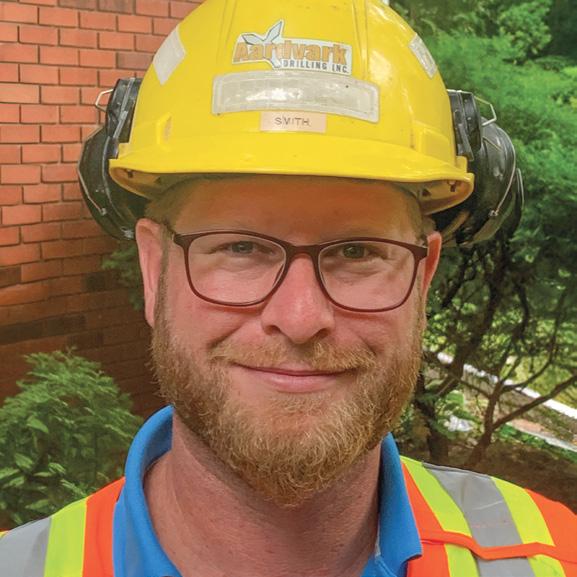
KYLE SMITH, President, Ontario Ground Water Association
recognition of our sector as a skilled trade. That work continues. While progress can feel slow, there are important signs that we are gaining traction.
We are increasingly finding that our voice is being heard.
We have established meaningful dialogue with Ministry officials, and we are building relationships that are opening doors to more productive conversations. There is a growing recognition that our industry brings practical, field-based expertise that must be part of the discussion when policies and regulations are being shaped.
We are not there yet – but we are closer than we have been.
Strengthening our industry through education
Another key area of progress is in how we approach education and training.
We are proud to be advancing a more modern, responsive approach to continuing education – one that reflects the real-world challenges our members face today. Through
our developing memorandum of collaboration with Fleming College, we are creating new opportunities to deliver relevant, accessible, and forward-thinking training for groundwater professionals across Ontario.
This is an important step in reinforcing the professionalism of our industry and supporting the next generation entering the field.
Moving forward – with unity and purpose
If there is one takeaway from the AGM & Convention, it is this: we are stronger when we move forward together.
Our industry is made up of knowledgeable experts, individuals and companies who bring years of hands-on experience, technical skill, and sound judgment to every project. That expertise matters, and it deserves to be recognized and respected.
Our industry has always taken a professional, collaborative approach – and that will continue. But there is also a growing recognition that we need to be more visible, more
HEALTH AND SAFETY REPORT
Updates for OGWA members
BENEFITS OF JOINING OGWA
Joining OGWA can be a game changer
IN MEMORIAM
Remembering the lives of OGWA members
OGWA SCHOLARSHIP PROGRAM
Association’s commitment to education
coordinated, and more consistent in how we advocate for ourselves.
That means:
• Speaking with a unified voice
• Sharing our experiences and challenges openly
• Supporting OGWA’s efforts to engage with government and regulators
• Continuing to push – respectfully, but firmly – for the recognition and clarity our industry deserves
We can make noise as knowledgeable experts in a way that reflects who we are: experienced, credible, solutions-focused, and committed to doing things the right way.
The year ahead is an important one. We will continue to engage proactively with multiple Ministries – including Labour, Transportation, Environment, and other key provincial partners – to ensure our industry is represented consistently across all areas that impact our work. We will keep pushing for alignment in regulations, clearer interpretation, and formal recognition of our trade. At the same time, we will continue strengthening relationships and advancing programs that support our members and reinforce the professionalism of our industry from within. Progress is happening. Momentum is building. And with your continued support and engagement, we will keep moving forward.
Kyle Smith – President
• Stephen Bleizeffer
– Vice-President
• Boyd Pendleton – Treasurer
• Matt Wilson – Secretary
• Dwayne Graff – Past President
BOARD OF DIRECTORS
Stephen Bleizeffer
BrokerLink
Phone: 519-579-3330 ext.
3689
Fax: 519-579-1151
Email: sbleizeffer@brokerlink.ca
| sblitz1961@gmail.com
Tecia White
My Water Quality
Phone: 705-888-7064
Email: info@mywaterquality.ca
Curtis Bullock
Eades Well Drilling Inc.
Phone: 705-934-1317
Email: curtisbullock@outlook.com
Ian Gawel
Desjardins Financial Security
Independent Network
Phone: 647-285-1390
Fax: 416-695-1713
Email: ian.gawel@dfsin.ca
Dwayne Graff
Well Initiatives Ltd.
Phone: 519-846-8289
Fax: 519-846-8281
Email: dgraff@wellinitiatives.com
Bruce Hietkamp, P.Geo.
Geo Kamp Limited
Phone: 905-825-8007
Fax: 905-825-9006
Email: geokamp@geokamp.com
Shawn Hopper
SD Hopper Drilling
Phone: 519-271-7860
Email: shawn@hopperwells.ca
Greg Smith
Pontil Drilling Services Inc.
Phone: 289-338-1838
Email: greg.smith@pontildrilling. com
Todd Ferguson
Splash Well Drilling Phone: 613-925-4885
Email: splashwelldrilling1987@ yahoo.ca
Boyd Pendleton
Lotowater Technical Services Inc.
Phone: 519-442-2086
Email: boydp@lotowater.com
Rick Pettit Rideau Supply Phone: 519-274-0281
Email: rpettit@rideausupply.com
Kyle Smith Aardvark Drilling Inc. Phone: 613-296-8779 Fax: 613-317-1194
Email: ksmith@ aardvarkdrillinginc.com
By Stephen Bleizeffer, Vice-President, OGWA
In the fast-paced, high-stakes world of construction, success is rarely built alone. Contractors, suppliers, engineers, and professionals often face a landscape of tight deadlines, fluctuating regulations, labour shortages, and rising costs. For many, navigating these challenges independently can feel overwhelming. Yet, there is a proven way to ease the burden while strengthening long-term prospects: joining the Ontario Ground Water Association which is the trade association representing your industry here in Ontario.
Trade
associations in the construction
sector are far more than networking clubs. They are professional ecosystems that bring together companies, contractors, suppliers, manufacturers, and specialists under a common banner. They exist to strengthen the industry, advocate for favourable policies, and help members thrive. Whether you are a small contractor seeking credibility, a supplier wanting new clients, or a large firm aiming to shape industry standards, membership can unlock significant advantages.
Below, we explore why joining a construction trade association is one of the most strategic moves you can make for your business.
Mike Steffen Steffen Well Drilling Phone: 519-531-0355
Email: ex9191@gmail.com
Matthew D. Wilson
J.B. Wilson & Son Well Drilling Ltd. Phone: 519-269-3364
Fax: 519-269-3552
Email: mwilson@ogwa.ca
Bryan Watson G. Hart & Sons Well Drilling Ltd. Phone: 705-887-3331
Fax: 705-887-4788
Email: bryan@ghart.ca
STAFF
Trish Luty
General Manager Phone: 519-245-7194 ext. 1
Email: trish@ogwa.ca
Debbie Stojkovic
Accounts Manager Phone: 519-245-7194 ext. 2
Email: accounts@ogwa.ca
Karina Pakalnis
Administrative Assistant Phone: 519-245-7194 ext. 3
Email: karina@ogwa.ca | admin@ogwa.ca
First impressions matter in construction. Clients want reassurance that the company or professional they hire is not only skilled but also reputable. Membership in a respected trade association provides that reassurance.
Many associations and licensing bodies set rigorous entry requirements: minimum years in business, references from peers, or even proof of customer satisfaction. Some require adherence to ethical codes of conduct or completion of certification programs. By meeting these standards, members gain a badge of credibility that signals reliability and professionalism to potential clients.
This professional recognition can make the difference between winning or losing a contract. Simply put, being part of an association communicates: We are serious about quality, ethics, and accountability.
The construction industry is heavily regulated, and the Ground Water Industry is no different, staying ahead of changes in laws, codes, and
policies can be daunting. Trade associations function as a united voice for members, advocating on their behalf at local, national, and even international levels.
Associations lobby lawmakers, consult with regulators, and campaign against policies that would burden contractors or stifle industry growth. They also work to advance beneficial initiatives, such as infrastructure funding or workforce development programs.
Instead of being a lone voice in the crowd, members benefit from the strength of collective advocacy. This ensures their interests are represented in policy decisions that directly impact daily operations and long-term business sustainability.
In construction, relationships are often as valuable as technical skills. Word-of-mouth recommendations and partnerships fuel business opportunities. Trade associations create the perfect environment for building these relationships.
From trade shows, conferences, Continuing Education Courses to online forums and local chapter meetings, associations provide structured platforms to meet peers, suppliers, and potential clients. For newcomers, this can mean faster integration into the professional community. For veterans, it is an opportunity to stay connected and visible.
The Drillers & Ground Water Contractors Industry as well as the whole Construction industry are industries in constant evolution, with new materials, technologies, and safety standards emerging every year. Keeping up
requires ongoing education – and associations make that accessible.
Members often gain access to workshops, seminars, certifications, and apprenticeship programs. These not only keep professionals updated but also help businesses attract and retain talent. A company that invests in employee development through association programs demonstrates commitment to growth and professionalism.
Mentorship is another valuable element. Associations frequently pair seasoned experts with newcomers, creating a talent pipeline that strengthens both the individual and the industry.
Running a construction business involves significant overhead, from insurance and equipment to fuel and materials. One of the less obvious – but highly valuable – benefits of association membership is access to group purchasing programs.
By pooling the buying power of their members, associations negotiate discounts on health insurance, commercial and fleet insurance, vehicle purchases, building materials, tools, office supplies, travel services, and more. These savings often offset membership dues many times over. For small and medium-sized businesses, such collective bargaining can be a gamechanger.
Beyond business, associations like the OGWA also provide something equally important: community. Construction can be a stressful industry, with long hours, high stakes, and frequent relocations of equipment. Being part of an association creates a support network of peers who understand the challenges and can share advice, resources, or even just
Hello OGWA members!
Trusting that all of you are well! Per usual, I do have a couple of updates for you!
1. Please get that WHMIS training done ASAP! It’s online and it’s free!
2. The MLITSD is bringing forth a change to the Ontario Regulations for Construction Projects. If passed, look for hard hats with chin straps to become mandatory. For some of you, you are already being told by the general contractor that you need to wear them. If it passes, it will come into effect July 1, 2027 (next year). I did a submission on the behalf of my WSIB members on this (they had a consultation paper), and I did request some level of reimbursement for employers (especially smaller ones). Stay tuned for updates!
3. Also in the works is a move to prevent employers from charging their workers for uniforms that they require to be worn. Stay tuned for this one, too!
camaraderie.
This sense of belonging not only reduces professional isolation but also contributes to long-term career satisfaction.
Associations do not just support individual members; they also drive progress across the entire industry. By doing and commissioning research, publishing data, advocating for industry changes, and highlighting innovative technologies, they encourage adoption of innovations that keep the sector competitive.
They also coordinate collective responses during crises, whether economic downturns, supply chain disruptions, or global events. This role as stabilizers ensures that the industry remains resilient and adaptable.
Joining a construction trade association like the OGWA is not merely about paying dues – it is about investing in your future. The benefits span every dimension of professional life: credibility, advocacy, education, networking, cost savings, and community.
More importantly, associations create the infrastructure that supports industry growth. Without them, advocacy would be fragmented, professional development less focused, and collaboration harder to achieve.
For individuals and companies alike, membership is both a shield and a springboard: it protects against challenges while creating opportunities for expansion.
In a competitive and ever-changing industry, joining a trade association is not a luxury. It is a strategic necessity – one that ensures you are not just surviving, but thriving, in the groundwater industry’s’ demanding landscape.
4. The WSIB Excellence program is still here, offering Rebates to members who participate. If you are interested in getting a) up to double your annual premiums back, OR, b) $2,000 per topic, up to 5 topics (yes, that’s $10,000) then please contact me!
Each business will now receive $1,000 to offset provider fees in addition to the Rebates!
If you have any questions on any of this, please just give me a call at 905-741-5001 or email me at info@safetyworksconsulting. com. I wish you all super Summer!
ELLALINE (ELLA) DAVIES President, Safety Works Consulting Inc
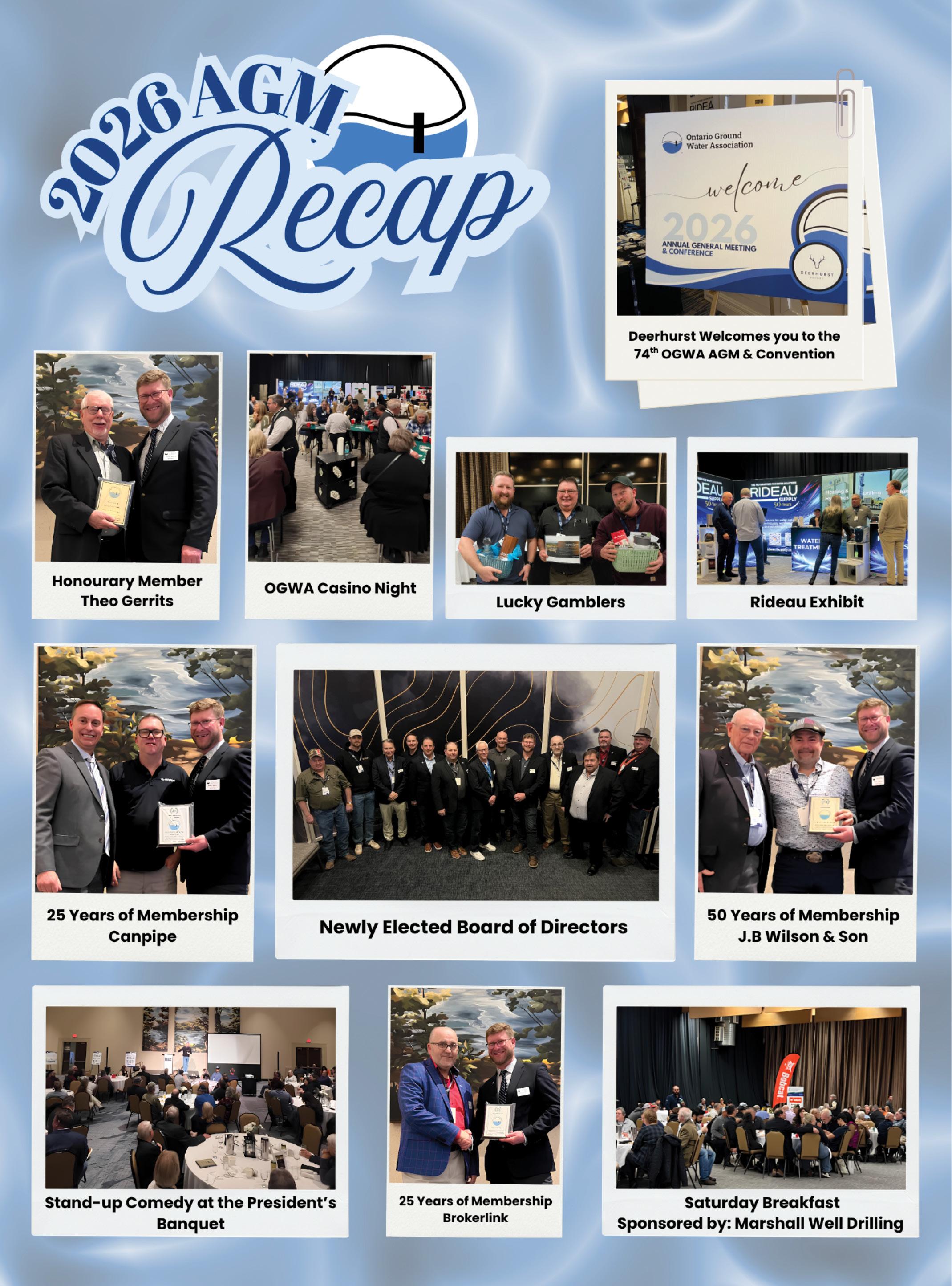
Contributed by the OGWA Board
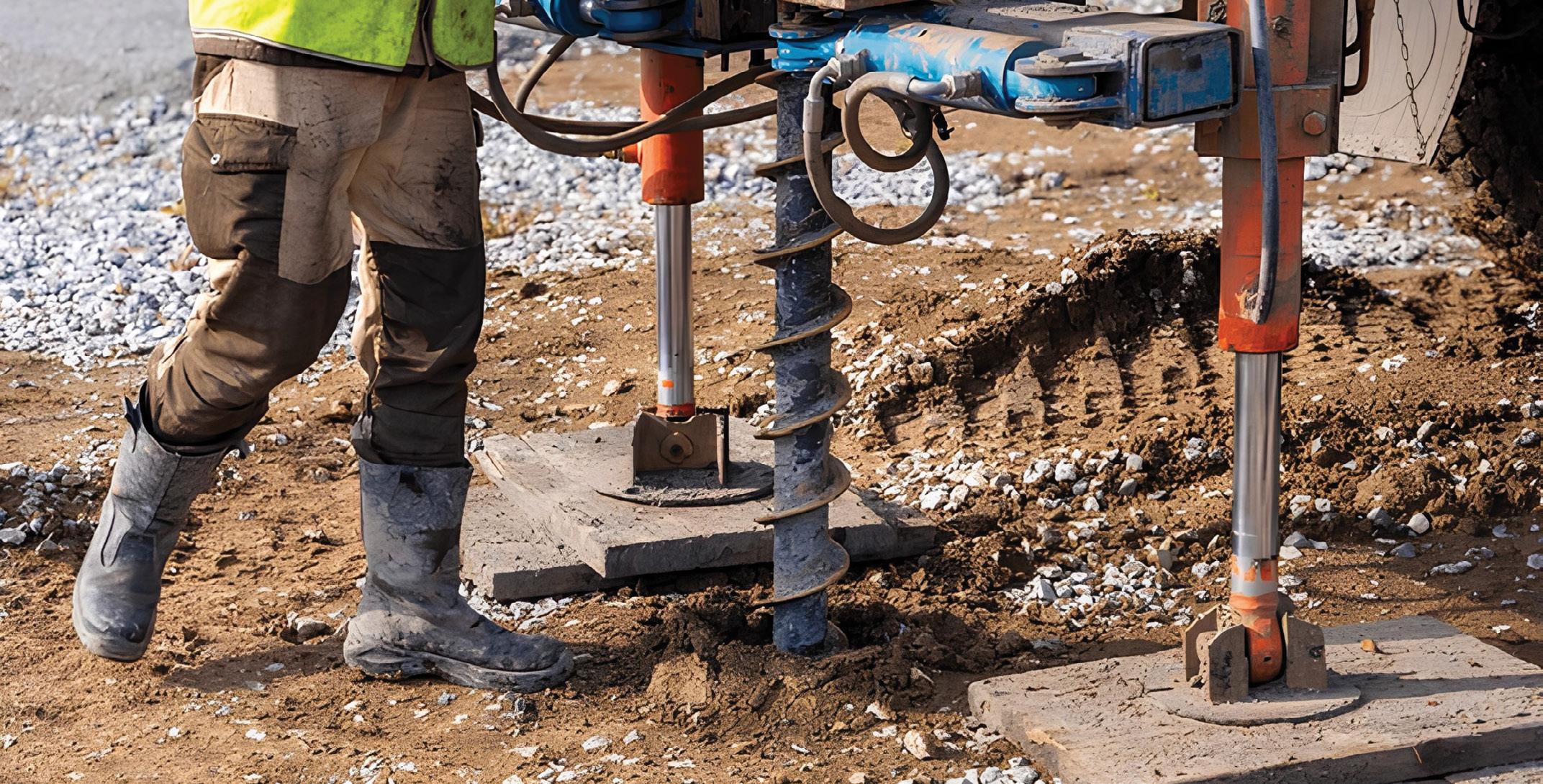
It’s hoped this article finds you well, as an Industry (PI). The Ontario Ground Water Association (OGWA) and the National Drilling Association (NDA), through their directors, were involved with a flowing artesian Residential Well in West Central Ontario that was facing a Director’s Order from the MOECP.
OGWA staff discussed work processes, well construction techniques, and even attended the site itself. In collaboration with senior board members, Qualified Hydrogeological Consulting Engineers, and other Industry professionals, there were comments and concerns that caused some to take a serious interest in the matter.
In short, the MOECP had put the Well Owner and the Well Contractor under obligation to Decommission/Abandon the well. When reviewing the well’s initial history, OGWA members and other groundwater Professionals confirmed that its construction was compliant with the Provincial Legislation (O.Reg 903) and that it was properly sealed when handed over to the owner. The well remained unused and sealed for approximately one year.
However, at a later point a plumber, who was not licensed by the MOECP, later performed non-compliant work, resulting in the well’s out-of-compliance status with O.Reg 903. At that time, it seemed like some simple remedial steps could restore the well’s compliance, but with a seemingly broader interpretation of well construction Regulations by the MOECP, that was not the case, and an Order to Decommission/Abandon the well followed.
For context, the Director’s Order was primarily focused on a possible “unsealed annular space” which may or may not have existed below the 6m+ surface seal.
For further context, many who have been involved with the groundwater industry in Ontario for many years will remember some changes made to O.Reg 903, that took various old and new drilling methods into consideration, with the goal of having a regulation which maintained groundwater safety and allowed standard drilling practices to coexist. The major adjustment back then was that a minimum of 6m of enlarged and appropriately sealed annular space must exist around well casings below ground surface, excepting a few unusual situations.
Typically, the leading edge of well casings as they are advanced below the 6m enlarged annular seal area require a drive shoe of one type or another depending on the drilling method. This is not a unique thing to Ontario as it is a standard practice virtually worldwide. Yet as anyone who advances casing knows, there needs to be some relief annulus created or the friction forces on the outer casing wall will eventually hinder its advancement. This was a clear reason back then for the adjustment of the regulation.
The unfortunate part is that there are some gaps particularly in the understanding of what the 6m surface seal was designed to accomplish and what subsequent drilling would or could exist below it. At the time the adjusted legislation was introduced, many contractors
quickly took exception to the wording in the legislation, as they recognized the serious implications of the words as written and many challenged them at the time. However, Ministry staff who were introducing the new legislation to contractors at the time, also understood the concerns of the contractors (as well as equipment limitations) and insisted this did not apply to drive shoe applications and that the very purpose of the 6m seal was to provide adequate protection from surface water impacts.
Moreover, it was also clear that the legislation was not going to be opened again anytime soon for revisions. Subsequently, assurances were given to all contractors of exactly how the Ministry of the day was interpreting and enforcing the adjusted legislation. The details surrounding this older adjustment have, unfortunately, not been well communicated over the years inside the modern MOECP, thus more work needs to be done on this front by all stakeholders.
Back to the issue of compliance, based on a possible annular space, the MOECP’s current interpretation was that the well in question was not constructed in a compliant manner. You might remember however, that an unlicensed person was involved some time after the well was constructed and at that time work was done which wasn’t compatible with the Regulation. It was this that started the ball rolling so to speak and eventually lead to the Order to decommission the well as noted earlier. Once the MOECP technical staff reviewed the well record they were no longer focused on the repairable mistakes made by the unlicensed person, but rather on the well’s annular seal.
Over a considerable period of time and many emails and phone calls later, OGWA & NDA members as well as the owner were able to meet with MOECP staff in person, to discuss the well and the details leading to the MOECP requirement to decommission an otherwise normal and functional well.
The concern that was relayed to the MOECP as being of the utmost
The Ontario Ground Water Association acknowledges with deep respect and sincere appreciation the passing of two long-standing members of the groundwater community. Their contributions to the industry, their commitment to their work, and their impact on those around them will be remembered for years to come.
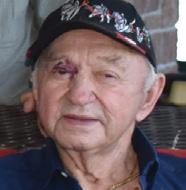
Wilfred “Wilf” Hall (1940–2026)
It is with heavy hearts that we announce the passing of Wilfred Hall on May 2, 2026, at the age of 85.
Wilf was the founder of Wilf Hall & Sons Well Drilling, a family-owned and operated company built on a foundation of hard work, integrity, and dedication to the trade. Beginning with his first well in 1973, Wilf went on to provide dependable water solutions to thousands of residents and businesses across Lanark County and the surrounding region.
In recognition of his outstanding career and lasting contributions to the industry, Wilf was named an Honorary Member of the Ontario Ground Water Association in 2023, marking 50 years of service to well drilling. His company has remained a valued and respected member of the Association and the broader groundwater community. Wilf will be remembered for his strong work ethic, his commitment to excellence, and his enduring passion for the profession. He was also
importance to OGWA & NDA was that essentially, they were requiring this well’s construction to have met the Best Management Practices guidelines, rather than O.Reg 903. As an industry we were not in agreement with the MOECP’s position on that. Dialogue back and forth continued, with points being noted from both parties. One disadvantage on the MOECP’s part was that there was no longer any senior staff who were present when the changes were made to O.Reg 903, many years ago. The problem which kept arising, was that there was no way to resolve the potential micro-annular space created by the drilling process in the view of the MOECP, when applying the regulation as they now understood it, and the Well Record details. With that in mind the OGWA & NDA were tasked with reviewing any and all old correspondence, as well as contacting personnel who may have been around or involved when the noted changes were made to the Regulation.
There were, fortunately, some who were familiar with the changes and the reasons behind them, which proved to be a huge help in handling this matter, especially in communicating the viewpoints of both parties correctly. As noted earlier there were things that needed to be done to improve the wellhead, which the MOECP for the most part agreed with, after additional review the Director’s Order to Decommission/Abandon the well was rescinded, albeit with a number of requirements to be met.
If you are a well contractor, drilling technician or groundwater professional, you should be interested in why the OGWA & NDA took such a vested interest in this well and the circumstances surrounding it. If the Director’s Order had remained in effect and the well owner and contractor had been left with no choice but to comply, it would have set a dangerous precedent in the opinion of the industry, based on the understanding and interpretation it was given and has accepted for several decades. This set of circumstances may have good results moving forward, in the hope that it will revive a channel of communication and dialogue that has been sorely missed for some time.
known for his sharp wit and the respect he earned from colleagues and peers throughout his career. His contributions to the industry and his community leave a lasting legacy.
The Ontario Ground Water Association extends its sincere condolences to the Hall family and to the entire team at Wilf Hall & Sons Well Drilling.

Ronald “Ron” Fournier (1936–2026)
It is with great sadness that we announce the passing of Ronald “Ron” Fournier on April 14, 2026, in his 90th year.
Ron was the co-founder of Rideau Pipe & Drilling Supplies in Perth, Ont., a company that has been an active and valued member of the Ontario Ground Water Association since 1973. Through his leadership and long-standing involvement, Ron played an important role in supporting and strengthening the groundwater industry in Ontario. Widely respected for his integrity, professionalism, and genuine care for others, Ron was instrumental in building not only a successful business, but also strong and enduring relationships across the industry. Even following his retirement, he remained engaged with the community, often reflecting on and sharing experiences from his years in the field.
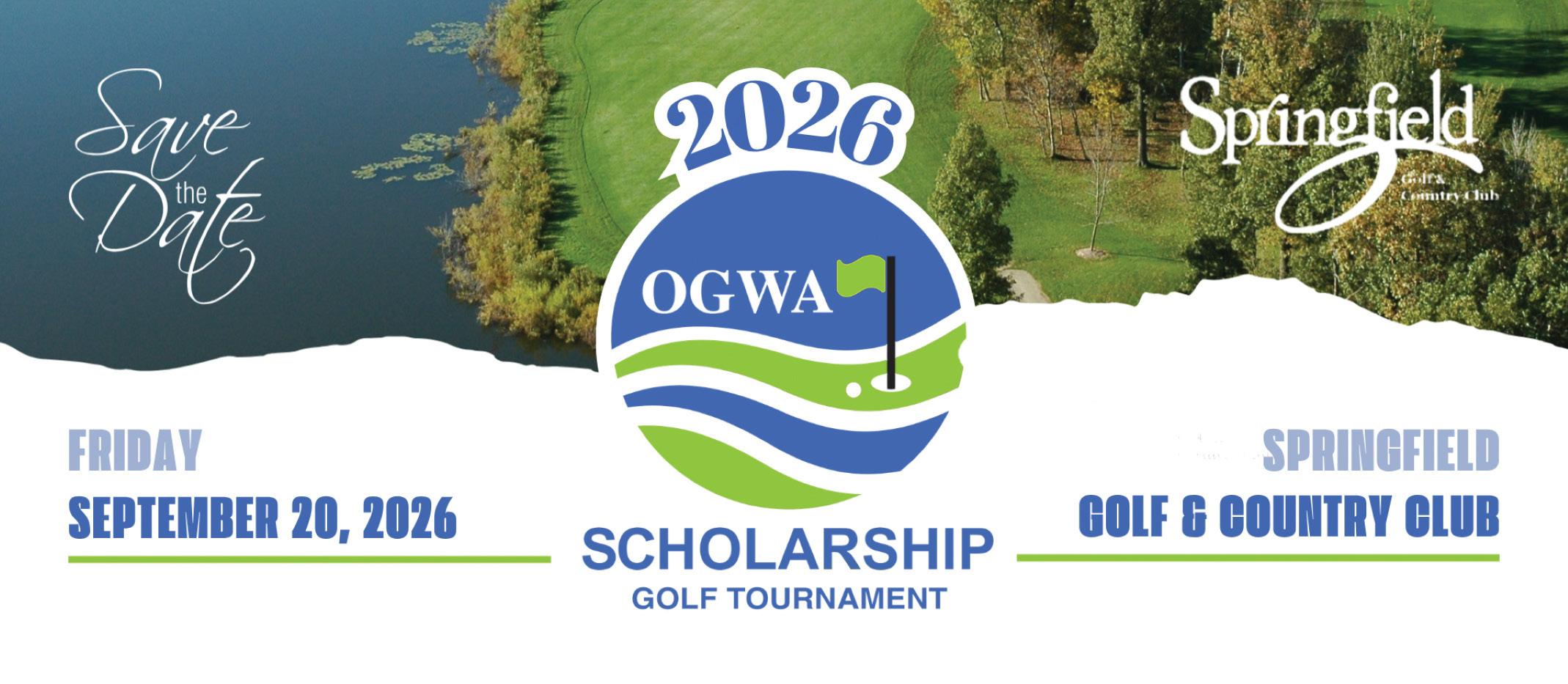
Each year, the Ontario Ground Water Association strengthens its commitment to education and industry development through its scholarship program, funded by proceeds from the annual OGWA Scholarship Golf Tournament. The next tournament will take place on Sept. 25, 2026, continuing a long-standing tradition that brings members together in support of future generations.
Funds raised support five scholarships in total, including three awards through Fleming College and two Ripple Effect Scholarships for children and dependants of OGWA members. Together, these awards reflect a shared investment in both the future workforce of the groundwater industry and the broader educational goals of member families.
Through Fleming College, OGWA supports three scholarships within the Resources Drilling Technician Program, recognizing achievement, improvement, and academic excellence in the groundwater and drilling sector.
The Archie Watt Award recognizes a student who demonstrates strong commitment and proficiency in the water well industry. It continues to highlight emerging talent entering the profession and the strength of the training program. Past recipients reflect clear career progression within the industry, including 2023 recipient Sammy Moniz, now a Well Technician Assistant with McLeod Water Wells.
The 2024 Ontario Ground Water Association Award recipient, Christopher Appiagyeih, is currently a Drilling Supervisor, Exploration at Orla Mining Ltd., while the 2025 recipient, Paul Dexter, is working with Geotech Drilling in British Columbia.
The Ralph Snider Scholarship recognizes a second-semester
student demonstrating improvement and overall proficiency, while the OGWA Award is presented to the graduating student with the highest mark in Well Construction. Together, these awards continue to support the development of skilled professionals entering the industry.
In addition, OGWA funds two Ripple Effect Scholarships for the children and dependants of members pursuing post-secondary education in any field of study.
The Ripple Effect reflects the broader strength of the association, recognizing that the industry is built on the families behind it. Past recipients Lexey Royer and Jordan Cooke demonstrate the wide range of academic pathways supported, from kinesiology and rehabilitation sciences to physics, geology, and astrophysics.
At the time of publication, applications for the current cycle remain limited. Members are encouraged to share this opportunity within their families and ensure eligible students are aware of the Ripple Effect Scholarship. Full details and the application form are available via the QR code.
From students entering the groundwater industry to children of members pursuing diverse academic paths, the OGWA Scholarship Program represents a long-term investment in people, opportunity, and the future of the sector.
Members are encouraged to participate in and support the 2026 Scholarship Golf Tournament on Sept. 25, as continued engagement ensures the ongoing growth and sustainability of these awards for years to come.
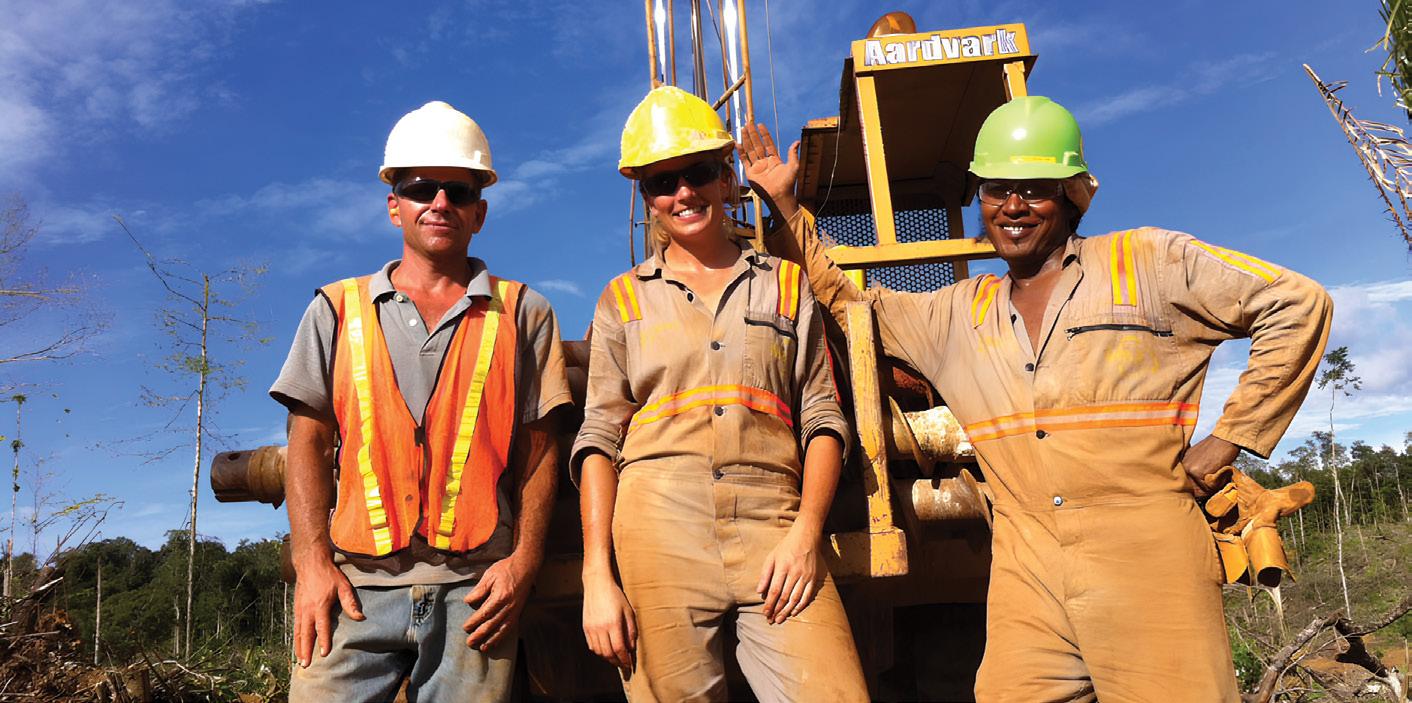
Members of the Ontario Ground Water Association play a vital role in communities across the province. From drilling and maintaining wells to working long hours in physically demanding conditions, groundwater professionals help ensure families, farms, and businesses have access to clean and reliable water. However, the very nature of this work – manual, outdoors, and physically intensive – also highlights the importance of protecting not just tools and equipment, but personal health and financial stability.
One often overlooked form of protection is critical illness insurance. While many people understand the need for life insurance or disability insurance, critical illness coverage serves a different and equally important purpose, especially for skilled tradespeople and independent contractors.
Critical illness insurance provides a lump-sum, tax-free payment if the insured is diagnosed with a covered serious illness, such as cancer, heart attack, or stroke. Unlike disability insurance, which replaces a portion of income over time, critical illness insurance pays out all at once, with no restrictions on how the money is used.
For groundwater professionals, this flexibility can be invaluable.
Many OGWA members are self-employed, work seasonally, or rely on their physical ability to earn a living. A critical illness does not just affect health – it can disrupt income, business operations, and family stability at the same time.
Below are three key reasons why critical illness insurance can be especially valuable for members of the Ontario Ground Water Association.
If a groundwater professional is diagnosed with a serious illness, work may stop immediately. Drilling rigs sit idle, contracts get delayed, and customer obligations still remain. Even if recovery is expected, the gap between diagnosis and return to work can be financially stressful.
A critical illness payout can be used to:
• Cover business overhead expenses such as
equipment payments, insurance, or yard rent
• Hire temporary help or subcontract work to keep jobs moving
Offset lost income without dipping into savings or taking on debt
Because the payout is not tied to proof of disability or ongoing treatment, the funds are available when they are most needed – right at the beginning.
Serious illnesses often require more than medical treatment. Time off, reduced workload, alternative therapies, travel for specialized care, or home modifications may all become necessary.
A critical illness benefit can be used to:
Allow time to recover properly without rushing back to physically demanding work
• Pay for non-covered treatments, rehabilitation, or private care options
• Reduce financial stress so recovery can be the primary focus
For workers whose jobs are physically intense, pushing to return too early can lead to long-term complications. Financial flexibility helps prevent that pressure.
Many OGWA members are primary income earners for their households. A sudden
IAN GAWEL
Life and Health Insurance Advisor/Mutual Fund Representative* Ian.gawel@dfsin.ca / 647-285-1390
health diagnosis affects not only the individual, but their spouse, children, and extended family as well.
Critical illness insurance can help:
• Cover mortgage or living expenses while income is disrupted
Maintain children’s routines, education, and household stability
Prevent reliance on family loans, credit cards, or selling assets
Unlike employer benefits that may be limited or unavailable to contractors, critical illness coverage is personal, portable, and designed to protect the family unit as a whole.
No one plans to get sick, and most people are healthiest during their peak working years. That is precisely why critical illness insurance is worth considering early – when premiums are lower and health is generally good.
For members of the Ontario Ground Water Association, this coverage is not about expecting the worst; it is about being prepared for the unexpected, the same way professionals prepare job sites before drilling begins.
Critical illness insurance does not replace hard work, skill, or resilience – but it can provide the financial breathing room needed when health takes priority.
In a profession built on planning below the surface, protecting what matters above ground is just as important.
VINCE VIVONA
Life and Health Insurance Advisor/Group Benefits Specialist vince.vivona@dfsin.ca / 416-571-6568
Properly treated water will assist with maintaining equipment efficiency and save on energy costs
Water quality is an important factor that affects the lifespan and performance of appliances, boilers, on-demand tankless heaters, electric, propane or natural gas heaters, hydronic HVAC systems or any other system in which water is used.
by JEFF WAHL
Understanding the potential impacts of hard water, corrosion, sediment buildup and other water quality factors allows you to take proactive steps to provide water quality that ensures the installed fixtures, piping and systems operate efficiently. This prevents frequent maintenance and adds value and cost savings.
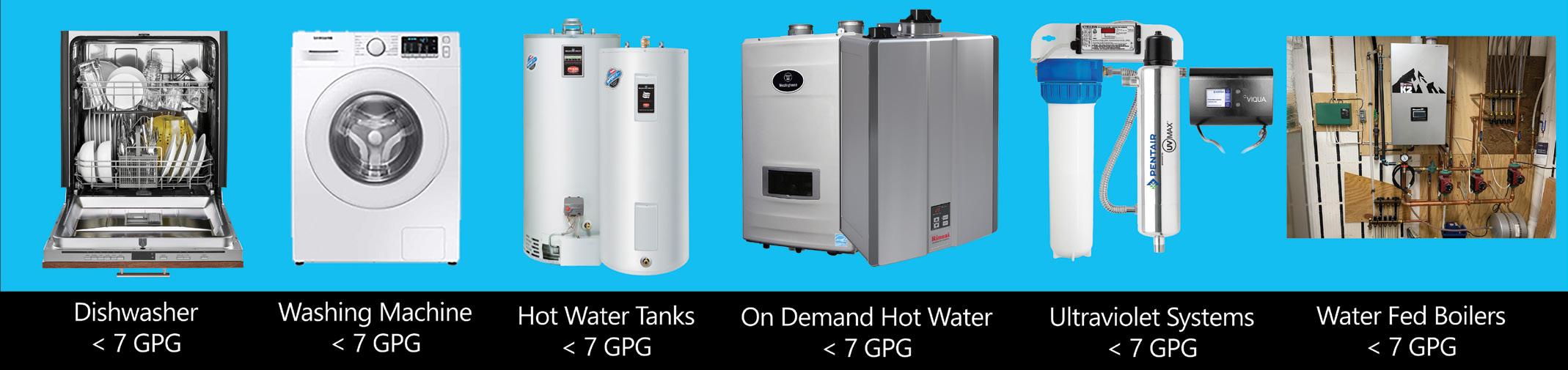
A water treatment system extends the life of a home’s or business’ plumbing piping, fixtures and water-using appliances (i.e.: hot water tanks, tankless water heaters, dishwashers, and washing machines). Properly treated water will assist with maintaining equipment efficiency and save on energy costs, which are negatively affected by water quality scaling or adhering which prevents flow and proper heating transference in systems.
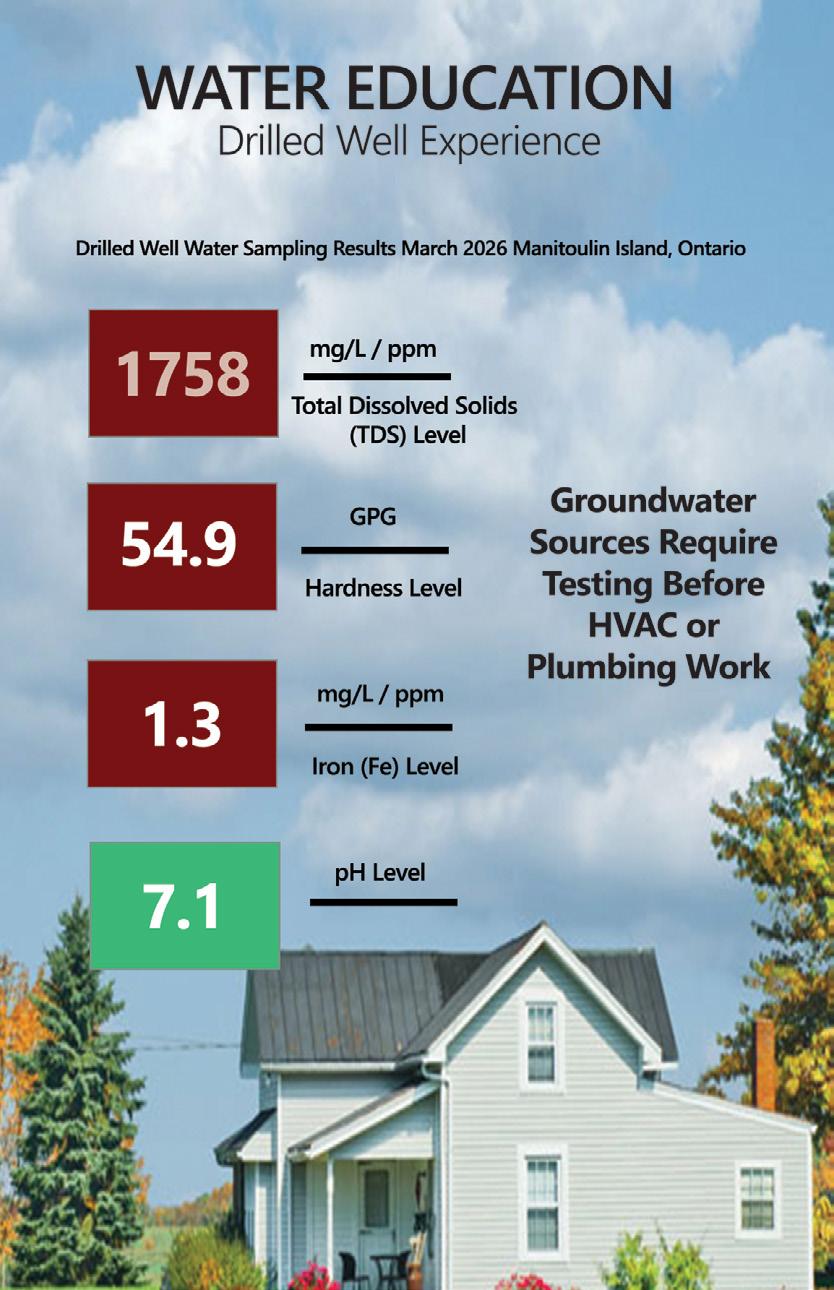
When considering water treatment equipment, testing groundwater for four common parameters is a good practice to identify potential issues such as scaling, discolouration, systems failures and costly maintenance calls for service. This practice is not commonly conducted and can have significant impacts in rural areas with no municipal water services.
Total dissolved solids (TDS) <500 mg/L / ppm
TDS refers to the amount of minerals, metals, organic material, and salts that are dissolved in a certain water volume expressed in mg/L or parts per million (ppm). TDS in water can come from many sources, including but not limited to, natural water springs, chemicals used during treatment of municipal water supplies, runoff from roads, industrial wastewater, agricultural fields, from plumbing distribution systems. This is usually calcium, magnesium, sodium, road salts, potassium, carbonate, bicarbonate, chloride, sulfate and nitrates. This can present an issue for consumers, as it is stated that “High TDS levels (above 500 mg/L) result in excessive scaling in water pipes, water heaters, boilers and household appliances”.1
Water hardness <120 mg/L / ppm or 7
Hardness is most commonly expressed as milligrams of calcium carbonate equivalent per litre (mg/L). Another common method of measuring water hardness is known as grains per gallon or GPG. Hard water is generally found in areas that are composed of limestone. Calcium and magnesium are absorbed into the water as it

•
•
•
•
•
•
comes in contact with the limestone. Over time, these minerals can accumulate and form a layer of scale inside appliances like dishwashers, washing machines, and water heaters. Scaling restricts water flow, reduces energy efficiency, and can result in breakdowns and repairs.
Most manufacturers specify hardness requirements for proper operation
indicate: “This includes minimizing the iron concentration entering the distribution system and distribution system maintenance (main cleaning). It is particularly important to maintain stable chemical and biological water quality conditions throughout the system and minimize physical and hydraulic disturbances that can release iron corrosion by-products.”2
pH is a measure of how acidic or basic the water is. It is expressed as a number from 0 to 14. Neutral water, which is neither acidic nor basic, has a pH of 7. As pH values decrease from 7 to 0, the acidity of the water increases similarly. pH values from 7 to 14 show increasing basicity. Acidic water will attack exposed metal surfaces, slowly dissolving the metal into the water. Constant exposure to corrosive water will noticeably shorten the life of household plumbing, eventually causing pinholes to appear in the pipes. Corrosion will occur at any place in the water system where water contacts metal.
Decreased
By creating a barrier at the bottom of your water heater’s tank, hard water and sediment will significantly decrease the efficiency of your water heater or heat exchanger. This is due to the fact that your unit will have to work harder and longer to keep your water warm. This leads to an increase in water heating bills and can also mean that water won’t be hot enough when required for use in homes and businesses.
The stress that poor water quality places on water heaters, appliances and piping takes its toll over time. Not only will you likely need to make more repair calls throughout their lifespan, but they will likely require replacement due to a failure in a quicker fashion.
Sediment (such as sand, silt, or rust particles) can impede valves, filters, and water lines. This effectively results in
restricted water flow and puts unnecessary strain on water-based appliances and equipment, leading to reduced efficiency and potential breakdowns.
The corrosive factor
Corrosive water can cause the deterioration of internal components, leading to leaks, malfunctioning valves, and premature failure of appliances. Over time the risk of flooding is greatly elevated due to the degradation of piping which often starts as “pinhole” leaks.
Scaling & water hardness
Calcification buildup in piping can result in reduced water flow at fixtures and adherence to water heater elements and heat exchangers. When cumulative over long periods of time, this can result in failure of the appliance or water device; replacement units are often having to be installed well before the manufacturer’s suggested life expectancies.
Microbiological contamination
Legionella is a type of bacteria that can cause a serious and potentially life-threatening form of pneumonia (commonly referred to as Legionnaires disease). Bacteria are found naturally in water and can grow and multiply in systems such as hot water tanks, cooling towers and large plumbing systems. When these systems are not properly maintained and disinfected, the bacteria can thrive and be spread through the air in the form of small droplets or mist.
Understanding the water source in an application is important to identify the potential risks adverse water quality may present. Some groundwater sources
contain excessive levels of hardness which contribute to scaling. Do not assume that because a water supply originates from any source that it does not contain hardness.
As an example, the region of KitchenerWaterloo has some of its water supplied from drilled wells with elevated hardness levels that vary throughout the region.3
Rural water sources without any regulation or jurisdiction have a greater likelihood of the presence of bacteriological, particulate or scaling elements. Water testing is an integral requirement, and rural water sources should always be sampled prior to the start of any installation or
plumbing work in buildings.
1. Guidelines for Canadian Drinking Water Quality: Guideline Technical Document – Total Dissolved Solids (TDS)
2. https://www.canada.ca/en/healthcanada/services/publications/healthyliving/guidelines-canadian-drinkingwater-quality-guideline-technicaldocument-iron.html)
3. https://watersoftenerfacts.ca/my-waterhardness/
Jeff Wahl is owner and water educator at Wahl Water in Mindemoya, Ont.
Fleming College’s resources technician drilling program has not only managed to survive cuts made within the Ontario college system but is seeing positive changes that bode well for the water well drilling industry’s future.
by MIKE JIGGENS
Jim Smith, program instructor at the Lindsaybased post-secondary institution, told the Ontario Ground Water Association (OGWA) at its annual convention in March that major cuts have been made over the years which have impacted every college in the province – including Fleming – but its drilling program has emerged largely unscathed.
Smith gave much of the credit to OGWA and the industry’s support of Fleming’s drilling program, including the awarding of scholarships and the provision of such assets as site equipment.
“These are things our board of directors sees and goes, ‘Not only is this program needed – it’s the only one in North America of its kind – but we have an industry here ready to support those students as they exit and get jobs.’”
He said the greatest asset the drilling program at Fleming has is that it is applied learning – “not just theoretical, not just lectures, but actually doing out in the field. We are one of the only institutions with a contractor’s licence and licensed technicians on site.”
Although the program has survived widespread cuts, it has been challenged by such hurdles as rising fuel costs, but the industry is largely helping to keep it alive, Smith said, along with an increase in government funding.
“We have jobs for students and they’re in high-demand areas – metals, minerals, skills, infrastructure.”
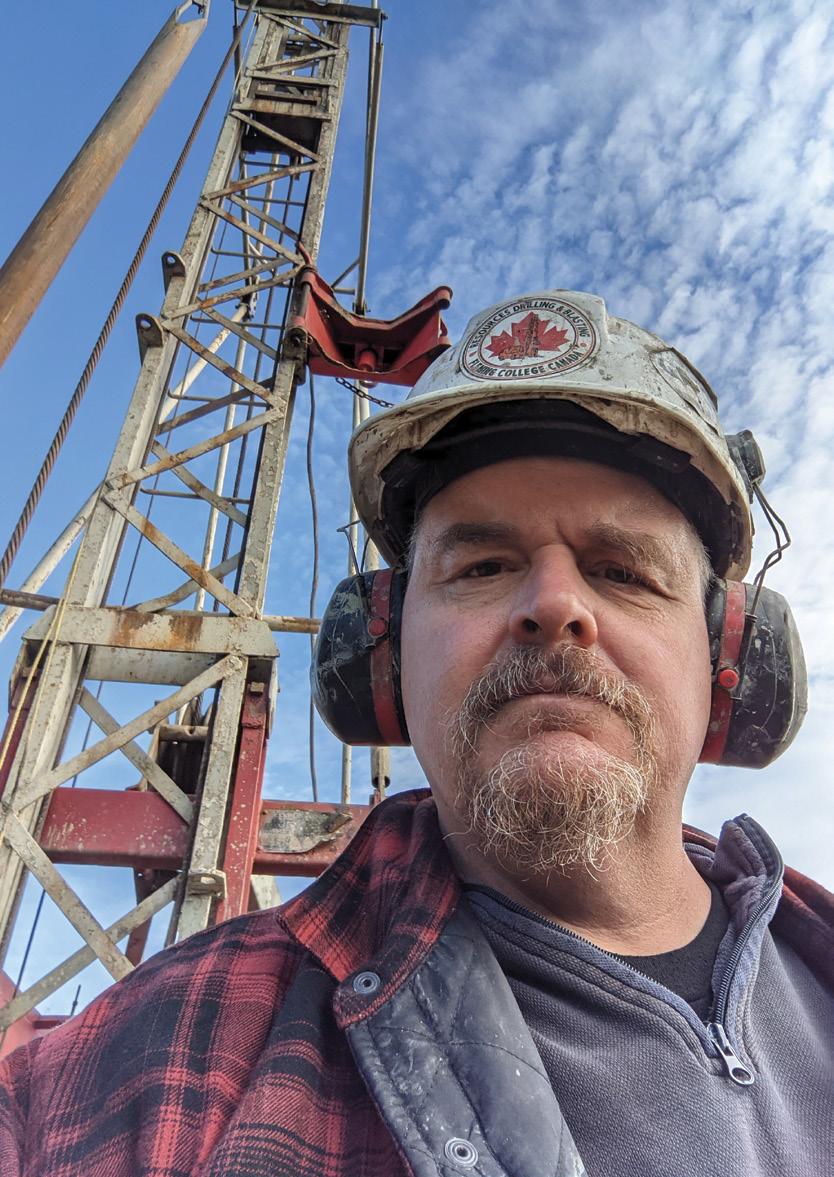
Students have been doing geotechnical environmental sampling as well as geothermal and foundation work.
“We are touching all the key infrastructure for metals, minerals, growth, growth, growth… and the government sees this and I think they’re saying, ‘These are key areas we need to support.’”
Smith attributed much of the crisis within the college system to the number of international students the Canadian government had allowed for program placements. The number of allotted spots has since been significantly reduced.
“The colleges suffered greatly because of that and thus the situation where we’re cutting hundreds and hundreds of programs.”
Drilling has secured a visa system which gives international students eligibility for a three-year work visa, which Smith said has been beneficial to the program.
“We can still have an international stream which helps our bottom line.”
Smith said several colleges don’t have such a system in place, but it was something Fleming fought to retrieve after it was initially lost. Fleming has several drilling students from all over the world who will be able to work in Canada for up to three years upon graduation.
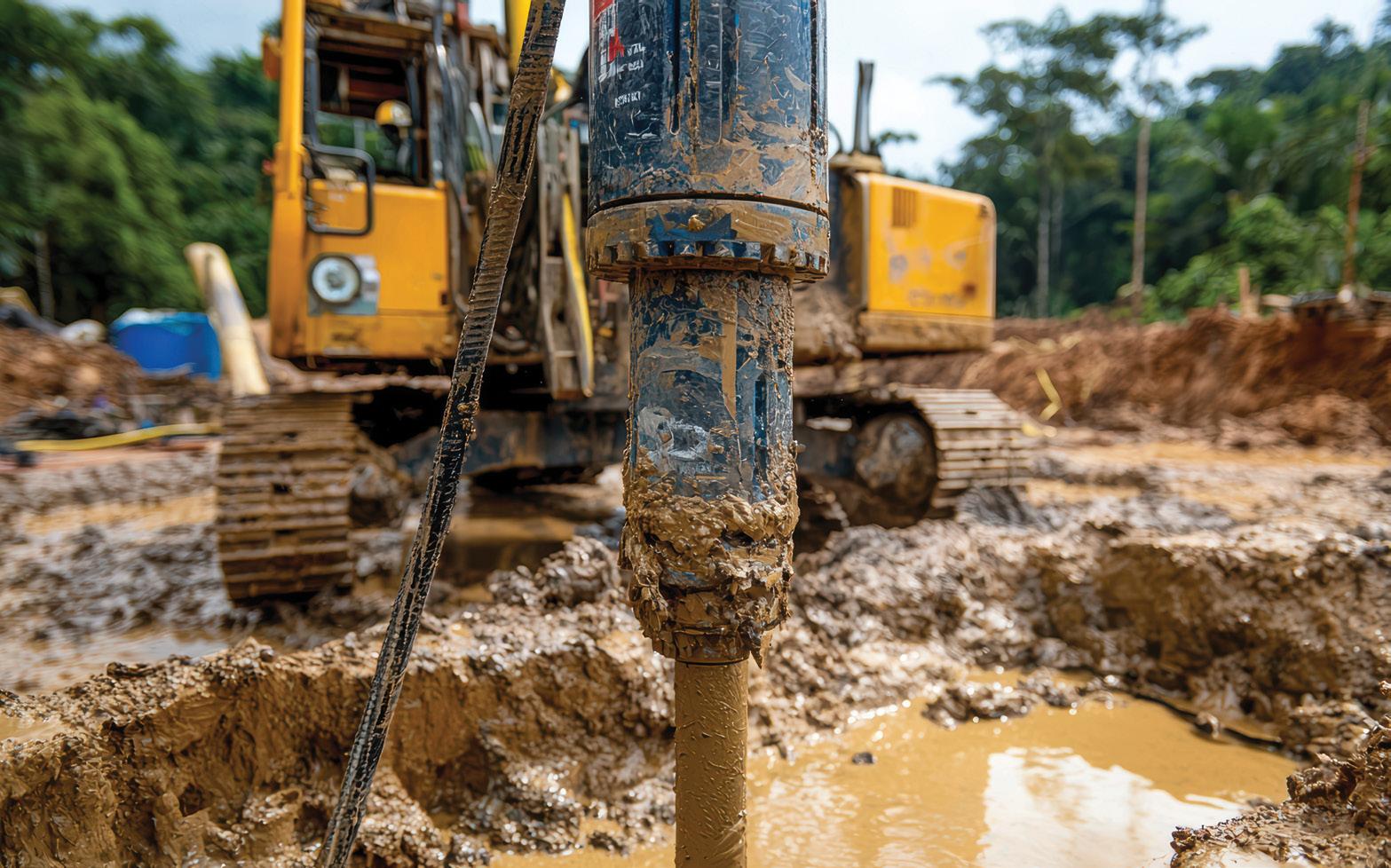
About 56 students are enrolled in the program’s current semester and most have already secured work, Smith said. Noting his personal passion is for water well drilling, he said he tells his students
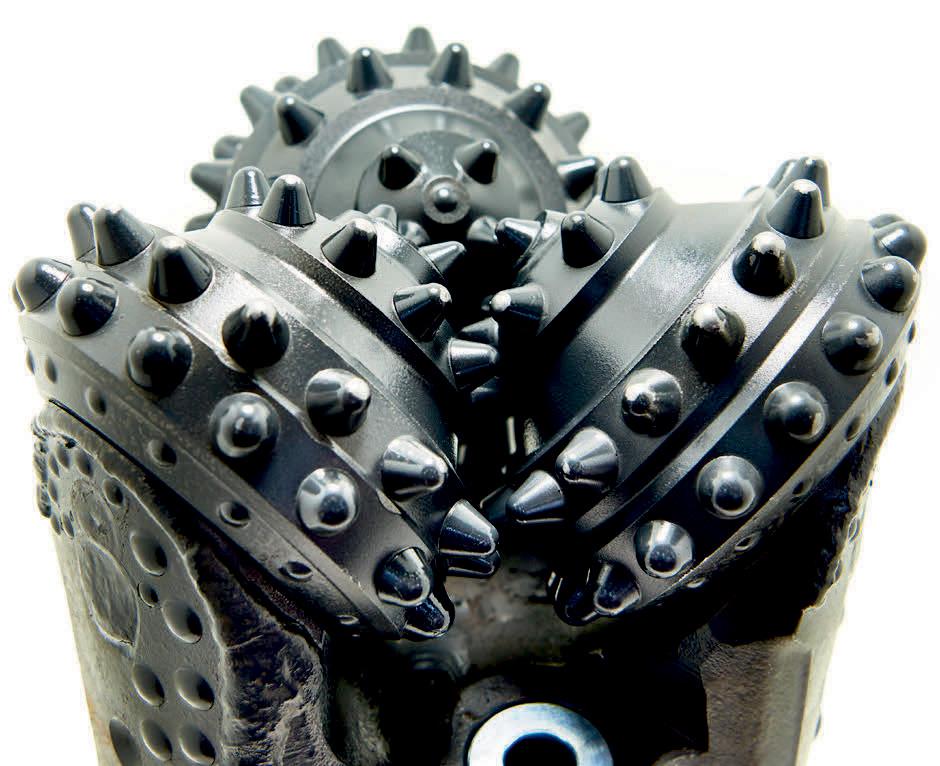
ABOVE: Jim Smith says high school students are intrigued by stories of well drilling opportunities in different parts of Canada.
that if they are interested in that field, there are people interested in them.
The college currently has about six international students in its drilling program, compared to about 15 a few years ago. An unfortunate aspect of the international program experienced in the past, when so many international students were enrolled, was that some were there to simply obtain their permanent residency and had little or no interest in drilling, Smith said. Several, however, have shown a passion for drilling.
“That’s changed drastically,” he said. “We have far fewer international numbers.”
Smith said he anticipates perhaps three to four international students next year, meaning there will be a need for more domestic students.
Fleming’s drilling program is the best one in the world that no one knows about, Smith said.
When sharing the program’s attributes during high school visits, he said students are intrigued by stories about drillers being flown by helicopter to remote areas of northern British Columbia or drilling
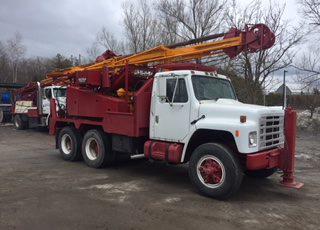
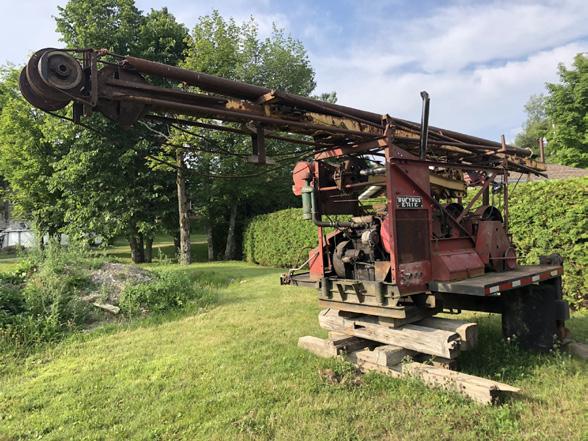

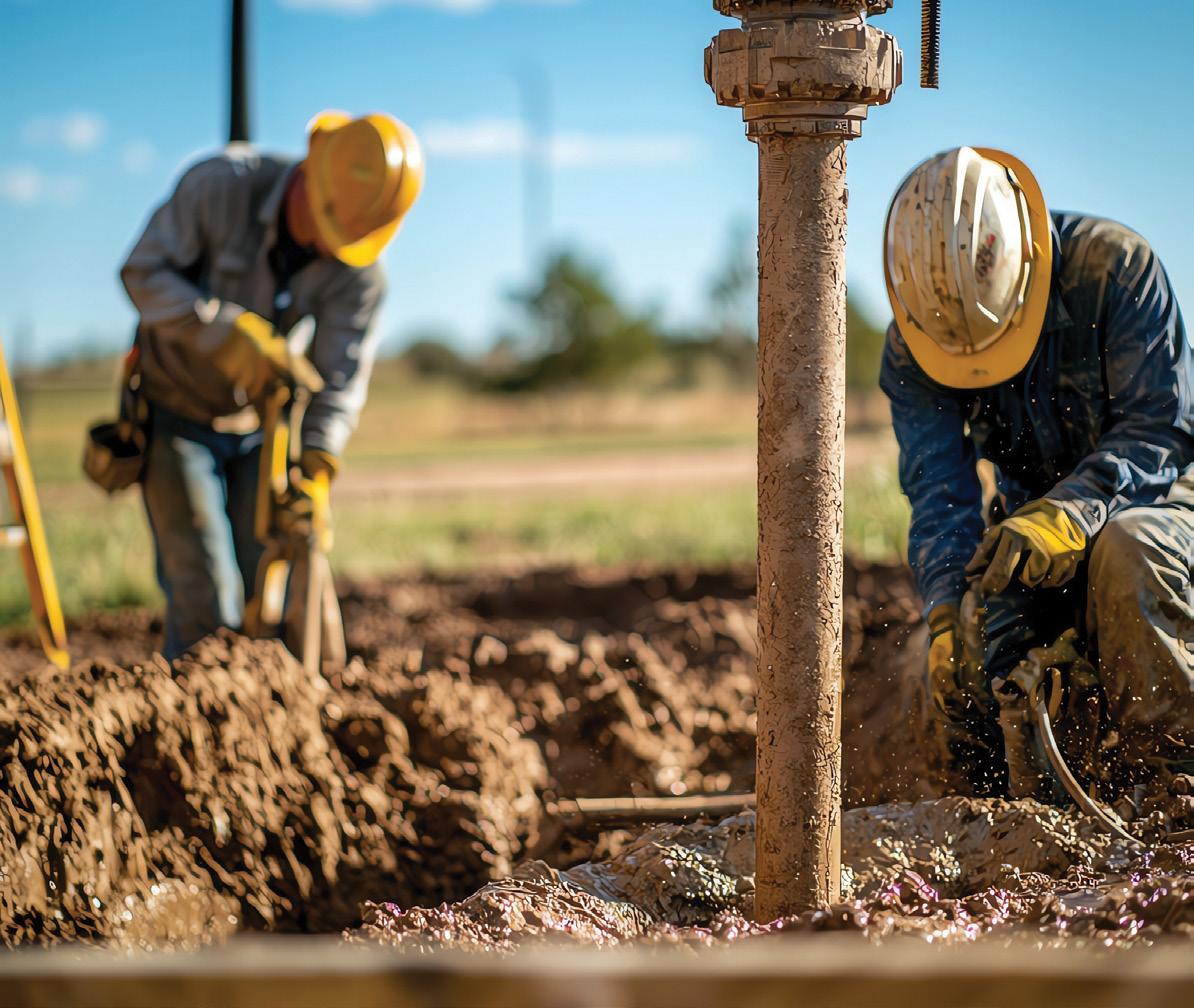
RIGHT: The ideal drilling student is one who enjoys working outdoors with his or her hands and isn’t afraid of working long hours.

water next to a lake in rural Ontario.
“This diverse industry could bring you anywhere you want,” he said, noting many high school students were never aware that drilling could be a potential career. “This is an incredible opportunity to have an amazing career. It can be lucrative, it can be rewarding, it can be fulfilling, long lasting… we just need to tell more people about it.”
About 20 students are expected for the summer semester and will merge with the new third semester group, to number at least 60 students in September.
“They are so versatile, and that’s what we’re teaching them.”
Those who hire students from Fleming’s drilling program are getting someone with a two-year foundation.
“Without programs like us, it’s all up to the industry.”
‘We have jobs for students and they’re in high-demand areas’
The ideal student candidate is one who enjoys the outdoors, likes to work with his hands and isn’t afraid to work long hours.
“If you have someone like that who’s looking for a skilled trade, this is a great way to look. I always push water wells because I love water wells.”
A driller, however, is good at a little bit of everything, Smith said, noting graduates could potentially become geologists, hydrologists, mechanics and customer service representatives.
Graduates are “invested in the industry” after two years, having spent time in class and in the field.
Smith’s message to his students is to chase the experience first.
“Do not chase the money right away.”
Drilling companies must stay competitive with other skilled trades, he stressed, adding that graduating students have the same desires as other skilled tradespersons, including the hope of one day owning their own home.
“If my wages can’t support that, they’re going to go somewhere else.”
Students want to be able to afford a car or a starter home, he said. “If you can’t pay them enough to even do that, we’ve got to really rethink what we’re doing.”
A lack of undergraduate programming sets a roadblock to a career path in groundwater management
My last article looked at the general state of new entrants into the groundwater trades in B.C., and some of the challenges related to training and recruitment.
by JAMES SPANKIE
Along that topic, a subject that came up during a speaker session at the BCGWA annual convention this year was the general absence of post-secondary education programs dedicated specifically to groundwater science.
That isn’t to say that education on groundwater isn’t present in undergrad engineering, geoscience, and geology programs, but there are no dedicated undergraduate programs available that have a clear path to a career in groundwater management.
There are options available at the graduate school level, but that doesn’t help develop the entry level employees for most organizations that need the help. I know that developing and implementing a new post-secondary program is a
hard row to sow, and takes an incredible amount of personal investment, support and time, so unless there are academics or practitioners that are willing to invest the time and effort to make it happen, a dedicated post-secondary groundwater science program is not likely to materialize anytime soon.
So, what can we do to attract current graduates who have other options?
The obvious answer is to provide a career path with clear and positive differentiation from the others. To start, that will mean some form of promotion to get the message to the people you want to hear about it. Advocacy in schools is a good start, but that will involve coordinated
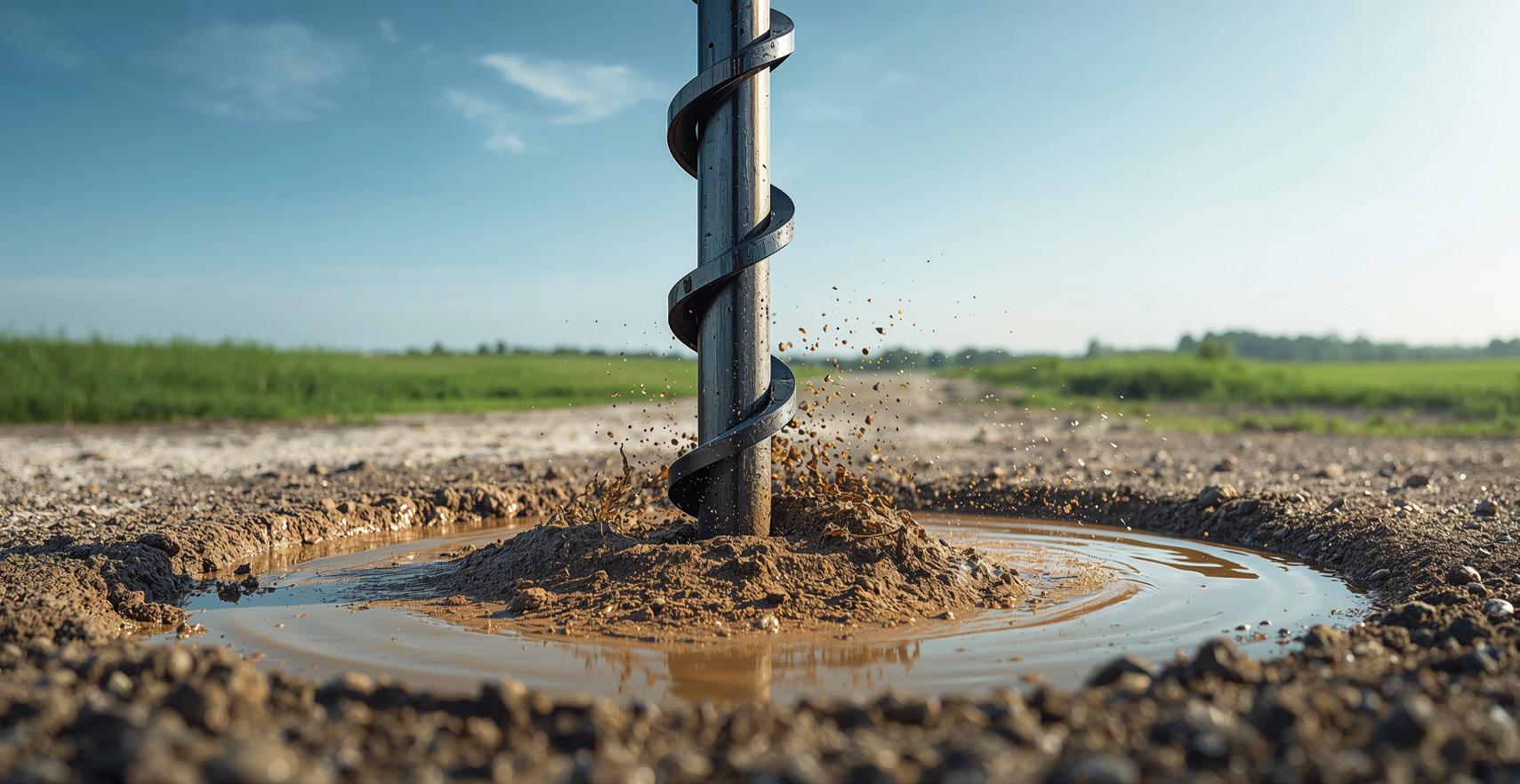
outreach – and that is, again, going to require some dedicated effort – posters in schools, information sessions, career nights, or even advertising career paths on social media.
But what will we communicate if we are able to reach the intended audience? Well, let’s focus in on some of the key points of differentiation that our industry can offer.
Starting with the most obvious point – if your work involves groundwater, “You Will Make a Difference.” If you are drilling wells or modelling aquifers to find safe water or monitoring and measuring contamination plumes – you are working to provide a resource to someone or to make it safer. It’s a career where you can have a major and positive impact on people’s lives.
The second one that springs to mind is “Variety.” It has been my experience that while there are similarities, no two jobs are ever the same. Field conditions change, the amount of available information changes, and the nature of the problem to be solved changes. All have unique conditions that provide a workplace offering constant challenges and variability.
There are certainly people who like to work in a predictable environment and there are other aspects of groundwater work, such as monitoring and modelling that can offer that as well, but the vast majority of people I know prefer to have some level of change in their work to keep them engaged and interested.
Hand in hand with variety is the “Challenge” associated with solving puzzles and problems. Why do adjacent wells have different properties? What is the right drilling method? How do I interpret the geology in the area with limited information? While it isn’t always a place of comfort, I find that being in a position where something is not proceeding “like it always does” or is offering some kind of logistical challenge, or a straight up
“unknown” problem, provides an especially grand feeling of satisfaction when it is overcome.
Offering a work environment that can provide someone with both a workplace obstacle, and then a subsequent feeling of satisfaction could be a significant draw for young people looking for variety in the workplace.
The last point is the least tangible, but incredibly important –the ability to develop a massive “Toolbox of Skills.” The ongoing personal and professional development that can occur as you add new skills to your list is significant. Constantly learning new things can provide an amazing amount of satisfaction –particularly when it is the result of facing a challenge that has stumped others.
So, please consider what you can do to get involved with spreading the message that we work in an incredibly rewarding industry. If you are an academic – what can you do to promote the development of industry specific programs? If you are a practitioner, are you interested in getting involved with engaging students and new graduates and what you can do to contribute to helping people choose some aspect of groundwater as a career path?
James Spankie is the former general manager of the British Columbia Ground Water Association.
Mutual Fund Representative*
647-285-1390
ian.gawel@dfsin.ca
vince.vivona@dfsin.ca
as your new member benefit partners, approved by Ontario Groundwater Association, for the following financial services:
• Group Benefits Plans Group Pension Plans
• Business Owner Financial Services
• Individual Employee Financial Services
WE LOOK FORWARD TO MEETING WITH YOU AND DISCUSSING EACH OF YOUR SPECIFIC NEEDS.

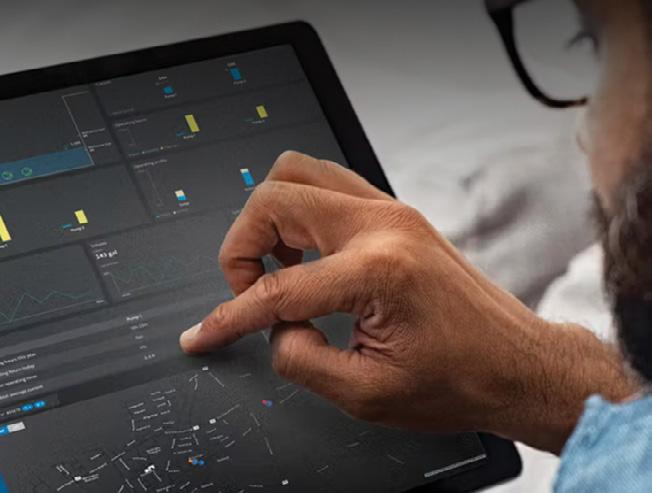
Grundfos, a producer of water pumps and water solutions, has announced the launch of its Grundfos Connect digital portfolio, a comprehensive suite of digital solutions designed to simplify operations, ensure reliable performance, and maximize return on investment for water utilities and irrigation operators worldwide.
Against a backdrop of aging infrastructure, increasingly unpredictable weather, regulatory pressure, and
workforce shortages, the municipal water sector is facing unprecedented challenges. According to Bluefield Research, nearly one in five gallons (19.5 per cent) of treated water in the United States is lost; costing $6.4 billion annually. The launch of the Grundfos Connect digital portfolio responds directly to utilities’ growing need to do more with less, while maintaining compliance, resilience, and service quality.
The portfolio includes Grundfos Connect Asset Monitor, Grundfos Connect Network Analytics, Grundfos Connect Demand Distribution, and Grundfos Connect Sewer Insights. On their own, each solution provides intelligence but together provide unparalleled visibility and control of a customer’s networks and pumps, enabling data-driven optimization from day one.
Grundfos Connect Asset Monitor is simple and cost-
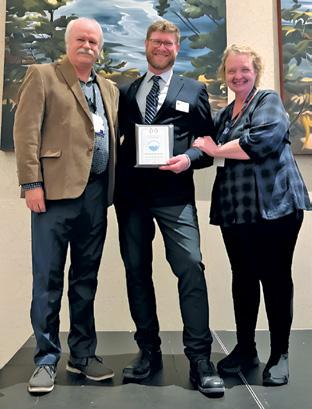
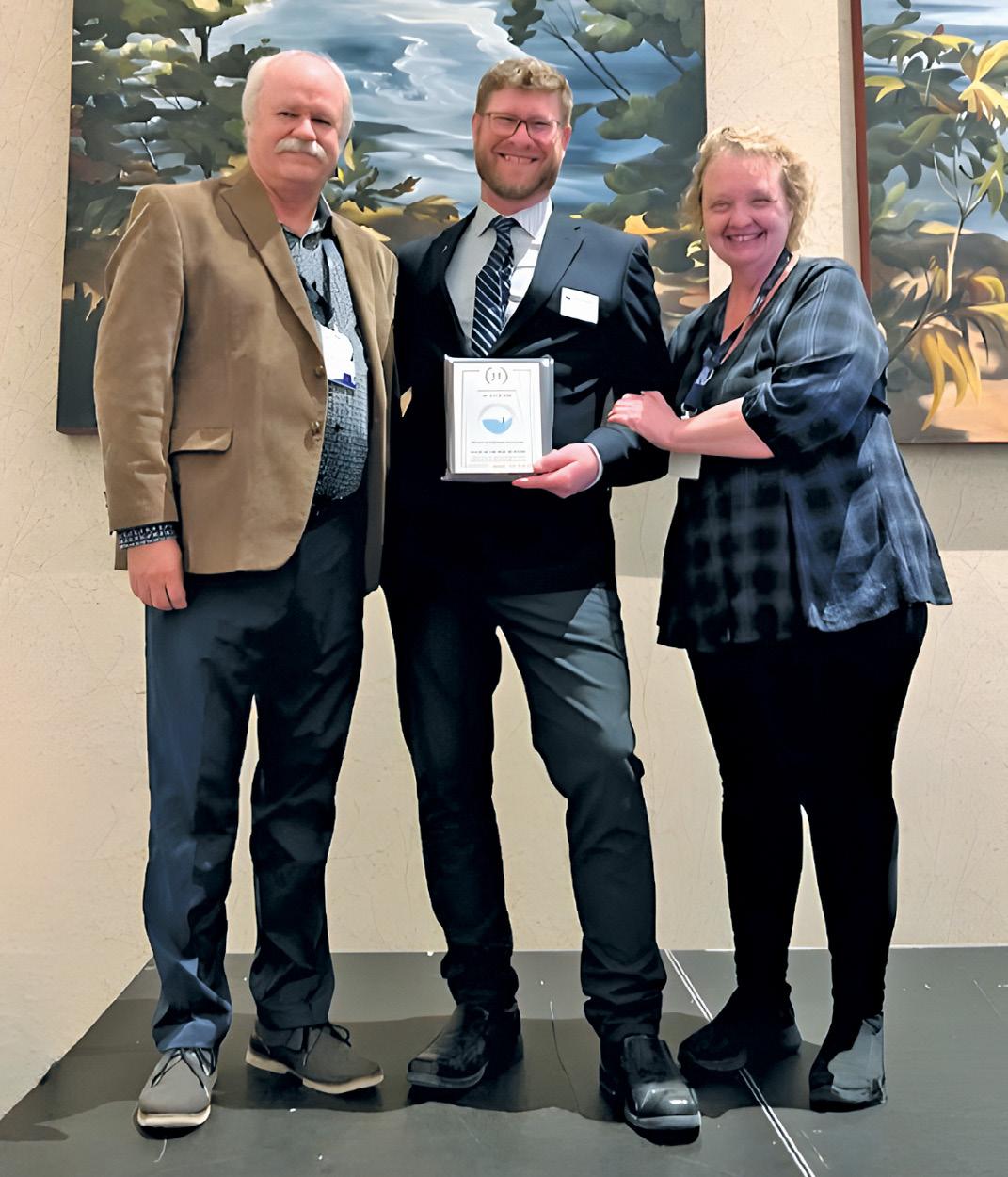
Ground Water Canada was recently honoured by the Ontario Ground Water Association at its annual convention in Huntsville for its 25-year association with OGWA.
Pictured with OGWA president Kyle Smith are Ground Water Canada editor Mike Jiggens, left, and advertising manager Sharon Kauk. “This milestone reflects not just the passage of time, but your longstanding support of the OGWA, your belief in our mission and your enduring commitment to Ontario’s groundwater industry,” read a statement from OGWA.
effective, allowing customers to remotely monitor and control their equipment via an online platform. The system is ideal for monitoring a wide range of water assets from boosters to sanitary lift station pumps and is easily integrated regardless of the brand of equipment being operated.
Grundfos Connect Network Analytics turns the huge volumes of untapped data into actionable insights that help anticipate issues, optimize energy use and extend asset life. A combination of digital twins and real-time sensor data and analytics can help minimize risk, waste and failures with proactive insights.
Grundfos Connect Demand Distribution helps utilities to achieve a more cost-efficient water distribution system by using real-time data to adapt pump performance to actual system needs, maximizing efficiency, preventing pipe bursts and reducing non-
revenue water.
Grundfos Connect Sewer Insights is a remote wastewater open-channel flow monitoring solution that uses smart sensors, predictive analytics, and realtime data to help utilities proactively manage wastewater networks and reduce overflow events.
The digital solutions hold the industry’s strongest cybersecurity certifications, providing robust protection for cloud-based operations. By leveraging its certified digital solutions, utilities can confidently embrace cloud technologies without compromising security. Grundfos Connect solutions; Asset Monitor, Demand Distribution, Sewer Insights and Network Analytics, are all developed to high standards of cybersecurity and resilience, keeping data and operations protected.
grundfos.com/ca
CONTINUED FROM PAGE 10

acetate contains zero chlorides. This means it will not raise the salinity level of surface and groundwater, nor hurt the aquatic ecosystem that it flows into. Furthermore, sodium acetate is an exothermic chemical, meaning it physically releases heat as it dissolves. As a result, sodium acetate melts ice and snow faster than rock salt. Its only downside is cost. Sodium acetate is much more expensive than rock salt for cashstrapped municipalities.
There’s one other way to reduce salt usage. This is achieved by giving limited liability protection to parking lot operators and other commercial property owners. They tend to overuse salt to avoid lawsuits related to people falling on their properties.
To teach these people to use salt properly, the State of New Hampshire has created the Green SnowPro Certification Program. It gives commercial salt applicators the knowledge they need to reduce salt use while prioritizing public safety. The Green SnowPro program also provides contractors with a degree of legal protection for following its rules. According to the NEIWPCC (New England Interstate Water Pollution Control Commission website, neiwpcc.org), “A significant – and unique – factor in the program’s success was the inclusion of limited liability insurance against damages arising from snow and ice conditions. Notably, the limited liability protection is not just for the commercial salt applicators certified by the Green SnowPro program but extends protection to the property owners or managers who hire them as well, so long as best management practices are being followed.”
“There’s hope in Ontario that if there were something like that instituted here, that we’d be able to reduce the salt use in parking lots and other private impervious surfaces,” Wellen says. “Currently, there isn’t that minimum standard of due diligence, so people apply a lot of salt just because they’re afraid of lawsuits.”
As far as he is concerned, there is still time to slow Lake Simcoe’s rising salinity level by reducing the use of conventional road salt in this watershed.
“I think there is a real opportunity to figure out what constitutes a healthy salt diet for Lake Simcoe and the watershed,” Wellen notes. “At the very least, there’s an opportunity to lower salt usage on parking lots and commercial properties by following New Hampshire’s lead. I think that’s probably the low hanging fruit to look at.”



by By Ground Water Canada staff
Now that the outdoor season is well underway, water well drillers and pump installers are being cautioned about the power of the sun and the potential damage it can do to exposed skin.
The Canadian Dermatology Association (CDA) recently launched its annual Sun Awareness Month campaign with a renewed focus on the growing trend of tanning behaviours, misinformation, and rising skin cancer risk among younger Canadians.
For more than 30 years, the CDA has led national efforts each year to promote sun safety. This year’s campaign evolves to meet Gen Z where they are, addressing tanning culture, the influence of social media, and the disconnect between skincare habits and sun protection. New national survey data, conducted by Ipsos on behalf of the CDA, explores Gen Z attitudes toward tanning, sun protection, and UV risk.
Key findings include:
• Tanning remains widespread among Gen Z: 39 per cent report intentionally tanning in the past year, with most doing so outdoors (72 per cent).
• Peer influence is strong: 68 per cent of Gen Z say intentional tanning is common among their peers, rising to 87 per cent among those who tan themselves.
• Appearance drives behaviour: Among tanners, 45 per cent say it makes them feel more confident, and 37 per cent say they look better in photos.
• Awareness does not equal behaviour change: While 79 per cent are concerned about skin cancer and 63 per cent know tanning is a risk, 39 per cent still report intentionally tanning.
• Skincare habits do not translate to sun protection: While 81 per cent of Gen Z follow a skincare routine, only 22 per cent use sunscreen year-round.
“Despite a high awareness of the risks, many young Canadians are still intentionally tanning,” said Dr. Julia Carroll, vice-chair of the CDA Sun Awareness
Working Group. “Nearly four in 10 Gen Z report tanning, even though most know it increases their risk of skin cancer. What we’re seeing is a clear disconnect; appearance and confidence are often outweighing health concerns, which is deeply concerning from a prevention standpoint.”
Despite widespread awareness of the risks, tanning continues to appeal to many young Canadians, often driven by appearance-related motivations and reinforced through social media. To challenge these perceptions, the campaign features a series of Gen Z reaction videos where participants viewed exaggerated scenarios of people deliberately “burning” their skin (e.g., putting their hands in a toaster or laying their face on a hot waffle iron). The contrast is intentional: highlighting the harm and prompting a key question; if we recognize these behaviours as unsafe, why do we accept intentional UV exposure through tanning beds or prolonged sun exposure? Participants then shared their immediate reactions and attitudes toward tanning, offering insight into whether the content shifts their thinking. The campaign also includes a real-life story that brings the risks into sharper focus, featuring a young Canadian diagnosed with melanoma at just 19 years old serving as a reminder that skin cancer can affect anyone, regardless of age.
“Intentional tanning is becoming normalized among young Canadians, with more than twothirds of Gen Z saying it’s common among their peers,” said Dr. Sunil Kalia, chair of the CDA Sun Awareness Working Group and associate professor at the department of dermatology and skin science, University of British Columbia. “That kind of social influence can make risky behaviours feel harmless, but the reality is that UV exposure significantly increases the risk of skin cancer. We need to shift the perception so that protecting your skin becomes the norm, not the exception.”
Sun Awareness Month serves as a reminder that skin cancer is preventable.